TopPodcast.com
Menu
  • Home
  • Top Charts
  • Top Networks
  • Top Apps
  • Top Independents
  • Top Podfluencers
  • Top Picks
    • Top Business Podcasts
    • Top True Crime Podcasts
    • Top Finance Podcasts
    • Top Comedy Podcasts
    • Top Music Podcasts
    • Top Womens Podcasts
    • Top Kids Podcasts
    • Top Sports Podcasts
    • Top News Podcasts
    • Top Tech Podcasts
    • Top Crypto Podcasts
    • Top Entrepreneurial Podcasts
    • Top Fantasy Sports Podcasts
    • Top Political Podcasts
    • Top Science Podcasts
    • Top Self Help Podcasts
    • Top Sports Betting Podcasts
    • Top Stocks Podcasts
  • Podcast News
  • About Us
  • Podcast Advertising
  • Contact
Not in our directory?
Add Show Here
Podcast Equipment
Center

toppodcastlogoOur TOPPODCAST Picks

  • Comedy
  • Crypto
  • Sports
  • News
  • Politics
  • True Crime
  • Business
  • Finance

Follow Us

toppodcastlogoStay Connected

    View Top 200 Chart
    Back to Rankings Page
    Alternative Health

    It’s Beyond The Food: Non-Diet Health Coaching

    It’s Beyond The Food: The Non-Diet Podcast takes nutrition and health beyond diet culture into the psychology of eating and behavior change, health mindset, body image and weight-neutral health.

    Hosted by Stephanie Dodier, Non-Diet Nutritionist, Certified Intuitive Eating Counselor and Cognitive Behavior Coach, each episode teaches evidence-based coaching tools to change health behaviors in a way that will expand freedom, power and well-being.

    This podcast is an essential resource for any women, health coaches, nutritionist, dietitian, fitness and health professionals wanting to embrace a non-diet approach to health and nutrition.

    Broadcasting since 2016 with over 1.4M downloads.

    Stephanie Dodier is the founder of the Non-Diet Coaching Certification. Learn more at www.stephaniedodier.com

    Advertise
    • Apple Podcasts
    • Google Play
    • Spotify

    Latest Episodes:
    220-Cycles of Binge Eating and Restricting: How to End It? Dec 26, 2019
    Show notes

    220-Cycles of binge eating and restricting_ How to end it_-Stephanie Dodier

    In today's episode, we'll talk about binge eating and restricting.

    Whenever somebody brings up the topic of how to stop binge eating, I vividly remember the day I caught myself binge eating. This story happens at the peak of my most restrictive dieting period.

    It was a Friday, at 4 o’clock in the afternoon. My plans with my partner just fell through; he decided to accept an invitation from his buddies to watch a game. I was left alone with no plans on a Friday night.

    I thought I’d just stop by the grocery on my way home, put on my PJ’s, and watch some movies. At the grocery store, I automatically gravitated towards the food I was restricting myself at the time: Carbohydrate, Dairy and sugar (hint, hint Keto!)

    I grabbed a frozen family-size pizza, some fresh mozzarella, a bag of mini brownies, and a pint of Dulce Haagen Dazs ice cream. Food was going to be my companion as I hit the couch for a romantic movie night.

    By the time the first movie was over, I was sitting there on my couch with an empty box of pizza, a half-empty bag of brownies, and an ice cream pint just about done…I wondered what just happened.

    I suddenly felt the sting of self-loathing. Soon, I was beating myself up, calling myself names that I wouldn’t call my worst enemy. As I bullied myself, I quickly cleaned up and made all evidence disappear out of fear of anyone knowing.

    I have been very hesitant about sharing this story with you...

    But I want you to know that you are not alone. There is nothing wrong with you and you aren’t broken. There is a reason why you do this. Until you find it and work on healing it, binge eating will not go away.

    What is Binge Eating?

    Psychologists define binge eating as eating more food than most people would in a specific amount of time under similar circumstances. It is characterized by a sense of lack of control and is associated with negative emotions. Binge eaters have difficulty regulating their emotions and use food to cope with them.

    At the time, I knew that what I was doing was called binge eating or overeating, but I had no idea why I was doing it. I just thought something was wrong with me, so I kept it a secret. Afraid that others might judge me, I hid my shame and guilt behind a façade of strength. Then I punished myself by restricting food the next day.

    I now know that I eat to numb the emotions I didn’t want to feel and because of the food restriction, I was imposing myself.

    In today’s episode, we will explore how to stop the cycle of binge eating and restricting.

    What you'll learn listening to this episode:

    • The spectrum of eating behavior
    • Disordered eating versus eating disorder
    • Overeating versus binge eating
    • How to end the cycle of binge eating and restriction
    • Diet Culture mindset in healing relationship to food
    • Support to help you in your journey


    Mentioned on the show:

    Going Beyond the Food Academy

    Self- Assesment relationship to food

    Grab your FREE guide to Intuitive Eating

    Intuitive Eating Blog

    Canadian National Eating Disorder Information Center

    Canadian National Eating Disorder Information Center Hotline: 1-866-633-4220

    US National Eating Disorders

    US National Eating Disorders Toll-Free Number: 1-800-931-2237


    219-Coming to Terms with Our Body Now - The Weight Loss Series Part 5 Final Dec 19, 2019
    Show notes

    coming to terms with our body

    In today's episode, we'll talk about coming to terms with our body... now

    Coming to terms with my body now was one of the hardest emotional events of my short life.

    I had to grieve my fantasy body... the body that was going to bring me everything I didn’t have now.

    Moreover, I had to grieve the thin ideal that diet culture had pushed into my core beliefs and that I was dreaming about since the age of 12.

    I had to learn to be in my body now... not the one I thought I should have but that one I have now.

    Body Fantasy

    We are indoctrinated very young to the thin ideal. I can remember, as young as 6 years, me playing with barbies and thinking about how I would look like her when I would be older. How I would dress my thin waist and be the admiration of everyone.

    As we grew in my teens, I became obsessed with chasing this thin body. You see at 12 years old, I dieted for the first time. People told me to lose weight if I wanted to be beautiful.

    As has my brain developed even more, I acquired in my core beliefs this notion that if I’m not thin I’m not worthy. That’s how I lived my life for the next 25 years truly believing that unless I was thin, I was not going to live the life I wanted.

    Grieving the thin ideal

    And then after 25 years of working really really hard at chasing the thin ideal so I could have the life of my dreams... I had to give up.

    It didn’t work and would never work.

    That experience of coming to terms with my body was hard. I got stuck a few times and I cried a lot. Grieving our thinner bodies is like grieving the loss of someone close to us.

    That’s what we will discuss in this episode of the podcast. How we have to experience the full grief cycle to be able to accept our body now. How to best navigate this phase of our healing and what does it look like.

    What you'll learn listening to this episode:

    • What is the body fantasy
    • Why the grief cycle is the same no matter what we lose
    • The 7 stages of grief
    • How to navigate each stage

    Mentioned on the show:

    Take the pledge to UNDIET2020

    Check out these podcast episodes:

    • 212 - Weight Loss Series Part 1
    • 214 - Weight Loss Series Part 2
    • 216 - Weight Loss Series Part 3
    • 218 - Weight Loss Series Part 4
    • 155 - 6 Stages of Transformation

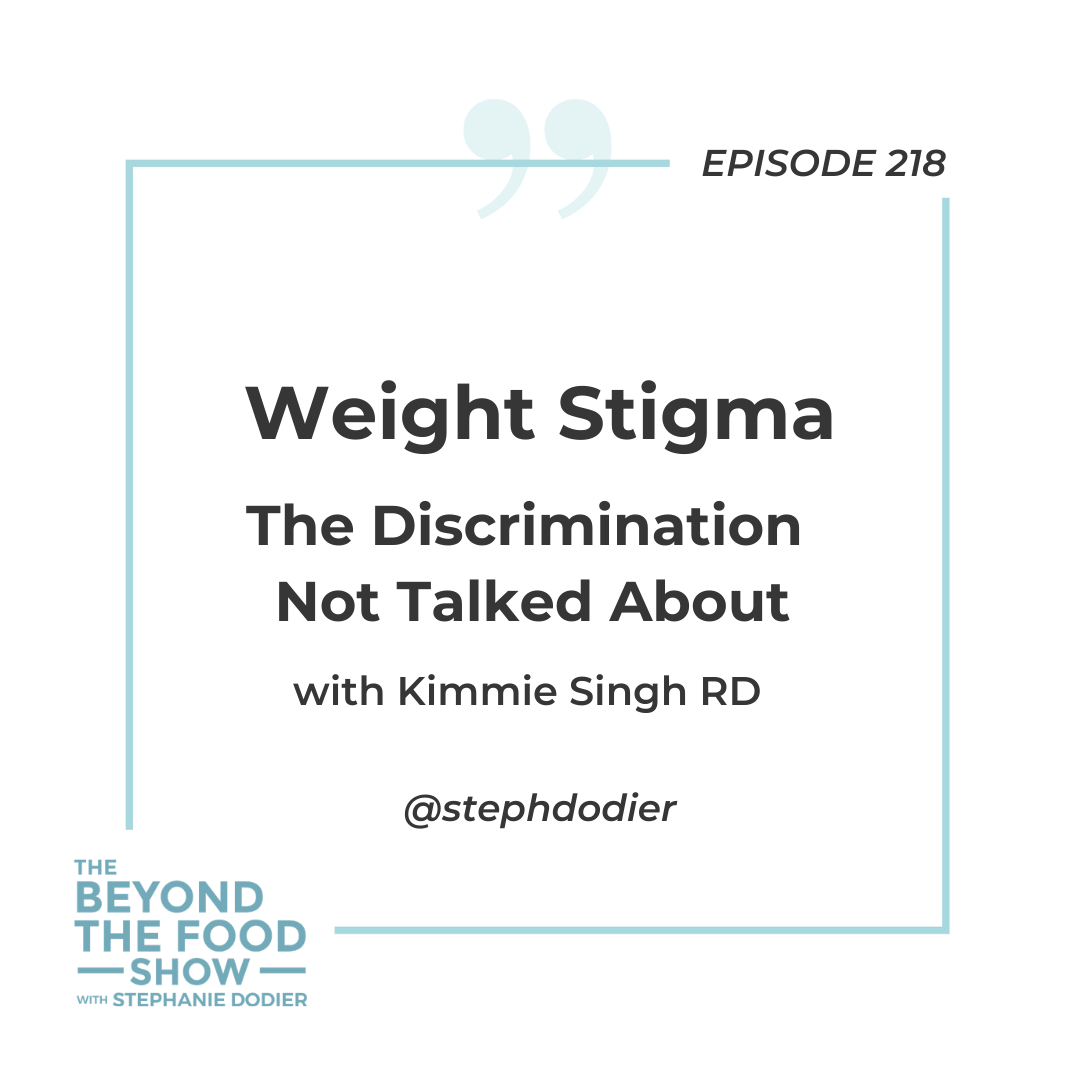
    218-Weight Stigma: The Discrimination Not Talked About with Kimmie Singh RD - The Weight Loss Series Part 4 Dec 12, 2019
    Show notes

    weight discriminationIn today's episode, we'll talk about how to get unstuck

    It’s illegal to discriminate based on sex and absolutely unacceptable in society.

    It’s also illegal to discriminate based on race and absolutely unacceptable in society.

    Now, it’s illegal even to discriminate based on sexual orientation and becoming rapidly unacceptable in society.

    But...it’s legal to discriminate based on body weight and completely acceptable in society.

    Whatttt? Yup.

    Weight Discrimination

    Not only is weight discrimination legal, but the diet culture absolutely encourages it as well. Marketing campaigns use the think “before and after” weight loss picture to sell the latest diet.

    “This picture will inspire you to achieve your goals and see what’s possible for you!”? What do you think would happen if a “before and after” skin whitening procedure picture was posted with this caption? First, get beyond the fact that it’s illegal and it would be the end of the company using that marketing technique.

    Yet every day, ad agencies and weight loss companies encourage the use of pictures of women in their “before and after” bathing suit and it’s ok. That is to say, shaming people for their body weight is acceptable.

    The Dangers of Weight Discrimination

    That’s weight stigma, a.k.a. weight bias or weight discrimination. In fact, weight stigma is a known danger to one’s health and a studied risk factor for adverse psychological and behavioral issues. That includes depression, poor body image, and binge eating.

    “Weight stigma poses a significant threat to psychological and physical health. It has been documented as a significant risk factor for depression, body dissatisfaction, and low self-esteem. Those who experience weight-based stigmatization also:

    • Engage in more frequent binge eating
    • Are at an increased risk for eating disorder symptoms
    • Are more likely to have a diagnosis for binge eating disorder (BED)

    Victims of weight stigma report physicians and family members are the most common source of weight bias. Among family members, weight-based teasing and diet talk are linked to binge eating, weight gain, and extreme weight control behaviors. Weight bias in health care is another important concern.

    Research shows that healthcare providers, when talking to obese patients, tend to:

    • Provide them with less health information
    • Spend less time with them
    • View them as undisciplined, annoying, and noncompliant with treatment.”- Extract from the National Eating Disorder Association website

    For this very important episode, I sought the help of an expert in weight stigma Kimmie Singh RD. Kimmie is a fat Registered Dietitian expert in weight stigma based in New York City. Kimmie presents and consults on weight stigma in dietetics. Her Health at Every Size private practice supports clients with eating disorders and disordered eating heals their relationships with food and body.

    What you'll learn listening to this episode:

    • What is weight stigma?
    • Weight bias & obesity bias
    • Internalize vs external weight stigma
    • The history of weight stigma and fat acceptance
    • Weight and stress relationship
    • How to cope with weight stigma
    • How to reduce weight stigma

    Mentioned on the show:

    Take the pledge to UNDIET2020

    Check out these podcast episodes:

    • 212 - Weight Loss Series Part 1
    • 214 - Weight Loss Series Part 2
    • 216 - Weight Loss Series Part 3

    Research

    Weight Bias: A call to action

    Connect with our guest

    Website

    Instagram


    217-5 Steps to Get Unstuck with Shawn Mynar Dec 05, 2019
    Show notes

    unstuck

    In today's episode, we'll talk about how to get unstuck

    Do you feel stuck? You desperately want to change an aspect of your life but you just can’t get yourself to take the leap.

    Is the solution to get unstuck and move towards your goal simply to be harder on yourself? I know I think about that before. If only I could be tougher and have more discipline, I could reach my goals.

    For that reason, I fantasized on that day when it would finally click... and I would get unstuck. Am I alone?

    Our guest on today’s episode of the podcast says the solution is within our mind. That is to say, if we change our minds, our life will follow.

    Her solution: Ditch your negative mindset, squash those limiting beliefs, and quiet the constant chatter in your head so you can finally live the life you desire, spark the change you want to see and feel better than you ever dreamed possible.

    That sounds familiar, right? In fact, it’s so in line with the Going Beyond The Food method and there’s a good reason for that. My guest today is one of my dear close friends, Shawn Mynar.

    Shawn Mynar is a holistic nutritionist and mindset coach. She’s on a mission to help women adopt a positive mindset as medicine on the path to total wellness.

    What you'll learn listening to this episode:

    • Why Shawn closed her successful business voluntarily
    • Why are we afraid as women to do mindset work
    • The concept hard and how it’s all relative
    • Why mindset work isn’t eliminating negative thoughts
    • 5 unique steps to get unstuck

    Mentioned on the show:

    Grab your FREE guide to Intuitive Eating

    Take the pledge to UNDIET2020

    Unstuck Podcast

    Take Vibe Quiz

    Energy Scale

    Music Apps mentioned

    Connect with our guest

    Website

    Facebook

    Instagram

    Podcast


    216-Everything the BMI Gets Wrong with Alissa Rumsey RD - The Weight Loss Series Part 3 Nov 28, 2019
    Show notes

    Everything-the-BMI-gets-wrong-Stephanie Dodier

    In today's episode, we'll talk about everything the BMI gets wrong

    Are you "overweight"? Am I "overweight"?

    That single question creates more anxiety & stress to women than any other question. Being overweight implies that there’s a weight we should be at. In today's society, THAT weight is determined by BMI.

    The Body Mass Index, the metric that uses to classify people in groups. Moreover, it’s the measure of "obesity" as per medical view and a simple calculation of 2 factors: weight and height. To convert the measurement to the unit of BMI in kg/m2, you must divide the weight in pounds by the height in inches squared, then multiply by 703.

    My BMI Story

    For the purpose of this article, I did my BMI calculation using the official CDC BMI calculator. If you are between 18-24.9 you are deemed normal, 25-29.9 "overweight" and 30 or above "overweight". I bet you’re curious to know my result? 39. I’m considered a class 2 "obese".

    As a matter of fact, for the longest, I can remember I was never not considered “overweight” based on BMI. During one of my many diet cycles in my adulthood, I remember hitting one of my lowest body weights, 180 lbs., body fat of 18% and wore size 8 p but when I calculated my BMI: "overweight".

    I remember the day I did the calculation and seeing the result. It sent me down a spiral of shame and binging. I still wasn’t enough.

    Not only was I healthy as ever but also had just received a full annual health check and no longer was considered pre-diabetic. My cholesterol was well below normal, my blood pressure was stellar, my inflammation blood markers were the lowest they could be... and overweight.

    Is BMI an accurate measure of health?

    What happens if you are over-the BMI weight prescribe? Is BMI ratio an accurate measure of health?

    Many experts disagree that just stating the fact that BMI ratio was never created with the intention of measure of health.

    Recently, a 2016 study by researchers at UCLA published this month in the International Journal of Obesity looked at 40,420 adults in the most recent U.S. National Health and Nutrition Examination Survey and assessed their health as measured by six accepted metrics (not including BMI) blood pressure, triglyceride, cholesterol, glucose, insulin resistance and C-reactive protein.

    It found out that 47 percent of people classified as "overweight" by BMI and 29 percent of those who qualified as obese were healthy as measured by at least five of those other metrics.

    Meanwhile, 31 percent of normal-weight people were unhealthy by two or more of the same measures.

    That means, we can be healthy and yet be considered "overweight". It bears the question: Over what weight exactly?

    So, why do we worry about BMI?

    What you'll learn listening to this episode:

    • The history of the BMI
    • How to determine your health status
    • The many health impacts of weight stigma.
    • Health at Every Size & Weight neutral approach to health

    Mentioned on the show:

    Start with our Intuitive Eating Guide

    Study on Health Marker Beyond BMI

    Body Respect Book

    Tools for weigh-in at a doctor visit

    • What to say at the doctor's office?
    • For fat patients and their doctors

    Connect with our guest

    Website

    Facebook

    Instagram

    Ditch the Diet Facebook Support Community


    215-#Undiet2020: Believing it’s Possible to Change Nov 21, 2019
    Show notes

    Undiet 2020

    In today's episode, we'll talk about Undiet 2020

    Undiet 2020 is what I did last weekend. It’s a process of goal setting specialized for women wanting to make peace with food and their body.

    If you think about how you feel right about your body: Do you feel stuck?

    Do you deeply want to change the way you engage with food and your body but right away feel so overwhelmed?

    The first steps in the process of change

    The first step in the process of change is to believe that change is even possible for us.

    Believing in oneself is the outcome of having the intention of love, not fear. When we live in a state of fear, we repeat choices that make us feel safe and most likely keep us stuck.

    As weird as this may sound, being stuck is the place we feel the safest... not the best but the safest. Crazy! Then, the only way for us to see this for ourselves is to take the time to reflect.

    Setting time aside to sit quietly and ask ourselves … is my approach to life (replace with food or body) over the last 12 months resulted in me feeling better? Achieving what I wanted with my life?

    That’s the power of reflection... realizing that what we did is or isn’t working for us.

    Taking responsibility for oneself

    Life is so fast today that if you don’t intentionally decide to take the time to reflect on what has happened in your life and what we want to happen in our life next, we may repeat the same cycle...Forever!

    In some way, I think it’s an expectation from society that we don’t reflect because if we did…would we continue to operate our world the way it is?

    From that place, we can look forward to the space of time in front of us and decide if we should repeat or change our approach.

    The hard truth is no one is coming to save us... we are the only one that can set a new path for our lives.

    In today’s episode, I’m going to share what it looks like to reflect and set goals and undiet your life in the upcoming year and decade.

    What you’ll learn listening to this episode:

    • I share my experience of setting goals for myself in 2020
    • Why life happens TO us instead of FOR us
    • The power of self-reflection
    • Why taking responsibility for our life can be so scary
    • How the beliefs we hold impacts our goals
    • How the UNDIET challenge work
    • The questions you should ask yourself over the next few weeks

    Mentioned on the show:

    UNDIET2020 Registration


    214-Set Point: Can You Control Your Weight? With Chris Sandel - The Weight Loss Series Part 2 Nov 14, 2019
    Show notes

    214-Set-Point-Stephanie Dodier
    In today's episode, we'll talk set point

    Think of your set point like a natural mechanism your body uses to maintain a natural weight. Just like your lungs manage the appropriate amount of oxygen for your body without you having to do anything or the way in which your heart manage your blood pressure.

    Another fascinating analogy is how your brain automatically gets you back steady on a bike even if it’s been 10 years since your last ride…it just happens without you having to think about it. Set point manages your weight in the same way.

    What is set point?

    In her book Health Every Size, Dr. Linda Bacon describes it as the Fat thermostat in our bodies. It acts just like a heat thermostat in a room. When set to a certain temperature, the thermostat will send a message to the heating system to activate when below a determined temperature. Your hypothalamus, the region of the brain that controls the system in your body that regulates your set point. It will send a message of hunger and fullness to manage your weight. This will make you think of the cookies in the cupboard and will also make you say no to the pizza when you’re full.

    Our set point manages all the various components in the complex human body that create our body weight. Your set point is your ideal body weight, the bodyweight you manage naturally without food restriction, deprivation, over-exercise. Your set point is your weight between diet. The weight at which you can live a non-food or exercise-obsessed life. Set point is the internal system to maintain a healthy weight.

    An example...

    One 1970s research study showed that the average weight of a sixty-year-old man was only four to five pounds more than the average thirty-year-old man. That kind of weight maintenance is no accident and not the consequence of dieting either.

    Dr. Bacon has this very powerful example in her book Health at Every Size:

    “Just consider a fifty-year-old woman who weighs about five pounds more than she did when she was twenty. If she eats about 2,000 calories a day, over the course of thirty years she takes in about 22 million calories. Since five pounds of body fat stores about 17,500 calories, that means that her body was just .08 percent off in balancing energy in vs. energy out. This amounts to a difference of about 50 calories per month—less than the calories in one egg!” -Bacon, Linda. Health at Every Size: The Surprising Truth About Your Weight (p. 12).

    Our set point is our natural weight and it can fluctuate during our lifetime. Currently, research estimates the fluctuation to beta between 10-20lbs. Set point fluctuates so it can maintain homeostasis.

    Homeostasis & happiness set point theory

    Homeostasis is the ability for the human body to maintain a stable environment is key to our survival. The magical ability that our body has to adapt to its environment given any condition is what is allowing to survive.

    This ability to maintain balance is what maintains a stable body temperature, stable blood pressure, stable level of iron, blood glucose, and yes, body weight. All of these biological systems are focus on maintaining homeostasis, aka balance, so we can survive and thrive in our environment.

    It goes beyond the human physical body. Homeostasis is also what creates your thoughts and your emotions. Your mind responds to its emotional environment as well.

    The happiness set point theory is almost similar as the body weight set point theory. It suggests that our level of subjective well-being is determined primarily by heredity and by personality traits ingrained in us early in life, and as a result, remains relatively constant throughout our lives. Our level of happiness may change temporarily in response to life events, but then almost always returns to its baseline level.

    For humans, homeostasis means survival and our body will do anything to bring us back to homeostasis so we can survive, including the dreaded weight gain.

    Identifying and manipulating your set point

    Are you at your set point now? That’s a very good question which unfortunately is not that simple to answer. How much fat protection your body requires (your set point) is the result of a complex interplay of genetics and the lifestyle choices made today as well as in the past.

    You see, at this time we do not have a tool that will allow us to determine an individual set point nor do we have the knowledge on how to manipulate someone’s set point either. The complexity of the human body and the number of elements involved in managing it exceed our scientific capacity as of today 2019.

    So, to be clear sister, if you see a headline claiming to have the secret trick to lower your set point or what I have seen recently the 21 days set point reset detox… that 100% diet culture in action. It’s a lie, fraud. It’s just another gimmick from someone wanting to make money from your despair about your body weight.

    What we do know is that if we want our body to settle at a natural weight that is effortless and healthy, we must make our brain feel safe. When the brain feels safe it will provide messages to the body that it is safe. Will you lose weight? We do not know… no one knows. But what we know is that health arises or is maintain in a safe physical and psychological environment.

    Why is dieting not the answer

    Dieting or over-exercising is not a safe environment for humans. Point.

    The human body perceives intentional weight loss as a threat. That’s why diets do not work. Your body will adapt to the starvation/ deprivation period during the diet with weight loss and as soon as you release the pressure of the unsafe environment (aka stop dieting or over-exercising). The body will come right back to your set point and in many cases higher to ensure complete protection from further weight loss threat.

    What can we do? Based on all the current research, I’d like to suggest focusing on creating a relationship of trust and respect for the innate wisdom of our human body. Foster a safe environment both psychologically and physically that you and your body can not only survive in but thrive.

    The best place to get started is to educate and understand what could be perceived by your body as unsafe especially when it comes to food and body weight.

    I would encourage you to get started by listening to episode 214 of the Going Beyond The Food Podcast right up to the end where I saver with you a tool to help you determine what could be impacting your set point. A free checklist and resource to get you started on your journey to trust & respect for your body.

    Our guest expert for this episode 214 is Chris Sandel, a UK-based nutritionist and the host of Real Health Radio. Chris’ approach to food and health is non-dogmatic. His areas of expertise are diet recovery, eating disorders, body image, hormonal health (fertility and thyroid issues), metabolism, habit formation, nutrition, eating habits, physiology, exercise, and movement.

    What you'll learn listening to this episode:

    • What is weight set point theory?
    • In what way does the body determine our set point?
    • How much do genetics influence weight?
    • How does the body keep us at our set point?
    • “calories in, calories out” is it true?
    • How could someone end up above their set point?
    • How trauma can affect set point
    • Next steps for you to reframe who you think about weight

    Mentioned on the show:

    Chris overeating experiment podcast

    Minnesota Starvation Study Podcast

    ACES Study with Irene Lyon

    Resources mentioned on the show:

    Dr. Linda Bacon Set point tool

    Health at Every Size book

    Body Respect book

    Going Beyond the Food Academy

    Conquer & Thrive Program

    Connect with our guest

    Website

    Facebook

    Podcast


    213-Women Food and Power Nov 07, 2019
    Show notes

    213-Women Food and Power -Stephanie Dodier

    In today's episode, we'll talk about Women Food and Power

    Women Food and Power is the emotional story of a woman on a journey away from diet culture back into her power... in the hope that it serves as an inspiration to others.

    My life was pretty good: I had food on the table, a home, a car, a great career that brought in enough money, cool friends, a supportive family.

    I thought of myself as an independent fierce woman.

    But I also wondered, “… is that what life is really about?”

    I kept wondering if every other woman was as anxious as I was about how I looked. This was while by society standards I was doing all the right things. Were they as overwhelmed as me at the thought of not losing or worse gaining weight? Is it normal to feel this frustrated with food and not being able to eat like everyone else.

    Everyone around me reflected that it was all ok, but secretly, I knew something wasn’t right. So, I kept going making sure I was checking all the boxes:

    My partner: Making sure he was happy, satisfied, that he felt loved.

    My boss: I was delivering the results expected.

    My social circle: Making sure I was there for them and was pleasant.

    My parents: Striving to be #1, working hard and making money to ensure my safety.

    Society: being a good girl and kept striving for the female beauty standards of thinness

    And then the forties came along

    It wasn’t one thing one moment… one day. It was a series of little things that collectively lead me to realize I was living the illusion of a happy life based on others’ beliefs.

    That’s why I was eating...

    I was years in the making. In fact, I was a pretty smart child and wasn’t afraid of speaking my mind. I played with boys as much as I played with girls. Certainly, a tough little girl.

    But at 13, I was led to believe that I was too much. Too tall. Too big. That if I wanted to be a good girl from now on, I needed to be less. Smaller. Thinner and also quieter. To achieve this goal of being a good little girl, food was going to be the weapon of choice. Over the next few years, I learned to diet and that shrinking my body was the gateway for me to manage my “too muchness”.

    By the end of my teenage years, I was fully indoctrinated into diet culture I learned that my power was food. I had learned that for society to accept women, she must conform to its standards. Unfortunately, I wasn’t born with a body & spirit that naturally conform to the norm so I had accepted that I would need to work hard at fitting in for the rest of my life.

    That’s exactly what I did for nearly 27 years until my forties came along. I started to read self-improvement books and questioning the beauty ideal imposed on women.

    Me Food and Power

    Up to then, my power was food (and the attempted control of weight) all to fulfill the illusion that being smaller would deliver better. I thought if I couldn’t control my height at least I could control my weight.

    Continue the story by listening to the podcast...

    What you'll learn listening to this episode:

    • Why I believed that my power was food
    • The indoctrination into diet culture
    • Why our greatest enemy isn’t food but ourselves
    • The power of choice
    • How to overcome the fear

    Mentioned on the show:

    Conquer & Thrive Program

    The 4 Mindf*ck of Diet Brain Workshop

    “... but I need to lose weight” article

    Women Food and Mindfulness podcast


    212-“… but I need to lose weight!” A Conversation with Aaron Flores RD - The Weight Loss Series Part 1 Oct 31, 2019
    Show notes

    Me: “... but I need to lose weight”.

    Her: “Ok... I can see how you can think that.”

    Me: “Everything you are sharing with me makes so much sense and I can feel it inside of me, that it’s what I need [pause & sigh] … but I need to lose weight”.

    The tears started to roll off my cheeks. Uncontrollably crying. The tears were coming from the depth of my gut. It was one of those moments when you want to stop crying because you really don’t want to cry in front of strangers but you can’t... it’s not in your control.

    Her: “Stephanie, your desires to lose weight are valid. It’s normal that you want to lose weight. These desires are encouraged every day by the society in which we live in, an environment that is laden with weight stigma, body size discrimination, and fatphobia. It makes perfect sense that you want to lose weight.”

    I was deeply confused.

    Life is on hold until I lose weight

    I was 38 years old and the last 25 years of my personal life had been a series pressing “pause” and “play”. I only allowed myself to “play” my personal life when I was at a weight that was recognized by others to be ok. If I was gaining weight or not working hard to lose the “not normal excess weight,” my personal life was on “pause”.

    Her: “So, let’s work through this, Stephanie. Why do you want to lose weight? What do you feel will happen when you lose weight?”

    Me: “ Uhhh.....”

    No one ever asked me this question. I never asked myself this question either. My brain was stumped... blank.

    Her: “It’s normal that you don’t know how to answer this question. You likely never thought of the desire to lose weight as optional therefore never considered why you were desiring it.”

    She was right by that point it had been 27 years. Since my teens, I had lived on and off diets always chasing “another body”. The truth was my happiness was conditional to the way my body looked. Even when my body looked “ok” it was such a battle to keep it up that I didn’t have the mental space or time to fully enjoy my now “allowed happy life”.

    Me: “I guess you’re right...”

    Her: “Until we see each other again I want you to ask yourself these questions: Where is the desire to lose weight coming from? What do you feel will happen if you lose weight? Will you be treated differently? Will you feel beautiful? Worthy? Healthy?

    As a good perfectionist, I did my homework. I had so many Ah Ah moments... many realizations. It took me a while to fully accept what these questions forced me to see: As a strong, independent & feminist woman, I had given away my power.

    The journey back to my power
    The social conditionings of the patriarchy of our modern society had kept me very busy dieting and chasing after the false currency of beauty instead of chasing my dreams. Being consumed by the fear of how my body looks was keeping me away from my power.

    I found my power. My true power. The power to live my life now. I gave myself the permission to be enough unconditionally to what my body looks like or weight. I no longer needed to be perfect in “all the things” or to make choices to please others in fear of rejection

    In today’s episode, we welcome a guest, Aaron Flores is a Registered Dietician with a private practice is in Calabasas, CA. He uses Intuitive Eating and Health at Every Size® in his work to help individuals learn how to make peace with food and their bodies. Aaron is a Certified Body Trust® provider and he also the co-host of the popular podcast, Dietitians Unplugged.

    On this episode, Aaron and I answered the following questions:

    • Why do we feel the need to lose weight?
    • Is the pursuit of weight loss helpful?
    • Can we take a weight-neutral approach to health?
    • My doctor said I need to lose weight
    • How to manage our medical provider expectation and discussion with regards to bodyweight

    Mentioned on the show:

    "So... You Want to Lose Weight?" Workshop

    Grab your FREE guide to Intuitive Eating

    Discussed in the episode:

    Jes Baker episode

    Invisible Women book

    Health Beyond Dieting article

    Connect with our guest

    Website

    Instagram

    Facebook

    Dietician Unplugged podcast


    211-The Wisdom of Emotional Eating – Listeners' Q&A Oct 24, 2019
    Show notes

    Wisdom-of-Emotional-Eating-Stephanie Dodier

    In today's episode, we'll talk about the wisdom of emotional eating

    Can we find wisdom in emotional eating behaviors? Or is emotional eating something to be demonized and eliminated?

    The vast majority of society say ‘no’ to the first questions and say ‘yesss’ to the second one. Then, they ask next: What’s the trick to stop emotional eating?

    What if I said to you there’s a gift in emotional eating... what would be your gut reaction? Likely doubts like most women. The truth is that yes, there’s wisdom, magic, and power in emotional eating. That is if we accept to do one simple thing:

    Trade judgment for curiosity.

    Empowerment & emotional eating

    The view we have on emotional eating is a direct reflection of our current relationship to food, weight, and body. In fact, most women are typically afraid of emotional eating. They are terrified to gain weight or not lose weight so they seek to end it.

    Moreover, self-described emotional eaters are typically “stuck” in the diet cycle and adhere greatly to diet culture’s teaching. When you free yourself from the shackle of diet culture, you automatically shift your perspective on emotional eating.

    Being in our power as women is the requirement to shift our perspective on emotional eating and being able to see the gift that it’s offering us. When we become empowered women, we have the guts to let go of diet culture’s expectation of our body. This enables us to come back into our truth, our intuition.

    Simply said, taking back our power is the first step to end emotional eating.

    Emotional Eating versus Binge Eating versus Overeating

    Emotional eating is a continuum. At one end, the simple act of choosing food to soothe ourselves from time to time and towards the end binge eating.

    The primary criteria of binge eating involve eating a large amount of food in a short period of time. This is while feeling a lack of control over the eating episode as well as intense shame about the behavior. Where emotional eating is soft and also is described as mindless eating.

    On the other hand, overeating is interesting. When you breakdown the word OVER EATING it means eating over a certain amount. What is the certain amount? Who determines it? The term overeating is 100% derived from diet culture in which the amount you are allowed to eat is pre-determined externally and must not be exceeded. Otherwise, you’ll not lose weight or maintain weight. Overeating is the term used to shame someone not following the meal plan, diet etc...

    The gift of emotional eating

    Plainly said, emotional eating is the act of using food to soothe uncomfortable emotions. Usually anxiety, stress, fear, anger, boredom, shame, etc... these emotions are present in our life for a reason. Emotions have messages for us… Deep, life-changing messages.

    Think of emotions as the radar for your life. Feeling good? Do more of xxx. Feeling bad? Do less of XXXX. Emotions are created from our thought and mindset. Emotions are then the secret message to let you know how you think and what you need to change.

    That’s the gift of emotional eating... a window into our truth and growth.

    What you'll learn listening to this episode:

    • Emotional Eating versus Binge Eating versus Overeating?
    • Why do we want to stop emotional eating?
    • What is the gift of emotional eating?
    • How to stop emotional eating?
    • Answer to the 4 questions from podcast listeners about emotional eating, binge eating, and overeating.

    Mentioned on the show:

    Conquer 2020 and Thrive Program

    Follow Stephanie on Instagram

    Self-coaching article

    Self-coaching podcast episode

    Grab your FREE guide to Intuitive Eating


    Previous 1 30 31 32 33 34 43 Next

    Related Podcasts

    Optimal Living Daily – Personal Development and Self-Improvement

    1

    Optimal Living Daily – Personal Development and Self-Improvement Alternative Health
    The School of Greatness

    2

    The School of Greatness Alternative Health
    Becoming a Super Male

    3

    Becoming a Super Male Alternative Health
    Sword and Scale – Sword and Scale

    4

    Sword and Scale – Sword and Scale Alternative Health
    The School of Greatness

    5

    The School of Greatness Alternative Health
    Optimal Living Daily – Personal Development and Self-Improvement

    6

    Optimal Living Daily – Personal Development and Self-Improvement Alternative Health
    footer-logo

    Contact Us

    Toll Free: 844-670-7747

    Links

    • Home
    • Top Charts
    • Networks
    • Apps
    • Independents Podcasts
    • Podcast Advertising
    • Podcast News
    • Contact Us
    • About Us
    • Analytics & Insights

    Stay Connected

      Privacy, Terms of Use & Our Code of Ethics Protecting Content Creators Copyrights