Idaho Matters is a wonderful way to stay up to date, meet people and understand there’s much more to this great state. Hosted by Gemma Gaudette on Boise State Public Radio News, it features arts and politics, growth and education, and the interesting stories that make Idaho unique. Send us your questions, comments or story ideas by emailing idahomatters@boisestate.edu or sending us a voicemail using the “Talk To Us” feature on the free Boise State Public Radio app.
Shed hunt season opener draws hundreds of Cowboy State residents
Jun 04, 2024
Show notes(Natalie Behring / KHOL)
The sun had yet to rise and over a hundred cars, trucks and trailers sat idling in the county fairgrounds parking lot and down the neighboring street. Hunters were drinking coffee, reaching for their toes to limber up and some — saddling horses.
Then, 20 minutes before the 6 a.m. start of Wyoming’s annual shed hunt, flashing police lights led the motorcade out of town toward the elk refuge.
(Natalie Behring / KHOL)
Brady Rivenes and his five shed-hunting passengers were 23rd in line. As he drove, his black truck’s headlights shined on herds of elk. The 24-year-old from Gillette says the rush — or the chaos as he put it — is hard to explain.
“Especially since it’s over something stupid like elk horns,” Rivenes said.
But this is his fifth year driving the six and a half hours from Gillette for the shed hunt, and he knew where he was heading.
He quickly hung a right leaving the motorcade, peeled down a gravel road, veered over the edge of it and lurched into park beneath looming canyon walls just outside of the refuge boundaries.
The group leaped out of the truck, swung packs over their shoulders and broke into a sprint alongside other hunters — like the start of an Easter egg hunt for grown men clad in camo.
“It’s exhausting — this is the definition of type two fun,” Rivenes said.
(Dante Filpula Ankne / KHOL)
Shed antler hunting season in the state opened on May 1 and the annual shed hunt in Jackson usually draws hundreds of vehicles from around the country. They come to search for antlers, which elk shed around this time every year.
But, this year, only Wyoming residents can participate for the first week — because of a new state law. The legislation was largely spurred by calls from Wyoming shed hunters who felt they’d been pushed out by swarms of out-of-state hunters in recent years as the sport has grown in popularity. While competition was still fierce, there were fewer people this year.
Wyoming Game & Fish’s Brad Hovinga said the legislation cut the number of registrations in the Jackson area in half, from around 300 to about 120.
“And quite honestly it was about as low-key as an antler collection opener than we’ve seen in years,” Hovinga said.
That’s because, in years past, Game and Fish has found hunters trying to get an advantage by sneaking out early, which is illegal. But this year, Hovinga said, law enforcement didn’t cite anyone for jumping the gun. He added that they checked licenses sporadically and didn’t find anyone violating the new law.
The law has been largely celebrated amongst Wyoming shed hunters, but he said the department has heard from many non-residents who felt the law — making them wait — is unfair because the large majority of antlers, at least in Jackson, will already be collected.
“Non-residents that show may have to hunt quite a bit harder than they have experienced in the past when they were allowed to start on the first of May,” Hovinga said.
Jase Romrell from Star Valley was out on opening day. He said he’s a fan of the law.
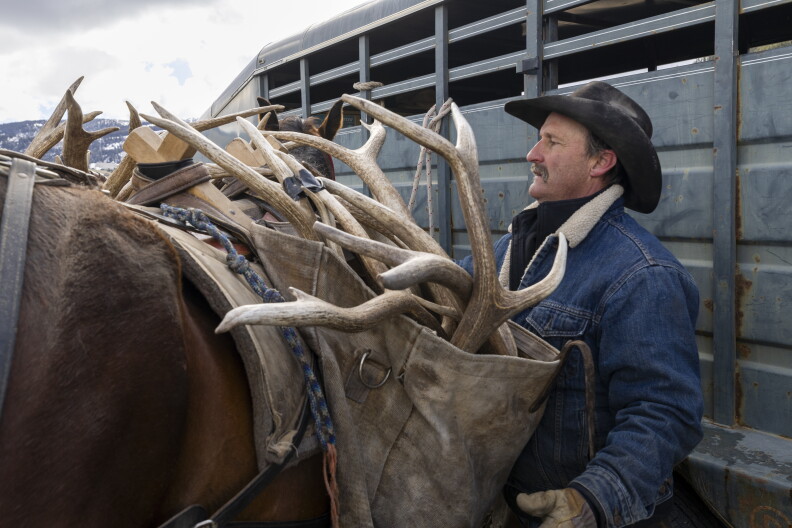
“It’s more special this year because we can actually benefit from being Wyoming residents,” Romrell said. “It makes me feel proud to come and pick up the antlers that you watch all winter and see on the refuge.”
Sitting atop his horse with multiple antlers slung to its side, he said this year is also special since his sons are joining him for the first time.
(Dante Filpula Ankne / KHOL)
“My goal was to get the twins, my two boys, an antler and they both succeeded in that,” Romrell said. “I just wanted to put a smile on their faces and make them enjoy the outdoors as much as I do.”
He’s been shed hunting in Jackson for about 10 years.
“We enjoy looking at them, we enjoy using them in home decor,” Romrell said. “They’re special to us because it’s a western living style.”
Brady Rivenes, the 24-year-old from Gillette, said he has mixed feelings about the new law.
“Yeah I kind of go both ways,” he said. “It’s cool getting to see all the Wyoming guys get their first pick on horns but also kind of bittersweet because you don’t get to see all of your out of state buddies you’ve made from coming to this over the years.”
Back on the mountain, Rivenes ran up a rocky cliff to a ridge line that plateaus. The chaos he had prepped for earlier had come to fruition. He occasionally tripped on the uneven game trails as he scanned the hillside for antler points. The sunrise cast a pink glow above the Tetons and glistened off the thin snow crust.
“They’re hard to see in snow,” Rivenes said as he tried to catch his breath.
Moving fast, with no plans of stopping, he knew other hunters were right behind him. He was looking for pockets, or clusters of many antlers he had had luck finding in previous years.
“Some years you find it, some years you don’t,” Rivenes said, “but either way, we’re not stopping.
Then, his pace quickened and he yelled as he spotted one — then two. He scrambled to their side, threw off his pack, strapped them in and, with no time to celebrate, kept moving.
He was unsatisfied.
“Not good enough,” he said. “From where we went through and to only have two — it’s surprising.”
By the end of the day he’ll have added two more. His friends, who had all spread out, found another four.
Ultimately, it was “not too shabby,” Rivenes said.
(Dante Filpula Ankne / KHOL)
He’s had better years, but ultimately it’s not just the thrill, the sheds or the scenery that keeps him coming back.
“A lot of it’s the people,” he said. “We like to shed hunt, there’s sheds on this hill, everyone else gets to come together that likes to shed hunt and you get to see all those guys pick up horns, it’s just a good time in general.”
Rivenes returned to his truck and threw down his sheds, considered their size alongside the others and debriefed the day cordially with other returning hunters. The competition was over.
He drove the gravel road out until he met the paved streets in town, grabbed a quick lunch at a local restaurant and then hit the road back towards Gillette — all before noon.
Copyright 2024 Wyoming Public Radio
What's at stake as Idaho evaluates mussel eradication effort
Jun 04, 2024
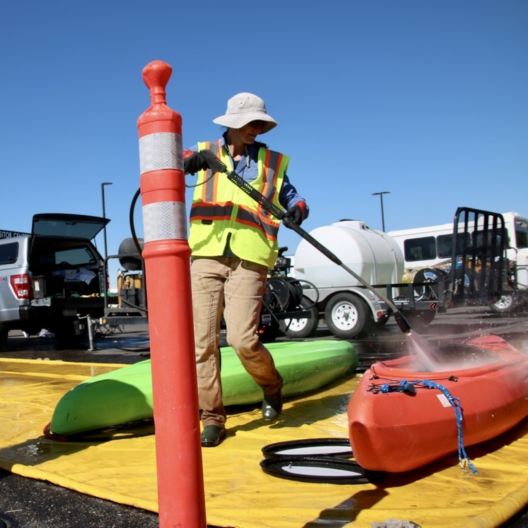
Show notesAfter quagga mussels were detected in the Snake River, ISDA set up boat decontamination stations in Twin Falls. It asked everyone who had been in the water during a month-long stretch to get their boats, kayaks and fishing gear cleaned.(Rachel Cohen / Boise State Public Radio )
Invasive quagga mussels were found in Idaho for the first time last fall. The state has been trying to get rid of them, but if it’s not successful, the mussels could have widespread and expensive consequences.
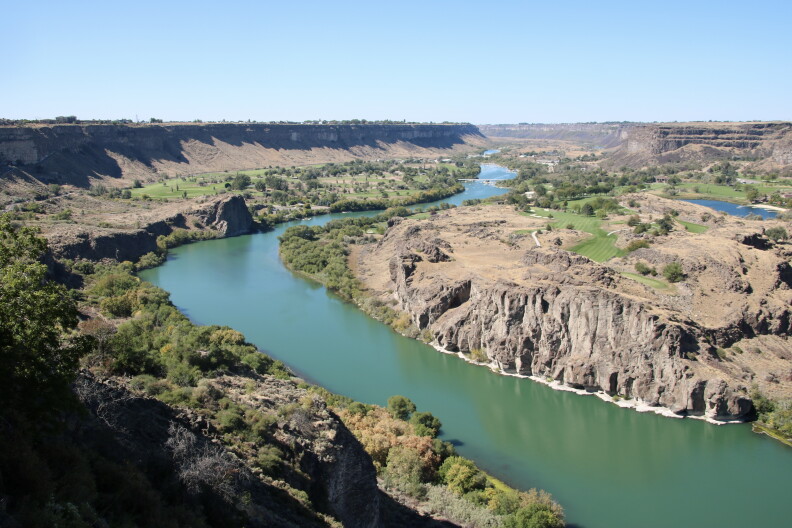
Michael Stephenson has spent years worrying about a tiny invasive creature smaller than a fingernail. Then, last fall, they arrived. The larval form of quagga mussels and one adult were found in the Snake River near Twin Falls.
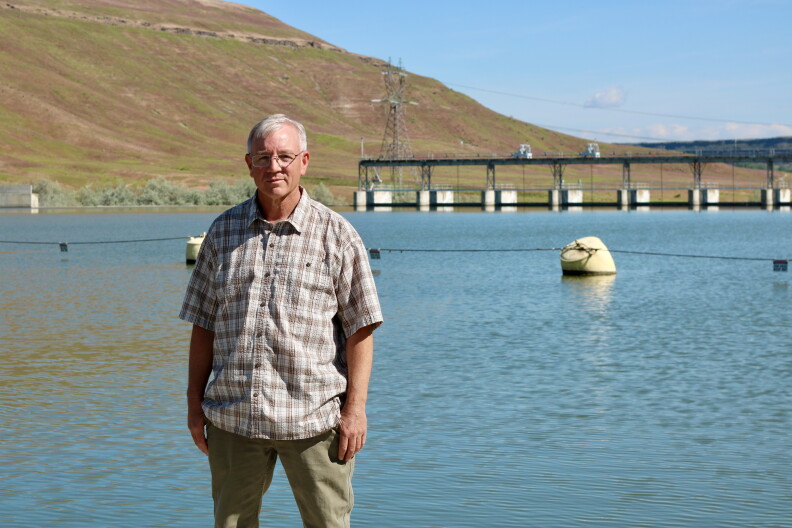
“I’m feeling very anxious about it,” said Stephenson, who works as a biologist at Idaho Power. The company operates 17 hydroelectric plants on the Snake River and its tributaries, 15 of which are downstream of where quagga mussels were detected.
Stephenson said the small bivalves are a big problem. They spread rapidly – a female can produce a million eggs each year – and they attach to pretty much any surface in the water. They can clog intakes for drinking and irrigation water systems, and hydroelectric turbines.
The Columbia River Basin is the only major river system in the country without an invasive mussel infestation. The Pacific NorthWest Economic Region estimates it would cost the Northwest $500 million a year to deal with.
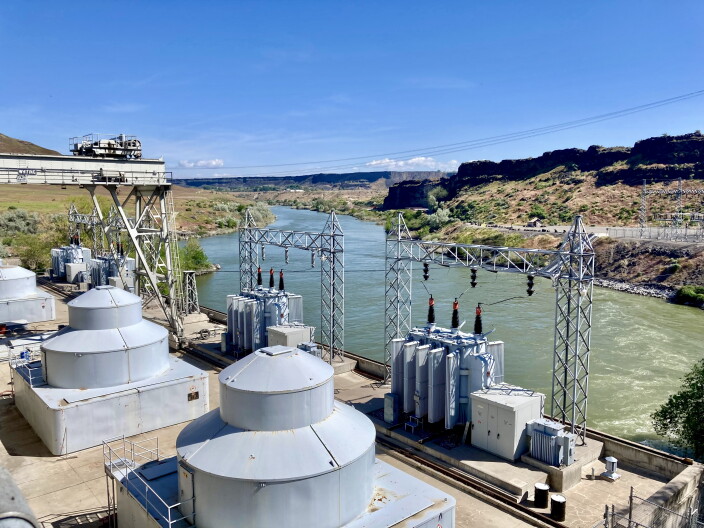
On top of an Idaho Power dam near Hagerman, Stephenson points to a metal filter where water flows from the reservoir into the power house. It’s one of the initial points where quagga mussels could interfere with the system. They’d start to encrust the steel bars, Stephenson said, reducing the amount of water entering the dam.
The company currently uses a mechanical rake to keep sticks and vegetation out, but prying quagga mussels off could require scuba divers. The mussels could also target other pipes that bring in water to cool the system as the turbines are spinning; without the cold water, they could overheat.
After a visit to the southwest to see how the operators of Hoover Dam handle quagga mussels in Lake Mead, Idaho Power is considering buying special ultraviolet lights to kill baby mussels floating through its facilities.
“If we get an infestation in the Snake River, it may be the biggest problem we've dealt with yet, as far as infrastructural issues,” Stephenson said.
Michael Stephenson, a biologist at Idaho Power, is investigating how quagga mussels in the Snake River could affect hydropower operations and how the company can prepare.(Rachel Cohen / Boise State Public Radio )
Last fall, Idaho poured a copper-based chemical into the river to try to eradicate the mussels. Similar toxins have worked to kill mussels elsewhere, but this treatment, in a major river, was unprecedented.
“That’s been weighing quite a bit on my mind,” said Nic Zurfluh, the invasive species bureau chief for the Idaho State Department of Agriculture. “Just gauging how effective the treatment was last fall.”
Zurfluh said it’s been a long winter of waiting to see if the mussels are gone. They stop reproducing in colder months so they’re not easily detectable then. As the temperatures warm, Zurfluh’s team will begin collecting water samples around the state with an emphasis on the Snake River near Twin Falls, searching for signs of mussels.
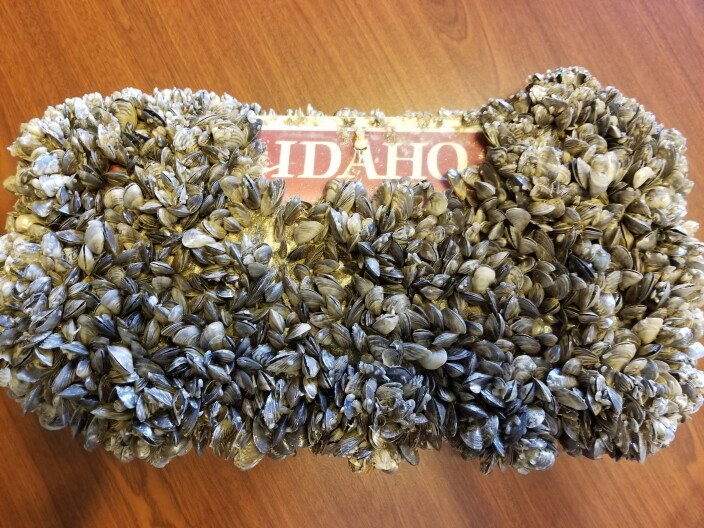
Quagga Mussels infesting an Idaho license plate.(Sen. Michelle Stennett<br/> / Jeremy J. Gugino)
Thanks to money from the legislature, those efforts will double in scale this summer. But Zurfluh cautions that answers might take time.
“Not having detections, I would take that as really great news,” he said.”But just knowing that's not going to tell the full picture until we go quite a little while with non-detects.”
The tiny mussels are hard to find. It might take a few months, even a few years, to get an “all-clear.”
ISDA hopes the chemical treatment will eradicate the quagga mussel before a population takes hold in the Snake River.(Rachel Cohen / Boise State Public Radio )
If the mussels are still around and float downstream they could pose a big threat to anadromous fish that migrate from inland spawning grounds to the ocean and bring vital nutrients back – nutrients the quagga mussels absorb. The mussels are expert filter feeders, said Anthony Capetillo, an invasive species biologist with the Nez Perce Tribe and a tribal member.
“If the quagga mussels are sucking all the oxygen and all the nutrients out of the water, then that takes away from the fish, so they're not able to grow as they usually would,” Capetillo said.
Salmon in particular, he says, are already suffering because of dams and climate change, and quagga mussels, with their sharp shells coating fish ladders, could make their migration journeys more treacherous.
“All the money that we've been putting into all these projects to get these salmon and steelhead and lamprey back into these waters,” Capetilo said. “All of that could potentially be for nothing if we allow these invasives to come and take hold.”
A lot is at stake, he said, for a region that values clean water and access to the outdoors, but perhaps even more so for tribal communities.
“If we do lose parts of our identity,” he said, “lose our resources, we can't really measure what those losses are.”
Even further downstream, Justin Bush, the aquatic invasive species policy coordinator for the Washington Department of Fish and Wildlife, said it could take as little as a week for floating veligers to make it from Twin Falls to that state’s borders.
“We feel like this threat is right on our doorstep,” he said. “It's causing us to think about a new timeline, new actions, and new levels of funding that will be required in both the short and long term.”
Last fall, as soon as the mussels were detected in Idaho, Washington deployed its monitoring crews closer to the border. They didn’t turn anything up.
Now, the state will have a specific Snake River mussel monitoring team, fully-staffed boat check stations in the southeast region and a new mussel-sniffing dog.
“All eyes are on Idaho and we're waiting for more information,” Bush said.
Idaho officials hope their eradication efforts have staved off an infestation, Zurfluh said.
At the Twin Falls waterfront, the state is requiring all boats entering and leaving the river to be washed down to contain any remaining mussels from spreading to other water bodies. Plus, prevention is still key, Zurfluh said. It would just take a single boat or kayak carrying new mussels to spark another introduction tomorrow.
'The Guncle Abroad:' An author interview with Steven Rowley
Jun 04, 2024
Show notes( G.P. Putnam's Sons)
The award-winning novel "The Guncle" has returned, reuniting us with our favorite characters five years after they spent the summer together. This time, however, they're going abroad.
Author Steven Rowley joined Idaho Matters to talk more about his latest novel, The Guncle Abroad.
The importance of menopause knowledge
Jun 03, 2024
Show notes(iStockphoto)
About half of all Americans will go through menopause, but it's still something people don't like to talk about, and that often leaves the women going through it freighted and unsure about what's happening to them as they go through this change.
Last year, we dedicated an entire show to this topic, talking to experts about the different phases of menopause, its symptoms, and how to treat them. And we were recently honored to learn we won a regional Edward R. Murrow Award for news documentary, as well as awards for best news talk show and best watchdog/investigative report from the Idaho Press Club.
We wanted to bring back this important program for folks who missed it the first time and for people looking for more information on menopause.
Idaho Matters Reporter Roundtable: May 31, 2024
May 31, 2024
Show notesChad Daybell sits at the defense table after the jury's verdict in his murder trial was read at the Ada County Courthouse in Boise, Idaho, on Thursday, May 30, 2024. Daybell was convicted of killing his wife and his new girlfriend's two youngest kids in a strange triple murder case that included claims of apocalyptic prophesies, zombie children and illicit affairs. ( AP Photo/Kyle Green, Pool)(Kyle Green / Associated Press)
It’s Friday, which means it's time for our Reporter Roundtable when Idaho Matters gets you up to date on all the news that made headlines this past week.
Hold a wild songbird in your hands as part of Intermountain Bird Observatory's 30 anniversary
May 31, 2024
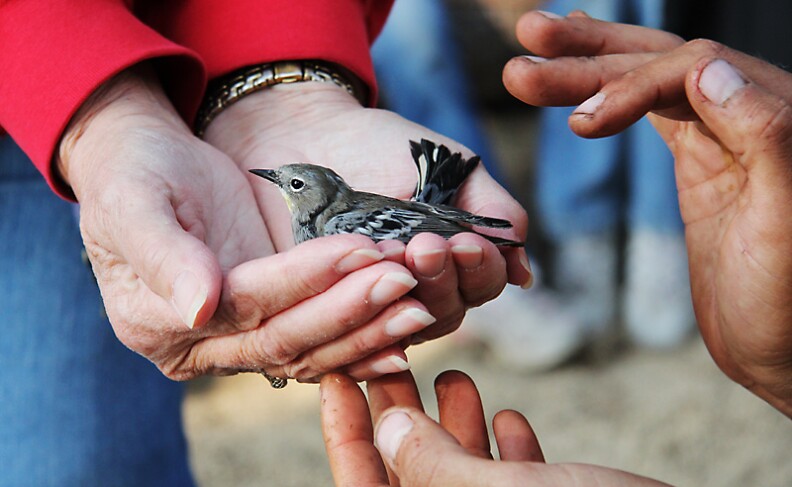
Show notes You can help catch and band songbirds with the scientists at the Intermountain Bird Observatory!(Dave Crawforth / Intermountain Bird Observatory)
Ever wanted to hold a wild songbird in your hands?
That’s something Heidi Ware Carlisle does a lot. She’s the education and outreach director with the Intermountain Bird Observatory which catches and bands songbirds along the Boise River.
“We're a research unit of Boise State and we operate like a nonprofit. So we do a lot of bird research and conservation work, mostly in Idaho, but actually around the world,” said Carlisle, who teaches ornithology in her spare time at Boise State University
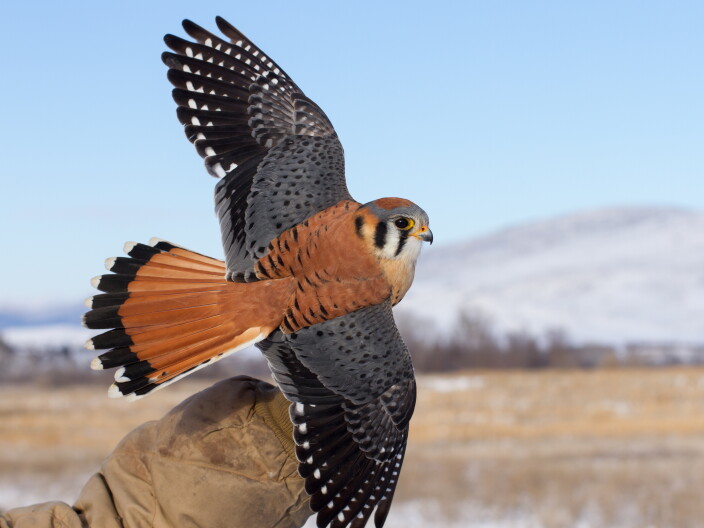
They study everything from the calliope hummingbird, all the way up to golden eagles.
“And the coolest thing about what we do is we invite the public to come and watch us as we do our research,” Carlisle said.
On Saturday, June 1, they'll be catching and banding songbirds along the Boise River and giving folks a chance to become a scientist for a day.
“So you have the opportunity to visit our stations and see birds up close,” Carlisle said. “And actually, when we're done measuring them and weighing them, you can actually hold out your hand and get to hold one of these wild birds as it flies off back into the wild.”
IBO, Intermountain Bird Observatory, hummingbird banding, Idaho City, John Kelly photo.(John C. Kelly/Boise State University / Intermountain Bird Observatory)
All that research has shown shifts in migration and the number of different bird species.
“One of our goals is to really keep our finger on the pulse, especially for common species.”
Idaho mom fights to improve dyslexia legislation and literacy in Idaho
May 30, 2024
Show notes(f_ / iStockphoto.com)
Idaho Mom Robin Zikmund knew her son was different at an early age. While his peers were reading by the third grade, her son was still struggling.
Eventually her son was diagnosed with dyslexia, but Robin wanted to do more than just have a diagnosis for her son.
So she founded the Idaho chapter of Decoding Dyslexia, which has helped make a significant impact on dyslexia legislation and literacy in Idaho through the science of reading.
Robin joined Idaho Matters to talk more.
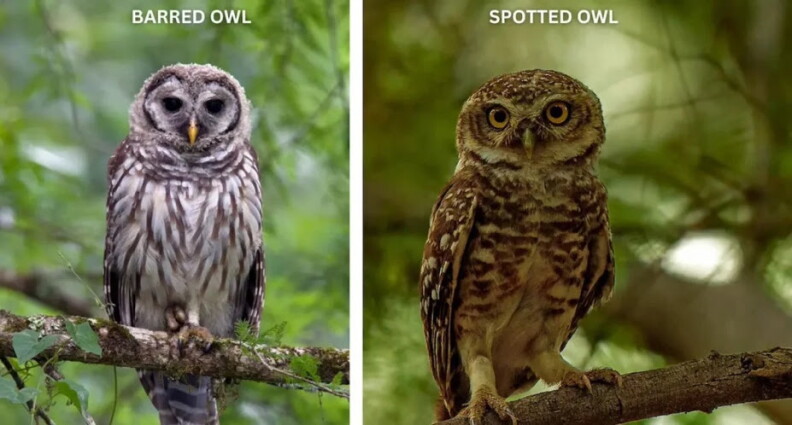
Shooting Barred Owls to save Spotted Owls
May 30, 2024
Show notes(Animal Wellness Action / Center for a Humane Economy)
Spotted Owls are disappearing from Oregon, Washington and northern California. Some officials estimate their numbers have dropped by 75% over the last 20 years.
The birds were listed as threatened under the Endangered Species Act almost 35 years ago but despite that designation, as few as 3,000 may be left on federal lands in the three states.
The birds are threatened by a lot of factors involving humans but one of their biggest threats comes from a sister species - the Barred Owl.
These owls are bigger and stronger than their cousins and have been crowding Spotted Owls out of their territory. Some estimates say there are more than 100,000 Barred Owls now along the coast range.
Giving Idaho dogs a second chance at a forever home
May 30, 2024
Show notes( Meridian Canine Rescue)
In March, Meridian Canine Rescue faced a rent hike that they couldn’t meet and had to move their operations. They asked the community for help for the move and donations poured in.
Now the dog rescue and training operation is moving into their new digs on a private farm in Emmett and we wanted to check in to see how they’re doing.
Karinna Lozano is the Meridian Canine Rescue Board President and she joined Idaho Matters.
Idaho Matters Doctors Roundtable: May 29, 2024
May 29, 2024
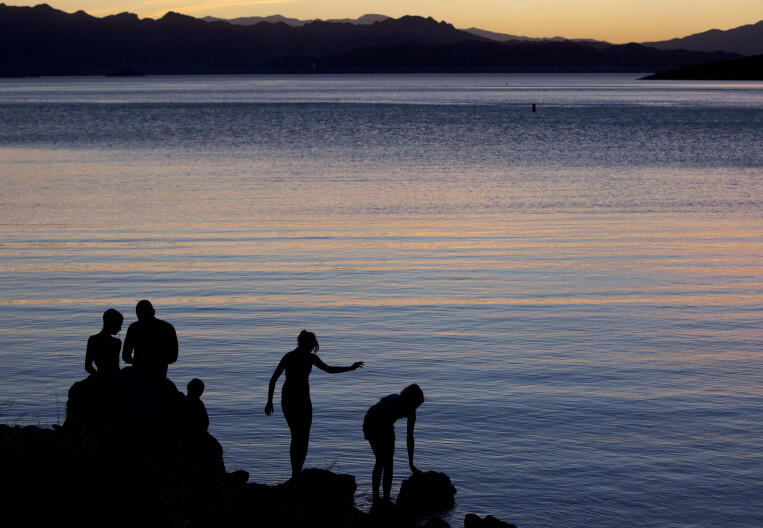
Show notesFILE - In this May 27, 2011 file photo, kids fish at twilight at the edge of Kingman Wash, at Lake Mead National Recreation Area in Arizona. Regional health officials say a Las Vegas-area boy died from a rare brain-eating amoeba that investigators think he was exposed to in warm waters at Lake Mead. (AP Photo/Julie Jacobson, File)(Julie Jacobson/AP / AP)

 Our TOPPODCAST Picks
  Stay Connected