Idaho Matters is a wonderful way to stay up to date, meet people and understand there’s much more to this great state. Hosted by Gemma Gaudette on Boise State Public Radio News, it features arts and politics, growth and education, and the interesting stories that make Idaho unique. Send us your questions, comments or story ideas by emailing idahomatters@boisestate.edu or sending us a voicemail using the “Talk To Us” feature on the free Boise State Public Radio app.
Looking on the bright side with best-selling author Kristan Higgins
May 29, 2024
Show notes(Penguin Random House / Penguin Random House)
New York Times bestselling author Kristan Higgins is back with her latest novel which is set in Cape Cod with fun and quirky family dynamics as well as a truly lovely main character. It’s called Look on the Bright Side and she joined Idaho Matters for a look inside.
Cutting down juniper trees to save sage grouse
May 28, 2024
Show notes Cutting and burning Juniper trees means better habitat for sage grouse.(Connor White / BOSH Project)
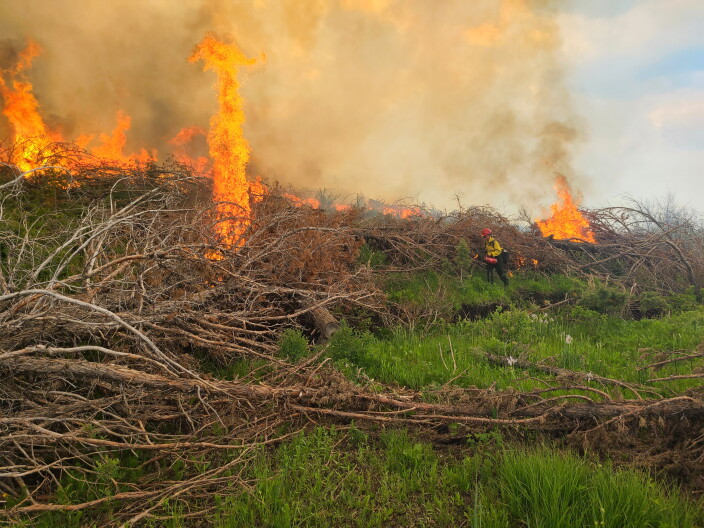
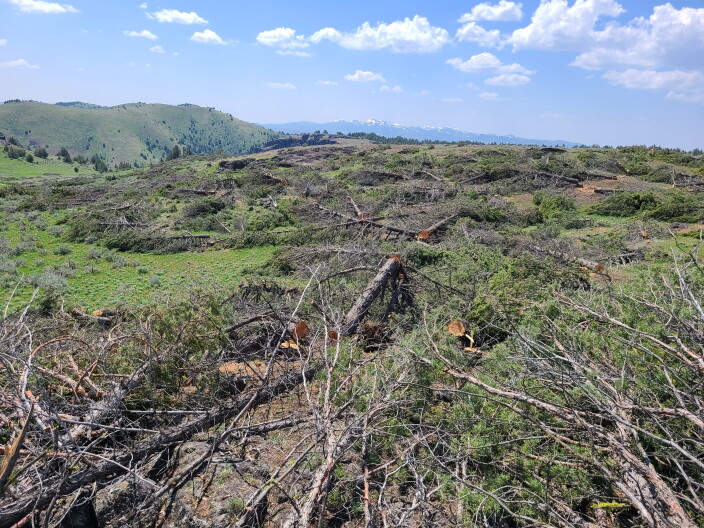
Imagine this: 50 chainsaw crews fan out over carefully selected areas of Owyhee County in southwest Idaho. For eight hours a day — all they do is cut down hundreds of juniper trees. Then in the spring, more crews go out and burn those fallen trees.
This is the BOSH Project. BOSH stands for Bruneau Owyhee Sage Grouse Habitat and in six years, crews have cleared 140,000 acres of encroaching junipers. Those trees, though native to Idaho, have been taking over the landscape since 1860.
And it’s our fault, according to Conner White, BOSH Project coordinator for Pheasants Forever and the Bureau of Land Management.
“We got very good at suppressing fire for over a century. We basically put every fire out,” White said. “Fire is the main thing that kills these conifers, and we completely removed it from the landscape.”
Crews spend eight hours a day cutting down Juniper trees in targeted areas.(Connor White / BOSH Project)
The goal of the BOSH Project is to take out those junipers, restore native plant species like sagebrush, recover more streams and wetlands and bring back sage grouse and other animals to the land.
The project is huge, covering around 600,000 acres in Owyhee County alone, says Jeremy Maestas, National Sagebrush Ecosystem Specialist for Working Lands for Wildlife and the USDA Natural Resources Conservation Service.
“We're probably going to be pushing up towards a million acres once this project's fully completed,” says Maestas.
Turns out, sage grouse don’t like to hang around Juniper trees and won’t nest in an area that has even four trees per acre.
“The theory is that the trees provide perches for predators or cover for ground based predators to be able to go in there and get them,” said White.
Similar work has shown results for the return of sage grouse in the Warner Mountains Project in southern Oregon.
“Grouse immediately started nesting in areas once the trees were removed. And then over a decade, we were able to show that it actually bent the curve on their population growth rates over areas that were untreated. So we saw a 12% increase in the population growth rate, which is the first time we've ever documented in the literature that we can benefit grouse at a population scale through active restoration,” Maestas said.
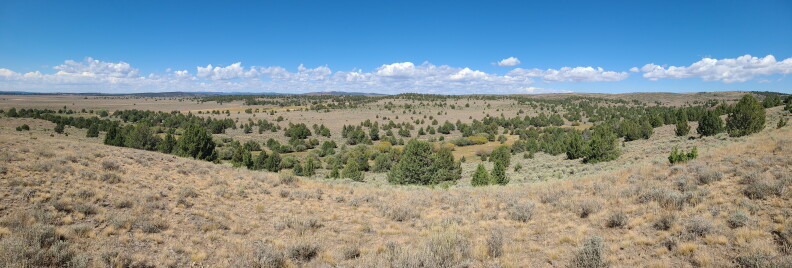
Here's what it looks like when Junipers overtake an area and crowd out sagebrush.(Connor White / BOSH Project)
Taking out junipers isn’t just good for sage grouse. Other birds, like Brewer’s Sparrows and Sage Sparrows, also come back along with native plants. Junipers also drink a lot of water and when you remove them, the landscape changes.
“They're seeing springs come back to life and creeks come back to life and more water for aquatic life and spotted frogs and things like that,” says Steve Stubner, writer and producer of the “Life on the Range” series sponsored by the Idaho Rangeland Resource Commission.
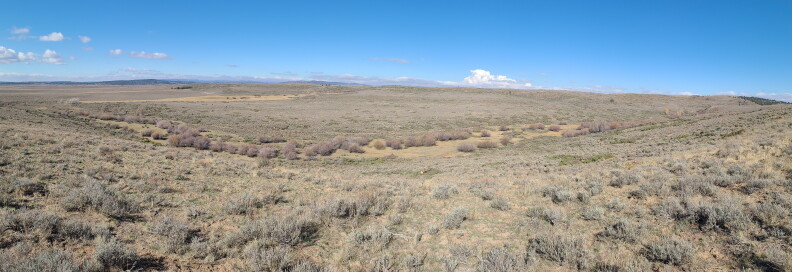
Here's the same area, after BOSH has come in and taken out the Juniper trees.(Connor White / BOSH Project)
Ranchers and other private landowners are partnering with up to a dozen federal, state, and local agencies to make the project happen. And ranchers are liking what they see.
“They're loving it,” said Stubner. “A lot of times, what's good for sage grouse is also good for livestock and wildlife. And that's definitely the great combo we've got going here.”
Maestas says they’re fighting against the clock to save sage grouse, with 1.3 million acres a year of sagebrush ecosystems disappearing thanks to things like conifer encroachment.
“So any time we can set the clock back and keep these lands healthy and resilient for current and future generations it really brings a lot of pride to the work that we do,” said Maestas.
Sage grouse can be the canary in the coal mine for areas like these.
“There's a whole arc of peril happening with over 350 species of conservation concern, plants and animals that will probably never have their own initiative. They're not sexy enough or interesting enough for that kind of investment. But when we do things for sage grouse we are seeing benefits for other sagebrush dependent species,” Maestas said.
Two small snails are disappearing from Idaho rivers
May 28, 2024
Show notesAshy pebblesnail.(Tyson Ehlers / Tyson Ehlers)
When you think of Idaho rivers, you think of water and fish and the beauty of the landscape but down in the nooks and crannies of the waterbed are two small, slimy creatures that act as a sort of canary in the coal mine for northwest waterways.
They are the Ashy Pebblesnail and Shortface Lanx and they’re disappearing from rivers around the west thanks to warmer water and threats from dams, agriculture and people.
Here to tell Idaho Matters more is Noah Greenwald, the Endangered Species Director for the Center.
Fish and wildlife officials help restore population of iconic trout in eastern Nevada river
May 28, 2024
Show notesThe Lahontan Cutthroat Trout, Nevada's state fish, is the largest member of the cutthroats, with lake-dwellers weighing up to 40 pounds. For decades, they've been listed as threatened under the federal Endangered Species Act. (USFWS)
For years, fish and wildlife officials have been working to help an iconic Western fish whose habitat is shrinking. That includes efforts to return the fish to a river in the Mountain West where the species had disappeared.
It’s a cloudy day east of Reno, and Chad Mellison, wearing waders and holding a flyfishing rod, steps into the Truckee River. He unfurls his line and casts upstream into the fast-flowing waters.
“If you're a fish and live in a river, your nose is pointing upstream because that's where your food's coming down,” said Mellison, an avid flyfisher and longtime biologist with the U.S. Fish and Wildlife Service.
Chad Mellison, a USFWS biologist, casts his flyfishing line in the Truckee River east of Reno. (Robyn Gerstenslager / USFWS)
“That’s why they call it fishing and not catching,” Mellison said with a laugh. “If it were easy, it wouldn’t be as fun.”
The Lahontan Cutthroat Trout, characterized by a vibrant red slash under its jaw, is a trophy fish many anglers hope to hook when they cast a line in Northern Nevada.
Just ask Mike Anderson, a guide with the Reno Fly Shop. Every year, he has a handful of clients land a 20-pound cutthroat – a size that makes the fish “almost look prehistoric” – in nearby Pyramid Lake.
“The fish that get that big, and the people that hook into them, it's a life-changing, once-in-a-lifetime kind of a thing,” Anderson said.
The Lahontan Cutthroat once swam in a dozen lake systems and more than 7,000 miles of streams in the Lahontan Basin, which extends from northern Nevada to central California.
Now, they occupy just about 10% of their historical habitat. For decades, they’ve been listed as threatened under the federal Endangered Species Act.
“Two of the biggest threats are poor habitat quality, and then non-native fish,” said Mellison, adding that river diversions, dams, and wildfires damage their habitat, and non-native trout outcompete them for food and territory – and even eat them.
That’s decimated cutthroat in some areas, like the North Fork of the Humboldt River in northeastern Nevada. Decades ago, that was home to one of the biggest populations.
By 2011, the fish no longer survived there. One big reason?
“There was a mining company out there doing exploratory drilling and they wanted to drill some really deep holes,” Mellison said.
The headwaters of the North Fork of the Humboldt River in northeastern Nevada, where the population of Lahontan Cutthroat Trout disappeared in 2011 due to habitat loss. (NDOW)
So deep that the drilling punctured the local aquifer and connected it to another one further downstream. Like a straw, it sucked up the headwaters of the North Fork.
That forced the cutthroat further and further downriver, where they met brook trout, which had “taken over” within a couple of years, Mellison said.
In response, officials installed a fish barrier, paid for by the mining company, to stop brook trout from traveling upriver. The Nevada Department of Wildlife worked to remove those that remained by treating river and area waterways with a chemical called rotenone.
The habitat still showed problems when the agency started returning the fish in 2015, said Jacob Stoller, a fisheries biologist with the Nevada Department of Wildlife.
“There are still concerns with habitat conditions being impacted from mining, irrigation, livestock grazing, and drought,” Stoller said.
It wasn’t until June 2021 that officials felt confident that the cutthroat were not only surviving, they were thriving. Mellison provided the defining moment. After doing field work in the North Fork area, he decided to flyfish a bit before heading home.
“First cast, hooked the fish, and I'm like, this better be a cutthroat, after all the work we've been doing,” Mellison recalled. “And of course, it was and I landed it, and it was just a beautiful fish.”
Mellison said he knew his day of fishing couldn’t get any better, so he packed up his rod and headed home.
The Lahontan cutthroat trout that U.S. Fish and Wildlife Biologist Chad Mellison caught on the North Fork of the Humboldt River in 2021.(Chad Mellison / USFWS)
“Seeing a native fish that you caught, admire it, and then watch it swim away back into his home. It was … whoo,” Mellison said as his eyes well with tears. “Yeah, that’s good stuff.”
Mellison and the others who helped return the Lahontan Cutthroat Trout to the Nork Fork are hopeful about the future of that population. Biologists are waiting on environmental DNA results to confirm that brook trout are no longer in the river.
And if you’re wondering if Mellison caught a cutthroat in the Truckee River on this cool, cloudy day outside of Reno?
“Here we go…Oh!” Mellison yelled after briefly hooking a trout before it slips away. “That was a big fish!”
As Mellison said, that’s why they call it fishing, not catching.
This story was produced by the Mountain West News Bureau, a collaboration between Wyoming Public Media, Nevada Public Radio, Boise State Public Radio in Idaho, KUNR in Nevada, KUNC in Colorado and KANW in New Mexico, with support from affiliate stations across the region. Funding for the Mountain West News Bureau is provided in part by the Corporation for Public Broadcasting.
'The Bump:' An author interview with Sidney Karger
May 28, 2024
Show notes
This episode of Idaho Matters originally aired on April 8, 2024.
Last year, we introduced you to a rom-com novel called "Best Men," which explored what it was like for one gay man looking for love in New York City.
The book was met with much-deserved buzz, being featured on Good Morning America, the Today Show, and Bravo's Watch What Happens Live.
Now Sidney Karger is back with his latest novel, "The Bump," which released on May 21, and he joined Idaho Matters to talk about the new release.
'Microjoys:' An author interview with Cyndie Spiegel
May 27, 2024
Show notes( Penguin Life)
This episode of Idaho Matters originally aired on March 6, 2023.
Author Cyndie Spiegel's book, "Microjoys: Finding Hope When Life is Not Okay" provides an intimate look at all the small moments that have helped her to move forward, even in the toughest times of her life. She joined Idaho Matters to talk more.
'No Filter:' An honest conversation with Paulina Porizkova
May 27, 2024
Show notes( The Open Field)
This episode of Idaho Matters originally aired on November 21, 2022.
When one thinks of Paulina Porizkova, one might remember her as the Sports Illustrated cover model from the 1980s or the wife of "Cars" front man, Rick Ocasek. Or perhaps you know her from her popular Instagram account.
Carter Bays sits down to discuss his debut novel
May 27, 2024
Show notes The front cover of Carter Bays new novel, The Mutual Friend.
This episode of Idaho Matters originally aired on May 11, 2022.
The co-creator of the Emmy award-winning show "How I Met Your Mother" is back, this time with his first novel. Idaho Matters sat down with Carter Bays to talk more about his debut novel, The Mutual Friend.
Idaho Matters Reporter Roundtable: May 24, 2024
May 24, 2024
Show notes The 4.5-mile trail begins in Stanley's Pioneer Park and ends near the entrance to Redfish Lake.(Rachel Cohen / Boise State Public Radio )
It’s Friday, which means it's time for our Reporter Roundtable when Idaho Matters gets you up to date on all the news that made headlines this past week.
Caldwell police are using a new tool to fight crime
May 23, 2024
Show notesFlock Safety camera on pole.(Flock Safety)
Early Sunday morning, gunshots were heard in Caldwell. Determining where those shots are coming from can be difficult for a human — but not for a machine.
Caldwell Police are using a new tool called Flock Safety which can pinpoint where a gunshot is coming from and alert law enforcement officers.
Flock told police where the shots came from, on Belmont Street, and that led to the arrest of two men in a car with guns and 26 bullet casings.

 Our TOPPODCAST Picks
  Stay Connected