Idaho Matters is a wonderful way to stay up to date, meet people and understand there’s much more to this great state. Hosted by Gemma Gaudette on Boise State Public Radio News, it features arts and politics, growth and education, and the interesting stories that make Idaho unique. Send us your questions, comments or story ideas by emailing idahomatters@boisestate.edu or sending us a voicemail using the “Talk To Us” feature on the free Boise State Public Radio app.
What happened at Idaho's GOP Convention
Jun 17, 2024
Show notes(James Dawson / Boise State Public Radio)
Over the weekend,Dorothy Moon was reelected as Idaho's Republican Party chairwoman at the GOP convention in Coeur d'Alene. Her second term comes after a challenge from former Sen. Mary Souza, of Coeur d'Alene.
Journalists were barred from most of the process. They could not attend events or committee meetings and were relegated to a corner hallway of the resort where the convention was held, watched over part of the time by an armed private security guard who made sure they did not leave the designated media area.
East Idaho News Director Nate Eaton was one of the reporters sitting in the hallway during the convention but managed to conduct an exclusive interview with Moon before she was reelected. He joined Idaho Matters to talk more.
How to help unhoused Idahoans during the summer heat
Jun 17, 2024
Show notes(Liz West / Flickr)
As summer gets underway and temperatures continue to rise many people are turning up the AC. But for those experiencing homelessness, combating the heat isn't as easy, which is why Catch Idaho is working to provide essential items to those in need.
Stephanie Day, executive Director of Catch, joined Idaho Matters to talk more about this effort.
Exploring the local food scene with BoiseDev
Jun 17, 2024
Show notes(Sarah Rahal / Flickr)
BoiseDev.com has become known for reporting about all things development in Boise, the Treasure Valley and beyond, from new business to construction projects to changes in building codes and zoning laws.
This year, they did a survey to find out what their readers wanted to know more about, and a large majority said food and restaurant news was a priority.
And indeed, stories about the "In-N-Out craze" or restaurant moves and shake-ups have been a hot topic on their website. So they've launched a new weekly newsletter called BoiseDev Eats, featuring local food news.
Don Day, the founder and editor of BoiseDev.com, and Kara Jackson, a managing partner, joined Idaho Matters to talk more.
How do abortion access and reproductive rights vary across the Mountain West?
Jun 17, 2024
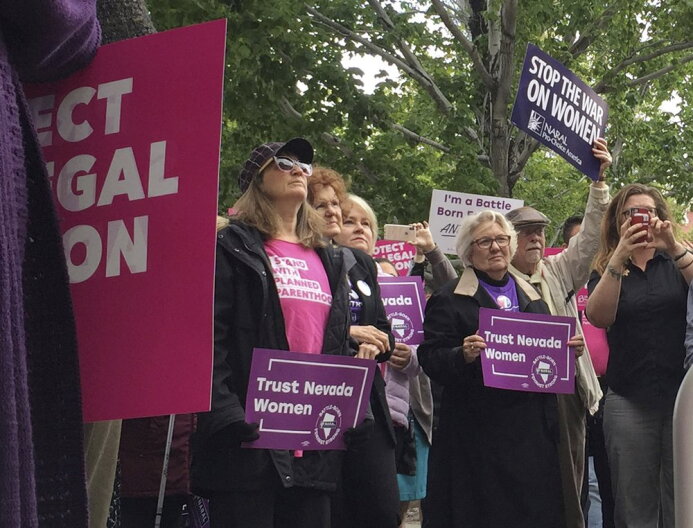
Show notes<p>Supporters of a bill that would rewrite Nevada's abortion laws rally in front of the Legislature in Carson City, Nev., on Tuesday, May 21, 2019.</p>(AP Photo/Ryan Tarinelli)
Nearly two years after the Supreme Court overturned Roe v. Wade and removed federal abortion protections, a legal chess game is taking place among states.
More than a dozen clinics in Texas closed, while others moved to New Mexico. New restrictions in Utah, Idaho and Wyoming are pushing women into Colorado and Nevada, which are working to protect reproductive care.
Lindsey Harmon is with Nevadans for Reproductive Freedom, a group working to enshrine abortion protections in Nevada’s constitution by a vote of the people — an attempt also being made in more than a dozen states.
"Today we've turned in over 200,000 signatures in all 17 counties across Nevada," Harmon said to a crowd gathered recently outside the Clark County Building in Las Vegas. Nevada advocates collected nearly twice as many signatures as needed to qualify their initiative for placement on the ballot.
She pointed out that Nevada is nearly surrounded by states that restrict abortion.
“Whether it’s travel bans or bans on emergency care as we're seeing out of Idaho or near total bans like we're seeing in Arizona and Utah respectively,” Harmon said.
Like a chess game, both sides in the nationwide battle are making significant, diametrically opposed moves before the clock runs out.
Opponents have turned to obscure laws – some from the 19th century. Lawmakers in Arizona wanted to rely on a Civil War-era law to ban abortions. (That Arizona law was later repealed, though the repeal didn't take effect immediately and the original ban could still be reinstated before the repeal takes place.)
Others want to invoke the Comstock Act, a federal statute from 1873 that prohibited mailing birth control materials. University of Nevada Las Vegas Professor David Orentlicher believes challenging this will be difficult since Comstock has been updated several times.
“That would suggest that Congress didn't object to maintaining that part of the law,” Orentlicher explained.
Meanwhile, those who support broader reproductive rights have celebrated as abortion medications like mifepristone became available in drug store chains, such as CVS and Walgreens.
Those who want to restrict reproductive rights are also challenging the federal law that ensures public access to emergency medical services. It’s called the Emergency Medical Treatment & Labor Act (EMTALA).
Orentlicher said this means hospitals must provide stabilizing medical treatment.
“If you're in active labor, they don't want you sending you away while you're in active labor, that you deliver,” somewhere in the street, he explained.
This is at the heart of a case brought by the state of Idaho to the U.S. Supreme Court. Idaho has a near-total abortion ban, allowing doctors to terminate pregnancy only to save the life of the mother.
Following oral arguments in March, Idaho Attorney General Raul Labrador said Idaho's abortion restrictions do not conflict with the federal law.
Labrador told reporters after the Supreme Court heard Idaho’s position that “EMTALA requires that emergency rooms care for pregnant women and their unborn children. And under Idaho's law, doctors are expected to treat women facing life threatening situations.”
“It is awkward to come to terms with the fact that the law that they championed has caused complete disaster for the state of Idaho ... But facts are facts. Numbers are numbers,” said Rubel shortly after the Supreme Court hearing.
Idaho’s Coalition for Safe Reproductive Health surveyed 117 doctors and about two-thirds said they were going to or likely would leave the state because of its new laws and the liability it places on them.
A decision on the Supreme Court case is expected this summer.
This story was produced by the Mountain West News Bureau, a collaboration between Wyoming Public Media, Nevada Public Radio (KNPR) in Las Vegas, Boise State Public Radio in Idaho, KUNR in Nevada, KUNC in Colorado and KANW in New Mexico, with support from affiliate stations across the region. Funding for the Mountain West News Bureau is provided in part by the Corporation for Public Broadcasting.
Idaho abortion ban opponents: Lawmakers are still disrespecting many faiths.
Jun 17, 2024
Show notesThe film Under G_D explores the tension between multiple faiths and the growing number of abortion bans.(Ronda Kimbrow / 123rf Ronda Kimbrow)
While Idaho's near total abortion ban – which continues to push OBGYNs out-of-state due to fear of prosecution – remains in effect, polling reveals a growing number of Idahoans see the restrictions as too draconian. Most polls find Idahoans in a growing middle ground in a debate which had, until recently, found citizens choosing a hard yes, or hard no.
“I try not to judge those whose religious convictions are different than mine,” said Rev. Sara LaWall, faith leader of the Boise Unitarian Universalist Fellowship. “And I want to have the freedom to believe those and practice those. Sometimes, those practices and beliefs have to be kept squarely in the religious sphere, and not in the governmental sphere. And that is the conversation I am interested in having.”
LaWall has joined a growing chorus of faith leaders from across Idaho who say, while some Idaho legislators have used their religious faith in informing their opposition to abortion, a good many other faiths have been left by the wayside.
“The challenges that the government is imposing is a narrow version of Christianity as a kind of state religion on this question,” said Rabbi Dan Fink, faith leader at Congregation Ahavath Beth Israel “And Idaho’s law, as current established on abortion, prevents Jews from freely exercising what our tradition calls us to do.”
GEORGE PRENTICE: It's Morning Edition. Good morning. I'm George Prentice. This morning we're going to talk about a movie. And because we single it out, we think it is deserving of your attention. It will be screened one night only later this week, Thursday the 20th at The Flicks, and the film is titled Under G_D. Indeed, the word is "God," but the letter "O" is missing from the title. But something else is missing in the debate over abortion restrictions in Idaho and other states. We'll get to that missing piece in a moment, but first, let's bring in our guests. Here is Reverend Sara LaWall from the Boise Unitarian Universalist Fellowship. Good morning, Reverend Sara.
REV. SARA LAWALL: Good morning, George.
PRENTICE: And here comes Rabbi Dan Fink from Congregation Ahavath Beth Israel. Good morning, Rabbi Dan.
RABBI DAN FINK: Good morning, George. Glad to be here.
PRENTICE: I must say, I was lucky enough to see this film when it emerged from film festivals and picked up a boatload of jury awards. The film, by the way, is about a half hour. It's a superb short documentary; so that will allow plenty of conversation following the film in Thursday's event and what conversation there should be. So, here's where we are: we know that most abortions are banned in Idaho and a number of other states. But upon seeing this film, you will learn a lot more about RFRA. That's R-F-R-A, an acronym for the Religious Freedom Restoration Act that allows some lawmakers to work around constitutional law to model laws around "believer's of faith." But what faith? Reverend Sara, jump in here. This is a big disparity because many of these restrictions have foundations of religious conviction. But to be sure, it's not all religions.
LAWALL: That's correct. And that is really what drew me to this film. But also I've been following this lawsuit. It's really disheartening when our lawmakers use faith as a foundation for the legislation that they are passing, without any recognition that there is such a multitude of faith traditions and beliefs, particularly around this question. And it's really about very, very narrow interpretation - theological interpretation and set of religious beliefs - and doctrine that doesn't apply to all faiths. And so I'm really invested in wanting to have a a conversation about how we govern. What does religious freedom really mean? What does the separation of church and state really mean? Because it is really ostracizing, leaving out and frankly, oppressing a number of faith traditions and faith communities with regard to this particular legislation IN abortion rights and access, but others as well.
PRENTICE: Rabbi Dan Fink, in this film we hear from a contemporary of yours. He is Rabbi Barry Silver from Florida. And, well, let me just play a clip here.
RABBI BARRY SILVER: "It's a Jewish value to stand up against authority. Jews have never hesitated to stand on the fringe of society when it's necessary to fight against oppression."
PRENTICE: Rabbi Dan, can you add to that? Can you bring this home to us here in Idaho?
FINK: Yes. Rabbi Silver participates in this suit, and appears in the film because he recognizes, as Reverend LaWall noted, that faiths are in very different places on the question of choice. in Idaho and in other places, the anti-abortion movement has chosen to give authority to a very small, a very narrow kind of conservative Christianity, and essentially made it a kind of state religion. And Jewish tradition has always stood against this. In Jewish tradition, an abortion is not only allowed' but actually when a woman's life and health are endangered, Jewish law requires it. So essentially the point is that, anti-abortion restrictions prevent pious Jewish people from living in accordance with our tradition on this matter.
PRENTICE: Talk a little bit more about that tradition, because I've learned a little bit about Jewish law using old rules or old principles, but they apply to contemporary circumstances. In other words, they're grounded in reality.
FINK: That's right. So, George, Jews famously like to disagree amongst ourselves. There's an old saying that "for every two Jews there are at least three opinions." And so, if you ask Jews about abortion and when is abortion justified and who chooses, you'll get different answers from different parts of the Jewish world. With the Orthodox, the more traditional...more conservative leaning, but one of the very few things. And there really are not so many Jews across the board. From very traditional, to very progressive agree on, is that human life begins at birth. Jews all agree that a fetus is not a human being. A fetus is a potential human being. And that until crowning, the life of the mother, carrying that fetus takes priority over the life of the fetus. It's really one of few things that Jews agree upon... and that Idaho law stands in direct opposition to.
PRENTICE: Rev. Sara, help me out with this. We found that there are a growing number of people who are conflicted about this. They're somewhere in this rather large middle, if you will, of this debate. And I have to assume that's where you want to open up this conversation.
LAWALL: I think that's right. I think it's to remind people of the kind of foundational beliefs of this country, in exercising one's own religious freedom separate from the state. And part of what that says to me is that there is deep power in one's religious convictions and beliefs, and I hold that as very sacred. And so I try not to judge those whose religious convictions are different than mine, and I want them to have the freedom to believe those and practice. But I want the same exact freedom for myself and other communities who practice and believe differently, which means that sometimes those practices and beliefs have to be kept squarely in the religious sphere, and not in the public or governmental sphere. And that's the conversation I'm interested in having.
PRENTICE: And I'd like you both to weigh in on this. Rabbi Dan, I'll ask you first: the First Amendment of the U.S. Constitution says the government cannot establish religion or prohibit the free exercise thereof. In other words, Jews, Muslims, even many Christians are being left out of the conversation in these new laws that are restricting.
FINK: The challenges that the government is imposing as a narrow version of Christianity as a kind of state religion on this question. And Idaho's law, as currently established on abortion, prevents Jews from freely exercising what our tradition calls us to do.
LAWALL: There are many Christians coming out of liberal Christianity and the Protestant Reformation and Unitarian Universalists who do believe in choice, who really also believe that, when it comes to abortion, it's very particular, very private, very spiritual decision that should be made by the patient in consultation with their doctor. And if that patient so chooses, in consultation, in consultation with their spiritual leader or others who are important in their life. And the government should really be out of that decision-making and out of that space.
PRENTICE: Reverend Sara LaWall is the faith leader from the Boise Unitarian Universalist Fellowship. And of course, Rabbi Dan Fink is from Congregation Ahavath Beth Israel. And the event is this Thursday the 20th. By the way, the event is free, but you want to reserve a ticket. Thank you to you both. Great good luck for Thursday, and thanks for giving me some time this morning.
LAWALL: Thank you George,
FINK: Thank you.
Idaho Matters Reporter Roundtable: June 14, 2024
Jun 14, 2024
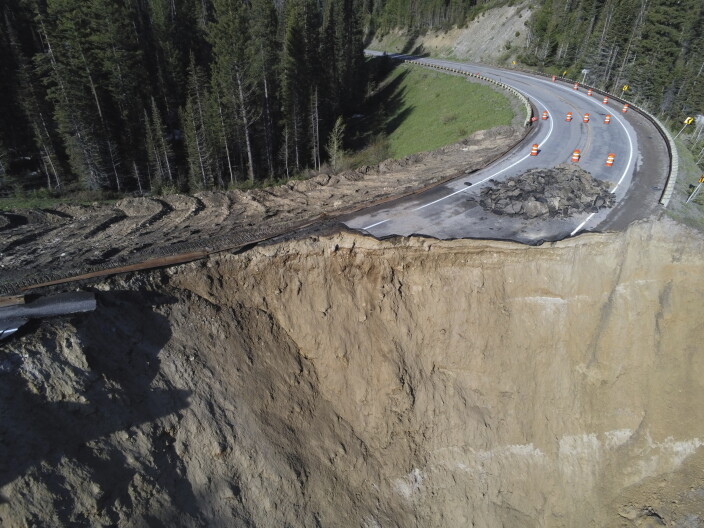
Show notesA damaged section of Teton Pass near Jackson, Wyo., on Saturday, June 8, 2024, that officials said had “catastrophically failed.” (AP / Wyoming Highway Patrol)
It’s Friday, which means it's time for our Reporter Roundtable when Idaho Matters gets you up to date on all the news that made headlines this past week.
Kevin Richert, senior reporter and blogger with Idaho Ed News
Display of a captured wolf in a Wyoming bar brings outrage
Jun 13, 2024
Show notes Daniel is part of a tight-knit ranching community in western Wyoming(Caitlin Tan / Wyoming Public Media)
Wyoming is home to hundreds of wolves, most live in or near Yellowstone National Park. They’re protected and a big tourist draw.
But elsewhere in the state wolves are still often reviled as predators and a threat to the livestock industry. So killing wolves in most of Wyoming is legal year-round without a license.
But one man who did that recently is now under investigation, after the animal’s death sparked outrage around the world.
Video shot inside a bar in Daniel, Wyo., population 108, in late February shows a muzzled and leashed wolf that looks to be injured, lying on the wooden floor. Bar patrons chatter in the background. Another video shows it attempting to snarl momentarily, but then submitting to a man grabbing its snout and leaning down to kiss it.
Cody Roberts in an image from a video in which he brought a live wolf into a bar in Daniel, Wyo., in February 2024.(screenshot by NPR)
That man is Cody Roberts, who’s from a longtime local ranching family. Local media reports say Roberts ran the wolf over with a snowmobile, which is legal in Wyoming if the animal dies.
But this wolf didn’t die that way. A source who requested anonymity for personal safety reasons says Roberts shot the animal later that night. But it’s what happened at the bar before he shot the wolf that has become a huge story.
Someone at the bar that night reported Roberts to local game wardens. They ticketed him for illegally possessing a live wolf, and he paid a $250 fine.
Global threats
Jackson Hole Community Radio broke the story a month after the incident. In April, videos of the bar incident surfaced and spread online internationally.
Cody Roberts isn’t talking to reporters, but people all over the world are talking about what happened at the bar in Daniel.
“I've had death threats from Ireland, Russia, Japan, Australia,” said another man who happens to be named Cody Roberts, but had nothing to do with the incident, is not related to the other Roberts, and lives about 100 miles way in Thayne, Wyo.
“I don't know how many thousands of messages I've had,” he said, exasperated.
Some people have mistaken his Facebook page for the other Roberts.
“Like this one just says, ‘You're a psychopathic wolf torturer kill yourself,’ ” he read.
People have threatened his family too — sharing his parents’ phone number online and even threatening to “run his grandson over.”
Roberts said he has responded to every message explaining that he is not the same guy.
“One lady even went and said, ‘I don't care if you're not the right one, do me a favor and put a bullet in his head and this will all go away,’ ” Roberts read.
He said he’s also disappointed in what the other Cody Roberts did, but he actually thinks these threats are worse.
“Does he deserve everything that he's getting? No, I don't think he does,” he said. “You know, he's still a human.”
“Boycott Wyoming” has become a trending hashtag. Another graphic circulating shows the Wyoming flag, with the words “Wyoming the animal abuse and torture state” superimposed upon it. The Wyoming Office of Tourism Facebook page is flooded with similar comments. The page normally posts almost daily, but went silent for almost all of April.
Local businesses are also facing backlash, including one-star reviews being left for some businesses only because they are in the same area as the incident.
Local anger
Cali O’Hare has had to write about it as the sole newsroom employee of the local paper, the Pinedale Roundup.
The reporter for the Pinedale Roundup newspaper says she's faced local backlash for writing about the wolf incident(Caitlin Tan / Wyoming Public Media)
“There's all kinds of letters I’ve gotten. I got one that was like, ‘The world is watching you.’ You know — so no pressure,” O’Hare half-joked. “It's not only a man's reputation, his family and their livelihood on the line, but it's also the reputation of the community — and the perception from the rest of the world.”
In this tight-knit community known for cowboys and sprawling sagebrush, this level of attention is unheard of. Not to mention — everyone knows everyone.
“I mean, I joke, it's three degrees of separation,” O’Hare said, adding that she knew Roberts before any of this happened. “It is truly one of those, you're damned if you do and you're damned if you don't.”
O’Hare said locals have condemned her for covering the incident. They did not like hearing about an incident that cast a shadow over one of their own, and the resulting global backlash to their community.
One comment she got reads, “Go practice real journalism Cali O’Hare, you b***h on a witch hunt for a man's family.”
Others asked O’Hare to stop the coverage, one accused her of not being objective or embellishing.
“I'm just doing my job. It's not personal. And I have great empathy for all of the folks involved in this,” she said.
The motorcycle brigade
On Memorial Day weekend, the local frustration moved beyond keyboards to in-person in Daniel.
For weeks, wolf advocates from across the country, including a motorcycle brigade from Texas, planned to drive through Daniel to raise awareness and money to reform Wyoming’s wolf laws.
Police escort the motorcycle protest brigade through Daniel, Wyoming on May 26, 2024(Caitlin Tan / Wyoming Public Media)
On the day of the event, a throng of locals came out, but only a handful of out-of-state advocates. The single-lane highway through town was lined bumper to bumper with trucks, livestock trailers, semis and hundreds of people, mostly locals. The day was peaceful, but tense.
“We have a great community. The people are the best,” said Lonny Johnson, a local farrier wearing a tan cowboy hat and purple silk scarf. “That's why we're here. No other reason than that.”
That was the main sentiment: Locals are tired of outsiders giving them a bad name. Many residents said they think Roberts is a good guy, he just made a mistake.
“Boys and booze and wolves obviously didn't mix up well,” said Pat Johnson “What was wrong about it was bringing it to this d*mn bar.”
But, there were a few Wyomingites who felt differently.
“I’m not too happy with what Cody Roberts did,” said Gary Garlick, from the nearby town of Big Piney. “There's a lot of ranchers that are upset with him as well. They're concerned about predator control, but what he did was a little out of line.”
He said he wished it had not come to this — a national protest in the tiny cow town.
Cattle ranching is important to Wyoming's economy and culture (Caitlin Tan / Wyoming Public Media)
Two women from California stood in front of the Green River Bar, sneaking by the giant livestock semi-trailers blocking the parking and street-side view of the infamous bar the wolf was brought into. They posed with red duct tape over their mouths — just like the tape that bound the wolf’s mouth in one of the leaked images.
“We drove 13 hours to get here,” Holly Smallie said, as a few local trucks blared their horns in the background. “Wolves are magical. We don’t deserve them. We’re no better than them. You live, you coexist, you care about wildlife.”
Smallie did not mince words — she thinks what Roberts did was torture and it needs further punishment.
The motorcycle brigade itself was short-lived. It took about one minute for six motorcyclists and several cars, one with a sign reading, “Stop wildlife cruelty," to be escorted through town by police.
The local crowd mostly booed, blatantly giving a thumbs down. Some called out, “That’s it?” Another said, “And I canceled church for this?”
But, the wolf advocates said they raised $130,000 that they hope will reform Wyoming’s laws, so that in the future something like what Roberts did would amount to a much higher penalty.
The investigations
Even though Wyoming’s Game and Fish Department said they punished Roberts to the fullest extent of the law with the $250 ticket, the Sublette County Sheriff’s Department is not so sure. They opened an investigation into Roberts in April to see if any other laws could apply to the case. That investigation is still ongoing.
But that isn’t the only investigation. Apparently, there have been an unprecedented number of death threats resulting from the case, said Travis Bingham, the department’s public information officer.
“Like the Sublette County Library has zero to do with it, but they're getting them [threats],” Bingham said. “But the list goes on — his family members, citizens and town business owners.”
He added that many of the death threat investigations are not wrapped up yet either.
Additionally, the Sheriff’s Department, which serves a county of less than 10,000 people, has received thousands of frustrated emails, social media comments and phone calls, Bingham said.
“We've had them from back East to Texas to California, Washington, D.C., New York, Florida, was the majority,” he said, “We did receive a couple emails from out of the country, like Europe and Australia.”
The calls were clogging up their 911 services, so the department set up a separate tip line. Outsiders, like some at the motorcycle brigade, want Roberts to be arrested, and many are saying Wyoming’s wolf laws should be changed.
“A pretty good compromise”
“An incident like this tars everyone,” said C.J. Box, a popular Wyoming author who has penned dozens of books following a fictional game warden. He has extensively researched Wyoming’s wildlife culture and laws, including those about wolves.
Box said people may not like Roberts — and Wyoming — being attacked by outsiders, but that does not mean they are defending what he allegedly did with the wolf.
“That's not hunting,” Box said. “Every hunter I know of, if they wound something, will try to dispatch that animal as quickly and humanely as possible. Not take it back, not show it off, not take pictures with it. That’s not the behavior of a hunter.”
He added that he thinks Wyoming’s wolf laws are a “pretty good compromise” — protecting the predator in much of the state’s northwest corner near Yellowstone National Park, and allowing them to be hunted in most of the rest of the state.
But this incident has state lawmakers looking at making changes. They recently formed a committee with stakeholders, specifically looking at the treatment of predatory animals. Any official changes to state law would come next year during Wyoming’s legislative session, at the earliest.
Meanwhile, wildlife advocate groups have filed a lawsuit to list the gray wolf in the multi-state northern Rocky Mountain region as either endangered or threatened under the Endangered Species Act. Currently, the species is protected under the act everywhere but that region. If the plaintiffs win, Wyoming would lose its authority to allow wolf hunting, with regulations being set and enforced by the federal government.
Copyright 2024 NPR
Tensions rise between Ranchers and conservationists over wolf restoration project
Jun 13, 2024
Show notes
A string of wolf attacks on livestock in Colorado's high country has become a flashpoint in the effort to restore the animal to its native range. Ranchers want the state to kill the wolves, which were reintroduced in that state just a few months ago. KUNC's Scott Franz reports for the Mountain West News Bureau that conservationists are urging patience.
What's next for the Radiation Exposure Compensation Act now that it's expired?
Jun 13, 2024
Show notesLinda Chase lived in Clark County, Nevada, during the time of active nuclear testing in the 1950s and 1960s. She contracted an autoimmune disease after being exposed to radiation. Many "downwinders" such as herself were not covered under the Radiation Exposure Compensation Act. She spoke at an event at the National Atomic Testing Museum in Las Vegas.(Yvette Fernandez / KNPR )
A long-standing federal program aimed at helping people afford medical treatment caused by toxic exposure, came to an end on Friday, June 7. Supporters tried to revive it but ultimately failed.
The Radiation Exposure Compensation Act (RECA) passed the Senate but never came up for a vote in the House before expiring last week. Since then, supporters tried a new tactic, submitting it as one of the over 1,300 possible amendments attached to the must-pass National Defense Authorization Act.
“What we're looking at here, is really trying to make sure that everybody who is impacted by our nuclear testing program receive the same kind of compensation,” said New Mexico Congresswoman Teresa Leger Fernandez.
She told her fellow lawmakers simply renewing the program as is would be unfair. Proponents have wanted significant expansions that would potentially help hundreds of thousands of people.
“Study after study has shown the expanse of the nuclear radiation,” Missour Sen. Josh Hawley said from the Senate floor earlier this year, imploring Congress to accept new scientific findings, take responsibility and compensate people who continue to be impacted.
With new technology and new studies, scientists have determined the fallout from hundreds of nuclear tests in the 1940s spread much further than what was known decades earlier.
“Here's a study from 1997, from 2005, another one in 2005, from 2023—all showing that the nuclear radiation is far beyond the contours of the original RECA passed in 1990,” Hawley said.
These new studies showed the radioactive plumes reached 46 states, the Navajo Nation, Guam, Canada and Mexico within days of detonation. But RECA only covered "downwinders" in portions of three states: Nevada, Utah, and Arizona.
“While they play politics we're gathering up our resources to pay for somebody to have cancer treatment," said Tina Cordova, a cancer survivor. She said five generations of her family have developed cancer. She represents the Tularosa Basin Downwinders Consortium in New Mexico.
Despite the Trinity Test Site being located in the New Mexico desert, “downwinders” in that state have never been included in the RECA program.
Cullin Potilo's family lives in Mojave County in Arizona. His family members have all the cancers covered by RECA, but Mojave County isn't part of the "downwinders" area defined by RECA.
“Mojave County has one of the highest rates of cancer in Arizona," Potilo said.
Earlier this week, at a news conference held at the Atomic Museum in Las Vegas, Congresswoman Susie Lee of Nevada was joined by Linda Chase, who remembers watching plumes from nuclear tests from her home in Nevada. She developed an autoimmune disease and her father died of bladder cancer.
“I checked every box except one," Chase said. "We lived in Clark County, which was not one of the 22 counties covered by RECA."
Most egregious is the exclusion of the Navajo Nation.
“Speaker (Mike) Johnson not only has betrayed the veterans and the blue-collar uranium miners and their families but has really also profoundly impacted and wronged the Navajo people,” said Navajo Nation spokesperson Justin Ahasteen, from his Washington, D.C. office.
Ahasteen said the tribe played a crucial role in World War II, from the Code Talkers to supplying the uranium used for the country's nuclear arsenal.
“It was the Navajo people in World War II who essentially won the war in the Pacific against Japan," he said. "From 1944 to about 1986, there were 30 million tons of uranium that were extracted from the Navajo Nation in between that same period. The domestic supply of uranium was around 60 million tons. So over half of the domestic supply of uranium came from the Navajo Nation.”
Ahasteen said once again the U.S. government is breaking its treaties and its word.
“The only thanks we've been given is disease, hardship and heartache," he said. "We have some of the highest rates of cancer in the country. High mortality rates, high birth defect rates, high cancer rates. All attributed to radiation exposure.”
States such as Missouri were far away from the testing sites and uranium mines but were used as toxic waste dumping grounds. Tricia Burns and several family members developed cancer as did many of her friends. Burns said she became a Missouri state representative because of this ongoing issue.
“Thyroid cancer is so common, when the doctor rips your thyroid out of your neck and that little scar on your neck, it's actually called the North County necklace,” said Burns during a recent online news conference sponsored by the Union of Concerned Scientists.
Republicans have said they wanted to ensure those who file claims are “actually suffering.” They have also balked at the $50 billion cost to expand the program for six years. The latest version, expanding coverage but funding it for only five years was also not acceptable for Congress to pass.
"We've spent $10 trillion on our nuclear programs since their inception," Cordova said. "We have spent $2.5 billion on RECA over 34 years. There is no way this is going to cost too much."
This story was produced by the Mountain West News Bureau, a collaboration between Wyoming Public Media, Nevada Public Radio (KNPR) in Las Vegas, Boise State Public Radio in Idaho, KUNR in Nevada, KUNC in Colorado and KANW in New Mexico, with support from affiliate stations across the region. Funding for the Mountain West News Bureau is provided in part by the Corporation for Public Broadcasting.
A guide to Idaho swallows
Jun 13, 2024
Show notes(Veit Irtenkauf / Flickr )
You've seen them zipping over irrigation canals, diving down, and skimming the water in search of bugs with their very distinctive wings.
There are 86 species of swallows, and many of them spend their summers in Idaho. These amazing birds were featured in the May issue of Wildlife Express, the Idaho Fish and Game newsletter for kids and kids at heart.
We asked Vickey Runnoe back on Idaho Matters to tell us more. She's a conservation education supervisor with Idaho Fish and Game and the superintendent of the Morrison Knudsen Nature Center.

 Our TOPPODCAST Picks
  Stay Connected