TopPodcast.com
Menu
  • Home
  • Top Charts
  • Top Networks
  • Top Apps
  • Top Independents
  • Top Podfluencers
  • Top Picks
    • Top Business Podcasts
    • Top True Crime Podcasts
    • Top Finance Podcasts
    • Top Comedy Podcasts
    • Top Music Podcasts
    • Top Womens Podcasts
    • Top Kids Podcasts
    • Top Sports Podcasts
    • Top News Podcasts
    • Top Tech Podcasts
    • Top Crypto Podcasts
    • Top Entrepreneurial Podcasts
    • Top Fantasy Sports Podcasts
    • Top Political Podcasts
    • Top Science Podcasts
    • Top Self Help Podcasts
    • Top Sports Betting Podcasts
    • Top Stocks Podcasts
  • Podcast News
  • About Us
  • Podcast Advertising
  • Contact
Not in our directory?
Add Show Here
Podcast Equipment
Center

toppodcastlogoOur TOPPODCAST Picks

  • Comedy
  • Crypto
  • Sports
  • News
  • Politics
  • True Crime
  • Business
  • Finance

Follow Us

toppodcastlogoStay Connected

    View Top 200 Chart
    Back to Rankings Page
    Health & Fitness

    Family Medicine & Pharmacy Podcast

    priority topics for family medicine and community pharmacy

    Advertise
    • Apple Podcasts
    • Google Play
    • Spotify

    Latest Episodes:
    Onychomycosis Jan 31, 2016
    Show notes

    Management of Onychomycosis in Canada in 2014 http://www.ncbi.nlm.nih.gov/pubmed/25775640

    Drug name: Brand: SA SA Criteria SA Approval period Direction SE Monitoring
    Ciclopirox 8% Penlac (nail lacquer) No Not covered N/A Nail lacquer: Apply bid to adjacent skin and affected nails daily. Remove with alcohol every 7 days (treat 4 weeks) dermatitis, dry skin, local burning sensation
    Efinaconazole Jublia (nail lacquer) Not covered Not covered N/A Apply to affected toenails once daily for 48 weeks Ingorwn nail (2%), dermatitis
    Terbinafine tablets Lamisil tablets Yes Severe onychomycosis
    PLUS
    functional disability
    PLUS
    positive KOH or dermatophyte culture of nail from a licensed lab.
    First approval: Three months
    Renewals: If required, up to three months.
    250mg once daily for 6 weeks (fingernail); 250mg once daily for 12 weeks (toenails) Headache (13%), diarrhea (6%), nausea, liver enzyme disorder (3%) Monitor AST/ALT prior to initiation, repeat if used >6 weeks
    Itraconazole Sporanox Yes 1. Immunocompromised pts/ Or 2. Pulse treatment for severe onychomycosis with functional disability
    PLUS
    confirmed lab results for candida or dermatophyte infection.
    1. Immunocompromised pts approval is indefinite 2. 3 months approval for 2nd group of pts (No need for SA approval if prescribed by HIV/AIDS Dr) Fingernail involvement: 200mg capsule twice daily for 1 week. repeat 1 week course after 3 week off time Toenails due to Trichophyton rubrum or T mentagrophytes: 200mg once daily for 12 consecutive weeks With or without fingernaikl involvement: 200mg once daily for 12 consecutive weeks Canadian labelling “Pulse dosing”: 200mg twice daily for 1 week, then repeat 1 week course twice with 3 week off time between each course Diarrhea, nausea, headache, skin rash Liver function in patients with pre-existing hepatic dysfunction, and in all patients being treated for longer than 1 month
    fluconazole Diflucan Yes 1. Immunocompromised patients.
    OR2. Exceptions on an individual basis for fungal infections resistant to first-line medications.
    1 day to indefinite (no need for HIV and AIDS Dr to apply for SA)

    The post Onychomycosis appeared first on Family Pharm Podcast.


    Diabetes Medications and BC Coverage Information Jan 23, 2016
    Show notes

    We are back! (Or your money back!)

    In this episode, Billy and Tina discuss the PharmaCare coverage status of different classes of diabetes medications.

    Sources:

    BC PharmaCare Formulary: https://pcbl.hlth.gov.bc.ca/pharmacare/benefitslookup/

    BC PharmaCare Special Authority: http://www2.gov.bc.ca/gov/content/health/practitioner-professional-resources/pharmacare/prescribers/special-authority

    CDA Formulary Listings for Diabetes Medications in Canada by provinces and territories (Jan 2016): http://www.diabetes.ca/getmedia/c87009a8-29b6-4061-a52a-963d0b077e47/pt-formulary-listing-jan-18-2016.pdf.aspx
    *In case the link doesn’t work: pt-formulary-listing-jan-18-2016

    Class drugs Other therapeutic considerations coverage SA criteria
    Biguanide metformin covered
    Alpha-glucosidase inhibitor (acarbose) acarbose Improved postprandial control, GI side-effects delisted
    Incretin agent: DPP-4 Inhibitors linagliptin (Trajenta) SA same as onglyza
    sitagliptin (Januvia) delisted
    saxagliptin (Onglyza) SA As part of a combination treatment for type 2 diabetes mellitus, 1) When insulin NPH is not an option
    AND
    2) After inadequate glycemic control on maximum tolerated doses of dual therapy of metformin AND a sulfonylurea.
    Incretin agent: GLP-1 receptor agonists liraglutide (Victoza) GI side-effects not listed
    Insulin rapid acting (Humalog, novorapid, apidra) No dose ceiling, flexible regiments partial coverage
    short acting (Humulin R, Novolin Toronto) covered
    NPH covered
    Premixed (Humulin 30/70, Novolin 30/70, 40/60, 50/50) covered
    Premixed (Humalog mix 25, mix 50, Novomix 30) partial coverage
    glargine (Lantus) SA A) Type 1 DM or B) Type 2 DM > 17 years old, and 1) requiring insulin and is currently taking insulin NPH and/or pre-mix insulin daily at optimal dosing
    AND
    2) Has experienced unexplained nocturnal hypoglycemia at least once a month despite optimal management
    OR
    3) Has experienced or continues to experience severe, systemic or local allergic reaction to existing insulin treatment.
    detemir (Levemir) SA same as Lantus
    new glargine (Toujeo) not listed
    Insulin secretagogue: Meglitinide repaglinide (gluconorm) Less hypoglycemia in context of missed meals but usually requires TID to QID dosing not listed
    Insulin secretagogue: Sulfonylurea glyburide Gliclazide and glimepiride associated with less hypoglycemia than glyburide covered
    gliclazide SA (listed everywhere else in Canada) Treatment failure or intolerance to at least one other sulfonylurea drug (e.g., glyburide, tolbutamide) at adequate doses.
    SGLT2 inhibitors canagliflozin (Invokana) UTI, genital infections, hypotension, hyperlipidemia, caution with renal dysfunction and loop diuretics, dapagliflozin not to be used if bladder cancer, rare diabetic ketoacidosis (may occur with no hyperglycemia) 1 year manufacturer coverage with special plan
    dapagliflozin (Forxiga) 1 year manufacturer coverage with special plan
    empagliflozin (Jardiance) not listed
    TZD rosiglitazone CHF, edema, fractures, rare bladder cancer (pioglitazone), cardiovascular controversy (rosiglitazone), 6-12 weeks required for maximal effect delisted
    pioglitazone SA same as onglyza
    Weight loss agent (orlistat) orlistat GI side effects not listed
    Combination Drugs sitagliptin and metformin (Janumet) delisted
    linagliptin and metformin (Jentadueto) SA same as onglyza

    The post Diabetes Medications and BC Coverage Information appeared first on Family Pharm Podcast.


    What I learned from St Paul’s CME 2014 Part 1 Nov 19, 2014
    Show notes

    This is planned to be an 8-part series highlighting the take-home points I picked up during the St. Paul’s Hospital CME Conference 2014.

    Pearls from Part 1 “Internal Medicine”:

    Alcoholism – Dr. Paul Farnan

    1. Screen alcohol use disorders routinely to catch those of whom do not appear to have a significant social or occupational impairment.
    2. Use assertive statements to convey the concern regarding someone’s alcohol use.
    3. Peer support is strongly recommended. Patients should try multiple meetings at different groups before concluding that they are not helpful, as the groups vary in their structure and member characteristics.
    4. Medical treatments may be considered in select patients: naltrexone, acamprosate, disulfiram.

    Gout – Dr. Hyon Choi

    1. Screen for HLA-B*5801 in Asians (esp. Chinese, Thai, and Korean patients) before starting alopurinol.
    2. Look for concurrent metabolic disorders.
    3. “Medication in the pocket” strategy for acute flares: colchicine 1.2mg po x1 then 0.6mg po in 1 hour.
    4. Use losartan or CCB for concurrent hypertension.
    5. Low-carb diet and avoid foods with highest purine content.

    Cellulitis – Dr. Val Montessori

    1. Non-purulent cellulitis, most likely caused by Group A Strep, treat with cephalexin (Keflex) 500mg po QID
    2. Purulent cellulitis, most likely Staph Aureus but still possibly GAS, treat with Septra DS PO BID, and cover GAS with Keflex.
    3. Complicated wounds, consult ID.

    HCV – Dr. Edward Tam

    1. New therapy more tolerable and has a 95% cure rate, but also exceedingly expensive.
    2. Refer all HCV RNA positive patients to hepatologists for assessment of treatment.

    This Changed My Practice – Dr. Steve Wong

    • http://thischangedmypractice.com/

    OSA – Dr. Pearce Wilcox

    1. Co-morbidities with metabolic syndrome -> screen for metabolic syndromes in patients with OSA, and vice versa

    The post What I learned from St Paul’s CME 2014 Part 1 appeared first on Family Pharm Podcast.


    Family Pharm Podcast – RELAUNCHED! Nov 11, 2014
    Show notes

    After a 6-month hiatus, Tina – now a newly-hatched PHARMACIST! – and Billy teamed up to relaunch this pet project with a plan to make it more interactive and less sleep-inducing. Did it work with this unscripted episode?

    The post Family Pharm Podcast – RELAUNCHED! appeared first on Family Pharm Podcast.


    ADHD 2: medications Apr 05, 2014
    Show notes

    Tina concentrates on the details of ADHD medications and invites your attention to the following:

    Non-pharmacological therapy

    • behavioural therapy

    Stimulants

    • methylphenidate
    • amphetamines

    Non-stimulants

    • atomoxetine
    • clonidine
    • other antidepressants and antipsychotics (to be covered in future episodes)

    The post ADHD 2: medications appeared first on Family Pharm Podcast.


    ADHD 1: CADDRA Guideline Mar 31, 2014
    Show notes

    *This episode was recorded in January 2014.

    This is the topic that started it all. As Tina planned to study ADHD for school, we discussed how this would be useful information for other pharmacy students and medical trainees as well.

    We looked to the comprehensive CADDRA guideline for the assessment, differential diagnoses, and treatment strategies for ADHD.

    CADDRA Guideline:

    • http://www.caddra.ca/pdfs/caddraGuidelines2011Chapter02.pdf

    ADHD Checklist on CADDRA ADHD Assessment Toolkit, page 8.20

    • http://www.caddra.ca/pdfs/caddraGuidelines2011_Toolkit.pdf

    The post ADHD 1: CADDRA Guideline appeared first on Family Pharm Podcast.


    Gastroenteritis in Children Mar 22, 2014
    Show notes

    Billy looked at the following guidelines to summarize the approach to a child with gastroenteritis:

    UK NICE Guideline: Diarrhoea and vomiting in children under 5 (Issued: April 2009) http://guidance.nice.org.uk/cg84

    CPS Guideline: Oral rehydration therapy and early refeeding in the management of childhood gastroenteritis (Posted: Nov 1, 2006) http://www.cps.ca/documents/position/oral-rehydration-therapy

    History:

    • onset of diarrhea and/or vomiting (gastro is sudden in onset)
    • duration of vomiting and diarrhea (diarrhea 5-7 days, max 2 weeks; vomiting 1-2 days, max 3 days)
    • sick contact
    • pathogen exposure
    • travel history

    History suggestive of increased risk of dehydration:

    • young age (esp <6mo)
    • low birth weight infants
    • >5 diarrhea in 24h
    • >2 vomiting in 24h
    • no oral intake
    • signs of malnutrition

    Think about differential diagnosis if:

    • fever >38 in children younger than 3 months
    • fever >39 in children older than 3 months (fever workup required)
    • shortness of breath or tachypnoea
    • altered conscious state
    • neck stiffness
    • bulging fontanelle in infants
    • non-blanching rash
    • blood and/or mucus in stool
    • bilious (green) vomit
    • severe or localised abdominal pain
    • abdominal distension or rebound tenderness.

    SSx of dehydration and shock

    Table 1 in NICE

    Increasing severity of dehydration

    No clinically detectable dehydration

    Clinical dehydration

    Clinical shock

    Symptoms (remote and face-to-face assessments)

    Appears well

    Red flag Appears to be unwell or deteriorating

    –

    Alert and responsive

    Red flag Altered responsiveness (for example, irritable, lethargic)

    Decreased level of consciousness

    Normal urine output

    Decreased urine output

    –

    Skin colour unchanged

    Skin colour unchanged

    Pale or mottled skin

    Warm extremities

    Warm extremities

    Cold extremities

    Signs (face-to-face assessments)

    Eyes not sunken

    Red flag Sunken eyes

    –

    Moist mucous membranes (except after a drink)

    Dry mucous membranes (except for ‘mouth breather’)

    –

    Normal heart rate

    Red flag Tachycardia

    Tachycardia

    Normal breathing pattern

    Red flag Tachypnoea

    Tachypnoea

    Normal peripheral pulses

    Normal peripheral pulses

    Weak peripheral pulses

    Normal capillary refill time

    Normal capillary refill time

    Prolonged capillary refill time

    Normal skin turgor

    Red flag Reduced skin turgor

    –

    Normal blood pressure

    Normal blood pressure

    Hypotension (decompensated shock)

    Table 2 in CPS

    TABLE 2

    Clinical assessment of degree of dehydration *

    Mild (under 5%)

    Moderate (5-10%)

    Severe (over 10%)

    Slightly decreased urine output

    Slightly increased thirst

    Slightly dry mucous membrane

    Slightly elevated heart rate

    Decreased urine output

    Moderately increased thirst

    Dry mucous membrane

    Elevated heart rate

    Decreased skin turgor

    Sunken eyes

    Sunken anterior fontanelle

    Markedly decreased or absent urine output

    Greatly increased thirst

    Very dry mucous membrane

    Greatly elevated heart rate

    Decreased skin turgor

    Very sunken eyes

    Very sunken anterior fontanelles

    Lethargy

    Cold extremities

    Hypotension

    Coma

    *Some of these signs may not be present

    SSx of hypernatremic dehydration:

    • jittery
    • increased muscle tone
    • hyperreflexia
    • convulsions
    • drowsiness or coma

    Labs:

    • No routine blood work
    • Serum sodium, potassium, urea, creatinine, glucose if IV fluids or signs of hypernatremia
    • Blood gas if shock suspected

    Stool culture if:

    • blood and/or mucus in stool
    • immunocompromized
    • septicemia suspected
    • travel history
    • diarrhea not improved by day 7
    • uncertainty about diagnosis of gastroenteritis

    Blood culture if antibiotic started

    Watch for HUS in E. coli O157:H7

    Treatment:

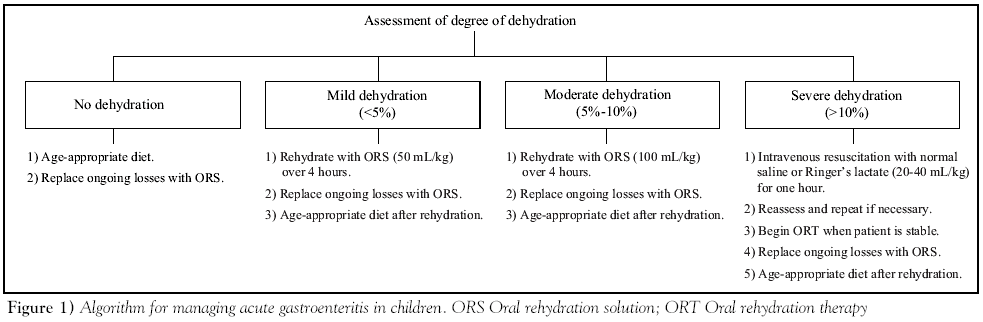
    Figure 1 in CPS

    No dehydration

    • continue breastfeeding and other milk feeds
    • encourage fluid intake
    • discourage the drinking of fruit juices and carbonated drinks, especially in those at increased risk of dehydration (see 1.2.1.2)
    • offer ORS solution as supplemental fluid to those at increased risk of dehydration (see 1.2.1.2).

    Dehydration

    ORT

    • Contraindications
      • IVF indicated (shock, deterioration, persistent vomiting despite NG tube)
      • paralytic ileus
      • monosaccharide malabsorption
    • use low-osmolarity ORS solution (240–250 mOsm/l)[5] (eg Pedialyte, Gastrolyte in Canada) for oral rehydration therapy
    • give 50 ml/kg for fluid deficit replacement over 4 hours as well as maintenance fluid
    • give the ORS solution frequently and in small amounts
    • consider supplementation with their usual fluids (including milk feeds or water, but not fruit juices or carbonated drinks) if they refuse to take sufficient quantities of ORS solution and do not have red flag symptoms or signs (see table 1)
    • plain water discouraged by CPS
    • consider giving the ORS solution via a nasogastric tube if they are unable to drink it or if they vomit persistently
    • monitor the response to oral rehydration therapy by regular clinical assessment

    IVF

    • indications:
      • Shock
      • a child with red flag symptoms or signs (see table 1) shows clinical evidence of deterioration despite oral rehydration therapy
      • a child persistently vomits the ORS solution, given orally or via a nasogastric tube.
    • Initial bolus
      • 20mL/kg of NS, then another one if still shocked
      • If no response to 2 boluses, consider other causes of shock. Consult PICU.
    • IVF therapy
      • Use NS or D5NS
      • If shocked: add 100mL/kg for fluid deficit to maintenance
      • If no shocked: add 50mL/kg for fluid deficit to maintenance
      • Early oral rehydration recommended. Switch to ORT as early as tolerated.
    • IVF in Hypernatremic dehydration
      • Urgent consult to specialist
      • Use NS or D5NS still
      • replace slowly over 48 hours, aiming at reducing serum sodium at a rate of less than 0.5mmol/L per hour

    Maintenance after rehydration

    • Encourage breastfeeding, milk, and fluids
    • Consider giving 5mL/kg of ORS after each large watery stool
    • If dehydration recurs, restart ORT

    Antibiotic indications:

    • suspected or confirmed septicaemia
    • extra-intestinal spread of bacterial infection
    • younger than 6 months with salmonella gastroenteritis
    • patient malnourished or immunocompromised with salmonella gastroenteritis
    • Clostridium difficile-associated pseudomembranous enterocolitis
    • giardiasis
    • dysenteric shigellosis
    • dysenteric amoebiasis
    • cholera

    Do not use antidiarrhoeal medications.

    Home care

    Red flags for dehydration (seek medical attention):

    • appearing to get more unwell
    • changing responsiveness (for example, irritability, lethargy)
    • decreased urine output
    • pale or mottled skin
    • cold extremities

    Also seek medical attention if length of illness beyond the usual course:

    • diarrhoea: 5–7 days and in most children it stops within 2 weeks
    • vomiting: 1 or 2 days and in most children it stops within 3 days

    If not dehydrated:

    • to continue usual feeds, including breast or other milk feeds
    • to encourage the child to drink plenty of fluids
    • to discourage the drinking of fruit juices and carbonated drinks
    • plain water also discouraged by CPS
    • to offer ORS solution as supplemental fluid

    with clinical dehydration:

    • that rehydration is usually possible with ORS solution
    • premixed ORS preferred due to risk of error (CPS)
    • to give 50 ml/kg of ORS solution for rehydration plus maintenance volume over a 4-hour period
    • to give this amount of ORS solution in small amounts, frequently
    • to seek advice if the child refuses to drink the ORS solution or vomits persistently
    • to continue breastfeeding as well as giving the ORS solution
    • not to give other oral fluids unless advised
    • not to give solid foods.

    after rehydration:

    • drink plenty of their usual fluids, including milk feeds if these were stopped
    • avoid fruit juices and carbonated drinks until the diarrhoea has stopped
    • reintroduce the child’s usual diet
    • give 5 ml/kg ORS solution after each large watery stool if you consider that the child is at increased risk of dehydration

    Disease prevention

    • washing hands with soap (liquid if possible) in warm running water and careful drying are the most important factors in preventing the spread of gastroenteritis
    • hands should be washed after going to the toilet (children) or changing nappies (parents/carers) and before preparing, serving or eating food
    • towels used by infected children should not be shared
    • children should not attend any school or other childcare facility while they have diarrhoea or vomiting caused by gastroenteritis
    • children should not go back to their school or other childcare facility until at least 48 hours after the last episode of diarrhoea or vomiting
    • children should not swim in swimming pools for 2 weeks after the last episode of diarrhoea.

    The post Gastroenteritis in Children appeared first on Family Pharm Podcast.


    Pediatric UTI Mar 16, 2014
    Show notes

    AAP Guideline on Urinary Tract Infection: Clinical Practice Guideline for the Diagnosis and Management of the Initial UTI in Febrile Infants and Children 2 to 24 Months

    • http://pediatrics.aappublications.org/content/128/3/595.long

    UK NICE guideline: Urinary tract infection in children

    • http://guidance.nice.org.uk/cg54

    Summary:

    • For children with fever, UTI should be suspected.
    • For children at a very low risk for UTI, or greater than 3 years of age, a bag urine for urinalysis is an appropriate first step. If the urinalysis is suspicious for UTI, such as being positive for leukocyte esterase or nitrite, or if the children is not at a very low risk for UTI, then a catheterized urine sample should be obtained for urine culture prior to starting empiric antibiotics.
    • If the culture comes back negative, then antibiotics treatment covering UTI can be stopped.
    • Febrile UTI is presumed to be pyelonephritis, and should be investigated with Bladder and Renal Ultrasound. If the ultrasound shows structural abnormalities, or if the child has recurrent febrile UTIs, a VCUG should be considered, especially in younger children.

    The post Pediatric UTI appeared first on Family Pharm Podcast.


    Pediatric Fever Mar 06, 2014
    Show notes


    The bulk of this episode is based on the UK NICE guideline: Feverish illness in children under 5, published in 2013. http://guidance.nice.org.uk/CG160

    The guideline covers:

    • Thermometers and the detection of fever
    • Clinical assessment of the child with fever (using the traffic light system)
    • Management by remote assessment
    • Management by the non-paediatric practitioner
    • Management by the paediatric specialist (investigations summarized below)
    • Antipyretic interventions

    The Traffic Light System in assessing risk for serious infection

    This assessment tool takes into consideration color/appearance, activity, respiratory, circulation and hydration, and “other” parameters. For each parameter, their associated signs and symptoms are assigned a color code: “green” (low risk), “amber” (intermediate risk) and “red” (high risk). The table can be found here.

    Age-appropriate investigations for pediatric fever

    Once the risk for serious infection is determined, the following investigation should be performed:

    Age CBC diff BC CRP UA/UC LP CXR Stool culture
    <1mo yes yes yes yes yes if indicated if indicated
    1-3mo yes yes yes yes if unwell, or WBC >15 or <5M/mL if indicated if indicated
    >=3mo, RED yes yes yes yes yes yes if indicated
    >=3mo, AMBER yes yes yes yes if <1yr if fever >39 and WBC >20 if indicated
    >=3mo, GREEN no no no yes no no if indicated

    And at the same time, empiric parenteral antibiotic coverage for meningitis (3rd generation cephalosporin plus ampicillin/amoxicillin) should be started if LP is indicated.

    The post Pediatric Fever appeared first on Family Pharm Podcast.


    A Fib 5: Antithrombotics Mar 03, 2014
    Show notes

    Antiplatelets:

    • ASA
    • Clopidogrel

    Anticoagulants:

    • Warfarin
    • Apixaban
    • Dabigatran
    • Rivaroxaban

    Clotting Cascade:

    File:Classical blood coagulation pathway.png

    Clotting Factor Song, by Emily Anne Nagler:

    Twelve, eleven, nine, it’s clotting factor time
    8 and 9 to 10a 5, that’s how we stay alive

    Don’t forget to say: the tissue factor way
    7 to 7a helps 10 go to 10a

    Then 2 to thrombin, and 1 to fibrin
    And that’s how it ends

    The post A Fib 5: Antithrombotics appeared first on Family Pharm Podcast.


    1 2 3 Next

    Related Podcasts

    Fresh Air

    1

    Fresh Air Arts
    Twenty Thousand Hertz

    2

    Twenty Thousand Hertz Arts
    The Black Tapes

    3

    The Black Tapes Arts
    Snap Judgment

    4

    Snap Judgment Arts
    Here’s The Thing with Alec Baldwin

    5

    Here’s The Thing with Alec Baldwin Arts
    The NoSleep Podcast – Creative Reason Media Inc.

    6

    The NoSleep Podcast – Creative Reason Media Inc. Arts
    footer-logo

    Contact Us

    Toll Free: 844-670-7747

    Links

    • Home
    • Top Charts
    • Networks
    • Apps
    • Independents Podcasts
    • Podcast Advertising
    • Podcast News
    • Contact Us
    • About Us
    • Analytics & Insights

    Stay Connected

      Privacy, Terms of Use & Our Code of Ethics Protecting Content Creators Copyrights