TopPodcast.com
Menu
  • Home
  • Top Charts
  • Top Networks
  • Top Apps
  • Top Independents
  • Top Podfluencers
  • Top Picks
    • Top Business Podcasts
    • Top True Crime Podcasts
    • Top Finance Podcasts
    • Top Comedy Podcasts
    • Top Music Podcasts
    • Top Womens Podcasts
    • Top Kids Podcasts
    • Top Sports Podcasts
    • Top News Podcasts
    • Top Tech Podcasts
    • Top Crypto Podcasts
    • Top Entrepreneurial Podcasts
    • Top Fantasy Sports Podcasts
    • Top Political Podcasts
    • Top Science Podcasts
    • Top Self Help Podcasts
    • Top Sports Betting Podcasts
    • Top Stocks Podcasts
  • Podcast News
  • About Us
  • Podcast Advertising
  • Contact
Not in our directory?
Add Show Here
Podcast Equipment
Center

toppodcastlogoOur TOPPODCAST Picks

  • Comedy
  • Crypto
  • Sports
  • News
  • Politics
  • True Crime
  • Business
  • Finance

Follow Us

toppodcastlogoStay Connected

    View Top 200 Chart
    Back to Rankings Page
    History

    Dead Ideas: The History of Extinct Thoughts and Practices

    We explore ideas once believed to be true but no longer. Each dead idea is explored in all its glorious eccentricity.

    Dead Ideas: The History of Extinct Thoughts and Practices is made with Jetpack Podcast. Full show notes and every episode at https://deadideas.net/

    Advertise

    Copyright: © (c) B. T. Newberg

    • Apple Podcasts
    • Google Play
    • Spotify

    Latest Episodes:
    What It’s Like to Make a Podcast: An Interview with Sam Hume of Pax Britannica Apr 28, 2019
    Show notes

    http://media.blubrry.com/deadideas/ia601402.us.archive.org/13/items/DeadIdeas107WhatItsLikeToMakeAPodcastAnInterviewWithSamHumeOfPaxBritannica/Dead%20Ideas%20107%20What%20It%27s%20Like%20to%20Make%20a%20Podcast%20An%20Interview%20with%20Sam%20Hume%20of%20Pax%20Britannica.mp3

    What’s it like to make a podcast? Sam Hume of the new show Pax Britannica talks with me about all the ups and downs of podcasting. Check out Sam’s show.

    Be sure to support the show at www.patreon.com/deadideaspod to get your portrait drawn!

    Music and graphic design by Rachel Westhoff. Maps, pics, references and more at http://www.deadideas.net.

    Become our patron on Patreon at www.patreon.com/deadideaspod

    Dead Ideas: The History of Extinct Thoughts and Practices is made with Jetpack Podcast. Full show notes and every episode at https://deadideas.net/


    Doomsday, 1000 AD: How Millenarianism Ushered in the Crusades, Feat. Neil Eckart – European History Mar 31, 2019
    Show notes

    http://media.blubrry.com/deadideas/ia601407.us.archive.org/1/items/DeadIdeas106Doomsday1000A.D.HowMillenarianismUsheredInTheCrusadesFeat.NeilEckart/Dead%20Ideas%20106%20Doomsday%201000%20A.D.%20How%20Millenarianism%20Ushered%20in%20the%20Crusades%2C%20Feat.%20Neil%20Eckart.mp3

    The end is nigh! Or so they’ve been saying since the year 1000 A.D. Today, Neil Eckart of the podcast War and Conquest tells us about millenarianism, the medieval idea that the world was coming to crashing halt at the end of the millennium. So, how did medieval folks party like it was 999? They went crusading! Discover the connection with the crusades in today’s episode.

    Be sure to support the show at www.patreon.com/deadideaspod to get your portrait drawn!

    Music and graphic design by Rachel Westhoff. Maps, pics, references and more at http://www.deadideas.net.

    Become our patron on Patreon at www.patreon.com/deadideaspod

    Time/place: Medieval Europe, c. 1000 CE

    Dead Idea: Millenarianism

    Main Sources

    Holland, T. (2008). The Forge of Christendom: The End of Days and the Epic Rise of the West. London: Little, Brown.

    Rubenstien, J. (2011). Armies of Heaven: The First Crusade and the Quest for the Apocalypse. Philadelphia, PA: Basic Books.

    Dead Ideas: The History of Extinct Thoughts and Practices is made with Jetpack Podcast. Full show notes and every episode at https://deadideas.net/


    Dan Carlin of Hardcore History: Full Interview for the History of History Podcasting Feb 17, 2019
    Show notes

    http://media.blubrry.com/deadideas/ia601500.us.archive.org/17/items/DeadIdeas104HistoryOfHistoryPodcasting/Dead%20Ideas%20105%20Interview%20with%20Dan%20Carlin%20of%20Hardcore%20History.mp3

    Last time we delved into the History of History Podcasting, and now we are giving you the full interview with none other than the host of Hardcore History, Dan Carlin.

    For the rest of the full interviews, check out our Patreon feed at http://www.patreon.com/deadideaspod.

    Music and graphic design by Rachel Westhoff.

    Dead Ideas: The History of Extinct Thoughts and Practices is made with Jetpack Podcast. Full show notes and every episode at https://deadideas.net/


    The History of History Podcasting, Feat. Dan Carlin, Bob Packett, Lars Brownworth, Cam Reilly, Lara Eakins, Robin Pierson, Roifield Brown, Jordan Harbour, Travis Dow, Glen Gibbs, and Liz Covart Feb 17, 2019
    Show notes

    http://media.blubrry.com/deadideas/ia601500.us.archive.org/16/items/DeadIdeas104TheHistoryOfHistoryPodcasting/Dead%20Ideas%20104%20The%20History%20of%20History%20Podcasting.mp3

    This is it: the first ever attempt at a history of our genre, history podcasting. I’ve interviewed nearly a dozen podcasters and spoke to dozens more to bring you this story, which comes to you with our characteristic Dead Ideas quirk (would you expect anything less?). Today I present, not a dead idea but a live idea: history podcasting.
    Guest list: Bob Packett, Lars Brownworth, Cam Reilly, Lara Eakins, Robin Pierson, Roifield Brown, Jordan Harbour, Travis Dow, Glen Gibbs, Liz Covart, and Dan Carlin
    Check out our Patreon feed for the full interviews at http://www.patreon.com/deadideaspod Released under a Creative Commons Attribution License. Theme music and graphic design by Rachel Westhoff. Sound Clip Credits: Nick Judy (plus this one, and this too) Kevin MacLeod Chris Wells Ilya Klushin Jovan System German Candy Taster Bju KS HelloKitty9713 Voyager360360

    Dead Ideas: The History of Extinct Thoughts and Practices is made with Jetpack Podcast. Full show notes and every episode at https://deadideas.net/


    Steampunk Rome VI: Rome Industrial – An Interview with Jordan Harbour of Twilight Histories – Roman History Feb 03, 2019
    Show notes

    http://media.blubrry.com/deadideas/ia801500.us.archive.org/12/items/DeadIdeas100SteampunkRomeIII/Dead%20Ideas%20103%20Steampunk%20Rome%20VI%20Rome%20Industrial%20-%20An%20Interview%20with%20Jordan%20Harbour%20of%20Twilight%20Histories.mp3

    Now that you know ancient Rome fell just shy of an industrial revolution, why not enjoy a world where Rome does industrialize? That’s Jordan Harbour’s Rome Industrial setting, which he is here to talk to us about today. Jordan is the host of Twilight Histories, an alternate history podcast you should listen to in the dark.

    Be sure to support the show at www.patreon.com/deadideaspod to get your portrait drawn!

    Custom map of Rome by Adam McKithern. Music by Rachel Westhoff. Maps, pics, references and more at http://www.deadideas.net.

    Become our patron on Patreon at www.patreon.com/deadideaspod

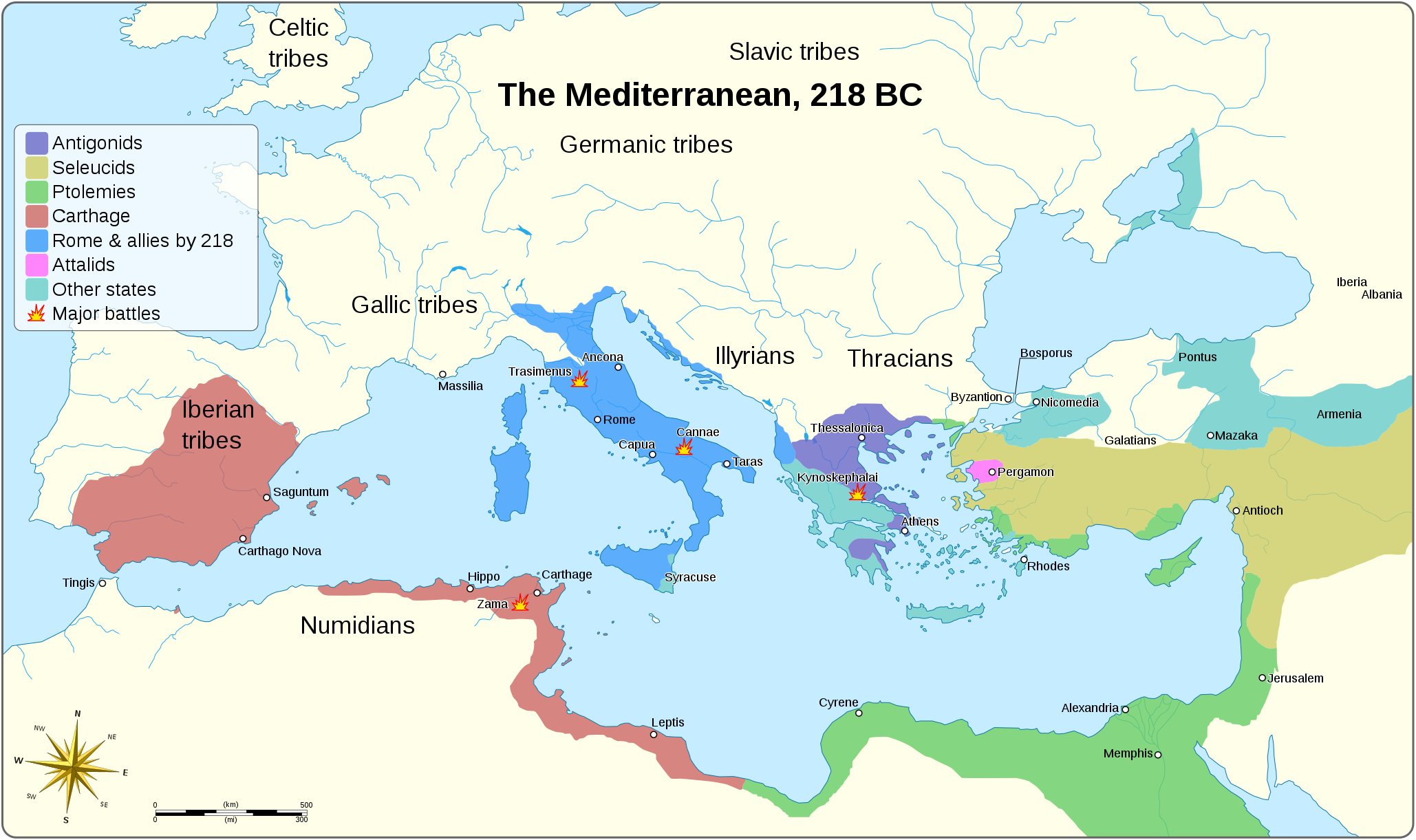
    2058px-Mediterranean_at_218_BC-en.svg

    The Hellenistic World, end of 3rd cen. BCE

    Custom-generated map of alternate history Rome by Adam McKithern

    The Roman Empire at its greatest extent, 117 CE

    Click to view slideshow.

    Main Sources

    Allen, R. C. (2017). The Industrial Revolution: A Very Short Introduction. New York: Oxford University Press.

    Arun. (2018). “10 Major Causes of the Industrial Revolution.” Learnodo-Newtonic.com. Retrieved Nov. 4, 2018, from: https://learnodo-newtonic.com/industrial-revolution-causes

    Deakin, M. A. B. (1994, Mar). “Hypatia and Her Mathematics.” The American Mathematical Monthly, 101(3): 234-243.

    Dzielska, M. (1995). Hypatia of Alexandria. Lyra, F., Trans. Cambridge, MA: Harvard University Press.

    Greene, M. (2004). “The Birth of Modern Science?” Nature.com. Retrieved Nov. 4, 2018, from: https://www.nature.com/articles/430614a

    Hero of Alexandria. (1851). The Pneumatics of Hero of Alexandria. Woodcroft, B., Trans. Himedo.net. Retrieved Nov. 4, 2018, from: http://himedo.net/TheHopkinThomasProject/TimeLine/Wales/Steam/URochesterCollection/Hero/index-2.html

    James, P., and Thorpe, N. (1994). Ancient Inventions. New York: Ballantine.

    Jones, P. J. (2006). Cleopatra: A Sourcebook. University of Oklahoma Press.

    Koyama, M. (2017). “Could Rome Have Had an Industrial Revolution?” Medium.com. Retrieved Nov. 4, 2018, from: https://medium.com/@MarkKoyama/could-rome-have-had-an-industrial-revolution-4126717370a2

    Lefkowitz, M. R., and Fant, M. B. (2016). Women’s Life in Greece and Rome: A Source Book in Translation. Baltimore, MD: Johns Hopkins University Press.

    Lowe, D. (2016). “Suspending Disbelief: Magnetic Levitation in Antiquity and the Middle Ages.” Classical Antiquity, 35(2): 247-278.

    MacLeod, R., Ed. (2000). The Library of Alexandria: Centre of Learning in the Ancient World. New York: I. B. Tauris.

    Miles, M. M. (2011). Cleopatra: A Sphinx Revisited. Los Angeles: University of California Press.

    Montserrat, D. (1996). Sex and Society in Graeco-Roman Egypt. New York: Kegan Paul International.

    Mosjov, B. (2010). Alexandria Lost: From the Advent of Christianity to the Arab Conquest. London: Duckworth.

    Oleson, J. P., Ed. (2008). The Oxford Handbook of Engineering and Technology in the Classical World. New York: Oxford University Press.

    Pollard, J. and Reid, H. (2006). The Rise and Fall of Alexandria: Birthplace of the Modern Mind. New York: Viking.

    Rowan-Robinson, M. (2004). “Praising Alexandrians to Excess.” PhysicsWorld.com. Retrieved Nov. 4, 2018, from: https://physicsworld.com/a/praising-alexandrians-to-excess/

    Rowlandson, J., Ed. (1998). Women & Society in Greek & Roman Egypt: A Sourcebook. New York: Cambridge University Press.

    Russo, L. (2004). The Forgotten Revolution: How Science Was Born in 300 BC and Why It Had to Be Reborn. Levy, S., Trans. New York: Springer.

    Torchinsky, J. (2012). “The Greeks Had the Technology to Build a Car in 60 A.D.” Jalopnik.com. Retrieved Nov. 4, 2018, from: https://jalopnik.com/5888188/the-greeks-had-the-technology-to-build-a-car-in-60-ad

    Watts, E. J. (2010). Riot in Alexandria: Tradition and Group Dynamics in Late Antique Pagan and Christian Communities. Los Angeles: University of California Press.

    Wyatt, L. T. (2009). The Industrial Revolution: Greenwood Guides to Historic Events, 1500-1900. Westport, CT: Greenwood Press.

    Dead Ideas: The History of Extinct Thoughts and Practices is made with Jetpack Podcast. Full show notes and every episode at https://deadideas.net/


    Steampunk Rome V: A Pyrrhic Victory: The Death of Ancient Science – RPG, Pt 3 – Egyptian, Greek, and Roman History Jan 20, 2019
    Show notes

    http://media.blubrry.com/deadideas/ia801500.us.archive.org/12/items/DeadIdeas100SteampunkRomeIII/Dead%20Ideas%20102%20Steampunk%20Rome%20V.mp3

    Success is at hand for Andre’s character Pyrrho. But it is a Pyrrhic victory, for after that we recount the history of the backward slide of science from the Roman conquest into the Middle Ages, until its final rebirth in the Renaissance and Enlightenment.

    Be sure to support the show at www.patreon.com/deadideaspod to get your portrait drawn!

    Custom map of Rome by Adam McKithern. Music by Rachel Westhoff. Maps, pics, references and more at http://www.deadideas.net.

    Become our patron on Patreon at www.patreon.com/deadideaspod

    Time/place: The Hellenistic World, 201 BCE

    Dead Idea: Ancient Steam Technology

    Co-host: Andre Sólo

    Andre’s character has one final challenge to solve. You can try your hand at solving it too. Post your solution to our Facebook page at @deadideaspod!

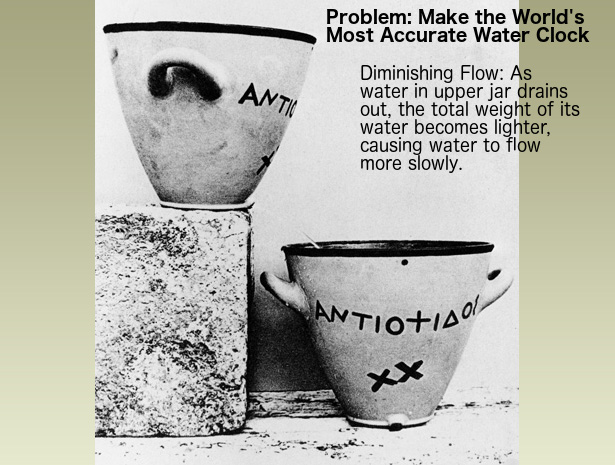
    Challenge #3: Invent the World’s Most Accurate Water Clock

    The ancient water clock known as the clepsydra measures time by the draining of water from one jar to another. However, it suffers from the problem of diminishing flow: as water drains out, water pressure decreases. This causes the water to flow more slowly, making time read slower. Your task is to come up with a new design that overcomes this problem of diminishing flow. For the Hellenistic solution, listen to the episode.

    Water Clock problem

    2058px-Mediterranean_at_218_BC-en.svg

    The Hellenistic World, end of 3rd cen. BCE

    Custom-generated map of alternate history Rome by Adam McKithern

    The Roman Empire at its greatest extent, 117 CE

    Click to view slideshow.

    Main Sources

    Allen, R. C. (2017). The Industrial Revolution: A Very Short Introduction. New York: Oxford University Press.

    Arun. (2018). “10 Major Causes of the Industrial Revolution.” Learnodo-Newtonic.com. Retrieved Nov. 4, 2018, from: https://learnodo-newtonic.com/industrial-revolution-causes

    Deakin, M. A. B. (1994, Mar). “Hypatia and Her Mathematics.” The American Mathematical Monthly, 101(3): 234-243.

    Dzielska, M. (1995). Hypatia of Alexandria. Lyra, F., Trans. Cambridge, MA: Harvard University Press.

    Greene, M. (2004). “The Birth of Modern Science?” Nature.com. Retrieved Nov. 4, 2018, from: https://www.nature.com/articles/430614a

    Hero of Alexandria. (1851). The Pneumatics of Hero of Alexandria. Woodcroft, B., Trans. Himedo.net. Retrieved Nov. 4, 2018, from: http://himedo.net/TheHopkinThomasProject/TimeLine/Wales/Steam/URochesterCollection/Hero/index-2.html

    James, P., and Thorpe, N. (1994). Ancient Inventions. New York: Ballantine.

    Jones, P. J. (2006). Cleopatra: A Sourcebook. University of Oklahoma Press.

    Koyama, M. (2017). “Could Rome Have Had an Industrial Revolution?” Medium.com. Retrieved Nov. 4, 2018, from: https://medium.com/@MarkKoyama/could-rome-have-had-an-industrial-revolution-4126717370a2

    Lefkowitz, M. R., and Fant, M. B. (2016). Women’s Life in Greece and Rome: A Source Book in Translation. Baltimore, MD: Johns Hopkins University Press.

    Lowe, D. (2016). “Suspending Disbelief: Magnetic Levitation in Antiquity and the Middle Ages.” Classical Antiquity, 35(2): 247-278.

    MacLeod, R., Ed. (2000). The Library of Alexandria: Centre of Learning in the Ancient World. New York: I. B. Tauris.

    Miles, M. M. (2011). Cleopatra: A Sphinx Revisited. Los Angeles: University of California Press.

    Montserrat, D. (1996). Sex and Society in Graeco-Roman Egypt. New York: Kegan Paul International.

    Mosjov, B. (2010). Alexandria Lost: From the Advent of Christianity to the Arab Conquest. London: Duckworth.

    Oleson, J. P., Ed. (2008). The Oxford Handbook of Engineering and Technology in the Classical World. New York: Oxford University Press.

    Pollard, J. and Reid, H. (2006). The Rise and Fall of Alexandria: Birthplace of the Modern Mind. New York: Viking.

    Rowan-Robinson, M. (2004). “Praising Alexandrians to Excess.” PhysicsWorld.com. Retrieved Nov. 4, 2018, from: https://physicsworld.com/a/praising-alexandrians-to-excess/

    Rowlandson, J., Ed. (1998). Women & Society in Greek & Roman Egypt: A Sourcebook. New York: Cambridge University Press.

    Russo, L. (2004). The Forgotten Revolution: How Science Was Born in 300 BC and Why It Had to Be Reborn. Levy, S., Trans. New York: Springer.

    Torchinsky, J. (2012). “The Greeks Had the Technology to Build a Car in 60 A.D.” Jalopnik.com. Retrieved Nov. 4, 2018, from: https://jalopnik.com/5888188/the-greeks-had-the-technology-to-build-a-car-in-60-ad

    Watts, E. J. (2010). Riot in Alexandria: Tradition and Group Dynamics in Late Antique Pagan and Christian Communities. Los Angeles: University of California Press.

    Wyatt, L. T. (2009). The Industrial Revolution: Greenwood Guides to Historic Events, 1500-1900. Westport, CT: Greenwood Press.

    Dead Ideas: The History of Extinct Thoughts and Practices is made with Jetpack Podcast. Full show notes and every episode at https://deadideas.net/


    Steampunk Rome IV: The Great Library of Alexandria – RPG, Pt 2 – Egyptian, Greek, and Roman History Jan 06, 2019
    Show notes

    http://media.blubrry.com/deadideas/ia801500.us.archive.org/12/items/DeadIdeas100SteampunkRomeIII/Dead%20Ideas%20101%20Steampunk%20Rome%20IV.mp3

    Arriving at the Great Library of Alexandria, Andre’s character Pyrrho of Pergamum searches for the secret plans for the floating statue. But in order to get his hands on them, he must first solve several science and engineering challenges. Along the way, we learn a great deal about the Library of Alexandria and its marvelous discoveries.

    Be sure to support the show at www.patreon.com/deadideaspod to get your portrait drawn!

    Custom map of Rome by Adam McKithern. Music by Rachel Westhoff. Maps, pics, references and more at http://www.deadideas.net.

    Become our patron on Patreon at www.patreon.com/deadideaspod

    Time/place: The Hellenistic World, 201 BCE

    Dead Idea: Ancient Steam Technology

    Co-host: Andre Sólo

    In this episode, Andre’s character faces several science and engineering challenges. You can try your hand at solving them too. Post your solutions to our Facebook page at @deadideaspod!

    Challenge #1: Invent an Ox-powered Water Lifter

    An ox can walk in a circle, providing horizontal motion, but your water-lifter wheel requires vertical motion (see illustration below). Can you invent a way to make these two technologies interface? You can add whatever components you like, so long as it was available in the Hellenistic world (which includes gears, axles, pistons, cams, valves, pulleys, reduction gears, driveshafts, screws, bolts, nuts, ball bearings, floats, etc.). For the Hellenistic solution, listen to the episode.
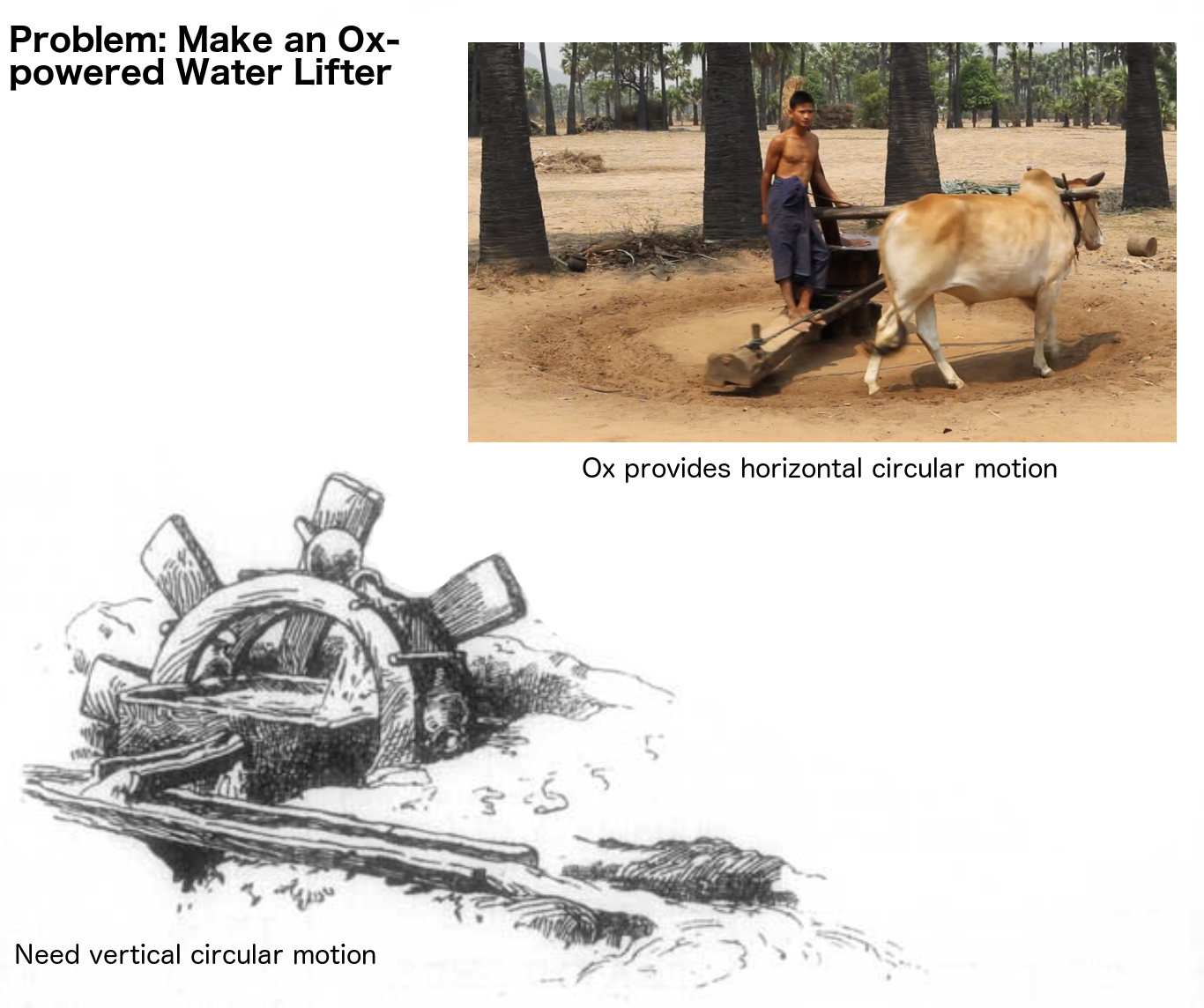
    Ox-powered Water Lifter Problem

    Challenge #2: Find the Circumference of the Earth

    This one’s a doozy, but Eratosthenes solved it using little more than a stick, a shadow, and some sick geometry. Can you? Use the information in the diagram below to figure out the answer. Here are the important details:

    • Assume the Earth is round
    • Assume the sun’s rays strike the earth in parallel lines
    • The sun is directly overhead at noon on the summer solstice at Syene
    • At the same moment in Alexandria, the sun casts a shadow at angle of 7 degrees ,or 1/50th of a circle
    • Alexandria is 5000 stadia (about 800km/497mi) north of Syene

    For the Hellenistic solution, listen to the episode.
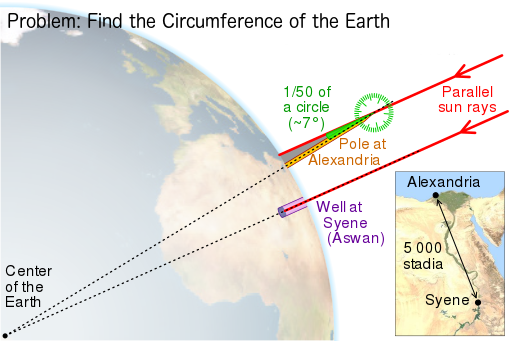
    Eratosthenes_measure_of_Earth_circumference problem

    2058px-Mediterranean_at_218_BC-en.svg

    The Hellenistic World, end of 3rd cen. BCE
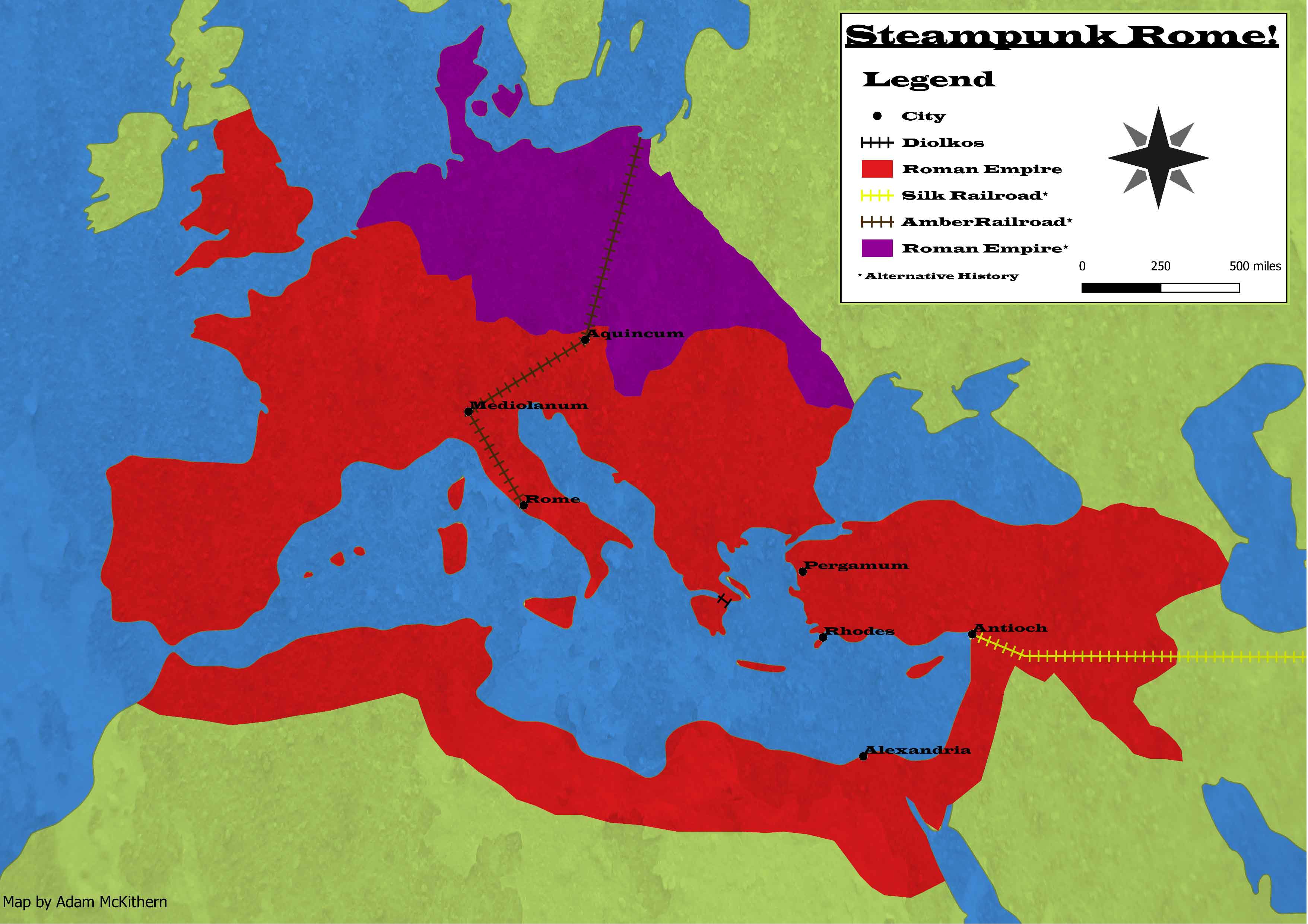
    Custom-generated map of alternate history Rome by Adam McKithern
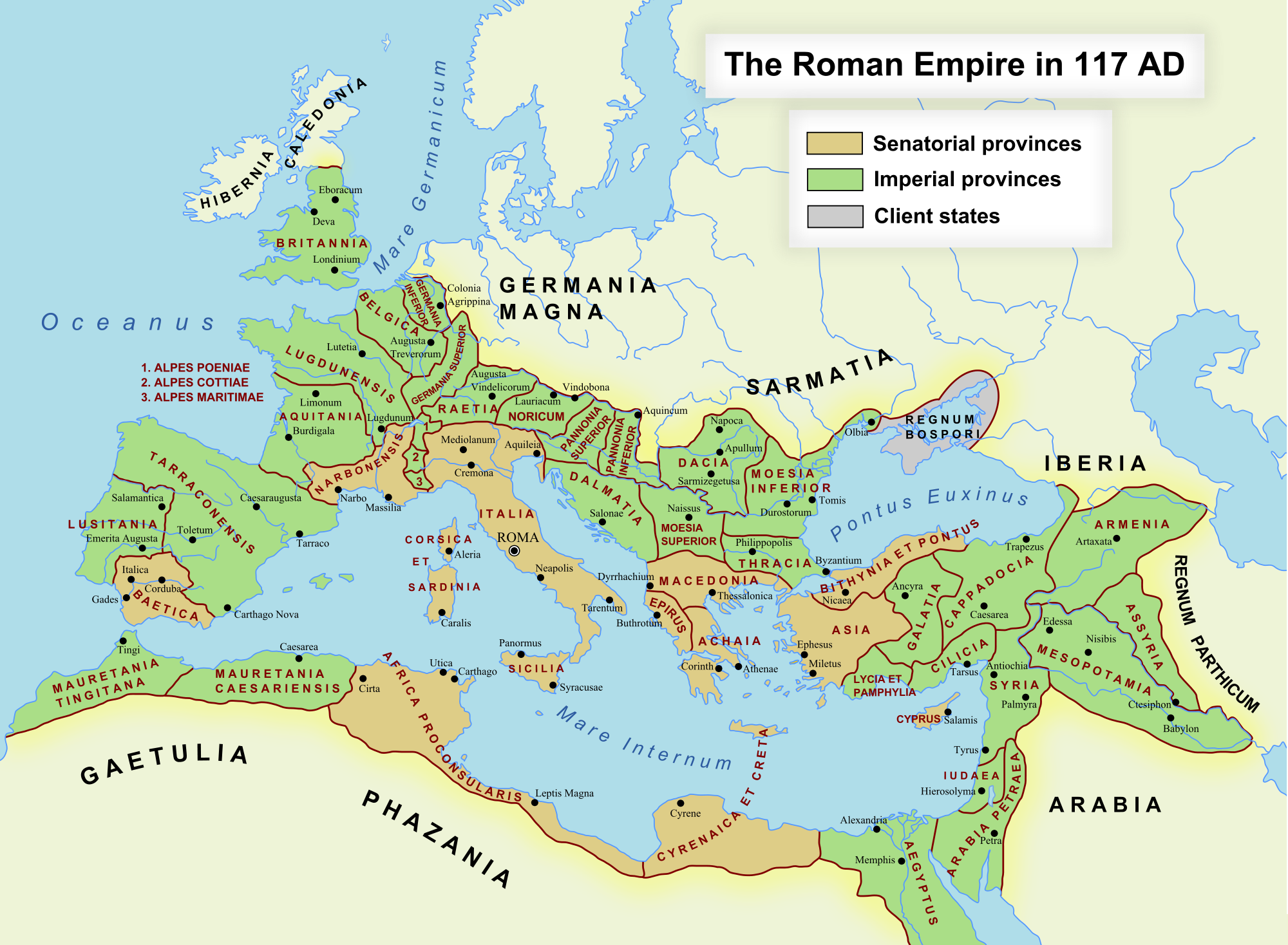
    The Roman Empire at its greatest extent, 117 CE

    Click to view slideshow.

    Main Sources

    Allen, R. C. (2017). The Industrial Revolution: A Very Short Introduction. New York: Oxford University Press.

    Arun. (2018). “10 Major Causes of the Industrial Revolution.” Learnodo-Newtonic.com. Retrieved Nov. 4, 2018, from: https://learnodo-newtonic.com/industrial-revolution-causes

    Deakin, M. A. B. (1994, Mar). “Hypatia and Her Mathematics.” The American Mathematical Monthly, 101(3): 234-243.

    Dzielska, M. (1995). Hypatia of Alexandria. Lyra, F., Trans. Cambridge, MA: Harvard University Press.

    Greene, M. (2004). “The Birth of Modern Science?” Nature.com. Retrieved Nov. 4, 2018, from: https://www.nature.com/articles/430614a

    Hero of Alexandria. (1851). The Pneumatics of Hero of Alexandria. Woodcroft, B., Trans. Himedo.net. Retrieved Nov. 4, 2018, from: http://himedo.net/TheHopkinThomasProject/TimeLine/Wales/Steam/URochesterCollection/Hero/index-2.html

    James, P., and Thorpe, N. (1994). Ancient Inventions. New York: Ballantine.

    Jones, P. J. (2006). Cleopatra: A Sourcebook. University of Oklahoma Press.

    Koyama, M. (2017). “Could Rome Have Had an Industrial Revolution?” Medium.com. Retrieved Nov. 4, 2018, from: https://medium.com/@MarkKoyama/could-rome-have-had-an-industrial-revolution-4126717370a2

    Lefkowitz, M. R., and Fant, M. B. (2016). Women’s Life in Greece and Rome: A Source Book in Translation. Baltimore, MD: Johns Hopkins University Press.

    Lowe, D. (2016). “Suspending Disbelief: Magnetic Levitation in Antiquity and the Middle Ages.” Classical Antiquity, 35(2): 247-278.

    MacLeod, R., Ed. (2000). The Library of Alexandria: Centre of Learning in the Ancient World. New York: I. B. Tauris.

    Miles, M. M. (2011). Cleopatra: A Sphinx Revisited. Los Angeles: University of California Press.

    Montserrat, D. (1996). Sex and Society in Graeco-Roman Egypt. New York: Kegan Paul International.

    Mosjov, B. (2010). Alexandria Lost: From the Advent of Christianity to the Arab Conquest. London: Duckworth.

    Oleson, J. P., Ed. (2008). The Oxford Handbook of Engineering and Technology in the Classical World. New York: Oxford University Press.

    Pollard, J. and Reid, H. (2006). The Rise and Fall of Alexandria: Birthplace of the Modern Mind. New York: Viking.

    Rowan-Robinson, M. (2004). “Praising Alexandrians to Excess.” PhysicsWorld.com. Retrieved Nov. 4, 2018, from: https://physicsworld.com/a/praising-alexandrians-to-excess/

    Rowlandson, J., Ed. (1998). Women & Society in Greek & Roman Egypt: A Sourcebook. New York: Cambridge University Press.

    Russo, L. (2004). The Forgotten Revolution: How Science Was Born in 300 BC and Why It Had to Be Reborn. Levy, S., Trans. New York: Springer.

    Torchinsky, J. (2012). “The Greeks Had the Technology to Build a Car in 60 A.D.” Jalopnik.com. Retrieved Nov. 4, 2018, from: https://jalopnik.com/5888188/the-greeks-had-the-technology-to-build-a-car-in-60-ad

    Watts, E. J. (2010). Riot in Alexandria: Tradition and Group Dynamics in Late Antique Pagan and Christian Communities. Los Angeles: University of California Press.

    Wyatt, L. T. (2009). The Industrial Revolution: Greenwood Guides to Historic Events, 1500-1900. Westport, CT: Greenwood Press.

    Dead Ideas: The History of Extinct Thoughts and Practices is made with Jetpack Podcast. Full show notes and every episode at https://deadideas.net/


    Steampunk Rome III: Hellenistic Science, Hell Yeah – RPG, Pt 1 – Greek and Roman History Dec 23, 2018
    Show notes

    http://media.blubrry.com/deadideas/ia801500.us.archive.org/12/items/DeadIdeas100SteampunkRomeIII/Dead%20Ideas%20100%20Steampunk%20Rome%20III.mp3

    So Roman tech was pretty surprising, but still more surprising is that all that was developed centuries earlier in the Hellenistic period. What’s up with that? Today we explore the development of Hellenistic science, then go deep into that world with a roleplay that will continue in the following episodes. Today we visit Pergamum and Rhodes, discovering all about Hellenistic learning along the way.

    Be sure to support the show at www.patreon.com/deadideaspod to get your portrait drawn!

    Custom map of Rome by Adam McKithern. Music by Rachel Westhoff. Maps, pics, references and more at http://www.deadideas.net.

    Become our patron on Patreon at www.patreon.com/deadideaspod

    Time/place: The Hellenistic World, 201 BCE

    Dead Idea: Ancient Steam Technology

    Co-host: Andre Sólo

    2058px-Mediterranean_at_218_BC-en.svg

    The Hellenistic World, end of 3rd cen. BCE

    Custom-generated map of alternate history Rome by Adam McKithern

    The Roman Empire at its greatest extent, 117 CE

    Click to view slideshow.

    Main Sources

    Allen, R. C. (2017). The Industrial Revolution: A Very Short Introduction. New York: Oxford University Press.

    Arun. (2018). “10 Major Causes of the Industrial Revolution.” Learnodo-Newtonic.com. Retrieved Nov. 4, 2018, from: https://learnodo-newtonic.com/industrial-revolution-causes

    Deakin, M. A. B. (1994, Mar). “Hypatia and Her Mathematics.” The American Mathematical Monthly, 101(3): 234-243.

    Dzielska, M. (1995). Hypatia of Alexandria. Lyra, F., Trans. Cambridge, MA: Harvard University Press.

    Greene, M. (2004). “The Birth of Modern Science?” Nature.com. Retrieved Nov. 4, 2018, from: https://www.nature.com/articles/430614a

    Hero of Alexandria. (1851). The Pneumatics of Hero of Alexandria. Woodcroft, B., Trans. Himedo.net. Retrieved Nov. 4, 2018, from: http://himedo.net/TheHopkinThomasProject/TimeLine/Wales/Steam/URochesterCollection/Hero/index-2.html

    James, P., and Thorpe, N. (1994). Ancient Inventions. New York: Ballantine.

    Jones, P. J. (2006). Cleopatra: A Sourcebook. University of Oklahoma Press.

    Koyama, M. (2017). “Could Rome Have Had an Industrial Revolution?” Medium.com. Retrieved Nov. 4, 2018, from: https://medium.com/@MarkKoyama/could-rome-have-had-an-industrial-revolution-4126717370a2

    Lefkowitz, M. R., and Fant, M. B. (2016). Women’s Life in Greece and Rome: A Source Book in Translation. Baltimore, MD: Johns Hopkins University Press.

    Lowe, D. (2016). “Suspending Disbelief: Magnetic Levitation in Antiquity and the Middle Ages.” Classical Antiquity, 35(2): 247-278.

    MacLeod, R., Ed. (2000). The Library of Alexandria: Centre of Learning in the Ancient World. New York: I. B. Tauris.

    Miles, M. M. (2011). Cleopatra: A Sphinx Revisited. Los Angeles: University of California Press.

    Montserrat, D. (1996). Sex and Society in Graeco-Roman Egypt. New York: Kegan Paul International.

    Mosjov, B. (2010). Alexandria Lost: From the Advent of Christianity to the Arab Conquest. London: Duckworth.

    Oleson, J. P., Ed. (2008). The Oxford Handbook of Engineering and Technology in the Classical World. New York: Oxford University Press.

    Pollard, J. and Reid, H. (2006). The Rise and Fall of Alexandria: Birthplace of the Modern Mind. New York: Viking.

    Rowan-Robinson, M. (2004). “Praising Alexandrians to Excess.” PhysicsWorld.com. Retrieved Nov. 4, 2018, from: https://physicsworld.com/a/praising-alexandrians-to-excess/

    Rowlandson, J., Ed. (1998). Women & Society in Greek & Roman Egypt: A Sourcebook. New York: Cambridge University Press.

    Russo, L. (2004). The Forgotten Revolution: How Science Was Born in 300 BC and Why It Had to Be Reborn. Levy, S., Trans. New York: Springer.

    Torchinsky, J. (2012). “The Greeks Had the Technology to Build a Car in 60 A.D.” Jalopnik.com. Retrieved Nov. 4, 2018, from: https://jalopnik.com/5888188/the-greeks-had-the-technology-to-build-a-car-in-60-ad

    Watts, E. J. (2010). Riot in Alexandria: Tradition and Group Dynamics in Late Antique Pagan and Christian Communities. Los Angeles: University of California Press.

    Wyatt, L. T. (2009). The Industrial Revolution: Greenwood Guides to Historic Events, 1500-1900. Westport, CT: Greenwood Press.

    Dead Ideas: The History of Extinct Thoughts and Practices is made with Jetpack Podcast. Full show notes and every episode at https://deadideas.net/


    Steampunk Rome II: The Industrial Revolution That Didn’t Happen (And Why Not) – Roman History Dec 09, 2018
    Show notes

    http://media.blubrry.com/deadideas/ia601500.us.archive.org/12/items/DeadIdeas100SteampunkRomeIII/Dead%20Ideas%2099%20Steampunk%20Rome%20II.mp3

    So why didn’t Rome undergo an industrial revolution? Today, we take a look at some of the contributing factors for 18th-century Britain and see how Rome stacks up.

    Be sure to support the show at www.patreon.com/deadideaspod to get your portrait drawn!

    Custom map of Rome by Adam McKithern. Music by Rachel Westhoff. Maps, pics, references and more at http://www.deadideas.net.

    Become our patron on Patreon at www.patreon.com/deadideaspod

    Time/place: The Roman Empire, 10-70 CE

    Dead Idea: Ancient Steam Technology

    Co-host: Andre Sólo

    Custom-generated map of alternate history Rome by Adam McKithern

    The Roman Empire at its greatest extent, 117 CE

    Click to view slideshow.

    Main Sources

    Allen, R. C. (2017). The Industrial Revolution: A Very Short Introduction. New York: Oxford University Press.

    Arun. (2018). “10 Major Causes of the Industrial Revolution.” Learnodo-Newtonic.com. Retrieved Nov. 4, 2018, from: https://learnodo-newtonic.com/industrial-revolution-causes

    Deakin, M. A. B. (1994, Mar). “Hypatia and Her Mathematics.” The American Mathematical Monthly, 101(3): 234-243.

    Dzielska, M. (1995). Hypatia of Alexandria. Lyra, F., Trans. Cambridge, MA: Harvard University Press.

    Greene, M. (2004). “The Birth of Modern Science?” Nature.com. Retrieved Nov. 4, 2018, from: https://www.nature.com/articles/430614a

    Hero of Alexandria. (1851). The Pneumatics of Hero of Alexandria. Woodcroft, B., Trans. Himedo.net. Retrieved Nov. 4, 2018, from: http://himedo.net/TheHopkinThomasProject/TimeLine/Wales/Steam/URochesterCollection/Hero/index-2.html

    James, P., and Thorpe, N. (1994). Ancient Inventions. New York: Ballantine.

    Jones, P. J. (2006). Cleopatra: A Sourcebook. University of Oklahoma Press.

    Koyama, M. (2017). “Could Rome Have Had an Industrial Revolution?” Medium.com. Retrieved Nov. 4, 2018, from: https://medium.com/@MarkKoyama/could-rome-have-had-an-industrial-revolution-4126717370a2

    Lefkowitz, M. R., and Fant, M. B. (2016). Women’s Life in Greece and Rome: A Source Book in Translation. Baltimore, MD: Johns Hopkins University Press.

    Lowe, D. (2016). “Suspending Disbelief: Magnetic Levitation in Antiquity and the Middle Ages.” Classical Antiquity, 35(2): 247-278.

    MacLeod, R., Ed. (2000). The Library of Alexandria: Centre of Learning in the Ancient World. New York: I. B. Tauris.

    Miles, M. M. (2011). Cleopatra: A Sphinx Revisited. Los Angeles: University of California Press.

    Montserrat, D. (1996). Sex and Society in Graeco-Roman Egypt. New York: Kegan Paul International.

    Mosjov, B. (2010). Alexandria Lost: From the Advent of Christianity to the Arab Conquest. London: Duckworth.

    Oleson, J. P., Ed. (2008). The Oxford Handbook of Engineering and Technology in the Classical World. New York: Oxford University Press.

    Pollard, J. and Reid, H. (2006). The Rise and Fall of Alexandria: Birthplace of the Modern Mind. New York: Viking.

    Rowan-Robinson, M. (2004). “Praising Alexandrians to Excess.” PhysicsWorld.com. Retrieved Nov. 4, 2018, from: https://physicsworld.com/a/praising-alexandrians-to-excess/

    Rowlandson, J., Ed. (1998). Women & Society in Greek & Roman Egypt: A Sourcebook. New York: Cambridge University Press.

    Russo, L. (2004). The Forgotten Revolution: How Science Was Born in 300 BC and Why It Had to Be Reborn. Levy, S., Trans. New York: Springer.

    Torchinsky, J. (2012). “The Greeks Had the Technology to Build a Car in 60 A.D.” Jalopnik.com. Retrieved Nov. 4, 2018, from: https://jalopnik.com/5888188/the-greeks-had-the-technology-to-build-a-car-in-60-ad

    Watts, E. J. (2010). Riot in Alexandria: Tradition and Group Dynamics in Late Antique Pagan and Christian Communities. Los Angeles: University of California Press.

    Wyatt, L. T. (2009). The Industrial Revolution: Greenwood Guides to Historic Events, 1500-1900. Westport, CT: Greenwood Press.

    Dead Ideas: The History of Extinct Thoughts and Practices is made with Jetpack Podcast. Full show notes and every episode at https://deadideas.net/


    Steampunk Rome I: An Ancient Industrial Revolution (Almost) – Roman History Nov 25, 2018
    Show notes

    http://media.blubrry.com/deadideas/ia801500.us.archive.org/12/items/DeadIdeas100SteampunkRomeIII/Dead%20Ideas%2098%20Steampunk%20Rome%20I.mp3

    For our final series, we’re doing the steam technology of the ancient world that died and had to be resurrected in 18th-century Europe. How close was Rome to being able to construct a working steam locomotive? That may sound silly, but you won’t think so after this episode!

    Be sure to support the show at www.patreon.com/deadideaspod to get your portrait drawn!

    Custom map of Rome by Adam McKithern. Music by Rachel Westhoff. Maps, pics, references and more at http://www.deadideas.net.

    Become our patron on Patreon at www.patreon.com/deadideaspod

    Time/place: The Roman Empire, 10-70 CE

    Dead Idea: Ancient Steam Technology

    Co-host: Andre Sólo

    Custom-generated map of alternate history Rome by Adam McKithern

    The Roman Empire at its greatest extent, 117 CE

    Click to view slideshow.

    Main Sources

    Allen, R. C. (2017). The Industrial Revolution: A Very Short Introduction. New York: Oxford University Press.

    Arun. (2018). “10 Major Causes of the Industrial Revolution.” Learnodo-Newtonic.com. Retrieved Nov. 4, 2018, from: https://learnodo-newtonic.com/industrial-revolution-causes

    Deakin, M. A. B. (1994, Mar). “Hypatia and Her Mathematics.” The American Mathematical Monthly, 101(3): 234-243.

    Dzielska, M. (1995). Hypatia of Alexandria. Lyra, F., Trans. Cambridge, MA: Harvard University Press.

    Gibbs, P., and Geim, A. (1997, Mar). “Is Magnetic Levitation Possible?” Physics FAQ. Retrieved Dec. 4, 2018, from: http://math.ucr.edu/home/baez/physics/General/Levitation/levitation.html

    Greene, M. (2004). “The Birth of Modern Science?” Nature.com. Retrieved Nov. 4, 2018, from: https://www.nature.com/articles/430614a

    Hero of Alexandria. (1851). The Pneumatics of Hero of Alexandria. Woodcroft, B., Trans. Himedo.net. Retrieved Nov. 4, 2018, from: http://himedo.net/TheHopkinThomasProject/TimeLine/Wales/Steam/URochesterCollection/Hero/index-2.html

    James, P., and Thorpe, N. (1994). Ancient Inventions. New York: Ballantine.

    Jones, P. J. (2006). Cleopatra: A Sourcebook. University of Oklahoma Press.

    Koyama, M. (2017). “Could Rome Have Had an Industrial Revolution?” Medium.com. Retrieved Nov. 4, 2018, from: https://medium.com/@MarkKoyama/could-rome-have-had-an-industrial-revolution-4126717370a2

    Lefkowitz, M. R., and Fant, M. B. (2016). Women’s Life in Greece and Rome: A Source Book in Translation. Baltimore, MD: Johns Hopkins University Press.

    Lowe, D. (2016). “Suspending Disbelief: Magnetic Levitation in Antiquity and the Middle Ages.” Classical Antiquity, 35(2): 247-278.

    MacLeod, R., Ed. (2000). The Library of Alexandria: Centre of Learning in the Ancient World. New York: I. B. Tauris.

    Miles, M. M. (2011). Cleopatra: A Sphinx Revisited. Los Angeles: University of California Press.

    Montserrat, D. (1996). Sex and Society in Graeco-Roman Egypt. New York: Kegan Paul International.

    Mosjov, B. (2010). Alexandria Lost: From the Advent of Christianity to the Arab Conquest. London: Duckworth.

    Oleson, J. P., Ed. (2008). The Oxford Handbook of Engineering and Technology in the Classical World. New York: Oxford University Press.

    Pollard, J. and Reid, H. (2006). The Rise and Fall of Alexandria: Birthplace of the Modern Mind. New York: Viking.

    Rowan-Robinson, M. (2004). “Praising Alexandrians to Excess.” PhysicsWorld.com. Retrieved Nov. 4, 2018, from: https://physicsworld.com/a/praising-alexandrians-to-excess/

    Rowlandson, J., Ed. (1998). Women & Society in Greek & Roman Egypt: A Sourcebook. New York: Cambridge University Press.

    Russo, L. (2004). The Forgotten Revolution: How Science Was Born in 300 BC and Why It Had to Be Reborn. Levy, S., Trans. New York: Springer.

    Torchinsky, J. (2012). “The Greeks Had the Technology to Build a Car in 60 A.D.” Jalopnik.com. Retrieved Nov. 4, 2018, from: https://jalopnik.com/5888188/the-greeks-had-the-technology-to-build-a-car-in-60-ad

    Watts, E. J. (2010). Riot in Alexandria: Tradition and Group Dynamics in Late Antique Pagan and Christian Communities. Los Angeles: University of California Press.

    Wyatt, L. T. (2009). The Industrial Revolution: Greenwood Guides to Historic Events, 1500-1900. Westport, CT: Greenwood Press.

    Dead Ideas: The History of Extinct Thoughts and Practices is made with Jetpack Podcast. Full show notes and every episode at https://deadideas.net/


    Previous 1 2 3 4 12 Next

    Related Podcasts

    Dan Carlin’s Hardcore History

    1

    Dan Carlin’s Hardcore History History
    More Perfect

    2

    More Perfect Government
    Casefile True Crime

    3

    Casefile True Crime Games & Hobbies
    The Way I Heard It with Mike Rowe

    4

    The Way I Heard It with Mike Rowe History
    BackStory

    5

    BackStory History
    The Black Dahlia Serial Killers

    6

    The Black Dahlia Serial Killers History
    footer-logo

    Contact Us

    Toll Free: 844-670-7747

    Links

    • Home
    • Top Charts
    • Networks
    • Apps
    • Independents Podcasts
    • Podcast Advertising
    • Podcast News
    • Contact Us
    • About Us
    • Analytics & Insights

    Stay Connected

      Privacy, Terms of Use & Our Code of Ethics Protecting Content Creators Copyrights