TopPodcast.com
Menu
  • Home
  • Top Charts
  • Top Networks
  • Top Apps
  • Top Independents
  • Top Podfluencers
  • Top Picks
    • Top Business Podcasts
    • Top True Crime Podcasts
    • Top Finance Podcasts
    • Top Comedy Podcasts
    • Top Music Podcasts
    • Top Womens Podcasts
    • Top Kids Podcasts
    • Top Sports Podcasts
    • Top News Podcasts
    • Top Tech Podcasts
    • Top Crypto Podcasts
    • Top Entrepreneurial Podcasts
    • Top Fantasy Sports Podcasts
    • Top Political Podcasts
    • Top Science Podcasts
    • Top Self Help Podcasts
    • Top Sports Betting Podcasts
    • Top Stocks Podcasts
  • Podcast News
  • About Us
  • Podcast Advertising
  • Contact
Not in our directory?
Add Show Here
Podcast Equipment
Center

toppodcastlogoOur TOPPODCAST Picks

  • Comedy
  • Crypto
  • Sports
  • News
  • Politics
  • True Crime
  • Business
  • Finance

Follow Us

toppodcastlogoStay Connected

    View Top 200 Chart
    Back to Rankings Page
    Government & Organizations

    Core EM – Emergency Medicine Podcast

    Core EM Emergency Medicine Podcast

    Advertise

    Copyright: © Core EM

    • Apple Podcasts
    • Google Play
    • Spotify

    Latest Episodes:
    Episode 127.0 – Idiopathic Intracranial Hypertension Jan 08, 2018
    Show notes

    This week we talk about the subacute headache and the dangerous, can't miss diagnoses of cerebral venous thrombosis and IIH

    https://media.blubrry.com/coreem/content.blubrry.com/coreem/Podcast_Episode_127_0_Final_Cut.m4a Download Leave a Comment Tags: Cerebral Venous Sinus Thrombosis, Headache, Neurology

    Show Notes

    Take Home Points

    • Keep IIH and CVST on the differential for patient’s coming in with a subacute headache, particularly if they have visual or neuro symptoms.
    • Consider an ocular ultrasound! It’s quick, shockingly easy to do, and can help point you toward a diagnosis you may have otherwise overlooked. I have made it my practice now to include a quick look in the physical exam of my patients with a concerning sounding headache or a headache with neurologic symptoms.
    • Consider IIH particularly in an overweight female of child bearing age with a subacute headache, but remember patients outside that demographic can have IIH as well.
    • Consider CVST in a patient with a thrombophilic process like cancer, pregnancy or the use of OCPs or androgens or in a patient with a recent facial infection like sinusitis or cellulitis.

    Read More

    WikEM: Idiopathic Intracranial Hypertension

    WikEM: Ocular Ultrasound

    Sinai EM Ultrasound – Pseutotumor Cerebri


    Read More

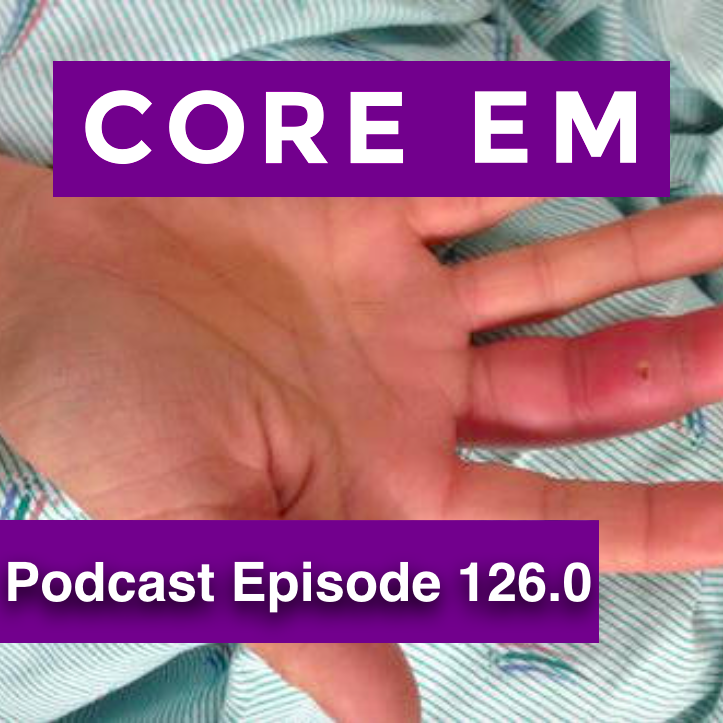
    Episode 126.0 – Flexor Tenosynovitis Dec 18, 2017
    Show notes

    This week we discuss the uncommon but must make diagnosis of flexor tenosynovitis

    https://media.blubrry.com/coreem/content.blubrry.com/coreem/Podcast_Episode_126_0_Final_Cut.m4a Download Leave a Comment Tags: Hand, Kanavel Signs, Orthopedics, Soft Tissue Infections

    Show Notes

    Take Home Points

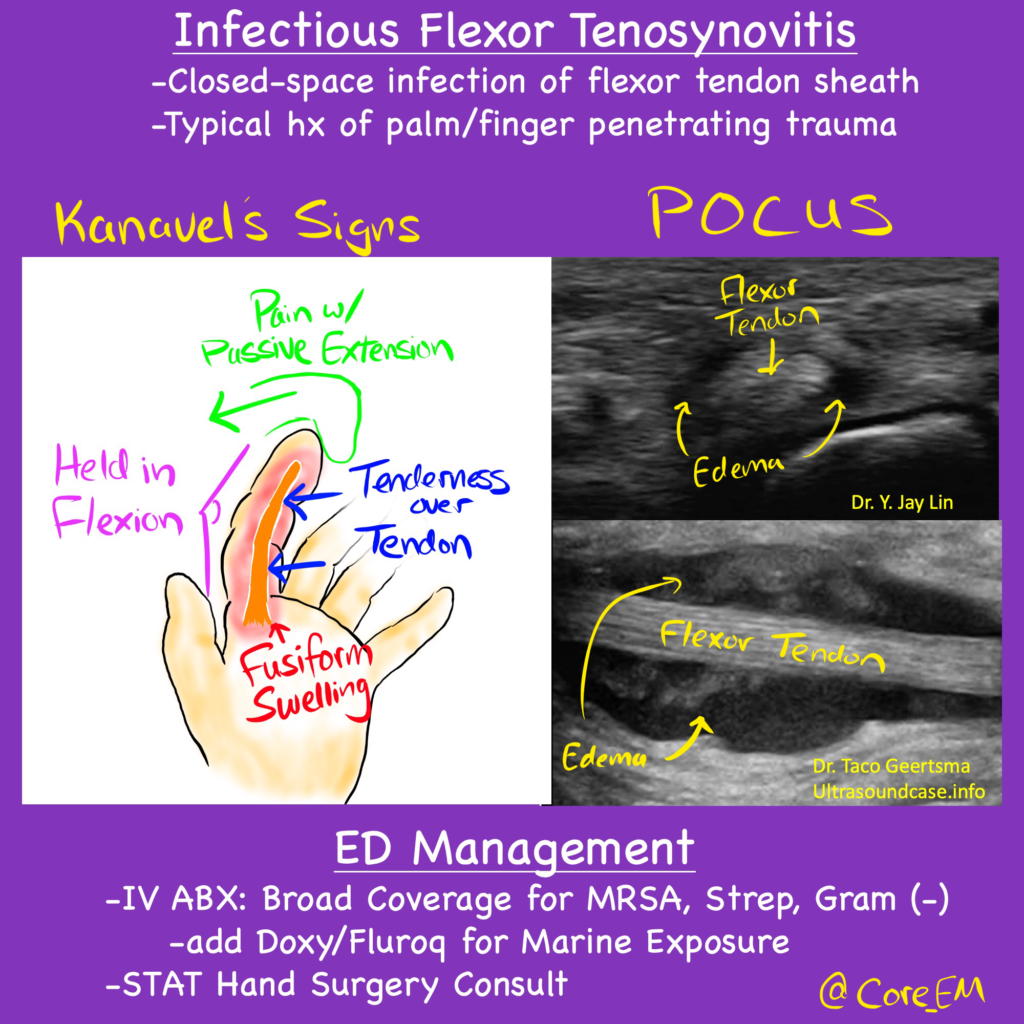
    • Think about flexor tenosynovitis in a patient with atraumatic finger pain. They may have any combination of these signs:
      • Tenderness along the course of the flexor tendon
      • Symmetrical swelling of the finger – often called the sausage digit
      • Pain on passive extension of the finger and
      • Patient holds the finger in a flex position at rest for increased comfort
    • Give antibiotics to cover staph, strep and possibly gram negatives.
    • Get your surgeon to see the patient, while we can get the antibiotics started, these patients need admission and may require surgical intervention.

    Infographic

    by Dr. Y. Jay Lin

    Read More

    Mailhot T, Lyn ET: Hand; in Marx JA, Hockberger RS, Walls RM, et al (eds): Rosen’s Emergency Medicine: Concepts and Clinical Practice, ed 8. St. Louis, Mosby, Inc., 2010, (Ch) 50: p 534-571

    OrthoBullets: Pyogenic Flexor Tenosynovitis

    Ped EMMorsels: Flexor Tenosynovitis


    Read More

    Episode 125.0 – Morning Report Pearls I Dec 11, 2017
    Show notes

    This week we discuss some critical pearls and teaching points from our morning report conference.

    https://media.blubrry.com/coreem/content.blubrry.com/coreem/Podcast_Episode_125_0_Final_Cut.m4a Download One Comment Tags: Fluoroquinolones, Pneumonia, Spleen

    Show Notes

    FOAMCast: Episode 17 – The Spleen!


    Read More

    Episode 124.0 – Metformin-Associated Lactic Acidosis Dec 04, 2017
    Show notes

    This week we discuss a quick case leading into the management of MALA.

    https://media.blubrry.com/coreem/content.blubrry.com/coreem/Podcast_Episode_124_0_Final_Cut.m4a Download 2 Comments Tags: Metformin, Toxicology

    Show Notes

    Take Home Points

    • In patients with shortness of breath and clear lungs, consider metabolic acidosis with respiratory alkalis as a potential cause
    • Suspect MALA in any patient on metformin who presents with abdominal pain, nausea and vomiting and/or AMS
    • Patients with MALA will have a low pH, a high-anion gap metabolic acidosis and high lactate levels
    • Call your tox consultant to assist with management which will focus on fluid resuscitation with isotonic bicarbonate and dialysis

    Read More

    Bosse GM. Antidiabetics and Hypoglycemics. In: Hoffman RS, Howland M, Lewin NA, Nelson LS, Goldfrank LR. eds. Goldfrank’s Toxicologic Emergencies, 10e New York, NY: McGraw-Hill; 2015. Link Accessed October 31, 2017

    LITFL: Metformin-Associated Lactic Acidosis

    LITFL: Metformin

    The Poison Review: 6 Pearls About Metformin and Lactic Acidosis


    Read More

    Episode 123.0 – Paracentesis Journal Update Nov 27, 2017
    Show notes

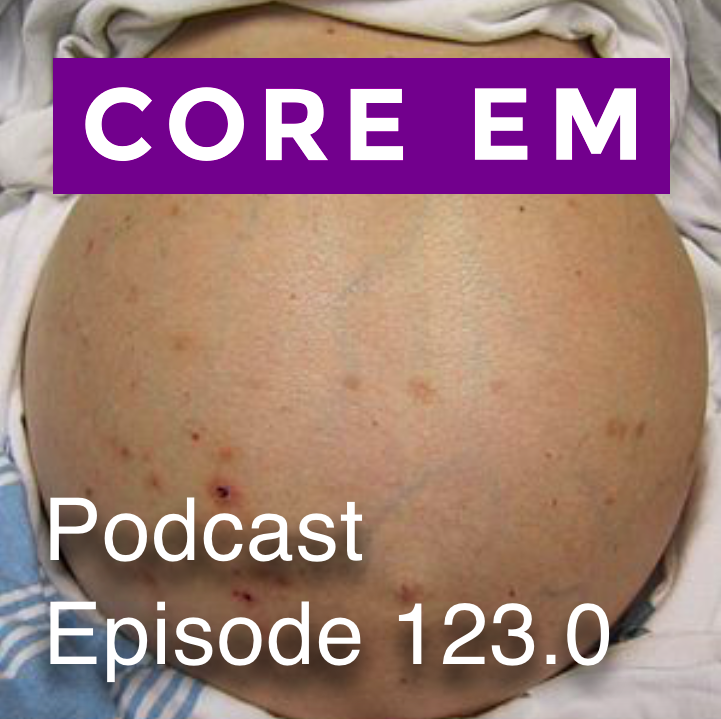
    This week we dive into a recent journal article questioning whether we should tap all ascites.

    https://media.blubrry.com/coreem/content.blubrry.com/coreem/Episode_123_0_Final_Cut.m4a Download Leave a Comment Tags: Albumin, Cirrhosis, Paracentesis, SBP, Spontaneous Bacterial Peritonitis

    Show Notes

    Take Home Points

    1. SBP is a difficult diagnosis to make clinically. While patients may have the triad of fever, abdominal pain and increasing ascites, they are far more likely to only have 1 or 2 of these symptoms
    2. In patients admitted to the hospital with ascites, consider performing a diagnostic paracentesis on all patients as limited literature shows an association with decreased mortality and, the procedure is simple and low risk
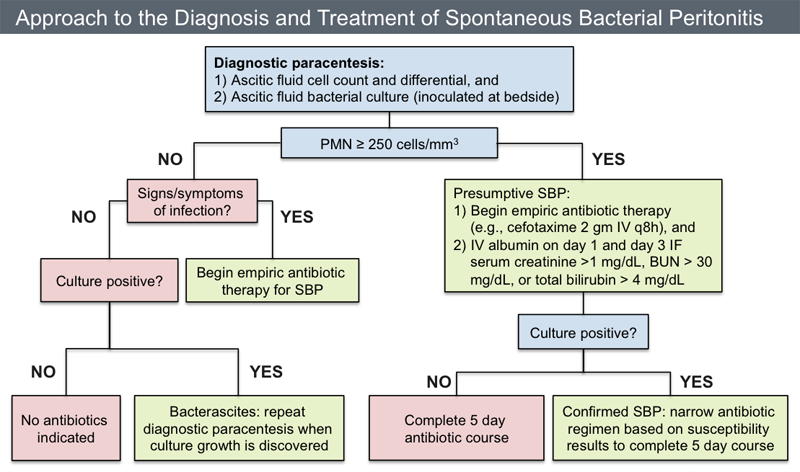
    3. Once you get the fluid, focus on the cell count: WBC > 500 or PMN > 250 should prompt treatment with a 3rd generation cephalosporin and albumin infusion

    Gaetano et al. The benefit of paracentesis on hospitalized adults with cirrhosis and ascites. Journal of Gastroenterology and Hepatology 2016. PMID: 26642977

    Read More

    EMRAP: C3 Live Paracentesis Video

    LITFL: Spontaneous Bacterial Peritonitis

    SinaiEM: SBP Pearls

    REBEL EM: Should You Give Albumin in Spontaneous Bacterial Peritonitis (SBP)?

    Approach to the Diagnosis and Treatment of SBP (University of Washington)


    Read More

    Episode 122.0 – True Knee Dislocations Nov 20, 2017
    Show notes

    This week we discuss the tibio-femoral knee dislocation focusing on identification of the dangerous complications.

    https://media.blubrry.com/coreem/content.blubrry.com/coreem/Podcast_Episode_122_0_Final_Cut.m4a Download Leave a Comment Tags: Knee Dislocation, Orthopedics, Popliteal Artery

    Show Notes

    Take Home Points

    1. Up to 50% of true knee dislocations will spontaneously reduce prior to arrival. Be suspicious of a dislocation in any patient who describes the joint moving out of place or if they have significant swelling, joint effusion or ecchymosis despite normal X-rays
    2. In all patients with suspected dislocation, perform a neurovascular exam immediately as popliteal artery injury is common. If they’ve got an absent DP or PT pulse, reduce immediately and get a CT angiogram as quickly as possible to assess for popliteal injuries
    3. If distal pulses are intact, you can either do ABIs and if normal, observe and repeat them or get a CTA. If the ABI is abnormal or the patient had an absent or decreased pulse at any point, get the CTA

    Read More

    OrthoBullets: Knee Dislocation

    Radiopaedia: Knee Dislocation

    EM: RAP: Obese Patient and Knee Dislocations

    Core EM: True Knee and Patellar Dislocations


    Read More

    Episode 121.0 – Pancreatitis Nov 13, 2017
    Show notes

    This week we dive into the diagnosis and management of pancreatitis in the ED

    https://media.blubrry.com/coreem/content.blubrry.com/coreem/Episode_121_0_Final_Cut.m4a Download Leave a Comment Tags: Gastroenterology, GI, Pancreatitis

    Show Notes

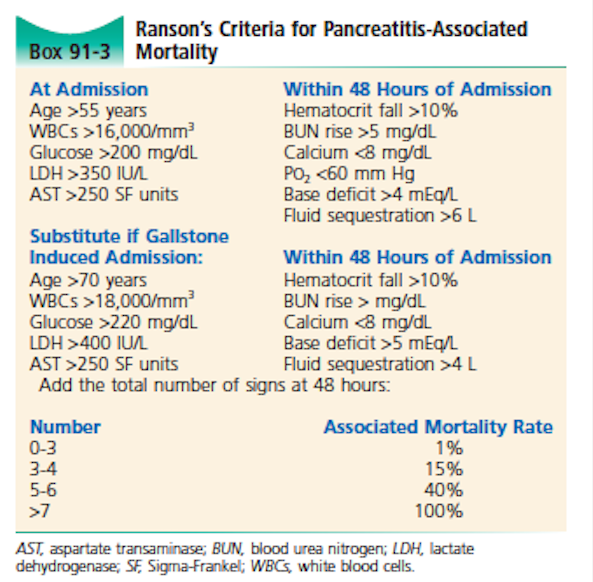
    Ranson’s Criteria for Pancreatitis-Associated Mortality (Rosen’s)

    Take Home Points

    • Pancreatitis is diagnosed by a combination of clinical features (epigastric pain with radiation to back, nausea/vomiting etc) and diagnostic tests (lipsae 3x normal, CT scan)
    • A RUQ US should be performed looking for gallstones as this finding significantly alters management
    • The focus of management is on supportive care. IV fluids, while central to therapy, should be given judiciously and titrated to end organ perfusion
    • Patients will mild pancreatitis who are tolerating oral intake and can reliably follow up, can be discharged home

    Read More

    Hemphill RR, Santen SA: Disorders of the Pancreas; in Marx JA, Hockberger RS, Walls RM, et al (eds): Rosen’s Emergency Medicine: Concepts and Clinical Practice, ed 8. St. Louis, Mosby, Inc., 2010, (Ch) 91: p 1205-1226

    PulmCrit: The Myth of Large-Volume Resuscitation in Acute Pancreatitis

    PulmCrit: Hypertriglyceridemic Pancreatitis: Can We Defuse the Bomb?


    Read More

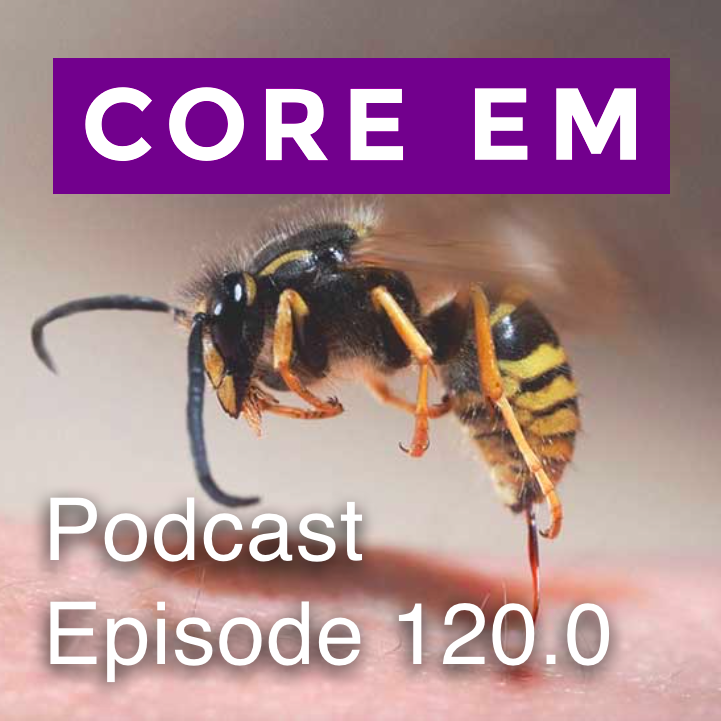
    Episode 120.0 – Bites and Stings Nov 06, 2017
    Show notes

    This week we discuss common bites, stings and envenomations.

    https://media.blubrry.com/coreem/content.blubrry.com/coreem/Episode_120_0_Final_Cut.m4a Download Leave a Comment Tags: Bee Sting, Black Widow, Brown Recluse Spider, Hymenoptera

    Show Notes

    Take Home Points

    1. The most common bites and stings you will see are by bees and ants. These can present as a local reaction, toxic reaction, anaphylaxis or delayed reaction. For all of these, treat with local wound care and epinephrine for any systemic symptoms.
    2. The brown recluse spider is found in the Midwest and presents as local pain and swelling but carries the risk of a necrotic ulcer
    3. The black widow spider is found all around the US and presents with either localized or generalized muscle cramping, localized sweating and potentially tachycardia and hypertension. Treatment is symptom management with analgesics and benzos.
    4. The bark scorpion usually presents with localized pain and swelling, but particularly in children, may present with a serious systemic presentation including jerking muscle movements, cranial nerve dysfunction, hypersalivation, ataxia and opsoclonus, which is the rapid, involuntary movement of the eyes in all directions. Treatment is supportive cares, but remember to call your poison center to ask about antivenin.

    Read More

    WikEM: Brown Recluse Spider Bite

    WikEM: Black Widdow Spider Bite

    WikEM: Hymenoptera Stings


    Read More

    Episode 119.0 – Journal Update Oct 30, 2017
    Show notes

    This week we review 4 articles discussed in our conference in the last month.

    https://media.blubrry.com/coreem/content.blubrry.com/coreem/Episode_119_0_Final_Cut.m4a Download Leave a Comment Tags: ACS, AMI, Cardiac Arrest, Cardiology, Oxygen, Pediatrics, POCUS, Syncope

    Show Notes

    Take Home Points

    1. Tachycardia in peds patients at discharge was associated with more revisits but not with more critical interventions. If your workup is reassuring, isolated tachycardia in and of itself shouldn’t change your disposition.
    2. Supplemental O2 is not necessary in the management of AMI patients with an O2 sat > 90% and, may be harmful
    3. Until further study and prospective validation has been performed, we’re not going to recommend embracing the Canadian decision instrument on predicting dysrhythmias after a syncopal event.
    4. Finally, our agreement on what cardiac standstill is isn’t great. We need a unified definition going forward to teach our trainees and for the purposes of research.

    Read More

    Core EM: ED POCUS in OHCA – The REASON Study

    ALiEM: Management of Syncope

    EM Nerd: The Case of the Liberated Radicals

    ScanCrit: O2 Not Needed in Myocardial Infarction

    Core EM: Predicting Dysrhythmia after Syncope

    Gaspari R et al. Emergency Department Point-Of-Care Ultrasound in Out-Of-Hospital and in-ED Cardiac Arrest. Resuscitation 2016; 109: 33 – 39. PMID: 27693280

    References

    Wilson PM et al. Is Tachycardia at Discharge from the Pediatric Emergency Department a Cause for Concern? A Nonconcurrent Cohort Study.Ann Emerg Med. 2017. PMID: 28238501

    Hofmann R et al. Oxygen Therapy in Suspected Acute Myocardial Infarction. NEJM 2017. PMID: 28844200

    Thiruganasambandamoorthy V et al. Predicting short-term risk of arrhythmia among patients with syncope: the Canadian syncope arrhythmia risk score. Acad Emerg Med 2017. PMID: 28791782

    Hu K et al. Variability in Interpretation of Cardiac Standstill Among Physician Sonographers. Ann Emerg Med 2017. PMID: 28870394


    Read More

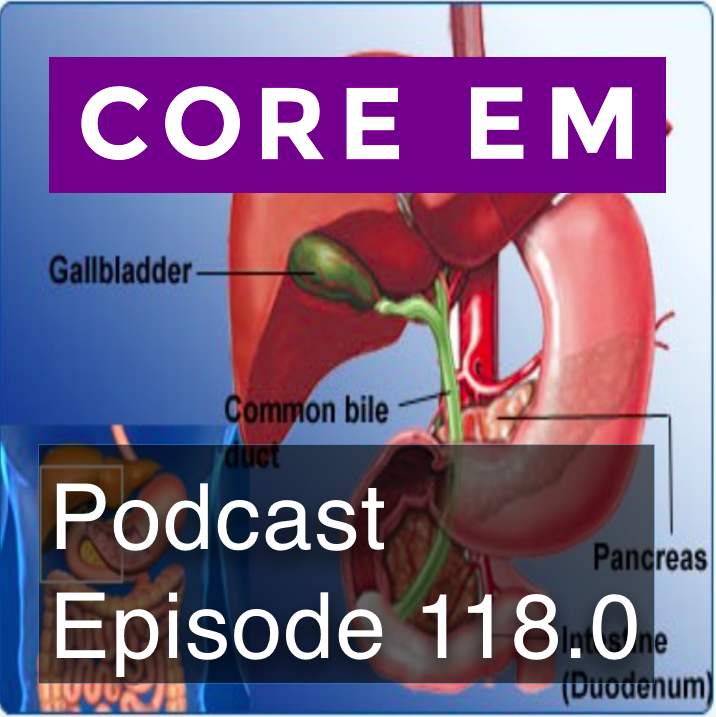
    Episode 118.0 – Acute Cholangitis Oct 23, 2017
    Show notes

    Part II of II on gallbladder disorders finishing up with acute cholangitis.

    https://media.blubrry.com/coreem/content.blubrry.com/coreem/Podcast_Episode_118_0_Final_Cut.m4a Download Leave a Comment Tags: Gallbladder, Gastroenterology, General Surgery, GI

    Show Notes

    Take Home Points

    • Cholangitis is an acute bacterial infection of the bile ducts resulting from common bile duct obstruction and is potentially life-threatening (mortality 5-10%, acute bacterial infection of the bile ducts
    • Diagnosis is based on clinical findings and while imaging can be supportive, it is frequently non-diagnostic. Look for RUQ tenderness with peritoneal signs and fever
    • A normal ultrasound does not rule out acute cholangitis
    • Treatment focuses on supportive care, broad spectrum antibiotics and consultation with a provider that can provide biliary tract decompression (IR, gastroenterology or general surgery)

    Read More

    Radiopaedia: Acute cholangitis

    Core EM: Cholangitis


    Read More

    Previous 1 9 10 11 12 13 24 Next

    Related Podcasts

    The Joe Rogan Experience

    1

    The Joe Rogan Experience Comedy
    More Perfect

    2

    More Perfect Government
    Casefile True Crime

    3

    Casefile True Crime Games & Hobbies
    Reply All

    4

    Reply All Games & Hobbies
    You Must Remember This

    5

    You Must Remember This Games & Hobbies
    Real Time with Bill Maher

    6

    Real Time with Bill Maher Games & Hobbies
    footer-logo

    Contact Us

    Toll Free: 844-670-7747

    Links

    • Home
    • Top Charts
    • Networks
    • Apps
    • Independents Podcasts
    • Podcast Advertising
    • Podcast News
    • Contact Us
    • About Us
    • Analytics & Insights

    Stay Connected

      Privacy, Terms of Use & Our Code of Ethics Protecting Content Creators Copyrights