TopPodcast.com
Menu
  • Home
  • Top Charts
  • Top Networks
  • Top Apps
  • Top Independents
  • Top Podfluencers
  • Top Picks
    • Top Business Podcasts
    • Top True Crime Podcasts
    • Top Finance Podcasts
    • Top Comedy Podcasts
    • Top Music Podcasts
    • Top Womens Podcasts
    • Top Kids Podcasts
    • Top Sports Podcasts
    • Top News Podcasts
    • Top Tech Podcasts
    • Top Crypto Podcasts
    • Top Entrepreneurial Podcasts
    • Top Fantasy Sports Podcasts
    • Top Political Podcasts
    • Top Science Podcasts
    • Top Self Help Podcasts
    • Top Sports Betting Podcasts
    • Top Stocks Podcasts
  • Podcast News
  • About Us
  • Podcast Advertising
  • Contact
Not in our directory?
Add Show Here
Podcast Equipment
Center

toppodcastlogoOur TOPPODCAST Picks

  • Comedy
  • Crypto
  • Sports
  • News
  • Politics
  • True Crime
  • Business
  • Finance

Follow Us

toppodcastlogoStay Connected

    View Top 200 Chart
    Back to Rankings Page
    Games & Hobbies

    Best Comics Ever

    The official podcast of Comic Book Herald.

    Advertise

    Copyright: © Comic Book Herald

    • Apple Podcasts
    • Google Play
    • Spotify

    Latest Episodes:
    Krakin’ Krakoa #39: X of Swords – 2020 X-Men Crossover! Theories and Predictions! Mar 02, 2020
    Show notes

    At this week’s 2020 Chicago Comic Con (aka C2e2) Jonathan Hickman and the X-Men team announced the X-Men’s first Dawn of X crossover, “X of Swords” pronounced “Ten of Swords.” Starting in May’s Free Comic Book Day special, “Ten of Swords” is a 15 part crossover primarily running through Hickman’s X-Men and Tini Howard’s Excalibur.

    Today I’ll answer:

    TASCHEN

    + What is “Ten of Swords”

    + Why does it make sense that X-Men and Excalibur are the focus comics?

    + Predictions and theories about the event, including a brief history of X-Men swords!

    Related Reading:

    X-Men: Dawn of X reading order

    For all Comic Book Herald X-Men videos:

    As it turns out, “X of Swords” is pronounced “Ten of Swords,” which is a reference to a Tarot Card.

    Review Notes!

    As a total newcomer to Tarot, I was intrigued to learn a card like the Ten of Swords has an upright, and a reversed position, and the meaning of the reading changes depending on this position.

    I’ll note for those interested in their own theories, the reversed position of the “Ten of Swords” refers to recovery, regeneration, and resisting an inevitable end, the last of which sounds so specific to the mutants on Krakoa and Moira’s Powers of X revelation that mutants always lose, that it almost can’t be an accident.

    Regarding the meaning of “The Ten of Swords,” I’d encourage obsessed X-fans to read up on some of the details because it’s impossible not to set your mind racing on X-Men connections and possibilities. The readings are just vague enough that a billion storylines fall into place.

    Based on the core meaning of betrayal, and being literally stabbed in the back by 10 swords – talk about overkill! – my mind immediately jumps to Mister Sinister (the ultimate promised betrayer) or potentially – and we’ll dig into this in more detail – Apocalypse and all the schemes he has of his own.

    Another particularly interesting element to me is the idea that the “Ten of Swords” features a setting sun, signaling the end of an era, which makes me think about the end of one of Moira’s lifelines, or possibly just the Krakoan dream of House of X.

    Speaking of Tarot Card connections, this actually isn’t the fist time we’ve seen allusions in the Hickman era of X-Men, considering Powers of X teased “The Magician,” “The Tower,” and “The Devil,” one has to assume with great intent!

    I expect all of these cards to play a major role, and to be explained in more detail in “X of Swords,” particularly “The Tower,” which was also just teased in the background of X-Men #7 as the mysterious perfect Krakoan home of Nightcrawler (and where I imagine he’ll be having sermons for his new mutant religion).

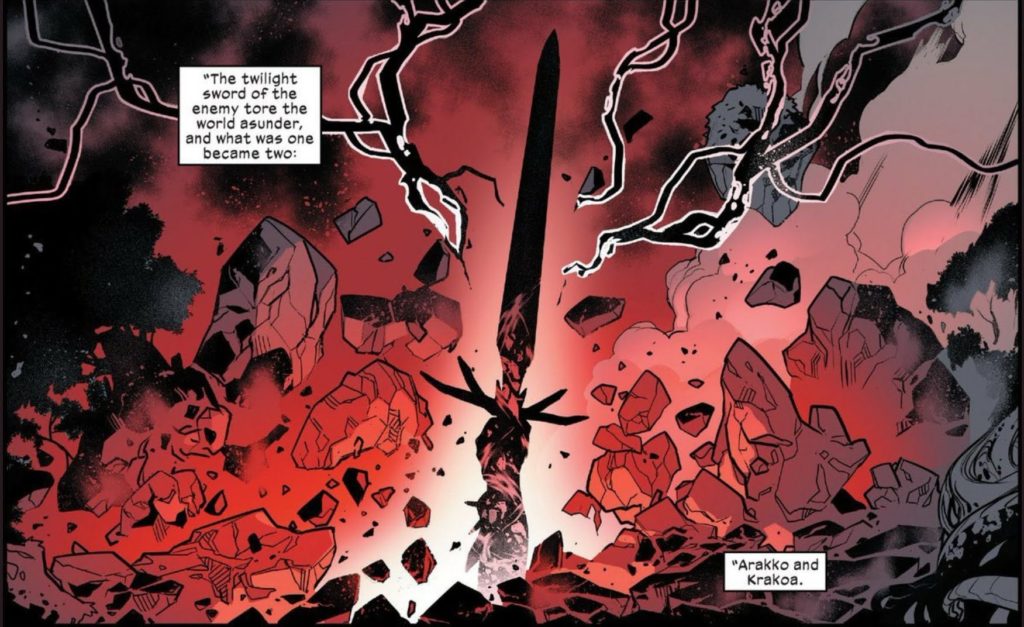
    Powers of X Twilight Sword in Arakko and Krakoa X-Men comics

    In terms of predictions and what I think is coming my absolute favorite connection centers around the mysterious origins of Arakko and Krakoa, teased in House of X #5 and X-Men #2 as deeply connected to longtime X-Men villain (and now ally) Apocalypse. Credit here to @TheMutantMenace and @Larkinz for hitting me with variations of this theory first after the news broke at C2e2 and I was furiously tweeting about relevant swords that could play a role in this crossover!

    So let’s start here: Krakoa and Arakko where separated during a demonic invasion, and Hickman writes about “The Twilight Sword of the enemy” as the weapon tearing the world asunder.

    The Twilight Sword is a very specific choice of words in Marvel, most memorably tied to Surtur, in the pages of the Walt Simonson all time great run on Thor.

    Here, the Twilight Sword is a herald of Doom, created by Surtur and the mines of Muspelheim to defeat Odin and bring about Ragnarok and the destruction of Asgard.

    When the Twilight Sword reemerged in the Kurt Busiek and George Perez Avengers about 15 years later, Thor is careful to point out the sword has magical, mystical elements that can influence the makings of reality. The power of the sword isn’t just that it’s a big ass blade – although, it’s a really big ass blade – but the fact that it’s imbued with all these other realm mystical connections.

    The big reason the Avengers connections to the Twilight Sword matter here – or at least the reason I’ll theorize they matter – is that it’s Morgan Le Fay who wields the mystical artifact. In Avengers #1 to #3, the swelling Avengers lineup is warped into a medieval realm controlled by Morgan Le Fay and Mordred, all using a combination of the Twilight Sword and – kind of amazingly – the “mutant witch” hex powers of the Scarlet Witch!

    As we’ve seen since the conclusion of Excalibur #6, Apocalypse is currently dissecting and running experiments on this same very Morgan Le Fay! This feels like way too much connection to be a coincidence, and I’m convinced Apocalypse is searching Le Fay’s being for mystical connections to the Twlight Sword that allow him to magically access the realms it once tore asunder. An Otherworld / Arakko war feels very much in play here, especially given Jaime Braddock’s own reality warping abilities, and Apocalypse’s clear machinations to put Jaime on the throne of Otherworld.

    Bringing it full circle, I predict that all these connections mean Apocalypse is studying the mystical properties of Otherworld and the Twilight Sword in order to access the extra-dimensional realm where his 1st Horsemen are trapped since the split of Arakko and Krakoa.

    We’ve seen in both the Marvel Comics #1000 one-pager from Jonathan Hickman and Dustin Weaver, and in the Powers of X selection of “Sinister Secrets,” that Apocalypse strongly desires the return of his secret first horsemen, the preferred and most powerful of them all. Exactly why he’s looking to bring back these Horsemen – who are notably visible in Moira’s 9th Moirapocalypse timeline – is unclear, but I could definitely see it tying back into that “betrayal” the Ten of Swords card foretells.

    So my primary theory is that “X of Swords” is a mega Arrako / Krakoa story

    Seeds planted throughout Excalibur and Hickman and Yu’s X-Men #2 have left a trail of swords, summoners, and secrets, and I anticipate it will all come to fruition in “X of Swords.”

    Another major X-sword that comes to mind – apart from, ya know, Excalibur itself – is Illyana Rasputin’s Soulsword. There’s a lot that goes into Soulsword, but effectively it’s a combination of Illyana’s own soul and her magical ability. Soulsword is powerful enough that its master more or less controls Limbo.

    The absolute standout potential of the Soulswords place in a story about Arakko and Krakoa is seen in the pages of New Mutants #50, when Illyana uses the Soulsword to “cleanse” limbo of a technorganic virus.

    The learning here – that Soulsword can “cure” the darkness of a mystical realm – seems like especially potent connective tissue for Arakko and “X of Swords.” The flipside, though, is that during Inferno the Soulsword corrupted Illyana to the point of turning her into the Darkchylde, and opened a portal between Limbo and Earth.

    Again, this is hugely relevant, as a portal between realms could be at the heart of “X of Swords.”

    Otherwise, we’ve been seeing swords pop up a ton throughout X-Men comics, and when you pause to think about it, all over X-Men and related Marvel history.

    Just in X-Men #7, we see Apocalypse championing sword fights as the trial by fire methods of The Crucible, where mutants prove their worth and desire to return to their rightful mutant heritage in a post Decimation landscape.

    X-Men comics with Magneto and the Cerebro Sword

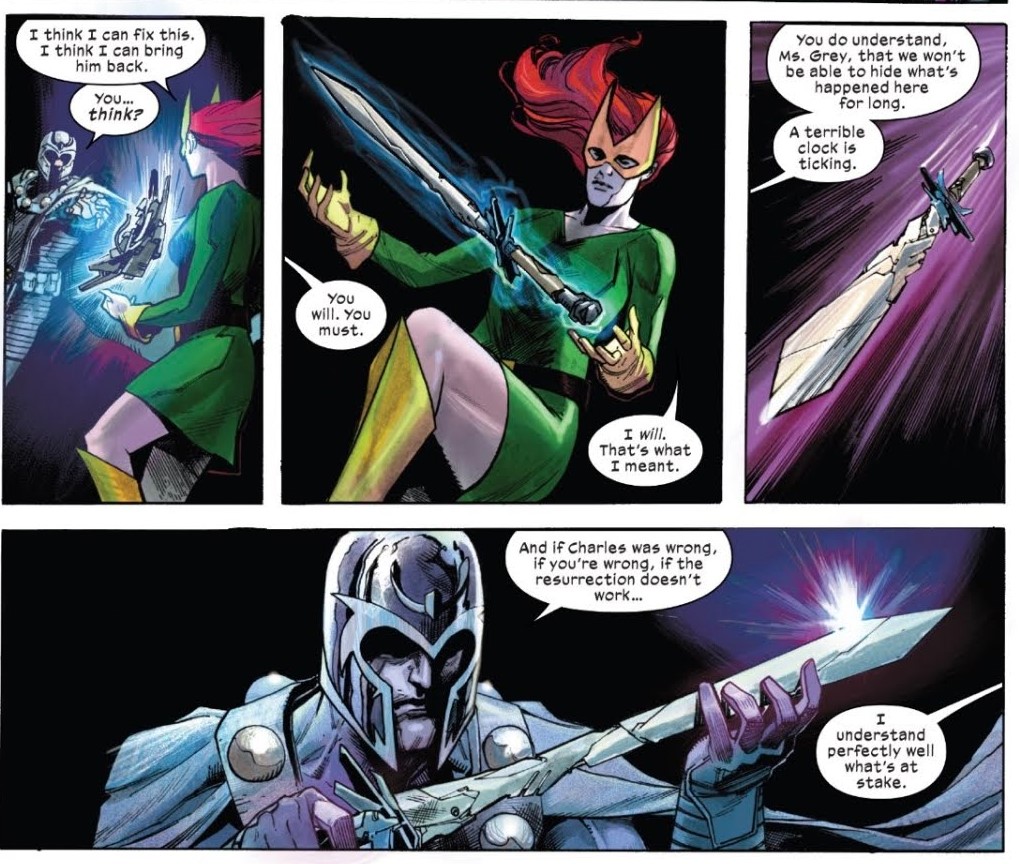
    There’s also notably the “Cerebro Sword” Magneto gifts to Professor X upon his resurrection (following X-Force #1)

    When you start digging into X-Men characters in the X of Swords promo and beyond, the history of swords is long, deep, and maybe entirely irrelevant but still pretty fun! Likewise, Marvel’s tease of swords from the Marvel Universe “past and present” really opens the door for some timey-wimey weapons selection. Could we see Exodus wielding the famed Ebony Blade from the Crusades for example?

    Everyone in the promo blade seems to have a custom made sword, like the aforementioned Professor X with Cerebro, or Wolverine with what I’m guessing is the Muramusa blade, and Gorgon with Godkiller, but the one that *really* catches my attention is Rachel Summers with the Phoenix Blade!

    The Phoenix blade was introduced – I believed during the “End of Greys” storyline in Uncanny X-Men #480-ish – as a weapon empowered with a fragment of the Phoenix Force. Korvus, a descendant of the shi’ar Rook’shir who created the blade, and was consumed by the Phoenix Force, originally tried using the blade to kill Rachel Summers.

    And finally, on the most reckless note of the bunch, swords are kind of a big deal in seemingly unrelated Marvel events these days! We have the necrosword of Jason Aaron’s run on Thor and now Donny Cates’ work on Venom, as well as Hulkling’s use of the Starsword in the pages of Empyre.

    The post Krakin’ Krakoa #39: X of Swords – 2020 X-Men Crossover! Theories and Predictions! appeared first on Comic Book Herald.


    Krakin’ Krakoa #38: X-Men #7 Review – What Is Hickman’s Crucible? What’s It Mean For Mutants? Feb 27, 2020
    Show notes

    X-Men #7 delivers a major update to the state of mutants on Krakoa and in the Marvel Universe, in easily one of the biggest issues since House of X ended!

    Today I’ll answer:

    TASCHEN

    + What is “Crucible” and what does it mean for the X-Men’s resurrection protocols?

    + How does X-Men #7 tie heavily into House of M and X-Men “Decimation” stories from the mid 2000’s?

    + Why Nightcrawler is the perfect guide to introduce us to the new Crucible practice on Krakoa

    Related Reading:

    X-Men: Dawn of X reading order

    Review Notes – Spoilers May Follow!

    In X-Men #7 by Jonathan Hickman, Leinil Francis Yu, Sunny Gho, Clayton Cowles, Tom Muller, the issue opens with the mysterious repeating refrain that “Crucible is today.” There’s been a lot of speculation about what “Crucible” might be after Marvel previewed the issue, and X-Men #7 does a nice job building details and information about the new addition to Krakoa culture as the story develops.

    Cyclops first considers the new procedure with Wolverine, in a scene full of details that are going to drive the Scott/Logan/Jean/Sure let’s throw in Emma why not shippers wild.

    On his quest to witness and learn more about Crucible, Cyclops first strolls past Doug Ramsey, Krakoa, and for just a split second, Warlock chilling. It’s tangential to the main story, but for fans who have been wondering about Doug’s techno-organic arm, and the presence of longtime New Mutants member Warlock, it’s another small clue in what appears to be another mystery. There’s definitely something curious, almost creepy, going on with Doug and Warlock, and I’m certain this isn’t the last we’ll see of them.

    The bulk of the issue centers around an extended, religious and philosophical conversation between Nightcrawler and Cyclops, mostly as it pertains to The Crucible.

    Kurt has so many questions about Krakoa, the resurrection protocols, and what they mean for faith, the afterlife, and morality.

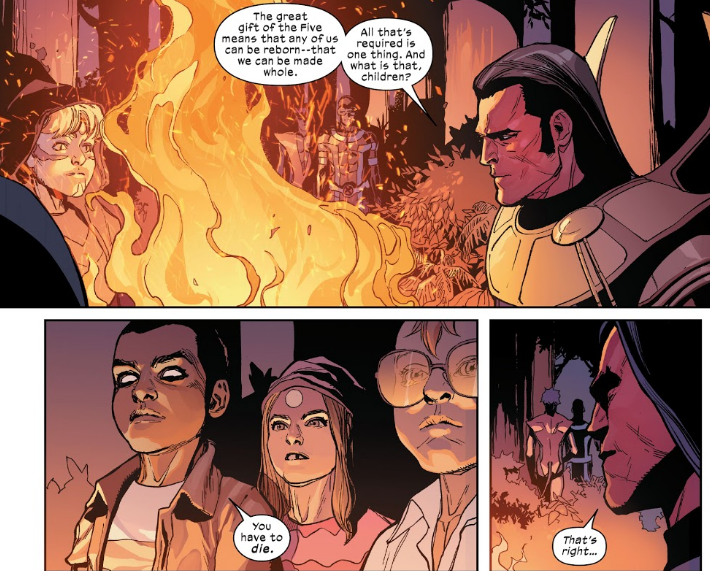
    Crucially, as Cyclops and Nightcrawler make their way to Crucible, they witness Exodus leading some campfire cult kids in the ways of Krakoa. Importantly, Exodus describes resurrection not just as “being reborn,” but as “being made whole.” Even the children of Krakoa understand that death is necessary to achieve this gift.

    At this point it begins to become clear what Crucible is meant to be.

    Exodus on Krakoa

    Crucible is all about restoring mutants that were depowered in Scarlet Witch’s Decimation to their full mutant abilities. These are Krakoa’s rules for mutants who have lost their powers, and the nation’s path forward to restoring mutant kind to their past glory. Importantly, it’s not enough to resurrect those who have been killed by humans, but mutants also see it vital to restore depowered former mutants as well.

    At the conclusion of 2005’s House of M, Wanda Maximoff, the Scarlet Witch – then thought to be both mutant and long-time Avenger – Wanda used her reality altering powers to declare “No More Mutants” and depowered 1 million mutants.

    Hence her new status in the Marvel Universe as boogeyman to mutant children, and “The Pretender” label given the fact that it’s been revealed in the last 5 years, that Wanda is not – in fact- even a mutant.

    It’s also clear now why X-Men #7 is titled “Lifedeath,” in a callback to Uncanny X-Men #186, a story in which Storm copes with the loss of her powers after being hit with a depowering invention from Forge.

    Arriving at Crucible, we learn that this gladiatorial ceremony is the Quiet Council’s solution to the problem of Decimation, and mutants that want to be made whole.

    The first mutant to go through Crucible – or at least the first we see – is Melody Guthrie, the fourth of the Guthrie’s 10 children, and herself a mutant until the events of M-Day.

    The talk by Apocalypse of refusing suicide as an option is particularly relevant for Melody, who nearly committed a form of post M-Day suicide, jumping off a building believing she could still fly (New avengers #18 (?))

    So instead of encouraging mass-death, Crucible is Krakoa’s way of challenging depowered ex-mutants to prove their mettle and desire to be made whole. It’s a very Apocalypse argument, fighting for survival and becoming your best self in a sword-fight with the Big A Symbol himself.

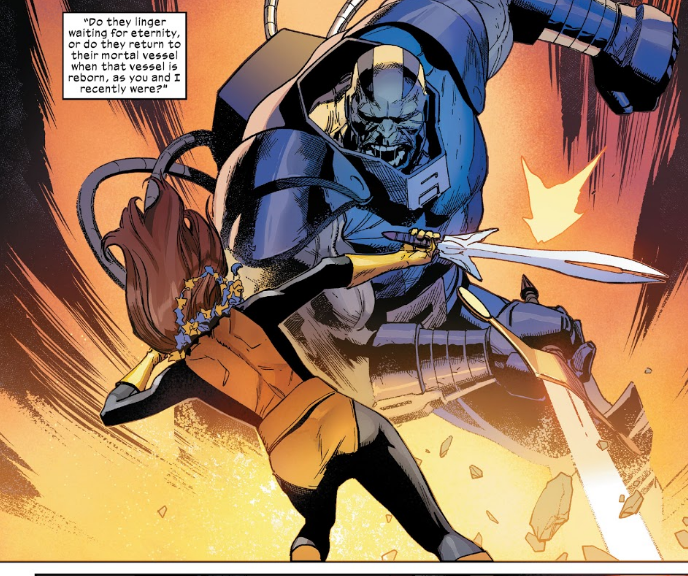
    Apocalypse sword fights Melody Guthrie on Krakoa

    My first major questions surrounding Crucible are:

    1)What happens if they beat Apocalypse? They don’t get to resurrect? Doesn’t seem like a lot of incentive to have a great sword fight.

    2)What about mutants – like Domino in X-Force – who aren’t depowered but are not “whole” in some way. How far does Crucible extend?

    While witnessing the evens of Crucible, Nightcrawler and Cyclops pose some major questions about the nation’s resurrection process.

    The first is the issue of mutant wills, where Cyclops points out some mutants “are arguing that the best version of themselves would be being reborn in a copy of Magneto’s body with his powers.” Nightcrawler then says “Why stop there? Why not combine two? Why not add a third into the mix?”

    This is some dramatic irony, as we know, considering Sinister’s Chimera program from Powers of X is all about mutant power splicing. At this point in Krakoa, though, it’s all theoretical and fuzzy.

    The question of resurrection *changes* – in becoming who you were meant to be – is a very interesting one. We’ve already seen hints throughout Dawn of X that mutants can come back through resurrection with amplifications or minor changes (Synch, Professor X/Fantomex body, now Melody Guthrie).

    So you have mutants leaving wills asking to be restored in Magneto’s body w/ his powers… or not mentioned here, how about just in their chosen gender?

    One idea that does occur to me is the concept of placing a mutant’s essence – their Professor X/Cerebra backed up person – into a physical body that is not their own is still a fairly untested procedure on Krakoa. This seems like the biggest setback preventing a nation of Magneto’s running around – Magnation? – but I have to imagine we’ll see this exact scenario play out sooner than later.

    The second major question revolves around questions of afterlife and the soul. The point is clearly not direct answers, so much as considering the weight of the questions, and Nightcrawler does that very effectively throughout the issue. How much does the resurrection process change a person?

    The questions regarding the afterlife and eternity are all especially relevant for Nightcrawler, who not only operates as the most famous devout Christian in the Marvel Universe this side of Daredevil, but has literally been to heaven. After his death in X-Men: Second Coming, Nightcrawler was in paradise until the pages of Amazing X-Men.

    Now, obviously in that story arc, Kurt returns to the land of the living, but for someone so committed to a life well lived leading to an eternal reward, how do you reconcile that with eternal immortality on Krakoa?

    X-Men #7 ends with Melody Guthrie’s ascension to her mutant status as the flying, glowing Aero, reborn as the mutant she was meant to be before Decimation. Amidst the spectacle, Nightcrawler also declares his new mission is to start a mutant religion, which is a fantastic idea.

    ——————————————————————————————————-

    Music for Best Comics Ever by Anthony Weis. Check out more music at anthonyweis.com.

    Subscribe on iTunes

    Subscribe on Android

    To learn how you can support Best Comics Ever and receive more exclusive content from Comic Book Herald, check out the Patreon: https://www.patreon.com/comicbookherald

    For the Comic Book Herald reading club through every year of Marvel Comics, check out mymarvelousyear.com

    The post Krakin’ Krakoa #38: X-Men #7 Review – What Is Hickman’s Crucible? What’s It Mean For Mutants? appeared first on Comic Book Herald.


    Krakin’ Krakoa #37: Giant-Size Jean Grey / Emma Frost Review! Feb 27, 2020
    Show notes

    Few power players in the world of X-Men are as essential to Krakoa with as much baggage between them as Jean Grey and Emma Frost, two of the world’s most powerful telepaths and members of Krakoa’s quiet council. ​

    Today I’ll answer:​

    TASCHEN

    + What does this Giant-Size special mean for Jean and Emma in the Krakoa era?​

    + What’s the big picture role of the 5 Hickman written Giant-Size specials in Dawn of X?​

    + What do you need to know about the history between Jean and Emma?​

    In our first of five Giant-Size issues written by Jonathan Hickman, with alternating artistic showcases, we get Russell Dauterman and Matt Wilson – the powerhouse duo that made the Jane Foster era of Thor and War of the Realms so incredible – taking on a Jean Grey and Emma Frost combo adventure.​

    Get your Krakoan translators ready because Giant-Size Jean and Emma is a nearly silent issue, with Krakoan language gates offering some of the only text in the issue. For those of you who don’t feel like playing cryptographer, the opening text reads: “Silence, Psychic Rescue in Progress!” Jean and Emma’s psychic rescue is required after Storm is found badly wounded and comatose on Krakoa.​

    Related Reading:

    X-Men: Dawn of X reading order

    Review Notes – Spoilers May Follow!

    Why Jean and Emma?​

    In addition to a long-running, frequently nasty history that dates back to the early 80’s “Dark Phoenix Saga,” Jean Grey and Emma Frost also stand out as the female leads of the Grant Morrison written, Frank Quitely designed New X-Men. It makes a lot of sense that Hickman – whose passion for New X-Men is well publicized and clearly influence all things X-Men – Dauterman, and Wilson would take to New X-Men #121 in particular, a “silent” issue in which Jean and Emma venture inside the psychic swamp of Cassandra Nova to save Professor X.

    With art by Frank Quitely, New X-Men #121 is a psychedelic explosion of ideas in which we learn Professor X tried to kill his twin sister – Cassandra Nova – in utero.​

    Notably, Jean is easily the most successful of the adventuring telepaths, as she points out to Emma at issue’s end. Frankly, if you read nothing else prior to the Giant-Size special, you should consider New X-Men #121 for inspiration and reference points, of which there are several fun ones.

    Venturing into Storm’s psychic landscape, we get a nice callback to the character’s shared histories. Whereas Storm’s psychic defenses recognize Jean Grey as a friend, they also recognize Emma Frost is a long-time enemy. Indeed, back in Uncanny X-Men #151 to #152, Emma took control of Storm’s body in order to use her to trick and manipulate the X-Men, among plenty of other misdeeds.​

    It’s a reminder that Emma’s history with the X-Men is ripe with baggage, much of which makes Jean and Emma working together an unlikely scenario to begin with. Jean and Emma Frost first meet in the pages of Uncanny X-Men during the “Dark Phoenix Saga” – which more or less spans issues #129 to #138, but arguably has been building since Giant-Size X-Men #1!. ​

    This is during Emma’s black-and-white – well, mostly white – straight up super villain days, without all of the nuance and complexity that Claremont, Lobdell/Bachalo in the pages of Generation X, Morrison, and countless other creators would add to her character in the decades to come. As a result, her and Phoenix era Jean quickly throw down, as Jean unleashes the full might of the Phoenix on Emma’s not inconsequential psychic powers.​

    In a sense, Emma would have the last laugh, working with Jason Wyngarde – aka Mastermind – to manipulate Jean into becoming the Black Queen of the Hellfire Club.

    Through all that history, by the time House of X and Powers of X culminate in a new Krakoan nation state for mutantkind, Jean and Emma are amicable enough and together enough in their cause to share a beer and celebrate.

    ——————————————————————————————————-

    Music for Best Comics Ever by Anthony Weis. Check out more music at anthonyweis.com.

    Subscribe on iTunes

    Subscribe on Android

    To learn how you can support Best Comics Ever and receive more exclusive content from Comic Book Herald, check out the Patreon: https://www.patreon.com/comicbookherald

    For the Comic Book Herald reading club through every year of Marvel Comics, check out mymarvelousyear.com

    The post Krakin’ Krakoa #37: Giant-Size Jean Grey / Emma Frost Review! appeared first on Comic Book Herald.


    X-Men: Dawn of X Wave 1 In Review! (W/ Zack Quaintance) Feb 25, 2020
    Show notes

    Looking back at the entire first wave of X-Men Dawn of X to discuss what’s working, what’s not, and where we think X-Men comics are going in 2020!

    Thanks to Zack Quaintance (@comicsbookcase) for joining me for a great conversation about all things X-Men!

    TASCHEN

    Related Reading:

    X-Men: Dawn of X reading order

    You can also find more of my thoughts and theories on all things 2020 X-Men over on the Comic Book Herald Youtube channel!

    ——————————————————————————————————-

    Music for Best Comics Ever by Anthony Weis. Check out more music at anthonyweis.com.

    Subscribe on iTunes

    Subscribe on Android

    To learn how you can support Best Comics Ever and receive more exclusive content from Comic Book Herald, check out the Patreon: https://www.patreon.com/comicbookherald

    For the Comic Book Herald reading club through every year of Marvel Comics, check out mymarvelousyear.com

    The post X-Men: Dawn of X Wave 1 In Review! (W/ Zack Quaintance) appeared first on Comic Book Herald.


    Dan Didio Out At DC Comics: Quickfire Reactions & Predictions (W/ Zack Quaintance) Feb 23, 2020
    Show notes

    News broke on Friday (Feb 21, 2020) that Dan Didio, Co-Publisher at DC Comics since 2010, is leaving the company. It’s a huge change for DC, and provides an opportunity to reflect on a legacy that includes The New 52, DC Rebirth, and a lot of complexity.

    Thanks to Zack Quaintance (@comicsbookcase) for joining me for an impromptu discussion about Didio’s legacy as DC co-publisher, and what it might mean for DC Comics moving forward.

    TASCHEN

    We talk about the good and bad of Didio’s time as the figurehead of DC Comics and what we’ll remember most. We also consider how Didio impacted both DC’s legacy characters and the line of in-continuity superhero comics as a whole. What will DC Comics look like in a post-Didio era, and with new corporate ownership bringing in different ideas of what they want out of a comics publisher?

    Related Reading:

    Co-Publisher Dan Didio no longer at DC

    DC’s The New 52 reading order

    DC Rebirth reading order

    ——————————————————————————————————-

    Music for Best Comics Ever by Anthony Weis. Check out more music at anthonyweis.com.

    Subscribe on iTunes

    Subscribe on Android

    To learn how you can support Best Comics Ever and receive more exclusive content from Comic Book Herald, check out the Patreon: https://www.patreon.com/comicbookherald

    For the Comic Book Herald reading club through every year of Marvel Comics, check out mymarvelousyear.com

    The post Dan Didio Out At DC Comics: Quickfire Reactions & Predictions (W/ Zack Quaintance) appeared first on Comic Book Herald.


    Krakin’ Krakoa #35: Wolverine #1 Review – Where Does Wolverine Fit In The Dawn of X? Feb 19, 2020
    Show notes

    An all new Wolverine comic series launches today for the first time in six years!

    Today I’ll answer:

    TASCHEN

    + Where’s Wolverine been in the Marvel Universe, and why hasn’t he had a comic series since 2014?

    + Where the new Wolverine series fits in the X-Men: Dawn of X!

    + Who are the villains of the new Wolverine ongoing?

    Wolverine #1 is an over-sized, excellent (and $7.99) special with two full stories written by Ben Percy. The first, with art by Adam Kubert and colors by Frank Martin, is an extended continuation of the Dawn of X X-Force run Percy’s been writing as well.

    The issue kicks off with an opening reminiscent of Old Man Logan, with X-Force teammates Jean Grey, Domino, and Quentin Quire apparently dead at the hands of a badly wounded, amnesiac but healing Wolverine.

    Really since X-Force #1, Percy’s shown a clear desire to explore concepts of safety on Krakoa, and in the case of Wolverine, this character surrounded in generations of violence, the idea of ever letting go enough to truly be at peace.

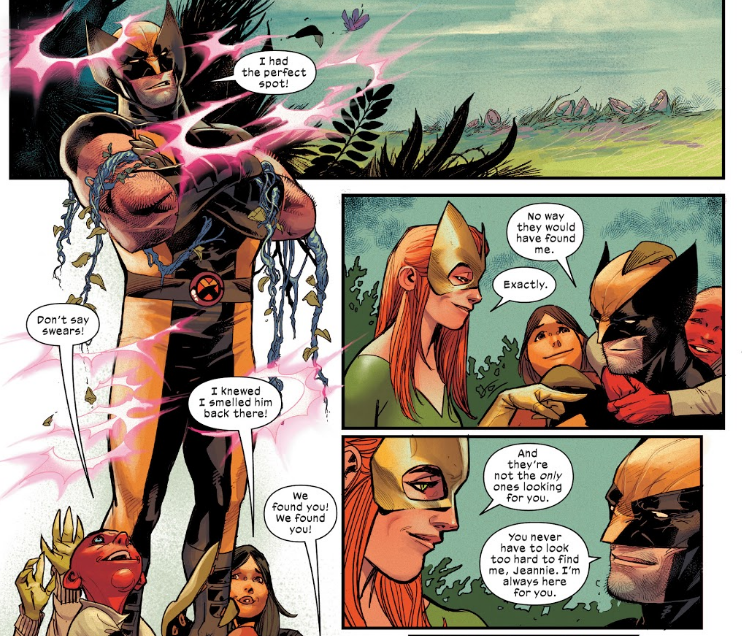
    Calling back to the imagery of Hickman/Larraz in House of X #1, there’s something remarkably sweet about Wolverine playing hide-and-seek with a bunch of young mutants, and only having his spot revealed by a teasing Jean Grey.

    Wolverine plays hide and seek on Krakoa with Jean Grey

    In the pages of Wolverine #1’s first story, black market Krakoan flowers are driving increases in religious cults around the world like the ‘Order of X.’

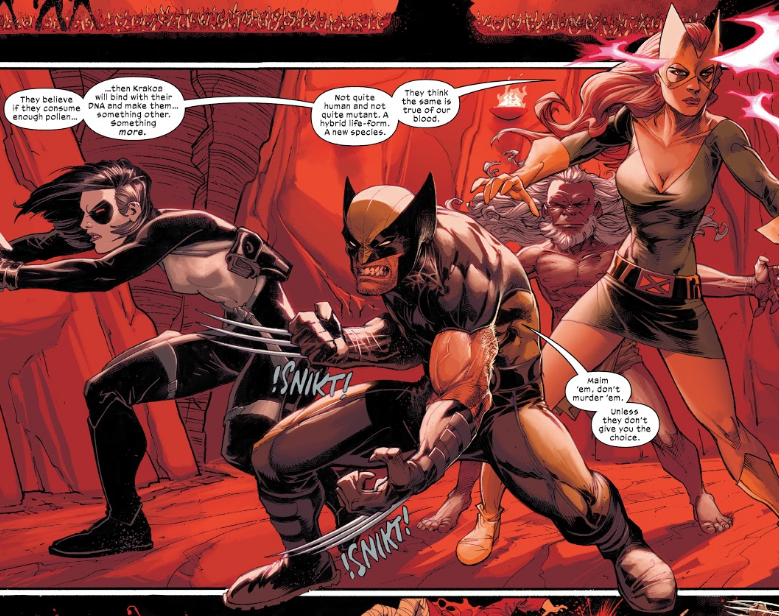
    Percy’s shown an eye for exploring the impact of Krakoan drugs in X-Force, and Wolvy continues that trend with more conversation about pollen than you can shake an allergist at. As Jean Grey states later in the issue “They believe if they consume enough pollen, then Krakoa will bind with their DNA and make them… something more. Not quite human and note quite mutant. A hybrid life-form. A new species. They think the same is true of our blood.”

    This all drives to an “X-Force” assemble moment, with Wolverine enlisting Sage’s aid to uncover an Order of X cult hideout, and bringing Jean, Domino, and Quentin (with Gateway’s chauffeuring aid) to explore the mistreatment of Krakoa’s pollen.

    The mystery revolves around how we truly get from this point to Wolverine surrounding his teammates dead bodies in the snow, and running headfirst into the CIA operative we also see tracking the pollen trade throughout this storyline. More to come of course, and I’m excited to see how it all plays out, including the revelations of the mysterious “Pale Girl” behind it all. My first “Pale Girl” thought jumped to Miss Sinister (yes I just read “Dead Man Logan” why do you ask?), but that seems unlikely from the story ending slight reveal.

    Wolverine and X-Force in the Dawn of X

    The second story by Percy and Viktor Bogdonavich plays in more familiar Wolverine comic territory, but still tackles several Krakoa questions, such as the policy of inviting truly every mutant onto the island regardless of their past deeds and inclinations towards serial killing.

    The appearance of a bloody Omega Red – a longtime Wolverine nemesis, dating back to 1991’s X-Men #4 in comics history, but even further back into Wolverine’s back story – requesting amnesty sets Wolverine on edge, and leads to a confrontation with Magneto (who joyously tosses Wolverine through a Krakoan gate like a rag doll).

    Wolverine and Magneto get into a pretty interesting debate about the dangers of a presence like Omega Red on Krakoa – remember back in House of X #5 it was Wolverine who expressed the most vocal objections to Apocalypse joining the island.

    Magneto argues the dangers of deadly mutants are nullified by Krakoa’s resurrection protocols, and Wolverine counters with “immortality don’t erase trauma.”

    This is a very compelling argument in theory, but it raises the question that has come up a few times now – How much would a mutant actually remember about their death? After all, Professor X’s backups occur weekly, not down to the second, so it’s actually very likely that the circumstances surrounding a mutant’s death would be unknown even to them. This comes up in the pages of X-Men #6, where Magneto, Professor X and Mystique can’t quite be certain Mystique’s goals were achieved prior to her death in House of X #4.

    If that’s the case, isn’t Wolverine’s point kind of null and void?

    Regardless, Omega Red’s presence and manipulations send Wolverine on a journey to Paris where he runs into a swelling Vampire Nation, who literally hang Wolverine upside down and stick a faucet in his neck like a Keg-arine.

    As it’s ultimately revealed, the Vampire Nation seeks Wolverine’s “Endless” blood to feed their leader, Dracula, who is very much in league with Omega Red. Dracula gives Omega, real name Arkady, the carbonadium synthesizer he is literally always looking for – usually because Wolverine and Maverick are playing keepaway with it! – in exchange for his loyalty as a mole inside Krakoa.

    Appropriately, there’s been a lot of theorizing about a mutant mole in the pages of X-Force and Omega Red could certainly fit the bill. It almost seems too easy, and perhaps misaligned with Dracula’s goals, but I do love the idea of Percy continuing to weave threads between Wolverine and X-Force.

    Likewise, Wolverine and the X-Men have a long, entertaining history battling both Omega Red and Vampires, so I frankly love the inclusion here. There’s also been some compelling work with Dracula and the Vampire Nation in the pages of the Jason Aaron / Ed McGuiness run on Avengers that may be worth exploring any crossover as Wolverine continues. If for no other reason than to showcase the panel I keep on hand of Captain America carrying a giant cross and yelling “So come take a big bite! If you’ve got the stomach for it!” at a crowd of vampires.

    I loved the heck out of Wolverine #1 more than even anticipated, and am thrilled to have this new series as part of the Dawn of X. Between this and the regular excellence of X-Force I’ve been really impressed by Percy’s contributions to the Dawn of X.

    The post Krakin’ Krakoa #35: Wolverine #1 Review – Where Does Wolverine Fit In The Dawn of X? appeared first on Comic Book Herald.


    The Cates of Hel #3: Thor #3 Review – The History of Beta Ray Bill! Feb 13, 2020
    Show notes

    Thor #3 follows the cliffhanger appearance of Beta Ray Bill, cosmic powerhouse, frequent player in the Donny Cates cosmic Marvel universe, and oath-brother to Thor. The story by Donny Cates, Nic Klein, Matthew Wilson, and Joe Sabino is an all out action issue fixating on a brawl between Bill and Thor. Beta Ray Bill views Thor’s work with Galactus as an absolute breach of his worthiness to hold Mjolnir, and initially seeks to attack the devourer in order to free Thor from what Bill assumes is some sort of mind control or bewitching.

    Today I’ll answer:

    TASCHEN

    + Who is Beta Ray Bill and what’s his history with Thor and Galactus?

    + Where are we at in the Donny Cates and Nic Klein Thor story through three issues, and where is the series heading?

    For related reading orders on Comic Book Herald:

    Donny Cates’ Marvel Comics!

    Thor reading order!

    Beta Ray Bill reading order!

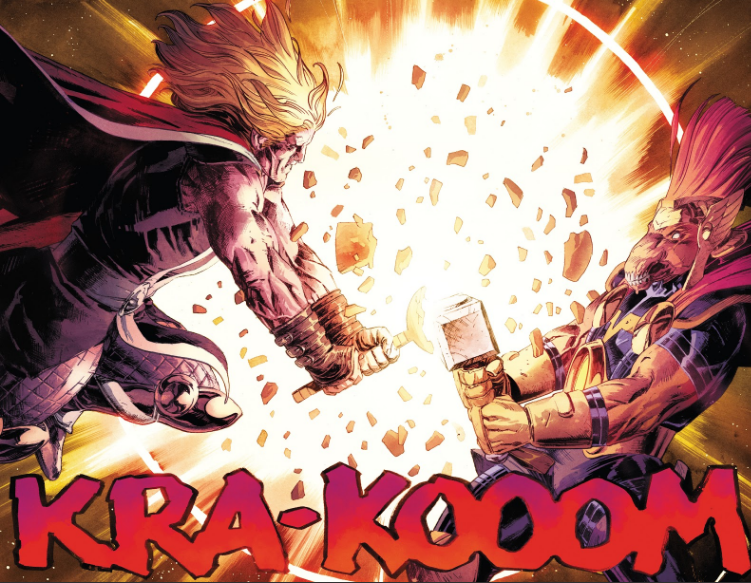
    Beta Ray Bill is even more enraged when he learns that Thor is working with Galactus of his own free will, and despite Thor’s clear advantages as the combination Lord of Asgard / Herald of Galactus, fights Thor until Stormbreaker, Bill’s enchanted hammer, is literally smashed to pieces.

    Beta Ray Bill is even more enraged when he learns that Thor is working with Galactus of his own free will, and despite Thor’s clear advantages as the combination Lord of Asgard / Herald of Galactus, fights Thor until Stormbreaker, Bill’s enchanted hammer, is literally smashed to pieces.

    To help explain why Beta Ray Bill is so enraged by the trajectory of Thor’s course with Galactus, it helps to look at the character’s history in the Marvel Universe.

    In my favorite Beta Ray Bill story of the 2000’s, and the one with the most relevance for the Cates and Klein run to date, the three issue Beta Ray Bill: Godhunter by Kieron Gillen and Kano follows Bill as he seeks revenge on Galactus. Thor questions the wisdom of Bill’s vendetta against the world devourer, and actually denies him aid.

    Bill’s plan is to starve Galactus, choosing to employ strategy over pure brawn in a way that highlights why Beta Ray Bill is a cosmic powerhouse.

    The story is also a nice inversion of the usual conclusion Marvel heroes come to about Galactus operating as a monstrous but necessary force in the galactic balance. Famously, in the pages of the John Byrne era of Fantastic Four, Reed Richards even makes a case for Galactus during a space trial, which is frankly a lot like making a case for a serial killer in front of the aggrieved family.

    Bill wants nothing to do with this philosophy or science, though. In the words of every review of stories involving Thor and Beta Ray Bill ever: It’s hammertime.

    Bill comes very close to succeeding too, taking on the likes of the Silver Surfer as he seeks an end to the World Devourer. His position as Galactus’ status as necessary force of nature is clear too, at one point telling the Surfer: “You serve Galactus. Thurs your hands are bloody red. What do we have to talk about?”

    Nonetheless, Bill’s obsession with revenge and his methods of planetary annihilation to murder Galactus result in him becoming unworthy of Stormbreaker. It’s only after he halts his bloodthirsty quest that he’s able to wield the enchanted weapon again.

    With all that in mind, it’s hardly surprising that Beta Ray Bill would bumrush the show in Thor #3, however foolhardy that proves.

    Although he has to learn a lesson by the end of Godhunter, I don’t think there’s any reason to believe Beta Ray doesn’t still hate Galactus with a raging fury.

    After Thor’s well and truly beaten Beta Ray Bill, the issue concludes with the former love interest of both Beta Ray Bill and Thor, Lady Sif, now Sif the all-seeing following the events of King Thor. Presumably issue #4 will kick off with a brouhaha between Thor and Sif, although I hope Cates & Klein are more clever than that.

    Thor vs Beta Ray Bill

    Because Thor #3 is so action-heavy – and again, so one-sided – there’s a lightness to this issue that leaves little to grasp onto. It’s perhaps important to show how far beyond his normal status quo King Thor has risen – he makes Bill look like a featherweight – but doing so a second time against an ally would feel beyond repetitive.

    The most interesting thing this “Herald of Thunder” storyline is doing is asking how complicit Thor is, or should feel about his newfound role aiding Galactus’ planet consumption. There’s a crucial moment in issue #3 where Galactus seeks to control Thor’s power cosmic, and Thor tells him “Nay!!! I took your power.” instead of the other way around. The scene reminds me a lot of my toddler when I tell him I’m going to play with the best dinosaur action figure, but nonetheless it reveals a clear distinction Thor is making that he is, in fact, in control of his actions and working with Galactus because it needs to be done.

    I think Cates and Klein are interested in asking questions about Thor’s humanity as King, even calling him the new “God of Genocide” in issue #2, but that angle is falling very flat for me. Firstly, the question was explored so thoroughly in Jonathan Hickman’s New Avengers that clearing the bar is a tall order, and this does not yet come close to measuring up. Second, there’s a very good reason Thor is working with Galactus, and it’s a threat to all universes! I’m yet to in any way think Thor has lost his sense of what’s right, although perhaps as the book progresses and more planets are endangered, we may see that trend.

    In Thor #4, I’m looking forward to Thor and Sif putting down hammer and sword, and discussing a plan to use the Bifrost to fully save future planets like they tried to do with Clypse on the fly. We’re three issues into the first story of this era of King Thor, and he’s yet to do much by way of governing. It’s time to put the fists down and see what Thor is thinking, lest this series devolve into nothing but shattered hammers.

    ——————————————————————————————————-

    Music for Best Comics Ever by Anthony Weis. Check out more music at anthonyweis.com.

    Subscribe on iTunes

    Subscribe on Android

    To learn how you can support Best Comics Ever and receive more exclusive content from Comic Book Herald, check out the Patreon: https://www.patreon.com/comicbookherald

    For the Comic Book Herald reading club through every year of Marvel Comics, check out mymarvelousyear.com

    The post The Cates of Hel #3: Thor #3 Review – The History of Beta Ray Bill! appeared first on Comic Book Herald.


    Krakin’ Krakoa #33: X-Men #6 Review – Mystique’s House of X Secrets Feb 12, 2020
    Show notes

    X-Men #6 by Jonathan Hickman, Matteo Buffagni, Sunny Gho, and Clayton Cowles is a much-needed flashback to Mystique’s role in the House of X event, offering present day insights into the apparent strong return of Orchis, those sentinel obsessed humans the X-Men gave their lives to stop. The issue’s effective at connecting back to the celebrated event that birthed the Krakoa era, while also suggesting the victory was not nearly as certain as mutantkind previously thought.

    For the full Dawn of X reading order:

    TASCHEN

    Mystique reading order

    History of Mystique and Destiny

    For all Comic Book Herald X-Men videos:

    Today I’ll answer:

    + What does X-Men #6 reveal about Mystique’s secret role in House of X

    + The history between Mystique and Destiny

    + What the return of Orchis in this issue means for Krakoa and the House of X!

    Notably, X-Men #6 features no data pages, maximizing a full issue’s worth of story for Mystique’s emotional power struggle with Professor Xavier and Magneto, as well as the development of the Orchis threat thought crippled. Like X-Men #4, issue #6 is a deliberate follow-up to the event that started it all, and feels tremendously essential.

    Looking back to House of X and Powers of X, when we first see Mystique, she’s in the process of stealing a data file from Damage Control with Sabretooth and Toad. When she returns to Krakoa – narrowly escaping the arrival of the Fantastic Four, who arrest Sabretooth – she delivers the data to Magneto.

    There’s really nothing suspicious about this interaction in these early stages, as Mystique and Magneto have long fought on the same side, and certainly from the early 2000’s movie franchise alone, now have a cultural perception of closeness and allyship.

    First, though, Mystique uses the acquisition of data as leverage against Magneto and Professor X. Mystique makes “demands” of Magneto and the Prof, before Xavier sarcastically condescends to her with the line “Is helping your fellow mutant not reward enough for Raven Darkholme,” a line Raven will wryly use back against the Professor in mere moments.

    House and Powers were really about Charles and Erik’s plans to use Mystique’s stolen data, and less about what she really wants. Following the House of X #4 mission gone terribly wrong – remember, Mystique gets “lost” and the entire X-crew is killed in the process of preventing Orchis’ Mother Mold from becoming operational – Mystique is resurrected and made one of the 12 members of the Council. This appears to be Professor and Magneto’s efforts of placating Mystique, although it’s clear from her abject boredom during Council meetings, that Raven has something else in mind.

    In X-Men #6 this scene is replayed but this time with an extended cut that reveals Professor X and Magneto also asked Mystique to plant a seed on the Orchis station during the X-Men’s mission to sabotage the Mother Mold. This is why Mystique mysteriously takes a wrong turn during that issue, and becomes crucial as the planted Krakoan gate allows Mystique to travel to the Orchis station under the guise of one of their soldiers to monitor their progress.

    This is one of those story beats that Jonathan Hickman is great at, fitting wrinkles into pauses and breath left behind in previous issues. There’s a sense to how the puzzle fits together, and also a clear-eyed vision that shows this was the plan all along.

    During the process of reconnaissance, Mystique learns that Dr. Alia Gregor is making progress on the development of Nimrod, and that the X-Men’s destruction of the Mother Mold was not the apparent end of the Nimrod threat that mutantkind had hoped.

    This is catastrophic news for Magneto and Professor X’s plans. Not only is Orchis restoring what they’re calling a “Sentinel City” on Mars – have to think that’s not the last time we’ll be hearing of Sentinel City! – but the dramatic House of X #4 infiltration didn’t even stop the rise of Nimrod.

    Personally, I think this is a brilliant reveal. Nimrod was so effectively built up as the ultimate threat to mutantkind in the pages of Powers of X, so the adaptive mutant hunter is a borderline requirement to retain tension towards the mutants attempts to assure a future that doesn’t result in their own extermination. Plus, it highlights that even with Moira’s lifeline insights, the Krakoa era of X-Men is far from a guaranteed success. In fact, so far based on Moira’s lives, everything she tries leads to failure; this is a hint that the same inevitability may be at play.

    x-men 6 mystique and irene destiny

    So why is Mystique running all these errands for the Prof and Magneto?

    Given the closeness of their relationship historically, many have postulated that Mystique is most dedicated to the resurrection of Destiny, and that’s quite clearly made explicit here. Mystique teases that she doesn’t kill Dr. Gregor because of Krakoa’s laws about killing humans – which Magneto characteristically throws out the window in a millisecond – but the reality is she’s holding out in an effort to get the resurrection committee to make good on their promise of bringing back Destiny.

    For the less familiar, Mystique and Destiny (aka Irene Adler) debut in the pages of Uncanny X-Men #141 to #142 during the incredible “Days of Future Past” storyline by Chris Claremont and John Byrne. They found a new Brotherhood of Evil Mutants with Avalanche, Pyro, and the Blob and make their presence felt with assassination plot against one of the most public anti-mutant politicians on the scene, Robert Kelly.

    There are actually a ton of fascinating moments from “Days of Future Past” that read differently in the wake of the House of X event. I don’t want to get too sidetracked but we just re-read the issues in the My Marvelous Year reading club and podcast, and I had completely forgotten that Mystique and Destiny’s Brotherhood of Evil Mutants set out to not only assassinate Senator Robert Kelly, but also Professor X and Moira MacTaggert! This feels especially pointed given what we now know about Charles and Moira’s founding of Krakoa.

    While never explicitly stated due to Marvel’s frankly homophobic & fearful 1980s editorial policies, hints of Raven and Irene’s love are frequent throughout their history together as atypically close friends and allies.

    Their relationship and romance has only recently been made clear in the pages of History of the Marvel Universe #2 by Mark Waid and Javier Rodriguez.

    There’s a really great article by The Beat describing the character’s full history, and I’ll share that in the show notes! https://www.comicsbeat.com/history-x-mens-destiny-mystique/

    House of X Moira No Precogs

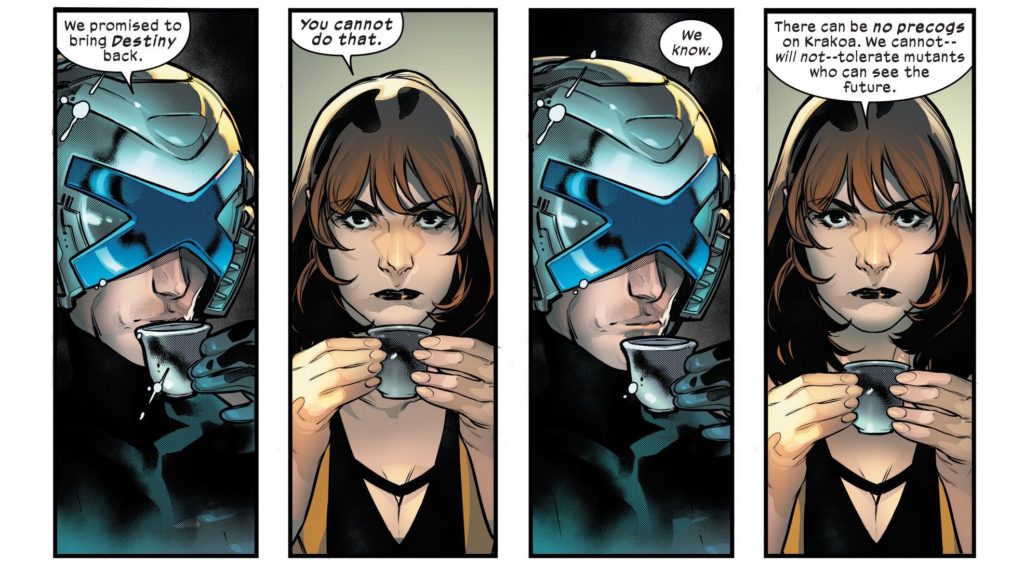
    Mystique and Destiny’s relationship raises problems for the shadow triumvirate of Magneto, Charles, and Moira because in Moira’s third timeline, it was Destiny who proved capable of seeing Moira’s lives, and effectively putting an endcap on her ability to experiment with the future of mutantkind. You know, before Mystique, Destiny and Pyro brutally burned her alive.

    House of X event even ends with Moira very directly telling Charles and Erik that they cannot resurrect Destiny under any circumstances. The fear is apparently not specific to Destiny – Moira states “there can be no precogs on Krakoa,” which now that I think about it raises some major questions about the status of Blindfold in the Krakoa era – but nonetheless it’s clear the mutant trio have no intention of actually delivering on their promise to Mystique out of their own still mysterious self-interest.

    We haven’t seen hide nor hair of Moira since the Dawn of X began, but I’m extremely curious about this mandate. It’s both sinister – what is she so worried about hiding from precognitive mutants? – and feels like self-sabotage. Couldn’t working in tandem with mutants who can see the future help mutantkind’s efforts to craft a better future? I have to believe that there’s something quite devastating in Moira’s plans, like Ozymandias willing to sacrifice millions in Watchmen in order to obtain world peace.

    As you’d expect, this is tremendously frustrating for Raven Darkholme. Charles and Mags are constantly moving the goalposts, and quite clearly have no intention of actually restoring Destiny to life for Mystique’s benefit, or simply because she’s a mutant and that’s what Krakoa does now. If you’re Mystique looking around at all the previous threats Professor X and company are welcoming onto the island, or the absolute wild card resurrections like Jamie Braddock in the pages of Excalibur, there’s no sensible reason to withhold Destiny beyond keeping Mystique on a string.

    Professor X and Magneto have their Moira-based reasons, but this constant refusal in the face of a woman screaming that she wants her wife back – and knowing it’s within their power – is one of the cruelest measures we’ve seen them take.

    We’re a long way from Mystique getting under Professor X’s skin in the pages of the early 2000’s Brian K Vaughan written Mystique solo series. When Professor X talks down to a deliberately teasing Mystique in these comics, it’s with a presence of stodgy leadership and respect.

    Now when Mystique shares her hatred for Charles Xavier, it’s deeply felt, and feels like the sort of animosity that there’s no walking back from. Stranger too, as a reader, I’m on her side!

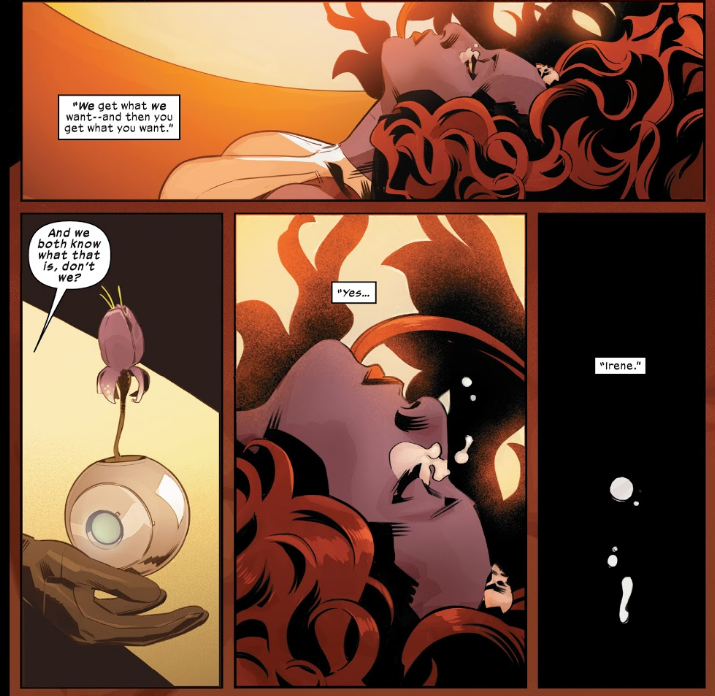
    The issue ends with Mystique revisiting a conversation she had with Destiny, prophesizing the emergence of Krakoa and the refusal to resurrect her person.

    I have to think that Professor X and Magneto have pushed Mystique beyond her breaking point, and that’s planning to make a move without their permission. I’d keep in mind too, that Mystique is a member of Krakoa’s council, and we’ve already seen Sebastian Shaw leverage that position for his own personal gain in the pages of Marauders. I fully expect Mystique to make similar moves, perhaps with the likes of Shaw, Sinister, or even Apocalypse at her side.

    The post Krakin’ Krakoa #33: X-Men #6 Review – Mystique’s House of X Secrets appeared first on Comic Book Herald.


    Krakin’ Krakoa #32: X-Men/Fantastic Four #1 Review – The History of Omega Level Mutant Franklin Richards Feb 06, 2020
    Show notes

    X-Men/Fantastic Four #1 by Chip Zdarsky, Terry Dodson, and Laura Martin follows up on a thread first teased in House of X #1, when Cyclops told the Richards family he’d always have a home on Krakoa. In addition to major ramifications for the Marvel Universe, X-Men/Fantastic Four #1 combines elements from my favorite Fantastic Four series of the last 5 years (Marvel Two-In-One written by Chip Zdarsky) and my favorite ongoing Dawn of X title, Marauders, for a very strong opening issue.

    The issue opens with a monologue from Franklin, now a 13 year old, reflecting on his history with the Fantastic Four and as an omega level mutant. Following 2015’s Secret Wars Franklin was in a position of literally creating universes (which as we’ll see is not the first time he’s done as much), but since Dan Slott’s Fantastic Four kicked off in 2018, Franklin’s powerset dwindles whenever he put it to use.

    TASCHEN

    For the full Dawn of X reading order:

    For all Comic Book Herald X-Men videos:

    Today I’ll answer:

    + Why the X-Men are after Franklin Richards, and why the Fantastic Four are suspicious

    + The essential reading history of Franklin Richards!

    By the time the X-Men come calling, wondering about the possibility of bringing Franklin “home” to Krakoa (and when I say wondering, I mean borderline storming the Richards’ home on Yancy Street and demanding an audience w/ flippin’ Magneto in tow!), he’s already in a place of sadness, anger, and confusion. Despite the fact that Franklin’s father, Reed, is arguably the smartest man alive, he can’t seem to find a cure for Franklin’s powers. This leads Franklin to question why it is that Ben Grimm and now himself are the only two “problems” that Reed seems historically unable to solve.

    It’s a devastating line of thinking from Reed’s own son, but also very understandable, and something we know Ben’s worried about and fumed over in the past as well.

    So when the X-Men decide it’s time to show and claim Franklin as their own, leveraging the debatable bond Kitty and Franklin share from a nice throwback connection to 1987’s Fantastic Four vs. X-Men miniseries, Franklin’s pretty primed to consider the offer!

    It’s a nice choice to use Kitty as the voice of reason connecting with Franklin throughout, as it affords both connections to Marvel’s history and an excuse to primarily utilize Kate Pryde and her Marauders as our focus mutants.
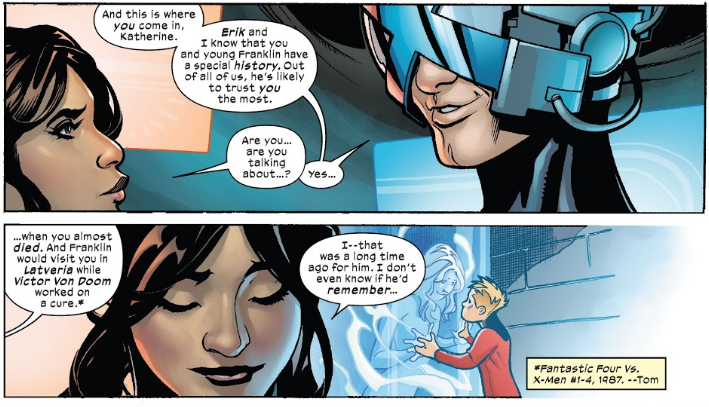
    X-Men Kitty and Franklin

    History of Franklin Pt. 1 – Birth

    Before going any deeper into this specific issue – and if all you’re here for is a review, I quite like this issue and am super excited about the 4 issue limited series. It’s a strong recommend from me, although I’d note to check my Dawn of X reading order on CBH for placement because it creates some conflicts with Marauders – I do also want to dig into Franklin’s history to explore why the character is such a crucial one for both the Krakoa era of X-Men and the Marvel Universe as a whole.

    Franklin was born in 1968’s Fantastic Four Annual #6, approximately six full years into Marvel’s growing Silver Age superhero universe, and over 75 issues (plus annuals) into Fantastic Four. In true Marvel fashion, the only way to mitigate cosmic ray induced difficulties with Sue’s pregnancy is for Reed, Ben, and Johnny to venture into the Negative Zone, battle Annihilus, and return with something called element X to help Sue give birth to a happy healthy Franklin!

    History of Franklin Pt. 2 – Power Creep

    As this auspicious debut suggests, Franklin begins developing his mutant powers well before puberty, really as a toddler, which is quite atypical in the Marvel Universe, and chalked up to his parent’s own cosmically altered genetics. Throughout our My Marvelous Year reading club read through the Marvel Universe, we’ve seen various instances of Franklin’s true power. Likewise, we’ve seen an equal reaction of Reed and the family (although mostly the responsibility falls to Reed) trying to control or tame this power in the interests of their son.

    For example, in Fantastic Four #150, Franklin wakes from a coma to take down a model of Ultron that literally the Avengers, Inhumans, and Fantastic Four were struggling to defeat. This use of Franklin’s power appears to “cure” him, but in reality his powers were just lying in wait.

    The next major development that I think of comes during the John Byrne era of Fantastic Four, specifically issues #244 to #245, when we meet “adult” Franklin for the first time. Franklin the toddler more or less accidentally uses his suddenly untapped mutant reality warping abilities to turn himself into an adult, and in the confusion, he of course fights and defeats the Fantastic Four sans Sue.

    It’s worth noting that although this is not a time traveling version of Franklin, the idea clearly sparked something in the Marvel creative fabric, as aging up Franklin and finding out what he could become has been a staple of the character’s stories ever since.

    This all leads to an overextended period of the Fantastic Four assuming Franklin’s powers are on lockdown, only to be proven wrong time and time again, such as in their battle against Mephisto.

    It’s hard to imagine what it would really be like as a parent of a toddler with such unimaginable power. There’s certainly a thread of Reed and Sue perhaps over-extending their reach to keep him under control – a theme that comes up in a major way in X-Men / Fantastic Four #1 – but a reality warping 4 year old is a genuine nightmare. If my toddler had these powers with no mindblocks, there’d be dinosaurs on every street in our neighborhood, and let’s just say he recently learned the word carnivore.

    History of Franklin Pt 3 – Mutant

    In terms of Franklin’s specific history with the X-Men, Franklin Richards is one of the surviving mutants in the Days of Future Past timeline (we see in these issues that his Fantastic Four family have been killed by Sentinels alongside the likes of many X-Men and Peter Parker). He’s in a romance with Rachel Summers, and part of the mutant resistance that sends Kate Pryde back in time to help prevent the Days of Future Past timeline. I find it interesting that even once his power inhibiting collar is disabled, Franklin is quickly and easily scragged by a sentinel during the mutant resistance’s last stand. It’s a minor role, but Franklin’s inclusion in this timeline is telling.

    This apparent downgrade of powers is dramatically course corrected in a sequel crossover event known as “Days of Future Tense.”

    The apparent downgrade of powers is dramatically course corrected in a sequel crossover event known as “Days of Future Present.” The crossover spans four 1986 annuals – Fantastic Four, New Mutants, X-Factor, and Uncanny X-Men – and tells a story where the Franklin from the “Days of Future Past” timeline escapes through time back to Marvel’s present day. Franklin’s deeply scarred by the trauma of his home timeline, and lashes out against everyone, using his reality warping abilities to try to regain some semblance of his past before the Sentinels took over.

    Generally, the idea of a “Dark Franklin” isn’t explored in too much detail, but “Days of Future Present” definitely gives a glimpse of what Franklin’s omega level abilities could do when the character has been traumatized.

    Skipping ahead a beat in the 90’s, Franklin plays a crucial role during the X-Men “Onslaught” saga, with the villainous hybrid of Professor X and Magneto coercing Franklin’s reality warping powers to his own ends.

    Appropriately, it’s Franklin’s vast abilities that create a pocket universe in the aftermath of Onslaught where Marvel could reboot heroes like the Avengers and Iron Man in their “Heroes Reborn” initiative. It’s Franklin yet again, who brings all these characters back to Earth-616 proper during “Heroes Return.” His powers at this point are so off the charts, the Celestials even get involved to consider what to do with him. This is definitely the point in time where Franklin’s reputation becomes that of the retcon-given-life, or little more than a Marvel editorial deus-ex-machina. As we’ll see, this reputation has dampened slightly, but it still lingers to this day.

    Certainly there are other very good stories involving Franklin prior – again, I’d recommend checking out my essential reading guide to the character in the show notes, or Dig into the Mark Waid and Mike Wieringo run on Fantastic Four from the early parts of the 2000’s – but the next major level up for Franklin comes during Jonathan Hickman’s extended run on Fantastic Four and FF.

    Hickman manages the impressive blend of a time-traveling ultra-powerful Franklin who wields Galactus as his Herald – you heard that right – and fights Mad Celestials, alongside the present day’s adorable child Franklin who befriends Leech and threatens Norman Osborn with a Nerf gun.

    In Avengers, this concepts is expanded, as Hickman uses Franklin as a near eternal lifeforce, available for conversation with the Avengers as the time stone exponentially hurls them through the timestream.

    This idea is particularly important for X-Men/Fantastic Four and the Krakoa era because Powers of X shows us how the X-Men are all about the long game of a future for mutants thousands of years into the future. Franklin has the potential to aid them here in a way that very other mutants ever could.

    It’s a small note, but this concept of eternal Franklin is backed up in the recent History of the Marvel Universe by Mark Waid and Javier Rodriguez. The framing device for retelling all this history is Galactus and Franklin chilling at the end of the universe, and Franklin more or less asking the Big G for story time!

    Given all this power and potential, it’s not surprising the X-Men are deeply invested in bringing Franklin to Krakoa. Obviously, Professor X and Magneto have a concentrated plan centered around omega level mutants, but it’s not just them. If you remember from the pages of Marvel’s Incoming we’ve also seen a briefly teased scene of Mister Sinister’s desperate need to accumulate Franklin’s DNA as part of his mutant genome project.

    In one of his best moments, Reed Richards questions Professor X’s suddenly urgent timetable with deep suspicion, and just looking at the smile on Sinister’s face as he drools over Franklin’s potential, Reed’s not wrong.

    Of course, Reed being Reed, he can’t help but scientifically overstep with a technology inserted into Franklin that masks his mutant gene and prevents him from using Krakoan gates. It’s an ultimate betrayal, not only because it’s invasive, but because it validates Franklin’s own concerns that his father is working on solving a million problems except the one that actually matters to him.

    Likewise, this moment, and the tenor of the issue solidify that this is ultimately more of a Fantastic Four story than X-Men. After all, this book is not edited in the X-Office, nor are the design pages a part of Tom Muller’s work across Dawn of X (I believe the credits was actually the work of Chip Zdarsky, looking to mimic the feel of the X-Line but in a way that fits within the Fantastic Four). This is particularly notable because since House of X, Marvel has been pretty careful about any crossover between Krakoa and the rest of the Marvel Universe. You get references here and there (in the pages of Invaders, Gwenpool, that wild “Brute Force” short story in the back of a Weapon Plus one-shot), but this is by far the most integrated Marvel U crossover involving the new World of X.

    While I’m beyond excited about the issue’s final villain reveal – I won’t spoil here but expect plenty of discussion in my next issue review – Chip Zdarsky’s take on a Fantastic Four data page is wonderful. In the entry from Reed’s files, he explores the concept of “Godpower” and whether or not it’s where the Fantastic Four get their abilities from. The reduction of Franklin’s powers suggests he may be running out of energy from this “Godpower.” In their conversation, we hear Professor X particularly curious about why Franklin’s abilities might be fading as well.

    In both cases, Franklin’s Patient Zero for a future that could affect either the Fantastic Four or mutantkind. If he’s losing his powers, who could be next?

    The post Krakin’ Krakoa #32: X-Men/Fantastic Four #1 Review – The History of Omega Level Mutant Franklin Richards appeared first on Comic Book Herald.


    Deep Dives #6: What’s It Mean For a Comic To Stick The Landing? – East of West Review Pt. 2 (#30 to #45) Feb 05, 2020
    Show notes

    With East of West wrapping up its seven year journey into the Apocalypse, John and I are taking a look back at the Jonathan Hickman, Nick Dragotta, Frank Martin, and Rus Wooten series from Image Comics!

    You can check out part one here covering East of West #1 to #29 (the first two in-universe years of the Apocalypse), and in part two we’re covering East of West #30 to #45, the final year of the Apocalypse!

    TASCHEN

    For previous Deep Dives:

    For more, check out the full guides on Comic Book Herald:

    Best of Jonathan Hickman

    Dave’s Faves: The Best Comics of All Time!

    Comics discussed include:

    • East of West

    Journals From Armageddon (Pre-Show Notes!)

    Dave:

    Here’s what’s catching me on my read through the 3rd and final year of East of West’s Apocalypse, much of which I’m reading for the very first time (because it just actually ended!)

    The idea of sticking landings is growing in importance across all of pop culture. I don’t know that the trend in its modern incarnation *started* with LOST, but that’s the biggest one that sticks out in my mind. Either way, you look across the nerd culture landscape, and the biggest stories in 2019 about Star Wars and Game of Thrones were about whether or not the franchises stuck the landing (or perhaps in those examples, more specifically about how they didn’t and how that is a grievous sin against mankind and generations to come).

    All of this looms over East of West, and I think because it’s structurally akin to Game of Thrones – patiently allowing the audience to take in the world and characters, while allows teasing the eventual culmination of ice and fire (or I suppose in this case, death and end times) – the landing feels to me like an almost impossible challenge.

    Just to get to a finish line, East of West has to really kick into overdrive. In year two we can watch Babylon decide whether to eat or befriend a pig. In year three, Chosen start getting taken off the board. So here’s the question:

    Is year 3 rushed, hollow, or delivering on its promise?

    Related, but not too directly: Who do you find yourself rooting for in year three?

    Are you rooting for the ranger? The chosen? Archibald? Death and Babylon?

    I’ll save my initial answer for the pod 🙂

    John:

    Good questions! I’ve bring trying to pay special notice to what new elements have come up in this final act. Things like the Psalm robots, Archie’s magic gun, and the knowledge that Wolf may have always been Chosen? I often find that “failure to land” can be predicted by what gets added this late and if those additions are escalations… or bandaids. Also, it’s interesting how much of this act revolves around love. • Death and Babylon • The two horsemen and Babylon • Wolf and his people • Doma Lux and the Widowmaker • the Ranger and Red I’ll be interested to see what those mean for the finale.

    The post Deep Dives #6: What’s It Mean For a Comic To Stick The Landing? – East of West Review Pt. 2 (#30 to #45) appeared first on Comic Book Herald.


    Previous 1 27 28 29 30 31 39 Next

    Related Podcasts

    The Joe Rogan Experience

    1

    The Joe Rogan Experience Comedy
    Casefile True Crime

    2

    Casefile True Crime Games & Hobbies
    Reply All

    3

    Reply All Games & Hobbies
    You Must Remember This

    4

    You Must Remember This Games & Hobbies
    Real Time with Bill Maher

    5

    Real Time with Bill Maher Games & Hobbies
    Last Podcast On The Left

    6

    Last Podcast On The Left Comedy
    footer-logo

    Contact Us

    Toll Free: 844-670-7747

    Links

    • Home
    • Top Charts
    • Networks
    • Apps
    • Independents Podcasts
    • Podcast Advertising
    • Podcast News
    • Contact Us
    • About Us
    • Analytics & Insights

    Stay Connected

      Privacy, Terms of Use & Our Code of Ethics Protecting Content Creators Copyrights