TopPodcast.com
Menu
  • Home
  • Top Charts
  • Top Networks
  • Top Apps
  • Top Independents
  • Top Podfluencers
  • Top Picks
    • Top Business Podcasts
    • Top True Crime Podcasts
    • Top Finance Podcasts
    • Top Comedy Podcasts
    • Top Music Podcasts
    • Top Womens Podcasts
    • Top Kids Podcasts
    • Top Sports Podcasts
    • Top News Podcasts
    • Top Tech Podcasts
    • Top Crypto Podcasts
    • Top Entrepreneurial Podcasts
    • Top Fantasy Sports Podcasts
    • Top Political Podcasts
    • Top Science Podcasts
    • Top Self Help Podcasts
    • Top Sports Betting Podcasts
    • Top Stocks Podcasts
  • Podcast News
  • About Us
  • Podcast Advertising
  • Contact
Not in our directory?
Add Show Here
Podcast Equipment
Center

toppodcastlogoOur TOPPODCAST Picks

  • Comedy
  • Crypto
  • Sports
  • News
  • Politics
  • True Crime
  • Business
  • Finance

Follow Us

toppodcastlogoStay Connected

    View Top 200 Chart
    Back to Rankings Page
    Games & Hobbies

    Best Comics Ever

    The official podcast of Comic Book Herald.

    Advertise

    Copyright: © Comic Book Herald

    • Apple Podcasts
    • Google Play
    • Spotify

    Latest Episodes:
    The Cates of Hel #2: Thor #2 Review – What Makes a Herald of Galactus? Feb 03, 2020
    Show notes

    Thor #2 follows the big new series development where Thor is now the Herald of Thunder, guiding Galactus across the cosmos to consume enough power to prevent the Black Winter’s destruction of the universe. The story by Donny Cates, Nic Klein, Matthew Wilson, and Joe Sabino raises some interesting questions about Thor’s new role as Herald and King of Asgard and how the two may function in tandem.

    Today on The Cates of Hel #2 I’ll answer:

    TASCHEN

    + What does it mean to be a Herald of Galactus, looking at the history of Heralds in the Marvel Universe and considering how King Thor compares

    + Whether or not Galactus is made of paper mache

    + Why the issues’ final page reveal is so exciting Spoilers for the discussed comics may follow!

    For related reading orders on Comic Book Herald:

    Donny Cates’ Marvel Comics!

    Thor reading order!

    ——————————————————————————————————-

    Music for Best Comics Ever by Anthony Weis. Check out more music at anthonyweis.com.

    Subscribe on iTunes

    Subscribe on Android

    To learn how you can support Best Comics Ever and receive more exclusive content from Comic Book Herald, check out the Patreon: https://www.patreon.com/comicbookherald

    For the Comic Book Herald reading club through every year of Marvel Comics, check out mymarvelousyear.com

    The post The Cates of Hel #2: Thor #2 Review – What Makes a Herald of Galactus? appeared first on Comic Book Herald.


    Krakin’ Krakoa #31: X-Force #6 Review – The Rise & Fall of The Beast, Hank McCoy Jan 30, 2020
    Show notes

    X-Force #6 by Benjamin Percy and Stephen Segovia digs into Beast’s role with the covert ops team, and it’s an eye-opening glimpse into Hank McCoy’s state of mind and current role on Krakoa. Honestly this issue might be a bit of a shock for long time X-Men fans, but for my money it very much aligns with where Beast’s been heading all decade, and maybe longer.

    For the full Dawn of X reading order:

    TASCHEN

    For all Comic Book Herald X-Men videos:

    Today I’ll answer:

    + Et tu, Beast? What the heck happened to Hank’s morality and is this issue in character?

    + Why Professor Xavier’s confession is the least surprising confession of all time!

    My Notes From the Review!

    Please note spoilers for the discussed issues may follow.

    X-Force #6 opens with Beast asserting his role as the death squad’s conductor, pulling strings from behind the scenes and masterminding schemes in the interest of Krakoa. As Beast says, on a team with Wolverine, Jean Grey, even Quentin Quire, there’s certainly an internal argument to be made about the true leader of the squad, but in Beast’s mind, it’s quite clearly him.

    It’s far from the worst we’ll see, but this is a good opening glimpse into the hubris of Henry McCoy. His arrogance frequently comes across as part of his charm, but there’s a sincerity and lack of self-awareness throughout X-Force #6 that transitions it to something more sinister.

    From there, Beast quite freely opens up the knowledge that in his role as information controller, he’s increasingly ok with “whatever it takes to hide our work.” Just a few examples given include bribery, planet evidence, memory erasure, and blowing up buildings. He’s like Joe Pesci’s character in The Irishman but blue.

    It’s not hard to imagine Beast in a role akin to Gotham’s Oracle, although I think the revelation that he’s more of a Calculator may be surprising to many. That said, the methods of X-Force are often given something of a pass, as this is, as Mystique puts it, “a mutant CIA.” Certainly there’s an expectation that lines of lawfulness and causing harm are crossed. The question is at what point does it all go too far?

    Before progressing deeper into the issue, I think it’s high time to address Beast’s years-long descent into the character we see now. I think there’s a tendency to view Hank as a hero almost without darkness, whether this stems from the 90’s animated series where Beast is perpetually a kindly professor, or just his comparative opposition to the inherent darkness in contemporaneous characters like Wolverine, Cyclops during the Utopia era, or even Jean Grey with the Phoenix.

    While there’s certainly a modern trend of Hank McCoy’s decent into questionable ethics and “non-heroic” decision making, you can run this back pretty far in X-Men history. Even Hank’s initial decision to experiment on himself is filled with hubris, and most importantly, mistakes that result in him turning blue and hairy for the rest of his days.

    Likewise, in the 90’s when Hank was studying the Legacy Virus, Beast turns to Mister Sinister for an information swap. The same happens with Dark Beast in the wake of the mutant Decimation, and while Dark Beast is obviously a darkest timeline mirror from the Age of Apocalypse, it is increasingly interesting to consider whether those seeds are within the Hank McCoy we know from Earth 616.

    The real break for Beast in the 2010’s kicks off with 2012’s All-New X-Men and Hank’s genuinely indefensible decision to bring the 5 original X-Men forward in time from their Silver Age debuts to the present day. The entire affair is a mess of a supposed genius intellect tampering with time and all of reality. It’s actually a great example of Beast’s downfall: Convincing himself of good intentions as his hubris drives him to a decision that does not take others into account at all.

    Similar conceits include Hank’s membership in the Jonathan Hickman written New Avengers Illuminati, where Hank was part of a group slipping away from their aspirations to never kill in the name of survival and their earth’s greater good.

    The worst version of all this, though, is Beast’s role collaborating with Hydra Cap’s regime in the pages of Secret Empire. Now, there seems to be a general Marvel fan consensus to just will away the idea that various Marvel “heroes” collaborated with Fascist Steve Rogers during this 2017 event, and to be fair, I don’t really hear anybody talk about Thor / Odinson’s role on the Stevil Avengers in 2020. Nonetheless, if we’re going to explore Beast’s descent into what he’s quite clearly seeing as “pragmatism,” but young Silver Age heroic ideals Hank McCoy sees as “the bad guy,” we have to mention this absolute low point. This is Beast accepting a Hydra takeover of America, and working with Hydra, so long as mutantkind could keep “New Tian” as their own. It’s an awful look.

    Enter the nation of Terra Verde and their experiments with “telefloronic scientists.” Essentially, Terra Verde had been on the brink of a plant-based miracle drug / weapons application when Professor X announced Krakoa’s new role as pharmaceutical savior. The rise of this economic competitor – or perhaps feared monopoly – led to self-experimentation and the rise of a Floronic Man / Swamp Thing / Man-Thing (because it’s marvel) army of plant people.

    I love the idea here from Percy and team that rival progress in telefloronics (here described as nanotechnology but with “organic “ components) is in direct competition with Krakoa’s rapid entrance into the marketplace. It helps ground Krakoan miracle meds in the globe in which mutantkind still inhabits.

    In a more traditional X-Men storyline, the expectation would be that the team tries to save humans and prevent the rising swamp monsters from inflicting further damage. You might even expect Beast to work on a cure for the infected while the heavy hitters run damage control.

    Not here. Hank calls killing the plant people “a worthless moral quandary” and compares their ascension and potential threat to that of the Omega Sentinels.

    So Beast projects where Terra Verde’s work is heading and decides – without consultation of anyone on Krakoa it would seem – that their experiments cannot be allowed to continue. Beast determines that Terra Verden floronics would lead to both competition for Krakoan drugs, and an additional way for humans to weaponize their bodies.

    After arriving at that conclusion, Hank effectively murders the President of Terra Verde’s son (without leaving a trail of course) and states “Sometimes a little wrong makes a greater right.” It’s the perfect summation of Hank’s deepening pit of compromises and sacrificed moral center.

    Even better, and an example showing Percy perfectly understands where Beast has been, is the final shot of the President’s plant-boy sliding out of a hospital window to Beast’s hyper-ironically incorrect statement: “Because I’m never wrong.”

    That Beast could even *think* to say this after the time-traveling X-Men, Inhumans vs. X-Men, and his role in Secret Empire is mind-boggling. As a fan of that Shakespeare quotin’, Avengin’, bouncin’ blue Beast, I’m concerned his arrogance is past the point of no return. Either way, it will be fascinating to continue to witness.

    On a final note, a data page in this issue reveals the confession of Charles Xavier (although the author is frankly unclear – the fact that it’s written in the third person makes me think it could be from Moira, but there are a myriad of options), revealing his issue #1 assassination was effectively planned from the start.

    This is exactly what I suspected, and very much thematically connected to Hank’s hubris that Charles would come up with a rallying cry around the tremendous mourning of his own person.

    I’ll admit, I still very much disagree with the sentiment that “Krakoa needed a Pearl Harbor,” at least at this juncture. Everyone had been on Krakoa for approximately 12 seconds when Professor X apparently schemed for tragedy.

    Nonetheless, the idea that Professor X would fake his death is about as true to character as you can get in the world of X. Professor X has pretended to die more times than I can count.

    Honestly, given this history, I’d actually prefer an issue where someone like a Jean Grey called him out on suspicions of getting shot in the head on purpose. There’s a track record here, as crazy as it sounds!

    None of this really changes the fact that X-Force #6 is another great entry in an increasingly strong series. Still, I find it humorous that even in the Krakoa era, Professor X can’t help but go back to the same Silver Age tricks.

    The post Krakin’ Krakoa #31: X-Force #6 Review – The Rise & Fall of The Beast, Hank McCoy appeared first on Comic Book Herald.


    Krakin’ Krakoa #30: X-Men #5 Review — The Children of the Vault Are Mutant’s Greatest Threat Jan 30, 2020
    Show notes

    X-Men #5 by Jonathan Hickman and Powers of X artist RB Silva is a fantastic continuation of the series first issue, and the Mike Carey written run of X-Men from the mid to late 2000’s.

    Today I’ll answer:

    TASCHEN

    + Who the heck are the Children of the Vault and why are they such a threat?

    + Who is Synch and what do his resurrection challenges mean for Krakoa

    + Why one small character moment between Laura Kinney and Logan is such a big deal

    As the recap page reminds us, in X-Men #1 by Hickman and Leinil Francis Yu, the X-Men’s raid of an Orchis mutant prison also revealed and freed Serafina, one of the Children of the Vault. The issue opens with Wolverine (Logan) hunting Serafina through Ecuador, before eventually losing the temporally accelerated and enhanced individual in the jungles and to the fabled Vault.

    In a striking image by RB Silva – whose style absolutely slays throughout this issue, to the point that I’m desperate for Silva to take over as the ongoing series artist – the Vault door used by Serafina is under what appears to be a defunct Master Mold, presumably the same one the Children were hiding out in that was previously used as a base by Cassandra Nova. As Wolverine tells Cyclops, the X-Men will have to find another way to get Serafina in their custody.

    The first and most obvious question here is “The children of the what now?” Hickman and company didn’t attempt much over-explanation for Serafina’s appearance in X-Men #1, but here we get to hear Hickman summarize the elements of Mike Carey and Chris Bachalo’s work in the pages of X-Men #192 to #197 (in a story titled “Supernovas”).

    Of course, in order to explain The Vault, Hickman uses another X-Men reference, calling back to “The World,” which is a Weapon X isolated environment created during Grant Morrison’s run on New X-Men (A Hickman favorite). The World is used to run evolutionary experiments in rapid time, creating a space where an entirely contained reality can play out while only moments of time on Earth actually pass.

    When I think of the World I tend to think of Fantomax, as the Weapon Plus Program survivor and debonair thief brings Wolverine and Cyclops to The World facility during New X-Men, and also uses the World during Rick Remender’s run on Uncanny X-Force in order to raise En-Sabah Nur like he’s Clark Kent (for real! But we don’t need to dig into that right now).

    There’s a really interesting line in X-Men #5 where Professor X says “I cannot stress this enough – the Children of the Vault represent the single greatest existential threat to mutantdom… and we know nothing about them. Not really.”

    Assuming the Prof isn’t just full of his usual hyperbole and bluster, it begs the question how the Vault is really all that different from known concepts like The World, and why that would contribute to mutantkind’s “single greatest threat.”

    Hickman makes the distinction that the Vault is based on “human adaptation along technological lines,” which sounds very much the most substantial threats identified in House of X / Powers of X: Omega sentinels, Master Molds, Nimrods, and eventually the likes of the Phalanx. It’s actually a very interesting distillation of one of the series broadest themes, this idea of evolution vs. technological advancement. Humans merging with technology is a threat to mutants, whether it’s the Omega Sentinels and spawning religions of 100 years into the future, or the desire to assimilate with the Phalanx 1000 years into the future.

    Looking back at the Carey / Bachalo story, the Children of the Vault definitely do fit into Professor X’s fears of the ultimate threat. The Children consider themselves Earth’s superior inheritors, and plan to wipe the planet clean so their enhanced kind can ascend. It’s a clever dark mirror of motivations we’ve frequently seen from mutantkind, most commonly from the likes of Apocalypse or Magneto.

    There’s a hard sci-fi angle to the Children that can definitely lead to a deep dark rabbit hole of trying to explain precisely how their enhanced nature is different than mutant evolution, but if you’re willing to just take the comic book science as it stands, Carey and now Hickman are very intentionally stating the Children are still another kind of species, close-ish to human, but definitely not mutant.

    It’s worth calling out too, that although the X-Men led by Rogue ultimately prevail against the Children of the Vault in their first encounter, they also frequently get their butts kicked, and actually have to resort to Lady Mastermind and Mystique killing some of the Children, which is obviously not the typical “X-Men” way (although if you’re reading X-Force these days let’s just say that “kill no human” rule is getting mighty flexible).

    Serafina is one of these original Children of the Vault, although many of the core original Bachalo designs die in the original story arc. According to the Vault, though, there are many Pods of new Children at the ready, which is of course a clear parallel to Krakoa’s own pods, or even Mister Sinister’s Chimeras from the pages of Powers of X.

    Again, the Vault has more similarities than differences with Krakoa. Honestly, if the Vault’s mission statement was simple acceptance and sovereignty, instead of, you know, genocide, they’d basically be Krakoa.

    I do love, too, how Silva and Hickman’s techno-data design of the Vault pages instantly feels like a continued thread from the pages of Powers of X. Pages set inside the Vault are like entering a machine reality, with its own set of dimensions and rules, a la those first Steve Ditko magical realms in the pages of Silver Age Doctor Strange.

    I do think it’s interesting to consider who the “villains” of the X-Men universe can be in a Krakoa era where the most familiar rogues gallery is a part of the community. With the knowledge of House of X / Powers of X, certainly the most interesting threats are those that aren’t just current threats, but threaten to prevent mutant safety hundreds if not thousands of years into the future.

    Given the focus on Nimrod, Sentinels and Orchis in the event kickoff, it makes a ton of sense to move to another form of non-mutant technological enhancements with the Children of the Vault. If you look across the Dawn of X lineup as it stands, the threats are either internal (in the case of Marauders and the schemes of Sebastian Shaw), magical (in the case of Excalibur), or tied to this same vein of human genetic enhancement. X-Force is full of militant human groups surgically weaponizing their own bodies to approximate mutant abilities, and Fallen Angels biggest threat is a literal god of technology designing competing drugs.

    In order to infiltrate the Vault and end this threat, Cyclops and team select three very specific mutants fit for the task: Wolverine (Laura Kinney), Synch, and Darwin. The selections are made based on the mutants ability to cross the “temporal” threshold. So in Laura’s case, her healing factor, and for Darwin (and Synch mimicking Darwin’s abilities) the ability to adapt to any environment.

    A lot has been made of the “Death of death” in the Krakoa era, but yet again, the Vault supplies another compelling way to complicate the apparent paradise. It’s pointed out several times that the team infiltrating the Vault will be exposed to hundreds if not thousands of years of accelerated time, and that the X-Men will not be able to monitor their progress until they escape with the desired intel. This is a tremendous ask, barely comprehensible, and completely outside the safety net of Krakoa’s resurrection protocols. I imagine will reach a stage of exceptions, but remember too that without a proven death, resurrection protocols cannot even begin!

    In terms of Krakoa-wide updates, there are some particularly intriguing details included in Synch’s medical report. Synch, aka Everett Thomas, is a mutant introduced in the mid-90’s and most typically associated with the Scott Lobdell and Chris Bachalo era of Generation X. It’s also worth noting Synch’s origins in the Marvel Universe are tied to the original Phalanx saga, which is of course relevant given the Phalanx presence in Powers of X.

    One of the biggest takeaways for me was that during resurrection, The 5 actually improved Synch’s natural physical ability – as the data page says the resurrected version is operating at a “four percent increase.” What this tells me is that the 5 are changing mutants as they bring them back, which feels significant.

    We haven’t really seen the Dawn of X dig too deep into the impact of resurrection – for the most part, it just works. Here, though, we see this idea that mutants are evolving through the process of resurrection. These tie to questions I’ve had most directly with Professor X, who has experimented with variance in mental backups and “husks.” So already we have Professor X who can walk, Jean Grey seemingly devoid of the Phoenix, Wolverine with adamantium reupholstered… the question for me becomes how custom-fit can Krakoa take the resurrection process? Likewise, given the assessment of Synch’s psychological challenges upon resurrection (the character died in Generation X #70, which is a LONG time ago in the Marvel Universe), there’s so much to explore about what it means to be resurrected! I can’t wait for Leah Williams and David Baldeon’s X-Factor.

    Finally, I can’t walk away from this issue without at least mentioning the most discussed panel, with Laura Kinney asserting her roles as Wolverine, and Logan returning to his role as proud father figure who also happens to be her clone origin (a classic role in literature).

    This is meaningful because after 2014’s Death of Wolverine, Laura Kinney grew into the role of the Marvel Universe All-New Wolverine until about 2018. In this series written by Tom Taylor, Laura Kinney, the one-time X-23, truly became one of Marvel’s best legacy characters, impossibly well suited for the role she was filling. Since that time, though, Marvel’s overarching editorial vision has clearly focused on returning Laura to the X-23 “up and comer” role, in order to make room for the original Logan as Wolverine.

    For anyone who has actually read All-New Wolverine this is an absurd sell – it’s like Dick Grayson returning to the Robin pixie costume – and the characterization of Laura has reached all-time lows in the pages of Dawn of X’s own Fallen Angels. So yes, it’s heart-warming and feels like an enormous victory to see Hickman and Silva validating the All-New Wolverine experience! For me, it’s yet another instance that Hickman gets what’s good about X-Men throughout the franchise’s history, and has the narrative weight to restore it to being in the Marvel U.

    The post Krakin’ Krakoa #30: X-Men #5 Review — The Children of the Vault Are Mutant’s Greatest Threat appeared first on Comic Book Herald.


    Krakin’ Krakoa #29: Marauders #6 Review — Villains Explained + Does Resurrection Work For Kate? Jan 24, 2020
    Show notes

    Throughout its first six issues, Marauders has consistently been my favorite Dawn of X book in the new X-Men lineup, both delivering on the promise of post House of X innovation and the energy of X-Men comics set in the broader Marvel Universe.

    For the full Dawn of X reading order:

    TASCHEN

    For all Comic Book Herald X-Men videos:

    My Notes From the Review!

    Issue #6 concludes the series first arc, revealing the Hellfire power plays of Sebastian Shaw and the potential impact that will have on Kate Pryde and her sailing Marauders. Impressively, the issue by Gerry Duggan and Matteo Lolli also solidifies Marauders as the X-Men comic most thoroughly integrated into the non-mutant parts of the Marvel Universe, with a variety of surprising character inclusions.

    Today I’ll answer:

    + Who are the Marvel Universe villains introduced in this issue?

    + Can Kate Pryde be resurrected?

    + How Marauders has neatly threaded a story perpetually grounded in the Krakoa era of X-Men

    Please note spoilers for the discussed issues may follow.

    Marauders #6 begins where issue #5 left off, with the Marauders walking into a trap set by Hominus Verendi (aka Kade Kilgore and the kids formerly known as the Hellfire Club during the early 2010’s Wolverine & The X-Men). In this case, Verendi has put a variety of villains together to take on Kate, Pyro, Iceman, Bishop, Storm and Lockheed, and they range from X-Men deep cuts to Jack Kirby and Stan Lee creations from Silver Age Fantastic Four.

    The first I’ll cover is an X-Men deep cut, the X-Cutioner, who is less well known than both an X-Men storyline (X-Cutioner’s Song) and Thor/Avengers villain The Executioner. Like Duggan and Lolli’s inclusion of Shinobi Shaw, X-Cutioner is another post-Claremont early 90’s X-Men character introduction, a former FBI agent named Carl Denti who wields alien (likely Sh’iar) technology (or in some cases Sentinel tech – really anything recovered by/used against the X-Men). Denti debuted in Uncanny X-Men Annual ‘93 with a cover teasing “Where Walks the X-Cutioner,” and he set out to avenge his FBI mentor’s death at the hands of “evil mutants.”

    In some ways, X-Cutioner is like a Punisher for evil mutants, or at least he starts that way, specifically hunting down Mastermind for his crimes. I don’t think it’s a coincidence that many of X-Cutioner’s initial targets were members of the Hellfire Club, given Hellfire’s obvious impact throughout Marauders. This includes of course, Emma Frost, who X-Cutioner tried to assassinate around the time of Uncanny X-Men #310. As you’d expect, he was unsuccessful.

    The X-Cutioner’s costumed partner in crime is known as the Hate-Monger, who was introduced in Fantastic Four #21 as actual Adolf Hitler. Since that time, various creators have made it clear the Hate-Monger persona is a clone of Hitlers, but either way the intent is a blend of Nazi, Klan, and evil incarnate.

    You can tell Kate is particularly shook/infuriated by Hate-Monger’s presence, as she should be! It’s worth remembering that Kate is one of Marvel’s most prominent Jewish characters, and the mere presence of a villain this vile is an affront to her culture.

    Much like Red Skull, Hate-Monger’s hatred knows relatively few limits, extending to any racial minority as well as mutants. He’s actually even more offensive than your run-of-the-mill mutant-genocide proponent, and that takes doing. The history of the Hate-Monger is beyond insane – at one point during a SHIELD 50th Anniversary special he tried to assassinate baby President Obama – but suffice to say if he’s around, he’s the absolute worst.

    A couple other villains I’ve already touched on in some capacity throughout Krakin’ Krakoa that show up: Donald Pierce of the OG Hellfire Club (“Dark Phoenix Saga”) and Chen Zhao, the Chinese anti-mutant conspirator we’ve seen in the pages of Marauders leading up to this point.

    I particularly enjoy the inclusion of Pierce, who I would say is best known for getting his Cyborg arms cut off / ripped off in what was clearly the most acceptable form of violence John Byrne could get away with during the early 80’s run with Chris Claremont. At one point, Pierce defeats Colossus by letting him rip off his arm and Piotr freaks right the heck out.

    Anyway, neither Pierce nor Zhen are any more effective in Marauders #6, getting swiftly tossed into the drink.

    The most mysterious villain introduction is Yellowjacket, a miniaturized Verendi accomplice injected into Pyro’s innards by the X-Cutioner.

    Historically, Yellowjacket has been most commonly tied to Hank Pym (when he’s had enough of calling himself Ant-Man and may or may not be on the verge of a mental breakdown), but even with Hank’s well documented struggles, I don’t think he’s on the side of mutant exterminators.

    For my money, the more likely player is Eric O’Grady, aka the Irredeemable Ant-Man (in the 2006 series by Robert Kirkman and Phil Hester), aka Black Ant.

    O’Grady is a former good-for-nothin’ SHIELD agent who steals Ant-Man tech, and has most recently been seen operating as a mercenary alongside Taskmaster in books like Secret Empire and another Nick Spencer written title, Amazing Spider-Man.

    The general disregard for morality, and the flippancy of Yellowjacket’s report talking about Christian Frost’s incredible wardrobe all point towards the possibility that this could be O’Grady. Given his general incompetence, though, it’s very possible that Yellowjacket is simply another player, someone like previous Yellowjacket Darren Cross, or even a mutant-hating regular who now has access to this technology. After all, the proliferation of mutant power dampening tech has been a major trend throughout Marauders.

    In addition to all this Marvel Universe connection insanity, the other major moment in Marauders #6 is Sebastian Shaw stepping out of the shadows and revealing he orchestrated the entire attack in order to murder Kate Pryde (and possibly Lockheed, but boy do I hope not).

    Shaw confidently asserts – he is, if nothing else, a confident asserter – that Kate’s inability to use Krakoan gate technology will somehow limit Krakoa’s famed resurrection protocols. He references Iceman and Storm’s clear desire to stick by her side as evidence for his theory that Kate is perhaps one of the only mutants who can’t be brought back.

    Now, I’ll be honest, I see a lot of wholes in Shaw’s rationale. Yes, Kate can’t use the gates, but we’ve seen her set foot on Krakoa back in Marauders #1. So it’s not like Krakoa is rejecting her very presence.

    Likewise, we don’t – yet – have reason to believe Mister Sinister doesn’t have a copy of her genetic material, or that Professor X hasn’t made a backup of her “essence” via Cerebra. I’ve seen some theories – floating around here in the Youtube comments of the CBH Krakin’ Krakoa series – that one of the Wolverine: Adamantium Agenda tie-in issues referenced a surprising exclusion from Sinister’s mutant database. This would certainly allow for an out to keep Kate from resurrection protocols, but I don’t think the X-line will move this direction for two reasons:

    1)Taking away Kate Pryde’s mutant gene would be frustrating as hell, and lead to no end of controversy

    2)I really think Shaw would have taunted her with this knowledge if he had it

    3)Oh and three, why on Krakoa would Professor X keep this a secret?

    The biggest question to me is whether or not Kate will remember that Shaw tried to have her murdered. We know Professor X makes backups of every mutant 1x per week, but unless he just happened to be in the process of doing so moments before Kate’s drowning, it seems to me like she wouldn’t actually know who killed her when resurrected.

    That said, I love that Shaw can never stop playing the Hellfire Club games where he fights his own mutantkind for profit! Look back to his debut in the Dark Phoenix Saga and you’ll see the exact same thing as he explains to Nightcrawler he’s most interested in using the X-Men so he can literally sellout mutant genetic engineering.

    In Marauders, Shaw is equally driven by greed, taking out the Red Queen as part of his plot to “own” seats on the Krakoan council and increase his own power.

    The post Krakin’ Krakoa #29: Marauders #6 Review — Villains Explained + Does Resurrection Work For Kate? appeared first on Comic Book Herald.


    Krakin’ Krakoa #28: Excalibur is a Bust – What Went Wrong? Jan 24, 2020
    Show notes

    I had high hopes for Excalibur heading in to Dawn of X, and through two issues was still caught up in the potential of a book exploring magic in the world of mutants. Talented creators Tini Howard and Marcus To have been playing with Apocalypse as a wizard, a previously untapped look into how a mutant this ancient might have explored the supernatural, while simultaneously moving the Captain Britain mythos forward once again towards Betsy Braddock.

    Nonetheless, apart from Fallen Angels, Excalibur has been the most disappointing comic in the Dawn of X, and with one full story arc under its belt has only trended down since launch. There will be fans of course, much as there are for Fallen Angels, but for me, reading this series is an increasing exercise in missed opportunities.

    TASCHEN

    For the full Dawn of X reading order:

    For all Comic Book Herald X-Men videos:

    My Notes From the Review!

    Today I’ll answer:

    + What went wrong? Why hasn’t Excalibur lived up to the promise of Dawn of X?

    + Is there a future for Excalibur as an ongoing in the Krakoa era?

    Please note spoilers for the discussed issues may follow.

    Before digging in, I will call out the elements I enjoy because again, these are talented creators and it’s not like I think Excalibur is devoid of ideas and craft.

    At its best Excalibur calls into question the mutant nation of Krakoa’s role and involvement with forces of magic, time travel, and alternate realities. Sure, Krakoa has a newfound hold over Earthbound territories, but what of Otherworld, Hel, Asgard… what’s Krakoa’s role in those far out reaches of the Marvel Universe? Are they conquerors or allies?

    I also love what Tini Howard has done with Excalibur’s data pages, really expanding the idea of Apocalypse the wizard with poetry, text, and Grimoire entries that, while confusing, create that sense of magical mystery the book is aiming for. Too many data pages in the Dawn of X have been little more than excuses to write prose, and Howard has been more inventive than that.

    In terms of Excalibur’s failings, it primarily boils down to one key question: What is this book’s story and why do we care?

    The answer is simultaneously complicated and painfully straightforward, and therein lies the problem – each member of Excalibur’s oddball roster is dealing with their own loosely related set of problems.

    On the surface, the hook for Excalibur is that it’s the book exploring magic and alternate realities, and this has been Apocalypse’s primary role, with mysterious manifestations seemingly bent toward opening Krakoa to other magical realms like Otherworld.

    The remaining team members are all impacted by “magic” in some way. Betsy Braddock’s brother Brian, the former Captain Britain, is imprisoned and transformed by the Otherworldly magic of Morgan Le Fay. Jubilee’s son Shogo magically transforms into a dragon when he enters Otherworld. Gambit is super cranky because Apocalypse magically put Rogue in a sleeping beauty coma. And late entrant Rictor is… welcomed with open arms by magical Druids due to his earth powers.

    Big picture, apart from Apocalypse and Betsy, it remains unclear why this is the Excalibur lineup aside from “these characters were available.”

    Now I know Excalibur is going to be plenty of X-fans favorite comic. That’s great, and I welcome that diversity of opinion around comics. That said, I’ve found so little to grasp onto with this book.

    The threats facing Excalibur seem to change from issue to issue. The book opened with Morgan Le Fay as a threat from Avalon, but since then there have also been threats from the Coven Akkaba, Apocalypse (of course), Druids, racist UK leaders, and a host of magical creatures.

    The effect is an Excalibur with a hook (Apocalypse wants to conquer alternate realities on behalf of Krakoa, and well, himself) that keeps getting more and more weighed down by comparatively less interesting threads. The challenge of an all-new Excalibur was to sell readers on this particular lineup and the purpose of this series. Excalibur has not done that.

    All of this muddled magical mayhem builds to an influx of Otherworld creatures invading Earth, most specifically London, where Captain Britain and Pete Wisdom were in the process of convincing some arm of the UK govt to… accept Betsy as the new Captain Britain.

    This ties to one of the biggest problems I’ve found with Excalibur, in that this type of demonic and mythical invasion of Earth could have happened any time in X-Men history! As a matter of fact, it has (shouts to Inferno)!

    The recent turn of an X-Men conversation around “too many series” has helped me isolate the absolute most appealing aspect of new X-books in the Krakoa era: A hook and purpose very specific to the new status quo of the X-Men post House of X. So when X-Factor is announced with the hook about exploring “The Five” and the process of resurrection, I’m instantly on board and excited.

    Excalibur has lost that connection. Demons from otherworld invade London is not specific to the Krakoa era. There are elements of the new era, of course, like Krakoan gates playing a role, and to a degree Apocalypse working together with lifelong X-Men, but in general, this Excalibur story could have happened any time in the last 20 years. That’s the ultimate disappointment to me; that’s a failure of part of Dawn of X not living up to the promise of something genuinely new.

    I don’t think these characters are particularly well suited by the story, either. Rogue and Gambit were way more fun in the Kelly Thompson written Mister and Mrs. X (I’ll grant here that Rogue in a coma doesn’t help matters), and Jubilee had way more purpose in the Christina Strain written Generation X.

    Indeed, the best Apocalypse moments are found in the Hickman written X-Men #2 and X-Men #4, where the ancient unpronounceable symbol advances the story of Krakoa and Arrako, and then wears his finest suit to flex in the face of world leaders.

    I love this idea of the centuries long scheming magical Apocalypse, but too much of his plan is taken for granted in order to serve other team members who simply don’t fit into the narrative.

    Even Betsy’s “new” role as Captain Britain isn’t really explored in enough depth. Excalibur #4 tackles the idea of Betsy “The Pretender” most thoroughly, but there are too many spinning plates to worry about to really dig into what this change means for the character.

    In many ways, this is where Excalibur falls apart the most. There’s a Captain Britain or Apocalypse solo series hidden with this title, but there’s very little that brings them all together as Excalibur. You could make a similar case for the Chris Claremont and Alan Davis original Excalibur for Nightcrawler, Kitty, and Rachel Summers, but I’d argue back that those characters all fit into the cross-time capers with some degree of purpose.

    Excalibur #6 does do a better job of honing in on the purpose of this series, resolving Apocalypse’s grand convoluted plans for Otherworld. The major twist – that Apocalypse was in league with Jaime Braddock and looking to instill him on Otherworld’s throne – works, but it also reveals the simplicity of the plot. Likewise, it’s truly strange that Excalibur #6 spoils this outcome on a page 2 data page!

    Questions that remain:

    Who was the white witch?

    What’s the point of Coven Akkaba?

    Why did it take Apocalypse thousands of years to get to Otherworld? Betsy, Gambit and Jubilee visited within these six issues?!

    Is there a future for Excalibur as an ongoing in the Krakoa era?

    I talked about this hope when I reviewed Excalibur #1, but my greatest hope for the series is still predicated on the idea of Apocalypse using Krakoan gates to access a variety of alternate realities and worlds. If his plan was just to conquer Otherworld and install Jaime Braddock on the throne, then I don’t expect the series’ second arc will win me over.

    The post Krakin’ Krakoa #28: Excalibur is a Bust – What Went Wrong? appeared first on Comic Book Herald.


    Best Comics Ever: The Road to Empyre – Marvel’s 2020 Cosmic Event! Jan 21, 2020
    Show notes

    Beginning with Marvel Comics #1000, and more directly with the 2019 Incoming #1, Marvel Comics began building to a cosmic war event, with Empyre #1 launching in April 2020. The event promises to bring the Avengers and Fantastic Four together against a cosmic Kree and Skrull threat that connects back heavily to Marvel Cosmic stories told since the publisher’s earliest days.

    Today I’ll answer:

    TASCHEN

    + What comics set the stage for understanding this event?

    + Why Marvel’s promotional strategy for Empyre is so refreshing

    + Expectations and theories for the event

    Please note spoilers for discussed background reading may follow.

    Before digging into the comics and stories that set up Empyre, it’s worth calling out a few big differences between Empyre and Marvel’s last few years of big events. Whereas the likes of War of the Realms and Absolute Carnage were both very clearly built on the backs of specific creator visions (Jason Aaron on Thor, and Donny Cates and Ryan Stegman on Venom), Empyre is more indebted to Marvel’s history of Kree/Skrull storylines.

    I’ve thought about it, and the approach of a major universe-wide event that doesn’t deliberately build out of a particular ongoing series is not a confidence-infusing background. The two least organic event builds of the past decade are 2013’s Age of Ultron and 2016’s Civil War II, and at my most charitable the best I can say about the events is that I liked parts of Age of Ultron.

    I talked about this a fair amount with War of the Realms, but it really helps to have the goodwill, strategy, and creative vision of a successful series driving to a universe-wide all-caps comic book EVENT.

    Empyre is – at least on the surface – forsaking that approach, but with a caveat. On one hand, the creative team of Al Ewing, Dan Slott, and Valerio Schitti, do not have an ongoing series between them, and although Slott’s near 20 issues on Fantastic Four will begin to tie-in to Empyre in 2020, Ewing’s most high-profile work – the Immortal Hulk – is simply not a part of this event pitch. So by traditional measures, Empyre is kind of out of the blue.

    That said, Marvel is quickly attempting to ground the event two ways. The first is through Ewing’s work writing potentially related teases in the pages of Marvel Comics #1000, and then Ewing and Slott’s work writing the teaser material in Incoming #1 (more on this in a moment). More clear even, is Marvel’s promotional effort to tie Empyre to some of their Kree vs Skrull greatest hits.

    Honestly, I love this approach and find it greatly refreshing. Marvel is leaning in to their vast continuity, calling back to storylines from 1971, the mid to late 1970s, 1984, 2005, and 2019! For Marvel fans who can’t help but dig into the entire decades long shared universe, it’s a suggestion that all that history is building to a payoff (As a writer, Al Ewing has shown a particular knack for weaving deep lore into modern stories as well). While this can be intimidating for newer readers, I actually agree with the instinct that more often than not, passionate new readers will simply seek out explanations for the history they don’t know, rather than away frightened!

    So without further ado, let’s address the history that we know will set the stage for Empyre, no matter how tangentially it may do so.

    You can check out the full guide on Comic Book Herald’s Empyre reading order!

    The post Best Comics Ever: The Road to Empyre – Marvel’s 2020 Cosmic Event! appeared first on Comic Book Herald.


    The Cates of Hel #1: Thor #1 Review – The Song of Galactus & Thor Jan 03, 2020
    Show notes

    When comics writer Donny Cates gets a chance at a Marvel series, he takes big shots, and aims for at least one clear, major hook to get readers on board. What if Thanos… won? What if Loki was the Sorcerer Supreme? What if Peter Parker could talk to Spiders?

    Ok that last one’s like half a joke (but seriously, it happened), but the idea is Cates excels as these balls-to-wall no-cards-left-on-the-table “WHAT IF” style narratives seen through to completion. It’s this approach that has generated an extremely compelling body of work, across a wide variety of Marvel titles, from Thanos to Venom and now to Thor. This body of work has also increasingly set up Cates as the godhead of Marvel Cosmic, a role that looks to continue in Thor.

    TASCHEN


    In many ways, Thor #1 is actually three years in the making, as the Cates-verse at Marvel builds upon itself in a style not dissimilar to what Jonathan Hickman did at Marvel from 2008 to 2016, only faster, and with fewer data charts. Since the Cates-verse is so compelling, and such an interconnected pocket universe, I can’t help but take the debut of this new Thor #1 as the chance to launch “The Cates of Hel!” where I’ll be reviewing all Donny Cates written books, like Venom and Thor, to explore connections, ideas, and Marvel Comics history.

    Today I’ll answer:

    + What’s coming for Thor in 2020

    + What are the elements of the Cates Marvel-verse at play in Thor #1 (and what comics should you check out to understand them)

    + A little history about the first meetings between Thor and Galactus in Marvel’s Silver Age, in comics by Stan Lee and Jack Kirby!

    Spoilers for the discussed comics may follow!

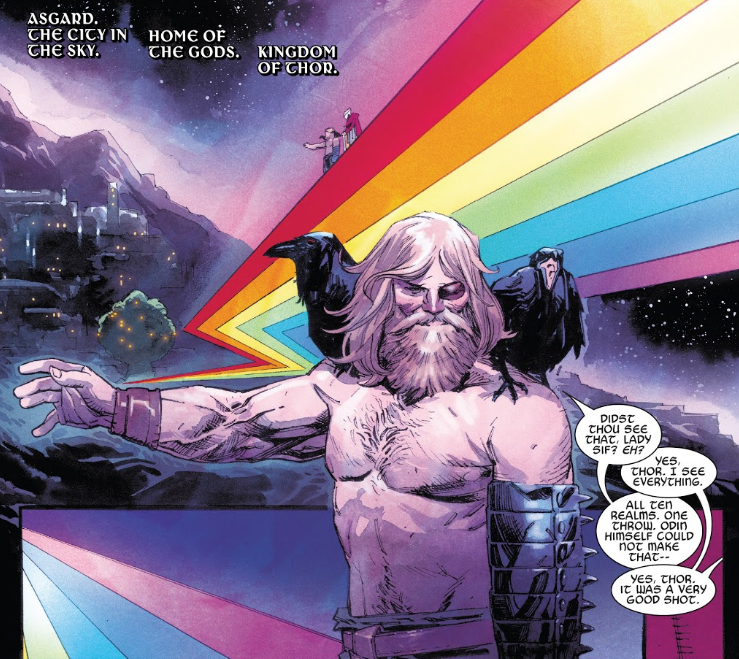
    King Thor throws Mjolnir

    Thor #1 follows in the wake of War of the Realms, and the Jason Aaron written run of Thor that began in 2012 with Thor: God of Thunder and ended in 2019 with King Thor (both drawn by Esad Ribic.) Aaron’s is a truly worthy run in the Marvel pantheon, undeniably one of the top three Thor runs of all time, and arguably 2nd best (Walt Simonson’s 80’s work is still, quite unimpeachably the GOAT). The highest degree of difficulty in the run is likely the middle stretch, where Aaron, Russel Dautermann, and colorist Matt Wilson turned Jane Foster into the goddess of thunder and were wildly successful in doing so.
    That’s the legacy that awaits Donny Cates, Nic Klein, and Matt Wilson (again!) entering Thor #1.

    The War of the Realms is over, and so – if the apparent mission statement of King Thor is to be believed – is death in the Realms. While I don’t necessarily expect the dark elves or Muspelheim to remain off limits for Cates, it’s definitely a smart move to take the action away from the 10 realms after so much focus over the past several years.

    Of course the other major inherited development is King Thor.

    Thor is both only recently “worthy” and only recently anointed King of Asgard. It’s not the first time we’ve seen Thor take the throne (whether in Marvel continuity or in alternate futures), but it’s a new role for Thor in the modern Marvel era, and not one without burden. The carefree prince will always be an adventurer first and foremost, and there’s a sense here that King Thor confined to a throne is the end of those days. As Tony Stark remarks with a sharpie on Mjolnir “Enjoy retirement.”

    When confronted by Loki, Thor displays his newfound all-father force by stopping his thrown hammer in mid-air, but also unintentionally reveals the continued difficulty he’s having even lifting Mjolnir.

    I quite appreciate that this thread wasn’t simply thrown away because even though the Odinson was finally restored to enough “worthiness” to wield the hammer in War of the Realms, it’s been a long, arduous journey, and Aaron’s work provides every indication that it will continue to be one for the unsure Thor.

    As for Loki, his role in the Cates/Klein era remains entirely unclear. I can’t help but lament the cancellation of Loki’s solo series written by Daniel Kibblesmith, as the prince of lies will once again have an empty Asgard to play with for the foreseeable future. I’m sure Cates and Klein have ideas aplenty as well.

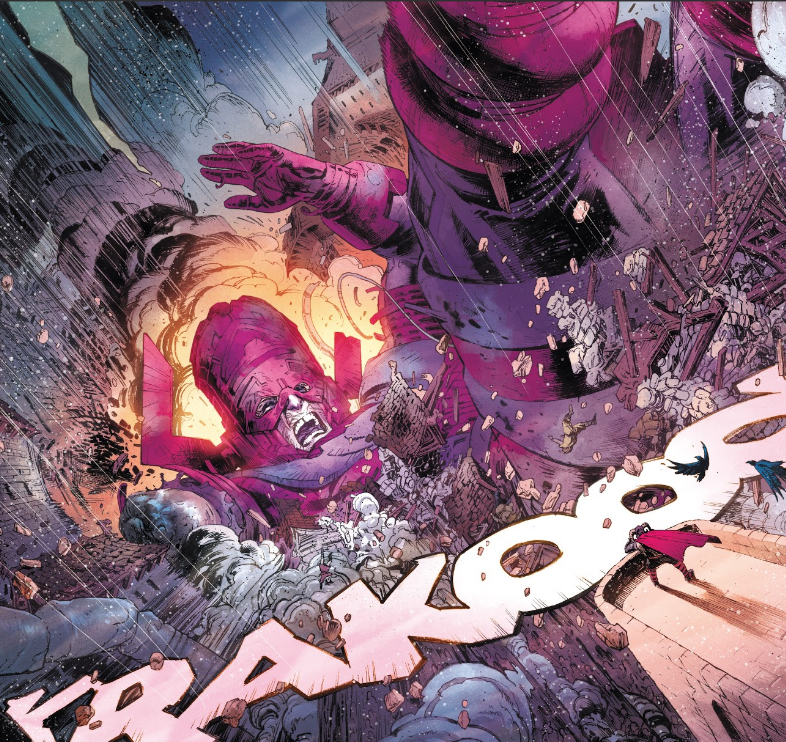
    Galactus crashes Asgard

    Things are all well and good until a Galactus with a severed arm comes crashing to Asgard, in my favorite artwork by Klein and Wilson this issue.

    Before passing out, a clearly wounded Galactus desperately tells Thor he’s come for help, and fears the coming of the Black Winter.

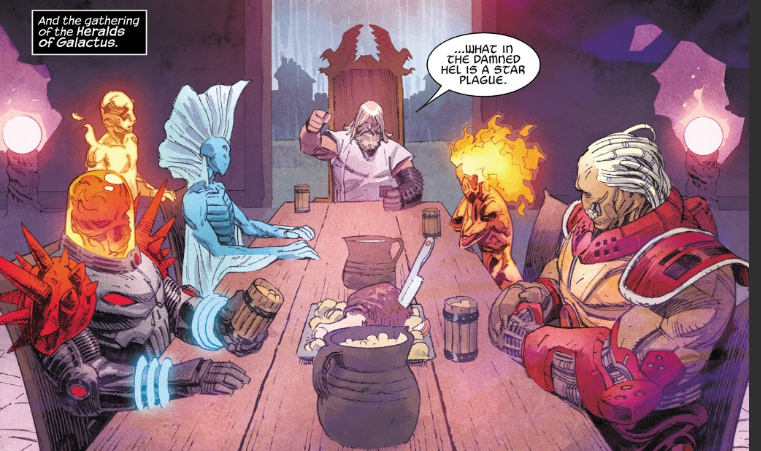
    In order to get to the bottom of Galactus’ dire warnings about “Star Plagues” and “Black Winters,” King Thor calls for a gathering of former heralds of Galactus (maybe I missed it in the issue, but I’d actually enjoy the semantics here – how does Thor reach all of them? Another hammer toss round the cosmos? Sponsored ads on the ‘Gram? One wonders.)

    This is also the first – of several – clear Cates-verse connections, with Donny’s favorite Cosmic Ghost Rider sluggin’ mead at Thor’s table (shouts to Firelord and Stardust for joining the party as well).

    The Cosmic Rider debuted in “Thanos Wins,” and has since appeared in the Cates written Cosmic Ghost Rider (5 issues that are way better than they have any right to be) and Guardians of the Galaxy. If you don’t want his origin spoiled, jump ahead 15 seconds, but the CGR is…

    A Frank Castle who made a deal with the devil and was once a herald of Galactus and then Thanos’ right-hand. For more on these details – and they’re comics well worth reading – I’d highly recommend Comic Book Herald’s complete Donny Cates Marvel Universe reading order.

    Heralds of Galactus in Thor #1

    The next major Cates-verse connection is when Silver Surfer Black shows up to spout some Galactus origins exposition (it’s not a Galactus wiki party if Norrin Radd isn’t present, don’t ever question that).

    If for no other reason, every comic book fan should read Silver Surfer Black for Tradd Moore’s modern psychedelia, but suffice to say after the color-altering 5 issue mini, no one is more intimately familiar with Galactus’ rebirth than Silver Surfer.

    That said, Thor’s actually quite well acquainted too, as Galactus told him his origin directly way back in 1969’s Thor #168 and 169 by Stanly the Manly and Jack “King Kirby.” As my work on Comic Book Herald may attest, I love no-prizing modern comic book stories into the historical canon, and it’s not really that hard to fit The Black Winter into Galactus’ origins!

    For the less familiar, the short version is Galactus was the lone survivor of his universe, more or less finding himself reborn in this universe’s big bang as the world devourer, a cosmic force of nature.

    The Surfer concocts the plan that will guide this story arc, revealing 5 super powered planets that he has hidden from the world devourer, which he now plans to deliver to Galactus in order to stop the Black Winter.

    I’m extremely curious what these “very special planets” might be, and if there are going to be known cosmic connections that give these planets their unique source of energies. For example, could a planet have a power stone or cosmic cube at its center? Could one of these be the offspring of Ego the Living Planet? Could one of the planets be the prison Knull just left behind after Absolute Carnage? There are a ton of cool Marvel connections that could come into play here.

    Everyone’s all set to go out for dinner, when Galactus shouts “Wild card B’s!” and reveals that his vision of his second death showed him Thor as the cause.

    In order to keep an eye on Thor, then, he turns him into the band leader for a Norwegian death metal act that uses rat teeth as guitar picks, and also his latest Herald.

    This is the big issue ending cliffhanger, and while it’s clearly supposed to be the “Oh hell yeah!” moment, it’s actually the part of the comic I enjoyed the least. Turning heroes into heralds of Galactus is kiiiiiiinda overplayed (Mark Waid just did this with Doctor Strange in his run), and I was already very much on board with the action and plot.

    Either way, I’m super excited for issue #2, and for this new era of Thor and the Cates-verse.

    What do you think? Was thor #1 a worthy follow-up to War of the Realms? Is Herald of Thunder a good idea?

    The post The Cates of Hel #1: Thor #1 Review – The Song of Galactus & Thor appeared first on Comic Book Herald.


    Krakin’ Krakoa #27: X-Men #4 Is Hickman’s Best In The Run To Date! Jan 02, 2020
    Show notes

    While 2019’s Dawn of X ended on a middling, muddled note, 2020 is off to an improved start, beginning with the energizing X-Men #4 by Jonathan Hickman and Lionel Francis Yu.

    My Notes From the Review!

    The issue features Professor X, Magneto, Apocalypse and their security detail of Cyclops and Gorgon heading to a global economics summit to discuss Krakoa’s newfound place in the world. The issue is full of Hickman’s riveting political tete a tete perfected in East of West, as well as the ethos of financial influence so elegantly explored in The Black Monday Murders. Honestly, in many ways X-Men #4 would have made a very sensible first issue, and I’m curious to explore why that is.

    TASCHEN

    Today I’ll answer:

    + What makes X-Men #4 the best Hickman/Yu issue to date

    + The state of the Krakoa X-Men era heading into 2020!

    Certainly there’s a surface level analysis of X-Men #4 that could reduce the issue to “people sitting around talking,” but there’s so much more happening here that addresses much of what I’ve been looking for in the Dawn of X. Whereas X-Men #3 was a wild curveball in the dirt (although I’m sure it’s not the last we’ll see of Hordeculture), issue #4 cuts directly to issues of Krakoa’s place in the world. We hear Magneto eloquently share mutantkind’s new plan for peaceful takeover, we see Professor X take Cerebro off for the first time (his X-Force #1 assassination not withstanding), and we learn of Krakoa’s ability to adapt to human hostility in the form of Gorgon’s security.

    Hickman’s first three issues of X-Men are an intriguing blend of offbeat humor, seed planting (yes, sometimes literally, but mostly I’m thinking here of Arrako and the Summoners), and defying expectations. I’ve been torn between just enjoying the breath between HoX/PoX and what Mister Sinister calls in Incoming #1 “The great crossover in the sky,” and wanting to see the Dawn of X more directly proceed from the big ideas in HoX/PoX. This is less specific to just the X-Men comic book, but my biggest sense of disatification with Dawn of X has come from a feeling of untapped potential in the era’s launch: The Powers of X and Moira X timelines were the biggest hook of the opening event, and have been lost to way more familiar ground.

    What X-Men can do instead, though, is answer the practicality of Krakoa in the Marvel Universe, and this is where X-Men #4 excels.

    More specifically, though, what makes X-Men #4 the best Hickman/Yu issue to date?

    A huge part is that Hickman revels in writing villains, especially villains that like to wax poetic over 9 panels. Prominent examples that come to mind are Archibald Chamberlain from East of West, or Doctor Doom from Fantastic Four / New Avengers / Secret Wars.

    In X-Men Hickman has found a perfect new star with Magneto, who digs into his steak with relish, and unsurprisingly takes the lead explaining mutantkind’s promise to subsume political, financial, and institutional power in the world in order to effectively “take it over.”

    This is another of Hickman’s wins, deflating long-running X-Men comic book tropes and replacing them with new ideas. The human politicians and leaders ask the mutant trinity if there will be war, if that’s what they want, and Magneto – of all people – assures them “there will be no war.” If for no other reason than to set the stage for his speech, explaining that war is an outdate form of mutant takeover, once he’s tried and failed at too many times. The new takeover is more insidious, more natural, and significantly harder to prevent.

    Lionel Franics Yu has come under fire for his X-Men work, with the most consistent criticism that his detailed grim and serious work does not match the tone of what has frankly been a more comedic opening salvo from writer Jonathan Hickman. I don’t have much doubt that Yu’s one of the better artists working consistently at Marvel, but his role on this specific title has absolutely felt miscast. A case of creative collaboration based on pedigree rather than fit.

    To Yu’s credit, his grim seriousness plays wonderfully throughout this tense conversation, particularly with Apocalypse unveiling arguably the greatest flex of all time, and certainly the best of 2020. I won’t spoil the joke beyond what’s shown here on the Youtube video, but suffice to say it pays to have a centuries old Celestial-powered mutant wearing a business suit in your meetings.

    I also very much appreciate leaders of humankind questioning the mutant drugs that have allowed their rapid ascent to power on the global stage.

    The very premise of House of X relies heavily on the idea that mankind would believe Krakoan drugs are as effective and safe as mutantkind claims. I am not necessarily looking for the FDA’s memos on testing (although that does feel like a possible data page) but it does feel noteworthy that the likes of Wakanda has denied a need for these drugs whereas other nations have accepted. Now, at first glance I’d imagine T’Challa, Shuri and company simply do not want to be held at the whims of Krakoa, but it could also be that their science doubts the efficacy of these drugs, or has found more Sinister – pun intended – intent.

    The biggest moment of the issue, though, is one honestly months in the making, with Professor X both addressing his successful* assassination and outright discussing his perceived change of heart regarding his dream for peace between humans and mutants. Throughout the Hickman era in 2019 the Professor’s motivations have come under the most scrutiny with many long time X-Men fans labeling him an outright villain following his shift in demeanor and behavior.

    I don’t know if it’s as simple as the removal of Cerebra, but Professor X sharing his belief in his dream feels more like the character of old, and less like the final House of X version with his mind broken by Moira X. It’s a huge moment, with Professor X revealing himself, and sharing that even with the attempt on his life, he still wants to believe in his original dream.

    He can’t though, and not just because of what he’s seen via Moira. No, it’s been one month since humans tried to kill him on Krakoa, and here representatives of humanity are planning to murder them all yet again, but for the intervention of Cyclops and Gorgon.

    I suppose it’s partially because I’m trained to root for the X-Men, but the moments where the Krakoan nation comes out on top and displays the extent of their power are inherently thrilling. Professor X, Magneto, Apocalypse, Cyclops and Gorgon all leave this meeting having fully revealed their plans to shape the world, and with Gorgon dismembering entire swaths of armed forces.

    So what does it all mean for the state of the Krakoa X-Men era heading into 2020?

    First off, hopefully more of Hickman writing on the international mutant relations scale. While episodic in nature, the throughline of the first four issues is Scott Summer’s role as Captain Commander of the X-Men. I enjoy these stories, but they do not capture the state of mutant affairs as effectively as everything to do with Professor X, Magneto, and Apocalypse. Ben Percy, Joshua Cassara and the X-Force team have done a good job owning some of this responsibility throughout the Dawn of X, but I’m eager for Hickman to lay claim to substantially more of it as he does here.

    The focus on Gorgon here, and the data page explaining his role as security for the Quiet Council, also has me hopeful for a run focusing on these stories – or perhaps specifically arcs alternating between Krakoa’s captains.

    This framing – especially Gorgon with the Quiet council – promises to keep X-Men at the heart of Krakoan developments, rather than the off the beaten path adventures that have shaped the book’s early stories.

    The post Krakin’ Krakoa #27: X-Men #4 Is Hickman’s Best In The Run To Date! appeared first on Comic Book Herald.


    Previously On #95: Marvel Incoming! #1 Review – What’s to Come in 2020 Dec 31, 2019
    Show notes

    Incoming is Marvel’s 2019 year-end spectacular, simultaneously summarizing much of the publisher’s 2019 while building suspense for storylines and comics to come in 2020.

    Spoilers for Incoming #1 Follow!

    TASCHEN

    Today I’ll answer:

    • What comics are the most important to have read prior to Incoming #1
    • What Incoming #1 teases for Marvel’s 2020, across everything from Hickman’s X-Men to a linewide event called Empyre to “perhaps” the death of teen heroes
    • How Incoming #1 is the best idea Marvel’s had in years and fulfills the missed promise of Marvel #1000

    Big picture, Incoming #1 could just as easily be called Marvel Universe (2019) #1 (and I’d argue that’s exactly what it should be called and that there should be one of these every year to onboard new readers!). The issue bounces between Marvels top creators contributing short stories for the characters or teams they write at Marvel. So you have Kelly Thompson writing Jessica Jones and Captain Marvel, Chip Zdarsky writing Daredevil, Jonathan Hickman reuniting with RB Silva and Marte Gracia for a Powers of X style Mister Sinister story, and so on.

    Impressively these short stories all intertwine, ultimately connecting to tell one murder mystery. Now there was some hand wringing, myself included, over a teaser promo Marvel released for this issue which suggested the murder mystery might be an Identity Crisis or Heroes in Crisis style death of a known character. Any comic book event that is strongly centered around “which character that you love will die!” in this day and age sends off a LOT of warning bells.

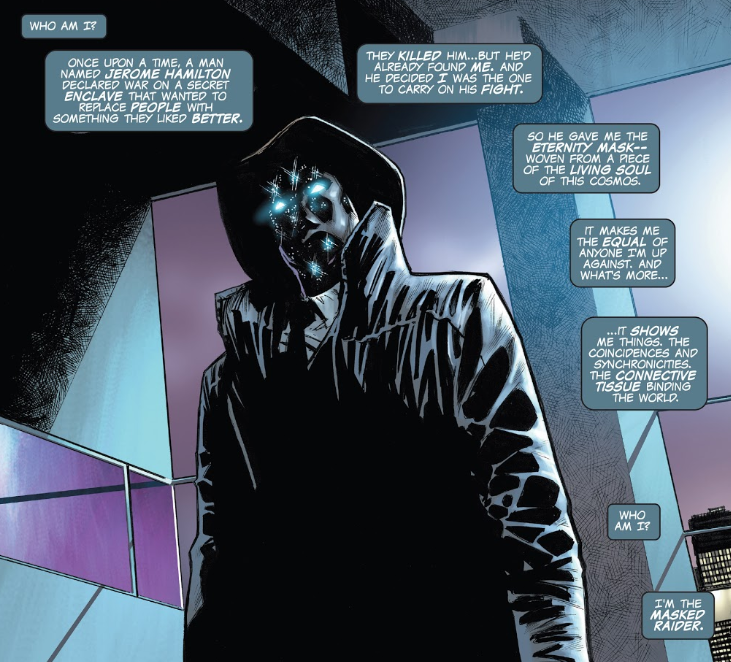
    Masked Raider in Marvel Incoming!

    Fortunately, the brilliant Al Ewing is in charge of the mystery’s framing, and he continues his work from Marvel Comics #1000 developing the Masked Rider into a centerpiece of the Marvel Universe fabric. The murder the Rider uncovers is a locked room mystery of an unknown player, and without the usual untimely death of a beloved figure, it’s easier to just enjoy the suspense of the hunt.

    The truly impressive trick to Incoming #1 is that the murder mystery is used as pretense to bounce around every corner of the Marvel Universe and it actually makes sense. We get a feel for what’s been happening in a wide variety of titles this year in both ways large (the Sampson and Joe Fixit interview very broadly summarizing Immortal Hulk) and small (Tini Howard continuing her story of Billy and Teddy’s romance from Death’s Head four issue mini).
    It’s a remarkably smart way to deliver a sampler platter issue, something Marvel has struggled with over the course of this decade. It’s no secret that genuine on-ramps into Marvel Comics are one of the publisher’s biggest struggles (there’s a reason Comic Book Herald’s guides on where to start reading Marvel books are perpetually among my site’s most popular). This is the closest I’ve seen Marvel come to an approach I’ve been recommending for years, though, with an authentic “state of the universe” address that functions on its own as a story.

    For my money, the two biggest criticisms against Incoming #1 are as follows. First, $9.99 is a terrible price point for your “new-reader” catch-up initiative. I get why Marvel prices this comic 60% higher than their standard release (there’s a ton of story and creative talent on display!), but just once I’d like to see Marvel bet on themselves with an excessively affordable on-ramp. The immediate comparison that comes to mind is DC’s .25 cents Free Comic Book Day teaser where the publisher teased out upcoming initiatives like the (now ill-fated) Batman and Catwoman wedding. I love the “we’ll give this one away” approach, but at most even saying “it’s 3.99 just like our other books but with way more in it!” is a win.

    The other criticism to me is that Incoming #1 is quite effective at building towards what’s coming in 2020, but doesn’t do a ton to really build your knowledge of what’s come before (or even where you can find that information). Sure, Elektra training Daredevil in his Netflix season one duds, or Nova referencing Annihilation Scourge makes sense to me, but I’ve read all those comics throughout 2019. For those who have not, there’s a real “here’s the situation, let’s roll!” vibe that can be extremely challenging for a lot of new readers.

    Hulkling and Marvel 2020 Empyre

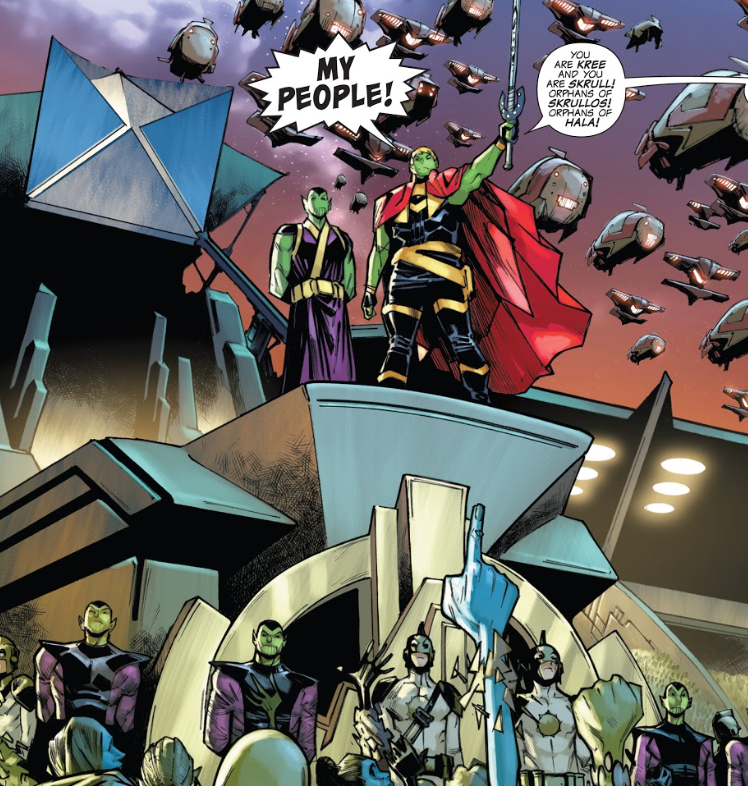
    Apart from Ewing’s work reaching back to Marvel’s relatively untouched Golden Age, the most fascinating callback is the murder mystery leading our Marvel heroes to Raksor and Bel-Dann, Skrull and Kree warriors previously seen as interplanetary monitors during the X-Men’s “Dark Phoenix Saga” (Uncanny #137 to be specific) and later during another John Byrne story in Fantastic Four Annual #18.

    This builds to the issue’s biggest tease for next year, the April 2020 Empyre, with Teddy of Young Avengers fame apparently take Emperor Teddy status among an allied Kree and Skrull armada. For those less familiar with Teddy Altman and his time with the Young Avengers his given name is Dorrek VIII, son of both Kree and Skrull royal heritage. Historically he’s been resistent to this calling, and his romance with Earth-bound Billy/Wiccan has typically kept him “pro-human,” but we’ll see what may have changed in Empyre.

    All in all Incoming is a fascinating idea, and shockingly well executed. I can understand if the price tag is off putting, but the content is something I’d love to see Marvel continue annually.

    The post Previously On #95: Marvel Incoming! #1 Review – What’s to Come in 2020 appeared first on Comic Book Herald.


    Deep Dives #5: Journals From Armageddon – East of West Review Pt. 1 (#1 to #29) Dec 25, 2019
    Show notes

    With East of West wrapping up its seven year journey into the Apocalypse, John and I are taking a look back at the Jonathan Hickman, Nick Dragotta, Frank Martin, and Rus Wooten series from Image Comics! In addition to the CBH Deep Dive podcast, I’ve also included our “Journals From Armageddon,” an email conversation John and I had prior to this conversation. Check out part one here covering East of West #1 to #29 (the first two in-universe years of the Apocalypse), and we’ll be back in January 2020 with part two covering East of West #30 to #45, the final year of the Apocalypse! For previous Deep Dives: For more, check out the full guides on Comic Book Herald: Best of Jonathan Hickman Dave’s Faves: The Best Comics of All Time! Comics discussed include: East of West Journals From Armageddon Dave: Hey John, I thought for this month’s deep dives we could start a back and forth about thoughts and questions we have as we read/re-read East of West. Think of this as a completely optional series of thought starters and possible dialogue to run as a companion on CBH once we’ve recorded our episode on part one. Now, part one is going to focus on the first two years of the Apocalypse (up to around issue #30 in the series), but obviously big picture questions and thoughts are fair game. I haven’t read the most recent issue in the big East of West finale, but otherwise there aren’t really any spoilers I’m worried about. Let’s go! Line one, panel one: “The dream is over.” Ok, I won’t be breaking down this book on a line by line basis (#EastofPedantic) but this is the only line of dialogue for nearly three pages while Nick Dragotta, Frank Martin, and Rus Wooten’s art do the work. I can’t read this line and think of anything other than John Lennon’s broken crooning on “God” from his first post-Beatles solo album. It’s a pretty famous song for a number of reasons, not least of which is that “The dream is over” sequence is the most deliberately Lennon addresses the end of the Beatles. It’s the build to that moment which feels more relevant to Hickman’s thematic opening statement here, as Lennon delivers an impassioned series of “I don’t believe in…” statements culminating in “I just believe in me. Yoko and me. That’s reality.” It’s about as direct a “kill your idols” song as a flippin’ Beatle could deliver, and that’s literally what we see the three horsemen discussing in this opening sequence. Another band of four, the horsemen just broke up too! Death is missing from their crew, and the remaining three horsemen are ready to set the world on fire if he won’t rejoin. Even the Apocalypse isn’t going according to plan. The dream is over. From there we get our first all white text transition with “The things that divide us are stronger than the things that bring us together.” The combination of these statements quite quickly builds a unified pessimism at the hear of this world. The trick will be filling it with purpose and life. John: Great thought about Lennon! I’m really excited with the collations you’ve spotted: The theme of breaking up the team the fact that we’re hearing it now from a man beyond death The sheer aesthetic match of the song itself! Brilliant thought! (Vastly better than my scoring with Morrissey’s “I know it’s over.”) Here are a few ideas I’ve been gathering. The two main reasons for Armageddon prophecies I’ve been reading a number of books and papers on eschatology in preparation for this month’s “Superpowers Reviewed” article. So these are taken straight from theology and current secular views. 1.) They Provide Definitive Answers Virtually all cultures create their own End Of Days prophecy to reaffirm their solutions to “The Big Questions.” These stories act as the conclusion to the culture’s narrative, the final summation that “proves:” the immortality of the human soul the value of the culture’s moral systems and rituals and the unknowable will of the Gods Even the word “apocalypse” comes from the Greek “to reveal” (something enormous.) It has nothing to do with war or death, only understanding. It is for this reason that it’s exceedingly common for Apocalypses to be seen as ultimately a celebration of faith, not a fear of death. 2.) They’re About Organizing Chaos Somewhere around 2-2.4 million years ago, human beings became possessed by a contradiction: The realization that we could all die at any moment, consumed by some arbitrary mass death event (disease, floods, volcanos, war, etc).As a rule, people don’t do well with arbitrary things—particularly not ones with such incredible power—so we made… A mental shield that makes all people secretly believe they’ll be the first to cheat death. So you can think of End Times prophecies as a cultural immune system that balances these two competing ideas. We build these stories to say “yes, your fear of extinction is correct. BUT it will happen in an orderly fashion, when and how we predict. Things are under control. You do not live in the final days of man.” It’s like an OCD tick that requires you to knock on doors or wash your hands as a way of controlling car crashes or the weather. This is in direct contradiction to our “Michael Bay” conception of the end times, where everything seems like pandemonium. How Does East of West Use These Two Reasons? For me, East of West breaks down as follows: It makes great use of the driving force behind Apocalypses Solipsism Need for order and meaning Avarice, petty divisions, and lust for power It’s “missing” common tropes No fire and brimstone, rain of frogs, etc No divine or demonic armies No Hieronymus Bosch or Zdzisław Beksiński influence No Messiahs or saviors What does that mean about the book? Order and Chaos in East of West I’m re-reading the book, I’m grabbed by how perfectly orderly it is in the beginning, but with a clever twist “Villains” like Conquest, Famine, War, and the Chosen all represent a call to (terrible) order. A desire to stay on script and follow the rules. “Heroes” like Death, Xiaolin, Chamberlain, and Freeman all represent a form of chaos. A defiance of that prophecy, and one that drags of players off script as the story goes on. The first year of the book is all about this consensus agreement that the world must end. In fact, there’s an unexpectedly small amount of direct conflict between the two sides in this period. Instead, it’s primarily characters talking, either ratifying their commitment to their cause or else conspiring against it. When there is conflict, it feels like all parties are merely squabbling over finer details of the end, trying to seize last-second opportunity to gain small advantages or earthly vengeance. A very human response to an inhuman time. Is “the Western” America’s Version of the Prophetic Apocalypse? I’m Genuinely Asking. If yes, then referencing classics like The Good, the Bad and the Ugly, Shane, Rio Lobo, and/or The Searchers: Who or what represents “hell” in these films? Who or what is the “Messiah” archetype? What constitutes the common, necessary elements of the “prophecy?” Do they say anything about the immortality of the human spirit? …our morals and rituals? …the will of God? What do East of West and Secret Wars have in common? Which did it better as a comic? Examples: Apocalyptic beasts Conspiracies Delivering Philosophy Fractured America God Children Which book is the better Armageddon? Based on the above “two main reasons for prophecies.” (Maybe we leave this for the second podcast) Clever Subtleties “Holy” Trinities support the story… Death • Xiaolion Mao • Babylon Death • Crow • Wolf Cheveyo • Wolf • Crow War • Conquest • Famine Conquest • Ezra Orion • Hellbeast …Binaries fall apart fast Andrew Chamberlain • (ex)President Bel Solomon • The Ranger Artistic References: Dali’s The Temptation of Saint Anthony Dali’s Elephants, 1948 Luis Buñuel’s Un Chien Andalou Boston Dynamics’s Spot Dave: Me: Hey, ya ever listen to solo Lennon?You: Here’s a concise summation of humanity’s fixation with the Apocalypse. Clearly, I’ll need to bring my A game. One of the more intriguing components of the Apocalypse in East of West is that this is round two. It’s not just the certainty the devout have towards The Message so much as the fact that we know the Horsemen already tried and failed to deliver. The question becomes less “Is Armageddon on the horizon?” and instead “Will it take this time?” We’re made aware of the horsemen’s previous existence in this world through efficient flashbacks, primarily centered on the forbidden romance between Death and Xiaolion Mao but so many big picture questions remain early on. The horsemen are fully developed in these flashbacks, but have lost their Death. What were they trying to accomplish? What did they accomplish? What happened exactly to reduce them to children in our narrative? And perhaps more importantly for the belief in The Message and the inevitably of Apocalypse – was their presence made known far and wide? Certainly the Chosen operate with a degree of secrecy, but what does this world know? I think your analysis of “End Times” is extremely astute, and goes a long way to explain the evergreen nature of the themes driving Hickman and Dragotta’s success with this book. Armageddon stories are always appealing. In Patton Oswalt’s memoirish autiobiography he posits that creatives all inevitably fixate on either zombies, spaceships, or wastelands. It’s genuinely difficult to break free from these categories, and East of West falls neatly into the “Wasteland” archetype. Voracious consumers of fiction are predisposed to consider tales from the wastelands, the trick is imbuing the collapsing world with enough detail to separate the fallout from the mushroom cloud. As you note, though, the actual end of the world is almost background noise. It’s the world we read (with open eyes) but it’s not why I’ve come back multiple times. When I try to articulate why I keep coming back to East of West it’s Dragotta’s cityscapes and spiderhorse mounts, and Hickman’s cryptic quotables from every character’s lips, but more than anything it’s the politics! The regions and leaders of this not so hard to imagine America 2069 are fascinating. I’m as invested in conversations between Chamberlain and Bel Solomon, or the mystery of the Endless Nation as I am in anything War, Famine, and Conquest could conjure up for our pale white rider. To your first question regarding the connection between The Western and the Apocalypse, I am no scholar of the genre, but there’s quite clearly something to this. Look at the Fallout video game franchise where post-annihilation survivors pick life up where Clint Eastwood left it in the 60’s/early 70’s (particularly in “New Vegas”). Even modern wasteland staples like Mad Max: Fury Road are all desserts and mob justice. You know, it’s less likely to get lumped in as part of the same genre, but if you look at The Walking Dead through the same lens, you can see a lot of the same ingredients too. The protagonist is a small town sheriff just trying to protect his family and do what’s right! To answer another of your questions, we also saw the “Hell” of the Western wasteland utilized in The Immortal Hulk, where the fresh Green hell is John Wayne era Americana. This feels like an increasingly modern take on “hell” (they don’t even have working outlets here!) but I think it’s primarily about the removal of societal standards due to some cataclysm. For my money, East of West transcends some of these connections by blending western tropes with fantastic machinery and societal structure. It may be Armageddon but The World still seems very much able to run as a segmented whole. It’s a Western where the cowboy walks into a futuristic White Tower to assassinate the daggum president of the Union! Oh, and yes, I’ll be coming back to Secret Wars. Always. And forever. A few stray thoughts and questions: I find East of West very re-readable, in part because I’ve been reading it over the course of seven years and can barely remember what happened in comics I read last week. What do you think makes the book re-readable, or do you disagree? I mentioned above, but I find the politics of this world fascinating, and perhaps a bit ahead of their time. As political discourse has become even more divisive since the book launched, do you find these elements more or less compelling? The introduction of Babylon is a game-changing moment for the book. What do you make of Hickman’s vision of “The Beast”? Ok another big picture thought: What was about this time period that helped titles like East of West lead to a modern golden age of Image Comics? I’ve written about this recently in response to this idea that Image’s incredible output from 2012 through 2015 is almost inimitably great, and they’ve been declining ever since. East of West in particular fits into an astonishing class of 2013, alongside four other series that I still have/had on my pull list (in some form) in 2019. Image’s ability to churn out “hits” like this has faded considerably. I was reminded of this during the week listening to Contest of Challengers, the podcast of Challengers Comics in Chicago. East of West ending is yet another death knell for an era of loyal fandom, at least as it concerns Image. So while the big picture market questions intrigue me (what precisely was in the water during this stretch?! Or, how much of this trend is Comixology Unlimited, Hoopla Digital, _Insert Easy Pirate Scan Here_ related?), for our purposes I wonder: How does East of West compare to the rest of the Image renaissance? East of West is (allegedly) going to make it to TV – How does it compare to its peers in terms of potential success? Is East of West actually Hickman’s best creator-owned work? ——————————————————————————————————- Music for Best Comics Ever by Anthony Weis. Check out more music at anthonyweis.com. Subscribe on iTunes Subscribe on Android To learn how you can support Best Comics Ever and receive more exclusive content from Comic Book Herald, check out the Patreon: https://www.patreon.com/comicbookherald For the Comic Book Herald reading club through every year of Marvel Comics, check out mymarvelousyear.com The post Deep Dives #5: Journals From Armageddon – East of West Review Pt. 1 (#1 to #29) appeared first on Comic Book Herald.

    Full show notes at the publisher

    Previous 1 28 29 30 31 32 39 Next

    Related Podcasts

    The Joe Rogan Experience

    1

    The Joe Rogan Experience Comedy
    Casefile True Crime

    2

    Casefile True Crime Games & Hobbies
    Reply All

    3

    Reply All Games & Hobbies
    You Must Remember This

    4

    You Must Remember This Games & Hobbies
    Real Time with Bill Maher

    5

    Real Time with Bill Maher Games & Hobbies
    Last Podcast On The Left

    6

    Last Podcast On The Left Comedy
    footer-logo

    Contact Us

    Toll Free: 844-670-7747

    Links

    • Home
    • Top Charts
    • Networks
    • Apps
    • Independents Podcasts
    • Podcast Advertising
    • Podcast News
    • Contact Us
    • About Us
    • Analytics & Insights

    Stay Connected

      Privacy, Terms of Use & Our Code of Ethics Protecting Content Creators Copyrights