TopPodcast.com
Menu
  • Home
  • Top Charts
  • Top Networks
  • Top Apps
  • Top Independents
  • Top Podfluencers
  • Top Picks
    • Top Business Podcasts
    • Top True Crime Podcasts
    • Top Finance Podcasts
    • Top Comedy Podcasts
    • Top Music Podcasts
    • Top Womens Podcasts
    • Top Kids Podcasts
    • Top Sports Podcasts
    • Top News Podcasts
    • Top Tech Podcasts
    • Top Crypto Podcasts
    • Top Entrepreneurial Podcasts
    • Top Fantasy Sports Podcasts
    • Top Political Podcasts
    • Top Science Podcasts
    • Top Self Help Podcasts
    • Top Sports Betting Podcasts
    • Top Stocks Podcasts
  • Podcast News
  • About Us
  • Podcast Advertising
  • Contact
Not in our directory?
Add Show Here
Podcast Equipment
Center

toppodcastlogoOur TOPPODCAST Picks

  • Comedy
  • Crypto
  • Sports
  • News
  • Politics
  • True Crime
  • Business
  • Finance

Follow Us

toppodcastlogoStay Connected

    View Top 200 Chart
    Back to Rankings Page
    Games & Hobbies

    Best Comics Ever

    The official podcast of Comic Book Herald.

    Advertise

    Copyright: © Comic Book Herald

    • Apple Podcasts
    • Google Play
    • Spotify

    Latest Episodes:
    Creannotators #2: “4 Kids Walk Into a Bank” Deep Dive with artist Tyler Boss May 26, 2020
    Show notes

    This week on Creannotators, I talked with Tyler Boss about 4 Kids Walk Into a Bank, his work on Lazarus, and the upcoming Dead Dog’s Bite!

    On Comic Book Herald’s ‘Creannotators’ I’ll be interviewing some of my favorite creators in comics about specific runs, graphic novels or series, looking for their insights on the inspirations behind the work and ideas or hidden material readers may have missed. Creannotators is an audio/visual annotative guide to enjoying the intricacies and thinking in the art. Thanks for listening, and enjoy the comics!

    TASCHEN

    Related Guides:

    Black Mask Comics

    Best Comics of All Time

    4 Kids Walk Into a Bank is one of my favorite comics to recommend to comics curious readers, and the current #54 on my best comics of all time list. It’s promoted as the tongue-in-cheek “torrid tale of child crime,” and one of the funniest and most impressive works of the last 5 years.

    The 4 Kids Walk Into a Bank team is:

    Writer: Matthew Rosenberg
    Art: Tyler Boss
    Flatter: Claire Dezutti
    Letters: Thomas Mauer
    Wallpaper Design: Courtney Menard
    Publisher: Black Mask Studios

    ——————————————————————————————————-

    Music for Best Comics Ever by Anthony Weis. Check out more music at anthonyweis.com.

    Subscribe on iTunes

    Subscribe on Android

    To learn how you can support Best Comics Ever and receive more exclusive content from Comic Book Herald, check out the Patreon: https://www.patreon.com/comicbookherald

    For the Comic Book Herald reading club through every year of Marvel Comics, check out mymarvelousyear.com

    The post Creannotators #2: “4 Kids Walk Into a Bank” Deep Dive with artist Tyler Boss appeared first on Comic Book Herald.


    Krakin’ Krakoa #55: The X-Men Dawn of X Story So Far! (May 2020) May 21, 2020
    Show notes

    The Jonathan Hickman led era of Marvel’s X-Men began in July 2019, and continued through the end of March 2020 prior to all of comics – and in many ways, all of the world – being put on hold due to the COVID-19 pandemic. With the return of X-Men comics imminent – Marauders #10 is scheduled for publication on May 27, 2020, followed by Excalibur and New Mutants #10 on June 10, 2020 – it’s a good time to look back on what’s happened in this new era of X-Men comics so far, and to refresh our memories on where the World of X stands heading into the hopefully glorious return of comics. Today I’ll Answer: What’s the big picture in the X-Universe that you need to know heading back into X-Men comics? What’s the story so far in the ongoing comics? What are the biggest lingering threads in the Dawn of X? Potential spoilers for ALL OF THE DAWN OF X may follow! Related Reading Orders: Hickman X-Men Modern X-Men All Comic Book Herald X-Men videos THE BIG PICTURE In the aftermath of House of X / Powers of X, Marvel’s mutants (nearly all of them!) now inhabit the independent, sovereign nation of Krakoa. While there have been plenty of threats to the nation including the infiltration and assassination of Professor X, and a full-scale Brood invasion, Krakoa and mutantkind still stand tall. Behind the secret plotting of Charles Xavier, Magneto, and Moira MacTaggart, with a leadership council that includes Jean Grey, Storm, Nightcrawler, Apocalypse & Mister Sinister among others, mutant pharmaceuticals have established global financial dominance, and mutant resurrection protocols have ensured at least the appearance of immortality for mutantkind. There are still many threats, but there’s also more reason to celebrate than mutants have seen in their lives. Crucially, while mutants have had sanctuary before – they’ve even had islands before – they’ve never been quite so tentatively unified. Traditional “hero” and “villain” archetypes have largely fallen to the wayside on Krakoa, as frequently embodied by the central role Apocalypse plays in the nation’s government and course. The same can undoubtedly be said for Mister Sinister and Exodus. Likewise, mutantkind is led from the shadows by the lifetimes of experience the artist formerly known as human ally Moira MacTaggert brings to the nation. In House of X #2 it’s revealed that Moira’s secret mutant ability is reincarnating across lifelines with all memories of previous lifelines in tact, giving her unprecedented tactical advantages preparing mutantkind for man-machine dangers that threaten to wipe them out. So yes, there are enough significant differences to Krakoa that it doesn’t feel exactly like a return to Genosha, Utopia, or Xanadu for the X-Men. The Dawn of X Titles Launch Titles X-Men New Mutants Marauders X-Force Excalibur Fallen Angels Additions: X-Men/Fantastic Four (Miniseries) Wolverine Cable Hellions Giant-Size Coming Soon: Children of the Atom X-Factor Empyre: X-Men X of Swords The Story So Far – X-Force The single biggest “death” in the Dawn of X came in X-Force #1, by Ben Percy and Joshua Cassarra, when human terrorists tortured Domino and used her mutant DNA as skin grafts to infiltrate Krakoa and assassinate Professor X. Predictably, he got better, but the impact led to the re-formation of the black ops X-Force unit of Wolverine, Domino, Quentin Quire, Beast, Jean Grey, Sage, Black Tom Cassidy, and in a clutch cameo role, Forge. The Hanging Thread: While the team has had their hands full with the rise of mutant-hating group XENO, and the expanding moral vacuum inside an increasingly arrogant Hank McCoy, the biggest lingering thread to look for when the series comes back is who’s the mysterious traitor on Krakoa? It’s been some time, but way back in X-Force #3, a shadowy hand snuffed the life out of the remaining XENO terrorist mutants had taken prisoner in the hopes of obtaining information about the organization. There’s a traitorous presence on Krakoa waiting in the wings, and it remains a huge threat to mutantkind. The Story So Far – Marauders While I was skeptical of the title at launch, Gerry Duggan and Matteo Lolli’s work on Marauders (with gorgeous series covers by Russell Dautermann and Matt Wilson), is a pitch perfect blend of high-octane pirating and Hellfire Trading Company power plays. The White Queen, Emma Frost, Black King, Sebastian Shaw, and all-new Red King, Kate Pryde, form alliances and internal competition throughout the work, all plotting to their ends, and all threatened by the rise of the former Kid Hellfire Club from the pages of Jason Aaron’s Wolverine & The X-Men, now calling themselves Hominus Verendi. The Hanging Thread: All this in-fighting escalates when Sebastian Shaw stages the assassination of Kate Pryde at sea. The mystery of Kate’s inability to use Krakoan gates has been one of Marauders greatest mysteries, and this is now coupled with the Five’s strange struggle to resurrect the good captain Kate. Theories here abound from “Kate’s not actually a mutant,” to “Well, technically she might be an off-shoot of mutants that we don’t really understand yet…” but either way it’s the biggest question Marauders can answer upon the return. The Story So Far – Fallen Angels While the 5 and out unintentional mini has its fan, I’m on record as loathing Fallen Angels. It’s the book that most passionately failed to live up to the hype of Dawn of X, and stranger still, the rest of the X-Men titles seem to agree. The inclusion of Kwannon (Psylocke), Cable, Laura Kinney, and Mister Sinister in this title is almost immediately undone by the use of those same characters in X-Men, Cable, and Hellions respectively (Hellions first issue at least seems to acknowledge that Fallen Angels happened, which is a testament to ongoing relevance). The Hanging Thread: Who let this happen? I’m being facetious, but I’m truly curious what the plan was for this title, and why it so rapidly didn’t fit within the Dawn of X. Did the X-team forget to invite writer Bryan Edward Hill to the X-Slack? It’s bizarre how out of synch this comic is with the direction of literally everything else in Marvel’s X-Universe. The Story So Far – Excalibur I’ve been critical of the launch of Excalibur by Tini Howard and Marcus To, but it’s not for lack of trying or relevance to the X-Men’s big picture. Indeed, Excalibur remains one of the core titles as the X-lineup heads towards its first major event, with Tini Howard co-writing X of Swords with Jonathan Hickman. As a result, I’m deeply curious about Betsy Braddock’s status as the new Captain Britain, and of course all Apocalypse’s machinations in Otherworld, where he’s set up omega-level reality warping Jamie Braddock as the mystical realm’s new king (pour one out for the deposed Morgana Le Fay). The Hanging Thread: What is Apocalypse planning and why does he need Otherworld? Likewise, Excalibur’s recent events have brought Apocalypse into conflict with Saturnyne and the powers of the Omniverse – how deep into Marvel’s multiverse do Apocalypse’s plans for mutantkind extend? All signs point to these questions being explored thoroughly in X of Swords, and I can’t wait. The Story So Far – X-Men & New Mutants First off, I lump New Mutants and X-Men together because for the Jonathan Hickman and Rod Reis issues of New Mutants starring the original kiddos (1-2, 5 & 7), the series is essentially building to the events of X-Men #8. As a result, I’m still waiting for Ed Brisson, Flaviano and the creative team to settle into their story, and I look forward to that as New Mutants continues. On the X-Men front, Hickman, Leinil Francis Yu, and Mahmud Asrar’s first nine issues have been somewhat divisive both in reception and structural approach. The storylines are all over the map (X-Men #8 and #9 are the first back-to-back issues in the run that continue the same story!), and they vary from exceedingly instructive to the post House / Powers X-Men landscape to shockingly focused on elder comedy (Hordeculture stans, stand up!). Nonetheless, when you add it all up, Hickman and company are quickly tackling a huge array of fascinating subjects including: -The Children of the Vault as the X-Men’s primary nemesis -Arakko (Krakoa’s other half) and the mysterious Summoners (going to play a role in X of Swords) -Mystique’s desire to resurrect Destiny, and Orchis’ continued development of a Nimrod -Krakoa’s Crucible and mutant’s plan to restore their numbers, plus glimpses into life on the new island -A new status quo with longtime alien enemy the Brood The Hanging Thread: As a result of the fractured approach to X-Men, there are plenty of intentional hanging threads that mostly tie into the same questions readers had coming out of House / Powers. Here are the first five that come to mind based on the issues so far: Ok seriously, when and how are Hordeculture coming back? What’s the bigger play? And will X-Men feel uncustomarily like Nextwave every time they show up? In X-Men #5, Laura Kinney, Synch, and Darwin all entered the Vault on a mission to uncover their secrets and diminish the threat to mutants. Within the Vault they will all age at an exponentially rapid rate. When will they return and what secrets will they uncover? What’s up with Doug Ramsey and Warlock? Doug’s been walking around with a Warlock arm, yet somehow keeping Warlock’s separate status secret (I guess) until Illyana saw them together in Giant Size Nightcrawler. Why is this a secret? What are they planning? What’s up with Gabriel Summers and his visions of a near-death experience inside the Fault at the end of Marvel’s War of Kings event? Is Gabe our first example of a resurrected mutant with a still living copy out in the universe? For more theories here, I recommend Krakin’ Krakoa #44 where I go deep on the topic. Biggest of all… what’s up with Moira X? The Story So Far – X-Men / Fantastic Four We’re 75% through the four issue X-Men/Fantastic Four mini, and it’s the X-Universe’s most significant taste of the broader Marvel Universe players to date. The conflict is centered around Franklin Richards status as an omega level mutant, and whether he should choose to stay with his human Fantastic family, or join life on Krakoa among his fellow mutants. Naturally, Franklin, Valeria and a pre-Marauders assassinations Kate Pryde turn to, uh, Doctor Doom for help? The Hanging Thread: Will Franklin Richards wind up on Krakoa? In the same vein, what does his presence and the collection of his DNA mean for Professor X and Mister Sinister’s plan for omega level mutants. We’ve seen Mister Sinister ogling Franklin’s DNA in the pages of Marvel Comics Incoming #1, and we know from House of X #1 that Omega Level mutants are considered Krakoa’s greatest resource. My theories here are that this ties to Sinister’s plans for a Chimera army (and likely the Professor’s plans that he can control said Sinister Army) but we don’t yet know for sure. The Story So Far – Giant-Size Two issues of the Hickman written Giant-Size series are available, the first a Jean Grey / Emma Frost ode to New Mutants #121 silent issue with art by Russell Dautermann and Matt Wilson, and the second a stealth Doug Ramsey solo about a haunted X-Mansion with art by Alan Davis. While the connective tissue is not instantly apparent, the series has so far worked in two hive-mind threats to mutants – the return of the Children of the Vault and their infection of Storm, and the X-history deep cut pull of the Sidri. The Hanging Thread: How will Storm escape the Children of the Vault’s trap, and how will Hickman bring all these stories together? We know Magneto, Fantomex, and Storm one-shots are to follow, and my hope is both Magneto and Fantomex bring in 2 more hive-mind based species or threats, before finding a way for Storm to save herself. Have to acknowledge that our first Dawn of X glimpse into Fantomex – last seen giving up his body to Professor X, and no I will not rephrase that – is full of potential as well. The Story So Far – Hellions In their opening issue, Zeb Wells and Stephen Segovia craft a vision of the X-Men’s Suicide Squad, the all-new Hellions at the command of Mister Sinister (and the return of Psylocke). The Hanging Thread: What’s Madelyne Pryor planning and how might it invite in an Inferno 2.0? Just as importantly, will we finally get the long-awaited issue entirely from the perspective of Madylene Pryor’s sentient underboob? Only time will tell. The Story So Far – Cable Gerry Duggan and Phil Noto’s Cable #1 was a loaded opening shot, full of X of Swords connections, the Galadorian spaceknights, and a fantastic tease of everybody’s favorite Old Man Cable. Basically, Cable finds a GIANT ASS SWORD in the foot of an Arakko monster, and the sword used to belong to Rom’s boys, the Galadorian Spaceknights. The Hanging Thread: There’s obviously plenty still to come, but most pressing to me is where is Old Man Cable trapped? All appearances indicate he’s in the same hellish dimension as Apocalypse’s first horsemen, which certainly gives off very strong Limbo vibes, connecting back to where so many of the X-books appear to be heading! The Story So Far – Marvel Universe There have been various references to Krakoa and the X-Men’s new status quo in Marvel Comics including Black Cat, Valkyrie, The Unbelievable Gwenpool Strikes Back, and a Weapon Plus one-shot. Linewide, though, Krakoa is still kind of under the radar, and far from thoroughly integrated into the status quo of the Marvel U. The Hanging Thread: That could all change in the coming months with the Avengers #32 reveal that Namor has plans for the Phoenix. What’s Namor doing with that Phoenix in Avengers? As Avengers vs. X-Men readers remember, it’s certainly not the first time Namor’s flirted with the power of the Phoenix, and last time he had it, he laid waste to Wakanda. Plus, Hickman teased Namor’s refusal of Professor X’s invitation to Krakoa already, setting the stage for greater plans for the increasingly villainous ruler of the deep. Namor’s sights are currently set on the Avengers, but with the Phoenix in play, it’s only a matter of time before the X-Men come calling. BIG PICTURE – Where are we going? The march towards the X of Swords crossover event is in full swing. X of Swords: Creation #1 is scheduled to kick things off in September 2020, written by Jonathan Hickman and Tini Howard with art by Pepe Larraz. As a side note, the story was supposed to begin in May with Free Comic Book Day. It’s *Possible* the FCBD X-Men story will get released prior to “Creation,” but if not, I haven’t been able to find any confirmation of how Marvel would proceed with that piece of the story. If they’re smart, they’ll release it for free anyway (good will, great PR, and a good hype machine for the crossover), but I’m not holding my breath. I’ve shared my X of Swords theories in detail immediately following the event’s announcement at 2020’s impossible con, C2e2, but I’ll just reiterate that every new piece of info unveiled since the teaser art supports my predictions. I anticipate X of Swords will focus on Apocalypse’s attempted retrieval of his first horsemen from the demon-infested realms of Limbo, and the promo art includes the first horsemen hovering in the clouds above Apocalypse, a Summoner, Cable, Rachel Summers, Beast, and Monet. I have very high hopes for this event, and look forward to it answering questions about Apocalypse’s motives, the nature of Arakko and Krakoa, and the mysterious Summoners. So, what major questions do you want to see X-Men comics begin to answer when they return? Let me hear ‘em in the comments. ——————————————————————————————————- Music for Best Comics Ever by Anthony Weis. Check out more music at anthonyweis.com. Subscribe on iTunes Subscribe on Android To learn how you can support Best Comics Ever and receive more exclusive content from Comic Book Herald, check out the Patreon: https://www.patreon.com/comicbookhe…

    Full show notes at the publisher

    Creannotators #1: “Ice Cream Man” Deep Dive with writer W. Maxwell Prince May 19, 2020
    Show notes

    I’m very excited to launch a new series, “Creannotators,” exploring the Image Comics comic Ice Cream Man in depth with book writer W. Maxwell Prince.

    On Comic Book Herald’s ‘Creannotators’ I’ll be interviewing some of my favorite creators in comics about specific runs, graphic novels or series, looking for their insights on the inspirations behind the work and ideas or hidden material readers may have missed. Creannotators is an audio/visual annotative guide to enjoying the intricacies and thinking in the art. Thanks for listening, and enjoy the comics!

    TASCHEN

    Related Guides:

    Best Comics of 2020 (So Far)

    Best Image Comics

    Best Comics of All Time

    You can find the Quarantine Comix project we discuss at: https://www.quarantinecomix.com/

    The Ice Cream Man team is:

    W. Maxwell Prince
    Art: Martin Morazzo
    Colors: Chris O’Halloran
    Letters: Good Old Neon
    Designs: Ashley Walker

    ——————————————————————————————————-

    Music for Best Comics Ever by Anthony Weis. Check out more music at anthonyweis.com.

    Subscribe on iTunes

    Subscribe on Android

    To learn how you can support Best Comics Ever and receive more exclusive content from Comic Book Herald, check out the Patreon: https://www.patreon.com/comicbookherald

    For the Comic Book Herald reading club through every year of Marvel Comics, check out mymarvelousyear.com

    The post Creannotators #1: “Ice Cream Man” Deep Dive with writer W. Maxwell Prince appeared first on Comic Book Herald.


    Krakin’ Krakoa #54: The Hickman X-Men Time Gap (6 Months Later) May 12, 2020
    Show notes

    In between the end of Marvel’s 2019 Uncanny X-Men #22 and the start of the Jonathan Hickman led era with House of X #1, there’s an in-universe time jump forward of 6 months. Over the course of House of X and the Dawn of X we’ve seen a smattering of flashbacks filling in details from this time period, but many questions remain, the biggest of course being: Just what exactly happened during these 6 months that we haven’t seen yet? Today I’ll Answer: What’s the Age of X-Man mystery that still matters for Hickman’s X-Men? How did Professor X get from Astonishing X-Men to House of X? What’s the Legacy and relevance of the Matthew Rosenberg written Uncanny X-Men? Spoilers for discussed comics may follow! Related Reading Orders: Hickman X-Men Modern X-Men While House of X and Powers of X do sparingly reveal essential details – examples include Emma Frost’s recruitment and Hellfire Company, Professor X’s financial portfolio and pharmaceutical reach, and that time Professor X and Magneto took a vacay to Bar Sinister – there’s still plenty we haven’t seen, and a fair amount of mystery generated by that fact. Certainly, I don’t have secret answers to the exact details, but what I can do is lay out the questions and hanging threads that exist, examine what we do know to be true, and then engage in reckless and unsound speculation about what’s to come in the world of X-Men! Age of X-Man General consensus around Age of X-Man is that it’s a stopgap event in the X-line holding down the publication calendar until Hickman, Larraz, and Silva kicked off House and Powers. Whereas Marvel comics payoff to read in sequence as part of this neverending shared universe story, most readers would pretty confidently say you don’t need to read Age of X-Man to get to House of X. I’d mostly agree, save the potential and implications of the event’s conclusion. Spilling out of the pages of the comically short-lived 2018 Uncanny X-Men relaunch, Age of X-Man is the story of an attempted mutant utopia created by Nate Grey, codename X-Man, the alternate reality Cable from the Age of Apocalypse timeline. Nate warps like 99% of mutants to this world where mutants have ascended to generally peaceful power – the Marvelous X-Men function more or less as the world’s Avengers – although inevitably it all comes undone when the X-Men’s memories start returning and its revealed that Nate’s using secret police to enforce his rule (classic, alternate Marvel reality shenanigans really). If you really want to experience this event, I’d recommend checking out the alpha and omega issues, and the Leah Williams written X-Tremists. There are a few interesting components to the world’s collapse. The first is in the semantics of Nate’s creation, as he tells the X-Men his world isn’t merely some alternate reality, but instead another plane of existence. You could argue this is just comic book mumbo-jumbo (the best side of Mumbo-Jumbo this side of Banjo-Kazooie), but it’s exactly the sort of thing that takes on new meaning in the wake of House of X #2 and the lifelines of Moira X. One question I’ve wondered is how to define the lifelines of Moira. Are they alternate realities? Are they futures that may yet come to pass? Nate’s Age of X-Man offers another alternative, “planes of existence,” perhaps more in line with Doctor Strange’s “separate realities” than the X-Men customarily deal with. The most ominous teaser from Age of X-Man comes in the Omega issue’s final pages, with Magneto and Nate coming to a secret agreement to keep the plane of existence alive, and to somehow separate Magneto into two versions (he returns to Earth-616 in time for House of X monologs, but also retains an Age of X-Man version). Nate asks Magneto “what are you willing to sacrifice?” and the scene ends: Everything is House of X. Admittedly, this could do down as one of the many forgotten teases in Marvel history, but it actually seems a bit unlikely to me. The arrival of Hickman’s X-Men aws well known within Marvel editorial for years, and writers Zac Thompson and Lonnie Nadler would have had at least some awareness. So the question of course, is what are they planning? Some CBH commenters have posited that this ties Nate and AoX Magneto to the rise of Krakoa. To me, though, the question of Magneto’s sacrifice would mean either the death of his dream of mutant superiority, or removing the gifts that make him special. On the surface, Krakoa kind of requires some sacrifice from Magneto – he has to play along with Charles and Moira rather than build to his Magneto War and violent mutant supremacy – but dig deeper and it’s really just the methods that have changed, not the means. In X-Men #4, we see Magneto admitting exactly this. So if Krakoa is a sacrifice for Magneto, there has to be another shoe to drop. I have two theories here: Moira’s dark scheme to blend all mutants together to rival post-human developments. Would Magneto sacrifice his “Self” so that mutantkind “wins”? A Krakoa that evolves into a Top 10 style everyone’s-a-mutant world. We’ve already seen in X-Men #7 the idea of mutants asking to be resurrected with Magneto’s omega level powerset. What if this comes to fruition? What does that make of the true Master of Magnetism? I don’t think it’s inconceivable, then, that the teaser does suggest some Age of X-Man influence in the rise of Krakoa. The other option, though, is that their story is yet to be told, and we’ll be seeing more of Nate and AoX Magneto in a future storyline. Astonishing X-Men One of the most discussed “unseen changes” in House of X is the return of Professor X to his own body (or at least… a version) after kinda bizarrely inhabiting the body of Fantomex during the Charles Soule written run of Astonishing X-Men. While the “how” is explained via Krakoan resurrection protocols, the specifics remain left to the imagination. There’s also the question of the impact the events of Astonishing X-Men has on the Professor. I could very easily see an all flashback, all Xavier issue of X-Men in the future (and I very much look forward to it!), but until then, this is what we know. Following his death by a Phoenix-possessed Cyclops in Avengers vs. X-Men, Charles Xavier’s psychic essence was imprisoned in the Astral Plane by longtime nemesis the Shadow King. In a wild twist of Krakoa era X-relevance, Proteus was also under the thumb of the Shadow King on the astral plane during this time. Long story short, the Professor merges his consciousness into Fantomex’s body to escape, and starts boldly going by X and striking Captain America poses. The simplest resolution to get from Astonishing X-Men #12 to House of X #1 then is via Krakoa resurrection protocols. Right? Charlie move his consciousness from Fantomex’s body to a husk of one of his own (a walking model selected, with the tint on the bodysuit). Except… there are a lot of questions that come along with this. The biggest one is actually directly tied to the Astonishing X-Men run – after his escape from Shadow King’s realm, Proteus enacts his own typical conquest plot, is disrupted by the X-Men, and his energy straight shot into space. Why does this matter? Well, Proteus as part of the 5, Proteus is essential to the resurrection process. So, assuming he wasn’t killed in Astonishing X-Men #11 (resurrecting Proteus, as a member of the 5, feels way too chicken or the egg), his recovery becomes an essential part of the lost “Man Called X” months. Before Professor X could launch Krakoa with resurrection in tact, he had to save Proteus. Let’s say he manages this, and corrals Krakoa and the 5 together, alongside Moira and Magneto. At some point in this process X either dies – forcing a resurrection – or the Professor opts-in for a test run “resurrecting” himself into his traditional body (perhaps with Sinister amplifications?). This definitely violates a number of resurrection rules (the mutant’s death has to be confirmed, or they have to “earn” death via the Crucible), but this is early days trial runs, and the Professor is clearly above these rules as he installs the process. There’s even the possibility here that he somehow saves the Fantomex “husk” to put the Grant Morrison creation back in his original body, but I’m not sure that would be altogether necessary. A major question I have through all this, though, is the presence of the Shadow King. Throughout Astonishing X-Men he continually takes a hold of Professor X’s thoughts, to the point that the Prof enlists the future Captain Britain, Betsy Braddock, as the only X-Men member who can keep an eye on the Man Called X until he reannounces his presence (presumably as Krakoa is being established). The Shadow King is apparently defeated at the end of Soule’s run, but that’s kind of his thing! He hides, lies in wait, and strikes. He could very much still be influencing Professor X’s actions. Until his whereabouts are known, this can’t be ruled out. Another choice, is the Amal Farouk is in fact dead, and Professor X and company are faced with the decision whether or not to resurrect the Shadow King. This is a fascinating resurrection question to me because Shadow King is the Professor’s longest running nemesis. There are at least two council members – Professor and Storm – who certainly have reason to want him nowhere near Krakoa. Farouk puts the “everyone together” dream to the test – and we haven’t yet seen reason to believe he’s not on the triumvirates secret black list alongside Destiny. Uncanny X-Men (Matthew Rosenberg) The first 10 issues of 2018’s Uncanny X-Men were released weekly, as part of a much ballyhooed (by Marvel PR) “Disassembled” event, that of course all built to most mutants being pulled into the Age of X-Man. The remaining mutants, led by Cyclops and Wolverine reconciling some differences, were left to fend for themselves under the pen of writer Matthew Rosenberg from Uncanny X-Men #11 through Uncanny X-Men #22. Any conversation I have about this time period has to begin with a caveat: The Matt Rosenberg and Tyler Boss graphic novel 4 Kids Walk Into A Bank is one of my favorite comics of all time. It’s just outside my top 50 right now, and I could easily see it moving up. I also find Rosenbergs previous X-line work compelling, if middling. I feel compelled to state that up front because Uncanny X-Men by Rosenberg is very, very bad. It’s a sadistic nightmare poem written in the key of pain. It’s depressingly bad and badly depressing. Re-reading the comics was a tremendous reminder why House of X and the Hickman era was so desperately needed for Marvel’s X-Men. Like Age of X-Man (which, by contrast, I greatly prefer), you don’t have to read Uncanny X-Men prior to House and Powers, nor would I recommend it. Still, because I care about all of you, I’ve done the difficult work of trudging through this empty vacuum of joylessness to figure out what parts of the state of the X-Men might actually help contextualize the 6 month time gap in the world of X. This desolate era of Uncanny will be remembered – if it is remembered at all – for wanton, callous death, and that’s definitely the easiest piece to resolve given Krakoa’s resurrection protocols. The likes of Strong Guy, Blindfold, Wolfsbane, Havok, Madrox, and more all need to be resurrected following Uncanny X-Men, and with one notable exception, I believe we’ve seen them all in some capacity. It’s not just the “good” X-Men who get offed during this run either, with shouts to the OG Marauders and the Nasty Boys. Again, given the mystery of how resurrection actually impacts characters – in terms of power augmentation, possible personality changes, and in the example of Synch, residual trauma – all these characters are now included among those impacted. I find this particularly interesting for Havok, who in Hellions #1 expressed some lingering 2014 Axis inverted personality effects, which seem like a very strange thing to carry over via resurrection. Most significantly, one of the earliest casualties of this run is Blindfold, who commits suicide after forseeing she “has no future.” As Ruth puts it, “My gift is seeing the future. My curse is I no longer have one.” To my mind, this has to be addressed. First off, other mutants on Krakoa should be asking why Ruth hasn’t been resurrected (if that is in fact the case – strange as she can seem, this would stand out). Second, is her vision of no future (very Sex Pistols) seeing Moira’s true plan? There’s the self fulfilling prophecy aspect of this (Moira refuses her resurrection, so she doesn’t have a future on Krakoa), but then there’s also the long-term secret plan of Moira. Again, to keep in theme with Magneto’s sacrifice, this could be something that requires mutants to literally merge together and lose their selves. It’s also possible that Blindfold could see Moira’s ultimate truth – mutants always lose – and sort of twist that into the darkness of “no future.” Speaking of resurrections, Uncanny X-Men does also leave us with the implication that some non-deceased characters underwent resurrections during the 6 month time gap. For starters, Cyclops lost an eye during UXM (during a comically hyperviolent sequence in which Hope shoots Cyclops in the head, uses Cyclops eyeblasts to roast Wolverine, tries to assassinate a Politician, and then gets sliced and diced by Well-Done-Wolvy), but when we see him in House of X, he appears patchless. Same goes for the modern-do and Suicide Squad scar Emma Frost sports by series end. Now, since both of these things are cosmetic, and we’re operating in a universe where Forge is like 60% manufactured limbs, it wouldn’t have to be resurrection that fixed these things. But it could be, and combined with other character transformations, I’m certainly willing to believe the end of House of X #4 and #5 isn’t the first resurrection for some of these players. Take Jean Grey for instance. Her return in the Tom Taylor / Mahmud Asrar X-Men Red is very much about the power of empathy in a world of hate and division, with Jean stating “No humans and mutants. No us and them. Just ‘us’” It’s a beautiful sentiment, and one that’s hard to reconcile with that same strong person turning around shortly thereafter and joining an all-mutant island. Forget whether or not the aims of Krakoa are right for mutants, and consider only whether they map to the motivations Jean had only recently expressed. You could make a strong case that they do not, and wonder whether Jean was backed up to a pre-Phoenix version of herself more susceptible to the Krakoan council’s manipulations. If that’s the case, and they have undergone resurrection, it raises plenty of questions about what happened during the 6 month time gap that led to the need for resurrection, as well as some pretty sinister theories about Professor X’s role in the development of Krakoa. Over on Screenrant, former CBH writer Thomas Bacon theorizes the X-Men may have gone to war with Professor X when they realized his plan. The idea that they sensed the real truth of Krakoa, opposed the Professor, and were brought back in more controllable circumstances. While I’m generally a little weary of “Professor X is the bad guy!” takes, this one has something to it. Again, Jean Grey’s behavior in X-Men Red runs expressly counter to the stated aims of Krakoa. I remain skeptical of the heel turn by Charles Xavier. It simply feels too telegraphed to actually be part of the grand plan. But I won’t pretend it’s not a question worth asking. A few other strange but intriguing threads from Uncanny: Extending from the Rosenberg written New Mutants: Dead Souls, the surviving New Mutants enter the run with Warlock spreading out his transmode virus across their team. Dark Beast “cures” them all of this, leaving some questions about the actual end state of Warlock. A Madrox-Dupe hosting Warlock discovers the use of Warlock Sentinels in the X-Men’s final confrontation in the run, which could imply making Warlock closer…

    Full show notes at the publisher

    Krakin’ Krakoa #53: How Zeb Wells’ New Mutants Leads to 2020 Inferno 2.0 May 05, 2020
    Show notes

    The Zeb Wells written run on New Mutants (the 2009 to 2011 volume) is definitely an underrated gem of the era, bringing the Xavier School students of the 1980’s Chris Claremont X-Men into the 2010’s as fully formed young adults, graduating to X-Men status. Through connections to X-Men history and lore, Wells and company weave in developments for Legion, Inferno, and the realm of Limbo, all concepts and characters that have plenty of resonance in the X-Men comics of 2020. Today I’ll Answer: What makes Wells run on New Mutants special How do the comics tie into the Dawn of X, especially the Wells written Hellions How the conclusion of the run ties into a wild theory I have about the threat of a demonic cosmic Hell facing mutantkind! Spoilers for discussed comics may follow! Related Reading Orders: Hickman X-Men Modern X-Men Covering issues #1 to #11, #13 to #21, with a gamut of artists including Leonard Kirk, Paul Davidson, Diogensis Neves, and some excellent Adam Kubert covers, the 2009 New Mutants launches at the tail end of Marvel’s “Dark Reign” and the X-Men’s “Utopia” era, tying into Necrosha and Second Coming throughout the run. Importantly, New Mutants by Wells returns to the classic roster established during the Claremont, Louise Simonson, Bill Sienkiewicz, Bob McLeod, and Art Adams heyday (among many other creators!). The players are: Cannonball, Sunspot, Mirage, Karma, Wolfsbane, Magick, Warlock, and Cypher. Overall, Wells’ run is about the team growing up, finally making that true transition from New Mutants to X-Men. For my money, it’s not quite as strong as the Mike Carey X-Men run I just covered on Krakin’ Krakoa, but it’s well worth a read, especially if you’re familiar with the original volume of New Mutants and the 1989 “Inferno” event crossover. Likewise, given Wells’ continued interest in “Inferno” era threads in the Dawn of X’s Hellions #1, it’s fun to connect the dots. The run opens with an engrossing “Return of Legion” story, although even here it’s important to note seeds are building to the “Fall and Rise of the New Mutants” story arc which concludes the run. Legion re-emerges with Shan trapped in his mind with rampaging personalities who don’t want the New Mutant “fixers” to bottle them up again. The use of Legion’s “Jack Wayne’ personality – the gruff, dirtbag man’s man – and his fixation on Warlock, Doug, Rahne and Dani is a nice callback to Claremont and Sienkiewicz’s debut of Legion in New Mutants #26 to #28. Essentially, the number of personalities vying for dominance in David Haller’s psyche has now increased legionfold, a development that would continue into the pages of X-Men Legacy under both the pen of Mike Carey and Si Spurrier. Nonetheless, the seasoned New Mutants do find a way to defeat the omega level Legion – a fact Bobby is all to happy to announce to Rogue, repeatedly, in the hopes of impressing her – with Illyana Rasputin’s soulsword dealing decapitating desecration to David Haller’s mind, and the team ultimately subduing him enough to bring him back to Utopia. It’s a little detail with surprising significance in the Dawn of X, but I’ll also note that the doll in Legion’s mind that allows personalities access to the “real world” is named “Moira.” Legion’s connection to Moira X will of course resurface in the upcoming Age of X crossover as discussed in the recent Mike Carey X-Men dive, and I continue to think it will be meaningful in the Krakoa era of X-Men. Again, at this point, if I met someone named Moira in real life, I’d assume they knew what was to come in the Dawn of X, and restraining orders would assuredly follow. Although the core cast all mostly get their time in the sun (Warlock is probably the most underserved, but isn’t that always the case?), Wells centers his run on Illyana Rasputin, Sam Guthrie, and perhaps most surprisingly, a depowered via Decimation Dani Moonstar. Mirage is cool as hell throughout this run, tough as nails and chomping at the bit for action among her teammates even without her mutant abilities. Of course, her lack of mutant powers leads her to turn to Hela – yes, Thor’s Hela – to restore a version of her Valkyrie abilities, leading to a really great Siege tie-in written by Kieron Gillen where Dani is the Valkyrie of Death In addition to a good comic, New Mutants #11 has some nice X of Swords tie-in potential, with Dani wielding a magic Death-Valkyrie blade. If for no other reason, I hope Dani has a major role so I can utter the phrase “Death Valkyrie Blade” again and again. And no, Hela residing in Las Vegas’ “Club Inferno” did not escape my notice. Much like X-Men: Legacy, Wells own vision for New Mutants is notably interrupted during Second Coming, when the title simply functions as the next chapter in that (quite good) mega crossover event. Wells has an easier time making the Necrosha tie-in issues his own, employing some truly exciting interpretations of the resurrected Doug Ramsey’s powerset, such as Doug’s ability to interpret body language to reveal his former teammate’s true meaning in a conversation with Professor X, or his developing battle prowess as he learns the “language of violence.” Necrosha also affords Wells the opportunity to write the resurrected original Hellions, a small bit of trivia as Wells and Segovia’s Dawn of X Hellions launches. They’re essentially just Selene’s pawns trying to return Doug Ramsey to their master, but nonetheless, Hellions they be! A final observation before the real meat of the story – There’s a standalone issue in between crossovers and tie-ins, New Mutants #10, in which Scott Summers reveals to Emma Frost that he’s seeking the next New Mutant leader. It’s a very good single issue, with the assumption that Sam Guthrie and all his X-Force training makes the “right” next leader, clearly inverted when Dani Moonstar and Shan clearly lead the team’s victory. Here’s the question: Is this even relevant in the Krakoa era? Do people still age and die? Or do they just resurrect in younger bodies? I hadn’t really paused to consider before since the ongoing concern is the unnatural end of mutant lives, but I really don’t know the answer. The primary evidence I’ve seen so far would be Wolverine aging throughout Moira’s lifelines in Powers of X, but those are situations where Krakoa has been decimated, and again, we don’t actually know that resurrection protocols were in place in those lifelines. Although there are multiple stages to Wells run, the big picture story is building to a timey-wimey “Inferno” reckoning from New Mutants #1. Illyana Rasputin comes to the New Mutants from “a future,” having witnessed the death of the team, remaining scant on the details until the full fledged army from Limbo and their allied “Inferno Babies” come to Earth to unleash, well, hell on Earth. Emma Frost is likely the most skeptical of Illyana’s central role in the unit’s success, as she tells Scott the rest of the X-Men are too overwhelmed with guilt over losing her to Belasco years ago and allowing her to become the Darkchilde without Illyana’s soul. There’s a lot of mystery and questionable motivations with this Illyana, and for generally fair reasons. I’ve actually publishing a Magick reading order on Comic Book Herald the week of this video’s release that I’d recommend for those devoted readers, but her road to 2009’s New Mutants includes stints in New X-Men (post Morrison years) and X-Infernus where she’s very much at odds with the X-Men (particularly Pixie!), and her allegiance to Limbo – where she’s the on again / off again demonic overlord – is very much of concern to the likes of Emma Frost. The Darkchilde presence – the influence of Limbo’s onetime demon ruler, Belasco, and the corruption of Illyana’s soul – is very much present in this “pirated copy” of Magick as Warlock puts it. On a simpler level, too, Magick’s powerset is immense, ruling realms of demons, wielding the magical Soulsword, and traveling back through time and space to confront the impending attack on the New Mutants. If you’re a mutant and Illyana doesn’t scare you, she should. Likewise, she’s an incredible ally to mutantkind – it’s far from a perfect example, but mutants did establish safehaven in Limbo through Illyanana in the post Secret Wars pre House of X years. What Illyana fails to mention – at least initially – is that the United States military has inhabited Limbo and is both seeking Illyana’s violent ends, and a means to get justice for their time trapped in limbo. We’ll touch on this more shortly, but this version of Limbo in the Marvel Universe – yes, there’s more than one! – does not adhere to Earth’s rules of time and space. As a result, years in Limbo could mean only months or days back on Earth. So we’ll learn these soldiers have been stranded in this hellscape for years while a more limited time passed on Earth. Intriguingly, the desire to send military into limbo, to better understand it and weapons applications comes out of the wake of “Inferno,” with a governmental awareness that mutantkind – in some capacity – set off the events that opened a portal to hell in Times Square. The wildest continuity connection, and the way Wells fully integrates his run with an event that happened 20 years prior (in publication years at least… there’s a note in the comics that make it sound like it’s 4 years of Marvel time, which is wild!), is the evolution of the “Inferno Babies,” which as we’ll see are the reason the US military is in Limbo in the first place. I’m not going to do a full “Inferno” deep dive (yet… when the My Marvelous Year reading club gets there in 1989, all bets are off), but here’s the completely off-the-chain background: Thirteen mutant babies were kidnapped and used by the demon N’astirh to keep open a portal between limbo and earth. The details are even wilder – like the fact that there’s 13 because the babies form the points of an inverted pentagram – but at the end of the day, these babies were rescued by the New Mutants, and ultimately turned over to the US government for safekeeping. Turns out safekeeping also meant experimenting on and turning the babies into the government’s own “mutant weapons.” It’s a horrendous fate for these aggressively mistreated children, but certainly goes a long way to explaining their own collective desire for revenge on, well, just about anything, but especially the mutants who put them in this situation. Realistically, had the new Hellions own Nanny and Orphanmaker actually obtained the children back in the pages of X-Factor, the inferno babies would have had a better upbringing! Considering Zeb Wells also wrote the Amazing Spider-Man story “Shed” in which the Lizard eats his own son, few at Marvel can quite lay claim to his crown for “most uncomfortably violent moments that happen to kids in otherwise quite good comics!” After they’re left to die, the military’s ultimate goal is effectively revenge and domination of the demon hordes of Limbo, and if they can’t achieve that through any other means, the plan is to release the Elder Gods using the bloodstone amulet. This goes as badly for General Ulysses as you’d expect – he has no control over the unleashed Elder Gods and is torn apart – but nonetheless the extradimensional beings are released and make way for Earth, and the New Mutants are unable to stop them. The “Elder Gods” motivation is a nice callback to where Magick’s journey started, following Uncanny X-Men #160 in the 4 issue limited miniseries Magick from 1983-1984. Belasco’s ultimate goal in corrupting Illyana is to set these forces free, and set them upon Earth. He creates the Beatrix Medallion, or the bloodstone amulet to do so, with the intent that Illyana would function as the gate through which the Elder Gods would enter the universe. In Magick, Illyana ultimately creates her soulsword and defeats Belasco before he can succeed, but releasing the Elder Gods has remaind a threat ever since, something that was also explored in X-Infernus. In this take 2 of Illyana’s last stand with the X-Men against the Elder Gods, she’s able to turn the tide when Shan finds the “real” Legion locked away inside David Haller’s mind, and his full reality altering powerset is utilized against the monstrous beings. This is a fairly incredible job by Wells and company of unexpectedly connecting nearly every beat from the 21 issues on New Mutants into one satisfying conclusion. Wiping out the Elder Gods via Legion’s reality warping abilities – Warlock refers to it as “Hacking reality” – has a finality to it for the purposes of the run, but given Legion’s unpredictability and the presence of extradimensional beings, I’m not so convinced they’re gone for good. At the same time, I’ve been noticing a recurring presence of Lovecraftian Cthulu horror at the edges of X-Men comics, and am beginning to believe that the impending Inferno 2.0 will feature a coalescence of extradimensional entities that threaten mutantkind and their world. Consider for a moment that Inferno already unleashed the demonic realm of Limbo into Earth. Repeating the same threat feels tired, and 30+ years behind the times. It would make more sense to me that the demon hordes would this time gather in an extradimensional location and combine forces to conquer the inhabited planet they’ve long sought. It’s an idea not dissimilar from the Masters of Evil, or Brian Michael Bendis’ council of cosmic powers from the pages of Guardians of the Galaxy, but applied to all manner of Kaiju / Chthulu wandering nightmare. Who are these extradimensional forces? Let’s flip through a few options: 1)The Many Angled Ones from the cosmic Cancerverse – I theorized in my Krakin’ Krakoa about Vulcan that these beings are still very much in play in the life of the third Summers brother (he may well be an agent of theirs), and last I checked, they were being held at bay in the Negative Zone by a – for the moment- heroic Sentry. 2)The Monsters of Nowhere – In Mike Carey’s X-Men Legacy – Emplate’s house in literal Nowhere is neighbored by these wormlike beings even the soul-sucking Emplate fears. 3)Moridun, Wizard of the 5th Cosmos – Taking a page out of Al Ewing’s New Avengers, Moridun would be an excellent addition tying in Kree, Skrulls, and various cosmic implications. 4)And finally, for the time being, the forces of Shuma-Gorath – In the pages of Wolverine: First Class, it’s revealed that Magneto’s Island M – adorned with sweet Octopus statues as far as the eye can see – was actually a prison for Quoggath, a creation of Shuma-Gorath who rebelled against his master, Marvel’s “Greatest of the Old Ones” (Astonishingly, Quoggath has most recently remerged in the pages of The Unbeatable Squirrel Girl). While most commonly an enemy of Doctor Strange (and believe it or not, Conan the Barbarian), Shuma-Gorath is weirdly on the edges of this slice of Marvel history, and the most likely “face” of the demon alliance that could launch Inferno 2.0. I could have this wrong because I let my certification in demonic history slip this year, but I also believe Shuma-Gorath (a “Great Old One”) is one of the Many-Angled Ones. I think these things are one in the same, or at least very similar. There are two aspects of Shuma-Gorath’s history that blow my mind with connections to Hickman’s X-Men. The first is that the dark entity was brought to Earth by Doctor Strange (under the influence of the Black Order’s Ebony Maw) during Hickman’s 2013 Infinity event. He brags about drinking bad milk, which is actually a pretty bad MC boast, but nonetheless he’s there. The second is way flippin’ wilder. Kulan Gath is a sorcerer from Conan the Barbarian’s Hyborian Age, at one time holding the title Sorcerer Supreme, and seeking the power of Shuma-Gorath. Well, Gath was transported to ‘present day’ Marvel via mystical means in the pages of Uncanny X-Men #188 to #191, which also happen to coincide with the debut of Nimrod in X-Men comics! Gath more or less murderiz…

    Full show notes at the publisher

    Best Comics of 2020 (W/ Zack Quaintance) Apr 29, 2020
    Show notes

    Counting down our top 5 favorite comics of the year so far with the head of Comics Bookcase and writer at The Beat, Zack Quaintance!

    You can also find our full lists via the links below. Otherwise we chat about our very favorites (including plenty of overlapping picks!) on this episode. Stick around to the end to hear our picks for favorite books that aren’t quite getting the attention we think they should.

    TASCHEN

    Comic Book Herald’s best comics of 2020 (so far)

    Comics Bookcase’s best comics of 2020 (so far)

    Since we did have technical difficulties that lost some of our top 10 picks (the initial plan!), I’ve shared my list below, as well as Zack’s top 5.

    Enjoy the comics!

    My Top 10

    10 – Money Shot — New

    9 – Jimmy Olsen – Holdover

    8 – Bog Bodies – New

    7 – Farmhand – Holdover

    6 – Immortal Hulk – Holdover

    5 – Machine Gun Wizards – New

    4 – X-Men – Holdover

    3 – Ice Cream Man – Holdover

    2 – Superman Smashes the Klan – New

    1 – Dragon Hoops – New

    Zack’s Top 5

    5) Superman Smashes the Klan

    4) Immortal Hulk

    3) Monstress

    2) Ice Cream Man

    1) Dragon Hoops

    The post Best Comics of 2020 (W/ Zack Quaintance) appeared first on Comic Book Herald.


    Krakin’ Krakoa #52: Mike Carey’s X-Men Run – The Legacy Behind Dawn of X Apr 28, 2020
    Show notes

    Mike Carey’s time writing the X-Men from 2006 to 2012 is the second longest consecutive run by any creator in Marvel history (trailing Chris Claremont), and despite a goldmine of concepts and character studies, the run is frequently overlooked in broader discussion of the best X-Men comics. Certainly, Carey’s work is referenced nowhere near as often as Grant Morrison’s time on New X-Men, or even the later run by Brian Michael Bendis. Today I’ll answer: What’s the legacy of Carey’s work on X-Men What concepts and ideas influence Hickman’s X-Men and the Dawn of X Theories and predictions for Hickman’s X-Men Spoilers for discussed comics may follow! Related Reading Orders: Hickman X-Men Modern X-Men Following well regarded comics runs on Lucifer and Hellblazer (among plenty of other work), Carey took on adjectiveless X-Men in 2006 with issue #188. The title takes place post House of M, post Scarlet Witch’s declaration of “No More Mutants,” during the Decimation era. Carey’s entire run on X-Men and the X-Men: Legacy title it would evolve into is very much integrated into the X-Men continuity of the time, progressing from “Decimation” to “Messiah CompleX” to “Dark Reign” to Necrosha to Second Coming to Age of X to “Regenesis.” Considering only one of those event is Mike Carey’s own event, it’s an impressive feat collaborating and rolling with broader storylines and shifts in status quo for mutantkind. Carey’s work is also very much a “fan favorite” and according to current X-Men mastermind Jonathan Hickman in interview with AIPT “criminally underrated.” The underrated nature of the run can probably be attributed to operating in the shadows of larger X-Men franchises (for example, Carey’s “X-Men” launched alongside Ed Brubaker taking over “Uncanny X-Men” after his work on Captain America: The Winter Soldier), and the absence of a central, go-to story highlight that stands out individually (the “Age of X” event was likely the greatest opportunity here, and although it’s fascinating for our purposes, I wouldn’t call it a great, highly recommended read for all X-Fans). In many ways, the run’s greatest strengths – complex integration of long-running and developing X-Men continuity, deep slow builds of the characters Professor X, Rogue, Gambit, and occasionally Magneto – are what keep it a mild secret for casual comics readers. Nonetheless aside from Claremont’s 16 years with the X-verse from 1975 to 1991, and arguably the Scott Lobdell and Chris Bachalo era of Generation X, no X-Men comics have a greater influence on the 2019 and 2020 Dawn of X. Regular artistic contributions from Chris Bachalo, Clay Mann, Scot Eaton, and Steve Kurth should be highlighted as well. Era 1: X-Men and the Children The clearest influence, and the one I’ve already discussed the most, is right there in Carey’s first story arc with artist Chris Bachalo, with the introduction of the Children of the Vault in the “Supernovas” story. The Children of the Vault are a post-human species that spent an estimated centuries in accelerated, sealed time developing beyond advanced technologies that more or less manifest as superpowers. As I’ve identified in Krakin’ Krakoa previously, the Children are very much in line with the human threats of Moira’s 6th life, “human adaptation along technological lines.” In X-Men #5, Professor X goes so far as to say “the Children of the Vault represent the single greatest existential threat to mutantdom… and we know nothing about them. Not really.” The Children consider themselves Earth’s superior inheritors, and plan to wipe the planet clean so their enhanced kind can ascend. As written by Carey, the Children are consistently more powerful than mutantkind, and it’s generally through some sort of Deus Ex Machina and unexpected turn of events (in “Supernovas” it’s the X-Men more or less encouraging Mystique and Lady Mastermind to trick and kill a number of the Children) that the X-Men survive. With the Children emerging as early as Hickman and Leinil Francis Yu’s X-Men #1, they remain the most direct connection from Mike Carey’s X-Men to the Krakoa era. It’s a story well worth reading, and not at all difficult to see why Hickman drew inspiration from it. It’s the influences beyond what’s already been heavily utilized that strike me the most in 2020 though, such as Carey’s clear interest in Exodus, Bennett Du Paris, as this tremendously powerful mutant follower of Magneto now branching out on his own path of mutant dominance. In X-Men, Exodus and his new acolytes also have a genuinely intriguing plan, seeking to combine Cable’s knowledge of the future and the Destiny Diaries in order to predict when mutants will begin repopulating the planet. Not for nothing, the story’s revelation that mutantkind is a truly “Endangered Species” (also the title of a series of backups Carey writes about Beast trying to solve for Decimation!), Exodus turns to Mister Sinister and his master plan for the species’ survival. Exodus spans both the early X-Men days and the Professor X focus of X-Men Legacy, and the Omega Level telekinetic is now a part of Jonathan Hickman’s Quiet Council of Krakoa (as well as his go to campfire storyteller for the kids!). Apart from his 90’s origins (and that wild Black Knight one-shot that connects Exodus, Black Knight, Sersi of the Eternals and the everlovin’ Apocalypse), Carey’s work is without question what I think of first when I think of Exodus, and a clear fountain that Hickman is drawing from in his own evolution of the character. There’s also the selective reemergence of Destiny’s Diaries, a loaded concept from Chris Claremont’s early 2000’s return to X-Treme X-Men, and a reflection of the supporting, but obviously relevant role Destiny will play in the run. In the Carey run, Destiny’s Diaries are hunted as the key to unlocking the survival of mutantkind. The Destiny Diaries are a superfun artifact in X-Men lore, the recorded futures written by Irene Adler as her powers manifested for the first time. As Claremont writes in X-Treme X-Men #1, “Much of the entries in her diaries was written in languages unknown to her, in code and in pictograms…” If that doesn’t set the stage for a Krakoan revival, I don’t know what does! Adjectiveless ends with both a build and tie-in to Messiah CompleX, marking a break point in Carey’s run from X-Men #188 to #207, as the title would become “X-Men Legacy” after this point in time. Crucially, the rush to “Messiah CompleX” affords Carey a focus on Mister Sinister and his reassembled Marauders. The exploration of Mister Sinister would continue successfully into “Legacy.” I really don’t think it can be overstated how well Carey bounces off larger linewide events and crossovers without missing a beat, and often using the occasion to add exciting ideas that simply wouldn’t have been possible previously. ERA 2: Professor X & Sinister Secrets Following Messiah CompleX – an X-Men crossover about the birth of the first mutant since Decimation – Carey picks up the pieces of Professor X, literally gunned down by Bishop of all people (it was an accident!) and thought dead at the event’s conclusion. X-Men Legacy #208 to #225 is a remarkable character study of Charles Xavier, something I celebrated in my very first episode of Krakin’ Krakoa with the history of Professor X! Here I’ll go into greater detail about some of the best parts of this era. Big picture, Carey really captures the complexity and contradictions of Professor X, riding into X-Men Legacy in the wake of X-Men: Deadly Genesis and New Avengers: Illuminati, amidst the confrontation of some his greatest failures and ethical compromises. For those House of X readers missing the kindly 90’s Animated/Patrick Stewart Professor, Legacy captures a more introspective version, trying to make his many wrongs right, but essentially, acknowledging that his methods have been far from the purest. It’s a needed quest for atonement that allows the character attempted heroism without erasing the shadows of his past. Speaking of shadows and impurities, after his resuscitation by Exodus, the new Acolytes, and kinda Magneto, Professor X uncovers a sinister secret lurking in the back of his consciousness. The coolest trick Carey pulls here is that Sinister’s presence is part of a decades long plan to make himself immortal (or, ya know, more immortal), all deeply integrated into the fabric of Professor X’s childhood. Cooler still, Carey revises Professor X’s past so that his father, his step-father Kurt Marko, Sinister masquerading as Dr. Milbury, and – get this – Irene Adler, aka Destiny were all part of a collective of geneticists working in Alamogordo. Sinister’s ultimate plan is to write his own genes into Charles Xavier as a child – among others including Sebastian Shaw – so that if his person was threatened, he could back himself up in an extraordinarily powerful mutant body. As Sinister puts it “I can write myself – my mind, my physical matrix, even my memories – onto the mind and body of someone else.” Honestly, in a lot of ways, Sinister’s own resurrection protocols kind of dwarf Krakoa’s, although of course Sinister is only securing these methods for himself (not all of mutantkind). It’s a very in character plot for Mister Sinister, here in a pre-“Everything is Sinister” phase, as we’ve seen him execute similar background operations on the lives of various X-Men, most memorably Scott Summers. Xavier confronts Scott with this unsettling reality, reminding him that Sinister clones and proxies constituted the majority of people Scott grew up with in the orphanage, and raising the possibility that like himself, Scott could be infected with Sinister’s DNA without knowing. This continues to be something to look for as the Hellions series gets rolling. The entire plot leaves a lot of wiggle room for House of X and Hickman era X-Men theories, and frankly adds plenty of credence to those HoX/PoX readers still wondering if this is actually Professor X plotting Krakoa! Even if the story is not quite so literal as to feature Sinister actually masquerading as Professor X, there’s a question of Sinister’s influence on the Professor over this entire timeline. Sinister is certainly hinting that the Professor’s actions could never fully be his own, but lies, deceit and manipulation are the name of Sinister’s game. For my money, I think a “The Professor Was Sinister The Whole Time” twist is too obvious for everyone involved, but I’m never ruling out Sinister lying in wait where we least expect him. I’m not sure of the broader implications, but I also can’t help but call out X-Men Legacy #219 as one of my absolute favorite single issues of the Carey years, focusing on a diner confrontation between Professor X and Juggernaut. If you’ve ever wanted the rival step-brothers dynamic in miniature, this is the issue for you. ERA 3: Rogue, Gambit, Magneto Beginning with X-Men Legacy #220, Carey shifts the character study back to a favorite from his start on the run, Rogue. The book is still very much an X-Men title at heart – we spend plenty of time on Utopia with Cyclops, Emma Frost, Dr. Nemesis, and the whole essential crew (such as Nightcrawler gloriously sassing Magneto in the field) – but more often than not it’s through the lens of Rogue, with supporting focus on Gambit and Magneto (two historical romantic pairings for Rogue). I actually like to think of this period as one where Rogue takes on a role similar to The Doctor in Doctor Who, or even Dream of the Endless in Sandman. The story can run in a million directions, but she’ll always make an appearance and play a role. Within that framework, Carey consistently makes very interesting choices when plucking characters and elements from X-Men history and weaving them into something new. Again, it’s easy to identify a large swath of choices that connect to the Hickman era. The first and most obvious is the return of the Children of the Vault. The children’s return via their floating atemporal city of Quitado is not quite as exciting as the team’s debut, although even here, we get more insight into the function and formation of the Children (their rulers, their society, their plans for a new world), and we see them explicitly identifying as “post-human,” which snaps my mind forward to Moira’s 6th life. I also love the potential of a detail the Children tell Rogue during their inevitable fall at the hands of the X-Men, mentioning their new plans: “We’ll make our own world, here in the void between dimensions.” This has a lot of potential for the Hickman era, either tying to interstellar travel via blackholes, or possibly with the Vault inhabiting the limbo like space where Apocalypse’s first horsemen (and seemingly Old Man Cable) are trapped. One of my favorite developments elsewhere is a fondness of Carey’s for playing with Precogs, as Blindfold becomes a recurring player, and Destiny is notably utilized during the Necrosha event (i.e. she’s brought back from the dead as part of Selene’s grand schemes). Blindfold, aka Ruth Aldine, has the mutant ability of clairvoyance, although her messages usually arrive jumbled and difficult to piece together. Given Moira’s fear of precognitive mutants on Krakoa – and her particular enmity towards Destiny – there are many fascinating moments. I was especially struck by a revived Destiny stating ‘I see timelines, past and future,” which rings true in an entirely new light given the revelations of House of X #2. It’s not intentional, but the sequence could now be read as Destiny’s admission of her knowledge of Moira’s abilities. It’s unfortunately also worth calling out that Blindfold commits suicide in the volume of Uncanny X-Men immediately preceding House of X, and as far as I know, has not been revived (presumably by Moira’s edict, she would not be allowed to resurrect). The same arc includes some additional nuggets through the return of Proteus, and Destiny’s admission that his presence and powersets clouds her reads of the future. While this is obviously just meant in regards to the particular Necrosha story Mike Carey and company were telling, it also really fuels my ongoing theory that Proteus is a targeted part of Moira’s life 10 plan. Proteus is engineered by Moira as a means of giving birth to a mutant with reality warping abilities. This plays a role in making the dream of The 5 and mutant resurrection on Krakoa possible. That *could* be enough on its own, but what if Proteus’ abilities also offered Moira a way to escape the predictive powers of Destiny? This offers some textual evidence that Proteus can uniquely impact Destiny, which is perhaps not at random. Speaking of major House of X / Powers of X connections, Carey’s role throughout the entire Second Coming crossover event brings in Nimrods, Cypher traveling to the future to take on Master Molds, and evolving Omega Sentinels in the event’s wake. While Second Coming is all a part of the larger crossover, Carey uses the aftermath to explore the impact on Karima Shapandar, the Omega Sentinel, and a character House of X fans will recognize from project Orchis. The fallout means that Karima’s “Nimrod CPU” was attacked by a virus Cypher created to stop time-traveling Nimrods, and that Karima more or less devolves into the out of control Omega Sentinel. On a final note from this time, there’s also a continuation of the Gambit / Death / Apocalypse development that occurred in “Blood of Apocalypse,” the issues of X-Men immediately preceding Carey’s own run, when Gambit became Apocalypse’s horsemen of death. I truly do not remember if this ever saw resolution, but given Gambit and Apocalypse’s reluctant alliance in the pages of Dawn of X’s Excalibur, it certainly makes that relationship more interesting. ERA 4: Age of X & Legion I’m generally a sucker for “Age Of” and alternate realities in the Marvel Universe, but Carey’s Age of X crossover never quite won me over. The sudden alternate realit…

    Full show notes at the publisher

    Krakin’ Krakoa #51: What Avengers Time Travel Tells Us About 2020 X-Men! Apr 21, 2020
    Show notes

    For my 32nd Birthday week, I decided to explore some of my favorite 32nd issues in comics, and that led me back to the Jonathan Hickman written Avengers #32. I wasn’t planning on the next episode of Krakin’ Krakoa centered around Hickman’s Avengers, but this issue, and the “Infinite Avengers” storyline is particularly compelling in connection with Hickman’s X-Men and the structure and approach to future timelines. Hickman’s Marvel Universe, dating back to 2008, is uniquely interconnected, and it’s useful to consider lessons from his previous work that will carry forward into X-Men.

    Today I’ll answer:

    TASCHEN
    • How an Avengers Future is both different and nearly identical to a Mutant Future
    • How time travel works in the Marvel Universe of writer Jonathan Hickman
    • Some theories about the way time travel will play a role in X-Men!

    Spoilers for discussed comics may follow!

    Related Reading Orders:

    Hickman X-Men

    Modern X-Men

    Since this all started from my review of Avengers #32, you can check out the full review if you like! Otherwise I’ll post here the parts of the script that I didn’t include in the issue review.

    Avengers #32 in particular also offers a very important glimpse into how Hickman views the nature of time in his Marvel Universe – Cap functions as a stand-in for a pretty common viewing on visions of the future. Cap sees Franklin thousands of years into the future and presumes that this means that future is an outcome that will happen (or at least that there will be a future).

    Franklin (clearly banging his head against a wall) explains that Cap’s understanding of time is, frankly, all wrong. Here’s the full quote, which made approximately no sense to me in the moment, and still generally flies way over my head, but at least clearly connects to X-Men comics!

    “Much like society is an organism composed of humans, and the universe is one composed of societies, space-time is an organism made up of universes. It exists and evolves just like we do – like any living thing does – in response to our environment.”

    “Space-time is an organism made up of universes” – this sci-fi theory comes to fruition in Hickman’s exploration of Dominions and the types of galactic societies in Powers of X. In fact, the “Universal” types of societies explanation is basically the annotated guide to exactly what Franklin’s trying to explain to Captain America in Avengers (he should have just handed him copies of Powers). Universal societies make up space-time, and in fact beginning with societal intelligence on the scale of a Titan, the intelligence has collapsed space-time into a singularity.

    While a lot of this is a real head-scratcher, the big takeaway is that the X-Men and Avengers futures are playing by the same governing principles.

    This reading on the nature of time also marks an advance – or at least a modification – on Hickman’s own explanations via Nathaniel Richards in FF. Through Hickman’s Fantastic Four, Nathaniel is careful to remind Valeria that certain universal constants are a given, even in fluid evolving space-time, and that some events are unavoidable – all they can do is change circumstances around the event.

    If this holds true, it really makes me wonder what events in this Avengers future will hold true for the impending Mutant future, and how might the factions react to them differently.

    The subsequent time jump connects heavily to Powers of X’s futures as well. Right off the bat, the tower of the Worldcore Captain America visits in the most distant future also brings to mind the recurring tower in X-Men.
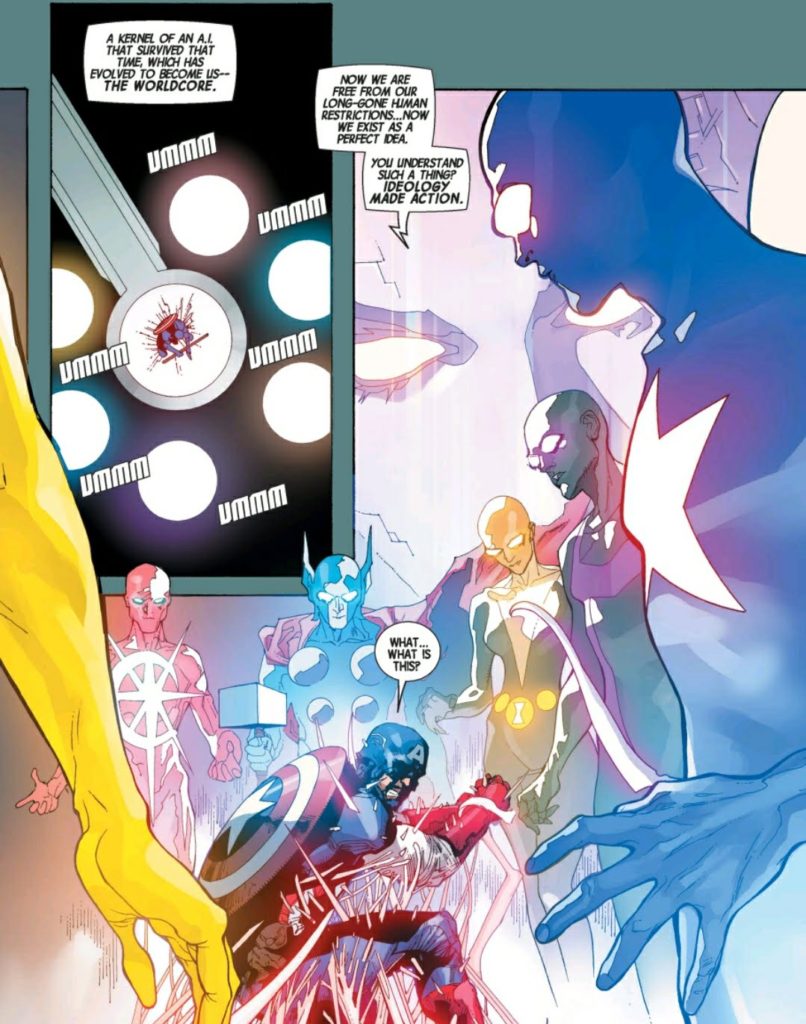
    Captain America travels through time to the Worldcore

    Likewise the evolved AI of this distant future is deeply similar to the Phalanx-ascending post-humans in Moira MacTaggert’s 6th life. They voice what in many ways appears to be the deepest desire of the humans in X-Men: Year 1,000 “Now we are free from long gone human restrictions… now we exist as a perfect idea. You understand such a thing? Ideology made action.” In two separate distant futures, humanity’s quest for perfection results in a hivemind collective absorption into something akin to a broader intelligence.

    Because we’ve only ever seen the human’s ascend, a question this leaves me with is what is the mutant version of “ideology made action?” We’ve never really seen this because, as Moira famously puts it, “We always lose.” Perhaps this is the secret that has Moira so scared of precognitive mutants like Destiny – her vision for mutant survival may mean the dissolution of everything that mutants evolved so wholly individually.

    A few interesting developments come from the Worldcore’s brief history shared with Cap. The first is Hickman’s general obsession with various singularity. They grew from “the rotting husk of the Ultron singularity.” Again in the worldcore’s explanation of time-travel to the past: “Traveling to the past requires a super-massive singularity strong enough to bend space-time.”

    This brings to mind Xorn, Rasputin and Omega Sentinels black hole. I’ve theorized previously that we haven’t seen the last of these Powers of X players, and I can’t help but believe Hickman’s own previous use of a super-massive singularity that can bend space-time is going to reemerge here to bring these characters back into our X-Men narrative.

    I won’t pretend to understand the science of singularities in earnest (I just read a few articles on scientific journal sites, and I think one of my eyes can see gravity now?), but if the end result is a means to travel across Moira’s lifelines – again not time travel, not necessarily travel across the Marvel multiverse; this is something else! – I certainly buy in.

    Arguably the coolest aspect of the Avengers Worldcore future, though is their war “fought throughout space and time.”

    “In order to achieve perfection we created protocols to reimagine our creation. A plan to correct future errors before they occurred.” Doesn’t this time travel approach to mutant survival sound like the sort of thing that might deeply appeal to Moira and Krakoa? We already know from House of X that Moira and Charles Xavier set up protocols to catch the potential build of a Nimrod, so why not protocols to predict and prevent “future errors” before they occur in the same way?

    Likewise, Hickman has fun with the Marvel Universe in the final “infinity” future, corralling Iron Lad, Kang the Conqueror, and Immortus together as the Last Avengers. I’d really love to see the X-Men’s version of this, and the time-travelers who could be involved.
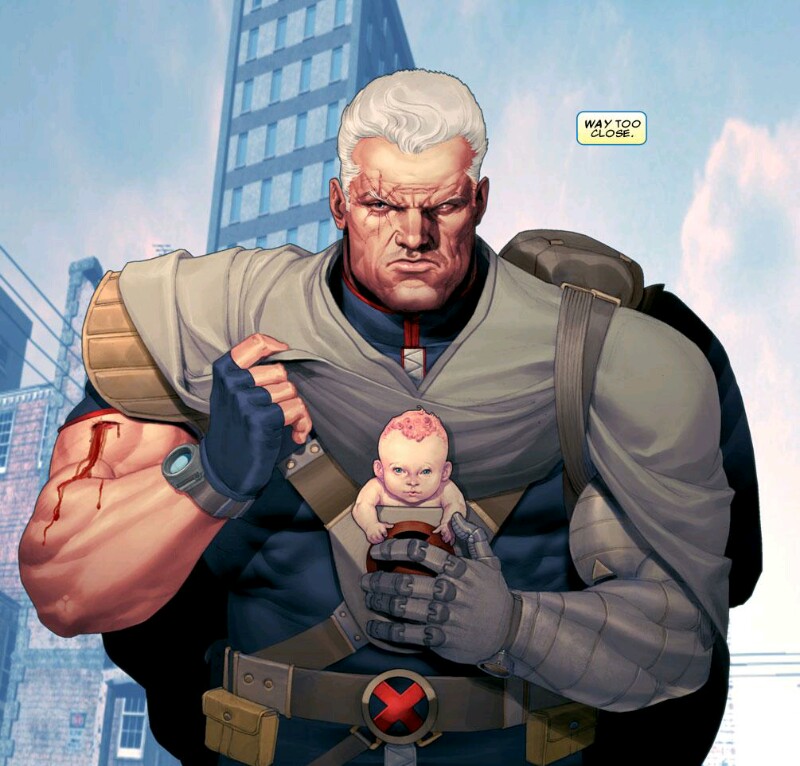
    Time traveling X-Men (or adjacent characters) who could play a similar role include

    • Cable (he even has a house at the end of time!)
    • Bishop
    • Nimrod
    • Or even something as awesome as Venom: The End (Venom)

    Plus, what is future Franklin’s role in the growth of Krakoa? He’s here waiting for Cap in the Avengers future, but surely he would now have a role in sustaining a future for mutantkind.

    Big picture, I suspect the role of time travel and mutants with powers related to traversing space-time will play a substantial role in this story by the time all is said and done. I’m still generally unclear why Moira MacTaggert is quite so up in arms about precognitive mutants, but with minimal qualms about known time-travelers. If visions of the future worry her, why don’t trips to the future?

    Likewise, it’s not like the X-Men (here’s looking at you Beast and Age of Ultron Wolverine) have been particularly careful about messing with time travel and the timestream. If all that careless action is coming home to roost, it could also seemingly interfere with the Krakoan triumvirate’s best laid plans.

    One major question that remains for me:

    Does Secret Wars and the “end of everything” signify the end of Hickman’s Avengers futures, and the start of mutant futures? I still have a fair amount of questions about the build and aftermath of the 2015 event.

    Next Time – What would you like to see covered? I have the following topics queued up for coverage:

    • The Mike Carey X-Men run and its influence on the Krakoa Era
    • Omega Level Mutants explored
    • Sinister Secrets Pt 2
    • X-Men and Limbo

    ——————————————————————————————————-

    Music for Best Comics Ever by Anthony Weis. Check out more music at anthonyweis.com.

    Subscribe on iTunes

    Subscribe on Android

    To learn how you can support Best Comics Ever and receive more exclusive content from Comic Book Herald, check out the Patreon: https://www.patreon.com/comicbookherald

    For the Comic Book Herald reading club through every year of Marvel Comics, check out mymarvelousyear.com

    The post Krakin’ Krakoa #51: What Avengers Time Travel Tells Us About 2020 X-Men! appeared first on Comic Book Herald.


    Krakin’ Krakoa #50: How House & Powers of X Break All The Rules Apr 14, 2020
    Show notes

    For the 50th episode of Krakin’ Krakoa, I felt it was time to return to the source that inspired this X-Men deep dive project, and now that House of X and Powers of X are fully available to read on Marvel Unlimited, it’s the perfect time to explore what made the event so special, search for clues that take on new light in the wake of X-Men’s Dawn of X, and craft all-new theories I didn’t see the first time around. Today I’ll answer: + How the theme of “Breaking All The Rules” dominates House of X, specifying which rules are broken and what that means for future comics. + How Moira X’s 10th life holds the secrets for mutant survival + Predictions for the trick Jonathan Hickman has up his sleeve to blow this whole era up and take X-Men comics to the next level Spoilers for discussed comics may follow! Related Reading Orders: Hickman X-Men Modern X-Men The quote “we have to break all the rules” becomes the apparent theme throughout House and Powers, but it helps to elucidate why that’s necessary. What are these rules that need to be broken, and how were they identified? In other words, who here is the rulemaker? This is where Moira MacTaggert and the revelation of Moira X’s 10 (or eleven!) lifelines changes everything. Through the preceding 9 lifelines Moira has experienced, she has accumulated the knowledge of all the rules that mutantkind has to break in order to *finally* survive and thrive on the longest term plan imaginable. One of the angles I find most intriguing re-reading House of X and Powers of X is what separates Moira’s life 10 plan from the previous 9 (or really previous 6, since those are the lives she spent trying to preserve mutants). I’d theorize that all the changes in this lifeline, however apparently minor, are with great purpose, or at least they should be if mutants are to find success. This is a big reason why I find Powers of X so utterly compelling on re-reads, as visions of future lifelines in “Year 100” or “Year 1000” are full of attempts at mutant triumph, only to be met with defeat after defeat. It’s essential to remember throughout the Dawn of X that Moira’s 10th life – what may be her final chance at all of this – isn’t a stab in the dark, it’s based on literal lifetimes of failure. Radical shifts are necessary to succeed! Otherwise, as Emma Frost puts it: “What’s going to make it different this time?” Rule 1): Extermination Mutants are exterminated, regularly, over and over, and they (mostly) stay dead. As Professor X says at the end of House of X #4 “Every victory… ash. Every triumph… defeat. They’ve murdered so many of us the world has grown used to it.” Culminating in the dramatic resolution, “No more,” also a deliberate inversion of Scarlet Witch’s decimating “No More Mutants.” So, in life 10, how do Moira, Magneto, and Professor X plan to break this rule? The first significant measure is taken in House of X #5, when the recently deceased X-Men lineup that blew up Project Orchis’ Mother Mold and apparently stopped their plans to eventually activate a Nimrod are all resurrected in an emotional ceremony in front of Krakoa. Resurrection protocols are promptly explained, and long story short a combination of Cerebra’s “essence” backups of all mutantkind, Mister Sinister’s genetic base, and the mutant Five combining their powers create an all-new scenario wherein all mutants can be brought back from confirmed deaths. We’ve also seen in X-Men #7 how “The Crucible” will restore depowered mutants. Hickman’s vision for X-Men pulls no punches with “The Great Pretender,” Wanda Maximoff, longtime Avenger and more recent “fake” mutant, responsible for depowering nearly 1 million mutants in the post House of M M-Day Decimation. In order to rectify this injustice, and restore mutants to their powered abilities, mutantkind avoids suicide or euthanasia in favor of a Roman Gladiator arena swordfight with Apocalypse (at least in the initial example we’ve seen in Dawn of X). Mutants have to fight for their birthright, and in so doing earn the gifts of death and resurrection on Krakoa. Digging into the details of resurrection, it’s not just the fact that resurrection is an option on Krakoa, it’s the specifics of the 5 that perform these resurrections, in particular the inclusion of Proteus, the son of Moira MacTaggert. I’m going to come back to this for the final rule breaking as well because I’m pretty fixated on the details here, but for now let’s just consider the following. I’m positing that Proteus is new to lifeline 10 (from Moira’s journals in Powers of X #6). If he wasn’t present in life 9, this would confirm (in theory) that the Krakoan nation state existed in Moira’s ninth life, but without resurrection protocols – they would have lacked the proper reality warping abilities, plus Moira’s journal indicates this idea stems from Charles Xavier specifically in life 10. Likewise, Moira’s 5th life – in which she embraces Xavier’s dream and they move mutantkind to a protected habitat away from humankind – is very similar to Krakoa (or really Genosha, Utopia, any of the mutant getaways attempted over the years in X-Men comics). It makes sense to me that a key difference would be the addition of Proteus and resurrection. Notably, Lifeline 10 is only one to call out marrying Joseph MacTaggert (which – given the awfulness of that pig – is a HUGE why would you do it otherwise?) and giving birth to Proteus in Moira’s 31st year. This alone doesn’t mean the events didn’t happen in any of Moira’s other lives, but coupled with the Journal entry, it certainly gives the implication that this coupling is a first, and that it’s done entirely because Joe provides a genetic match for the birth of a reality warping mutant. Again, after her first life, Moira doesn’t take time to have kids – she’s on a mission. This is a cold, calculated decision to fulfill the potential of mutant resurrection, and perhaps more. And finally on this first rule, not only is the sting of death systemically alleviated, but the limits of evolution are – very likely – completely upended. This will be especially important when we get to rule #3, but the process of resurrection allows for mutants to come back with enhanced powersets, performance levels greater than the ones they had prior to death, and eventually all sorts of custom modifications. This is teased in both the event data pages, and again in X-Men #7. The ability to resurrect mutants with omega level powersets added to their own is a game-changer. Rule #2) Schism Mutants are never truly together, always butting heads over plans and approach and philosophies. Professor X dreams of peaceful co-existence with humans, Magneto dreams of mutant domination, and Apocalypse dreams of weeding out the unworthy and unfit. The list goes on and on. Breaking this rule requires unity. As Professor X tells Magneto: “Apart, we always lose. We believe it’s only together that you and I – that all our people – can survive.“ They’ve had peaceful moments, sure, but this is true, no turning back togetherness. Even with this knowledge, the road to unity is full of complications, whether it’s Moira and Charles losing Magneto in 1991’s X-Men #1 to #3, or even broader differences of vision between Professor X and Magneto throughout all of X-Men history. It can be easy to undersell the complexity of actually bringing all mutants together, something that has clearly taken years in X-Men history. Whatever the path, through Moira’s lifelines, mutantkind is never united like they are in life 10. After all, one of Apocalypse’s first moves in life 9 is to *kill* Xavier (and later Magneto). Likewise, Moira’s lives turn to the various leaders in turn (Professor X in Life 5, Magneto in Life 8, and Apocalypse in life 9), rather than this final call to combine their efforts. It’s not like the X-Men have never teamed up with quote-on-quote villains before (Gold Loves, Man Kills stands out as a personal favorite example), but this instance stands out because of the scope of the alliance (truly, all mutants), and because it’s clearly the summation of Moira’s learnings rather than another individual approach. Rule #3: We Always Lose This is Moira’s hardest learned truth and the hardest rule to break because it is, in reality, the entire ballgame. Nimrod will ascend. Rise of machines and post-humans is inevitable, and evolutionary biology can not compete. Mutantkind just can’t stop losing. In truth, we don’t yet know the final answer to breaking this rule, and we won’t until Jonathan Hickman decides his years long plan for X-Men has reached a finale. Nonetheless, there are enough clues in House of X and Powers of X, plus preceding years of X-Men stories to theorize ways to break the chain of loss. I’ll start with some of the simpler ones, and work my way up to the more expansive theories. In the wake of Powers of X #6 revealing humanity’s genetic engineering and post-human state are an even greater long-term enemy than the machines, there’s a strong argument to be made that natural mutant evolution is too slow to give mutantkind enough of an advantage to fight back sentinels, nimrods, and eventually “Year 1000” post-humans seeking ascendancy to the Phalanx. The librarian asks Moira X^6 and Wolverine “What happens when humanity stops being beholden to its environment?” My takeaway from that and the statement that “Evolution is no match for genetic engineering” is to flip the question: “What happens when mutants stop being beholden to evolution?” To me, this sounds like Mister Sinister’s entrance music (I’m hearing Robyn’s “Dancing on My Own” for the record). Sinister’s genetic engineering efforts, and those resurrection infused upgrades we mentioned earlier, feel even more essential. In Life 9 Sinister’s 4th generation chimeras are omega-based, and although the hive-mind chimeras are a part of Sinister’s ultimate betrayal of mutantkind, the idea for an army that strong remains tantalizing. It would also explain Krakoa’s stated goal of omega level mutants as the most valued natural resource of mutantkind. Importantly – and this is where the idea of true rule breaker falls apart – Sinister’s engineering is not actually a part of Moira’s plan. Instead, it’s a decision Professor X and Magneto make without her consultation or approval. Again, from Moira’s journal entries, it’s clear she disapproves, perhaps understandable given Sinister’s betrayal of mutants, and the lingering thought that her lifeline with Apocalypse might have worked but for Sinister! Two more quickfire theories for how mutants break the losing rule: Could Okarra be another game-changer? In the timelines of Moira’s lives only Krakoa is mentioned, for example the mutant nation state that exists in life 9, but falls 30 years after the 1st generation of Sinister mutants. Presumably, Apocalypse and Moira rescue the first horsemen from the same fate as described in House of X #5, in which the islands are separated, but the “Fall of Krakoa” later isn’t “The Fall of Okarra.” This could easily just be convenient naming (Chicagoans still refuse to call our largest building anything other than the Sears Tower), but it could be more. Perhaps making Krakoa whole is way more meaningful to mutantkind’s success than we yet realize. Likewise, the idea of mutant leverage is truly unexplored in our knowledge of Moira’s past lives. Krakoa’s life-changing (and in some cases, life extending) drugs for humanity could be everything from new idea that buys time and resources to part of a plot that ensures humanity can’t rise up to post-human achievements. Krakoan flowers could also be a trick Moira’s pulled before – we simply don’t know yet. This is also where we really start to tap into the following quote from Moira: “There can be no precogs on Krakoa. We cannot – will not – tolerate mutants who can see the future.“ What is it exactly that she’s so terrified of mutants discovering? Regardless of the answer, we’re definitely not done with these questions of leverage, and the purpose behind them. I was struck re-reading the comics that on the mutant diplomacy data page, Wakanda’s status for rejecting Krakoa’s drugs is both unique – “They do not need mutant drugs” – and colored in red (a coloring choice so far only utilized for absolutely game-changing turning points in the Hickman era of X-Men). My first thought is a competing drug war from Wakanda that brings the nation into conflict with Krakoa, but it’s likely something far more inventive. 3 Big Theories For How Mutants Win With all that said, lets now get into the three biggest theories for how Moira and mutants are planning to break the chain (cue Fleetwood Mac soundtrack). 1) Lifeline Travel First, let’s dig into the seemingly simple ways Moira’s ninth life benefit the tenth, and how that lays the groundwork for something far more complicated. In Powers of X #3, Moira’s 9th life learnings are obtained in order to take out Nimrod early in life 10. Nimrod activation is seen as a point of no return, and an assurance of decades long war, accompanied by unimaginable levels of mutant death. The X-Men of life 10 take this knowledge, and send a Mother Mold crashing into the sun in House of X #4 – losing their lives in the process – to keep Nimrod from activating in this life. As we’ve seen in X-Men #6, this may not have been successful, as Mystique discovers a Nimrod still in development within Orchis (perhaps even accelerated due to mutantkind’s actions). Another, perhaps more unsettling possibility: Couldn’t Year 100 Nimrod have grabbed the grand mutant plan from Apocalypse’s head and traveled to Moira’s 10th life? Originally, Nimrod is a time-traveler from the “Days of Future Past” timeline. This would have a similar feel. After all, we never actually see life 9 Apocalypse killed, the battle ends with Nimrod firing energy into his skull. With all of this, I think it’s key to remember Moira is not infallible. In fact, by her own admission, she has done nothing but fail, despite her herculean efforts. Just because it’s a part of her carefully acquired plan does not ensure any degree of success. Speaking of traveling across time and space, the real “rule break” could stem from travel across Moira’s lifelines. In Powers of X #6, the librarian explains to Moira and Wolverine that by existing outside of space and time, a Dominion (essentially a godhead composed of interconnected blackholes) could “see” outside of all Moira’s lifelines, effectively retaining their knowledge, status, and power regardless of Moira’s death and start of a new lifeline. Earlier in Powers, could (Death-Seed) Xorn, Rasputin and Omega from Life #9 have traveled similar routes via blackhole? The repetition of language – both scenes reference singularity and black holes – and ominous foreshadowing (“Do you have any idea what les at the heart of a real black hole”) – feels like near certain connections. Maybe Moira did scheme for Rasputin to enter that Black Hole with Xorn, and bringing her 4th gen Chimera DNA through to life 10 will advance the cause of mutant genetic engineering without any need for Mister Sinister. Maybe that’s why she’s so bothered by Professor X and Magento’s inclusion of Mister Sinister without her (although I’ll admit there… why not just tell them of this plan?). It’s dense and full of complex science fiction in the hands of Hickman’s Kree Supreme Intelligence master brain, but I really think there’s something to this, and it would be a game-changing shift in Moira’s tenth life. Plus, consider the unknown logistical status of Sabretooth’s “exile” and Krakoa’s no-places. The undefined science of either option presents the possibility for connection to alternate life blackhole travel, or even better yet – as a handful of eagle-eyed Krakin’ Krakoa readers have suggested to me – a future Exiles comic book starring Rasputin, Death-Seed Xorn, Omega, Sabretooth and perhaps a few add-ons. Considering the original early 2000’s Ex…

    Full show notes at the publisher

    Krakin’ Krakoa #49: Krakoa’s Complete Marvel Comics History! Apr 07, 2020
    Show notes

    While there are many fascinating aspects of the Jonathan Hickman era of Marvel’s X-Men, no one word sums up the shift in status quo quite like the following: Krakoa! One time little more than the mutant monster island that brought the All-New All-Different X-Men together, Krakoa is now the home to all of mutantkind, providing everything from sustenance to shelter to language and beyond. Today I’ll answer:+ What’s the history of Krakoa in Marvel Comics, and how many different versions have we seen?+ Whether or not Krakoa’s origins match up with Apocalypse’s stated origin of Krakoa in Powers of X.+ What secrets the island may hold, and predictions for what they’ll mean in the Krakoa era of X-Men. Spoilers For Discussed Comics May Follow! Related Reading Orders: Hickman X-Men Modern X-Men Krakoa debuted in the pages of 1975’s Giant-Size X-Men #1 by Len Wein and Dave Cockrum, appearing as the most powerful mutant Cerebro had yet detected on the island known as Krakoa in the South Pacific. The original X-Men unit of Cyclops, Jean Grey, Iceman, Angel, Havok, and Polaris flew to investigate, and their subsequent disappearance leads Professor X to assemble the All-New All-Different lineup of mutants Wolverine, Storm, Nightcrawler, Thunderbird, Sunfire, Banshee, and Colossus. Upon investigation, the new X-Men are able to find the original X-Men trapped on the strange island, and upon freeing the team, quickly learn that the mutant they’re searching for is in fact the entire island itself. Krakoa’s origins telepathically flood the mutants minds, telling the tale of an early atomic bomb test on the island that mutated all living things into a hivemind island intelligence. Krakoa is also able to feed on the mutant energies of the original X-Men (in this case without actually killing them – they’re kept catatonic in his vines), which does raise the question what Krakoa’d been feeding on until the X-Men showed up. At this point in time, Krakoa is not terribly different from the Jack Kirby and Stan Lee creation Ego the Living Planet, first introduced as a Thor villain. Frankly, the monster is even more traditional, lacking the cosmic scope and magnitude of Ego (p.s. art here by the incredible Tradd Moore). At the conclusion of Giant-Size X-Men, Polaris is able to fling the entire island of Krakoa into space – Silver and Bronze Age understanding of magnets is a beautiful thing – effectively leaving the threat concluded for the X-Men’s future. Or so it seemed! In later years, Marvel Comics would update the X-Men’s connections to Krakoa’s origins, most notably in the pages of X-Men: Deadly Genesis by Ed Brubaker and Trevor Hairsine. In this six issue miniseries, it’s revealed that the All-New All-Different X-Men weren’t the first team of mutants Charles sent to Krakoa, and that there was another failed squad – led by the third Summers brother, Gabriel Summers, aka Vulcan – that marched to their deaths (well, some of them) at the behest of Charlie X. One of the more interesting aspects of this secret history, at least as far as it concerns Krakoa, is that Professor X manipulated the X-Men’s perceptions of Krakoa so they’d believe the island was speaking to them and had to be stopped. There are a few elements that connect to the broader post House of X Krakoa era of X-Men here: The first is that Brubaker and Hairsine’s reveal here effectively “fixes” the oddity of Krakoa speaking English to the X-Men, setting the stage for Hickman and company’s mutant language, and a Krakoan dialect only Cypher can translate. The other intriguing piece to me is whether this is a part of Charlie and Moira MacTaggert’s plan? How does this tie in to Moira’s goals for her tenth life, and a last stand effort to see mutants prevail into the distant future? This is one of the bigger questions I’m considering reflecting on the entirety of Krakoa’s history, as I remind myself that Moira – through nine lifelines – has tried everything from siding with Magneto to siding with Apocalypse to assassinating the Trask bloodline, but now in her tenth life, she picked Krakoa. Why? How does this fit? Admittedly, it’s very possible the Professor’s actions and Krakoan plot here don’t fit. I’ve already done a deep dive on tying Moira’s redacted journal entries to X-Men history, but it’s highly likely Deadly Genesis fits into at least one of these redacted pieces. As you can see from Krakoa’s presence in House of X / Powers of X, the journey through space was not the end of the island, although from here it’s comic history is way muddier. In the pages of 1990’s Quasar, written by Mark Gruenwald, Quasar finds himself trapped among the cosmic Stranger’s prize collection, which proves to actually contain Krakoa. It’s a brief cameo, but it alludes to the survival of Krakoa after being launched into space. Aside from this, though, Krakoa’s appearances in Marvel Comics generally become tied to pieces of Krakoa or “offspring,” really leaving a lot of room for interpretation and “lost years” storytelling throughout the rest of the Krakoa era of X-Men. Before really moving on to Krakoa’s descendants, I’d also like to look back at Krakoa’s stated origins as they compare to the updated origins in the pages of House of X / Powers of X. Apocalypse tells a story of Krakoa belonging to a larger land called Okkara, as he puts it, “Ancient before that word existed.” To my mind, this pretty clearly contradicts the atomic testing origins found in Giant-Size X-Men #1, and oddly enough reinforced in the pages of the 2019 Journey Into Mystery: Birth of Krakoa. In the Dennis Hallum written Birth of Krakoa, Nick Fury, Dum Dum Dugan, and the Howling Commandos happen to fly into Krakoa in the aftermath of the atomic test that mutated the island (or so we were told in Giant-Size). There are two possibilities here. The “no-prize” solution that Krakoa is both ancient, and was the subject of atomic testing in the mid 1940s. It could be that Krakoa was already a mutant, and then was irradiated and severely enraged by the US bomb testing. I suppose it’s also possible that Krakoa was a non-sentient landmass Apocalypse protected in ancient days, and then gained mutant abilities and sentience following exposure to radiation. Professor X is a lying liar who lies (we just established how he fabricated Krakoa’s origins), and the Birth of Krakoa special is simply a confusing entry proving even Marvel editorial can get caught up in the Prof’s dark schemes! Otherwise, as mentioned, there large and small moments of Krakoan descendants over the past 30 years. My favorite one and done example is in Excalibur #31, an issue I read as part of a Nightcrawler binge (thinking he would, you know, be a big part of Giant-Size Nightcrawler #1 by Hickman and Alan Davis!), and was all too thrilled to discover contained the Son of Krakoa! It’s an extremely fun one-and-done story, with Nightcrawler at his quippiest and most swashbuckling, but it also sets the stage for the possibility of Krakoan offspring lingering around planet Earth. Other small appearances include a brief Kaiju connection in the pages of the alternate reality hopping Exiles, as well as the short-lived Young X-Men. One of the most tantalizing additions to Krakoan legacy runs throughout the 1990’s Generation X, in which Krakoan ties to the team’s “Ecological bio-sphere” are sprinkled throughout the run. In Generation X #47, Forge visits the campus and posits that the bio-sphere – which up and disappeared in Generation X #44 – leaves the X-campus in order to make the original Krakoa whole, as Forge puts it “for some unknown and possibly dire purpose.” Again, this leaves a lot of wiggle room for future creators to play with if the ‘lost years’ or Krakoa are to be explored. The absolute most memorable Krakoa, though, is the one developed throughout the pages of Wolverine and the X-Men, introduced as a weapon of the new Hellfire Club by Jason Aaron and Chirs Bachalo. The new Hellfire Club, led by Kade Kilgore who’s been seen in the Dawn of X in the pages of Marauders, launch their Krakoa as a weapon against the new Jean Grey School for mutants (with headmaster Wolverine), only to have Quentin Quire eventually befriend Krakoa, and convince him to stay with the school as a living breathing school landscape. In many ways, this friendly inversion of Krakoa sets the stage for the allied island mutantkind currently inhabits. Krakoa becomes enough of an ally of the X-Men during this run that he even leads Wolverine and company to the Hellfire Club’s opposing school base, where Kilgore and the like have their own breeding pool of alternate Krakoan islands. The Krakoa vs. Krakoa’s throwdown is amazing work from Jason Aaron and Nick Bradshaw. This same friendly Krakoa re-emerges in the pages of 2017’s super underrated Generation X written by Christina Strain, when Krakoa goes looking for his pal Quentin Quire. This is puppy-dog Krakoa, as the island unleashes all kind of (accidental) damage – including the near impaling of Jubilee – as it trudges through Manhattan to get to Quentin. Apart from that, though, the most memorable uses of Krakoa relate to clones or warped versions. One of these I’ve covered, as the Warren Ellis written Astonishing X-Men unleashes a cloned Krakoa infected by the Brood. The biggest takeaway for me here is that Krakoa, or at least versions of Krakoa, can be manipulated by outside influences. Another incredible version can be found in the Kieron Gillen written Uncanny X-Men, where artist Daniel Acuna delivers a vision of Castle Sinister atop the back of Sinister’s cloned Krakoa. The Sinister heavy X-Men run is set during the events of Avengers vs. X-Men at this point in time (issues #14 to #17), and Krakoa is more or less included purely to escalate the action, but it’s worth noting in both these instances that Krakoa can be cloned and infected. I think it’s particularly interesting that Mister Sinister would have experimented with clones of Krakoa. Obviously Mister Sinister is a key player in the Krakoa era of X-Men, and his eventual betrayal of mutantkind is all but assured. Plus, we know from “Sinister Secrets,” that Mister Sinister is likely no longer controlled by Professor Xavier, and is operating his own schemes and plans. It’s possible that he even predicted Professor, Magneto and Moira’s move to Krakoa, and began developing his own insights into Krakoa’s nature well before the move. So what else have we actually learned about Krakoa in House of X / Powers of X and the Dawn of X? To me, the most important reveal comes in Powers of X #1, when we see that Krakoa survives into Moira’s 9th lifeline to become one of Apocalypse’s final horsemen. This indicates that Moira and Apocalypse have some experience working with Krakoa. Likewise, data pages in the issue refer to the “Fall of Krakoa,” establishing that a Krakoan stronghold is a part of Moira’s 9th lifeline as well. Scanning Moira’s lifelines will also reveal that she and Apocalypse freed the first horsemen, which, if events played out similarly in lifeline 9 and now 10, indicates a successful journey to limbo on Arakko as well. All of this tells me that something about Krakoa and the plan has to be different this time, otherwise Moira is just replaying scenarios she’s already seen lose. In the present, apart from Doug Ramsey, both characters that have a unique relationship to Krakoa were also tied to the mutant’s presence – however mysterious – in the pages of Generation X. The first is Mondo, who Doug convinces/tricks into becoming a conduit for direct Krakoan conversation. Mondo’s also able to keep a Krakoan gateway flower in his belly when the New Mutants discover the flower kills one of the Starjammers space plants. The second is Black Tom Cassidy, who reveals in Generation X #25 that he created a plant-clone of Mondo to sabotage Gen-X, and uses the Krakoan bio-sphere to infiltrate the team. Black Tom is particularly “one” with Krakoa, although developments in X-Force are indicating that this bonding is driving Tom further and further from sanity. The biggest development for Krakoa itself is when the island is made whole in X-Men #2, with Arrakko joining its long lost other half. This happens oddly fast, although since the “joining” we’ve hardly seen Arakko, save a map here and Cable #1 journey there. I anticipate the upcoming Ten of Swords event will play heavily into Arakko and Apocalypse’s first horsemen being trapped in some mysterious dimension (perhaps accessible through the island), but until then I do think it’s interesting to consider that Krakoa is set up and performing throughout House and Powers without its other half. What changes for the mutant island when it’s reconnected? Krakoan feeding requirements remain one of the more troubling components of life on the island, and a reflection of the broader impact Krakoa has on mutantkind oftentimes without them even realizing. Use of Krakoa as an island nation, and mutantkind’s collective willingness to allow Krakoan feeding on their own psychic energy, is what enables Krakoa to grow to this size and operate a hivemind collection of gates across the globe (as opposed to the reduced versions we’ve previously seen in the pages of Giant-Size X-Men #1). In addition to low-level feeding on mutants at all times, when something goes wrong with Krakoa (as it does when Hordeculture crashes a Krakoan gate in X-Men #3), effects include aggressive wildlife, decreasing land mass, and telepathic disruption. Similarly, in X-Force #9, Beast casually remarks that Krakoa requires the consumption of two mutants per year if it is to survive. The implication remains that this “two per year” quota is negligible when spread across the entirety of a growing mutantkind, but never forget that Krakoa eats mutants! I also find little comfort in the committee’s plan to let Selene and Emplate (i.e. other mutants who feed on mutants) monitor Krakoa’s behavior, as neither character has been particularly trustworthy historically. Speaking of reasons to question Krakoa, there are hints of Krakoan trickery throughout comics in the Dawn of X, perhaps most memorably in X-Men #7 when Nightcrawler is weirded out by the exactness with which the island fills his needs. Many longtime X-Men fans have been put off by the cultlike attitude of everyone on the island, and are perhaps vocalized when Kurt wonders “doesn’t that make your hair stand on end?” The questionable undercurrents lead me to think of the Professor X quote in Powers of X #5, when he states “They will think we are doing one thing, but the truth is we are doing something altogether different.” The broader plan and Krakoa’s connections to it simply can’t be as simple as “new safehaven home.” Moira and company know that’s not enough! So what then are the secrets of Krakoa? One that really sticks out to me is the still mysterious “no-place,” which is a “non-naturally occurring flower” that sets up habitats Krakoa itself has no knowledge of. We know Moira is hiding out in an established “no-place,” but other options include the prison Sabretooth is kept in, or even a gateway to the Limbo of demons that Apocalypse’s first horsemen are keeping at bay. Remember, if Krakoa’s already been a part of Moira’s past lives, perhaps the use of “no-place” sanctuaries is a piece of the new developments that make this all a game-changer. It’s also well worth noting that both Krakoan biology and a “No-Place” are utilized by Forge as part of his designs to keep Cerebro capable of backing up so many mutants of resurrection protocols. I’d considered that perhaps Krakoa was a front, and that the real plan was for mutants to settle elsewhere, but details like this make it appear essential. As such I’m more inclined to think ongoing advances in Krakoan technology lead to more surprising transformations for the island, including an engineered Krakoan / Phalanx hybrid! There are so many big picture questions about Kr…

    Full show notes at the publisher

    Previous 1 25 26 27 28 29 39 Next

    Related Podcasts

    The Joe Rogan Experience

    1

    The Joe Rogan Experience Comedy
    Casefile True Crime

    2

    Casefile True Crime Games & Hobbies
    Reply All

    3

    Reply All Games & Hobbies
    You Must Remember This

    4

    You Must Remember This Games & Hobbies
    Real Time with Bill Maher

    5

    Real Time with Bill Maher Games & Hobbies
    Last Podcast On The Left

    6

    Last Podcast On The Left Comedy
    footer-logo

    Contact Us

    Toll Free: 844-670-7747

    Links

    • Home
    • Top Charts
    • Networks
    • Apps
    • Independents Podcasts
    • Podcast Advertising
    • Podcast News
    • Contact Us
    • About Us
    • Analytics & Insights

    Stay Connected

      Privacy, Terms of Use & Our Code of Ethics Protecting Content Creators Copyrights