
Overview of modern scientific cosmology, including discussion of stars, the Milky Way galaxy, black holes, dark matter, the big bang, and evidence for our current understanding of the universe.
Podcast Categories: Science & Medicine
Supersymmetry, Grand Unification, and String Theory – Stanford Continuing Studies Program
Revolutionary new concepts about elementary particles, space and time, and the structure of matter began to emerge in the mid-1970s. Theory got far ahead of experiment with radical new ideas, but the concepts have never been experimentally tested. Now all that is about to change. The LHC — the Large Hadron Collider — has finally been built and is about to confront theory with experiment. The final quarter of our ongoing physics series with Leonard Susskind is devoted to supersymmetry, grand unification,
and string theory.
This course was originally presented in Stanford’s Continuing Studies program.
MIT+K12 Videos – MIT+K12 Videos Program
MIT+K12 Videos are made from start to finish by MIT students for curious learners all over the world. Ever wondered what keeps airplanes flying, or how osmosis works? Let an MIT student show you!
Modern Physics: The Theoretical Minimum – Statistical Mechanics – Stanford Continuing Studies Program
This course is comprised of a six-quarter sequence of classes that will explore the essential theoretical foundations of modern physics. The topics covered in this course sequence will include classical mechanics, quantum mechanics, the general and special theories of relativity, electromagnetism, cosmology, and black holes. While these courses will build upon one another, each course also stands on its own, and both individually and collectively they will let students attain the “theoretical minimum” for thinking intelligently about modern physics.
Quantum theory governs the universe at its most basic level. In the first half of the 20th century physics was turned on its head by the radical discoveries of Max Planck, Albert Einstein, Niels Bohr, Werner Heisenberg, and Erwin Schroedinger. An entire new logical and mathematical foundation—quantum mechanics—eventually replaced classical physics. We will explore the quantum world, including the particle theory of light, the Heisenberg Uncertainty Principle, and the Schroedinger Equation.
1:2:1 – Stanford University
An award-winning podcast from Stanford’s School of Medicine, 1:2:1 presents engaging conversations about how advances in health-care policy and biomedical research touch our lives. The podcast is hosted by Paul Costello, executive director of the School’s communication office.
HubbleSite: Hubble’s Universe — iPod/QuickTime Small (320×240) – STScI Office of Public Outreach
Discover the marvels of the universe with a Hubble scientist, and find constellations from the view of your backyard. Hubble’s Universe brings these and many other videos to your screen.
Dr. Kiki’s Science Hour (Video)
Dr. Kiki’s Science Hour is an in-depth exploration of scientific topics ranging from climate change to nanotech. Every week neurophysiologist Dr. Kirsten Sanford talks with leading experts in all areas of scientific research.
Although the show is no longer in production, you can enjoy episodes from the TWiT Archives.
Palliative Care – The University of Texas MD Anderson Cancer Center
Shark Week Collection
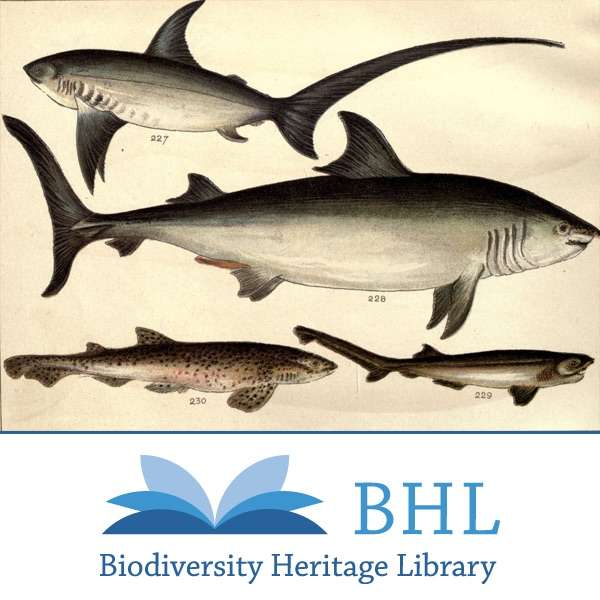
A collection of works about sharks to celebrate Shark Week.
Animal Sciences – College of Agriculture and Life Sciences, Department of Animal Sciences
The scope of teaching, research and extension activities in Animal Sciences involves the production, marketing and utilization of animals in agriculture, entertainment and companionship. The department offers courses in animal production emphasizing either business or biological processes involved in genetics, nutrition and reproduciton as well as livestock management and food safety.
 Our TOPPODCAST Picks
  Stay Connected