
This course is a survey of the scientific study of human nature, including how the mind works, and how the brain supports the mind. Topics include the mental and neural bases of perception, emotion, learning, memory, cognition, child development, personality, psychopathology, and social interaction. Students will consider how such knowledge relates to debates about nature and nurture, free will, consciousness, human differences, self, and society.
Podcast Categories: Science & Medicine
New Revolutions in Particle Physics: The Standard Model – Stanford Continuing Studies Program
This course is a continuation of the Fall quarter on particle physics. The material will focus on the “Standard Model” of particle physics, especially quantum chromodynamics (the theory of quarks) and the electroweak theory based on the existence of the Higgs boson. We will also explore the inadequacies of the Standard Model and why theorists are led to go beyond it.
This course was originally presented in Stanford’s Continuing Studies program.
Released with a Creative Commons BY-NC-ND license.
Epidemics in Western Society Since 1600 – Video – Frank Snowden
This course consists of an international analysis of the impact of epidemic diseases on western society and culture from the bubonic plague to HIV/AIDS and the recent experience of SARS and swine flu. Leading themes include: infectious disease and its impact on society; the development of public health measures; the role of medical ethics; the genre of plague literature; the social reactions of mass hysteria and violence; the rise of the germ theory of disease; the development of tropical medicine; a comparison of the social, cultural, and historical impact of major infectious diseases; and the issue of emerging and re-emerging diseases.
The Early Universe – Alan Guth
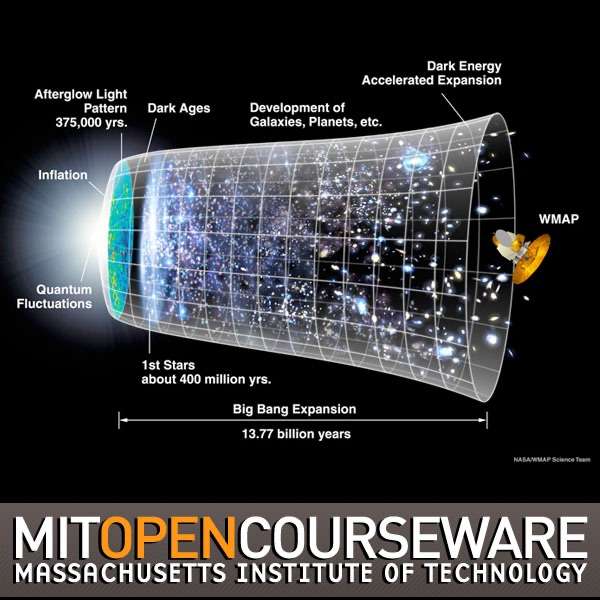
The Early Universe provides an introduction to modern cosmology. The first part of the course deals with the classical cosmology, and later part with modern particle physics and its recent impact on cosmology.
License: Creative Commons BY-NC-SA
More information at http://ocw.mit.edu/terms
More courses at http://ocw.mit.edu
Evolution, Ecology and Behavior – Audio – Stephen C. Stearns
(EEB 122) This course presents the principles of evolution, ecology, and behavior for students beginning their study of biology and of the environment. It discusses major ideas and results in a manner accessible to all Yale College undergraduates. Recent advances have energized these fields with results that have implications well beyond their boundaries: ideas, mechanisms, and processes that should form part of the toolkit of all biologists and educated citizens.
This course was recorded in Spring 2009.
15 Stretches that will Change your Life – UCLA Recreation
15 stretches that will change your posture, breathing and workout. For more infromation and videos, please visit us at www.recreation.ucla.edu/iworkout.
The Rudd Report – Yale Rudd Center for Food Policy & Obesity
The Yale Rudd Center for Food Policy & Obesity is a non-profit research and public policy organization devoted to improving the world’s diet, preventing obesity, and reducing weight stigma. The Rudd Center serves as a leader in building broad-based consensus to change diet and activity patterns, while holding industry and government agencies responsible for safeguarding public health. It serves as a leading research institution and clearinghouse for resources that add to our understanding of the complex forces affecting how we eat, how we stigmatize overweight and obese people, and how we can change.
The Rudd Report is the podcast series from the Rudd Center for Food Policy & Obesity. Hosted by Kelly Brownell, Rudd Center Director, the series features experts in nutrition, food marketing, food policy and law, the food industry, and weight bias.
OCW Scholar: Introduction to Solid State Chemistry – Donald Sadoway
Introduction to Solid State Chemistry is a freshman (first-year) class on the principles of chemistry, with an emphasis on solid-state materials, and their application to engineering systems.
OCW Scholar courses are designed for independent learners who have few additional resources available to them. The courses are substantially more complete than typical OCW courses and include new custom-created content as well as materials repurposed from MIT classrooms. The materials are are also arranged in logical sequences and include multimedia such as video and simulations.
Anatomy of Movement – Course Introduction – Stanford University
Understanding the Global Economy – The University of Chicago Center for International Studies
The 2009 University of Chicago Teacher Institute on “Understanding the Global Economy,” provided an interdisciplinary look at how changes in the global economy are affecting numerous aspects of countries around the world. The Institute addressed issues of globalization and its positive and negative effects on issues such as: labor, social rights, and natural resource exploitation and allocation. A general overview of markets, trade and the current global financial crisis was presented. Case studies from around the world were used to illustrate the interconnectedness of societies and their roles in the global economy.
The topics presented could easily and appropriately be incorporated into a wide array of subjects taught, including: history, math, economics, literature, English, biology, environmental science, social studies, anthropology, world studies, and foreign language/culture classes.
Intended primarily for elementary through community college educators (but open to all interested parties), this 3 day workshop explored issues surrounding the Global Economy through a series of presentations, discussions, and small group activities. The topic of the Global Economy was examined through the following daily themes:
* Day 1 – Markets, Trade and Globalization
* Day 2 – Impacts of Globalization
* Day 3 – The Current Global Financial Crisis
Experts from The University of Chicago and other institutions from around the U.S. lectured on these themes. Each day attendees received lessons and resources for curriculum building. In addition, an optional full-day curriculum development workshop was held on June 25th.
This internationally focused conference was presented by The University of Chicago Center for International Studies, in conjunction with the East Asian, Southern Asian, Latin American, East European and Russian Eurasian, and Middle Eastern Area Studies Centers.
 Our TOPPODCAST Picks
  Stay Connected