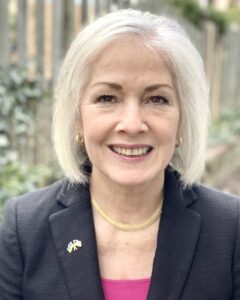
Ep. 37 — A tumultuous childhood filled with displacement and abuse draws a healthcare expert to the psychology of human behavior / Nicole Fisher, President of Health and Human Rights Strategies.
To say that Nicole Fisher's childhood was tumultuous would be an understatement. Fisher's world fell apart when she was two years old when she began to experience a pattern of psychological, and physical abuse by her mother.
When her parents divorced, her dad won custody of Fisher and raised her with the help of loving relatives. But Fisher still endured years of brutal custody battles in which the courts often sided with her mother and ordered Fisher to visit her or even live with her, creating massive stress and uncertainty, fueled in large part by her mother’s unpredictable behavior.
“There were many times, she was so loving, and kind, and affectionate, and there were other times she was the opposite. And I think that actually at its core, is part of that underlying instability,” say Fisher. “It wasn't just, whether my grandma was picking me up from school, or my aunt, or I was going to walk home with cousins, I think it was really, not knowing which sort of personality you were going to get, and that instability . . . really created a need for me, to have predictability in my life, and to understand, why, what were those triggers, what was within my control, what wasn't.”
Her chaotic childhood left Fisher with a deep hunger to understand the human psyche. She has devoted her career to working on issues of health and human rights, homelessness and hunger through her consulting firm, Health and Human Rights Strategies.
Fisher soon realized that the poor and underprivileged in the U.S. confront many of the same issues as those in the developing world. This chasm between the haves and have nots in America has only come into sharper relief with #Coronavirus.
In a strange way, the #Covid-19 pandemic has brought Fisher full circle to her own history of displacement, and resilience.
Transcript
Download the PDF
Chitra Ragavan:
Nicole Fisher's world fell apart when she was two years old, and she began to experience psychological, and physical abuse by her mother. Fisher's dad worked three jobs, and despite his best efforts, had little idea how to bring up a daughter, but he had the help of her grandparents, and many other relatives. Her chaotic childhood left Fisher with a deep hunger to understand people, and a passion for health and human rights. Hello everyone, I'm Chitra Ragavan, and this is When it Mattered. This episode is brought to you by Goodstory, an advisory firm helping technology startups, find their narrative. My guest today is Nicole Fisher, President of the consulting firm, Health & Human Rights Strategies. Fisher is a global health and policy contributor to Forbes, and the founder and curator of the think tank, A Seat at the Table. Nicole, welcome to the podcast.
Nicole:
Thank you for having me.
Chitra Ragavan:
Well, to say that you had a rough childhood, is a bit of an understatement. Tell us what happened.
Nicole:
Sure. It's not something I talk about very often, but yes, my childhood was, I think tumultuous, is a word. I had a wonderful family, a very big loving family, but my parents got divorced, for good reason, when I was very young, and there was, as you mentioned, some psychological and physical abuse. It went on for years, and so my dad got custody of me at two. We moved to be near his family. I was born in Louisiana, but we moved to Missouri, where his family was. And over the years, there were lots of custody battles, lots of court dates, lots of instances of having to choose which parent to live with. I of course chose my father, but the courts' system really believed, particularly back in those days, that children, girls in particular, should be with their mother. And I respect the mindset, and yet we had a loving... My father is the greatest guy in the world, his family is just so kind and warm, had no problem, helping to raise and step in when he needed help.
Nicole:
And yet, kept having to strike this balance of being sent to stay with her, or live with her, and then either getting dropped off, and being left and, or my dad having to come get me. It was just constant motion. In fact, I joked that I used to go to school, at least every third day, because my father was a fireman, with a backpack, and a duffel bag, an overnight bag, and more nights than that, just because whoever dropped me off in the morning was not who I was going to be leaving with at the end of the day. So I grew up in a very hectic sort of lifestyle, and yet I think I can say, with complete honesty, that it had lots of pieces of normalcy. My family and like I said, was very close, and they all lived in one town. So I had the opportunity to be very close to lots of aunts and uncles and cousins.
Chitra Ragavan:
Well I guess you did have that village.
Nicole:
Yes. I think that actually, when I think about my childhood, I think that saying is the perfect application. It took a village.
Chitra Ragavan:
So you saw your mother often, even though there was this physical abuse, and you wound up going to court a bunch of times when you were young, for these custody wars?
Nicole:
We did. I don't remember all of them, and there were obviously instances they didn't involve me, but I seem to recall my dad once saying something about, they had gone to court, maybe 14 times, by the time I was seven or eight. It felt, as a child, like it was just constantly something that hung there, and I never really understood, why? I couldn't understand that need to fight. I think it was really about winning, I don't think it was about providing care, or wanting to have a child around all the time. It felt much more, like it was simply a matter of, "I don't want you to have her."
Chitra Ragavan:
And when you went back, I guess on weekends and stuff, to see your mother, did you still experience abuse? What were you getting when you went?
Nicole:
It depended. There were many times, she was so loving, and kind, and affectionate, and there were other times she was the opposite. And I think that actually at its core, is part of that underlying instability. It wasn't just, whether my grandma was picking me up from school, or my aunt, or I was going to walk home with cousins, I think it was really, not knowing which sort of personality you were going to get, and that instability created... you alluded to this in the introduction?I think it really created a need for me, to have predictability in my life, and to understand, why, what were those triggers, what was within my control, what wasn't. And I also, had a psychologist when I was younger, probably 10 or 11, who was fantastic. And that was something that I remember her very vividly working with me, to understand, which was, "There are adult things I cannot control, and there are things I can control." And at that age, there's not a lot you can control.
Nicole:
And so, when things happened, to go within myself and say, "this is not something I have the ability to change, it's sort of a live-through-it, you can't go around it." And I'm very thankful again for an outlet, that gave me resources, and helped me understand the best of my cognitive ability at the time, what was happening around me.
Chitra Ragavan:
Was there any one day or any one event or anything that kind of best summed up the chaos of your surroundings, and how you coped with it?
Nicole:
To be honest, I don't know that I had one coping mechanism, and if I did, it was... I'm still guilty of it today, over committing. What I took to doing very young, was committing myself to as many things as humanly possible, so that I didn't have to be home. Or I had to be at a practice, I had to be at a lesson, I had to be cleaning my room, for this or that. I always found things to do, to keep myself busy and occupied, so that there wasn't free time, for conflict to arise.
Chitra Ragavan:
So what was your ultimate path, out of the situation?
Nicole:
Well-
Chitra Ragavan:
College I guess?
Nicole:
... I think that's really it. I think I knew at a pretty young age, I was not going to be a professional athlete, or a professional dancer, or singer, or any of those things. And although no one in my family had finished college, my dad was adamant from the time I was very, very young, that I would go to college, and that was going to be my future. I didn't plan to be an academic at all. I thought I would be some kind of doctor, but I knew, when looking at my horizon, that school was going to be an anchor in my life. And so I worked very hard, and luckily I love reading, and I'm a very, very curious person, and so school was something I threw myself into, but I also enjoyed. And so when I turned, I think 18, and my birthday falls right at the end of the school year.
Nicole:
As I was in the last month or two of school, graduating, moving to college, I made the decision to end that relationship. I knew I was moving away, and I wanted to start college fresh. And I didn't have it all figured out by any means, but I did know, there were certain aspects of that pre-18 youth childhood, that I just didn't want to take with me, into that next phase.
Chitra Ragavan:
So then how did you get your life together? What did you end up doing?
Nicole:
Is it really ever together? Life, I think for me became, as predictable as humanly possible. And I did that in a number of ways, particularly, looking back, it's very obvious the patterns that arose. But before I even finished college, while I was psychology and biology major, I wanted to understand human behavior, I wanted to understand people. I thought I would end up in neuroscience, but before I graduated, I had already applied, and been accepted, that's going to get a Master's,...