For centuries, humans have looked to the heavens and asked: Are we alone in the universe? And when it comes to answering that question, it’s not a matter of if. It’s a matter of when. With that day on the horizon, are we, as humans, ready for what insight that might bring? “When We Find Them” is a new limited podcast series from Central Florida Public Media that looks at our search for life in the universe and the not so finished plan to tell the world what we find. We’ll look at our current efforts to search for life, the protocols in place to confirm such an extraordinary finding, and look at how we – as humans – may react when our entire worldview changes. Subscribe to “When We Find Them,” from Central Florida Public Media.
When we discover life in the universe, how will we find out? Most likely, through the news.
An example of that is from a CBS radio broadcast from October 30, 1938.
A series of news bulletins chronicled the discovery of something unusual happening on Mars. As the broadcast continued, the event escalated, and there’s reports of an invasion by aliens.
It was described as the night America panicked. But it wasn’t real. It was The War of the Worlds, a radio play.
“It was one of the first studies of what people's reactions to a potential discovery of extraterrestrial life was like,” said Katherine Denning, an anthropologist at York University.
Those bulletins were part of a radio play, orchestrated by Orson Welles as an adaptation of the H.G. Wells novel The War of the Worlds.
An early analysis of that reaction found more than a million people believed the broadcast was real, and nearly the same amount were frightened by it.
Matthew Seeger is a professor of communication at Wayne State University in Michigan. He studies crisis communication and what the field calls disruptive events.
“Certainly the War of the Worlds is a great example of that,” he said, “where society became supposedly very disrupted as a consequence of the possibility of an alien encounter, but the research literature clearly demonstrates that that's not the case.”
People weren’t as panicked as we once thought. If there was a real discovery of aliens these days, he said, “we're not going to see people screaming and and you know running and hiding and engaging in all sorts of irrational behavior.”
So how will we react when that news comes? And how will we get that news in the first place?
The plan on paper
Former Senator Bill Nelson served as NASA administrator during the Biden administration. I asked did he ever think about the news of life elsewhere breaking when he was in office. He said of course he did. I asked if he thought we’re ready for such an announcement.
“With our inquisitiveness as a people, with our exploration being a part of our DNA, of us constantly looking for a new frontier – I often say the frontier now is not westward as it was when we settled the country, the frontier is upward,” he told me. “With that as a people in our DNA, I think that that'd be maybe a page one story in our newspapers.”
I asked him how he would break that news to the public.
“If I were there, I'd be a straight shooter, and I'd say exactly what it was,” he said.
That, in fact, is the plan.
SETI Institute president and CEO Bill Diamond told me that if a finding went through rigorous and independent verification, they’d say exactly what it was.
“What we would do is share with everybody what we've observed, what we can factually say about that observation, what phenomena was it,” said Bill Diamond, president and CEO of the SETI Institute. “Whan what can we say about it?”
And that’s the plan. At least, on paper.
“We should probably take care how we do this,” said Michael Garrett, a professor of astrophysics at the University of Manchester. He’s also the chair of the International Academy of Astronautics’s SETI Permanent committee, which wrote the 2026 protocols for what to do if you discover alien life.
We discussed those protocols back in episode three. They talk about how a finding needs confirmation. Different groups of scientists taking observations with different telescopes — independent verification.
Garrett said that once all that independent verification is done, it’s time to tell the world.
This could be one of the most consequential announcements of human history – and we’re not sure how humanity will react.
“I imagine it'll be quite a big thing,” he said. “There's journalists there, TV, and a large panel of experts that can take questions on this and we try and be, you as transparent as possible”
That would be in the form of a press conference – an opportunity for experts to talk to the media and influencers about a news event. It’s a way for journalists and content creators to get the story out but it’s also a way to control the narrative. The scientists making the discovery want to be the ones to tell the story. It’s a way to get the primary source – and credible information — in front of the public.
If there’s no press conference, the information gets out elsewhere. It’s like a game of telephone – and inaccurate information could quickly permeate social media.
“People are terrible at keeping secrets”
But the news of alien life might come out before scientists can even get to the point of coordinating a press conference.
“Somehow the news will probably break before anyone wants it to break, or at least there'll be major rumors circulating about it,” said Garrett. “Maybe that's not a bad thing, because when that happens, it gives people a chance to get used to the idea. It’s just not all of a sudden out there.”
This isn’t a new phenomenon.
“If you look at the way big scientific announcements have been done in the past, first of all, it's been actually really difficult to keep them under wraps,” said Garrett. “I don't think this will be any different."
Science journalist Nadia Drake agrees.
“If there's something that's been detected and it's credible and it's going through the process of being independently verified, that's gonna leak,” she said. “That’s not going to stay quiet. People are terrible at keeping secrets."
Leaks lead to other problems like confusion, said York University anthropologist Katheryn Denning.
“It’s a situation where you have a tantalizing piece of evidence, then somebody leaks it somehow. It gets all over social media. You don't yet know whether you actually have the discovery for sure or not,” she said. “That's a period of confusion which could last hours, days, weeks, or years, or potentially even decades in some of these situations.”
That leaves gaps in understanding. It’s not that scientists are hiding anything. They’re still actively trying to confirm a finding.
Communication experts say that when there’s an information vacuum, someone will step in to fill that void.
There’s ways to combat that. And again, it comes down to transparency.
“What you can do and what you should do, as a scientific enterprise, is provide the best information that you have, as responsibly and as quickly as you can, and as clearly as you can so that it can be understood by as many people as possible,” said Denning. “It’s our responsibility but it's also kind of the best tool that we have for trying to counter the misinformation that will almost inevitably arise."
New issues to deal with
The people involved in this kind of work are now dealing with another challenge, like AI-mediated communication and things like deepfakes.
“I imagine within the next year or two it'll be really difficult to distinguish a deepfake from the real thing, said Garrett. “It muddies the waters in terms of communication. It's hard for them to tell the difference between reality and something that's been faked up."
He said this is something that still needs addressing in the protocols he helped develop.
“I think we're a little bit behind the curve on that, and so the protocols don't really go into this at all."
But the protocols do go into protecting the scientists making the discovery on social media. People are going to believe what they want to believe.
Something so world changing like this could elicit negative reactions – ones that target the scientists, or even the people close to them.
“We want to make sure that a scientist who makes this discovery kind of knows what they're getting themselves into,” said Garrett. “There will be a lot of public interest in a discovery like this. There will be scrutiny, not just of the data or the paper, but personal scrutiny of the researchers that are involved.”
The protocols state that researchers have the right to decline engaging with the press or social media for this reason if they fear they might be subject to cyber bullying. It’s up to the scientist’s organization, whether it be a university or research group, to protect those that make the discovery.
And this might not be a one-time thing, either. A discovery may not just be a single finding. Or one viral video. A single press conference. Science, and the search for life, is always evolving. Lucianne Walkowicz is the co-director of the Discovery and Futures Lab at the SETI Institute.
Discoveries are not these single points in time, but rather these evolving events that can take sometimes many years for us to understand the implications of,” said Lucianne Walkowicz, the co-director of the Discovery and Futures Lab at the SETI Institute.
The public’s reaction
Regardless of how the story breaks, or how long it takes, how will the public react? And will they understand the implications?
“The word panic is a bad word in disaster research,” said Seeger. “We don't see panic."
These events, in the communication field, are called disruptive events. Think of natural disasters or Covid-19. Seeger thinks about the discovery of life elsewhere in the universe as if it would be a disruptive event.
Those events don’t typically create panic.
“We're not going to see people screaming and and you know running and hiding and engaging in all sorts of irrational behavior. In fact, my expectation is the initial response will be ho hum,” said Seeger. “I think we can speculate or extrapolate from other events that this would not necessarily result in widespread social panic, unless it turns out that this is the alien that pops out of people's chests – the evil destructive alien.”
Putting that example aside, Science journalist Nadia Drake envisions a similar reaction.
She points to media saturation. Stories like this have already permeated headlines, especially with recent interest in things like UAPs and UFOs – and those false alarms we talked about earlier in this podcast.
There’s already plenty of other news stories that demand our attention. Would something like this even cut through the noise?
“There has been a certain amount of saturation in headlines, especially around the UAP conversation,” she said. “There's these claims of biosignature detection, and I think on some level people are just like, 'Yeah, okay. Yeah, we get it.'"
There is still much uncertainty over how people might react. There has been some empirical research looking at public perceptions of news stories like these — or looking to predict how they might react. But it’s something that’s never happened before, and it’s difficult to compare to something else in history
“We don't actually know, for the majority of the world, what people think — what pre-existing ideas they have, said Walkowicz. Whether those perceptions are positive, negative, mixed, something in between those things, some secret third thing."
Do we want to believe?
I asked science journalist Nadia Drake if she’s thought about whether or not the public would even believe that what we are telling them – as journalists reporting on science – is even true?
“God, that's so bleak,” she said.
That’s because she understands that trust in news media is near historic lows, although increasing slightly based on new data from Gallup. While trust in science is slightly on the rise, it hasn’t fully recovered to pre-pandemic levels and is deeply split by political party, according to the Pew Research Center.
Communication researcher Matthew Seeger worries that the state of the information ecosystem today will lead to misinformation. People are less likely to believe the experts quoted in news media reports.
”We don't trust the subject matter experts broadly as much as we did until relatively recently. It really has been the disinformation campaigns around things like climate change, and then later COVID-19, that have undermined the role of the subject matter expert.” he said. “That’s created a real problem.”
Especially when the plan to tell the world relies on the media. That press conference? Will people believe the experts in attendance? Is this the right way to go?
What’s happening outside of traditional news media is also concerning, says Seeger, especially considering the role the social media influencer has on wider public perceptions.
“We often place individuals who have no background in particular issues in very powerful positions because they have so many followers,” he said. ”Influencers will become really important and will, I'm sure, have an outsized role in trying to frame the meaning around these particular events."
Seeger points to crisis communication, like that of a natural disaster, as a way to look at the role traditional media might play in this story.
“Journalists do try to be especially responsible during a crisis situation,” he said. “They view journalism in general as having a very, very important role in protecting the public around a disruptive event."
But he warns that with something so big as this story … there could be missteps
“The media has, on occasion, maybe more than on occasion, sensationalized particular issues, and this certainly would be a very sensational event,’ he said, and certainly fodder for outrageous media representations.”
It’s very likely that when we find them, you’ll hear it in the news, or from someone you follow on social media. That information will shape how you feel about this discovery, how you handle this paradigm shift.
For philosopher Chelsea Haramia, the magnitude of this discovery makes it really difficult for scientists, journalists and the public to be ready for that day.
“The full answer is that no one is sufficiently prepared,” she said. “By extension, no, the media are not either. But that is because no one is sufficiently prepared. If for some reason tomorrow there were some sort of immediate discovery that was confirmable in a moment, people would find out very fast that no one is prepared."
Implications
Oct 14, 2026
Show notes
On April 1, 2026, four astronauts launched from the Kennedy Space Center in Florida on a mission to circle the moon and return home.
Artemis II was the first time humans ventured to the moon in more than half a century. From inside their capsule, the crew sent updates, showing images and videos of the four voyagers as their planet Earth got smaller and smaller as they traveled farther from home than any other Earthling had ever before.
On April 6, as the crew swung around the far side of the moon and began the journey home, NASA astronaut Christina Koch radio’d back to Earth with a message from more than a quarter million miles away.
“We will explore, we will build, we will build ships, we will visit again,” she said. “We will construct outposts, we will drive rovers, we will do radio astronomy. We will found companies, we will bolster industry, we will inspire. Ultimately, we will always choose Earth, we will always choose each other."
Koch and her crew had been looking back at Earth, illuminated brightly by our star, the sun, against the blackness of space. For them, there was nothing else out there. The only living things were on the rock where they came from.
Should we uncover evidence of life out there, that crew would be one of the last to ever see our home planet against the blackness of space, knowing that there was nothing – no one – out there.
University of Central Florida planetary scientist Addie Dove thinks that just as the world followed the Artemis II crew mission and rooted for their safe return, humanity would come together in light of a groundbreaking finding of life elsewhere in the universe.
“That kind of unifying thing is what could happen if we have this detection of life elsewhere,” she said. “It's not necessarily hopefully in us versus them, but it's like look at us, and look at where we are. How do we see that as a species, and in sort of the greater context of what else is out there in the universe?”
Her UCF colleague Josh Colwell says such a finding comes with such enormous implications that have the potential to change who we are as humans.
“Recognizing that we're not alone in the universe, that there's other life out there that's developed elsewhere,” he said, there are “huge philosophical and religious implications for such a discovery that I think will affect the sort of human mindset."
In the search for life in the universe, what’s at stake if we find something? How will we reckon with such a profound discovery? Would it change what it means to be human?
“Not one impact”
The wheels of discovery are already in motion.
“This question, ‘are we alone,’ has really transitioned and transformed to the dominant science question in astronomy and astrophysics,” said SETI Institute President and CEO Bill Diamond “It went from sort of a sideshow, like a niche of this area of research, into this is the question everybody's trying to answer."
The first modern attempt to search for life out there began in 1960, and since then has continued to peer deeper into the cosmos and with more precision than ever before. As scientists collect more data about our universe, we’re filling in the blanks of Frank Drake’s equation.
The possibilities of life out there increase with each new day of discovery, and the chances of that finding are getting closer and closer. If we find it, it would be a watershed moment for science. One that would fundamentally change who we are.
“There's not going to be one impact. There's not going to be one way that humanity is affected," said Chelsea Haramia, a senior research fellow at the center for science and thought at the university of Bonn in Germany and co-director of the Discovery and Futures Lab at the SETI Institute.
“We only have one kind of example of life. Evolutionary trajectory of life here on planet Earth. We only have one kind of technology that's detectable at interstellar distances, and that's human technology,” she said. “Life could look very, very different, and so it's just really exciting to think about what we could come to understand potentially if we were to get some real concrete details on the matter.”
I asked the scientists I interviewed for this podcast what they would think of that day. It was hard for them to put it into words, but for the most part, that day would be a happy one. It would be a moment that we answered a question that we had been asking ourselves for centuries. One that would tell us we are not alone in this incredibly large universe.
We would learn that we are not unique — and that’s okay. And that we would come together as one planet, one species, and it would be for the better.
I had a hard time believing that when that day comes it will be all sunshine and rainbows, or milk and honey, or smooth sailing – whatever phrase you want to put there. I am not alone.
What probably my biggest concern would be that the world reacts in a fearful manner, and you know, without any compelling reason to do so, that this is something that people are afraid of,” said Diamond.
However, Diamond told me the public’s response to news stories about Unidentified Anomalous Phenomena, or UAPs, and UFOs, has him thinking like that.
“I find that might be unlikely,” he said. “Fourty percent of the American people think that UAPs and UFOs are evidence of advanced technologies in our airspace, and yet they generally don't hear that discussed in a fearful context. Rather, it's a more fascinating and maybe even hopeful context. I don't hear people saying we've got to build a defense network around UFOs and UAPs, because they're scaring the crap out of me.”
The existential threat
People aren’t afraid of the invasion of aliens … at least for now. But fear may come from something bigger than that.
There's a bigger kind of risk, and it's an existential risk. Our existence, as we understand it, is threatened, and will be threatened, as will our assumptions of divinity and religion, but if you can confirm that presence of another being it starts to threaten the kind of assumptions we make about ourselves existentially, and we have an existential crisis.”
Tim Sellnow is a professor of risk and crisis communication at Clemson University. When I reached out to him about this podcast, he said he’s been thinking a lot about what happens after a discovery is made.
“People have known forever that it's possible that there's life beyond what we can see in our solar system, but what does it mean to actually find evidence and share that evidence?”
People have been thinking about this for a very long time.
“It surprises people that the ancient Greeks were talking about alien life, but they were,” said Joe Packer, a professor of communication at Central Michigan University who studies how people have historically talked about alien life.
He explains that conversation began with a group of philosophers called atomists.
They basically said all of life was composed of these little atoms, they're infinite, they're all over the place, they're manifesting in infinite or near infinite combinations, and because of this, we should expect that there are other planets. On these other planets, there are other life forms that are sort of like us, he said
The atomists were “having these debates about what is the nature of our earth, what is it made out of,” he said. “This idea that the matter of our planet is not unique. It’s just these atoms and we can expect it elsewhere.”
Even in the days of Plato, we were questioning our uniqueness. Our aloneness in the cosmos. And now thousands of years later, we very well could get an answer to those questions.
So what happens next?
“I think when you have this sort of an existential crisis where we attach uncertainty to something you're going to seek information,” said Sellnow. “You’re going to want evidence But then you're also going to have questions of — and that is — the greater kind of question that is going to be answered by theology or religious figures. What does it mean to be human? What does this say about God’s plan? What do I do with this? What does this mean for me? How do I see myself in this universe?"
A collapse of faith?
A popular assumption when it comes to the confirmation of extraterrestrial life is that religion and faith institutions will collapse. But that doesn’t appear to be the case.
Religious scholars find that idea comes from media narratives and anti-religious commentary and not from empirical evidence or religious people themselves.
Jennifer Wiseman is a NASA astronomer and the former director of the Program of Dialog on Science Ethics and Religion for the American Association of the Advancement of Science
Now my experience is that faith communities of various stripes that I’ve interacted with are very interested in what we're discovering about the universe, and they find the possibility that there might be life beyond Earth to be delightful, actually,” she said. “They might have to expand or broaden their imagination a little bit. But they have, for most of the cases, people [who] have no problem incorporating this idea into the idea that however they believe life began on planet Earth, that God or the creator could have done something on a much bigger scale. And that would be just fine.”
There is empirical evidence that backs that up. Ted Peters is a retired professor at the Graduate Theological Union in Berkley, California. He studies the relationships between religion and natural sciences. In fact, he helped create the field known as astrotheology — the study of how astrobiology impacts faith — including one interesting study from 2008.
"We asked people who are self-identified as religious to answer 10 questions, some of which were like, 'Well, if we could confirm the existence of an intelligent off-Earth civilization, would your faith beliefs face a crisis? Would your religious tradition collapse?' 80 to 90% of people said, 'No, I don't have a problem,” he said.
Peters wasn’t surprised bu the results. He is an ordained pastor in the Evangelical Lutheran Church in America. With that background, I asked him, how does the idea of life on another planet square with Christian teachings and beliefs?
“These are the deeper questions that really do need to be genuinely explored. Just briefly on the survey, there was room for comments,” he said. “We got again and again and again. It didn't matter whether you're fundamentalists or Roman Catholic or mainline Protestant. This universe is so big, and God is so big, and the creation is so big. Of course, we share it with other creatures by God. Let me tell you that was the general tenor of this.”
Peters recognizes the constraints of this research, like the fact that this survey was conducted in 2008 – and it’s probably time for another. Still, Steve Engel, Rabbi emeritus of the Congregation of Reform Judaism, is hearing similar sentiments in the Jewish faith, even today.
It's just proof that God is so big that it can encompass something outside of ourselves,” he said. “We need to make a connection, because you always hear, ‘Oh, we're all God's creation,’ right? Well, this is extrapolating that concept.
“We would have to accept whoever or whatever that intelligent being was outside of ourselves, because it's all part of God's creation, so we couldn't fight it, we couldn't, you know, try to take control of it, because it would be just as important as a part of God's creation as we are. It would be one of God's creatures.”
The Islamic faith has similar teachings, said Jörg Matthias Determann, a historian based at Virginia Commonwealth University in Qatar.
“The opening of the Quran and various other passages describe God as the Lord of the Worlds – worlds in the plural,” he said. “The Arabic phrase only ever appears in the Quran in the plural. It never appears in the singular. So in general the text here is very open to the possibility that there is life out there."
Peters’ study found these findings weren’t just from those three faith groups.
“We didn't run into a single religious tradition that's going to face a problem. The Buddhists were the most interested because it was 100% There wasn't even one Buddhist respondent who thought that a religious crisis was nigh,” he said.
“The only people who talked about a religious crisis were those who are self-identified as non-religious. They said we don't have a problem, but those religious people are going to have a problem,” said Peters. “I just don't, on this basis, foresee a religious crisis on the horizon.”
But these are very broad strokes and religious groups are not monolithic. Engel explains while he belongs to the more progressive group, there are others within the Jewish faith like fundamentalists who might not be as welcoming to the discovery of alien life.
“The way that this relates to science is that when you're [a] fundamentalist, you see the Bible as the truth, and you see that as God's word, and you see science as human created,” he said. “When there's a conflict between science and religion, as a fundamentalist, religion always wins out, and so fundamentalists also reject a lot of science because they say it contradicts what's said in the Bible, what's said by a religious perspective.”
So there could be a crisis of religion, or humanity. Or both.
"Would it humble us? Would it make us arrogant?,” asked Engel. “Religion is based upon the human being being the center of the universe and being the most important creature that God created, and boy, would that be a change if we found something else?"
A transformation of humanity
In writing this episode I kept coming back to my conversation with philosopher Chelsea Haramia. She told me that a finding like this could change our sense of who we are.
I asked her: How would this happen?
This is the kind of situation where you face a transformative choice. It's big – and you know it's big – but you don't actually know what you will be like on the other side of that choice,” she explained. “The fictional, mythical example is suppose you were asked to become a vampire. Do you want to become a vampire? You know if you were to become a vampire all your core preferences and values would change. How do you decide rationally to make that choice now as a human being?”
This comes from the writing of another philosopher, L.A. Paul, who says these personal individual transformational events happen in our lives already. We become a parent. We move to another country.
We don’t know what is on the other side when we make that choice.
“There's a problem of rationally preparing for what you will be, and so that is the kind of thing that I believe can happen at the collective level,” she said. “Other people think this too: that collective transformations are possible, that collective shifts can happen, and it can change what it means to be maybe a member of a group, or even what it means to be a member of humanity.
But in order for that transformation to happen, people need to understand what we’ve found.
How do we tell the world we’ve found life somewhere else in the universe? And will people even believe it?
Search and confirm
Oct 07, 2026
Show notes
As we continue to search for signs of life in the universe, how will we know we’ve found credible proof?For many scientists, they use the Sagan standard: Extraordinary claims require extraordinary evidence.If there was ever a finding that could prove we’re not alone, the Sagan standard would require proof that was equally as strong to back it up.When it comes to finding proof of that extraordinary claim, one mission just launched to push us closer to gathering the required extraordinary evidence.On the morning of Aug. 30, SpaceX’s Falcon Heavy rocket roared to life from the Kennedy Space Center in Florida. On top of the rocket was NASA’s Nancy Grace Roman Space Telescope – called Roman for short. Twenty-seven engines launched the tourbus-sized telescope on a three-month trip to its new home a million miles from Earth. And from there, scientists hope, it will fundamentally alter our understanding of the cosmos.“Roman is going to change the way we look at the universe. It is going to discover tens of thousands, maybe even a hundred thousand new exoplanets,” said NASA’s head of science Nicky Fox just hours after liftoff.Roman begins its three-month journey to its new home about a million miles from Earth after launching Sunday from the Kennedy Space Center.(Derek Demeter / Central Florida Public Media )The telescope is on the hunt for dark matter and energy. It’s also searching for exoplanets – planets that orbit stars other than our own sun. And it’s going to find a lot of them.“Why do we care so much about exoplanets? Because one of our main goals at NASA is answering the question, are we alone in the universe?,” Fox said. “Whether you like space, whether you like technology, whatever it is, people look up at the sky, and they think ‘you know, am I alone? Are we alone? Is there another Earth 2.0 looking back at me?’ And with Roman, we are going to make this giant leap forward.”Exoplanets are just one avenue scientists are using to answer that question. Scientists like astrophysicist Josh Colwell say in finding that answer – through exoplanets or other methods – it’s not a matter of if, but when.“It's hard for me to think of a more important scientific question to be answering, because I think the implications are so profound and far-reaching that I think it's an essential and necessary search,” he said.When that day comes, it will be an extraordinary claim – that humans are not the only living beings in the cosmos. As astronomer and science communicator Carl Sagan said – extraordinary claims require extraordinary evidence.When it comes to life in the universe, what extraordinary evidence are we looking for?ExoplanetsLet’s be clear — the search for life isn’t monolithic. There is not one thing scientists are looking for. Instead there are three parallel and distinct efforts underway that make up this quote unquote search.Scientists are looking for chemical signs of life on far-off exoplanets, more physical traces of life on planetary surfaces closer to us, and a deep scan of the skies for evidence of alien technology.We’re going to take a look at each of those efforts. And we’ll start with searching for chemical signs of life on planets outside our own solar system. They’re called exoplanets.Bill Diamond is the CEO of the SETI Institute, a non-profit research organization. He said exoplanets are one of the most consequential findings in SETI. When Frank Drake was writing his equation, the only variable he really knew the value of was the first — the rate of star formation. But he had no idea what the second variable could even be. Until exoplanets came along.“That's the discovery, which is quite recent, that planets are ubiquitous, that every star in the sky is essentially a solar system,” he said. “That's shockingly recent information.”What does shockingly recent mean in the world of astronomy? 1995.Coolio is topping the Billboard chart with Hootie and the Blowfish, Mariah Carey, Seal and TLC. I was in the third grade. And a pair of scientists announced the first discovery of a planet orbiting a sun-like star — 51 Pegasi b. An artist's impression of 51 Pegasi b (left) and its star.( ESO/M. Kornmesser/Nick Risinger)What was just considered a hypothesis — that other stars had planetary systems like our own — was now proven true.(51 Pegasi b technically isn’t the first exoplanet discovered. That happened in 1992 when scientists found planets orbiting a pulsar – a dead star. The discovery in 1995 was the first to find planets orbiting a living, Sun-like star.)Since that finding in 1995, many more efforts are underway to count these planets. NASA has confirmed over 6,000. It’s now understood that pretty much every star that we see in our night sky has planets orbiting it.“We also have ascertained that a sizable fraction – like 30% of these planetary systems – are likely to be potentially habitable environments based on their size and and distance from their star and other characteristics,” Diamond said. “This statistically suggests the possibility that in the Milky Way galaxy alone there may be tens of billions of potentially habitable environments. That kind of new knowledge and information compels us to keep looking.”What exactly are we looking for? Astronomers are using a technique called spectroscopy to peer inside the atmosphere of these planets. It breaks light apart — like a prism takes a beam of sunlight and turns it into a rainbow.Through that breakdown, scientists can uncover specific chemical signatures. Different gasses absorb light in different and unique ways. So by looking at starlight passing through a far-off planet, we can know what that atmosphere is made of.This spectrum is made from observations by NASA’s James Webb Space Telescope, which analyzed the atmospheric composition of a distant exoplanet called WASP-96 b. JWST detected signatures of water and haze in the gas giant's atmosphere. ( NASA/ESA/CSA/STScI)“We are trying to understand what life on planets that we cannot visit in person, what that life would do that would reveal itself to us if we are looking from a distance,” said Jennifer Wiseman, a NASA astronomer.“If there were bacteria or microbial life, what would it do that might change the atmosphere of its planet, such that we, from a distance, could see that that atmosphere is in disequilibrium, or in some way give a sign that there's biological activity going on? We call these biosignatures.”If an alien civilization pointed its telescope at us, it would see our own atmosphere interacting with our sun’s light revealing things like water vapor and oxygen.That’s exactly what powerful telescopes like the James Webb Space Telescope are doing now. While it hasn’t found a smoking gun just yet, it’s opening new doors to potential plants that could harbor life.But other efforts to find life are happening closer to home.Life in our solar systemNASA’s Perseverance rover landed on Mars in 2021. Since then it has traversed over 28 miles with the goal of hunting for evidence of ancient life. It’s looking for that evidence in the rocks on the planet’s surface, and collecting samples to hopefully one day send back to Earth.Scientists now know that Mars once had liquid water — oceans like our own. So why wouldn’t it have life just like us?Mars ends up being a really great environment in framing our questions about the search for life beyond Earth, in part, because it is very Earth-like, or at least was in an ancient past,” said Amy Williams, an astrobiologist at the University of Florida and a scientist on the two Mars rovers.“There's different parts of the community for Mars astrobiology that are looking at whether there was life in the past on Mars, and then there's also a contingent that are interested in whether, if there were life on Mars in the past, if it could have survived to the present,” she said. “There are a lot of assumptions that have to go into those kinds of searches, but the more that we learn about Mars, the more we have to ask the question, if life started on Earth, why not also on Mars?”NASA’s Perseverance rover takes a selfie, capturing part of the rover and track marks left on the Martian surface.( NASA/JPL-Caltech/MSSS)What Williams and her astrobiology colleagues hope they may one day find is evidence that microbes lived there. Not active life. Still, the findings would be profound indeed, and prove that life, at least in the past, existed on more than one planet.Other missions are planned within our own solar system to look for places that might be able to sustain life. NASA’s Europa Clipper is on its way to explore a moon of Jupiter with that same name, hoping to peer beneath its icy surface to see if there are places that can sustain life — scientists think there could be a salt water ocean down there. A moon of Saturn called Encelodus could have a similar ocean beneath its icy surface. The European Space Agency is planning a mission that would arrive there in 2050.Both exoplanet surveys and planetary missions are looking for signs of worlds that could sustain life — or evidence of past life. But one search for life in the universe is looking for something more alive.A sign of intelligent lifeA techno signature is like the next tier up, something that we could confidently attribute to some kind of technology, which would require not just life but technologically advanced life,” said Washington University in St. Louis planetary scientist Paul Byrne.Ideas as to what this could actually be run the gamut, but the thought is that they are a sign of technology developed by an intelligent civilization that was either sent out intentionally or accidentally — and we are able to pick them up. There are three categories as to what technisignatures might be, as SETI Institute’s Bill Diamond explains"The first way,” he said, “and what has been historically associated with SETI as an endeavor, is the use of radio telescopes to interrogate the radio spectrum to look for engineered signals”A portion of the Allen Telescope Array (ATA) in northern California. (Alex Pollak / SETI Institute)Electromagnetic radiation is common in the universe. But very narrow band radio waves are not As we know them, they are intentionally created by us humans and used to transmit information, communication, data. These engineered signals would show up as narrow band signals or modulated waves. The Wow! signal we talked about last episode was in the narrow band.Diamond says SETI scientists are also looking at optical waves, too, as a sign of a technosignature. “We now have programs called Laser SETI, where we use sensitive camera systems with gradings on them to look for laser pulses, short duration monochromatic, meaning signal wavelength or color that again nature doesn't produce.”And finally, Diamond says, you can also look at what’s happening in an exoplanet’s atmosphere – but not for signs of a habitable planet like discussed earlier. Instead, one that has inhabitants.That search includes “finding a chemical compound in those atmospheres that we pretty well understand nature doesn't produce, that is a byproduct of industry and or technology,” he said. “We would say that looks like a technological civilization based on what we're seeing in their atmosphere.”If we find a planet with pollution, chances are pretty good we’ve found another civilization. We assume that aliens would pollute their planet just like ours.We are actually sending out our own technosignatures. Alien civilizations, at the right distance from us, and pointing their telescope at the right spot would pick up the radio signal of I Love Lucy episodes.As radio astronomer Emma Chapman explains, this is known as the I Love Lucy radius.“This was seen as one of the first concentrated, strong radio signals that humanity sent, and that was [about] 75 years ago,” she said. “So the I Love Lucy sitcom is just about arriving at a planet 75 light years away.”That signal travels at the speed of light. So civilizations some 75 light years away are just now hearing it for the first time. It’s the boundary of how far we might be detected.But it’s not just ‘I Love Lucy’ episodes that might tell a civilization where we are. Any electromagnetic signal that’s engineered or artificial could give us away.However, that signal is getting quieter. We’re no longer beaming out episodes of ‘I Love Lucy’ over broadcast transmitters. And we’re transmitting data differently than before. That means our radio footprint is getting smaller“As humanity has evolved in terms of technology, we've gone from using these few really strong antennas to communicate radio stations to the kind of like Wi-Fi lower power but everywhere satellites, and that kind of quieter but wider over the frequency,” she said. “There's lots of people looking for that kind of signal too, but it's harder because it's quieter.But we’re still listening for those signals from someone else out there. Maybe it’s an alien version of ‘I Love Lucy’ or E.T.’s Wifi. So if we hear something, how will we know it’s actually coming from another civilization?ConfirmationIn her book “The Possibility of Life,” Science writer Jaime Green explained the process this way: The detection of alien life won’t be obvious. It’ll be partial and inconclusive, a perfect task for the scientific method.The scientific method takes an observation, forms a hypothesis for why it happened, tests that hypothesis, analyzes the data to draw conclusions and then shares the results — with the goal of other scientists to prove – or disprove – the results. It’s applied to all fields of science. And for that reason, Diamond says the scientific method should work in the case of searching for life, too.“This process of hypotheses, experimental undertakings, and observations, verification, and repetition by other recognized individuals and institutions is what the scientific method is all about, so I think in that sense there is a self-governing validation for discoveries. It's inherent in the process,” he said. “That's not to say that people will, including in the scientific community, will sometimes, bypass that process, or make claims that are extraordinary without the extraordinary evidence.”There are some guardrails in place to prevent just that. The closest thing to a formal plan for if and when we find something is a document: The Declaration of Principles Concerning the Successful Detection of Extraterrestrial Intelligence. It’s maintained by the International Academy of Astronautics.They have at regular intervals put out this document, which we call informally the protocols,” Chelsea Haramia is a senior research fellow at the Center for Science and Thought at the University of Bonn in Germany, and co-director of the Discovery and Futures Lab at the SETI Institute. “It's basically how do the people who are involved in the search, how do they agree to act in the event of a meaningful detection.”The protocols were first created in 1989, then updated in 2010, and most recently revised this year.“They just put out a much more comprehensive and robust set of principles to help guide the scientists and those involved in the search when and if there is a successful discovery,” she said. “Here's how we've agreed to follow it up, and here's how we've agreed to act during the confirmation process.”That includes guidance on how to verify a signal, how much transparency to maintain during the very likely long verification process, and whether we — as humans — should respond.It charges the person or group that finds the evidence to do all that they can to authenticate and substantiate the finding using all the resources available. That might be using other tools or telescopes to replicate the results. It says the results should be scrutinized by other scientists. And if it is indeed found to be credible, that should be s…
In the search for life in the universe there have been plenty of close calls. Each instance brings us closer to answering that existential question and lays bare how we as humans may react to such a revelation. In this episode, we’ll take a look at those close calls.We begin in Cambridge, England, in 1967, where a graduate student by the name of Jocelyn Bell Burnell is working on a brand new radio telescope. She’s on the hunt for quasars – these mysterious and powerful bursts of energy in the cosmos.“They were the really hot, sexy topic at that time and very new,” she told me during an interview in March 2020.Jocelyn Bell Burnell photographed after a March 202 interview with Central Florida Public Media at Embry Riddle Aeronautical University in Daytona Beach.(Brendan Byrne / Central Florida Public Media)We talked about that hunt for quasars and how it led her to something completely unexpected.“It was a string of pulses, about one and one-third seconds apart, so it was going - dit - dit - dit - dit - dit - which suspiciously like some man – a human being – doing something,” she said.Was someone out there signaling Earth? Did Bell Burnell finally find what Frank Drake was listening for? In less than a decade was the question of are we alone already answered?What Bell Burnell found was groundbreaking, and just one of many times we thought we had that answer to whether or not we were alone in the universe.Little Green MenEmma Chapman is an astrophysicist at the University of Nottingham in England. She uses radio telescopes in her work to look at the cosmic dawn, the first signs of our universe’s formation. But she also combs through historical astronomical data looking for signals that might be from some other civilization — sent to us on purpose or on accident.And it was that kind of data that Bell Burnell stumbled upon some 60 years ago.“She was looking for all this data in her printouts that were coming from this radio telescope,” Chapman explained of Bell Burnell’s work.Bell Burnell was looking through a scroll of chart paper that measured cosmic radio intensity much like a cardiac ECG does. In a football field’s length of this chart paper she found what she described as “a little bit of scruff” of a repeating signal. The little “bit of scruff” Bell Bernell discovered which would later be identified as pulsars.(National Radio Astronomy Observatory. )“They ended up saying, ‘is this repeating signal coming from this one place in the sky? Could it be little green men, you know?’ And they wrote LGM,” said Chapman.“‘Maybe it's aliens’ is a bit of a catchphrase in astronomy,” she said. “That's where it began.”But it wasn’t aliens. That dit - dit - dit - dit - that Bell Burnell saw in that data showed up again and again.“Very quickly they actually realized that they had spotted two or three more in different areas of the sky,” said Chapman. “Now the chances of aliens contacting you all at the same time from three or four different completely remote places in the universe is vanishingly small.”It was a false alarm. But the finding wasn’t a bust. Instead, she found evidence of what are now called pulsars — cosmic lighthouses of energy – a neutron star that spins rapidly emitting beams of radiation.The discovery wasn’t evidence of intelligent life. But it was profound enough to earn a Nobel Prize in 1974. Controversially, though, not for Bell Burnell.The finding is just the first of many false alarms that clue us in to just how the world might react to the day we find the real thing, and those findings happened much closer to home than we ever expected.Life in a Mars rock?On August 7, 1996, President Bill Clinton addressed reporters on the South Lawn of the White House.“Today, rock 840001 speaks to us across all those billions of years and millions of miles. It speaks to the possibility of life,” he said. “If this discovery is confirmed, it will surely be one of the most stunning insights into our universe that science has ever uncovered.” President Clinton speaks to reporters on August 7, 1996 about the Allan Hills meteorite findings.(YouTube / William J. Clinton Presidential Library)Scientists found what they thought was microbial evidence of life in a 4.5 billion-year-old meteorite found in the Allan Hills in Antarctica in 1984. It was a chunk of Mars that broke off and found its way to Earth, and trapped within it, some scientists thought, evidence of life from another planet.Amy Williams is an astrobiologist at the University of Florida and a scientist on NASA’s Curiosity and Perseverance rovers — which are currently searching for evidence of life on Mars now.“This meteorite was being studied by a group at Johnson Space Center, and as they continue to study it, they found what they argued were multiple lines of geochemical evidence that came together,” she said. “ They said the most parsimonious explanation would be that this could be life – a form of preserved life in this meteorite.”The Allan Hills 84001 meteorite(NASA/JSC/Stanford University)The team was led by NASA scientist David S. McKay. But as other scientists took a closer look at the findings, they disagreed with the initial conclusion.“I would say the community generally [finds the] consensus is no, you don't have evidence for ancient Martian life in this meteorite,” she said. “But this discovery and the conversation that it started is truly the birthplace of modern astrobiology."Astrobiology is the scientific study of the origin, evolution, distribution, and future of life in the universe. Simply put, it studies whether there is life in the universe.While the findings from that meteorite didn’t answer that question, it got scientists closer to an answer. President Clinton charged NASA with exploring Mars further.Later that year, the Mars Global Surveyor mission launched, and in 1997, NASA’s Mars Pathfinder landed on the red planet. While those missions were already underway, the publicity from the now-debunked findings no doubt propelled the search for life into a new era.“People still walk around remembering this meteorite paper. I see it serving both [the] good and negative sides of science education and communicating with the public,” she said. “It’s really great that it launched astrobiology. It lays bare the challenges and flaws inherent in the scientific method. We're not always right. That's why we test hypotheses."And those hypotheses would be tested again and again on planets other than Mars.A mysterious gas on VenusIn September 2020, a team of astronomers announced the finding of phosphene gas in the upper atmosphere of Venus.Phosphene is a colorless gas. Here on Earth, it’s created by decaying organisms – what was once life.Venus is known as Earth’s twin. It’s similar to our planet in size, mass, and structure — it’s rocky, like ours. But what is on the surface is far from Earth. It’s a toxic inferno with a thick carbon dioxide atmosphere. It’s hot enough to melt lead.So why is phosphene detected on Venus?An artistic impression of phosphen in the clouds of Venus.Researchers hypothesized that the presence of phosphene gas must be some sort of “aerial” life form in the planet’s clouds.( European Space Organization)Phosphine is pretty common in things like giant planets, and there's a bunch of mechanisms we think that might produce it, but it is exceedingly rare in smaller rocky worlds like Venus, and on Earth,” said Paul Byrne, a planetary scientist at Washington University in St. Louis.”Phosphine, as we know it, is linked to life, found in places like bogs and swamps from the organic breakdown by bacteria. A finding of phosphene in Venus points to the possibility of life within its atmosphere.“This phosphine detection really was stunning, and the team went through great lengths to first off demonstrate the robustness of their detection, and then to offer explanations that might account for why there might be phosphine there,” Byrne said. “And what they felt was that there really wasn't much they could rule in, except perhaps some kind of weird biology.”Was that weird biology alien life? The findings captured the attention of the media and other scientists who worked to confirm what they found. Follow-up studies challenged whether the team detected the phosphene signal at all, and the original researchers revised their estimate of just how much phosphene there was.Now, whether the findings are an indication of life are still up in the air.“Like anything, when we detect the potential trace of a gas we might not expect in the atmosphere of a planet, whether this system or beyond, there is going to be a lot of scrutiny, and that's how it should be,” said Byrne. “That is the scientific method."But sometimes public interest outweighs scientific merit.“Why the hell didn’t you come by?”“Are aliens headed for Earth, right now?” asked one news anchor in October 2025. He was referring to a news story about 3I/Atlas, a comet that originated beyond our solar system that would pass by Earth – although it posed no threat.It was discovered in July that year and is the third known interstellar object to travel through our solar system.“It's a comet that came in at such high speed that it can only have been on an orbit kind of way out of our solar system's reaches,” said Chapman.Some in the science community thought it might be alien technology – a beacon or interstellar spacecraft.But the science community overwhelmingly argued it wasn’t from an alien civilization. Despite that, the comet continued to capture headlines and social media posts. It brought the search for life into the mainstream — even just briefly — and put attention to the skies and that question: are we alone? Is someone coming to say hello?The scientific community turned its eyes to the comet as it made its closest flyby in December 2025, taking careful observations to see if it might be some sort of alien technology, a beacon, or interstellar spacecraft.It wasn’t. And neither were the two that came before it.“From what we believe and observe and have understood about these — no, they were not in fact engineered, that they were natural objects,” said Bill Diamond, President and CEO of the SETI Institute.“Yes, it was disappointing,” he said. “It would have been amazing if it was a spacecraft, except I would then say, if you're a spacecraft, why the hell didn't you come by? If you came all that way, it'd be kind of a shame to miss us.”The interstellar visitor – and the media attention it garnered – shows a gap between what some call scientific nonsense and public interest, said York University anthropologist Katheryn Denning.“It's so important in those cases to acknowledge that the scientific community at large is pretty darn clear on what those objects are or were, and what they are not,” she said. “But it's a really interesting example in how the larger scientific consensus does not necessarily carry the day in terms of public opinion."But there’s still one longstanding false alarm that still doesn’t have consensus as to what it actually is.The “Wow!” signalThe Big Ear telescope at Ohio State University was massive. It was three football fields wide and from 1973 to 1995, its job was to listen for extraterrestrial radio signals.“In 1977 they got an incredibly strong burst of radio light,” said Chapman. “Now, this is one of the brightest radio signals we've ever received, and the astronomer who was combing through the data at the time saw this really high intensity burst, and wrote "wow" with an exclamation mark in the margins of that data.”The “Wow!” signal is one example of a time we thought we found life, although some scientists aren’t convinced it was a false alarm.(Ohio State University Radio Observatory (OSURO) and North American AstroPhysical Observatory (NAAPO))The “Wow!” signal. It’s a computer printout with a bunch of printed numbers. But a series of numbers and letters is circled in red ink with that word Wow written in the margin. Radio telescopes collect radio waves that are traveling through space. Using massive dishes, they listen for these waves, then turn them into numbers or letters that represent the intensity and frequency of the waves.Radio telescopes collect radio waves that are traveling through space. Using massive dishes, they listen for these waves, then turn them into numbers or letters that represent the intensity and frequency of the waves. Chapman explains these printouts look a lot like a scene from the movie The Matrix.“Like the kind of like the green numbers falling down the screen,” she tells me. “That's what the data looks like in 1977. Imagine as if somebody was printing out the matrix numbers falling down, so it's loads of different numbers and letters all coming down, and the higher those numbers – they went from one to nine – to higher intensity.”If the intensity got beyond nine, the computer would switch to letters, starting with A then moving to Z as the highest. The “Wow!” signal observation got as high as Q.“They never had anything like that,” said Chapman.The signal was so bright, and lasted for over a minute. Then it vanished.Had it been a natural phenomenon — like Jocelyn Bell Burnell’s pulsars — you’d expect to see it again and again. But it was a single burst. A signal flair, perhaps. And it was never seen again.“I’m not saying there was an alien with a green finger literally turning it off, but something really strange happened.”Chapman is puzzled by the fact that after the signal, there was very little scientific attention. It was treated more as gossip than a scientific finding. But recently, within the past decade or so, there’s been more follow up.“We don't know it's a false alarm,” she said. “What the “Wow!” signal is, is one of the few times in human history that we have heard what appears to have all of the characteristics of an extraterrestrial radio signal.”The false alarms we’ve been talking about in this podcast are just a handful of the dozens that we’ve discovered over the years. But for decades, the “Wow!” signal has continued to puzzle scientists.We’re still not sure it was a false alarm. What could it be?“Am I saying it's definitely aliens? Just to be clear, absolutely not. I'm saying we are still in the trenches of science with this one,” Chapman said. “We are still trying to work out what it is, and we do not know."
Searching for life in the universe
Sep 23, 2026
Show notes
If scientists ever found evidence that we are not alone in the universe, what would happen next?
I posed that question to Bill Diamond, CEO of the SETI Institute in 2023 during an interview for our podcast Are We There Yet?.
“Well,” he told us “we’d probably call a press conference.”
For what is likely to be the most consequential scientific discovery for humanity, the answer to how we would tell the world we’re not alone in the universe was a press conference.
As a journalist covering space for more than a decade, I’ve covered hundreds of press conferences. They’re usually pretty mundane – a mission status update, the announcement of a new launch contract. Sometimes, they can be quite exciting, like when NASA named the crew of the Artemis II moon mission.
But news of cosmic neighbors would certainly outweigh even that excitement. It was hard to think about how I might cover that press conference. Thinking about that day, as a journalist, is the catalyst to this podcast.
For most of human history, we have asked “are we alone?” Centuries ago, it was the philosophers and the priests asking the question. These days, it’s the scientist leading the charge to find the answer.
And everyone in between is curious, probably even you, if only just a little, of what that answer might be.
Moonrise over the National Radio Astronomy Observatory’s Very Large Array (VLA)(Bettymaya Foott / RAO/AUI/NSF)
We’re on the verge of answering that question. Arrays of massive radio telescopes are listening to the vast universe for any signs of some other species saying hello. We’re peering into the atmospheres of far-away planets, ones that exist both inside and outside our own solar system for chemical signs of life — be it breaths, or pollution, or even farts, on another world. Closer to home, robotic explorers are digging up what they hope may be signs of ancient microbial life on one of our closest celestial neighbors.
What happens when we find the answer?
For this podcast, I reached out to all sorts of experts: scientists, scholars, religious leaders, anthropologists, politicians and journalists. They all told me the same thing — they expect an answer. Not proof of little green men or flying saucers, but real, definitive evidence of something and sooner than most people think.
It’s not a matter of if. It’s a matter of when.
But what almost none of them could tell me, definitively, is what happens next. Who announces such a finding? What would the discovery do to us humans? How would it change our cultures, our religions, our understanding of science as we know it now? Would we even believe it?
And what happens in the murky, sprawling weeks or even years between “we saw something strange” and “we are confident this is real?”
This podcast follows the people that are trying to answer those questions before that day arrives, and we find that the plan is far less finished than you might assume.
Searching for a Land of Oz
Modern efforts to search for life in the universe can be traced back to one boy.
Frank Drake was born on May 28, 1930 in Chicago. His mother was a music teacher and his father a chemical engineer. Growing up during the Great Depression, Frank would hear stories from his father about the night sky – about other worlds out there, like the baron planets in our solar system.
“But Dad, who was like six or eight years old at the time, he didn't know that, and he thought that my grandfather was referring to other worlds like Earth,” recalls Nadia Drake, a science journalist and daughter of Frank. “He started to wonder, did those places really exist, and if so, could he find them, and could we maybe actually communicate with whomever lived there.”
Frank Drake studied astronomy, getting his PhD from Harvard in 1958 as one of the first radio astronomers.His first job was at the National Radio Astronomy Observatory in Green Bank, West Virginia.
It was there, in 1960, where he would get that chance to try and detect those other civilizations in our universe that young Frank wondered about. That year, he convinced the observatory director to give him $2,000 to conduct the first search for life outside our own planet.
He named his search Project Ozma — after the queen in L. Frank Baum’s Land of Oz, a series Frank Drake loved as a kid.
“Oz is a strange land full of strange and exotic creatures, and he imagined that the worlds that he was searching for may be similar in that sense,” Nadia Drake said. “He wanted to bring Oz back into life.”
A young Frank Drake poses in front of a large radio telescope.( NRAO/SETI Institute)
To search for that land full of strange and exotic creatures, for six hours a day from April to July 1960, Frank pointed an 85-foot antenna at two stars some 11 light years away, or about 64 trillion miles from Earth.
The two target stars were much like our own sun. “He reasoned that if those stars had planets in orbit around them, as the sun does, and if those planets were anything like Earth, with civilizations that were anything like ours, then they would be releasing distinctly artificial radio signals into the cosmos,” Nadia Drake told me.
Frank Drake calculated that his telescope could detect those signals. So that’s what he tried to do – he listened around those two stars.
He was looking for someone just like us. To do that, he was listening for a very specific radio frequency. One he thought an alien civilization would use to say “Hello! We’re over here!”
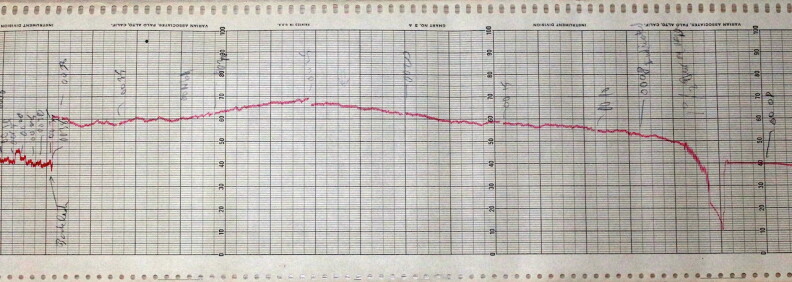
Chart paper from Frank Drake’s Project Ozma observation( Nadia Drake)
The team used a chart recorder – an instrument that uses a pen to draw squiggles that correspond to a signal on a roll of paper. They used it to track any cosmic blips that would indicate that cosmic greeting and a loudspeaker to let them know if there was anything worth listening to.
But there was silence. Frank didn’t find that strange land he hoped to find as a kid. Our galaxy, it seemed, was quiet.
And we were alone.
The experiment, however, wasn’t considered a failure. It marked the first time anyone conducted a Search for Extraterrestrial Intelligence – the beginning of the era of SETI.
The Drake Equation
A year after Project Ozma, Frank Drake was asked to convene a meeting by the National Academy of Sciences specifically about the search for life, at the same observatory he used to carry out that groundbreaking search. It was a new field of study. So Frank invited everyone he knew interested in the topic – that turned out to be about a dozen people.
Despite the small size, Frank needed to make the most of the conference. He sketched out an agenda he thought might be worth discussing over the next three days.
“When he looked at the list of discussion topics, he realized that if he organized them in the form of an equation,” said Nadia Drake. “He just wrote down his meeting agenda in the form of an equation, just put it on the chalkboard, and that kicked off everything.”
The formula aimed to calculate the number of detectable civilizations in the Milky Way Galaxy. It would be known as the Drake Equation and it single handedly shaped the trajectory of efforts to search for life beyond our own planet.
Frank Drake poses in front of white board with the Drake Equation( SETI Institute)
The Drake equation isn’t something you can solve – at least not yet. It’s an estimation of just how many civilizations might be out there. It “tells you how many detectable civilizations there are in the Milky Way galaxy based on the values that you put in for seven variables, and you're just going to multiply all of these variables together,” said Nadia Drake. When you do, you get N, or the estimation of the number of civilizations in the galaxy.
The Drake Equation as written is:
N = R* × fp × ne × fl × fi × fc × L
The first variable R* is the rate of new star formation – how many new stars are born each year? Variable fp is the fraction of those stars with planetary systems, ne is the number of planets per system with an environment suitable for life. The fraction of suitable planets on which life appears is fl, and fi is the fraction of those planets on which intelligent life emerges. The final two variables are fc – the fraction of civilizations that develop technology that produces a detectable signal and L – the average length of time such civilizations produce those signs of life.
“You can kind of see how you're starting with something that's really very big, and just breaking it into smaller and smaller things: stars, planets, life, intelligence, technology,” said Nadia Drake. “You end up multiplying it all together, and you get this number that tells you how many detectable civilizations there are. We know there's at least one.”
That’s us. Planet Earth. Human beings. N is greater than or equal to 1.
When Frank Drake wrote that equation in 1961 there was only one variable that he kind of knew the value to – that was the rate of formation of stars. Everything else would have been just a guess.
But since 1961, our understanding of the equation’s variables have increased exponentially.
“We now know the answers to some of those questions pretty well,” said Josh Colwell, a planetary scientist and dean of the College of Sciences at the University of Central Florida.
“We know how many stars are in the Milky Way galaxy, we know a pretty good census of what kinds of stars there are.. We know a lot more now than we did even a few decades ago about how many planets there are,” he said. “So, with a whole bunch of those parameters we’ve got actual numbers that we really know what they are.”
The confirmation of exoplanets has been the biggest driver in getting a better answer to the Drake equation. Exoplanets are planets outside our solar system that orbit other stars — that’s the variable fp that asks the fraction of stars that have planets.
Scientists have found thousands of exoplanets (planets outside our solar system) throughout the galaxy. (NASA/Goddard Space Flight Center )
In the time of the formation of the Drake equation that confirmed number was zero. It was just a hypothesis that there were other planets orbiting other stars. But now, some 65 years later, scientists have confirmed over 6,000 and are now pretty confident that every star has planets.
So when you look up tonight at all those stars in the sky, imagine each of those stars having a handful of planets orbiting it.
In our Milky Way Galaxy Alone, there are billions of stars. That means there are trillions of planets. Surely there’s got to be one that’s just like ours — one with the potential to harbor life. Maybe one that’s at a distance from its star that’s not too hot or not too cold. One that has oceans, oxygen, and plants. One that has living organisms just like ours.
With that many potential planets, why haven’t we found anyone yet?
Where are they?
That vast contradiction is highlighted in what’s known as the Fermi Paradox. Quite simply, it asks: where is everyone?
There are a number of reasons why we haven’t found anyone yet. Maybe there are plenty of civilizations out there, they just haven’t figured out a way to travel to us yet. Or maybe it’s just a quiet time in galactic history. There also could be civilizations out there that just don’t want to be found.
“Or maybe civilizations never actually get to that point,” where they can travel to other star systems, said Colwell. “That gets to this concept called the Great Filter, which says something happens that prevents life from getting to the point where it could colonize the galaxy, so to speak.
The Fermi Paradox seems like a buzzkill for anyone searching for life outside our own planet. Some argue it should be taken with caution — it comes to a cast conclusion using limited observations. It’s like saying alligators don’t exist because you live in Colorado and never saw one in your backyard. Well they do exist. And as a Floridian I’ve seen plenty in my backyard.
Still, thousands of scientists are hard at work, each day, scanning the skies for any signs of life out there and chasing the day that they may one day hear something.
To those people, the Fermi Paradox is not a discouragement. It’s a call to action and underscores how important these efforts are to collect more data and eventually break the silence.
In 1960, during Frank Drake’s listening experiment, his team thought they heard something. And for that brief moment, Drake thought he made the discovery of a lifetime. He recalled that moment in an interview with the SETI Institute decades later.
“When you see that, and you think you're sure you have detected another civilization, you feel a very special emotion. It is different from all other emotions” he said. “I can't really describe it to you, but it's an emotion of elation, in a sense, that you are now part of some much greater world of knowledge and activity, and you have sort of gone through a door into a world of new facts, phenomena, creatures that populate our universe. It's a very powerful motion because you sense that what you're seeing is going to change all of history, and I think for the better.”
Trailer: When We Find Them podcast
Sep 11, 2026
Show notes
“When We Find Them” is a new limited podcast series from Central Florida Public Media that looks at our search for life in the universe and the not so finished plan to tell the world what we find.
We’ll look at our current efforts to search for life, the protocols in place to confirm such an extraordinary finding, and look at how we – as humans – may react when our entire worldview changes.

 Our TOPPODCAST Picks
  Stay Connected