Show notes
SUSANNE BARD:
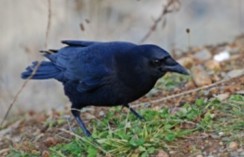
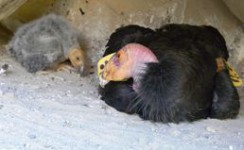
25 years ago, the California Condor was nearly extinct. An intensive captive breeding program saved the species. But young condors released into the wild don’t have many experienced birds to show them the ropes. For instance, the birds bring animal bones back to their nests to provide their chicks with much-needed calcium. But captive-bred condors often substitute other hard objects like bottle caps and glass, which can kill the chicks. This according to Mike Wallace of the San Diego Zoo Institute for Conservation Research.
MIKE WALLACE (San Diego Zoo Institute for Conservation Research):
They breed wonderfully, hold down territories, but when they start feeding the young they bring back to the nest what presumably they think is calcium in the form of bones. But they go after anything that is small, hard, catches their eye, and the chicks don’t know anything different.
SUSANNE BARD:
Wallace and his team are teaching young condors the difference between bones and trash before they’re released into the wild. And they’ve replaced manmade objects outside the birds’ nests with bone to put that training into practice.
MIKE WALLACE:
Young birds that don’t have any cultural transmission from their true parents in the wild, they’re learning as they go and so they’re picking up bad habits and trying to break those habits.
It seems to be changing in the culture of the condors over time.
SUSANNE BARD:
The condors face many other hazards when they’re released back into the wild, for instance, wind turbines. Wind power offers a green alternative to fossil fuels. But collisions with turbines often kill passing birds. So the condor biologists are teaming up with energy companies to minimize the risk. Wallace says one solution involves attaching GPS transmitters to condors.
MIKE WALLACE:
We’re designing a transmitter that will go on the wing of the bird and it’s going to alert the office as to the position of the bird in relation to the wind turbine. So as the bird comes towards the turbines, if it’s 15 miles out, we’ll get a weak alert letting us know there’s a bird coming in the direction. As it gets to 10 miles and 5 miles the alerts will become more critical, and even to the point of shutting down turbines if the bird is heading right in that direction. So in this case the transmitter will be working as an early alert system for the birds getting into danger and then we can change our behavior.
SUSANNE BARD:
He says warning lights and sounds and could also be deployed to encourage the bird to fly in another direction. He and his team are planning to test the system in Baja, California in the coming months.
BOB HIRSHON:
Thanks, Susanne. Drivers of the future may fill their gas tanks with clean-burning fuel derived from marine algae. Scientists have overcome a major hurdle that had hampered large-scale commercial production of the fuel. Scripps Institution of Oceanography marine biologist Mark Hildebrand says when algae are growing well, they produce carbohydrates instead of the lipids, or oils, needed for biofuels.
MARK HILDEBRAND (Scripps Institution of Oceanography):
And it’s only when they stop growing that they have excess carbon to deal with, and then they start to make the lipids, and so it’s just as a human if you were to eat a big meal and sit on the couch afterwards, you would start to accumulate lipids, if you went outside and exercised, you’d be burning carbohydrates, so it’s actually directly analogous to that.
BOB HIRSHON:
Their team altered gene expression in the algae so they burn up less of the lipids they’ve already accumulated while still maintaining growth. That will allow the algae to produce much more of the fuel than previously possible. (music sting)
BOB HIRSHON:
Some animals such as jellyfish and fireflies produce their own light. Scientists have harnessed these properties in the service of biomedical research. Now, they’ve unscrambled the unique chemistry of another glowing creature – a marine worm. Susanne has that story.
SUSANNE BARD:
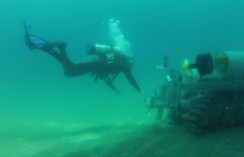
Divers in coastal waters may be surprised by a brilliant blue glow on the seafloor. The light is produced by the parchment worm, which lives inside small brown tubes, secreting bioluminescent mucus when disturbed, according to Scripps Institution of Oceanography marine biologist Dimitri Deheyn.
DIMITRI DEHEYN (Scripps Institution of Oceanography):
As a diver, if you press on those tubes you will suddenly see this bluish mucus that will spew out of those tubes, and that comes from the worm. The worm produces a blue bioluminescence, which is also magical, and it diffuses out in the water you see this cloud of blue light.
SUSANNE BARD:
He says bioluminescence is caused by a reaction between two chemicals, like cracking a glowstick.
DIMITRI DEHEYN:
Animals that produce light have tiny itty bitty glowsticks in their cells. In general, the light is produced by an enzyme called a luciferase, and a compound called a luciferin, and the enzyme will react with the luciferin, and it’s only once those two are mixed together they will charge each other and because nature says that you cannot be in an unstable state, molecules will try to go back to their basic energy level and they will release light.
SUSANNE BARD:
Deheyn says most bioluminescent invertebrates, like fireflies, produce light in brief flashes. But the Chaetopterus parchment worm can glow for up to 27 hours at a time.
DIMITRI DEHEYN:
We discovered some essential aspects of the chemistry, showing that the chemistry is different than anything that has been described so far. The worm uses a chemical reaction that does not follow the conventional chemistries. It uses compounds that we have a hard time to identify because they’re new compounds.
SUSANNE BARD:
He and his team are trying to uncover the secrets of the worm’s bioluminescence so they can recreate it in the lab.
DIMITRI DEHEYN:
Ultimately, we want to regenerate light in the laboratory, we want to be able to have it in a test tube.
SUSANNE BARD:
Once they do that, it could be useful in biomedical research, for instance, by visualizing gene activity. (music sting)
BOB HIRSHON:
Thanks Susanne. People suffering from achromatopsia are blinded by daylight, and can only see at night. But an unlikely animal could help them out – the armadillo. Susanne investigates how the lowly animal’s poor vision is helping researchers unravel the genes behind blindness.
SUSANNE BARD:
Armadillos are nearly blind. They lack brain cells called cones, which are necessary for seeing well during the daytime.
CHRISTOPHER EMERLING (University of California, Riverside):
If you startle an armadillo, they’re just as likely to run into a tree as avoid it.
SUSANNE BARD:
That’s UC, Riverside evolutionary biologist Christopher Emerling. He and his colleagues have discovered that the ancestors of armadillos developed a number of genetic eye mutations millions of years ago, when they lived deep underground to avoid predatory dinosaurs.
CHRISTOPHER EMERLING:
When we looked at the cone pathway, what we noticed was that at every single step along the way, every single one of the genes was inactivated, meaning it had debilitating mutations that ultimately prevented cones from working.
SUSANNE BARD:
He says the finding could help humans with similar eye disorders, which may be caused by the same cone cell mutations. For instance, if gene therapy improves vision in armadillos, it could then be tried in humans.
CHRISTOPHER EMERLING:
So you might look at an armadillo think, oh, that’s just Texas roadkill or something like this, but this organism might be actually be useful in helping to restore sight to some individuals.
SUSANNE BARD:
He adds that sloths and anteaters also inherited the cone cell mutations from an ancestor they shared with the armadillo, and have very poor vision as well.
The post LIFE ON THE EDGE appeared first on Science Update.

 Our TOPPODCAST Picks
 Stay Connected