Episode 40 - Memorizing Facts vs Using Information with Dr. Jared Cooney Horvath
May 02, 2019
Show notes
Episode 40 - Memorizing Facts vs Using Information with Dr. Jared Cooney Horvath
Learning Scientists
This episode was funded by listeners like you. For more details on how to help support our podcast and gain access to exclusive content, please see our Patreon page.
Listening on the web? You can subscribe to our podcast to get new episodes each month! Go to our show on iTunes or wherever you get your podcasts.
In this episode, Cindy Nebel interviews Dr. Jared Cooney Horvath (@JCHorvath), neuroscientist and educator affiliated with University of Melbourne and author of Stop Talking Start Influencing: 12 Insights From Brain Science to Make Your Message Stick. During the interview, they discuss how we take information in, and how do we use it, or transfer it to new situations. Jared Cooney Horvath is a cognitive neuroscientist with expertise in human learning, memory, and brain stimulation. In 2018, Dr. Horvath co-founded LME Global, a mission-driven company serving teachers, students and schools through applied learning sciences. To learn more, visit www.lmeglobal.net.
Episode 39 - Bite-Size Research on Awareness of Evidence-Based Practice
Mar 21, 2019
Show notes
Episode 39 - Bite-Size Research on Awareness of Evidence-Based Practice
Learning Scientists
This episode was funded by the Chartered College of Teaching, and listeners like you. For more details on how to help support our podcast and gain access to exclusive content, please see our Patreon page.
Listening on the web? You can subscribe to our podcast to get new episodes each month! Go to our show on iTunes or wherever you get your podcasts.
In this bite-size research episode, Megan describes a paper by Kayla Morehead and colleagues (2016) about student and instructor knowledge about evidence-based study strategies. This episode is a follow-up to the last bite-size research (Episode 37). If you haven’t listened to that one, we recommend you listen to it first!
Reference:
Morehead, K., Rhodes, M. G., & DeLozier, S. (2016). Instructor and student knowledge of study strategies. Memory, 24, 257-271.
Episode 38 - A (pseudo) Randomized Control Experiment about Teaching Effective Learning Strategies
Mar 08, 2019
Show notes
Episode 38 - A (pseudo) Randomized Control Experiment about Teaching Effective Learning Strategies
Learning Scientists
This episode was funded by the Chartered College of Teaching, and listeners like you. For more details on how to help support our podcast and gain access to exclusive content, please see our Patreon page.
Listening on the web? You can subscribe to our podcast to get new episodes each month! Go to our show on iTunes or wherever you get your podcasts.
In this episode, Megan and Cindy talk about their massive research project at Washburn University investigating the effectiveness of an intervention to teach first-year college students effective study strategies. The Project is huge, but asks an important question: how can we teach students to utilize strategies that we know are effective on their own to improve learning and academic success. We know these strategies work, we just don’t know a whole lot about the best way to help students learn about them and then transfer the use of the strategies to their own studying.
In a huge pseudo-randomized control trial at Washburn University, we taught half of the WU 101 students (a first-year seminar course) about effective learning strategies. In our first wave of data collection during the 2017-2018 school year, we found that first-generation college students actually had a lower GPA in the intervention group compared to the control, while non-first-generation college students had a higher GPA in the intervention group compared to the control.
NOTE: we have to say this with extreme caution! We need to replicate this finding before we decide to run with it. If we do replicate this during the 2018-2019 school year, future research will need to examine why this happened. Note, we’re not saying the strategies don’t improve learning in first-generation students. Instead, it’s possible that this interaction did something that led the students to perform slightly worse in courses! This could be because the intervention didn’t explain the strategies, or that first-generation students were overwhelmed, perhaps they didn’t know how to use the strategies strategically. There are a lot of potential reasons to investigate. Of course, this result could also be a fluke, and we need to replicate. (And honestly, we hope it is a fluke, but the data are the data!)
While this finding is disappointing, and we certainly don’t want to hurt any specific group of students, this highlights the importance of the research and control groups. It is best to test things out before implementing them widely!
Episode 37 - Bite-Size Research on Learning to Learn Effectively
Feb 20, 2019
Show notes
Episode 37 - Bite-Size Research on Learning to Learn Effectively
Learning Scientists
This episode was funded by the Chartered College of Teaching, and listeners like you. For more details on how to help support our podcast and gain access to exclusive content, please see our Patreon page.
Listening on the web? You can subscribe to our podcast to get new episodes each month! Go to our show on iTunes or wherever you get your podcasts.
In this bite-size research episode, Megan describes a paper by Dr. Jennifer McCabe (2011) investigating whether students understand what learning strategies are most effective, and whether we can teach this to students.
Reference:
McCabe, J. (2011). Metacognitive awareness of learning strategies in undergraduates. Memory & Cognition, 39, 462-476.
Episode 36 - Carolina's Research on CPD and Service Learning
Feb 06, 2019
Show notes
Episode 36 - Carolina's Research on CPD and Service Learning
Learning Scientists
This episode was funded by the Chartered College of Teaching, and listeners like you. For more details on how to help support our podcast and gain access to exclusive content, please see our Patreon page.
Listening on the web? You can subscribe to our podcast to get new episodes each month! Go to our show on iTunes or wherever you get your podcasts.
In this episode, Megan interviews Carolina about her research on CPD sessions, Service Learning projects aimed at teaching students to utilize effective learning strategies, and the start of TILE.
Episode 35 - Implementing Effective Strategies
Jan 30, 2019
Show notes
Episode 35 - Implementing Effective Strategies
Learning Scientists
This episode was funded by the Chartered College of Teaching, and listeners like you. For more details on how to help support our podcast and gain access to exclusive content, please see our Patreon page.
Listening on the web? You can subscribe to our podcast to get new episodes each month! Go to our show on iTunes or wherever you get your podcasts.
In this episode, Megan and Althea discuss things to keep in mind when trying to implement evidence-based learning strategies into your classroom.
We start out with a brief description of the six strategies for effective learning. If you haven’t listened to previous episodes yet, we recommend going back to the first set of episodes, 1 through 13, to hear more about each strategy in depth. The purpose of the review is to provide a bit of spaced practice!
Some tips to keep in mind:
Don’t try to implement all of the strategies all at once or all of the time.
Don’t try to overhaul your entire course! Start with small changes and see how it goes. You can keep making little changes with each iteration of the course.
Remember, each strategy works because it encourages processing that promotes learning. So, implementing these strategies are all about encouraging useful processing. When looking from the outside, two groups of students can look like they’re doing the exact same thing, but in reality one group may be doing something useful and the other not. Using the strategies in the classroom also won’t always look the same.
Episode 34 - An Introduction to our Team in 2019!
Jan 16, 2019
Show notes
Episode 34 - An Introduction to our Team in 2019!
Learning Scientists
This episode was funded by the Chartered College of Teaching, and listeners like you. For more details on how to help support our podcast and gain access to exclusive content, please see our Patreon page.
Listening on the web? You can subscribe to our podcast to get new episodes each month! Go to our show on iTunes or wherever you get your podcasts.
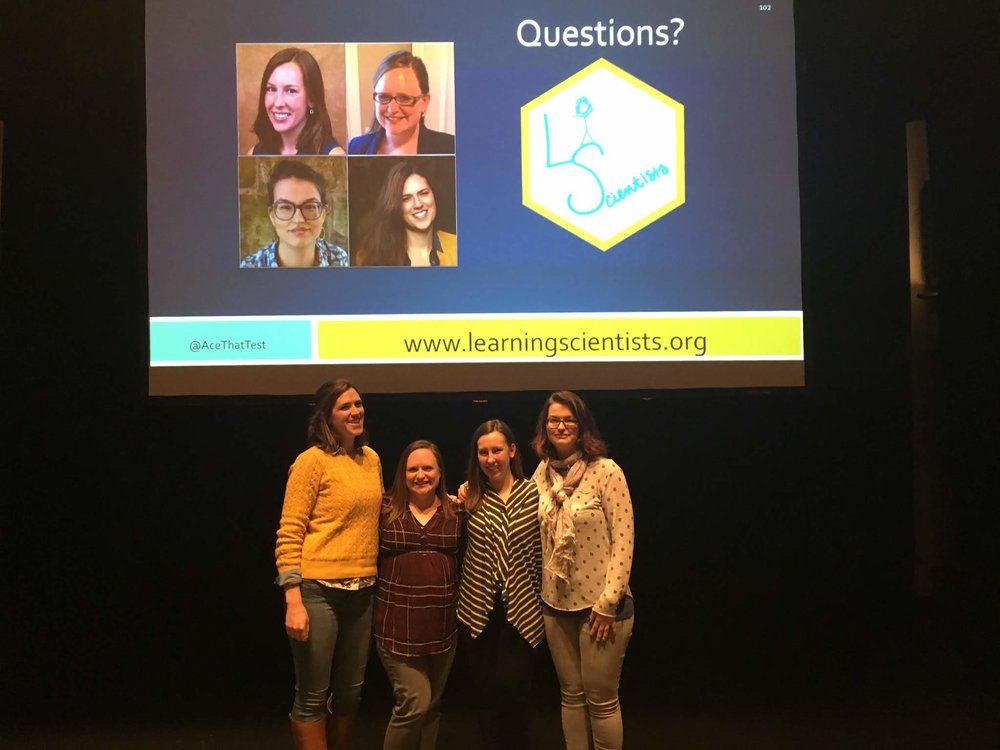
We’ve got some exciting things happening in 2019! Listen as Megan, Cindy, Althea, and Carolina discuss our workshops during our England 2019 tour, and the excitement around talking with teachers about the science of learning.
The team in Bedford, England - January 2019
Episode 33 - Bite-Size Research on Using Laptops to Take Notes
Dec 19, 2018
Show notes
Episode 33 - Bite-Size Research on Using Laptops to Take Notes
Learning Scientists
This episode was funded by the Chartered College of Teaching, and listeners like you. In today's episode, we feature one of our patrons, David Handel and his flashcard app iDoRecall.com. For more details on how to help support our podcast and gain access to exclusive content, please see our Patreon page.
Listening on the web? You can subscribe to our podcast to get new episodes each month! Go to our show on iTunes or wherever you get your podcasts.
This is a bite-size research episode, where we briefly describe research findings on a specific topic. This week, Megan talks about research findings showing that taking notes with a laptop in class can lead to less learning than taking notes by hand.
The research paper, published by Mueller and Oppenheimer (2014), reports 3 experiments examining learning after taking notes by hand or taking notes on laptop computers. Importantly, the laptop computers were disconnected from the internet, and only allowed the students to take notes on them eliminating distraction. Even still, taking notes by hand led to more learning across all three studies. The researchers found that students tended to type a lot more when they took notes on the computer compared to what they could write while taking notes by hand. Typing out a transcription of the material is likely what is causing less learning; when students take notes by hand, they often cannot write everything and must put the material into their own words. However, even when the students in the experiment were instructed not to transcribe the material while taking notes, and were asked to put the material into their own words, they still typed a lot more while taking notes on the laptop than when taking notes by hand. Even with this instruction, performance on an assessment later was better when the students took notes by hand.
References:
Mueller, P. A., & Oppenheimer, D. M. (2014). The pen is mightier than the keyboard: Advantages of longhand over laptop note taking. Psychological Science, 25, 1159-1168.
Episode 32 - Attention, Learning, and Memory with Althea Kaminske
Dec 05, 2018
Show notes
Episode 32 - Attention, Learning, and Memory with Althea Kaminske
Learning Scientists
This episode was funded by the Chartered College of Teaching, and listeners like you. For more details on how to help support our podcast and gain access to exclusive content, please see our Patreon page.
Listening on the web? You can subscribe to our podcast to get new episodes each month! Go to our show on iTunes or wherever you get your podcasts.
In this episode, Megan interviews Althea at the Psychonomic Society Conference in New Orleans, LA. (Note, we’re in the conference hotel, and so you can sometimes hear some street noise!!) Althea is conducting research with students on learning and distractions of cell phones and exercise and learning.
Episode 31 - Bite-Size Research on Retrieval Practice and Complex Content
Nov 21, 2018
Show notes
Episode 31 - Bite-Size Research on Retrieval Practice and Complex Content
Learning Scientists
This episode was funded by the Chartered College of Teaching, and listeners like you. For more details on how to help support our podcast and gain access to exclusive content, please see our Patreon page.
Listening on the web? You can subscribe to our podcast to get new episodes each month! Go to our show on iTunes or wherever you get your podcasts.
In our last episode, Yana interviewed Alexander Chamessian, an MD PhD student who has been consistently utilizing evidence-based learning strategies. In this bite-size research episode, Yana follows up with a study on retrieval practice with complex medical information.
In this study by scientists at a department of Health and Kinesiology (1), students taking an exercise physiology re-read or practiced retrieval practice on background texts and journal articles, and then took critical analysis and factual texts. The debate between John Sweller (2) and Jeff Karpicke (3) on whether retrieval practice works with complex materials can be found in this special issue.
The following table shows the phases in the experiment:
Image from Dobson, Linderholm, & Perez (2018)
The main result can be found in this figure:
Image from Dobson, Linderholm, & Perez (2018)
References:
(1) Dobson, J., Linderholm, T., & Perez, J. (2018). Retrieval practice enhances the ability to evaluate complex physiology information. Medical Education, 52, 513-525.
(2) Van Gog, T., & Sweller, J. (2015). Not new, but nearly forgotten: the testing effect decreases or even disappears as the complexity of learning materials increases. Educational Psychology Review, 27, 247-264.
(3) Karpicke, J. D., & Aue, W. R. (2015). The testing effect is alive and well with complex materials. Educational Psychology Review, 27, 317-326.

 Our TOPPODCAST Picks
  Stay Connected