Today, we are talking about concrete examples. Abstract ideas and concepts are harder to remember than those that are concrete (1). One way of getting around this issue is to use concrete examples to illustrate abstract ideas. For a concrete example of a concrete example, see this post.
Surface features vs. underlying concepts
Novices will tend to focus on the surface features of the examples you give them. For example, if you show novices examples of different physics problems, they will group together the problems that look similar, rather than those that actually are similar in terms of the underlying structure (2) - see this blog post.
When Megan taught her first class as a graduate student, in one class she gave her students candy to demonstrate operant conditioning, specifically "positive reinforcement". At the end of the semester, students just remembered that she gave them candy - not the concepts she was trying to demonstrate with the candy!
How many examples?
Giving multiple examples with different surface features will help students understand the underlying abstract idea better than if you just give them the abstract idea with its definition, and better than if you give them the abstract idea and just one example. See this blog post for a discussion of why we need to use multiple examples (3), (4).
Making the link
But, it's not enough to just give students all of these examples. Due to the "curse of knowledge", we as teachers might feel that it is obvious how the examples connect to the abstract ideas. It's important for us to also make the link between the concrete examples to the abstract ideas. We, as teachers, need to make this link explicit, explaining why and how the examples illustrate the abstract concepts. We can also point out which specific features of the examples match up to the abstract concept. Otherwise, we risk the students only remembering the concrete example itself, and not how it relates to the abstract idea itself.
We hope you enjoyed this podcast! Check back in 2 weeks, when we’ll be releasing a “bite-size research” episode describing an interesting paper on concrete examples.
(1) Paivio, A., Walsh, M., & Bons, T. (1994). Concreteness effects on memory: When and why? Journal of Experimental Psychology: Learning, Memory, and Cognition, 20, 1196-1204.
(2) Chi, M. T. H., Feltovich, P. J., & Glaser, R. (1981). Categorization and representation of physics problems by experts and novices. Cognitive Science, 5, 121-152.
(3) Gick, M. L., & Holyoak, K. J. (1980). Analogical problem solving. Cognitive Psychology, 12, 306-355.
(4) Gick, M. L., & Holyoak, K. J. (1983). Schema induction and analogical transfer. Cognitive Psychology, 15, 1-38.
Episode 9 - Bite-Size Research on Interleaving Categories
Dec 20, 2017
Show notes
Episode 9 - Bite Size Research on Interleaving Categories
Learning Scientists
This is a bite-size research episode, where we briefly describe research findings on a specific topic. This week, Yana talks about interleaving while trying to learn how to categorize things.
In the last episode, we talked about the research on interleaving. The idea behind interleaving is that students might switch up their studying so that they are not studying the same idea or concept for a long time, but instead are alternating the material they are studying. Mainly, the benefits that we discussed come from studies of motor learning (1) or problem solving (2). So, we talked about studies where students were given math homework based on one type of problem, or math homework with problems from different areas that required different approaches to solve them (2).
In this episode, Yana talks about a different type of learning that has also been shown to benefit from interleaving: learning which items are part of one category, and which are part of another. Earlier research on this topic looked at how people learn to classify paintings by different artists (3), or different types of birds into a taxonomy (4). In these studies, students aren’t interleaving problem solving or retrieval practice. Instead, they are just studying examples from different categories. And in these studies, interleaving examples from different categories generally helps the learner extract the main features of each category.
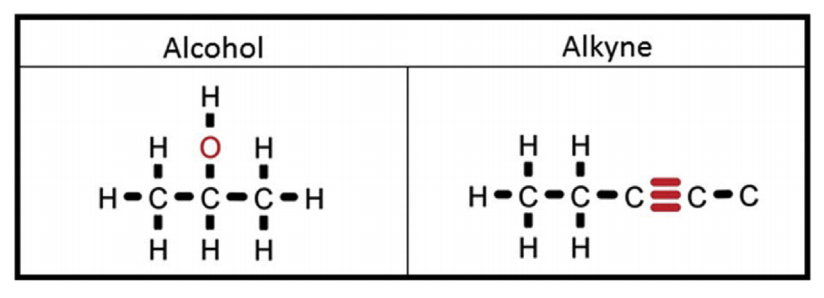
The set of studies described in this episode (5) applied this type of design to students learning chemistry. In this set of experiments, students studied visual representations of chemicals, as shown below. Each diagram shows the structure of the elements, and how they form the chemicals.
Image from Eglington and Kang (2017)
They saw 12 examples of chemicals in each of 5 categories - 60 examples in total. Then, when they came back two days later, students were shown new visual representations from these 5 chemical categories, and were asked to determine which category they fit into. What differed between the two groups of students was whether the examples from the 5 categories had appeared interleaved or blocked during the study phase. Those who had seen the chemicals interleaved during study got an average to 85% on the categorization quiz 2 days later, compared to only 71% in the blocked condition. In a follow-up experiment with more complex materials, students who interleaved performed at 65% and students who blocked performed at 49% on the later test, showing the same pattern of results. The authors also found that participants in the interleaving group outperformed those in the blocking group even when both groups were given cues about similarities and differences between categories.
This type of learning - that is, learning how to categorize visual representations of chemical elements - may seem quite basic, but it is actually very important for those who want to go on and study chemistry in more depth. For example, knowing which chemicals belong to which category is essential to understanding how the chemicals interact. And, the same can be said for any subject: knowing the basics is essential to later understanding of more complex abstract ideas.
Tune in over the next two months to learn about the remaining two strategies, concrete examples and dual coding!
(1) Shea, J. B., & Morgan, R. L. (1979). Contextual interference effects on the acquisition, retention, and transfer of a motor skill. Journal of Experimental Psychology: Human Learning and Memory, 5, 179-187.
(2) Taylor, K., & Rohrer, D. (2010). The effects of interleaved practice. Applied Cognitive Psychology,24, 837-848.
(3) Kornell, N., & Bjork, R. A. (2008). Learning concepts and categories: Is spacing the “enemy of induction”? Psychological Science, 19, 585-592.
(4) Tauber, S. K., Dunlosky, J., Rawson, K. A., Wahlheim, C. N., & Jacoby, L. L. (2013). Self-regulated learning of a natural category: Do people interleave or block exemplars during study?. Psychonomic Bulletin & Review, 20, 356-363.
(5) Eglington, L. G., & Kang, S. H. (2017). Interleaved Presentation Benefits Science Category Learning. Journal of Applied Research in Memory and Cognition, 6, 475-485.
Episode 8 - Interleaving
Dec 06, 2017
Show notes
Episode 8 - Interleaving
Learning Scientists
Today, we are talking about interleaving. Be sure to listen to our spaced practice and retrieval practice episodes, as those are the most important strategies!
Interleaving is a learning strategy that involves switching between topics and ideas, which has been shown to improve long-term learning relative to blocking study of the same idea or topic (1). We recently spoke with a 12-year-old student in the UK, who described a similar strategy that he uses, and called it "jumbling it up". We loved this term so much, that we wrote a blog post about it!
Early research in interleaving focused a lot on motor skills (2), but more recently there has been renewed interest in this strategy as it applies to problem-solving, for example in maths (3), as well as how it applies to music (4). In the podcast, Yana talks about an adorable concrete example of interleaving involving her 5-year-old daughter who was trying to interleave addition and subtraction problems.
Interleaving might work because it helps students learn to distinguish between concepts and learn when to apply which strategy (5). Machine learning studies have also attempted to simulate the processes involved in interleaving (6). However, there is still much we do not know about interleaving! For example, while we know that it's not worth interleaving completely unrelated material from different subjects (7), we don't yet know exactly how related the interleaved material should be, or what effect interleaving has on attention. Yana recently submitted a grant proposal with Dr. Sophie Forster at Sussex University to explore these unanswered questions.
We hope you enjoyed this podcast! Check back in 2 weeks, when we’ll be releasing a “bite-size research” episode describe an interesting paper about interleaving.
(1) Taylor, K., & Rohrer, D. (2010). The effects of interleaved practice. Applied Cognitive Psychology, 24, 837-848.
(2) Shea, J. B., & Morgan, R. L. (1979). Contextual interference effects on the acquisition, retention, and transfer of a motor skill. Journal of Experimental Psychology: Human Learning and Memory, 5, 179-187.
(3) Rohrer, D., Dedrick, R. F., & Stershic, S. (2015). Interleaved practice improves mathematics learning. Journal of Educational Psychology, 107, 900-908.
(4) Carter, C. E., & Grahn, J. A. (2016). Optimizing music learning: Exploring how blocked and interleaved practice schedules affect advanced performance. Frontiers in Psychology, 7.
(5) Rohrer, D. (2012). Interleaving helps students distinguish among similar concepts. Educational Psychology Review, 24, 355-367.
(6) Li, N., Cohen, W. W., & Koedinger, K. R. (2012, June). Problem Order Implications for Learning Transfer. In ITS (pp. 185-194).
(7) Hausman, H., & Kornell, N. (2014). Mixing topics while studying does not enhance learning. Journal of Applied Research in Memory and Cognition, 3, 153-160.
Episode 7 - Bite-Size Research on Elaborative Interrogation
Nov 15, 2017
Show notes
Episode 7 - Bite-Size Research on Elaborative Interrogation
Learning Scientists
This is a bite-size research episode, where we briefly describe research findings on a specific topic. This week, Megan Sumeracki talks about elaborative interrogation with middle school students.
In the study Megan describes (1), elaborative interrogation worked well for students who were working independently, and with a partner. In this study, 6th and 7th grade students learned two types of science facts: those that were consistent with their prior knowledge, and those that were inconsistent. An example of a consistent or unsurprising science fact from their research is "the larger an animal is, the more oxygen it needs to live". But take, for example, this fact: "the sun is made up of every color, including blue and violet". This type of fact might be more surprising to students. The study looked at how elaborative interrogation impacted learning of both types of facts.
The students worked either independently, or in pairs - and in one of the following three learning conditions: 1) Elaborative interrogation: answering the question "why is that fact true?" and using their class materials to help. 2) Select their own study strategy: students were told to study the facts in whatever way they think will help them learn them best, and think back to strategies that have worked in the past. 3) Read the information for understanding, out loud.
Learning was assessed both immediately, and 60 days after the study session. Learning in pairs versus independently did not make a difference, but students who practiced elaborative interrogation learned more than those in the other two learning conditions. This was true both for facts that were consistent, and those that were inconsistent with prior knowledge. Importantly, this learning was durable - 60 days after the study session, students who practiced elaborative interrogation still performed best. It's interesting to note that students who selected their own study strategy did not better than those who just read for understanding.
Here's an important caveat to the findings: the quality of the elaborative interrogation answers mattered. Students performed best when they produced an adequate response to the question. However, producing an "inadequate" response was still better than providing no response at all. And finally, studying in pairs did not lead to a larger number of adequate responses than studying alone.
So far, we’ve covered retrieval practice, spaced practice, and elaborative interrogation in our podcasts. Over the next three months we’ll be talking about interleaving, concrete examples, and dual coding!
(1) Woloshyn, V. E., & Stockley, D. B. (1995). Helping students acquire belief-inconsistent and belief-consistent science facts: Comparisons between individual and dyad study using elaborative interrogation self-selected study and repetitious-reading. Applied Cognitive Psychology, 9, 75-89.
Episode 6 - Elaborative Interrogation
Nov 01, 2017
Show notes
Episode 6 - Elaborative Interrogation
Learning Scientists
Today, we are talking about elaboration. Be sure to listen to our spaced practice and retrieval practice episodes, as those are the most important strategies!
Elaboration is a really broad concept - at its core, it just means connecting or adding information. "Elaborative interrogation" is a strategy within this broad idea, and it involves asking “how" and “why" questions and finding those answers (1). Students can do this independently, with the teacher helping, or in pairs of groups. Once they come up with the questions, students must also find the answers!
For example, how might you learn about the physics of flying? You could do it by answering lots of fact-based questions, but you can also supplement this by asking and then answering elaboration questions, such as "why does a plane need an engine?" and "how does a plane take off?"
Elaborative interrogation can be a tricky strategy to implement, because students won’t always focus on the right information, or have the content knowledge necessary to carry out the task effectively. In the podcast episode, we use lots of examples from younger and older students, demonstrating how hard it can be to pick out the right information to ask questions about, or even come up with “how” and “why” questions at all.
Students may also produce incorrect explanations in answer to their own questions. Elaboration has been shown to help students who are more familiar with the topic, while those who are less familiar don’t benefit as much (2); some studies (3) have even found elaboration to be less effective than re-reading, when students are unable to produce useful elaborations (see this guest blog post). Teachers will need to guide students towards the right kinds of questions, and give feedback on explanations.
Ideally, students would be able to describe and explain ideas from memory - that is, retrieval practice using elaborative interrogation!
We hope you enjoyed this podcast! Check back in 2 weeks, when we’ll be releasing a “bite-size research” episode describing an interesting paper on elaborative interrogation.
(1)Pressley, M., Symons, S., McDaniel, M. A., Snyder, B. L., & Turnure, J. E. (1988). Elaborative interrogation facilitates acquisition of confusing facts. Journal of Educational Psychology, 80, 268-278.
(2) Woloshyn, V. E., Pressley, M., & Schneider, W. (1992). Elaborative-interrogation and prior-knowledge effects on learning of facts. Journal of Educational Psychology, 84, 115-124.
(3) Clinton, V., Alibali, M. W., & Nathan, M. J. (2016). Learning about posterior probability: Do diagrams and elaborative interrogation help? The Journal of Experimental Education, 84, 579-599.
Episode 5 - Bite-Size Research on Spaced Retrieval
Oct 18, 2017
Show notes
Episode 5 - Bite-Size Research on Spaced Retrieval
Learning Scientists
This is a bite-size research episode, where we briefly describe research findings on a specific topic. This week, Yana Weinstein talks about combining spacing and retrieval practice.
In Episode 2 we introduced retrieval practice, and in Episode 4 we introduced spaced practice. We are often asked whether these effective strategies for learning are only applicable to fact learning - at a recent workshop with K-12 teachers, we were asked:
What do these strategies do to students’ abilities to make inferences, apply what they know, and think creatively?
Megan responded to this question with a blog post aptly entitled "Retrieval and Spaced Practice Sound Great, but Are They Just for Memorization?". In this episode, I continue answering that question by describing the results of a study on spaced retrieval practice that looked not only at performance on factual questions. but also on higher-order (application) questions (1). The goal of this study was to extend the already huge evidence for the benefits of spaced retrieval practice to a situation where students were engaging in what they called higher-order learning.
The take-away points from this study are that spaced retrieval practice works not only in basic lab studies, but can also work in highly realistic classroom settings. Also, spaced retrieval can help not only memory of factual information, but also performance on more complex application questions. Thus, a very simple tweak in the timing of students’ retrieval practice can have a measurable impact on later performance.
Next month, we’ll continue by talking about Elaboration.
(1) Kapler, I. V., Weston, T., & Wiseheart, M. (2015). Spacing in a simulated undergraduate classroom: Long-term benefits for factual and higher-level learning. Learning and Instruction, 36, 38-45.
Episode 4 - Spaced Practice
Oct 04, 2017
Show notes
Episode 4 - Spaced Practice
Learning Scientists
Today we’re introducing spaced practice - spacing out studying the same information over multiple sessions rather than cramming it all into one (1).
What is spaced practice?
We talk about how the idea is really simple in theory, but harder to implement. The benefits of spaced practice have been demonstrated in many domains, from fact learning (2), to problem solving (3), and even to musical instrument learning (4). We also talk about how the benefits of spaced practice appear on a delayed test rather than an immediate test (5).
For more about how spaced practice can be helpful and instructions for how to implement it during studying, see this blog post.
How can we get students to space out their learning?
It's hard! You can try to help students set aside blocks of time to study: first have them log how they spend their time for a week, and then have them look for times in their schedule that they could dedicate to studying. Even if they only plan to study 5 minutes each day, that's infinitely more than 0 minutes! You might want to use a time log to use with your students to help them plan for spaced practice. On the podcast, we describe our own attempts at implementing spaced practice in our real lives - with variable success.
If your students need help forming intentions and sticking to them - don't we all? - you can share this guest post with them.
Implementing spaced practice in the classroom
Since it is quite difficult for students to independently engaged in spaced practice, teachers might consider providing students with opportunities for spaced practice as part of the mandatory classroom experience. If you're really planning ahead, you can try to break up the topics you're teaching and space them all out throughout the semester - but this is tricky (though see here for a resource digest full of ideas for spaced teaching).
A lighter approach to introducing spacing is to give students an opportunity to practice the information you've taught at a later date, for example by implementing "lagged" homework. In this system, homework on a given topic is given a few weeks after the topic is taught.
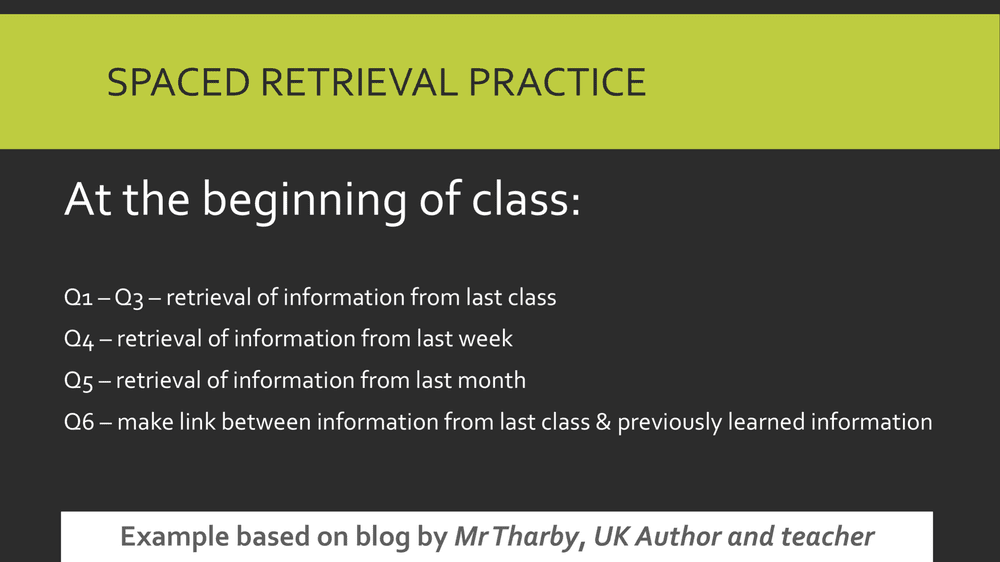
Another idea is to combine spaced practice with retrieval practice, providing students with in-class opportunities to retrieve information from previous classes. A teacher in the UK proposed the following method:
We hope you enjoyed this podcast! Check back in 2 weeks, when we’ll be releasing a “bite-size research” episode describe an interesting paper on spaced practice.
(1) Ebbinghaus, H. (1913). Memory (HA Ruger & CE Bussenius, Trans.). New York: Columbia University, Teachers College. (Original work published 1885). Retrieved from http://psychclassics.yorku.ca/Ebbinghaus/memory8.htm
(2) DeRemer, P., & D'Agostino, P. R. (1974). Locus of distributed lag effect in free recall. Journal of Verbal Learning and Verbal Behavior, 13, 167-171.
(3) Grote, M. G. (1995). The effect of massed versus spaced practice on retention and problem-solving in High School physics. Ohio Journal of Science, 95, 243-247.
(4) Simmons, A. L. (2012). Distributed practice and procedural memory consolidation in musicians’ skill learning. Journal of Research in Music Education, 59, 357-368.
(5) Rawson, K. A., & Kintsch, W. (2005). Rereading effects depend on time of test. Journal of Educational Psychology, 97, 70-80.
Episode 3 - Bite-Size Research on Retrieval Practice Formats
Sep 20, 2017
Show notes
Episode 3 - Bite-Size Research on Retrieval Practice Formats
Learning Scientists
This is our first bite-size research episode, where we briefly describe research findings on a specific topic. This week, Megan Sumeracki talks about retrieval practice.
In our second episode, we introduced retrieval practice or bringing information to mind. We know from a century of research that retrieval practice improves learning. There are a lot of ways to practice retrieval, and this strategy seems to be very flexible and can be used in a lot of different ways.
One easy way to implement retrieval practice in the classroom is to give students frequent low-stakes or no-stakes quizzes. But the next natural question is, what retrieval format should I use?
The two most common formats are short-answer and multiple-choice formats. Some research shows that short-answer quizzes improve learning more than multiple-choice quizzes because they require the students to produce the answer (1). Yet often multiple-choice quizzes are easier to administer and to grade, and we know this is very important for busy teachers. So what to do? (Spoiler alert, based on my honors thesis and the work of others, the format does not have a huge impact on learning. The important thing is to make sure students practice retrieval in some way.)
In 2005, Park (2) created a hybrid format to try to combine the benefits of short-answer and multiple-choice formats. Sixth-grade students would first try to answer a question in short-answer format, and then could click a "next" button for the multiple-choice alternatives to select the correct answer. The catch is that the multiple-choice alternatives only show up for a brief amount of time. So, the students really had to try to produce the answer before clicking next. Park found that the hybrid quiz led to a little bit more learning than a standard multiple-choice quiz after a few days.
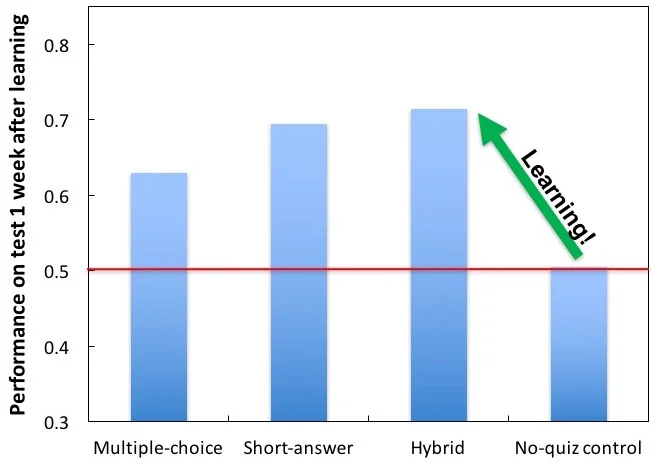
In 2008, I was really interested in quiz formats and decided to conduct my undergraduate honors thesis on this topic at Purdue University. In my experiments (3), students were randomly assigned to one of a few different conditions, and each condition was assigned a different retrieval-practice format. Some students answered multiple-choice questions, some answered short-answer questions, and others answered hybrid questions. Finally, some students were in a control group where they didn't answer questions at all. All of the students read a text, took a quiz (except the control group), and then read statements containing the correct answer to all of the quiz questions. One week later, we gave the students an assessment test.
My thesis advisor and I found that retrieval practice, regardless of format, improved learning over the control group.
Data from Smith & Karpicke, 2014 (3) Experiment 4
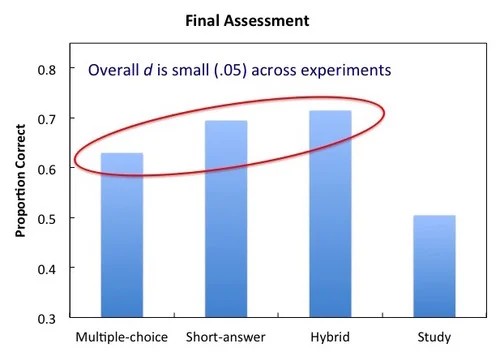
However, we also found that the type of retrieval format didn't really much matter. Across 4 experiments, any differences we found between retrieval formats were really pretty small.
Data from Smith & Karpicke, 2014 (3) Experiment 4
At first, my advisor and I were really surprised by this! But after doing a very systematic review of the literature and conducting 4 experiments of our own, it seems that the retrieval practice format does not have a huge effect on learning. Others have found little to no difference between retrieval practice formats (e.g., 4, 5, 6). In another paper that was published after mine, researchers found that there weren't format differences among younger middle school students (7).
Main Takeaway:
Retrieval practice improves learning, and we can be pretty sure of this based on a century of research. However, the type of format you use is not likely to make a huge difference to learning.
You can read a blog based on this research here. You can find the published paper containing my honors thesis experiments here. We hope you enjoyed this bite-size research podcast! Check back on the first Wednesday of next month, when we’ll be releasing a podcast about spaced practice.
(1) Kang, S. H. K., McDermott, K. B., & Roediger, H. L. (2007). Test format and corrective feedback modify the effects of testing on long-term retention. European Journal of Cognitive Psychology, 19, 528-558.
(2) Park, J. (2005). Learning in a new computerised testing system. Journal of Educational Psychology, 97, 436-443.
(3) Smith, M. A., & Karpicke, J. D. (2014). Retrieval practice with short-answer, multiple-choice, and hybrid tests. Memory, 22, 784-802.
(4) Clariana, R. B., & Lee, D. (2001). The effects of recognition and recall study tasks with feedback in a computer-based vocabulary lesson. Educational Technology Research & Development, 49, 23-36.
(5) Williams, J. P. (1963). Comparison of several response modes in a review program. Journal of Educational Psychology, 54, 253-360.
(6) Gay, L. R. (1980). The comparative effects of multiple-choice versus short-answer tests on retention. Journal of Educational Measurement, 17, 45-50.
(7) McDermott, K. B., Agarwal, P. K., D'Antonio, L., Roediger, H. L., & McDaniel, M. A. (2014). Both multiple-choice and short-answer quizzes enhance later exam performance in middle and high school classes. Journal of Experimental Psychology: Applied, 20 , 3-21.
Episode 2 - Retrieval Practice
Sep 06, 2017
Show notes
Episode 2 - Retrieval Practice
Learning Scientists
Today we’re introducing retrieval practice – in other words, bringing information to mind.
How does retrieval practice help learning?
Retrieval practice is beneficial in many ways. The more obvious way is that doing something like a practice quiz can help you figure out what you don’t know. That’s one example of an “indirect” benefit of retrieval practice: figuring out what you know and what you don’t know leads you to do something that causes learning.
But, lots of studies have also shown direct effects of retrieval practice: the act itself of bringing information to mind makes it more durable. For more on the various direct and indirect benefits of retrieval practice, see this post.
Later on in the podcast, you'll hear about how retrieval practice can be good for application of knowledge to new situations – not just fact learning. For more about how retrieval practice can help with complex and novel situations, see this post. Retrieval practice can also help with anxiety! (2)
Do students practice retrieval on their own?
The answer is no. While students often do use quizzes as a check of how much they've learned, very few of them list retrieval practice as their go-to study strategy (1). Why not? Well, it’s hard. While doing retrieval practice, it can feel like you don’t know much – and that feels bad. This leads students to be underconfident after practicing retrieval, compared to overconfident after re-reading. For more on this illusion, see this blog post about predicted and actual learning.
Megan tells an anecdote about students who come to her office and say they studied and studied – why didn't they do well? It’s probably because they didn't use effective study strategies!
Another reason why students may not practice retrieval as often as they should is that the benefits of retrieval are delayed. Retrieval is better in the long-run - it produces durable learning - but it might not feel like it’s “working” while students are actually doing it.
How can teachers integrate retrieval practice into their classrooms?
There are many different ways for students to practice retrieval – it doesn’t have to be with a formal quiz or test. Yana’s colleague, Dr. Miko Wilford, likes to play Jeopardy with her students to help them get ready for exams. You can also do starter or exit questions, which can be low or even no stakes. You can ask students to write from memory, answer open-ended questions, draw from memory, and even create concept maps from memory(3). Be careful with having students create their own questions, though – it may not be worth it(4). Prompting questions might also help – though not always (but at least, they shouldn’t hurt). See this blog post for Megan’s recent study on retrieval practice with prompts (5).
Students actually really like frequent quizzing once they get used to it. Megan and Dr. Cindy Nebel (formerly Cindy Wooldridge) recently went to Columbus State Community College to talk to instructors there, and one of the professors, Felicia Smith, talked about giving daily quizzes in some of her classes, and how students who’d experienced this reacted when they took her other classes in which she didn’t use daily quizzing.
It’s a good idea to tell students why you are including so many quizzes. This helps students understand that we’re not just doing this to be mean to them! Dr. Althea Bauernschmidt always tells students:
"I quiz because I care."
(For Althea’s latest guest post on our blog, see here).
What about flashcards?
Flashcards can be a good way for students to practice retrieval on their own, but they have to make sure they are doing it properly: actually trying to retrieve, rather than just flipping the card. A group of students in Yana’s class recently claimed that making flashcards rather than using them to practice retrieval was what helped them learn. You’ll have to listen to the podcast to find out what happened with that hypothesis!
Image from Pixabay
For a different twist on flashcards, see this method described by college student Rachel Adragna, which goes beyond using flashcards for retrieving key terms and definitions –encouraging students instead to think more deeply and in new ways about the information they’re trying to learn.
One last thing: Students should not stop studying when they think they’ve learned the information. Repeated retrieval, even after retrieval success, is critical for long-term learning (6), (7).
We hope you enjoyed this podcast! Check back in 2 weeks, when we’ll be releasing a “bite-size research” episode describe an interesting paper on retrieval practice.
(1) Karpicke, J. D., Butler, A. C., & Roediger, H. L. (2009). Metacognitive strategies in student learning: Do students practice retrieval when they study on their own? Memory, 17, 471-479.
(2) Smith, A. M., Floerke, V. A., & Thomas, A. K. (2016). Retrieval practice protects memory against acute stress. Science, 354, 1046-1048.
(3) Blunt, J. R., & Karpicke, J. D. (2014). Learning with retrieval-based concept mapping. Journal of Educational Psychology, 106, 849-858.
(4) Weinstein, Y., McDermott, K. B., & Roediger, H. L. (2010). A comparison of study strategies for passages: Re-reading, answering questions, and generating questions. Journal of Experimental Psychology: Applied, 16, 308-316.
(5) Smith, M. A., Blunt, J. R., Whiffen, J. W., & Karpicke, J. D. (2016). Does providing prompts during retrieval practice improve learning? Applied Cognitive Psychology, 30, 544-553.
(6) Karpicke, J. D., & Roediger, H. L. (2008). The critical importance of retrieval for learning. Science, 319, 966-968.
(7) Karpicke, J. D. (2009). Metacognitive control and strategy selection: Deciding to practice retrieval during learning. Journal of Experimental Psychology: General, 138, 469-486.
Episode 1 - Welcome to the Learning Scientists Podcast!
Sep 05, 2017
Show notes
Episode 1 - Welcome to the Learning Scientists Podcast!
Learning Scientists
Welcome to the Learning Scientists Podcast – a podcast for teachers, students, and parents about evidence-based practice and learning.
In this episode, the two of us – Dr. Yana Weinstein (UMass Lowell) and Dr. Megan Sumeracki (formerly Megan Smith; Rhode Island College) – introduce ourselves and tell you a bit about our backgrounds, how we came to start the Learning Scientists project, and what we’ll be talking about on this podcast.
About Us
Yana was born in Russia, grew up in England, spent a bit of time in France, and moved to the US in 2008 – first to St. Louis, MO (to do a postdoc at Washington University in St. Louis with Roddy Roediger), and then to Boston 5 years ago to start her faculty position at UMass Lowell.
Megan has lived in the United States her entire life. She grew up North of Chicago, went to Purdue University for her undergraduate education, Washington University in St. Louis for her Masters, and back to Purdue for her PhD. She then took a 1-year position at Utah State University Eastern, before settling into her position at Rhode Island College.
So, we met at Washington University in St. Louis 8 years ago, but we didn’t really work together at the time. A year and a half ago, however, everything changed as we re-discovered each other on Twitter and launched the Learning Scientists project.
The Learning Scientists project
Originally, we started searching for students who wanted help studying. Did you know that once every few minutes, someone tweets asking “how to study”? See for yourselves! To learn more about how the project emerged spontaneously from our Twitter interactions, see this story.
With the help of Samuel Sumeracki, a strategic communication expert – and now, Megan’s husband! – we started a website and blog. Our first blog post was called Communication Breakdown Between Science and Practice in Education. We got a variety of responses to this blog post, and in the past 18 months we’ve learned a lot and realized that we were somewhat naïve when we started the project and wrote that post. See here for our 1-year reflection post, where we elaborate on how the project evolved from that first post.
The Lab to Classroom model
In this first podcast episode, we discuss our experiences in the classroom, and debunk one of the myths surrounding cognitive psychology and education: that we only collect data in the lab. We do, in fact, start in the lab; but then, we build our way up to the classroom.
For an example of the lab to classroom model in practice, see this blog post.
Six Strategies for Effective Learning
Image by Oliver Caviglioli
In this podcast, we’ll be focusing on 6 strategies that have the most evidence supporting their effectiveness. Here are the 6 strategies, with links to our dedicated page for each strategy, where you can find posters, blog posts, and other free downloadable resources:
For more about the 6 strategies, see this blog post. Recently, we’ve been discussing these strategies with teachers and students. One of the 12 year olds we talked to in the UK even co-authored a blog post with us!
For the next 6 months, we’ll be taking one of these strategies in turn and presenting research evidence as well as implementation ideas, and hopefully providing even more opportunities for teachers, students, and parents to interact with us.
Speak to you soon!
You can leave a comment here, on any of our blog posts, and join us on Twitter and Facebook. Also, check out the FAQ page and submit your questions through the form at the bottom of that page. Check out this digest for all the different ways you can get in touch with us. We’d love to hear from you.

 Our TOPPODCAST Picks
  Stay Connected