Why Your Facebook Ads Aren’t Converting (And How to Fix It Without More Content or Spend)
Apr 08, 2026
Lucy didn’t have a traffic problem. She had a conversion problem.
Her ads were getting clicks. People were watching. Some were even opting in.
But very few were buying.
If that sounds familiar, you don’t need better ads. You need a better conversion system.
In this post, I’ll show you why most Facebook ads don’t convert and what to fix first.
What is a Conversion Rate?
Understanding conversion rates will help you assess if your ad types and ad copy are effective. You want your audience to perform the desired action after interacting with your Facebook Ad. They aren’t just there to look pretty.
So, what is a conversion rate? Simply put, it is the percentage of people who convert into a new behaviour after being exposed to an intervention.
In the context of Facebook Ads, it is the number of people who purchase your product, or sign-up for your email list, after being exposed to your ad.
Facebook advertisers do not need to only be concerned with low click-through rates, it is essential that their Facebook Ad conversion rate is also high. Clicks should lead to a specific action and new customers for your business.
Facebook Advertising Benchmarks
One benefit of running Facebook Ad campaigns is access to Facebook Analytics. This powerful tool can lead to high conversion rates by allowing you to assess what is and isn’t working when it comes to converting Facebook users into customers.
Facebook metrics also help set pricing for the site with your advertising cost being tied to social media users’ interaction with your Facebook campaign.
Remember that Facebook takes a variety of factors into account when setting pricing on the site, including your campaign goals, so the prices listed here are average.
Cost Per Click
Cost per click, or CPC, refers to the price per click on your Facebook Ad. The average CPC is $0.94 per click. You can choose to bid on CPC when running your Facebook Ad. Facebook will then attempt to get you the most clicks possible in the budget you set. This can be a great way to generate views for your blog posts or to bring people to a landing page.
Cost Per Mile
Cost per mile, or CPM, refers to the price you pay per one thousand impressions. Where did mile come from? It means thousand in Latin. You are learning language and average cost today!
CPM is a great option to get your ad seen by as many potential customers as possible. When you bid on this advertising option on the social network they will get your ad seen by as many of their millions of daily active users as your budget allows. The average cost is $7.19.
Cost Per Like
Cost Per Like, or CPL, refers to the cost per like your Facebook page receives from your ad. Increasing likes helps build brand awareness. It can also lower costs by increasing the number of people seeing your content outside of sponsored content. It currently averages $1.07.
Cost Per Action
Cost Per Action (CPA) is a choice when running Facebook Ads that will have you paying per your desired action. Once you set your budget and your desired action Facebook will optimize for you to receive as many actions as possible.
This is a better option than just paying for link clicks when your concern is your Facebook Ads conversion rate. The price is $5.47 on average.
Factors Influencing Facebook Ad CPA
Facebook Ads does not charge everyone equally for any of their four price options. A variety of factors are at play. We will take a look at some of them here.
Prospective Customers
The people you are seeking to reach with your ad will affect the cost of the ad. Facebook allows you to narrow the Facebook users seeing your ad to those that fall within the parameters you set.
This prevents you from shooting in the dark at all 25-40 year-olds in the Midwest but rather lets you drill down into only those that share an interest in what you are offering.
For example, if you are offering running shoes it would display to those that are interested in marathons.
This targeting increases the effectiveness of ads but can also come with a price. Not all audiences clock in at the same dollar amount. As you tailor your audience you will see the pricing of your ad change.
Ad Quality and Relevancy
Facebook rewards ads that its users like. They use a variety of metrics to determine whether the ads people see are relevant to them and engaging. The better your ad scores the cheaper it will be to run the ad on Facebook.
To reduce your costs produce good ads. This has the added benefit of enticing customers. Conversions are higher with good-quality ads.
Ad Placement
Where you opt to place your ad within Facebook’s ecosystem will also affect the price of your CPA. Options include choosing to only display your ads on mobile, placing your ads in Facebook newsfeeds, integrated videos, and more.
The abundance of choice lets you select where you can gain the most traction, and conversions, for your business. Though some of these options come at higher price points consider whether the increase in conversions makes up for the increase in Facebook Ads costs.
Why Your Facebook Ads Aren’t Converting
Most people think the problem is:
targeting
creatives
budget
It’s not.
The real problem is this:
👉 You’re asking people to buy after 1–2 touchpoints
Buyers don’t work like that anymore.
They need multiple exposures, angles, and proof before they decide.
That’s where most campaigns break.
How to Increase the Conversion Rates of Facebook Ads
Facebook ads are a powerful tool to drive traffic to your site, but they aren’t magic bullets. To make sure you’re getting the best results possible, follow these tips to boost conversions.
Concentrate On Relevance
With the ability to target your Facebook Ads so precisely comes great responsibility. You want your ads to be seen by people that are interested in what you have to offer. Increase the effectiveness of your ads by targeting them to the right people.
Facebook lets you target your audience based on age, location, gender, interests and more. Assess who your customer is and then go find them on Facebook.
Make Use of Dynamic Ads
Facebook utilizes dynamic ads to show your products to the right people. Facebook automatically show your ad to people who have expressed an interest in what you have to offer whether that be on your website, app, or anywhere else across the internet.
Opting for this targeting is an even narrower form of audience selection. These are not just people who share demographic details with your customers or are interested in things related to your product.
These are people who have already gone through the trouble of interacting with your content outside of Facebook. They are highly primed conversion and are a great value for your Facebook Ad budget.
Do Not Skimp on Quality
Facebook rewards you for creating ads that people like. Advertising doesn’t have to be bleak and salesy. It can be engaging and fun.
If your ad is something that people like and find value in, then Facebook wants it on their platform.
Ways to ensure high-quality ads make quality graphics, including great photos, and writing witty copy.
Write Copy That Emphasizes the Value
Writing good ad copy not only means that Facebook will reward you with more views it can also be a part of creating more sales itself. Your copy should clearly lay out what you are offering and why people should want it.
Emphasizing the value that people receive from choosing you is also best practice. Even those with large budgets do not want to receive less for their money. We all want to receive more for our money.
Lay out in your ad the value they will get from choosing you. In a crowded field, why do I want to opt for you as my wellness coach? Why do you offer the best-knitted ferret jumpers?
Make it clear they will receive a high-quality product at the best possible cost. Highlight any features of what you offer that stand out from the rest.
If possible offer them a bonus. You could run a giveaway for people who sign up for your email list. You could offer free bonus materials if selling a course. The possibilities are endless. What you offer is high value make your potential customer see that.
Keep an Eye on, and Improve Your Campaigns
Facebook’s analytics tools are there for you to take advantage of. Look and see what ads are getting engagement and which aren’t. With the power of the world’s largest social media platform providing performance reports, there is no reason to not see how things are going.
Once you have an idea of which ads perform well you can improve lower-performing ads to be more like the ads that are getting traction. You can also apply those analytics to your Facebook page posts and see which of your regular posts is performing best and consider boosting it or turning it into an ad.
Ad Fatigue Should Be Avoided
People are fickle. They love what you are doing one moment and hate it the next. Familiarity breeds contempt so avoid oversaturating your market with ads. Consider varying the ads so that your market doesn’t become annoyed.
Perhaps worse than annoyance is indifference. If you are running the same ad over and over it can become part of the wallpaper. Your target customers might grow so used to your ad they view it as an extension of the navigation bar.
Vary things up to keep your audience engaged and primed to follow through on your call to action. Keep your branding consistent of course but add interest and spice things up from time to time.
Get Your Creativity on Point
Have fun with your advertising! Get creative. Test things out and see what works. We can’t overstate enough how much Facebook and your audience will value this. Don’t sit on your laurels and let your advertising become boring and stale.
Use Facebook’s analytics tools to see what people like and think about how to deliver more of what the people want without boring the people. Stretch those creative muscles!
Tools to get your creative juices might include upgrading to Canva Pro and really getting in there and creating something fun and new. You could join a Facebook (the irony) group for advertisers to share ideas and look for inspiration there. You could do some good old-fashioned brainstorming. Don’t think too much just write what comes to mind and evaluate after.
Have Very Strong CTAs
Call-to-actions are the words or images that prompt users to click on something. When designing your landing pages, think carefully about your CTA buttons. Do they match the tone of your message? Are they clear and concise? Is the button large enough?
The goal of your CPA Facebook Ad campaign is to get people to perform an action whether it be purchasing something or signing up for an email list. Make sure that that is clearly laid out for them to do in your ad. Be enticing too!
A button that says click here without much else isn’t going to get clicked. Why do people want to sign-up for your email list? Do you offer exclusive content?
Why is your membership good value? Why do they want to purchase your potato warmer out of all of the potato warmers? Use your call to action to clearly highlight what makes what you have to offer so awesome.
How to Monitor Facebook Ad Conversions?
Facebook advertising is a powerful tool for businesses looking to reach customers and prospects. But, like all forms of marketing, it requires constant monitoring and tweaking to ensure maximum results. Here are some tips to help you monitor Facebook Ad conversion rate effectively.
1. Use Conversion Tracking Tools
Conversion tracking tools allow you to track specific actions taken after a user clicks on a Facebook advertisement. They also provide detailed reports showing exactly how much money was spent on ads, how many impressions were seen, and how many clicks resulted in sales.
Knowing these numbers allows you to see how far your money has gone and whether you are reaching your targets with your current spending.
2. Track the Performance of Each Page Post
You can set up conversion tracking for individual posts within your page. For example, if you run a blog, you can choose to track the performance of every single article posted.
This allows you to see which articles perform best and which ones underperform. Facebook offers this same feature for posts on their site. You can see how many people viewed your posts and how many engagements they received.
If you find that a particular post was shared more than others analyze it. What makes it stand out from the crowd? Test your ideas of what made it effective by creating more content. Perhaps you’ll find the secret to going viral.
3. Set Up Custom Audiences
Custom audiences let you target users based on the criteria you define. For example, you can select only users who visited your site last week and clicked on a particular link. Once you’ve defined these parameters, you can build custom audiences based on them.
Defining your audience allows you to focus on people who need, want, or are likely to buy your product or service. No offence to those people who are not interested in what you offer but when it comes to advertising they aren’t worth your time.
You want to hone in on converting people who are ready and willing to buy what you have to offer rather than persuading those whose interests lay elsewhere.
4. Create Remarketing Lists
Remarketing lists allow you to reengage past visitors to your site. When you’re running a Facebook Ad, you can specify which remarketing lists you’d like to display to previous visitors.
Remarketing, simply put, is using cookies to track previous visitors to your website. If they have visited your site not only are they interested in your field they are interested in you specifically. Entice them back to finish the sale by advertising to them after they’ve left your site and navigated across the web to Facebook.
5. Measure the Impact of Ads
Once you’ve created a campaign, you’ll receive daily reports showing how well your ads performed. These reports give you valuable information about your campaign, including clickthrough rates, cost per click, and conversion rates.
You can then continue to tailor what you have done based on this information. If you thought an inspirational quote as a call to action was your ticket to conversions and it wasn’t these numbers will bring this to light. You can then switch your approach to something else after good thinking and try again.
What is a Good Facebook Ad Conversion Rate?
A conversion rate of 1% means that for every 100 people who see your ad, one person clicks through to perform your desired action.
If you want to know what kind of conversions you should be aiming for, look at other businesses that have similar audiences to yours. You should ideally be outperforming the competition to continue to grow your business.
According to Wordstream’s Facebook Ad benchmarks, the average conversion rate for paid Facebook ads across all industries is 9.21%. From this, we could say that a “good” conversion rate for your Facebook Ads should be around 10% or more.
If you are in a particularly difficult or easy market you can adjust your expectations accordingly.
A few industries with conversion rates above the average include fitness, education, employment and job training, healthcare, real estate, and B2B. The fitness industry is doing particularly well with Facebook Ads clocking in at a 14.29% conversion rate.
Industries that have a tougher go of it when it comes to Facebook Ad conversion rates include retail, travel and hospitality, and poor technology clocking in the lowest at 2.31%.
Summary
Facebook Ads are a powerful tool for social media marketers, but they aren’t always effective at creating action. Facebook Ad conversion rates refer to the number of people who perform your desired action as opposed to the number of views your ad received.
These actions are not only sales based but can include page views, video views or collecting contact information. The action you are looking for might be something that will lead to sales at the right time.
Facebook Ads are a powerful tool for businesses looking to reach their target audience. They allow business owners to create custom audiences, track conversions, and even run split tests.
The problem is that these tools don’t come for free. Given that Facebook Ad budgets are not unlimited you want to make sure your digital marketing is leading to conversions.
Conclusion
Facebook looms large in the social media field and that has translated into power in the advertising space as well. Facebook Ads are the medium of advertising on the site. The service is paid for via bidding and the price is based on a variety of factors including whether you are utilising CPC, CPM, CPL, or CPA.
Advertising on Facebook helps you reach your potential clients but you want to ensure that your ads are leading to conversions. People need to not just be seeing your ad but also performing a desired action based on what they are seeing.
This action is not always a sale but can also be something like signing up for a newsletter. There are many strategies for increasing your Facebook Ad conversion rates that we could discuss during a call today.
5 Genuine Goal-Setting Exercises for Entrepreneurs
Jan 22, 2024
Stacy wanted this year to be different but she needed help with her goal-setting exercises.
After looking at what she managed to accomplish over the last 12 months she knew that something needed to change.
Some weeks over the last financial year were downright hairy because of the limited amount of cash flow.
Plus her dream of living on a tropical island for 6 months of the year hasn’t materialised just yet.
If you can relate to Stacy let me know if these points sound familiar.
Setting goals and achieving them can be quite daunting
You’ve rarely ever accomplished the goals that you set in the specific timeframe
Others seem to be better at setting goals but it doesn’t work for you
You have a goal but you are clueless about the steps needed to take action
Wouldn’t it be lovely if there was a realistic way to set achievable goals with action steps as well?
In this resource, you’ll discover a few key secrets that separate the winners from the others.
Join me as we look at a few goal-setting exercises for complete beginners.
The Goal-Setting Process
Before looking at the various goal-setting exercises available for you to use.
It is important to understand the various aspects of the goal-setting process.
Many people make the mistake of looking at the ultimate goal while ignoring the reasons behind that goal.
For example, if you have professional goals like getting a 6-figure deal or having an income of $10k/month why do you need that money?
I’ll tell you why…
It’s because you have a number of personal goals behind those specific goals.
This could range from larger goals like buying a mansion or a sports car to smaller goals like hiring a fitness coach.
At the end of the day, the goal-setting process should start with the realistic goals of improving the quality of your life and the lives of your loved ones.
It’s important that you have a process that walks through the stages by adopting the 7 whys principle. At each stage of the process ask yourself why you want that thing.
Here’s what that looks like…
I want to make $100K a year so that I can
Pay for living expenses so that I can
Buy a beautiful home so that I can
Provide a secure life for me and my family so that I can
Not have to worry about emergencies so I can
Live my perfect day so that I can
Do the things I enjoy
Of course, you can also do this powerful exercise in reverse order.
The most important step is that your focus is on accomplishing the right goal to create a life worth living.
Also, these must be meaningful goals for your future self so that you’ll be motivated sufficiently to accomplish them.
1. Your Perfect Day
A number of years ago I was encouraged to write out in detail what my perfect day will look like.
At the time, I was not a digital nomad or even a virtual assistant.
In fact, I thought that it was a lot of wishful thinking.
With a bit of hesitation, I sat down with a pen and a few sheets of paper.
I scribbled down my perfect day from the time I woke up until the time I went to bed.
Here are a few things I included.
The ideal time for me to wake up each morning
Who I would like to wake up with in my bed
What I did after waking up
The atmosphere and location I’d like to wake up in
Items that I would include on the menu for breakfast
At what time would I check messages and emails
What I would do for work
My working hours and days of the week
Extracurricular activities
Things I would like to do with my loved ones
My downtime routine
What I do at bedtime
Things I do during the day for self-improvement
Although I can’t remember every single thing that I wrote down many years ago, I can tell you that this stuff works.
It’s crazy what happens when you get crystal clear about what you want to include or even exclude from your perfect day.
I’m living some of that dream even today which really amazes me because I really believed that it wasn’t possible to have a perfect day.
2. Vision Boards
Have you ever wondered if creating a vision board will work for you?
I always thought that they were useless until I discovered a dirty little secret.
You must always use photos of actual places, locations, fun experiences and things that you want in your life.
For example, a number of years ago I wanted to get my hands on the Chanel No. 5 perfume.
It looked good in the adverts so maybe it will be good for me too.
To tell you the truth I never walked up to the beauty counter and did a scent test, I just decided to get it.
That bottle of perfume remains on my bathroom shelf many years later because it doesn’t match my body scent.
The most important thing to learn from this lesson is to get crystal clear about what you include on your vision board.
Do a test drive, trial or just try it for a few days because chances are you may not like it.
When next you are creating a vision board get photos of places, things and experiences that you know would work for you.
No more magazine clippings, go try out that mattress, the sofa, the dream destination, etc.
If you like it, include it, if not, move on. Vision boards only work when you get real with your dreams.
3. Mind Mapping
One of my absolute favourite goal-setting exercises is mind mapping.
At first, I just didn’t get what the excitement was about but then one day I came across a great tool called Xmind.
My life changed forever.
Something just clicked and there I was mapping out world domination before sunset.
In case you’ve never done any kind of mind mapping before it’s like writing down your big dream and working backwards to figure out the next steps.
Here’s an example of how it works.
Say you would like to achieve an income of €100K a year. Just look at that number it may seem impossible but let’s break it down.
$100K/year = $8,333/month
What can you do to make $8,333/month?
You can do a split of 3-4 income streams like $2,000 from digital products, $3,000 from client work, $2,000 from UGC and $1,500 from sponsored content.
I have to warn you that the items that you include in the income streams must align with those things on your vision board and your perfect day.
There’s no point in you generating income from things you absolutely dislike.
Mind Mapping Visual Example
Now that you have an idea of what you want to include in a mind-mapping exercise.
Let’s do a practical example.
My favourite free powerful tool that I like to use is one called Whimsical because it’s so easy to use and you can share your mind map with team members.
Always start at the end goal and work your way backwards through the process of achieving that goal.
Here’s a screenshot of the first stages of my mind-mapping process.
Let me explain some reasoning behind why I chose these vehicles for my income streams.
I know that I only have 24 hours in one day so I’ll need some sources of income to be passive and others will need my time and attention.
I’ll also need help creating quite a number of deliverables.
Notice that under the section for digital products, I’ll need to create 1,000 different products for my store.
I already know that I can outsource the product creation process.
Using this method gives me tons of fun accomplishing items.
4. Bucket Lists
One of my favourite and fun goal-setting exercises is the bucket list.
The reason why it’s so much fun is because I use it to cover all 8 areas in the Wheel of Life.
So, it goes beyond entrepreneurial goals.
I’ve used it to cover areas like self-growth, romance, travel, learning a new language, learning a new instrument and volunteering for charity.
If you are one of my regular readers or listeners then you would be familiar with my bucket list.
I created it before the global health crisis so that slowed my progress significantly.
However, I’m so happy to report that I’ve achieved quite a number of the items on that list which is so very exciting.
At this point, you’re probably wondering how many goal-setting exercises you’ll need to achieve your goals.
The answer, my dear, is only one.
I’m giving you a peek behind the scenes of the ones I’ve tried and what I liked or found exciting about each one.
I am also letting you know the dirty little secrets about how to get them to work for you.😉
Notice how each exercise is different in its own way.
Action Plan
Now we are at the point of setting goals where quite a number of people get lost.
This brings me nicely to a famous quote by Greg Reid.
“A dream written down with a date becomes a goal. A goal broken down into steps becomes a plan. A plan backed by action makes your dreams come true.”
Greg Reid
In order for any goal-setting exercise to work we need to ensure that those goals have a plan with steps so that we can take daily consistent action.
This is probably the most scary part of the process.
I remember the time when I had a goal but I had no idea the steps that I needed to take to make that goal a reality.
Sometimes that goal can seem insurmountable when you realise that it can potentially take you 5 years instead of 12 months to obtain results.
Let me give you an example, 10 years ago I knew what a funnel was but I had no idea how to build a high-converting funnel.
In fact, the cost back then was prohibitive.
However, slowly but surely I started that journey into learning about the tech and marketing aspects of creating gorgeous funnels.
I was curious, I was determined and I put in the work.
Now, I can build them in my sleep and I know which platforms are the best to get specific results.
Action Plan Visual Example
As I already mentioned mapping out the steps so that they can be actioned is probably the biggest hurdle for many people.
This is why I don’t want to leave you hanging by not sharing a practical example of effective goal-setting activities.
If you remember I’m using Whimsical to create a mind map of my $100K/year journey.
Let’s dive deeper into one of the areas on the map.
The area I’ll dive into is creating digital products for Shopify and Etsy.
We’ll look at the action steps needed to create one finished product that’s ready to go live.
In this example, we’re looking at creating a pack of 8 brand boards that align with a specific theme like summer or watercolour or something similar.
Notice that the 6 tasks I need to do to take the product from concept to a completed, ready-to-ship version include the following:
Choosing a theme
Ensuring that the original template is in Canva
Do research in Everbee
Further research in Insight Factory
More research using eRank
Outsource the creation to a virtual assistant
Of course, I’ll need to break each step further by giving objectives and dates for each step.
These dates and subtasks can then be transferred into a project management tool like Asana or ClickUp.
However, you can see how comprehensive mind mapping can be.
5. SMART Goals
One of the most popular goal-setting exercises on the planet is the concept of a SMART goal.
What’s unique about the methodology is that it is based on key performance indicators (KPIs) by breaking down important goals into manageable steps or milestones.
The word SMART is an acronym for 5 words used to set long-term goals.
Here’s how it goes…
S – Specific
M – Measurable
A – Attainable
R – Relevant
T – Timebound
In many ways, you can see why using this methodology to set goals can be tangible.
Let’s break down the SMART acronym even further using our real-life example of attaining $100K/year.
Specific
So, we’ve broken down the goal to a monthly figure and added the vehicles (digital products, client work, etc.) we’ll be using to attain the end goal.
What we haven’t done is to break those monthly figures down even further.
Let’s look at the example of being a UGC Creator with two clients per month with an income of $1,500. What does that look like in reality?
On average clients would pay between $200 and $300 for a UGC video, so let’s assume an average of $250/video.
In order to make $1,500 with two clients I’ll need to create 6 videos a month which can be 3 videos per client.
How will I find these clients? Let’s say I do a combination of 50 outbound and inbound marketing activities to land 2-3 clients a month.
So, my specific goal will look something like this…
Acquire UGC clients every month by doing a combination of inbound and outbound activities in my chosen niche.
Measurable
When we add the measurable element to the mix it means that we need to add numbers to the specific goal.
As I already mentioned, it will take about 50 marketing activities in order to acquire these clients.
If you are like me and you only work 4 days a week that will equate to 16 days for marketing activities.
This means that I can apply and/or send pitches to 4 brands a day so that I can reach my client acquisition goals.
So, my measurable goal will look like this…
Acquire 2-3 UGC clients every month by pitching 4 brands a day on Instagram and UGC platforms in my chosen niche to create 6 videos a month.
Attainable
I look at the attainable part of this exercise as a way to do a reality check. I’m basically asking myself can I really do this?
If I have never pitched a single brand before can I really develop the habit of pitching 4 a day?
Am I better off pitching 10 a day for 5 days so that I can have free time to create videos?
As a reminder, I’m also working on other income sources in my business like client work, digital products, YouTube videos, etc.
I think it might make more sense to pitch 50 brands over a 5-day period which will free up my time to do other revenue-generating activities. Think of it as a 5-day challenge every month.
So, my attainable goal will look something like this…
Acquire 2-3 UGC clients by pitching 50 brands over a 5-day period (10 pitches a day) every month using Instagram and UGC platforms in my chosen niche to create 6 videos a month.
Relevant
This is what I like to call a second reality check because it is now asking me why am I doing this in the first place.
It is another way of saying, “Remember why you started”.
The reason why we are doing this is to achieve the BIG goal of $100K/year. This SMART goal is only one of the 5 income sources that we looked at previously.
It will bring in $1,500 a month which contributes to the $8,333/month goal. We should include this in the SMART goal statement so that we don’t forget.
So my relevant goal will look like this…
Acquire 2-3 UGC clients every month by pitching 50 brands over a 5-day period (10 pitches a day) on Instagram and UGC platforms in my chosen niche to create 6 videos a month. Done right this activity will generate $1,500 every month which will help me get to my monthly goal of $8,333.00. It is feasible because brands constantly need fresh, authentic content for their social media campaigns.
By the way, this can also be used for short-term goals as well.
Time-bound
Of course, the most important part of this goal-setting exercise is adding the boundary of time.
When would I or you want to achieve this goal of $8,333/month? This month? At some distant date in the future?
If we don’t have any dates or deadlines then this entire exercise would more or less remain like a master plan on a piece of paper or inside a virtual document that never gets activated.
It would be very similar to a dream that never comes true because we didn’t take action.
Let’s be honest, the scariest part of setting a goal is adding a date.
When we put a date on it then we suddenly break out in sweat and our armpits get uncomfortable.
Nevertheless, it has to be done if we want the results.
So, my time-bound goal will look something like this…
Acquire 2-3 UGC clients every month by pitching 50 brands over a 5-day period (10 pitches a day) on Instagram and UGC platforms in my chosen niche to create 6 videos a month. Done right this activity will generate $1,500 every month which will help me get to my monthly goal of $8,333.00. It is feasible because brands constantly need fresh, authentic content for their social media campaigns. I will start my first day of pitching brands on __/__/__, so that I can get to my first $1,500/month by the end of ___________/_____.
As you can see the ultimate goal is to have a fully comprehensive statement about that single goal to ensure that it is actionable.
Goal-Setting Exercises FAQ
Let’s look at a number of frequently asked questions around goal-setting exercises.
1. What is the first step of goal setting?
The first step of goal setting is to get a clear understanding of why this goal is important to you personally. Look specifically at both your internal and external desires.
Also, perform the 7 Whys methodology to get to a deeper level of your motivation for setting a goal.
2. What are 5 SMART goals?
The 5 SMART goals include the following:
S – Specific
M – Measurable
A – Attainable
R – Relevant
T – Timebound
See a comprehensive breakdown included in this post above.
3. Why must entrepreneurs set goals that are SMART?
I’m going to be a little controversial and say that setting goals that are SMART is not necessarily a must but it does help by associating key performance indicators (KPIs) to determine success.
In other words, by taking these specific actions consistently you’ll increase your chances of achieving your business goals.
4. What is the most important goal of an entrepreneur?
To generate sufficient income to maintain a healthy cash flow and keep your business viable.
Summary
Goal-setting exercises can be difficult and scary however life can be disappointing when you fail to achieve your goals.
Even when you set new goals the next year but still fall short of getting the results you wanted.
I’m intrinsically motivated so I wake up every day excited to get stuff done.
I know that this is not the same experience for everyone because each of us gets motivated in different ways.
Developing new habits in several areas of your life also gives you a new sense of purpose.
Many years ago I felt stuck because I would set goals in a wishy-washy fashion.
At the time I didn’t know the necessary steps I needed to take to achieve my goals.
Today, my life is so different and I feel like a veil has been lifted. The truth is that a veil hasn’t been suddenly lifted.
In fact, I’ve learned a ton of new skills and strategies that I’ve used to earn my first $100,000 online as a virtual assistant and you can do the same too.
The Ultimate Guide to Freelance Marketing Consultant Rates
Dec 18, 2023
Siobhan needed help promoting her small business but she didn’t know what are the current freelance marketing consultant rates.
This is important for her because she didn’t want to pay too much for digital marketing services.
Yes, leads and sales are important to the survival of any business.
Like many entrepreneurs and small business owners, Siobhan prefers spending time doing what she enjoys.
She just was not interested in learning to become a digital marketer herself.
Let me know if you face these struggles like Siobhan.
You need more leads and sales in your business this year
Setting up a 12-month marketing plan is outside your comfort zone
You like showing up on social media but you don’t have a marketing strategy in place
Terms like ROAS, abandon cart emails, CTR, conversion rate, LTV and MRR are way outside your wheelhouse
If only there was a way to figure out the cost of a marketing consultant so that you can include them in your marketing budget.
In this resource, you’ll discover simple strategies to plan, budget and hire your digital marketing strategist to significantly increase your business revenue.
What or Who is a Marketing Consultant?
For the purposes of this resource, a marketing consultant is someone who works alongside a business at a strategic level to lead their marketing plan.
In many cases, a business will hire a marketing consultant to fix issues like underperforming campaigns.
Sometimes they are brought in to help an organisation adopt a more cohesive approach to their marketing strategy.
Ideally, there would need to be a budget set aside for marketing spend and your marketing consultant can oversee how to spend it effectively.
Your marketing consultant should help you get a good return on your marketing spend.
A marketing consultant can look at the historical data from your marketing spend vs results over the last 3-12 months and give you wise insights.
It is important to note that even the best marketing consultants are not magicians.
They don’t have control over external forces, economic factors, market trends or making things go viral.🤣
Social Media Manager vs Marketing Assistant vs Marketing Manager vs Marketing Consultant
Before we look at rates it’s important to understand all the different roles that promote a business.
Let’s spend some time understanding who these people are and what they do.
1. Social Media Manager
Depending on the size of your business you may already have someone who looks after your social media accounts.
Their role would be to develop a plan for the social media channels, write the copy, create the graphics and schedule out the content.
They would also look at the performance of the content and suggest ways to improve the results of their social media efforts.
Another vital role would be to keep up with the latest trends and grow the social media community for the business.
2. Marketing Assistant or Marketing Coordinator
So how does the social media manager differ from a marketing assistant or marketing specialist?
Well, a marketing assistant also known as a marketing co-ordinator does just that they assist. They are not responsible for leading a specific strategy.
In most cases, the business owner makes a plan and the marketing assistant would help implement the plan in the business.
They can create graphics from existing templates, transcribe copy based on what the business owner said and pull + compile the reports for someone else to interpret.
3. Marketing Manager
If you decide to hire a marketing manager in your business here are a few things that you can expect.
They expect to be hired on a full-time basis.
The marketing manager would own, plan and develop the marketing strategy for the business across multiple channels.
It is their responsibility to deliver the results that they promised.
The kind of results that you can expect from a marketing manager will be centred around leads, not sales.
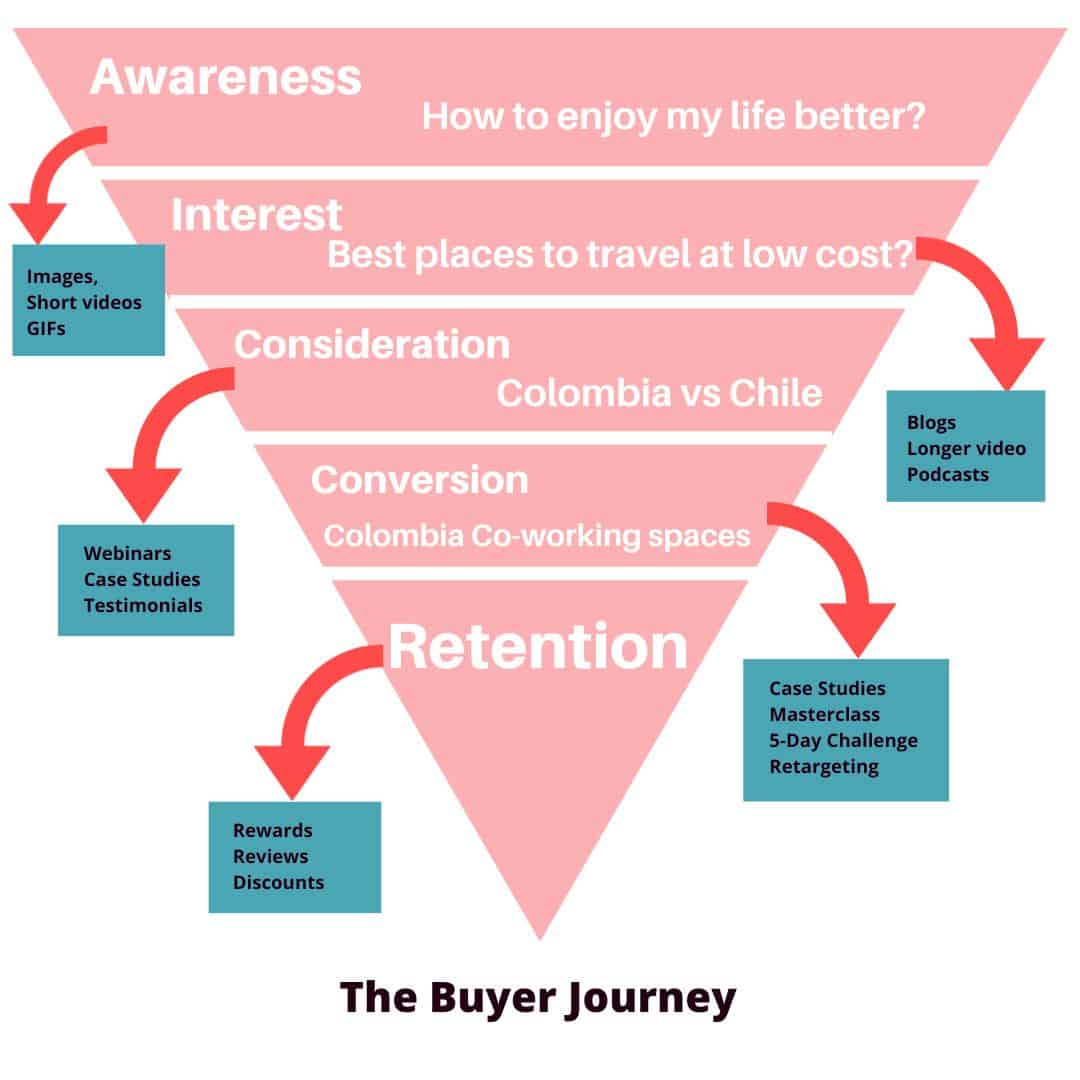
If you look at the typical customer journey where you have awareness, interest, consideration and retention.
The marketing manager is responsible for awareness and interest. However, they assist with the consideration phase where the sale takes place.
4. Marketing Consultant
So, what’s the difference between a marketing manager and a marketing consultant?
As a general rule, the marketing manager is treated like a full-time employee. They don’t work with other businesses, so they are an in-house marketer.
However, the marketing consultant would be more like a freelancer or independent advisor who is brought on for a short time, like 3 months.
They are more objective in their approach to marketing solutions.
Their fees tend to be higher when compared to a marketing manager.
7 Signs That You Need a Marketing Consultant
At this point, you are probably feeling a little bit confused because you are not sure if a marketing consultant is who you need.
Here are 7 clear signs that you need a marketing consultant.
You are looking for someone short-term (3-6 months) to come in and set up an overall marketing plan
Your business online presence includes several organic channels including a blog, several social media channels, YouTube and Pinterest.
There are also paid campaigns across Google Ads, Facebook Ads and TikTok Ads.
Right now everything feels disparate so you are looking for a more cohesive approach to digital marketing
You are not really sure which digital channels are the top contributors to sales, awareness and retention
It would be lovely if you had better visibility into the customer journey from awareness to consideration
You need help improving your offers and product suite in order to go from a 6-figure business to a 7-figure business
Current Freelance Marketing Consultant Rates
So, you’ve come this far because you know for sure that what you need is a marketing consultant.
However, you are not quite sure how much you should expect to pay to hire that person.
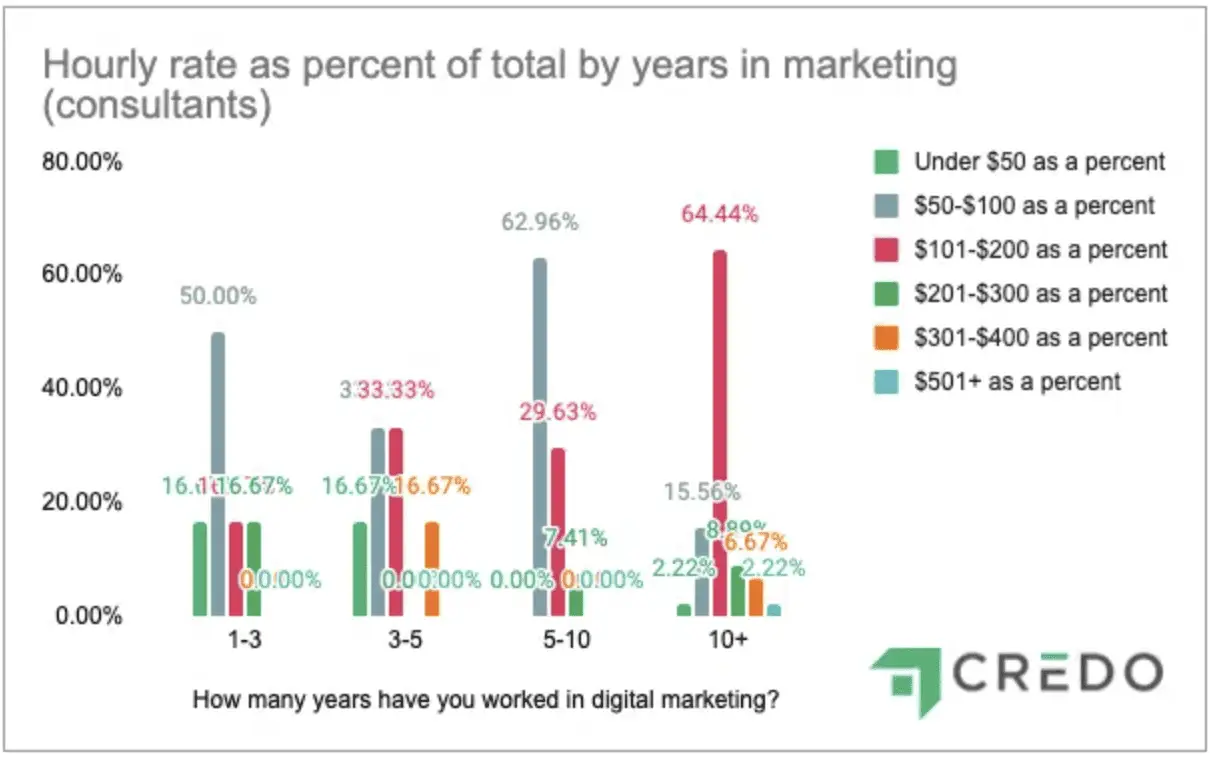
According to a report by Credo, the average hourly rate for a marketing consultant depending on years of experience is $150/hour.
You’re probably thinking that you could only pay them a flat fee of $1,500 a month or maybe even $3,000/month.
However, remember that they will not be as expensive as a regular Marketing Director who has an annual salary of $150,000 a year.
There’s no need to pay a marketing consultant $12,500/month unless you are a multi-million dollar organisation with a team of 100 employees in marketing alone.
The beauty of hiring a marketing consultant on a part-time basis is that you get the impact of their marketing expertise without the ridiculous price tag.
Some, like me, can do project-based fees of $7,500 over a 3-month period.
In fact, other names for these types of marketing consultants include Fractional Chief Marketing Officer (CMO) or Fractional Director of Marketing.
How to Budget for Your Marketing Plan
Now that you know the freelance marketing consultant rates, it’s time to figure out how to make a budget so that you can hire them.
It is standard practice to set aside 20% of sales as part of your marketing budget.
I’ve seen other places online where the figure is much lower because they are saying that it depends on the target audience.
In fact, I’ve seen suggestions of between 2% and 10% of sales.
After working with several businesses over the years what I’ve seen work effectively is a budget that is somewhere between 10% and 25% of sales.
Included in the figure is the cost of hiring team members like a social media manager, copywriter, graphic designer, ads manager, SEO specialist and many more.
By the way, copywriters are not cheap and the work they do is very effective. SEO specialists do require a long-term view of 12 months minimum.
Budget Example
If your business is doing $15,000 a month and you decide to set aside 20% of that figure.
Then you’ll have a monthly budget of $3,000 available to spend on marketing, this will work for a short-term marketing campaign.
By the way, you should be doing 3-4 launches a year on top of your evergreen campaigns which will help you to have a bigger budget for marketing.
Need help improving your evergreen and launch campaigns? Check out my portfolio here to see how I’ve helped other businesses like yours to increase their income.
You can start to exponentially improve your business results just by hiring a Fractional CMO for as little as $500 to $1,000 a month on an as-needed basis.
There’s also the option to hire a good consultant on a project-by-project basis for a flat rate.
Freelance Marketing Consultant Rates FAQ
Well, you probably have a number of questions that you need to clear up before taking the next step.
So, let’s look at the most frequently asked questions that many small businesses have before hiring their first Fractional Director of Marketing.
1. How much should I pay a marketing consultant?
The reality is that it depends on a few factors including:
The skills you need in your business right now
What results you are hoping to achieve
Their experience level
How much budget you have available each month
The quality of work needed
While the average rate is $150/hour there’s also wiggle room to do profit share to sweeten the deal.
2. What is an acceptable marketing budget when considering bringing on a marketing consultant?
There are many sources online that suggest a budget of between 2% and 5% of sales. However, based on my experience you are better off setting aside between 10% and 25% of sales.
The reason for this is that you’ll need to hire a small team to help you implement your marketing plan.
3. What kind of results can I expect from hiring a marketing consultant?
It really depends on why you want to hire them in the first place. What type of work would you like them to do?
Before rushing out and hiring someone to develop and execute marketing plans for your business, spend time thinking about why you want to hire them.
Are you looking to increase sales or leads by 10%, make your brand more loveable, increase market share, get help with an ad campaign or get more visibility around your customer journey?
When you know what you need then you’ll be better able to choose the perfect match for the job because not all marketing consultants are created equal.
Unlike a regular employee, lunch hours, sick days and vacation time will not be a worry for you.
4. What should be included in your marketing budget?
This is a great question because it is so easy to forget all the small things that you need to promote your business.
Here’s a short list of what you should include.
Tools, software and apps
A percentage of utility bills like heat, light, broadband and phone
Employees and freelancers
Ad spend
Memberships and subscriptions
Training
Coaching
Office space
As you can see it is quite easy to forget all the things that go into promoting your business. I always forget the apps and storage. Lol🤣
Summary
As a teenager whenever I heard the name consultant I always thought that the person would charge anywhere between $10,000 and $100,000 for their services.
However, we now live in a society where you can get the help you need to grow personally and professionally for a small fee rather than a king’s ransom.
Yes, the market rate for bigger organisations will be much higher.
While starting a business can be difficult, growing that business exponentially without the proper help can be hard.
I can’t help but giggle at the fact that the number of social media channels to manage is increasing which is quite stressful for entrepreneurs.
Believe it or not, I thought that growing your business from $15,000/month to $100,000/month is difficult.
However, after helping one client achieve this goal my eyes have truly been open.
To put it in a nutshell, it is not as hard as those coaches out there are telling you.
Need help to grow your coaching business? Take a look at my portfolio here and if you like what you see just book a call with me to discuss your requirements.
How to Get Potential Clients Through Cold Email
Dec 04, 2023
Shelley started her business recently and she had a burning question, how to get potential clients through cold email?
As an entrepreneur, you know that it’s important to constantly have cash flow in your business.
Without any consistent income, your business is just an expensive hobby.
The one skill every entrepreneur needs to master is getting sales or clients into their business.
Shelley was keenly aware of this which is why she needed to find a way to master this skill.
Here are three things to consider when you decide to use cold emails as your way of generating leads.
You’ll need a fresh list of people to email every week
Sending out emails that get responses is crucial
Doing this 100% manually can be a daunting task
Nobody likes to be sold to but everyone likes to buy
If only there was a way for Shelley to get proven strategies and resources that work every single time.
In this resource, you’ll discover a number of key elements and insider secrets that you can use to get the results that you need.
Email Marketing Statistics
So, you’re probably wondering why Shelley decided to use cold email as her lead generation strategy.
Well, according to Oberlo, there are 4.3 billion users of email globally and this is set to increase to 4.6 billion in the next few years.
Another surprising statistic from the same source reveals that over 3 billion emails are sent every day.
To put that into perspective, there are 2 billion active users of Facebook daily.
In terms of return on investment, the figures show that you can expect to generate $40 for every $1 spent on emails.
81% of business owners continue to use email as their source of customer acquisition.
Also, welcome emails have the highest open rates at 68.6% when compared to the average email open rate of 19.7%.
Did you know that 49% of consumers said that they like to get promotional emails from their favourite brands weekly?
Based on what you know now about email marketing do you think that Shelley has made a good decision?
List of Potential Clients
One of the toughest things Shelley needs to do before sending out cold emails is to develop a list of her prospective clients.
Have you ever wondered where people find a list of ideal clients?
If you have no idea who your potential client or buyer persona is then it will be more difficult to find them.
So, spend some time developing an avatar of your prospective client before moving to the stage of getting a list.
One of the things to figure out when profiling your ideal client avatar is where you can find them quickly and easily.
When you know who they are and where they spend most of their time then it becomes easier to find them as well as their email addresses.
A number of places where you can find them could include:
LinkedIn
Business website
Instagram
Facebook
3rd Party Publications
Let’s look at ways in which you can develop a solid list of prospects.
How to Get a List of Email Addresses
Broadly speaking there are two ways to generate a list of email addresses.
These two ways are called inbound and outbound.
Inbound involves you leaving a link for people to access a free resource and they’ll need to enter their email address to get it.
Outbound is quite different, you basically need to go and find them and send them a cold email introducing yourself and giving them a reason to respond.
Everyone likes inbound email marketing because it is like if your prospective client raises their hand to get what you have.
However, if you are like Shelley and you’re starting from scratch there are a few ways to get this started.
1. Social Media Hand Raiser
The next time you are publishing content on social media instead of sharing a link publicly ask your prospective client to send you a DM.
If the thought of getting your prospective clients to send you a cold direct message gives you butterflies in your tummy then take a step back.
Imagine you have the perfect solution to their pain point and all they need to do is message you for it do you think that they will do it?
What I like about doing a hand-raising post is that you get instant feedback on whether your messaging is working.
So, say yes to using social networks to help you grow your customer base.
2. Freebie on Website
Another way to get people’s email addresses is to offer a freebie like a lead magnet on your website.
This will need to be something too good to pass up and it should give them a quick win.
You can use the same lead magnet for the handraiser on social media as well as your website.
3. Other People’s List
A really clever way to grow your email list fast is by doing a collaboration with a business owner who does something complimentary to your business.
For example, my zone of genius is tech and funnels. I can team up with someone who does copywriting.
We can put on a shared event together or that person can invite me to do a free masterclass with their audience.
4. Online Research
This is probably the hardest way to find a list of potential clients but it can be done.
You can do a manual search on LinkedIn and find your target audience. For example, if you’re looking to create a list of all the Accountants in the US, you’ll need to do a search on LinkedIn.
When you find them, you’ll need to add each one of them to your list and then find their email address manually.
Yes, there are several 3rd party tools that you can use like Hunter.io or Slik Prospector Chrome extension but they are never 100% accurate.
Once you have a list of first names, last names and job titles you can upload it to a tool like Hunter and they’ll populate the email address for you.
Then download your list of leads ready to do your cold email outreach.
5. Buying a List
A few years ago I was heavily involved in affiliate marketing which involved buying lists.
I cringe every time I think about this because it’s such a terrible way to do business.
However, there is one platform that has made this process non-sleazy by giving you the ability to purchase high-quality B2B emails.
It’s called Lime Leads and it gives you the ability to filter your leads before paying for them and downloading them.
After using these resources you should be able to drum up a list of 1,000 leads.
Cold Email Campaign
If you are like Shelley and you don’t have any experience at all in copywriting or email marketing.
You may be stuck thinking about what to write in your cold prospecting emails.
The world would be quite boring if we were all good at writing email copy.
I have over 20 years of experience sending out cold emails and all I can say to you is that there are so many different methods and templates available.
However, recently I came across one resource that is great for those on a low budget.
It’s priced at $5 and you can also purchase additional cold email templates for $30.
If this sounds like something you would like for your business, grab it here.
When you make the purchase, you’ll notice that it also comes with emails for the follow-up process as well.
Tools for Cold Emailing
Now that you’ve got your list of leads as well as the email copy that you’ll be sending to your potential customers.
You’re probably wondering if there’s a way to efficiently send out these emails to a minimum of 100 people each week.
Maybe you’re ambitious enough and you want to send 50 emails a day.
What should you use?
You’re probably thinking of using Outlook, Apple Mail, Postbox or Gmail.
Is there a way to save your email templates so that you can save time?
Can you track the open rates of the emails you’ll be sending out?
What about the ability to set follow-up reminders after a few days?
There are several tools that you can use to help with these features.
The two popular options include Mixmax and Mailtrack.
Warm Email Campaigns
If you decide to grow your email list using inbound techniques like the handraiser and freebie on the website that I mentioned previously.
You’ll need to have a welcome email sequence to deliver that freebie and then nurture that list with weekly newsletters.
In case you didn’t realise it there are significant differences between warm email templates and cold email templates.
So, it is important for you to decide which one you would like to do and develop your email content to match the right audience.
Yes, you can certainly decide to do both types of campaigns because the warm email campaigns can be set up and automated.
Conversion Rates
If you’ve never done any kind of marketing campaigns, sales outreach, lead generation or anything similar.
You’ll know that it’s all a numbers game if you get all the components right.
Whether it’s a cold email or a warm/regular email marketing campaign there are some key numbers you need to look at to determine if you’re doing it right.
These key numbers include delivery rate, open rates, click rates and sales/conversions (income generated).
There are other analytics as well like unsubscribe rates, bounce rates and spam complaints.
This is not a comprehensive guide on email marketing so let’s focus on what those key numbers should look like.
Delivery rate – 100%
Open rate – 35%
Click rate – 10-15%
Conversion rate – 1% (minimum)
When you are not married to a specific prospect or company here’s what you should be doing.
Take a step back and look at the numbers.
It helps you to focus on what really matters.
In other words, if you only sent 50 cold emails and got no conversions then you’ll know that you just need to send more emails to get to the 1% result.
How to Fix Your Email Results
If you sent out 1,000 emails and your analytics don’t look like the benchmark numbers that I gave you previously.
Here’s what you can do to fix those problems.
Low Delivery Rate
If your delivery rate is less than 90% then there could be a few reasons why this is occurring.
The platform or domain name you are using could be blacklisted or you haven’t built up sending trust. One method to try for a few weeks is sending emails in smaller batches.
For example, if you have 2,000 people on your list you can try sending 100, 300 or 500 emails at a time.
Very Low Open Rate
If less than 20% of people on your list open the email then consider improving your email subject line.
You can test your subject lines by using personalization as well.
Low Click Rates
Potentially one of the areas in an email to get right is the body copy of the email.
It needs to enticing enough so that people will take the desired action that you want them to take.
Believe it or not, a clever way to achieve great click rates is by segmenting your list.
Which in layman’s terms means breaking them down into smaller groups of people interested in a specific product or service.
How to Set Up Your Cold Email Campaign – Step by Step
Now that you have all the pieces that make up the cold emailing puzzle let’s bring it all together in a streamlined step-by-step process.
Bear in mind that you can use any tools and platforms that work best for you to accomplish your business goals.
Step 1 – Choose Your Objective
One of the most important aspects of doing a cold emailing campaign is to decide on your objective.
While you might be thinking that all you want to do is make sales.
You need to remember that cold emailing is part of a big picture called a funnel.
When you first reach out to ‘strangers’ what are you going to do to take them from cold to warm to hot?
Here are a few objectives that you can have.
Invite them to an event
Offer to help them solve a small problem
Give them something for free (a quick win)
Offer them a free trial
An overall special offer
Step 2 – Decide on the Ideal Contact Person
Now that you know what the objective is for your campaign it’s time to decide who in the organisation can benefit from it.
Is it the Owner, Marketing Director, HR Director, COO, Financial Director or someone else?
When you’ve decided on the ideal person to contact write down the reasons why they would be interested.
Also, take note of the ways their life or business can be better after you offer them the thing that you chose as an objective.
Step 3 – Create Templates
The next step in the process is to create 4-5 cold email templates + complimentary subject lines for different scenarios and to test to see which performs best.
Another name for an email template is a sample email.
Also, another 4-5 follow-up email templates because people are busy and they need to be reminded of your offer/event.
As you can imagine, the response rate from cold emailing is not great but some people will respond.
While you may not be good at copywriting the key thing to remember is that your new clients have a problem that you can solve.
You can include their first name in the subject line and/or salutation to create a sense of urgency.
So, focus on the problem as well as how you can solve a small piece of that problem.
Step 4 – Generate a List of Prospects
It’s time to generate a list of your potential clients using the methods I discussed previously.
Or you can use your way of getting that list.
The two fastest ways to create a list of prospects is as follows:
Buying a list of leads from a supplier
Running a paid lead generation campaign to grow a list of new subscribers
When generating this list it’s important to remember your end goal, objective and ideal person.
If you have a list of people who are not your ideal audience then your campaign will not yield the results that you want.
Step 5 – Platform Set Up
Cold emailing can be a very painful and lengthy process if you decide not to include any automation.
Using a few key tools would help you to complete this process more efficiently.
Let’s say that you decide to use a tool like Mixmax for your campaign.
It means that you’ll have the ability to add your cold email templates and follow-up templates inside the platform.
Below, I’ve included an example of a cold email template that I created recently inside Mixmax.
Notice how you have the ability to insert variables depending on your chosen objective.
Step 6 – Set Targets
You’re almost ready to send your first batch of emails but before you do there’s something you need to do.
Set a realistic target of how many people you’ll need to reach out to daily or weekly in order to achieve your end goal.
If you know that you’ll land between 2-3 customers by sending 100 cold emails together with 7-8 follow-up emails then do a calculation.
Let’s say your goal is to generate $10,000 a month from a cold email campaign and each client will be paying you $2,500/month.
It means that you’ll need to successfully send out 200 emails a month in order to achieve that goal.
Step 7 – Send Out Emails
It is difficult to predict which prospects will respond to your cold email aka introduction email.
So, you’ll need to set aside time each day or week to focus on your campaign.
Remember that the majority of success will come from your follow-up emails.
So make time to do the follow-up process to get better results.
Block off time in your calendar and send those emails.
You can use the features in Mixmax to track the performance of your emails like open rates, click rates, etc.
In the follow-up emails, you can also have the option for them to book some time in your calendar to get on a phone call to discuss their requirements in further detail.
A quick hint to get higher response rates is to include a case study or some social proof demonstrating the success of other small businesses.
Frequently Asked Questions (FAQ)
Here’s a list of common questions people have about cold email campaigns.
1. Does cold emailing actually work?
Yes, I did it for many years and it works but it is not the most enjoyable thing that you can do with your life.
However, here are some reasons why it does work.
You are reaching out directly to them via email which feels personal
You’ll be offering them a solution to their problems
There’s very little competition in the area of cold emailing
You’ve got a unique opportunity to build lasting relationships with these people
Including case studies from other small business owners just like them builds trust in your offer
2. How do you find prospects to send cold emails?
There are a number of ways you can achieve this.
You can buy leads from a supplier like Lime Leads
There’s also the option to run a paid lead-generation campaign using Facebook ads.
You can find your leads via LinkedIn
There are also quite a number of paid platforms where you can ‘scrape’ a list of leads full of local businesses.
3. How many cold emails does it take to get a client?
When you send out 100 emails, you should expect to get between 1-3 clients depending on the performance of your content as well as your target audience.
4. Is cold emailing illegal?
Yes and no. Depending on the location of the leads, sending them a cold email can be illegal so please seek professional advice before you start.
5. How do you start a prospecting email?
Be sure to have a subject line with a benefit statement. Include something relevant and relatable about the person or company that shows them that you care.
Include the pain points, why you’re qualified to help and what they need to do to get the help you’ve promised.
Summary
The idea of sending an email out to someone you don’t know can make anyone cringe.
One of the secrets to making this attractive is to think that you have a much better chance of making $10k a month compared to other methods.
The other important thing to realise is that your email recipients don’t like to be sold to but they do enjoy buying.
Your potential leads are going through many challenges and you have the answers so don’t hold back.
There are so many clever tools and platforms that you can use to make the cold emailing process a lot simpler.
How to Get Clients Through Facebook Ads – The Guide
Nov 20, 2023
Nellie sighed, her business has experienced a great level of success over the last 3 years but now she wondered how to get clients through Facebook Ads.
She knows that in order to take her business to the next level and generate the revenue needed to fulfil her dreams.
It was imperative for her to scale her cash flow.
Nellie had about 110 clients on a monthly retainer or subscription.
What would be nice is if she had two new groups of clients.
Project-based clients for VIP day engagements
Consulting clients who needed more high-end services
Have you experienced something similar to these points in your business as well?
You’re making 2-3 sales a week on your signature offer
You are making between $12k and $15k per month consistently
It is your dream to get to $20k and then $50k per month but you’re not sure how
Just recently, I was listening to one of my peers say that they were unsure what to do next to get the results they needed in their business.
In this resource, you’ll learn a simple step-by-step process about how to get clients through Facebook Ads.
Why Facebook Ads?
Before looking at that process, it’s important to understand why Nellie is interested in learning about Facebook marketing.
So, let’s spend some time looking at the latest Facebook advertising statistics.
Facebook currently has over 3 billion monthly active users based on an article from Demand Sage.
According to Hubspot, Facebook Ads reach 62.2% of all Americans from age 13+.
In that same resource, we can see that there are over 10 million active advertisers on the Facebook platform compared to an audience of 2.25 billion in terms of advertising audience size.
That means, only 0.45% of active advertisers compared to the audience size. I’ll let that sink in for a second.
During 2022, Meta generated $113 billion in ad revenue. This means they make $51/person in their advertising audience.
Most users in the US are aged between 25-34.
Facebook is used by 67% of social media advertisers and 25% of marketers say that Facebook has the highest return on investment.
Now that you know this essential information do you think Nellie’s interest in using Facebook Ads for her business is justified?
Ideal Client
No matter how good the Facebook ads statistics appear to be.
It is really important that you answer this question.
Is your target audience hanging out on Facebook? If yes, then it means that Facebook is a great platform to get clients.
Having a clear understanding of who your ideal client is will help you to succeed with Facebook ads.
The reason for this is that one of the most intriguing aspects of Facebook Ads Manager is the ability to choose the right audience.
This is accomplished using a process called audience mining.
A few good examples of this are knowing who your target market follows, what they listen to, where they spend their time online and what apps they use to stay informed.
If you know that they like shopping at Lululemons, own a Peleton and spend winters at Breckenridge in Colorado every year.
Guess what? You can use Facebook audience targeting to find them.
Facebook Page
One of the first things you’ll need to have in place if you want to find clients through Facebook ads is a business page or a Facebook page.
All you need to do to get one is to sign up and complete your details.
You can name the page after yourself or use a business or brand name.
It would be best if you also have a branded email address and a website address.
If you’ve never created a page before head over to your personal profile and click the 9 dots on the top right-hand side.
You’ll see the option to create a page in that menu.
Please note that apparently there are different versions of the platform depending on where you are located so yours may look a bit different.
After creating your page, complete the About section as much as possible.
If you are like me and you have a business that’s 100% online then there’s no need to include a physical address, phone number or opening hours.
Meta Business Suite
After creating your business page you’ll be given access to Meta Business Suite.
It is like the control centre for all your business needs on Facebook.
You’ll be able to upload images and videos to your library so that you can plan, schedule and publish content.
You can link your Facebook page to your Instagram account.
After getting a minimum of 100 likes on your business page, you’ll get access to insights (formerly known as audience insights).
The scaled-down version of this control centre is called Facebook business manager.
If you want to understand the differences between the two platforms you can check out this resource here.
In my experience, you are better off using Meta Business Suite because it has everything you need.
Facebook Pixel
Many years ago when I was a new kid on the block learning about Facebook ads.
I never realised how important it was to help Facebook with audience targeting.
If there is one thing you need to do months or years in advance of running ads is to install your Facebook pixel.
You can use it to track your website visitors.
Here’s why…
The technology that Facebook uses to find leads and buyers for your products and services is extremely good.
Let me show you what I mean in real terms.
A few months ago I started running ads on Facebook to a specific audience.
In that space of time, my ad has been seen by close to 17,000 people and I got over 500 leads from that Adset.
Now imagine if someone gave you a list of 17,000 people and asked you to use it to generate leads for your business.
Will you be excited? Lol!!🤣
Installing your Facebook pixel is not the easiest thing in the world and the process keeps changing.
Rather than going through those steps here please head over to YouTube to get the most up-to-date methods.
How to Find the Right Audience
As I mentioned previously, one of the most important skills that you can develop from running Facebook Ads is the ability to do audience mining.
It’s very similar to panning for gold but without damaging your knees, messing about with metal detectors or covering a lot of territory.
In fact, all you need is a great understanding of the habits of your audience and access to the section or tab of your Business Suite called audiences.
It is advisable to develop or create a saved audience before creating a campaign.
To do this head over to “All tools” and scroll down until you can find “Audiences”.
When you click through you see the ability to create audiences in there.
When you click on ‘create audience’ you’ll see the option to create a saved audience, a custom audience and even a lookalike audience.
Audience Mining
Let’s spend a little bit of time looking at audience mining because it is where many people get it wrong.
The most effective campaigns are the ones where the person running the campaign has invested time and effort in audience mining.
For the purposes of this resource, we’ll choose the option to create a saved audience so that when a campaign is created we can just choose this audience.
After choosing a saved audience you should get a pop-up window that looks like this one.
Give your audience a name, choose their location, age range, gender and language.
Next is the best section of all called “Detailed Targeting”.
Earlier on I mentioned a specific audience.
People who owned or had an interest in Peletons, wear Lululemons and spent winter every year at the Breckenridge ski resort.
Guess what??
When I selected all three my audience size was 62 million which is too big.
So I opted to narrow my audience further and choose those who had an Instagram business profile admin.
My audience size went down to 2 million which is manageable.
Facebook Ads Funnel
Another well-known secret is to step your potential customers through a Facebook ads funnel.
When you look at the buyer journey there are several stages to include the following.
Brand awareness
Consideration
Decision
Retention
So, you can develop a set of Facebook ad campaigns that take people from becoming aware of your brand to signing up for a lead magnet, joining a masterclass or workshop, and purchasing your offer.
Finally, they purchase again and become a raving customer.
Here’s a big hint for you, people who are loyal to their brand include regular buyers of the following brands.
Starbucks
Apple
Lululemons
Pelotons
Wholefoods
You might want to create a sticky brand like these so that you can build a loyal following too.
Facebook Ads – Phase 1
So, the first step in that journey is to write down your business goals and to get people to know that your brand exists.
This can be achieved by creating all or one of the following.
Page likes campaign (for new followers)
Video views
Engagement
You’ll notice that in each of these campaign types, a very low commitment call to action is required.
They can like, watch and react to a piece of content by liking it or even sharing it.
You can create ads using single images or videos by adding the images at the campaign level or using an existing post that’s published on your page.
In the know, like and trust factor phenomenon, potential clients are getting to know your brand.
Engagement campaigns are an excellent way to build social proof.
Facebook Ads – Phase 2
Now that they have seen you once or twice it’s time to test that brand recall with lead-generation activities.
People are now required to give you their contact information in exchange for something valuable.
This can be achieved with the following campaign types.
Instant forms (on Facebook leads)
Conversions (leads via a landing page)
Messenger (asking people to send you a message)
Using any of these methods will require you to test your pieces of content to see which one will give you the qualified leads.
My advice would be to start by using the one that has the lowest path of resistance or quickest results.
You can start with Instant forms to collect email addresses and then move them to a landing page lead campaign when you find a winning lead magnet.
Facebook Ads – Phase 3
Now that your potential clients know you and like you, it’s time for them to trust you which is achieved with sales.
Here are the campaign types at this level.
Conversions (run ads directly to a sales page)
Messenger ads
Booking a call
As I said earlier Facebook has this cool technology available that knows who are the people who complete forms, engage with content or make a purchase.
All you need to do is choose the specific audience with the right amount of pain that will take action.
A clever trick to test all the different offers you have available is to use a tripwire offer.
You can test 3-5 different offers to see which one will convert.
When you find the one that makes the most sales it’s time to send traffic directly to a sales page with this offer.
After you have your first 50 results or sales you can create a lookalike audience so that Facebook can easily find you more buyers.
Also, remember that you can build as many lookalike audiences as you want by country, region, age, etc.
Facebook Ads – Phase 4
At this point, you have your first 100 buyers and you want them to buy other offers from you.
You can email them and advise them of your new offers and you can use retargeting ads to get them to buy those new offers.
This is achieved by creating a custom audience of previous customers or people who take a specific action.
When you create a custom audience you’ll see a window like the one below.
Then choose website and you’ll see a different window that looks like the one below.
Remember that you can create as many custom audiences as you want to get the best results for your business.
After you’ve done this successfully you’ll be able to choose this as an audience inside your Facebook ad campaign.
How to Get Clients With Facebook Ads
Now that you have a better overall understanding of how Facebook ads work using a phased approach.
Let’s look at how to bring this all together in one neat bundle.
1. Create Your Offer
Quite a number of people get this piece wrong so let me explain what I mean.
If you have a program that teaches people how to become a better version of themselves using personal development.
Then alongside that program, you need to create an offer.
The offer is the container or packaging that you’ll be using to sell and deliver your program.
Your offer is the content that goes on the sales page in order to tell people about your program.
An offer is very different from your program and is used to put a framework around your program.
2. Lead Magnet
Only after you’ve spent time creating the offer and you’ve completed it can you create other smaller items like a lead magnet.
When you are super clear on your offer it becomes super easy to create the lead magnet.
Your lead magnet should be designed to bring people into your world by solving a small problem or answering a few questions.
It can also give them a quick win.
3. Remove Creative Burden ($7 Offer)
Depending on your type of business the next level up from a lead magnet could be a template or a planner that’s high value at a super low price like $7.
For example, if you are new to Facebook ads you’ll come to realise that there are a lot of assets that you’ll need to create like ad copy, images, lead magnets and videos.
How would you feel if someone else could offer you a shortcut like templates that you can customise so that you don’t have to create yours from scratch?
In the same way, with your audience think of how you can remove the creative burden from your audience by giving them a high-value, low-cost offer.
This $7 offer can be used as a trip wire when running your first set of conversion offers.
4. Appointment Bookings or Events
Depending on your type of business once you have the potential client on your list you can nurture them with email marketing.
Then invite them to book an appointment with you and close the deal.
The alternative way is to run an event like a challenge, a workshop or a masterclass and at the end invite them to work with you as a client.
The secret is getting them on your list or into your community like a Facebook group.
All About Conversion Rates
The one thing that everyone needs to look out for is a good conversion rate.
If you have all the other elements of your Facebook ad campaign ready to go and you are apprehensive, like many people, because you are scared to lose money on ads.
Here’s some advice for you on how to tell if your ads are performing well.
If your cost per lead is $1.50 – $2.00 each then check other statistics like your CPM, CTR and CTR Link-Click-Through-Rate.
Here’s a good rule of thumb to follow.
CPM -> should be less than $30
CTR all -> should be 4% or higher (if not, change the image)
CTR Link-Click-Through-Rate -> should be 1.5% or higher (if not, fix copy)
If all of these are bad it could be the lead magnet itself or the audience. This is the reason why people hire a Facebook ad manager to figure all this out for them.
For sales conversion type ads you’ll also need to look at the cost per conversion and the return on ad spend (ROAS).
There isn’t a fixed rule for spend on sales conversion ads because it really depends on the lifetime value of your customer (LTV).
If your customer spends $2,000 and stays with you for 12 months then you’ll need to decide on your customer of acquisition (CPA).
Remember to factor in all the costs in your business like lights, heating, software and staff.
Maybe you’ll decide that you’re willing to pay up to $300 to acquire one customer so make the budget and stick with it.
Frequently Asked Questions (FAQ)
Here are some popular questions that you may have when it comes to setting up and running your first ad campaigns.
1. What’s the best audience for Facebook ads?
There are several ways to figure this out without a lot of work. If you already have an audience on a blog or social media then do some research on who those people are by looking at your analytics.
You can also go to the Facebook Ads Library and see what other people in your niche are doing.
When you find an ad that resonates with your offer have a look at who is engaging with their ads by going to those people’s profiles.
2. Do Facebook Ads Get Better Over Time?
Yes, they actually do. The first 7 days allow the algorithm time to understand who the target audience should be.
After the first 7 days, you may need to tweak the ad copy or the images.
It is a good idea to keep updating the images to give Facebook several types of content to keep the ad set fresh.
3. What are the Three Types of Targeting on Facebook?
These three main types of targeting include saved or the main audience, lookalike audience and custom audience.
4. Which Niche is Best for Facebook Ads?
Any small business owners who are selling their offers online. Your business will need to have either all or a section of it that can handle the digital side of things.
This could be lead generation or processing orders.
5. How Much Does it Cost to Run Facebook Ads?
Depending on the type of ad you can start from as low as $2 a day for Page Likes or engagement campaigns and $20 a day for Sales Conversion campaigns.
Summary
I have met so many small business owners and entrepreneurs who are terrified of losing money with Facebook ads,
I was there once upon a time but instead of living in fear of something that could help my business, I decided to master it instead.
I’ve always said to my fellow business owners to start small with a Facebook lead ad and then take bigger steps along the way.
Using Facebook ads is a great way to grow your email list when compared to depending on the traffic from a search engine.
It can take you one year to grow your email list to 1,000 subscribers using organic methods or 1-3 months with Facebook ads depending on your ad spend.
At the end of the day using Facebook ads is one of the fastest ways to land clients when you need them like yesterday.
How to Attract New Clients in 5 Incredible Ways
Nov 06, 2023
Melia felt tired and frustrated from working 50-hour weeks, something needed to change fast.
She would do anything to start her own business but didn’t know how to attract clients.
Melia knew that if she didn’t figure this out in the next 6 weeks, she would need to quit her job of 14 years.
Yes, there’s a lot of information available on YouTube and blogs across the Internet.
However, what would be nice is if she could find a resource that would lead her through the client attraction process successfully, step by step.
Let me know if you struggle with any of these.
You know that client acquisition is very important for your small business
No clients means no cashflow, revenue or income
It would be best if you generated a lot of income to become profitable
Getting your business to 5-figure months consistently is the ultimate dream
If only there was a way to get this process automated or at least have multiple streams of consistent high-quality leads.
In this resource, you’ll discover how implementing a few simple systems can generate leads that’ll help you generate the income and profits needed to go laughing all the way to the bank.
5 Things You’re Probably Doing Wrong
Before looking at those 5 incredible ways to attract clients let’s spend some time looking at the things that don’t work.
At least when you know what not to do you’ll understand the reason why you’re not generating leads for your business.
You’ll also have a better idea of how easy it is to settle for these default or vanilla options in your business.
1. Talking to Everyone
Several years ago when I was brand new to business I didn’t understand the concept of target marketing.
When asked by my business advisor who is my target market, I responded with, “Anyone who needs my services”.
There’s a common phrase in marketing which says, when you talk to everyone, you’re talking to no one and this is so true.
2. Not Digging Deep Enough
Another common mistake is when you are addressing a specific target audience you are not digging deep enough.
What I mean by this is that you are solving a core problem for your potential customers and this core problem has symptoms.
For example, when someone is constantly late for all their appointments, what is the real problem? Please don’t say that they need a watch. Lol!!
3. Wrong Platform
You might not be someone who has difficulty with talking to everyone or digging deep but what about the platform you are using to promote your business?
Are you using the right platform where your ideal client is hanging out?
Business is so weird, sometimes I find certain types of audiences hanging out in the strangest places.
4. Suffering From Analysis Paralysis
This may not be you but there are some people who spend a lot of time analysing everything before taking action.
They’ll choose 2-3 platforms and go on each one to spend time observing conversations and results others get.
However, spending 6-24 months lurking and observing will definitely not bring you leads.
5. Stuck in the Content Creation Phase
This is probably the most popular challenge that many new business owners, entrepreneurs and freelancers face.
If you are stuck trying to make your content perfect before publishing it then I have some news for you.
Nobody is perfect and your client cares more about solving their problem compared to any errors you made.
Who Are Your Potential Customers?
I know I mentioned this briefly previously but let’s take a look at this in a little bit more detail.
Understanding who your potential new customers are will not only help you to better customise your research process.
It will also help you to coin a message that speaks to them at a deeper level.
You’ll have much better results if you spend time listing out the things that irritate them or even keep them awake at night.
In the previous example, I mentioned the fact that someone was late for all their appointments.
Let’s look at several reasons why this might be the case.
They are tired all the time
Maybe they have trouble sleeping
Potentially, they may need an eye test
They are unhappy about their current situation in life
It’s possible that they may be experiencing a mid-life crisis
Figuring out the real reason why your potential clients are tired, sleepy, sad, worried, stressed, frustrated, bored or apprehensive would help you to speak to their needs better.
Develop a Marketing Strategy
It’s important to look at the promotion of your business from a 10,000-foot view because it helps you discover how to attract clients.
There was a time when the phrase marketing strategy made me break into hives.
However, it simply means taking a step back and looking at your business holistically with the end result being that you are meeting that big objective using a marketing plan.
The most effective way to achieve this is by looking at the journey of your ideal clients and reading their thoughts at each step.
Here’s an example map of your potential client’s journey.
Notice how their search or questions change the closer they get to making a decision to buy a solution.
Your digital marketing strategy will look at each stage of the journey and decide what is needed to get to the end goal.
This could include collateral, budget, audience size and conversion rates. Most people would work backwards through the journey.
If you need 20 sales a month, how many leads would you need to generate at the start of the journey?
How to Attract Clients in 5 Sensible Ways
Now that you have a good idea of what not to do, who your potential clients are and how to develop a digital marketing strategy let’s look at how to attract them.
By the end of this section, you will have 1-3 client acquisition techniques that you can implement in your business in a single weekend.
Remember that there’s no need to overthink it.
1. Short Videos
You may have noticed that at the top of the client journey diagram, I suggested images, GIFs and short videos for brand awareness.
At the time of creating this resource, Reels on TikTok, Facebook and Instagram are taking the world by storm and it’s also a great way to attract clients into your business.
Would you like to know what kind of short videos to create to attract your audience?
Let me introduce you to two different tools.
Social Blade
The first is called Social Blade. Before you can use it you’ll need to find 3-5 accounts on Instagram and TikTok that your ideal customers follow.
Grab their usernames and research them using Social Blade. If their account is growing exponentially fast then they are doing something right.
You’ll see in the screenshot below the fast growth of Tailor Swift’s account without adding much content.
So, look at the videos that have many more views than normal.
PipiAds
The second tool is called PipiAds. It allows you to see which ads are performing the best by country and category.
You can browse their platform for free or upgrade to a paid plan to filter your search results.
It means that you get to see what’s working right now for short-form video content.
2. Blogging
A very organic way to attract potential customers to your business is by starting and growing a blog. This method is also known as content marketing.
The reason why this is great for client acquisition is because your ideal clients find you when they are searching for a solution via search engines.
Of course, there is a right way to develop a blog using search engine optimisation.
One of the best tools on the market to accomplish this is called RankIQ.
Personally, I have been using it for over 2 years and it takes the heavy lifting out of keyword research by providing the relevant keywords you need.
The trick is that you need to consistently publish 8 blog posts a month as a new blogger for 12 months.
If you are an existing blogger then you’ll need to publish 8 pieces of content and rewrite 8 old ones.
While it is not easy to develop a blog it is so worth it because the results are exponential.
3. Testimonials and Case Studies
To help attract your new clients to your business showcasing a case study and a number of testimonials can rapidly build the know, like and trust stages.
Your ideal client will see people just like them in a before-and-after scenario that’s associated with your product or service.
They will think to themselves, if this person can have this level of success chances are that I can have a similar experience.
You can share these assets about your satisfied customers on your social media platforms as well as with your email list.
Testimonials in the form of video content tend to increase conversions faster.
4. A Masterclass or a 5-Day Challenge
Giving clients a taste of your teaching style before they buy or at a relatively low cost is a great way to help them decide if you are the one to solve their problem.
This can be accomplished using a masterclass, workshop or a 5-day challenge and offering them a free gift for attending.
At this stage on their journey, they have a shortlist of solutions that they believe are suitable for them.
However, choosing the right one is difficult simply because they are not clear on the transformation that you offer.
Inviting them to join community events where they get a taste of what it’s like working with you really helps with clarity.
Also, giving them special offers if they buy within a certain time period will help you to seal the deal.
Either way, you’ll have their contact information which will help you to nurture them using email marketing campaigns.
5. Customer Retention
One of the least practised client attraction activities is customer retention.
It is really important to keep your current customers happy and to encourage them to refer your services to their friends as well as their peers or other people in their network.
Using community areas like Facebook groups is a great way to nurture existing customers and even get innovative ideas for new products and services.
Even by establishing a solid referral program where you offer a commission on each sale that your clients refer to you can drive new hot leads to your business.
Also, reaching out to complementary businesses and building lasting relationships with them will also drive more warm leads.
How to Attract Clients FAQ
Let’s look at the top frequently asked questions many small businesses have about how to attract clients.
1. How do I attract my first client?
There are two main ways to attract your first client if you are a coach, service provider or consultant.
the first way is to create content that speaks to your ideal target client’s need and publish it where they are hanging out like LinkedIn, Facebook or Instagram. Or you can even publish it as a blog post.
another clever option is to deliver free training like a workshop or masterclass that addresses a specific need for your target audience in a Facebook group or on Eventbrite.
2. How do you get clients without experience?
You can offer them a small item from your list of services or an offer for free (aka pro bono work) in exchange for a testimonial.
For example, if you create Reels or other short-form videos for brands you can offer the very first one free of charge in exchange for a testimonial.
3. Why am I not getting clients?
There could be a variety of reasons why you are not getting clients but the top 5 reasons include:
talking to everyone, your message is not targeted
not digging deep enough
wrong platform
suffering from analysis
stuck in the content creation phase
4. How do you make people buy?
While this is not the easiest question to answer without a comprehensive understanding of the specific situation, it is important to understand why people buy in the first place.
Generally speaking, people buy to move away from pain or to move towards pleasure. Therefore, your offer must help them achieve one of these two goals.
Here are 4 things that you can do to make people buy.
Create an offer that addresses their pain points
Develop an offer that helps them move toward pleasure
Make it easy for them to take action (offer a guarantee, payment plan or use scarcity)
Ask for the sale (would you like to go ahead with it?)
Summary
Attracting clients can be a seamless process when you spend some time developing an overall marketing plan to include each stage of your client journey.
Yes, everyone is not going to be at the same stage so this is why it’s important to have a community event 3-4 times a year.
Diving deep into their thought process rather than staying at the surface level will set you apart from everyone else.
Taking a creative approach to talking about their deep problems as well as your solution will help to develop the know, like and trust journey faster.
How to Get Clients From Facebook Groups [Bank $1,000]
Oct 23, 2023
Are you wondering how to get clients from Facebook groups without feeling icky? You’ve come to the right place because I’ve made at least $10,000 using this method.
In fact, let me tell you the story of Ethney…
Like many people getting started in business Ethney had big plans of how well her business would do during its first year.
Ethney was a planner so she wanted to prepare everything before finding her first client.
She developed a solid business plan, put all her software and systems in place, and got her branding and website ready.
She also hired an accountant and even consulted with a lawyer for her contracts.
So, when you look at her business from the outside it was perfect.
However, there was only one problem…
Ethney didn’t have a single client.
It means that she really needed to get clients fast otherwise she’d end up with one expensive hobby.
So, what can she do to resolve this problem?
In this resource, you’ll learn 5 ways to find clients using Facebook groups as well as what you need to do to be ready to get paid.
5 Reasons Why You’re Not Getting Clients in Facebook Groups
Before diving into how to quickly and easily find clients using Facebook groups, let’s first at 5 ways that don’t work.
A little background about me…
I started my digital business just before 2020 when we had that major global event.
My first client as well as my first $5,000 online came from me finding a client using a Facebook group.
I’m telling you this so you’ll realise that I’m not just talking about theory but something that worked for me in real life.
So, here are 5 ways to repel potential clients inside Facebook groups.
1. Ignoring a Potential Client’s Request to Not Send a DM
I see this quite often inside Facebook groups where a potential client would say something like “no DMs”.
Quite a number of freelancers or VAs would ignore this and send a direct message anyway.
I remember there was a time when I advertised a role for one of my clients and I asked potential freelancers to send me a DM.
It was so overwhelming that I swore never to do it again.
2. Not Paying Close Attention to Their Requirements
One of the most annoying things anyone can do when offering a service is not ‘listening’ to your potential client’s needs.
When a prospective customer publishes a post inside a Facebook group giving an overview of their needs and pain points.
In many instances, they are looking for a specific solution or result.
For example, the person may say, “I’m not looking for a program or training but a done-for-you service”.
A freelancer may write in the comments, “___________has a really amazing program that would be a great fit for your needs”.
What does the client want? These potential customers are normally cash-rich and time-poor so they have no interest in yet another training program.
3. Using Vanilla Responses When Commenting
When trying to get the attention of new clients one of the best ways to get lost in the crowd is to reply like everyone else.
Responses like “I sent you a DM”, “here’s a link to my portfolio” and “Applied”.
Yes, I hear complaints all the time from freelancers who say that they don’t bother applying for a role that has dozens of comments on it.
The question though is, what are you doing to stand out in that crowd?
4. Doing a Copy and Paste Attempt
Another reason why you’re not getting clients using Facebook groups is when you take a slapdash approach.
In other words, you prefer to hurriedly apply or reach out to 100 potential clients every week.
Instead of spending quality time reaching out to only 25 using a unique approach for each one.
Remember that quality beats quantity every single time.
5. Looking for Work Posts
This may sound strange…
You are looking for clients and publishing a post inside a Facebook group saying that you are looking for clients doesn’t really work.
The reason for this is that it screams desperation and potential clients will take advantage of this weakness.
There is a clever way to do this which I’ll mention later in this resource.
Your Ideal Clients
Okay, to begin this journey, having a very clear picture of your ideal client would help you to succeed at finding clients in Facebook groups.
If you don’t know who your ideal target audience is then you won’t have a deep understanding of how you can help them.
Let’s look at a specific example of a social media manager.
As you probably know when a client is looking for a social media manager the person they are likely to hire is someone who understands their clients.
Here’s why…
Your ideal client dislikes the hiring and onboarding process, so the person who can hit the ground running is the person who’ll get the job.
Take some time to figure out what you enjoy doing the most in the services that you provide.
Also, figure out which clients you absolutely enjoy working with to provide that service.
Knowing who your ideal client is, where they hang out, where they go when they have specific questions and where they are in that painful journey will enable you to speak to their need better.
Joining Relevant Groups
When you know who your ideal client is and where they go to ask questions then it’s time to join those groups.
Did you know that as of August 2022, there are over 10 million groups on Facebook? That’s a lot of Facebook groups!
It means that there is so much opportunity out there when it comes to finding clients in large Facebook groups.
Are you still wondering which groups to join to find your clients?
Let me ask you a question…
What software or platforms are your clients using daily in their business?
When they have a problem or question with that platform where do they go for help?
Let me give you a practical example, I enjoy helping clients with Kajabi and ActiveCampaign.
So, I’ve joined groups in that area of specialisation so that I can meet potential clients.
For example, Kajabi has an official support group on Facebook.
Therefore, you should do the same, even if all your clients are interested in are bullet journals or pretty stationery.
Depending on your offer remember that you can also join local groups to find clients.
Start Your Own Facebook Group
Did you just say that you cannot find a group on Facebook where your clients are asking questions?
If you said yes, then I would encourage you to create your own FB group to develop a sense of community.
Now, I have to tell you that growing your own Facebook group is hard work and it does require some level of strategy to pull it off.
Using Facebook lead ads or Facebook ads with the lead objective is an effective way to grow your Facebook group.
The good thing about having your own Facebook group is that you decide who gets in or not.
Your Facebook group members will get access to you and learn the best practices for their business.
You get to post whatever you want (well almost because Facebook is now deleting posts everywhere like crazy).
You’ll have a group of business owners at different stages of their growth journey and it means that your pipeline of prospects will always be full.
As a service provider, you can publish valuable content and even use live video to warm up the members of the group so that they can become ideal customers.
Another advantage is that you’ll get to assign group admins and assess your client’s needs by looking at the popular posts inside the group.
Create a Facebook Business Page
In order to build that know, like and trust factor online it’s important to have a presence about who you are and what you do.
It not only builds brand awareness but tells people in your industry that you are serious.
A great way to achieve this is by having a Facebook page. It demonstrates that you are serious about doing business online.
If you are worried about having a page without any likes or only your friends and family like the page.
Remember that you can always run a page likes campaign so that you can get to your first 100 – 200 page likes.
It’s important to complete it as much as possible so that you can let Facebook know that you are serious.
There’s no need for you to add an address or phone number and you can always link to another social media platform if you don’t have a website just yet.
How to Get Clients from Facebook Groups
Now that you have an overall idea of how to know your ideal clients, why join relevant groups or even create your own Facebook group as well as what you shouldn’t do.
Let’s look at 5 ways to find clients using the strength of Facebook groups.
Remember that you don’t have to use all of these methods.
In fact, just using one of them will get you the results that you need.
1. Answering Questions
This one may or may not come as a surprise to you but answering questions in a clever way always sets you up as an expert.
The answers you give must provide value without expecting anything in return.
In fact, when you answer the question it would be like writing a summary of a blog post for the question that has been asked.
Of course, there are some questions that would take a bit of screen sharing to illustrate the solution so try bullet points instead.
So, do as much as you can within reason.
At the end of your answer or at the start you can say something like this.
“Several of my clients had a similar challenge and the way I solved it was….”
Or, “some of the members of my group had a similar challenge and we got it sorted within 24 hours by doing…”
2. Asking Open-Ended Questions
Sometimes a potential client may come into a group and say something like, “I’m trying to make a decision between X and Y, what’s your preferred option”.
Most service providers will jump in the comments and say, “X” or “Y” but you need to be the person that sticks out and instead ask an open-ended question.
In case you don’t know what that is, these types of questions need a deeper answer other than yes or no.
They normally start with, who, what, where, when or why.
The response to this type of question is never a one-word answer and the response will give you the ability to ask even deeper questions.
When you ask these questions you stand out as an expert and as someone who really cares about your potential clients.
3. Building Relationships
I am sure that you didn’t see this one coming. Lol!!😂
So often we forget that social media is a place to get to meet new people and build a network of people who know, like and trust each other.
Yes, you are looking to find clients online but it’s also important to find people who you enjoy working with for a long time.
If you have been a freelancer or a virtual assistant for some time, you’ll know that there are scammers as well as clients who can be scary to work with.
Therefore, building relationships will help you to know who the nice people are in a group.
Also, you’ll get a bunch of referrals from building relationships because these people know you as the go-to person for the service you offer.
4. Commenting on Promo Threads
There are some groups that have threads/posts for specific days of the week.
Be sure to read the rules before joining those groups or even after you join so that you don’t get in trouble for sharing links or promoting on the wrong day.
Some of them allow you to tell everyone what you do without sharing a link to your business.
Others let you share your latest blog post or free offer.
I can think of one specific one that encourages you to look for beta testers for your product or service.
There are even some that would encourage potential clients to say what type of service they are looking for or what problems they are experiencing.
5. Guest Speakers
Did you know that there are groups where people are looking for guest speakers?
You are probably thinking why on earth would you be interested in groups for guest speakers?
The truth is that you are an expert in the service that you offer because you solve a problem.
There are coaches, course creators and group owners who are always looking for guest speakers to help their members solve problems.
For example, my 3 areas of specialisation are funnels, digital marketing and tech set-up.
Therefore, I can offer some insight into how people can overcome problems they are facing in these 3 areas.
You can do the same for your area of expertise.
How to Jump-Start Your Results in an Existing Group
After joining a group consider looking for existing content where you can join in the conversation.
You can go as far back as 3-6 months and start commenting on those older posts.
In large Facebook groups, this can be tricky if you don’t know how to add value.
When inside the group, go to the search bar for the group and search for the following:
The keywords or phrases that your potential clients use to describe their problem
The name of the software and tools they use to solve those problems
Here’s an example of a search in a group that I’ve joined.
First step, head to the top of the page and click on the little magnifying glass so that the search bar will pop up.
Enter your keyword, name of software or problem phrase and hit enter.
You’ll see the results on your right as well as options on your left to customise the search results.
I would normally toggle on “most recent” so that I can see them in reverse chronological order.
Next step, scroll through the results until you find a post where you can add value and write a comment, always adding valuable resources too.
Summary
While finding clients from Facebook groups may not be the easiest task in the world it sure beats going out in the rain and cold in a market selling goods.
Or worse, attending a trade fair and handing out business cards.
In fact, you can meet more people online or even network faster online to a much bigger audience.
The trick is to do it consistently for 3-6 months so that you become the go-to person in your area of specialisation so that others will start tagging you on autopilot.
You’re probably thinking that you have no idea what your area of speciality is in terms of expertise.
Or you may be worried about what will happen if you change your expertise.
The reality is that you need to start somewhere and then when the time comes to change you can refer those potential clients to others in your network.
How to Get Clients on LinkedIn Fast [Even as a Newbie]
Oct 09, 2023
Martha was desperate she started her business and she wanted to know how to get clients on LinkedIn.
The challenge is that Martha was unexpectedly made redundant at her 6-figure job due to her company outsourcing to low-cost locations.
Rather than adopting a wait-and-see attitude, Martha wanted to develop an alternative income source as soon as possible.
Her 15 years working in business operations leave her with no choice but to promote her business and close sales, even if this is 100% new to her.
Do any of these sound relatable to you?
You’ve always used LinkedIn as an online resume
Your current connections are not your ideal clients
The thought of promoting your business to your connections makes you feel icky
You have no idea how to use LinkedIn to find clients
If only there was a simple guide to give you step-by-step instructions.
In this resource, you’ll discover 5 secrets to getting your first client on LinkedIn in the next 30 days.
Why LinkedIn is the Best Platform to Find Buyers
Have you ever wondered why LinkedIn is one of the best places to find clients or for lead generation of any kind?
Well, let me help you with this aha moment.
When it comes to social media platforms, LinkedIn is the only one that your potential clients volunteer to divulge their buying power.
As a professional network, people are forced to complete details about their profession and qualifications.
The only other platforms that come close are X (formerly Twitter) and Instagram.
Titles like VP, Manager, Director, President, CEO, Founder and COO scream to others that I influence buying decisions at this company.
A person’s LinkedIn profile also reveals information about education, interests, past experience and stability.
The only difficulty you’ll encounter is actually sending a ‘cold outreach’ connection request or sending an InMail.
If you feel so inclined you can upgrade to the Sales Navigator subscription on this social media platform.
Your Target Audience
One of the first things that you’ll need to do before reaching out to prospective clients is to figure out or get clear on your target audience.
Do you know who that person is and where they hang out online?
What about their problems or the pain points you are trying to solve?
Ever wondered about where they are in their journey right now and what questions keep popping up in their heads each day, week and month?
What keeps them awake at night?
Having a really good understanding of your target audience is one of the keys to successfully finding and/or attracting your potential clients on LinkedIn.
In case you are wondering why, I’ll explain in greater detail in the next section.
Let’s look at the best practices for your LinkedIn profile. You do need a LinkedIn account for this to work.
Your LinkedIn Profile
Did you know that your LinkedIn profile acts as a sales page for your potential clients?
I know you’re skeptical about that statement but hear me out.
When you reach out to someone on LinkedIn, especially if they don’t know you the first thing they do is head over to your profile to ‘check you out’.
If your profile has a professional headshot, is optimised and speaks to your target audience then there’s a high chance that they’ll convert to a paying customer.
The top section of your profile serves as a headline, sub-headline and summary of what you do and who you help.
Below that you have a featured section which is a great place to add links to items such as lead magnets, testimonials and your lowest price offer.
The next section is your latest activities, posts, articles and stuff you commented on across LinkedIn.
Right below that is an about section, use this space to speak directly to your potential clients including the results you can give them.
This is followed by your experiences showing your potential clients why you’re qualified to help them.
On the topic of optimisation be sure to add relevant keywords on your own profile that your clients are searching for on LinkedIn.
Do you see why your LinkedIn profile is like a sales page?
LinkedIn Company Page
Depending on where you are in your business growth or journey, you’ll be interested in setting up a LinkedIn page for your business.
A key benefit of doing this is that it gives you the ability to see more granular analytics on who is engaging with your content.
It helps you to grow a business brand too.
If you plan to run ad campaigns on LinkedIn at some point then you’ll only be able to do this from your LinkedIn page.
Paid campaigns are not available for personal profiles.
You also have the ability to boost employee posts as thought leaders from a business page campaign.
Having a LinkedIn page is not a requirement for you to effectively generate leads on LinkedIn.
Advanced Search Feature
This is super important if you want to find potential clients on LinkedIn.
Using LinkedIn’s advanced search functionality will really help you identify and pinpoint your potential clients in a crowd.
For example, if I want to find anyone who is a founder and also a business coach.
To get the best search results possible click on the filters on the far right.
You’ll notice that you have the ability to search by connections, followers of, location, current company, past company, industry, profile language and title.
Plus, if that wasn’t giving you the results you need you can also add boolean search to your query.
For example, “(founder + business coach) OR (owner + business coach)”. Including the parentheses will help strengthen the results of your search.
5 Ways to Get Clients on LinkedIn Fast
Now that you have a better understanding as to what’s available on the LinkedIn platform let’s see how you can use it to get clients.
Remember that you don’t have to use all these 5 ways to get clients.
I’m not asking you to suffer from overwhelm.
Just take note of each one to see which one resonates with you and the way you work.
It’s important that your profile is ready for traffic before attempting any of these options.
1. Commenting on Viral Content – Where Your Potential Client Hangs Out
One of the best ways to get in front of your potential clients is by commenting on the feeds where they can see you.
Before you head off to comment on everything that’s going viral, first curate your feed so that you can see content that’s relevant.
When you go to LinkedIn type in the hashtag(s) that your ideal client would follow.
For example, here is a search I did looking for the hashtag business coach.
As you can see straight away the very first post is a viral post. I can simply read the post, watch the video and leave an intelligent relatable comment.
It’s important that you’re not obnoxious but you can be kind and entertaining.
When you make people laugh you become more memorable and they head over to your profile to ‘check you out’.
2. Creating Delicious or Valuable Content
Okay, I have to admit that this one takes more creativity and genius to stand out from the crowd.
Publishing original content means that you are in the spotlight. I also need to remind you that it’s difficult to get engagement on average LinkedIn posts.
However, one cool hack I have learned from publishing content on Facebook is to create a series on an interesting topic and make sure that it’s entertaining.
You can also just create something edgy as Shay Rowbottom does on her feed. See the screenshot below.
The video itself is less than 2 minutes long and it got over 2,000 comments, close to 18,000 likes and over 1,300 reposts.
With high-quality content like this, you’ll be sure to have new leads in your Inbox daily.
Be sure to create relevant content if you want to attract your dream clients.
3. Join LinkedIn Groups
A less effective method of getting clients on LinkedIn is joining groups on the platform.
While this strategy is not as effective as commenting on viral content or even creating cool content it still works and here’s why.
When you join relevant groups on LinkedIn you increase your exposure and network.
The way it expands your network is a bit strange but hear me out.
Before joining a group you have the ability to message people in your 1st and 2nd level without paying for LinkedIn Sales Navigator.
However, after joining a group you’ll instantly get the ability to directly message other people in your group because you are now connected to them.
4. Sending Messages (warmish outreach)
You might have heard this statement before but it is often said that the fastest path to cash is having conversations.
In other words, sending a message to a potential client to see if they may be interested in your offers is another way to pick up clients.
Of course, remember that nobody enjoys being sold to but they do enjoy buying the stuff that they need.
Here’s what you need to pull this off really effectively. You need a strategic outreach plan to help them.
After all, there’s a good chance you’ll generate warm leads from this activity alone.
So, you may visit their profile and notice that you can give them a few quick tips and tricks on how they can improve areas of their business.
For example, Hello (prospect), we’re part of the ___________(name of group) and I have a quick question for you.
I noticed that you’re a __________ helping ________. Would it help you if I were to share a free resource on how to get__________(the result that you offer)?
If they say yes then share it and ask them if there is anything else that they need help with in their life or business.
5. Sending InMail Messages (cold outreach)
Nobody likes sending cold outreach emails and nobody enjoys receiving them except in rare cases when it solves an urgent problem for them.
LinkedIn has a feature or powerful tool called Sales Navigator that gives you the ability to send direct messages to people outside your network.
With Sales Navigator you get 50 InMail credits each month and as far as I remember when someone doesn’t respond you get the credit back.
I know what you are thinking, 50 credits isn’t a lot and it isn’t but remember that you can still reach out to people in your network without paying.
Also, one BIG benefit of the Sales Navigator is the ability to search very granularly for your potential clients.
In terms of what you say when you reach out to them, it really depends on why you’re contacting them.
Always, remember that helping them works like a charm, you can congratulate them on a recent win or a new job.
For more clever ideas on how to break the ice, check out this tool here.
6. Growing Your Network (Bonus Client Getting Strategy)
You’ve probably heard it said many times in the past, your network represents your net worth.
Building relationships with small business owners can generate qualified leads.
So, remember that you can pop into LinkedIn every day and make new connections by sending 5-10 connection requests.
Of course, you’ll have to give the person a reason why it’s a good idea for them to connect with you.
I know it feels cheesy at first but remember that if your profile is optimised to the max and you give them a valid, magnetic reason then why will they say no?
Yes, I get some really lame ones all the time. “I noticed that we both shared an interest in marketing so I thought it would make sense for us to connect.”
Please promise me that you’ll find something more exciting.
If you’re still shy, you could choose the creepy alternative of viewing other people’s profiles.🤣
There could be many reasons why you are not getting clients on LinkedIn. These include:
a. Your profile is not optimised sufficiently to get clients to reach out to you
b. You’re not getting in front of your ideal clients by engaging with content that they see
c. You haven’t given enough time after optimising your profile and engaging with content
d. Your potential clients aren’t sure how you can help them
2. How do you gain popularity on LinkedIn?
There are basically 2-3 ways to become popular on LinkedIn. These include publishing viral content on LinkedIn and engaging with other people’s viral content on LinkedIn by leaving a comment that stands out from the rest.
Finally, grow your network with LinkedIn influencers.
3. How do people get 500 followers on LinkedIn?
This is achieved by connecting with potential clients on LinkedIn. Every day, for two months, send out 10-20 meaningful connection requests. They would have to be irresistible enough so that these people would say yes.
4. What are 4 ways to attract customers on LinkedIn?
Here are 4 ways to attract potential customers on LinkedIn.
a. Optimise your LinkedIn profile to include benefits and results statements.
b. Leave clever and juicy comments on viral content where your customers are hanging out
c. Create relevant, juicy, viral content that will attract your potential customers (think edutainment)
d. Grow your network and send introduction messages to those potential clients
5. What happens when you get to 10k followers on LinkedIn?
Well, as far as I am aware nothing really happens. I have over 10k followers and I don’t have any extra privileges compared to anyone else. It just shows that you have a certain level of authority but not really because my followers don’t see most of the content that I publish.
Summary
Most people are of the opinion that LinkedIn is this stuffy place where you create a boring social media profile.
Here’s the thing, if you want to reach new prospects and close 5, 6 and 7-figure deals for your business then LinkedIn is a great way to find new clients.
It’s up to you to find creative ways to reach these future clients.
I’ve given you a few ideas that mostly go against the grain and make you stand out.
Let me tell you a little secret, many decision-makers scroll through LinkedIn looking for content that will give them comic relief.
Of course, no one will admit to this but you’ve got to trust me on this one.
I’ve spent 18 working in Fortune 500 companies generating leads using LinkedIn and the stuff that works falls into the category of edutainment.
Now, over to you, what kind of content will you publish to generate leads on LinkedIn?

How to Get Clients Online – 41 Proven Ways [#31 is Rare]
Sep 25, 2023
Rebekah lost her job last week so, she decided she wanted her own online business but she had one problem. She didn’t know how to get clients online.
Her background and experience spanned 20 years working for Fortune 500 companies in her capacity as Human Resources Director.
So, the idea of doing any kind of sales and marketing for a business was foreign to her altogether.
However, she knew that for her business to make money she needed to figure out how to get clients fast.
Let me know if you find these relatable at all.
You’ve always wanted to start your own business but wondered how to make it work
The whole 9 to 5 job scene is no longer appealing
The fear of failure at a business venture is keeping you stuck in that cubicle
Getting that first client would really boost your confidence by 1,000%
If only you knew how to navigate the digital marketing world effectively to find paying clients.
In this post, you’ll learn practical ways to get clients online that would say yes to you even though you don’t have experience as an entrepreneur.
How to Build Trust and Authority
Before diving into the process of finding clients for your new business let’s talk about building trust.
Believe it or not, the number one reason why potential clients may not say yes to you is because they don’t trust you.
You’re probably thinking, well Alvern, I don’t trust me either so why should my potential clients?
The truth is the only difference between you and the person who has been in business for 3-10 years is that they are more confident than you.
Yes, confidence is the thing that separates those who book clients and those who don’t.
So, how do you get clients to trust you?
Did you know that potential clients will “check you out” before deciding to have an initial chat?
Since this is the case it is important for you to give them something to chew on by creating 2-3 social media profiles. This helps you to establish an online presence.
Here’s what you can do, choose a business name and then…
Create an Instagram profile for your business
Publish a Facebook business page
Create a simple one-page website (use a Canva template)
Right now it may all seem quiet because you don’t have any content published yet but hang tight because we’ll look at that next.
What Content to Publish on Social Media?
When you’re just starting in business it’s really difficult to figure out everything on your own.
One of those things includes knowing what to post on social media also known as content marketing.
The number one tip I’m going to give you next is going to change your life forever (well almost) and here’s why.
Most solopreneurs complain that social media feels like a constant content hamster wheel where you have to post fresh content daily.
However, I can tell you that 3 times a week is fine.
The secret to coming up with 365 days of content ideas is this…
Write down the top 12 topics in your niche. If you get stuck remember that you can always use ChatGPT to help you complete the list.
Now that you have the list head over to Answer the Public, type each topic and take note of the top 30 questions for each one.
At the time of creating this resource, you could create a free account and get 3 free searches a day.
There’s also the option to get a lifetime account for only $79.
What to Do With Those Questions from Answer the Public?
Now that you have the questions be sure to grab the one with the highest searches.
You can choose to do all the questions focused on a specific topic in one month or place them in a spreadsheet and shuffle them.
For each question create content suitable for each social media type.
Here’s an example of what I mean. One of the questions on the topic of lead generation was, how to generate leads with Facebook Ads.
I can map out the content like this…
A carousel on Instagram
Also, a Reel outlining the same question
Repurpose that Reel on TikTok as well as my personal profile
A simple post on my Facebook business page
Create a blog post and podcast episode
Repurpose the carousel and caption as a post on LinkedIn
As you can see, one question can lead to several pieces of content by type.
Your Ideal Client
If you’re one of my existing blog readers or podcast listeners you should know by now the importance of focusing on your ideal client.
Are you unsure as to who your ideal customer or target audience is?
If yes, figure out who is the person you would like to serve, I struggled with this for a few years too.
It was only after working with a few clients that I got to know who my people are in real life.
Recently I discovered that you can reverse engineer the process of finding your ideal clients using artificial intelligence.
Once you have an idea about what you want to offer you can find your ideal client avatar as follows.
Head over to ChatGPT and create an account if you don’t already have one.
Tell ChatGPT your profession or area of specialisation and ask it to give you a list of services you can offer (I did this pretending to be Rebekah and I got a list of 17 services)
Next, pick one of the services listed and ask ChatGPT to outline a program for that specific service (I chose HR Strategy + Planning and asked ChatGPT for a program outline)
The next step is to ask ChatGPT who it thinks the ideal client is for the program (I did it again for Rebekah and got a list of company types by business stage)
Finally, ask ChatGPT to create a specific client avatar for the program ( I did this for Rebekah and got back the screenshot below)
As you can see creating a client avatar is now easier to create thanks to artificial intelligence.
Your Client Sales Funnel
Just before I go into a lot of details about how to find clients it’s important that you have a system in place for client acquisition.
The reason for this is that every potential client is at different stages of their decision-making process so you’ll need to nurture them along the way.
Here’s an example of what the different stages of your client’s journey will look like.
One other important thing to note is that it is a lot easier to convert leads into sales if your prospective clients are problem-aware.
If you need help understanding what I mean then take a look at this diagram below.
When someone is problem aware you don’t need to spend a lot of time educating them about their problem before you can introduce your solution.
Now that you know who your target market is and what content you need to provide at each stage of their journey let’s look at how to find them.
How to Find Clients Online
You probably already know this but there are so many ways to find clients online because it all depends on your niche and your potential clients.
The first step, ask yourself, where do your clients hang out?
What resources do they use to find solutions?
Knowing this will help you save a lot of time and money. Write a shortlist of the top 5 places where you believe your client is hanging out.
Let’s look at a list of ways to find clients online.
41 Ways to Get Clients Online
Whether you are doing freelance work or a virtual assistant or you just started a side hustle looking for client work or freelance clients. You are going to find these techniques valuable to your situation.
No matter what business model you have or maybe you have an established small business and you considering pivoting into offering something for service providers there’ll be something here for you too.
If you enjoy cold pitching by writing cold emails or messages, I’ll talk about a powerful tool that you can use.
1. Instagram Content
Suppose your business is focused on offering services related to Instagram like social media management, social media strategy, Reels creation and editing, etc. on a number of social media platforms. The best platform for you to publish content regularly is Instagram.
Even if you don’t offer any offers, products and services related to Instagram you can still get clients on this platform by focusing on Reels and carousel posts.
Your content should offer scroll-stopping value so that you can attract engagement and get visits to your profile as well as link clicks.
Oh my, a few years ago when TitTok was new on the scene everyone thought that it was a platform only for young people.
Now here we are and it is considered mainstream because of the fact that you don’t have to dance to get your point across.
So, how do you win on TikTok? Find 3-5 accounts that resonate with your audience and take note of their handles.
Take a look at their last 10-20 videos and what you’re looking for are those videos that receive a higher amount of engagement than usual. Look at the type of caption as well as the number of hashtags used and make your own version.
3. Facebook Profile
Until recently I always believed that I couldn’t use my Facebook personal profile to build awareness of my business.
One day, I published a Reel that got over 2,000 views which really surprised me. Since then I switched to the professional or creator mode and I’ve been getting great engagement on my content.
Of course, there are a ton of other things you’ll need to do which you’ll be able to find in this training here.
By the way, this is very different from a Facebook page or business page.
4. Eventbrite
I’ll be honest, I never saw Eventbrite as a place to find clients until I saw a 60-minute training on how effective this can be.
It does require you to host a recurring training at a basic level over a period of 6 weeks. A good example of this would be “Introduction to Social Media Management”.
As you do this over time you’ll build up a following on Eventbrite. After hosting the training you can have a call to action for viewers to book some time in your calendar to discuss their requirements further.
5. Facebook Ads
Did you just cringe at the thought of running Facebook Ads? Lol!! Yes, there are a lot of people who had terrible experiences with running Facebook Ads but I can assure you that this stuff works.
There are two different ad campaigns that would get you results fast.
The secret to getting results using Facebook advertising is to start with a lead magnet. Using Facebook Lead Ads and a budget of $300 to $500 a month you’ll be able to grow an email list of 300 leads every month.
An alternative method to get clients fast is by using Messenger Ads but you really need to know your target clients very well.
6. Webinars
Depending on where you are in business webinars also called masterclasses are a great way to get new clients.
This type of resource is only good if your offer is over $500.
It does involve setting up a high-converting funnel around the webinar to include follow-up emails but it certainly does work.
You’ll need to have an offer that’s already been validated in order for webinars to truly bring revenue into your business.
7. Workshops
Think of workshops as a way that help your clients get a quick win around a specific corner of your business.
For example, if you teach people how to become a 5-figure food blogger then your workshop will focus only on a small part of it like food photography for beginners.
Workshops are a great way to give potential clients a taste of what it’s like to work with you and it could be part of your larger value ladder.
8. Pinterest Organic Marketing
So many people continue to underestimate the power of Pinterest. Yes, it’s not like how it used to be during the years of 2010 to 2019 but I still get potential clients visiting my blog from Pinterest every single day.
You need to keep in mind that it takes 3-4 months for a pin to really get into its groove and then from there onwards it will keep delivering traffic year after year.
Using Tailwind to help you schedule your pins can save you a lot of stress and anxiety.
Also, remember that you can get potential clients from Tailwind communities too.
9. Pinterest Ads (Promoted Pins)
If your clients hang out on Pinterest and you are running an event like a 5-day challenge using promoted pins can be a great way to get more sign-ups in a short timeframe.
What’s great about promoted pins is that you have the ability to target potential clients by keyword.
In terms of campaign objectives, you can target by awareness, consideration or conversion (see screenshot).
Equally, there are also exciting options available when it comes to targeting. Currently, the available options include.
Audience list
Interest and keywords
Demographics
Placement and tracking
It’s important that you set up your Pinterest pixel in order to target an existing audience or even a lookalike audience of people who engage with your website or blog.
10. Blogging
If you want to build authority over a long period, let’s say 5-10 years then starting a blog is such a great way to create impact that moves the needle.
Depending on your marketing strategy, you can have a blog with about 20 blog posts that are very high quality answering the top 20 questions in your niche.
There are some business models where a blog is one of their main sources of income which means they’ll need to blog 3-5 times a week.
Whichever option you decide is best for your business remember that getting clients from blogging only happens when you have a funnel implemented to grow your email list.
11. Podcasting
Oh my, starting a podcast can be quite scary because unlike a blog you’ll have to show up regularly and people will hear your voice.
The great thing about having a podcast is that you get to decide what kind of style you would like to implement. These styles include:
Solo
Interview
Co-host
Story-telling
Bite-sized
Panellist
In other words, you can get really creative when it comes to creating episodes. You can also decide to do it in seasons and you can also dictate the frequency.
When I first started my podcast in 2017 I was terrified that I would run out of content and I was doing it once a week.
Here I am 6 years later and I’m doing it once every 2 weeks and I haven’t run out of things to say yet. Lol!!
12. Guest podcasting
On the flip side of this coin is the idea of becoming a guest on other people’s podcasts.
The one thing disliked about having guests on my show was the post-production. It took so much time.
However, being a guest is easy, you just show up, answer questions and get exposure to other people’s audience.
You can do this 2-3 times a week for 50 weeks of the year. Of course, you’ll need to have an amazing story, hack or success to share.
It’s important to have an easy way for listeners to reach out to you or join your email list.
13. Guest blogging
Being a guest on someone else’s blog isn’t as easy as being interviewed on a podcast.
Guest blogging will require you to create a unique piece of content that would resonate with another person’s audience.
Many blogs that accept guest posts will also have a list of requirements for you to follow so that you can abide by their rules.
Depending on the blog, there’s a chance that you will not be able to share links to an offer. Sometimes all you’ll get is a link to the home page of your website.
14. YouTube Videos
One of the strategies that continue to grow your list on autopilot year after year is having your own YouTube channel.
Yes, I know that you are cringing at the thought of creating videos every single week.
There’s also the fact that you’ll need to edit those videos in such a way that will grow your channel.
At the end of the day, video marketing is not for everyone but if you can do it then it will be worth the effort, especially after getting your first 1,000 subscribers.
15. Display Ads
A huge shortcut to getting your content seen on YouTube is display ads.
This type of ad is created inside the Google Ads platform and it allows you to display your video in front of other people’s organic videos on YouTube.
When you are setting up the campaign you’ll have the option of targeting specific channels where your ad will be displayed.
It’s important that your video grabs the attention of your audience within 3 seconds for this to work.
16. 5-Day Challenge
A few years ago, 5-day challenges were all the rage. Nearly everyone and their grandmother were having a 5-day challenge.
Times have changed to a certain extent and having a 5-day challenge isn’t as popular unless it really focuses on delivering a promise where people feel truly stuck.
The bottom line is that 5-day challenges do require a specific delivery method which Alina Vincent teaches so brilliantly with her online course.
Yes, you can do it without her help but why put yourself through the unnecessary hassle?
17. A Summit
Have you ever attended a summit? I’ve attended many of them and I’ve also been a speaker at one of them. It’s a great method for generating leads.
This is going to sound weird but at the time I wasn’t even interested in obtaining the email addresses of the attendees (I have them saved somewhere). Lol!!
I guess at the time I didn’t have an offer that I thought was relevant.
In short, participating in a summit is a great way to grow your email list and reach new potential customers.
18. Other People’s List
At the time of creating this resource, ConvertKit recently launched what they called Creator Network where you can collaborate with other people who have email lists.
The catch is that you’ll need to be on the Creator Pro plan which gives you access to the newsletter referral system.
As far as I can remember there are also other criteria to be able to use this referral system but if you’re interested it can set you back $79/month to use it.
19. Press Releases
Are press releases still a thing? Well, if you said yes then you are right. Head over to Google, type in any topic or person’s name and take a look at the news tab.
You’ll see that even today with the trend of 100% digital business, artificial intelligence and space travel you can still do press releases with success.
Why, because people are nosy. Lol!! They always want to know what’s happening in the lives of the people they look up to or the solutions that they use.
Have ever done a search on Google only to find a LinkedIn article in the top 10 results?
Well, here’s why that is the case.
As a platform, LinkedIn has a domain authority of 99 out of 100 which is really powerful so when you publish an article on their platform you get eyeballs from your network.
However, your article will rank on page one of the Google search results page especially if the competing content isn’t as strong as your article.
It’s important to remember that you’ll need to have a LinkedIn profile in order to write articles.
21. LinkedIn Posts/Videos
Another cool way to attract high-paying clients to your services is by publishing content like videos or regular image posts to your feed.
This does require something different in the actual content itself. It does require a bit of market research.
Look at a few profiles that attract your potential clients to their content and make a note of what they are posting in terms of content type, hashtags and length of captions.
As a general rule content will fall into four different categories.
Emotional
Entertainment
Educational
Engagement
So, have a look at what’s working for your audience.
A great way to get in front of an existing audience is by offering to speak on a topic of your choice.
You can also become a paid international speaker if this is something you would like to do for a living.
If you’ve ever watched someone do a presentation on TED Talk then you know how valuable it is to be a speaker on stage.
It brings you instant credibility and the opportunity to showcase to the world your brilliance.
Of course, you can acquire clients using this method as well.
29. Quora
While Quora is not as popular as Google, Facebook, TikTok or Instagram it is a great place to answer popular questions and grow your authority.
You can also take a look at what questions are being asked and piggyback on the popular ones to increase your clout.
Finding clients on Quora is a long game because, just like blogging, you’ll get a better return on investment if you stick to it.
In this example, you’ll see the user gained 3,000 followers over a period of 2-3 years on Quora.
So, if you want over 1.3 million eyeballs on your business give Quora a try.
30. Course Marketplaces
If you ever purchased a course on Udemy or Coursera, you’ll know that finding courses on business topics is easy.
However, what you may not have noticed is the profound ability to get instant authority and recognition from them.
In fact, many big names in the industry have used Udemy as a platform to build authority.
If you were introduced on a radio program or podcast as a coach with 5,000 students and 1,500 five-star reviews people would sit up and listen.
They don’t care if those 5,000 students only paid $9.99 for the course they just know that you are a leader.
Of course, it means that you get clients as well from Udemy and your interviews.
31. Reddit
One of those platforms that’s not your usual place to find clients is Reddit. While I don’t have any direct experience finding clients on Reddit I know it’s great to gain exposure.
I was browsing Reddit to find golden nuggets recently and I found this gem here.
What I liked about it is that it shows us an example of how to link an external resource like a YouTube video to grow your audience.
However, what I did find is a subreddit call for hire. It is the place where people go to post the jobs that they have available.
I didn’t even know that it existed until recently.
By the way, it’s also the place where you can post your availability for doing work.
32. Medium
A very cool way to attract your ideal clients is to write a results-driven post on a platform like Medium.
Like LinkedIn, Medium ranks high in the search engines so the unique, scroll-stopping articles you publish there will grab attention.
The key is to focus on a pain point that your clients struggle with like meal planning, weight loss, meal prep, storage ideas, Pinterest marketing, etc.
At the end of your article, you can have a bio that leads to a lead magnet, your services page or your calendar.
33. Upwork
Many freelancers have a love-hate relationship with Upwork because of the amount of scammers out there.
Also, the rates that clients want to pay can be very low ($5 an hour).
If you are just starting out and you want to build a portfolio of client work then Upwork is a great place to start.
The key to landing great clients is to build out an amazing portfolio and include a video to stand out from the crowd.
I’ve made $4,000 on Upwork so I’m talking from experience not theory.
34. Instagram Live Series
Do you love a challenge? When I was first starting online I challenged myself to go live every day for 30-60 days on my Facebook page.
While it did not specifically land me a client it showed me how challenging it can be to do a live every day and it increased my visibility online.
Instagram is a great place to go live and it’s even better if you can do it with a friend or 3.
The most important thing you need to do is choose a series of topics that address your potential client’s pain points.
One main drawback is that you can only go live using a smartphone on Instagram.
35. Local Chamber of Commerce
While you probably think that joining the local Chamber of Commerce is so 1980s what you need to realise is that people prefer to hire locals.
Every Chamber of Commerce have a listing of all their paid members online so it’s important not to miss out on this opportunity to be there.
Depending on where you live, whether it be a town or a small city, many small businesses like to support a company that is local to them.
For $300/year you can just get listed and let your potential clients know that you’re open for business.
36. Google My Business
Still, on the topic of local business, Google has a service called Google My Business that helps you get ranked on the first page in your local town.
You’ll need to have a local address because Google will send out a verification code to that address.
So, whenever someone searches for a photographer, digital marketer or plumber in their local town, your business will be shown in the listings.
It’s really simple to complete, you’ll need to create a Gmail account for your business and away you go.
37. Masterminds
Another great way to find potential clients is by hosting a free mastermind covering something that your clients struggle with.
For example, there are women over 50 who would like to pick up running, if you’re an expert in this area you can host a mastermind for beginners.
A great way to fill the seats for this masterclass is by running Facebook Ads for the event.
You can also have a chat with the owners of Facebook groups where your audience hangs out and do a collaboration with them.
38. Stand Out Online Membership
A very established way to get in front of other people’s audience is to pay to do so.
Yes, sometimes it’s difficult to find some of these places but Christina Rowe has a Facebook group with over 700,000 members.
One way she helps others to get in front of her audience is through the Stand Out Online Membership program.
It is priced at just $197 a month and you get the opportunity to go live every week, get featured in a blog post, be added to their business directory and be featured in podcast episodes.
The only thing left for you to do is come up with your irresistible offers.
39. AppSumo
If you are a software developer and you are looking for a way to find beta clients a great place to find them is on AppSumo.
Normally the owner of the software and Appsumo will come to an agreement in terms of payment for publicity.
Once that’s agreed AppSumo will promote the software for a few days or weeks so that people will buy the software through a lifetime deal.
It’s a win-win situation for all involved because small businesses get the software they need for a great price and the software developer gets clients.
40. Fiverr
While Fiverr is similar to Upwork in a number of ways it’s actually different because they actually have premium services.
These include Fiverr Pro, Fiverr Certified and Fiverr Enterprise.
It means that potential clients pay top dollar to get access to the freelancers in these three sections.
Let’s be fair while Fiverr was built on the premise that you can get almost anything for $5 the platform has grown and become a great place to get stuff for a business.
All you need to do is decide what you would like to offer, set up a seller account, name your price and wait for the enquiries to roll in.
41. Job Boards
One of the most overlooked places to pick up new clients is job boards.
Yes, in many cases the roles on job boards are looking for full-time employees but that doesn’t mean that the hiring manager is not willing to consider hiring a contractor or freelancer.
Popular places to pick up new clients include Indeed, LinkedIn, Glassdoor and ZipRecruiter.
There are also a number of freelancing and contractor-specific job boards including the following:
FlexJobs
People Per Hour
Freelancing Females
We Work Remotely
Dynamite Jobs
Twine
Hire a Marketer
42. Cold Outreach (*bonus*)
Let’s agree on this one thing. One of the scariest ways to pick up new clients is by doing cold outreach.
Here’s the main reason why it’s scary. Fear of rejection.
Nobody likes that feeling of getting a no. However, here’s something that you probably didn’t know.
Cold outreach is one of the best ways to get a new client because there’s very little competition.
To use this method you’ll need to develop a template for yourself where the first paragraph contains a hook that would stop them in their tracks.
A great tool to help with this is a tool that will help you generate these using AI and LinkedIn, you can find it here.
At this point, you may have additional questions about getting clients online. Here are some of the top questions and answers on this topic.
1. What is the best way to get clients online?
It really depends on where you are in your business journey. If you are just starting a freelance business Upwork, Fiverr, Reddit and a number of Facebook groups are the best ways to get clients online.
2. How to get clients fast?
The fastest way to get clients is by using paid promotions like Facebook Ads and Google Ads. These are very useful if you have a local business too.
3. How do I get my first 5 clients?
There are several ways to get your first 5 clients, these include referrals from people you know, responding to job opportunities inside Facebook groups and applying through job boards.
4. How do I get clients with no experience?
You can offer to do a free 30-day trial with a local business at a lower hourly rate and after that 30-day period, you can decide to continue on a full contract at standard rates.
5. Why am I not getting clients?
It really depends on what you’ve tried already to get clients. If you have done cold outreach or applied to roles on job boards it could be that your application process needs tweaking.
If you’ve done interviews and you didn’t get through to the next round then you can consider tweaking your interview technique.
There are a number of factors that could affect your ability to land clients. However, with a few simple tweaks, you’ll be getting clients in no time at all.
6. How to Attract Clients Fast
There are several ways to accomplish this using both organic and paid methods. Here’s a very detailed resource that walks you through how to attract clients even as a newbie.
Summary
As you can see there are so many options when it comes to finding or getting clients online as a freelancer.
Depending on the services you offer to clients there are niche-specific and even role-specific channels where you can find clients.
The most important thing is figuring out what you are offering and also determining where your potential clients are already hanging out.
If you are applying for roles but your not landing any clients consider tweaking your application style or process.
However, if you are landing tons of interviews but no one is hiring you then consider offering something unique, lowering your rates or improving your interview technique.
Facebook: Business Suite vs. Business Mgr vs Creator Studio
Sep 11, 2023
It was 2020 and Julie got very confused about the Facebook Business Suite vs. Facebook Business Manager platforms.
While she was quite familiar with the platform this new addition to the Facebook family left her quite baffled.
As if the health restrictions weren’t bad enough Julie thought that this change was adding injury to insult.
As a business owner if you are looking to streamline social media management on Facebook then you’re probably familiar with the Facebook Business Page and the various tools available.
For growth, any Facebook advertiser or content creator must identify the right tool.
I’ve been playing this game for over a decade and have seen so many people struggling to figure out which tool is right for them. It’s like trying to choose between pizza toppings – so many options, so little time.
If you’re feeling lost in the jungle of Facebook tools, fear not!
In this resource, you’ll discover how to conquer the social media world and Facebook, its undisputed king and you’ll be able to pick the perfect tool for your needs.
It’s like a battle royale between two heavyweight boxers, Facebook Business Suite vs. Business Manager. And just for kicks, I’ll throw in Creator Studio as a wildcard contender. Don’t worry, you’ll come out on top.
Facebook Business Suite – Info Guide
Facebook Business Suite (now Meta Business Suite), is like assembling the ultimate team members of social media superheroes to help small business owners conquer the world of social media management.
Launched in 2020, Facebook Business Suite is the ultimate sidekick that integrates the Facebook Pages Manager app and the Instagram app, creating a powerful force for businesses to manage their accounts on the go.
It’s like Gamora and her sister Nebula teaming up to conquer the galaxy but for social media.
Facebook Business Suite was designed to replace Facebook Business Manager. Let’s face it, FB Business Manager can be as complicated as trying to solve a Rubik’s cube blindfolded, especially for small businesses with limited resources.
Facebook Business Suite, on the other hand, is user-friendly and accessible for businesses of all sizes. The new interface with powerful features is as easy to use as playing a game of Monopoly with your family.
You can access Facebook Business Suite on both desktops and via mobile app, giving businesses the flexibility to manage their accounts from anywhere. And you can schedule posts and stories on both Facebook and Instagram in advance.
This game-changer feature allows businesses to plan and organize their social media content like a pro.
Facebook Business Suite also offers a range of additional tools that can help businesses improve their social media strategy. These include ad management tools, audience targeting options, and insights into the performance of their content.
With these great tools, businesses can gain a deeper understanding of their audience, create more engaging content and ultimately drive more traffic and sales to their website. It’s like having a secret weapon in your back pocket.
Facebook Business Manager – Info Guide
Compared to the sleek and user-friendly Facebook Business Suite and Creator Studio, Business Manager feels like a clunky relic from a bygone era. It’s not as powerful as its newer counterparts, and let’s be real, it’s just for managing page settings and assets.
And don’t even get me started on the way Business Manager handles ads. It is like trying to swim upstream in a river full of obstacles.
It’s an outdated way of managing ads that can leave even the most experienced marketers scratching their heads.
It’s mainly intended for managing page settings and assets, like who has access to your page and what permissions they have. If you’re looking for a simple way to manage your page and assets, Facebook Business Manager might be a good fit.
For a few businesses, it would be the best tool if they wanted to have a separate Facebook business account and Instagram business account rather than having everything combined in one platform.
But if you’re looking to take your social media game to the next level, it might be worth checking out some of the newer and more powerful tools available.
Facebook Creator Studio – Info Guide
Facebook Creator Studio is a hub for all your content creation needs. It’s like having a video assistant that helps you launch, test, and analyze your videos across Facebook and Instagram pages. Plus, it’s loaded with royalty-free tracks and sound effects to make your videos pop!
If you’re all about monetization, Creator Studio has tools that help you earn money from your videos. With ad breaks, you can earn money by showing short ads during your videos. And if you’re all about those Instant Articles, Creator Studio can help you monetize those too.
As per the latest update, the tools from Creator Studio are packing their bags and heading over to the new and improved Meta Business Suite.
But don’t worry, you’ll still have access to all the amazing new features that allow you to create, manage, and monetize your content, now all in one convenient location. You should also get ready to say goodbye to the Instant Articles feature after mid-2023.
Facebook Business Suite vs. Business Manager
The classic battle of Facebook Business Suite vs. Business Manager is like a fight between a fancy, high-tech robot and a clunky old car.
Business Suite is all like, “Look at me, I can schedule posts and manage multiple platforms!” while the Business Manager is like, “Eh, I’m just here to manage your page settings and ads.”
It’s like the difference between a smooth, easy ride and a bumpy, pothole-filled road. But hey, at least they both are great online business assets and get you where you need to go.
Why Facebook Business Suite Is Better Than Business Manager
Let me tell you why you should embrace the improved and new Facebook Business Suite with open arms. Facebook Business Suite is the superhero of social media management, leaving Facebook Business Manager in the dust.
Its user-friendly interface and detailed Insights dashboard give you the tools to target your audience effectively and make your business shine. And just like the Wasp suit, Facebook Business Suite is designed to help you navigate the digital landscape with ease.
It is like having a personal spy on your social media activity, providing you with all the juicy information you need to target your audience effectively.
The new unified inbox collects all your social media messages across all meta platforms in one place.
The content calendar view is like having a personal assistant who never complains about being overworked, allowing you to schedule your Facebook and Instagram posts with ease.
And let’s not forget about better ad management, Facebook Business Suite’s main interface is like having a superpower that allows you to create and manage the most epic ads that will make your competition weep in envy.
So if you’re serious about Facebook marketing and growing your business name, you should upgrade to Facebook Business Suite.
Why You Should Switch To Facebook Business Suite
As a small business owner, managing your social media presence can be as stressful as watching a horror movie in the dark.
With Facebook Business Suite’s new layout and home screen, managing your social media platforms has never been easier.
Facebook Business Suite also features a detailed Insights dashboard that will help you understand your potential customers. Plus, its unified inbox will make sure you never miss a message from your customers.
And if that’s not enough to convince you, how about the fact that Facebook Business Suite works like robot scheduling posts in advance? No more getting up at 3 a.m. to post memes.
Let’s not forget about the better Facebook ads manager, which is more powerful than a superhero on steroids.
How To Switch Back To Business Manager From Facebook Business Suite
While Facebook Business Suite provides several useful features, some businesses may require the Business Manager. Especially if they aim to focus on Facebook pages and ad accounts.
If you want to switch back to Business Manager from Facebook Business Suite, you can do so by following these simple steps:
Look for the ‘Give Feedback’ option in the menu located on the bottom left-hand side of your sidebar.
Once you have located ‘Give Feedback’, click on it, and you will see the button to switch back to Business Manager.
Click on the ‘switch’ button and confirm if you would like to switch.
After confirmation, you will be asked to provide feedback. Click on the ‘your feedback’ option and write a summary of your reason for switching.
Finally, press ‘done’, and the screen will refresh, giving you access to the Business Manager.
Facebook Business Suite vs. Facebook Creator Studio
Facebook Business Suite and Facebook Creator Studio are like two siblings with different personalities. Business Suite is the responsible one, while Creator Studio is the free-spirited one.
Business Suite is the ultimate multitasker, managing both your Facebook and Instagram accounts seamlessly. Creator Studio, on the other hand, is the perfect playground for content creators to unleash on Facebook.
Both tools offer content scheduling, but Business Suite takes it to the next level by allowing you to post stories on Facebook and Instagram.
Creator Studio, on the other hand, can only post stories on Facebook, making Instagram feel like a neglected child.
If you’re looking to make some money, Creator Studio is the way to go as it offers monetization options for your content.
However, if you’re running a business and managing a shop, Business Suite is the one for you.
Conclusion
So, which tool to pick to grow your business Facebook page? Facebook Business Suite vs. Business Manager is like Iron Man vs. Captain America.
Business Suite’s Iron Man is new, shiny, and feature-packed. Business Manager’s Captain America is dependable, sturdy, and gets the job done. It may not have all the bells and whistles, but it’s still useful for social media account management.
And then there’s Creator Studio, sleek, stylish, and deadly effective for content creators.
Launch, test, and analyze your videos like a pro with royalty-free tracks and sound effects that can make your content sound as catchy as a chart-topping song.
Monetization tools are also included, making earning from your content a breeze.
Choosing the right tool depends on your needs. For a serious business owner, the new Business Suite is a good idea with accessibility to all new tools.
Business Suite is the new kid on the block, with a modern design, detailed insights dashboard, and better ads management.
The Business Manager, on the other hand, is more like the trusty old workhorse that gets the job done.
Need help with Facebook Ads? Feel free to book some time in my calendar here to discuss your requirements.
How Much To Spend On Facebook Ads [Real Example Included]
Aug 28, 2023
Aoife broke out in a cold sweat because she wondered how much to spend on Facebook Ads.
In the past, she dabbled with Facebook Ads spending $600+ with very little return on that investment.
You see, Aoife saw many entrepreneurs and small business owners who publish stellar results from their Facebook Ads campaigns.
This has never been her experience but it would be lovely if she could finally crack the code and get significant results for her business.
Facebook is one of the most powerful tools that allow businesses to quickly and easily create targeted campaigns to reach their desired customers.
With its growing popularity, it is important to remember that there is no one-size-fits-all solution. I have come across many marketers feeling nervous about Facebook ads’ costs and budgets.
Many get iffy with thoughts of how much to spend on Facebook Ads and what is a good daily Facebook ads budget.
In this comprehensive guide, you will learn how much to spend on your Facebook Ads in order to get the best results.
In the end, you will have a better understanding of how to allocate budget and run effective and successful Facebook Ads.
How Much To Spend On Facebook Ads – Budgeting Guide For 2023
With the right Facebook Ads strategy, you can reach your target audience and grow your business. But how much should be spent on Facebook Ads?
The answer depends on your budget, size, industry, and goals. To work out optimal spending, it’s important to set a budget that is realistic and achievable.
If you’re ready to start advertising on social media, don’t be intimidated by the Facebook cost. You can start small with just $1 per day and start seeing results.
This approach works for those who have a limited budget and want to test the waters before diving in.
Before you start looking at allocating more money, here’s a step-by-step guide that you can use.
Step 1: Determine Your Monthly Facebook Advertising Budget
When it comes to determining your monthly Facebook advertising budget, the key is to start small and adjust as you go.
There are a number of factors that would lend to good results. For example, a lead generation campaign using the most relevant ads can be achieved at the lowest cost.
You’ll want to consider how much you can realistically afford to spend. Another way to look at it is what is your lifetime budget.
A good starting point is to allocate 5%-10% of your overall advertising budget to Facebook and Instagram ads. This will give you the flexibility to experiment and learn from the campaigns.
Once you’ve allocated a budget, it’s important to track your results. This will give you an idea of how effective your campaigns are and how much you should be spending.
Try using different budget strategies for different campaigns.
For example, you can use a cost-per-click (CPC) pricing model for campaigns that focus on conversion rates, and a cost-per-thousand impressions (CPM) for campaigns that focus on brand awareness.
With the right budget and strategies in place, you can ensure that Facebook Ad campaigns are working for your business.
Step 2: Consider The Size Of Your Brand & Average Product Cost
When it comes to deciding how much to spend on Facebook Ads, the size of your brand and the average cost of your product are two important factors to consider.
Small business owners tend to have a much lower budget than larger brands and hence may not be able to afford the same amount of advertising.
The cost of your product will also play a role in how much you spend on Facebook Ads. If you’re selling a premium product, you may need to invest more money in ads in order to reach the right customers.
On the other hand, if your product is more affordable, you may be able to get away with a lower Facebook ad budget.
Ultimately, you need to consider the size of your brand and the average cost of your product when deciding how much to spend.
Step 3: Distribute Your Facebook Ad Spend Based On Objectives
If you’re looking to maximize your Facebook ad spend, the key is to know how much money to put into each of your objectives. This helps you to better target the right audiences and get the best results for your money.
Generally, it is recommended to allocate a budget based on outcomes. For instance, if you want to increase brand awareness, aim for a higher budget for reach and high-frequency ad sets.
One example of brand awareness is traffic campaigns which require the implementation of a Facebook pixel. These ad types are normally used by big brands to warm up an account.
If you want more conversions, allocate more money to conversions. Additionally, you can create audiences for each objective and analyze how much you should be spending based on their performance. The key is to use the data to make informed decisions and stay flexible.
A good starting point is to allocate 1/3 of your budget towards lookalike audiences, which will help you quickly build an audience.
Lookalike audiences are based on existing customers, so you can be sure that you’re connecting with people who are likely interested in your product or service.
With another 1/3 of your budget, you can target interests and behaviours, which will ensure that you’re reaching people who are likely to take action. This could be anything from people who have recently moved house to avid gamers.
Finally, the last 1/3 of your budget should be used for retargeting campaigns, which allow you to reach out to people who have already interacted with your business.
This is a great way to drive conversions and maximize ad spend. So there you have it – a strategic way to distribute your Facebook Ad spend.
Step 4: You Can Start Small With Just $1 Per Day
You can start with a small budget of just $1 per day and go from there. You can experiment with different ads, find out what works for your target audience, and slowly increase your budget as you go.
Plus, you don’t have to commit to a long-term contract – you can pay as you go and adjust your budget at any time.
However, do bear in mind that conversion campaigns would have a higher cost when compared to lead generation objectives.
Step 5: Pass The “Learning Phase” With 50 Conversions Per Week
Figuring out how to run effective Facebook ads can be a daunting task. And one of the biggest hurdles is getting past the learning phase, where you’ll likely spend a lot of money with no return.
To ensure you get the most out of your Facebook ad campaigns, it’s important to set a tangible goal. A good place to start is aiming for 50 conversions per week.
This will give you a baseline number to measure your success and help you get a better grasp of how much to spend. With some trial and error, you’ll be able to identify an easy way to reach 50 conversions per week.
After that, scaling up your ad spend to get even more conversions is just a matter of tweaking your ad spend, content and targeting.
So don’t be afraid to take the plunge and reach for those 50 conversions per week goal. However, keep an eye on your conversion rate.
Also, your landing page and ad creatives can have a significant effect on your total conversions per week.
Step 6: You Can Scale To $20/Per Day/Per Ad Set
With the right strategy, you can scale your ad spend up to $20 per day per ad set. This means that you could be spending $20 a day on each ad set, with potentially unlimited returns. But don’t jump into this too quickly.
You need to have a plan in place to ensure that you’re spending money wisely. To start, you should have a clear understanding of your target audience and the type of ads that will be most effective.
Once you have that data, you can create a budget, and experiment with different ad sets and spending levels. You can then adjust your spending levels according to performance.
Step 7: Identify Your Winning Ad Sets & Scale More
Identifying your winning ad sets and scaling more is essential to success on the platform. With a successful ad set, you will be able to get more out of your ad budget and maximize ROI.
To identify winning ad sets, you should start by testing with different creatives and targeting options.
Once you have found a winner, you can then scale up your budget and increase the reach of your ads.
Pay close attention to your Facebook ad campaign metrics and optimize the ad sets that are performing well.
Step 8: Always Have ROI In Mind
Whenever you decide to spend money on marketing, always have a return on investment (ROI) in mind. This means that for every dollar you spend, you should be getting back more than a dollar in sales.
How much you spend on Facebook ads should always depend on the ROI you expect to get from them. Of course, the amount you spend on Facebook ads should also depend on your budget.
Setting a budget and sticking to it is a must when it comes to online advertising. But you should also make sure that the budget you have set is realistic and achievable. That way, you can ensure that you’re always getting a good return on your investment.
5 Things To Avoid When Spending Money On Facebook Ads
1. Not Spending Enough
Not spending enough is one of the biggest things to avoid when spending money on ads. The cost of Facebook ads can quickly add up, so it’s important to budget for your campaign goals.
But it’s also important to spend enough to see results. If you don’t spend enough, your ads may not get the reach or engagement they need.
Too often, businesses fail to invest enough in their Facebook Ads campaigns, resulting in minimal returns. The key is to set a realistic budget and adjust it as needed.
2. Quitting Too Soon
Quitting too soon is one of the biggest things to avoid when spending money on Facebook ads.
It’s easy to become discouraged when you’re not seeing the results you want right away, but it’s important to remember that it takes time and effort to see success.
Before you give up, make sure you’ve given your campaign a fair chance. You may need to adjust your strategy or tweak your targeting to get the results you want.
It’s also important to be patient – results don’t come overnight. Don’t be afraid to experiment.
3. Choosing the Wrong Type Of Campaign & Objective
One of the most common mistakes is choosing the wrong type of campaign and objective.
When selecting your campaign type, you should make sure it aligns with your goals. For example, if your goal is to increase brand awareness, then a Reach campaign would be appropriate.
If your goal is to generate sales, then a Conversion campaign would be more suitable.
You should choose an objective that is directly related to the action you want people to take, such as clicking on a link or making a purchase.
Making the wrong choice can result in your ad not being seen by the right people or not achieving the desired results.
4. Not Analyzing The Data
Analyzing the data is one of the most important things to do when spending money on Facebook Ads. Not doing so can result in a huge waste of time and money.
It’s essential to understand your data in order to gain insights, make adjustments, and optimize your campaigns.
Without analyzing the data collected from your ads, you won’t know what’s working and what’s not. You won’t be able to identify patterns, which can help you better target your audience.
If you’re not analyzing the data, you’ll be blindly spending on ads without any real understanding of what’s driving your results. So, it’s important to set aside time each day to review your data and make adjustments.
5. Not Calculating The Marginal Profitability
Another important thing to avoid when spending money on Facebook ads is not calculating the marginal profitability. It’s easy to get lost in the glitz and glamour of the ads and be tempted to spend more than you need to.
But, if you don’t pay attention to the marginal profitability of your ads, you could end up overspending and not seeing the return on investment that you wanted.
Marginal profitability refers to the rate at which your profits increase, or decrease, with each additional dollar you spend on a campaign.
Calculating it will help you make sure you’re spending your money wisely and not wasting your budget.
Marginal Profitability Example
Let me give you a practical example of marginal profitability. Let’s say you are running a conversion campaign for a smaller item like a digital planner priced at $17.
Initially, you were getting conversions when you were spending $20 a day, however over time you increased your budget to $35 a day and this is what happened.
At $20 a day, you were generating 3 sales a day but after increasing your budget to $35 a day you now make 4 sales.
Doing the math you realise that at $20 a day, you make $17×3 = $51 but a budget of $35 a day only yields $17×4=$68.
In this case, it would be better to return to a budget of $20 a day because your profit is better at this level.
The other option is to set up upsells in the backend so that you can increase your profitability.
How Much to Spend on Facebook Ads – Real Example
Recently I wanted to test a lead magnet I created and use it as a basis for growing my email list.
Like any entrepreneur, I have several options to test the effectiveness of a lead magnet.
These options include organic marketing and paid marketing. I did not have a lot of time to use organic marketing so I opted for Facebook Lead Ads.
So, with $200 in hand, I decided on a budget of $10 a day for 2 weeks.
Here are the results that I got. 159 leads with an average cost per lead of $1.26 cent. It means that I now have 150 more people on my email list.
I’m also running a 5-day challenge to see if any of these will convert into long-term clients.
People Also Ask
Is $5 a Day Enough for Facebook Ads?
The answer is yes and no. It depends on what type of ad you’re running and what your goals are. For example, if you’re just looking to increase brand awareness and reach more people, then $5 a day is probably enough.
However, if you’re looking to drive more conversions or sales, you will need to spend a bit more.
That said, with $5 you can still test out different strategies and see what works best.
Keep an eye on the analytics and adjust your campaigns accordingly, you can slowly increase the budget and get better results.
What Is a Good Daily Budget for Facebook Ads?
Figuring out a good daily budget for Facebook Ads can be tricky. Your total budget will depend on your overall marketing goals, as well as your cash flow.
If you’re just getting started with Facebook Ads, a good rule of thumb is to start with a minimum budget and then bump it up. The best budget for your Facebook Ads will depend on your goals.
Are FB Ads Worth It in the 21st Century?
With so many businesses competing for customers, advertising on Facebook has become an increasingly popular way to reach potential customers. But are Facebook ads still worth it in the 21st Century?
The answer is a resounding yes! Facebook ads offer powerful targeting options and can be used to reach a wide range of different audiences.
Plus, they are relatively inexpensive and easy to customize. So with the right strategy, it’s possible to get a good return on your investment.
Conclusion
Facebook Ads help to reach new customers and build your brand. But it is important to know how much to spend on Facebook Ads. First, you need to set a budget that you can afford to pay.
Once you have a budget, you can determine how much to spend on different types of ads, such as boosting posts, running event campaigns, or targeting new users.
You can also create audiences for each type of ad and analyze how much you should be spending based on their performance.
This way, you can make the most of your Facebook Advertising budget and take your business to the next level.
Improve your return on Facebook ad spending by leaving it to someone who can help. Book a call in my calendar here to learn more.
The Ultimate Facebook Ad Frequency: How Much Is Too Much?
Aug 14, 2023
Picture this: you’ve spent countless hours crafting the perfect Facebook ad for your business.
You’re convinced it will boost your sales, and can’t wait to see the results. But after a while, you notice something strange.
The same people keep seeing your ad over and over again in their Facebook feed.
They’re starting to get annoyed, and they are leaving negative feedback.
So, what’s going on? Well, my friend, it seems you’ve encountered the issue around Facebook ad frequency.
And if you’re not careful, it can hurt your campaign more than it helps. But what is Facebook ad frequency, and how much is too much?
Let’s dive deep into the world of Facebook ad frequency, and I’ll share with you some practical tips to make sure your ads stay fresh and relevant to your target audience.
What Is Facebook Ad Frequency, And Why Does It Matter?
What exactly is Facebook ad frequency, and why should you care? Facebook ads frequency is the average number of times your ad has been shown to each person in your target audience.
It’s crucial because if you have a higher frequency, people might experience ad fatigue, leading to lower engagement, higher costs, and a potentially negative perception of your brand.
On the other hand, maintaining an optimal frequency can be beneficial for ad recall, particularly for a potential user or new user who is not yet familiar with your brand.
A well-managed frequency number helps ensure your target audience sees your ad enough times to remember your message and associate it with your brand.
By striking the right balance, you can optimize your campaigns for better ad recall without overwhelming your audience or causing high ad fatigue.
This can help you achieve higher engagement and conversions, making your advertising efforts more effective and efficient.
Managing Your Facebook Ad Frequency
Managing your Facebook ad frequency is about finding the right balance between reaching your Facebook user audience and not overexposing them to your ads.
It can be tricky to master, but here are some best practices to help you manage your ad frequency effectively:
Monitor your ad frequency regularly to ensure it stays within an optimal range. The optimal frequency varies, but it should be around1 to 3 per ad set
Adjust your ad targeting to reach a broader audience size if your frequency gets too high.
Rotate your ad creatives to keep your ad quality fresh and engaging.
Another thing you can do is use the frequency cap feature to limit how often your ads are shown.
Understanding Facebook Ad Frequency Cap
Now that you know what Facebook ad frequency is and why the frequency metric is important, let’s talk about how you can control it using the Facebook ad frequency cap.
There are a couple of ways to set frequency depending on your needs and the features available.
First thing, if you are creating a campaign, Facebook Ads Manager only allows setting frequency caps for awareness campaigns.
You’ll be able to find that option when clicking the show more options under bid control.
The default frequency cap is 1 impression every 7 days, but you can edit it to whatever number you’d like.
Another option is to create automated rules. To do this, you’ll need to:
Open the Facebook Ads Manager.
Highlight the specific campaign where you’d like to implement the rule.
Click the Rules drop-down button beside campaign tags in the main menu, select Create a New Rule, and click Custom Rule.
Provide a name for the rule, and decide if it should apply to all active campaigns or only the selected one.
Select the action for the rule to perform. You have three options: turn on the campaign, turn off the campaign, or send a notification only.
Set up the desired frequency cap and time range for the rule under Conditions.
Unfortunately, this option does not enforce a strict frequency cap, as it is limited to, for example, only turning off the campaign if a specific cap is met.
If you do, you’ll be able to play around with the ad frequency of your campaign in the Custom option under Reach and frequency balance.
You can then toggle the Increase average frequency option to turn it on.
And that’s it! Now you’ve set a frequency cap to help prevent ad fatigue and keep your ads relevant to your audience.
Facebook Ad Frequency: How Much Is Too Much?
Now that we’ve talked about setting caps, you’re probably asking yourself: how much Facebook ad frequency is too much?
And in reality, there is no one-size-fits-all answer. It really depends on various factors like your industry, audience, and campaign goals.
However, a general rule of thumb, recommended bySocial Media Today, is between 1.8 and 4 views on average of an ad.
But that is an estimated metric, and it is essential to take into account other data points, such as ad impressions, the length of your campaign, and your advertising objectives.
Understanding the relationship between these factors will help you tailor your campaigns to reach the right audience without oversaturating them with content.
However, If your frequency exceeds that, it might be time to consider adjusting your strategy.
Finding The Optimal Facebook Ad Frequency
Remember that your ideal frequency may vary depending on your specific goals and the audience you’re targeting.
By analyzing the performance of your ads and monitoring key metrics, you can adjust your strategy to achieve the best results for your unique situation.
Ultimately, striking the right balance will help you maximize the effectiveness of your Facebook advertising efforts.
Finding the optimal Facebook ad frequency can be tricky. To help you along, here are some ideas to consider:
Test different frequency caps and monitor their impact on your campaign performance.
Analyze your ad relevance diagnostics (we’ll dive into this in the next section) to identify areas for improvement.
Keep an eye on your ad’s performance metrics, such as click-through rate, cost per click, and return on ad spend, as they can indicate if your ad frequency is too high or too low.
In today’s digital world, the average internet user bumps into many ads daily.
That’s why it’s important to find the optimal ad frequency that ensures your particular ad stands out without overwhelming your unique users.
Remember that too many ad impressions can lead to negative comments and a less effective frequency for your campaign.
Alrighty, now that we’ve covered the importance of finding the right balance in ad frequency, the next step is to explore the Facebook Relevance Score.
What Is Facebook Relevance Score: When It Increases And When Plummets?
Facebook Relevance Score is a metric that measures the overall quality and relevance of your ads to your target audience.
A higher score means your ad is more relevant and engaging, which can lead to better results and lower costs.
Your relevance score can increase when your ad content resonates well with your audience, and it can plummet when your ad is poorly targeted or not engaging enough.
Relevance Score vs. Facebook Ad Frequency
Understanding the relationship between Relevance Score and Facebook ad frequency is essential.
A higher ad frequency can lead to ad fatigue, causing your relevance score to decrease.
On the other hand, a low frequency may not give you enough exposure to your target audience, which can also negatively impact your relevance score.
Finding the right balance between ad frequency and relevance is crucial for a successful campaign.
3 New Metrics For Facebook Relevance Score
In 2019, Facebook decided to shake things up a bit and replace the old relevance score with three new metrics to give you a clearer picture of your ad performance:
Quality Ranking: This important metric compares your ad’s perceived quality with other ads competing for the same audience;
Engagement Rate Ranking: Your ad’s expected engagement rate measured up against other ads, and lastly;
Conversion Rate Ranking: Ranks your ad’s expected conversion rate against ads with the same optimization goal but still competing for that audience’s attention.
These diagnostics are like your personal ad performance detectives.
They help you spot your ad campaigns’ strengths and weaknesses. By checking out your ad’s quality, engagement, and conversion rankings, you can determine if tweaking your ad’s presentation, post-click experience, or targeting will make it even better.
In some cases, it could be a less obvious issue, like targeting the wrong audience, that has a major effect on your campaign.
💡But don’t get too hung up on sky-high relevance diagnostic rankings. High rankings are nice, but they don’t guarantee mind-blowing results.
Focus on improving low rankings and use these diagnostics to fix underperforming ads rather than aiming for perfection in every aspect.
With Facebook’s ad platform always changing, staying in the loop with the latest metrics and diagnostic tools is important.
This way, you can optimize your Facebook ad campaign like a pro and get the best possible results.
For instance, understanding different ways to analyze the number of impressions, link clicks, and average cost can help you fine-tune your frequency campaign and cater to larger audiences.
So, always be on the lookout for the best way to keep your Facebook ads in tip-top shape and ensure they resonate with your target audience.
8 Tips To Lower Facebook Ad Frequency & Increase Relevance Score
Now that you know the importance of managing your Facebook ad frequency, let’s explore some tips to help you lower your ad frequency and increase your relevance score.
1. Set up frequency rules when you create your Facebook campaigns
When building your Facebook campaigns, don’t forget to establish frequency rules. This proactive approach helps you manage your ad frequency and ensures your audience, including new users and potential customers, doesn’t feel overwhelmed by your ads.
2. Know your target audience (cold vs. warm)
Understanding whether you’re targeting a cold or warm audience is crucial. Adjust your ad frequency depending on your audience’s familiarity with your brand. Remember, warmer audiences may tolerate higher frequencies.
3. Use the Facebook Pixel to create custom audiences
By implementing the Facebook Pixel, you can create custom audiences based on user interactions with your website. This allows you to target those who are more likely to be interested in your ads, improving your ad’s relevance
4. Create Lookalike audiences
A lookalike audience is a targeting tool that finds users similar to your existing customers, increasing the chances of your ads resonating with them. To create one, select a source audience, such as a custom audience or website visitors.
Facebook then generates a new audience based on shared traits, helping you maintain lower ad frequency while enhancing your ads’ relevance and effectiveness.
This strategy lets you reach a broader audience while ensuring your ads are shown to people likely interested in your offerings.
5. Exclude targeting converted and uninterested people
Avoid targeting people who have already converted or shown disinterest in your ads. This helps reduce ad fatigue, keeps your ad frequency in check, and allows you to focus on more interested users.
6. Select the best placement (news feed vs. side placement)
The right placement can lower your ad frequency while increasing engagement and relevance. You can choose automatic placements or experiment with different placements and ad types to find what works best for your campaign.
Be aware of banner blindness, when people naturally ignore website ads, like banners and pop-ups, because they’re focused on the main content instead.
7. Consider Campaign Budget Optimization
Embrace Campaign Budget Optimization to allocate your budget effectively across ad sets. This helps you maintain a healthy ad frequency while maximizing results, especially over the course of a couple of weeks or the entire campaign duration.
8. Consider A/B split testing with different ad variations
Try A/B split testing with various ad variations to discover what works best for your target audience.
By experimenting with different ads, you can maintain a lower frequency while keeping your ads fresh and engaging on the social platform.
With these tips in hand, lowering your Facebook ad frequency and increasing your relevance score should be a breeze.
Put these strategies into action and watch your ad campaigns become more effective, driving the results you desire.
People Also Ask
I’ve gathered some frequently asked questions about Facebook ad frequency for you that I will quickly answer in this section.
What is the best frequency for Facebook ads?
The ideal frequency for Facebook ads varies depending on your campaign objectives and audience. Generally, a frequency of 1 to 3 is considered good.
When you keep the frequency in this range, you ensure that your ads aren’t overwhelming your audience yet still reaching them effectively. However, monitoring your ad performance and adjusting as needed is essential, as every campaign is unique.
Can you set ad frequency on Facebook?
Yes, you can set an ad frequency cap in Facebook Ads Manager for specific types of campaigns, like brand awareness.
What Facebook frequency is too high?
A high Facebook ad frequency varies depending on the campaign and the audience. However, when the frequency surpasses 6 or more, it may start to become counterproductive.
A high frequency could lead to ad fatigue, causing your audience to lose interest or even develop negative feelings toward your brand.
It’s crucial to keep an eye on your ad frequency and make adjustments to maintain its effectiveness.
Key Takeaways On Facebook Ad Frequency
Understanding and managing Facebook ad frequency is essential for your advertising campaigns’ success.
A good frequency range is typically between 1 and 3, although it can vary depending on your specific campaign and audience.
Setting an ad frequency cap in Facebook Ads Manager for certain campaigns helps control ad exposure.
Additionally, Facebook’s ad relevance diagnostics, such as Quality Ranking, Engagement Rate Ranking, and Conversion Rate Ranking, can assist in refining your ad performance.
To lower your Facebook ad frequency and increase your ad relevance score, follow tips like setting up frequency rules, knowing your target audience, using the Facebook Pixel, creating lookalike audiences, and more.
Optimizing ad frequency and relevance will enhance your campaign’s performance by effectively reaching your target audience.
So, dive in and review your current Facebook ad campaigns or start with these valuable tips to create successful Facebook ads.
Remember, that you can book some time in my calendar if you need help with Facebook ads.
I’m here to help you navigate the ever-changing world of Facebook advertising. Best of luck!
The Facebook Lead Ads Cost Guide – How Much Per Lead
Jul 31, 2023
Kimberly heard a lot about Facebook lead ads cost and she was wondering if it will work for her business model.
As a new course creator Kimberly was finding it difficult to figure out what marketing strategy to use to achieve her goals.
While Udemy and Coursera look like attractive options because they have an existing audience.
Kimberly knew straight away that these course marketplaces are not the best solution for her dream life.
Let me know if you can relate to these points.
You’ve enrolled in several coaching programs that promised visibility but didn’t deliver
You don’t have an existing audience to promote your course
After spending $1,000s on resources you’re wondering if to throw in the towel
All you need to see is a silver lining behind your current dark cloud
If only there was a way to grow a targeted email list of potential students quickly and simply with a minimum budget of $1,000/month.
In this post, you’ll learn how Facebook lead ads can be a breath of fresh air and how they can generate leads for you while you sleep at a very good price.
What is Facebook Lead Ads
In case you are brand new to Facebook advertising and wondering why you haven’t heard about it before this is for you.
One of the best ways to explain Facebook lead ads is to show you what it looks like and how it works.
However, before doing that here’s a brief explanation.
Facebook lead ads are a form of advertising specifically designed to generate qualified leads for businesses.
The reason it is called Facebook lead ads is because the lead generation occurs on the Facebook platform itself.
It means that people viewing the ad will be given the opportunity to enter their details to obtain the offer without having to leave Facebook.
So, everything occurs on the platform.
How is it Possible to Generate Leads Without Leaving Facebook
When you are logged into Meta Business Suite and you click on Ad Manager you’ll see the opportunity to create a campaign.
After clicking ‘Create’ at the campaign level you’ll see a list of objectives to choose from which will determine your ad type.
Choosing leads as your campaign objective will give you a list of possible results that you’ll receive from running this type of campaign.
Notice the four options given include:
Calls
Instant forms
Conversions
Post engagement
It is important to note the conversions in this particular case refer to you generating leads on your own web property. As opposed to getting them to sign up via Facebook.
‘Instant forms’ is the not-so-popular name for Facebook lead ads.
What Does the Lead Ad Form Look Like?
After creating your ad set and creatives you’ll see the option to customise your Instant form before publishing your Facebook ad.
As you can see Facebook is pretty thorough in that they’ve included an area for Privacy policy which is very crucial.
This is because you’ll be collecting personal details or contact information like an email address.
The key to getting high conversion rates on these forms is to remember that people are busy so the less you ask them the more leads you’ll get.
Although a Facebook pixel isn’t required to run an instant forms campaign you’ll still need a link to your privacy policy page.
This leads us to the next question, the ad.
What Does a Lead Ad Look Like?
If you’re wondering how different a lead ad looks compared to regular ads the answer might surprise you.
A Lead ad looks very much the same as regular ads with the only difference being the call to action at the bottom.
Typically the call to action would be to download the free resource that you will be offering them in exchange for their details.
Here’s an example of one such ad as it would appear on Facebook
Of course, this resource would not be complete if I fail to include what Instagram ads look like so here you go.
I bet just seeing these two examples just gave you lots of ideas about how you can do the same in your business.
Where Do the Leads Go After People Complete Their Details
When your potential clients complete the form Facebook saves them inside a CSV file which you can manually download daily.
I know what you’re thinking, isn’t that a lot of hassle?
Well, the good news is that there are several ways for you to automate the lead collection process.
Depending on what you are using as your email service provider you can integrate it directly with Facebook or you can use a third-party platform.
The two third-party platforms that integrate with Facebook instant forms are Zapier and Make.com.
If you decide to use Zapier then you’ll need to use the paid version but you can use the free version of Make.
You also have the option of using ActiveCampaign because they have a direct integration with Facebook Lead Ads.
Using ActiveCampaign’s direct integration means that you’ll need to upgrade to the Plus plan so it would set you back $75/month on the monthly plan.
Yes, it does require some technical ability to know what you’re doing but many of these solutions have step-by-step training on YouTube.
Any direct or third-party integration also gives you the ability to deliver the freebie or item that you promised in the ad.
How Much Do Facebook Lead Ads Cost?
If you’re wondering about how much Facebook lead ads will cost for you I may not be able to tell you precisely.
However, I can tell you what the typical range is for a lead ad that’s performing as it should.
A normal lead cost can be $1.50 each if your ad is performing in the good range.
An excellent ad can cost 0.30 cents to 0.99 cents each! I’ll cover what are the telltale signs that you have the ability to get this lead ad cost shortly.
These figures do not apply to webinar leads or lead generation that is done on your own web property like a website or landing page.
How Much Do 1,000 Facebook Ads Cost?
When you set up a lead ad campaign normally Facebook charges per impression (not per lead or per click).
However, you can see in the report based on the leads you receive the cost per result or per lead.
In other words, if your campaign doesn’t generate any leads at all you still get charged per impression.
If your campaign is overperforming then this actually works well in your favour because the cost per 1,000 impressions (CPM) should be $20 or less.
It means that if you’re only paying $1 per lead then every 1,000 people who see your ad 20 will sign up for your freebie.
This represents a conversion rate of 2% which is quite good. Anything less than 1.5% means that your copy may need to be improved.
How Much Should I Spend a Day on Facebook Ads?
Specifically as this resource to Facebook lead ads, the suggested budget is $10 – $15 a day.
When you first set up your campaign to get it approved you can start with $10 a day.
After it has been approved wait about 3-4 days and check to see how it’s performing.
If your cost per lead is $1.50 – $2.00 each then check other statistics like your CPM, CTR and CTR Link-Click-Through-Rate.
Here’s a good rule of thumb to follow.
CPM -> should be less than $30
CTR all -> should be 4% or higher (if not, change the image)
CTR Link-Click-Through-Rate -> should be 1.5% or higher (if not, fix copy)
If all of these are bad it could be the freebie itself or the audience. This is the reason why people hire a Facebook ad manager to figure all this out for them.
Do you need help from a Facebook Ads Manager or Strategist? Book some time in my calendar here.
Is $5 Enough for Facebook Ads?
Yes, I’ve used a strategy where I had Facebook ads running for $5 a day and I got results.
If you start off at $10 or $15 per day and you find your winning combination of image, copy, freebie and audience then here’s what you can do.
Every 1-2 days reduce your budget gradually by $2.50 a day.
In other words, you start at $15 then reduce the budget to 12.50, then $10, then $7.50 and so on until you get to $5 a day.
What was very surprising is that Facebook still delivered 10 -12 leads a day when my budget was $15 and $10 a day.
I enjoy testing Facebook Ads just to see if the daily budget actually makes a difference.
One of my coaches would say if you give Facebook $50 to spend in a day they will do it and give you the same result as $10 a day. Lol!!🤣
What is Better Google Ads or Facebook Ads?
The honest truth is that it depends on a combination of things. Here’s that list of things.
Your niche/audience
The goal of your campaign
How much you are hoping to spend
The offer
Your funnel
I know that it’s not the answer you are expecting but the competition on Google Ads can be very high depending on your niche.
It can also be very low if your niche is less competitive.
My advice is to start with Facebook and when your campaign is proven and generating results then you can move it to Google Ads.
Why is my Cost Per Lead So High on Facebook?
If you are using Instant Forms on Facebook then check the following stats in your reports.
CPM – if it’s less than $25 then leave it.
CTR all – if this figure is less than 4% then try split testing with a new image
CTR Link-Click-Through-Rate – this figure should be 1.5% or higher if not then create a new ad with new ad copy
Be sure that the form is as easy to complete as possible
If all of these are terrible then either your audience or your freebie needs changing or both.
Do you need help figuring it all out and you would like someone else to manage it for you? If yes, book some time in my calendar to discuss your options.
Alternatively, you can visit the Facebook Ad Library for inspiration on how you can improve your ads.
How Do You Calculate Lead Cost?
Bearing in mind the fact that Facebook charges per 1,000 impressions we’ll use this as our main metric to calculate lead cost.
The best way to demonstrate this is by choosing a budget.
So, let’s say you have a budget of $100 and after one week that budget is used up and you look inside your campaign and see that you have 70 leads.
Here’s the formula to calculate your lead cost.
Total ad spend divided by total leads generated. So, $100/70 = $1.43. It means that your cost per lead is $1.43 each.
Most likely your total impressions would be somewhere between 4,000 and 5,000 if all the other stats were within range.
When Is It Okay to Pay More Per Lead
There will come a time when your campaign is performing really well and you decide to capture the leads on your own web property.
This could be a landing page or website where you have a funnel set up.
You’ll already know the customer lifetime value of your offer based on the history of your lead ad Facebook campaigns.
Let me explain what I mean by this statement.
For example, you run lead generation campaigns for 12 months and you notice that when you spend $300/month on ads you get 10 customers who spend $97/month each.
These customers stay with you on average for 10 months which means the long-term value of each customer is $970.
So, let’s break it down a bit. You spend $30 to acquire a customer who spends $970 with you.
It means that you’ll probably be willing to spend up to 50% of that $970 figure to acquire a lead because you know that your funnel works.
In that case, spending up to $485 per lead is normal practice if you know that the return on ad spend is $970.
What is a Good Monthly Budget for Facebook Ads
If you are running a Facebook lead ads campaign then you can expect to spend between $10 and $15 a day.
I would normally advise my clients to budget for a minimum of $300/month to spend on Facebook lead ads.
The reason for this is that every new ad has to go through a learning phase so that Facebook can figure out the right people in your audience for the ad.
Facebook lead ads cost is dictated by a combination of copy, target audience, freebie, image and budget.
It’s important to remember that there are other businesses bidding for the attention of the same audience that you chose.
Therefore, the person with the highest bid and the most relevant ad wins.
Is Facebook Ads Still Worth it Today?
Yes, because if you sit and think about it for 60 seconds here’s what you need to consider.
Facebook has 2.95 billion monthly active users that’s almost 3 billion Facebook users which means that your potential customer is hanging out there every day.
The chances of you getting into your car and driving around your neighbourhood to find your precise potential customers and only paying $2 or less per lead is slim.
Instead, you can sit at your computer and use that gas money to create a Facebook campaign for $100 and already you’ll be able to generate high-quality leads for your business.
The average cost-per-click is between $0.50 and $1.50 which is quite good compared to Google Ads which could be $3-$5 without any results at all.
It means the cost of advertising on Facebook is still relatively attractive today even for a small business on a shoestring budget.
Because Facebook is a social media platform it continues to gather information on its users day after day which means better results for everyone.
How to Set Up a Lead Ads Campaign step-by-step?
First, you’ll need to have a Facebook Business page already live as well as access to Meta Business Suite.
Head over to Ads Manager and create a campaign
Select the objective labelled ‘Leads’ and give your campaign a name
The next section is your ad set where you choose your conversion location (should be Instant Forms) and set your daily budget.
Choose your audience location, age group, gender and audience interest and use the recommended placements.
Select your Facebook page and Instagram account and choose a single image. My advice would be to have at least two formats of your single images; one square and the other 9:16 or vertical.
Write your copy in the section labelled ‘Primary text’ feel free to let it reflect your personality (I like to add emojis).
Choose your call to action and spend time customising your form (the thank you section of the form is a great place to add a call to action like ‘follow me on Instagram – with a link)
When you are happy click publish bearing in mind that it’s not possible to edit the form after it has been published.
The integration with third-party tools can be done after the form is published and while you wait for your campaign to be approved.
To get the most out of your time setting up the ad have your ad copy, images and form content ready or pre-written before you create the campaign.
Don’t Become Complacent
It’s important to remember that your Facebook ads can experience ad fatigue which means your potential audience no longer sees the ad.
For this reason, it’s advisable to create new images and ad copy frequently. Keep testing them every week to remain fresh.
A clever way to do this is by going to the Facebook ad library to look at what others in your niche are doing.
Read their ad copy and look through their images for inspiration so that you can come up with your own version that works.
I have over 100 best-performing ad examples in my library that I use as a resource to pull from with my clients.
So, it’s a good idea for you to collate a list of 50 ad examples as your go-to when you need to switch things up a little.
I’m not a copywriter but I also have swipe files with high-performing ad copy that I use as a resource with my clients.
As a small business, you can keep the cost of Facebook advertising low by choosing a campaign goal of instant forms also known as Facebook lead form ads.
The beauty of this campaign type is that you can target different audiences with custom questions (less is more).
This campaign type also helps build brand awareness apart from generating great lead quality.
After some time you can create a lookalike audience from your winning campaign and use that lead data to attract leads inside a sales funnel.
What I really like about Facebook lead ads is that you tend to get a new lead within 24 hours of the campaign being approved.
The secret to finding winning Facebook lead gen ads is to keep testing until you find the right combination of all the different ad elements.
So, when your image is great, find the ad copy to go with it, and the right audience and you’ll be off to the races in no time.
Facebook Ad Automation: What Nobody is Telling You
Jul 17, 2023
As a course creator Edith heard a lot about Facebook ad automation and she wondered if this would work for her business.
After launching her program 12 months ago Edith is always on the lookout for ways to drive more leads to her sales funnels.
So far, she has tried Facebook ads, organic Pinterest marketing and organic social media campaigns to generate leads.
Recently, I attended a social media conference and the hottest topic among the delegates was Facebook ad automation.
It was surprising to note that with its ability to target specific new audiences and drive engagement, Facebook’s automated ads can play a major role in driving sales and increasing reach.
With this guide, you can learn how to create and manage effective Facebook automated ads that will help you reach your desired audience and maximize return on investment.
From selecting the right ad format and targeting options to optimizing campaigns to get maximum results, I’ll walk you through the process.
What Are Facebook Automated Ads – 4 Top Benefits
Facebook ad automation has revolutionized the way businesses reach their target audiences. These are created and managed entirely through the Facebook Ads Manager.
With automated Facebook ad campaigns, you can set up and launch an ad in minutes, even if you don’t have any ad creation or management experience.
Facebook automated ads can be used for a variety of purposes, including boosting brand awareness, lead generation (via Facebook lead ads) and driving traffic to your website.
They are highly customizable, you can select the ad format, choose a targeting strategy and create a custom ad that gets desired messages across to the right people.
With the help of sophisticated artificial intelligence (AI), businesses can now create customized personalized ads. This essentially speeds up the ad creation process.
This helps them maximize their ad spend and get the most out of their campaigns. Automated ad campaigns run on a budget-spending model and are optimized to get you the best return on investment.
Personalized Audience Targeting Based On Your Page
When it comes to marketing, Facebook’s automated ads are a game changer. With the ability to target an audience based on data and activity associated with your page, you can reach the right people with the right message at the right time.
This means that your ads are more likely to be seen by interested parties. Plus, with advanced audience segmentation, you can create custom audiences based on age, location and other profile information.
This aids in helping you tailor messages accordingly. What’s more, you can track the performance of your campaigns in order to make adjustments and maximize results.
Facebook automated ads are a powerful tool for any business, and they can help you gain more leads, customers and profits.
Quick Tip: It is advisable that you have an established Facebook ad account with a history of running ads before choosing to use Facebook Ad automation.
Multiple Ad Versions For A/B Testing (up to 6 different versions)
If you’re looking to get the most out of your ad campaigns, Facebook automated ads with multiple ad versions for A/B testing are a must. You can test six different versions with different images, ad copy, or even targeting the right audience.
This is an incredibly powerful tool as it helps optimize your ad campaigns and get the most out of your budget.
With this feature, you no longer have to guess which version of your ad will get the highest conversions. Instead, you can make metrics-driven data decisions.
Suggesting Changes & Other Useful Notifications
Facebook automated ads are easy to set up and manage, and they allow you to target specific types of customers.
But did you know that Facebook also offers suggestions for changes to your ads? With this feature, you can get real-time feedback on what’s working and what’s not.
You can also get notifications when an ad has finished running or when an ad has reached its budget. This is incredibly helpful for tracking your ad performance and getting the most out of your campaigns.
Not only that, but you can also create automation rules to pause ads when they reach certain thresholds or when you have new promotions.
Recommending Optimal Budget For Best Results
Facebook automated ads are the perfect tool for businesses looking to maximize their ad budget. With this feature, you can easily set a budget and let Facebook’s AI-driven algorithms do the rest.
Facebook will analyze your campaigns and recommend optimal budget levels for each ad, helping get the most out of your budget. This means no more guesswork or wasted money on ineffective campaigns.
The best part? It’s all automated, so you don’t have to worry about making changes. Just sit back and watch as your ad budget works and delivers the best results.
How To Start With Facebook Ad Automation and Automated Ads
Automated Facebook ads can be a great way to reach a larger audience and increase brand recognition.
Setting up Facebook automated ads doesn’t have to be complicated. By following a step-by-step process, you can get your campaigns up and running in no time.
Step 1
To create an automated ad campaign, log into your Facebook account and go to your Facebook Page. Click the Promote button right below your profile name.
You will be directed to the Facebook Ad Center. Click Get Started with Automated Ads. Facebook ad automation will now help you create a more personalized plan.
You would need to enter a few business details including location, website, contact etc. Once done you can choose your Ad creatives.
Step 2
Once ready, you would be required to choose your target audience, daily budget and your business goal. Just complete the payment process and voila, all set! Promote now!
Plus, you can track the performance of your ads with detailed analytics, giving insights you need to optimize your campaigns.
You’ll be able to see how many people are engaging with your ad, how many clicks you get, and even how much money you’re making on each click.
The 4 Key Differences Between Facebook Automated Ads & Boosted Posts
Facebook automated ads and boosted posts are two of the most popular ways to promote your business on the platform. While they may seem similar on the surface, there are a few key differences between them.
Firstly, automated ads are created using a specific set of targeting criteria. You can specify who you want to target by age, location, interests, and other factors. With boosted Facebook posts, you can only boost a post that has already been published to your page.
Secondly, with automated ads, you can set up multiple campaigns each with different objectives and targeting options. With simple boosted posts, you only have one campaign per post.
Thirdly, automated ads are much more customizable. You can choose from a variety of ad formats, such as carousel ads, video ads, and story ads. With boosted posts, you only have the option of a single image or video.
Finally, automated ads have a much more advanced reporting system. You can track impressions, conversions and other metrics. With boosted posts, you can only see basic performance stats.
Facebook Automated Ads
Boosted Posts
Suited for targeted leads & traffic
Suited for awareness campaigns
Require some level of experience
Can be made quickly without any experience by clicking the boost button
Personalized targeting with automated suggestions
Limited targeting
Offer more customizations
Offer fewer customizations
Low risk of wasting money
Some risk of wasting money due to weak optimization
Understanding Facebook Automated Rules
Facebook automated rules are a great way to maximize the effectiveness of your Facebook ads. By setting up automatic rules, you can customize ad targeting to reach your desired audience.
The triggers that you add to each rule are called conditions. It is possible to set more than one requirement for a rule. Every condition must be satisfied for the campaign, ad set, or ad to be triggered by the rule.
If multiple conditions need to be met for an action to take place, then create a distinct rule for each set condition.
You can also set rules to adjust your ad budgets, bids and ad placements. This allows you to optimize campaigns for better performance.
With automated rules, you can automatically turn campaigns on and off, set up notifications for when campaigns hit certain thresholds and much more.
Automated rules give you the power to easily and quickly optimize Facebook campaigns, making them more effective. With a few clicks, you can make sure that ads are reaching the right people and that your budget is being spent wisely.
Facebook Ad Automation – 5 Benefits For You & Your Business
1. It Saves Time By Automating Complex Tasks
If you’re looking for a way to save time and energy when it comes to marketing your business, you should definitely consider Facebook automated ads.
This tool allows you to automate complex tasks, making creating and managing ads much simpler and quicker.
2. Provides Better Reports & Insights
As an advertiser, you know how important it is to monitor the performance of your campaigns. With automated ads, you can analyze in real-time, track key performance metrics, and create more targeted ads based on these insights.
Plus, you can check out the performance of your campaigns over a set period of time and make necessary adjustments.
In addition, Facebook’s automated ads provide comprehensive reports and insights that can be used to make informed decisions about future campaigns.
3. Doesn’t Require a Lot Of Experience
With automated ads, you don’t need a wealth of experience. All you need is to set a budget, choose a target audience, and set the parameters for your campaign.
From there, Facebook will do the rest, bringing you targeted leads and interested customers. It’s an incredibly efficient way to reach your desired audience in no time. Plus, you can always adjust settings to maximize results.
Quick Tip: While a wealth of experience isn’t required to set up automated Facebook ads it’s really important that you find winning creatives, copy and audiences before using this strategy.
4. Generates Qualified Leads For Your Business
Facebook automated ads are a great way to generate more qualified leads for your business. With these ads, you can target specific audiences and tailor messages to the interests of your potential customers.
5. Has a Lower Risk Of Wasting Your Money
Facebook automated ads are a great way to maximize your marketing budget without wasting money. Using automated ads, you can target them to a specific audience and set a daily budget.
This way, you can be sure that ads are reaching the right people and that you’re not overspending. Plus, the automated system allows you to monitor in real-time to make changes on the fly.
Best Tools For Facebook Ad Automation In 2023
As the world of digital marketing continues to evolve, so do tools and technologies used for ad automation. In 2023, there are some great ones available to help businesses save time and money.
AdEspresso
AdEspresso is an amazing subscription-based tool for businesses looking to get the most out of their Facebook ads. The interface is easy to use and integrates with Facebook Business Manager making it perfect for beginners and experts.
You can create, test, and optimize ads in no time. You can also use detailed analytics to track the performance of campaigns and make adjustments.
They offer a 14-day free trial to play with a digital marketing platform that allows users to create and manage automated Facebook ads with ease.
AdBraze
AdBraze is an exciting new platform that offers automated Facebook ads. It allows users to quickly and easily create and manage ads that can be targeted to specific audiences.
With AdBraze, you can create professional-looking ads in an incredibly short amount of time. You can also track the performance of your ads and adjust them.
This Facebook ad automation tool also integrates with other popular platforms like Google Analytics, so you can monitor performance. They do offer a 7-day trial and have flexible plans for all kinds of businesses.
Revealbot
Revealbot is the perfect tool for businesses wanting to get the most out of their Facebook automated ads. You can automate your ad campaigns to save time and money.
The platform also offers powerful features like real-time reporting, performance tracking and split testing.
It also easily integrates with existing ad accounts. Best of all, Revealbot is incredibly user-friendly, so anyone can set up and manage campaigns hassle-free. It offers a free 14-day trial along with two months free with annual plans
AdRoll
With AdRoll, you can create powerful campaigns that run on platforms like Google and Facebook. Creating campaigns is easy and user-friendly.
You can create ads for all kinds of campaigns, from brand awareness to retargeting, and you can also customize with dynamic creative for maximum effectiveness.
With AdRoll’s powerful analytics, you can keep track of how your campaigns are performing and adjust.
SocialPilot
If you’re looking for a way to take your social media marketing to the next level, then you need to check out SocialPilot. This amazing platform offers a wide range of Facebook automation tools to help build an effective social media presence.
From automated posts to content curation to analytics and reports, SocialPilot has it all. The best part is the automated Facebook ads. You can track the results of your campaigns in real-time.
Facebook Ad Automation – FAQ
Can Facebook Ads Be Automated?
The answer is a resounding yes! Facebook ads can be automated, and it can be a powerful tool for businesses. Automating your ads on Facebook allows you to target specific audiences, test different variations, and manage more efficiently.
What Is Facebook Ads Automation?
Facebook Ads automation is a powerful tool for businesses looking to take advantage of the massive reach of the platform. With Facebook Ads automation, you can set up targeted campaigns that reach the right people at the right time.
Are Facebook Automated Ads Worth It?
A definite yes! Facebook automated ads are an incredibly valuable tool for businesses of all sizes.
With automated ads, you can target specific audiences, optimize your budget, and track the performance of your campaigns. What’s more, you can set up automated ads with just a few clicks.
How Much Do Facebook Automated Ads Cost?
The great news is that they don’t cost an arm and a leg. Facebook automated ads are designed to be affordable for businesses of all sizes. You can start running automated ads for as little as $2 per day.
Key Takeaways
Facebook automated ads are an excellent way to maximize the reach of your business while saving time and energy. With automated ads, you can easily create, target, and launch campaigns without too much stress.
Automated ads are easy to set up and can be tailored to target your ideal customer. Automated ads are also great for budgeting, as you can set daily or lifetime budgets and have Facebook take care of the rest.
Would like to know more about how to use Facebook Ad automation and make the most out of your budget. Book some time in my calendar here to find out how I can help you.
How To Lower the Cost Of Social Media Advertising In 8 Steps
Jul 03, 2023
One afternoon I along with my 3 friends decided to step out for lunch. On the way, Sophie asked me to stop at a new Italian restaurant.
She had seen an amazing advertisement and great reviews on Instagram and finally, we had Italian that afternoon. This is the power of social media advertising.
It has revolutionized the way we communicate, build relationships and find new customers.
Social media advertising is a great way to reach a large audience and promote your business, but the cost of social media advertising could make a hole in your pocket.
This guide provides a detailed overview of the cost of social media advertising and how you can make the most of your budget.
Social Media Advertising Glossary
If you’re new to the game of advertising, navigating the complex language and terminology of the industry can be a huge challenge.
Following is a comprehensive guide to the social media advertising glossary, to help you understand the lingo used by industry professionals and ensure that you’re well-equipped to take advantage of all the different platforms.
CPC (Cost-per-click) – The amount you’ll pay for ad placement when your ad is clicked
PPC (Pay-per-click) – The amount you pay for the clicks your ads get, meaning you only pay when someone actually clicks your ad.
CPM (Cost Per Mille) – Also known as Cost per Thousand Impressions, is an amount you pay when your ad is shown a certain number of times.
CPL(Cost Per Lead) – The amount where you only pay when someone clicks on your ad and takes action, such as signing up for your newsletter or filling out a contact form.
CPV (Cost-per-view) – You pay for every view generated by your ad. This means you don’t have to worry about clicks or impressions, you only pay for the views that actually count.
CPA (Cost Per Action) – Also known as cost per acquisition. This is the amount you pay for every user that clicks on your ad, visits your website, or even makes a purchase.
CTR (Click-through rate) – The CTR is a measure of how many people are clicking on your ad. This number will vary based on the type of ad you’re running and the platform on which you’re running it.
ROI (Return on investment) – ROI is the return on the money you spend, so you can determine whether your investment is worth it or not.
ROAS (Return on Ad Spend) – is very focused on the return on ad spend for a specific ad campaign. It is different from ROI because it only considers the cost of the ad but excludes other fees like copywriting, graphic design, ad management etc. The formula to calculate ROAS is Revenue/Ad Spend
Social Media Advertising – Budget’s Guide
When it comes to social media advertising, budgeting is not only important but a challenge as well. I like to think of myself as your personal budget guide when it comes to social media advertising!
To start off, the cost of social media advertising depends on the platform you’re using and the type of ad you’re creating.
To narrow down marketing platforms for your business, you need to have clarity on the monthly budget vs the bidding options on different platforms.
Before you review the average CPC and CPM on various platforms, it is advisable to set a budget and focus on tailoring your campaigns to reach the target audience more effectively.
Minimum Ad Budgets For Different Social Media Platforms
Facebook = $1/day for impressions, $5/day for clicks
Instagram = $1/day for impressions,$5/day for clicks
Linkedin = $2 /click, $10 /day
Twitter = No minimum
Youtube = $10/ day
Pinterest = $2.00 for impressions, $0.10 for clicks
TikTok = $50/day for campaigns, $20/day for ad groups
Average CPC For Different Social Media Platforms
Facebook = $0.97
Instagram = $3.56
Linkedin = $5.26
Twitter = $0.38
Youtube = $3.21
Pinterest = $1.50
TikTok = $1.00
Average CPM For Different Social Media Platforms per 1000 impressions
Facebook = $7.19
Instagram = $7.91
Linkedin = $9.68
Twitter = $6.59
Youtube = $6.46
Pinterest = $30
TikTok = $10
Monthly Ad Spend For Different Social Media Platforms
Facebook = $200 to $1500
Instagram = $200 to $1500
Linkedin = $300 to $1500
Twitter = $200 to $1500
Youtube = $200 to $1500
Pinterest = $200 to $1500
TikTok = $200 to $1500
CPC vs. CPM vs. Monthly Social Advertising Costs – Table Comparison
Social Media Platform
Average CPC
Average CPM per 1000 impressions
Monthly Ad Spend
Facebook
$0.97 per click
$7.19
$200 to $1500 per month
Instagram
$3.56 per click
$7.91
$200 to $1500 per month
Linkedin
$5.26 per click
$6.59
$300 to $1500 per month
Twitter
$0.38 per click
$6.46
$200 to $1500 per month
Youtube
$3.21 per click
$9.68
$200 to $1500 per month
Pinterest
$1.50 per click
$30
$200 to $1500 per month
TikTok
$1.00 per click
$10
$200 to $1500 per month
Bidding Options For Different Social Media Platforms
Facebook = CPC, CPM, CPL, CPA
Instagram = CPC, CPM, CPL, CPA
Linkedin = CPC, CPM, CPS, CPO
Twitter = CPC, CPM, CPE, CPF, CPD
Youtube = CPC, CPM, CPV, CPA
Pinterest = CPC, CPM
TikTok = CPC, oCPM, CPV, CPM
How To Start With Social Media Advertising – 8 Practical Steps
Social media advertising is becoming increasingly popular for businesses, but it is not free.
You need to set a budget, as the cost of social media advertising can vary depending on the platform you’re using and the type of ads you’re running. But don’t worry – there are plenty of cost-effective ways to get started.
1. Identify Your Audience
Knowing your target audience is a key step in creating an effective campaign. Too often, people jump in without really knowing who they’re targeting, and the result is an ineffective ad campaign.
Before you start, ask yourself, who are you trying to reach? Once you know who you’re targeting, you can tailor your content, language, and visuals to speak directly to them.
You can also use tools such as Google Analytics or Facebook Insights to get more detailed information about your audience.
2. Select Your Social Media Platform – Start Small!
When it comes to social media advertising, it’s best to start small and work your way up. Trying to manage too many platforms at once can be overwhelming, so it’s important to focus on one at a time.
Once you’ve got a decent number of followers, you can start producing content and running campaigns.
3. Look at Industry Benchmarks
Industry benchmarks can give you an idea of what’s possible for your budget and what kind of return on investment you can expect.
They can also provide a sense of direction and insight on how to structure your campaigns and allocate your resources.
Take a look at the Facebook Ad Library to see what others like you are doing in terms of Ad copy and creatives.
4. Educate Yourself With Relevant Knowledge
You’ve heard time and time again that knowledge is power, and it’s especially true when it comes to social media advertising. If you want to get started with your own campaigns, the best way to do it is to educate yourself.
There are plenty of resources to help you out. With a little bit of research and practice, you’ll be ready to hire someone to run a successful social media advertising campaign for you in no time!
5. Don’t Forget the Organic Strategy and Organic Data
Don’t forget organic strategy and organic data when you’re learning how to start with social media advertising. Sure, paid advertising campaigns have their place, but organic social media activity is important too.
It’s all about building relationships with your customers and potential customers, so it’s important to focus on what brings people to your page.
Organic data can also help you to better target your paid campaigns.
6. Consider Split-testing
If you’re looking to start with social media advertising, consider split-testing different copy, creatives and audiences.
Split-testing is a great way to test out different strategies and see which one works best for your business.
The concept is simple, create two versions of an ad and then test them against each other to see which one performs better. You can test different things, like the headline, the image, the copy, and more (only changing one item at a time).
7. Refresh and Update Your Creatives
Refreshing and updating your creatives is a great way to keep your social media advertising campaigns feeling fresh. The first step is to assess what kind of creatives you need for the campaign.
This could include images, videos, GIFs, or interactive content. Once you’ve identified, you can start creating or sourcing.
It is important to remember that the goal of your campaign is to engage with your audience, so make sure your creative is indeed creative and eye-catching! You can then start testing them across different platforms.
8. Always Keep Mobile in Mind
From smartphones to tablets to wearables, mobile technology is increasingly becoming an integral part of people’s lives.
As a result, it’s essential to ensure that your business stays ahead of the curve. This means optimizing content for smaller screens and creating ads that are easy to read and engage with.
7 Factors That Influence The Cost of Social Media Advertising
Social media advertising can be a great tool to reach new customers and grow your business. But understanding the factors that influence the cost of social media advertising can help you better understand how to lower the cost of your campaigns.
I. Size of your audience
The size of your audience is one of the main factors that influence the cost of a social media ad. The larger the audience (100 million), the more expensive it will be to run a successful ad campaign.
That’s why it’s important to start narrowing down to build up your audience over time. You can do this by targeting specific groups with relevant content and by running targeted ads.
So if you’re looking to maximize your ROI, it pays to define your audience first.
II. Location
Location plays a major role in the cost of social media ads. Different countries, states, and cities all have different costs associated with running a social media campaign.
Factors such as the size of the population, the competitiveness of the market, and the rate of ad saturation all influence the cost of social media ads.
For example, running a campaign in a major metropolitan area may cost more than running a campaign in a smaller city. The size of the target audience can also affect the cost. It is important to identify the right location based on your business.
III. Demographics
Demographics are one of the most important factors to consider when it comes to the cost of social media ads.
Knowing the age and gender of your target audience can help you tailor your content to appeal to them. Income and occupation can help you determine the type of people who are more likely to purchase your products or services.
IV. Season
Seasons play an important role in determining the cost of social media ads. The competition for ad space during the holiday season is usually much higher than the rest of the year.
This leads to higher prices for ads, as companies are willing to pay more to get the word out about their products and services.
As the holiday season approaches, the cost of ads will likely go up, especially for popular social media platforms like Facebook, Twitter, and Instagram.
It’s also important to keep in mind that the cost of ads can vary depending on the time of day and day of the week. Ads placed during peak times or on weekends usually cost more than ads placed during off-peak times.
Quick note: It’s important that you keep your Facebook ad running 24/7 to get the best return on investment so peak and off-peak don’t apply to Facebook Ads.
V. Industry
The industry is a major factor that influences the cost of social media ads. Different industries have different levels of competition, which can affect the cost of social media ads.
For example, a highly competitive industry like the automotive industry will have a higher cost per click than a less competitive industry like the pet food industry.
A larger target audience will require more ad impressions in order to reach the desired number of people, which will increase the overall cost.
VI. Ad Relevancy
Ad relevancy is an important factor when it comes to social media advertising. Ads that are relevant to the target audience will have a higher chance of success. Another factor is ad placement.
Ads should be placed in appropriate locations on the platform to be seen by the right people. The quality of the ad itself is important. Ads should be engaging, well-designed, and contain relevant content.
VII. Ad Quality
The quality of an ad is one of the most important factors that influence the cost of running a social media ad. The higher the quality of the ad, the more effective it is likely to be.
A few things that affect the quality of an ad on Facebook include the domain name, and the legal features around the website associated with your domain name like privacy policy, terms and conditions, etc.
Another important factor is how people are engaging with your ad.
How To Lower Cost Of Social Media Advertising – 8 Easy Steps
Social media advertising is becoming an increasingly popular way for businesses to reach their target market.
However, it can be costly, especially for small businesses with limited budgets. Fortunately, there are some ways to lower the cost of social media advertising.
1. Choose a Less Expensive and Narrow Audience
One of the best ways to lower the cost of social media advertising is to narrow down your audience.
By narrowing your target audience to a specific demographic or location, you can get more bang for your buck and limit your ad spend. You can also use features like A/B testing to determine which ads are successful and which are not.
A quick tip: Your audience size shouldn’t be smaller than 500,000 if you’re running a lead Ad campaign.
2. Tailor Your Ads to Your Ideal Buyer Persona
Tailoring your ads to your ideal buyer persona is essential for effective social media advertising.
Knowing who your ideal customer is and what they need will allow you to craft compelling and effective ads. You’ll also want to make sure you are targeting the right audiences on the right networks.
3. Focus on user retention
User retention is essential to the success of any business. It costs much less to keep a customer than to acquire a new one. That’s why it’s important to focus on user retention, finding ways to keep customers engaged and coming back for more.
One way to do this is to lower the cost of social media advertising. By using re-targeting ads and optimizing your campaigns, you can reach the right people at the right time without breaking the bank.
You can also use customer feedback to improve your campaigns and create personalized experiences that will keep customers coming back. Finally, don’t forget the value of offers and discounts.
4. Reduce Your Ad Frequency
This means not bombarding your audience with ads all the time. Instead, you should be strategic when it comes to targeting and timing. Aim to target the right audience at the right time, and you’ll be able to get more out of your ad budget.
You can also look at reducing the frequency of your ads by running them in segments. This way, you’ll be able to test different strategies and see which ones work best.
By taking the time to optimize your ads, you can make them more effective and lower your overall cost.
Yes, your potential audience may need to see content from you 67 times before taking action but limit your ad frequency to 1.5 times.
5. Set a Campaign Budget
Setting a campaign budget is a great way to make sure your money is working for you. You can do this by making a list of all your expenses and then subtracting any income you make.
This will give you an idea of how much you have to spend each month. Once you have this figure, you can start setting a budget for yourself.
6. Cap Your Bids
One of the best ways to lower the cost of social media advertising is to cap your bids. By capping your bids, you can control the amount of money you are willing to pay for each impression or click.
This helps you to target your audience more effectively and helps you to stay within your budget. It also helps you to focus your campaigns on the most important metrics, such as cost-per-click and cost-per-engagement.
7. Think about obtaining User-Generated Content
User-Generated Content (UGC) is an increasingly popular way to supplement your social media presence and lower your costs of advertising. The key is to find creative ways to engage your followers and encourage them to generate content for you.
By offering an incentive to your followers, you can generate a lot of engagement and content. You can also create a hashtag and encourage users to post content related to it.
Plan to collaborate with influencers and ask them to post about your product or service. By taking advantage of these strategies, you can easily obtain the UGC you need to lower your social media advertising costs.
8. Warm Up Your Account
When you create a new ad account that doesn’t have any history on any of the ad platforms it is important to warm it up first by running specific types of campaigns.
These types of campaigns include video views and lead ad campaigns.
After running these kinds of campaigns for 1-2 months platforms like Facebook can then trust you with their audience to run conversion campaigns.
This means your cost of advertising on social media will be lower compared to brand-new accounts that are targeting the same audience.
Conclusion
Social media advertising is an invaluable tool for businesses of all sizes. It’s a great way to reach a broad audience, build brand awareness, and increase conversions.
However, it can also be a costly endeavour. It’s important to have a firm understanding of the costs associated with social media advertising and how to make the most of your budget.
Make sure ads are relevant to your audience and adjust them as necessary to make them as successful as possible.
Remember, the audience on social media is an extension of your brand. They deserve to be treated as such and you can do that by creating engaging ads that are worth their time.
How to Build an Online Community [That’s Active + Engaged]
Jun 19, 2023
Anna felt stranded, she heard that growing a community on social media is a great way to generate a consistent income online.
But she wondered, how to build an online community that is engaged.
A few years ago, Anna made a first attempt at building an engaged group on social media but it went quiet pretty quickly.
This time she wants to do it right so that she can have over 1,000 engaged group members in 90 days.
As you know, social media has become a part of our everyday lives.
Whether we’re talking about posting pictures and updates on Facebook, tweeting about our latest activities on Twitter, or sharing funny memes on Instagram, social media has become a major source of entertainment and information.
Social media platforms are also powerful tools for connecting people and building community. Platforms such as Twitter, Facebook, and Instagram bring people together. Facebook groups in particular are great online communities.
If you want the students in your online course to be able to connect and learn from each other you are probably interested in how to build an online community. But building an online community isn’t always easy.
This guide will walk you through the steps needed to build an online community.
What Is an Online Community?
An online community is a group of individuals who share common interests and goals. The members of an online community may be connected through a website, blog, forum, Facebook group, or any other form of digital communication.
Online communities provide a platform for individuals to interact and collaborate around specific topics. They also allow businesses to connect with customers and prospects.
For course creators, online communities serve as a powerful learning tool.
Facilitating connection between your students and allowing them to learn from each other improves the overall learning process. Your vibrant online community can also drive sales of your online course.
Why Build Your Own Online Community?
As a course creator, the online community you create will be focused on bringing your students together.
This has obvious benefits for your students in the form of a space for them to ask questions about course procedure or content, and to learn from each other.
However, it also has benefits for your online training business including turning satisfied students into brand ambassadors.
Creating an online community can ultimately increase the money you make from selling online lessons. Students who actively engage in your online community are more likely to find that they receive a benefit from your course.
This will lead them to purchase further courses and increase your revenue. Happy students will also help you reach a larger audience.
If they are happy with the benefit they have received from your course, and from being with like-minded people in your shared space, they can refer new people to your online platform.
Your online community will also afford you the opportunity to present yourself as a leader in your field with the social proof of a large online community behind you.
The students engaging with you in your community will also feel a connection to you and be more likely to refer others to your course. Social networks and blog posts can only take you so far. Having real people see and attest to your expertise is great for content creators to showcase their abilities.
Online communities will not only highlight your strengths and build brand loyalty but also point out your weaknesses. Don’t worry! This is a good thing.
Taking the temperature of your online community and finding the content your students are struggling with allows you to improve your course offerings.
Students in your community will also be able to point out any potential technical glitches. Your engaged community can be your first line of quality assurance.
Main Types of Online Communities for Entrepreneurs
There are a wide variety of online communities on the internet. They range from meme-sharing groups to communities for professionals in a geographic area. There are two main types of community groups that will be of interest to course creators that we will highlight below.
Learning Communities:
What Is It?
Learning communities are built around, well, learning. You would create this online community around your course. You could even consider a membership community.
Benefits:
Improved student outcomes. Student success benefits not just the student in terms of knowledge gained, but also you as a course creator. Students who have succeeded are happy students who will buy more courses and refer friends. The benefits of an online community have been shown to improve test scores and course completion rates.
Fast social learning. In online communities, students can learn from each other. They can also receive faster answers to their questions. Peer support is also a great accountability feature. A great example of a post for your new community could be an accountability partner post. This post would allow students to find someone they can partner with to ensure they keep on track in their courses.
Course ideas. When you pay attention to what your students are discussing and what they need you might get an idea for a new course! You can anticipate your students’ needs and create a course to meet them. Your group members will help you to help them. Finding out what students need will require you to stay engaged in your community.
Brand Communities:
What Is It?
Brand communities are built around businesses. Though learning is your business you could consider a brand community if you offer a variety of courses.
This is a place where fans of your teaching style can engage with you and others and stay tuned for more course offerings. It can be a great complement to your business’s social media presence.
Benefits:
Customer retention. Building an online community for your brand will increase loyalty toward your online learning brand. Loyalty is built through engagement and through quick responses to customer inquiries in the community. Online communities are a great place to improve customer service. Members can ask important questions and receive quick answers from the community. You can also respond to these posts and follow up as needed.
Product feedback. Your brand community will be filled with your fans and they make ideal targets to test new ideas. As you trial ideas and offerings with them you can gather feedback and improve the product. In this case, your business goals are met via your in-house focus group, your online community!
A Guide to Building a Successful Online Community
Now that you understand the value of building an online community around your course or your online learning brand it is time to learn the steps to do it.
If you find that you need further guidance after you’ve read through the steps you can schedule a call to discuss it with me. The best option always is to just get started!
Define the Purpose and Goals of Your Own Community
What type of online community do you want to grow? Online communities can have more than one purpose but it is best practice to identify the main purpose of your community.
While you want to leverage your community to increase course sales this will not necessarily be done by marketing to your community but rather by the members feeling that they are receiving value from the community.
The best way to ensure students find value in your community is by building a great community. You want it to be a space where people can come together around a shared interest.
Where they can learn from their peers and share their successes. You might also use your community as a space for people to find employment if your courses are geared toward career change or the business world.
Build a valuable community rather than focusing exclusively on how you can improve your sales.
The goal of your community should be based on meeting the needs of your online course students. You also want to increase their engagement in the community.
It is best to define a few key performance indicators (KPIs) to make sure you can track whether you are meeting your goal. This will keep you and your community focused. By tracking you can also find what is and isn’t working for students and tweak it to improve their experience.
Determine Your Ideal Community Members
Before you begin your community you will need to establish who will be in it. Determining the members will help decide the tone and direction of the community. As an online course creator, you have a few options.
You can opt to have only currently enrolled students in your community. This creates an online community focused on learning and your course content.
Your online community would like a study group where students can seek answers from each other and hold each other accountable for reaching goals.
If you opt to only have current students in your group consider having another place for them to move once they complete the course. This keeps them engaged with you and your content.
You can also allow students who have completed your course into the community. The community can remain focused on your subject matter but will probably have a larger scope.
Allowing former members lends itself to job or opportunity posts. Former students can also ask expansion questions. Since they have mastered your content they can bring additional ideas from the field to the community.
This could give you ideas for additional courses! They can also help current students if they are so inclined. Perhaps most importantly to you, they can decide to enrol in additional courses.
A big consideration is whether you want to open your online community to potential students. An online community can be a great place to convert potential students into students.
However, it might not mesh with the feeling of the group to have someone not enrolled, or previously enrolled, in the course in the community. You would also need to ensure that your community has rules against posting course content in the group.
While having potential students as members of the group would be done with an eye to entice them to join, you don’t want to give them the whole course for free.
Create Guidelines and Rules for the Community
Alas, the internet is not free of conflict. To avoid your online community becoming a troll party it is imperative for you to set up rules and guidelines that govern the behaviour of both your community members but also your moderators.
By setting clear expectations for everyone involved in the community-building process you can do your part to create a peaceful corner of the internet.
A key thing that your rules should address is that rude behaviour is not allowed. Draw a line between debate and harassment. While your subject matter may lend itself to passionate debate you don’t want community members crossing the line.
Set rules regarding language, personal attacks, and doxing. You will also need to specify that discrimination of any kind will not be tolerated. Learning is for everyone after all.
The scope of topics allowed in the community should be clearly defined to keep the group cohesive and everyone on the same page. Off-topic personal discussions can help build a sense of community but you will need to consider their downsides.
They can derail the group from its main focus and possibly create conflict by bringing up contentious issues. Defining the topics allowed means that everyone will remain on the same page.
A possible solution to this is to specify a specific post or day per week for off-topic comments. This will give your group the feel of an in-person community without clogging group members’ feeds with things unrelated to the subject they are learning about.
How moderators will handle digression from the rules, whether it be a rude comment or an off-topic post, should also be defined. You can consider warnings for first offences, post-deletion, or group bans depending on the severity of the offence.
Choose Your Online Community Platform
When considering creating an online community your mind might jump straight to a Facebook group. While Facebook groups are a powerful player in online communities they aren’t the only show in town. Consider all of your options before settling on one.
Free Community Platforms
Free community platforms are great because, well, they are free. These include the ubiquitous Facebook group and also other communities like subreddits and LinkedIn groups.
They have the advantage of being easy to start up. No coding or WordPress plug-ins are required! They are a great option if you need to get an online community started quickly.
Besides being free and easy these platforms offer the benefit of a built-in user base. Your students probably already have a Facebook account and can connect with your community easily.
As opposed to hosting your own community, where students will have to create new log-ins and learn a new platform. If you decide to allow potential students in your group you draw them in through their searches on the platform.
Branded Community Platforms
Building a branded online community will involve building your own site. Once you’ve built your platform you can offer it for a membership fee as opposed to free community platforms which are always free for your members.
Another benefit of the branded community platform that might make it worth investing in is that you completely control the experience. You can ensure your students are focused on your content and each other rather than being distracted by ads. If you do run ads you can decide their placement and keep the revenue generated from them.
Determine Key Players in the Community
If you are currently running your online course creation business solo, congratulations you have found your key community player. It is you! You will be the main admin of your group and be responsible for fostering it and helping it grow. It is an important role but can also be fun!
If managing the community becomes too cumbersome you can consider hiring a community manager for your Facebook group. This person would be responsible for monitoring the group for issues and engaging in posts in addition to you.
If that is not within your budget you can reach out to your community and see if there are any volunteers to moderate the group to keep it a great space for everyone.
Do you run a larger business that already has separate roles? Then consider who should be engaged in the group and what their role will be. If you have customer support they should be a part of the community to answer questions.
Sales should be a part of the team for marketing purposes. If there will be multiple team members in their group clearly define their roles and make sure they are invested in fostering a community spirit.
Set Up and Create Your Community
Once you have considered the above, it is time to create your community. If creating a branded community platform you will need to design and build the site.
If you are hosting on a free community platform, customise it to the degree the site allows. Make sure you have a cover photo that quickly reflects the group if using Facebook groups for example.
You will want to ensure that any membership questions you might require are posted. Also, have your rules and guidelines somewhere clear and accessible. Test your community for glitches. You want to launch your new community to be a seamless process.
Increasing Community Involvement
Once you have begun your online community it is time to fill it with students and start developing connections. In the beginning, you might need to engage in more posting to give students something to engage with and prompts to respond to.
Once the community has had time to establish itself your members will begin generating content. You will need to stay involved however to moderate and to ensure the goals of the group are being met.
Some ideas to get the ball rolling include themed daily posts like Monday Goals or Share what you are proud of Friday. You can pose questions to your community. You can create posts that allow members to find an accountability partner.
Encourage everyone to introduce themselves! These are just some ideas to get you started.
Expand Your Online Community
Once your community begins you’ll want to grow it. Some ideas to attract members to your online community include emailing a link to your email list and including a link on your website. You can promote your community via your social media channels. You can also encourage members to invite other members.
As your community grows it is important to continue to look at the KPIs you selected. Keep track of the rate your community is growing at.
Watch engagement on various posts and what percentage of members post monthly. Also, watch how promotion in your group affects sales.
How To Manage or Handle an Online Community?
Now that your online community is established, it’s time to start creating content. You can write articles, answer questions, host discussions, and more. Just make sure that your content meets the guidelines laid out in your community rules.
This content will provide your community members with something to engage with as the community begins to grow.
Even after your community is active and posting its own content it is a good idea to keep posting content regularly so that your community members see value in being a member of your community.
Remember that students who feel connected to you and your courses can help drive sales by referring their friends and family.
You have a thriving community. Now it’s time to engage with your members! Ask them questions, respond to their messages, and encourage them to participate in discussions. Even if you are no longer generating the bulk of initial discussion posts you still need to be active and engaged with them.
Monitoring activity in your community is essential to keeping things running smoothly. You have established community rules and guidelines for a reason. You must continue to monitor the community to see that the guidelines are adhered to. Doing so will create a better, safer space for everyone.
Check your analytics regularly to ensure that members are engaging with your content and that your rules are being followed. If your community is not receiving high engagement from its members it isn’t doing its job. You can use analytics to tweak your strategy in your community and hopefully develop engagement.
Responding to comments and questions is key to maintaining a strong community. When members leave feedback, thank them and address their concerns.
When they ask a question, reply promptly and offer helpful advice. If they post a success, encourage them. To develop an active online community you too must be active in it.
Conclusion
Building an online community, whether it be on a free community platform or a branded community platform, can be a powerful piece of your online course creator toolkit. Developing these communities allows you to engage with your students, build loyalty, and increase sales.
The steps in this guide are easy to follow and will lead to a strong online community. Make sure you take the time to carefully consider your goals in creating the community and what you would like the community to look like.
Monitor your group after it is created and keep actively engaged in it. If you are considering starting an online community as a part of your online course creator journey check out our 90 Days in 90 Minutes social media bundle. This offering will help you confidently create content for your community.
How Much Can You Make Selling Online Courses?
Jun 05, 2023
Melinda was excited because she found out that it was possible to generate income online by selling courses.
However, she had lots of other questions that needed answers. The most obvious question is this.
How much can you make selling online courses? The answer depends on several factors such as your niche, audience size, business model and competitiveness of your field.
There are thousands of online course providers offering anything from basic English lessons to advanced programming skills.
If you want to start earning some extra cash, then you should consider starting your own online course. The e-learning market is growing and is a great source of potential revenue.
You can sell your courses through multiple platforms, including Udemy, Teachable, Skillshare, and CreativeLive.
Each has its pros and cons, and you’ll need to decide which suits your style and target audience. You can scale up as you go to reach more students and create additional courses to increase your potential revenue.
In this post, you’ll learn how much you can make from online course sales and other tips and tricks.
Is It Possible To Earn Money Selling Online Courses?
Yes, it is possible to sell online courses for profit.
There are several ways to do this, such as through Amazon, Clickbank, Udemy, Teachable, Skillshare, and others. The key to making money from these platforms is to create high-quality courses that teach something valuable and useful. Your educational content should have real value.
You can opt to create your course on a course creation platform or WordPress site and market it through social media ads or Google Ads. Great options for generating revenue if you do not already have a built-in audience to whom to sell your course.
Another option for earning money from selling an online course is to utilize an online course marketplace like Udemy. Potential students visit these sites seeking out online courses which can reduce your marketing pressure.
A downside might be the competitiveness of offerings and the low cost of courses on these sites. Additional marketing outside the platform and creating a stellar brand reputation is the best option for helping you manage these downsides.
How Much Revenue Can You Expect From an Online Course?
Income in the course creation field can vary widely. Course creators might make only a thousand dollars a year from a course while others might be raking in more than a hundred thousand dollars a year in passive income.
Several factors go into what end of the spectrum you might find yourself on.
1. Marketing Effort
First, how much effort you put into marketing your course is going to have a huge impact on how much return on investment you will see.
To get people to purchase your course they need to see it and for them to see it you are probably going to need to show it to them in the form of an ad, social media post, Pinterest pin or blog post.
Your advertising style and strategy are going to depend on factors personal to you but rest assured putting effort into marketing will pay off.
Once people have found your online course you want them to go beyond browsing. The percentage of viewers who become students is your conversion rate. The higher your conversion rate the higher your revenue.
Bear in might that the lowest acceptable conversion rate when it comes to online marketing is 1%.
2. Addressing the Pain
One way to increase your conversion rate is to offer students value and a compelling reason to buy.
They want to learn new skills via the online education industry.
Your job is to make sure your digital courses appeal to them by offering value and quality.
It’s important that your course helps your students move away from pain and towards pleasure and that you address these points in your sales page copy.
3. Price Point
The third factor that goes into determining how much you can make from selling online courses is the price point.
While it stands to reason that the higher you sell your course for, the more you will make, you can’t set the price so high you have no students.
You have to strike a delicate balance between a lower price that doesn’t reflect the quality of your course material and a higher price that discourages conversions.
Choosing an ongoing membership instead of a one-time payment can make the price point attractive.
Additionally, consider any fees or advertising costs of revenue the platform you choose to host on will take.
4. The Numbers
Here’s an example when it comes to figuring out how much revenue you can expect from your online course.
Course prices can range between $97 to $997 on the low end. In the mid-range category, you’ll be looking at $1,297 to $4,997.
When it comes to high-end aka high ticket course prices you can expect to see $5,997 to $19,997+.
Therefore how much revenue you can expect will be calculated as follows:
Number of enrolled students x course price
So if your program sells for $997 and you get 10 sales a month then your annual revenue will be as follows:
120 x $997 = $119,640
These revenue figures exclude expenses and other overhead costs.
How To Increase the Value of an Online Course
As we laid out before, your earnings for an online course will equal the number of potential students who view it times your conversion rate times your price point.
To increase all three of the numbers you should consider the aspects which I’ll cover shortly to launch a successful online course.
Brand’s Recognition
Do you already have a successful blog or a sizable social media following? If yes, then you are halfway there by already having a company or personal brand. If not, no worries.
You can start building a brand today and working toward a large audience.
For those that already have a brand, whether it be personal or professional, consider how you can leverage it to sell your online course to your target market.
If your course is not related to what you are currently posting, start to move your posts in the direction of your course to begin establishing your brand’s relation to the topic. Your brand is one of the most powerful marketing tools you possess.
If you are starting from scratch, it is a good idea to build your brand with your online learning course sales in mind.
Start accumulating followers that are interested in your course idea and you can convert them to students when you launch a course. Make your new social media platform a lead magnet.
Your Level of Knowledge
Teachers should know something about what they intend to teach and that applies to you too.
Choose a topic that you can educate your students about. A topic to display your expertise.
You don’t have to know every single little thing about the topic you choose for your online course but you should know more than the Average Joe. Potential students want to know that their teacher knows what is up.
If adding a certification or brushing up on your skills will benefit you, do it! If potential students are more likely to convert when they see your additional training that will only increase your revenue.
Investing in your personal development is one of the best things you can do to establish your expertise in the field.
The Depth of the Subject of Your Course
The topic of your course is understandably going to have an impact on your revenue. In the formula mentioned previously the larger the number of students you can get to enrol in your course offerings the larger your income.
A Case Study
Your topic is going to affect the course enrollment. However, you should not change your topic away from an area in which you are qualified to one in which you are just going to fill a trend in online learning.
Sticking to what you know best is going to create more income for you in the long run than any trend will.
If your topic has a high rate of interest you will also find that you are probably not the first to offer a course on the subject.
So, though the number of people that view your course might be high they might not be converting to students but rather opting for other courses. You can remedy this by offering value and quality.
Include a case study of what your potential student’s journey looked like before enrolling in your course as well as their results after taking the program.
What’s Included
Give students a reason to buy your course rather than browsing through another twenty additional options. You can do this by creating a sales page that establishes your course is created by an expert(you!) and offer value via things like free digital downloads, a live coaching component and other bonuses.
You know from experience that browsing becomes exhausting. Converting potential students into students benefits not just you but also them by allowing them to end their search and move on to learning.
If your topic is more niche perhaps you will have fewer people viewing your course but it creates opportunities for you elsewhere. You can increase your price point if options are limited. When you are the only show in the town you have a bit of power over the price of admission.
You might also see a high student conversion rate since students are so excited to finally find a course offering about their interests.
Especially, if students need to develop a skill for their job or business that’s not available online.
An online course that will help them will encourage them to purchase yours if it meets that need.
Your Target Audience
Your target students are the people who will ultimately decide how much you earn from your online course. You need to understand and cater to them to increase your revenue.
Consider hosting a webinar or challenge to establish yourself in your field and find out from potential students what they are looking for in a course. You can use the webinar to tease your eventual course as well.
You can take their feedback and use it to create marketing strategies for your course and set your price point. As valuable as your knowledge you have to meet market demand.
Hosting a webinar also means that you will collect the email addresses of the attendees.
You can use that later to convert these interested people into students when your course is ready to launch. Be sure to offer them a freebie or discount for getting in early and helping you with the course creation process.
Market Size and Competition
You aren’t the first person to create an online course and it would be silly to pretend you are.
Take the time to consider the other players in the market. Understand the dynamics of pricing and how much you might expect to make from an online course.
You have all the tools and skills you need to create a course on any topic and should not be discouraged by the competition. Rather leverage your knowledge of the competition to make your online course even better.
If you scope out the competition you might also be able to find gaps in what they are offering. With that knowledge, you can fill that gap with your course. Advertise to potential students that your course covers x, y, and z.
Create value and increase your student conversion rate.
If you have noticed that other courses are missing an essential piece of the puzzle other students have probably noticed too.
Assure them that they are in good hands with you and that they will get all the pieces to complete their learning puzzle.
How to Make More Money as an Online Course Creator
Determine Your Ideal Price Point
Just like Goldilocks, you want your course to be priced just right. Not too high and not too low. An overly expensive course will drive off potential students and negate any gains that might be made from increasing the price of the formula.
Price it too low and you are giving away your valuable time, effort, and knowledge for less than it is worth. Market research is key to striking the perfect balance.
Create an Effective Sales Page
Once you have gotten students interested in your online course through marketing you need to convince them to purchase the course.
Your sales page is the ideal place to offer that last push. You are selling a high-quality product and you can use your sales page to highlight that.
Include testimonials and reviews related to your subject. You can highlight your experience in the field. You can offer students a bonus for signing up now!
Create a sense of urgency and offer value. You have a lot of tools at your disposal to get browsers to convert to students and increase your online course income.
Create a High-Converting Sales Funnel
Once you have created your sales page you need to funnel your potential students to it. You can create a sales funnel via effective social media marketing that grows your following.
You can use your email list to direct students to your sales page and create excitement. Start teasing the course before it launches and start a countdown. Make it something they cannot miss!
To grow your email list offer freebies that require a potential student to sign-up with their email address. You could create a free newsletter that offers value to readers to start getting names on your email list if you don’t already have a list at your disposal.
If you hosted a webinar to gather information from students those attendees are prime potential student conversions. Reach back out to them and get them enrolled in your online course.
Invest in the “Right” Marketing Strategy
There are many ways to advertise in the 21st century. Take the time to identify the one that works best for what you are offering.
Set your budget and invest in tools like Facebook Ads or Google Ads. Perhaps try a less conventional advertising strategy like Podcorn, a marketplace where podcasts can present offers for you to sponsor their podcasts.
The options for marketing are as limitless as the internet. With a little thought and investment, you will be on your way to a large online course revenue in no time. Persistence and consistency are key.
Develop More Courses!
It might be counterintuitive, but creating more courses can be a way to not only create more revenue from online courses through the volume of sales from additional offerings but also to increase the sales you are making from existing courses.
Consider creating a mini-course or planner and offer it at a low price point to increase interest in your larger course.
People like a deal and once they see the real expertise and opportunity for growth your courses give them they will be excited to move on to your offerings at a higher price point.
Students might also be attracted to what they see as a series of courses since it means there is a way to continue to learn if they enjoy what they get from the course they are purchasing. This lends itself well to fields that naturally progress in difficulty like learning to code.
Which Online Courses Are the Most Profitable?
The most profitable online course is the one that you are able to successfully create and market. Having said that, there are topics that tend to generate more interest than others:
Business and Entrepreneurship
People seem to always be interested in working for themselves. These courses remain popular for people with a business idea and a dream and also those looking to scale up their existing business. Entrepreneurship isn’t something one completes and thus there will always be a demand to learn more about it.
Computer and IT
Learning to code is popular and not without reason. Coders are some of the most in-demand people in the job market. It is no wonder people are flocking to online coding courses since it is a skill that can bring you gainful employment without a degree.
Web Design
Though a sub-niche of computers it is worth mentioning on its own. It remains one of the most popular subsegments of online learning in the computer field, If you have a talent for graphic design this can be a great course to create.
Do not be discouraged if your field isn’t above. Any high-quality online course can generate good revenue if marketed well.
What Is the Cost of Creating an Online Course?
Just like revenue from online courses can vary widely, so can the cost of creating one. The hosting platform you choose, there are dozens out there, will affect your upfront cost and how much you earn as you go.
You might want to hire a video editor or a copywriter to polish your material which is an additional expense. You might need to invest in software or a higher-quality camera to really create your vision of a course.
There isn’t a high-cost barrier to entering the online course creation field but you can increase your cost as your needs and desires dictate.
Conclusion
Online courses are an ever more popular offering on the internet and many people consider making them to have a source of passive income once they are launched.
Creating an online course is an investment of time, labour, and perhaps money depending on the course you are creating and what equipment and materials you already have. Given this, it is natural to be interested in knowing how much you can make selling courses online before you begin.
Course viewers x course conversions x course price = revenue
The secret to increasing your income from online courses is to increase one of the three numbers in the equation. Potential students viewing your course can be increased via effective marketing and creating a sales funnel.
Course conversions can be increased by creating value for your students, making a great sales page, and highlighting your experience. Careful with the third factor, price. You do not want to increase your price beyond the point the market can bear.
To help you navigate the factors that go into how much you make from creating an online course, book a call and create an action plan.
How to Sell Courses on Amazon – 5 Clever Hacks [#5 is a Gem]
May 22, 2023
Melli was browsing the self-improvement section on Amazon when she had a question, how can she sell courses on Amazon?
As a personal development coach who has seen it all, Melli wanted to help as many people as possible.
She knew very well that reading a self-improvement book or listening to an audiobook is only hitting the top of the iceberg.
Her potential students needed someone to walk them through that transformation while holding their hands.
However, she had no idea if it is even possible to sell courses on Amazon.
Like Melli, if you are creating an online course, Amazon has to come to mind as a place to sell it. You can buy cat food, a trampoline, and your wedding dress on Amazon. Why shouldn’t you consider adding your online course to their myriad options?
Amazon sellers have access to millions of customers via the Amazon platform. Though you might be worried there is too much competition, by following best practices you can sell profitable products via the Amazon marketplace.
If you want to know how to sell your detailed course on Amazon you’ll find it requires thinking outside the box.
Amazon is very user-friendly for both its customers and its sellers. However, they do not allow online courses to be sold as we might traditionally think of them.
In this post, you’ll learn clever ways to get your course marketed on Amazon as well as how to sell other digital products on the platform as needed.
Can You Sell Your Online Course on Amazon?
Amazon does not allow third-party vendors (that’s you!) to sell traditional online courses on Amazon. Selling digital products on Amazon is limited to Amazon’s partners which are limited to other large corporations like Sony or Microsoft. You will see digital codes for the latest Switch games for sale on Amazon for example.
You are considering selling your online course on Amazon due to its customer base. Amazon developed that customer base due to its sterling reputation. It has that reputation because it offers quality products. Your online course will be of the highest quality I’m sure but you know you can’t trust others.
Amazon can’t risk having its site clogged, and reputation degraded, by low-quality course offerings and can’t take the time to verify each course. They are running a huge global conglomerate. You understand.
Pros and Cons of Selling Courses on Amazon
While you can’t sell online courses on Amazon directly, which some might consider a con, there are ways to get your online course content on Amazon and reach students. Given that Amazon is still an option to deliver your digital product we should consider the pros and cons of using Amazon.
Pros of Selling Your Online Course on Amazon:
Amazon is the world’s largest online retailer. You want to reach your students and the odds are good they have an Amazon account. Utilising the Amazon website is a great opportunity to find your future successful students.
Amazon has great customer service. If you are having trouble with your account you can easily reach a representative for help. The responsiveness of Amazon makes them a great business partner. They also handle sensitive data well.
Marketing costs with Amazon are low. With their large user base, you already have potential students in your marketplace from the beginning. They are already searching Amazon for products they are interested in like your online course! Amazon also has built-in marketing tools like sponsored products and Lockscreen ads if you are so inclined.
Cons of Selling Your Online Course on Amazon:
You can’t sell online courses on Amazon. This might seem like an insurmountable con but there are options. You can convert your content into an ebook or upload a course video to Prime Direct Video.
The competition on Amazon can seem like a huge con. While Amazon, as a retail giant, does have many sellers there is no reason you can’t succeed. You can improve your ranking on Amazon by excelling in a few different areas.
Offer great customer service. These are your students so this is something you should already be doing. You want your students to keep learning with you as you offer more courses.
Fulfil orders in a timely manner. Later we will discuss in more detail ways of selling digital products on Amazon, one of which is by converting them to physical products. If you opt to sell your course on CDs or DVDs you can improve your place in Amazon search results by shipping your orders promptly.
Have competitive prices. Amazon rewards sellers who offer good deals. As much as Amazon is known for being a reliable retailer they are also well known for providing great value. If you price your product in a way that aligns with their values they will reward you with a better spot in the search results than the competition.
Ways You Can Sell Your Course on Amazon
1. Convert It to an Ebook For Amazon KDP
If your online course is largely in text format, or your course idea lends itself to the written word, you can convert it into an ebook to sell your course on Amazon. Amazon’s Kindle Direct Publishing (KDP) is a powerful tool that allows you to sell your ideas on Amazon. Using this method allows students access to your great courses on Amazon’s website.
With KDP you’ll upload your text, set your pricing and royalty share, and design your cover. From there, students can purchase your online course as an ebook or as a physical book.
One of Amazon’s greatest selling points in this regard is that you do not have to bulk order as a self-publisher. They’ll print on demand.
As for how much you’ll make from selling your course on Amazon as a book, you can earn a 70% royalty fee per purchase. This is only if you set your pricing between $2.99 and $9.99. Outside of that range, the royalty fee is only 35%.
You also have a ceiling of $200. Carefully consider the price point your potential students will be comfortable with when choosing between higher royalties or a higher purchase point.
A clever way to overcome the issue of low prices is to break your big course into 10-20 mini-courses and refer your reader to the next book as part of a series.
If you’re wondering what people are searching for right now on Amazon KDP you can use this clever tool to help you spy out potential opportunities.
2. Convert Your Course Into a Video for Prime Video Direct
If your course is mostly in video format why reinvent the wheel? Sell your online course on Amazon as a video. Amazon’s Prime Video Direct is waiting for you! This is also a great option if you already have video content on YouTube, your website, or in reels.
As always, Amazon is concerned with quality control on this platform as they are with their others. Your video will be screened to ensure that it is HD quality.
If your course is just an idea make sure you invest in equipment that will meet this standard. If you have an existing course you are hoping to convert for Amazon review your videos to ensure they are up to snuff.
Amazon will pay you based on the time customers spend streaming your content. If people purchase or rent your video via Amazon video direct you will also receive a piece of the action.
3. Convert Your Course Into an Audiobook for Audible
Audible is another excellent option for selling your online course on Amazon. If you already have the text or created a book for KDP, it is a pretty simple option as well.
Potential customers might also like the convenience of learning about your specific subject while doing tasks like driving or washing the dishes. If you offer good value Audible can be the right place for small business owners to become an Amazon success.
While you always have the option of recording your Audible book to retain a greater share of the sales, Amazon can also provide a narrator for you. This option is simple and removes the stress of worrying about recording equipment.
It also helps you avoid the dreaded question, “Does my voice really sound like that?!” With Amazon’s narration services, you’ll receive 20% of sales.
Paying Amazon a production fee is also an option. Though it is an upfront cost you can keep a larger amount of revenue as you sell your course.
You receive 40% of the sales if you give Amazon exclusive distribution rights or 25% otherwise with the production fee model.
4. Sell Courses on Flash Drives, DVDs, and CDs
Amazon might not allow third-party digital sales but they do allow third-party sales of physical items. You can consider selling your online course on Amazon via DVDs, CDs, or even a flash drive.
Setting up these product listings might seem like a lot of hard work but they can be a great way to get the best products to your students. After you set up your Amazon listing you will be an amazing selling machine.
This does require you to invest in the physical items. You will also need to add trips to the post office into your day. Another option is taking advantage of Fulfilled By Amazon (FBA) to reduce your involvement.
With FBA you ship Amazon a box of products and they take care of shipping it out to your students as they purchase.
Amazon will take a larger share of your sales for the convenience but you avail yourself of their years of experience shipping packages on a regular basis. Starting your Amazon FBA journey can be a ticket to freedom from the post office.
It’s important to note that Amazon will charge a significant warehousing fee if your physical product is not sold out after 12 months.
5. Zapier Integration
Another clever hack is via integration with Zapier from four popular course platforms; Kajabi, Clickfunnels, Teachable and Thinkific.
Of course, you will not have the ability to upload your entire video course to Amazon but through an integration with Zapier, it is possible to sell your course via Amazon.
After purchase, there’ll be a trigger that will deliver logins to your course via your integration with Teachable or Thinkific.
All you need to make this happen is an account with Zapier and Thinkific or Kajabi or one of the others as well as a Seller Central account with Amazon.
Bear in mind that people can complain to Amazon customer service if they are not happy with your course content.
Is Selling Courses on Amazon Allowed?
As we’ve discussed Amazon is concerned with quality control. As you might have experienced during your time on the internet, not everyone is looking out for the good of others.
There is no Nigerian prince who needs to send you a bank transfer because their aunt has a terminal illness.
Given that the internet has some shady characters you can see how Amazon might be concerned about low-quality courses flooding their site. You would never do such a thing of course.
Since you are all about selling digital products on Amazon that are of high quality, you can take advantage of one of the options discussed previously to get your content out there on Amazon.
These different ways allow your online business to place new products on the various Amazon marketplace platforms.
How Do I Get Started Selling Digital Products on Amazon?
First things first, do you have an Amazon account? If you are one of the five people that don’t, create an Amazon seller account. From there navigate to the site for the route you are choosing Audible, KDP, Amazon Seller Central, or Prime Direct Video.
From there you’ll need to sign a contract with Amazon to begin selling. You will also need to fill in tax information if it is applicable based on your country. Once the pesky paperwork is out of the way you can upload your content and begin selling your online course on Amazon.
If you are opting to sell your online course on Amazon via a physical item you will also need to set up a system for your stock. Amazon rewards timely product shipment so make sure you have a system in place to manage this.
Also, consider taking advantage of the Fulfilled By Amazon service and shipping a box of your products to Amazon. They will handle the distribution for you.
Is There Any Advantage To Using Amazon Over Other Platforms?
The advantage of using Amazon is its large customer base. Everyone and their uncle is on Amazon. They also have a reputation for delivering quality products.
The same reason you cannot sell your online course directly on Amazon is the same reason people might trust buying it as an ebook from the Amazon store.
Amazon also has a wide array of features and great customer support for sellers. One feature that stands out is the ability to add people to your account.
If you have a partner or a Virtual Assistant you can add them to your Amazon account, so they can help with uploading ebooks or shipping CDs, without dealing with them logging in and out of your account or having to share account details. They don’t need to know about your midnight Amazon shopping binges.
Where Can I Sell My Courses Besides Amazon?
Amazon is a great platform for selling your online course “in disguise” but if the workarounds do not appeal to you there are other options. They may not have the number of potential students that Amazon has but they are geared toward selling online courses.
Udemy is a popular online course marketplace where you can both create and sell your digital product as an online course. They have a large market share and their browsers are looking for online courses. These factors make Udemy an attractive option for online course creators.
Another option is selling your course via your own website. You can create a course on Kajabi or iSpring Suite and then market it via your website and social media.
Interested students can then click through to a landing page to purchase your online course. Though this relies on you to seek out potential students it is still a great option for online course creators.
What Is the Best Way To Sell a Course?
The most important part of selling an online course is understanding your student. Why is a student going to take your online course and where would they be looking for it?
Someone taking a course for personal versus professional development would be two different types of students who would be approaching the process differently.
Once you understand your student you can select the platforms that will appeal to them. You can also use this understanding to create your marketing campaign.
Whether you are selling your course on Amazon or another platform you will need to advertise to drive students to your product. The best course is a course with students.
Conclusion
You aren’t creating online courses for nobody to take them. You want students. That is why you are considering Amazon, the largest online retailer on the globe.
Amazon didn’t become number one without some quality control measures which, unfortunately, means you can’t sell your online course as an online course there.
There are plenty of ways to work within Amazon’s framework to get your content out there as we’ve discussed.
You can create an ebook, upload a video to Amazon’s Prime Direct Video, create an Audible book, or sell your digital product on a physical item like a CD. You have options and Amazon is a great platform to work with.
If you are considering launching your online course via Amazon and want some guidance you can book a call with me to go through these options and select the one that works best for you and your students.
How to Sell Online Courses [Includes ChatGPT Guide]
May 08, 2023
Nancy was extremely excited she finally got clarity on the idea for her online courses but she wondered how to sell online courses.
Like Nancy, many aspiring course creators struggle with figuring out their offer, ideal client and marketing strategy.
After playing around with the A.I., tool ChatGPT, Nancy was able to get a comprehensive overview of her offer, big promise and ideal client in granular detail.
However, before creating her course she needed to have a chat with her prospective students in a group setting, like a Facebook Group.
This will help her validate her offer and course content as well as enrol her first students at a beta price.
Major Tip: Before you sell online courses it’s important to get really clear on your offer, ideal client, big promise and course content – see the ChatGPT videos below for more.
Looking to Start Selling Courses Online?
Are you looking to start selling courses online? If yes, then hold tight as I give you a deep dive into this interesting topic. It has all the information you need to get started on the right foot.
In this post, you’ll learn some great insights into how to start selling your very own online course. I’ll highlight best practices as you consider how you will proceed with your digital products.
Selling courses online has become extremely lucrative over the last decade. This explosion in popularity is forecasted to continue. The eLearning market is expected to reach $350 billion by 2025. This is good news for those who have exciting online course ideas.
Selling courses online is a great way to earn passive income. The key to success lies in creating high-quality content. If you understand and are passionate about your subject you can succeed in creating courses that appeal to students.
There are several ways to go about achieving this.
As I go through this resource, you’ll also learn how to increase your course conversion rate and how to focus your marketing efforts.
Why Make and Sell Your Own Online Course?
There are many different ways to monetize your skills and knowledge. You can make money online with an online course.
It doesn’t matter if it is your first time teaching or if you have some experience under your belt in the education field. With hard work, passion, and a good idea you can make a lucrative digital course.
Online courses are a growing industry making them a great option for breaking into the work-from-home space. With an online course, you are also your own boss and in control of your online business.
You can create a course that requires little oversight from you that has a passive income. The flexibility and growth of selling an online course are some of the greatest benefits of the endeavour. If you’ve ever dreamt of creating a more secure and stress-free lifestyle for yourself, online course creation is the way to go.
Content creation can also be a stimulating experience for course creators who are passionate about their subject. In turn, this passion helps you create content that students will enjoy and learn from.
Making your passion your business is a great idea since it allows you to engage with what you love whenever you work. Your knowledge of your field will also grow as you research and create content for your students.
Why Is Having an Online Course Profitable?
Online course creation has a very low barrier to entry. You can essentially create an online course for free. Your greatest resource is your expertise in your subject matter after all.
If repurposing content the investment of time can be minimised as well. Expenses you may face in creating an online course are all optional. Some things you could choose to invest in are:
Software programs to create graphics or edit video
Video and audio recording equipment
An editor for written content
A graphic designer
A professional videographer or photographer
Keep in mind that these are all optional! You can choose to spend as little, or as much, as you’d like to create your online course. Since the cost of course creation is low you can create a profitable online course.
Another cost to consider is hosting your online course. Different platforms for hosting come at different price points.
Their models also vary. You can choose to subscribe to a course creation service or you can choose to share revenue with a site. It is also possible to create your own course. This will require coding knowledge or the ability to find free WordPress plug-ins.
Creating online courses is a popular path to online revenue due to the low cost of entering the field. The low costs also create high profitability.
Another interesting thing about the profitability of online courses is that the revenue can become passive income. Your course can generate sales long after you complete its creation.
Once you create your course the costs to maintain it is lowered apart from marketing expenses and hosting fees. You can set goals for yourself to recoup your costs and then sit back and let any additional sales become extra income.
How Do You Make a Successful Online Course?
To sell your online course you need to have one! Even better if it is a great course full of good content and well-researched. I’m sure yours will be! Let’s go through the steps to a successful online course together (at the end I’ll show you a cool hack to sell it successfully).
1. Find Your Niche
Assess your areas of expertise. What are you most knowledgeable about and able to teach others? From there, think about what people might want to learn about in your field.
Do market research to see if there are any gaps in the market for your field. You can create multiple courses if you identify several areas that meet the requirements for course creation. You can also consider developing a series of courses that build on each other.
2. Identify Course Type
Once you have a topic, think about how it is best presented. Most courses take several hours to complete and are performed at the student’s pace or at dates set out by the teacher over several weeks.
Choosing between these two versions comes down to how much you need to be involved. If you are going to mark projects it is good to set dates for completion.
When students are submitting work based on their own timing you might not have time to grade their materials in a timely manner. If your course grading is all automated you can let students work at their own speed.
You can choose another format if it works better for you. Consider a Bootcamp that condenses your teaching into a couple of high-intensity days of learning.
This is currently a popular option for coding but can be used in other fields of study as well. This format might appeal to students so that they can achieve results quickly and stay motivated.
A mini-course is a good option for covering a small, niche area of your field. If teaching photography, for example, your mini-course could deal with adjusting just one setting on the camera.
In addition to being a good format to cover just one niche topic, mini-courses can also serve as marketing tools. You can offer a mini-course as a bonus for signing up for your course to create value. You can also give mini-courses away, as a bonus, in exchange for the student’s email. Then add the email to your email list to market your other course offerings.
3. Choose the Best Medium for Your Course
Courses can be presented through a few different content types. Images, videos, texts, and audio are all popular choices. Which you select will depend on the type of material you are presenting. The best practice is to vary the content throughout your course to keep students interested and motivated.
Within the field of video content, you also have options. You can make the image displayed as a slideshow and just have a voice-over. This combines graphics and audio. You can also present to the camera directly. Consider supplementing with images if recording yourself.
4. Produce Your Own Online Course
Make sure your instructions are clear and concise. Don’t assume that everyone knows everything about your topic already. They are in your course so they see a need to learn more. Instead, explain things step-by-step. This makes it easier for learners to follow along and understand exactly what you’re asking them to do.
Make sure to include quiz questions and assignments. They give learners immediate feedback on their understanding of the material. They also encourage students to practice what they’ve learned.
Ensure that your course materials are accurate and high-quality. Avoid looking like you’ve rushed the process and thrown out a product without care.
5. Select the Best Course Platform
Consider where you are going to host your online course. There are several options in this area as well. You can host the course on your own website. You can use a platform that hosts your course.
Some of these sites are also marketplaces where you can also sell your course to students. The different course platforms each come with their own sets of pros and cons that we will cover later.
6. Establish Course Pricing and Sales Targets
Choose a price for your course that values the effort that you have put into creating it while also being within your students’ budgets. Consider doing market research to see how similar courses are priced. Stay competitive without undervaluing yourself.
It is always good to be working toward your goals. Establish sales targets that you can motivate yourself to work towards. You can make money selling online courses but you need to stay motivated.
7. Launch Your Online Course
Launching your course is not as simple as just clicking a button and making it go live on the web. You should consider carefully a launch strategy to start making money from your online course fast. Create a buzz about your launch.
Some options you consider for your course launch are a countdown timer to the launch date, a special offer for signing up early, or an opening webinar. If you are excited your new students will be excited too!
8. Create a Community
Once your course is launched, create a community for your students to connect and learn from each other. This online community will be a great study tool. Students can also clarify each other questions about the class procedure.
You can use a service like Facebook Groups to achieve this, make a subreddit, or use a connection feature on another platform. Using a social media platform as a host for your community has the advantages of being free and being a place where your students likely already have log-ins.
You can also consider creating a community on your website. While this requires the upfront work of making it, it does have its advantages. You are in complete control of the content and the user experience. You can also charge for access to the community.
Remember as you go through the work of creating your online community that it will benefit your students. It will also benefit you by serving as a marketing tool for your online course.
9. Promote Your Online Course
Once your course is created and launched you can further devote yourself to promoting it. Digital marketing is an essential piece of the course creation puzzle and will help you reach your sales goals.
Continue to stay involved with your email list of potential students via a newsletter or promotional offers. Promotional offers could include limited-time-only discounts or freebies for signing up for the course. Consider placing ads across the web with a service like Google Ads that will advertise your course on platforms that appeal to your target students.
Social media marketing is vital. You should be actively using your social media platform to reach potential students. Respond to comments and post consistently. You can also use paid advertising services to reach potential students who don’t follow you.
How To Set the Price of Your Course
You’ve spent hours writing content, creating slides, designing graphics, and putting together videos. Now that all that work is done, you’re still stuck wondering how much money you should charge for your course. You know that a lot of your time and effort went into creating the course but how much is that worth exactly?
Pricing your course is a delicate balance between charging enough to compensate you for your expenditures, knowledge, and time, while also not setting your price so high that it scares students away.
You have to find the sweet spot. A good way to do that is to research how courses similar to yours are priced. Bear in mind that as your course garners reviews it will appeal to more students and you can always increase your prices.
When thinking about pricing your online course you also need to consider HOW to charge for an online course. There are two main methods – subscription-based and fixed-price.
Subscription-based model (membership)
In a subscription-based model, students pay a recurring fee for access to your courses. This model can make sense if you are frequently adding new course material or if your field requires practice. With a subscription model, students can keep engaging with your content and continue to develop their skills.
A good example of a subscription-based online course is online fitness memberships. These memberships offer students access to online fitness courses and other related materials.
Students continue to pay the subscription as they repeat the videos. The fitness instructors also continue to release more videos for their members to access. Fitness is a lifelong journey and continuing to engage with the materials makes sense.
Fixed Price model
In a fixed-price model, students pay a fee and then have access to a set amount of content. You can choose to make the amount of time they have access limited but this is not a common practice.
This model of paying one price for access to content is the most common form online course payment takes. This is also the model on popular online course marketplaces like Udemy.
Course Payment Plan
Another factor to consider in your pricing is whether you would like to offer a course payment plan. In a fixed-price model, students would pay one set price for the course but break it up into instalments under a course payment plan.
A somewhat similar idea in the world of subscription-based courses is tiered memberships. Students can pay a lower price but do not have access to the full features of the course.
A Successful Sales Page for an Online Course
Your sales page is where you present your course to prospective students. It’s possibly the first impression that a potential student will have of your business, so it needs to be well-designed and professional looking.
A good sales page should include:
An introduction to the course (what does it cover?)
You wouldn’t buy a product that you don’t understand and neither will your students. You also want to avoid disappointing students who thought that they were buying a different kind of course or product.
The benefits of taking the course
What will this course help your target student achieve? Lay this out clearly and attractively for them on your sales page.
Will it help them improve their business? Will it teach them a new macrame technique that will allow them to start creating fibre pieces with multiple colours? Lay out exactly what skills your students will level up with your course.
Any extra value your course might offer
Why should students choose your course over the other HIIT course two search results down? Use your sales page to show the value of your specific course. Will your students get any additional materials? Tell them!
Do you have any special certifications relevant to the course or many years of experience? Tell them! Also, include testimonials and reviews so they can see that others have received benefits from your teaching.
The price of the course
Though it might seem obvious, don’t forget to include the price. Your sales page is the moment of decision and your students should have all of the information in front of them.
It’s important that your sales page has a clear call to action (CTA) button that leads students through the process of purchasing your course. The CTA button should lead students directly to the checkout process. If you want to add extra functionality to your sales page such as a free trial, you can link to that as well.
Where Can I Sell My Courses Over the Internet?
Selling courses online is a great way to earn money from home. There are several ways to sell courses online, such as through Amazon, Teachable, Udemy, and others.
The best part about selling courses online is that you don’t need any inventory or physical space to do so. All you need is a computer and an internet connection.
Your inventory will be on the internet and you will have a place to put it, in other words, you will need an online course hosting platform. Let’s discuss the different types of platforms for selling your online course.
Through Your Own Website
A great option for hosting your online course is your own website. You can code the course from scratch, use a stand-alone online course hosting platform, or use WordPress plugins.
This option is great for course creators who already have an online audience that they can direct to their course. It also allows you to maintain complete control of your content.
Some downsides to this method are that you are responsible for all marketing and for taking payment. Protecting your students’ credit card and personal data is of the utmost importance. Don’t skimp on setting up your online payment system. You can consider using Stripe as an easy and safe way to take payments on your website.
All-in-One Platforms for Online Courses
Online course creation is made simple with an all-in-one solution. Course creation services in this bracket aim to have everything you need to set up a course, accept payments and market your online course. Examples of all-in-one course platforms include Kartra, Podia and Kajabi.
These types of platforms generally operate on a subscription model. As your course creation needs increase you can move up the payment plan tiers to access more features.
A benefit to using this method is that all that you need is one place. It also takes away the need to have or to hire technical expertise. Some downsides include having to pay an ongoing fee and not having complete control of the platform.
Online Course Marketplaces
Online course marketplaces also help you create and host online courses on their sites. You will have all the tools you need to create a course right there on your host site.
In addition, your course will be added to the site’s marketplace! These marketplaces have students actively searching to take online courses like yours.
These platforms also cater to students as well as course creators. They can come there to browse and search for courses.
In exchange for offering you access to their student pool, these sites will take a share of your course sales. The access to students could also come with the downside of students having access to your competition’s course with the same search.
Is It Really Worth It To Sell Courses Online?
Yes, it is! Selling courses online is a great way to earn money from home. There are several reasons why selling courses online is worth it.
Inventory
First, you don’t need any inventory. You can get started with computer access and your own knowledge of your field.
Location Independent
Second, you can sell anywhere at any time. You aren’t limited by the constraints of time or place on the internet.
Own Schedule
Third, you can set up your own schedule. Since you are not working a traditional 9-5 with online course creation you can make a schedule that fits your lifestyle.
Work from Home
Fourth, you can work from home, at a coffee shop, from a villa in your dream vacation spot, or at the beach. You get it. You can take your online course creation business anywhere you can dream.
Income Generation
Fifth, you can start making money from selling courses right away. You can make a course for a low financial investment. As your first sales roll in you could already recoup your investment and begin profiting.
Find Your Passion
Sixth, you can build a business around what you love doing. Your course should cover something you are not only knowledgeable about but also excited about. Follow your passions. As the saying goes, if you love what you do you never work a day in your life.
Passive Income
Seventh, you can create passive income. Online courses can be created in a way that requires very little ongoing involvement from the creator. As you step away the income you generate becomes a passive income.
Scale Quickly
Eighth, you can scale your business quickly. Once you create one course you can find gaps where other courses can go. Your students can approach you with other areas they need development. You can then create more courses. Sales of online courses are also limitless. Even with one online course, you can scale. Just keep marketing and finding new students.
Flexible Hours
Ninth, why stop at one course or niche? You can create an entire range of courses based on market trends, feedback from your students and updates on your course topic.
Minimal Investment
Tenth, you can grow your business with minimal investment. As you create new courses you can continue to do so on a low budget. Just make sure you are turning out high-quality content. Your marketing costs can also be kept low. You don’t even need to spend on Facebook ads if you can grow your following organically through hard work.
Online course creation doesn’t need to break the bank. You don’t even need a computer if you can access a public library. Don’t let any potential costs stop you from creating the online course of your dreams.
How Can I Turn Prospects Into Students?
The best way to turn prospects into students is to provide them with valuable information about your product or service. Once they find out what you do, they may be interested in buying from you. If what you are offering is unclear or confusing you will have less success in the long term.
When marketing your course, always clearly lay out what you are bringing to the table and have a clear call to action. The call to action should lead them to your lead magnet or sales page. Don’t confuse people by making them navigate through several pages to get to what you are offering.
Ensure that you are creating a sales funnel and email list. Utilise these tools to reach out to people that have expressed interest in your online business so that you can convert them into students.
Freebies
Consider offering them freebies to sign-up or offering them a mini-course as a taster. You can also offer limited-time only discounts to create a sense of urgency for them to purchase. If they have shown enough interest in what you have to offer to give their email addresses they might just need one more little push to become students.
If you have your own website make sure you are doing these things to turn prospects into sales. To attract new students, you need to create a website that has useful information for visitors.
Include relevant blog posts that establish your expertise in your field. Make sure that your site is easy to navigate and that it loads quickly. Also, include contact information such as email addresses, phone numbers, and physical address if applicable.
As we have already highlighted in this complete guide, it is important that you lay out what your students will get from your course and what the course is about on this page.
You will also highlight any special offers you might have and include testimonials. Be sure to include a checkout cart for students to input their credit card information and purchase your course.
What Is the Best Way to Market Your Online Course?
Marketing online courses can be done in a variety of ways. There is no one-size fits all answer to marketing and will depend on the other choices you have made along the way to creating your course.
Social media marketing is a great tool in the online course creator’s marketing toolkit. Using this method will require setting up profiles on various social media sites with the goal of promoting your online course. Using these pages you can interact with interested potential students and push sales of your course.
If you are looking for a simple way to get more students to sign up for your course, social media marketing can be the answer. Social media marketing has become one of the most effective ways to market your products or services like online courses.
If done correctly, it will help you reach out to potential students and build relationships with them. Social media marketing is an affordable way to promote your business and increase traffic to your website or course sales page. It’s easy to set up and use, so don’t let it go to waste!
Email Marketing
Email marketing is another excellent way to market. Create an email list with emails generated from your lead magnet or other sources, and send out emails periodically.
This is a great way to keep people engaged and interested in what you’re doing. You could also include a link to your website or blog so that they can learn more about you and your work.
Gather email addresses from people interested in your topic by offering them freebies like a template or newsletter. You can then leverage these email addresses by sending them marketing materials and information that they will find value in.
The options for marketing don’t end at social media and email. You can also participate in a podcast or host your own. You can give a TedTalk or create an online community. The options to market are endless.
Good Marketing vs Bad Marketing
If you want to be successful, it is important that you know the difference between good marketing and bad marketing.
Good Marketing:
Is focused on your audience
Has a clear goal
Is measurable
Is repeatable
Bad Marketing:
Does not focus on your audience
Adopts a hope-and-pray mentality
Is only interested in aesthetics
Focuses on vanity metrics (likes, followers, views, etc)
As this list shows us, good marketing has a clear target in mind and a clear goal to achieve. Marketing should not be a shot in the dark.
It is also best if you can measure how successful your marketing strategy was so you can make any necessary tweaks before beginning a new campaign. Create good marketing and a great course and you will be making money from online courses in no time.
How Important Is Social Media in Selling Online Courses?
Social media is an EXTREMELY important part of selling courses online. It is a powerful tool for building your brand, creating social proof, and connecting with potential students.
Social media platforms are where people communicate, build communities, and even get their news. You want to be a part of that ecosystem. If an ad runs in the woods and nobody sees it, was there ever an ad?
You can leverage social media for a variety of purposes. The first thing that might come to mind is digital marketing. This kind of marketing via social media can take two basic forms. But all in all, it’s about engaging with your audience and creating content that keeps them interested. You should try to be informative while also entertaining.
One way to market is via your posts on the platform. You will create posts with calls to action that implore people to buy your course. These posts will resemble more traditional advertising.
You can also use advertising tools on social media. These are paid ads that will reach an audience beyond your followers. You can repurpose posts on your own page for these ads to keep the content more organic.
Social media is useful beyond just traditional-looking marketing, however. All of your interactions on social media platforms do not need to be salesy to be useful toward your goal of selling an online course.
Engaging with people in your field, or interested in it, can help you find students and course ideas. By contributing to communities you can build a good reputation for yourself and your brand. You can also use social media to create your own online community to support your online course.
What Is the Most Effective Method for Determining Who Your Target Students Are?
The best way to determine who your target customers are is through market research. Market research is the process of gathering information about your potential customer base. This includes asking questions:
What Needs Does Your Course Fill?
People make purchases to satisfy their necessities and desires. Just by thinking about how your course could fulfil that you can work backwards to find the type of person who would be interested in purchasing your course. You wouldn’t sell ice to Eskimos after all.
What Makes Your Course Different?
Lots of offerings might be able to fill the same need your course does. This is where you need to think about what sets your course apart. Does your course feature lots of audio content making it easy for people on the go to engage?
Does it come with a planning section when others skip over it? When you find what is special about your course as compared to comparable courses you can get an idea of who might be interested in that special feature and find your target student.
Who Already Engages With Your Content?
When considering who will buy your course, think about the people who are already exposed to your content. That is your built-in market. If you have a sizable social media following, those users can become students.
While this tip skews more towards selecting a course topic it is still important to keep in mind when creating a model of your target student.
Once you have your answers to these questions, you can create a marketing campaign that appeals to your future students. This is how to best sell online courses. Just as you have your ideal course in mind as you create your online course content it is helpful to keep a picture of your target student in mind as you create your marketing strategy.
What Are the Best Platforms for Hosting Videos for Your Online Course?
The best platforms for hosting videos for your online course include YouTube, Vimeo, and Wistia. These platforms offer different features such as analytics, embedding, and commenting. However, they all provide similar functionality. Choosing between them comes down largely to personal preference.
Why do you want to host videos for an online course? Video content is engaging and popular with students. However, when creating videos for an online course ensure they are not too lengthy.
Creating smaller videos allows busy students to break up their study time into manageable chunks. If your video is too long, it becomes difficult to watch and can put off students who would rather read the material than watch a video.
The best way to find out if your audience will enjoy your videos is by testing them yourself. Ask friends and family to test your videos and see what works well and what doesn’t work so well. This will help you improve your videos and increase engagement.
How to Sell Online Courses Using ChatGPT – Training
I’m going to outline step by step how to use ChatGPT to help you map out and sell your online course content.
Step 1
Give ChatGPT the information it needs to know about you in as much detail as possible. This video gives you an overview of how to get that done.
Step 2
In the next step you’re going to ask ChatGPT for more information about who it thinks is the best client avatar for your program, this video will show you how to get that done.
Step 3
Well done on getting this far in the process. Remember to take the results from ChatGPT and add them to your Google document. The next step involves interrogating your ideal client avatar. Watch this video and here to find out how to do that well.
Step 4
The next step is where things get a little more exciting. You’ll now want to ask ChatGPT to write 5 emails for you in two separate batches. This video here will explain why you’ll need to break up the content creation process in two.
Step 5
We’re almost there. It’s time to look at your options for lead magnets. In this video, we’ll ask ChatGPT to give us suggestions for lead magnets as well as deep dive into one of the suggestions to create an outline.
Step 6
Now it’s time to create the welcome email series plus one upsell email. There’s also a bit on creating a launch strategy which you can find in the video here.
Step 7
Oh goodness!!! I had so much fun creating these ChatGPT hacks for you. In this step, we reviewed the launch strategy given by the tool and we even created an outline for a 10-day series for you to go live on social media with experts in the market. Check out the excitement in the video.
How Simple Is It To Organise Your Content?
Organising all of the content for your course is intimidating but also essential. Your students will respond better to a course that they can follow.
The modules should clearly be building to their desired outcome. Instructions should also be clear and easy to follow. Remember that happy students make referrals.
Maybe you are a super organised person and nothing about this scares you. Or maybe, like most of us, you aren’t.
Don’t give up hope! You can organise a course. I know it sounds daunting but I promise that it isn’t as hard as you think. It is actually quite simple to do.
The first step is to brainstorm everything that will need to be covered in the course. From there you can break down the pieces into component parts that lead to the desired outcome.
An Example
For example, if your goal is to teach your students how to write a book, then you’ll want to think about what it takes to get published and make money from writing books.
You might also consider topics like marketing, editing, or even self-publishing. The more specific you are with your goals, the easier it will be to find resources on those subjects.
Once your brainstorming is done put your thoughts on Trello or use Google Sheets. As you are inputting the information, think about how they flow together and in the best possible order. Then review it.
If you have a lot of ideas, it’s good to go through them one by one and see if they make sense in the context of the course. You can also do this for each module of the course. If you find that some modules don’t work well with others, then you may want to split those out into separate courses.
Now that you know the modules and goals of your course, and have an order, you are ready to move forward and begin creating. Keep this organised by making lists you can easily update about the content needed for each section. Review as you go.
Conclusion
Selling a course online is an attainable goal for you. If you have the knowledge to share you can make a profitable course. However, You will need to spend the time to make it great. Ensure that you keep in mind the needs of your audience when creating your content.
Create quality content and compile it in an organised way that appeals to students. Think about your ideal student and what they will need and find interesting.
Create a quality online course that benefits your students and that you can sell successfully.
With your ideal student still in mind, you can create an effective marketing campaign to sell you online.
Utilise different ways of marketing including email lists and social media. Selling a course can be overwhelming so if you need help with the process, schedule a call with me so we can create a great plan for your course idea.
How to Launch an Online Course – Ultimate Guide [Checklist Incl]
Apr 24, 2023
This guide begins with a story about Sandra, a 25-year-old chef working at a local restaurant. She is known amongst her peers and customers as the “genius behind the recipe.”
To Sandra, cooking goes beyond simply heating up a collection of ingredients – it is an art that she’s perfected over the years. She loves cooking and is passionate about her craft.
Through her experience and networking within the culinary world, Sandra meets a man named Kyle: the owner of a five-star restaurant downtown who loved the cinnamon rolls Sandra’s restaurant is famous for.
Wanting to learn more about her and her style of cooking, Kyle offers her a lead role in the online culinary courses he manages for international students. Sandra began nurturing this idea of developing a course and selling it to people like Kyle and his students stationed all over the world.
As Sandra considers making her first course she realizes that there is a lot she doesn’t know about how to create one. Her knowledge of successful online course creation is not at the same level compared with her knowledge of cooking.
It’s clear that there are many people like Sandra, armed with the perfect potential to excel in creating courses online but lacking the basic knowledge required to launch their course content onto the internet in the best way.
Here’s how to launch an online course with ease and transparent comprehension.
What Are the Benefits of Launching an Online Course?
Perfect Source of Passive Income
One of the many advantages that come with launching an online course is that your presence isn’t needed in order to earn income. You’ll need to invest in marketing, but after that, the course pretty much runs itself. It doesn’t have to take up a lot of time.
The simple fact of only needing to do it once makes the whole process much more straightforward. If you are looking for the most effective way to earn a passive income with a smaller workload and less oversight, launching an online course is an ideal route to consider.
Expand Your Audience
Building monetary value is common sense: The bigger the market you cover, the more sales you accumulate. What better possible way can you reach more audiences if not online?
Online learning is available to anyone with an internet connection. By putting your course content online your list of potential students expands exponentially from just students in your local area,
Work Remotely
Like Sandra, it doesn’t matter where you are. Just like your students can be anywhere with an internet connection, so can you. You can do a lot of work creating your course in a coffee shop or have your launch day on vacation in Bali
You can be anywhere at any time and still make sales. If flexibility in where and when you work is important to you, creating an online course could definitely be the right decision for you.
Creating online courses is one of the most highly recommended businesses for many such as those stay-at-home moms who wish to make a living while still keeping an eye on their kids. It is also great for those who travel frequently or wish to start living the digital nomad lifestyle.
Self-Fulfilment
Online course creation is for people who find joy in the ability to impact others by sharing their knowledge of a particular niche. A great course is made by someone who has a passion for sharing their knowledge with others.
In any circumstance, you may have seen people quit their regular jobs so they may concentrate solely on creating course material on a particular topic.
To these types of people, creating this material is more of a hobby than it is a business. When they made their first online course they discovered the joy of teaching others and they keep that positivity going through each new course they create.
As the popular quote by Confucious goes, “Do what you love, and you’ll never work a day in your life.”
Let’s make sure you are set up for a successful launch. Here’s how to make it happen.
Launching an Online Course: A Step-by-Step Guide
When I set out to create an engaging course, I divide the creation process into smaller stages. This is perfect for quality assurance and makes me feel confident that every step of the way is covered in detail for my students.
The first phase, the Pre-launch phase, is the most labour-intensive. You will have to put in hard work now to set yourself up for an easier time later.
If you’re overwhelmed, I’ve broken it down into baby steps, and we can work on it together. Remember, I’ve got your back.
Every niche, every topic, has an ideal course breakdown that makes the most sense for new learners. What’s your niche’s optimal outline? Think about the best way to deliver what you know to new students. What is the optimal order to teach your online course topic?
Good structuring doesn’t stop at the course creation stage; it extends to its marketing, upselling, and pre-selling stages for your course: it’s all about efficient planning. You’ll want to have the plan to reach your target market with your online class.
The outcome of improper structuring is high bounce rates and poor sales. Once you’ve put so much work into creating a course you’ll want to be sure that you have students in your class. I’ll teach you how to avoid common mistakes as we continue.
Educate Your Target Audience
To succeed in this aspect, focus on telling prospects about the benefits of the course. Everywhere from your first email to your online ads you will want to show your potential students what you are all about and what value you can offer them.
Let’s take Sandra’s case, for example.
Should Sandra want to educate her prospective audience, she would likely start by citing the advantages of her cooking and how lucrative it is to stick to the method she teaches in the course.
That way, she can shed light on the course without letting the cat out of the bag. Of course, you want to show people what they will learn in your course but also not give so much of your knowledge away they do not need to become students.
Build an Email List of Potential Customers
Many marketers are starting to believe that the email list method of lead generation is old school. That it does not have the big impact that it once did. However, this is not the case for everyone and email should still be a part of your online course launch strategy.
According to the latest report by Snov.io, 93% of B2B marketers still leverage this method for all their marketing activities, while 29% of online marketers still see it as the most effective channel of marketing. So, if you are serious about growth as an online course creator, you should build a current email list for your present and future campaigns.
You don’t need to spend much time on this.
There are many techniques to garner email signups, like a gated content system. This marketing technique restricts prospective consumers’ access to the course until they provide an email address.
Discount Method
Another method is the discount method. In this case, you will offer some sort of financial incentive whether it be a percentage off a course offering or a free printable in exchange for an email address. This is one of the more common methods and this is most likely because of its effectiveness. Plus, who doesn’t love a good deal?
Social Media Method
The least effective strategy is the social media method of building an email list. You all know how big the social media world is; the 2021 survey by Backlinko disclosed that there are approximately 4.48 billion social media users in the world today, with Facebook topping 2.85 billion users. Social media is huge.
So, do yourself a favour and leverage this channel.
To harness the power of social media you’ll need an engaged audience. Post content that resonates with your ideal students. Build as much fan base as possible. In your posts add a catchy call to action that allows you to collect emails easily.
Set Up Email Campaigns
The whole idea of building an email list is to one day use it for a powerful email campaign. To pull off this process, you need two things: a good email campaign tool (email service provider), and an email list obtained from your email list-building efforts.
I’ve noticed that there are many online course creators out there who are not familiar with how online tools work, so they find it a bit difficult to use email campaign tools. I’ll explain everything in detail, so you can make the best choices for your business.
The most popular tools in the email marketing realm are:
Flodesk:
This tool was made by creators for creators making it perfect for your online course business. It can be used both to design and send emails.
Flodesk also allows you to create sales and checkout pages to link to in those emails making it a truly multi-faceted tool. It also lets you continue to grow your email list with its opt-in forms.
Their email automation process is also intuitive and powerful. Flodesk also offers a free thirty-day trial.
Flodesk is popular among entrepreneurs offering creative services because they make emails beautiful.
Sendinblue:
This tool conducts automated marketing campaigns, advertised as a “separate SMTP bulk email marketing service.” This service is what propels the automated email function from website platforms like WordPress.
Like Mailchimp, it is mostly used by e-commerce merchants and B2B companies to reach out to more customers. Here, you can upload your email list on Excel, Microsoft Outlook, and more.
This is perfect for new people in the email campaign business since it comes with so much simplicity in its operations. If you are nervous about starting out with email marketing its user experience will reassure you and help you get the ball rolling.
What makes SendinBlue unique compared to other email service providers is the fact that they offer WhatsApp campaigns, heat map reporting, Facebook Ads integration, marketing automation and page tracking.
ActiveCampaign
One of my favourite email service providers is ActiveCampaign. When it comes to setting up complex and comprehensive funnel automations you’ll need a robust service that can trigger emails to go out based on what actions people on your list take.
Yes, ActiveCampaign can achieve all this and so much more. Here are a number of features that I enjoy about ActiveCampaign.
Granular tagging
Goals
Integrations
Triggers from forms, lists, tags and link visits
Segmenting
Reporting inside Google Analytics 4
Evergreen campaigns
If you are interested in using ActiveCampaign in your business and you need help with the set-up and maintenance feel free to book some time in my calendar here.
Other email campaign tools:
GetResponse, MailerLite, AWeber, Moosend Ltd, Zoho Corporation, and more. There are many tools out there. Consider the one that will work best for you and the success of your online course.
The concept of an email campaign is complex. There are many branches, strategies, and tools that factor into a decision. The key is to know what you need, and what will perform the needed actions for your business reach and marketing.
Optimise the Sales Page
Research shows that companies that optimise their sales page will most likely get twice their current sales. This makes sense since the more people that see your page the more potential customers you have.
According to research by KISSMetrics, the more sales pages you create, the more sales you make. So let’s optimise your sales pages ASAP! Don’t miss out on course sales by not optimizing.
Formally, sales page optimization is a marketing process that ensures that your product or sales page is easy to locate on search engines.
Search engines have algorithms that rank the content they display and with some tweaking, you can place your page higher on the list and gain a larger amount of views from potential students.
When a sales page is properly optimised, all the relevant information on the product or about the seller is displayed for the prospective student to consume.
Sales page optimization doesn’t just happen; it requires the handiwork of a professional to make it really pop. And by pop, I mean views and conversions.
SEO Specialist
If you hire an SEO Specialist to boost your site’s visibility, they will do the following:
Enforce your unique value proposition (UVP) or unique selling point (USP). This proposition directly explains what your offering is all about, and the value provided. It is all about what makes your online course a great way to learn the course content. What makes your online course a better idea than another?
Write a clear and compelling meta description. A meta description is the following text after the site’s headline/title. It’s usually around 180 characters and is your first chance at capturing users’ attention. Think about a short and convincing summary of your offering– this is your meta description. This is what will display on the search results page and a good meta description is essential for getting potential students to click the link to your sales page.
A/B Test your Call To Action. It’s not one-size-fits-all when it comes to CTAs. Testing out the slogan can drastically influence your sales. The best practice in SEO is to try different ways to state your CTA and use analytics tools to find which are most effective.
Create a Course Teaser
Course teasers or “course trailers” are compelling invites that use some media instruments to help the audience understand the information being communicated to them.
In addition to serving as a way to introduce potential students to what you have to offer they also generate excitement as you reach your launch date. You want students buzzing about starting your course and telling their friends.
There are many ways to pull this off; the most common being a webinar.
A webinar is a live interactive online presentation or conference. In a webinar situation, participants can actually ask questions, discuss topics, and get relevant information in real-time. The webinar method, or course teaser, is used by every industry, especially when they release a new product.
So, as someone hoping to get to a wider audience, it is only rational if you use the webinar method or course teasing. And we must add, though, webinars and social media ads work hand-in-hand, you will have to use the ads to send invites to prospective students/customers, and then use the webinar to pitch them about the content. And if it’s a free training, you must emphasize it in ads as well.
Send out an email to your list of subscribers for a live webinar. Then, appear on camera to sell your course and answer questions.
Phase 2: Launch
It’s your big day– launching! What an exciting time your course is going live. All of that hard work is paying off!
What’s your budget? Do you know your timeline? What’s your strategy?
Okay, too many questions, to the drawing board we go! Let’s go through what you need to do to really get your online course out into the stratosphere.
Hyping a product like an online course (whether paid or not) means telling your audience about its benefits in an exceptional way. You want them to be excited about what you have to offer and clear about what they will be learning and why it is a good value.
When pitching any new product, focus on the value provided rather than the deliverables. Inform about leading information, skills needed, and the 411 on what’s included in the course without giving away your secrets for free!
You’ll want to have a well-coordinated marketing strategy. Consider where you will be placing your ads and what your budget will be. Consider investing in Google Ads as well as social media ads.
Speaking of social media ads don’t neglect your free social media accounts. Though Facebook Ads are powerful, marketing your Facebook page itself is good as well. Create good posts that engage your audience and have a clear call to action.
In addition to course sales being a call to action in your advertising don’t neglect a lead magnet that will grow your email list. You will be continuing to utilize email marketing at this time.
Some additional ideas include blog posts, being featured on other blogs and social media accounts, and podcast appearances. Really get the word out there about your course launch. You want to create excitement and really start out strong.
Phase 3: Post-launch
All the email lists you have built, and all the contacts you have created on your social media page, still have important roles to play even after the end of your sale.
You have probably not converted all of them to students after all. They have shown interest in what you have to offer so keep engaging with them to get them enrolled in your course.
In fact, some of the key post-launching techniques include gathering feedback and upselling. This is how you make your course better and more sustainable over time.
Upselling means offering a higher-priced program (like 1:1 coaching) after the official closing of the former sales.
What differentiates a normal selling process from upselling is that upselling comes with a higher value and is more expensive.
The advantage of this is that it will even yield more profit, and continue to increase your reputation. If your first online course was productive for you and your students, why not create more?
Example
For example, if I sell a course for $100 about plants. Students learn everything about plants, flowers, and growing their own flora and fauna– and they love it! I can upsell these students by marketing an add-on to the course about soil irrigation techniques or how to grow their own spice plants. See how that works?
Consider what you can tack on as bonus value to your current offering. Chances are good your students want to continue to grow their knowledge. Make sure you are ready to fulfil that need.
And, don’t sleep on feedback.
Feedback is compelling; it’s a major driving force in an upselling process. What did well and what fell flat? Make improvements, and launch further updates to stimulate sales on improved products.
If your students are consistently telling you that they felt they had no way of gauging their progress throughout the course then add quizzes. If they felt that they learned more than they expected add that to your marketing. Use their feedback to both convert more students but also to improve what you have created.
Handy Launch Checklist
Having a launch checklist is one of the secrets to reducing human error and increasing the possibility that your launch will be successful.
Step 1 (12 weeks out)
Map out your course content (don’t create your course just yet)
Outline the features and benefits
Create the messaging for the content strategy
Write/gather all the content for the launch including social media images, captions, hashtags, emails for each stage of the launch, landing pages, sales pages, slides for the webinar, testimonials and lead magnet
Step 2 (10 weeks out)
Build out the entire funnel for the course launch, integrate it with other pieces, optimise it and test it (this includes your email service provider, landing page platforms, checkout carts, tags, etc)
Step 3 (8 weeks out)
Start the pre-launch process by promoting your lead magnet so that you can grow your email list of potential students
Step 4 (4 weeks out)
Start the pre-launch process by promoting your webinar, 5-day challenge or other hype events so that you can grow your email list of attendees/participants
Step 5 (2 weeks out)
Run the hype event and open the cart
Step 6 (1 week out)
Close the cart and create the first lesson of your course then release it to your buyers
When Should You Go Live With Your Course?
As soon as the first lesson is ready, take it live.
Yes, you heard that right. You should make it available as soon as possible.
How fast do information and advancements in your niche evolve? In tech, the information and processes are ever-changing; a minute delay can lead to so many changes that render the entire course obsolete.
Delay is dangerous in this business. Making your courses available ASAP is the best precautionary measure.
Additionally launching the course allows you to improve the course and generate more buzz. As we covered before, feedback from students is a powerful tool. Those early students can help you figure out what is and isn’t working and allow you to make changes.
You can use their testimonials as a selling point on your sales page. They can write reviews if you are offering your course on an online course marketplace like Udemy.
Don’t forget word of mouth. If your course content is valuable these early students are sure to help spread the word for you.
Conclusion
Launching your online course is a phase-by-phase process that absolutely rocks if you take it in stride. It’s your creation, and once you have it up and running, it does the work for you, basically. You know that you have valuable knowledge and you are passionate about sharing it with others.
Before you head out and get creative, let’s recap. You want to be ready for the best successful launch of your online course offering after all.
The structure is everything. Don’t put the cart before the horse, map it out correctly and strategically with the logical flow of the content.
You want to deliver high-quality and high-value material to your students after all. In addition to letting down your students a poorly designed course won’t generate additional sales.
Launch via email lists and webinars. Your target audience wants to ask questions before they buy and you should be present for the delivery.
Get the help you need with launching, and don’t stop when you’ve completed the launch. Keep in stride with current market trends and ride the wave.
Cost of Marketing on Social Media: How Much Should It Be?
Apr 10, 2023
Patty was preparing to start her small business but one question bothered her, what is the actual cost of marketing on social media?
During her online research, she found several sources that outlined a large number of different strategies.
As someone who is going to be a solopreneur, Patty doesn’t have a big budget available.
So, it’s imperative for her to adopt a strategy and develop a plan that will work for her and the way she wants her potential clients to experience her brand online.
If it was true a decade ago that everyone was on social media, it definitely is a fact now. Even your grandmother is on Facebook sharing viral cat videos.
The fact that everyone is on social media, gives you a good reason to market using social media. Who doesn’t want to be marketing to everyone?
The cost of marketing on social media is a factor to consider as you start considering your marketing strategy.
Though you can’t afford to ignore advertising on social media you still want an idea of the costs so that you can advertise on social media while staying within your marketing budget.
In this post, you’ll learn who does what on social media, the cost of hiring them, the tools you can use, and the cost of social media advertising.
Also, how to calculate your budget and the number one secret that nobody shares on how to get a return on your investment.
What is Social Media Marketing?
Social media marketing boils down to marketing on social media. Does that answer your question? Probably not. Let’s dig into it more deeply.
Social media marketing involves using social media platforms to build awareness of your brand, increase sales of your products, and drive traffic to your website.
The platforms for social media are places where people can connect with others and share content. Social media platforms include sites like Facebook, Instagram, Twitter and LinkedIn.
You can use your profile on these sites to market to your potential customers. This requires creating content and posting it.
You can use planners to chart out your posting schedule. You can also use tools like Facebook Ads to market to people who fit the profile of your customers that might not already be following you on social media.
No matter which strategy you pursue with your social media marketing campaign, you need to advertise on social media. There are 4.62 billion social media users this year.
These people represent 58% of the globe. 27.6% of these users say that they discover new products and brands via social media. You need to be marketing to these people to capture your share of the market. This is the most effective way to generate leads and increase your conversion rate.
Social media marketing also offers the advantage of analytics. You can see in clear numbers the number of people seeing and engaging with your content.
You can easily track which types of posts resonate with the largest market share and create more posts that get clicks.
Social Media Manager Costs
You are going to be marketing on social media. It is a given in today’s climate. Though there are many tools available to ease the process of doing it yourself, you might be considering bringing in help for your digital marketing campaign.
How much is a social media manager? What about an intern? Let’s dive into it!
Intern
Social media marketing interns generally earn around $15 per hour. Their tasks include things like creating social media posting schedules, creating captions or graphics for social media posts, and tracking analytics for already posted marketing.
Interns might not have the experience to tackle large projects or take on the creation of posts. They are a great option to keep you organised and to handle smaller tasks.
As your intern gains experience you can begin to entrust them with more tasks, perhaps even working up to content creation.
Freelancer
The internet hasn’t just changed the way we connect with each other via the rise of social media, it has also led to the rise of freelancers in fields such as social media marketing services.
With platforms like Upwork and Fiverr, you can hire a social media manager on a per-post basis and see reviews of their previous work. Well-reviewed freelancers on these platforms, on average, start at $285 for four posts on two platforms to $795 for 30 posts on four platforms.
They can be the best way for small businesses to manage their different social media platforms on a small budget.
Full-Time Employee
On average a full-time social media manager earns $58,000 per year. Though this might seem like a large chunk of change a full-time employee can make sense depending on the size of your business.
They will be fully devoted to tasks like increasing your social media following and planning out a posting schedule. They also handle analytics to see what is and isn’t helping your business.
Social Media Marketing Firm
A small social media marketing firm can charge a variety of rates depending on the social media management you require. Prices range from $50-$300 per hour.
Tasks that these firms can handle range from responding to customer reviews to creating and publishing Facebook Ads for your company. They will also have graphic designers.
Social media marketing firms might seem like an expensive purchase but can definitely be the best option for your social media pages. If you are considering launching a large campaign it can be worth it to have a dedicated team to plan and implement it.
If you want to increase your engagement with people who comment on your posts or leave reviews it can eat up a lot of your time to do it personally and could be a great task for a firm.
Factors Affecting Social Media Marketing Costs
A lot of different elements go into creating your social media marketing budget. Are you just in need of some help and can hire an intern?
Have you scaled your business and found yourself in need of someone to create an entire social media marketing campaign for a new product? These come with wildly different price tags. Let’s dive into these various factors affecting price.
Your Company’s Size
As I’m sure you have found out during your entrepreneurial journey, your needs change as you grow. If you are still running your business as a one-man shop you might consider bringing in a freelancer to handle your posting schedule to open up your time for other endeavours.
If you have scaled your business and are launching a new product, you might consider an agency to create an entire marketing strategy for you.
Specific Business Objectives
Your aim in your marketing campaign will affect your budget. Objectives of social media marketing can include building brand awareness, creating sales, or getting sign-ups for your email list. All of these different goals can require different social media marketing elements and this come in at different price points.
Tools and Software
The content you post for your social media marketing doesn’t come out of the clear blue sky. It has to be created. Creating content requires investments of not just time and creativity, but can also include an investment of money.
You might need to invest in a higher-calibre camera if taking photos of products for your campaign.
If your brand is built on your personality you might need a tripod to take better photos for your Instagram feed. Canva’s paid subscription might be a necessary investment for creating graphics for social platforms.
Social Media Advertising Costs on the Most Popular Social Media Platforms
Your business’ social media page is an integral part of your social media marketing. However, you might want to reach people who do not already follow you. This is going to require an investment in ads and sponsored posts. How much do social media ads cost? Let’s dive in.
Facebook and Instagram, both a part of Meta, allow you to set the price you are willing to pay and will deliver you the best results possible within that budget. How Meta calculates your costs varies according to factors like your target audience or your ad placement.
For Facebook, the average cost per thousand impressions is $7.19. For Instagram, that figure ranges from $2.50 to $3.50.
The average cost per click on Facebook is $1.72, for Instagram that figure is $0.40 to $0.70. The cost per action on Facebook is $18.68. The cost per engagement on Instagram is $0.01 to $0.05.
For the popular video content streaming service YouTube, the cost per view ranges from $0.01-$0.03. The cost of reaching 100,000 viewers is $2,000. Like Meta, costs vary depending on many factors like the length of the video or the ad campaign’s objective.
There are a variety of factors to consider when you calculate your social media marketing budget. There is no one-size fits all answer to the cost of marketing on social media. It is a good idea to consider the following when setting your budget:
Are you hiring for additional help? If so what kind?
Do you need to pay for any equipment or subscription?
Are you going to run ads? On which platforms?
Will you do a photoshoot?
Are you going to need tools for scheduling and hashtag research?
Will you be investing in stock photos?
From your answers to these questions, you can research the average cost of the option you have chosen. Once you have found the average you can set a personal budget that you are comfortable with.
Though the costs might seem intimidating, consider if you can afford not to invest in social media marketing. Your business needs customers and those customers are on social media. Social media marketing doesn’t require top dollars always.
You can opt to do it yourself or to contract out to a freelancer versus hiring an agency. This can keep costs down but make sure that your social media isn’t suffering in return for you saving a penny. Social media marketing creates sales and is worth the investment.
One thing you can do is start with one method like posting content organically on Instagram 3-5 days a week for 3 months.
Next, look at the metrics and decide if you want to run a paid advertising campaign based on the type of content that is getting the results you need.
How To Get the Most Out of Your Social Media Marketing Costs
To get the most bang for your buck when it comes to social media marketing you should avoid just throwing money at it.
You’ll want your marketing efforts to yield better results and harness the power of social media.
Do your market research. Analyse your target customer, check out your competition, and try out some surveys. Get a lay of the land before you jump in feet first. Then you can map out your goals and outline a plan to reach them.
Keep your eye on analytics. Social media platforms offer built-in analytics tools just for this purpose. Use them to see how your audience interacts with your content and adjust accordingly.
Keep this up consistently not just when considering starting a marketing campaign. The way you evolve with your audience changes and grows and requires continuous reflection.
You can use these analytics tools for more than just seeing what content creates the most engagement. These tools also let you see a snapshot of your audience.
Social Media Activity Times
One of the most useful pieces of this is activity times. You can see when your audience is most active and plan posts accordingly. You want active social media users to see your social media campaign.
In addition to continuously checking engagement via analytics, you should conduct regular social media audits. Set aside the time to sit down and look at your social media.
When you look back over time you might find things like schedule inconsistency. If you notice that weekends tend to have a lapse in posts you can consider planning out posts to schedule in advance.
If you look back through your posts and notice that a key aspect of your business is underrepresented you can add that to a priority list. This will lead you to create and schedule posts on the topic.
Social Media Analytics + Tracking
One of the best ways to get a return on your social media investment is tracking every single thing and checking your analytics/metrics.
When looking back over analytics you might find that some content consistently underperforms in engagements.
As much as you might enjoy your regular series ‘Monday Motivation: Various Photos and Quotes of Things That Keep People Motivated,’ if it isn’t resonating with your audience you might need to drop it. It isn’t helping you reach your business goals.
These audits are also a great time to check your content for broken links or inaccurate information.
In reviewing your feed you can also consider if what you find is exciting or dull. If you find that your followers aren’t growing maybe it is time for a new campaign or a consideration of whether your style has become outdated.
Conclusion
Social media marketing is essential in the modern era. Nobody can argue that social media is not a powerful influence in all of their lives. And if they are arguing about it they are probably doing it on social media.
As important as social media marketing is, it can still be an extremely daunting proposition. Should you be posting reels?
My business is in the digital marketing sphere but everyone wants to see a cat meme right? Should I post it to my Facebook story? There is so much to consider!
There is also the budget to keep in mind. Should you opt for Canva Pro? Do you need to hire a marketing agency? Can you justify a freelancer? How much should you bid for Facebook Ads?
Don’t get overwhelmed. Check out our 90 Days in 90 Minutes program and develop your social media marketing strategy now.
How To Create an Online Course [The Ultimate Guide]
Mar 27, 2023
Jen lost her job as a high school teacher after four years of working with her former employer.
It was a devastating moment for a 28-year-old woman with a passion for impacting knowledge in others.
Normally, people like her would look for another 9-5 job to rely on because that’s the easy path, but Jen was smarter.
Teaching is the only thing Jen has a passion for. She is an IT expert and understands how hacking works.
She wasn’t ready to let teaching go, and that was how she got the idea of creating online training for prospective hackers and IT students.
Jen had the right market, concept, and strategy. But, there was a problem: she needed help to create an online course.
The point is that we know many people like Jen are out there.
People knowledgeable in a particular niche, excellent communicators, and passionate about impacting others with knowledge but need to learn how to go about it.
If you are like Jen, you are lucky to be in this group because we created this piece just for you.
In this post, you’ll learn ten important steps you will need to develop the best online course. So, let’s do this, shall we?
What is an Online Course?
An online course is a learning program structured in a syllabus focusing on a particular niche or topic.
Depending on the niche, these courses can be formal or informal. Unlike the informal, the formal type of online courses usually come with certification at the end.
Benefits of Developing an Online Course
There is no one benefit of developing online courses, but there is one popular benefit all online course creators admit to innovation.
An innovative online course idea has been one of the methods corporate bodies deploy when trying to communicate their new ideas or strategies to their staff. Some other known benefits are
Constant availability of your instructor. You can access your instructor 24 hours a day, seven days a week.
Convenience. Unlike the traditional classroom setting, it allows you to bring the classroom to your room. You will agree that this is the best way to learn in the 21st century.
It commands attention. Because you are the only person in the room, it is easier to pay attention while an online course is going on.
Step-By-Step Guide to Creating an Online Course
Now, to the big part. The thing is, knowing how to teach a course online plays a huge part in the whole online course creation process. Like Jen, you should be talented in teaching skills and understand the psychology behind impacting knowledge.
How to structure an online course – to be seen as an expert, course creators should know how to structure an online course. Without wasting much time, check out the steps below.
#1. Find Your Niche
Before teaching a particular course, you must have an area of concentration or interest. Like Jen, who is into IT and skilled in hacking, you should be able to find a niche and create a syllabus around it.
Choose the Best Course Topic
There are many good online course ideas; make sure you choose topics that solve real problems.
Here are the factors you should consider when choosing your ideal topic:
Passion. Passion is crucial if you want to teach the course in the long run. Furthermore, being passionate about a topic helps you apply effective marketing strategies that will lead to high sales.
Profitability. Good topics are always the most profitable; make sure it is what the market (your potential students) needs. You can conduct a market research assessment to determine whether your topic of choice is in demand.
Experience and expertise. Experience and expertise are crucial in backing up your content. With experience, you know the issues your audience is likely to encounter, and you can offer them help, giving you an edge over your competitors.
Ensure That Your Course Concept Has High Market Demand
When selecting your niche, you should focus on what people need. Carry out a market research assessment to know whether your topic is in demand
But how do you ensure your course topic is in demand?
Use online course platforms like Lynda, Skillshare, and Coursera to find out what your competitors are doing. It will help you to differentiate what you offer from what they have, enabling you to stand out from your competitors.
Focus on the trends and ideas in course titles and the major selling points for the popular courses.
As an online course creator, you want to avoid getting stuck with a course you cannot sell. Therefore, it is a good idea to presell your course to figure out your target audience. It will help you avoid creating a course that will not sell.
How to Presell A course
Here are some tips for preselling your course:
Sell Your Course Before Creation
You can come up with a course title and an outline that shows the content that will be included in the course. You can then set a price for it and set sales goals. For example, you can hope to acquire just 10 customers. You will then introduce this information to your audience through a webinar or an email.
If your course fails to meet its goal, you can explain to them that you will refund them because there needs to be more interest shown towards your content.
If you use this tactic, ensure that you will be ready to deliver the content within the specified timeframe. Refund requests and complaints may come in if you do not keep your end of the bargain.
Launch a Pilot Course
The pilot strategy is common among TV networks. This strategy involves creating a pilot episode- a standalone one meant to test the ground and gauge if the reception would be successful.
They can continue the series if it is well received, saving production and marketing money.
You can use the same strategy to gauge whether people are willing to pay for your content and get feedback from your target audience. You can then improve and refine your course based on their feedback.
Sell at a Lower Price for the Pilot Course
Your pilot should sell at a lower price than what you eventually plan to sell. As this is your first course, it’s only fair to offer it to the pioneers at a reduced price.
You can create hype around this by calling them a ‘beta testing group’ and limiting the number of students. You can increase the prices as the course becomes more popular and advanced.
#2. Identify Course Type
There are different types of courses that you can explore as a content creator. The type of course you choose is crucial as it determines the method you use to market to buyers, the selling price of the course, and the content you will include.
A great course will fall under one of the types we discuss below;
Mini-courses
Mini-courses are small courses that would require the user to take one or two hours to complete. It can be delivered through a variety of mediums. For instance, you can deliver it as a series of short videos or emails.
If you choose to do a mini-course, it is best to price it at under $100 or even let it be free. Those who offer free mini-courses do it as a marketing tool or a lead magnet for a bigger, pricier course.
A mini-course is best for you if you are just getting started and are looking to test the market for the larger course. It can be the first online course you offer in a series of many others and can be a free trial to more advanced courses.
How To Create a Mini Course
Creating a mini-course requires a fine balance between the course topic, the curriculum, the length, and the topic. Below are some steps to create a mini-course:
Choose a Super-Actionable Topic
The first step to developing a mini-course is to choose an actionable topic. A mini-course is typically small and goes straight to the point with a definite learning outcome.
Choose Your Audience Wisely
Your chosen topic should align with the topic and the problem the audience is seeking to solve. While some content creators would like their courses to cover as many topics as possible, some courses work best if they speak to a specific audience. So figure out where you fall and run with it.
Ensure you get as specific as possible and realize that your topic can appeal to some.
Bite-Size your Content
After honing in on your audience, you should get started on the course content and action plan.
Your target audience needs concise information, so avoid any fillers. Instead, help them build momentum quickly as they go through the course by presenting information in small chunks.
Don’t overthink it
Avoid overthinking the creative process, as this is a small course. You only need it to see what your audience thinks.
Consider Impulse Buyers when Pricing
Many course creators give free mini-courses, so the user can see what the full course offers. However, you can start at a low price to help filter out those who are willing to pay from those who are not.
Multi-day Courses (boot camps)
Multi-day courses can also be called boot camps. These are intermediate courses that will require days to complete. You can design it as a series of pre-recorded videos breaking down the course into modules or levels.
Include checklists and worksheets, and you will have gotten yourself a winner.
Most of these are within the price range of $250 to $2000 and are ideal for those who have already validated their idea through mini-courses.
Masterclasses
Masterclasses are more advanced than a typical boot camp and are geared toward a professional audience. This course takes weeks to months to complete and gives the audience an entire system to help them succeed.
You can price it anywhere between $3000 and $5000, which is ideal for those who want to offer a more comprehensive course than mini-courses and boot camps.
#3. Choose the Best Medium for Your Course
You can decide the medium for your course based on the contents of your course. For instance, a mini-course can work with an email format. You can use text, screenshots, and images to pass the message.
More advanced or intensive courses may require you to use multiple formats throughout the course to promote user engagement. Below are some recommended formats and benefits:
Video
Video content is ideal for portraying ideas simply and effectively. Here, you can read more about creating a video for a successful online course.
Screencasts and walkthroughs
Screencasts are a good option for your course if it involves a lot of demonstrations. This medium will allow your students to see the steps they need to take to get to an answer. For instance, an arithmetic course would benefit from this format.
Text content
Text content is ideal for a course that explains concepts in detail and gives step-by-step information. It can also be useful if you need to link information to other sources around the web.
Downloadable content
This format is applicable if you want to include glossary templates and cheat sheets to help set up the users for success.
Workbooks
This great format can help you present information to help learners internalize concepts.
#4. Produce Your Online Course
Now it’s time to produce your course and bring it to life.
How long should an online course be? We will give you more information on the link.
However, ideally, you should have a course outline, come up with content and then logically divide the content into lessons. Create your outline keeping the student in mind and considering how long your course is.
If you want to know more about how to make a course outline, you can read more.
However, the number of lessons you will provide will be determined by the type of course you choose and the time and cost implications.
After sorting out the outline, you can break it down into lessons or modules.
#5. Select the Best Course Platform
Now, it’s time to choose a course platform to host your work online. Again, many different platforms have unique features that can suit an online marketplace.
Some of them include the following:
Standalone Platforms
These give you control over the content and data. These include Thinkific, LearnWorlds, Teachery, and Teachable.
This kind of platform has all the tools you need to host your content in one place. These include website builders and marketing tools.
All-in-One Platforms
Note that such platforms may be expensive. However, they are worthwhile as they let you use multiple tools to accomplish things in the same place—some of the best online course platforms.
Online Course Marketplaces
Online marketplaces have built-in audiences that can help bring your course to the surface easily and quickly. However, you may need more control over pricing and data, but it can be one of the best masterclass alternatives you will get in the market. They include platforms such as Udemy and Skillshare.
#6. Establish Course Pricing and Sales Targets
The next step involves setting sales goals and course pricing. Ideally, the cost of creating your course can be low, mid, or high-cost, depending on the course created. However, the pricing will depend on other factors, including:
Niche and Course topic. Considering your industry and how others are pricing their courses would be best.
Marketing. Your price will also be determined by the amount you are willing to spend on marketing. For example, the cost of marketing on social media may be different from marketing the course in real life. As discussed above, you can presell your course to see how it will fair in the real world.
Your authority as a Course creator. Buyers will pay more if you are perceived to be valuable and considered a force in the industry. Therefore, create a perceived authority before diving into course creation.
A good way to see how much your course is worth is to research your competitors’ prices and how they are pricing their digital courses. The price you set should not be too low or too high.
Remember to set a sales goal, which can also inform your pricing.
#7. Launch Your Online Course
Now that you have come this far, it is time to launch your course to the world and market it to buyers. If you want to know how to launch an online course, follow the marketing tips below.
Weekly webinars. Webinars are a great way to market your content and prevent yourself from feeling overwhelmed with the demands of your course. They are also low-cost and can be a good way to convince your audience to buy your course.
Email Marketing. You must capture prospective buyers’ emails and have an email list to help share updates, discounts, and any other information related to the course. While some people may buy the course from the landing page, others may only be convinced through the email marketing funnel.
Podcast Appearances. Podcast appearances can help increase your authority and help you show your expertise. You can pitch to podcasters in your niches so they can see the value you can add to their listeners. In addition, they will allow you to tell the audience what you’re working on and even offer a discount.
Choose a Platform Wisely. Choosing a platform for setting up your course is crucial as this is where your students will get access to your content and how you will manage them.
Several platforms, including Podia and Kajabi, can help you get started as you come to the last steps on how to sell an online course. You can use this Podia vs. Kajabi resource to see which products work best for your course and needs.
#8. Create a Community
If you are looking for different ways to give your course traction online, one of the best tips would be that you build an online community.
If you are wondering how to build an online community for your course, use these pointers:
Online communication platforms. Online communication platforms such as Discord, Circle or Slack are good for community learning.
Build a Members Area. A member’s area on your site could include forums, blogs, and chat boxes. This type of content would only be available to paying users.
Social media groups. You can use online community resources such as Twitter lists and a Facebook group to allow learners to interact with each other.
#9. Promote Your Online Course
You must promote your online course to ensure longevity. If you do not know how to market an online course, we have some pointers below;
Invest in social media ads. One of the best ways to promote your course is to utilize social media as a marketing tool. Facebook ads are a great way to start as this platform provides various tools to ensure your online marketing success.
For instance, the FB ads library allows you to spy on what your competitors are doing online and see the active ads on different Meta products. On the other hand, the FB ads learning phase is when the delivery system will learn about your ads set. During this time, you should not expect a stellar performance as the performance will fluctuate, and results will vary.
If Meta products are not working for you, you can choose an alternative to Facebook ads and see how well that works.
However, sometimes you may need help figuring it out, as only some have the knowledge and skills to market a course successfully.
Success Unscrambled can help you plan your course so you will always have content ideas whenever they’re promoting your course on social media.
#10. Gather Feedback and Testimonials
Since this is a way of disseminating online education, you can make data-driven decisions based on analytics and scale higher with your online course.
Take advantage of your chances to improve the curriculum by seeking feedback at all course stages. If you can improve the course, your students will enjoy a better experience and enrol in your future courses or workshops.
You can do this by creating surveys that explore user experience and provide a chance for them to give suggestions for improvement. You can then adjust to make your course better.
4 Common Mistakes to Avoid
Creating an online course can be taxing if the right steps are not followed.
Do you know the steps you need to take to create interactive content for an online course? Consider these mistakes during the course creation process to help you meet your educational goals.
1. Information overload
The first thing you need to do is avoid overloading your learners with too much information. It can overwhelm them and hinder the online learning process. Instead of sharing every aspect of the course, focus on the main parts and discuss them extensively. As a result, you will build a strong community and improve the learning process.
2. Lack of engagement
Online courses that are longer with low interactivity could be more appealing. On the other hand, you want to give learners a manageable amount of information without impact.
Encourage learners to participate in the learning process by allowing them to share views on the course material. Similarly, create free discussions among learners on the platform to increase engagement. But, again, you will only have an impact if your platform is fun and engaging.
3. Unnecessary clicking
Only create meaningful clickable interactions if you have something else to offer. Focus on creating impactful content and only create links when necessary. This way, you will not bore learners with endless clickable interactions.
4. Lack of assessment
Online courses that lack any assessment are boring and incomplete. So the rule is simple; always have an assessment by the end of the course. This step is crucial because it allows learners to know the progress and whether they are on the right track.
How Can I Create an Online Course for Free?
Online courses are popular nowadays because of the high demand. With more people working online, the need for learning opportunities has increased to equip them with the necessary skills.
There is high demand for online courses, and more creators are needed to fill the gap.
Many people think that course creation is expensive and needs a huge investment. Nothing is further from the truth, going by the large number of creators online.
You can create course content for free and make fortunes out of it.
Identity a niche. The first step is choosing an attractive and unique topic that will appeal to your audience. You can find a wide range of ideas online but ensure that you choose something that appeals to you. Which subjects are you passionate about?
Identify your target audience. Who are you targeting with your online course material? This information will help you design and create the right content. Also, determine your target audience’s age, background, and interests to tailor the course material to their needs.
Research the topic. Before you start educating people about the topic:
Take some time to learn about it.
Always acknowledge your source when presenting other people’s ideas instead of assuming ownership of other people’s ideas.
Provide practical and valuable knowledge to gain the trust of your community.
Tools and Software. You can use software to create an online course for free. They include Freshlearn, Teachable, and Thinkific. These tools are easy to set up and use, allowing you to share courses at the touch of a button.
How Much Does it Cost to Create an Online Course?
Learn the cost of creating an online course, including software, web hosting, and hardware costs. Learn free options available in the market and how to maximize them. We break down each cost category for course creation to give you a good perspective.
Creating an online course ranges from $200 to $10,000. Labour is the main source of expense, followed by software and equipment. However, only some expenses are involved if you create the course and do not get third-party assistance. Also, it enables you to learn tricks and tips to improve your content creation.
While you can use free software online to create your online course, you must get a good microphone. Getting the right equipment helps in producing high-quality content that captivates learners. You will incur a higher expense if you hire a professional to create and edit your course.
If you don’t have the means to outsource, you can do everything by yourself. If anything, the best online courses out there are those produced with minimal equipment.
Essentials for Creating an Online Course
Hardware – the actual equipment needed to produce an online course. You will incur roughly $300 for hardware. This includes using a microphone, pen, notepad and external hard drive where necessary (videos can take up a lot of storage space).
Software – software that accompanies the equipment and is roughly $300. You may need screencast software like Camtasia, video editing software like Adobe Premiere, Filmora or Final Cut Pro, video recording software apps like Filmic Pro and audio editing platforms like Auphonic.
Hosting is where you place your online course materials to reach learners, which is free if you use YouTube to host your videos or paid platforms like Vimeo, Wistia, Kajabi or Thinkific.
Marketing – tools used to promote and sell course materials. You can do free email marketing like MailerLite to reach learners. Or if you need a more professional solution you can use ActiveCampaign, ConvertKit, Missinglettr, Easy Webinar and many others.
Microphone – A major piece of equipment you need to produce your online course. You can get a good microphone for $100.
Is Creating an Online Course Profitable?
Yes. Creating an online course is a profitable venture like any other business. Plus, there are good platforms on which you can market your courses and get students. The good thing is you have many avenues that can scale up your online course business.
You are missing a lot if you have not started creating and selling courses on online platforms. It is hard to quote the amount you can make by creating online courses. However, one thing that you can be sure of is profits.
Sell courses on Amazon to generate more income and build a strong community. The best part is that you get to sell your courses for free. Once you sign up as an Amazon seller, you can sell your courses without monthly fees or subscriptions.
You pay Amazon $0.99 for every course sold. To get valuable tools, you can sign up as a professional seller at a fee. Selling on the platform is as easy as:
Creating online courses
Creating an Amazon seller account
Creating a listing for free
Profits you get from selling only courses vary and depend on many factors. Some factors that affect the amount you earn include the course price, customer loyalty, your audience, and sales and marketing experience. In addition, some courses pay more than others across different platforms.
One way to increase course creation earnings is to improve your course’s value. While creating course content purely for money is okay, you also need to consider the value students derive from using your course. Improve value by picking profitable topics/ideas, focusing on areas you know, and creating engaging content.
How Can I Make an Online Course More Interactive?
Many creators need help to create interactive courses that appeal to learners. You can turn boring courses into immersive and interactive ones with the right knowledge and tools. Here’s how!
Adopt an Active Learning Approach
Creators who engage students directly with the course material yield better results than those who prefer a passing learning approach. Active learning is where learners are actively involved in the learning process instead of only listening and taking notes. Creators can create an active learning environment through problem-solving, case studies, and discussions.
The goal is to motivate learners to participate in the learning approach. Although it needs creativity to build an active learning approach in an online course, it is worthwhile. It will make your course unique and provide value for your learners.
Run a Cohort-based Course
Students derive value from interacting with their peers, whether they attend virtual or physical classrooms. A cohort-based course emphasizes student teamwork and collaboration rather than individual effort and understanding.
It encourages students to consult one another and develop unique ideas to improve learning experiences. Moreover, it encourages critical thinking and problem-solving abilities in students. Bring your learners together regularly in your course community or other online platforms to benefit from a cohort-based course. Give them time to interact after the course session to build friendships, trust, and teamwork.
Let them know each other and interact to form connections.
Live Lessons
Nothing compares to real-time interactions between creators and students. The Zoom app can bring everyone together and discuss the course material. Online interaction apps come with quizzes, games, and discussions that learners can use to increase understanding.
Conclusion
Creating an online course can be daunting if you need the necessary tools and skills. However, content creation has come a long way to accommodate different subjects and individuals to speak freely and connect with an audience.
You can use many tools to create a robust online course that gives value to learners. There is a high demand for creators as more people learn about online courses and their benefits. Take advantage of this opportunity by creating top-notch courses that meet the needs of students.
Learn about topics that interest you and seek subject matter expert opinions on how to go about them. Don’t be afraid of failure or rejection; use them as a stepping stone to develop your course creation career.
How Long Should an Online Course Be (Lessons + Modules)
Mar 13, 2023
Eva sat in front of her desktop, contemplating how to set up the online classes she dreamed of launching.
‘But how long should an online course be?’ she thought. She didn’t want to prepare online content that would be too cumbersome for students to complete.
For over two years now Eva has been a digital marketer, and quite successful at it, but now she wants to launch into the online course space. For what exactly? To bring her knowledge and skills to students who want to learn.
She glanced over at her email list to see the number of emails requesting her to start already; it made her more determined.
If you are also like Eva, seeking to also put your course out there in the online space, you might find yourself asking questions like these:
What is the ideal class length?
How long should I make courses, so that my students can enjoy the lessons?
Will people appreciate a longer course, or do they prefer shorter ones?
Will my prospective students be willing to pay for the course if it’s too long or too short?
How long are master classes?
Will I make more sales if I make the course a bit longer?
Will people feel my teaching won’t have value if it’s short? I think I need to increase it a bit, say 8 hours or more.
All these are valid questions, so stick to this resource if you want good answers that will guide you through.
In this post, you’ll learn everything you need to help you determine the ideal length of your online course including lessons and modules.
Factors That Affect The Length of Your Online Course
It’s not just about putting out online programs. You want your students to get value from what you will teach them in your e-learning course. Depending on the course and the technicality, course content shouldn’t be less than 30 minutes or more than 4 hours.
There is no set rule on what the length of an online training should be. However, from the process of course creation, you will understand how teaching goals affect online course length.
There are other things you might want to consider about the length, which include activities you will provide, what course material you will use, how thoroughly you will dwell on the subject, and so on. An ideal online course length can depend on a variety of factors.
In all, your course should be long enough to cover everything that your students need to know without taking much time.
What Course Material Will You Use
Before putting together a course for your online training, you need to keep these things at the back of your mind:
Check the content material you are putting together and ensure it’s not too complex for the learners.
Knowing a particular subject well doesn’t automatically translate to knowing how to put that knowledge together to teach someone else via online learning.
Why this? Most course creators make the mistake of thinking their students are at the same knowledge level as them.
They make the course so complicated and too long to the point that it is too difficult for students to understand. You have to identify common gaps in your student’s knowledge.
Put yourself in their position and ask, as a beginner with little or no knowledge about this subject, will I need all of these?
Your aim shouldn’t be to make sales but to impart knowledge, skills, and valuable information, so let your priority be the students.
How Do I Spread Out The Modules and Lessons
At the time of compiling the course, if it’s getting too long, then you should consider dividing it into modules and lessons. Covering your course topic by spreading out learning materials can help your students reach their learning objectives in less time.
Spreading out the information in this way will help the lessons be concise for better comprehension. Ideally, the range of each should be between five to twenty minutes, a maximum of twenty-five minutes.
As earlier stated, your students do not want anything that is unnecessarily long or complex, so there is no need to make video content that lasts five hours
Also, consider that your students have their schedules. Some might have active jobs or run a business. Think about what their day would be like and make videos that they can cover at their own pace.
Students appreciate it when lessons are in smaller bits rather than having the whole chunk of it all at once. This method is also an excellent way to help the brain grasp information better.
How To Create a Good Course Outline
Spreading out course activities is a great way to facilitate better learning. It is good practice to put the basics of the course first.
If your students need to learn about the terminology used in the field of study, then it should be in the introductory section for easy access.
Let them be appropriately introduced to the lesson plan. It will keep them excited and have an end result of helping them anticipate more information.
The introduction should also contain the instructions they must follow. This includes how to follow through with the remaining modules and how to carry out the activity lessons collected in the course.
Each lesson activity should be coordinated to give the best learning experience by using invaluable learning techniques.
You might want to also include an interactive section in between lessons, say a video of about 2- 5 minutes, that requires them to take a quick test to check their understanding of the online course so far.
What Factors Affect How Long A Student Can Concentrate?
According to studies, many factors affect attention spans. Factors can range from things on the student’s end to the course itself. Let’s look at some of them.
#1 Passion for Knowledge
How seriously a person takes something will largely depend on how interested they are in it. The same applies to learning courses.
If the lessons are essential to them, or of great interest, they will be more willing to engage. In addition, the better designed your course is the more willing they will be to pay attention.
Let your course be captivating as well as educational, it will capture your student’s interest, and they will appreciate what you offer in online education.
#2 Engaging Courses
If you want to get maximum concentration from students, choose activities that will get them to participate. Even though you know the courses are for learning, you can also incorporate a way to teach the lessons that will make them more fun for students.
You can make some lessons interactive. It could be a 2- 4 min video. Get them to complete a question-and-answer section.
You can also give them practical classes, tests, and personal research projects to carry out, let them be actively involved in the class, and you will see an increase in engagement and interest.
#3 Easy To Achieve
Students want to start and finish a lesson without fail. If you’re going to get the best from them, don’t make them afraid by painting a picture of a very tough and complicated course that they are bound to fail.
This will give them cold feet as they already have the mindset of a challenging course. Instead, find the right way to communicate that it’s something that can be done if they put their mind to it.
#4 Quality Video and Audio
Since you are creating an online class, you should use high-quality graphics and videos.
High quality improves the appeal to students, don’t forget that people leave reviews online about the courses they attended.
The best way to do this is to invest in quality visuals. The recommended video quality is 1080p.
#5 A Class That Sparks Enthusiasm
Switch things up a little bit. Instead of the conventional way of introducing the topic of a new module, add some suspense by revealing some clues about what to expect in the previous class.
This creates a mystery that generates enthusiasm for the next class.
How Long Should Your Videos and Lessons Be?
Now, the big question is, what is the easiest way to structure your lessons and videos so that they won’t be too long or too short?
Even though you want to create great content, you should also consider determining how long your videos and lessons should really be to ensure student engagement.
This will also determine whether people will appreciate the time they’ve invested in taking the course and if they would buy it at an even higher price tag.
Relevancy and Quality of The Course
The main objective of an online course is to educate and provide needed information to people. If people are going to appreciate what you do, then it must be relevant to them, and it must answer the questions in their hearts.
To have a large quantity of content, course builders make the mistake of stuffing information that is not necessarily relevant to their courses. This degrades the quality of the course. You want to make your class the best thing that has happened to them.
Attention Span
The attention span of the average human keeps decreasing, and especially with the constant use of technology, people are used to getting things done in a shorter length of time.
Think of it this way. People will move away from a video that doesn’t capture their attention in at least 8 seconds. That’s how short attention spans have become, so to get your student’s attention, don’t put out lessons that are too long.
Even in psychology, it’s easier to understand a lesson when it comes out in smaller portions than taking a long lecture.
Long vs. Short Courses
Point blank, people tend to like shorter videos, people are busy with so many schedules and deadlines to meet, and if, in the midst of all that, they want to take up a course, they don’t want one that will take up too much of their time.
Students want a well-put-together video that they can watch and understand quickly without wasting extra time. So, how long is a short online course? It’s a point to consider.
A study that analysed the watch time of video courses considered a sample set of 7 million videos from various learning platforms. It was found that learners found videos that lasted six minutes are more engaging than videos that take a longer amount of time.
If you are a course creator and you want the best engagement and positive feedback, then you should look at best practices. It would be best if you prioritised making videos below five minutes or, at most, five minutes.
This method has been tested and proven as an effective way to get the highest engagement from students.
Effective Ways To Keep Your Students Interested
Create Short Videos
As we’ve discussed, people don’t want to spend too much of their time on online lessons. They want to be able to manage their time, so rather than making long videos that last for hours, make videos students can engage with quickly.
Think of yourself in the classroom listening to a long, boring lecture. In that scenario, you are forced to wait until the end. Not so in an online course. It’s just you and your screen, so you might as well switch it off.
Help your online students have a better learning experience by decreasing the time they must invest to complete your course. Please give them the modules and lessons in more digestible chunks. It will facilitate the engagement you want to see.
Throw in Quizzes
The main goal of introducing quizzes, practicals, and tests is to increase the interactivity of the course. When it’s more interactive, it’s more engaging for students in the long run.
Make them do a compulsory quiz or test at the end of each module. This should be an expected part of the course so students are transformed as they complete the module. Their scores at the end of each quiz will tell you if they are following the course or not.
Conclusion
Your online course should be practical and relatable. You want your students to complete the course so make sure it fits into their lifestyle by breaking up content into manageable pieces and keeping the overall length of the course manageable.
Once you have set your goals for your course you can begin considering the most effective way to present your materials to manage time. You are encouraged to schedule a call with me to assist you in planning your course.
How to Create a Video for Online Course [7-Year-Olds Can Do It]
Feb 27, 2023
Margaret sat at the kitchen table wondering how to create a video for her online course.
Ever since she experienced an online program a few years ago, Margaret got the course creator bug.
She realised how much value she could add to the lives of her potential students.
With the emergence of popular social media apps: TikTok, Instagram reels, Facebook reels, Youtube shorts– there’s a key underlying attraction and all signs point to video content.
Let’s face it, video is king now. Even if we didn’t want to jump on that train, it’s a take-it-or-lose ROI situation now. Selling anything is directly related to how well you present the service or product.
Although informing through a blog post is useful, numerous people prefer watching a video instead. Thus, the boom in online learning.
At first, the video freaked me out. How will I keep up with the quality, the lighting, the tone, everything? What goes into a high-quality, high-converting video and how do I get there?
I’ve invested hours upon hours in building out my video content so I can let you in on all the industry tricks of the trade. Grab your phone or DSLR, and let’s get filming, crew!
In this post, you’ll learn everything from reaching your target audience to identifying the right tools to make your work easy, and how to position yourself as an expert in your field.
It’s completely possible to make money as a course creator without any teaching experience.
As long as you have adequate knowledge of a subject, you can create expert video courses by following these painless steps.
Tag along as we take a deep dive into the subject.
First, Why Should You Create Online Courses?
The short answer here is impact, passive income, a wealth of knowledge, and flexibility. But, the freedom that comes with being a course creator is unparalleled– plus sharing your passions with others is always an exciting venture, isn’t it?
Create an Online Course to Impact Lives
Do you ever feel deeply satisfied whenever you help someone? That’s a sign that you’ll do well as a content creator. Your content can really make a difference.
The major reason for educating people is to impact their lives in a positive way. Teachers create a lasting impact on their students’ lives and can really shape and influence people in powerful ways.
The internet has made it easier than ever to teach local and international students. Create a course in California that’s accessible to learners in India, Turkey, Europe, and more!
You no longer have to meet people physically to make positive changes in their lives. Simply by producing excellent course content, you have the opportunity to make someone else’s journey smoother.
Tell your progress story to guide others as they climb the ladder. Someone out there needs the knowledge that you have; dispense it. Sharing your skills and expertise will have a greater impact than you might be able to imagine.
Create an Online Course for Passive Income
As of late, the entire world is experiencing inflation, which means having one stream of income is not enough to keep you financially stable. The ultimate goal for anyone in the 21st century is to make money while you sleep or at least have multiple sources of income.
Turn your passions and knowledge into passive income by creating a course that up and runs itself after initial development. Before, you were only able to access your local market to teach in-person classes. Now, the market is worldwide.
Create an Online Course for Flexibility
Online education has made it easy and convenient for entrepreneurs to make money doing what they enjoy from the comfort of their homes. We no longer need a physical location to create a business.
You can make your own video course at your own pace without any pressure. This allows you to own your time and manage it as you deem fit. If you’ve ever worked a 9-5, you know what I’m talking about.
Creating a complete guide on your preferred subject matter allows you to take breaks and spend ample time doing whatever it is that feeds you. Since you have the flexibility, you’ll have time to delve into hobbies and pastimes that you’ve previously ignored.
Create an Online Course to Concrete Personal Branding
Building a personal brand is essential for any expert who wants to stand out among the crowd.
Creating a video for online courses allows you to leave an unforgettable impression on your audience and makes your face easy to remember. Not to mention, videos reveal your personality more than text or imagery ever will!
You can transfer this audience to your social media platforms and interact with them there or create an email list and drive up customer/user loyalty.
When past or present students need assistance in their business, they’ll reach out to who they remember first– YOU!
This provides the opportunity to upsell and assist others in producing better results for their business.
Long story short– branding equals visibility and awareness which equals higher ROI, enforced customer loyalty, and scaled online presence.
Create an Online Course With Little-to-Zero Investment
Anyone who says you need to shell out thousands to build an online course is simply gatekeeping. All it takes is the right tools and proper direction to get it right, the first time.
Online learning eradicates the need to spend on printing course materials, creating an ideal environment for your students, and the costs of running a physical school.
Instead, you can leverage online course platform resources to create the perfect environment for your students to learn quickly. Most platforms have a free version that you can use without worrying about fees. The paid version is affordable and helpful since you’ll get your money back.
Create an Online Course Because Videos Are King
If you’ve ever considered releasing an e-book instead of a video; stop that thought. Video is the way to reach people in this day and age.
According to WordStream, 68% of customers prefer watching videos to using other forms like ebooks or infographics. With the amount of time users spend daily on social media, this isn’t surprising.
Create an Online Course To Generate Leads
Are you trying to gain more customers and generate leads for your business?
Learning how to create a video for an online course can help you achieve such results.
Once people perceive you as an authority in your niche, it opens doors for you to become a leader, appear on podcasts and interviews, and eventually gain traction in your field.
People are always looking for experts in particular niches to help them with business problems. Once you position yourself in a value-delivered role, you can upscale your business.
Now, How Do Different Video Formats Work for Online Courses?
Before learning how to develop online courses, it is essential that you’re aware of the different video formats that exist. It would help to familiarize yourself with them so you can make a perfect choice.
If you’re not tech-savvy, I totally get it. Snag a virtual coffee and chat with me, and I can answer any questions that arise in the following discussion.
Number 1: Screencast Videos
This video format involves recording your screen and accompanying it with a voiceover. You can decide whether to show your entire screen or just a part depending on what works best.
Most online course creators use this video function to walk students through every step they take. This way, students can easily imitate it to get the same results.
You should splice screencast videos with a presenter video for variety’s sake.
Screencast videos work best for courses that teach testing new software or products, setting up a new platform, building out funnels and much more.
Your potential customers will find this super useful and it saves them the trouble of having to figure out how a computer system works.
Number 2: Talking Head Videos
A talking head video requires a presenter or subject matter expert that is comfortable speaking to the camera.
The instructor either takes over the full screen or remains at the side so slides can be shown to students.
If you don’t have props, it is a good idea for you to use talking head videos for a start. All you really need is a good camera, a distraction-free location, video editing tools, and a script.
Number 3: Animated Videos
Animated videos are popular for their way of bringing a fun and exciting perspective to the learning experience. If you’re looking for a way to make complex topics much easier, you can use this format.
These videos use graphics and text to pass a specific message to an audience.
Some popular examples of animated videos include animated infographics, whiteboard animations, cartoon-style animations, character-based animations, and 2D animations.
You can hire a designer to help you produce animated videos from your course content if you prefer this format to the rest, as most online course platforms don’t offer this media tool.
Number 4: Interactive Videos
Interactive videos are relatively new in online education.
Interactive videos guide students through the course by clicking buttons to navigate to the following steps. Students must make decisions or answer questions correctly to be prompted with the next step.
This format works well for adapting to different scenarios and allows students to make decisions in real time.
Which Video Format Is Best for Your Business or Course Offering?
All four video formats are used for unique reasons. For certain niches, it may be better to have a guidable course setup, like interactive videos.
For coding or tech, a lot, of course, facilitators use talking heads or screen sharing so students can follow along with the exact layout of the site.
Think about what you would prefer as a student in your niche, what avenue provides the best opportunity to stimulate learning?
Five factors to consider when choosing a video format for your course are:
The Budget
Creating a talking-head video is the most affordable option as it requires minimal equipment.
However, if you want to create animated videos or interactive videos, you’ll need to invest more cash in the visuals.
Visual Knowledge
Although you can create expert videos like talking-head videos without much knowledge of visuals, knowing what works best for what content will make your course outperform others.
Technical Knowledge
Some video formats have complexities requiring technical knowledge to create a successful online course.
For example, to make animated videos or screencasts about how computer software works you’ll need technical expertise. Then, you can fully explore the video formats throughout your course that will heighten the learning experience for your students.
The Topic
The topic of your online course is an important factor that influences the type of video that will work best for you.
Take into consideration the main objective and outcome of the course.
If you’re walking your audience through the process of using new software, you cannot avoid using screencasts.
If you’re dealing with a dull subject that requires some excitement, use animated videos to make it simple yet engaging.
A good way to decide if this video format is perfect for your course offering is to conduct baseline competitor research by scanning reviews. Check the negative reviews to see if there are any mentions of how the course could be improved and then deliver.
Preference
Select the format you’re most comfortable with to ensure your videos come out looking their best.
If you’re able to budget in a video editor, then you can experiment with formats outside of your comfort zone, which might end up working better for your course niche.
So, How Can You Produce Appealing Videos for Your Online Courses, Without Being a Professional Videographer?
Do the words, “video production,” ring any bells?
What is video production anyways?
To put it simply, video production deals with the entire process of making a video, from ideation to execution. This includes pre-production, production and post-production.
A, B, and C of video before and after. You’re seeing the online course idea and script through the pipeline until completion.
Even though you’re not plotting a major motion picture, it’s vital you flow through every step of the video process to ensure the final product comes out perfectly.
You can liken the process of creating online course videos to that of building a house. Builders always have to start by preparing the land, starting the foundation, and building the blocks till the point of roofing.
There’s no way you can jump one step before going to the other, the same way with creating an appealing online course video.
Remember, if you create a quality video, you won’t need to jump through hoops again and again to fix the weak spots. Video production can be as smooth as four, basic steps.
4 Steps for Producing Captivating Videos For Online Courses
You need to create online video courses that will grab your audience’s attention and keep them coming back for more.
The purpose of your online course can be defeated if the videos you create fail to resonate with your viewers.
Instead of testing random suggestions, here are my four tried and tested steps towards a flawless course creation process.
If you have any questions or need help with the content planning and video suggestions, let’s hop on a call and discuss what suits you best!
Step 1: Planning
Remember that popular saying, “if you fail to plan, you plan to fail?”
Planning is everything.
As a creator and expert in your niche, it’s your job to provide the quality and valuable information that customers are willing to pay for. When you fail to strategize or think through your logic and script, people are going to notice.
Before you start filming, ask yourself:
What Are Your Expected Learning Outcomes?
When your students have finished taking your course, what do you want them to achieve?
For example, if you’re teaching them how to use a particular software, you need to determine how proficient you want them to be after taking the course.
Knowing what your students stand to gain will offer you a clear direction on what you’re supposed to produce.
What’s Your Topic?
When choosing a topic, it must be one that you can handle confidently.
Choosing a topic you cannot handle will affect your reputation and reduce your capacity to earn passive income. This may be obvious, but it’s a needed reminder.
Who Is Your Target Audience?
Who and where are important factors.
The who is who you see taking your course and gaining something from it.
The where is where in their learning journey are your target students. If you’re targeting people with advanced knowledge of a subject, it will be a waste of time for you to start your course from scratch.
Instead, you can move directly to the significant aspect you’re handling with a summary of the basics.
Step 2: Preparing
After you’ve drafted a solid plan for your video courses, the next step is for you to start making moves.
How Do You Create an Outline?
Every outline or lesson plan begins with the research stage.
Know and study the ins and outs of your niche to determine a structure for course delivery. Without a good structure, you can miss out on some crucial aspects or even talk about the subject because there’s no clear direction.
You can search for blog posts or videos that have already been created around a specific topic to determine the pain points of your target audience.
The research will help you identify the gaps in the materials already created and see how your course can fill them. Afterwards, you start creating a sketch of what the course will look like.
For visual learners and teachers, I recommend using a storyboard to help visualize a sequence of the information provided.
How To Prepare a Video Script?
When training for improv, professional comedians practice filling or not filling the quiet spaces with common stutters like “um,” “ah,” and “like.”
In fact, throw these words out of your vocabulary– they’re dead to you now!
A script mitigates all these throwaway words because you know exactly what you want to say, and how you plan to say it.
Read your script aloud to ensure that it flows well. If you don’t plan on being the voiceover for your content, have your presenter read it out once before filming to double back on content delivery.
Don’t neglect spacing and timing. Details are registered differently when you place important information together.
What Equipment Do You Need?
A course builder is only as good as the tools used for creating the videos.
The right equipment can make a difference between a successful online course and an unsuccessful one.
A good camera, tripod, and editing tools make your videos look polished and intentional.
Check out my list of affordable tools, I’ll link to it on my site or you can access it from my podcast notes.
There are also affordable tools, such as Adobe After Effects, that work effectively for animation, graphics, and visual effects.
Free tools like Cam studio can help your videos stand out if you’re starting. Some online platforms already have built-in tools to make your work easier.
Recording Space:
Learning is majorly influenced by the environment, so you must prepare your recording space before creating videos.
Making videos in a chaotic environment makes the video quality poor and diverts your students’ focus. Here are a few factors to consider to improve your space:
Background:
You need to decide the colour of your background and use a backdrop from your screen to settle it once and for all.
Quietness:
Background noise affects the audio clarity and makes it difficult for your audience to pick the needed information from the online course. You can choose an isolated space in your house or shoot when you’re sure there’ll be no interruptions or noise.
Hack Tip: If you are using your laptop to record video content grab a copy of Krisp to block out all background noise.
Composition:
Your face has to be adequately positioned at the centre of the screen for better presentation or a little bubble at the side works as well. When creating screen recordings, you must be careful that the whole information is covered on the screen.
Since your students will learn from your screen, you must clear out your computer and close unnecessary tabs. You don’t want notifications popping up in the middle of creating a great course.
Step 3: Creating:
Now, you can move to the most interesting part which is creating. However, you have to be careful, so you’re not overly excited to the point you miss out on the right way to create compelling videos for online courses.
Recording Your Video:
Learning how to record an online class is slightly different from other types of videos. It requires a level of seriousness and a content creator has to gain the trust of the target audience within a short time.
It’s normal for you to feel shy in front of a camera. Some of the best instructors still feel that way before recording.
You want to create a consistent tone throughout the video and show some personality, if it is a talking head video, to create a human effect that will keep your audience engaged. Make sure you watch yourself repeatedly to know the areas that require adjustments.
While you’re practising, try not to be harsh on yourself. Always remember that you’re making progress.
Try imagining that you’re teaching your closest pal. Using that approach will make you comfortable in front of the camera.
Another aspect you must watch out for is your body language. Your body language says so many words that your mouth doesn’t. You want it to sync with the message you’re trying to convey.
A correct posture creates a powerful effect on your viewers. It must communicate confidence and show that you’re sure about what you’re talking about. If you lack gestures or you’re leaning all the time, it defeats the purpose of your online video course.
Editing Your Video:
Editing is crucial to creating an appealing video for your target audience. This video content creation process requires that you cut out every background noise and any mistakes that can affect the delivery.
Thorough video editing will help you eliminate mistakes and trim the video to the ideal length of an online course which is no more than 20 minutes.
Ensuring that your online course’s audio and video quality is top-notch can be daunting. Recording your video directly from an editing software like the iSpring editor can make your work easier.
Also, editing your videos in small batches will make the task easier, and you’ll be able to focus on its coherence and sequential flow.
Editing also involves including audio and video effects to make the video more appealing. Adding music or a voiceover to your online course videos can make them more fun and engaging.
Music is one of the elements that make TikTok videos popular; viewers love it. You can also include animations and visuals to make the course less rigid.
In addition, transitions are equally essential to video editing to ensure a seamless flow between numerous scenes. Once you’ve figured out all these, you’re ready to start distributing.
Step 4: Delivering
Even if you create a compelling course, if you’re oblivious to the right ways to deliver it to your audience, all your efforts will be wasted.
Once you’re done creating, the next step is to export the videos so you can easily upload them to your preferred channel. Depending on what suits you best, you can convert the file to an MP4, MOV, or GIF file.
The next step is hosting. You need a platform that easily makes your videos available to your viewers. Platforms like YouTube, Vimeo, an online community (Circle) or a Facebook group can help you distribute your online course.
It is important to note that in order to upload a video to YouTube you must first create a YouTube channel.
If you have a functional website with lots of visitors, you can use WordPress for hosting. Another option to consider is hosting your videos on online platforms such as Udemy, Lynda, Thinkific, and others to gain a wider reach.
5 Tips For Creating High-Quality Videos For Online Courses
Creating an appealing video for an online course is not rocket science. With the right hacks up your sleeve, you can keep your audience engaged from beginning to end. Here are a few things to look out for on how to record an online course:
1. Pay Attention to the Video Length
Students are naturally intimidated by long videos. If you will catch their interest, you must learn how to pass across much information within a short time.
Once your video is over 20 minutes, you should make efforts to reduce the length, so you don’t scare your target audience.
However, you also have to be careful, so you don’t remove the crucial aspects that will give your students an in-depth perspective on the topic.
2. Review Your Script
Your script is the most powerful tool for creating a successful online course. This is why you must review it thoroughly for grammar errors and logicality.
A review will help you gain more confidence when recording the course because you know the content has been thoroughly scrutinized.
Another way to make it easy is to give the script to someone you trust to help you read through it. Getting a fresh pair of eyes to check it will make your work faster and more effective.
3. Practice
If you’ve never had experience creating videos, you need lots of practice to avoid coming off as an amateur in your field.
You can start by presenting your course content in front of a mirror so you can study your facial expressions, body language, and posture before you use a camera.
Rewatching your screen recording multiple times can also help you get more comfortable in front of a camera.
Implementing these hacks will make your content delivery more natural. Also, it will make your audience feel connected to you and that’s the effect you want.
4. Video Lighting
If you’re creating a talking head video, you need ample light to create the right effect. Most times, relying on natural light can slow down your work because you’ll only be able to shoot during the day.
However, with a ring light, you can create tutorial videos at any time that suits you. Proper lighting will help your students see you clearly and create a more engaging effect.
5. Audio
What’s the essence of a nice-looking video if your viewers cannot hear you clearly? You will only end up confusing your audience. Create a test recording to listen to the audio quality before you start.
It can be devastating when you’ve created multiple videos only to find out later that the audio quality is poor. You should also consider investing in high-quality microphones and software to ensure it comes out nicely.
Conclusion
Knowing how to create a video for an online course can put you ahead of your competition. It comes with mouthwatering benefits that can help you level up your authority.
The best part, you don’t have to set up a standard studio to create videos which means you can make videos within your budget.
Creating videos that will resonate with your target audience requires a solid plan, preparation, creation, and delivery efforts to make it successful.
Although these steps are dead easy, it is necessary that you understand as a course builder that high-quality videos cannot be made haphazardly.
Hacks like practice can make a difference in the quality of your online course video and set you on a path of constant growth and improvement.
Following the steps provided in this article will help you start as a course builder and also guide you through the process of creating multiple profitable online courses.
The Ultimate Guide on How To Create a Mini-course [Step-by-Step]
Feb 13, 2023
Maxine wanted to know how to create a mini-course because a 6-figure course creator let her in on a little secret.
Just like Maxine, this 6-figure business owner got a successful start using a mini-course.
After hearing this Maxine was determined to grow her business using similar strategies.
However, there was one problem.
Maxine never created a mini-course before so she needed a guide or mentor to assist.
Let me know if you’re having an experience similar to Maxine’s.
You’ve heard that less is more.
How true is this concept in online course creation?
Is there value in creating a one-hour or two-hour mini-course?
Mini-courses can be powerful online tools for creators when created correctly.
If you’re just starting out, a mini-course provides a great platform for you to grow into full online courses. If you already have a course running it can be a great complement and drive sales to your full course.
But to create a valuable best-selling mini-course, you should select a topic, know how to create an online mini-course, and consider what modules you should include.
In this post, you’ll learn how to create a mini-course, how many modules a mini-course has, and the benefits of developing a short course.
What’s a Mini-Course?
A mini-course is a short online course or a condensed version of a full-length course. It can also be online video courses created for a targeted audience.
As a short course, it can contain a number of short videos and be used as a minimum viable product of a larger course.
A mini-course can be mini online video classes or a set of live trainings without printables or download options.
A mini-course is a powerful tool that creators use to build their online businesses. It takes less time and is one of the best ways to launch an online course business.
The focus of mini-courses is assisting people to gain experience and learn a new concept or skill. A mini-course acts as a tool creators use to attract market leads or acquire market validation.
Compared to full courses, mini-courses are action-oriented, more focused, and quicker and easier to complete. In most cases, creators use a free mini-course as a guide and platform for creating more expensive and longer courses.
Advantages of Developing a Mini-Course
Bigger isn’t always better, and creating a mini-course is simpler and takes less time to produce.
A mini-course is an appropriate way to start making money before launching your full-length course.
It can be placed at the front end of a sales funnel and sold using monthly subscriptions.
So why should you create a mini-course? Is it worth the time and the resources used when creating it? What are the potential advantages of developing a mini-course for your audience? Below you’ll find the primary benefits of creating a mini-course.
Less Time To Produce
If you don’t have the time to create a full-length course, but you still want to share your ideas online, why don’t you create a mini-course that requires less time to produce?
Producing a mini-course is faster than a full-length course. You can create a mini-course in two weeks and use limited resources and money. A large course has much more pressure and requires more investment of time and money.
Verify Your Market
Mini-courses also help you gauge demand for the selected topic before investing resources and time to create a larger course. You have the opportunity to create online courses to test your market.
When starting your online course business, starting small is always appropriate. You can even ask your audience what they really want through social media platforms and social networks. You can use the feedback to verify and validate your target audience and market.
Start small if it is your first online course to create and you feel insecure and uncertain. Select a mini-course topic and create a short online course for your target audience. It’s a good idea to test your idea and skills based on your course idea before developing a larger project.
Simpler
A mini-course covers a narrow subject, which makes it simpler to create than a full course as it does not include extra resources.
The course format of a mini-course addresses a specific topic of your choice. It is a simplified version of a full-length course.
The simplicity of mini-courses makes them easier to digest. Just like mini burgers, mini-courses can be digested easily and are better for business. Instead of focusing on a broad topic, you concentrate on a particular problem.
People don’t have all day to sit down and watch more than 200 hours of video or read a 6,000-word blog post on a given topic. The simpler the course, the better.
We’re all busy with work, kids, and running businesses. Creating shorter courses allows you to access students who might not have the time or need for the full breadth of your knowledge of your field.
Get More New Leads
A free mini-course is a great approach to capturing leads in your targeted audience. People are more willing to commit when the investment is smaller. Once you have their attention you can show them the value of your other, or future, offerings.
Where provided for free, mini-courses are lead magnets and can attract learners to pay for the full course. A mini-course is used to create and build an online audience. A mini-course can create expert recognition and generate reviews.
When you have a lead magnet, you’ll get students’ contact information and open a communication channel. You can use the contacts for email marketing for your other courses or services.
Many online course creators use mini-courses to attract leads and traffic into their marketing funnel. Students may be interested in a $500 course, but hesitant to commit. Such a large investment requires consideration. Giving potential students mini-course options allows them to test the water. With a $15 or free mini-course you can create brand extensions by appealing to new customers.
How can you promote your mini-course to get new leads? Here are the primary strategies you can use to promote your short course to generate leads.
Email Marketing
Email marketing is one of the most powerful tools you can use to promote your products, such as a mini-course. Popular email marketing campaigns include email newsletters and promotional emails.
You can check out our article, where we unscramble the leading steps to a successful email marketing strategy for course creators. You can use free email marketing services such as SendInBlue, Email Octopus, Benchmark, or MailChimp.
You can share your content on social media platforms to attract more readers, convert your followers into clients, and grow your email list. You can get customised social media campaigns and improve conversion rates when marketing your own online course.
Social media platforms, including Twitter, Facebook, Quora, and Reddit, can be effective tools for promoting your mini-course. You can go beyond sharing it with your followers and find communities to share it with as well. Facebook groups relevant to your topic can be a great place to share!
You can also have sponsored Facebook Ads for your mini-course and quickly attract clients and generate leads. The best decision you can make is to use social media for advertising your short course.
Blogging
Although blogging can be time-consuming, it is a rewarding strategy that will create quality leads for your mini-course. You can create your own blog or even engage in guest posting on blogs your target students might already be following.
Content marketing provides a strategy to create credibility online and educate your clientele. You must make room for blogging as a marketing strategy for spreading knowledge and online presence.
Paid Ads
The most effective and quick way to improve your online presence is through paid ads. The only shortcoming you’ll experience when using paid ads is the financial investment. Facebook Ads and Google Ads are two top choices to consider to drive traffic to your course and generate leads.
Influencer Outreach
Offer YouTubers, Podcasters, Bloggers, Influencers, and Instagrammers free access to your mini-course, especially if they run accounts closely related to your course.
If a particular influencer has great reach with your target students you can also consider approaching them for a sponsored post.
Great Way to Start Making Money
You can start earning money before launching your full-length course. Just create mini-courses, sell them, and generate money today. Mini-courses are not capital intensive, and you can create them in a short time and start making a profit.
Creating a short course helps cut startup time and quickly produces profit. If you are already blogging, have a YouTube channel or podcast, or even extensive social media content related to your topic, you can repurpose this content to get started even faster.
Step-by-Step Guide to Creating Your Mini-Course
1. Choose Your Mini-Course Topic
Choose a mini-course topic that demonstrates your expertise and can bring potential clients to your brand. Choosing the right mini-course topic is the key to your success.
Your topic should be something that you are knowledgeable about and that can be imparted to others in a short course format.
Whether you’re an expert or new, you need to choose a topic you can comfortably write (or talk) about and that will significantly assist your target audience to achieve their goals.
If you already have existing content, narrow it down and create a mini-course. A creator with an email list already understands the market and the content they’re interested in and passionate about. Ensure the mini-course topic aligns with your target audience.
2. Establish the Learning Objectives
Now that you have chosen your mini-course topic, what are your goals? What do you want to accomplish with your mini-course?
Creating learning objectives is the answer to these questions. Defining your learning objectives, goals, and mini-course objectives will help you organise your course content.
Achievable objectives will help you to promote your mini-course effectively. If you have clear objectives, your target audience will have a reason to join your mini-course.
3. Research
The next important step is to conduct online research for your topic ideas and plan the course outline. The research will help inspire you and ensure you aren’t missing anything related to your mini-course topic.
The research should include an extensive Google search, a social media dive, reading Amazon, and checking out the competition.
Don’t skip research; remember to search on Facebook, browse Instagram hashtags, and look for your topic on Twitter. Next, conduct keyword research using online tools such as Keyword Tool, SEMrush, Google Trends, and Buzzsumo.
Why does research matter? Given that you want to generate traffic and sales, you need an organic search for your course topic. A well-researched topic can help your minicourse rank in the search engine results pages (SERPs).
After you find your topic and search a keyword for your minicourse, create a title that will rank and generate excitement among your followers. You can also use powerful verbs and adjectives to appeal to your audience.
A pro tip: A well-sought-after keyword will increase the chances of your potential student searching and finding your mini-course and purchasing it.
4. Create a Buyer Persona for Your Short Course
What is a buyer persona, and why do you need to create one for your short course? Briefly, a buyer persona is also known as the audience or marketing persona and helps you create content targeting your audience.
A buyer persona is important and will keep you focused on addressing your potential student’s priorities rather than your own. A buyer persona describes the individuals who represent your target students.
If you don’t know your target students, you cannot market your mini-course effectively. Creating a buyer persona for your short course will enable you to choose marketing strategies that resonate with them.
A buyer persona’s information can include age, income, hobbies, spending habits, and personal and professional goals.
5. Sketch Your Mini-Course Outline
After you have gathered all the necessary information for your mini-course, the next step is to create your mini-course outline. The mini-course outline helps you plan out the flow of your course and ensure that the pieces build on each other.
Whether you’re creating your course from scratch or repurposing content, you can utilise a mini course outline template. An outline will help you connect the dots and put your ideas together for the mini-course.
Your course outline breaks the topic down into modules that align with your mini-course learning objectives. It will help you put all of your ideas into an actionable, logical order.
6. Create Your Course Content
Now that you have all the information, you can start to create your mini-course. So far, you’ve done your research, keyword search selected a topic and sketched your mini-course outline, you can now create your content.
Be sure to compile your content into an easy-to-use mini-course package attractive to customers.
You must ensure that your content is actionable, unique, focused, and reliable. You want to attract your audience and convince them to purchase your short course.
The goal is to provide value for money to your students. If they are happy with your mini-course you can convert them into students for longer courses and other offerings. You can deliver gold in your mini-course as an expert on your topic. Building a mini-course is simple, and you can use Kajabi and other platforms with pre-built blueprints.
What Should the Price of a Mini-Course Be?
After creating your mini-course, you should determine its price. You need to research and set the right price for your mini-course. Many creators give their mini-courses for free to create leads and get a taste of the full course. However, you can choose to sell it for a small fee.
An impulse price point is recommendable for your short video or written course. You can set the price of your course as low as $20, $50, or even $100. People are more likely to pay a small price for a mini-course, given the availability of free online short courses.
If you’re unsure about the price, you can consider charging $10-$50 for your mini-course.
How Long Does It Take To Make a Mini-course?
An attractive online mini-course requires planning and commitment. On average, a mini-course will take you one month to create. It might also take you one day to three months to fully create a mini-course.
The length of a mini-course depends on the content to be included, materials, format, and learning objectives. If you’re integrating video content into your mini-course, you might require an additional ten to fifty hours of recording and editing.
How Long Should a Mini-course Be?
So, how many modules is a mini-course and how long should a class be? There is no rule of thumb on the number of modules you should have in a mini-course. Shorter modules are easier to digest and more engaging so multiple modules are encouraged even in a mini-course.
An ideal mini-course will allow your students to learn within the shortest time possible. A mini-course should range between 30 to 90 minutes.
As we have discussed, your potential students are busy people. They are opting for your short course to quickly develop a targeted skill or to assess your offerings before committing to a longer course. Bear that in mind and keep things quick and concise.
How do you Generate Leads for your Mini-course?
Generating leads for your mini-course requires consistency and dedication. You can use some of the following ideas to attract attention and generate leads for your mini-course:
Make use of referral marketing
Embark on creating blog posts and guest blogging that follow best practices for search engine optimization (SEO)
Create quick videos that act as minicourse teasers
Be active on social media networks such as Instagram or Twitter
Use pay-per-click (PPC) advertising for your mini-course
Participate in webinars, networking events, and podcasts.
Conclusion
A short online course is worth launching if you’re optimistic about your online business. A mini-course is a great stepping stone to creating a full course. You can also opt to create a mini-course as a way to convert students to your other full-length course offerings.
Be sure to follow the steps I’ve outlined here on how to create a mini-course to get you started. You can find the main takeaways here:
They are simpler and take less time to create than full-length courses.
They can help you generate new leads and traffic.
A mini-course provides a great way to start making money quickly.
Depending on the content, you can sell your mini-course for $10, $50 or $100.
The time duration should be around 30 to 90 minutes.
Do you have a mini-course or full program you need to launch and want to increase your profitability and conversion rate? Let me help you unscramble your success through launch management services.
9 Incredible Tips on How To Presell a Course [+ 6-Figure Secrets]
Jan 30, 2023
Lily felt lost because after spending days searching through content about how to presell a course she wasn’t any wiser.
You see, Lily heard inside a Facebook group that it was better to presell a course rather than invest lots of time building it out.
She wanted to be able to gauge interest in her signature offer before investing time and energy.
The problem though is that preselling a course is not as easy as she expected it to be.
All the information in blogs and in YouTube videos seems to be oh-so vague.
Let me know if you can relate to these points.
Creating an online course is a labour of love.
You know your topic well and are excited to share your knowledge with others but it is still a lot of labour.
Learning how to presell a course can help you feel like the work you are putting in is worth it.
You want to have students and make an income.
That is why you are learning about online course creation after all.
If you can generate presales you can work on that content knowing that eyes will see it! Make sure the labour in your labour of love is worth it.
In this post, you’ll learn why pre-selling is important as well as 9 incredible tips that will help you to sell out your course in no time.
Why Pre-Selling is Important
You are passionate and knowledgeable about your field. So much so that you can teach others about it and you want to! But of course, you want the time you spend making a course to be worth it for you financially. You aren’t giving away your hard-earned skill for free after all.
Pre-selling before and as you create means that your course will be generating income even as you invest time and effort in creating it. You are being paid for your work upfront. Not only does this ease your pocket it can also help incentivise you to work when that cup of coffee isn’t cutting it.
All the tips outlined in this resource will help you with creating pre-sales for your course. Online innovative business owners now have all the information they need to start pre-selling to their target students. Use this info to get the pre-sales for your next course.
Tips on How To Sell a Course
Tip #1 Layout Your Digital Product
Navigating through the entire course shouldn’t be difficult for students. The first section starts with the basics like the course title.
The introductory part of the lessons should carry all the needed information about what to expect.
You can start by giving out a sneak peek of what to expect in each module, the topics, class activities, quizzes, and the time frame for completing the course.
Through pre-sales, you can be selling your course as you are creating it however it is essential to create a great online course. Students can refer other students or leave reviews. You want to make sure your pre-sales students have a great online course after you launch.
Tip #2 Figure out Your Target Numbers
You do not want to price your online course so high that people do not sign-up but you also want to recoup the investment of your time and resources in creating a course.
Conduct market research, calculate your cost during production (value your time too!) and use that to guide you in pricing your new online course. This is important in pre-selling as you do not want to over-price or even under-price your course.
The next step is to know that you are not marketing your product to just anyone but to people who need or would be interested in your online course, so just like any other venture, you need to figure out who your potential customers are, including where and how to find them.
Don’t make the mistakes some course creators make, thinking people will be more interested if they offer their course at a lower price. This is not true at all. If your course is worth it, you will make sales effortlessly.
When you determine the people your course is meant for and set the price appropriately, it will be easier to plan your strategies.
Tip #3 Identify Your Launch Date
One of the reasons you might not have a profitable online course as a new course creator, even though you have great content, is that you didn’t consider timing.
First, you need to make sure there’s enough demand for your course. If you fix your launch date when there is no demand for online classes, you’ll have a hard time making sales. Imagine selling Christmas lights in May. Yikes!
You’ll be in the same boat if you launch a digital product at a time when it’s not in demand. There is a lot of competition out there already, so you have to make sure yours sells.
Look at your own schedule. Perhaps use our planner! Start early enough to put together your materials. Even though the course is on pre-sale, you do not want your customers waiting for a long time before getting it. For all we know, you might have a great turnout. Think about this.
Don’t put a date too soon when you know you’re not ready to deliver or too late when the demand is over, and you know that there are many competitors already in the market launching the same course, so you don’t want to be left behind.
Tip #4 Pick Your Pre-Sell Strategy
Outline the pre-sales strategy you want to use for your upcoming course launch. Consider whether you want to use a video format or webinar sign-ups. Perhaps something else!
You can make a video for your pre-sales page to spell out the importance of the new product and how it would be of great value to your potential students and their career, job, or business. Outline the benefits to show the great things they would be getting from it.
You can host a webinar with your potential students to find out what their interests and expectations are for the course and have a question-and-answer session with them. It will show them that you have their interests at heart and are ready to give them great value.
There is also the option of using social media to share snippets of what you’re creating. Your potential students can read about it across various social media platforms.
Make teaser videos that give an insight about the course, and share highlights and thrilling aspects of the course. Make them realise they would miss a lot if they don’t sign up. This will keep them anticipating the course release date.
Most people taking an online course like to check the reviews for a course before purchasing because, for all they know, you might be making fake promises online.
So, this is an excellent opportunity to include past reviews and testimonies from previous students attesting to your capability. You gain trust if they see examples of the impact your teaching has made in the past.
If this is your first online course and you don’t have student testimonials from any other source, you can highlight testimonials from people who have seen you put the skills you will be teaching into practice.
Tip #5 Create a Waitlist Opt-In Page
A Strong Headline
An essential aspect of pre-selling is making a powerful headline. Your headline is like an intro to the course, and remember that people’s attention spans are short, so you have to create something that will keep them hooked and interested in a short time.
Your headline should be short but powerful, explaining the course outline, the problems it would solve, and why it is the next best thing to happen in their life.
A Detailed Overview of the Course
Use a detailed format to explain the content of your course. This overview will give your potential students a deeper view of what to expect, plus the advantages of the course.
Don’t write long speeches. Keep them as short as possible to avoid confusing the reader.
Communicate as if you are speaking to someone you see physically. Make use of a simple, friendly tone when writing. Avoid the use of terminology and technical jargon that would put off the reader.
Use a Strong Call to Action
The call to action you use should be compelling enough to encourage them to make a purchase. Your call to action should be convincing but not manipulative.
Don’t give them room for options. Make them act immediately. You can do this by offering a discount price to the early birds, or you can offer them free course material or, better still, a money-back guarantee if they don’t get value from the course content.
Tip #6 Create Content
This is when you want to create content around your product to increase the course conversion rate. At this point, you have successfully put together all you need to start the presale. The next thing you want to do is your advertising.
It’s time to create awareness and inform people about what is coming up. Let’s look at some of the ways you can create content around your course topic.
Make Youtube Videos
The number of people who spend time on YouTube videos is estimated to be about 2 billion. From watching live streams, movies, and music videos to learning skills, YouTube has it all and you can use the platform to promote your course.
Making videos on YouTube is an excellent way of reaching out to your potential students. Start by creating short videos. Each video talks about a new topic, don’t give out all the information, just snippets of it, then ask them to sign up if they want to know more.
You can offer one of your courses for free as a lead magnet to attract a lot of people. You can also leave a link in the description box that will lead them to your course landing page, where they can fill out the checkout page.
Start an Email Campaign
Start email marketing. Make an email list of all the emails of the interested persons that you have, and you can start sending them emails about the upcoming course. Create a compelling landing page and insert the links to the presell page in the email.
Create a situation of urgency to let them know they don’t have much time before the course launch date and they need to be among the first beneficiaries of the goodies to come.
After sending the email, always follow up by sending a reminder to their email address to ensure they haven’t forgotten.
Put it on Your Blog
People spend a lot of time on various blogs, so if you can’t reach them via email, they can read about your pre-sell on your blog.
Writing a blog post either on your blog or someone else’s blog for social proof would help you expand your marketing strategy and give you the leverage to reach more people.
People who love to read would appreciate it if you could put down all the benefits they would get by registering. This would convince them to click the call to action button to get the course.
You can also encourage people to become an affiliate with you. They earn a commission when someone clicks on their affiliate link to purchase the course.
Use Social Media advertisements
All the social media platforms can be turned into your marketing channel. Apart from sending emails and making YouTube videos, use various social media platforms like Facebook, Instagram, LinkedIn, and Twitter and turn them into your marketplace.
When doing your promotions, don’t be too salesy. Customers want to know that you are interested in their pain point first, don’t sound like all you want is to collect money from them. Learn how to create compelling social media content here
If they end up showing interest, reply to their messages and comments and show appreciation for their interest.
Tip #7 Close Your Offer
The best presales are those that are only offered for a brief period of time. This creates a sense of urgency, which motivates customers to pull out their credit cards.
To get people to make haste and register for the course, you need to let them know you have a special offer for them to get it at a lower price now or get it at the full price later, as the offer won’t be there for a long time.
It would help if you offered a massively discounted price for the first round of people to sign up and close the offer as soon as the pre-sales are over.
Tip #8 Keep Your Customers Engaged After The Pre-Sale
As a countdown timer for the launch date is approaching, you must keep in touch with your new students. You do not want to leave them hanging, wondering what to do next until the release date.
Make them realise they have come to the right place, and create a series of activities to keep them busy with your course creation process until the day of the launch.
Start by sending them thoughtful inspirational quotes, not necessarily about the course, just something to motivate them to succeed. You can also give them a free ebook about one of your courses. It will help to make the whole process worthwhile.
Create a platform where you can ask them about their expectations about the course, even as the day approaches.
Lastly, you can create a Facebook group for your online students. This is an excellent way to bring all the students together for social interactions, and they can ask questions and seek clarification about anything.
Tip #9 Gather Feedback
When creating your course, you want to hear what your potential customers have to say. This will help your online business because customers feel like you listen to them. Their feedback will give you insight into what to fix and what corrections must be made before the final release of the full course.
Advantages of Pre-Selling
If you have never heard of pre-selling and you are asking how presales work and if it is important, you will find your questions answered here.
Pre-selling a course means that your course is available for purchase before it launches.
Perhaps even before it is finished. Students who sign-up during a pre-sale are often rewarded with freebies or a discount.
Here are the advantages of pre-selling an online course.
1. Make a List of Your Potential Customers
Creating awareness for your upcoming course will help you know the people interested in the course so that you can add them to a list of prospective customers.
You can do this by creating an email list that you would use to send bulk messages to your email subscribers, telling them when the launch date for the course is approaching.
If you want to know how to make an online course sell, then you need to look at advertising strategy. And if you have the money, you can go all out on this, as it would yield significant returns of reaching as many people as possible, which is an excellent advantage in the long run.
Depending on your budget or expectations, it is up to you to decide how long the email list will be before your launch date.
2. Receive Constructive Criticism From Your Students
Students who have first-hand access to your course as soon as it launches will help you by generating reviews early. The feedback they give you will also tell you where you can improve the course or advise you of any glitches in your course.
Please encourage them to give you feedback. You’ll use their reviews, whether positive or negative, to improve the course content and make it worth it for the students.
Remember that your aim is to put out educational content that will satisfy your student’s needs.
3. Raise Money in Advance To Build the Lessons
You could be spending money developing your course, depending on what you will put out and what resources you already have.
Running a pre-sale will help you gather a little bit of income to help with your course creation costs. Pre-selling is a way of receiving advance payment for the course.
4. It Allows You To Know if Your Ideas Are Great
If you are wondering if you have valuable information and if it is something people would appreciate, selling your course before it comes out will help you know if students find the lessons educating and engaging.
If you receive lots of positive responses from them, it’s a good sign because you don’t want to waste resources on a futile venture.
You can then use the feedback to make changes where necessary to give your students nothing but the best learning experience.
Conclusion
You have spent a lot of time on your course content creation but haven’t launched yet (or maybe you just have an outline!).
Either way, pre-selling is for you! Selling an e-learning course before the release date requires careful planning and I’m here to help with launch management services.
How To Create an Online Course Outline [Plus 6-Figure Examples]
Jan 16, 2023
Linda was excited, she figured out her course niche but how to create a course outline still remained as the burning question on her lips.
You see, Linda spent the last 3-5 years trying to decide what she can teach online.
As a Therapist, it can be difficult to translate her skills into something easily teachable.
Like Linda, I’ve had similar battles in the past.
At this point, I’ve already lost count of how many courses I prematurely tossed aside.
You know the ones I’m talking about: those with huge unstructured walls of text that’s just a huge run-on sentence.
I can’t tell you how frustrating it is to try and learn a new course that’s nothing more than a jumble of information. How are you supposed to know where to start? Or what the most important information is?
Fortunately, a simple solution to this problem is learning how to create a course outline.
A course outline is a road map for your course. It’s a way to take all the information you want to include in your course and organize it into an easy-to-follow format.
Now, how do you create an online course outline?
Creating a course outline is a simple process that anyone can do. Determine your goals, break down the steps, and reassess your outline, ensuring you maintain simplicity.
In this blog post, you’ll learn easy steps (with examples) to create an effective course outline. I’ll also give you outline creation tips and answer questions like, “what is a course format?”
Let’s take a closer look.
What is a Course Outline?
Did you know that 2030 e-learning predictions place the online course market at six times the 2015 levels($107 billion)?
As such, it’s unsurprising why many want to perfect this area. One of the biggest questions course creators ask is, “What is a detailed course outline?”
A course outline is a document that typically includes a
Course title
Course description,
Learning outcomes
Subject matter topics
Course syllabus materials
Course requirements and assessments
Course Policies
Course Schedule
Instructor’s contact information, and sometimes social media pages.
A course outline is like a teaching partner for instructors, which lays the building blocks for each online course topic. You can share it with students to give them an overview of the course content.
Once a course plan is ready, you may add more detail to the objectives or topics or an additional assessment. You can also modify a course plan as you teach to make changes to the content or structure of the course.
Why You Need a Course Outline
An outline is an excellent enhancer of your teaching methods.
It helps you organize yourself and stay on the right track. An outline helps you keep all your content organized in one place from the first to the final project. You can easily reference it when you need to and it can help you with course development.
An outline also helps ensure an instructional designer creates cohesive and well-flowing modules. Planning your course material ahead of time ensures that the component parts build on each other. It ensures that you adequately cover all the course modules.
Creating an outline for your course may seem time-consuming and hard work. However, it saves you much time in the long run. Take time to plan out your content ahead of time. This way, you’ll avoid having to make last-minute changes to your lectures or handouts.
A course outline provides a clear overview of the learning resources and their structure. A clear understanding is helpful to prospective students as they meet your material for the first time.
Well-structured course outlines give a good impression to students. They help them determine how the courses fit into their schedules and what the set expectations are.
How To Create an Effective Course Outline
Creating a course outline can be a simple or complex process, depending on your needs. You can create an outline in a word processing program like Microsoft Word, Airtable or Google Docs. You can also use an online course outline template.
The three aspects to keep in mind when creating an outline are goals, procedures, and assessing the product.
First Step: Determine Your End Goal
The first step is establishing the course goals. What do you want your course students to achieve by the end of the course?
Your learning objectives should be SMART. In other words, it should be a goal you can realistically achieve within a specific timeframe.
For example, if you want your students to learn how to use a particular software program, your goal should be
Specific: learn how to use the software program
Measurable: Use the software program to complete a specific task
Achievable: have the necessary skills and knowledge to use the software program
Relevant: the software program is relevant to your course
Time-bound: You’ll complete the task within a specific timeframe.
Once you determine your end goal, you can begin to identify the steps that you’ll need to take to reach it.
Next Step: Identify Your Steps
The next step in creating an effective course outline is to identify the steps needed to take to reach your goal. This stage may require some research on your part, but it is important to ensure that your steps are clear and concise.
To identify your steps, you’ll need to think about what your target audience needs to do to reach your goal. For example, if your goal is for your students to learn how to use a particular software program, your steps might include
Research the software program.
Install the software program.
Learn the basics of how to use the software program.
Complete a specific task using the software program.
Evaluate their progress and understanding of how to use the software program.
Repeat steps 4 and 5 until they have a complete understanding of how to use the software program.
Once you have identified your steps, you can begin to outline your course.
Final Step: Review Your Outline
The final step is to ensure that each step is well-defined. There should be a logical progression covering everything from the basic information at the start until the end of the course.
If there are steps that are not vital, remove them from your outline. It’s also a good idea to ask yourself if the order of the steps makes sense. Let the first things ease students into your course and follow smoothly to the end.
Tips When Creating Your Course Outline
Many first-time course creators make the mistake of rushing through the content creation process. As a result, their courses end up disorganised and difficult to follow.
A great way to ensure your course outline is on par is to be concise yet detailed. Here are a few tips to help you get started.
Use as Few Steps as Possible
The best way to create a course outline is to use as few steps as possible. Doing this helps to keep your course concise and focused. Too many steps can overwhelm students and make it difficult for them to follow along.
Additionally, be clear and brief when writing your steps. Use language that your target audience understands and can follow easily.
Use Supplementary Information Sparingly
Don’t load your students with handouts, PowerPoints, and readings. Too much supplemental information can overwhelm students and make it difficult for them to focus on the content of your course.
Only include the necessary information to make the students’ understanding a little bit better. Everything added should help your students to understand the course’s lessons and improve their learning.
Use Simple Language
Imagine trying to teach peripheral nerve surgery in elementary school. It would be pretty difficult, right? That’s because the language used in medical school is far too complex for elementary school students.
The same is true when creating your course outline. Don’t complicate basic details except when handling complex subjects with no alternatives.
Simple language helps to ensure that your online students understand the material and can follow along easily. Additionally, simple language helps keep your material focused and concise, two key things of successful courses.
Course Outline Example
Have you gone through the outline creation steps but still wondering, “How do I create a course plan?” While we’ll follow our three steps, we can break them further into five tasks. We’ll:
Start with the result. Write down the result using mind map tools like MindMeister and Coggle. You can also use tools with cards, boards, and lists like Trello. A third option would be merging several tools, such as mind-mapping and building further on Trello.
Determine your major steps. Don’t get into many details. We are only outlining. For instance, creating several Trello lists of the key steps needed to achieve the result.
Develop the action steps for each major step. Provide the subordinate steps for each step you developed above. Don’t get into details.
Outline the milestones covering each of your steps in step three. Get into the nitty-gritties to ensure you address all the critical information, i.e.; you can make checklists for each step with Trello, Airtable or Google Sheets.
Review your outline. Drag and adjust to ensure everything flows and is cohesive.
Let’s now apply the simplified version to see a course outline example.
Application of Steps
Let’s assume our course title is “How to Start a Blog.” We’ll begin with the result and work our way backwards.
So, the goal of each student learning in this class is to “become a blogger.”
There are several major steps involved in starting a blog, which we can break down into lists inside Asana, ClickUp or Notion.
We’ll have several topics. For instance, the main topic that can form our first module could be the “blog framework.” Under this, some major steps may include:
Choosing a blog name
Creating a blog navigation layout
Buying a domain and hosting.
You need to take several steps for all major steps in starting a blog. For instance, when choosing a blog name, you’ll need to:
Brainstorm ideas
Come up with a list of possible names
Decide on the best one.
When creating a blog navigation layout, you’ll need to:
Determine what pages you want to include
Establish how you want those pages organized.
Then, when buying a domain and hosting, you’ll need to:
Research your options
Decide on a provider
Set up your account.
You must meet several milestones for each action step in starting a blog. For instance, when brainstorming ideas for a blog name, you may need to:
Assess your niche
Come up with a list of relevant keywords
Use keywords to generate a list of possible names.
When deciding the name, milestones may include:
Establishing a weighting mechanism for various factors
Using the weighting mechanism to assess options
Selecting the best option.
As we conclude, you’ll want to ensure that the steps involved in each major task are clearly laid out.
By the end, you’ll have an effective course outline. Readers/students should have all they need to become successful bloggers.
Conclusion
A course outline is a vital element of the learning management system. It makes it easy to identify important pieces within your training materials.
The most important thing course instructors should do for a great course is careful planning. Try using headings, subheadings, audio recordings, and video content to break up your content and make it easy to scan.
I hope our course outline template provided you with everything you need to create a successful online course outline, right?
You can use this example to tailor it to your specific course and stand out from similar courses.
If you want an excellent platform to create online courses, grab our free course outline template here. My 6-figure clients use a similar template for their courses.
This course gives you excellent tips on actualizing your goals through writing.
201 Best Online Course Ideas – What Profitable Niche to Target?
Jan 02, 2023
Lizzy was reading a sales page about the best ways to find online course ideas for creators.
She wanted to do the market research herself but she was short on time.
You see, Lizzy had about 5-6 ideas swirling around in her head about potential topics for a course she would like to launch in a few months.
Like Lizzy, you’re probably facing a similar challenge.
What niche should you choose for your online course? There are hundreds of courses out there, and you don’t want to create a course in an oversaturated niche.
How do you decide whether or not a particular course is worth making? How do you narrow down a field to one niche to teach?
There are many reasons why you want to create your own online course. Some of them might include earning extra income, building a brand, and even helping others.
The key is finding something that you enjoy creating and sharing. There are lots of online course ideas that you can get started with if you keep that in mind.
How to Choose the Best Online Course Idea
You have mastered a skill and have a lot you can share with others. That is why you want to create an online course or even a mini-course. However, you want to pick a topic that will sell. Consider our profitable course ideas to choose your online course niche.
1 – Demand
Will people be interested in purchasing and learning from it?
Is your topic something that has demand? Make sure there are people out there interested in what you want to share. You want to pick a popular topic that will intrigue students.
What problem can you solve?
If you create something that solves a problem for someone, then they will be interested in buying it. Pick a topic that addresses a concrete pain point.
2 – Audience
Who is your target audience?
Your target audience is your potential student. What kind of students are you looking for?
What are they looking for? What are their pain points?
Once you know who the target audience for your online course is you can begin to consider their needs. Think about what problems they need to solve.
How long should an online course be for them to stay interested?
It is important that your online course be a manageable length for your students. Don’t create a course that is too long.
3 – Expertise
Do you have unique skills?
Is there a particular skill that sets you apart in your field? Think about things that make you different from other people interested in your topic.
What’s your expertise and knowledge that you can share with your audience?
Think about what you know that others might want to know. Don’t try to teach an online course about surfing if you can’t swim. Stick to what you know.
4 – Competition
How many other courses are already out in your chosen niche/topic?
With proper marketing and a quality product, you can break into a crowded field. However, you can consider the competition when selecting a course topic to perhaps cover a lesser-explored corner of your field.
5 – Medium
What’s your approach?
Your approach is how you will deliver your knowledge to your students. Think about the different course content types you will use. Options include audio, text, video, and more.
6 – Profitability
Can you profit from your online course?
Though you have many motivations for selling online courses such as making the world a better place and educating others, you still want to make money selling courses online.
Ideas For A Successful Online Course
With these ideas and questions in your mind, you are ready to start thinking about your online course topic. Take a look at some of the fields and topics we have highlighted to get your next great idea.
Digital Marketing
Digital Marketing has become very important these days. With the rise of the new online marketing medium, there has been equal demand for courses on the subject.
Digital Marketing is basically the promotion of brands through various digital platforms such as social media, mobile apps, websites, and email. It involves creating strategies to promote products or services using multiple channels.
It is also known as Online Marketing because it deals with promoting businesses online. The main aim of digital marketing is to increase sales and improve brand awareness.
Content marketing is a large piece of online marketing. Using content marketing involves creating content and publishing it online to reach your target audience.
Once you create your digital marketing course you will probably need to engage in content marketing yourself if you aren’t already. You can use our Google Sheets Editorial Calendar to plan months of content all in one place.
Even with expertise in digital marketing, you might be struggling to think about what exactly to teach your students. Hopefully, these course ideas inspire you.
Onpage SEO
Email Marketing
Landing Page Optimization
Email List Management
Affiliate Linking
Monetizing Facebook Groups
Building a Sales Funnel
Leveraging your LinkedIn Presence
Social Media Marketing
PPC Ad Strategies
Technology
Technology has become a huge part of our lives. From smartphones to tablets, laptops and even desktops, technology has changed the way we live.
Technology also plays a major role in the workplace. If you want to advance in your career or start a new job, learning about technology can give you an edge over other candidates. The essential nature of technology makes it a hot course creation opportunity.
Your students have the desire to improve their technology skills. It is even in high demand. Here are some ideas of things you can teach them in your online technology course.
Google Suites
Microsoft Office
Adobe After Effects
Adobe Photoshop
CRMs (Customer Relationship Management) Tools
JavaScript
Fullstack Coding
Data Science
HTML and CSS
Online Hosting Platforms
Trading and Investing
There are many options out there for those who want to start investing or trading. In fact, there are an overwhelming amount of ways to get into the industry.
Your students understand that breaking into this field will be their ticket to financial freedom or a smart move for their retirement. But let’s face it, it can be a scary field. A lot of people will be interested in your online classes to learn new skills in trading and investing.
You can use your expertise to help people level up their skills in the trading and investing fields or even just get started. Here are some ideas of areas for you to build an online course around.
Index Funds
Mutual Funds
Roth IRAs
How to Analyse Buying Trends
Stock Market Secrets
Investing for Beginners
Diversifying Your Portfolio
401Ks
Forex Trading
Getting Started Flipping Houses
Building Personal Finance and Wealth
Cryptocurrency
Cryptocurrencies are becoming increasingly popular. Many people want to get involved in the exciting new trend, but they don’t know where to start. Non-fungible token? Come on, you know that can confuse a newbie even if you were involved in mining the first Bitcoin.
Creating an online cryptocurrency course can take a lot of different forms. You will need to find an area that you are knowledgeable about and that you can market to people as a way to increase their knowledge of Crypto or even increase their crypto wallet balance. Here are some ideas for you to run with to find a profitable idea.
Metaverse
Decentralised Finance
Reading Candlesticks
Bitcoin and Crypto Technology
NFTs
Ethereum and Other Coins
USDT: Stablecoins
Digital Art
Bitcoin Mining
Crypto Applications
Language
Online language courses are becoming increasingly popular around the world. They allow students to learn at home from anywhere, anytime, and they also offer flexibility when studying.
There are free online language learning apps like Duolingo but many users complain about these apps. They want more in-depth knowledge. This is where you come in.
Additionally, when creating a language course, you can think beyond just traditional learning of new language ideas. Language is a very wide field! There are a lot of types of courses you can create. Look at some of our ideas below.
English as a Second Language
Ancient Languages
French
Becoming a Polyglot
English Language Grammar
Guide to Tonal Languages
Arabic For Travelers
Gen Z Slang Guide
How Language Evolves
Dying Languages
American Sign Language
Photography
Photography has become very popular over the years. Many people want to take their hobby to the next level and break into professional photography.
Others just want to know how to use their iPhone to up their Instagram feed. If you have some photography skills you can create a course that appeals to these people. Your new course will teach people about a specific topic in photography.
You know you are good at photography but you might be having some issues thinking of ways to teach others how to do what you do. Photography can be broken down into many teachable skills. The biggest challenge could be knowing where to start. Here are some ideas to get your creative juices flowing.
DSLR Cameras
Lightroom Editing
35mm Film Cameras
Creating a Darkroom
Film Development and Manipulation
Depth of Field
Shutter Speed
How to Pose Like a Model
How to Make Money From Stock Photos
Photography Essentials for Beginners
Videography
Video has become a powerful tool in our modern world. Video content is now being shared at a much faster rate than text or images.
Lots of people have ideas for videos but no know-how to create a video. There is a large audience in online education for creating videography courses that teach practical skills for making great videos.
How would you describe your videographer skills? Are they good enough to create professional video content? If yes, then you can create an online videography course to teach your skills to others. Here are some ideas to get you started with online course creation.
Audio Effects
Post-Production Skills
TikTok Video Creation Tips
Drone Footage
Final Cut Pro
CapCut
Professional Live Streaming
Videography for Beginners
iMovie
Film and TV Production
Graphic Design
Graphic Design is a field where creativity meets technical skills. This combination makes it possible to create visual messages that communicate effectively.
Graphic designers are responsible for creating logos, websites, advertisements, brochures, packaging, posters, and more. They also develop brand identities, corporate communications, and other marketing materials.
With all of these tasks in the field, there is a lot of room to learn more and level-up skills. Maybe you have the know-how to get people started in the course ideas we lay out here or another option will work for you with additional research.
Illustrator
Canva
Brand Kit Creation
Logo Design Fundamentals
Vector and Rendering
Web and Mobile Design
Print Design
Brand Identity
Adobe Creative Cloud
Colour Theory
Health and Wellness
Health and wellness have become a major concern for everyone today. The demand for fitness programs and exercise classes is increasing day by day.
People are experimenting with ketosis and intermittent fasting. Of course, everyone wants to know how to increase their mental well-being and end their stress. A healthy lifestyle can be found by addressing a specific problem in an online course.
If you have expertise in improving health and wellness you can turn your knowledge into a course that ups other people’s skills. Most importantly you’ll be making the world a happier and healthier place with your real-world experience. Take a look at these ideas to get started with online learning in the health and wellness sphere.
Pilates
Clean Eating
Meditation
Full Body Workouts
HIIT Workouts
Bulking as a Vegan
Managing Stress
Nutrition
Navigating Allergies
Easy Indoor Fitness
Online Sports Course
Sports are popular for recreation and exercise. Not all little league players make it to the majors but many of them continue to play sports for the rest of their lives.
Adult recreation leagues are becoming increasingly popular and popping up for even more sports. Sports courses could become among the most popular online courses.
If you are a coach or athlete you can create online sports courses. Sports go beyond just playing! If you have no knowledge of how to backhand serve you can still make an online sports course. Think outside the box and use your own experiences. Your sports course doesn’t have to just be a guide to playing. Here are some ideas!
Pickleball
Sports Betting
Perfecting the Slapshot
Cross Training for Football
Sport Psychology
Basketball Fundamentals
Rowing
Yoga for Surfers
Sports Management
History of Cricket
Relationships and Family
Relationships, whether they be with family, friends, co-workers, or significant others, can be incredibly difficult to navigate. Having healthy relationships is vital for mental well-being and satisfies a human need for connection.
Relationships have never been easy but the stresses of our modern world have not helped. An online course can be a great place for students to make strides in their relationships.
If you have solutions to creating healthy relationships please do us all a favour and create an online course to teach your magic and skills to others. There are a lot of directions that you can take in your online course. Here are some potential course ideas to get you started.
Sibling Relationships
Parenting in a Blended Family
Guide to Falling in Love
Communicating Boundaries
Relationships with an Attachment Disorder
How To Start Dating Again in Your 40s and 50s
Moving on After Heartbreak
Love Languages
Navigating Business Relationships
Premarital Counselling Course
Parenting Course
Parenting is a challenging job. There are lots of things to consider, from discipline to nutrition. Parenting is a long journey and can become overwhelming.
The demand for help in the endeavour of nurturing children is high. Parenting is such a great responsibility of course people want to learn how to do it as best they can. Children are the future after all.
Impart your knowledge of parenting in an online course. You might have a background in medicine. counselling, or even just hard-earned experience. All of it can be turned into an online course. Your knowledge is valuable! Here are some ideas for areas where you can share your knowledge.
Parenting with An Anxiety Disorder
Guide to Common Childhood Ailments
Parenting a Child with ADHD
Preparation for Childbirth
Lactation Tips
Postpartum Advice
How to Parent After Your Spouse Dies
Guide to Relationships with Adult Children
Parenting a Gifted Child
Child Learning Styles
Personal Growth
Personal growth is a hot online course field. It’s not just about learning how to be more productive, it’s also about being happier and healthier. People are interested in improving their life and having more success.
You can share your knowledge and help others! It is important that you have a passion for your course content. Your potential customers are looking for a quality course and an instructor who cares about their success
Personal growth is a wide category and you might be having trouble figuring out what niche to focus on. It does not help that this topic can also be rife with scams. You want to make sure that your course stands out as a high-quality offering. Take a look at a few of our ideas. You’ll be creating a course in no time.
Fostering Healthy Relationships
Stopping Bad Habits
How to Follow Your Dreams
Setting Healthy Boundaries
Knowing Your Worth in the Workplace
Letting Go of the Small Things
Time Management
How to Get Motivated to Succeed
Networking in the Modern World
A Guide to Mastering Work-Life Balance
Online Career Course
Earning an income from home is a top desire of many people. Remote work is increasingly popular.
Not everyone has the option of taking their existing job online. Others might not like what they do. These people are seeking information about how to change their careers.
Your course can help them achieve their dreams! See if any of these course ideas appeal to you. Make sure to choose a topic that you have experience with.
How to Become an Online English Teacher
Remote Work Guide
Becoming a Freelancer
Setting up Your Online Workplace
Becoming a Web Developer
Becoming a Novelist
Breaking into Upwork
Social Media Management
VA Guides
Perfecting Your Resume for Online Work
Music Course
Who doesn’t love a good tune? Music courses aren’t just for people who want to become rock stars (though they can be!) but also for people who want to pick up a new hobby.
Your students might just be starting out in music or be masters of the whole wind section. Lots of people can be interested in music, not just talented musicians.
Piano and guitar are popular ideas but don’t despair if they aren’t your jam. The world of online music courses is so much bigger. Here are some of our suggestions.
How to Read Sheet Music
Music Theory
Accordion
Music Production
How to Be a DJ
Vocal Coaching
Your Guide to Karaoke
Mastering GarageBand
How to Play the Triangle Like a Pro
Making Instruments from Upcycled Materials
Travel
Travel has always been a great way to explore new places and meet new people. And now thanks to the Internet, travelling has become much easier.
Whether you want to take a virtual tour or go on a real adventure, there are plenty of options to choose from. Google searches can’t replace a knowledgeable teacher, however.
The world of travel is as big as, well, the world. Creating courses in this field gives you lots of options to expand and grow. Think beyond just place guides. Here are some ideas for your online travel course.
How to Become an Airline Miles Millionaire
How to Travel the World for Free with HelpX
Becoming a Travel Agent
Guide to Becoming a Digital Nomad
How to Move to Peru
How to Stay at a Hostel
Six Months in South East Asia
Essential Spanish for Travel
Travel Etiquette
Travel Photography
Gardening
Gardening is a great way to relax after a long day at work. In addition, it also helps you stay fit and healthy. Gardening can feed families and help save the planet.
In short, gardening is a big thing! If you have gardening know-how there are students out there who want to know what you have to offer.
While you might have a green thumb you might not think you have anything to teach others but you do. There are lots of things you can teach others about making our planet a little greener. Here are some ideas.
Organic Gardening at Home
Airplants
Raised Garden Beds
Soil Irrigation
Sustainable Compost
Plant Propagation
Succulents
Terrarium Creation
Growing Your Own Spices
Cooking
Cooking is some people’s passion and is seen as the bane of their existence by others. Preparing a yummy meal is a satisfying experience but might be quite difficult. Other students in cooking courses want to perfect a skill or try their hand at a new cuisine.
As a course creator in the cooking field, your potential students are pretty much everyone. You can target students who struggle to not burn toast. You can target students who know what sous vide is. Check out our ideas!
Meal Plan Creation
Affordable Vegan Foods
Raw Vegan
Keto
Complete Guide to Cooking with Potatoes
Knife Skills
From Boiling Water to Cooking Sunday Roast
Cooking Midwestern Favourites
Sushi Rolling
Cooking on a Budget
Arts and Crafts Courses
Arts and crafts aren’t just for Kindergartners! Doing arts and crafts is fun for grown-ups too. It is satisfying to see a completed project. Arts and crafts also help relieve stress. For these reasons arts and crafts, online courses are becoming more and more popular.
Arts and Crafts span so many mediums and tools. You might be great at more than one! Here are some ideas of arts and crafts you can teach others online.
Artisanal Candle Making
Melted Crayon Art
Paper Doll Crafting
Fibre Art
Embroidery
Kids Crafts
Knitting
Paper Mache
Scratch-Art
Oil Painting
Watercolours
Pets
Pets are popular for their ability to make people happy and provide companionship. Having a pet brings a lot of joy into your life. Seen increasingly as a member of the family, people are very concerned about improving the lives of their pets.
If you have some knowledge about pets you can help students care for and train their pets. Here are some ideas to get the ball rolling on creating pet online courses.
Dog Training
Understanding Cats
Rabbit Breeding
Treating Common Pet Ailments
Maintaining Fish Tanks
Teaching Parrots New Words
Orphaned Kitten Care
Ant Colony 101
Ethical Chicken Coops
Leash Training Cats
What Are the Most Useful Online Courses?
What course is the most useful is always going to come down to the student. Something that is useful for one person of course may not be useful for another.
A JavaScript master looking to expand their coding knowledge is going to find more use in a Python course than in a beginner’s JavaScript course for example.
The most useful courses address a need. They solve a problem for someone by imparting skills and tools.
Which skills and tools any individual might need to solve their problems require some research.
The essential point applies that a useful online course will have a clear problem to address.
A useful online course will also be well structured. It should be clear what the course is about and how the modules build to achieve a goal.
Goals should be clearly defined. The procedures for completing the course should also be laid out well. In addition, there should be a way of assessing progress built into the course.
Conclusion
Deciding to start an online course is an exciting time. You know that you have a lot to share but can’t share it all in one go. You have to narrow down what you will teach in an online course.
Your niche should be one that you have knowledge of and that there is demand for.
One good place to look at what’s in demand over a period of 12-36 months is Google Trends.
I’ve given you a lot of ideas to get you started here but you are probably still thinking about how to narrow your topic and find your niche.
Check out our Hidden Niches course and keep working to find a course topic that works for you.