Election Day Prep, Funding Public Education And A Giant Troll Sets Its Sights On Huntington, This West Virginia Week
Oct 24, 2026
Show notes
On this West Virginia Week, our voter's guide is out, and it has all the information you need to know about the upcoming general election in the state.
Maria Young is our host this week. Our theme music is by Matt Jackfert.
West Virginia Week is a web-only podcast that explores the week's biggest news in the Mountain State. It's produced with help from Bill Lynch, Chris Schulz, Eric Douglas and Maria Young.
Silas House is a prolific writer who is a vital voice in Appalachia. The Kentucky native has written more than 15 books, served as the state’s poet laureate, done music journalism and even wrote and directed a music video for Tyler Childers.
His latest book is The Tulip Poplars. It’s a sweeping novel that chronicles the lives of four people as they navigate friendship and forbidden love throughout the 20th century.
Host Mason Adams recently spoke with House.
Exploring Ancient Cave Systems In Pennsylvania
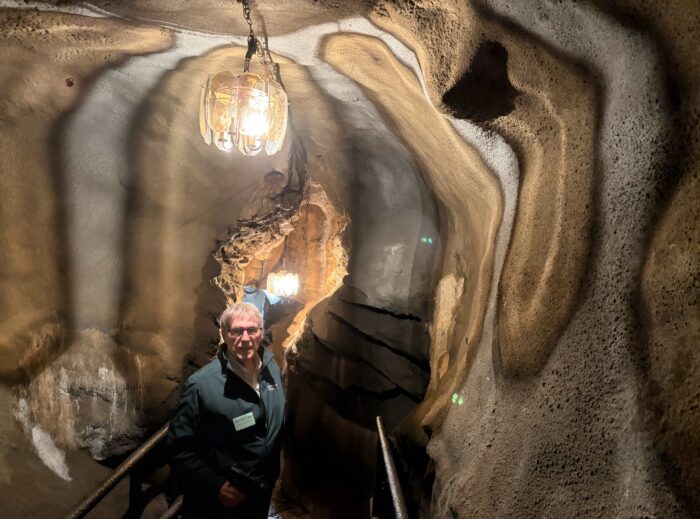
David Cale stands below chandeliers he hung underground to light Laurel Caverns in Fayette County, PA. Photo Credit: Andrea Peterson/West Virginia Public Broadcasting
Across much of Appalachia, there's a hidden world beneath your feet. The region is chock full of ancient cave systems. Some are just little caverns you can walk in and out of. Some are so deep nobody’s sure where they begin or end.
Folkways Reporter Andrea Peterson explored a once-privately owned underground landscape that recently became a Pennsylvania State Park.
What Do We Lose When Newspapers Shutter?
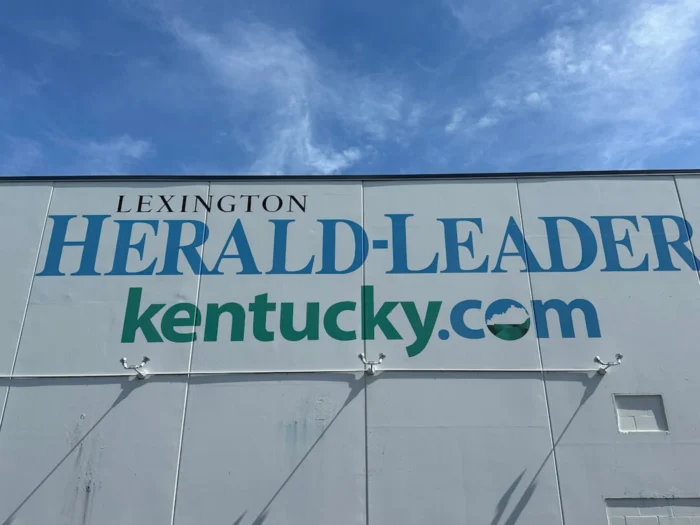
The masthead of the Lexington Herald-Leader newspaper is seen on the side of an office building where the paper was once located in Lexington, Kentucky. Courtesy of Alex Acquisto
Print journalism has been struggling for years. What happens when a newspaper shutters or loses most of its staff, and what do we lose?
Mary Hyre's column from the time of the initial Mason County Monster sighting. Courtesy of The Athens Messenger
Fans of Appalachian monsters and cryptids know Mothman. In West Virginia lore, it’s a human-sized creature with wings and red eyes that glow. It was first spotted in the 1960s. A small-town newspaper writer covered the Mothman sightings. And then tragedy struck the town.
Our theme music is by Matt Jackfert. Other music this week was provided by Larry Rader, Harvey and Copeland and Blue Dot Sessions.
Bill Lynch is our producer. Abby Neff is our associate producer. Our executive producer is Eric Douglas. Irina Zhorov is our editor. Our audio mixer is Patrick Stephens and our Folkways Audio Engineer is Charlie Kaier. We had help this week from Folkways Editor Ibby Caputo.
You can send us an email: InsideAppalachia@wvpublic.org.
Inside Appalachia is a production of West Virginia Public Broadcasting.
Appalachian Author Silas House Talks New Book, This West Virginia Morning
Oct 23, 2026
Show notes
On this West Virginia Morning, Silas House is a major voice for Appalachia. The Kentucky native has written more than 15 books and served as the state's poet laureate. His latest book is The Tulip Poplars, a sweeping novel about the lives of four people as they navigate friendship and forbidden love throughout the 20th century. Inside Appalachia's Mason Adams spoke with House.
And, according to a new study, West Virginia ranks in the middle when it comes to measures of freedom compared to other states.
Finally, West Virginia students from kindergarten through fifth grade can enter to win up to $5,000 in a SMART529 college savings account by writing about their dream job.
West Virginia Morning is a production of West Virginia Public Broadcasting which is solely responsible for its content.
Support for our news bureaus comes from Shepherd University and Marshall University School of Journalism and Mass Communications.
West Virginia Morning is produced with help from Bill Lynch, Chris Schulz, Eric Douglas and Maria Young.
Eric Douglas is our news director. Teresa Wills is our host. Maria Young is our producer.
Listen to West Virginia Morning weekdays at 7:49 a.m. on West Virginia Public Broadcasting or subscribe to the podcast and never miss an episode. #WVMorning
Us & Them: Dinner Party — Huntington 2026
Oct 22, 2026
Show notes
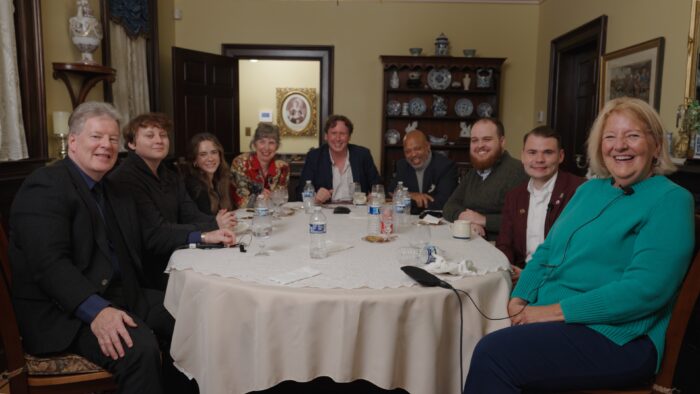
For this episode of Us & Them, the Dinner Party travels to Huntington.
Host Trey Kay brings together eight West Virginians at the historic Coin Harvey House for a potluck meal and a conversation about the issues shaping their lives in the weeks before the midterm elections.
This time, half of Kay’s guests are college-aged. The younger guests share political values that reflect beliefs ranging from conservative Christian Republicans to Democrats, a democratic socialist, with Independent viewpoints as well. The older guests bring equally varied perspectives shaped by public health, business, ministry and community life.
The conversation ranges from immigration and the economy to foreign policy, trust in government, the media and what younger West Virginians look for when they contemplate life after graduation.
During the conversation, the guests repeatedly discover that they sometimes want similar outcomes despite differences in how to reach them.
This is the second of three Us & Them Dinner Parties across the Mountain State this fall. The first took place in Charleston, and the next gathering will be in Morgantown following the midterm elections.
This episode of Us & Them is presented with support from the CRC Foundation, and the Friends of West Virginia Public Broadcasting.
Subscribe to Us & Them on Apple Podcasts, YouTube Music, Spotify, the NPR app and wherever you get your podcasts.
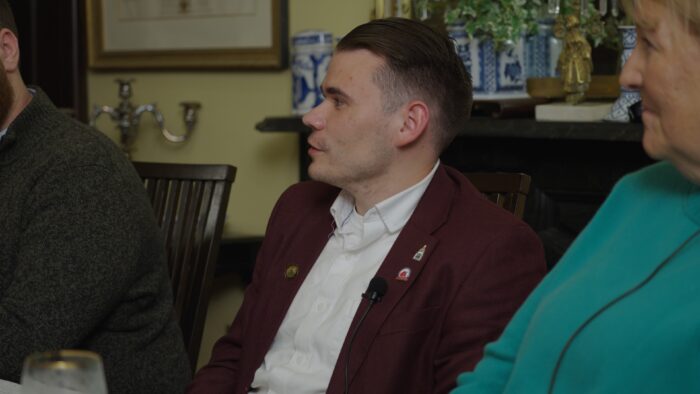
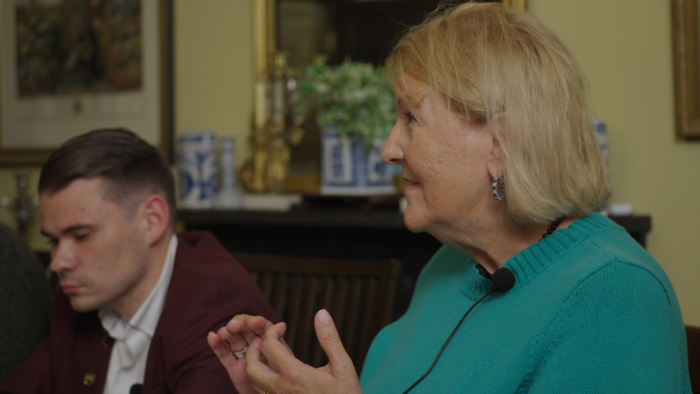
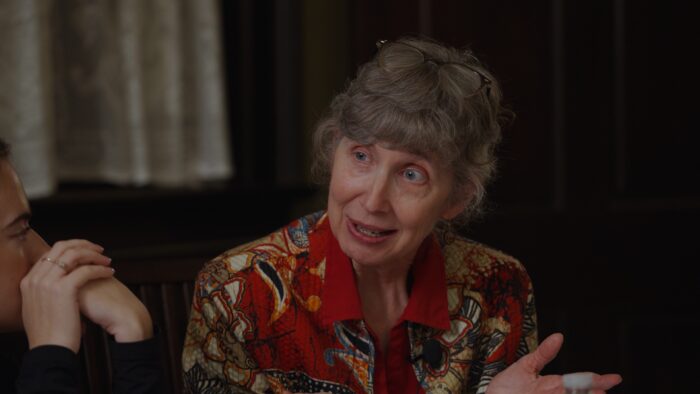
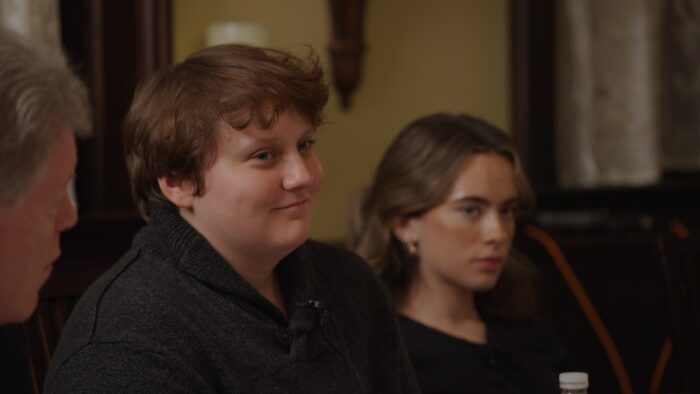
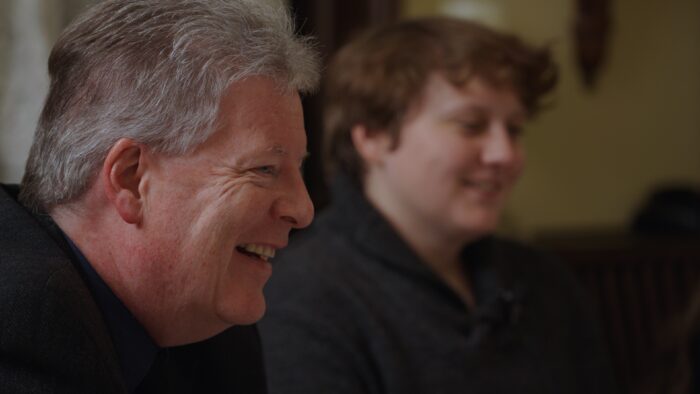
The Us & Them Dinner Party gathers at the historic Coin Harvey House in Huntington, West Virginia. Pictured from left around the table are Rev. Dr. John C. Minihan, E Provost, Roxy Leonard, Cathy Slemp, Us & Them host Trey Kay, Dr. Alan Letton, Ashton Pack, Michael Borsuk and Sharon Lansdale. Half of the evening’s guests are under 30, which lends an intergenerational perspective to the discussion about politics, culture and the upcoming midterm elections. Photo Credit: Ethan Rayment/West Virginia Public BroadcastingMarshall University student Michael Borsuk returns for his fifth Us & Them Dinner Party. Borsuk describes himself as a conservative and serves as an Ohio County Republican Party chairman. At the Huntington gathering, he talks about domestic manufacturing, trade policy and the importance of finding ways to “disagree better” with people across the political divide. Photo Credit: Ethan Rayment/West Virginia Public Broadcasting
“We've lost the ability to see the humility in argument, and I mean, we're not gonna agree on everything, but the phrase I like to use is ‘disagree better.’ How do we disagree in a way that isn't just screaming in Facebook comment sections, pointing fingers, swearing at each other, but making disagreement constructive? … I am sitting right next to a Democratic Socialist who happens to be one of my good friends from school. He knows my politics. I know his politics. We don't agree on anything, likely. But … I can see that person's position even if I don't agree on it.”
— Michael Borsuk
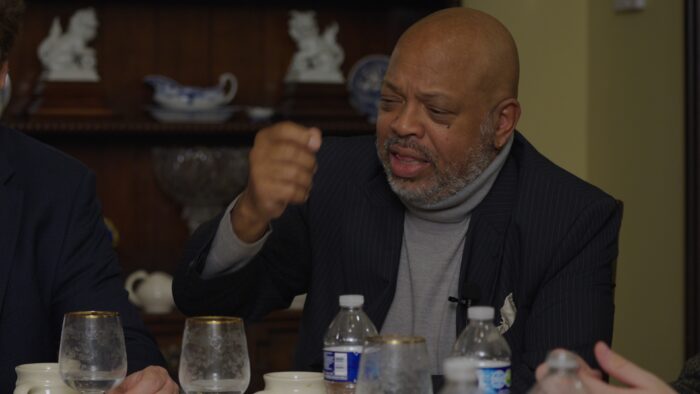
Alan Letton is a Marshall University visiting scholar and directs the university’s Center for Economic & Community Development in Black Appalachia and Isolated Communities. He describes himself as politically unaffiliated and says he approaches issues individually rather than through a party label. At the Dinner Party, Letton talks about Black history in West Virginia, immigration, government power, education and the need to use personal stories to break through polarization. Photo Credit: Ethan Rayment/West Virginia Public Broadcasting
“West Virginia is in the middle of erasing the history of African Americans, when there was a rich legacy and history here. … I come from a legacy of scientists that started here in West Virginia. … I think West Virginia has a very unique opportunity to create this environment that embraces all of that history because it's so tied to the land.”
— Alan Letton
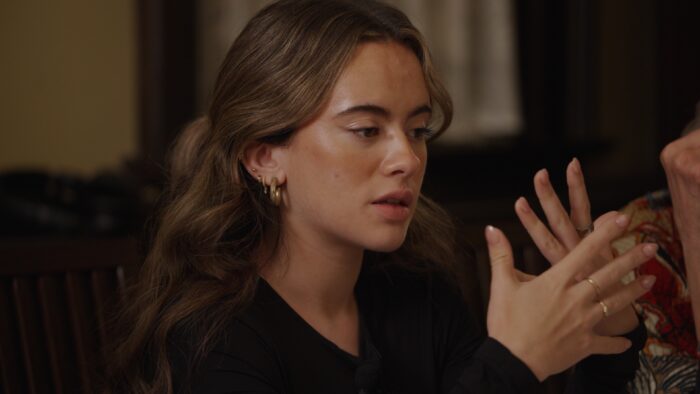
Marshall University student Roxy Leonard studies geography and journalism and describes herself as a Christian who generally leans conservative. But Leonard says her faith has put her at odds with the Trump administration’s approach to immigration. She argues that Christians have an obligation to respect governing authority while also treating immigrants with compassion and dignity. Photo Credit: Ethan Rayment/West Virginia Public Broadcasting
“I think from a Christian perspective the treatment that's been given to immigrants in our country is not Christian-like. It's really not. The ideals of Jesus and the ideals that are found in the Bible are based on love and obedience. … The Bible, of course, does command that Christians follow the law, obey the laws of the land. And while I find it very important to be subject to governing authorities and follow what the government has set in place, there are ways to go about that that aren't so evil and inhumane.”
— Roxy Leonard
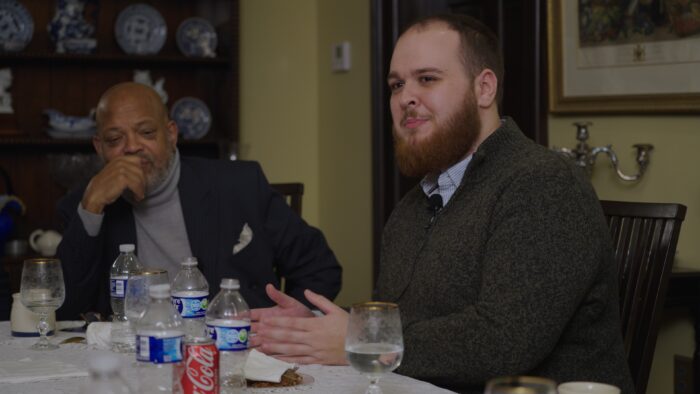
Ashton Pack, pictured with Alan Letton at left, is a Master of Public Administration student at Marshall University who describes himself as a democratic socialist. Pack expects to leave West Virginia after graduation to pursue federal government or nonprofit policy work in Washington, D.C., although he says he could imagine eventually returning. When host Trey Kay asks whether Pack is confident that the economy he is entering will allow him to build the kind of life he is preparing for, Pack does not hesitate. Photo Credit: Ethan Rayment/West Virginia Public Broadcasting
“Not even almost. The reason I went to grad school is because I was terrified of entering the real adult world, so I decided to delay that two more years by getting a graduate degree. No, I am not confident at all about that. Every time I take a look at the job market for just about anything, all I am met with is red numbers going downward saying that less people are getting jobs, there are less jobs available, it's more expensive to live.”
— Ashton Pack
Sharon Lansdale, right, is a longtime West Virginia public-health leader and former president and CEO of the Center for Rural Health Development. Now retired from that position, Lansdale describes herself as a Christian conservative. Michael Borsuk, left, is also pictured. At the Dinner Party, Lansdale voices strong support for the Trump administration’s push to rebuild American manufacturing, arguing that outsourcing weakened left the country dangerously dependent on foreign production. She also backs the administration’s confrontation with Iran, saying that country cannot be allowed to obtain a nuclear weapon. Photo Credit: Ethan Rayment/West Virginia Public Broadcasting
“I think what I've learned is that what we're doing under this administration is bringing back American industry. I think what happened with COVID is we learned how dangerous it is that things are not produced here. I mean, amoxicillin is not produced in the United States today. That's a critical antibiotic, and other drugs. And I think, since the Cold War, the policy was to outsource everything and get it cheaper, so consumers would be happy and everything would be cheaper. … I just can't imagine being like in Detroit where all the car manufacturers left, and what they did to those communities and the people and the middle class in those communities. So I'm very thankful that we have an administration that's bringing back manufacturing and industry.”
— Sharon Lansdale
Dr. Cathy Slemp is a public-health physician from Milton, West Virginia, who describes herself as a longtime independent who leans liberal. Like fellow Dinner Party guest Sharon Lansdale, Slemp has spent much of her career in public health, but the two bring different political perspectives to the table. Slemp says one of her greatest concerns heading into the midterm election is that polarization has weakened the country’s ability to debate complicated problems, develop meaningful policy and work through imperfect solutions. Photo Credit: Ethan Rayment/West Virginia Public Broadcasting
“It's not just that we don't have the tools or the attention span, but, you know, one of the things I worry about is we have enormous economic divides in our country. And increasingly, especially here in West Virginia, people are working two jobs. They are raising — trying to raise their kids. … We've got substance use issues. You know, it takes a lot of time to be an informed electorate.”
— Dr. Cathy Slemp
E. Provost, left, is a Marshall University political science student who describes herself as an independent progressive and identifies as queer. Roxy Leonard is pictured in the background. This is Provost’s second Us & Them Dinner Party. Provost says she experienced discrimination and harassment because of her sexual identity while she was in high school. Against that personal background, she was struck that a politically diverse group could spend an evening discussing immigration, affordability, education and humane treatment without the conversation becoming primarily a fight over identity politics. Photo Credit: Ethan Rayment/West Virginia Public Broadcasting
“A theme that stuck with me is that we didn't really talk much about identity politics tonight. It was all about things like affordability and people's right to life and right to be treated humanely. None of it was, I think, what a lot of the media talks about, and I'm not really surprised, but I am very pleased.”
— E. Provost
Rev. John C. Minihan, left, is senior pastor of Christ Presbyterian Church in Huntington and describes himself as politically and socially conservative. E Provost, right, is seated beside him. Near the end of the Dinner Party, Minihan reflects on the economic anxiety expressed by younger guests like Ashton Pack. Although Minihan says he strongly disagrees with democratic socialism, he says he understands why rising housing costs and other economic pressures can make that politics attractive to younger Americans. Photo Credit: Ethan Rayment/West Virginia Public Broadcasting
“I am as far from a democratic socialist as you can imagine, but you know what, Ashton [Pack]? I actually see why young people are doing this. The average price of a new home is over $400,000. And so when interest rates just popped over 7%, they say, ‘Well, historically, that's not high.’ I said, ‘Okay, my first house I paid eight and three-quarter interest, but my first house cost $91,000.’ It wasn't 7% on $400,000. I see it. Now, I don't agree with it. I think it doesn't lead to good places … but I think that's a beginning of a dialogue. Like, I want your flourishing. I want you to have a lovely life and family and whatever is a blessing to you.”
— Rev. John C. Minihan
‘Us & Them’ Dinner Party Guests Weigh In On Immigration, This West Virginia Morning
Oct 22, 2026
Show notes
On this West Virginia Morning, as we’re counting down to the midterm election, Us & Them host Trey Kay has invited a new group of guests to a Dinner Party – but this time, the table is in Huntington. Kay’s guests are a mix of conservative and progressive voters, half of whom are under 30 and they share a wide-ranging conversation over a potluck meal. We listen to an excerpt from this episode where a number of guests weigh in on immigration.
And, early voting in West Virginia is underway and runs through Oct. 31. Election Day is Nov. 3. To make it easier for voters to decide who they want to elect, West Virginia Public Broadcasting teamed up with journalism students at the West Virginia University Reed School of Media to create a voter's guide.
West Virginia Morning is a production of West Virginia Public Broadcasting, which is solely responsible for its content.
Support for our news bureaus comes from Shepherd University and Marshall University School of Journalism and Mass Communications.
Maria Young produced this episode.
Listen to West Virginia Morning weekdays at 7:49 a.m. on West Virginia Public Broadcasting or subscribe to the podcast and never miss an episode. #WVMorning
ProPublica, Mountain State Spotlight Opened A ‘School.’ Here’s What They Learned, This West Virginia Morning
Oct 21, 2026
Show notes
On this West Virginia Morning, the nonprofit newsroom ProPublica has been reporting on the use of public money to fund private education. Earlier this month, ProPublica published a series of stories about how they, along with Mountain State Spotlight, opened a school in West Virginia. Reporter Jennifer Smith Richards spoke with Chris Schulz about the experience and what it says about modern education.
Also, effective immediately, a 60-day state of emergency is in place to cut the cost of red-dyed diesel fuel.
And, state regulators have given Kentucky Power the go-ahead to build a new cooling tower at its Mitchell coal plant in West Virginia.
Finally, residents of 14 counties will soon be able to apply for a program designed to help fill vacant healthcare positions in rural communities.
West Virginia Morning is a production of West Virginia Public Broadcasting, which is solely responsible for its content.
Support for our news bureaus comes from Shepherd University and Marshall University School of Journalism and Mass Communications.
Maria Young produced this episode.
Listen to West Virginia Morning weekdays at 7:49 a.m. on West Virginia Public Broadcasting or subscribe to the podcast and never miss an episode. #WVMorning
Protecting Yourself When Taking Multiple Medications, This West Virginia Morning
Oct 20, 2026
Show notes
On this West Virginia Morning, as people take a greater number of medications across years or decades, experts say the risk for adverse drug interactions increases. One way to advocate for yourself? Keep a list of your meds handy. We listen to the latest story from health series, HealthQ, a collaboration between Nashville Public Radio and KFF Health News, with reporters Cara Anthony and Blake Farmer.
Also, the Public Service Commission of West Virginia (PSC) has filed draft rules for supplying energy to data centers.
Finally, there are thousands more West Virginians registered to vote in next month’s general elections.
West Virginia Morning is a production of West Virginia Public Broadcasting, which is solely responsible for its content.
Support for our news bureaus comes from Shepherd University and Marshall University School of Journalism and Mass Communications.
Eric Douglas produced this episode.
Listen to West Virginia Morning weekdays at 7:49 a.m. on West Virginia Public Broadcasting or subscribe to the podcast and never miss an episode. #WVMorning
A Tale Of Tennessee’s Cryptids, This West Virginia Morning
Oct 19, 2026
Show notes
On this West Virginia Morning, middle Tennessee’s Dickson County is known for being the filming location for Ernest Goes to Camp, which grossed upwards of $20 million in the late 1980s. For the Appalachia + Mid-South Newsroom, WPLN’s Jewly Hight looked into the area’s earlier lore about mysterious creatures of the night.
Also, in Charleston, West Virginia, this weekend, the state’s largest free and charitable clinic attracted hundreds of people seeking healthcare.
West Virginia Morning is a production of West Virginia Public Broadcasting, which is solely responsible for its content.
Support for our news bureaus comes from Shepherd University and Marshall University School of Journalism and Mass Communications.
Maria Young produced this episode.
Listen to West Virginia Morning weekdays at 7:49 a.m. on West Virginia Public Broadcasting or subscribe to the podcast and never miss an episode. #WVMorning
Energy Rules Coming For Data Centers and West Virginia’s Chestnuts, This West Virginia Week
Oct 17, 2026
Show notes
Bill Lynch is our host this week. Our theme music is by Matt Jackfert.
West Virginia Week is a web-only podcast that explores the week's biggest news in the Mountain State. It's produced with help from Bill Lynch, Chris Schulz, Eric Douglas and Maria Young.
John Phillips of Mars Hill, North Carolina performs an Appalachian ballad called “Little Maggie” at the ballad swap at Zadie’s Market in Marshall, North Carolina. Photo Credit: Sarah Melotte/Daily Yonder
When Hurricane Helene tore through western North Carolina in 2024, it took lives and upended communities. A community of ballad singers lost a place where they could share their tradition. The storm set them back, but it didn’t stop them. And what might’ve seemed lost could be restored.
From Marshall, North Carolina, Sarah Melotte reports for the Rural Remix, a podcast from the Center for Rural Strategies.
How To Protect Amphibians Against Climate Change
Climate change has affected the seasons and made weather less predictable. And severe storms and flooding are causing damage to wildlife habitat. Kylie Frederick is a journalism student at West Virginia University (WVU), and reports that protecting amphibians, like frogs and salamanders, can start at home.
Tornado Destroys Orchid Restoration In Southern Kentucky
Tara Littlefield, a botanist and ecologist with the Office of Kentucky Nature Preserves, has been working to restore this wetland site in Mount Victory. Photo Credit: Lily Burris/WEKU
Researchers have spent nearly 20 years restoring a threatened species of orchid in southern Kentucky. Those efforts were disrupted after a tornado last spring. For the Appalachia + Mid-South Newsroom, WEKU’s Lily Burris went to Mount Victory to learn about the recovery.
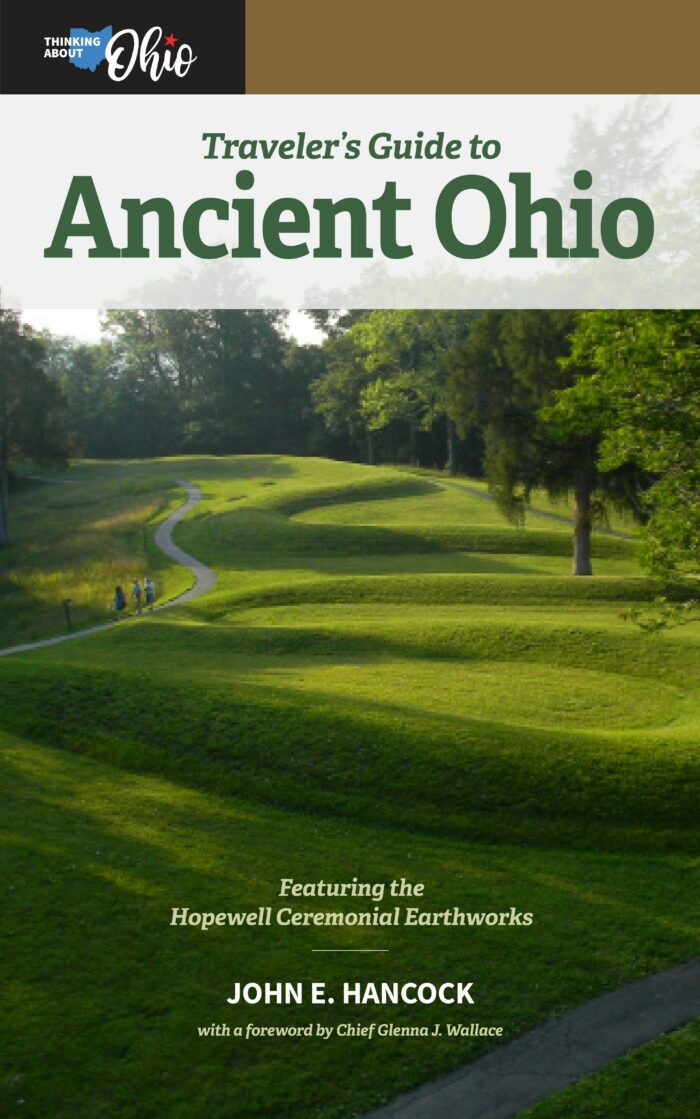
Traveler's Guide To Ancient Ohio
The cover of "Traveler's Guide to Ancient Ohio" by John E. Hancock. Courtesy of Ohio University Press
Thousands of years ago, Indigenous people created hundreds of earthen monuments in what is now Ohio, Kentucky and West Virginia. Some were burial mounds. Others were curious shapes and designs whose purposes are not entirely understood.
John E. Hancock, a professor of architecture and design at the University of Cincinnati, has spent years studying these earthworks. Last year, he published Traveler's Guide to Ancient Ohio. If you want to visit these ancient sites, it’s a good place to start.
Producer Bill Lynch spoke with Hancock about the book.
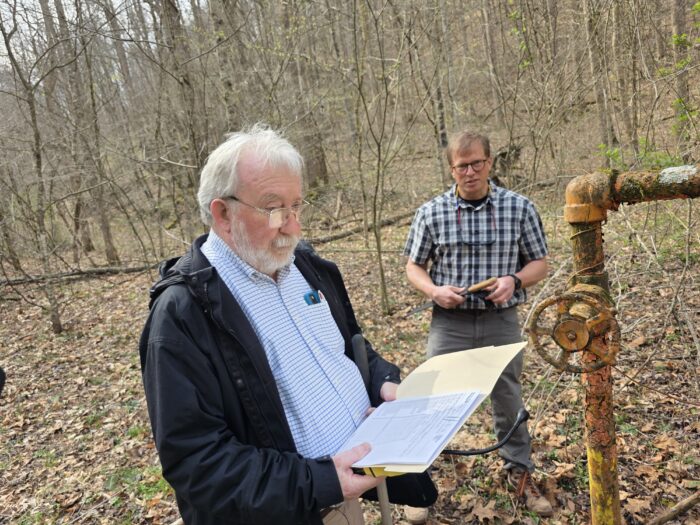
Abandoned Gas Wells In W.Va.
Dave McMahon, left, and Ted Boettner look at an abandoned natural gas well near Kanawha State Forest in Kanawha County. Photo Credit: Eric Douglas/West Virginia Public Broadcasting
According to the West Virginia Department of Environmental Protection (WVDEP), there are more than 6,000 abandoned or orphaned natural gas wells in the state. But some advocates say that number is low.
WVPB’s News Director Eric Douglas visited a few.
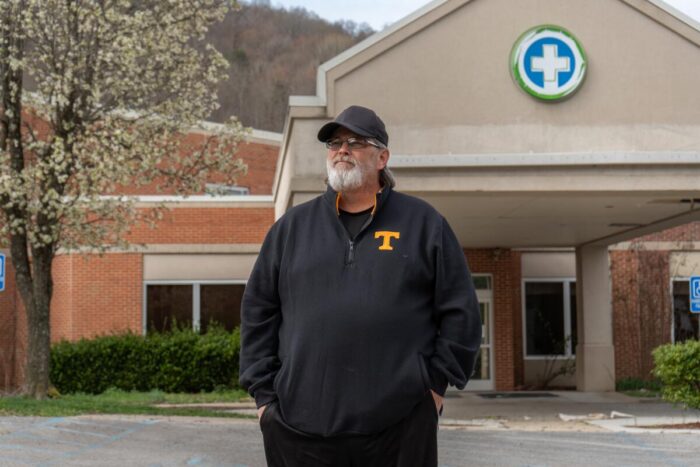
Tennessee Town Struggles To Reopen Its Only Hospital
Local minister Benji Johnson stands outside of the shuttered Jellico Regional Hospital on Monday, March 30, 2026. Photo Credit: Pierce Gentry/WUOT
As the healthcare industry cuts unprofitable rural hospitals, small towns across Appalachia are paying the price.
WPLN’s Pierce Gentry takes us to Jellico, Tennessee, where the local government is struggling to reopen its only hospital.
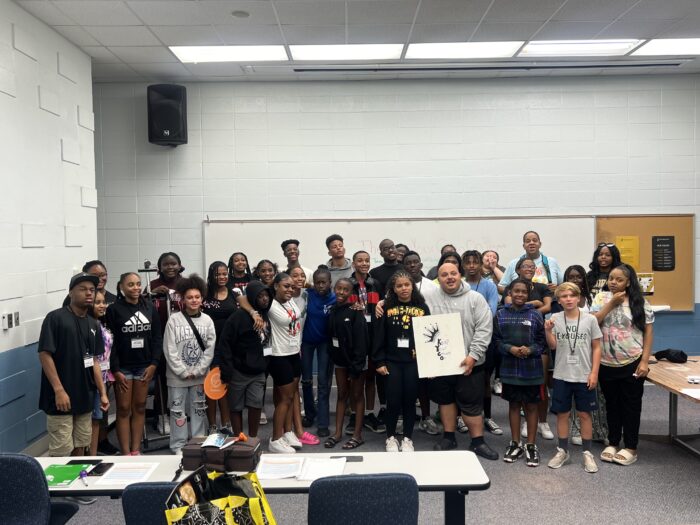
The Legacy Of Norman Jordan
Students participate in a poetry workshop at the 2024 Norman Jordan African American Arts and Heritage Academy. Photo Credit: Traci Phillips/West Virginia Public Broadcasting
Affrilachian poet and playwright Norman Jordan was a prominent voice in the Black Arts Movement through the 1960s and 1970s. He was also one of the most published poets in the region, anthologized in at least 42 books. He died in 2015 at the age of 77. Along with his writing, Jordan left another legacy: a summer camp for teens to learn music, theater and dance.
Last summer, Folkways Reporter Traci Phillips visited the Norman Jordan African American Arts and Heritage Academy in Westover, West Virginia.
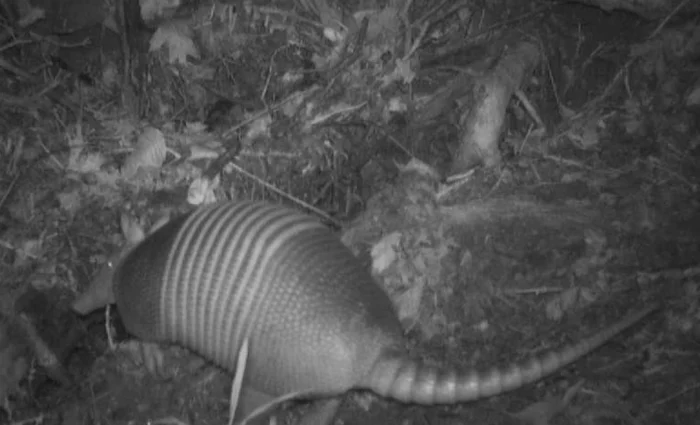
Rising Temperatures Bring Armadillos To Kentucky
Armadillos are moving farther north to states like Kentucky and the surrounding region. Courtesy of Bernheim Forest and Arboretum
In 2023, we reported on the appearance of armadillos as far north as Virginia. Now, they’re being found in Kentucky, which is seen as another indicator of rising temperatures in the region. For the Appalachia + Mid-South Newsroom, LPM’s Giselle Rhoden has more on how the species has made its way north from South America.
------
Our theme music is by Matt Jackfert. Other music this week was provided by Blue Dot Sessions, Hello June, Paul Loomis, Jeff Ellis and John Inghram.
Bill Lynch is our producer. Abby Neff is our associate producer. Our executive producer is Eric Douglas. Kelley Libby is our editor. Our audio mixer is Patrick Stephens. We had help this week from Folkways Editor Nicole Musgrave.
You can send us an email: InsideAppalachia@wvpublic.org.

 Our TOPPODCAST Picks
 Stay Connected