TopPodcast.com
Menu
  • Home
  • Top Charts
  • Top Networks
  • Top Apps
  • Top Independents
  • Top Podfluencers
  • Top Picks
    • Top Business Podcasts
    • Top True Crime Podcasts
    • Top Finance Podcasts
    • Top Comedy Podcasts
    • Top Music Podcasts
    • Top Womens Podcasts
    • Top Kids Podcasts
    • Top Sports Podcasts
    • Top News Podcasts
    • Top Tech Podcasts
    • Top Crypto Podcasts
    • Top Entrepreneurial Podcasts
    • Top Fantasy Sports Podcasts
    • Top Political Podcasts
    • Top Science Podcasts
    • Top Self Help Podcasts
    • Top Sports Betting Podcasts
    • Top Stocks Podcasts
  • Podcast News
  • About Us
  • Podcast Advertising
  • Contact
Not in our directory?
Add Show Here
Podcast Equipment
Center

toppodcastlogoOur TOPPODCAST Picks

  • Comedy
  • Crypto
  • Sports
  • News
  • Politics
  • True Crime
  • Business
  • Finance

Follow Us

toppodcastlogoStay Connected

    View Top 200 Chart
    Back to Rankings Page
    Business

    New Thinking, from the Center for Justice Innovation

    New Thinking is a podcast about justice—and injustice—in America. It’s about the people working to fix a justice system that falls so short of our ideals, and the people organizing to build something new in its place. It’s hosted by Matt Watkins and produced by the Center for Justice Innovation (formerly Center for Court Innovation).

    Advertise

    Copyright: ©2019 Center for Court Innovation

    • Apple Podcasts
    • Google Play
    • Spotify

    Latest Episodes:
    How Can Lawyers Help Address Poverty and Eviction? A Conversation with Law Professor Raymond Brescia Dec 13, 2016
    Show notes

    In this New Thinking podcast, Raymond H. Brescia, associate professor of Law at Albany Law School, speaks with Aubrey Fox and Robert V. Wolf of the Center for Court Innovation about the role lawyers can play in addressing poverty and eviction, why New York City has been dramatically expanding funding to provide lawyers to respondents in Housing Court, debt collection cases as the next great issue for public interest attorneys, and how a good lawyer is like a patronus from a Harry Potter book.


    Houston’s SAFE Court Offers Victims of Human Trafficking a New Path Nov 09, 2016
    Show notes

    In this New Thinking podcast, Ann Johnson, an assistant district attorney and the human trafficking section chief with the Harris County District Attorney's Office, discusses her office's strategies for combating human trafficking, including increased enforcement against traffickers and buyers, and diversion from prosecution for victims. One of the office's diversion programs, SAFE Court, gives those aged 17 to 25 who are charged with prostitution the opportunity to clear the charge from their criminal records by completing a year-long program of monitoring and social services. SAFE Court was created with support from a Smart Prosecution grant from the U.S. Department of Justice’s Bureau of Justice Assistance. To learn more, visit the Association of Prosecuting Attorney's Smart Prosecution website.


    Taking a Collaborative Approach to Addressing Racial and Ethnic Disparities in the Justice System Oct 25, 2016
    Show notes

    Tshaka Barrows, deputy director of the Burns Institute, discusses his organization's collaborative and community-centered approach to addressing and eliminating racial and ethnic disparities in the justice system. Barrows spoke with Robert V. Wolf, director of communications at the Center for Court Innovation, after participating in a panel on Race and Procedural Justice at Justice Innovations in Times of Change on Sept. 30, 2016.


    The Potential for Bias in Risk-Assessment Tools: A Conversation Oct 19, 2016
    Show notes

    In this New Thinking podcast, Reuben J. Miller, assistant professor of social work at the University of Michigan, and his research collaborator Hazelette Crosby-Robinson discuss some of the criticisms that have been leveled against risk assessment tools. Those criticisms include placing too much emphasis on geography and criminal history, which can distort the actual risk for clients from neighborhoods that experience an above-average presence of policing and social services. "Geography is often a proxy for race," Miller says. Miller and Crosby-Robinson spoke with the Center for Court Innovation's Director of Communications Robert V. Wolf after they participated in a panel on the "The Risk-Needs-Responsivity Framework" at Justice Innovation in Times of Change, a regional summit on Sept. 30, 2016 in North Haven, Conn.


    Fairness, Procedural Justice, and Domestic Violence: A Conversation with Judge Jeffrey Kremers Aug 30, 2016
    Show notes

    In this New Thinking podcast, Judge Jeffrey Kremers of the Milwaukee County Circuit Court brings procedural justice to bear on domestic violence. Sharing his insights from the bench, Judge Kremers talks about the importance of procedural justice for both defendants and survivors as well as their families, and discusses strategies for addressing the unique challenges posed by domestic violence cases.

    This podcast was supported by Grant No. 2015-TA-AX-K023 awarded by the Office on Violence Against Women, U.S. Department of Justice. The opinions, findings, or recommendations expressed in this podcast are those of the speakers and do not necessarily reflect the views of the Department of Justice, Office on Violence Against Women.


    Foundations Can Support Justice Reform, If You Know How to Ask: A Conversation with James Lewis Aug 19, 2016
    Show notes

    Private foundations are an overlooked resource for innovative justice programs. James H. Lewis, senior program officer and director of research and evaluation at the Chicago Community Trust, offers insight into how foundations make funding decisions and shares tips for attracting foundation investments in justice programs. The interview was conducted by the Center for Court Innovation's Director of Communications Robert V. Wolf at Community Justice 2016, where Lewis participated in a panel on "Funding Change."


    Strengthening Ties Between Police and the Community: A Conversation about Restorative Justice in Madison, Wisconsin Aug 09, 2016
    Show notes

    Joe Balles, who recently retired as a captain after a 30-year career with the Madison (Wisconsin) Police Department, discusses restorative justice and police legitimacy with Robert V. Wolf, director of communications at the Center for Court Innovation. A mentee of Herman Goldstein, considered the father of problem-oriented policing, Balles was instrumental in the creation of the Dane County Community Restorative Court, a diversion program based on the Native American principles of peacemaking. The interview took place during Community Justice 2016.


    A Second Chance Society: A Conversation about Justice Reform in Connecticut Jul 12, 2016
    Show notes

    Mike Lawlor, Connecticut's under secretary for Criminal Justice Policy and Planning, discusses Governor Dannel P. Malloy's Second Chance Society, a series of justice reforms (including dramatic changes to bail and juvenile justice policies) that seek to reduce crime, lower spending on prisons, and help rebuild relationships between criminal justice professionals and the communities they serve. This New Thinking podcast was recorded in Chicago in April 2016 after Lawlor participated in a panel on "Jail Reduction and Public Safety" at Community Justice 2016.


    ‘An Open and Inviting Court’: Judge Joe Perez of the Orange County Community Court Talks Procedural Justice Jun 15, 2016
    Show notes

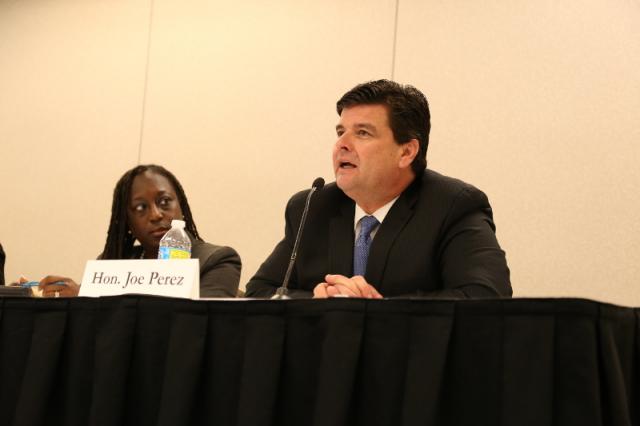
    Joe Perez, the presiding judge of the Orange County Community Court, discusses how the principles of procedural justice inform both design and process in his courthouse. Perez is a lifelong resident of Orange County whose father was the first Spanish-speaking attorney and judge in the county. The interview with Robert V. Wolf, director of communications at the Center for Court Innovation, took place while Judge Perez was in Chicago to speak at Community Justice 2016. Wolf interviewed Judge Perez’s predecessor and the founding judge of the Orange County Community Court, Wendy Lindley, in 2008.

    Judge
        Joe Perez speaks during a panel on race and legitimacy at Community Justice 2016.Judge Joe Perez speaks during a panel on race and legitimacy at Community Justice 2016.


    Jails as Psychiatric Facilities: Addressing Mental Illness in the Justice System with Judge Steve Leifman Jun 14, 2016
    Show notes

    Judge Steve Leifman, associate administrative judge of the Miami-Dade County Court Criminal Division and presiding judge of its Criminal Mental Health Project, has worked at the intersection of mental health and the criminal justice system in Miami-Date County for decades. In this podcast, he outlines the challenges of addressing the high occurence of mental illness in Miami's courts and prisons, the fraught history of incarcerating those with mental health needs, and ways in which the justice system can change its response to those living with mental illness.


    Previous 1 8 9 10 11 12 23 Next

    Related Podcasts

    How I Built This with Guy Raz

    1

    How I Built This with Guy Raz Business
    Planet Money

    2

    Planet Money Business
    Inside Strategic Coach: Connecting Entrepreneurs With What Really Matters

    3

    Inside Strategic Coach: Connecting Entrepreneurs With What Really Matters Business
    BiggerPockets Real Estate Podcast

    4

    BiggerPockets Real Estate Podcast Business
    The Smart Passive Income Online Business and Blogging Podcast

    5

    The Smart Passive Income Online Business and Blogging Podcast Business
    Bad With Money With Gabe Dunn

    6

    Bad With Money With Gabe Dunn Business
    footer-logo

    Contact Us

    Toll Free: 844-670-7747

    Links

    • Home
    • Top Charts
    • Networks
    • Apps
    • Independents Podcasts
    • Podcast Advertising
    • Podcast News
    • Contact Us
    • About Us
    • Analytics & Insights

    Stay Connected

      Privacy, Terms of Use & Our Code of Ethics Protecting Content Creators Copyrights