MBA219: How To Be an Agile Business Analyst
Mar 23, 2021
Show notes
Kent McDonald shares his thoughts on what it takes to succeed as a Business Analyst in an Agile environment.
BA Toolbox – A3 Report
Mar 09, 2021
Show notes
In this episode of the BA Toolbox, we explore the A3 report and it's use in problem solving.
MBA218: Customer-Centric Transformation
Mar 02, 2021
Show notes
Melissa Boggs discusses how the Scrum Alliance transformed into customer-centric teams and how you can have a greater customer focus.
SHOW NOTES
Over the past several years, many organizations have transformed the way they work and the way they’re organized. With Digital and Agile transformations and shifting from projects to products, organizations are trying to find better ways of working and deliver more customer value.
Some forward-thinking organizations have even transformed to organize around the customer. This allows them to have greater customer focus and deliver value faster through fewer dependencies and hand-offs.
The Scrum Alliance recently went through such a customer-centric transformation, which allowed them to focus on customer needs at their specific point in the journey. This also helps that organization better align with organizational priorities.
They reorganized into customer-centric, interdisciplinary teams serving different customer segments. This allows them to discover new products and services that better meet their customers’ needs.
Challenges
One of the challenges faced by the Scrum Alliance when they transformed was the fear of changing the way they are working when they’re been successful. This required understanding the value in shifting to a customer-centric focus and saying ’no’ to some things.
Another challenge is in the area of alignment. If you have a skill or discipline spread across several teams, how do you ensure alignment and consistency and avoid duplication of effort? Creating shared guiding principles and creating communities of practice help with alignment and consistency.
Enabling the Transformation
To enable the customer-centric transformation, the Scrum Alliance shifted their Sprint Reviews to include real customers. This allows them to get rapid feedback from customers, which helps them adapt to customer needs.
They also created open-mic events every two weeks for teams to showcase their work to the rest of the organization. This helps with alignment and consistency between teams.
In addition, teams shared stories of success and learnings through storytelling. The Scrum Alliance used their Slack storytelling channel to share stories about accomplishments, failures, and what they learned along the way. Storytelling also helps create psychological safety within the organization.
Listen to the full episode to discover how your organization can shift its focus on the customer and increase customer value.
“It starts with you, because when you embrace your own uniqueness, so will your team. When you demonstrate self-confidence, self-worth, and your strengths, they will feel the permission to do the same. When you tell your stories, so will they. At this intersection of strength, vulnerability, and uniqueness, that’s where thriving begins.”
– Melissa Boggs
YOUR HOMEWORK Start by getting clarity about who the customer is and their customer’s story. Then reflect to understand yourself and your relation to that customer.
Melissa Boggs
Melissa Boggs offers a unique blend of coaching expertise and executive experience. She is a leadership, agility, and culture coach and executive with background in leadership, business, and product development. She has worked with executive teams, software teams, marketers, and educators in domains such as healthcare, public education, technology, and finance. She is a former nonprofit executive and board member, having served on the Board of Directors for both Scrum Alliance and Agile Denver.
Thank you for listening to the program
To get more valuable content to enhance your skills and advance your career, you can subscribe on iTunes.
Also, reviews on iTunes are highly appreciated! I read each review and it helps keep me motivated to continue to bring you valuable content each week.
Lightning Cast: Agile Planning
Feb 09, 2021
Show notes
Understanding the different levels of Agile planning and what they mean for you will help your team stay aligned and focused on achieving the right outcomes.
Show Notes
Responding to change over following a plan. This value listed in the Agile Manifesto doesn’t mean that we don’t do planning in Agile. In fact, we plan more in Agile than in traditional methods; we just do it differently.
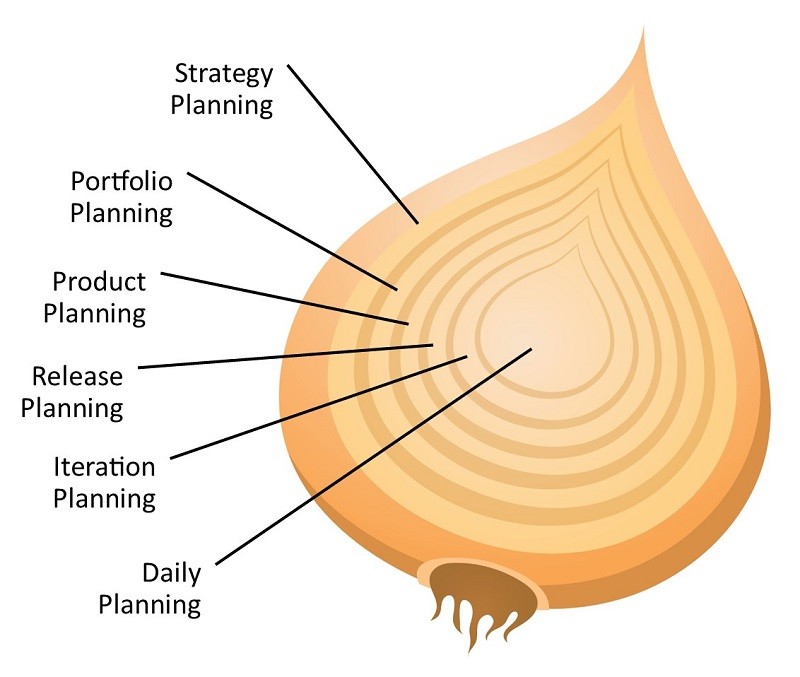
A common metaphor for planning in Agile is an onion. Each layer of the onion reflects another level of planning – from strategic to tactical.
Let’s take a look at each of these layers and what it means to you.
Strategic Planning
The outermost layer of the Agile planning onion is the strategic level. At the strategic level of planning, organizations set their direction. It involves the mission and vision as well as long-term goals. This is multi-year planning.
If you’re a Product Manager, Business Architect, or in another strategic role, you might provide input into the strategic plan by helping organizational leaders understand where the market is going and your organization’s capabilities. Common tools are SWOT Analysis and PEST or PESTLE Analysis.
Portfolio Planning
The next layer of the planning onion is the Portfolio level. This is where the organization decides what products or initiatives to work on. This is essentially where and how much the organization will invest.
We can support this level of planning by providing input through business cases, business models, and other approaches. You may also be involved in the ideation of new products or new initiatives. In some cases, you may even recommend that certain initiatives be stopped due to changing market conditions or changing customer needs.
Once portfolio planning is complete, the plan should serve as an input as to where we should focus effort and resources.
Product Planning
The next layer is Product planning. At this level, we determine the goals and objectives of the product and how we’ll achieve those outcomes. You’ll likely develop Objectives and Key Results (OKRs) for the product as well as a product roadmap.
This level of planning provides context to the teams working on the product and is usually developed by a Product Manager in collaboration with stakeholders and subject matter experts.
Remember that an Agile Roadmap isn’t just a Gannt Chart showing timing or different initiatives. A good roadmap is outcome based and may include options to achieve those outcomes as well as certain milestones such as a contractual or compliance required date. Your roadmap should also allow you to respond to changing market conditions.
The innermost planning levels of release, iteration, and daily are considered team level planning.
Release Planning
At the Release level of planning, the team plans for the next major release. Even if you deploy continuously, this level of planning looks at the next coherent set of features or pieces of functionality.
This is often where you may define the Minimum Viable Product (MVP) or Minimum Marketable Features (MMF).
Depending on your organization, at this level you might break down Epics into Features or help the team determine what can be achieved in the release. In some Agile scaling frameworks, a Feature is a larger set of work that can be completed within the release time box.
You’ll also want to start breaking down the higher priority features into User Stories or other backlog items.
Iteration Planning
The next layer of the Agile planning onion is Iteration planning. If you’re using an iterative approach, this is where you plan for the next iteration or time box. In Scrum, this is known as Sprint Planning.
If you’re a Product Owner or Business Analyst on an Agile team, you’ll need to get the User Stories and other backlog items to a ready state. This means they’re small, testable, well understood by the team, and meet the other definition of ready criteria.
You might also be involved in helping the team refine and size the product backlog items prior to iteration planning. This helps ensure the team can properly forecast what they can complete in the iteration.
If you use Scrum, you’ll define a Sprint Goal with the team as part of Sprint Planning. The Sprint Goal helps bring focus and alignment to the Scrum Team and encourages them to work together as a team rather than individuals.
Daily Planning
The final and innermost layer of the Agile planning onion is Daily planning. On a daily bases, team members get together to discuss the progress they’ve made, where they need help, and what they’ll do next taking any needed adjustments into account.
If you’re on a Scrum Team, this is the Daily Scrum. Many teams make the mistake of turning the Daily Scrum into a status meeting. It’s actually a quick planning meeting that creates transparency into where we are and allows us to inspect progress and adjust.
If you’re a Product Owner, Business Analyst, or someone else not working on the tasks associated with completing the work planned for the iteration, daily planning or the Daily Scrum is an opportunity to help the team adjust plans and remove impediments that are slowing down or stopping the team’s progress. You can also clarify any misunderstandings about the details or intent of the backlog items.
Understanding the different layers of the Agile planning onion and the different levels of planning will help you and your team stay aligned and focus on the right things.
Listen to the full episode to better understand the different levels of planning in Agile.
Thank you for listening to the program
To get more valuable content to enhance your skills and advance your career, you can subscribe on iTunes.
Also, reviews on iTunes are highly appreciated! I read each review and it helps keep me motivated to continue to bring you valuable content each week.
MBA217: Objectives and Key Results
Feb 04, 2021
Show notes
Paul Niven helps us to understand Objectives and Key Results (OKRs), a goal-setting tool to set ambitious goals with measurable results.
Show Notes
Objectives and Key Results (OKRs) is a goal-setting system to help drive strategic execution. It’s a critical thinking framework and ongoing discipline to focus efforts to drive the company forward. In short, OKRs help your organization align and achieve important goals.
OKRs go beyond simple goal setting in that there is a build-in approach for reflection and ongoing improvement.
Many organizations use a dual cadence. That means that the highest level of the organization, they have longer term OKRs (typically annual) to set context. From there, other areas set 90-day OKRs that allow for frequent inspection and help to achieve the longer term OKRs. Teams will often use weekly check-ins and mid-quarter reviews to ensure we’re focused and achieving results.
Objectives
When crafting an OKR, start with the objective. An objective is a statement of a broad qualitative goal designed to propel the organization forward in a desired direction. It’s what the organization aspires to be.
There’s an art and science to creating a good objective. There are three components to an effectively worded objective.
Objectives should start with a verb. By their nature, objectives are action oriented.
The objective should state what we aspire to do.
Effective objectives should state the ‘why’ or ‘so that’. It explains why we want to do what we’re trying to achieve.
Key Results
The Key Results portion of the OKR tell us how we’ll measure progress and how we’ll know if we’ve achieved the objective. These are quantitative statements. There are two types of key results; metrics and milestones.
When using a metric, it’s important to show the level of stretch by describing it in the format of “from X to Y”. For example, a Key Result may be “Increase click-through rate on the website from 27% to 43%”. Showing the amount of change in this way sets the context of the goal.
Sometimes to get to a metric, we need to use a milestone Key Result. A milestone turns a binary activity into a Key Result. It’s an activity that will drive progress for the metric Key Result. An example of a milestone Key Result is “Build sales page on the website”.
There are two conditions for milestone key results. They should be accompanied by a date (deadline) and it should be complimented with a metric key result.
Common Challenges
One of the common pitfalls with using ORKs is that the Key Results may have a lack of specificity. The use of generic words such as “launch” or “implement”. These vague words make it difficult for people to align because they may have different interpretations of what these words mean. The more specific and clear you make the goal, the more likely you are to achieve it.
Another problem is that people often turn their OKRs into a long, uncoordinated list. To address this, make a story out of your OKRs. Once you have the objective, think about what the first thing you’ll need to do or measure to achieve that outcome and then the next and the next.
Alternatively, start with the metric Key Result and work backwards from that measurable outcome.
Listen to the full episode to understand how to use OKRs to stay aligned and achieve ambitious goals.
Homework Learn more about OKRs and try it yourself by using the OKR formula to set a goal either for your next project or in your personal life.
Paul Niven is a management consultant, author, and noted speaker on the subjects of Strategy, Strategy Execution, Objectives and Key Results (OKRs), and Balanced Scorecard. Paul is the founder of both OKRsTraining.com and The Senalosa Group. The companies have assisted over two-hundred organizations around across the globe effectively execute their strategy.
Thank you for listening to the program
To get more valuable content to enhance your skills and advance your career, you can subscribe on iTunes.
Also, reviews on iTunes are highly appreciated! I read each review and it helps keep me motivated to continue to bring you valuable content each week.
Lightning Cast: POWER Start for Your Meetings
Jan 26, 2021
Show notes
Stop the wasted time and money from ineffective meetings by giving your next meeting a POWER Start.
Show Notes
According to a recent Atlassian survey, professionals waste 31 hours each month on unproductive meetings. That’s about four full days wasted each month. In the U.S. alone, unnecessary meetings cost businesses 37 billion dollars in just in salaries.
You can help stop this madness by giving your meetings some POWER. We’ve likely all received (or sent) meeting invitations with little more than a meeting title. This means that attendees likely won’t be properly prepared, the meeting may not achieve its intended goal, and you’ll likely waste time in yet another unproductive meeting.
The POWER Start technique was developed by the Agile Coaching Institute to address the root of unproductive meetings.
POWER is an acronym for Purpose, Outcomes, What’s in it for them, Engagement, and Roles and responsibilities.
As you’re planning your meetings, think about the POWER Start.
Begin with the Purpose. What’s the purpose of the meeting and why is the meeting necessary? Are you trying to inform, persuade, or make a decision? Perhaps it’s possible to get to this purpose by other means, such as distributing information through an email broadcast.
Think about the right medium for your purpose. If you need to collaborate to make a decision, it’s likely that email isn’t the right channel.
Next, consider the desired Outcomes of the meeting. What do you want to achieve by the end of the meeting? What does success look like? By considering and communicating the intended outcome of the meeting, attendees can come prepared to achieve that outcome.
That might mean doing some homework before the meeting, extending the invitation to someone else, or not going at all if you’re not the right person to help get to that outcome.
Once you understand the Purpose and Outcomes, think about why the attendees should come to the meeting. What’s in it for them and why should they care? Without the ‘what’s in it for me’, people may not be motivated to attend or help achieve the goal of the meeting.
The first three pieces (Purpose, Outcomes, and What’s In It for Them) all lay the foundation for the meeting. It ensures that the meeting is actually needed, provides a clear focus for the meeting so that you’ll stay on track, and helps ensure the right people attend. It can also help avoid the numerous follow-ups and the meeting after the meeting that we so often see.
But you’re not done yet. Next, you’ll need to consider how you’ll engage the meeting attendees. That engagement may span before, during, and after the meeting.
Before the meeting, you may need to contact attendees individually or in a group communication to ensure that they understand the purpose and intended outcome as well as what’s expected of them in the meeting. Is there any information they need to bring to the meeting or any work they need to do to prepare?
During the meeting, you may want to have an icebreaker to get people communicating and collaborating. Create a plan for how you’ll keep attendees interested and engaged during the entire meeting.
After the meeting, you may need to engage stakeholders by sharing key decisions or following up on action items.
The final piece of POWER Start is Roles and responsibilities. Think about the different roles that may be needed to have a successful meeting. Do you need a facilitator, a time keeper, a scribe? If so, who will fulfil those roles? Who will contribute what information during the meeting?
Making roles clear before or at the start of the meeting helps everyone understand expectations. Taking a little time to consider the elements of the POWER Start technique and including appropriate information about the purpose and outcomes in the invitation will lead to more productive meetings. The time, money, and headaches you save are well worth the extra effort you put into planning effective meetings.
Listen to this episode to ind out how to use the POWER Start facilitation technique and what to do if you’re in the receiving end of an invitation to a possibly ineffective meeting.
MBA216: Outcome Based Change
Jan 20, 2021
Show notes
David Hawks shares an approach to transformations, projects, and large change initiatives by starting with the intended business outcomes.
Show Notes
Many transformations and large initiatives fail or don’t achieve their intended value. While the transformation, project, or large initiative may be “done”, if it doesn’t result in its intended business value, it has failed.
Part of the reason for this is a lack of alignment. We often see transformations and large initiatives where the transformation or initiative itself is the goal. The effort is focused on the wrong goal or intention.
Instead, we need to start with the end in mind. Understand what the outcome you’re trying to achieve is and focus on the activities that will help achieve that outcome. Begin with the end in mind.
The goal is not to implement Agile practices or deliver Project X. The goal is to get the business outcome resulting from that change.
Listen to the full episode to understand how to gain alignment and ensure your initiative is enabling the right outcomes.
YOUR HOMEWORK Challenge yourself on your current of next initiative to think about the intended outcomes you’re trying to produce. Are why we’re undertaking this initiative if you don’t already have a clear understanding. What would success look like from a business outcome perspective?
David Hawks is the Founder and Chief Agilist of Agile Velocity. He’s a Certified Enterprise Coach and Certified Scrum Trainer who is passionate about helping organizations achieve true agility beyond the basic implementation of Agile practices.
David’s primary focus is to guide leaders through their Agile transformation by helping to create successful transformation strategies and effectively manage organizational change with a focus on achieving real business results.
Thank you for listening to the program
To get more valuable content to enhance your skills and advance your career, you can subscribe on iTunes.
Also, reviews on iTunes are highly appreciated! I read each review and it helps keep me motivated to continue to bring you valuable content each week.
Lightning Cast: Resistance to Change
Jan 12, 2021
Show notes
Are you working on a change initiative? Overcome resistance to change using Goldratt’s Four Quadrants of Change.
A lot of people talk about how difficult change is and how people resist change. People don’t actually resist change; they respond to a change by evaluating the change across four dimensions. These four dimensions make up Goldratt’s Four Quadrant’s on Change.
The reason getting someone to change is hard or we perceive that people are resisting change is because we often only look at one of those dimensions; the positive consequence associated with the change.
Most of us ignore the negative consequences of the change as well as the pluses and minuses of not changing.
We need to present all four sides from the other person’s perspective. Look at the pluses and minuses of changing as well as the pluses and minuses of not changing.
What’s the pot of gold or benefit for the person you’re trying to influence?
What are their crutches – their risks, obstacles, and effort associated with the change?
What are their alligators – their current problems that will be solved by the change?
What are their mermaids – the things they consider positive today that they may lose with the change?
Are there enough positives to outweigh the negatives? Is the pot of gold is large enough, alligator is dangerous enough, the effort and risk are small enough, and is the loss of the mermaids small enough?
Remember to look at each of these dimensions from the other person’s perspective. If you’re working with a group of stakeholders, each may have different pots of gold, crutches, alligators, and mermaids.
Thank you for listening to the program
To get more valuable content to enhance your skills and advance your career, you can subscribe on iTunes.
Also, reviews on iTunes are highly appreciated! I read each review and it helps keep me motivated to continue to bring you valuable content each week.
MBA215: The Challenges with Leading in Product Management
Jan 06, 2021
Show notes
Roman Pichler discusses the challenges associated with leading in a Product Management role and what you can do to overcome those challenges.
MBA214: The BA Success Path
Sep 09, 2020
Show notes
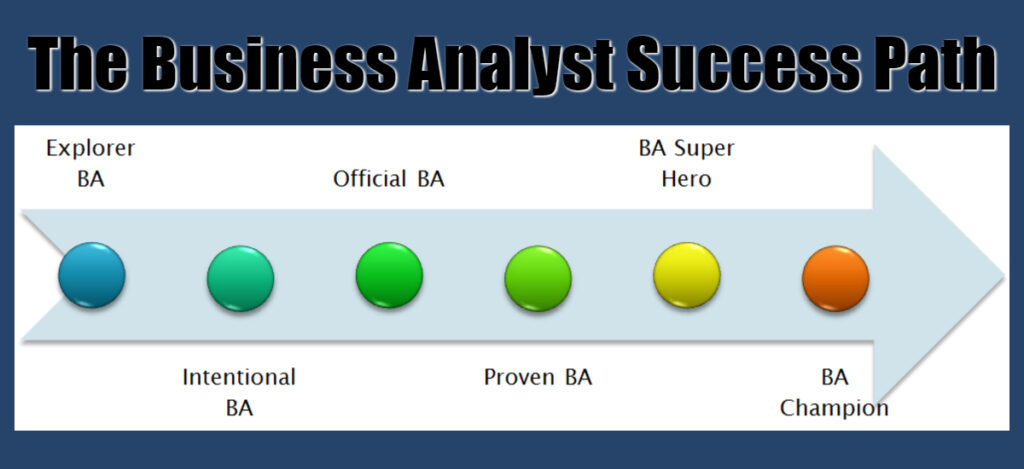
Laura Brandenburg shares her framework for career development; the Business Analyst Success Path.
Show Notes
Many Business Analysts struggle to understand how to get to the next step in their career. The way to advance in your career depends on where you are now. Charting your career path includes defining the “as is” and “to be” of your career.
Laura’s Business Analyst Success Path framework highlights six stages.
Explorer – This is when you’re first exploring the Business Analysis profession. You’re not yet committed to the BA role as a career.
Intentional – You’ve made the decision to commit to being a Business Analyst.
Official – You’re in an official Business Analyst role either with or without the actual title and you’re performing business analysis activities.
Proven – You have a solid track record as a Business Analyst. Your experience may be within one specific area.
Super Hero – You are confident that you can succeed in any project situation and you’re often sought after because people trust you and your work.
Champion – You’re an expert in business analysis and a champion for the role. You can mentor, lead, train, and manage others. You may also establish frameworks that enable others to be successful.
Listen to the full episode to understand how to progress from one stage to the next and grow in your career as a Business Analyst.
First, be clear on where you are now and where you want to be. From there, determine the specific action steps you must take to move towards your desired state. After three to six months, reevaluate where you are and where you want to go in your career.
Episode 31: Starting a Career in Business Analysis
Laura Brandenburg
Bridging The Gap
Laura Brandenburg is an internationally-recognized leader known for helping mid-career professionals start business analysis careers. Laura brings more than a decade of experience as a full-time business analyst to help you find transferable BA skills, expand your experience, and start your business analyst career with confidence. Laura is also the author of How to Start a Business Analyst Career.

 Our TOPPODCAST Picks
  Stay Connected