TopPodcast.com
Menu
  • Home
  • Top Charts
  • Top Networks
  • Top Apps
  • Top Independents
  • Top Podfluencers
  • Top Picks
    • Top Business Podcasts
    • Top True Crime Podcasts
    • Top Finance Podcasts
    • Top Comedy Podcasts
    • Top Music Podcasts
    • Top Womens Podcasts
    • Top Kids Podcasts
    • Top Sports Podcasts
    • Top News Podcasts
    • Top Tech Podcasts
    • Top Crypto Podcasts
    • Top Entrepreneurial Podcasts
    • Top Fantasy Sports Podcasts
    • Top Political Podcasts
    • Top Science Podcasts
    • Top Self Help Podcasts
    • Top Sports Betting Podcasts
    • Top Stocks Podcasts
  • Podcast News
  • About Us
  • Podcast Advertising
  • Contact
Not in our directory?
Add Show Here
Podcast Equipment
Center

toppodcastlogoOur TOPPODCAST Picks

  • Comedy
  • Crypto
  • Sports
  • News
  • Politics
  • True Crime
  • Business
  • Finance

Follow Us

toppodcastlogoStay Connected

    View Top 200 Chart
    Back to Rankings Page
    Education

    Making Biblical Family Life Practical

    Biblical truth for real family life — practical help for Christian parents raising, teaching, and discipling their kids at home. Authors and longtime homeschool parents Hal and Melanie Young tackle what families actually wrestle with: marriage, raising boys, discipline, sibling relationships, curriculum, and keeping Christ at the center of your home. Encouraging, down-to-earth, and rooted in Scripture — for homeschool parents who want faith and family to work together. Follow the show and never miss an episode.

    Advertise

    Copyright: Copyright © Ultimate Radio Show 2017

    • Apple Podcasts
    • Google Play
    • Spotify

    Latest Episodes:
    MBFLP – Beginning Homeschooling Oct 06, 2026
    Show notes

    Hal and Melanie Young answer the four fears every new homeschool parent has — is it legal, will they be weird, can I afford it, am I even qualified?News from the government and public schools has been disturbing recently, and homeschool organizations are reporting an increase in inquiries from families who are now considering moving away from the public school option. There are always questions though – is this legal here? Will my kids be able to get into college or a job one day? Will my family turn out weird?

    This episode, we’ll share some of our own observations from over twenty years of homeschooling our own family – and maybe encourage you to take a serious look at homeschooling your own!

    Thinking About Homeschooling? Every Question You’re Afraid to Ask (Sweet 13 Replay)

    Thirteen years of this network, and some questions never change. Hal and Melanie Young sat down in 2015 to answer the four things every parent asks before they pull the trigger on homeschooling: Is this legal? Will my kids turn out weird? Will they get into college? And the quiet one underneath all of them — am I qualified to do this? Their answers have held up. We’re replaying it for the network’s 13th birthday.

    Show notes

    The question behind the question (01:10)

    Families start asking about homeschooling when something in the headlines unsettles them. That was true in 2015 and it is true now. Hal and Melanie’s point: whatever drives you to look, the questions you ask next are the same ones every homeschool parent has asked.

    “Is it even legal?”

    Legal in all fifty states and most countries. Every state recognizes home education under some structure, and nobody is being asked to take a constitutional stand anymore — HSLDA’s attorneys already fought those cases. hslda.org → click your state → read exactly what your law requires.

    “Will my kids turn out weird?”

    Hal on what twelve years of classroom conformity did to him — the teasing, the pressure to not lift your head above the crowd, and how long it took in adult life to shake off. Melanie’s counter: homeschooled kids don’t get told that the way God made them is wrong.

    The socialization answer

    “The best kind of socialization is socialization for the adult world.”

    Followed by the line that reframes the whole argument: you are preparing a young person for the grown-up world by sitting them in a room with twenty-five fourth graders exactly like themselves — and hoping they pick it up by osmosis. Homeschooled kids learn it the natural way, standing beside you at the town office and in the neighbor’s driveway.

    “Will they get into college?”

    The question dads ask when their child is three. The answer from the Youngs’ own house: three graduated, all admitted, all on academic scholarships. Many of the colleges they visited have an admissions officer specifically assigned to recruit homeschoolers.

    “Am I qualified to teach?”

    Teaching twenty unrelated fifth graders at twenty-two years old is a different job than teaching the child you have known since birth. Most of what happens in a classroom is crowd management. You are not doing that job.

    “I don’t have the patience”

    “There are days I feel like jerking myself baldheaded.”

    And then: stop, take a break, go outside, go to the grocery store, start over. Every job has days you hate. This one just lets you reset.

    The line that should be on a poster

    “Potty training a child is way harder than teaching them to read.”

    No PhD required. No teaching certificate. Either you learned it once yourself or you learn it a chapter ahead of your student — which, Hal points out, is what a scripted classroom curriculum has the teacher doing anyway.

    “Can I afford it?”

    One of the best phonics review programs available costs under $20 for a full year. Others cost hundreds. You choose what fits your budget and your teaching style. Plus: tutors, co-ops, video courses, online classes — you are not inventing this out of your own head.

    “Where would I find the time?”

    “Most homeschoolers can do most of their work before lunchtime.”

    A couple of hours for second grade and under. Three to five in the middle years. Then it drops again in high school, because by then they are working largely on their own — which is the opposite of what most people fear.

    No child left behind, actually

    When you teach one child, you can see whether she got it. If she did, move on. If she didn’t, explain it another way. No child left behind and no child sitting around waiting.

    Oxford, at the kitchen table

    Their son called home from Oxford to say the tutorial system felt like homeschooling at the college level — small rooms, real conversation, no lecture hall with two hundred freshmen in it.

    The biggest advantage, and it isn’t academic

    “You are regaining hours and hours and hours of their lives every single week.”

    Thirty or forty hours a week that would have gone somewhere institutional. The schoolwork gets done — probably better, certainly faster. What you actually bought is the hours around it.

    When the hard questions come

    The thirteen-year-old wrestling with her faith, the twelve-year-old asking who am I. Those questions are coming either way. They can surface between classes at the consolidated high school, or in health class, or they can surface in your kitchen while you’re there.

    “The Bible doesn’t say a whole lot about academics, but it says reams about discipleship.”

    Give it a year

    “The reason you start homeschooling is often overwhelmed by the reasons you continue.”

    Wondering whether to homeschool next year? Give it a full year. That’s the whole ask.

    It’s our 13th birthday on the Ultimate Homeschool Podcast Network

    More than $1,500 in prizes across four October drawings, and a free Sweet Treats resource bundle for everyone who enters. One entry puts you in all four.

    👉 Enter the Sweet 13 Giveaway

    Our Sweet 13 sponsors

    This series is sponsored by Eden’s Table and the podcasters of the Ultimate Homeschool Podcast Network.

    This episode’s sponsor is Eden’s Table — Biblical herbalism for the elementary grades. One plant a week, with science, history, art, reading and handwriting running through it as a single unit study. Open and go, no prep the night before. The first nine weeks are $39 at edeninstitute.health/homeschool.

    This episode is sponsored. We only take sponsors we’d point our own families to.

    ❤ Loving Making Biblical Family Life Practical?

    A rating and review in Apple Podcasts takes 20 seconds — and it helps another family find Hal and Melanie’s biblical wisdom for building a Christ-centered home.👉 Leave a quick review on Apple PodcastsAlready reviewed? Share this episode with a family walking the same road.

    The post MBFLP – Beginning Homeschooling appeared first on Ultimate Homeschool Podcast Network.


    Sweet 13 Bonus: Boys Who Will Not Sit Still Oct 01, 2026
    Show notes

    Making Biblical Family Life Practical | Sweet 13 Bonus episode

    Hal and Melanie have been on this network since nearly the beginning. Felice met them on the conference circuit, asked if they would podcast, and they said yes — and they are still here thirteen years later.

    For the network’s birthday, every host answers one question a real homeschool mom actually asked. This is that episode.

    Their question: “Your boys will not sit still, and you are out of ideas.”

    You know the answer if you have been listening a while, but it never stops being true: boys need to move, and the research backs it up. When they use their big muscle groups, they actually learn better. The clip comes from Boy-Friendly Homeschooling — go hear the whole thing if the mini-trampoline idea catches you.

    Also in this episode: Felice Gerwitz on whether to homeschool at all · Dr. Melanie Wilson on why you are already behind · the 7Sisters on the high school transcript · Sue Myers on a fever and a two-year-old · Meryl van der Merwe on teenagers and AI · Meredith Curtis on getting the joy back · Lisa Nehring on life skills before they launch.

    🎂 The Sweet 13 Giveaway is open. More than $1,500 in prizes, four drawings across October, and a free party favor for everyone who enters. Enter at ultimateradioshow.com/sweet-13 — October 1 through 29. No purchase necessary, US residents 18+, official rules here.

    Presented by Eden’s Table, a Bible-rooted herbalism unit study for K–5. Get Week 1 free, or use code EDEN13 for 10% off through October 31.

    The post Sweet 13 Bonus: Boys Who Will Not Sit Still appeared first on Ultimate Homeschool Podcast Network.

    Click the icon below to listen.

    When Your Child Falls Apart Over an A-Minus Sep 04, 2026
    Show notes

    A missed math problem shouldn't wreck the whole day—but for some kids it does. Hal and Melanie Young on the perfectionist child: the pride, the fear, the answer.Helping Your Perfectionist Child

    Melanie’s phone rang. It was their son, away at college, nearly hysterical.

    He was going to get an A-minus. If you’re raising a perfectionist child, you know that phone call in your bones.

    If you have a child like that — the one who bursts into tears over a missed problem, who won’t try anything unless he already knows he’ll be good at it, who announces he’s “terrible at everything” the moment something is hard — this episode is for you. Hal and Melanie Young take on perfectionism in children, a topic their own Facebook community asked for, and they come at it as parents who have both raised perfectionists and been perfectionists.

    Where it comes from. Our faults, Hal says, are often virtues that have gone astray. Wanting to excel is good and biblical — whatever you do, do all to the glory of God. The trouble starts in the slide from excellence into perfectionism. It shows up especially in firstborns, whose parents hovered over every detail, and in gifted kids for whom everything came easily until, one day, it didn’t. Melanie tells her own version: the smartest kid in her school, sent to the North Carolina School of Science and Mathematics, suddenly average — and with no idea who she was anymore.

    What “perfect” actually means. When Scripture says be perfect, it isn’t demanding flawlessness; the sense is completeness, maturity. And our righteousness was never ours to produce. Hal walks through Galatians — having begun in the Spirit, are you now being made perfect in the flesh? — and the law as a tutor that leads us to Christ by showing us we cannot.

    Why the preteen years are so hard. Brains are remodeling, school gets harder, and — more importantly — this is often when a child tries to meet the standard on his own, before the faith becomes his. So when your child collapses into “I’m so bad, I can’t do anything right,” don’t argue him out of it. Agree, and point him to the gospel: You’re right. None of us can. That’s why God provided a sacrifice.

    Two ditches. Perfectionism runs into arrogance on one side — I’ve got my act together, what’s wrong with everyone else — and hopeless guilt on the other. Both are the same error: hope shifted off Jesus and onto our own performance.

    And then, the practical half:

    • The weight room. Nobody lifts the heaviest weight on day one. Missing a problem doesn’t mean you’re bad at math; it means you need more reps at that weight. (Works especially well with boys.)
    • Don’t freak out yourself. Perfectionist kids often have perfectionist parents. Watch the teasing, too — Hal brought home a 98 on a Latin exam and his dad joked, “What happened to the other two points?” It was a joke. It landed anyway.
    • Throw them into something they’re bad at. Music, a sport, dance. Melanie made a mortified twelve-year-old go to the homeschool conference dance; he pitched the fit of the century. Years later she watched that same son dance with his bride at his wedding while the whole room went quiet.
    • Teach what quality actually is. Hal’s old job as a quality engineer defined it as conforming to the standard — no more. If the spec says mark it with chalk and cut it with a hatchet, anything beyond that is wasted effort. See also: the neighbor trimming his lawn edge with scissors, and Hal’s third-grade B in handwriting, earned because his cursive loops were too exact to finish on time.
    • Praise the intangibles. The arrogant child who encourages a struggling sibling needs praise for that far more than for the math grade. A C student earning Cs deserves praise; an A student coasting to Cs does not.
    • Watch for the fear underneath. Some perfectionism is pride. A lot of it is fear — and perfect love casts out fear.
    • Even rest is grace. Melanie was required to spend an hour a day in devotions at an inner-city mission and kept falling asleep, until someone told her: He gives to His beloved even in their sleep. Sometimes the godly answer is more sleep, not more effort.

    The bottom line, in Melanie’s words: we’re not looking for a checklist before we love our kids — and God isn’t either. Jesus took care of the checklist.

    Scriptures mentioned: 1 Corinthians 10:31 · Colossians 3:17 · Matthew 5:48 · James 1:4 · Galatians 3:3, 3:24 · Romans 14 · 1 John 4:18 · Psalm 127:2 · Ephesians 2:8-9

    Also mentioned: the Youngs’ Craftsman Crate subscription box (craftsmancrate.com) · the Raising Real Men Community group on Facebook ·

    Recorded on the deck in South Carolina — and yes, that’s the dog, who firmly believes no one should be outside without her.

    Making Biblical Family Life Practical is hosted by Hal and Melanie Young and is part of the Ultimate Homeschool Podcast Network. This episode is brought to you by CTC Math — ctcmath.com. Find more from Hal and Melanie at HalandMelanie.com.

    The post When Your Child Falls Apart Over an A-Minus appeared first on Ultimate Homeschool Podcast Network.

    Click the icon below to listen.

    Family Worship That Actually Works: What to Do With Those 15 Minutes Aug 28, 2026
    Show notes

    ou're sold on family devotions—but what do you actually do? Hal and Melanie Young on what family worship looks like at every age, from toddlers to teens.

    Family Worship That Actually Works | What to Actually Do

    Last week we talked about why family worship matters and why it’s so hard. You came away convinced. Then Monday morning arrives, everybody’s on the couch, and the question hits: what do we actually do for the next fifteen minutes?

    Hal and Melanie Young — parents of ten — walk through exactly that. Not a theory of family devotions, but the pieces you can pick from, and permission to leave most of them out on any given day.

    The building blocks:

    • Bible reading. Pick one book and read straight through it — the Youngs alternate Old and New Testament. Read a complete thought (a paragraph, sometimes a whole chapter), then talk about it. “You don’t have to preach a sermon.”
    • Prayer. Ask the kids what they want to pray about; you’ll hear their hearts. Let them hear your requests too — work, church, money, energy — so they see you depending on the Lord.
    • Worship in song. The Youngs’ “hymn of the week”: sing every verse daily, explaining one new verse each day. By Friday your children know the whole hymn and understand what they’re singing.
    • Memory work. Passages often stick better than isolated verses, because a paragraph carries one thought. Build a list of the anchor texts every Christian should carry — Genesis 1:1, John 3:16, Psalm 23.
    • Catechism. A question-and-answer framework that teaches children to think about Scripture in an orderly way. They used A Catechism for Boys and Girls (“Who made you? God made me.”).

    And the freedom underneath all of it:

    you don’t have to do every element every time. Little ones need it short and moving; older kids can handle more. Match it to the family you actually have this year.

    Hal closes on Deuteronomy 6 — teach them when you sit in your house, when you walk by the way, when you lie down and when you rise. Family worship isn’t fifteen minutes in the morning; it’s the whole day, and the fifteen minutes is just where it gets named out loud.

    The last word belongs to Melanie: “You can’t save your kids. Only God can do that. But you can make sure you have a good relationship with your kids, and you can make sure you’re teaching them the Word of God.”

    Scriptures mentioned: Deuteronomy 6:6-7 · Colossians 3:16 · Genesis 1:1 · John 3:16 · Psalm 23

    Resources mentioned: Hymnary.org (online hymnal — tunes, texts, accompaniment) · A Catechism for Boys and Girls · the Youngs’ Christ-Centered Advent (two volumes) and other family devotionals at RaisingRealMen.com/shop

    Missed part one? Start with Family Worship Without the Guilt — the obstacles, and why they’re not the end of the story.

    Making Biblical Family Life Practical is hosted by Hal and Melanie Young and is part of the Ultimate Homeschool Podcast Network. Find more from Hal and Melanie at HalandMelanie.com.

    This episode is sponsored by CTCMath.com

    The post Family Worship That Actually Works: What to Do With Those 15 Minutes appeared first on Ultimate Homeschool Podcast Network.

    Click the icon below to listen.

    Family Worship Without the Guilt: Making Devotions Stick This School Year Aug 21, 2026
    Show notes

    Family devotions keep slipping? Hal and Melanie Young on the real obstacles—no time, a spouse who won't lead, wiggly kids—and how to start again.You know you should be having family devotions. You’ve started three times this year. Somebody bounced on the couch the whole time, somebody else couldn’t stop giggling, and by Thursday it had quietly disappeared again — along with a fresh layer of guilt.

    Family Worship Without the Guilt: Making Devotions Stick This School Year

    Hal and Melanie Young have been there. In this episode they talk honestly about why family worship is so hard, why it matters more than you can see right now, and how to build a rhythm that survives a real week in a real house.

    Melanie tells the story of their son Sam — the wiggliest of the wiggly, the boy who “just did not seem to be in the same room” during devotions. Home from his first year of college, he waited until everyone else had left the room and said, “Mom, Dad, don’t ever stop doing this with the kids.” He’d sat in Bible studies with kids raised in Christian homes who didn’t know the Word — and found that the passages his parents had read again and again came right back to him. “I didn’t know I was paying attention.”

    In this episode:

    • Why family devotions feel so hard — and why some of that difficulty is spiritual, not logistical
    • The freedom of no “right” time and no “right” length: consistency beats intensity every time
    • The math that changes everything: 15 minutes a day, five days a week, adds up to more than 1,000 hours of Bible teaching by the time your child turns 18
    • Teaching a mix of ages without losing the little ones — and why they absorb far more than you think
    • What to do when your spouse won’t lead, can’t lead, or doesn’t know the Lord (and the biblical warrant for a mom who steps up)
    • Feeling self-conscious reading aloud, or singing off-key? Practical, guilt-free workarounds
    • The wiggly child who isn’t actually missing a word — and why focus is a life skill worth teaching
    • “I don’t know enough Bible to teach it” — where to start and which resources actually help
    • What to do when you fail, skip a week, or quit entirely: the permission to just start again

    Scriptures mentioned: Ephesians 6:4 · 1 Timothy 3:4 · 2 Timothy 1:5 · Colossians 3:16 · John 16:13 · James 1:5

    Resources mentioned: J.C. Ryle, Expository Thoughts on the Gospels · Matthew Henry’s Commentary · BlueLetterBible.org · Hymnary.org accompaniment tracks · the Youngs’ Christ-Centered Advent family devotional at RaisingRealMen.com

    Next time: You’re convinced it matters — but what does it actually look like in a house full of different ages? That’s next week.

    Making Biblical Family Life Practical is hosted by Hal and Melanie Young and is part of the Ultimate Homeschool Podcast Network. Find more from Hal and Melanie at HalandMelanie.com.

    The post Family Worship Without the Guilt: Making Devotions Stick This School Year appeared first on Ultimate Homeschool Podcast Network.

    Click the icon below to listen.

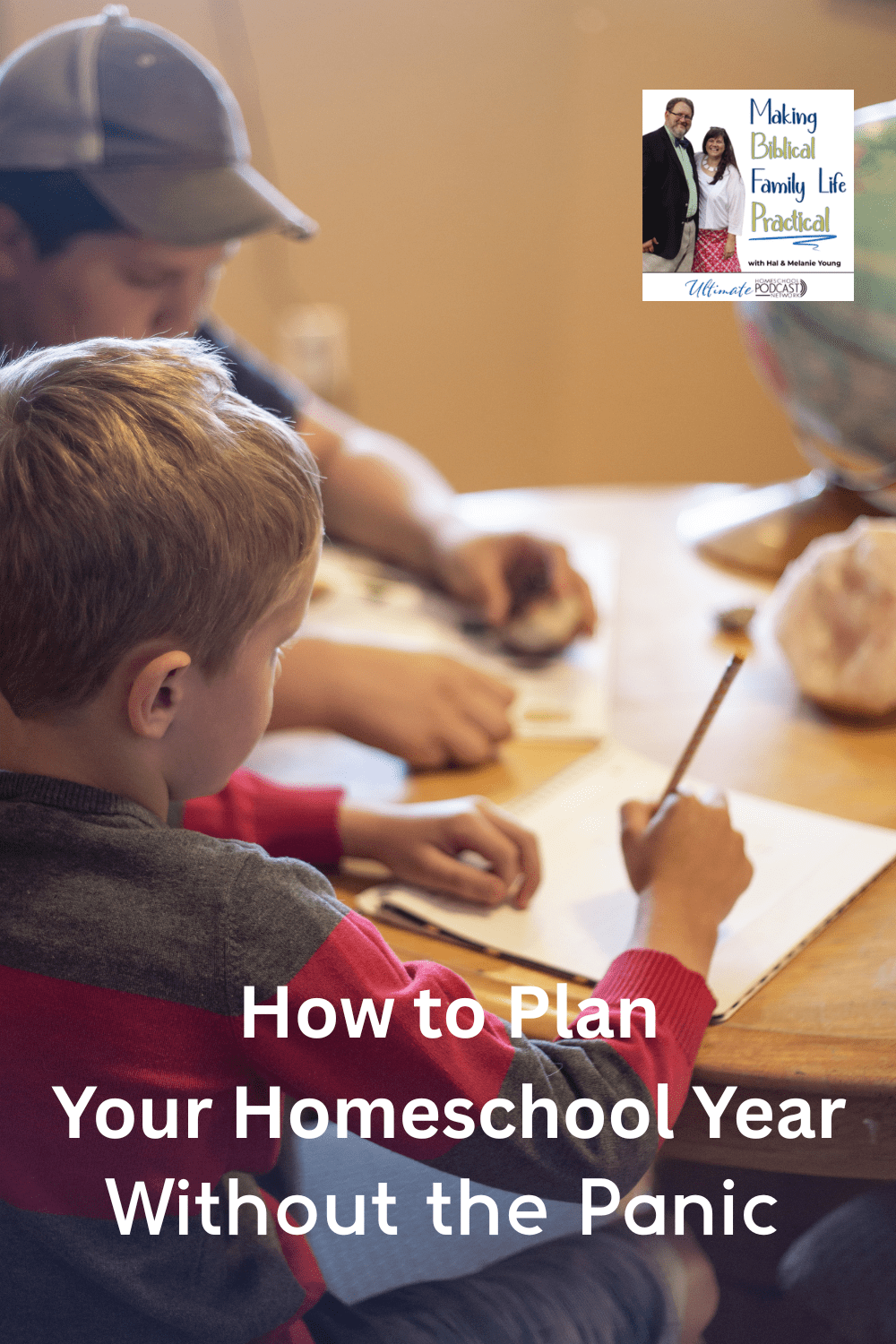
    How to Plan Your Homeschool Year Without the Panic (Put the Big Rocks in First) Aug 14, 2026
    Show notes

    Hal & Melanie Young on planning your homeschool year the sane way: put the big rocks first, hold your plans with humility, and leave room for real life.It’s that time again — the planners are out, the curriculum catalogs are dog-eared, and the pressure is building. Before you map out every minute of the coming year, Hal and Melanie Young want to give you some relief, some freedom, and a whole lot of grace.

    In this back-to-school favorite, Hal and Melanie share the planning approach that carried them through 25+ years and five graduates (all offered academic scholarships): plan well, but hold your plans with humility and flexibility. They walk through the “big rocks” principle — if you fill your jar with sand first, the important things never fit, so put the biggest rocks in first — and get honest about what those big rocks actually are.

    In this episode you’ll hear:

    • The “big rocks” framework for planning a year — and why discipleship and character are the biggest rock of all, bigger than any curriculum choice
    • Melanie’s practical system: plan eight weeks of each quarter and leave one week blank to catch up; plan the week ahead, not every single day
    • Why “God’s curriculum is often different than ours” — and two family stories (a surprise trip to China, a baby in the ICU during AP season) where the interruption became the lesson
    • The tools of learning that matter most — reading, math, and writing, in that order — and how mastering them lets a child teach themselves almost anything
    • Grace for the early years: why you can do a lot of work orally with little ones (especially boys) and not panic over handwriting
    • How to make your curriculum your servant, not your master — read the teacher’s notes, follow the design, then adapt and trim the busywork (“busy work kills the love of learning dead”)
    • Freedom from the fear of “gaps,” and permission to grab the once-in-a-lifetime opportunity even when it’s not on the schedule

    Whether you’re a brand-new homeschool mom terrified of choosing the “wrong” math, or a veteran feeling the August overwhelm, this one is a deep breath and a reset before you begin.

    Resources mentioned:

    • Hal & Melanie Young — RaisingRealMen.com and HalandMelanie.com (see Shop → Struggling Learners for reading help)
    • Love, Honor, and Virtue — Hal & Melanie Young
    • The “big rocks” time-management illustration
    • Proverbs on the fear of the Lord as the beginning of wisdom; the Psalms on delighting to study the Lord’s works

    Related listening (back-to-school): 👉 Homeschooling a Struggling Learner: Real Help When Nothing’s Working — a great companion if reading is your child’s sticking point this year.

    Connect: RaisingRealMen.com · Facebook /RaisingRealMen · and if this encouraged you, leave the show a rating on Apple Podcasts.

    This episode of Making Biblical Family Life Practical is part of the Ultimate Homeschool Podcast Network.

    The post How to Plan Your Homeschool Year Without the Panic (Put the Big Rocks in First) appeared first on Ultimate Homeschool Podcast Network.

    Click the icon below to listen.

    Boys and Noise: Managing a Houseful of Energetic Boys Aug 07, 2026
    Show notes

    oin Hal and Melanie as they discuss boys and noise. Find practical advice for navigating the noise in your home life.

    Encore presentation from the MBFLP archives — a listener favorite worth hearing again. Sponsored by CTCMath.com

    Boys and Noise: Managing a Houseful of Energetic Boys

    “Got boys? Then probably, you’ve got noise!” This week Hal and Melanie Young open up an email from a desperate homeschooling mom of four boys, all eight and under — two quiet, peace-loving firstborn parents completely overwhelmed by the volume, the wrestling, and the endless bickering. As parents of six boys themselves, Hal and Melanie have been exactly there, and they walk through what actually helps.

    The heart of it: boys are noisy, active, and energetic by God’s design — and noise is not the same thing as sin. Your job isn’t to turn your boys into quiet little girls; it’s to train them to know when to let it rip and when to put a cork on it, to stop the meanness without crushing the energy, and to keep your home a safe harbor for everyone in it.

    In this episode:

    • Why “one boy plus one boy” equals way more than two boys’ worth of noise
    • Boys, power, and impact — the God-given wiring behind all that energy
    • Teaching self-control: inside/outside voices, “commando quiet,” and the Silent Ship game
    • Burning energy on purpose — outdoor time and mid-day movement (and why large-muscle activity actually helps boys learn)
    • The bickering: kids are born sinners, so media limits help but the heart is the real issue
    • “The wrath of man works not the righteousness of God” — why losing your temper never motivates, and how raising your voice differs from losing it
    • The “knock it off” rule: rough-and-tumble is fine, but stop means stop — or you’re a bully
    • Home as a safe harbor: no name-calling, no sowing discord among brothers (Proverbs 6)
    • Why sibling competition is unfair across wide age gaps — and how to raise a “hero” big brother instead of a bully
    • The long payoff: the brotherly friendship you build now pays off hugely in adulthood

    Chapters:

    • 0:00 — Intro & welcome
    • 1:16 — The topic: boys and noise
    • 1:51 — A desperate mom’s email: four boys, eight and under
    • 3:23 — “We’ve been there” — Hal & Melanie’s six boys
    • 5:00 — Why boys are so loud (and why some are louder than others)
    • 7:17 — Power, impact, and God’s design for boys
    • 8:36 — Don’t turn your boys into girls — make it livable instead
    • 9:00 — Teaching quiet: ninja/commando, Silent Ship, inside voices
    • 12:43 — Burn the energy: outdoor time, mid-day PE, movement & learning
    • 14:51 — Resources for parents of boys
    • 16:19 — The bickering & nastiness: it’s a heart issue
    • 17:41 — Ground rules: the wrath of man, and voice vs. losing it
    • 19:02 — The “knock it off” rule
    • 20:11 — Home as a safe harbor: names, discord, Proverbs 6
    • 21:47 — Competition, fairness, and raising a hero big brother
    • 24:10 — The long payoff: brotherhood into adulthood
    • 27:20 — Encouragement: it takes consistency, and it will get better

    A few lines worth remembering:

    “Being noisy is not necessarily a sin. It’s not necessarily something you need to punish — but it is something that needs training.”

    “The wrath of man works not the righteousness of God. When I yell, when I lose it, it does not motivate them one bit.”

    “Whatever’s out there in the world, when you come home you should be completely safe.”

    About the hosts: Hal and Melanie Young are the parents of six boys (and more) and the authors and speakers behind Raising Real Men. Find more of their work at halandmelanie.com.

    More on raising boys from the show:

    • Boy-Friendly Homeschooling: How to Help Boys Thrive in Learning
    • Boys and Books: How to Help Boys Love Reading
    • Boy Question Free-for-All: Raising Sons Biblically

    Noise can be fun. Shop Whismsical and Adventure Gear @ RaisingRealMen.com

    Whisical Gear from Raising Real Men

    The post Boys and Noise: Managing a Houseful of Energetic Boys appeared first on Ultimate Homeschool Podcast Network.

    Click the icon below to listen.

    How to Be Happily Married While Homeschooling Jul 10, 2026
    Show notes

    🌿 This episode is proudly sponsored by Eden’s Table — a Christ-centered herbalism curriculum for K-5 homeschool families. One plant a week, woven through Bible, science, history, art, and Latin.

    Try a free week →

    Happily Married and Homeschooling, podcast episode of Making Biblical Family Life Practical with Hal & Melanie YoungHappily Married While Homeschooling?

    Happily Married and Homeschooling, podcast episode of Making Biblical Family Life Practical with Hal & Melanie Young.

    Everyone tells you that homeschooling isn’t an educational choice, but a lifestyle! Should we be surprised if we discover that homeschooling has an impact on our marriage? It’s true, and if we’re not watchful, our marriage could be a weak spot in our family’s new endeavor. Hal and Melanie have been married for 27 years and homeschooling for 20, and this week they share some ideas of stumbling blocks to avoid and how you can make both your homeschool and your relationship strong!

    This episode sponsored by CTC Math.

    Are you looking for a new Math Curriculum?

    CTCMath specializes in providing online video tutorials that take a multi-sensory approach to learning. Favorably reviewed in Cathy Duffy’s 102 Top Picks and The Old Schoolhouse Crew Review, the lessons are short and concise to help your children break down concepts and appreciate math in a whole new way!

    The lessons are taught the traditional way, not to a “test”.

    Each one of the video tutorials is taught by an internationally acclaimed teacher, Pat Murray, who is renowned for teaching math concepts in a simple, easy-to-understand way (and in only a few minutes at a time). Using a multi-sensory approach having the combination of effective graphics and animation synchronized with the voice of a friendly teacher together with practical assessment. This three-pronged attack makes learning so much easier and more effective. Even students who struggled with math are getting fantastic results! And ones who were doing OK before are now doing brilliantly.

    Visit c-t-c-math.com today to start your free trial.

    Real. Authentic. Practical.

    We’re Hal and Melanie Young. We’re not just authors and speakers, but we’re the parents of six sons (in a row!) and two daughters. The experience of raising this van-full has proved two things – you need God’s wisdom to raise a family, and you need help to make it practical!

    That’s our goal and message—start with Biblical foundations, then share how to put principles into practice.

    The reality is that God gave each family a mix of parents, children, and personalities, in a particular time and circumstance. They’re all unique, so every family’s “practical” may be a little different, and still be totally Biblical. That’s why we focus on principles instead of checklists. Instead of more law, we need more grace!

    And it’s grace that drives us to Jesus Christ, the one who ultimately makes our family what it ought to be. We want to help families find practical ideas, but the risen Savior as well.

    The post How to Be Happily Married While Homeschooling appeared first on Ultimate Homeschool Podcast Network.

    Click the icon below to listen.

    MBFLP – Teaching Kids About Liberty and Government (Replay) Jun 30, 2026
    Show notes

    🌿 This episode is proudly sponsored by Eden’s Table — a Christ-centered herbalism curriculum for K-5 homeschool families. One plant a week, woven through Bible, science, history, art, and Latin.

    Try a free week →

    MBFLP - Teaching Kids About Government and Liberty

    On the eve of the mid-term elections, how do we talk about the blessings of liberty to ourselves and our posterity? How can we help keep the next generation from trading our hard-won freedom for supposed security or momentary gain? Do we appreciate the importance of even these small local races that clutter up the bottom of the ballot? Join us as we share some of the things we’ve done in our family!

    Thank you to our sponsor, CTCMath.com

    The post MBFLP – Teaching Kids About Liberty and Government (Replay) appeared first on Ultimate Homeschool Podcast Network.


    When You Can’t Walk on Water: Practical Water Safety for Homeschool Families May 29, 2026
    Show notes

    🌿 This episode is proudly sponsored by Eden’s Table — a Christ-centered herbalism curriculum for K-5 homeschool families. One plant a week, woven through Bible, science, history, art, and Latin.

    Try a free week →

    Learn practical water safety tips for homeschool families. Hal and Melanie Young share swimming guidelines, life jacket rules, drowning prevention strategies, and ways to help children safely enjoy water adventures.It’s almost summer and water safety is a big concern. Peter walked on water when Jesus called him (Matthew 14) but most of us don’t have that direct command! We share some thoughts about how we train our kids to be safe around the lake, pool, or beach – even if you can’t afford a country-club swim instructor. It’s important!

    When You Can’t Walk on Water: Practical Water Safety for Homeschool Families

    Podcast: Making Biblical Family Life Practical with Hal & Melanie Young
    Episode Title: When You Can’t Walk on Water: Practical Water Safety for Homeschool Families
    Hosts: Hal Young and Melanie Young

    Sponsored by CTCMath.com

    Water safety isn’t just a summer concern—it’s a life skill every family should prioritize. In this practical and encouraging episode, Hal and Melanie Young discuss how parents can teach children to enjoy the water safely while building confidence, responsibility, and common sense.

    Using the biblical account of Peter walking on water as a starting point, they remind listeners that while faith is essential, God also calls us to use wisdom. Whether your family spends time at the beach, lake, river, water park, or neighborhood pool, this episode offers practical guidance for helping children become safe and capable around water.

    Why Water Safety Matters

    Many families assume accidents happen only to inexperienced children, but water emergencies can affect anyone. Hal and Melanie share stories of adults who nearly drowned because they never learned basic swimming skills and discuss why swimming should be viewed as an essential life skill, not just a recreational activity.

    Key Takeaway:

    Every family member should learn how to swim, float, and remain calm in the water.

    Teaching Children to Swim Safely

    The Young family emphasizes introducing children to water gradually and positively. They encourage parents to:

    • Make early water experiences enjoyable.
    • Use properly fitted life jackets.
    • Teach floating before advanced swimming techniques.
    • Focus on confidence and comfort in the water.
    • Respect each child’s readiness level.

    They also note that supportive instruction can make a significant difference in how children learn and overcome fear.

    The Young Family Swim Test

    Before children are allowed around water without a life jacket, the Young family requires them to pass a swim test designed around real-life safety situations. Their standards include:

    Water Safety Requirements

    • Float face-down for 30 seconds.
    • Float on their back for 10 minutes.
    • Tread water for 10 minutes.
    • Swim a substantial distance without assistance.

    The goal isn’t competitive swimming—it’s ensuring a child can stay safe if they unexpectedly fall into the water.

    Why Life Jackets Are Non-Negotiable

    One family rule remains consistent regardless of swimming ability:

    Anyone in a boat wears a life jacket.

    Even strong swimmers can become injured, exhausted, disoriented, or unconscious after an accident. Wearing a life jacket provides a critical layer of protection.

    Balancing Adventure and Safety

    As children become stronger swimmers, parents often face a new challenge: managing their growing sense of adventure.

    The Young family encourages activities such as:

    • Kayaking
    • Exploring nearby islands
    • Swimming longer distances
    • Building and using small boats

    However, every adventure includes planning, preparation, and safety measures such as:

    • Chase boats
    • Emergency recovery practice
    • Weather awareness
    • Life jackets
    • Clear communication plans

    Their philosophy is simple: encourage courage without ignoring prudence.

    Understanding Dry Drowning

    One of the most important topics discussed is the danger of delayed water-related breathing problems, often referred to as “dry drowning” or secondary drowning.

    Parents should watch for symptoms such as:

    • Unusual fatigue
    • Difficulty breathing
    • Anxiety
    • Chest discomfort
    • Persistent coughing after a water incident

    These symptoms may appear after a child has inhaled water and should be evaluated by a medical professional immediately.

    What Real Drowning Looks Like

    Many people expect drowning to look dramatic, but the reality is often very different.

    According to the discussion, drowning is frequently:

    • Silent
    • Quick
    • Difficult to recognize

    A person who is actively drowning often cannot:

    • Call for help
    • Wave their arms
    • Signal distress

    Instead, they may appear motionless, with their mouth barely above the water while instinctively trying to breathe. Parents and caregivers should learn these warning signs so they can respond quickly.

    Practical Water Safety Rules for Families

    Consider implementing these simple family guidelines:

    1. Wear life jackets until swimming proficiency is proven.
    2. Never swim alone.
    3. Establish clear water boundaries.
    4. Match activities to each child’s ability level.
    5. Teach floating and treading water early.
    6. Monitor weather conditions.
    7. Require life jackets in boats.
    8. Learn the signs of drowning and dry drowning.
    9. Encourage adventure with appropriate safeguards.
    10. Make swimming a family life skill.

    Frequently Asked Questions

    Why should children learn to swim?

    Swimming is a life skill that can help prevent drowning and increase confidence around water. It prepares children for situations they may encounter throughout life.

    How can I teach water safety if I don’t swim?

    Seek help from community pools, churches, friends, local instructors, or YMCA programs. Learning together as a family can be a valuable experience.

    Are life jackets necessary for strong swimmers?

    Yes. Accidents can happen to even experienced swimmers, especially when boating or participating in water sports.

    What is the most important water safety skill?

    Learning to stay calm, float, and tread water can save lives in emergency situations.

    Final Thoughts

    Water can provide some of a family’s most memorable adventures, but those experiences should always be paired with wisdom and preparation. By teaching children to respect the water, develop strong swimming skills, and practice safe habits, parents can help their families enjoy the fun while minimizing unnecessary risks.

    As Hal and Melanie remind listeners, the goal isn’t to avoid adventure—it’s to equip children to pursue it safely and responsibly.

    The post When You Can’t Walk on Water: Practical Water Safety for Homeschool Families appeared first on Ultimate Homeschool Podcast Network.

    Click the icon below to listen.

    1 2 3 8 Next

    Related Podcasts

    Making Sense with Sam Harris

    1

    Making Sense with Sam Harris Education
    Grammar Girl

    2

    Grammar Girl Education
    Good Life Project

    3

    Good Life Project Education
    Explain It to Me

    4

    Explain It to Me Education
    Team Never Quit

    5

    Team Never Quit Comedy
    Optimal Living Daily – Personal Development and Self-Improvement

    6

    Optimal Living Daily – Personal Development and Self-Improvement Alternative Health
    footer-logo

    Contact Us

    Toll Free: 844-670-7747

    Links

    • Home
    • Top Charts
    • Networks
    • Apps
    • Independents Podcasts
    • Podcast Advertising
    • Podcast News
    • Contact Us
    • About Us
    • Analytics & Insights

    Stay Connected

      Privacy, Terms of Use & Our Code of Ethics Protecting Content Creators Copyrights