If you’re looking for information about baby development, or looking for ideas about how to play with your baby to support development, Learn With Less (formerly Strength In Words) is where we discuss all things early parenthood and early childhood. We help families (expecting parents, new parents, and seasoned parents) navigate those early years in an inclusive, educational, and supportive space. Join Ayelet Marinovich, M.A., CCC-SLP, author, singer, imperfect mother of two and pediatric speech-language pathologist, for a podcast for parents, caregivers, and educators of infants and toddlers of all developmental levels. Learn With Less is the place for families to access high quality, evidence-based resources about how their infants and toddlers learn and develop; for regular sessions of music, play and developmental information for both you and your baby, subscribe on Apple Podcasts and visit https://learnwithless.com!
What Gets In The Way of Recognizing That All Communication Has Value? An episode with Jess Burchiel, M.A., CCC-SLP
Apr 16, 2025
Show notes
Exploring the Impact of Societal Pressures, Cultural Differences, & Trauma on Communicative Intent In this episode, Ayelet Marinovich and Jess Burchiel discuss the importance of communicative intent and access to communication as a human right. Jess, a speech-language pathologist, shares her experiences working with children, emphasizing the value of responsive parenting and the challenges parents face in recognizing their children’s communicative actions. We talk about: Communicative intent and Early Intervention Challenges in recognizing communicative intent The importance of slowing down and noticing each other, valuing all forms of communication How communicative intent is connected to broader social issues, and communication as a human right The impact of cultural differences, societal pressures, and trauma on communication We look forward to hearing the ways in which this conversation sparked your curiosity, and what new questions arise from listening! Helpful Resources Related to This Episode Learn With Less® Podcast episode: Assuming Intentionality – How to Respond to Early Communication Connect Learn Play – Digital / Printable infant, toddler, and pre-school aged ideas to provide simple, enriching ways to support early development through play, language, music, and movement – using everyday items – helping you Learn With Less®! The Learn With Less® Infant/Toddler Development Blueprint Lead caregiver/baby groups using the Learn With Less® curriculum by becoming a licensed facilitator Book recommendation: How to Talk so Little Kids Will Listen: A Survival Guide to Life With Children Ages 2 – 7, by Joanna Faber Donate to Operation Olive Branch, a direct aid fund for families on the ground in Gaza Support Palestinian Liberation by learning more about the BDS or Boycott, Divest, Sanction movement which has strategic boycott targets for consumers Learn more about the root causes of violence in Palestine, we recommend you watch this short history video or read The Hundreds Year War on Palestine by Rashid Khalidi Connect With Us Ayelet: Facebook / Instagram / Pinterest Jess: Facebook / Instagram Text Transcript of the Episode Ayelet: Welcome to another episode of Learn With Less®. I’m here today with Jess Burchiel. Jess just told me that a great way to remember how to pronounce her last name is: it rhymes with Churchill. Hahaha. Jess, would you like to introduce folks a little bit to you & to the kind of work that you do? Jess: I would love that. Thank you. Hi. Good afternoon from the west coast. My pronouns are she/her, I live in Bellingham, Washington, on occupied Salish and Nooksack and lami territory. I’m a speech-language pathologist here at a private clinic. I’ve been working with kids young as 2, and as old as 25, for about four years here. For years before that, I worked at a small community hospital in the county. I don’t know, I love cats, and I really like my job! I really like doing what I do, what we do, which has been so wonderful to continue to know. Ayelet: Yeah, that’s awesome. Well, I’m really happy to have you for this recorded conversation. You and I have been in touch over the last year and a half or so, mostly over social media. More recently, we’ve been in actual conversation with synchronous face to face contact, which is lovely. It’s been about a number of topics. These are including and not limited to: communicative intent, access to communication, the fact that everyone deserves access to communication, communication as a human right, human rights in general. We’re both Jewish or Jewish adjacent, and quite outspoken within the movement for Palestinian Liberation and what is happening in Gaza and The West Bank. Really looking at how we communicate, what is being communicated, communicative intent, looking at the full spectrum of communication here, from both a political lens and a education lens. And as we all know, everything is political at the end of the day. So with that all said, let’s start there, right? Jess: Let’s start there. I really gravitate to people who have a passion for what we do, for people who are internally curious about we do and how we do it. In particular now in the last year & a half, for people who are willing to speak up and say hard things. I think that is required of us, and I’m really excited to ask you some questions about communicative intent today. What do you think? Ayelet: I love it. I want to start just because before we hit the record button, we were doing a nice little grounding practice. As we sit here recording, it’s spring break. I have kids at home. They’re in the other room doing “video game camp” in the living room. And it’s been a day, it’s been a week. Let’s get on the same page here. Let’s ground ourselves. And Jess, you were introducing this lovely exercise, and I was wondering if we could just start with that, as well. Grounding Exercise and Initial Discussion Jess: A quick note, this is a grounding exercises, very new for me. It’s very much something I don’t want to do, which is why I’m trying to lean into it. I borrowed it directly from my therapist, who’s very much grounded in Buddhist teaching. As people who’re very busy and often disconnected, one of the hardest things is just to slow down and stop. We’re going to do that by, me and you & everyone who’s listening, taking a second, truly, to put your feet on the ground. Feel your feet on the ground, and take a couple deep breaths. Maybe I’m going to ask myself and you to identify a sensation in your body, and I’ll do the same. I will name mine as my heart is racing a little bit. I can taste the cupcake that a kid gave me this morning in the back of my mouth. Yeah. How about you? Ayelet: I’m feeling some congestion in my nose and throat. I have celebrated a birthday of one of my children this weekend. I had a nine year old literally fall directly into my face while coughing. Oh yeah, it’s very cute. I’m just feeling some tightness in my back, looking forward to just getting to connect and talk today. So some ease in my belly and openness in my solar plexus. Jess, thank you. Communicative Intent and Early Intervention So you had emailed me and you had asked about resources, thoughts, ideas around communicative intent. I’m going to open up this email, if that’s alright with you, as I read it out loud. So you had said, “I’m sure you’ve spoken about this countless times. Along with our mental health therapist, I am co-leading a support group for families with autistic kids. Something that came up last meeting was the concept that everything kids do has a communicative value. I think this is a really simple concept, but it seemed more challenging to go into depth about this with parents”. You’d said, “I’m wondering if there is a specific resource or podcast episode of yours that might help explain this concept to parents.” I had shared with you that, yes, in fact, I do I have a podcast episode about this. It’s called Assuming Intentionality, Responding to Early Communication. And of course, so much of what I focus on here at Learn With Less® is with early intervention… Those earliest years of infancy and toddlerhood, zero to three. A lot is focused on parent education. Also educators and or therapists who are serving that population. This is both in a family centered approach or just the kids or just the parents. That was the nuts & bolts focus of that episode, but I want to hear anything that was helpful around listening. Before we started recording, we started talking about how so much of looking at communicative intent and assuming intentionality, assuming that there is intent behind any action, essentially, is that it actually doesn’t matter what age the child is. You and I share a lot of experience, having worked with autistic kids. We’ve both worked with assistive technology, specifically augmentative & alternative communication. Utilizing assistive technology within the realm of communication might look like a speech generating device that’s high tech. It might look like a picture based or visual communication system. You and I have both utilized things like that within our work. I want to hear what was helpful for you, specifically with your work, looking at the episode that I directed you to. Also, what else do you want to talk about? Challenges in Recognizing Communicative Intent Jess: Oh, man. Okay, so my favorite takeaway was that there is an evidence base for responsive parenting. I love being able to say, “this is what the science says” when parents are asking me questions about how to help their kids talk more. And that’s not something I’ve read into! I know that more responsive parents tend… I’ve just seen that that they tend, their children tend to communicate more. That almost seems self evident, but to know that that is what the evidence shows was really good. I was like, Okay, I can look at this. I can be able to say that confidently, even if it seems obvious. This brings me to my questions that I want to talk about with you. Would you agree that it seems pretty obvious that responsive parents have more communication coming out of their kids? Does that seem to you an obvious thing, or was it a surprise to you? Or do you even agree with that? Ayelet: In my own personal experiences, both as a mother & in my professional experiences as a speech language therapist. Yes, I have, I have found that to be the case. I think primarily the reason is because joint attention& and communicating for a social purpose of any kind… Turn taking begets more turn taking! Once we have that skill, we see that oh, I say something. You say something. I look at something. You look at something. I reach out for something. You name it. I hand it to you. You say, thank you. It’s a continuous response, whether those responses are verbal or not. I think that is the piece. What I have found is that when any human feels heard, feels acknowledged and seen and supported, then they’re going to continue along that path. They’re they’re going to continue to have those attempts to to want more, because that is an innate human need. Jess: Yeah, so here’s my question. Well, maybe it’s another question. My experience… all of that resonates with me. It feels very natural. It feels very human, like we are communicating to kids and validating what they communicate back. What I’ve seen be a challenge is that sometimes… I feel like the challenge there is shifting the mindset of parents. And I’m wondering if my questions circle around that, specifically. What do you think gets in the way or prevents us, caregivers, parents, from recognizing that all communication has value. Recognizing that there is communicative intent happening. Like, what do you think gets in the way? Ayelet: That is, what a great question. Jess: Yeah, I thought, Okay, so why… that’s my pathology brain. Like, okay, we see a problem. Why? Ayelet: Right? What is getting in the way? I love that. I think that could be the title of our episode! Jess: Yes, what gets in the way? What prevents us from recognizing the communicative intent of children? Ayelet: Yeah, well, many things. First of all, I think in many ways, a lot of it comes down to time, energy, effort, education, understanding. Not just about child development, but about actually sitting with and being with and recognizing, again, basic human needs. And I think that some of this is because we are very busy as humans, right? We’re “keeping up with the Joneses,” whether or not we’ve opted out of multiple things. We are often trying to manage a home and a family. Maybe a co-parent or caregiver, and at least a job and all of the things. We want to feel like we have enough in a society that is built around needing to be more, do more, & buy more. So here’s the easy answer, we’re not going to be perfect. It’s impossible, right? This is a supremacist ideology. I think that’s part of it. I also think a big part of it has to do with what we are told is communication. What is valid and valuable. There’s so much pressure on many parents and caregivers to be raising the best child possible. So many people in our society value academic language, politeness markers. I think that’s a big part of it, too. So how that comes out often can be in the form of parents and caregivers sometimes sort of getting into that stuckness, of the interrogation: What’s this? What’s that, what’s this, what’s that? For the specific purpose of labeling, for this sort of performance: show me what you know. This, again, you’re not a bad parent for doing that. None of us are. I’ve done it! Jess: I do it all the time! Ayelet: We do it because we want our kids, our clients, to show us what they’re able to do, & to feel successful. Also, we want to make sure that we’re not just communicating for one specific purpose. We want to give our little people, or not so little people, in some cases, the opportunities to engage in communicative acts for a variety of purposes. Sometimes to protest, to request a social routine. Sometimes to greet, sometimes to acknowledge, sometimes to request an object – so many different pieces! I think what’s really important is to recognize that all of those (and so many more!) communicative acts can be done without speaking a single actual word. Jess: Absolutely. Ayelet: That is an attuning, I think. For many parents & caregivers who are not thinking about how their often pre or non-speaking child is communicating. For an educator how their student, for instance, is communicating. They’re looking at a particular piece & not taking the time to ground themselves. Not taking the time to really look at all of the whole environment, themselves. At them as the respondent, what the setting is, what’s happening around them, what the child might be interested in. I have an example, a memory that I have from when my own eldest was about a year old. I remember my mom was visiting. We had gone out to a meal, just the three of us. Myself, my child, and my mom. My kid was, at that time, very early stages, making one word utterances. He was reaching out, sort of pointing. Looking at somebody over in the restaurant. He said, “tah!” And I was like, oh, okay, yep, there’s a person over there. That’s their head, cool. And my mom, it was my mom, who realized, is he saying “hat?” The person was not actually wearing hat, they were wearing a head scarf. It was just so interesting because, as you may know, my go to with anything is: anything can be a hat, right? So then we grab the napkin from the table. We’re putting it around our heads & saying, Oh, is this a hat? This is like a hat. It’s a scarf. And he said “tah!” again. He repeated his word! He’s switching the consonants, but he was saying it. He was saying hat. Anyway, it just it was one of those experiences that you’re like, oh, wow, cool. This is a child who is absolutely paying attention to what’s happening. Is actually assigning a a symbolic language, a word. It’s a matter of looking at the environment, looking at the setting. Looking at what’s interesting to the child, looking at where the child is gesturing. Looking at how they’re doing it, what they might be commenting on. Deducing, “detectiveing,” investigating what is happening here, and only then might you notice. And then we had a whole conversation about it, and we played with the napkin, and we… Yeah, it just like, what a what a lovely thing. And if my mom hadn’t been there, I would have missed it, right? So we’re never going to be able to get it all the time. That’s an important thing to say as well. Jess: Yeah, I suppose, that perfectionism like, “Oh no, I missed it, It’s my fault.” One of my favorite books is “How to Talk So Kids Will Listen and Listen so Kids Will Talk.” There’s one for littles and one for older kids. That is one of their things. The best thing about being a parent is you have a million chances to do it again. You will ne…
Am I Doing Enough? Understanding Your Baby & Toddler
Mar 25, 2025
Show notes
A Co-Production from Learn With Less® and the Play On Words Podcast Are you constantly wondering if you’re doing enough as a parent? Do you feel pressure to “get it right” when it comes to your baby or toddler’s development? In this episode, In this co-produced episode, of the “Play On Words” podcast and the Learn With Less®” podcast, Ayelet Marinovich of Learn With Less® joins host Beth Gaskill of Big City Readers. Ayelet Marinovich is a pediatric speech-language pathologist, parent educator, & founder of Learn With Less®. She’s the author of Understanding Your Baby & Understanding Your Toddler, 2 incredible resources that remind parents: you don’t need fancy toys or complicated activities—your everyday interactions are already powerful learning moments. We talk about:🧠 Why you don’t need more stuff to help your child learn✨ How to feel confident that you’re doing “enough”👶 The surprising ways babies and toddlers learn best📚 Simple, evidence-based ways to support early development🎵 Why everyday routines (yes, even diaper changes!) are packed with learning opportunities If you’ve ever doubted yourself as a parent, this episode is your reminder: you are enough. 💛 Helpful Resources Related to This Episode The Learn With Less® Infant/Toddler Development Blueprint Ayelet’s books: Understanding Your Baby & Understanding Your Toddler Connect Learn Play – Digital / Printable infant, toddler, and pre-school aged ideas to provide simple, enriching ways to support early development through play, language, music, and movement – using everyday items – helping you Learn With Less®! Learn With Less® Fundamentals Course Big City Readers Courses Ayelet’s Musical Album, Strength In Words: Music For Families Connect With Us Ayelet: Facebook / Instagram / Pinterest Beth: Facebook / Instagram / Pinterest Text Transcript of The Podcast Episode Beth: Welcome back to the Play On Words podcast. I am so excited and a little bit nervous today to have Ayelet Marinovich here from Learn With Less® to talk about: Do kids really need toys to learn and thrive? If you don’t know Ayelet, she is a child development guru, parent, play based learning specialist, and speech therapist too, right? So many things, I’ll let you introduce yourself, but this is an episode (I already know) is going to be so great. So welcome to the show. Ayelet: Thank you so much for having me. Beth. It’s great to be here. Yay. Beth: Okay, so tell us a little bit about you and Learn With Less® for the people who might not know you! Ayelet: Sure. So again, I’m Ayelet. I have been a speech and language therapist since, gosh, 2009 / 2010. When I became a mom in 2014, I was far from where I grew up, which was here in California. My partner and I had moved to London, and so I was pregnant and had my first child there, across the pond. I was really looking for, number one, community. Number two, a way to utilize the knowledge that I have in my professional arena, and connect that with creating connection points with other new families. So I started leading caregiver and baby classes with my own child, just in my community, out of our home. I loved it so much because it was an opportunity to connect, to bring people together and, again, to share information that at least I knew. Obviously, the overwhelm of early parenthood is intense, and this was a place that I could feel confident. I could feel at least a little bit less vulnerable and and really share that information with other new parents and caregivers who I knew were feeling the same way. I just started leading these groups, and really facilitating these groups and utilizing that knowledge, and just expanding on the kinds of questions that I was getting and asking myself. What can I do to support and connect with this teeny, tiny human in my world? And yeah, that’s, that’s how it came to be. Beth: Wow. And so now, are you still leading them, or are you mostly training and coaching other people to lead them? Ayelet: Yeah, primarily I license and support other educator and therapist types to utilize the curriculum that I developed, to use in their own communities. This is amazing because it expands the impact that I can have exponentially, and really allows me to feel like I’m putting something into the world that is healing and helpful. Beth: It is. I even like the song on your podcast. Is that in – do you sing that in the class? Hello, everybody, I get it stuck in my head when I’m listening. I love singing it in my own house, like when I’m making dinner. So, okay, do you do miss teaching the in-person or the actual “caregiver & me” classes? Now that’s my growing pain, too: You want to have a bigger reach, but you kind of have to give a little! Ayelet: Yeah, and I do from time to time, often offer them virtually! I mean, it’s funny, right? Because when I started the licensing program, it was February of 2020, so there was, of course, a big switch to, I now need to ensure that other folks also are able to lead these virtually. I had actually been doing this since 2017 myself, for a variety of reasons. There has always been a need for virtual connection, and always will be. So I do still lead classes from time to time, especially when I’m getting that itch. Beth: Oh good, that’s kind of how I do it, too. I was just talking with someone yesterday, and they said, so you don’t get to be with kids anymore? I answered, No, I still do. I do, say, a once a month meetup, but it’s so hard because you think to yourself, I want to reach every kid and family! I think we align a lot on that – that is my big focus: community for families, whether they’re in school or in the baby stage. Originally I started because I saw so many parents having struggles with knowing how to advocate for their child in an IEP meeting, or like things like that. There needs to be a bridge between school and home: how to find your community, asked the right resources… and then my work expanded to people who don’t need IEPs! Yeah, it’s such a need. Community is such an important part of being a parent! Ayelet: Yes, especially in these uncertain times. Beth: I know! Every post I do, I ask myself, does this matter? The world is on fire! I know you are a big advocate of using what you have. I mean, your literal company is called Learn With Less®, right? I once posted something many years ago, and I still think about it, because I kind of got in trouble, but I posted something that a popular toy subscription company had sent me – this little toy that was a box and it had tissues in it, and you pull them out. I was like, so cute. And I made a post that said, and also, this actual box of tissues does the exact same thing. There’s no need to buy this. Ayelet: I literally have one sitting behind me, yes! Beth: The reason I got in trouble is because a toy store owner said, I’m so mad at you! but I said, I’m sorry, there’s enough for people that want to buy toys and people to know that they don’t need, too. So can you talk a little bit about what role toys actually play in child development? What Role Do Toys Play in Child Development? Ayelet: I mean, first of all, I like to say this whole the baby industry is sort of a “The Emperor has no toys” situation, right? I am not anti toy. My children have always had toys, either that I have bought or that other family members or people in our community have given them. But my my kids also have always known that the wooden spoon and the paper towel roll are equally as entertaining and an equally valid developmental tool. The power of any tool or toy is not inherently on the box that says “this is an educational toy.” Anyone can put that tag on, say, cupcake liner and say “educational toy.” It’s the actual interaction with that toy and with others that makes the difference. I think it also really comes down to the power of connection! And at Learn With Less®, we have four pillars that we want to define around creating more connection, more opportunities for interaction, more vocabulary, more modeling, more reciprocity. So those are, as I define them here at Learn With Less®, play, talk, sing and move. And I’m happy to go into that, if you’d like. Beth: Oh, please! How Does Play Support Early Learning? Ayelet: Yeah! So around play, we want to define that with attention to the following principles. First, open ended play, meaning we want to encourage caregivers to really engage in the exploration of the environment and everyday objects. Also, being playful can simply mean exploring, experimenting, offering varied environments and varying objects! Most importantly, we want to actually help the adults in the room see that being playful is a different way of looking at what we as grown ups come to define as play. Many adults in the room come into the idea of playing with their child as following set of rules. For instance, we hit the ball, we run, we score. Or it can be thought of as a procedural exercise: we open the book, we read the page, we turn the page, repeat. Encouraging caregivers to play with no specific end goal in mind can really require them to reframe their entire thinking. I think a lot of your audience are educators or therapists, as well. So in a therapeutic context, you’re going to want to weave whatever skill you’re working on into the play. For instance, it might be that a professional is working on turn taking, eye gaze, joint attention, imitation, first words, or gesture use. We want to encourage and create an environment where that caregiver is encouraged to be flexible and accepting of what is happening, what might happen next, and what their child is doing. Finally, within that play, we want to ensure safety with a variety of materials. Beth: Yeah. So, okay, I’m imagining. I always try to work on remembering that not everyone has all of the information. If I’m the furthest point out, I’m imagining that I’m a parent. So how do I play with my kid? Say, I’m sitting in my living room and we have I’m drinking my coffee, and he likes the plastic lid that I took off from the coffee shop we stopped at this morning. How do we play with that? I think a lot of parents also think that play means I have to “be silly,” which I think maybe we can correct that. I think people want a specific goal. So if they’re asking, so what do, how do I pick what topic I want to do with this lid? And, you know, then they just get stuck. Do I just say, the lid is on my head? Ayelet: Well, actually, yeah, I mean, my default is always… everything is a hat! Beth: Okay, so that is a good move. Ayelet: It’s a great method, yeah! I mean, it’s really about following the child’s lead. If your child is interested in that plastic lid, then, yeah, what are they doing with it? All you need to do is talk about what they’re doing, how are they engaging with it? Oh, it’s light! Yep, you can pick it up. I wonder if there’s something heavy over here? Just speak about what they are doing with it, or how it feels, or what it looks like. Engage with that. Of course, we can always expand, meaning take what they are doing and add more language. I can imagine say, pushing a finger down and sort of popping it up. There’s so much that we can either lead with and model, or simply just follow what our child is doing and how they are interested in it. Beth: I love it. Okay, that’s easy. Do you have a time frame around that? I know we would say, no, just follow their lead. But so many people ask, how long do I sit? Should I introduce something else? I think we’ve over analyzed things so much as a society that people feel like they’re not doing anything right. When actually, you’re worrying about it is the only problem! Ayelet: I think parenting is such a practice of of being able to sit with. I will be the first person to say that I absolutely still struggle with that. My kids are eight and 11 now. But I think it’s about paying attention to what’s happening in the environment. It’s looking at, is the child still engaged? Great. Continue to reinforce that engagement. Are they finding that they’re done? Great. We’re all done with this. We can move on to the next thing. And like you said, it’s very hard, I think, for families to trust themselves. So much about of what this is all about, what I try to achieve at Learn With Less®, is fostering confidence and competence. It’s about helping families feel confident and competent that they can be with, and facilitate, and engage in play. The means to do that are often through these four pillars of play, talk, sing, move, which are again, just an open ended opportunity to enjoy your child for a few minutes. I think another thing is, like you said, people think that play is “I have to be silly. I have to do pretend play. I’m not good at that. I don’t want to do that. Or I don’t even have more than 10 minutes a day to dedicate to sitting and totally being present.” But I think the example you gave,Beth, is so good. Because it’s literally: Okay. I’ve sat down with this maybe lukewarm cup of coffee. I’m finally getting a few minutes to sit with it and with my child. So much can happen within those in between times. A lot of what I talk about at Learn With Less® is utilizing those everyday routines and tiny rituals of the day. That’s your gold! We don’t need to necessarily dedicate 20 minutes a day just sitting with our child. We are literally doing it during a diaper change, when you’re putting your child’s shoes on or sweater on, when you are going out to get the mail. All of those little things are the opportunities! Beth: Those tiny moments are often the times we’re rushing through to get to the next part – but that’s when everything’s happening! I also when you were just talking, I thought, okay, I went from asking, people are going to ask, “what do I do?” Okay, so say they want to play with this lid, and can we give them play? And then when you renamed the pillars again, play, talk, sing and move, then, I got to thinking about what happens next! So maybe you’re pushing the lid, and then you’re going to chase it. Then you get it, and then you are popping the thing, and you’re going, “pop, pop, pop, pop goes the top,” and just those little moments. So maybe walk us through, let’s keep this as the example, and through the rest of the pillars. How Do We Create A Language Rich Environment For Babies and Toddlers? Ayelet: Okay, so we’ve started with play, so then we can discuss talk. Like you said, “pop, pop, pop, pop goes the top.” That’s both talk and sing! You’re saying vocabulary and you’re making it into some rhyming scheme, you’re giving it a rhythm or a melody. So for talk, we want to remember that caregivers – just by having discussions with their potentially pre verbal baby or toddler, just by making those observations alongside their child, they’re creating a language rich environment. Let’s think about this idea of “repetition with variation” as the gold standard. That’s about helping them see the value in all those everyday experiences, like the diaper change or popping the lid of the coffee topper. These are all these are opportunities for repetition, because maybe you do go get a cup of coffee every morning. And tiny variations that you can make with a change of pace, with a change of attention, with the addition of a choice making opportunity, with a little song, like “pop, pop, pop goes the top” and so on. That’s it! We also want to help caregivers remember that the drill and kill kind of “what’s this? What’s this?” labeling that many parents sort of get stuck in, because they want their child to show them how much they know… This is just one of the many reasons we communicate! Labeling is just one way we can talk about things, but so is asking questions, making requests, greeting… You could hold up that lid and say hello, and then move the little topper that goes in and out and that can be its mouth. Suddenly you have a puppet! Oh my goodness, how cute! So many other parts of joint…
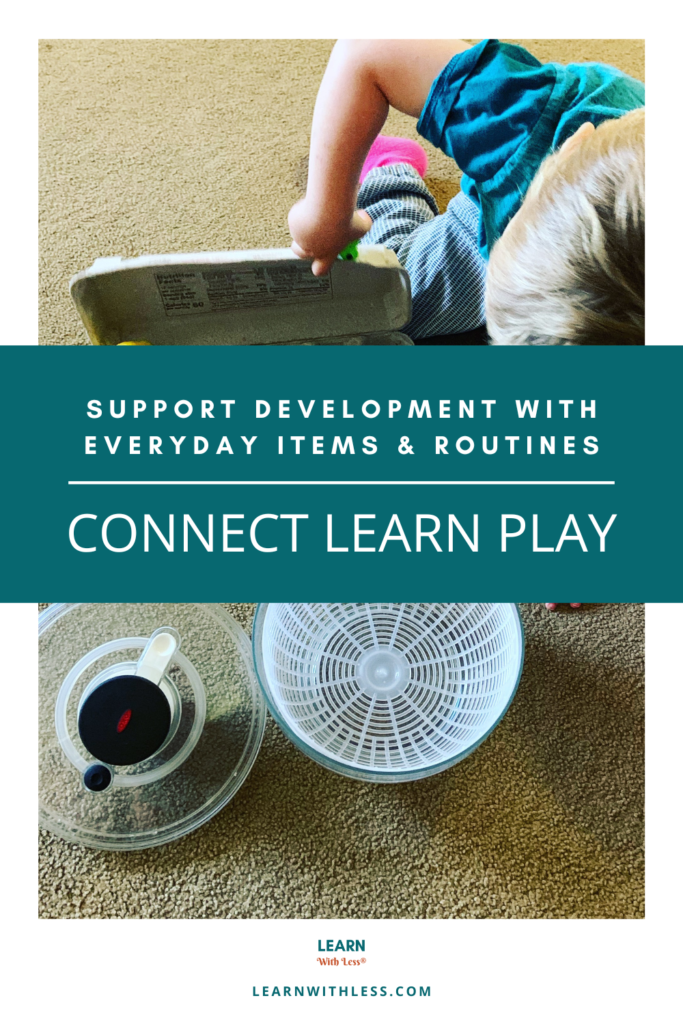
You’ll always know how to support a young child’s development with a laundry basket, a cardboard box, or a dishtowel!
On this episode of the Learn With Less® podcast, Ayelet discusses how a simple shift in our understanding of what we can view as “educational materials” or “toys” can help us see how little we actually need to buy… And also how much power there is in opening up our own eyes to the wonder of play, as seen through a young child.
Are you a new parent or caregiver wondering what you really need to support and connect with your baby or toddler? Or are you a professional who serves new families as a developmental therapist, early childhood educator, or other professional in the perinatal space? This episode and our related resource, Connect Learn Play, is for you!
Hi there. I’m Ayelet Marinovich, and you’re listening to Learn With Less®. Today, I wanted to share a little bit about a very exciting new resource that we have just released here at Learn With Less®, in collaboration with my friend and colleague, Miranda Zoumbaris at The Emerging Parent. Miranda and I attended the American Speech Language and Hearing Association conference back in November 2023, and at that convention hall, we had a exhibit booth for Learn With Less®.
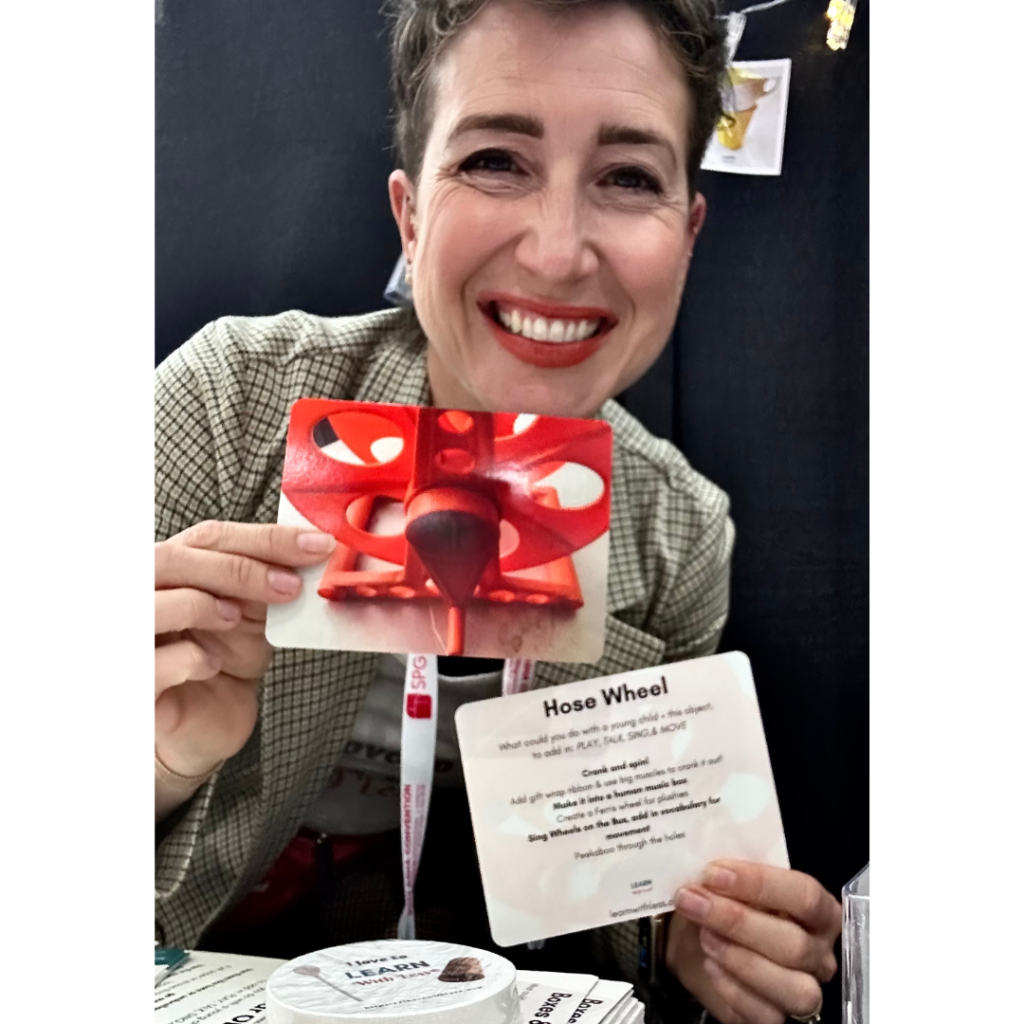
One of the fun giveaways that I had created was a series of postcards. On the front was an image of an everyday object, like a funnel or a laundry basket or a box. On the back there were a series of ideas for how you could use that everyday, simple object (a commonly found household item) to support connection and development through the use of play, language, music or movement. These are the four pillars of Learn With Less®: play, talk, sing and move.
Now, I had created these as a giveaway, and they were sort of a testing ground for the kinds of fun things that might be useful for both professionals serving young families as well as new parents and caregivers themselves. What happened was pretty hilarious. Everyone was getting them as giveaways, and they were asking where they could buy the product. So Miranda and I got to work creating this new, exciting resource for all of you, and we call it Connect Learn Play.
What does Connect Learn Play do? Basically, the promise is that you’ll always know how to support a young child’s development with a laundry basket, a cardboard box or a dish towel. Connect Learn Play is a resource for parents and caregivers of young children and for practitioners working with zero to five year olds. They are digital, printable, infant, toddler and preschool aged ideas to provide simple, enriching ways to support early development through play, language, music and movement, using everyday items, helping you to Learn With Less®.
What Does It Mean to Connect Learn Play?
I want to give you a little bit more information about what Connect Learn Play is, and why it is a useful resource for you. So essentially, it’s your invitation to stress less, to need less and spend less of your time and money so that you can feel more confident, be more responsive, and create more connection.
So, picture this: you’re sitting on the floor with your tiny human. You’re trying to figure out what to do to maximize the 20 minutes between the time you’ve gotten home and the time you’ve got to start getting ready for the next meal. You take out your devil device and start scrolling through Tiktok or Pinterest or IG, or whatever the latest idea rabbit hole where you’re currently following the latest parenting or early childhood influencer. Everything you find requires materials that are not within arm’s reach. And everything requires time you don’t have. Everything requires pre-planned brain space that you don’t have. And in the meantime, your child has found the curtain above them.
What do you do next?
A, pull your child away from the curtain again and again.
B, distract them with one of the five toys you got suckered into buying from this year’s best toys to buy for kids under five.
C, join your child at the curtain after recalling the idea about using long fabrics on the Learn with Less® Connect Learn Play prompt yesterday.
You can play peek a boo. Or you can talk about the color or texture of the curtain, or what you see outside the window. You could sing a song about hiding and seeking. And you could follow your little one around as they move behind the curtain. Listen, you get to decide!
Connect Learn Play cards are a classic resource from Learn With Less®. They’re designed to prompt you to start thinking about ways to connect the dots between what a child is showing interest in, between the relationship between caregiver and child. And to connect the dots between the literal neurons in a young child’s brain that enable them to grow, learn and thrive without being prescriptive, overly structured or requiring of any specific toy. Connect Learn Play helps parents and caregivers make the connection between a child’s interests and strategies used to support development, whether that child is experiencing a delay, is right on target or is ready for more.
If you are a parent, a caregiver or a provider of developmental services, then Connect Learn Play is for you! As with all the resources we create here at Learn With Less®, we use the four-pillar framework of the Learn With Less® curriculum (as I mentioned, play, talk, sing and move) to address four major areas of infant and toddler development: cognitive, communicative, motor and social and emotional development.
Toys and more materials take up, extra space, cost more and sometimes even prevent us from following a young child’s lead and responding to what they’re interested in at the moment. So, let’s get real. As a mother, a pediatric speech language therapist, and as a coach for practitioners using the Learn With Less® developmental curriculum, I am certainly not anti-toy. I say, do what works for you. But the idea that you need to buy anything in particular to support a tiny human is not only flawed, but also deeply inequitable.
How To Support Early Development With Everyday Routines and Everyday Items
Supporting development and connection for young children can be simpler than we think. Families need to know how to make use of the natural routines and everyday interactions in front of them. The idea that there’s an inherent developmental value in an object classified as an educational toy is, quite frankly, a delusion. The truth is, you already have the resources to give young children the right stimulation, play, and interaction to thrive – whether or not your toy closet is bursting at the seams. The items in our homes that we already have often hidden in plain view are powerful learning tools that can support all areas of development.
So just imagine, providers and practitioners: instead of spending your precious time pre-planning sessions, hauling that big old therapy bag around, wondering how to do bagless therapy routines based intervention and how to center parent education in your work with young families. You feel confident responding to the parent or caregiver and the child in the moment. You feel rooted in the routine you step into using what the family already has and relying on your own set of skills, knowledge and observations instead of a particular toy. And you feel relieved to have a quick reference guide to use an object the family already has on hand in either printed or digital format so families can generalize and carry over what you practiced in the many, many days and hours while you’re not there.
Now for families, imagine this instead of the constant looming guilt that you’re not doing enough or that you don’t have that special toy or specific material in order to support your kids, brain, language, muscles, emotional needs, I’m looking at those very expensive toy subscription boxes in your social media feed. Instead of all those feelings, you have ideas for play and interaction using what materials, time and energy you already have. You have confidence. You’re doing enough for your young child’s physical and mental development each day. And you have more valuable interactions using the tools at your fingertips to play and engage in enriching activities that support the connection between you. Finally, you also have access to ideas on the go wherever you are with a digital download.
What exactly do I get with Connect Learn Play? So what this is, is access to over 100 ideas for play with 25 everyday items. It is a simple digital download. You’ll be provided with both postcard-sized and full page handouts, in case you want to print a physical copy for easy use or easy sharing with families. For families, you can easily save to a folder on your phone, for instance, print it out and place one on your fridge. And for providers and practitioners, you could text or email an idea to a family with whom you work.
Connect Learn Play can be used during sessions as handouts or cards. They can be provided as supplemental material after. You’ll receive a link to a digital download with all 25 cards in English. Currently, we’re still working on Spanish and Arabic. As a parent or caregiver, or as a provider, you can save these to a folder on your device or print them out for quick reference. Just as you’d refer to a cookbook for a recipe, you could check out what you might do with the ingredients you have on hand. Once you’re using these ingredients regularly, you’ll start to see the power of everyday items. Connect Learn Play can go alongside materials you might use as a clinician, for instance, mental health or developmental therapist, as an early childhood educator, home visitor and or a licensed Learn With Less® class facilitator.
See Play Through A Child’s Eyes
I want to share with you one thing that a current Learn With Less® facilitator, parent of multiple young children who have attended Learn With Less® classes themselves, with me as a facilitator, and who are now in preschool and beyond… I want to share with you what Rachel Kammeyer has to say about the power of Connect Learn Play.
“The most powerful thing is that, like, this veil gets lifted of our adult perspective of the use of an object. And then once you unsee one thing, like a garden hose, you start to unsee it everywhere. You’re open to how a child explores it, versus our expectation of how we use it. Yeah, it’s amazing!
So the preschool I go to is very Learn With Less® in the sense that we use a lot of everyday objects for our activities, and one little girl was touring yesterday. There are these little sticks that look like golf tees, and we have 12 or 15 little things to put them in. And this was, like, this little girl’s jam. She was just putting in and taking out and lining them up. And it was fine motor. It was cognition. It was so beautiful. And the mom was like, How do I buy these? And I’m like, “Oh, do you have hot rollers at home? You can do the same thing. She can put them up and put them right down on this.” And she’s like, I do, and I haven’t used them in forever! She’s like, I never would have thought of that. I’m like, I have been trained in the art!”
I love that from speech-language therapist and Learn With Less® facilitator. Rachel Kammeyer, Thanks, Rachel. So again, who this is for: Connect Learn Play is for families with or expecting infants, toddlers and preschoolers. It’s for individual providers serving families in a home based, clinic based, school based and/or medical setting, and it’s for organizations serving families.
So no more scrolling Pinterest trying to find the perfect activity to set up for your child. No more digging through your therapy bag to find the perfect toy to invite playfulness into a session. Again, there is a simpler, more equitable way to support tiny humans without needing the fancy toy subscription. Connect Learn Play is the perfect, simple resource that allows you to offer a perfect blend of child led and structured play for tiny humans to thrive.
Here’s the thing: when you learn to recognize the tools you already have to boost your child’s development, you are able to maximize the time you have with a young child. You’re empowered to get it right, and you’re able to unlock the power of everyday routines and everyday objects to figure out how to play with your tiny human go ahead and grab Connect Learn Play. Over at learnwithless.com/connectlearnplay. We cannot wait to hear how you’re using Connect Learn Play, and we look forward to hear what you think! Wishing you more great moments with what counts.
What Do We Really Need to Support & Connect With Tiny Humans?
Apr 10, 2023
Show notes
An Ultimate Checklist of Baby and Toddler Learning Essentials? Or Nah. On this episode of the Learn With Less® podcast, Ayelet discusses the ways in which early development, everyday routines, everyday materials, and simple activities (often in which we are already engaging) are powerfully interconnected. If you are a new parent or caregiver wondering what you really need to support and connect with your baby or toddler… or you’re a professional who serves new families as a developmental therapist, early childhood educator, or other professional in the perinatal space, this episode and our related upcoming workshop is for you. Many of us are searching for the ultimate checklist of items for young children, or for a list of go-to developmental activities for babies or toddlers to have in your back pocket. Ayelet makes the case that you already have the resources you need – and that if you’re spending your hard earned money on fancy developmental toys, that investment could go toward other places that are in line with your values. In our upcoming Learn With Less® Family Enrichment Fundamentals Workshop, we’ll explore the basis for the four areas of early development, and connect these to a framework of play, language, music, and movement so you can support and connect with the tiny humans in your care using the time and energy you’re already expending, and the materials you’re already using. Find the magic in the mundane, everyday objects and routines. Join us in our upcoming workshop and discover all about how to Learn With Less®! The Learn With Less® Curriculum is used in communities all over the world in a “caregiver & me” class setting, and has also influenced the philosophies and environmental considerations for play spaces and organizations serving families. Not familiar with the term, “caregiver & me” classes? We use it as a more inclusive term instead of “mommy & me” classes. Our classes are open to – and meant for – ALL parents and caregivers: not just moms… but also dads, non-binary folks, grandparents, foster parents, babysitters, nannies, and other amazing grownups who care for tiny humans. We’re going to play the “search term” game here (so you can find this great content more easily!) and help shift the conversation from “mommy & me” classes to “caregiver & me” classes… to do our part to shape the more inclusive world in which we’d like to live. Helpful Resources Related to This Episode Register now for Learn With Less® Family Enrichment Fundamentals Workshop Learn With Less® Bundle: get our favorite infant and toddler development resources (save 70%)! Discover how to support & connect with your tiny human, without having to buy a single toy. Learn With Less® “Caregiver & Me” Classes: the magic of Learn With Less® lies in the communal aspect of coming together with our resources, in community with other families. Join us for a virtual or in-person class led by a licensed facilitator near you! Learn With Less® Facilitator Training & Certification Program: Use your existing skills as an educator or therapist to serve families holistically with a high quality program that will provide lasting impact! Apply now to become a licensed facilitator Learn With Less®. Connect With Me Ayelet: Facebook / Instagram / Pinterest Text Transcript of The Podcast Episode Hi there, I’m Ayelet Marinovich and you’re listening to Learn With Less®. Today I wanted to share a little bit about an upcoming event that we are holding here at Learn With Less®, you can learn more about it at learnwithless.com/fundamentals. What this is, is a family enrichment workshop, all about the fundamentals of the Learn With Less® curriculum and program and philosophy. It is a live workshop for parents, caregivers and professionals serving new families. The whole idea is to help you feel confident that you can support and connect with babies and toddlers without having to buy another toy. The event is being held this time around on April 29 2023, from 10am PST until 2pm PST. When you enroll before April 15, you’ll be able to enroll and save $50 on the ticket price. So again, that’s learnwithless.com/fundamentals. What we’re trying to do with this workshop is to help support you to find confidence and connection through play language, music and movement. These are the four pillars of Learn With Less®: play, talk, sing and move. And you’ve heard me speak a lot about them on the podcast, and in all of our content and information that we put out into the world. Essentially, what we want you to do is to discover how to use the time, the energy and the materials that you already have to support young children — instead of buying all the fancy toys that you may be are being shown on social media. Here’s the question that we all sort of ask ourselves: what do we really need to support and connect with tiny humans? When the internet feels like a firehose of information, Dr. Google and the baby industry create a sense of overwhelm and perceived incompetence in families… New parents and caregivers know the should’s, but they’re exhausted! Gathering internal resources to do anything extra for their children often feels impossible. And then on the other side, educators and therapists, as well as families, often feel pressure to go out and buy a bunch of toys to ensure that they’re doing the “right” thing, maximizing the precious time that they have with tiny humans. Now, here’s the thing: supporting development and connection for young children can be simpler than we think! Families need to know how to make use of those natural routines and everyday interactions. The idea that there is an inherent developmental value in any object that’s classified as an educational toy is, quite frankly, a delusion. You Already Have the Resources to Support & Connect With Your Young Child So drumroll please, wait for it: the Emperor has no toys, folks. The truth is, you already have the resources to give young children the right stimulation, play and interaction to thrive. And that is true whether or not your toy closet is bursting at the seams. The items in our homes that we already have often hidden in plain view, are powerful learning tools that can support all areas of development. Now, again, I’m just going to break here and share with you that if you want to find out how to Learn With Less® with this workshop, you can go to learnwithless.com/fundamentals and sign up right now. As a parent myself, I’m a mom, I have two young children, and I’m also as a professional serving new families. In my work with other educators and therapists, I know that the developmental value between a cardboard box and the fancy toy that might have come inside is often (ahem) exactly the same. And I also know that early learning does not happen only when I can eke out 15 minutes to provide undivided attention to my child. I also know that it feels sometimes impossible to share succinctly about the simple and natural ways to support and form a deep and loving connection with a child. But when we can connect simple everyday interactions with early learning, we have a blueprint for parent support, partnering with families, and education. Because families already have the resources to give young children the “right” stimulation, play, and interaction to thrive and we can do it with the materials we already have. No extra time or energy needed. Supporting Early Learning With Simple Activities So I’d like to present to you the Learn With Less® Family Enrichment Fundamentals Workshop. We held this workshop in December of last year and it was very well received. We had a lot of great feedback from folks. This is a live workshop for parents and caregivers as well as professionals serving new families. And like many of you listening right now, you might actually be both – a new parent or caregiver, as well as a, say, developmental therapist or early childhood educator – or something in the perinatal space. The Learn With Less® framework is built on four pillars, which each, in turn, support each of the four major areas of early development. In this live workshop, you will find out how to make use of what you know is special, precious time with tiny humans. You’ll discover ways to ensure you’re doing the “right” things for children at their developmental level. You’ll learn how to find that balance between structured play and free play. You’ll find out how to let a young child guide their own learning. You’ll discover new ways to use materials you already have, and also how to help a child communicate to, say, reduce negative behavior and minimize everyone’s frustration. Now, this is a great workshop for families with or professionals serving children who are developing along a “typical” progression within, say, normal developmental limits. It is also a fantastic workshop for families or professionals with children who are not meeting developmental milestones, for instance. This is not about milestones. It is about helping you and discussing and showing you how this four pillar framework of the Learn With Less® curriculum (which again, play talk, sing, and move) actually addresses those four major areas of infant and toddler development, regardless of where a child is performing. Those four major areas are cognitive development, communicative development, motor/sensory development, and social/emotional development. Interaction, Discussion, Observation, and Practice What we’ll be doing is interacting, discussing and sharing about all of these ideas and information. You’ll come away with specific ways to support and connect with young children using what you already have through natural interactions and simple play ideas. Again, this is a workshop that’s occurring (this time around) on April 29 2023 at 10am Pacific. We will be providing a replay period to those who are registering for the live workshop. I do definitely recommend that you try your best to attend live because we’re going to have a whole lot of interaction, live Q*A, and interaction with other professionals who are using the Learn With Less® curriculum in their practices or in their families. For instance, I wanted to share with you what one of our attendees in the past has shared about their learning in this workshop. This is from a father named Josh. He’s the parent of an infant and a toddler. After attending and after involving himself with this information, he shared the following. He said, “You’ve helped me see more clearly that we are already engaging in the kinds of activities that can make a huge impact on our children’s development. We already have the materials we need.” He said, “Ayelet’s words rang true for me. Pinterest can be helpful and fun. But it’s the experience of words, objects, people and ideas in a variety of contexts, settings and environments that support your child’s learning.” He said, “Ayelet helps you understand and knows way to do so – thank you.” So Josh, thank you for sharing all of that. We also have from Megan, who’s a speech language pathologist, and she attended this workshop in the past. She said, “I loved seeing how easy it can be to incorporate music into everyday tasks. And I like how the class flowed and how each parent was able to be successful.” Now, she is actually referring to one of the components of this workshop. And so I’m going to share with you what all of those are. What Are the 4 Components of the Workshop? We have four components. The first is that you’ll learn and discover those four major areas of early development. So we’ll lay out these four areas of early learning. And then we’ll take a deep dive into a particular aspect of each area helping you to find simple, practical and fun ideas to support that learning, using the time, energy and materials that you already have. Then, we’ll also be sharing how to utilize those four pillars of learning with less so that you know you don’t have to expend your energy and resources worrying about what you really need to support tiny humans. Instead, you’ll discover how you can support the connection between caregiver and child. And then that third component, which is what Megan the SLP who shared that quote was referring to. We’re going to then connect practical application to that theory with a live demonstration of activities. So you’ll actually get to experience a live demonstration of caregivers and children experiencing the Learn With Less® framework and working together in a group class that breaks down how to use this info very clearly – and definitely joyfully! Finally, the fourth and potentially most impactful part of this workshop is that you will be able to find out answers to your most pressing questions with a live Q&A. So we’ll have access to a panel of early childhood professionals, early childhood educators, speech language pathologists, developmental therapists of all sorts, who use the Learn With Less® framework in their everyday practice, as well as often with their own children when applicable. I’m going to just share with you some details about this workshop. It is, again, on April 29 2023, at 10am Pacific – that’s 1pm Eastern. You can expect to reserve up to four hours of your day. If you are a speech language pathologist who is registered in the United States, you will receive professional development hours as well. When you purchase before April 15, you will also save $50 on the price of your registration. This workshop will be held on our private Zoom room, and the link will be emailed to you prior to the session. Space is limited. We are capping this workshop it’s going to be small in an effort to create an intimate community learning experience for everyone. Once it fills up, we will consider adding more dates. As I said, we held this workshop successfully in December of last year and it was very, very well received. So that’s why we’re doing it again. Pertinent, Evidence-Based, Bite-Sized Information & Ideas For New Parents and Professionals Working With Families You will also have bonus access to the recording for seven days should you want to review the information, or say, if you were unable to attend for part of the day. So again, who is this for? This is for parents and caregivers of infants and toddlers, expecting and seasoned parents alike. This is also for professionals working with tiny humans and their families. So those working in the perinatal space, those who are early childhood educators, developmental therapists, doulas, mental health practitioners. Also professionals who are, in addition, parents and caregivers, so people who are looking for high quality, evidence based information and ideas to support your tiny humans, as well as those on your caseload. There is no complicated activity planning, there’s no required materials from say a particular parenting philosophy. This is just about you. It’s about the tiny humans in your life and the everyday objects and everyday routines already happening around you. We will be sharing what the baby industry doesn’t want you to know or to understand. When you learn to recognize the tools that you already have to boost an infant or toddlers development, you’re able to maximize the time you have with young children, you’re empowered to get it right. And you’re able to unlock the power of everyday routines and everyday objects to figure out how to play with the little ones in your life while also supporting their learning. You’ll discover how to take simple everyday items and use them in different ways. exploring them with the children in your care and guiding that child to explore with you. There is a simpler, more equitable way to support tiny humans without needing the fancy toys subscriptions. Here’s another quote from Sue, who is a pediatric occupational therapist. She said, “I often went into houses with my magic bag of toys. The Learn With Less® framework is making me rethink the way I interact…
Building Community & Belonging for New Families
Mar 30, 2023
Show notes
Building a Sense of Community in Parenting On this episode of the Learn With Less® podcast, Ayelet sits down with Desiree Viray, an early childhood educator, mother, entrepreneur, parent partner and parent educator, Learn With Less® facilitator, and the owner of Empowered Family Collective. Desiree’s purpose and joy are rooted in serving, empowering and walking with educators, parents / caregivers, and families through each stage of development, impacting children’s lives through a family-centered approach to play, talk (language development), song, movement, connection, and simplicity. Her work at Empowered Family Collective helps families find moments of joy, and opportunities for intentionality and simplicity in each stage of child development and parenthood/caregiving. She offers “caregiver & me” groups for families using the Learn With Less® curriculum, among other services. Not familiar with the term, “caregiver & me” classes? We use it as a more inclusive term instead of “mommy & me” classes. Our classes are open to – and meant for – ALL parents and caregivers: not just moms… but also dads, non-binary folks, grandparents, foster parents, babysitters, nannies, and other amazing grownups who care for tiny humans. We’re going to play the “search term” game here (so you can find this great content more easily!) and help shift the conversation from “mommy & me” classes to “caregiver & me” classes… to do our part to shape the more inclusive world we’d like to live in. In this episode, we discuss: Desiree’s background, how she came into the world of early childhood education, and where her career has taken her What drew her to the Learn With Less® philosophy, and the value of prioritizing parents and caregivers and parent education How she has placed her values front and center with regard to her own business decisions, marketing decisions, and how she coaches families The ways in which creating a sense of belonging serves both her as a business owner, as well as serving families with young children How she has respected her internal pace and intentionally created slow and steady growth Helpful Resources Related to This Episode Learn With Less® Stories: Additional podcast episodes and other interviews from educators who’ve provided the Learn With Less® infant/toddler family enrichment curriculum and families who’ve experienced our programming. FREE Infant/Toddler Development Blueprint: Discover the four major areas of infant and toddler development, what’s involved in each one in the first three years of life, and what you can do to support that learning (using what you already have in your home). Desiree’s Podcast, Storm and Sky (specifically, her episode on writing new chapters – what happens when you find yourself in your sweet spot) Learn With Less® Bundle: get our favorite infant and toddler development resources (save 70%)! Discover how to support & connect with your tiny human, without having to buy a single toy. Learn With Less® Facilitator Training & Certification Program: Use your existing skills as an educator or therapist to serve families holistically with a high quality program that will provide lasting impact! Apply now to become a licensed facilitator Learn With Less®. Learn With Less® “Caregiver & Me” Classes: the magic of Learn With Less® lies in the communal aspect of coming together with our resources, in community with other families. Join us for a virtual or in-person class led by a licensed facilitator near you! Connect With Us Desiree: Website / Instagram Ayelet: Facebook / Instagram / Pinterest Text Transcript of The Podcast Episode Ayelet: Welcome to the Learn With Less® Podcast. Today I am joined by my dear friend and colleague Desiree Viray. Desiree, welcome to the Learn With Less® podcast. So happy you’re here. Desiree: Thank you for having me. I’m really excited to be here. Ayelet: Yay! Desiree, I would love it if you could just tell us a little bit about you who you are, your background and what led you to come into the world of Learn With Less®? Desiree: Yes, I was an educator in the classroom for about 16 years. And I’m going to take it way back to junior college where I did not know what I wanted to do with my life, and I felt lost. I found my way when I stumbled across a flyer from Bright Horizons. I took my very first child psychology class, and I was hooked. That literally was the seed to my career in early childhood education. It should not have come as a surprise to me, because I actually come from a long line of educators. My paternal grandfather was a principal in the Philippines. I have been in the classroom, as I mentioned, for 16 years. I managed a team, if you will. One of my dream jobs was to become a principal, which I tried on for two and a half years… and realized that it just was not my thing. And I’m glad that I tried it. Fast forward a little bit. I’ve since transitioned into executive support. I’m not surprised that my skills have transferred over really nicely to this role. So I do that full time. I am a bonus mama to two wonderful children that I met about eight years ago. They are 10 going on 20, and 12 going on 50. My son has a very old soul. One morning, I heard him say Hey, Google… Play Elvis Presley. Like that’s, that’s my kid I love. I met you and I stumbled upon Learn With Less® when my good friend Lesley Mayson had posted about her own experience. And I was in a bit of a transition. I knew that I wanted to serve the community in some capacity, and I had thought, Oh, I’m going to be a career coach! Took an intro class and realize that specific framework was not the right fit for me because I am an intense introvert. And when I met you, and you told me a little bit more about how the information is disseminated. Again, I was hooked. And so here we are together. A year later! What is it about the Learn With Less® Program That Speaks to You? Ayelet: Let’s hear a little bit about what was it that really intrigued you about the way that the Learn With Less® facilitator training and certification program, really… What is it that really got you in terms of feeling like it was a better fit? Not only, of course, within the way that you wanted to serve and impact your community, but also in the way that we do our training? Because it sounds like that, as as I know from speaking with you over the year, I know that really was useful to you. But I’d love to hear specifically what it was about it then. Desiree: The thing that really drew me in is the fact that it is play-based. I was in a program where we had a community of parents and caregivers that did not initially see the value of a play-based program. And I tell you, I talk to them still, many of these families, their children are probably now in middle school, which is absolutely insane to think about. They talk about that time, this magical time that they had in this particular program. Now seeing why play was so important, and is still so important. So that was part of it is just the fact that it was play-based. The other part is that it was a mix of philosophies, Ayelet. I came from a program that was heavily inspired by Reggio. And so my own value system, my own philosophy around education, is actually a mix of those different philosophies and ways of thinking around child development and play. So that was the other part. The receiving of the information is that I got to choose my own adventure. I took about a year to go through the actual program. And you and our community did not make me feel guilty about that! We had just talked about time being a very precious and scarce resource, right. While working full time, I would go through the program when I felt called to it. And that is so empowering. I just want to pause there because I got to make very intentional choices as to when I engaged in that learning. And that was really important to me as a working mom, and someone that was making a very serious investment in this… I don’t like to call it a small business because it’s not small! In this venture, this new chapter that I was writing for myself. Ayelet: I love that. Yeah, it’s so important to me, in terms of the way that people go through the program, to have that opportunity. Because we know that not everybody life circumstances are the same. Everyone is coming from a different educational, professional background. People are dealing with different COVID restrictions, different life restrictions, different life pathways, and some people zip through it, who are in your exact circumstances, right? Who are working full time parents, and some choose because of other circumstances to take their time. What we try to do is, like you said, try and create that ability for people to self determine what it is that is important to them, and what they need while continuing to provide the support, and information sharing, and inspiration to those who are ready to take it in, as well. And to bring you back in, and pull you back in, when it’s time. Finding Your Sweet Spot, Creating Balance in Your Life Desiree: Yes, you make me think about this conversation that I had with a few – three of the executives that I support right now. And I said to them, no joke, I’m retiring with you all, I will be on this team supporting you all for as long as you’ll have me. And one of them said, I really worry about the day that you’re going to leave and want more. And I told him, I found my sweet spot. Sometimes people search a lifetime for that sweet spot where you feel like everything is integrated at just the right volume, if you will. And so that was the beauty of Learn With Less®, is that I was able to maintain equilibrium, if you will. I was able to maintain that sweet spot. I think that was really important to me, it still is really important to me. And I just I want to talk more about that with other people! Just that if you have found your sweet spot, that’s okay. And that is good. Ayelet: Yeah, well, I want to dig into that more, actually, because it’s such a perfect parallel to what you’re doing for families using the Learn Wit Less® curriculum, right? Because yeah, I mean, as we were also talking about before we started recording, new families have such limited bandwidth. And so asking them or sharing with them new ideas for more ways that they can play with their child, and more things to do, and more things to buy, and blah, blah, blah, is like… no! That’s not what people want. I want to actually quote you. When you entered the program, I ask people, you know, why are you passionate about being a parent educator using the Learn With Less® curriculum? You wrote that this chapter is rooted in wanting to help caregivers feel and be empowered to look at their environments through a different lens, and to help them see value in and find their way to simplicity. So I mean, well done, Desiree of the past. Desiree: I wrote that? Ayelet: You did! And that’s, I mean, that’s it. I think, that really cuts to the heart of what we’re doing here and why. And I wonder if you could just say a little bit more about that. And what you think was going through your head when you wrote that! What it is that you, now that you’ve been through the training program, and you are a licensed Learn With Less® facilitator. You’re fully certified, you’re doing the thing, you’re marketing your classes, you’ve hosted a demo class, and you’ve done some investment into local marketing things. So let’s talk about what it is you are trying to create for folks who enter your space and what the value is of your classes. Intentionally Creating a Sense of Belonging Desiree: Yes, I as you know, I hosted my first pop up last weekend, and it was actually a school district sponsored event, it was outdoors 80 degrees in Texas, and there was a breeze. So it was good. I learned a lot with it being my first pop up, and we can go back to that. But you encouraged me to really think about what my elevator pitch is and was. I got to practice it a number of times. Yes, it changed a number of times too. But it allowed me to get closer to what it – and that was the question. I was approached with, oh, Empowered Family Collective. What is it that you do? I often started with, well, I’ve been an educator for a number of years. I’m also a parent and I one want to serve the community. And through that, it is about disseminating this message that your child, your children, don’t need the $100 toys. I’d walk over to the shelving that I had available because I wanted. The vibe that I wanted was, I wanted one to feel like you were walking into my living room. Ayelet: Yeah. And to clarify, this was a pop up like marketing event. You were the vendor at a fair at the school district’s fair. Desiree: That is correct. I wish you could have seen the faces when I was unloading my car. Then I talked a little bit about, and then I pointed to the recycled materials that I had collected and amassed over the last, I don’t know, six months? I talked about how oftentimes what our children want to interact with and play with and learn most from are the things that we have at home already. I had spatulas, colanders, tons of recycled materials. Then, of course, conversation began around, oh my gosh, yes. Why don’t I save the egg carton, right. So I created, I like to call them invitations. I created invitations as to how you might pair something that you did buy from Amazon, because that’s real, with something that you purchase from the grocery store, like a yogurt tub, and how you could pair those things. That there is room for a combination of both situations. Then I talked a little bit about, you know, many times our families really crave, like, how do I cultivate independent play? It’s through that is through these open-ended materials that you offer. Because the possibilities are endless, and the creativity and the imagination is just bananas! Ayelet: That’s right, that’s not going to happen with a press the button toy, cause and effect, right? There’s room for that, yes. And when you have these wonderful, open-ended – meaning materials that can be used in a multitude of different ways… You have endless opportunities, as you said. I love that. Yeah. Desiree: And you hit on something. I think we can fall into the trap of “but” – I think what we’re doing through learn with less is the message of using more and yeah, I have these, what is the word that we use for things that have single use – prescriptive materials? There’s room for prescriptive materials and open-ended materials, loose parts. Ayelet: Yeah. Right. Because the point is not to be anti toy. It’s very interesting. Because we do live, you and I are both stateside, we both live in the US. And we live in a very binary society, right? That’s how we’re socialized generally. And you have yes/no, good/bad, big/small. And that’s… so much of all of this is taking that down. Helping people see that parenting also in general is not a binary there’s no right and wrong way, right or wrong way to parent, a human. Number one, we’re all coming from a unique set of circumstances, life experiences, cultural, ethnic, and otherwise background. And number two, we have our different humans who have their specific needs. So, we often in a Learn With Less® group, will touch upon those challenges, and also wins of what’s going on with families. And in that time, that sort of sharing time, it’s a wonderful opportunity for families to share, like, what is going on with them, what they’re challenged by. But of course, as you know, we talked so much about how this is not the time for you to give the prescription of oh, well, here’s how you can solve that problem. Right? Which I think a lot of us as the helpers of society. Early childhood educators, developmental therapists, we want to help we want to solve the problem, we want to get that child to the next milestone!. But in this case, it’s, it’s so much mor…
How to Incorporate Movement into Everyday Routines, with Miranda Zoumbaris & Ayelet Marinovich
Feb 20, 2023
Show notes
Creative Ways to Add Movement into Your Young Child’s Day This episode of the Learn With Less® podcast is the final of a 4-part series about incorporating play, language, music, and movement, into everyday routines. These episodes feature a conversation between Ayelet Marinovich (pediatric speech-language pathologist, founder & creator of the Learn With Less® curriculum) and Miranda Zoumbaris (early childhood educator & interventionist, licensed Learn With Less® facilitator, and entrepreneur). In this series, we’ll explore the four pillars of the Learn With Less® framework, and examine how we can incorporate more of each of those into our everyday routines to support connection and early learning. For each episode, we chose one routine and one everyday object, and explored the ways in which we could infuse developmentally enriching experiences into everyday life, and helping families see they can do this using the time, energy, and materials they already have. Be sure to check over at our Instagram and Facebook pages (linked below) for additional content that may support your understanding and experience of these episodes. As we release each episode, we’ll link to them here in the show notes so you can access them easily. In this episode, we discussed: What is MOVE (as we define it in the Learn With Less® curriculum), and how it can be woven into everyday routines How to take the routine of dressing (putting on and taking off coats, zippers, etc!), and incorporate more opportunities for movement into these moments How we can adapt movement activities based on our body’s needs or the needs of our children Adapting an environment to include opportunities for movement and integrating a child’s needs How to incorporate movement into simple routines, using simple, everyday objects How to include young children within an activity by facilitating opportunities for movement The value of learning in community, of parallel processing with other families, and of experiencing the practice of following your child’s lead, through caregiver and child classes like those led by licensed Learn With Less® facilitators Helpful Resources to Acknowledge For This Episode: Daily Routines Freebie: download Miranda’s free handout about winter dressing, and get ideas for incorporating play, talk, sing, and move into your everyday routines! Free Infant/Toddler Development Blueprint: what are the four major areas of early development… and how can you use the pillars of Learn With Less® to support that learning, using the time, energy, and materials you already have?! Download our free blueprint today. How to Incorporate Play into Everyday Routines: our first episode in this podcast series, featuring a conversation with Miranda Zoumbaris and Ayelet Marinovich How to Incorporate Language Into Everyday Routines, the second episode in this 4-part series! How to Incorporate Music Into Everyday Routines, the third episode in this 4-part series! The Power of Play Through Movement, a Learn With Less® podcast episode featuring physical therapist, Wendi McKenna What Is Sensory Processing?, a Learn With Less® podcast episode featuring occupational therapist, Christie Kiley Learn With Less® Facilitator Training & Certification Program, helping educators and therapists create lasting impact in their communities with a high quality, evidence-based, “plug & play” program Expand Your Impact Workshop Bundle: for early childhood educators and developmental therapists hoping to serve new families in their community and support themselves, using their existing skills Learn With Less® Bundle: our best infant and toddler development resources for families and educators alike, including our bestselling books Understanding Your Baby and Understanding Your Toddler, our acclaimed family music album, recorded Learn With Less® “caregiver & me” classes, and a caregiver handout featuring ideas for carryover in the home Learn With Less® Stories: Testimonials from educators who’ve provided the Learn With Less® infant/toddler family enrichment curriculum and families who’ve experienced our programming. Connect With Us: Miranda: Website / Facebook / Instagram Ayelet: Facebook / Instagram / Pinterest Text Transcript of this Episode Ayelet: Okay, welcome back to the Learn With Less® podcast. And welcome to my co-host for these four episodes, Miranda Zoumbaris! Hi Miranda! Miranda: Hello! I’m glad to be back. Ayelet: I can’t believe this is the last one, of this installment. Tell us over on the socials: did you enjoy this? Was fun to have Miranda join us in all four episodes. This is so fun. I had a great time. It is nice to have a co-host, actually. Thank you so much, Miranda, for all your contributions to the last few weeks of content and things that we’ve been talking about. This conversation has just been so much fun to have and connect with people over on social media, Instagram and Facebook over on @learnwithless and @earlyinterventionmama! Why don’t we go ahead and finish out our series of our four Learn With Less® pillars, with the final installment of MOVE. So again, just like we’ve been doing in the last few episodes, and if you haven’t already listened to those, go ahead and check those out. We’ve got three other wonderful episodes for you about the other three pillars of Learn With Less® which include PLAY, TALK, and SING. But today we’re going to talk about MOVE, what move is. We’re going to give you some examples about how this pillar of MOVE can be woven into those everyday routines. And the routine that we’re going to be talking about with relation to one particular object… we’re going to talk about this notion of dressing, coats, zippers. Learning About Motor and Sensory Development So that’s what we’re gonna be chatting about today. Let me go ahead and introduce the ways that we define this pillar of move within the Learn With Less® curriculum and framework. So movement, as we know, can be very big movements, very small movements, proprioceptive movement. Gross motor movement and fine motor skills, all kinds of visual spatial movements, there’s lots of different pieces to movement, and then motor and sensory development, in addition to how MOVE can support all other aspects and areas of early development. First of all, movement, whether we’re talking about a child who is developing along a typical progression of learning and within, you know, quote, unquote, “normal limits” of meeting milestones and things like that, or whether we’re talking about a child with severe motor needs and limitations, movement is learning and movement is life. We can always help to create more opportunities for movement, even with a child who has more motor challenges. In general, with all of our movers, babies and toddlers are learning how their body moves, where their body ends and begins, and where the rest of the world ends and begins in relation to themselves and their own identity… through exploration and movement. Through touching the surfaces on which they’re laying down or running around on, or whatever it is. And we want to think, even from that very beginning, of when our children are just starting to learn how to move, to consider various planes of movement, when they’re on us, or on the floor, forward and backward and side to side, up and down, vertical and diagonal. Really remembering that when we’re talking about exploration of movement, yes, we can think about a “yes space” kind of a thing, a place where everything is available to our children. And also thinking about, that can be inside or outside. One of the physical therapists that, I love her work, and we’ve had her on the Learn With Less® podcast in the past, Wendi McKenna, and I’ll link to the episode, she talks about how our homes are just giant containers for our children. I love that notion of the idea of yes, it’s really important to have a space that you feel comfortable for your child to explore in, and also get outside, right? Your children can explore spiderwebs, and the gravel and the broken sidewalk, and the little pebbles between their toes, and the grass, and the dew, and all of the things. It doesn’t matter whether you are in a rural or urban or suburban setting or any other place, there is so much to explore. And movement is how our young children do that. So that is the basic outline that I wanted to start with, a–nd let’s move into how we can use this understanding of this pillar of MOVE in relation to, say, putting on coats and zipping up and zipping down zippers, and really just dressing in general. So Miranda, why don’t you get us started on the ways that we can utilize this pillar of movement and MOVE in relation to everyday routines. How we can embed movement into everyday routines Miranda: Yeah. So I don’t know my brain just goes to the really tiny infant side of things first in terms of developmental spectrum. Thinking about, at first, you’re kind of moving your tiny human through dressing. Putting their arm through a shirt for the first time and those sensations that they have, putting their hand through it. Then, thinking about how when they start moving their fingers and really moving from involuntary grasping onto something to voluntary grasping on something: your hair, a necklace maybe you’re wearing, or your shirt, the zipper, feeling how that feels different. So just really thinking about those smaller movements. And then working up… there’s this meme that’s going around the internet that shows instead of a toddler trying to get dressed, it’s wrestling an alligator. Ayelet: Yeah, every parent and caregiver of a toddler knows this. Even if they’ve never seen that, they know exactly what you’re talking about. Miranda: And I think the tagline says, “recent photo of me getting my toddler dressed,” or something. All of that is the movement – playing chase to get away from your mom because she wants your coat to go on to go outside! You don’t want to go! So those parts of dressing routine is movement. Or, keeping in mind, you’ve done such a great job Ayelet, of just how we adapt, based on our own body’s needs. So if you are a parent that is wheelchair-bound, how you might need to move your body to be closer to your child using a wheelchair and describing that to your child. Thinking about how we get around, or how we get how to get around, impacts every area of development, whether it’s the parent or the child that’s working on movement. I’m just going to share as we’re talking through this, I am just reflecting on the last couple months, my husband had a significant break in his ankle. And I was gearing up to have a big season of Learn With Less® classes, and instantly one Chipotle curb took him down for months! So really, it just changed our whole perspective, I think, on movement, and just what he could and couldn’t do. Thinking about, for him, his ankle was completely immobilized, but he was allowed to move his toe – and how important it was for him to have that little bit of movement in his foot up to when we regained full mobility and the celebration we had around him running around the kitchen. Oh my god! So yeah, really put some perspective, I think, for me, on what an impact movement is on development and you know, just in daily life. Working on Balance, Weight Shifting, and Independence in Dressing Ayelet: Yeah, so, so true. Let’s give a few fun ideas and examples for families who are looking for a few more tools, because it’s interesting, I like to ask before Learn With Less® class that I hold, I like to ask people about which of those four pillars of PLAY, TALK, SING and MOVE, are they most confident or at least confident or comfortable in supporting, or doing, or participating in? For those of us who do have more challenges with integrating movement, or maybe our children are not as interested in movement, bow can we integrate more of that pillar into our daily life, in say, the routine of getting dressed or zipping up coats and things like that? Do you have some ideas for us, Miranda? Miranda: Yeah, of course. So I’m envisioning, if you have a little one who’s working on balance, and you’re working on getting on snow pants, or just regular pants, or shorts. Or working on weight shifting, right: lean to the left, lift your foot up, put it in! Lean to the right, lift your foot up, put your foot down. So we’re working on balance, or if you have an infant who you’re working on getting them to really push their hand through that shirt to get their hands out, playfully helping them slide that hand through. Let’s see, other things… You know, of course, those zippers, we’re talking a lot about, I’m envisioning gross motor things here. But that fine motor movement is so important, right? Being able to pinch something to pull it up, or oftentimes they’re gonna start by pulling down the zipper on us if we’re wearing something. And scaffolding it. If they can’t quite pull it down, helping them by aligning the zipper a little bit better, right or giving a cue: tug, tug, tug or pull down! Scaffolding that interest that they might have in dressing to give the least amount of support that your child might need in order to be successful. Do they need two hands to step into their shoes? Do they need to sit down? Do they need you to put on their shoe, but they can shove their foot the last little bit? Ayelet: Yeah, or encouraging them to ask for help in whatever way they can. Whether it’s looking at you or signing the word help or saying something approximation of the word help – I love that. Miranda: Visually searching for the coats and the gloves that didn’t return to where you hoped they would be when you needed to leave! All the movement that comes from that! Ayelet: That’s right, yeah. Or racing to get to the door from the outside. If you’re not interested in running around in the home and things like that! Just using movement to warm up – my gosh, to warm up or slow down. Playing with the different kinds of movements that you can do. Again, a little bit of levity. Oh, how slowly can we put on our coats? I wonder, slowly, we can bring up the zipper or whatever it is, right? Miranda: Love that. We just did the same thing in Target today. My little one did not want to hold my hand. And it was, well, do you want to hold my hand and go fast? Or do you want to hold my hand and go slow? And yeah, that helps helped us move forward with our grocery run. Creating an Inclusive, Child-Friendly Space Allowing Movement Ayelet: That’s a great example. I love it. Amazing. What else? Have we got anything else to share with folks? I mean, I feel like we’ve given people a lot to hold here. And so many tools for all four of our pillars of the Learn With Less® framework. Oh, one other thing I wanted to make sure that we chat about in terms of MOVE is that idea of moving in and out of a space that’s created, and exploring a space, and moving in and out of a physical space. And the comfort level of the group, and the caregiver, and the Learn With Less® facilitator, for instance. I wonder if you can share a little bit about experiences. You shared in our SING episode, a little one who was interested in exploring and needed to regulate their body by moving away. And how you pulled in that child and their caregiver by creating opportunities to continue to involve themselves in the class, even though they had moved away from the space. So I wonder if you can talk a little bit more about how MOVE is integrated into your classes, even within the physicality of the space and the need for movement, or sometimes disregulated children and/or caregivers. Miranda: Yeah, I… oh my gosh, this is something that I think can be really stressful for parents. They envision oftentimes a class, sitting down all together, nobody moving away. And just as the facilitator, I think it’s our job to really set up the situation to say: your child is going to need to move, let’s do what they need t…
How to Incorporate Music Into Everyday Routines, featuring Miranda Zoumbaris & Ayelet Marinovich
Feb 13, 2023
Show notes
Bringing Music Into Your Everyday Routine Can Support Early Learning! This episode of the Learn With Less® podcast is the third of a 4-part series about incorporating play, language, music, and movement, into everyday routines. These episodes feature a conversation between Ayelet Marinovich (pediatric speech-language pathologist, founder and creator of the Learn With Less® curriculum) and Miranda Zoumbaris (early childhood educator & interventionist, licensed Learn With Less® facilitator, and entrepreneur). In this series, we’ll explore the four pillars of the Learn With Less® framework, and examine how we can incorporate more of each of those into our everyday routines to support connection and early learning. For each episode, we chose one routine and one everyday object, and explored the ways in which we could infuse developmentally enriching experiences into everyday life, and helping families see they can do this using the time, energy, and materials they already have. Be sure to check over at our Instagram and Facebook pages (linked below) for additional content that may support your understanding and experience of these episodes. As we release each episode, we’ll link to them here in the show notes so you can access them easily. In this episode, we discussed: What is SING (as we define it in the Learn With Less® curriculum), and how it can be woven into everyday routines How to take the routine of transitioning (from one activity to another, from inside to outside, etc), and incorporate more musical elements into these moments What kinds of musicality can we infuse into the routines we have when it comes to transitioning between activities Using the power of music to create levity in a stressful moment – for both children and adults How to incorporate music into simple routines, using simple, everyday objects The power of “group sing,” and learning within a group How to create inclusive environments for children (or adults) who are reticent or averse to music The value of learning in community, of parallel processing with other families, and of experiencing the practice of following your child’s lead, through caregiver and child classes like those led by licensed Learn With Less® facilitators Helpful Resources to Acknowledge For This Episode: Daily Routines Freebie: download Miranda’s free handout about winter dressing, and get ideas for incorporating play, talk, sing, and move into your everyday routines! Free Infant/Toddler Development Blueprint: what are the four major areas of early development… and how can you use the pillars of Learn With Less® to support that learning, using the time, energy, and materials you already have?! Download our free blueprint today. How to Incorporate Play into Everyday Routines: our first episode in this podcast series, featuring a conversation with Miranda Zoumbaris and Ayelet Marinovich How to Incorporate Language Into Everyday Routines, the second episode in this 4-part series! Infant-Directed Speech: Tips for Talking To Your Baby, an early Learn With Less® episode Learn With Less® Facilitator Training & Certification Program, helping educators and therapists create lasting impact in their communities with a high quality, evidence-based, “plug & play” program Expand Your Impact Workshop Bundle: for early childhood educators and developmental therapists hoping to serve new families in their community and support themselves, using their existing skills Learn With Less® Bundle: our best infant and toddler development resources for families and educators alike, including our bestselling books Understanding Your Baby and Understanding Your Toddler, our acclaimed family music album, recorded Learn With Less® “caregiver & me” classes, and a caregiver handout featuring ideas for carryover in the home Learn With Less® Stories: Testimonials from educators who’ve provided the Learn With Less® infant/toddler family enrichment curriculum and families who’ve experienced our programming. Connect With Us: Miranda: Website / Facebook / Instagram Ayelet: Facebook / Instagram / Pinterest Text Transcript of this Episode Ayelet: Okay, welcome back to another episode of the Learn With Less® podcast. I am again joined my my fabulous current co-host Miranda Zoumbaris. Hi, Miranda! Miranda: Hellooooo! Ayelet: Hello! Miranda: I know that’s like almost how I always say hello, when I’m on a call like this. I don’t know why. But… Ayelet: Well, I would like to propose a thought, which is that, I think it’s because it’s fun and playful and musical. And that is the thing that we’re talking about today. I’m very excited because the last few episodes that we’ve been chatting together have been about the first two pillars of Learn With Less®, PLAY and TALK. And today, we’re going to talk about SING! I know that SING is sometimes one of those more divisive, maybe… You either know the power of musicality, and you’re always singing to your child or always humming in the shower, whatever it is. Or, you’re like, nope, I am not musical, I am not a singer, I do not want to do that. I do not feel comfortable, I hate all children’s songs. They sound like nails on a chalkboard… or nobody wants to hear me sing or whatever it is! We all have a story that we have in our heads about what music means to us and our relationship with it. And also, I hope that today, you and I Miranda, can just give people a few extra tools in their toolbox about how they might consider utilizing musicality, and really what that means to us here at Learn With Less® with regards to how we can utilize it with young children, and in our families, and in our daily routines. Because I know, Miranda, you and I both know that there is a great power in singing and in music. And in utilizing music to enhance, energize, or decrease energy and lull to sleep, our young children, or lull into a more regulated state. Lull into? I don’t think that’s really the term I want to use, but help move into a more regulated state. I don’t think I want to be loaded into a regulated state. Miranda: We’re gonna lull you in. Yeah. That’s for our podcast listeners, we’re just going to let you lull you in! Ayelet: Listen to what we say. Anyway. So let’s just talk a little bit. Again, we’ve been doing this structure of sharing with you listeners: what are the definitions about how we define these pillars of PLAY, and TALK and SING and MOVE, those pillars of Learn With Less®. And then also, we’re going to be talking today again, about how we can weave this pillar of SING into everyday routines and give you a few specific examples and ideas around one particular routine. That of… you want to introduce it, Miranda, go ahead? I’ve been talking a lot! Miranda: Yeah, going in and out of the house, or transitions in and out of the house. Ayelet: Yeah, the transition piece and maybe bundling up or heading outside. Miranda, you are in Michigan. And right now it’s January. And it’s wintertime, and it’s cold. Here in California right now, it is also wintertime and it’s been raining a ton. We’ve been very wet. And you know we’re in a drought, still, despite all the rain. But it’s meant a little bit of a different kind of transition for us than maybe our children are used to, and us as adults, as well. So those going in or out transition types of things. Singing To Babies – For Non-Musical Parents! So let’s just start a little bit with what is SING as we define it here at Learn With Less®. So really, as we know, singing, yes, can look like singing a song from start to finish through and through. Having particular lyrics, and having it be the lyrics that you associate with that song in particular. Or, it can just be humming a tune, or tapping a rhythm, or moving, swaying to the beat of something that is happening. Holding your child! It can be really just adding a silly element and adding more joy, often, into routines through this idea of musicality: of quickening or slowing the pace. Of enhancing the pitch intonations, which as it happens, is something that we actually naturally do in every single language – spoken or gestural – in the world. It’s what we call infant-directed speech, sometimes referred to as “parentese” or, more archaically, “motherese.” It’s this idea of naturally slowing down, enhancing those pitch contours, being more melodic in our voice, actually. And this is something that I linked to the podcast episode that I did about infant-directed speech years ago. But this is something that we do to help our young children really feel considered naturally. And when we don’t even think about that we’re doing it, right? Think about the connection between all those specific things: shortening a phrase, making your voice more melodic, all those kinds of things… You are already doing it. You are literally already enhancing the musicality and this experience of SING for your child. But then also remembering that we can distract or engage with music. We can heighten an experience or an energy level, like we said, or we can lower the energy level with a lullaby, for instance. We can connect and cuddle with a lullaby, or a cozy song, or we can have a wild dance party. Rhythms are everywhere, right? They are literally everywhere – in the sounds that we hear, the environmental noises everywhere. We can bring them into a song, knock, knock, knock, who’s there? Whatever it is, like Tada, like, there it is. Really, remembering to make music with what you have, whether that is a fancy, organically stained, hand carved wooden drum, or a laundry basket. They are all great. Yeah. So let’s talk a little bit about relating this pillar of SING into this routine of going in and out. And that transitional thing that happen, those micro routines of transitions that we all experience – whether we are at home with our children all day long, whether we have another caregiver with our child all day long. And we’re only present for a couple of routines throughout the day, I want to just really name that this is for all of us. And whether you are a full time working parent, or a full time stay at home caregiver, or anywhere in between, you can utilize this information, you can utilize some of these ideas. Again, these are tools for your tool belt, and I know that you’re present for at least one routine throughout the day. So let’s think about how we can utilize this pillar of SING and make it more fun, if that’s the one you choose. If singing just really doesn’t speak to you, and you’re like, No, I refuse to do that. That’s fine! After you listen to this whole episode, go back and listen to the other ones that we have around, PLAY and TALK and MOVE. But Miranda and I are hoping to convince you otherwise, that there’s something here that you can take away and utilize. So Miranda, take it away, let’s hear a little bit about how we can use this pillar of SING with these routines of going in and out and transitions. Miranda: And the other thing I’ll say before I dive into that, too, is I think I would hope that this will allow anybody that is a little bit hesitant to see SING and music and rhythm around them more frequently. Like when you see your child on the floor banging a whisk that all of a sudden you notice that it happens to be kind of in a rhythm or that you are watching a group of parents swaying back and forth. Nobody told them to do that. They happen to be doing that. Ayelet: Oh my gosh, I still do it when there’s a baby around. Miranda: Right? Yeah! So just open those pathways up in your brain to see it when you go out and pick up on on where it might be coming in. And maybe that makes it a little bit easier for you if you are hesitant, so search it out. But yeah, so, okay, right now I’m gonna give a very real example. So we use SING a lot when we have grumpiness going on in our house. And there is so much grumpiness when it happens to come to transition time, right? So even just the way that we might call our children to come into what we call it the Magic Room. It’s our laundry room where we exit our house, everybody comes in there and we’ll be like, Okay, come to the Magic Room. Ayelet: Oh my gosh, that’s amazing. Miranda: Or, you know, and it’s not every time we’ve talked about this, right? Or it’s time to go, how we say it, you know, the words that we use to give some instruction for older toddlers who may have a good understanding of receptive language, who have good receptive language skills, right? Or we’re modeling it for them. That is a way to kind of get their attention. It’s not mom and dad just chattering in the background. It’s this calling, of them to come. Ayelet: Right, and it’s a shift in tonality that they recognize as distinctly their family. Actually, a funny example of that is a specific whistle that my dad used to use. And if we were in a store, a grocery store, whatever, I’d always know if he was looking for me. I’d be like, Oh, that’s mine. That’s my, that’s my family. That’s my family’s whistle. Right? So that’s just that even – if you don’t want to sing it, or call it, or use your traditional speaking voice, there are other ways to do it. A whistle is great one! Miranda: Yeah, or chanting, right? It’s time to go. It’s time to go. It’s time to go out the door. I know you don’t want to go anymore. It’s time to go out the door. Like it doesn’t have to be singing, it can just be saying you know, I mean… My husband and I sometimes I have some very humorous moments where we’re like we don’t want to go eiiiiither! Ayelet: Love it right? Yes. Miranda: Levity just for us, even. Ayelet: That’s for sure! Miranda: But yeah, so I would say for us, we use this so much to regulate ourselves. And I think to just rhythm and that beat helps us regulate when we’re having a difficult transition. I think oftentimes, we see clean up songs being used in transition. So thinking about having some kind of song that signals when it’s time for something to be done. Hi-Ho, Hi-Ho it’s inside we go, doo doo doo doo doo doo doo, you know, something like that. So something that, like you said, when you hear it in the store, you knew what it meant? It meant come find me. I’m waiting for you. This signals, Hey, it’s time to come inside. And we’ve set the routine and you know it. Or singing about what we’re going to put on next to go outside? You know, we’re gonna put on your… gloves next. Now we’re going to put on your… hat. Pausing for them to add those things in. Ayelet: Yeah, right holding up the object so they can see what it is and then waiting for them to fill in the word, for instance. Yeah, that’s great. Right or even, the transition that comes to mind for me, this is not like an indoor outdoor but like diaper changing. And especially for a little ones for whom diaper changing and that sensory experience is not a pleasant one, adding in a little levity, through your voice and through song, or just a little playfulness and connection. Where you’re looking into their eyes, and you’re being silly, and you’re my… Do you mind, Miranda, if I share my favorite song that I made up when my child was young? Miranda: No! Please sing about the poop! Ayelet: Is their a poo-poo in there? Is there a poo-poo in there? Was it only air or is there poo-poo in there? Good one. And it still gets giggles! It still gets giggles. In fact, my six year old now is like, hmmmmm, Mama, stop being silly! There you go. But even if it doesn’t work for him, it works for me! Miranda: Yeah, yeah! Ayelet: What child doesn’t love talking about poop as they get older. Right. So right, right. Good. All right. Back to you, Miranda. Miranda: Oh, well, I’m just remembering, now that you’re singing about your little one, we have lots of songs for this when we were doing diaper changes, too! I used to sing, every party has a pooper, that’s why I invited you! Poopaloop? Poopaloop! Yeah, right! I think we as adults kind of know when we need to add a little bit. And it is such a mood shift. Yeah,…
How to Incorporate Language into Everyday Routines, with Miranda Zoumbaris and Ayelet Marinovich
Feb 06, 2023
Show notes
Use Everyday Routines to Build Language Skills In Young Children: It’s Powerful! This episode of the Learn With Less® podcast is the second of a 4-part series about incorporating play, language, music, and movement, into everyday routines. These episodes feature a conversation between Ayelet Marinovich (pediatric speech-language pathologist, founder and creator of the Learn With Less® curriculum) and Miranda Zoumbaris (early childhood educator & interventionist, licensed Learn With Less® facilitator, and entrepreneur). In this series, we’ll explore the four pillars of the Learn With Less® framework, and examine how we can incorporate more of each of those into our everyday routines to support connection and early learning. For each episode, we chose one routine and one everyday object, and explored the ways in which we could infuse developmentally enriching experiences into everyday life, and helping families see they can do this using the time, energy, and materials they already have. Be sure to check over at our Instagram and Facebook pages (linked below) for additional content that may support your understanding and experience of these episodes. As we release each episode, we’ll link to them here in the show notes so you can access them easily. In this episode, we discussed: What is TALK (as we define it in the Learn With Less® curriculum), and how it can be woven into everyday routines How to take the routine of nose-blowing and other self care routines, and incorporate more language into these moments What kinds of language routines we can create with an item like a tissue or tissue box Using language to create levity in a stressful moment – for both children and adults How to incorporate language strategies into simple routines, using simple, everyday objects The value of learning in community, of parallel processing with other families, and of experiencing the practice of following your child’s lead, through caregiver and child classes like those led by licensed Learn With Less® facilitators Helpful Resources to Acknowledge For This Episode: Daily Routines Freebie: download Miranda’s free handout about winter dressing, and get ideas for incorporating play, talk, sing, and move into your everyday routines! Free Infant/Toddler Development Blueprint: what are the four major areas of early development… and how can you use the pillars of Learn With Less® to support that learning, using the time, energy, and materials you already have?! Download our free blueprint today. How to Incorporate Play into Everyday Routines: our first episode in this podcast series, featuring a conversation with Miranda Zoumbaris and Ayelet Marinovich How to Incorporate Music Into Everyday Routines, the third episode in this 4-part series! How to Incorporate Movement Into Everyday Routines, the final episode in this 4-part series! The Power of the Pause, an early Learn With Less® episode Learn With Less® Facilitator Training & Certification Program, helping educators and therapists create lasting impact in their communities with a high quality, evidence-based, “plug & play” program Expand Your Impact Workshop Bundle: for early childhood educators and developmental therapists hoping to serve new families in their community and support themselves, using their existing skills Learn With Less® Bundle: our best infant and toddler development resources for families and educators alike, including our bestselling books Understanding Your Baby and Understanding Your Toddler, our acclaimed family music album, recorded Learn With Less® “caregiver & me” classes, and a caregiver handout featuring ideas for carryover in the home Learn With Less® Stories: Testimonials from educators who’ve provided the Learn With Less® infant/toddler family enrichment curriculum and families who’ve experienced our programming. Connect With Us: Miranda: Website / Facebook / Instagram Ayelet: Facebook / Instagram / Pinterest Text Transcript of this Episode Ayelet: Okay, welcome back to the Learn with Less® Podcast. Today I am joined by my current co-host Miranda Zoumbaris. Hi, Miranda! Miranda: Hi! I’m so glad to be back! Ayelet: Yay! Let’s go ahead… Last week, we had an episode all about that first pillar of Learn With Less®, which is PLAY. So, go back, if you haven’t listened to that, and grab all of the things that we talked about, listen to all of that, and catch up with all of the content that we’ve created over on Instagram and Facebook and places at @earlyinterventionmama and @learnwithless, and you can get caught up with all the great stuff all about PLAY. But this week… Miranda, what are we talking about this week? Miranda: We’re going to talk about TALK! We’re going to talk about talk, and talk about playing with some tissues or tissue boxes. Ayelet: Yeah, last week, we talked a little bit about what play is, and then different routine examples of using a specific object in play. This week, we’re going to do the same thing about TALK. And the object that we’ve chosen for this week is, as you said, that whole routine of blowing your nose. Blowing, the sort of handkerchief, nose blowing, tissue pulling type stuff. Tissues and self care, really, is the topic that we’re gonna chat about. Let’s talk a little bit about what talk is, as we define it in Learn With Less®. I can start there. And then I’m going to hand it off to you to chat a little bit more about the different routines that we’re going to chat about. So when we’re talking about this pillar of TALK, what we’re really discussing is discussion, the act of discussion and observation. The idea of repetition with variation. Because every single day, we hope, you’re having some kind of conversation with your young child. Within daily routines… is such a wonderful time to really give into that discussion and observation. Instead of quietly changing your child’s diaper, this is a great opportunity to say the same kinds of things at the same time. Because then you’re repeating yourself and giving context to words. So for instance, oh, let’s take it off, when you’re taking off the diaper. You can sequence events, and look at what’s coming next, and all of those things. So you’re repeating, and you’re giving a lot of consistency, but then a little bit of variation, right, the pattern adjusts a little bit each time. We’re also talking about, when we’re talking about TALK, we’re having this conversation about communicating for a variety of purposes, not just “what’s this, what’s that” – labeling, which is, I think, something that a lot of us as adults tend to get stuck in in terms of quizzing and drilling our little ones. That’s how oftentimes we’ve learned what learning is! It looks like taking tests and quizzing. Also as the grownups in the room, we want to hear our children say those words, we want to see that they can identify something. We want to know what they know, we want to see what they know. We want to show our loved ones what they know. And also, because again, we’re talking about not just the but/or its AND. So, we want to communicate for a variety of purposes. We want to ask our child questions. We want to wonder aloud, we want to imitate them. We want to talk about what’s happening around us, how something feels, what it looks like. And notice what they are noticing – and say those things out loud. And then, of course, we also want to communicate to our little ones using a variety of means and modes of communication, right? We know that right now, Miranda and I are sitting at two different computers looking at each other on Zoom, and she’s nodding, That tells me that she’s listening, right, and she’s smiling. That tells me that she’s engaged. And all of those nonverbal communication skills also assist in communicating and engaging with each other as humans. So whether it’s gestures and pointing or clapping. Or whether it’s moving towards or away from our little one. Whether it’s facial expression, or different kinds of motor movements, like hugs or pushing something away, not everything has to be positive! Really showing that there are so many ways to communicate what we need, what we want, what we think what we’re wondering what we’re questioning. Then finally just modeling what you want to see both in terms of the kinds of communicative behaviors that you want your child to then imitate and replicate because goodness knows. Some of the things that I’m noticing in my nine year old right now are directly influenced by things that I’m like, Oh my gosh, I wish I wasn’t like that. I wish I didn’t do that to him because now he’s doing that to his little brother. That doesn’t feel very good. Yeah. How lovely. So just bringing that awareness to ourselves, because even from before day one, they are learning from us. So those are the pieces that I wanted to start with in terms of what is TALK. Right. So let’s talk a little bit about, Miranda, how to utilize routines with regard to this pillar of TALK. Miranda: Yeah, absolutely. So oh my gosh, There literally is so much to talk about. So let’s really think about that self care routine and your child has a runny, gunky nose. So maybe you start by explaining what’s going to happen, if that works for your child. So you’re using language. I see you, you have boogers coming out of your nose. It’s about to get on your mouth. Let’s find a tissue to clean it up. Or maybe you want to give some choices. You know, you have boogers on your nose. Do you want to wipe or a tissue so you can wipe it and allowing them to do it, giving some choices! Or maybe you’re the one blowing your nose! And your baby looks up at you startled! Or you know, you’re running a Learn With Less® class and you make the children cry when you blow your nose! Ayelet: I assume we’re speaking from personal experience! Miranda: Yes. I did a playful sneeze, and I had about three crying babies. And they were like, Yeah, that’s kind of traumatic right now! You have to know your audience! But you have your tiny baby looking up at you because you just sneezed or you blew your nose – to useTALK to change the pitch and tone of your voice to let them know it’s okay. Whoa, you were startled, and I blew my nose – that was loud. And then you pause and look at your child and give them an opportunity to go oh! And kind of reconnect and that serve and return that we get with TALK, too. So I think in all those different examples, right? They’re just little micro routines that are happening around nose blowing, but we’re able to use that pillar of TALK. And I think playfully too, like I said during class where we’re pretending to sneeze really loud using noises… Ayelet: Yes, right, right, those social sounds. Yeah, I love that. And actually, just another note about that is that, again, we talk about these four different pillars, sometimes as if they’re four distinct, different things. But there’s always overlap. Just like when we’re working on a communication skill, we’re also often working on a motor skill. And we’re also often working on a cognitive skill. So there is overlap in all of this, especially in those first three years of life. So I love that you brought that to our attention, Miranda. Let’s talk a little bit about some of those kinds of things in terms of… So we’re talking about blowing the nose, but also like wiping faces, putting a mask on talking through some of those things. Let’s just chat about how we can useTALK in terms of – you had said a little bit about nose blowing, but also tissue pulling, right? Even just taking little pieces of fabric out of a box and just saying some of the words right? Out! Out! Pull! All of these things have so much potential for adding a more language-rich environment into your everyday routines. And so providing those examples of little tiny bits of language to offer during some of those nose blowing and caregiving [routines]. Do you want to give a few more examples? Miranda? Miranda: Sure. Yeah, I’d love to. I’m thinking now because we talked about that pulling something out of a box: wipes! That’s the same thing is a tissue, right? So maybe you talk about opening the wipe, the little button, push! And then put it in front of your child and maybe you don’t say anything. Maybe you look expectantly at them and just wait, give that power of the pause that we talk about in Learn With Less®, and see what they do. Do they say something back to you? Do they reach for it, but we’re looking at them with this playful expectation that says, Hey, it’s your turn to do something? What are you going to do? So that’s one thing that I’m thinking and then just like you said, maybe it’s not wipes or tissues that you’re pulling out? Because those do get expensive. You know, and they are a valuable resource then maybe we save that empty box to put things in that we’re okay getting continually pulled in and out because… Ayelet: Yeah, it might be mail – Junk Mail. Yeah, pieces of paper, envelopes that we’re pulling out. It might be postcards, it might be… I’m just thinking about paper now. But other little scraps like scraps of fabric or ribbons or ties or hair ties, hair pulls… any – it can be any little thing! I’m just riffing on different things that you can put in and pull out that are just everyday items used in self care routines. Miranda: Then thinking about what do we do with like a blanket right off Sometimes we’re hiding behind that. So playing peekaboo thinking about taking that and using it when you’re using a tissue or a wipe. Or maybe you happen to be sitting out waiting to get into a restaurant, the only thing you have in your pocket is the tissue. And it’s a clean one! And you pull it out to play peekaboo, or maybe you pull it out and ball it up in your hand and give a big puff of air and blow it across the table and take turns practicing that back and forth. And again, you’re giving that turn taking which is essential to communication and you’re playing and talking about it. Maybe we do a verbal routine, crumple that tissue or mask or whatever you have in your hand. 1,2,3 – And we throw it in the air! Lots of ways to add language and play and all the pillars. Ayelet: Yep, that’s right. Yeah, I love that idea of crumpling up a tissue or even a little piece of paper or a mask or whatever it is – something really light right it can be a cotton ball and then blowing it across a floor right the vinyl or laminate or wooden floor. Yeah, and then watch it go! So BLOW, GO, taking something OUT of a box – out! Pretending to sneeze, all of the Ah-CHOO! And ooooh – when is mom or dad or other caregiver going to finish? That anticipation of “choo!” coming right? Or finding a hidden toy, or hidden whisk, under one of a few of the hankies, handkerchiefs, for instance. So yeah, UNDER, ooh, WHERE? Where could it be? You put something under! Where is it?! So much language in there – anything else you can think of Miranda? Miranda: I was imagining if you don’t have a box to pull things out, of that maybe you shove it in your couch. Or maybe you’re cleaning your socks out of your couch that got taken off and you’re pulling that in a silly way or pretending and you’re pulling! Oh, what did I say? I found a sock. Maybe it’s not a sock, maybe it’s a maybe it’s a tissue, and pretending, or a hand puppet. Put it on as a puppet. Ayelet: Yeah. Well, I’m thinking about my getting-more-stinky-as-we-go little people. But there are always socks. There are always socks hanging around the house. That is, yeah, that is the eternal issue… Why are your socks here? Again? Child. Yeah, again, that levity that we talked about in the last episode, when you’re feeling energized and frustrated. How can we bring that a little bit of play and language into that? Love it. Miranda: And as you’re saying that I’m just thinking about how we’ve talked about repetition with variation. And in this instance, last episode, we talked about how you might say, we need to put your gloves on yo…
How to Incorporate PLAY into Everyday Routines, with Miranda Zoumbaris and Ayelet Marinovich
Jan 30, 2023
Show notes
Turning Everyday Routines into Developmentally Enriching Play Experiences (Hint: You’ve Already Got What You Need) This episode of the Learn With Less® podcast is the first of a 4-part series about incorporating play, language, music, and movement, into everyday routines. These episodes feature a conversation between Ayelet Marinovich (pediatric speech-language pathologist, founder and creator of the Learn With Less® curriculum) and Miranda Zoumbaris (early childhood educator & interventionist, licensed Learn With Less® facilitator, and entrepreneur). In this series, we’ll explore the four pillars of the Learn With Less® framework, and examine how we can incorporate more of each of those into our everyday routines to support connection and early learning. For each episode, we chose one routine and one everyday object, and explored the ways in which we could infuse developmentally enriching experiences into everyday life, and helping families see they can do this using the time, energy, and materials they already have. Be sure to check over at our Instagram and Facebook pages (linked below) for additional content that may support your understanding and experience of these episodes. As we release each episode, we’ll link to them here in the show notes so you can access them easily. In this episode, we discussed: What is PLAY (as we define it in the Learn With Less® curriculum), and how it can be woven into everyday routines How to take the routine of transitioning indoors and outdoors, and incorporate more playfulness into these moments What kinds of play routines we can create with an item like a glove Using play to create levity in a stressful moment – for both children and adults You are the expert on your child, on what routines are useful for you, and on how you play with your little one Helpful Resources to Acknowledge For This Episode: Daily Routines Freebie: download Miranda’s free handout about winter dressing, and get ideas for incorporating play, talk, sing, and move into your everyday routines! Free Infant/Toddler Development Blueprint: what are the four major areas of early development… and how can you use the pillars of Learn With Less® to support that learning, using the time, energy, and materials you already have?! Download our free blueprint today. How to Incorporate Language Into Everyday Routines, the second episode in this 4-part series! How to Incorporate Music Into Everyday Routines, the third episode in this 4-part series! How to Incorporate Movement Into Everyday Routines, the final episode in this 4-part series! Listen, Learn, & Advocate: Support New Families, featuring Sydney Bassard Maximizing Natural Language Opportunities, Without Toys, featuring Joanne Cazeau How to Use Everyday Routines to Boost Infant & Toddler Development, featuring Stacey Landberg Parent Coaching and Routines for Early Language Development, featuring Cari Ebert Connect With Us: Miranda: Website / Facebook / Instagram Ayelet: Facebook / Instagram / Pinterest Text Transcript of this Episode Ayelet: Hi, Miranda! Miranda: Hi, Ayelet! Ayelet: So, I’m really happy that we’re here together today to do some recording of these podcast episodes. This is a series that you and I are co-creating and putting together just a little bit of content for both of our audiences. And I want to just start by giving you the chance to introduce yourself to anybody who does not yet know you, because you’re the co host of these four episodes that we’re about to start releasing. So, take it away! Miranda: I’m Miranda Zoumbaris, and I am… I am an entrepreneur! I spent 14 years in early intervention and serving families through a few different programs. And then transition to being a stay at home mom while also offering Learn With Less® classes. And that’s how Ayelet and I know each other! So yeah, now I would describe myself more as an entrepreneur than I would an early interventionist, although my instagram handle is @earlyinterventionmama, and I don’t think that’s going away anytime soon. Ayelet: Right! Well, I love how you stated that because it is a very strange shift in identity, what both you and I have been doing over the years. We started as these helper people in the communities that we are both a part of, and then transitioned into working with families and professionals in a different way. So today, and for the next few episodes, we’re going to be sharing a little bit about the Learn with Less® framework: play, talk, sing and move – the four pillars of the Learn With Less® framework. As well as routines, and routines-based intervention in terms of how this relates to supporting early development for families. And then giving professionals also some ideas and thoughts and resources to help support families that are looking to just utilize more of what they already have. I know Miranda, you and I are both very committed to this idea of number one, family focused services, and really putting the power in the hands of the family and helping to show them what they already have access to and how they can utilize that. So let’s just start, I guess, by talking a little bit about what “play” is. And then we can talk a little bit about some examples of how we can weave that into everyday routine. Miranda: Yeah, well, I would just I just want to add before we hop into play, too, I think so often, there are providers, or even parents, who look at play as one routine. And so I think just really reminding everybody that play can be woven into any routines. And if there are parents or therapists who are listening to this episode and thinking like, Okay, well, that’s great, but I really don’t want to do Routines Based work. I want to stick with my very play based therapy. I think we just keep that in mind, right? That play, yes, is a routine. But play and playfulness can be woven into any routine. And, you know, just something to kind of keep in mind. Ayelet: Yeah, I love that. I think part of what we’re trying to do here today is just have a little bit more of a nuanced conversation about: it’s not routines based intervention versus play-based intervention, or Routines-Based Services versus play-based services. It’s not one philosophy versus another. It’s all/and and it’s not and/or. Let’s talk a little bit about what we mean, first of all, by “play,” and I’d love to start, if it’s okay with you, with how we define it within the Learn With Less® framework of that first pillar of play, in terms of play being really all about open-ended experiences. When we think about that term… because I think it’s one of those things that’s thrown around by professionals a lot! It’s important to think about, okay, there’s no specific end-goal. This is about exploring, experimenting with a variety of objects, in a variety of different environments. Whether that means indoors or outdoors, in the hallway, in the kitchen, whatever it is. And really just remembering that instead of that definition of play that I think a lot of us as grownups start off with, or have defined for ourselves, as: we play a game. There’s a specific set of steps involved. There’s a start, and a middle and an end. There’s a trajectory and an arc. And yet, we know that when it comes to playing with infants and toddlers, especially, that’s not what it is, right? It’s it’s more about being flexible and accepting what is happening in the environment. Miranda: That’s right. That’s right. So it’s up to us to help to just see what happens, and let it unfold in front of us. And provide language around it, provide opportunities for movement around it. Provide music, is often something, right? I think the thing to think about, too, is just taking a little bit to sit back and watch the children you work with or your own child – and they are really good at it! It is a muscle, I think, for so many adults – myself included – to really stretch, to embrace that open-ended exploration. To look at a toy that you are going… okay, this is a little person, I need to put it in the bed. Versus, we can just play dumb, bring it in and out, or we can play hiding it. So I think, letting our children guide us because they really are so good at that open-ended piece of it. They have less of that structure that things have to be a certain way, I think in their brain, than we do, oftentimes. Ayelet: So I think one of the things that it’s important for us, that we wanted to set out and discuss today, was giving examples for families and professionals about how play can be woven into everyday routines. So you and I took the idea of… let’s come up with a specific object that we could think of, that would really help to define all the things that we could do within many different routines, with a single object – that’s not traditionally thought of as a toy or a play object! So do you want to go ahead and introduce what that is? Miranda: Yeah. So we are going to be taking a look at gloves within that pillar of play, that focus of play. So when you hear gloves, I want you to if you’re listening, stretch in your mind what that might think. Here in Michigan, gloves or mittens for winter. But think about the gloves that you might wear for washing dishes in the sink! If you might happen to have access to a glove because you happen to be sitting in the doctor’s office, and they’re they’re accessible. So just kind of really start by just stretching that, and not thinking oh, like a glove that you put on to go outside because you’re cold. You know, there’s more than one way that we can kind of think about that even, in itself. Ayelet: Yes, I cannot even say how many times we’ve been in the waiting room. Yes. How many ways can we use this thing? So, perfect. Okay, we’ve got the idea of gloves. All right, what are some of the things that we could think of to provide for ideas for families and professionals listening? Things that we could do to play with gloves or mittens within routines of everyday life? And first of all, I think, maybe starting with defining routines, right? What are some of the routines that families are experiencing every day. So those might be those big things that we think of, and we’ve talked a lot about this, on the Learn With Less® podcast, and I’ll link to a few other episodes that will be really helpful, as well. But things like the big ones, like waking up, getting out, dressing, diaper changes, bathing, feeding, nap time. But the little ones, like in the in-between moment, right? Miranda: Yes, those micro routines. Ayelet: Yeah. What are some examples that you go to, usually, Miranda? Miranda: Oh, so one thing that I’m thinking about is leaving childcare. So like, getting your child suited up to get out to the car. Or you’re trying to cook your eggs on the stove, you know, and you happen to be in the kitchen. And it’s not breakfast yet. And it’s not wakeup time. But it’s that little five minute where you’re, you’re in between. You know, so I think all those routines and to keep in mind that it’s not about schedule, it’s what is happening. And I think to just the little connection moments can be routine, too. So for me and my daughters,, I think there are some routines that are play-based and connection where let’s say we play a chase game. It’s a little routine that kind of has a script for us.That, to me, is a routine, too. Ayelet: Yes, the social routines. Miranda: Yeah, the social routine. Exactly. Those are what come to mind. Ayelet: I love it. Yeah, that’s great. So let’s give our fair listeners a few ideas for utilizing this idea of gloves of any kind, whether, again, it’s mittens, gloves for outside, soccer gloves, or dishwashing gloves, or surgical gloves. But how we could utilize anything, really, that you put on your hand. It could even be a bag, right? Yeah. Miranda: Yeah, oven mitts! Ayelet: That’s exactly right! How did we, how did we forget that? Yes, exactly. How can we give some ideas for how to utilize those in play? So we’re releasing this episode now, you’ve heard it, you’re listening to it. And you can also go over too @earlyinterventionmama, and @learnwithless on Instagram and Facebook to check out some of these examples in a more visual way. Because, we’ve gone ahead and we’re releasing some reels and different kinds of posts on social media so that you can really see the examples that we’re going to talk through. Miranda, why don’t you go ahead and start with the ideas that you have for playing with gloves or mittens? Miranda: Yeah. So in terms of gloves, I just want to go off of what we talked about today, even. And I can create some more things off of that. So think about your oven mitt, any glove that you might have in the kitchen, right? So oftentimes, they’re going to be those bigger kitchen gloves that you’re pulling on for doing dishes or an oven mitt. I want you to think about using it kind of as a container to put things in. So maybe you’ve noticed that your child likes to fill and dump, and you’re looking for something to give them putting spoons and you know, whatever safe for them in the moment! But spoons, and different things from your kitchen drawer, pull out those odds and ends and put them in and out, and in and out of an oven, or put that oven mitt on and pretend to eat their toes. Right. Yum yum yum! It now becomes a puppet, almost! I think, other things that we might think of, are when you’re getting ready to go out, pretending to put them in a different spot, right? Oh, let’s put your gloves on. And maybe you put it on their head, you just set it on their head, and they’re gonna tell you, that’s not what it’s supposed to look like. So you’re being playful with them as you’re you’re getting ready to go out. Ayelet: I love that. Yeah, that’s great. I want to also be specific here and just really call out the fact that we’re giving lots of ideas, you don’t have to do all of these things, you get to choose some of these things that really speak to you. And also leave out the ones that don’t. Because I know, for instance, people are very specific about their kitchens. Some people love creating a little space kind of a thing within their kitchens, one cabinet that is just low and open to the child. And that’s just, they get to go in and out of it, or explore anything that’s in that one cabinet. Or maybe they don’t have access to cabinets at all. And you have a limited space in your kitchen, for instance. And maybe you have like a little basket or a bag of things that are available to your child, and there’s like a salad spinner or a dishwashing glove, for instance. And so I just wanted to really name the fact that you don’t have to do this, this particular thing. This particular idea that we’re giving you, any of them? Obviously, there’s no should’s or have to’s. And the whole purpose of all of this is to give you tools for your own at-home routines. In your experience of early parenthood, and in your caregiving day to day life. So just wanted to clarify that. Yeah, go ahead. Miranda: I was gonna say I think that is just one of the beautiful things about Learn With Less®. That it leans so heavily on that improvisation. Ayelet, you talked about that like as part of your background, too. And I think, like you said, for parents to know: you are the expert on what your child enjoys, and you are the expert on what routines work within your family. And that is why, I think in terms of routine, it’s so important for professionals to rely on parents to show that to us. So we might not if we’re a professional, we’re not going to take this episode and go, Oh, gloves, great. I’m going to bring those on my home visit the next time… No, like wait for that family that maybe says oh my gosh, every time we have to put gloves on to go outside it’s terrible! And then you can think about, how do we make this a little bit more fun and engaging and playful to de-stress. So I think just relying heavily, like you’re saying Ayelet that this isn’t something that…
Listen, Learn, and Advocate: Support New Families, with Sydney Bassard
Jan 23, 2023
Show notes
Building Equitable Outcomes for Families with Young Children Through Access to Information On this episode of the Learn With Less® podcast, Ayelet sits down with Sydney Bassard. Sydney is an ASHA-certified speech-language pathologist, with a B.S. in Public Health. Her clinical focus areas are working with individuals who are deaf and hard of hearing and those with literacy challenges. Sydney engages in research with these populations as well as clinical practice. With a passion for access to high-quality service and care for all, she takes the time to invest in each client and their family. Her motto of listening, learning, and advocating stems from the three principles that guide her clinical practice. We discussed: Sydney’s new book, “A Day With Mom,” which she co-authored with her own mother The importance of health literacy The fine line between “doing enough” and not doing enough for one’s child How everyday routines can be developmentally beneficial The importance of play, and what high quality educational materials actually are Where to find high quality resources for families Helpful Resources to Acknowledge For This Episode: A Day With Mom, by Pearl and Sydney Bassard Understood.org – great resources on early intervention and early learning Free downloads for families and professionals from Sydney Early & Bright SLP (formerly Mommy & Me Milestones) Maximizing Natural Language Opportunities, Without Toys, featuring Joanne Cazeau How to Use Everyday Routines to Boost Infant & Toddler Development, featuring Stacey Landberg Parent Coaching and Routines for Early Language Development, featuring Cari Ebert Free Infant/Toddler Development Blueprint: what are the four major areas of early development… and how can you use the pillars of Learn With Less® to support that learning, using the time, energy, and materials you already have?! Download our free blueprint today. Learn With Less® Facilitator Training & Certification Program, helping educators and therapists create lasting impact in their communities with a high quality, evidence-based, “plug & play” program Expand Your Impact Workshop Bundle: for early childhood educators and developmental therapists hoping to serve new families in their community and support themselves, using their existing skills Learn With Less® Bundle: our best infant and toddler development resources for families and educators alike, including our bestselling books Understanding Your Baby and Understanding Your Toddler, our acclaimed family music album, recorded Learn With Less® “caregiver & me” classes, and a caregiver handout featuring ideas for carryover in the home Learn With Less® Stories: Testimonials from educators who’ve provided the Learn With Less® infant/toddler family enrichment curriculum and families who’ve experienced our programming. Connect With Us: Sydney: Website / Facebook / Instagram Ayelet: Facebook / Instagram / Pinterest Text Transcript of this Episode Sydney’s Book, A Day With Mom Ayelet: Okay, welcome Sydney Bassard, to the Learn With Less® podcast. I’m so happy you’re here today. And I’m really excited to have this conversation with you, we have met all over the place on the internet. But finally, in November 2022, we got to actually connect and spend lots of good time together at ASHA in New Orleans. And we also around that time, it became very clear that you had just embarked upon the journey of publishing a book, which is incredible. So I wanted to make sure that before we get to the rest of the episode, we have a chance to talk a little bit about what that book is, why you wrote it, its name, and how people can order it, because I’m just very excited that my copy is on its way! Please go ahead and share with the good people. Sydney: So first off, it was so great meeting you and getting to spend time together in person at ASHA. It was great to just finally get to connect with the people you’ve been talking with over the internet for the past couple of years. So the title of the children’s book that I co-authored with my mom is called A Day With Mom. The principle of the book is to really just tell the authentic story of middle class Black families: to show that Black people live everyday lives, oftentimes in children’s literature, Black children are put on pedestals of being extraordinary – they’re super smart, they’re scientists, they’re all of these amazing things, which can be true! But they’re also allowed to just be ordinary children. Everything doesn’t have to be rooted in being super amazing, and everything doesn’t need to be rooted in poverty and struggle. So that was our mission behind writing the book, and then everything in it is based on activities that my mom and I did as I was a child growing up, from making breakfast together, going to different book fairs, to just shopping at the mall and looking for a good sale. Ayelet: Yep, that’s great. And tell us the name and the best place that people can find it. Sydney: Yeah, so the name of the book, again, is a day with mom, and people can find it at artistmadridbooks.com. Please, please, please, we are so thankful for the people who have read the book, for the people who have shared the book with their audiences. But our real goal is just so people can feel seen and represented in this story. But also just to continue to make good connections with your kids. Everything doesn’t have to be an extraordinary experience, sometimes the simple things create those lasting memories. Ayelet: That’s right. Fantastic. All right. Thank you, Sydney for that. That is very exciting. And again, of course, we’ll link to that in the show notes. So let’s get on with the rest of the episode. You and I have been in community on Facebook for quite some time now. And it’s just great to hang out with you in well, not in the flesh, but synchronously here now. Sydney: Thank you so much for having me. I am so excited to chat with you today. The Trajectory of Sydney’s Career as a Speech-Language Pathologist Ayelet: Yay. Why don’t you, instead of reading a bio out loud, it would be great to hear from you a little bit about your story, you know, what led you to the work that you are doing today? And what is that work? Sydney: Oh, that is such a long story. But I’m going to do the condensed version today. So I’ve been an SLP for almost three years. And I tell people that I kind of ended up in this space by chance. I originally went to school to be a pharmacist. I was dead set on being a pharmacist. And then I took organic chemistry II, and found out that I was not cut out for the pharmacy life very quickly. And so I was kind of in the space of not really knowing what I wanted to do or having a strong foundation. And that’s around the time that my brother found out he was dyslexic and had ADHD. So I ended up working for the reading center that he went to. I loved it, but I knew that I wanted to still have some of the freedoms that I would have if I had gone into pharmacy. So I found SLP, fell in love with the field from the reading standpoint, first, and then learned a lot more about hearing loss and working with children with hearing loss that use cochlear implants or hearing aids, particularly. So that’s kind of what led me here. Then right out of grad school, I wanted to work on a cochlear implant team. That was my goal. And so I did that for two years within a children’s hospital and I absolutely loved my job there. But I really missed my family. So I decided to move closer to home last year, and now I’m here owning and running my own private practice, and doing a bunch of other jobs on the side, too. Ayelet: Amazing. That’s so great. Well, I It’s always fun to talk to people who like came to the speech-language pathology worlds from a slightly different path, because that was my path as well. And I learned about the field much later in life, or realize that that that was a thing that condensed all of… basically all of my interests. And it’s always nice to hear from people who found this field more intentionally. The Inception of The Listening SLP: Health Advocacy and Parent Education So let’s hear a little bit about what you are doing. You run an Instagram account and social media existence, and of course, a whole website that is called The Listening SLP. And I would love to hear about what you’re doing over there, what your mission there is, and the message that you would like to share with families, because as you and I both know, but we want our dear listeners to know, that it’s very much in line with what we talked all about here at Learn With Less®. Sydney: Yeah, so The Listening SLP happened kind of by chance. I had been following some other SLP accounts on my personal Instagram, and then ASHA in 2019, I was like, I can do this, I want to share! I really wanted to help and connect with students, was my initial goal. So that’s kind of what I did then, I was still in the midst of my clinical fellowship. And so I just stopped it. And then COVID happened. And I picked it back up, thanks to a really good coworker who’s now a friend of mine. But my mission at that point had changed. At the time, I was like, students need help and information and support. But what I really started to see more from practicing is that there was a lack of transparency with information. My bachelor’s degree is in public health. It’s not in communication sciences and disorders. So I knew a lot from the public health aspect of what does health literacy look like? What is the importance behind it, and how we’re always wanting to get people to this “take action” step. But sometimes we miss the steps along the way of, we have to plant the seeds before we can get them there. So that’s where I shifted the focus of The Listening SLP. And I wanted it to be a space where health equity was at the forefront. We are no longer keeping information to a few but we’re able to share information with the masses. And so that’s really what has happened. That’s where my business tagline that really means a lot to me, of “listen, learn advocate” comes from. Oftentimes, as practitioners, we are really instructed in grad school, that we are the professionals. And we know all the things – which is true from a foundational standpoint, from a pure knowledge standpoint of the information, we do know those things. What we don’t know is all the other things that’s going on in that individuals life. What we don’t know is how much they know coming into the situation. And so, being able to take a step back and give information freely is really what I want to do. I love the space that I’ve created now, because that’s what I get to do. I love interacting with the parents and people from all over the country, all over the world, that have taken like little snippets of things that I’ve put together and they enjoy it. And I should clarify, this is not coming from me. I think sometimes people are like “The Listening SLP” or “Sydney said it.” No, no, no, no, no, pretty much everything that I put out is taken from either research articles or other resources that are available. And I have just compiled it in this way that is a little bit easier to digest. Ayelet: Exactly, right. It’s all based in developmental research, or whatever it is, in terms of what researchers, what scientists what “experts” are saying and have learned, and you’re the venue, right? You’re the person who is putting those things together, and putting them in a more sort of easily digestible format so that families can have access to that information. I love what you said about that shift between what we, number one, what we as professionals are taught, and taught to believe about ourselves or understand about ourselves that we are quote unquote, the expert, and that we come in, and our job is to “teach” and “give” information when you and I know very well that it’s actually… to do our jobs in the best way possible, to serve our clients and to provide them with the tools that THEY need to be able to be the best advocates for their families. That role is not of teacher and expert. The role is of co-host, right? It’s a collaborator. Collaborating With Families: Using Everyday Routines to Build Language I would love to hear a little bit more about your philosophy, your belief system and what the kinds of things that like you help families understand. Of course, that’s a big part of what we do here at Learn With Less® in terms of routines-based intervention and looking at what a family is already doing, what’s already happening in the home, and how we can build language around that. So I know that you have some great tips and ideas for how to build language in the home or in the community for that matter. And I would love to hear a few of those if you don’t mind sharing with the audience. And what you said about how, Yes, we know that we have that knowledge base, we have the pretty deep understanding of what the research says the quote unquote “best ways” or lots of different tools and strategies to help build language in a young child’s life, for instance. But what we don’t know is the context, the context that we’re walking into within every given family. That piece is just is so essential. And I think the reality of what you said [earlier, before we started recording] about you know, yes, toys are great, toys are great, they’re great, but everyone has access to everyday things in our homes. Sydney: Yeah, so I think the first thing that we have to realize is that parents are stressed. And that is okay to say. Parents of small children, it can be a very stressful time, it’s a lot of love, a lot of joy, but it’s stressful. And it’s stressful when your child is hitting those milestones, as we would expect. The stress is even higher when your child is not necessarily doing those things. You know, you have pressures from family, you have pressures, even sometimes from your partner and your spouse within the same house. Maybe, you know, feeling some tension in that relationship, as well. Then there’s tension sometimes between the parent/caregiver and this child who they’re just wanting them to communicate. So I think the first thing is to recognize that parents are stressed. And oftentimes, we hear practitioners say, play-based and floor-based routines are the best. This is what people should be doing… without acknowledging that there’s so many other things going on outside of just, this parent wants to help, they still have responsibilities of cooking and cleaning and working a job. So that’s why I love routines. Daily routines, hands down, are my favorite, from the standpoint of it can help alleviate some of that guilt that parents feel from not being able to carve out this time to sit on their floor. Or if that’s not their thing, they don’t feel pressured into having to make it their thing. So that’s what we do a lot on my social media, that’s what I do a lot in therapy, is how can we find out what your daily routine is, and then incorporate language structures? The first thing as a therapist is I asked families, what generally is your routine? And then you have the people that say, I don’t know, we just kind of do things. Okay, well, figure out things that most people do every day, then. Most people are going to eat, most people are going to bathe, most people are getting in a car to go somewhere. So okay, there you go, you got three daily routines, I don’t really care when you do them. But there you go, you have them. Helping families to figure out how they can incorporate those language skills into their environment. And that takes some humility on the part of the professional, because what you’re going to have to do is not come in with all the ideas and just spit them at the parent. It’s really more so a collaborative effort, because what I call things, I grew up in the South, so I might call something very different than someone who grew up in the north, versus someone in…

 Our TOPPODCAST Picks
  Stay Connected