TopPodcast.com
Menu
  • Home
  • Top Charts
  • Top Networks
  • Top Apps
  • Top Independents
  • Top Podfluencers
  • Top Picks
    • Top Business Podcasts
    • Top True Crime Podcasts
    • Top Finance Podcasts
    • Top Comedy Podcasts
    • Top Music Podcasts
    • Top Womens Podcasts
    • Top Kids Podcasts
    • Top Sports Podcasts
    • Top News Podcasts
    • Top Tech Podcasts
    • Top Crypto Podcasts
    • Top Entrepreneurial Podcasts
    • Top Fantasy Sports Podcasts
    • Top Political Podcasts
    • Top Science Podcasts
    • Top Self Help Podcasts
    • Top Sports Betting Podcasts
    • Top Stocks Podcasts
  • Podcast News
  • About Us
  • Podcast Advertising
  • Contact
Not in our directory?
Add Show Here
Podcast Equipment
Center

toppodcastlogoOur TOPPODCAST Picks

  • Comedy
  • Crypto
  • Sports
  • News
  • Politics
  • True Crime
  • Business
  • Finance

Follow Us

toppodcastlogoStay Connected

    View Top 200 Chart
    Back to Rankings Page
    Natural Sciences

    KGNU – How On Earth

    The KGNU Science Show

    Advertise
    • Apple Podcasts
    • Google Play
    • Spotify

    Latest Episodes:
    Music producer Tom Wasinger comments on HOE theme song entries Jul 26, 2011
    Show notes

    Tom Wasinger in his Boulder studio

    Grammy Award-winning music producer Tom Wasinger comments on the entries to the How on Earth theme song contest. Give us comments on your favorite theme song here. The winner will be announced on August 12, 2011.

    Co-hosts: Ted Burnham and Tom McKinnon
    Engineer: Tom McKinnon
    Executive Producer: Susan Moran
    Producer: Tom McKinnon


    Green Tech Author // NCAR Climate Scientist Jul 20, 2011
    Show notes

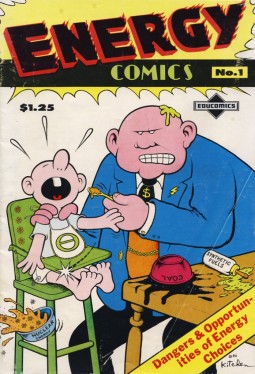
    energy comics, courtesy greentechhistory.com

    This week’s How On Earth offers two features:
    Co-host Susan Moran interviews Alexis Madrigal, a senior editor for The Atlantic magazine and author of the new book, Powering the Dream: The History and Promise of Green Technology. Madrigal spins tales of the bicycle boom in the 1800s and how it paved the way for cars, ironically; of a time when gasoline emerged as a waste product of kerosene for lighting; and when crude oil was what you might call the environmentally sound alternative to oil from whales, which were nearly hunted to extinction. Madrigal also pays tribute to Colorado’s National Renewable Energy Lab and its deep history of spawning renewable energy and surviving budget cuts. And he honors green-tech (and fossil fuel) inventors and beacons of yesteryear, as he looks forward to what a greener future could be.

    In the second feature, Shelley Schlender interviews Warren Washington, a ground-breaking climate scientist at the National Center of Atmospheric Research in Boulder. He’s a world leader in using computers to model climate. Last year he was awarded the National Medal of Science by President Obama. Dr. Washington’s autobiography is Odyssey in Climate Modeling, Global Warming, and Advising Five Presidents.

    Hosts: Susan Moran, Ted Burnham
    Producer: Susan Moran
    Engineer: Shelley Schlender


    Ocean Acidification // Citizen Science Jul 13, 2011
    Show notes

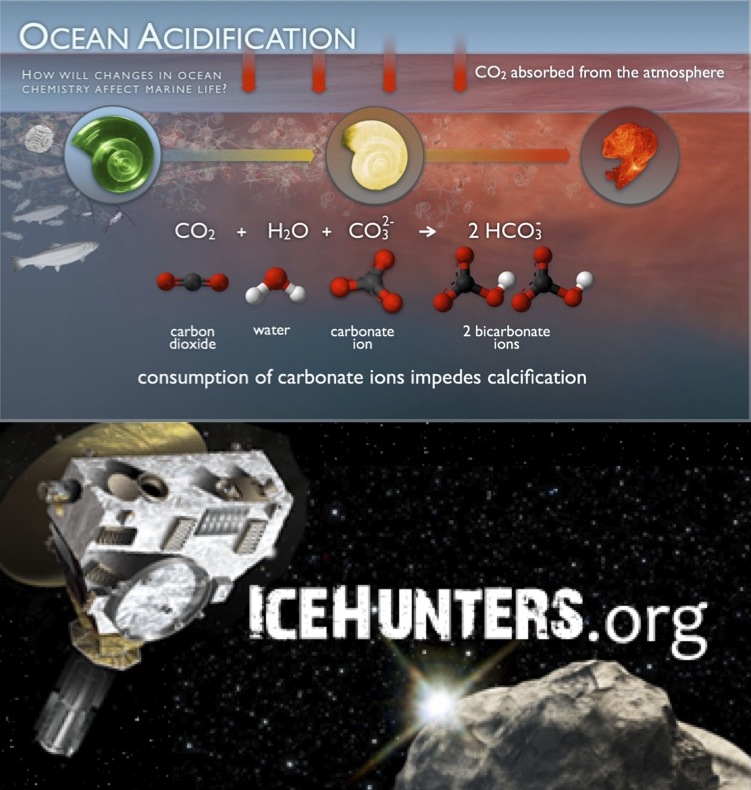
    Top Image: Ocean Acidification process. Bottom Image: New Horizons spacecraft flies by a Kuiper belt object.

    Feature #1: Many problems plague the oceans and the fish and other species that inhabit them: overfishing, pollution, and much more. But perhaps the greatest threat to sea life – and possibly to humans – is ocean acidification. That’s when the chemistry of the ocean changes and causes seawater to become more acidic because the ocean is absorbing carbon dioxide from the atmosphere. This increase in ocean acidity makes it difficult for many plants and animals in the ocean to make or maintain their shells or skeletons. The head of the National Oceanic and Atmospheric Administration (NOAA), Jane Lubchenco, recently said that the ocean is becoming more acidic at rates not seen for at least 20 million years, and that’s due mostly to increases in CO2 in the atmosphere. The threat is so grave that NOAA recently created a distinct Ocean Acidification Program. In May, Dr. Libby Jewett was appointed the first director of the program. We talk with Dr. Jewett find out more about the problem and what she aims to do about it.

    Feature #2: Some sciences have a tradition of fruitful interactions between professional researchers and amateurs, and this has been made even more accessible with data being able to be shared over the internet across the world. Dr. Pamela Gay, an Astronomer at Southern Illinois University, Edwardsville, is the architect and participant in many such collaborations. In addition to her teaching and research, she does extensive public outreach to share the excitement of astronomy (such as her podcast AstronomyCast.com) and even finds ways to let anyone with an internet connection make new scientific discoveries and find new worlds that will be visited by spacecraft (IceHunters.org). We talk with Dr. Gay about the Zooniverse and her hunt for of icy objects in the outer solar system.

    Hosts: Susan Moran and Joel Parker
    Producer: Joel Parker
    Engineer: Tom McKinnon

    Listen to the show:


    Science Education, Evolution & Creationism Jun 28, 2011
    Show notes

    the book “Why Evolution Works (and Creationism Fails)" by Matt Young and Paul Strode

    At its most basic level, science can be considered as non-political or at least politically neutral: science is dedicated to the collection of facts and interpreting them to help us understand the universe and how it works. For that reason, many people – one may even say our culture in general – places a high value in being scientifically literate. Or at least we pay lip service to that idea. But when the results of science end up contradicting and conflicting with other ideals such as religious beliefs, personal behaviors, or vested interests, then science can become very political. Perhaps the two most visible examples of this politicization of science are in the areas of climate change and evolution, where the discussion ranges from the White House and Congress to local school boards and textbooks. Our guest today has front line experience in several aspects of science and education. Dr. Paul Strode is a biology teacher in the Boulder Valley School District, and has been an instructor of ecology and evolutionary biology at the University of Colorado. Dr. Strode is co-author of the book: “Why Evolution Works (and Creationism Fails)” – also available and reviews here and here.

    Hosts: Susan Moran and Joel Parker
    Producer & Engineer: Joel Parker

    Listen to the show:


    Beekeeping in Troubled Times Jun 22, 2011
    Show notes

    Beekeeper's Lament, by Hannah Nordhaus; image courtesy of Harper Perennial

    This week on How On Earth co-host Susan Moran interviews Hannah Nordhaus, Boulder-based author of the new book, The Beekeeper’s Lament: How One Man and Half a Billion Honey Bees Feed America. Nordhaus describes how one passionate, colorful and quixotic beekeeper named John Miller struggles against all odds to keep beekeeping–and bees–alive at a time when they’re being slammed by a mysterious mixture of Colony Collapse Disorder, varroa mites and other maladies.

    Nordhaus will give a reading at the Boulder Book Store on June 30, 7:30 p.m.

    Hosts: Joel Parker and Susan Moran
    Producer: Susan Moran
    Engineer: Joel Parker


    Cell Phone Safety Jun 14, 2011
    Show notes

    The World Health Organization has officially listed cells phones as a possible carcinogen. One expert who’s not surprised at the designation is University of Colorado, distinguished professor Frank Barnes. For decades, Barnes has cobbled together hard-to-find research dollars to study the biological effects of magnetic fields and radiation, including cell phone radiation. In 2008, he chaired a National Research Council report that called for more research into the health effects of all kinds of wireless technologies, including laptop computers, wireless phones, and cell phones. In today’s show, Frank Barnes talks with How on Earth’s Shelley Schlender about cell phone safety.

    Hosts: Joel Parker, Tom McKinnon
    Producer: Joel Parker
    Engineer: Tom McKinnon

    Listen to the show:


    Cell Phone Safety – Extended Version Jun 14, 2011
    Show notes

    Here is the extended version of the interview with CU Electrical Engineering Professor Frank Barnes about cell phone safety.


    Cavemen Stayed Local while Women Left Home Jun 07, 2011
    Show notes

    We talk with Sandi Copeland, Adjunct Professor of Anthropology at CU, about this story:

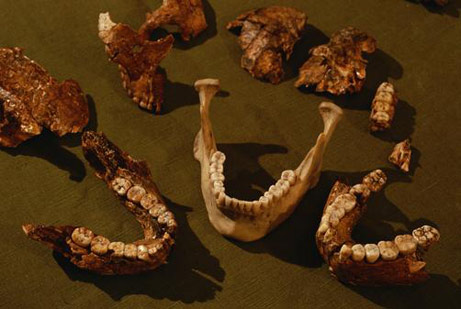
    Two million years ago, two-legged apes roamed the African landscape. Many of these ancient hominins, lived in limestone caves in what is now South Africa. We know this through fossilized skull fragments and teeth from those caves.

    But fossils only tell us where an individual died—not where it grew up, or where it traveled during its life. Or do they? New research from the University of Colorado that’s been published in the journal Nature, reveals that male hominins in South Africa grew up in the caves where they died, while the females who died there grew up elsewhere and migrated to the caves as adults.

    The research not only sheds light on the behaviors of early human relatives; it makes use of a new technique, pioneered by the CU researchers, to quickly and cheaply analyze the birthplace of fossilized creatures.

    Producer: Shelley Schlender
    Co-hosts: Joel Parker, Ted Burnham
    Engineer: Shelley Schlender

    For Headline Features, read on . . .

    STORY 1 {Virtual water cannot remedy freshwater shortage}:
    We all know what it’s like to drink or bathe in “real” water. But what about “virtual” water? “Virtual Water” is an economic calculation of the water needed to produce a certain amount of product. For instance, producing one kilogram of beef generally requires 15 thousand litres of water. It also takes water to grow crops such as juicy oranges. Virtual water transfers occur through trade. When desert destinations such as Quatar, or Las Vegas, buy oranges and beef they are indirectly importing water. And as the world’s population grows, virtual water transfer could, in theory, provide more equal water use between nations, insuring that everyone’s water needs are met.

    However, according to a study published today in the journal Environmental Research Letters, banking on virtual water as a solution to global water problems could spell disaster. The study’s lead author, David Seekell, of the University of Virginia, points out that 80% of the people on Earth are already threatened by water shortages. Seekell warns that there’s not enough virtual water transfer to provide future, larger populations have enough water. What’s more, recent theoretical work shows that these transfers make societies more vulnerable to droughts. Without addressing population growth, Seekell says that efforts to equalize water supplies through global trade or a formal government-based virtual water market are likely end up high and dry.

    STORY 2 {Bat hibernation and rabies}:
    For North American wildlife, it’s often hard to survive the winter. Many bats solve this problem through hibernation, but at a cost. Hibernation allows some pathogens, such as rabies, to survive as well. To figure out the costs and benefits of hibernation, Colorado State University biologist Dylan George and colleagues designed a mathematical model to analyze data from a five year study of Colorado’s big brown bats. Matching data about birth, mortality and rabies infection, they’ve concluded that during the chilly months of a bat’s winter hibernation, the bat’s slowed-down metabolism slows viral development enough that it doesn’t make the bats sick just yet, and this allows plenty of bat babies to be born in the spring — already infected with rabies. Many of these young bats then live long enough to produce more generations of infected babies. In contrast, when the scientists ran simulations that eliminated hibernation, the rabies virus killed bats so fast, populations crashed. The authors say this gives insights into how hibernation and cooler temperatures may influence many diseases in bats.

    STORY 3 {Glimpse Into Uncertainty}:
    We’re not completely certain how to explain this next story, because – well – it’s based on the “Uncertainty Principle.” The Uncertainty Principle is one of the more well-known consequences of quantum mechanics, but in case you are uncertain about what the principle is, it is usually defined as: you can’t measure both the position and speed of a particle simultaneously, because as soon as you measure one, you irrevocably interfere with getting an accurate measure of the other. It is also related to the other well-known concept of quantum mechanics: the mysterious particle-wave duality. One classic demonstration of these phenomena is called Young’s double-slit experiment, where particles pass through a pair of slits and interact with each other and create an interference pattern even if you send them through one particle at a time. That raises the spooky question: what is a particle interfering with if it is traveling alone unless it – somehow – passes through both slits simultaneously and interferes with itself? And if you tried to measure the position or momentum of the particles or which slit a particle went through, the very act of measuring destroys the interference pattern.

    Now, Sacha Kocsis and colleagues at the University of Toronto have devised an experiment that may provide a peek at the path, or the typical path, taken by photons in the double-slit experiment. They make what are called “weak measurements” of a photon’s momentum to create an average trajectory for the particle. These weak measurements don’t disturb the particles enough to destroy the interference effect; they also don’t allow for precise measurements of individual particles, but they do make good measurements of the average paths for many particles. The researchers suggest that the power of these weak measurements might bring a better perspective to the quantum behavior of particles than trying to pin one down and see what happens. Though precisely how this will help our understanding of quantum mechanics is…uncertain.


    Colorado river crisis // “The Believing Brain” Jun 01, 2011
    Show notes

    Lake Mead's dipping water line. Image courtesy of futuretimeline.net.

    This week co-host Susan Moran speaks with Dr. Doug Kenney, director of the Western Water Policy Program at the Natural Resources Law Center at the University of Colorado, Boulder’s law school. Kenney sheds light on the Colorado River Compact and how population growth, climate change, and water politics, are expected to further threaten our future water supply.

    And Ted Burnham interviews skeptic and science writer Michael Shermer. His new book, “The Believing Brain,” presents a counter-intuitive explanation for how we form and reinforce our beliefs. Shermer draws on evidence from neuroscience, psychology and sociology to show that we often form beliefs first, and only then look for reasons to believe.

    Hosts: Susan Moran, Joel Parker
    Producer: Susan Moran
    Engineer: Joel Parker

    Listen to the show:


    Moonwalking with Einstein (Part 2) // Brain Evolution May 24, 2011
    Show notes

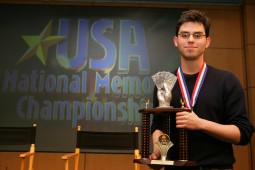
    We present the second part of Joel Parker’s interview of Joshua Foer, author of the book “Moonwalking with Einstein: The Art and Science of Remembering Everything” (the full interview can be found here). To round out the “brain theme” of the show, we also include an excerpt of BBC’s Science in Action where Jon Stuart talks with paleontologist Timothy Rowe about how our brains evolved and how scientists can study brains from long dead, ancient mammals.

    Producer: Joel Parker
    Hosts: Joel Parker, Susan Moran, Breanna Draxler
    Engineer: Ted Burnham

    Listen to the show:


    Previous 1 75 76 77 78 79 Next

    Related Podcasts

    Science Friday

    1

    Science Friday Astronomy
    Radiolab

    2

    Radiolab Documentary
    BrainStuff

    3

    BrainStuff Natural Sciences
    StarTalk with Neil deGrasse Tyson

    4

    StarTalk with Neil deGrasse Tyson Games & Hobbies
    Radiolab

    5

    Radiolab Documentary
    Stuff To Blow Your Mind

    6

    Stuff To Blow Your Mind Life Sciences
    footer-logo

    Contact Us

    Toll Free: 844-670-7747

    Links

    • Home
    • Top Charts
    • Networks
    • Apps
    • Independents Podcasts
    • Podcast Advertising
    • Podcast News
    • Contact Us
    • About Us
    • Analytics & Insights

    Stay Connected

      Privacy, Terms of Use & Our Code of Ethics Protecting Content Creators Copyrights