Leaky Natural Gas Wells [extended version]
Feb 21, 2012
Show notes
Natural Gas Wells Leak More Methane and Benzene than Expected
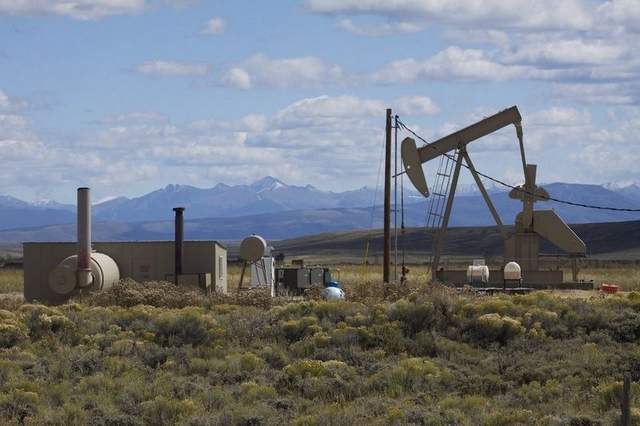
This is an extended version of the KGNU Science Show, How on Earth. It features Greg Frost, a scientist with the University of Colorado at Boulder and with NOAA, the National Oceanic and Atmospheric Administration. He’s on the team led by Gabrielle Petron which has been studying leaks from natural gas production. In this extended interview, Greg tells us about natural gas wells in Colorado that are leaking twice as much methane and benzene into the atmosphere as official estimates have indicated. Methane is a potent greenhouse gas. Benzene is a carcinogen. Let’s listen in now, as Greg Frost tells How on Earth’s Shelley Schlender what their study of leaking methane from gas wells found.
Boulder Robotics // Compassion
Feb 14, 2012
Show notes
Image courtesy of Boulder is for Robotics
Boulder is for Robotics (start time 4:00). “It starts really with the fact that a lot of robotics materials, sensors and manufacturing are here in Colorado.” Boulder as a hub for robotics? You bet. KGNU’s Tom McKinnon reports from the first Boulder is for Robotics meetup, which drew over 100 participants. Learn about some local projects, from robots for agriculture to robots for kids.
Photo courtesy of Flickr user gelinh, used under Creative CommonsThe Neurology of Compassion (start time 12:50). “Someone on the street asks you for money. Do you give or not? What drives that decision?” Researchers Jessica Andrews-Hanna and Yoni Ashar from University of Colorado’s Cognitive and Affective Neuroscience Lab talk to us about the causes and effects of compassion. The first of their studies on compassion looks at charitable giving. What determines whether a person will decide to donate part of their earnings? They also talk to us about their current study, which involves using brain scans to evaluate the effect of compassion meditation.
Hosts: Tom McKinnon & Beth Bartel Producer: Beth Bartel Engineers: Jim Pullen and Shelley Schlender Additional contributions: Breanna Draxler & Susan Moran Executive producer: Shelley Schlender
Listen to the show:
Snowshoe Hare // Cubelets Robotics
Feb 07, 2012
Show notes
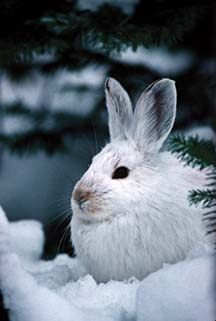
Snowshoe Hare Faces Uncertain Future (start time 6:35). They don’t get much cuter than bunnies. One of the cutest of them all is the snowshoe hare. It’s elusive, and well camouflaged, so you may well never have seen one. To survive, these hares change their coats with the seasons – white in the snowy winter and rusty brown in the summer. So now, some hares’ fur turns white before the snow covers the ground. Think what it’d be like to be naked in public, an easy meal for eagles and other predators. Whether these fragile hares can evolve and adapt to their changing homes fast enough is a question some biologists are studying hard. Hillary Rosner, a local science journalist and author, wrote about the plight of the snowshoe hare in the current issue of High Country News and now talks with How on Earth’s Susan Moran.
Cubelets Robotics (start time 15:00) is an award-winning modular robotics kit created and made in Boulder. The concept is simple: you take these magnetic blocks and snap them together to make an endless variety of robots with no programming and no wires. You can build robots that drive around on a tabletop, respond to light, sound, and temperature, and have surprisingly lifelike behavior. But instead of programming that behavior, you snap the cubelets together and watch the behavior emerge like with a flock of birds or a swarm of bees. To find out more, How on Earth’s Shelley Schlender talks with Modular Robotics Design Director, Eric Schweikardt. Cubelet theme song by Blorp Corp.
Hosts: Joel Parker, Susan Moran Contributor: Breanna Draxler Producer: Shelley Schlender Engineer: Shelley Schlender Executive Producer: Shelley Schlender
Listen to the show:
Algae oil omega-3 // Little Ice Age
Feb 01, 2012
Show notes
algae samples growing in a DSM lab; photo courtesy of DSM
Algae Oil Omega-3 (start time 5:28). Omega-3 dietary supplements are all the rage. Many studies claim that this family of fatty acids benefits your brain, heart and vision, among other things. A non-fish source that already is infused in milk and other foods we consume is oil derived from marine algae. Cohost Susan Moran interviews Dr. Bill Barclay, a microbial ecologist who manages the Boulder division of Martek Biosciences (now DSM). He talks about how he discovered how to produce DHA omega-3 oils from microalgae, and how they can boost our health in an environmentally sustainable way (or at least free of concern about overfishing).
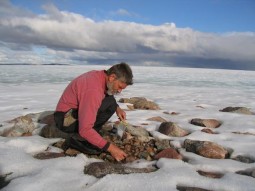
Gifford Miller collecting dead plant samples from beneath a Baffin Island ice cap; photo courtesy of Gifford Miller
Little Ice Age (start time 15:25). Shortly after the Middle Ages, something strange happened. Suddenly, the entire world got a little cooler. And then it hung on. The cooling lasted over 500 years, all the way to the 1800s. Those five cool centuries are known as the Little Ice Age. How it happened has been a mystery that modern climate scientists have worked hard to figure out, and one they’ve argued about. Now, a University of Colorado Boulder-led study appears to have finally solved the mystery. HOE’s Shelley Schlender interviews the lead author of the study, CU-Boulder Professor Gifford Miller.
Hosts: Tom McKinnon, Susan Moran Contributor: Breanna Draxler Producer: Susan Moran Engineer: Shelley Schlender Executive Producer: Shelley Schlender
Listen to the show:
Underwater Volcanoes // Sleep
Jan 24, 2012
Show notes
Underwater Volcanoes (start time 5:45). Most of our planet’s volcanoes are out of sight, and largely out of mind. Hidden under sometimes thousands of feet of water, volcanoes on the sea floor bubble and boil away without our knowledge and largely without our understanding. We talk with Oregon State University volcanologist Bill Chadwick about some of his research on these buried giants. More information (with photos and videos) are available at NOAA’s VENTS Program.
Sleep (start time 15:50). As any mother knows, when children get cranky, one of the best solutions is to “go take a nap.” What is less understood is whether or not those naps can be now and then, or whether it’s important to keep them regular. We speak with an expert who has just published a study that looks at the question of napping among preschool children. Her name is Monique LeBourgeois and she’s a professor of Integrative Physiology at the University of Colorado’s Sleep and Development Lab.
Co-hosts: Joel Parker and Shelley Schlender Contributors: Beth Bartel, Breanna Draxler, Susan Moran Engineer: Joel Parker Producer: Joel Parker Executive producer: Shelley Schlender
Listen to the show:
20th Anniversary Science Show
Jan 17, 2012
Show notes
Bucky Ball 1991 “Molecule of the Year”
We celebrate 20 years of How on Earth, featuring the 1st ever KGNU science show, 20 years ago, including Bucky Balls, Electromagnetic Radiation and Cows, Hubble, Bubble, Toil and Trouble, and along the way, we give updates on current science issues, including Tom McKinnon talking about applications for Bucky Balls (Fullerenes) today, a conversation with CU Electrical Engineer Frank Barnes, who is one of the world’s most sought-after experts on EMFs, Southwest Research Institute Astrophysicist Joel Parker gives an update on space telescopes, and CU Science Journalism professor Tom Yulsman talks about an issue NOT on the radar 20 years ago — global climate change. We also share information about tonight’s Denver Cafe Sci, with Brian Hynek, about “Mars: Are We Alone?” Special thanks to How on Earth original producers Sam Fuqua and Jeff Orrey for being here as part of the show.
Co-hosts: Joel Parker and Susan Moran Engineer: Shelley Schlender Producer: Shelley Schlender Executive producer: Shelley Schlender
Listen to the show:
The first KGNU science show (Jan 1992)
Jan 16, 2012
Show notes
Here is the ORIGINAL KGNU science show, broadcast 20 years ago in January 1992. For our science show on January 17, 2012, we’ll feature excerpts from this show, along with interviews with two of the show’s originators, KGNU station manager, Sam Fuqua, and KGNU Volunteer, Jeff Orrey.
Nicotine Patches // Restoring the Desert
Jan 10, 2012
Show notes
Do nicotine patches really help you stop smoking? Shelley Schlender interviews a scientist who says they don’t. Lois Biener and her colleagues at the University of Massachusetts and Harvard University have done a study that indicates that out in the real world, people who use nicotine replacement therapy in the hopes of an easier “quit” don’t fare any better than people who use will power and community support. Some people who use nicotine replacements are actually MORE likely to relapse. (Extended interview version here).
Great plumes of dust rising from the desert forms an iconic image of the West, but much of that dust is a result of humans altering the desert soil structure. Several Boulder scientists are investigating a new technology that may allow us to restore the desert, and sequester large amounts of carbon at the same time. Tom McKinnon interviews Jim Sears, president of A2BE Carbon Capture and Bharath Prithiviraj, a Postdoctoral Research Associate in Chemistry and Biochemistry at the University of Colorado. They are developing a large scale deployable technology that would enable agricultural aircraft to re-inoculate and restore arid soils using indigenous strains of soil-crust-based cyanobacteria. For additional information on airborne soil crust reseeding, its research and its applications please contact jimsears@algaeatwork.com for an overview paper on the topic.
Co-hosts: Tom McKinnon and Shelley Schlender Engineer: Joel Parker Producer: Tom McKinnon Executive producer: Shelley Schlender
Nicotine Patches Don’t Work [extended version]
Jan 10, 2012
Show notes
This is an extended version of the interview with researchers at Harvard and the University of Massachusetts, which indicates that out in the real world, people who use nicotine replacement therapy in the hopes of an easier “quit” don’t fare any better than people who use will power and community support. Some people who use nicotine replacements are actually MORE likely to relapse. Here, Shelley Schlender talks with Lois Biener, a Senior Research Fellow at the Center for Survey Research at the University of Massachusetts Boston. Her research was published in the journal Tobacco Control.
Logicomix: An Epic Search for Truth
Jan 03, 2012
Show notes
We hear about a book called Logicomix, featuring Christos Papidimitriou, who is one of the world’s leaders on computational complexity theory, and what happens when he consents to be interviewed by two 10-year olds. And in the headlines, we delve into a new report published in the January issue of Archives of Pediatrics & Adolescent Medicine that indicates exercise helps kids do better in school. We fly to the moon with two GRAIL spacecraft, which stands for “Gravity Recovery and Interior Laboratory.” And we invite you to sign up for the free, “Mini Med-The Clinical Years,” being offered at the CU Medical Center.
Nora and Lee
Hosts: Joel Parker, Susan Moran Producer: Shelley Schlender Engineers: Tom McKinnon, Shelley Schlender Executive Producer: Shelley Schlender

 Our TOPPODCAST Picks
 Stay Connected






 Underwater Volcanoes (start time 5:45). Most of our planet’s volcanoes are out of sight, and largely out of mind. Hidden under sometimes thousands of feet of water, volcanoes on the sea floor bubble and boil away without our knowledge and largely without our understanding. We talk with Oregon State University volcanologist
 Sleep (start time 15:50). As any mother knows, when children get cranky, one of the best solutions is to “go take a nap.” What is less understood is whether or not those naps can be now and then, or whether it’s important to keep them regular. We speak with an expert who has just published a study that looks at the question of napping among preschool children. Her name is

 nicotine patches really help you stop smoking? Shelley Schlender interviews a scientist who says they don’t.