TopPodcast.com
Menu
  • Home
  • Top Charts
  • Top Networks
  • Top Apps
  • Top Independents
  • Top Podfluencers
  • Top Picks
    • Top Business Podcasts
    • Top True Crime Podcasts
    • Top Finance Podcasts
    • Top Comedy Podcasts
    • Top Music Podcasts
    • Top Womens Podcasts
    • Top Kids Podcasts
    • Top Sports Podcasts
    • Top News Podcasts
    • Top Tech Podcasts
    • Top Crypto Podcasts
    • Top Entrepreneurial Podcasts
    • Top Fantasy Sports Podcasts
    • Top Political Podcasts
    • Top Science Podcasts
    • Top Self Help Podcasts
    • Top Sports Betting Podcasts
    • Top Stocks Podcasts
  • Podcast News
  • About Us
  • Podcast Advertising
  • Contact
Not in our directory?
Add Show Here
Podcast Equipment
Center

toppodcastlogoOur TOPPODCAST Picks

  • Comedy
  • Crypto
  • Sports
  • News
  • Politics
  • True Crime
  • Business
  • Finance

Follow Us

toppodcastlogoStay Connected

    View Top 200 Chart
    Back to Rankings Page
    Natural Sciences

    KGNU – How On Earth

    The KGNU Science Show

    Advertise
    • Apple Podcasts
    • Google Play
    • Spotify

    Latest Episodes:
    Gold Lab // National Climate Assessment May 13, 2014
    Show notes

    For our May 13th show we offer two features:
    REVISED_GLS 2014 artwork_borderGold Lab Symposium (starts at 3:42): Biotech entrepreneur Larry Gold, a CU Boulder professor at the BioFrontiers Institute, talks with How On Earth’s Shelley Schlender about the annual Gold Lab Symposium, which will be held in Boulder May 16th and 17th. This year’s theme is Embracing the Reptile Within: Head, Heart and Healthcare. The event will focus on research and educational approaches that can potentially help improve the U.S. healthcare system.

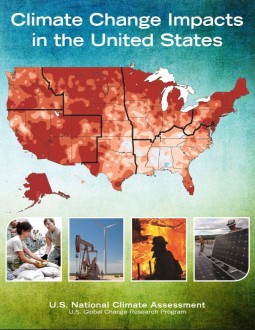
    NCA_2014U.S. Climate Change Report (starts at 11:50) The National Climate Assessment, a sobering new report on the science and impacts of climate change in the U.S., makes it starkly clear that human-induced climate change is already affecting all parts of the country. It is making water more scarce in some regions while bringing torrential rains elsewhere. It is making heat waves more common and severe, and it’s causing more severe and destructive wildfires. How On Earth co-host Susan Moran talks with two guests: Kristen Averyt, PhD, is a lead author of a chapter on Energy, Water and Land. She is associate director for Science at the Cooperative Institute for Research in Environmental Sciences (CIRES) at CU Boulder. Dan Glick is a journalist who helped edit the report. His company, The Story Group, also produced a series of videos that highlight the report’s key findings and how climate change is affecting many people’s lives and livelihoods.

    Hosts: Ted Burnham, Susan Moran
    Producer: Susan Moran
    Engineer: Ted Burnham
    Executive Producer: Joel Parker

    Listen to the show (click below):


    Hacking Happiness May 06, 2014
    Show notes

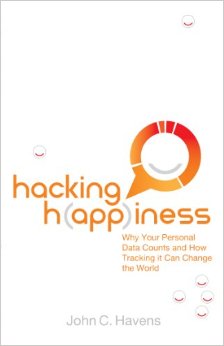
    Hacking HappinessYou drive to Starbucks with your cell phone in your pocket, go online, read your favorite newspaper, share an interesting book review on Facebook and then go and order the bestseller from Amazon. It’s only 9:00am, but you’ve already left a data trail—a big one—on your whereabouts, your taste, your friends, and your financial habits.

    In his new book, Hacking Happiness: Why Your Personal Data Counts and How Tracking It Can Change the World, John C. Havens talks about how megacorporations hoard these details and use them for their own monetary gain. But, Havens argues it doesn’t have to be like that. Using emerging technologies, we can reclaim control over our information and use it, not to boost company sales, but to improve our own happiness.

    Hosts: Ted Burnham and Jane Palmer
    Producers: Jane Palmer and Beth Bartel
    Engineer: Ted Burnham
    Executive Producer: Joel Parker

    Listen to the show:


    Baseball Vision // Emerald Ash Borer Apr 30, 2014
    Show notes

    Today, April 29th, we offer two features:
    baseball - sports-glasses (1)Baseball Vision (starts at 5:42): The major league baseball season is now in full “swing.” Fans may take it for granted that these professional athletes are in top physical condition. What’s less known is how important it is for baseball players to have perfect eyesight. Batters in particular have some of the best vision in the world. To find out how scientists know this, and study it, and even make it better, How on Earth’s Shelley Schlender last month headed down to spring training in Arizona. There, she caught up with two of the nation’s top experts on the science of vision, and sports.

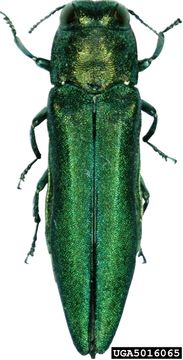
    emerald ash borer, courtesy Encyclopedia of Life
    emerald ash borer, courtesy Encyclopedia of Life

    Emerald Ash Borer (starts at 11:21): It’s been called the most destructive looming pest blight to hit Colorado in ages. The perpetrator in question is the emerald ash borer, a small shimmery green beetle. It is believed to have hitchhiked to the U.S. and Canada on cargo ships, or airplanes, from its native Asia, in 2002. Since then it has wiped out millions of ash trees in many states. Last September, the ash borer was first found in Colorado. Ash trees have had no time to develop resistance against the exotic invader. And meanwhile, the ash borer has no predators here to keep it in check. Dr. Whitney Cranshaw, an entomologist at Colorado State University, talks with host Susan Moran about what we should know about the emerald ash borer.

    Hosts: Susan Moran, Joel Parker
    Producer: Susan Moran
    Engineer: Joel Parker
    Executive Producer: Joel Parker

    Click below to listen to the show:


    NASA Visit // IPCC Report Apr 25, 2014
    Show notes

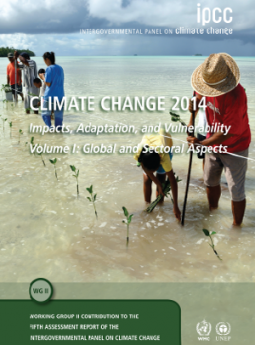
    wg2coverEarth Day gives us plenty of reason to reflect on the state of the planet and the impact we humans have had on it. This week’s show featured Dr. Linda Mearns, a senior scientist at the National Center for Atmospheric Research in Boulder, who is among hundreds of scientists who produced the latest report on global climate change. She’s a lead author of a chapter on regional climate change in the Fifth Assessment Report (AR5) of the United Nation’s Intergovernmental Panel on Climate Change. She also co-authored previous IPCC assessments – in 1995, 2001, and 2007. Dr. Mearns talks with How On Earth host Susan Moran about the science and implications of the IPCC report, including what it means for Colorado and the broader U.S. West.

    Unfortunately, due to a technical glitch at the station, the recording of that live interview was lost. But we still have audio from our second feature.

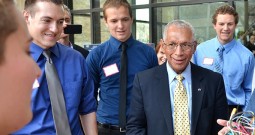
    NASA chief Charles Bolden meets with CU students on Friday, April 18, 2014. Photo: University of Colorado
    NASA chief Charles Bolden meets with CU students on April 18, 2014. Photo: University of Colorado

    Charles Bolden, the top administrator at NASA, was here in Boulder last week, touring the classrooms and facilities that earn the University of Colorado more space agency dollars than any other public university in the nation. We’ll hear what he has to say about CU’s role in the space program — past, present and future.

    We’ve also recreated the Earth Day tribute that opened the show. These days it’s more like Earth Week, and it’s not too late to catch some of the planet-happy celebrations going on in the Boulder area this weekend. Listen for details.

    Co-hosts: Ted Burnham, Susan Moran
    Producer and Engineer: Ted Burnham

    Listen to the show:


    Space Dust Apr 15, 2014
    Show notes

    442120main_moon-fullsize

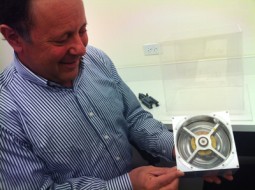
    Dr. Mihaly Horanyi and his colleagues at the University of Colorado are on the brink of watching an instrument they developed crash into the moon. It’s okay—it’s designed to. In the meantime, the instrument, LDEX, is measuring impacts from dust particles a fraction of the width of a human hair on NASA’s LADEE mission. It’s measured more than 11,000 of these tiny impacts since falling into orbit in October.

    Dr. Mihaly Horanyi and an LDEX prototype. (Photo/Beth Bartel)
    Dr. Mihaly Horanyi and an LDEX prototype. (Photo/Beth Bartel)

    How On Earth’s Beth Bartel is on her own mission to figure out just what is so interesting about space dust. Think: space colonization, geologic mapping, and searching for signs of extraterrestrial life.

    Hosts: Beth Bartel, Joel Parker
    Producer: Beth Bartel
    Engineer: Joel Parker
    Additional Contributions: Jane Palmer
    Executive Producer: Joel Parker

    Click below to listen to the show:


    Space Dust – Extended Version Apr 15, 2014
    Show notes

    800px-Helkivad_ööpilved_Kuresoo_kohalFor the patient and interested listener, here’s more of How On Earth host Beth Bartel’s conversation about space dust with University of Colorado’s Mihaly Horanyi. We talk about why we should colonize the moon, how Dr. Horanyi got into studying dust in the first place—which is a very interesting Cold-War-era story—how space dust may give us hints about climate change ( via the phenomenon of “night-shining” or noctilucent clouds), and what zodiacal light is.


    Conquering the Energy Crisis Apr 10, 2014
    Show notes

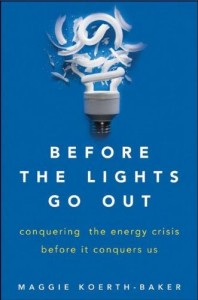
    book_cover_amazon-198x3001360_517118571690819_2111630523_nWelcome to this special edition of How on Earth. This week, the 66th annual Conference of World Affairs is happening on the campus of CU-Boulder, and today’s show is one of the events. The speaker and guest in our studio today is Maggie Koerth-Baker. She writes a monthly column, “Eureka,” for The New York Times Magazine and is also the science editor at BoingBoing.net. She enjoys exploring the intersection between science and culture, and you can “Find your daily dose of Maggie science” through her website at maggiekb.com, and her pages on Facebook and Twitter. She has co-authored a book titled: “Be Amazing: Glow in the Dark, Control the Weather, Perform Your Own Surgery, Get Out of Jury Duty, Identify a Witch, Colonize a Nation, Impress a Girl, Make a Zombie, Start Your Own Religion.” Her recent book, and with a shorter title, is called: “Before the Lights Go Out: Conquering the Energy Crisis Before It Conquers Us.” And that is the topic that brings her here today.

    Host, Engineer, Producer: Joel Parker

    Listen to the show:


    Quantum Computers Apr 01, 2014
    Show notes

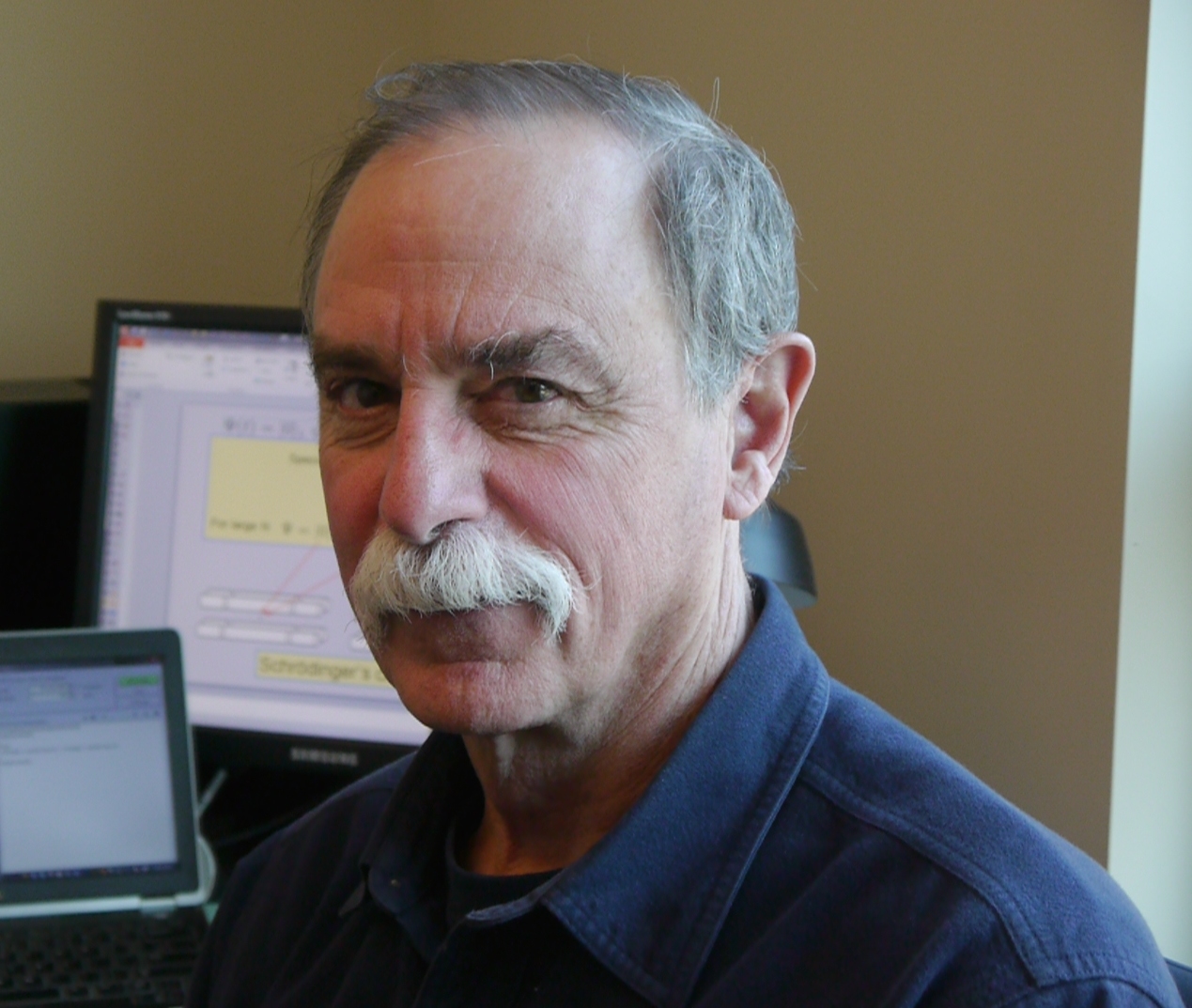
    P1020271Quantum Computers [starts at 7:05] Dr. David Wineland has worked at the National Institute of Standards and Technology in Boulder, Colorado, for 38 years. In 2012, he shared the Nobel Prize in Physics with France’s Dr. Serge Haroche for “ground-breaking experimental methods that enable measuring and manipulation of individual quantum systems”. Dr. Wineland and his colleagues use electromagnetic fields to trap individual ions for long periods of time, and lasers to place the ions in quantum superposition states. Superposition is like being both here and there at the same time.

    Superposition, if taken literally (as many physicists believe it should, although some disagree), results in some very strange behaviors, like in a thought experiment designed by Erwin Schrodinger. Schrodinger’s thought experiment describes how a cat in a box can both dead and alive at the same time. Dr. Wineland talks with How On Earth’s Jim Pullen about the connection between his work and Schrodinger’s famous cat. He says quantum computers are in the news.

    In a two part series in early 2013, Jim Pullen also interviewed Dr. Wineland on the occasion of the award of his Nobel Prize (on the physics and the human side of winning the Nobel Prize).

    Host, Engineer, Producer: Joel Parker
    Additional contributions: Jim Pullen, Jane Palmer, Beth Bartel, Kendra Krueger

    Listen to the show:


    1964 Alaska Earthquake // Neuroscience of Dying Mar 25, 2014
    Show notes

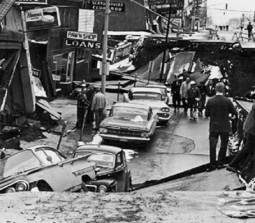
    F3.mid1964 Alaska Earthquake (start time 04:37) This week 50 years ago, in 1964, the Beatles were huge, Alaska had only been a state for a mere five years, and the theory of plate tectonics was in toddlerhood. This Thursday, March 27, also marks the 50th anniversary of the magnitude 9.2 Great Alaska Earthquake of 1964.

    This earthquake changed our thinking about how the world works by showing us the hard way that tsunamis can arrive before the ground even stops shaking, that we can look in sedimentary records to recognize past great earthquakes offshore in places like the Pacific Northwest, and that these huge earthquakes rip the Earth open along a plane rather than in bits and pieces. What you’ll hear on today’s show is just the tip of the seismic iceberg: How the earthquake confirmed subduction, which is where one tectonic plate plunges under another. Beth Bartel speaks with Dr. Mike West, the Alaska State Seismologist and Director of the Alaska Earthquake Center, about his recent paper, “Why the 1964 Great Alaska Earthquake Matters 50 Years Later,” published in Seismological Research Letters.
    near-death-brain-676472-Neuroscience of Dying (start time 12:38) If there’s one thing more certain than taxes—pardon the reminder—it’s death. It may be certain, but it’s still one of life’s biggest mysteries. On today’s show, we explore what neuroscience can tell us about chemical and hormonal releases that can occur as we near the threshold of death.

    For instance, many people have written about so-called near-death experiences. It’s when your heart stops. You walk effortlessly toward a tunnel. You see a blast of white light. You might call it Heaven. Visions like these that people report they’ve had have some biochemical underpinnings.

    To help us understand the limited but fascinating body of scientific research regarding the neurobiology and chemistry of dying, Susan Moran talks with Dr. Ilene Naomi Rusk. Rusk is a psychologist who specializes in neuropsychopharmacology and co-directs The Brain and Behavior Clinic in Boulder.

    Hosts: Beth Bartel and Susan Moran
    Producer: Beth Bartel
    Engineer: Shelley Schlender
    Executive Producer: Jim Pullen
    Additional contributions: Jane Palmer and Ted Burnham

    Listen to the show:


    1964 Alaska Earthquake – Extended Version Mar 25, 2014
    Show notes

    Today marks the 50th anniversary of the 1964 Great Alaska Earthquake. To commemorate the quake, we’re posting this extended version of the interview we broadcast on March 25, 2014, with Dr. Mike West, the Alaska State Seismologist and Director of the Alaska Earthquake Center. How On Earth host Beth Bartel talked with Dr. West about his recent paper, “Why the 1964 Great Alaska Earthquake Matters 50 Years Later,” published in Seismological Research Letters.

    To whet your appetite, here are some of the topics we covered:

    • How this earthquake fit in to the still-young idea of plate tectonics.
    • How geodesy–the study of the shape of the Earth and how it changes–helped nail this event down as a subduction earthquake. (Also: How the simplest explanation is not always the right one.)
    • Monitoring: Where we were then, where we are now.
    • Why we should look to Alaska to test out earthquake early monitoring systems.
    • How this quake led us to see that the same thing could–and has–happened off the coast of the Pacific Northwest.
    • Local tsunamis, and what we should do about them.

    Previous 1 58 59 60 61 62 79 Next

    Related Podcasts

    Science Friday

    1

    Science Friday Astronomy
    Radiolab

    2

    Radiolab Documentary
    BrainStuff

    3

    BrainStuff Natural Sciences
    StarTalk with Neil deGrasse Tyson

    4

    StarTalk with Neil deGrasse Tyson Games & Hobbies
    Radiolab

    5

    Radiolab Documentary
    Stuff To Blow Your Mind

    6

    Stuff To Blow Your Mind Life Sciences
    footer-logo

    Contact Us

    Toll Free: 844-670-7747

    Links

    • Home
    • Top Charts
    • Networks
    • Apps
    • Independents Podcasts
    • Podcast Advertising
    • Podcast News
    • Contact Us
    • About Us
    • Analytics & Insights

    Stay Connected

      Privacy, Terms of Use & Our Code of Ethics Protecting Content Creators Copyrights