Idaho Matters is a wonderful way to stay up to date, meet people and understand there’s much more to this great state. Hosted by Gemma Gaudette on Boise State Public Radio News, it features arts and politics, growth and education, and the interesting stories that make Idaho unique. Send us your questions, comments or story ideas by emailing idahomatters@boisestate.edu or sending us a voicemail using the “Talk To Us” feature on the free Boise State Public Radio app.
Tips for supporting your kids mental health
Sep 19, 2024
Show notes(RenoCdZ / iStockphoto)
One in six children faces some kind of mental health concern each year, and 50% of mental health issues start to emerge before a child is 14 years old, that’s according to the National Alliance on Mental Illness.
There has been more focus on kids and mental health, especially after COVID-19 school lockdowns, but help is too often in short supply, and parents are left struggling to find ways to help their kids.
Dr. Christine M. Crawford is the associate medical director with the National Alliance on Mental Illness, and she decided to put together a guide that can provide support for our kids as they navigate these challengers. The book is called “You Are Not Alone for Parents and Caregivers." Dr. Crawford joined Idaho Matters to talk more.
Next Thursday we're holding a special event in Marsing to talk about rural mental health issues and how to build connections between teens, families, and their support network.
Climate change is making Colorado mountain streams more acidic and polluted
Sep 19, 2024
Show notes
MARY LOUISE KELLY, HOST:
Now to a story from the Rocky Mountains of Colorado, where climate change is having a subtle but serious impact on streams and rivers. As member station KUNC's Rae Solomon reports, they're becoming more acidic and polluted with heavy metals like zinc, iron and copper.
RAE SOLOMON, BYLINE: It's a bright summer day in the mountains. Research geologist Andrew Manning and some colleagues are hauling sensors, buckets and other scientific equipment through thick scrub willow at the edge of a rushing mountain stream.
ANDREW MANNING: We are on the upper Snake River in the Colorado Rockies here at about 11,000 feet.
SOLOMON: The upper Snake doesn't look like a clear mountain stream. Instead, it has a distinct reddish hue. That's because the water is depositing iron onto the river bed.
MANNING: This is kind of a unique stream in that it has unusually high metal concentrations and high acidity.
SOLOMON: Manning, who works for the U.S. Geological Survey, is here to keep tabs on those unusually high metals and acidity, a phenomenon known as acid rock drainage. His research points to sharp increases.
MANNING: We look specifically at zinc and copper. It amounts to about a doubling of concentrations over the past three decades, and that's substantial.
SOLOMON: Manning says it's all happening because of changes in the climate. Ground that is normally frozen year-round is now thawing and the water table dropping.
MANNING: You have large zones of the subsurface that never saw any water or oxygen because they're armored off by a frozen ground layer or under the water table.
SOLOMON: But when the ground thaws or the water table drops, new rock high in sulfates is exposed to the elements. That makes the water acidic and allows heavy metals to leach out and flow into the waterways. That can kill plants, insects and fish.
ASHLEY RUST: Of the water quality problems I deal with, this is the largest scale and the most daunting.
SOLOMON: Ashley Rust is a water quality specialist with Colorado Parks and Wildlife. She says acid rock drainage is devastating to river ecosystems.
RUST: It can dissolve tissue. It can dissolve shells. Like, the exoskeleton or the outside of an insect's body is made of, like, calcium carbonate material, and so the low pH will dissolve it, and so the insects can't live.
SOLOMON: As the effects intensify, Rust worries about a future with more silent waters stripped of life. And it's not just in Colorado. Researchers in Alaska have been seeing similar issues in waterways near thawing permafrost, the Arctic's so-called rusting rivers. Research chemist Amanda Barker is with the Army Corps of Engineers Cold Regions Research and Engineering Lab.
AMANDA BARKER: Literally the water looks orange. You're seeing, you know, impaired waterways that are just bright orange, and that's oxidized iron.
SOLOMON: She says they don't know yet how widespread this problem is. But...
BARKER: Anywhere you have permafrost that is thawing, you're likely going to see the waterways being impacted because you're exposing fresh mineral surfaces to weathering reactions.
(SOUNDBITE OF WATER SPLASHING)
SOLOMON: On the upper Snake, Andrew Manning and his colleague Sara Warix crouch at the river's edge, dropping a probe that measures acidity into the swirling water.
SARA WARIX: So our pH is 3.88.
SOLOMON: They also collect water samples in plastic bottles. They'll take those back to the lab to analyze the metal content. Manning says beyond ecosystem damage, if levels continue to rise, that could mean problems for drinking water.
MANNING: A lot of our mountain communities get their water resources from these streams. And if you begin to increase the metals enough high up and you can't dilute it very well anymore, now they may have to start treating that water or taking it out in a different place.
SOLOMON: He says municipal water managers would be wise to take note. For NPR News, I'm Rae Solomon in Summit County, Colo.
(SOUNDBITE OF FUGEES SONG, "READY OR NOT" ) Transcript provided by NPR, Copyright NPR.
NPR transcripts are created on a rush deadline by an NPR contractor. This text may not be in its final form and may be updated or revised in the future. Accuracy and availability may vary. The authoritative record of NPR’s programming is the audio record.
New collaboration shows way to get help with ‘insatiable’ prescribed fire need
Sep 19, 2024
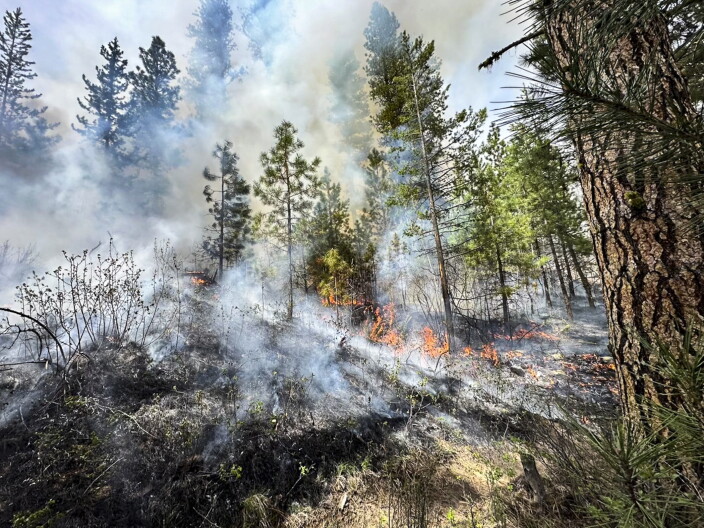
Show notes A low-intensity burn on the recent Crawford prescribed fire near Cascade, Idaho(Steve Vigil / The Nature Conservancy )
On a Thursday morning in May, Forest Service staff and crew leaders gathered in the Cascade Ranger District Office for a briefing. They were putting a plan together for the nearby, nearly 100-acre Crawford burn on the Boise National Forest.
Matt Haupt, the district’s senior fuels technician, read out the weather: sunny, 70-75, relative humidity in the upper 20s to lower 30s, low winds.
“Today is looking fairly good, a little hotter and drier,” he summarized.
The burning has already taken place earlier in the week, and this day’s work would be mostly mopping up and checking lines. After crew members got their marching orders in the parking lot below, they headed east toward the burn. I jumped in with Haupt, who’s overseeing it.
“The last time it was burned was the spring of 2018,” he said, driving to the project site. “It's mostly ponderosa pine, which typically needs five- to 15-year fire intervals.”
Many ecosystems and species — like the ponderosa pine — are dependent on regular fire. Prescribed fire can bring a number of ecological benefits, as well as significantly reduce the risk of catastrophic wildfire.
Haupt is with the Forest Service, but that day everyone else was working for The Nature Conservancy — or TNC — an environmental nonprofit.
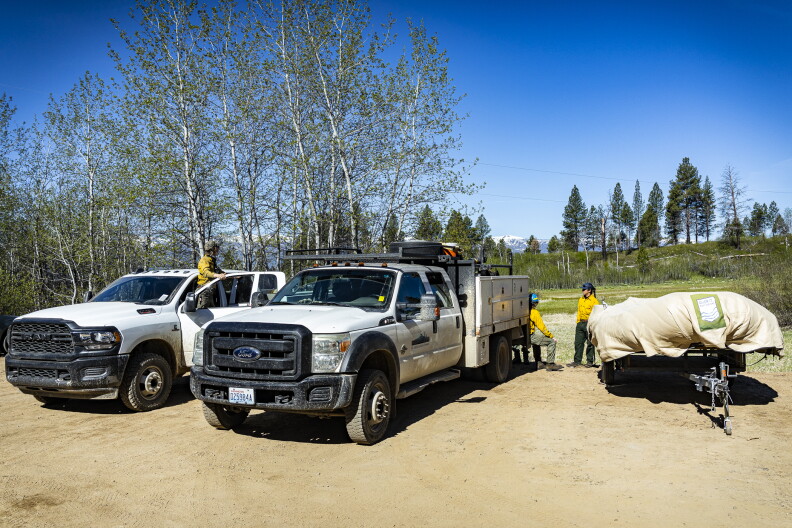
A Nature Conservancy fire crew gets ready to head out to check the Crawford prescribed fire's lines.(Murphy Woodhouse / Boise State Public Radio )
“The Forest Service still has their overhead structure,” he explained. “The supervision still needs to be there, but it's a lot of the manpower could be taken care of with TNC coming in.”
Federal agencies have committed to dramatically accelerating the pace of prescribed fire. In its 2022 Wildfire Crisis Strategy document, the Forest Service set a goal of treating 50 million additional acres of federal, state, tribal and private land. But last year, a major federal wildfire commission said that the current federal fire workforce — some 19,000 strong — is “not sufficient for the scale of wildfire risk reduction, response, and post-fire recovery work required now, let alone into the future.”
“Federal investment is urgently needed to create new and expanded workforce capacity that is focused on, and tailored to, mitigation, planning, and post-fire response and recovery for communities and landscapes,” the commission’s report read. Efforts to build that workforce, it recommended, should include the public, private and non-governmental sectors.
‘Insatiable need’
Jeremy Bailey, TNC’s North America prescribed fire training director, said forests and grasslands’ need for fire is insatiable.
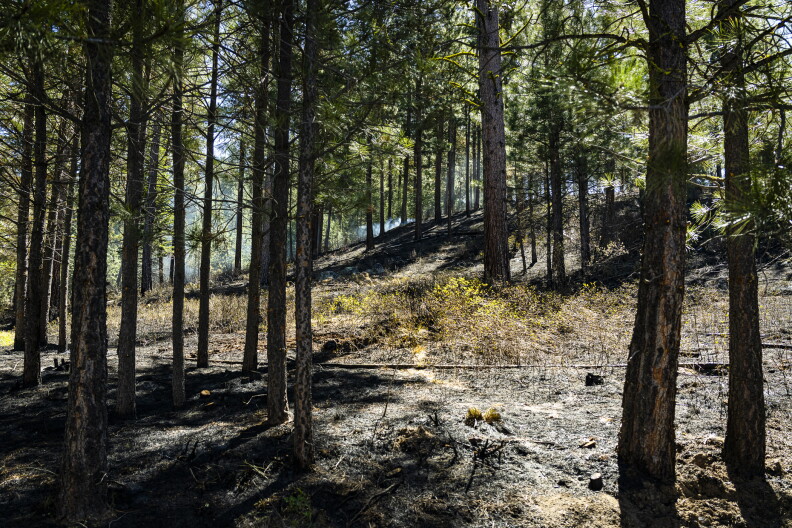
A day after burning operations on this section of the Crawford prescribed fire, the ground is a clean black, and some smoke is visible from the line. (Murphy Woodhouse / Boise State Public Radio )
“And so is the need for a workforce that can do that work,” he said. “Back of the envelope, I estimate we need 10,000 employees nationwide.”
Last year, his organization received $45 million over five years from the Forest Service — money he said came out of the 2022 Inflation Reduction Act. They hired some 50 people on top of existing fire staff, and they have 20 to 30 folks out on Forest Service priority projects — like the Crawford burn — on any given day. His TNC colleague Matt Ward said workforce constraints are probably “biggest issue that is complicating everybody's ability to do more projects.”
“We’re adding needed capacity,” Ward said.
‘Instantaneous effect’
In a video shared by TNC crew boss Steve Vigil, you can see a snaking line of short flame burning steadily through pine needle duff earlier in the week, the sort of low-intensity fire that prescribed burns often try to create. When I visited, some smoking stumps were still visible from the fireline, but it was mostly clean, blackened forest floor.
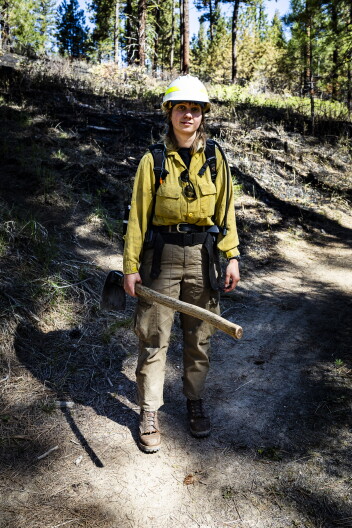
“So we are looking at a post-burn landscape,” said TNC crewmember Slug Kaltenbach, my guide on the burn. “This was actually burned yesterday, if you can believe it.”
Kaltenbach, who uses they/them pronouns, is from Eugene, Oregon and is in their fifth year of fire, much of which has been suppression work. But for Kaltenbach, prescribed fire hits different.
“I think that prescription fire is one of the best feelings in the world to have as a job,” they said. “In one day of burning … you're going to have a larger effect than maybe like two weeks of work doing other kinds of initiatives, like thinning or piling. Fire is such an instantaneous effect on the ecosystem.”
TNC crewmember Slug Kaltenbach(Murphy Woodhouse / Boise State Public Radio )
They’re also drawn to the way TNC operates. Wildland fire has a reputation for brutal work schedules and long, unpredictable stretches away from friends and family. Poor work-life balance was one of the barriers to recruitment and retention in the federal fire workforce identified by the Government Accountability Office in 2022. TNC gives its workers fixed schedules, meaning they know exactly when they’ll be home.
That’s allowed Kaltenbach to be an active part of the Moon Mountain String Band back in Eugene, hard to imagine in other corners of fire.
Kaltenbach identifies as non-binary, and said they appreciate the near gender parity and diversity they see in their TNC colleagues, which contrasts sharply with federal counterparts. In fiscal year 2021, 84% of federal firefighters identified as men, and 72% identified as white. Limited workforce diversity was another challenge faced by federal fire agencies cited in the GAO report.
“We're super excited to have 50% of our workforce represented by women because that is not that is not the norm in the wildfire workforce,” TNC’s Bailey said.
Slug and their colleagues are also able to complete trainings and get professional qualifications on burns. All of these things together, they said, point toward a more sustainable, attractive way to do fire. And there’s always the most basic draw.
“Playing with fire is fun,” Kaltenbach said. “In a controlled way, of course.”
‘We need help’
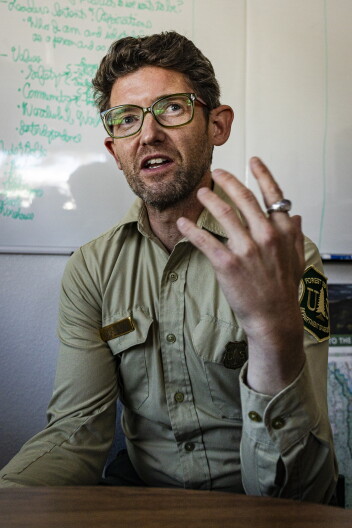
Back at the district headquarters, Ranger Chris Bentley said that the TNC partnership is “exactly the direction we need to go.”
Chris Bentley, ranger on the Boise National Forest's Cascade District, explains how TNC crews fit into his agency's goals for prescribed fire. "It's just absolutely vital that we bring in these types of agreements and these types of partnerships. We can't do it on our own. We wouldn't want to even if we could."(Murphy Woodhouse / Boise State Public Radio )
“We're still going to try to attract the traditional firefighter workforce for ourselves, for the Forest Service,” he added. “But we need help. We're not going to be able to do the work on our own. We're just not. There's too much work to be done, it’s too important that we succeed.”
He readily acknowledged that the TNC crews are a drop in the bucket compared to the needed workforce.
“But, you know, every drop counts,” he said.
This story was produced by the Mountain West News Bureau, a collaboration between Wyoming Public Media, Nevada Public Radio, Boise State Public Radio in Idaho, KUNR in Nevada, KUNC in Colorado and KANW in New Mexico, with support from affiliate stations across the region. Funding for the Mountain West News Bureau is provided in part by the Corporation for Public Broadcasting.
Idaho Matters Doctors Roundtable: September 18, 2024
Sep 18, 2024
Show notes(Jamie Grill / Tetra images RF/Getty Images)
According to a new report from the March of Dimes, more than 5.5 million women in the U.S. live in counties that are experiencing limited to no access to maternity care resources.
Here in our state, three facilities have shuttered their maternity services since Idaho enacted its near total abortion ban in August 2022. With these closures, health experts at the March of Dimes are calling this a growing maternal and infant health crisis.
Dr. David Pate, former CEO of St. Luke's Health System, joined Idaho Matters to talk more about this report along with other public health issues.
Reporter resigns after using AI to make up quotes
Sep 18, 2024
Show notes
Newsrooms around the country are talking about how to use AI in the wake of a recent journalism scandal in our region. A reporter in Cody, Wyoming resigned after he was caught using the technology to write stories and make up quotes. The Mountain West News Bureau’s Hanna Merzbach has more.
Idaho decision 2024: Breaking down voter registration
Sep 17, 2024
Show notes
(Emilie Ritter Saunders / Boise State Public Radio)Tuesday, Sept. 17 is National Voter Registration Day, and 2024 marks a historic election year. In November, voters will decide the future of our country for the next four years, as well as many key state and local races.Because it’s a presidential election year, there’s been a lot of focus on not just who gets elected but also on how our election system works at both a national and local level.To answer the questions that have come up this election season, we asked Idaho's secretary of state, Phil McGrane, to join Idaho Matters each Tuesday to take a closer look at these issues.Read the full transcript below. GAUDETTE: From the studios of Boise State Public Radio News. I'm Gemma Gaudette. This is Idaho Matters. Today is National Voter Registration Day, and 2024 marks an historic election year. In November, voters will decide the future of our country, at least for the next four years, as well as numerous key state and local races. Now, because it is a presidential election year, there has been a lot of focus on not just who gets elected, but also on how our election system works at both a national as well as a state and local level. So to answer the questions that have come up this election season, we've asked Idaho Secretary of State Phil McGrane to join us each Tuesday leading up to Election Day to take a closer look at these issues. And Phil is joining us now to chat more. Always nice to have you on the program.McGRANE: Thank you. Gemma. It's always great to be with you.GAUDETTE: Okay, so as I mentioned, it is National Voter Registration Day today and the whole month of September is devoted to to registration, is that correct? I mean, how did this idea come about?McGRANE: Yeah. National Voter Registration Day has been going on for a while, and it kind of varies each year. Um, earlier, as you know, we, uh, had a proclamation declaring September voter registration month here for the state of Idaho. And really, this is the opportunity for Idaho voters to update their registration. So if someone say, is turning 18 and they need to register to vote for the first time, right now is a wonderful opportunity to do it. If they've just moved to Idaho, it's a good time to register. But one of the areas I really want to just focus on is for all of the voters who voted in elections in the past. Right now is a great time to make sure your registration is current. Uh, a large percent of Idahoans move between presidential elections, and we want to make sure everybody's ready to go so that as the presidential election comes up, they have everything in place and are going to be able to easily vote, whether absentee, early or in person.GAUDETTE: Okay, before we get into the nitty gritty of all of that, um, Phil, voter registration rules are different in every state, aren't they?McGRANE: They are. You know, one of the things that makes our elections unique and it really kind of fits our federalist system, is all 50 states run their elections according to their state, and just each state has a little different makeup, so the rules can be slightly different. Um, voter registration exists in almost every state, so it's pretty common. Voters are familiar with it, but there are some things that make it unique, whether, you know, for us in Idaho, uh, showing photo identification and proof of residence in order to register to vote, or as I know you and I will probably talk about it a little bit more, is we have same day registration, which is one of the really cool things in Idaho, to make sure that anybody can register to vote, even when it comes all the way up to Election Day.GAUDETTE: Okay. So I want to talk about the rules here in Idaho and and what you need to register to vote. So number one, um, even though there might be misnomers about this. You must be a US citizen. So how do you prove that?McGRANE: That's true. So you must be a US citizen. You must be 18 years old, and you do actually have to go through the process of registering. One of the changes that we've had over the past couple of years, that's of note is the requirement to show photo ID, so you must have a state issued photo ID, could be driver's license or an ID card, or your passport, military ID, concealed weapons permit or tribal ID, uh, each of those. So something just basically to prove you are who you say you are. So one of those official forms of identification. And then in addition, you need something that proves your residence to show that you are an Idahoan and you are eligible at the address you're at. Um, usually. So that citizenship question is proved. Most often people use their driver's license overwhelmingly. That's what we see. And often the driver's license also has people's current address. So most common people will have everything they need in one stop. Um, beyond that for residency, things like a utility bill, a rental agreement. Often insurance in your glove box for your car is one of the easiest things for people to access and show their residence address. But we do have to. The person has to prove they are who they say they are, and they live where they say they live in order to be able to register to vote.GAUDETTE: Okay, let's talk about someone who is 18 and they're registering to vote for the very first time. This is going to happen in our house in a couple of years.McGRANE: That's exciting.GAUDETTE: I know right. So my my son has a driver's license, but I mean, the utility bills are not in his name, nor is the mortgage. Be nice if it was, it is not. So how then would someone who's 18, living at home or maybe even going to college and maybe in a different part of the state would register to vote?McGRANE: Yeah, I think, you know, you're touching on a really important question. First and foremost, most instances, just like your son, they're going to have a driver's license. That driver's license is going to have their address because it's where they've lived that's going to be the easiest. And anybody who has an Idaho driver's license or Idaho ID card can do all of this online at VoteIdaho.gov. It's really easy. We actually, in real time, as someone goes in and registers, we go and compare the information they provide us with what driver's license records have to validate someone's identification. So it's a really slick, easy process. So that that's the safest and easiest way. But we are on Boise State Public Radio. And so for all those students who are considering registering for the first time, I think one of the things to emphasize is someone we want people to vote first and foremost. And really the first question is just where do you live? Is Boise now your home? And that's where you consider your residence? Or is there another part of the state of Idaho or another state that's your home? One of the common questions we get is, say someone has a Wyoming driver's license, but they want to register to vote here. That actually raises a question. They have to decide whether they're from Wyoming or they're from Idaho. You can't have a driver's license of a different state and claim residency and vote in another state. You have to pick basically which state you consider home and get the same documentation in all forms. Now, every state has some form of absentee voting, and in Idaho it's really important. Doesn't matter if a student goes off to school somewhere else or overseas, they are eligible to vote in our elections, and our office and the county clerk's offices can easily assist anybody who needs help navigating that process.GAUDETTE: Okay, so you mentioned registering online. Is there a deadline Phil, on on how long you can register online.McGRANE: There is a deadline that'll be coming up. Um, the pre-registration deadline for this election is October 11th. Uh, that will be the cutoff prior to Election Day that people need to get their registration in. So that's part of why we've emphasized voter registration month here in September is this is the best time to do it? However, if someone doesn't get their registration done by that October 11th date, they can still do it when they vote in person, either early voting or on election day through same day registration.GAUDETTE: So let's talk about this registration on Election Day. This is highly unique to Idaho. I've lived in other states and I don't remember there being another state I've lived in where you can actually register to vote on Election Day. So first off, why is that so important and why does Idaho do it?McGRANE: Yeah, there's kind of two systems out there largely. So I believe there's ten states right now that do same day registration. Idaho was an early adopter back in 1994. This is all part of the National Voter Registration Act. Um, most states people are familiar with motor voter. It's where when you go get your driver's license, they automatically try to register you to vote through that process. We don't do that here in Idaho. You actually have to go choose to register to vote here in our state. But an advantage that we have with it is on election day we have same day registration. So if someone didn't get their information updated or they just haven't forgot to get their registration in before the deadline, they can still show up on election day. Bring photo ID, bring proof of residence. They can fill out the registration form there with the election officials and get a ballot and vote at the same time.GAUDETTE: Okay, so they need to make sure they have that proper identification..McGRANE: They do need ID, yes to register. I think this is an important question for listeners to register to vote, you do have to have photo ID and proof of residence for Election Day. If you're already registered, you'll be asked for ID and there is an affidavit, but the affidavit does not apply to the registration process itself.GAUDETTE: Okay, so what about if on Election day you want to register and you maybe because you haven't registered to vote before, you don't know where your polling location is, or you see one down the street, but maybe that's actually not your polling location. Does that matter when you go to register on Election Day?McGRANE: In terms of the registration, it doesn't. But you want to get to your polling location. Everybody's polling location is specific to where they live. And just like you said, we've all driven down the street and seen vote here signs. You can't just go to any vote here sign. And I'm sure we'll talk about this more. As you get closer to election, you need to go to your polling place. The easiest thing for everybody. It doesn't matter what part of the state you're in is visit voteIdaho.gov There. Not only can you register to vote, but you can also look up your registration information, find out where your polling location is. And one of the things we'll be talking about more here coming up is we for the first time, we'll have sample ballots that people will be able to view at Vote Idaho.Gov so they can see what races they're voting on, what candidates and what issues they're going to be being asked when they get their ballot.GAUDETTE: So what about folks who might think they're registered to vote? Um, or they want to check? How do they do that?McGRANE: Yep. Easiest thing. VoteIdaho gov. Um, you can look up your voter record and you can see double check that you're registered and make sure your address is current on your registration as well as see, you know, what legislative district, what congressional district and other things you're registered to vote in.GAUDETTE: What about polling locations, Phil. Because I've lived in the same house for going on. I mean, going on eight years. In that time, our polling location has changed. Um, and, and that's, I think, kind of typical, right, with growth and all of that. So let's say I want to go and make sure I know where my polling location is. Do I go to the same website?McGRANE: Yep. You know, one of the things our office has worked really hard on over the last year is the new VoteIdaho.Gov website. We launched it back in February, and it really is meant to be a one stop shop for all Idahoans. So whether you're someone registering for the very first time. Or like you Gemma, you're trying to look up to make sure you know your polling location or say, you're like me and you're an election nerd, and you want to see campaign finance data and some of the other cool tools about people moving to Idaho. All of that information is all available at the same location, Voteidaho.gov. Similarly, as the election gets close and we get to Election Day, we'll have all of our results posted statewide uh, at Voteidaho.gov. So really trying to make it a simple, memorable space for Idaho voters to go to. I think that's one of the really important things that our office is focused on, is trying to make it easy for Idahoans to exercise their vote and have a voice in this election that is so important, both nationally and here in the state of Idaho.GAUDETTE: There's been a push in a lot of states to check voter rolls for people who should not be registered. The the governor of Texas, Greg Abbott, recently announced that he actually took more than a million ineligible voters off the rolls. Does Idaho have a system to check this sort of thing.McGRANE: Yeah. With voter registration, I think it's an important part of the process is that we're always actively maintaining our voter rolls, trying to keep them as current as we possibly can. So, you know, one of the great things I've had the cool opportunity to share is just the voters moving to Idaho. Part of that process is when someone registers to vote, we actually ask for your last known address, and that's so we can share information between the 50 states. So say someone moves here from California, they register to vote here in Idaho, it's important that our office notifies the California Secretary of State's office that somebody has moved so that they can keep their rolls clean. Beyond that, we're on a monthly basis doing checks against vital statistics for death records, against Department of Corrections for people who have been incarcerated. Um, there's numerous other checks. Citizenship is one of the big things. There was an executive order from Governor Little back in July, and our office has been working with both the Idaho Department of Transportation as well as Department of Homeland Security, just to verify that our rolls are current and that everybody who's on our voter rolls is eligible to vote in this upcoming election.GAUDETTE: I want to go back to two things that you mentioned, and this is people moving in and out of state, or even if someone passes away. So let's start with, um, if someone does die, how do you know and how do you take their name off the rolls? I'm assuming it's the one thing you do is like, you, you check, uh, very often.McGRANE: Yeah, that's one of the things. So working with all of the counties, we do vital records, checks all of the time. So we have processes in place, and our systems are all connected so that we can easily do validation. So as vital statistics is notified of deaths, um, we get that information. We're also working on a process with the Social Security Administration to keep those records current as well. I think, you know, in this day and age, with the way that technology works, we're more networked and able to share information between governm…
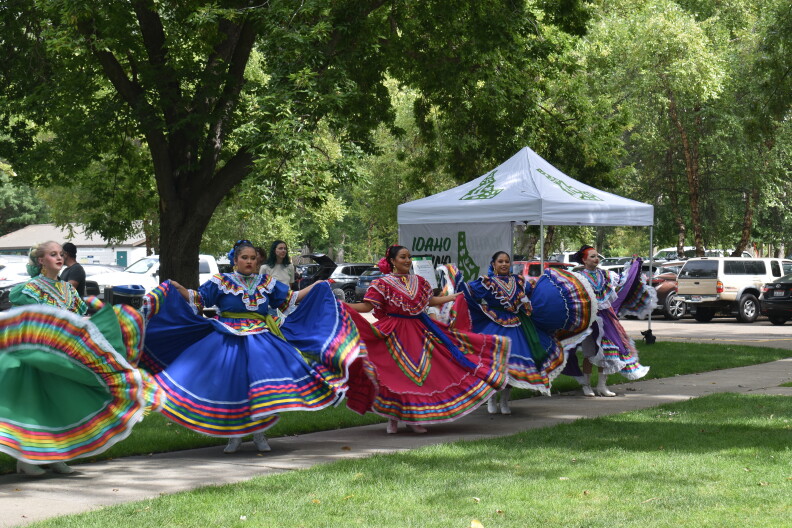
Protecting our environment is important, especially if we want to continue to enjoy it, which is something that many people will be doing as they take part in Latino Conservation Week.
The national celebration kicked off earlier this weekend and puts focus on the conservation goals of our Latino community while also providing lots of opportunities to get out in nature.
Melisa Rodriguez, one of the week's organizers and an urban ranger with Deer Flat National Wildlife Refuge, joined Idaho Matters to talk more about the event.
'Telling the stories of women's lives' with Elizabeth Gilbert
Sep 17, 2024
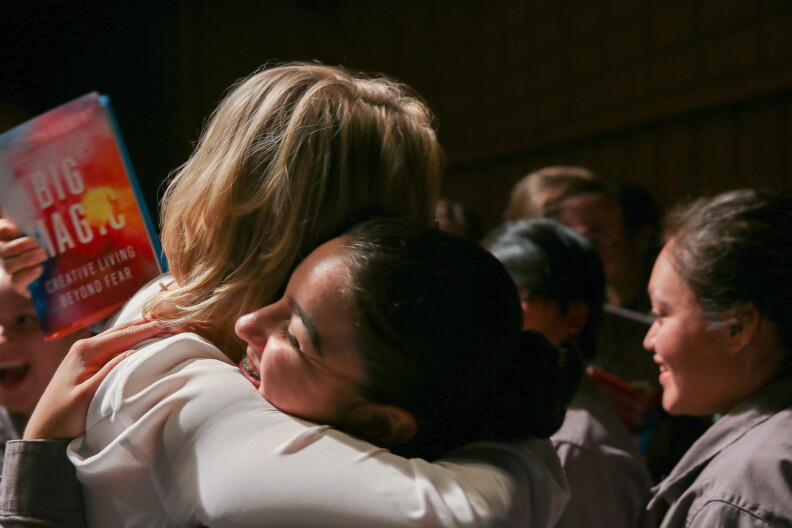
Show notesElizabeth Gilbert greets and talks with students from the Oregon Youth Challenge program.(Deschutes Public Library/The Penguin Group / Flickr)
This episode of Idaho Matters originally aired on Month 13, 2024.
Maybe you saw the movie starring Julia Roberts or read the book "Eat, Pray, Love," which was an international bestseller and sold more than 12 million copies.
Author Elizabeth Gilbert has written 10 books, including her latest, "City of Girls." She is writer-at-large for GQ and joined Idaho Matters to talk more about her journey as an author.
Idaho mom fights to improve dyslexia legislation and literacy in Idaho
Sep 16, 2024
Show notes(f_ / iStockphoto.com)
This episode of Idaho Matters originally aired on May 30, 2024.
Idaho Mom Robin Zikmund knew her son was different at an early age. While his peers were reading by the third grade, her son was still struggling.
Eventually her son was diagnosed with dyslexia, but Robin wanted to do more than just have a diagnosis for her son.
So she founded the Idaho chapter of Decoding Dyslexia, which has helped make a significant impact on dyslexia legislation and literacy in Idaho through the science of reading.
Robin joined Idaho Matters to talk more.
Idaho Matters Reporter Roundtable: September 13, 2024
Sep 13, 2024
Show notes( Custer County Sheriff)
It’s Friday, which means it's time for our Reporter Roundtable when Idaho Matters gets you up to date on all the news that made headlines this past week.

 Our TOPPODCAST Picks
  Stay Connected