Idaho Matters is a wonderful way to stay up to date, meet people and understand there’s much more to this great state. Hosted by Gemma Gaudette on Boise State Public Radio News, it features arts and politics, growth and education, and the interesting stories that make Idaho unique. Send us your questions, comments or story ideas by emailing idahomatters@boisestate.edu or sending us a voicemail using the “Talk To Us” feature on the free Boise State Public Radio app.
Wassmuth Center for Human Rights opens its doors in downtown Boise
Oct 10, 2024
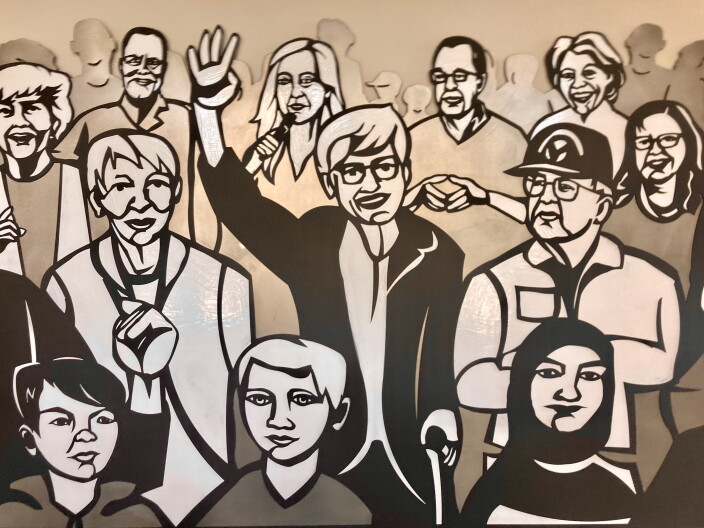
Show notesThe mural "Defenders of Dignity" by Addie Boswell is one of the artwork featured at the Wassmuth Center for Human Rights. In the center, with arm raised, is the late Marilyn Schuler, a prominent human rights activist in Idaho. (Julie Luchetta / Boise State Public Radio)
The education nonprofit behind Boise’s Anne Frank Memorial is getting its own building in downtown Boise. The Wassmuth Center for Human Rights will now reside in a brand new space downtown.
The center was first founded 22 years ago to build the only monument on U.S. soil dedicated to the young victim of the Holocaust. Since then, the center has been offering classes, lectures and trainings in the community.
“As the demand for programming grew, it really became apparent that having a space ideally adjacent to the memorial was kind of the dream,” said Director Christina Bruce-Bennion ahead of the grand opening on Thursday. “And here we are.”
(Wassmuth Center for Human Rights / Boise)
Bruce-Bennion said the center’s goal is to promote human dignity through education. The new space will be a place for the public — both adults and children — to engage with local artists, attend classes and reflect on Idaho’s history of human rights. It offers access to a library collection, an interactive display featuring testimonies of holocaust survivors and various reflective art pieces.
But the center does not focus on particular human violations, Bruce-Bennion added.
“It's really more about, 'how do we give people the information, how do we learn from history and connect it to today? How can that lead to informed action?'” she said. Instead the center offers programming to identify what it calls the “Spiral of Injustice.”
“That spiral looks like a tornado,” Bruce-Bennion explained. “The top level is language. And that's where it starts, right? It's how we begin with othering, how we talk about other groups. And then if we don't interrupt the spiral at that point, it can continue to avoidance, discrimination, violence and elimination.”
The center was funded by roughly 650 donors and cost $6.4 million. It opens its doors to the public on Thursday.
A Colorado Springs school is making students ditch cell phones. It's a trend in the Mountain West.
Oct 10, 2024
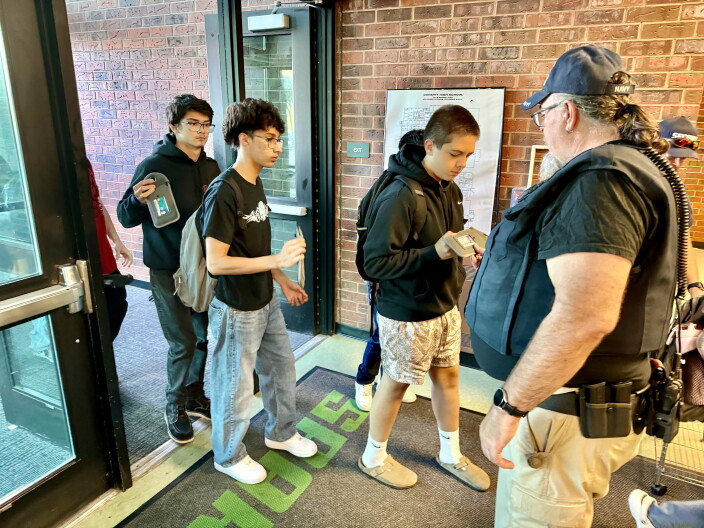
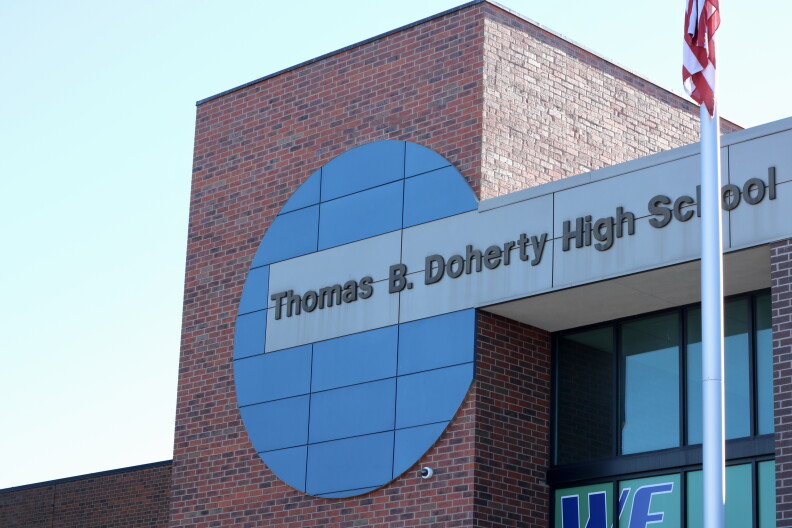
Show notesStudents at Doherty High School in Colorado Springs show their IDs and their phones inside Yondr pouches to security guard Lonny Barrett. The school district started a new policy this year banning cell phones for middle and high schoolers.(Rachel Cohen / KUNC )
It's the third day of school at Doherty High in Colorado Springs. 1,700 teenagers file through the doors as security guard Lonny Barrett checks IDs.
This year, he’s also inspecting cell phones. According to a new policy, students need to put their phones away all day inside special pouches.
Barrett checks each one. Only a few minutes into the morning rush, he’s found a pouch that’s suspicious.
“What is this?” Barrett asks a student. “This isn't a phone. This is a box of Extra gum.”
He hands the student the gum stuffed inside in place of a phone. Barrett said this happens a few times each morning.
"They'll put like empty cases, or even like an old broken phone that doesn't even work anymore, they'll try to put that in there and sneak it past us,” he said. “It's been entertaining."
Many kids simply tell him they left their phones at home. He has his doubts. He reminds them there are consequences if they're caught with their phones – starting with getting them confiscated, up through suspension.
Standing near the entrance is the principal, Hillary Hienton.
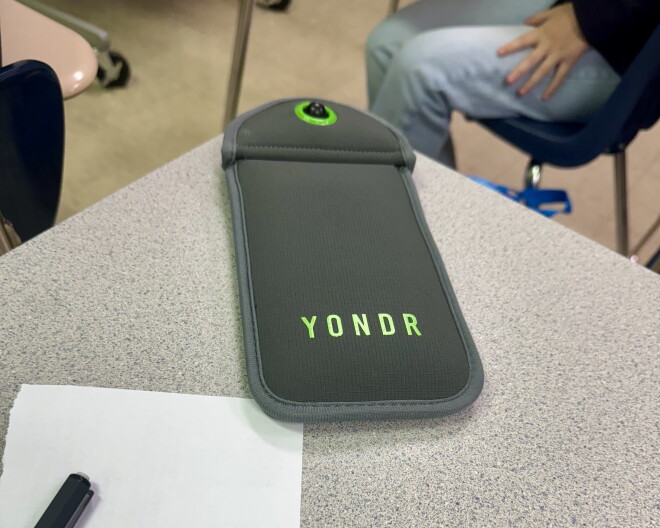
At the end of the school day, administrative staff rolls out carts of Yondr magnets to unlock the phone pouches.(Rachel Cohen / KUNC )
She explains how the system works. The gray fabric pouches are designed by a company called Yondr. Buying one for each middle and high school student cost the district more than $300,000. The pouches magnetically lock so the phones are trapped all day. At the end of the day, students pass through special magnet stations by the front office to unlock their pouches.
Hienton said after students returned from learning at home during the pandemic, rampant cell phone use in schools reached a new level. Doing something felt necessary.
"They’ve just been so glued to them,” she said. “In classrooms, it turned into a lot of power struggles. Students didn't want to put their phones away or give up their phones."
A Pew survey last year found 72% of high school teachers nationwide said students being distracted by cell phones was a major problem in their classes.
When making the decision to implement a cell phone policy this summer, district leaders in Colorado Springs also cited a plethora of research showing phones and social media can be harmful for young people’s mental health, and can lead to cyberbullying and poor sleep.
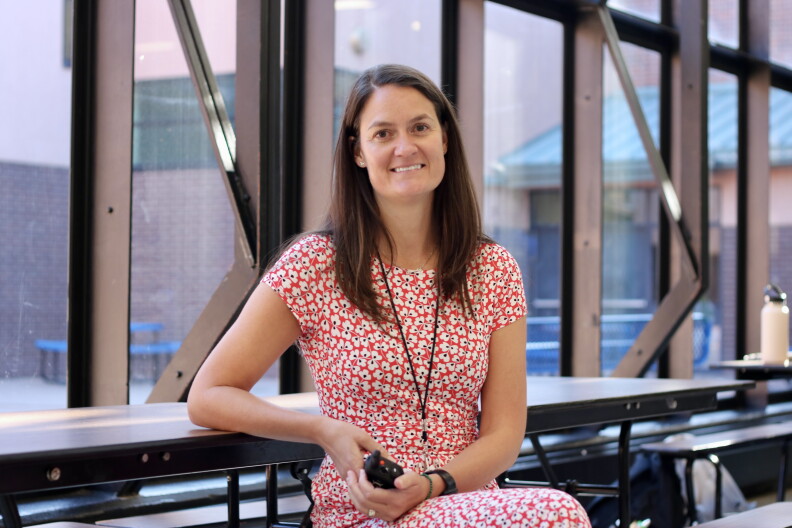
Principal Hillary Hienton said the Colorado Springs district felt it necessary to address cell phone use in schools. “In classrooms, it turned into a lot of power struggles," she said.(Rachel Cohen / KUNC )
Lots of districts around the region arrived at a similar conclusion. This year, schools in the Salt Lake City, Las Vegas and Boise areas are declaring campuses or classrooms phone-free.
Others ditched them last year.
"This is the best policy change we've ever made in my career of 28 years," said Jim Foudy, a superintendent of the Blaine County School District in Idaho, which banned cell phones in classrooms last year, though without the pouches.
He said the first year went smoothly. The district didn’t have to confiscate as many phones as expected and situations where the schools had to get involved in cyberbullying issues declined. Teachers reported higher classroom engagement.
“We actually had hired a teacher who had a few different job offers and said that he chose to work for Blaine County because this policy was in place,” Foudy said.
At Doherty High, students in Erin Ahnfeld's English class passed around a ball of yarn for a lesson about connections -— between each other and books they'll read.
Ahnfeld said he feels like he did when he began teaching, before smartphones were everywhere.
"I think it's a courageous move,” he said.
In the first week, he said he’s already noticed a difference. Last year, when he gave students a break between lessons, they'd pick up their phones. This year, it’s different.
“They just talk to each other,” he said. “That makes the feel and community in a classroom way more powerful."
District 11 in Colorado Springs is one of several school districts in the region implementing no-cell phone policies for the first time this school year.(Rachel Cohen / KUNC )
Some students feel differently.
"I hate this new phone system a lot,” said Eli Howard, a junior. He doesn’t think the policy will prompt students to pay more attention in class — those who were distracted by phones before are putting their heads down on their desks.
Howard also worries about safety. Earlier in the morning, the school was put on a "hold" during a potential emergency. That means students are asked to stay in their classrooms and clear the halls to limit commotion, typically during a medical situation. It turned out to be fine, but in the moment, Howard was scared.
"I was like, ‘Dude what if there's someone in here and I can’t — my mom and dad — I can't talk to them,” he said.
Many parents opposed to cell phone bans say they have similar concerns about reaching their kids in an emergency. Doherty High said staff are extensively trained in emergency protocols and that the district will continue to communicate with parents via mass communication systems.
On the other hand, some students, such as Dante Click, say they understand where the school is coming from by limiting cell phone use.
"I don't think adults are crazy for this one. Kids are definitely on their phone too much,” Click said. “But I think it's going to backfire on them."
Click said some kids are frustrated and are breaking the pouches.
Many ask Principal Hienton why the school is doing this.
"I say, ‘I care about you, and I care about your education, and I want to make sure that you have the tools and the skills and the competencies that are going to make you successful in life,’" she said.
Hienton said phones are a distraction from that success, so, for now, the solution is to remove them from the equation.
This story was produced by the Mountain West News Bureau, a collaboration between Wyoming Public Media, Nevada Public Radio, Boise State Public Radio in Idaho, KUNR in Nevada, KUNC in Colorado and KANW in New Mexico, with support from affiliate stations across the region. Funding for the Mountain West News Bureau is provided in part by the Corporation for Public Broadcasting.
Tribes advocate for the rights of those exposed to radiation
Oct 10, 2024
Show notes
Since the atomic bomb program began during WWII, countless Americans have been exposed to radiation — either from mining uranium or from the tests themselves.
But compensation for the cancers caused by this exposure has been limited, and this summer, Congress allowed the main way of paying for treatment to expire that’s been especially harmful to Native Americans and Mexican Americans living in the southwest.
Late last month, members of several tribes and others affected by exposure went by bus to Washington -- to persuade lawmakers to revive and expand the cancer treatment program.
The Mountain West News Bureau's Yvette Fernandez met up with them and has this report.
'How to Hide in Plain Sight:' An author interview with Emma Noyes
Oct 10, 2024
Show notes( Berkley)
It's a story about Eliot, a 21-year-old woman who's spent years building up walls, separating herself from her family, so she can try and control her struggle with OCD.
However, when she returns home for a wedding, the reappearance of her childhood love threatens to bring down the barriers she's so carefully constructed.
Noyes joined Idaho Matters to talk more about her newest book.
Improving your experience on the Boise Foothills trail system
Oct 10, 2024
Show notes(<a href="https://www.flickr.com/photos/9977722@N02/">albussan</a> / Flickr)
The Boise Foothills trail system sees a lot of traffic throughout the year. Which is why the folks over at Ridge to Rivers are constantly working to improve people's experience.
In order to do that, though, they need feedback. So they're asking you to share your experience on the trails in an annual survey.
Lisa Duplessie, Foothills and Open Space Superintendent with the Parks and Recreation Department, joined Idaho Matters to talk more.
Idaho Matters Doctors Roundtable: October 9, 2024
Oct 09, 2024
Show notes(<a href="https://www.flickr.com/photos/drlisamariecannon/">Lisa Marie Cannon</a> / Flickr)
As Mpox continues to hit African nations hard, here at home we are dealing with bird flu and a rise whooping cough.
Dr. David Pate, former CEO of St. Luke's Health System, joined Idaho Matters to talk more about these issues.
In the shadow of trauma, Stephanie Foo still finds ‘exquisite beauty’
Oct 09, 2024
Show notes Acclaimed journalist Stephanie Foo is the author of 'What My Bones Know'( Penguin Random House, Stephanie Foo)
By the time she was a teenager, Stephanie Foo had been abused and abandoned by both parents. She spiraled into trauma, and the feeling of, ‘‘Why didn’t anybody want me?’
Diagnosed with Complex Post Traumatic Stress Disorder, years later, Foo was able to look at that teenager and think, "Oh my God, the strength that you have … the power that you have … to have gone through all of that and to keep going and to succeed."
“I have a lot of love and empathy for that girl now,” she said.
Prior to her being the keynote at the Idaho Office for Refugees’ Northwest Conference on Resettlement, Foo, author of "What My Bones Know: A Memoir of Healing from Complex Trauma" visited with Morning Edition host George Prentice to talk about CPTSD and how she went from victim to survivor to understanding that “along with the losses are the triumphs.”
Read the full transcript below:
GEORGE PRENTICE: It's Morning Edition. Good morning, I'm George Prentice. Because we will be talking about PTSD and more specifically, CPTSD, you should know that yes, we will be considering trauma for the next few minutes; but you should also know that our guest reminds us that while a life can be full of anger and pain, at the same time, it is very possible to have that life also include peace and exquisite beauty. And these are some of her words in her amazing book. She is Stephanie Foo, an acclaimed radio producer for This American Life and Snap Judgment. Most of us know her New York Times bestseller, “What My Bones Know: a Memoir of Healing From Complex Trauma.” And we are thrilled to report that she is to be the keynote speaker at the upcoming Northwest Conference on Resettlement, put together by the Idaho Office for Refugees. Stephanie Foo, good morning.
STEPHANIE FOO: Thank you so much for that wonderful introduction. Good morning.
PRENTICE: With your permission, I'm going to ask you to share with us a couple of passages from your book. By the way, how do you best explain to most of us what is CPTSD?
FOO: Yeah, I think we're all familiar with PTSD. You can get PTSD from a single traumatic event. Let's say you're in a car accident. You can get PTSD from that. Complex PTSD occurs when the trauma happens over and over and over again for an extended period of time. So that could be survivors of war, of domestic violence, of child abuse. That's very frequent. My CPTSD comes from child abuse. It's kind of like if you were in a car accident every week for several years. The toll that takes on your brain is very different than Complex PTSD. And it's more complex to heal.
PRENTICE: On social media, pretty early on you threw a question out: “Do I know anybody who was diagnosed with CPTSD? And one of the responses came back from someone that you call Lacey. And in chapter 11 of your book….could you read a bit beginning with…beginning with the words “Lacey said the road…” Could you share that with us?
FOO: Sure.
“Lacey said the road would be long and difficult. That sounded about right, considering I was endeavoring to relearn how to be a person. I wanted to learn to be happy and strong and independent so I could support others instead of letting my own depression always take center stage. I wanted to learn how to be a better friend, partner, family member to invest in permanent relationships. I wanted to be the kind of woman people didn't leave. I had to find out what was salvageable. If I had good qualities underneath all of those layers of trauma and hurt and workaholism.”
PRENTICE: And you do caution us early on that the first part of your book is detailed about trauma… the trauma that you grew up with. And I have to tell you… and my guess is that this is not the first time a reader has told you this: I had to wince as I was reading …more than a few times. I also had to decide whether I needed to put the book down for a few minutes, or whether it would be better to power through. Because you do promise us a happy ending.
FOO: And I do say in the beginning too…that it's totally okay if you need to just skip a few pages. I recognize that books on trauma are really difficult… and I really wanted to make sure that survivors were protected in reading this book. And so, I tried to keep the real ugly, nasty trauma stuff from my childhood to 50 pages or less.
PRENTICE: With the success of this book, you have been asked…as I'm asking today…probably countless times in interviews or events that you're speaking at… about these horrible, visceral memories. And I truly want to know: How you do that without this not being triggering.
FOO: Well, see, CPTSD is sort of a curse and a blessing. One of the advantages, or what I kind of call superhero talents of having CPTSD, is that it makes us excellent at dissociation. I sort of leave my body and shut off all of my sadness and anxiety and all of that, whenever I talk about my childhood and I just don't feel anything. So, I it's pretty easy for me to talk about some of the hardest things that have ever happened to me. That can happen in moments of crisis. It happened during the pandemic. I wrote this book during the pandemic which pretty much completely dissociated in one of the most traumatizing moments for our society, I guess living with CPTSD is kind of like being used to always feeling like you're going to die at any moment. And so, at a certain point, you do kind of get dulled to it, and it can be both a terrible thing and a wonderful thing.
PRENTICE: Is it learned? Is it through professional help?
FOO: My dissociation?
PRENTICE: Yeah.
FOO: It's actually a symptom of how people who are very traumatized. I think that they sometimes have a hard time accessing their feelings… particularly difficult feelings. But all feelings, like when you numb the sadness, you can also numb the happiness. I think that it can be pathologized as something that's really debilitating for some people. And it certainly exists on a spectrum, But in moments of extreme distress, in moments of where you really need to stay calm in order to survive, we can be the calmest ones in the room. You know, it is a survival mechanism from having to stay calm in dangerous moments where our lives were threatened. You know, if you have a tiger… if a tiger ate your wife, you can't just, like, sit there and freak out about it and grieve. You have to feed your children. If you're living in a jungle, you have to find a way to survive. And so, you have to shut down all of those feelings and keep going. And I think the harder thing has been to tap into some of those rough feelings and feel grief and sadness and anger over what happened to me as a child.
PRENTICE: Can I assume that when you are invited for readings or a speaking engagement… do countless people come up to you when you're done and want to share their stories? I'm wondering what that experience has been like.
FOO: I feel like the language around trauma has actually been improving a lot with the help of social media and awareness and books. So, I think people understand more about the concept of trauma dumping. And the toll that it can take on people. So, I don't frequently get people coming up and dumping all their trauma on me. But what I do get a lot of is people coming to me and saying, ‘My story is your story.” And I always say, thank you so much. And I'm so sorry…I'm so sorry that you have to be part of this club. But I always say, “This is the crappiest club with the best people in it.” Because I feel like survivors… when they come up to me, they're always so empathetic. They're so kind, they're so gracious, they're so thoughtful. And it's really taught me that survivors of CPTSD are really powerful and loving… and lovable individuals.
PRENTICE: As a point of personal privilege, I have to tell you that my connection was that I worked with foster kids… pretty high risk foster kids…close to 100 before I returned to journalism. And I found your story to be their story. What I learned from your book, and what you've reminded me of more than a few times, is that you never know that you are learning to survive, But only on the other side, where there's any amount of daylight do you consider yourself a survivor. Because the process of surviving is so… just… awful sometimes… even though you are surviving.
FOO: It's all encompassing. And I think a lot of times the process of surviving is so sad that there is a lot of self-hatred in there. For me, being abused and abandoned by both of my parents by the time I was a teenager, there was a lot of self-loathing and feeling like, “Why didn't anybody want me? Why must I be unlovable?” And only years later, really, was I able to look at that teenage girl and think, “Oh my God, the strength that you have, the power that you have to have gone through all of that and to keep going and to succeed. I mean,” I have a lot of love and empathy for that girl now.
PRENTICE: I'm next going to ask you to read from your book again: Chapter 43, if it's okay? Beginning with the words, “But there are two main differences…”
FOO: Okay.
“But there are two main differences. Now I have hope, and I have agency. I know my feelings, no matter how disconsolate they are, they are temporary. I know that regardless of how unruly it is, I am the Beast's master, and at the end of each battle I stand strong and plant my flag. I am alive, I am proud, I am joyful still. So, this is healing, then. The opposite of the ambiguous dread fullness. I am full of anger, pain, peace, love of horrible shards and exquisite beauty and the lifelong challenge will be to balance all of those things while keeping them in the circle. Healing is never final. It is never perfection. But along with the losses are the triumphs. I accept the lifelong battle and its limitations now, even though I must always carry the weight of grief on my back. I have become strong. My legs and shoulders are long, hard bundles of muscle. The burden is lighter than it was. I no longer cower and crawl my way through this world. Now I hitch my pack up. And as I wait for the beast to come, I dance.”
PRENTICE: Stephanie Foo will be the much-anticipated keynote speaker at the upcoming Northwest Conference on Resettlement, sponsored by the Idaho Office for Refugees. Stephanie, great good luck to you. Safe journey. I can't thank you enough for giving me some time today.
Why eighth graders are naming ITD's snowplows
Oct 09, 2024
Show notes(Idaho Transportation Department)
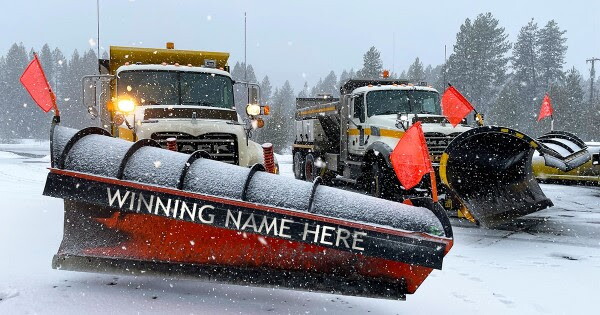
Contests to name a snowplow are becoming more common around Idaho. It’s a great way to involve and educate kids about what road departments do each year to get ready for winter weather.
For the past two years we’ve told you about Nampa's name that plow contest where elementary school kids came up with names like "Darth Blader" and "Frosty the Snowplow."
Now the Idaho Transportation Department is joining in with its first name a snowplow contest targeted at eighth grade students who are just about the right age to start drivers training.
Ellen Mattila, public information officer with the Idaho Transportation Department, and transportation program manager Vincent Trimboli join Idaho Matters to talk more about the contest and how ITD prepares for winter road conditions.
Split by politics: The experience of one mountain town
Oct 09, 2024
Show notes(<a href="https://www.flickr.com/photos/127122884@N04/">Matt McClintock</a> / Flickr)
The partisan division in national politics in recent years has also come to define much of local politics. Candidates up and down the ballot regularly tap into fears that their opponents threaten the way people live their lives. In Colorado, that political schism has split one rural country in half. KUNC's Lucas Brady Woods reports for the Mountain West News Bureau.
Idaho Decision 2024: Voter ID requirements
Oct 08, 2024
Show notes(Otto Kitsinger / AP Images)
What happens when you go to vote and you don’t have a driver’s license? Can you still vote? What kind of identification do you need, and how do you get one?
Voters will decide the future of our country for the next four years as well as many key state and local races in the upcoming November election. Because it’s a presidential election year, there’s been a lot of focus on not just who gets elected but also on how our election system works at both a national and local level.
Idaho's Secretary of State Phil McGrane joined Idaho Matters to take a closer look at these issues and answer the questions that have come up this election season.

 Our TOPPODCAST Picks
  Stay Connected