TopPodcast.com
Menu
  • Home
  • Top Charts
  • Top Networks
  • Top Apps
  • Top Independents
  • Top Podfluencers
  • Top Picks
    • Top Business Podcasts
    • Top True Crime Podcasts
    • Top Finance Podcasts
    • Top Comedy Podcasts
    • Top Music Podcasts
    • Top Womens Podcasts
    • Top Kids Podcasts
    • Top Sports Podcasts
    • Top News Podcasts
    • Top Tech Podcasts
    • Top Crypto Podcasts
    • Top Entrepreneurial Podcasts
    • Top Fantasy Sports Podcasts
    • Top Political Podcasts
    • Top Science Podcasts
    • Top Self Help Podcasts
    • Top Sports Betting Podcasts
    • Top Stocks Podcasts
  • Podcast News
  • About Us
  • Podcast Advertising
  • Contact
Not in our directory?
Add Show Here
Podcast Equipment
Center

toppodcastlogoOur TOPPODCAST Picks

  • Comedy
  • Crypto
  • Sports
  • News
  • Politics
  • True Crime
  • Business
  • Finance

Follow Us

toppodcastlogoStay Connected

    View Top 200 Chart
    Back to Rankings Page
    Education

    Derek Sivers podcast

    Derek Sivers very short articles and audiobook chapters, read by Derek Sivers. Transcripts at https://sive.rs/blog

    Advertise

    Copyright: © 2022 Derek Sivers

    • Apple Podcasts
    • Google Play
    • Spotify

    Latest Episodes:
    The day Steve Jobs dissed me in a keynote Nov 11, 2010
    Show notes

    In May 2003, Apple invited me to their headquarters to discuss getting CD Baby’s catalog into the iTunes Music Store.

    iTunes had just launched two weeks before, with only some music from the major labels. Many of us in the music biz were not sure this idea was going to work. Especially those who had seen companies like eMusic do this exact same model for years without big success.

    I flew to Cupertino thinking I’d be meeting with one of their marketing or tech people. When I arrived, I found out that about a hundred people from small record labels and distributors had also been invited.

    We all went into a little presentation room, not knowing what to expect.

    Then out comes Steve Jobs. Whoa! Rock star.

    He was in full persuasive presentation mode. Trying to convince all of us to give Apple our entire catalog of music. Talking about iTunes success so far, and all the reasons we should work with Apple.

    He made a point of saying, “We want the iTunes Music Store to have every piece of music ever recorded. Even if it’s discontinued or not selling much, we want it all.”

    This was huge, because until 2003, independent musicians were always denied access to the big outlets. For Apple to sell all music, not just music from artists who had signed their rights away to a corporation, this was amazing!

    Then they showed us the software we’d all have to use to send them each album. The software required us to put the audio CD into a Mac CD-Rom drive, type in all of the album info, song titles and bio, then click [encode] for it to rip, and [upload] when done.

    I raised my hand and asked if it was required that we use their software. They said yes.

    I asked again, saying we had over 100,000 albums, already ripped as lossless WAV files, with all of the info carefully entered by the artist themselves, ready to send to their servers with their exact specifications.

    The Apple guys said, “Sorry, you need to use this software; there is no other way.”

    Ugh. That means we have to pull each one of those CDs off of the shelf again, stick it in a Mac, then cut-and-paste every song title into that Mac software. But so be it. If that’s what Apple needs, OK. They said they’d be ready for us to start uploading in the next couple weeks.

    I flew home that night, posted my meeting notes on my website, emailed all of my clients to announce the news, and went to sleep.

    When I woke, I had furious emails and voicemails from my contact at Apple.

    “What the hell are you doing? That meeting was confidential! Take those notes off your site immediately! Our legal department is furious!”

    There was no mention of confidentiality at the meeting and no agreement to sign. But I removed my notes from my site immediately, to be nice. All was well, or so I thought.

    Apple emailed us the iTunes Music Store contract. We immediately signed it and returned it the same day. I started building the system to deliver everyone’s music to iTunes.

    I decided we’d have to charge $40 for this service, to cover our bandwidth and payroll costs of pulling each CD out of the warehouse, entering all the info, digitizing, uploading, and putting it back in the warehouse.

    5000 musicians signed up in advance, each paying $40. That $200,000 helped pay for the extra equipment and people needed to make this happen.

    Within two weeks, we got contacted by Rhapsody, Yahoo Music, Napster, eMusic, and more — each saying they wanted our entire catalog. Yes! Awesome!

    Maybe you can’t appreciate this now, but the summer of 2003 was the biggest turning point that independent music has ever had. Until that point, almost no big business would sell independent music.

    By iTunes saying they wanted everything, then their competitors needing to keep up, we were in! Since the summer of 2003, all musicians everywhere can sell all their music in almost every outlet online. Do you realize how amazing that is?

    But there was one problem. iTunes wasn’t getting back to us. Yahoo, Rhapsody, Napster and the rest were all up and running. But iTunes wasn’t returning our signed contract. Was it because I posted my meeting notes? Had I pissed-off Steve Jobs?

    Nobody at Apple would say anything. It had been months. My musicians were getting impatient and angry. I gave optimistic apologies, but I was starting to get worried, too.

    A month later, Steve Jobs did a special worldwide simulcast keynote speech about iTunes. People had been criticizing iTunes for having less music than the competition. They had 400,000 songs while Rhapsody and Napster had over 2 million songs. (Over 500,000 of those were from CD Baby.)

    Four minutes in, he said something that made my pounding heart sink to my burning stomach:

    “This number could have easily been much higher, if we wanted to let in every song. But we realize that record companies do a great service. They edit! Did you know that if you and I record a song, for $40 we can pay a few of the services to get it on their site, through some intermediaries? We can be on Rhapsody and all these other guys for $40? Well we don’t want to let that stuff on our site! So we’ve had to edit it. And these are 400,000 quality songs.”

    Whoa! Wow. Steve Jobs just dissed me hard! I’m the only one charging $40. That was me he’s referring to!

    Shit. OK. That’s that. Steve changed his mind. No independents on iTunes. You heard the man.

    I hated the position this put me in. Ever since I started my company in 1998, I had been offering an excellent service. I could make promises and keep them, because I was in full control. Now, for the first time, I had promised something that was out of my control.

    So it was time to do the right thing, no matter how much it hurt. I decided to refund everybody’s $40, with my deepest apologies. With 5000 musicians signed up, that meant I was refunding $200,000. Ouch. Since we couldn’t promise anything, I couldn’t charge money in good conscience.

    I removed all mention of iTunes from my site. I removed the $40 cost. I changed the language to say we can’t promise anything. I emailed everyone to let them know what had happened. I decided to make it a free service from that point on.

    The very next day, we got our signed contract back from Apple, along with upload instructions. Unbelievable.

    We asked, “Why now?”, but got no answer.

    Whatever. Fucking Apple.

    We started encoding and uploading immediately. I quietly added iTunes back to the list of companies on our site. But I never again promised a customer that I could do something beyond my full control.


    Valuable to others, or only you? Jul 21, 2010
    Show notes

    When I’m hot, it’s hard for me to imagine that others in the room are cold. I think it really is hot, not that it’s hot only for me. It feels like a fact, not an opinion.

    When I do something that’s really valuable to me, it’s hard for me to imagine that it’s not valuable to others. I think it really is valuable, not that it’s valuable only for me. It feels like a fact, not an opinion.

    This is understandable. Our feelings feel like facts. It’s hard to imagine that they’re not.

    This is the problem of the “starving artist”.

    When someone creates something that feels important, powerful, and valuable to them, it’s hard to imagine that it’s not important, powerful, and valuable to others.

    But money only comes from doing something valuable to others.

    The starving artist pours his heart into a project that’s incredibly valuable to him, but not (yet) valuable to others. That’s why no money comes.

    The good news is there are two ways out of the starving artist problem, and either one can be fun.

    #1: Focus on making your music more valuable to others.

    Art doesn’t end at the edge of the canvas. Keep your creativity going. Constantly ask, “How can I be more valuable to an audience?” You may come up with ideas like this:

    • Convert what you do from a public display to a personal service. Customize your work for hire.
    • Spread a fascinating version of your history, so fans can get emotionally interested in you.
    • Be more entertaining, so that people don’t need sophisticated tastes to appreciate your music.
    • Make your shows invitation-only.
    • Engage more senses. Make a live performance so visually interesting that even deaf people would love it. Can you even incorporate smell, touch, or taste?
    • Go where money is already flowing. Adapt what you do to match the needs of businesses or universities.

    Then force yourself to try all the best ideas, even if it seems unnatural at first. Read books about business and psychology to get more ideas, since many brilliant minds are asking the same question from a different perspective.

    Do this repeatedly, paying attention to feedback from others, and you will become more valuable.

    Though if you find that this makes you more miserable than excited, try the other way:

    #2: Stop expecting it to be valuable to others.

    Accept your music as personal and precious to only you. Get your money elsewhere.

    Sex with my girlfriend is very valuable to me and her, but luckily I’m not trying to make it valuable to others.

    If you stop expecting your music to be valuable to anyone but you, your conflicted mind can finally be at peace. Do it only because you love it, and it honestly doesn’t matter what anyone else thinks.

    You might even keep it private like a diary, just to be clear who it’s really for.

    You’ll probably be happier with your music because of this change in mindset. Ironically, others may appreciate it more, too, though you honestly won’t care.


    I assume I’m below average Jul 01, 2010
    Show notes

    Ninety-six percent of cancer patients claim to be in better health than the average cancer patient.

    Ninety-four percent of professors say they are better-than-average teachers.

    Ninety percent of students think they are more intelligent than the average student.

    Ninety-three percent of drivers say they are safer-than-average drivers.

    When I learned this, it shook my soul. At first, like almost everybody, I thought, “Yes, but I really am above average!” Then I realized I was doing it again.

    So I decided to gamble on the opposite. Now I just assume I’m below average.

    It serves me well. I listen more. I ask a lot of questions. I’ve stopped thinking others are stupid. I assume most people are smarter than me.

    To assume you’re below average is to admit you’re still learning. You focus on what you need to improve, not your past accomplishments.

    Many people are so worried about looking good that they never do anything great. Many people are so worried about doing something great that they never do anything at all.

    You destroy that paralysis when you think of yourself as just a student, and your current actions as just practice.


    After fifteen years of practice Jun 15, 2010
    Show notes

    Since the age of fourteen, I was determined to be a great singer. But my pitch was bad, my tone was bad, and everyone said I was just not a singer.

    At seventeen, I started taking voice lessons and practicing two hours every night. I’d go into a soundproof room to sing long tones, scales, arpeggios, and specific song phrases over and over.

    At eighteen, I started touring, performing two to four shows a week, always as the lead singer. Often they were outdoor shows, sometimes with no PA system at all, so I had to learn to project to be heard.

    At nineteen, I was still practicing two hours a night but still having a problem with pitch. People kept telling me I was just not a singer — that I should give it up and find a real singer.

    Then I heard Warren Senders singing Indian vocal music, and his pitch was so perfect that I went rushing up to him afterwards to ask how he did it. “How are you able to hit the notes so perfectly dead-on? Are you just naturally good at this?”

    He said, “No! When I first started singing, not only was I not within an inch of the note — I wasn’t within a football field of the note! I was horrible!”

    “So how did you do it?”

    He jabbed a finger in my chest, and looked me in the eye. “Practice. Thousands of hours of practice, and eventually I got it. I can show you how.”

    That year, I took a bus out to his house every Wednesday night, and he taught me some esoteric ways of thinking about singing.

    I continued touring for years, always as the lead singer — still taking voice lessons with different teachers in different cities — still practicing tones, scales, and trouble spots for an hour every night.

    At twenty-five, I recorded my first album. When I gave it to a record producer who was a real mentor to me, he gave it a focused listen and then said, “Derek, you’re just not a singer. You really need to stop trying. Admit you’re a songwriter, and find a real singer.”

    But I bounced away from that meeting unfazed. I knew I just had more work to do. I toured for three more years after that, always pushing, always practicing, always determined to be a great singer.

    At twenty-eight, I started noticing that my voice was getting good! I recorded a few new songs, and for the first time, I really liked the vocals!

    At twenty-nine, I had done it. After fifteen years of practice, and about a thousand live shows, I was finally a good singer, at least by my own standards. You can judge for yourself at sive.rs/music, where my old recordings are at the bottom, and new recordings are at the top.

    Someone who heard me for the first time said, “Singing is a gift that either you’re born with or you’re not. You’re lucky. You were born with it!”

    I had to remember this story now because I’m spending most of my time doing new things I’m not good at. It’s overwhelming to feel so in awe of the people who seem to do it naturally. I’m just a beginner. It may take me another fifteen years, but I’m determined.


    How I became Ryuichi Sakamoto’s guitarist May 25, 2010
    Show notes

    In 1991 I was 22 years old, and had moved to New York City to be a professional musician. I had a little home studio, and was doing some random gigs around town.

    My roommate, Hoover Li, was an assistant engineer at a huge recording studio in midtown. Ryuichi Sakamoto was there recording his new album “Heartbeat”.

    Ryuichi mentioned to Hoover that he was looking for a guitarist for his next tour of Japan. Manu Katché on drums and Victor Bailey on bass. But no guitarist chosen yet.

    Hoover said, “My roommate is a great guitarist.”

    Ryuichi said, “But what does he look like?”

    Hoover came home around midnight, and told me the big news. I was already a fan, since I loved his album “Beauty”, and thought this would be a dream gig.

    Hoover gave me a tape of the new (unreleased) Heartbeat album, but told me he needed it back in the morning.

    I listened to the whole album carefully. There was no guitar on it. I was already imagining parts. I started playing along with it.

    I stayed up all night writing guitar parts for his album, recording them in my home studio, then mixing together his album — now with my guitar — back into a new master.

    In the morning, as Hoover was waking up to go into the studio, I gave him his tape back, but also a 2nd tape of the whole album, now with my guitar, for him to give to Ryuichi.

    I only slept a few hours, but woke up with the feeling like that wasn’t enough. I had to do more to prove I really wanted this gig.

    I bought six of his older CDs, and listened to them all day. One had a particularly hard cello part in the middle. I decided to transcribe it and write out the transcription in perfect bass-clef notation in pencil on staff paper, just to show him I could read and write music. Again, I asked Hoover to deliver it to Ryuichi, telling him I really wanted this gig.

    The next day I got a call from his manager, giving me the dates, asking if I was available! A month in Japan. Two weeks of rehearsal in Tokyo, then two weeks touring the country.

    I said yes, but the manager said they were undecided, and would get back to me. (Oh no! Are they changing their mind?)

    Hoover said Ryuichi wanted me to come down to the studio to meet him. I did. We barely spoke. He’s very quiet. But at one point I said, “Your manager said they’re undecided,” and Ryuichi just smiled and said, “I decide. Not them. I’ve decided. Don’t worry.”

    Whoo-hoo! Got the gig!

    When we were rehearsing in Tokyo, all the other band members were given very specific charts, but Ryuichi would say to me, “Just do what you did before.”

    Dream gig. 22 years old. In Japan. Playing to the famous 10,000 seat Tokyo Budokan concert hall, and more. Awesome.

    I did OK, but as the youngest, I was definitely the punching bag of the other band members. It was rough.

    Later that year, we got hired back to play the World Expo in Seville, Spain, this time with Darryl Jones on bass.

    I made the fatal mistake of thinking they were providing the outfits for us, like they had done in Japan. So just 30 minutes before showtime, (televised and all), I’m in shorts and a t-shirt, asking where everyone else got their nice outfits, and found out we were supposed to bring back the ones they gave us in Japan. Ooops! They tossed some other clothes on me, but were gravely disappointed, and I never heard from them again. (I’ll never know if it was because of the clothes or my playing.)

    Oh except a year later, I was living on the Oregon Coast, and got a little happy birthday postcard from Ryuichi himself.

    My personal lessons learned from this story:

    • Being in the middle of things increases your chances for opportunities.
    • Everything great that happens in your career starts with someone you know.
    • When you hear of an opportunity you want, you have to go for it completely, over-the-top, not casual, and work your ass off to get it.
    • The tiniest detail can derail everything.
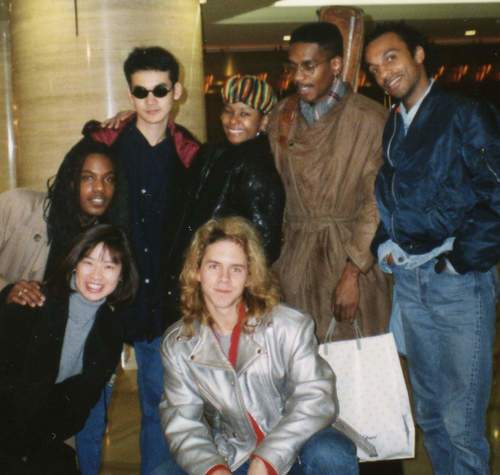
    Ryuichi Sakamoto’s band — 1992
    In this picture, from left to right, is translator Mei Fang, Everton Nelson, Satoshi Tomiie, Vivian Sessoms, Victor Bailey, Manu Katché, and me at the bottom, with the long blond hair.

    For now, the videos seem to be live on YouTube if you search “Ryuichi Sakamoto Live 1992”.


    Naïve Quitting May 24, 2010
    Show notes

    My first real job was as the librarian at Warner/Chappell Music.

    I loved it. I was 20 years old, just graduated college, just moved to New York City. I took it really seriously and learned a lot.

    After 2½ years, though, I decided to quit to be a full-time musician. (Partially because I was too happy there! I was scared that if I didn’t force myself to quit, I’d never leave. Too comfortable.)

    Since I had never quit a job before, and didn’t know how, I did what seemed to be the respectful and considerate thing to do: I found and trained my replacement.

    (It wasn’t my boss’s fault I wanted to quit, so why should I make it his problem? If I want to quit, it’s my problem.)

    I called on my old friend Nikki, who I knew would be perfect, and offered her my job at my current salary.

    She came with me to the office for a week while I trained her in every aspect of the job.

    Once she had it mastered, I went into my boss’s office on a Friday afternoon and said, “I need to quit now, but I’ve already trained my replacement. She’s great. She’ll take over for me starting Monday.”

    My boss just looked a little stunned, then said, “Uh. Well. OK. We’ll miss you. Tell her to see HR about the paperwork.” And that was that.

    Ten years later, I was running my own company, and for the first time, an employee told me he needed to quit.

    I said, “Drag. Well. OK. I wish you the best! Who’s your replacement?”

    He looked confused.

    I said, “Have you found and trained a replacement yet?”

    He looked a little stunned, then said, “No.... I think that’s your job.”

    Now I was stunned. I asked a few friends, and found out he was right. People can just quit a job without finding and training their replacement. I had no idea. All these years, I just assumed what I did was normal.

    There’s a benefit to being naïve to the norms of the world — deciding from scratch what seems like the right thing to do, instead of just doing what others do.


    A real person, a lot like you Mar 31, 2010
    Show notes

    My friend Sara has run a small online business out of her living room for twelve years. It’s her whole life. She takes it very very personally.

    Last week, one of her clients sent her a 10-page-long scathing email, chopping her down, calling her a scam artist and other vicious personal insults, saying she was going to sue Sara for everything she’s worth as retribution for her mis-handled account.

    Devastated, Sara turned off her computer and cried. She shut off the phones and closed up shop for the day. She spent the whole weekend in bed wondering if she should just give up. Thinking maybe every insult in this client’s letter was true, and she’s actually no good at what she does, even after twelve years.

    On Sunday, she spent about five hours — most of the day — carefully addressing every point in this 10-page email. Then she went through the client’s website, learning everything about her, and offered all kinds of advice, suggestions, and connections. She refunded the client’s money, plus an additional $50, with gushing deep apologies for ever having upset someone she was honestly trying to help.

    The next day, she called the client to try to talk through this with her.

    The client cheerfully took her call and said, “Oh don’t worry about it! I wasn’t actually that upset. I was just in a bad mood, and didn’t think anyone would read my email anyway.”

    My friend Valerie was doing online dating. She was half-hearted about it. She wanted a magic perfect man to sweep her off her feet through divine serendipity.

    We were at her computer, when I asked her how it’s going. She logged into her account and showed me her inbox. There were eight new messages from men, each one well-written, saying what they liked about her profile, how they have a mutual interest in hiking, or also speak German, asking her if she’s also been to Berlin, or has hiked in New Zealand.

    I felt for those guys. Each one pouring out his heart, projecting his hopes onto Valerie, hoping she’ll reply with equal enthusiasm, hoping she might be the one that will finally see and appreciate him.

    She said, “Ugh. Losers. I get like ten of these a day,” and clicked [delete] on all of them, without replying.

    When we yell at our car or coffee machine, it’s fine because they’re just mechanical appliances. So when we yell at a website or company, using our computer or phone, we forget it’s not an appliance but a person that’s affected.

    It’s dehumanizing to have thousands of people passing through our computer screens, so we say things we’d never say if those people were sitting next to us.

    It’s too overwhelming to remember that at the end of every computer is a real person, a lot like you, whose birthday was last week, who has three best friends but nobody to spoon at night, and is personally affected by what you say.

    Even if you remember it right now, will you remember it next time you’re overwhelmed, or perhaps never forget it again?


    Flip it in your favor Mar 29, 2010
    Show notes

    The old saying, “It’s all who you know,” used to feel so defeating.

    I wanted to be a famous musician, but I didn’t know any famous people. I didn’t grow up in Hollywood. None of my friends were successful. Fame was a secret insider’s group.

    So when I heard, “It’s all who you know,” it felt like the rest of that sentence was, “and you don’t know anyone. So forget it.”

    One day in college we had a guest speaker who was a top executive at BMI.

    On his way into class I overheard him say he was hungry. He had come straight to our school without lunch, so when the teacher told him it was a two-hour class, he groaned.

    Because everyone was still getting seated, I quickly ran out to the hall, called the local pizza shop, and ordered a few pizzas to be sent to our classroom.

    After they arrived, he laughed and said, “Good move. I owe you one.” He gave me his card after class, and suggested I keep in touch.

    For the next two years, he took my calls and gave me all kinds of advice about the music business. When I graduated college, he got me a great job at Warner/Chappell Music Publishing in New York City. He heard they were hiring, called them to say their search was done, and that was that. I started work that week.

    A year later, I realized “It’s all who you know,” doesn’t have to be depressing. I just never considered it could work in my favor.

    Then I realized the profound conclusion. Everything that seems depressing can be flipped to work in my favor.

    Every deal that’s bad for someone is good for someone else. So instead of moaning about the bad side, you can take the good side.

    If you think corporate radio is keeping your music from being heard, start a radio station! Look at the history of SomaFM.com for an example.

    If you think banks have an unfair advantage, you can start a bank! Look at simple.com for an example.

    In 1997, I thought distribution for musicians sucked. So I started CD Baby. Now distribution doesn’t suck anymore.

    If you live in a democracy and don’t like the law, you can even change the law!

    You can flip anything in your favor. It’s easier than ever for you to replace a broken system, and never feel helpless again.


    Don’t punish everyone for one person’s mistake Jan 30, 2010
    Show notes

    The little diner near me has these big warning signs posted everywhere:

    WE RESERVE THE RIGHT TO REFUSE SERVICE TO ANYONE FOR ANY REASON

    ALL ORDERS ARE FINAL! ABSOLUTELY NO REFUNDS!

    NO SHOES, NO SHIRT, NO SERVICE

    NO CELLPHONES. NO PHOTOS. NO VIDEOS.

    NO LOITERING! RESTROOM FOR CUSTOMERS ONLY!

    ALL VIOLATORS WILL BE PROSECUTED TO THE FULLEST EXTENT OF THE LAW

    Poor business owner needs a hug. Every time someone upsets him, he punishes all his future customers forever.

    When I was six, I attended a strict little school in Abingdon, England. Early in the year, someone spilled grape juice, so they banished grape juice for the rest of the year. Later, someone spilled orange juice, so orange juice was banished for the rest of the year. Eventually we were allowed nothing but water.

    Many years ago, one guy tried to light his shoes on fire on a plane. Now for all future time, millions of people a day have to queue up to take their shoes off at the airport, because of that one dumb moment.

    As a business owner, when you get screwed-over by someone, it’s tempting to make a big grand policy you think will prevent you from ever getting screwed-over again.

    One employee can’t focus, and spends his time surfing the web. Instead of just firing or reassigning that person to more challenging work, the company installs an expensive content-approving firewall so that nobody can go to unapproved sites ever again.

    It’s important to resist that simplistic, angry, reactionary urge to punish everyone, and step back to look at the big picture.

    In the moment, you’re angry, and focusing only on that one awful person who did you wrong. Your thinking is clouded. You start thinking everyone is awful, and the world is against you. This is the worst time to make a new policy.

    When one customer wrongs you, remember the thousands that did not.

    You’re lucky to own your own business. Life is good.

    You can’t prevent bad things from happening. Learn to shrug.

    Resist the urge to punish everyone for one person’s mistake.


    There are always more than two options Jan 27, 2010
    Show notes

    People sometimes ask my help in making big decisions. They’re usually trying to decide between two options.

    But that’s not a decision — that’s a self-created dilemma! You have to remember that there are always more than two options.

    When someone says they have only one option, they’re really saying, “I have no choice,” and you know that’s wrong. At the very least, add “do nothing” and “go insane” as options.

    When people say they have only two options, it means they got stuck. Once people get two options, they start comparing the pros and cons of those two, and forget to think of more.

    As an example, a friend was trying to decide whether to stick with his frustrating job or quit to start his own company. I suggested some other options:

    • Build your new company outside of work hours. Do this until the income from the new company is 50 percent of your salary; then quit.
    • Show up to your job, but secretly just work on your own company all day. Do this until you get fired.
    • Bring your new-company idea to your boss and propose it as a division of their company, so you can stay on salary.
    • Do neither, and move to New Zealand to be a tour guide.

    After exploring more options, my friend realized that he didn’t actually want to start a new business, but was just avoiding fixing his current situation.

    Great insight comes only from opening your mind to many options. Brainstorm them all, from the hybrids to the ridiculous. It takes under an hour, but has always helped my friends feel less stressed, think clearly, and get excited about decisions that used to feel like dilemmas.


    Previous 1 27 28 29 30 31 39 Next

    Related Podcasts

    Making Sense with Sam Harris

    1

    Making Sense with Sam Harris Education
    Grammar Girl

    2

    Grammar Girl Education
    Good Life Project

    3

    Good Life Project Education
    Explain It to Me

    4

    Explain It to Me Education
    Team Never Quit

    5

    Team Never Quit Comedy
    Optimal Living Daily – Personal Development and Self-Improvement

    6

    Optimal Living Daily – Personal Development and Self-Improvement Alternative Health
    footer-logo

    Contact Us

    Toll Free: 844-670-7747

    Links

    • Home
    • Top Charts
    • Networks
    • Apps
    • Independents Podcasts
    • Podcast Advertising
    • Podcast News
    • Contact Us
    • About Us
    • Analytics & Insights

    Stay Connected

      Privacy, Terms of Use & Our Code of Ethics Protecting Content Creators Copyrights