TopPodcast.com
Menu
  • Home
  • Top Charts
  • Top Networks
  • Top Apps
  • Top Independents
  • Top Podfluencers
  • Top Picks
    • Top Business Podcasts
    • Top True Crime Podcasts
    • Top Finance Podcasts
    • Top Comedy Podcasts
    • Top Music Podcasts
    • Top Womens Podcasts
    • Top Kids Podcasts
    • Top Sports Podcasts
    • Top News Podcasts
    • Top Tech Podcasts
    • Top Crypto Podcasts
    • Top Entrepreneurial Podcasts
    • Top Fantasy Sports Podcasts
    • Top Political Podcasts
    • Top Science Podcasts
    • Top Self Help Podcasts
    • Top Sports Betting Podcasts
    • Top Stocks Podcasts
  • Podcast News
  • About Us
  • Podcast Advertising
  • Contact
Not in our directory?
Add Show Here
Podcast Equipment
Center

toppodcastlogoOur TOPPODCAST Picks

  • Comedy
  • Crypto
  • Sports
  • News
  • Politics
  • True Crime
  • Business
  • Finance

Follow Us

toppodcastlogoStay Connected

    View Top 200 Chart
    Back to Rankings Page
    Science

    Clearer Thinking with Spencer Greenberg

    Clearer Thinking is a podcast about ideas that truly matter. If you enjoy learning about powerful, practical concepts and frameworks, wish you had more deep, intellectual conversations in your life, or are looking for non-BS self-improvement, then we think you’ll love this podcast! Each week we invite a brilliant guest to bring four important ideas to discuss for an in-depth conversation. Topics include psychology, society, behavior change, philosophy, science, artificial intelligence, math, economics, self-help, mental health, and technology. We focus on ideas that can be applied right now to make your life better or to help you better understand yourself and the world, aiming to teach you the best mental tools to enhance your learning, self-improvement efforts, and decision-making. • We take on important, thorny questions like: • What’s the best way to help a friend or loved one going through a difficult time? How can we make our worldviews more accurate? How can we hone the accuracy of our thinking? What are the advantages of using our “gut” to make decisions? And when should we expect careful, analytical reflection to be more effective? Why do societies sometimes collapse? And what can we do to reduce the chance that ours collapses? Why is the world today so much worse than it could be? And what can we do to make it better? What are the good and bad parts of tradition? And are there more meaningful and ethical ways of carrying out important rituals, such as honoring the dead? How can we move beyond zero-sum, adversarial negotiations and create more positive-sum interactions?

    Advertise
    • Apple Podcasts
    • Google Play
    • Spotify

    Latest Episodes:
    52 Living Ideas and the Four Systems Model (with Shrikant Rangnekar) Nov 17, 2020
    Show notes

    Read the full transcript here.

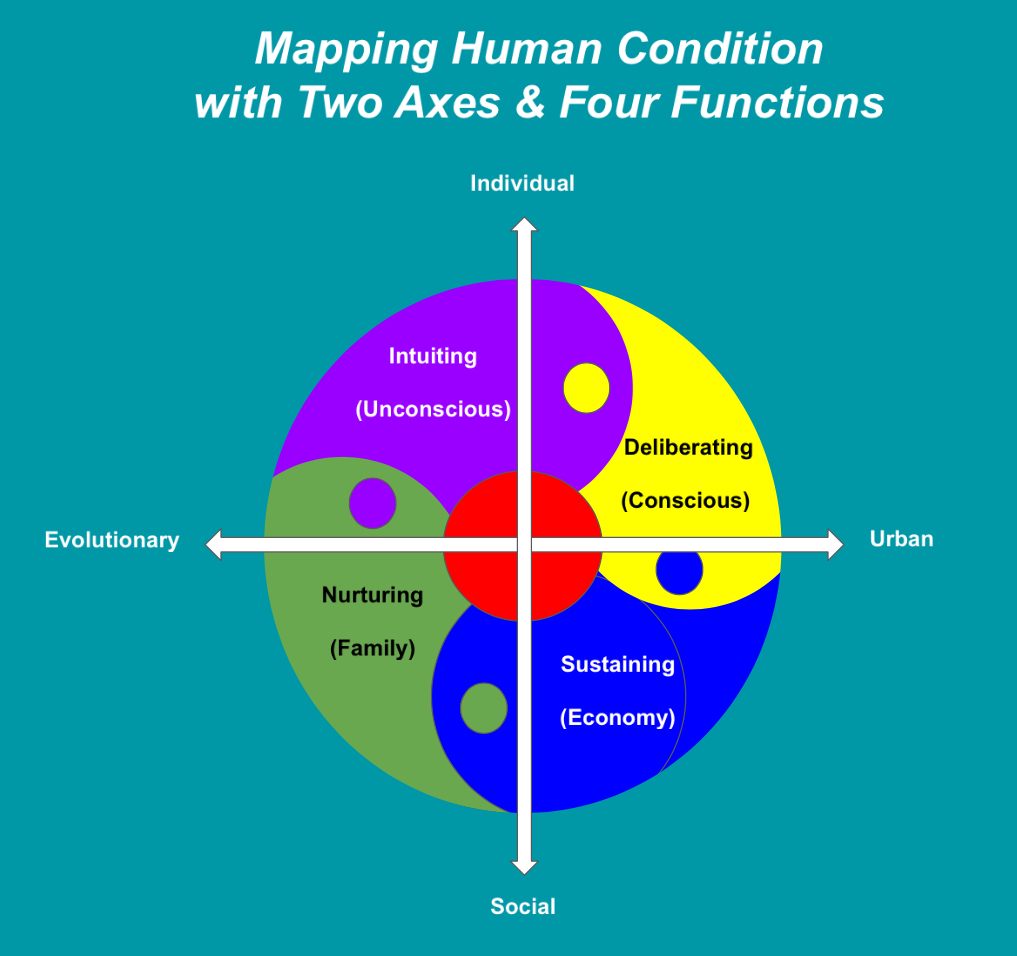
    What is 52 Living Ideas? How does the Four Systems Model help to classify parts of human nature? What tools do civilizations create that allow individuals to transact with each other without knowing each other? Why has "form follows function" been the most influential idea ever for Shrikant? What is intuitive analytic shuttling, and how does it help to improve creative output?

    Shrikant Rangnekar runs 52 Living Ideas, a community of learners engaged in joint exploration of the world, ourselves, and ideas. He conducts daily, open Zoom meetups on psychology, philosophy, and self-improvement.

    Also, here's the diagram Shrikant mentions in the episode:

    Staff

    • Spencer Greenberg — Host / Director
    • Josh Castle — Producer
    • Uri Bram — Factotum

    Music

    • Broke for Free
    • Josh Woodward
    • Lee Rosevere
    • Quiet Music for Tiny Robots
    • wowamusic
    • zapsplat.com

    Affiliates

    • Clearer Thinking
    • GuidedTrack
    • Mind Ease
    • Positly
    • UpLift

    Learning and Governance (with Emerson Spartz) Nov 10, 2020
    Show notes

    Read the full transcript here.

    What's the best way to learn? Why is learning how to learn "the most important skill"? When should we explore, and when should we exploit? What are the merits and demerits of various models of governance? How should we think about the problems around free speech?

    Named "King of Viral Media" by Forbes, Emerson Spartz is one of the world's leading experts on internet virality and has been featured in major media including CBS, CNBC, CNN, and hundreds more. Spartz was named to both Forbes' and Inc Magazine's "30 Under 30" lists. Spartz is the founder of Dose, a top digital media company with $35 million in funding. Dose's videos generate billions of video views, and the company's broadcast TV show, Morning Dose, airs on CW stations nationwide. Previously, Spartz created 20+ of the world's largest viral content sites, including OMG Facts, attracting 50 million visitors monthly. At age 12, Spartz founded Mugglenet, the #1 Harry Potter site and one of the internet's largest communities. By the age of 19, Spartz became a New York Times bestselling author after publishing his first book. Find out more about Emerson at his website: emersonspartz.com

    Staff

    • Spencer Greenberg — Host / Director
    • Josh Castle — Producer
    • Uri Bram — Factotum

    Music

    • Broke for Free
    • Josh Woodward
    • Lee Rosevere
    • Quiet Music for Tiny Robots
    • wowamusic
    • zapsplat.com

    Affiliates

    • Clearer Thinking
    • GuidedTrack
    • Mind Ease
    • Positly
    • UpLift

    Liberalism and Conservatism (with Cassandra Xia and Hank Racette) Nov 04, 2020
    Show notes

    Read the full transcript here.

    Why do liberals and conservatives disagree so vehemently? Why are things so polarized in the US right now? What are the core values held by liberals and conservatives? How much value does tradition have? Where and why do liberals and conservatives disagree about climate change? Where and why do liberals and conservatives disagree about free speech and political correctness?

    Cassandra Xia's bio: "Cassandra Xia (@CassandraXia) is the daughter of Chinese scientists who emigrated to the United States. Her parents raised her on a blend of logic, reason, and immigrant can-do attitude. She emerged as a strategic liberal that strongly believes in free speech and compassionate dialogue. She recently left her job as a Google software engineer to work on climate change. Cassandra's work can be found at cassandraxia.com and workonclimate.org."

    Hank Racette's bio: "I'm an uneducated fifty-something father of six who divides his time between writing industrial automation software and opining about the precariousness of western civilization and the enemies, mostly unwitting, arrayed against it. I'm fascinated by words, mathematics, evolution, human nature, emergent behavior, and saving the most successful nation and culture in history from the innocent mistakes of smart people with good intentions. I'm a free-speech extremist and, in general, what used to be called a classical liberal. I can be found on Ricochet, where I write as Henry Racette, on Facebook, and reached via email at hank.racette@gmail.com."

    Staff

    • Spencer Greenberg — Host / Director
    • Josh Castle — Producer
    • Uri Bram — Factotum

    Music

    • Broke for Free
    • Josh Woodward
    • Lee Rosevere
    • Quiet Music for Tiny Robots
    • wowamusic
    • zapsplat.com

    Affiliates

    • Clearer Thinking
    • GuidedTrack
    • Mind Ease
    • Positly
    • UpLift

    Psychedelics and Comedy (with Sarah Rose Siskind) Oct 27, 2020
    Show notes

    Read the full transcript here.

    What are the pros and cons of taking psychedelics? What goes into creating a good setting for psychedelic use? How can experiencing depression change someone's political views? What is comedy? What is the relationship between comedy and social status? Why is it that comedians can get away with saying things that other people can't say?

    Sarah Rose Siskind is a science comedy writer based in New York City. She's the cofounder of HelloSci.Com, a consulting group that makes smart people funny, and the producer of Drug Test, a show about Psychedelics. Previously, she wrote comedy for Hanson Robotics, StarTalk with Neil deGrasse Tyson on Fox, and several shows on Facebook Watch. She's written jokes for the White House Press Correspondents dinner and spoken at Comic Con! In the words of Marie Curie, "follow me on Twitter."

    Staff

    • Spencer Greenberg — Host / Director
    • Josh Castle — Producer
    • Uri Bram — Factotum

    Music

    • Broke for Free
    • Josh Woodward
    • Lee Rosevere
    • Quiet Music for Tiny Robots
    • wowamusic
    • zapsplat.com

    Affiliates

    • Clearer Thinking
    • GuidedTrack
    • Mind Ease
    • Positly
    • UpLift

    Comfort Languages and Nuanced Thinking (with Kat Woods) Oct 20, 2020
    Show notes

    Read the full transcript here.

    What's the best way to help someone who's going through a difficult situation? What are the four states of distress? What are "comfort languages"? How can we introduce more nuance into our everyday thinking habits? When gathering information and forming opinions, how do you know who to trust? What's the difference between intelligence and wisdom?

    Kat Woods is the co-founder of Charity Entrepreneurship, a startup incubator for effective altruist charities. It provides training, seed funding, and the other things necessary to kickstart an effective nonprofit. Previously, Kat co-founded Charity Science Outreach, a meta-organization that raised nine counterfactual dollars for high impact charities for every dollar spent. Subsequently she co-founded Charity Science Health, a direct poverty charity that received multiple grants from GiveWell and has served hundreds of thousands of families in India. You can find more about Kat at her website or on Twitter at @kat__woods.

    Staff

    • Spencer Greenberg — Host / Director
    • Josh Castle — Producer
    • Uri Bram — Factotum

    Music

    • Broke for Free
    • Josh Woodward
    • Lee Rosevere
    • Quiet Music for Tiny Robots
    • wowamusic
    • zapsplat.com

    Affiliates

    • Clearer Thinking
    • GuidedTrack
    • Mind Ease
    • Positly
    • UpLift

    Education and Charity (with Uri Bram) Oct 13, 2020
    Show notes

    Read the full transcript here.

    Are universities a cult? Do charitable interventions like de-worming work? How much should we trust the conclusion of well-respected charity evaluators like GiveWell?

    Uri is the publisher of The Browser and The Listener, the world's favourite curation newsletters, and the author of Thinking Statistically and The Business of Big Data. Uri can be found at uribram.com or uri@uribram.com.

    As we mention in the audio, this episode includes a critique of Givewell. Givewell were kind enough to listen to our recording and send us a reply. Here's their reply:

    We're excited to see this level of detailed engagement with our research. As Uri and Spencer note, one of the key reasons we share the full analysis behind our recommendations is precisely this: inviting fresh perspectives and debate on the conclusions we reach.

    We operate in an expected value framework when recommending top charities. We recommend deworming programs because of the possibility that deworming may have a large impact on long-term economic well-being. At less than $1 per treatment, we think it's a pretty good bet. We've discussed our views publicly over the years, such as in our blog post titled "Deworming might have huge impact, but might have close to zero impact."

    The case for deworming's long-term benefits does rely on a relatively small number of studies. And the mechanisms by which it has long-term impact are unclear. But when we account for these uncertainties in our impact estimates, it still remains promising.

    We've also supported research to better understand the impacts of deworming. We funded part of a study that measured the economic welfare of children who received deworming treatments 20 years later. This work was recently published, and at a high level, seems to support the story of deworming's long-term effects.

    Thanks again for discussing this topic—it's an important and thorny one!

    Givewell also mentioned some corrections to some of the claims made in the episode. They said:

    [We] noticed some comments outside of the deworming conversation that didn't reflect our views and flagged a few of the more important ones below.

    • In addition to the groups you listed, our current list of top charities includes Malaria Consortium's seasonal malaria chemoprevention program and Helen Keller International's vitamin A supplementation program. The full list is here: https://www.givewell.org/charities/top-charities.
    • The two outcomes we recommend our current list of top charities for are averting deaths (not improving nutrition) and increasing incomes/consumption. We are open to considering additional outcomes in the future.
    • Uri said the following in regards to cash transfers: "I might be wrong but I think GiveWell doesn't count—if you took the money and spent it on a one-off way that didn't increase your long-term wealth or income—then GiveWell wouldn't count that." This is not accurate. We model short-term as well as longer-term benefits to cash transfers. This is reflected in our cost-effectiveness model and discussed in this blog post.

    Staff

    • Spencer Greenberg — Host / Director
    • Josh Castle — Producer
    • Uri Bram — Factotum

    Music

    • Broke for Free
    • Josh Woodward
    • Lee Rosevere
    • Quiet Music for Tiny Robots
    • wowamusic
    • zapsplat.com

    Affiliates

    • Clearer Thinking
    • GuidedTrack
    • Mind Ease
    • Positly
    • UpLift

    Negotiation and Psychological Immune Systems (with Julie Kheyfets) Oct 13, 2020
    Show notes

    Read the full transcript here.

    How can we move beyond zero-sum, adversarial negotiations? What are some tools we can use to overcome physical and psychological pain? How can we develop psychological resilience and stability?

    Julie is an executive at an A.I. company and winner of the 2019 USA Track & Field's Women's 100-Mile Trail Championship. You can find more about her on LinkedIn.

    Staff

    • Spencer Greenberg — Host / Director
    • Josh Castle — Producer
    • Uri Bram — Factotum

    Music

    • Broke for Free
    • Josh Woodward
    • Lee Rosevere
    • Quiet Music for Tiny Robots
    • wowamusic
    • zapsplat.com

    Affiliates

    • Clearer Thinking
    • GuidedTrack
    • Mind Ease
    • Positly
    • UpLift

    Life Experiments and Philosophical Thinking (with Arden Koehler) Oct 13, 2020
    Show notes

    Read the full transcript here.

    What is 80,000 Hours? What sorts of people should become entrepreneurs? How can you run cheap experiments on yourself? What are some beneficial modes of philosophical thinking?

    Arden Koehler is a researcher and writer at 80,000 Hours, a nonprofit whose mission is to help people use their careers to help solve the world's most pressing problems, and an active member of the effective altruism community. Arden has a PhD in philosophy from New York University, with a specialisation in ethics and attitudes toward time, and a B.A. in philosophy from University of California, Berkeley. You can check out her work at 80,000 Hours, and you can email her at arden@80000hours.org.

    Staff

    • Spencer Greenberg — Host / Director
    • Josh Castle — Producer
    • Uri Bram — Factotum

    Music

    • Broke for Free
    • Josh Woodward
    • Lee Rosevere
    • Quiet Music for Tiny Robots
    • wowamusic
    • zapsplat.com

    Affiliates

    • Clearer Thinking
    • GuidedTrack
    • Mind Ease
    • Positly
    • UpLift

    Death and Story-Telling (with A.J. Jacobs) Oct 13, 2020
    Show notes

    Read the full transcript here.

    Are there more meaningful and ethical ways of honoring the dead than our traditional rituals? Why is it useful to adopt probabilistic thinking in our everyday lives? What sorts of things do we value intrinsically (i.e., that we would value even if they had no other positive benefits)? What do stories do well and not so well?

    A.J. Jacobs is an author, lecturer, and human guinea pig. He has written four New York Times bestsellers, including The Year of Living Biblically and Drop Dead Healthy. He is a contributor to NPR, Esquire, and the New York Times, among others. His most recent book is Thanks a Thousand, which chronicled his quest to thank a thousand people who had even the smallest role in his morning cup of coffee. You can find A.J. on Facebook and Twitter, or you can email him at ajjacobs1@gmail.com.

    Staff

    • Spencer Greenberg — Host / Director
    • Josh Castle — Producer
    • Uri Bram — Factotum

    Music

    • Broke for Free
    • Josh Woodward
    • Lee Rosevere
    • Quiet Music for Tiny Robots
    • wowamusic
    • zapsplat.com

    Affiliates

    • Clearer Thinking
    • GuidedTrack
    • Mind Ease
    • Positly
    • UpLift

    THINKERS Workshop (with Spencer Greenberg) Oct 13, 2020
    Show notes

    Read the full transcript here.

    Why is it important to learn about cognitive biases? What are the various modes of nuanced thinking? What kind of mindset do people have to have in order to change their minds? When should we make "gut", intuitive decisions? When should we make careful, measured, reflective decisions?

    This episode was originally recorded on the THINKERS Workshop show. Watch the original recording here, or visit THINKERS Workshop or THINKERS Notebook to learn more.

    Staff

    • Spencer Greenberg — Host / Director
    • Josh Castle — Producer
    • Uri Bram — Factotum

    Music

    • Broke for Free
    • Josh Woodward
    • Lee Rosevere
    • Quiet Music for Tiny Robots
    • wowamusic
    • zapsplat.com

    Affiliates

    • Clearer Thinking
    • GuidedTrack
    • Mind Ease
    • Positly
    • UpLift

    Previous 1 30 31 32 33 Next

    Related Podcasts

    Invisibilia

    1

    Invisibilia Personal Journals
    Hidden Brain – Hidden Brain, Shankar Vedantam

    2

    Hidden Brain – Hidden Brain, Shankar Vedantam Science
    How To Do Everything

    3

    How To Do Everything Science
    Hidden Brain

    4

    Hidden Brain Games & Hobbies
    Something You Should Know

    5

    Something You Should Know Education
    Sword and Scale – Sword and Scale

    6

    Sword and Scale – Sword and Scale Alternative Health
    footer-logo

    Contact Us

    Toll Free: 844-670-7747

    Links

    • Home
    • Top Charts
    • Networks
    • Apps
    • Independents Podcasts
    • Podcast Advertising
    • Podcast News
    • Contact Us
    • About Us
    • Analytics & Insights

    Stay Connected

      Privacy, Terms of Use & Our Code of Ethics Protecting Content Creators Copyrights