TopPodcast.com
Menu
  • Home
  • Top Charts
  • Top Networks
  • Top Apps
  • Top Independents
  • Top Podfluencers
  • Top Picks
    • Top Business Podcasts
    • Top True Crime Podcasts
    • Top Finance Podcasts
    • Top Comedy Podcasts
    • Top Music Podcasts
    • Top Womens Podcasts
    • Top Kids Podcasts
    • Top Sports Podcasts
    • Top News Podcasts
    • Top Tech Podcasts
    • Top Crypto Podcasts
    • Top Entrepreneurial Podcasts
    • Top Fantasy Sports Podcasts
    • Top Political Podcasts
    • Top Science Podcasts
    • Top Self Help Podcasts
    • Top Sports Betting Podcasts
    • Top Stocks Podcasts
  • Podcast News
  • About Us
  • Podcast Advertising
  • Contact
Not in our directory?
Add Show Here
Podcast Equipment
Center

toppodcastlogoOur TOPPODCAST Picks

  • Comedy
  • Crypto
  • Sports
  • News
  • Politics
  • True Crime
  • Business
  • Finance

Follow Us

toppodcastlogoStay Connected

    View Top 200 Chart
    Back to Rankings Page
    Technology

    Changelog Master Feed

    Your one-stop shop for all Changelog podcasts. Weekly shows about software development, developer culture, open source, building startups, artificial intelligence, shipping code to production, and the people involved. Yes, we focus on the people. Everything else is an implementation detail.

    Advertise

    Copyright: © All rights reserved

    • Apple Podcasts
    • Google Play
    • Spotify

    Latest Episodes:
    Productionising real-world ML data pipelines (Changelog Interviews #380) Feb 14, 2020
    Show notes

    Yetunde Dada from QuantumBlack joins Jerod for a deep dive on Kedro, a workflow tool that helps structure reproducible, scaleable, deployable, robust, and versioned data pipelines. They discuss what Kedro’s all about and how it’s “changing the landscape of data pipelines in Python”, the ins/outs of open sourcing Kedro, and how they found early success by sweating the details. Finally, Jerod asks Yetunde about her passion project: a virtual reality film which debuted at the Sundance Film Festival in January.

    Join the discussion

    Changelog++ members support our work, get closer to the metal, and make the ads disappear. Join today!

    Sponsors:

    • DigitalOcean – DigitalOcean’s developer cloud makes it simple to launch in the cloud and scale up as you grow. They have an intuitive control panel, predictable pricing, team accounts, worldwide availability with a 99.99% uptime SLA, and 24/7/365 world-class support to back that up. Get your $100 credit at do.co/changelog.
    • Retool – Retool makes it super simple to build back-office apps in hours, not days. The tool is is built by engineers, explicitly for engineers. Learn more and try it for free at retool.com/changelog
    • Brain Science – For the curious! Brain Science is our new podcast exploring the inner-workings of the human brain to understand behavior change, habit formation, mental health, and being human. It’s Brain Science applied — not just how does the brain work, but how do we apply what we know about the brain to transform our lives.
    • Fastly – Our bandwidth partner. Fastly powers fast, secure, and scalable digital experiences. Move beyond your content delivery network to their powerful edge cloud platform. Learn more at fastly.com.

    Featuring:

    • Yetunde Dada – Twitter, GitHub
    • Jerod Santo – Mastodon, Twitter, GitHub, LinkedIn

    Show Notes:

    • Kedro on GitHub
    • Kedro’s documentation
    • Cookiecutter
    • CausalNex on GitHub
    • Atomu at Sundance
    • QuantumBlack is hiring

    Something missing or broken? PRs welcome!


    Octane moves Ember to an HTML-first approach (JS Party #114) Feb 14, 2020
    Show notes

    KBall and Nick dive deep with Chris Manson and Jen Weber from the Ember core team. They talk about Ember.js: What it is, why it’s different, what’s new in the Ember Octane release, and what’s exciting in the future of the project.

    Join the discussion

    Changelog++ members support our work, get closer to the metal, and make the ads disappear. Join today!

    Sponsors:

    • Rollbar – We move fast and fix things because of Rollbar. Resolve errors in minutes. Deploy with confidence. Learn more at rollbar.com/changelog.
    • DigitalOcean – DigitalOcean’s developer cloud makes it simple to launch in the cloud and scale up as you grow. They have an intuitive control panel, predictable pricing, team accounts, worldwide availability with a 99.99% uptime SLA, and 24/7/365 world-class support to back that up. Get your $100 credit at do.co/changelog.
    • The Brave Browser – Browse the web up to 8x faster than Chrome and Safari, block ads and trackers by default, and reward your favorite creators with the built-in Basic Attention Token. Download Brave for free and give tipping a try right here on changelog.com.

    Featuring:

    • Jen Weber – Twitter, GitHub
    • Chris Manson – Twitter, GitHub, Website
    • Kevin Ball – Twitter, GitHub, LinkedIn, Website
    • Nick Nisi – Mastodon, Twitter, GitHub, Website

    Show Notes:

    Segment 1: About Ember

    • Ember Engines
    • Upgrades in Ember
    • Glimmer

    Segment 2: Ember Octane

    • Octane is Here
    • Ember Guides: Testing Components
    • Ember Guides: Template Lifecycle DOM and Modifiers
    • Ember Guides: Autotracking In Depth
    • Ember Guides: The Ember Tutorial

    Segment 3: Future of Ember

    • To Have A Future, Ember Must Kill Its Past
    • RFC: Ember 2018 Roadmap
    • RFC: Editions

    Something missing or broken? PRs welcome!


    Telemetry and the art of measuring what matters (Go Time #117) Feb 13, 2020
    Show notes

    Telemetry is tricky to get started with. What metrics should you be tracking? Which metrics are important? Will they help you predict and avoid potential issues? When is a good time to start? Should you put it off until later? In this episode we discuss some common metrics to collect, how to get started with telemetry, and more with guest Dave Blakey of Snapt.

    Join the discussion

    Changelog++ members support our work, get closer to the metal, and make the ads disappear. Join today!

    Sponsors:

    • DigitalOcean – DigitalOcean’s developer cloud makes it simple to launch in the cloud and scale up as you grow. They have an intuitive control panel, predictable pricing, team accounts, worldwide availability with a 99.99% uptime SLA, and 24/7/365 world-class support to back that up. Get your $100 credit at do.co/changelog.
    • Algorithms with Go – A free Go course where panelist Jon Calhoun teaches you how algorithms and data structures work, how to implement them in Go code, and where to practice at. Great for learning Go, learning about algorithms for the first time, or refreshing your algorithmic knowledge.

    Featuring:

    • Dave Blakey – Twitter, LinkedIn
    • Jon Calhoun – Twitter, GitHub, Website
    • Johnny Boursiquot – Twitter, GitHub, Website
    • Jaana Dogan – Twitter, GitHub, Website

    Show Notes:

    • OpenTelemetry - Telemetry software that is the merger of OpenCensus and OpenTracing
    • Nova - ADC software created by Dave’s company
    • statsd - Open source stats aggregator used often in telemetry collection
    • Prometheus - Monitoring system for metrics

    Something missing or broken? PRs welcome!


    GraphQL's benefits and costs (JS Party) Feb 11, 2020
    Show notes

    We teamed up with some friends of ours at Heroku to promote the Code-ish podcast so we’re sharing a full-length episode right here in the JS Party feed. This episode features Owen Ou, who is joined by Tanmai Gopal (CEO of Hasura) talking about the pros and cons of using GraphQL in your application. Learn more and subscribe at heroku.com/podcasts/codeish.

    Join the discussion

    Changelog++ members support our work, get closer to the metal, and make the ads disappear. Join today!

    Sponsors:

    • Code-ish by Heroku – A podcast from the team at Heroku, exploring code, technology, tools, tips, and the life of the developer. Listen on Apple Podcasts and Spotify.

    Featuring:

    • Tanmai Gopal – Twitter, GitHub, LinkedIn, Website
    • Owen Ou – Twitter, GitHub, LinkedIn, Website

    Show Notes:

    GraphQL is a querying language with the aim of increasing the productivity of frontend and backend developers. It can make working with React easier, be used as an API for third-party clients, and allow for feature-rich applications to request precisely the data they need. Like any part of your stack, GraphQL isn’t a panacea. The language is still being developed, and has some limitations.

    • graphql.org is where you can learn all about GraphQL
    • Awesome GraphQL provides a list of GraphQL tools
    • learn.hasura.io offers GraphQL tutorials

    Check the show notes and transcript for more details.

    Something missing or broken? PRs welcome!


    AI-powered scientific exploration and discovery (Practical AI #76) Feb 10, 2020
    Show notes

    Daniel and Chris explore Semantic Scholar with Doug Raymond of the Allen Institute for Artificial Intelligence. Semantic Scholar is an AI-backed search engine that uses machine learning, natural language processing, and machine vision to surface relevant information from scientific papers.

    Join the discussion

    Changelog++ members support our work, get closer to the metal, and make the ads disappear. Join today!

    Featuring:

    • Douglas Raymond – Twitter, GitHub, LinkedIn
    • Chris Benson – Twitter, GitHub, LinkedIn, Website
    • Daniel Whitenack – Twitter, GitHub, Website

    Show Notes:

    • Semantic Scholar
    • Allen Institute for Artificial Intelligence
    • ELMo
    • SciBERT: A Pretrained Language Model for Scientific Text
    • Semantic Scholar API

    Something missing or broken? PRs welcome!


    Fullstack D3 (JS Party #113) Feb 07, 2020
    Show notes

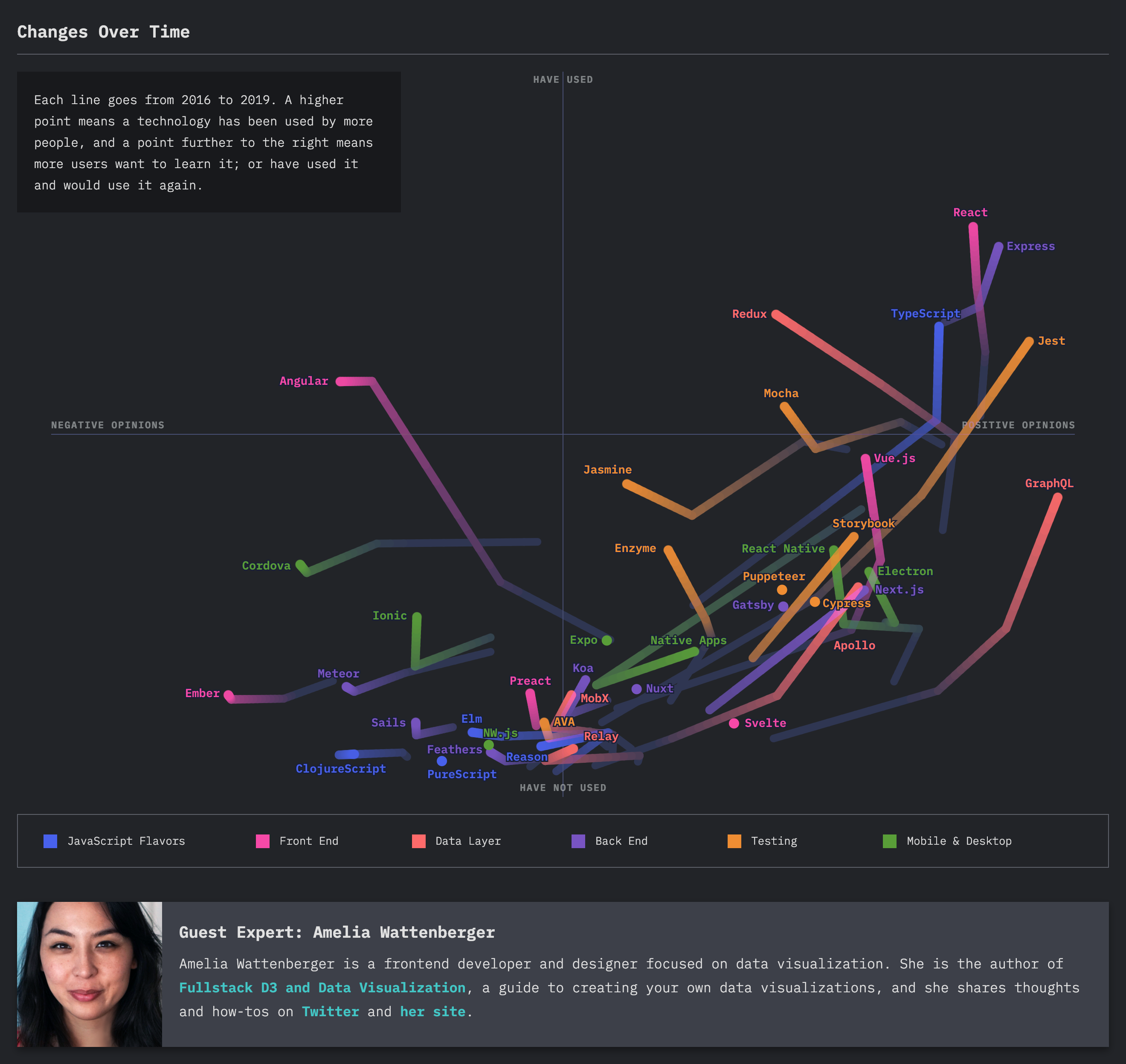
    The State of JS 2019 survey left many in awe of the beautifully rendered line graph created by Amelia Wattenberger. So we’ve brought her on JS Party to discuss how she built it!

    We’ll chat about all things D3, a JavaScript library for creating data visualizations, and even learn a bit about the CSS cascade.

    Join the discussion

    Changelog++ members support our work, get closer to the metal, and make the ads disappear. Join today!

    Sponsors:

    • Rollbar – We move fast and fix things because of Rollbar. Resolve errors in minutes. Deploy with confidence. Learn more at rollbar.com/changelog.
    • DigitalOcean – DigitalOcean’s developer cloud makes it simple to launch in the cloud and scale up as you grow. They have an intuitive control panel, predictable pricing, team accounts, worldwide availability with a 99.99% uptime SLA, and 24/7/365 world-class support to back that up. Get your $100 credit at do.co/changelog.
    • Algolia – Our search partner. Algolia’s full suite search APIs enable teams to develop unique search and discovery experiences across all platforms and devices. We’re using Algolia to power our site search here at Changelog.com. Get started for free and learn more at algolia.com.

    Featuring:

    • Amelia Wattenberger – Twitter, GitHub, Website
    • Emma Bostian – Twitter, GitHub, LinkedIn
    • Jerod Santo – Mastodon, Twitter, GitHub, LinkedIn

    Show Notes:

    State of JS overview survey

    • CSS Cascade by Amelia
    • State of JS overview survey
    • Star Wars CSS Specificity Wars
    • D3 website
    • The Fullstack D3 book
    • React Spring
    • Pudding.cool

    Something missing or broken? PRs welcome!


    Unusual uses for Go: GUIs (Go Time #116) Feb 06, 2020
    Show notes

    Johnny and Jon are joined by Andy Williams to talk about some of the unusual ways developers are using Go. In this particular episode they deep dive into building GUIs and discuss all of the challenges imposed by trying to build a UI that is both cross platform and functional. How do you create buttons that work on both mobile and a desktop app? Should you even be designing both apps at the same time? Tune in to find out!

    Join the discussion

    Changelog++ members support our work, get closer to the metal, and make the ads disappear. Join today!

    Sponsors:

    • DigitalOcean – DigitalOcean’s developer cloud makes it simple to launch in the cloud and scale up as you grow. They have an intuitive control panel, predictable pricing, team accounts, worldwide availability with a 99.99% uptime SLA, and 24/7/365 world-class support to back that up. Get your $100 credit at do.co/changelog.
    • Algorithms with Go – A free Go course where panelist Jon Calhoun teaches you how algorithms and data structures work, how to implement them in Go code, and where to practice at. Great for learning Go, learning about algorithms for the first time, or refreshing your algorithmic knowledge.

    Featuring:

    • Andy Williams – Twitter, GitHub, LinkedIn, Website
    • Jon Calhoun – Twitter, GitHub, Website
    • Johnny Boursiquot – Twitter, GitHub, Website

    Show Notes:

    • Enlightenment Window Manager - Window manager mentioned on the show
    • Shiny Go Bindings - A way to access Shiny with Go
    • Qt Go Bindings - A way to interact with Qt in Go
    • andlabs UI - GUI library in Go
    • Fyne - GUI library in Go
    • Wails - GUI library in Go using Vue.js
    • Awesome Go - List of Go projects with a GUI section
    • Hands on GUI Application Development in Go - Andrew’s book on GUI development

    Something missing or broken? PRs welcome!


    Good tech debt (Changelog Interviews #379) Feb 06, 2020
    Show notes

    Jon Thornton (Engineering Manager at Squarespace) joined the show to talk about tech debt by way of his post to the Squarespace engineering blog titled “3 Kinds of Good Tech Debt”. We talked through the concept of “good tech debt,” how to leverage it, how to manage it, who’s in charge of it, how it’s similar to ways we leverage financial debt, and how Squarespace uses tech debt to drive product development.

    Join the discussion

    Changelog++ members support our work, get closer to the metal, and make the ads disappear. Join today!

    Sponsors:

    • Linode – Our cloud of choice and the home of Changelog.com. Deploy a fast, efficient, native SSD cloud server for only $5/month. Get 4 months free using the code changelog2019 OR changelog2020. To learn more and get started head to linode.com/changelog.
    • Retool – Retool makes it super simple to build back-office apps in hours, not days. The tool is is built by engineers, explicitly for engineers. Learn more and try it for free at retool.com/changelog
    • Brain Science – For the curious! Brain Science is our new podcast exploring the inner-workings of the human brain to understand behavior change, habit formation, mental health, and being human. It’s Brain Science applied — not just how does the brain work, but how do we apply what we know about the brain to transform our lives.
    • Fastly – Our bandwidth partner. Fastly powers fast, secure, and scalable digital experiences. Move beyond your content delivery network to their powerful edge cloud platform. Learn more at fastly.com.

    Featuring:

    • Jon Thornton – Twitter, GitHub, LinkedIn, Website
    • Adam Stacoviak – Mastodon, Twitter, GitHub, LinkedIn, Website
    • Jerod Santo – Mastodon, Twitter, GitHub, LinkedIn

    Show Notes:

    3 Kinds of Good Tech Debt ~> discuss

    “Tech debt” is a dirty word in the software engineering world. It’s often said with an air of regret; a past mistake that will eventually need to be atoned for with refactoring.

    Head to changelog.com/submit if you’ve written something your fellow devs would find interesting that you’d like us to promote.

    Something missing or broken? PRs welcome!


    Shame on you (Brain Science #10) Feb 05, 2020
    Show notes

    Mireille and Adam discuss shame as an emotional and experiential construct. We dive into the neural structures involved in processing this emotion as well as the factors and implications of our experience of shame. Shame is a natural response to the threat of vulnerability and perception of oneself as defective or inherently “not enough.”

    Join the discussion

    Changelog++ members support our work, get closer to the metal, and make the ads disappear. Join today!

    Featuring:

    • Mireille Reece, PsyD – LinkedIn
    • Adam Stacoviak – Mastodon, Twitter, GitHub, LinkedIn, Website

    Show Notes:

    What is shame?

    Brené Brown, leading researcher on shame, vulnerability and connection — ​​​​”Shame is the most powerful, master emotion. It’s the fear that we’re not good enough.”

    The “hustle” of not enough

    Shame is the response to threat. It is a stress response. ​​Think of Shame as the inner critic. The one who berates and belittles you out of this place of fear of inadequacy or inherent flaw.

    Shame vs. guilt

    1. Shame = I AM bad/marred/irreparably flawed.
    2. Guilt = I DID something bad.

    Guilt is rooted in a behavior you did whereas shame is all encompassing, fundamentally who you are as defective or inadequate.

    Behavioral response

    Shame prompts hiding. Because when we feel ashamed, we don’t want to expose ourselves to others. If we “feel” or believe ourselves to be marred, it makes sense that we would be apt to hide.

    From an evolutionary perspective - ​​Shame is a signal that you aren’t part of the tribe, which would’ve been threatening or dangerous.

    ​​​Is the culture of today conditioning us to feel dis-content more often?

    “I stopped trying to keep up with the Jones’ because I realized that when I wake up someone moved the line.”

    Examine what you are optimizing for as opposed to applying the “one-size-fits-all” approach.

    How do I manage shame more adaptively?

    1. Identify the emotion. What is the perceived threat that I’m reacting to?
    2. Identify your tribe. Who can I connect with? Who’s part of my tribe?
    3. What is my system for soothing? I need to upload new soothing/calming data.

    It all comes back to being grounded in knowing what you’re optimizing for and recognizing that being who we are — being human, always involves vulnerability so we have to practice showing up.

    Something missing or broken? PRs welcome!


    The soul of an old machine (Changelog Interviews) Feb 04, 2020
    Show notes

    We partnered with Red Hat to promote Season 4 of Command Line Heroes — a podcast about the people who transform technology from the command line up. Season 4 is all about hardware that changed the game. We’re featuring episode 1 from season 4 — called “Minicomputers: The soul of an old machine.” This is the story of Minicomputers and how they paved the way for the personal computers that could fit in a bag and, eventually, the phones in our pockets.

    Learn more and subscribe at redhat.com/commandlineheroes.

    Join the discussion

    Changelog++ members support our work, get closer to the metal, and make the ads disappear. Join today!

    Sponsors:

    • Command Line Heroes – A podcast from Red Hat about the people who transform technology from the command line up. Head to redhat.com/commandlineheroes to learn more and subscribe.

    Featuring:

    • Saron Yitbarek – Twitter, GitHub, Website
    • Adam Stacoviak – Mastodon, Twitter, GitHub, LinkedIn, Website

    Show Notes:

    They don’t fit in your pocket. But in their day, minicomputers were an order of magnitude smaller than the room-sized mainframes that preceded them. And they paved the way for the personal computers that could fit in a bag and, eventually, the phones in your pocket.

    16-bit minicomputers changed the world of IT in the 1970s. They gave companies the opportunity for each engineer to have their own machines. But it wasn’t quite enough, not until the arrival of 32-bit versions.

    Carl Alsing and Jim Guyer recount their work at Data General to create a revolutionary new 32-bit machine. But their now legendary work was done in secret. Codenamed “Eagle,” their machine was designed to compete with one being built by another team in their own company. These engineers recall the corporate politics and intrigue required to keep the project going—and how they turned restrictions into advantages. Neal Firth discusses life on an exciting-but-demanding project. One where the heroes worked together because they wanted to, without expectations of awards or fame. And all three discuss how this story was immortalized in the non-fiction engineering classic, The Soul of a New Machine by Tracy Kidder.

    • The Soul of a New Machine by Tracy Kidder
    • The New Golden Age of Building with Soul by Jessie Frazelle
    • The Minicomputers of the 70s by Georg Wittenburg
    • Rise and Fall of Minicomputers by Gordon Bell

    Something missing or broken? PRs welcome!


    Previous 1 152 153 154 155 156 240 Next

    Related Podcasts

    Reply All

    1

    Reply All Games & Hobbies
    Inside VR & AR

    2

    Inside VR & AR Gadgets
    Note to Self

    3

    Note to Self News
    BrainStuff

    4

    BrainStuff Natural Sciences
    This Week in Tech (Audio)

    5

    This Week in Tech (Audio) News
    Hands-On Tech (Audio)

    6

    Hands-On Tech (Audio) Technology
    footer-logo

    Contact Us

    Toll Free: 844-670-7747

    Links

    • Home
    • Top Charts
    • Networks
    • Apps
    • Independents Podcasts
    • Podcast Advertising
    • Podcast News
    • Contact Us
    • About Us
    • Analytics & Insights

    Stay Connected

      Privacy, Terms of Use & Our Code of Ethics Protecting Content Creators Copyrights