TopPodcast.com
Menu
  • Home
  • Top Charts
  • Top Networks
  • Top Apps
  • Top Independents
  • Top Podfluencers
  • Top Picks
    • Top Business Podcasts
    • Top True Crime Podcasts
    • Top Finance Podcasts
    • Top Comedy Podcasts
    • Top Music Podcasts
    • Top Womens Podcasts
    • Top Kids Podcasts
    • Top Sports Podcasts
    • Top News Podcasts
    • Top Tech Podcasts
    • Top Crypto Podcasts
    • Top Entrepreneurial Podcasts
    • Top Fantasy Sports Podcasts
    • Top Political Podcasts
    • Top Science Podcasts
    • Top Self Help Podcasts
    • Top Sports Betting Podcasts
    • Top Stocks Podcasts
  • Podcast News
  • About Us
  • Podcast Advertising
  • Contact
Not in our directory?
Add Show Here
Podcast Equipment
Center

toppodcastlogoOur TOPPODCAST Picks

  • Comedy
  • Crypto
  • Sports
  • News
  • Politics
  • True Crime
  • Business
  • Finance

Follow Us

toppodcastlogoStay Connected

    View Top 200 Chart
    Back to Rankings Page
    Kids & Family

    Your Parenting Mojo – Respectful, research-based parenting ideas to help kids thrive

    Parenting is hard…but does it have to be this hard?

    Wouldn’t it be better if your kids would stop pressing your buttons quite as often, and if there was a little more of you to go around (with maybe even some left over for yourself)?

    On the Your Parenting Mojo podcast, Jen Lumanlan M.S., M.Ed explores academic research on parenting and child development. But she doesn’t just tell you the results of the latest study – she interviews researchers at the top of their fields, and puts current information in the context of the decades of work that have come before it. An average episode reviews ~30 peer-reviewed sources, and analyzes how the research fits into our culture and values – she does all the work, so you don’t have to!

    Jen is the author of Parenting Beyond Power: How to Use Connection & Collaboration to Transform Your Family – and the World (Sasquatch/Penguin Random House). The podcast draws on the ideas from the book to give you practical, realistic strategies to get beyond today’s whack-a-mole of issues. Your Parenting Mojo also offers workshops and memberships to give you more support in implementing the ideas you hear on the show.

    The single idea that underlies all of the episodes is that our behavior is our best attempt to meet our needs. Your Parenting Mojo will help you to see through the confusing messages your child’s behavior is sending so you can parent with confidence: You’ll go from: “I don’t want to yell at you!” to “I’ve got a plan.”

    New episodes are released every other week – there’s content for parents who have a baby on the way through kids of middle school age. Start listening now by exploring the rich library of episodes on meltdowns, sibling conflicts, parental burnout, screen time, eating vegetables, communication with your child – and your partner… and much much more!

    Advertise

    Copyright: © Jen Lumanlan - M.S. Psychology focused on Child Development

    • Apple Podcasts
    • Google Play
    • Spotify

    Latest Episodes:
    RE-RELEASE: Parenting beyond pink and blue with Dr. Christia Brown Dec 05, 2021
    Show notes Today I join forces with Malaika Dower of the How to Get Away with Parenting podcast to interview Dr. Christia Brown, who is a Professor of Developmental and Social Psychology at the University of Kentucky, where she studies the development of gender identity and children’s experience of gender discrimination. Dr. Brown’s book, Parenting Beyond Pink and Blue (Affiliate link), helps parents to really understand the scientific research around gender differences in children, which is a harder task than with some other topics because there’s just a lot of bad research out there on this one. I ask about theories of gender development while Malaika keeps us grounded with questions about how this stuff works in the real world, and we both resolve to shift our behavior toward our daughters just a little bit. Related Episodes Interview with Yarrow Dunham on how social groups form Interview with Kang Lee on children’s lying (yep – your kid does it too!) Jump to highlights 00:30 Introduction to the episode and guests Dr. Christia Brown and Malaika Dower 02:47 Are there real brain differences between young boys and girls? 06:22 Why boys report more confidence in math than girls, despite similar ability 08:11 A striking finding: parents use three times more math talk with sons 12:38 The myth of girls being more verbal, and where it comes from 16:09 A classic study: the same baby dressed in pink versus blue 20:39 What's really going on when a child is mistaken for the "wrong" gender 22:01 How elaborate gender stereotypes show up by age three or four 24:19 Why pointing out stereotypes explicitly matters so much 36:02 "Boys will be boys and cows will be cows": how children reason about gender 39:22 How gender segregation in play reshapes the brain through synaptic pruning 41:35 Practical ways to counter gender segregation outside of school 44:43 Why this effort is worth it: what happens as kids get older References Brown, C.S. (2014). Parenting beyond pink and blue. Berkeley, CA: Ten Speed Press. (Affiliate link) Taylor, M.G., Rhodes, M., & Gelman, S.A. (2009). Boys will be boys and cows will be cows: Children’s essentialist reasoning about gender categories and animal species. Child Development 80(2), 461-481. DOI: 10.1111/j.1467-8624.2009.01272.x

    RE-RELEASE: Why isn’t my child grateful with Dr. Jonathan Tudge Nov 21, 2021
    Show notes

    “I spent the whole morning painting and doing origami and felting projects with my daughter – and not only did she not say “thank you,” but she refused to help clean up!” (I actually said this myself this morning:-)) “We took our son to Disneyland and went on every ride he wanted to go on except one, which was closed, and he spent the rest of the trip whining about how the whole trip was ruined because he didn’t get to go on that one ride.” (I hope I never have to say this one…I’m not sure I could make it through Disneyland in one piece.) You might recall that we did an episode a while back on manners, and what the research says about teaching manners, and how what the research says about teaching manners comes from the assumption that manners MUST be explicitly taught – that your child will NOT learn to say “thank you” unless you tell your child “say thank you” every time someone gives them a gift. We also talked about how parent educator Robin Einzig uses the concept of “modeling graciousness” and that if you treat other people graciously, when your child is ready, she will be gracious as well. The problem here, of course, is that most people expect your child to display some kind of manners before they are developmentally ready to really understand the concept behind it. But what really underlies manners? Well, ideas like gratitude. Because when we train children to say “thank you” before they are ready to do it themselves they might learn to recite the words at the appropriate time, but they aren’t really experiencing gratitude. Dr. Jonathan Tudge of the University of North Carolina at Greensboro tells us much more about this, and how we can scaffold our child’s ability to experience gratitude, if we decide we might want to do that. Dr. Tudge’s book, Developing Gratitude in Children and Adolescents (co-edited with Dr. Lia B. L. Freitas) contains lots more academic research on this topic if you’re interested. Jump to highlights 00:38 Introduction to the episode and guest Dr. Jon Tudge 02:27 What gratitude actually means, and its three parts 05:01 Why most "gratitude" scales are really measuring appreciation 09:40 Is saying "thank you" the same as being grateful? 12:09 Modeling gratitude instead of forcing a child to say thank you 21:24 The cookie jar test: how theory of mind connects to gratitude 24:21 Concrete gratitude: when kids give back what they themselves love 28:07 How the development of gratitude differs across cultures 33:25 Shifting a child's focus from the gift to the person who gave it 40:50 A mindset shift for teachers and parents: what can I give, not what can I get References Halberstadt, A.G., Langley, H.A., Hussong, A.M., Rothenberg, W.A., Coffman, J.L., Mokrova, I., & Costanzo, P.R. (2016). Parents’ understanding of gratitude in children: A thematic analysis. Early Childhood Research Quarterly 36, 439-451.

    Kiang, l. Mendonca S., Liang, Y., Payir, A., O’Brien, L.T., Tudge, J.R.H., & Freitas, L.B.L. (2016). If children won lotteries: Materialism, gratitude, and imaginary windfall spending. Young Consumers 17(4), 408-418. Mendonca, S.E., Mercon-Vargas, E.A., Payir, A., & Tudge, J.R.H. (2018). The development of gratitude in seven societies: Cross-cultural highlights. Cross-Cultural Research 52(1), 135-150. Mercon-Vargas, E.A., Poelker, A.E., & Tudge, J.R.H. (2018). The development of the virtue of gratitude: Theoretical foundations and cross-cultural issues. Cross-Cultural Research 52(1), 3-18. Mokrova, I.L., Mercon-Vargas, E.A., & Tudge, J.R.H. (2018). Wishes, gratitude, and spending preferences in Russian Children. Cross-Cultural Research 52(1), 102-116. Nelson, J.A., Freitas, L.B.L., O’Brien, M., Calkins, S.D., Leerkes, E.M., & Marcovich, S. (2013). Preschool-aged children’s understanding of gratitude: Relations with emotion and mental state knowledge. British Journal of Developmental Psychology 31, 42056. Tudge, J.R.H., & Freitas, L.B.L. (Eds.) (2018). Developing gratitude in children and adolescents. Cambridge, U.K: Cambridge University Press. Wang, D., Wang, Y.C., & Tudge, J.R.H. (2015). Expressions of gratitude in children and adolescents: Insights from China and the United States. Journal of Cross-Cultural Psychology 46(8), 1039-1058.

    RE-RELEASE: Becoming Brilliant – Interview with Prof. Roberta Golinkoff Nov 07, 2021
    Show notes

    In just a few years, today’s children and teens will forge careers that look nothing like those that were available to their parents or grandparents. While the U.S. economy becomes ever more information-driven, our system of education seems stuck on the idea that “content is king,” neglecting other skills that 21st century citizens sorely need. Backed by the latest scientific evidence and illustrated with examples of what’s being done right in schools today, Becoming Brilliant (Affiliate link) introduces the “6Cs” collaboration, communication, content, critical thinking, creative innovation, and confidence along with ways parents can nurture their children’s development in each area. Join me for an engaging chat with award-winning Professor Roberta Golinkoff about the key takeaways from the book. Jump to highlights 00:33 Introduction to the episode and guest Dr. Roberta Golinkoff 02:04 Why she and Kathy Hirsh-Pasek wrote Becoming Brilliant 04:02 The book's mission statement and the Six Cs framework 09:09 Why memorization alone isn't enough anymore 13:07 Content: following a toddler's curiosity, from dinosaurs to spiders 19:08 Letting go of the pressure to set up "learning activities" 21:08 Strive for Five: what makes a real back-and-forth conversation 23:14 Beyond the 30 million word gap: why quality of talk matters more than quantity 28:38 Grit, failure, and modeling perseverance for kids 32:27 Reconciling praise, rewards, and Carol Dweck's growth mindset research 37:57 Being your child's advocate inside an imperfect school system References Duckworth, A. (2016). Grit Scale. Available at: http://angeladuckworth.com/grit-scale/ (Duckworth also wrote a book, although I haven’t read it…yet…: http://angeladuckworth.com/grit-book/)

    Dweck, C. (2006). Mindset: The new psychology of success. New York, NY: Random House. Golinkoff, R.M., & Hirsch-Pasek, K. (2016). Becoming Brilliant: What science tells us about raising successful children. Washington, D.C.: American Psychological Association. Kohn, A. (1999). Punished By Rewards. Boston: Houghton Mifflin.

    [Looking back and looking ahead] Oct 31, 2021
    Show notes

    In this short episode, I reflect on where we’ve been over the past year, my plans to slow down a bit at the end of the year (as well as a super exciting project I’m working on!), and what episodes we have lined up for the new year. In this episode, I also mention something I haven’t done for a while, which is that it’s possible to donate to support the show. You might know that it takes 20-40 hours to do the research for each episode (although my record is about 80 hours for the show on Self-Reg, because the research was in such a mess and I had to check what I was reading with several developmental psychologists who tempered the claims of the person who created the concept of Self-Reg!). A core group of listeners (shout out to: Jacqueline B., Rebekah S., Elizabeth M., Kelsey B., Jessica S., Crystian M., Megan P., Alison O., and Cristin B.) have helped to sustain the show over the last months and years. If the show has helped you, would you consider making a donation to support it? You can now do this from any episode page. If a particular episode has given you an insight or a tool that resonated with you and/or your child, I’d be really grateful if you would make a one-time donation to acknowledge that, or consider a recurring donation to help me keep making more episodes for you. I know there’s always the temptation to say that “eh; I don’t have time right now and it probably doesn’t make that much of a difference and someone else will do it anyway.” And maybe they will, but as we all know, if everyone thinks like that, then the work doesn’t get supported…. I mention in the episode that I’m writing a book! And the e-book will be available for a sliding scale price on this website, to help everyone who wants to read it be able to read it, no matter what their financial constraints. I also now make every course and membership I offer over a $100 threshold available with sliding scale pricing, and invite folks who can’t afford even the minimum price to get in touch to figure out a price that works for both of us. I’m doing everything I can to live my values to make my work available to as many people as possible. If this resonates with you, I’d be grateful if you would consider donating to support me in continuing to do this work. You can now donate from any episode page (including this week’s episode!). Just look for the Support Jen’s Work button on the right side.


    SYPM 016: Getting it right from the start with a new baby Oct 24, 2021
    Show notes

    In this episode we do something we haven’t done before - talk with podcast listeners who aren’t parents yet! Kellie and Jon are an amazing couple living in Tennessee. Kellie is a bit of a planner (by which I mean that during her Ph.D program Jon noticed Kellie was getting stressed about when they were going to have a baby, so she led them through a four-hour planning session factoring in the baby’s birth and ages at likely dates for her to enter post-doctoral programs and fellowships and landed on February 2021 as the optimal time to conceive - so they started trying in February and she got pregnant in February!). Jon, by contrast, is a go-with-the-flow kind of guy. He’s the kind of person who just knows everything is probably going to turn out OK without needing to worry about the details too much. He already knew Kellie was going to be a great parent, while she was much less convinced - although now she knows that babies drink milk rather than water, she’s off to a running start! Kellie devoured all the pregnancy podcasts she could find (my favorite is the Pregnancy Podcast - host Vanessa basically does the same thing I do here at YPM for the pregnancy stage) and then moved onto the child development podcasts, which is how she found YPM - and she was drawn to the research-based information she found here. Jon describes the whole experience as an “uncertainty sandwich” - there was a lot of uncertainty in the beginning about whether and when they’d be able to have a baby: “and then it really certain really fast!” And after that it became uncertain again as they looked to figure out what life with a baby would be like. Jump to highlights 01:00 Kellie & Jon are expecting parents who have just gone through the Right From the Start Course 02:25 Kellie and Jon’s background: Jon grew up in a home where he had older women in their family who looked after him and younger nieces that he was also a caretaker of, and Kellie grew up in a very structured environment that revolved around school and gymnastics, and things being planned out 07:05 Planning out when to get pregnant with the least amount of distractions, to when Kellie works on her doctorate, and the Uncertainty Sandwich 11:02 What were your thoughts when the point of certainty had passed, and you're getting into the moment where there was a lot of worry and anxiety? 18:01 Jon realized that to truly support Kellie in their pregnancy meant supporting her in a way that makes sense for her 19:27 How the podcast helped Kellie and Jon 20:33 What made you decide to take the Right From the Start course? 22:38 Joining the group class was the first time I actually felt excited to parent as opposed to just feeling nervous and anxious 26:35 “I had not thought of parenting as this potentially really diplomatic, really egalitarian, loving process” 31:31 We don't have to know exactly what's gonna work best from the start, but we can figure it out together 34:24 I feel like we're not just going to be okay, like we can actually thrive, and that our baby can actually thrive Links to resources:

    • Right From the Start Course
    • Your Parenting Mojo Facebook Group
    • Upbringing with Hannah and Kelty


    146: The Rested Child with Dr. Chris Winter Oct 17, 2021
    Show notes

    Sleep! It’s a topic that’s on pretty much every parent’s mind. We’ve already looked at this from a cultural perspective, where we learned our Western approach to sleep is by no means universal, and that this can result in quite a few of the problems we face in getting our children to sleep. In this episode we dive deep into the practicalities of sleep with Dr. Chris Winter, who has practiced sleep medicine and neurology since 2004. His first book, The Sleep Solution, Why Your Sleep Is Broken and How To Fix It (affiliate link) was focused on adults’ sleep challenges, and I’ve been putting the ideas in it into practice and have been getting better sleep as a result. His new book is The Rested Child: Why Your Tired, Wired, or Irritable Child May Have a Sleep Disorder--And How to Help (affiliate link), and is based on Dr. Winters’ almost two decades of experience of evaluating children in the sleep clinic that he founded. We’ll look at ways that you can get more sleep (or maybe even more rest that feels almost as restful as sleep), whether you can shift your (or your child’s!) sleep patterns, how to banish bedtime struggles for good, and so much more! This episode is for all parents, but especially for those who are expecting or have a child under the age of one, and who are desperately trying to get more sleep (or worried about being in that phase of life in the near future!). We’ll help you get started on the right foot so you can know you’re doing the best for your child - and for yourself as well. Dr. Chris Winter's Books:

    The Rested Child: Why Your Tired, Wired, or Irritable Child May Have a Sleep Disorder--and How to Help

    The Sleep Solution: Why Your Sleep is Broken and How to Fix It (Affiliate links).

    Jump to highlights 01:00 Introduction to the episode and guest Dr. Chris Winter 04:24 Jen challenges Chris's stance on bed-sharing 09:52 Where the real danger in co-sleeping comes from 16:19 Reframing sleep struggles around needs 17:45 Distinguishing a gentle cry from real distress at bedtime 22:26 Why "average" sleep numbers can mislead parents 29:33 The "bad sleeper" label, and how kids internalize it 32:50 Why journaling sleep matters more than memory 34:47 Napping, and why consistency matters more than timing 41:35 Letting go of a set bedtime and trusting a child's body 51:48 What circadian rhythm actually is, and whether it can shift 01:00:52 When fragmented sleep is worth bringing to a doctor References: The Rested Child: Why Your Tired, Wired, and Irritable Child May Have A Sleep Disorder – And What To Do About It. New York: Avery. The Sleep Solution: Why Your Sleep Is Broken, And How To Fix It. New York: Berkley. Blair, P.S., Fleming, P.J., Smith, I.J., Ciarlegilio, C.M., Axley, J.C., Strauss, B.R., Gamble, K.L., & McMahon, D.G. (2011). Perinatal photoperiod imprints the circadian clock. Nature Neuroscience 14(1), 25-27. Cortesi, F., Giannotti, F., Sebastiani, T., Vagnoni, C., & Marioni, P. (2008). Cosleeping versus solitary sleeping in children with bedtime problems: Child emotional problems and parental distress. Behavioral Sleep Medicine 6(2), 89-105. Henderson, J.M.T., France, K.G., Owens, J.L., & Blampied, N.M. (2010). Sleeping through the night: The consolidation of self-regulated sleep across the first year of life. Pediatrics 126(5), e1081-e1087. Knutson, K.L., Van Cauter, E., Rathouz, P.J., DeLeire, T., & Lauderdale, D.S. (2010). Trends in the prevalence of short sleepers in the USA: 1975-2006. Sleep 33(1), 37-45. Patrick, J., Campbell, ., Carmichael, L., & Probert, C. (1982). Influence of maternal heart rate and gross fetal body movements on the daily pattern of fetal heart rate near term. American Journal of Obstetrics and Gynecology 144(5), 533-538.

    145: How to Sugarproof your kids with Dr. Michael Goran Oct 03, 2021
    Show notes

    Sugar has a bad name these days - much like fat did back in the 1990s. "Research shows" that it's addictive...that it shrinks your brain...that it's likely to lead to all kinds of health problems. But will it really? I interviewed Dr. Michael Goran, author of the recent book Sugarproof: The Hidden Dangers of Sugar that are Putting Your Child’s Health at Risk and What You Can Do. This is a pretty alarming title, and I was interested to dig into the research behind the book as a continuation of our exploration of topics related to parenting and food. It turns out that yes, there’s a lot of research on this topic. And a lot of it supports the idea that sugar may be harmful to children...but the case wasn't nearly as clear-cut as I'd imagined it would be. In this episode we discuss the research on which the book is based, and what practical steps parents can take to reduce their child's sugar intake if they decide they want to do that.

    Dr. Michael Goran's Book

    Sugarproof: Protect Your Family from the Hidden Dangers of Excess Sugar with Simple Everyday Fixes (Affiliate link).

    Jump to highlights 01:01 Introduction of episode 03:50 Children's preference for sugary foods 08:27 How does fructose differ from glucose and other forms of sugar that humans ingest and where can we find it 12:46 What is the effect of fructose on our body 16:04 Why Dr. Goran would recommend dried fruit as a sweetener when we see fructose should be less consumed off 18:19 How children respond acutely to different types of meals 21:53 Where can we truly understand children's behavior after they've consumed sugar and low-calorie sweeteners and no sweetener at all 38:20 A Big source of added sugar is in liquid form 39:52 Dr. Goran's breakfast experiment 43:12 Why does Dr. Goran recommend less intake of carbohydrates 46:31 Overall message to parents about the episode References: Bayol, S.A., Farrington, S.J., & Stickland, N.C. (2007). A maternal ‘junk food’ diet in pregnancy and lactation promotes an exacerbated taste for ‘junk food’ and a greater propensity for obesity in rat offspring. British Journal of Nutrition 98, 843-851. Cohen, J.F.W., Rifas-Shiman, S.L., Young, J., & Oken, E. (2018). Associations of prenatal and child sugar intake with child cognition. American Journal of Preventive Medicine 54(6), 727-735. Davis, J.N., Whaley, S.E., & Goran, M.I. (2012). Effects of breastfeeding and low sugar-sweetened beverage intake on obesity prevalence in Hispanic toddlers. The American Journal of Clinical Nutrition 95(1), 3-8. DeBoer, M.D., Scharf, R.J., & Demmer, R.T. (2013). Sugar-sweetened beverages and weight gain in 2- to 5-year-old children. Pediatrics 132(3), 413-420. Francis, H.M., & Stevenson, R.J. (2011). Higher reported saturated fat and refined sugar intake is associated with reduced hippocampal-dependent memory and sensitivity to interoceptive signals. Behavioral Neuroscience 125(6), 943-955. Goldman, J.A., Lerman, R.H., Contois, J.H., & Utall, J.N. (1986). Behavioral effects of sucrose on preschool children. Journal of Abnormal Child Psychology 14(4), 565-577. Grossman, A., & Grossman, E. (2017). Blood pressure control in type 2 diabetic patients. Cardiovascular Diabetology 16, article 3. Jensen, T., Abdelmalek, M.F., Sullivan, S., Lanaspa, M.A., Diehl, A.M., & Johnson, R.J. (2018). Fructose and sugar: A major mediator of non-alcoholic fatty liver disease. Journal of Hepatology 68(5), 1063-1075. Jung, S.W., Kim, S-M., Kim, Y.G., Lee, S-H., & Moon, J-Y. (2020). Uric acid and inflammation in kidney disease. American Journal of Physiology – Renal Physiology 318(6), F1327-F1340. Lago, R.M. (2007), Singh, P.P., & Nesto, R.W. (3007). Diabetes and hypertension. Nature Clinical Practice Endocrinology & Metabolism 3, 667. Luo, S., Monterosso, J.R., Sarpelleh, K., & Page, K.A. (2015). Differential effects of fructose versus glucose on brain and appetite responses to food cues and decisions for food rewards. Proceedings of the National Academy of Sciences 112(20), 6509-6514. Noble, E.E., Hsu, T.M., Liang, J., & Kanoski, S.E. (2019). Early life sugar consumption has long-term negative effects on memory function in male rats. Nutritional Neuroscience 22(4), 273-283. O’Reilly, G.A., Belcher, B.R., Davis, J.N., Martinez, L.T., Huh, J., Antunez-Castillo, L., Weigensberg, M., Goran, M.I., & Spruijt-Metz, D. (2015). Effects of high-sugar and high-fiber meals on physical activity behaviors in Latino and African American Adolescents. Obesity 23(9), 1886-1894. O’Reilly, G.A., Huh, J., Schembre, S.M., Tate, E.B., Pentz, M.A., & Dunton, F. (2015). Association of usual self-reported intake with ecological momentary measures of affective and physical feeling states in children. Appetite 92(1), 314-321. Pan, L., Li, R., Park, S., Galuska, D.A., Sherry, B., & Freedman, D.S. (2014). A longitudinal analysis of sugar-sweetened beverage intake in infancy and obesity at 6 years. Pediatrics 134(Suppl 1), S29-S35. Pase, M.P., Himali, J.J., Jacques, P.F., DeCarli, C., Satizabal, C.L., Aparicio, H., Vasan, R.S., Beiser, A.S., & Seshadri, S. (2017). Sugary beverage intake and preclinical Alzheimer’s disease in the community. Alzheimer’s & Dementia 13(3), 955-964. Pase, M.P., Himali, J.J., Beiser, A.S., Aparicio, H.J., Satizabal, C.L., Vasan, R.S., Seshadri, S., & Jacqques, P.F. (2017). Sugar- and artificially sweetened beverages and the risks of incident stroke and dementia: A prospective cohort study. Stroke 48(5), 1139-1146. Philpott, T. (2016, March 16). We don’t mean to ruin smoothies, but…. Mother Jones. Retrieved from: https://www.motherjones.com/food/2016/03/are-smoothies-devil/ Rodríguez-Artalejo F, García EL, Gorgojo L, et al. Investigators of the Four Provinces Study . Consumption of bakery products, sweetened soft drinks and yogurt among children aged 6-7 years: association with nutrient intake and overall diet quality. British Journal of Nutrition 89(3), 419-429. Sullivan, S.A., & Birch, L.L. (1990). Pass the sugar, pass the salt: Experience dictates preference. Developmental Psychology 26(4), 546-551. Watson, E.J., Coates, A.M., Banks, S., & Kohler, M. (2017). Total dietary sugar consumption does not influence sleep or behavior in Australian children. International Journal of Food Sciences and Nutrition 69(4), 503-512. Welsh, J.A., Sharma, A.J., Grellinger, L., & Vos, M.B. (2011). Consumption of added sugars is decreasing in the United States. American Journal of Clinical Nutrition 94(3), 726-734. Wolraich, ML, Wilson, DB, and White, JW. “The effect of sugar on behavior or cognition in children. A meta-analysis”. JAMA, 1995. 274(20): p. 1617-21. World Health Organization (2015). Guideline: Sugars intake for adults and children. Author; Geneva.

    SYPM 015: How to support each unique child’s learning journey Sep 19, 2021
    Show notes

    I hear from a lot of parents who are worried about their children’s learning. They tell me things like:“I want to encourage my child’s learning and creativity and confidence as a learner without solely focusing on literacy and numeracy.” “We’ve been in lockdown here in Melbourne for a very long time, with my older kids learning remotely, and I feel that a lot of the tasks they are given by their school are a bit … uninspiring. It’s so cool when there is something that really engages them and I’m trying to find more things like that.” “I am wary about the school system squashing the natural instinct to learn, as I feel it did with me. But I'm hoping we can provide the attitude and environment at home to mitigate this.” “What we have read about traditional schooling is a bit disheartening but something we have to embrace for now. So it is important that with the time we have outside of school we do the best we can to encourage his spark for exploration and learning.” “My children are already in school. Even though they (and I) are happy with their school and learning so far, I would love to learn how I can support them better and help them being more motivated and stay curious. The challenges of distant-learning that we experienced during the lockdowns have highlighted that I find it difficult to be a good teacher for them and I would like to change that.” If you could have said (or have already said!) one or more of these things yourself, then I want to introduce you to Madeline.She describes all three of her children as ‘spirited’ (you can kind of see it in their eyes, right?!) When I first met her, she wanted to know that she was doing everything she could to support their intrinsic love of learning in the preschool years - and she wasn’t sure whether or not they would go to school. In this episode we discuss some of the Learning Explorations she’s done with them, how she became confident that she really was meeting each child’s learning needs, and what decision she ultimately made about school!

    Ready to Support Your Child's Natural Learning

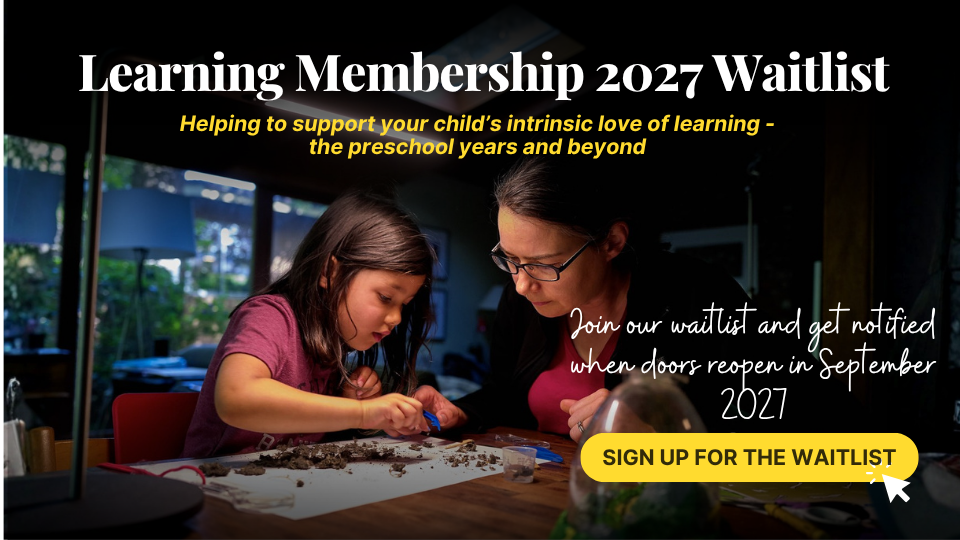
    Whether this episode has you considering unschooling, reinforced your commitment to traditional schooling, or left you somewhere in between, one thing is clear: every child deserves to have their natural curiosity and love of learning nurtured. The challenge for parents isn't choosing the "right" educational path, but knowing how to support meaningful learning wherever your child is. The Learning Membership gives you the tools to nurture your child's development whether they're in traditional school, homeschooled, or unschooled. Inside the membership, you'll find research-backed strategies that work alongside any educational setting, helping you become the parent who nurtures learning rather than forcing it. Your child's curiosity is precious - don't let it get lost in debates about educational methods. Click the banner to learn more. Jump to highlights 00:02 Introduction to the episode 05:08 Kids’ creativity encouraged through Kid Kitchen Creations 06:38 What Madeline values as a parent: Autonomy and skills 08:23 How being a perfectionist affected Madeline’s parenting 12:30 Finding balance between allowing her child to make mistakes and providing guidance 14:19 The effectiveness of workbooks in supporting children’s love of learning 16:26 Madeline discusses her middle child’s interests and learning style 18:47 Madeline discusses how joining the joining the Supporting Your Child’s Learning Membership supported her 23:04 Madeline shares a specific example of how she applied the learning framework she gained from joining the membership 27:59 Madeline reflects on the importance of keeping the balance between her children’s learning and their emotional, social and psychological wellbeing 29:40 Madeline shares the importance of documenting her children’s learning 38:08 Madeline shares how being a member of both Parenting Membership and Supporting Your Child’s Learning Membership supported her 42:05 Madeline’s advice for parents

    144: Supporting Your Gifted Child Sep 11, 2021
    Show notes Is your child gifted? Do you wonder if they're gifted but aren't quite sure? Do you want to know how to support your gifted child's learning in a way that doesn't pressure them or make them resist working with you? If so, this episode will help. I have to say, I wasn't sure where this one was going to end up. I was really uneasy about the concept of giftedness from the outset, perhaps because the way I had previously come into contact with it was through our conversation with Dr. Allison Roda, from whom we learned how some parents manipulate the Gifted & Talented program in New York City to perpetuate segregated education. But even so, I tried to go into the research with an open mind. What if it's just the G&T programs as they're set up in New York City that are the problem, not the entire concept of giftedness itself? The good news is that there's a good deal of evidence on what kinds of programs benefit gifted children. And in this episode I end up arguing that we shouldn't just put gifted children in them, but that all children would benefit from learning using these methods. Ready to transform how you support your child's curiosity? While we're all trying to figure out what's really behind rising teen anxiety and whether phones are the problem, there's something we can do right now that helps nurture our children's natural curiosity and intrinsic motivation to learn. The You Are Your Child's Best Teacher masterclass shows you how to do exactly that without adding pressure or creating elaborate activities that exhaust you. When children feel competent and engaged in learning that matters to them, they develop resilience that serves them well, whether they're facing social media pressures, academic stress, or the general challenges of growing up in today's world. Click the banner to learn more!

    Learning Membership

    Do you want to turn your child’s interests into learning opportunities? The Learning Membership is here to help you. Make learning a fun adventure that not only strengthens your bond, but also nurtures your child’s intrinsic love of learning—an essential foundation for success in an AI-driven world. Get tools and strategies to support your child’s love of learning and future-proof their success in navigating whatever comes their way. No special skills needed—just a willingness to explore alongside them. When you join before the end of day, August 8, you'll also get free access to Mind Your Own Business: For Kids, the course Carys and I built after she started her own pet-sitting business. It walks kids through testing an idea with real clients, then growing it if it works. You'll also get the You Are Your Child's Best Teacher Masterclass, 60 minutes on spotting the learning your child is already doing and starting a learning journal to track it. Click the banner to learn more! Jump to highlights 03:56 What is giftedness? Early history of the IQ test 06:09 How IQ tests fall short for kids who aren't White 13:52 Yolngu Aboriginal elders on giftedness and community 21:17 Critique of Gardner's theory and its Euro-centric roots 31:05 The data on Black students and gifted programs 35:06 What the evidence says about supporting advanced learners 38:29 Are gifted programs just measuring good schooling? 42:07 Dr. Borland's case for gifted education without gifted children 48:02 What interest-led learning looks like in practice 51:16 The five Cs: Control, Choice, Challenge, Complexity, Caring 53:24 Dr. Adair's study: first graders shocked by self-led peers References Adair, J.K., Colegrove, K. S-S., & McManus, M.E. (2017). How the word gap argument negatively impacts young children of Latinx immigrants’ conceptualizations of learning. Harvard Educational Review 87(3), 309-334. Aiegler, A., Balestrini, D.P., & Stoeger, H. (2018). An international view on gifted education: incorporating the macro-systemic perspective. In Pfeiffer, S.I. (Ed.), Handbook of giftedness in children: Psychoeducational theory, research, and best practices (p.15-28). Cham, Switizerland. Begay, H. & Maker, CJ. (2007). When geniuses fail: Na8Dene’ (Navajo) conception of giftedness in the eyes of the holy deities. In S.N. Phillipson & M. McCann (Eds.), Conceptions of giftedness. Sociocultural perspectives (pp. 1278168). Mahwah, NJ: Lawrence Erlbaum Associates. Berry, K. S. (2004). Multiple intelligences are not what they seem to be. In J. L. Kincheloe (Ed.), Multiple intelligences reconsidered. (pp. 236-250). New York, NY: Peter Lang. Carrillo, J.F. (2013). I always knew I was gifted: Latino males and the Mestiz@ Theory of Intelligences (MTI). Berkeley Review of Education 4(1), 69-95. Chandler, P. (2011). Prodigy or problem child? Challenges with identifying Aboriginal giftedness. In Vialle, W. (Ed.), Giftedness from an Indigenous perspective (p.1-9). Australian Association for the Education of the Gifted and Talented Ltd. Retrieved from https://ro.uow.edu.au/cgi/viewcontent.cgi?article=1016&context=uowbooks Christie, M. (n.d.). Some Aboriginal perspectives on gifted and talented children and their schooling. Charles Darwin University. Retrieved from https://www.cdu.edu.au/centres/yaci/docs/Aboriginal-Perspectives-On-Gifted-Children%20190910.pdf Ford, D. Y., Orantham T. C. & Whiting, G. W. (2008). Culturally and linguistically diverse students in gifted education: Recruitment and retention issues. Exceptional Children, 74, 3, 289Q306. Jiuliani, A.J. (2013, June 25). Why “20% time” is good for schools. Edutopia. Retrieved from https://www.edutopia.org/blog/20-percent-time-a-j-juliani Kanevsky, L., & Keighley, T. (2003). To produce or not to produce? Understanding boredom and the honor in underachievement. Roeper Review, 26, 20–28. Mayes, R.D., & Moore III, J.L. (2016). The intersection of race, disability, and giftedness: Understanding the education needs of twice-exceptional African American students. Gifted Child Today 39(2), 98-104. Miller, E.M., & Cohen, L.M. (2012). Engendering talent in others: Expanding domains of giftedness and creativity. Roeper Review 34, 104-113. Novak, A.M. (2021, February 5). Black (Gifted) Joy: A critical race theory perspective. https://doi.org/10.35542/osf.io/xdpwr Peterson, J. S. (2001). Successful adults who were once adolescent underachievers. Gifted Child Quarterly, 45, 236–250. Pfeiffer, S.I., & Prado, R.M. (2018). Counseling the gifted: Current status and future prospects. In Pfeiffer, S.I. (Ed.), Handbook of giftedness in children: Psychoeducational theory, research, and best practices (p.299-313). Cham, Switizerland. Reis, S.M. (2005). Feminist perspectives on talent development: A research-based conception of giftedness in women. In R.J. Sternberg & J.E. Davidson (Eds)., Conceptions of Giftedness (2nd Ed.) (p.217-246). Cambridge: Cambridge University Press. Rinn, A.N., & Majority, K.L. (2018). The social and emotional world of the gifted. In Pfeiffer, S.I. (Ed.), Handbook of giftedness in children: Psychoeducational theory, research, and best practices (p.49-64). Cham, Switizerland. Silverman, L.K. (2018). Assessment of giftedness. In Pfeiffer, S.I. (Ed.), Handbook of giftedness in children: Psychoeducational theory, research, and best practices (p.183-207). Cham, Switizerland. Sternberg, R.J., & Kaufman, S.B. (2018). Theories and conceptions of giftedness. In Pfeiffer, S.I. (Ed.), Handbook of giftedness in children: Psychoeducational theory, research, and best practices (p.29-48). Cham, Switizerland. Ziegler, A., Balestrini, D.P., & Stoeger, H. (2018). An international view on gifted education: incorporating the macro-systemic perspective. In Pfeiffer, S.I. (Ed.), Handbook of giftedness in children: Psychoeducational theory, research, and best practices (p.15-28). Cham, Switizerland.

    143: The Extended Mind with Annie Murphy Paul Sep 05, 2021
    Show notes

    We don’t just think with our brains. What?! How can that possibly be true? I struggled to understand it if myself for quite a while, until I read the fabulous English philosopher Andy Clark’s description of what happens when someone writes, which essentially involves ideas flowing down the arm and hand, through the pen and ink, across the paper, up to your eyes, and back to your brain. The ideas don’t literally flow, of course, but the process of writing alters the process of thinking - which is why research has shown that processing traumatic memories through journaling about them is more useful just thinking about them - the act of writing about them changes our interpretation of them in a way that just thinking about them doesn’t. The challenge with school-based learning, of course, is that it’s primarily concerned with the brain. Our task is to remember facts and ideas so we can recount them when asked about them at a later time. Children who fidget are told to sit still, when the research that Annie Murphy Paul cites in her new book The Extended Mind indicates that this instruction is entirely misplaced - fidgeting can be a way of managing excess energy, and movement can actually help us to remember things more effectively than we otherwise would. In this episode we learn many of the different ways that we our brains interact with the outside world to learn in ways that we might never have considered up to now. Ready to transform how you support your child's curiosity? While we're all trying to figure out what's really behind rising teen anxiety and whether phones are the problem, there's something we can do right now that helps nurture our children's natural curiosity and intrinsic motivation to learn. The You Are Your Child's Best Teacher masterclass shows you how to do exactly that without adding pressure or creating elaborate activities that exhaust you. When children feel competent and engaged in learning that matters to them, they develop resilience that serves them well, whether they're facing social media pressures, academic stress, or the general challenges of growing up in today's world. Click the banner to learn more!

    Learning Membership

    Do you want to turn your child’s interests into learning opportunities? The Learning Membership is here to help you. Make learning a fun adventure that not only strengthens your bond, but also nurtures your child’s intrinsic love of learning—an essential foundation for success in an AI-driven world. Get tools and strategies to support your child’s love of learning and future-proof their success in navigating whatever comes their way. No special skills needed—just a willingness to explore alongside them. When you join before the end of day, August 8, you'll also get free access to Mind Your Own Business: For Kids, the course Carys and I built after she started her own pet-sitting business. It walks kids through testing an idea with real clients, then growing it if it works. You'll also get the You Are Your Child's Best Teacher Masterclass, 60 minutes on spotting the learning your child is already doing and starting a learning journal to track it. Click the banner to learn more!

    Annie Murphy Paul's Book

    The Extended Mind: The Power of Thinking Outside the Brain (Affiliate link).

    Jump to highlights 01:00 Looking at the idea that our mind isn't actually only located inside of our brains 01:46 An open invitation to join the free You Are Your Child’s Best Teacher Workshop 05:30 Learning does not just happen within the brain, but with things and people that are outside of it 06:44 The metaphor of how our brains are like magpies nest: we draw raw material available to us as resources for our thinking process just like how magpies incorporate materials available in their environment when building their nests 09:22 The movements and gestures of our bodies, the internal sensations of our bodies are part of the thinking process 10:34 Interoceptive sensitivity 13:07 The gut feeling is your body tugging at your sleeve saying that you’ve encountered this situation before and this is how you should respond 14:53 Moving the body is a way to stimulate mental processes in specific ways and you can use different kinds of movements to produce different kinds of thoughts 16:53 Recess - the great invention that allows students to move and break the monotony of sitting down all day in school 17:49 Fidgeting is a very subtle way to calibrate our arousal level so that we're in this optimal state of alertness 19:00 We're creatures who are good at moving our bodies and navigating through space and interacting with other people 20:23 We rely on our surroundings to shape our sense of ourselves 26:48 We can interact with our environment in a way that supports our learning 28:33 What are some ways that we can support children in using the space around them in their learning 31:49 Journaling and sketching as a tool to process learning deeper 36:47 Thinking with relationships; encouraging children to learn from and with other people 45:25 Allowing your children to genuinely work together so that parents don’t need to support their learning individually 46:29 We tend to think of learning as when a person sits down at a desk but in fact there are all these cognitive processes that get activated in social interactions 48:08 Argument is very valuable and can be a really effective way of solving problems 52:43 It is a different cognitive process when we do learning with other people 55:45 Human thinking works best when we are able to create “loops” and the best way for parents to support their children’s learning is to look for those loops Other episodes mentioned:
    • 113: No Self, No Problem
    • 137: Psychological Flexibility through ACT with Dr. Diana Hill

    Links
    • You Are Your Child’s Best Teacher Workshop
    • The Extended Mind: The Power of Thinking Outside the Brain, by Annie Murphy Paul
    • Origins: How the Nine Months Before Birth Shape the Rest of Our Lives, by Annie Murphy Paul

    References: Andrade, J. (2010). What does doodling do? Applied Cognitive Psychology 24, 100-106. Bobek, E., & Tversky, B. (2016). Creating visual explanations improves learning. Cognitive Research: Principles and Implications 1, 27. Church, R.B. & Goldin-Meadow, S. (1986). The mismatch between gesture and speech as an index of transitional knowledge. Cognition 23, 43-71. Fishburn, F.A., Murty, V., Hlutkowsky, C.O., MacGillivray, C.E., Bemis, L.M., Murphy, M.E., Huppert, T.J., & Perlman, S.B. (2018). Putting our heads together: Interpersonal neural synchronization as a biological mechanism for shared intentionality. Social Cognitive and Affective Neuroscience 13(8), 841-849. Glenberg, A.M. (2011). How reading comprehension is embodied and why that matters. International Electronic Journal of Elementary Education 4(1), 5-18. Kandasamy, N., Garfinkel, S.N., Page, L., Hardy, B., Critchley, H.D., Gurnell, M., & Coates, J.M. (2016). Interoceptive ability predicts survival on a London trading floor. Scientific Reports 6, 32986. Kelly, S.D., Singer, M., Hicks, J., & Goldin-Meadow, S. (2002). A helping hand in assessing children’s knowledge: Instructing adults to attend to gesture. Cognition and Instruction 20(1), 1-26. Knight, C., & Haslam, S.A. (2010). The relative merits of lean, enriched, and empowered offices: An experimental examination of the impact of workspace management strategies on well-being and productivity. Journal of Experimental Psychology: Applied 16(2), 158-172. Kontra, C., Lyons, D.J., Fischer, S.M., & Beilock, S.L. (2015). Physical experience enhances science learning. Psychological Science 26(6), 737-749. Langhanns, C., & Muller, H. (2018). Effects of trying ‘not to move’ instruction on cortical load and concurrent cognitive performance. Psychological Research 82, 167-176. Link, T., Moeller, K., Huber, S., Fischer, U., & Nuerk, H-K. (2015). Corrigendum to ‘Walk the number line – An embodied training of numerical concepts.’ Trends in Neuroscience and Education 4(4), 112. Link, T., Moeller, K., Huber, S., Fischer, U., & Nuerk, H-K. (2013). Walk the number line – An embodied training of numerical concepts. Trends in Neuroscience and Education 2(2), 74-84. Lozada, M., & Carro, N. (2016). Embodied action improves cognition in children: Evidence from a study based on Piagetian conservation tasks. Frontiers in Psychology 7, 393. Meagher, B.R. (2020). Ecologizing social psychology: The physical environment as a necessary constitutent of social processes. Personality and Social Psychology Review 24(1), 3-23. Mehta, R.K., Shortz, A.E., & Benden, M.E. (2015). Standing up for learning: A pilot investigation on the neurocognitive benefits of stand-biased school desks. International Journal of Environmental Research and Public Health 13, 0059. Shteynberg, G. (2014). A social host in the machine? The case of group attention. Journal of Applied Research in Memory and Cognition 3(4), 307-311. Zhang, T. (2017). Back to the beginning: Rediscovering inexperience helps experts give advice. Academy of Management Proceedings 2015-1, 15215.

    Previous 1 14 15 16 17 18 33 Next

    Related Podcasts

    Tumble Science Podcast for Kids

    1

    Tumble Science Podcast for Kids Education for Kids
    The Longest Shortest Time: A Women’s Health Show for Everyone

    2

    The Longest Shortest Time: A Women’s Health Show for Everyone Government & Organizations
    Dream Big Podcast for Kids

    3

    Dream Big Podcast for Kids Education for Kids
    Brains On! Science podcast for kids

    4

    Brains On! Science podcast for kids Education for Kids
    The Purrrcast

    5

    The Purrrcast Kids & Family
    The Dog Trainer’s Quick and Dirty Tips for Teaching and Caring for Your Pet

    6

    The Dog Trainer’s Quick and Dirty Tips for Teaching and Caring for Your Pet Education
    footer-logo

    Contact Us

    Toll Free: 844-670-7747

    Links

    • Home
    • Top Charts
    • Networks
    • Apps
    • Independents Podcasts
    • Podcast Advertising
    • Podcast News
    • Contact Us
    • About Us
    • Analytics & Insights

    Stay Connected

      Privacy, Terms of Use & Our Code of Ethics Protecting Content Creators Copyrights