TopPodcast.com
Menu
  • Home
  • Top Charts
  • Top Networks
  • Top Apps
  • Top Independents
  • Top Podfluencers
  • Top Picks
    • Top Business Podcasts
    • Top True Crime Podcasts
    • Top Finance Podcasts
    • Top Comedy Podcasts
    • Top Music Podcasts
    • Top Womens Podcasts
    • Top Kids Podcasts
    • Top Sports Podcasts
    • Top News Podcasts
    • Top Tech Podcasts
    • Top Crypto Podcasts
    • Top Entrepreneurial Podcasts
    • Top Fantasy Sports Podcasts
    • Top Political Podcasts
    • Top Science Podcasts
    • Top Self Help Podcasts
    • Top Sports Betting Podcasts
    • Top Stocks Podcasts
  • Podcast News
  • About Us
  • Podcast Advertising
  • Contact
Not in our directory?
Add Show Here
Podcast Equipment
Center

toppodcastlogoOur TOPPODCAST Picks

  • Comedy
  • Crypto
  • Sports
  • News
  • Politics
  • True Crime
  • Business
  • Finance

Follow Us

toppodcastlogoStay Connected

    View Top 200 Chart
    Back to Rankings Page
    Natural Sciences

    The Amp Hour

    The Amp Hour is a weekly conversation about electronics and the people who design them.

    Advertise

    Copyright: Copyright © The Amp Hour Electronics Podcast 2020

    • Apple Podcasts
    • Google Play
    • Spotify

    Latest Episodes:
    An Interview With Brandon Harris - Impish Internet Iamatology Jun 11, 2014
    Show notes

    Welcome Brandon Harris of Electric Imp!

    • Hugo started the company after leaving Apple (after briefly working at Nest). He worked on an Apple stock notifier (that turns green or red depending on stock direction). The frustration around connecting XML and JSON lead to the Imp.
    • Brandon and Hugo worked together at Apple on the iPhone.
    • Around the Electric Imp offices, one of the employees made the "IoTEA", a notification system for when the kettle is ready.
    • Electric Imp wants to be the AWS of IoT.
    • There are currently three different versions of Imp hardware:
      • IMP001 is the SD card.
      • IMP002 is the solder down device.
      • IMP003 is the lower cost, no antenna module manufactured by Murata.
    • Each of these has the Broadcom wifi chipset, the same used in iPhones.
    • The main processor is the STM32 Cortex M3.
    • The coding language for the Electric Imp is Squirrel. They started with Lua, both of which are scripting languages.
    • The application team created a freefall detection device, something you throw in the air and it connects to the internet and sends a packet before returning to your hands.
    • DHCP is the slowest step in the connection process.
    • The Imp runs eCos, they call it impOS.
    • Using the SD card you are limited to 6 pins, it can help to use an i2c expander. Bit banging has to go through the SPI port.
    • Because it is an RTOS instead of a superloop, it can be a tough adjustment for normal Arduino users.
    • The Nora reference design is a multi sensor design with qualification of the power. Quirky has a similar product called Spotter.
    • There are a wide variety of other reference designs to pull from.
    • The sleep modes sip current in different modes:
      • Deep sleep: 4-6 uA wakes on timer or interrupt
      • On with wifi off: 1-2 mA
      • On with wifi on: 5-6 mA
      • Everything on: 100 mA
    • Nora reference design has battery info/comparison. It gets roughly 60K wakes on 2 AA alkalines. Nora does 15 mins between uploads, 1 min wake for each read.
    • Wifi is TDMA.
    • BlinkUP is how you get the info into a device, it uses a phototransistor on the bottom of the SD card (or you have to add one)
    • Adam Wolf told us about how they do something similar at Wayne and Layne.
    • Brandon hopes future products will try bluetooth, cellular.
    • They tried to put their reference designs into the public domain, which wasn't allowed. Instead they licensed with the X11 open source license.
    • All of the necessary code and drivers for the Electric Imp are on their Git Hub repo.
    • Their main competition is SparkCore; the differentiating factor is that Spark allows you to run on their servers, whereas Electric Imp helps to make the process smoother.

    Cheap Respins And A Time Machine - Multiscience Mercenary Marketplace Jun 04, 2014
    Show notes
    • Dave wrote a post about the economics of hardware.
    • Chris now is part of the Google Helpout program. You can rent time with him.
    • A previous program Chris was part of was Maven. He didn't like that it was just surveys.
    • A version with actual engineering tasks is Proto Exchange, which is specifically for electrical engineers. CircuitHub is also setting up a marketplace for electronic work as more people want to get into hardware.
    • The Embedded podcast recently had a show about hiring.
    • Contextual Electronics had some (unintential) issues during the build, including a wrong footprint and a couple of reversed signals.
    • Dave's advice for a checklist? Double check everything.
    • Two things you need to get a great product
      • Cheap respins
      • A time machine
    • eFabless is a new service for sharing a wafer and getting low cost custom chips. The low cost is the result of excess capacity.
    • It uses an online compiler called Yosys, the author of which was on our subreddit.
    • We assumed it was all digital as it is defined with verilog, but it might do mixed signal.
    • Others deal with excess capacity by converting the fabs to grow lettuce.
    • The ISEE3 satellite has been reclaimed!
    • Elon Musk has been driving amazing companies, such as SpaceX. The recently announced Dragon V2 looks amazing. It reminds Dave of the ship in the film version of Contact.
    • NASA is apparently planning to send people to Mars by 2035.
    • Dave is reminded of the 40 day report.
    • Watson (the computer that won Jeopardy!) will now be doing medical diagnosis.
    • Google announced a self driving car that they are planning on manufacturing.
    • Mentioned last week, manufacturing is moving from China to Mexico due to cost, logistics, agreements.
    Thanks to ChaoticGood01 for the Lego picture

    SolidCon and Traveling Tech - Joined Junk Jocularity May 28, 2014
    Show notes

    Chris is back in his lab after a week and a half of travel; Dave continues to trick out his lab to take advantage of his high speed internet.

    • Chris has road-tested the portalab! There isn't enough lighting, nor time in the day to work on it.

    My hotel room based electronics lab pic.twitter.com/f3AXExoZIB

    — Chris Gammell (@Chris_Gammell) May 20, 2014
    • Does solder have an expiration date?
    • Dave is going lead-free in his lab.
    • Flux pens can be nice, but pricey. No clean flux isn't worth it.
    • In the late 80s, there was a push to use citrus cleaning solvents for boards (PDF).
    • The TSA also went through Chris's Portalab case. They were met with this note:

    Packing the portalab for the journey home. This is my note to the TSA, should they decided to mess with my stuff. pic.twitter.com/cltEIXmUeC

    — Chris Gammell (@Chris_Gammell) May 24, 2014
    • Chris was still in San Francisco for SolidCon (you can see the schedule here). It's meant to be a conference for the crossover of hardware and software.
    • Videos should be online eventually. Dave doesn't understand why people would speak at conferences without someone taping it.
    • On interesting protocol that Chris learned about was MQTT, a lightweight way for machines to interact. This is what Facebook uses for their notification.
    • A similar topic was covered by Peter Semmelhack and Stacey Higgenbothom on the Internet of Things Podcast. The new platform (vs protocol like MQTT) is called dweet.io.
    • The "hard" part of hardware is the manufacturing and distribution side of things. Brady Forrest of PCH Int'l and Highway1 gave a talk about how there is "No China Button".
    • During the meetups on non-conference days it was crazy to see how much ferver there is over hardware (and really tech in general). Quirky is opening a new SF office and hiring up to 60 hw engineers.
    • Outside of SF, Tony Hsieh (the Zappos guy) has invested $10M in US manufacturing (specifically in Las Vegas).
    • Another investor, Renee DiResta of OATV, gave a presentation about the state of hardware startups and revealed the cost of labor in Mexico are falling past those in China. https://www.youtube.com/watch?v=YICzDD9O1PU
    • Dave was impressed by the growth of hackerspaces/makerspaces (where do they go when a big city has them?).
    • Chris's favorite presentation was by Nadya Peek, a PhD candidate in the MIT Center For Bits and Atoms (Neil Gershenfeld's group). The talk focused on modular machines building reconfigurable tools for manufacturing.
    • If you're interested in the building your own Portalab, there is a lower cost case offered by Digikey.
    • Mentor and Digikey are pairing up for a low cost CAD tool. At first glance we didn't realize the $300 price tag only gets you schematic capture. Boo.
    • We ARE excited for the new feature from the CERN folks, working on KiCad. The push and shove router is now released (whatever that means for KiCad) https://www.youtube.com/watch?v=CCG4daPvuVI
    • The "Never trust the autorouter" t-shirt is now available for sale on teespring.
    • Can solar roadways work? There is a crowdfunding project raising money for further research. Chris and Dave agree that feasibility on a large scale road would take a long time to implement.
    • Another group at SolidCon was the Makani wind turbines/kites.
    • Chris made a comparison between the derision that smokers receive and people wearing Google Glass. There are a wide range of reactions.
    • NASA is giving amateurs the chance to recover a long lost satellite out in orbit.
    • TI is auctioning off the first microchip that Jack Kilby made. It is expected to sell for $1M+.
    • Chris has been doing field research and hardware people are still cheapskates. Are any of our listeners a counter point?

    The 2014 Maker Faire Show - Traveling Technology Trangam May 21, 2014
    Show notes
    • Laen set up the BringAHack dinner, it was about 120 people! Really well set up.
    • The Novena funded and as a result, Bunnie cut his hair off!
    • Jeri gave an update on the CastAR, the molds are just about ready for first shot.
    • Chris was given an MDO3000 to try out.
    • Voltset was a company at Maker Faire with a phone/tablet based DMM (the 3rd we've heard of)
    • Velleman is also coming out with a phone/tablet dual channel scope (with 10 MHz bw)
    • Chris loved the robotic front loader https://www.youtube.com/watch?v=XjHJ71SVop4
    • The portalab is out on the road with Chris. It is all low-cost tools
      • DMM - The EX330 (reviewed in Dave's $50 shootout)
      • Oscilloscope - Rigol DS1052E
      • Soldering iron - Aoyue 937
      • ATX power supply with BenchBudEE
      • Hand tools/soldering supplies.
      • Case - Pelican 1610
    • Chris finally saw the Othermill in person. It can do 5x5 PCBs from Gerbers or EAGLE files.
    • More of a machining tool, the Carbide3D Nomad was there as well. It was developed by two hardware folks and the author of the software MeshCAM.
    • Dave has been working a live stream setup where he can send the HDMI that is captured from his various cameras and microscope.
    • Ben Heck did a new project that included Dave voice clips. Chris saw it in person. https://www.youtube.com/watch?v=wYo4lOuD_-Y
    • Chris's "NEVER trust the autorouter" T-shirt was popular but was given away. There will be a teespring campaign for everyone to get one.
    • Dave had never heard of Uber before, but will try it the next time he travels.
    Thanks to @Noazark for the picture of Bunnie's haircut

    Mike Ossmann Returns! - Planetic Portalab Packaging May 14, 2014
    Show notes

    Welcome again to Mike Ossmann of Great Scott Gadgets!

    • Mike will be attending Hamvention in Dayton OH this year. He'll be at the TAPR booth and giving a talk about the HackRF.
    • Chris will be at Maker Faire and SolidCon in San Francisco.
    • Because of travel during Contextual Electronics, Chris has been working on the portalab concept discussed on previous shows (see picture above).
    • Have you ever participated in a hardware hackathon? Did the winner have the most gear?
    • Hackaday ran the hackathon at the Freescale Tech Forum in Dallas this year. The entries' subject matter were a testament to the time crunch; the technical piece was well done for many of them.
    • Mike continues development on the Daisho. It is an open source (HW & SW) USB 3.0 analyzer. It uses a custom core.
    • The team bought a USB 3.0 analyzer from Lecroy. The chips and the tools still aren't fully mature, so it's not uncommon to find bugs. They have to compare across multiple platforms.
    • Once again we discussed Rent's Law (same as on the show with Dave Vandenbout); there is a correlation with pin count and logic size. Dave and Mike want the opposite ends of the spectrum.
    • When asked about putting together an OSHW team, Mike said that he finds people at conferences and due to their contributions to the project before being hired. Many of the main contributors are now paid contractors.
    • The funding for this project came from the DARPA cyber fast track program.
    • Bunnie announced that the Novena project will also have a modular oscilloscope add-on possible for the extension header. You can still participate in their crowdfunding campaign!
    • Mike also recently attended the Colorado OSHWA meeting in Boulder. He got to meet one of the few science savvy US House Reps (Congressman Polis), who also was interested in the trend of open source. The remainder of the US congress still is pretty clueless.
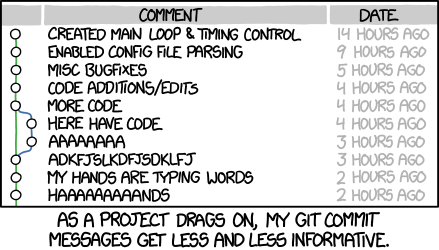
    • Mike and Chris both use GitHub to capture changes in hardware. Chris is reminded of the XKCD where the commit comments get more and more ridiculous over time. Image courtesy XKCD.com
    • You can tag official builds on GitHub with tags (example); Alternately, you can place your finished builds on a separate server, like KiCad.
    • Dave still isn't sold on KiCad, but we'll wear him down.
    • If you're at Hamvention, keep an eye on Mike's Twitter feed for a possible meet up.
    • If you're at Maker Faire, be sure to stop out to the annual #BringAHack dinner, this year at BJ's restaurant in Foster City starting at 6 pm.

    Spacing Out On Space - Dave's Dongle Designing May 07, 2014
    Show notes
    • Dave has decided to keep his current office and update his internet.
    • A Swedish broadband company showed the effect of crappy internet (because of the lag)
    • The 3 second lag is similar to a trip for a signal from the earth to the moon.
    • Speaking of space, Hackaday (and Supply Frame) is sending a design contest winner to space! It's called The Hackaday Prize.
    • Dave is a judge, Chris is helping to organize it.
    • There are some parallels to the 555 contest; Dave wants to see an elegant solution, similar to Le Domineux.
    • On the Virgin Galactic wiki page (a possible carrier for winners of The Hackaday Prize), it mentions that Richard Branson was scheduled to be on Spaceship Two, but apparently Chris was mistaken thinking this had already launched (only testing still).
    • On the portable lab idea, talked about 2 episodes ago, Chris found a new class of carrying cases: Rolling Makeup Carrying Cases.
    • If a tablet based scope was going to be included in the portolab, a possible option is the OSCiprime, an open source Android based oscilloscope.
    • A more rugged and advanced option would be a handheld scope, like the Hantek DSO-1200.
    • Chris will be at Maker Faire and SolidCon giving talks this year, prompting more discussion about a portable lab. If you'll be in town, let him know!
    • Altium is moving again, this time to San Diego. Their last move to Shanghai was when Dave was let go.
    • Dave wrote a forum post translating press release.
    • EAGLE is also making some changes; their version 7 of their software will be node-locked. This means more hassle for software owners when changing machines (though they will allow two machines to start with)
    • Dave was once contacted to be a dongle designer. Heh.
    • The chip world is seeing changes, especially at the top. Intel was not the choice by Google for their new server motherboard. Instead it will be the Power8 chip from IBM.
    • Amazon is also hiring a chip architect to develop next generation server silicon technology.
    • Cirrus Logic is buying Woflson, a competing audio firm. Who is left to compete with them for audio amplifiers and CODECs?
    • One of the hardest things about doing a project (especially alone/with a small team) is handling the purchasing side of things.
    • Lean manufacturing and the Toyota Production System (that many vendors follow), means that there isn't often excess inventory in the marketplace for non-commodity components.
    • Chris never got his green belt he began training for, but he did develop a distaste for terms like KanBan.
    Thanks to Danlockton for the picture of the Dongle Scrapyard

    An Interview with Mike Engelhardt - SPICE Simulator Synteresis Apr 30, 2014
    Show notes

    Welcome, LTspice guru, Mike Engelhardt of Linear Technology!

    • Mike has been writing simulators since 1975! LTspice was his 3rd simulator, it is currently on version 4 and has been in the market for 14 years. You can download it for free here!
    • Simulators are based upon numerical methods and approximating non-linearities. Mike defines SPICE as having common Jacobian (part of the solving matrix)
    • The best simulators are not from software companies, they're from the equipment manufacturers. The best measure of radar return from a war plane was from the plane manufacturer.
    • Mike has optimized LTspice to run fast. This means it uses self authoring code, runs pipeline hot, compiles during the simulation and lots of other stuff Chris didn't understand. This was all in order to remove processing overhead. It also means it's energy efficient!
    • Berkeley SPICE (the original) had lots of problems and discontinuities for the models contained within. It also was 200000 lines of code, but only 85000 lines of code were actually used. LTspice has closer to 500,000 lines of code.
    • Intel CPUs are surprising, especially when running multithreaded. Mike recommends benchmarking all systems because of unknown possible behavior.
    • Making transistor models is a difficult task and not advised for the layman. Either try to talk to the vendor to get one or approximate with a built in model.
    • THE book on this topic is Semiconductor Device Modeling With Spice, 2nd edition.
    • Some of the curve parameters are human readable (gate capacitance, beta, etc), others are not.
    • Power transistor manufacturers do not normally provide models because the work of creating a good power transistor is different than a normal chip designer. To help switcher designs, LT made their own power transistor.
    • Many of the switchers in LTspice are shown as Macromodel. These are encrypted versions of spice components that are written in a hardware description language.
    • The LT3780 (which controls 4 switches and can do all types of switching regulation) has a digital engine in SPICE to replicate the state machine on board the chip.
    • Though Berkeley SPICE is open source, LTspice is not. Mike did not think it was worth losing the competitive advantage.
    • The control panel in LTspice has lots of knobs you can turn which will mess up your simulation. Some are worth it though:
      • Solver: normal or alternate
      • TRTOL: Default is 1 (Windows) or 2 (Mac), but the pros put it on 7 because they can handle possible glitches.
      • LTspiceControlPanel
    • Chris has played with the Gmin characteristic when working on sensitive designs.
    • The hacks page allows you to turn on or off many of the corner cases that have been designed in over the years.
    • Mike is currently on a 60 city Arrow seminar tour, on 6 continents! In the past Nu Horizons ran this tour (and Arrow bought them). You can see if Mike is coming to your city and sign up to attend!
    Many thanks to Mike for visiting the show! More importantly thanks to him and his team for all the hard work on a tool that many of us use regularly and without hassle or payment! You can reach Mike directly at ltspice@linear.com (as always, please be respectful of our guests' time)

    Guns and Mobile Labs - Nuanced Nomadic Non-essentials Apr 23, 2014
    Show notes
    • Dave finally got the poster that Chris sent him. He opened it on his mailbag segment https://www.youtube.com/watch?v=BXWbmODBvhI
    • Dave is shopping for a new lab/workspace. He wants to be able to include mechanical elements like a laser cutter and a drill press. The current space isn't well ventilated enough to even use a reflow oven (though he still does sometimes).
    • Chris started working part time at Supply Frame, the company that owns FindChips.com and Hackaday. Chris will be helping develop new tools for engineers to navigate the supply chain. This is why he's been traveling more and will continue to travel.
    • Because Session 1B of Contextual Electronics started recently (the building portion), Chris will likely need to build while on the road.
    • If building on the road, a portable lab will be required. There are some great builds already out there by Ben Heck and across the web.
    • But what about protecting your stuff while going through security?
      • Steve Hoefer has written in the past about taking your stuff through as a carry on.
      • Another option is to be allowed to lock your bag...by packing a gun? Kind of a crazy lifehack, but it works! There are very well defined processes on US airlines for registering and checking a bag with a gun in it.
    • Dave actually would consider using a tablet based scope (as would Chris) when creating a portable lab. Another benefit is you could use a new simulator with a nice UI called EveryCircuit. It shows current flow and helps people learn circuits.
    • The Nest production is on hold because waving your arms can shut off the smoke detector without knowing it.
    • The Fuel Band team was laid off and Nike is getting out of wearable hardware. They won't be the last company to bail on the "hot" market of wearables.
    • Sick of doing laundry? UC Berkeley is using a PR2 to develop a laundry folding robot.
    • Chris has been reading The Second Machine Age (and won't stop talking about it). Much of the computing surplus will go towards robotics and human replacement...which will allow us to work on harder problems.
    • A recent infographic shows the extent to robotic deployment in 2014.
    • This year the Open Hardware Summit will be in Rome!
    • Chris will be attending Electronica in Munich Germany. It likely will be a little far for Dave to attend.
    • If you happened to be at Maker Faire Shenzhen, there was a workshop on how to reball BGA parts by hand!
    • The workshop was set up by Dangerous Prototypes, who also recently started a service that can layout your boards and get them made for low cost.
    • Will layout designers be out moded by fancy software? No.
    Next week on the show, we'll have LTSpice guru Mike Englehardt. You can ask him questions over on our subreddit.

    Thanks to Elizabeth M for the picture of a suitcase


    An Interview With Todd Bailey - Embedded Embrasure Engineering Apr 16, 2014
    Show notes

    Welcome, Todd Bailey of Narrat1ve!

    • Todd grew up with electronics, his dad was an electrical engineer.
    • He got his degree in English Literature from Oberlin.
    • A final class there in electronics introduced him to Horowitz and Hill's Art of Electronics.
    • After school he got a job in a stereo repair shop and was building amps.
    • He speaks fondly of finding the Jim Williams books. Reminded of the essay "The Importance of Fixing"
    • When Todd left the repair shop he started designing synthesizers, sequences, switches.
    • Then he moved onto the PIC microcontroller, taught himself assembly.
    • He met Dima, now a professor, who offered an interview with a toy company.
    • The company Big Monster Toys in Chicago. Made over 200 prototypes a year(!).
    • The ones that made it to production were a power law distribution.
    • His first design was to design a "Beast in a bag". His mentor, "Big brain Todd" eventually told him a shortcut that helped illuminate how to get things done and move onto the next product (don't listen when the motor is on).
    • After moving on from the toy company, Todd had a wide range of clients: artists and toy customers.
    • He started designing products to sell, including a synth kit and a binary display watch.
    • Then he design "Where The Party At" (WTPA), a synthesizer meant to help people learn electronics.
    • Todd also talked about the classic Casio SK1 and how it was featured at the Bent circuit bending festival.
    • Version 2 is on the shelf and ready to get pushed to production, but he is interested in other problems right now, including consulting.
    • One project he couldn't talk about was a design for robot doors in marine environment.
    • Todd talked about the experience about doing the engineering for art installations; personal investment in the work seems to be higher for art.
    • Nam June Paik didn't design the TV Synthesizer specifically, he designed the art around the technology.
    • A more recent personal project has been the Vec9, built on a vector screen from an Asteroids cabinet. It's unique because the Asteroids controller draws with vectors instead of rasters (like on VGA televisions). https://www.youtube.com/watch?v=lEkPHPiHuio
    • Andrew Reitano worked on the FPGA stuff, you can read more about it on his site Batsly Adams
    • For the past few years you could find Todd at the Analog Aficionados dinner, thrown by Paul Rako. Chris hopes to be out there next year.
    • Todd's image of himself is as an engineer, if someone proved him otherwise, he'd be shaken.
    • Other fun projects recently:
      • A motor driven flying bed that allows extra space in his apartment.
      • A video synthesizer that he showed off at Maker Faire NY
    You can reach Todd online at his site Narrat1ve.com or on Twitter by tweeting @ToddBailey. Thanks to Todd for coming on to share his stories!

    We're Sorry! But Apple Ain't! - Remorseless RAM Racketeering Apr 09, 2014
    Show notes
    • Yes, it's true, episode 192 (last week) was a lame attempt at an April Fool's joke. This could have been caught if you noticed the mention of Touchstone starting up. Dave also did an April Fool's video, but released it early in order to increase trickery! https://www.youtube.com/watch?v=iFyEqcVpKLI
    • Adam Carolla is taking the fight to the patent trolls! You can support the fight too by participating in their fundraising campaign.
    • Chris got a Sparkfun meter (contraband!) at his local Microcenter.
    • Bunnie gave a talk at EELive about OSHW and the slowing of Moore's law.
    • He also showed the newest prototype of his open source laptop. You can join in and buy your own through the crowdfunding campaign.
    • Dave doesn't think he'd ever buy one because he could get low cost hardware for a PC, but Chris pointed out the software ecosystem you're really buying.
    • All of the software is available on GitHub under Xobs (Bunnie's co founder) account.
    • The laptop has a built in Spartan 6 FPGA
    • The newly announced Saleae logic analyzer and scope family was just announced! They have 4 different flavors, the lowest being $99. Too late for Contextual Electronics, they'll be using the Gabotronics Xminilab instead.
    • Chris didn't like that they are crowdfunding a product that very obviously will be released regardless.
    • Sometimes you don't get a large variety of component choice when you're inside a niche industry. Dave used to find and report silicon bugs to manufacturers when he was working with leading edge analog to digital converters (explained on our episode about buoys!).
    • Advertising at tradeshows is extreme, Chris questions if this is why he has to pay more for products.
    • Apple is working to buy a dominant stake in Renesas. Their supply chain needs and excess cash has them taking risks like buying companies with huge losses ($6B+ in the past few years) in order to have first shot at the silicon.
    • Buying lots of chips at once basically allows cash-heavy companies to act like mafias ("leaning" on their suppliers).
    • The Raspberry Pi foundation just released a new "Compute" module based on a SO-DIMM form factor. Dave mentions that these were used in the past and had a standard associated with them, the embedded open modular architecture.
    • Yet another BS indiegogo, this one creeping past $1million dollars (and still going) that can claim to track your calories through skin resistance. NOPE.
    • A high-flying crowdfund campaign that isn't BS is the MicroView, which crossed the $500K threshold. Marcus was on the show a few weeks back talking about the device.
    • Chris did a booth mini Maker Faire. It's amazing that some people do this for conferences as large as Bay Area Maker Faire (which Chris will be attending as a participant, not a presenter).
    • This year there will be a "Gauntlet" that runs for 1.5 weeks: MakerCon -> Maker Faire -> SolidCon.
    Thanks to Wikipedia for the image of Al Capone and to Apple for not suing us (...right?)

    Previous 1 54 55 56 57 58 76 Next

    Related Podcasts

    Science Friday

    1

    Science Friday Astronomy
    Radiolab

    2

    Radiolab Documentary
    BrainStuff

    3

    BrainStuff Natural Sciences
    StarTalk with Neil deGrasse Tyson

    4

    StarTalk with Neil deGrasse Tyson Games & Hobbies
    Radiolab

    5

    Radiolab Documentary
    Stuff To Blow Your Mind

    6

    Stuff To Blow Your Mind Life Sciences
    footer-logo

    Contact Us

    Toll Free: 844-670-7747

    Links

    • Home
    • Top Charts
    • Networks
    • Apps
    • Independents Podcasts
    • Podcast Advertising
    • Podcast News
    • Contact Us
    • About Us
    • Analytics & Insights

    Stay Connected

      Privacy, Terms of Use & Our Code of Ethics Protecting Content Creators Copyrights