TopPodcast.com
Menu
  • Home
  • Top Charts
  • Top Networks
  • Top Apps
  • Top Independents
  • Top Podfluencers
  • Top Picks
    • Top Business Podcasts
    • Top True Crime Podcasts
    • Top Finance Podcasts
    • Top Comedy Podcasts
    • Top Music Podcasts
    • Top Womens Podcasts
    • Top Kids Podcasts
    • Top Sports Podcasts
    • Top News Podcasts
    • Top Tech Podcasts
    • Top Crypto Podcasts
    • Top Entrepreneurial Podcasts
    • Top Fantasy Sports Podcasts
    • Top Political Podcasts
    • Top Science Podcasts
    • Top Self Help Podcasts
    • Top Sports Betting Podcasts
    • Top Stocks Podcasts
  • Podcast News
  • About Us
  • Podcast Advertising
  • Contact
Not in our directory?
Add Show Here
Podcast Equipment
Center

toppodcastlogoOur TOPPODCAST Picks

  • Comedy
  • Crypto
  • Sports
  • News
  • Politics
  • True Crime
  • Business
  • Finance

Follow Us

toppodcastlogoStay Connected

    View Top 200 Chart
    Back to Rankings Page
    Music

    Ray Harmony

    The unorthodoX ideas of multi award-winning music lecturer Ray Harmony. Older episodes were co-hosted by his wife and protégé Kate Harmony. As a songwriter and producer, Ray has made music with Grammy winners and multiplatinum artists, including Serj Tankian (System Of A Down) and Tom Morello (Rage Against The Machine). Join over 255,000 YouTube subscribers learning the fast, easy, and fun way to make music without using AI, cos it ain’t no fun getting a robot to write “your” songs! Download Ray’s free book at HackMusicTheory.com

    Advertise

    Copyright: © 2022 Revolution Harmony

    • Apple Podcasts
    • Google Play
    • Spotify

    Latest Episodes:
    How to Write a Locrian RIFF • Music Theory from Metallica "72 Seasons" Apr 23, 2023
    Show notes

    How to Write a Locrian RIFF

    FREE: Download This Tutorial as PDF
    Includes multitrack MIDI example

    Step 1. Octaves

    Set your grid to 1/16 notes and your tempo to 97 BPM. You’re gonna start by writing a creative pattern using only octaves. If you’re writing this on guitar, use your low open E string and the E one octave higher. And be sure to play every 1/16 note, as that’s what gives the riff that heavy momentum. At the very end of the riff, though, play four 1/8 notes. That creates variation, and gives the circle pit a few seconds to breathe!

    Quick shoutout to Metallica, as this lesson is based on their song “Too Far Gone?” from the new album “72 Seasons”.

    Step 2. Mode

    Now that you’ve got an outline of your riff, it’s time to start thinking about the melodic element. For this, we’re gonna use the Locrian mode, like Metallica. So, to get the E Locrian mode, which is what they use, start with the E natural minor scale.

    Now, flatten the 2nd and 5th notes. And “flattening” just means lowering the note by one semitone - or one fret, if you’re on the guitar. So the 2 (which is F♯), becomes a ♭2 (which is F). And the 5 (which is B), becomes a ♭5 (which is B♭). That’s E Locrian! And if all these numbers and flats are confusing, just read hack 8 in our free book.

    Free Book

    Just before we jump into the next step. If there’s an artist you want us to hack, drop us a comment on YouTube.

    Also, are you new to music theory? Or are you experienced, but you want a refresher? Then download our FREE BOOK (link opens in new tab). It only takes 30 minutes to read, then you’ll have a solid theory foundation that you can instantly apply to your songwriting and producing.

    Step 3. Melody

    Finally it’s time to add the melodic element to your riff. Now, you’re not actually going to move any of your low E’s, they’re gonna chug away down there. You’re only gonna move the high E’s. So, have some fun playing around with where you can move those high E’s to.

    However, be sure to play the notes that make the Locrian mode different to the natural minor scale, as those are the really dark heavy notes. In other words, play F and B♭. Also be sure to play G, as that’s the ♭3, which is a relatively dark note too.

    Lastly, here’s a quick bonus for my fellow theory nerds. At the end of their riff, Metallica plays some 5ths, which guitarists call “power chords”. What’s interesting about this is that the 5th of the root note E, is B. But, in E Locrian there’s a B♭ not a B. So theoretically that B pushes the riff into Phrygian for a split second. However, because our ears only pay attention to the root note of each power chord, that end part of the riff still sounds like it’s in Locrian.

    PODCAST

    Listen below, or on any podcast app.


    How to Write a Catchy MELODY • Music Theory from Beastie Boys "Sure Shot" Apr 09, 2023
    Show notes

    How to Write a Catchy MELODY

    FREE: Download This Tutorial as PDF

    Includes multitrack MIDI example

    Step 1. Scale

    There are two types of catchy melodies: annoyingly repetitive ones you can’t stop singing but actually hate, and awesome ones that are memorable cos they’re unique.

    So, to write a catchy melody that isn’t annoying, you need to make it unique somehow. There are numerous ways to do that, and in this example we’ll be using two. The first way is to use an unusual scale. You see, our ears are so used to hearing melodies in the major and minor scales that they often fade into the background. By using a scale that’s more rare, your melody will instantly stand out.

    In this example, we’re using the Blues scale. So, to get the Blues scale, you start with the natural minor scale. From the root of A, that’s simply all the white notes. Next, you delete the 2nd and 6th notes. This gives you a five-note scale called the minor pentatonic. Now, to turn the minor pentatonic into the Blues scale, you add what’s known as the “blue note”, which is the ♭5. So in the A Blues scale, that’s E♭.

    And a quick shoutout to Beastie Boys, as this lesson is based on their song “Sure Shot”, which features that much-loved flute melody from Jeremy Steig.

    Step 2. Rhythm

    Another great way of making your melody unique is to use an unusual rhythm. And one of the easiest ways to do that, is to use triplets. So, change your grid to 1/16 note triplets. Next, write a cool rhythm on your root note. And to create variety, be sure to use three different note values. Also, use a rest somewhere, which allows your melody to breathe. And by the way, our tempo is 98 BPM.

    Free Book

    Just before we jump into the next step. If there’s an artist you want us to hack, drop us a comment on YouTube.

    Also, are you new to music theory? Or are you experienced, but you want a refresher? Then download our FREE BOOK (link opens in new tab). It only takes 30 minutes to read, then you’ll have a solid theory foundation that you can instantly apply to your songwriting and producing.

    Step 3. Contour

    Finally, it’s time to create a melodic contour. So, change the pitches now by moving your notes up and down on the grid. And most importantly, remember to play the “blue note” somewhere, which is E♭ in this example. If you don’t play that ♭5, your melody won’t actually be in the Blues scale, it’ll just be in the minor pentatonic. And that’s it!

    If you need more help writing melodies, download our Songwriting & Producing PDF (link opens in new tab) and follow the seven guidelines in our Melody Checklist.

    PODCAST

    Listen below, or on any podcast app.


    How to Write Energetic BASS Lines • Music Theory from The Chemical Brothers "No Reason" Apr 02, 2023
    Show notes

    How to Write Energetic BASS Lines

    Step 1. Rhythmic Energy

    There’s a super energetic bass line in the new single “No Reason” by The Chemical Brothers. To write a bass line like this, you need a lot of movement. Not just rhythmic movement, but melodic movement too. So, start by writing an energetic 2-bar rhythm for your bass line. Just use one pitch for now. We used A. You see, if you can get your bass sounding cool on one note, imagine how amazing it’s gonna sound when you bring in the melodic movement!

    Here are three guidelines for writing your rhythm. First, use a combination of 1/8 notes and 1/16 notes. This provides speed and variety. Second, use lots of rests. This allows your bass line to breathe. And third, use a few syncopated notes, which are off-beat accents. This makes it groove! And by the way, the tempo is 128 BPM.

    Free Book

    Just before we jump into the next step. If there’s an artist you want us to hack, drop us a comment. Also, are you new to music theory? Or are you experienced, but you want a refresher? Then download our FREE BOOK (link opens in new tab). It only takes 30 minutes to read, then you’ll have a solid theory foundation that you can instantly apply to your songwriting and producing.

    Step 2. Melodic Energy

    Now it’s time to add melody. So, first think about the chord progression you want your bass to outline. We’re in the key of A minor here, which is all the white notes from A to A. And the chord progression we chose to outline is: Gmaj, Fmaj, Am. Next, move some of your notes an octave higher. This hugely increases the energy, because it hugely increases the melodic range.

    It’s sounding good already, but the bass is still only playing the root note of each chord. So, next you wanna move some notes off the roots. Over the Gmaj, we’re playing F a couple times. That’s the ♭7. This is a funk favourite, so try to use a ♭7 somewhere. Over the Fmaj, we’re playing E a couple times, which is the 7.

    And by the way, the ♭7 (over G) followed by the 7 (over F) creates a motif. A motif is a short musical idea, which is repeated to give music structure and make it more memorable. Then lastly, over the Am, we played C. That’s the ♭3. This creates some variation. And, the ♭3 is also another funk favourite, so throw one in somewhere if you can!

    PODCAST

    Listen below, or on any podcast app.


    How to Write a Lydian MELODY • Music Theory from Depeche Mode "Ghosts Again" Mar 20, 2023
    Show notes

    How to Write a Lydian MELODY

    FREE: Download This Tutorial as PDF

    Includes multitrack MIDI example

    Simple music can be great music. Depeche Mode’s lead single “Ghosts Again” from their new album “Memento Mori” is proof. It has a well-written and creative vocal melody in the verses, but it’s really simple. So, here’s a method for writing melodies from a band that’s been going for over 40 years!

    Step 1. Mode

    If you’re going to write a simple melody, it helps to choose an interesting mode. They chose Lydian, which is an uplifting but quirky mode. So, we’ll use F Lydian for our example, which is all the white notes from F to F.

    Just before we jump into the next step. If there’s an artist you want us to hack, drop us a comment. Also, are you new to music theory? Or are you experienced, but you want a refresher? Then download our FREE Book (link opens in new tab). It only takes 30 minutes to read, then you’ll have a solid theory foundation that you can instantly apply to your songwriting and producing.

    Step 2: Roots & 3rds

    Write a simple four-bar chord progression, then mute your chords and only play the root note of each chord on your bass. That’s the only thing Depeche Mode plays under the vocal melody in their verse.

    Right, are you ready for a melody masterclass from Dave Gahan? So, most of his vocal melody consists of only the 1, 3 and 5 of each chord. These are known as harmonic notes, as they form the chord. Over the first two chords, he only sings the 1 and 3 of each chord, and over the third chord he only sings the 1 and 5.

    But, his melody sounds extra beautiful for two reasons: First, it’s in Lydian, which makes it unusual. And second, there are no chords playing, so his vocal melody is what creates the harmony and therefore the emotion. The 3rd note of each chord is the most emotional note, as it makes a chord either major or minor. And because there are only root notes in your bass, your melody will create that uplifting sound when it plays a major 3rd, and that sad sound when it plays a minor 3rd.

    Also, in a F Lydian melody we wanna use the note B somewhere, as that’s what makes the mode different to the F major scale, which has a B♭. If you wanna learn about the modes and how to use them, that’s in our Songwriting & Producing PDF (link opens in new tab).

    Step 3: Variations

    Over the last chord in the progression, Dave sings the 2 and 4. These are non-harmonic notes. In other words, they’re not in the chord. This is what makes them sound like they’re floating, as they’re not anchored into the chord. So use a couple of non-harmonic notes at the end of your melody, to avoid it becoming predictable. Then lastly, in the second cycle of their melody, Dave sings a small variation to keep it fresh, so change a few notes when you loop your melody.

    PODCAST

    Listen below, or on any podcast app.


    How to Write Polymeter DRUMS • Music Theory from Periphery "Atropos" Mar 09, 2023
    Show notes

    How to Write Polymeter DRUMS

    Step 1. Kick in 7

    The new Periphery single “Atropos” (from the album Periphery V: Djent Is Not a Genre) opens with a classic djent polymeter, which we love! Staying true to Meshuggah’s original polymeter recipe, the kick is in odd time while the snare and cymbals are in 4|4. So, start by programming a one-bar kick rhythm in 7|8. And just cos you’re in 7|8, doesn’t mean you have to only use 1/8 notes, so change your grid to 1/16 notes. By the way, the tempo is 80 BPM.

    Once you’re happy with your kick rhythm, copy and paste it over four bars of 4|4. At the end of your 4-bar loop, you’ll notice that you can’t fit a full bar of 7|8. Don’t worry, that’s part of the fun of playing these polymeters. Simply chop off whatever doesn’t fit of your 7|8 rhythm. In fact, that’s how you get those abrupt-sounding loops that are one of the main characteristics of djent polymeters.

    Just before we jump into the next step. If there’s an artist you want us to hack, drop us a comment on the YouTube video. Also, are you new to music theory? Or are you experienced, but you want a refresher? Then download our free book (below). It only takes 30 minutes to read, then you’ll have a solid theory foundation that you can instantly apply to your songwriting and producing.

    Step 2. Snare in 4

    This is the easy and fun part! Start by playing a crash on every 1/8 note. This keeps the pulse and lays your 4|4 foundation. Then for momentum and to give the djent kids something to shake their heads to, throw in a regular backbeat snare, which is on beat 2 and beat 4. Right, now you’ve got a polymeter! But, there’s more.

    Periphery’s drummer Matt Halpern does this really cool thing that most people won’t even notice. Where the kick and snare overlap in bar 2 beat 4, he moves that kick a 1/16 note earlier. This tiny variation makes the repeating 7|8 rhythm less obvious, which melts the two time signatures together a little bit. Small tweak, but it’s super creative!

    Next, throw in some accents on a second crash (or china). You can do whatever you want here as your polymeter is already established. We accented the first beat in every bar of 7|8 with a china, as well as beat 3 in every bar of 4|4. This further melts the two time signatures together. And lastly, a little kick and snare variation at the end of the loop will act as a mini-fill to transition back around to the beginning.

    Free Book

    Wooohooo!!! You’re a mere 30 minutes away from being even smarter than you already are. Just head on over to your inbox now for your free download.

    There was an error submitting your subscription. Please try again.

    “The most brilliant, fast, easy & fun music theory book I’ve ever seen!” DEREK SIVERS, CD Baby founder

    We use this field to detect spam bots. If you fill this in, you will be marked as a spammer.

    DOWNLOAD FREE BOOK

    PODCAST

    Listen below, or on any podcast app.


    How to Write a Layered RIFF • Music Theory from Polyphia "Ego Death" Mar 01, 2023
    Show notes

    How to Write a Layered Guitar RIFF

    Step 1. Bass

    The first thing you notice in the opening riff of “Ego Death” by Polyphia is that there are two layers. There’s a bass line and a lead melody all in one riff, played by one guitar. By adding bass notes below the melody they’re implying chords and creating harmony. This adds a beautiful depth to the riff. And yes, this technique is not new. In fact, it’s hundreds of years old and is common in classical guitar pieces. But, it’s actually rare to hear it in popular music where the guitar usually plays either chords or melody, not both at the same time. So, you’re gonna start by writing a bass line for your riff. You can make this complex, or you can keep it simple and just play the root note of each implied chord. That’s what Polyphia does here, so we’ll do that too. Also, make your bass line at least 4 bars long. We’re in the key of G minor, but whatever you use, start on the root chord to establish your key.

    Step 2. Melody

    Next, you’re gonna write a 2-bar melody over the top. Once you’re happy with this, then copy and paste it over the rest of your bass line. Some of your melodic notes may not sound as good over different bass notes, but just move those ones. And that actually creates some nice variation too. By repeating the melody over different bass notes you create both familiarity and freshness in your riff. It’s a very clever technique, which Polyphia nails in this intro. And by the way, if you need help writing melodies, simply follow the Melody Checklist in our Songwriting & Producing PDF.

    Step 3. Spice

    Lastly, to spice up your riff, you’re gonna move one bass note outside the scale. This is called a non-diatonic note. Polyphia’s intro is in the natural minor scale, but then at the end of the riff they use the 7 instead of the ♭7, which temporarily shifts the riff into harmonic minor. So, we did this too, by moving our ♭7 (F) up to the 7 (F♯). And if you find this 7 / ♭7 stuff confusing, no problem, just download our Free Book. It only takes 30 minutes to read, then you’ll have a solid music theory foundation! Okay, so all you need to do now is check if there’s a ♭7 in your melody above the 7 in your bass. If there is, move that ♭7 up to 7 as well, otherwise it will clash. We didn’t have a ♭7 in our melody here, so we didn’t need to change anything. Finally, if you’re playing this on guitar, you can mute a few notes for that percussive sound.

    Free Book

    Wooohooo!!! You’re a mere 30 minutes away from being even smarter than you already are. Just head on over to your inbox now for your free download.

    There was an error submitting your subscription. Please try again.

    “The most brilliant, fast, easy & fun music theory book I’ve ever seen!” DEREK SIVERS, CD Baby founder

    We use this field to detect spam bots. If you fill this in, you will be marked as a spammer.

    DOWNLOAD FREE BOOK

    Podcast

    Listen below, or on any podcast app.


    Drum Secrets of Hip-Hop Legends Feb 17, 2023
    Show notes

    Drum Secrets of Hip-Hop Legends

    DOWNLOAD This Tutorial as PDF

    Includes Bonus Hack, MIDI & WAV file examples

    Could you hear the missing ingredient in our drum beat? (click play above). If not, don’t worry, that’s because the beat is actually pretty good the way it is. The kick pattern is a two-bar rhythm, which gives the drum beat variety. There’s also some off-beat kicks, which add groove. The hi-hat accents change in the second bar, which creates more variety. And the regular backbeat snare provides momentum. It’s a decent drum beat! So, what’s wrong with it then? Well, it’s a bit stiff and lifeless. And what’s the missing ingredient that will transform this decent beat into a great beat? Hip-Hop!

    INTRO

    Wait, what?! Isn’t hip-hop a genre? Yes, of course! But, as with all genres, there are theoretical characteristics that make music recognizable as hip-hop. And those characteristics can be isolated and applied to other genres to spice them up. Considering hip-hop has been the most popular genre for the last few years, if we want people to connect with our music, then there’s a lot we can learn from hip-hop’s secret formula. As you’ve probably heard in the music news, hip-hop is celebrating its 50th anniversary in 2023. In its 50 years, hip-hop has influenced almost every other genre. That fact inspired the idea behind our epic new Genre Project. In this ongoing series, we’ll hack different genres to reveal their secret formulas and how you can use those formulas to make better music in whatever genre you work in. So, if there’s a genre you want us to hack, drop us a comment. And just a quick caveat. Genres are also recognizable by non-theoretical characteristics, like instrumentation, and even some non-musical characteristics, like culture. But, we focus exclusively on melody, harmony, and rhythm. Also, every genre’s characteristics have their roots in earlier genres. However, exploring a genre’s heritage is a rabbit hole! A fun one, but still, we’re not going down there. Alright, let’s jump in!

    KICKS

    Hip-hop is all about groove, and one of the easiest ways to instantly add groove is to change your grid to 1/16 note triplets. Okay, well you have to do a little more than just change your grid. But, that’s the game-changer right there. Seriously! All you do now is move your kicks onto that new grid. And by the way, the tempo of our example is 84 BPM. Also, depending on where your kicks were before, some of them might sound weird on the new 1/16 triplet grid, but just delete those weird-sounding kicks. The magic hip-hop kick that probably adds the most groove is on the 1/16 note triplet right before beat 3. So, that’s what we played. And you can hear this magic hip-hop kick everywhere, but a classic example is in Wu-Tang Clan’s 1993 track “Cash Rules Everything Around Me”.

    SNARE

    Hip-hop usually uses a regular backbeat snare, which is on beat 2 and beat 4. There’s obviously nothing unusual about that. But, where hip-hop gets creative with the snare is by adding a syncopated hit to the drum beat. And syncopation just means that it’s played off the beat, in other words, in between the main beats. This snare is often on the 1/16 triplet grid as well, so we added this syncopated snare on the 1/16 note triplet right before our kick that’s on beat 3+. And you can hear this hip-hop snare everywhere, but a classic example is in Ice-T’s 1986 track “6 in the Mornin’”.

    HATS

    Many other genres use the hi-hats as the pulse; simply a way of keeping time. Not hip-hop, though. Oh no! Great hip-hop producers never waste an opportunity to be creative, so there’s none of those boring metronome-style hi-hat patterns here. Pretty much anything goes when it comes to the hi-hat, as your groove is already established from your kick, and the momentum is coming from the snare, so you’re free to experiment on the hats. That’s exactly what we did here, creating a similar but different rhythm for bar 1 and bar 2. Both are still using the 1/16 triplet grid. And you can hear those hip-hop hats everywhere, but a classic example is in Dr. Dre’s 1999 track “Forgot About Dre”. A bonus hat hack is to change your grid to 1/32 straight, then add 1/32 note rolls in a few places. We replaced the hats in the beginning of both bars with 1/32 rolls.

    So, no matter what genre of music you make, whenever your beats are sounding a bit stiff and lifeless, apply these hip-hop hacks and they’ll instantly pump your drums full of energy and groove!

    Free Book

    Wooohooo!!! You’re a mere 30 minutes away from being even smarter than you already are. Just head on over to your inbox now for your free download.

    There was an error submitting your subscription. Please try again.

    “The most brilliant, fast, easy & fun music theory book I’ve ever seen!” DEREK SIVERS, CD Baby founder

    We use this field to detect spam bots. If you fill this in, you will be marked as a spammer.

    DOWNLOAD FREE BOOK

    Podcast

    Listen below, or on any podcast app.


    Why You Struggle to Make Music Nov 18, 2022
    Show notes

    Why You Struggle to Make Music

    Do you sometimes find yourself staring at a blank screen, with absolutely no ideas? Then we have the solution for preventing that from ever happening again. How can we be so confident that this solution will eliminate writer’s block? Because I’ve been writing music for over 30 years, and I’ve never had writer’s block. Ever!

    So, what’s this magic solution? Music theory! I know, I know, it’s not the exciting answer you were anticipating, but it’s the truth. A solid knowledge of music theory (and how to creatively apply it) will end your writer’s block forever. How? Well, music is a form of communication, and do you struggle to communicate using your first language? Of course not!

    If you want to express what you feel, you effortlessly explain it in words. And music theory empowers you to have that same effortless communication, but through music. If you want to communicate musically that you’re feeling joyful, you simply use the notes which express that emotion. And obviously the deeper your knowledge of music theory grows, the more nuanced your communication can be.

    I’ve actually done a masterclass on how to turn your emotions into music: 5 Steps to Give Writer’s Block the Finger

    So, you literally only need two things to overcome writer’s block forever: music theory, and feelings!

    You bring the feelings, and we’ll bring the music theory! On that note, we invite you to download our free book, which will only take you 30 minutes to read. Yep, music theory really is that simple. If you’ve been confused by music theory in the past, it’s not you. You just had a bad teacher. You see, music consists of only 12 notes, and music theory is simply the relationships of those 12 notes. It’s that easy!

    So, if you wanna learn music theory from Ray Harmony, a multi award-winning college lecturer who’s made music with multiplatinum Grammy-winning artists, then download our free book below.

    Free Book

    Wooohooo!!! You’re a mere 30 minutes away from being even smarter than you already are. Just head on over to your inbox now for your free download.

    There was an error submitting your subscription. Please try again.

    “The most brilliant, fast, easy & fun music theory book I’ve ever seen!” DEREK SIVERS, CD Baby founder

    We use this field to detect spam bots. If you fill this in, you will be marked as a spammer.

    DOWNLOAD FREE BOOK

    Podcast

    Listen below, or on any podcast app.


    Sound Design Is Ruining Your Music Nov 04, 2022
    Show notes

    Sound Design Is Ruining Your Music

    Have you ever opened your digital audio workstation (DAW) because you’re in the mood to make some music, but then you end up spending hours searching for the right bass sound? Then, feeling frustrated because you’ve wasted hours and didn’t even find the right sound, you close your DAW and open Instagram instead.

    If you’ve ever done that, then we have a huge secret to reveal to you: forget about sound design, it’s probably the worst distraction in the music making process!

    Now, we’re not saying that you shouldn’t spend hours on designing the perfect sounds. We’re saying that you should not be spending your time trying to design the right bass sound, when you haven’t even written the bass line yet. How could you possibly know what the right sound is for a bass line you haven’t yet written?

    Working on sound design before you’ve written the music, is like mastering before you’ve mixed. Yes, mastering is essential but it needs to happen after the mixing. Same with sound design. Yes, it’s essential, but it needs to happen after the writing.

    And of course, the sound you choose will usually affect what you write for it. For example, the line you’d write for a bass guitar will be different to the one you’d write for a bass synth. But (and it’s a BIG but), will the line you’d write for a Fender 4-string bass guitar be different to the one you’d write for a Gibson 4-string bass guitar? No! And that’s exactly why you should use presets when writing.

    Simply decide if the melody you wanna write is for a bass guitar or a bass synth, then choose a preset that’s kinda close to what you want, and get writing! Then, when you’re happy with your bass line, don’t start sound designing it. Not yet. You’re still in the writing stage, so move on to your drums.

    And use the same approach here. Do you want a realistic sounding drum kit or an electronic kit? Choose a preset that’s in the ballpark of what you want, then get writing! Then continue on to the next instrument. And the next. Chords. Melody. Counter melody. Then move on to the next section. Keep going! Stay focused. Don’t start sound designing until you’ve completely finished writing.

    You see, when you’re writing music, you’re in the sublime state known as Flow. This is where time disappears. You and your music are one. In fact, there is no you anymore, just oneness. The flow state is the ultimate high, but it can be lost in a split second. And one of the easiest ways to lose it is to switch tasks. Also, you’re exponentially more creative when you’re in the flow state. So, you can massively improve your creativity and therefore your music, by simply focusing on the writing process exclusively, and avoiding distractions like sound design.

    However, it’s vital that you actually know the method for writing a song from start to finish. Especially when it comes to how you write a new section for an existing section, how you transition between sections, and how you structure and arrange your song. So, if you wanna learn Ray’s secret method, which he has used to make music with multiplatinum Grammy-winning artists, then enroll in our Video Course.

    Free Book

    Wooohooo!!! You’re a mere 30 minutes away from being even smarter than you already are. Just head on over to your inbox now for your free download.

    There was an error submitting your subscription. Please try again.

    “The most brilliant, fast, easy & fun music theory book I’ve ever seen!” DEREK SIVERS, CD Baby founder We use this field to detect spam bots. If you fill this in, you will be marked as a spammer. DOWNLOAD FREE BOOK

    Podcast

    Listen below, or on any podcast app.


    Stop Looping Melodies This Way Oct 20, 2022
    Show notes

    Stop Looping Melodies This Way

    DOWNLOAD This Tutorial as PDF (includes MIDI file)

    When you loop a melody, do you just copy and paste it? If so, that way of looping could be ruining your melodies!

    But the good news is that in this lesson you’ll learn a creative way of looping, which will actually make your melodies better than they were before you looped them. Seriously, this looping hack can even make boring melodies kinda interesting.

    But first, what’s wrong with looping a melody by copying and pasting it? Well, when you do that, the rigid repetition of the melody shortens its lifespan. In other words, even if your melody is really good, it will get stale and boring after a few loops. Remember: repetition kills a melody’s longevity, but variation extends it.

    THEORY

    Our brains are designed to pay attention to things in the environment that change, and filter out those things that stay the same. So, if your melody has been copied and pasted, your listeners will pay attention for the first couple of loops, but then their brains will shift attention away from your music to something in their environment that’s changing (like their Instagram feed).

    This process will happen automatically and unconsciously in your listener’s mind, well, unless they’re an advanced meditator. So, the best way to hold your listener’s attention is to keep your music changing. And as our attention is usually on the lead melody, by continually varying that, your listeners will be utterly captivated.

    If you keep varying your melody, though, won’t you end up with a long string of notes that’s impossible for your listeners to remember, resulting in them not wanting to listen to your song again? Well, yes. That’s why you need this looping hack. And for the record, there are ways to vary a melody just enough so that when it repeats, it’s familiar and fresh.

    HACK

    This looping hack bypasses that entire problem, though. It’s a way to create variation in your melody without actually changing any of its notes. I know, it sounds impossible, right? But, it’s not only possible, it’s also easy!

    Are you ready? Here’s the hack: each time you copy and paste your melody, you rhythmically displace it.

    What exactly does that mean? Well, it’s easiest to show you with an example, so let’s jump into the practical part of this lesson now.

    MUSIC

    This looping hack is used brilliantly by Björk in her new song “fossora”, so this example is our version that we made using the music theory from that song.

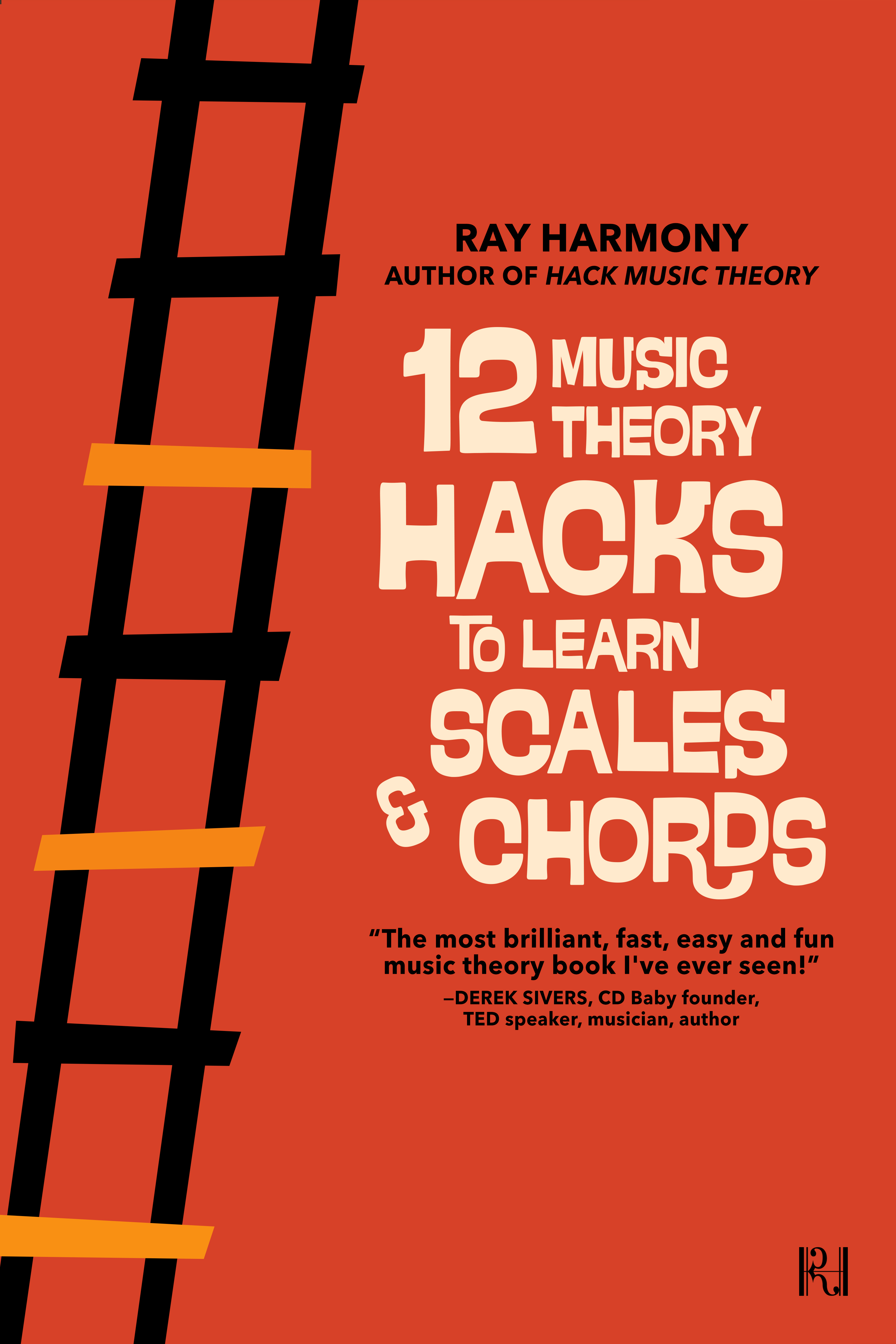
    Alright, so open your DAW and set the tempo to 100 BPM. Then create a track for your melody, make a six-bar section, and set the grid to 1/8 notes. This example is in the key of G minor, and if you find keys, scales and chords a bit confusing, then download our free book: 12 Music Theory Hacks to Learn Scales & Chords. The link is below.

    So, start by making a two-bar melody using 1/8 notes. And as this lesson is focused on looping, we’re not gonna cover how to write a good melody here, but if you need help with that, then simply use the Melody Checklist in our Songwriting & Producing PDF. The PDF also contains our other essential music making hacks. Over 10,000 producers around the world use this guide as their studio handbook. So if you’re struggling with your music, this PDF is for you!

    Right, now it’s time for the juicy part. So, copy and paste your melody into bars three and four. Then, instead of leaving your melody as it is, you’re going to rhythmically displace it by an 1/8 note or a 1/4 note. In other words, move your looped melody a little earlier or later. Björk moves the second repetition of her melody an 1/8 note later, so we did that too.

    Next, copy and paste your original melody into bars five and six. Then displace that third repetition as well. Björk actually did something even cooler here: she didn’t displace the first half of her melody, only the second half. She did this by moving it a 1/4 note later. We did the same thing, so you can hear how cool it is!

    Then, to make her music even more creative, when Björk repeats this section later in the song, she actually changes the displacements again. This totally captivates your brain, because even though you’re expecting the displacements in the repetition of that section, they’re not where you expect them to be. Utterly brilliant!

    BONUS

    And here’s a bonus hack from Björk. This section in her song is only six bars, not the usual eight bars. So it actually sounds like it ends too early, which grabs your attention yet again. If you want your music to sound less weird than Björk, which I’m guessing you do, then use eight bars for this section. That will create familiarity.

    And just a warning. There’s one caveat to rhythmically displacing your melody. If you’ve already written a chord progression and/or bass line below, then you’ll need to make sure that your displaced melody still works over that underlying harmony.

    Free Book

    Wooohooo!!! You’re a mere 30 minutes away from being even smarter than you already are. Just head on over to your inbox now for your free download.

    There was an error submitting your subscription. Please try again.

    “The most brilliant, fast, easy & fun music theory book I’ve ever seen!” DEREK SIVERS, CD Baby founder We use this field to detect spam bots. If you fill this in, you will be marked as a spammer. DOWNLOAD FREE BOOK

    Podcast

    Listen below, or on any podcast app.


    Previous 1 5 6 7 8 9 25 Next

    Related Podcasts

    Twenty Thousand Hertz

    1

    Twenty Thousand Hertz Arts
    NPR Music

    2

    NPR Music Music
    Here’s The Thing with Alec Baldwin

    3

    Here’s The Thing with Alec Baldwin Arts
    Drink Champs

    4

    Drink Champs Music
    Soundtracking with Edith Bowman

    5

    Soundtracking with Edith Bowman Music
    Red FM Bauaa

    6

    Red FM Bauaa Music
    footer-logo

    Contact Us

    Toll Free: 844-670-7747

    Links

    • Home
    • Top Charts
    • Networks
    • Apps
    • Independents Podcasts
    • Podcast Advertising
    • Podcast News
    • Contact Us
    • About Us
    • Analytics & Insights

    Stay Connected

      Privacy, Terms of Use & Our Code of Ethics Protecting Content Creators Copyrights