The unorthodoX ideas of multi award-winning music lecturer Ray Harmony. Older episodes were co-hosted by his wife and protégé Kate Harmony. As a songwriter and producer, Ray has made music with Grammy winners and multiplatinum artists, including Serj Tankian (System Of A Down) and Tom Morello (Rage Against The Machine). Join over 255,000 YouTube subscribers learning the fast, easy, and fun way to make music without using AI, cos it ain’t no fun getting a robot to write “your” songs! Download Ray’s free book at HackMusicTheory.com
Over the last few months, you've been learning the music theory hacks we used to write our new single "Down with the Drama". Well, we're super stoked to finally reveal the finished song. Enjoy!
Hello, we are Kate Harmony & Ray Harmony (AKA Revolution Harmony), and welcome to the Hack Music Theory show, where you are empowered with notation-free theory for making great music in DAWs.
CREDITS Sarah Serene - vocals Grey - vocals Ray Harmony - guitar Music by Ray Harmony Lyrics by Ray Harmony, Kate Harmony, Sarah Serene & Grey Produced by Ray Harmony & Kate Harmony Mixed & mastered by Meyrick de la Fuente
LYRICS
Always hatin’ Always complainin’ Switch attitude Get down with the beat Not the drama
Always wanting more followers By showing more skin A slave to desire
Down with the Drama
Always giving respect Loops around We learn when we listen Spiral to the edge One groove
Finding peace within myself In the days of demise Stay far away from negative vibes Once I took my close circle down to a fraction And cut out all the distractions I really started to makin’ my strides
It was time to groove different To truly improve how I’m livin’ Had to really get in tune wit decisions Manifest my greatness, stars aligned with the moon and da ribbons Now it’s time for me to move in position
Life is way too short just guard dat energy baby Keep an open eye man the closest been the enemies lately They see your light and try to dim at it daily And when its out they bring the Sun and the praise, the world we live in is crazy
Just try to keep it leveled to the ground With your spirit clean, keep the devils out Focus on your wild dreams, let ‘em level out And if you got that peace, we can settle now
Kate & Ray Harmony (AKA Revolution Harmony) Music Teachers & Producers in Vancouver BC, Canada
LEARN 1: Read our free book (below) & watch our YouTube videos 2: Read our "Part 1" book & "Songwriting & Producing" PDF 3: Learn our Secret Art of Song-Whispering & effortlessly finish music!
ABOUT Hack Music Theory is the pioneering notation-free method for making great music. Taught by award-winning music lecturer Ray Harmony, and his protégé (and wife) Kate Harmony, from their studio in Vancouver BC, Canada. Ray is the author of critically-acclaimed book series "Hack Music Theory", and has made music with Serj Tankian (System of a Down), Tom Morello (Rage Against the Machine), Steven Wilson (Porcupine Tree), Ihsahn (Emperor), Kool Keith (Ultramagnetic MCs), Madchild (Swollen Members), and many more. Kate has the highest grade distinction in Popular Music Theory from the London College of Music, and is the only person on the planet who's been trained by Ray to teach his Hack Music Theory method! While these Hack Music Theory YouTube lessons teach music theory for producers and DAW users, they are designed to accommodate all music makers (songwriters, guitarists, etc.) and all genres, from Electronic Music to R&B, Pop to Hip-Hop, Reggae to Rock, EDM/Dance to Metal (and yes, we djefinitely Djent!).
Wooohooo!!! You’re a mere 30 minutes away from being even smarter than you already are. Just head on over to your inbox now for your free download.
There was an error submitting your subscription. Please try again.
“The most brilliant, fast, easy & fun music theory book I’ve ever seen!” DEREK SIVERS, CD Baby founder
We use this field to detect spam bots. If you fill this in, you will be marked as a spammer.
DOWNLOAD FREE BOOK
How to Write an Arpeggio Chord Progression like David Guetta "Don't Leave Me Alone"
Jul 27, 2018
Show notes
Happy New Music Friday! David Guetta’s new single “Don’t Leave Me Alone” (feat. Anne-Marie) dropped today, so in this music theory lesson, you'll learn how to write arpeggios like David Guetta. But first… Tea!
Hello! I’m Kate Harmony, this is Ray Harmony, and welcome to the new Hack Music Theory show (yeah it’s like Hack Music Theory v2.0). Every Friday, we’ll hack the theory of a big new release, and you’ll learn how to use that theory creatively in your own music. You can think of it as hot-off-the-press” music theory news, you can actually use!
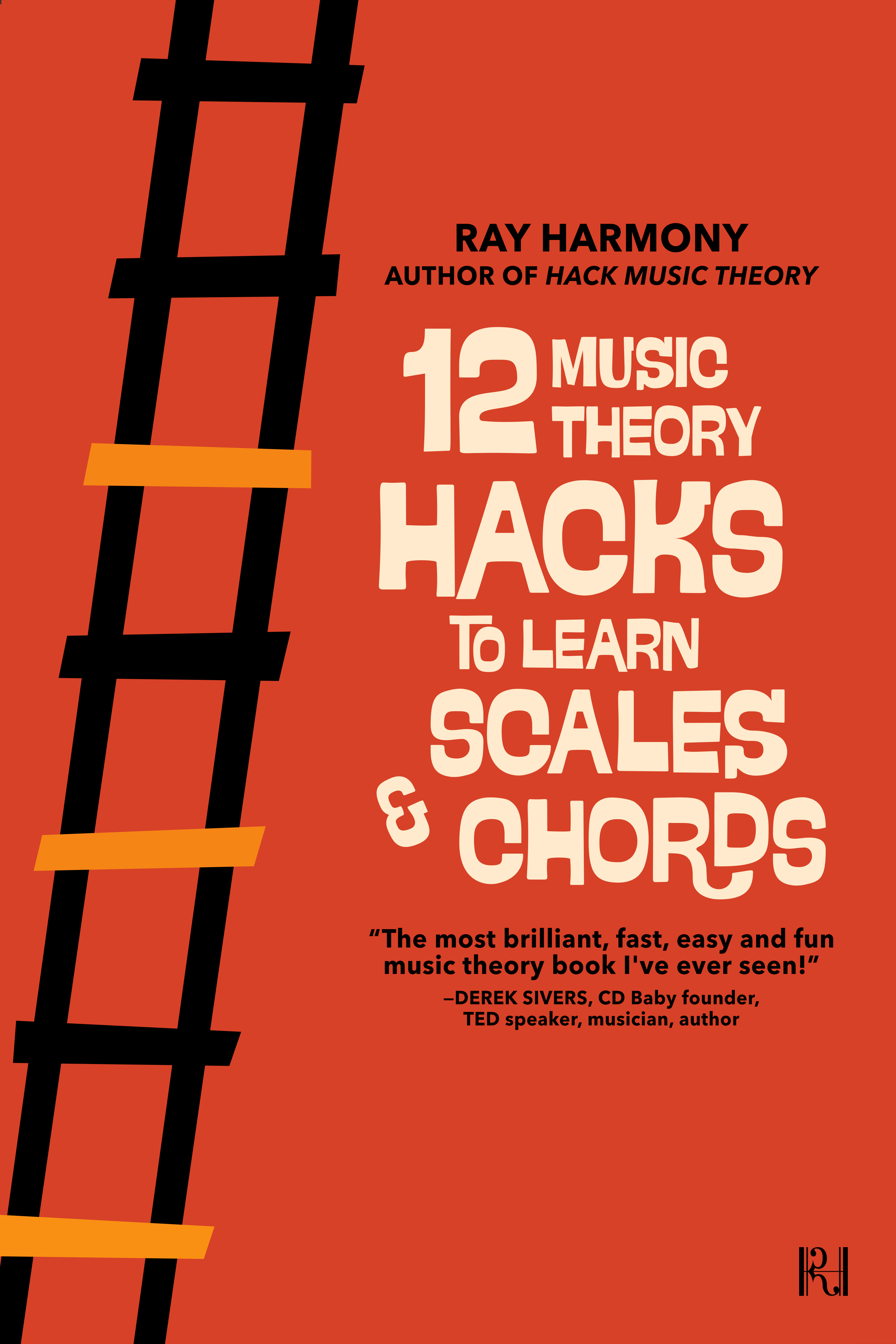
And if you’re new to our channel, just a heads up, we cover all genres here, from Hip-Hop to EDM to Metal, and everything in between. But please note, this is a strictly classical and jazz free zone! Also, the hack that you’re about to witness is at an intermediate level, so this video will make more sense if you’ve got a solid theory foundation, which you can get in a mere 30 minutes, if you read our free book “12 Music Theory Hacks to Learn Scales & Chords” (free download below). Alright, it’s time to open your DAW to hack music theory.
THE THEORY
An arpeggio is created by simply playing a chord, one note at a time. This technique contrasts the usual "block chords" we hear in most songs, where the notes of each chord are played simultaneously. While block chords work great in some sections, their thick texture can be too much for other sections. “Don’t Leave Me Alone” is the perfect example of this, as David Guetta uses arpeggios for the verses, but block chords for the rest of the song. This contrast makes the verses sound super chill, and the drop sound super massive!
THE HACK
Right, to make arpeggios, you need chords first, so start by choosing a key and writing a chord progression. David chose a minor key for his chord progression, but then he starts the progression on the relative major key’s root chord. This creates an uplifting beginning to the chord progression, as it sounds like it’s in a major key, but then things start getting sad when we reach the real key’s root chord, which is minor. Let me show you what I mean. So to keep things simple, we’re in the key of A minor here. And using our white-note hack, you get A minor by playing all the white notes from A to A. Then, to find the relative major key, you simply count up to the third note of your minor scale. So, the relative major key of A minor, is C major. What that means, is that A minor and C major have the exact same notes. If that seems like sorcery to you, then you definitely need to read our free book (download below)!
So, by starting our progression on the Cmaj chord, listeners will think we’re in the key of C major, but then when we hit the Am chord, they’re gonna start getting drawn into the key of A minor, and they’re not getting out! And if you’re interested in why this is in the key of A minor, and not C major, it’s because of all the time spent on the Am chord, which anchors this progression into the key of A minor. And by the way, if you need help writing chord progressions, check out the simple step-by-step guide in our Songwriting & Producing PDF (click & scroll down).
Finally, here’s a couple other things to consider when writing arpeggios. Be sure to use different note values for variation. David actually only uses 1/8 notes in his arpeggios, so we’ve thrown in a few 1/16 notes to spice things up. Also, change some chords in your progression on unexpected beats. Every time David changes chords, it’s on beat 1 or beat 3, so we’ve added some variation by changing chords on beat 2 (here) and beat 4+.
Just a couple quick things before the final playthrough. Firstly, we intentionally wrote these arpeggios to be very similar to David Guetta’s, but we did that for the sake of this lesson. So, now that you know the theory hack, we want you to explore how you can use it creatively with your own musical personality, so it sounds like you! Secondly, if you wanna learn how to write great songs (and finish them!), then check out our cutting-edge online apprenticeship course, where you’ll join over 400 apprentices from over 40 countries, who’re all learning our secret art of song-whispering!
Alright, that’s it. We really hope you found this video helpful, and if you did, subscribe and hit the bell to get notifications. Also, what do you think of this new David Guetta single? We’d love to know, so drop us a comment on YouTube. Thanks for joining the Hack Music Theory revolution, enjoy the video/podcast, and we’ll see you next week!
Kate & Ray Harmony (AKA Revolution Harmony) Music Teachers & Producers in Vancouver BC, Canada
LEARN 1: Read our free book (below) & watch our YouTube videos 2: Read our "Part 1" book & "Songwriting & Producing" PDF 3: Learn our Secret Art of Song-Whispering, and effortlessly finish your music!
ABOUT Hack Music Theory is the pioneering notation-free method for making great music. Taught by award-winning music lecturer Ray Harmony, and his protégé (and wife) Kate Harmony, from their studio in Vancouver BC, Canada. Ray is the author of critically-acclaimed book series "Hack Music Theory", and has made music with Serj Tankian (System of a Down), Tom Morello (Rage Against the Machine), Steven Wilson (Porcupine Tree), Ihsahn (Emperor), Kool Keith (Ultramagnetic MCs), Madchild (Swollen Members), and many more. Kate has the highest grade distinction in Popular Music Theory from the London College of Music, and is the only person on the planet who's been trained by Ray to teach his Hack Music Theory method! While these Hack Music Theory YouTube lessons teach music theory for producers and DAW users, they are designed to accommodate all music makers (songwriters, guitarists, etc.) and all genres, from Electronic Music to R&B, Pop to Hip-Hop, Reggae to Rock, EDM/Dance to Metal (and yes, we djefinitely Djent!).
Wooohooo!!! You’re a mere 30 minutes away from being even smarter than you already are. Just head on over to your inbox now for your free download.
There was an error submitting your subscription. Please try again.
“The most brilliant, fast, easy & fun music theory book I’ve ever seen!” DEREK SIVERS, CD Baby founder
We use this field to detect spam bots. If you fill this in, you will be marked as a spammer.
DOWNLOAD FREE BOOK
How to Write a Bass Line like DJ Khaled "No Brainer"
Jul 27, 2018
Show notes
In this 60-second music theory lesson, you'll learn how to write a bass line like DJ Khaled.
Hello, we are Kate Harmony & Ray Harmony (AKA Revolution Harmony), and welcome to the Hack Music Theory show. This is a 60-second special on DJ Khaled's new single "No Brainer" (ft. Justin Bieber, Chance the Rapper, Quavo).
We really hope you find this music theory lesson helpful, and if you do, be sure to subscribe to our YouTube channel, and hit the bell to get notifications. Thanks for joining the Hack Music Theory revolution, and we'll see you next time!
Kate & Ray Harmony (AKA Revolution Harmony) Music Teachers & Producers in Vancouver BC, Canada
LEARN 1: Read our free book (below) & watch our YouTube videos 2: Read our "Part 1" book & "Songwriting & Producing" PDF 3: Learn our Secret Art of Song-Whispering, and effortlessly finish music!
ABOUT Hack Music Theory is the pioneering notation-free method for making great music. Taught by award-winning music lecturer Ray Harmony, and his protégé (and wife) Kate Harmony, from their studio in Vancouver BC, Canada. Ray is the author of critically-acclaimed book series "Hack Music Theory", and has made music with Serj Tankian (System of a Down), Tom Morello (Rage Against the Machine), Steven Wilson (Porcupine Tree), Ihsahn (Emperor), Kool Keith (Ultramagnetic MCs), Madchild (Swollen Members), and many more. Kate has the highest grade distinction in Popular Music Theory from the London College of Music, and is the only person on the planet who's been trained by Ray to teach his Hack Music Theory method! While these Hack Music Theory YouTube lessons teach music theory for producers and DAW users, they are designed to accommodate all music makers (songwriters, guitarists, etc.) and all genres, from Electronic Music to R&B, Pop to Hip-Hop, Reggae to Rock, EDM/Dance to Metal (and yes, we djefinitely Djent!).
Wooohooo!!! You’re a mere 30 minutes away from being even smarter than you already are. Just head on over to your inbox now for your free download.
There was an error submitting your subscription. Please try again.
“The most brilliant, fast, easy & fun music theory book I’ve ever seen!” DEREK SIVERS, CD Baby founder
We use this field to detect spam bots. If you fill this in, you will be marked as a spammer.
DOWNLOAD FREE BOOK
How to Write a Drum Beat - The 1 That Got Away (Music Theory Hack)
Jul 23, 2018
Show notes
In this video, you’ll discover why your kick drum on beat 1 just isn’t kicking, and you’ll learn how you can overcome this obstacle. But first... Tea!
Hello, we are Kate Harmony & Ray Harmony (AKA Revolution Harmony), and welcome to the Hack Music Theory show, where you are empowered with notation-free theory for making great music in DAWs.
HACK 1 - The 1 That Got Away Playing a kick drum on beat 1 of your bar, gives your music, well... a kick. However, a kick drum on beat 1 of every bar will quickly result in your listeners acclimating to this. It’s like when your fridge turns on. You notice it at first, but then the hum blends into the background and you don’t hear it any more. So, in order to stop your beat 1 kicks from blending into the background, you need to prevent your listeners from getting used to them. And, as absence makes the heart grow fonder, the best way to keep your beat 1 kick kicking, is to leave it out of every other bar. This “missing” kick on beat 1, is what we call: The 1 That Got Away!
Yeah so these are our kicks down here on C2, and you can see we’re kicking beat 1 in bar one, but then in bar two, no kick on beat 1. And then same again for bars three and four: we’ve got a kick on beat 1 in bar three, but then in bar four, no kick on beat 1. This drum hack is so simple, but so powerful, and you can instantly apply it to any of your drum beats (by simply deleting the kick on beat 1 in every other bar), which will ensure that when you do play the kick on beat 1, it really kicks!
HACK 2 - Wear Different Hats While open hi-hats on all the offbeat 1/8 notes will get heads bobbing, it’s definitely not enough to keep those heads coming back for more. So, to make a more advanced drum beat (which doesn’t just groove, but also offers your listeners a creative pattern to explore), you need to wear different hats. In other words, after you’ve programmed your offbeat 1/8 notes, take off your “open hats” hat, and put on your “closed hats” hat. Closed hats are great for quick notes (as the sound is short and tight), so have fun experimenting with some 1/16 note patterns on your closed hats. Also, if your tempo is slow enough (like ours here, which is 95 bpm), throw in a few 1/32 notes as well, but be sparing with these, as they’re intense!
So, we started by anchoring our closed hats into the drum beat, by playing a closed hat on beats 1 and 3 of every bar (which is conventionally where the kick would be). This adds weight to those beats, and allows the closed hats to act as a counterbalance to the offbeat open hats. Next, wherever you have the most space between kicks (for us, that’s between beat 2+ and beat 4 in bars two and four), that’s where you can really do something creative with your closed hats, as they won’t interfere with your kicks. Then lastly, sprinkle in a few 1/32 notes for extra spice (like we did here), and you’re done!
EXAMPLE The example in this video is the bridge section from of our upcoming single “Down with the Drama”, which features the amazing Sarah Serene on vocals. If you missed any of our previous videos on this song, check out our YouTube playlist.
MORE If you want a more in-depth lesson on how to write a drum beat, we suggest our video: 3 Hacks for Better Drum Beats.
Lastly, do you struggle to finish your music? If you do, then check out our online apprenticeship course, where you’ll learn how to effortlessly write new sections for existing sections, how to transition between them, and most importantly, how to finish your songs! For more info, just head on over to our Apprenticeship Course. Alright, enjoy the video/podcast.
Kate & Ray Harmony (AKA Revolution Harmony) Music Teachers & Producers in Vancouver BC, Canada
LEARN 1: Read our free book (below) & watch our YouTube videos 2: Read our "Part 1" book & "Songwriting & Producing" PDF 3: Learn how to become a song-whisperer, and effortlessly finish music!
ABOUT Hack Music Theory is the pioneering notation-free method for making great music. Taught by award-winning music lecturer Ray Harmony, and his protégé (and wife) Kate Harmony, from their studio in Vancouver BC, Canada. Ray is the author of critically-acclaimed book series "Hack Music Theory", and has made music with Serj Tankian (System of a Down), Tom Morello (Rage Against the Machine), Steven Wilson (Porcupine Tree), Ihsahn (Emperor), Kool Keith (Ultramagnetic MCs), Madchild (Swollen Members), and many more. Kate has the highest grade distinction in Popular Music Theory from the London College of Music, and is the only person on the planet who's been trained by Ray to teach his Hack Music Theory method! While these Hack Music Theory YouTube lessons teach music theory for producers and DAW users, they are designed to accommodate all music makers (songwriters, guitarists, etc.) and all genres, from Electronic Music to R&B, Pop to Hip-Hop, Reggae to Rock, EDM/Dance to Metal (and yes, we djefinitely Djent!).
Wooohooo!!! You’re a mere 30 minutes away from being even smarter than you already are. Just head on over to your inbox now for your free download.
There was an error submitting your subscription. Please try again.
“The most brilliant, fast, easy & fun music theory book I’ve ever seen!” DEREK SIVERS, CD Baby founder
We use this field to detect spam bots. If you fill this in, you will be marked as a spammer.
DOWNLOAD FREE BOOK
How to Write a Synth Bass Line like The Prodigy "Need Some1"
Jul 20, 2018
Show notes
In this video, you'll learn how The Prodigy use (and abuse!) the Phrygian mode to write a killer bass synth melody in their new single "Need Some1". But first... Tea!
Hello, we are Kate Harmony & Ray Harmony (AKA Revolution Harmony), and welcome to the Hack Music Theory show, where you are empowered with notation-free theory for making great music in DAWs.
So… today The Prodigy just dropped the lead single “Need Some1” from their upcoming album “No Tourists”. And, considering I’ve been a Prodigy fan since 1994, and considering they’re using a really interesting scale in the main synth line of this new single, I’ve hacked the music theory behind it and I’m gonna show you how you can use this theory in your own music.
One of the main reasons why The Prodigy stands out from most other electronic music, is their super edgy sound! This allows them to crossover and reach fans in other genres, which not many other artists can pull off. For example, they could be headlining an electronic festival one weekend, and a rock festival the next weekend. The Prodigy’s edgy sound is actually not due to the synths they’re using (yeah of course that helps), but the main thing behind their sound, is musical dissonance. And this new single “Need Some1” is the perfect example!
They’re using the Phrygian mode, which is the dark mode, and that is what’s causing the awesome dissonance (i.e. that edgy sound!). Using our white-note hack, you can get Phrygian mode when you play all the white notes from E to E. Remember, once you’ve finished writing your synth line, you can simply select all the MIDI and move it up or down to start wherever you want (The Prodigy song starts on F♯). But, The Prodigy have given Phrygian a little twist. They’re playing the major 6 instead of the minor 6. So if you’re starting from E, like we are here, then this means your notes are: E F G A B C♯ D. Click play above to get stuck into the rest of this lesson!
Lastly, do you struggle to finish your music? If you do, then check out our online apprenticeship course, where you’ll learn how to effortlessly write new sections for existing sections, how to transition between them, and most importantly, how to finish your songs! For more info, just head on over to our Apprenticeship Course. Alright, enjoy the video/podcast.
Kate & Ray Harmony (AKA Revolution Harmony) Music Teachers & Producers in Vancouver BC, Canada
LEARN 1: Read our free book (below) & watch our YouTube videos 2: Read our "Part 1" book & "Songwriting & Producing" PDF 3: Learn how to become a song-whisperer, and effortlessly finish music!
ABOUT Hack Music Theory is the pioneering notation-free method for making great music. Taught by award-winning music lecturer Ray Harmony, and his protégé (and wife) Kate Harmony, from their studio in Vancouver BC, Canada. Ray is the author of critically-acclaimed book series "Hack Music Theory", and has made music with Serj Tankian (System of a Down), Tom Morello (Rage Against the Machine), Steven Wilson (Porcupine Tree), Ihsahn (Emperor), Kool Keith (Ultramagnetic MCs), Madchild (Swollen Members), and many more. Kate has the highest grade distinction in Popular Music Theory from the London College of Music, and is the only person on the planet who's been trained by Ray to teach his Hack Music Theory method! While these Hack Music Theory YouTube lessons teach music theory for producers and DAW users, they are designed to accommodate all music makers (songwriters, guitarists, etc.) and all genres, from Electronic Music to R&B, Pop to Hip-Hop, Reggae to Rock, EDM/Dance to Metal (and yes, we djefinitely Djent!).
Wooohooo!!! You’re a mere 30 minutes away from being even smarter than you already are. Just head on over to your inbox now for your free download.
There was an error submitting your subscription. Please try again.
“The most brilliant, fast, easy & fun music theory book I’ve ever seen!” DEREK SIVERS, CD Baby founder
We use this field to detect spam bots. If you fill this in, you will be marked as a spammer.
DOWNLOAD FREE BOOK
Resting for Energy - Music Theory Hack for Better Bass Lines
Jul 16, 2018
Show notes
In this Hack Music Theory lesson, you'll discover why your bass lines lack energy, and we'll give you two hacks to fix it. But first... Tea!
Hello, we are Kate Harmony & Ray Harmony (AKA Revolution Harmony), and welcome to the Hack Music Theory show, where you are empowered with notation-free theory for making great music in DAWs.
HACK 1 - Resting for Energy Counterintuitively, adding lots of well-placed rests to your bass line, actually adds energy to it. And there’s two ways you can do this to pump up your low-end. Firstly, adding a rest before a note that’s on the beat, gives that note extra punch. And secondly, adding a rest before a note that’s off the beat, gives that note extra groove. And yes, this bass hack works in all situations, but it’s even more effective when the chords above are smoothly connected (which is known as “legato”), as that contrast provides space for your pumping bass line to do its thang!
Alright so let’s have a look at some examples of those two types of rests. You can see that the first note of our bass line has been shortened, to create a rest on beat 2, which adds extra groove to the note coming in on beat 2+. We then use this same type of rest again on beat 4, to also add extra groove to the note coming in on beat 4+. But then in our second bar, we totally change things up, by using the other type of rest on beat 3, which gives the note on beat 4 an extra punch. Then that’s immediately followed by the other type of rest again at the beginning of our third bar, which brings back that extra groove on beat 1+.
HACK 2 - Phat ♭5 If you’re already using the “funky trio of notes” in your bass line, as we are in the first three beats, then you can kick things up to a whole new level, by borrowing the ♭5 from the Blues scale. And by the way, if you don’t know about the “funky trio of notes”, or the Blues scale, you can learn about all that (and a bunch more) in our Songwriting & Producing PDF. So, using the ♭5 creates a delightfully dirty dissonance, which ramps up the phatness of your bass line big time. You can find the ♭5 by moving one semitone down from the 5 in your key. For example, in our key of F♯ minor, the 5 is C♯, so the ♭5 is C♮. Beware though, this note is non-diatonic (AKA not in the key), so it’s gonna clash with your chords above, and that’s why the ♭5 usually works best as a quick note.
Yeah exactly, and you can see we have two ♭5s in our bass line, one high C and one low C, and both of them are 16th notes. What’s even more interesting though, is that while our first C is over the F♯m chord, our second C is over the E chord, so that second C is actually perceived as a ♭6, not a ♭5. And the context of this E chord makes the C a little less dissonant than it was over the F♯m chord, and that’s a powerful hack in itself. So, use the phat ♭5 over your key’s root chord for maximum dirty dissonance, and try it over another chord in your key for a slightly diluted dissonance, like we did here over the E, which is our ♭VII chord.
EXAMPLE The example in this video is the bridge section from of our upcoming single “Down with the Drama”, which features the amazing Sarah Serene on vocals. If you missed any of our previous videos on this song, check out our YouTube playlist.
Lastly, do you struggle to finish your music? If you do, then check out our online apprenticeship course, where you’ll learn how to effortlessly write new sections for existing sections, how to transition between them, and most importantly, how to finish your songs! For more info, just head on over to our Apprenticeship Course. Alright, enjoy the video/podcast.
Kate & Ray Harmony (AKA Revolution Harmony) Music Teachers & Producers in Vancouver BC, Canada
LEARN 1: Read our free book (below) & watch our YouTube videos 2: Read our "Part 1" book & "Songwriting & Producing" PDF 3: Learn how to become a song-whisperer, and effortlessly finish music!
ABOUT Hack Music Theory is the pioneering notation-free method for making great music. Taught by award-winning music lecturer Ray Harmony, and his protégé (and wife) Kate Harmony, from their studio in Vancouver BC, Canada. Ray is the author of critically-acclaimed book series "Hack Music Theory", and has made music with Serj Tankian (System of a Down), Tom Morello (Rage Against the Machine), Steven Wilson (Porcupine Tree), Ihsahn (Emperor), Kool Keith (Ultramagnetic MCs), Madchild (Swollen Members), and many more. Kate has the highest grade distinction in Popular Music Theory from the London College of Music, and is the only person on the planet who's been trained by Ray to teach his Hack Music Theory method! While these Hack Music Theory YouTube lessons teach music theory for producers and DAW users, they are designed to accommodate all music makers (songwriters, guitarists, etc.) and all genres, from Electronic Music to R&B, Pop to Hip-Hop, Reggae to Rock, EDM/Dance to Metal (and yes, we djefinitely Djent!).
Wooohooo!!! You’re a mere 30 minutes away from being even smarter than you already are. Just head on over to your inbox now for your free download.
There was an error submitting your subscription. Please try again.
“The most brilliant, fast, easy & fun music theory book I’ve ever seen!” DEREK SIVERS, CD Baby founder
We use this field to detect spam bots. If you fill this in, you will be marked as a spammer.
DOWNLOAD FREE BOOK
Why People Don't Sing Your Chord Progressions
Jul 09, 2018
Show notes
In this Hack Music Theory video, you’ll learn why people aren't singing along to your chord progressions, and we’ll give you two hacks to solve this problem once and for all. But first... Tea!
Hello, we are Kate Harmony & Ray Harmony (AKA Revolution Harmony), and welcome to the Hack Music Theory show, where you are empowered with notation-free theory for making great music in DAWs.
HACK 1 - Chords Can Sing Have you ever noticed how people don’t really sing along to chord progressions? Instead, they’ll wait for the vocals to come in, then sing along to the vocal melody. The reason behind this phenomenon, is that even the simplest type of chord (known as a triad), offers the listener a choice of three different notes to sing. And this choice happens with every chord in a progression. So for example, if someone is listening to a chord progression containing four triads, the amount of note choices is 3x3x3x3, resulting in a whopping 81 potential melodies to sing.
But wait, doesn’t that give them 81 reasons to sing? Nope, because this is the paradox of choice. It’s like when you’re in the grocery store trying to buy a box of organic green tea, but there’s shelves and shelves of different types of organic green tea (welcome to our world haha!), and as a result of the vast amount of choices, you’re totally overwhelmed and can’t decide, so you just walk away. And that is exactly what happens to listeners when they hear chord progressions; the vast amount of note choices totally overwhelms them, so they don’t sing any. Don’t worry though, our Chords Can Sing hack solves this issue once and for all, and will definitely get your listeners singing along to your chord progressions!
Right, so if you’ve used the chord hacks in our Songwriting & Producing PDF, you’ll be starting this hack with a well-written chord progression, which includes inversions and sus chords. Now, you need to pull out a melody from your chord progression (by choosing one note from each chord), for your listeners to sing along to. And once you’ve decided on your melody, copy and paste it an octave higher, so it’s now above your chords. This hack makes it sound like your chords are singing, which will in turn make your listeners sing. It works for two reasons: Firstly, it gives your listeners a defined melody to sing along to, and secondly, our ears are drawn to melodies in higher octaves, cos they’re in the vocal range, so doubling this melody above the chords (instead of below), pushes it to the front of the stage and into the spotlight!
HACK 2 - Motifation Now that you’ve given your listeners something to sing, you need to give them the motifation to sing it! Listeners will only feel motivated to sing a catchy melody. And what makes a melody catchy? Yep. Motifs! A motif is a short musical idea, and by repeating it, you make your melody memorable. So now it’s time for what we call “motif hunting”. Motif hunting is when you search through your musical content, hunting for an idea that stands out. When you find that idea, you can then creatively repeat it, thereby turning it into a motif. Using our Chords Can Sing hack together with our Motifation hack, will ensure your chords not only sing, but their melody gets stuck in your listeners’ heads!
When we were motif hunting, we found something in our second bar: a beautiful descending melody, which really stands out due to its contour and rhythm. And by repeating that idea in our last bar, we’ll make our melody super catchy. So, let’s move down to the E on beat two, and add in a C♯ on beat 4, so the contour and rhythm match our second bar. And with that, we’re done!
EXAMPLE The example in this video is the bridge section from of our upcoming single “Down with the Drama”, which features the amazing Sarah Serene on vocals. If you missed any of our previous videos on this song, check out our YouTube playlist.
Lastly, do you struggle to finish your music? If you do, then check out our online apprenticeship course, where you’ll learn how to effortlessly write new sections for existing sections, how to transition between them, and most importantly, how to finish your songs! For more info, just head on over to our Apprenticeship Course. Alright, enjoy the video/podcast.
Kate & Ray Harmony (AKA Revolution Harmony) Music Teachers & Producers in Vancouver BC, Canada
LEARN 1: Read our free book (below) & watch our YouTube videos 2: Read our "Part 1" book & "Songwriting & Producing" PDF 3: Learn how to become a song-whisperer, and effortlessly finish music!
ABOUT Hack Music Theory is the pioneering notation-free method for making great music. Taught by award-winning music lecturer Ray Harmony, and his protégé (and wife) Kate Harmony, from their studio in Vancouver BC, Canada. Ray is the author of critically-acclaimed book series "Hack Music Theory", and has made music with Serj Tankian (System of a Down), Tom Morello (Rage Against the Machine), Steven Wilson (Porcupine Tree), Ihsahn (Emperor), Kool Keith (Ultramagnetic MCs), Madchild (Swollen Members), and many more. Kate has the highest grade distinction in Popular Music Theory from the London College of Music, and is the only person on the planet who's been trained by Ray to teach his Hack Music Theory method! While these Hack Music Theory YouTube lessons teach music theory for producers and DAW users, they are designed to accommodate all music makers (songwriters, guitarists, etc.) and all genres, from Electronic Music to R&B, Pop to Hip-Hop, Reggae to Rock, EDM/Dance to Metal (and yes, we djefinitely Djent!).
Wooohooo!!! You’re a mere 30 minutes away from being even smarter than you already are. Just head on over to your inbox now for your free download.
There was an error submitting your subscription. Please try again.
“The most brilliant, fast, easy & fun music theory book I’ve ever seen!” DEREK SIVERS, CD Baby founder
We use this field to detect spam bots. If you fill this in, you will be marked as a spammer.
DOWNLOAD FREE BOOK
The #1 Way to Hook People
Jul 02, 2018
Show notes
Learn the No.1 way to hook people with your intros, so your songs don’t end up in the one-quarter of all songs played on Spotify that are skipped within their first five seconds. But first... Tea!
Hello, we are Kate Harmony & Ray Harmony (AKA Revolution Harmony), and welcome to the Hack Music Theory show, where you are empowered with notation-free theory for making great music in DAWs.
HACK 1 - Save The Chorus As we spoke about in our last video, a great intro gives away just enough hooky musical content (to pull your listeners in), but no more than that. This allows you to hold back the vast majority of content, which you can then drip out through the rest of your song, to ensure your listeners are hooked till the very last note. It’s worth noting here, that this approach is actually relatively new. In the old music industry (where people bought music), there was no need to make a hooky intro, as listeners would usually wait until the chorus before deciding whether to buy the song. This allowed us to be way more creative with our intros. However, in the new music industry (where people stream music, and literally have tens of millions of songs in the palm of their hand), listeners are arriving at their verdict within seconds, instead of waiting to hear the chorus. This puts us under enormous pressure to make our intros ultra mega hooky, in order to avoid that dreaded skip button (or the swipe). Sadly though, this leads far too many songwriters and producers to give away their choruses in their intros. But as a result of this colossal compromise, listeners get bored halfway through these songs, as not enough content was held back to maintain their attention till the end. It’s important to remember here, that every song is different, and therefore requires a different structure. So, while using a stripped-down version of your chorus for an intro may work for some of your songs, it will definitely not be the right structure for most of your songs. And yes, there is a way to have your chorus and eat it! All you need to do is write a new section (specifically for your intro), which is super hooky, too. This gives your streaming listeners what they demand, while also allowing you to save the chorus for later in your song.
HACK 2 - Harmonize the Shadow Millions of years of evolution has hardwired us to instantly connect with the human voice, so the No.1 way to hook your listeners with your intro, is vocals! So, start by writing a short melodic phrase, using just a few notes (we’re using the 2, the 1, and the ♭3). Also, be sure to use syncopation, which is the accenting of an off-beat (we start our melodic phrase on a 1/16 note syncopation, then we follow that with an 1/8 note syncopation - super groovy!). Now, copy and paste your phrase into bar two, and for variation, move it left or right to start on a different beat. Then, copy and paste those two phrases into bars three and four, and mute them. The first two phrases are your lead melody, and the second two phrases are its shadow. This “shadow melody” is gonna be sung in your backing vocals, and your lead melody is gonna harmonize it. But remember, shadows are slightly distorted, so be sure to make a little change to your shadow, for variation. Our little change was adding more syncopation to our shadow, by singing the last note (in both phrases) a 1/16 early. Far too many intros use far too much repetition (in a desperate attempt to hook people), so this hack allows you to use the repetition needed to hook people, but, by passing that repetition over to your backing vocals, it also allows your lead vocals to sing something new, so your listeners don’t get bored. Finally, connect the two halves of your lead melody, by adding a few notes in between, and you’re done!
EXAMPLE The example in this video is the intro section from of our upcoming single “Down with the Drama”, which features the amazing Sarah Serene on vocals. If you missed any of our previous videos on this song, check out our YouTube playlist.
Lastly, do you struggle to finish your music? If you do, then check out our online apprenticeship course, where you’ll learn how to effortlessly write new sections for existing sections, how to transition between them, and most importantly, how to finish your songs! For more info, just head on over to our Apprenticeship Course. Alright, enjoy the video/podcast.
Kate & Ray Harmony (AKA Revolution Harmony) Music Teachers & Producers in Vancouver BC, Canada
LEARN 1: Read our free book (below) & watch our YouTube videos 2: Read our "Part 1" book & "Songwriting & Producing" PDF 3: Learn how to become a song-whisperer, and effortlessly finish music!
ABOUT Hack Music Theory is the pioneering notation-free method for making great music. Taught by award-winning music lecturer Ray Harmony, and his protégé (and wife) Kate Harmony, from their studio in Vancouver BC, Canada. Ray is the author of critically-acclaimed book series "Hack Music Theory", and has made music with Serj Tankian (System of a Down), Tom Morello (Rage Against the Machine), Steven Wilson (Porcupine Tree), Ihsahn (Emperor), Kool Keith (Ultramagnetic MCs), Madchild (Swollen Members), and many more. Kate has the highest grade distinction in Popular Music Theory from the London College of Music, and is the only person on the planet who's been trained by Ray to teach his Hack Music Theory method! While these Hack Music Theory YouTube lessons teach music theory for producers and DAW users, they are designed to accommodate all music makers (songwriters, guitarists, etc.) and all genres, from Electronic Music to R&B, Pop to Hip-Hop, Reggae to Rock, EDM/Dance to Metal (and yes, we djefinitely Djent!).
Wooohooo!!! You’re a mere 30 minutes away from being even smarter than you already are. Just head on over to your inbox now for your free download.
There was an error submitting your subscription. Please try again.
“The most brilliant, fast, easy & fun music theory book I’ve ever seen!” DEREK SIVERS, CD Baby founder
We use this field to detect spam bots. If you fill this in, you will be marked as a spammer.
DOWNLOAD FREE BOOK
How to Write a Song Intro - Music Theory Hacks for Catchy Bass Lines
Jun 25, 2018
Show notes
In this Hack Music Theory lesson, you’ll learn how to write a bass line that hooks your listeners into your song within seconds. But first... Tea!
Hello, we are Kate Harmony & Ray Harmony (AKA Revolution Harmony), and welcome to the Hack Music Theory show, where you are empowered with notation-free theory for making great music in DAWs.
A great intro is a musical tease! It reveals very little of the song, while totally hooking us in to ensure we keep listening. Think of an intro like a trailer for a song, and just like movie trailers, there’s three types: 1) the trailer that’s so desperate for you to watch the movie, it gives everything away, but now you don’t need to watch the movie. 2) the trailer that’s attempting to lure you in with a mysteriously abstract taste, but you have absolutely no idea what the movie is actually about, so you don’t watch it. And finally, 3) the “goldilocks” trailer that acts as a window through which you glimpse the movie, but now you have questions, and if you wanna know the full story, you’ll need to watch the full movie!
HACK 1 - One. Two. Boo! The ultimate goal for every intro is to give away enough to keep people listening, while also holding back enough to maintain their interest till the end of your song. And the way to achieve this is through our easy psychological hack: One. Two. Boo! Here’s how it works. Create a simple pattern that your listeners can instantly follow, and then repeat it once - this will trigger their brains’ reward system, as they’ll correctly predict the recurrence of your pattern. But then, at the end of your second loop, vary the pattern unexpectedly. And boo! Thanks to a good dose of dopamine, your listeners are now mentally and physiologically hooked into your song! And as you can see, our simple pattern consists of a couple long F♯s (our root note), played on beat 1 and beat 2+, which is a classic hip-hop rhythm. And then on beat 4 we’ve got a 1/4 note rest, which sets up the expectation of that rest recurring at the end of our second loop, but that’s exactly where the unexpected variation hits! Instead of a 1/4 note rest, we give ‘em a couple quick 1/16 notes and a couple 1/16 note syncopations, which is an accenting of the off-beat that pumps up the energy of your rhythm.
HACK 2 - Vary the Variation The great irony of variation, is that if you repeat it, it’s no longer variation. This is how an unexpected and thrilling variation can quickly turn into a predictable disappointment the second time round. So, in order to deliver another dopamine hit to your listeners, which will keep them listening beyond your intro, you need to vary the variation! Start by looping your “One. Two. Boo!” pattern, and then, on the second “Boo!”, change it up to totally surprise your listeners yet again. And with that, they settle in and take their fingers off that dreaded Skip button! Yeah so you can see our second “Boo!” is completely different to our first “Boo!”. Instead of starting on beat 4, it starts on beat 3e, and instead of going down, it goes up, and instead of going to a diatonic note (a note that’s in the scale), it goes to a very unexpected ♭2, which is a non-diatonic note (a note that’s not in the scale). And finally, for one last massive dopamine hit, we’re gonna bring back this intro after our second chorus (just before the bridge), which will beautifully tie the song together, while also creating a comforting familiarity right before we change things up in the bridge!
EXAMPLE The example in this video is the intro section from of our upcoming single “Down with the Drama”, which features the amazing Sarah Serene on vocals. If you missed any of our previous videos on this song, check out our YouTube playlist.
MORE If you want a more in-depth lesson, we suggest our 15-minute video: How to Write a Bass Line
Lastly, do you struggle to finish your music? If you do, then check out our online apprenticeship course, where you’ll learn how to effortlessly write new sections for existing sections, how to transition between them, and most importantly, how to finish your songs! For more info, just head on over to our Apprenticeship Course. Alright, enjoy the video/podcast.
Kate & Ray Harmony (AKA Revolution Harmony) Music Teachers & Producers in Vancouver BC, Canada
LEARN 1: Read our free book (below) & watch our YouTube videos 2: Read our "Part 1" book & "Songwriting & Producing" PDF 3: Learn how to become a song-whisperer, and effortlessly finish music!
ABOUT Hack Music Theory is the pioneering notation-free method for making great music. Taught by award-winning music lecturer Ray Harmony, and his protégé (and wife) Kate Harmony, from their studio in Vancouver BC, Canada. Ray is the author of critically-acclaimed book series "Hack Music Theory", and has made music with Serj Tankian (System of a Down), Tom Morello (Rage Against the Machine), Steven Wilson (Porcupine Tree), Ihsahn (Emperor), Kool Keith (Ultramagnetic MCs), Madchild (Swollen Members), and many more. Kate has the highest grade distinction in Popular Music Theory from the London College of Music, and is the only person on the planet who's been trained by Ray to teach his Hack Music Theory method! While these Hack Music Theory YouTube lessons teach music theory for producers and DAW users, they are designed to accommodate all music makers (songwriters, guitarists, etc.) and all genres, from Electronic Music to R&B, Pop to Hip-Hop, Reggae to Rock, EDM/Dance to Metal (and yes, we djefinitely Djent!).
Wooohooo!!! You’re a mere 30 minutes away from being even smarter than you already are. Just head on over to your inbox now for your free download.
There was an error submitting your subscription. Please try again.
“The most brilliant, fast, easy & fun music theory book I’ve ever seen!” DEREK SIVERS, CD Baby founder
We use this field to detect spam bots. If you fill this in, you will be marked as a spammer.
DOWNLOAD FREE BOOK
How to Write a Lead Melody - 2 Music Theory Hacks for Better Melodies
Jun 18, 2018
Show notes
In this Hack Music Theory lesson, you’ll learn two hacks that will make your lead melodies grab the attention of your listeners. But first... Tea!
Hello, we are Kate Harmony & Ray Harmony (AKA Revolution Harmony), and welcome to the Hack Music Theory show, where you are empowered with notation-free theory for making great music in DAWs.
HACK 1 - 7 Up Lead melodies need to grab your listeners’ ears and demand their minds’ attention, otherwise your song will just blur into background music. So, in this world of ever-increasing distraction, how can your lead melody get someone’s attention? Easy, you just use our 7 Up hack! Evolution has programmed our minds to ignore everyday things (like the trees on a road you walk down every day), and instead pay attention to extraordinary things (like the first tree on that road to eventually blossom). So if you want your song to be the first to blossom, then write your lead melody with a huge interval in it, like a 7th. This hack works because small intervals are considered everyday things (they’re even heard in speech all the time), but large intervals are super rare and therefore super exciting! And lastly, for extra attention, go a 7th up (instead of down). You can see we actually start our lead melody with a 7 Up, so we’re wasting no time at all in grabbing our listeners attention! No time like the present, right? And just in case you’re not sure how to get the interval of a 7th, it’s super easy, you just start by going an octave up from whatever note you’re on, and then you just move one note down in your scale, and that’s your 7 Up. And depending on your scale or mode, you’ll either get a major 7th (which is 11 semitones), or a minor 7th (which is 10 semitones). We’ve got a minor 7th here, cos if you count all the semitones from C♯ up to B, you’ll see there’s 10. And remember, counting semitones is like counting stairs in a staircase, you don’t count the ground. So in other words, the note you start on is not counted (the first step up is one semitone).
HACK 2 - Endings Are for Quitters! The end of a bar, is just that, the end of a bar. It does not need to be the end of your melody. Most songwriters and producers don’t consider this, and automatically finish their melodies on (or before) the end of a bar. But endings are for quitters! One of the best hacks for writing a flowing yet unpredictable lead melody, is to hold your last note in the bar over the bar line, and into the next bar! This hack loosens up that rigid structure so many melodies adhere to, and it even creates the illusion that your lead melody is floating above the music, making it even more attention-grabbing! You can see we’re holding this E over the bar line and into the next bar. And that brings us onto an awesome side effect of this hack. Because you’re holding one note over two chords, that note’s feeling changes. Check this out: the E is a 5 over the Amaj, which sounds totally resolved, but then when the chord changes to F♯m, the E becomes a very tense ♭7, which injects a sudden momentum into the melody, cos it now desperately wants to move on and resolve. And finally, for even more melodic fluidity, end your held note on a 1/4 note beat, then give your melody an 1/8 note rest, and then start your melody again on the off-beat 1/8 note. So tasty! Think of it like this: if that unexpected held note over the bar line is your rainbow, then this surprising syncopation is your pot of gold. And with that, your listeners are now your fans!
EXAMPLE The example in this video is the verse section from of our upcoming single “Down with the Drama”, which features the amazing Sarah Serene on vocals. If you missed any of our previous videos on this song, check out our YouTube playlist.
Lastly, do you struggle to finish your music? If you do, then check out our online apprenticeship course, where you’ll learn how to effortlessly write new sections for existing sections, how to transition between them, and most importantly, how to finish your songs! For more info, just head on over to our Apprenticeship Course. Alright, enjoy the video/podcast.
Kate & Ray Harmony (AKA Revolution Harmony) Music Teachers & Producers in Vancouver BC, Canada
LEARN 1: Read our free book (below) & watch our YouTube videos 2: Read our "Part 1" book & "Songwriting & Producing" PDF 3: Learn how to become a song-whisperer, and effortlessly finish music!
ABOUT Hack Music Theory is the pioneering notation-free method for making great music. Taught by award-winning music lecturer Ray Harmony, and his protégé (and wife) Kate Harmony, from their studio in Vancouver BC, Canada. Ray is the author of critically-acclaimed book series "Hack Music Theory", and has made music with Serj Tankian (System of a Down), Tom Morello (Rage Against the Machine), Steven Wilson (Porcupine Tree), Ihsahn (Emperor), Kool Keith (Ultramagnetic MCs), Madchild (Swollen Members), and many more. Kate has the highest grade distinction in Popular Music Theory from the London College of Music, and is the only person on the planet who's been trained by Ray to teach his Hack Music Theory method! While these Hack Music Theory YouTube lessons teach music theory for producers and DAW users, they are designed to accommodate all music makers (songwriters, guitarists, etc.) and all genres, from Electronic Music to R&B, Pop to Hip-Hop, Reggae to Rock, EDM/Dance to Metal (and yes, we djefinitely Djent!).
Wooohooo!!! You’re a mere 30 minutes away from being even smarter than you already are. Just head on over to your inbox now for your free download.
There was an error submitting your subscription. Please try again.
“The most brilliant, fast, easy & fun music theory book I’ve ever seen!” DEREK SIVERS, CD Baby founder
We use this field to detect spam bots. If you fill this in, you will be marked as a spammer.
DOWNLOAD FREE BOOK

 Our TOPPODCAST Picks
  Stay Connected