Encore: Oscar Micheaux, Kathleen Driskell And Soul Food, Inside Appalachia
Jul 03, 2026
Show notes
In the 1920s, Oscar Micheaux was an entrepreneur filmmaker in western Virginia. He became a world-renowned director and producer.
Also, Kentucky’s poet laureate lives down the road from what has been called the country’s most lethal cryptid. Attempts to spot it have led to deaths.
And, we talk soul food with Xavier Oglesby, who's passing on generations of kitchen wisdom to his niece.
You'll hear these stories and more this week, Inside Appalachia.
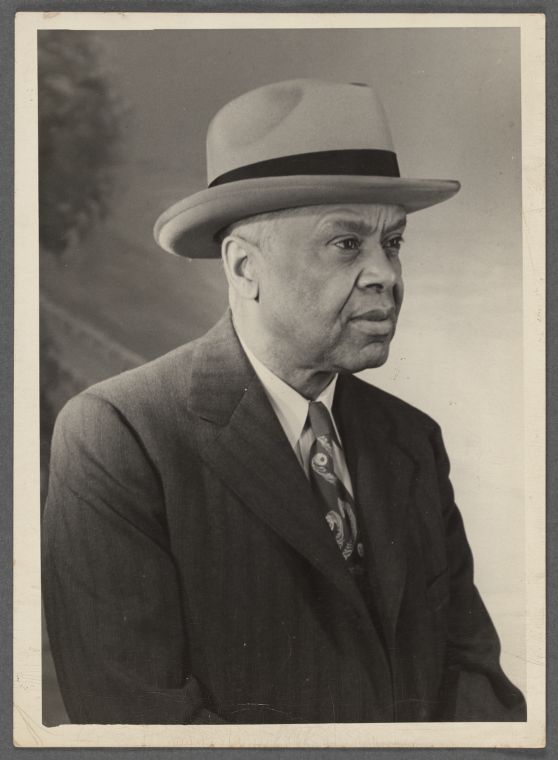
How Oscar Micheaux Changed Filmmaking From Appalachia
Oscar Micheaux. Courtesy of the New York Public Library
One of America’s pioneering filmmakers had nothing to do with Hollywood but nevertheless left his mark on the emerging industry. Oscar Micheaux was a homesteader, who then turned his attention to making movies in the early 1900s. He was a Black man who made movies for Black audiences at a time when they weren't allowed into mainstream, white-only theaters. And for several pivotal years in the 1920s, he operated out of Roanoke, Virginia.
Host Mason Adams brings us this story.
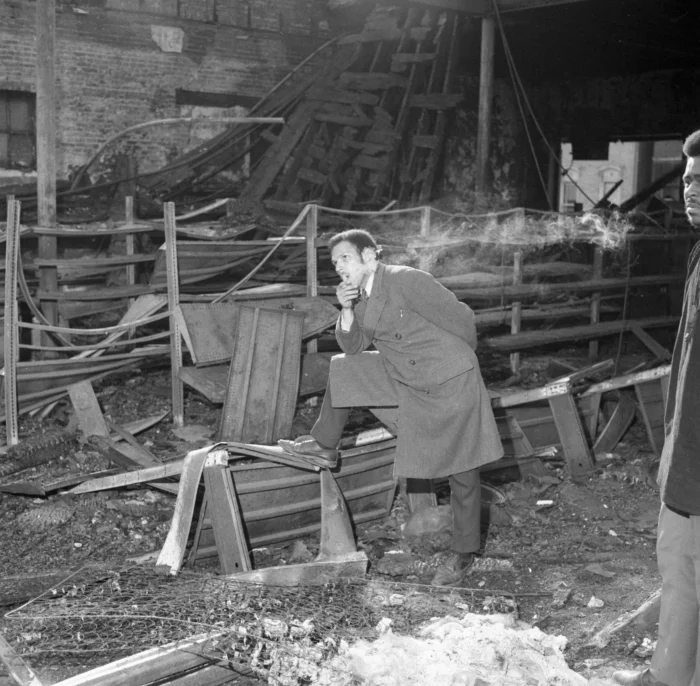
Playwright August Wilson's Life And Legacy
In a 1968 photo, playwright August Wilson poses amidst the burnt remains of the Hill District's Mainway Market, torched in the riots following the assassination of Martin Luther King Jr. Courtesy of the Frank F. Hightower Photograph Collection/University of Pittsburgh Press
Acclaimed playwright August Wilson was deeply influenced by his hometown of Pittsburgh. Wilson was the author of 10 plays collectively known as The Pittsburgh Cycle. They include the Pulitzer Prize winning plays Fences and The Piano Lesson. Now there’s a new book about him, titled August Wilson’s American Century, by University of Pittsburgh professor Lawrence Glasco, and it explores that deep influence with his hometown.
WESA’s Bill Driscoll spoke with Glasco.
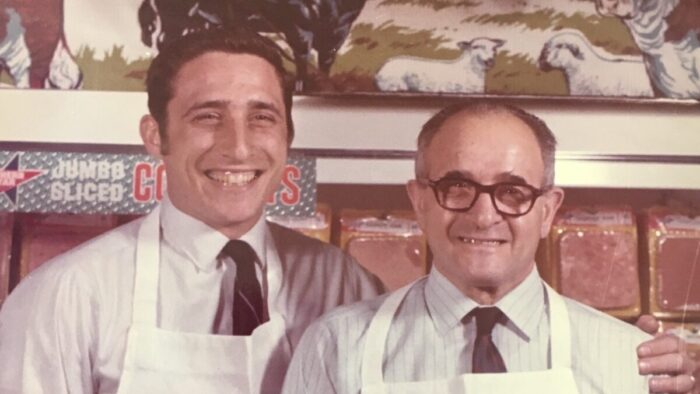
Angelo’s Old World Italian Sausage
Sonny (left) and his father Angelo pose in front of the meat case at Angelo’s Market in Powellton Hollow. From father to son to father to son, Angelo's Old World Italian Sausage has been around in the hills of West Virginia for a while. Courtesy of the Argento Family
In 2023, Folkways Reporter Zack Harold took us to Angelo’s Old World Italian Sausage. Angelo’s makes a craft sausage distributed throughout West Virginia, as well in southern Ohio and eastern Kentucky. The recipe comes from the Calabria region of Italy, and it’s made in West Virginia.
Kentucky Poet Laureate Talks Deadly Cryptids
Kentucky’s governor appoints a new poet laureate every two years. Last year, Gov. Andy Beshear named award-winning poet, essayist and teacher Kathleen Driskell to the post. Driskell’s poems have appeared in The New Yorker, Rattle and Appalachian Review, among others. She’s authored six poetry collections. Her most recent is Goat-Footed Gods.
Producer Bill Lynch spoke with Driskell about living next to the dead, and America’s most lethal cryptid.
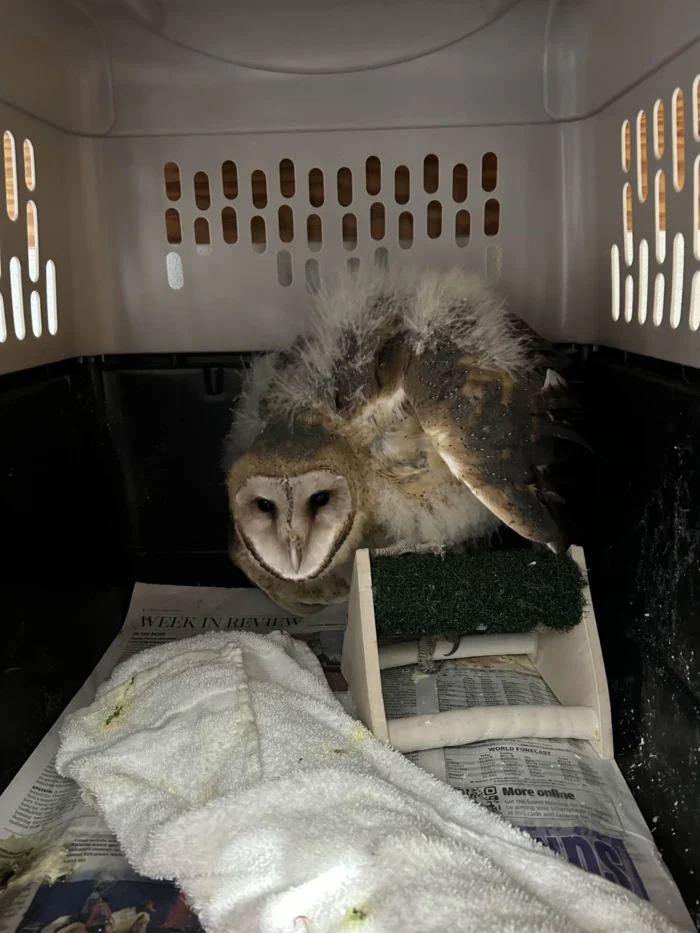
Baby Barn Owl That Left His Nest Too Soon
The juvenile barn owl was safely kept and transported in a dog crate. Courtesy of the Wildlife Center of Virginia
The Wildlife Center of Virginia in Waynesboro treats hundreds of injured animals every year, from possums, to eagles, to bear cubs. And even a fledgling barn owl that fell from its nest in a grain silo in Augusta County.
WMRA's Meredith McCool has more.
Sharing Soul Food
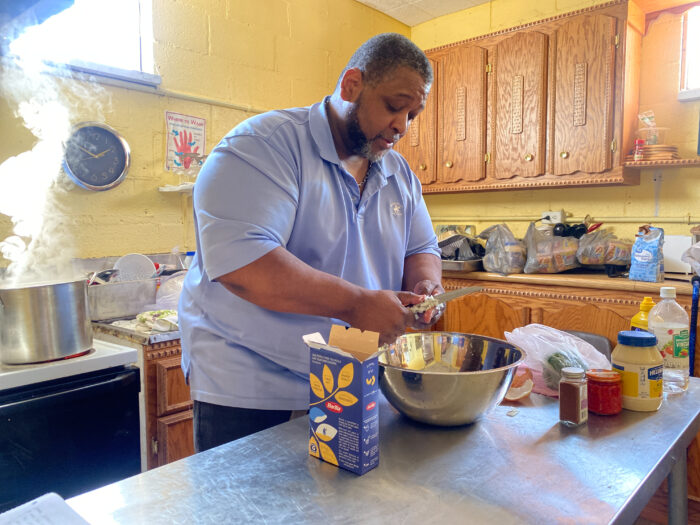
Xavier Oglesby cuts onions for a macaroni salad he is cooking inside Manna House Ministries’ kitchen. A pot of boiling water is behind him, cooking the pasta for the dish. Photo Credit: Vanessa Peña/West Virginia Public Broadcasting
Soul food like cornbread, extra-cheesy mac-n-cheese and collard greens plays an important role in Black communities across Appalachia. In 2023, Folkways Fellow Vanessa Peña spoke with Xavier Oglesby, a master artist in soul food cooking from Beckley, West Virginia.
--
Our theme music is by Matt Jackfert. Other music this week was provided by John Blissard, Bennie Moten Kater, Tim Bing, Paul Loomis, John Inghram and Blue Dot Sessions.
Bill Lynch is our producer. Abby Neff is our associate producer. Our executive producer is Eric Douglas. Kelley Libby is our editor. Our audio mixer is Patrick Stephens. We had help this week from Folkways Editors Nicole Musgrave and Chris Julin.
You can send us an email: InsideAppalachia@wvpublic.org.
Inside Appalachia is a production of West Virginia Public Broadcasting.
A Look At Filmmaker Oscar Micheaux’s Impact, This West Virginia Morning
Jul 02, 2026
Show notes
On this West Virginia Morning, Inside Appalachia this week discusses the influence and contributions of Oscar Micheaux, an African American filmmaker who lived in Virginia in the 1920s. Mason Adams speaks with Roanoke historian Jordan Bell about Micheaux's life and career.
Also, a private school has been put on probation and another has been permanently disqualified from participating in the Hope Scholarship program.
And, a new West Virginia business partnership is investing millions of dollars in the byproducts of coal mining.
Finally, the state of West Virginia has finished the fiscal year ahead of projections for revenue.
West Virginia Morningis a production of West Virginia Public Broadcasting which is solely responsible for its content.
Support for our news bureaus comes from Shepherd University and Marshall University School of Journalism and Mass Communications.
West Virginia Morning is produced with help from Bill Lynch, Chris Schulz, Eric Douglas and Maria Young.
Eric Douglas is our news director. Teresa Wills is our host. Maria Young is our producer.
Listen to West Virginia Morning weekdays at 7:49 a.m. on WVPB Radio or subscribe to the podcast and never miss an episode. #WVMorning
The Robotic Future Of Caring For The Elderly, This West Virginia Morning
Jul 01, 2026
Show notes
On this West Virginia Morning, West Virginia has one of the highest percentages of elderly residents in the nation. As baby boomers grow elderly amidst a workforce crisis of caretakers, WESA's Kiley Koscinski reports that both the U.S. and Japan are considering robots as a potential solution as part of this “Designing Dignity” series.
Also the Supreme Court of the United States rules that West Virginia's law barring transgender women from girls' sports can stand, and hospital consolidations play a considerable role in the closures of labor and delivery services.
West Virginia Morning is a production of West Virginia Public Broadcasting, which is solely responsible for its content.
Support for our news bureaus comes from Shepherd University and Marshall University School of Journalism and Mass Communications.
Maria Young produced this episode.
Listen to West Virginia Morning weekdays at 7:49 a.m. on WVPB Radio or subscribe to the podcast and never miss an episode. #WVMorning
New Program Aims To Keep Seniors At Home, This West Virginia Morning
Jun 30, 2026
Show notes
On this West Virginia Morning, as baby boomers in West Virginia and nationwide continue to age, more Gen X and Millennial adults are finding themselves as caregivers for their parents. Pittsburgh’s major health systems are designing a new program alongside federal agencies aimed at keeping seniors at home for as long as possible.
It’s a strategy Japan has been exploring for more than two decades.
In this “Designing Dignity” series, WESA’s Kiley Koscinski takes a look at how the country’s care managers bridge medical and social support.
Also, southern West Virginia saw significant flooding last week and Kentucky saw even more over the weekend. But a system to detect rising water isn’t any closer to completion.
And, the West Virginia Mine Wars Museum is creating the largest labor history driving trail in the United States, and community members have a chance to shape how it will look.
Finally, West Virginia’s America250 celebration kicks off in just a few short days. We bring you a snapshot on what to expect.
West Virginia Morning is a production of West Virginia Public Broadcasting, which is solely responsible for its content.
Support for our news bureaus comes from Shepherd University and Marshall University School of Journalism and Mass Communications.
Maria Young produced this episode.
Listen to West Virginia Morning weekdays at 7:49 a.m. on WVPB Radio or subscribe to the podcast and never miss an episode. #WVMorning
Appalachia’s Declining Bat Population, This West Virginia Morning
Jun 29, 2026
Show notes
On this West Virginia Morning, bats are the subject of myths and legends, often in a negative light. But that goes against the reality of their role in ecosystems, including critical agricultural services for humans. For the Appalachia + Mid-South Newsroom, West Virginia Public Broadcasting’s Eric Douglas reports bat populations have dropped significantly in the face of a changing climate and disease.
Also, Air National Guard Staff Sergeant Andrew Wolfe over the weekend was awarded the inaugural Freedom 250: Hometown Hero Award. Last November, Wolfe, and his partner U.S. Army Specialist Sarah Beckstrom, were on duty in Washington, D.C., when they were ambushed and shot. Specialist Beckstrom died from her injuries. Wolfe continues to recover.
And, the Supreme Court of the United States is expected to rule on a West Virginia case this week.
Finally, in a Saturday ceremony commemorating the 10th anniversary of devastating floods, the town of Clendenin received a $450,000 Transportation Alternatives Program grant.
West Virginia Morning is a production of West Virginia Public Broadcasting, which is solely responsible for its content.
Support for our news bureaus comes from Shepherd University and Marshall University School of Journalism and Mass Communications.
Maria Young produced this episode.
Listen to West Virginia Morning weekdays at 7:49 a.m. on WVPB Radio or subscribe to the podcast and never miss an episode. #WVMorning
A Very Big (Ferris) Wheel And Soda On SNAP, This West Virginia Week
Jun 27, 2026
Show notes
On this West Virginia Week, the world’s largest transportable Ferris wheel arrives in Charleston, the SNAP ban on soda is blocked, and we look at an effort to expand local medical care through EMS.
Bill Lynch is our host this week. Our theme music is by Matt Jackfert.
West Virginia Week is a web-only podcast that explores the week's biggest news in the Mountain State. It's produced with help from Bill Lynch, Chris Schulz, Eric Douglas and Maria Young.
Undated photo of Bristol’s Black Bottom. Courtesy of Black in Appalachia/Virginia Humanities
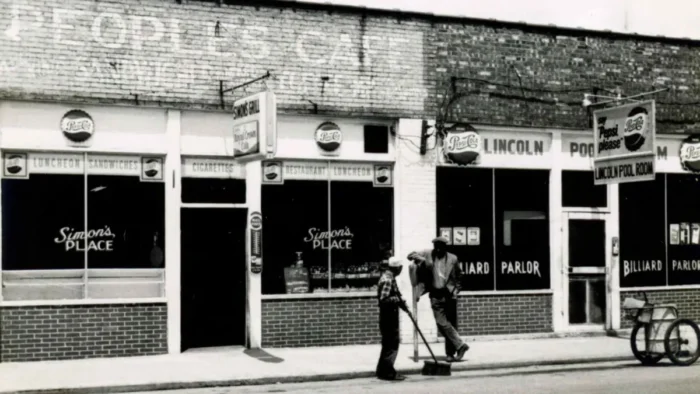
Urban renewal was a 20th century movement by local, state and federal governments to revitalize struggling cities. But Black neighborhoods and business districts were often sacrificed. In Bristol, Virginia, Black business owners ran barber shops, groceries and doctor’s offices in Black Bottom, which was leveled to make way for new streets and civic projects.
“The Souls of Bristol’s Black Bottom” is a partnership between Black in Appalachia and Virginia Humanities. The project uses interpretive signs, public art and digital storytelling to remember the community. Organizer and storyteller Tina McDaniel helps lead the project. She says learning about 'Black Bottom was a revelation.'
Host Mason Adams spoke to McDaniel about the project.
Roots Book Ban Reversed In Knox County, Tennessee
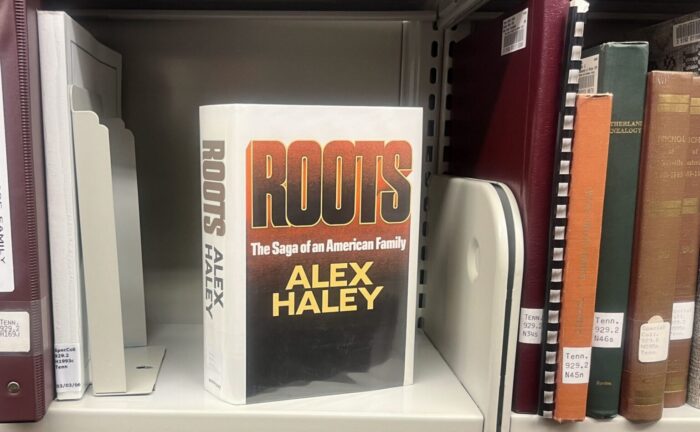
Alex Haley’s 1976 Roots is about the horrors of the slave trade in America and designated an official state book of Tennessee. Knox County recently backtracked its decision to remove the critically acclaimed book from school libraries. Photo Credit: Camellia Burris/WPLN
Knox County, Tennessee officials have reversed their decision to remove the book Roots from school libraries. In May, just a couple weeks prior, the book was banned by a school board committee.
Written by Alex Haley, the novel follows generations of a Black family from enslavement in America in the 1700s through changes and upheavals to the second half of the 20th century. Roots won a Pulitzer Prize and was adapted into an award-winning television miniseries.
It was one of 124 titles that have been removed from library shelves in Knox County. In particular, school board members objected to a depiction of rape of an enslaved woman by a slaveholder. Public outcry to the ban was immediate.
WPLN’s Camellia Burris reports.
Roadside Farmstand Gets An Upgrade
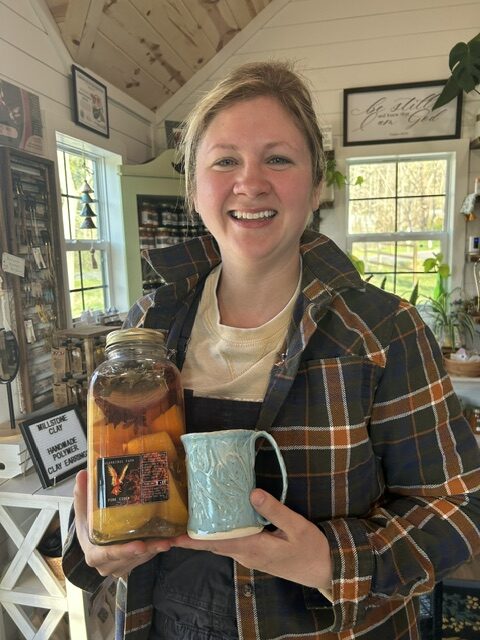
Jessica Camden, owner of Sugarbirds Farm Stand, holds two of the 30 vendors’ products available for sale inside. Photo Credit: Wendy Welch/West Virginia Public Broadcasting
Roadside farmstands with fresh eggs or tomatoes are a common sight in Appalachia. They can be a way for people, especially rural women with kids at home, to support themselves economically. They often work on the honor system; there’s nobody there. Take a carton of berries and leave some cash. But the humble farm stand is changing to keep up with an increasingly cash-free society.
Folkways Reporter Wendy Welch recently visited a stand in Wythe County, Virginia.
State Regulators Audit Kentucky Power After 20 Years
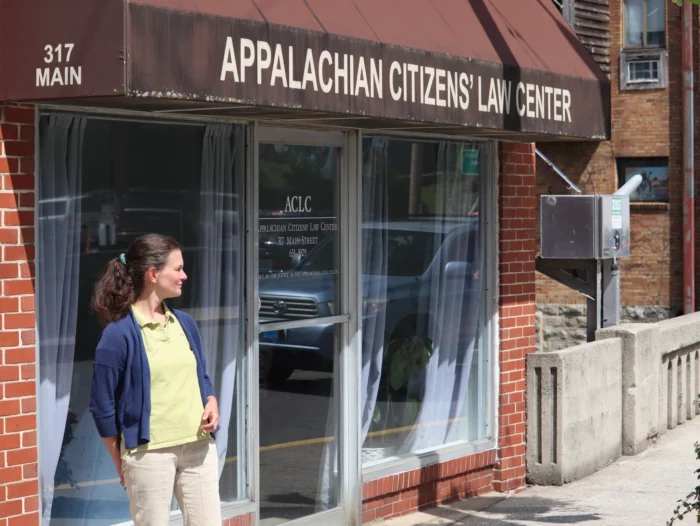
Mary Cromer, deputy director of the Appalachian Citizens' Law Center, stands outside of their Whitesburg offices. Photo Credit: Andrew Henderson/AMSN
Power bills have been rising across much of Appalachia. That’s the case in eastern Kentucky, too, and led to state regulators ordering an audit of Kentucky Power for the first time in more than 20 years.
Kentucky Public Radio’s Sylvia Goodman met with a new coalition that hopes the audit could lead to lower bills.
Volunteers Document Species In The Smoky Mountains
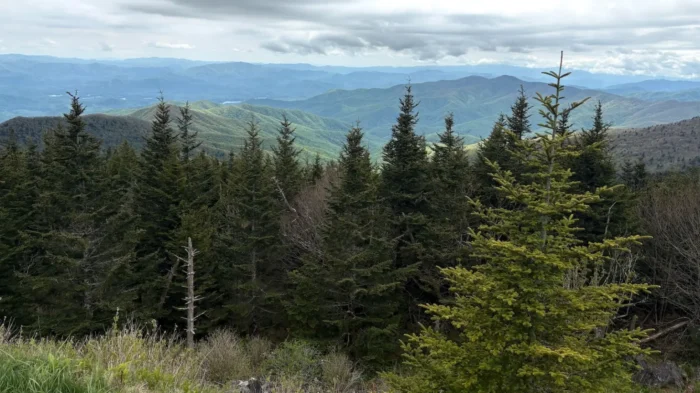
The Great Smoky Mountains are the most biodiverse site in the national park system. Every square foot of the park teems with life, much of which park visitors rarely see. Photo Credit: Katie Myers/Grist
For years, citizen scientists have been documenting plants and wildlife in the Great Smoky Mountains National Park. They do work the Park may not have capacity for, tracking changes in the ecosystem and helping us better understand Appalachia’s biodiversity.
BPR and Grist reporter Katie Myers tagged along with a group of volunteers into the Smokies.
Black Bears Are Migrating As Climate Change Threatens Habitat
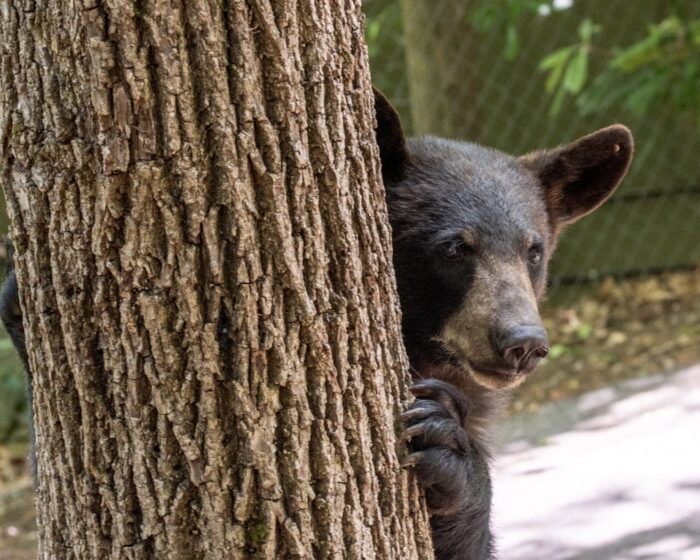
An adolescent bear scales a tree on May 20, 2026. Photo Credit: Caroline Eggers/WPLN
Black bear encounters are on the rise, and climate change is often a hidden culprit.
WPLN’s Caroline Eggers reports that Tennessee wildlife managers are working to promote peaceful coexistence.
The Vine That Ate The South
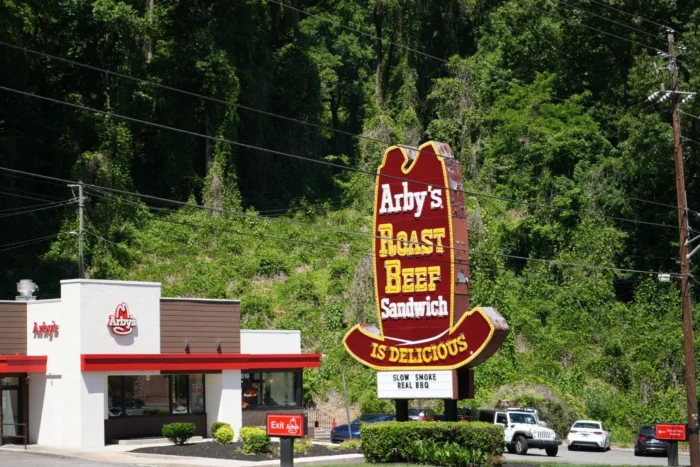
Kudzu covers a patch of woods behind an Arby’s in Knoxville, Tennessee on May 8, 2026. Photo Credit: Jacqui Sieber/WUOT
Kudzu is a leafy vine that has spread through the South and Appalachia, draping whole landscapes with its greenery. Some people find it beautiful, at least at first. But, it’s an invasive plant that can swallow entire sections of forests and choke out other plants.
WUOT’s Jacqui Sieber has more on efforts to tackle the “vine that ate the South.”
Herbicide Drones Are Killing Kudzu
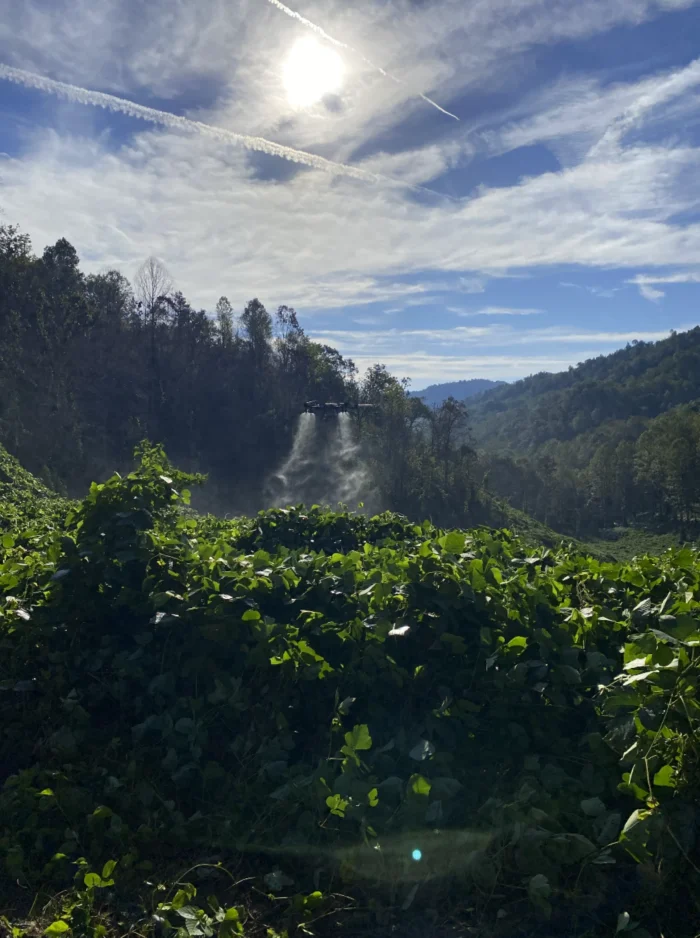
An herbicide-spraying drone douses a thicket of kudzu at one of Kentucky Fish and Wildlife's study sites last summer. Many sites like this are only accessible on foot or by air due to the vine's thickness and difficult terrain. Officials say drones like this can turn days or weeks of work into an afternoon. Photo Credit: Jacob Stewart/Kentucky Fish & Wildlife
Goats aren’t the only tool to keep kudzu in check. In Kentucky, wildlife officials are testing whether new drone technology could help fight kudzu.
Michael Collins with WKYU has more.
Herbalism In Appalachia
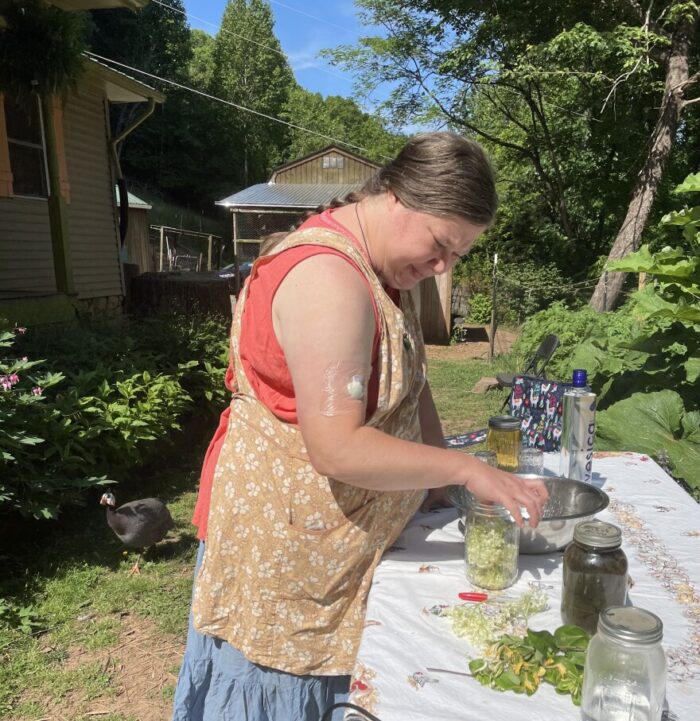
Crystal Wilson adds elderberry flowers to create a fever tincture as her guinea hens fuss around her feet. Photo Credit: Heather Duncan/West Virginia Public Broadcasting
In the warm months, a lot of people stock up on roots and herbs to use as medicines. Some, they grow, and others, they find in the woods. Here in Appalachia, those remedies have been a path to wellness and independence for centuries.
Folkways Reporter Heather Duncan has more.
--
Our theme music is by Matt Jackfert. Other music this week was provided by Erik Vincent Huey, Tim Bing, John Blissard, Mary Hott, Paul Loomis, Dinosaur Burps and Blue Dot Sessions
This week, we say goodbye to Kelley Libby. Kelley's been Inside Appalachia’s show editor since 2020 and was also a lead editor for the Folkways project. As much as anyone, Kelley has helped shape Inside Appalachia into the show that it is. Kelley, we can’t thank you enough. Good luck with your next adventure!
And, introducing Irina Zhorov, who will take over as show editor. We’re glad to have her.
Bill Lynch is our producer. Abby Neff is our associate producer. Our executive producer is Eric Douglas. Our audio mixer is Patrick Stephens. We had help this week from Folkways Editors Jennifer Goren and Molly Born.
You can send us an email: InsideAppalachia@wvpublic.org.
Inside Appalachia is a production of West Virginia Public Broadcasting.
Remembering ‘Black Bottom’ In Bristol, Va., This West Virginia Morning
Jun 26, 2026
Show notes
On this West Virginia Morning, urban renewal in the last century was supposed to revitalize struggling cities, but it often sacrificed Black neighborhoods and business districts, like Black Bottom in Bristol, Virginia. Inside Appalachia’s Mason Adams spoke with organizer Tina McDaniel about “The Souls of Bristol’s Black Bottom,” a project in Bristol that remembers the community through interpretive signs, public art and digital storytelling. McDaniel says learning about Black Bottom was a revelation.
Also, the Public Service Commission of West Virginia (PSC) has scheduled a public comment hearing for construction of a gas-electric generation plant in Monongalia County and three solar energy projects.
And, as West Virginia prepares to celebrate America’s 250th birthday, construction is underway on the Capitol grounds, where the world’s largest transportable Ferris wheel is going up.
West Virginia Morningis a production of West Virginia Public Broadcasting which is solely responsible for its content.
Support for our news bureaus comes from Shepherd University and Marshall University School of Journalism and Mass Communications.
West Virginia Morning is produced with help from Bill Lynch, Chris Schulz, Eric Douglas and Maria Young.
Eric Douglas is our news director. Teresa Wills is our host. Maria Young is our producer.
Listen to West Virginia Morning weekdays at 7:49 a.m. on WVPB Radio or subscribe to the podcast and never miss an episode. #WVMorning
Federal Cuts To Medicaid Endanger Addiction Treatment, This West Virginia Morning
Jun 25, 2026
Show notes
On this West Virginia Morning, federal cuts and changes to state law focused on Medicaid programs could undermine West Virginia’s drug addiction and treatment system for 50,000 residents. In the latest encore episode of Us & Them, which was recently honored with a regional Edward R. Murrow Award, host Trey Kay learns how Medicaid supports recovery organizations and what that work looks like.
Also a new data center is announced in Wheeling, changes to Medicaid benefit requirements and flooding in Boone County.
West Virginia Morning is a production of West Virginia Public Broadcasting, which is solely responsible for its content.
Support for our news bureaus comes from Shepherd University and Marshall University School of Journalism and Mass Communications.
Maria Young produced this episode.
Listen to West Virginia Morning weekdays at 7:49 a.m. on WVPB Radio or subscribe to the podcast and never miss an episode. #WVMorning
Us & Them Encore: Black West Virginians With Substance Use Disorder Face Unique Challenges
Jun 25, 2026
Show notes
This year, West Virginia lawmakers made significant changes to drug and alcohol treatment programs funded by Medicaid, which many people use. The new legislation ties Medicaid payments to patient outcomes rather than the number of patients served.
The Mountain State has the nation's highest overdose rates, and overdose death rates among Black residents exceed those of any other group. In this episode of Us & Them, host Trey Kay learns how Medicaid funding supports organizations working in recovery and what that work looks like on the ground.
This episode of Us & Them, recently honored with a Regional Edward R. Murrow Award for Excellence in Diversity, Equity and Inclusion, is presented with support from The Greater Kanawha Valley Foundation.
Subscribe to Us & Them on Apple Podcasts, YouTube Music, Spotify, the NPR app and wherever you get your podcasts.
Reverend James Patterson has led the Partnership of African American Churches (PAAC) for the past two decades as its founder and president/CEO. PAAC is a nonprofit, collaborative, faith-based community development corporation based in Charleston, WV, that also provides health care. Photo Credit: PAAC
"Every time we had discussions, I was doing focus group research. We started talking about kids, the challenges they face, and other issues in our communities. Everybody kept saying, 'the real problem is them drugs' — that’s exactly how they said it. So, we decided to do something about it. We began by implementing prevention programs and training community health workers, and then we trained them in peer support as recovery coaches."
Many Black West Virginians have had uncomfortable experiences when visiting the doctor — experiences that can discourage people of color from seeking medical care, mental health treatment or help for drug addiction. Dr. Wendy Lewis, clinical director for the Partnership of African American Churches and a researcher of this phenomenon, explains the impact of these encounters. Photo Credit: PAAC
"Every day, people face subtle but constant annoyances because of their color — especially Black people. They are insulted, invalidated and sometimes physically, verbally and mentally assaulted just for being Black. I see this as a double malady that people must overcome daily, particularly when they’re also dealing with addiction and racism. The stress they endure is something others rarely experience.
We are a licensed behavioral health center that provides treatment for substance use disorder. We offer a residential treatment facility, medication-assisted treatment and multiple sober living facilities."
— Dr. Wendy Lewis, clinical director for the Partnership of African American Churches, Charleston, WV
Kevin Watkins received training as a peer support coach from the Partnership of African American Churches. A native of Charleston’s Westside — a community with a high concentration of Black residents — Watkins describes the area as "the valley of the shadow of death" because many people he knew died too young. Watkins struggled with substance use disorder, starting with alcohol at a young age and later turning to marijuana, pills and, eventually, speed, which he injected. Photo Credit: PAAC
"I had a teacher who was trying to help me, to show me the right way. I was one of those kids with ADD—I could never sit still—so I spent most of my time in the office. I don't think he understood the full extent of my problem, or he wouldn’t have paddled me as he did. I knew I had issues when I tried to break into his house.
Looking back, I wonder why I did it all. Part of it was the divorce—my dad was never around, having started another family—so I never had the support system other kids had. I felt like I fell through the cracks in Orchard Manor. Sometimes I’d wake up in the old county jail, not even knowing why I was there, beat up and bleeding. I knew I had a serious situation on my hands."
— Kevin Watkins, peer support coach trained by the Partnership of African American Churches
Robert Hansen is retired after nearly 50 years in West Virginia's behavioral health field, including a two-year stint as director of the state’s Office of Drug Control Policy — known as the drug czar. Photo Credit: The Charleston Gazette-Mail
“Residential treatment programs in West Virginia have grown dramatically. Back in 2016, 2017 and 2018, the state had about 150 to 200 treatment beds. Today, there are more than 1,700. Providers are expanding services on the theory that Medicaid funding will continue.
The bulk of Medicaid money comes from the federal government — with Congress and the president’s approval — while West Virginia must supply matching dollars. The Partnership of African American Churches is funded similarly; as they apply for grants from the Bureau of Behavioral Health or the federal government, they have opportunities aligned with their expertise. Otherwise, their core funding is no different from any other addiction treatment provider."
— Robert Hansen, former director of West Virginia’s Office of Drug Control Policy.

 Our TOPPODCAST Picks
  Stay Connected