TopPodcast.com
Menu
  • Home
  • Top Charts
  • Top Networks
  • Top Apps
  • Top Independents
  • Top Podfluencers
  • Top Picks
    • Top Business Podcasts
    • Top True Crime Podcasts
    • Top Finance Podcasts
    • Top Comedy Podcasts
    • Top Music Podcasts
    • Top Womens Podcasts
    • Top Kids Podcasts
    • Top Sports Podcasts
    • Top News Podcasts
    • Top Tech Podcasts
    • Top Crypto Podcasts
    • Top Entrepreneurial Podcasts
    • Top Fantasy Sports Podcasts
    • Top Political Podcasts
    • Top Science Podcasts
    • Top Self Help Podcasts
    • Top Sports Betting Podcasts
    • Top Stocks Podcasts
  • Podcast News
  • About Us
  • Podcast Advertising
  • Contact
Not in our directory?
Add Show Here
Podcast Equipment
Center

toppodcastlogoOur TOPPODCAST Picks

  • Comedy
  • Crypto
  • Sports
  • News
  • Politics
  • True Crime
  • Business
  • Finance

Follow Us

toppodcastlogoStay Connected

    View Top 200 Chart
    Back to Rankings Page
    Games & Hobbies

    On the Media

    On the Media is a weekly show that uses the media as a lens to understand our world.  On the Media listeners say the show is an essential companion, helping them survive the firehose of media coming at them 24/7. Hosted by Brooke Gladstone and Micah Loewinger, the show does not do ‘hot takes’, instead offering listeners context, historical parallels, media analysis and often a much appreciated deep exhale. On the Media hosts have an eye on the nuances and details regularly missed by other outlets which helps listeners understand where they should be paying attention (and what they can afford to ignore). Our media diets have untruths woven in, and inconvenient truths left out. These are the bits explored every week at On the Media.

    Advertise

    Copyright: © WNYC

    • Apple Podcasts
    • Google Play
    • Spotify

    Latest Episodes:
    It's Time for Justice Sep 26, 2018
    Show notes

    On Tuesday, nearly four years since a viral comedy routine helped usher a long list of rape and sexual assault allegations against Bill Cosby into the fore, the once-beloved artist was sentenced to three to 10 years in a state prison. Years before Cosby's predatory behavior became public knowledge, rumors circulated in Hollywood and privileged circles, well within earshot of journalist Ta-Nehisi Coates. But, in a 2008 profile of Cosby for The Atlantic, Coates merely mentioned some of the sexual assault accusations in passing, without digging into the damning details. Whether willful denial or reckless mistake, this oversight would come to haunt him — so much that he fessed up and agreed to mull it all over with Bob back in 2014.

    On the Media is supported by listeners like you. Support OTM by donating today (https://pledge.wnyc.org/support/otm). Follow our show on Instagram, Bluesky, TikTok and Facebook @onthemedia, and share your thoughts with us by emailing onthemedia@wnyc.org.


    Hosted by Simplecast, an AdsWizz company. See pcm.adswizz.com for information about our collection and use of personal data for advertising.


    Make Amends Sep 21, 2018
    Show notes

    Senators are weighing serious allegations of attempted rape as they consider Judge Kavanaugh's nomination to the Supreme Court. Meanwhile, McDonald's employees in ten cities went on strike to bring attention to sexual harassment at the fast food chain. This week, we look at the ripples from the #MeToo movement and how much further they have to go.

    1. Dr. Christine Blasey Ford's expected testimony against Supreme Court nominee Brett Kavanaugh has echoes of Anita Hill's testimony against Clarence Thomas in 1991. Kai Wright [@kai_wright] of the podcast The United States of Anxiety revisits how that moment led to a "Year of the Woman" in 1992. Listen.

    2. Disgraced former radio hosts Jian Ghomeshi and John Hockenberry recently wrote essays reflecting on their lost status after #MeToo allegations. Slate's Laura Miller [@magiciansbook] discusses the serious shortcomings of those essays. Listen.

    3. Rabbi Danya Ruttenberg [@TheRaDR] explains what atonement and repentance actually mean, and why a clear definition matters in the context of the #MeToo movement. Listen.

    4. History professor Annelise Orleck [@AnneliseOrleck1] puts this week's McDonald's strike over sexual harassment allegations in its global and historical context. Listen.

    Songs:

    Middlesex Times by Michael Andrews
    Bubble Wrap by Thomas Newman
    Liquid Spear Waltz by Michael Andrews
    John’s Book of Alleged Dances by Kronos Quartet
    Human Nature by Steve Porcaro, John Bettis, Vijay Iyer
    Love Theme from Spartacus by Yusef Lateef

    On the Media is supported by listeners like you. Support OTM by donating today (https://pledge.wnyc.org/support/otm). Follow our show on Instagram, Bluesky, TikTok and Facebook @onthemedia, and share your thoughts with us by emailing onthemedia@wnyc.org.


    Hosted by Simplecast, an AdsWizz company. See pcm.adswizz.com for information about our collection and use of personal data for advertising.


    An Obit, This Time For Real Sep 18, 2018
    Show notes

    This past week’s coverage of Hurricane Florence has had all the trappings of a terrible storm: the satellite images, the sandbags and empty grocery stores, the newscasters dressed in flood gear. One recurring side character we seem to have avoided this time around, though, is the doctored image of a shark swimming on a flooded highway.

    It’s a preposterous hoax that succeeds, occasionally, on the merits of some kernel of truth; for instance, whole swathes of interstate highway in North Carolina are, as of this moment, covered with water. That kernel of truth is what hoaxers and jokers build their handiwork upon — as did the veteran hoaxer Alan Abel, who passed away late last week at the age of 94.

    Abel made a name for himself inventing characters and causes and turning the joke on the media; in 1980 he staged his own death and got himself an obituary in the New York Times.

    Brooke spoke to Abel — and his daughter, Jenny Abel, the director of the documentary, "Abel Raises Cain" — in 2008.

    On the Media is supported by listeners like you. Support OTM by donating today (https://pledge.wnyc.org/support/otm). Follow our show on Instagram, Bluesky, TikTok and Facebook @onthemedia, and share your thoughts with us by emailing onthemedia@wnyc.org.


    Hosted by Simplecast, an AdsWizz company. See pcm.adswizz.com for information about our collection and use of personal data for advertising.


    Doomed to Repeat Sep 14, 2018
    Show notes

    The anniversary of a disaster gives us a moment to reflect on whether we have learned the right lessons — or any at all. This week, we examine the narratives that have solidified ten years after the financial crisis, and one year after Hurricane Maria.

    1. Political anthropologist Yarimar Bonilla [@yarimarbonilla] on how we can focus our attention on Puerto Rico's structural challenges even as the president spouts falsities about the "unsung success" of the federal response to Hurricane Maria. Listen.

    2. Dean Starkman [@deanstarkman], author of The Watchdog That Didn't Bark: The Financial Crisis and the Disappearance of Investigative Journalism, on how the signs of the financial crisis had been visible leading up to it but many journalists were looking elsewhere. Listen.

    3. Brown University professor Mark Blyth [@MkBlyth] takes on the most popular narratives of the financial crash. Listen.

    4. Copenhagen Business School business historian Per Hansen on Hollywood's depiction of the board room and Wall Street from 1928 to 2015. Listen.

    Songs:

    Marjane's Inspiration by David Bergeaud
    Glass House by Bonobo
    Dinner Music For A Pack of Hungry Cannibals by Raymond Scott
    With Plenty Of Money And You by Hal Kemp
    Modern Times OST by Charlie Chaplin

    On the Media is supported by listeners like you. Support OTM by donating today (https://pledge.wnyc.org/support/otm). Follow our show on Instagram, Bluesky, TikTok and Facebook @onthemedia, and share your thoughts with us by emailing onthemedia@wnyc.org.


    Hosted by Simplecast, an AdsWizz company. See pcm.adswizz.com for information about our collection and use of personal data for advertising.


    FEMA Time Sep 12, 2018
    Show notes

    On Wednesday, as Florence swirled ominously off the coast of the Carolinas, and states prepared for imminent disaster, Senator Jeff Merkley (D-OR) thought it would be a good time to draw everyone’s attention to the shifting priorities of this administration. Specifically, he released a budget that showed the Department of Homeland Security had transferred nearly 10 million dollars from the Federal Emergency Management Agency to Immigration and Customs Enforcement to pay for detention and removal operations.

    FEMA officials maintain that the smaller budget won’t hinder their operations, but as wildfires rage and hurricanes make landfall, they have a lot on their plate. We don't think about FEMA much, until that's all we think about. Historian Garrett Graff says the agency’s, quote, “under-the-radar nature” was originally a feature, not a bug. Graff wrote about "The Secret History of FEMA" for Wired last September and he spoke to Bob about the agency's Cold War origins as civil defense in the event of a nuclear attack and how it transitioned to "natural" disaster response. Plus, they discuss the limitations to FEMA's capabilities and why it has such a spotty record. Graff is also author of Raven Rock: The Story of the U.S. Government's Secret Plan to Save Itself -- While The Rest of Us Die.

    On the Media is supported by listeners like you. Support OTM by donating today (https://pledge.wnyc.org/support/otm). Follow our show on Instagram, Bluesky, TikTok and Facebook @onthemedia, and share your thoughts with us by emailing onthemedia@wnyc.org.


    Hosted by Simplecast, an AdsWizz company. See pcm.adswizz.com for information about our collection and use of personal data for advertising.


    O See, Can You Say Sep 07, 2018
    Show notes

    Between the Kavanaugh confirmation hearings on Capitol Hill and an anonymous op-ed from within the Trump White House, a wave of rule-bending and -breaking has crashed on Washington. This week, we explore how political decorum and popular dissent have evolved since the early days of our republic — and how the legal protections for those core freedoms could transform our future.

    1. Brooke and Bob on how best to cover the anonymous op/ed written by a "senior official in the Trump administration." Listen.

    2. Geoffrey Stone, professor of law at University of Chicago, on our evolving — and occasionally faulty — interpretations of the first amendment. And, Laura Weinrib, professor of law at University of Chicago, on how early-20th century labor struggles gave birth to our modern ideas about freedom of speech. Listen.

    3. Tim Wu [@superwuster], professor of law at Columbia University, on how the first amendment could inform new regulations for Silicon Valley. Listen.

    Music:

    John Renbourn - Passing Time
    Puck - John Zorn
    Joeira - Kurup
    Mulatu Astatke - Tezeta

    On the Media is supported by listeners like you. Support OTM by donating today (https://pledge.wnyc.org/support/otm). Follow our show on Instagram, Bluesky, TikTok and Facebook @onthemedia, and share your thoughts with us by emailing onthemedia@wnyc.org.


    Hosted by Simplecast, an AdsWizz company. See pcm.adswizz.com for information about our collection and use of personal data for advertising.


    CNN's Lanny Davis Problem Sep 05, 2018
    Show notes

    Six weeks ago, CNN broke a blockbuster story: According to several anonymous sources, President Trump had advance knowledge of the infamous Trump Tower meeting. It was a potential smoking gun, until one of those sources — Lanny Davis, attorney for Michael Cohen — recanted.

    Beyond that headache for CNN, there was another. The original article had claimed, "Contacted by CNN, one of Cohen's attorneys, Lanny Davis, declined to comment." Depending on how you understand the word "comment," and depending your general disposition, that claim could be technically true or woefully, mendaciously disingenuous. Bob spoke with Washington Post media reporter Paul Farhi about the implications — and dangers — of this latest media mishap.

    On the Media is supported by listeners like you. Support OTM by donating today (https://pledge.wnyc.org/support/otm). Follow our show on Instagram, Bluesky, TikTok and Facebook @onthemedia, and share your thoughts with us by emailing onthemedia@wnyc.org.


    Hosted by Simplecast, an AdsWizz company. See pcm.adswizz.com for information about our collection and use of personal data for advertising.


    Face the Racist Nation Aug 31, 2018
    Show notes

    For more than a year, Lois Beckett [@loisbeckett], senior reporter at The Guardian US, has been showing up at white nationalist rallies, taking their pictures, writing down what they say. And she finds herself thinking: How did we get here? How did her beat as a political reporter come to include interviewing Nazis? And what are the consequences of giving these groups this much coverage?

    In this week's program, we revisit this deep dive into what the news media often get wrong about white supremacists, and what those errors expose about the broader challenge of confronting racism in America.

    1. Elle Reeve [@elspethreeve], correspondent for VICE News, Anna Merlan [@annamerlan], reporter for Gizmodo Media’s special projects desk, Vegas Tenold [@Vegastenold], journalist and author of Everything You Love Will Burn, and Al Letson [@Al_Letson], host of Reveal, from The Center for Investigative Reporting, on the pitfalls and perils of covering white supremacist groups. Listen.

    2. Felix Harcourt [@FelixHistory], professor of history at Austin College and author of "Ku Klux Kulture," on the history of the Ku Klux Klan in the press in the 1920s. Listen.

    3. Anna Merlan, Elle Reeve, Al Letson, Gary Younge [@garyyounge], editor-at-large for The Guardian, and Josh Harkinson [@joshharkinson], former senior writer at Mother Jones, on how individual identity impacts reporting on discriminatory movements. Listen.

    4. Ibram X. Kendi [@DrIbram], professor of history and international relations at American University and author of "Stamped from the Beginning: The Definitive History of Racist Ideas in America," on the enduring myths surrounding the perpetuation of racist ideas and whose interests these misconceptions serve. Listen.

    Songs:

    Lost, Night by Bill Frisell

    Disfarmer Theme by Bill Frisell

    I Am Not a Farmer by Bill Frisell

    Gone Tomorrow by Lambchop

    On the Media is supported by listeners like you. Support OTM by donating today (https://pledge.wnyc.org/support/otm). Follow our show on Instagram, Bluesky, TikTok and Facebook @onthemedia, and share your thoughts with us by emailing onthemedia@wnyc.org.


    Hosted by Simplecast, an AdsWizz company. See pcm.adswizz.com for information about our collection and use of personal data for advertising.


    Summer Series Episode 4: Tectonic Edition Aug 29, 2018
    Show notes

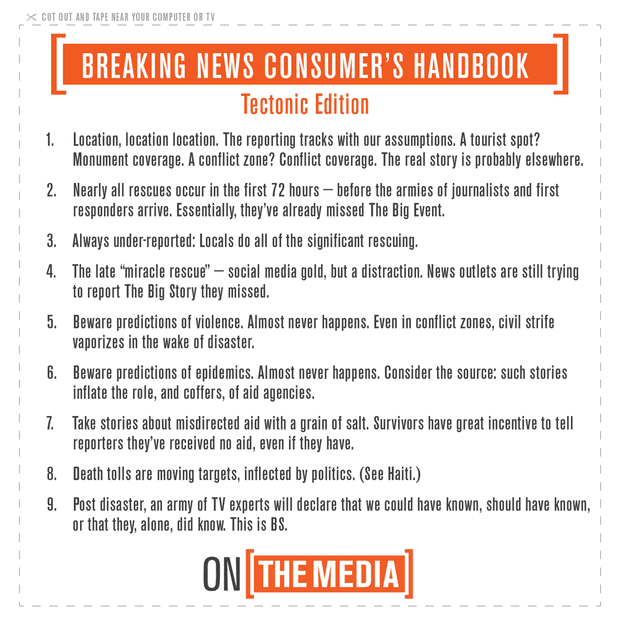
    After an earthquake struck Nepal in April of 2015, the post-disaster media coverage followed a trajectory we'd seen repeated after other earth-shaking events. We put together a template to help a discerning news consumer look for the real story. It's our Breaking News Consumer's Handbook: Tectonic Edition. Brooke spoke to Jonathan M. Katz, who wrote "How Not to Report on an Earthquake" for the New York Times Magazine.

    On the Media is supported by listeners like you. Support OTM by donating today (https://pledge.wnyc.org/support/otm). Follow our show on Instagram, Bluesky, TikTok and Facebook @onthemedia, and share your thoughts with us by emailing onthemedia@wnyc.org.


    Hosted by Simplecast, an AdsWizz company. See pcm.adswizz.com for information about our collection and use of personal data for advertising.


    Fallout Aug 24, 2018
    Show notes

    End-of-times narratives themselves are nothing new; only the means have changed. While once a few horsemen and a river of blood were enough to signal the dusk of man, apocalypse now requires the imaginations of entire atomic laboratories — or roving squads of special effects crews. This week we look through a few recent highlights from the genre: from a 1980's made-for-TV spectacle, to a new piece of speculative fiction documenting a hypothetical nuclear conflict with North Korea.

    1. Jeffrey Lewis [@ArmsControlWonk], author of "The 2020 Commission Report," on what we might say to ourselves after a devastating war with North Korea. Listen.

    2. Marsha Gordon [@MarshaGGordon], film studies professor at North Carolina State University, on the 1983 film "The Day After," which imagines a massive nuclear strike in the Midwestern U.S. Listen.

    3. Anne Washburn, playwright, on "Mr. Burns: A Post-Electric Play," in which she imagines American cultural life after a devastating nuclear event. Listen.

    4. Andrew Fitzgerald [@magicandrew], chief digital content officer at Hearst TV, on what journalists, seven years ago, thought about the prospect of covering the end of the world. Listen.

    On the Media is supported by listeners like you. Support OTM by donating today (https://pledge.wnyc.org/support/otm). Follow our show on Instagram, Bluesky, TikTok and Facebook @onthemedia, and share your thoughts with us by emailing onthemedia@wnyc.org.


    Hosted by Simplecast, an AdsWizz company. See pcm.adswizz.com for information about our collection and use of personal data for advertising.


    Previous 1 84 85 86 87 88 192 Next

    Related Podcasts

    The Joe Rogan Experience

    1

    The Joe Rogan Experience Comedy
    Casefile True Crime

    2

    Casefile True Crime Games & Hobbies
    Reply All

    3

    Reply All Games & Hobbies
    You Must Remember This

    4

    You Must Remember This Games & Hobbies
    Real Time with Bill Maher

    5

    Real Time with Bill Maher Games & Hobbies
    Last Podcast On The Left

    6

    Last Podcast On The Left Comedy
    footer-logo

    Contact Us

    Toll Free: 844-670-7747

    Links

    • Home
    • Top Charts
    • Networks
    • Apps
    • Independents Podcasts
    • Podcast Advertising
    • Podcast News
    • Contact Us
    • About Us
    • Analytics & Insights

    Stay Connected

      Privacy, Terms of Use & Our Code of Ethics Protecting Content Creators Copyrights