If you’re looking for information about baby development, or looking for ideas about how to play with your baby to support development, Learn With Less (formerly Strength In Words) is where we discuss all things early parenthood and early childhood. We help families (expecting parents, new parents, and seasoned parents) navigate those early years in an inclusive, educational, and supportive space. Join Ayelet Marinovich, M.A., CCC-SLP, author, singer, imperfect mother of two and pediatric speech-language pathologist, for a podcast for parents, caregivers, and educators of infants and toddlers of all developmental levels. Learn With Less is the place for families to access high quality, evidence-based resources about how their infants and toddlers learn and develop; for regular sessions of music, play and developmental information for both you and your baby, subscribe on Apple Podcasts and visit https://learnwithless.com!
Infant & Toddler Math Concepts and Activities
May 27, 2016
Show notes
Making connections in the brain and in the world…
What do the skills of matching, classifying and patterning have in common? What do these things involve and require when it comes to brain-building? How can we best support these developing skills in our infants and toddlers?
These are the topics we explore on this episode of Learn With Less!
Below is the transcript of this week’s “Developmental Thought,” an excerpt from the full episode.
For additional information, music, play ideas and the complete interactive family experience, please listen to the entire episode.
Let’s get back to our original discussion topic, that of a few early cognitive and math skills – specifically, matching, classifying, and pattern-recognizing.
Matching involves an ability to perceive and take in aspects of objects in the environment, and the ability to start to match like items also indicates that the young child is starting to discern and understand the world by classifying “like” items in certain ways.
Matching and classifying are both related to the activity of sorting, in that young children are constantly organizing life experiences, new words, objects, and people, and determining how all these things relate to each other, to themselves, and to the child. And classification is essentially the grouping and sorting of various characteristics…
When infants and toddlers start to explore, they begin to make classifications about their world, and determine how certain things are alike and how they are different – through tactile experiences, visual experiences, auditory experiences, movement experiences, oral experiences. This is why it is so important to follow your baby’s lead, and to provide your baby or young child with lots of different types of experiences.
This doesn’t have to equate to spending lots of money, buying lots of fancy toys, or traveling to exotic places. I’m talking about ensuring your baby gets time both inside and outside, in dirt and sand as well as on carpet and wood. With soft objects and hard ones, wet ones and dry ones, with lots of different colors and textures, sounds and people!
Interaction: The Best Teacher
This is also why over-reliance on the television or any other screen is not conducive to learning. The only input the child receives is a two-dimensional image from a screen. We know that children do not learn or carry-over vocabulary from a screen, but instead, through interaction with a real-life person – like you!
Talking, asking questions, singing or humming a tune, playing, modeling, and sometimes (more often than many of us might feel comfortable!) simply sitting back quietly, being present, and allowing our young children to problem-solve, listen to and recognize patterns in the environment, make connections, and imitate in their own time… these are the skills we as caregivers must build to give our young children a great start.
Helping Infants & Toddlers Understand Feelings
May 20, 2016
Show notes
Emotional development starts from birth – and it’s something we “work on” our entire lives!
Consider that even as adults, we struggle to understand our feelings. We have emotional reactions, we “act out” or “lash out” and we sometimes have emotional responses to a trigger in our environment.
In this episode of Learn With Less, Ayelet explores some of the ways we can help our youngest humans to develop healthy social and emotional development, and some of the tools we can provide.
Below is the transcript of this episode’s “Developmental Thought,” an excerpt from the full episode.
For additional information, music, play ideas and the complete interactive family experience, please listen to the entire episode.
Even in the first year of life, babies are incredibly sensitive to emotion. Research suggests that even by a few months of age, infants are able to recognize the difference between happy and sad expressions, and differentially process emotional tones in voices they hear.
That’s powerful stuff! Recent findings even suggest that infants exposed to more conflict show higher stress levels (measured by their brain activity to angry tones of voice) – and regular exposure to conflict (including exposure to those angry tones while they are asleep!) can deeply affect the way their brains process emotion and anxiety, leading to their own ability to regulate emotions.
Emotional Cues
You may have seen your baby start to cry simply when he hears another baby cry! This imitation and “empathy cry” is not simply for the sake of imitating others, but because infants look to others for cues about emotional signals, and are affected by other peoples’ emotions.
This is why it’s important to try to pay attention to your emotional reactions to things, and give words for how you (or others around you) are feeling. It’s also why, when speaking to your baby, it’s wise to try to match your tone with your intent.
Your baby is learning from you about how to display and regulate his emotional reactions to things, to the clearer you can be about yours – the better!
Giving Words For Feelings
When you label emotions – of people in your environment (especially when strong emotions are witnessed), or those your baby expresses, you give words to feelings and reassure her that feelings of all kinds are valued.
If you explain how actions make people feel, or make predictions about why people might feel a certain way – when looking at pictures of other people or watching others in a social situation – you work on sensitizing your little one from a very early age to an important part of social language, cognition, and perspective taking, something in the psychology field that is known as “theory of mind.”
We’ll talk more about this in future episodes, but for now, I’ll just say that if you can naturally build in this type of “emotional language” naturally and fluidly throughout your baby’s early months and years, you will be supporting her receptive language (what she understands) as well as her social/emotional and cognitive development.
Object Permanence in Infants and Toddlers
May 13, 2016
Show notes
There’s a term we all need to know: object permanence
There comes a time in every baby’s life when he realizes he is a separate entity from his caregiver. Mayhem ensues.
Below is a transcript of this episode’s “Developmental Thought,” an excerpt from the full episode.
For additional information, music, play ideas and the complete interactive family experience, please listen to the entire episode.
Talking about things you see, as well as relating experiences about things you have seen is also, in a way, related to object permanence in that a young child must have a mental representation of the object about which you’re speaking.
This, of course, also correlates with the beginning of “symbolic” thought, and there is therefore a good deal of overlap with language (which is the verbal or gestural symbolic representation of objects, people, ideas, etc.).
More specifically, though, having an understanding of “object permanence” signifies that a young child knows that an object or person still exists, even if it’s hidden. So, for instance, your baby watches you place a stuffed animal under a blanket or behind a box… and then knows that it’s there when you ask her, “where’s the bear?”
This is why games and activities that increase your baby’s awareness of and familiarity with the fact that objects out of sight still exist are wonderful ways to help support your baby’s understanding of object permanence.
Many of the activities we’ve done in previous episodes inherently help support the development of object permanence – and many of the play items we’ve made and used can be wonderful props.
This episode’s corresponding DIY object, the “Familiar Family Book,” gets to the heart of helping your baby understand that you haven’t left “for good,” and helps to make sure there are nice reminders of you and other familiar people in his environment when you are not present.
In my opinion, “peek-a-boo” is the ultimate game for developing and appreciating object permanence, with the added benefit of the main attraction being your baby’s favorite thing to look at – your face!
Simple games and social routines like these are great helpers for developing an appreciation for and familiarity with the fact that we are here even when hidden.
This is not to say that playing peek-a-boo will simply generalize into easing separation anxiety each time you leave your baby, but it helps give her the tools to understand the concept as a whole.
Peek-a-Food
It’s important to remember, too, that your little one’s “experiments with gravity” are also part of this cognitive growth – when she drops a spoon or piece of food to the ground from her high chair, and then looks over the edge for it, giggling demonically… this is her testing the hypothesis that object permanence applies to all things in all situations.
She’s essentially playing peek-a-boo with her food. Yes, it’s frustrating, and yes, it’s messy. But it’s also what learning looks like.
Using Puppets With Infants and Toddlers
May 06, 2016
Show notes
Puppets: they’re not just for magic shows! A powerful learning tool
Puppets are singular in their diverse ability to entertain, teach and connect. In this episode of Learn With Less, Ayelet explores the merits of puppets and the ways we can use them in play!
Below is the transcript of this episode’s “Developmental Thought,” an excerpt from the full episode.
For additional information, music, play ideas and the complete interactive family experience, please listen to the entire episode.
Let’s go back now to the use of puppets. We touched upon their interactive nature, and their natural capacity to promote “joint attention” skills and social interaction.
Using them with young children in song or rhythmic chants is a wonderful way to utilize their ability to entertain and teach.
They are very useful tools to encourage creative play and vocabulary development – and can be great for you as a parent to help you feel comfortable being silly, which, as we’ve discussed in previous episodes, is a really useful way to keep your child engaged and enhance the interaction.
Wherever You Want Them To Be
Since they come in all shapes and sizes, puppets can become characters in reading activities by acting out parts of the story, they can provide an entertaining distractor for little hands to reach and hold as baby becomes more wiggly and mobile.
Puppets can help your baby to stay entertained – during care routines (which we know are more emotionally satisfying for your little one when there is interaction and participation on both your parts), or while on the go. You can use smaller finger puppets in the stroller, car, public transportation…
They can play peek-a-boo, sing silly songs, or tell stories. They can be used to focus on or talk about specific vocabulary, such as body parts or action words (the puppet can point to its own body parts or your baby’s) or can act out actions like crawling, dancing, eating, etc. There is truly no limit to their use.
Open-Ended, Lots of Love
And that, right there, is another reason why I love them. Puppets are open-ended toys. There is no specific way to use them that’s “correct,” they can be used and enjoyed in very different ways by a child who is three months or three years old. They promote interaction (without human involvement, they do just sit there!)
And the more playful, creative, and silly you can help them to be, the more enjoyment, bonding, and naturally fun learning time you can have together with your young child. I plan to bring you more DIY puppet-making ideas in future episodes.
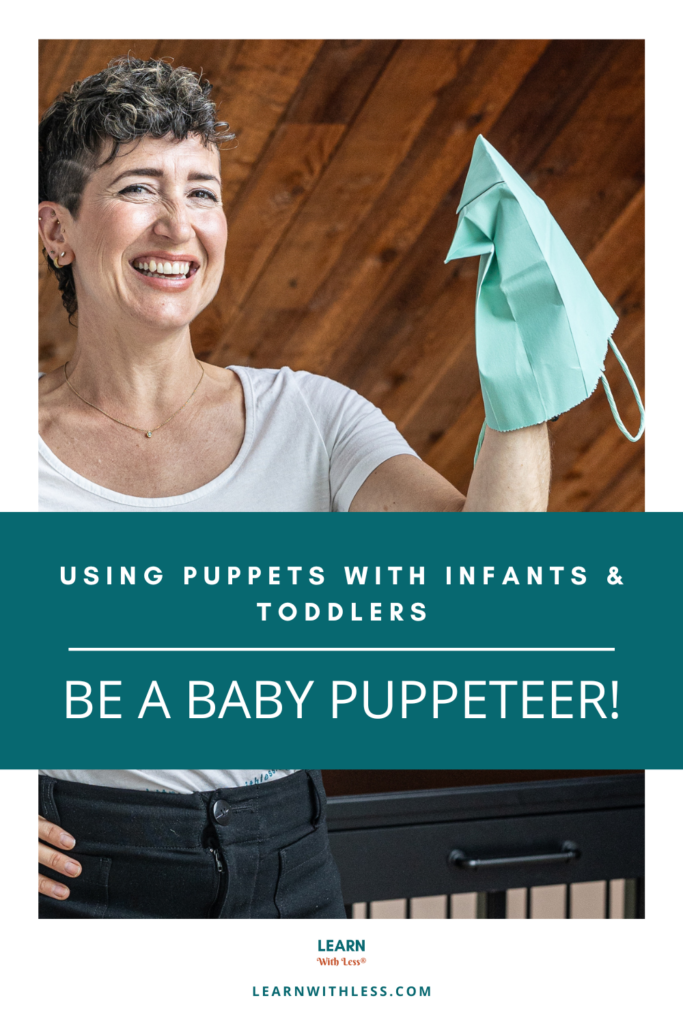
But I want to dedicate this episode and the “Dishwashing Glove Puppet” to my mother, who continued to pass down the tradition of “Endig, Wendig, Featherwick, Weatherwick, Bumpus, Little Pea, Patty Lou, Lulu Whistle, Whistle Nozzle, and Kadabowobble-wobble” from her great aunt Marie, to my son, who now gets a big smile on his face every time he sees a yellow glove, and starts to giggle the words, “Kadabowobble-wobble.”
Happy Mother’s Day, to my mother, and to all the mothers and incredible caregivers, future parents, and adoptive and step-parents out there listening. I’m thrilled to be part of your family’s experience.
Responding To Early Communication
Apr 29, 2016
Show notes
We are all communicators. Sometimes it takes a little more attention to see it!
In this episode of Learn With Less, Ayelet discusses the importance of adult responsiveness to infant and toddler attempts at communication.
So much of our response shapes and informs our childrens’ communication with the world – the more we can reach into their world and pull out what we can, the more we shape their ability to be heard, their confidence in expressing themselves, and their desire to connect.
Below is the transcript of this episode’s “Developmental Thought,” an excerpt from the full episode.
For additional information, music, play ideas and the complete interactive family experience, please listen to the entire episode.
When we talk about what we see our young children doing, we call attention to the fact that every behavior is inherently communicative in some way. If you say, “oh, I see you batting at the picture of the bear on the mat – are you interested in him? Look at his big ears!” – you read into what your child is doing, and create a sort of social narrative behind it.
As time goes on, your baby trusts that you’re paying attention, and that you’re making a good effort to read his actions and communication attempts! Even when we think we’re paying close attention, I can say with certainty and with experience that we often miss so much of what our children are learning!
Infants and Toddlers are Learners
Young children are learners: that’s what they do! We’ve talked a lot about the fact that their studying of an object, their movement in a particular way, their vocalization or gaze in a particular direction – this is what learning looks like. When we sit back, comment on what they’re doing, respond to their needs and desires, and give them physical and emotional support without bombarding them, both parties often feel more satisfied!
I want to talk for a moment about a term, “communicative intent.” As humans, we are all communicators – whether we are able to speak or not. When your young infant studies the bear on his play mat, and then looks up at you, is he not looking for a response with his gaze? It is our job to decide whether that gaze intended to tell us something specific – whether there was a specific message associated with it, and what that might be.
My general practice, both in my work as a speech-language pathologist and as a mother of a young child, is that it is almost always safe to assume intentionality.
Honoring With a Response
Developmental research confirms that there is a relationship between the responsiveness of parents and caregivers of pre-verbal children (those with and without develop.mental delays) and acquisition of language. I
n other words, when we respond to our young children’s non-verbal communicative efforts (their gestures, their gaze, their vocalizations and even those we associate with negative behaviors such as grabbing or pulling), we honor that this is an effort to communicate, and our response to their communicated message has a positive effect on their growing ability to express themselves through language.
Decoding Their Messages
Of course, once they start to use language, the importance of our responsiveness doesn’t change! I want to tell you about an experience I had with my own son when he was about 15 months old. He was using “one-word sentences” at that time, which, of course, continued to require a fair amount of decoding on my end.
My mother, he and I had gone out to lunch at a restaurant, and as we were waiting for our food, he suddenly stated, “hat!” Of course, my mom and I started trying to figure out what he wanted to say about a hat… neither of us were wearing hats, nobody in the restaurant within his view was wearing a hat… was he asking me to put my hat back on? I did, but that didn’t seem to satisfy him. Did he want me to be silly? I put the napkin on my head and asked him if that was the hat he wanted.
What he did next blew my mind – he pointed to a woman at a table across from us, who was wearing a headscarf, and again, said, “hat!” He was making an observation – and using the closest associative word he knew to describe it, calling our attention to something that was out of the ordinary in his world. We affirmed that yes, it was like a hat, that you could call it a scarf or a headscarf.
My mom was wearing a scarf around her neck, and she offered to put it on his head to try it on. He was thrilled. This was clearly the ultimate goal, “What’s that thing she’s wearing that’s like a hat but not, and how do I get one of those to try on my own head?” He had gotten his message across, and we had successfully decoded the multi-faceted nature of it.
Making Connections For Connection
The point I’m trying to make here is that there is so much our little ones are trying to tell us or ask of us, even when they can’t! Even when we can’t see it.
And it’s often not what we would have expected! The best we can do is think about all the different reasons we communicate… to connect what they express to our own knowledge of their experience and interests, and hope that we don’t miss too much!
References:
Bates, E. (1979). The emergence of symbols: Cognition and communication in infancy. New York: Academic Press.
Wetherby, A., Cain, D., Yonclas, D., & Walker, V. (1988). Analysis of intentional communication of normal children from the prelinguistic to the multiword stage. Journal of Speech and Hearing Research, 31, 240-252.
How To Respond To Your Babbling Baby
Apr 22, 2016
Show notes
There is a link between your infant’s babbling and the development of early gesture.
This episode of Learn With Less focuses on this topic – and Ayelet gives you ideas to use musical experiences with your babbling baby to develop the sense of “vocal play” that results in experimentation, play and – ultimately – language!
Below is the transcript of this episode’s “Developmental Thought,” an excerpt from the full episode.
For additional information, music, play ideas and the complete interactive family experience, please listen to the entire episode.
On the last episode of Learn With Less, (Communication, The First 6 Months), we talked about the typical development of infant communication within the first 6 months of life, and we ended our conversation with the topic of babbling, or the sounds your baby makes with his mouth that combine both a consonant and vowel – like “bababababa.”
There’s some interesting research to suggest that rhythmic arm movements (like banging) increase substantially around the same time as the onset of babbling, and that there is a definitive relationship between infant gesture and the acquisition of spoken language.
We already know that gesture is one very clear form of non-verbal communication. Today we sang a song that made use of gestures, both representational (like waving, which represents a greeting) and referential (like pointing, which helps us refer to something being pointed at), as well as traditional or personal “signs” – hand movements or motions which can represent a specific word, thought or idea.
Gestures and Sign Language
You are welcome to use whatever hand signal or representational sign that works within your family. When you watch my video, you can see the gestures I use, which are adaptations of signs from American Sign Language.
You may have questions about using signs with a child who is not deaf or hard-of-hearing – I’ll focus more in depth on that topic in a future episode, but for now, I’ll mention that there has been a lot of research on this, and the consensus is that a young child will use the most efficient, effective, and easiest form of communication presented to them.
If your child is accustomed to hearing English (or any other verbal language) as his primary language, then when he can speak, he will! Signing can be considered a form of gesture (a very specific representational gesture), and, again, gestures often develop before speech.
Remember that most children are starting to babble around the same time as they start to experiment with movements of their arms (such as banging a drum) – this is a good way of thinking about how precise their movements are – and how much more precise these movements will need to be to sequence all the sounds in a word.
But all of this is a progression of ability – first we see larger, less refined movements, like banging, or sweeping with the hand to move an item from one place to another, or babbling with a simple consonant-vowel combination… and then those eventually turn into more precise movements and sequencing of movements – gestures like pointing or signing, pincer grasping with the thumb and forefinger, and actual words which require a particular set of sounds in a particular sequence.
Rhythm Play
[The second rhythmic activity we did in this episode] is great fun if you have a toddler or preschooler who can repeat rhythms back to you… but what about a little babbler? That activity is going to be fun for him to listen to on this podcast, and interesting for him to watch you do, but way too complicated for him to actually perform in imitation.
So how can we make it more about him? We can switch the activity around – and imitate the rhythms he makes! When we do this, we make rhythms together, we take turns, and we validate and repeat what our little ones create. So if he makes three short bursts, you make three short bursts – and then pause. Wait for him to go again. When he does, imitate his rhythms again!
He may notice what you’re doing, and get a real kick out of it! Do this with vocalizations, as well – this encourages your baby to engage in that vocal play, because he sees that you can be playful, too! There is a stage within that first year of life when typically developing babies realize that their caregivers are imitating them – and most of the time, they find this pretty hilarious, or at least fascinating!
Vocal Play vs. Baby Talk
You may have heard that using “baby talk” with your baby is not a good idea. If all you’re saying to your infant all day long is “goo goo gah gah,” then yes, please build actual words into your repertoire. Or if what you’re doing with your verbal toddler is repeating back his infantilized versions of words (“wawa” for water or “bup” for “cup”), regardless of how cute it might be, try to stop that, too!
Again, children learn through imitation, so when we use actual and correct forms of words, and correct sentence structure, that is what we’re going to be teaching them. This vocal play imitation is different from “baby talk” in several ways – first, I’m assuming that this is not the only time you talk with your child. By all means, talk to your child using actual language!
Narrate your day until you feel like a walking audiobook. Talk about what you’re doing, what your child is doing, what you see, where you’re going, etc., no matter whether your child is 3 days or 3 years old. But also, stop to engage in vocal play like the kind we were talking about just now.
This kind of interaction falls under the category of social play, and when you do it again and again, your baby is able to categorize it as a “social routine” or a game that he plays with you – another example being a game like peek-a-boo.
Even pre-verbal children can request things like social routines by actually initiating them, or by getting into the same position or bringing you the same props you used the last time you played that way. It takes us paying attention to those associations our children are making to sometimes read their cues.
Resources We Mentioned:
Why Sign? – Learn With Less Podcast episode featuring Learn With Adrienne
Iverson, J. M., Hall, A. J., Nickel, L., & Wozniak, R. H. (2007). The Relationship between Reduplicated Babble Onset and Laterality Biases in Infant Rhythmic Arm Movements. Brain and Language, 101(3), 198–207. http://doi.org/10.1016/j.bandl.2006.11.004
How Babies Communicate in the First 6 Months
Apr 15, 2016
Show notes
Even in the first 6 months of life, there are communicative milestones through which infants move.
This episode of Learn With Less is focused on those wonderful, intense and amazing first 6 months of an infant’s life – and the parts of communicative development about which it helps to become aware!
Below is the transcript of this episode’s “Developmental Thought,” an excerpt from the full episode.
For additional information, music, play ideas and the complete interactive family experience, please listen to the entire episode.
Today, I want to talk about a few of the very early parts of communication development – those that typically happen in around the first 6 months of our babies’ lives.
There is so much that happens in that first year of life, in all areas of our infants’ learning.
Our babies grow from tiny (let’s face it, adorable blob-like) beings to tiny people starting to express their personalities, desires, and interests. In recent years, there’s been a real push to help parents and caregivers become more aware of “developmental milestones” – I very much encourage you to be aware of the basic things to look for, but I want to highlight also that obsessing over each milestone is not necessarily conducive for healthy support of our children’s learning, either!
It’s more about the whole picture. Also, there is always a range of “what’s normal.” If you are the parent of an infant who has come into this world under more challenging circumstances than others, or you are concerned that your child is not communicating the way you see other same-aged children doing, I encourage you to talk to your child’s medical provider or developmental specialist to gather more information.
Knowledge is power, and the more information you can collect – about your child’s hearing ability, about therapeutic techniques you or a specialist can do to help stimulate your child’s communication skills – the more your child can benefit!
Major Changes At 6 Weeks
We touched upon the earliest form of purposeful communication, crying. Interestingly, around 6 weeks is also when we start to see what’s known as a “social smile,” or an intentional smile… yes, grown-ups, sorry to disappoint, but in the early days and weeks after birth, you may have seen your baby turn her mouth upwards, seemingly smiling… though this is beautiful to witness and a nice preview, it is most likely your precious one making a slight effort to pass gas.
I think many of us feel, when that first real interactive smile comes, that this was SO necessary – because up until that point, we’ve essentially been slaves to this beautiful and wondrous tiny being, not sleeping, rarely eating or bathing, and there hasn’t been a whole lot of reciprocation. And then, those lips turn up… and wow. Thank you!
What’s fascinating is that that 6-8-week mark when you see that first social smile and when your baby realizes that if she cries, you will help her – it comes at around the same time… indicating that around this time, your baby is starting to make connections about human behavior!
She realizes that returning your smile keeps your attention! This is another wonderful early step in back-and-forth communication, and can be a great way to development of her self-esteem, as smiling back lets your baby know her feelings are important.
Cooing Begins
I mentioned earlier that in the first 3 months, the sounds your baby makes are mostly uncontrolled. Around the 4-month mark, clear vowel sounds start to emerge. This is when you start to hear those lovely “ah-ooo” pleasure sounds that are so sweet.
Vowels are open sounds, that don’t require a whole lot of specific tongue placement. They are all in the mouth shape (eeee, ooooo, aaaah), and therefore, the most obvious to imitate!
Vocal Play
The next step in this “vocal progression” (which, I’ll just say, is not a simple hand-off between one to the next! It will more likely be much more fluid than that), happens as your baby starts to play more with the sounds she is able to make, and that she sees and hears you making. You might see her purposefully playing with the flow of air through her lips as she makes raspberries (bbbbpppfff)…
The more “speech-like” vocal play includes both vowels as well as consonants, and is called babbling. You might hear your baby start to babble anytime between the ages of 4 – 10 months. Usually, babbling starts as what’s called “reduplicated babbling” – meaning that your baby may start to say “ma” and then “mamamamama.” These sounds are not yet considered words – though you may hear “mama” or “dada” or “papa.”
Your baby’s environment (as in, you!) starts to encourage production of these sounds – as in, you reinforce your baby when you hear her make various sounds, and as time moves on, she starts to babble not just to stimulate herself because it’s fun and feels good, but for a social purpose – when she “speaks,” she gets reinforced by you.
Those first consonants that you often hear are also /m/, /b/, /p/, /w/ – those that are formed on the lips (known in the linguistic world as “bilabials”) – though you may also hear others that are made toward the front of the mouth, with the tongue pressing on the ridge behind the front teeth like /d/ or /t/ (these are pressing on the alveolar ridge, and are therefore known as “alveolars”).
It makes one wonder which came first – the babbling of “mama, dada, papa” or the fact that those names are almost universally the same in so many languages? Fascinating stuff for any of you linguistic or child development nerds out there!
Role of Hearing
So, wow – all that happening by around 6 months… Now, again, I want to reiterate that if your infant is not exhibiting these communication behaviors within the timeframe that I spoke about in this episode, you are encouraged to discuss it with your child’s medical provider.
Hearing is also a huge factor in all of this – if a child is unable to hear the sounds around her, she will be unable to imitate them. That goes for both hearing loss, fluid in the ears, and also a child who is so uncomfortable or sick that she is crying and cannot hear or attend to her caregivers. It takes a village, as they say, and the medical community’s job is to be there to support families!
Creating Strong Bonds With Baby
Apr 08, 2016
Show notes
How do we build relationships (and support relationship-building) with our infants and toddlers?
In this episode of Learn With Less, Ayelet explores the ways we as caregivers and educators support our young children in one aspect of social/emotional development: relationship building.
The discussion delves into the use of tools we have at our disposal (including screens) – and the efficacy of these tools!
Below is a transcript of this week’s “Developmental Thought,” an excerpt from the full episode.
For an interactive musical family experience, please listen to the entire episode.
Let’s go back to our earlier discussion of the use of photographs to help us support our childrens’ development of positive relationships.
I mentioned that using printed photographs, while it can be a bit more effortful, can really pay off in play.
Using actual photographs as manipulable materials that your baby can handle (otherwise known as “manipulatives) is a great sensory experience for your small child, in that they can use multiple senses to explore that object, including their sense of sight to look at the image, their hands to explore the tactile qualities of the picture, and any other senses (the smell, and likely the taste, of the cardboard or plastic, the feel of it moving in space, the sound of it as it hits the ground or other surrounding objects, etc).
Additional ways to use photos in your home as invitations to discuss the images might be adding photo albums to your book collection, placing photos in sheet protectors or hanging wall pockets low on the wall where your small child can easily look at, point, or talk about them from his vantage point. Sometimes, low-tech is better than high-tech!
Word of Warning
Remember that getting your child used to viewing photos or videos on your phone will get him used to using your phone as his “manipulative” – and, as much as possible, I encourage you to follow the American Academy of Pediatrics and other organizations around the world that regard overuse of screen time as unhealthy for infants and toddlers, especially under the age of two years old.
When we interact with our children, we provide a direct reaction to their actions and expressions. Television, movies, video games, apps – they don’t do that. We know children learn best through imitation and interaction with us, and from three-dimensional relationships with other people or objects.
An Exception: Video Chat
Now, there is one exception that has been studied a lot recently – and that is the use of video chat. Very young babies (from 6 months old!) are able to tell whether the person talking to them is responding to them in “real time,” and since video chat is a very easy way to stay in touch with loved ones who are far away, many families (even those who tend to stay away from other sorts of screen time) use video chat to create and maintain a “face-to-face” interaction.
Several studies (referenced below) have researched language learning in both a live interaction and video chat, and found that young children ARE able to learn new vocabulary and imitate actions through video chat, suggesting that young children are not only able to attend, but also able to learn through this type of interaction. Especially when supported by a caregiver who is present (someone to man the device, to explain why the image of Grandpa’s face froze or why the sound is disjointed), young children can derive meaning and enjoy affection through this kind of interaction.
I speak from experience when I say that my own son has successfully reinforced relationships with both my partner’s and my extended families through the tool that is video chat… he knew my parents’ pets names, was at least somewhat familiar with the type of space they lived in or the layout of the particular room in which they chatted, their voices and funny facial expressions – long before we visited them in person.
In addition, I remember video chatting with my husband when we were apart, when my son was just 6 months old. When he saw my husband’s face, he became very excited, very vocal, and very smiley… To me, all of this was proof that video chat was very different from other non-interactive types of screen time.
Now, that said, we all do what we need to do to survive as parents and caregivers. The important part of decisions that we make for our own families as that we do so as informed citizens to the best of our ability!
References
LaFrance, A. (2015). Do Babies Know When They’re Skyping? The Atlantic. Technology, 10 Sept. 2015. < http://www.theatlantic.com/technology/archive/2015/09/do-babies-know-when-theyre-skyping/404650/>
Simcock, G., & DeLoache, J. (2006). Get the picture? The effects of iconicity on toddlers’ reenactment from picture books. Developmental psychology,42(6), 1352.
Can Infants & Toddlers Learn About Music and Math?
Apr 01, 2016
Show notes
Music hits on all aspects of development – including early developing math concepts!
Did you ever think that simply playing music or singing a song to your young child would be beneficial for cognitive development?
In this episode, Ayelet explores the idea that when your baby listens to patterns in music (and when you do things to play with those patterns), it helps set the foundation for early math and reading skills.
Below is the transcript of this episode’s “Developmental Thought,” an excerpt from the full episode.
For additional information, music, play ideas and the complete interactive family experience, please listen to the entire episode.
We’ve talked a lot in past episodes about the fact that when you sing a song, you need not be afraid to change the lyrics to apply them to your own surroundings.
In addition to the reasons I discussed in my episode, “Play With Words,” this allows your child to become familiar with the tune and rhythm, and also highlights the difference when you sing with different vocabulary!
What Benefits Does “Musical Play” Have?
When we alternate singing and speaking on a rhythm, humming a tune but taking out the words, adding and taking away hand motions or other movements… we play with similarities and differences, comparing and contrasting, and focus on various elements, helping our young children make sense of and enjoy different elements of the interactive experience.
We can also play with the rhythm of otherwise familiar songs – changing the rhythm or meter of a song (not just the speed, but the feel of the beat), we give a different flavor to the music. Listen to what my friend Lily does with one of my favorites, the ABC song. [Listen to full podcast episode for Lily’s ABC’s]
What a cool, swingin’ beat, Lily! Thanks for that. When we add these variations to familiar songs, we teach our children about discrimination, and to observe differences.
Melodic Patterns
Almost every song has a pattern built into its melody, as we saw with the last song we sang together. We see toddlers listening to the pattern of a song when they request to hear the same song over. And over. And over again. Before we think to ourselves, “oh my gosh I can’t take it anymore,” remember – this is how our children learn. Through repetition. By listening. By discriminating.
My 2-year old son recently got to this stage, requesting a particular song on repeat. What I find interesting is that sometimes, he’ll ask for another particular song to be played directly after the first one, and then want to listen to both of those on repeat. This tells me that he is most likely actually comparing and contrasting the structural, rhythmic and linguistic elements of both songs!
Play With Songs
When we actively play with the content, and pause to wait for a young infant to make a choice with his hands or body (as we did in our “Routines & Rituals” episode with the DIY animal images), or pause to wait for a verbal child to offer a word (with or without a visual aid), we help them learn to anticipate those patterns, as we are directly placing the words within a sequence – which will help form critical early math and early reading skills!
In addition, there is research suggesting that a small child’s ability to feel and express a steady beat or rhythm is correlated with academic achievement scores in elementary school. I don’t want to focus too much on the idea of getting one’s child into the best schools, I simply mean to reinforce that this play and interaction and silly time you spend with your tiny person is shaping his entire experience – social/emotional, cognitive, communicative, and even motor development. These things are all connected to the way our children process and, in time, perform.
A Surprising Way To Build Early Literacy Skills
Mar 25, 2016
Show notes
When a book is not just for reading (it’s used to build early literacy)!
We’re used to thinking of the term “literacy” as a word to describe people who can read. What about the term “early literacy?” Does it simply refer to teaching young children how to read?
In this episode of Learn With Less, Ayelet discusses a few more ways to use books with infants and toddlers than simply reading the text on the page – and the benefits of exposure to early literacy experiences (hint: the term refers to much, much more than simply learning how to read)!
Below is a transcript of this episode’s “Developmental Thought,” an excerpt from the full episode.
For additional information, music, play ideas and the complete interactive family experience, please listen to the entire episode.
I have heard parents say, “oh, I think that book is a bit too advanced for my infant…” It is never too early to expose your child to early literacy skills! Here’s the biggest misnomer:
The term “early literacy” is NOT the same thing as “learning how to read.”
There are many different early skills and supportive activities you can do that are involved in building literacy, including (but not limited to):
Simply exposing your baby to text and symbols (think about some of the activities we discussed in another podcast episode, “Visual Supports: An Intro”).
Handling books (whether that means your baby is quietly holding a book in her hands, wildly removing each one from the shelf, chewing on the board book, or turning a page).
Looking at pictures (and watching you point to those pictures as you speak about the words they represent, or starting to engage themselves in recognizing pictures).
More quote-unquote “early literacy behaviors” can be found on the Zero to Three website (link here) or in the book So Much More Than The ABCs, by Judith Shickendanz, published by the National Association for the Education of Young Children (an Amazon affiliate link can be found below).
Use Pictures to Stimulate Language
In a recent episode, “Visual Supports, An Introduction,” I gave some examples about how to use visuals in a more naturalistic, communicative way than simply labeling. It is very easy to us as adults to become “drill sergeants” when our intention is to help our young children learn.
Getting creative and asking different questions, creating playful experiences rather than pointing and naming, linking objects and people to previous experiences, are all great ways to provide a “language-rich” interaction. Let’s talk today a little more about how to integrate early literacy experiences into this idea of “language-rich” interactions.
Book reading is wonderful example of an activity that promotes joint attention, which I spoke about in Episode 1:“Why Sing?” When you sit and read to your baby, you’re not only exposing her to text and pictures, you’re also highlighting the idea that these things are important!
What Should I Read to Baby?
As adults, I think it can be difficult for us to instinctively know what on earth to say to these tiny people all day long, especially in those early days when there’s not a whole lot of reciprocation. By creating shared experiences, especially interactive ones, you are teaching your little one so much.
For those of you who are listening with newborns or young infants – or even those of you who are still pregnant – you can even hold your newspaper up and read it aloud!
In those early days and months, it isn’t about them needing to understand the content – it’s about them hearing your voice, being close to you, and watching (and being part of) what you’re doing and how you interact with the world. It’s also about you getting used to talking to your tiny baby.
How Should My Baby Engage With Books?
Within the first year of life, the way babies interact with books changes quite dramatically. Your baby may go from engaging more with the physical properties of a book (mouthing, shaking, crumpling, or waving it) to focusing on pictures (looking at, or even pointing to them).
By the end of the first year, babies often show more “enjoyment” of books, spending less time manipulating them and more time engaging with the pictures and listening to words.
Your older baby may hand a book to you or point to the one she wants when given a choice, and may help you turn the page.
But even very young babies can be encouraged to “turn the page” (even if this simply means that you’re reacting to her impulse to touch the book by offering and moving the page toward her outstretched hand). Young babies can be given opportunities to engage with the pictures in the story, as well, when engaged.
Your efforts as “the reader” will really pay off if you engage that silly side of you we spoke about last week. For instance, using lots of animated voices for your characters will not only heighten the likelihood that you can keep her attention, it also allows her to hear you play with your voice – and she’ll do the same in the form of cooing, shrieking, blowing raspberries, and babbling!
We know that, as opposed to forcing a child to sit through an entire book whether or not she is enjoying it, allowing and supporting young children to engage with books at their own developmental level is a more compelling approach to encourage early literacy.
So if your baby wants to simply turn the pages of the book, remove the books from the shelf one at a time (or all at once), then don’t be afraid to allow this to be the activity!
Talk about what she’s doing, or try to talk about one thing on the page or cover of the book she’s looking at (before she moves on), or read another book aloud as she busies herself with other books. Try different approaches to see what works – and remember that something might work one day, and not so well the next (or the other way around!)
Forget About The Words On The Page
Another thing to remember about book reading activities is that they are activities, like any other, and the object in front of you just happens to be a book. We tend to get boxed in by our adult understanding of book reading, but remember: reading the words on the page is not actually the only way to read a book!
It may actually help to find a book with no words, to create a book with pictures from magazines (like we did earlier), or to find a picture book in another language. Instead of reading the story as it appears on the page, simply point out what you see or make the sounds of the items that appear on the page.
I want to encourage you to “think outside the text.” Wordless picture books can very often provide more natural opportunities for adults to sit back and remember that shared reading is about noticing new things, making observations, creating solutions, predicting what’s coming next, attending to details, and listening to each other.
I recommend going through the “wh-questions” in your head to help guide you in getting creative with what to say, so, “who” is in the picture or “who” has one of these / “what” do we see or what do you think will happen / “when” have we been there before or when do we regularly do this activity / “where” have we been where this happens / “why” do we do this activity?
Many of these will end up being questions you answer yourself (depending on the age and stage of your young child), but getting into the habit of asking questions or making predictions from a very early age is a wonderful thing to do with your child.
I find it also helps us as adults get out of the cycle of asking our children to simply label “what’s this?” “what’s that?” – as I mentioned in my episode “Visual Supports: An Intro“ as well.

 Our TOPPODCAST Picks
  Stay Connected