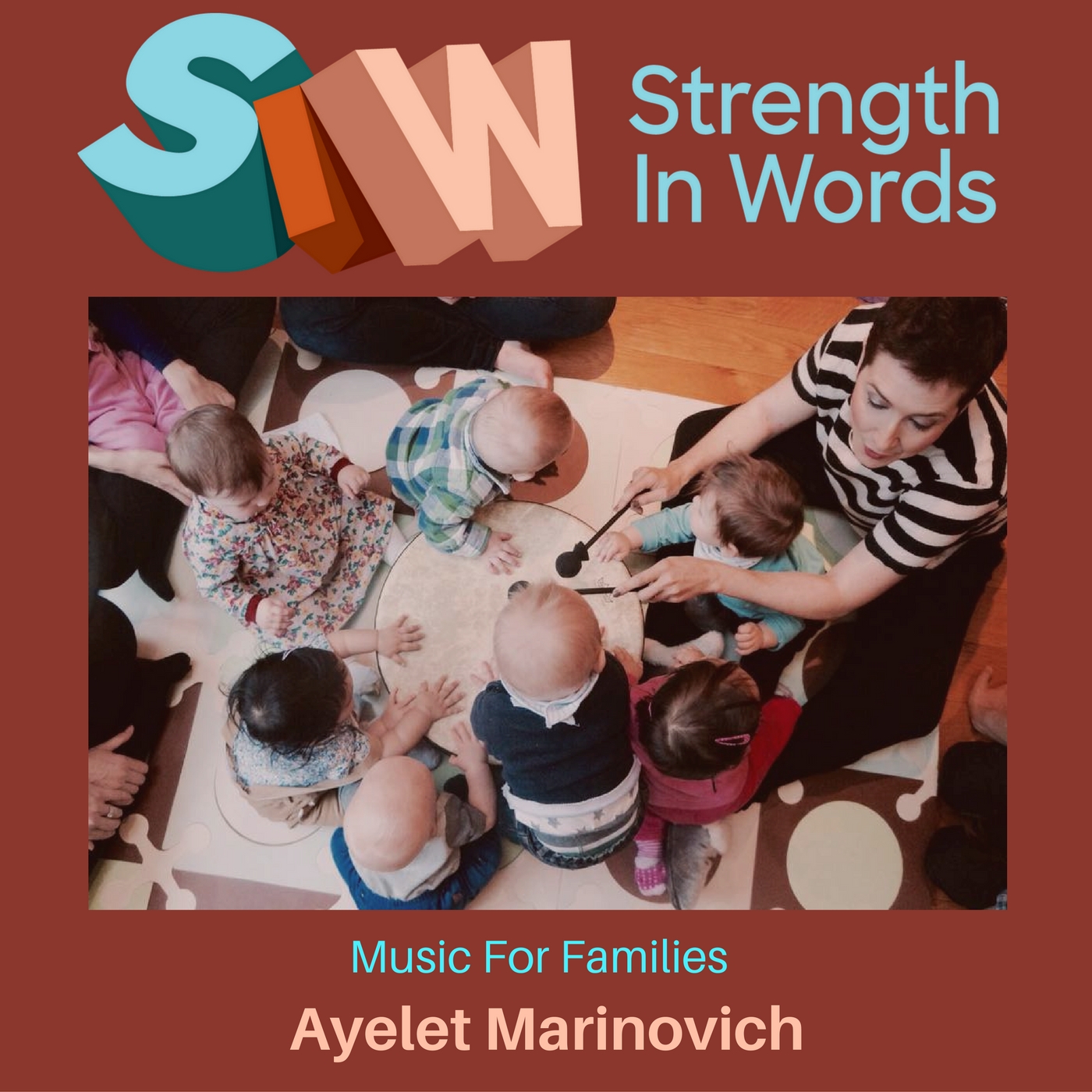
If you’re looking for information about baby development, or looking for ideas about how to play with your baby to support development, Learn With Less (formerly Strength In Words) is where we discuss all things early parenthood and early childhood. We help families (expecting parents, new parents, and seasoned parents) navigate those early years in an inclusive, educational, and supportive space. Join Ayelet Marinovich, M.A., CCC-SLP, author, singer, imperfect mother of two and pediatric speech-language pathologist, for a podcast for parents, caregivers, and educators of infants and toddlers of all developmental levels. Learn With Less is the place for families to access high quality, evidence-based resources about how their infants and toddlers learn and develop; for regular sessions of music, play and developmental information for both you and your baby, subscribe on Apple Podcasts and visit https://learnwithless.com!
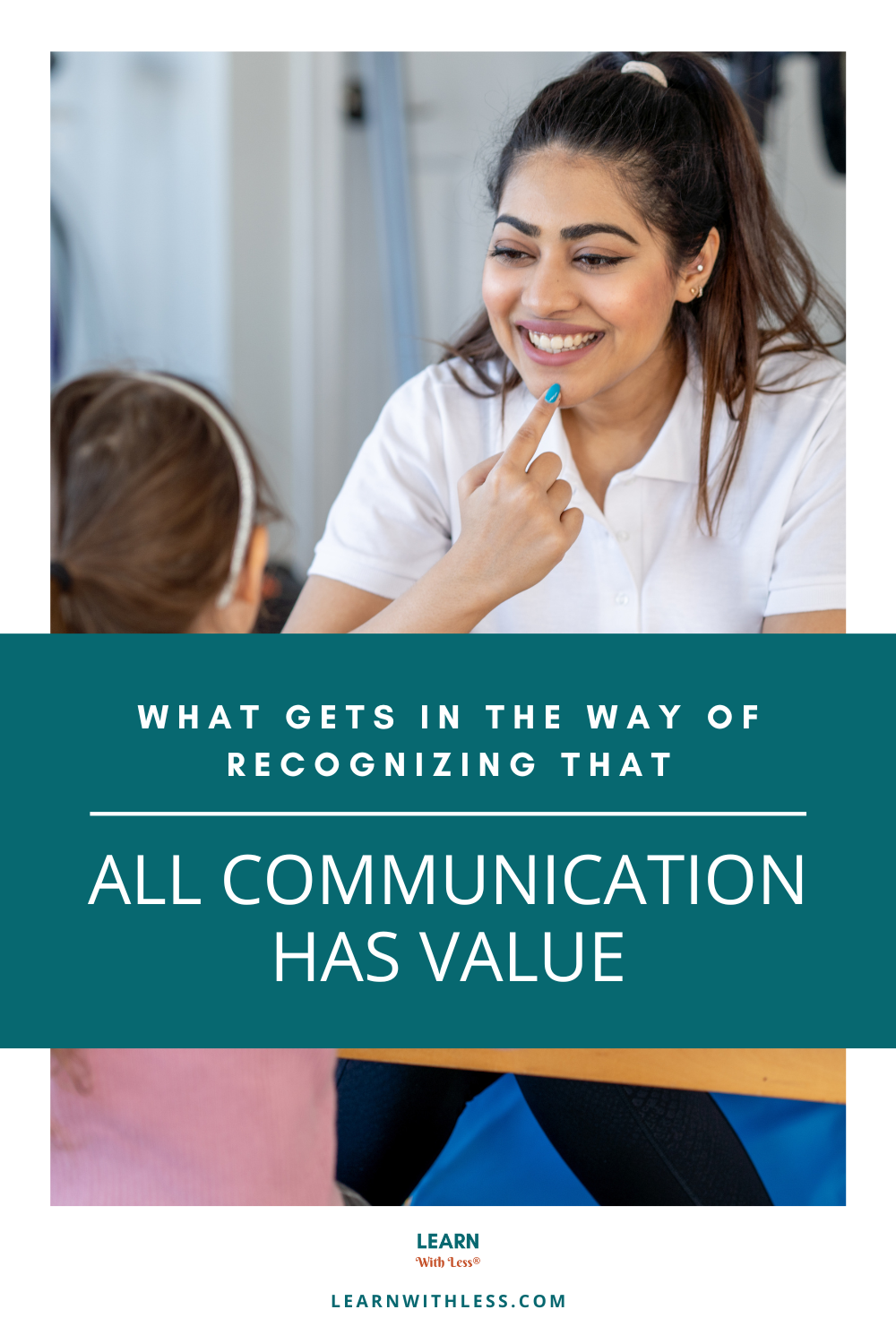
What Gets In The Way of Recognizing That All Communication Has Value? An episode with Jess Burchiel, M.A., CCC-SLP
Apr 16, 2025
Exploring the Impact of Societal Pressures, Cultural Differences, & Trauma on Communicative Intent
In this episode, Ayelet Marinovich and Jess Burchiel discuss the importance of communicative intent and access to communication as a human right. Jess, a speech-language pathologist, shares her experiences working with children, emphasizing the value of responsive parenting and the challenges parents face in recognizing their children’s communicative actions.
We talk about:
Communicative intent and Early Intervention
Challenges in recognizing communicative intent
The importance of slowing down and noticing each other, valuing all forms of communication
How communicative intent is connected to broader social issues, and communication as a human right
The impact of cultural differences, societal pressures, and trauma on communication
We look forward to hearing the ways in which this conversation sparked your curiosity, and what new questions arise from listening!
Connect Learn Play – Digital / Printable infant, toddler, and pre-school aged ideas to provide simple, enriching ways to support early development through play, language, music, and movement – using everyday items – helping you Learn With Less®!
Ayelet: Welcome to another episode of Learn With Less®. I’m here today with Jess Burchiel. Jess just told me that a great way to remember how to pronounce her last name is: it rhymes with Churchill. Hahaha. Jess, would you like to introduce folks a little bit to you & to the kind of work that you do?
Jess: I would love that. Thank you. Hi. Good afternoon from the west coast. My pronouns are she/her, I live in Bellingham, Washington, on occupied Salish and Nooksack and lami territory. I’m a speech-language pathologist here at a private clinic. I’ve been working with kids young as 2, and as old as 25, for about four years here. For years before that, I worked at a small community hospital in the county. I don’t know, I love cats, and I really like my job! I really like doing what I do, what we do, which has been so wonderful to continue to know.
Ayelet: Yeah, that’s awesome. Well, I’m really happy to have you for this recorded conversation. You and I have been in touch over the last year and a half or so, mostly over social media. More recently, we’ve been in actual conversation with synchronous face to face contact, which is lovely. It’s been about a number of topics. These are including and not limited to: communicative intent, access to communication, the fact that everyone deserves access to communication, communication as a human right, human rights in general.
We’re both Jewish or Jewish adjacent, and quite outspoken within the movement for Palestinian Liberation and what is happening in Gaza and The West Bank. Really looking at how we communicate, what is being communicated, communicative intent, looking at the full spectrum of communication here, from both a political lens and a education lens. And as we all know, everything is political at the end of the day. So with that all said, let’s start there, right?
Jess: Let’s start there. I really gravitate to people who have a passion for what we do, for people who are internally curious about we do and how we do it. In particular now in the last year & a half, for people who are willing to speak up and say hard things. I think that is required of us, and I’m really excited to ask you some questions about communicative intent today. What do you think?
Ayelet: I love it. I want to start just because before we hit the record button, we were doing a nice little grounding practice. As we sit here recording, it’s spring break. I have kids at home. They’re in the other room doing “video game camp” in the living room. And it’s been a day, it’s been a week. Let’s get on the same page here. Let’s ground ourselves. And Jess, you were introducing this lovely exercise, and I was wondering if we could just start with that, as well.
Grounding Exercise and Initial Discussion
Jess: A quick note, this is a grounding exercises, very new for me. It’s very much something I don’t want to do, which is why I’m trying to lean into it. I borrowed it directly from my therapist, who’s very much grounded in Buddhist teaching.
As people who’re very busy and often disconnected, one of the hardest things is just to slow down and stop. We’re going to do that by, me and you & everyone who’s listening, taking a second, truly, to put your feet on the ground. Feel your feet on the ground, and take a couple deep breaths.
Maybe I’m going to ask myself and you to identify a sensation in your body, and I’ll do the same. I will name mine as my heart is racing a little bit. I can taste the cupcake that a kid gave me this morning in the back of my mouth. Yeah. How about you?
Ayelet: I’m feeling some congestion in my nose and throat. I have celebrated a birthday of one of my children this weekend. I had a nine year old literally fall directly into my face while coughing. Oh yeah, it’s very cute. I’m just feeling some tightness in my back, looking forward to just getting to connect and talk today. So some ease in my belly and openness in my solar plexus. Jess, thank you.
Communicative Intent and Early Intervention
So you had emailed me and you had asked about resources, thoughts, ideas around communicative intent. I’m going to open up this email, if that’s alright with you, as I read it out loud. So you had said, “I’m sure you’ve spoken about this countless times. Along with our mental health therapist, I am co-leading a support group for families with autistic kids. Something that came up last meeting was the concept that everything kids do has a communicative value. I think this is a really simple concept, but it seemed more challenging to go into depth about this with parents”. You’d said, “I’m wondering if there is a specific resource or podcast episode of yours that might help explain this concept to parents.”
I had shared with you that, yes, in fact, I do I have a podcast episode about this. It’s called Assuming Intentionality, Responding to Early Communication. And of course, so much of what I focus on here at Learn With Less® is with early intervention… Those earliest years of infancy and toddlerhood, zero to three. A lot is focused on parent education. Also educators and or therapists who are serving that population. This is both in a family centered approach or just the kids or just the parents. That was the nuts & bolts focus of that episode, but I want to hear anything that was helpful around listening.
Before we started recording, we started talking about how so much of looking at communicative intent and assuming intentionality, assuming that there is intent behind any action, essentially, is that it actually doesn’t matter what age the child is. You and I share a lot of experience, having worked with autistic kids. We’ve both worked with assistive technology, specifically augmentative & alternative communication.
Utilizing assistive technology within the realm of communication might look like a speech generating device that’s high tech. It might look like a picture based or visual communication system. You and I have both utilized things like that within our work. I want to hear what was helpful for you, specifically with your work, looking at the episode that I directed you to. Also, what else do you want to talk about?
Challenges in Recognizing Communicative Intent
Jess: Oh, man. Okay, so my favorite takeaway was that there is an evidence base for responsive parenting. I love being able to say, “this is what the science says” when parents are asking me questions about how to help their kids talk more. And that’s not something I’ve read into! I know that more responsive parents tend… I’ve just seen that that they tend, their children tend to communicate more.
That almost seems self evident, but to know that that is what the evidence shows was really good. I was like, Okay, I can look at this. I can be able to say that confidently, even if it seems obvious. This brings me to my questions that I want to talk about with you. Would you agree that it seems pretty obvious that responsive parents have more communication coming out of their kids? Does that seem to you an obvious thing, or was it a surprise to you? Or do you even agree with that?
Ayelet: In my own personal experiences, both as a mother & in my professional experiences as a speech language therapist. Yes, I have, I have found that to be the case. I think primarily the reason is because joint attention& and communicating for a social purpose of any kind… Turn taking begets more turn taking! Once we have that skill, we see that oh, I say something. You say something. I look at something. You look at something. I reach out for something. You name it. I hand it to you. You say, thank you.
It’s a continuous response, whether those responses are verbal or not. I think that is the piece. What I have found is that when any human feels heard, feels acknowledged and seen and supported, then they’re going to continue along that path. They’re they’re going to continue to have those attempts to to want more, because that is an innate human need.
Jess: Yeah, so here’s my question. Well, maybe it’s another question. My experience… all of that resonates with me. It feels very natural. It feels very human, like we are communicating to kids and validating what they communicate back.
What I’ve seen be a challenge is that sometimes… I feel like the challenge there is shifting the mindset of parents. And I’m wondering if my questions circle around that, specifically. What do you think gets in the way or prevents us, caregivers, parents, from recognizing that all communication has value. Recognizing that there is communicative intent happening. Like, what do you think gets in the way?
Ayelet: That is, what a great question.
Jess: Yeah, I thought, Okay, so why… that’s my pathology brain. Like, okay, we see a problem. Why?
Ayelet: Right? What is getting in the way? I love that. I think that could be the title of our episode!
Jess: Yes, what gets in the way? What prevents us from recognizing the communicative intent of children?
Ayelet: Yeah, well, many things. First of all, I think in many ways, a lot of it comes down to time, energy, effort, education, understanding. Not just about child development, but about actually sitting with and being with and recognizing, again, basic human needs. And I think that some of this is because we are very busy as humans, right?
We’re “keeping up with the Joneses,” whether or not we’ve opted out of multiple things. We are often trying to manage a home and a family. Maybe a co-parent or caregiver, and at least a job and all of the things. We want to feel like we have enough in a society that is built around needing to be more, do more, & buy more. So here’s the easy answer, we’re not going to be perfect. It’s impossible, right? This is a supremacist ideology.
I think that’s part of it. I also think a big part of it has to do with what we are told is communication. What is valid and valuable. There’s so much pressure on many parents and caregivers to be raising the best child possible. So many people in our society value academic language, politeness markers. I think that’s a big part of it, too.
So how that comes out often can be in the form of parents and caregivers sometimes sort of getting into that stuckness, of the interrogation: What’s this? What’s that, what’s this, what’s that? For the specific purpose of labeling, for this sort of performance: show me what you know. This, again, you’re not a bad parent for doing that. None of us are. I’ve done it!
Jess: I do it all the time!
Ayelet: We do it because we want our kids, our clients, to show us what they’re able to do, & to feel successful. Also, we want to make sure that we’re not just communicating for one specific purpose. We want to give our little people, or not so little people, in some cases, the opportunities to engage in communicative acts for a variety of purposes. Sometimes to protest, to request a social routine. Sometimes to greet, sometimes to acknowledge, sometimes to request an object – so many different pieces!
I think what’s really important is to recognize that all of those (and so many more!) communicative acts can be done without speaking a single actual word.
Jess: Absolutely.
Ayelet: That is an attuning, I think. For many parents & caregivers who are not thinking about how their often pre or non-speaking child is communicating. For an educator how their student, for instance, is communicating. They’re looking at a particular piece & not taking the time to ground themselves. Not taking the time to really look at all of the whole environment, themselves. At them as the respondent, what the setting is, what’s happening around them, what the child might be interested in.
I have an example, a memory that I have from when my own eldest was about a year old. I remember my mom was visiting. We had gone out to a meal, just the three of us. Myself, my child, and my mom. My kid was, at that time, very early stages, making one word utterances. He was reaching out, sort of pointing. Looking at somebody over in the restaurant. He said, “tah!” And I was like, oh, okay, yep, there’s a person over there. That’s their head, cool. And my mom, it was my mom, who realized, is he saying “hat?”
The person was not actually wearing hat, they were wearing a head scarf. It was just so interesting because, as you may know, my go to with anything is: anything can be a hat, right? So then we grab the napkin from the table. We’re putting it around our heads & saying, Oh, is this a hat? This is like a hat. It’s a scarf. And he said “tah!” again. He repeated his word! He’s switching the consonants, but he was saying it. He was saying hat.
Anyway, it just it was one of those experiences that you’re like, oh, wow, cool. This is a child who is absolutely paying attention to what’s happening. Is actually assigning a a symbolic language, a word. It’s a matter of looking at the environment, looking at the setting. Looking at what’s interesting to the child, looking at where the child is gesturing. Looking at how they’re doing it, what they might be commenting on.
Deducing, “detectiveing,” investigating what is happening here, and only then might you notice. And then we had a whole conversation about it, and we played with the napkin, and we… Yeah, it just like, what a what a lovely thing. And if my mom hadn’t been there, I would have missed it, right? So we’re never going to be able to get it all the time. That’s an important thing to say as well.
Jess: Yeah, I suppose, that perfectionism like, “Oh no, I missed it, It’s my fault.” One of my favorite books is “How to Talk So Kids Will Listen and Listen so Kids Will Talk.” There’s one for littles and one for older kids. That is one of their things. The best thing about being a parent is you have a million chances to do it again. You will never run out of chances to try again and do better.
I am not a parent. Sometimes, I think that’s a good perspective to have, because it makes me have more questions about parenting. But that’s absolutely true. I think that it’s really funny, actually. We started out today by slowing down and noticing. I think that is actually what the answer to my question is, to some degree. We got there. It honestly took only about 10 minutes to get to! We all live under a supremacist capitalist system that puts pressures on us. External pressures that we are all subject to, and it is challenging.
I really want to validate that to parents. It’s challenging to slow down and notice because you don’t always know! There’s a lot of that external pressure. One thing that I’ll do with parents, that I just started doing… I will have them playing with their kid. Playing in the way that (we know that it’s so much more than that), but also just play.
And I’ll just sit them down. I’ll give them a piece of paper & say: I just want you to write down what you notice. Just as a practice. Even then, parents are like, Oh no, it’s a test. I’m like, nope, not a test. This is just practicing noticing. It is a hard thing to do.
Ayelet: So hard, especially if you are not practiced in this.
Importance of Slowing Down and Noticing
Jess: Another thing that that came up for me in my “noticing practice,” which is also very new… If it’s hard, then find the smallest step that’s easy that you can do. If noticing is hard, maybe just trying to slow down for a millisecond, that’s all you can do. That’s fine. Again. It’s not about perfection.
Ayelet: It’s such an important piece of what we do. That slowing down, having dedicated time doing being in a practice of doing these things. It might be through play, through adding more language, just verbalizing, narrating, asking questions, answering your own rhetorical questions. Through musicality, whether it’s a rhythm or a nursery rhyme or a chant. Or play, or something you’re making up on the fly. Or whether it’s through movement, practicing visual awareness, perceptual awareness, practicing gross movement. Whether it’s a child with motor challenges. Or whether it’s a teeny tiny baby who is literally just trying to figure out where their body begins & ends in space. Whether it’s anybody in between.
All of these pillars within the context of Learn With Less® of play, talk, sing, move, are, to me, those kinds of interactions that really give the opportunity for parents and caregivers. Also for educators and therapists, to do that work. To slow down, to attend, to acknowledge, to investigate, to pay attention. For instance, in a Learn With Less® class, that is the majority of what a class is, for caregivers & babies.
Whether it’s happening through a song activity, it’s literally just the activity. Often it’s, all right, here’s a tune. You may be familiar with it. Now we’re going to just input a word for what you see your child doing. Maybe what you are doing, what the object is, what’s happening. Mabye how it feels, whatever it is. Find a word that is in the context of this. Those are the words you’re going to sing on or chant on.
That is such a major part of what myself and other Learn With Less® facilitators do. It gives that dynamic opportunity for caregivers to notice. To do that work, of purposefully engaging in that way. Of course, you can do that in a therapy session. You can do that with your own child. You can do that in a educational setting, whatever it is. But yeah, just as an example having that practice of slowing down. Being intentional as a caregiver or practitioner so that a child can know that that is valued here.
Jess: The words that come out of our mouth tell our kids what is valuable to us. I often… what I think… I don’t know how much time we have, and have so much I want to say about this! But I’ll just say that I find that one of the things I say over & over & over again when I talk to parents is… I want you to be thinking about directing their attention to where their child’s attention is.
I’m often working with kids who are older, non-speaking. We’re working on the same things. Trying to engage together and validate all communication. I have to work pretty hard to sometimes get parents to attend to what their child’s attending to. To join in, rather than pull their child away to something else. I started describing it as… I want you to imagine that your kid has a minor’s headlamp and it’s on whatever they’re focusing on.
Ayelet: I love that visual!
Jess: They’re wearing that hat. And any word coming out of your mouth, it better be about what’s in that light. I want you to fill their world with words that show that you are attending to what they’re attending to. For kids when we say they don’t pay attention, or they’re not coming over to play. I’m like, okay, that’s fine. Our job right now, going back to that investigator, detective is to know what they’re focusing on. To know where their attention is. To attend to that with the phenomenal blessing that is our language skills as mature adults. I say that a lot!
I think we’re already talking about the second question. What are the challenges that we have in shifting parent perspectives on this? We’re raised as we’re raised. We have our own experiences and expectations and different pressures on us from the world. A lot of valid fear from parents that if their kid doesn’t measure up, they will be subject to discrimination, harassment, violence.
Especially if, I mean, I’m white. Marginalized families absolutely have more reason to be worried about what might happen. To want their child to meet certain expectations. But I’ve had success in saying, what are they looking at? Only talk about that as simple as that, that’s our practice for today.
Ayelet: Yes! Also, parents ask all the time, how do I build my child’s attention skills?
Jess: Oh, I could talk about attention for days.
Ayelet: And that is, that’s how.
Jess: Oh my gosh, that’s how. That’s how. Guess what? Sorry, you’ve got to talk about cars. Sorry, it’s boring! You want to build your child’s attention skills. Shout out to anybody out there saying that you can’t do that with anything other than attending to things that you like… Because that’s how it works. But, yeah, you gotta, maybe you gotta talk about minions forever.
That’s how you build attention skills. I would say many of, if not most of the kids that I see. From a year and a half, all the way up to the oldest that I’ve seen… Attention is a component of it. That connects everything that we’re talking about today. When we talk about slowing down and noticing we are talking about resting our attention away from the million things out in the world and putting it on ourselves.
And that’s that’s hard, that’s really hard. But when we’re supporting that with our kids, with our language, we’re helping them have the language to do that for themselves.
Ayelet: Does that feel complete, Jess? I mean, for now?
Jess: We could talk about all this stuff that I want to talk about. I feel like that’s yeah, that specific note, anyway, yeah, for sure, yeah.
Connecting Communicative Intent to Broader Issues
Ayelet: I want to talk about the fact that every one deserves a communication as a human right. Everyone deserves access to communication… To being heard. Whether that is your literal words, whether that is your viewpoints. Whether that is your narrative, what you are experiencing in the world.
I think when we as healthcare, educational professionals are talking about the importance of this and not speaking out about those who are not receiving access to that, whose whose narratives, whose stories are not being told or are not being heard or are being gaslit, then we are doing a real disservice. You and I started to engage and interact one on one together through work around collective liberation and Palestinian human rights. I wonder, how can we connect these two things? Because they are absolutely related.
Jess: Yeah, a couple of things. A, it is our job to as as much for our patients and our clients and our families. It is our job to be informed and be able to connect the dots for them.
It is our job as people who live in the West, people who have privilege, to educate ourselves so that we can connect the dots. We have access to so much information, I believe we are required to do that. To lean in to when we notice that there’s perhaps a gap in our knowledge. Perhaps a disconnect between our values and our actions. That gets into real discomfort. I think that that’s probably something we’ve all experienced to a small degree.
But when you practice medicine, as we do… If you work in education, if you work, gosh, in so many different areas, you swear to some values in medicine. We say that those values are universal. Like you said, communication is a human right.
We have to be able to step back and be able to recognize that if we have these values and yet, we are able to look away from people whose rights are being violated in ways as horrific as genocide… We have to be able to introspect about why that is, and understand what that might tell us about us.
Not that it makes us awful, bad, nasty people. It makes us people who live in a world, and work on that. I believe that’s required of us, as well. It’s not fun. And another thing that I’ll share with you that’s just directly read from my therapy. Speaking up and doing the right things, speaking up for rights, for human rights, for communication, for health care, for access to food and water, for the right to simply tell your own story. Doing the right thing doesn’t get you claps. It doesn’t get you cookies.
Ayelet: And often comes at a cost.
Jess: It often does. I was raised in a church, Protestant. I grew up with the mythology of Jesus who did all the right things. The mythology of what happened to that person. We have a very good example here in Christian culture. I’m atheist now, but that’s something most of us know.
And yet I think that we think that it should be easy to connect the dots. To notice those uncomfortable things. To have those uncomfortable conversations, and it’s not. And that’s okay, and it’s okay, like you said, to not be perfect with it. I think that’s maybe another really important one.
Ayelet: One of the things that is just feeling very alive in me, and that’s coming up from what you’re talking about, too, that very much connects all of this, is the idea of dehumanization. The idea of all communication being valid, all bodies being valid.
When we only value certain people, certain neurotypes, certain bodies, certain lineages, certain ethnicities, certain identities, that is how we dehumanize others. And unless we understand that, in the case of a child who is either pre verbal or non speaking, that all of that is valid. There is value in all of those humans and all of those modes and modalities of communication.
When we prioritize one over another, or only value one over another, that is how we end up in hierarchy. In systematic oppression and oppressive tendencies. And so until we are doing that work of understanding that base level of, “what is the ideology? What do we believe about certain people versus certain others?” Unless we’ve done that hard work, then we’re never going to see even the level of dehumanization that’s possible.
Jess: That is a really good point, that all of these ideologies come from somewhere. None of them are natural. They’re learned. They’re all learned. And that undoing that starts with the relationships we have around each other. What more important relationship than when you have with your family and your children?
Ayelet: Yeah, your community.
Jess: It’s really hard to talk about. I find it really hard to talk about what I do and how I’m trying to help families without talking about big stuff. I think that that means that I’m doing it right. Even if it feels like I don’t quite know where it’s going. Sometimes I feel like… I don’t know if I said it already today, but that we’re pathologists for a reason.
Our job is to figure out what is the source of the problems… Rather than spot treating like what’s the root cause of what we’re seeing. And that’s a lot, and if we work on that, it’s a lot more efficient. Yes, and that applies to the culture we live in and the world we’re in.
Ayelet: Absolutely. What else would you like to talk about here today, Jess?
Cultural Differences in Communicative Intent
Jess: I’ve got one more metaphor for you, if you want it, that I use a lot. Let’s see, the questions that I wrote down, we pretty much covered.
In shifting parents framework, another thing that has been helpful is to talk about what speech therapy for articulation is, which is what we often people think of as speech therapy. Get them to say it right, which is a thing that I do and do quite well.
But that’s quite different than communication therapy, if you want to call it that. And I describe them as different in that working on sounds is like kind of being a car mechanic. They got some… not broken pieces, but pieces that aren’t working quite right and need a little jiggle, tinkering. With the right approach, I can reach in and just fix it, six months or so.
I can do that versus supporting a child’s language development, which is a wholly different thing. And I describe that as gardening, because can you pull a plant out of the ground? Can you force it to grow? No, you have plants, and maybe a certain plant is struggling. If you want it to grow, you have to make that ground be as fertile as humanly possible.
Ayelet: You have to shift the environment. Tend to the environment. Make sure it’s in the right setting. Look at the context for everything. Give it the right amount of attention for it to thrive. And you are good with these metaphors!
Jess: Another thing I was going to ask you about. So we’re talking about recognizing communicative intent and all of this stuff that ties back into like culture and expectations. I lived in the Pacific Northwest for my whole life. White English speaking, European ancestors. Very much like a monoculture here.
I had a parent tell me when I was talking about some of this. Talking about descriptive language or something like that, parallel narrative talk and all that stuff. And she was like, Oh yeah, that’s what we do all the time. We’re Japanese. And I realized, I don’t know how much of this is just particular to my culture! I’m wondering if there are cultural differences, or, I mean, cultures that do this differently or better, or maybe we don’t know at all.
Ayelet: I mean, I think what I tend to look at, or what I’ve noticed the most, are different kinds of patterns more around… Well, okay, a couple things. One is, I look a lot around at what kinds of caregiver relationships there are available to a child. Whether it’s just a nuclear family, or an extended family where you have lots of different adult and child or peer relationships. That’s something that I think you find often with more immigrant experiences. Or folks who are closer to an immigrant experience, regardless of, for instance, where family is from.
And then another piece is looking at trauma! What is available to a caregiver in terms of how much of themselves can be present and attentive. I mean, that is a huge piece. It can come out in some moments and not others. But definitely is connected to the ways that we watch family dynamics play out.
Jess: That’s actually, it’s maybe that’s a nice button. That’s making me think of the reason that I reached out to you about communicative intent. It’s what you just said about trauma, because my clinic, we’re very small, but we got a grant. We’re able to pay ourselves and some childcare folks to do a support group for families of autistic kids. They can come and bring their kids. We put them in one corner of the building. Everybody else hangs out.
We turn the lights off when everybody gets to sit on the squishy pillows. It’s great, and it’s led by a mental health therapist. I wasn’t quite sure what it was going to look like. It is basically an hour of stress management techniques, just basics.
Ayelet: That’s great.
Jess: It is. And I’m thinking about what you just said about trauma and again, root causes. If we’re trying to work on what’s the root cause of difficulty, being able to slow it down or having the time to notice that’s a huge part. Not everybody has access to the support for that. But that is why we’re talking today.
Ayelet: Yeah. And that absolutely is something that, number one can get in the way. It has the potential to get in the way of that connection, of seeing the communication in of itself. Also just gets in the way in general, between humans. When we don’t have access to the tools to reconcile, repair, heal, face traumatic experiences in our own lives… We are essentially bound to either get into similar experiences. We are bound to repeat them on ourselves, or enact them on others. Heavy stuff, heavy stuff, the stuff of life.
Jess: The stuff of life. It is the human experience.
Ayelet: Thanks so much. Jess, what a great conversation. I can’t wait to hear what other folks are taking away from this.
Jess: Oh my gosh, this is like giving me so many other good questions and food for thought, too. Thank you.
Ayelet: I love connecting with other professionals and listening to how they explain similar concepts! There’s always another little key ingredient that we can take away from each other. There’s so much value in having that sort of network of support listening to each other.
Jess: We get so siloed, it’s the classic speech pathologist thing. I really appreciate this. This has been wonderful!
Ayelet: Thank you for sharing so much of yourself here.
Jess: You too!
Ayelet: Yeah, thanks. All right, let’s leave it there.
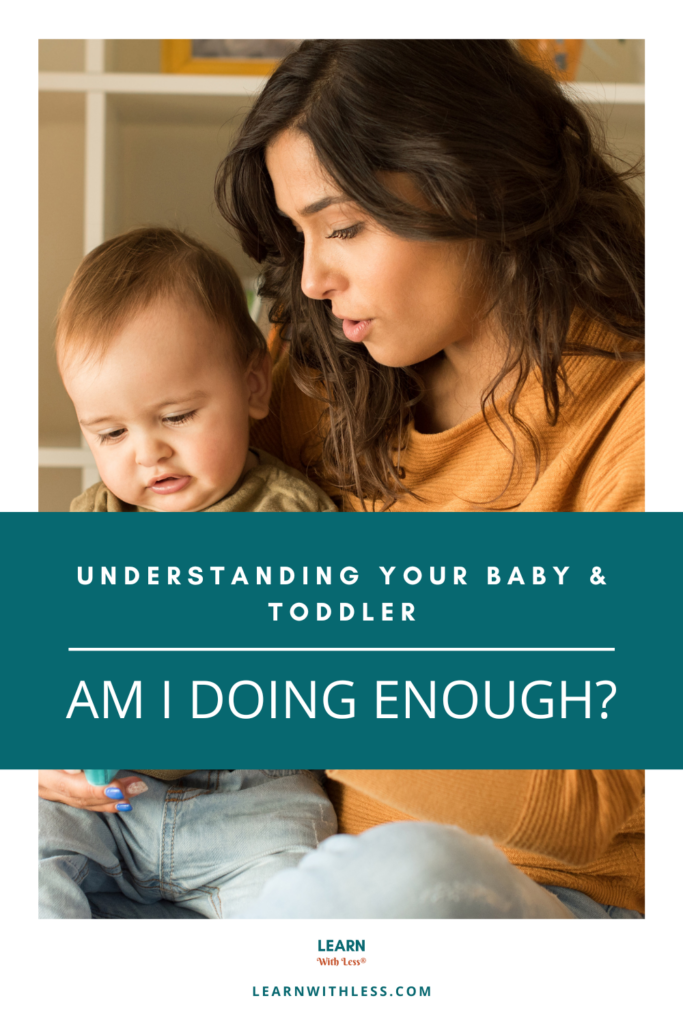
Am I Doing Enough? Understanding Your Baby & Toddler
Mar 25, 2025
A Co-Production from Learn With Less® and the Play On Words Podcast
Are you constantly wondering if you’re doing enough as a parent? Do you feel pressure to “get it right” when it comes to your baby or toddler’s development? In this episode, In this co-produced episode, of the “Play On Words” podcast and the Learn With Less®” podcast, Ayelet Marinovich of Learn With Less® joins host Beth Gaskill of Big City Readers.
Ayelet Marinovich is a pediatric speech-language pathologist, parent educator, & founder of Learn With Less®.
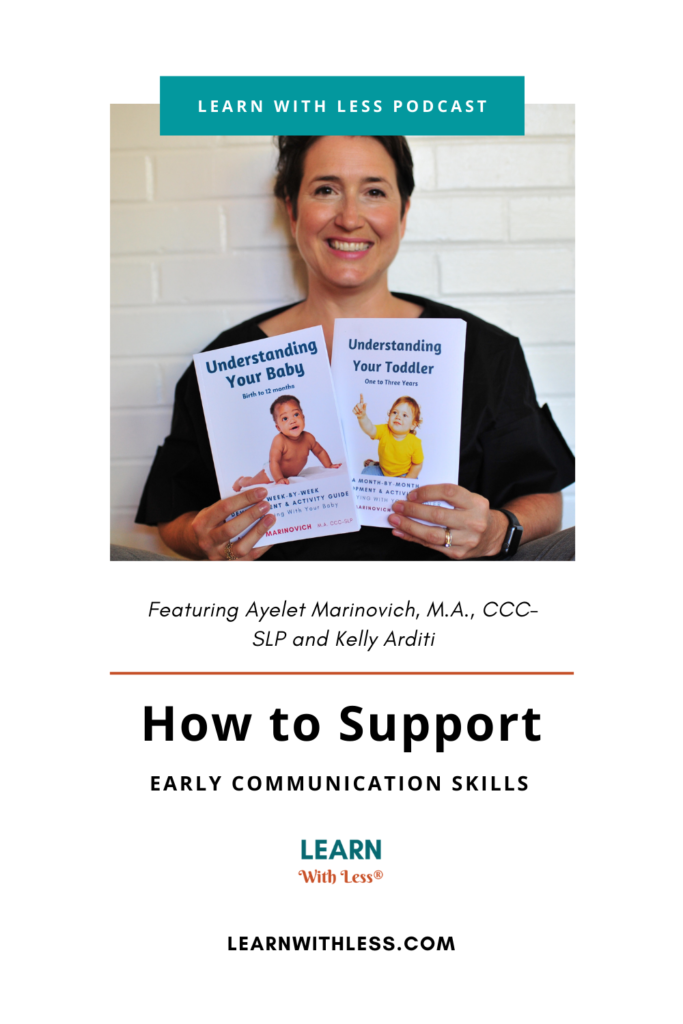
She’s the author of Understanding Your Baby & Understanding Your Toddler, 2 incredible resources that remind parents: you don’t need fancy toys or complicated activities—your everyday interactions are already powerful learning moments.
We talk about: 🧠 Why you don’t need more stuff to help your child learn ✨ How to feel confident that you’re doing “enough” 👶 The surprising ways babies and toddlers learn best 📚 Simple, evidence-based ways to support early development 🎵 Why everyday routines (yes, even diaper changes!) are packed with learning opportunities
If you’ve ever doubted yourself as a parent, this episode is your reminder: you are enough. 💛
Connect Learn Play – Digital / Printable infant, toddler, and pre-school aged ideas to provide simple, enriching ways to support early development through play, language, music, and movement – using everyday items – helping you Learn With Less®!
Beth: Welcome back to the Play On Words podcast. I am so excited and a little bit nervous today to have Ayelet Marinovich here from Learn With Less® to talk about: Do kids really need toys to learn and thrive? If you don’t know Ayelet, she is a child development guru, parent, play based learning specialist, and speech therapist too, right? So many things, I’ll let you introduce yourself, but this is an episode (I already know) is going to be so great. So welcome to the show.
Ayelet: Thank you so much for having me. Beth. It’s great to be here. Yay.
Beth: Okay, so tell us a little bit about you and Learn With Less® for the people who might not know you!
Ayelet: Sure. So again, I’m Ayelet. I have been a speech and language therapist since, gosh, 2009 / 2010. When I became a mom in 2014, I was far from where I grew up, which was here in California. My partner and I had moved to London, and so I was pregnant and had my first child there, across the pond. I was really looking for, number one, community. Number two, a way to utilize the knowledge that I have in my professional arena, and connect that with creating connection points with other new families. So I started leading caregiver and baby classes with my own child, just in my community, out of our home.
I loved it so much because it was an opportunity to connect, to bring people together and, again, to share information that at least I knew. Obviously, the overwhelm of early parenthood is intense, and this was a place that I could feel confident. I could feel at least a little bit less vulnerable and and really share that information with other new parents and caregivers who I knew were feeling the same way. I just started leading these groups, and really facilitating these groups and utilizing that knowledge, and just expanding on the kinds of questions that I was getting and asking myself. What can I do to support and connect with this teeny, tiny human in my world? And yeah, that’s, that’s how it came to be.
Beth: Wow. And so now, are you still leading them, or are you mostly training and coaching other people to lead them?
Ayelet: Yeah, primarily I license and support other educator and therapist types to utilize the curriculum that I developed, to use in their own communities. This is amazing because it expands the impact that I can have exponentially, and really allows me to feel like I’m putting something into the world that is healing and helpful.
Beth: It is. I even like the song on your podcast. Is that in – do you sing that in the class? Hello, everybody, I get it stuck in my head when I’m listening. I love singing it in my own house, like when I’m making dinner. So, okay, do you do miss teaching the in-person or the actual “caregiver & me” classes? Now that’s my growing pain, too: You want to have a bigger reach, but you kind of have to give a little!
Ayelet: Yeah, and I do from time to time, often offer them virtually! I mean, it’s funny, right? Because when I started the licensing program, it was February of 2020, so there was, of course, a big switch to, I now need to ensure that other folks also are able to lead these virtually. I had actually been doing this since 2017 myself, for a variety of reasons. There has always been a need for virtual connection, and always will be. So I do still lead classes from time to time, especially when I’m getting that itch.
Beth: Oh good, that’s kind of how I do it, too. I was just talking with someone yesterday, and they said, so you don’t get to be with kids anymore? I answered, No, I still do. I do, say, a once a month meetup, but it’s so hard because you think to yourself, I want to reach every kid and family! I think we align a lot on that – that is my big focus: community for families, whether they’re in school or in the baby stage.
Originally I started because I saw so many parents having struggles with knowing how to advocate for their child in an IEP meeting, or like things like that. There needs to be a bridge between school and home: how to find your community, asked the right resources… and then my work expanded to people who don’t need IEPs! Yeah, it’s such a need. Community is such an important part of being a parent!
Ayelet: Yes, especially in these uncertain times.
Beth: I know! Every post I do, I ask myself, does this matter? The world is on fire!
I know you are a big advocate of using what you have. I mean, your literal company is called Learn With Less®, right? I once posted something many years ago, and I still think about it, because I kind of got in trouble, but I posted something that a popular toy subscription company had sent me – this little toy that was a box and it had tissues in it, and you pull them out. I was like, so cute. And I made a post that said, and also, this actual box of tissues does the exact same thing. There’s no need to buy this.
Ayelet: I literally have one sitting behind me, yes!
Beth: The reason I got in trouble is because a toy store owner said, I’m so mad at you! but I said, I’m sorry, there’s enough for people that want to buy toys and people to know that they don’t need, too. So can you talk a little bit about what role toys actually play in child development?
What Role Do Toys Play in Child Development?
Ayelet: I mean, first of all, I like to say this whole the baby industry is sort of a “The Emperor has no toys” situation, right? I am not anti toy. My children have always had toys, either that I have bought or that other family members or people in our community have given them. But my my kids also have always known that the wooden spoon and the paper towel roll are equally as entertaining and an equally valid developmental tool.
The power of any tool or toy is not inherently on the box that says “this is an educational toy.” Anyone can put that tag on, say, cupcake liner and say “educational toy.” It’s the actual interaction with that toy and with others that makes the difference. I think it also really comes down to the power of connection! And at Learn With Less®, we have four pillars that we want to define around creating more connection, more opportunities for interaction, more vocabulary, more modeling, more reciprocity. So those are, as I define them here at Learn With Less®, play, talk, sing and move. And I’m happy to go into that, if you’d like.
Beth: Oh, please!
How Does Play Support Early Learning?
Ayelet: Yeah! So around play, we want to define that with attention to the following principles. First, open ended play, meaning we want to encourage caregivers to really engage in the exploration of the environment and everyday objects. Also, being playful can simply mean exploring, experimenting, offering varied environments and varying objects! Most importantly, we want to actually help the adults in the room see that being playful is a different way of looking at what we as grown ups come to define as play. Many adults in the room come into the idea of playing with their child as following set of rules. For instance, we hit the ball, we run, we score. Or it can be thought of as a procedural exercise: we open the book, we read the page, we turn the page, repeat.
Encouraging caregivers to play with no specific end goal in mind can really require them to reframe their entire thinking. I think a lot of your audience are educators or therapists, as well. So in a therapeutic context, you’re going to want to weave whatever skill you’re working on into the play. For instance, it might be that a professional is working on turn taking, eye gaze, joint attention, imitation, first words, or gesture use. We want to encourage and create an environment where that caregiver is encouraged to be flexible and accepting of what is happening, what might happen next, and what their child is doing. Finally, within that play, we want to ensure safety with a variety of materials.
Beth: Yeah. So, okay, I’m imagining. I always try to work on remembering that not everyone has all of the information. If I’m the furthest point out, I’m imagining that I’m a parent. So how do I play with my kid? Say, I’m sitting in my living room and we have I’m drinking my coffee, and he likes the plastic lid that I took off from the coffee shop we stopped at this morning. How do we play with that? I think a lot of parents also think that play means I have to “be silly,” which I think maybe we can correct that. I think people want a specific goal. So if they’re asking, so what do, how do I pick what topic I want to do with this lid? And, you know, then they just get stuck. Do I just say, the lid is on my head?
Ayelet: Well, actually, yeah, I mean, my default is always… everything is a hat!
Beth: Okay, so that is a good move.
Ayelet: It’s a great method, yeah! I mean, it’s really about following the child’s lead. If your child is interested in that plastic lid, then, yeah, what are they doing with it? All you need to do is talk about what they’re doing, how are they engaging with it? Oh, it’s light! Yep, you can pick it up. I wonder if there’s something heavy over here? Just speak about what they are doing with it, or how it feels, or what it looks like. Engage with that. Of course, we can always expand, meaning take what they are doing and add more language. I can imagine say, pushing a finger down and sort of popping it up. There’s so much that we can either lead with and model, or simply just follow what our child is doing and how they are interested in it.
Beth: I love it. Okay, that’s easy. Do you have a time frame around that? I know we would say, no, just follow their lead. But so many people ask, how long do I sit? Should I introduce something else? I think we’ve over analyzed things so much as a society that people feel like they’re not doing anything right. When actually, you’re worrying about it is the only problem!
Ayelet: I think parenting is such a practice of of being able to sit with. I will be the first person to say that I absolutely still struggle with that. My kids are eight and 11 now. But I think it’s about paying attention to what’s happening in the environment. It’s looking at, is the child still engaged? Great. Continue to reinforce that engagement. Are they finding that they’re done? Great. We’re all done with this. We can move on to the next thing. And like you said, it’s very hard, I think, for families to trust themselves. So much about of what this is all about, what I try to achieve at Learn With Less®, is fostering confidence and competence. It’s about helping families feel confident and competent that they can be with, and facilitate, and engage in play.
The means to do that are often through these four pillars of play, talk, sing, move, which are again, just an open ended opportunity to enjoy your child for a few minutes. I think another thing is, like you said, people think that play is “I have to be silly. I have to do pretend play. I’m not good at that. I don’t want to do that. Or I don’t even have more than 10 minutes a day to dedicate to sitting and totally being present.” But I think the example you gave,Beth, is so good. Because it’s literally: Okay. I’ve sat down with this maybe lukewarm cup of coffee. I’m finally getting a few minutes to sit with it and with my child. So much can happen within those in between times.
A lot of what I talk about at Learn With Less® is utilizing those everyday routines and tiny rituals of the day. That’s your gold! We don’t need to necessarily dedicate 20 minutes a day just sitting with our child. We are literally doing it during a diaper change, when you’re putting your child’s shoes on or sweater on, when you are going out to get the mail. All of those little things are the opportunities!
Beth: Those tiny moments are often the times we’re rushing through to get to the next part – but that’s when everything’s happening! I also when you were just talking, I thought, okay, I went from asking, people are going to ask, “what do I do?” Okay, so say they want to play with this lid, and can we give them play? And then when you renamed the pillars again, play, talk, sing and move, then, I got to thinking about what happens next! So maybe you’re pushing the lid, and then you’re going to chase it. Then you get it, and then you are popping the thing, and you’re going, “pop, pop, pop, pop goes the top,” and just those little moments. So maybe walk us through, let’s keep this as the example, and through the rest of the pillars.
How Do We Create A Language Rich Environment For Babies and Toddlers?
Ayelet: Okay, so we’ve started with play, so then we can discuss talk. Like you said, “pop, pop, pop, pop goes the top.” That’s both talk and sing! You’re saying vocabulary and you’re making it into some rhyming scheme, you’re giving it a rhythm or a melody. So for talk, we want to remember that caregivers – just by having discussions with their potentially pre verbal baby or toddler, just by making those observations alongside their child, they’re creating a language rich environment.
Let’s think about this idea of “repetition with variation” as the gold standard. That’s about helping them see the value in all those everyday experiences, like the diaper change or popping the lid of the coffee topper. These are all these are opportunities for repetition, because maybe you do go get a cup of coffee every morning. And tiny variations that you can make with a change of pace, with a change of attention, with the addition of a choice making opportunity, with a little song, like “pop, pop, pop goes the top” and so on. That’s it!
We also want to help caregivers remember that the drill and kill kind of “what’s this? What’s this?” labeling that many parents sort of get stuck in, because they want their child to show them how much they know… This is just one of the many reasons we communicate! Labeling is just one way we can talk about things, but so is asking questions, making requests, greeting… You could hold up that lid and say hello, and then move the little topper that goes in and out and that can be its mouth. Suddenly you have a puppet! Oh my goodness, how cute!
So many other parts of joint intentional acts, socially interactive acts, and behavioral regulation acts are all talk, creating that language rich environment. We all communicate using a variety of means and modes, not just with words! Remember alll those precursors to language, all those additional ways, like eye gaze, facial expressions, gestures, moving closer to an object. So maybe your child is pre verbal, and they’re not going to say something, but you might move that funny little top that’s become a puppet closer to their face, and they might move towards it too. Then all of a sudden, when they’re not expecting it, BOO!
There’s so much that we can infuse with these silly little objects that often end up in our recycling containers, that are opportunities for engagement and modeling our own curiosity, talking about our own feelings, imitating their vocalizations, verbalizations, and movements. These are all supporting various areas of communication. And caregivers are the primary language models. They are the ones modeling what they want their child to then imitate. So we want to help them model a wonderful variation of vocabulary, and formation of sentences, etc. We also want them to model positive behavior of positive communication styles. We want them to talk to their children, around their children in the ways that you know they want them eventually to do the same to them. So that is how I sort of define talk.
How to Use Musical Experiences to Support Early Development
And then we have sing. Often, this is the one people have the most difficulty gathering the resources and just doing. I want to really encourage people to remember that this pillar of sing doesn’t necessarily mean singing a specific song with specific vocabulary, singing every day or in every way with their child. There’s so many ways to be musical, just like “pop, pop, pop, pop goes the top,” because music is so powerful. Giving caregivers ways to feel at ease, trying things out, and giving children ways to trying things to try things out, by modeling our own imperfection, and using music to add a silly element to a simple routine. This coffee lid being a wonderful example. Another one might be the diaper change. STINKY DIAPER! It’s time for a new one! Or my personal favorite, that came out of a moment of brilliance. “Is there a poopoo in there / Is there a poopoo in there / Was it only air / Or is there poopoo in there?
Beth: Oh my gosh. I love that. I think parents and caregivers need this permission that being silly actually is helpful!
Ayelet: Yeah, right, when you have the capacity!
Beth: Yes, yes. So I just thought about when you were using talk and sing to model both communication and stuff that you want them to do. I thought of the little tiny Tim song, the froggy. I had a little froggy / his name is Tiny Tim. I always do at the burp, he had a bubble in his throat, and we do a big burp, and then I always go, “and what should he say? Excuse me!” In those moments, because yeah, it can be fun to do Tiny Tim and there’s a lot of language benefits and literacy benefits and all of the things and that. But also, you can add in manners!
There’s so much, I think, that people often also get lost in that questioning, what does a dog say? What does a cow say? I like to remind grown ups to try to think about yourself in conversations. Are you just asking questions? That’s not a good conversation! If you’re just asking a dozen questions at someone, that’s gonna get really boring for the other person! You have to leave that space for the dialog. I think that’s a good reminder.
Ayelet: Sometimes just pausing at the end, towards the end of a sentence or a poem or a chant or a melody of a song is such an effective thing! And that’s actually, there’s a name for that. It’s called the cloze procedure, where you’re pausing and what do we do next? We… buckle our seat belt, or whatever it is. When you have that sort of repetition and routine, you you allow them to know, number one, what’s coming next, and number two, offer an opportunity for them to either verbally or gesturally, take the next step and fill in that gap.
Beth: I love it. That is great. I also love to do that when I’m talking about teaching rhyming. I’m sure you know the book, Little Blue Truck. I could read it in my sleep. My examples always go, horn went beep / Engine purred / friendliest sound you ever…. And I always am coaching parents and teachers and caregivers that even if they’re not gonna know the rhyme yet, or even if they don’t, just leave a little bit of time, and then if the child is not saying it, then just fill it in. But giving that amount of time is going to help them start to realize, Oh, those two words are rhyming words. Oh, there’s a word that goes there. Oh, that’s not just one sentence, those are separate words…
Ayelet: Yes! I mean, I’m just imagining this whole thing, and visually, I’m seeing myself cupping my hand against my ear. “Friendliest sound you ever…” put the hand against the ear, and that’s a gestural opportunity for someone, for a child who’s maybe non verbal, pre verbal, to to give that that gesture of “heard.”
Beth: I love that. Okay, amazing. So then move is next, yeah, great. Tell us about move.
How to Use Movement to Support Early Child Development
Ayelet: Number one, movement is life. Their child learns about everything by learning how their body moves, where it is in space, by solving that problem of how to balance and lift, and figuring out elements of force & gravity, and of becoming the scientists that they are through movement. So we want to help caregivers remember that even with a tiny baby or a child with motor challenges, they can consider various movement planes. Whether it’s during tummy time or during a dance party or a lullaby, whether it’s to stimulate or to regulate.
Also, exploration cannot be contained. It is learning. So we might have some movement in and out of the location where the session started. We might be sitting up or laying down on the floor. We might be mouthing something or exploring how one surface is different from the next. Movement is also connected to gesture, so pushing, pulling, raising a hand, waving all of those things. Even in that example, earlier that you were giving of pushing that coffee lid on on the floor, for instance, with a little toddler: you can have them flick it with their finger, or with their whole hand, or their the tops of their fingers, or with a foot. There’s so many ways to integrate movement, and we know that early gestural communication is also linked to this movement as well.
It’s all connected. And I want to also just name out loud that all of these things, play, talk, sing, move. There’s overlap with all of them, of course. Just gonna say that. So it’s not like you can, you know, check one off the list and be done with it. It’s an ebb and flow. You’re always playing. All of this is play, but how can you infuse more playfulness, more language, more melody or rhythm or and more movement into your everyday moments with your child.
Also, those four pillars are how we support cognition, communication, motor and sensory development and social/emotional development. That is how it happens! It’s sort of this developmental matrix that I like to talk about: there are ways that you can play that support cognition. There are ways that you can play that support communication. There are ways that you can play that support motor and sensory development, etc, etc. And then same goes for all of the other pieces.
Beth: Yeah. I was just thinking, we love the song, zoom, zoom, zoom. And in that song, you’re doing all the things, because you’re doing, zoom, zoom, zooming. Yeah, we’re flying to the moon, and then when you do blast off and you lift the baby in the air, it’s playful, it’s movement. You’re flying them around the room, even the part if you want to take a trip, climb aboard my rocket ship, has talk in it. There’s singing… So if your baby wants you to sing, zoom, zoom, zoom 10 times. Guess what? You just did all of the components!
Ayelet: Exactly. All you need to do. And maybe they’re telling you that they want you to do, zoom, zoom, zoom by moving their hands in that zooming way that is representative of that song. To me, it’s really, you know, it’s not about you getting to show off all your cute therapy toys or getting to use your laminator as a provider, but for every single material that you use as a provider or a therapist or educator, for instance, if you’re bringing something into the home or you’re providing materials within a group, or you’re using what’s already there, try to think of the most basic version.
In our use of everyday items, we’re educating caregivers that they don’t need what you have, what you bring in, they can use what they already have in their own homes, regardless of how “much” or how “little” they have. Our caregivers are a diverse set of people and children who may or may not be accustomed to playing with a variety of materials. So I want to address this too, right? Folks maybe started a speech therapy session or a developmental class maybe already having spent the morning in a cardboard box or the kitchen cabinets. OR, that caregiver may be completely opposed to their child using their their kitchen as a play space, and that’s fine! That is their right. If they’re not comfortable, you find another way, another material, another space. Because, again, we’re building family capacity, family confidence and family competence.
Beth: Amazing. So would you say, if, let’s say a therapist is listening to this. The question is: what is your favorite tool that you can find in someone’s house?
A Speech Therapist’s All Time Favorite Developmental Tool In Your Home
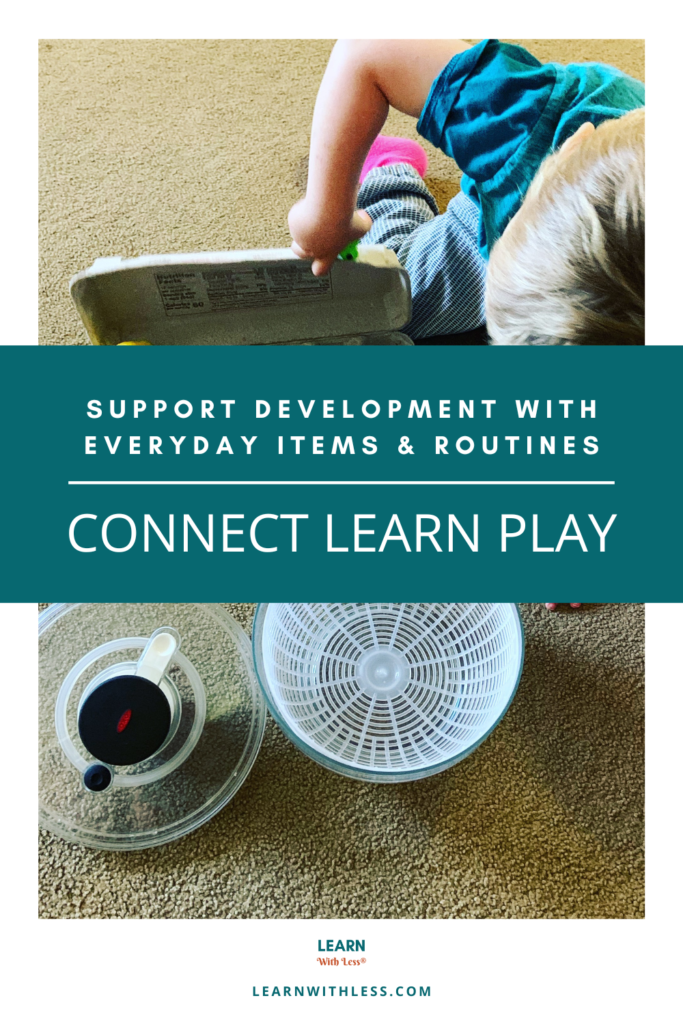
Ayelet: Ooh, the favorite? That’s a fun one. I think the salad spinner is one of my all-time faves.
Beth: Wow, I was not expecting that!
Ayelet: Yeah, my kids still, if they see the salad spinner… again, they are eight and 11 years old. They will take it out. They’ll just push down that topper. It’s such a fun, very regulating activity. The sound of it, the pushing of the topper is great. You can put things in, take them out, tap it. It goes round and round. There’s so much vocabulary. There so much opportunity for a musical element. It is a movement activity. Fine motor, yeah.
Beth: Great one.
Ayelet: And, of course, there are multiple levels of hats, right? The top is a hat, the bottom is a hat. The netting section is a hat.
Beth: So, wow, lots of hats.
Ayelet: When in doubt, it’s a hat.
Beth: Yeah, when in doubt it’s a hat! Do you have any practical shifts you can give to caregivers to help them shift their mindset from entertaining their child to supporting independent play?
How to Support Independent Play In Young Children
Ayelet: building attention is done through helping children see the creative aspects within what they have in front of them. When you are engaging with those everyday objects, whether it’s the coffee lid or a diaper itself, or whatever it is you are helping them with, see the magic and the wonder in all of those things, and see the value in those things.
What the research says is that one way to support attention and independence in young children is actually through engagement. So it’s a little bit counterintuitive, but that is literally what we can do. The more little moments that you can spend in engagement with your child, the the more actually that fosters their independence and their ability to see playful opportunities everywhere.
Beth: Yes, that is in deep alignment with one thing that I I talk about. I have a course at Big City Readers, learn to draw, drawing to writing. It’s a progression, it starts with just drawing, and then you’re writing words. And some parents will say, Okay, I put it on and my child is it’s for four and five and six year olds. The child is watching it, but they’re not doing it. What should I do?
I always say, set up two spots, put it on and don’t say anything. You just do the class. You sit and you draw with me, and you write with me. And you don’t need to invite them. They see that there’s a spot for them if they want to come over there, but show them that you’re doing it. If you’re like watching TV and you say, Okay, you do this, or you know you’re doing something. They want to be close to you. They want connection with you. So if you’re doing it and not pressuring them, they’re probably going to be interested in what you’re doing.
Ayelet: Yes, absolutely.
The Parental Pressures of Keeping Up With the Right Tools
Beth: What advice would you give to parents or caregivers who feel pressure to keep up with trends of toys and things, especially with social media. I get a lot of messages saying, this new reading curriculum came out. Do I need it? My answer is: You have taken Big City Readers classes. Those are the tools you need. That tool that that new reading game, is not going to teach your child anything more than you know already! You don’t need another tool. You are the one that teaches your child. That tool is not magical. Do you have any advice on people that are trying to keep up?
Ayelet: I mean number one, don’t be afraid to opt out. I’ve gotten much better at that over the years.
Beth: Why is it so hard?
How to Opt Out and Declutter Your Digital Landscape
Ayelet: It is so hard because we live in a capitalist society that tells us that more and more and more is always better, that you need to be more, do more, and buy more to be the “best” parent or therapist that you can be. And the the the secret in that is that you do already have everything you need to support and connect with tiny humans in your life.
That is the gold. And it is, it’s very hard to remember that. But if you need permission, here it is, you literally have everything you need. It’s probably in your recycling container. It’s in every single room in your home, and it’s everywhere that you go, if you are taking a walk with your tiny human, there is grass, there are spider webs, there are cracks in the concrete. All of that is, is the tool of supporting early language, early learning in general.
Beth: Wow, I love it. I Okay. What would you say to the parent or caregiver who is overwhelmed by clutter? Where should they start in simplifying their play space.
Ayelet: I’ve always been a big fan of toy rotation. Something children haven’t seen in a while suddenly takes on meaning and excitement and wonder, and it’s because they haven’t seen it in a while, or they forgot what joy it brought them. Even now , my 8 and 11 year old do this if they catch wind of a box we have in the garage that’s going to another family or for donation!
Even if you have, say, a closed bin of stuff, or a closet full of stuff, bringing just a few things out at a time, and just observing your child, looking at what what is exciting for them or interesting to them. And if you want to do that on a weekly basis or a monthly basis, there’s no right way, again. That’s a good reminder: there’s no right way for any of this.
Anyone who tells you that number one, they’re a parenting expert, or that this is the one, be all, end all solution, has something to sell you, right? I think really just reminding folks that they literally already have all of the tools they need, they probably need less than what they have depending on the family and community that we’re talking about. Just giving that permission to to Learn With Less®, is it.
Beth: I think that’s a really good reminder. You have what it takes. You don’t need these extra things. It’s hard to remember, though!
Ayelet: It is. Well, one of, one of the things that I want to offer to your audience is what I call the Learn With Less® infant and toddler development blueprint, which you can find at learnwithless.com/blueprint, and it goes through everything that we covered today. It’s everything around those four pillars of play, talk, sing, and move, how they connect to early development, and how you can support that. So that is a gift that I would be happy to share with your audience so you can keep it top of mind.
Beth: I like to remember whenever I’m feeling overwhelmed by anything, not just in this developmental world, that social media – back to the keeping up thing – you wouldn’t have 200 people in your house talking to you and giving you advice. Scrolling and watching videos from 200 people saying you should do this. You should do this.
I always like to suggest picking like the three to five people that really align with me right now doesn’t have to be forever. I say, you can unfollow me if I’m causing you stress, because you can’t, in this season, do these things with your child, but pick three to five and just focus on that and don’t look at anything else.
Ayelet: Decluttering, decluttering that digital landscape is also an important piece.
Beth: It is. I need to work on it as a daily practice.
Ayelet: Yeah, for sure, I’m there with you.
Beth: Ok, I have two questions for you that I like to ask my guests. The first is, what are you currently reading?
Ayelet: Oh, what am I currently reading? Ooh, what am I currently reading! This is a good one.
Beth: I surprised you with this, because, as we talked about before we started the podcast recording, I was asking, how do you keep up? You’ve been doing this for almost 10 years, and I forgot that I have segments, and because I haven’t been I’ve been so irregular. I realized, oh yeah, it’s been a month since I recorded an episode. I forgot.
Ayelet: Yes, I’m reading a couple of books, which tends to happen. One is Braiding Sweetgrass by Robin Wall Kimmerer, a beautiful book. I’m listening to it on audio, and it’s her actually reading it. I love when that happens. Her subtitle is: indigenous wisdom, scientific knowledge and the teaching of plants. It’s a really beautiful book.
Beth: Oh, that sounds amazing.
Ayelet: Yeah. And then the other one is called the Trail Guide to the Torah of Non-Violence by Rabbi Lynn Gottlieb, who’s a wonderful Jewish spiritual leader and anti racist guide. So yeah, those two things on my reading list.
Beth: Oh I may have to link those too.
And okay, this one’s kind of tricky. So I’ll give you a minute if you need to think about it. But everyone that listens to this podcast seems to be from the same-ish generation. So I started asking, what is one thing that you miss about elementary school? It’s different now than it used to be. And you know, some people have said book covers. Lisa Frank pens have been mentioned. Oh, market days, which seems to be only certain population in the US had market days.
Ayelet: I want to know what that is!
Beth: It was a fundraiser for the school, like, once a month, and you could put an order for market days, and it was very novelty items, but not good at all, like french toast sticks and these little, tiny mini frozen pizzas. And it would raise money for the school. A percentage of the orders from market days would go to the school, and but only about 60% of people that I’ve mentioned that to knew what it was, and they’re like, Oh yeah, but the French go sticks from it were so good!
Ayelet: That’s really funny. Two things come to mind. One, and this is ironic, because my eight year old is is now begging to do this, which we will do. Don’t worry. Lemonade stands.So bringing it back, yes. The other one… and maybe this is more, a little bit more middle school, but mix tapes.
Beth: Yes, oh my gosh. I actually bought a used car a couple years ago, and there was a mixed CD in the and I found it like a year later. I was like, this is someone’s mixed tape!
Ayelet: Yes, so much love and intentionality goes into that. Oh gosh, yes. You know, there’s always a good playlist, of course, but the actual sitting down. And again, I was born in 1981 so cassette tapes were my jam, literally. But sitting down, often recording a song from the radio literally going, pressing record at exactly the right time. Yeah, amazing.
Beth: Yeah, wow. I do remember that, just like, brought me back. I remember what I had one that was written on it in pink marker. And I remember packing it to go to college, it was my favorite thing.
Ayelet: Yes – I have one from summer camp back in the day that I still treasure.
Beth: Oh, I love that. Wow. Where’d you go to summer camp?
Ayelet: I went to Camp Tawonga, which is near Yosemite, yeah, fun place. Love it.
Beth: Well, okay, thank you so much for being on this episode. I can’t wait to share it with everybody and link all of your things that you mentioned. Where can people find you?
Ayelet: Yeah, at learnwithless.com, at Learn With Less® on all the social platforms, I hope! I mean, yeah, by the time this episode comes out. Yeah. I’m also on blue sky @learnwithless, as meta implodes, definitely at Learn With Less® you can find me almost everywhere, sharing information, ideas, permission to to put it down and opt out. And, yeah, lots of ideas and fun.
I love social media because it literally can be so social. And so if you’re on there, and you hear this and want to connect, please do – love to chat with you in the DMs!
You’ll always know how to support a young child’s development with a laundry basket, a cardboard box, or a dishtowel!
On this episode of the Learn With Less® podcast, Ayelet discusses how a simple shift in our understanding of what we can view as “educational materials” or “toys” can help us see how little we actually need to buy… And also how much power there is in opening up our own eyes to the wonder of play, as seen through a young child.
Are you a new parent or caregiver wondering what you really need to support and connect with your baby or toddler? Or are you a professional who serves new families as a developmental therapist, early childhood educator, or other professional in the perinatal space? This episode and our related resource, Connect Learn Play, is for you!
Hi there. I’m Ayelet Marinovich, and you’re listening to Learn With Less®. Today, I wanted to share a little bit about a very exciting new resource that we have just released here at Learn With Less®, in collaboration with my friend and colleague, Miranda Zoumbaris at The Emerging Parent. Miranda and I attended the American Speech Language and Hearing Association conference back in November 2023, and at that convention hall, we had a exhibit booth for Learn With Less®.
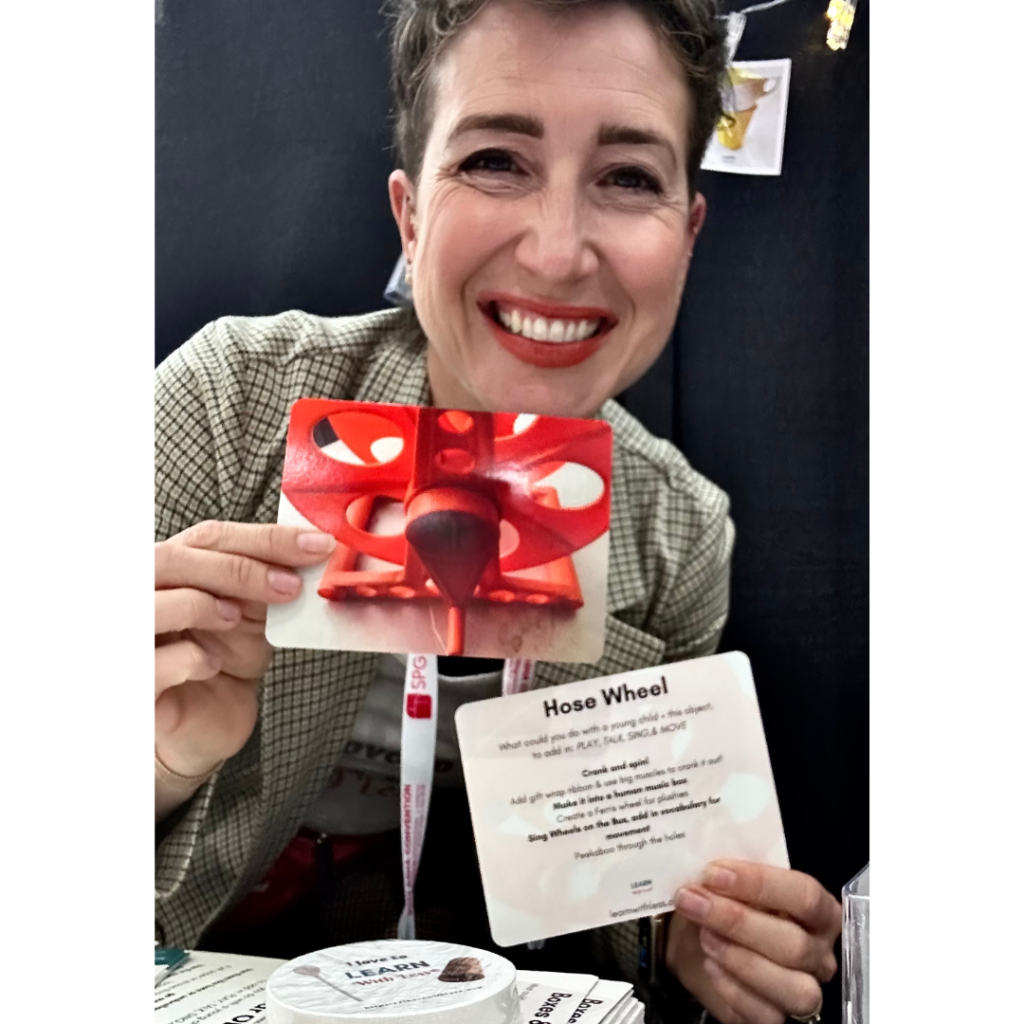
One of the fun giveaways that I had created was a series of postcards. On the front was an image of an everyday object, like a funnel or a laundry basket or a box. On the back there were a series of ideas for how you could use that everyday, simple object (a commonly found household item) to support connection and development through the use of play, language, music or movement. These are the four pillars of Learn With Less®: play, talk, sing and move.
Now, I had created these as a giveaway, and they were sort of a testing ground for the kinds of fun things that might be useful for both professionals serving young families as well as new parents and caregivers themselves. What happened was pretty hilarious. Everyone was getting them as giveaways, and they were asking where they could buy the product. So Miranda and I got to work creating this new, exciting resource for all of you, and we call it Connect Learn Play.
What does Connect Learn Play do? Basically, the promise is that you’ll always know how to support a young child’s development with a laundry basket, a cardboard box or a dish towel. Connect Learn Play is a resource for parents and caregivers of young children and for practitioners working with zero to five year olds. They are digital, printable, infant, toddler and preschool aged ideas to provide simple, enriching ways to support early development through play, language, music and movement, using everyday items, helping you to Learn With Less®.
What Does It Mean to Connect Learn Play?
I want to give you a little bit more information about what Connect Learn Play is, and why it is a useful resource for you. So essentially, it’s your invitation to stress less, to need less and spend less of your time and money so that you can feel more confident, be more responsive, and create more connection.
So, picture this: you’re sitting on the floor with your tiny human. You’re trying to figure out what to do to maximize the 20 minutes between the time you’ve gotten home and the time you’ve got to start getting ready for the next meal. You take out your devil device and start scrolling through Tiktok or Pinterest or IG, or whatever the latest idea rabbit hole where you’re currently following the latest parenting or early childhood influencer. Everything you find requires materials that are not within arm’s reach. And everything requires time you don’t have. Everything requires pre-planned brain space that you don’t have. And in the meantime, your child has found the curtain above them.
What do you do next?
A, pull your child away from the curtain again and again.
B, distract them with one of the five toys you got suckered into buying from this year’s best toys to buy for kids under five.
C, join your child at the curtain after recalling the idea about using long fabrics on the Learn with Less® Connect Learn Play prompt yesterday.
You can play peek a boo. Or you can talk about the color or texture of the curtain, or what you see outside the window. You could sing a song about hiding and seeking. And you could follow your little one around as they move behind the curtain. Listen, you get to decide!
Connect Learn Play cards are a classic resource from Learn With Less®. They’re designed to prompt you to start thinking about ways to connect the dots between what a child is showing interest in, between the relationship between caregiver and child. And to connect the dots between the literal neurons in a young child’s brain that enable them to grow, learn and thrive without being prescriptive, overly structured or requiring of any specific toy. Connect Learn Play helps parents and caregivers make the connection between a child’s interests and strategies used to support development, whether that child is experiencing a delay, is right on target or is ready for more.
If you are a parent, a caregiver or a provider of developmental services, then Connect Learn Play is for you! As with all the resources we create here at Learn With Less®, we use the four-pillar framework of the Learn With Less® curriculum (as I mentioned, play, talk, sing and move) to address four major areas of infant and toddler development: cognitive, communicative, motor and social and emotional development.
Toys and more materials take up, extra space, cost more and sometimes even prevent us from following a young child’s lead and responding to what they’re interested in at the moment. So, let’s get real. As a mother, a pediatric speech language therapist, and as a coach for practitioners using the Learn With Less® developmental curriculum, I am certainly not anti-toy. I say, do what works for you. But the idea that you need to buy anything in particular to support a tiny human is not only flawed, but also deeply inequitable.
How To Support Early Development With Everyday Routines and Everyday Items
Supporting development and connection for young children can be simpler than we think. Families need to know how to make use of the natural routines and everyday interactions in front of them. The idea that there’s an inherent developmental value in an object classified as an educational toy is, quite frankly, a delusion. The truth is, you already have the resources to give young children the right stimulation, play, and interaction to thrive – whether or not your toy closet is bursting at the seams. The items in our homes that we already have often hidden in plain view are powerful learning tools that can support all areas of development.
So just imagine, providers and practitioners: instead of spending your precious time pre-planning sessions, hauling that big old therapy bag around, wondering how to do bagless therapy routines based intervention and how to center parent education in your work with young families. You feel confident responding to the parent or caregiver and the child in the moment. You feel rooted in the routine you step into using what the family already has and relying on your own set of skills, knowledge and observations instead of a particular toy. And you feel relieved to have a quick reference guide to use an object the family already has on hand in either printed or digital format so families can generalize and carry over what you practiced in the many, many days and hours while you’re not there.
Now for families, imagine this instead of the constant looming guilt that you’re not doing enough or that you don’t have that special toy or specific material in order to support your kids, brain, language, muscles, emotional needs, I’m looking at those very expensive toy subscription boxes in your social media feed. Instead of all those feelings, you have ideas for play and interaction using what materials, time and energy you already have. You have confidence. You’re doing enough for your young child’s physical and mental development each day. And you have more valuable interactions using the tools at your fingertips to play and engage in enriching activities that support the connection between you. Finally, you also have access to ideas on the go wherever you are with a digital download.
What exactly do I get with Connect Learn Play? So what this is, is access to over 100 ideas for play with 25 everyday items. It is a simple digital download. You’ll be provided with both postcard-sized and full page handouts, in case you want to print a physical copy for easy use or easy sharing with families. For families, you can easily save to a folder on your phone, for instance, print it out and place one on your fridge. And for providers and practitioners, you could text or email an idea to a family with whom you work.
Connect Learn Play can be used during sessions as handouts or cards. They can be provided as supplemental material after. You’ll receive a link to a digital download with all 25 cards in English. Currently, we’re still working on Spanish and Arabic. As a parent or caregiver, or as a provider, you can save these to a folder on your device or print them out for quick reference. Just as you’d refer to a cookbook for a recipe, you could check out what you might do with the ingredients you have on hand. Once you’re using these ingredients regularly, you’ll start to see the power of everyday items. Connect Learn Play can go alongside materials you might use as a clinician, for instance, mental health or developmental therapist, as an early childhood educator, home visitor and or a licensed Learn With Less® class facilitator.
See Play Through A Child’s Eyes
I want to share with you one thing that a current Learn With Less® facilitator, parent of multiple young children who have attended Learn With Less® classes themselves, with me as a facilitator, and who are now in preschool and beyond… I want to share with you what Rachel Kammeyer has to say about the power of Connect Learn Play.
“The most powerful thing is that, like, this veil gets lifted of our adult perspective of the use of an object. And then once you unsee one thing, like a garden hose, you start to unsee it everywhere. You’re open to how a child explores it, versus our expectation of how we use it. Yeah, it’s amazing!
So the preschool I go to is very Learn With Less® in the sense that we use a lot of everyday objects for our activities, and one little girl was touring yesterday. There are these little sticks that look like golf tees, and we have 12 or 15 little things to put them in. And this was, like, this little girl’s jam. She was just putting in and taking out and lining them up. And it was fine motor. It was cognition. It was so beautiful. And the mom was like, How do I buy these? And I’m like, “Oh, do you have hot rollers at home? You can do the same thing. She can put them up and put them right down on this.” And she’s like, I do, and I haven’t used them in forever! She’s like, I never would have thought of that. I’m like, I have been trained in the art!”
I love that from speech-language therapist and Learn With Less® facilitator. Rachel Kammeyer, Thanks, Rachel. So again, who this is for: Connect Learn Play is for families with or expecting infants, toddlers and preschoolers. It’s for individual providers serving families in a home based, clinic based, school based and/or medical setting, and it’s for organizations serving families.
So no more scrolling Pinterest trying to find the perfect activity to set up for your child. No more digging through your therapy bag to find the perfect toy to invite playfulness into a session. Again, there is a simpler, more equitable way to support tiny humans without needing the fancy toy subscription. Connect Learn Play is the perfect, simple resource that allows you to offer a perfect blend of child led and structured play for tiny humans to thrive.
Here’s the thing: when you learn to recognize the tools you already have to boost your child’s development, you are able to maximize the time you have with a young child. You’re empowered to get it right, and you’re able to unlock the power of everyday routines and everyday objects to figure out how to play with your tiny human go ahead and grab Connect Learn Play. Over at learnwithless.com/connectlearnplay. We cannot wait to hear how you’re using Connect Learn Play, and we look forward to hear what you think! Wishing you more great moments with what counts.
What Do We Really Need to Support & Connect With Tiny Humans?
Apr 10, 2023
An Ultimate Checklist of Baby and Toddler Learning Essentials? Or Nah.
On this episode of the Learn With Less® podcast, Ayelet discusses the ways in which early development, everyday routines, everyday materials, and simple activities (often in which we are already engaging) are powerfully interconnected.
If you are a new parent or caregiver wondering what you really need to support and connect with your baby or toddler… or you’re a professional who serves new families as a developmental therapist, early childhood educator, or other professional in the perinatal space, this episode and our related upcoming workshop is for you.
Many of us are searching for the ultimate checklist of items for young children, or for a list of go-to developmental activities for babies or toddlers to have in your back pocket. Ayelet makes the case that you already have the resources you need – and that if you’re spending your hard earned money on fancy developmental toys, that investment could go toward other places that are in line with your values.
In our upcoming Learn With Less® Family Enrichment Fundamentals Workshop, we’ll explore the basis for the four areas of early development, and connect these to a framework of play, language, music, and movement so you can support and connect with the tiny humans in your care using the time and energy you’re already expending, and the materials you’re already using. Find the magic in the mundane, everyday objects and routines. Join us in our upcoming workshop and discover all about how to Learn With Less®!
The Learn With Less® Curriculum is used in communities all over the world in a “caregiver & me” class setting, and has also influenced the philosophies and environmental considerations for play spaces and organizations serving families.
Not familiar with the term, “caregiver & me” classes? We use it as a more inclusive term instead of “mommy & me” classes. Our classes are open to – and meant for – ALL parents and caregivers: not just moms… but also dads, non-binary folks, grandparents, foster parents, babysitters, nannies, and other amazing grownups who care for tiny humans. We’re going to play the “search term” game here (so you can find this great content more easily!) and help shift the conversation from “mommy & me” classes to “caregiver & me” classes… to do our part to shape the more inclusive world in which we’d like to live.
Learn With Less® Bundle: get our favorite infant and toddler development resources (save 70%)! Discover how to support & connect with your tiny human, without having to buy a single toy.
Learn With Less® “Caregiver & Me” Classes: the magic of Learn With Less® lies in the communal aspect of coming together with our resources, in community with other families. Join us for a virtual or in-person class led by a licensed facilitator near you!
Learn With Less® Facilitator Training & Certification Program: Use your existing skills as an educator or therapist to serve families holistically with a high quality program that will provide lasting impact! Apply now to become a licensed facilitator Learn With Less®.
Hi there, I’m Ayelet Marinovich and you’re listening to Learn With Less®. Today I wanted to share a little bit about an upcoming event that we are holding here at Learn With Less®, you can learn more about it at learnwithless.com/fundamentals. What this is, is a family enrichment workshop, all about the fundamentals of the Learn With Less® curriculum and program and philosophy.
It is a live workshop for parents, caregivers and professionals serving new families. The whole idea is to help you feel confident that you can support and connect with babies and toddlers without having to buy another toy. The event is being held this time around on April 29 2023, from 10am PST until 2pm PST. When you enroll before April 15, you’ll be able to enroll and save $50 on the ticket price. So again, that’s learnwithless.com/fundamentals.
What we’re trying to do with this workshop is to help support you to find confidence and connection through play language, music and movement. These are the four pillars of Learn With Less®: play, talk, sing and move. And you’ve heard me speak a lot about them on the podcast, and in all of our content and information that we put out into the world. Essentially, what we want you to do is to discover how to use the time, the energy and the materials that you already have to support young children — instead of buying all the fancy toys that you may be are being shown on social media.
Here’s the question that we all sort of ask ourselves: what do we really need to support and connect with tiny humans? When the internet feels like a firehose of information, Dr. Google and the baby industry create a sense of overwhelm and perceived incompetence in families… New parents and caregivers know the should’s, but they’re exhausted! Gathering internal resources to do anything extra for their children often feels impossible. And then on the other side, educators and therapists, as well as families, often feel pressure to go out and buy a bunch of toys to ensure that they’re doing the “right” thing, maximizing the precious time that they have with tiny humans.
Now, here’s the thing: supporting development and connection for young children can be simpler than we think! Families need to know how to make use of those natural routines and everyday interactions. The idea that there is an inherent developmental value in any object that’s classified as an educational toy is, quite frankly, a delusion.
You Already Have the Resources to Support & Connect With Your Young Child
So drumroll please, wait for it: the Emperor has no toys, folks. The truth is, you already have the resources to give young children the right stimulation, play and interaction to thrive. And that is true whether or not your toy closet is bursting at the seams. The items in our homes that we already have often hidden in plain view, are powerful learning tools that can support all areas of development. Now, again, I’m just going to break here and share with you that if you want to find out how to Learn With Less® with this workshop, you can go to learnwithless.com/fundamentals and sign up right now.
As a parent myself, I’m a mom, I have two young children, and I’m also as a professional serving new families. In my work with other educators and therapists, I know that the developmental value between a cardboard box and the fancy toy that might have come inside is often (ahem) exactly the same. And I also know that early learning does not happen only when I can eke out 15 minutes to provide undivided attention to my child.
I also know that it feels sometimes impossible to share succinctly about the simple and natural ways to support and form a deep and loving connection with a child. But when we can connect simple everyday interactions with early learning, we have a blueprint for parent support, partnering with families, and education. Because families already have the resources to give young children the “right” stimulation, play, and interaction to thrive and we can do it with the materials we already have. No extra time or energy needed.
Supporting Early Learning With Simple Activities
So I’d like to present to you the Learn With Less® Family Enrichment Fundamentals Workshop. We held this workshop in December of last year and it was very well received. We had a lot of great feedback from folks. This is a live workshop for parents and caregivers as well as professionals serving new families. And like many of you listening right now, you might actually be both – a new parent or caregiver, as well as a, say, developmental therapist or early childhood educator – or something in the perinatal space.
The Learn With Less® framework is built on four pillars, which each, in turn, support each of the four major areas of early development. In this live workshop, you will find out how to make use of what you know is special, precious time with tiny humans. You’ll discover ways to ensure you’re doing the “right” things for children at their developmental level. You’ll learn how to find that balance between structured play and free play. You’ll find out how to let a young child guide their own learning. You’ll discover new ways to use materials you already have, and also how to help a child communicate to, say, reduce negative behavior and minimize everyone’s frustration.
Now, this is a great workshop for families with or professionals serving children who are developing along a “typical” progression within, say, normal developmental limits. It is also a fantastic workshop for families or professionals with children who are not meeting developmental milestones, for instance. This is not about milestones. It is about helping you and discussing and showing you how this four pillar framework of the Learn With Less® curriculum (which again, play talk, sing, and move) actually addresses those four major areas of infant and toddler development, regardless of where a child is performing. Those four major areas are cognitive development, communicative development, motor/sensory development, and social/emotional development.
Interaction, Discussion, Observation, and Practice
What we’ll be doing is interacting, discussing and sharing about all of these ideas and information. You’ll come away with specific ways to support and connect with young children using what you already have through natural interactions and simple play ideas. Again, this is a workshop that’s occurring (this time around) on April 29 2023 at 10am Pacific. We will be providing a replay period to those who are registering for the live workshop. I do definitely recommend that you try your best to attend live because we’re going to have a whole lot of interaction, live Q*A, and interaction with other professionals who are using the Learn With Less® curriculum in their practices or in their families.
For instance, I wanted to share with you what one of our attendees in the past has shared about their learning in this workshop. This is from a father named Josh. He’s the parent of an infant and a toddler. After attending and after involving himself with this information, he shared the following. He said, “You’ve helped me see more clearly that we are already engaging in the kinds of activities that can make a huge impact on our children’s development. We already have the materials we need.” He said, “Ayelet’s words rang true for me. Pinterest can be helpful and fun. But it’s the experience of words, objects, people and ideas in a variety of contexts, settings and environments that support your child’s learning.” He said, “Ayelet helps you understand and knows way to do so – thank you.” So Josh, thank you for sharing all of that.
We also have from Megan, who’s a speech language pathologist, and she attended this workshop in the past. She said, “I loved seeing how easy it can be to incorporate music into everyday tasks. And I like how the class flowed and how each parent was able to be successful.” Now, she is actually referring to one of the components of this workshop. And so I’m going to share with you what all of those are.
What Are the 4 Components of the Workshop?
We have four components. The first is that you’ll learn and discover those four major areas of early development. So we’ll lay out these four areas of early learning. And then we’ll take a deep dive into a particular aspect of each area helping you to find simple, practical and fun ideas to support that learning, using the time, energy and materials that you already have. Then, we’ll also be sharing how to utilize those four pillars of learning with less so that you know you don’t have to expend your energy and resources worrying about what you really need to support tiny humans. Instead, you’ll discover how you can support the connection between caregiver and child.
And then that third component, which is what Megan the SLP who shared that quote was referring to. We’re going to then connect practical application to that theory with a live demonstration of activities. So you’ll actually get to experience a live demonstration of caregivers and children experiencing the Learn With Less® framework and working together in a group class that breaks down how to use this info very clearly – and definitely joyfully!
Finally, the fourth and potentially most impactful part of this workshop is that you will be able to find out answers to your most pressing questions with a live Q&A. So we’ll have access to a panel of early childhood professionals, early childhood educators, speech language pathologists, developmental therapists of all sorts, who use the Learn With Less® framework in their everyday practice, as well as often with their own children when applicable.
I’m going to just share with you some details about this workshop. It is, again, on April 29 2023, at 10am Pacific – that’s 1pm Eastern. You can expect to reserve up to four hours of your day. If you are a speech language pathologist who is registered in the United States, you will receive professional development hours as well.
When you purchase before April 15, you will also save $50 on the price of your registration. This workshop will be held on our private Zoom room, and the link will be emailed to you prior to the session. Space is limited. We are capping this workshop it’s going to be small in an effort to create an intimate community learning experience for everyone. Once it fills up, we will consider adding more dates. As I said, we held this workshop successfully in December of last year and it was very, very well received. So that’s why we’re doing it again.
Pertinent, Evidence-Based, Bite-Sized Information & Ideas For New Parents and Professionals Working With Families
You will also have bonus access to the recording for seven days should you want to review the information, or say, if you were unable to attend for part of the day. So again, who is this for? This is for parents and caregivers of infants and toddlers, expecting and seasoned parents alike. This is also for professionals working with tiny humans and their families. So those working in the perinatal space, those who are early childhood educators, developmental therapists, doulas, mental health practitioners. Also professionals who are, in addition, parents and caregivers, so people who are looking for high quality, evidence based information and ideas to support your tiny humans, as well as those on your caseload.
There is no complicated activity planning, there’s no required materials from say a particular parenting philosophy. This is just about you. It’s about the tiny humans in your life and the everyday objects and everyday routines already happening around you. We will be sharing what the baby industry doesn’t want you to know or to understand. When you learn to recognize the tools that you already have to boost an infant or toddlers development, you’re able to maximize the time you have with young children, you’re empowered to get it right. And you’re able to unlock the power of everyday routines and everyday objects to figure out how to play with the little ones in your life while also supporting their learning.
You’ll discover how to take simple everyday items and use them in different ways. exploring them with the children in your care and guiding that child to explore with you. There is a simpler, more equitable way to support tiny humans without needing the fancy toys subscriptions. Here’s another quote from Sue, who is a pediatric occupational therapist. She said, “I often went into houses with my magic bag of toys. The Learn With Less® framework is making me rethink the way I interact with the family. For instance, interacting with family as a whole, or at least the caregiver and child dyad – versus interacting predominantly with the child.”
Think Outside the Box When It Comes to Early Learning
With this workshop, I want you to discover how to think outside the box. Parents and professionals alike are often caught up in the lure of fun new toys, only to start to feel a strong sense of overwhelm each time they idle down the toys and games aisle. Cut the overwhelm: let’s play in the box instead! So we’re going to help you connect loose parts and open ended play with straightforward developmental concepts that you’re often already supporting… without having to spend time, energy and money setting up a bunch of crafty activities. Again, space is extremely limited. We are creating an intimate atmosphere for learning and community. So I urge you to save your spot today. That’s learnwithless.com/fundamentals.
I also want to say that the Learn With Less® Facilitator Training & Certification Program is a complete plug and play system for using the popular Learn With Less® curriculum in one’s community as an additional offering for new families. That is a four figure investment. It includes a complete training program and certification process in addition to access to all of our licensed materials, ongoing Q&A and coaching calls, and a professional sounding board. But I want to invite you to join me for a complete workshop around the framework, a panel of other educators and therapists who have integrated the Learn With Less® framework into their practice to answer your questions around the concepts, and a live demonstration of the Learn With Less® curriculum in action.
Right now this workshop is just $99. You can save $50 on the price of the workshop before April 15. After that, it will go up to $149. So go ahead and register now to save your spot. We have also a quote from pediatric speech language pathologist and a parent of a toddler, Meryl, who said, “I like that it makes things feel simple. It feels like you’re going back to the basics, the Learn With Less® framework is accessible, use what you have. I really like it because it feels relatable, like anybody can do it.”
Who Is the Creator of the Learn With Less® Framework?
Finally, I just want to introduce myself in case you don’t know who I am, and if you’ve made it this far, I am Ayelet. I’m a pediatric speech language pathologist and a parent educator and I’ve been running caregiver and me classes using the Learn With Less® infant and toddler curriculum since 2014. I’ve served thousands of families all over the world, both virtually and in person, helping new families to feel confident that they can support and connect with their babies and toddlers without having to buy another toy.
And since early 2020, I’ve helped dozens of educators and therapists to do the same by creating lasting impact leading, marketing, and filling caregiver and child classes to supplement their income and to provide education and support families in their communities. I wanted to share, in case you’re wondering, a few things. First of all, you will have the tools and guidance to promote learning and connection using existing time, energy and materials. And again, if you are a US based speech language pathologist, you’ll get more certified maintenance hours of continuing education.
FAQ’s About the Family Enrichment Fundamentals Workshop
A couple of FAQs, in case you’re wondering, what if I want a training that provides me with in depth knowledge and support integrating these concepts into everyday life. So here’s what this workshop will not cover. It will not cover access to and training around our full curriculum as a parent coaching and support and a family enrichment offering. It will not cover coaching and guidance around using the Learn With Less® curriculum in your community. It will not include ongoing support for your questions and challenges frustrations regarding early parenthood and early childhood, and it will not include ongoing access to a community of like minded caregivers or educators. If you want more in depth training or mentorship and support, here’s what we recommend.
For parents and caregivers, we recommend that you grab the Learn With Less® Bundle, which includes all of our best resources, including our best selling books, our musical album, a recorded class, as well as caregiver handouts. That can be found at learnwithless.com/bundle. We also recommend that you participate in a Learn With Less® caregiver and child class in your community, either virtually or in person, led by a licensed Learn With Less® facilitator. You can find those over at learnwithless.com/classes.
And for educators and therapists, if you are looking to create lasting impact leading caregiver and me classes with a high quality evidence-based “plug and play’ program. then we would love to see your application come through over at learnwithless.com/certification. And then here is the rest of the fine print, because I always want to be up front with you.
So number one, no refunds for this workshop will be granted for any reason. Space is limited, which means that if you decide to take one of those spots, it’s yours, even if you don’t attend live! This session will be recorded. You will still learn a ton from watching the recording after the live workshop is over, and you’ll have access to it for a seven day replay period.
The workshop is for parents and caregivers with or expecting infants and toddlers, and also for professionals supporting new families or who are in the perinatal space like developmental therapists, early childhood educators doulas, mental health professionals, etc. If you’re not sure really whether this workshop is right for you, please do reach out to me at admin at strength in words.com and we will get back to you ASAP. If you want to know, “how do I sign up to host a Learn With Less® group?” That’s another question I wanted to answer. We would be thrilled if you’re interested in becoming a Learn With Less® facilitator. We are accepting applications now. So if you get yours in today, you can do so by applying aat learnwithless.com/certification.
Another quote or testimonial I wanted to share from Miranda Zoumbaris who we’ve had the podcast a bunch, who is a licensed Learn With Less® facilitator and early childhood educator, and who will be on the panel on the upcoming workshop. She said, “what could be better than sharing with families the gift of joy? It has always been a goal of mine as a parent educator to take away worry, provide education and infuse joy into everyday activities, teaching parents to have joy with their babies and toddlers. What could be better than helping them have that gift?”
Learn With Less® Values: Showing Up In Our Space
So again, you can go ahead and enroll now to secure your seat at our upcoming workshop on April 29, you can do that today, it’s learnwithless.com/fundamentals. And if you are wondering what the experience of the workshop will be like, I wanted to just share a little bit about our values and how those play into the way that we hold events and the way we run our communities. Here at Learn With Less, we are a relationship and values based company. To us, that means that we prioritize and make decisions based on the values that we hold. We hope that learning more about these values and how they show up in the company will give you a good sense of what to expect.
The first one is simplicity. As professionals, we know that everyday materials and routines hold the utmost developmental value, we always encourage you to use what you already have, you don’t have to go out buying more stuff. We also want to encourage you to remember that you already have everything you need. Play and interaction do not require expensive toys or lots of time.
The second value that I want to share with you is community. To us, that means communal learning. So facilitation versus hierarchical learning. We value the idea of learning together, and alongside one another. We value communal support, meaning we’re here for each other even when we don’t have the same professional backgrounds, or hold the same identities, or parent in the same way.
Our third is inclusivity. We respect and accept diverse thought and practice, these are valued. We want to help our audience with access: you don’t have to have oodles of supplies to support families or your baby. We provide access to information throughout our podcast books, workshops, and programs. We honor, create, and uphold space for those holding a diversity of social identities.
Next is education. So we value the power of learning and knowledge, shared learning. Once you know what you’re doing is supportive of a young child, you’re motivated to keep doing it. You’ll be participating in the educational information that we’ll be sharing in this workshop, but you’ll also, at times, be co-creating it.
And then finally playfulness. We value playfulness. And we define this in terms of exploration, musicality, and love. Play with your baby, play with your style, play with materials, play in a group with others, play with me. Those are the values that we define in our company and how they show up. I wanted to share with you what that feels like and looks like, and how that might present itself within this workshop.
Join Us In Community With the Learn With Less® Framework
Again, we are holding a wonderful workshop. It’s a Learn With Less® Family Enrichment Fundamentals workshop for parents, caregivers and professionals. It will be held on April 29th 2023 at 10am Pacific / 1pm. Eastern. You can expect to reserve up to four hours of your day, and you will receive professional PD hours (professional development hours) if you’re an SLP – a speech language pathologist. If you purchase your ticket before April 15, you will save $50 on your registration. Currently the price of the ticket is $99 and that goes up to $149 on April 15. You will also, once you purchase your ticket, have bonus access to the recording for seven days if you want to review the info, or if you were unable to attend part of the day, for instance. I do want to again reiterate this is a ticket to a live virtual event and there will be no refunds, so make sure you understand fully: we do have no refunds policy when you purchase.
We can’t wait to see you. It’s going to be so fun. We have a wonderful panel of early childhood professionals and it’s just going to be a great day, so please go ahead and reserve your ticket now. I can’t wait to see you go ahead and reach out to me a great place to do that would be @learnwithless on Instagram in the DMs. I would love to hear your thoughts questions, and I can’t wait to see you at the workshop on April 29th. Talk to you soon. Bye!
Building Community & Belonging for New Families
Mar 30, 2023
Building a Sense of Community in Parenting
On this episode of the Learn With Less® podcast, Ayelet sits down with Desiree Viray, an early childhood educator, mother, entrepreneur, parent partner and parent educator, Learn With Less® facilitator, and the owner of Empowered Family Collective.
Desiree’s purpose and joy are rooted in serving, empowering and walking with educators, parents / caregivers, and families through each stage of development, impacting children’s lives through a family-centered approach to play, talk (language development), song, movement, connection, and simplicity. Her work at Empowered Family Collective helps families find moments of joy, and opportunities for intentionality and simplicity in each stage of child development and parenthood/caregiving. She offers “caregiver & me” groups for families using the Learn With Less® curriculum, among other services.
Not familiar with the term, “caregiver & me” classes? We use it as a more inclusive term instead of “mommy & me” classes. Our classes are open to – and meant for – ALL parents and caregivers: not just moms… but also dads, non-binary folks, grandparents, foster parents, babysitters, nannies, and other amazing grownups who care for tiny humans. We’re going to play the “search term” game here (so you can find this great content more easily!) and help shift the conversation from “mommy & me” classes to “caregiver & me” classes… to do our part to shape the more inclusive world we’d like to live in.
In this episode, we discuss:
Desiree’s background, how she came into the world of early childhood education, and where her career has taken her
What drew her to the Learn With Less® philosophy, and the value of prioritizing parents and caregivers and parent education
How she has placed her values front and center with regard to her own business decisions, marketing decisions, and how she coaches families
The ways in which creating a sense of belonging serves both her as a business owner, as well as serving families with young children
How she has respected her internal pace and intentionally created slow and steady growth
Helpful Resources Related to This Episode
Learn With Less® Stories: Additional podcast episodes and other interviews from educators who’ve provided the Learn With Less® infant/toddler family enrichment curriculum and families who’ve experienced our programming.
FREE Infant/Toddler Development Blueprint: Discover the four major areas of infant and toddler development, what’s involved in each one in the first three years of life, and what you can do to support that learning (using what you already have in your home).
Learn With Less® Bundle: get our favorite infant and toddler development resources (save 70%)! Discover how to support & connect with your tiny human, without having to buy a single toy.
Learn With Less® Facilitator Training & Certification Program: Use your existing skills as an educator or therapist to serve families holistically with a high quality program that will provide lasting impact! Apply now to become a licensed facilitator Learn With Less®.
Learn With Less® “Caregiver & Me” Classes: the magic of Learn With Less® lies in the communal aspect of coming together with our resources, in community with other families. Join us for a virtual or in-person class led by a licensed facilitator near you!
Ayelet: Welcome to the Learn With Less® Podcast. Today I am joined by my dear friend and colleague Desiree Viray. Desiree, welcome to the Learn With Less® podcast. So happy you’re here.
Desiree: Thank you for having me. I’m really excited to be here.
Ayelet: Yay! Desiree, I would love it if you could just tell us a little bit about you who you are, your background and what led you to come into the world of Learn With Less®?
Desiree: Yes, I was an educator in the classroom for about 16 years. And I’m going to take it way back to junior college where I did not know what I wanted to do with my life, and I felt lost. I found my way when I stumbled across a flyer from Bright Horizons. I took my very first child psychology class, and I was hooked.
That literally was the seed to my career in early childhood education. It should not have come as a surprise to me, because I actually come from a long line of educators. My paternal grandfather was a principal in the Philippines. I have been in the classroom, as I mentioned, for 16 years. I managed a team, if you will. One of my dream jobs was to become a principal, which I tried on for two and a half years… and realized that it just was not my thing. And I’m glad that I tried it.
Fast forward a little bit. I’ve since transitioned into executive support. I’m not surprised that my skills have transferred over really nicely to this role. So I do that full time. I am a bonus mama to two wonderful children that I met about eight years ago. They are 10 going on 20, and 12 going on 50. My son has a very old soul. One morning, I heard him say Hey, Google… Play Elvis Presley. Like that’s, that’s my kid I love.
I met you and I stumbled upon Learn With Less® when my good friend Lesley Mayson had posted about her own experience. And I was in a bit of a transition. I knew that I wanted to serve the community in some capacity, and I had thought, Oh, I’m going to be a career coach! Took an intro class and realize that specific framework was not the right fit for me because I am an intense introvert. And when I met you, and you told me a little bit more about how the information is disseminated. Again, I was hooked. And so here we are together. A year later!
What is it about the Learn With Less® Program That Speaks to You?
Ayelet: Let’s hear a little bit about what was it that really intrigued you about the way that the Learn With Less® facilitator training and certification program, really… What is it that really got you in terms of feeling like it was a better fit? Not only, of course, within the way that you wanted to serve and impact your community, but also in the way that we do our training? Because it sounds like that, as as I know from speaking with you over the year, I know that really was useful to you. But I’d love to hear specifically what it was about it then.
Desiree: The thing that really drew me in is the fact that it is play-based. I was in a program where we had a community of parents and caregivers that did not initially see the value of a play-based program. And I tell you, I talk to them still, many of these families, their children are probably now in middle school, which is absolutely insane to think about. They talk about that time, this magical time that they had in this particular program. Now seeing why play was so important, and is still so important. So that was part of it is just the fact that it was play-based.
The other part is that it was a mix of philosophies, Ayelet. I came from a program that was heavily inspired by Reggio. And so my own value system, my own philosophy around education, is actually a mix of those different philosophies and ways of thinking around child development and play. So that was the other part.
The receiving of the information is that I got to choose my own adventure. I took about a year to go through the actual program. And you and our community did not make me feel guilty about that! We had just talked about time being a very precious and scarce resource, right. While working full time, I would go through the program when I felt called to it. And that is so empowering.
I just want to pause there because I got to make very intentional choices as to when I engaged in that learning. And that was really important to me as a working mom, and someone that was making a very serious investment in this… I don’t like to call it a small business because it’s not small! In this venture, this new chapter that I was writing for myself.
Ayelet: I love that. Yeah, it’s so important to me, in terms of the way that people go through the program, to have that opportunity. Because we know that not everybody life circumstances are the same. Everyone is coming from a different educational, professional background. People are dealing with different COVID restrictions, different life restrictions, different life pathways, and some people zip through it, who are in your exact circumstances, right? Who are working full time parents, and some choose because of other circumstances to take their time.
What we try to do is, like you said, try and create that ability for people to self determine what it is that is important to them, and what they need while continuing to provide the support, and information sharing, and inspiration to those who are ready to take it in, as well. And to bring you back in, and pull you back in, when it’s time.
Finding Your Sweet Spot, Creating Balance in Your Life
Desiree: Yes, you make me think about this conversation that I had with a few – three of the executives that I support right now. And I said to them, no joke, I’m retiring with you all, I will be on this team supporting you all for as long as you’ll have me. And one of them said, I really worry about the day that you’re going to leave and want more. And I told him, I found my sweet spot.
Sometimes people search a lifetime for that sweet spot where you feel like everything is integrated at just the right volume, if you will. And so that was the beauty of Learn With Less®, is that I was able to maintain equilibrium, if you will. I was able to maintain that sweet spot. I think that was really important to me, it still is really important to me. And I just I want to talk more about that with other people! Just that if you have found your sweet spot, that’s okay. And that is good.
Ayelet: Yeah, well, I want to dig into that more, actually, because it’s such a perfect parallel to what you’re doing for families using the Learn Wit Less® curriculum, right? Because yeah, I mean, as we were also talking about before we started recording, new families have such limited bandwidth. And so asking them or sharing with them new ideas for more ways that they can play with their child, and more things to do, and more things to buy, and blah, blah, blah, is like… no! That’s not what people want.
I want to actually quote you. When you entered the program, I ask people, you know, why are you passionate about being a parent educator using the Learn With Less® curriculum? You wrote that this chapter is rooted in wanting to help caregivers feel and be empowered to look at their environments through a different lens, and to help them see value in and find their way to simplicity. So I mean, well done, Desiree of the past.
Desiree: I wrote that?
Ayelet: You did! And that’s, I mean, that’s it. I think, that really cuts to the heart of what we’re doing here and why. And I wonder if you could just say a little bit more about that. And what you think was going through your head when you wrote that! What it is that you, now that you’ve been through the training program, and you are a licensed Learn With Less® facilitator. You’re fully certified, you’re doing the thing, you’re marketing your classes, you’ve hosted a demo class, and you’ve done some investment into local marketing things. So let’s talk about what it is you are trying to create for folks who enter your space and what the value is of your classes.
Intentionally Creating a Sense of Belonging
Desiree: Yes, I as you know, I hosted my first pop up last weekend, and it was actually a school district sponsored event, it was outdoors 80 degrees in Texas, and there was a breeze. So it was good. I learned a lot with it being my first pop up, and we can go back to that. But you encouraged me to really think about what my elevator pitch is and was. I got to practice it a number of times. Yes, it changed a number of times too. But it allowed me to get closer to what it – and that was the question. I was approached with, oh, Empowered Family Collective. What is it that you do?
I often started with, well, I’ve been an educator for a number of years. I’m also a parent and I one want to serve the community. And through that, it is about disseminating this message that your child, your children, don’t need the $100 toys. I’d walk over to the shelving that I had available because I wanted. The vibe that I wanted was, I wanted one to feel like you were walking into my living room.
Ayelet: Yeah. And to clarify, this was a pop up like marketing event. You were the vendor at a fair at the school district’s fair.
Desiree: That is correct. I wish you could have seen the faces when I was unloading my car. Then I talked a little bit about, and then I pointed to the recycled materials that I had collected and amassed over the last, I don’t know, six months? I talked about how oftentimes what our children want to interact with and play with and learn most from are the things that we have at home already. I had spatulas, colanders, tons of recycled materials. Then, of course, conversation began around, oh my gosh, yes. Why don’t I save the egg carton, right.
So I created, I like to call them invitations. I created invitations as to how you might pair something that you did buy from Amazon, because that’s real, with something that you purchase from the grocery store, like a yogurt tub, and how you could pair those things. That there is room for a combination of both situations. Then I talked a little bit about, you know, many times our families really crave, like, how do I cultivate independent play? It’s through that is through these open-ended materials that you offer. Because the possibilities are endless, and the creativity and the imagination is just bananas!
Ayelet: That’s right, that’s not going to happen with a press the button toy, cause and effect, right? There’s room for that, yes. And when you have these wonderful, open-ended – meaning materials that can be used in a multitude of different ways… You have endless opportunities, as you said. I love that. Yeah.
Desiree: And you hit on something. I think we can fall into the trap of “but” – I think what we’re doing through learn with less is the message of using more and yeah, I have these, what is the word that we use for things that have single use – prescriptive materials? There’s room for prescriptive materials and open-ended materials, loose parts.
Ayelet: Yeah. Right. Because the point is not to be anti toy. It’s very interesting. Because we do live, you and I are both stateside, we both live in the US. And we live in a very binary society, right? That’s how we’re socialized generally. And you have yes/no, good/bad, big/small. And that’s… so much of all of this is taking that down. Helping people see that parenting also in general is not a binary there’s no right and wrong way, right or wrong way to parent, a human. Number one, we’re all coming from a unique set of circumstances, life experiences, cultural, ethnic, and otherwise background. And number two, we have our different humans who have their specific needs.
So, we often in a Learn With Less® group, will touch upon those challenges, and also wins of what’s going on with families. And in that time, that sort of sharing time, it’s a wonderful opportunity for families to share, like, what is going on with them, what they’re challenged by. But of course, as you know, we talked so much about how this is not the time for you to give the prescription of oh, well, here’s how you can solve that problem. Right? Which I think a lot of us as the helpers of society. Early childhood educators, developmental therapists, we want to help we want to solve the problem, we want to get that child to the next milestone!. But in this case, it’s, it’s so much more about creating a space where people can feel seen and heard. And I wonder Desiree, if you could talk a little bit about that, in terms of what it is that you’re creating, and why that’s valuable.
Desiree: Oh, my gosh, yes. Many of the people that I met last weekend, were those who have moved to Texas recently, and are essentially rebuilding their communities, their villages. And that can be so challenging. And some people talked about how isolating it can be. That’s part of my purpose is to create these communities of support, especially for those who are feeling isolated by especially first time, early parenting. I am here to create space for whoever it is that you want to show up as today. I am here to simply listen.
One thing that I like to often start conversations with is, okay, I need to know, do you need me to listen? Or do you need solutions? Or do you need both? Because then that sets my mindset into the space of like, okay, I’m going to be totally clued in. And so one of the pieces of feedback that I receive quite often is that people often feel visible and heard by me. So I’m using… I’m hoping to really use that gift in the community while I’m serving them in that way. Building community. Allowing space for parents and caregivers to feel like it’s okay to make mistakes. You’re not going to show up as your best self every day. There are going to be things that are challenging and I want to be that sounding board for you. And to just help you feel okay with that?
Ayelet: Yeah, beautiful. I think for all our listeners here, right now, like it’s, I mean, if someone were there to do that, for me, when I was a brand new parent, that would have been really nice, right. And also, that’s for me also why I started leading these classes, because I wanted a place to be able to do that for myself and for others. I knew the value of that for myself. I knew how much I got out of creating a space for people.
I just want to come back to what you said about that. Instead of immediately jumping in to solve a problem, that that pause of asking a person and this is so true in all areas of life. It’s very, it can be very hard for people to do it is actually that moment of empathy, right? Where you’re asking someone what support looks like for them in that moment: what would you like for me right now?
A lot of what you’re doing in this season of life with families is creating that space, holding that space and creating a place for families to let someone know what they need… and be asked. Because we also know that in early parenthood, that doesn’t happen very much. There’s not a whole lot of… you’re giving, giving, giving, giving, giving to this tiny human and whether or not you have a co-parenting partner, it can be really hard. Many people, I will say, don’t have — who is asking them what they need, right? Because often when we’re sleep deprived, or we’re overwhelmed, there’s an immediate go to.
There’s that switch of, without that pause, of the other person who’s trying to provide support, often goes right into trying to solve the problem. And all of this is not to say that there isn’t a problem that we solve within a Learn With Less® class, right? Of course, what we’re doing and actually, I’d love to hear what you would define that as – what, what is it that we are doing? If we’re not solving, solving all the problems of early parenthood? Why do people come to your classes to Learn With Less® classes? What is it that they get out of it, other than having a space to come to where they can feel seen and heard and held? Because just that is super valuable to people! But there’s a lot more, right? And so what what else is it that you’re doing for families, Desiree?
Desiree: I’m gonna go back to that, to that sense of community that you’re building. Especially when we have Learn With Less® facilitators that offer a series of classes, right, that you’re going to see these consistent faces over a certain amount of time, and you will more than likely exchange phone numbers with somebody, right? So that’s another connection that you’ve made locally. And I think that was the that was the other thing that drew me in, Ayelet, I’ll bring it back, is the fact that you’re encouraging us to be in our local communities.
And so it makes it easier for parents and caregivers to make those local connections. Isn’t that what we want? That when you are not in this space, when you’re not in the space of Empowered Family Collective with Desiree, that you are potentially connecting at the local park or the coffee shop when we are not all together. The other part is that we are holding our parents and caregivers and those children at the same time. When I think about traditional classes, like a music class, for example. It is mostly geared towards the children.
But yet we incorporate our parents and caregivers by engaging in the conversation of hey, what are your roses and thorns this week? I want to hear from you very intentionally about what you are excited about and what was challenging this week. So there’s that layer, again, of visibility for the adults that helped bring the children to this space. And so yeah, I have goosebumps.
Ayelet: Yeah, it’s powerful stuff. And then of course, without failing to mention the entire developmental enrichment piece of it. So I want to hear about that, too. For sure.
Desiree: That part I get really excited about. I’m a child development nerd. I really enjoyed the classes that I took both in undergrad and graduate school. And so I really appreciate being able to talk about that with families, because one, we talked about this: time is a very precious yet scarce resource. We no longer potentially have the time to read the 100 page book about what to expect. Allow me to be your personal, oh my gosh, what was it back in the day, they were yellow. If you wanted to read a book… allow me to be your personal CliffsNotes. Yeah, around child development, in particular. Why is my kid waking up at 3am every morning? Or why is it that my child’s appetite is very unpredictable? Right?
Well, Oh, well, I’ve spent 16 years in a classroom, I’ve seen a variety of things, I have my own children to kind of add to the mix, right? Allow me to, to maybe offer three or four possibilities. And if you want them, some solutions that you might try at home. So yes, the whole child development piece. Then of course, the enrichment part, right? Is how do we put these philosophies into practice? But in a way, that’s not scary, very approachable, again, using the things that we already have at home. And I think that’s where the simplicity comes in. Again, I’m not asking you to go out and buy all these things. Everything that you need to create an engaging environment for your child is already in your home.
Ayelet: Yes, whatever kind of home you live in, whether it’s big, or small, yes. Whether you have ample storage, or none at all, yeah, okay. So Desiree, you’ve acknowledged that your business is called Empowered Family Collective. So I’d love to hear what it is, if you can speak specifically to what it is you’re empowering families to do.
Desiree: Yes. The seeds were planted during the pandemic. And I had a number of families that had been part of my program, my early childhood program, when I was teaching, reach out to me because we were still connected. Because they just weren’t sure how to navigate the pandemic. We were all homeschooling, et cetera, et cetera. And I had done this with a number of families. And I thought, I feel like I’m kind of good at this, and I still got it. So there’s something there. That led me to the proposition for myself, like, okay, so if you’re going to do this, what is it that you’re trying to do here Desiree? And the word empowerment kept coming up, because what I was finding is these families that were coming to me just seemed disempowered, and potentially because they were so flippin’ tired.
So I am here to help you step into that empowerment that still exists. It may be dormant right now, and to potentially connect you with the resources or local resources that can help you get to the next step. I think the empowerment piece also comes in to play when I am listening, I’m actively listening to these parents and caregivers. I’m actually reflecting back what I’m hearing and or validating what I’m hearing and what they’re experiencing and feeling. And I think that when you are truly heard, when you feel like you’re heard, and you’re visible, that you actually realize that oh, she’s in there still, and I am going to make it through this season. It may not feel like it today, but I’m going to.
So, multiple conversations with these families over time, none of these things were fixed overnight, not not even fixed. I don’t like to use the word fixed. It took time to address what was happening for them. Some of them are still ongoing. But it was really helpful to have someone that they trusted, someone that had been in the classroom for a number of years. Someone who had sort of the educational background to help them figure out what might be happening and what next steps were. Sometimes you just need someone to say, what if you tried this? Here are three options, and here is where you might potentially go for that support.
Values Driven Business, Values Driven Life
Ayelet: Yeah, I think it’s so important to to really get to the core of what motivates us, as business owners, as parents, as women, as humans. And really understanding what the values are that guide our choices in making decisions, right, because that, when we move back into those values, whether those are of the company that you’re building, or the way you are parenting, actually stating those out loud, writing them down somewhere, having that set of belief systems to guide you… really helps. So of course, empowering families is one thing for you. But I’d love to hear if you’re willing to share, Desiree a few of the other values that are really guiding you.
Desiree: Yes, I all of a sudden had this vision of when I had engaged in the rocks, pebbles, sand – you can actually Google this – framework around how to identify what your rocks are, when you put all of those together, the rocks are the ones that take up the most space in the physical vessel that you put them in. And those actually, for me, translated into my values. And my values, my very first one, actually, is my family. The other one was my career. The other one is also my wellness. And I have two more, but they they slipped my mind at the moment.
So I use those values for myself. They help me make decisions. I use this very same sort of provocation invitation, if you will, for families that have needed help to say… I don’t know which school to send my child to. And my response is… Sometimes they’d come in with like piles of printed articles around data, just data, right? And that’s how they thought! And so I would take them along a different path, sometimes an uncomfortable path and I’d say well, what are your values as a parenting unit? What are your values as a family? And if you haven’t established them, here’s a way that you can.
We actually have our values as a family posted in a common space very clearly so that we can go back to them when we have hard conversations. And so when I think about just to bring it full circle, when I think about my full time job writing this new chapter around starting my business, Empowered Family Collective, I kept my family at the forefront. How is this going to impact them?
What ways can I include them in this in this chapter, which my daughter made her own name tag and she had her name, her age, and on the top, it said, employee, she laminated it. And so that’s just an easy example, if you will, of how I have used my values to inform this chapter of mine. And the way in which I think about how I’m I’m actually executing the vision that I have for myself. What I do as a parent educator – I prefer to call myself a parent partner – is rooted in family, whatever, whatever that looks like! I wish there was a different term that we could use. So I’m going to figure that out.
Ayelet: Well, let’s talk about that, actually, because I do find myself using the the word “parent education” so often. But I think it’s so useful to explore what does that mean? How else can we say that? What are we actually referring to when we’re talking about parent education? For you, what would you say in terms of like, why you prefer the “parent partner,” instead of “parent educator” piece? What does that bring up for you? What, what resonates there?
Desiree: It brings up sort of a division of power for some reason. And so when I think of partner, you and I are side by side, potentially linked in arms if you want to. The other word that I love using is Sherpa. We’re on this journey together. Allow me to utilize the information and experience that I’ve gathered over time to help you and inform you as you go through this experience that you’ve never gone through before. And working with you, working with a number of the educators that I’ve worked with in the past, I’ve just learned to really value belonging.
Yeah, not just inclusion, belonging. And so I have learned to use “y’all” more. “Hey, everyone,” and then so much of what I post has slashes, right. It’s like parents slash caregiver slash, etc, etc, because, and I, I say that out loud, because it’s like, I just want people to feel like they belong in this space. Oh, my gosh, that’s it. I’m trying to cultivate a sense of belonging. I know that the Learn With Less® framework allows us to do that. And that is so clear in your value statement too. And I think I told you in the beginning, that really drew me to your values are so clear. And that allows someone like me to say, hey! My values actually line up with Ayelet’s. And this framework that she has created. So the decision was so clear. I’m in.
Ayelet: Yeah, I love that. Thank you for sharing that does. The piece that I wanted to really tease out of there is in terms of the belonging piece, and how that relates to how we talk about things at Learn With Less®, and to really emphasize about what you said in terms of those slashes. And the partner piece is how we speak about our role as facilitators of a space or guides. Versus a leader, a class leader, a teacher, an expert, right? And that, what you said there in terms of, let me guide you through a process. Let me move you through an understanding. Let me give you the Cliff Notes, right, let me break it down into bite sized manageable pieces of information that you can utilize right now to understand how to build the connection between you and your child in a way that feels natural to you.
And also, how to really feel confident that you are doing all of the things that you need to be doing, quote unquote, “need to be doing right” in terms of supporting their learning and development in all those areas of learning – cognitive development and communication, development and motor and sensory development and social and emotional development, right? Because we go through all of those things within the different classes that we hold, and we have a very clear breakdown of ways in which we address all those areas of learning. So I’m curious, what for you stands out in terms of the actual curriculum and the way that it’s broken down for families? How does it allow you to do the job of empowering families to feel confident? How does it facilitate for you a process of transition in that way that you’ve said is so important?
Desiree: Well, one of the more powerful pieces around what we do is we’re basically equipping our parents and our caregivers with information that is so powerful. It’s a game changer often, but again in a way that is bite-sized, and is just so easily understandable. So we’re equipping this community with knowledge that is going to help them in their home when we’re not with them. And two, helping our parents, caregivers, families, units understand and see the value around play, natural play, let them play.
Ayelet: It comes back to what we were talking about earlier, in terms of just like that pause, instead of providing an answer, or a direction, or a solution. It’s also letting… providing that model for families that you’re doing, also provides them to do that, and step back and watch what their child is doing, what their child is interested in. So that then they can respond, and support, and clue in and provide the words or the tools, for their child to do the play. To actually do the learning. And then for them to create that environment around the child that facilitates even a deeper level of it through the interaction.
Desiree: Yes, the other part is the playfulness that the adults are encouraged to engage in. So parenthood is hard. But it doesn’t always have to be! That it is okay, it is encouraged to bring in playfulness. And I’ll give you an example. My kids don’t like to brush their teeth. So guess what mama does, I go in there, I make up a silly song, it may not be in tune. And I’m actually brushing my teeth with them maybe took five minutes in my day.
Sure, I could have been washing the dishes, I could have been doing other things. But making those intentional choices around being playful myself, has helped me many times over. So we’re modeling that right? That that’s okay. Two: the practicality of what we are sharing that again, you do not have to come to this space that we are in together once every few weeks, you can do this in your home. And that’s the idea. Yeah, the practicality.
Intentionally Building Slowly
Ayelet: Alright, Desiree with our very short remaining time, I would love to ask you about the intentional building that you’re doing, like the building of what you’re creating, and how you’ve gone about that. Because you’ve been very intentional about really being interpersonal, more one on one interactions and reaching out to your existing community and the people who you know, and who can help to facilitate connections for you. And now you’ve also stepped into some additional sort of marketing type adventures. So I would love to just hear very briefly about what that’s been like for you – that process of stepping into actually letting other people know about what you’re doing here.
Desiree: Yes, when I knew that I was going to write this chapter, I knew that I needed to be very intentional and slow about it. Because as I’ve gotten older, and as I’ve peeled back my childhood, mamahood, adulthood, I have learned that I am, one, an introvert. Two, that slow and easy is my pace. I am happily going to hang out in the slow lane, like, let me be. So honoring me has become very important and it’s also one of my values. And so I don’t like to make mistakes. And so going slow allows me to avoid as many of them as possible.
I did make mistakes along the way but they were mistakes that I felt like I learned a lot from, right, some of the things that I had done were sort of out of order, if you will, in regards to setting up an LLC for example. And my time also led me, my own sort of resource, like my time, really led that. You know, I work full time, kiddos are with me, and so when is it that I can earmark some uninterrupted time to doing this and looking at this more closely.
A lot of it was just having that internal banter with myself. I call her the negative roommate. She tells me sometimes that I’m not good enough, you’re not going fast enough. What is it that you’re doing? And so I say to her, I hear you and it’s not true, right? So I try to combat those messages. You know, with that, I just I try to make very intentional choices. Yeah, and it’s, it’s okay to go slow because ultimately I want to be proud of what it is that I’m doing and that stands true today.
Ayelet: And what a perfect place to land. Yes, Desiree thank you so so much for your time today. We will be linking to all of your beautiful links but just for all the folks at home who are listening will you let them know where they can find you?
How to Incorporate Movement into Everyday Routines, with Miranda Zoumbaris & Ayelet Marinovich
Feb 20, 2023
Creative Ways to Add Movement into Your Young Child’s Day
This episode of the Learn With Less® podcast is the final of a 4-part series about incorporating play, language, music, and movement, into everyday routines. These episodes feature a conversation between Ayelet Marinovich (pediatric speech-language pathologist, founder & creator of the Learn With Less® curriculum) and Miranda Zoumbaris (early childhood educator & interventionist, licensed Learn With Less® facilitator, and entrepreneur).
In this series, we’ll explore the four pillars of the Learn With Less® framework, and examine how we can incorporate more of each of those into our everyday routines to support connection and early learning.
For each episode, we chose one routine and one everyday object, and explored the ways in which we could infuse developmentally enriching experiences into everyday life, and helping families see they can do this using the time, energy, and materials they already have.
Be sure to check over at our Instagram and Facebook pages (linked below) for additional content that may support your understanding and experience of these episodes. As we release each episode, we’ll link to them here in the show notes so you can access them easily.
In this episode, we discussed:
What is MOVE (as we define it in the Learn With Less® curriculum), and how it can be woven into everyday routines
How to take the routine of dressing (putting on and taking off coats, zippers, etc!), and incorporate more opportunities for movement into these moments
How we can adapt movement activities based on our body’s needs or the needs of our children
Adapting an environment to include opportunities for movement and integrating a child’s needs
How to incorporate movement into simple routines, using simple, everyday objects
How to include young children within an activity by facilitating opportunities for movement
The value of learning in community, of parallel processing with other families, and of experiencing the practice of following your child’s lead, through caregiver and child classes like those led by licensed Learn With Less® facilitators
Helpful Resources to Acknowledge For This Episode:
Daily Routines Freebie: download Miranda’s free handout about winter dressing, and get ideas for incorporating play, talk, sing, and move into your everyday routines!
Free Infant/Toddler Development Blueprint: what are the four major areas of early development… and how can you use the pillars of Learn With Less® to support that learning, using the time, energy, and materials you already have?! Download our free blueprint today.
Expand Your Impact Workshop Bundle: for early childhood educators and developmental therapists hoping to serve new families in their community and support themselves, using their existing skills
Learn With Less® Bundle: our best infant and toddler development resources for families and educators alike, including our bestselling books Understanding Your Baby and Understanding Your Toddler, our acclaimed family music album, recorded Learn With Less® “caregiver & me” classes, and a caregiver handout featuring ideas for carryover in the home
Learn With Less® Stories: Testimonials from educators who’ve provided the Learn With Less® infant/toddler family enrichment curriculum and families who’ve experienced our programming.
Ayelet: Okay, welcome back to the Learn With Less® podcast. And welcome to my co-host for these four episodes, Miranda Zoumbaris! Hi Miranda!
Miranda: Hello! I’m glad to be back.
Ayelet: I can’t believe this is the last one, of this installment. Tell us over on the socials: did you enjoy this? Was fun to have Miranda join us in all four episodes. This is so fun. I had a great time. It is nice to have a co-host, actually. Thank you so much, Miranda, for all your contributions to the last few weeks of content and things that we’ve been talking about. This conversation has just been so much fun to have and connect with people over on social media, Instagram and Facebook over on @learnwithless and @earlyinterventionmama!
Why don’t we go ahead and finish out our series of our four Learn With Less® pillars, with the final installment of MOVE. So again, just like we’ve been doing in the last few episodes, and if you haven’t already listened to those, go ahead and check those out. We’ve got three other wonderful episodes for you about the other three pillars of Learn With Less® which include PLAY, TALK, and SING.
But today we’re going to talk about MOVE, what move is. We’re going to give you some examples about how this pillar of MOVE can be woven into those everyday routines. And the routine that we’re going to be talking about with relation to one particular object… we’re going to talk about this notion of dressing, coats, zippers.
Learning About Motor and Sensory Development
So that’s what we’re gonna be chatting about today. Let me go ahead and introduce the ways that we define this pillar of move within the Learn With Less® curriculum and framework. So movement, as we know, can be very big movements, very small movements, proprioceptive movement. Gross motor movement and fine motor skills, all kinds of visual spatial movements, there’s lots of different pieces to movement, and then motor and sensory development, in addition to how MOVE can support all other aspects and areas of early development.
First of all, movement, whether we’re talking about a child who is developing along a typical progression of learning and within, you know, quote, unquote, “normal limits” of meeting milestones and things like that, or whether we’re talking about a child with severe motor needs and limitations, movement is learning and movement is life. We can always help to create more opportunities for movement, even with a child who has more motor challenges.
In general, with all of our movers, babies and toddlers are learning how their body moves, where their body ends and begins, and where the rest of the world ends and begins in relation to themselves and their own identity… through exploration and movement. Through touching the surfaces on which they’re laying down or running around on, or whatever it is.
And we want to think, even from that very beginning, of when our children are just starting to learn how to move, to consider various planes of movement, when they’re on us, or on the floor, forward and backward and side to side, up and down, vertical and diagonal. Really remembering that when we’re talking about exploration of movement, yes, we can think about a “yes space” kind of a thing, a place where everything is available to our children. And also thinking about, that can be inside or outside.
One of the physical therapists that, I love her work, and we’ve had her on the Learn With Less® podcast in the past, Wendi McKenna, and I’ll link to the episode, she talks about how our homes are just giant containers for our children. I love that notion of the idea of yes, it’s really important to have a space that you feel comfortable for your child to explore in, and also get outside, right?
Your children can explore spiderwebs, and the gravel and the broken sidewalk, and the little pebbles between their toes, and the grass, and the dew, and all of the things. It doesn’t matter whether you are in a rural or urban or suburban setting or any other place, there is so much to explore. And movement is how our young children do that.
So that is the basic outline that I wanted to start with, a–nd let’s move into how we can use this understanding of this pillar of MOVE in relation to, say, putting on coats and zipping up and zipping down zippers, and really just dressing in general. So Miranda, why don’t you get us started on the ways that we can utilize this pillar of movement and MOVE in relation to everyday routines.
How we can embed movement into everyday routines
Miranda: Yeah. So I don’t know my brain just goes to the really tiny infant side of things first in terms of developmental spectrum. Thinking about, at first, you’re kind of moving your tiny human through dressing. Putting their arm through a shirt for the first time and those sensations that they have, putting their hand through it.
Then, thinking about how when they start moving their fingers and really moving from involuntary grasping onto something to voluntary grasping on something: your hair, a necklace maybe you’re wearing, or your shirt, the zipper, feeling how that feels different. So just really thinking about those smaller movements. And then working up… there’s this meme that’s going around the internet that shows instead of a toddler trying to get dressed, it’s wrestling an alligator.
Ayelet: Yeah, every parent and caregiver of a toddler knows this. Even if they’ve never seen that, they know exactly what you’re talking about.
Miranda: And I think the tagline says, “recent photo of me getting my toddler dressed,” or something. All of that is the movement – playing chase to get away from your mom because she wants your coat to go on to go outside! You don’t want to go! So those parts of dressing routine is movement.
Or, keeping in mind, you’ve done such a great job Ayelet, of just how we adapt, based on our own body’s needs. So if you are a parent that is wheelchair-bound, how you might need to move your body to be closer to your child using a wheelchair and describing that to your child. Thinking about how we get around, or how we get how to get around, impacts every area of development, whether it’s the parent or the child that’s working on movement.
I’m just going to share as we’re talking through this, I am just reflecting on the last couple months, my husband had a significant break in his ankle. And I was gearing up to have a big season of Learn With Less® classes, and instantly one Chipotle curb took him down for months! So really, it just changed our whole perspective, I think, on movement, and just what he could and couldn’t do.
Thinking about, for him, his ankle was completely immobilized, but he was allowed to move his toe – and how important it was for him to have that little bit of movement in his foot up to when we regained full mobility and the celebration we had around him running around the kitchen. Oh my god! So yeah, really put some perspective, I think, for me, on what an impact movement is on development and you know, just in daily life.
Working on Balance, Weight Shifting, and Independence in Dressing
Ayelet: Yeah, so, so true. Let’s give a few fun ideas and examples for families who are looking for a few more tools, because it’s interesting, I like to ask before Learn With Less® class that I hold, I like to ask people about which of those four pillars of PLAY, TALK, SING and MOVE, are they most confident or at least confident or comfortable in supporting, or doing, or participating in?
For those of us who do have more challenges with integrating movement, or maybe our children are not as interested in movement, bow can we integrate more of that pillar into our daily life, in say, the routine of getting dressed or zipping up coats and things like that? Do you have some ideas for us, Miranda?
Miranda: Yeah, of course. So I’m envisioning, if you have a little one who’s working on balance, and you’re working on getting on snow pants, or just regular pants, or shorts. Or working on weight shifting, right: lean to the left, lift your foot up, put it in! Lean to the right, lift your foot up, put your foot down. So we’re working on balance, or if you have an infant who you’re working on getting them to really push their hand through that shirt to get their hands out, playfully helping them slide that hand through.
Let’s see, other things… You know, of course, those zippers, we’re talking a lot about, I’m envisioning gross motor things here. But that fine motor movement is so important, right? Being able to pinch something to pull it up, or oftentimes they’re gonna start by pulling down the zipper on us if we’re wearing something. And scaffolding it.
If they can’t quite pull it down, helping them by aligning the zipper a little bit better, right or giving a cue: tug, tug, tug or pull down! Scaffolding that interest that they might have in dressing to give the least amount of support that your child might need in order to be successful. Do they need two hands to step into their shoes? Do they need to sit down? Do they need you to put on their shoe, but they can shove their foot the last little bit?
Ayelet: Yeah, or encouraging them to ask for help in whatever way they can. Whether it’s looking at you or signing the word help or saying something approximation of the word help – I love that.
Miranda: Visually searching for the coats and the gloves that didn’t return to where you hoped they would be when you needed to leave! All the movement that comes from that!
Ayelet: That’s right, yeah. Or racing to get to the door from the outside. If you’re not interested in running around in the home and things like that! Just using movement to warm up – my gosh, to warm up or slow down. Playing with the different kinds of movements that you can do. Again, a little bit of levity. Oh, how slowly can we put on our coats? I wonder, slowly, we can bring up the zipper or whatever it is, right?
Miranda: Love that. We just did the same thing in Target today. My little one did not want to hold my hand. And it was, well, do you want to hold my hand and go fast? Or do you want to hold my hand and go slow? And yeah, that helps helped us move forward with our grocery run.
Creating an Inclusive, Child-Friendly Space Allowing Movement
Ayelet: That’s a great example. I love it. Amazing. What else? Have we got anything else to share with folks? I mean, I feel like we’ve given people a lot to hold here. And so many tools for all four of our pillars of the Learn With Less® framework. Oh, one other thing I wanted to make sure that we chat about in terms of MOVE is that idea of moving in and out of a space that’s created, and exploring a space, and moving in and out of a physical space. And the comfort level of the group, and the caregiver, and the Learn With Less® facilitator, for instance. I wonder if you can share a little bit about experiences.
You shared in our SING episode, a little one who was interested in exploring and needed to regulate their body by moving away. And how you pulled in that child and their caregiver by creating opportunities to continue to involve themselves in the class, even though they had moved away from the space. So I wonder if you can talk a little bit more about how MOVE is integrated into your classes, even within the physicality of the space and the need for movement, or sometimes disregulated children and/or caregivers.
Miranda: Yeah, I… oh my gosh, this is something that I think can be really stressful for parents. They envision oftentimes a class, sitting down all together, nobody moving away. And just as the facilitator, I think it’s our job to really set up the situation to say: your child is going to need to move, let’s do what they need to be comfortable, you need to move! And then us, as facilitators, attune to what those needs are. And maybe say it out loud, Oh, I see everybody is ready to get up and go let’s just take our stuff with us.
I think for me, it’s really being as responsive as possible. We have certain classes that are designed to focus on movement. But for me, when I run out for classes, just really reading the group. And if we need to move out of the space that we are in to go on a walk, and we sing about the trees, or we… I had – one of my favorite examples, we were pulling the branches on a pine tree down, and using our muscles, and then letting it go and fling up. And it would like fling snow on us.
Ayelet: Oh my gosh, that’s so fun!
Miranda: How fun to do again and again. But you know, it was in response to… we needed to warm up, we needed to move our bodies. And you could tell that some of the children were getting restless. And so yeah, I think just ensuring that your space that you have, or that parents are comfortable in your space to move around in whatever way they need to. Referencing what you talked about at the beginning, that you know, your home is a container like your classroom space is a container, too, and guess what, sometimes the door needs to be open so your little one can go up and down the hall instead, and take a break from class and use their body that way.
Ayelet: Yeah, beautiful. Thank you for that. That’s really wonderful. Yeah, I think that it’s really important for people to know that, too, just about how because that is a really distinguishing marker for how, say, a Learn With Less® class functions versus sometimes other caregiver and child infant-toddler classes, that maybe people are used to. And really how, also your ability as a facilitator, to manage all of that.
Because, you know, we have people who are early childhood educators who are maybe more used to managing groups of children, but not necessarily managing caregivers and children. And then we have more interventionists, developmental therapists, who are more maybe used to managing that caregiver and child dyad, but not multiple ones, and not outside of a therapeutic context. So we give a lot of training around all of those things, and how to manage a group and how to really facilitate engagement, and movement, because that is such a big part of it.
Supporting Motor and Sensory Development Can Be Simple
Miranda: And I think we’re so conditioned to have movement be very prescriptive, almost. You think about – none of this is right or wrong, like you’ve talked so much about. And… use your phrase, Ayelet!
Ayelet: It’s not “but,” it’s “and!”
Miranda: Yeah, it’s not, you know, so we can attend a dance class AND we can have a dance party with our family at night, that’s not this very structured thing that’s just free. We can go for a run, AND we might just chase our child down the hill. So I think helping again, to just stretch that muscle in your brain and think about what does movement mean? It can mean your baby working on tummy time.
But it can also mean that they are stretching their arms up or grabbing their toes, all those things are movement and doesn’t have to be this prescriptive look at movement – that we often see in school, nowadays, right in school. Like this is when recess is, this is when gym time is. I’d love seeing more movement happening in classrooms throughout the day.
Ayelet: Yeah, for sure. So good. Yay. Well, Miranda, this has been such a pleasure. Is there anything else you want to add?
Miranda: Oh, gosh, no, but I just want to like, I’m ready, I’m ready to move now. And… ready for a dance party?
Ayelet: I know, I feel like we need to get moving! So everybody, thank you so much for tuning into these last four episodes. This has been so fun to do with you, Miranda. I really appreciate your time and energy and brain because it’s just so fun to put our heads together and chat about these things that we’re both very passionate about. And I’m just so happy to have you in this space. And as part of Learn With Less®. So thank you for everything you do. And anybody who’s in Lansing, Michigan, especially Miranda, do you want to just share a little bit about what you have going on your community specifically?
Miranda: I would love to! And I will just say, too, before I get into that, I just so appreciate all the support Ayelet. And getting to come and talk about this. Yeah, so I am in the process of actually opening up a physical space in Lansing called The Emerging Parent, where I will have Learn With Less® classes and open play, and some other classes and hopefully lots of collaboration with local early childhood providers and parent support people.
And so my vision is to really serve families that have young children, who are looking for places to get out and build community in a space that feels safe. You know, here in Michigan, I think one of the things I’ve noticed running classes, it is hard to get out in the winter, it’s important, it’s essential. Oftentimes, parents want to have that opportunity to linger and be together and connect. And so that’s what I’m doing. I’m building a space that will allow us to do that, you know, indoors as well as what we’re done outdoors. So yeah.
Ayelet: So special. And you can learn more about that over at Miranda’s website, earlyinterventionmama.com. Again, it’s called The Emerging Parent. So anybody who is or knows anybody with a little person in Lansing, Michigan, head on over because it’s gonna be awesome! All right. And then Miranda, you have a special freebie that pulls together some of the routines we’ve talked about in these last four episodes, can you let people know where to find that?
Ayelet: Amazing. And then again, you can also download the Learn With Less® infant and toddler development blueprint that goes through all of these four pillars of PLAY, TALK, SING, and MOVE, in terms of the framework that we use here and how it relates to early development. And that’s over at learnwith less.com/blueprint. We will have all these things in the show notes. And we can’t wait to connect with you. We want to hear all about how you have enjoyed these last four episodes and all the content that we’ve created for you over on Instagram and Facebook with regard to the more visual aspects of the things that we’ve been chatting about. So Miranda, thank you so much. It’s been a pleasure. Let’s do it again sometime.
Miranda: All right, that sounds like a plan. Thank you for having me. And like you said, I just look forward to connecting with everybody on socials.
Ayelet: Yeah, so @earlyinterventionmama and @learnwithless – head on over and let us know how you enjoyed these episodes! Alright, talk to you soon.
How to Incorporate Music Into Everyday Routines, featuring Miranda Zoumbaris & Ayelet Marinovich
Feb 13, 2023
Bringing Music Into Your Everyday Routine Can Support Early Learning!
This episode of the Learn With Less® podcast is the third of a 4-part series about incorporating play, language, music, and movement, into everyday routines. These episodes feature a conversation between Ayelet Marinovich (pediatric speech-language pathologist, founder and creator of the Learn With Less® curriculum) and Miranda Zoumbaris (early childhood educator & interventionist, licensed Learn With Less® facilitator, and entrepreneur).
In this series, we’ll explore the four pillars of the Learn With Less® framework, and examine how we can incorporate more of each of those into our everyday routines to support connection and early learning.
For each episode, we chose one routine and one everyday object, and explored the ways in which we could infuse developmentally enriching experiences into everyday life, and helping families see they can do this using the time, energy, and materials they already have.
Be sure to check over at our Instagram and Facebook pages (linked below) for additional content that may support your understanding and experience of these episodes. As we release each episode, we’ll link to them here in the show notes so you can access them easily.
In this episode, we discussed:
What is SING (as we define it in the Learn With Less® curriculum), and how it can be woven into everyday routines
How to take the routine of transitioning (from one activity to another, from inside to outside, etc), and incorporate more musical elements into these moments
What kinds of musicality can we infuse into the routines we have when it comes to transitioning between activities
Using the power of music to create levity in a stressful moment – for both children and adults
How to incorporate music into simple routines, using simple, everyday objects
The power of “group sing,” and learning within a group
How to create inclusive environments for children (or adults) who are reticent or averse to music
The value of learning in community, of parallel processing with other families, and of experiencing the practice of following your child’s lead, through caregiver and child classes like those led by licensed Learn With Less® facilitators
Helpful Resources to Acknowledge For This Episode:
Daily Routines Freebie: download Miranda’s free handout about winter dressing, and get ideas for incorporating play, talk, sing, and move into your everyday routines!
Free Infant/Toddler Development Blueprint: what are the four major areas of early development… and how can you use the pillars of Learn With Less® to support that learning, using the time, energy, and materials you already have?! Download our free blueprint today.
Expand Your Impact Workshop Bundle: for early childhood educators and developmental therapists hoping to serve new families in their community and support themselves, using their existing skills
Learn With Less® Bundle: our best infant and toddler development resources for families and educators alike, including our bestselling books Understanding Your Baby and Understanding Your Toddler, our acclaimed family music album, recorded Learn With Less® “caregiver & me” classes, and a caregiver handout featuring ideas for carryover in the home
Learn With Less® Stories: Testimonials from educators who’ve provided the Learn With Less® infant/toddler family enrichment curriculum and families who’ve experienced our programming.
Ayelet: Okay, welcome back to another episode of the Learn With Less® podcast. I am again joined my my fabulous current co-host Miranda Zoumbaris. Hi, Miranda!
Miranda: Hellooooo!
Ayelet: Hello!
Miranda: I know that’s like almost how I always say hello, when I’m on a call like this. I don’t know why. But…
Ayelet: Well, I would like to propose a thought, which is that, I think it’s because it’s fun and playful and musical. And that is the thing that we’re talking about today. I’m very excited because the last few episodes that we’ve been chatting together have been about the first two pillars of Learn With Less®, PLAY and TALK. And today, we’re going to talk about SING!
I know that SING is sometimes one of those more divisive, maybe… You either know the power of musicality, and you’re always singing to your child or always humming in the shower, whatever it is. Or, you’re like, nope, I am not musical, I am not a singer, I do not want to do that. I do not feel comfortable, I hate all children’s songs. They sound like nails on a chalkboard… or nobody wants to hear me sing or whatever it is!
We all have a story that we have in our heads about what music means to us and our relationship with it. And also, I hope that today, you and I Miranda, can just give people a few extra tools in their toolbox about how they might consider utilizing musicality, and really what that means to us here at Learn With Less® with regards to how we can utilize it with young children, and in our families, and in our daily routines.
Because I know, Miranda, you and I both know that there is a great power in singing and in music. And in utilizing music to enhance, energize, or decrease energy and lull to sleep, our young children, or lull into a more regulated state. Lull into? I don’t think that’s really the term I want to use, but help move into a more regulated state. I don’t think I want to be loaded into a regulated state.
Miranda: We’re gonna lull you in. Yeah. That’s for our podcast listeners, we’re just going to let you lull you in!
Ayelet: Listen to what we say. Anyway. So let’s just talk a little bit. Again, we’ve been doing this structure of sharing with you listeners: what are the definitions about how we define these pillars of PLAY, and TALK and SING and MOVE, those pillars of Learn With Less®. And then also, we’re going to be talking today again, about how we can weave this pillar of SING into everyday routines and give you a few specific examples and ideas around one particular routine. That of… you want to introduce it, Miranda, go ahead? I’ve been talking a lot!
Miranda: Yeah, going in and out of the house, or transitions in and out of the house.
Ayelet: Yeah, the transition piece and maybe bundling up or heading outside. Miranda, you are in Michigan. And right now it’s January. And it’s wintertime, and it’s cold. Here in California right now, it is also wintertime and it’s been raining a ton. We’ve been very wet. And you know we’re in a drought, still, despite all the rain. But it’s meant a little bit of a different kind of transition for us than maybe our children are used to, and us as adults, as well. So those going in or out transition types of things.
Singing To Babies – For Non-Musical Parents!
So let’s just start a little bit with what is SING as we define it here at Learn With Less®. So really, as we know, singing, yes, can look like singing a song from start to finish through and through. Having particular lyrics, and having it be the lyrics that you associate with that song in particular. Or, it can just be humming a tune, or tapping a rhythm, or moving, swaying to the beat of something that is happening.
Holding your child! It can be really just adding a silly element and adding more joy, often, into routines through this idea of musicality: of quickening or slowing the pace. Of enhancing the pitch intonations, which as it happens, is something that we actually naturally do in every single language – spoken or gestural – in the world. It’s what we call infant-directed speech, sometimes referred to as “parentese” or, more archaically, “motherese.”
It’s this idea of naturally slowing down, enhancing those pitch contours, being more melodic in our voice, actually. And this is something that I linked to the podcast episode that I did about infant-directed speech years ago. But this is something that we do to help our young children really feel considered naturally. And when we don’t even think about that we’re doing it, right? Think about the connection between all those specific things: shortening a phrase, making your voice more melodic, all those kinds of things… You are already doing it. You are literally already enhancing the musicality and this experience of SING for your child.
But then also remembering that we can distract or engage with music. We can heighten an experience or an energy level, like we said, or we can lower the energy level with a lullaby, for instance. We can connect and cuddle with a lullaby, or a cozy song, or we can have a wild dance party. Rhythms are everywhere, right? They are literally everywhere – in the sounds that we hear, the environmental noises everywhere. We can bring them into a song, knock, knock, knock, who’s there? Whatever it is, like Tada, like, there it is.
Really, remembering to make music with what you have, whether that is a fancy, organically stained, hand carved wooden drum, or a laundry basket. They are all great. Yeah. So let’s talk a little bit about relating this pillar of SING into this routine of going in and out. And that transitional thing that happen, those micro routines of transitions that we all experience – whether we are at home with our children all day long, whether we have another caregiver with our child all day long.
And we’re only present for a couple of routines throughout the day, I want to just really name that this is for all of us. And whether you are a full time working parent, or a full time stay at home caregiver, or anywhere in between, you can utilize this information, you can utilize some of these ideas.
Again, these are tools for your tool belt, and I know that you’re present for at least one routine throughout the day. So let’s think about how we can utilize this pillar of SING and make it more fun, if that’s the one you choose. If singing just really doesn’t speak to you, and you’re like, No, I refuse to do that. That’s fine! After you listen to this whole episode, go back and listen to the other ones that we have around, PLAY and TALK and MOVE. But Miranda and I are hoping to convince you otherwise, that there’s something here that you can take away and utilize. So Miranda, take it away, let’s hear a little bit about how we can use this pillar of SING with these routines of going in and out and transitions.
Miranda: And the other thing I’ll say before I dive into that, too, is I think I would hope that this will allow anybody that is a little bit hesitant to see SING and music and rhythm around them more frequently. Like when you see your child on the floor banging a whisk that all of a sudden you notice that it happens to be kind of in a rhythm or that you are watching a group of parents swaying back and forth. Nobody told them to do that. They happen to be doing that.
Ayelet: Oh my gosh, I still do it when there’s a baby around.
Miranda: Right? Yeah! So just open those pathways up in your brain to see it when you go out and pick up on on where it might be coming in. And maybe that makes it a little bit easier for you if you are hesitant, so search it out. But yeah, so, okay, right now I’m gonna give a very real example. So we use SING a lot when we have grumpiness going on in our house. And there is so much grumpiness when it happens to come to transition time, right? So even just the way that we might call our children to come into what we call it the Magic Room. It’s our laundry room where we exit our house, everybody comes in there and we’ll be like, Okay, come to the Magic Room.
Ayelet: Oh my gosh, that’s amazing.
Miranda: Or, you know, and it’s not every time we’ve talked about this, right? Or it’s time to go, how we say it, you know, the words that we use to give some instruction for older toddlers who may have a good understanding of receptive language, who have good receptive language skills, right? Or we’re modeling it for them. That is a way to kind of get their attention. It’s not mom and dad just chattering in the background. It’s this calling, of them to come.
Ayelet: Right, and it’s a shift in tonality that they recognize as distinctly their family. Actually, a funny example of that is a specific whistle that my dad used to use. And if we were in a store, a grocery store, whatever, I’d always know if he was looking for me. I’d be like, Oh, that’s mine. That’s my, that’s my family. That’s my family’s whistle. Right? So that’s just that even – if you don’t want to sing it, or call it, or use your traditional speaking voice, there are other ways to do it. A whistle is great one!
Miranda: Yeah, or chanting, right? It’s time to go. It’s time to go. It’s time to go out the door. I know you don’t want to go anymore. It’s time to go out the door. Like it doesn’t have to be singing, it can just be saying you know, I mean… My husband and I sometimes I have some very humorous moments where we’re like we don’t want to go eiiiiither!
Ayelet: Love it right? Yes.
Miranda: Levity just for us, even.
Ayelet: That’s for sure!
Miranda: But yeah, so I would say for us, we use this so much to regulate ourselves. And I think to just rhythm and that beat helps us regulate when we’re having a difficult transition. I think oftentimes, we see clean up songs being used in transition. So thinking about having some kind of song that signals when it’s time for something to be done. Hi-Ho, Hi-Ho it’s inside we go, doo doo doo doo doo doo doo, you know, something like that.
So something that, like you said, when you hear it in the store, you knew what it meant? It meant come find me. I’m waiting for you. This signals, Hey, it’s time to come inside. And we’ve set the routine and you know it. Or singing about what we’re going to put on next to go outside? You know, we’re gonna put on your… gloves next. Now we’re going to put on your… hat. Pausing for them to add those things in.
Ayelet: Yeah, right holding up the object so they can see what it is and then waiting for them to fill in the word, for instance. Yeah, that’s great. Right or even, the transition that comes to mind for me, this is not like an indoor outdoor but like diaper changing. And especially for a little ones for whom diaper changing and that sensory experience is not a pleasant one, adding in a little levity, through your voice and through song, or just a little playfulness and connection. Where you’re looking into their eyes, and you’re being silly, and you’re my… Do you mind, Miranda, if I share my favorite song that I made up when my child was young?
Miranda: No! Please sing about the poop!
Ayelet: Is their a poo-poo in there? Is there a poo-poo in there? Was it only air or is there poo-poo in there? Good one. And it still gets giggles! It still gets giggles. In fact, my six year old now is like, hmmmmm, Mama, stop being silly! There you go. But even if it doesn’t work for him, it works for me!
Miranda: Yeah, yeah!
Ayelet: What child doesn’t love talking about poop as they get older. Right. So right, right. Good. All right. Back to you, Miranda.
Miranda: Oh, well, I’m just remembering, now that you’re singing about your little one, we have lots of songs for this when we were doing diaper changes, too! I used to sing, every party has a pooper, that’s why I invited you! Poopaloop? Poopaloop! Yeah, right! I think we as adults kind of know when we need to add a little bit. And it is such a mood shift. Yeah, I’m sure there’s plenty of research about how music, like you talked about, but how it can really like calm and, and shift moods and all of that.
So the other Oh, the other things I’m thinking about, right? If you’re transitioning a little tiny baby to go outside how, as you’re putting them in their car seat, maybe you’re humming, hmmm, hmmm, hmmm! Even if it’s just one tone, because maybe you don’t – you have a Shusher upstairs in your nursery and you don’t have one when you’re putting them in the car. Maybe it’s shh shhh shhh shhh. So even just simplifying it to that, or as you’re swaying, waiting for the garage to close or something, and you’re racking their car seat back and forth. Or giving a gentle bump on it to give a little bit of that patting sensation that they got.
Ayelet: Yeah, or just in the stroller, right? I’m thinking of folks who don’t live in suburban areas. Like for the first three years of my journey through parenthood, we lived in cities and did not have a car and so it’s the stroller, right? So yeah, just all of all of the things that’s just think about how you can apply it to you. And if you’re having a hard time envisioning that reach out, reach out to us we we got ideas clearly. I think that’s pretty clear here, Miranda! All right. What else? How about a song modeling a familiar tune with the steps to get ready to leave the house, for instance?
Miranda: Yeah. Oh, gosh, we love The Ants Go Marching. My favorite Learn With Less® classes, too, we utilize this, but so let’s let’s just sing it! Let’s say your child really needs you to walk them through each step. It’s time to get our shoes on, hurrah, hurrah. Now we’ll put our coats on, hoorah, hurrah. Time to go out the door, walk to the park once more. And we’ll be ready to go play at the park, at the park park park park… And then you might even say something like and now you’re laying on the floor hurrah, hurrrah. You don’t want to put your shoes on hurrah, hurrah. But we’re gonna do it anyway, so we can go play!
You know, I think singing through some of that… Obviously we want to attend and attune when our child is upset, but it does help sometimes to sing through it! You know, sing through it, and then acknowledge where we’re at, and pause and, and use that other pillar of TALK to be at their level.
The Power of Group Sing
Ayelet: That’s right. That’s right. I love it, I also want to actually use this moment to chat about that power of “group sing” in a Learn With Less® class, for instance, and this is slightly off topic in terms of our routines piece. But I mean, you can certainly utilize it with a caregiving partner even, right, in your own home. Or replicate this in your home with, maybe it’s a family dinner, you know, extended family, if you can get people on board.
But my goodness, when you have people within your community all singing the same tune at the same time, there are such limited opportunities for humans to experience this. I think, especially in the United States, outside of, say, a religious or cultural, specifically cultural experience, I would say. It’s that creation of a ritual that is very special, and very special somehow to give our children the experience of. Can you, would you mind talking a little bit about what that can feel like for families in your classes or for you as the facilitator of a space that’s doing that?
Miranda: Yeah, I mean, to me, it’s like the evolution. When I have a group of families that have committed to come for a several week session, the beauty of the evolution of them coming at the first class and kind of looking around, like, we’re gonna do this? We’re gonna do that… we’re gonna, oh okay, everybody’s singing, I’m good, I’m gonna join in! Or they’re like, oh, I want to, I want to have this moment with my baby. And they sing.
And just, I think, you know, to see people be a little bit afraid, a little bit brave, too, to call out something to add into a song. Or maybe they really enjoyed the singing piece of it. And other parents get a giggle out of it, because they’re singing about something ridiculous. Or oftentimes using humor, and we all can sing together.
We’ve had little celebrations, you know, at classes, too. I know some people, some people celebrate birthdays, some people don’t. But like, that’s really a powerful thing to have happen on a normal basis. But for us all to sing together, or when oh, gosh, this is a good example. I had a class where we were doing, “way up high in the apple tree.” And I am not very familiar with that song. And I had a few other parents who were! I was like, Oh, please, please. And they just kind of go over for that part.
Just, the joy that we had hearing them sing and lead was just… yeah, just just really wonderful. I think in class – Ayelet, you and I are reading a book right now, and one of the things that it talks about in that is the power of strangers. Kind of how you might be a little bit more willing. And I think there is that element of it to a Learn With Less® class, too! You’re coming into it and you know, it’s not your, it’s not your aunts and your uncles that you never sing around that you just happen to be doing. It’s just everybody is getting to know each other, perhaps, and there is that element of… well, they don’t really know me, I guess I can sing and feel comfortable and, and do it.
Creating Accommodations, Centering The Marginalized
Ayelet: That’s right. That’s right. And also just noting that creating accommodations, too, for people who are like either not interested in singing. Or where song or music or voices in unison can be a very overwhelming sensory experience both for adults and children in the space. So creating opportunities for families to note that this might be an issue in advance, or noticing yourself as the facilitator of a space when there might be some discomfort for a child for instance, who’s covering their ears because things are too loud. And just giving that opportunity also in a community group that creates that space that helps people feel seen and heard, and helps them feel noticed and valued. And their needs valued. So I just wanted to say that, as well.
Miranda: I love that you’re pointing that out because that’s bringing up for me, I have a little person who has attended several of my classes and he needs to move. And a lot of times the start of that movement is with the welcoming when we’re all together having that group sing of the Hello Song. And he kind of heads off on that.
Then when we, it has been really great with the outdoor classes I’ve done, to allow him to move away — or not allowed, just to, we have the space and safety in place for him to be able to move far away from the group. But ironically enough, sometimes with that SING portion, being able to call out to the mom across, she’s a little bit away attending her little one, to invite her back in, be a part of the SING like, “call out what he’s doing right now and we’re gonna sing about it!” It kind of brings her back even though she might not be able to be right at the circle.
Ayelet: Exactly, exactly right. Because within that structure, there’s always… It is like, we like to call it sort of a semi structured class structure. Because yeah, there’s always that flexibility. And you’re never stuck trying to accommodate the needs of a curriculum versus the needs of the families within your space. So yeah, love that. Thank you. That’s a that’s, I think that’s really helpful for people to know, actually. Anything else? What other songs do we want to leave people with? Or other other ideas for song prompts, right?
Miranda: Yes. So what about if you’re, we oftentimes, on the way going places, instead of singing Wheels On The Bus, we’ll sing about the wheels on the car. So we’re just changing a little bit. Yeah, you know, the wheels on my car go round and round. Or the clip on your car seat goes click, click, click. Or with a stroller, right the buckles on the stroller go click, click, click. Or on your carrier, or whatever it is, but taking that very familiar song and just changing a little bit of it is something we do all the time in Learn With Less®. It doesn’t have to be a particular song. Pick something that you know, and feel comfortable changing. Or instead of singing, like we talked about, do a chant: buckle buckle, put on the buckle!
Ayelet: Talk through it in a rhythmic way.
Miranda: I just want to point out, too, we’re talking I think a lot about activities that work really well for toddlers. But just keep in mind, you’re doing a lot of this with your babies and infants, tiny people. And yeah, they need to hear this language. They need to hear your voice and be connected with you from the time they’re very little. So, just remembering that they’re soaking all that in, like we talked about, from the womb, and though when you’re pulling them out of their bassinet in the morning, or rolling over if you co-sleep. Good morning, good morning, you know, just those little moments with your tiny ones. It doesn’t have to look like this preschool circle that you’re sitting around.
Ayelet: That’s right. Thank you for that. That’s so important for people to just remember and hold. Awesome. All right, well, Miranda, just a little recap of where they can find, our listeners, a special little freebie that you’ve created all around routines. Why don’t people head over to your website at…
Ayelet: Amazing. And of course, go ahead, if you haven’t already, go ahead and download the Learn With Less® infant and toddler development blueprint that goes through all of the four pillars of Learn With Less® that we’re talking about in these four episodes of PLAY, TALK, SING, and MOVE. And just what they’re all about and how they can relate to early development, as well.
So go ahead and follow what we’re doing over at Instagram and Facebook and social media in relation to these episodes, because we’ve got lots more visual content and maybe even more auditory content that you can see us doing these things. What we’re doing with our hands or the things that we’re holding with relation to the music or chants or songs that we are encouraging you to utilize.
And we’d love to hear from you about what you feel regarding this episode. Did this change anybody’s perspective? Give you new ideas for utilizing music or musicality in new ways? What’s your big takeaway? We’d love to hear it. So head over to Instagram and let us know. I love Instagram right now. Looking forward to see you at @earlyinterventionmama and over @learnwithless. We will be back next week with our final installment of these four pillars, with our pillar of MOVE. So we’re going to be talking all about that next week. But in the meantime, head over and we will see you on the socials. Okay, bye Miranda!
How to Incorporate Language into Everyday Routines, with Miranda Zoumbaris and Ayelet Marinovich
Feb 06, 2023
Use Everyday Routines to Build Language Skills In Young Children: It’s Powerful!
This episode of the Learn With Less® podcast is the second of a 4-part series about incorporating play, language, music, and movement, into everyday routines. These episodes feature a conversation between Ayelet Marinovich (pediatric speech-language pathologist, founder and creator of the Learn With Less® curriculum) and Miranda Zoumbaris (early childhood educator & interventionist, licensed Learn With Less® facilitator, and entrepreneur).
In this series, we’ll explore the four pillars of the Learn With Less® framework, and examine how we can incorporate more of each of those into our everyday routines to support connection and early learning. For each episode, we chose one routine and one everyday object, and explored the ways in which we could infuse developmentally enriching experiences into everyday life, and helping families see they can do this using the time, energy, and materials they already have.
Be sure to check over at our Instagram and Facebook pages (linked below) for additional content that may support your understanding and experience of these episodes. As we release each episode, we’ll link to them here in the show notes so you can access them easily.
In this episode, we discussed:
What is TALK (as we define it in the Learn With Less® curriculum), and how it can be woven into everyday routines
How to take the routine of nose-blowing and other self care routines, and incorporate more language into these moments
What kinds of language routines we can create with an item like a tissue or tissue box
Using language to create levity in a stressful moment – for both children and adults
How to incorporate language strategies into simple routines, using simple, everyday objects
The value of learning in community, of parallel processing with other families, and of experiencing the practice of following your child’s lead, through caregiver and child classes like those led by licensed Learn With Less® facilitators
Helpful Resources to Acknowledge For This Episode:
Daily Routines Freebie: download Miranda’s free handout about winter dressing, and get ideas for incorporating play, talk, sing, and move into your everyday routines!
Free Infant/Toddler Development Blueprint: what are the four major areas of early development… and how can you use the pillars of Learn With Less® to support that learning, using the time, energy, and materials you already have?! Download our free blueprint today.
Expand Your Impact Workshop Bundle: for early childhood educators and developmental therapists hoping to serve new families in their community and support themselves, using their existing skills
Learn With Less® Bundle: our best infant and toddler development resources for families and educators alike, including our bestselling books Understanding Your Baby and Understanding Your Toddler, our acclaimed family music album, recorded Learn With Less® “caregiver & me” classes, and a caregiver handout featuring ideas for carryover in the home
Learn With Less® Stories: Testimonials from educators who’ve provided the Learn With Less® infant/toddler family enrichment curriculum and families who’ve experienced our programming.
Ayelet: Okay, welcome back to the Learn with Less® Podcast. Today I am joined by my current co-host Miranda Zoumbaris. Hi, Miranda!
Miranda: Hi! I’m so glad to be back!
Ayelet: Yay! Let’s go ahead… Last week, we had an episode all about that first pillar of Learn With Less®, which is PLAY. So, go back, if you haven’t listened to that, and grab all of the things that we talked about, listen to all of that, and catch up with all of the content that we’ve created over on Instagram and Facebook and places at @earlyinterventionmama and @learnwithless, and you can get caught up with all the great stuff all about PLAY. But this week… Miranda, what are we talking about this week?
Miranda: We’re going to talk about TALK! We’re going to talk about talk, and talk about playing with some tissues or tissue boxes.
Ayelet: Yeah, last week, we talked a little bit about what play is, and then different routine examples of using a specific object in play. This week, we’re going to do the same thing about TALK. And the object that we’ve chosen for this week is, as you said, that whole routine of blowing your nose. Blowing, the sort of handkerchief, nose blowing, tissue pulling type stuff. Tissues and self care, really, is the topic that we’re gonna chat about.
Let’s talk a little bit about what talk is, as we define it in Learn With Less®. I can start there. And then I’m going to hand it off to you to chat a little bit more about the different routines that we’re going to chat about. So when we’re talking about this pillar of TALK, what we’re really discussing is discussion, the act of discussion and observation. The idea of repetition with variation. Because every single day, we hope, you’re having some kind of conversation with your young child. Within daily routines… is such a wonderful time to really give into that discussion and observation. Instead of quietly changing your child’s diaper, this is a great opportunity to say the same kinds of things at the same time. Because then you’re repeating yourself and giving context to words.
So for instance, oh, let’s take it off, when you’re taking off the diaper. You can sequence events, and look at what’s coming next, and all of those things. So you’re repeating, and you’re giving a lot of consistency, but then a little bit of variation, right, the pattern adjusts a little bit each time. We’re also talking about, when we’re talking about TALK, we’re having this conversation about communicating for a variety of purposes, not just “what’s this, what’s that” – labeling, which is, I think, something that a lot of us as adults tend to get stuck in in terms of quizzing and drilling our little ones. That’s how oftentimes we’ve learned what learning is! It looks like taking tests and quizzing.
Also as the grownups in the room, we want to hear our children say those words, we want to see that they can identify something. We want to know what they know, we want to see what they know. We want to show our loved ones what they know. And also, because again, we’re talking about not just the but/or its AND. So, we want to communicate for a variety of purposes. We want to ask our child questions. We want to wonder aloud, we want to imitate them. We want to talk about what’s happening around us, how something feels, what it looks like. And notice what they are noticing – and say those things out loud.
And then, of course, we also want to communicate to our little ones using a variety of means and modes of communication, right? We know that right now, Miranda and I are sitting at two different computers looking at each other on Zoom, and she’s nodding, That tells me that she’s listening, right, and she’s smiling. That tells me that she’s engaged. And all of those nonverbal communication skills also assist in communicating and engaging with each other as humans. So whether it’s gestures and pointing or clapping. Or whether it’s moving towards or away from our little one. Whether it’s facial expression, or different kinds of motor movements, like hugs or pushing something away, not everything has to be positive! Really showing that there are so many ways to communicate what we need, what we want, what we think what we’re wondering what we’re questioning.
Then finally just modeling what you want to see both in terms of the kinds of communicative behaviors that you want your child to then imitate and replicate because goodness knows. Some of the things that I’m noticing in my nine year old right now are directly influenced by things that I’m like, Oh my gosh, I wish I wasn’t like that. I wish I didn’t do that to him because now he’s doing that to his little brother. That doesn’t feel very good. Yeah. How lovely. So just bringing that awareness to ourselves, because even from before day one, they are learning from us. So those are the pieces that I wanted to start with in terms of what is TALK. Right. So let’s talk a little bit about, Miranda, how to utilize routines with regard to this pillar of TALK.
Miranda: Yeah, absolutely. So oh my gosh, There literally is so much to talk about. So let’s really think about that self care routine and your child has a runny, gunky nose. So maybe you start by explaining what’s going to happen, if that works for your child. So you’re using language. I see you, you have boogers coming out of your nose. It’s about to get on your mouth. Let’s find a tissue to clean it up. Or maybe you want to give some choices. You know, you have boogers on your nose. Do you want to wipe or a tissue so you can wipe it and allowing them to do it, giving some choices! Or maybe you’re the one blowing your nose! And your baby looks up at you startled! Or you know, you’re running a Learn With Less® class and you make the children cry when you blow your nose!
Ayelet: I assume we’re speaking from personal experience!
Miranda: Yes. I did a playful sneeze, and I had about three crying babies. And they were like, Yeah, that’s kind of traumatic right now! You have to know your audience! But you have your tiny baby looking up at you because you just sneezed or you blew your nose – to useTALK to change the pitch and tone of your voice to let them know it’s okay. Whoa, you were startled, and I blew my nose – that was loud. And then you pause and look at your child and give them an opportunity to go oh! And kind of reconnect and that serve and return that we get with TALK, too. So I think in all those different examples, right? They’re just little micro routines that are happening around nose blowing, but we’re able to use that pillar of TALK. And I think playfully too, like I said during class where we’re pretending to sneeze really loud using noises…
Ayelet: Yes, right, right, those social sounds. Yeah, I love that. And actually, just another note about that is that, again, we talk about these four different pillars, sometimes as if they’re four distinct, different things. But there’s always overlap. Just like when we’re working on a communication skill, we’re also often working on a motor skill. And we’re also often working on a cognitive skill. So there is overlap in all of this, especially in those first three years of life. So I love that you brought that to our attention, Miranda.
Let’s talk a little bit about some of those kinds of things in terms of… So we’re talking about blowing the nose, but also like wiping faces, putting a mask on talking through some of those things. Let’s just chat about how we can useTALK in terms of – you had said a little bit about nose blowing, but also tissue pulling, right? Even just taking little pieces of fabric out of a box and just saying some of the words right? Out! Out! Pull! All of these things have so much potential for adding a more language-rich environment into your everyday routines. And so providing those examples of little tiny bits of language to offer during some of those nose blowing and caregiving [routines]. Do you want to give a few more examples? Miranda?
Miranda: Sure. Yeah, I’d love to. I’m thinking now because we talked about that pulling something out of a box: wipes! That’s the same thing is a tissue, right? So maybe you talk about opening the wipe, the little button, push! And then put it in front of your child and maybe you don’t say anything. Maybe you look expectantly at them and just wait, give that power of the pause that we talk about in Learn With Less®, and see what they do. Do they say something back to you? Do they reach for it, but we’re looking at them with this playful expectation that says, Hey, it’s your turn to do something? What are you going to do? So that’s one thing that I’m thinking and then just like you said, maybe it’s not wipes or tissues that you’re pulling out? Because those do get expensive. You know, and they are a valuable resource then maybe we save that empty box to put things in that we’re okay getting continually pulled in and out because…
Ayelet: Yeah, it might be mail – Junk Mail. Yeah, pieces of paper, envelopes that we’re pulling out. It might be postcards, it might be… I’m just thinking about paper now. But other little scraps like scraps of fabric or ribbons or ties or hair ties, hair pulls… any – it can be any little thing! I’m just riffing on different things that you can put in and pull out that are just everyday items used in self care routines.
Miranda: Then thinking about what do we do with like a blanket right off Sometimes we’re hiding behind that. So playing peekaboo thinking about taking that and using it when you’re using a tissue or a wipe. Or maybe you happen to be sitting out waiting to get into a restaurant, the only thing you have in your pocket is the tissue. And it’s a clean one! And you pull it out to play peekaboo, or maybe you pull it out and ball it up in your hand and give a big puff of air and blow it across the table and take turns practicing that back and forth. And again, you’re giving that turn taking which is essential to communication and you’re playing and talking about it. Maybe we do a verbal routine, crumple that tissue or mask or whatever you have in your hand. 1,2,3 – And we throw it in the air! Lots of ways to add language and play and all the pillars.
Ayelet: Yep, that’s right. Yeah, I love that idea of crumpling up a tissue or even a little piece of paper or a mask or whatever it is – something really light right it can be a cotton ball and then blowing it across a floor right the vinyl or laminate or wooden floor. Yeah, and then watch it go! So BLOW, GO, taking something OUT of a box – out! Pretending to sneeze, all of the Ah-CHOO! And ooooh – when is mom or dad or other caregiver going to finish? That anticipation of “choo!” coming right? Or finding a hidden toy, or hidden whisk, under one of a few of the hankies, handkerchiefs, for instance. So yeah, UNDER, ooh, WHERE? Where could it be? You put something under! Where is it?! So much language in there – anything else you can think of Miranda?
Miranda: I was imagining if you don’t have a box to pull things out, of that maybe you shove it in your couch. Or maybe you’re cleaning your socks out of your couch that got taken off and you’re pulling that in a silly way or pretending and you’re pulling! Oh, what did I say? I found a sock. Maybe it’s not a sock, maybe it’s a maybe it’s a tissue, and pretending, or a hand puppet. Put it on as a puppet.
Ayelet: Yeah. Well, I’m thinking about my getting-more-stinky-as-we-go little people. But there are always socks. There are always socks hanging around the house. That is, yeah, that is the eternal issue… Why are your socks here? Again? Child. Yeah, again, that levity that we talked about in the last episode, when you’re feeling energized and frustrated. How can we bring that a little bit of play and language into that? Love it.
Miranda: And as you’re saying that I’m just thinking about how we’ve talked about repetition with variation. And in this instance, last episode, we talked about how you might say, we need to put your gloves on your feet! Come here. Also, if you have a child that’s resisting nose blowing: we need to blow your nose come here, and you wipe their ear! So using that same concept of I’m going to do something that’s not quite right, in a silly way, you know, using it and then switching it to something different. The next time.
I always talk with parents about all these little things are tools that go in your tool belt. And sometimes when you’re just getting more comfortable using those concepts, it helps to have a script like that. I’ll pretend to put something on a different body part or wipe a different party part or tickle a different body part. So to kind of have that in your mind as a way to help you stretch that muscle of play and talk.
Ayelet: It’s so true. I love how you said that too, Miranda. Because I think that is the real key differentiator of the biggest difference between you and I who came into parenthood with this set of tools… versus a parent or caregiver who really never spent a whole lot of time, maybe, with kids or young children before. Having access to those little tools to pull from, from the very beginning. Now, number one, I want to say that does not solve all the things. So if you’re, if you’re a professional who is hoping to have children one day and thinks you’re gonna be the best parent ever, because you’re already an early interventionist of some kind, yeah, good luck.
Miranda: We will wait for the enlightening, the enlightenment.
Ayelet: Right? But yes, there are there are some nice aspects to having that knowledge. And that is the whole point, I think, of number one, why we’re here with you today. And number two, what Learn With Less® is all about, and what we’re doing in our classes. Miranda, actually, I wanted to just ask you as a Learn With Less® facilitator, what are some of the… because before we hit the record button, we’ve been chatting a little bit about those little moments of “aha moments” for families in your classes. For instance, that when they realize like, Oh, this is what play can look like, Oh, this is what talk can look like, and how simple actually, it really is right? Because we see all this content on Instagram or we read all the parenting books. And we hear all of the messages that oh, we need more and to do more and to buy more and to blah, blah, blah. But really, it’s about simplification and just utilizing these simple simple routines and simple objects. So I was wondering if you could just talk a little bit about that.
Miranda: Yeah, absolutely. I think it’s so interesting to watch parents have this surprise that they come to a class and their child happened to play with a tissue box for 40 minutes. And they did it together with them, and it was fun! Or that they played with a big shower curtain, rising above and below, and that those were the things that their child was most interested in. So I think just that feeling of watching on parents faces experience the delight that their child has in those simple interactions. And then getting to see later on maybe as they’re coming into class or leaving class, that they’re infusing some of that in the moment practicing it. Maybe they’re trying to have a conversation with a parent that they met during their little uncertain thing get fussy, and they pretend to sneeze! Because you’re doing that in class and their little one thought it was so funny, and so they’re like, oh, that worked!
Yeah, so absolutely, I think just watching them see that it’s a simple things. And then like you said, just adding a little bit of variation to it. Just me as a facilitator, I really view it too, as my role is to be like, I’m not doing anything, like I’m literally just pulling a tissue and pretending to go “ah-choo!” This is completely accessible to you. If you don’t have a voice, we can use the action, that we can modify, like, there are thousands of ways to modify this, to make it fun. And just really taking away too, I think that feeling of, “she can do it better than I can” or “they have more ideas.” No, put it back on them.
Ayelet: Like, actually, your child is going to show us what their ideas are. And then we’re gonna follow what they do. That’s literally, that’s a Learn With Less® class. And also, one thing in there that I really wanted to highlight is it’s not just… your role as a Learn With Less® facilitator is you’re not just illuminating that these are the simple objects that they can play with. It’s that you are connecting that there is a developmental value inherent in the ways in which they can very simply interact with those everyday objects. And you’re taking away the facade or the illusion that it has to be a fancy subscription box full of toys, or it has to be purchased from a specific aisle in a specific kind of store to have developmental value.
You’re totally busting that myth, you’re doing what what I like to talk about is, showing everybody that the emperor has no toys, that it’s just what you already have! You and your child, letting the child lead the way. Noticing what your child is interested in. And then providing a more robust version of these four pillars of play, talk, sing and move, around your child when you have the capacity. And that’s what you are doing and in your Learn With Less® classes, Miranda, and it’s clearly helping the families in your community because they keep coming back!
Miranda: And it’s so it’s so fun to just model that, you highlighting, we’re watching what the kids are doing, right? We’re watching what the babies and the infants are interested in and what they’re doing. And I think, too, we model that by also watching what our parents do, you know, in class, that whole parallel process! If you see a parent that happens to be pretending, if you see in that class, or maybe they’re gently waving a blanket up and down and up and down. And we might gently nudge them and say, Tell me more about why you did that. Or, I saw that you noticed your little one really wanted that scarf. They were looking intently at it. How did you think to do that little song? And just looking at the parents and watching them and letting them lead. That way they can do the same thing with their little ones.
Ayelet: That’s right. And then the value of doing that within a group setting is that other families can notice that, and see that, and observe different ways of being with children. And my goodness, especially as we come out of the deepest, darkest depths of COVID. What a beautiful, what a beautiful thing. And I will say we’ve been doing also all of these classes virtually, as well. And that is an incredible thing to witness because as we know virtual connection can be actually just as fulfilling in many ways.
Miranda: Yes. From from here in Michigan to you in California, Ayelet.
Ayelet: Here we are right now! Exactly. Right. So let’s just wrap this one up today, this episode. Go ahead, Miranda, and let us know where people can find this special little present that you have created for our listeners.
Ayelet: So fun. So fun. So fun. Awesome. And then of course, you can go to learnwithless.com/blueprint to download the Learn With Less® infant & toddler development blueprint that really kind of outlines just all of those four different pillars that we’re talking about in these four episodes as well. So hurray, head over to our Instagram and Facebook profiles, as well, for some more visual content around what we’re talking about today at @earlyinterventionmama and @learnwithless, and go ahead and DM us if you have ideas or thoughts or takeaways from these episodes, because we love to hear what people say. And of course, also feel free to comment on on our stuff, because it’s really fun! And it’s actually I love having these conversations with you, Miranda, so I’m looking forward to our next episode! Until then, we’ll see y’all next time.
How to Incorporate PLAY into Everyday Routines, with Miranda Zoumbaris and Ayelet Marinovich
Jan 30, 2023
Turning Everyday Routines into Developmentally Enriching Play Experiences (Hint: You’ve Already Got What You Need)
This episode of the Learn With Less® podcast is the first of a 4-part series about incorporating play, language, music, and movement, into everyday routines. These episodes feature a conversation between Ayelet Marinovich (pediatric speech-language pathologist, founder and creator of the Learn With Less® curriculum) and Miranda Zoumbaris (early childhood educator & interventionist, licensed Learn With Less® facilitator, and entrepreneur).
In this series, we’ll explore the four pillars of the Learn With Less® framework, and examine how we can incorporate more of each of those into our everyday routines to support connection and early learning. For each episode, we chose one routine and one everyday object, and explored the ways in which we could infuse developmentally enriching experiences into everyday life, and helping families see they can do this using the time, energy, and materials they already have.
Be sure to check over at our Instagram and Facebook pages (linked below) for additional content that may support your understanding and experience of these episodes. As we release each episode, we’ll link to them here in the show notes so you can access them easily.
In this episode, we discussed:
What is PLAY (as we define it in the Learn With Less® curriculum), and how it can be woven into everyday routines
How to take the routine of transitioning indoors and outdoors, and incorporate more playfulness into these moments
What kinds of play routines we can create with an item like a glove
Using play to create levity in a stressful moment – for both children and adults
You are the expert on your child, on what routines are useful for you, and on how you play with your little one
Helpful Resources to Acknowledge For This Episode:
Daily Routines Freebie: download Miranda’s free handout about winter dressing, and get ideas for incorporating play, talk, sing, and move into your everyday routines!
Free Infant/Toddler Development Blueprint: what are the four major areas of early development… and how can you use the pillars of Learn With Less® to support that learning, using the time, energy, and materials you already have?! Download our free blueprint today.
Ayelet: So, I’m really happy that we’re here together today to do some recording of these podcast episodes. This is a series that you and I are co-creating and putting together just a little bit of content for both of our audiences. And I want to just start by giving you the chance to introduce yourself to anybody who does not yet know you, because you’re the co host of these four episodes that we’re about to start releasing. So, take it away!
Miranda: I’m Miranda Zoumbaris, and I am… I am an entrepreneur! I spent 14 years in early intervention and serving families through a few different programs. And then transition to being a stay at home mom while also offering Learn With Less® classes. And that’s how Ayelet and I know each other! So yeah, now I would describe myself more as an entrepreneur than I would an early interventionist, although my instagram handle is @earlyinterventionmama, and I don’t think that’s going away anytime soon.
Ayelet: Right! Well, I love how you stated that because it is a very strange shift in identity, what both you and I have been doing over the years. We started as these helper people in the communities that we are both a part of, and then transitioned into working with families and professionals in a different way.
So today, and for the next few episodes, we’re going to be sharing a little bit about the Learn with Less® framework: play, talk, sing and move – the four pillars of the Learn With Less® framework. As well as routines, and routines-based intervention in terms of how this relates to supporting early development for families. And then giving professionals also some ideas and thoughts and resources to help support families that are looking to just utilize more of what they already have.
I know Miranda, you and I are both very committed to this idea of number one, family focused services, and really putting the power in the hands of the family and helping to show them what they already have access to and how they can utilize that. So let’s just start, I guess, by talking a little bit about what “play” is. And then we can talk a little bit about some examples of how we can weave that into everyday routine.
Miranda: Yeah, well, I would just I just want to add before we hop into play, too, I think so often, there are providers, or even parents, who look at play as one routine. And so I think just really reminding everybody that play can be woven into any routines. And if there are parents or therapists who are listening to this episode and thinking like, Okay, well, that’s great, but I really don’t want to do Routines Based work. I want to stick with my very play based therapy. I think we just keep that in mind, right? That play, yes, is a routine. But play and playfulness can be woven into any routine. And, you know, just something to kind of keep in mind.
Ayelet: Yeah, I love that. I think part of what we’re trying to do here today is just have a little bit more of a nuanced conversation about: it’s not routines based intervention versus play-based intervention, or Routines-Based Services versus play-based services. It’s not one philosophy versus another. It’s all/and and it’s not and/or.
Let’s talk a little bit about what we mean, first of all, by “play,” and I’d love to start, if it’s okay with you, with how we define it within the Learn With Less® framework of that first pillar of play, in terms of play being really all about open-ended experiences. When we think about that term… because I think it’s one of those things that’s thrown around by professionals a lot! It’s important to think about, okay, there’s no specific end-goal. This is about exploring, experimenting with a variety of objects, in a variety of different environments.
Whether that means indoors or outdoors, in the hallway, in the kitchen, whatever it is. And really just remembering that instead of that definition of play that I think a lot of us as grownups start off with, or have defined for ourselves, as: we play a game. There’s a specific set of steps involved. There’s a start, and a middle and an end. There’s a trajectory and an arc. And yet, we know that when it comes to playing with infants and toddlers, especially, that’s not what it is, right? It’s it’s more about being flexible and accepting what is happening in the environment.
Miranda: That’s right. That’s right. So it’s up to us to help to just see what happens, and let it unfold in front of us. And provide language around it, provide opportunities for movement around it. Provide music, is often something, right?
I think the thing to think about, too, is just taking a little bit to sit back and watch the children you work with or your own child – and they are really good at it! It is a muscle, I think, for so many adults – myself included – to really stretch, to embrace that open-ended exploration. To look at a toy that you are going… okay, this is a little person, I need to put it in the bed. Versus, we can just play dumb, bring it in and out, or we can play hiding it. So I think, letting our children guide us because they really are so good at that open-ended piece of it. They have less of that structure that things have to be a certain way, I think in their brain, than we do, oftentimes.
Ayelet: So I think one of the things that it’s important for us, that we wanted to set out and discuss today, was giving examples for families and professionals about how play can be woven into everyday routines. So you and I took the idea of… let’s come up with a specific object that we could think of, that would really help to define all the things that we could do within many different routines, with a single object – that’s not traditionally thought of as a toy or a play object! So do you want to go ahead and introduce what that is?
Miranda: Yeah. So we are going to be taking a look at gloves within that pillar of play, that focus of play. So when you hear gloves, I want you to if you’re listening, stretch in your mind what that might think. Here in Michigan, gloves or mittens for winter. But think about the gloves that you might wear for washing dishes in the sink! If you might happen to have access to a glove because you happen to be sitting in the doctor’s office, and they’re they’re accessible. So just kind of really start by just stretching that, and not thinking oh, like a glove that you put on to go outside because you’re cold. You know, there’s more than one way that we can kind of think about that even, in itself.
Ayelet: Yes, I cannot even say how many times we’ve been in the waiting room. Yes. How many ways can we use this thing? So, perfect. Okay, we’ve got the idea of gloves. All right, what are some of the things that we could think of to provide for ideas for families and professionals listening? Things that we could do to play with gloves or mittens within routines of everyday life?
And first of all, I think, maybe starting with defining routines, right? What are some of the routines that families are experiencing every day. So those might be those big things that we think of, and we’ve talked a lot about this, on the Learn With Less® podcast, and I’ll link to a few other episodes that will be really helpful, as well. But things like the big ones, like waking up, getting out, dressing, diaper changes, bathing, feeding, nap time. But the little ones, like in the in-between moment, right?
Miranda: Yes, those micro routines.
Ayelet: Yeah. What are some examples that you go to, usually, Miranda?
Miranda: Oh, so one thing that I’m thinking about is leaving childcare. So like, getting your child suited up to get out to the car. Or you’re trying to cook your eggs on the stove, you know, and you happen to be in the kitchen. And it’s not breakfast yet. And it’s not wakeup time. But it’s that little five minute where you’re, you’re in between. You know, so I think all those routines and to keep in mind that it’s not about schedule, it’s what is happening.
And I think to just the little connection moments can be routine, too. So for me and my daughters,, I think there are some routines that are play-based and connection where let’s say we play a chase game. It’s a little routine that kind of has a script for us.That, to me, is a routine, too.
Ayelet: Yes, the social routines.
Miranda: Yeah, the social routine. Exactly. Those are what come to mind.
Ayelet: I love it. Yeah, that’s great. So let’s give our fair listeners a few ideas for utilizing this idea of gloves of any kind, whether, again, it’s mittens, gloves for outside, soccer gloves, or dishwashing gloves, or surgical gloves. But how we could utilize anything, really, that you put on your hand. It could even be a bag, right? Yeah.
Miranda: Yeah, oven mitts!
Ayelet: That’s exactly right! How did we, how did we forget that? Yes, exactly. How can we give some ideas for how to utilize those in play? So we’re releasing this episode now, you’ve heard it, you’re listening to it. And you can also go over too @earlyinterventionmama, and @learnwithless on Instagram and Facebook to check out some of these examples in a more visual way. Because, we’ve gone ahead and we’re releasing some reels and different kinds of posts on social media so that you can really see the examples that we’re going to talk through. Miranda, why don’t you go ahead and start with the ideas that you have for playing with gloves or mittens?
Miranda: Yeah. So in terms of gloves, I just want to go off of what we talked about today, even. And I can create some more things off of that. So think about your oven mitt, any glove that you might have in the kitchen, right? So oftentimes, they’re going to be those bigger kitchen gloves that you’re pulling on for doing dishes or an oven mitt. I want you to think about using it kind of as a container to put things in. So maybe you’ve noticed that your child likes to fill and dump, and you’re looking for something to give them putting spoons and you know, whatever safe for them in the moment! But spoons, and different things from your kitchen drawer, pull out those odds and ends and put them in and out, and in and out of an oven, or put that oven mitt on and pretend to eat their toes. Right. Yum yum yum! It now becomes a puppet, almost! I think, other things that we might think of, are when you’re getting ready to go out, pretending to put them in a different spot, right? Oh, let’s put your gloves on. And maybe you put it on their head, you just set it on their head, and they’re gonna tell you, that’s not what it’s supposed to look like. So you’re being playful with them as you’re you’re getting ready to go out.
Ayelet: I love that. Yeah, that’s great. I want to also be specific here and just really call out the fact that we’re giving lots of ideas, you don’t have to do all of these things, you get to choose some of these things that really speak to you. And also leave out the ones that don’t. Because I know, for instance, people are very specific about their kitchens.
Some people love creating a little space kind of a thing within their kitchens, one cabinet that is just low and open to the child. And that’s just, they get to go in and out of it, or explore anything that’s in that one cabinet. Or maybe they don’t have access to cabinets at all. And you have a limited space in your kitchen, for instance. And maybe you have like a little basket or a bag of things that are available to your child, and there’s like a salad spinner or a dishwashing glove, for instance.
And so I just wanted to really name the fact that you don’t have to do this, this particular thing. This particular idea that we’re giving you, any of them? Obviously, there’s no should’s or have to’s. And the whole purpose of all of this is to give you tools for your own at-home routines. In your experience of early parenthood, and in your caregiving day to day life. So just wanted to clarify that. Yeah, go ahead.
Miranda: I was gonna say I think that is just one of the beautiful things about Learn With Less®. That it leans so heavily on that improvisation. Ayelet, you talked about that like as part of your background, too. And I think, like you said, for parents to know: you are the expert on what your child enjoys, and you are the expert on what routines work within your family.
And that is why, I think in terms of routine, it’s so important for professionals to rely on parents to show that to us. So we might not if we’re a professional, we’re not going to take this episode and go, Oh, gloves, great. I’m going to bring those on my home visit the next time… No, like wait for that family that maybe says oh my gosh, every time we have to put gloves on to go outside it’s terrible! And then you can think about, how do we make this a little bit more fun and engaging and playful to de-stress. So I think just relying heavily, like you’re saying Ayelet that this isn’t something that needs to be done. But parents know. And therapists can rely on parents to know what things do fit for them or will work.
Ayelet: Yeah, that’s right. And I like that distinguishing idea of you don’t need to bring it in because we said so. You might actually come in with your bag, your purse, for instance. And look at what are you bringing in? Maybe you you came in with a pair of gloves, and that child is really interested, or you use them to engage because they’re just there. So right again, yes, if you want to bring them in, great. And also, your family has shared with you that this routine in the kitchen is a particular difficult time, or transition outside is a particularly difficult time. Here’s your aha moment to integrate that idea, potentially, into your into your therapy or your intervention work.
Miranda: I love that, Ayelet. That’s such a good reminder. Yeah, you just happen to have the… I mean, absolutely. It happened to have them on you to think about that – again, right? You’re following that child’s lead! Oh, it fell out of your pocket. I’m gonna pick it up then. Okay. Yeah, that may be what we’re doing today.
Ayelet: That’s right. Yeah. Love it. So okay, you gave some great ideas in terms of filling a glove with smaller objects. I love how that can integrate also into so many different concept development conversations, too. Does this fit? Is it too big? Is it too long? Those kinds of things. And then finger play puppet, everything is fun if it becomes a puppet. If you remember any kind of finger plays, ghat’s great. And if not, I loved your example, Miranda, of ooooh, here are your toes! Toes are the best! Yeah.
You can also count the fingers obviously. There’s so many different kinds of little things in there. When we’re putting on… a couple of other ideas I had were, when we’re putting on a glove, find a missing finger! You put it on and intentionally craft an experience where you’re holding one finger down. Was there a missing finger, for instance? So you’re putting on a glove and there’s one empty. So there’s all kinds of things that you could do with with that, right? You could like jiggle the empty, yeah, jiggle, the empty one, talk about which one is gone. Which one is missing? Where’s my finger? Right?
There’s so much language here. Such a possibility for just absolute ridiculous playfulness. I was also thinking about how especially a dishwashing glove or surgical glove, for instance, those are great bath toys. Great for use with water, or any kind of water sensory bin, if that’s something that you have access to or want to, which, again, folks, is really just like a container. So maybe it’s a mixing bowl, or one of those plastic bins that you put under your bed flat, and you just fill that with water, boom, that’s a sensory bin. Brilliant! Ah.
Miranda: Super fancy!
Ayelet: And then you put a dishwashing glove in, and it’s incredible! So yeah, great things can be done with water, it can be a bath toy. Obviously, the age old, put it on your head, right? You can, all the different fingers can become a little chicken comb. And you can imitate a rooster, a chicken, sing a song about chickens, right, whatever you want to do.
Miranda: Yeah, draw on it before you head into the bath and wash the little chicken, you know, put it on your hand and use that washcloth.
Ayelet: I love it. When my oldest was a toddler. We were living in London and my mom… My mom is really, I would like to just say out loud right now: my mom is the real founder of Learn With Less®. Because she instilled in me these ideas of playfulness. So she sent us a care package once and inside of it was a yellow dishwashing glove. And she had drawn on little faces on the tips of each little finger. On the hand of the yellow dishwashing gloves, she had written the words to a nursery, like a little finger play kind of a thing that she knew when she was a kid that her mom had done. So I’ll do it for you right now. If I can remember. So I’m like squeezing each finger as I go. So Little Pea, Patty Lou, Lu-Lu Whistle, Whistle Nozzle… and… Kadobble-Wobble-Wobble! And then on the Kadobble-Wobble, I would always go in for a tickle. And it was adorable anticipation game, we’re looking at visual-spatial recognition kinds of things, right? You’re bending each finger forward.
Miranda: Separation of mobility…
Ayelet: Yeah, exactly. Or my son would love to then imitate and put it on and then have me sing the finger play. Or maybe he’d imitate the words. And then a tickle ending is the ultimate for most toddlers, or even older sometimes, right? But that’s my ultimate favorite. So maybe we’ll have to, we’ll have to do a video on Instagram of that.
Miranda: Yeah, I love that. I love that. Well, and I think I’ll just say to, for us with that surgical glove piece. So I’m a mom to a type one diabetic daughter. And so we spent days in the hospital and just trying to find what was around her to be entertaining. Then also take things that are being used and might seem kind of scary and use them in ways that take away that fear factor, so really leaning in on those things, leaning in on Play to be a tool of comfort, too.
Ayelet: Yes, thank you for sharing that one. That’s a just a great point. And so important. Let’s think of just a couple of others. And then we can sort of wrap up. So being purposefully silly. I loved your idea of the glove to go outside or the mitten going outside, putting it on a silly place like, oh, let’s put them on your feet. Come on, let’s go. And they can just be like, oh Mom, you’re so silly, right? But especially, I think in those times when – and this takes a lot of practice and awareness and wherewithal. And please, parents and caregivers, please give yourself the grace that maybe I haven’t in the past given myself. Recognize that you’re stressed. It’s okay to be stressed. And when you do have the wherewithal to provide some levity in those stressful moments, play can be such an important and easy way to do that.
For me, one of my big triggers is getting out the door and being on time, right? Because my mom was never on time and I hated that. And it was, it’s like a thing for me that I need. And I’m trying to let go of that urgency and let go of that desire and need for timeliness as well, because I then overextend that to my children. Then now I’m giving them distress like what’s the point? This is not working for anybody! But when I can create those moments of levity in my stress, and come on, let’s go, alright, we got to get your mittens on. Okay, let’s put them on your feet. Right. And then my kids are like, Wait, oh, she’s she’s being funny. Okay, trying. She’s trying to. Alright, we can forgive her for being such a wild woman, as well.
Miranda: Yes! It lends to that cooperation. And, and I think such a good point, Ayelet too that here we are sitting on a podcast talking about this, but I hope that like you said, everyone knows that every single time I go out the door is not filled with levity, you know? When I’m in it, would I love to have tha? We have opportunities to do these things. But sometimes you just don’t have it in you in that moment. And I think that’s one thing to remember, too, as professionals and people who do this and appear to look like they can do this every single time without issue? No, it is, it’s a muscle that has to be stretched. And every time we go out the door, it’s not always beautifully playful. But we have these tools to rely on when we’re able to and and a practice to get better at it. You know, even for, yeah, for anyone to just kind of flex that muscle.
Ayelet: That’s great. What a perfect place to land. So all of you great listeners, we would love to invite you to, number one, go take a look at the Instagram and Facebook posts that we’ve created around the time of this release of this episode. Also, Miranda, do you have a little something for our audience to grab?
Miranda: Yeah, if they want to head on over I will have a daily routines handout about winter dressing. That will be a freebie for everybody.
Ayelet: That’s awesome. And we will put the link in the show notes of this episode, as well. And then I also want to encourage you to download the Learn With Less® Infant and Toddler Development Blueprint, which really goes through the four pillars that we’re talking about. So today was play, the next one will be talk, then then we’ll cover sing. And then finally we’ll cover move. But that blueprint download just brings everything together, and puts it all into context. So go grab those things that can be found at learnwithless.com/blueprint. Miranda, people will be able to find your handout at earlyintervention mama.com/dailyroutinesfreebies, is that right?
Miranda: Yes.
Ayelet: Perfect. Okay. And then obviously, linking to all those in the show notes as well. So thanks so much for joining us and go ahead and catch us next time on our next episode. Miranda, thanks for joining me. This is super fun.
Miranda: Yeah, thank you. I’m just envisioning that we’re in the same place and maybe I’m leaving, putting my gloves on to head outside. Giving a friendly wave.
Ayelet: Good. I’m gonna go put something in the oven with my mitt.
Miranda: There you go.
Ayelet: All right. Thanks so much for joining us. See you next time.
Listen, Learn, and Advocate: Support New Families, with Sydney Bassard
Jan 23, 2023
Building Equitable Outcomes for Families with Young Children Through Access to Information
On this episode of the Learn With Less® podcast, Ayelet sits down with Sydney Bassard. Sydney is an ASHA-certified speech-language pathologist, with a B.S. in Public Health. Her clinical focus areas are working with individuals who are deaf and hard of hearing and those with literacy challenges. Sydney engages in research with these populations as well as clinical practice. With a passion for access to high-quality service and care for all, she takes the time to invest in each client and their family. Her motto of listening, learning, and advocating stems from the three principles that guide her clinical practice.
We discussed:
Sydney’s new book, “A Day With Mom,” which she co-authored with her own mother
The importance of health literacy
The fine line between “doing enough” and not doing enough for one’s child
How everyday routines can be developmentally beneficial
The importance of play, and what high quality educational materials actually are
Where to find high quality resources for families
Helpful Resources to Acknowledge For This Episode:
Free Infant/Toddler Development Blueprint: what are the four major areas of early development… and how can you use the pillars of Learn With Less® to support that learning, using the time, energy, and materials you already have?! Download our free blueprint today.
Expand Your Impact Workshop Bundle: for early childhood educators and developmental therapists hoping to serve new families in their community and support themselves, using their existing skills
Learn With Less® Bundle: our best infant and toddler development resources for families and educators alike, including our bestselling books Understanding Your Baby and Understanding Your Toddler, our acclaimed family music album, recorded Learn With Less® “caregiver & me” classes, and a caregiver handout featuring ideas for carryover in the home
Learn With Less® Stories: Testimonials from educators who’ve provided the Learn With Less® infant/toddler family enrichment curriculum and families who’ve experienced our programming.
Ayelet: Okay, welcome Sydney Bassard, to the Learn With Less® podcast. I’m so happy you’re here today. And I’m really excited to have this conversation with you, we have met all over the place on the internet. But finally, in November 2022, we got to actually connect and spend lots of good time together at ASHA in New Orleans. And we also around that time, it became very clear that you had just embarked upon the journey of publishing a book, which is incredible. So I wanted to make sure that before we get to the rest of the episode, we have a chance to talk a little bit about what that book is, why you wrote it, its name, and how people can order it, because I’m just very excited that my copy is on its way! Please go ahead and share with the good people.
Sydney: So first off, it was so great meeting you and getting to spend time together in person at ASHA. It was great to just finally get to connect with the people you’ve been talking with over the internet for the past couple of years. So the title of the children’s book that I co-authored with my mom is called A Day With Mom. The principle of the book is to really just tell the authentic story of middle class Black families: to show that Black people live everyday lives, oftentimes in children’s literature, Black children are put on pedestals of being extraordinary – they’re super smart, they’re scientists, they’re all of these amazing things, which can be true! But they’re also allowed to just be ordinary children. Everything doesn’t have to be rooted in being super amazing, and everything doesn’t need to be rooted in poverty and struggle. So that was our mission behind writing the book, and then everything in it is based on activities that my mom and I did as I was a child growing up, from making breakfast together, going to different book fairs, to just shopping at the mall and looking for a good sale.
Ayelet: Yep, that’s great. And tell us the name and the best place that people can find it.
Sydney: Yeah, so the name of the book, again, is a day with mom, and people can find it at artistmadridbooks.com. Please, please, please, we are so thankful for the people who have read the book, for the people who have shared the book with their audiences. But our real goal is just so people can feel seen and represented in this story. But also just to continue to make good connections with your kids. Everything doesn’t have to be an extraordinary experience, sometimes the simple things create those lasting memories.
Ayelet: That’s right. Fantastic. All right. Thank you, Sydney for that. That is very exciting. And again, of course, we’ll link to that in the show notes. So let’s get on with the rest of the episode. You and I have been in community on Facebook for quite some time now. And it’s just great to hang out with you in well, not in the flesh, but synchronously here now.
Sydney: Thank you so much for having me. I am so excited to chat with you today.
The Trajectory of Sydney’s Career as a Speech-Language Pathologist
Ayelet: Yay. Why don’t you, instead of reading a bio out loud, it would be great to hear from you a little bit about your story, you know, what led you to the work that you are doing today? And what is that work?
Sydney: Oh, that is such a long story. But I’m going to do the condensed version today. So I’ve been an SLP for almost three years. And I tell people that I kind of ended up in this space by chance. I originally went to school to be a pharmacist. I was dead set on being a pharmacist. And then I took organic chemistry II, and found out that I was not cut out for the pharmacy life very quickly.
And so I was kind of in the space of not really knowing what I wanted to do or having a strong foundation. And that’s around the time that my brother found out he was dyslexic and had ADHD. So I ended up working for the reading center that he went to. I loved it, but I knew that I wanted to still have some of the freedoms that I would have if I had gone into pharmacy. So I found SLP, fell in love with the field from the reading standpoint, first, and then learned a lot more about hearing loss and working with children with hearing loss that use cochlear implants or hearing aids, particularly. So that’s kind of what led me here.
Then right out of grad school, I wanted to work on a cochlear implant team. That was my goal. And so I did that for two years within a children’s hospital and I absolutely loved my job there. But I really missed my family. So I decided to move closer to home last year, and now I’m here owning and running my own private practice, and doing a bunch of other jobs on the side, too.
Ayelet: Amazing. That’s so great. Well, I It’s always fun to talk to people who like came to the speech-language pathology worlds from a slightly different path, because that was my path as well. And I learned about the field much later in life, or realize that that that was a thing that condensed all of… basically all of my interests. And it’s always nice to hear from people who found this field more intentionally.
The Inception of The Listening SLP: Health Advocacy and Parent Education
So let’s hear a little bit about what you are doing. You run an Instagram account and social media existence, and of course, a whole website that is called The Listening SLP. And I would love to hear about what you’re doing over there, what your mission there is, and the message that you would like to share with families, because as you and I both know, but we want our dear listeners to know, that it’s very much in line with what we talked all about here at Learn With Less®.
Sydney: Yeah, so The Listening SLP happened kind of by chance. I had been following some other SLP accounts on my personal Instagram, and then ASHA in 2019, I was like, I can do this, I want to share! I really wanted to help and connect with students, was my initial goal. So that’s kind of what I did then, I was still in the midst of my clinical fellowship. And so I just stopped it. And then COVID happened. And I picked it back up, thanks to a really good coworker who’s now a friend of mine. But my mission at that point had changed. At the time, I was like, students need help and information and support. But what I really started to see more from practicing is that there was a lack of transparency with information.
My bachelor’s degree is in public health. It’s not in communication sciences and disorders. So I knew a lot from the public health aspect of what does health literacy look like? What is the importance behind it, and how we’re always wanting to get people to this “take action” step. But sometimes we miss the steps along the way of, we have to plant the seeds before we can get them there. So that’s where I shifted the focus of The Listening SLP. And I wanted it to be a space where health equity was at the forefront. We are no longer keeping information to a few but we’re able to share information with the masses. And so that’s really what has happened. That’s where my business tagline that really means a lot to me, of “listen, learn advocate” comes from.
Oftentimes, as practitioners, we are really instructed in grad school, that we are the professionals. And we know all the things – which is true from a foundational standpoint, from a pure knowledge standpoint of the information, we do know those things. What we don’t know is all the other things that’s going on in that individuals life. What we don’t know is how much they know coming into the situation. And so, being able to take a step back and give information freely is really what I want to do. I love the space that I’ve created now, because that’s what I get to do.
I love interacting with the parents and people from all over the country, all over the world, that have taken like little snippets of things that I’ve put together and they enjoy it. And I should clarify, this is not coming from me. I think sometimes people are like “The Listening SLP” or “Sydney said it.” No, no, no, no, no, pretty much everything that I put out is taken from either research articles or other resources that are available. And I have just compiled it in this way that is a little bit easier to digest.
Ayelet: Exactly, right. It’s all based in developmental research, or whatever it is, in terms of what researchers, what scientists what “experts” are saying and have learned, and you’re the venue, right? You’re the person who is putting those things together, and putting them in a more sort of easily digestible format so that families can have access to that information.
I love what you said about that shift between what we, number one, what we as professionals are taught, and taught to believe about ourselves or understand about ourselves that we are quote unquote, the expert, and that we come in, and our job is to “teach” and “give” information when you and I know very well that it’s actually… to do our jobs in the best way possible, to serve our clients and to provide them with the tools that THEY need to be able to be the best advocates for their families. That role is not of teacher and expert. The role is of co-host, right? It’s a collaborator.
Collaborating With Families: Using Everyday Routines to Build Language
I would love to hear a little bit more about your philosophy, your belief system and what the kinds of things that like you help families understand. Of course, that’s a big part of what we do here at Learn With Less® in terms of routines-based intervention and looking at what a family is already doing, what’s already happening in the home, and how we can build language around that. So I know that you have some great tips and ideas for how to build language in the home or in the community for that matter. And I would love to hear a few of those if you don’t mind sharing with the audience.
And what you said about how, Yes, we know that we have that knowledge base, we have the pretty deep understanding of what the research says the quote unquote “best ways” or lots of different tools and strategies to help build language in a young child’s life, for instance. But what we don’t know is the context, the context that we’re walking into within every given family. That piece is just is so essential. And I think the reality of what you said [earlier, before we started recording] about you know, yes, toys are great, toys are great, they’re great, but everyone has access to everyday things in our homes.
Sydney: Yeah, so I think the first thing that we have to realize is that parents are stressed. And that is okay to say. Parents of small children, it can be a very stressful time, it’s a lot of love, a lot of joy, but it’s stressful. And it’s stressful when your child is hitting those milestones, as we would expect. The stress is even higher when your child is not necessarily doing those things. You know, you have pressures from family, you have pressures, even sometimes from your partner and your spouse within the same house. Maybe, you know, feeling some tension in that relationship, as well.
Then there’s tension sometimes between the parent/caregiver and this child who they’re just wanting them to communicate. So I think the first thing is to recognize that parents are stressed. And oftentimes, we hear practitioners say, play-based and floor-based routines are the best. This is what people should be doing… without acknowledging that there’s so many other things going on outside of just, this parent wants to help, they still have responsibilities of cooking and cleaning and working a job.
So that’s why I love routines. Daily routines, hands down, are my favorite, from the standpoint of it can help alleviate some of that guilt that parents feel from not being able to carve out this time to sit on their floor. Or if that’s not their thing, they don’t feel pressured into having to make it their thing. So that’s what we do a lot on my social media, that’s what I do a lot in therapy, is how can we find out what your daily routine is, and then incorporate language structures?
The first thing as a therapist is I asked families, what generally is your routine? And then you have the people that say, I don’t know, we just kind of do things. Okay, well, figure out things that most people do every day, then. Most people are going to eat, most people are going to bathe, most people are getting in a car to go somewhere. So okay, there you go, you got three daily routines, I don’t really care when you do them. But there you go, you have them.
Helping families to figure out how they can incorporate those language skills into their environment. And that takes some humility on the part of the professional, because what you’re going to have to do is not come in with all the ideas and just spit them at the parent. It’s really more so a collaborative effort, because what I call things, I grew up in the South, so I might call something very different than someone who grew up in the north, versus someone in the Midwest or a family that’s coming from California. So making sure that we’re asking those things as well, when modeling those behaviors.
So I have a whole series on my page where we do building language within daily routines, and we model it with toys. But then I try to have a video, too. And now those are blog posts that live on my website. So if there’s a family that’s not you know, they don’t want to be on social media, that’s fine. It’s also in a blog format. And then I’ve been tagging the video at the bottom so that practitioners can show the demonstration as well.
Ayelet: Nice. We’ll be sure to link to those things as well. That’s fantastic. What are some of those, what have you from the feedback that you’ve received from both practitioners and families? What are some of the ones that have been the most popular or you’ve had a lot of feedback about?
Sydney: Oh, I think the one that came out about ice cream, hands down as been one that people were like in love with, because it was summer, you know, everybody was ready for a nice cold treat to enjoy. That one was a really popular one. I think the one that we did with going to school was another really popular one. And there was one on bathtime routines and bedtime routines, those were popular. And I want people to know that I don’t come up with all of these ideas of things to say aye my own generally before those posts, especially, that I’ve sent them to a couple other SLP colleagues, I’ve sent them to parents. I’ve even had some grad students look at them too. So they’re not just coming from me and my own brainchild, but a couple other people are giving their input as well. So there’s some diversity in the language and emphasis of each post.
Ayelet: Oh, that’s great. That’s really cool. I mean, I think it’s so key that one again, it’s coming down to like “the expert” versus a collaborative piece of being in community with other people and how that, depending on where you’re from, what language or what words you are utilizing, and it’s so – I love how you say that about within the English language itself, there are so many ways Is that people express themselves. It’s totally true. For those of our listeners who have not yet seen some of the videos or looked at your blog, I’d love for you to just break down. Number one, how do you define a routine? What does that look like? Because I think a lot of people think, okay, a routine is like a bedtime routine. It’s like how we get from one place to another, right?
But I think what you and I define routines as is like a little bit, even smaller, right, breaking it down even smaller into literally what happens step by step within this process. And why that’s so important is because those tiny little steps help us get from one place to another, within even a two minute period, throughout our day. And they happen again, and again and again. And those become patterns that our children can familiarize themselves with. And those patterns can help to build language, words, phrases, and expectations and all of the things. So yeah, I’d love to just hear a little bit more about that, from your perspective.
Sydney: Yeah, I would totally agree with you. And to add on to that, anything can be a routine. I mean, oftentimes, people think of routines, as you said, as bedtime routine, or our bathtime routine. But anything can be a routine. If it’s your family routine, that everybody goes and takes a walk to the mailbox, then that’s the routine. You know, that’s, that’s an integral part of what you and your family does during the day. And so what we want to do is figure out all of those ways to capitalize on language within those moments. So before you’re heading out the door, what are you having to do? We’re going to make sure we’re dressed, you have to make sure we have our shoes on. Keys are important. If you’re going to lock your your house or if your mailbox is somewhere else, you need to have the keys to open that. So those are all those little, itty bitty moments, before we’re even out the door to get on that walk.
Ayelet: Or the dog is barking. And that’s the signal that we have to do it in the first place, right?
Sydney: Right!
Ayelet: And “wah wah, wah wah…” [imitates Charlie Brown’s teacher’s voice.] I was curious to hear your thoughts around… because there are there many of us who are parents or caregivers are naturally more introverted. And so even just speaking to your child, and I think oftentimes, the big advice is like just talk, just talk more to your child, just talk freely and doesn’t matter what you say. And like, yes, of course, that is a great thing to do. And again, it’s not always – we don’t want to bombard our children, and we don’t want to overwhelm ourselves in the process.
So do you have any hot tips about what you say to families who maybe are more introverted, or for whom that part doesn’t come so naturally, about that fine line between doing enough, you know, quote, unquote, versus not feeling like you’re not doing too little.
Sydney: Exactly. So figuring out all those little ways to capitalize. And the nice thing about a daily routine, or even if you do a routine multiple times within a day, you’re having all of these language exposures. But I never want families to feel as though they have to constantly just be talking. Because when you do that, we do end up sounding like Charlie Brown’s teacher, it starts to sound washed out, no one is listening. So you know, give yourself some room to grow. But give yourself some room to just connect with your child!
Every time you go to the mailbox, every time you go to do… you know, really any routine you do. It doesn’t have to be, oh, I’m narrating I’m giving information. I’m providing it, because that’s overwhelming for you. And sometimes you just don’t want to do it. So remember to keep things light to just giving your kid a hug. It’s building a connection with them. And I think when families realize that they can take a little bit of the pressure off of themselves, then it can come a little bit more naturally. Instead of feeling as though we’re constantly having to keep watering into this plant. Because at some point you’re going to overwater.
Families Are Stressed: Give Yourself Grace
Yeah, I always tell my families, especially my moms out there to give yourself a lot of grace and kindness. Because moms, especially, can be really hard on themselves when dealing with their kid, and trying to work on these skills. But then also recognize that that’s okay. You do not have to be extremely extroverted and jumping up and down and doing cartwheels and backflips. It is totally fine for you to still be 100% yourself. I think sometimes when we’re giving advice, and we tell people to do these things, if it’s not natural to them, they’re like, you know, they’re shutting it down, or they’re not wanting to do it. Or they’re trying to force themselves to fit into this box that they don’t really feel comfortable in – and we don’t want that to happen. The interaction is still supposed to be natural. So sticking with that, you don’t have to force yourself to be something that you’re not.
As long as you are engaging with your child in a way that is intrinsic and natural to you and your family, that is 100 percent okay, and realizing we’re all different, like there are some times that I can be the most obnoxious, I’ll claim it, I can be the most obnoxious person when working with a kid and they’re looking at me like you are crazy. And then there’s sometimes that I’m just like, Alright, cool, whatever, we’re, we’re sitting back, and we’re, you know, enjoying because that’s part of being human. Nobody is super happy, super overjoyed 24/7. That’s just not life.
Ayelet: Mm hmm. Yeah, well, I think that even just that message is so important and can be so liberating for parents and caregivers, because there’s just so much, so much pressure out there. And that big transition into new parenthood can be very overwhelming, and is huge, because it is a transition not only in that now you have this human around. And also you have to figure out who you are in relation to that human, and also who you are in relation to yourself. And all of those things can be very overwhelming and very intense. And it’s a lot to handle at once. And I just think the message of simplicity is so important. And and I’m so happy that we can share that message here today as well with these different things.
Another thing I want to just touch upon the idea of toys in general. Something that I like to say a lot lately is that the emperor has no toys, right? Just like anything can be routine. Most things can also be a play object, AKA a toy, as well. And what we attribute to being a developmentally enriching object, because we have purchased it from a specific aisle in a store, is not necessarily any better. And then often is not any better than a coaster, for an empty box, or most things in the kitchen or anything like that. So I wanted to just make sure that we touched upon this in terms of both the developmental benefits of play objects, whether or not something is a toy, and also just the access issues, and what that means in terms of whether you have a lot of toys, or just a couple, or zero.
Sydney: Can I just say, I was duped into buying all the toys?
Ayelet: As a therapist, right!
You Don’t Need All The Toys: What Is An Educational Toy?
Sydney: When I was in grad school, I had a supervisor who she’d be planning a theme. And I did it. And then she goes, Okay, I have a toy for that, and would pull out not just like a toy, but so many toys to all go with this one theme to the point that I was like, Wow, if I want to be a good therapist, and I want to do all my themed stuff, I need to have the treasure trove, the Toys R US of toys too, to the point now that I’m in private practice, my garage is looking like Toys R Us, because I constantly was buying all of the things! And the reality is yes, toys can be great. And they have a lot of benefit to them. But oftentimes, what people don’t realize, especially parents, is you want to do everything just right for your kid. No parent wants to make a mistake or buy something for their child that they don’t think is great. So marketers know that too.
Ayelet: The industry is capitalizing on that, yup.
Sydney: So in their marketing, thank you. So in their marketer brain, what are they going to put on there? “Developmentally appropriate, best toy for ages blah, blah, blah to blah, blah, blah, educational, must-have” you know. And then they hire all of their social media people that they want, so that they can constantly shove this toy down your throat. So that by the end of it all, the marketing that you’ve taken in for this one object, you are dashing down that toy aisle in Target to go get it. And the reality is, you can have that toy, but you can also do the same thing with a common object in your house. And oftentimes think about, you know, like they have the ball drop toys. So, you can do something very similar like that. If you take an empty toilet paper roll or empty paper towel roll, and you can like make a ball out of paper and you can put it in there. And when they go down, it’s that same kind of out of shape…
Ayelet: Out of paper, a cotton ball, out of tape, whatever. Yup.
Sydney: It’s the same concept. So I always encourage people, like it’s great to have some toys, right? Kids are gonna learn with toys, but it’s also okay to use things in your house, because what that’s really encouraging is that imaginative play. And what we oftentimes see happening with children, especially the toys of today are very battery operated, or they’re very fixated on, you know, if you push this button, I’m going to dance, sing, and do a whole jig for you. It’s going to be great. And so it’s not really encouraging kids to go beyond just like well I pressed the button and this thing lit up for me – that imagination is not developing and that imaginative play is important for language development as well.
Ayelet: Yep, right, and concept development, all of the cognition, I mean, all of the things, how something fits together, how heavy it is, whether it fits inside. All of those are concept development. And then when you see your child playing with something or wondering about something, or you do it and model it with them, then you can provide all of the vocabulary around that! And not all of it, just like one word at a time. In! On! Whoa! Big! That’s it! Very, very simple.
Yeah. For years, the only things I ever bring into therapy now are actual items of my own that I’ve seen them have in their home. So that it because to inspire them to use it in a new way. And then the next time I won’t bring it, and then the child will bring out theirs, for instance, it’s great, simple way to shift things. I love that. And not surprisingly, totally in agreement, there.
Sydney: Yeah, it is really simple. And I think we were… I mean, you and I have talked about this on several occasions about the equity issues that we see around toys and materials within not just the field of Speech Pathology, but really all over. Sometimes when we are using all these toys in therapy, we don’t know what people’s life is like at home. Even if we are a home health provider, even if we are in early intervention. And we think well, no, like I’ve seen, we have no, you have no idea what goes on behind closed doors when you are not there. So they might seem like they have all this stuff, because maybe they’re pulling it out because they know you’re coming. Or you might have the family who is breaking their bank, because they see you with all the toys, so they feel like they have to have them too.
And then there’s some people who, they quit services because they they feel pressure into doing all these things that they know realistically, is not feasible for their family. So when we help people figure out how to use what’s in their home, we’re meeting them truly wherever they are, we are taking those external influences out, and we’re working with what they have. And then what you’re also doing is you’re coaching the parent. You’re providing the model in real time, because not only is this in their house, but you’re using their materials. You’re not using something else to demonstrate the task and then trying to get them to scaffold it to this different object you’re providing. You’re basically given the YouTube tutorial right there for them.
Finding High Quality Resources New Families Can Use
Ayelet: I would love to hear, Sydney, because you’ve spoken a little bit, a few times about you are not the only one, you’re not like the sole place where this information is coming from, you know, you pull from resources, and you then help to break it down, of course, as you and I both do. But I would love to hear because I think a very valuable part of what we provide here on this podcast is not only the conversation, but also a little bit more, you know, suggested resources into delving further into what other things might be helpful. So please tell us a little bit about where people can find the resources that you have created. And also other things, whether it’s like podcasts, books, research, websites that you feel like might be helpful for families to know about, or other professionals, as well.
Sydney: Yeah, so all of my resources, you can find that thelisteningslp.com Pretty much all of the resources that are geared towards families are, I have them as free downloads, so that way, you’re able to easily access them, some of the ones that I really find helpful, and I’ve actually gotten feedback from parents that have loved them. I did one about like, how do you know that your child’s provider is the right one? That is a relationship that you’re going to want to foster and build. And it’s an investment, right? Like, it’s not just an investment of your time, it’s an investment of your money, it’s an investment of your feelings. And so making sure that you are really kind of screening this person, especially if they’re a private provider, schools are a little bit different. But private providers, you can do that and just kind of making sure that this is going to be a good fit for you and your family. So it’s a five question guide that you can just ask a provider and most people should feel pretty comfortable answering those. And based on those questions you can figure out like if this is a relationship that will be great, or if there’s one that you might want to adjust.
The other handout we have available is tips for building language at home. And so it just goes over some general language strategies that families can use along with an example and an explanation for why. And then, you know, we talked a little bit about toys. The list was originally created for children who are deaf and hard of hearing but it’s really a question guide for any child that a parent or even a extended family member can go through, and it’s five questions about when you are going down that toy aisle, these are the things that you should be asking yourself and it kind of gives some rationale behind why we should be thinking about these things before just picking something up and dropping it in our basket for purchase. So those are some of the ones that I have.
Some of my favorite, favorite child based resources is there’s Mommy and Me Milestones, which I find that she is wonderful. She breaks things down really well as well for families, and she has a lot of handouts and free resources available for professionals and for families. Her stuff is really, really amazing. And I really love anything pretty much that she puts out. It is really helpful. And then a lot of my other resources and things that I pull, I try to go directly to the research or the kind of the source behind it.
Sometimes that can be a little tricky as a parent to figure out where to find that. But if you ask the professional that you’re working with, they should be able to direct you to those things and then understood.org, I think is underrated. But there’s stuff is really helpful. And I love the way it breaks things down into smaller, digestible sections. So those are kind of some of my top ones that I like.
Ayelet: That’s great. Yeah. Thank you for that. I think that’s awesome. Sydney, thank you for this conversation. Is there anything else that you want to leave people with?
Sydney: Yeah, I think the biggest thing is just continue to listen to all parties, continue to learn from each other, and then form these partnerships to advocate.
Ayelet: Love it. Yep. Great takeaway. Thank you so much, Sydney for your time and energy today. And thanks to everyone who’s listening. We’ll see you next time.
Maximizing Natural Learning Opportunities Without Toys, with Joanne Cazeau
Jun 01, 2022
How do we provide new families with the skills they need to support their baby or toddler’s development?
This episode of the Learn With Less® podcast features an interview conducted by Joanne Cazeau, a recent guest another episode of the podcast, pediatric speech-language pathologist, owner of Koze Speech Therapy, and the brains behind the Instagram handle @thespeechpathologist.
The interview originally aired on her Instagram page, and we wanted to share it more broadly, here. I want to acknowledge that the sound quality isn’t perfect, but as always, the full transcript can be found here on the Learn With Less® website, and we know you’ll get a lot of good information, even imperfectly.
Toward the end of the episode, we also mention the Expand Your Impact Retreat, which is an event that already took place; however, you can access the recordings by going to learnwithless.com/expand and grabbing the workshop bundle!
We discussed:
Ayelet’s professional journey and how the Learn With Less® infant and toddler development curriculum was born
What Learn With Less® is, what makes it so unique, and the inspiration behind the program
The biggest misconceptions and challenges about toy-less learning
The biggest benefits of the Learn With Less® approach from both the parent/caregiver perspective, as well as the Learn With Less® facilitator perspective
The problems or challenges the Learn With Less® program seeks to alleviate and address
What professionals can expect from the Expand Your Impact Workshop Bundle (originally the Expand Your Impact 2021 Retreat), who it’s for, and who can benefit
Helpful Resources to Acknowledge For This Episode:
Expand Your Impact Workshop Bundle: for early childhood educators and developmental therapists hoping to serve new families in their community and support themselves, using their existing skills
Learn With Less® Bundle: our best infant and toddler development resources for families and educators alike, including our bestselling books Understanding Your Baby and Understanding Your Toddler, our acclaimed family music album, recorded Learn With Less® “caregiver & me” classes, and a caregiver handout featuring ideas for carryover in the home
Free Infant/Toddler Development Blueprint: what are the four major areas of early development… and how can you use the pillars of Learn With Less® to support that learning, using the time, energy, and materials you already have?! Download our free blueprint today.
Learn With Less® Stories: Testimonials from educators who’ve provided the Learn With Less® infant/toddler family enrichment curriculum and families who’ve experienced our programming.
Ayelet: I’m excited to chat with you today. Can you hear me okay?
Joanne: Yeah, I can hear you perfectly fine. I’m so glad to have you today. So is it okay if you just hop right in?
Ayelet: Let’s do it.
Joanne: Yeah, perfect. Hi, everybody. My name is Joanne Cazeau, I’m a speech language pathologist and I run the account at @thespeechpathologist, and I am here with Ayelet – Ayelet, can you let me know how you see your last name?
Ayelet: Yes. Yeah. So i-YELL-it Marinovich.
Joanne: Ayelet Marinovich? Woo! Ayelet, nice to meet you. Oh, my goodness, everybody’s here! Or not, not nice to meet you, Ayelet, we’ve talked a couple times? Nice to see you. So we’re hopping on today with Ayelet who is founder of Learn With Less®. And we’re going to learn a little bit about her program and also a little bit about a live seminar or live retreat that’s coming up on Saturday, and she’s gonna explain it. And I can’t wait for you to learn about what you can expect.
So Ayelet, not everyone who’s joining us knows you. So I just was wondering if you could tell us a little bit about yourself for the people who are a little bit newer to you and your program, and a little bit about your professional journey. Yeah!
Ayelet: Yeah, totally. So I’m Ayelet, she/her/hers, I came to the SLP world (I’m a speech language pathologist) because really, because I wanted to like find a profession that melded my interests in like child development and psychology and working with people. And I love that that’s the field offered flexibility to work with humans, like across the lifespan and like that it offered flexibility. At the time I was in my early mid 20s.
When I came to this field, I knew that I wanted to hopefully have a family at one point, at some point. And I loved that there was like potential for flexibility for balance, balancing career and family. And, and just like my grandfather had this phrase that he used as to “repot yourself” like every, you know, few, 10 years or whatever, to be able to shift gears in your career to reduce stagnation and that, our field, absolutely has that ability. And that was always something that really drew me in and I loved that idea.
So as far as I mean, I don’t know how much you want to know about like my own professional journey, but… yeah? Okay, so in grad school, I fell in love with AAC, and I did my CFY under Dr. Marilyn Buzolich who has an AAC consultancy. And I worked with preschool aged kiddos school aged kids and young adults using AAC. And that was amazing because, you know, you get to really, as the AAC specialist, and I was, right out of grad school, which was wild, and amazing, but you get to work so much with the whole team and really specialized in and bringing everybody together for the purpose of this child or person’s communication. And I mean, that was just totally amazing.
Also doing it all the time, full time, I did get burned out. And so a few years later, I realized, you know, over time, how much I love supporting early communication, and really the whole family. And so I started to shift gears slowly to work, you know, part time with my AAC clients, and then part time in early intervention, and then that went towards full time.
Then, in 2012, I got married, and then my partner was offered a job in London. And so when I was about 10 weeks pregnant, we moved to the UK. And then I spent really the bulk of my pregnancy waiting for my license to be approved through the Royal College of Speech Therapists for about, yeah, about nine months. And then finally, it was approved when I was 38 weeks pregnant. It Yeah, it can be… so, happy to chat with anybody who’s looking to go down that road because it’s quite an interesting set of paperwork that you get to fill out. But yeah, so you know, as that happened, and I gave birth and I had signed on to work very minimally with clients through a local practice. And I did that for a while.
Really, what I wanted to focus my energy on was building a community of support for myself because we were in a very new place with new systems and then suddenly navigating new parenthood. And I am a person who very much values community and friendships and so I had this idea, you know, like, why not invite the other like new parents or pregnant people that I’ve met in a prenatal yoga class and then like local childbirth classes and such to join me each week with their babies to sort of hang out, and have some activity geared towards stimulating and playing with our babies, have been a discussion about child development, and then tea and a chat as one does!
So I was, you know, very much in that stage of deeply vulnerable, extremely sleep deprived, lost and confused about a lot of things related to early parenthood, as is everybody who experiences that. And I could definitely see that we were all asking the same questions and experiencing very similar challenges.
In London, in a very diverse area, you know, I had friends from like, all over the world, from Singapore and Italy, and Australia, and India and Wales, and Seattle, and Malaysia, and blah, blah, blah. But in this time of, you know, new parenthood, we were very much all there in this like, am I enough? Am I doing enough? Who am I? Sort of transition from, like, individual personhood to parenthood. So like I said, I was very much struggling with many of those, like new parent things. But the one area that I did feel confident in was, how to play with my baby, right? How to connect with my child.
Since my storage locker of therapy, materials and toys, and such were halfway across the world, I improvised. And I knew that I could improvise, right, I knew that like play and talking to your baby and singing with your baby, and encouraging movement and all those things, are super important aspects of supporting development, supporting connection to your child. And so I started sharing about what that might look like, also using very simple materials. And that’s how Learn With Less® was born.
Joanne: And tell us a little bit more about I love to hear the journey about how you got to Learn With Less®, tell us a little bit more about learning with less, and you know, what you do through that program? And what makes it especially unique?
Ayelet: Yeah, so what is now the brand Learn With Less®, obviously, very much came out of that time, right, that need for like, new families to feel confident and capable and competent. Like that was obviously a huge part of it. And then for me, sharing information, creating community around me, being in community with others… that was so needed. So you know, I think basically, over time, I started writing down the questions that people had, and the challenges that we all faced, and I gained confidence myself, in understanding what my fellow new parents and caregivers needed, because it takes some time to like navigate how to put that kind of stuff into words to, especially when you’re sleep deprived. And then over a period of a few years, I had created a curriculum of sorts.
That really was born and grew up alongside my first child, and those children and families around me. And each element became very purposeful. So I knew that I wanted to take it with me, because we were leaving London and moved, we moved to Berlin for a year. And then we moved back to California. And so I was just experimenting with form, I started a podcast in February of 2016. Been a long time podcasting! And then, over time, published the books that are now the sort of DIY version of sorts of the Learn With Less® curriculum, and continued to deliver these classes, both in my various communities all over the world, and also virtually since 2017.
So then, in February 2020, just in time for the pandemic, I launched the Learn With Less® Facilitator Training and Certification Program, which I’m happy to talk more about. But really the brand the philosophy and the whole idea is that it’s not about using any specific material. It’s not about following any particular parenting philosophy, right? Instead, it’s about identifying the value in the materials around you, those everyday and ordinary objects, and tweaking the routines and interactions that you have with your tiny human, whether that’s a diaper change, waking up, eating, putting a jacket to go outside, right, whatever you’re present for as the caregiver, regardless if you are a full time working parent or a full time stay at home caregiver, or somewhere in between, tweaking those things that you are present for, so that you’re just adding a little bit more joy, a little bit of play, maybe a little bit of rhythm or movement, and then using those moments to guide your family time and build that connection while supporting development. And that’s the key, right?
I think a lot of parents and caregivers feel like well, I might be doing this but that’s not child development, right? So it’s about like demystifying what it means to support a child. Because as we both know, Joanne, and everyone pretty much here listening, nobody needs to go out and buy a wooden box with a hole in it to support object permanence, right? We get tissue boxes right here, or shoe boxes or whatever it is lying around in plain sight. So…
Joanne: Yeah.
Ayelet: I think one thing that makes Learn With Less® unique is that it as opposed to like many programs for families out there that are like deeply locked into like a specific culture or some kind of specific material or set of materials that you have to go out and buy or some parenting philosophy, whether whether you’re buying something like musical instruments, or wooden climbing objects, or, you know, curated toys, subscription learning with lesson is literally just handing the parents the tools, the knowledge about the underlying developmental concepts that may be emerging, whether those are communicative milestones, or cognitive, or motor and sensory, or social and emotional, and then demystifying what that looks like, right?
You don’t need an organically stained wooden drum when you have a laundry basket or empty cardboard box like, the developmental value is exactly the same. And it’s about the interaction and not the object. And there’s a second… sorry, I feel like… Blah, blah, blah, blah, blah. Clearly a speech pathologist, love to talk. The second piece is that it’s about bringing people together. Learning and sharing and playing together, often letting your guard down as an adult, whether that’s by participating in singing and making up the words to a song or sharing some personal like high or low that’s going on in your life. And it’s about including anyone in the community who wants to be involved. Yes, Mecca, yes.
Joanne: Nope! Go! Mecca’s agreeing.
Ayelet: It’s about the interaction, not the object. Yeah. So and then obviously doing our best to center those at the margins. So like, for instance, you see that in our language, right? We don’t refer to our classes as “mommy and me,” instead, we call them “caregiver & me” or “caregiver and child” or “Baby and Me” or “toddler & me” or whatever classes. Because we would like to prepare the space and make it clear that like, this is for you, not just for this kind of mom.
Joanne: Right. Yeah. Because like parent and family models also look really different. So I liked that you’re being attentive to that, I’m sure families are very appreciative of that as well. And I like, and I liked how you talked about making it about the interaction and not the object. And I think that we had, I understand, like your mindset, I think that also we talked about the mindset shift that I had coming from a private practice in the homes where there was a clinical model of therapy that I was observing and following versus a more consultative model, where I’m getting the parents the tools to do what we’re doing in therapy, not necessarily focus on the activity, the billions of billions of toys that we bring and families might not have access to – by giving them the strategies to be able, to be able to target those developmental milestones that we’re targeting. But it’s within… it’s centered within a routine. It’s centered within the natural environment. And it’s not necessarily looking for you to have specific materials, but the materials can be what you already have home.
Ayelet: Yeah, whatever it is, right? Whether it is a toy, or something else.
Joanne: Yeah. And I like everything is a toy. Anything is a toy, really. So I like that idea that you’re kind of guiding professionals to be able to kind of broaden their, their horizon and their outlook on what therapy looks like, and also what parent education looks like.
Oh, I wanted to say one more thing. Oh, the thing that I wanted to highlight, which I love about the Learn With Less® program is I have come to this realization that whether we’re in the clinic, or whether we’re going in the homes, we are spending one or maybe 30 minutes, like one hour, maybe 30 minutes, or maybe sometimes two hours, right? If the kid needs more support, we’re spending like one to two hours that might be very generous, but one to two hours a week with the child, whereas the child is spending 80 or more hours in the week with their family.
And we already know that parents are you know, their child’s first teachers so why wouldn’t we equip that person to be able to carry over and to be able to so many opportunities to do what we’re, what we’re doing the natural opportunities versus… you went to clinic for 30 minutes and then you’re out the door and then the parents kind of feel like they’re leaving with nothing, or they feel like they have to get Potatohead just because you have it, or they have to get this toy just because you have it, but it’s not necessarily about those objects. It’s about ways to implement some of those strategies to use during routines. So I love that link.
Yeah, Yeah, I was gonna ask you what is one of the biggest misconceptions about toyless learning? Kind of what, what freaks people out? What do families, and even providers not understand about toyless learning?
Ayelet: Well, first of all, I think it’s funny because I get a lot of like, oh, do I… Like do I, from professionals, people are like, Oh, can I join this program, can I be a Learn With Less® facilitator if I use toys or if I like, like preparing the environment? It’s like, yes of course! I’m not anti toy, right? Yeah, this program is not being about anti toy, the whole thing, right?
We just deeply resent the baby industry’s notion that there is such a thing as an educational toy, right? Like, did you know that anybody can put those words on a box! I could, and probably should, packge a spatula, and write, “educational toy for toddlers” on it. I mean, it’s ridiculous. So, and also, I have plenty of toys for my kids. But I also have a deep pride in the fact that my five year old still won’t let me throw away an empty box without playing with it, and the salad spinner is his, and when he was three, and we went to a garage sale, I started scrounging through the kitchen items, and his eyes lit up and he screamed, “TOYS!”
Yes, marketing at its finest. And yeah, we’ve had to make that disclaimer so often, it’s not about being anti toy. And it’s totally about, you know, I think the point is, the big misconception about toys is that they’re for kids. Really, toys are for the adults. Kids are going to make anything into a toy. And they’re going to use objects imitatively, often, or we can encourage that more, right, by letting them play with objects, right. And these are fun things, right.
So it’s really, it’s more about helping the adults in the room see that there’s so much creativity there, if we allow it. And if we can create space for it. One thing that is very interesting is that I always tried to also, of course, integrate any toys or objects that a family has, or that parents come to learn with us class with. Like, we often will say, like, especially if it’s a virtual class, like you know, have next to, you know, something with print on it, something that’s soft and maybe like a pillow that’s fluffy or whatever, like those kinds of things, but they’re always things that they have with them and they can access.
And so it’s all about creating that shift and showing families that anything can be a play object and also in the way that we use it, it can support development, whether it’s an envelope with pictures in it, whether it’s a greeting card, whether it, you know, a shiny empty box, this is a new favorite of mine – look at that, look at all the fine motor skills, the drumming, you can use it as reverberation, mouthing and you know, “shiny!” so much vocabulary in this ridiculous, once nut container!
Joanne: Plenty of things just lying around the house and we aren’t thinking of it as toys. And I also just think from like a financial standpoint, also, how some families don’t have access to… toys are marketed… Toy makers and marketers of toys, they are brilliant people! They almost like generate a guilt families to provide these items for their children, where it might not be accessible, accessible to the family. So when you can grab the nut container, right, which does the same thing as this other actual toy, the family feels they can provide that interaction for their child, without it also generating guilt.
Ayelet: It’s all about the guilt. Yeah, I brought a few fun things to share with y’all. But yeah, it’s all about the guilt. So when we can show a family that actually, the developmental value of this object is exactly the same. Or we can look at that toy subscription box that shares this, like I said earlier, like the beautiful wooden box with the gorgeous pieces of fabric it’s like it’s called a tissue box, tissue paper, a mask, a handkerchief, toilet paper, come on people! I like to… I have this phrase, which I like to say which is the emperor has no choice, right? Like, hello!
Joanne: Yeah, yeah, no, but it’s true. Yeah, I wanted to ask you what the biggest challenge have been either for yourself or some of your facilitators or for families, about toyless learning.
Ayelet: Yeah, well, I will. And maybe like – Wordy Child is here, Ronesha, and she’s a Learn With Less® facilitator. I know we have a couple of people actually in there who are there. So feel free to chime in also because we want to hear from you because you can speak better to your own experience. But for me, I will say for me as things, as time has gone on, I will say that I am challenged not to see everyday objects as toys. And I tend to drive my partner a little wild because he’s constantly throwing away my treasures. I’ve created these little monsters who get very upset about him throwing out their things, right.
I guess part of it is like knowing when to call it quits with a cardboard box. Though like the same thing is true for actual toys, when all they want is that thing that they find in the box that’s going to Goodwill that they haven’t seen or played with for a year. But I think really, it’s just that shift. I mean, I think it’s a huge shift for people to see it in action of like, what can we do with hair rollers, right? Oh, my goodness, what an amazing, like, at first, you know, you see these things and you’re like, uh, okay, well, everybody starts with ok, well, they’re blue. Right? Okay, well, let’s What else can we talk about? They fit on our fingers, their finger puppets? Oh my god.
Joanne: Brilliant.
Ayelet: Look at that, right? We count them if we really want to, but we can do all kinds of things. So really starting to, they have kind of this nice sound.
Joanne: Yeah, right.
Ayelet: I mean, there’s so much we can talk about like, this is an SLP’s dream, right? But really, starting to shift. And oh, so I’ll say that it’s really giving people a framework for how to think about what it means to support a child’s development is really the key. So the challenge, I think, is not having a place to start from as far as the thinking goes. So what we’ve done at Learn With Less® is we have our four pillars that we integrate into every class, and that we talked about in all of our work, which is, they’re play, talk, sing, and move. So what could you do with this object? Or how can we organize activities around this kind of thing, or this kind of developmental concept to share, so that we can we can think about it right? So like, I mean, we can practice this right now, if we want.
I’ll ask everybody who’s here. How can we play? How can we use these little they’re like silicone baking cupcake things? How can we use these in play? How could we add more language to it? Or vocabulary? How could we add more music for sing, or rhythm or whatever? Like, POP! How could we add more movement? Right, sorry, what was that? I was gonna say, I didn’t even think about popping them. Yeah! That’s what my fingers want to do. But there’s so much there.
And when we add those, when we think about it through a lens, right, then we are given the tools to be like, oh, right, right, if I add that, and I’ll share that, like one of my, one of our facilitators recently had a, she shared a sort of realization and in our group, about like, “pre-Learn With Less® certification,” she’s like, Oh, well, this child like she’s very quickly wants to change activities has a short attention span. Maybe she’s bored. So we’ll change the materials… Post-Learn With Less® certification, she’s like, well, maybe she needs to move, how can we add more movement? Blah, blah, blah, right?
Just giving people a framework can be a big mindset shift to address that, that challenge. And then of course, for families, seeing it in action, seeing how, let’s sing about these objects, let’s make up the words to it. Let’s do that thing, even if I don’t feel confident singing, in general, and would never do that, how can we add some rhythm to it? How can we, like those kinds of things, that’s what like, makes a huge difference for families. And they see that it doesn’t have to be so complicated. It’s all about keeping it simple, right? And literally, if they say something, you can just add that exact word or set of words into a song, right? And that’s it. So a lot of times we find that our Learn With Less® facilitators tend to move in the direction of more bagless therapy and parent coaching models in their therapy practice, in addition to leading more community based groups or classes, as well.
Joanne: Yeah, yeah. And I find that the consultative model of therapy is just so foreign, compared to a direct clinical, because we’ve got to give the parents the strategy so that they can use it in the home. And I love the fact that the Learn With Less® program teaches us a way like so important. Especially coming from like a clinical model. Like we think about, alright, we have these toys we know what to do. Whereas when we don’t have a blueprint of what to do with something, we get creative really quickly.
Ayelet: Yeah. We get stuck very easily. Yeah.
Joanne: Exactly. I wanted to ask you what, I know, when people create something, it’s usually because there was a problem, right, and then seek to, to find the solution to that problem. So what problem is Learn With Less® a solution for?
Ayelet: Yeah, great question. I love this. Yeah. So really, for families, we help, really what we do in the end of the day, is we help families, new families feel confident that they can support and connect with their babies and toddlers, without having to buy a single toy. Because we know that parenthood is amazing, miraculous time, yada, yada, yada, right? It’s what we see here on social media all the time. And it’s also incredibly hard, and it’s ok for it to be both! It’s all about the but/and, right? I mean it’s creating that space.
So really, helping families see that they already have the resources to give their little ones the “right” stimulation, play, and interaction to thrive, and that you can do it with the materials you already have, no extra time or energy required. That’s a big key of it, right? And that there are ways to get gentle support so that you don’t want to pull your hair out, and to get that reassurance that you’re doing a really good job, and insight into how others are playing with their little ones. Like that’s huge! That’s, that’s a big part of it.
So I can share a quote from a mom who participated in a Learn With Less® class who said, and I think this is the key, right? Like, she’s like, I just don’t have the internal resources in me. She said I, of course, I have a desire to connect. But I don’t have it in me to do anything extra. This is a working mom, right? So this helps, it’s helpful, because it’s literally showing you what you’re already doing, or how to maximize that opportunity, or how to think about what you’re doing in a different way, and maybe alter it a bit so that it’s more enriching, instead of having to do a completely new separate thing to create a whole activity for your child, for instance.
Joanne: Yeah. And also, I know that we kind of like briefly touched on it yesterday, but Mecca, at @meccatheslp [on instagram], she had made a really good point, too, that a lot of the times parents feel like they have to carry out this activity, and it has to be an activity, and it has to be targeting something developmental. But really, it can just be that you’re connecting with your child. And connecting with your child, like, that is the biggest goal, is connecting with your child. And in connecting with your child, you also are doing strategies that are targeting development. So it doesn’t, you don’t have to sit here and do XY and Z to target this. But it can just be that I want to connect with my child. And I get the added benefit of, you know, like targeting some different milestones as well.
Ayelet: Yes, exactly. So really, like the problem that we solve at Learn With Less®, for families, is we help to build family capacity. And community.
Joanne: Yeah. And community.
Ayelet: And thinking, on the other side, because for facilitators, for these educators and therapist-types that we serve with our program, and so that they can then turn around and share the program with others. It’s really a big piece of it is creating lasting impact on your own life, right, that reflexive impact, as far as how it can help you support yourself, diversify your own income streams, improve or alter your own therapy practice potentially or like, again, we also have a lot of early childhood educators in the program, and other kinds of developmental therapists, and social workers, and those kinds of people – all kinds of people! It can really helped to shift gears and also create a huge impact, social impact on families in their communities, human impact in the general community of like, what does that do, to create more connected families in your community? What problem does that solve?
Man, that’s, that’s pretty amazing when we can create a more connected set of families and more confident caregivers and more connections between caregivers in your community. I don’t know about where you are in Jersey, Joanne, but like it is… So for me, the US is so fractionalized, or it’s very hard for new parents to, to find other people who they want to be in community with, and who are at a place that’s like creating a space that is built for anybody to join.
It’s very hard and early parenthood can be a very divisive time for families as well. Right? Like, Well, I’m a breastfeeding mom and I’m a co-sleeper and I’m a cry-it-out mom or you know, whatever, like parent, caregiver. And it’s very, it can be very difficult to navigate and it can be very ugly. So creating a space that is specifically especially during the pandemic and doing that virtually is freaking amazing. And there’s I will say, there has always been a need, like I said, I’ve been leading virtual classes since 2017. And that’s… there’s always been a need, there always will be a need. But my goodness, did the pandemic clarify that need to be even bigger and rip it wide open, like it has done with so many pieces of our society.
People need connection. And it is quite amazing that you can create that in a virtual space. And it’s about setting the stage, it’s about creating a space, you know, creating that in your marketing, in your – in your whole message. And that’s what we’ve done in my own brand, and to share it with other facilitators as well. And that that’s very powerful. And, of course, that not having to reinvent the wheel piece is huge!
Joanne: Exactly. And Claire brings up such a good point. And I had just written down “pandemic” in my notes just now while you were talking. Not only is it a benefit to parents, because they get feel like they’re part of a community without having to step outside of their house, which is pretty darn hard there are restrictions on everything, restrictions on being in groups, how big the group can be, etcetera, etcetera. And we’re like, in the middle of a very big wave. But they still get to feel like they’re part of a community, they can do it virtually and be safe.
But also from the provider standpoint, we aren’t going out to houses where you have to worry about toys, and then you have to worry about what is their chance of transmission, that it’s you know, it’s based on the fact that you can be effective in the work that you’re meant to do, and the need to do parent education. But you can do it virtually! That’s really helpful. And just, for people who are going into the homes, inside the homes and for providers who are doing EI, they’re still going into the homes, it just teaches them because we’re not supposed to be bringing toys anyway. Right.
Especially with the pandemic, we’re definitely not supposed to be bringing in our toy bags. So it just teaches them a new way of thinking about how they’re going to do their therapy. And it forces them to involve the parents a little bit more. Because it’s like, we’re going to switch gears, we’re going to play with what you have. And that doesn’t have to be a toy, which… it makes parents feel really good. A lot of times when I walk into homes for the first time, parents are expecting me to be walking up with like a huge, backpack full of things. And I’m just walking in with my coat and my cell phone. I’m like, Hey, I’m here. I’m ready to play.
Ayelet: Yeah! And by the way, everybody go check out Mecca’s… was it a reel? I think she made she was like, you don’t think I’m gonna bring toys? Yeah.
Joanne: Yeah, exactly, everybody, definitely check out meccatheslp’s post from yesterday, that was really awesome. But yeah, families think we’re gonna come in with, you know, a whole bunch of toys. And it’s like, we’re coming in, just ourselves. We’re gonna empower you to be with your child. But also a lot of parents feel guilty because they don’t have anything. And we’re not bringing anything. But they feel like they have to have more… If they’re like, we don’t have much. And it’s like, okay, but what do you have? What can we… also, oh, you’re gonna go make a sandwich? Or some some parents have time poverty, right? In addition to, you know, like poverty in terms of finances, they have time poverty, there might be multiple children in the house that they need to attend to during that time where, you know, you’re sitting down, and they’re expected to sit down and play.
They could be making sandwiches for like, you know, their other child who it’s lunchtime for, and neither, like the two of them don’t have to be separate, right, we can still go into the kitchen, we can still make that sandwich, we can still target so many skills. While you’re getting what you need to get to do done it’s part of a routine and you can focus on learning, obviously.
Ayelet: Absolutely. Another thing that I love to do, especially in our like virtual classes, when if there is a sibling, like an older sibling who’s, I don’t know four or five, and you have a parent with, or a caregiver with an infant or young toddler… Getting that sibling involved and modeling for – showing the caregiver how to get the sibling involved, and how to model language, or model, you know, developmental concepts for the younger child, is so valuable and so powerful for that caregiver to see – like, oh, yeah, gosh, this is great, because all we need is a colander and a spoon and look, everybody’s going to be involved. Because, you know, my bigger kid is going to be showing the little one what they might do, and then providing the language, and all that, you know, just it’s this continued approach. And it just, it’s great.
Joanne: Yeah, it’s great. I hope that everybody was able to get a lot of information about what the Learn With Less® program looks like. And this was just a sneak peek. We’re giving people an idea of what to expect because the retreat is on Saturday! Yeah. So what should we expect from the Expand Your Impact retreat?
Ayelet: So really, the whole point of this day is to bring people together, share ways and get ideas and sort of vision, ways to you know serve your community, support yourself, using your existing skills. So whether you are an early childhood educator, a speech pathologist, an occupational therapist, physical therapist, somebody with a sort of a background in early child development-related stuff – SLPA! If you have an interest in, you’re in a helping profession, yeah.
And if you have an interest in building other ways to guide and support families, and really facilitating that connection between caregiver and child, finding new ways to do that. And so we have four workshops that we’re going to be hosting. One is all about new ways to serve new families. So really thinking outside of the box about service delivery. We’ll be helping you to sort of refine your own inspired goal or vision. And then consider the role of like community and connection. Discover the importance of being able to identify that smallest next step to help you actually move forward into that goal.
The second workshop we’ll be hosting is entitled Community Impact Begins With You, which is all about really how to become that person that your community needs. So really, considering what role community plays for you and for your ideal clients, defining the various ways that you want to create lasting impact. And then, of course, combating things like perfectionism and impostor syndrome, which tend to come up for people when they want to start or create something new that’s like outside of their box, right?
Then the third workshop will be about how to put magic in the mundane. So really sharing more about that four pillar framework that I shared about today a little bit, what that looks like, and why it works for both like parenting and supporting families, and also starting or creating something new, whether that’s a small business, or a side, hustle, or a whatever. And we’ll sort of outline all the ways that busy and tired families can still support their little ones via everyday tasks and everyday items, and you’ll get to experience our curriculum, surprise! That will be really fun.
The last one is about time hacking, because I know we are all busy professional, and how on earth do we fit even the time in to do those things and work towards those goals that we have, in terms of expanding the impact that we want to have on our communities. So really helping you envision and shift your sort of perspective, and reframe what’s possible for you, and sharing just simple, practical, and very powerful tools that can really keep you moving forward without feeling like you’re doing it wrong, or really not doing it at all.
And then the best part of this whole four workshops is that we have a ton of amazing speakers. They are early childhood providers, they are physical therapists, occupational therapists, speech therapists, all kinds of amazing, amazing people who are doing these kinds of things in their communities. And so they will be sharing their own experiences and their own takeaways. I don’t like saying the word “advice,” but their thoughts, really, their thoughts about, and just their experiences about how they came to do the work that they’re doing. I just think that’s so powerful to hear from people who are doing the things that you want to be doing.
So if you want to do things like serve families in your communities in different kinds of ways, with what you already know. And to provide parent education, and support that connection between caregiver and child. Learn to or discover how to believe that you can become a trusted authority in your area and finding that confidence to try or start something new. Whether you are a totally brand new baby business owner or a seasoned small business owner, or you don’t even consider yourself wanting to have a business, right? Yeah, trying something new. And then just discovering ways to serve families, where they’re at. And how to, I like the phrase “time hack,” your way towards making the impact that you want to have.
So it’s a one day live virtual retreat, you do get access with your ticket to a replay period, as well as an invitation to apply for our free bonus day the following day, should you want to learn more about you know, creating lasting impact using an evidence based on high quality program that can have families lining up and wanting to come back again and again. And then of course, a ton of Q&A opportunities within the day itself to really… our whole goal is to really make this very interactive and very fun and, and to really model the things that we, that our company values, uphold! Things like community and playfulness and education and inclusivity and simplicity. So you’re welcome to learn more about the retreat, and I know with a great affiliate link, which means that she gets a cut of anybody who signs up through that link, but it’s no cost to you. Yeah. And I just really appreciate your support.
Joanne: Yeah. So everyone can get their tickets and register. The thing that I do love about this retreat, which I think I told you, is that not only is it virtual, but it’s on a Saturday and I think lots of PD’s and retreats are usually in the middle of the week. And they’re usually like in the middle of your day, it’s kind of like hard to take the time off to be able to attend.
So the nice thing about this is it’s only one day, and it’s on a weekend, and it’s virtual, so you don’t even have to leave your house. It’s going to be a really awesome retreat. I’m really excited. I’m gonna be there. And I do have an affiliate link. So you guys can go ahead and register through there. And hopefully, we can see you guys there.
Ayelet: Yeah! Joanne, thank you so much for having me. This was fun. I love talking talking nerd talk about all this stuff.
3 Myths Holding You Back From Leading Caregiver/Baby Classes
May 05, 2022
Empowering Parents is the Key
As an educator or therapist, you recognize that empowering parents and caregivers is the key to supporting the families you serve. They’re the ones that are “doing it” everyday.
Maybe you work primarily with children, and you want to expand to serve the family more holistically.
Maybe you’re a therapist who believes in the parent coaching model and routines-based intervention. You’re curious to expand into serving families in a resource and support role.
The idea of serving families in a new way in a parent education or parent support role can be daunting! To make a whole curriculum, to teach parents language (and other) strategies, to work with the whole family unit, outside of a classroom or therapy setting.
You know this work is needed, and is an amazing expansion of your own skill set and knowledge. In my work both delivering caregiver/baby classes and training other professionals to create these programs in their own communities using the Learn With Less® Curriculum, I see 3 myths that tend to get people stuck, holding them back – often before they even get started.
Now, before I get into these 3 myths and why they’re just false assumptions, I want to encourage you to fill out the short application form over at learnwithless.com/certification right now. You’ll gain access to my private training, which will teach you all about the ways to create lasting impact leading “caregiver & me” classes with a high quality, evidence-based, plug & play program that will have families coming back again and again. When you do, I’ll review your application, then I’ll send you limited time access to this training! In addition, I’ll be gifting you free Caregiver/Baby Classes Roadmap, wherein you’ll discover all the pieces to help you become successful with a family enrichment program that every infant/toddler family can access.
3 Myths That Are Holding You Back From Leading Caregiver/Baby Classes
I find that many people believe you have to have children of your own or be an “ideal caregiver” yourself to lead Caregiver/Baby Classes in your community…
First of all, I personally would pack up my baby and things, and leave the room if I walked into a group where the facilitator claimed to be the best parent ever or to know everything there is about early child development. Of course parents and caregivers want to be led in community by a facilitator who has knowledge, someone who has experience…
But let’s stop for a second and think. Do you like learning from a perfectionist? Especially in one of your most vulnerable states (i.e., early parenthood)??
When parents and care givers come together in a group setting like this to gain support, education, and ideas about how to help their child thrive… they’re often not looking for a rigid parenting philosophy. They’re looking for a place where they can feel heard. Where they can connect with each other, with their babies, with a community that understands what they’re going through.
So it doesn’t matter whether you have kids of your own, or whether you regularly fall short of being an ideal caregiver yourself.
What matters is: do you love being around kids? Do you interact well with kids? Do you love empowering and coaching parents? Because when it comes to wearing your teacher hat or therapist hat OR a family enrichment facilitator hat… what you’re doing matters… but it doesn’t matter as much as how the parent feels their child is doing. The goal is to help the parent or caregiver feel supported, empowered, and curious about discovering something new about themselves or their child.
What matters is whether you have empathy, whether you can learn to create community so that you can help parents and caregivers feel empowered to try new strategies or new ways of playing with their kids.
Myth #2: You have to perform for the parents & caregivers or expend energy so they’ll participate & engage with your “caregiver & baby” classes
I find that many people considering leading parent education and support classes believe that you have to perform for the parents and caregivers or spend a lot of energy to get them to participate and engage with your classes.
Professionals with whom I’ve spoken often share with me that getting adults to participate can be difficult, or that they seem conditioned to approach the class as if you’re doing a service or performance for them.
Now, I have certainly seen this happen.
And I think a lot of it comes down to a few things. First, the primary objective is to lead with trust building. Parents are often confronted with divisive topics and opinions on every single topic, whether it’s how they choose to feed their babies, hold their babies, or put their babies to sleep… The primary objective when building community for parents and caregivers is to ensure that you are creating a place where everyone – regardless of the social identities they hold – can feel included and heard.
Now, that’s no small order.
That’s why I highly recommend that you ensure you are in a practice of understanding more about the systems that uphold certain social identities over others, and where you fall in terms of the identities you hold. I also recommend that you stop looking at these groups with a “therapy” or “teacher” hat on. You’re not leading them. You’re not telling them how to parent. You’re not telling them what to do. You are facilitating.
That means that you need to be modeling, you need to be sharing, you need to be asking them what they need, you need to be setting the tone. You don’t need to solve their problems. You don’t need to give them “one-size-fits-all” solutions.
I also think there is a lot here to do with the fact that often, when leading a group of parents and young children, the greatest challenge for you as the facilitator is actually meeting the needs of the group versus the needs of the curriculum. This is why ensuring that the content you share needs to be flexible. It needs to allow for and accommodate the needs of the group.
As a facilitator, you may not know how to address everyones’ questions. Please know: you don’t have to. The knowledge of other families in the room may be useful, and when you are the person in the room with access to more resources, there’s nothing wrong with saying, “let me look into that and share some information with you later.”
Myth #3: You will have to spend lots of money and time on marketing, ads, logistics, etc. that may or may not work
I hear from many, many professionals who believe they’ll have to spend lots of money and time on marketing, ads, logistics, etc. that may or may not work.
When you have a plan, when you know how to address the challenges your families are sharing – within your marketing…
When you make time to create systems around logistics like finding spaces, communicating with your potential audience through things like email and social media, building relationships in your community, and build self-reflection measures into your entire process…
It all becomes much simpler.
When you know the value of your program, know what you’re presenting, have a plan for promotion, create partnerships with existing organizations and businesses in your community… you have a roadmap.
You don’t have to reinvent the wheel.
You can create a system that works.
You can be intentional about where you put your energy. You can do more of what you enjoy – which, of course, is the actual service to families.
Don’t Reinvent The Wheel
So if you want to discover how to show parents and caregivers what play is all about: helping them learn to let their infants and toddlers explore, experiment, fail, and persist.
If you want to find out how to get parents to try new things – even if they haven’t been willing in the past.
If you’re looking for ways to establish a relationship quickly and get buy in for your families.
If you want to logistically enroll for economic diversity in a fiscally responsible way – even if you’ve considered various avenues before.
If you want to discover new ways to offer your knowledge to young parents in your community – even if you don’t have a clear plan!
If you want to figure out what to present, how much to charge, how to promote, and how long to make your workshops…
Start by registering for my FREE on-demand training,
Then head over to learnwithless.com/certification and fill out the short application so I can share with you the private training helping you create that lasting impact on new families in your community.
Feel free to get in touch if you have any questions.
The Ultimate Guide to Supporting Infant & Toddler Families
Apr 27, 2022
Families already have all the “right” tools to support their babies: they just need to know how to use them.
In today’s episode, I’m going to be sharing with you the ultimate guide to supporting infant and toddler families through parent education. Because here’s the thing: The single most important thing your families need to realize about supporting their young child’s development is that they already have all the “right” tools to support their babies: they just need to know how to use them.
All around the world, educators and therapists working with families with infants and toddlers are moving to a “routines-based intervention” approach.
Essentially what that means is that the research is finally catching up with what professionals in early childhood education have known for a long time: tiny humans must be supported by responsive caregivers, and do this best in their natural environment.
In the first few years of life, children learn through a process of observation (observing others), imitation (starting to imitate others) and interaction (interacting with objects in the environment and with other people in the environment).
And everyday routines are those common threads that help children make sense of the world, and help them learn about basic concepts, about vocabulary for things around them, about how their bodies move and how the world feels, and about how to engage socially with others.
So when parents and caregivers can learn to maximize the everyday routines and everyday objects that they’re often already participating in and using, they can unlock their potential and boost development… and this, in turn, gives them the peace of mind they crave: it empowers them to do the big job of parenting tiny humans. They get to combat the overwhelm of early parenthood.
Parenting is that great equalizer, and no matter where your families come from, what language(s) they speak, what socio-economic bracket under which they fall, or whether a child is developing along a typical progression or whether she falls outside the norm, there’s one single thing we all need to realize:
When you can help families learn to recognize the tools they already have to boost their young child’s development, you’re able to help them maximize the time they have with their babies, you help them feel empowered to “get it right,” and you’re able to help them unlock the power of everyday routines (diaper) and everyday objects (paper roll) to figure out how to support their tiny human and boost all areas of development.
Play, Talk, Sing, Move
So what are the kinds of things we as educators and therapists can do to support young children and their families? What are the things we can show parents and caregivers that can help them infuse every single interaction with more connection, more opportunities for interaction, more vocabulary, more modeling?
I see these as play, talk, sing, and move. I refer to these as the 4-pillars of Learn With Less®. I come back to these in each one of my therapeutic sessions as a pediatric speech-language pathologist, in everything I model and discuss with client families, and in all my parent education work with Learn With Less®.
Now, the ultimate goal both with direct therapy and with any kind of parent education or enrichment class, is to build family capacity, competence, and confidence.
THEREFORE, this means that your job as a parent educator or a therapist of any kind is to help parents and caregivers believe they can make a difference with their child… and you can do that using very simple strategies and very simple materials!
As a pediatric speech-language pathologist, parent educator, and imperfect mother of two young children, I see so often that parents and caregivers often get caught up with the idea of finding the “best route” to follow, and then, instead of thinking things through or thinking about why they believe something is the best or why a certain material holds specific developmental value, they become a “blind follower” to the tool they’re using or philosophy they’re following.
Your job as a parent educator or therapist, in many ways, is to help them think for themselves. It’s to show them that the materials you’re using don’t matter. Because – they ARE going to get fixated on the materials! I kid you not, I’ve literally had a mom say out loud without even thinking about it as her baby was reaching and grasping for an empty toilet paper roll, “We’re going to have to go and get one of these!” We had a good laugh about that when she realized what she had just said. But we are conditioned to want to go out and get the best for our babies! And because the baby industry is so strong, we believe we have to go out and buy things to support development.
So it’s not about the materials. It’s what you infuse the experience with that matters.
In the Learn With Less® curriculum, I encourage families to use four basic pillars to connect with their little ones. These are the pillars of play, talk, sing, and move, and these pillars allow us to connect as a group, and allow me to facilitate and model to other caregivers. Today, I’m going to break those down for you.
As a facilitator of caregiver/baby groups, a parent educator, or a therapist of any kind, these four pillars will help you provide families with the foundation for learning and connection, and will help you break down early development so parents and caregivers can think about supporting their infants and toddlers through simple, manageable steps. Pointing out these pillars allows you as an educator to set a warm and friendly tone with both caregiver and child, and allows you to use the languages of play, talk, sing, and move to connect, facilitate, and model to other caregivers.
So what are the kinds of things we can do to support young children? That can infuse every single interaction with more connection, more opportunities for interaction, more vocabulary, more modeling? What does that mean for our little ones?
First, we want to define PLAY with attention to the following principles:
Open-ended play – meaning, we want to encourage caregivers to engage in exploration of the environment and of everyday objects, and being playful can simply mean
Exploring, experimenting, and offering varied environments and varied objects
Most importantly: we want to help adults see that being playful is a different way to look at what we, as we grown ups, come to define as play: many adults come into the idea of “playing with their child” as following a set of rules of a game, like, we hit the ball, we run, we score! Or, as a procedural exercise: we open the book, we read the page, we turn the page, repeat!
So, encouraging caregivers to “play” with NO specific end goal in mind can really require them to reframe their entire thinking!
Now, of course, in a therapeutic context, you are going to want to weave whatever skill you’re working on into the play! SO whether it’s turn-taking, eye gaze, joint attention, imitation, gesture use, first words, or building on existing verbal language…
We want to create an environment where the caregiver is encouraged to be flexible and accepting of what is happening, what might happen next, and what their child is doing
And finally, within that play, we want to ensure safety with a variety of materials.
Next, we want to define this second pillar, TALK, with attention to the following principles:
We want to help caregivers recognize that just by having discussions with their (potentially pre-verbal!) baby or toddler, just by making observations alongside their child, they are creating a language-rich environment.
We want to encourage them to engage in the gold standard of early learning: repetition with variation, which we’ll talk more about in a few minutes. So helping them see the value in all those everyday experiences like the diaper change and the sitting down to a meal or the bath or the waking up or going to bed routine… all those are opportunities for repetition… and tiny variations they can make, with a change of pace, with a change in attention, with the addition of a choice-making opportunity, with a little song, and so on… that is the way to go!
We also want to help them remember that the drill and kill kind of “what’s this, what’s this, what’s this” labelling that many parents get stuck in (because they want their child to show them how much they know!) is just one of maaaaaaany reasons we communicate – labeling is just one way we can talk about things, but so is asking questions, so is making requests, so is greeting, and so many other parts of joint attentional acts and socially interactive acts, and behavioral regulation acts…
And we want them to recognize that we ALL communicate using a variety of means and modes – not just with words, but all those precursors to language, and all those additional ways like eye gaze, and facial expression, and gestures, and moving closer to an object…
We want to help them recognize that modeling our own curiosity, talking about our own feelings, imitating their vocalizations and verbalizations and movements… are all supporting various areas of communication…
And finally, we want them to realize that they are the primary language models. They are the ones modeling what they want their child to then imitate. So not only do we want to help them model a wonderful variation of vocabulary, and the formation of sentences, etc., but we also want them to model positive behavior, positive communication styles, and we want them to talk to their children and around their children in the ways we want them to eventually do the same to us.
And now we come to SING, the one people often have the most trouble gathering resources and just doing.
But we want to give families the chance to realize that this pillar of “sing” doesn’t necessarily mean singing everyday and in every way with their child. There are soooo many ways to be musical with young children.
But because music is so powerful, I really encourage you to give them ways to just feel at ease trying things out (by modeling your imperfection, as well!), and using music to add a silly element to a simple routine like the diaper change – “stiiiiiiiinky diaper, it’s tiiiiiime for a new one!” or “is there a poopoo in there, is there a poopoo in there? Was it only air or is there poopoo in there?”
We want to help them see that simply by adding “you pooped, you pooped, you really really pooped” is adding joy into a routine!
And just by using a melody or a change in pace or rhythm, we can distract a child or engage a child… using musicality!
We also want to encourage them to remember that rhythms ARE everywhere – that nearly everything can become a percussive instrument (and their child playing with a bowl and wooden spoon IS a musical experience!)
… because they can make music with what they already have. They might have a few lovely instruments, a wooden drum, a few maracas… but they might also have a poster tube full of dried beans or an upside down laundry basket. And you’re here to show them how to make use of those!
Finally, we want to define this last pillar, MOVE, with attention to the following principles:
Movement. IS. Life. Their child learns about… everything… by learning how his body moves, where it is in space, by solving the problem of how to balance and lift and figuring out elements of force, of gravity, and of becoming the scientists that they are… through movement.
So, we want them to remember that even with a tiny baby or a child with motor challenges, they can consider various movement planes – whether it’s during tummy time or a dance party or a lullaby, whether it’s to stimulate or regulate.
And exploration, which is learning, cannot be contained. So we might have some movement in and out of the location where the session started. We might be sitting up or laying on the floor. We might be mouthing something or exploring how one surface is different from the next.
The Way Forward
Now, I want to finish by, again, reminding you that the way forward in early intervention, in routines-based intervention, or in any family enrichment workshop or class… is not about you getting to show off all your cute therapy toys, or getting to use your laminator.
For EVERY single material you use (if you bring it into the home, if you provide materials within a group, or if you use what’s already there), try to think of the most basic version.
In our use of everyday items, we are educating caregivers that they don’t need what you have: they can use what they already have in their own home, regardless of how “much” or how “little” they have!
Your clients are a diverse set of caregivers and children who may or may not be accustomed to playing with a variety of materials. They may have started your session already having spent the morning in a cardboard box or the kitchen cabinets… or the caregiver may be completely opposed to their child using their kitchen as a play space.
And the latter? THAT’S OK! That is their right. So if they’re just not comfortable, find another way, another material, another space.
Remember, we’re building family capacity, family confidence, and family competence.
You’re making attempts at creating an environment for exploration, you’re providing examples for ways they can engage with their own children. You’re giving them ideas about how they might generalize at home or when you’re not there. You’re showing examples – you’re not giving them the “right” way to parent.
Your model and your structure provides them with a new set of eyes, a new way to see what they already have and what they can use and do… should they wish to implement that without you.
They may start to see, over time, that “controlled chaos” is maybe sometimes ok. That mess is not always terrible, or that they can create “mess” in ways that are more comfortable than others.
And they may start to see that the value of those little moments in between… are actually incredibly powerful.
Parents and caregivers often define “learning” and “play” in more adult terms – this is often something that manifests itself in activities like book reading. Clients often express to me that the “problem,” for instance, when they sit down with a book with their young child is that their toddler just wants to “remove all the books out of the book stand” or “just wants to turn the page for no other reason than just to turn the page.”
When I dig a little bit deeper with them about what about this “irks” them, they often explain that they simply want their child to attend to something interesting or special in the book, or they know that book-reading and early literacy is important.
So that means that there are a lot of levels of parent education that we as clinicians have to do about how all young children learn.
So here we are. Families need a guide. They want to know how “best” to help their children. That guide can be you.
Remember where they are. Often overwhelmed, sleep-deprived, anxious, and needing to be reassured they are doing all the things “right.”
They all want to do enough for their children. Every single parent wants this.
The strategies we’ve discussed today focus on empowering the family, creating confidence, helping them feel competent, and and building their own capacity: helping them see what they’re capable of, and giving them the eyes to see the value of what they’re already doing – adding just a few tweaks to their mundane everyday moments.
I believe that a very powerful way to do that is through community based caregiver/baby classes.
And I’d love to share the knowledge that I’ve gained over the last 6 or so years, creating my own curriculum and sharing it with families all over the world, both virtually and in-person. I’d love to share with you our community of facilitators who are also leading classes using the Learn With Less® curriculum with families, diversifying their income streams, and creating social impact on families in their communities.
I invite you to apply now to the Learn With Less® Facilitator Training & Certification Program. When you do, I’ll be reviewing your application. If you’re a good fit, I’ll share with you my private training all about how to create lasting impact on families in your community, using a high quality, evidence-based, “plug & play” program that’ll have families coming back again and again.
In addition, I’ll be gifting you my “caregiver & child classes roadmap,” which will help you discover how to promote parent education about play and development, facilitate opportunities for early parent support, establish yourself as a resource and leader, earn an income, and create a steady stream of clients for your other services. This roadmap will show you the six areas you’ll need to consider so the overwhelm of starting your own thing doesn’t stop you in your tracks before you even begin, and so you don’t have to reinvent the wheel when it comes to leading caregiver/baby classes in your local community.
5 Reasons Why You Should Lead “Mommy & Me” Style Enrichment Classes
Apr 19, 2022
Supporting The Family As A Unit, as a Parent Educator
We’ve used the term “Mommy & Me” here because it’s a searchable term, but we refer to our Learn With Less® classes as “caregiver & me” classes. Not familiar with this term? We use it as one way to reflect our commitment to inclusivity.
Our classes are open – and meant for – ALL parents and caregivers: not just moms… but also dads, non-binary folks, grandparents, foster parents, babysitters, nannies, and other amazing grownups who care for tiny humans.
We’re playing the “search term” game, here (so that you can find this great content more easily!), and we’re committedto helping shift the conversation from “mommy & me” classes to “caregiver & me” classes… to do our part to shape the more inclusive world we’d like to live in.
As an educator or a therapist of any kind, you know that parents and caregivers need to feel confident that they can support and connect with their new baby or toddler.
As a professional working with families, the single most important thing that allows you to do your job effectively… is to support that CONNECTION between caregiver and child.
You know that all parents and caregivers – regardless of where they come from, what language(s) they speak, or what socio-economic bracket under which they fall, ALL want the same thing for their child: to raise a great human and to have peace of mind they’re doing what they need to do to support their child.
You also know that not all parents and caregivers come into parenthood knowing about how to support their children’s development, and many of them have a LOT of questions. They may rely on you as an educator or therapist to “fix their child” or “educate their child” for them, but many of them want to know more, want to “do it right” and “do it better.”
You know that not all kids who need a bit of help are going to qualify for early intervention services.
And finally, you know that ALL parents/caregivers – whether their children are developing within “normal” limits or whether they fall outside of the typical trajectory. They could use the support and education involved in seeing how the magic in those mundane, everyday moments is the key to connection, the key to supporting their child’s development, and the key to raising a great human being – from day one.
You Have the Knowledge and Ability to Support Familiesthrough Parent Education
Within the therapy room, you can support parents and caregivers alongside their children if you’re serving a child with delays, and if you can manage to get buy-in and engagement from the family. Within an early childcare setting, you can support the children by creating a language-rich, movement-rich, child-led environment to support open ended play…
But still, you know you could be doing more to support the family unit as a whole.
There’s still that niggling feeling that, with your knowledge about early child development and how to support the bond between caregiver and child… you could create truly enriching opportunities to help families from all backgrounds in your local area…
And… you know could probably get paid to do it! You may have already started checking out the other offerings in your area. You may already be the person many of your friends and neighbors confide in or ask questions about development or behavior problems…
The idea of leading “mommy and me” (caregiver & me) groups or “sign language” classes or “early language development” workshops… may crossed your mind.
You may be tempted to put yourself out there and try something new…
So I want to give you 5 reasons why leading “mommy & me” (caregiver & me) style family enrichment classes is in your best interest as a professional working with families.
1. Promote parent education about play and development
Whether you work with children who are developing along a typical progression, or who are experiencing developmental delays, you may be looking for additional tools to encourage parents and caregivers to understand their children and the stages they go through.
As professionals working with families, I know many of us feel we’re often repeating suggestions and are often looking for more concrete suggestions for parents, as well as multiple ways or activities that they can do to address early learning.
Leading caregiver/baby workshops allows you to establish a relationship quickly, gives all families access to fun and simple activity ideas they can learn to do to help their infants or toddlers thrive. These family enrichment classes can provide caregivers with suggestions they can take home and apply more generally . This is true, even if they’ve seen your examples in a therapy room or classroom setting as the only way to do things.
2. Facilitate opportunities for early parent support
Early parenthood can be incredibly isolating for families. Parents and caregivers don’t often have the opportunity to observe and reflect about their own challenges, or about their children in an organized, uplifting space.
A group scenario that allows families to benefit from quality, developmentally enriching opportunities, adds a whole other layer of enrichment – as families can learn together and from one another.
It doesn’t matter where you come from or what economic level you’re at, everyone wants the best for their child – that’s universal! If you build authentic relationships with various populations within your community so that you can serve them in the ways they express a need to be served, you become a wonderful conduit of knowledge.
When you get groups of parents together that are of different backgrounds, it can be quite miraculous. Everyone gets to learn together and from each other, and everyone gets their assumptions blown out of the water.
That said, it’s also beneficial to create identity-aligned groups, especially for families holding marginalized identities. This is one of the biggest reasons why I started this program: as a white, cis-gendered, heterosexual, able-bodied, neuro-typical/allistic woman, I’m not the “right” person to serve every community. But the next licensed Learn With Less® facilitator just might be the right one for their community!
3. Establish yourself as a resource and leader in your local community
As a therapist or educator, I’ll bet one of your biggest thrills or pleasures is giving families resources for other high quality supports that are community-based.
As a therapist, you know that you can only do so much in your role as “expert” – or as an educator, you can create that learning environment for the child… but to be able to truly empower the whole family unit is a gift that keeps on giving.
When we’re in a therapeutic or educational context, you’re often focusing on one specific skill that you’re trying to do. But in so doing, you’re also supporting all kinds of different things, we just don’t talk about that. The family enrichment class context provides the context for learning, exploring, observing, and scaffolding – for both the child and the adult! And you get to facilitate that!
4. Earn an income
You can earn or supplement an income, diversify your current offerings and practice, and supplement a maternity/paternity leave!
You may have gone into the field you’re in because you’re passionate about working with children, dedicated to helping families, committed to the work of early childhood education, maternal mental health, or strengthening family relationships.
In this climate where we aren’t quite sure what’s coming around the corner, how we’re going to be serving our communities, or whether our industries or companies will survive a global pandemic…
The ability to diversify one’s income streams and the ways in which we serve our families by sharing knowledge, imparting information, providing enriching experiences is a gift like nothing else. The ability to introduce families to developmental concepts (supporting their babies with what they already have) is what creates freedom and true job satisfaction. And we can do that not only in our primary functions as therapists or educators, but as a parent educator, “mommy & me” (caregiver & me”) class facilitator!
5. Create a steady stream of clients for your other services
When you help families bring more joy into their homes, create community by bringing families together, foster early development and early parent support… you also build your own authority in your community. You can promote your other services through your classes! You can create and build a system that allows you to build your reputation in your community as a provider in the realm of early childhood and early parenthood. Again, this is true regardless of whether you’re wearing a “therapist” or “teacher” or “parent educator” or “facilitator” hat.
My grandfather believed in the idea of “repotting” yourself – the idea of moving between industries or roles in life and in business, to remain inspired, and to keep oneself fresh. To never stagnate.
When we repot ourselves by taking on new roles, we get to support families in different ways, towards the same end goal: connection. Because everyone wants the same thing: to connect and support their child and do the best that they can.
Caregiver/Baby Classes Roadmap
So whether you’re a new parent yourself, looking for extra income and a way to share your professional knowledge (as I was)…
Whether you’re considering dipping your foot in the water and starting your own thing (private practice, your own small business)…
Or whether you’re looking to expand your offerings within an existing practice…
I’d love to invite you to apply now to become a Learn With Less® facilitator. When you submit your application, we’ll take the time to review it. If you’re a good fit, I’ll gift to you a private training I’ve created, which will help you discover how to create lasting impact on your community by leading “caregiver & child” classes using a high quality, evidence-based program that’ll have families coming back again and again.
I would love to be a guide on your journey to expand your impact, helping you discover how to promote parent education about play and development, facilitate opportunities for early parent support, establish yourself as a resource and leader, earn an income, and create a steady stream of clients for your other services.
I’ll also share with you a free resource, my caregiver & child classes roadmap, which will show you the six areas you’ll need to consider so the overwhelm of starting your own thing doesn’t stop you in your tracks before you even begin, and so you don’t have to reinvent the wheel when it comes to leading caregiver/baby classes in your local community.
You can download that and gain access to my private training now, over at: https://learnwithless.com/certification
I can’t wait to see your application come through!
Creating Inclusive Spaces For Families, with Lindsay Teitelbaum
Apr 04, 2022
Bringing Together New Families to Build Community
On this episode of the Learn With Less® podcast, Ayelet sits down with Lindsay Teitelbaum, a pediatric speech-language pathologist, mother, parent educator, Learn With Less® facilitator, and the owner of the inclusive community play space, Spirited Play Labs.
Lindsay’s physical community play space for new families is in San Ramon, California. She supports new families with neurodiverse children, as well as parents and caregivers with children of all developmental levels, from birth to three. Lindsay has doubled down on building community by bringing groups of families together with “caregiver & me” groups.
Not familiar with the term, “caregiver & me” classes? We use it as a more inclusive term instead of “mommy & me” classes. Our classes are open to – and meant for – ALL parents and caregivers: not just moms… but also dads, non-binary folks, grandparents, foster parents, babysitters, nannies, and other amazing grownups who care for tiny humans. We’re going to play the “search term” game here (so you can find this great content more easily!) and help shift the conversation from “mommy & me” classes to “caregiver & me” classes… to do our part to shape the more inclusive world we’d like to live in.
In this episode, we discuss:
Lindsay’s background and how she placed her values front and center in terms of how she wanted to practice speech-language therapy
What drew her to the Learn With Less® philosophy, and the value of prioritizing parents and caregivers and parent education
Perception changes she’s experienced that allowed her to create a space for families
What it means to be creating an inclusive space, what Lindsay has considered, and who ends up being centered
How it feels to serve families as a facilitator, instead of coming in as the “expert”
Helpful Resources Related to This Episode
Learn With Less® Stories: Additional podcast episodes and other interviews from educators who’ve provided the Learn With Less® infant/toddler family enrichment curriculum and families who’ve experienced our programming.
FREE Infant/Toddler Development Blueprint: Discover the four major areas of infant and toddler development, what’s involved in each one in the first three years of life, and what you can do to support that learning (using what you already have in your home).
Learn With Less® Bundle: get our favorite infant and toddler development resources (save 70%)! Discover how to support & connect with your tiny human, without having to buy a single toy.
Learn With Less® Facilitator Training & Certification Program: Use your existing skills as an educator or therapist to serve families holistically with a high quality program that will provide lasting impact! Apply now to become a licensed facilitator Learn With Less®.
Learn With Less® “Caregiver & Me” Classes: the magic of Learn With Less® lies in the communal aspect of coming together with our resources, in community with other families. Join us for a virtual or in-person class led by a licensed facilitator near you!
Ayelet: Lindsay Teitelbaum! I’m so happy to have you here recording for the Learn With Less® podcast will you go ahead and just share a little bit about you, how you got into this work, your educational background, and how that led you to what you’re doing now! Big question, but you know, that’s where we’ll start. And if you could share your pronouns and where you are in the world and all that.
Lindsay: Yeah, so my name is Lindsay Teitelbaum, pronouns she/her. I live currently in San Leandro, California, which is the San Francisco East Bay. And I have a business in San Ramon, California called Spirited Play Labs. I am a speech therapist. And I’ve been doing speech therapy for about eight years or so. And I’ve worked in a lot of different organizations and systems in which I just took issue with a lot of the ways in which we treat kids, you know, using speech therapy.
I discovered Learn With Less® during COVID, so 2020. And at the same time was sort of envisioning something larger where I could practice the principles of therapy, but also parent coaching and community building that I felt like I wasn’t able to practice elsewhere. So that was in school districts, private practice, clinic work, I’ve done all of those things throughout my career. And there was always those couple pieces that I was like, Oh, you seem like you want to do this, but then you’re not really doing it, or you just don’t want to change things or whatever, you know, that whole thing about if it ain’t broke, don’t fix it, you know?
And so, during COVID, I was working for a public school, you know, we weren’t doing anything in person, and then also virtual, they wouldn’t let us do anything virtual. And so I just said, Oh, okay, I’m going to stop, then, I’m going to leave this district, and I’m going to go into private practice. And that’s where I started seeing kids and building the vision of what Spirited Play Labs is, and I did your Learn With Less® training during that time, which really significantly influenced what I did with Spirited Play Labs.
A Community Center For Families, Featuring a Multisensory Play Space
The business that I have currently is a community center, I run an open play space, inclusive, multi sensory space. It’s interesting, because it’s bringing in neurodivergent, kids, neurotypical kids, it’s a big old mix. And I love that, and it’s birth to six. And then in addition, I’m doing parent and child facilitated play groups.
To me, the parent and child piece is like the most important because a lot of people are doing facilitated social groups or play groups or what we call like social skills and all this, but the most important piece is that the parent is present in the groups that we’re running. And it’s play, and it’s with your community. And I’m doing lots of different versions of that with other local providers in the area. Okay, that’s everything.
Ayelet: That’s everything, yeah. Okay, so where to go from here? I mean there’s so much… so much there! So okay, let’s take it back, and I would love to hear a little bit if you could tell the good listeners… So you said before you started the Learn With Less® program, you were working in a few different kinds of environments like private practice and in the school district, right, before I started. Initially, what was it that drew you to this whole Learn With Less® philosophy? What was it that brought you in and made you want to take a move?
Lindsay: One piece was I felt like a lot of the people that I worked with didn’t seem like they cared about parents, or they saw parents as an obstacle. It was always this sort of negative thing around parent. And then I became a parent in 2017. And especially because most of us are, you know, white women in this field, serving a diverse group of families. And I always just felt like we stepped in, and we were like, this kind of boss lady being like, Oh, I don’t like the way you do this, parent!
The style that we approached parents was very, like, authoritative from above talking down. And I always was just like, this is weird, like, what’s the point of this? And so Learn With Less® really spoke to me because it was directly addressing the parents. You and like one other sort of giant program is sort of addressing parents, I don’t know of many other programs that directly say, parents are part of the experience of development. We want parents to be given the tools, and we want parents to be the main sort of supporter and teacher of their children… and that we are the conduit, we are the vessel for that information; we are not the information.
Ayelet: Us as educators and therapists, right or yeah, I love that.
The Parent Piece: Working With Young Children Means Working With The Whole Family
Lindsay: I would work with a kid for an hour, and I would walk away and I would be like, so what? What did I do for an hour? I put on a little show, I did a little song and dance for the kids. I got them… and people would say to me, Oh, you get my kid to do things that I can’t do. And I was like, Oh, I’m failing, actually, if that’s what they’re telling me! Because, who cares if their kid can use certain skills or certain strategies when I’m present but as soon as my presence is gone, they’re no longer able to do those things. I’m like, what’s… what is that then that’s no point, no point.
So Learn With Less® spoke to me because of that parent piece. And then, the other piece that I really liked was… I’m also just, my own parenting style is giving my kid like… Like, I remember when he was little I used to just get paper towel rolls. And I’d just put them on his hands and see what he did. Just silly stuff in the house, and I almost never bought toys. And I would go to Target. They have now an entire V-Tech aisle, and it keeps expanding! And I’m like, What is going on here. So I was also really inspired, I worked at the public preschool, and all of those people would give me their hand-me-downs, and they were all just sort of, quote unquote, old school toys were really simple. They have no lights and flashing and all of this.
I just felt like, oh, yeah, like this is so accessible. And this is meaningful. It doesn’t have to have lights and sounds, and blah blah blah, to make it an environmentally enriching toy. On top of that, I actually saw a lot of the kids that I served in speech therapy, playing with those toys. The relationships go away when those toys are activated, because they’re like, woosh! Right into that toy.
You would try as a therapist to engage sometimes. And it was like… get away, this is my private experience with this toy. So I always just felt like some of those toys made it so that you didn’t need to be in relationship, which sometimes that’s fine. But sometimes it’s like, I want to build relationship with you, or I want you to build relationship with your parents. So what items can we think about to do that if it’s not going to have like lights and sounds and stuff?
Ayelet: So you found as a parent yourself, as a caregiver yourself that you gravitated to that and you could see the benefit of these everyday items, and simple, simple toy-like substances that were hugely beneficial. And like you said, I love that they could help to build the relationship, because that’s what we’re talking about, right? I mean, we’re talking about helping families to feel confident that they can both support their child’s development and also the connection between caregiver and child.
That’s huge, right? Yeah, that’s the whole point. So tell us a little bit about this journey into and through Learn With Less®, because you started the program. Tell me a little bit about your own perception of yourself, too, as far as how you felt you were going to achieve this shift. And then now, how that changed after participating in the training program.
Parent Education Means Getting on Equal Footing With Families
Lindsay: I remember the content all immediately spoke to me. And I was like, yes, yes, yes. And I took it in, and it felt in alignment with what I believe or what I was already practicing. And the area in which I think I had the most growth was in understanding how to, because even though I love working with parents, I still have a lot of work to do in really understanding how to coach parents and support parents versus that direct, “I’m going to tell you” thing.
And so the module that you did around adult learning really spoke to me because I feel like I did graduate school. I learned all about kids, like, I got that part. It’s really the part around the parents thinking about the diverse backgrounds they come from the identities they have the style of learner that they are… thinking about that is like a whole new paradigm that is really scary, but also will make the most meaningfulness for the children that I say I’m serving. And so I think stepping into that role, I just, I want to be able to just talk to parents in a way where they feel like they’re understood and they’re being talked to at a matched level.
I’m not at this authoritative hierarchy level. And so that was what I think the modules really helped me to do. And then once it came time to doing our demos, yeah, continuing to remember that it’s not about me putting on… it’s so hard to not, like, the show. It’s all about for speech therapists. And I don’t know about other disciplines, but it’s all about the show, right? You know, the big…
Ayelet: Can you define that further for our listeners who maybe are not quite familiar
Lindsay: Yeah, you show up and you’re really happy, and you have… And you’re constantly moving and talking, and you’re bringing out all the best items, and you’re like putting it in the kid’s face and you’re like going, going, going, going and not stopping talking and not making space for anybody else. Because you feel as if you’re being put on the spot to like, be amazing. That, to me, is the show. And I used to walk away from that super tired and just feeling like it was not authentic.
Even though you know, I’m an East Coast Jewish woman, I’m very talkative by nature, but showing up to someone’s home and becoming a chameleon into their own experience… that takes a lot of self restraint and a lot of patience. And it’s definitely worth working on that, ongoing. So that was I think, the most impactful piece just continuing to try that out and feel that out. Especially in a group dynamic, allowing for whatever families bring, allowing that to exist and not trying to fix fix, fix, manage, manage, manage, you know.
Ayelet: Yeah, it’s a huge paradigm shift for so many. I mean, I think for pretty much every single facilitator that’s gone through the program has commented on that shift from wearing the teacher hat or the educator hat or the therapist hat, into this facilitator hat. Can you talk just a little bit more about what that feels like or what that looks like for you?
Building Relationships with Parents to Address Their Needs
Lindsay: It’s like so much observing. And not doing a lot of talking, and I have not been doing as much direct work while I build the business, but before I took a pause on direct work, it felt like becoming friends with the parents. It felt like building relationship with the parents and addressing their direct needs in the moment and not coming in with a prepared… Like, topics are good, but like ultimately dropping the topic to a degree if it doesn’t suit these specific parents or trying to address the topic in very individualized ways.
So it feels actually like more thinking and less talking. Yeah, right. So sort of watching what’s happening and trying to meet that moment, instead of concocting all these grand plans and trying to make those happen.
Ayelet: I think that is a big, big shift. And for so many of us therapists types, especially those who I think are the majority comprising this field of like Type A, very planned out, you know, very highly structured, this is how the session will go. And, and being able to sit back and say, Okay, I do have a structure, I have a lesson plan, an activity plan. But being able to sit and say, Okay, here’s what I want you to try, here’s what we’re going to look at today, or in this session.
Here’s the purpose of what we’re going to try to do. And then I’m going to see what happens if you follow my lead. And then we’re going to look at what words come up, what movements come up. What things that the child is exploring what kind of play comes up and what we can say about that. Or how we can put it into a song or a rhythm or whatever that is what the Learn With Less® curriculum is right? Yeah. And that’s that we have, it’s within a structure, but highly unstructured.
Lindsay: I’ve been thinking of the word structured chaos a lot. Because when I see the groups happening at Spirited Play Labs, like there’s this moment of a little terror, you know, you’re watching it, you’re like, Oh, my God, you know, you have this, like, whatever you have, you have some people bring cardboard boxes, or pools of water, or whatever kind of random items. And you have this group of toddlers, pre K kids, whatever coming in, and you’re like, Ooh, let’s see what happens.
That takes a lot of confidence and openness on the part of the provider. To be like, I’m going to show up with what I have, I’m going to directly teach important information. And then I’m just going to let it flow and see what happens. And try to like embed that into what the parents are coming in with. And sometimes if the parents are coming in with, I don’t know, something unrelated or something that’s distracting the group we’re coming in with, that’s a whole other thing.
But meeting parents where they’re at and give them the information. Sometimes it’s not even the sometimes it’s forming the relationship and giving them the information later down the road or something because sometimes they come in and they want the information, but maybe there’s a lot going on, the kids actually access it.
Ayelet: I love what… you keep using the words “building relationship.” And that is such a key piece of this work, right, of the work of parent coaching. The work of helping to, as a provider of any kind of practitioner create a space, both physical and emotional for building family capacity. And it starts with relationship. So tell me a little bit about, to you, what the importance of building community, especially within small groups is all about? To you, what is the value of that? How does that play out in your business, and in your life?
Building an Inclusive Community For New Families
Lindsay: I’m sort of serving two very different populations in the space, and building community among all of them. The one that was first on my radar was the neurodivergent kids who are in private therapy and whose parents are shuttling them from appointment to appointment. And they may not have anyone else in their sphere who has any kids in therapy or with disabilities. And then to me, it was like a no brainer of they need to be together! I see them on Facebook talking to each other. I know there’s a deep, for a lot of them have shared with me, a deep loneliness or isolation or fear of going out into spaces they don’t know are welcoming.
For me, that group was like, of course, I’m going to form groups and bring them together so they can talk about resources. Compare therapists, sort of being able to talk about the day to day experience of bringing their kid to all these things and experiencing early intervention and all this. And then the other group I’m bringing together is just families of kids birth to three, which was on my radar, but wasn’t because I was like, oh, there’s so many “moms groups” and certain areas in the Bay Area there’s a lot of coming together of families and meeting up at parks and they’re sort of creating their own connections.
But I made the physical space, and they’re all coming and joining together as well in the space, and they’re all showing up! A lot of them are utilizing the space to ask questions about development. And what I knew but didn’t know for sure was who’s giving them the information about development just as their kids are developing? And I talked to a lot of them and they’re like, Yeah, my pediatrician gives me five minutes, or all the other parents just tell me, Oh, don’t worry about it and move on. Or there’s just people have expressed to me regardless of whether their kid needs any private services or is typical developing at this point, they want access to the information.
That community is being formed, as well, in the space at the same time, which is a lot. But essentially, the community is being formed around parents gaining access to information and parents coming together, because they care about their children, and they’re nervous, and they want to know more. And that’s just bringing them together. And the people who are joining are all these, like, really nice people, too. I tell everybody, because I ran the space as a membership. And then the groups are a weekly thing you commit to for a period of time. And most people who join groups are like really nice people, like they want connection.
Ayelet: Other people who want community and connection.
Lindsay: Yes, It’s a really lovely thing to see them come together and chat and they look at each other’s kids and kind of go hmmm, what does another kid’s parents kids look like? And how do they parent and they kind of like see each other. And so I think I’m really gonna keep building into sort of that Birth to Three, these developmental play groups and doing catch all developmental groups, because people don’t have access, and they just want to be among their peers talking about their daily experience of parenting.
Ayelet: I’m curious, what do you think? Or do you know, what would you or your clients describe as the value of the space to your business? What problem does it solve? What challenges does it help them to solve?
Lindsay: Well, groups, for whatever reason, feel out of reach for a lot of people, I don’t know, in this area, some of the groups that are provided are like once a week at a very specific time only, and people can’t access it. Or it’s through a clinic that you have to already be a member of this kind of thing. So I’m having my hands out with lots of groups. And it’s like, Okay, here’s all these groups, try out the ones that speak to you that support you as a parent. So that’s one thing.
Then a lot of people describe, I’ve heard things about it being an oasis, and it being this really safe space. Because most of the space is enclosed. So sometimes with big open parks and families feel like they can’t, they don’t feel safe with their kids running around. And then this items that I’ve picked in the space are all, to me, really enriching and developmentally exciting, because I put in there a lot of open ended toys and have this one item that’s it’s like a bucket, plastic bucket.
Parents will be like, What do I do with this? And I’m like, Oh, give it to your kid, see what they do with it? Because there is no answer to that question. What do you do with a plastic bucket? Put it on your head, sit on it, pretend like you’re a turtle.
Ayelet: Roll it around. Yeah, yeah.
Lindsay: And there’s 500 things you can do with it. And I’m sure if that item was in a department store, they would walk right past it, because it doesn’t seem like it does anything. So a lot of the toys people are blown away by seeing what their kids do just with the items themselves. And then I think the space is also just Yeah, creating this ongoing connection to other nice people who… yeah people are so nice, who just want to stay connected to other nice parent people.
Because we all know that making mom or dad friends with kids is really hard, so this space is really fostering that relationship. And then I just made everybody a Facebook group because they were wanting to talk to each other. And if they’re too nervous to exchange phone numbers, I was like, Okay, here’s a group for you, go talk to each other so that you can make playdates with each other and talk to each other.
Creating an Inclusive Space that Centers Neurodivergent Kids
Ayelet: I’m curious to hear what measures have you taken… other than, of course, making a space available for group therapy for kiddos who are maybe neurodivergent, for instance, but like what measures have you taken to make this space inclusive, accessible to lots of different groups of people?
Lindsay: It is blowing my mind calling something inclusive, sometimes it just draws neurodivergent kids, because to find a space that is accommodating of your child, if they have any special needs, it is impossible to find. But then also, I’m drawing in all of these neurotypical kids too. And I think why it’s working… It’s because one, I made it really beautiful, like the space is pretty and aesthetically pleasing. And I do feel like there’s something to that around everybody feeling like their kid is cared for and given something beautiful. I don’t know. That’s kind of a weird thing.
I thought about all my experience of working with kids and my own son who is a highly sensitive kid and thinking about in a large space, how can I think up every possible accommodation, whether it’s communication, or sensory processing, or wayfinding. Or I’ve thought about all of these things and talk to other OTs especially, and tried to figure out, how do I make the space feel really clear so that kids and parents know what to expect, but also exciting to them?
And I will say the one thing that I think makes it inclusive is that I really focused on the parents when I was building the space and I feel like that’s, most places, eh… do they care? Like, they try a little bit but they give parents benches that are like far away from where the kids are playing and stuff. And because I made it beautiful and comfortable for parents, I’ve heard a lot of things around them feeling like they’re enjoying it themselves, which I think then allows them to relax in the space because they also know that we’re able to be with any of their kids kind of whatever their kid shows up with.
Ayelet: You’ve mentioned this thing about how your space is beautiful, feels good. Why is that important to you, specifically?
Lindsay: I really enjoyed the idea that the space is for parents as well. Yeah. So when we think of typical children’s spaces, they got like really bright primary colors. And they have this sort of like hyper whimsy to it. And I don’t even know if kids actually even like that, that much> I want raising a child to feel like you don’t have to go to these like really dingy, overly bright places, you know? I want it to be a positive sensory experience for all people.
So like keeping it minimal, keeping the lights at a certain brightness, thinking about the music that’s being played. I had an employee that was putting on Kidz Bop, and I was like, friend, the music is for the adults, the music is not for the children. We’re putting on cool indie rock here, or like jazz or soul. Because I want the parents to feel like… if I could relax parents and make parents feel comfortable, we’ve all done our job.
Ayelet: All the other things that you have created about the space are for the kids, but this part is actually for the adults.
Lindsay: Yeah, and the space used to be a tech office. So it was like this open air and had these really high ceilings, beautiful lights. And I was like… this is for children. And my landlord was like, What are you talking about? Like we made this for tech workers. And I was like, No, this… I have a room that was a phone booth for them. And I turned it into like my sensory lightroom, my quiet room.
So I put in, you know, lights and beanbags. And a basket of fidgets and squish mellows and stuff, and people lose their minds over that room and then go replicate it in their own homes. And it’s just… my own home doesn’t look like that. But like let me create a space in which you come into it, and you feel like Ah, wow, this is so lovely to be here.
Ayelet: Yeah, I also feel like and I don’t want to put words into your mouth. But I feel like there’s a thing around a space that is for kids with special needs, kids who are neurodivergent. And that many of those spaces are not thought about. There’s not a lot of thought that goes into it other – than other than they’re doing about, we are – right, we are doing a job here. We need to fix this child, but you are thinking about so much more than that! And that’s so important. And that is quite unique about what you do.
Lindsay: Yes, I hate most clinics.
Ayelet: It doesn’t feel clinical That’s what it is. Right? Like that’s a big… it feels like a space you want to be in, like you said.
Everyone Benefits from Physical Accommodationsto Make a Space More Inclusive
Lindsay: I’m aware of the experience, these people are my customers, too. So it’s like, I’m aware of the experience they’re having. And I want it to feel positive for them, and relaxing for them. So if I make a clinic in which the hallways are bare, there’s fluorescent lighting, there’s no signage anywhere. The toys are all hidden way up on a shelf, and you can’t access them, and you’ve got this tiny table and chairs, a kid looks at that and is like, Get me out of here immediately! Being in that space is like a soul crusher. I’ve been in those, I’ve worked in those. They are hard to motivate and feel good in.
It gives the parents a feeling to have, they’re given a little children’s chairs to sit in. They’re not given like a regular sized chair, or they’re not given a space at all. They’re in the waiting room. But just the thought that we put towards parents enjoying the space and feeling comfortable, to me says a lot, and lets them know that they are part of the experience.
And that it’s not just about the kids getting therapized or whatever. I haven’t fully thought through it because it’s like happening in real time. I’m three months into the business, and it is the most inclusive space I’ve ever seen, experienced so far, and still unsure how it’s happening.
Ayelet: Well, I mean, I think I mean, I could give you my two cents about why I think… I think you you use the language of inclusivity. Right, you’ve created a space that is open, easy to navigate, you talked about how you created a physical space that is safe, for not only kids who don’t have sensory needs, who don’t have any additional needs, but you’ve put the more marginalized segments of your community of families at the forefront. They’re centered in your space.
So whether it’s about the physical boundaries of the space, whether it’s about the lighting, and how much stuff is available, and where. You pointed to things that you did to help people navigate through and where they could go, they know automatically this is for them.
Lindsay: Yes, I’ve heard a lot about how inclusion is for everybody, and that we often think of all of these accommodations as only serving neurodivergent kids. But actually it’s benefiting everybody, I feel like! I do this whole pitch, especially with the neurotypical families because I often get nervous about if there’s ever a situation and they get an item thrown at them or their kid gets bit. I want them to know that we don’t kick kids out. We don’t do punishment. We explain to you and we support you, but you know all the parents we support your style of parenting and where your kid is currently, like behaviorally developmentally.
And so if that stuff happens, I’m so sorry, but like, I’m not gonna “side with you,” quote unquote. Like I’m, I’m here for everybody. And so I really try to hammer that home to our neurotypical families who actually those kids sometimes end up having some delays and then they do go into therapy, right. But I, like you said, first and foremost are my neurodiverse, like that is number one. And then everybody else. Sometimes I’m like, Oh, you can hang with this? Okay, cool!
I think we sometimes assume they won’t. Sometimes I assumed that parents of… every so often I’ll have like a 15 month old come in, and there’ll be some four year olds, and there’ll be tussling, and the family will get really scared and take their kid out. And that’s totally that feels scary for you. And that parenting style wants something a little more contained, a little more, maybe consistent, and maybe no mixed ages, something like that. And I’m not really providing that. And I wish them well in finding what they’re looking for. But I’m definitely not going to… I was apologetic.
If a kid gets hurt, or if a family feels scared. I’m very sorry about that. But also, we’re mixing it up over there, where you know, all manner of kids and families are present there. And all those experiences are welcome. And I’m not going to say, “please, leave” if your kid is a thrower, that’s their style at the moment. Or if you are on the phone the whole time while you’re in the play space as a parent, like whatever, you know?
Ayelet: Well, I actually want to say something just to clarify, because actually, you are not for everybody. And that’s very important. Because you said out loud, you said, you know, I am inclusive to everybody, but actually not true. And that’s so it’s such an important point. Because I think we we talk about what inclusivity is, is well that’s it’s a space for everyone. But no, it’s actually not! Like if, you’re… if you have to have some exclusion to be inclusive.
What you’re excluding is the idea that actually, in order to center children who may have more physical needs, who may have more cognitive variances with what the quote unquote “typical” age is, or whatever… you’re, you’re not centering the kid the the quote, unquote, “typically developing” families. And that is a huge differentiator of what your space actually is. And I think, I will say out loud that I think that that’s a big part of what people are benefiting from.
Lindsay: Yeah, it just surprises me because, I just thought once you make a space quote, unquote, “inclusive,” primarily, you’re serving Autistic kids, or you’re primarily serving like one specific population of kids. And it often kind of just builds that set because there’s a lot of fear and misinformation around inclusion or around behavior or communication from parents of neurotypical children. And you’re right, I really don’t, I welcome in those people to try it out. Everyone gets a first visit. And if they walk away being upset because a child has shoes in the play space, because that child refused to take their shoes off, like, bye! That is such a minor thing. Who cares?
Every so often I’ll have those people, because I’m in a fancy area. And I’ll have those people who are like, you know, wanting manners and rules and safeness. And sure, that would be nice. But like, we talked about earlier, it’s structured chaos, we’re up for that. And I’ve worked with all the employees, I have to support structured chaos. And for those people that can’t hang with that, best of luck to you, see you later.
Ayelet: Right. Do you have those kinds of, sort of community agreements at the forefront in your space?
Lindsay: Yes. Like a waiver is all about, we’re here to support if your kids struggling, which is, I think different than a lot of play spaces. A lot of play spaces… I ran across this place recently that was like said there Montessori and Reggio Emilia. And then they had like 500 rules of what you can’t do in the space. And I was like, I don’t think you’re actually adhering to what you think you are. No, climbing up the slide. No climbing the walls. It’s like, of course, we all want those things. But you can’t be inclusive and have 500 rules.
So yeah, when people walk in… I also just got certified with Maisie Soetantyo‘s Better Community, she does a sensory integration and neurodiversity-friendly spaces. So right now, she’s going to people and supporting their creating a physical space that’s inclusive. So I try all my languaging to be around to then… I had an Instagram post recently. It was like, here’s our play space rules, and then it was blank. And then at the bottom it was like no, no play space rules. So my hope is that people look at that. And if they go like, aaah! I don’t like that! Then like, don’t come. I mean, or come see how it goes.
Ayelet: That’s incredible. I know we’ve talked a lot about what it is for other families, what you’re creating for other families what you want it to be for other families, but what about for you? What has all of this done for you?
Creating A Space For Renegade Therapists Who Want To Focus on Parent Education
Lindsay: But yeah. It just… I feel like I’ll probably cry, but I feel like for my whole career as a speech therapist, I felt like I was the outlier. Like everybody on a certain day of the week would make crafts for the week ahead for their kids. They would make these like crafts things and it was all thematic and it was all around holidays. I would always be the lady twiddling my thumbs in the corner. Like what? I’m not doing that! I’m doing routines based! I’m not making crafts, and I felt like an outlier all the time.
I always wondered, am I in the right field? Am I doing the right work? And I always walked away feeling like, I wished I could do more. And I wished I could do it in the way that I believed in it. And I made the space but then I chose myself not to do the direct service. So there was this big fear of like, are there other people in this area who believe in the style of practice that I believe in from multiple disciplines? And like all these people showed up, and they’re doing it! And I’m, like, blown away, because in our fields, we’ve created communities around preschool SLPs, medical SLPs. We’re like the renegade SLPs like, we’re like the… I feel like we’re like the outlier SLPs who don’t subscribe to the regular style that most people are practicing.
Part of me feels like happy that I’m surrounded by other people who are believing and practicing the same style. But also that I can have an OT and a music therapist, and a speech therapist and an early childhood educator, all promoting parent coaching and promoting Routines Based interaction through groups.
We’re solving all the world like, I feel like we’re solving all the world’s problems, you know what I mean? Like, it just it feels so awesome. And I see so much possibility because of all these other people in different disciplines who also want to support parents. And I really hope that it then changes the dynamic of how we treat families in our fields.
Ayelet: Yeah, well, and I want to be perfectly clear to to our listeners, you, yourself, are Learn With Less® trained, certified to provide Learn With Less® groups. But what your play space is providing is not just Learn With Less® groups, it’s actually a lot of different kinds of therapy within a group setting and other play based type groups within a play space that is actually very much formulated around the concepts of Learn With Less®.
Lindsay: Yes, and I send everybody to you because I don’t know of a ton in the OT world, or in the early childhood education world, speech world, some of these, like specialized worlds. There aren’t a lot of people doing this work. So I always send people to you to get that you know that information.
Ayelet: Will you explicitly name some of the things that the program has helped you to do? Because I think it’s really interesting. Your stories, especially is, it’s not unique, actually, in that lots of people come into the program, the Learn With Less® Facilitator Training and Certification Program thinking, I’m going to do this in order to lead Learn With Less® groups. And of course, that’s the ultimate experience that most people have. But there’s also, oftentimes, it ends up opening up a much bigger vision of what’s quote unquote “possible” or what someone wants to do, for a variety of reasons that I think actually you could speak to better than I perhaps, and I’d love your perspective on that.
The Value of Using Flexible Resources: Serve Your Community In The Way It Needs to Be Served
Lindsay: Yes, well, I want to thank you for that. Because most packaged programs, you have to be very prescriptive about how you offer them. So like I had somebody recently asked me about some other program, and I was like, no, because you have to do it, you know, A to Z, the way they told you how to do it. And that, again, creates this feeling of you can’t individualize it to the families. And so, I really appreciate your flexibility and ability to allow us to use the curriculum you created in the way that it serves our communities, you know, so for me working through the modules at the same time I was putting together my business plan.
And so as I was doing some of the modules, like around adult learning, around serving diverse family identities, around sort of clarified, like, you have the four pillars, and they feel very clean and easy to digest for parents. And all of these pieces are things that I really took with me when I thought about the business plan. And then in who I’m looking for, from other disciplines to run groups.
So like, believe me, I’ve tried all the Learn With Less® certified people. They live just far enough away from me that like I mean, and at some point, I will run Learn With Less®, that will happen. Right now. I’m not doing anything, oh my god.
Ayelet: You’re building something big here.
Lindsay: Holy moly. Yeah. But like the people who have done your training, I’m like, Please come, please come. Because I know they’ve got it too. And then those people that haven’t, I’m telling them about what you do. And I’m asking them to really boost up their, especially like parent coaching, their sort of awareness of counseling, and parent support, and group dynamics, because that’s the piece that everybody is at varying stages of comfort around. And that’s the thing I want to say is like the most, most, most, most most important.
Ayelet: I mean, is that something that you feel like you benefited from the program with?
Lindsay: Yes, 100% because there was nobody else there’s only one other lady in the field who’s talking about it, Carrie Ebert, and I’ve done your training and her training and really brought all of this stuff together because nobody taught me this in graduate school. I didn’t have a counseling class. I didn’t learn about adult learners. It was all from my own direct experience.
The Benefits of A Parent Coaching System: You Are On the Right Track
My own experience as being a parent and directly doing Learn With Less® gave me the confidence to, I think, one believe that within a system, we can do parent coaching, right? That because you’ve created it into a system that it feels like, Okay, I’m not like totally off base here with this parent thing, because it was always just an inkling in my mind.
You put visuals and words to a topic that I have been struggling with for all these years in my work, and I felt as if I couldn’t practice it, because nobody was talking about it. And it was like, does anyone else care about this topic and like nobody else was talking about it. So when you put together the curriculum, you’re directly talking about it, and you’re telling us how important it is. And it just gave me the feeling of I’m on the right track. And that there is value in how I want to practice
Ayelet: And it being like parent coaching, routines based intervention, everyday items. Those kinds of things, yeah.
Lindsay: Yes, yes, those things I just didn’t see it being talked about in our field. And so the way you put it together, it just buoyed my instincts around it. And it made me be like, Okay, no, I’m actively going to practice it. And you wrote it in a way that it was like, and this is how you actively practice that, you know, in a group setting.
Ayelet: Yeah, it’s very interesting to me that you’ve said a couple of times, there’s this sort of overarching theme here in this conversation about feeling like the outlier, feeling like not everybody is thinking or talking this way. But knowing deep in your bones that this feels right.
And it’s really interesting, because this is a conversation that happens over and over again, in our Learn With Less® community is like, I always felt like this. I always knew innately that this is true, but I never felt like I had the words or the framework. So I’m just curious, because we’ve talked a lot about the community you’re creating right, in your business. But looking reflexively, of what is the value of our Learn With Less facilitator community for you? What has that been? And what does that continue to be for you?
Why Have A Community of Other Professionals? Build Relationships That Buoy Your Own Beliefs
Lindsay: It’s so fun to see those people succeeding in their own areas with this practice. Whether it’s their private practice, or their Learn With Less® groups, because they show up talking about the wins, and they come bringing the challenges and questions. And of course, a lot of those questions are questions we all have… around advertising, or logistics, or things that happen in a group setting that who else would we go to, to ask these questions, you know? So it’s this ongoing relationship.
Those people, I feel as if there’s this unspoken agreement we’ve all made. That we all get it. And so I really enjoy knowing they’re out there. And then knowing that we can come together for both positive and negative, you know, sharing and that you facilitate, you know, weekly us coming together ongoing, and it just, it really, I wish they all lived near me. And they were all we all just like ran groups together. You should make like an Institute, where you like down in the, you know, down where you are, make like a Learn With Less® Institute and have like, everybody running things there.
Ayelet: There’s a there’s some eventual potential for that. That would be amazing.
Lindsay: Yeah. Yeah! I mean, when you look at the landscape, it’s it’s needed. And there’s so many people that tell me like, oh, I want to do what you’re doing. I was thinking about that. And then don’t. Many – most don’t. You know, like doing groups I’ve heard most people say they’ve wanted to and then don’t.
So there’s also something about the cohort that that are really brave people who are like, not fearless, but like willing to step out and try things, that there’s so many people in our fields who might also feel this way and just let that live. And don’t speak to that and just continue in these systems and not, not practice the way they believe, that it you know, would be effective.
Ayelet: How to practice the way you know is right. Renegade SLP, Lindsay.
Lindsay: I know seriously. I wish – I’ve heard every so often of people who were like, I wanted to do a group. So I talked to my so and so and they let me do a group. And every so often, I’ll hear that. But for the most part, you got to step out on your own and do it. And I see the success.
And it just keeps me going, seeing like, seeing Carly and her popularity, and Allie, and Rachel, and seeing how they’re building community in their specific areas, and continually trying out new things, and developing it and configuring it. And it’s just this wonderful, ongoing thing. We’re all trying out. Like there’s nobody around to like so we’re just comparing to each other because there’s nobody else doing what we’re doing.
Ayelet: Yeah. Well, it is so interesting, too Lindsay because I think, you know, there’s… you could take Learn With Less® and use it as like a business in a box, if you want to. There are people doing that. And also you can take Learn With Less® and then make it fit into whatever you want it to.
Whatever you want it to be, and then you have this consistent support, framework group, cohort, community, and sounding board of others who are doing similarly, like you said, brave things. I want to know” do you feel like you’ve always been this confident? And what help like imposter syndrome that you inevitably have experienced to some degree? What’s been helpful?
Working Through Imposter Syndrome to Build Confidence You Can Create An Impactful Parent Education Business
Lindsay: Well, I will say I spent all of 2021 sitting in my house, talking to business coaches and mentors, doing your training, doing all this stuff to build up my confidence. Because one thing that I always value is having mentors or people who have already done certain pieces of what I’ve done and can support the ongoingness. Have I always had this confidence? I have my husband’s, my husband’s in tech. So I definitely was able to, like have the resources to be like, I want to do this, you know? Yeah, without the fear of… but I did a big thing. Yeah. Not everybody has to do that.
But even just step out and say like, I have something of value. And I think you would all really love it. And from what I’ve seen from myself, and everybody that’s done Learn With Less®, sometimes it’s an immediate response, like yes, and sometimes it’s like a slow build. But either way, the need is there. And I think we’re all being shown that the work we’re doing is valuable and is successful.
No, I haven’t always had this confidence, though. I think I just… 2020 just… I got real tired. Being in your house. And like sitting on Zoom, being told that the school districts are building an airplane while it’s flying, and you have to just sit there while they figure it out. All that kind of stuff. I was like, I’m outta here Best of luck to you.
Ayelet: Like you said, you had certain privileges that allowed you to do that, for sure. Yes. And and also, you went for it.
Lindsay: Yeah. And I think I just got tired of it. I think I just got I felt like I was stuck between a rock and a hard place, where it was, okay, this feels like a turning point where I can make a choice for myself of what I want to do. And so I started first with private practice. I went from district to private practice work. And then I did a couple groups just like informal like playdate things. And those all went really well. And then I just decided to go for it.
Some people have asked me like, oh, did you get like, did you know that this was a need in your community? Or like, did you talk to people? And I was like, a little bit but I just had an instinct that this was a thing that was needed. And I just like went did it, and all the people who had done those playdates with us, like a year ago, are now members in the space doing groups. They’re there with us. Which is so cool.
And then of course, like lots of podcasts, listening to lots of podcasts of people and getting that feeling of Yeah, I’m gonna trust my instincts. Yeah, I’m gonna do this thing. You know. Having those people that kind of support that little voice of like, I want to try this thing. What do you think, you know.
Ayelet: What are some podcasts that you would recommend to others who are looking for that?
Lindsay: For a second, I was listening to Independent Clinician, with Jena Castro-Casbon. They were all talking about stepping out and doing something big.
Ayelet: Absolutely. Yeah.
Lindsay: I have yours, first. I have yours right there, right on the top there. And then I had done during 2021, I also did my DIR Floortime 201 course. So I started listening a lot to Affect Autism, Two Sides of the Spectrum with Meg Proctor, just listening to other people’s voices who also were stepping out and, and trusting their gut on how they wanted to change the system. And then seeing their popularity grow and the interest in what they were doing grow. And so I think seeing you all building these communities and this interest, I think that was also very helpful.
Ayelet: Like you said, it’s so important to have mentors who have gone before you in some way. There’s nothing else like the value of that, for sure. Yeah. That’s awesome. Lindsay, this has been awesome, first of all, and second of all, what would you say to someone who is considering Learn With Less®, considering becoming a Learn With Less® facilitator?
Someone who may or may not be ready to step out and take a giant risk, right? It doesn’t have to look like it does with you, as we have all kinds of other examples of other licensed Learn With Less® facilitators on the Learn With Less® podcast, but what would you say to somebody who’s thinking about it?
You Don’t Have to Build Your Dream From Scratch: Use Existing Resources to Expand Your Impact on Families in Your Community
Lindsay: Well, I love that idea that like you are, you are open to having people use the curriculum in the way that it supports them. So I feel like paying the money, getting access to the curriculum, and the modules, not only boosted my confidence in that my intuition was right about how I wanted to support families. But then also giving me a visual and being able to see your demos, and then connecting to the other people. I feel like because we’re able to use it in the way that we’d like and it’s flexible, it’s another really big toolbox that is added, that helps me feel like I don’t have to make it from scratch.
Because making something from scratch… it’s really hard. And if it doesn’t have to be that way. No, I really feel like if the idea… because initially my idea was I am going to directly run Learn With Less® classes. That was my… but then as I was going through the modules, I was like, Oh, I’m still going to run them. And also… like, holy moly, this is, this is everything that’s – when I would listen to it or hear it. It would just like ping ping! It was like a right connection in the beliefs I had internally.
That just felt so great, because there aren’t many systems that I went through in graduate school or that any other big box stuff that I’d walk away being like, yes! I’d walk away with a lot of questions and feeling like oh, I’ll have to take some of it and leave the other parts of it, which meant I couldn’t practice it.
So while I’m not yet running the groups, I think having access to the curriculum and having access to the community has really supported my ongoing… clarifying what I’m doing over at Spirited Play Labs! Because you gave it words, and you gave it visuals that really helped me a lot.
Ayelet: I need to know what visuals helped you, so that I can make more of them!
Lindsay: I remember, you always include a lot of photos. And that really helps me as a learner. And I’m just remembering some of the slides in which you had the picture, and then you were talking. And then it was always like these really clear bullet points.
I don’t know, because because listening to your podcast also was impactful for me, but like seeing the slides and having the images, and having the demo videos and then having other people’s demo videos. And then Oh, my God, and then you brought in like other people who could speak to, like pieces of it? Yes. I’m a very visual person. So having all of those, yeah, I just like loved them.
Ayelet: That’s great. That’s super helpful. Lindsay, thank you, for your time and energy today, and for being brave and confident and amazing.
Lindsay: Yes. Thank you for doing what you do, as well. And building all of this. Man, you built a big thing. And it’s really impactful and meaningful. And I’m so glad that you’re sharing it with everybody. Because also, I know we’re ending, but I have met a lot of people who are running playgroups that like don’t talk about it and don’t offer what they’re doing to anybody. So it’s very quiet. They’re not on social media.
I’ve met a lot of parent coaching people who are way behind the scenes, to the point that you cannot access what they’re doing. And they’re so busy, and they’re so involved in their communities directly, which is great, but then they aren’t making any large scale changes, because they’re only solely focused on their day to day work. Yeah, which I understand it. But I really appreciate the system you made and the curriculum you made because it allows us access to it, which I felt like I couldn’t find elsewhere. So, thank you.
Ayelet: Awesome. Thank you! It’s, I mean, that is why! That’s the why, for me, you have your why, I have my why, which is make a big impact make a big splash. All right. Well, thank you so much, Lindsay. This was such a pleasure to chat with you. And where can people find you who are looking to learn more about you and your business?
Lindsay: Yeah, social media. All of our handles are Spirited Play Labs, the website is spiritedplaylabs.com.
Ayelet: Lindsay, thank you so much. What a pleasure.
Lindsay: Thank you!
Ayelet: How about you, dear listener? Does this work call to you? Are you curious about expanding the impact you can have on new families in your community with a high quality, evidence-based program that will have them coming back again and again? You can discover more about the Learn With Less® facilitator training and certification program by heading to learnwithless.com/certification today.
How Families Can Support Gender Identity, with Mason Aid
Mar 22, 2022
Creating Inclusive Communities for Families Who May Hold LGBTQ Identities
On this episode of the Learn With Less® podcast, we sat down with Mason Aid, an LGBTQ educator focused on inclusion and how to take the next step in becoming an ally.
We discussed:
Mason’s background, and how they got into the work they’re doing today
A few basic definitions of useful vocabulary, such as pronouns, non-binary, cisgender, and the difference between sexual identity and gender identity
Various things Mason has had to consider because of their own gender identity as a non-binary parent
Mason’s suggestions for families to consider when it comes to supporting their own children as they start to build awareness of their own gender identities
Top tips for parents, caregivers, and educators who want to create an inclusive, supportive community for young children
A few of Mason’s favorite resources to share with families or helping professionals who want to support others who are questioning or who are coming out
Helpful Resources to Acknowledge For This Episode:
Mason’s Compassionate Coming Out Guide: resources and tips on how to respond, and how to deal with how you might be feeling if a child or family member comes out to you about their gender or sexual identity
Free Infant/Toddler Development Blueprint: what are the four major areas of early development… and how can you use the pillars of Learn With Less® to support that learning, using the time, energy, and materials you already have?! Download our free blueprint today.
Ayelet: Welcome to Learn With Less® I am so happy to have Mason Aid, they/he. Mason is an LGBTQ educator focused on the greater Midwest, who loves to talk about inclusion and how to take the next baby step in becoming an ally. Whether you consider yourself an ally or simply want to learn more about the LGBTQ community, they share passionately and in a disarming manner.
Mason lives in Columbia, Missouri with their five year old daughter, and loves going on hikes and playing with Perler Beads. Perler Beads, my very favorite thing, we all know that we buy them for our, air quotes, for our children… but those are for me.
Mason: Oh no, I own it, I buy them for myself, I have a giant Batman set right now that’s like gonna make a Batman that’s like 15 inches tall.
Ayelet: I love it. That’s so fun.
Mason: I’m so excited. It’s like meditation, you know, it’s my self care. It’s that, you know, I can’t sit still and meditate. But I can sit still and focus only on putting the right bead in the right spot for hours. And it just is like my Zen moment.
Ayelet: Yeah, and that precision and focus. It’s a beautiful, beautiful way to do it. I love it.
Mason: It is!
Ayelet: Mason, thank you so much for coming on today and giving us your time and energy. Obviously, I read your fancy pants bio, but I would love it if you would just sort of, in your own, words, tell us about your background, and how you got into the work that you’re doing today.
Mason: Yeah, so once upon a time, in about 2002, I was a conservative Christian homophobe, who didn’t know that they were in the closet and had no idea that I belonged to the LGBT community. I just knew I didn’t fit anywhere else. Fast forward to 2008, and I came to the University of Missouri where for the first time in my life, I saw LGBT people happy, healthy, holding hands, living successful lives. And I had that Oh, expletive moment, where I knew that I had to do something about this.
And that I had to address my queerness… which, queer is a word that I like to use for myself, but is one that is still being reclaimed by much of the community and is better not to use if you’re unsure that someone identifies that way.
I like to give that disclaimer because if someone says, Oh yeah, Mason’s queer, I’d be like, Heck, yeah. But for some people, it would be like, that’s really offensive. So we have to be careful with that word. It is being reclaimed and is being used more and more within the community, but if you’re not in the community, it’s better just to not use it unless, you know, someone specifically identifies that way.
Ayelet: That’s really helpful. Thank you for that acknowledgement. And as you said… terms, words, the way that we use vocabulary, it’s constantly changing, you know, as a speech-language pathologist, you know, like, language is an adjustment always.
And so I love, I love just that distinguishing piece of like, who are the the quote, unquote, “right” people to be using certain terminology, and what… we always want to know, like the history of a word and what connotations it has. So thank you for that. That’s awesome.
Accepting One’s Sexuality and Gender Identity
Mason: Yeah. So I came out in 2008, and felt like I had three paths in front of me. I could either deny my sexuality and marry a man, live happily ever after, except it wouldn’t be so happy for either person in the relationship. I could deny my sexuality and be celibate, or I could meet someone and marry a wonderful woman and have the life that I always thought I would… just with a woman.
And as I looked at my options, and as I pondered what would be the most in authenticity… and you know, for me at the time, what I believed God wanted me to do, I came down to the solution that these are my three choices. And if I marry a man, that wouldn’t be right, that’s not fair to him. That’s not fair to me. If I were to try to stay celibate, it would be a difficult thing to do, and would not be good for me in the long run. You know, my mental health would suffer being alone. And so I settled on, you know, okay, well, I’m going to pursue a relationship, I’m going to follow this path.
It’s been great. You know, I met a wonderful woman, and we got married, we’re currently separated, but things are still good there. And I have the most amazing five year old daughter. So I got into this work in about 2013, I was asked to volunteer with Prism, which is an LGBTQ teen group here in Columbia. And through my work with Prism, I got asked to do a presentation at a local small town high school on trans issues. And I was like, sure, why not? I can do that. Whatever. And I fell in love.
I fell in love with communicating with people what I had to learn, myself. Here are the specifics of the LGBT community, here’s what all the letters mean. Here’s how you navigate this world that, you know, things are changing. I’m not that old. And I am one of the oldest non-binary people I know, because language is changing and changed in the 2000s.
Ayelet: Yeah, and continues to change every day.
Mason: Yes, exactly. And so I just love talking to people who haven’t had exposure to the LGBT community and they don’t hate people, but they just don’t know and are unfamiliar. That’s, that’s my happy place. Because it’s talking to myself. It’s talking to my parents, it’s talking to the people I grew up with. It’s that simple.
Ayelet: I just, I love how you put that because it’s, it’s a conversation, which is what you and I are doing right here. And it happens to be being recorded so that other people can hear about it, right?
Mason: Exactly.
Ayelet: Yeah. Awesome. Well, when you and I chatted about the topics that we wanted to focus on for today’s conversation, we kind of discussed the fact that like, we would love to talk about your experience as a non-binary parent. And since this is number one, actually a huge topic. Yeah, there is no specific question there. Right.
And number two, a topic that actually many of our listeners, as we just discussed, may have quite varied degrees of knowledge, you know, their own personal experience with or understanding of, I was hoping that we could first start with a few basic definitions of terms, right.
So number one, we opened up with your pronouns. So Mason, could you share? What is the value of sharing pronouns?
Why Do We Share Pronouns?
Mason: So that’s an entire podcast episode by itself, right? So the short version is, for me, when she her pronouns are used, it’s like a punch in the arm, like a gentle, playful punch, you know, I know the intention is not ill will I know that most people don’t mean to hurt me with it. But when you get gently punched…
Ayelet: Just to clarify when she/her pronouns are used to refer to you.
Mason: Correct.
Ayelet: Ok, thank you.
Mason: And when that gentle punch happens hundreds of times a day, it gets… it hurts, you know, it’s not, it’s not the one instance that is hurtful. It’s the repetition. I worked at Starbucks for six years and got ma’amm’ed, and she/her-ed every day, for hours a day, and it just drained me, just emotionally, wore at me, because… it’s not being seen accurately. When I was coming out and figuring out gender, I had a lot of people tell me, Oh, you’re, you’re a butch lesbian.
I’m fabulous. Like, if anything, I am a feminine man. I am not the stereotype of Butch. And that language doesn’t resonate with me, it just doesn’t fit. That’s not who I am. And I, I find myself landing in this space that is both feminine and masculine. You know, I’m never going to try to masculinize my speech patterns, because I love the way I talk, you know, I’m working on speaking with a lower voice, because I’ve been on testosterone for a year. And I need to because it keeps cracking, because I’m still so used to talking in a higher register. So that’s a thing.
But like, pronouns matter. And using correct pronouns is a small step of allyship that has a huge impact on people’s lives. And for me, I use they/he, because they’re both right. So if they is weird for you, and you just can’t quite wrap your mind around singular “they,” great – use “he.” And for me, both are right. But for some people, it’s only they and we need to practice getting they right, which is a struggle. I still sometimes use the wrong pronouns for myself, and I have been out for a decade and using they/them or he/him pronouns for a decade.
So you have all the grace in the world. The person you’re referring to may not have capacity to give you the grace that you need. But that doesn’t mean that you’re a failure, or that you can’t do anything, rightt. It just means that that person doesn’t have capacity at that moment for you to be using the language that hurts them. It doesn’t mean that you’re intentionally hurting that, like there’s a distinction there that I feel like isn’t often made. That you know, while impact does override intention, intention still matters, intention still matters.
Ayelet: There’s a huge shift, movement, transition into using pronouns within all kinds of spaces, right, whether we’re talking about professional spaces, social spaces, educational spaces, different kinds of community spaces. And that is important because it acknowledges and puts at the forefront that how I identify, how you identify, how I can help to correctly identify you. And again, language matters, yeah.
Mason: Mm-hmm. And when allies give their pronouns, it opens up space for me to give mine and it not be so strange or weird. And I’m okay with being a little strange and weird, but I love it when someone comes up to me and says, Hey, my name is Marsha. I use she/her pronouns. And that gives me the space to say, Oh, hey, I’m Mason, I use they/he pronouns, nice to meet you.
And it just, that’s the best way to figure out someone’s pronouns, if you don’t know, is to introduce yourself with yours. That’s my biggest tip is introduce yourself with your pronouns. Especially if you’re unsure of what someone’s pronouns are. Because then you’re not straight up asking, which can be awkward for both parties, but you’re putting it out there and giving them the opportunity to self disclose.
Ayelet: Right, and assuming that someone else is going to self disclose just because you did is also not not a great idea, right? It’s, it’s up to every single human.
Mason: Exactly. And sometimes, you know, it’s a way of saying, Hey, I’m a safe person if you feel safe.
What Does it Mean to be Non-Binary?
Ayelet: Yeah. Lovely. Okay, moving on to the next term that I think we should just sort of start with is the term non-binary.
Mason: Yeah, so I am not a woman. I was born assigned female at birth. That’s another term that’s used in the community, that means that when I was born, the doctor looked at my genitals and said, It’s a girl. And I grew up and was like, You’re not wrong, but you’re not right, either. And, you know, I was the definition of a tomboy growing up and was never uncomfortable with being called a girl. But I was given space to be a different kind of girl.
Then in fifth grade, I was bullied and started to grow my hair out, and moved on and tried to pretend to be what we define a woman to be. I was really bad at it. I tried so hard, and I was so bad at it. And then when I came out, I was like, Oh, well, I’m a man. Obviously, if I’m not a woman, I’m a man. And as I navigated that, I put on this mask of toxic masculinity that we are presented with and was… became a bro and was like, hey, what’s up, yeah. And that was just as wrong as pretending to be a woman for me.
And where I have settled, for a long time where I settled was very much in the middle, was very much that I am neither a woman nor a man. Neither fits, not in the way we define them socially today. You know, which we can have a whole other conversation on the social construction of gender, like it’s a book, I’m working on it, I promise, we’ll get there. So I don’t fit with women, but I don’t fit with men either.
Where do I fit? I fit somewhere else, I use the term gender queer to identify myself and honestly, as I become more comfortable with my gender identity, and with who I am, I am embracing my maleness at a level that I haven’t before. Thus using he/him pronouns in addition to they/them. Where I am now is that I am a feminine man, more than I am a masculine woman, I fit in masculinity, I dress masculine, but I am, I am femme, and I’m comfortable with that I am more comfortable with nail polish and makeup now that I’m presenting in a masculine manner than I ever was when I was pretending to be a woman.
Because it feels accurate, it feels authentic, it feels like I’m being who I am, and not putting on a mask. And so that’s that’s what non-binary means to me. For some people, they don’t have a gender. For some people, they see themselves as both male and female. Some people see themselves as something entirely different. And it’s different for each person.
I choose to call myself non-binary because I don’t fit in traditional masculinity, I could call myself a man. And that wouldn’t be a lie. But I’m not the kind of man that we see in our, in our mind’s eye, when we picture a man. I am the fabulous gay best friend who happened to be born a woman and is straight-ish. That’s where I fit.
What is the Difference Between Sexual Identity and Gender Identity
Ayelet: Thank you for that. So I I’d also love to just, again, start with… because you’ve you’ve also mentioned, you came into an understanding of your own sexual identity. But we’re also obviously talking about gender identity.
So I would love it Mason, if you could also just give us a little bit of your own experience, your own understanding of those two very distinct sets of social identities and help listeners who are not quite sure what that means and what the difference is, and where this word called “Cis” fits in.
Mason: Yeah, it’s a new word. It’s an old word, but it’s a new word. So we often talk about the LGBTQ community. But really, we’re talking about two separate and distinct communities. We’re talking about the LGB community, which has to do with sexual orientation, AND we’re talking about the T community.
And Q kind of goes in both, because L is lesbian, G is gay, B bisexual, so people who are attracted to either both genders or the opposite gender, and I use gender intentionally because there are transgender men who identify as men and the women who date and marry them are straight, because they’re marrying someone of the opposite gender, and that doesn’t negate their identity at all.
Then you have gender identity, which is what’s in your heart, not what’s in your pants, you know, so often we reduce sex to biology. And when you look at it, it’s a lot more complicated than that. Intersex people exist, that’s yet another podcast episode. And, you know, we have these biological variances in what sex looks like in humans. And that’s beautiful.
We also have variations in what gender looks like for humans. And that’s just as beautiful. I was born and told I was a girl and tried to be a girl, and it never fit. I came into my own and I figured out that different words aligned better for me, and different words fit me better. So I started using them. And my mental health went from really horrible to really good. In a matter of two or three years after I came out, I went from being in a really bad place to being in a really good place, because I was honoring and being authentic to who I am.
Why We Need the Term Cisgender
And the word cisgender is a little complicated, actually. I’ve had conversations with a friend who is a staunch ally, who I know will go to bat for me any day and she is cisgender and has had the word Cis used against her as a “you don’t understand what my life is, like you’re just cis.” And most of the time, that’s not how cisgender is used.
Most of the time, it is simply if you’re not transgender, you’re cisgender… because you don’t want to use the word normal instead of transgender because that, you know, super others trans people, right? So we needed a different word for people who are not transgender, and that word is cisgender. But it’s one that is being used by someone in the trans community as a slur, which is interesting to me.
Ayelet: Very interesting. Yeah. Just this idea that for people who have never had to question their gender identity, it can be a whole new world opening up for like, oh, wait, that’s, that’s something that people… that actually many people question, or do not feel comfortable with. And so the idea that, as you said, it’s not about saying normal and abnormal, right? That’s, that’s not what we’re talking about.
We’re talking about a centered identity, an identity that is the “default,” at least in this culture in western American culture, as you and I both exist in. And that is not the only identity, right? And so now we’re starting with using language as a tool to help foster inclusivity and help foster identity building of lots of different kinds of people utilizing certain words that can help to distinguish instead of just center one…
Mason: Experience.
Ayelet: One kind of human. Yeah. Thank you, experience. Yeah.
Mason: Exactly. So one question that I get asked, is, why do I make my gender identity such a big part of my life? Why do I center that so much? Why do I advocate for my pronouns so much? And the honest answer is, if I were to relocate to New York City, today, I would advocate for my Midwestern status just as staunchly as I do my my gender identity, because that is just as core and just as influential and just as powerful to me as the fact that I am genderqueer.
And in a society, in a space where I am not given space to be who I am, or I’m assumed to be different from who I am, I’m going to advocate for myself. And in Columbia, Missouri, most people read me as female. And so I advocate for myself when it is safe and logical to do so, just as if I were in New York City, and someone were to say something offensive about the Midwest, I would call them out on it and say, No, that’s not actually what Midwesterners are like, it’s, it’s the same – for me.
Ayelet: Yeah, thank you for that, Mason, there’s so much there. And I hope that that was helpful to people who are listening in, and who are maybe newer to this language and trying to start educating themselves. For those of you who are already in this work and in the work of allyship, or who do identify within different experiences. I feel like that’s not even great language right there!
Language is Constantly Evolving – Sometimes The Words We Need Don’t Exist Yet
Mason: There’s some spaces where the language just isn’t there yet. Like, there is no gender neutral, sir or ma’am. Right? It doesn’t exist. Yeah. So what do you say when you’re a polite Midwestern person? Right? I don’t know. Like, that’s an honest question!
Ayelet: Yeah, there is no answer!
Mason: I have googled and googled and talked to all of my friends. And everybody’s like, there just isn’t one. I don’t know that one will be created, which is the interesting part to me, you know, there is Mx in replacement of Mr. or Miss. Hmm. And the x is my formality. But there isn’t a gender neutral sir or ma’am.
Ayelet: Yeah, so many so many pieces to think about! I mean, these things are changing in languages, for instance, that are gendered inherently. Like Spanish for instance, right? There are things like Latine, Latinx… There are even, I recently realized that people are utilizing the singular they in Spanish now. And that’s really, really wonderful to see. And fascinating.
Mason: And Swedish has a new there’s Han, Hon, and Hen are the gendered words, to denote gender. So I believe hen is non-binary. I don’t know. It’s been a while since I was learning Swedish, so… don’t quote me on that.
Ayelet: All right. Well, let’s move into the topic at hand today, a little bit more of the topic at hand today. As far as you know, at the time of this recording, you and I both have preschool-aged kids, right. And the first time we spoke, we chatted at length about how this sort of tends to be a time developmentally when kids are starting to verbalize the way that they understand gender identity.
But of course, we know that the ways that we are socialized to understand these concepts or constructs start so much earlier than that. So Mason, can you tell me about some of the things that you’ve had to consider because of your gender identity over the years as a parent that stand out to you?
Shaping Gender Identity Starts Before Conception
Mason: I mean, it starts before conception. Do you want a boy or a girl? I want a baby. Right. And it’s so engrained and there are parents who choose to raise their kids in an un-gendered manner, which is great and not what works for my family. You know, we decided to raise our daughter as a daughter with her knowledge that she can be whomever she wants to be.
And she has space to be whomever she wants to be. She is solidly cis at this point, she solidly identifies as a girl, a “gir,” she doesn’t quite have her R’s down, so it’s adorable. But I had to navigate when she was two, when we were taking a walk and almost back home and she went, “Baba, you boy or girl?” and like… she didn’t even have full sentences yet, but she knew that I didn’t fit in either male or female. And she didn’t know what to do with that.
So she asked, and I was not prepared for that question yet. I was like, I know, I’m gonna have to answer it eventually. But I didn’t think it would happen at two. And, I replied with, well, Bob’s both while I was a girl, boy, and she was like, oh, okay, and we’ve finished our walk, and things moved on. And you know, as big of a part of my life as it is, it’s also not. I am a parent, just like anyone else.
As a parent, I worry about my kiddo. I worry about her safety. I worry about all the things I have fun, you know, we play with Barbies, and watch Encanto on repeat. And, you know, we don’t talk about Bruno, that’s for sure. You know, I feel like talking about being a non-binary parent is just talking about being a parent.
You know, we had an issue with our childcare center, where there was a book about a trans parent on the shelves of their preschool classroom. It wasn’t being used in curriculum, it was just there available for kids. And I believe five to seven families left the school because that book was there. That broke my heart.
But what really empowered me was the school’s response. They didn’t pull the book, they didn’t try to placate the families, they said, okay, then this isn’t the school for you. And they took the potential financial hit. And for the next… her teachers are still wearing Pride shirts, every chance they get. And there was, this is this is my example of excellent, awkward allyship.
So while this was going down, and we were not in the middle of it, but kind of like, I’m the Trans parent of the of the school.
Mason: And here I am. So I went to pick my daughter up. And one of the other parents from my daughter’s class came up to me and was like, I just want you to know that we are so glad that you all are here and that we’ve got your back, we’re here for you.
It was just so awkward, because it was like the first time we’d ever talked. But it was also so sweet. Right? And then afterwards, we were at our cars. And she was like, I’m sorry, that was really awkward. I just needed to say something, but didn’t know how. So I just said something. And I was like, it’s all good. You know, was it the perfect way to approach it? No, but she said something.
She said, I see you. I support you. I’m here for you. You have allies in this community. That’s huge. Yeah. Did she do it perfectly? No. You know, but she did it. And she did it well, and that’s what matters is that we take those little steps that are kind of scary. Yeah, she was nervous about having that conversation with me because she didn’t know how to, but she did it.
And that’s my message: it’s that you don’t have to know what you’re doing. And you don’t have to do it perfectly. And if someone gets upset with you for not doing it perfectly, that’s their problem, not yours. And that’s okay. It’s ok for trans people to be upset when someone does something wrong. But it’s not, in my mind, it’s not okay to hate people for learning and for trying to do better.
Ayelet: I mean, there’s space for all of it. Right? There’s space for restoring justice. There’s space for reparing harm. And I think… it’s so interesting, Mason, because the more deeply my own personal relationship is with allyship, with work to uphold and support and be a presence for any marginalized identity that is not my own, you know, you realize so I realized so much more deeply about how this is really about acknowledging when we don’t get it right, and getting better at that. And we live in a society that reveres and upholds perfectionism. And just that harms all of us because it cannot… we get stuck in our own stuff.
Mason: Yeah, we get in our heads about it.
Ayelet: We get in our heads, we suffer from imposter syndrome we have so much it hurts us all within any kind of arena of our lives. Whether it’s our professional lives, whether it’s our personal lives. But the more that we can get prepared to sit in that discomfort, whether it’s about our own selves, or about supporting others and being there for our community and members of our community, however imperfectly, that’s the whole point. Right?
Mason: One of the biggest things that I teach and advocate for is how to mess up. It’s not, you’re not going to get it perfect. I don’t get it perfect. I have friends whose pronouns I’m still working on zhe/zher is really hard for me. I’m learning, I’m doing better. I do better every day.
When I mess up, I correct myself, move forward, don’t make a big deal out of it. And I repeat it in my head three sentences using pronouns correctly, to help embed that in my brain. And when I mess up in my head talking to myself about this person, I correct myself. Because I’m doing the work to do better. And, you know, that’s all we can do is work to do a little bit better every day.
Ayelet: So on that note, what are some of the things that you feel like are important for families to start to consider when it comes to supporting their own children or their own selves as they start to build awareness about their own gender identities?
Mason: As we well know, as parents, gender is so ingrained in everything, there’s a boy section and a girl section in the toy aisle. There’s boys clothes and girls clothes. And while I understand that, in some instances, styles are different for the general boy category or the general girl category, why, why are Batman toys for boys? Yeah, you know, I was very lucky in how I was raised in that my parents encouraged me to play with whatever I wanted to play with, which was generally a large stick or Legos.
All Children Are Figuring Out Their Gender Identity
When I did play with dolls, it was with my sisters, and we were on the Oregon Trail, and I was the adventure guide. I was given space to play with what I wanted to play with how I wanted to play with it. And that is huge. In regards to a child who is who is figuring out their gender identity, which all kids are, whether their gender identity aligns with their sex assigned at birth or not.
So giving that kid space to play with what they want to play with, and not say that’s a girl toy, or that’s a boy toy, and working to negate the voices that your child will hear outside of the home that say that’s not appropriate for your gender. And I believe just having those conversations and being open to those conversations. And if your kid asks a question that you don’t know the answer to, even if they’re like two or three, which is when gender identity is typically starting to be formed, say, You know what, I don’t know! Let’s look it up together.
And that teaches good research skills, that teaches that, you know, I’m not perfect, I don’t know everything. Or, you know, my friend, Mason might have the answer for that. Let’s ask Mason. And that’s a great space to start. Yeah, you know, I want to… I want to be a resource, because I am constantly learning and I love learning about this. And I have to learn about this, because it’s my lived experience.
It’s easy as a person who doesn’t live this experience to never think about it. And that’s where potential harm comes in. Because according to recent Pew Research, seven point something percent of the United States population identifies as LGBTQ. Now, that might seem small, but think about 8% of your community. If you have 100 people in your community, that’s eight people.
So in my community that I grew up in, which has a population of 5000, where we know everyone, that’s a lot of people, I’m not going to try the math on that, because I’m not going to try the math on that. But, you know, that’s a lot of people!
Ayelet: Right, that’s more people than actually feel safe, or acknowledged or…
Mason: Exactly, that’s just people who are willing to put on a form that that’s how they identify. Statistically, estimates have been, given that, the guess is that 10% identify as LGBTQ. We’ll see in the future, if that statistic gets blown out of the water or not, it’s higher than it was even a year ago. You know, we look at Gen Z, and whatever the generation after that is, and wow!
There was a marketing research brief done in Great Britain a while ago, that less than half… Okay, so there’s the Kinsey scale, which zero is exclusively heterosexual, like, I am not attracted to the same gender ever at all, in the least, what? No. And then there’s a six, which is I am only attracted to the same gender, never any other gender, ew. And so the numbers between fall, you know, 12345 are kind of in the middle.
And this research brief, marketing research brief showed that less than half of British Millennials identified as a zero, as exclusively heterosexual. Now, most of them identified as a one or a two, which is mostly heterosexual, but they didn’t identify as a zero. They were open to the concept of being attracted to someone of the same gender. That’s a huge mindset shift that has happened in the last 15 to 20 years.
You know, that has happened in my lifetime. It’s been 20 years since I graduated from high school, which is super weird to say. And what has changed since I was in high school is ridiculous. I mean, the internet has brought information to everywhere that wasn’t there before. You know, I didn’t know that transgender men existed when I was growing up. I didn’t know that it was an option, right? And now due to the internet, like Yeah, kids know, right. And kids know who they are.
Ayelet: And they have the language for it!
Having – And Using – the Language Helps Everyone, Even When it’s Uncomfortable
Mason: Exactly. I didn’t have the language to say no, I don’t… I knew I didn’t fit, but I didn’t know what didn’t fit. I didn’t have the space to create space for myself to be who I am until I went away to the “big city” of Columbia. There’s like 100,000 people here, but it’s, you know, it’s huge in comparison to where I grew up. And you know, as I work on my business, and as I work on wanting to reach Midwesterners, who don’t know anything, but know they don’t want kids to die.
I didn’t escape from Shelby County, Missouri. I didn’t run away from home. I wasn’t exiled either. Nobody forced me to leave. I chose to leave to create space for my own self, and I choose to stay because I need that community. Do I wish I could move back home? Honestly, yes. Every time I go home, every time I set foot on the farm, I get tears in my eyes because it’s so hard to live elsewhere. And I know that ultimately, that’s not where I belong right now. Maybe someday I will, but right now it’s not.
And it’s heartbreaking for me. And I think that’s something that when we talk to people on the coasts who aren’t familiar with the Midwest and paint, you know, rural Missouri with a certain paintbrush… That’s not accurate. It’s not a bunch of backwoods homophobes who don’t know anything.
They’re a bunch of good, hardworking, honest, open, compassionate people who don’t know anything. And it’s not their fault that they don’t know anything. They haven’t been told they haven’t been exposed. I mean, some of my biggest advocates and allies are farmers in Shelby County, Missouri. That’s the fact of it.
Ayelet: Well, I mean, that again, it all comes back to creating space for education and creating space for learning.
Mason: Exactly.
Ayelet: And creating space to be uncomfortable in that process of learning.
Mason: Yeah, you know, I don’t care if people agree with my sexual orientation or gender identity. I really don’t. Yeah, I care if they treat me with respect and love and try to do better. That’s what matters to me. I don’t care what you believe or how you vote or what church you go to. That’s, that’s on you. That’s between you in the ballot box or you and God.
What matters is how you treat me as an individual. And what matters is how you treat people like me and kids like me. Having one safe adult in a kid’s life reduces suicidality by 40%. According to research from the Trevor Project: one person, one person who treats them with respect and gives them a safe place to exist, that’s massive, that’s an impact that you can have as a parent, as a provider, as a professional, you can be that safe person, and that can literally save a kid’s life. Whoa.
How Can We Create Inclusive, Supportive Community For LGBTQ and Questioning Folks?
Ayelet: Okay, so let’s move into that. So what are some tips that you have, Mason, for parents, caregivers, and educator types who want to create an inclusive, supportive community for young children, including those who may be questioning their gender or sexual identities or who have already identified outside of the binary or cisgendered identity.
Mason: Give them the space they need to explore and figure out who they are and what they enjoy. If you have parents who are LGBTQ and your child’s caregiver and Mother’s Day is coming ask how they do Mother’s and Father’s Day. Chances are, they have a plan already. And you can ask! That was a really cool moment when my my daughter started childcare in early May. And then like Mother’s Day was like, immediately.
They just came to us and said, Hey, how do you want us to do Mother’s Day? And you know, we’d already talked about it, Hillary gets Mother’s Day, I get Father’s Day, we’ve renamed it Baba’s Day. And and that’s how we roll. And most families have a plan. And that’s okay. You can just ask, if you’re ever unsure of anything, you know, you can just go to the person in question and say, Hey, even if they’re a kid, maybe, especially if they’re a kid. Hey, does this word hurt you when I use it? Would you like me to use a different word instead? What words do you like to have used for you? Asking those questions and getting curious is great.
If you’re the parent of a child, who seems to be cisgender, and they have questions, let them ask the questions. Like legit, let’s hop on a call. And I’ll talk to them and just say, hey, yeah, this is this is who I am. Because we all dread that moment of, “why is that boy wearing a dress?” as loud as possible in the grocery store. Although that happens less because everybody gets delivery now, because COVID.
But you know, we dread that moment as parents, when is my kid gonna point out someone who is different from themselves and ask a very loud question. Most people, whether it’s in regards to ability or gender, are open to having the conversation with a kid, because a kid’s just learning and making sense of the world around themself.
So don’t be afraid of the questions. If you don’t know the answer. Just admit you don’t have it and say, You know what, let’s look it up. Let’s find someone who might know the answer. There are some really great YouTube channels that are geared for kids that cover the basics in a kid friendly way, which is awesome.
Resources and Tips to Create Inclusion and A Supportive Community: Start the Conversation into the Wild World of Gender Identity
Ayelet: Yeah. Well, we’ll want some of those resources that you mentioned. That’s great. That’s great. Do you have any other thoughts or tips for how to create that inclusive or supportive community for little ones?
Mason: Ask the adults in their lives’ pronouns. Ask for their pronouns. If you see a kid who seems to be expressing their gender differently than what was assigned at birth, let them and ask them questions about… not leading questions. If a kid comes to you and says, I’m not a girl, I’m a boy… believe them. And if they change their mind, great. If they don’t, they were given permission to exist and be who they are in that space at that time.
As kids get older and want to physically transition and you know, medically transition, take hormones, have surgery, whatever. That’s when things get a little more complicated. But when they’re littles What’s it hurt to let your son wear a dress? There might be people who don’t understand and your kid might deal a little bit with that, but how much more hurtful is it for you to be the one to tell them not to.
Explaining the consequences of a decision is different from saying no, you can’t do that. Saying most boys don’t wear dresses, but it’s totally okay if you want to. I just want you to know that some people may not be nice about it. That’s an okay conversation to have with your kid. That’s informing them that you know, their decision, their comfort might be at the expense of some other people’s but they can still be who they are. Yeah.
And let them make that decision, because kids are so much more aware than we, we know. My daughter’s friends will come up to me and be like, Are you a boy or girl? And I’ll say, Well, I’m, I’m kind of both, and they’ll go, okay, and skip away and play. They don’t have these preconceived notions that we do as adults. And we need to allow them to continue to not have those preconceived notions.
Ayelet: They’re asking that question, because they are noticing something that they haven’t seen before. They’re noticing something that doesn’t fit into the categories that they’ve been taught. And again, it’s that they’ve been taught, right? It’s not “that exists,” it’s just that the idea is that we think about gender as a binary. And we know from all kinds of examples in science that it’s not.
So again, just really driving home the idea that like, that’s how, often, we talk about it, but it’s not actually that easy. Just like, like the good guys and bad guys conversation. Right? I liked to have that with my kiddos when they were both sort of starting in that I guess around three, like, Oh, is he good? He’s a good guy, or they’re a bad guy, or blah, blah, blah. Right. And and my answer would always be well, there’s actually…
Mason: They’re doing bad things!
Ayelet: Yeah, right. Exactly. They’re just a human who’s making some choices. And so it’s always about the reframe.
Mason: Exactly. It’s been really amazing, because that one experience at childcare where some families left because of a book is the only negative experience I’ve had, and it wasn’t even directly related to me.
Ayelet: Right. It happened to be that that was, that you were…
Mason: I happened to be that I was a parent at that school as well. Yeah, they would have left whether I was there or not. And living in relatively rural Central Missouri for that to be the only negative experience I’ve had, shows that you know, people aren’t jerks. They just don’t know. And that’s okay.
Ayelet: It’s the attempt to learn is the key.
Mason: Exactly. Yeah, putting in the effort. And you know, it doesn’t have to be an overnight shift. Baby steps are allowed. If all you take away from this interview is a thought of, huh, that’s different…Then I’ve done my work. That’s my goal.
Ayelet: Starting with conversation.
Mason: Starting the conversation being an approachable entryway into the wild world of gender diversity.
Ayelet: I love that. Mason, what are some of your favorite resources to share with families or with helping professionals who want to support others who are questioning who are coming out, I know that you have an amazing resource that you’ve created. And I’d love to hear some of the others that you, at least that you enjoy sharing.
Mason: So listen, GLSEN is for educators and parents of school aged children – so elementary, middle, and high school. So they have some amazing resources, PFLAG Parents and Family of Lesbians and Gays, they have great resources, they have support groups across the country. You’re allowed to feel your feelings. If your child is transitioning, that’s totally okay.
Give yourself the space to do that in a safe, compassionate space, which is often parents groups, whether they are PFLAG, or through a local LGBTQ center or online, you know, find the support you need. And you know, I’m in a Facebook group with a bunch of parents of trans kids. And it is the most beautiful thing in the world to see these parents navigating their kids coming out at 4, 5, 6, 36, 46. And these parents are just trying to find their way through it.
They’ve got each other for support. And it’s beautiful. And goodness, there are so many. I have a compassionate coming out guide that you can get at aidedcollective.com and click on… I forget what I have it as right now. I’m redoing my website. So I think it’s under Support. It’s Masonaid.VIPmembervault.com is the direct link. It’s a little complicated.
A Compassionate Coming Out Guide
Ayelet: But if you go to aidedcollective.com and search for the Compassionate Coming Out Guide, you can find that.
Mason: Yes, awesome. And it has resources and tips and how to respond and how to deal with how you might be feeling if a kid or family member comes out to you. You know, because that’s honestly that’s a big honor. If someone trusts you, to come out to you, that says a lot about who you are and how comfortable they are with you. Even if it’s scary for them, they did it. They spoke their truth with you.
How you respond establishes that relationship for the future. And you don’t have to throw a rainbow cake parade to be a positive response. You have to say, Okay, this is all new to me. You know, I’m going to have to learn some, but I’m going to do the work to learn and know better. How can I support you? You don’t have to know all the answers. You don’t have to know all the lingo. You’re not going to I still don’t and that’s okay.
Trevorproject.com is a great resource for mental health in the LGBT community. They have some amazing research briefs as well as they provide suicide hotlines for trans and LGBTQ teens. So they’re a phenomenal resource. And then follow me and I’ll be sharing resources as I find them. I’ve got a picture books list. I’m working on a juvenile and young adult list of you know, because books are so powerful in having those conversations with your kids.
You know, like the book Everywhere Babies doesn’t ever say a thing about LGBTQ inclusion. But there’s a pair of Mama’s in that book in a picture. And so that gives me the space to say, see, everyone’s family looks a little different. Isn’t that cool? You’ve got a mama and Baba, they’ve got a mommy and daddy. They live with their grandparents.
That’s a way to foster that conversation without it having to be a… so, kid. We’re gonna talk about sexual orientation and gender identity in America. By the way, you’re three. You know, you can just make it casual. And bring it up with a book.
Ayelet: Show that it exists!
Mason: Yeah, just let people know. Or if you have a friend with LGBTQ parents say, oh, yeah, they have two mommies. Isn’t that cool? You’re so lucky. You have a mommy and a daddy. And they’re so lucky. They have two mommies. And families all look different. But they’re all wonderful.
Ayelet: That’s awesome.
Mason: Good stuff.
Ayelet: It’s great stuff. Awesome, Mason, thank you so, so much for being here today and chatting through these topics with us. Where can people find you if they want to give you a follow?
Mason: Instagram is at aidedcollective, Facebook is also at aidedcollective. And then my website is aidedcollective.com.
Ayelet: So on brand.
Mason: Consistent and on brand. It’s so good. I am starting to blog regularly again soon and there will be a podcast coming in May or June.
Ayelet: Okay, all right, everybody. Stay tuned.
Mason: Stay tuned. That’s… I believe I’m calling it Midwest Pride.
Ayelet: Oh, exciting. Love it.
Mason: Because it’s a little gay, a little Midwest. I’m proud of being Midwestern. I’m proud of being LGBTQ. So, I’m pretty proud of that name.
Ayelet: Amazing. Amazing. Mason. Thank you so much.
Why is Parent Coaching Important in Early Intervention, with Joanne Cazeau
Mar 10, 2022
Just what is parent coaching in early intervention?
On this episode of the Learn With Less® podcast, we sat down with Joanne Cazeau, of Koze Speech Therapy and @thespeechpathologist (Instagram). Joanne is a licensed pediatric speech-language pathologist and private practice owner who believes strongly in the power of parent coaching – working with caregivers directly to support their young children when providing early intervention services.
We discussed:
Joanne’s professional and personal background that brought her to the work she’s doing today
Disparities in clinical service, culturally responsive care, and the implications of biases held by practitioners providing speech therapy and other services
How Joanne’s therapeutic approach has shifted from when she was working in a private practice to her work in early intervention working for herself
The impacts of the pandemic on her outlook and therapeutic approaches
Some of Joanne’s favorite therapy “hacks” when it comes to being creative now that she’s following more of a parent coaching / bagless style of therapy
Joanne’s favorite resources to share with families or other professionals who are hoping to approach early intervention in this way
Helpful Resources to Acknowledge For This Episode:
Transplaining, with A.C. Goldberg, Ph.D., CCC-SLP and Chris Rehs-Dupin
Learn With Less® Bundle: get our favorite infant and toddler development resources (and save 70%)! Discover how to support and connect with your tiny human, without having to buy a single toy.
Free Infant/Toddler Development Blueprint: what are the four major areas of early development… and how can you use the pillars of Learn With Less® to support that learning, using the time, energy, and materials you already have?! Download our free blueprint today.
Learn With Less® Caregiver & Me Classes a developmentally based family enrichment curriculum for caregiver and infant/toddler learning. Classes available both virtually and in-person.
Learn With Less® Stories: Testimonials from educators who’ve provided the Learn With Less® infant/toddler family enrichment curriculum and families who’ve experienced our programming.
Ayelet: Welcome to the Learn With Less® Podcast. Today I’m joined by Joanne Cazeau. Joanne is a multilingual, New Jersey-licensed pediatric speech-language pathologist and early interventionist who specializes in identifying and therapeutically supporting young children with speech-language disorders. She is also the owner of Koze Speech Therapy, a pediatric private practice based in Bergen County, New Jersey.
In her earliest days as an undergraduate student, Joanne knew that her life’s work was to help children and their families improve their communication skills, Joanne believes in making speech therapy fun and functional. She knows that optimal learning occurs during positive experiences and that rapport is a critical component of a successful therapeutic relationship.
Joanne sees all children as having strengths to build on to improve their weaknesses, and to help them achieve their speech and language goals. She is passionate about empowering families, especially those from the diaspora, to support their children in achieving their full communicative potential through education, training and counseling. Joanne, welcome. Thank you so much for being here today on Learn With Less®!
Joanne: Thank you, Ayelet. Thank you for letting me come on!
Ayelet: I’m so happy to have you. Well, I just wanted to say first of all, I looked on your website. And I love how your tagline is communication is… communication for everyone, actually, not just communication is for everyone. But what you provide is communication for everyone. And I just love that. And I want you to sort of get into you know more about that, in general. But first, you know, I read your bio, but I’d love for you to just tell us more about your own professional background, how you got into the work that you’re doing today.
Becoming a pediatric speech-language pathologist
Joanne: Yeah, and thank you, I’m glad that you like that tagline. It took me so long to come up with something that I was comfortable with, and that represented what my practice was doing, and my practice values. So I guess I’ll jump into a little bit about myself. So I actually got into speech-language pathology in the roundabout, most confusing way. And we talked about that a little bit before.
So I actually was very interested in being a pediatrician… which I feel like there are so many similarities with what we do, especially if you’re working with pediatric populations with having that interest to work with younger population. So I really just had it written in my mind that I was going to become a pediatrician, and I was looking at pre med programs at all my colleges.
But an experience that actually put me on the path to engaging with a speech-language pathologist was when I moved to the US, I was evaluated by the district. And when I was evaluated, I was evaluated in English, and I spoke no English at that time. The only word that I knew was rabbit. And that was from watching Bugs Bunny! Sometimes we would play that, and then I knew what a rabbit was. And I could say it perfectly, but that’s the only thing I knew.
So I remember the person who was doing the assessment was just flipping through pages and giving me directions. And I had no idea what they were saying throughout the entire assessment. And I was crying, and I was in distress. And a few months later, we had this big old meeting downtown. It was in the Department of Ed and my mom was there and they were just chatting away, I had no clue what was going on.
Parents as A Child’s First Advocate
My mom was just very furious. And I still had no clue what they were talking about until we got home. And my mom said that they were trying to diagnose me with a language disorder and that she had advocated for me and said, Well, she doesn’t speak English. And she was assessed in English. So of course, she’s not going to meet any of your criteria.
And so my mom was my first advocate. And actually speech-language pathologists were like enemy number one in my mind, because I was like, this person did a very terrible thing to me. And they tried to take advantage of me. And so when I went into undergrad, I was still pre-med and I was a bio major… until one day I took a foundations to human communication course I loved it, still not realizing that this is the thing that I hated so much way back in the day.
Then, I took another course in that same department. That department was called something else. It was like communications something something something so it didn’t click to me that like this was the Speech and Hearing Science Center and that I was taking some of their courses.
Finding The Field of Speech-Language Pathology
When I realized what was happening, I was like, Oh, wow, okay, I really do like this. And I feel like, you know, if the thing that happened to me, if it happened to me, and I had my advocate, you know, my mom, then this could potentially happen to other children. And so that’s when I kind of took up an interest. And I said, well, maybe I could be the person that makes a difference, especially given the demographic of our field, that maybe what happened to me actually happens a lot more often than I thought. And maybe I could be the person that makes a difference in another child’s life. So that’s how I ended up pursuing the academic portion of speech language pathology.
And so, I did my undergrad at GW. I have Haitian parents, so it was not an option to… even though I was halfway through my four years. It was not an option to do five or six years of undergrad. And so I was taking 18 plus credits from junior to senior year just to try to finish my speech and hearing degree since I picked it up so late. And I was also a public health minor, so I was just like taking credits, taking credits. And by the time I was done, I was exhausted. And then I did my graduate studies at Howard University, I specialized… we had like a medical speech language pathology track. And that’s what I did.
I did my CF [clinical fellowship] in Baltimore at the Kennedy Krieger Institute. And I learned so, so much there, but I worked with populations, children who had complex medical diagnoses for medically fragile, and cognitive disorders, and then I moved back home because I was homesick, I really missed New Jersey. And so I moved back home and I did some private practice work. And I really realized that the work that I was doing, because of the demands that were placed on us, I really felt like I wasn’t doing my best, clinically. And so I dove into my own private practice, which has been working out great. And I have time to do things like this, with you!
Ayelet: Yeah, right! Yes, yes. Okay. First of all, I would love it if we could just specifically name what you, what you touched upon, about the demographics of our field, number one, which I am assuming, and I’m pretty sure I’m right, that you’re talking about the fact that our field is… I don’t have the actual statistics in front of me but…
Joanne: Right, 92%!
Ayelet: And I believe it’s 92. Yes, 92% white women. So, I did not bring you on to talk specifically about this topic. Nor do I think that you need to be the person to talk all about this topic.
Joanne: Well, let’s talk about it, though.
Speech-Language Pathologists are 92% White Women: We Need to Discuss Bias, Race, and Identity
Ayelet: But I’d love to talk. I mean, I’m happy to… tell us a little bit more if you can explain from your own experiences, some of the things that you feel like we’re at play, knowing what you know, now, as a grown woman with an education in a field now, yourself, as one of the 8% humans who holds a marginalized identity within this field, what do you feel like were some of the factors that contributed to the identification of you, as a child, having a language disorder versus the fact that you probably should have just been evaluated in a language other than English.
Joanne: Another language, yeah. So I feel like there are multiple things at play. And I will give credit to some things and kind of dismiss other things. So I know that discussing bias and race is not something that occurs at the graduate level, and definitely not at the undergraduate level. So I think that clinicians aren’t prepared to be able to make sound decisions when they are presented with a child that doesn’t speak English, or maybe speaks multiple languages. And they’re not really sure how to do differential diagnosis. I think that’s something that’s not discussed.
I think there are also clear biases that are not kind of brought to the forefront at the academic level, like, these are the biases that you might hold as a white woman… they like these are the biases that you might hold, like, with these different identities, and just being able to have open discussion about it. Because when I was at Howard, we talked about it a lot.
And I’m not necessarily sure that it’s just because it’s a Historically Black College, I just think that our educators were invested enough in the work that we did, and invested enough in our clients to be able to say, look, when you go out into the field, you’re going to encounter different people, these are the biases that you should take into account. And then let’s figure out clinically what you’re going to do to make sure that you’re recognizing these biases, I think that conversation just doesn’t happen.
And I can tell you just being at GW, so I had both experiences, right, I went PWI [Predominantly White Institution]. And then I also went to a predominantly Black University, a historically Black university. And some of the things that I experienced from people who had PhD’s… some of the things that they were telling us… one, I was thoroughly offended by, and two, wasn’t true. And three, like there was just no discussion beyond what was said, no one had the ability to challenge anything. And I felt like in my PWI experience, I was the challenging Black student, I was the only I was the only Speech and Hearing science major who was Black and female, black and female, ooh, double, like double whammy, and my entire class.
A Clinician’s Biases and Assumptions
And so a lot of things that were said to me, I would challenge them. Like I had one professor, very esteemed in our field, who said that Jamaicans and Jamaican natives do not speak English, and that, like threw me all the way back. And I said, well, if they don’t speak English, what do they speak? And she said, Well, they speak Patois. And I was like, okay, but like, if you were handing out, you know, like a survey to like all Jamaica, and you said, circle all the languages that you speak, they would circle English, because Patois is based off English, and they were colonized by Britain. And then they would say, and I also speak Patois. And so that became a whole conversation of contention.
And I was like, labeled as the difficult student in that class. And I had that experience throughout my PWI journey. And it’s alarming to me that someone, you know, who holds such an advanced degree… if that person can make that statement, I can only imagine what’s happening everywhere else in the field. So I think it’s like, one, these conversations aren’t had, but two, these are just these people’s biases like these are these clinicians’ biases and assumptions and throw in a little hint of racism in there, and you got a good ol’ pot. So yep, yeah. It’s a lot of things look at a lot.
Ayelet: A lot of things. And we will also be sure to link to a ton of great resources [see above], because we brought up some pretty important discussion topic. And if you are someone who’s listening and would like some more resources on this topic, we’ll be linking to things like that in the show notes. So Joanne and I will have a conversation about what those might be. Obviously, this topic is ingrained into all of the other things that we’re supposed to “supposed to,” quote unquote, supposed to talk about today.
But I want to, you know, revert back and ask you about your own therapeutic approach, because you mentioned about how, number one, you worked in a private practice, you wanted a little bit more flexibility, you wanted more control over your own life and lifestyle. So I want to hear a little bit about specifically your therapeutic approach and how that has shifted, if has shifted from when you worked in a private practice to working more in early intervention for yourself in your own practice.
Shifting into Private Practice as a Clinician: Toy-Heavy Therapy to Bagless Therapy in Early Intervention
Joanne: Yeah, for sure. So when I worked in private practice, I think one thing that we kind of had to recognize is the private practices, especially when insurance is involved, there is a pressure to have more clients and to be more productive. And so I kind of got stuck in that cycle of seeing upwards of like, 45 to 50 clients in a week. And it felt like a rotating door kind of a process. When you are seeing that volume of clients, and you know, there’s a restricted amount of time, it’s not like you can say, hey, you know, I’m feeling really tired. Can we delay our session by 45 minutes, because you’re scheduled back to back a lot of times.
For me, the therapy became a lot of grabbing toys, and doing the session that way. It became a lot of doing a lot of articulation, drill activities, a lot of things that I felt like in that moment, immediately, it took care of their therapeutic needs, but I wasn’t sure that I was being my best clinician. And the way that I could describe it, the best, is that I was seeing the clients but not treating the clients and saying it out loud is so cringy because as a therapist, I would never want to assess myself as not treating a client. But it felt that way to me, like clients were just coming in and out. And I was seeing them and I was doing activities with them. But I really felt like I really wasn’t treating them and doing my best therapy. So I didn’t feel good about myself and the kind of therapists that I knew that I could be in that space.
And so everything was also so toy heavy, like I had my big ol bag and everything was in a Ziploc bag. And it was just like toys, toys, toys, toys. Whereas, I really wasn’t taking time to talk to the families about what to do at home besides like, this is your homework, I want you to do these drills, let’s do like initial T’s for homework. But I really wasn’t, the carryover wasn’t happening. And parents would tell me, I just don’t have the time, I just don’t have this. And I didn’t have the tools to tell them any better, because I was just like, well, sit down to play with your kid or like sit down and do these drills.
We Don’t Need to Cling to Toys: Early Intervention is About Daily Routines and Interactions
Whereas when I transitioned into more early intervention, and working using the home based model, especially given the climate that we’re in with COVID, bringing in the toys, one, was just a hassle because then you have to wipe everything down and make sure that you’re not transmitting and transferring things for myself and for my other clients. But also, too, because in early intervention now, the expectation is that you’re not bringing toys in. So I was so used to clinging onto toys and holding on to toys and that was like my, you know, my saving grace, like, oh, we can do Pop The Pig, thank goodness, like I’m gonna pull one of these out. Whereas with early intervention, it’s like, Nope, we don’t expect you to be bringing in toys. And they kind of have people monitoring!
I felt like I was freaking out for like, the first week, I had no idea what I was doing. I was like, What do you mean, I can’t bring toys? Because sometimes you go into the home and the families don’t have toys. So I think that what that’s done for me is it’s taught me how to be a lot more creative. It’s taught me how to use what families have.
And it’s also taught me how to bring families into the activity, so that maybe whatever mom is doing, we can get involved with and we can still target skills, but it’s not necessarily that we’re playing with a specific toy. So that’s really helped me a lot. And then, I see the carryover happen a lot more. Because if we’re making a sandwich with mom, or maybe for helping her with the laundry or with dad, Whoa, that was not inclusive at all. Or if I am playing to just – I just caught myself I’m like, oh gosh!
Ayelet: Yeah!
Joanne: Two years of training with AC Goldberg and I still am just not getting it right. So if we’re playing with parents, or if we’re completing a routine with parents, and if we’re doing maybe a laundry routine with parents, since this is something that they’re going to do any ways, then that it takes out that pressure from them that makes them feel like I have to sit down for five minutes or 15 minutes and play a game. Whereas now, a lot of my families are carrying it over because it’s already part of their routine.
Helping Families See the Value of Embedding Skill Development in Everyday Routines
So it’s been beneficial to me. And it’s also been beneficial to the parents, because they see the value of just taking one activity that they’re doing, and embedding a skill into it. So I feel like that’s opened up a whole new world for me. And now I have a cart, trunk full of stuff and they’re all organized very neatly, but I don’t touch them! I might take in a book every now and then. But now it’s, it’s almost like I really don’t have a use for toys, whatever we can get inside. And we can just do whatever.
And we can still find a way to target things. And I’m not anti toy by any means. I love toys. I think they’re great. But I think the mindset shifts for me, especially with early intervention being like, Nope, you can’t take your bag in there, has been, you have got to figure out a different way, and a different way has been working for me, that was a really long winded answer.
Ayelet: But you know what, it resonates, as you might imagine very much with this person, as in, me. Sorry, I’m raising my hand for all the people who can’t, can’t see us, right? Yes, I love just number one that yes, it’s not about being anti toy. It’s about utilizing what families already have. If they have toys, I bring them in [to the play]! If the child is playing with a favorite toy, of course, that’s gonna come into the play. But one of my clients right now is really into spatulas. And his family has several different colored spatulas as in like the the like, what’s the word? Not scooping? But like, oh my gosh, what’s the word for like when you’re…
Joanne: Like, curved?
Ayelet: Yeah, it’s like the curved one for like, the edge of the bowl. Not like getting something
Joanne: Ayelet, you’re asking the wrong person. I don’t cook a day in my life.
Ayelet: But there’s they’re both called spatula, right? One kind of spatula is like the flipping kind for. And one kind is like for scooping the icing or whatever off the edge of a bowl and like getting it in, right. Anyway, regardless, spatulas, great toy. But like, that’s what we’re gonna play with. Right? So, for instance, for me, like I find, if I am going to bring something into a session, then it’s usually something that I think the family might already have.
But if I bring it, it’s like, oh, you mean you we can use a salad spinner in play? Oh, well, the speech therapist brought it. So it must be okay. Right. So that’s like sometimes a strategy that I use to like, get families more buy in to like, actually utilize the things that they have at home as play objects, right. Anyway, just a fun, just a fun little side.
Joanne: Yeah, no, that’s great!
Parent Coaching in Early Intervention: Seeing Clients vs Treating Clients
Ayelet: I would love for you to just like outrightly name, what to you do you feel like is the difference between seeing clients versus treating clients? Because that was a really interesting note that you said, and I’d love for you to just talk a little bit more about that, if you can.
Joanne: Yeah, so I feel like… and I think I mentioned it before, because of the volume of people that were coming in, they were just coming in and I was doing the session. So I knew that that was taken care of. But just having the time – and time is so precious. And I’m figuring that out now, like time is a luxury. And we don’t talk about it enough. But when you have so many clients coming in, and there’s just… there’s enough time to grab something or think of a quick activity.
Whereas I feel like now, because I do have the luxury of time, I can sit down and like think about some creative things to do with my kids. And think about some creative ways to target their skills, and then give them carryover activity that is actually really functional to them and really invest a lot more time into my clients than I was before. Because another thing that we have to think about is the documentation. When you’re dealing with insurance, you kind of have to be like on your P’s and Q’s. Whereas I feel like I’m not spending, you know, that much time on my documentation. I’m not spending all of my time talking to reps and trying to figure out about a claim or this or that.
So I feel like I have more time to invest into my clients. And that looks like physical time sometimes, too, like sometimes the session is going really well. And I don’t want to stop and I don’t want to interrupt the kid because they’re doing so well. So we might go over a couple of minutes. And that’s okay, because I have the ability to time myself that way. And parents really appreciate that. Because sometimes in private practices, it does feel like at the 30 minute mark, they are out the door because you have someone else that you need to see.
The Value of Time as a Clinician and as a New Parent
So just given that extra time to really dive in do extra research. I have a client who has a complex and a rare diagnosis and just having that time to do extra research… and my family has told me, Wow, we’ve never had a practitioner actually take the time to read. Like, I was reading ASHA articles and I was sending to them and I was highlighting some notes and they said we’ve never actually had any of our practitioners do that for us and take the extra time to look into this. So I feel like I’m treating my clients in that way. Like I’m investing. I’m investing my clinical skills a lot more than I was before. I hope that makes sense.
Ayelet: Absolutely. I love that. I think it’s, I think it’s a really thorough answer. And yeah, I think time… time for you as the clinician, time as in helping a family reframe what this time is for, right? And reframe what we can do in a certain amount of time. As far as like, it’s not just the clinician comes in with their bag of toys and treats the child, it’s actually a family affair.
It’s, we’re utilizing this time that you’re already spending in the family to make it even more enriching, make this a language-rich environment, and help the family, the caregivers see that they can integrate everything that they’re doing with their child into their daily life there, and then participation to support communication in this case.
But if it was another kind of developmental therapy, it would be that as well. And that’s what the parent coaching model, routines based intervention, and bagless therapy are all about. So I just love, I love that. And I think time is is absolutely such an interesting piece. Because, in all of those ways, it’s it’s so important. I’d love to hear more, too, because you talked a bit about COVID, how much of an impact has the pandemic had on your outlook on therapeutic approaches?
Partnering with Parents and Caregivers in Early Intervention
Joanne: Well, a couple of things have changed. Clearly, our clients can’t see our faces. And so what I’ve had to do, which works, right, it works, because I’m already in the home. That’s another thing when I was at my practice, you know, the rooms are small, they have limits on how many people can be in there. And a lot of times parents would just take off and go, and come back at the 30 minute mark. So because we’re already at home, and I have my mask on, I’m asking, you know, for like my Arctic kids, or like my speech delay kids, I’m having the caregivers actually model, right? So they have to be an active participant because Oh, Miss Jo can’t see her mask off.
So parents are actually doing and caregivers are actually doing a lot of the modeling, which works out because we’re already at home, anyways. And because of the way that the session is structured, it is a parent coaching model. So parents are having to be there anyways. So the modeling, I feel like that’s helped a lot, you know, in comparison to what was happening in the clinic to what’s happening now. The parents are doing the coaching and… not the coaching, I’m doing the coaching! The parents are doing the modeling, which has been super, really helpful.
I think also because, you know, taking in toys, you’re kind of like risking transmitting things, that’s been really helpful, because I’m not bringing in toys. And because I’ve adopted that new mindset, I don’t have to bring in toys. So I think that’s really helped with COVID a lot. The part that was a little teensy bit nervous about was, you know, I’m going into people’s homes in the middle of a pandemic, but I’ve been able to keep safe. And I’ve told parents and I’m really strict about keeping my mask on.
And parents, they understand, I think they see the value of you coming into like coming to them and bringing the therapy to them. That’s huge for so many parents, especially parents who are busy or experiencing time poverty. So I think that’s been really helpful, even though it’s a little bit worrisome… But you know, fingers crossed, everything has been okay. Yeah. Is that what you were getting out? When you asked that?
Ayelet: Yeah, absolutely. Yeah. I mean, really just open ended question about what your experience has been. And then we’ve talked a lot about different kinds of everyday items and things like that. So I would love it if you could share just a few of your own favorite therapy hacks when it comes to being creative now that you are following more of this, like parent coaching or bagless style of therapy.
Therapy Hacks in Early Intervention: What can Parents and Clinicians Do?
Joanne: Yeah. So I’ve had a lot of sessions that in hindsight, it was like, Whoa, that was really kooky. But then it worked in the moment! So I have one of my kiddos, who… we played with a big candle and a little candle for 30 minutes. And he loved it! He scratched it, sniffed it, took it off of the stand that it was on, we rolled it around, we passed it back and forth. We talked about the big one and little one, and he absolutely loved it. And I know that grandma was sitting there like what the heck is happening, but he loved it.
We got lots of really good language out of him, he was able to say up and down, and we’re talking about a kid who has his own playroom and he has millions of toys and he has lots of aunts and uncles who just spoil him, but he wanted to play with a candle! And I got more language out of him playing with that candle because he likes to smell things. I got more language out of him working with that candle then like ever, ever, ever, ever, doing all of our sessions with all the things that he has!
I have another kiddo who just like picked up mirror and that’s what he wanted to play with. And so we played peekaboo. We talked about who we see in the mirror, we reflected other things off of the mirror, and he got a kick out of that. Absolutely loved that. Another kiddo who picked up the remote, really because he wanted to watch TV and I was interrupting his TV time because I walked in and I was like, Oh, well that’s gone. Because otherwise he would just be staring at the TV and completely ignoring me.
And so we played with the remote and there were lots of buttons on there. Some of the buttons were a little bit harder to push than others. Some of them were really squishy buttons. We opened up the battery pack in the back we took things out, we’d hold them and he absolutely loved it once again!
When parents realize that oh wow, he likes to play with the remote! Because you know, there’s like those fancy phone remotes are like there’s those fancy toy phones and parents will go out and buy them. And they make really cool noises, etc. But it’s like, Oh no, this is like your Time Warner Cable remote, and your kid loves it. And we’re doing so much… so much with it. So I feel like I’ve had pockets of that happening where my parents are really shocked and actually really excited because they’re like, oh, wow, we don’t need all of those things.
Then I look back at the session, and I’m like, oh, okay, that was pretty, that went pretty well wasn’t really expecting, that’s how it would have gone but works pretty well. Or sometimes you’ll you’ll think, you’ll have a plan in your head when you go into the session of oh, this is what we’re going to work on. But they happen to be interested in something else, then I’ll just dive into that.
Child-Led Activities vs Adult-Led Activities in Early Childhood Education and Early Intervention
When I used to work at a private practice, I never would have felt comfortable following a child’s lead. And I know that sounds terrible coming from a clinician, but I felt more comfortable knowing that it was an adult led activity because I knew what targets we can bring up. And I knew what to anticipate and accept would happen. And you know, the vocabulary targets we could use and everything like that. Versus where now I am.
And it’s still process! Right now I am in the process of accepting child led therapy and child led play, where sometimes I’m like, Well, I’m not really sure where this is going or like he’s really interested in this or she’s really interested in that and not really sure where it’s going. But just being confident enough in knowing that whatever happens, we’ll still be able to target skills. It doesn’t have to be super structured, but we’ll still be able to have fun and target skills, which I think having fun is like the number one priority, too. Yeah.
One thing to plug in, too, that I’ve stepped away from and I didn’t notice that I was doing, is writing goals about unpreferred activities. But I think that we all kind of go through moments as clinicians where we’re like, oh, my gosh, I can’t believe I used to write those goals. I used to write eye contact goals! Terrible, terrible stuff. But now like, I refuse to even see those goals. Because if it’s unpreferred, why are we doing this and also by replacing the expectation on children that they should tolerate unpreferred activities.
That’s something that I’ve stepped back away from, which also supports the whole child led approach to therapy, is that let’s let them do what they want to and what they’re interested in. Because if they’re enjoying it, then everybody’s happy. And chances are that you’ll actually be able to target more skills that way.
Child Led Approaches to Therapy: How do We Help Families Learn to Follow Their Child’s Lead?
Ayelet: Right. And actually, that’s like, basically the definition of play, right? Like we know, that’s all of the like Early Childhood Education Research, all Early Learning Research, early intervention research, that points to the fact that young children are going to utilize play, right? I mean, you have all these quotes, right, from Maria Montessori and Fred Rogers, and all the people saying, like play is the work of the child, right? Literally, that’s how they learn is through play.
And when we let them explore, and we follow their interests, then we can provide the language around those things that they’re doing, how they’re moving, what it feels like, how it looks, what they might do next, and target all of those beautiful pieces of language and speech, as well. Right? How does it Oh, what is that word? Right? Like you mentioned the T’s earlier, right? Like, oh, let’s let’s see how many words that start with a /t/ we can fit into this activity? Right. And, and that does like it requires some reframes from the clinician. And also, we know that that is what is most, that is the most efficient and what’s what’s the adjective version of effective effictacious? Effica…. Regardless,
Joanne: You’re asking a person who speaks four languages, and I have no clue… Efficacious? I think that might be a word?
Ayelet: You’ve got two speech pathologists, who together could speak at least six or seven languages. We just can’t figure it out. You know, it’s effective.
Joanne: When when the words are coming, sometimes I honestly give up. I’m like, having a little bit of word retrieval issues, not really sure which language I’m trying to pull up, or if this is even a real word. So let’s just go ahead and talk about something else!
Ayelet: Or a medley of several different languages!
Joanne: Exactly, exactly. Oh, my gosh so funny.
Resources for New Parents and Professionals to Support Early Language Development
Ayelet: Gosh, all right. Well, let’s hear about a few of your favorite resources to share with families or with other professionals who are hoping to approach early intervention in this way.
Joanne: Yes. I mean, besides Learn With Less®?
Ayelet: Oh, thank you.
Joanne: So Learn With Less® is definitely number one. I feel like we met each other in a very odd way because I was actually just using the hashtag #learnwithless because I was like, Oh, this is like what I’m doing. And I was like, Wait, this is a whole program.
Ayelet: It’s a thing!
Joanne: Yeah, I was like this is a whole thing! And then I was like, Oh, let me follow her. And then we got connected by like, some weird happenstance or something. I think I might have tagged you in something. So definitely the Learn With Less® curriculum I feel like would be so beneficial for so many people. I myself have fun and into the category of more toyless play. So I also have lots of different resources. And I usually direct a lot of my families to a lot of really cool Instagramers. And a lot of blogs just to kind of like get out information. I don’t have anything in particular.
But if I see something, I’ll just kind of like shoot it out to parents, I’ll ask them like, if they’ve read this or like, I just read this really cool article, or I just saw this really cool reel, which like, reels are so quick and easy. And parents can read them, or watch them. So I’ll just send it to them. I don’t have any like particular go to resource, but yours is definitely your Instagram page. And your website is definitely one and I’m definitely moving away from Toy therapy or like Toy directed therapy. So I also refer them to some of my blogs.
Ayelet: Yeah, well, we would love obviously, to share those things in the show notes. But in general, where can people find what you’re doing? You know, where you are on the internet and all the amazing content that you’re creating?
Joanne: Yes. So I have my information is not very consistent. But I started out as @thespeechpathologist on Instagram…
Ayelet: Which is the best… and most amazing handle!
Joanne: The name is so good that I refuse to change it to my company name. I’m like, No, I like this one. And when people look up “speech pathologist,” it just comes right up. So I am @thespeechpathologist on Instagram, which I don’t even know how I got that name. And nobody had it before me, it just, boop! It happens. But on my website, I am Koze Speech Therapy. So K-O-Z-E speech therapy dot com, and my Facebook is the same it’s Koze Speech Therapy. And then all of my contact information is on my website.
Ayelet: Amazing.
Parents are Their Child’s First Teachers: Parent Coaching is Essential with Early Learners
Joanne: If I can leave your listeners with one thing, I don’t remember who exactly had that statistic. But I did a training that was called Keeping Babies and Children in Mind. And it’s a seven part training and it’s actually offered for free. I think as long as you’re in early childhood, you can just sign up on the Montclair University website. And the statistic was that if you see a child for 2 30-minute sessions, or one one-hour session. You’re seeing them once you’re going to that house once it was mostly geared towards early intervention, so you’re seeing them for one hour in the week.
But children typically spend upwards of 84 hours with caregivers and with parents in the home or in their natural setting. So I thought for me, that was a big mind frame shift for me. Because when you really look at these numbers, the families and the caregivers are spending the most amount of time with the child. So why wouldn’t you direct your therapy and why wouldn’t you shape your therapy to support them? Especially since we know that parents and caregivers are their children’s first teachers? Why wouldn’t you shape your therapy to support them so that it really feels like they’re getting 85 hours of therapy?
You know, like once you’ve given all the resources so for me that was really big, and then I understood okay, you know, pulling out Potato Head or like Pop the Pig and like doing that, and then taking my stuff and leaving. That’s not very helpful. So I think that one to 84 hours for me just kind of blew my mind because I never thought of it in like a numerical way. Sometimes you need numbers to be able to, to get it. So I wanted to leave everyone with that statistic.
Ayelet: That’s awesome. Thank you. It’s so true. I mean, because again, it’s like that, that half an hour or one hour of an entire week. Think about how many hours there are in a single week that that the caregiver spends with that child. And so if we can, it’s the adage of teaching a person to fish right or giving them a fish versus teaching a fish. Yes. Yeah, yeah. Teaching fish teaching how to fish. Thank you. Yeah. We’re on fire here today. Joanne, thank you so much for coming onto the show today. It was so great having you.
Joanne: Of course. Thank you so much Ayelet!
Ayelet: Are you an educator or therapist looking for new ways to serve families, to use your knowledge to support new parents and caregivers in your community, I’d love for you to check out the Learn With Less® Facilitator Training & Certification Program.
When you submit your application, we’ll make sure you’re a good fit. If you are, I’ll be gifting you my exclusive, private training all about how to create lasting impact leading “caregiver & me” classes with a high quality, evidence-based, “plug and play” program that will have families coming back again and again.
All you need to do to get an invitation, is fill out the quick application form at https://learnwithless.com/certification, today.
Why Pausing Works: An Early Communication Tool
Feb 28, 2022
What’s in a pause? Take a moment to think about it. (#punintended)
It’s the simple little tricks we love the most – pausing is such a simple strategy to use with young children, and works for many different reasons. Join Ayelet in this episode of Learn With Less as she discusses the power of the pause.
Within this podcast episode, we model ways to play, talk, sing, and move in order to support learning and development, using the things you already have laying around your home.
Download our free Infant/Toddler Development Blueprint, outlining major areas of learning and development in the first three years of life, and how you can support them using our four pillars of play, talk, sing, & move
Learn With Less® Bundle: get our favorite infant and toddler development resources (save 70%)! Discover how to support & connect with your tiny human, without having to buy a single toy. Includes our bestselling books, our family music album, a full Learn With Less® “caregiver & me” class, and a caregiver handout outlining everything we covered so you can do it again and again at home!
Learn With Less® Expand Your Impact Workshop Bundle: If you’re an educator or therapist type who’s interested in providing family enrichment services to families in your community, but you’re not sure where to start, grab our bundle of 4 value-packed workshops & discover how you can serve your community & support yourself, using your existing skills.
Learn With Less® Facilitator Training & Certification Program: Use your existing skills as an educator or therapist to serve families holistically with a high quality program that will provide lasting impact! Apply now to become a licensed facilitator Learn With Less®.
Learn With Less® “Caregiver & Me” Classes: the magic of Learn With Less® lies in the communal aspect of coming together with our resources, in community with other families. Join us for a virtual or in-person class led by a licensed facilitator near you!
Today, I want to talk about why pausing with your young child is one of my single most powerful tools in parenting and in my role as a pediatric speech-language pathologist. There are many reasons why pausing during any conversation can be useful… first, we pause to highlight grammatical structures – to mark the end of a sentence, or a shift to a new idea.
We pause for social reasons – to build anticipation, to clarify that we have expectations, to simply gather our thoughts, or to emphasize a point we’re trying to make. Pausing is also a useful strategy for us as parents and caregivers to allow our young children to process what we’ve said.
We know that infants and toddlers are often processing multiple pieces of information (what they hear, what they see, what they’re touching, the way their bodies feel in motion) simultaneously – it’s no wonder that it often takes our little ones more time to attend to what we’ve said or asked of them.
And finally, using a pause as a strategy to entice your little one to communicate can be very useful. Think about phrases that you use all the time – we all use them – those you just automatically know the way to finish them. For grown-ups, these are often successful advertising slogans like, “Just do ___”, or familiar idioms “When it rains, it ___.” These are unmistakably obvious to most of us socialized in the Western World, because we’ve heard them over and over again – they’re simply phrases that our brains automatically fill in.
Our brains automatically do this when we’re listening to familiar songs, as well – either with the melody and rhythm or with the words. For our children, these are the phrases we use day in, day out. When we pause expectantly before saying part of the phrase, we’re using a particular strategy – and the technical term for this is called using a “cloze procedure.” You may already be doing this without thinking about it, either in daily caregiving routines like washing, dressing, etc., or in musical activities when singing familiar songs or nursery rhymes.
For little ones who are just learning to use gestures, such as pointing, or even touching, using images to communicate thoughts and words is a wonderful first step towards verbal language. As we know, in the progression towards verbal language, we see babbling and gesture before actual words. Honor that gestural communication – when we model language and acknowledge that our children are communicating, we give them incentive to continue in their journey to express themselves.
With children who are non-speaking, using a set of specific images to represent ideas, actions, objects, descriptive words, social words, or people, is a form of symbolic language, known as augmentative and alternative communication.
Social Routines
Modeling both gesture and words simultaneously is a wonderful way to enhance your little one’s learning, and creates a multi-sensory experience involving visual, auditory and movement elements in your interactive play.
Our four-pillar framework of play, talk, sing and move here at Learn With Less® is also a wonderful way to think about how to incorporate developmentally enriching elements into our daily lives. You can learn more about that by downloading my free infant/toddler development blueprint, over at learnwithless.com/blueprint.
Now, there are lots of ways to incorporate pausing and the cloze procedure strategy in our lives with our little ones. Think of all the things you already say each day or each time you complete a caregiving routine. We’ve spoken in the past, in my episode Routines and Rituals about the idea that caregiving routines are not only opportunities for repetition, allowing your child to anticipate what’s coming next, but they are also opportunities to introduce the idea of ritual to an infant or toddler.
Even if this is simply something you say each time in a silly voice, or a song you sing on your way to the bathtub, or a favorite book or poem… these moments become special bonding and interaction time, as well as predictable opportunities that offer comfort and security. I encourage you to take an inventory of the types of rituals you might already be doing (sometimes you have to ask a caregiving partner or really pay attention to these moments, as you may be largely unaware that you’re even doing them!) and think about other simple little ways to add little phrases to your daily care routines.
For instance, when you sit down to set up meal-time, you might say, “Ok, what do we need? A bib and a plate!” If you start saying this at every meal-time, your little one may surprise you by pointing to the objects they see in their vicinity before you even say your phrase, or may respond when you pause – “What do we need? A bib and a ___” by gesturing, vocalizing, or verbalizing. Whatever they do, you can say, “That’s right! A plate!” making sure to provide a verbal model or reinforce the adult pronunciation, and validating their response, at whatever level they were able to give it to you.
Book-reading activities are also wonderful opportunities to utilize a pause. I’m particularly in favor of using books with repetitive phrases (I have a whole collection of them on a Pinterest board, as these naturally lend themselves to use of the cloze procedure, if we leave out the final word or other familiar words in the repetitive line, pausing to wait for either a gesture or sign, or the word, before stating or modeling it ourselves.
Ritual, Play and Pausing
I might simply use the same phrase when I get into the car and put on my little one’s seat belt (something like, “arm in, arm in, ____ click!”), or when we are heading down the slide (counting “one, two, ___ three!” or “ready, set, ___ go!”)… and here’s another reason why talking to our little ones is so important – even from infancy!
Everything we say becomes part of their world, whether we’re just bathing them in language, or whether we’re using particular ritual-like language to help them identify patterns and transitions. When we shift the focus slightly and use strategies like pausing, we’re not only giving them opportunities to respond, but also giving them something different to attend to, or to anticipate.
This is part of language play. And you know I always encourage you to play with your little one. Please see below for a link to my YouTube video, which I reference in this week’s episode, and model one of the songs/rhymes we sang. Don’t forget to subscribe to the Learn With Less YouTube channel!
How To Use Sabotage To Help Your Young Child Communicate
Feb 14, 2022
Looking for tricks to “make” your little one communicate?
There are little tools we have. We, who work with little people, have tricks of the trade. One of them is the ability to tempt your small child into communicating.
On this episode of Learn With Less, Ayelet tells you all about this early communication strategy, known as “sabotage,” but also discusses why it’s a tool to tempt your child – not to “make” your child do anything.
Within this podcast episode, we model ways to play, talk, sing, and move in order to support learning and development, using the things you already have laying around your home.
Download our free Infant/Toddler Development Blueprint, outlining major areas of learning and development in the first three years of life, and how you can support them using our four pillars of play, talk, sing, & move
Learn With Less® Bundle: get our favorite infant and toddler development resources (save 70%)! Discover how to support & connect with your tiny human, without having to buy a single toy. Includes our bestselling books, our family music album, a full Learn With Less® “caregiver & me” class, and a caregiver handout outlining everything we covered so you can do it again and again at home!
Learn With Less® Expand Your Impact Workshop Bundle: If you’re an educator or therapist type who’s interested in providing family enrichment services to families in your community, but you’re not sure where to start, grab our bundle of 4 value-packed workshops & discover how you can serve your community & support yourself, using your existing skills.
Learn With Less® Facilitator Training & Certification Program: Use your existing skills as an educator or therapist to serve families holistically with a high quality program that will provide lasting impact! Apply now to become a licensed facilitator Learn With Less®.
Learn With Less® “Caregiver & Me” Classes: the magic of Learn With Less® lies in the communal aspect of coming together with our resources, in community with other families. Join us for a virtual or in-person class led by a licensed facilitator near you!
Today I want to talk about one of the strategies I use to promote early communication, both as a mother and as a therapist. This particular strategy has a bit of a funny name: we call it “sabotage.”
Essentially, the idea is that the adult creates a situation wherein the child has to communicate to solve a problem. You are obstructing their path in some way.
Kindness is Key
Now, since you are purposefully creating a situation wherein your little one has to solve a problem, it’s very important that you do this kindly! It’s ok if your child becomes mildly frustrated, but we don’t want to make our little ones feel like they are failing.
This relates to our discussion in my episode, “Not Too Much Or Too Little: Channeling Goldilocks,” and the fact that infants and toddlers are constantly making assessments about whether something is so difficult that it’s not even worth attempting. We want to make expectations that are within their reach, but at a slightly higher level than where they’re comfortable.
The technical term for this is called “scaffolding,” and I think it’s a wonderful visual image – think of creating a little boost for them to get to the next step up. We don’t want the next step up to seem too far away, but we want to expect slightly more than what they’re currently doing.
There are many ways to set up the opportunity to sabotage your older infant or toddler to encourage them to initiate communication. A nice way to think of your role as the “setter-upper” of a sabotage situation is that you are being silly – a routine with a step missing, or a toy with an essential part missing becomes over the top and ridiculous if your little one points out that something’s “wrong,” and you can react with humor.
Set Up Temptations
Movement and gesture, song and rhyme are all wonderful tools to use with infants and toddlers to help set up an environment conducive to learning, play and interaction. We spoke earlier about setting up “temptations” for communication and using the strategy of sabotage. Now, I think this strategy is a wonderful one when used kindly and as a tool for learning.
But that word, sabotage really brings up some negative connotations, as well, as it is defined as the deliberate obstruction or disruption of another. I think perhaps, a better way to think of this strategy is, in a way, a technique for scaffolding: we want our little ones to get to the “next level,” so we place small challenges in front of them to assist in their learning, and to create new opportunities for them. In other words – we have to make it a fun and positive challenge.
We spoke about this a bit earlier in our episode, and I modeled a way to make yourself seem silly and ridiculous. In episodes past, we’ve talked about the importance of getting down and dirty with your “silly self,” because it can be a great way to connect and make yourself more interesting. This is no different.
If you put your foot down and create a situation wherein your child MUST perform OR ELSE, then the strategy will most likely fail. This is a communication temptation – you are tempting your child to do something. Not forcing them. So, just to be clear, I’m not supporting an “all or nothing” approach. I’m suggesting you try something new out, and see how it goes.
We also want to encourage small steps toward new skills. If your child has never used the pointing gesture, this is what you can work toward… by modeling that gesture a lot in lots of activities you do or interactions you have, and then as a suggestion that this is what you expect from her.
If your child has never said the word, “open,” but is starting to use words or imitate the first sound of a word, work towards that! In other words, we’re not using the art of sabotage to make unrealistic expectations on our little ones. We actually want to use the strategy of sabotage to get our little ones to initiate or do things that they’ve already done before – you are putting this strategy in place to help push them towards a skill that you know they can be successful doing!
And if your strategy and your modeling and your set-up of this activity doesn’t work, that’s ok! Try again another time, or in another way! For a clear example of the set-up of an activity that utilizes the strategy of sabotage, and ideas for how to modify your expectations for different developmental levels, visit the corresponding activity, my DIY Box of Communication Temptations.
The Right Level
On that note, we don’t want to be using this strategy all the time, in every activity we do, all day long. This goes back to being kind, and to trying different things at different times. We don’t want to ask our kids to “perform” all day – that’s not terribly interactive, either.
And for some little ones, no matter how kind or silly you might try to be, the fact that you’re creating a new challenge where there was not one before might make her really, really mad and turn her off completely. We don’t want that. We want moderate difficulty, tools in place to make it easier, and a present and kind caregiver.
One last note on this – sabotage is most effective when a little one is able to engage in joint attentional acts. We’ve spoken about joint attention in previous episodes, in my bestselling books, and in our “caregiver & me” classes using the Learn With Less® curriculum – it’s that focus between you and your child not only on an object, but also a recognition that you’re both engaged with that object or activity. So, making eye contact, getting your attention with a touch or gesture, vocalizing or verbalizing, etc.
For more great ideas and information on sabotage & setting up communication temptations:
Bowen, C. (2011). Supporting speech and language progress in children with CAS or sCAS. Retrieved from http://www.speech-language-therapy.com/ on June 24, 2016.
Mize, L. (2008). A Little Frustration CAN Go A Long Way… Using Sabotage and Witholding Effectively to Entice Your Toddler To Talk. Retrieved from http://www.teachmetotalk.com/ on June 22, 2016.
How This Bilingual Parent Supports Bilingualism in Early Childhood, with Diandra Morse, LCSW
Feb 02, 2022
How do you support a bilingual child? How can you support bilingualism from day one?
On this episode of the Learn With Less® podcast, we sat down with Diandra Morse, of Bilingual Playdate and Daring Hearts Counseling. Diandra is a licensed clinical social worker in New York State and a mother of two bilingual children. She supports families exploring bilingual parenting, and shares activities, resources, fun ideas, and methods for raising a bilingual child.
We discussed:
Diandra’s professional and personal background that brought her to the work she’s doing today
The values Diandra feels she is instilling when she thinks about why she’s raising her children to be bilingual
What parts of Diandra’s identity are important for her to share with her children through language
How Diandra’s work as a social worker plays a role in her ability to be culturally responsive in supporting families in multiple ways (both in Spanish and English)
What’s working well in Diandra’s own journey of raising bilingual children, and what parts are more challenging
A few of Diandra’s favorite resources for families hoping to share bilingualism or multilingualism with their families
Helpful Resources to Acknowledge For This Episode:
Learn With Less® Bundle: get our favorite infant and toddler development resources (and save 70%)! Discover how to support and connect with your tiny human, without having to buy a single toy.
Learn With Less® Caregiver & Me Classes in both Spanish and English – a developmentally based family enrichment curriculum for caregiver and infant/toddler learning. Classes available both virtually and in-person.
Learn With Less® Stories: Testimonials from educators who’ve provided the Learn With Less® infant/toddler family enrichment curriculum and families who’ve experienced our programming.
Ayelet: Today I have the pleasure of sitting down with Diandra Morse. Diandra is a licensed clinical social worker in New York State. Her clinical background includes experiences in school advocacy, sexual abuse prevention, healthy relationship building, and supporting bilingual families in Spanish. She is the face behind Bilingual Playdate, which is currently a social media page dedicated to celebrate and encourage bilingualism advocate on behalf of parents for better resources, explore bilingual parenting mental health, and provide intentional target language play ideas that can be easily implemented at home.
Bilingual Playdate was born in May 2020 when Diandra was 22 weeks pregnant with a 15 month old toddler at home, and playing was how she and her little ones passed their days. She was reminded quickly that play has always been at the core of her therapeutic work with young children the best way to engage and teach children anything. Playing has been the venue to further develop the language goals of her bilingual home Indian does bilingual home they follow the strategy known as “minority language at home” or MLAH, using Spanish as the primary language in the home.
Diandra describes raising bilingual children as an eye-opening experience, even though she herself grew up bilingual so through her work, creating Bilingual Playdate, she’s found it helpful to connect with other families who are in the similar trenches. And she has found it incredibly special to see her love for play bilingual parenting and her professional experiences in mental health combined.
So Diandra, thank you so much for joining us here at Learn With Less®. That was a wonderful, you know, bio that you supplied me, but I just want to say number one, welcome. And number two, it’s nice to have that more formal bio reading, but I would love it if you could just, in your own words, tell us about your background, and just really how you got into doing this work that you’re doing today.
Being Raised in a Bilingual Environment
Diandra: Yeah, absolutely. Thank you so much for having me here. So I grew up in the Dominican Republic. I was born in New York, but my parents, after I was 27 days old, moved us to the Dominican Republic, their home country. Both of my parents are Dominican, and I grew up for the majority of my life in the Dominican Republic. I went to school there, my school was bilingual. And so I was able to learn all day, my classes were not… it wasn’t like half the day in Spanish half today in English, it was more like every other class was in Spanish or every other class was in English.
So it was a really interesting dynamic where me and my classmates were constantly switching back and forth in the languages, which was a really cool experience. And then when I was home, my parents do not speak English, and so we spoke in Spanish. And then in the community, it was whatever, you know, whatever language we wanted, whether Spanish or English, depending on who we’re speaking to, and what they were doing. But I really, I was truly raised just switching back and forth between the languages, which I really appreciated.
And so I was in the Dominican Republic until I was 16 years old. And then we decided to move to the States. So we moved to New York City so that me and my siblings could finish off our high school careers in the States. We wanted to go to college here. And so I was then I guess, for the second time in my life immersed in one language only because my high school was only in English and New York City. I did interact with a lot of other kids who, like me, were bilingual.
That was really neat to see how even in that environment, many of us were still managing and navigating both languages. Following high school, I ended up in upstate New York, attending a college in Buffalo, New York, Hilbrook college is very small, so not a lot of people know it. But I found myself loving everything related to working with people. And I ended up getting a Bachelors of Science degree in Human Services, which then led me to going after graduate school.
I went to Fordham University and got a Masters of Social Work degree from Fordham in social work that focused on community problem solving, which was something that I really felt passionate about, I love finding a challenge and finding a solution or, you know, kind of thinking about creatively, how can we figure a problem that someone is experiencing or a community is experiencing and what can we do about it? And so a lot of my work was around that. And so my first job after graduate school was actually working for an agency in New York City that’s called Advocates for Children in New York, and there was an immigrant students rights project that I was able to be the parent advocate.
I advocated on behalf of parents who had English language learners in the school system, which was very interesting to me because I had a parent at home, both parents at home, didn’t speak English. And so for me, I was my advocate. I was the one that was doing all the advocacy in school, so it was very cool to be able to do what I wish my parents had when I was navigating high school and then college, like financial aid, like all that information that you just don’t know, if you didn’t go to school here, like that wasn’t a thing in Dominican Republic.
Ayelet: Right – well, and which requires a whole other set of vocabulary, even that you’re somewhat familiar with the dominant language, trying to master a whole other set of not only navigating the language system, but all the other systems related to… the educational system, for instance, yeah.
Diandra: It was very, very, very rewarding to be able to do that. I felt like I was able to give back something so special that I wish had been something that someone had given our family. But so that was beautiful work. I love doing that I learned so much about the school system. So much about bilingualism, how students are supported or not supported in the school system, how parents are supported or not supported in the school system, and kind of noticed a lot of the gaps. So my time there was very, very, very educational. And I appreciated that that was my first experience right after graduate school as a first time social worker.
So then I ended up moving, actually, to upstate New York, because I met my husband in college. So he’s my college sweetheart. And we ended up moving to upstate New York to his hometown. And this is where I live now. And I ended up getting into sexual abuse trauma. And so I started working as a social worker for a not for profit here. And during my time there, that’s really when I was able to really get into not only trauma work, but also Play work, because the population that I was now working with wasn’t able to do one on one therapy in the way that you see in a movie where like someone comes in and they sit down, and they have a conversation with you. It was more three year olds and four year olds and five year olds, that I was having to engage in conversations regarding trauma, boundaries, safety, you know, what does it mean if someone’s being unsafe? How do you ask for help? Like, these concepts, that sure we talk about it with our kids, but are really, really hard for a young child to then be able to really put into practice. And so, I was able to kind of learn how to do that, how to navigate that, and what is the vocabulary of small children, because I wasn’t as familiar with that. And so it was very interesting to be able to have the advocacy lens that I had already.
I feel like this is the kind of stuff that a child needs to be able to have a positive, productive life. And how do I then adopt that to communicate that to that child so that that child can advocate for themselves. So I did that for six years, and really, really, really loved it. And I was able to even work with some Spanish speaking families that did come through our program, not many, I wish more, I wish I was able to interact with more. But it was very helpful for me because I also, when I was working with the Spanish speaking families, was able to start learning how to then I talk about this English vocabulary to this family where their culture, this might be so taboo, and we can’t talk about that.
How do we even navigate that cultural barrier, so that it can be a positive experience. So I created resources while I was there, that were able to help those family members navigate those conversations with their child. And so that was very, very, very cool. Then I started thinking, well, I want to work with maybe the potential parents of children in this same line of work. Like I really enjoy talking about healthy boundaries, healthy relationships, the world needs more of that. So I ended up finding myself as a violence prevention educator in a college setting. And that was also very fun.
Being able to talk to college students about their understanding of what a healthy relationship is, how to set boundaries, what is consent, how do we ask for consent, it felt very rewarding to be able to do that kind of work, because who talks about healthy relationships when you’re young? That’s not a typical, I guess, not normal, normal to me, but not a typical conversation that we’re often engaged in. And so I found myself doing that in a college setting, but still kind of missing…. So that was more educational, so I was missing that mental health piece where I was able to do one on one therapy. So I opened up my own private practice here in upstate New York. It’s called Daring Hearts Counseling.
So I was doing kind of both. And at the same time, I was a mom. I was a mom of a six month old boy. And so it was a very busy time and very, very fun to be able to do all the things that I love – being a mom, educating the future generation of adults about healthy relationships and then also being able to tap into that mental health piece that will always be a part of me, but it was starting to feel a little bit more busy than I guess I wanted it to be when I started considering my own child, and my own bilingual parenting goals for him.
And so that was where I started being like, wait, I am at working, and I’m doing work that I love. But, my child is being cared for by family we love and caregivers we love, but they’re speaking to him predominantly in English. And if I want him to have any sort of Spanish fluency, he needs to hear Spanish from somewhere. But… that’s just how language works! It’s input and output, like if he doesn’t listen, not going to speak. And I was finding that the hours of the day that I was at home, were starting to feel not enough for me. And so I had to kind of come to a decision that we can like all the things in the world, we can love doing all the things in the world, but maybe we can’t do them all at the same time. And so I decided…
Ayelet: Ah, the eternal struggle of early parenthood.
Diandra: I wish you could clone, I don’t know, I wish there was a way that you could do all the things that you love, and all the things that you’re interested in, but there’s just no way. And so I had to think about that really, really, really big part of me that I really wanted to pass down and all the things that make me, “me” to my child. And I took a step back from doing the violence prevention education at the college setting and ended up just doing my private practice part time and being able to come home at somewhat what felt like the perfect timing, because I found out I was actually pregnant. And the pandemic that we’re all living through right now, started. And so I guess it was a perfect time for me to be home.
That’s kind of how I then found myself at home with my child who was 15 months at that time, and I was 22 weeks pregnant. And I found myself just constantly playing, trying to provide him with as much Spanish vocabulary in a creative way. Because yes, we can have conversations with our kids. But there’s just some vocabulary that they’re never going to hear unless we’re playing with them or we’re doing something specific because no one’s talking about scooping. And you know, there’s just words that you don’t use on a regular basis when you’re interacting with your kids.
So to me, play, was the way to maximize that Spanish input that I wanted to provide him that he wasn’t getting previously. Yeah. And so that’s how Bilingual Playdate was born. I wanted to share my play ideas. And I also wanted to find community because the world was on lockdown. So the only community to be found was really online. And in our community, there aren’t many Spanish speaking families. So it wasn’t like, Oh, if there wasn’t a pandemic, then I would be able to have access to this community – I wouldn’t have. So it really was kind of like my safe space, our safe haven that we tapped into when the day started feeling like you know, Groundhog Day where everything’s kind of the same.
Bilingualism and Play Development
Ayelet: Yes. Diandra, there’s so much there to talk about. And there’s a couple of directions that we could go in right now. But one thing I just want to emphasize is this idea that it all comes back to play, right? And not only is play the framework and the avenue that you used in your work with families and children who’d experienced trauma, for instance, and what you were talking about earlier about how working with families who hold different value systems, for whom maybe certain discussion topics or ways of talking about certain, like you said, taboo subjects… that play was often the way in which you were able to make your point and communicate.
And I would actually just love to hear – we didn’t talk about talking about this, but I would love to hear (if you’re comfortable sharing) a little bit more about what that looked like, and how it also just relates to the work that you do now, because you are working, I mean, you affect and you reach families from all different backgrounds, of course, because we’re online, and so it’s wonderful to be able to create content that affects people from all over the world. But I’d love to hear a little bit more about that sort of awareness and cultural responsiveness that your work has made you more understanding and aware of and what role play has in that?
Diandra: Yeah, okay, so the first thing that kind of comes to mind. So, one of the things that we used to do with families is kind of explore this idea of boundaries. And no matter what I mean, I think about culture as kind of like your heritage, where you come, from what you are accustomed to, but I also think about – and people forget about this! – I think about family culture. Because your own family has a way of doing things and they have a way of understanding things. And that becomes part of who you are. And sometimes that shows up more than your actual culture like whether you’re Dominican or whether you’re Mexican, you know, and so..
Ayelet: Yeah, and it can all be rooted within a larger culture, sometimes.
Diandra: Yeah, sometimes. And so, one of the things that was very interesting to explore was boundaries. And so how do boundaries exist in different family systems? And how do different people understand boundaries, and what is comfortable for you might be uncomfortable for you. Or maybe your parents did this when you were growing up, but now you want to do something different with your kids. And then you have to communicate that. So, how do you communicate that to everybody so that everybody can respect each other’s boundaries? And so, with young children, one of the things that we used to do is we used to think of boundaries as the size of a hula hoop.
So, we would do exercises where we would have hula hoops in a room, and then have kids pick out a hula hoop that spoke to them, that attracted them, the color that they liked. So they would go and sit inside the hula hoop that they liked. And then we would relate that to comfort, like, how do you feel in there? Do you feel safe? Do you feel unsafe? How do you know what if… and then we would do a lot of what if this person’s hula hoop was right next to you? Would that be something that makes you feel comfortable or uncomfortable? We did a lot of question and role playing like that. And then like, what if this hula hoop was on top of yours? And we would do this even with families? Like, what if this one was on top of yours? How would that feel? And then we would do a whole activity and a debrief where we would process, like for some people, that would just be too much, too much closeness? And what does that then look like when we’re talking about physical space? When we’re talking about emotional closeness? Like, would it feel different if it’s like, we’re just very close, and we talk about all these things, versus you’re like, in my face, so close to me. And we did a lot of analogies and a lot of observation.
It was playful. You know, it was funny, like, Oh, my God, what do you what do you mean that that, you know, hula hoop is going to be on top of me?! How silly is that! But then, we then took that, we had a visual that we could go off of, and then talk about this concept in a more meaningful way for kids, you know? It was funny and it was active, and it made sense to them. So then they could use words like, you’re too close to my space, or you’re too close. You’re in my hula hoop. That’s one of the things that they could say, which is so cute for kids to say, and then what someone’s like, What do you mean, you’re too close to me, and then being able to give them language that they could use practically, or like, let me show you, if I put a hula hoop over over myself, you’re in here, and I don’t want you to be in here. We did that also with bubbles, we would blow bubbles in a room.
Then we would say, what would happen if you touch it, and then the bubble will pop. And so let’s pretend that we have a bubble and we’re inside the bubble, what would happen if someone touched it, they were so close that they could touch it. And then they would talk about that experience. And then it allow for them later to be able to then communicate that when you’re so close to me, it feels like you’re invading my personal space.
So that was some of the things that I think everyone could understand and relate to, that physical boundary. And then we could talk more about other kinds of boundaries, like emotional boundaries, and how to set them. But it was a way for families and parents, it was like a common language for all when we were all playing, and something that they could replicate at home in a very inexpensive way. Because you know, we could give them bubbles, but they could also get bubbles even at the dollar store. And then…
Ayelet: You can replace a hula hoop with like standing inside of a laundry basket or whatever it is.
Diandra: Correct, or inside a box, or you know, it would be very simple things that they could do at home that would still communicate personal space, safety, security, and talk about how do we feel we’re in this box? We’re protected. And that’s what we want in our family. And so that’s kind of a two examples that kind of pop in my mind that were very easy for families to do at home, but also were very meaningful for kids.
When we were thinking about how do we give them language, they need language to be able to convey how they feel. And maybe they felt like different people have different sized hula hoops. Some people, the older they get their hula hoop gets bigger, and they’re able to tolerate more people in close proximity. Like when they go to a concert, when they are at the movie theaters. There are different events where you are required to have more people around you. But there are times that we don’t need people that are around us, like when we go to the bathroom. And so we were able to kind of then give context using these very practical exercises that we were doing in the office.
Raising Bilingual Children: Identity, Culture, and Language
Ayelet: I love it, because again, just to drive this home to everyone who’s listening. Play is the way, right? Play is the way that you frame it because that is the common language. I love how you said that. So alright, veering back into the world of bilingualism, which is really primarily the topic that we want to chat about and how it relates to play. I wanted to ask you, too, like from your own personal perspective, what are some of the values that you’re instilling when you think about why you’re raising your children to be bilingual? Because we talked a little bit about this as far as like your identity and why that was so important to you, when you were like, I need this, I need my children to also be bilingual, I want that for them. What parts of your own identity are important to share with them through language?
Diandra: The first thing that comes to mind is my parents do not speak English. And so, I am very close to my family, I’m very close to my parents, very close to my sibling. I love that my kids get to see that members of our family speak only one language and some members of our family speak both languages, and that in order to communicate with the members of the family that don’t speak both languages, we need to use different languages. And so I wanted them to understand that relationship. And that it’s not just us lots of people in the world that speak other languages! And I always say that if we were watching TV, and then something will pop up in a different language, and I’ll be like, Oh, that is a different language, you know, like Spanish, English is the language and then Italian is another language. And then I tell them, you know, in another in another country, there’s a little kit that speaks mainly Italian, English and Spanish.
So it’s very important to me, for them to understand that there are other people in the world that speak other languages, and that not only Spanish and English exist, even though those are the two that we prioritize. So that’s one of the things that I guess for me, I always was aware of this, because in the Dominican Republic, we share our country with many people from different nationalities, but also right next door, our neighbors are Haiti. And so they speak French Creole. And so we were always exposed to French Creole. And we, I was always aware that there were not only Spanish, but English, but French Creole. And then whoever I interacted with or saw, I knew that they were speaking a different language that wasn’t any of these three that I saw on a regular basis. And so I was always aware of that. And I really, really want my kids to have that awareness. Because in our community right now, they’re not going to be exposed to that very much unless we go out of our ways to show them.
Exposure is one of the things that is very important to me, whether that’s through books, movies, whether that is us going out of our ways, and seeking out opportunities that they can hear other languages. So I would say that, so it’s not just like, I want them to dominate and be able to be fluent in both of the languages. But I want them to also be aware and be sensitive to other people speaking other languages, because that’s the world we live in. And it wouldn’t be fair for them to only think like, oh, that person should speak the languages that I speak. I don’t want that mentality for them. I think it’s very important to want acceptance and then give acceptance.
Diandra: I want to just pick out another thing that you said within there, because you said exposure is the is that key, but also in, in what you said is connection, right? And it’s not just connection to the two languages, its connection to the people who speak both of those languages, and to the understanding, again, that not everybody speaks those two languages, and that there are so many languages in the world, and that those are all representative of different people and different connections.
Ayelet: Yes, that’s awesome.
Provide Your Bilingual Child With Language, Food, and Traditions
Diandra: And so I think that and then this – when I think about language, and I think, what do I want to give them? I want to give them language, food and traditions.
Ayelet: Yeah! Language, food, and traditions – beautiful, yes. Okay.
Diandra: So for food, I think about like, you know, my husband and I go out of our ways to prepare Dominican dishes. My husband has learned how to prepare many Dominican dishes. And sometimes I think I’m like, Oh, my God, you cook better than I do? How is it possible? I’m like, is my mom teaching him secretly how to prepare this? Because how can he do this better than I? So we go out of our ways to incorporate that food piece because I think the food provides its own specific language that you can really tap into and inviting our kids into cooking with us and being aware with what goes into what dish I think is just a very special way to let your culture really show up and really give that back. And it’s something that also goes into tradition!
There are certain things that you think about when you think about Thanksgiving, you think about a certain set of foods that you are going to have at Thanksgiving dinner, or you know, at Christmas, and we’ve done a really good job in blending both of our cultures and being able to incorporate a little bit of both into even what traditional holidays… because my kids are, they’re bicultural, you know, the medical and they’re American and so and I want both of those cultures to always exist and always dance with each other and never compete. That’s what, if I can give my kids anything it’s like to embrace both of their cultures and to let them be together.
You know, I had said something to someone before that sometimes I get a sense of Spanish and English being in competition like that is sometimes what it can feel like when you’re raising a bilingual child in a majority language community can feel like the languages are at odds. So when I think about my own bilingualism, I see them as yin and yang. They’re best friends. They’re constantly interacting with each other. And that’s what I want for my kids when it comes to the languages and the culture.
Ayelet: I love that, Diandra. I just love how you said that the It’s a dance, if they are constantly dancing with each other. Love it. It’s great.
Diandra: Thank you. So that’s kind of when I think about what’s most important, I want them to be aware and connected to themselves in the larger world, that there are other people in the world that speak other languages different than them, or similar to them. And neither is better. You know, neither, it’s not better to be monolingual or bilingual or trilingual, multilingual, all of it has its positive things, and we have to embrace them.
We have to be respectful and sensitive towards people, it is a privilege to be able to pass down or to give your child a language that they don’t actually need to survive. And so I want to always remain sensitive and not feel like everyone should be raising bilingual kids. I think we should be all racing conscious kids, kids that are aware that there are other options and other things in the world and other people, and we can celebrate it all.
What Works When Raising Bilingual Children
Ayelet: Oh, man. That’s it. Exactly. There’s nothing else. Okay, so on that note, let’s hear just a few of the things that are working well for you! These things that you’ve identified as far as the playfulness, the musicality, and creating community and things like that, in your family. And then some of the things that are like presenting themselves as more difficult because you mentioned like it is, yes, it is a privilege to raise our children, bilingual, multilingual, multicultural, as well. So what are the things that are going well, and easy or easy for you? What’s working? And then what are some of the things that are showing themselves to be a little harder?
Diandra: So, start with the positive. So I’ll start with what’s going on. So what’s going really well is that we’re still playing, I think my kids have a pretty good association with “Spanish is fun. And we love Spanish.” And both of my kids are Spanish dominant. So that means that they both speak predominantly Spanish, my oldest who’ll be three in February is very aware that there are multiple languages, he’s very aware that there’s English and Spanish, and he’ll say, how do you say this in English? Or if someone tells him something in English, he’ll be like, how do you say that in Spanish? And he’s very curious, and I love that.
So I think like we planted the seeds of curiosity about language, or even like when someone is speaking not Spanish, not English, he’ll ask, what are they saying? Like, what are they speaking? Which is what I wanted. So he knows that other things exist. So that is going really well. They’re very engaged in language learning, they love learning, they love playing. My husband’s Spanish fluency has skyrocketed because he is immersed in Spanish all day, every day.
Ayelet Marinovich: And let’s just call attention to that. Like he’s not a native Spanish speaker. He’s learned Spanish.
Diandra: Yes, he’s not a native Spanish speaker. He when I met him in college, he had taken Spanish in high school, like most people in the States. And so he was aware, he knew that I was speaking Spanish, and he was aware and he had worked for a while at Disney. So his ear was very open to language from that experience, but our relationship was mostly in English, except for when he interacted with my families, l, he would say little things here and there. But since having children, his Spanish, like, I mean, he says, like Spanish is my love language with my children. Like, that’s all he’s ever spoken to them.
And so he really, really connects on that level, like Spanish to him means the relationship he has with his kids. And so he will, and he says, like, I’ll continue to work on it, because I want to preserve that, like, that’s how I feel connected to them. So even like, sometimes I’ll be like, Oh, well, when we’re around family, we’ve we’ve explored the idea of like switching to English while we’re with family, and he’s just like, it just feels so unnatural. And like, I know, because we’re so used to it, but we’re figuring out what we’re going to do with that. Very interesting. I’m fascinated by that. Because I’m so you’re switching back from my whole life that it’s easy for me to like, it feels unnatural, like awkward, I guess a little bit weird, like speaking in English to my kid, because they’re looking at me, like, what are you doing? But I can do it. I don’t think twice about it. But he gets more like hung up like, Wait, that’s not what we do. Like, that’s not my relationship with them. I don’t really want to do that. And so it’s so interesting to hear that from a non native speaker that they feel so deeply connected to language that it means the relationship they have with their child.
Ayelet: That’s incredible. Yeah.
Raising Bilingual Children is Not Always Easy
Diandra: So I’ve got really well I love seeing that relationship just blossom in another language. So I always say it’s so interesting to see you parent and your second language and so he’s he’s pretty fluent. Yeah, I always be Yeah, I’m like I’m so shocked that like I didn’t I guess we never, you never know what to expect, you know, sometimes, for many families, it can feel overwhelming for the parent that isn’t a native speaker to now have to do this, you know, in the language that they don’t feel most comfortable in. But we have seen it, that it can work, but it is it is a lot, a lot, a lot of work. And so I guess that’s kind of where, if I think about the difficulty, it’s like, it’s a lot of work to stay present, and to stay on it. Because at the end of the day, we all have so much English practice. And like even for myself, after I moved from the Dominican Republic, my professional interactions, my professional education, my trainings have all been in English. And my point person will always continue to be my parents and my grandma. That’s who I speak Spanish to.
Prior to having kids, they were my only – then whenever I had family here and there that I spoke to in Spanish, that’s my whole Spanish, you know, since moving to the United States. And now I’m back to full time Spanish and sometimes English. So it’s very interesting how fluid that goes. But it is difficult. It is a lot of work. A lot of times it falls on us because we’re the only input that they have, especially in a pandemic where you don’t have the ability to interact with other people or travel. So it’s been that’s I guess, the difficult part like navigating that whole process that it’s all on us. We’re the only input, finding a large community of other parents who are either Spanish speaking or even non native, but raising their kids bilingually. That’s been tricky. We don’t have a lot of that.
We’ve been lucky to find three other families in our area, that we’ve connected with but even that, even though we love the connection, and everything like that, it’s hard because everybody has different bilingual goals for their kids. And everybody does bilingualism in the way that fits their own family. Sometimes it’s not the same as yours. And sometimes like even though my family language plan might be minority language at home, someone else’s might be one parent, one language, or it might be mixed. But at the end of the day, no matter what anyone’s family language plan, what I love is that my kid gets to see my kids, both of them, get to see that other people are also speaking other languages in their home, and that they’re able to be, they can connect on that level of like, we do things different than maybe someone else. And that’s I think, that’s a special thing, when we find someone who’s going through the same things as us, we feel seen, and we feel that we’re not the only ones and that is so powerful for people to stay connected and rooted in what’s important to them.
Ayelet: Let’s just also say again, just to emphasize none of those ways of doing it like as in both parents speaking the minority language at home, or as we might call it L1 – language one, versus one language two, right? And one parent, one language, for instance, which just just to call out to people who are maybe not as familiar with these terms. One parent one language is just as it sounds as in, one, like Diandra would be speaking Spanish. And for instance, maybe her partner would be speaking English, if that was the way that we’re doing it, for instance, and that there is no right or wrong way. It is the right way for your family.
Diandra: For sure. It’s the right way for your family. And each way has different results. But again, it all goes back to your own goals. You’re like, well, you want to get out of it. And so people have to do what works for them. And in different seasons, people change their plans. Yeah, it’s so fun that it’s just a plan, it’s a plan for right now. But it could be – we might have a different plan once they start school or, you know, life changes! And so you never know. That’s kind of like the fun part. I I enjoy that we’re so committed to our plan, but it is difficult for other people to understand for your language plan sometimes so what your family wants to do.
Because you know, there is always concern there sometimes I guess concern around the English because at the end of the day, most kids in the United States go to school in English, and so we’ve experienced a lot of commentary around well what about English or are you not nervous about English? Is he going to be delayed? Are they going to be… there’s just a lot of misinformation out there when it comes to bilingualism because it’s not really the norm in the United States. And so we’ve had to spend time educating ourselves so that we can advocate on behalf of our children but also educating other people and that can feel exhausting sometimes to be honest, it can feel really exhausting having to defend something that you know is important to you and that also is going to be okay. So yes I think that that has been difficult for me and my husband too.
Concerns When It Comes to Raising Your Children Bilingually
Ayelet: That is hard. That is hard and I want to just say also like to point out something that you said the Diandra which is that is not done norm in the United States. There are many places, your own upbringing included, where bilingualism, multilingualism is the norm. And just to also clarify that delay and disorder, like unless there is any kind of delay or disorder, for instance, presenting itself in that first language, there’s not going to be in the second language. So that in and of itself, just to clarify, is a misnomer.
Diandra: Yeah, bilingualism does not cause delays direct speech delay, it does not cause any kind of delay, whatever, you can master one language, it translate to the next language if you were taught that, but kids can’t produce things that they’re not taught. So you can’t expect a Spanish speaking child to know how to say a word in English if they’re not taught that word. Yeah, this that, that can happen. Babies can’t produce language unless they’re taught language. And so it’s the same thing with your wherever speaking toddler,
Ayelet: Yeah, right, right. And like all of the things that we’ve been discussing this entire process, your toddler, for instance, is very much aware of different languages. That is a wonderful, that’s exactly where he should be right? Like, that’s amazing. Anyway, I just want to clarify all of that. And that that is, like you said, that is not the norm in the United States. But that does not mean that again, back to the awareness of different cultures with different experiences and different language models, just because one place does it one way doesn’t mean that it’s the only way to do it.
Diandra: Yeah. So I guess that has been just something that for me, who was raised bilingual, and who was raised where like, both of my languages were celebrated always. And my parents even tried for us to learn French, you know, we started learning it in ninth grade in the Dominican Republic, just like kids started learning Spanish, but I already had two languages when I was starting to learn a third language. And so if it was up to my parents, I would have continue on with that, but I was good with my Spanish and English. But I think that I was raised that you celebrate any language, extra language ability or acquisition that your child has. And so to then trying to raise bilingual children in the United States and then being interfaced with… it feels like a little bit of pushback like for why doesn’t he speak English?
First, it’s not the it’s not the problem isn’t to speak, to speak more than one language. The problem that I keep feeling is actually the root of the problem, if I put my therapists thinking cap on, I would see like, it seems like the problem is that they’re not speaking English first. If they were speaking English first. And then Spanish was the language that we then were introducing later, it would look different, but because Spanish is the language first and English is going to come second, there’s this uncomfortable feeling around it, which I don’t know, I don’t I try not to think too much about it.
But you feel it, you feel it when you know, you’re at the grocery store, and you’re speaking Spanish and someone’s looking at you weird or in a different way. Or when you’re in no English, mostly monolingual setting and it’s English, and it’s a group setting, and you like turn, and you’re talking to your child and the language that you both communicate, and and everyone is kind of wondering, why are you not also speaking to them English, even though you know, you have your own family plan and stuff. So that is, that’s been the interesting kind of thing.
For me, it’s been an eye opening experience. And that’s why kind of I called it that, because my parents want to talk to them about this. They’re like, what, like, they don’t even can’t even relate. They’re like, we never worried about Spanish or English, or one taking over one causing a problem. Like, we just wanted you to have more than one. And so, it’s so interesting what their bilingual parenting experience was, and then what my bilingual parenting experience is raising bilingual children. Yeah. And so it just, it’s interesting to have that perspective, and that’s kind of what’s led me to do more of the supportive mental health content on Bilingual Playdate for parents that’s really resonating with a lot of people, because it’s very hard to go against the grain and to stay rooted in that this is going to be worth that this is going to, you know, yield the resource that I want.
And for my research and educating myself on what that process is like for people here, because I didn’t grow up in the United States, so I don’t know what that must have been like for a lot of people. But what I have started to really understand is that a lot of immigrant parents are pushed to not pursue the home language with their children, because of this fear that they won’t learn English, they’ll have an accent, they won’t be able to be understood. And a lot of language loss has happened as a result of that. And it breaks my heart, and so if I can do anything to support other families like mine who are in the trenches right now trying to figure out what the best way is to support their child and to keep their home language alive. That’s what I want to do.
Whether that’s through play whether that is through I see you, I hear you, I’m here with you. Whether that is through send me a message let’s connect let’s think about outside the box. Let me connect it to other people that are professionals and know the information about this. I’ll do whatever. I want to protect… I, it breaks my heart to think that there are generations of families that can’t communicate with each other because someone felt that incorporating another language would be a threat to English or to whatever the majority language was at that place. Yeah.
Resources for Raising Bilingual Kids
Ayelet: All right. Well, on that note, let’s hear we’d love for you to share a few of your favorite resources, including Bilingual Playdate, for instance, for families hoping to share bilingualism, multilingualism with their families.
Diandra: Yeah, so I’ll go through the points that I talked about, and then who I would go to. So on Instagram, there is an account by Rebeca Imberg, she actually lives in Germany and she is a trilingual mom. She speaks Spanish (first language), German, and English and her account is @biliki_ds when I’ll send you that information too.
Ayelet: We’ll put it in the show notes for sure.
Diandra: Okay, perfect. So she is a linguist she is who I would 1,000% and anyone to who is thinking about bilingualism and wants to create a family language plan. That is who I learned family language plan from, that who I go to and I have questions about what we’re doing, if this is a strategy we need to do or if she should be nervous and what to do with, when it comes to the time for school. So that’s where I would call Rebecca is a wealth of information.
Also go to Kayla Diaz from bilinguitos. So she is also a linguist. She also talks about family language planning, but she also offers Spanish Immersion School Online and so there’s a lot of Spanish play so right up our alley when it comes to Spanish intentional play and then also having a community because you can have your child so my oldest has done some of her classes and he can see other kids speak Spanish and say, Oh my god, Mom! There’s another kid that speak Spanish. And I know there are many kids that speak Spanish, I promise you. It is not just you or like your two other friends that live here. There’s so many I promise. And so it’s so helpful. She is parent & me like baby classes says that families can join us.
So I really I really like Rebecca, Kayla, to connect I love Klaudia Johnson from laleo.bilingual.therapy and she is also another speech language therapist, like you. But she focuses on bilingual language development and she will scream at the top of the mountains that bilingualism does not cause any language delays. And so if anyone is curious or has any concern regarding their child’s bilingualism and their language development, that’s who I would refer to or go to.
And then obviously Bilingual Playdate, but I also create bilingual resources Spanish and English I help creator and translate, I guess, more like translating so Mikaela Martinez from Raising Little Goose. She is a project based teacher, and she creates educational resources for parents and I guess teachers could use also in their classrooms. And so me and her connected and I’m working on translating many of her resources so that Spanish speaking families can have access to it because not many of us will be able to send our kids to school in Spanish. But we can do these things at home and we can continue to incorporate play at home and keep our language alive.
Ayelet: Beautiful. Oh my gosh, I can’t wait for people to check out all of these amazing resources. I was so happy to see I’m already following most of those people on Instagram as well. So go check out all of those amazing accounts and resources. There’s so much for all of you. Diandra, is there anything else that you would like to share? I’m so pleased that we’ve had this opportunity to chat.
Diandra: Oh my god, me too. I’m so excited that we were able to do this and that we’re raising awareness and talking more about this because it’s so important for this message to get out there. The only thing I can think about is, I just want to send whoever’s listening, whether you are a bilingual family yourself or raising bilingual children or you know a bilingual person just to take the time to give yourself a pat on the back and say, you’re doing the best job with your child and their bilingualism, and you know, it is hard work and it’s going to take a lot of your time and perseverance to keep doing it but it’s going to be worth it.
I have never felt regret from speaking two languages and being able to help multiple people like I’ve never, you know, there’s not going to be a sense of regret and so I just want to continue to encourage people to do that to give that gift and and to celebrate you because it is – so much falls on the parents, so much falls on the family, and I want it to be known that the parents are at the core of whether a language can be passed down or not.
Ayelet: Thank you for that. Everyone, please go and join Diandra over @bilingualplaydate on Instagram and see all of the amazing things that she puts into the world. We’re so excited to see you next time. Thank you.
Diandra Thank you.
Ayelet: Are you an educator or therapist looking for new ways to serve families, to use your knowledge to support new parents and caregivers in your community, I’d love for you to check out the Learn With Less® Facilitator Training & Certification Program. When you submit your application, we’ll make sure you’re a good fit. If you are, I’ll be gifting you my exclusive, private training all about how to create lasting impact leading “caregiver & me” classes with a high quality, evidence-based, “plug and play” program that will have families coming back again and again. All you need to do to get an invitation, is fill out the quick application form at learnwithless.com/certification
Now, I’d love to know more about you: does this work call to you? Do you already serve families in your community in a similar way? Send me a direct message on Instagram – I’m @learnwithless and I’d love to hear from you!
Supporting Parents With an Early Childhood Educator’s Knowledge, with Miranda Zoumbaris
Dec 14, 2021
Bringing Joy to Early Parenthood By Supporting The Parent-Child Dyad
On this episode of the Learn With Less® podcast, Ayelet sits down with early childhood educator, mother, parent educator, Learn With Less® facilitator, and the face behind Early Intervention Mama, Miranda Zoumbaris. Miranda lives in Lansing, Michigan, has two young children, and is an incredible gift to her community. She’s bringing families together and fostering positive relationships and confidence for new parents and caregivers by leading caregiver & me classes using the Learn With Less® curriculum.
Miranda is an early childhood educator and mother, who is a self described child development nerd. Miranda was inspired to grow and diversify the ways she could reach families in her community because she wanted to teach parents and caregivers new ways to experience joy with their babies and toddlers. To her, it’s always been a goal to take away worry, provide education, and infuse joy into everyday activities.
Miranda’s joy is infectious, and she has now been spreading it both as an active participant in our Learn With Less® facilitator community of educators and therapists, as well as in her community in and around Lansing, Michigan, with families who are experiencing her “caregiver & me” classes using the Learn With Less® curriculum.
Not familiar with the term, “caregiver & me” classes? We use it as a more inclusive term instead of “mommy & me” classes. Our classes are open – and meant for – ALL parents and caregivers: not just moms… but also dads, non-binary folks, grandparents, foster parents, babysitters, nannies, and other amazing grownups who care for tiny humans. We’re going to play the “search term” game here (so you can find this great content more easily!) and help shift the conversation from “mommy & me” classes to “caregiver & me” classes… to do our part to shape the more inclusive world we’d like to live in.
In this episode, we discuss:
Surprises and unexpected difficulties Miranda faced when she became a mother, even though she has been working with new parents and young children for years
The role empathy and self awareness plays in work with new families
Why Miranda decided to become a parent educator and start her own small business to serve new parents and caregivers in her community
The value of learning and sharing experiences in community with others going through the same journey
Why a collaborative approach to learning is so important (both in business and in parenting)
How Miranda moved through imposter syndrome (hint: the power of flexibility and adaptation)
The ways in which her work as a parent educator using the Learn With Less® curriculum has shifted aspects of her own parenting
Why Miranda ultimately decided to invest in herself and her business
Helpful Resources Related to This Episode
Learn With Less® Stories: Podcast episodes and other interviews from educators who’ve provided the Learn With Less® infant/toddler family enrichment curriculum and families who’ve experienced our programming.
Learn With Less® Bundle: get our favorite infant and toddler development resources (save 70%)! Discover how to support & connect with your tiny human, without having to buy a single toy.
Learn With Less® Facilitator Training & Certification Program: Use your existing skills as an educator or therapist to serve families holistically with a high quality program that will provide lasting impact! Apply now to become a licensed facilitator Learn With Less®.
Learn With Less® “Caregiver & Me” Classes: the magic of Learn With Less® lies in the communal aspect of coming together with our resources, in community with other families. Join us for a virtual or in-person class led by a licensed facilitator near you!
Ayelet: Before we get started today, I want to let you know that if you are an educator or therapist interested in expanding your impact by using your existing skills to serve families holistically to diversify your offerings, I’d love to invite you to join us at the upcoming event I’ll be hosting, the Expand Your Impact Retreat. This will be a live virtual event on Saturday, January 15th, 2022. If you’re listening when this episode comes out, I’m sweetening the deal even more by giving you access to early bird pricing on your ticket, saving you 40% off the ticket price, until the end of 2021. Want to learn more about this event and grab your ticket? Just head on over to learnwithless.com/expand and join us now!
If you are a parent or caregiver interested in learning more about resources to help you feel confident you can support and connect with your tiny humans, we would love you to start by downloading my free infant/toddler development blueprint, over at learnwithless.com/blueprint, today!
Today, I’m joined by Miranda Zoumbaris. Miranda is an early childhood educator and mother, who is a self described child development nerd. Miranda was inspired to grow and diversify the ways she could reach families in her community because she wanted to teach parents and caregivers new ways to experience joy with their babies and toddlers. To her, it’s always been a goal to take away worry, provide education, and infuse joy into everyday activities.
Miranda’s joy is infectious, and she has now been spreading it both as an active participant in our Learn With Less® facilitator community of educators and therapists, as well as in her community in and around Lansing, Michigan, with families who are experiencing her “caregiver + child” classes using the Learn With Less® curriculum.
I’m so thrilled to share this episode with you, today!
Ayelet: Okay, today I have with me Miranda Zoumbaris. She’s an amazing early childhood educator, she is based around Lansing, Michigan, and she is a licensed Learn With Less® facilitator as well as being a mother and an incredible community member. Miranda, I’d love for you to just sort of introduce yourself, give us just a sense of who you are and how you came to be doing the things that you are doing today in the world.
Miranda: Yeah, I’m Miranda and I’m a self prescribed child development nerd that since the longest time I can remember, I’ve always loved children. And when I started my professional journey, I thought for sure I was going to be a teacher and quickly realized that I wanted to work with parents and caregivers, and the most important people to children. And so that’s kind of been my whole career is figuring that out: I love children. But what I love most of all, is parent-child dyad, or caregiver-child dyad. And so I’ve done home visiting for early Head Start. I’ve been a early interventionist with it, our Michigan Part C services, and have just spent my whole career working with families in their homes and playgroups, supporting them being their cheerleader, and being their coach.
I have a bachelor’s degree in child development and English, surprisingly, and just hadn’t found my niche of like, what do I want to do in terms of a master’s degree? And what I’ve kind of figured out is, that’s because I love the whole child, I love looking at the whole aspect of child development. And that’s really what I think drove me to this program is that you have created a way for us to embrace that family dyad, you know, parent-child dyad. And also look at the whole child, and see them as a whole person, which is my area of expertise, looking at that whole child, whole family dynamic, and serving parents that way.
Ayelet: I love it. That’s great. It’s so wonderful to hear you describe what you do, because you do a lot for families, not only in Lansing, but also all over the world because you have an incredible Instagram following and really all over social media, but currently primarily on Instagram, you are Early Intervention Mama! Actually, can you tell us a little bit about when did you start that? And what made you decide to go ahead and do that? And like what was the impetus for that?
Miranda: So Early Intervention Mama, it was something I had in my head after I had my first baby. So this was like way pre pandemic before there was a lot of people on Instagram, I think that I just had in my head like, oh my gosh, I knew parenting was going to be hard. Like I went into it, you know, I remember having a family tell me, oh my gosh, you’re going to be such a good mom because you know, so many things. And my response to her was, I may know a lot of things, but there is so much that I have no idea about, and I those are the parts I can’t wait for to get into parenting. And those words just kept hitting me in waves – and are still hitting me in waves. That there is a lot to learn about parenting, I’m assuming forever and beyond, you know, it just keeps coming in.
So after having my first baby, I was like, Oh my gosh, I want to share the parts that are tough, and help families with that perspective of parenting has been challenging and hard for me. And there’s tough things to go through. And also I’ve got a background in child development and early intervention and helping families of littles who have delays and it’s all hard, and we can do it together, and we can do it simply. And so, in my head when I was putting together Early Intervention Mama, I saved the Instagram handle and I saved the Facebook page. And then about six months later I said to my husband who’s like my tech guru, hey, can you please save the website? You know? I’m not ready yet. But this is what I want to do. And yeah, then pandemic happened and I was postpartum with a baby, ready to head back from maternity leave as soon as the pandemic started, and really decided that I needed to amp up my game and Early Intervention Mama and yeah, here we are.
Ayelet: That was after your second child was born. Yes. Yes. Amazing. There’s so much there. I love it. And I also love Miranda how overlapping our stories are and our “why’s” are as far as like why we each you know started doing this because I absolutely hear my own sense of self in your story as well as far as having some knowledge of early child development, having some knowledge of what parents and families go through in those early years and then getting to do it one’s own self. And having some things go as expected and having some things go remarkably, I guess off kilter or totally surprising. Would you feel comfortable sharing with us a few of the things for you that were on the surprising side, or the current you off guard as far as coming into early parenthood yourself?
Miranda: Yeah. So my first one was such an incredibly tricky nurser. So I planned on breastfeeding and had in my head that like, this is what I wanted to do, it’s going to be super easy, watched my sister go through that. And it was so incredibly difficult that I just felt like this broken person, which is not anything that anybody should feel going into parenthood. And so that really just created a lot of stress for me of what I had maybe envisioned, you know, the things that I felt like, Oh, this is natural, this is going to be easy, you know, I’ve never judged anybody for how they feed their baby, I think everybody needs to do what is right for them. And this is what I thought was right for me and what was going to work for me.
It just was so challenging that I think that just really put me on a perspective of you know, you have to be flexible in parenting. And right from the start, you know, learning how to see the baby who really struggled with something that I wanted, having to manage those really tough postpartum hormones – go right from there, and then learning as a parent, and not constantly evaluate my own child, you know, after having been in early intervention all the time, I remember being like, there is some structural tension going on here. And I need to, we need to do some stretches… and learning to ease from that mode of thinking to like, we’re gonna talk and sing and play, and I can do these things that I know are gonna help you track and move left to right, but it’s going to just be more fun for us.
Ayelet: Yeah, that trust.
Miranda: So getting to that joyful part of parenting, I think, took me – yes, yes, being able to, like let go of things. And like you said, trust, that I could do all these things for my baby, because of the relationship that we were building and how we were connecting.
Ayelet: Yeah, hard, hard to do.
Miranda: And then my second baby, we had a lot of stress. My dad, who has now since passed, was really sick. And we were heading into like the winter holidays. And just all the stress from that, I ended up delivering her early. And so it got to experience a NICU baby after having worked for many years with NICU babies. Here I am sitting in the hospital with one of my own and figuring out how to manage that amidst my own father going into the hospital, and ended up her first month of life was his last. And so just navigating parenting through grief, and how to be there for other people while you’re trying to become a mom of two, and all those challenges and worries that come with having a baby that was premature.
I mean, she was 36 weeks, but we still had struggles, breathing issues, you know, had to go see some specialists for her to and just… a lot to navigate again, you know, it feeling like oh, I have one baby and I know what I’m doing. And then to have a second and feel like Gosh, this is really tough again. And I think the hard part of baby number two was that with my first one, I reached out to some amazing local groups and formed some incredible friendships, that classes and parent and me groups. And then with my second, I was just like suffering from grief and postpartum depression. And then when I was ready to form those relationships and head back to work, we had a pandemic, and are still in a pandemic!
Ayelet: Oh gosh, to laugh about that!
Miranda: I know, I know.
Ayelet: Oh, Miranda oh my goodness, it’s I think what strikes me maybe… maybe most, about what you shared… number one, thank you for sharing all of that is… how much I think empathy plays a role in everything that you experienced and in your work with other families and personal relationships with other families in your community. I think so often we come into parenthood and when we do experience certain things going as expected it can be easy to assume, perhaps, that it goes like that for everyone. But when you do have the experience of things not going quite like you thought they would, things looking a little different – or even witnessing that in a good friend or a close family member, it can help us to develop empathy, right? On a personal level, not just when you’re working with families. I mean, it’s such a different experience when it is you and your personal life versus your professional life or your professional knowledge.
I would love to hear just a little bit about how that informs your practice day to day with Early Intervention Mama, with the Learn With Less® “caregiver & me” style classes that you lead, and in all dimensions of how that… because you’ve actually shifted your own personal life and your professional life, very similar to the work that we both are doing, to meld into your passions and into something that is really becoming something that you can deliver both out of personal need and desire, and also to make a professional and social impact on your community. So I would love to hear just a little bit about the role of empathy in all of that for you, and how your experiences have informed that piece.
Miranda: Yeah, so think in terms of leading into my own parenting journey, having had a lot of infant mental health training and support, like in my profession to have reflective supervision, and what that is, is really having somebody help you identify how what’s going on with a family is impacted by what you are experiencing, or what experiences you have had may impact how you work together with a family. So for example, I think developing empathy for these NICU families that I had worked with before experiencing that myself… My sister, like my second year at the school district, I was in ended up with a NICU baby, herself. And I just remember experiencing that, and trying to be a support for her, drawing on what I learned from families and then bringing that back around.
It just is so interesting to me, thinking from a personal and professional perspective, that all of that is intertwined. And I think the concept of infant mental health really respects that of having boundaries, but also allowing yourself to reflect on how families experiences impact yours, and your experiences impact families, and just noticing the importance of that. And so I think that informed me when I was parenting like, oh my gosh, I’m experiencing this NICU journey. And I carry the stories from all these parents that I’ve worked with that are informing me because I am, here, this mom sitting here with this tiny baby hooked up to tubes, having the voices of all these parents that I’ve carried with me kind of talking to me in my head as I’m here, and then being able to share that out with other families and again, just that cyclical, like you know, you get it and you give it you get it and you give it into me that you don’t have to receive empathy to have, to be able to give it, but it definitely helps to just kind of… that give and take and exchange of empathy.
Ayelet: I love that. Another thing that I would love to explore with you is I mean you… So you came out of having this second child who… it was a very intense time, and at what point did you decide to join the Learn With Less® program? How old was she at that point?
Miranda: She was over a year. So I saw… Ayelet, I have followed you since it was Strength In Words on your Instagram and Facebook with words those pieces transitioned to Learn With Less®.
Ayelet: The rebrand?
Miranda: Yes, yes. And I remember looking at a video of you, I think, singing to one of your babies and then talking about how, what you’re doing is building eye contact, and all this just through song. And I was like, yes, yes! This is my person, like, oh my gosh, like follow all her stuff, explore all the things. And so like instant fan, I think from one little video clip that I was like, this is it. This is it. She’s there. She’s got it. This is who I want to follow. And then, seeing you roll out the program. I think you rolled out in 2020. Right?
Ayelet: Yeah. Early 2020.
Miranda: Yes. So when that came out, I just was not ready. You know, like I said, I was, I had just been through so much, personally. But it was in the back of my head, just like those other things I had saved. I was like, Okay, I really want to be there for like, the inaugural class or, you know, facilitators, but this is not this is not the right time for me, put it in my pocket, and then things got busy, and then come almost a year later things were picking up with Early Intervention Mama, and I was like, Okay, I’m ready to start thinking about doing more. And I was still working, doing all these virtual visits and feeling really burnt out doing that, and overwhelmed, and looking for more. And so that’s when I said, my husband and I had some financial discussions. And I was like, Can we do this because I want to do this. This is how much it costs. This is what we need to do. Like I am ready. Can we do that? Like, not asking permission but just like, are we like, let’s get our let’s talk together, you know, cuz it’s a, it is a journey, right? Like, I followed you, I trusted you. I had I think I even reached out to to have that to have your licensed facilitators.
Ayelet: Yeah, I was so glad you did that. I mean, you were so informed with your decision which is great, because you know, we don’t take that lightly. Like, yeah, you are joining something, you’re joining into a community – that is a big decision. You know, and you you want to know everything about what that looks like, and how that then, like you said, like I had, you know, quote unquote, earned your trust in many ways, but this is a different level. And it’s a different kind of investment. And it’s a different kind of investment of your time and energy, and a vision that you have for yourself in a very different way. So yeah, okay, so that’s great. So you talked to your husband, you chatted about what would work, how it could work. And you reached out to other licensed facilitators of the Learn With Less® program.
Miranda: Yes, and then we had lots of conversation back and forth in our DMs on Instagram. And then finally, I was like, Okay, I want to do this, like, we will see where this goes. And so alongside, starting with the Learn With Less®, I beefed up my Early Intervention Mama, and you know, I’ve just kind of been working these two things alongside themselves, and gave myself permission to do the course at my own pace, and on my own timeline. And then this past summer, my daughter ended up sick in the hospital and got a Type 1 diabetes diagnosis. And I just, it was just too much to continue working full time. And I was so thankful to be in a position where I can say, you know, what, I’m going to have to step away from that at this time, I can’t do it. But there are some things that I can do, that I’ve been working on, and use that opportunity to finish up my Learn With Less® curriculum and started pushing forward on that.
And just being able to be a part of the community with Learn With Less® has filled my soul and my heart in ways that I wasn’t expecting. You know, just being able to be a part of a community that doesn’t have this hierarchical structure, which is very different, I think, than my experiences previously. Right? Like, I have a bachelor’s, I’m not a master’s trained therapist. And so being able to be… I’ve always collaborated with physical therapists, occupational therapists, speech therapists, all the therapists! As the parents primary coach bringing in this team of support, but there has been this hierarchical structure of, you know, us versus them. And I don’t feel that within this community, and it’s just a beautiful thing to have so many people supporting each other and cheering each other on and building each other up and learning from each other, that I’m thankful. I’m thankful for the experience.
And I think, too, it just is reflective of all the ways that we work with families, right? Like, not coming into a playgroup, or a parenting class or a Learn With Less® class and saying, I’m the instructor, here’s what we’re going to do. I know all the things, you have nothing to share, you know… We are coming at it from a let’s learn together. And we have so much, we each bring so much value to this experience. And we can all learn from one another. So carried on, I think, from the course down through facilitators to the classes and work we’re doing, it just, I love that aspect of it.
Ayelet: I’m so glad, obviously, very intentional. But it’s really nice to hear from you and others who have experienced it, that that is a pleasurable experience, you know, and that it’s working, right? Because it is it’s a parallel process. We… how can you go out and create the kind of impact that you want if it hasn’t ever been modeled to you, or if you don’t have that yourself, right? It’s so important. We’re creating community with families, we’re building trust with families, we’re building a place to be playful, to ingest information and to work together. And so how can we ensure that we’re all doing that? Well, by creating it for ourselves? Why don’t you Why don’t you continue on your discussion of the journey? I’d love to hear more.
Miranda: Ok! So, let’s see, gosh, it’s been kind of a whirlwind. I think since I did my first demo class. I did a demo class and did it virtually. And from there, spent a lot of time kind of hemming and hawing over getting a website up and running. And like, also, while doing my, like, I love Instagram, I’m an Instagrammer. So like, trying to balance use of social media with trying to build a business. And I myself, have always thought of myself as an entrepreneur, but that business side of it is where I am least comfortable, right? Like I feel comfortable serving families, feel comfortable leading groups, I feel comfortable singing, I do not feel comfortable with the business parts of it. And so relying heavily kind of on the course to help inform that… it has been so helpful. And then to take that and like put it into action and like assure myself that I can do it. Even though the business side doesn’t come naturally for me like that, I’m a lifelong learner. That’s what you do as an educator you learn and it has been tough for me right to figure that out.
But just to kind of have a plan, and I think we have had discussions about like, okay, what are the what is just that next step right, that next step to get things rolling and trying to make sure that, in my head, I remember things don’t have to be perfect, or I don’t have to worry as much about that as I do of like just getting things done. So for me, there was like a little bit of a stalling in that journey between the demo class and actually putting out paid classes, because I felt like I had to have all those things in order. And then I just decided one day, like, the website is a hang up for me, and I need to have some workarounds. And so that’s what I did. I started putting classes on Eventbrite and using my social media to kind of promote them. And still doing that!
So I hit launch on my website today. I did, you know, again, I had to tell myself, like, it doesn’t have to have all the things on it. I can build out, this is my base to build from, then just using the tools that I’ve learned to incorporate into there and make it easy for me to do right now. You know, I think that’s the thing that I figured out, like, what I had in my head and what I had envisioned, I need to be flexible and have workarounds, right, like, the messages that I got in my first year or first two years and motherhood, be flexible, have work arounds, it’s not going to be perfect. It’s not going to necessarily be how you envisioned… same thing with the business baby.
Ayelet: Absolutely, yeah, it’s true. Well, I would love to hear a little bit more too about, what were some of the pieces that were helpful for you to build your own confidence in those aspects that you felt a bit of, say, imposter syndrome, or just like I… This makes me feel very nervous. This is too much, as far as like the business building. Yeah, like, what did that look like for you?
Miranda: So I think for me, it meant at each step of the game, kind of like going back and looking at some of the resources that you had, and going from there to look at other resources, looking at my state, like we have a small business division in the state, and looking at what resources and opportunities they have there. Talking with other people that I know that are running their small businesses, like I have a good friend who’s done a couple things. And I’m like, Okay, well, how hard was it to get an LLC here in Michigan, or tell me about like, how things looked tax wise, I think like having the information and then also seeking out some of that personal experience felt more comfortable for me to hear it, and then to see to like that some of the things that maybe I had fears about, like, oh, my gosh, I’m gonna do this improperly and Oh, am I gonna get in legal trouble or any of that, you know, like, I just had fears about that.
And realizing that, like, so much of the small business journey, like if you put every single duck in a row, like, I might be dead before every single duck in a row, you know, and just, like, knowing I needed to have certain things in place, but like, it didn’t all have to be in place, and just realizing that so many other people have built their businesses in that way. And as long as I’m doing things, honestly, and doing my best to do that, that I could move forward with it.
Ayelet: Right. And you have all the resources at your disposal, you know exactly what you need to do.
Miranda: Yeah, and lots of lots of help and support.
Ayelet: Yeah, that’s great. Yeah, I’d love to know also, as far as the investment of time and energy that this has taken for you, because I mean, you went in knowing that you were going to put the time and energy in. Has it been more than you expected, less than expected, about right? What, what does that look like for you?
Miranda: I would say about right, you know, I am definitely like, aesthetics kind of person. So the things that take me longer are like the graphics for things or, you know, the how the website looks or trying to plan out all of that takes me longer than I would say the average person, just because that is where I struggle to not be a perfectionist. But in terms of actually like creating my event listings, and then learning how to reach out to people. I mean, it is not what, it is not unexpected, you know, the effort that I’ve put forth, is what I expected.
And I think too, I decided, I think the first time I just offered like one or two classes a week. And then the next time I rolled out a session of classes, I had like four or five and didn’t fill as many as I had, you know, didn’t fill most of them and like just learning like realizing that all of these things that I’m doing are kind of little beta tests, right? Like, how many classes do I put out? And how do I figure out what areas I should focus on? So I think it’s just a matter of kind of like trial and error in terms of how you put your classes out and learning by doing. I mean that makes sense to me is is to learn as I go and if I had a class that somebody didn’t show up to, I learned a lot from that too. And it definitely for sure from like the first class I hosted to where I’m at now, I have gained so many skills in terms of how to invite people to participate.
Ayelet: Mmm. What I love about what you’ve shared is, is how you have learned the that power of flexibility and how much that is going to shape your quote, unquote, success with all of this, right? Because so much of this is setting the intention and adapting to what’s in front of you, and what life is throwing at you. And it’s not about well, I want to do this, this and that. And that’s how it’s got to be by the end of the month or whatever, right? Because it may be, and it may be because you learned some things, and you iterated upon those things. And you shifted your perspective, or you shifted your tactics. And of course, that’s what we all do together to help you and support you to see what maybe you can’t see on your own or to give you more ideas about what you might do.
But what really stands out to me about everything that you’ve described Miranda is that flexibility and adaptation, and how intentional you have become about all of that, because that is… you’re playing the long game. That’s it, because it’s not just how many people can I get enrolled in this class today? It’s how can I show my community that I am here, that I’m here to stay, that I am a resource, I’m a trusted resource. That’s so powerful, and that is much more impactful than just offering a class here and there. Can you talk a little bit about… was that a perspective shift at all for you? Or is it just me seeing that in you?
Miranda: Yeah, I mean, definitely, and I so learning to be flexible in the things that, like I have the strong desire to go a certain way, right. I tend to think of myself as a pretty flexible person. But there are areas where, you know, it’s hard for me to be… and I think the other thing that I’ve thought about is, this has impacted my parenting too. Like, I remember listening to the module about how we use toys and what things we we need to have. And like thinking about the setups that we do for our kids, and I started reflecting back on like, even things that I had posted on Instagram, or my own personal, like, look at these setups that I have, like beautiful little baskets full of just the right toys, or just, you know, even homemade toys.
I mean, I’ve always loved homemade things, but like just this concept I have in my head of like, I have to have this beautifully set up environment, because the environment is another teacher and yada yada, yada, yada. Which, yes, I still believe that that impacts however, I just had, like this complete shift in myself that I have noticed drastically changed my parenting… to become more of an observer of my kids. And not just like, I’m going to observe how you interact with the things I’ve set up for you. But like when we go outside, and I can just watch how they’re interacting with the material and go oh my gosh, like, yes, they know they already know what to do. And I can just kind of be the person to come alongside them and engage together in what they’re already doing, versus that feeling like, well, I’ll set something up, and then observe how they do it. I’m letting them be the one to lead that way. And that has definitely shifted my parenting.
I mean, it’s using things that I’ve known, but just to see it in practice and feel it in my parenting, not having the stress of feeling like I need to go and rearrange their playroom every month with different toys, with giant toy rotation or that stress, I needed that stress taken away in the seasons I’ve been in. So the flexibility to allow my children to explore how they needed to explore and join them is something that I want to share with parents because I’ve gotten to experience it.
Ayelet: That’s beautiful. I love that. What other perception changes or shifts have you made or have impacted you through participation of this program, either in your own personal parenting journey or in other aspects of your professional journey?
Miranda: Gosh, there’s been so many! I think one of the big perspective changes is not being held back by fear, fear of not doing things right. Like it being okay to put myself out there. One of my things that I’ve done lately is, I’m going to invite somebody that I know from the community to come for a free class, but being willing to you know, ask that they just share it with a friend or that they let me know, give me their honest feedback. Where before it was like oh gosh. How could I reach out to anybody? Like, I just need to sit here and not reach out to anybody and just put the stuff out there? So getting out of that comfort zone, right? Like, no, like, I am running a business, I am supporting my family. And I believe in this so much that I want to share it. And I believe in supporting my small business community locally. And I want to share my business so that they can do the same.
I think just reminding myself that it’s okay to do things that feel a little bit scary. And it’s okay to have people say no, not very many people have said no! I don’t even know if I’ve had, I’ve only had people say like, oh my god, I can’t, you know, like, I’m so busy right now. I haven’t had anybody say no! So I think just taking away that fear factor of you have things to offer. And, you know, that brings me back to like this hierarchy feeling like, I think for myself, like my professional journey, that sense of… I don’t have this advanced degree. I am a first generation college student. And so I’ve also watched my parents struggle, not having had college degrees and raising three kids, and just the financial pull of debt, and so that for me, played into my journey of like, I can’t afford to go back to get a masters, because I didn’t feel like I could go into debt because of my experiences into like further debt and have more student loan debt while still carrying some. And so, just that sense of like, I can’t, I didn’t feel like at the time that I could go back and do that, I think has been like a ghost on my shoulder that has just been taken away if I’m being honest. I’m so happy with where I’m at now in that like, I’m necessarily yearning for that, like I’m right where I need to be I love running this small business and doing what I’m doing now.
Ayelet: Yeah, I’m actually really curious just to hear from your own perspective, because I mean, we can talk a little bit more about like you made a big decision to invest in this program. That’s such an interesting perspective that I’m sure you’re not alone in, as far as like, people who are considering this kind of investment. And it is! It is a major investment, but what to you, because it is an investment in your career, and it is an investment in your professional journey and your own business. It’s an investment in your own business. So to you, what was the difference that made you feel that it was acceptable to yourself to make an investment in a program like this?
Miranda: So, for me, it’s the idea that this led to continuing entrepreneurialship. Continuing to be an entrepreneur, investing in my own small business, which meant I could rely on myself to create it, you know, within a community, right? I lean on my community, but I myself am responsible for putting the information out there, putting the messaging out there, how much effort I do want to put in or take back, and I’m not waiting for a raise from someone else. I’m not asking for a next pay step and being turned down because I don’t have a master’s degree. That is the difference. You know, I was in my head, I’m like, I could go back. And I’m sure I will, I am, you know, eventually going to go back to school.
But at this point, when I was going through the whole journey of my 13 years in early intervention, I just couldn’t rely that that degree was going to bring me to a more financially stable place. And it feels more important to rely on myself to make that. And I think being in a pandemic kind of push that to like everybody is shifting. And you can either choose to stay doing things, how you’ve done, or shift with everything that is going on. And I think I have just… it feels almost like a real awakening for me of, even just experiencing how I’m learning the tools I’m using, how other people are learning and I can just see in my head, how people learn and how people parent, how people engage and interact with each other… is shifting. It is entirely different than it was before the pandemic and I want to be a part of that. And I want to help families embrace that, like how do we stay connected when things are tough? How do we parent in a way that is more exposed than generations past? But also sometimes hidden behind like that social media screen? So I just think all of those things have impacted me wanting to do this because, again, it relies on myself but just having that awakening of feeling like I’m seeing how things are changing and wanting to be a part of it.
Ayelet: That’s huge. Yeah. What do you feel like the impact of this program is currently having on your life? How would you say that in words and what you anticipate it to continue to have on your own life?
Miranda: So it given me the, the program has given me the confidence to utilize the skills I already had, and put them out there as an offer to my community of, I know how to do these things, and I want to share it with you and want to support you, because I’ve been there. So feeling confident enough to take my experiences, my education, and what I’ve done, and put that out to a wider lens of people. I think that’s a huge part of the program, too, right? Like I spent those years working for organizations where we had to have this strict requirement on who qualified or who didn’t. And this program, now I can serve whoever needs it, whoever is ready to come. And I can find ways to serve people who can’t even necessarily afford the class or people that like I can make that, I’ve learned ways to do that. And so this is a completely accessible program.
And I think that’s been a perspective shift for me of like, I have things that I can offer to many more people and I can reach more people and build a community for those who haven’t been able to reach it before. Because I think there are! There are a lot of parents out there, there’s a lot of caregivers who are in need of a community and can’t get the service, can’t get the support, or don’t know where to go! Because even some of the, some of the organizations that do offer wonderful things aren’t participating in this shift, as well. You know, they’re not participating in the shift of, how do we access families? How do we support families? How do we meet them where they’re at? And I want to be a person that can meet families where they’re at! Literally and figuratively.
Ayelet: Right. Exactly. And with what they already have?
Miranda: Yes, yes. Help them feel supported, you know, being a mirror to reflect what they’re already doing well, versus, you know, somebody to tell them what to do.
Ayelet: Miranda, do you have anything to share with anybody who is potentially where you were, who’s considering, who’s thinking about it, especially if they’re, like, you know, on the fence about the investment about the experience, about whether or not this could work in their community or for themselves? What would you make sure to share with somebody who’s considering it.
Miranda: I would encourage them to reach out to any facilitators, because that’s how, I mean…
Ayelet: Like Miranda.
Miranda: Yes, like me. But reach out and ask those questions that you might have or wondering about how the experience was. And I think too, like, just know that this is a program, it’s a curriculum, but I think more than that, it’s a community. That is something that you aren’t going to regret. I mean, knowing you know, I just get joy out of seeing other facilitators post their classes or like, posts their wins, and just feeling that together, as part of a team, all the while we’re dispersed all over! You can feel it like it does, it feels like we are all in this together in terms of serving and providing this message, this much needed message for parents of little ones, that they are enough. And so to be in community with other people who share those same values and who you’re able to bounce things off of is invaluable. You know, so I think that’s really what I would sell to anybody that is questioning, I would tell them come for the curriculum and the program and stay for the community.
Ayelet: It’s definitely my favorite place to be on the internet. Miranda, thank you so much for sharing everything that you have today. I can’t wait to share this message with everybody. And where can people find you?
Miranda: They can find me at my newly posted website, earlyinterventionmama.com! I’m on Instagram Early Intervention Mama and Facebook, and Eventbrite if you’re local to Lansing, Michigan!
One Therapreneur’s Journey to Becoming a Parent Educator, with Rebecca Hernandez
Nov 24, 2021
How Rebecca Found the Will to Move Forward With Her Dreams, Despite Multiple Setbacks
On this episode of the Learn With Less® podcast, Ayelet sits down with pediatric occupational therapist, mother, parent educator, Learn With Less® facilitator, and founder of Santosha Wellness, Rebecca Hernandez. Rebecca lives in Kalamazoo, Michigan, and has her own private pediatric occupational therapy clinic where she serves new families in multiple ways via developmental therapies, infant massage, and now, caregiver & me classes using the Learn With Less® curriculum, leading infant and toddler enrichment classes to provide resources and support to parents and caregivers.
Rebecca’s practice is focused on sharing her love and passion for the needs and development of children through empowerment, advocacy, education, collaboration, and support. She believes that in order to help children, we must first take time to understand each child’s rich life background: developmental history, caregiver support structure, the cultural lens through which the child identifies, socioeconomic needs, and the child’s strengths and interests. These values on top of her robust skillset as not only an occupational therapist, but also a Feeding Therapist, infant development specialist, certified Infant Massage therapist, kids yoga teacher, and CrossFit trainer (for both kids and adults), make her an incredible asset to the Learn With Less® program as a facilitator of “caregiver & me” classes.
Not familiar with the term, “caregiver & me” classes? We use it as a more inclusive term instead of “mommy & me” classes. Our classes are open – and meant for – ALL parents and caregivers: not just moms… but also dads, non-binary folks, grandparents, foster parents, babysitters, and other amazing grownups who care for tiny humans. We’re going to play the “search term” game here (so you can find this great content more easily!) and help shift the conversation from “mommy & me” classes to “caregiver & me” classes… to do our part to shape the more inclusive world we’d like to live in.
In this episode, we discuss:
Rebecca’s biggest skepticism in joining the Learn With Less® Facilitator Training & Certification Program, and what value it provided her even though she wasn’t new to parent education and providing family enrichment services
Why conversations about self-identity as a facilitator are valuable in responsibly and responsively serving families who hold various identities
What helped her pushed ahead even when life felt overwhelming
Why her plans include holding both virtual and in-person caregiver + child classes in her community
The role of “facilitator” and how that affects one’s ability to lead a class for other families
Learn With Less® Bundle: get our favorite infant and toddler development resources (save 70%)! Discover how to support & connect with your tiny human, without having to buy a single toy.
Learn With Less® Facilitator Training & Certification Program: Use your existing skills as an educator or therapist to serve families holistically with a high quality program that will provide lasting impact! Apply now to become a licensed facilitator Learn With Less®.
Learn With Less® “Caregiver & Me” Classes: the magic of Learn With Less® lies in the communal aspect of coming together with our resources, in community with other families. Join us for a virtual or in-person class led by a licensed facilitator near you!
Ayelet: Before we get started today, I want to just let you know that we will be speaking a lot today about the Learn With Less® Facilitator Training & Certification Program. If you are an educator or therapist interested in becoming a licensed Learn With Less® Facilitator and integrating “caregiver & me” classes into your offerings or practice, you are invited to apply now at learnwithless.com/certification. If you’re actually listening to this on or around the day this episode airs on in late November, 2021, I recommend you get your application in today, as we’ll be leading a live Goal Setting and 2022 Planning Workshop event on Friday the December 3rd, for our entire Learn With Less® facilitator community! Just head over to learnwithless.com/certification and submit your application today.
If you are a parent or caregiver interested in learning more about resources to help you feel confident you can support and connect with your tiny humans, we would love you to start by downloading my free infant/toddler development blueprint, over at learnwithless.com/blueprint, today!
Today, I’ve got Rebecca Hernandez with me. At the time of this recording about a month ago, Rebecca had just completed the Learn With Less® training program and was about to host her demo class, which is a right of passage within our facilitator certification program, and the last step toward certification. She’s now moved into our certified pool of facilitators, and is developing her plans to serve families using Learn With Less® in the new year, with both virtual and in-person “caregiver & child” classes in and around her community of Kalamazoo, Michigan.
Rebecca had a heck of a year – the pandemic was tough on her business, she gave birth to a second child, and just had hurdle after hurdle thrown at her… but what I love about her story is that it’s one of resilience. Rebecca is committed to serving her community. She’s not a beginner to, as she puts it, being a “therapreneur” (just to be perfectly clear, that’s a therapist who’s also become an entrepreneur or small business owner). But she’d invested in the Learn With Less® program when all of that went down. Now, “life” nearly took over and ravaged that dream of leading family enrichment classes using the Learn With Less® curriculum. But Rebecca charged on, at her pace. Sometimes she completed a few minutes of the training, sometimes weeks would go by before she was able to get childcare and commit the brainpower to sitting and moving toward her dream. But she did it. And I can’t wait to share the power of what she’s gotten back from that, in her own words, with you here, today. Let’s get to it!
Hi, it’s very nice to see you!
Rebecca: Nice to see you, too. What a, what a time it’s been since that last zoom call. I think the last zoom call I was on was in my office like pre was at pandemic but like early on.
Ayelet: Yeah. Yeah. I’m so glad you are here, like, in the program, where you are and ready to… ready to demo and move forward.
Rebecca: So excited. And I have it’s it’s kind of perfect timing in a sense for the demo class because all of kind of my mom group of friends and just group of friends in general, we all just had babies this past spring and summer, and so it’s going to be so nice. My sister in law is going to come my backyard and everyone’s craving that community. And I was like, I can create that. And this is so
Ayelet: That’s it! How old is your daughter now?
Rebecca: Five months.
Ayelet: Oh my gosh.
Rebecca: And so I think she’s teething. And she’s just feisty. She was born on the full moon and just the opposite of my son who was just very mellow in general. And I’ve also forgotten that baby is, you know, your brain protects you and for you to have more children. And so like she only put her to bed at eight last night. And then at 11 she woke up. And I was just like, having to bouncer in the carrier holding her like standing until two. It’s all temporary, but I’m in it. In the thick of it!
Ayelet: In the thick of it. I mean, I think for me, the best part of having the second child was just being like, Okay, remember, this is just a season of my life. Remember, this doesn’t last for 18 years. Remember, things will shift everything shifts, and just knowing because it might not look the same as it did with the first one because they’re totally different humans, but that first time around and you’re like, Oh my god. This is my life. Right? It’s okay.
Rebecca: I have that, it is so true. And I have thought that so many times, at least like this time, I know, like, Oh, this is just temporary. And all of a sudden I’ll realize, Oh, she’s sleeping. And it also goes by so fast. And now that I have that like actual experience of it going by so fast. Like I can be tired. And no, this is not gonna be my always. Oh my gosh, totally. Yeah. So I’m just looking at myself in the video like, Oh, man…
Ayelet: You look great, amazing. Well, let’s just chat a little bit you had written that first of all, you said, What was your biggest skepticism upon joining like that it might not be necessary that you’ve taught, you know, classes like these in the past, that you have the skills and you weren’t sure if you need to add training to that professional area. But you’ve learned a lot and the cohesiveness of this program and then the support. I’d love to hear to just in your own words, like when you were first drawn to the program, like what did you see specifically that led you to think that still would be useful?
Rebecca: Yeah. It’s interesting, because there’s like a large part of me, and I don’t know if this is just like an entrepreneurial therapist thing in general. But I tend to like go a little crazy with courses. And I’m like, yes, yes, yes. Right. Yes. Certification. Sure. This one, this one…
Ayelet: Right. This is part of what we talked about in the like, imposter syndrome area, right?
Rebecca: Exactly. Yes. And so then I’ve tried to read more recently be a little bit more selective, and, Okay, do I really need this? And so that’s where I was sort of at with like, okay, is this you know, is this another class, but I was really drawn to, like, the philosophy of it, of the Learn With Less®, like, you’ve really don’t need anything. And that’s just something that I’ve said so often had so many conversations with. So that was a huge.
And then just listening to your podcast, seeing your marketing, like and your, your website all looked so great. And so I felt like I could also just tell like, there’s more to this than just like someone who just randomly decided, like, I could teach a class, you know, not to say like, other courses I’ve done haven’t been beneficial, but like, there just seemed to be a depth to it. And I was like, I think I could get a lot out of this. And then after our conversation was like, Yes, this is totally what I need to just kind of deepen. So the philosophy is what sort of drew me in to think, oh, this could be something that may be beneficial, even though I’ve already done some of these classes. And it just you could just tell it was… you really had it really organized and I was like, I’m gonna get the support. There’ll be curriculum support and for me, like all of that stuff. And I was like, that’s the stuff I need to learn and get more of. So…
Ayelet: What at the time I’m curious also, like, what were some of the areas that you still felt were a challenge for you, particularly, when you were looking at joining Learn With Less®? What were those pieces that you still felt like, Oh, I could use some support specifically in these like around this or that?
Rebecca: Yeah. I mean, I think the business side of it, I think like the vision of my classes, like I had this idea, like yes, I see There’s benefit in bringing families together. But I felt myself sort of like not feeling organized and really knowing how to make it a program. So like, you know, I could lead a class and have content but was I really having something that was cohesive, that flowed week to week or what I really know what… because excitement is one thing, and I’m good at that. Yeah, but translating it into, you know, an actual class. And that’s something that has really solid content so that I can then can market it.
I think that’s where I was felt like I was really lacking, it was like, I don’t really know what I should put into this class. Because I had, I would sometimes I remember thinking, like, I had a little whiteboard that I’d write out like kind of what we’re doing in class, almost like 10 things like I am, this is too much! And then I felt stressed that people were talking, and I really wanna get my thing… But I feel like families really need to, they want all of the stuff… I know that really what they want us community. So, I think I was looking for something that would give me this ongoing support, vision, and you have done the work to create this program that is like, Yes, this is what I want. And it’s already here. So why try and reinvent the wheel.
Ayelet: Good! That’s awesome – good to hear! You had said, as far as the overall content of the program, you said you love the content overall, it was especially focused on the business side of things, and you learned a lot even after having run classes through your business for you know, going on for years. But for instance, with module four, and we talked through the culturally responsive delivery of services…
Rebecca: I loved that. Yeah, it’s so nice sometimes to be in your like little bubble of like, this is all important to everybody. Right? Then outside, you pop that bubble, which is also important to do. And then you realize, oh, my God… I’ve had so many conversations, one of my really good friends is a social worker with our Early On team in the county. And she’s like, I have tried to have so many conversations around diversity, inclusion and equity in talking about how we are a group of all privileged white women (in that particular group) and what does that mean for the families that we’re serving? And let’s have conversations, and people are like, “Oh, no, it’s not important. We’re, it’s fine.” And she’s like, we can’t even talk about it? I mean, come on!
Well, and I will say, it’s one of the most profoundly, it’s just an amazing part of the program that you give, and it makes it so much different than others. That’s what starts to create this access to families is having these hard conversations, when we’re training, in the people that are going to are going to be mobilizing these, you know, these types of groups. And I just loved that that was so… I mean, that was woven into, somehow, every single conversation in the training, and I thought that was just so amazing. So it made me think, and I felt like it kept it at the forefront of, this is why we’re doing this. This is this is a huge part of why this program exists. And yes, we’re supporting kids and families. And this is a huge need. And I so I thought that was… and it’s a hard thing to do. So I love that.
Ayelet: Yeah. Awesome. I’m happy to hear that. All right, you had said that this is a very well organized, well thought out deep and supportive program. Not that I had a poor reception by any means beforehand, but it’s certainly more evident, now. I mean, you’ve been expanding on that the whole conversation, but I’d love to hear more about… it sounds like it was, in the beginning you were hoping for that. And then the end it was delivered.
Rebecca: Yeah, I mean, even like, just those those little things that aren’t little things, but like, you know my name, and you know, my story and like you, you support so many people going through this program. And then the way that you facilitate conversations on the Facebook group, and then it was like learning those little things of oh, wait, there’s like calls every month like, especially once I start running these like that will be so helpful. And knowing like there’s a group once you’re a facilitator that like, that’s just, I’ve never had that in a, in a program that I’ve done in training, and it’s sort of like you’ve finished and it’s like, “click, done, here’s your certificate,” and you’re, and you’re done.
But to have that, and I mean, because then you’re like, I love reading through the comments and all of the like the prompts, like I learned so much. And to just have that always, that’s where I felt like, oh, wow, this is even so much more than I thought that it would be. I don’t even know I would want something like that. And now I’m like, Oh, I totally want something like that. Honestly, with everything that was thrown my way this past year, constantly, I would not have… I would have just called my losses and been like, this was meant to be, another time.
It was solely because you outreached, you made me feel like it’s okay that it has taken some time. Like what can we do? Let’s try this. You’d notice when I was… you engaged in conversation right away, like that’s the stuff that kept me going. And now I’m at a place where I can, I’m excited and energized and have capacity to start running them. It would have been years if I had ever even finished for no other reason than I just felt like I couldn’t. So that’s great. It’s been a year.
Ayelet: It’s, it’s been a year, man. Absolutely. Is there anything else that has you know, come up for you in general or just anything else that you can share, would like to share, how you feeling?
Rebecca: Nothing that I can think… I’m feeling really good about the class, that’s my favorite spot to be is sitting in a circle with other caregivers in their, in their little ones and some excited to be doing that I have too many ideas. And so that’s why I’m like, I’m going to take some dedicated time finished going through bonus content and actually, like, map out my class, match it to Learn With Less®, that’ll be really helpful. And I’m so excited. There’ll be little babies, which is kind of a nice place to start. Because they’re not mobile, totally. And anyway, it’s all my close friends and my sister in law. So yes, I don’t really have any questions about that.
Ayelet: And you’re doing it in your backyard.
Rebecca: I was gonna do it virtually. And I was like, you know what, I know enough people in my community, and we can, it’s fall. So it’s kind of perfect out right now. Because unless it’s rainy, but then I have a really nice just big garage that’s, we could go in the garage. Like if we can be in person – I would love that. And I’m proud of myself, I almost was like, I just can’t, like no, you want to do it, just do it! Don’t feel like, you know, it has to be perfect or whatever, so…
Ayelet: Yeah, get it done, move to the next level. And then you can….
Rebecca: And I want to be doing virtual classes, I have so many ideas and so many people that want to do it. And so I was like, once I’m done, then I hit the ground running and go from there.
Ayelet: Yes. That’s amazing. I’m so happy for you. Well, and you have, obviously, a big community of people who you have been serving for years. So now that you’re…
Rebecca: I’m back! And I have, I’m ready to go when… I think I’ve decided for myself was, I’m gonna do virtual and then, once the pandemic is in a space where it’s over or like, it’s, you know, it’s safe to be indoors, unmasked. And that’s like the smart science thing to do, I have four or five people who are like, yes, please use my space. So I’ve got all this stuff on deck. And I have a whole map of, this is what my business will kind of look like right now. So I’m super excited that I have that and then I can do that when it’s ready. I was gonna start trying to do stuff now. I was like I feeling overwhelmed by it.
And then I feel like should I really be in spaces with little babies and right, they can’t wear a mask? And then like is yeah, the virtual is so nice. Go figure, it’s not in person, you don’t know each other. So you think this is gonna be like, how are we ever going to connect? But I did a virtual prenatal yoga class and it was my best friend’s a teacher. And so some of the people I didn’t know because their local but then she started pulling people from all over the US doing it, man. It was just as connecting as it would be in person and I never would have guessed. Yeah, that. Yeah. So I’m excited to take little snippets of like, what made me feel connected in that and bring it to… It’s totally possible! I’ve found, too, like sometimes parents worry, they’re like, “I’m so sorry, my baby was asleep.” One, you should never be sorry that your baby’s asleep. Thank goodness. Yeah. But they get worried…
Ayelet: And you might even write that in an email before the class to be like, listen, even if you’re if your child is sleeping, or if you have a diaper change, there’s still ways to engage. It’s totally fine.
Rebecca: Yeah, I mean, the thing I’m, I think I’m not nervous to teach because I’ve done it enough. But like, I’m honestly a little bit more nervous, because it’s all people I know. And so I feel silly, almost. And I know, I’m being recorded. And so that will be a thing to like, get over. And remember, they’re still parents! It’s just like any other parent, but you know, sometimes you almost feel like – it’s like when you’re in a class and you have to pretend-do whatever.
Ayelet: Well, I think to that point, it does help that your role is not teacher it’s, just the group, it’s the group that you’re – just, you just happen to be leading the group. You happen to be the one who has access to the paper that says what you’re doing and you’re doing it in a trained way.
Rebecca: Yeah, that’s so true.
Ayelet: You’re not in charge of them. You’re not telling them how to parent, you’re just sharing information that you’re gonna be doing alongside them because your baby will be there too!
Rebecca: Yeah, it is, it’s like sometimes you feel this like pressure of like, I need to give like the most valuable mind blowing content every time I… you know, you put this pressure on yourself. Really like what’s valuable is just all being together, take a breath, actually look at your baby, pause for a minute. And, here are some tidbits. Oh, that’s it. I needed that reminder that like, just a facilitator. Yeah, you just happened to be happening.
Ayelet: Well, I can’t wait. I’m so excited.
Rebecca: And thank you. I mean, I know I’ve said this before, but I really am so grateful that you just were so encouraging, very grateful. Because this is a phenomenal program. So…
Ayelet: Thanks, Rebecca. Thanks for being part of it!
Why Become A Parent Educator? Ask These Learn With Less® Facilitators
Nov 01, 2021
How these speech-language pathologists shifted their focus to parent education
In today’s episode of the Learn With Less® podcast, we’re doing something a little bit different. We’re actually going to share with you the replay of a private event we held recently for accepted applicants of the Learn With Less® Facilitator Training and Certification Program, wherein we brought in a few of our current clients who are licensed, Learn With Less® facilitators, and had them answer your questions.
We covered:
Why they initially joined the Learn With Less® Facilitator Training & Certification Program
What benefits they found to utilizing an existing framework that would show them how to lead high quality caregiver & me* classes instead of creating their own (*we use this inclusive term as a substitution for “mommy & me” classes as we serve and welcome parents, caregivers, non-binary folks, foster parents, grandparents, babysitters, etc.)
Big shifts each of them have made in their lives and businesses as a result of joining the Learn With Less® parent educator program and becoming Learn With Less® facilitators
How some of them have found confidence to become parent educators, even if they aren’t parents themselves
Some of the unexpected or unanticipated wins they’ve made as a result of joining the Learn With Less® program
How much time it took each of them to complete the training program, and how much time they dedicate continuously to leading Learn With Less® classes
Whether or not you have applied yet for the Learn With Less® Facilitator Training & Certification Program, I know that you will learn so much about not only our program, but about the incredible and generous and supportive individuals that are part of it. In this episode, we feature several amazing professionals, they all actually happen to be speech language pathologists, however, we do have many different types of professionals who are involved in our program, including SLPs, we have occupational therapists and physical therapists, early childhood educators and social workers, para educators and instructional assistants, and other people who are pursuing different kinds of endeavors in the educational or therapy world.
So go ahead, if you are interested in learning more about our program, you can head over to our website at learnwithless.com/certification – We’d love to share more with you! You can apply today, and when you do, we will be gifting you a private training that is all about how you can create lasting impact in your community with a high quality and evidence based plug-and-play program that will have families coming back again and again. So, cannot wait to hear from you. And I really look forward to sharing this episode with you. Okay, here you go!
Learn With Less® Bundle: get our favorite infant and toddler development resources (save 70%)! Discover how to support & connect with your tiny human, without having to buy a single toy.
Learn With Less® Facilitator Training & Certification Program: Use your existing skills as an educator or therapist to serve families holistically with a high quality program that will provide lasting impact! Apply now to become a licensed facilitator Learn With Less®.
Learn With Less® “Caregiver & Me” Classes: the magic of Learn With Less® lies in the communal aspect of coming together with our resources, in community with other families. Join us for a virtual or in-person class led by a licensed facilitator near you!
Ayelet: Welcome, everyone. I want to go ahead and introduce to you well, I’ll actually have you all introduce yourselves. I don’t need to do it for you. So I’m Ayelet, I am the founder of Learn With Less®, and I am the creator of this program. We’re so happy that you all are joining us today we have Ronesha, we have Allie, we have Carly, we may have one or two more who knows can pop in today. But, looking forward to chatting with you all and anybody else who joins us live. I’ll just go in the order of my screen. So Ronesha, you’re right next to me. Would you like to go ahead and just let us know you know who you are, where you’re located your professional or educational background what you do, and your pronouns!
Ronesha: Sure. I am Ronesha Roberson, she and her, and I am located in Tampa, Florida. I am a speech language pathologist, and a licensed Learn With Less® facilitator.
Ayelet: Awesome, Carly, you want to go?
Carly: Sure. My name is Carly Dorfman. She/her, I am in Parkland Florida. I am also a speech language pathologist, Learn With Less® facilitator, and I am a mom to two little ones.
Ayelet: Awesome. All right, two Floridians. Awesome. Okay, Allie, go for it.
Allie: I am Allie Glazer, my pronouns are she/her/hers. I am also an SLP. I am in the Bay Area of California, I have my own private practice. I’m also an employee, a couple places and a licensed Learn With Less® facilitator. No kids of my own, just cats, you might seem running around behind it, though.
Ayelet: Yes, supervisors, perfect. So two, very funny that we’re all SLPs who are here. But we also obviously in the program have many occupational therapists, early childhood educators, we have social workers, we have physical therapists, so lots of different kinds of backgrounds from people who have a lot of, you know, it’s really nice to have that diversity in thought and diversity in background as well, because we can all pull from our own information and our own understanding of the world and of early childhood. So I would love to hear from each of you. What were those initial reasons why you join the Learn With Less® program? Does anyone have any specific things that they are ready to share? Should I pick you out?
Allie: I can go first, I think my I had like three trifold interests, I wanted to diversify my income a little bit and kind of add an addition to the direct therapy that I was doing for my employer. I wanted to get more into the enrichment world because I had so many families who I was working with in a therapy level, but who are also reaching out to me, like what should I be doing with my baby? What should I be doing with my toddler, what kind of things are just enrichment-based… and I had to, I was wanting to work hard to like take off the therapy hat and put on the professional hat.
And also I was just looking for a community to help kind of expand my own private practice in terms of how I was developing my social media presence, creating a website. Prior to Learn With Less®, I had like no social media presence whatsoever, and it’s still something I’m working on but I think those were the three big things, is just wanting something a little bit different out of my career that I wanted to kind of create and make for myself.
Ayelet: That’s awesome. And I will also say like creating that website and social media presence is always a work in progress. It’s one of those fun things that you get to just play with, if that’s the direction that you decide to go in. So yay. I see Melanie has joined us. Welcome, Melanie, when you are ready, we will be ready to for you to introduce yourself as well. Anybody else, Carly or Ronesha? Do either of you want to share a little bit about you know, those initial reasons about why you joined the program? Ronesha, I’d love to hear from you.
Ronesha: Okay, sure. So I think the first, like foremost reason why I was drawn to it was like, the name, Learn With Less®, at the time, I was a mom, I think he was like, one or two. And he was my second, and it was just like, am I even doing like all the things that I could be doing for my child, you know, for the two of my child’s mother, I was two years older than that. So I was like, in the throes of like, you know,
Ayelet: Oh yeah, early motherhood.
Ronesha: Exactly. So I was intrigued by that. And then I also knew that I wanted to eventually start my own private practice. And I also knew that I wanted to work with parents of young children. And so I was just like, if I was a parent of young children, I wanted to diversify my income, like Allie said, and also, I wanted to work with children, parents of young children, so it just kind of like, fit. And then as I was reading more about it, I was like, Oh, this is great, because parents need to, like, I feel like need that encouragement that they have everything that they need to succeed and to help their baby. So it really spoke to me that way.
Ayelet: Awesome. Melanie, welcome. Thank you for joining us on the go. It’s great. Do you want to go ahead and quickly introduce yourself? And then so we’re just sharing you know, where you are in the world, your professional or educational background, your pronouns?
Melanie: First of all, I’m Melanie, my pronouns are she/her, and right now in the world, in my car, and in the Bay Area in California, and I’m a speech language pathologist.
Ayelet: Too funny that that’s how we have we have like two on the West Coast and two on the east coast, the same state and area. And all SLPs today, but you know, again, we have lots of different kinds of people. This is just the the way the cookie crumbles today, and then Melanie, if you wouldn’t mind sharing to about, you know, what were some of the initial reasons for you why you joined the Learn With Less® program?
Melanie: I had a similar idea as you, Ayelet, and that’s why I was like, man, back before I even heard about this, I was thinking, man, is there a way I could do like a late talkers program that children who don’t necessarily have a diagnosis or they’re concerned, but we still could help a little bit and use everything around the house, and then your program came along! Actually, it was Allie who mentioned it, or put it on her Facebook, and then told me more about it, and then I hopped on board.
And it was just, it’s basically everything I was thinking about. And I love it, I you know, yeah, just passed the certification. And even though I had it run much beyond the demo class, it’s a lot of the skills and the mindset behind it and the modules have really shaped a lot of my behaviors and practices as a clinician right now.
Ayelet: That’s awesome. I want to talk more about that in a second, too. But I want to get Carly in to chat about her own initial reasons of why you, you joined also.
Carly: Yeah, so for me, it’s like a little bit of what everyone has already mentioned. Like Melanie mentioned, I sort of had this idea in my head, too, of caregiver education classes, but didn’t know how to organize my thoughts around presenting the information. I wanted to diversify my income, I knew I wanted to have my own private practice in the future, and the philosophy behind Learn With Less® in that you can use what you already have at home to support your child and their development. All of those reasons just led me to you and are why I joined the program.
Ayelet: That’s great. Well, I like what you said too, about how I mean, both you, Carly and Melanie, who both just said, like you you already had this idea. So I mean, but you decided not to do that idea yourself. But instead invest yourself your time, your energy, your financial investment into something that already existed. I mean, is it worth talking about the benefits of that?
Melanie: Oh, yeah, especially, I think, I guess we’re all a room of our we solopreneurs in here all of us. I think so.
Ayelet: Yeah. Everybody here currently.
Melanie: Yeah. So it’s just, you learn that you can’t do it all! And I am now learning that, as well. This being my. I would say like 2017, almost five years into a private practice, where now I have no choice but eventually become full time. But you just can’t. And so time is money and money is time. So I saw it as, Okay, rather than spending extra time I have to create a program have my own, why not explore some other option that is already established that already has the system going. And also has added benefits to it.
Like, I’m pretty self motivated as a person. But there are just some things that I need that push from, and what I’m grateful for the community is that that little extra push and that camaraderie of everyone going through the same process, or same process different stages, it’s just, it’s been really wonderful to have that community to lie back on and also grab ideas – and be motivated to, like, go beyond a certain hump.
Because at one point as solopreneurs, like, we’re just tired, we get burned out, we have only so much energy to give and that just seeing little posts of Allie you having your little post in the local newspaper, and then Lindsay getting her site set up. And then I believe it’s another, I think Miranda, another person, who just did a whole bunch of establishing for her business while dealing with personal things. So just little moments like that have really been helpful.
Ayelet: Mm hmm. Yeah, hearing from others and being able to cheer each other on, for sure. I mean, that’s like a nice added sort of unanticipated additional piece, right. And then let’s just talk through like some of you, like you, Melanie said that you have been a lot of private practice work for the last five years, but you also work a job in the schools, correct? And then Carly has recently left her full time job and started her own private practice where she sees private speech therapy clients, as well, as leads Learn WIth Less® classes. Allie, you’ve been doing, as you said, private practice for a few years now. And you were primarily word of mouth, I think you still are, but you’re building that very much. And now you also have additional offerings. And then Ronesha, you are in the schools? And what else is going on for you?
Ronesha: And seeing private clients as well.
Ayelet: Awesome. That’s very cool. Let’s hear a little bit because some of you have, again, like had been doing private work, doing solopreneur kind of work on your own before, and some of you hadn’t. So I know that that’s one of the big shifts like for Carly, for instance. And I know you can speak to that. But what are some of those in general big shifts for you that have happened in your life, in your business, or in say, the goals that you have for your life and business, as a result of being part of this program? And Carly, since I mentioned you, go ahead and go first.
Carly: Sure. So I discovered the program about a year ago. And at that time, I had this vision of one day, I’m going to have my own private practice. And one day, I’m going to be leading these classes multiple days a week. And that’s what I want to be doing with my time. But when I signed up for the program, I wasn’t quite there yet.
So I went through the modules, I did the training, I did my demo class. And then I just sort of sat with it all for a few months, until, you know, I felt the stars aligned, and the time was right where I could… now, where I am today is living the dream that I saw for myself many years ago when I decided to be a speech language pathologist. But even more recently, a year ago when I signed up for the program. And you know, now I’m doing that work that I wanted to be doing, then.
Ayelet: You’re doing the thing!
Carly: So, complete 180 shift.
Melanie: Congratulations!!
Ayelet:And you can actually listen to an entire podcast episode of the Learn With Less® podcast with Carly telling her full story, which is just on our website, if you look up Carly on the website with a Y, Carly with y. Who else… what I mean, and again, it doesn’t have to be that ginormous shift. But like, I know that things have shifted for every single one of you. So let’s let’s hear some more about that. Who else would like to go ahead?
Ronesha :For me, like, I just I had like this huge like imposter syndrome going on. Like I still do. But like, it’s just so much better now! Like with how I see myself last year compared to right now, this program definitely has pushed me out of my comfort zone and also gives me the confidence to be like, You know what, you do have the skills! Thank you, Ayelet, by the way, I do have the skills, and you know, I can lead these classes, I can take on private clients. So that’s been a shift for me, for sure.
Ayelet: Thanks for sharing that. That’s so great.
Allie: To go along with that, too. I feel like the Learn With Less® program and modules and community have really helped me feel comfortable establishing myself as a presence versus just this like random person that some people know about that is very skilled but me being hesitant to seek out marketing, to… I was very terrified of even creating like an Instagram or social like, I feel like that the social media piece has been I’m even just creating a website. I did not do that for the first three years of my private practice. It was just teeny tiny word of mouth.
People found me because they knew somebody I was working with, and got referred, but then I think there’s there’s a level of ownership and confidence that comes when you kind of put yourself out there and are really proud of what you create, and what you yourself have created! You’re kind of identifying, what skills do I want to tell the world about? How do I represent myself in my community? And that’s been something that has has been huge for me over the last year that I wasn’t even close to prior to kind of investing.
Ayelet: I love that. Melanie, how about you?
Melanie: Oh, Allie, you just had a perfect segue for me because I’m going to address the marketing part. Because I know, and the conversation I had with Ayelet after finishing that module, like I am, I’m gonna say this, again, I am the one person you do not want to sell things to, because I will have a ton of questions, I will always think about the game and I don’t like being pressured, like it has to align with my values. And that’s who I am as a person. My old housemate was a salesperson. And she noticed that she’s like, God, You’re horrible.
Ayelet: Discerning, you’re discerning!
Melanie: There you go, I’m discerning! But I was so turned off by a lot of network marketers, and but just hearing it shifted as more of like a conversation and that there is a need, definitely like shifted my whole mindset about what marketing is, especially for us as SLPs. And for anyone leading “caregiver & me” classes, really, if you’re doing a service, it’s quite different versus marketing for a product. Like that’s what I’ve also noticed, I mean, it’s probably same concepts. But for me, I feel more comfortable with the ideas of marketing and advertising now, because I don’t have to be that pushy salesperson, right? The pushy, sleazy car salesman, I don’t have to be that person.
And that’s what Learn With Less® has really taught me with all the modules, a lot of it is conversations, you have conversations in our group, we have conversations virtually, and we hone in until those little support groups and see what people hear when people are talking about like, I never thought of it that way before. I never thought about looking at a toy posting on Amazon and seeing it as a way to shape my marketing for my services at all!
Ayelet: Yes, yeah. So awesome. I know you have all had that, like come to “higher power” moment with, with your own understanding or feeling towards marketing. Does anyone else have anything to share about that? Yeah, Carly!
Carly :I can say, so, you know, it was something that I knew zero about prior to taking the Learn With Less® course. And one of the things that really spoke to me is that in marketing myself and my services, I’m essentially selling me, you know, and so really channeling that and being my full authentic self and having it be real and relatable to the people in our community, I think helped me to put myself out there in a way that I was comfortable with, and in a way that I think people responded to because it was genuine and real. Not a sleazy sales person.
Ayelet: Yeah, totally.
Carly: So, that was, that was really helpful.
Ayelet: I loved also, you know that some of you like Ronesha and Carly, you can both pull from your own specific experiences as mothers, but and Melanie and Allie, you pull from other things. I mean, Melanie, Melanie has a dog, and that, she is a dog mom, and it’s very clear. And she absolutely is a caregiver. And we all know that. And that is not something to mess with. Am I right? I’m not wrong, right?
Melanie: Yeah, especially when you got the vet bill come in through Oh, my God. I am learning a lot about being a solo, a single mom. Right.
Ayelet: Right. But I’d love to talk a little bit about… because I do actually get this question about people especially linked to that sort of imposter syndrome feeling of like, well, how can I serve, you know, parents and caregivers in this way, if I’m not one myself? Which I think I, it’s a totally valid question. But somehow it’s a different role, right. It’s a different role as a facilitator of a group, as a, as parent support versus just like you as the expert, maybe telling a parent how to get their child to communicate or to work on sensory needs, or whatever it is that you specialize in, or you work with, or how you work with children or our parents.
So I’d love specifically to hear from those of you who do not have human children, like was that something that you struggled with or wondered about in the beginning, and is like, how has that sort of resolved for you? And what are the places that you pull from as far as experience?
Melanie: Allie, mind if I go first?
Allie Hit it!
Melanie: Okay, so for me, how do I put this? So culturally and community wise, I service both monolingual populations, but I also service bilingual populations, specifically Spanish speaking populations, and culturally, a lot of times they see us more as like authority figures. And so regardless of whether or not I have children or not the fact that I am a professional, they have that respect or they understand that I do with expertise, I do I warn them, hey, I might be an expert in communication, but you are the expert for your child. So we work together. And that’s how I kind of minimize that imposter syndrome feeling because I am looking through the lens of communication not as a lens of a parent. And so I put it out there that this is a team effort.
I’m not going to tell you, I know this about your child, because you probably know that too, if not more so. But I look and I always tell my parents that when – I’m especially now thank you Ayelet, by the way – I tell them that I’m coming in here to help you change what you’re already doing. You are doing something right, let’s just add a little bit more. Yeah. And so that’s what I’ve been telling a lot of the families that I’ve been working with now, regardless of whatever language they’re doing.
So yes, I’m a dog, mom. But in the beginning of my career, especially when I was mostly in the schools, I hold a lot is my experience of a sibling of a child with autism, now young adult. So for me, my caregiver experience extends to being kind of like, my mom might even admitted like a second mom to him. So in a way, I have my own background as a caregiver.
Ayelet: Yeah, that’s great. Thank you for that. Allie, how about you?
Allie: Melanie, you’re a powerhouse. Early in my career, I got so much of well, you don’t have kids, how can you know what you’re doing? How can you know what you’re talking about? How can you know what’s best for my family? And I had a lot of childcare experience growing up, I nannied, and I babysat, I did all of that. But I really do think in the last two years with shifting my practice into routines based intervention and going through this Learn With Less®, of learning how to facilitate those conversations and shifting again, from that “I’m a therapist-expert” into how can I help your family figure out what you need? Because I don’t have all the answers for your family.
And I also think it’s a practice in kind of exploration for us to guide families to figure out what is best for them, too, because you’re you’re absolutely right, I don’t have kids of my own, I don’t know what it’s like to wake up at 3am. Yes, I wake up at 3am for my cat puking, but I don’t like have a screaming toddler. But I think also shifting into when you have other families in the room, opening up that conversation to anybody else I’ve experience with this? And like, so often just seeing that that light bulb go off of, I’m not alone, I’m you know, somebody else will give me ideas, and I can give ideas to a different family member – has been really pivotal for me, because I’m not coming in with this, I have, you know, my own child to to draw from my experience, but also knowing that we have a very different experience and skill level, two, we are coming, we are bringing a lot to the table by sharing what we know. And that’s one piece of what we have to offer. It’s not the only piece, it certainly is a very powerful piece.
And I think, in some of my classes too, parents are trying to kind of capture that person that they used to be before kids and like, what are the other things that happen before kids? How do I kind of merge myself as a, as an individual with this tiny human, like, we have different ideas of what we want to do right now. And kind of helping facilitate that piece. So I like again, it’s still a process to take off the therapy/expert hat and be like, no, no, this is the only thing that I know, I can’t rely on my other caregiving experience. But also just it’s, it is a tool and a really powerful tool as well.
Ayelet: Yeah, absolutely. Thank you for sharing that. What are some of the unexpected or unanticipated wins that you have experienced as a result of being part of this program? Because of course, there’s always I joined because I want to, you know, lead Learn With Less® classes, I want to lead these caregiver and me classes, like, clearly that’s often why people join this program. But I would love to hear a little bit of, what are some of the other wins? What are some of the other big sort of aha moments, the unanticipated things that have happened as a result of this time we’ve we’re spending together. Carly, you look like you have something to say!
Carly: So for me, what was unexpected was how much of a positive response I got from pretty much everybody that I reached out to in the community to let them know I’m doing this work and I’m leading these classes. Every organization, every community person that I spoke to was like, yeah, yes. Like how can I sign up? How can we work together? And so that was a huge confidence booster for me even before I led my first class this time around, was just that idea that people in my community who are in touch with the people that would possibly be attending the classes, are interested
Ayelet: In partnering with you, and giving you a voice. Yeah, that’s awesome.
Carly: So that was unexpected. Also really good, a good feeling for me.
Ayelet: So awesome. Why do you think that is? What is it that piques their interest?
Carly: I think it’s it’s a different take on anything that is going on in my community aleady, any other kind of caregiver & me or music class or thing that people are doing with their children? So having the professional, you know, a speech language pathologist there, leading this class in a different way than the lady with a guitar would, if you know what I mean. Yeah. It just was filling this void that people were searching for. Where, I think like Melanie mentioned, you don’t need Speech-Language Services, you don’t have like a labelled disorder or anything like that. But you still want this information. And you could benefit from being in this environment and learning from from a professional. And so I think that’s why.
Ayelet: Right, I mean, it kind of sells itself like, Ronesha, I think it was you that said, like, it was just the words like Learn With Less®, that absolutely resonates with many, many people, right? And we’re in this absolutely – even more so today, as we record this, like for the last almost two years, we’ve been in this, like, we have less, we have less bandwidth, we have less time, we have less patience, we have less opportunity to buy things, we have less opportunity to go and do things: it’s, what can we do with what we already have, that in the culture and the phenomena of what we are all collectively experiencing resonates? Yeah, that’s awesome. How about for others what are some – Oh, go ahead.
Melanie: I have some, to go with the Learn With Less®, one personal win for me in terms of like my services is I have literally reduced so much of the bag lady syndrome, I can not tell you how much I have reduced like that. Ta da! That’s it!
Ayelet: That’s awesome. That’s all you bring the families’ homes.
Melanie: Well, for my, for my more like early intervention younger, you know… Like, I literally have just got in, I have nothing but like my little backpack, maybe I’ll have that just as like a little carry caddy, if my backpack feels heavy on my back. Like, I have walked in to a recent new client that I have nothing except for the handouts and like the homework, or any files give and I maybe have one toy. And then afterwards, I literally just go in and see what they’re what they’re playing with. And I just, I do my work there. And one of the dads said, you know, let’s pay attention to what she has here too, so that we can buy it and I literally had a parachute. And I just told parents, you could use a towel, you could use a blanket.
And it’s like, oh, and I even demonstrated a way to like fold it up and end the activity but have the parachute fold it up. I was like, see, you could do this with a blanket. Because now you’ll have time to play and fold your laundry. Two birds in one stone with that one. So that was like my big like, clinician win is now I’m able to confidently go in and, one, use whatever they have.
But now when they’re like playing with like, you know, one parents playing with the child, I’m actually more able to just kind of sit back and not necessarily tell them, this is what you should say. And then I now I’m starting to use more open ended like what else could you say in this opportunity? Or how about you try this? And then oh, the parent might go, Oh, yeah, or I can also say that? Exactly.
So a lot more, I feel more of like a facilitator as well as a coach in my sessions now, whereas before I was more of coach only. And then the other big one is just similar to what Carly said, just having that receptive, like, Oh, yes, I definitely need this. My Buy Nothing group has so many responses. And then they you know, because of time schedules, I didn’t have as many bookings. But there was a big response for it. I was so shocked to see that there were people who really wanted it and to go with it, you know.
Ayelet: Yeah, I mean, we’re in we’re in a time when people are like really needing that connection, you know, families, especially new parents for whom their children have been born within a pandemic, for instance, they personally need time to connect, they’re looking for places where their children can connect. And again, whether that is in person or virtual, because it’s both and actually Ronesha, I would love for you to share a little bit about like that experience of of doing like your demo class, for instance, online and feeling like oh, my gosh, you know, something that surprised you was the level of connection that could be created within this class, would you would you care to share a little bit?
Ronesha: Oh yeah, no, that’s exactly what I was thinking about that. So, I was trying to figure out why it made such a big difference for me and it, I feel like it’s just because, you know, I’m a parent of young children. And with this pandemic going on, you’re starting to feel isolated, and it was just a way… I was surprised and like, oh my gosh, I need this as much as they need it, too.
And then I posted in like a Black moms group and it was also just the connection of just being with other parents of color. And it was just like surprising to me, a good, surprising win. So like, when you are leading these classes, it’s not just them that’s getting the community out of it. You are too. So I think that’s important.
Ayelet: Yeah, yeah, I mean that getting to watch your demo class too, for me was just like so special, because there were so many connections that people were making. And, and you all can watch that if you haven’t yet, as in that everyone who’s present here on this call, it’s in one of our, in our example of demo classes that we have, and it’s lovely. Like, they’re these parents, and they, they’re two of them were like, Oh, you’re from the islands, I’m from the islands. It was – or three! – it was amazing, it was just really neat to see that level of connection with people who had never met each other.
Ronesha: It was online, too.
Ayelet: And it was a totally virtual class. And so it was just it was like, beautiful. So yeah. What about what other kind of like unexpected or unanticipated wins, Ronesha, have you experienced as a result, you know, of being part of this?
Ronesha: I think we kind of talked about it a little bit before, but like, just I’m not like a huge poster of my, posting things on social media. I just, No, that’s not me. But like, ever since I was forced to find people for my demo, it’s like, I just like even with my private practice, I’m just more of like, okay, it is what it is. I’m just gonna do it. So I call that a win. And like all areas of my life, and it definitely started with having to do the demo and finding people.
Ayelet:That’s so good. Allie, have you shared?
Allie: No, but I think this this program, and this experience really forces a lot of us outside of our comfort zone in many different ways. And it’s unique for each person, too. I have a similar like, just surprised at how powerful the connection is not only for families, but for myself as well, like just leading in this in this slightly different way of for me, it’s kind of a relief too, like, okay, it’s not a therapy session, okay, we can we can just kind of create this community. But I think we also enter it into it being like, is it gonna work? How’s it gonna go? What’s this going to be like? Why am I doing this? What and I think we’re kind of expecting it to go awry. Or we’re kind of trying to be careful with how much we invest in it. Because you know, we are in a time where our, you know, our bandwidth is very slim, we are pulled in a million a million directions and putting ourselves out there is incredibly scary.
But we’re also seeing the reward of that of like, every time I end a Learn With Less® class, even if I’m like, oh, no, I didn’t. I didn’t know all the lyrics. Or I was stressing out about gathering materials (which is just so ironic), but it is what it is. But I close my screen. And I’m like, That’s my why! That like, I’m thrilled. And I’m it’s always a surprise, but it’s it is something that’s so powerful. And then I get, when I send out the post class survey, just warm fuzzies all in and most people are like, “yeah, that was great. This was wonderful. I met a friend, I am thinking about things in a different way.”
And even the hard moments to where, you know, we might end a class and like toddlers were awry, somebody was crying. It’s still sharing a very real moment with people. And I think also creating the space for it to be like, this is just part of the day. And that’s okay. It doesn’t have to be Pinterest, perfect. It doesn’t have to be picture perfect. It doesn’t have to be all out there for us to be like, Yep, I see your humanity. We’re here together.
Ayelet: Yes! And that, but I don’t know, I think when I was experiencing having very young children, and like hearing other people talk about classes that they went to, or going to classes myself, like that experience of being in a group wherein the facilitator was not understanding of like, everything is different for everybody, or did not create a space in which like, it doesn’t matter, whatever happens, happens, it’s totally fine. Of course, go feed your baby or do it right here. Or, of course, change your child’s diaper. Like wherever you need to do it, it’s totally cool. Or if you need to step away, it’s fine. Or if your child is asleep, no problem. All of the things where, a big part of what we do in our classes is to contain a space that is inclusive to wherever you’re at, right? And acknowledging that like the [BLANK] hit the fan, and you’re you’re really exhausted as a new parent and holding that space for families is such an important piece of it.
So I would love to hear because this is actually a question that I get a lot from people is about your time, like how much time have you spent and do you spend? Like how much time did you each dedicate to getting through the training itself? Or how difficult was it to complete and Ronesha, because you’re right next to me, go ahead.
Ronesha: Sure. So when I was doing the training, I would take just a Sunday afternoon and just like take time for myself that was like my me time, and I’d go and I’d just do it, it was just an afternoon each week that it came out and and then whenever whenever it was time to do the demo, I would take about… I’m very… I just want everything to be perfect sort of thing before I even go out and do it but I think it was a push from Ayelet, was like, okay, like, let’s set a deadline for yourself.
And then so that really helped. And then I’m just now getting started with leading classes. And right now I’m going to go ahead and spend about, I usually spend about like, an hour a day, like just getting things like if I need marketing stuff that’s just been in the last couple of weeks, like just me gearing up to hold some classes,
Ayelet: Do you… and we’ll hear from everybody else, too. But do you feel like that amount of time is going to be what’s necessary for you to get stuff going, and continuity wise, like to keep things up? Or do you feel like that will shift or
Ronesha: No, I feel like that will shift. I’m just like I said, very, like, I need to make sure things is like, perfect. And I do know that that’s like something that I need to work on. But it’s, I feel like once I start getting going, like, it’s not gonna be like a lot to do. I just started like, just starting to hold it, though. I am putting a lot more time upfront.
Ayelet: Right, and then creating those systems for consistency. Yeah, that’s awesome. Allie, you’re nodding a lot why don’t you go ahead. How about you for…
Allie: I want to hop onto Melanie because she has to leave sooner than I do.
Ayelet: Go ahead. Melanie, go ahead.
Melanie: Similar to what Ronesha said, it just, I feel like about an hour, or maybe even a little less to prepare for the demo class that I did. And now that I got like the feel of it, for those two, in particular, I feel like the time preparing will be a little bit less. It’s more of like reviewing the lesson and making sure I know, okay, what am I looking for? Or like, what am I trying to facilitate and guide for today’s lesson.
The one that I think it will be a little harder will be I thought to look at the Spanish lessons, because I haven’t looked through all of those yet. So I am fluent-like I’m not a native speaker. So if anyone else is interested in facilitating those classes, and are in my boat, it might take a little bit longer just to read through the lessons and also modify the vocabulary if needed, since not every Spanish speaking household uses the same vocabulary, right? So I might have to, one modify the vocabulary.
But my pre-survey for those classes might be different. I might have to actually ask what regions are you from? Because from there, I could actually figure out, do I have to address all the different vocabularies? Like do I have to address all four words for car or something like that. So, I might literally have to shift my brain in like five directions, depending on the class.
Ayelet: That’s so interesting. Yeah. I mean, I think it’s so it’s fascinating, right? When we start to look at language, and whether we’re looking at one language or multiple languages. I mean, I think there’s space too for like asking a family like, oh, what word do you use for for car for coche, for carro, like, which one do you use? And then just putting it in there as you go along? Like, but But yes, I think you’re right, that’s a whole other level of things that you’re going to need to think about. Because you’re thinking about leaving classes in two different languages, potentially. So yeah.
Melanie: Yes. So yeah, that’s but I mean, you already saw it didn’t take me long once I actually started and spent the time, I had to do it in the summer, because I knew my schedule. And I knew the school year was gonna be very interesting this this year, and I knew that the breaks are when I’m going to be able to focus on Learn With Less®. So, the next time I’m going to offer some classes would be like that Christmas, winter holiday break. Yeah.
Ayelet: Yeah. So that’s awesome. And how about you for the training, because I see you have to go sorry, I didn’t actually see that in the chat until just now. Melanie, how long did you you know, what kind of time did you dedicate to getting through the actual training? What did that look like for you?
Melanie: Like one night, two nights a week, really, just setting myself a time where, you know, Puppy was down and somewhat compliant. And then I could actually focus on a module. And if I had to pause, I had to pause. But I found a time in my schedule to actually say I can pretty much get uninterrupted time for about two hours, more or less so.
Ayelet: And how, how long would you all say that each of the modules would take you and of course they vary because some of them have more – of those six modules, some of them have more in them than others. And like Allie, you were part of our original set of facilitators. So of course, it’s grown. So I’m sure you’ve gone through and looked at stuff again, but especially like Ronesha, Carly, and Melanie, who have been through it a little bit more recently, at least, how long did did each of those modules take for you to complete? Specifically,
Ronesha: Probably one to two hours, I think…
Ayelet: Okay, that’s what I say.
Carly: I would agree with that.
Ayelet: Okay, good. Yeah. Melanie, would you agree?
Melanie: Probably!
Ayelet: Okay. Okay, good. That’s good to hear. Because that’s what I say to people. Thank you, Melanie, you’re heading out.
Melanie: Yes, I have another client to go to. I think some my final word is to let go of control as much as you can. Really let go of a lot of control because sometimes… I think Allie, you also told this to me too. Like if you just let it go. It’s like you know when the class goes, that’s when the best moments happen. And it’s true. Like, just let it go.
It’s okay. I mean, everything I realized you just let it go. Like I didn’t know I was gonna be in private practice. I literally just fell into it, kind of going through and then realizing my dream during the pandemic was, that was my eye opener, really to shifting mentalities and saying, no, I am really wanting to go to private practice and shift gears and focus on early intervention. So let go of control.
Allie: Let it go, let it go!
Ronesha: I was totally thinking in my head the whole time!
Melanie: I mean, in the school systems, two years of girls and boys singing Let It Go, the whole time. I’m like, all right, I’m over this! Let it go, I’m done!
Ayelet: So good. Melanie, thank you so much for for coming and chatting with us today.
Melanie: Thank you, have a good morning, bye, or afternoon for east coasters!
Allie: I can go next, because I have to hop off soon. I think it took me about six months to get to the modules. Pandemic had just hit, and I was also planning my wedding. So I took it really slow. I took it as I could, sometimes it was 30 minutes, like, in a month. Other times, I knocked out two modules in a week. For my planning, it depends on if I’m running a four class series or a single drop in class, I am still working on my systems to make a lot more things automatic in terms of, because I send out the zoom with myself, I email out the pre- and post-class survey.
I’m… so it can because I’m also a, in these moments, a very detail oriented person, like I check the email four times. I check that I sent it out four times. Versus another moment, I’m just like, what it will happen with whatever happens. So my classes are usually around 45 minutes to an hour. And then around at that the actual class itself, I may have an hour of prep time, that’s 30 minutes before 30 minutes after. I’ve gotten better, I set a timer for myself for 15 minutes, I look at the materials list, and I say okay, I’m just gonna get this. Otherwise, I’m going to spend three days looking in my my kitchen cabinet.
Trying to like just set some systems for myself to minimize the amount because I could also spend a lot more time prepping than I need to. And so on a good day, like 30 minutes to get the emails out, to send out the handout afterwards to gather all my materials. If I’m prepping for a series, then it might take a little bit longer, so closer to an hour.
But and that’s this, I’m going to be honest, this month, I have not done too much. I don’t have any classes going, and I haven’t done any advertising, marketing, anything. So I’ve spent no time on it. Other months, it might be like you know, 30 minutes to four hours. It just it really depends and that’s the beauty of it is that it’s flexible for what you need when you need it.
Ayelet: Such a key piece, too. And I love hearing that because it is, it can totally shift depending on the season in your life. That’s great.
Allie: Thank you lovely ladies, have an amazing day.
Ayelet: Thanks so much, Allie. All right, who would like to go next?
Carly: I can kind of pick up on where Allie just left off, in that depending on the season of your life that you’re in, and I have experienced both having a lot of time to dedicate and having zero time to dedicate – and I made it work in both scenarios. So in terms of getting through the modules and doing the training, I did, I spent about an hour or two on like a Saturday or a Sunday and I was doing the modules as they became available to me. Yeah. So I got through them pretty quick in about six weeks and then leading up to module six I was already thinking about my demo and prepping for that so that I could do that. I think the following week.
Ayelet: You were fast.
Carly: Yeah, I got through the training really fast. And then I set up a four class series with very little time dedicated to marketing that you know, yes, just an email that I sent out to friends of friends of friends and got a full class that way which took very little time on my part. And then, now that I’m in my own private practice and I am I have the space to dedicate more time I’m doing it so I’m doing a social media post every day. I’m scrolling through the mommy groups on Facebook to see, you know, do some social listening and hear where I can be of service to those families. I’m leading multiple classes a week so, but I lead the same class!
Ayelet: Very smart! So easy.
Carly: So then I kind of keep everything in my trunk and don’t tell my husband because he hates when the car becomes a storage..
Ayelet: But it’s just your spatula!
Carly: Ha, but bought a rolling laundry bin, is my where I stash everything. I take that with me everywhere I go and it has my blanket and all my materials.
Ronesha: I like that idea!
Carly: Yeah, and it speaks to the brand.
Ayelet: That’s really smart. Yeah.
Carly: And you know it practical.
Ronesha: And functional.
Carly: Yeah, totally, and so you know, now because I have the time, I’m dedicating more time because I want to and I have the time for it. And when I didn’t, I didn’t. Yeah.
Ayelet: All right. Well, thank you for coming today! Ronesha or Carly, do either of you have anything else that you would like to share? Just you know, from the heart, anything that is something that you just that makes you feel good about being this program?
Ronesha: I think community of it all. And like, like Carly was saying, like, some sometimes I just don’t have the time. And sometimes I do have the time. And then whenever I come back to the group, you guys are like, hey! You know, it’s just, you don’t have to feel pressured to do it to do it. But when you have the time, just do it. Also, I just love that I’m able to just put myself out there and be with a group of people who get it and, and are supportive as well.
Ayelet: Yeah, that’s huge. Awesome. We’re so happy, you’re, you’re part of it, Ronesha!
Carly: This, this community that you’ve built, Ayelet, is like, unlike anything that I’ve experienced professionally, in my career, it’s amazing to be surrounded by a group of like-minded individuals who understand each other and who are supportive of each other and who celebrate everything, and are there for, you know, whatever that other person needs to share. And, and there’s no, you know, there’s just no negativity. It’s so positive and uplifting. It’s really great.
Ayelet: I’m so glad to hear that. It’s that for me too, so. Thanks for keeping it awesome. Yeah. Yay. Well, thank you all for being here. And to those of you who are watching in the future, thank you and please go ahead and DM me any questions that you have, you are welcome to apply for the Learn With Less® Facilitator Training and Certification Program over at learnwithless.com/certification. We’d love to see it come through and we’d love to hear more about you. So go ahead and submit that application today. Looking forward to being in community with you!
Leading Caregiver & Baby Classes: From Therapist to Parent Educator, with Carly Dorfman
Oct 11, 2021
How Carly Gained the Confidence to Find Balance and Transition into Private Practice
In this episode of the Learn With Less® podcast, Ayelet sits down with pediatric speech-language pathologist, parent educator, Learn With Less® facilitator, mother, and founder of Kidnection LLC, Carly Dorfman. Carly is based in Parkland, Florida, and serves families in her private practice both within therapy, as well as in the community with family enrichment classes for infant and toddler families, in a “caregiver & me” setting.
Her experiences as a speech-language pathologist (and a mom!) makes her an incredible resources for parents and caregivers in her community searching for high-quality, evidence based resources to help them connect with their babies and toddlers, and support early learning and development.
Not familiar with the term, “caregiver & me” classes? We use it as a more inclusive term instead of “mommy & me” classes. Our classes are open – and meant for – ALL parents and caregivers: not just moms… but also dads, non-binary folks, grandparents, foster parents, babysitters, and other amazing grownups who care for tiny humans. We’re going to play the “search term” game here (so you can find this great content more easily!) and help shift the conversation from “mommy & me” classes to “caregiver & me” classes… to do our part to shape the more inclusive world we’d like to live in.
In this episode, we discuss:
Carly’s educational and professional background, and how she came to do the work she’s doing today
How and why she made the transition from steady, full time work as a speech-language pathologist to business owner in her own private practice
The various “hats” she wears (speech-language pathologist, parent educator, mom, etc) and why all these roles actually create MORE balance in her life
What COVID had to do with the shifts Carly has made in her life
How she gained confidence in herself to move forward with her big dream of running community-based classes for families and becoming a go-to early intervention resource in her community for new parents and caregivers
Why leading Learn With Less® “caregiver & me” classes speaks to her soul and reinforces the work she was already doing as a therapist, allowing her to create additional impact on families and on her own bottom line
Learn With Less® Bundle: get our favorite infant and toddler development resources (save 70%)! Discover how to support & connect with your tiny human, without having to buy a single toy.
Learn With Less® Facilitator Training & Certification Program: Use your existing skills as an educator or therapist to serve families holistically with a high quality program that will provide lasting impact! Apply now to become a licensed facilitator Learn With Less®.
Learn With Less® “Caregiver & Me” Classes: the magic of Learn With Less® lies in the communal aspect of coming together with our resources, in community with other families. Join us for a virtual or in-person class led by a licensed facilitator near you!
Ayelet: Before we get started today, I want to just let you know that we will be speaking a lot today about the Learn With Less® facilitator training & certification program. If you are an educator or therapist interested in becoming a licensed learn with less facilitator and integrating “caregiver & me” classes into your offerings or practice, you are invited to apply now at learnwithless.com/certification. If you’re actually listening to this on or around the day this episode airs on October 11, 2021, I recommend you get your application in today, as we’ll be leading a live Q&A roundtable event this Friday the 15th, for accepted applicants! Just head over to learnwithless.com/certification and submit your application today.
If you are a parent or caregiver interested in learning more about resources to help you feel confident you can support and connect with your tiny humans, we would love you to start by downloading my free infant/toddler development blueprint, over at learnwithless.com/blueprint, today!
Ayelet: Welcome, Carly – Welcome to the Learn With Less® podcast! I’m so happy to speak to you today and have you here to chat about all things Learn With Less®. You have been a big part of the Learn With Less® Facilitator Training and Certification Program over the last year, almost a year. It’s been almost a year since you joined. And you have… you have made some serious progress, you have made some changes in your life since joining us in the program and deciding that you wanted to start leading Learn With Less® “caregiver & me” classes, and all different kinds of things. So I’d love to chat with you all about that today, and I’m just very happy that you’re here!
Carly: I’m so happy I’m here! I told Ayelet I’ve been waiting for my turn to do the podcast. I know there’s a few other facilitators who have done it, previously. And I’m so excited that I’m at this point where I’ve taken the course, I’ve led the classes, and now I’m here to talk about it.
Ayelet: Yeah, well, and it has been a real evolution for you, both just logistically and as well as, like, mindset stuff. So I’m very happy to have you here, in this space. And I have grown to really love to feature all of you because Learn With Less® has really, as you know, it started with me doing all of these things. But now I get to pass the baton and that is extremely gratifying – and is work that I absolutely love and could never have even foreseen how much I would love doing this. And to see you where you are today and moving forward every day is pretty phenomenal. So let’s get into it! Carly, will you tell us a little bit about you, where you are in the world, your pronouns, a bit about your professional background, and how you got into sort of doing the work that you’re doing these days?
Carly: Sure! So, I am Carly, she/her, I live in Parkland, Florida, and I am a speech-language pathologist by trade, and I’m a mom of two kids. I have a four year old daughter and a two year old son, and I am also a parent educator. So I’ve been working as an SLP for almost 10 years. And throughout my career. I’ve worked in lots of different settings. I started out in private practice, moved into the schools did a little stint with adults went back into a private practice and just recently started my own business. So…
Ayelet: Chills, yes!
Carly: Yeah, it’s it’s a lot – it’s a lot to say! Just saying it out loud is like, wow, what have I done?! And so, I’ve always had a passion for working with children. Even prior to my career as a speech pathologist. I was a camp counselor and babysitter, I was a nanny when I was in grad school. So, working with kids was always a part of my life. And what I realized when I started working as a speech therapist with children is that every child comes with an adult, there’s always a caregiver involved. And when, you know, I’m doing my work with the child, there’s always a conversation to be had with those adults about what I’m working on with the kid, the progress the child’s making, answering all the questions that they have. And so as much as I wanted to stay away from working with adults, professionally as a speech therapist, I realized that in working with kids, you’re also in a way working with adults as well, for sure. Yeah. So you know, that’s sort of what drew me to more of the parent educator, part of my “hat.” You know, we all wear many hats. One of those is parent educator. And where I lived for a long time was just being a parent educator about what I was doing as a speech therapist, and then more things came.
Ayelet: Tell us about those things, Carly?
Carly: Oh, I would say like I said, it was about a year ago when I discovered Learn With Less®, but this idea of parent education and classes and wanting to teach and share information really stemmed out of COVID which for a lot of people out there, you know, COVID had hidden blessings in it – although it’s a terrible, you know, situation for many people. It’s just… sparked some ideas in my head. So I was actually talking with one of my best friends who lives in Canada. And she said to me, you know, like, we’re both home with our kids, right? Going kind of crazy in COVID land. And when we were in lockdown, that’s what I’m referring to. Yeah, yeah.
This idea was planted where she said to me, oh, there’s this speech therapist in Toronto, and she does “mommy and me,” and maybe you could do that! And she, at the time during COVID, was leading… She was working in the entertainment industry doing like parties and events, and she decided, oh, I’m going to do “mommy and me” workout classes. So she was like, Oh, you can do something like that, speech therapy. And I was like, okay… so the seed was planted, I would like write random notes on random napkins and sheets of paper. And I was just disorganized about it all. And then I think it must have been just a Google search that led me to you, like, speech therapy, mommy and me, how to… I was at a loss, like, I’m the type B SLP. Like, I mess with my organization and my thoughts. You know, they’re all in here. But getting them out is always been a challenge for me.
Ayelet: There’s a lot of us in the program, actually.
Carly: Yeah! But… when I found your program, and I watched the video, there was a training. I said to my husband, I think it was late at night too. I was watching it in bed. And I, like, woke my husband up and I was like, she’s talking to me!!! She’s speaking to my soul. I have to know more. And I was just it was like, this is, this is it. This is what I’ve been looking for! Something that just takes everything that’s been in my head and organizes it in a way that I can make sense, I can learn, because the – the training modules, there was a lot in there that I didn’t know, that I needed to know, you know, prior to leading the classes, even things about how to collect payments, and you know, what to charge and how to get the word out all of that stuff. I had no idea! So, I found your program, we had so many amazing conversations, I think I cried…
Ayelet: I will not confirm or deny.
Carly: And once I signed up for the program and started listening to the modules and taking my notes and just learning from you and having conversations with you, I was like, this I have to, like this was like my calling almost, I have to do this! And in my community as well. There’s there’s so many young families where I live and no programming, none! And everyone, everyone, a lot of people that I know go into the neighboring communities for classes for their children and for services for their children. So I was like, yeah, we need this here.
Ayelet: Tell tell us more about the community. Is it is it small, it’s not rural. Is it suburban? Is it close to a large city, like what’s what’s the deal?
Carly: So, Parkland is, it’s very residential. Not a lot of businesses within Parkland or like shopping centers or anything like that. It’s mostly residential. I don’t know the population size, but it’s pretty average. It’s not small. It’s not big, very suburbia. And so the next biggest city, I would say is Boca Raton, Florida is nearby. Fort Lauderdale, Florida is not too far. So Miami is about 45 minutes to an hour from where I live. So we’re kind of, we’re like in this little northwest pocket of South Florida. And if you go any more West, you’re in the Everglades.
So we’re, so it’s a pretty new city, they’re doing a lot of new construction in the area. So lots of new families coming in. And it’s a very tight knit community. I don’t know if you remember this a few years ago, there was a shooting at our high school. So since that happened, you know, the community just got together and we’re very close, very tight. There’s kind of like one of everything. There’s just one, you know, one grocery store, there’s one gas station, you know, one or two restaurants one ice cream shop.
Ayelet: And one “caregiver and me” parent educator speech therapist, now!
Carly: Yeah, exactly. So I am that. And I am so happy to be bringing that to my community. And you know, so far the feedback has been amazing. And I’m so grateful that I found the program when I did and I’m offering the classes now when I’m offering them and that it’s all, it’s all happening.
Ayelet: Well, I mean, you made it happen, number one, but I want to go back for just a second and ask you a little bit about, yes, there’s the fact that the Learn With Less® program puts it all into this clear, step by step, plug and play sort of ready made business in a box type idea, but I’m sure there was something also about the actual philosophy of the curriculum that resonated with you, too, and I would love to hear a little bit about what that was for you, and why you also like whether you could imagine that that was something that your community would resonate with. So tell us about that.
Carly: It mostly resonated with me on a personal level, as a mother and a caregiver to my two children, the philosophy of learning with less that you don’t need a single toy, and that you are your child’s best educator. And that, you know, you can use whatever you have at home to create these beautiful opportunities for growth and development of your child… is what drew me to the program the most.
I have a ton of toys sitting over there, in a bucket, taking over my living room – an exploding bucket taking over my living room, and my kids are more interested in what’s going on in the kitchen and what I’m doing. You know, they want to copy me and take all of my stuff and do what I’m doing and pretend to be mommy and you know, all of that. So I totally related to that aspect of the program.
And in my own speech therapy practice, I use a lot of this same philosophy that we can create your communication opportunities, and I can support your child’s language and development through the routines that are already happening in your daily life. We don’t need the special tools and bag of tricks, like what’s real for you what’s really happening and create opportunities there and around that.
Ayelet: Beautiful, I love that. Okay, so there was the actual programmatic function of getting yourself through from where you were to this other side of having this, you know, way to holistically serve families and create more of like a parent education presence in your community. And also there was a philosophy resonance as well, that you felt, like Learn With Less® was clearly something that you were already utilizing in theory, and this was bring it all together. So tell us, what did life look like when you started the program?
I mean, I remember you, Carly, actually, number one, you you have two small children, as you said, and you were in a full time job, and you actually were the first person to complete the entire training program in six weeks. And then not only that, but then also get your demo done and host a class. And then very quickly after host a whole series of paid classes, because you went through this program, you got it done, you did the demo, you then were able to like fill a whole class series of people who wanted to pay for your class, really by word of mouth. And I’d love to hear more about that if you’re willing to share here. And then… and then you…
Carly: And then radio silence!
Ayelet: And then radio silence, right. So let’s talk a little bit about that. Because after you made money, you actually made money from this program, right? You started to like recuperate the cost of investment, and you knew you could do it. Let’s hear a little bit about that. What happened in your own head when you realize that this was, like, real?
Carly: Yeah, so like you said, I was… what I found the class and I was going through the modules, I was doing them on the weekends, I would do them during my son’s nap. And that was like my Learn With Less® time, my husband would take my daughter and I had like, I was like, in school, you know, I was very motivated and focused on getting the information because I was like, so hungry for it. I needed, I needed to know more and more and more and more, I would even listen to your podcasts while I was waiting for the next module to come out. I would listen to the podcast, like on my way to work. And I was just so invested and I wanted to… and that’s that’s how I am – I love to learn. And I’m like a lifelong learner. I just I, my dad always said, if you could just stay in school forever, you would. Like, I just love learning.
So I was very motivated to get the information and to learn how to do this thing. And then I, yeah, and then I was like, I have to do my demo. And I got, you know, my two friends together. And they had babies around the same age. Like I think they were six or seven months at the time. And I wanted their honest feedback, too, about like, what do you think? Like, can I do this? And that went amazing. Yeah, and then those same friends told their friends or friends of friends, the friends and again because of COVID we had this national virtual “caregiver & me” class. And it was amazing! And it was so nice for the people that were in the class to get to know each other. And for people who lived on opposite sides of the country to have this quality time together with their babies and get to see each other once a week… because as moms we’re always go go go go go, you know. And so even to pick up the phone like to talk to a friend we forget. And like weeks go by, right? So this was like, designated time where we all stopped. And I got to really realize that this is what I need to be doing and how much it filled my soul. And I loved it. And I was working full time, but I was doing the classes on the weekends during my son’s nap. And thank God for that.
And I think it was… I had a four class series, and I had, you know, five to six families each time and people who signed up for all four, and you know, if they didn’t get to see it, and they got to watch the recordings, and we were, you know, it was great. And so then when the series was over, I said, that was a lot to be working full time, and do my classes and have time for my kids and my husband and myself. Yeah. And so I said, you know, this is not going anywhere. And when the time is right, I will be able to go back into offering my classes, but that time wasn’t right then. Yeah, that was I think back in April. And then, you know, I went back to working my nine to five, I had felt the tug to want to be doing more classes, I got to be doing these classes, and my community needs me! Like, I really felt that! And I had all of these ideas in my head.
Again, I would start writing on my napkins and writing in my phone and writing on random places, all of the people that I wanted to contact to let them know I’m offering these classes and I just kept a running list and the list kept on getting longer. And so now we’re in the end of July. Summer at my previous job is like the busiest time where all the kids are coming because it’s summer and they had time off from school. And so it’s so crazy.
And that last week of July, I get COVID. I locked myself in my bedroom and my husband was taking care of the kids and I had nothing to do but ruminate on my thoughts. And the loudest thought in my head is, “you need to… you need to do these classes. You need to follow your heart and your dream of running your own business and being your own boss and creating your own schedule and everything that comes along with that.” And so because I had nothing else to do, I started checking names off that list. I couldn’t go to work but I still had my job technically… but I was stuck. So I’m like what do I have to lose? I started reaching out to all the people on that list. Wow. And as I was going through, I was getting like all the “yeses.”
Ayelet: What were you saying to people, just local others like service providers in your community?
Carly: I reached out to a few preschools in my community I reached out to like the local community center, I reached out to like indoor play space kind of facility that has classes. And friends, you know, like people that are sort of in my industry but not speech therapists but they’re, you know, I have a friend that I went to college with… she does art classes for kids in Miami. I have another friend who does the dance classes for kids yoga classes, you know people who offer services to families but not exactly what I did. Yeah.
And then… my daughter also tested positive, so then my extension of not going back to work just got even longer, and my husband and my son ended up leaving and going staying somewhere else, so it was just me and my daughter. Oh my gosh, thank god both of us were pretty much okay. She was sick for a few days but mostly she was okay, and that was it. So once that was happening I decided: if this is happening to my family, I need to make something good come out of it. I can’t go back to my life how it was.
And so I decided to leave my job, start my business, start offering those classes and setting dates and getting the word out there and making it happen. And I… so that was like mid August, and my kids had a little break from school, so I left my job. I had like two weeks with my kids where we were just home and I got to enjoy them and experience what life was like and just that stress of that go go go go go was gone. And I just had this whole mind shift of, I need to be living my best, happiest, most fulfilling life. Life is short.
Again, COVID made me realize that, why… what are we doing here? What are we doing here if we’re not making the most of this life that we’ve been given? And so. I was home with my kids, and then we went to go visit our family in Canada for two weeks. We haven’t been able to go see them for two years, and while I was there was when things really started happening. My brother-in-law got my website going for me, I was on the phone booking private clients, I set dates for my classes, and I started promoting them so that when I came back, boom, ready to go.
Ayelet: And so you had private speech language therapy clients, and you had groups of classes that you were planning, just to clarify for everybody, right? This is like… you hit the ground running. And I will say like, it’s so interesting, I love hearing your perspective, Carly, because of course, we have lots of people in the program who do also work full time and are also doing these classes. Sometimes people are working full time for themselves in their own practice. And sometimes they’re working full time job, say in the schools or for another private practice or for you know, in lots of different settings.
But in your case, you just felt like you did not want to divide your attention. And you, again, have a lot of things going on right? There was COVID… there, in general, there are two small children in your home, you have a partner, you have a full time job, you had all these things, and you knew you wanted to pursue this dream. And this idea of being a real… doing your own thing, being a business owner, having your own access to parent education offerings, as well, and you know, being your own private practice. Yeah, but in your case, you needed to get there in your own way.
Carly: Yeah. Yeah, it was a journey, like yes.
Ayelet: And we had many conversations over the months leading up to it.
Carly: And it was… it was a lot in my own head! I tried offering the class… So I tried the class series while I was working my full time job. Yeah, it didn’t work for me in the big scheme of things. But it doesn’t mean that it couldn’t work for someone else.
Ayelet: You know, yourself. And yeah, and they know themselves. And that’s, that’s the best part, right? Is that you have your own way of doing it, and that’s so great!
Carly: And so during that, like radio silence time, from when, it was like April till now, right, a few months back, yeah. When I, you know, was just in the grind of work and kids, and I just didn’t see… the, there was just no space. I had to make space because again, I wanted to be doing this. And so I made the leap, and yeah, I’m so much happier.
Ayelet: Yeah, I think what’s really intriguing to me about like, your story, specifically, is that you identified, way before you had the actual mental and physical and whatever space in your life, that this was something you really wanted to do. And there was like, a, I’m gonna do it now and see if it fits right now. And also, I’m gonna, I’m gonna make the space for it when I can.
But I don’t think everybody would have jumped in when you did, right? I think sometimes people would, many people would be more conservative about like, well, this is a someday plan. Right? But you, what was it about you that made it so that you knew that this was someday, but really just on the horizon? Like, how could you see that about yourself?
Carly: So I think I always wanted my own business. Yeah, I had, my brother went to speech therapy when he was a kid. And I don’t even know how the idea popped into my head that I’m going to be a speech therapist! I discovered that I think I could really like this, but I don’t really even still know what it is, but I’m going to apply. And so in my master’s degree for Speech Language Pathology, I discovered if you’re a speech language pathologist, you can work for yourself, you can have your own business, and you can make your own hours. And that sounded great. That part of the of the career also, was very appealing to me, because that’s what I wanted. I wanted, and I was 21 years old, but I knew I wanted a family and I wanted to be able to have time for my kids and still work. So that was always in my head from the minute that I started my career 10 years ago.
Ayelet: So you identified that as a clear potential trajectory. Yeah, even then.
Carly: Yeah. And then, and so like I told you in our initial conversations, it was always this dream of mine. And over the course of these 10 years, I don’t know if I ever thought that I would get to this point. And I even said in interviews, you know, they asked you like, Where do you see yourself and I would always say, like, I see myself running my own private practice. And I just kept putting that out into the universe. And and here we are, yeah. So, I just I manifested it, I guess, I don’t know. It just was something I always wanted. And after just working in an environment where it was like therapy, therapy, therapy, therapy all day long, I knew that when it came to private practice, I wanted a more diverse offering for myself and for the community.
So the Learn With Less® classes helped me to not feel that burnout of just one-on-one therapy all day. And it’s just something fun, and it also helps to build that community, and to position myself in the community as the speech language pathologist that you can come to with any kinds of questions about any area of development – it doesn’t only have to be speech, and that’s something else that I love about the class. And I forgot to mention that, that in my previous job, we worked in a in a facility that treated we had OTs, and teachers, and audiologists, and all kinds of professionals touching on the four areas of development that the Learn With Less® program touches on. And so that also spoke to my soul, that that’s how we have to look at things, you know?
Ayelet: Right, holistically, right!
Carly: Exactly.
Ayelet: Well, I actually, I just pulled up an Instagram post that you made, which I think is such a great example of the way that you’ve been able to not only… Learn With Less® clearly has helped you sort of see the whole picture. But now that you’ve stepped into that part of yourself, now you get to help other people, as in your potential clients see that whole picture too.
And so you just recently put up a testimonial on Instagram, it reads, “my son is already talking so much more, he started putting two words together after attending only one class, Carly is awesome. She makes learning so fun for all of us.” So that’s the image on this social media post. And then you wrote in the description part of it, what you wrote was, “Messages like these make all the long days and late nights worthwhile. I love what I do. And it shows in my private Speech Language sessions, and my group ‘caregiver & me’ classes. You can read more about me and my philosophy on my website,” and so on, and so on.
But I think that… that right there, is such an interesting and amazing example of how that encapsulates all of it, right, you linked all of the things that your clients want and need and struggle with and are challenged by every single day… to all of the things that you offer, and the human and the kind of business that you are in both your private therapy sessions, as well as your group family enrichment style sessions, that all of your offerings help to solve this problem or help to share this knowledge. And I just, I wanted to bring that up. Because I think, just that, is such an interesting example of how you have grown to see yourself. Because you, you knew that that’s what you wanted. But.. until maybe just a month ago, even, you wouldn’t have been able to use the language to do it yourself. So, great work. Like, I’m just amazed by you. I love it.
Carly: What’s so interesting is I remember when I was putting my business ideas together thinking that, Oh, these classes are a great way to get private clients, but the opposite is actually happening. Yes. And that the private clients are coming more word of mouth. And I’m letting those clients know, whether it’s the child that I’m working with directly who is under three, or they have a younger baby at home, “by the way, I’m also leading these classes in the community. And I would love for you to join in, I think it would just be a great way for you to you know, get out and meet other families. And it’s not therapy, but it’s… I’m still there, and it still geared towards supporting your child’s development.” So yes, I that has been very interesting. I didn’t expect that.
Ayelet: Right? Because it is – it’s this, I like to call it cross pollination. It’s like a cross pollination effect, right. All of the licensees, all of the Learn With Less® facilitators do have some kind of background, educational, professional background in some field related to early child development. So again, you know, we have speech therapists, we have occupational therapists and physical therapists, we have many early childhood educators, we have social workers, we have all kinds of people with this sort of knowledge. And then all of those people come together under this philosophy and within this framework, and then we all disseminate and do the things that we do all over the world.
But you and your knowledge, I mean, you are a speech and language pathologist, primarily. But also now, you get to offer this other service to families that goes both ways. Like you said, the classes can develop word of mouth for your classes, and also for your therapy practice, and vice versa. Your therapy practice also gives those wonderful clients, you have now an additional way to serve them, other members of their family, other members of their community, and so on and so forth. And it just builds from there. So it’s, I mean, how incredible! that is so special.
And it positions you to create this huge social, human and reflexive impact for yourself and your own family in how you’re able to support your own income, but also how you’re able to serve your community. And as you said earlier, you’re now basically the go to person in your community for speech and language pathology, any kind of early intervention kind of stuff. And these classes, and obviously, if you have more people requesting that you do more virtual classes, you’ll do that, too. And I know you’re exploring teletherapy, as well, for your speech therapy practice.
Carly: Exactly – I’m exploring so many different avenues of this field. And you know, just being a business owner now, and leading the classes that… I never even knew was possible, I had this dream, but the reality of that dream is, it’s actually better. It’s better because part of the dream was never like, Oh, I want to drop my kids off and pick them up from school. By virtue of having more time, I now can drop my kids off at school and pick them up from school, which I was never able to do before, which fills all of my buckets, you know, all my buckets are filled. And it’s just such a good feeling!
Ayelet: In a way that they are not overwhelmingly full, like earlier.
Carly: Evenly full, right. Each one is is perfectly just balance, there’s just more balance. The other the other great thing, speaking of balance, is like balancing my schedule, where a lot of my private clients want afternoon times, and my mornings are very open, which is now full with leading classes, different days of the week, throughout the community. So just logistically, as well. It’s just working great.
Ayelet: That’s fantastic. I mean, that’s so great. I think a lot of therapists who are private practice owners tend to have that issue of like, how do I fill slots that are different times of the day without overwhelming myself at this other part of the day? And you now have… Wow, that’s awesome. That’s pretty cool. That’s way cool. So what would you say to somebody who knows that they want to do something like this, who knows that they need their bucket filled – all of their buckets. And regardless of whether it’s about having to shift into a totally full time, private practice, or even keeping their nine to five, or their day job, or whatever their life looks like, who knows that they’re like, not quite ready to commit, to fully commit, to fully step into that new identity, to that transition, but knows that this is something that they want to do for themselves? Like, what would you say to a person like that?
Carly: So, I would say that they should definitely sign up for the [Learn With Less® Facilitator Training & Certification] course and take the modules and get the information and figure out how having that information can support them in the spot that they’re in at that moment. And then once they have completed the course, and they have the curriculum, finding a way that it fits in with their life and their schedule, even if it’s just like a pop up class once a month, you know, and that might be, that might work for them.
There’s so many different things that you can do with this program. It’s not, you know, it doesn’t have to be, oh, I’m doing classes every day and that’s all I do… Yeah, it’d be, you can do them in person, you can do them virtually, we have so many resources now for the virtual classes, that it made it very easy to just hop in and do that – that’s how I started it was virtually You know, there’s just so many options that even if you have a dream of what it might look like in the future, and you’re not there yet, still doing it in a small way is so rewarding and fulfilling. And it helps you take those baby steps to get to where you really want to be.
Ayelet: Yeah, awesome. I would be curious to hear also, because of course, we have the actual training program, these sort of modules that you move through, and also a community aspect – actually, calls that we do together, you know, an entire professional community hosted currently on a Facebook group, that allows people to discuss and share their own vision, and ask what has worked for them and not worked for them, and share freakout moments and all of those kinds of things. What are the pieces for you that have been most helpful, most fulfilling?
Carly: So the Learn With Less® community and the facilitators that are licensed and the facilitators that are in the program right now, we’re all like-minded. You know, we all believe in this philosophy. And because of that, I don’t know if any of us have met each other in person, but we all feel like we can go to each other with anything and having that community, especially for me who’s just getting started, having a community of people to reach out to who have done it before and who could give me advice has been invaluable, priceless. You know, you can’t… you can’t put a price tag on that.
Having you, Ayelet, as a resource has also been amazing. Like you’ve been such a mentor to me, and I’m so grateful for that now that I’m in this position that I’m in, in the program and leading the classes, you know, being able to give back is rewarding for me to help facilitators and other people who are in the program right now to understand, you know, how have I shifted some of the activities to make them COVID friendly? How have I set up my virtual classes? How did you market yourself, you know, what is your strategy for this? So I just being able to bounce ideas, you know, I wrote an email and before I sent it, you know, I, it’s just me, you know, who am I gonna ask for help? So I write an email, and I posted in the group or I send it to you, and then you get amazing feedback. And you just feel more confident in presenting yourself and presenting your information to the community, because we have each other to bounce those ideas off of.
Ayelet: Yeah, it’s awesome. It’s been really, really cool to see everybody work together like that – very collaborative.
Carly: Even you know, a lot of us are in similar fields. So we’ve created friendships outside of just running classes, but like, Rachel just had a baby! And we’re all so excited for her. And you know, so many life milestones that happened, that we’re so excited to share with each other. So that’s amazing.
Ayelet: Carly, where can people find you, and take your classes, and learn from you, and play with you?
Carly: So I am in Parkland, Florida, that small little speck in Broward County. I lead classes here in the community at Liberty Park, and I’m going to be offering lots of other classes coming up soon, you can read all about where I’m at and what I’m doing on my website, Kidnection.co and on Instagram, Kidnectionco, and Facebook, Kidnection LLC.
Ayelet: We’ll link to all of them in the show notes for the episode. So… thank you so much for all of your time today and for sharing with us your experiences and all of the incredible shifts you’ve made to your life and your business. We’re so happy for you!
Carly: I couldn’t have done it without you and this program. Really, really you thank you for having me, and looking forward to the future!
This week, I’m bringing back the very first episode of the Learn With Less® podcast. We’ve been going strong for 5 and a half years now, and whether you’re brand new to Learn With Less or you’ve been in our community for a while, I want to bring this information to the forefront of your mind again.
It’s so exciting to revisit content I created years ago, both because the heart of that content is still so very relevant today (which is of course why I’m sharing it with you again), and also because it helps me see how far I’ve come as a content creator, a parent educator, a business owner, and a human!
I remember sitting down to record this episode originally, after having led my “caregiver & me” classes for several years, and thinking that it was time to experiment with form. You’ll see that in these early episodes, the podcast was really very much an extension of our classes.
These days, I refer to the topic in today’s episode as related to third pillar of Learn With Less®, which is SING. If you don’t know yet, we have 4 pillars, which are play, talk, sing, and move! I’ll step aside for the actual episode in just a moment, but I do want to encourage you to explore all the resources on our website, which is now learnwithless.com. If you’re curious about our Learn With Less® “caregiver and me” classes, you are invited to head to learnwithless.com/democlass where you can sign up to watch a short pre-recorded version of that experience! I can’t wait to hear what you think.
** The information, songs, and ideas listed herein are protected by copyright. To license the materials used in the Learn With Less® curriculum, please apply here! **
Download our free Infant/Toddler Development Blueprint, outlining major areas of learning and development in the first three years of life, and how you can support them using our four pillars of play, talk, sing, & move
Learn With Less® Bundle: get our favorite infant and toddler development resources (save 70%)! Discover how to support & connect with your tiny human, without having to buy a single toy. Includes our bestselling books, our family music album, a full Learn With Less® “caregiver & me” class, and a caregiver handout outlining everything we covered so you can do it again and again at home!
Learn With Less® Facilitator Training & Certification Program: Use your existing skills as an educator or therapist to serve families holistically with a high quality program that will provide lasting impact! Apply now to become a licensed facilitator Learn With Less®.
Learn With Less® “Caregiver & Me” Classes: the magic of Learn With Less® lies in the communal aspect of coming together with our resources, in community with other families. Join us for a virtual or in-person class led by a licensed facilitator near you!
Hi, I’m Ayelet Marinovich, your host of the [Learn With Less®] podcast!
This is the very first episode of[Learn With Less®], a family enrichment program for caregivers and infants. Each week, we get together to sing a few songs, discuss some ideas for play, and outline some insight about infant and toddler development. The idea is this: whether you’re a parent or caregiver, working a job, caregiving full-time, whether your baby is following a typical progression of development or not, this is time for you to be together and to feel like you’re doing something good for and with your baby.
Please do follow your baby’s lead. If you can get through the entirety of the episode while sitting in one place together, that’s great! If not, keep it on in the background for as long as it’s entertaining, and you may find yourselves coming back to it. But please don’t force your child to sit through something that’s not being enjoyed – we’re trying to promote shared interactive experiences! You can always come back another time or another week!
I am a speech-language pathologist and I specialize in work with very young children, but this is not to be confused with “speech therapy.” This is, what I call, “family enrichment!” For more information, links to further reading, and to learn more about me, please visit my website.
Let’s start by using our bodies, tapping to the beat. As you become familiar with the songs, sing along and please sing them without me throughout your week! Don’t worry if you don’t consider yourself musical, or if rhythm doesn’t feel like it comes “naturally” to you – this is about the time you spend with your baby, doing something together! We’ll talk more about why it’s so beneficial later in the episode and in weeks to come.
Hello everybody, hello everybody, it’s nice to see you here today
Hello everybody, hello everybody, it’s nice to see you here
We can start by saying hello to the people who are with us.
Hello to Ayelet, hello to the singers, hello, hello, hello, hello
Hello to the baby, hello to the grown-ups, hello, hello, hello
Since I don’t know your name, I’ll help you sing the song and you can fill it in! Ready? Let’s practice once first.
Hello to (your baby’s name), hello to (your name), hello, hello, hello, hello
Great job! That’s our “hello song,” and we’ll start with some version of it each time. This is a nice way to introduce the idea of “ritual” to your baby. I think we tend to get pretty caught up with the idea of babies becoming accustomed to routines, but I like to think of rituals as special things we can do within our families. More on that another time, though.
So, I’m going to be using a mix of “real” instruments, and things you can likely find in your home or can easily create out of items in your home. I will be starting a section of “DIY’s” on my website, and a Pinterest board for even more ideas.
This is a “rain stick” I made out of an empty round spice jar and and some dry rice. The lid stays on (with an additional layer of baby-proofing duct tape for peace of mind), but can be pushed or manipulated by baby quite easily.
Rain, rain, go away, Come again another day
Little Johnny wants to play, so rain, rain, go away.
If you already have a little Johnny at home, how lucky that this song is already personalized for you! If not, let’s take the necessary steps to do that!
Rain, rain, go away, come again another day
My sweet baby wants to play so rain, rain, go away
Ok, this time, you can add your baby’s name!
Rain, rain, go away, come again another day
Little _____ wants to play so rain, rain go away
Who else might want to play? I do!
Rain, rain, go away, come again another day
Ayelet wants to play so rain, rain go away
Why don’t you come up with another person who might want to play (yourself, for instance)
Rain, rain, go away, come again another day
_______ wants to play so rain, rain go away
You know, on second thought, I think it might be fun to go outside and play IN the rain, as long as we’re warm and cozy enough!
Rain, rain, stay all day, come again throughout the day
Baby and I want to play so rain, rain, stay all day!
Since this is sort of a lulling tune – slow and repetitive, it feels nice to hum it or make it into a lullaby. Let’s try taking out the words and just humming the melody.
Mmmmm, mmmmmm, mmmmm, mmmmmm
Mmmmmm, mmmmmm, mmmm, mmmm
Now, this is, of course, a nursery rhyme that I’ve put to a tune – using just the rhythm and simply chanting the rhyme might be appealing for some of you out there, and that’s just fine, too. In fact, alternating rhythmic and melodic “verses” is a nice way to highlight different parts of “musical experience” for your baby
Rain, rain, go away come again another day
My sweet baby wants to play so rain, rain, go away
Ok, speaking of rhythm, let’s have a little fun. I love using real drums because I love the natural materials, but kitchen pots bowls, and pans, are also fantastically effective instruments (and readily available!) – feel free to take yours out now!
Hickory dickory dock, the mouse ran up the clock
The clock struck one (1)
The mouse ran down, hickory dickory dock
Tick tock, tick tock, tick tock
Hickory dickory dock, the mouse ran up the clock
The clock struck two (1, 2)
The mouse said, “woo hoo!!”
Hickory dickory dock
Tick tock, tick tock, tick tock
Hickory dickory dock, the mouse ran up the clock
The clock struck three (1, 2, 3)
The mouse said, “wheeeee!!”
Hickory dickory dock
Tick tock, tick tock, tick tock
Hickory dickory dock, the mouse ran up the clock
The clock struck four (1, 2, 3, 4)
The mouse said, “let’s do more!”
Hickory dickory dock
Tick tock, tick tock, tick tock
Hickory dickory dock, the mouse ran up the clock
The clock struck five (1, 2, 3, 4, 5)
The mouse said, “let’s jive!”
Hickory dickory dock
Tick tock, tick tock, tick tock
Hickory dickory dock, the mouse ran up the clock
The clock struck six (1, 2, 3, 4, 5, 6)
The mouse said, “oh, fiddlesticks!”
Hickory dickory dock
Tick tock, tick tock, tick tock
Hickory dickory dock, the mouse ran up the clock
The clock struck seven (1, 2, 3, 4, 5, 6, 7)
The mouse said, “let’s go to 11!”
Hickory dickory dock
Tick tock, tick tock, tick tock
Hickory dickory dock, the mouse ran up the clock
The clock struck eight (1, 2, 3, 4, 5, 6, 7, 8)
The mouse said, “wow! This is great!”
Hickory dickory dock
Tick tock, tick tock, tick tock
Hickory dickory dock, the mouse ran up the clock
The clock struck nine (1, 2, 3, 4, 5, 6, 7, 8, 9)
The mouse said, “This is fine!”
Hickory dickory dock
Tick tock, tick tock, tick tock
Hickory dickory dock, the mouse ran up the clock
The clock struck ten (1, 2, 3, 4, 5, 6, 7, 8, 9, 10)
Ok, I wanted to take a moment and just speak about why we as parents and caregivers are always hearing people say things like, “oh, play music for your baby,” “sing to your baby!” We hear, “it’s important and useful to expose your baby to music and rhythms and songs…” but WHY?
Let’s start with the basics – and look at some of the inextricable links between music and speech. First, both use “pitch” – in music, we sing a melody, and in speech, we use variations in our intonation (for instance, when we ask a question, our pitch rises). Second, both have a rhythmic quality. Music is grouped into what we call “phrases” by meter and tempo. There are rhythmic rules that govern a song, which then might help to determine what genre of music it is. In speech, we use phrases as well, in a way. Just think about how we use punctuation, or pauses either — for effect, or simply to mark the end of a sentence.
So, some of the essential components of both music and speech are actually very similar! When we expose our children to the stories and music of our cultures from a very early age, we are helping them to develop musical intelligence, but also primary communication skills!
There’s a term that is often used in early learning and child development, called “joint attention” – this is essentially the shared attention between you and your child upon another “thing” – an object or event. It’s not merely that you are both looking at the same thing, but it’s that you’re both using words, gestures, gaze, or other non-verbal communication to understand that you’re both interested in the same object or event. This is a crucial piece of communication (and something that usually happens sometime in the later part of the first year of life), and also it’s crucial to the act of being musical in a group.
When we sing to our young children, we are modeling:
Vocabulary and phrasing patterns or grammatical structures (sentences, questions / commands / statements)
Expressions of feelings and thoughts (through our physical actions, words, tone of voice, and facial expressions)
Attention and listening skills – hey, you’re not just entertaining your child! You’re interacting uninterruptedly with a focus! Think about how rare this kind of interaction is becoming in the age of technology!
Enrich Your Practice as a Parent Educator, with Sara Moreno
Sep 16, 2021
How Sara Discovered The Confidence To Serve Families Holistically In Her Community and Beyond
In this episode of the Learn With Less® podcast, Ayelet sits down with special educator, music educator, parent educator, speech therapist, and Learn With Less® facilitator, Sara Moreno of Mi Casa Abierta. Sara has been instrumental in the community and growth of the Learn With Less® Facilitator Training & Certification Program, and has been utilizing resources from Learn With Less® for the last several years. Sara has also taken on the task of translating and interpreting all the materials (lesson plans and caregiver handouts) for our “caregiver & me” programs into Spanish so that we can more inclusively and responsibly serve families from both multilingual (Spanish, English) and monolingual (Spanish) households.
In this episode, we discuss:
Sara’s educational and professional background, and what brought her to the work she’s doing today
How Sara found the confidence to serve families more holistically, both in her own community in San Salvador, and beyond
Why the Learn With Less® Facilitator Training & Certification Program has been so valuable and transformational both for her practice, and in her personal life
The various new avenues she has explored due to her experience with the Learn With Less® program
Why the curriculum transcends culture and parenting philosophy, and is universally accessible to families who simply want more tools to support and connect with their young children
Learn With Less® Bundle: get our favorite infant and toddler development resources (save 70%)! Discover how to support & connect with your tiny human, without having to buy a single toy.
Learn With Less® Facilitator Training & Certification Program: Use your existing skills as an educator or therapist to serve families holistically with a high quality program that will provide lasting impact! Apply now to become a licensed facilitator Learn With Less®.
Learn With Less® “Caregiver & Me” Classes: the magic of Learn With Less® lies in the communal aspect of coming together with our resources, in community with other families. Join us for a virtual or in-person class led by a licensed facilitator near you!
Ayelet: Welcome, Sara, officially, to this conversation, I wanted to just chat with you today, because you have been such a big part of the Learn With Less® Facilitator Training and Certification Program over the last year plus… in so many ways, and I want to, number one, just take a moment to thank you for, for being part of it. And it’s such a pleasure to to know you to be in community with you and to have you be part of this program and how it’s grown, and all of the benefits that you’ve added to it. So I wanted to really share that with our larger community and make sure that you have a voice here and that we want to just amplify what you’re doing. So can you just give a little bit of a background about you know, who you are, your professional, educational experiences, where you are in the world? And yeah, let’s start there!
Sara: I’m so happy to be here. And I’m so glad to be part of this program. And well, my name is Sara Moreno, I’m from El Salvador. I’m a special educator, but I have a lot of interests in so many areas, as you know. I’ve been studying some certifications in music education, and early music stimulation. And also in well, I did Learn With Less®, and also I have a master’s in speech language therapy. So yeah, that’s like what I’ve been doing. I’m a violin teacher. And I also give music communication and all that stuff in national, like a music institute here. That’s what I’m doing. And also I have particular clients in speech therapy, that’s what I’m actually doing. And also, I’m the founder of Mi Casa Abierta. That’s a space where I give parents and educators tools to be with their child and use music in that process of seeing them grow.
Ayelet: Yes, so many amazing, amazing experiences. And I think I mean, it’s kind of hard to believe that you do all of those things, and that you have all of those capabilities, because you’ve also done such a beautiful job of bringing together all of your interests, all of your skills, all of the things that make you thrive and light up. And you’ve created this very robust and very sort of diverse career path for yourself, that’s part traditional employment and part entrepreneurship and a lot of experimentation. Yeah, that’s something just I think that’s such a neat part of who you are, and and what has drawn me to you and to work with you. It’s just been such a pleasure.
So I want to ask you a little bit about what drew you to Learn With Less®, and the Learn With Less® program, and in general, just the brand, the podcast, the books, all of those kinds of things… For you. What was it that sort of drew you in? And how did you find us because I love knowing that there are people out there from all over the world, right? I think for me, it’s very easy to speak to, especially people in the United States, because that’s where I live currently, but also, say, specifically in Europe, because that was where I lived when I started this work. But I know and you know, and many people know that so much of what we talk about in the Learn With Less® curriculum, and all of the things that we do is applicable to all over the world. So I’d love to hear your specific perspective on all that.
Sara: Yeah, I found you on Instagram. I really love Instagram. And a lot of my resources come from there. And I found you because I was looking for SLP s. And I was like starting to study in that area. And here in my country, you can study the be an SLP [speech-language pathologist]. So you have to look outside. Here, the special educators are the ones that take that job. So I started looking for people that I felt like had an approach similar to what I already knew. So I really loved that you were using like not having to buy anything because that was something that I was feeling like I was not enough and maybe it was not that I was not enough but that I didn’t have all the things that some speech, some SLPs have.
So when I realized that I didn’t need anything, actually anything… And that I could use anything I had and that families had… it was like a new world. And… it was like, I really love to find you because I, you know, you gave me like the confidence to use what I knew and to feel like an SLP. That was something that was very hard for me because that’s not my main career! Yeah, that was the way I found you. And then I actually give like groups of music initiation, like, like…
Ayelet: Like a music enrichment class?
Sara: Yeah, the first steps in music for some kids. Yeah, I also believe that music is connected to all development areas. So I was so happy to find you, because I call you what you taught me to those music groups and also for my individual SLP work.
Ayelet: Right. Because as if you’ve been listening to the Learn With Less® podcast or following Learn With Less® for any measure of time, you know that our four pillars are play, talk, sing, and move. So music is a big component of what we do, we have some nod to music and all of our podcast episodes and books, you know, Understanding Your Baby and Understanding Your Toddler, we encourage families to use music in so many different ways. And then, of course, in our Learn With Less® “caregiver and me” classes that we hold throughout the world with licensed facilitators.
You know, music is a big part of what we do and how we encourage families to be with their children. So I guess that’s a good segue into the program itself. And I think it would be interesting to hear, because you already were leading classes, right, you had your own curriculum that you were developing. So what then was the impetus for you to also invest your time and your energy and financials into a program that would give you something different. Like, for you, what was the benefit and value of that?
Sara: I feel like, first of all, you can learn from so much things, sometimes journey to look like for something that is specific, just when you learn it, you know how to connect it. And that’s like a philosophy I have. But also, I think that the thing that made me feel like a stronger connection was the thing of buying stuff and not having to. You know, and before being in the program, I was the one, the teacher that goes to any store, and starts to look for things for therapy, or for classes, or for whatever, even when I didn’t have the plan, you know, I went and “oh these could be useful someday. And these too, and this could be useful too!” And actually, now I understand that it doesn’t work like that, because you get like so frustrated that you will never have materials for everything. But you can use anything so that I don’t know how to explain that.
Ayelet: Yeah! That was, I mean, it is the reframe right, you have to adjust your own perspective. Because I think it’s so interesting, Sara, how you say that. Because I think a lot of professionals feel like that, right? I remember being a speech-language pathologist and at least the first five years or more of my career and going to the dollar store or going to garage sale or going to the toy store or watching someone on Instagram who’s some big, you know, influencer in the early intervention or therapy space who’s talking about how great this toy or this activity is. And it’s like, yes, that’s wonderful. But that’s not the point! But I agree, it’s, it’s how we come into our professional journey thinking, Okay, it’s the tool that’s going to be effective to work with families. And on the other side, I think as a parent, my own self, when I became a mom, I felt that, too! This pressure to have the latest and greatest and best and most developmentally enriching toys. But I knew also that like, Oh, my gosh, this is not necessary.
And the more I met with families, and the more I became more comfortable in my own skin, as a mom, I was seeing how much we could do with just the basics. And for me, I was living in a new country when I had a baby. So I didn’t have all of my therapy materials, for instance, in the garage, or in an office or somewhere. So I was starting from scratch, which actually was so good for me! And so I would maybe go down the street to the local thrift store and find some very basic kinds of things, and then show my friends how you could use this in so many different ways. But over time, even those toys that I would get became less important. And it was much more about the empty milk carton or the paper towel roll that I actually just happened to have around that I would hand my baby and he would love it and play with it. And I was like, oh, let’s sing about it. Let’s add more language around it. Let’s move and do fun things with it, right? Let’s play with it. That was literally how Learn With Less® grew up.
Sara: You know, it was funny that at the beginning when my approach like my mindset changed, you don’t have to buy things. It was so interesting because parents came sometimes and asked me what did they have to buy? And they asked me if I could buy the things that we use in therapy. So I explained I started like to ask them to bring me the things that they had. For example, even I know that my kids, my kids, they’re not my kids. But my clients, I know that they had toys. And I was not like get rid of the toys… It was like, bring it bring the toys that they love! I, in the therapy, I improvised. And I, I taught them like you can do this, and this and this, and you don’t need to buy anything. So I started, like, including them in therapy and tell them to do what you do in Learn With Less® groups, like give them the model, and then ask them to practice in front of me to make them feel comfortable and confident that they could do that.
And also, I wanted to mention in this line that when you have like this mindset that you have to buy, buy, buy, buy, buy, it affects your personal life, because it affects your financial Yeah. And it affects also, for example, we want to have a not minimalist life, but less stuff. And you want to do that. And you want to have an organized life in the inside and in the outside in your home. And you have a therapy room in your home, and you have a lot of material that interferes with your personal life. So it’s something that was amazing for me. The other thing that I don’t want to stop mentioning is that for me, before the program, it was like hard to give advice to the to the moms and dads because I’m not a mom, and understanding that I don’t have to be a mom to give great tools and to help, really help them. It was amazing, because it’s a big part of the program telling us like, you don’t have to be that to help. So yeah, that that was another thing that made me feel like a big connection with with the program and made me value a lot of the information.
Ayelet: Right. It’s not just about having access to this specific curriculum, it’s a whole mindset shift, and then working through your own confidence and ability, your own self concept as a facilitator and the person in your community who can be a resource.
Sara: Yeah. And I think that we’re the people that is like thinking about getting in or not, you know, they have to know that this is not about if you’re gonna give these classes if you’re gonna lead “mommy and me” sessions, it’s not about that! Awesome if you do, but you don’t need to like enter thinking about this, because this can enrich your practice in so many ways. Even if you’re just a mom, like because you can connect this with anything, anything you’ll learn can be connected with what you already do. That’s amazing.
Ayelet: I would love to hear you expand on that. Because obviously, a lot of the time when someone applies to the program, their end goal is to have this ability to offer these family enrichment classes, right. That’s that’s the whole point to them. But as you say, and many of our other facilitators have expressed that there’s so much more to the program than just that end goal. And in fact, people have even said, like, I got the value of this entire program and all of the mindset shifts and building my own confidence and learning about marketing and things like that. Even if I never had even taught one Learn With Less® class, like I got my money’s worth. So I would love to hear more from you about like, can you speak to some of those other pieces? Obviously, there’s the end goal of being able to utilize the Learn With Less® program, but what are some other ways that this program has impacted you in your life?
Sara: Yeah, as I said, using other materials, like boxes, and blankets, pillows, and books, magazines, all those things, the use of that was amazing. Like it opens your eyes to the use of all these things, and not just for giving the sessions. You know, also, if you are in the therapy room, you can use it for a lot of goals. And also, if you’re in music lessons, you can make songs from that you can use it as an instrument. You can use it to do a lot of activities. If you’re a mom, you can use it just for the time that you’re spending with your child. So I’m talking about the things I do, but I’m so sure that also if you are an occupational therapist, or if you are a physical therapy, or even you are giving, like, psychological sessions, you can help in play therapy, art therapy. I’m also studying art therapy. Yeah, so I can’t tell you how amazing it’s it’s been not having to buy so much art materials because I can use even the fruit! I can paint with fruit! I can do the card of the cereal, it’s so amazing because in all the areas you can use it, that’s one thing.
The other is like, if you work not just with kids, but also with parents or even with other professionals, it’s amazing because you’ll learn how to give them like guidance and how to, how some things that maybe in their areas are going to be helpful. Also, I want to mention that I don’t know how the schools in other parts of the world are. But here, you don’t always have the access to all our materials, because the school can’t buy the materials. So if you want materials, as a teacher, you must buy them. But in this program, you’ll learn how to use anything, so you don’t have to. And also you can ask kids to bring stuff because they won’t have to buy anything. Those things are things that they have at home. So I really love that. I think that those are the major things. Also, it helps you see like a holistic approach! You see that “sing” is connected with “play,” “move,” and “talk.” And “talk” is connected with “play” and “move.” It’s everything connected. And it helps you to see that having these four pillars in mind, helps you see the child as one thing, not just like this area talk, let’s just talk, no! Talk and move and…
Ayelet: Right, because as you were saying, like each of those pillars, you can bring in and encourage all different areas of development, right. So if you’re using some part of class, like a Learn With Less® class that is dedicated to singing or music, you can see how that connects to supporting cognitive development, supporting communication development, supporting motor and sensory development, supporting social and emotional development. So all of those things are connected, as you said, Sara, and I love hearing that that is a value for you. Because for me, obviously, that’s a big part of how this was all created and formulated is really helping both families and professionals feel that interrelatedness and the holistic nature of early, early development in those first three years.
Sara: Also, in that line, you know, it’s not like the mind that changes because – it’s the practice, too! Because you have like the holistic approach in your mind, but then you learn how to plan to make this go to practice. And I love to have the four pillars, for example, you can take the four pillars and say, plan your therapy, and then in the month, reveal them and say, Okay, I feel like I wasn’t using the mood that much. So I’m gonna start using a little bit more than move, oh, this month, I didn’t use this one. So I’m gonna start using this more, and it helps you like to play with balance
Ayelet: for your own self as the professional, it’s that self reflection. That’s really great to hear. Thank you for sharing that. I remember back in the beginning, when you and I first spoke about, you know, you coming and joining in the program, you mentioned how the kinds of programs that are available in San Salvador, where you live, which is a large city with very diverse set of people socio economically, and you know, in all different ways, right? So I remember you mentioning that there were things like parent and child classes available that were more things like specifically in like a Waldorf philosophy or Montessori type classes.
I mean, obviously, we’ve touched upon this a little bit in general about how with Learn With Less®, you don’t need these specific materials, as you might in a different kind of philosophy types of classes. But I’m so curious to hear a little bit more about and obviously like that, Learn With Less®, again, you’re just using materials that the family already has for you, in your experience, both as a professional delivering these classes, and also the kinds of feedback that you receive from families. What was the response? What did people have to say? How did they feel about a program that focused on something very different?
Sara: Yeah. I love the question, because I think that sometimes it goes like underwater, you know, and yeah, you don’t realize about it. But I found that the parents feel more confident. They also like, learn to see the progress. Oh my God, that’s a very special thing in the program because you have to learn to see how kids responds to the activities in you have to learn how to name it and to affirm it and To given them the motivation to continue doing that, doing more of that. And the parents learn to do that, too. It’s not just me, they also do it and I receive messages of them like, these are the things that they did this week. There’s this, this, this this and they learn to do that. And the other thing that I love in I use a lot is the jest end.
Ayelet: Yes. And right, like we talked about in improv comedy, right. Can you explain it a little bit?
Sara: The “yes, and” is like a principal in the in, in the theater? Right?
Ayelet: Yeah, improvisational theater.
Sara: Yeah, yeah. And it’s awesome. Because it’s that one person says something or does something, and the other person has to affirm that thing that the other person did, and like to build from that, and expanded, it’s so awesome, because it really works in therapy, when a child is therapy, I mean, homerun in everything in any relationship. Yeah, and also be with your friends and everyone. When someone says something, Yes, you did. Blah, blah, blah. What if we do blah, blah, blah. It’s like, amazing how this works. And parents learn to do this. So they don’t have to be like, so worried about what activities to do? Because they just go with the child. And so, with their initiative…
Ayelet: Yes. Okay. So we can go in a couple different directions from here, because I was just a whole other settlement. So we’ll come back to this piece. But I want to talk just for a second to about how, again, I remember for you, in the beginning, you were thinking, well, not only is this really important for those families who can say afford a class that is like Montessori or those families who like know about these kinds of philosophies, which in general, I mean, let’s face it are often families who have means or access financially. That was tackling Yeah. Tell us more about how that played into your decision to join us.
Sara: I’m sorry that I get so excited. But it’s awesome because it’s like a cheaper approach to use. And it can sound weird because the families can access to that easier. And if you want to do I don’t know, like something as volunteer or something like that is easier because you are not using more money or using more resources to help families. So I think that it’s so awesome. Also that, you know, all these approaches that you mentioned, like Montessori, Waldorf, Gymboree, and a lot of those are so awesome. In for example, Montessori was created not just not for high class people, right, was great for everyone. And actually, everyone you know, but it has taken another like path, and it has gone to a specific population, and not all the people can afford that.
So I will love that people can access to this in a better price or sometimes even without having to pay and also that they can use a home. They don’t have to buy the materials that they say this other approach have to use, like wood and stuff. You know, you don’t have to buy that. So yeah, that that one thing that I really like. And I also think that it’s very attractive for organizations and foundations, foundations. Yeah, yeah. Because you can go to any area and help families letting them learn to because you know, we’re talking not just about kids education, we are also talking about parents and teachers education, in some places in this country. And I know that in every country, there’s people that wants to help their child but can’t because they don’t know how not just because they don’t have the resources but because they don’t know how. And if you go to a place you’re not given just like social help. You’re also like teaching and helping them build from what you give them. So yeah, that’s an amazing part of the program.
Ayelet: I’m curious to hear your perspective. Sorry about because I think a lot of times with this specific parenting philosophy, it centers one culture or one perspective, Western culture, for instance, right, but I’m very curious to hear like because culturally the family structure or the way that people behave in a family unit parenting culture and the perspective of for instance, el salvadorian parents versus a parent in New York City. Or Idaho or London or Cairo? Like is very different. Right? So how is it that this kind of structure works in El Salvador? Like, have you found that you had to adjust certain things from the classes? What What does that look like for you?
Sara: Yeah, I love because the classes can, I think that the development of the child is almost the same university, right? In any part of the world, you can have like the structure clear, but change what is inside. And I, for example, doing the translations. So the things that I had to adapt was music…
Ayelet: Like the specific songs for instance, right? Yeah, for example…
Sara: You can sing! Well, you can see anything in here we have something that works for a specific the same, and that people will feel comfortable doing because it’s not just about our let’s use national stuff, it’s about those things are national, because they connect with people here, not just because we are proud of being Salvadorian – that I am! – but also that because those things are here, because they connect with us. So music, also the use of some words, during the translation, it was interesting, too, that I was like, I have doubts to use this word or that word. But when I was talking with you, you said like, you can write it down as you will use it, and people can feel free to change it themselves when they need to. Right, that flexibility is awesome. Also, the use of materials, you know, if you don’t have to buy a specific type of cereal!
Ayelet: Right. As the facilitator, you don’t have to bring Rice Krispies box, right? It can be whatever.
Sara: It can be whatever. And also, if you’re going to paint with some fruit, you can use fruits that are in your country. Yes, it’s so easy, so simple, because the program gives you that flexibility. And also, I have to mention in the pandemic, I had to do my demo class online. And it really weren’t getting the work done. I did it with people in Ecuador. I also had people I think that Mexico I remember on Dora, yeah, Honduras, but it was amazing. And people here in El Salvador to It was awesome, because it worked in I call us the songs that we all we all understood and we all felt connected with. So yeah, I think that that those are the things but not just that you have to use these songs, or you have to do this the stuff you learn to adapt in. Yeah!
Ayelet: It’s like unstructured structure.
Sara: Yeah. Yeah. And as we said before, it’s like a change of mindset. So you change your mindset, you you’re able to adapt it to any circumstance and resource.
Ayelet: Yeah, I also wanted to go back and say, because we were talking about cereal boxes, it doesn’t have to be a cereal box, because not everybody in the world. It can be a cardboard box.
Sara: Yeah, whatever. And it was funny because some some words, I had to look for it. When I was writing the translation, I had to look for some things and see the picture and say like, what is the word is that you will never use that right? Why will I have to read it there if people…
Ayelet: Not even, right? And again, all of the all of the materials, it always says these are suggested something like this, right? So yeah, so you and I would talk about – because actually, I want to just make it very clear to people, Sara is the one of our facilitators who has been responsible for actually translating all of the activity plans, all of the parent handouts, everything that we have created into the Spanish language so that we have now not only for Sara, but for any one of our facilitators who does speak Spanish and would like to offer this program in another language to serve families whose primary language is Spanish or whose home language is Spanish or that they would like to even have just the handout in Spanish to refer to maybe for a family member or another caregiver.
So not only do we have those additional handout, kind of things that go home with parents for the learn with us program that have been translated, but also the entire program of the lesson plan. Each of those are now translated into Spanish. So anyone who is a facilitator who actually speaks Spanish and would like to serve families who also speak Spanish this can be done now in Spanish. So this is the first of many, many languages that we would like to do this for and Sarah, just to name this incredible feat that you have completed. You did all of that and I just I’m so grateful to you and again, like what you said about how you know because Salvadorian Spanish is different from Spanish in Mexico and it’s different from Spanish in Spain, right? So we know that there is flexibility. And you know, I think one of the things that you felt like, Oh, well, that’s okay. Like if I put the word “coche” for car, knowing that some families will say, “carro,” depending on where they are, it’s okay. And that the knowledge is that that facilitator who’s serving families in Spanish will know which one to use, and we can always adapt and shift as needed.
Sara: Yes. And I was thinking right now that sometimes when when you study and you’re preparing to give some specific service, your teachers tell you that you have to do a B, C, like specific steps and specific words. And when you go there, and you have to, that’s not how it works. And, and yeah, and that’s amazing, because, in this approach, you can make it your own way. It’s not only that you have to do it, like the way that your country does that, but also the way that you as a facilitator feel comfortable. Yeah, and you also it’s like a chain, a chain reaction, yeah, jewelry to do it that way. And you say, Okay, I don’t have to do it, as I gel, it does it. So I will do it my way. And parents say, I don’t have to do it the way Sara does it. So I can do it my way. And child’s calm and say, Oh, I don’t have to do it. The way Sara and my parents do that. So I will do it my own way. And they roll in that way. And they will teach it to the people they are with when they are older.
Ayelet: It is it’s that chain reaction that we’re all learning. And I mean, this is a big part of the Learn With Less philosophy, the Learn With Less program is is that lack of hierarchy, right? Like even for me, when I’m training everyone or the coaches that are training, we were all in the same boat, we’re all learning from each other. And then those Learn With Less facilitators who’ve been certified and out there doing what they’ve been doing, they then are very open and sharing of what’s working or not working for them. And we all problem solve. And it’s very useful to have also people who are, say, special educators like yourself, speech language pathologists, occupational therapists, physical therapists, early childhood educators, social workers, there’s so much variety and diversity within all of our experiences, that everyone also comes to it from a different place. But it is very much by design that what we are sharing with each other, and then what each of us is sharing with the families that we serve in each class is led by the group that is literally present in that moment. So it’s not like one person, as in you, the facilitator who’s teaching everybody how to do this one new thing, it’s everybody figuring it out together and learning from each other all the time.
Sara: Yeah, it’s funny, because you have the running of the session, when you’re doing it, and you say, okay, maybe I will take less time because of the activities that I have today. But when you go there times, just flies and because you join not just doing what the plan says that you have to do, you’re also doing what parents propose. And then and also what child’s indicate they want in their own way. So the session goes like, it’s an interesting game, an open ended session, you know, it’s it’s very interested in having that in mind also helps so much with confidence, and it helps you just like, okay, we have to move, we have to know you don’t have to, you can stay there in the child’s are learning from what you’re doing. So continue where you are.
Ayelet: Right? And there’s always ways to integrate the other pieces into that specific activity, right. Like you said, if you’re finding that everyone is really enjoying these materials, and it’s already been 20 minutes, you can just continue with those materials and move into maybe you were in the same section. And now we can keep doing the same thing, but maybe Okay, how could we do this? If we’re just talking and and integrating more movement? What can we do here with the same materials and continuing on with with what’s being enjoyed in that way? So yeah, I love that. It’s true. It is, as we said, it’s an unstructured structure. There’s so much flexibility within the lesson plan, but it is recognizable still. Yes!
Sara: And also in terms of approaches that we were talking about that before. So just like tell you what to do, and we do what materials maybe to do it. But gear is awesome because you learn how to give the explanation about what what you did. They was important, right? And that’s amazing because you don’t want parents to do things just because you say you have to do and parents that know what they are doing. And and it’s not like magic tools or something like that you’re not given them something magic that if you would do it like this, and that will work not you’re giving them science. Yeah, you’re telling them why that is important. And why do they have to do and also when they know why they’re doing that the brain says like, Oh, so I can do this. Another thing. And this Another thing is that like to see the progress in the child’s easier.
Ayelet: I wonder if you have any specific examples in your head of that when they realize like, Oh, that’s what I just did, or that’s even what I’ve already been doing.
Sara: One example is when Barla talk to us that for the child to have the words and to expand like the vocabulary and to make structures in their head about what they doing. And when you explain that to the parents, they are able to do it, actually, they sometimes do it naturally, right. But when you know that these words for something, you start doing it more or more intentional, and you start to take their little moments and make them special and useful. Also, I was thinking about the joint attention is something that parents, they do it naturally. But when they know that these exist, and it’s part of the development, they start doing more stuff and start learning also that they just don’t have to take their child to see what they see. But they can join to the things that the child is paying attention. So I think that those two are examples of things that I’ve seen in in the room in this room. But also that parents have told me that they’re doing more and sometimes, for example, if the kid is playing with soil, and so I don’t know, like, say 123 and then throws…
Ayelet: The dirt all over the place. Yeah.
Sara: Yeah. So when the parent know that to say what they’re doing works, they do it. And then the other day that the kid is playing with toil, the kid starts using the words that the parent were using when he was playing. So I think that it’s it’s so awesome how this work and knowing that this is not magic, it’s just like the brain working in some way.
Ayelet: I love how you said that. That’s great. You’ve said so much around this topic already. But I’d love to just hear from you or perspective also about the value for parents and caregivers that are coming to these classes, like how do you define that both for yourself and your own mind? And also, how have you come? Because we do of course, as you very well know, a lot of work around this in the program to help professionals market their classes and to help share that value with families that they hope will come and attend their classes. So for you How do you define the value for parents and caregivers who want to join you in this experience of your Learn With Less class?
Sara: Yeah, I think the biggest thing is the confidence that’s like the greatest value because especially when people is like foreign for the first time, they feel so afraid of so many things. So this gives them like the confidence know that some things happen naturally. And the other things that does happen naturally, you can learn and do it also to connect what they do instinctively with the things that they’re learning. And they are taken years also all the things that we talked, I think that are related with the parenting work. And yeah, for example, the materials, especially a mom, when she just gave birth, she The last thing she wants to do is leave her baby and go to jump in and go and buy a lot of things. The thing that she wants to do is be with her baby. And this program gives her the opportunity that she won’t need anything he can be with her child and use whatever she has at home. Especially when she’s tired to Yes, yeah. He has you know about so valuable to give them that in total them. You don’t have to worry if you don’t have a specific toys because you have your home and you have your device and you have your hands and the other value is that they can when they’re looking for a location for their kids.
They can look for what they want and they are able to see when there’s freedom for the child or when there’s not in a school, and to find like, the best place to do that, or to do it themselves at home, you know, the benefit is not just like, Oh, I can do this. But also you have the tools. And here are some extra tools. If you didn’t know about this, there’s the question that I really love in the program. And it is, have you ever done these that activity? Have you ever done this, like the giant attention? And the answer is yes, I actually did it. And the other question is, where or when, in what moments? Can you do it more? Yeah. And so it’s this connection is so so rich, that those are some of the benefits. And I know that there’s a lot more because as we said that we are everyone so different. Also people get so different things from the program. We will I think that not all parents get the same definitely.
Yeah, no other thing that I found with the parents I work is that some parents come here being so expressive and telling me everything, but others are like, like shy, and they are like maybe at the beginning, like afraid to tell me that things because they think that I know a lot. And they don’t. But actually when when I start using this things, they start saying like they can communicate with me that if they communicate with me, the work will be better. So given them the possibility to talk and to say, Yes, I’ve done these in these situations in I think that I can do it more in these other situations, or I have these and I don’t know how to use it, you know that the possibility to talk, it’s so amazing. And you don’t have it always end. Other thing is that the parent is there, right? So they’re not just helping the child’s role, but they’re going hand in hand with them. They’re growing together and seeing and being present in the process, not just the things that they’re learning, but also the connection that they can have that makes it.
Ayelet: Yes, so amazing. Well, I also think, because I actually I just opened up our like spreadsheet about the feedback that you’ve gotten. And I wanted to touch upon this piece, because a few of your responses from families mentioned, I really liked when we talk about our highs and lows and make comments together in the group. And this is actually a piece that we haven’t even touched on that is such a value to families of the program. But I wanted to bring it up because literally one of your respondents, one of your participants said that that was something that they loved about the class is that community peace of being in community with other families, for the parents, and for the children? Can you talk a little bit about that, especially you did a lot of this in the pandemic, right virtually. And parents still found that piece of being together and the value of community was so strong and so enriching. So I would love to hear a little bit more about that from you.
Sara: I think that parenting was never meant to be a solo thing. It was always created to be as a community. And we have lost that in the in, in the contemporary world. So I think that when parents face this and realize the possibility of talking without being judged that they find that it’s not just what they do with their childhood that is important, but also what they feel and what they need. And also when they do things great to you know, to share it with other people and help others because helping others is a part of the human being. And when parents are able to help another person that is in the same way that they are they also grow and feel better. You know, this emotional area is so important. And it’s not just the kids that connect with each other because sometimes parents go to a group thinking for my child to talk with other kids.
But it’s so important that parents connect with other parents. You know, I think that it’s because being with other parents helped them to communicate without restriction. Sometimes parents are so careful when they share with other person that it’s no parent or when they go to a home they are like apologizing a lot or when people come home. They apologizing for the tie, so and for anything that happens, you know, but when you’re with other parents, they can feel completely free and understand that what they’re going through is normal. And that if they need the help they can ask it to, and that it’s normal to have a hard time doing some things. And yeah, I know that the benefit of being in community is not just that you can see other people and talk with other people, but also that you can realize a lot of things about yourself and help others that we do naturally.
Ayelet: Sharing the load in some ways. Yeah, yeah.
Sara: I want to mention that that review is for the first time I did a class. Yes. So people didn’t know parents didn’t know the other parents that were in the session.
Ayelet: They were all strangers. Yes.
Sara: Yeah. They were all strangers. And they all felt comfortable to chair I now I remember that they told us about to two families have two kids sick. And they told the group that and been there and you know, and it was not receiving advice, right? That was so awesome. Because it was not, I didn’t tell them what to do, because of their kids being sick. And other parents didn’t tell them what to do. And not to have their child sick, just like to express that and not having to be strong. Right? Just to be here for them was awesome. And it’s amazing to think about that they were all strangers.
Ayelet: And and it wasn’t even enough in a room together. It was in a Zoom Room, literally in a room online in the internet world. Yeah, I don’t remember. I mean, I would love to know from you to like, what do you think is the reason why they were able to do that? Like, what about the class about you as a facilitator about the structure of it all about how you shared what would happen in the class, even before leading it? Like all of those are the ways that we teach how to create that environment and Learn With Less? But how did you create that?
Sara: I think that I think that first of all, receiving them happy, and being happy to be with them and being genuine to say that you are happy to have them there. Also, the other thing that maybe sounds crazy, is in the Hello song, do you say hello to the parents too, because the session is not just for the kids. So I think that that also says, Oh, so I’m supposed to participate and to have fun too, because when you’re playing with a kid, and you’re not having fun, you know, just been part of our life, to make the play locked into play, yeah. And also given them the permission to participate in the level they want to participate. Not saying like you have to do this, you have to do that. No, just letting them be the person they are because their child doesn’t need another person, they need them as the person they are giving them the permission to do that. Also, given the space, like the name and say it out loud, like you can say anything when you want it. And if you don’t feel comfortable, you can do this or that. Or this is the moment to say our highs and lows. And you know, it was not like this just happened. No, you gave them the space and you told them that that was the time to do that.
But you know, like giving them that attention, like one on one. I think that also helps you have to affirm that what they were doing was amazing. For example, one thing that I love is when for example, the kid is moving a checker in your name, oh, you’re judging the checker and you’re moving it, they’re making music. And when the parent takes another thing without you telling them you can also name that. And when you named what the parent is doing, the parent says, Oh, I’m doing this great. Right? Yes. So I like the details. And another thing I remember now is I sent like three emails. Yep. And those emails were powerful because they had the information of the materials that were things that they had at home, but also had information about please be on the floor Be prepared to play and don’t worry, you don’t have to do this or that or in any moment. You can do these with your camera you can turn it off if you need to. Yeah, you can move the important thing is not that I see you but that you are doing them right you know you can even give this session when they’re coming off you can do so given them like the space aplenty space you know like to move and not add as specific way or as specific snow, they can do it however they want.
And you say that a lot of things in this session, I repeated a lot of things. And the same thing you do in in the session with parents, you repeat and repeat the things, repeat the things. And for example, I can say, you can feel comfortable doing this or that in other moments, you can feel comfortable not to do this, you can feel comfortable to do this if you want. But you know, in repeating that word, make something inside of them that they feel so comfortable to be in community and to share later, because they are part of the group. And I’m not the authority because they’re doing the job. So that’s another thing that I always start saying that they’re like, 40 minutes with me, but I live with them. A complete week with the child. So they know I say this a lot that they know better. They kids and me. So that is like, as one day mom asked me, it’s okay that my kids watch this program. And my response was, I don’t know what that program is. But you can go with your instinct. What does your instinct say. And when I asked them to teach me, it makes something inside of them that they can feel free. They live or what they like, and to share the highest highs and lows and all that things.
Ayelet: Right? Because you’re not judging them, you’re not telling them something that’s right or wrong, or even giving them advice to do the next thing, you’re just holding the space and letting them feel and be who they are. And even
Sara: when you are given the instruction journal saying we are gonna do this, you are saying I invite you to do that. And I invite you just that the words. I don’t know whether it’s
Ayelet: an invitation. Yeah.
Sara: Yes, an invitation and knowing that they can say no, right. And I love that they Learn With Less program is not just the four pillars, but also some principles. I think that that knowing that you can give an opportunity just to recreate a space, you don’t have to make the kid do a specific thing. Just I’m making the space. So if the kid doesn’t do something, it’s okay. Because they didn’t have to. So that gives the parents a lot of confidence that it is not them that are doing something wrong. But it’s just that the kid didn’t want to do it in that moment in that’s perfectly fine. Yes. Did you know In the therapy room, it also is amazing, because parents sometimes are like, but why? Why doesn’t my child to do this? And when is he going to do this? How many sessions Do you know, but I say here, I’m not making them do things, I’m just opening a space and giving them the opportunity. And that’s what you have to do. So you have to let go that responsibility, because it’s not your responsibility to just have to give the space, this space is what you have to do. And the other things will happen.
Ayelet: Yeah, thank you. For that side, I’d love to also hear just as we sort of close out, because I’ve taken up a lot of your time already. But I want to hear just a little bit about you know how Learn With Less has impacted you in your life within the program and even outside of the program and how you’re using it not only within the classes, but now also in other parts of your life.
Sara: Yeah, I think that with my friends that are moms, it’s amazing to sit and talk, you know, like not not like a professional, but I will always be a professional even when I’m not doing my work. But I think that the confidence, the confidence that I can I can do the things my own way. And to value my culture, for example, is another thing that actually you have helped me to do more, because you feel that every culture is valuable. And it is a that’s another thing. And as we said some principles like the “yes, and” – it’s something that I’ve learned with the conversations even with my husband, and with everyone because yeah, it’s something that every human needs. So it helps to communicate better. I feel that I’m more creative person because I have to improvise more in the therapy room. So I have to – and in the sessions have Learn With Less so now I can do songs and any song is okay. Yeah, I know. And also about the things that the way I think, have changed, for example, that I thought a lot of the materials for the sessions, but not what is in the kitchen. I don’t have something and now my mind says there must be another thing that can work for that. And it’s amazing to think about that.
Ayelet: Yeah, I think you’re so much more flexible in your own thinking.
Sara: It helps you to be more flexible person. And, you know, I also went when I was in the calls with the other facilitators, we all were in different places, most of them in United States, but other there were Canada, and but we all had a lot of ideas, and we all value connecting with other people and feeling that we are all the same even when we don’t use the same words, or we don’t use the same materials or asking when I don’t understand something like asking them. And you know, it’s it’s so awesome. Yeah. And you know, like, I think that realizing that, yes, you can find inspiration in a lot of places, maybe on Instagram, Pinterest and a lot of places, but you cannot find inspiration inside of yourself. So use that inspiration to create and for your work and also your home, and your friends… and yeah, it’s amazing.
Ayelet: Thank you for that. It’s, I’m so happy you feel that way. Is there anything else that you would like to share just from the heart with our listeners here today?
Sara: You know, I think that maybe that I’m very thankful for this opportunity, not just because of the possibility to give sessions, but because how this changes you as a person and as a therapist or a teacher or whatever, you know, I say therapy or teacher because I do both! But yeah, that that opportunity was so awesome. And I want to repeat this: that if you’re thinking to enter to the program, and you’re evaluating the possibility, just don’t think as specifically, what are you going to do when you finish the program, just let yourself learn in the way and find out how that’s going to work. And also that I’m so thankful, not just for the materials, and the videos, and the audios and all the things we had to read and all the things but also being part of the Facebook group was so amazing, because you have a support group, or you can ask whatever you need, and you can give whatever you have. And really I just want to replicate that someday to have a group where I can help people as as you actually do. And as all the facilitators do.
Ayelet: Yeah, right. Because we try to replicate literally what we’re trying to create for parents so that you can feel that you can feel supported, you can feel like you have a place to ask all the questions. And like you were saying earlier, it’s this, I guess you could call it like a waterfall effect, right? Like you were describing it as a chain reaction to like where you have all of the facilitators are getting what they need, so that they can then pass it down to the parents so that they can then pass it down to the children. And then you are creating this whole social impact and human impact and community impact in communities all over the world. So yes.
Sara: And when you’re like preparing us as Learn With Less facilitators, you are not just, like, reading materials, or listening to things or listening to you, but you are also seeing other people implement the program themselves, and you are able to give them feedback and you are able to receive feedback. So I know it happens that [sometimes] when you are learning, you have… you know how to do that! Because you have never seen someone doing it. You are like confused and afraid. But in this program, you can see and also do it in also talk about it. So it’s like a very complete program.
Ayelet: I love to hear that. Thank you. Thank you for being part of it. We’re so happy. And I’m just I’m so thankful to be in community with you. I’m so grateful for now our friendship.
Sara: I really hope to work with you more because it was so awesome. Any it wasn’t just pray that it was to do the things and learn, but also to be able to talk with you and have all the learning just from talking and all the comfort of being here. Thank you. You don’t have to be like any specific kind of human you can just be up here. And that’s amazing.
Ayelet: Thank you. That means a lot to hear.
Sara: I really love this. I really love this and I’m so thankful for you and all the things that you do I and I really admire you a lot.
Ayelet: Thank you. Well, thank you so much for your time today and all of the energy you’ve given the this program over the last year plus, and we’re just so thankful. Thank you.
What is Trauma and Trauma Informed Care? With Michelle Hardeman-Guptill
Sep 01, 2021
How do we heal from trauma? How do we become trauma informed practitioners?
This episode of the Learn With Less® podcast was recorded as a live, virtual event featuring a very special guest, psychotherapist and trauma-informed transformational coach, Michelle Hardeman-Guptill, and was aimed at both parents/caregivers as well as professionals working with infant/toddler families.
We discussed:
Michelle’s professional and educational background, and how she came to doing the work she does today
Some good working definitions for trauma (big and little “T”)
What does it mean to be “trauma informed” as a practitioner? (& whose wheelhouse is this even in?)
Tips and resources for those hoping to start looking at / continuing their healing journey in their own trauma
Tips and resources for those serving families, who would like to engage from a more “trauma-informed” lens
Learn With Less® Bundle: get our favorite infant and toddler development resources (save 70%)! Discover how to support & connect with your tiny human, without having to buy a single toy.
Learn With Less® Facilitator Training & Certification Program: Use your existing skills as an educator or therapist to serve families holistically with a high quality program that will provide lasting impact! Apply now to become a licensed facilitator Learn With Less®.
Learn With Less® “Caregiver & Me” Classes: the magic of Learn With Less® lies in the communal aspect of coming together with our resources, in community with other families. Join us for a virtual or in-person class led by a licensed facilitator near you!
Ayelet: Welcome back to the Learn With Less® podcast. We are so excited to be hosting this very special live event and I am so very thrilled to be here with all of you in community. I am Ayelet Marinovich, your host of the Learn With Less® podcast. I want to officially introduce you to our very special guests Michelle Hardeman-Guptill. Michelle is a licensed psychotherapist, a trauma informed transformational coach, and an advocate for creating a trauma informed world so that we can all live life from our hearts with compassion, rather than from our fears with defensiveness – well put.
Michelle has been a trauma specialist for the last 15 years. The beginning of her career was focused on children and families, many in the system in some way, many with trauma histories and lived experiences where their voices were not heard, respected or valued. While Michelle continues to work one on one and in small groups with gifted practitioners and creatives who are ready to break through to the next layer of their expansion and possibility, another layer of her work is working with small businesses and corporations to help them create a trauma informed work environment. So from c-level, to management, to staff to customer and consumer, that value of recognizing when someone is responding from a place of trauma (including ourselves!) cannot be overstated.
As Michelle says, “it’s time to look at the elephant in the room.” And it’s always been there, but we have not always been able to know the tools, we haven’t been taught the tools to see it and understand it and deal with it. So Michelle breaks down trauma into digestible and bite sized, practical and often humorous pieces for deeper understanding and a greater sense of confidence and competence in managing the things that distress us, including other humans! Love it. So, that is why I am so excited to have you on the show today, Michelle, and to be able to share this conversation with the greater Learn With Less® community. Thank you so much for being here today with us and welcome.
Michelle: Thank you so much for inviting me into your community. I really appreciate it, I’m excited to be here.
Ayelet: Yeah, good. Fantastic. Well, Michelle, you know, that was the official version of your bio, but we would love to just hear a little bit more about you, about how you actually, you know, came into doing the work that you do today.
Michelle: Yeah! So I guess I’ll start at the beginning, which is that I have my own trauma history. I experienced sexual abuse at a very young age. And part of what happened for me was that my parents… nobody is trained as a parent to recognize the signs, right? Nobody knows. And so they didn’t recognize the signs. And when I finally remembered some things about it, the response was kind of like, Oh, I’m so sorry, let’s just forget that ever happened, you know. And so a lot of the damage of trauma comes after the fact, when someone chooses to share their story, or if they choose not to share their story because they’re afraid to do so.
So I have my own trauma history. And I seemed to have this stamp on my forehead that said, I will listen to your trauma from a very young age. So I had perfect strangers telling me their stories on buses, trains, in supermarkets, you name it. I worked with children in theater, specifically teens. And we were doing a project where they would share their stories from the stage. So we were doing a monologue workshop and group workshop and a lot of trauma started to show up in the room and kids were going home and you know, self harm, substance use. And I realized, you know, I really need to understand how to hold trauma, like I need to understand more about it, I need to learn how to help people compartmentalize it and kind of wrap it up before they leave the room. So I decided to go back to school to become a psychotherapist. And I kind of always specialized in trauma.
And it’s interesting because when you’re trained as a therapist, you’re not actually trained in how to work with trauma. Like that’s what you do after, that’s what you learn after you get your degree, right, they touch on it in little bits and pieces, but it’s not actually like a whole training on like, this is trauma. This is what it looks like. And you have to actually discover that after the fact, which I think is kind of like, huh! You know? So for me, the perspective that I hold is that Yeah, sure, maybe doing some of the deep dive stuff with trauma and really, really working with complex trauma and all of that is in the realm of the therapist, but we’re always dealing with trauma, we’re always dealing with it.
The more informed we are about what it is, what it looks like what’s helpful in those situations, what’s not helpful in those situations, the easier it is for us to be able to manage not only the person in front of us, but ourselves. Because when someone in front of us is having a trauma response, we are often having our own central nervous system response to what is going on for them. And when we can separate those two and recognize that that’s what’s actually happening, we can come back into our own bodies, calm our systems and be able to actually hold space for that person to move through whatever they need to move through.
So there’s a lot of divisiveness in our world right now. And a lot of that divisiveness is trauma, it’s trauma responses, it’s people feeling like their identity is being attacked. And we will talk about the definition of trauma in a moment, because that is a piece of it that a lot of people don’t consider when thinking about the word, “trauma.” So I’m on a mission, to create a trauma informed world and to help as many people and businesses and families become trauma informed as possible. Because I know, for myself, if I had had that, after that experience, it would have changed my life, I wouldn’t have been holding on to the trauma symptoms and reminders in my body and in my mind, if I had had some of those things right after the event. Yeah, that’s my story.
Working Definitions of Trauma
Ayelet: Thank you so much for sharing that, first of all. Let’s get into some good working definitions. Because, you know, we collected a huge amount of responses that was like, so beautiful, I sent out a form to the Learn With Less® community. And everyone responded, like we had so many incredible responses, both from people who identify as parents and caregivers, and from those professionals, like educators and therapists, and people like that, who are, you know, working with new families who are looking to be more trauma informed. And so we’ve been sort of trying to work together, you and I, Michelle, to really come up with like a clear, concise podcast episode with for you, to make sure that we can include all of those things, and all of the beautiful questions and challenges and things that are coming up for people.
One definite pattern that we saw again, and again, was really – and I really appreciate this – coming from all of the people who responded was, you know, I don’t even know what is… like, I can’t even define trauma. I’m not quite sure what that is. And I know that, in general, when we’re talking about trauma, I have, you know, quotations, this is, there are you know, definitions for like that big T trauma and little t trauma. So let’s just first spend a little time, Michelle, talking through some working definitions of trauma, both big and little “T.”
Michelle: Okay. Sounds good. So there’s a lot of definitions out there. And they all kind of point to the same things. But probably the most practical definition I’ve read or heard was from Karl Dawson, who is the founder of EFT, matrix re-imprinting, which is kind of like a regression form of tapping, right? So he came up with this four part definition that I love. And basically what he says is that trauma is an event or series of events that are four different things.
One is that it’s sudden and shocking, right? The second piece is that it is a threat to one’s safety, identity or sanity. The third is that it creates a freeze response, a sense of helplessness, that means they can’t get out of the situation, right? They can’t run, they can’t fight. They’re just kind of frozen in the experience. And then the fourth piece is that they often feel isolated. And that was the piece I was talking about earlier, where they might not feel like they can share about the event with anybody, they might feel shame about it, they might feel they’re going to get in trouble. They might, you know, there’s all kinds of things that can happen.
So the main thing is that it dysregulates the system, right? The system becomes dysregulated during that experience. And so trauma is not actually what happened. A lot of people think that trauma work is like going back into the memory and having to like dig it up and feel the feels… that’s not actually trauma work that’s effective, it can be re traumatizing. Some folks want to go there and when they want to go there and they’re ready to go there, that could be very cathartic and beautiful. But many people are very defended against going there – for good reasons, because their defenses have been there to protect them, right?
So trauma’s not what happened, it is what we believed about ourselves, the world, because of what happened, and what happened in our own body and central nervous system in response to what happened. Unlike animals, we don’t have a way to discharge trauma. So animals in the wild will literally go and shake their bodies and physically, and sigh and do all of these things to release trauma from their body and then they get up and they run off and they go do their thing and they don’t continue to have trauma responses.
What we do as humans is as soon as we see somebody who’s dysregulated or upset or has had something bad happen to them, we go Oh calm down it’s okay here’s a Kleenex. What do you want? What do you need? Right? We try to fix it, rather than saying oh my god… Wow, that’s so, that’s so intense or that must have hurt so bad, or like do you need – what do you need to do? Do you need to shake your body do, you need to scream? Like, what needs to happen to just release some of that energy? Because if we don’t release it comes out sideways later when we scream at our child or we scream at the dog, or it goes inward and we get disease, right? And we get we get stuff that happens in our bodies.
So big T trauma is basically what most of us think trauma is right: war, domestic violence, sexual abuse, you know, kind of the big, the big ones. Little t traumas are, most of the time are wrapped up more around our identity, right? So these are these are smaller traumas like, you know, let’s see what examples did I give in here? I had a couple of examples, things like non life threatening injuries, emotional abuse, humiliation, bullying, things like that.
So the third grade teacher who humiliated you in front of class and told you that, you know, don’t quit your day job, writing is not your thing. Imagine how a child takes that information. That was an attack to their good writer self. And so if that gets reinforced in any way, shape, or form, that becomes a little t trauma, right? That gets wrapped up in their identity. And now they have complexes or neuroses around writing because it was sudden and shocking to their system, it was a threat to their identity, they felt helpless, and they feel isolated and embarrassed, right. So we don’t think about those kinds of traumas. And the interesting thing about those kinds of traumas is if you have multiple little t traumas, it’s more emotionally damaging than one, big t trauma.
Big T traumas are actually much easier to work through, especially if you get help right away. And little t traumas, like I said, get wrapped up in our identity. And so they’re harder to kind of pull out because a part of us is convinced that’s just who we are. And it’s not true. It’s a part right. It’s a part of us that’s holding on to that particular wounding.
So the other way we can look at trauma is there’s acute, so it was one time and then it was over, it never happened again. And then there’s chronic trauma. Same thing, acute trauma is easier to deal with and chronic trauma, it’s going to take longer. And then there’s physical trauma, and there’s relational trauma. So when we meet people who we consider to be difficult, most likely they have experienced relational trauma.
And what they’re searching for is a sense of safety in relationship, and they’re looking to you for that, even if you didn’t ask to be in that role. So that is another piece is that it’s different. Physical trauma is different than relational trauma. And relational trauma impacts our relationships for the rest of our lives. And so that is the scary thing. And as far as what trauma looks like, you know, there’s so, there’s so many ways that they can look, the DSM has some pretty clear criteria for post traumatic stress disorder, or acute stress disorder that lists some of those things.
But just off the top, the first thing you notice is that they’re dysregulated. And dysregulated usually means they’re being reactive, really big, intense, or they’re completely shut down, they’re checked out, or they’re falling asleep, they’re they’re not here, right? Those two extremes are pretty much really clear indicators that somebody is is kind of in a trauma response. And it’s important to notice that.
It’s not always like sometimes people just daydream, you know, it’s it’s not always that so it’s, that this is the place we got to be careful, is that, you know, if we start jumping to conclusions, we start assuming like, well, what is the trauma? Oh my gosh, this kid is constantly spacing out, or they’re constantly reacting, like, there must be that… we have to be careful because sometimes people just have very sensitive nervous systems in general, you know, there’s a lot of factors here.
But keeping that as a possibility without trying to figure out the why… is trauma informed care, right? Just knowing that it’s there. It’s possible it’s not it doesn’t matter what it was how we work with it is the same, right? We don’t need the details. That piece is not as important.
Ayelet: Ok. Right? Because we’re not actually doing the the human thing of trying to fix everything. Right. So I’m good at that. We’re good at that.
Michelle: You know, I have I have a whole list you know, and most people kind of have a sense of what this is, but I’ll just do a real quick rundown just so that we can kind of touch some of those bases things like startle response, hyper vigilance, avoidance of trauma reminders, certain places certain people isolation, excessive worry, nightmares, flashbacks, acting as if or feeling as if you are back in the situation.
Anger and depression substance use reactions that are sudden intense and hard to shift anxiety, chronic or around specific things. increased heart rate, children will often have somatic symptoms, my tummy hurts, tightness, clenching, shallow breathing, holding on to the breath or hyperventilation, obsessive thinking response disproportional to what’s happened muscle tension, twitches, jumping to conclusions, or worst case scenarios, a sense of not belonging, a sense of not being in one’s body intense fear of abandonment, feeling small and insignificant and feelings of anxiety or fear that seemed incongruent with what’s happening. We’ve all felt that.
Ayelet: Yeah, I mean, let’s just acknowledge, too, that was like so many things. That’s a huge list. And that is, we see all of those things all the time.
Michelle: Exactly, yes, yes. Yeah.
Ayelet: Yeah. Amazing. Thank you so much for breaking all of that down. That is fantastic. Okay, now moving along, to… because you touched on this, what it means to be trauma informed, big has all of us can utilize all of these things, right? Because regardless of whether you are a parent or caregiver with tiny humans, who may or may not have experienced trauma, or you are, I mean, we all have, again… Or you are a professional working with families with tiny humans who may or may not have experienced big traumas, little traumas. I mean, they’re, I think this is one of those words or phrases that’s become like a la mode recently is you need to be trauma informed, make sure you’re a trauma informed provider or practitioner. So for all of the people here wondering what does that actually mean? Please, can you tell us, Michelle?
What does it mean to be trauma informed?
Michelle: Yes and no. So it’s an ever evolving definition, right? We are we are evolving that exact “what is this” as we speak, as we get clearer on why this is so important. So in general, in general, trauma informed care is a lens, right? It’s a way of looking at things that basically assumes trauma. There, there’s just this underlying assumption that that it’s possible that trauma is in the room between you and I. It is not a trauma service, a trauma specific service.
So it’s trauma specific service would be psychotherapy, a trauma specific service might be somatic experiencing, or clinical hypnosis, or someone who is trained to work with trauma, you know, and has extensive training in trauma as well as the particular modality that they might be using, right? So that’s a trauma specific service. And we’re not asking anybody to become a trauma therapist by being trauma informed, right? We’re asking that people really yeah, just kind of have this perspective, that trauma is probably in the room, and I’m going to respond differently to someone who has experienced trauma than I might to someone else.
So here’s the thing, we can’t hurt anybody by assuming that trauma is in the room, right? If anything, we’re going to get better results with everybody. Because we’re automatically assuming that this person is seeking safety, that this person is seeking connection, that this person needs to know that you are a safe human, right? And how we approach that there’s lots of different pieces to that.
So Gabor Mate has this great phrase, and he says, you know that we need to come from the perspective of what happened to you, not what’s wrong with you. So a lot of times when our kids are acting out, or we see humans, adults acting out, we you know, what’s wrong with you? Why are you doing that? And that makes sense. But it’s not trauma informed, because what we want to understand is what’s actually happening for them, what’s happening inside of them, right? And trauma informed care really is just a, it’s also just a framework for understanding how profound and complex and deep the impacts of trauma are on us socially, physiologically, and emotionally.
Ayelet: Oh, that was really good. Can you please say that one more time for the people in the back? Trauma informed care is that…
Michelle: It’s a framework for thinking or working with others. Really, that’s, that’s driven by the understanding of how impactful complex and deep the effects of trauma are on us socially and emotionally and physiologically.
Ayelet: Amazing. Also, I just want to name the fact that like, look at Michelle, she is literally living this. She’s not reading from a handout, she has created a handout, which I put into the chat here, and which we will link to in the show notes of the episode once it’s released. But she like this literally is what Michelle does every day all day. And she’s sharing her amazing knowledge with us. And I just, it’s so great that you can just do that and give these working definitions and beautiful. Anyway, I just wanted to say that out loud. So.
Replacing Judgement with Curiosity
Michelle: I want to just add in it’s really just this core component, really of trauma informed care is that we are replacing judgment with curiosity always. And so I would imagine that Ayelet does this, like when she teaches what she teaches like this is probably a core component, right is that he stay in the curiosity, we stay in the wonder of what’s happening.
And so when we’re working with any human, we want to, and we see that they’re in reaction, we want to ask like, Hmm, I wonder what might have triggered this for them? To look for the cause, to actively look for the cause of what might have happened for this child or this human that caused this response and to not take it personally because we cannot be inside another person’s head. We cannot be inside their neurobiology. We do not know what’s actually happening for them and us saying the word ice cream might not mean anything to us, and it might be an incredible trauma reminder for the person in front of you and you don’t have to get it you just have to validate it. Yeah, validation is key.
Ayelet: I mean, it’s so interesting, because as we’re sitting here talking, I’m thinking about, obviously, how this applies to us in our parental roles for those of us who are parents, especially of young children, especially if those young ones who cannot regulate their emotions, who are constantly having these big, big feelings and reactions to everything throughout the day, right? And so not only is it just, it feels like such good practice to just be there and reflect back to them and validate back to them what they’re experiencing, all of their feelings. This is how we build emotional regulation. This is how we build self regulation skills. This is what co-regulation is. Right?
Michelle: Exactly. Exactly. And co-regulation is everything. Yes. Like I said at the beginning, if I can assume that this is a trauma response, right? That it’s not me. I didn’t do something, you know, it’s like, this is a trauma response for this human. Can I, what do I need to do to come my central nervous system so that they can regulate to me? It’s everything. It’s everything. So when I’ve worked with clients in the midst of their psychosis, in the midst of, you know, an angry outrage, and I just breathe and open my body and stay calm, they regulate to me.
But if I let my central nervous system get out of control, or I assume anything, or you know, jump into my own response, then I’m going to join them, I’m going to go with whoever is strongest in the room. And generally, the grounded is the strongest, as long as we can sustain it, right? As long as we can just stay in that, keep breathing and keep our bodies open, it’s huge.
Ayelet: It does, it totally re adjusts the energy in the room, when you have somebody who’s just standing there, stating facts, being there, holding space, right? It is so much more powerful and so much more effective than the person who’s going, “blah blah blah!!!!” Or joining in on that high level high energy, high emotion, as you just said, but wow, yeah, so this, of course, then also applies to us as grownups with other grownups.
Right, whether it’s a partner, a parenting partner, whether it’s a client, whether it’s a parent of our own selves, or whatever, like coworkers, obviously, this is all applicable. Yes, it’s all there. So if you are, for instance, maybe you’re joining us as a Learn With Less® facilitator, right, and you are a professional, who works with families, and now you’re venturing into like leading these sort of family enrichment classes, well, this is the kind of thing that you’re going to want to be aware of and knowledgeable about and be able to hold that space and take that deep breath and hold that space for any one of your families or every single one of your families. Carly is here. And she says, “Absolutely!” And and how powerful that is.
And so, it’s so interesting, right, Michelle, because we, when we saw all of those responses to our questions about you know, what is your challenge? What what are you challenged by? What questions do you have about being trauma informed? A lot of what came up for people is as, say, a speech language pathologist or somebody else working with families, is this even in my wheelhouse, right? Well, I think yes, from what we’ve been talking about, as you can see, yes, this is not about being a trauma therapist, as a say, occupational therapist, physical therapists, speech language pathologist, this is about being trauma informed. And being able to assume trauma is in the room, if you are a professional, or if you are a parent or caregiver with your own family.
Trauma is a Stress Response
Michelle: Well, and part of trauma informed care is that you refer! You recognize when you are outside the scope of your professional training, right, and your personal experience, or your own capacity, right, like we get to do that we get to say this is outside of my capacity. You know, as a therapist, there are times when I have to turn away people who are really struggling because I already have a lot of really struggling people on my caseload, and I can’t maintain if I don’t make sure to refer that person to another person, right? I got to keep my cup full. I’ve got to make sure that I’m taken care of for I cannot be the best provider that I can be.
So part of trauma informed care is also taking care of you, doing your own trauma work. Learning about trauma, referring out talking to people being in a consultation space where you can talk about some of the difficult parents or difficult children or difficult partners or whatever we need to talk about to be able to really just like have a place to let it go without judgment so that we can come back into ourselves because what happens in the brain when we’re in a trauma response.
The other thing I want to say about trauma is that trauma, like let’s throw that word out, let’s say, it’s a stress response. It’s under anxiety disorders in the DSM. It’s a stress response. So okay, maybe there wasn’t trauma, it’s still a stress response, it’s still the same thing that’s happening in the body and the brain. And we’re going to work with it in the same way, you know. So we need places as providers, to release our own stress, to shake out our own bodies to go dance to do whatever we’ve got to do to release this, I have rituals that I do at the end of my day, every single day to release my clients, and so that I don’t take them home with me in my head, it’s so important that we have those practices for ourselves. Otherwise, we can’t keep doing this right in a sustainable way.
Ayelet: It’s so true. I mean, this is, again, for those of you who are here with us live, who happen to be in the Learn With Less® Facilitator Program. This is again, why, of course, this is what we’re creating for families and community. And then this is also what we create together for our community of facilitators. That is why it is so important to have that continued support and community with each other. Fantastic.
Okay. So before we move into the next section of today’s event, which we’re going to be talking more about sort of specific tips and resources, I want to just first address that, we have a couple of things I want to show you in the chat, direct your attention to… Michelle has created an amazing handout for today, all about, what is trauma and trauma informed care. And you can access that here in the chat, as well as some basic ways that you can do more to Learn With Less®, if you are interested in any of the things of course that we have to offer. So, of course, those will be linked in the show notes as well. Alright, so we’re going to I see, we’re getting a few questions in the chat. And we are going to move to a Q&A in just a few moments.
But first, let’s go ahead and talk a little bit about some tips and resources for those hoping to start looking at or continue their healing journey in their own trauma, right? Whether you are or are not a parent or caregiver yourselves, sharing a little bit about a few tips for those hoping to look at their own trauma journey. And of course, as well as whether or not you’re a parent or caregiver yourself.
Michelle: Yeah. So the biggest thing to remember, I saw some of these on the comments and the questions, really was like, how do I basically not screw up my kid because of my own trauma, right? So I want to give some assurance here, relationship is about rupture and repair, end of story, we cannot be in relationship…
Ayelet: Full stop.
To be In Relationship Is To Both Rupture and Repair
Michelle: Right! So we cannot be in relationship without rupture and repair. So what we need to get good at is the repair. That’s what we need to get caught up because we are going to rupture, we have to radically accept, as parents, we’re going to screw up, we’re going to screw up big, and the healing comes in that repair. The damage is avoidance, secrecy, not taking responsibility, pretending it didn’t happen. That is the damage of trauma. So if you can come back to your child, any child, whether you’re working with them, or they’re your own child or any human, and come back and say, This is what I did, and I see how it impacted you. And I’m sorry that what I did or said impacted you in that way. Here’s my plan to try to work on it in myself, so I don’t do it again. Does that sound good? That’s it right? We come back.
Or if a child is in reaction, or human is in reaction to something that we’ve done, we regulate our system, and we see if we can help them regulate theirs, right? We cannot combat stress and a stress response with more stress. We cannot combat it by yelling at it, we cannot combat it by, you know, telling it we’re right, we cannot combat it with any of those things! We have to combat it with quiet spaces, quiet energy, validation, I see that you’re upset or I see that your face is really tense and your your hands are balled, you know, because sometimes we can say it looks like, you’re, I think you’re angry and “I’m not angry,” you know.
But if we stick with the facts, just like you said earlier, Ayelet is like, you know, we have to stick with the facts, I see that you’re, you know, your jaw is clenched, and your and your hands are clenched. What’s happening? That what’s happening question again, right? What’s happening to you or in you rather than what’s wrong with you, you know, why are you acting that way? So I really want to encourage parents that awareness is key. If I’m aware that I just had a reaction that doesn’t seem to make sense, right? Then I need to take that step back, reflect, see where that came from. So the biggest tool I can offer you is Oh, what’s happening? Okay, I’m activated. I don’t like the word triggered, by the way. I like to use word, “activated,” even though it’s in my paperwork, because that’s the word most people use.
But I like to use the word activated because it takes, there’s some ownership here. Like, I’m noticing something is happening in my system or my mind or whatever. So I’m activated. What is that? What does that remind me of? Oh, this reminds me of all of the times when, you know, my dad would get mad at me for such and such and I would feel really embarrassed. Okay. Is that what’s actually happening right now? No. Okay, so alarm system parts that are holding on to the story. We’re good. We’re okay. That’s all right. And we take a breath and we move on. That that series of what am I feeling? How big is it? What does it remind me of? Is that what’s actually happening right now and then doing what I need to do to regulate my system, and then coming back in or giving myself a break, is key to working with our own system, right?
When my children were around the same age, as my sexual abuse, all my stuff came up, I was terrified, I didn’t want to leave them with anybody. I, you know, didn’t want them taking bags together, like all of this stuff came up. And luckily, I was being trained as a therapist. So I went to my colleagues and supervisors and was like, what’s normal? What’s not normal? Like, I don’t know what I’m supposed to do here. And it was so incredibly helpful to just own that I was having a trauma response, to ask the questions I needed to ask, to assure myself that I was doing everything right, that I was doing everything I needed to do that I was very comfortable talking about body parts, that there was no shame in our house around bodies, you know, all of the things.
And then I was able to calm my own nervous system and know that, like, I know what the signs are, you know, what the signs are, and I know the people that my children are around. I can take a breath, you know, and, and relax. I know, I know that I can ask my children questions, that there are no secrets in our house. You know, I’ve set the stage for my children to be able to talk to me about these things.
So there’s so many different I mean, as far as like, what helps and tools like there’s so many things, but the biggest thing to remember is, what you know, if I’m if I’m experiencing stress, what do I need? Like what’s helpful when I’m experiencing stress? Do I need a break? Do I need to drink some hot tea? Do I need to go for a run? You know, what do I need to do? And so when we’re working with children, one of the first things we can ask, actually, is asking the parent and the child when you get really upset, what helps you? What helps you calm down? Do you have a special teddy bear? Do you like hugs? You know, or do you like not like hugs? Like, do you really not want people to touch you when you’re upset? To have those conversations ahead of time before there’s ever a problem? And maybe even as part of your assessment!
No matter what you do, you know, that’s another trauma informed lens is that no matter what you’re doing to do like an ACES questionnaire, and an aces questionnaire, basically rates kind of the most common traumas that people can experience. And when there is more than… I think it’s like three or four, you know, you’re going to be having some trauma responses in the room. Simple, Simple, Simple, Simple.
And we’re not used to asking those questions, right? We’re afraid we’re being invasive, we’re afraid, like, oh, people don’t want to talk about that. Actually, people really want to talk about that, you know, secrecy is where the damag is, you know? So if we can help people share in a contained way, it’s a questionnaire, right? We don’t want to open a can of worms and I don’t want to give an assessment that says lame, all of the deepest, darkest traumas you’ve ever experienced, you know, like, we don’t want that.
But we do want to know if there’s a trauma history, we can have some checkboxes, you know, so that that person also knows like, oh, wow, this person may know how to hold space for that, right? Let’s see. Okay, so someone asked, I love this question. Someone asked what is good enough?
Ayelet: Yeah that’s a great question, I saw that, too.
What is “Good Enough?” When It Comes To Trauma?
Michelle: I was like, Okay, good enough, is everything we’ve been talking about? Yeah, holding space for another’s feelings another’s reaction, as long as they’re not like being violent or, you know, abusive, then we have a right to walk away or do whatever we need to do but to to hold space. And if we can’t, to come back and do the repair, do not avoid the repair. The repair is how to be good enough. I used to write apology letters to my children. And then they started to write apology letters to me, it was the sweetest thing.
Because it taught them like it is important to take responsibility. Right? But we don’t have to beat ourselves up. We don’t have to tell ourselves we’re bad people we don’t have to be in self judgment. We want to go back again to that curiosity right. Why did I do that?
Ayelet: This right here is the key and I think because all of us anyone who has ever been in relationship with anyone else has experienced this like oh, I really messed that one up. Yeah. And in the moment especially, I think especially as parents, right? I will just speak from my own experience. As a mom when I mess up with my toddler preschooler, school aged child. I even when when my children were babies, I knew that I was not always going to get it right. I know that I am not always going to get it right. That is a fact. When you do you feel like an Olympic athlete right? You feel superhuman. That’s great.
When you when you don’t and you feel yourself. I love that, activated… and you’re having the thing and you still can’t catch yourself because when you are activated, triggered, whatever you want to call, like, it’s really hard to come down from that in the moment, the more practice you have, the more easy it gets to do in those moments, however, you’re never going to get it right 100% of the time. And, and I actually I hate saying “get it right,” because even that it’s like, no, you’re not going to, you’re not going to obtain perfection. How about that, right? Because number one, no one needs to be perfect.
We are, we are humans, that is literally not the point. And number two, it’s about the repair, as you said, Michelle, because it’s about coming back and saying, example from my own life, I have recently noticed that I am totally nutso about like, I get wild about being on time. And it’s partially because, I finally identified, that it’s partially because my own mom has a problem with time management, right. And that pissed me off as a kid and as a growing up adult, and it still pisses me off. And it makes me feel this ball of frustration. Yeah, so I will not be late, right? And I get this terrible anxiety. And when my kids are fooling around and not putting on their shoes, I start going nuts. And I have this big, big, big reaction. And they’re like, What is wrong with you mom, basically, right? Like, I can see it in their faces. And I can feel it in my own body. And finally, I have started to acknowledge it to them, because I finally was able to identify it. Right?
Michelle: Exactly, exactly.
Ayelet: And now I literally said to my kids, like, Listen, I want to just say out loud, like, I’ve realized this about myself, I get really freaked out, I get very anxious when I know I want to be on time, and we are not on time. And I’m really sorry that I yelled at you. And that is on me. And I’m really sorry. And if you see me going like that. And if you’ve not that it’s your problem, and not that you’re responsible for it. But you can say to me, Mama, it’s okay. It’s okay if we’re late. And that actually might even help me. But personally, I need to say that to you. And I’m sorry, I shouldn’t have yelled at you.
And oh my gosh, the other day, my now four year old was like breaking out he didn’t like how I was talking to him. And he removed himself from the room and then came back when he was ready. He said I’m sorry Mama, I just wanted a sandwich. And I’m like, Oh, my God, it worked, right? Because it does work. And it does work. You don’t have to get it right. You just need to repair and acknowledge when you are overstimulated, over, you know, whatever, when when you are in that moment.
The Brain’s Amygdala Is Like a Mood Ring
Michelle: So here’s here’s a piece I want to give because I did see that there were people who have their own trauma, right, that were that were asking questions. So the way that the brain operates is that, trauma and trauma responses live in the emotional, the limbic part of the brain, right? The emotional center of the brain, when that part of the brain, think of the brain as a mood ring, right? When that part of the brain is red, the part of our brain that thinks about consequences that thinks through situations that’s able to plan is offline, there is no blood going to that part of the brain, it’s black.
I don’t care how smart you are, I don’t care how long you’ve been meditating, if there is a trauma reminder, trigger activator in the environment, the amygdala is going to go on fire, there’s no blood coming here. So there’s no point in having a conversation, there is no point in trying to do an intervention, there is no point in any of it. Until l I can get that amygdala, a lovely shade of green. And when there’s a lovely shade of green, then I’ve got all the blood flowing here. And I can actually do what I need to do or figure out the problem or whatever.
So your son going, that’s what he did, he went and made his amygdala green, so he could come back and acknowledge that he was frustrated and that he had a particular behavior. So those of you with trauma history, one of the things that I hear all the time is Oh my god, there’s so much like it feels overwhelming, just even starting, why did I even have a kid? I’m just going to screw them up. Because you know, I’ve got all of this complex trauma in my history.
Here’s the thing when you start to do the work of that process: What does it remind me of? Where is this really coming from? Is that what’s going on? Okay, alarms, you can turn off now take a breath, the more you do that, you… there are traumas I haven’t actually worked on because they kind of stopped being triggered because my central nervous system was trained to go through that process of what oh, okay, you know, and so that is so helpful to just recognize that no matter how much trauma you do have, the goal of any trauma treatment is not to go back into the memory, it’s to teach the central nervous system that the world is safe right now. That’s it.
So when we think about being trauma informed that lens of what can I do to create safety in this moment for this person who’s in front of me is probably the the most pivotal piece being trauma informed.
Ayelet: Amazing. Amazing. Okay, let’s drop the mic for Michelle. Alright, so those were some amazing tips. That was I think we all have a lot to think about, here. What about for people who would like both again, for those who are on their own trauma healing journey, and those who would like to have more resources, what you like to recommend as far as resources, for engaging and serving families who would like to engage, you know, from a more trauma informed lens. And just just again, I would like to acknowledge in the chat, we had a comment that said, I so needed this today. Thank you for letting me feel real and not crazy. And yeah, yes, amazing, right?
Michelle: Yes. So okay, so someone, when you’re on your own trauma journey, there’s, there’s so many different ways to work through stuff, right. So you know, sometimes we need a guide. Sometimes, I love that there was this great Facebook picture of like, the therapist and the client, and there was like this big ball of yarn with all these different colored strings all wrapped up together. And it was like the therapist was kind of helping to like pull the strings down one by one, right, to kind of help you like, okay, here’s one, let’s just focus on that one. I know there’s other stuff here, you know.
So some trauma specific modalities that that I personally love for myself, and also for my clients are Brainspotting, EMDR, EFT – the tapping, dialectical behavioral therapy, which is actually set of skills. So there’s a lot of really good DBT workbooks out there. And those skills are mindfulness, emotional regulation, distress tolerance, and interpersonal effectiveness. And they’re all based on how trauma impacts all of those areas. Trauma keeps us from being mindful, trauma keeps us from being able to even acknowledge that we’re having an emotion, let alone control it, trauma tells us that when we’re in distress, the world is falling, we’re gonna die, terrible things are gonna happen.
And trauma impacts the way we communicate with others, because we’re trying to communicate from a reactive place or an activated place rather than from that calm, central nervous system. So those tools are just incredible. Let’s see, I had like a whole little list here of other things, clinical hypnosis, TRE – tension, stress, and trauma release… is basically a kind of a way of teaching people to actually like do the shaking and moving things through their body, which is so powerful. When I do Brainspotting. Sometimes people their bodies will start to shake in their teeth or chatter, and they’re like, what’s happening? And I’m like, this is beautiful, you’re releasing trauma, like, this is literally your body doing what it was designed to do to shake this stuff out.
Ayelet: Right? Like you were talking about earlier, as an animal does.
Michelle: Yes, exactly, exactly. And the best thing we can do for our kids, she was like, shake it out, like, Let’s dance it out. Let’s stomp, like, let’s just really, you know, move it through our bodies, and then anything related to Somatic Experiencing, Hakomi, working with the body, the body is essential. You cannot do trauma treatment without addressing the body and the central nervous system response, we in the last 10 years, it’s become really, really clear that just talking about trauma will never, ever, ever heal and solve trauma, talking about it in a safe space where you’re allowed to have all of the feelings and do the shaking, and do all that kind of stuff is beautiful, because it’s incorporating the body, right, and it’s incorporating the witnessing.
And it’s all of those things. I have a whole list in the handout, of resources. The two top books that I would suggest are The Body Keeps The Score by Bessel Van der kolk. And Waking the Tiger by Peter Levine. Both of those books really explore what happens in the brain and body through trauma responses. There are tips and tools in those books that can be really supportive. I think the challenge for many folks is like, this is wonderful, and I know for myself, this was my experience… I couldn’t touch the deeper trauma with a 10 foot pole without having somebody take me there because the thought of trying to do it alone in my bedroom was terrifying.
Ayelet: With a book. Yeah.
Michelle: So they can help you build tools. They can help you build central nervous system regulation skills, those are all vitally important. And when you are ready to really do the deep dive to again like to take that part that’s holding that story and give it everything it needs and bring that part back inside so it’s no longer running the show, that is going to be deep work. And Internal Family Systems is something I mix with brain spotting to do that, because it is so, I can’t even tell you like I’ve been a trauma therapist for a long time. And when I found Brainspotting, it was like I found the Holy Grail. And when I was able to combine Brainspotting and the parts work, the level of shifts for folks with complex trauma is just incredible.
So highly recommend IFS and parts work – there is a good book out there. I don’t know if I listed it, I don’t think I actually did about IFS that might be helpful to just start learning to use parts language. I use it with, with everybody – I use it with my husband, I use it with my kids: So a part of me is really pissed right now. Another part of me gets why you’re doing what you’re doing, right? A part of me is kind of worried about this, but another part of me knows that everything’s gonna be okay. So identifying which part of us is activated can be really amazing.
Psychoeducational tools. So there’s a flip chart by Janina Fisher is basically just a psycho educational trauma flip chart, I think is what it’s called, I use that sucker all the time, I need to get a new one. It’s like ratty at this point, because I use it all the time. And for there’s a smaller version, like a desktop version, I highly recommend it. For anybody who works with humans. It’s just really helps you understand and really clearly and succinctly describe what’s happening in the brain. It’s just, it’s so good, I highly recommend it.
Another one is the polyvagal theory flip chart. And polyvagal theory, basically, it’s a whole thing. And it’s really useful information to again, understand what’s happening in the central nervous system and to have tools to calm the nervous system. The thing about trauma work is like you can do all of those things. And the way I kind of talked about is like, but you’re mowing the weeds, they’re going to come back, you got to pull him up by the roots. And that’s where that deeper work when you’re ready, and you feel like you’ve got lots of tools and resourcing to go ahead and go in and pull those things out. Because you don’t really need them anymore.
There’s a movie that just came out by I can’t remember their names. But Gabor Mate is one of the key people in it’s called The Wisdom of Trauma, another excellent film in very clearly describing what trauma is and how impactful it is in our society. Gabor Mate is tearing apart the medical system and substance abuse systems and basically saying, What the hell are you people doing? If you’re not trauma informed, you’re doing damage. And so he’s very vocal about how we just completely ignore this piece of trauma and what we’re going to do about it, because I think what a lot of people think is like, Oh, God, if I open that can of worms, like we’re never, it’s never gonna stop, right. And that’s not true, we have tools to be able to help close the box back up, stick it on the shelf until we’re ready to deal with it later.
And then there are some links for those of you who are providers, just for some documents around trauma informed care that I found really useful National Center for Trauma Informed Care. And then there’s the National Child Traumatic Stress Network, they have some workshops that are I think, either free or very, very low cost on how trauma impacts children that are excellent if you have children, if you have your own trauma history and or if you work with children, it’s it’s really there’s a lot of great information.
Ayelet: Amazing. Again, all of those are listed inside of Michelle’s handout, the link for which is in the chat and will be in the show notes when this episode is published. Okay, well, thank you so much for all of that. We’re gonna go ahead and open up for a Q&A at this time.
Full replay of the interview + Q&A lives inside the Learn With Less® Facilitator Training & Certification Program. Apply now!
What Are Your Values as a Parent or Professional in Early Childhood?
Aug 19, 2021
Defining your Values as a Parent or a Professional Serving Families Perinatally or in Early Childhood Can Guide Your Work & Lighten The Load
Today’s episode is just an intimate conversation between you and I wanted to share a bit about what guides our work here at Learn With Less®, and how we make decisions about the resources we share, the people we bring on to join us on this platform, and the values that guide us.
Helpful Resources Related to This Episode:
Learn With Less® Infant & Toddler Development Blueprint: a free resource outlining the four major areas of development in the first three years, and how to use our 4-pillar framework to support and connect with your baby or toddler, without having to buy a single toy.
Learn With Less® Bundle: our best infant and toddler resources, including our bestselling books, fun family music album, a pre-recorded Learn With Less® “Caregiver & Me” class, and a 1-page handout outlining how you can take everything we did and do it at home to maximize your time with your tiny human!
Understanding Your Baby & Understanding Your Toddler: our bestselling books and the basis for the Learn With Less® curriculum. These are month-by-month development and activity guides for playing with your baby from birth to three years.
Learn With Less® “Caregiver & Me” Classes: the magic of Learn With Less® lies in the communal aspect of coming together with our resources, in community with other families. Join us for a virtual or in-person class led by a licensed facilitator near you!
Learn With Less® Facilitator Training & Certification Program: Use your existing skills as an educator or therapist to serve families holistically with a high quality program that will provide lasting impact on your life, income, and community! Apply now to become a licensed facilitator Learn With Less®.
Text Transcript of This Episode:
I want today’s message to reach you as we reset for a new season of Fall, a new school year, and so many hopes for the future. I’m recording this in mid to late August 2021. So over the last few years, I’ve done a lot of work to create a values aligned life and business.
Undoubtedly, parenting and working through a pandemic has tested so many of us on so many levels. However, when we get clear on our values, it helps us to clarify what motivates us and helps us to see the path forward to the life we want to create. And sometimes more importantly, how to get there in integrity with what we believe.
Now, if you’ve done any kind of values work before, you’ll know that this experience can help illuminate and lighten the load. I’d also love to get to know what your values are. So you can go ahead and send me a message on Facebook or Instagram at Learn With Less®. Seriously, I love learning about you and I love reading every response.
Now if you’ve been here for a while or you’re new to Learn With Less®, I want to re-familiarize you with the values that we hold here partly because I believe it will clarify for you whether you still want to be here you know receiving my emails or listening to this podcast. I’m partly because I want you to know more about what motivates me and how we create the resources that we do here at Learn With Less®. So here we go.
What are the values we hold at this company? You know, I start every podcast episode in my intro by defining what those are. But really these help to guide every decision that we make here at Learn With Less®. So the first value that I’d like to share with you is community. This is one of the reasons why I create this podcast to be in community with you all at some level, right? We also value communal learning, the resources that we share in our Learn With Less® “caregiver & me” classes, our books, things like that.
We really do share resources that help facilitate communal learning, which is about facilitation versus like hierarchical learning and learning together and alongside one another and really creating a safe and brave space that is inclusive for all identities. We value communal support in that we’re here for each other. And we recognize that our diverse experiences make us stronger.
Now I create community, on a broad scale, of course with you here, just by being in your ear or listening to this podcast, but I also take it very seriously with regard to say, the training program that I have created with the Learn With Less® Facilitator Training & Certification Program. We create a very strong community, and we build community for our facilitators that we’ve trained and licensed, and then support and coach along the way as they continue to bring our programs into communities in their world. And we also want to, of course, foster that community building for each and every class that any one of our facilitators hold.
So we model that in our training program. And then that gets to be just divided and conquered and continued on through the facilitation of our licensees through the Learn With Less® program all over the world.
The second value I want to share with you is playfulness. Now being playful, is a core element of the Learn With Less® philosophy play is also one of our four pillars including play, talk, sing and move. And these four pillars are present in really everything we do and all the resources like my books, Understanding Your Baby and Understanding Your Toddler. And that’s what all of the Learn With Less® caregiver and parent and me classes are based upon.
So play, talk, sing, and move… but play! We know that play begets play, right? So the more playful we can be as adults, the more we can model playfulness to our children and at our company for our clients, right? Both those parents and caregivers and the professionals we serve. So this often takes the form of musicality, right? This is why we start and end each episode of the podcast with with a song! It might take the form of sharing joy and joyful moments and silliness, and just stuff surprise and delight. So we try to you know, incorporate playfulness into really everything we do.
The next value I want to share with you is simplicity. You know, the Learn With Less® philosophy is is very much about simplicity, right? It’s not a parenting philosophy. It’s just about re-adjusting, reformulating, re-orienting… it’s about re-orienting our lens to see the value within simple, simple materials and simple moments of everyday simple interactions. Right? So we value simplicity in materials. But also, since that’s such a core value, we try to incorporate simplicity into all the explanations that we provide for clients in our resources and in our content, like our books for instance, definitely in our classes, right, our Learn With Less® classes are very much, we try to say less and do less and give you more opportunity to observe and practice and explore and reflect as a parent. And as our licensees know, we really encourage facilitators of our classes to do and guide less, say less, and give our parents and caregivers the chance to try and do more.
So simplicity in explanations as well as simplicity in processes that we create here at Learn With Less® in the back end and then simplicity in solutions to help you move forward in you know in your own parenting style or moving our clients one step forward who participate in our classes to say like, “oh well here’s one little thing when very simple adjustment or different strategy that you might try with your little one when you’re sitting with them or changing a diaper.”
And also simplicity to help our facilitators who are building these sort of side hustles building these “caregiver & me” classes within their communities like how can they move one step forward to really build that business or build that practice of working with families we believe that families already have everything they need right simplicity and materials so we know that toys are great and a lot of people ask me you know well if I am following Learn With Less® do I does that make me you know quote unquote, “a bad person” or “a bad mom” or “a bad professional” if I’m drawn in by certain toys and buying toys?
Listen, we’re not anti toy! You know, we, we just we value simplicity. We know that this reorientation that you can make for yourself and readjustment to see that there are so many ways that you can play with a simple empty tissue box and you… don’t need, you know, a beautiful, organically stained wooden toy to do essentially the same thing, right pull tissues out of a box, for instance, or explore simple materials as a baby or a toddler. Like, we all know that that empty paper roll, it’s pretty amazing and can take the form of so many things. So we share how to play and how to talk and sing and move with those simple, simple materials.
Now, another one of our values is education. We value the power of knowledge. And we know that the network effect of our shared communal knowledge as a whole is so much more powerful than that of one person, right. So that’s why I love bringing guests on to the podcast. And when I started the Learn With Less® podcast, you know, the first, I don’t know, 25-30 episodes, I was I was creating all that content myself. But as I went along and realized that, my goodness, I don’t have all the answers, obviously, I’m one person, I’m not supposed to have all the answers.
And I, as a parent, myself, as well as a professional really wanted to learn from others. So I would bring on people who are knowledgeable in lots of different areas, or who had totally different unique experiences from what I have. And so, I so believe that we can all educate ourselves through others, it doesn’t have to be, you know, formal education, it can certainly be through communal education and through your community.
So, you know, we encourage you so much as I said, community is such a big part of what we do here with our classes that we share with families all over the world. And we encourage you to educate yourself about how your child learns, because that’s so much that takes so much of the edge off of early parenthood, I think for many caregivers is just knowing, okay, well, what’s appropriate, right now, what’s my kid supposed to be doing or, or thinking about or knowing or understanding, you know, when we have that knowledge to know what our kiddos might be working on, then we can think about very simple ways that we can support that learning, right?
We also value self education and self advocacy, and then reaching out for support when you need it. So that’s why, for instance, with the Learn With Less® Facilitator Training & Certification Program, we have created a robust set of resources and a beautiful, you know, very organized framework for people to go through our process, and then be able to successfully host these classes, Learn With Less® “caregiver & me” classes throughout their communities and bringing in clients, and sharing our values really, at the end of the day with people in their community, those shared values.
But we also continually support our clients, and we know that they’re going to also have to reach out for what they need. We are here, right? We are always here to help. But we definitely want people to be able to advocate for what they need. And we are here to listen, the last value I want to share with you is our value of inclusivity. We very much value the diverse perspectives, experiences and practices of our clients, all of our clients.
And that includes, again, both our licensees and then the families that we all ultimately serve. And we really do value, of course, the provision of access, offering information and service at all financial levels. For instance, through this Learn With Less® podcast, through our books, through our “caregiver & me” classes and our courses. And then through our licensing and certification program, we are in the practice of honoring and creating and upholding spaces for those who hold marginalized identities. We try to do this and educate ourselves in a responsible manner that doesn’t center one identity.
We also encourage you, our community, our larger community to be in a practice of self understanding with regard to things like anti bias work, anti racist work, so that you can responsibly serve and uphold the identity of your clients, your community members, fellow parents, fellow caregivers, in your community, or in other aspects of your own professional or personal work.
So those are the values – those are the values that we hold dear. Defining and leaning into my values has definitely given me the vocabulary, helped me to set the intention, and allowed me to live my values really through my business as well as in my personal life through my parenting and truly create remarkable space for folks that I serve. And it has created so much more depth for all of my clients and really provided me with such a strong compass for the way that I’m doing business.
So I wanted to share that with you and whether you are a parent, a caregiver, an educator, a therapist, or all of the above. Whether you are expecting your first child or you have multiple tiny humans running around your home, or whether you support families in the perinatal stage of life for those with young children, we all have values that define us, that help us shape our commitments, and that allow us to lead our lives heading down the path that we want to go.
I would love to know: what are yours? Give it some thought, and tell me! I would love for you to share by sending me a message on Facebook or Instagram over at @learnwithless because the more I know about you and the values you hold, the more I get to understand our broader community that we’re building. I understand more about what inspires you, what guides you, and what it is about learning with less that helps you find meaning and inspiration.
So with that, we’re going to sing our goodbye song and head out. Thank you so much for joining me today!
Simple Ways to Connect With Your Baby or Toddler
Aug 03, 2021
It’s Simple, Really: all you need to remember is how to play, talk, sing, or move
In this episode of the Learn With Less® podcast, Ayelet brings back a chat with two women who helped shape the journey of the entire Learn With Less® infant and toddler curriculum. Manuela and Gwen, two mothers living in London, became parents at the same time as (and along with) Ayelet.
Together, they created and maintained a community for new parents and caregivers, by learning alongside each other, and learning alongside their babies. This process of interaction and modeling, of learning and discovering, of exploring and experimenting, is what we discuss in today’s episode.
We cover the ways in which, through the powers of observation and the benefit of learning through a developmental framework and in community with each other, these new parents learned to find the confidence to play with, connect with, and support their babies.
We discussed:
What types of activities helped to guide their children (using simple materials they already had)
How they learned to use play, communication strategies, music, and movement to support all areas of their children’s development
Why community, simple play ideas, and learning about child development have completely shifted the parenting and lives of these three mothers
Ayelet: I’m joined by Manuela and Gwen and we are sitting here in London… And we are just regaling the past. And I thought that there are not many more appropriate people than the two of you to help tell the story of how this whole thing was started. Because we met, actually, the three of us while we were still pregnant with our first. Yeah.
And we met in a prenatal yoga class and I remember actually one of the first days that I met you, Manu. Well that I was just amazed by, you were just like the stuff you ever got, a long, beautiful dark hair and this just perfectly pregnant belly.
And I was like, wow, she’s so cool. She’s so Italian. And, and then we walked out and you got on your motorcycle and you put on your helmet and you just sped away. And I was like, “wow, I can’t wait to see her next week.”
Manuela: Pregnant on the motorcycles… not advisable! But… it was that, I know.
Ayelet: A very easy way to get around in London.
Manuela: And I also remember the first time I met you! I remember as yesterday. This woman, this girl, actually. I remember a lovely light, sunny day. There was light coming from the window, and I saw you with a green chiffon on your hair. I don’t know, you were so… energetic! I said, “oh!”
This is my first memory of you. And it was magic, and I said, “I don’t think she’s English.” Because I didn’t hear your voice yet, but I was wondering where you were coming from. But I was amazed by your energy and your colors. I remember green, and the light.
Gwen: My first memory was thinking, “she is not English!” because… I was sitting next to you on the yoga mat. And I’d never spoken to you before, I don’t think I’d even seen you before.
And you just came and started having a conversation with me – with a beautiful, I remember, very open smile, and thinking, “how nice!” You know? So, the English are a wonderful people, you know, but it takes a little longer to open up.
Manuela: So, you brought us this amazing energy, and then we started this journey together. Yeah, and I remember it was really together in the real sense because we started to discover things together.
Gwen: Yeah. I think if I were to summarize, I was a first time parent. I’m an only child. In fact myself, I didn’t grow up with siblings, I hadn’t had much contact with babies in most of my life. And so I came to motherhood with this being… Feeling like a complete amateur and, and that’s, I know I shouldn’t feel so critical of myself, but I felt, you know, a bit isolated and a little bit lost.
And Ayelet, I think, as you were saying Manuela, she just brought us together and she created this community, which is a wonderful thing, which made me feel supported and reassured and it’s just, it was such a wonderful warm feeling to meet once a week and sometimes more.
And then I think she just taught me that parenting is, is simple. That you just need to get away from this tendency to just want to keep doing things, buying things and reading books and so on. And you just need to sit back and observe your child and listen to them and just let them lead you as opposed to doing what instinctively I did, which was to want to lead her.
Ayelet: But we’re the grown-ups, right? Isn’t that our responsibility?
Gwen: Yeah! And, and I think I wouldn’t be lying if I said, I think the group we had at the time that Ayelet was leading really changed my parenting journey completely, gave me confidence and changed, changed my life in more ways than one. And, yeah. Fast forward to the day I heard you were leaving. What are we going to do? It was, what are we going to do?
Manuela: We had the second child – without you! Yeah. We were, because we were still meeting a lot. Catching up. But having this big loss.
Gwen: Yes, exactly. But you had sewn the seeds.
Manuela: Exactly. Trying, trying to, to do exactly what we were doing. Even without you, but with your guide in our mind. Yes. Try to… We didn’t need to remember it because what we’ll learn together, uh, it was in our veins. It was already in us. Yeah. So we didn’t have to remember something but only to say, okay, let’s do yeah – Ayelet’s way what she would do that.
Ayelet: First of all, what were some of the things that stand to you that we did together that, that were so special?
Manuela: As, as Gwen said, I was, I’m also an only child, only child, so, and I really didn’t have any contact with babies in my life before, so I really didn’t know anything about babies. Not even a book about baby, nothing, nothing. We, for me it was this, watch my child, um, and discover – I wasn’t alone in discovering what was happening.
So I was watching, observing and together we used to discuss behaviors, our behaviors too, not only our children’s behaviors, but also our reactions about them, about what was happening to us as well. It was huge. It was huge. We, uh, we are alone in London.
We are alone and so we were, we were growing up children on our own. Yeah. So the support, it was like we were a big family, but not with the pressure of a, a family would have done if we would have been in a family context probably.
Gwen: And I also think, yeah, as you were saying, talking about how the children were developing and their behaviors as you say, was helpful. And at the same time you were always saying we’re not comparing. Right. Yeah. It was done in such a nurturing and friendly way and, and, and just emphasizing that every child is different.
Every child develops at their own pace and you know, in some context parents are kind of competing with each other and they compare the children and then they get anxious and you were doing everything you could, Ayelet, to sort of dispel that, immediately, and make sure everyone was observing their child as its own, as, as an entity in and of itself without ever thinking, oh, Joe’s kid of doing that or…
And starting with yourself because, so yes, you were mentioning earlier, your little boy took his time to start walking and, and I remember one session where you openly talked about that and you were saying, yeah, you know, he’s, he’s not walking. And that’s, that’s kind of hard because I was expecting it to happen earlier, but I know that he will do it in his own time. And he did. Right. So, yeah,
Manuela: For every child is different and this is incredibly special and what a parent should do is watch it, watching the progress and uh, and to try to guide them but not to teach – another thing. Yeah. Try to guide without, without teaching. Because I think that this is the main point I’ve learned.
Ayelet: I think too, like when, when we’re grown up, we don’t, unless we’ve studied child development deeply, you know, in depth than how, when was the last time you played with a baby?
Probably since when you were a baby, you know that it’s a very, as you were saying it, it takes this reframe to feel like, oh, okay, well this is, I can follow what my child is doing and then I can support her or him by, by following what he’s interested in or what he or she is doing.
So I’m curious if either of you remember what, like if there are specific activities or specific moments or songs or things that we did that stand out to you as like an example of how we did that?
Gwen: I mean the, uh, the one thing that always stuck with me and the way you conducted your sessions was always you reminded us, well, try to avoid a sort of flash card approach to “what’s this, what’s that” hold up a picture of a cat. The cat goes, “meow, and the dog goes woof, and yeah, and what is it?
Ayelet: Right! That’s what we think of as teaching.
Gwen: So to me that was, I think that was one of the first things you came up with. And I thought, yeah, of course! And, and then just giving the child different options. So if you had a basket full of objects, you would, instead of just taking one yourself and giving it to the child, you would offer the basket to the child and give them time. You would say, wait, wait, let’s just see what, what she or he decides to choose, what object they would like to play with.
And then you were saying, okay, so giving lots of different options around it. Say, so what is it, see it, is it round? Does it make a noise? What kind of color is it? What do you like about it? What would you like to do with it? Do you want to put it near your nose? Do you want to hold it this way? Do you want to put it on the ground?
And, and I’m, I’m doing like a completely, you know, it’s, I’m going a lot faster than you ever would have, but it’s just like between everything I have said, you would just pause and wait and observe and yeah, for, for, for first time parents, I think most first time parents, that’s quite hard. But you learn the value of that and you discover your child as they are, not as a reflection of yourself or as well as how you expect, perceive them to be.
Ayelet: Yeah. But I also remember for instance, this is such a good example because Gwen, when I met you, you, you are this like warm, loving person who is quiet and gentle and your daughter was a spit fire and amazing and had all this amazing energy. And I mean I recall they, I don’t think they were sitting up yet, they were so little.
And she, she would lean in and she would grab the ball and then, and then push it away and, and we had essentially a ballgame with these teeny tiny little babies and they would sort of take turns and sort of move it back and forth.
And she wanted that ball – and she was – her personality was showing through from such an early age. And, and this was, I think the first time that we all witnessed this. Yes. And you were like, yeah, this is intense, and really hard for me cause she’s not like me!
Gwen: Yeah, I remember that so well, she sort of tucked her chin in and her eyes were like daggers and you’re right. I couldn’t even see how fast that well, but I could sense, oh my goodness, I don’t think I would have ever done something like that when I was a small child and, and it’s true.
In one of the sessions I was saying, one of my biggest challenges is realizing how different my daughter is to me. You know, and you go through pregnancy, just imagining a mini me of yourself popping out. And no! Of course not. Right. Yeah, they are. They’re sentient beings. Yeah. And you just seemed to go with it and that’s, I find that so hard. Just go with it.
Manuela: And I have to say, also the music, the music. Instruments, different instruments to use and not only instruments, everything. Anything that was making a sound and then the voice, and then putting words together in songs. And that was amazing. I can see today after five years, how powerful was that for them? For them.
Because this music is so present in Sofia’s life so much, so much in the she, today I think she’s able to invent songs everyday she invents songs and that she remembers that is amazing. And she has these huge links with the music. I think because she was born like this, no we did it. You, you, you let her in this journey, you let them in, in, in this journey.
Gwen: Sounds, words, and rhythm. You were very… I think to me it was the just getting them to feel rhythm. And I Ariana lost dancing so much and from what I understand, you know, pretty good at it and I think that sense of rhythm comes through a lot. But you were teaching it to us in ways that was so simple to just do at home.
Manuela: To repeat it.
Gwen: To me as I’ve said, it was using simple materials in simple ways that you can easily do at home without a lot of paraphernalia. And that was reassuring, too. You don’t have to go out and buy all these things.
Manuela: I remember one thing, the toilet paper – the toilet paper – that was amazing. I never thought about it. I never thought about it. Then I saw you putting things in the shape. Um, let’s see which shape can go through and which shape can’t.
So because they are too big or because they are too small, that was amazing and Sofia could spend hours in that. And the same I did with Alice. Even if you weren’t here! So I taught Alice to use the different things in the home. Yes. Things. Uh, It was a way to see the way to see things in your house so you can use everything.
Gwen: In the end, that’s all they want to play with. Yes. We have more toys than, I don’t want to admit – thanks to grandparents, amongst other things.
Manuela: Yes, that’s the truth.
Gwen: But they don’t want to play with most of their toys. They just love the things that you use in the home. Yeah. And they learn so much from those things.
Ayelet: Right. And it’s up to us to figure out, not only are they the things that we’re using, but they are also very powerful learning materials. Just as powerful as the beautiful toys that you have in your home. They… The developmental value of that fancy wooden drum and the kitchen with shelves that you have in your, you know, playroom is the same as the shelves in your kitchen.
Oh, I was going to ask, I think you consider yourself quite musical, Manuela you, I mean you come from, you’ve used music for many years and you’ve also had much music in your life as well. But did you, what do you think there were certainly people in our group who did not consider themselves musical and I mean obviously you can’t speak to that personally, but what were some of the observations that you had about that? And do you think that we were able to show how music was a powerful tool even to people who are not necessarily confident in their own use of music?
Gwen: I mean, that’s, I, yeah, definitely I can vouch this, one of the lovely ladies in the group that is still a very, very good friend of us, Jenny, said to me at the start, you know, I never thought I could ever sing.
And anyone who thinks they can’t sing probably isn’t very confident seeing with their child. And I think you’ve transformed that for her – to the extent that now she sings in the choirs at schools! And when she told me, I went, “you’re singing in a choir?!”
I watched her last night! It was awesome! Yes! So yeah, as I said you gave moms so much confidence. I think that really is key. That’s what I was liking at the start. That is the key to so much of what parenting is, you know, and accepting you’re not perfect.
Manuela: We did not feel alone in this journey. This is what it was. And this is what Gwen and I, because we talked about it with the second child and yeah, we felt a little bit alone. That was, even if, no, we weren’t alone at all. But yeah, there was, um, very, very powerful way to guide our, our children and ourself in this journey – and ourself as well.
Gwen: Right. Because parenting is a journey of self discovery.
Manuela: My God, yes.
Gwen: A wonderful journey of self-discovery, I have to say, but…
Manuela: And still… challenging! Very challenging… new challenge. New challenge every day.
Ayelet: Yeah. Yup!
So if you could summarize, what would be some of the things that learning about these things, even taking out the, if you can, the community component, the, just the informational piece of what, what you can do with your child and how you can do it. What did that knowledge give to you?
Cause that really is what, I mean, the books, the Learn With Less® curriculum. The books that I have, that’s, that’s what we did with our children, like that’s… I just wrote it down and put it into form. So for you guys, what, what has the value of that been? That information, that knowledge? In five words or less?!
Gwen: I think, you know, I think it kind of overlaps with things I’ve already said it’s, yeah, cause you, you have your four pillars, right? I’ve, I’ve read the book. So, how can I say it in my own words? Yeah. So I think it’s just, to me it really is just taking simple things, mostly that you can find in your own home or just outside on the streets, in the parks, wherever you are, and using the things that you encounter in different ways, exploring them with your child and just guiding your child to explore those things.
And also I think – and in daily routines, just how to use the things you have to get through every day in creative ways that help you connect with your child, that make them fun and that that helps them learn. Just, just as a consequence of that, they just learn through, through those simple things and not feeling you have to, you have to be perfect or have to be better each time.
Accepting that it’s a completely rocky road and, and I think yeah because I use two languages with my child. And I loved the ways that you have suggested that you can transpose things that you learn in one language as a parent and transpose those to another language, because I was a little bit stuck on that and I’m thinking, well, actually yeah, you know, just make things up as you go.
Use, use the words that you know in your own language and fit them in to what you’ve learned in the other language and, and that will make the materials that you gave us. You can make them more personal by doing that, for example.
Ayelet: Yeah, that’s a great example.
Manuela: I think that the most valuable thing you gave us was really many different ways to connect with your child. So to discover how even very, very, very simple things. So I don’t know, uh, probably, thanks to you today. I, when I’m in trouble, which I very often… When I’m in trouble, what I do is it not the first thing that passes in my mind that is what I, what I would do – but is, thanks to what we have learned together… Today, I try to wait. That is very, very difficult. Very difficult. I try to wait, I try to hold, no? And uh, to try to find a way to connect, a different way.
So I, I take situation and I try to put the situation upside down and to see the situation from a different perspective. This is what… I wouldn’t have done it before, for sure. But now I can see that if we do that, and we, we see different, the situation in a different perspective, then we have many other chances to connect. So this is the most valuable things I’ve learned. I think that is what your work gives.
Gwen: The way I say it is to meet your child where they are at. Acknowledge where they are. And that’s just like 80% of the, the whole journey. Yeah.
Ayelet: Yes, exactly. I think, yeah, when it comes to discipline, when it comes to learning, when it comes to a diaper change or like to a meal, eating all of it. Yeah. And it is such a simple concept, but it is such a hard thing to do in reality.
Manuela: Oh yes, it’s simple to say, difficult to do.
Ayelet: Yeah, yeah, yeah, yeah. Yeah. So what would you say to someone who’s thinking about learning more about learning with less, or what we do here at Learn With Less®?
Gwen: It’s a no brainer. [laughter] of course, of course I would, and I’m heavily biased, but I think it’s, say, It’s such an accessible approach in every way, including financially but.. It is really. Yeah. It’s, it’s so encouraging and reassuring because it makes you realize that you can thread this into every single aspect of your day with your child. That’s what makes it so simple and accessible and exploitable however you want to describe it.
Ayelet: Right. Cause it’s also like we’re not selling, I’m not selling a thing. There is no like prescribed content that you have to go out and buy a specific set of tools. You already have the tools they’re literally in your bathroom or your kitchen, it’s already attached to you.
Manuela: You need to find out. Yes. It’s a way to learn how to see – how to see.
Gwen: And because you were able, because you know, I’ve, I’ve read so many books and how much of them do I remember? Probably not very much. So the great thing about Learn With Less® is even if you don’t remember the detail, because you’re always sort of bring people back to these main areas with talking, playing, singing, etc.
That’s all you need to remember and say, what can I do now? It’s like you don’t need to remember the words of some sophisticated song. Right. Just sing! Just make it up! Just sing one word. And it works. Yeah. And it’s personal.
Ayelet: Yeah, it’s totally individual.
Gwen: And therefore it is perfectly suited to you and your child in that moment.
Ayelet: Yeah, yeah, yeah. Nice.
Manuela: It’s so touchable. Yeah. In a way, you really, it’s immediately, you really found out that you can really touch this progress… I don’t know.
Ayelet: It’s also really interesting because I think for people to know, like you’re Italian and you grew up in France and Belgium and now everyone lives in London and everyone who was in our group also was from lots of different places. There were, there were Brits and Australians and Canadians and the Singaporeans, everyone and everyone could utilize this information because the truth is we all are actually human.
Gwen: It’s universal.
Manuela: It’s not cultural.
Ayelet: It’s not cultural!
Manuela: It’s not cultural.
Ayelet: Yeah. I mean the culture is how we value these things.
Manuela: Exactly. Exactly. This is what I was saying.
Ayelet: Well, I think too, I get asked a lot of times, oh, well, is, is this based on, is this like a Montessori thing or is this a RIE thing? Or, or something like that. And I’m like, no, that’s a particular parenting philosophy. This is not a parenting philosophy.
It, it incorporates certain philosophies of minimalism or simplicity or how we learn, how we grow, but it incorporates the information that we know about how humans learn – and then gives you the tools to use so that you can do that in your own way, however you want to do. Sure you can use Montessori materials to get that done, but you can also use the toilet paper roll.
Manuela: Exactly!
Gwen: I think we’re just so grateful and we feel so lucky to have encountered your work on our journey and, and you have delivered it so much generosity.
Ayelet: In fact, you helped make it, you were the inspiration. And you! And your sister. Yeah.
Alice: Yeah!
Gwen: So thank you.
Ayelet: Thank you. On that note, we’ll all go cry.
Self-Advocacy in Birth: One Mother’s Birth Story and Shared Lessons, with Val Pitaluga
Jul 21, 2021
Lessons Learned About Identity, Ableism, and Systemic Health Disparities When It Comes to Birth
On this episode of the Learn With Less® podcast, we sat down with Val Pitaluga, of JoyCo Therapy, and Accessible Vacations. Val is a multi-passionate mom, wife, speech-language pathologist, and business owner. Her personal experiences as an immigrant and English language learner fuel both her professional work and personal advocacy efforts. Val has a background in Early Childhood Education and extensive experience working with children of all ages. Val’s husband is a quadriplegic after sustaining a spinal cord injury in a car accident over a decade ago. They met post-injury and bonded over their many shared interests, chief among them travel. They now share about parenting and traveling with a disability via their non-profit, Accessible Vacations.
We discussed:
Val’s various social identities, and the privileges she holds leading up to the birth of her second son
What can happen in a hospital when the system does not prioritize birthing people and their families
Definitions of ableism, the ABC’s of Safe Sleep, and evidence-based practices around birth
Val’s top tips for advocating for what you need before, during, and after your birth
Why Val advocates for community-based support and leaning on practices of gratitude
Helpful Resources to Acknowledge For This Episode:
Learn With Less® Bundle: get our favorite infant and toddler development resources (and save 70%)! Discover how to support and connect with your tiny human, without having to buy a single toy.
Ayelet: Welcome back to Learn With Less®! Today, I have Val Pitaluga joining me. Val is a multi passionate mom, wife, speech-language pathologist, and business owner. Her personal experiences as an immigrant and English language learner fuel both her professional work and her personal advocacy efforts. Val has a background in early childhood education and extensive experience working with children of all ages.
Val’s husband is a quadriplegic after sustaining a spinal cord injury in an accident over a decade ago. They met post-injury and bonded over their many shared interests – chief among them, travel. They now share about parenting and travel with a disability via their nonprofit, Accessible Vacations. Val, thank you so much for joining me today on Learn With Less®… we have connected over social media in a variety of speech-language pathology and interest-focused groups, and I’m just so glad to be in community with you. You shared recently your birth story, and I just found it so compelling on so many levels, and I think it’s so important to share experiences like this in general. And so much of what we do here at Learn With Less® is focused on community and education, and the simplicity of what we all would like to be focusing on as far as early parenthood and early childhood. I just thought that this was a great story to share, and I’m so grateful to you that you have decided to join me today.
Val: Thank you so much for having me. And thank you for allowing me to share my story on your platform.
Ayelet: Well, so just to sort of get started, so now you have several children. How many kiddos do you have?
Val: I have two children.
Ayelet: Two kiddos. Yeah, the most recent addition to your family is this tiny human that you have attached to you right now, as we record and he is…
Val: Six weeks old? Yeah!
Ayelet: Six weeks old, amazing. So let’s just sort of get right into it. I’d love for you to share a little bit about what happened with your birth, what is happening, how you are now and that’s sort of the trajectory of the conversation that we’ll have today. But there’s a lot to unpack, because of your own social identities and the identities your family holds. So go for it. Let’s hear… Let’s hear it!
Naming Social Identities and Privileges
Val: Yeah. So I think in the post that we bonded over and where this idea started, for having me come on your podcast, was just highlighting, like you said, my birth story. So from the lens of how many privileges I held when I came to my second birth, my most recent birth. And so some of those privileges, and I think you you might read a piece of it, and you’re welcome to, but just off the top of my head some of those privileges were I did have a healthy, full term live birth, before the pandemic. So I had that experience of having my husband at every doctor’s appointment and having visitors at the hospital and all those pre-pandemic things. You mentioned, I’m an immigrant and an English language learner. I’ve been told I speak English with native-like proficiency. And so I did speak English when I arrived at the hospital. I am Latina, but I know that I don’t run a higher risk of having a severe maternal morbidity or dying, basically, while giving birth because of the color of my skin.
And still, my birth experience left so much to be desired. And I’m a healthcare professional, you know, so I just felt that had I not had all these stacked privileges, my birth experience had the potential to be, frankly, traumatizing. And you know, of course, part of that had to do with, as I mentioned in the passage, that I had a precipitous labor and delivery, right, so my son decided it was go time and it was like he was on a rocket launcher. It was a whole two and a half hours from I’m pretty sure that’s the contraction to having my baby on my chest.
Ayelet: I had the same experience with my second, as well. Yeah.
Val: It was wild. My mom, who stayed with my firstborn son, so our older son, Joseph, he will be three next month. And my mom had plans to stay with him. And of course, you know, as these things happen, it happened in the middle of the night, 11pm was when I had, 1130 lives and I had my first contractions. So my mom, who was coming to stay with him, was coming from Miami, and we live in Fort Lauderdale. So it’s about a 40 minute drive. And I mean, if she had been 10 minutes later, we would have just delivered him in the parking lot.
But yeah, so we arrived, like I said, I was crowning. My husband and I both speak English, we were able to very clearly say like, Hey, I’m crowning. I’m in active labor like, get me a room and part of it is probably hospital protocol. Part of it was probably not realizing the urgency of it. They had me sitting in the admission bay, like, nurses bay, asking me all kinds of questions. How many weeks pregnant are you, who’s your doctor but somehow forgot some like really critical questions, like what’s your group B strep status, like are you positive? So anyway, I’m sitting there in excruciating pain answering this, these questions like, Pitaluga, P-I-T-A-L-U-G-A!
Ayelet: Between contractions right? Oh my gosh.
Val: Right! And so, my water broke, and finally I got kind of annoyed, and I was like, Okay, my water broke and I need a room, now. And so they’re like, okay, take her to room seven. So I go to room seven, and I’m begging for an epidural, which, you know, in hindsight, full body sweat, shaking uncontrollably. There’s no way they were gonna get a needle in my back at that time, but I’m begging for an epidural. The nurse is like, no, we can’t. My husband is an amazing, amazing advocate. After our second labor, I joked with him that he should become a doula, he should be like the wheelchair doula.
Ayelet: Oh, my gosh, that’d be amazing!
Val: I’ve already branded it for him. It’s so easy. For some reason. He won’t take me up on it.
Ayelet: We’ll see!
Val: Right? So he was advocating for me. So like, for example, one of the things that really helped me with my first labor was having a mirror so I could, I’m very, like goal driven. So I could see my son’s head and I was like, Oh, my gosh, I want to meet this human so bad. Let me push harder. So he asked for a mirror and it was just like, the nurse gave him this confused look, and was like… a mirror? And we were like, okay, nevermind, moving right along. And then I think, like, the most dehumanizing moment of my birthing experience was when about an hour and a half after I delivered, the nurse walked me to the bathroom, barefoot, gave me a Peri bottle, and said, here you go. And then she was knocking and I was like, you know, there’s a lot of postpartum waste. I’m working on, on cleaning by myself barefoot in this tiny bathroom. No, I’m not done yet. So yeah, that was probably the most dehumanizing part of it for me.
Ayelet: I don’t know, because of my own experiences, because with my first, I was living in Europe, my husband and I gave birth – I gave birth, excuse me, I gave birth to my first while we were living in London, and, and we had a hospital birth. And it took a very, very long time. And I ended up having an epidural, and a forceps delivery. And afterwards, I was, you know, I was not in any position to get up off of my back and, and go clean up. So I had people helping me do that. My second, we were back here in the US, and I also had a precipitous labor, and we did not make it to the hospital. We actually were planning potentially a home birth, we wanted sort of like all the options open to us. But so, I certainly was, you know, cleaning up myself, but in the luxury and comfort of my own shower, and, you know, a very different birthing experience, and a bit like, you know, minimal tearing, and all of those kinds of things. So I honestly, like, I don’t know, what, what is the standard of care? What did you experience with your first birth after… after giving birth?
Evidence Based Birthing Options
Val: Yeah, so, it’s interesting, we have so many similarities. So I wasn’t in Europe, but I was in Ohio. So my second birth, obviously, happening in Florida. And my first birth was in Ohio, and I gave birth in a hospital called Dublin Methodist Hospital. And it is a newer hospital. So that was another privilege. Of course, they are very, very EBP-focused. They, for example, don’t use an overhead system at all, because they just want moms to be feeling peaceful and relaxed and not, you know, with all this sensory stimulation. And so it’s, it was a very calming and soothing hospital to begin with. But then also the standard of care was great. So I did have an epidural with my first…
Ayelet: Oh, sorry, just to go back. You said EBP, which which stands for evidence-based practice for anyone who’s listening, who’s not a speech-language pathologist or in the health, allied healthcare professions, yes. Sorry, please go ahead.
Val: That’s right. I’m sorry about that. But, yeah, so they’re very aligned with that what research says is best for mom and for baby. And yeah, I mean, like, that’s a privilege most people don’t have…
Ayelet: Right, which is bizarre… and reality.
Val: … and unfair. But also Yes, reality. So I did have an epidural with my son and I am so lucky, I have super easy births. And so after I delivered my son, the epidural was kicking off and I was able to walk to the bathroom. But my nurse held my hand and was actually kind of shocked that I was walking, she was like, you need to slow down! So she held my hand walked me there, obviously wearing, wearing my own sandals that I brought in, my flip flops that I brought in from home, and kind of walked me through the whole process of you know, icing the area, care and you know, the first 24 hours are crucial for swelling, and those are things so those are more things that I had to advocate for. I had to ask for an ice pack after delivering a seven pound baby with no pain management, you know and… with or without, you know, the swelling is gonna be brutal. So, so again, I had that experience with my first nurse, Wendy, that I will never forget.
Ayelet: I love that you even remember her, like she you know her name and everything you know?
Val: Yes, yes.
Ayelet: She partnered with you. She was present, she was part of the experience. Whereas the second one, yeah, very different.
Val: Absolutely. Yeah. And she, I mean, she honored everything about our family. I remember distinctly her, looking at… so my firstborn son was born on a Monday, she – I’m gonna get all emotional, now. She looked at us and said it had been a hard weekend on L&D, on the labor and delivery unit. And she really needed our, our birth, our family that morning, and she told my husband, he was the most like committed and involved dad I’ve seen in the delivery room in years, and she just like, thanked us for giving her a positive morning after a very difficult weekend.
Ayelet: Amazing. Yeah, that’s, I mean, again, you’re partnering with your healthcare team. That’s, that’s the idea, right? Like this is this is what quote unquote, should be happening. Alright. So back to number two. So you’re, you’re you’re told to go into this bathroom, you don’t have any shoes on, you’re not – it sounds like you weren’t given any time to like, sort of prep, you weren’t really given any materials to to help you. No icepack. No nothing, no instructions, no reminders of how how this is supposed to go? And then you’re told, “Are you done yet?” Right. You’re hurried out of the experience trying to do your best. Where is baby at this point?
Val: So, baby was still having his neonatal care. So he was being weighed and I think he was struggling still with some temperature issues that I think he might have been under the warmer. So he was he was in the care of – they had at that hospital, two nurses, so one for the mom and one for the baby. So he was with the baby nurse.
Ayelet: Okay, and this is relevant, because the next part of your story is about your husband’s experience.
Ableism In The Birthing Experience
Val: Right. So, I shared how it was dehumanizing for me. My husband, you also mentioned in the intro is a quadriplegic. So quadriplegic, for anyone who’s listening who may not be familiar with the term or may have this stereotypical kind of “Christopher Reeve” idea in their mind. Most people think they can’t move anything at all. People might think they’re event dependent, they’re always in a power chair, but that’s not really the case. Quadriplegic just means all four limbs are affected. So my husband does have weaker hands, he cannot perform fine motor movements. So things like gripping a pencil or a zipper or opening a can of coke or pop (depending on where you live). And so he, he struggles with fine motor movements, but he’s still very independent. He’s, you know, a young guy who was an athlete before his car accident. He’s still an athlete, he plays wheelchair rugby, and quite well, he has tried out for the Paralympics in the past. And he, you know, he’s in a manual chair, like I mentioned, he’s involved in our all of our parenting is mutual. He’s just a regular dad, that parents from a wheelchair. So all that to say he’s very capable, and…
Ayelet: And the healthcare professionals can see that he’s maneuvering his own chair. He’s quite, you know, clearly quite strong. He is a totally independent person, please continue.
Val: 100%. Yes, he wheeled himself into the hospital, as he does everywhere. And then, he was not… and this was just the beginning of the saga, he was not offered to hold our son after our son was born. And it wasn’t until, obviously, I was in a funny state, obviously, having just delivered – not funny I was in a postpartum state, to call it accurately what it is. So it took me three hours to realize that Oh, my goodness, you haven’t held Julian! So, I have the picture. It’s time stamped 5am, and our son was born at 2am. And that was only because I said, here, hold your baby. But at no point did the baby nurse or the mom nurse, or the attending physician who was also unfamiliar to me, nobody offered my husband to hold the baby, which I think we’ve talked about is rooted in ableism. And that is, that is a discussion that can probably take up a full episode of on its own. But very quickly, ableism is just discrimination on the basis of somebody’s disability status, and it’s rooted in the false belief that able bodies are somehow better than disabled bodies, and they’re not. They’re just different.
So my husband, again, comparing it to our first birth, he was immediately like any able bodied father and support person in the delivery room, was immediately given the baby to hold, bonded over him. I, again, I distinctly remember, Joseph was born and he was crying and letting everybody know that he had arrived. And my husband put on like a karaoke background of the song that he had sang to him on my whole pregnancy. And Joseph immediately stopped crying. So and of course, I was bawling when that happened, but But yeah, so all that to say my husband’s perfectly capable, and he was just denied that very special moment. And my husband is a super peacekeeper, he is, you know, he’s always, “Why are you stirring the pot? Or, you know, like, it’s okay. It’s not a big deal.” So he wouldn’t have said anything for sure. But I know that that’s something that was important to him – as it should be. And it was denied by the healthcare staff, or delayed for three hours.
Ayelet: Right. And ultimately, it was you who handed the baby to him?
Val: Yes, absolutely. And you know, and I think part of the real problem I had, too, is that at no point, did anybody take a step back and say, oh, wow, that was a wild birth and delivery, we’re acknowledging that and here are the things we could have done better. And we’re sorry that we missed the mark… because that alone would have meant a lot to me. If they had said, wow, you know, we should have asked your Group B strep status when you came in, or we should have given your husband the baby. And, you know, we’re sorry, it was a lapse in judgment. Because everybody has a lapse in judgment at some point!
Ayelet: Right? Well, and that just, acknowledgement marks at least one step of learning and hopefully doing better the next time around. That’s the whole right. But there was not that, right. So that’s why what Val is saying is so important, right? That is literally the first, tiniest thing that you can do. So what… were there other people in the room when you finally were able like to realize that your husband had not held the baby? Like, were there other people there who realized and saw that? Or was it just the two of you?
Val: Yeah, both of the nurses were in and out at that point. And, you know, I just think that they, I think with… so you mentioned, I’m multi passionate, I’m passionate about dismantling ableism and racism and all these other isms, as you know, but I think the problem with a lot of isms is that people don’t even realize they harbor them. And they’re not, like we said, willing to acknowledge them. And so, I think that they maybe were at a point where they didn’t even realize that they were being ableist, that they were denying this right to a father because of their perceptions of his abilities. So they thought nothing of it. Honestly, that’s, that’s my best guess. I don’t know. Maybe they’ll listen to this podcast and say, Oh, yeah, we did. We did realize it or not, but yeah, that’s all I can think of is maybe they don’t even know.
Ayelet: And there, it sounds like there wasn’t necessarily any kind of reaction when, when you were like, Oh, my gosh, you haven’t held our son. And if there was, it was so insignificant that it did not warrant any kind of realization that someone had. Yeah, yeah.
Val: No, it was definitely business as usual. I mean, yes.
Ayelet: Fascinating, hmmm. And all right. So continuing on, you had this experience with ableism with your husband. It sounds like there were, you know, moment after moment of what we call micro-aggressions. Right, these tiny little, quote unquote, I’m air-quoting myself when I say “tiny little”, because they all add up, and they all have an effect on everyone involved. And you’re both experiencing these things. Okay. So now you’re, I’m looking, I’m looking at your, your beautiful passage and the story. So you said you asked to be discharged less than 48 hours after you arrived. And that was because, number one, your husband was not offered to hold his newborn son at any time during the birth or aftermath. It was three hours… and then you were transferred to a room right? And now, what room was this? They can see who you are, who your husband is, what needs he has, what kind of room is this?
Val: Yeah, so and I actually so it was a not not a wheelchair accessible room. So this is a hospital in the United States where we have the Americans with Disabilities Act of 1990. So, by law, they have to have a wheelchair accessible room. And so, I mentioned that I have very easy births, and I’m very lucky to say that. I feel very, very lucky, I know that’s not the case for many people. But because I was feeling empowered by just having cleaned up my own waste by myself, I actually walked upstairs to the fourth floor recovery room, and denied the the hospital chair, wheelchair that they offered to transport me in. And so as I was walking up and out of the elevator I, because I’m married to a quadriplegic, I make a habit of making a mental note of accessibility features, I saw a wheelchair symbol on a doorframe in a patient room. So I thought, Oh, that must be the wheelchair accessible room – one of them, at least, on this unit, and proceeded to my room, room nine, and found out that it was not a wheelchair accessible room.
So, my husband again being the peacekeeper that he is, finds out that he cannot shower in that room. It’s not that, that bathroom is not… he can make it happen. The transfer from the wheelchair to the shower chair, the opening was not wide enough. And it just, it was not going to happen. And so he ended up going home, having to leave the hospital to come to our home, to use the restroom that night, our first night there and then came back, of course, to stay the night with me and with Julian, and so the following day, because I knew the plan wasn’t for me to be discharged before 48 hours, I asked my nurse, could we please be transferred to the wheelchair accessible room on this floor?
Well, imagine my surprise when she tells me, “No, we don’t have a wheelchair accessible room.” What? record scratch I was like, hold on. First of all, it’s, it’s law. And second of all, I walked past it on my way in, so I know you have one. So I told her, I said, could you please make sure because I’m like 99.9% certain that you do have one. So then in comes a couple of hours later, the nurse leader, apologizes, and she says I’m very sorry, I heard that you were given wrong information. We do of course have a wheelchair accessible room on this unit. But we’re still not going to transfer you to it because there’s somebody else in it.
Ayelet: … who… presumably did not need it for the for the reasons that you need it.
Val: Right. Presumably.
Ayelet: We don’t, we don’t know that, necessarily.
Val: No, we don’t know for sure, really. But, although I feel like she would have mentioned that, despite privacy laws that are in effect, she probably would have mentioned this person also has a legitimate medical need for it, which was not mentioned. So I just presumed that that’s the case. But yeah, so I was told it exists. And yes, we see that you have a legitimate medical need for it. And we’re sorry, I told her that my husband had to leave the previous night. I was told sorry for that. But also, there’s nothing we’re going to do about that. And so then at that point, I was like, Okay, well, then please discharge me because my husband deserves the dignity of using a bathroom that works. And we’re just kind of hanging out here and I’m feeling great. I’m obviously being left to my own devices, anyway. So can I please just go home. And so we did a couple of hours after that conversation with the nurse lead.
Ayelet: Let me just reiterate to people who are listening, like we’re talking about Val’s husband needing to go to the bathroom, right? We’re talking about necessarily showering, although that that is a basic thing that he should be able to do, because anybody else who is able bodied would be able to do that. However, we are literally just talking about relieving yourself. And like, being in a room with your family and supporting your partner when a new baby comes, and you cannot just simply use the bathroom. Literally cannot do it. Because just not a possibility. Okay, so there’s one more piece of this that I think is really interesting, and I think warrants, you know, part of telling the story, was this last part here about the time like was this… Did this happen the first night after your son was born?
Val: I really can’t recall…
Ayelet: Right, it doesn’t really matter, regardless.
Val: But yeah, I think it was towards the end, I want to say it was towards the end of our stay. Yeah, it was our last nurse that we had. So the last, like, 12 hours that we were there because I know she was the last nurse that we had who did… what we’ll talk about.
Ayelet: Well, and I mean, even just what you just said there is very important information because this is – we’re not just talking about one shift one set of medical professionals, one nurse, one set of nurses, one doctor. Like, this is consistent throughout the experience. This is clear that there is a lack of training at this particular hospital as opposed to the training that was experienced by hospital staff at the hospital where your first birth occurred, right? I mean, this is like a systemic issue in and of itself within the system of this particular hospital that there is a lack of training, awareness and ability to see what is happening… and I’m giggling because Val is just making the cutest faces to her tiny baby.
Safe Sleep Conversations
Alright, so this last part is about sort of a backstory about the ABCs of Sleep. So the American Academy of Pediatrics recommends that all newborns sleep A, alone; B, on their back; and C, in the crib to avoid SIDS or sudden infant death syndrome. This is the AAP, the American Academy of Pediatrics, this is a, this has been standard practice for a number of years after an increase of SIDS deaths in like the 80s and 90s with young children. There’s a whole lot of stuff to be said all about, you know co-sleeping, bed sharing. You know, the ABCs of safe sleep obviously is there to prevent Sudden Infant Death which nobody wants. And there are cultural implications with regard to this, right? Because there are many countries and many places, many cultures wherein bed sharing co sleeping is the standard practice and ABCs of Safe Sleep does sort of negate this norm, and disregards that cultural informed practice and culturally informed care.
So, regardless of where you, listener, fall, in your own practice, on your own standard, what your experience personally has been, I think it’s really important to, number one, name the fact that the ABCs of Sleep obviously was created to help families do things to lessen the probability of sudden infant death syndrome. And also, there are so many different ways that people sleep next to their children. And the idea that there’s this dichotomy of a “right way” to sleep or a “wrong way” to sleep goes against and just negates the idea that there are many ways to do a certain thing, and feeds into this idea of such a divisive worlds in terms of early parenthood, right?
Where how we choose to put our babies to sleep, how we feed our babies, how how we do all of that, how we diaper. or like all of these things that feel – especially in like the American sort of way – or like you’re, you’re this kind of mom or that kind of Mom, you’re a cloth diapering mom or disposable diapering mom. And the reality is like, there are so many things that people do because of where they come from, because of the identities they hold, because of what is working or not working for their own family. And the idea that there is a right and wrong way to do things… It’s, I think we have to acknowledge that there’s a gray area. And yeah, that’s, that’s what I’ll say about that. So with all of that said, let’s hear what happened within your experience, though.
Val: Yes. And if I could just add, from my multi passionate point of view, a couple more things about the ABCs of safe sleep, even within the United States where that is standard practice, or at least to my understanding, it is that every birthing hospital, we fail to acknowledge the fact that within our country, there are women and families who may not have a crib, yes, we are not doing anything. We are not providing every parent with a crib when they’re being discharged from the hospital. I think there is a country I want to say Sweden, but I’m probably wrong that provides…
Ayelet: Finland Yeah, the baby box.
Val: …that provides baby boxes. And so it’s kind of the same idea that the baby sleeps in their own sleeping safe sleeping space. But you know, at least there are some countries that are making sure that you have this arbitrarily selected sleeping space, right. But we don’t do that. And so even within the United States, we are failing to acknowledge the fact that not every family has the privilege of having a crib or bassinet or some kind of, what we’ve deemed a safe sleeping surface. So there’s that. And then also, it also negates biology, right.
So when a mom is very, very tired and sleep deprived, I might really, really, really, really want to get this baby into his crib. But oh, my goodness, my eyelids are winning. And oh, no, now I’m sleeping with my baby. And does that make me the worst parent on earth? Does that mean I want my baby to die? Of course not. So I just wanted to add those two things. But anyway, we so we had been told, of course, that this is an American hospital and that they’re observing the ABCs of Safe Sleep, we were told what the ABCs of Safe Sleep were. And we were told before warned that any time that a nurse or any kind of medical professional would walk in, if we happen to be asleep with the baby, that they would just gently wake us up and let us know that they would be placing the baby in the bassinet. And you know, that was standard practice sure, for our first birth as well. So it was nothing new. We could agree to that, fair enough, great.
But the real problem came with the fact that I actually happened to biologically let my eyelids win, way more often than my husband does. And I had been quote unquote, “walked in on” asleep with Julian several times during our stay. And of course, I was only lightly asleep. I’m a light sleeper to begin with anyway, but you know, I would kind of gradually answer Yeah, no, I don’t need pain medicine, or Yeah, he had his newborn hearing screening or whatever. But I was still very visibly asleep with the baby in my arms. And the fact of the matter is that he was never taken from me to be placed in his bassinet. I can’t tell you if that standard practice, it certainly seen that way just based on the amount of times it happened, but…
Ayelet: Right, basically, they did not do what they said they were going to do.
Val: Exactly. Right, right. They made a big to do about you know, we’re gonna have to do this. And so they had every right if they had done it, I wouldn’t have expected it. I was kind of actually, in my head, thinking, boy, they haven’t done that a single time and That’s odd, because they had told me they were going to do this. But anyway, I’m not going to tell them to take my baby from me! So I just kind of chalked it up to chance… until, within the last 12 hours that we were there, the nurse came in and my husband happens to be asleep, or I don’t, I’m not sure if he was asleep, or he just had his eyes closed, but either way, appeared to be asleep with the baby. And the reaction was completely different. It was Sir! You know, these are the ABCs of Safe Sleep, and we’ve gone over them and I’m going to take the baby and I’m putting him in the bassinet.
Ayelet: Not… wow. So intense! Like, not even like, excuse me, sir. As you know, we’re going to have to do this. I’m going to take the baby now. Here we go. Right. like totally different tone, right? totally different. Like, oh, excuse me. Sorry to wake you. And…. right?
Val: Yes, exactly, exactly.
Ayelet: Admonishing him.
Val: Yes. And so to me, that basically… To me, I think that’s still rooted in ableism. And this heightened fear that because my husband is disabled, that he would be more likely to, you know, either smother our child or drop him or whatever, have any kind of adverse impact on him by sleeping with him, than I would. And, you know, as a side note, even if that wasn’t rooted in ableism, because, you know, I’m sure many people will listen to this and say, maybe you’re reaching, maybe everything isn’t an instance of ableism. And I respect that, I can, I can see that, you know, maybe some people think, your, your sensitivities are heightened.
But I just want to say, as a child of a single mother, that even just reinforces the fact that fathers have a different role to fill or parent differently than mothers. And I think that that’s really damaging to the family structure and society, because we do that unconsciously. So often, to fathers specifically, that we think that that, you know, they need to be different than mothers. And, and I just, I don’t know, I think you worded it beautifully about, there is no one right way to parent. And so you know, maybe the father does want to be gentle or wants to be the gentler disciplining parent, or maybe he doesn’t want to be the one to sleep with the baby, or whatever…
Ayelet: Or may just be the primary caregiver, right? Like…
Val: Or maybe the caregiver might be a single dad. And so you know, I think that either way, regardless of what it was rooted in, ableism, or fathers are different than mothers, or their… you know, I think either way, it’s detrimental to the family unit, to the experience of birthing a child in the United States, and it just really rubbed me the wrong way.
Ayelet: Me too.
Systemic Problems Related to the Birthing Experience
Val: And, you know, the other piece, I think you mentioned, really, that is key is that it was a systemic problem. It is a systemic problem in that particular hospital, and when I was contacted by their unit manager, I was kind of given kind of Band Aid fixes, you know, oh, well, we’re moving to a new building, so accessibility shouldn’t be an issue there or well, that nurse is no longer with us. I was told by her contracting company that she, that she would not be coming back… and Okay, like those things fix some aspects of it. But that culture shift is what I’m not really getting a feel that they’re going to really address and get to, which is, is what all of it is rooted in, in my opinion.
Ayelet: Yeah. Well, I’d love to just sort of shift gears a little bit and ask you, because of your own identities, because of your own experiences, and your own proclivity to like, stand up and advocate for yourself, right? Like what, for you, in your mind? What are some things that expecting moms or dads can do, who, you know, might want to be aware of things like this or hospital procedure or protocol, like the things that you experienced? Like what are some things or tips that you might give to people about either what they can do before they enter the hospital, anything like things they could write down? Or say or do or ask when selecting a hospital, things like that? Like, do you have any kind of sense of things that like, what you would do differently, or what you would tell your best friend who’s like having a child at that hospital who shares or doesn’t share any of the identities that you hold?
Val: Oh, that’s such a good question. And it’s loaded, it’s rich in answers! So my number one answer would be trust your instincts. Right. So like you mentioned, I am a really passionate advocate and this is a little bit of a rabbit hole that I’m going down, but when I was pregnant with my first born son, I was having some dental issues and I was given the go ahead by my OBGYN to get them addressed during pregnancy. You know, she said, You’re out of the first trimester and it’s now safe so long as you are not administered epinephrine. So, fine, so I go, I scheduled my doctor’s appointment. My OBGYN has to fax over a letter clearing me – of course, very importantly, to the dentist’s office, where she made that note, no epinephrine. Because, epinephrine is, I believe – my understanding – is synthetic adrenaline and it can actually send you into premature labor.
And so I’m sitting in the dentist chair, the doctor has the needle inches away from my mouth. And I’m thinking, don’t be that person. Don’t be that person. Don’t be that person. But of course, I am that person, so I stopped her. I stopped her, and I said, I just want you to know, I’m pregnant. And there’s no epinephrine in that, right? So I see her, like, grabbing the needle, and, like, putting it behind her bag and switching the vial, and she’s like, you’re pregnant? Um, let me look up the note. And oh, yes, of course. It’s right here in the patient notes! No epinephrine, sure! But I see her, like, changing the vial of what’s in the syringe. So clearly, there was epinephrine in it. And so, so therefore, my number one advice is, you know, trust your instincts. You know, so often, we like have imposter syndrome where we want to discourage ourselves. Oh, no, like, why would you know better than the doctor? Or why would you know better than the dentist? Don’t ask that. That’s annoying. Of course, there’s no epinephrine in that, of course, this is just the way that things are done.
Ayelet: Of course they have your best interests in mind, right?
Val: Yeah. And I want to say no, you know, if you don’t feel right, question it. Question everything, you ultimately have options in your medical care in, you know, what birthing hospital, even whether you go to a birthing hospital, as you mentioned. So that’s number one, is trusting your instinct. I would also… I’m very big about trusting the consensus of the community. So I had put out a question about what the best birthing hospitals in the area were, and nowhere on that list was the one I delivered at. And, in hindsight, I’m not surprised by that at all, you know, and when I specifically asked, Well, what about this hospital, but I was told, oh, well, my experience there was two decades ago. And I’m like, well, that’s not, that’s not comforting. Or, you know, and so it was, in hindsight, it was very easy for me to see that the writing was on the wall. And I, you know, I found a physician that I was very comfortable with, I felt her cultural sensitivity aligned with what I needed. And she only delivered at that hospital. So I made that concession.
And, you know, it was a fine choice for me, like I said, but it could have had the potential to be traumatizing if I didn’t have all these other benefits that I had coming in. And then the last thing is, just that talking to people that you know, and trust, every birthing experience is different. A birthing plan, I’ve never had one because all I know is that nothing ever goes according to plan when it comes to birth and delivery. But the more you speak to other people, the more you will know what to expect. So I am a very… oh, buddy.
Ayelet: Yeah! You got stuff to say about that, too. Yes, you do.
Val: I am an extrovert, but I don’t like to share like very private details of my life with anyone. And so you know, I didn’t know about ice packs in your nether region when you’ve just delivered. I didn’t know that. But if I was a first time mom, knowing what I know, now, I would be asking everyone, how did you take care of what was your postpartum care like, and I would ask different people, moms who had a C section moms who delivered naturally – because that care looks different, too. So I think the power of the community should not be undermined, you know, people are our best resource, always, I think. And so leaning on your community. Moms who have been there before, dads who have been there before. I think that’s the beauty of social media that we can connect with people during a pandemic, during lockdown. So barriers are kind of non-existent now to connecting with other people… and at the same time barriers are at the highest they’ve ever been, because we’ve got 5000 things pulling at our attention at any given time.
Ayelet: Well said, yes. And then I’d love to know if you have any resources that you can share that have been helpful for you while exploring any of these topics. But we’ve touched upon, which is so many things. But I think, you know, part of what we do here at Learn With Less® is just, you know, open up people’s ideas and minds to what’s out there and sharing great resources. So if there’s anything that you would like to share that’s been helpful for you in terms of thinking about things in terms of educating you on any of these issues as far as ableism. As far as the systemic issues of privilege and identity. I’d love for you to share a few of those right now.
Val: Oh, another loaded question. I don’t have any, like, “go to” resources. Of course, I’m going to point everyone to Accessible Vacations, because that’s just where we share, my husband and I share, about our life, kind of how some of these things show up in everyday life. I think normalizing disabled parenting is really important. I think reaching across the aisle and talking to people who don’t look and sound and parent like you is also really important. So, for example, I breastfed both of my boys and some of my dearest friends have exclusively formula fed. And I think that there’s a there’s a big debate about that “breast is best” versus “fed is best.” And we tend to, like, overly theorize these arguments and we’re like no like, biologically breast is best. There’s no other way. No, but science is so great, that formula is the same – fed is best if I don’t feed him, he’s gonna die.
But when you really put a face to that, it’s hard to be so stuck in your ways. There’s no way I could look at my best friend who formula fed her daughter and say, actually, breast is best and you did your daughter a disservice. There’s no way. Right? Because I know that’s not true. That’s, that’s factually inaccurate. And also, there’s a human behind there. And there’s, there’s two humans, there’s my best friend and my best friend’s daughter, who is one of my son’s closest friends. So I think reaching across the aisle, meeting with people who don’t think the way you do and then lastly, checking your own privileges and kind of being aware of it, I make a practice of that when I express my gratitude.
So anytime I’m looking around, and I’m thinking, wow, you know, I have food on the table, or, you know, wow, I have a safe roof over my head, or wow, I have a kind of animosity that like my options are endless for ABCs of Safe Sleep. I like to take that time to kind of take on someone else’s perspective and really think about what would it feel like to be a mom who didn’t have the luxury of having a crib at home? And maybe I want to put my child to sleep alone on his back and in his crib, but financially or space? I don’t, I have limited space? And I don’t, I can’t have a crib in my house? How would that feel? Or how would I feel to have to skip a meal to feed my child or what, you know, you name it.
I, so I do that during my daily gratitude practice. And just as I’m being grateful for things I have thinking about what it would feel like to go without those things and, and how that would affect my interaction with the community. Because the fact is that it does. People who don’t have a crib in their home are looked at differently, you know, and treated differently and face different obstacles.
Ayelet: Right. Well, I love that literally, the first thing we did when we started recording today was you acknowledged all of the privileges that you hold. So, there – like, thank you for modeling to us the things that we can all do and and acknowledge. Val, thank you so, so much for coming on today. And for having this conversation with me. I really appreciate it. Again, please, let’s go ahead and share where can people find you if they’re interested in learning a bit more about what you do.
Val: Thank you. Thank you for having me. Again. I’m so grateful. This was so great. And I can’t wait to hear the feedback and see if anyone else finds it useful. But my husband and I we run a nonprofit. It’s called Accessible Vacations. It was born out of our love for travel, but has since grown along with our family to include a lot of parenting and we are on Instagram @accessiblevacations, we’re on Facebook, @accessiblevacations, and we’re we have a website accessiblevacations.org and we’re also on YouTube, although we need to improve our presence there.
Ayelet: I obviously will be sharing all of those links in the show notes. And yeah, I cannot wait to share this episode with everybody. So thank you so much for joining me, and for anyone who’s out there at home or on the go, thank you so much and we will talk to you next time.
Educating Parents To Be Their Child’s Best First Teacher, With Rachel Kammeyer
Jul 08, 2021
She wanted to empower new parents with tools to understand how they can support their young children
Today, I’d like to share the story of one of my clients, Rachel Kammeyer. We’ve heard from Rachel on the Learn With Less® podcast in a few past episodes, in which she shared her own experiences with Learn With Less® resources from her perspective as a parent. In this episode, however, she’s back to talk about her experience from the perspective of a professional.
Rachel is a speech-language pathologist, and the owner of Improvised Therapy. Her career has been an illustration of the varied opportunities the field of speech-language pathology offers, including work in a pediatric private practice, elementary and middle schools, sub-acute brain injury rehabilitation, skilled nursing rehab, home health, advocacy for the rights of the disabled, and most recently, expanding into parent training to support infants and toddlers, and developing community-based support groups for adults caring for adults.
For our purposes today, Rachel and I sat down to talk about her parent education work, as it’s near and dear to her heart as a parent of several young children (and one more on the way), and as a professional. Without further ado, let’s bring Rachel to the conversation!
Ayelet: Rachel, you’ve been on the Learn With Less podcast several times before in a parenting capacity. And now you’re back in a professional role. You’ve always been a speech language pathologist throughout our relationship, our knowledge of each other. And also, you’ve, you’ve been a mom through this entire process as well. You decided to move forward into the Learn With Less® Facilitator Training & Certification Program. And you have completed the training program, and you are a certified Learn With Less® facilitator. So I just wanted to take a few minutes and chat with you about you know, what that experience, number one, has been like for you. What brought you into this part of wanting to use Learn With Less® in this capacity in your life, and just hear a bit more about that?
Rachel: I’m really thrilled, this has been a really awesome journey, and especially in this year. I think growth, and, you know, achieving a really, a growth mindset is sort of like what you need in this year. And also, the idea of, like, Learn With Less®, has become critical, because so much of us had access to so much less this year. And, in a lot of ways, that’s been something that’s kept me going when it took longer than the perfectionist would have necessarily wanted. But I really believe in this framework. And I really believe in everything that the Learn With Less® philosophy is about – not just as a parenting philosophy, but as an evidence based philosophy, or tried and true, I mean, if it’s evidence-based, we know that the science supports it.
And as I’ve thought a lot about what I want my practice to be in the future, when I’m no longer mostly a stay-at-home mom, I really want to support people so that they know that they are enough and that they feel empowered and have tools that are simple and straightforward, and can give a child and a parent an opportunity to connect without the extraordinary amount of pressure that is put on parents and caregivers these days. And so that was sort of the personal motivation, plus the professional recognition that this is a fantastic program, and also that it’s for any child zero to three, it’s not necessarily for a child who is presenting with some sort of communication disorder, it’s for everybody, and that we all benefit from these types of activities.
What Are The Challenges For New Parents?
I think, I think there are two problems. I think there’s a crisis of confidence that a lot of new parents or even parents who have – one of my participants, were saying, I know I’ve been there and done that. But I, you know, you forget. And I think that comes from a culture of comparison and social media and a lot of things that make it really easy to judge ourselves. And I think the other problem that we’re solving is that — this is all my opinion, it does not necessarily reflect the opinions of Learn With Less®! But I think that there’s a lot of competition and pressure that we place on children to be academically successful that the measures of childhood have become a little skewed towards like the alphabet, counting. And those are important. And I think that a lot of the toy industry has prioritized that.
And so, when it comes to social/emotional learning, or helping a child learn how to feel their body out to develop, and rhyming and how so important rhyming is as a phonological skill, these things are really basic and don’t have to be huge. And I think that memo was sort of, like, lost in the advertising culture. And so to me, the two problems are how do I help a parent feel confident that what they have is enough, and what they do is enough, and then if there’s something that they might learn to grow, that that’s great. And then also that the things that we have in our home, like my laundry basket cover that I’m holding in my hand, is a circle, okay, circle, there’s one thing, but it also has a lot of texture, and we can talk about the color, and I didn’t have to pay for a giant toy that represents a circle, I’ve got it right here in my bedroom. And there’s so much opportunity in that, that it’s almost like the problem is we’ve told people that they need more, when really less is more.
But I really feel like, you know, I want parents to take a step back and say, you know, what I’m paying for is connection and support and confidence. And maybe seeing the world through the eyes of a child where everything is new and interesting, and that it doesn’t have to be something off the shelf, or that it could be off the grocery shelf, you know, it could be off any shelf. It doesn’t necessarily have to be the toy shop. Right? And that’s going to be okay, because it’s from the child’s perspective. And we’re feeding into what they need. Yeah.
Ayelet: So what because you’ve now been explaining the program to people in your life and your community… What do you number one what we’d love to hear some feedback that you’ve received from people who have experienced to your class (and you don’t have to, you know, quote them), but just in a succinctly ish way, whatever the kinds of things that that people were saying about your class and what you did do for them?
Educate New Parents By Educating Ourselves
Rachel: I think a lot of the feedback we got was that it was valuable, that it was worth the time to take the time. To connect with other caregivers, and parents, and that parents have it in there, and they just needed to be reminded. And so I think I’m really excited to show parents all the different components of the framework through a variety of different opportunities. So they can really kind of get into ways to generalize this beyond the class.
Ayelet: Yes. Which, of course, is the like, entire point, right? We’re literally we’re building family capacity in this way. Yeah. Yeah. So what how about for you, like, what’s been a perception change for you? Because we’ve talked a little bit about from the participants point of view, but how about you, as a facilitator, like, who came into this program, maybe thinking, you’re going to learn one thing, and then what has been a perception change for you, coming out?
Rachel: I honestly didn’t think that I was going to be as insecure about some parts of it, I really came into it thinking like, I’ve got this, I don’t need to improve. I mean, like, there’s a horrible conceit, sometimes, you know, we as professionals have, and like I was talking about with growth, I think a lot of it that was so humbling was suddenly being like, it was 15 years ago, and I’m a grad student again, and there’s something I need to learn. And there’s something that I need to be judged, and not in a bad way. But in a like, I have to be accountable. And I really, like was surprised and humbled to have that experience of like, this is bigger than me. This is not just, you know, putting on my speech therapist hat, putting on my friend hat, it’s a different hat.
And I need to learn how to wear that hat, and also give other people the space to be themselves. How do I learn to be like, you know, why am I talking? Right? You know, that’s an exercise I think I will probably have until I am riddled with dementia, and someone else is teaching me to give someone else a turn again, you know, and it’s gonna be like… But it’s I think, you know, this is part of the reason I signed up for this program is because I think somewhere inside of me, I knew I wanted to be the kind of friend and caregiver and professional who was better at letting other people have those opportunities to practice.
Ayelet: So there’s a question… why now? We’ve been in the depths of a pandemic. You have two young children, what on earth made you decide to go as you said, back to grad school to learn something new to improve something, to learn some new skills? What was the impetus for you? And I would love to hear that?
New Parents All Have The Same Questions
Rachel: Oh, well, I think there are a couple things first, and foremost, being a speech therapist, and being a, like, helper is my identity like, is very much wrapped up in who I am. And I always knew I wanted to be a stay-at-home parent, mostly because I can only juggle a few things at a time while maintaining my sanity, I’m just like a two things that are big, and that’s it. Otherwise, I struggle too much. So not “working” quote, as a speech therapist. And also being a parent, though very fulfilling, and exactly what I want for my life right now, there was definitely this void of… it’s not that I’m not doing what I love. I’m using what I love every day, but I’m not using it in a professional capacity that could also help educate other people.
So this program was sort of like this perfect bridge between the two “wants” of my life. And when I signed up for it, I knew that in a few months, maybe that stretched out quite a bit. Eventually my kids are going to be well, my kids will be back in preschool, you know, and both of them will be in preschool. And I’ve really grown… and the other impetus for this is that I’ve become very involved with our local parents club. And I just keep hearing and listening to the parents who are having their first kids, having their second, multiple children through zero to five. And they’re always asking the same questions, they always have the same things they want to know and feel reassured about.
And I thought, well, with this program, in my community, I can become a resource to help the parents in that group start to have a place that they can go to find answers, or at least find support, if not answers. And so that was the other draw. And that’s not going to change if there’s a pandemic or not. Right. And so for me, definitely there was the bridging the gap between parent and SLP and then also just wanting to put this program in the hands of more and more people, because I really do believe in it.
Rachel: Yeah, I it really like – I was so happy, like okay, so for anyone who hasn’t listened to the other podcasts, I stalked Ayelet on Facebook, because I wanted to find local SLP friend moms, and then it turned out that she had this amazing empire she was building! And so, you know, win-win! I learned a lot from that relationship. And so, you know, I think that that’s what we all want is connection and finding people that help us feel good about the way we’re raising our children.
Ayelet: Oh, yeah, cheers to that. What do you feel like will be the impact on your life and community as you continue along this journey?
The Impact on Parent Education On Your Community
Rachel: Well, I like to dream big. So I’m hoping that the Learn With Less® brand, and then other speech therapists who are also associated with the brand, and not just speech therapists, as well, just anyone who is a professional in the sphere…
Ayelet: Right, because we’ve got occupational therapists, special educators, early childhood educators…
Rachel: That anyone in this will be valued for our opinions and for the science that backs the activities and resources that are offered. And that whenever a parent says, “Oh, you know, sometimes I’m not sure what I should do, how do I keep my two year old engaged? I’m really frustrated with this situation…” That someone will say, oh, have you? Have you talked to Rachel or Oh, there’s this book, Understanding Your Toddler, and that the answers will be readily accessible to people, and that it’s going to be local! And it’s going to be science, and that ‘s my goal.
So, so I just wrapped my series, I’m going on maternity leave. And so I think, Well, you know, for sure I’m gonna do an infant class. I don’t know if I can swing a toddler class with a newborn, but from the toddler class was also very, like, what are some concerns you have, and I had one friend who kind of mentioned some things that fell onto my like therapist radar, right. But what we’re doing isn’t therapy. It’s really more about helping parents feel competent and successful. So I’m really working on that piece. Like that’s always going to be the piece that’s hardest for me is the “not director, but facilitator.” So I really challenged myself to just be like, I’m not going to bring it up. I’m not going to ask, I’m just going to provide opportunities.
And we were doing the lesson for one – it was heavy work – because my son needed heavy work and that was the other thing… I was like, I know how much heavy work changed my life and so it’s one of my favorite ones to talk about. And in that lesson, we talk a lot, you know, Ayelet did an amazing job putting together the “Oh, I love how you’re like reaching or do you feel balanced when you’re leaning over,” and so what was happening is the other two participants… for some context, this is all happening in my front yard.
So like, I had this plan for them to move the laundry baskets. And instead, they wanted to like run around and go up and down the steps to my front porch, what I observed was, the child couldn’t go up and out independently. And he’s about two and a half. And when he was always like, leaning out for his mom to grab him, and then the other little girl who was one could go up, but she couldn’t come down. And so these steps were suddenly presenting this really natural opportunity for us to kind of talk about how we can make that transition from being the person who brings the kid versus the person who coaches the kid.
And so it was just so much fun to like, be on the steps, kind of walking backwards with one and then saying, oh, why don’t we show him how to use the side of the step to hold on to like, I love how you’re reaching for support, and Oh, do you feel stable, and then you could see the mom was like, Oh!, and I didn’t have to go into the body mechanics or any of that, she could just see that he felt confident. And she was giving him a tool versus being there like the tool. And so it was just it was a really great class. And then of course, the next time he came, all he wanted to do was show me how he could go up and down the steps… which provided another opportunity for talking about how you can entice the child into an interaction when they really want to go do something else, you know.
But I got a lot of feedback that that was sort of, like, mind boggling in a lot of ways. The like, Oh, this is this is the bridge between seeing what I want them to be able to do and then doing it myself. And then in the next lesson, one of the kids was very reticent to put the jacket on. And the mom looked right at me was like, he’s not gonna put that jacket on. And I was like, great! We have a baby doll. Let’s put the jacket on the baby doll. So we, so it was in a lot of ways. It was this crazy moment where I didn’t. I’m not practicing as a therapist. So sometimes when I have these moments, I’m like, oh, like therapist mode, like it’s still in there.
Ayelet: I mean, you’ve been in mom mode, which is quite similar.
Rachel: Yes. Right. So the baby doll was like, “oh, help me get dressed! Can you put…” and it’s like this giant toddler size like, and he jumped right in. And like, it was so cool to have this moment again, where it’s like, I’m not telling her how to do anything. We’re just playing. And I was like we’re playing: everything is about playing. And so I think the value that my participants got out of it was seeing that we as parents are playing, too and how we can be both like, in one sense, the director or the facilitator, or the coach. Yeah. And then also the playmate. And it really like I just I could tell that there was a lot of like, relief. Yes. So yeah, so coming off of that was really special, because that was the last class, too.
Ayelet: Before your maternity leave. Yeah, so awesome, Rachel.
Rachel: Right, a lot of it just came from like gauging their reactions from one class to another and tweaking it, because the infant class had a completely different dynamic, because the infants were all four months old. I mean, they’re like, they’re just, they’re kind of there. And it’s really about the, the parents and or the caregivers, and that and so they’re all kind of shy and all kind of quiet. And so it took a little while to like kind of figure out if we were having a groove. But you can also play with that, too. I was like, Oh, we don’t, we can do a lot more sharing and support with the infant class, like that ended up being the bigger piece.
And so it turned out more to be like the “mommy and me” support versus like, a whole lot of the kind of content that gets stressed. But that was just those three moms, I mean, a different group might have a different vibe. And so I think, you know, what they’re going to tell their friends is, it was so good to be able to talk to new moms versus the toddlers were potentially saying, or the parents of the…
Ayelet: What do you think the families with the who participated in your toddler class would, would be saying?
Rachel: I think they would be saying that they would feel more empowered and more confident. And then they, that their play changed how they play what they get out of the play changed. One of the moms would fill out the survey and she said that she could see more things for her daughter to do during the day, because she, again, when you listen, what or when you’re opening up for the struggles hers was I can’t get anything done because my daughter’s right there all the time. And it’s like, oh, okay, well if you’re in the kitchen, here’s the things in the kitchen you can give to help her play, you know, without saying that, just with her experiencing it.
Ayelet: Right exactly because that’s the entire class. Didn’t have to say it you just you just showed her! So powerful.
Rachel: Yeah.
The Social and Human Impact of Increasing Family Capacity Through Parent Education
Ayelet: Yeah! I’m curious, because you’ve mentioned like the word community, and being local, and serving your own area a few times, like, what does that mean to you? What’s the value of that for you?
Rachel: So this is sort of probably a unique to the Bay Area situation, there’s a high rate of turnover in this area for long term friendships and community, I think, because it is expensive pandemic change to how people are working. And I think I’ve had like 15 friends move this year. And I think that for me, I moved a lot as a kid, I don’t really know if I have like a home. I know, a lot of people here, especially in my community are not local, we didn’t grow up here, our family isn’t here. And we have to create a village and a lot of times, we have our work life, and then we have children. And so you’re like dating to find parents, you know, dating to find families that kind of align with how you want to learn, because sometimes you meet really cool people, and then you do a playdate. And you’re like, Oh, we have different philosophies on things. Right? Oh, we can’t…
Ayelet: Which is also valuable, right?!
Rachel: Exactly. And so you have to, like, take a step back and be like, what, why am I uncomfortable? Or is it just that, you know, this is new to me? Or is this remind me of something I experienced? You know, it’s just, there’s a lot. And so I think, especially for me, and especially in this area, having parents feel like they are supported kind of replaces the like, absent grandparents or the like, you know, the, the friends that you have for the first year, and then they move because they want to have an affordable home, with, you know, a lot of square footage, because they want to have more than one kid, you know, and so there’s, that’s why it’s very important to me.
And you know, you psychologically, you could probably go back and be like, Oh, well, you know, you said that you moved like 13 times in 12 years, you know, like, is that important to you, Rachel? Probably, but I also do you think that especially during the pandemic, we’ve seen that like, who is in your community doesn’t have to be geographic, like, you know, and that, you know, we have a lot of opportunity for virtual connection that is quite meaningful, and some of us are going to be doing this for quite some time. And I feel like a lot of us really just want to know that our kids have friends, too, that they can still be connected, even though they may not be going to preschool or daycare, like we had planned or envisioned for them earlier.
Ayelet: that’s all it’s all there. Who knew? Zoom “parent and me” is definitely a thing! Yeah, yep. I would love to know if you have anything that you would say to another professional, potentially thinking about becoming a facilitator?
Rachel: Oh, I do. Because I have like four of my friends that I want to, like, have do this. Because for one reason or another, I think they’d be phenomenal. I think that especially some of the questions and insight that I’ve heard from my friends who are in the early childhood sphere, that the ability to demonstrate and offer opportunities for ritual and routine and expanding on different communities and having equity is crucial. And we’re part of that. That, no matter your socioeconomic status, no matter your race, religion or creed, all of this applies to everybody. And that this is a really accessible toolkit, I mean for any family. And so for, I have friends who are providing services, and I have friends that are much more just like caregivers, caretakers, but they’re very social and have huge networks.
I think that if you have any interest in helping people feel like they have what it takes, and they have what they need, and you want someone to like, you want to be able to, like, show them that. But you don’t necessarily want to write the book, Ayelet already did it for you! And that actually, the training is golden. Like, I really am just, you know, I was telling my husband that this is, it’s no joke, like it is legit. It’s very well structured, it’s put together in a super professional and quality away. It is like having a very big CEU course, it’s training for a certification to use their program. People might say, Oh, I want to pay for like XYZ training so that I can have this credential. And I would say, this is an equivalent program for serving this population. If you’re considering that one, you could also consider this one, and also not even have to be offering it as a professional scope of practice. This is something anyone could have access to. And that’s, I think, really huge. The net is broader for serving, because, right, like specific to one component of the population or a child with some sort of communication disorder.
Ayelet: Yeah, exactly. It, you’re becoming a parent educator, this is how you can do that with an inclusive program that can serve any family from anywhere, in any way. Yeah. Is there anything else that you would like to add or just share from the heart? Rachel?
Rachel: You know, I have to say that one of the parts of the training that surprised me that we dive into, like, what holds us back? And I think very few trainings, offer that level of reflection. And then that piece is not just powerful, because… because I can tell you like after I finished that module, I was like, okay, whatever. And then three months later, when I was like, why am I scared to schedule my demo? It was, oh, okay, this is what’s going on here. And you had already had the forethought and the wisdom to address that. Because that’s what some people do. They have what it takes, and they are self limiting for a variety of reasons, either related to perfectionism, or a fear of starting a business, or not knowing how, but everything that you put into the training is useful and relevant for the process of becoming a professional who is serving a population. And so I just, I really, I really appreciated that.
I shared [in our facilitator community group] that I literally had a dream where like, I was falling off a precipice. And then like Ayelet pulls like some steps out of nowhere. But it was like my brain reconciling like “you have what it takes, it’s okay. Look, it’s already here. You’ve got this!” But also being, that it’s fine to say “I’m scared.”
Ayelet: In the group…
Rachel: Yes, yeah, yeah. And that it’s, you’re gonna be supported. And I think that, you know, I was really surprised by how relevant it became as time went on. And I really, I think anyone who really practices vulnerability knows that you have to give people the tools to not just be vulnerable, but to do something with that, and I think this program is great for allowing you to grow. That’s that’s what, that’s all I have to say about that.
Ayelet: Thank you. Rachel, thank you so much.
Are You Looking For a Parent Education Training Program?
Now, if this kind of work calls to you, if you are an educator or therapist looking for new ways to serve families, to use your knowledge to support new parents and caregivers in your community, I’d love for you to check out the Learn With Less® Facilitator Training & Certification Program. When you send in your application, I’ll be gifting you my exclusive, private training all about how to create lasting impact leading “caregiver & me” classes with a high quality, evidence-based, “plug and play” program that will have families coming back again and again. All you need to do to get an invitation, is fill out the quick application form at learnwithless.com/certification
Now, I’d love to know more about you: does this work call to you? Do you already serve families in your community in a similar way? Send me a direct message on Instagram – I’m @learnwithless and I’d love to hear from you!
How to Deal With Picky Eating in Babies and Toddlers, with Melanie Potock
Jun 22, 2021
How do I know if my child is really a picky eater?
On this episode of the Learn With Less® podcast, Ayelet sat down with speech-language pathologist Melanie Potock, who describes herself as “a mom who once had a picky eater.” She’s experienced first-hand the stress that parents feel when they are worried about their child’s nutritional health.
Fast forward to today, and you’ll find Melanie blending her knowledge of feeding therapy with practical parenting strategies that help the entire family eat healthier. She’s an international speaker and author of three books, including co-authoring the award-winning Raising a Healthy Happy Eater.
We discuss:
Melanie’s personal and professional background, and how she came to do the work she’s doing today
Typical stages of eating development with oral eaters
How to tell whether you’re dealing with a “picky eater” or just a typical toddler
Melanie’s top 3 tips for true “picky eaters” and top 3 tips for more typical toddler food preferences
Melanie’s favorite resources to share with families who are dealing with eating challenges
Ayelet: Today I am speaking with Melanie Potock, an international speaker on the topic of feeding babies, toddlers, and school-aged kids. She is the co-author of the award winning Raising a Healthy, Happy Eater, a stage by stage guide to setting your child on the path to adventurous eating, and Baby Self Feeding: solutions for introducing purees and solids to create lifelong healthy eating habits.
The tips in her cookbook for parents and kids, Adventures in Veggieland, help your kids learn to love vegetables with 100 easy activities and recipes, are based on the latest research and Melanie’s 20 years of success as a pediatric feeding therapist. Melanie’s children’s book, You Are Not An Otter, takes preschoolers on a food adventure exploring all the ways that various animals eat. Melanie’s advice has been shared in a variety of television and print media, including the New York Times The Wall Street Journal cnn.com, and parents magazine. Melanie, thank you so much for being here with us today. Welcome to Learn With Less.
Melanie: Well, this is so fun to get to know you! And I’m just so glad we’re doing this today. Thank you for having me on.
Ayelet: My pleasure. So Melanie, today I’ve asked you to come on speak to us about how to deal with picky eating in babies and toddlers. But first, just to get a little bit of information about you. Why don’t you tell us more about you and how you got into this work that you are doing today?
Melanie: Well, thank you sure I, you know, it’s I’m going to try to give you the brief version. All right, having my own very picky eater, before I ever went back to school to become a speech pathologist, and even when I was in graduate school, I didn’t really focus on feeding, I was focusing on augmentative communication. But then as life, as we know, has these twists and turns, I worked in a rehab hospital and they had an opening in the NICU. And that is what got me really thinking about the fact that feeding is developmental. That we learn to swallow in the womb, and that we learn to bite and chew and enjoy a variety of foods, really over the next four years.
And then, from there, a lifetime – because we’re all learning eaters. You know, I tried haggis for the first time last year, speaking of Scotland. So I’m learning eater, but it really got me realizing that with my own very picky eater, I knew I needed to keep it fun. I knew I needed to keep the joy in family meal times, but also that there was a learning curve here. And that’s when I started to combine my own experience as a mom with what I learned initially in the NICU, and then helping these kids as they grew and becoming a pediatric feeding specialist.
Ayelet: Amazing. Yes. Well, we have that in common that actual technical background, and then “becoming the parent” background. When you marry those and connect those. It’s quite an experience and a very different experience.
Melanie: It is it just kind of rounds it all out. And it raises so many more questions, right?
Ayelet: Absolutely. Well, let’s dig right in. Tell us a little bit about those typical stages of eating development with oral eaters. And by oral eaters, I’m really referring specifically for our audience to those children receiving nutrition orally as opposed to say, a feeding tube.
Melanie: Well, first of all, I think that is an excellent, excellent question. It is the whole reason why wrote Raising a Healthy, Happy Eater, a parent’s handbook… to really explain to parents – and professionals like that book too, but to really explain to parents that, as I said earlier, feeding is developmental. So there are various stages of development that children move through to help them learn to love food. Although I can’t explain every single one in this short time. Just to give you a couple brief examples.
As I mentioned earlier, babies actually learn to swallow in the womb. And then once they come into the world, and they are going to breast or bottle feed, they rely on reflexes, the suckling reflex, the sucking reflex that sucks, swallow, breathe, coordination, all of these incredible ways that their body works naturally to teach them to eat. They actually learn from those reflexes. And then the reflexes integrate because we don’t need them anymore.
Well, likewise, the toddlers, they also learn from the tongue lateralization reflex. So if you simply were to touch the side of like a 12 month old’s tongue, the tongue will actually move toward the stimulation. And that’s, that’s a reflexive move that starts in that first year life, but then it starts to go away because the babies have already figured out – because the reflex taught them – how to move their tongue left to right. And all of those natural phases of feeding development, that we see all the way up to about age three, are what help kids try new foods in combination with these awesome parents.
Ayelet: Love that. Yes. All right, well, how can parents and caregivers tell whether they are dealing with a quote unquote “picky eater?” Or just a typical toddler?
Melanie: Yeah, yeah. Well, first of all, we have to recognize the fact that there is this garden variety stage of picky eating that almost every child will go through in the toddler years, they’re supposed to, you know, kids learn the word “No.” They also have a huge drop in appetite, because their growth really slows down, especially as they approach age two, so between 18 months and three years of age is this window of time where kids will be picky on and off, and it can be really frustrating for parents. But the honest truth is, if we just parent proactively, and we follow a few tips, the kids will emerge out the other side at about age three, once again, on the journey to adventurous eating.
The dilemma is, is that it’s really common to get advice from other medical professionals that say, all toddlers are picky, they’ll grow out of it. Well, that’s actually not the case: one in four typically developing children will develop a feeding disorder. In other words, they don’t grow out of it. And we don’t want to wait to see if that’s going to happen. So to answer your question, just a few red flags. And I list all of them in my book, Raising a Healthy, Happy Eater, as well as some of my other books. Just a few red flags in those toddler years is, is it incredibly stressful on a consistent basis? That’s my big one. Is there really no joy in meal times anymore? Do you find that you’re having to serve the same thing over and over and over?
That signals that problem, and it definitely is something to call attention to when you talk to your pediatrician. And if you’re wondering how to do that, I have a whole playlist on my YouTube channel, which is titled, Pediatrician Advice, that will walk you through exactly what to say and what pictures to bring in, frankly, before and after a meal, or where to get a three day food diary to share with your pediatrician to really get to the why that this is stressful trying to find that why is so important.
And just a couple other red flags that I’ll throw out to the audience. With toddlers, we of course, want to be very aware of choking. But once kids get into that, oh, you know, the early toddler years, 14-15 months, they really shouldn’t be gagging on a daily basis. And definitely, if you have even one choking episode, just one, you have to talk to your pediatrician about that and document what happened before the choking episode, what happened during, and what happened after, so we can make sure that doesn’t happen again. And that it doesn’t possibly signal difficulty swallowing in some way. Because sometimes, kids can just get really large tonsils and have a choking episode. You know, there’s a lot of different reasons for that.
And then finally, I would say that one of the major red flags when it comes to toddlers developing a feeding disorder is that they limit what they’ll eat to a specific texture like oh, the kid only patches of applesauce, etc. all day long. He never really likes to chew. Those sorts of things.
Ayelet: Right? So that distinction between Yes, he loves applesauce, but he won’t eat an apple. He won’t try a sliced apple. Interesting. So those are great, wonderful tips. And I think it’s really interesting, too about you know, we going back to what you said about the reflexes, we think about motor development and reflexes, like I think most parents have heard about suckling and palmar grasp and like those early reflexes, but I think it’s really helpful to think about feeding and eating as well. And it definitely surprised me when I first heard about the fact that toddlers have these reflexes remaining like we think about that is often something that goes away in those early infant months.
But there are developmental pieces to eating and changing and food and feeding and eating development. And I think that’s so important. So thanks for really going into that with us a little bit. Let’s take just a brief break to hear a word from our sponsors. And then we’re going to hear a few tips from Melanie about what you can do to support young children with regard to eating preferences, and we’ll hear about her favorite resources to share with families.
As a parent or caregiver of an infant or toddler, you want to make sure you’re doing it “right.” But everywhere you look, there’s another learning toy or fancy subscription box that you don’t have room for and that your child seems to lose interest in all too quickly. You want to support your infant or toddler’s development, but you struggle finding the “right” toys or enough time and energy to do it. You just want the map to get through these first few years and find more joy in the journey, as well. If any of this rings true for you, you’re in the right place.
Right now I’m giving away my infant/toddler development blueprint, a straightforward guide that will help you discover the four major areas of development in the first three years of life and what’s involved in each of those areas, find out what you can do to support development using what you already have in your home. Learn how to follow my four pillar framework to maximize the time you’re already spending with your tiny human, and much, much more.
If you are ready to boost your infant or toddler’s learning, stop feeling like you’re “winging it” all the time and simplify your life head to learnwithless.com/blueprint and download my free infant/toddler development blueprint today.
Ayelet: All right, Melanie, we would love to hear… we’ve got two sets of sort of tips that I’d love to go into. The first is: we’d love to hear a few of your top tips for families who are actually dealing with true picky eaters,
Melanie: You bet so is kind of that garden variety picky eater, you know, is doing fine on the growth curve, but just isn’t very adventurous, really hesitant to try new things. But there’s enough of a food repertoire that nutritionally they’re doing okay, we just need to expand on that. Well, for those what I call “garden variety picky eaters,” it’s interesting because no matter where a child is on the picky eating spectrum, whether they’re garden variety, or highly selective, or what we call extreme picky eaters, we still have the same foundational tips for both, and then we expand from there.
So if I can just give you three basic ones that will fall into both categories. And I can tell you a little bit more about our more extreme picky eaters. The first one is make sure that your toddlers and older are on what we call a hunger schedule. And by that I mean the moment they sit down for breakfast, it’s another two to two and a half hours later before they sit down for a snack again. So the time at breakfast, gosh, it might be 10 minutes, it might be 20 minutes, you know, everybody’s a little bit different. But the moment they sit down, they have their breakfast and they take their plate to the counter to say they’re all done. They’re all done. The kitchen is closed, you know water, yes, of course.
But that two to two and a half hours until a small snack is offered? That’s growing time. That’s playing time. And you can learn more about that eating time and growing time schedule. If you go to melaniepotock.com and just click on my free toolbox tab and you can download that schedule and put it right in your kitchen to help you remember how to get kids a little bit hungry for meal times, but not hangry. But definitely the hunger schedule is good.
Ayelet: And just to clarify, again, this is for those kiddos who are really experiencing, like this is not for those just typical toddler food preference, like maybe a little bit here, maybe a little bit there. But this is for kiddos who really have been sort of diagnosed or identified as real picky eaters?
Melanie: Actually, it’s for both no question would be for both. So let’s just take a look at that for one second. So one of the easiest missteps we can make as parents is to let kids graze throughout the day, and especially our picky eaters, as a mom myself of one I know it was really tempting that every time she opened her mouth, I offered her a goldfish cracker, you just want to get some food there. And the reality is that we know that kids will actually try new foods, are more likely to try new foods, and will eat even their preferred foods in more reasonable amounts because picky eating also involves volume a lot of times… if they truly come to the table hungry. So as tempting as it is to let them graze throughout the day, all of the best registered dietitians, and of course my favorite pediatrician Dr. Young, who wrote Raising a Healthy Eater with me, agree that kids really need to have two to two and a half hours between snacks and meals.
But there is one more reason for that. And that is their teeth. The American Dental Association also recommends that so that the mouth can really be restored to the typical pH that it needs to be. If we graze all day, we actually have a much higher risk for dental cavities, etc. But to answer your your comment there for our more extreme picky eaters, it’s the number one thing I start with because even if we’re only going to have three foods that we eat, and we have months of therapy to learn how to eat even two more, we still have to create that hunger, not not “hanger,” you don’t want them hangry! – but hunger, so that at least we have a little bit of desire.
Most kids who are extreme picky eaters, who have the diagnosis of avoidant restrictive food intake disorder or ARFID, aren’t really that excited about food, you know, they don’t really find food that pleasurable. And part of the reason why is they have a very low homeostatic appetite, and that means they’re just not really that hungry and they sort of just eat because we eat, you know? Where you and I are like… when’s dinner?
Ayelet: Definitely, yes, definitely. I can, I can agree with that for myself, for sure. I think it is really important, though, to distinguish that, and to to help parents really understand that this is not about withholding food. This is not about creating an environment in which we’re saying, No, you cannot eat, or you can only eat on this very rigid schedule. We’re talking about giving additional opportunities for children to develop an appetite. And this is just one strategy among many that you would recommend, Melanie.
Melanie: Can I expand on that a little bit? Yeah, exactly. It’s no different than being in preschool. Kids don’t get to graze all day of preschool. You know, there’s a center for snacks, there’s a center for artwork, there’s a very specific schedule. And we always, especially if we happen to have a child who perhaps has had a rough start, or perhaps is coming from an orphanage, I have a number of kids on my caseload who have been adopted in the United States from other countries where, frankly, the kids are kind of worried about food, and is there going to be more food.
And we always want kids to understand that we just had eating time. Right now it’s play time. But then we want to reassure them, so sweetheart, it’s playtime right now. So we’re going to go to the park, we’ll have a small snack, when we get back, you always want to reassure them that absolutely more food is coming. And our job as a parent is to provide options for food, you know, our job is just decide when food will be presented. But it’s not in a way that is… we just don’t want it to be counterproductive to developing a joy for eating.
Ayelet: Sure. I also think it’s important to note that if you, in your family, if you are grazers and that’s just the way that works for your family, and you’re not having any kind of problems, keep doing what you’re doing. It’s – you’re not doing it wrong,
Melanie: Right, you’re not doing it wrong. It’s if you have concerns about it, and you’re raising this to your pediatrician, et cetera. This is the first strategy we start with. And as long as your child takes in a variety of foods for good nutritional health, even if it’s in a grazing pattern, that’s totally fine. As a matter of fact, some kids need to be able to do that, especially if they have type one diabetes, for example, or cystic fibrosis would be another good medical reason or slow stomach emptying gastroparesis.
So there are a lot of reasons that that works better for some people than others. And it’s not unusual in our assessment to determine that perhaps this child may not be able to go on what we call a typical hunger schedule. But instead of snacks and meals being rotated, actually needs five or six mini meals a day.
Ayelet: Yeah, thank you for that. Melanie, I think it’s just really important to always be aware that we’re talking to such a variety of people, and that everyone has strategies that work for them. And no one here is telling you exactly what to do. This is just sharing ideas and information. So thank you for that. Alright, how about… Do you have any other specific tips that you’d like to share about those more true picky eaters? Or shall we move on to more tips for families who are coming into raising toddlers, who are just really expressing those more typical food preferences as I like to call them.
Melanie: Right, let’s give you one more that would apply to both. And you know, if you want to expand from there. When we have the garden variety picky eater, it’s very tempting not to put new foods on their plate, because what’s the point they’re not going to eat it, you know, and we certainly don’t want to waste food. But there is a compromise there where we can continue to do the most important thing, which is expose them to new foods. So I asked my families just to put a tablespoon – literally the tablespoon off your measuring spoons where we you know, we all use to bake with right? I mean, it is small, not a spoonful out of you know, a serving spoon out of your drawer like a true tablespoon.
And just kind of keep that out on the counter to remind yourself that when you pre plate, that you always have a little bit of everything on child’s plate, it’s their choice if they want to eat it. You know, that’s not a big deal. But we’re never letting go of the possibility that one day they’ll be ready. And even for those families who, especially this year, are struggling with just food insecurity and budgets are really tight.
Don’t hesitate to take a few leftovers and just freeze them in an ice cube tray. And then you know, defrost them and keep – and you’re just using them for exposures or even for food play. Like everyone was really tired of that chili you made and you know you don’t want to dump it. You know what you could do with it. Get out a cookie sheet, put a little bit of chili in the middle, get out some plastic dinosaurs and make a big chili volcano and the kids are now exploring it with all of their senses. And if they decide to lick their fingers, we’re just not gonna argue about that!
Ayelet: I really love that. Thank you so much for that great idea, Melanie. Such a good one. Yeah, because I think it’s, it can be really hard for many families to recognize because we have that, like, “Don’t play with your food sort of mentality,” a lot of times, right? Many of us were raised that way. But can you just speak – just for a minute, about why is that important? What is that connection? And of course, we’ve talked a bit about this on previous episodes of Learn With Less, but I’d love to just get your sense about that!
Melanie: I love to talk about that because I wrote a whole book about it. But, you know, it actually ties nicely into the third suggestion that I was gonna give. You have a picky eater or an extreme picky eater, and that is to follow my three E’s. That’s what I always say to my parents. Listen, there are three E’s, you’re gonna follow: expose, explore, expand. And that’s how we get from fun to yum. We start with exposure. And exposure can be food play that you and I just talked about. But the food play, as much as we love it to be messy, therapists, we love messy play, you know, because it incorporates all the senses, and kids need to get messy.
But it can also be a food activity. Like in my book Adventures in Veggieland, I go through 20 different vegetables according to season. And right now we’d be in the chapter with asparagus. And asparagus… What’s fun to do with that? Make it asparagus log cabin! So we just get, we just get a milk carton and we spread it with cream cheese, and we take our asparagus and we make a cabin. Now if you take a bite of raw asparagus in the process, that’s cool, too, you know, raw asparagus is is actually very yummy. Most people don’t realize that, that’s okay. But it’s not the primary goal because we’re in the expose face expose might also mean helping to wash the asparagus and using a child-safe knife to trim the ends or learn how to snap off the end, you know that we all do it that magic spot on the end of the asparagus, but it from there, then we get into explore.
And explore mostly means cooking together. There’s so much good research that shows that when you bring your kids into the kitchen, and you cook together, and you don’t worry about the end result whether or not the recipe comes out perfect, and you just parent in the kitchen… that those kids are much more likely to be adventurous eaters and much, frankly, much more likely to be healthy eaters. And then finally, expand just means that you take the skills that you’ve got from expose and explore. And maybe you make more complicated recipes, or you branch out to, Oh, a veggie lasagna that has asparagus in it. You know, in other words, there’s more texture, there’s more elements to the dish, and from a sensory perspective, that takes time to develop that skill. So absolutely any sort of food activity, food play, using food in a way that isn’t necessarily about taking a bite is actually what will lead to the kids taking a bite.
Ayelet: That’s fun. All right, let’s move on just into a little bit about some of your favorite resources. We always like to empower those families and give them resources that say you’d like to share with families who are dealing with any type of eating challenges.
Melanie: Sure, you bet. It is the whole reason I developed my website and I have so many free resources for families. I have a tab on melaniepotock.com as I was mentioning earlier, called your free toolbox. And you’ll find over, Gosh, I think about 12 or 13 free downloads there. Several of them go along with my children’s book that you mentioned, You Are Not an Otter. And they involve games and matching cards and fun things that you can do with kids just to introduce the idea of being a learning eater, of being an adventurous eater, of being a food explorer. That’s the point.
And then on my YouTube channel, I have Gosh, I don’t know over 180 videos now, and all according to playlist. And one thing I do want to mention about YouTube, you don’t always have to watch YouTube, a lot of my videos are much more like a podcast, like the wonderful ones that you provide. And you know, I hate to clean my house. But if I can just put YouTube in my ear and just listen to a few of these videos or listen to a great podcast like yours, boy, I can get a lot of cleaning done. So you know, that’s a great way to find some information. And then lastly, my social media is packed full of free information and resources for parents.
My Instagram has so many different infographics. And lately I’ve been really pleased to get emails from speech pathologists, occupational therapists and parents saying is it okay if I print this off? Yeah, I’ll keep your copyright on it because I print this off and I want to laminate it and stick it up in my preschool classroom. Absolutely. Please do that. That’s why I’m creating them just to find as many ways I can in addition to my books and my video courses, but ways the parents don’t have to spend any money to really get this information.
Ayelet: I wonder if you have other types of feeding therapists who you love to follow or that you would recommend also that other people follow?
Melanie: Yeah, you know, there are, the one that actually comes to mind. She’s not a feeding therapist. Yes, yes, she’s, she’s wonderful. And her name is Dani and you’ll find her under kid food explorers on Instagram. And she has got the most fabulous books. She used to work in special education. She’s also a teacher and a mom and she is brilliant at helping kids learn to love food. So she’s also a dear friend of mine that I met on Instagram, which is the way I met you too! So I would say that is honestly Dani’s is my favorite to go for all the time to her.
Ayelet: Great, thank you. Melanie, thank you so much for your time and energy today for everyone listening from home or on the go. Thank you so much for joining us and we will see you next time.
Is My Baby or Toddler Delayed? Tips for Navigating Early Intervention Services, with Crystal Sanford
Jun 08, 2021
What is early intervention… and why is it important?
On this episode of the Learn With Less® podcast, Ayelet spoke with Crystal Sanford, M.Ed., M.A., CCC-SLP, a pediatric speech-language pathologist, parent educator, advocate, mother of a child with special needs, and owner of Sanford Autism Consulting. Her work focuses on providing a place where other Autism and special needs moms can find clarity, support, and hope for their IEP journey.
We’ll discuss:
Crystal’s personal and professional background, and how she came to do the work she’s doing today
The three biggest myths Crystal sees from parents and caregivers about when or how to get early intervention services (assessment and/or intervention)
What is the purpose of early intervention, what should parents expect, and what happens when a child “ages out” of these services?
Crystal’s top 3 tips and resources for parents and caregivers who want to be the best advocates for their child
Before we get started today, I’d like to just acknowledge that although this episode is not exclusively about working with children who ultimately may receive an Autism diagnosis, we definitely touched upon it. And one resource for families who have young children who are Autistic that we failed to mention later on in the episode, is the voices of Autistic adults themselves. This is an integral part of understanding neurodiversity and the supports we can put into place to help all family members grow and thrive. I’m including some of my favorite resources in the show notes of this episode!
Text Transcript of This Episode:
Ayelet: All right, today I am speaking with Crystal Sanford. She’s a pediatric speech language pathologist, a parent educator, advocate, mother of a child with special needs and owner of Sanford Autism Consulting. Her work focuses on providing a place where other Autism and special needs moms can find clarity, support and hope for their IEP journey, which of course stands for individualized educational plan. For those of you not familiar who are listening, Crystal, you and I have been in conversation for the last few months about the wonderful advocacy and education work that you provide for families above and beyond all of your clinical work as a speech language pathologist, and I just want to officially welcome you to Learn With Less.
Crystal: Thank you so much for having me. I’m very excited. I’m so glad that we met and I’m very happy to be here.
Ayelet: Me too. Awesome. Well, I’ve asked you, of course, to come on to the show today to speak to us about navigating that path into early intervention for families who are concerned about their baby or toddler’s say developmental milestones. But first, why don’t you just tell us a little bit more about you and how you got into the work that you’re doing today?
Crystal: Well, I will say that I have been interested, passionate about the special needs community since I was a young child because my older sister has special needs. So that’s been a part of my life forever. And then in college, I discovered the field of communication disorders and speech pathology. So I said, Wow, this sounds like exactly what I want to do. I knew I wanted to be in a helping profession. And so I did that. And then I began to practice as a speech pathologist. And I have done so now for over 20 years.
But Autism began to be my area of interest and focus, I really loved those students as so many more about on my caseload, and I get more exposure and training. And then I had my first child in 2010. And at about 17 months, I began to suspect that something was going on that was different, unique. And so that’s when I began the journey of looking to have her assessed and get some questions answered, just, you know, because as an SLP are already looking at every little thing that they do, you know, but I just, I just couldn’t quite figure her out, I knew something was going on. And so that started at 17 months.
By age three and a half, finally, after persisting, we were able to get her assessed, and she was identified with Autism. And, you know, the team said, Well, nobody would have noticed this, you know, if it hadn’t been you Crystal. These were professionals that I knew and… Finally, they listened to me and assessed her. And so luckily, they did. And we persisted, and she began to receive services at three and a half. Soon after that, I realized that I wanted to do more in helping the community and more with my life as a professional. And 2016 is when I opened my practice Sanford Autism Consulting so that I can help parents on the other side of the IP table and, and really invest in parents so much more, because really, parents are the best advocates for their children. So I wanted to empower families.
Ayelet: Yes. Well, and like you said, If you hadn’t already known everything that you knew it would have taken a much longer time It sounds like for your daughter to be identified as being qualified for services. So that’s incredible. Yes. Well, let’s dig right in about… what would you say, are three of the sort of biggest myths that you tend to see from parents or caregivers about when or how to get early intervention services, whether that’s assessment or intervention, I think starting maybe with what you tend to see that’s incorrect. And then maybe demystifying those things would be helpful for people who may be thinking along those lines of improper information.
Crystal: Yeah, another issue that comes up and it, it’s not necessarily wrong. But I talk to parents who say, Well, I talked to my pediatrician and they say that they’re fine or, you know, start with a pediatrician. And I, not that I’m saying, Don’t listen to your pediatrician – start with the pediatrician, yes. But if you get pushback that again, just doesn’t sit right with your gut. And I would encourage families to persist. If we had waited for our pediatrician, my daughter would have not had been diagnosed until she was five, it was at age five, that my pediatrician finally said, You know what, I think maybe there is something going on.
Right. I think one of the biggest things that I see with families is they’re thinking and maybe almost hoping that the child’s going to grow out of it. You know, if they’re suspecting something, maybe they’re seeing some things, but maybe a family member has told them or they’re just hoping, oh, you know, they’ll grow out of it, or Oh, they’re just a boy or you know, all these other reasons. And so what I say to families always – and for various issues is ask questions and trust your gut.
And I encourage parents and caregivers to trust your gut if you sense that something might be different, unique, something going on with your child that I always encourage them to investigate. Just in case because of… the window of time is so small, between zero and five, really zero and three, four, is a real critical time. And so if you miss that, the time that it takes to catch up is can be long depending on the child and their needs and their challenges. So if there is a suspicion I encourage families not to just wait and hoping for the best but to investigate.
Ayelet: And by then you’re like, Wait a second, we’ve been there already.
Crystal: Oh, my gosh, I’ve talked to her so many times. And by then I’d had her assessment, she’d been receiving services for a year and a half. So, you know, that’s just an example of sometimes, especially if it’s not overt. For our children who have maybe some strengths in certain areas, they might appear to be neurotypical and functioning well enough to a pediatrician who sees them for five minutes, but they are missing the things that you see at home with the child every day. So if again, if it doesn’t sit well with you, beyond what your pediatrician says, I would say, continue to persist and investigate where you can.
And the last thing that I see a myth is labeling the child and parents who say, I don’t want to label my child, you know, they’re too young to put a label on them. And what I say to families is, again, trust your gut and investigate, because if you wait, the longer you’re waiting, the less service the child’s getting, the wider the gap is becoming. And so in order to support children best, it’s really important to start that work early, that intervention early. And so it could be that your child might be found to be at risk. Or they might say, come back in a year, maybe they are not going to say like, get a label, quote unquote, initially.
So don’t let that label scare you. Really, for us. It was a relief. When they were they told us that our daughter was on the autism spectrum, because we know something was different. And now we just set a name for it. And so in our house, we just say, your brain works differently. And that’s called Autism, you know, mine works differently. And I have to wear glasses. I mean, and so we kind of demystified the label in our home and just made it as a matter of fact. And so I tell parents, don’t don’t be afraid of a label, and let that deter you from seeking out the services that that your child needs.
Ayelet: Right. I love that, first of all, Crystal. And I think that it’s so important, because we tend to think of things in terms of the deficits, right? Like, I think when parents, especially parents, and caregivers who realize that something is different about their child, that maybe they’re not meeting milestones, or things just feel a little bit quirky, or a little bit different, that immediately, we as adults go to well, different, maybe bad or different, maybe other and we know that in our society, in our culture, we stigmatize “other” – we know that.
I think when we can look at it and find those professionals, especially who respect that those things that are different, are not necessarily construed as deficits, but we are focusing more on what tools can we use? What strategies can we use to help build up our children regardless of whether they have a diagnosis, or whether they are behind or you know, advanced, or whatever it is all we want, as parents and caregivers, our tools, right? To help us help our children advocate for our children, whatever best way we can, so that we can help them live their best lives, right? Like, it’s so important. That’s the goal.
Crystal: Exactly. That’s what we all want for our kids. Yeah, I tell parents all the time, we just all want for our kids to be happy to be successful in whatever way success is for them. And whatever tools they need along the way, then so be it, you know, I have another child who has different needs, not Autism. And it’s exactly what I told her therapist, I said, you know, hey, I’m a professional. But in this case, I’m a mom. And this is not my area of training, what tools can you give me to help support her because I want her to be empowered with tools that she can use along her way to help her, you know, be her best self?
So, so yeah, just, you know, helping kids be their best, whatever that looks like every child has the potential to be great at something. My husband has really been a cheerleader for our daughter from early on. And I remember him saying, you know what, who cares if she can’t tie her shoes, she is going to be so successful, that she’ll be able to pay somebody to tie her shoes when she gets older. So who cares?
Ayelet:I love that.
Crystal: Oh, yeah!
Ayelet: I would love and I think this sort of gets to that piece that we were just talking about, like what in your words would you say because if we’re thinking about… all right, well, get services, get those tools. Don’t wait, investigate. I love that that piece of it that you suggested is really just listen to your gut and investigate and look at it. Look at that feeling, sit with that feeling, wherever it takes you. Yes. What would you say really… like, why get early intervention services? What is the purpose of early intervention as you see it? Because I mean, I have my own opinions, but you work with families so much, and what should parents expect?
And then I’d love to get into also like what happens when a child ages out of those early intervention services, which are birth to three, right? And for instance, your daughter in your story, didn’t even receive early intervention services? Sounds like, right, she she started getting identified after age three. So yes, So first, let’s talk about because I think in general, the audience here listening to this podcast is primarily families and professionals serving those families with infants and toddlers. So I’d love to hear a little bit more about in particular, early intervention first. So again, what, just to recap, giant diatribe there. What is the purpose of early intervention? What can parents expect?
Crystal: You know, in my perspective, early intervention, it’s not to fix the child, that’s something I always tell parents were just because you get the intervention services, your child is not going to necessarily those, those things aren’t necessarily going to disappear, per se. And I knew that because for my kid personally, because I had worked with kids who were, you know, 2018 years old, up in high school, who have the same diagnosis as my daughter did, and still had some challenges.
I knew early intervention was not going to fix anything, but it was going to empower her with tools and empower us with tools to help see the areas of need, maybe not grow. And that’s this to see the gap not widen so much. And so that was our thought is that we were going to access services and you’re accessing your early intervention services, so that you’re addressing the areas of need, you’re building up the areas of challenge, you’re also maybe learning some tools and maybe learning about your child what their strengths are, because I think for every child, there are areas of strengths that we maybe miss, because we’re looking so much at the deficit. So when you receive the early intervention services, I think you learn more about your child’s strengths, and those areas, how you can use those strengths to help, then, support the deficit. So I think that’s really important.
I see it all the time with families who have those, you know, difficult experiences, for instance. So any, you know, professionals listening to this, remember how important that is, in your work with families, you know, it really can make all the difference. And yes, we have to understand what kinda like it can be a traumatic event, of course, for a family to, to receive the news of a diagnosis or to know to recognize fully like, Okay, what, what are those deficits? What can I do so, so what can parents expect around the process of all of this? Who are navigating this for the first time? Yes, they can expect to be completely overwhelmed. I’ll be honest.
Ayelet: Thanks for that!
Crystal: Yes, yeah. And be okay with that, like you said, and sit with that and be okay with that. Because it’s a very overwhelming process, especially if this is not your area of expertise. If this is not anything that you have any training, and it can be completely overwhelming. So I encourage parents to take each day one step at a time, take a notebook or phone or something that you can document your questions and document your feelings along the way, and process those feelings so that you have some way to list questions that come up so that when you get to the next therapy appointment, you have that they’re ready, and they’re not asking you Oh, do you have any questions? You’re like, Oh, you know?
So keep something with you, that works for you where you can document it. But you’re going to see your child get a lot of assessments. And assessments should include your input, it should include observation and should include some some standardized measures, testing, performance based, qualitative assessments of your child interviews, maybe with you with the caregiver, if there’s an additional caregiver, there’s a preschool teacher. So looking at getting a whole picture of your child and their skills, strengths and challenges. And then you will see a discussion of how we can intervene, how we can support the areas of need, it could be that you’re receiving speech therapy, in the home or outside of the home occupational therapy for those fine motor skills, you know, self help skills.
So then it may begin to be a time where you’re seeing a lot of appointments, and then also hopefully with that a lot of education for you on what you can do in the home to continue those services, because that’s one thing that’s important. It’s not that we’re going to hand over our child now and say here, fix them, or here, you know, do these things. But at home, it’s critical to carry that over, especially for our little ones to be using the same language and the same strategies in the home is really important to see the most success with early intervention.
Ayelet: Oh, my gosh, yes, thank you for that as well, that is such an important piece of it. And I think with that also, like really helping families see that it is a partnership and professionals do it is a partnership. And those moments when you have a therapist working with your family that that therapist needs to really be, like you said, teaching and facilitating your understanding of what you can do. And instead of looking at it, and instead of giving you you know more things, to do more things, to work on more toys to play with more helping you see the ways that you are already doing this, and then just eat that up a notch, right?
Like, just look at all of the things that are happening right here in this mealtime routine. And all of these things that are happening, when you wash hands before the meal or change a diaper or whatever it is, what else can we do in those moments to increase communication opportunities to increase joint attention to do all of the things that you may be working on with your child in those everyday routines and using everyday materials. And that, of course, is what we do here at Learn With Less® with everyone.
The value of those things, and it’s no different with a child who may have deficits, it’s the same like these are this is how children learn is is through this language rich environment and providing that when you have a therapist or educator in your home or working with you, you know, using a natural environment, then that is oh my gosh, such an important piece that it’s not just the therapist comes in for 30 minutes and right and does this magical trick with a magical bag full of stuff and then leaves, right? It’s the 23 other hours of the day, every day of the week, that that all of that magic can happen.
Crystal: And that’s why I love what you do and what you promote here in learning with less and using what you have, you know, our kids really benefit from the simple things and the naturalistic environment and carrying over those strategies and tools into your everyday routine. You know, I say this to to any professionals who are watching, that’s where you’re going to see the most success. That’s where you’re going to see goals met is and that’s how you’re going to know you’ve done a great job when those things that you have taught the parents are begin to get woven right into their everyday life in an everyday environment. So you know, it doesn’t take a lot of fancy things, and sometimes the fancy things take away from the real learning.
Ayelet: Yeah, absolutely, absolutely, Crystal. Well, let’s just take a break to hear a word from our sponsors. And then we’re going to hear a few tips from Crystal about what you can do to support an advocate for your child. And then we’ll hear a little bit about her favorite resources to share with families as well.
As a parent or caregiver of an infant or toddler. You want to make sure you’re “doing it right,” but everywhere you look there’s another learning toy or fancy subscription box that you don’t have room for and that your child seems to lose interest in all too quickly. You want to support your infant or toddlers development but you struggle finding the right toys are enough time and energy to do it. You just want the map to get through these first few years and find more joy in the journey as well.
If any of this rings true for you, you’re in the right place. Right now I am giving away my infant/toddler development blueprint, a straightforward guide that will help you discover the four major areas of development and the first three years of life and what’s involved in each of those areas. Find out what you can do to support development using what you already have in your home. Learn how to follow my four pillar framework to maximize the time you’re already spending with your tiny human and much much more if you are ready to boost your infant or toddlers learning stop feeling like you’re winging it all the time and simplify your life, head to learnwithless.com/blueprint and download my free infant/toddler development blueprint today!
Ayelet: Okay, Crystal, What tips do you have other than the amazing ones you’ve already shared with us, for families who want to be the best advocates for their young child or young children.
Crystal: So my first tip is to almost like what you’ve already said is to use what you have use what you know use the resources and and your intuition about your child. I have a great resource that’s available through parentscenterhub.org offers just a plethora of information about unique needs, how to investigate takes you from zero all the way till 21, which is when services and through school districts so and they have really great parent friendly resources there. So that’s one resource that I do recommend for families to investigate if they’re having some questions.
Ayelet: Fabulous. Any other tips for specifically for families to do things to look out for things to be aware of? I would love to know if you’re comfortable sharing Crystal, what were some of the pieces that you saw in your daughter that caused you to think… well, there’s something to look at here?
Crystal: So that’s a good question. At 17 months, I began to suspect that something was going on that was different with my daughter, because she had so many highs and lows, she had so many strengths, yet challenges, she had just out hard to develop milestones that were motor related, were all slow, she was slow. And all of them she didn’t start crawling until later, she didn’t start walking, she’d just start walking at 17 months. And so yet, she was so academically high at 17 months, she already could identify cars and numbers and letters, numbers one to 10 we have video of her being able to identify these things and say the same thing was so interested in learning letters, colors, numbers, that kinds of things. Yet she just barely went to walk, you know, was still messy with food eating that pattern of development was a question mark for me.
Ayelet: Just those, yeah, like you said, those highs and lows, the variability.
Crystal: The variability was so different.
Ayelet: Yeah, just out of curiosity, like she she was using words for these sort of pre academic concepts. But was she also using different kinds of functional words?
Crystal: She did a lot of labeling, but not as much. And we look and look back and see and that is much of bringing us in with that joint attention. And let’s talk about this Mommy, it would be more of a label or as she would ask a question to get our help. Yeah. But not as much of a dialogue between the two of us about something. Right? It will be more we’re talking about at a 17 month level, which would rarely be one word, maybe one word or two words. Yes, yes.
But just the way she used language and the purpose of it wasn’t what you would expect in my experience for a typical kiddo. And then the biggest thing that was a tipping point for me for her, I remember being at Target and she was in the basket and she was very verbal. She was hyper verbal. She was hyperlexic and hyperverbal, so she could identify signs, words, written, she could tell me you know, Walmart or whatever was – Kohler. The name on the bathroom sink. I mean, random stuff… but we were at Target. She was in the basket, and she began to say words, almost verbatim from an episode of Cailou that we had watched that morning. And I thought, Oh, my that looks, that sounds like Autism. It was that verbatim, verbally echolalia, just recasting why exactly what she had heard. Not like, Mommy, I like… I mean, you know, and her 17 month old where it was word for word what had just been on that episode. And so that was a concern for me. Because I know that that’s one of the telltale signs for Autism.
Ayelet: So that’s really interesting. And I’d love to just break that down really quickly for our audience, because people who might be thinking, okay, but what’s wrong with that? She’s just, she’s just repeating something that she heard. Right. So right. She’s, she’s repeating something that she heard, but not to communicate specifically with you about anything in particular, just for the purpose of repeating for the purpose of sharing information or making a comment or acknowledging that you were there talking about something that happened in the past?
Crystal: Yeah, it’s simply that she was just repeating what she had heard in her mind, and it was hearing it and then repeating it out loud, versus using language to communicate for Yes, any kind of social purpose. Exactly. Yes, for sure. You know, we also begin, I also encourage parents to observe your child via be a student of your child. And this is something that my husband is much better at than I am, because I’m always trying to facilitate navigate, but he’s a better observer, observe your child. Watch them, learn from them.
Let them teach you how to teach them they really well, if you give them that space, watch your child and play. Watch your child when they’re with other children, which is a really important thing as we start that journey from 17 months. For three and a half, it’s about that long, about 18 months before she got diagnosed. So during that period, I continued to observe her at preschool in comparison to the other kids, and the language that they were using, and the play, or the lack thereof, the lack of the reciprocity, she was always the one on the one side, and everybody else was engaging and doing things together, she was much more happier being by herself. If someone brought her into play, she would play for maybe about five minutes, and then she would end up somehow back doing her own thing. That’s just how she, she operated socially.
And so but I noticed those things by observing her, when people would talk to her, they would say, Oh, she can talk to me, she looks at me, I said, but you’ve got to see her with other kids. She’s not the same. She’s not like them. And not that every kid is the same. But they were just some things that were consistent with all the other kids that I didn’t see with her. So you know, really study your child and and observe them and begin to notice some things and take note of that.
Ayelet: Yeah, that’s the best tip I think anyone could ever get. Great. So in addition to that website that you mentioned earlier, for parents, what are some other favorite resources that you like to share with families who are looking for additional resources to navigate those early intervention services and actually support their tiny humans?
Crystal: Yeah. So I’d also encourage families to investigate the regional center. If you’re in California, the Regional Center is an organization that’s a nonprofit organization that is funded to support families, and they provide a wealth of services supports, especially from zero to three. And so check out the regional center in their area as well.
Ayelet: Right. And then for families who are not in California, because we have families from all over the world. This podcast, though the regional center is something that’s managed through the state of California, but in other states, it can be referred to as early start services as well. It’s through the Department of Developmental, yes. Is that correct?
Crystal: Yes. Yes, it is.
Ayelet: So yes, of course, check out what what are those services that are available to you through your country, your state or your municipality, whatever it may be. But there are services and programs out there, you know, all over the world? What about your services, Crystal has some amazing resources that you’ve created and support for parent education that you do as well. And I want to make sure that we spend some time on that as well.
Crystal: Yeah, I offer training monthly for families who have questions around the special education process. And so in my, it’s called the IEP parent boot camp, and now for that each month. And so in the boot camp, we talk about everything from federal law, special education, law, and the beginnings of that transition from three and on into where services are provided through the school district and that public education all the way through age 22. And so, how to manage that how to prepare yourself for the meetings, how to resolve disagreements along the way, all those things are covered in in that program. And so there’s a parent who is new, who maybe has a child they are they’ve discovered or has questioned by a child who is three, or approaching three and beyond, and they’d be a great resource to prepare you for what is to come.
Ayelet: Wow. It’s such an amazing thing because of exactly what we were talking about earlier of that overwhelm, it can be a giant thing, especially. And actually, I’d like to just go back into this because we mentioned that there is a process of a transition from when you’re zero to three versus when you hit that three year mark. These transitions from different kinds of services from what we were talking about through the Department of Developmental Services into managed more by the school district, for instance, in the United States. Can you talk just a little bit for just a moment a little bit about that transition? And what that’s marked by and what that looks like? And of course, that’s something that you cover when you work with families in a group?
Crystal: Yes. Yes, so that is a really important transition. When children are zero to three, like we said that the services are provided through the state and through that Department of Developmental Services. And this child might have an IFSP – an Individual and Family Service Plan. And the services that are provided through the IFSP versus what happens after three are very different. Because what’s provided when there’s zero to three, it’s so much more family based, so much more parent education and parent training, and all that good stuff where therapists may be working in your home or they’re working just there’s much more of an emphasis which it should be on supporting the parent and how the parent will then support the child throughout the way, but that changes.
And so once the child is around two and a half years old, that’s when that transition begins. That’s when your service coordinator should be helping you to reach out to your school district. And the school district, hopefully, in a best case scenario will get involved. And they’ll begin to do their assessment so that by age three, their assessment is done. And the child can begin to receive their services through the IEP process and an individual education program. And the school district will then take on to provide the services at whatever level it looks like for your child.
Unfortunately, what happens sometimes is that there hasn’t been that smooth transition. And so once a child turns three, and literally, when they turn three, the next day, you’re you know, you’re done all the services and and they begin now through the school day. So if it hasn’t happened to be a smooth transition at that point, then you’re starting from point zero at age three, and then it might take six more months before your child receives services. So if at all possible, I encourage parents to talk with their service provider and start getting that transition prepped early in preparation for age three.
Ayelet: Awesome, thank you so much for that Crystal. And again, that’s something that Crystal helps with when you when you work with her. Any other resources that you would recommend families just to be aware of, as far as you know, navigating this information and, and getting a handle on on things should they be concerned?
Crystal: Sure, I’d also encourage families to investigate if they’re considering that autism could be part of their child’s life. There is a website autisminternetmodules.org. And I tell you, anything you could ever want to learn about when it comes to trainings and acronyms and you know, strategies that work all those good things. They have been created by University modules for that. And so you can actually self paced take read through and go through these modules. And you can actually, if you’re a service provider, you want to learn more, you can do this and receive a certificate of completion at the end. So, you know, from ABA, or any types of topics that have to do with autism, there’s a module for that on this website.
Ayelet: Oh, great to know. I will be looking into that myself. Thank you. Yeah, Crystal, thank you so much for all of your time and energy today for everyone listening from home or on the go. Thank you so much for joining us and we will see you next time.
What is Early Intervention Speech Therapy, With Grace Bernales
May 20, 2021
What does an Early Intervention Speech-Language Pathologist Do, Anyway?
On this episode of the Learn With Less® podcast, Ayelet sat down with Grace Bernales, a pediatric SLP based in Los Angeles, and owner of Graceful Expression, providing in-home speech/feeding therapy. Grace works with the early intervention population (birth to three) and elementary-aged children, and provides helpful information and play ideas on social media and in her store on the site, Teachers-Pay-Teachers.
We’ll discuss:
Grace’s personal and professional background, and how she came to do the work she’s doing today
What does a speech-language pathologist do with an infant or toddler during early intervention services?
What is the “parent coaching model” and why is it so effective?
Grace’s top 3 tips and resources for parents and caregivers who want to use everyday materials and routines to support their young child’s language
Ayelet: Okay, welcome. So today I’m speaking with Grace Bernales, a pediatric speech language pathologist based in Los Angeles and owner of Graceful Expression, providing in home speech and feeding therapy. Grace loves working with the early intervention population and elementary aged children and provides extremely helpful information and play ideas on social media. And in her store on the site, Teachers Pay Teachers. Grace’s primary passion is providing speech and language therapy for the three and under population as well as preschoolers, and she truly enjoys coaching families and believes in the importance of empowering parents to connect with their child. So Grace, I have just loved getting to know you a little bit on social media. And I want to welcome you today to Learn With Less®!
Grace: Well, hi, Ayelet, thank you so much for having me. I’m so excited to be here and talk about the early intervention population.
Ayelet: That’s it. Yes, a passion for us both. So I have asked you to come onto the show, of course, today to speak to us about early intervention, and really, what a speech therapist does with infants and toddlers. But first, why don’t you tell us a little bit more about you and how you got into the work that you’re doing today?
Grace: Yeah, sure. So I knew growing up, I always wanted to work with children or help people somehow I just wasn’t sure yet. I initially actually wanted to be a school or clinical psychologist, so I had my degree in psychology. So while I was in school, I worked as a behavioral therapist, and a lot of the children were children on the spectrum, or with Down Syndrome, and they often had speech therapy and a communication device.
So that’s kind of how I learned more about the field. And then I decided to do a few observation sessions, larger opportunities for that. And that’s kind of how I got into it. And then also, my dad had his own clinic as a physician, and I just, it kind of inspired me to do my own thing and also open up my own clinic, but that’s how I came up with Graceful Expression!
Ayelet: That’s so great. I love that. Well, let’s dig right in. So what does a speech language pathologist do with an infant or toddler during these early intervention services, specifically, Speech and Language Pathology, off course, is we can speak to
Grace: Right, that’s a great question. And I feel like, you know, coming into the family’s homes, or just, you know, for the initial session, not many families know exactly how the sessions work. So usually, I’ll, you know, tell them, you know, it’s very important for the families to be involved in this each session versus just, you know, sitting on the chair, or watching the therapist or being on their phone, I like to explain to them, you know, it’s very important for the families to be involved, it does involve a lot of play.
And I always tell families to me with when we’re just playing, but we’re actually using a lot of different sheets and language goals and to target using different toys. And it also, you know, it’s very common for a speech therapist to interact with the parent, you know, we kind of talk about how the session goes, I explained to them different strategies that they can also do with their child during that session. But now, now that COVID is around, of course, my sessions are virtual, and it’s still very much the same. It’s just more parent coaching versus me, showing them ways their child can play.
Ayelet: Right, well, this is a great sort of lead into the next real question that I have for you, which is you were speaking so much about, you know, that involvement of the parent or caregiver with the child within a therapy context. So tell us a little bit about, for those families who don’t really know what this is, what is the parent coaching model? And why is it considered so effective?
Grace: Right! So parent coaching is a very interactive process between the therapist and the parent, it involves a lot of observation, reflection and action to help promote the parent’s ability to support their child’s participation during the session. So for example, oftentimes, you know, before a session, I’ll speak with the family, whether it’s on the phone or email, I’m asking, like, Hey, is there any specific toy you want to work with today? Are there any specific words or strategies you want to work on today, and then we’ll come kind of come up with something together prior to the session. And then oftentimes, the session or the toys that we use are, of course, what the parent has already, I don’t expect families to, you know, go out and buy their own toy, I like to use whatever is already within their home.
That’s kind of part of the parent coaching model where I tell them, you know, we can use these toys, today if you like, we can use those toys, and then usually throughout that parent coaching I’ll, while I’m observing them, or I’ll kind of include them if you fix that, you know, they could adjust or I’ll kind of help them build up on strategies that they’re already doing themselves, as well as adding on new skills that they can share with their child throughout the session or throughout the week when I’m not speaking with them. But yeah, and I just feel like parent coaching is just so effective because a parent is with the child 24-7. The therapist is not there 24-7, you know, they’re the one that’s interacting with their child throughout the day, throughout the week, throughout the month.
It’s really important for the family to be hands-on with the child, you know, versus a session where let’s say the family sits in the waiting room or the family is the sitting on the couch, it’s going to be very different, or difficult for the parent to try this strategy without seeing it themselves or doing it themselves. And I know most people are very hands on – I know, I’m very hands on. So I feel like for me to really understand a strategy or do a certain skill, I need to feel, I need to be able to also get in the action.
That’s kind of why I feel like parent coaching is so effective, because we’re having them do that particular strategy with their child. And that way they can at least remember like, okay, Grace showed me how to do this, I did this during the session. So I can do this with my child more, so I feel like that’s why parent coaching is just so important.
Ayelet: Right, because it’s an, it’s like an active learning process. So it’s so interesting, because I think so often we as the adults in the room, and as a parent, for instance, we oftentimes will assume like, okay, my child is receiving services. So my child will be the one who this therapy session is focused around. But really, in many cases, early intervention is so much about parent education, and about building up that parent’s or caregiver’s capacity to really be able to feel confident that they can do that, that they can serve their child that they can support their child, and that they have the tools to connect with their little one and support their little one within play, within everyday routines.
I’m just curious to hear from you, you know, I think we do, in general, as a society, and as parents in this day and age, focus on the tools themselves instead of those interactions. And play can really – obviously, as you know, and I know that you share this all the time on say Instagram, for instance, play can happen and developmentally supportive and enriching play can happen with everyday materials. And in those everyday routines and interactions. And I’d love – we’ll get some specific tips from you in just a moment.
I’d love if you could share just a few of those actual materials that you might recommend, whether they are the, like a toy, or the everyday material “version” of a toy, for instance, that you might sort of gravitate towards or help families gravitate towards within your sessions.
Grace: Yeah, sure. So a few that come to mind at the top of my head, number one would be a paper towel roll or toilet paper roll, which I’m sure everybody has. So, I always tell families, when you run out of paper towels or toilet paper, you know, save those because you can do a lot of different things with them. One of the main things I like to use it as is like a microphone. Because I feel like children just love hearing like how their voice echoes or how your voice echoes, so I like to tell parents to use that. And then it’s also fun to play an “I Spy” game with if you have two of those, so that, you know, you can get a lot of language with those roles.
Then I also like to use boxes. And a lot of I’m sure, especially people these days are using Amazon boxes or whatever they’re shipping to their home. And I’ve had kids where they pretend it’s like a car. I’ve had parents draw wheels on it, and they push them in the box, but it’s also turned into a fort or like a castle where you can draw windows on it. So you know, definitely toys don’t have to be actual toys. Like you said it could be everyday items.
And then I would say the third everyday item that I like to use often, too, is a muffin tin. Right. I like using muffin tins because you know, the parent can put whatever item or toy they can put in there. And then I tell them to cover it up with some tape or painters tape. That way they can use that for a lot of requesting, labeling, and it’s fun for kids to also riff off the tape. It’s like they’re opening a present each time. So that one’s definitely a favorite of mine, too.
Ayelet: I love that. Yeah. Do you, do you like to use the like solid metal ones? Or have you ever experimented with the the rubbery sort of foldy ones that can that can be heated up in the oven?
Grace: Yeah, I’ve done both. I think most of the times they use a regular, the actual muffin since you put it in the oven. But I’ve had some families where they had the rubbery one. And that was just as fun too!
Ayelet: That one’s fun too, for sure. Awesome. Well, we’re gonna just take a very brief break to hear a word from our sponsors. And then we’ll hear just a few tips from Grace about what you can do to support your young child’s communication development using what you already have. And we’ll hear about her favorite resources to share with families.
As a parent or caregiver of an infant or toddler, you want to make sure you’re “doing it right.” But everywhere you look, there’s another learning toy or fancy subscription box that you don’t have room for and that your child seems to lose interest in all too quickly. You want to support your infant or toddler’s development, but you struggle finding the “right” toys or enough time and energy to do it. You just want the map to get through these first few years and find more joy in the journey as well. If any of this rings true for you, you’re in the right place.
Right now I’m giving away my free infant/toddler development blueprint, a straightforward guide that will help you discover the four major areas of development in the first three years of life and what’s involved in each of those areas. Find out what you can do to support development using what you already have in your home. Learn how to follow my four pillar framework to maximize the time you’re already spending with your tiny human, and much much more. If you are ready to boost your infant or toddler’s learning, stop feeling like you’re “winging it” all the time and simplify your life had to learnwithless.com/blueprint and download my free infant/toddler development blueprint today.
Ayelet: Okay, Grace. So what tips – other than everything you’ve already said – what tips do you have specifically for families who are curious about, say, using everyday materials, and using those routines to really support their child’s language development?
Grace: Sure. So the number one tip and I get this is difficult to do on is to decrease questions.
Ayelet: To decrease questions? Okay, great.
Grace: So decrease questions and instead turning them into statements, because you know, it does take the pressure off the child. So for example, let’s say I’m sure a lot of us are watching our hands these days, you can have your child as they’re washing their hands, instead of asking, What are you doing? You say, oh, wash hands, wash hands, we’re washing our hands. So doing a lot of narrating and just remember, and instead of asking the question, turning that question into a statement.
So another example could be, let’s say, you know, your child is eating a cookie. Oh, what are you eating? What flavor is it? What color is it? You can just say, oh, you’re eating a chocolate chip cookie, or you’re eating a cookie. And that way the child is hearing the words that we want them to say and it takes off the pressure because I feel like oftentimes, you know, when I see children get asked so many questions, they kind of shut down and they shy away more versus when it’s more indirect. So I would say…
Ayelet: That’s such an interesting point.
Grace: Yeah! That’s probably one of my favorite tips to give. And then I would say another tip I like to give is providing choices. That way, when you give a child choices, it makes them feel like they’re in control. And this can be helpful I feel like with meal times. Of course, you know, when you do give the choices, don’t give them something you definitely don’t want them to like two sugary meals!
Ayelet: Right! It has to be – both both choices have to be something that you feel comfortable with.
Grace: Exactly. Yeah, so you can even ask, oh should we eat an apple or a banana? That way they can choose, but in their mind, they’re like, Oh, I get to choose which one I get to eat. So providing choices. And that can be done during many routines, whether it’s meal time, dressing up, maybe you know, their little ones like to choose their own clothes, they can say, oh, should we wear our red shirts today or white shirts today? So that one’s another helpful one that can be done throughout the day.
Ayelet: That’s a great one too. Because in that like “choice making” you’re also bathing them in all this language, right without, like, drilling the colors, for instance, which I think a lot of us as adults tend to get stuck in and like my child has to learn how to say red, white, blue, green, purple. But in reality if they can’t communicate, like the things that we want them to communicate, of course are within that everyday context and everyday routine. So if they can indicate which one they’re interested in, or say “shirt” or whatever, like or say “that!” That’s the word “that” is a way more useful word than the, than the word read. For instance, I love that.
Grace: Yeah, no, especially with the colors, because like you said, I do often see a lot of parents focusing on like, Oh, my child doesn’t know their letters or their colors yet. And I say, you know, that’s okay, what about other words like “help,” or “want” or “open?” Do they know that yet? So that’s another good point you said, too, is focusing on those functional words because that way they’re able to communicate better. If the child only knows or colors, how are they going to ask for help? They can’t just say “red.” Yeah. So yeah, I like that point that you made there.
And that’s another thing is I guess this goes along with using everyday items too, is well one with toys and when families ask me like, oh, what toys, kind of toys that I get from my child, and I’m looking to get them something for their birthday or for the holidays. So I remind them, you know, it’s really better to get a toy, the less a toy does, the better. And that way, so specifically toys without sounds, without any battery, and you know, when I tell them that they said, Oh, really, that’s interesting, why is that? And I said, Well, you know, the toy is already making the sounds and the words, will your child say the sounds or the words and the sounds? And they’re like, Oh, no. So it’s really helpful to get a toy that has no sound. And I mean, a few of my classic toys are like blocks, wooden type puzzles, pretend food, because that way the child is able to do different sounds with it, they can label it, as a toy isn’t doing it for them already.
Ayelet: Right? And they can engage in those sort of imitative play contexts, like with the pretend food, you know, giving it to the parent asking the parent if they want it, even giving the parent choices. Right, and then they’re imitating what we do to them. And that’s something that we always want to see with, with little ones. So yes, great point. I love that: open ended materials versus those cause and effect toys. Because again, as we’ve talked about, so often on the Learn With Less® podcast, you know, when we have those kinds of toys that purport themselves to be teaching your child, all of these things, maybe, you know, on the side, they’re like complementing that knowledge. But really what they’re teaching is cause and effect, which you can also teach with a light switch. Right?
Grace: You’re right, yeah. A light switch! It would definitely give you that.
Ayelet: So definitely save your money on that. And then how about resources, we’d love to know what some of your favorite resources to share with families are, who are, you know, looking for those practical and simple solutions to support their little ones?
Grace: Yeah. So, a few specific resources that I use… well, Teachers Pay Teachers does have a lot of various resources, and I don’t want to think like, oh, it just says teachers, is it only for teachers? It’s really for, you know, anyone and a lot of the handouts that I make too, are also meant for parents. So, Teachers Pay Teachers, I use a few websites, you know, for parents that want to have an interactive experience online. Of course, I do like to limit the usage of doing it on the laptop or the iPad, but one of one website I like to use is called abcya.com.
They have a lot of different games on there, they have holiday games on there. And what helps is, you know, of course the parent can be there with you. So you can make it interactive for them. You can, for example, there’s one where you can build the pumpkin. So you can ask the toddler, which one should we get? We get the black, the brown one so I like that the website’s very interactive. And they also have stories for children, too. Same with Starfall there’s a lot of different stories and animated activities on Starfall, as well.
Ayelet: So, so you said Starfall – what was the first one you said?
Grace: Abcya.com.
Ayelet: Okay, cool. So, so those are a few great sort of high tech resources for families who are looking for the more technology.
Grace: I’m always getting asked, oh you know, what can we do online, so okay, remember, be there helping make it interactive, vs. just, here you go, go play with the iPad.
Ayelet: Right. And also to point out too, especially with the little ones under the age of three, the most effective, you know, play is is going to be with those actual, physical objects that they can touch and manipulate and move around and lift and figure out how big they are, and how heavy and all of that. But those are really fun resources to like build out, if that’s where you want to go with with some of the time that you’re spending with your little one. That’s great. Any other resources just like for parent education that they can look to? I mean, obviously, your… I want to give a big plug to your Instagram feed because it is so helpful. We both share a lot of information with parents on Instagram. Can you tell us what, just so that they can hear it what your Instagram handle is?
Grace: Sure, it’s @gracefulexpression.slp – So yeah, like on my Instagram, I do also like to share a lot of different handouts and the handouts include strategies that parents can do with certain toys, certain activities, certain daily routine, you can also just provide a few activities or even things you can do for like brushing your teeth, or sometimes I’ll collaborate with other people like with a dentist who talks about the brushing teeth and you know, using sweets and how you can serve sweets with your toddler. So few of them are also a feeding therapy related.
Ayelet: Cool. Great. Well, where can people find you who are looking to find out more about you about the services you provide the resources that you provide, Grace?
Grace: So I’m in Los Angeles, but because of COVID I am doing everything via teletherapy at the moment, but if it wasn’t if it wasn’t COVID and I usually do provide services in the home either in the, I know Los Angeles is a big county, so specifically in the Pasadena area, Glendale area, Burbank, La Cañada, but right now since I am doing teletherapy, then it could be anyone in California because that’s where I’m licensed in.
Ayelet: Excellent. And your website. Where can people find you online?
Grace: Oh, sure. It’s graceful-expression.com!
Ayelet: Beautiful, wow, very, very great. Thank you so much for your time and energy today, Grace. Thank you for everyone listening from home or on the go. Thank you so much for joining us and we will see you next time.
How to Impact Your Community With Parent Education and Parent Coaching Skills, with Laurel Smith
Apr 26, 2021
She Needed the Tools to Be Successful In Empowering Families to Support Their Young Children
Today, I’d like to share the story of one of my clients, Laurel Smith, of More Than Words Therapy. Laurel is a pediatric speech-language pathologist with a masters in public health, and is based in the Bahamas. When we met, she told me she had an interest in gaining knowledge and skills in parent education and parent coaching, and she was very interested in providing more community-based support to families.
When she entered the Learn With Less® Facilitator Training & Certification Program, she stated that she believed becoming a parent educator using the Learn With Less® curriculum will give her the tools she needs to be successful in this area, and the support she needs to ensure she’s providing evidence-based strategies that will indeed empower and support families.
She loved that the Learn With Less® program focuses on using the things in the families’ environment, and helps them to understand that it doesn’t take a fancy toy to allow them to support their infant and toddler’s development. As a busy private practice owner, she’d always had an interest in leading parent education classes, but she didn’t have the time to create a program – so I wanted to share this episode with you, to check in with Laurel and see if, now that she’s completed the training program, she feels ready with the knowledge and skills to make her dream a reality.
Before we get into it, though, I’d love to invite you to join me on a private training I’m holding for educators and therapists, on Thursday, May 6. If you’re interested in working with me to create a high quality, community based parent education program using the Learn With Less® curriculum, all you need to do to get your invitation is to fill out this quick application at learnwithless.com/certification. Ok, let’s hear from Laurel.
Ayelet: All right. Well, I am joined here by Laurel Smith. She is a speech language pathologist, as well as having a background in public health. Laurel, thank you. And welcome to Learn With Less®. Thank you for having me. I wanted to just give the good people a sense of who you are and what brought you into the Learn With Less® Facilitator Training and Certification Program. What were some of the things that drew you to this program?
Laurel: Okay. So I found it, I believe on Instagram and I, well, I love the idea of Learn With Less®. So I did your training and I was able to get a better understanding of what Learn With Less® was about and how it works and being in a community where we don’t have anything like this… And working with families that I believe would benefit from having the opportunity because, well, within my age group, a lot of my friends are now having babies. So they’re always asking various questions about what things did they can do. And I’m usually having to just guide them and give them little tips and tricks here. So I can only imagine how many other parents, especially new parents feel that way. So it would be an opportunity for me to help them along their journey. And so I liked the Learn With Less® program, because it’s not something where I having to be the instructor, but rather the facilitator and allow them to see that they are likely doing a number of things that are helping their babies and toddlers and you know, other things that they can possibly add on to, to make it even more worthwhile with building their child’s communication.
I love that this course would give me the roadmap to be able to put something like this in place, because with my busy schedule, the idea has been there, but it’s stayed at that phase. So now this training gave me the opportunity to move that into the phase of where it can come to life and I can shape it, how I’d like to see it in my community, as well as being able to add an additional service to my private practice.
Ayelet: I’d love to know a little bit about when you were thinking about joining, what were some of the things that you were skeptical about as far as joining a program like this?
Laurel: I think, in the beginning it was probably that it was only going to take me six weeks or well, or so, like it was only like six modules and I was like, boy, how are we going to learn all of this in this amount of time? But I realized that the modules are very specific, and well, they provide a lot of information, but they also provide you with opportunities to make it more practical and allow it to focus on where you’re at and the thing that you’re doing. So it’s structured, but also unstructured in a way that you can use it and personalize it to your community.
So I enjoyed that it ended up being, not just a lot of information about how to do XYZ, but it was also, there was also a practical component and then having the community available as well has also been helpful, so I didn’t have to be skeptical about, even though it’s only six modules, there is a wealth of information and a lot of examples, like the demos, which have been very helpful to see that, you know, other facilitators have had demos where it could go left or right. And they still make it work, though. They still make it work and they work with what they have. So that completely kind of went away once I started and I saw how it is and how it’s structured and that we’re able to kind of use our community to help each other, ask questions and then the Q&A calls also add to it. So if there were any outstanding questions, I can always get them answered, but everything turned out to be pretty straightforward and to the point. So now that I’m at the end where I’m preparing to do my demo, I feel pretty prepared and that the modules gave me sufficient information to get to this point. And so, yeah, I’m excited to do my demo and become certified.
Ayelet: Woo. We’re excited, too. I’d love to hear a little bit about whether there was a perception change in your work or this work or what this would be as far as the program itself, as far as what you expected to get out of it, or what leading a class might look like, you know, after having participated in the training program, were there any perception changes for you?
Laurel: Well I think because it seems like a lot of the community members’ biggest thing was trying to get parents to understand that we’re not here to just teach you. And because a lot of them are speech-language pathologists, taking that cap off… And instead of being the SLP, you’re now a facilitator or… And parent coaching is a big part of it versus what we would do in our everyday life. I think that’s changed. And I guess being able to see others, having the same mindset and thought process about it and then hearing or seeing how they’ve been able to show, or you’ve given us strategies, I should say, and tips to be able to help parents and families understand that that’s not what we are here to do. We’re here to allow you to see where you’re at and build on that versus just giving you the information but aligned… And to do it in the course. I think that was the biggest thing. Like being able to see that the parents will be able to do the hands-on and how do we get that information and get that kind of into their thought process that, Hey, we’re not here to just show you what to do, but you know, it’s more than just that.
Ayelet: It’s practical!
Laurel: Especially because people don’t – right. People don’t understand that it doesn’t have to be a time where you just have to say, okay, this is sit down time for learning with my child, but you can use it in routines. And I mean, that’s something that I continued to struggle with as an SLP anyway, because trying to tell my parents that they don’t have to necessarily create this homework time, so to speak or this speech time, but you can use it and fit it in where you can, because I understand that you have a busy life and this is just kind of to help add at home, but not necessarily in a way where you have to just carve out this time, but use it in the routines and the times that you have available. So whether that’s in the car or whether that’s during bath time or whatever, have you, you kind of use those opportunities and build on whatever goals we’re working on at those opportune times.
Ayelet: Right, right. And not only whether or not there are specific communication or motor or social, emotional or cognitive goals, right? Because again, this group of people is not just speech therapists. It’s also occupational therapists and early childhood educators and special educators. And so many more that I’m not even thinking about like clinical social workers, people like that, that this is outside of a therapeutic or educational context, right. This is like an enrichment context. This is helping them just to create those opportunities for play and helping them see that they get to do that all the time. So I love, I love what you said about that, because it also, it helps you as a facilitator, take off your therapist hat and put on more of a parent coaching hat, which I’m guessing will also impact – if it hasn’t already your therapy – with, with younger children.
Laurel: Right. I definitely see it. Well, with my little ones, I do find myself singing more. And I think one of the things that I learned was about singing about anything. So in the beginning, I would think that I could, I just had to use like, or McDonald or itsy bitsy spider. But now if my little one is playing with a puzzle piece and it’s of a firetruck, and then I can use the tune of any one of those songs and just talk about the firetruck in other ways. And instead of just having to try to think, okay, what’s song do I know that has a fire truck in it… Now I just make it up as I go. And so from that perspective, I’ve seen where my little ones will join in and it’s like, okay, well, we just made up our own little song. And so I try to remember to write down the lyrics so I could know it for the next time.
And we continue with that tune, but if not, then I just wing it and I do the same thing over and over again. But they have definitely been more responsive when I use the singing in particular, in it. And then I, well, obviously with COVID, I don’t really use as much of the toys that I would have, before. So I would try to use more of the things that they might have in their environment. So I’m not bringing stuff, but I’m like, okay, well you have an empty water bottle. Let’s just put some stuff in there and shake it. You know what I mean? And that way we are still able to use things in your environment. And I tell my parents a lot more about things and examples of things that they can use – instead of having to go out and buy things.
Ayelet: Yeah. So this is really cool to hear, right? Because it’s sort of this, I’m making a motion that nobody can see, but it’s like this cross-pollinating effect of, within this, the Learn With Less® program, which is like a family enrichment training program, so that you can go out and provide these types of parent education, parent support classes. It’s also affecting how you do your everyday job as a therapist. And vice versa, right? So I just love, I love hearing that. And I’d love… That sort of brings me to my next question, which is, you know, what, what do you anticipate more of the impact or results of being involved in this program and offering these classes in your community? What does that look like in your biggest vision?
Laurel: Well, I think for the program itself, I think that it would allow me to have an impact on a larger community because so much of the focus as we know, is on alphabet and numbers and…
Ayelet: For parents, you mean?
Laurel: Right. And so just really trying to help to change that thought process that, you know, it’s, it’s not the focus and you’re already doing the things that you’re doing. You don’t have to worry about you, you don’t have to worry about the battery operated things to be able to communicate and bond with your child. So I think I’m most excited about parents being able to see, Oh yes, I can definitely do this at home, or I’m doing this now. So now I can just add X, Y, and Z and getting them to see, which is why I like the program, because I liked that once they’re able to have that hands-on opportunity, it gives them an opportunity to see, to have that aha moment like, Oh yeah. So I really didn’t need toy X. I could just do this, instead. And I add a little song to it. And now I see my little one imitating me, imitating my actions, imitating the song. So I’m like, there it is. Now you see it for yourself, how you learning with less works and how you’re likely already doing the things that you can with, you know, maybe some additional tips, you can help to allow your child to blossom in their communication skills. So I think I’m most excited to see or hear parents, their feedback about having that aha moment and saying, I’m doing this and I can do this. And it’s nothing that I have to really change per se or even add.
Ayelet: And you’ve been able to see some of those aha moments in the classes that like the demo classes that your fellow facilitators have led for families, right? Yes. You’ve been able to see that in parents’ faces and in their comments. So it is such a positive, social and human impact that you’re making on your community when you can provide these things. I love how you said it’s, it’s not – and also it’s not just for families with children who have delays, right. It’s for all, it’s for all families. But once you can sort of make that bigger dent in like the perception of what parents and caregivers think they’re coming to the class for, or think they’re even supposed to be doing with their child and really elucidating the fact that it’s like, well, no, it’s actually way easier. It’s, number one, it’s like the stuff that you already have and the time and energy that you’re already expending with your child, those everyday routines and rituals and interactions that you’re having with your child, instead of thinking that you have to add in more opportunities for, like you said, numbers and colors and shapes, oh my! Right? Like, it’s the everyday interactions. Instead. And that’s where the value is. Right. I love that.
Laurel: Because that’s the biggest thing that everybody always says or worry about or even, well, actually is the biggest thing that they would even tell me if they come in for a consultation is, Oh, well my child can, they know their colors, they know their shapes, they know their alphabet. And then I find sometimes that the missing piece is that okay, well, and I asked them, well, how are they communicating with you? Then there’s the disconnect. And so it’s trying to retrain people to understand that this is the important parts that are needed. And I think that this Learn With Less® program will allow me to do that and expand, especially because obviously people come to me, if they have concerns with their child’s speech and language. So if they don’t, it still will allow people to understand what it really means to help to expand your child’s communication skills and what that really looks like.
Ayelet: I think it’s so important, I mean, let’s not forget the value of that for your practice, right. I mean, by offering these classes, you’re, you’re going to be providing so much more word of mouth for your other services, in addition to supporting your income through leading the classes in and of itself. So that’s, that’s hugely valuable as well. Let’s not forget that part, right.
Laurel: That’s important, the financial impact!
Ayelet: Is there anything else that you would like to share, Laurel?
Laurel: I’m just excited for the next steps, getting on the road to see how this program really evolves in my private practice and making it fit my community.
Ayelet: Yeah. Well actually let let’s chat about that for just a second, right? Because like number one, I’m based in the U S many of the facilitators are based in the U S you are not based in the U S. So, like tell us a little bit about your community.
Laurel: So well, in The Bahamas, we are, I think with, as far as parenting, I wouldn’t want to call it a parenting class, but as far as “caregiver and me” types of classes, it’s definitely going to be something that’s very new to my community, because most of the time parents aren’t really, I wouldn’t say they’re not receptive, but they don’t think about it so much. But when I speak to parents individually, especially those that know what I do, and I get the questions I’m like, Hm, that means that there are so many more people who probably feel and thinking the same thing. So it will definitely be a new addition because this is something that I haven’t seen here, as yet. So it’s going to be a new endeavor, but I believe that people are going to be receptive to it, especially new parents and people are kind of, you know, understanding that it’s so much more, that they can kind of grasp about things that they can do to help their children. So, yeah.
Ayelet: It’s interesting too, right? Because it’s not just about the, the child’s learning. It’s also about, so much about the parent’s learning. And it’s also so much about creating community around you as a new parent or caregiver, right? Because we’re supporting that community-based learning and getting that social support, which, you know, obviously people are getting in their own way, if it’s not through these sort of “parent and me” style classes, but, but I think what you said is so key, right? That they are asking, they’re all asking the same questions. And when you start pointing that out to them and the value of that social support and the being in community and getting the benefit of helping their little one and getting their child to be around other little ones, whether that is virtually or in person, right? That that will be something that has a lot of value. And of course you have all the tools available to you to talk about that and market and get it out there. So, yeah.
Laurel: Yes. I think it’ll definitely help because parents, well, I love that about Learn With Less® than the parents get an opportunity to share and probably you’re right. Realize that, Hey, I’m not the only one feeling this type of, this way at this time. Or I’m not the only one experiencing this with my child. So, you know, it’ll allow other parents to connect. And even though I’m not a parent at this time, I think that they will still be able to enjoy being able to connect with each other. And who knows where I can go after that.
Ayelet: That’s it. Awesome. Laurel, thank you so much for your time and energy today. I really appreciate it. And I love having you in the program.
Laurel: You’re welcome.
Ayelet: Now, if this kind of work calls to you, if you are an educator or therapist looking for new ways to serve families, to use your knowledge to support new parents and caregivers in your community, I’d love for you to join me on my free upcoming private training. All you need to do to get an invitation, is fill out the quick application form at learnwithless.com/certification.
Now, I’d love to know more about you: does this work call to you? Do you already serve families in your community in a similar way? Send me a direct message on Instagram – I’m @learnwithless and I’d love to hear from you!
Parent Coaching and Routines for Early Language Development, with Cari Ebert
Apr 15, 2021
What Can Parents Do to Encourage Infant and Toddler Language Development?
On this episode of the Learn With Less® podcast, we sat down with Cari Ebert, of Cari Ebert Seminars. Cari is a speech-language pathologist, parent, consultant, author, product developer, and nationally recognized speaker in the areas of Apraxia, Autism, and early intervention (and routines-based intervention) who has dedicated her career to helping young children achieve their maximum potential with speech, language, and social and emotional development.
We discussed:
Cari’s personal and professional background, and how she came to do the work she’s doing today
Definitions of the terms, speech, language, and communication
How parents and caregivers can support early communication through everyday routines (and what “routines” even are)
Why there is no such thing as a parenting expert (and what the purpose of parent coaching, parent education, and routines-based intervention actually are)
Cari’s top tips and resources for parents and caregivers hoping to support early communication development
Learn With Less® Bundle: get our favorite infant and toddler development resources – including our bestselling books! (and save 70%)! Discover how to support & connect with your tiny human, without having to buy a single toy.
Learn With Less® Facilitator Training & Certification Program: Use your existing skills as an educator or therapist to serve families holistically with a high quality program that will provide lasting impact! Apply now to become a licensed facilitator Learn With Less®.
Learn With Less® “Caregiver & Me” Classes: the magic of Learn With Less® lies in the communal aspect of coming together with our resources, in community with other families. Join us for a virtual or in-person class led by a licensed facilitator near you!
Ayelet: Today. I am speaking with Cari Ebert, a pediatric speech language pathologist in private practice in the Kansas City, Missouri area. Cari is a therapist, consultant, author, product developer, and nationally recognized speaker who gets paid to do what she loves most: talk! She specializes in early intervention, Apraxia, and Autism, and has dedicated her career to helping young children achieve their maximum potential with speech, language, and social and emotional development.
Cari, I have followed you for years and been familiar with your work in the area of early intervention and routines-based intervention, and just working with families with infants and toddlers in general, of all developmental levels. But I have to say that I was tickled when I realized that you were following me on Instagram and I’m totally going to go into fan-girl mode right now. When I say that you commented on a post in my feed with the words, “you are an early intervention rock star.” And I just wanted to let you know that that may have been the single most validating and gratifying moment of my career.
Cari: Well, I have to say I don’t comment a lot on social media, you know, I’m on there so much posting, so and I don’t tend to comment a lot. And so when I do, I mean it’s authentic and it is sincere. So, I appreciate everything you’re doing in our
Ayelet: Thank you. Well, you know, to be recognized by another person in the field who I have such deep respect for just, you know, it feels good. So thank you for that. And welcome. Welcome to Learn With Less.
Cari: Thank you for having me. I was honored that you asked me to be a part of this. It’s very exciting. Yeah.
Ayelet: Yay. I’ve asked you to come onto the show today to speak to us about these sort of differences between… What are all the pieces of early communication, what does it mean when we’re talking about that with a child who’s meeting communication milestones versus a quote-unquote “late talker,” and then how to support all of that during and within daily routines. But first I would love to just hear a bit more about you and how you got into the work that you’re doing today.
Cari: Very good. Yes. Well, I’ve been a speech language pathologist for 25 years, and 20 of those years have been as an early intervention provider. So working with the birth to three population is my passion. I always say those of us who get into early intervention, don’t do it for the paycheck. We certainly do it because there is so much that can be gained by working with families and caregivers and supporting early child development during those naturally-occurring routines and interactions that just happen every single day, whether the child’s at home, at daycare, at Grandma’s house, at the park, wherever.
So I am extremely passionate about the birth to three population. I do a lot of research, and write professional development courses that pertain to the birth to five population. So like I have a course on the power of play that really looks at play development from birth to age five. So birth to five is like my area, but birth to three is where my love is. And partnering with parents is the thing that means the most to me. One thing that I’ve said for years is that I am the expert in communication development as a speech-language pathologist, but the parent is always the expert on their child, their family, their routines, their culture, and their concerns. And so it takes two to tango. And, I am here for the dance.
Ayelet: I love that.
Cari: I also just for listeners who maybe are interested in this, I have, my husband and I have three children, two are neurotypical and our son is Autistic. And so I get to be a speech language pathologist working in the field of early intervention. And I come at this, you know, from the professional side, but also from the parent side. So it allows me to kind of, I don’t know, I’ve been in the shoes, you know, of the families with whom I’m supporting. And so it gives me a different perspective.
Ayelet: Oh my gosh. Absolutely. Well, I mean, so much of what you just said resonates, obviously, with me, because I, I do say so often to people like I abhor that term “parenting expert.” And like, if I, if I’m like asked to speak on a panel or in a summit or whatever, I’m very clear to, like, clarify immediately that no, I am a professional who knows some things… And I am not a “parenting expert.” There is no such thing as a parenting expert. The goal is for each parent or caregiver to become an expert on their own child. And that is an ever-evolving process. And you know, that like, you’ll be trying to do for the rest of your life, if you’re lucky, right? Like is that’s the point, right? That’s the goal. And I think it’s a very important clarification that we have to make for both families and other providers, really.
Cari: Absolutely. I just have to add that two of my daughters are in their twenties now. And so now I’m having to learn how to parent adult children, because when you say it’s an ever, it’s a lifelong thing. It is because parenting toddlers is different from parenting teenagers and it is different from parenting adult children. So I feel like I’m having to relearn how to parent again, you know, so I love that you say nobody is a parenting expert, you know, we’re constantly evolving in that process.
Ayelet: Oh my gosh, completely. Well, and I think, you know, you and I both have that both parent and professional piece, which can be very helpful. I think as far as relating to parents and not to say that, you know, SLPs or other providers who are not parents or caregivers themselves, “can’t” do those things. But for me on a personal level, like when I became a parent, I suddenly realized all of the areas in which I personally was like, Oh wow, I cannot believe I ever said that to a parent. Like, oh my gosh.
And it totally reframes everything that you do. And, and all every statement that you have to feel like, okay, well, I’m going to qualify this with like, okay, this here is like the place that would be ideal that in a textbook, this is what we could do, but here’s what we’re going to start with. And here’s where we’re going. And here’s the path, right? Like start with what you can do. And, and again, like you said, too, individualized treatment, working with families of all types of all cultures, from all backgrounds, with all different kinds of priorities and working within family capacity, right. That is the entire point of what we do within early intervention.
Cari: I just love that you used that word. I’m sorry. I’m like, I’m so excited now. I know they can’t see us, but I’m like doing like this little party over here because when you say, you know, it’s building capacity. That to me is, is why I am such an advocate for early intervention because it is an early intervention is a capacity building program. And when I first heard that term, Oh, what do they mean? We’re building the child’s capacity? No, no, no. We’re building the caregiver. The parent’s capacity to support their child’s learning and development during everyday routines and interactions that naturally occur, right?
And so to me, that’s just really powerful because I don’t leave homework for families to work on. I don’t give them extra things to do. I’m a parent and I know I barely have enough time in the day to get through the things that absolutely have to be done. And if someone is going to give me a speech therapist or an occupational therapist or a physical therapist is going to give me homework, I’m going to be honest with you. It’s probably not going to happen.
So that’s why, what I love to talk to families about is embedded intervention. We want to embed strategies into your already existing routines. And that’s what I’m hoping we can talk about a little bit is what do we mean by those daily routines? Because it’s a term we use, but I’m not sure that everybody has a great understanding of the power of routines-based intervention.
Ayelet: Yeah. Right. Well, guess what, Cari, you’re in the right place, because this is Learn With Less®, which literally is all about using the materials you already have and the time and energy that you are already expending. So, first, first let’s dig a little bit into really that number one, like the term “late talker,” and then just really pausing for a moment and defining for families, those various aspects of early communication as the umbrella term, because I do find that it’s not uncommon for parents and caregivers to be unfamiliar (of course, why would they?), with the difference between speech, language, communication…
Like, so let’s break it down for listeners so that we can really just sort of help families understand why when we are talking about each of those things, they are actually distinctly different from one another. And also like why, when we say “late talker,” quote unquote, it’s not just about identifying a child who is not using words consistently or who is not totally clear or intelligible in their speech. So let’s start, let’s start there.
Cari: Okay. So communication, I love, again, you’d think that you and I have like had multiple conversations before, and this is really our first conversation, but the term that umbrella term, I always say, and I have in one of my, my seminars, an umbrella to show that communication is this umbrella term. And so on the umbrella, I have the word “communication,” and underneath communication dangling from the umbrella you have hearing, right. It’s very important that we make sure all children can hear. That’s why, in this country, we have, newborn hearing screenings, you know, so that we can make sure that they are able to hear. And if not that we can get them assistance, there. So hearing is one component of communication.
And then we have language, and under language, we break that down even further, right? We have receptive language: what does your child understand? And we have expressive language: how does your child express themselves to other, you know, with other people? And then we have speech. And speech is one component of expressive language, but speech is the actual physical, motor act of talking, right? So you can have a child who has both an expressive language delay and a speech delay. Or the speech could be intact, but they could just have an expressive language delay.
I think there are a lot of people who think that speech and language are the same thing. And that’s where you and I, as you know, when we were talking about speech-language development, it’s so important to recognize that they’re not the same thing. Speech is a motor act, right? Language is this global way of expressing and having interactions, communicative interactions, with other people. And so they’re not the same thing and language develops before speech, right?
So it’s very… And the other thing that I think is so tough is separating out expressive and receptive language. It’s very hard to separate them, right? So when we talk about children who are struggling with language development, we always want to look at how much does your child understand are they following directions? You know, we really want to make sure that receptive language is strong because it’s pretty hard to talk about something that you don’t understand, right? So that receptive language is an important component, there.
And so when we really look at that umbrella of communication, we want to consider early language development. We want to consider, you know, speech development, and we want to consider hearing. And then we kind of want to look at, you know, pragmatics – or just those social components of language, things like eye contact and turn-taking and some of those. So, you know, we could talk for hours about that, but I think…
Ayelet: Right – that’s a whole other episode!
Cari: It really is! But when we talk about the birth to three population, really just in general, talking about early language development is appropriate, because that encompasses speech, too. You know, speech is a component of expressive language. So I really like to just give parents strategies on ways to support early language development. And then if we find there are actual speech concerns, you know, then we can, make more, really dive deeper into specific strategies for speech development.
But that term late talker, you know, it’s a tough term. There, there are different – Hanen has a specific definition of a late talker. When we talk about, you know, children who are late talkers, it’s usually that people say that because the child doesn’t have as many spoken words as we would think that they would have. And in some late talkers, you know, their receptive language is really strong. And it is just that they’re not saying the words, but it also can be that there is, you know, more of a global language delay that includes that receptive language as well.
Ayelet: Mm-hmm, okay. So talking about how to actually support early speech and language, early communication development, we spoke a little bit before we actually started recording a little bit about how those strategies to support communication within the birth to three population within infants and toddlers, they are the same things that you would do with a child who is developing along that, you know, typical progression of development that we see within the milestone checklists that you get from your physician. And also they’re exactly the same strategies that we are going to be using with children who fall outside of the norm, right? And really it’s about, like you said, embedding these strategies into the everyday life of families. And that means, into those interactions that you’re already participating in… And really what that looks like is routines.
But as you said earlier, I think when we say routines, families actually get confused and even providers, right? “Caregiving routines” or “daily routines” or “play routines” are all different types of routines. And when we say routines, what are we really talking about? Because I do think also for many new parents and caregivers, like, that word is also very much tied to sleep routine where it’s like something beneficial for the parent to create a set of steps that the baby can recognize as cues for say, going to sleep. And then everybody’s happier in the end. Well guess what, like that same preface, like that same rationale of creating that set of steps, a pattern of some kind… That routine is it’s the same premise for any type of routine. And you and I know that the idea of like caregiving routines or everyday rituals have much more value also than just like following a set of steps.
So number one, why are routines so important when it comes to supporting early language develop – not only early language development, but also we didn’t even talk. And we could someday about like the connection between concept development, which really is a cognitive skill and language development, understanding what a word means and all of the concepts that go along with it. But regardless, like why are routines so important when it comes to supporting that early language development for any infant or toddler, regardless of whether or not they are meeting early communication milestones?
Cari: Yeah, yeah. Routines based intervention is what I provide as an early intervention professional. When we talk about routines, the reason it’s so important is because these are naturally occurring learning opportunities. So I always say, the whole purpose is for the child to develop meaningful skills in meaningful ways with the meaningful people in their life. Okay. So a lot of times people say, Oh, you’re a speech therapist Cari, you do speech therapy. So will you come in and teach my child to talk? Right. I have a two and a half year old. He’s not talking. I want you to come in and teach them to talk. And I say, yeah, we don’t do therapy with infants and toddlers. The same way we do therapy with older children. I mean, we don’t sit, it’s not like golf lessons or tennis lessons where I’m going to sit this two year old down and drill them.
And you know, and that’s what some parents want, you know, from a speech language pathologist in early intervention. I say, no, no, no. What I’m here to do is to transfer my skills and knowledge to you. Okay. Because I’m the expert in communication development. You’re the expert on your child, your family, your routines, your culture and your concerns. Right? So together we are going to collaborate. We are partners in this. And what I want to know is, you know, what, what does a day in the life of little Joey look like? Right? So you’re going to tell me as the expert on your child and your family, what is a day in the life of little Joey look like? I want to learn about your routines. I want to learn about you, when you say, well, we get up in the morning.
Well, okay. Let’s start there. How did you know little Joey was awake in the morning? I mean, a lot of people don’t even recognize that waking up is a routine. It happens every single day. So how did you know, how do you know when little Joey’s awake? Well, what do you mean? I have a baby monitor and I hear him crying. Okay. So does he call for you? Does he say “Mama?” You know, I mean, what happens if you don’t go in right away and when you do go in, does he reach to be picked up or do you just scoop him up? I mean, I I’m telling you, we could talk for a half hour just about the routine wake up, you know, and all of the different components of that. And so then what do you do next? Oh, well we go to breakfast. Well, how do you get to breakfast? What do you mean, how do we get there? Well, do you carry him? Does he crawl? Does he walk? I mean, I don’t know. How do you get, see all, every single interaction with a child is an opportunity for learning and development. Can we work on gross motor fine motor communication, social/emotional. We can address all areas of development in every single interaction, right? And that’s, what’s so powerful about routines.
One of my favorite routines to talk to families about is getting the mail. If your mailbox, like in our community, in my neighborhood, you have to walk like a couple houses down and there’s this, you know, mail box center, if you will. So everybody has to go out. So take your child instead of getting your mail at nap time, let’s build this into a regular routine where we take our toddler and okay. So are we going to walk down the driveway? Well, I’m going to actually walk through the grass because that’s an uneven surface. So it’s going to challenge the new walker’s balance. It’s going to, you know, maybe teach them to hold my hand. You know, maybe this is a child who isn’t great at holding hands. It’s going to really force them to visually scan and look at what’s going on in the yard. So they don’t step in a hole. I mean, again, we can talk forever. So we finally get to the mailbox and maybe we have a key, what do we do? Do, do I wait for him to request, to be picked up or do I anticipate his needs and pick him up?
You see, every, oh, I, I mean, I’m so excited. I’m sorry, I’ll try to calm down. So we get the mail out and maybe we count the pieces of mail, you know, so we know how many we’re going to carry home. Now he’s got to carry mail in one hand and maybe try to balance either holding my hand with the other or walking, you know, maybe we walk along the curb again to challenge balance, there. We go inside, what are we going to do with the mail? Well, we’re going to junk mail from important mail. Mommy’s mail and Joey’s mail. Right? And then Joey’s mail is the best. Look. I’ve got some of Joey’s mail here because I keep all my junk mail because these are the best things in the world for teaching children to snip with scissors. Because you see how they’re they’re they’re I mean, look at them all I always save them, but my husband’s like, why do you save the junk mail? I’m like, you don’t understand. I’m like powerful stuff. Right?
Ayelet: For reference, Cari is holding up… Because this is a listening podcast. I know, I know. She’s holding up a bunch of stuff, like junk mail.
Cari: Postcards like this one’s like, get some new windows or this one’s from tele floral or, you know, backflow water testing. I don’t even know what they are. I don’t care. But they’re postcards. So they’re thick, right?
Ayelet: Yes. Yes. And guess what, like all of that has print on it too, right? So all of the things that you’re doing there is also supporting early literacy because you’re looking at print in the environment and you’re pointing out letters.
Cari: Yeah. There’s a J! Your name is Joey. Your name starts with a J. Look here’s mommy’s name, my name look that says Cari, that’s mommy’s name! I mean, it’s so amazing. So you can, I mean, it’s just, yeah. I love grocery store ads. That’s one of my favorites for building vocabulary. So we’re going to look through every Wednesday is when we get our grocery store ads. So we flip through and we, we, we talk about the different foods. We circle the foods we want to buy. Maybe we make a grocery list, which is another early literacy skill. So these are things we can just model. So all of a sudden we’ve taken getting the mail, which maybe the parent used to do while the toddler was napping, to now, it is an interactive activity that encourages learning and development across all different domains of development. And it’s just so exciting.
And that’s really why I think you and I are kind of like soul sisters, if you will. Because even though we live, you know, in different areas of the country, and it’s just a fluke that we finally, you know, connected on social media, what we are talking about is you don’t need to go and spend a lot of money and buy store-bought toys. I mean, are toys fun. Yes. They’re great. Do I sometimes post, you know, toys that I like sure I do, but I do just as many posts about, you know, using what’s available in the natural environment, you know, and about to me, it’s about relationship-based learning. That is my absolute favorite term.
It’s not about screen-based learning. Because I know everybody wants to know, is there an app for that? What app can I download for my two year old Cari? And you don’t ever want to ask me that question? Because my response is there is no app to replace your lap. And I’m not going to give you any apps. I don’t know any apps for toddlers. So don’t even bother asking me because I want you to feel comfortable supporting your child’s learning and development, not just during routines, major routines, like bath time and meal time and dressing time. Like those are great routines, but also when getting the mail, when playing in the backyard, when hanging out in the family room, right? When riding in the car, right? When brushing your teeth, when washing your hands, when putting on your mask, I don’t care what it is.
Every single interaction is a time for your child to learn, to learn about sequencing. What do we do first, putting your shoes on – isn’t that an important routine that we do on a daily basis? So what do we do first? What do we do next? What do we do last? We’re building vocabulary. We’re teaching children how to be patient and how to wait. I mean, we can, we’re building fine motor skills, gross motor skills, you know, social skills. It’s just learning and development… It doesn’t have to be complicated. Okay. What we want to do is empower parents and caregivers that every interaction, every routine that you engage with your child is an opportunity to help them learn and develop new skills.
Ayelet: Yes. I love, I mean, everything there was exactly. Yes. But I, I love also when you started with the, like, getting that sort of pre-assessment of like what, helping families identify, what is happening here? What does it look like? And you asking those really seemingly very mundane questions. Like how do you know that that child is awake? Well, they are crying. Okay. Then you go in, then what happens? The fact that they’re raising their hands and reaching for, you… well guess what? If they’re doing that and a parent can report all of that. Then even if you’re not there at morning wake up time, you now know that the child that you’re in, the family that you’re working with, that child is able to gesture using a representative gesture to represent, “pick me up” by holding their hands up. Right.
Okay. Well now this is very useful information. You can jot that down in your notes as a provider and say, great, this child is using gestures. And then you can also show the family, show that caregiver like, look, your child is communicating in these certain ways already during this specific time. So one thing you might do is you could say the word for what the gesture represents like, Oh, look, Oh, you want to come up! Up, mama, up. And then you’ve provided the very specific singular word and verbal language for what that gesture represents. And now you’re embedding and building and scaffolding doing all of the things that you are, number one already doing, you’re just doing them slightly more enhanced. You’re, as one of my clients said, you’re creating like a tiny play revolution because it’s, you’re like, Oh my gosh. Now you’ve just expanded on just maybe making a tiny to what you are already doing. It’s this very revolutionary feeling of empowerment, right?
Cari: I love it. Can I just give you two words? I mean, this is just, I just get so excited about this stuff. Okay. So my two words that I love about parent coaching and about early intervention is reflect and refine. So what I want to do is ask thought provoking questions that encourages parents to reflect on what they already know about their child’s learning and development. How do you know when he’s awakened warning? How did you know he was hungry right then? How did you know that he had a dirty diaper or was lonely? You are the expert on your child. So sometimes parents just don’t spend time in reflection mode to really think about, Oh my gosh. I do know. I do know that my child communicates, right? So I want, I want to ask you these questions.
These open-ended, thought provoking questions, that encourages parents to reflect on what they already know. And then together, what we’re going to do is figure out how you can refine the way you interact with your child, in order to support an area of learning and development. So it’s reflect and refine. So what I’m here to do is ask the question. So you can think about how did you know that he wanted to be done eating? Oh, well, cause he threw his plate across the rooms. That’s how I knew he wanted… Well, are you, are you happy with that way of communicating because all behavior is communication? Well, no, I don’t want him to throw his food across the room. Well, how do you wish he would let you know? How do you want him to communicate with you? So now, see, we’re going to, we’re going to try to work on this. Well, I mean, I wish he’d maybe say “Mama” and then hand me his plate or maybe, you know, tell me all done well, since he doesn’t talk yet, what do you think about teaching them to sign for all done?
Oh, well I don’t know any sign language. Well, would that, you see what I mean? So we can actually then build skills through our collaboration. And that is why I think parent coaching is, I think parent coaching gets a bad name. Parent coaching is about capitalizing on the family’s strengths, right? What they are already doing and focusing on their knowledge, they are the experts on their child. So my early intervention case history form that I created is like eight pages long. Not that you guys can see it. I’m here trying to show it on the screen, but I have routine activities. And again, these are some of the basic ones. And just with the basic ones of wake up time… You know, when I asked things like, what time does your child typically wake up? How do you know when your child is awake? Does your child play for a while in the crib or bedroom after waking up?
So it, I actually, you know, made all these prompts for me to ask, because if I just say, you know, tell me about your day. All of that stuff just gets skipped over. You know, when we wake up about seven, we eat breakfast, then we go to the park, then we do… Well, we missed like 500 opportunities for learning and development in there. So for me, it’s all in the details, right? It’s all in the, within one routine, we should be able to break that down into like 25 learning opportunities. And so it’s really about empowering parents, for example, following directions.
That’s a really great thing to work on. Let’s say, during diaper changing, right? So instead of just getting a diaper, picking your child up and putting them on the changing table and changing their diaper, how about Oh, stinky, you know, p-u! Did you go poopoo? Maybe we teach them the sign for toilet or for poopoo, right. Whatever it is. And then, Oh, go get me a diaper. So now, we’re going to start working on following one step directions. Do we have to point to give them a cue? Do they need that gesture? You know, and then, you know, throw it, you know, lay down on the floor, lift your legs up. We can teach body parts whenever we’re doing things like that. And then, you know, at the end, throw it in the trash. I mean, there’s so much that we can focus on right
Ayelet: Well, right, and even before, before they are expected to do this, or we even give them the words to do that. We feed that language to them, right? Like when they’re infants and we’re – this, again, we’re talking about kids who are “typically developing” quote unquote and kids who are, have developmental delays, right? This is you create a language rich environment by saying those things out loud. Oh, we’re going to pull up your feet. Okay. Up, up, up! Feet up. Here we go. Okay. And then you talk through what you’re doing. We give them those cues. Yeah,
Cari: Yeah. Becoming a narrator. Isn’t that really what that’s, what a language rich environment is, is I’m going to talk about what I’m doing. Okay. I’m going to talk about what you’re doing or seeing, or hearing. Right. And so we become a narrator of sorts. Oh, you’re waving to daddy. Bye, bye daddy. And then we add some language to it for our children who are not expected to, you know, they’re too young to be verbal yet, but absolutely. It’s, it’s really, and that’s why relationship based learning is so very powerful because there’s, there’s, um, learning to be had in every single interaction.
Ayelet: Yeah. Well, and you know what, here’s the thing I get asked a lot. Also. What about us introverts? What do I do? If it just feels super unnatural to me as a parent or caregiver. And I’m curious to hear what you have to say, but generally what I say is like, Hey, start with a routine that you, that you do this with. And then just let it, let it go. See how it feels. Do that every time you change the diaper or every time the child wakes up, or every time you put your shoes on before you go outside, whatever it is, and see how that feels. And then over time, you’ll see a difference in how your child relates to you and reacts to you because they start learning to expect you to talk about that thing. And they might hold up the thing for you to say it, expecting you to say the word, whatever it is, right?
Cari: That’s so exciting.
Ayelet: So that’s why, like, in our Learn With Less® classes, in like our curriculum for “caregiver and me” classes, which is really parent coaching outside of an education or therapist context, it’s just that, it’s what you said, Cari, right? It’s like, exactly. You’re creating an opportunity. You’re giving the family an opportunity to understand a concept, right? Like whether it’s using early literacy through junk mail or some kind of caregiving routine or some kind of motor play, whatever it is. And then you’re giving them that practical application to actually do it, right? Because number one, we know that and toddlers learned through interactions and everyday context and everyday partners and all of that. And we know that grownups learn very differently. We know that we need like this system to follow, we’re procedural. We need like to see what the steps are and observe other people doing it and, and emulate. And then we can explore and reflect.
And that’s, what’s packed into like a Learn With Less® class. Right, for instance. And, and that really helps like all of the parents and caregivers who, regardless of whether they aren’t number one, parenting, a child who falls in or outside of the norm would, regardless of whether they feel confident or competent, regardless of whether they’re introverted or extroverted, right, like, to learn through watching others is actually, as we all know, like very powerful and in practice, like that’s how you do it, but I would love to hear, like, what, what do you say for parents and caregivers who have that, “Ah, I dunno, this feels a little weird,” kind of a thing?
Cari: Well, I’ve actually had parents say to me, kind of with this odd look on their face, like, um, Ms. Cari, I’m not sure I can talk like you. And I say, Oh, well, that’s because I haven’t taught you the strategies yet. Okay. And they look at me like, what do you mean? I say, well, when I talk to teach children language, okay. I talk much differently than when I just talked to communicate with an adult or to communicate with an older child. So the way I talk is certainly not something that comes natural to everybody. So I always tell parents, of course, you should feel uneasy with this. I’m going to ask you to be, I’m modeling for you. And I’m going to be asking you to use new strategies that maybe aren’t very comfortable in the beginning. So I anticipate that there will be this learning curve for you.
So what I like about that conversation is it helps parents to understand that I’m not just “good with kids.” I’ve had so many parents say to that to me when I was, at first, you know, in the field, they’re like, Oh, you’re just so good with kids. And I was like, Oh, well, yeah, I kind of am. But I now understand that’s not it. Okay. The reason I can elicit so much from young children, the reason I’m so successful in my job is because I’m using skilled strategies. And I know how to use them. I know when to use them. And what I’m here to do is to help parents see the value in those strategies, as well. Okay. You and I are not just – contrary to popular belief – just good with kids, right. We are providing a skilled service. And so I would love to share with you. I know we probably don’t have a lot of time left, but maybe a couple of my favorite strategies. Would that be okay with you?
Ayelet: Yup, let’s do that. That’s exactly what I was going to ask you.
Cari: Wonderful. So one of the strategies, and again, I have this whole list. I have like 12 or 13 strategies. So we’re not going to go through all of them. But one of my things, one of my favorite strategies is: don’t tell your child to say words. Okay? So “don’t say, say” is one of my favorite strategies. Instead, what I want parents to do is to model the word you wish your child would say in the moment, but don’t instruct them to say it. So let’s say, you have a ball and your child is reaching for it. “Eh, eh!” Instead of saying, say ball, okay. That’s not that that creates this prompt dependency where the child then waits for someone to tell them what words to say.
So instead of say ball, if I have a ball in my hand and the child is reaching for it, I would say “ball.” And I use the rule of three, which is where I say the target word three times and pause. After each, each time to give the child an opportunity to imitate me. Ball. Count to three, silence. Child goes, “eh!” He doesn’t talk. Right? So I do it again. Ball, pause, look at him, expectantly. Okay. He just says, “eh,” that’s fine. The third time I say “ball” and I hand it to him. It’s automatic reinforcement the third time. I just want him to get used to me saying words, having him look at my face. I want to make sure he’s not expecting me to tell him to say those words.
What I want is spontaneous verbal limitation. That is how children learn to talk is through spontaneous imitation. And so try not to say, say, okay, just say the word. So if your child is pulling on your shirt and clearly wants to be picked up, don’t say, “say up mama.” Right? And we don’t want another adult to say, say up, mama, tell her what you want. Say up mama. No, no, no. We’re just going to say “up mama.” He grunts again “up mama.” He grunts again. Third time “up mama.” And then you pick them up and love on him. So we’re giving him the language right, where we’re giving it to him, but it’s in context and that’s, what’s so important about that strategy.
And then the other strategy I would love to share with you. Again, I have so many, it’s hard for me to pick, but I, this is probably my all-time favorite. And I wished somebody would have taught me this strategy in grad school. What I try to do is get families and caregivers to balance out “business talk” versus “extra talk.” Okay? So if somebody had given me this language a long time ago, I feel like I would have been better able to support parents. So business talk is language that we all have to use when interacting with young children, “business talk” is what keeps life moving forward. So some examples of business talker, things like no, stop it. Sit down, be quiet. Keep your hands to yourself. Not now. Finish your breakfast, clean up your toys, put on your shoes.
Does that make sense? Those are directives that we give children to keep life moving forward. If we didn’t have business talk, we would never accomplish anything in a day. So everybody parents, caregivers, speech-language pathologists, teachers, daycare providers, everybody must use business talk, but here’s the kicker: business talk is not language-rich. Business talk is highly repetitive. No, stop it. Sit down. Be quiet. Finish your milk. No, stop it. Sit down and be quiet. Finish your milk. We say the same exact words, all day, every day in order to keep life moving forward. So you cannot create a language rich environment if your own language is filled primarily with business talk. So what I try to coach parents on is to balance business talk with extra talk.
Now, extra talk is spontaneous chit-chat. Extra talk does not serve any purpose. It doesn’t keep life moving forward. It doesn’t get you through your day. Some examples of extra talk would be things like, Oh, I like that sparkly unicorn on your shirt. Whoa, that building is taller than the tree, you know? Or, uh, Oh, look at that little tiny lady bug he’s so small! Or wow, it is raining so hard outside. I hope the neighbor took his puppy in, you know, it’s just, mm. This chocolate cake is delicious.
So extra talk is where we get this language rich environment. Okay. So what, what I like to do is have parents kind of keep track of their own, you know, become aware of how much business talk am I using in a day, and how much extra talk. So here’s the great thing: when you read a book, when you sing a song, okay, what is that?
That is not business talk. What is that? That is extra talk. And that is why we, I think it makes so much more sense to me now in understanding why we promote reading and singing to children so much, is because it’s all extra talk, right? And so for me, it’s been extremely powerful to help families and childcare providers really start to intentionally use more extra talk. It’s not that you can use less business talk. Does that make sense?
It’s just that a lot of what our introverted parents will do are parents who aren’t talking a lot to their child. They’re only talking when they need to use business talk. So if you want to change one aspect, if you want to do one thing at home, start being very aware of how much extra talk you are using with your young child, with your language learner. And it doesn’t matter if they’re learning one language or three languages, right? This, this all applies. And that’s, what’s so powerful about early language strategies.
Ayelet: Yeah. Well, you know, what I love about that too, is that it’s very much a parallel process of what, of course we want our children to then emulate. When we think about these sort of three categories of function of communication, right? Behavioral regulation – regulating another person’s behavior. Stop. Don’t do that. I want that. No, don’t like to, to protest or reject or deny to, to request an object or an action. All of those kinds of things. That’s the business talk, primarily. And then you have socially interactive communication. Hello. Thank you. Yes. I love that. Right. Like, and, and also joint attentional acts, right? So all of the like commenting and soliciting attention and relaying information and… All of the pieces of why we communicate are in those, those two categories that you’ve defined, but like really so many different things. And you give them all of that? Yeah, go ahead.
Cari: And one last thing that feeds into exactly what you were saying is we need to limit the number of test-like questions, because I feel like when parents are thinking, Oh, I need to help make my child smarter. You know, I need to help my child learn to talk. What color is it? What shape is it? How many are there? You know, all of those questions, the problem is then kids, if they do respond it’s with one word response, right? Blue, four green. Okay. So it’s this… that’s not that communication.
So instead of quizzing your child, life is not a quiz after all, instead of quizzing, what color is it? I would much rather you create a language rich moment and say, Oh, you found the blue ball. I like that blue ball. I don’t know where that blue ball came from. I didn’t buy it. So you see how now all of a sudden I’ve created this language rich moment with my child, or I could have just said, when he picked up the ball, what color is it? “Boo.” And he walks away and it’s over that doesn’t support back and forth, conversational reciprocity, which is really what we want is we want to create communication, not just quizzes for children to prove that they know their letters, numbers, shapes, and colors.
Ayelet: And can I just, can I just say that, like, that’s what communication is. It’s an interactive event it’s back and forth and back and forth and back and forth until we’ve completed the, the journey, right. That’s also what play is, right. We, we don’t want to only provide our children with things that are cause and effect-type toys. We want them to have an open ended experience where they can explore and look at and use one thing in a very unexpected way and put, you know, the chapstick on top of the Kleenex box, because my goodness that’s tower building, right. By the way, you don’t need blocks. And it’s also like, and all of the things that…
Cari: I keep wanting to show you things, but I’m like, Oh, I forget. They can’t see me. I’m like, Oh, if you could see my container blocks, I save all our cottage cheese containers and sour cream. And we, I call them container blocks. I’m like, you don’t have to go spend money on blocks. So yeah, no, that’s play, man. We could do a whole other episode, but yeah, yeah, no, this has been great. I just, I, again, lots more strategies, but I think in general, limit the number of questions, use balanced business talk and extra talk and try to avoid telling your child to say words all day long. You know, those would probably be three of my top strategies.
Ayelet: That’s they are so good. Well, tell us, we’d love to know about a few of the different resources that you like to share with families who are either looking for more strategies or concerned about their child’s communication development, those that you have created, and also ones that you just love to share with families in general.
Cari: Sure, sure. Well, following early intervention providers on social media, if you happen to be on social media, I think that’s where you can get daily, like I do daily posts related to early child development now because I’m a speech-language pathologist. Some of my posts may not be relevant, but you know, you can always sift through and find those. So I think following providers who serve the birth to three population, following childcare providers who are on social media or Pinterest or whatever, and want to share, you know, their activities and ideas, that can be very helpful on my website, cariebertseminars.com. I have a whole host of different handouts and materials. Again, they’re designed for early intervention providers to use in their parent coaching sessions, but like my parent coaching handouts for early language development, I mean, obviously parents would find those extremely helpful, you know?
So there are, there are those things I have again, I know you can’t see, but my, my bookshelf is just filled with so many different resources. Can I just show you one thing? And then, you know, they can’t see it, but like for example, I have these, these two books and I know you have amazing books as well, but like when I just pull off my shelf, Games To Play With Babies, this is just a very simple, and they’re just, you know, very short activities. I have Games To Play With Toddlers. There’s one that’s called Games to Play with Preschoolers. So I sometimes think, gosh, for a baby gift instead of buying, I don’t know, you know, Baby Einstein DVD, I don’t know, please don’t buy that. I would much, this is what I often give is a baby gift is, you know, a book about ways to play with your baby that don’t require you to go out and buy toys.
And if you are going to go buy a toy, can I just end with this one thing? That the more the toy does, the less your child does? So please buy toys that do nothing. We want your child to provide all the power, all the imagination, all the sound effects. And so I’m not a big believer in battery operated, cause and effect button pushing toys. They’re my least favorite ones that are out there. So I always just say, you can go to the kitchen and find plenty of toys. The kitchen has the best toys on the planet. And sometime I would love to, uh, that I feel like almost has to be… Maybe what I can do is have you on my Facebook live some night. I do every Thursday night, we do a Facebook live, but because I feel like we need to show people things, but I would love, I love to talk about using what’s available in the natural environment, which is your whole premise of everything that you do. And so I’m just so excited that we were able to connect and now we can be besties forever.
Ayelet: Can’t wait, yay! Cari, thank you so much for your time and energy today. It was such a pleasure to connect with you and for everyone listening from home or on the go. Thank you so much for joining us and we will talk to you next time.
What Conscious Parenting Is and Isn’t, with Brandi Jordan
Mar 29, 2021
How Do We Define Conscious or Gentle Parenting? And Who is it For?
On this episode of the Learn With Less® podcast, we sat down with Brandi Jordan, founder of the Cradle Company, a pregnancy and postpartum resource center. Brandi’s work as a consultant, a parenting group leader, and in-home practitioner has led her to develop a unique philosophy of gentle parenting techniques that are a pragmatic, practical, and healthy approach for the whole family. In 2018, Brandi also founded the National Association For Birth Workers of Color. Brandi is a board certified lactation consultant, pediatric sleep specialist, newborn care specialist, and postpartum doula.
We discussed:
Brandi’s personal and professional background, and how she came to do the work she’s doing today
What are “conscious parenting” and “gentle parenting” – and who are these parenting philosophies for?
How can parents and caregivers become more conscious about their own parenting choices?
Brandi’s top tips and resources for parenting in a more conscious way, self-care strategies, and asking for what you need
Ayelet: All right! Today, I am speaking with Brandi Jordan. Brandi has been helping new families grow, adjust, and find balance for almost two decades. Brandi is a board certified lactation consultant, pediatric sleep specialist, newborn care specialist, and postpartum doula. She holds a BA in child development, a master’s of social work from USC, where she is also adjunct faculty lecturing in the area of infant mental health and culturally competent mental health care.
In 2009, she opened The Cradle Company, a pregnancy and postpartum resource center. Brandi’s work as a consultant, a parenting group leader, and in-home practitioner has led her to develop a unique philosophy of gentle parenting techniques that are a pragmatic, practical, and healthy approach for the whole family. And in 2018, Brandi founded the National Association of Birth Workers of Color. Brandi, thank you so much for being here. Welcome to Learn With Less.
Brandi: Hello! Thank you so much for having me!
Ayelet: Well today, we are going to be talking a whole lot about tips for parents, what conscious and gentle parenting are, things like that, but I would love it if you could start, I gave the sort of “formal “introduction, but I’d love to tell our listeners a bit more about your background and really how you came to do the work that you are doing today.
Brandi: So, I came to this very much differently than most people. So when I was 19, I was home from the summer from Texas originally, you know, you’ve kind of, I was trying to figure out what I really wanted to be doing. And I was in my car and NPR came on and it was talking to this old-timey career called midwifery. And so I was like, what is this? What is it like, I need to know everything.
And so I don’t know if it was me going online or look looking at a yellow pages back then, whatever we had back then. But I cold called the interviewer, who for whatever reason, allowed a 19 year old to come and train with them. And I kind of just like found my space in life, but I was also 19, and I was like, who the heck is going to hire someone who’s 19 to be their doula or whatever.
And so I kind of put out of my mind, but I knew I wanted to work with families. And so I went down the child development track. That next year I moved to LA to finish my studies, and I moved next door to the Hollywood Birthing Center, I would say, not by chance, but had them as my neighbor. And so I was like, okay, maybe I should do something with this. And so I took a formal doula training in 2001 and just found my calling with parents and with families.
While I was doing the academic side of like getting, you know, a bachelor’s degree getting a master’s degree, it was also working inside the home, doing doula work and just seeing, you know, I didn’t have children of my own back then. And so I was kind of just seeing like what people were learning, what they were doing, and matching that up to how I was parented and kind of having this idea of like, what do I want to take with me on that journey that I learned in my own childhood? What do I want to, you know, take away and then had my first in 2007 and kind of went down this path of like, how do we connect more, be more gentle to ourselves and to our children, and kind of do it in a way that’s actually practical. That makes sense for all of the pressure that we do have on ourselves, as modern parents.
Ayelet: Here, here. Love it. Well, let’s talk a little bit about these terms, you know, conscious parenting, gentle parenting. Let’s talk a little bit about what conscious parenting is and also what it isn’t, because I think these, this is like such a important conversation. I think parents, caregivers today, we hear these terms being thrown around. These are terms that certain people have like created and then run with.
And then it’s, you know, this thing and in the parenting ether. And I think it would be nice to just hear your definition in your own words and from your own experiences as both a parent and a professional. Can you give us a little bit of a definition of about what you understand about this whole world?
Brandi: Yeah. So I feel like conscious parenting is such a loaded word, but it’s kind of one of the things that… We use it because it gives people kind of an idea what we’re talking about. But I think when people think of that, they’re thinking of like any of these super woo-woo parents who do yoga and who are vegan and most likely White, you know? And so there’s a lot of connotations when we think about parenting. And I use that term because I know that people have this idea that it’s kind of this parenting from the inside out, but I’m hoping that we change when we think about that word, that it has more global, diversified connotation of just people who are trying to get closer to the parents they wanted to be before they had kids. I think we all have this idea of like the perfect parents we’re going to be before we had children. And then reality sets in…
Ayelet: Oh my gosh. Especially those like professionals among us, right? Who have always worked with families, but…
Brandi: Yeah. But I think it’s this idea that like you realize how imprinted your own journey of parenting is like on a cellular level. And it’s kind of being really conscious of that and figuring out, you know, what is, what parts of this is serving me and helping me to create the relationship I want my children and what part isn’t. And the idea that it’s conscious. It’s more that you have to be intentional about it. It’s not something that just saying like, I’m going to be conscious is going to work. It’s like the actual intentional of like, what is your story? Like, what things did you love about the way that you were parented? What things were missing in that equation and how do you make a turn if you want to, with your own children, and the idea that it has to be something that you actually think about, talk about, make a plan for, and falter many times.
But that’s what I think about when I think about conscious parenting. And my goal is that people start to look at it differently, like being a conscious parent doesn’t mean that you’re it’s, you know, letting your kid do everything. It doesn’t mean permissiveness. It doesn’t mean that you have to be this, like, you know, a person who’s made it to this place of enlightenment, you know, like I use lots of F-bombs and I’m still a conscious parent! You know, I try with my children, but, you know, it’s this idea that you have to be like this Yogi who’s mindful and never, you know, loses their temper. It’s not perfection, is what I really would get across. It’s really flawed people that we are trying to be better for our children. And to me that’s conscious parenting. Yeah.
Ayelet: So, so many important points to unpack there and to think about! I do want to hit on something that you did say, which I think is really important. And especially for our listeners who come from a very wide variety of backgrounds, whether they are based in the US, based in the quote unquote “rest of the world,” whether they are diverse in race and culture and ability level and all of those, you know, power holding spaces.
I want to just touch upon that, what you said about how we think of White families when we think of conscious parenting. And I, I think that’s really interesting and I think it’s totally true that, in general, the White parenting world has become this ubiquitous… Like yes, that’s the like, place that everyone thinks that we aspire to or something. And I would like to just hear in your words, what about conscious parenting do you think is reflective of Whiteness and white society and white parenting?
Brandi: I think there’s a couple of, like, I will just say in quotations “parenting philosophies” or groups that have kind of coined terms, you know, that create this kind of social status in parenthood, you know, whether it be that you have some kind of, you know, monopoly on attachment or monopoly on consciousness, whatever, and it becomes this kind of way to like, you know, “we’re doing this and they’re doing that.”
And it also, it has a condescending flavor to it that like we’re more R.I.E. We’re more like “in the know,” because we’re doing these practices with our children. And I think a lot of those organizations, or those groups tend to have a large, you know, White parent following, of people who tend to be middle to upper middle class, following those. And so it, in some ways becomes a very reflective of, especially in the United States, it’s very reflective of what parenting circles look like.
You know, we have to have and have nots like that are going to these circles. And so I think that creates a little bit of a condescending nature. Like, you know, I was at a park once and I remember her mom like going around and asking everyone if they, if their kid wanted a parsley snack and I was like, no kid wants a fucking parsley snack, but, you know, I could tell, to her, it seemed like a really like “arrived” and my kid doesn’t eat sugar. My kid doesn’t have this or that and she talked about it about the park and it’s like, you know, I think it’s great if that works for your family and it’s great for your DNA and your own biodiversity of food. And that makes you guys feel strong and healthy. But in some ways we use it as, as kind of like badge of honor.
And I think we see that in a lot of different places when it comes to parents of, you know, differing backgrounds, that there is kind of a segregation that happens. And so I think that’s why a lot of people, when they hear that they kind of think like, Oh, that’s for rich White parents, it isn’t for us. And my goal is that I want both BIPOC parents and White parents to see that there is a place for them in conscious parenting, because it means that we are treating our children with respect, that we’re giving them their space to become who they should be and not something that like we left on the table and want to get it through our kids.
And I think if, if we don’t make that distinction and we keep it divided, that there’s a lot of kids who are going to suffer in that, you know, and I don’t want it to be the social status. It should be that we’re all striving to create a space that is more just, and more gentle for our kids. But I think, you know, like so many conversations that we need to have in the United States, there has to be one around parenting and what that support looks like and what it looks like for, you know, all people.
Ayelet: Yes, absolutely. Well, I think so much of what the conversation tends to be within circles of parents, of all kinds. It becomes divisive, right? It’s so easy to get, to get two parents, whether they look exactly the same or whether they look totally different or whether they came from totally similar backgrounds or not, together. And it’s really hard. I think for many parents to see the commonalities, especially in those early days, when you’re overwhelmed, you’re trying to make the quote unquote “best” decision for your child and for your family, it can feel very divisive.
And I think you and I are, are both working towards this community approach of look when we get each other together, when we provide these supports, when we provide, you know, knowledge and education around intentional practices, whether that’s, you know, parenting, whether that has to do with, with breastfeeding or sleep or child development or how we engage our children in play all of those things.
When we bring people together to sort of observe each other, observe their children, figure out what’s happening… We find that families tend to say, Oh, okay, this is happening for you, or that’s not happening for you. Or I never had to deal with that. My goodness, how great that I finally got to understand that that’s something that you think about every day, for instance. So I just, I thank you for that. And I think it’s… I, in my own personal opinion and thoughts like community is how we move through this. All of it, right. Is, is looking at those commonalities and those divisions and helping each other, understand what, what life looks like for somebody else,
Brandi: Right. I’d just like to add, you know, parenting is probably one of the greatest cultural expressions that we have. And so, you know, when we have these rules that are set for people, like you have to do this when your kid is misbehaving and you should be doing this, you cut out, you know, the way that different cultures deal with those things.
When you have this kind of like one size fits all to parenting, which so many of these, like, you know, parenting philosophies or things that people are following. And it definitely cuts out like the cultural part that is important, the values that are gonna be different from family to family. And it’s figuring out how do you get all that inside of it while still being gentle? And I think that’s kind of, what’s been missing.
Ayelet: Oh gosh, gosh, yes. So let’s, let’s move. A little bit into some, some useful tips from you about how to do that practically on a day-to-day basis when you and I spoke previously in preparation for this discussion, you were talking about how, yeah. Like, how do we do this in this not, you know, this is not just breathing through it. Like how do I actually get my toddler to put their shoes on in the morning? So I would love to hear a few of your, you know, best favorite, useful tips for practical strategies using gentle parenting and conscious type parenting approach.
Brandi: Yeah. I mean, the first thing that I would say is that we often, you know, look for these formulas, and we skip over like the easiest, most basic things, the simple things that we just feel like aren’t going to work. And it’s, it sounds so simple when you’re telling someone that, but it’s like, but did you do that? Like, no, you actually didn’t. And so, you know, I think about for young children, I think that’s probably a stressful stage for so many of us.
I have a teenager and young kids, you know, so I’m in all the stages at three, five and 13. And so particularly when I’m working with clients with younger children, they’re dealing with a lot of like big emotions. Like they’re trying to figure out their limits and they’re super emotional. They don’t necessarily have the cognitive or, you know, impulse development that allows them to act like sane humans. So we’re often managing those things. And I want to say that…
Ayelet: Paired with, let, let me just say paired with that, like sleep deprivation on the parent’s end, right? And the like feelings of overwhelm and trying to figure it out and that all your own transition into, and through those early years of parenthood, like we are lacking in our own impulse control and self regulation and all of that!
Brandi: Exactly, exactly. You know, it’s such a, like I always say parenting is a parallel process. And so there’s so much focus on like, how do I get my child to act? And it’s like, how are you handling yourself? That’s number one. And so if you’re lacking sleep and you’re meeting your, you know, your two year old, hasn’t slept like two disregulated brains meeting each other are going nowhere fast.
So, you know, the first thing I tell parents is, is like the same way you do the care of your children, like making sure they get to bed on time and they brushed your teeth and whatever: you got to know yourself first, you know, I know it’s hard if you’re getting up with an infant, but sometimes have to decide, like, do I want to scroll Facebook or do I want to take a nap?
You know, do I need to entertain, you know, in different times when we’re not actually able to entertain back in the olden days when we didn’t have a pandemic, you know, it’s the decisions that we make that sometimes take from our quality of life, because we get into these “should’s.” I should be doing, or I have to be doing. And a lot of times it’s that lack of self care that creates a lot of the frustration that we have.
Now, once you’re kind of saying, like, I’m taking care of myself, I’m, you know, I need more than self care. Like, what else are the things, the practical things. You know, one thing I always talk to my toddler parents about is this idea that you can’t rush toddlers. It’s not possible. It’s probably one of the biggest frustration for parents is getting their kids to do something, getting them out of the door in the morning, when you gotta be at work, you’re already running late and you know, they’re still eating cereal and they should be dressed. And it’s all those things. And it comes down to what time did you guys get up? You know?
Ayelet: Right, working backwards.
Brandi: You know, to do this task. And it sounds like a really simple solution, but we have to like put time in our schedules to be at their pace. Oftentimes, we’re making our little ones and even our 12 and 13 year olds be on our pace. And it creates a lot of frustration because they just can’t do it. They can’t be in our pace. They don’t care about our pace because they’re still in the mindset that they’re on their own timeframe and schedule. And we’re the ones that need to get on board.
Ayelet: Yeah. And that Cheerio, like looking at that Cheerio from every different angle is a very important learning moment. Right?
Brandi: You know? So thinking like, if, you know, you gotta be at work at 8:15, you know, how much time realistically do you need to have in that morning routine so that you don’t feel rushed because you can sit next to the door with a toddler who wants to take 10 minutes and do it. “I gotta do it myself,” you know, to put that shoe on, you know, then there’s days that won’t work out. Of course, I totally understand that you overslept, you’re tired, you slept in whatever. But you know, if 80% of the time, 75% of the time you have this idea of, like, I know that my toddler has a hard time with this one task. I’m going to double the amount of time that I give to them.
The control that parents feel in that space of control over themselves and their emotions. They’re really actually being intentional about the idea that their kid actually needs something during that space. And they’re just not being annoying and trying to like, you know, make them late for work. Like that little flip just changes everything, you know? And it still might be frustrating, but when you kind of plan for it, it creates more of a sense of control over your own emotions. So that’s one of my biggest tips for families. Like you just need to give more time to kids.
Ayelet: I love that. Yeah. Right. I think time is such a huge thing. And there are other tools too, right? Like, like visuals, right. Like I remember, especially when my older one who’s now seven was like three, four years old. He did really well with getting out of the door. Like, okay, well, what do we need to do before we leave?
Right here are the, here are the things like, here’s the reminder, right there. So whether it’s a visual schedule on top of planning backwards, right? Because again, like you were saying, this is so much about reverse engineering from, from the parent end, right. What do we need to get done? How, what are the tools that we need to put in place that we can get these things done? So I love that.
Brandi: Yes. Knowing you’re… In that space, you learn your own triggers as well, because a lot of them they’re feeding off of you. Like one of my triggers is like the one shoe and taking 25 minutes to put the other shoe on. And so for me, it’s like, I want to have extra time. And so you go put your shoes on, I’m going to get myself ready, you know, so that I’m not there for most of that dilly dallying time, you know, of putting the shoe on because that’s my own trigger, you know? And so just building that in and just creates a bit of a, you know, I’m able to be more gentle to be more patient, cause there’s time built in. You know, the other thing, you know, that we talk about a lot in conscious parenting because you want to take out this idea of like, you know, behavioral modification and like making them, you know, be compliant.
It’s more about like, how can we be in relationship with each other to get the things done that we need to get done in this family. And so I’m not using things like rewards and things like that because I want it to be an intrinsic want to actually help and be a helpful part of the community. And so sometimes that looks like just being really descriptive.
Like you might’ve heard, like there’s a really good book that I would recommend to your listeners and some of it, you know, like if anything, take it to, you know, take some that you want and leave the other part, but it’s called Happier, Easier Calmer Parenting. And in her book she talks a lot about descriptive praise, meaning this is not the idea that we’re just like giving people, the kids a high five because they like, you know, you know, woke up.
You know, I feel like there’s so much like, you know, junk praise that we’re giving. It’s more of just like talking about the things that we want them to be doing. Talking about the things that we saw them do that were great. And it’s kind of like I saw today, you know, you got your shoes on, right when mom asked you to put your shoes on, very matter of fact, no one’s getting a cartwheel or, you know, a, you know, candy or something like that because they did something that you wanted them to do, but you are putting it out there in the universe that that is a behavior. That’s something that was really helpful in saying that can be really helpful as opposed to like, you know, doing rewards and things like that that tend to like work for awhile and then it won’t work later. But when it comes like out of them and their own value system, it’s more longterm.
Ayelet: I think that is so great. I love that tool too, because it can, it can be applied on both sides, I guess you could say it. Like that non-judgemental just observing, saying sort of what you see happening can be applied for like the, wow. I, I saw that you did that you know, so well or whatever, I saw that you put your shoes on. Great. And it can also be like, wow, I saw, I saw that you left your shoes out. And I tripped on them that really hurt. Like here’s where we put our shoes or whatever, right. And it’s like you were saying, it’s, it’s much more about being in relationship with another person. And instead of that sort of hierarchical positioning of, I am the parent, you follow my rules.
Brandi: And that becomes really authoritarian and shouty. Like that’s when I get into, like, that’s like a really easy way to go to like “shout parenting,” you know, and that, like, “they’re not listening to me!” And it’s like, that’s where the ego starts to get involved. And so much about conscious parenting is kind of letting go of the ego and the expectation, you know, and what we’ve been trained to know. Like I was trained that kids are supposed to listen to before the jump, when I say jump, they say how high, you know, that’s how I was trained.
You know, that there was a hierarchy and children are at the bottom of that hierarchy. And to unlearn that, that means that I have to be really mindful of like those structures I’m setting up and I fall back into them. So this is not about perfection. Like there are many times I’m just like, Oh, wow, that was a little control freakish. Let me pull that back a little bit. Like, why am I saying no to this? Because I’ve been conditioned to say no, or because there’s actually something wrong with this request or what they’re asking or what they’re doing.
Ayelet: All the time. Yes. Yeah. Definitely. I think pandemic living gives us, you know, so many more opportunities to, and to enjoy that reflecting and that unlearning for sure.
Brandi: I think that people will talk about gentle parenting. This is a time where you need to be the most gentle to yourself, you know? And I think, you know, I was talking with someone and they were like, you know, can you believe that, you know, so-and-so like the teacher had my, you know, four year old doing zoom all day. Like, Hm. Was the teacher in your house? Like how, you know, it’s like, the question is, it’s like, no, no one’s forcing us to do that. We’re choosing to like, why do we feel like there’s certain things we have to do if we’re feeling within our soul that is not helping our children.
And then it goes back to like what we’ve been trained, like who’s authority and who we’re supposed to listen to you, regardless of what our internal being is telling us we should, or shouldn’t be doing, you know, the same thing we don’t want our kids to stop doing. We have forgotten because that’s how we were conditioned. And so, you know, in this time where there’s going to be things that are happening, where you just like, you know what, that doesn’t feel good to me in my, for my, for myself or for my kids.
It’s going to take some people like bucking against that and saying, Hey, I don’t think I want my three-year-old to do zoom classes all day long. Like, I’m noticing that it’s making them ragey and making me ragey and, you know, we’re having a problem with that. And I think so a lot of this is coming up for people because they do have this instinct that, you know, this maybe isn’t the way for my young child or my older child. And not really sure, you know, if it’s okay to say no, or to take a stance for your child.
And so I think we’re all kind of figuring that out and what that space is. Obviously we’re all concerned about our community’s health and doing things that make sense for our community. But I think it’s, it’s going to be also a parallel process to make sure that we’re doing things that are okay for like our kids’ brains and longterm development. So yeah, I think we’re all learning that, but I’m getting lots of emails from parents about the emotional factor of the pandemic on their children, the behaviors that they’re seeing.
Ayelet: Yeah, definitely, definitely. I would love to hear from you also some tips for those younger, even younger than toddler. Cause we do have a lot of like brand new parents of infants and toddlers in the zero to three years, listening in, uh, as well as professionals working with that age range. So I feel like we’ve talked a lot about like that two and a half and up, but I’d love to hear a little bit from you about even the younger set.
Brandi: Yeah. So, you know, most of my career has been spent working with young babies and pregnant people. And so I, that’s kind of my specialty. I think, you know, there’s a thing that I always say to clients, you know, that calm is contagious. It’s really true because you know, I work a lot with clients who are having difficulties with their baby sleeping or having breastfeeding issues, et cetera.
And so I’ll go and like, you know, do the thing. And they’re like, I did exactly what you’ve been doing. Like why the heck did that baby go to bed right now? And I was like, it’s not what I’m doing. It’s what I’m feeling and what I’m thinking. And that could sound woo woo for some people, but you know, they’re so innocent and open and so aware of what’s happening around them with people’s emotional state and what they’re carrying, you know? And so when someone’s coming to them with like the secure center and, you know, security, they feed off of that and that feels good and they pay attention to that, you know? And so if you’re coming to this space with like, Oh my God, how long is this gonna take? Like, Oh, that’s good to take an hour and a half for this kid to go to sleep. And it’s hard not to be in that space. I totally get that.
But the baby is open to that and listening to that and it is affecting them. And so a lot of times it’s kind of, you know, what do you need to do to get into that space where you’re able to go into this bedtime? And this is a new bedtime, this is a fresh space. Like let’s renew that energy around it. And so, so much of what happens between parents and babies. A lot of that is like how well we’re dealing with their own emotional, emotional state. And I know parents probably tired, like why is it always me? Like, why can’t I just don’t put it into this kid? Like why is it always fixing myself?
Particularly with babies, you know, a lot of those techniques, obviously routine can be something that is really helpful for young babies and that’s whatever routine works for you, not what routine the book said, because the book doesn’t know that you work nights or that, you know, you’re parenting by yourself or whatever, but a routine, whatever that is for your family, can be something that can be really helpful to babies managing their emotions. It also makes it much easier for parents to see those shifts in emotions and better understand their cues. Like if they’re hungry versus bored versus over tired, it’s much easier to see that when you guys kind of developed your own rhythm and routine, whatever that is…
Ayelet: Right. When there’s a pattern to follow, you notice a pattern interrupt, whether you’re a baby or a grownup. Right?
Brandi: Exactly. So the first step that I, for any client that I’m working with, it’s like, I need to see a log, tell me what’s happening with this baby, because it really, it feels like Groundhog day when you’re a new parent and you’re kind of like, in a barrage of either bottle feeding or breastfeeding or sitting on your sofa doing the same thing 10 times a day. It’s hard to kind of see that. And so just by doing the log, sometimes parents have their own epiphany, like, Oh my goodness, I’m seeing that from like one to six, like she she’s, you know, eating every five minutes and not really actually having a full meal.
Like you might, you find these things, you’re able to do the log and say, if you’re not doing that, you’re dealing with, you know, eating problems, sleeping problems, breastfeeding problems. The first step is start to write it down, if you’re not already doing that, because that’ll one give you more information, but if you’re enlisting someone to help, you they’ll have a much better picture of the situation if it’s written down as well, you know? Yeah.
Ayelet: Yeah. I want to just say too, I, I like your distinction of writing down the sort of routines and the patterns much more than, like, recording every single feed and that, like, it was on the left side, it was on the right side. He had three ounces, whatever. Like, because personally speaking in my own experience, like I definitely got into that like rigid need for control, which absolutely contributed to my own like early postpartum anxiety-style fun, you know? And, and so I think that suggestion that you just gave of, of a much more sort of top level, which is a harder thing to get your head around when you’re in it, right. But I totally appreciate it because I think it’s so important that we don’t stick to the minutia. And like, when I say this, I know this is a podcast and nobody can see my, my whole body is like, totally tensing up!
Brandi: You’re prickling. Exactly. Like there is flexibility in parenting. There is so much room to like create your own system. And so the book is saying, your kid has to eat at nine, 12, three, maybe for your kid. That means seven, nine, 11,2. You know? And so when people ask me for a schedule, I always, I know it’s helpful to people to have a framework but I always kind of like do my own kind of like, ah, should I, should I not because I want people to know there’s so much flexibility. And it’s just kind of like get into the rhythm of figuring out what your rhythm is, because there will be a rhythm, even if it’s not what the book says, you guys have a rhythm. The question is whether or not it’s working for you or not, you know, and if it’s not working for you, then by all means, try something else.
See if another system makes more sense or makes you feel at ease. If you’re doing anything that doesn’t bring the feeling of ease, don’t do that. You know? So it might seem like the thing that everyone’s doing and all the friends at the parenting circle are going to this class. This is what their person says, but if you do it and it makes you anxious or it makes you feel incompetent, or it makes you feel like you can’t get anything right.
It’s probably not the thing for you to be doing. And I think that’s what I want parents to connect to more is having like more of a body compass check of like, you know what I feel really good. This feels easy. Like I’m doing this with ease. I don’t feel like I have to study for, you know, a calculus exam to figure out this thing. And if you’re feeling most of the time, you’re probably on the right track.
Ayelet: Oh gosh. I mean, just that permission I think is like, that’s it for people. Fabulous. Thank you.
Brandi: Well, thank YOU!
Ayelet: I mean, it’s so important for, for parents to hear this! So, okay. So we’ve talked about some of those resources that are like the rigid ones, the, the book that says this, the book that says that what are actually some of the resources that you do like to recommend to families?
Brandi: I mean, it’s hard because you know, there is so much of like our own parenting stuff and our culture wrapped up into it. And so a lot of the books discount other people’s culture, even if they have good tips. And so I always tell people like, take what you like and what you don’t just don’t pay attention to that. Like, don’t follow anything, but don’t let anyone, even myself cancel out what you know, to be true for yourself and your baby. You know, take it as compliments to your already amazing intuition, whether you believe that or not, you have it. It’s just starting to believe it is the, is the thing that we have to work on. And so, Happier, Calmer Parenting is one that I recommend. And surprisingly, one that I recommend that is not a parenting book at all is a book called The Big Leap.
Ayelet: Yes, I’m reading that right now!
Brandi: And for me, like literally the first 20 minutes that book was life changing to me because so much of it is learning to accept where we are ourselves in life, as perfect, and not in need of being fixed in, in worthy of like love and happiness every single day. And I think for me, like I recommend that to all parents to read because so much of the way we parent our children is wrapped up in our own self-worth… That if my kid is doing X or not doing this, I’m going to be either considered a good parent or a bad parent, and none of what our kids should be doing should be reflection of us. And so I feel like it’s such a great book to kind of get that idea that things could just be going right. Like we don’t have to plan for failure or for things to go bad.
And I see that so much with the families that I work with, particularly babies that we do have this, like, you know, what if this happens or what if that happens? It’s like, and so much of that I think is things are going, it feels so good. And being a parent feels so good, we’re just waiting for the other shoe to drop, you know? And it’s like, how do we train ourselves? Not to believe that something bad has to happen when you know, you are happy and doing well, and your kids are thriving so that we can pass that kind of feeling onto our kids.
Ayelet: Absolutely. I think such a big part of this, too, is having that opportunity to be in community with other families, because that gives you the reflective practice of, Oh, you’re trying it that way. That looks like something I might want to try, or my goodness. I would never do that. I don’t think that sounds good to me at all, either way!
Brandi: And finding that community that is going to be like that. There’s a lot of communities, but is it the community that’s going to be mom shaming or like, Oh, your kid has sugar or, you know, Oh, you’re bottle feeding. You know, like you gotta be really, you know, I tell people like, that’d be so protective of the people that you bring into your parenting village because it’s all those like, you know, it becomes, you know, like almost things like ideas, spread, feelings spread, if everyone’s doing one thing.
Even if you instinctively feel like it’s not the right thing, you’re going to feel like you need to do it when everyone else is doing, because it also automatically becomes like this. Like, well, well maybe I’m picking the wrong thing. If these 10 people are saying, this is the right thing. So I tell people like, you want to make sure that you’re getting into spaces that are curated with the idea that there are so many ways to do the same thing and that no one is doing it wrong.
Everyone’s figuring out like, what’s the best mix for that child because I have three kids and I’m not going to parent any of them the same. Nope. You know, if I’m doing it right. You know, so I think it’s, you know, being really mindful of how a community makes you feel, if you’re feeling the need to perform in a community to show up as something different, to not like, let your full hot mess self show up, then I want you to kind of rethink why you’re in that community.
Is there a better community where you can a hundred percent be yourself and find people that you can have deep relationship with that you can lean on when things are going really bad when you don’t feel competent, because we all have those feelings of inadequacy, but you have to be within a real community to be able to share that and get those, you know, kind of pep talks and real talk from people. And you can’t do that when you’re not presenting your full self, because you’re either feeling insecure or are you wanting to meet some kind of standard
Ayelet: That’s right. Yeah, absolutely. Thank you. Brandi, where can people find you?
Brandi: All my pages are public, so Brandi Jordan on Facebook, on Instagram, I’m brandijordanofficial. And then I have my free parenting support group that embodies a lot of what we’re talking about, which is Calm Is Contagious
. And you can find that, on Facebook.
Ayelet: Say it, say it one more time.
Brandi: Calm is contagious.
Ayelet: Perfect. Thank you, thank you so much.
Brandi: Yeah, no, thank you. Thank you for all that you and just teaching people this idea of like more connection, less things, and you know, having some mindful relationships.
So… The last thing that I wanted that I didn’t mention about babies for this last tip… Is touch. That’s one thing that we don’t talk enough about, like so many people in the world are under touch and that promotes more depression, more anxiety, more, all the things and the human mammal is the only mammal that can’t survive its infancy without touch. And so particularly in this time, we’re not, none of us are getting enough stimulation… taking time throughout the day, just to like, touch your baby. Like have a little bit of massage.
If that’s just like five minutes before bedtime, if it was just playing with their hair before a nap, you know, just doing as much of that as possible. And just building so much in their brain, so much with the attachment and security and they need more of it because they’re not getting enough of that with like friends and seeing friendly faces when they’re out on walks, because we’re all masked up that we can kind of counteract that with providing them with more touch and physical interaction with them than we normally would.
Ayelet: I love that. That’s great. How about for the parents who feel over touched?
Brandi: I know a lot of moms who feel over-touched.
Ayelet: Myself included. Yes.
Brandi: I felt that very much so during breastfeeding, and then I was very overtouched, that I had to like actually have like blocks of time where I was like, not with baby, not with anyone. My husband would have to like give this 90 minutes span, in evening time where I was just over touched where I would go and just do my own thing, which meant not hearing, talking, or seeing, or touching anyone for 90 minutes. But I kind of like put that in purposely. And I think a lot of people don’t give themselves permission to say like, Hey, you know what, I’m a bit over touched. Like, you know, I would like it that you’re not doing a handstand and breastfeeding right now.
And so knowing that it’s okay to make those boundaries for your body, you know, in those times where you’re feeling over touched, it might be good, not necessarily to be touching herself, but you know, you, you know, doing more of that for yourself, but finding ways to kind of release that. So taking a hot bath, doing, you know, a vaginal steam, which might seem like why would I do that for touching it’s about the release and then relaxation to kind of release that tension.
Sometimes when you don’t want to be touched having something just like steam and heat can make you feel that release without like getting a massage or, you know, having someone, you know, caress you or et cetera, et cetera, that can be a way to release that. So those are the things that I recommend for someone who is feeling over touched to find ways to have that feeling of weightlessness or, you know, and you most likely will feel that in water. And so having a shower and nice bath, sometimes you just like be in your own space, you know, for me, like I like warm things. And so I can just like put myself in a cocoon, you know…
Ayelet: My little hot water bottle has been my, my thing this, since it cooled down. Yeah, it’s great.
Brandi: Well, you need that kind of relaxation. If you happen to not be a warm person, then doing things that make you feel cool. Maybe you’re like smelling a little peppermint, you know, doing like, you know, sometimes I would do like a cold towel and like put some eucalyptus or lavender on it and put in like in the fridge or the freezer, put them on the back of your neck and just like sit somewhere.
Like if you’re a person who tends to be hot, you know, so just find ways to kind of have that release of tension, of frustration, whatever that is. If you can’t do it every day, you have to at least put it in one time a week. And if we can’t give back to ourselves, that means we need to redo our entire schedule. If we can’t give ourselves like one hour a week.
Ayelet: I love it. Thanks Brandi. Thank you for that permission. So good.
Thank you so much for your time and energy today. I really appreciate it. And I’m so happy to share this episode with listeners.
Brandi: Oh, I’m so happy, as well. So thank you, and thanks for having me!
What is a Play Schema and How Can it Help Me Support my Baby or Toddler, With Lina Richards
Mar 08, 2021
What are the different types of play?
On this episode of the Learn With Less podcast, we sat down with Lina Richards, an early childhood educator and family support worker. Lina mentors caregivers serving infants and toddlers as well as providing play experiences for children and their families who have been approved for supportive services via Early Steps. She is the proud mother of twin girls and a military spouse.
We discussed:
Lina’s personal and professional background, and how she came to do the work she’s doing today
Why play looks “different” at different developmental stages
What is a play “schema” and why is it useful for parents and caregivers to understand these?
Lina’s top 3 tips and resources for supporting a young child’s learning through play
Ayelet: Today, I am speaking with Lina Richards. Lina is an early childhood educator and family support worker. Lina mentors caregivers serving infants and toddlers, as well as providing play experiences for children and their families who have been approved for supportive services via early steps. She is the proud mother of two twin girls, and a military spouse. Lina, welcome to Learn With Less! We’re so happy to have you here.
Lina: Thank you. Happy to be here.
Ayelet: Excellent. Well, I’ve asked you today to come onto the show to speak to us about play (one of my favorite subjects), and specifically what is a play schema? But first we want to just hear a little bit about you. Why don’t you tell us a little bit about, you know, how you got into the work that you’re doing?
Lina: Well, I’ve had a long, very different career. I don’t tend to stay places very long… So, I went into the military and from there, I always kinda knew I wanted to work with children and families. And so I went into nursing, but that wasn’t my thing. So obviously, I went back to teaching. Once I had my daughters, they were two. I stayed home with them from the time they were one years old to two years old. And then I was like, okay, time for you to go to school and me to go to school. I went back to college and pursued getting a bachelor’s degree that allowed me to work in early childhood education.
Ayelet: Amazing, amazing. And I’m sure that journey has had lots of different definitions and has looked many different ways, as well. And it’s, it’s great to be able to support other families as well, especially once you’ve become a parent yourself, because you can feel like, you know, how important it is and how helpful it can be.
Lina: Oh, yes, my mom was an educator, so education was always a foundation for me. She always encouraged that, we’d be in the libraries and we’re always learning. So it was natural for me to pursue education.
Ayelet: Awesome. That’s so great. Well, let’s dig right in. Tell us a bit about why play really looks different at different developmental stages? That’s like a huge question, but I would just love your take on, you know, tell us, break it down a little bit for us about, you know, obviously I think many parents and caregivers come into parenthood thinking, okay, we’ll play is like, you play a game, you know, you run around the field and you play that or you read a book and you read it from front to back. And that’s how we as adults conceptualize play. But obviously that’s not what it looks like to play, especially with an infant or a toddler. So tell us a little bit about what those sort of early developmental stages and what play might look like in different ways.
Lina: So when I was thinking about this question, I was thinking about as adults, we should still be playing! So I think over the years, when I look at how I’ve played, it’s changed. What I read, what I read has changed when I was going to nursing school, I read murder mystery books. And, you know, I focused on games that had something to do with nursing. So I, I feel like just like with adults, children are going, their interests are going to vary as they grow and they change. So I’ve had three, I had two different ideas and my, you know: children are different. They’re unique and they have different ways to explore just like we have different ways to explore, ourselves. So we need to honor that, like I just said, I went from one interest to another interest in all the years that I’ve been alive on this earth based on what interests me in that particular moment.
So I think with children, we have to follow them with what interests them in that different moment. And then when you think about children with developmental delays, they’re going to need more time. They’re going to need more support in, in developing what they are enjoying. And I always feel like we need to meet children where they’re at, just like we meet adults where they’re at, we need to meet children where they’re at. So those, when we talk about the schemas of play, it’s very important to provide them an environment that’s going to be interesting and engaging to them. I frequently see questions on different sites that I’m on that say, well, you know, I need some ideas for play for children, six to 12 [months]. It’s not that easy, right. If it was that easy, I don’t know, there’d be a book out there and people would be buying it. But I just, it’s just that I feel like you have to tailor it to meet the needs of the kids, just like anything else. We want people to tailor to our needs as well, as adults, we needed to look for the children. Totally agree.
Ayelet: And I think the, the real word that stuck out to me in how you answered that question was the word exploration, right? Because that, that is, it that’s – that is play, right? Especially for children and certainly for adults. And I think it’s such a good point that you bring up. Like, we lose sight of that. We, we define like, as adults, we think of procedural things that we have to get done. And we forget that exploration and just time with an object or in a place or with a person is so valuable! And it’s not about, you know, getting something done or specifically targeting a skill. Like if that happens, awesome.
And it probably will, but like, if you give your child, I like to have something on hand. So I’m holding up a funnel. If you hand, just a small, everyday safe, obviously, household objects and you see how they explore – that is going to be a whole lot of learning, right there. And it may not be what you came into the activity, you know, expecting, but it’s certainly, there are ways to, to help your child integrate learning and to do the learning of the day based on how you’re talking to them, how you’re playing with them, how you’re exploring the object, or just talking about the object or giving the space and opportunity. So I just, I love, I love everything you said about that. So let’s hear a little bit about, as you mentioned, what is a play schema and really, why is it useful for parents and caregivers to understand what these are?
Lina: Okay. So I recently not even a year ago, discovered the list and I think I have put it on your site and a response to a question someone asked from your group, and this – it comes from Britain. Everything comes good from overseas, for some reason. But anyways, there’s nine schemes of play. And I didn’t really know about the schemas as myself working in education, but I kind of, you know, I didn’t know there was a name I knew that kids need certain ways and they had certain interests. So this chart has been really helpful and beneficial and I enjoy stirring this chart and encourage you maybe to post it somewhere yourself so that your members can see it.
Ayelet: We’ll definitely link to it in the, in the show notes of this episode. For sure. Yeah.
Image Credit: www.handmadeplaces.co.uk
Lina: Good. So there’s nine scheme as a play and I’ll just briefly go over them. I’m not going to go into detail if you put that up there. So the first one is orientation, then there’s positioning, connection, trajectory, which is the throwing of things, and transporting, moving from one basket to another basket, or as my friends like to say, “dumping it into the toilet or dumping it into my coffee cup!” And then there’s enveloping where they’re hiding underneath blankets or going in tents. I was at a visit yesterday and I had a friend that kept burrowing underneath the cushion of the couch. I was like, it seems like he’s trying to find somewhere to hide. You know, he wants to go burrow like a little animal would.
Rotation, those children that like to spin and, and go on the swings and stuff like that. I think my group, I mentioned that I’m not a big spinner. I love roller coasters, but if you put me on a spinny ride, I don’t like that. So you have those kids that enjoy spinning. And then you have transformation, which is more like your mixing, cooking and baking – those kids that like to do those things, experiment yesterday I had some neighbors over, we made homemade play-dough. So you have those, and then you have enclosure, which is kind of similar to the enveloping, where they like to go into things and maybe in the boxes and make tools with boxes or those kinds of things.
Ayelet: Yeah. Well, just hearing about these different, you know, the names, these different kinds of play it. I think it’s very helpful as an adult and even just as an educator and like you were saying, you know, it, it’s just nice to hear the words for things, because it gives a word to describe everything that you’ve seen before as an educator, or a therapist, and, and as a parent. And because that is, it’s so useful when you say like, these are things that happen. And again, we don’t necessarily see these things develop in order, but it’s definitely, it definitely develops over time and on some type of trajectory, can you speak a little bit to that, Lina?
Lina: Sure, well we’re going to bounce around in our interests. You know, just like I said earlier, I haven’t had the same interests in the 40 some years that I’ve been alive on this planet, you know, and, and even as an adult, there’s things in these schemas that I enjoy. So I would say, you know, when you’re little, when you’re baby newborn, you’re going to be more in, you know, just basic you’re on the floor. And you’re maybe getting into that rolling stage. You might be pulling that blanket over your head, you know, playing that peek-a-boo those kinds of things. So that’s kind of like your enclosure, your enveloping. Your toddlers, they’re going to be into, you know, that trajectory, throwing everything. They’re going to be into the transporting, the connection piece, the mix, the transformation, those are going to be your older toddlers.
So I, I feel like, but like I said, you’re going to vary maybe a month, you might be in one thing, maybe two months, you might be in another, it could be a year. You might be in something. So it just, you kind of what I like to tell the parents that I’ve talked to is you have to be a detective, just sit back, watch, ’em watch how they’re playing, just with anything in the home. Or you can set up something, put out some kitchen gadgets and see how they explore with them. And just sit back and watch ’em, take some notes. And, you know, just set up that play experience that it’s a guest play experience that you’re not going to have to tell them no, just sit and watch them and see what they do with the materials. You don’t always have to be in there. Oh, you got to do it this way. You got to do it that way. Just watch them, you know, see what interests them, take notes. If they like to throw things, you know, offer something that they can throw. Instead of always saying, no, no, no, no, you can’t throw this. You can’t throw that. You know, give them some socks to throw, give them some cotton balls or give them, you know, something that they can do so that you can encourage that type of play.
Ayelet: Yes. Because it is play and it is learning and it’s all valuable. And, and I think it’s so helpful to hear that this is something that it’s not just your kid, who’s throwing things. It’s not just your kid, who’s dumping things into the toilet or dumping all of the books off of the shelf. Like number one, that’s early literacy. And number two, like it’s how they are learning about like, they are these tiny scientists and they are learning about how heavy something is and how much force it takes to move one thing to another place.
And all of those things – that’s learning, right? It’s not holding up, holding up a flashcard and saying, what’s this, it’s figuring it out. It’s tactile education. It’s, it’s all of those things. And I want to hear a few of your great tips to help parents to figure out how they can get started or reframe their thinking into doing those kinds of things in just a second. But first we’re going to take a brief break and hear a word from our sponsors. And then we’ll hear some of those great tips and resources from Lina about what you can do to support your child’s learning through play.
Okay. Lina, we would love to hear if you have three top tips or just any of your favorite tips for helping parents to do what it is you just explained and we just talked about, about, you know, sitting back and exploring and letting them play. What does that look like? What, what are some things that parents can do to sort of support that reframe for themselves and feel confident that they’re doing enough and doing it right.
Lina: Right. I think the main thing for us, it’s like you said, our society is so rush rush, and in the developmental milestones, they, they become overwhelming to caregivers. You know, you want your child to be meeting these milestones, but I think the thing about milestones is they’re just guidelines. Don’t put so much pressure on the guidelines. I firmly believe that children bloom when they’re ready. I’ve worked with children with developmental and they were just so awesome. You know, they have gifts that other children might not necessarily have – all our kids have gifts. So we need to take the time and relax and study them and watch, watch, just watch them and see what their interests are and not worry so much about, Oh, they didn’t do X, Y, and Z in the physical domain or the motor domain or the whatever else. You know, your child has probably has strengths in other areas.
Maybe they’re just really loving and kind, and they got those social, emotional skills down. So I just, I feel like we just need to read and watch them and let them develop in who they are. Just like, I would want someone that I work with to let me develop and, and not rush me along and realize that, you know, I have strengths and commend me for those strengths specifically, praise me for those strengths and meet me where I’m at when I don’t, you know, give me those baby steps. I know with our age range, that zero to three, it’s not always easy to come in and, and I guess give them the opportunity to use their voice. But even if they’re non-verbal, they have a way to communicate. They can point to this or point to that. So respecting their voice, even if they don’t have a voice, right.
Ayelet: However, they’re using their, their own modes of communication, whether it’s looking at something or moving towards something, if they’re not even at that pointing phase yet. Right. Yeah. I love that. And I love Lina, how you bring it back to, like, what would I want?
Lina: Yeah.
Ayelet: It’s so obvious when you think about it that way. And I think as a society, we don’t often regard young children in that same way. So thank you for that. I think it’s so important. And I think it’s so important for parents to, to hear that and to remember and recognize that, especially because we live in such a fast paced society,
What other jewels of wisdom do you have to offer for us?
Lina: Well, the main thing for me is setting up a “yes” environment. So often parents say, no, no, no, no. So we have to create the environment that is tolerable for us and acceptable. Some kids like to jump, they want to, you know, have that risky play opportunity. And that’s perfectly normal. They need to have that experience. When I had a home daycare and it was raining outside and we couldn’t go outside because it was too hard of a rainfall, I would take the couch cushions out and I would just put music on and they would just run all about the house. And they would be able to jump on and off the couch cushion, because they need to have those opportunities to use all their muscles throughout the day. So decreasing the amount of time we say no, and allowing them to have risky play, giving them the opportunities like you said, to explore how they see fit and not stepping in all the time to take over their play.
Ayelet: Hm. That’s something that I hear again and again from parents that it’s really hard to do. And also on the other side from educators and therapists like myself who want tools to help parents do that, do you, we didn’t talk about this, but do you have any, you know, little bits of wisdom in your, from your own experience about ways to help parents to step back and like, what have you, like, what are some things that you like to say to parents to help them see that?
Lina: I just say… Be a detective. I love the concept of being a detective it’s so relatable. You know, a detective sits back and observe. I have personally myself, I’m an observer. I don’t jump right in and take over a situation I’m going to watch. And I’m going to see what’s going on before I offer an opinion. And narrating! We have to do a lot of narrating with our young ones. You know, we don’t always have to control the conversation. And especially when they’re zero to three, they’re not doing a lot of talking anyway. So just being, I call it being the sportscaster, of doing a play by play of, Oh, I see you doing this. And I see you doing that and giving that specific praise. I really liked the way that you did this. That was really smart. I would have never thought of that. You know, being okay with the fact that they don’t have to do it your way, as long as it gets done, this is not math and the math that they have nowadays, where you have to do it X, Y, and Z way. Why does it matter? As long as it gets done, it gets solved. You know, that was great that you came up with that way. I would’ve never thought of that way. I bet that’s the thing about working with kids that excites me. They come up with things that we might not have ever thought of. I truly believe we can learn from anybody.
Ayelet: I totally agree. And I, it makes me want to invite you into my home and play with, with you and with my kids to hear you. It’s so sweet. I love it. And then Lina, will you tell us a little bit more about some of your favorite resources to share with families, for supporting a young child’s learning through play? You mentioned, of course, And again, we will link to that handout that was created that is a really nice, just summation of those schemas of play and stages. But what are some other things that you have found useful to share with families or even for your own edification?
Lina: Well, I really enjoy following those researchers that are interested in brain science. It’s totally fascinating to learn about, you know, there are reasons why everybody does what they do, but now they’re really getting to know children and exploring, getting those, you know, why kids are having lagging skills or why they’re doing so well in this area. Those kinds of things, brain research, really fascinates me. Loose parts, I love loose parts. Like you said earlier, we don’t have to have that fancy gadget. Most of the time I take out recyclables, you know, going for a walk in nature. You know, finding parts out in nature is the best way. You know, you get that fresh air, you get that opportunity to escape the busy-ness of the day, especially if you’re going to a park, you get that time to just breathe and relax and have that meditation, which is so important for us because we’re rushing, you know, as caregivers, we have maybe the responsibility of work, full-time motherhood, those things are not easy. So we need to, you know, I follow groups like that, that I share with people in my group so that they realize that, that it’s important to take time for you in order to be the best caregiver for your children.
Ayelet: Absolutely. Do. You mentioned following brain science researchers, do you have any favorites?
Lina: Dr. Tina Payne Bryson. I love Dr. Ross Greene for older children and well for school-age, but all of his techniques, you can still use with the primary… the planning, plan B plan C, and we just involving kids and having their voice heard when you get buy-in from a kid, they’re going to do it more likely than if you’re sitting there, commanding them all the time and you know.
Ayelet: Said anyone with a toddler, right? And you have a beautiful Facebook group. Can you tell us where people can find that?
Lina: Yes! I decided to create Mud Bugs Early Learning Resource, because eventually I want to turn it into a school in my backyard. And that’s what my plan is done, hopefully one day, because I have mud bugs in my backyard – they’re pretty cool! They’re interesting! Anyways, I decided to do it because I see a lot of good groups, but sometimes groups just talk about one concept and I wanted to make sure that, you know, parents understand that you have to heal yourself.
And sometimes you have to look and reflect on yourself. What am I doing wrong? Because we as adults, we do stuff wrong – and it’s okay that we do stuff wrong, we’re human beings. So I just want them to realize that, you know, as parents, we have to sit back and reflect, how can I change my own actions? My own responses was I hungry? Was I sleepy? Was I this or that? Maybe I needed a break away from the kids for a minute. So I include that part in there. And then I also, because I love play so much, I include play in there and basic child development. I just pull resources from everywhere. You had asked me my favorite researchers. I really, I mean, those two are one of my favorites, but I just love researching in general.
Ayelet: Yeah, totally. I’m the same, as you might have guessed. Awesome! Well, Lina, thank you so, so much for your time and energy today. For everyone listening from home or on the go, thank you so much for joining us. And we will see you next time!
How to Use Your Skills as an Educator or Therapist to Serve Families Holistically as a Parent Educator, with Allie Glazer
Jan 27, 2021
She wanted to expand her scope and create more parent coaching, parent training, and parent education opportunities in her community
Over the last few weeks, I’ve been sharing a lot with you about the value and benefits of leading caregiver / baby “parent & me” style family enrichment classes or workshops. As educators or therapists who serve infant and toddler families or who have an educational or professional background in a field related to early child development, we know that our job is much more than simply helping babies and toddlers develop new skills. We know the exponential impact we can make when we serve families holistically in our own communities.
If you haven’t yet downloaded my free Caregiver/Baby Classes roadmap, I invite you to do so today at learnwithless.com/roadmap.
Today, I want to share the story of a licensed Learn With Less® facilitator who I’ve had the pleasure of working with in the last year. I’d like to introduce you to Allie, who is a pediatric speech-language pathologist. She’s been working with infant and toddler families in early intervention for several years, and fell in love with the population – she loves the home coaching, the flexibility, the parent empowerment, and, as she stated, “learning from my clients as much as they were learning from me.”
When she first learned about the Learn With Less® Facilitator Training & Certification program [a parent educator training and certification program], Allie felt that it could be a great way to expand her scope, and to have a different kind of interaction with families than the 1:1 therapeutic sense.
She’d been approached multiple times (and mind you, this was pre-pandemic) by families wanting overall support for early learning, community, and language development, even – or especially – if they didn’t have significant developmental delays. She knew there were plenty of kids slipping through the cracks for therapeutic services, and that families with children of all developmental levels were looking for support from a knowledgable professional.
Before she signed up, Allie did have some reservations and skepticisms. She wondered whether this was a program that could actually help her pivot in her career, and refresh her professional perspective.
Upon completion of the training program, Allie wrote, “the program went above and beyond in content, evidence based support and scope of support and content. I’m so excited to review, tie the pieces together, and try it out.”
It’s one thing for me to read her words… but I’d rather you hear directly from Allie. Allie and I work together in the group each month, where certified facilitators get continued support and coaching. She was kind enough to sit down with me to chat about what she’s doing now, how it’s going for her, and share with you the kind of impact the Learn With Less® Facilitator Training & Certification Program is having on her life.
I do want to say that when she refers to modules, she’s referring to the 6 modules within our training program, which provide training around foundational areas licensed facilitators need to utilize the program effectively.
Learn With Less® Stories: Podcast episodes and other interviews from educators who’ve provided the Learn With Less® infant/toddler family enrichment curriculum and families who’ve experienced our programming.
Learn With Less® Facilitator Training & Certification Program: Use your existing skills as an educator or therapist to serve families holistically with a high quality program that will provide lasting impact! Apply now to become a licensed facilitator Learn With Less®.
Caregiver/Baby Classes Roadmap (free download for educators and therapists curious about leading “parent & me” style classes and finding a parent educator training or certification program)
Text Transcript of This Episode
Ayelet: So you have been you’re out there. You’re doing it. It’s so great. I like love seeing it so fun. I’m proud of you. That’s really…
Allie: You were a big inspiration for that! The whole, the whole, uh, modules [training program] like kickstarted my fire. And I think for me, COVID was like, I wouldn’t have done this if COVID weren’t happening, I would just be doing my normal day to day.
Ayelet: That’s so fun, so, okay. That’s fascinating. Tell me more, what makes you say that? That’s so interesting.
Allie: Uh, not driving all the time. Every 15 to like 30 minutes between sessions certainly frees up a lot of time.
Ayelet: Doesn’t it? And mind space, too!
Allie: Yeah. So I think having more, more time to like be, and even if I’m like, I’m not super productive about it, it’s not like, okay, I’ve got 15 minutes. I’m going to like, here’s my one thing on the to-do list, I’m just gonna crank out. I think it’s, it is the mind space and it is having the, um, being in one space more often allows me to explore, explore my goals in different ways.
And I think the, the modules [of the training program] were extremely focused and since I could do them at my own pace, like it was a topic to think about until I did the next one and in addition to it, you know, for me, it was very focused and without the pressure of having to act on it right in that moment, because I think for, for me earlier on like this year has been crazy in a lot of different ways, but it also gave me a lot of space to think about my own professional development and what I wanted from it versus just maintaining a caseload and maybe taking CEU’s in an area that I like wanting to get better in.
And that would have been my goal for the year, had I not pivoted to teletherapy, had I not developed this whole new coaching reign and also had kind of a push in my caseload changing so much in that format to be able to entertain the idea of taking on groups and trying something outside of the speech therapy thing. Cause I was always curious about it beforehand, but like didn’t have the capacity and didn’t have the, the resources to really develop that.
Ayelet: Totally. That’s awesome.
Allie: Yeah. So like a silver lining of COVID is that now I’m doing these classes and got to take the module and like all that good stuff. Or maybe I would have, it just would’ve been a lot harder or it would have been a lot slower.
Ayelet: Right. Well, I mean you had, you had number one, you had already signed up for the training program before COVID so you already knew you were interested in doing this, but it sounds like, you know, it was kind of the, the idea of like, well, I’ll, I’ll start, I’ll start it. I’ll get my mind around it and then I’ll do it someday when I can do it versus like, Oh actually this is the perfect time to do it. How many classes have you led now?
Allie: I have done one, one paid one a month. Since October. I believe October was my first paid one.
Ayelet: That’s great. It’s so, it’s so good. I mean, I’ve been doing virtual classes since 2017, so it’s like, I know there’s a need, people all have always want, wanted to not have to get out of their homes to go when they have a new baby or whatever, a toddler, nap, schedules, all of that. So what, Oh, okay. Well just to gratify me, what’s been going well. And what have been the challenges for you so far?
Allie: Yeah, I think for me developing the confidence to explore different, different types of advertising and different wording and different, like, calls to action. I, I really appreciate like the streamlined, “this is what you need.” Once I had my central hub of like, this has all the stuff I need to send out, like that’s been awesome. And I feel like I’m prepped for it. The families are prepped for it. I haven’t… There was only one time for my, one of my first demo classes where the family was like, Oh, were we supposed to do something? And I was like, Nope, don’t worry. We’ll do it now. But everything else has been pretty smooth.
And in terms of getting the families who are interested and they sign up, they’re feeling the flow of the classes has been pretty good. Feedback has been pretty good. So I think the tools that you gave us about the pre the post-class surveys are awesome and things to think about through the reflective coaching and the group call that, where you gave me more feedback. So yeah, I think those, those have been the strengths. So just, like, people are getting so much out of it. And I, I was hoping that they would, but I also was like, okay, don’t like, don’t get too hopeful. It’s still a still pandemic. It’ll, it’ll be great. But maybe not that great, but like, it’s awesome.
Ayelet: So yeah. Well, I would love you to share just from, you know, what you remember, like, what are some of the things that, that have really stood out to you? As far as the feedback that you’ve gotten?
Allie: One of my, my toddler demo class, one of the moms was like, I, we just, we, we, we know the regular songs, but we don’t think to sing about other things. And, and this was just written feedback from her. And I’m like, and she, I think she said something was, that was like, we can just sing throughout the day. And my daughter loved it, or like somebody else was like, we haven’t ever built a fort with my two year old. And it’s just those, those things that I, you know, I, I was thinking of like, Oh, everybody’s already tried this already because you’re providing it… It gives them a safe space to practice instead of just thinking about it.
And there was another one that was feedback from my first infant class with like, I just never think to use mailers. I never think to use junk mail and like that again, it was one of those things of, Oh, you must have already tried this. Why are we talking about it? It’s because we’re provided with space to do it. Yeah. So that’s my reinforcement for it too, is every time I’m like, Oh, this seems like a really, but I, again, I like have to, I talk myself out and into it. Of like, it, it seems like a really simple suggestion and I don’t want to insult anybody by suggesting something I think they’ve made already tried, but most of the time…
They, they may have tried it and it’s either gone really well or they tried it and it went terribly. So they don’t want to try it again, or they haven’t even tried it at all. It’s like, those are usually the three options. It’s not usually like, you know, we, we try it once in a while and it goes really well. And then we never do it again.
Ayelet: No. Right. I mean, or, or, and if they do, then they’re like, Oh right. I appreciate the reminder that I’ve… Because we did that a few months ago and like, Oh yeah, that’s right. That went really well. And I’m going to do it again. And now I know that it’s actually supporting this area of development. Like how, how important, how great. Yeah. Yeah. I feel like we hear that, we hear that all the time as facilitators that like, Oh, right! Like, it’s such a good reminder of, even if it’s something that you already do, like, feels like it’s a validation, right?
I mean, I think you had written about the feedback that you got… I think from one parent was like, this was exactly what I needed: the confidence and reassurance. Like, that’s it. And like for parents and caregivers, especially like during a pandemic, when you already feel guilty that you’re not doing enough, not going places, not having the social time, all of that, like giving families that sense of like, Oh, I am very capable and I am, I feel empowered with the knowledge that I can do these things. Like, that’s a gift! That’s awesome.
Allie: I don’t think we should discount… We shouldn’t discount that either, because that’s something I wasn’t, as… I wasn’t expecting to be as powerful as it is.
Ayelet: Huge. It’s huge. Yeah. Oh, good. What about some challenge? What’s… what’s been more difficult?
Allie: Yeah… I think my challenge is marketing to get enough people in a class. And I haven’t deep dived into trying a lot of different strategies all at once, because right now, my goal is to do one class a month through the end of the year. And I’ve already got one scheduled for December and I’m going to meet my goal and I’m really excited about that. But the, the two to three person group has felt pretty good. I also remember doing a five person group and that felt crazy, but awesome.
Ayelet: Was that with toddlers?
Allie: Yeah, that was with toddlers.
Ayelet: Yeah! It’s a whole different energy.
Allie: Yeah. So getting… accessing more people who are ready to sign up for a group. And I don’t know if that’s like, if they’re not connecting with my marketing posts, if I need to try, like snazzing them up in a certain way, if it’s just that, like, it’s, it’s a hard time right before the holidays to try anything new. So…
Ayelet: It’s also a numbers game. And again, like you said, you’ve been trying new things that you’ve never done before… and you’ll continue to go down the route of things that like we’ve talked about in the marketing module and that we continue to talk about in the coaching strategies that we do every month, and stuff like that.
And I’m just so happy that you have not let that hinder you. You haven’t stopped, you’re getting the experience, there’s not a whole lot of overhead costs for you, either, and that’s great! Because then you get this amazing feedback from the families that you are serving, and you get to go forward and get the experience. And that’s fantastic!
Allie: I also, I set, my goal was to set, set my fees so that one person doing one class would pay for my zoom membership. And that’s like, that’s all I need for the month to not only get the practice, but also be like, okay, I can, I’m covering some expenses with this.
Ayelet: And then a little more!
Allie: And then a little more, yeah, right on. There was also… yeah. And I’m gearing up to do a little more outreach to like pediatricians and agencies. I’ve, I’ve got some ideas brewing. I’m not ready to, to make gung ho on them yet, but I think just kind of developing the confidence to entertain those ideas and then make motions on them based on the stuff that you’ve given us in the modules is.. but that’ll open up.
Ayelet: All right, let’s be clear! You have been, you have been teaching classes with like a, quite a small audience and doing it and you haven’t even reached out to like your local resources. Like that’s huge. You’re… Number one, you’re fearless. And number two, like you you’ve just been doing it and that’s great. And you have so many more resources at your fingertips that you can move forward with.
Allie: Yeah!
Ayelet: Good. I would love to know also just like a perception change that you’ve had now that you’ve actually started doing the classes?
Allie: It gets easier with practice. Yep. That’s for sure. I think that the nerves are so powerful the first few classes that you do. It’s, it’s like inhibitory of just having that feeling of like, am I going to, and I think I posted about this in the group of like, am I going to feel like this every single time? Oh my God, I hope not. And it gets better. I feel like I’ve also been, and this is really in terms of the feedback that you’ve given me about like not making it the “Allie Show,” it’s gotten a lot easier to facilitate, interaction with other members just by like pivoting the questions back to them. And I, and I think that even before I was starting the module two, I was trying to figure out how to not only be the therapist in these, in these moments.
And so I think that took some work to, to take off that hat, but it, it has been really empowering to shift into more of the supportive, encouraging role in addition to informant and really remembering that like the goal is not for them to come on, only focus on me telling them things like this, isn’t a webinar, this isn’t, this isn’t a, you know, a class that they’re taking for credit. It is a chance for them to join and get some time to play with their kids and learn with their kids and interact with other parents too.
Like, there’s more to it than just the, the tidbits I give them, which, you know, they’re very important and they get them in the, in the handout too. But I think I wasn’t necessarily expecting to feel all the different formats and sections of the class come together to be the experience that they have become. Like, I think I was expecting like, okay, I’m here to share information. I’m here to teach you something. I’m here to tell you about this developmental thing, but it’s, it’s become a much more natural way when they’re the ones who are doing it.
Ayelet: Totally. I love how you said that. It’s true. It’s so true. What do you feel like will continue to be the impact that it’s having on, on your professional, personal life? In general? Allie: I feel like my I’m also working really hard to do more parent coaching in my therapy sessions as well. And you know, incorporating a direct model, but also doing much more reflection in a variety of ways. Like I’m trying to do video modeling, I’m trying to do different types of routines.
And so I think the combination of, of starting to learn more about coaching from a speech therapist perspective and also this program being entirely based on things you already have, the whole guise is that you don’t have to go out and like prep hard for the thing you’re about to do. There’s… You can have the same outcome with the things that you would already be using just in a slightly different way. Right. And so I think that that for me has been really empowering of not feeling like I need to have all the answers all the time I do.
I’ve got a big binder next to me that I just keep norms in, and then I’m always like, “Hey, just here are the, here they are,” just in case. But sometimes giving, giving the families re reflection opportunities and chances to like, think through it is way more powerful than me saying, you know, at 12 months they should be doing this. Totally. So, yeah. Yeah. Just encouraging more of that reflection, encouraging reflection on positives and on the ways that they can do it themselves.
I think that’s something that I wasn’t doing. I would usually want to come in and give an answer. Like here’s a suggestion for your week, do this. But it being like, what do you, what’s a way that you think you can redo what we just did. I’m still getting, I’m still working on doing it in the classes. I’ve, I’ve been doing it more in my, my, my speech therapy sessions. So there’s practice happening there.
Ayelet: That’s amazing. I just think that’s so amazing. It’s true. It’s true for me too. Like my therapy, when I do speech therapy with, with families, like it’s way more parent coaching, which is extremely effective, obviously like, like we’re talking about, but it’s, and people love that. It’s very helpful to have things reflected back. I mean, that’s, that’s everything you’re giving them tools. That’s great.
Allie: Yeah! And we don’t always do that in our day to day. Like we, we’re either looking for quick fixes or we want answers, or we want somebody else to tell us how to do it. And there’s certainly a place for that. And it is very helpful to have somebody with a lot of expertise, give you some insight, but also to like force the, the reflection or like maybe gently support. I feel like a lot of things I do, I’m very forceful of like, I’m just gonna do this. Let’s see how it goes, but give the opportunity for somebody else to think through what they would do about it. Yeah.
Because I, I’m just thinking of like all the, the marketing stuff I see all the time is here are three, “three things you need to do to do, to be more successful,” like blah, blah, blah, blah, blah, blah. I’m like, okay. But that only works. If I came up with it myself, I’m like one of those learners that if it’s way more powerful, if I think about it, if I do it, if I develop it, I do want all of the resources and the information, to come to my own conclusions. Yeah.
Ayelet: The strategies. Yes. Well, and that’s really good because that’s totally how the, like our training marketing module was created. Like that’s what it was. It was like, here’s all of these great marketing conversations that you can have: go forth and do it!
Allie: And I think it’s helpful that they’re, that we, I did them once and that they’re there for me to reflect on. I think I really have done like most, most revisiting of the logistical one. And I want to revisit the diversity one again too. I have not revisited that one, but that one is on my shortlist to do next.
Ayelet: Yeah. So good. When is your website going live?
Allie: I still have to decide that. I think it might be next week, but I don’t know… I have a friend who’s in marketing who’s helping me coordinate and create, and… she’s like, you can launch it anytime you want.. and I’m like, no, no, I want bubbles, I want fanfare, I want, like, I want to do the, “oh in 3 days there’s going to be something exciting happening, I want to send you bubbles, yes, like I want this to be a celebration!
Ayelet: Yay! Fun! So, that’s another thing… you’ve been doing all of this with no website, and a brand new Instagram and Facebook account for business. Like, sorry, let’s not forget that!
Allie: As of October, I think I went live with my Instagram account, or maybe September. I don’t remember. It’s been less than four months.
Ayelet: Yeah – just a couple of months! That’s amazing!
Allie: Yeah! So you don’t need it! You don’t need, like, I do think that the module about creating all of that and the, the reasons to were really powerful for me because I like, it was something that I was always very afraid of and much more of a lurker than an active participant in…
Ayelet: In creating, in having those assets for yourself?
Allie: Yeah, in social media… other than the “Buy Nothing” group, like I’m very pro proactive in that. But like for other things, in terms of speech therapy stuff, or just parent stuff, I would imbibe the information, but not necessarily feel like I was at a place where I could be the one who sharing that. And so I think having that resource to, to be the push of like, “if you wanted to do it, this is how you could potentially do it with these resources. Here are the things to think about.” I don’t think I would’ve made a website if I hadn’t taken the module. I don’t think I would’ve done Instagram had I not been within this Learn With Less program. Like, I feel like it’s, it’s, it’s something that sets me apart and it’s like, it’s a, it’s a niche development for sure.
Ayelet: You’re creating a… you’re an influencer, Allie.
Allie: Oh my gosh. Can I put that on my resume? I influence.
Ayelet: You’re, well, and you’re also, you’re facilitating with less! You’re not just learning with less…
Allie: No, right here, this is the program, this is the program at work! No, truly, it’s… And I think I, because I started my private practice for speech therapy in 2018 with like word of mouth, only continuing with me, you know, after kids age out of our program, I would see them privately. And I was also not quite ready to do any major marketing there of like, I love the idea of becoming a, you know, a successful practice that has the logo and has the maybe, maybe may or not have a brick and mortar office, but just like the, the idea of the presence, which I wasn’t ready to kind of fully practice that.
But with feeling empowered to make a website and feel like, yep, the things I’m sending out into the world via social media are things that people are hopefully learning from and benefiting from. And it’s also pretty cool to see the positive response to something that I’m doing.
Ayelet: Oh my gosh, your posts have been great. I love the one with your cat was so great. Oh my gosh. I mean, brilliant. Like for you. It’s so great too, because you came into this program feeling like, Hmm, I don’t have kids. Can I really like teach parents quote unquote. Right? Like, and, and you are using what the experience you have. You have, you’re using your kitties. Like, I love it. It’s so great. It’s so good.
Allie: I have no kids, but I have two kitties. So we’ve gotta be creative with what we have, you know, we don’t, and we don’t necessarily have to have the, “the expected” for it to be successful. Like, I don’t think we need to check all the boxes in terms of like, Oh, this is what it means for me to be successful and an idea of that is great, but we don’t necessarily need all of those things for it to be successful in a different way.
Ayelet: So true. So true.
Allie feels confident, she has a roadmap to reach another level in her career. She knows exactly what she needs to do next, and she’s already started laying the foundation.
At the time of this recording, she’s leading her first “4 week group program,” completely virtually, and for me, to sit and watch her take the reigns, to put her own spin on it, to create rich, meaningful, supportive experiences for the families who participated – and will continue to participate in – her classes… it is just incredible. I got to hand that to her, and she gets to bring it to her community.
Now, if this kind of work calls to you, if you are an educator or therapist looking for new ways to serve families, to use your knowledge to support new parents and caregivers in your community, I invite you to download my free caregiver/baby classes roadmap, which is waiting for you at learnwithless.com/roadmap. Downloading that will get you onto the waitlist to learn more about the Learn With Less Facilitator Training and Certification Program, which I’ll be opening for enrollment again very soon.
Now, I’d love to know more about you: does this work call to you? Do you already serve families in your community in a similar way? Send me a direct message Instagram – I’m @learnwithless and I’d love to hear from you.
5 Reasons Why You Should Lead “Parent & Me” Classes For Infant & Toddler Families
Jan 14, 2021
Supporting The Family As A Unit
As an educator or a therapist of any kind, you know that parents and caregivers need to feel confident that they can support and connect with their new baby or toddler.
As a professional working with families, the single most important thing that allows you to do your job effectively… is to support that CONNECTION between parent and child.
You know that all parents and caregivers – regardless of where they come from, what language(s) they speak, or what socio-economic bracket under which they fall, ALL want the same thing for their child: to raise a great human and to have peace of mind they’re doing what they need to do to support their child.
You also know that not all parents and caregivers come into parenthood knowing about how to support their children’s development, and many of them have a LOT of questions. They may rely on you as an educator or therapist to “fix their child” or “educate their child” for them, but many of them want to know more, want to “do it right” and “do it better.”
You know that not all kids who need a bit of help are going to qualify for early intervention services.
And finally, you know that ALL parents/caregivers – whether their children are developing within “normal” limits or whether they fall outside of the typical trajectory – could use the support and education involved in seeing how the magic in those mundane, everyday moments is the key to connection, the key to supporting their child’s development, and the key to raising a great human being – from day one.
You Have the Knowledge and Ability
Within the therapy room, you can support parents and caregivers alongside their children if you’re serving a child with delays, and if you can manage to get buy-in and engagement from the family. Within an early childcare setting, you can support the children by creating a language-rich, movement-rich, child-led environment to support open ended play…
But still, you know you could be doing more to support the family unit as a whole.
Still, there’s that niggling feeling that, with your knowledge about early child development and how to support the bond between caregiver and child… you could create truly enriching opportunities to help families from all backgrounds in your local area…
And… you know could probably get paid to do it! You may have already started checking out the other offerings in your area. You may already be the person many of your friends and neighbors confide in or ask questions about development or behavior problems…
The idea of leading “parent and me” groups or “sign language” classes or “early language development” workshops… may crossed your mind.
And you may be tempted to put yourself out there and try something new…
So I want to give you 5 reasons why leading “parent & me” style family enrichment classes is in your best interest as a professional working with families.
Don’t forget to download my FREE Caregiver/Baby Classes Roadmap!
Your email is safe with me – I’m a mom and an SLP, not a spammer!
1. Promote parent education about play and development
Whether you work with children who are developing along a typical progression, or who are experiencing developmental delays, you may be looking for additional tools to encourage parents and caregivers to understand their children and the stages they go through.
As professionals working with families, I know many of us feel we’re often repeating suggestions and are often looking for more concrete suggestions for parents, as well as multiple ways or activities that they can do to address early learning.
Leading caregiver/baby workshops allows you to establish a relationship quickly, gives all families access to fun and simple activity ideas they can learn to do to help their infants or toddlers thrive, and can provide them with suggestions they can take home and apply more generally – even if they’ve seen your examples in a therapy room or classroom setting as the only way to do things.
You can help them see where their child’s development is, what their child is looking for, what their child is showing them, how they can respond to that to get their child to the next step – you can create a space that says, “this is a place where we can explore together.”
2. Facilitate opportunities for early parent support
Early parenthood can be incredibly isolating for families. Parents and caregivers don’t often have the opportunity to observe and reflect about their own challenges, or about their children in an organized, uplifting space.
A group scenario that allows families to benefit from quality, developmentally enriching opportunities, adds a whole other layer of enrichment – as families can learn together and from one another.
Often, bringing families together provides them with additional opportunities to build their own confidence and parental competence, and allows the facilitator to convey to parents that THEY are the agents of change in their household.
It doesn’t matter where you come from or what economic level you’re at, everyone wants the best for their child – that’s universal! When you get groups of parents together that are of different backgrounds, it can be quite miraculous because everyone gets to learn together and from each other, and everyone gets their assumptions blown out of the water. Now, in order to be able to hold space for all kinds of people, you need to do the work on yourself to be able to do that responsibly.
3. Establish yourself as a resource and leader in your local community
As a therapist or educator, I’ll bet one of your biggest thrills or pleasures is giving families resources for other high quality supports that are community-based.
What if you could create a natural transition for families to engage with you – and with other families – what if you could partner with other local organizations, and support families in new ways?
As a therapist, you know that you can only do so much in your role as “expert” – or as an educator, you can create that learning environment for the child… but to be able to truly empower the whole family unit is a gift that keeps on giving.
When we’re in a therapeutic or educational context, you’re often focusing on one specific skill that you’re trying to do. But in so doing, you’re also supporting all kinds of different things, we just don’t talk about that. The family enrichment class context provides the context for learning, exploring, observing, and scaffolding – for both the child and the adult! And you get to facilitate that!
4. Earn an income
You can earn or supplement an income, diversify your current offerings and practice, and supplement a maternity/paternity leave!
You may have gone into the field you’re in because you’re passionate about working with children, dedicated to helping families, committed to the work of early childhood education, maternal mental health, or strengthening family relationships.
You have a knowledge base that is valuable to others.
And in this climate where we aren’t quite sure what’s coming around the corner, how we’re going to be serving our communities, or whether our industries or companies will survive a global pandemic…
The ability to diversify one’s income streams and the ways in which we serve our families by sharing knowledge, imparting information, providing enriching experiences… the ability to introduce families to developmental concepts (supporting their babies with what they already have) not only in our primary functions as therapists or educators… that’s what creates freedom and true job satisfaction.
5. Create a steady stream of clients for your other services
When you help families bring more joy into their homes, when you create community by bringing families together, when you can foster early development and early parent support… you also build your own authority in your community. You can promote your other services through your classes – you can create and build a system that allows you to build your reputation in your community as a provider in the realm of early childhood and early parenthood, regardless of whether you’re wearing a “therapist” or “teacher” or “parent educator” or “facilitator” hat.
My grandfather believed in the idea of “repotting” yourself – the idea of moving between industries or roles in life and in business, to remain inspired, and to keep oneself fresh. To never stagnate.
When we repot ourselves by taking on new roles, we get to support families in different ways, towards the same end goal: connection. Because everyone wants the same thing: to connect and support their child and do the best that they can.
Caregiver/Baby Classes Roadmap
So whether you’re a new parent yourself, looking for extra income and a way to share your professional knowledge (as I was)…
Whether you’re considering dipping your foot in the water and starting your own thing (private practice, your own small business)…
Or whether you’re looking to expand your offerings within an existing practice…
I’ve created a new free resource that I’d love to share with you: a caregiver/baby classes roadmap, helping you discover how to promote parent education about play and development, facilitate opportunities for early parent support, establish yourself as a resource and leader, earn an income, and create a steady stream of clients for your other services.
This roadmap will show you the six areas you’ll need to consider so the overwhelm of starting your own thing doesn’t stop you in your tracks before you even begin, and so you don’t have to reinvent the wheel when it comes to leading caregiver/baby classes in your local community.
Ayelet: Welcome! Today, I am speaking with Mercedes Thomas, a board certified pediatric nurse practitioner, certified lactation counselor, maternal child health consultant, and author of What in the Baby: the Modern Mama’s Guide to Confidently Caring For Your Baby and Surviving the Postpartum Period, which will be released in February, 2021.
Mercedes is also the owner of Advanced Practice Wellness and Lactation, which is a private practice based in the Washington DC area, where she provides virtual lactation services, parenting classes, and healthcare consulting to organizations serving families. Mercedes was most recently awarded the 2020 Washington Parent Pick in the category of breastfeeding support. I saw that, Mercedes that’s so cool! And Mercedes has over 12 years of nursing experience working in both the neonatal intensive care unit or the NICU as well as inpatient and outpatient pediatrics.
Her mission is to combine her nursing experience with her experience as a mom, to support families with evidence-based education and resources, which is why I just love everything you share, Mercedes, and I just want to welcome you so graciously to Learn With Less!
Mercedes: Thank you for having me. I’m excited to be here today.
Ayelet: Great. Well, I’ve asked you today to come onto the show to speak to us about, you know, how to prepare for baby’s arrival by developing a postpartum plan. But first, why don’t you just tell us a little bit more about you and how you got into the work that you’re doing today?
Mercedes: Sure. So I’m a wife, I’m a mom of one. I have a two and a half year old son, and my story is pretty straightforward. So as you’ve seen, I have, uh, basically my whole career has been dedicated to babies and pediatrics. It was obvious to me right out of nursing school. I didn’t need to do any soul searching. I didn’t need to do any figuring: it was pediatrics for me and NICU. I thought it was a great place to start. For those that are listening that may not be familiar. A NICU is when babies are born too early or premature, and we help them and their families to grow and learn during that period.
And really, although I’m making it sound a little rosy, it can be a little scary for families. So I, I thought it was a good place for me to start. I got a ton of great experience at a huge NICU down in Atlanta, which is where I started my career. And we learned a lot. We learned from critical care how to take care of really sick premature babies. So that was starting at 25 weeks of gestation all the way down to a lot of education with breastfeeding. We had a lot of multiples too. I’m not sure how that ran, like in terms of numbers with our hospital, but I just remember having a ton of multiples and we were in about a hundred bed unit. So a lot of great experience.
I stayed in NICU for about three and a half years. Went back to get my master’s in pediatric primary care, which is kind of a different token. So I went from being in a hospital setting to being in a primary care setting, or when you would go visit your pediatrician, that’s essentially the role that I was doing, but as a nurse practitioner. So I did that for several years. And then I had my son, we moved up to the Washington DC area and yeah, the rest is history.
We had some troubles with lactation, even though I knew a lot. I thought I had it covered. Our story wasn’t rosy because he didn’t come out and it wasn’t just, it wasn’t just an instantaneous ease to breastfeeding. Taking care of the baby was pretty easy because I had a ton of experience with that. But the, the trials and tribulations of being a new mom, postpartum, and breastfeeding is not going right for you. We had a lot to work out.
And so I had a lactation consultant myself because I felt like, you know, you can have a baby and have all this experience and then your baby comes and you’re like, huh? Like I literally actually have a Facebook post that I’d like to go back and find when I was the new mom. And I was like, now I get what everyone’s saying. When it’s your baby, you don’t know anything, which is absolutely crazy, right. 12 years of a career. And then you’re like, huh, what do I do? How do I do this? It’s just kind of, it’s kind of like a postpartum fog almost that you almost may even be in for up to a year. So it’s totally normal. And I can sympathize with that.
So that’s why I’m doing what I’m doing. I’ve decided to help other families. And I, the real thing is to get out quality, evidence based information to them because there’s so much swirling around. I love mom groups. I’m a part of some of them in my area. And they’re great. They’re very supportive, it’s a great way to network with other moms and that are in small businesses, which is great.
But you have to be careful about the information that you get sometimes because people can mean well, and I don’t think anyone ever means to hurt anybody with the information they give, but sometimes it may not be reliable information that you get. So, yeah, that’s why I’m here today. Um, hopefully we can get you the right information or where to look for the right information.
Ayelet: Absolutely. Well, I just, I appreciate so much what you said about how, you know, you’re, you’re the best parent until you become a parent and you’re like, Holy moly, what just hit me?! So let’s dig right in, you know, also pulling from my own experiences as a parent, I definitely, from on my end, like I had a lot of information and ideas around supporting my tiny human’s development and, and knowing how to connect with my baby or play with my little one and things like that. But there were many areas that I was not, I, I suppose I could say informed around or prepared for, you know, for me it was things like the realities of infant sleep patterns or how to my own postpartum mental health, and so many more.
So I would love to know what you think, you know, in your opinion, professionally, from your own experience, both as a professional supporting your parents and pulling from your own experiences as a new mom, what are some of those things that we can actually expect as, as a parent? What are the kinds of topics that new and expecting parents can collect wisdom about in order to really prepare for that beginning phase?
Mercedes: So I think you need to know your options. That’s first and foremost. So before you have the baby is when the preparation really begins. So you don’t want to get just insane about it and reading 50 books and reading all the blogs and… Pick several trusted resources, maybe two or three, figure out what your mode of learning is.
So is it a book? Is it a class? How do you learn best and figure that out. There’s also even individual classes that you can have where someone can teach you one-on-one if you work best that way, we did a hospital class, which was great. The nurse that taught it, she had a ton of experience in lactation and in both L and D. So I…
Ayelet: Oh, Labor and Delivery, for those who don’t know.
Mercedes: Oh, sorry! Yeah. So she had a lot of experience, and it was fun. It was a fun class. We got to get up and feel things. We got to simulate different positions and comfort measures that my husband could try and so that is very helpful. Getting a class. You want to try to look for those resources that you are going to sign up for, like commit to and around your third trimester. So I would really suggest a birth class that’s first and foremost, because you need to know your options.
Some people out there, they don’t even know where a baby comes from anatomically. So please know where the baby is coming from, coming out of how they’re growing in there and what you need to do as a parent when the baby is on the other side. So after you’ve had your baby, do you want to formula feed? Do you want to breastfeed? I have to insert that I’m a huge breastfeeding advocate, but as a pediatric nurse practitioner, I support all families. So although a lot of my content, a lot of my book is very infant feeding heavy. It’s probably like half of my book. That chapter is like very heavy for obvious reasons because it’s one of my focuses, but I want you to know what you want to do.
So you don’t have to have it all figured out, but know your options. Maybe you want to breastfeed and try and see how it goes. And then maybe you have to figure out another way, if that doesn’t go right for you. You mentioned a lot about your mental health. So you have to figure out what is going to work for you as a parent and whoever your support system is. If it’s your spouse, if it’s a family member, maybe it’s a neighbor. Maybe you’re a military spouse and maybe your partner is not going to be able to be there.
So figure out your situation, get a book, if that’s your mode of learning, that’s – really, people can do that in between working, in between other kids, get a podcast like this one, you can listen and consume that information. If you have another child, it makes it easy to pop in maybe a wireless headset, but get reliable information from professionals in whatever mode you learn best. We talked a lot about when we initially talked about this podcast about a postpartum plan.
A lot of people, they are gung ho about their birth. They know what they’re going to do. They’ve got an eight page birth plan about what it is that they want to have happen. Sometimes those things happen. Sometimes they don’t. Sometimes the nurse may look at it and the doctor and go, what is this? And kind of sit it to the side.
Keep your plans, at least a page. So that can be front and back, but try to keep it to a page, try to really figure out what it is that you want not to happen, right? So we can figure, I think that list is going to be a lot shorter for most of us than what we want to have happen. So maybe you don’t want to have an episiotomy, but these are things again that you’ve talked to your provider about before you’ve had the baby, but these are kind of like reminder bulleted points about what to do.
You get a postpartum plan as well. So don’t just focus on the birth. What’s going to happen after? Who’s going to help you. How do you get to your first doctor’s visit after you have the baby? Can you have someone else come into the doctor’s visit with you with the baby? You know?
Ayelet: Especially right now, as we record, right, during COVID. Yeah,
Mercedes: Absolutely. So things have changed. Know what your pediatrician or your pediatric nurse practitioner, what their office policies are. Are they going to have someone on call? If you need to call someone in the middle of the night and think your baby’s sick or have a question, is someone going to be available to you to answer those phone calls at midnight one o’clock in the morning. If that’s something that you need, then that’s really important to discuss when you’re looking for a pediatrician before, certainly should go in your postpartum plan. Because you would be seeing your pediatric provider, at least maybe on the second or third day after going home from the hospital.
Think about those things. Are you going to go somewhere where they’re able to space out your vaccines or are you going to be on a schedule? These are not things you want to go somewhere and figure out afterwards what you want to do and get into that is going to mess with your mental health and you don’t want that. So figure out what you do not want to happen, right? And then work from there and come up with a plan. That’s going to be workable for you and your family.
Ayelet: Yeah. I love that. I would love to just dig a little bit deeper about this sort of distinction between developing a birth plan versus a postpartum plan. Because again, like you said, if you have never experienced, assuming you are carrying your child physically, and I think a lot of us do focus on birth. What does that look like? What is that gonna feel like? What is the whole experience going to be like? Because that’s something we can wrap our head around, right? And then, and then there’s a baby, or maybe several babies.
So what are some of the things that you would recommend considering? And including in that postpartum plan? I, myself, I had a birth doula, but not a postpartum doula, but I, for my first birth, when we were living abroad, my mom was in town. She was here for, for the first month. And that was incredible and so important for me. And so what, what are some of the pieces there that you would recommend to new parents looking into this?
Mercedes: So you touched on one, definitely. So who’s your village, who’s your support system? So is that support system going to be a family member? Is it someone that can reasonably get to you in a safe way, meaning “safe” because we’re in the midst of a pandemic still. So how can you figure out a plan for if you want a family member that may not be local to you, for them to be able to help you, if you don’t have any family, if you don’t have friends to help you, do you have the resources and the funds to be able to hire out help?
You mentioned a postpartum doula. That’s something that definitely I would look into as a new parent, as a new mom. They are not only really there to help support you, but they’re there to help support you with the baby. So if you need to go take a nap, if you need help preparing meals, they’re there for you to do that. And it’s absolutely great if you have the resource and the funding to be able to do that. If you do not have that, your postpartum plan should most certainly talk about what is going to happen in each situation. Maybe think of a week of what your normal week would look like when you’re doing laundry.
When you’re cooking, try to have a plan for your meals. That’s important. Are you going to have a meal train? Are people going to drop off a meal to you that’s home cooked? Are you going to make a bunch of meals and then freeze them? That’s a really good way to approach it. Are you going to have a family member that’s going to be able to come in and cook for you? After I had my baby, my mom was able to come up immediately, right after we had him.
It actually, I had him two weeks earlier than my due date at 38 weeks. And so it actually worked out that my mom was on her spring break. She’s a teacher. So we wouldn’t have had that additional time built in to her being able to be there for like almost seven days, if not a little bit more. So we didn’t want him to, you know, you want the baby to stay in there. You want to be patient. But I did have him two weeks early. He was still full term, but that was actually a blessing for us.
So my mom was able to come and, I mean, my mom does everything. She cooks. She cleans, she, I mean folds the clothes too. So, she’s doing it all. And so I think the thing that you need to ask yourself is what can you do to help make things easier for you? You may not necessarily need help with the baby, right? Because this is your time immediately after birth to bond, but what can you do so that your time is freed up and so that your body can heal.
You’ve just had a baby that you’ve been carrying around for most women have been carrying for nine months, at least. So what can you do to support that? So that you’re not in a stressful state, in a heightened, stressful state because you’re already emotional and you have hormones that are readjusting.
And that’s another important thing -before you have the baby, right? Who is your support system to know how you normally are, right? So does my husband understand that I’m just a little tearful and sad versus like I’m having scary thoughts about harming myself or my baby. Those are absolutely things that you want to consider before you have your baby. Because when you’re in the thick of it in the midst of it, you may not even, I mean, your partner or your support may be tired too and miss some things. But I think these are real conversations that we need to have.
And not to assume that anybody knows these things. I had, I had someone say they didn’t even know what postpartum depression was. That was at the, and it was a person that I has gone through masters and doctoral program. And they still, so don’t assume people understand that they know that, they may have. That’s why I backtracked to, before you have the baby, did you take a class? Did you read, did you prepare yourself? Figure out at least one or two resources, definitely taking a class about the way that you would care for your baby. If you don’t have any experience with that, realizing a lot of families and people have never even changed a diaper before they’ve had a baby.
There are classes that can go through all of that with you. And infant safety, what to do if your baby is in a scary situation, they’re choking. If they change color, what do you do in those situations outside of calling nine one one, but what can you do before, you know, in the midst of that? So these are really important things. And I, my book goes through those steps of what to do.
I use a method that I used to teach and I go through, from infant feeding from your postpartum plan. I like to call it a postpartum wishlist rather than a plan, because a plan sounds so, like, serious, but I think we need to communicate what you want to have happen. And so those are our wishes, right? What we really want to see happen and yeah, work on that and know that your postpartum, what you, what you’re normally like have a baseline for that with whomever is going to be the closest person to you so that you can measure if you’re not feeling well.
I even have a, a little chart in there to kind of document your feelings for the day. And it’s super easy. You just kind of check off the smiley face. It’s not writing anything if that’s not your thing, but just to kind of check in with yourself and say, Hmm, how do I feel today? And if you’ve been putting in only frowning faces for greater than three weeks, four weeks, and you just can’t figure out how to get out of that, you definitely want to talk to somebody, even if it’s before your six week visit, which is usually when you get back in to see your OBGYN or midwife.
Ayelet: I am going to absolutely link to several other podcast, episodes that touch on some of these things. In addition to your book, Mercedes, which I’m so excited about, and we can let people know that they can listen to a few of those other podcast episodes that inform people about, like, we had an interview with Dr. Katayune Kaeni about postpartum mood disorders. We’ve had an interview with Arianna Taboada about maternal mental health – going, going back to work and setting yourself up and things like that. So we have a lot of great resources that we’ll link to in the show notes, in addition to a link to pre-order your book.
Okay. So we’re going to just take a brief break to hear a word from our sponsors. And then we will hear a few tips from Mercedes about what you can do to prepare for that postpartum period. And we’ll hear about her favorite resources to share it with families.
Ayelet: Okay. Mercedes, we would love to hear your top say three tips for really supporting new parents through that initial postpartum period.
Mercedes: So, we, I talked a little bit about what is going to be an evidence-based resource versus just maybe a personal blog or maybe information that you’ve gotten that are, “this work for me, so…” Yeah, try to stay away from that, right? Because what worked for somebody what even worked for, if you’re not a first-time parent for another child that you have may not work, just because, so, one of the things that I like to do is give out websites that are going to be reliable for families to be able to get the information that they need.
One of my favorite resources for that is Healthychildren.org that’s by the American Academy of Pediatrics. They even have an symptom tracker on there that you can look in there and kind of, you’re not diagnosing yourself, but you’re kind of seeing, is this something that I should be worried about, which is important to know as a parent also napnap.org. That’s the National Association of Pediatric Nurse Practitioners and it’s napnap.org/families. So you’re also going to get a bunch of information and it’s kind of divided by development category. So you’ll get all the way from birth up until 21, which is the range of pediatrics.
If you are looking for a book on understanding how to feed your baby, maybe breastfeeding, a really helpful book is The Womanly Art of Breastfeeding. Like I said, my book also has, it’s pretty heavy on infant feeding and goes through positioning, latching, all of those things. But that book is pretty comprehensive and giving you what you would need to know about preparing to breastfeed.
Take a class. So there’s a lot of resources for that. You can take a class, I even teach classes on infant development. So I think that’s really important to know what’s normal and what’s not – I think a really great example is that most families do not know that a newborn baby, their sleep wake cycle is about an hour to 90 minutes at a time. That’s a shocker to a lot of people because they think, “my baby’s not sleeping. They’re up all the time,” but it’s not just you. It’s pretty normal, the research tells us that.
So you want to manage your expectations, too, as a new parent, because that can really take you in a, in a dark place. You don’t want to go, if you feel like you’re doing it all wrong… Why is my baby not doing X, Y, and Z? This person said their baby was sleeping eight hours by X, Y, and Z time. Developmentally, your baby is going to be waking and it’s for, one, safety purposes and also to feed. So those are really good resources that you can check out to have something reliable. You want to stay away from just a personal blog post that someone wrote, and it’s, it’s just opinion based. And it may not be fact based, and it may not apply to your situation at all.
Ayelet: I love that. And I also want to pull that back into what you said earlier about, like, how do you like to learn? Do you like to learn through listening, right? Whether it’s an audiobook or a podcast, do you like to learn through reading, whether it’s through text, or do you like to learn by watching – whether that’s in a class or watching a series of videos or something like that? And I love that, like you pointed out, you have these fantastic infant development classes, Learn With Less® classes are all over the world, as well, and offered, and you know, all about evidence-based practice.
Even if you’re not like a terribly social person, I think there’s so much to be, there can be so much to be gained by just that power of observing others and seeing the differences actually, because that’s, that’s a piece of it too, is knowing like, all right, well, my baby is not crawling and is eight months old and this baby is, but look like they’re both developing along a spectrum that is a typical progression.
And having that knowledge base of sort of like a facilitator who does have that knowledge and understanding to help you to see that, like there’s a range of typical development and you may or may not fall within that with your child, but like having that community based network of other families who are going through it at the same time is so important. So just another plug for community in general, I think is just such, there’s so much to be gained from that. So awesome. What else have you got for us Mercedes?
Mercedes: So, I don’t want to leave out on us on a scary note, but this is something I like to, for all families to know. And like I said, this is about your support person, too, being able to sometimes recognize things that we may not see. So I did want to talk about the post-birth warning signs, absolutely important for all women [birthing persons] that have just birthed the baby. And basically it’s an acronym and that was developed by a nursing association. I won’t get into the whole acronym, but, so it’s literally just that.
So it’s POSTBIRTH. And so the P stands for pain. These are things you want to watch out after you have your baby. That may mean that you need to contact your healthcare provider right away. The O is for obstructed breathing or shortness of breath. Seizures is the S, T is thoughts of harm. So we talked about those scary thoughts, which is what I like to call it. If anything is, if you ever hear voices, if someone is, if you feel like you’re compelled to do something to harm you, your baby, or a family member, the birth B is for bleeding. So bleeding is specifically soaking heavy soaking of a pad within an hour’s time. So if you see that happening after you have a baby, you’re doing a very soaked pad within one hour constantly, then that is an immediate call to 9 11 and to your provider to get in, to be seen right away.
The I in birth is for incision and healing. If you ever have any reddened area, if it’s burning, stinging, has any like discharge coming from it, that’s another sign that there may be an infection, a rather swollen leg that could mean that you have a blood clot forming, which is really common, and you don’t want that to happen to get up into your lungs. So again, it might just feel like, man, what’s going on? Am I just swollen because of pregnancy or am I just swollen for other reasons? So just watch that. And you just want to monitor that if you see that and elevate your legs up, if you notice that.
A temperature, a lot of people are not really clear on what a fever is. So a fever is a 100.4 [farenheit] and a baby that’s rectally adults. We have some flexibility with taking that. But in a baby that’s a rectal temperature of 100.4. So you wouldn’t ever stick a thermometer in a baby’s mouth. You can do under their arm, but under three months, you want to stick to doing a rectal temperature. And then headache, right? So this isn’t your normal, like just hormonal headache. This can be changes in your vision. This can be, you just are not even functional, not your normal headache.
So these are things that you want to look at, the things that you want to contact your healthcare provider about right away. In some of my mom groups, I see people oftentimes say that they have these things, and they’re not quite sure what it is and skip the mom group and call your provider. Okay. So, that’s very important. You could save your life or someone else’s life by just knowing those things.
Ayelet: Wow. That is that’s all so important. And so good. I had never heard that acronym before. Thank you so much for sharing that. I’d love to know, too, what are some of your favorite other resources to share with families who are looking ahead and who are expecting the arrival of their baby? You mentioned a few amazing ones, right? Healthychildren.org. Yeah, go ahead and let us know what some of the other ones that you would recommend.
Mercedes: So I, I mentioned those earlier, but in specific the types of birth classes that you want to take. So I would look for a certified childbirth educator. So there’s multiple out there. There’s Lamaze, that’s really popular. That’s internationally known. You can also look at – some parents like Hypnobirthing. I’ve never participated in that, but there’s been a lot of good feedback where you’re able to kind of channel your mind into another place, to help with the pain and, hopefully alleviate some of the pain that you may have going into birth.
Ayelet: Anecdotally, I did do that in the UK, the natal hypnotherapy, which is like the same idea, but it it’s, it’s fascinating. Yeah.
Mercedes: Yeah. I’ve heard some really positive feedback about it. So I would explore those. And there are also classes if you decide that you want to have a birth at home, so you may have a midwife, there’s either nurse midwife or a certified professional midwife that you would hire, and they’re able to also come into your home.
DONA International has a really great checklist. If you’re looking to interview someone for a birth doula or postpartum doula, they have a list on there. So you don’t have to reinvent the wheel. You can go to that website and they’re able to get a list that you can use to interview someone that you’re potentially thinking about having help you. So birth doula would be a really important thing.
Really important thing to note is even with COVID, there are virtual services available to you. Please look at those. You can be supported whether in person or virtually – same thing with the classes, there are classes, a gamut of classes that are available to you virtually even if it’s just not even having to do with COVID, it may just fit into your schedule better. Yeah. So look at those and definitely look into getting a doula that would be something really important, a resource, even if you’re a family that may not be able to afford it, there are resources out there to get scholarships and lower costs in many different areas.
Ayelet: Yes. I’ve even heard that some hospitals are providing that as a service, which is incredible. Awesome. And I understand you have a special link that you’d like to share with our audience.
Mercedes: Yeah. So I am going to be giving away a couple of pages of my first chapter. So, check that out and it will allow you to be able to stay in touch and learn about pre-sales. And, also I have some awesome giveaways coming up, so that will allow you to get first dibs on that as well. It’ll include my book and then also some other awesome items. I partnered with a local mom and she does beautiful crochet items. So that’s all I’ll say. And she has, graciously donated a few items. So we’re excited about getting those out to parents. So we have a few giveaways happening.
Ayelet: Excellent. And the link to that will be in the show notes available on this episode. So do not miss that. That’s an amazing gift. Thank you so much, Mercedes.
Mercedes: Thank you.
Ayelet: Thank you for all of your time and energy today, Mercedes, and for everyone joining us from home or on the go, thank you so much. And we will see you next time.
Tips to Create A Toddler Tantrum Toolkit , with Sonnet Simmons, Veronica Morales Frieling, and Bryana Kappa
Dec 08, 2020
On this episode of the Learn With Less podcast, we were joined by Sonnet Simmons, Veronica Morales Frieling, and Bryana Kappa. Sonnet and Veronica are hosts of the “Not Your Mother’s Podcast.” and co-creators of the parenting online course “Raising Children You Like” with Bryana Kappa.
We chatted about:
Each of our guests’ backgrounds and how they came into the work they’re all doing today
Personal experiences in the transition from parenting an infant into toddlerhood
What’s happening in the brain when a young child is having a tantrum
Older methods of discipline and diffusing a tantrum why they don’t work, and what you can do instead
Specific changes these parents have made as a result of understanding their toddlers better
Recommended resources for families looking for additional support
Ayelet: So, today I am speaking with Sonnet Simmons, Veronica Frieling, and Bryana Kappa. Sonnet and Veronica are hosts of the Not Your Mother’s Podcast and co-creators of the parenting online course, Raising Children You Like, with Bryana Kappa.
So, Sonnet and Veronica are two long-time friends who became new moms at the same time, and who kept asking the question: “why doesn’t anyone tell you this about motherhood?” And set out on a journey to find answers to the unsaid and unspoken’s of motherhood by interviewing experts in areas like sex after baby, female body postpartum marriage. That’s two separate things. Postpartum, marriage…
Sonnet: [Laughter] postpartum marriage is definitely something!
Ayelet: Yes! Childhood development, and so much more. Sonnet is also a singer and songwriter. And Veronica is a digital marketing queen. And Bryana is a licensed marriage and family therapist with a private practice in Redondo beach, California. She’s endorsed as an infant family, early childhood mental health specialist. And she works exclusively with new moms and young children, birth to five. She owns, it operates South Bay Mommy and Me, and is the mother to Mateo, someone we can hear in the background because we are all parents. We’re all moms and welcome to motherhood, right?
Veronica: Yep. Yeah. I tried to put her down, but she wanted to go down.
Ayelet: Hashtag, motherhood, right? This is a podcast for and from parents. So it’s fine. So Sonnet, Veronica and Bryana. This is I think the first time we’ve ever actually braved three guests on the Learn With Less podcast, and I can’t think of a better triple threat panel. So I want to thank you so much for coming onto the Learn With Less podcast to share your story. Welcome, you guys.
Sonnet: Thank you so much for having us. Thank you.
Ayelet: So I’ve asked you to come onto the show today to speak to us about some tips to create what you guys call a toddler tantrum toolkit. But first I know we did a little bit of a background, but why don’t you give us just sort of a short backstory about you guys and how you came into this crazy thing called parenthood. And whoever wants to go first, just chime in.
Bryana: You guys go.
Sonnet: Okay. Um, so this is Sonnet, and I don’t know. I mean, how I got into parenthood is I think the same as everybody else. One, one, one night, one sexy night, that’s how that happened. But luckily I had Veronica and I have been friends. We have been like single lady friends. We met at a music festival. Like you look through our pictures together and we have really gone through a lot. And so we became moms at the same time, too.
And we would go on these walks and we were just in that mode of transition, where you’re trying to just get back to your old identity and you haven’t figured out yet that there is no getting back. And so you’re just frustrated that nobody talks about this, and you can’t put your finger on it, and you can’t find information about it. And so we decided to find that information ourselves.
And I mean, you also go on your own journey, but through the experts, we have learned so much, and we’re so grateful to be creating this community of moms and experts to get information from and how much we’ve learned as mothers to really allow ourselves to go through that transition. And to understand that we are becoming new people, rebirthing ourselves, as well as, you know, as a child, when we become a mom. And how that looks so different than you could ever imagine it will look. So that’s pretty much it, here we are!
Ayelet: So true. Anybody else
Bryana: For me? This is, this is Bryana. I, my story is a little different because I actually started working with moms and children, long before I became a mother myself. I’ve been working in a clinical capacity for eight years. And I think what really led me to working in infant mental health in particular and toddler mental health, was my own relationship with my mom and my family. And really just trying to understand and make sense of what happened as a child and the way it affected me.
And it really like lit this fire in me of, wow, what can I do to help support moms and children in having healthy, safe, secure relationships, attachments like a real sense of trust so that, you know, these children grow up. I want, I would like children to grow up into adults who believe that they are worthy, who believe they’re adequate, who believes that they can be loved and can love themselves.
These are all things that I, myself, even just as an adult, with all the work I’ve done, still struggle with and still feel uncertain about. And, you know, after learning about attachment and family systems in graduate school, it was just like this light bulb went off of, Oh, wow. Trauma. Isn’t just something like something that’s happened to you, but it’s something that gets passed down from generations. And sometimes you’re the, the holder of multiple generations of trauma. And what does that do to a person’s psyche? And what does that do? How does a person like go out into the world and live like that?
So all of those things just kind of came into one melting pot and I got that’s what really put me into the field of prevention. I was like, well, it doesn’t make sense to try to like work with adults who are already like going and like already having so much baggage. Let me like work with adults in this major transition. Let me work with parents in this major transition into life of becoming a parent where they are in such a powerful, influential place with their child. And how can we start that, right from the very beginning and prevent things right from the very beginning. So I’m very motivated by that. And then I became a mom myself, again, one sexy night.
Ayelet: [Laughter] Just to put it out there, it does not always happen that way, right?
Veronica: Okay. That’s true, that’s true.
Bryana: That’s true. For us, it did, and it was a very intentional, sexy night, guys, legs up, you know, for 30 minutes.
Sonnet: Wearing your heels and earrings. [Laughter]
Bryana: Anyway, so then, I became a parent myself and I started to, with my own child, utilize the things that I’ve been teaching parents for all these years. And it all kind of solidified for me like, wow, this, this stuff actually works.
And now, as you know, through just over the course of the last 18 months, we’ve been, Sonnet and Veronica and I, have been working together to really solidify the message of what really helps support children and families in their relationships in their, you know, engagements in everything. So, okay. I’m done talking. That was a lot.
Sonnet: No, it’s fantastic. And obviously just to add, like we, I met Bryana through South Bay Mommy and Me, I was a student or I still am, you know, I had come in and was just blown away by the whole approach, you know, cause it’s what we desire as moms, to show up for our children that way. And then we were like, come work together!
Veronica: So like before Sonnet went to South Bay Mommy and Me, we were in a Mommy and Me class up here in LA and that, our instructor was the one that introduced her to Bryana and once, and once, I got pregnant (another sexy night) six months after the first toddler was born. And so I, so I, while Sonnet was like, really in toddlerville, I was in like, Oh my God, I’m going to be a mom to a second child, you know, place.
And when I saw, and so Sonnet moved down and we don’t see each other as regularly as we used to. And when I saw her, her parenting and her relationship with Cairo had completely shifted from when I had last seen them. And I was like, whatever you’re learning, I need to learn too, because we were getting into the, the tantrums and that whole thing.
And so that’s when we were like, we need to work with Bryana and really get her message out there because it’s so helpful. And so it just, in the past few months of just working with her, I’ve seen a complete shift in my own patience and all, all that jazz that we’ll get into. So yeah, that’s how we all came to be.
Ayelet: I love it. Okay. So let’s get into it. Sonnet and Veronica, from a parent perspective, I would love to hear a little bit more about what that transition from parenting an infant to parenting a toddler, was like for each of you and Veronica, we can start with you also, because you mentioned also, you’re not only, at that point, you were not only parenting a toddler, but also an infant at the same time. So, yeah, I… It’s hard. Let’s hear about that.
Veronica: Also, what I’ve learned is that each stage that you hope to get out of, the next one that comes isn’t better than the last one, you know, there’s, there’s always problems. So it was really not about the child. It’s about the parent. Yeah. It’s like, I learned that it’s not about them. It’s about you. It’s not about where they’re at, because they’re gonna, they’re gonna run their course. They’re gonna do their thing. They’re going to learn and be messy and make mistakes and do all those things regardless of how you feel about it. So it’s really not about them. It’s about you. And also, that time goes by really fast.
So now seeing Melrose, my four month old, before months, whereas just Cecilia was four months last year, time goes by so quickly. So I’m not so honed in on like fixing them or like, or like fixating on the problems. I’m able to also care less because I just don’t have the bandwidth to be so, like high strung on what’s going on with them, even though I still am high strung. Um, but it’s just really, it’s just about doing the work on myself.
Ayelet: Yeah. Let’s, I mean, we’re going to get into all of that too, but will you give us a couple of things about what, what does that look like for you?
Veronica: Um, uh, so just prioritizing self care. So before, like now I’m going to the gym five to six times a week, whereas before it might be like two or three times a week, and it would be around their nap schedule and feedings and all this stuff. And it’s like, they can just call me if they, if they’re hungry, if they’re tired, I can just leave, but I have to get there and take care of myself. So I would say that’s like the biggest shift.
Also, I’ve been working with Bryana with this, about when Cecilia, my toddler, is having a tantrum. She’s very triggering like her, her and I are, her birthday is like a day after mine. So I think there’s like some cosmic, like relationship thing that is going on between us. So a lot, like most of the things that she does, I’m like, Oh God, okay. Like I can’t react.
So I’m learning how to pause and take a breath, multiple breaths, before I engage has been like a total game changer, because it’s so easy for me to react to her, rather than to like proactively or like, not necessarily prevent, but just create some space between us. But so I don’t like get into her swell of energy. I’m much better at creating the safe space for her to come to me and me be there for her to like, give her a hug or listen or whatever it is that she needs at that time.
Ayelet: Yeah. Yeah. Beautiful. And then to, to figure out like that, okay. That you’re taking a breath and then try and figure out what it is that she needs. Right. Because she’s going, “BLEH!!!,” right? But if you are able to just sit, sit for a second with, with your brain, your, your like adult brain, which actually does have layers of like impulse control that she doesn’t have…
When you can activate it, right, which is hard, especially when you’re being triggered.But the, that you can find those ways to step back. That’s awesome. Sonnet, let’s hear about it from, from your perspective, what was that transition like parenting, this brand new, cute little baby who’s coming themselves every day and then there’s a shift, right?
Sonnet: Yeah. No, I was like, hello, I just gave birth to you. So I feel like you should still be listening to me. Like, you know, I should still be in control here! But it’s not the way it goes, you know? And, and I think for me, what has been really helpful is just understanding where they’re at, you know, like developmentally, this is super normal developmentally, this is why they’re doing this. And this is why they need this kind of support.
And the best thing that I, like, I was in a restaurant the other day with an older lady, like my grandma, I was like an older lady who shall remain nameless. With my grandma. And Cairo was making a little bit of noise. And she was like, we do not make noise in the restaurant like this. And I was like, well, you know, she’s a toddler. She’s going to make noise. She’s babbling, she’s doing her thing. Like, she’s upset, she’s whatever.
But it’s such a just difference in the parenting of, I probably was raised like that. You know, it’s like, we are quiet here. And if you’re not able to be quiet, then we’re going to leave. And it’s a very different thing to be like, okay, well, she just needs to sit here and like, take all the sugar out and put it all back and she’s not hurting anybody.
And I can like take a deep breath and be okay with that and let her be, you know, and it’s really a testament to Bryana teaching us, really, this whole story of, of where they are developmentally so that we can help support them where they are and what they need.
And like you said, they don’t have those layers. That’s just not built into them yet. And so we are, we look to them and we’re like, why don’t you understand? I mean, I even hear my husband say it sometimes. Like she should know.. I’m like, but she doesn’t like, she doesn’t know, like, that’s okay. You know, like…
Veronica: You’re like, you’re 40 and you don’t know!
Sonnet: I know, right? They’re not even there yet, you know? So how do we help them support them where they are at, whether that, rather than where we are.
Ayelet: Right, well, and I think, too, it’s important for families and, and grownups in general to hear like, because I think some people could hear what you’re saying. Like, Oh, well, this child in a restaurant was so loud and that mom’s just letting her be so loud. Like, there’s a difference between, like, I mean, there there’s a limit, right? Like, of course I’m not run loose in a restaurant and trip all the waiters and scream and not let other people enjoy their restaurant experience.
But I am gonna let my child maybe like open a sugar packet and empty it into a bowl. Like, that’s fine. That’s fine motor control and all kinds of wonderful developmental tasks. Right. Like that’s okay. And like you said, the babbling and the talking to herself, that like, that’s fine, right So I just wanted to like, be perfectly clear. Cause I think a lot of people are like, well, what is it? Like, where’s the limit? Like there’s a limit.
Sonnet: Yeah! But then I find when she is like super loud and she is feeling like she needs to go trip all the waiters. Like I need to take her outside. Like my job is not to make her sit in her high chair and yell at her till she does, till she’s quiet.
Ayelet: Cuz that’s enjoyable for all the other people, too.
Sonnet: Totally. Yeah. Yeah. But we don’t keep her there to trip the waiters. Right.
Bryana: Right. We’re always looking at our child’s sense of regulation. And our goal is not to control our child because that doesn’t work. That always ends up in power struggles and battles between children and parents. Our goal is to see, how regulated is my child, and if my child is not in a nice green ready to go zone, then how do I get my child back to that?
And so, yeah, sometimes a child is just babbling and happy and playing and they’re good to go. And they’re not, like I love the way Sonnet said it. Like, she’s not hurting anybody, but if we’re yelling and we’re screaming and we’re a hot mess, or we’re even like screeching and throwing our bodies around, yeah. Go take a sensory break, get out of that, loud, you know, environment of the restaurant or whatever it is. Go take a walk, go take in some fresh air.
And it actually is more regulating for us as well. And that’s something that I keep talking about, you know, because so much of parenting these days has become about like, what can we do to our child or what can we do for our child? And I think the best thing that we can do for our child is get ourselves grounded, really feel our bottoms on the chair, our feet on the floor or wherever we are, take some deep breaths and clear our own mind before we hop in, and before we try to engage and support our child.
There is something so powerful about a regulated parent hopping in to support a child who’s not feeling, not feeling their best. Whereas when we are dysregulated, we’re only going to further add to the dysregulation of the child. Or if we’re dysregulated and our child is regulated, we’re only going to further, we’re only going to cause that child to become dysregulated because our children are really, you know, they’re monitoring their own regulation based on us. They’re looking to us to get themselves calm, cool, and collected, not the other way around.
Ayelet: Right. We talked so much about self-regulation in children, and in fact it is all about co-regulation, right?
Bryana: All of it.
Ayelet: That’s exactly what you’re saying, Bryana, it’s not just getting your child to be regulated. It’s being able to provide a model because they are always learning in observation and in imitation of us, right? So how are they going to be calmed and regulated if we’re like, ” YOU HAVE TO BE CALM!”
Bryana: That’s how I grew up, by the way.
Ayelet: Okay. So we’re going to take a break in just a minute, but first Bryana, can you tell us a little bit about what is happening in the brain when a young child is having a tantrum? Cause we spoke a little bit about this regulation piece, but…
Bryana: Absolutely. So children have, you know, for the, for the most part, children, birth to five are doing the majority of their operating out of the emotional part of the brain. That’s a very non-technical term, but we do have, like, different segments of our brain that our children are operating from the thinking part of the brain that allows them to rationalize strategize, organize, plan.
The moment a child becomes triggered, that part of the brain flies off the handle. And if we look to Dan Siegel, he kind of talks about like our thinking brain, our hand brain model. So this is the, this is our thinking brain. It flies off. And now just that really emotional part of the brain is like, “AAAH!,” and it, it activates the fight, flight, or freeze response for our babies. And that’s a very instinctual, emotional, almost reptilian response. And this is why our children can, you know, show physiological signs of distress, right?
If they’re anxious, their eyes are going to get really big and they might start to slobber and their bodies might look kind of scared and they might be pushing away. If they’re feeling really angry, you might see their eyebrows, kind of, you know, tense up and their jaws are going to get tight. We start to see the fists close in.
Either way, the body starts to kind of expand and go away from a nice calm, cool midline, keeping the body, you know, inward, the body starts to splay outward. And this is really the brain communicating to the body: Hey, you got to get ready because you’re threatened and you need to do something about this threat.
And what happens then, the brain releases adrenaline and cortisol, which are some really big stress hormones in the body. And what happens in our brains, as we’re watching that, we’re taking in, visually, the information that we’re seeing from our child, and our brain is also reading all of their cortisol, being, being dripped into their, into their system.
And so our brain starts releasing a ton of cortisol and adrenaline too. So our brain actually ends up mirroring our children’s brain. And now we have an adult, which is like, who becomes like a mini child, and a child, both operating in this limbic system, this, this emotional part of the brain.
And it’s a really unhelpful place for us to be as parents, because what it kind of does is it creates this feedback loop in the child’s brain that says, yeah, this isn’t this an event where I should be threatened. Or this is an event where I should be scared. This is an event that I should be feeling really angry and really upset because my parent is showing me the exact same thing that I’m feeling. So what we, I met, I’ll just stop there. Cause that I feel like answers, answers the question. If you want me to go into more detail, I can. Yes.
Ayelet: I love it. Well, well, we all have more opportunity for that during our Q and a portion after the interview, with our participants, but we’re going to take a break to hear a word from our sponsors. And then we’ll hear a few tips about raising toddlers and diffusing tantrums from Sonnet and Veronica and Bryana. And we’ll hear about their favorite resources to share with families.
Ayelet: Okay. Bryana, let’s start with you. I would love to hear about some of the, what we might call “older” methods of discipline, and diffusing a tantrum. So why… Tell us a couple of these, why they might not be terribly effective and then give us a “what you can do instead,” if that’s alright.
Bryana: Okay. So to just kind of piggyback off what I was saying with the brain, spanking is an older, you know, not as popular, but still being, being utilized way to discipline children. But what happens when we, when we spank, research has shown that children are not able to discriminate spanking from physical abuse. So the brain reads it and experiences it as if it is physical abuse and it automatically activates that fight, flight, or freeze response in the child’s brain. And then what this creates is a lot of complication in that child-parent relationship.
This child kind of becomes a little bit more submissive and compliant in the moment, but out of fear that the parent is like a dual source of love and, and also fear and pain. And so long-term, that is not a very effective way to promote healthy, secure relationships and attachments, which is really, you know, where discipline and, and you know, that like internal sense of like self motivation and self control and impulse control really comes from – it comes from healthy, secure attachments and a sense of trust in the world and people in your world.
So we have that. Another old method, um, are timeouts now timeouts aren’t as like, I don’t know what the word I wanna say is, you know, damaging, if that’s the best word?
Veronica: Traumatic?
Ayelet: It’s not a physical reminder…
Bryana: Reminder, but happens when we do timeouts is it sends a message to a child that you’re, I can’t tolerate your big emotions. You need to go be alone with your big emotions. And so this child then internalizes that as, you know, I don’t, I don’t have anybody who can safely help me navigate these big things that I’m experiencing, that I’m supposed to be experiencing.
And so that’s why, you know, timeouts are, can be kind of, again, they can be effective in the moment, but they’re largely ineffective in the long-term because what I would really, what I think of like a whole person, I think of somebody who is aware of their emotions, is aware of how other people impact them and is also aware of how they impact others. And that is an experience that we get to teach our children about, and we get so many opportunities to teach them about.
So I like to look at temper tantrums and emotional dysregulation as an opportunity to teach my child about what is going on with them inside, how they are impacting others, and how others are impacting them. And each moment is really a learning opportunity. It doesn’t need to be something that I need to punish, because that sends the message that these things are bad.
But instead, it’s something that I get to teach because we’re really learning and growing from them, me as a parent, I’m learning and growing from them. And my child is also learning and growing from each of these experiences.
Ayelet: Okay. So there’s that part. And then we’re going to get to the, what you can do instead part, for sure. But before we do, I want, I want to just say for the purpose of this show, this podcast episode is not to tell you as a parent what to do and what not to do. I think for me, the idea is, when we have, when we see what’s modeled to us from our own parenting, from our friends, from our culture, whatever it is, we feel like that’s what we have.
And that’s what… So the purpose of this is to give you a broader toolbox to use, to understand, to, to see about what some other options are. And then you go back into your family and you decide what’s right for you, right? Because, number one, I also want to say, I love that you, Sonnet and Veronica have sought out professional resources, other people, and as you call “experts.”
For me, as a professional, with a background in early child development and early language development, I actually abhor that word “expert” because I don’t believe there is a parenting expert out there. There is no parenting expert. Who is the parenting expert? That’s you, that’s you, you’re the parent. You are, you are becoming the expert on your own child every single day. And that’s the only way that you’re going to get through this thing.
But, there are professional resources out there, so, call it semantics, call it whatever you want. But I… it’s like one of those triggering terms for me. That I’m like, noooo the chalkboard! Like, No, I’m not an expert. I mess this up all the time! Right? Like Bryana, you’re so mellow and so together right now, but I’m sure you have your moments too, right? Like I love it. And I love that. We all have, like, we can call each other out on this because we are human.
So I think it’s important to recognize this and say like, these are the tools in our tool belt, when we can activate and be regulated ourselves with our tiny humans, then we feel… Like personally, I’m like, I am an Olympic athlete. I just killed that. Like, that was awesome. I did it “right,” like “right”. Like I got that.
I know that I did not activate that limbic part of my kid’s brain and I didn’t quote unquote, damage him in the moment. Like I’m going to do it later today, but I did it that time. And that feels really good. And the more we can retrain our brains – cause that’s what we’re doing, right? Where us, we have to retrain our brain. For them, we are training their brain, like and it’s both really hard from both sides.
I just wanted to say that because I think it’s important to say, because when we, as parents hear, you know, “these are the tools and they’re so pretty, and here’s what it looks like when you do it right?” Like, you’re not going to do it right all the time. And that doesn’t make you a bad parent. It’s okay.
Bryana: Right. It’s such an important conversation. I feel like I was having with sauna and Veronica, when they wanted me to put together tools, I was like, look, guys, the tool is… The tool is take some deep breaths and trust that it’s all going to unfold the way it’s going to unfold, and we have to do our work. It’s our work! Where, we’re raising our children, but really they’re raising us. They’re really teaching us about what we need to work on and what we need to understand better about ourselves and about our lives. So I’m totally with you. It’s, you know,
Ayelet: I love how you said, that, too. It is that, it’s a self discovery piece, right? It’s rough.
Veronica: Absolutely. Yeah. And it’s so easy to feel like you’re doing it wrong. I think that’s such an ease. That’s like a thought that just comes in all the time of your, your head. Like there must be a right way to do this because this one isn’t working.
And to really trust and give yourself permission or give yourself permission to trust that you are the best person who can answer this, you know, with, and, but it, it’s very helpful to have an education and have information and, and know kind of what’s going on for your child, but then you’re the best one to kind of, to be there for your child. Yeah.
Ayelet: You’re the one decide what and how to do that in your own families. Right. I love it.
Bryana: And it needs to be authentic to you the way that you re respond and are in relationship with your children. If it’s fake, if it’s somebody else’s words or someone, else’s way of being, it’s not going to be an authentic way of being in relationship with your children. Like presence is probably the best parenting skill.
One of the best parenting skills that we have, is how do we just be present, be in the moment and, and recognize what’s happening for me and recognize what’s happening for my child, without any judgment, just holding both of those. Like at all times, you know, that, I feel like if, if we did that, that would probably be enough. That’d be all we need to do in raising our kids.
Ayelet: That would change the world, right?
Bryana: Yeah, it would!
Sonnet: For everybody,
Ayelet: Alright, so we have some quote, unquote older methods. These methods have been around a long time, spanking, timeout. What can we do instead?
Bryana: So I like to talk about self-regulation as a tool and our AWE method. So, self-regulation and the AWE method go together. Self-regulation i how do I get myself feeling grounded, get some deep breaths into my body. Am I, is my chest, is my breath in my chest? If it is, send it down into my tummy, what’s going on with my hands? Are my hands starting to clench, if they are relax, them. Notice my shoulders. Are my shoulders up at my ears? If they are, can I bring them down?
I am literally trying to change my physiological cues of stress and get my brain to respond by taking deep breaths and feeling grounded as opposed to reacting to the stress that’s happening in front of me in the moment.
And then, I want to hop into that AWE method. So with my AWE method, it’s, it’s very simple. A W E. A stands for acknowledge. I’m going to acknowledge what I see going on for my child. It’s a pretty simple description. It’s non-judgmental. It’s really simply narrating noticing, in a short way, like one quick little sentence. I can acknowledge the emotion, I can acknowledge if I don’t understand the emotion or if I’m unsure what the need is. I can just notice the behavior that’s in front of me and maybe speak to that quickly.
And then my W is wait. We must wait. Because in those moments that, like I said earlier, the front part of the brain is shut down. It’s all emotional, which means they are processing at a slower speed. And so I need to see: how does my acknowledgement land on my child? Did I get it right? My child is going to be the best indicator, the best litmus test to tell me if I got it right or not.
And if I got it right, they’re gonna, you know, take a pause. They’re going to listen in. If maybe I’m maybe I didn’t quite get the emotion right or I didn’t quite get that need right. Or I’m not really seeing the behavior for what it is. My child’s going to protest a little bit, but when we get it right, they do, they feel felt, they feel heard by us.
Then I can hop into my E, which is my, my engage and my connection. So my whole philosophy is connect before we correct. So I really wanna, like help my child feel safe in that moment. Cause obviously if they’re having a big meltdown, they’re having a big emotional dysregulation, they’re not feeling safe. So my, my main goal is how do I get my baby feeling safe? And then I can set a little limit if I need to.
Right? Like if for the restaurant situation, maybe when we’re in the restaurant, we use our gentle hands or we use, we use our inside voice. When we’re in the restaurant. If you need to use your outside voice, let me know. We’ll take a break and we’ll go outside. Those kinds of gentle but effective limits. And then I want to trust that this process is going to repeat itself. And my child is not going to remember every single thing that I said. But over time and through consistency, we’re going to have this experience.
My child’s body is going to get wired to be able to respond to their own stress in these kinds of ways. And for children who are older, then we can really start problem solving. You know, my young kiddos, my two, you know, two, three-year-old kiddos, I’m helping my children problem solve at that age. For my kiddos four and five. I want to enact that problem solving process because it’s that problem solving process that helps impulse control, and helps our children really, you know, navigate their own emotions and navigate their behaviors in a healthy, safe, and adaptive way. And yeah, that’s the process. It’s pretty simple.
Ayelet: Let’s hear, because you gave a really wonderful example of what that, the engaged piece looks like with say the restaurant example. I would love to have you just give us an example of what the A piece looks like. So for instance, okay. I’m Sonnet’s two year old and I’m shoveling stuff in my mouth, or I’m standing on my chair, whatever I’m doing, what does the parent say?
Bryana: Oh, I would probably say, Oh, it looks like your body really needs to move right now. That would be my A. And then I would wait. So just nonjudgmental, simply noticing what I see the child doing.
Ayelet: And helping the child call attention to what, what it is without, without being like, Oh yeah. Oh yeah, my body.
Bryana: There you go, exactly. Because that’s promoting mindfulness. I’m teaching my child’s brain and my child’s body to be in sync and to recognize, Oh, that is what’s going on. And maybe that two year old will say, “outside.” Maybe, maybe then that two year old will solve their own problem. I want to go outside. If not, either way I’m waiting and I’m taking deep breaths. Especially if I notice this is triggering for me, or I’m aware that other people are watching me and other people are upset with what my child is doing. I’m going to get myself regulated.
And then I hop in with that engage and connect: I can see you really want to move your body right now. We do need to move our bodies outside. I’m going to pick you up and take you outside. Beautiful. Right? Simple, safe, warm, affectionate, but still the boundaries are clear, and they’re, and they’re firm, I’m not advocating for letting your children run the show. I’m not advocating for children being your boss. No, I believe that parents are still the ones in charge, but we don’t need to be controlling to be in charge.
We don’t need to be punitive to be in charge. We can actually collaborate. And I think when we really see our children as our best collaborators, it changes how we, how we want to be in relationship with our kids. It changes how, how they want to respond and be in relationship with us.
Sonnet: Yeah. It’s because you feel like the weight, the weight of the responsibility is balanced. You don’t feel like you’re responsible for how they’re acting and for all of those things. And that’s how mom, where mom guilt comes in, you know, because it’s like, I can’t control my child. My child is insane, you know.
Ayelet: Right, right. Cause they are, we think of them as a reflection of ourselves, right? But we have to acknowledge that they have their own needs, their own physical and emotional needs and feelings. And that’s how they are engaging with the world. I love it. All right. Sonnet and Veronica, I want to hear what are some specific changes that you have each made as a result of really understanding your toddlers better?
Veronica: Oh, what shifts have we made? I mean, just the AWE method that Bryana has that just talks about that has been the biggest shift because, and for me, it’s like, like I had said earlier, it’s the, before even getting to the A, because I was showing up triggered, just taking the breath before I even engaged with her because I just kept feeling like I wasn’t showing up authentically. I was irritated saying like, it looks like your body needs to move. You know, because I was already, I was already frustrated, showing up.
So I had to take a pause before that, uh, to re, to re because my I’m short fused, you know, it’s like these two under 2 is like, don’t do that. It’s a lot. It’s a lot of, it’s a lot of, it’s a lot of baby. So just, yeah, I would say that the AWE method is the, is the biggest shift in, in how I, in our relationship. And it does change so much.
And most of the time when I engage, when I get to the E and I just say, like, it looks it when you can just tell that they’re having a hard time. I’ll just say like, it looks like you need a hug. Do you need a hug? And then she’ll just be like, Ooh. And then like, we’ll hug and then it’ll be over. Yeah. But it’s like, I wouldn’t have gotten there had I, if I didn’t regulate before I engaged authentically.
Ayelet: Yeah. I was just gonna say, I love how you identified because it is so easy to like, try and make that nonjudgmental sentence with so much like, Oh, totally. “Your body’s really loud right now.” Let me try that again.
Veronica: Yeah. That was, I was having a hard time getting there right now.
Ayelet: Yeah. That’s great. How about you for you Sonnet?
Sonnet: I mean, similarly, I feel like just having the acknowledge part, learning that, that it doesn’t have to be this big, like huge acknowledgement paragraph. You know, it’s really like narrating what is happening in that moment for them too. And it’s also extremely helpful for you because it makes you have to take a break and be like, Oh, I see what’s happening here. And have to put words to it.
For me, that’s been incredibly helpful. I don’t even know if Cairo even knows sometimes, you know, like what I’m saying, you know, but for me it’s helpful. Cause I could, I can put words to it and be like, okay, well we’re going to go outside then. Cause I can see you need to move your body. So for me that’s been one of the most helpful parts of this is, is the acknowledgement of it.
Ayelet: Yeah. That’s awesome. Um, all right, well guys, let’s hear about some of your favorite resources you’d like to recommend to families who are looking for additional support in this area. Cause we have acknowledged that it is hard. We have given some tools, but we have knowledge that it is difficult. So what are some resources that families, that you’ve used, that you’ve created, that families might look to for additional support and strategies?
Bryana: Go ahead, girls.
Sonnet: Well, I mean, we’ve created together something, cause we were looking for that support and we were looking for information that really spoke to us, you know, as the whole parent and how are we going to show up to help support a, a child that is going to be a teenager and going to be an adult and not just in that moment. And so we created with Bryana, Raising Children You Like. And it’s actually, it’s actually going to be, it’s a series of online video trainings, not just with tantrums.
And we’ll talk about discipline and connecting with your child and screen time and lots of different aspects of the parenting world of information that you can take and use to incorporate into your life as you, as it works for your family, but on your own time. And so the first one that we launched was Toddler Tantrum Toolkit. So I think that has been an incredible resource for me. You know, like we started this podcast because we were looking for answers and then we created this because we were looking for answers too so, you know, we don’t, we’re just learning, we’re just figuring it out.
Ayelet: You’re learning with some guidance and it’s wonderful. So that’s, uh, I’ve had a chance to look at it. It’s a beautiful course. So if anyone is interested in going that route, we will obviously put the link to that in the show notes. Bryana, what about you? What are some resources that you like to recommend to, to families?
Bryana: Some of my biggest inspirations for my work are Mona Delahooke and Janet Lansbury, Dan Siegel, Dr. Shefali. I mean they wrote some, some really powerful things. Mona Delahooke wrote a book, Beyond Behaviors. So we’re really learning and understanding the nervous system of ourselves and our children. And how do we promote, how do we see beyond the behavior?
So one of the things that we talk about all the time, I talk about all the time is, you know, behaviors are really just the gateway to what’s going on emotionally. And when we can tap into that, then we can actually see the child’s need. And when we start shifting to see the child’s need, we’re really going to help our children in a way that’s more profound.
Janet Lansbury, you know, she takes a very, you know, No Bad Kids and takes away the sense of shaming our children into listening and following directions. So she has a very, you know, she comes from Magda Gerber and the, the RIE philosophy. So it’s really child led and respectful and gentle, but still an effective way of raising children.
Dr. Dan Siegel and Dr. Shefali, you know, they both wrote two books: Parenting From the Inside Out, Dan Siegel, and The Conscious Parent, Dr. Shefali, that are really asking us to look inward and understand our own past, and how our past influences how we are raising our children today. What old wounds are being triggered in relationship with our child that have nothing to do with our child that we need to show up for, for ourselves. How do we need to, how can we repair it ourselves so that we can now really show up for our children in the way that we want to?
And I think all of these, you know, there’s so many wonderful resources. These just tend to be some of the ones that I really rely on that just really change our framework, shift our framework in how we see parenting, how we see our role as, as parents. I really think it kind of grounds us as mothers. We don’t have to see ourselves as these martyrs who know how to do everything perfect. And these Disney princesses who get everything done well and right, that we actually get to be human beings in this process who are alongside, our children are learning and growing.
So yeah, I just, I really appreciate those. And I think any parent at any stage in Parenthood actually can really benefit from these. And then, one more resource that I point parents to is Siblings Without Rivalry when you, especially when you’re adding in multiple children. Because I think that really creates a collaborative non-competitive atmosphere.
And I know some parents benefit from How to Talk So Kids Will Listen and Listen So Kids Will Talk. That book gives more, like, scripts, and kind of trains us to even use some of this language that I’m talking about. So I think especially for parents who didn’t have great models, and who are kind of struggling with being triggered in the moment, that is a really hands-on practical book that, you know, I think can be very empowering for a lot of, for a lot of parents.
Ayelet: Yes. Yes. It’s lovely. Perfect. Really great. They’re both perfect. Yeah. Excellent resources. Thanks so much. And I love, I love what you said Bryana about, about the Disney princess mother, right? That’s none of us, by the way. Nope.
Bryana: Even though I pretend to be, I do sing Disney songs all around the house. But I’m not actually a Disney princess!
Ayelet: Thank you so much. Sonnet, Veronica and Bryana, and thanks to all our participants of the Learn With Less® curriculum who are here, listening live as a benefit to our membership community. We’re going to continue the discussion and open up for a Q and A session for you all in just a minute, but for everyone listening from home or on the go, thank you so much for joining us. And we will see you next time.
How to Provide Nurturing Environments That Shape Your Young Child’s Brain, with LaDawn White
Sep 28, 2020
On this episode of the Learn With Less podcast, we were joined by LaDawn White, an Early Childhood Educator and Family Childcare Director. LaDawn is the owner of Labor of Love Childcare, a preschool prep, family childcare program that services families with children aged birth to three years old.
We chatted about:
LaDawn’s background and how she came to do the work she’s doing today
What are the kinds of materials and experiences she finds are the most supportive of learning for infants and toddlers?
What are some of the simple ways parents and caregivers can set up the home environment to help support early learning and connection?
LaDawn’s top tips for parents and caregivers who want to ensure they’re “doing it right” and “doing enough” when it comes to their little ones
LaDawn’s favorite resources to share with families raising infants and toddlers of all developmental levels
Ayelet: Today I am speaking with LaDawn White, the owner of Labor Of Love Childcare, a preschool prep, family childcare program that services families with children aged birth to three years old, located in Northern Indiana. Through her collection of experiences and education, LaDawn offers an all-inclusive childcare program that provides education, activities, and resources for young children and their entire families. LaDawn, you and I connected a while back on social media, and I know that you provide such value for families in your community. So I’m really excited to chat with you about your approach to play and early childhood education. So welcome to Learn With Less.
LaDawn: Thank you for having me! Yay.
Ayelet: I’m so glad you’re here. So I’ve asked you to come onto the show today to speak to us really about, you know, how to provide nurturing relationships and environments that shape a young child’s brain. But first, why don’t you tell us more, a little bit about you and how you actually got into the work that you’re doing today?
LaDawn: Sure. So I started, just, I guess initially this wasn’t my career pathway. So I was in fashion design and had children got married, had children and was like, okay, I need something a little more practical. I need something that… I’m a small town girl, you know, big cities did not seem very appeasing to me having a young family. And so ultimately, I just wanted my kids to have the best education and for them to be with people who I could trust. And so that kind of is what prompted me to look into education.
And then I started thinking about how I didn’t want to work with kids that were too old. So, you know, the younger children seem to be underserved. So maybe I can kind of explore that field, just really got into it and start off as a nanny, of course, trying to make sure my children knew as much as they needed to before they went off to preschools and things like that after I kind of let go because I was like, “oh I don’t want them to go!” They can stay with me.
And so I ended up, that prompted me then to open up a childcare in my home, my first one, I was like 23. So, you know, things were lot different than they are now, now I’m 35 and, you know, looking at things different through different lenses, from experience and education. So, you know, I was just so just excited about being in a field that was underserved. And I knew that I could offer a lot too, cause I come from a family of teachers. So I’m like, okay, this may be my purpose. This may be way to do it. It just came so natural.
And then, like I said, through the different experiences, I’ve been a teacher assistant, I’ve been a teaching coach. I had my own program, now of course my own program again. And I just really enjoy and love teaching children. And I noticed such a big need to teach not only them, but their families, they need the resources to do. And in order to help their children be the best they can be.
Ayelet: Yeah, well said, it’s so true. And I love how, because I, I had a similar path as far as the parent education component of my career when I had my own child, I definitely felt like, well, I already know a little bit about, you know, early childhood education on play and early child development. And I, I think, you know, and we have talked about this in the past, like that feeling that you, you know what’s best for your child and you have a little bit of knowledge and you can apply that. And that, that is really so powerful and so empowering for you as an educator and as a parent.
LaDawn: Yes, exactly.
Ayelet: So let’s dig right in. What are some of the kinds of materials and experiences that you have found are the most supportive for learning for infants and toddlers?
LaDawn: You know, during that stage, children are just imitating so much, you know, I’ve been one of those educators and parents that really wanted to get gadgets and gizmos that, you know, have bells and whistles and, you know, they, they did so many different things and the kids, just their attention span was so short with those things. And I’m like, I just spent a gazillion dollars on this toy for the child to love the box that the toy came in and it’s like, that is not what is supposed to happen.
You know, I really, throughout the years it just seems like kids want whatever the adult has, whether it be a phone, whether it be a cooking utensil, whether it be the laundry basket, I mean, whatever your child sees you with, they ultimately want. And so providing a child with those types of items where they can have, and you know, this one’s yours and this one’s mine, but this one’s yours and it looks just like yours. So ultimately, you know, of course I still want yours, but at least knowing they have something that looks like, you know, yours, they will be more inclined to play with.
And then, you know, you’ll be able to do whatever you need to do as a parent or an educator. And so it’s so funny that, you know, we would think, I don’t know who makes toys, toys for children, but I don’t know. I don’t think it’s the thing. I don’t think it’s educators, because it’s like, that’s not what they like, you know? And it’s sad because you think all these people know, really know what children like, and then ultimately you see them play with for two seconds. And it was like, Oh, what a waste of money! So, you know, boxes. And like I said, kitchen utensils, bubbles, kids love bubbles and anything sensory based, sand and dirt and water, which ultimately are very minimal costs. You know, these are things that kids love. And so, yeah, that’s been my experience.
Ayelet: Yeah. I love what you said about how, like, I don’t know who’s making these toys, but… Because the point is like, they’re not marketing to the children, obviously they’re marketing to the parents, right? The baby industry. And I’m also, I think it’s really interesting because I think especially parents, but also us as educators, therapists, professionals, working with families like that term “educational toy,” and I’m doing air quotes, we think it means something, right? We think that it means that that’s passed through some sort of process to become accredited. And it’s just a term you can put on a box that’s, you know, it doesn’t mean…
LaDawn: It’s a marketing term.
Ayelet: Yes! It’s marketing, so, right. Like you said, families are looking for these high quality things, but what we often and educators too, because I think you’re absolutely right. As a, as a therapist I’ve, especially earlier in my career, I spent hundreds of dollars getting, you know, that one toy that I could only find on eBay because some other speech-language pathologist said it was so great for, you know, for therapy, but really I could just make it out of cardboard pieces, right? I mean, it’s ridiculous.
And it’s that, I like to say, like the emperor has no toys, right? Because if it’s like it just, but it does, it takes a reframe and we’d have to come back to like what you were saying about how children learn through observation of their environment and the people in their environment, imitation of what the parents and caregivers and other adults are doing in their environment, and interaction with those people and those objects. So I love all of that.
So tell us a little bit about, because as we know, there are many families, especially right now, as we record in the midst of a global pandemic, there are a lot of families who are home with their kids and thinking, Oh my gosh, I need more materials, more stuff, more things to entertain my child. I’m not doing enough for their, you know, their learning, their development. What are some of the very simple ways that parents and caregivers can set up their home environment to help, to support early learning? What do you recommend?
LaDawn: I believe in a lot of your philosophies, which is why we connected so well use what you have in your home. It’s not, you know, it’s really just that simple. I mean, we have so many teaching tools that we can use and implement that children love just naturally. Why buy some fancy toy just because, like I said, it’s marketable or it’s trending, you know, based on a mom’s group or a parent group “try this new toy. You know, this is the coolest thing to have,” you know, no, we want to do what’s best for children and doing what’s best for children, it’s just the simplest thing. So use what you have in your environment!
Ayelet: Totally. What are some of the kinds of, I mean, you already gave some great examples as far as like kitchen items and cardboard boxes. What about, like, what are some of the ways that you have set up, for instance, your family and daycare program, the space itself to help, to maximize learning?
LaDawn: We have a lot of open space. However, of course, with, you know, childcare environments themselves, you have to kind of section off things to reduce, you know, behaviors that may not be as appropriate because of the space and having so many children. But, I believe, you know, we initially, like I said, got all these fancy toys and all these fancy things, we switched out a lot of stuff to just things, like I said, that are everyday materials, every day, things that kids can use.
So, we we’ve gotten like phones, you know, that are the corded phones that we used to have back in the day, the landlines. We use ice cream scoops, we use, we’ve had at one point we had the strainer bowls, we had some of those, just a lot of open ended materials that kids can use, that they can use their own minds and creativity to learn and to explore. I’m trying to think of a few things that we just put in. They love to pound on things. We got these like age-appropriate hammers, like, that they can use. And just really looking at what they’re interested in and what we can provide that is an age-appropriate, you know, mimic or copy. So, yeah.
Ayelet: I like how you were saying earlier about how it’s great to give them a developmentally-appropriate size or weight or something of the thing that the parent has like exactly the same thing, but, and it doesn’t even necessarily have to be like the plastic keys that come as a toy. It can be like, you know, a few old key, like keys on a key chain or whatever it is. That’s like a safe version or a safe size, or, you know, obviously a lot of these things you need adult supervision.
LaDawn: Of course.
Ayelet: But you would do with infants and toddlers, anyway.
LaDawn: Anyway! Yes. And speaking of keys, we have a container of keys. They are so drawn to it, you know? And like you said, there has to be supervision because there’s small keys, there’s larger ones. So yeah, definitely.
Ayelet: Right. And then when it comes to that independent play, you can be present and also, you know, ensure that your child is playing with safe things. What about for, for families who are say, trying to work or work part time at home while their children are home, what are some of the kinds of things that you might suggest to families to help help them deal with that?
LaDawn: Yeah, the same kind of stuff, you know, and we are a no-screen environment. We don’t have any television screens, computer screens when we play our music, if it happens to be YouTube, I’m always so very adamant about making sure I flip over the phone because they’re drawn to it. Kids are naturally drawn to technology.
Ayelet: Just like us.
LaDawn: Yeah, just like us. We do a lot of sensory baskets for, you know, younger children. It gives them a variety of options, textures, different items that they can explore. They might want like one thing versus the other. So parents can do that. They can get a basket of different items that a child may be interested in and gather them up and hand those. And they can see, you can switch them out. You can do different kinds of sensory baskets. You know, you could do themed ones. So those might be good for young children to keep them busy for a little bit.
You know, children’s attention spans when they’re young are hard, but I think having those types of items, and of course having a schedule for children, even though you may be home, will be beneficial, allow you to be able to get some more things done, because if you don’t have a schedule, then kids are kind of going to, it’s going to be hard for you and them.
Ayelet: That’s so true. That’s such great input. Absolutely. Well, we’re going to just take a very brief break to hear a word from our sponsors. And then we’ll hear a few more sort of specific tips from you, LaDawn, about what you can do to ensure that you have, you know, access to a great environment and what you can do to support your child. And we’ll hear about your favorite resources to share with new and expecting parents, as well.
Ayelet: Okay, LaDawn! What are a few of your top tips? And we sort of got into these a little bit, but we could go into them a little bit more, I think, for parents and caregivers who want to ensure that they’re “doing it right, “and “doing enough” when it comes to supporting and connecting with their little ones.
LaDawn: So for me as a educator, you know, provider, I really believe it’s important to not have just, I guess I wouldn’t say nonsense toys, but toys that don’t have a purpose. So everything that we do, even when it comes to lesson planning, we think about what type of skill will be developed and present a certain kind of toy. So, as a parent, you know, there’s a lot of different resources and things out there and available for parents to be able to know what kind of skills my child would need for their different developmental area.
There’s developmental guides, checklists, things of that nature. So, you know, I would, I would look for those types of things. I know that’s probably the next question I’m kind of going into that is what, you know, what are the resources, but I would look for those types of things and thinking about, you know, how I can help my child, the different checklists and tools to see how a toy could match up. And that may be a little harder and easier said than done. But, yeah, there’s a lot of resources available for parents, parents interested in that.
Ayelet: Could you give a couple of examples about what that might look like? I think that would be really helpful for parents.
LaDawn: Sure. For instance, like with our, our little ones, our infants, they do a lot of bringing things to midline, you know, where you’re bringing the toy to midline. So we, we look and try to think of what type of objects that we can give to them, um, to be able to help them to do that.
Ayelet: Yeah. So like, to the middle of their bodies, for parents who aren’t quite familiar with that.
LaDawn: Yeah, and definitely a skill that, you know, helps in fine motor development later in life, you know? So we look for things that they may be interested in to kind of help them with their grasp. You know, once again, you can go back to sensory baskets that have a lot of different options for younger children, especially infants. And then you can look and see what’s age and developmentally appropriate.
But we, you know, we do those, I’m trying to think for toddlers, looking at the same skill, maybe we’ll find motor and development. We’re looking more at grasp. We do a lot of, you know, things that they can hold. So we call them work utensils, or work tools, markers, giving them opportunities to write and draw, scribble play dough, um, things of that nature.
So you’re looking at, you know, these different skills, which once again, you could find a developmental checklist that will kind of coincide and then the activity would then be to, you know, allow them to use a tool to practice the grasp and, you know, the, the pincer grasp, which is definitely important for later future writing when they get to school.
Ayelet: For everything early, right? Like self-feeding and independent and adaptive skills like that. And then writing on all of those things. Yes. So as you know, I’d love to know what are some of the, your favorite resources that you might like to share for families raising infants and toddlers of all developmental levels?
LaDawn: Yes, definitely. I follow you. That’s how we met. I follow your Facebook page, I believe you have a lot of great resources on there. I really love Janet Lansbury’s information. She has the same types of philosophies, a lot of great articles for everything from infant to toddlers and beyond. So, between those two, you got your hands full, but I also follow every group that I can on Facebook, because I feel like, you know, there’s so many things that we can learn from each other, you know, there’s people that are experts, but like we don’t know everything.
So you can always learn from somebody and I just love to continue to learn. So I’m in every group I could find that relates to what I do. So I think as a parent, I would look for groups that, you know, are, you know, the same thing related to my child’s age and like and join those groups, follow those groups, look for tips and strategies. So, you know, of course we’re in a technology age. I can’t think of a specific book, but there’s lots of resources online. Yeah.
Ayelet: Do you have any specific favorite developmental checklists or, or milestone checklists like that, that you mentioned?
LaDawn: I do. I I’ve used the, I wanna say I can’t remember the specific, but it’s a government one that we use for our parent teacher conferences, which we do three times a year. And we use a checklist that is government derived. Like I said, I can’t remember the exact one right now.
Ayelet: If you want, if you want to let me know later and we can link to it in the show notes.
LaDawn: That will be great. I’ll, I’ll pull it up for you. And it has, it has what a child should be doing at a certain age. And then it has a checklist. So you can kind of check off, you don’t want you, you’re using it as a loose guide. It’s not something that every child is going to be doing, but just kind of to give you an idea of what your child should be doing around a certain age to show if they’re progressing as they should.
Ayelet: That’s great. Well, thank you so much for your time and energy today and thank you to all our participants of the Learn With Less Curriculum Online Family Program who are here, listening live as a benefit of our community. We’ll continue the discussion and open up for Q and a session for you guys in just a minute, but for everyone listening from home or on the go, thank you so much for joining us, and we will see you next time.
Tips for parenting a child with medical needs, with Parijat Deshpande
Aug 19, 2020
Building Empathy and Capacity for Families with Young Children With Medical Needs
On this episode of the Learn With Less podcast, Ayelet sits down with Parijat Deshpande, of parijatdeshpande.com. Parijat is a leading high-risk pregnancy expert, mind-body health specialist, trauma professional, speaker and author who teaches women how to deactivate their stress response before, during and after a high-risk pregnancy so they can give their baby a strong start to life.
We discussed:
Parijat’s personal background and how she came to do the work she’s doing today
What might it mean to be parenting a child with medical needs.
For those families who are parenting a child with medical needs, the biggest obstacles Parijat sees families dealing with
Critical tips for families facing these challenges
Tips for loved ones of families facing these challenges
Learn With Less® Facilitator Training & Certification Program: Use your existing skills as an educator or therapist to serve families holistically with a high quality program that will provide lasting impact! Apply now to become a licensed facilitator Learn With Less®.
Learn With Less® “Caregiver & Me” Classes: the magic of Learn With Less® lies in the communal aspect of coming together with our resources, in community with other families. Join us for a virtual or in-person class led by a licensed facilitator near you!
Ayelet: Today, I’m speaking with Parijat Deshpande, of parijatdeshpande.com. Parijat is a leading high-risk pregnancy expert, mind-body health specialist, trauma professional, speaker and author who teaches women how to deactivate their stress response before, during and after a high-risk pregnancy so they can give their baby a strong start to life.
Parijat’s unique approach has served hundreds of women to manage pregnancy complications and reclaim a safety and trust in their bodies that they thought was eroded forever. Parijat is the author of bestselling book Pregnancy Brain: A Mind-Body Approach to Stress Management During a High-Risk Pregnancy. She is also the host of the popular podcast Delivering Miracles®, that discusses the real, raw side of family-building including infertility, loss, high-risk pregnancy, bed rest, prematurity and healing once baby comes home. Parijat, I am so thrilled to have you on thank you so much for joining us!
Parijat: Thank you so much for having me. I’m so excited to be here.
Ayelet: I’ve asked you to come on today to this about some tips, parenting a child with medical needs, but first, I would love to just hear a bit about your own background and how you came in that you’re doing today?
Parijat: Yeah, absolutely. So I am classically trained in clinical psychology. That is not where I thought I would end up. I thought I would end up as an OB GYN. That was kind of my dream dream career since I was a really little kid, but chemistry and I realized did not, we don’t get along at all. And so I went kind of in a psychology route, but I was very interested in women’s health from a very, very young age.
And it wasn’t until my own experience with fertility treatment losses, a very high risk pregnancy months on bedrest and an extremely preterm delivery with months in the NICU afterwards, that really shifted the way that I wanted to, and I, I, I guess I, I felt I was supposed to be in this world. And the work I was supposed to do in this world was to show women exactly how much power we have in our bodies. And I, and at first, you know, my focus and I mean, my primary focus really is before and during pregnancy, but it really wasn’t until after I brought my son home from the NICU.
And I, you know, the first two and a half years of his life were just so intense with medical care for him, that it became so apparent to me that the tools, techniques and the power that we have in our bodies as we’re trying to get pregnant. And as we are trying to stay pregnant are still the same types of strengths that we have to be really, really strong advocates for our children, as we are raising them as infants, toddlers and beyond.
And so it really so much of this work is inspired by my personal journey and just seeing how little empowering messages are out there and how much power we have. And so it just, that disconnect never sat well with me. And so that’s how, that’s how we’re here. Short story, short version of that.
Ayelet: I love it. I mean, I think there are certain things like person-centered language and, and, you know, things that we can do for children, say, with disabilities and ways that families can feel more empowered talking about is really just advocating for oneself, one’s management of that… So tell us, because we have quite a variety of listeners here with their own, you know, various back stories, what might it actually mean to be parenting a child with medical needs? Can you give us sort of a brief definition of like, what are some of those things that might look like?
Parijat: Yeah, it’s such a wide range of things, right? It could be having a child with food allergies, having a child with asthma, having a child with developmental disabilities, having a child with learning disabilities, having a child with anxiety or depression, having a child with digestive trouble. I mean, it’s really such a wide, wide range. And I like to keep that really open to the definition that the parent comes in with, because oftentimes we can’t see the medical needs on the outside and the child may look completely fine to the untrained eye, so to speak, when the parents know a completely different story, from, by living with them at home and by raising them at home. And so I think it’s really important for us to honor what that definition is for each parent and each family.
Ayelet: Yeah. So important. And then for those families who are parenting a child with medical needs, whatever that might mean, what are some of the biggest obstacles you see is might be dealing with?
Parijat: I think there’s a number of them. One I find to be the, the, maybe not the first one that comes up, but often is the most prevalent is the loneliness around this style of parenting. And whatever that may be, because depending on the needs of the child, what you have to do as a parent is, is on top of what you have to do with all the typical things to take care of a child. You know, if you’re changing diapers, you’re feeding, you’re brushing teeth, you’re, you know, teaching them how to count, something like that. And then on top of that, you’ve got all these medical needs and there’s, there’s a loneliness around that because it’s really hard to connect with other parents who may not understand.
And I can speak from personal experience, too, is there’s sometimes a pull for, from our loved ones to go, but she’s fine now. Right. But he doesn’t need so much now, right? He’s, he’s three, she’s six, like it’s, it’s over now. Right? And for, for families who have children who have either chronic medical needs or ones that are complex and will take time to resolve – if they resolve at all, uh, there’s that pressure of needing to appease or kind of comfort people in our life, which then further adds to that loneliness, without being able to truly share what the challenges are, what the realities are of raising a child with complex needs, whatever those might be.
And so I think that that’s kind of backdrop against which so much else happens. There’s the logistical issues of trying to coordinate appointments that, that can be so challenging. The mental load of that can be so exhausting. Trying to figure out appointments schedules between certain specialists. If you’re working, then trying to figure that out with work and your employer, if you’re employed at a, say a corporate job, trying to figure out just the moving parts of schedules is another aspect of it that comes up, which can be very, very exhausting.
On top of that, you’ve got the management of medical bills and coordinating that with insurance coverage. The first two years of my son’s life, I probably spent about five hours a month on the phone with insurance, trying to figure out why all the bills were messed up or why certain charges were, you know, given there so many mistakes that kept happening. And that in itself also almost a full time job to do all of that. And so I think there’s so many different factors.
And then you’ve got the emotional side of it. There is a tremendous amount of grief that needs to be grief. There’s a loss in having a child and watching a child grow up with any type of medical needs. That’s not something any parent wanted for their child, right? It’s not something that you hoped for. It’s not something you wish for as a parent. Sometimes we can see a few steps ahead, which is a blessing and a curse at the same time of what these medical needs might mean for our child, as they become toddlers and young children, and then move on to school age. And there’s a lot of loss in that, in your role as what you thought it would be as a parent, what you hoped for, for your child.
And there’s a, there’s a lot of loss that needs to be grieved, and there’s often not enough space or allowance to, to actually agree with that because there’s a pressure of, well, but at least your child’s alive. Well, at least your child can walk well, at least… And there’s so much pressure to overcome that. I like to call it toxic positivity, which can be very, very difficult for parents who are raising children with medical needs to overcome and to live with when oftentimes what we need is to be able to talk about it and go, this day is hard. This week is hard. This phase is hard and that’s, this is why, and to have a safe place to be able to do that. So I, it’s very nuanced and a lot of different layers kind of built on top of each other, that impact the experience of raising a child with medical needs.
Ayelet: Thank you for breaking that down for us. I think it’s really important to hear all of it, as we said, the audience base for this show is many of our listeners know exactly what you’re talking about are some are not as attuned to those experiences. So thank you. Yeah. All right. Well, we’re just going to take a brief break to hear a word from our sponsors. And then we’re going to hear a few tips from Parijat, for families facing these challenges and for loved ones who are facing challenges like these. And we’ll hear about her favorite resources to share with families.
Ayelet: Okay, Parijat. Let’s hear some of your most valuable tips for families facing these sorts of challenges.
Parijat: Yeah, I think the number one thing is actually tied to the last thing that I just said, which is give yourself the opportunity to grieve the losses, because as long as we try to avoid that and we, and it’s so easy, I say this purely from personal experience, as well. As long as we try to avoid that. And we just stick with the go, go, go of the logistics and the routines and the therapies and the whatever is required, the appointments and all of that, which is very easy to fill up our time with, that grief sits deep and it gets deeper and deeper and deeper.
And it comes out with red flags that show up often as your own medical needs, new diagnoses that you come up with new illnesses that you end up happening having, or you end up getting sick more often. And you know, if you’ve got a child with medical needs, you have even less bandwidth to be able to get sick or be knocked down for even day or two, because your life is busy. So really, really allowing yourself to experience and release that grief that comes with parenting a child with medical complications that you had wished they’d never had. I think that has to be number one.
Ayelet: Oh, I was just going to say, what are some of the ways that you recommend to people, people doing that?
Parijat: One of a really great way to do that is to find people who you can really resonate with and who can hold that space for you. Sometimes that’s a professional. Sometimes that’s another parent who has either a child going through the same type of thing or something completely different. I can tell you from my personal experience, sometimes the parents who really understood the most about what I’m going through, many of them were micro preemie moms. And they’re, our friendship is invaluable, especially as we get into RSV and flu season in the winter time.
But there were also parents who had children with different medical complications than my child did, but really understood the lifestyle shifts that it required in order to care for our children, even though the diagnoses were completely different. So I think number one is connecting yourself with people who really speak your language and, and keep an open mind that again, the diagnoses for your children may be different, but if they understand kind of the underlying challenges, they may be fantastic supports for that. I think, secondly, in order to release some of that grief, it requires you to be in a place where you can allow yourself to really tolerate that, feeling.
And I’ll say this all the time on my podcast, I say this all the time to my clients, and I’ll say this here, too: grief is painful. And that doesn’t mean there’s anything wrong with you. If it hurts, if it doesn’t feel good, if that is the point of grief, so to speak, it is, it is painful. And the more you release it, the less painful it becomes time does not heal it. It will be in getting it out of your body. I’ve got several techniques that I teach my clients on how to do that because it is so essential.
And it’s not something you can talk yourself out of, although sharing your experiences is wholly invaluable. But it’s really just about allowing your body to lean into that, really feeling it and then letting it go. And it’s hard. It is really hard and it is also extremely beneficial for you to be a better and more present parent. And for you to also protect your health as you are caring for your children. So I think that would be kinda my, my number one thing, where to start with being right there.
Ayelet: Right. What other tips do you have for our audience?
Parijat: Yeah, I think the second thing is, and this is the, this is one that I wished I had learned myself sooner is to delegate. There are certain things that only you can do for your child. Totally fine, right? That’s great. That is your spot. That’s where you need to be. What other things do you have in your life that you personally do not need to do, right? Is it washing dishes? Is it doing laundry? Is it, it could even be making the appointments. Do you have somebody in your life or could you hire somebody to make these appointments and juggle the calendar for you?
There are patient advocates around the country who actually will make phone calls on your behalf to insurance companies and handle that nonsense, if you will, on your behalf, you know, where can you find moments in your life? And I know that sometimes we hold onto some of these day to day tasks as a way to maintain some semblance of a life that we’d wished we’d had.
Again, it goes back to grieving those losses, right, of well, I thought I would be the mom who cooked dinner every single night. And I really wanted that for my children, but truthfully given the circumstances, maybe that’s not possible right now at this stage of life. And that’s okay, can you have somebody else cook for you? Can you order some meal kits, order out whatever that might be, find those places to delegate because the mental load that you have as a parent, raising a child with any type of medical needs is much higher than the mental load of a parent who does not have a child with complications.
And I, I think it’s very easy to downplay that because we can’t see it anywhere, right? But if you sit down and you actually make a list of every single thing that you’re holding on in your head every single day, it is much more than which appointment do we need? Do we need to update the equipment, the medical equipment, do I need to call insurance? There’s so you’ll be shocked at how much is in your head. And the more you can kind of take that out of your head and give it to somebody else for the things that you don’t need to do, that can be done any time by anybody else.
You are going to start to feel a relief, you’ll start noticing your body will relax a little bit more and your shoulders will drop a little bit more. And that’s not because you’re just breathing more deeply. It is just literally, because you can imagine the bricks you’re carrying on your shoulders. You’re just kind of handing a few of them off, and so the weight will alleviate a little bit.
Ayelet: Yeah. And I love that visual. What are your best tips for loved ones of families facing these challenges, because we’ve talked about so much of the people who are actually dealing with it, and it’s so important to have a few of those. And if you’re not ready to move on, do you have any more tips for these guys, please go ahead. I want to make sure that we give tips to loved ones of family members for this. We want to support families.
Parijat: Totally. I’ve got a couple that I find to be really helpful and really powerful in strengthening your relationship with your loved one. So if you are a loved one, if you are somebody who has a loved one is parenting a child with medical needs, one thing I often recommend is watch how you ask your questions. So instead of asking, when’s your baby coming home from the hospital, when’s she going to be off oxygen? When’s he going to be able to drink milk again? When is she going to be able… You know, instead of asking that because oftentimes the parents don’t know, and the not knowing is causing tremendous amount of uncertainty and tension and stress and anxiety for parents that they, they don’t often share, but they live with every day.
So instead of asking that way, I often recommend asking about their current situation. How is your child in the hospital? How is the speech therapy going, Hey, I know you said that you took them to the audiologist. How did that appointment go? And so instead of focusing on that ultimate outcome, because we don’t know what that’s going to be, there are going to be some children who, who, whose symptoms improve, or the diagnosis is just gone completely because they’re so quote unquote healed. And there are going to be some children where they’re going to live with us for the rest of their life. And we do not know sometimes who those kids are.
And so instead of focusing on the outcomes, it’s, I, I find it to be so much more supportive to focus on where they are right now. Ask them about what’s going on, ask them about what’s the big thing that they’re dealing with. What’s the big win for the week. And you’ll be surprised to hear what these families are celebrating that is so meaningful to them. You know, maybe it’s a walk to the park. Maybe it’s the fact that the child ate macaroni for the first time. Maybe it’s the fact that the child put her feet on grass for the first time or that they could read a sentence for the first time, even though they’re much older than you’d expect, it doesn’t matter. These moments are so special. And I can tell you from personal experience, we like to share this and we love to celebrate with our loved ones. And so asking us where we are in the moment is so, so helpful.
Ayelet: That’s great. It’s such a good place to start. What else, what else? Family or friends looking for additional support. What can they do?
Parijat: I think the other thing, the second one is more on the practical side, which is tied to the delegation. Sometimes it is very hard to delegate. I have a very hard time delegating. Just the idea of even thinking of what to send to somebody and then asking to do it is hard. I find it still very challenging. So if you can see it from the outside and go, oh gosh, I haven’t seen this person in a couple of days. Maybe I’ll come by and bring them dinner, maybe I’ll call and check in and see how they’re doing. Maybe I can invite them to something so that they get a break.
Giving, trusting that you can probably see something that they’re able to benefit from your help with, and then offering that help and really being there, checking in frequently, coming by and visiting if it’s safe and for the health of the child for you to do so, because I know that’s not always the case, but just really being there and offering as much practical support as you can, maybe it’s doing play dates at your house. So the parents get a little break, whatever that might be, walking the dog, All of that helps so, so, so much really just relieving that mental load for the parents.
Ayelet: Yeah. A good one that a friend of mine and I were recently talking about was like, just replenishing basics in the fridge. What are you out of? It’s so simple, right? But makes such a big difference! So yeah. Fantastic. Any other things that you’d like to share with us?
Parijat: I think the only other thing I would say is that there are a lot of challenges and there are also so many moments of just incredible eye opening moments of, of just, “wow!” You know, it just takes your breath away what the human body and the human spirit can do. And so as the parent, to really just, when you have a moment like that, when your child is doing the one thing you’ve been working on for so long or we’re told they would never do, or even some, some semblance of that to really just stop it all. And just bathe in that moment, because those are the moments that carry us through.
And as parents of children who have medical complications, we know how few and far between those can be. And so we need, you know, that’s kind of like our fuel to, to boost us back up and to keep doing the things that we do out of love every day, but that are very exhausting and taxing on the mind and the body. I think similarly for our, our family and friends is to continue to be open to what these moments are that we’re celebrating, because they may not look the same as what you expect for a child of whatever age it might be.
These might be much smaller or much nuanced moments, but they’re a really big deal for the family. And so, join us in the celebration and really get a chance to understand what this means in the context of this child’s life, in this family’s life. And, and in doing that, I think we create a really beautiful community that’s so helpful to carry us through even during some of the darker days and the harder days, because those ups and downs happen as we’re raising our children with these needs and things are changing all the time.
Ayelet: So true. Thank you. Parijat, let’s hear some of your favorite resources that you like to recommend to families or to loved ones looking for additional support.
Parijat: Yeah. You know, I recently came across and now I can’t think of a name of it, of course. So I will send it to you after, but there’s a really great organization that has patient advocates available around the country. And I really, I just think that’s such a fantastic resource to have, because I, I said this earlier and I still looking back and thinking about those days, calling the insurance companies and coordinating all of that and doing three way calls with, you know, the clinic and the insurance.
And this is, it was it, Oh my God. I think it took years off my life. And so to be able to delegate that, to have somebody who knows the system very well and can do this on your behalf is so tremendously powerful. So I’ll send you that link so you can send it out to your, your members. I, it completely just flew out of my head.
Ayelet: And we’ll certainly put it in the show notes as well. Perfect.
Parijat: I think that’s great. I think, you know, because there’s such a wide range, there’s not one specific resource I have, but finding parents like you, who are living the life similar to you is super helpful. And I found that we, there were actually groups on Meetup that I could find that weren’t necessarily specifically for micro preemie, and we tried this through our hospital and in our case specifically, it was just so hard to coordinate because of how many health challenges there were.
We couldn’t actually meet in person. So there were some more like larger umbrella type groups of like special needs kids or kids with developmental disabilities or autistic kids. And you can find some of a bigger umbrella like that. And within that, you might be able to find that, you know, a few handful of people that really get your specific type of lifestyle and then to add to that would be, find virtual support groups. Because I also know how, like you’re busy, you’re even if you’re not working outside the home, sometimes taking care of your child fills up your calendar so fast.
I remember there was some times where I’m like, I really need to talk to a friend. I cannot get myself out of the house, can’t do it. And so video chats and virtual support groups that meet in a group, something like that I found to be so, so helpful. And you can find those there’s a lot more of them now than there were back when we were kind of in this phase, which is really, really supportive and helpful. And sometimes your hospital or your clinic or the social worker at your particular, maybe developmental clinic might have access to your resources that are very local to you so definitely check that out.
Ayelet: Awesome. Awesome. Awesome. And where can people find you, Parijat, if they’re interested in your resources?
Parijat: Yeah. So yeah, I guess I should mention that. So I actually have, I have a couple of workshops coming up on for parents actually, who are parenting children with medical complications on how to relieve the grief and trauma of parenting a child with medical complications. So that workshop’s actually coming up. And if you experienced a traumatic experience trying to get pregnant, stay pregnant, or afterwards, then there’s a second workshop for that.
And I have a group program that actually encompasses all of this called Healing Hearts that I think would be fantastic. We have several moms in there right now who have children with complex medical needs, who have just in a very short amount of time have had major medical issues of their own completely reverse because of the nervous system regulation techniques that I teach in there. And that’s, that’s called Healing Hearts. So best place to find all of that is on my website at parijatdeshpande.com. And there’s a button on the homepage that says live events, and you can check out how to join healing hearts or how to join some of these upcoming workshops in the next few weeks!
Ayelet: And then I’m sure that your podcast itself, Delivering Miracles, is a great resource for people as well in general. So thank you so much. Thanks so much, Parijat, thank you to all of our participants of the Learn With Less® Curriculum Online Family Program. If you’re listening live and we’ll continue the discussion and open up for a Q&A session with you guys in just a minute, but for everyone listening from home or on the goat, thank you so much for joining us and we’ll see you next time.
Postpartum Care and How to Get Your Mental Health Needs Met, With Arianna Taboada
Aug 04, 2020
Navigating Postpartum Care Can Be Tricky…
In this episode of Learn With Less, Ayelet sat down with Arianna Taboada, a maternal health consultant for businesses and entrepreneurs. Arianna holds a Masters of Social Work and Master of Science in Maternal & Child Health, and was introduced to the maternal health field as a public health professional working with new mothers in some of the most vulnerable situations women can find themselves in: living in poverty, leaving abusive spouses, navigating a new country and language — all while they experienced pregnancy, postpartum, and tried to make sense of the resources available to them.
We discussed:
The status of postpartum care (and how the US falls short of international standards)
Maternity leave as a human rights and economic equity imperative
Arianna’s best tips on what you can do to ensure you have access to the postpartum support you need (both clinical and psychosocial support)
A little known way you can leverage your baby’s pediatric visits to get YOUR mental health needs met
Arianna’s favorite resources to share with expecting and new parents
Ayelet: So today I am speaking with Arianna Taboada, a maternal health consultant for businesses and entrepreneurs. Arianna holds a Master’s of Social Work and Master’s of Science in maternal and child health, and was introduced to the maternal health field as a public health professional, working with new mothers in some of the most vulnerable situations women can find themselves in: living in poverty, leaving abusive spouses, navigating a new country and language – all while they experienced pregnancy, postpartum, and tried to make sense of the resources available to them. Arianna, I think that your work is so important, and you bring so much passion and gusto and intelligence to an extremely complicated field. So I’m so excited to have you on the show today. Welcome to Learn With Less!
Arianna: Thanks. I’m so glad to be here and very glad that we’ve connected in the past few weeks.
Ayelet: Me too. It’s very exciting. So I have asked you to come onto the show today to speak to us, really, about postpartum care and how new and expecting parents can get their mental health needs met. But first, why don’t you just go ahead and tell us a bit more about you, and how you actually got into the work that you’re doing today?
Arianna: Sure. So, one of the funny things that people, or that people always find funny when I talk about it is that I worked in maternal health long before I was actually a mother. So, you talked about my background and in clinical settings, I was in mental health settings, and in the U.S., In what we call “safety net systems.” So, health centers and clinical settings that provide services to primarily the Medicaid population. So people who are below a certain level of the federal poverty line, and therefore have access to services that are reimbursed by the federal government and, and states to some extent.
Uh, so this was all pre-baby for me. And from… Started in health centers in 2002, and I didn’t have my kid until 2016. And at one point I did end up pivoting a little more into the research side of things. So, instead of doing direct patient services, I was on the side of evaluating programs and implementing new programs and quality improvement in services. And I went into private practice in 2013 and have been doing that for the past few years. So that is, kind of, in a nutshell how, how it happened. And obviously once I was in private practice, I also had my own for – the personal and professional collided, and I became my own client, in other words.
Ayelet: Yeah. I’m super familiar with that! Yeah, it’s great. So well, let’s dig right in. So, I wanted to just sort of start by telling a bit about my story, because my experience with postpartum care is not typical. I myself was in an interesting position during my “birthing years” we can call them, because I spent my first pregnancy, birth, and postpartum months and years after my first child was born, in the UK. And I spent the majority of my second pregnancy living in Germany, and I had my second child in the US so we actually ended up hiring a home birth midwife to cover the last 10 weeks of my prenatal care, the birth, and the postpartum care – partially because we only qualified for emergency health insurance for the first 30 days of our, I think you call it repatriation.
And at that point I was actually 30 weeks pregnant, so that was not going to fly. And then partially because I really wanted access to very good postpartum care. You know, someone coming to my home to check on me, as I’d had in the UK, thankfully, cause I, I did have complications with my first. So now, I understand, that this is not the standard of care in the U S, so let’s hear a little bit about that. Tell us about the status of postpartum care and how the US compares to international standards.
Arianna: Sure. So I’ll, I mean, it’s a big question. For people that have had babies in the US you might already know that the standard is pretty, the bar is very low in the US. Essentially, there, since the formalized maternity care system in the US it has been a kind of six week postpartum visit that only about 60% of mothers even make it to.
Ayelet: And it’s not in your home, it’s somewhere else, right?
Arianna: You have to get up from wherever you are lying with a baby clinging on you, and make your way to this visit. And so that really varies from state to state, in urban versus rural geographies. And in terms of how realistic it is that people even make it to that postpartum appointment. There was a shift last year in the federal recommendations. So the American College of Obstetrics and Gynecology developed a set of postpartum guidelines that are greatly improved from that six week, one time checkup.
Ayelet: In 2019, we finally have guidelines!
Arianna: Right! But, and again, they’re recommendations. So what we know in healthcare settings is that recommendations take a long time to trickle down and actually be policy. And then once their policy, it takes a long time to trickle down and be standard practice. So we’re probably a good 8 to 10 years away from any kind of quality postpartum care in the US and especially compared to international standards, where four visits within the first six weeks is standard. And there’s also a long list of things that should be covered in those first four visits.
And it ranges from the physiological recovery, which in the US is kind of the only thing that was checked on in those first, in that six week appointment. So basically, is mom healing? And the international standards recommend covering that, but also social support, psychological support, emotional wellness, and kind of the full scope of what you need to be well postpartum.
Ayelet: Yeah. Seems pretty standard. Yeah. Okay. As it is now, it feels also very much like maternity leave is this, like, added benefit or like a super bougie option that women are lucky if they, say, work at a company that values it. I would love you to get on your high horse and tell us your thoughts about maternity leave and where you think we should be going. And if you have any ideas about how we, how we can get there and how we can help get there?
Arianna: Sure. So again, just to set a little context on what the very low bar is in the US… We, during the Clinton administration in 1996 was when the Federal Family and Medical Leave Act was signed in as a bill. And so what that means is that certain companies, large companies who have over 50 employees, are required to not give someone’s job away for 12 weeks after birth, and allow someone to take 12 unpaid weeks of leave. And that’s it, that’s all we have. Uh, there are some states that have implemented state leave policies where essentially, similar to how part of your paycheck is taken into state taxes, you pay into a state disability leave policy, and you can request to dip into that money when you have a baby. So it’s six weeks of partial pay for those who have a vaginal birth, eight weeks of partial pay for a caesarean birth.
And it is based the percentage that you get of your income is really based on how much you make. So a lot of people make a very small percentage, are given a very small percentage of their income during that leave. So you and I are both in California, California has that, for example, Rhode Island has it. And New York has a version of it. I believe a few other states are rolling out their, their state level policies.
So again, when we look at the international comparison, where it’s pretty standard for new parents to have paid leave, wage replacement, and also a, I won’t even call it generous amount of leave, like a normal amount of leave. So, you know, it ranges widely country, to country and UK. Your experience might have been a lot of people, mothers have have a full year of leave. I mean, Canada, there’s a full year in like all the Nordic countries, and the U S is one of three countries in the world that doesn’t have – and the only industrialized high income country that doesn’t have a paid leave policy.
Luckily there are folks on the ground working to change that. So actually here in our neck of the woods in San Francisco, the only advocacy group that’s specifically around paid leave exists. And they’re seeing actually support from, bipartisan support, essentially for a policy that will be like a first iteration of a US paid leave policy. And they’re seeing it as possible in the next few years. So by kind of their goal is by 2022 to get, to get a bill passed. So we might see some real change happening in the next few years.
Ayelet: Woohoo! Any recommendations for basic things that people can do to get involved in that?
Arianna: Yeah, so that organization is called paid leave for the US – PLUS, for short. And they have a great website where if you are an organization or if you are kind of interested in, in changing policy at the organizational level, they have workshops you can attend. And then if you join their newsletter, essentially as they get ready to propose bills, you can sign your name on as a supporter. So those are two great ways to use… Everyone’s busy. So use a little bit of the precious time you have to…
Ayelet: Yeah! We are also talking to often new parents or people who work with new parents. So yes, quite busy, but, but Hey, I mean, sometimes it feels good to be useful!
Arianna: And those things you can do pretty easily from your phone.
Ayelet: Yeah. Awesome. Thanks. Okay. Well, let’s take just a brief break to hear a word from our sponsors. And then we’re going to get into a few tips from Arianna about what you can do to ensure that you have access to the postpartum support you need!
Ayelet: Okay. Arianna, let’s get into the gold. We want to know what are your best tips for new or expecting parents to ensure they have access to the postpartum support they need, both on a clinical level and on a psychosocial level.
Arianna: Sure. So again, until… I’m all for like top down and bottom up approach, and until we have a policy and kind of the infrastructure for a positive maternity leave and postpartum experience, I really believe in doing it yourself in the absence of that. So creating, creating a system that can match these international guidelines and get your physiological, mental health, psychological, emotional needs met – and your, like, basic material needs, basic human needs.
And so for me that often looks like helping people walk out their support systems, like walk through, map it out on a piece of paper, identify your local support. So that might look like friends and family, people you already know that you can make specific asks from. And then from the wider network, it might be like looking up resources in your community that are specifically for new moms, for new families.
Sounds like you did some of this, it’s finding someone to fill the gaps, right? Finding a professional whose services exactly align with what you need and setting that up. It’s… I find it really interesting to visually map out support networks, because if you are identifying that, like, I actually don’t have anyone that I can ask for, for, you know, for making sure that I have meals and something to eat for the first few weeks when I do not plan to be cooking, then that’s an indicator of actually that might be a specific ask that you need to find someone to fulfill.
Whether it’s a family member from afar who can set up a meal train or getting meal prep support and hiring someone to do that. So I, for this exercise, it’s one of the things that I do with everyone, with all my clients. And I’m happy to share a kind of free download that folks can use to DIY it. It’s literally just how to map out the postpartum support map. Awesome. We are going to link to the show notes to that. Can you give us the link right now? I can, let’s see. Hold the, I might need to go look it up.
Ayelet: Oh that’s ok – I’ll put it in the replay of this in the community, and we can put it in the show notes later on. That’s no problem. Alright, keep going. That’s great.
Arianna: Well there’s… So one aspect is, is mapping it out and then there’s, there’s the filling in the gaps. And so that I found really helpful to actually, especially if this is first baby, to talk to people who have been in your shoes recently, and not have to reinvent the wheel in terms of, like, spending hours on Google, figuring out what exists. So talking to two or three people and doing kind of “informational interviews” for, for new parenthood and postpartum, if you will, is another great tool.
Ayelet: That’s so my style!
Arianna: Yeah. But you’re basically crowdsourcing all of the things that people have done recently. And, you know, if you can remove the barrier of having to find stuff yourself, I think it does make it that much easier to put in a strong plan.
Ayelet: Absolutely. Yeah. I understand that you have a special tip sort of a little known way that you can leverage your baby’s pediatric visits to get your mental health needs met. Will you give us the goods on that?
Arianna: Yeah. So maternal mental health is another one of these like woefully inadequate systems we have in the US. And so really the mechanism that we have is that postpartum visit, which again, if only 60% of women are even getting to, then…
Ayelet: Right, and that’s six weeks in! There’s a HUGE amount of stuff that happens in those first six weeks. That’s crazy.
Arianna: Yeah. And the scope of that visit is usually just physiological, right? Exactly.
Ayelet: But the baby is going to their well-baby visits.
Arianna: Yes, baby is going to, well-baby visits. So there’s, I’ve found there’s essentially a new mom checklist that you could fill out prior to one of those well baby visits and you bring it with you, and you share it with their provider. Now, their provider is not your provider. So there’s still a handoff that has to be made to get you connected with services.
But that is the most frequent point of contact with the health system that a new mom has. And so even though, you know, the mentality is like, “Oh, they’re, they’re here for my baby. Like, I’m, it’s not a place where I can get my needs met.” If that’s the entry point into the system, I’m all about using it.
Ayelet: Absolutely! So you have a download on your website. That is that checklist. Is that right?
Arianna: I’m happy to share it. It’s from, it’s actually created by Postpartum Progress, which has since I believe, like shut their doors or narrowed their services. So the handout still exists and I can share a link in the show notes, but it, yeah, so it’s basically a way to say, “Hey, I know I’m here for my well baby visit. And I also want to let you know that I am not feeling great,” and it gets the conversation started.
Ayelet: Yes. So important. That’s awesome. And such a great resource to share. Let’s hear some of your other favorite resources that you like to share with expecting and new parents.
Arianna: Sure. So another one on the mental health side is Postpartum Support International‘s helpline, which you may have heard me talk about.
Ayelet: You and others. Yeah. It’s a great, it’s a great thing that exists.
Arianna: So it is essentially a volunteer-run hotline. So it’s a number that you can call at any time and a train volunteer will either pick up or will, if you leave a voicemail, will call you back and be able to help you identify what supports for your own mental health would be helpful.
So they do a little bit of their training to do a little bit of crisis management, but also they have access to a directory and can look up based on your zip code and location, who are the in-person resources and they can directly connect you with them.
So there, you do get, what’s called a warm handoff where it’s not just like, here’s the name of some people, go reach out to them. It’s like they make the email introduction. They provide the local person with your phone number to call you back. And…
Ayelet: Wow! I actually didn’t realize that it was that. Wow, that’s amazing.
Arianna: Yeah, so that is a wonderful, you know, if, if you don’t have a well baby visit coming up or it just, that’s not the place you want to bring it up. This is a place specifically for new moms whose whole mission is to connect you with mental health supports in your local area.
Ayelet: That’s amazing. Are there any other resources that you’d like to share?
Arianna: I mean, I kind of mentioned it as we were chatting earlier, but I am a huge fan of the meal trains. So both for pregnant women, new moms in your life, offering to set up a mail train and also in your own pregnancy, identifying someone in your life who can organize a meal train for you. I mean, at this point, there’s very easy kind of online systems you can use to have people sign up for meals, but I think there’s, there’s like no match for, for having food provided for you and your family for those first few weeks.
Ayelet: Totally. And then another, like a thing that if you’re in the mind space or you’re able to do it beforehand, if you don’t have people, I actually like stockpiled a bunch of stuff in my freezer for, for after, while I was still pregnant. That’s another, you know, little hack.
Arianna: Right, yeah, some meal prep or even, you know, meal delivery services. There are so many of those these days per preferably, one of the ones that are like already cooked when they deliver it.
Ayelet: Yeah, seriously! Obviously, I think the meal train has a more social component, which is nice – should you want it right? Or you can be specific about, “here. Just leave it on my doorstep. I will get to it when I can.” But yeah, no, that’s, that’s so important.
Well, thank you so much, Arianna. And thanks to all of our participants of the Learn With Less® Curriculum Online Program who are here, listening live, as a benefit to our membership community. We are going to continue the discussion and open up for a Q&A session with you guys in just a minute. But for everyone listening from home or on the go, thank you so much for joining us. And we will see you next time.
How Lesley Took Her Existing Skills as an Educator, and Started Serving Infant/Toddler Families in a Holistic, Meaningful Way
Jun 30, 2020
She envisioned more for herself – beyond the classroom
Over the last few weeks, I’ve been sharing a lot with you about the value and benefits of leading caregiver / baby “mommy & me” style family enrichment classes or workshops. We use the term “caregiver & me” classes to describe our programming, as it describes a more inclusive version of “mommy & me” classes that centers all kinds of families, caregivers, and family structures, reflective of the world we’d like to live in. But we’ll play the search term game to include “mommy & me” classes… to help you find us!
As educators or therapists who serve infant and toddler families or who have an educational or professional background in a field related to early child development, we know that our job is much more than simply helping babies and toddlers develop new skills. We know the exponential impact we can make when we serve families holistically in our own communities.
Today, I want to share the story of someone I’ve come to know over the last few months. I first met Lesley in February of this year (2020), just about 6 months ago. Lesley has a B.A. and M.A. in Human Development with an emphasis in Leadership and Education. She has been working in infant and toddler classrooms for over 10 years in a variety of settings, and most recently in her own family child care program for birth to three year olds in San Jose, CA.
Related Resources in This Episode
Learn With Less® Stories: Podcast episodes and other interviews from educators who’ve provided the Learn With Less® infant/toddler family enrichment curriculum and families who’ve experienced our programming.
Learn With Less® Facilitator Training & Certification Program: Use your existing skills as an educator or therapist to serve families holistically with a high quality program that will provide lasting impact! Apply now to become a licensed facilitator Learn With Less®.
Expand Your Reach to Serve Families Through Parent Education
Lesley had been following Learn with Less® on the podcast and on Facebook, and regularly used my information to share with the parents of the children in her care. She had been daydreaming about expanding her reach to other parents.
So many moms, fathers, grandparents, friends, etc have been following her facebook page and instagram account where she documents the learning happening in her childcare program with simple materials, and she was getting a lot of positive feedback and questions. She started to feel that parents in her community were craving this type of information.
She envisioned more for her own program. She wanted to be able to create a support system for families, serving them (eventually) with enrichment services from the prenatal period through toddlerhood. So finding a new way to offer informational and supportive enriching experiences for the whole family felt like a natural next step for her. Here’s how she describes it:
Lesley: And so I think this was the next step for me because it uses the skills I’ve been developing, and under a philosophy that I really appreciate, you know, these loose parts and recycled materials. That’s been part of my classroom since I first opened the door. And for the past two years, I was kind of researching different parent/caregiver baby classes, and, you know, there’s baby sign language, infant massage, all the different approaches and they all, they all sounded great and I still would love to be all of them, but yours spoke to me the most because it is just use what you have and you can enhance your child’s experience and their learning and their, your attachment just by being yourself and using things that you have.
That’s so important to me because I, I just, I feel I always did not really appreciate all the marketing tactics that all you see in the baby industry that lead with, say, fear. And I didn’t really understand it until I was pregnant too, because even though I had this philosophy ingrained in me where I just want to use everyday materials, loose parts, I felt, “oh, well, I need to get this, and I need to get that,” even with my prior knowledge, I still felt all this pressure. So I was thinking, and having conversations with my friends and hearing how much bigger their fear was, and I found that yeah, this is really important to talk about. There’s gotta be a way…
I started following you on… I think I even listened to your podcast before I found your internet presence. And I was like, oh this is so interesting! Who’s this lady? We would totally get along! I started following your stuff for probably at least a year, if not more. And when I, as soon as I saw that this was available, I knew it was like a sign.
The “this” that she’s referring to is the Learn With Less® Facilitator Training and Certification Program.
Now, when I first met Lesley, she had offered a few workshops to both parents and other providers, but she wanted to step up her game and offer more workshops for her community.
On top of running her own infant and toddler child care program, she had some experience with designing and developing programs for families. But Learn With Less aligned so well with her approach, and she was excited to partner together.
But she was having a difficult time being able to do the actual work of taking her years of education and experience in this other direction. She was craving a clear way to take her child development knowledge beyond the classroom and be confident about it!
Now, she had some initial hesitations when considering the opportunity of joining the Learn With Less® Facilitator Training and Certification Program. Here’s what she said:
Lesley: I know one of the things was cost because, you know, I’m an early childhood educator. It’s just the, you know, we don’t get a very respectable pay. So I have to really reflect hard on how I want to invest in my future. And so I think interviewing with you and talking with you helped me make that decision to move forward.
Ayelet: What were some of the things, or, what did I say that convinced you?!
Lesley: I think it was just the conversation. I don’t even think it was anything specific, I think because you’re relatable. And you just talked about your program with passion that I knew that it was going to be something good. I think I just, that made me remember why, my hesitation – because I was going to be part of the first cohort that I was, I wasn’t sure, like, you know, does Ayelet know what she’s doing, you know? Like this is the first class, and I like to be over prepared. I had shared that earlier. And so without having run all of that before, your program, I was a little hesitant. But like I said, that conversation where you spoke with passion, you explained what the classes looked like and you know, that, that was enough to convince me.
Putting Your Faith In Yourselfas a Parent Educator and Knowledgeable Professional
Lesley was part of the first cohort of the training program, which meant that she had to put a lot of faith in me. One of her main hesitations was that she was worried that the training program I had developed might not adequately help her feel confident to actually go forward and lead a class in her community, either online or in person, using the curriculum I developed, or that she wouldn’t finish what she started. She shared:
Lesley: I think, one of my personality traits is sometimes not being able to complete what I start. So something that required a length of time to, to partake in, in order to complete, and also having to host a demo class, which was a little scary and intimidating. Yeah, I was just worried that I was going to invest in something and not follow through, which I have done a few times in my past.
Ayelet: Sure. I think we all have.
Lesley: Yeah. I just kept reminding myself that I felt like this was meant to be, and I was meant to be part of this program, in the first cohort, and I just, I pushed through it. And I think what helped was that you had your schedule. I can listen back as needed, attend when I, yeah. And so I didn’t, sometimes I attended and you know just had the earbud on but listened, even though I was cooking or something. So that was very helpful. And I was able to go back and be listening to the lessons, which was very helpful. There are some things that I just wanted to hear again, you can just go at your pace, still, and even at the end, I wanted to host a demo class, but I’ll have to do it this week. Because I knew, if I procrastinated too much that I might not do it, I just put it on the calendar and did it.”
Ayelet: And yet you’re the second person to complete the entire, the entirety of it. So, ta-da, congratulations. Yeah.
Lesley: It’s such a huge sense of accomplishment because I was fearful that I wasn’t going to finish. So I’m feeling pretty proud of myself right now.
Ayelet: And it’s what, like, not even two weeks since we completed the last module, like that’s amazing. And in the middle of, lest I say it, a global pandemic. Okay. So how about like, what is, what is a perception change or a few, but that you’ve had after participating in the program, what are some of the things that maybe also that you didn’t expect to learn or think about that you, that you have?
Lesley: Yeah, that’s, that’s great. I think when I entered, I had this idea, Oh, well, I’ve been teaching infants and toddlers for 10 years. I probably know all this stuff already. I’m in it, just so I can learn about the class structure and to be able to learn how to create this business. But I think throughout, I was able to learn so much more and just reinforce what I’ve already believed in, but maybe mainstream media told me that it’s not ok?
So, you know, it just felt good to be in a group of people that all shared the same idea, that you can really have a wonderful experience with your child, just you and your child, and junk mail or pots and pans. Yeah. Or, you know, some brushes from the bath. Yeah. And you know, I, I sometimes strive to have that Instagram worthy, you know, play area or activity. And it just, it’s not about that.
Ayelet: Lesley, we’re, we’re changing. We’re changing what “Instagram-worthy” looks like. Yes, but sorry, I interrupted you please.
Lesley: Oh, no, it’s not. Yeah. That’s, that was a big perception change. I think what I had mentioned when we were kind of talking about the demo video that I realized the difference between having on a teacher hat, and being a facilitator of a parent child, and it is very different. It feels very different in my heart.
In that moment where a parent had shared some vulnerable information or what became vulnerable, my teacher hat wanted to share so many different facts and scientific data, but the facilitator hat was on and I just, it felt to share and hold space with her, to share her experiences. And the classes really helped me figure out the difference between those two hats.
Ayelet: The difference between those two hats. Yeah. That’s, that’s, that’s powerful. What about like, what do you, what do you feel like the impact of having this program in your life now will, will have on your life? How, how is this going to change your, your career trajectory or your life goals? Obviously your life goals are not different, but what is, what is different?
Lesley: It’s exciting. I feel like what I’ve been envisioning for the past few years is slowly coming into fruition. So, um, I, so I operate a family childcare program and I’ve been open Monday through Friday, but starting August I’m closing Fridays. Um, and then I’m going to host my Learn With Less® classes on Fridays. That way I have more time with my son on Fridays, and then the class will be an hour. And then I have the rest of my day to, to be with him, which I’ve kind of come to really, really enjoy during this whole pandemic.
Then going back to work, it’s still great because I’m with him all day, but it’s very different, and I’m sharing my time with him and other children. And it’s kind of motivated me to, to really look at my business and try to expand it even further. I’m just so full of confidence right now.
I think it’s a really great opportunity for early childhood educators and preschool teachers who are looking maybe to, to just try to use their degree, their education in a different way besides being in the classroom. Yeah. I think, I think parents are really appreciative of this type of work, creating a community for them, as well as that validation that what they’re doing is enough, that they’re teaching their babies every day. Yeah.
Ayelet: With, with what they’re already doing. And you’re just calling attention to that in new ways.
Lesley: Yeah.
A Roadmap to Success
Lesley feels confident, she has a roadmap to reach another level in her career. She knows exactly what she needs to do, and she’s already started laying the foundation.
She led her first infant class a few weeks ago, completely online, and for me, to sit and watch her take the reigns, to put her own spin on it, to create rich, meaningful, supportive experiences for the families who participated – and will continue to participate in her classes… it was just incredible.
I got to hand that to her, and she gets to bring it to her community.
Now, if this kind of work calls to you, if you are an educator or therapist looking for new ways to serve families, to use your knowledge to support new parents and caregivers in your community, I invite you to download my free caregiver/baby classes roadmap, which is waiting for you at learnwithless.com/facilitator. Downloading that will get you onto the waitlist to learn more about the Learn With Less® Facilitator Training and Certification Program, which I’ll be opening for enrollment again very soon.
Now, I’d love to know more about you: does this work call to you? Do you already serve families in your community in a similar way? Send me a direct message Instagram – I’m @learnwithless and I’d love to hear from you.
How to Use Everyday Routines to Boost Baby and Toddler Development, with Stacey Landberg
Apr 28, 2020
Why are early interventionists and developmental therapists implementing “routines-based intervention” with families, and how can ALL families benefit from this approach?
On this episode of the Learn With Less podcast, Ayelet is joined by Stacey Landberg, M.S., CCC-SLP of speechtheraping.com. Stacey is a pediatric speech-language pathologist and regular presenter on topics related to early intervention, autism, and navigating parenthood in the digital age. She is also the mother of two great kids.
On this episode, we discuss:
Stacey’s own professional background, and how she came to do the work she’s doing today
What everyday routines have to do with early development
Why these everyday, mundane tasks are such powerful opportunities for supporting early development
Why early interventionists and developmental therapists are implementing “routines-based intervention” with families, and how this is model different from what traditional therapy looked like with 0-3 year olds
How the Learn With Less philosophy goes hand in hand with this new model of intervention
Stacey’s top tips and resources for parents hoping to maximize the interactions they have within everyday routines
Great resources we mentioned in this podcast episode:
Ayelet: Today I am speaking with Stacy Landberg of speechtheraping.com. Stacey has devoted her career to supporting communication and connection between young children and their caregivers. She has worked in the homes of hundreds of families across Southern California, and she has guest lectured to early education specialists across the United States.
At the time of this recording, Stacey is in her 15th year of professional practice as a speech language pathologist, and her current work is focused on interdisciplinary and early intervention and dissemination of best practice patterns for improved child and family outcomes. Stacey, you are an incredible resource for parents and caregivers and professionals working with families. So I’m so excited to finally have you on the show today.
Stacey: Yay. Thank you, Ayelet. I’m so happy to be a guest, it’s just an honor because I obviously love the work that you do as well.
Ayelet: Thank you. Well, I’ve asked you to come onto the show today specifically to talk about, you know, how to use everyday routines to support infant and toddler development. But first, why don’t you just tell us a little bit more about you and how you got into the work that you are doing today.
Stacey: Sure. So I feel like you already gave me a really generous introduction. I, yeah, I feel like, you know, I always knew I wanted to work with little, little ones, early intervention. So that was why I specifically like went to the program that I went to and pursued that. And then, you know, and then I just, I stuck with it. But it’s easy to get burnt out cause as we know, like little people are, can be exhausting…
Ayelet: … as we know, both as parents and professionals!
Stacey: Yes, and so, and so, you know, then I had my own kids, very close in age, they’re 19 months apart. And I was just really in the thick of like motherhood and how hard that was. It was a very, um, you know, I dealt with all the postpartum stuff and it was such a hard transition and that kind of reinvigorated me to want to just support parents, period.
Not even, you know, of course parents because I’m a speech pathologist of kids with special needs, but just to all parents need support. And so yeah, I just have such a calling towards this young age group. I will say that around like my kids turning four, five, six, it’s like every year the clouds lift a little bit more, but I feel like those early years are just so precious and so that’s kind of why I’ve devoted most of my career to that age group.
Ayelet: Great. Well, we’ve talked, you know, certainly talked on the podcast about everyday routines and everyday household objects, but I would love to start by just hearing from you in your own words, what do everyday routines have to do with early development?
Stacey: So every day routines are like the context, right? Basically, I don’t even, I know that it’s called routines based intervention, but I don’t even love calling it that because as you know, you know a lot of people, we think of a routine as brushing your teeth. But even within that, there are those tiny little moments between like choosing your toothbrush, opening the toothpaste, putting it on. So it’s more of like these, and I think you’ve used the word before, like these mundane moments, right? So it’s creating the magic in those little moments.
For me, that’s so cool and special because really as adults we do that stuff automatically. That’s our procedural memory. Just we don’t think about it. We don’t even know later if we think someone asks you, where did you put your toothbrush back? Like on the left side or the right side, you might not even remember. Because it’s so habitual, right?
But for little people it’s like those tiny moments are new and exciting for them. And that’s really where learning happens. And of course it happens within play as well. But when we bring those elements of play into these little moments or just love and excitement into them, that, that was such a mind shift for me as a parent because I had been doing therapy, right, in air quotes, for so long with like a bag of two ways, a bag of tricks and sitting down.
And then I had my own children and I was like, Whoa, when am I ever going to sit down and do this with them? And I didn’t need to because that’s not where the magic happens, right? So it was such a mind shift for me, even though I had that training in school and I, I was aware of it. It just, yeah, it really shifted for me once I entered motherhood. I don’t know to actually answer your question about what of routines.
Ayelet: Well, yeah, I mean it, like you said, it’s the context for learning, right? It’s that it’s, it’s those things that happen day in and day out and it’s the, it’s implanting those moments with play. I think that’s, yeah, that’s such a key.
Stacey: And playfulness. So, cause we all have our own sort of definitions of what play looks like. Right. So you know, if you’re playful to children, that’s how they experience as fun. Yeah.
Ayelet: Exactly. So, okay, so let’s get a little bit deeper into it. What is it about everyday mundane tasks and everyday objects that are such powerful opportunities for supporting early development? What, what makes them so strong?
Stacey: Okay, so they’re special, right? So first let’s talk about the mundane moments, the routines themselves. Why are they special? They’re special because they happen over and over and over again, right? So, and they’re functional for the most part. Meaning a parent doesn’t have to have add anything else to their schedule. They don’t have to go to a class, they don’t have to read a specific book, get a specific object. They’re already doing it. They’re already putting, picking out socks. They’re already putting shoes on.
So it, and they have functional outcomes. Meaning when you embed our activities, our learning and our play into these moments, the functional outcome is my child’s shoes are on their feet and we’re ready to go. So now as a parent it’s like, okay, I didn’t have to add anything extra because we’re already so overwhelmed, right? And then there’s the opportunities for repetition, right?
Because you wash your hands five times a day or 20 times a day. So the idea is if you’re already doing it, the child has that opportunity of repetition to learn and practice. But if you’re going to say, okay, instead, you know we have to add play, a specific toy or a specific routine or this or that, how often does that get done? How often does the child have that interaction?
It might be once a week instead of five times a day. Two of the reasons they’re special routines are also predictable. So like I said, for adults, it’s this like automatic memory. And so if we do something the same way kind of every day like, okay, it’s, we’re going to eat, I’m going to pull the high chair over to the table, I’m going to reach over. You’re going to reach out, I’m going to put you in.
Well, maybe the child is reaching up there because you know, reaching up to request being picked up because that happens so frequently that they’ve learned, okay, in this routine, this is where my job is, this is how I initiate. And those are the building blocks, right? So their routine is kind of like the anchor. It happens all the time. It happens in the same way very often.
And then the child knows, Oh, this is where I get a part, this is how I can initiate. And then as adults we build off of that. So they reach up and we say, up! And then the next time and the next time that happens 20 more times and then they say up and then we say, up! Now you’re in, and then the child, you know, so it’s like there are these building blocks that are anchored within the routine. That’s why there’s, yeah.
Ayelet: Yeah. Those are literally the moments of learning. Of learning language, of learning fine motor tasks, of learning all of it. And building anticipation, which of course is a cognitive task. Like it’s all all in there. I love it. Thank you for that. Okay. So why are early inter, I mean this is, I think fairly clear where we’re going with this, right? Why are early interventionists and developmental therapists implementing more of this as you called it, a routines based intervention model with families?
And talk a little bit about the difference between that and then what you had described earlier as that model of like more traditional therapy, what that looked like or what that used to look like with zero to three year olds. Because we do have a model of routines based intervention. I believe there are even some states now that require early intervention therapists, those servings zero to three year olds to implement, uh, early, a routines based intervention approach. So talk a little bit about that.
Stacey: Yeah, so the, so there is like a nationwide shift and in some States we’re a little more ahead in this direction than others. But basically the, like what we would consider like the old way is the traditional model and it’s also been called the medical model or living room therapy. So the clinician comes in with like a bag of tricks and sets up the therapy in the living room and just says like, okay, now we’re gonna do potato head. Now we’re going to do blocks. Now we’re going to do read a book.
And it’s not to say there’s not benefits from that, but especially with this really young age, we know that we can have such a bigger impact on a child’s overall development when we embed learning into let’s say like 10 or 20 everyday moments, then in this like one hour devoted because that’s the value of their routines. They repeat so frequently. And so I might be a specialist with speech and language, right? But every parent is going to be this expert on their child.
So if I can teach mom or dad or help support them on how to do this, when snack time, when you know, opening the door to go outside and play, then that intervention can happen 20 times a day, all throughout the week, even when I’m not there. It’s this model of supporting parents and as parents, as we feel supported, we’re encouraged and we realize, Hey, I have the tools, I just maybe, you know, needed to see them from a different perspective and now I get to use them effectively with my child.
Ayelet: Yeah, exactly. I think I hear from so many parents, you know, I came into this, I know that these are, you know, special and precious moments that I have to take advantage of the, these first three years, there’s so much brain development, blah, blah, blah. Right? And this is, there’s marketing tactics that are, this is what the baby industry is using to market, you know, expert curated toys and toy subscription boxes and, and so when we realize that, okay, the learning is literally happening right in front of you, that’s so powerful and such a shift.
And I think it’s been a real shift, too, and is continuing to be a shift for many therapists as well and professionals working with, with families because it does require a little bit more of many things, including up more flexibility, more integrating the parent or caregiver into the therapy, and so many different things. So yes, go ahead.
Stacey: Oh, I was going to say, you made me think of something, I hope it’s okay to chime in with this, but, I just feel like the, like what you hit on with the marketing industry and like you need this toy or that book or this, you know, in my mind, like those are not for the child, those are for the adults, right? Because the child is so excited about putting the lid on the toothpaste and trying to figure that out and that magical moment and hearing the word toothpaste and like our excitement about it and we, and, and that opportunity of just simple engagement is thrilling for them. Right?
So when you have the… So for adults to get that same thrill out of something we’ve done a gazillion times, we have to have something novel or exciting, right? So the new book or the new toy or that this or that kind of invigorates that adults passion. Um, you know, really not at all needed for the child. This is all new and exciting for them. Every little moment.
Ayelet: Yeah. Well and that is exactly why I love showing families how those mundane every day objects are so powerful and, and that you can do exactly the same thing with a, you know, beautiful plush finger, you know, puppet and a dishwashing glove, which I…
Stacey: Or a sock, or a paper bag!
Ayelet: Exactly! It’s all right there in front of you. It’s a matter of exploding your own sense of like, Oh actually it has exactly the same developmental value. It’s all a matter of how you use it. So that really brings me into my next question then. I know that you are familiar with the philosophy that I am sort of calling Learning With Less. So how does this really go hand in hand with this new model of intervention? Can you explain to the people?
Stacey: I think I kind of feel like that’s sort of what we’ve been describing all along. Definitely goes both in the same like grounded in the same philosophy. What else can I add to that though? I guess sometimes my concern is actually that all the stuff, all the like, you know, toys and electronics and all these things are almost a distraction from missed opportunities that we’re not getting when we include the child in sweeping with us. Right?
Because it’s like, Oh well look at the, here’s the new toy. So I, I do, I just definitely feel like less is more… because with less, there’s, you are bringing more to the table, right? Like now it’s about the engagement in the interaction, which is really, that’s more important to any child’s learning than anything else, right? Is that relationship piece. Yeah.
Ayelet: So how do we, how do we really infuse all of these things with the relationship piece? That’s what we’re going to get into in just a second. So we’re going to take a break to hear just a quick word from our sponsor and then we’ll hear a few tips from Stacy about supporting early development through everyday routines and hear about some of her favorite resources for parents and caregivers interested in learning a bit more about this topic.
Ayelet: Okay Stacey, let’s hear it. We would love to hear your top tips for parents and caregivers who are hoping to maximize those interactions they have within everyday routines. So what are some of your best tips for families who need a few more ideas and support? Because again, this is not just about intervention.
This is about all families. We can all use these things. They are just the building blocks for learning and development. Whether your child is developing along a typical progression or whether they are experiencing delays. Let’s hear your best tips.
Stacey: Okay. I feel like this is actually a hard question for me because it’s just in so many ways it feels like common sense, right? Like use what you have, make it fun, get in there, be, you know, just be creative. But actually like being creative is not all that easy for a lot of adults and a lot of parents because you know, we all, we have a constant task list of things to do. So we know that play is great for children. So of course anytime we can play and just, you know, I always say just like looking at what’s in your recycling bin.
Like what can you just take out of that and make into play, you know, like making rolling, you know, I mean, I don’t have to give you any ideas to figure it out you’re the queen of this, but, you know, take toilet paper rolls that you literally like roll down a hill. Like that is so exciting to kids. Right? So I just think it’s this idea of novelty.
A lot of times like looking at something from a different lens and in that sense, my biggest tip for parents is mindful activities that they can do for themselves, right? So that we are making time for ourselves to practice mindfulness, to engage in something that’s creative and artistic or beautiful for ourselves.
Whether it’s cooking, whether it’s gardening, whether it’s knitting, like whatever it is. Something like those practices, we have to think that we’re using a different part of our brain when we’re doing that and as we’re experiencing that, we want to think that’s what we want to bring. That sense of presence is what we want to bring to the moment of putting the shoes on, right? Like how do we bring the art into this? And that same feeling that we’re getting, right, into the these other moments because for children, that’s the, that’s what the thinking is happening in their brain.
We’re just over conditioned and we’ve done it thousands of times. But if we can build our own mindfulness practices, you know, it’s like I said, I don’t have a lot of stuff, but it goes along with your Learn With Less curriculum because we don’t need a lot of stuff. I don’t need to give you a list of 20 resources to then take extra time away to build.
So I would say prioritizing like your own mental health, that’s always my first, creating some time for mindfulness for yourself and then realizing that that’s what we want to cultivate in these everyday moments for kids. So it’s not a magic cookbook or any recipe like that, but that is my top suggestion.
Ayelet: I love that. And I love the two sides of it because it looks like it’s that feeling that you get when you’re doing the thing that you need to do for yourself, like that, that, and you’re able to do that with your child so much better when you’ve had that moment. But that’s what we bring to that moment of play. And like you said, putting your shoes on. That’s, that’s it. Oh, I love it. Beautiful. What else? What else? What else?
Stacey: I feel like a scenario would be helpful for me, but, um, I’m trying to think. So other thing is, I, you know, as for parents, you know, a lot of our kids with the screen time stuff and, and that’s a different topic altogether. But what I will say is we know kids like to watch the videos that are like opening a box, right? And we look at it and we’re like, that’s so boring. We watched cartoons or this was so exciting. But if we just look at that content that they’re interested in and think like, well look, they care about this silly little stuff.
So maybe, maybe we can just use that as a, as a guide for ourselves to be like, it doesn’t have to be fancy. It doesn’t have to be expensive. But I can, you know, realize how powerful just the simplest little thing is and that my child is interested in it and how we can use that. Kind of just like as a reminder for ourselves. Yeah. Do you have any, like any other things that you are thinking, I’m sure I’ve talked about this before and I didn’t want to overwhelm parents with too many.
Ayelet: Well, those two are just such great tips and I mean for more specific ideas, check out my Instagram or Facebook page. And I know you’re always sharing fun things too, Stacey.
Stacey: Yes. And I definitely, I mean you’re one of my go-to resources all the time. So I feel like there’s a lot out there, but there’s not a lot that I can recommend full-heartedly knowing it’s really quality content. So thank you for that.
Ayelet: Thank you. That’s a huge testimonial and I feel very honored. Well what, so what are some of the other favorite resources that you do like to share with families?
Stacey: Yeah, so I often share of course Zero to Three just for overall development. I like that one. There’s the family guided routines based intervention website that’s out of Florida State. So that’s my former professor’s website where she talks all about embedding into daily routines. That’s my number one website for professionals. Parents can also see videos there.
Then there’s, there’s a few others that are sometimes parents like to watch a video, right. To see like, well, what should I be doing or what should this look like? So the Center for the Developing Child out of Harvard also has some really high quality content that I highly recommend and it’s free.
Ayelet: Great. That’s great. Very cool. Thank you so much Stacey. This is awesome and thanks to all of our participants of the Learn With Less curriculum online program who are listening live as a benefit to our membership community.
So we will continue the discussion and open up for a Q and a session for you guys in just a minute. But for everyone listening live, I mean, sorry for everyone listening from home or on the go. Thanks so much for joining us and we will see you next time. Stacey.
Hands-On Learning For Infants and Toddlers, with Jeana Kinne
Mar 02, 2020
What is “hands-on” learning for babies and toddlers, and why is it so important? An Early Childhood Development Specialist tells all.
On this episode of the Learn With Less podcast, Ayelet is joined by Jeana Kinne, M.A., of jdeducational.com. Jeana is an Early Childhood Development Specialist with over 15 years experience working with children birth to six years.
Her work experience has taught her that regardless of whether a child is typically developing or has some developmental delays, a parent’s engagement in their child’s daily lives directly correlates with their child’s academic and social progress.
On this episode, we discuss:
Jeana’s own professional background, and how she came to do the work she’s doing today
How Jeana defines “hands-on learning” and why it’s so important for young children
How young children experience the world through sensory experiences
Jeana’s top tips and resources for parents hoping to offer more opportunities for hands-on learning at home, even if they have limited time, energy, or materials
Great resources we mentioned in this podcast episode:
Ayelet: Today. I am speaking with Jeana Kinne of jdeducational.com. Jeanna is an early childhood development specialist with over 15 years experience working with children birth to six years. Her work experience has taught her that regardless of whether a child is typically developing or has some developmental delays, a parent’s engagement in their child’s daily lives directly correlates with their child’s academic and social progress. So Jeanna, I am so excited to have you on the show today.
Jeana: Thank you for having me. I’m so excited to be here.
Ayelet: So I’ve asked you onto the show today really to speak to us about the importance of hands-on learning for young children. But first, why don’t you just give us a little bit more information about you and how you really started to get into the work.
Jeana: Yes. So I started as a young child babysitting, and then I moved into college and I started working at the children’s center on campus, which we watched all the teachers and the staff and the students’ kids. And I was undeclared at that point. I didn’t know what I wanted to do, but I knew I loved that job. And I so enjoyed being around the kids and playing with them, and helping them learn and grow.
And so I decided to get my bachelor’s degree in sociology and human development. And then I went on to getting my master’s degree in early childhood curriculum development. And from there became a preschool director. That was my ultimate dream at that time, was to have my own school and direct it.
And so then I ended up transitioning into a new kind of career working with infants and toddlers with special needs and their families, supporting their learning and working with speech therapists, occupational therapists, physical therapists, and also becoming a preschool consultation specialist, working with preschool teachers and staff in the area. Trying to better their programs. That’s more what I do today, but I still love the preschool and being with the kids.
Ayelet: Yeah. Well, and I know that that’s sort of your “golden age” and of course the Learn With Less podcast is more about the infant-toddler side, but everything that we talk about today, we’re going to be able to chat about the early stuff, and then heading into what’s coming next, as well.
So we’ve spoken a lot on the Learn With Less podcast about the fact that you know, infants and toddlers really do learn through observation and imitation and interaction with other people and with objects in the environment, regardless of whether, as you said, they are developing along a typical progression or whether they have developmental delays.
This is how young children learn. So we know that it’s a very much sort of a experiential process. But I would love to hear from you, how do you define hands-on learning?
Jeana: So hands-on learning to me means that there’s multiple different ways that children learn. And to have an experience with an object or an activity is better than just watching someone else do the activity. So, I know we had talked about the multiple languages of learning and how my whole master’s degree was on this theory by a guy named Howard Gardner who developed a theory called the “eight learning languages” or the multiple languages of learning. And he talked about how children learn not just through one language, but multiple languages at a time.
So by moving and by touching and by seeing and by hearing and by really becoming super engaged in an activity in more than one way. And that also means children that are not so interested in sitting down and doing worksheets or tracing letters. There’s other ways they can learn through moving and games that the adults are able to adapt the whatever learning skill they’re trying to teach that child to the way that child learns.
Ayelet: Right. And it’s, yeah, it’s so hard because I think, you know, we hear, I hear so often from parents like, “well, you know, my toddler is, he would so much rather run and jump and climb and stuff like that than, like, sit and learn his letters.” So what would you, what would you say to a parent who says something like that?
Jeana: Well, and I, I like to give the expandable of as an adult, and you walk into a classroom about trains, would you rather someone sit at the front of the room with a PowerPoint and give you the 50 top bullet points about what makes a train a train?
Or would you rather experience through videos and for the adults maybe songs or maybe stories about trains are actually getting in there and learning the mechanics of trains and how they work and doing a lot of this stuff hands on.
And most kids want to be in there, hands on. They don’t want to be talked at or told what to learn. They want to actually experience it for themselves, which is how they remember what they learned, tomorrow. So if someone were to give me a PowerPoint if 50 train activities and they asked me tomorrow what were the 50 train activities, maybe I’ll say one or two.
Well, if I was actually actively engaged in building this train and singing songs about this train, I could probably tell you tomorrow 50 to 75% of what that person was trying to teach me with the train. So it’s all about making sure your child is experiencing these lessons in multiple different ways.
Ayelet: Yeah, and I think it’s so important to say too that this does not mean that you have to go out and, number one, buy expensive materials so that they can experience whatever it is you are thinking that they want to learn or should be learning about. It doesn’t mean that you have to go out and spend a whole lot of money on, you know, experiences like museums and wonderful centers…
Like these things are amazing add-ons that of course are wonderful and can benefit your children, but they are not the essentials. And what I think is important for the take home for parents and caregivers to hear is that that’s not how we can do it at home.
How we can do it at home and in a learning environment in general, say a daycare center or a school is with very simple materials, with movement, with play, with, you know, like you said, music and, and in communication with each other, right? It’s that interaction.
It’s not about sitting and doing a worksheet. It’s not even about sitting and coloring a worksheet. It’s about actually moving and playing and all of that experience with an object and with a person. And you’re nodding. So I want to give you a chance to respond.
Jeana: Yeah. In the curriculum like, and I create curriculum for parents to do at home with their kids and also preschool and daycare teachers do this, too. And one of the – trains is one of the themes – that starts by, they can either watch a YouTube video of a real train going down the tracks. Cause some kids have never seen a train before, they don’t even know it looks like or what the railroad tracks look like.
And then go to the library and get a book about trains, and then encourage your child to build a train out of empty cardboard boxes and maybe making the wheels out of empty toilet paper rolls, coloring the box of crayons. Even if you have a big box and you put a couple of them back to back, the kids can actually get in and out of the boxes and the different parts of the train.
You could talk about the front of the train, the caboose of the train, where does the conductor sit? All of that sort of stuff. And all that you needed were three big boxes and empty toilet paper.
Ayelet: Yup. And, and look what you have. You have vocabulary, you have core strengthening, right? I mean, and again this is a great thing for if you have an older kid and a toddler or even an infant who’s starting to sit up, like putting some cushions around them and helping them, like moving them around and working on that core. That’s great. These are all like, this is simple, right? This is…
Jeana: Yeah, Thomas the Train starts at what, two?
Ayelet: I know a lot of two year olds who like that stuff. Sure. Yeah. So I love that. Let’s talk a little bit about how young children experience the world through these sort of sensory experience. Because number one, I think there’s sort of a misnomer that’s going around these days.
We hear this sensory buzzword and we go to either one of two areas generally because of just the connotation of, and parents’ limited experience with this word and concept. Either we go straight to, like, Oh, sensory as in kids who have sensory processing issues or sensory as in a sensory, you know, tactile experiences, uh, things that you can touch, right? Like a sensory bin.
But that’s not all there is to it. So what are some of the other ways that young children can experience the world through sensory experiences?
Jeana: So sensory, if you think about the five senses that we all know, the sight, sound, auditory, the visual, that tactile, which is touch. All of those are senses. So when you’re working with kids and you want to encourage that all of those senses be used, including smell and movement. Like vestibular is how the kids are moving. That’s another way to engage with the world.
And so the sensory and the sensory system is how your body is responding to all of these things that are around them at once. So if you want to do a tactile, bin like with play-dough, then add some essential oils to the play-dough. So now it’s not just touch, it’s they smell something good. Or if you want to do a movement activity with a ball, you can run up to the ball and kick it and maybe there’s three or four different colors of balls.
So they’re visually seeing all those different colors while they’re moving into getting that vestibular input, or even swinging and counting. And all of those different activities have multiple sensory components to them. And I think that is what kids respond to the most. And it’s how we see the world as adults. We have to experience it 10 times, right?
Ayelet: That’s right. And there’s, like we talked about, there’s a lot of research that even indicates that like babies experience the world with this sort of sensory “Sensorama” kind of thing where they’re literally, they’re like smelling a color and seeing how something tastes like, It’s, it’s just a very different “sense” of things.
And I think the other piece of the puzzle here that I want to take home for parents is the fact that, like, everything is a sensory experience. Literally like if you are watering the driveway with your child, how can you make that more learning? It’s more of a learning experience, meaning how can you engage more senses? How can you incorporate more of these sort of four pillars that I talk about in terms of play, talk, sing and move, into any experience that you’re, that you’re engaging with your child.
So yeah, that’s great. Well let’s take just a brief break to hear a word from our sponsors and then we will hear a few tips from Jeana about supporting early development through hands on learning and we’ll hear about some of her favorite resources for parents and caregivers interested in learning more about this topic.
Ayelet: Okay, Jeana, let’s get into it. We would love to hear your top tips for parents and caregivers who really just want more ideas for supporting their little ones through hands on learning experiences. So what are some of your best tips for families who need a few more ideas and support?
Jeana: My favorite thing to do is just pay attention to what your child loves to do. I think that that is the key. Do they love to move? Do they love to sing? Do they love to dance? Do they love to do artwork or paint? And just encourage more of that! Incorporate different things that they like to do and then incorporate different or new skillsets that you want to teach within that learning language that they’ve already demonstrated to you that they love doing.
And then, what we already talked about was not to go out and buy a ton of things. You already have them at home. There’s so many different ways that you can manipulate objects from ice cubes to blankets and pillows and boxes and wooden spoons from the kitchen, and tape and paper and all sorts of things that you already have at home, and you can do activities in five or 10 or 15 minutes or just let your kids go for as long as they want to or as short as they want to.
I think those are really, really important: that all kids have different attention spans and all kids, and that’s fine! They’re developing and growing and we expect them to want to go run around the house every 20 minutes, that’s normal.
Ayelet: Yes, exactly, right! I think a lot of parents think like, okay, I’ve set up, now I’ve set up this activity that I found on Pinterest that looks so great and that is perfect for my kid because I know he likes trains or whatever it is.
Right, but he’s only interested in it for two minutes and then he destroys it or he goes over to the other side of the room and it’s like… Exactly! That is how long it lasts! That’s how long any given activity probably is going to last, unless you can add more of the sort of repetitive pieces of it or add more interesting ways to play with that object, or vary it a little bit, right? We talk a lot on the podcast about repetition with variation. That’s the key to so much of play with infants and toddlers and beyond.
But it’s really I think giving families a sense of how long something is most likely going to last. And this is, again, this is another reason why like you don’t go out and buy those expensive materials or spend all this time preparing an activity because literally gonna last five seconds and that’s it! So the best thing to do is just to create some open ended experiences or opportunities, set out some stuff that you already have, and go from there and see what happens.
Okay, great. And I want to say too that as we get into resources also you mentioned that you have this amazing curriculum which is perfect for this sort of toddler slash incoming like preschool and kinder, incoming kindergarten sort of set. And so with those kinds of things and the Learn With Less Curriculum, and things covered in the Understanding Your Baby and Understanding Your Toddler books… Like, you’re covered guys.
So let’s hear a little bit about some of your favorite resources to share with families. I want to hear some of the stuff that you’ve created and then what other kinds of things you love to share with families, as well.
Jeana: So I created, what I found was that a lot of parents were struggling with finding out how to teach their kids skills that they would need for success in kindergarten. Now that their kids are developmentally ready for some of these more advanced learning things like learning the alphabet, learning their colors and shapes and all those other things that we look at towards success in their first week of school.
We don’t want them to fall behind or be frustrated. I created some activities you guys can do at home with your kids that teach those skills through these hands-on learning techniques. So it’s a little bit different. It’s not worksheets to print out. It’s not things to cut out and cutesy crafts to do. It’s a very open-ended play-based hands-on activities that actually teach the skills that preschool teachers teach, based on the kindergarten standards. But these teach in the way that children learn best.
I have it either printed on Amazon, you can buy it in the books or I have a membership class where I walk you through everything and help you adapt the activities to your children and your family individually, give you ideas of substitute materials. If you don’t have something so you don’t go out and buy that expensive thing, or if your child doesn’t want to sit and do this activity, what could we do instead?
Or if you have a busy family and you’re learning on the go all the time or in the car or at the park, or we, I help adapt all the activities to anything because really kids learn everywhere and so that’s what’s in the membership course. Right now, It’s for kids. It’s open right now, today for kids that are starting kindergarten in 2020, so for older kids, but then in the Spring, we’re opening up for the three year olds.
Ayelet: Very cool. So this is great for all of you guys who are sort of aging out of the, you know, birth to three age. This is what we really focus on. So I just, I believe so wholeheartedly in what you’re doing Jeana. And I’m so happy to have a place where we can send people as they age out of our curriculum, as well. First of all, where can we find those things on your website? JDeducational.com. Is that right?
Jeana: Yes. When you go to the website, there’s two dropdown menus, one says for parents and one says for teachers. So if you’re a parent, or you can drop down there or if you even, I have some parents that have little daycares or in co-op groups, they use those activities in there also. So there’s two different memberships, honestly for a teacher or for a parent.
Ayelet: And then, what are some of the other kinds of things that you like to recommend the parents look at?
Jeana: Well the other, the other thing I have on my website is the Soothing Sammy kit that teaches emotional, social and emotional skills sets. That teaches kids how to calm down and manage their emotions. Cause I know we talked about how just because the kids know all of their academic skills for kindergarten, that’s only half the battle.
The other part is that they can understand how they feel, communicate their feelings, problem solve, share space and toys with other kids. And so Soothing Sammy is a book and a parent set that I’ve created that teaches kids how to do that in a hands-on sensory based way. We’re talking about it in a way they remember. So that’s the other thing I have on there. So that is the social emotional support and then the academic support.
Ayelet: Right, because it’s a two sided, two pronged thing. And I was sharing with you also before we started recording that we went to a kindergarten panel because my son was starting kindergarten and it was a question that had come out by some of the parents asking all these kindergarten teachers, “what is the best way, what can we do over the summer to make sure that our kids are ready” and or like “how do we know that our kids are ready for kindergarten?”
And the answer that I’m so happy that all of the kindergarten teachers agreed upon was, “I can teach a child to read. I can teach your child math. What I cannot teach your child are those social emotional skills that they need to come into kindergarten with like impulse control, emotional regulation, being able to sit and being able to be ready to learn.” That’s what play does. That’s what play-based curriculum does.
That’s what you as the parent can do and support with emotional language and with tasks that just help with all of those things. We’ve had so many great podcast episodes of in the past about you know, how to teach these skills.
But I just want to say I think it’s so awesome and so important that you Jeana, are addressing both sides of that, because it is two sides of the same coin. What about other resources or books or things like that you like of others?
Jeana: One of my favorite things, and you can Google these, is to look up Reggio Emilia or I don’t know if you’re familiar with that, but it looks like process based art and as I said that is so important. It all comes back to how kids learn by doing and it’s not really what the art project or the craft looks like at the end. It’s the process of how they got there. That’s where they’re building their skills.
Ayelet: And we actually, this is great cause we actually have a great episode of, in the past, with Julia Linstead who is the founder, cofounder of KidArtLit, and the whole episode is about pairing process art and early literacy for infants and toddlers. So guys read that, listen to that. I’ll send you the link to do that. I’m a huge fan of that. I’m a big fan of anything Reggio.
And the last one, I know last time we did talk about the book for creating an outdoor environment. It’s called outdoor. It’s like outdoor place scapes I think is what it’s called and it is such a cool book that teaches all the different ways you can bring what you’re learning inside, outside. And I know you had a question about that. We can get into more. Yeah. Oh, fantastic. Well, thank you so much, Jeana.
This is awesome and thank you to all our participants of the Learn With Less Curriculum who are here listening live as a benefit to our membership community. We are going to continue the discussion and open up for a Q&A session for you guys in just a minute, but for everyone listening from home or on the go, thank you so much for joining us and we will see you next time.
From Pediatric Occupational Therapist to Surviving The NICU with Three Under Three, with Jennifer Russell
Feb 12, 2020
Surviving the NICU with micro-preemies… with a toddler (and partner!) at home: What this pediatric occupational therapist and mother did to support her babies
On this episode of the Learn With Less podcast, we’re joined by Jennifer Russell of the Instagram handle @otmomdiaries. Jen is a pediatric occupational therapist by training, and at the time of this recording, on maternity leave with her NICU warrior twin babies and spunky preschooler.
Jen is committed to boosting parent confidence & connection, and her passion lies in supporting young children and families to set the foundation for greater participation in life. She believes supporting children’s emerging skills, as well as bolstering parent understanding during early development, sets the stage for further learning.
On this episode, we discuss:
Jen’s own professional background, and how she came to do the work she’s doing today
Jen shares with us the story of her journey into three kids under three, and about her NICU experience
What resonates with her about the Learn With Less philosophy: how she knew the simple things were the things that mattered, and how she knew that was the “right” thing to do for her little ones
Jen’s top tips and resources for all parents – especially applicable to parents of premature babies
Great resources we mentioned in this podcast episode:
Learn With Less Curriculum Online Program: get week-by-week developmental info and simple activities based on your child’s developmental age (using what you already have), plus additional group support and virtual workshops
Every Tiny Thing: created by a NICU nurse, products specializing in journaling and celebrating small milestones for parents of babies in the NICU
CanDoKiddo: pediatric occupational therapist, Rachel Coley, shares baby and toddler development resources from an OT perspective
Ayelet: Today, I’m speaking with Jennifer Russell, a pediatric occupational therapist by training who is currently on maternity leave with her NICU warrior twin babies and spunky preschooler. Jen is committed to boosting parent confidence and connection, and her passion lies in supporting young children and families to set the foundation for greater participation in life.
She believes that supporting young children’s emerging skills as well as bolstering parent understanding during early development sets the stage for further learning. So Jennifer, I first connected with you on Instagram by following your feed over at @OTmomdiaries, and I just love how you share and talk about your experience both as a mom and a professional. And I want to thank you for being here. So welcome.
Jennifer: Thank you so much. It was, I was honestly so shocked and floored since I’d been listening to you for a couple of years. I have a bit of a commute when I go back to work. So when I went back to work after my first mat leave. You were a regular in our car for those commutes for my daughter in the back. So it’s a, it’s a pleasure to be talking to you.
Ayelet: Oh, awesome. Well, I’ve asked you to come onto the show today to speak to us really about your story and your journey into the world of having three kids under three and a bit about your NICU experience and about your philosophy in supporting all three of your young children. But first, why don’t you just tell us a bit more about you and how you got into the work you’re doing today.
Jennifer: Well, as you said, I’m a pediatric occupational therapist. I graduated from OT school back in 2010 and at that point, within a couple of months I was super lucky to land what I thought at the time or, still is, my dream job right away, at a government funded children’s treatment center here in Ontario, Canada, Canadian here. And since 2010 I’ve primarily worked with the children and their families, zero to five years old.
In case, some listeners are thinking, what is occupational therapy? I came prepared to, to explain that one. Our title is so confusing for people. They always assume we have something to do with helping people work. But as any good pediatric occupational therapist will do, we will then joke that in fact children have very important jobs to do. So.
And then my next joke that usually follows that one up for any new family is that, you know, the speech therapist will look at helping your child to talk. The physiotherapist is going to help them to walk, and then the OT is going to look at all the other stuff in between walking and talking.
Ayelet: Well tell us, just a couple of little tidbits about what that might look like. So people have just like a firm grasp.
Jennifer: Oh, good question. So basically we, we look at daily function. Again, another cheesy joke (I’m full of them) is that we put the fun in function for, for kids since there are so many aspects of their day as they’re learning and growing and playing that they’re really kind of, like I said before, they’re setting those foundations for future skills that they need. And a lot of that really is supporting that early development.
Usually as an OT to help make all the other things in between more manageable, I’ll break it down into three main categories when I’m working with families. So I might ask how things are going in a category called “self care.” So how your child’s doing with dressing, eating, sleeping, their ability to participate or the parents’ ability to care for them. Especially for those younger children where they’re a bit more dependent on you. Seeing kind of how you can support them in feeding or sleeping early on.
The next category we call kind of “productivity.” So to be a productive child, usually that’s play… As they get a bit older into school years, looking at how they’re functioning at school and participating in routine circle time at classroom activities.
And then the third category we call “leisure.” So kind of just what that child wants to do on a daily basis. We kind of just think of occupation as the meaningful activities that people want to do and people need to do on a daily basis. And we look at any of those barriers that are in the way to having those children participate in what they want to do every day.
Ayelet: Perfect. Ah, so well-stated I’ve had several OTs come on and everyone does their little bit, but that was, that was great. Thank you. So tell us, you became a mom the first time around. Tell us a bit about life back then. You went from professional working with families to being an actual parent. So tell me a bit about… What were some of the biggest challenges that you found yourself experiencing the first time around?
Jennifer: The first time round, I guess it was just kind of an eye-opener I think to kind of transition from telling people what to do or should do to then realizing maybe how realistic or not realistic some of the recommendations or things that I may have been giving to families, pre-kids. And just the aspect of time, and what you kind of have the bandwidth available to do.
So I guess not necessarily, well I guess it was a challenge and trying to, just being… Reflecting back on previous assumptions or clinical skills and kind of reflecting on how going forward I’m going to change how I work with a family or what I might recommend going forward, and just breaking things down and just being more manageable, being more digestible and kind of saying if I can give you one thing to work on this week, it’s this versus maybe the 10 things I might’ve given them before having my own child.
Ayelet: Right! Yeah, so the overwhelm, the need to really things down into one piece. I think that’s exactly what I found as well. All right, so now your little girl is a toddler, and you get pregnant again. Talk us through a little bit about your journey with the twins.
Jennifer: I’ll just say so if I take everyone back to, I guess, our 12 week ultrasound with the twins. My first daughter was I think one and a half at the time and we had that first ultrasound at 12 weeks and kind of had our worlds rocked to find out that there were two babies instead of one at that point along. And then we were still recovering from that news, when my obstetrician called us to schedule another ultrasound at 16 weeks.
I’m not sure how it is in other places, but here in Ontario, Canada, it’s routine, you kind of have a 12 week ultrasound and then you don’t have another one usually until 20 weeks unless there’s other complications and things. So I was a bit surprised to get a call that there was a new ultrasound I wasn’t, I never needed the first time around. And it was because we had twins, and later we found out it especially because we had what they call monochorionic twins, which are identical twins that share one placenta.
So we had to be followed much more closely and scanned more frequently for complications. The very complications that did happen. So I guess that’ll be my one awareness plug that if you know somebody who is expecting twins and they haven’t been told to have this extra scan at 16 weeks, make sure that you’re getting monitored by somebody who knows what they’re looking for.
Because at 16 weeks, it revealed the beginnings of something called twin to twin transfusion syndrome. Or I’ll just call it TTTS from now on to keep it short. And this only happens to those identical twins who are sharing a placenta.
So my girls had shared blood vessels in this shared placenta and essentially to sum it up, shortly, it’s just that the blood flow issues occur and one baby who’s known as the “donor” ends up kind of giving away, sending away all their blood and nutrition to what they call the “recipient” twin through these shared blood vessels, and things get kind of pretty scary pretty fast.
We were immediately referred to a hospital in Toronto where we luckily only live a short distance from, as we later found out that maybe only one or two other hospitals in all of Canada can deal with this and are ready to treat.
So we felt really fortunate that we could either drive when there’s no traffic or take a commuter train downtown. So we had that scan around 17 weeks and then by 18 weeks on the dot, I had an in utero surgery that I was wide awake for. They made a small incision beside my belly button and they just placed in a camera and a laser to essentially zap all of those blood vessels that were causing the blood flow issue. And I was just there watching, they asked if I wanted to watch on a TV screen and I said, sure.
I guess having a healthcare background, I was more just fascinated and I was like, it’s not very often you’ll have that type of opportunity to see your fetuses at 18 weeks I saw them saw little hands, feet float by and it was truly surreal. I was pretty, we were, we were very successful. The surgery was very successful. They were able to stop that blood flow issue.
But, there’s a but, the doctors had told us that on top of this blood flow issue, the girls were not sharing the placenta evenly. So they kind of explained that with the surgery, they could prevent Olivia or donor baby from giving away what she was getting, but they couldn’t give her any more of the placenta than what she had.
So she had what they also call selective intrauterine growth restriction or IUGR, on top of the twin to twin transfusion. So they didn’t know at that point if she had a big enough share to grow big enough and strong enough to make it to a gestation where she could be viable. So it was kind of just a wait and see after that surgery.
Ayelet: It’s a lot. It’s a time to take in. That’s really when you’re managing the big needs of a toddler at the same time.
Jennifer: Oh yes. Yes. It gets, it gets even more dramatic.
Ayelet: Keep going.
Jennifer: So our specialist at the time of the surgery gave her about a 30% chance of surviving the pregnancy, not to mention on top of that, one of the main risks in having the surgery itself is your water breaking, because they put a hole in it to do the surgery. So then from weeks 18 to 31, we had ultrasounds every two weeks, just to kind of keep monitoring to make sure that the surgery was successful and that…
It was, it was actually really quite incredible, the degree of precision that they could monitor certain blood flows to different parts of each baby’s brain and heart. And it was, we tried our best to keep up with what they are telling us and I was so grateful to have the OT background that I can’t imagine what it’s like for those parents who don’t have that kind of previous knowledge to allow them to be, it would just be so overwhelming.
At one point there was one follow-up and I remember clearly it was, it was black Friday and so about three weeks after our surgery. And for some reason we had um, a new specialist filling in that day to interpret our results from our ultrasound. And he actually told us that, well my husband didn’t come because things have been going so well.
So I was by myself and that doctor actually told me to prepare for her to pass away. And that based on what he was seeing that day, she wouldn’t make it and to be fully prepared at the next ultrasound to not hear her heartbeat.
So we kind of spent two weeks grieving really hard in the middle of everything and trying to make sense of what that all meant. But then at the next followup she was there, she was fighting hard. We never saw that doctor again. So I never got to fully tell him how I felt about his prediction.
Ayelet: Right. I’m sure you rehearsed that one in your head many times though.
Jennifer: Oh yeah! But then it was all at the same time glad not to have to see him again. So then, yeah, every, every two weeks she was there, she was always tracking underneath the first percentile, if you can imagine a baby growing that slowly and that small. So we just kinda kept showing up, just waiting to find out how things were going to happen.
It was always just looking for signs that we needed to deliver, that things would be better out than in as they say. So we reached 31 weeks and I was admitted to the hospital on my birthday, with new symptoms that were kind of happening that we weren’t sure what they meant. So I had the steroid shots at that point. They do two shots, I think 24 hours apart, I believe to help with the lung development, to prepare for premature labor.
I was there for a week every single morning, at that point they had an ultrasound again, it all those precise measurements and then every three hours they hooked up my tummy to what they call non-stress tests or NSTs, kind of like those monitors they put on when you have contractions when you’re out to go into labor. Just to be, tracking heart rates and things like that to make sure if they see any big decelerations then it just means they need closer monitoring or maybe they need to come out.
So because Olivia was always so tiny, our doctor had kind of, when we asked for, kind of his blunt opinion of when is it that she has a chance to make it, he told us that he felt we needed to make it to 32 weeks for her to be big enough and strong enough.
So, low and behold, 32 weeks and one day, that morning the daily ultrasound showed some fluid in her tummy that wasn’t there the day before and up until that point all week, the steroids shots actually give the babies what they call a “honeymoon period” where the steroids might temporarily increase blood flow and give the babies more positive readings than they might have without them.
So she’d been doing really well all week and then we saw the fluid on her tummy and the doctor said, we don’t know what this means, but we know leaving her in there means she’s going to get sicker. So you’re having your babies today. And we had them that afternoon and they were able to kind of show me Evelyn, Baby A, or the receipient, quickly.
They pulled her out first and showed me her on the other side of the curtain. So I got to hear her, and then Olivia though needed to be taken right away to the resuscitation room and my husband was able to go with them as the doctors kind of did their thing to make sure everybody was breathing and seeing what kind of support they need. While I had to wait to be stitched back up, I think it was a good, I don’t know, half an hour, 40 minutes till I got to get in the room and see how everyone was, was doing.
So Evelyn, just to give you an idea of like how small everybody was, Evelyn at 32 weeks and one day was three pounds, 10 ounces and Olivia was only one pound, 10 ounces, still. Even though she was 32 weeks gestation, she was about the size of a 25 week old baby. Evelyn was able to breathe right away on room air and then Olivia just needed some light kind of pressure to help those lungs fill or otherwise known as C-PAP for anyone that knows what that is.
But actually she didn’t require any supplemental oxygen, which was pretty incredible for such a small baby, she, she was, they actually say that sometimes those IEGR babies because they’re under so much stress in utero that they come out just fighting because they’re, they’re just used to fighting for their life. And then the next part, sorry, it keeps going!
Ayelet: No! It’s the story! No apologies!
Jennifer: So everything was kind of under control for a day. We were like, wow, okay. We didn’t know until that day if we were going to be a family of four or five. So we kind of started settling into we’re going to be a family of five, we need to buy a van.
Ayelet: All the practical issues.
Jennifer: Emma needs to be moved into a smaller room so the twins can share her big bedroom. You kind of start nesting now. But then on the second warning, the nurses that had been with her the day before, had said to me that they thought, they asked me if they thought her stomach looks more swollen and more red. And when I looked, I definitely thought it did.
So the doctors did some x-rays and saw air in her abdomen, now. So the doctor sat me down and said that this meant there must be a hole somewhere in her bowel and that kind of her breathing support was pushing air out into her tummy through that hole.
At this point at this hospital, they couldn’t tell me if this was just kind of like a fluke, a hole just from her bowel being fragile, from being so restricted in her growth or if it was something called necrotizing enterocolitis, or they call it NEC for short, which is a pretty common and and very aggressive and very scary infection that preemies can get in the NICU.
They needed to send her across the street to a specialized children’s hospital. So that part was, I still feel like when I think of that memory, play it back in my mind. It feels like I was kind of watching from above. Like one of those moments in your life. They had to intubate her, so kind of put a breathing tube in and stabilize her to be moved and prepped for the surgery.
And I still remember we’d had the same nurse for a couple of days and she was crying as she was getting her ready. So it was just kind of like, wow, okay. If the nurse is this upset, like this is serious, I just, I just remember sitting beside the bed being helpless. I couldn’t touch her, just waiting for the team to move her and singing her, “you are my sunshine” because that’s what I saying to them in my tummy the whole whole time.
So yeah. So we, my husband had to wheel me and that wheelchair across the street since I was still recovering from the C-section, it was the middle of like the middle of February. It was freezing. And so for whatever reason, I, we weren’t allowed to go with the actual transport team through the specialized tunnels and things that they bring her. So we… yeah, I’m not sure what the policy and procedure is there.
We met with the surgeon in the NICU at the other hospital, and he was kind of going through all, we had to sign off on the paperwork saying that we understood all the risks. And then, yeah, before we knew it, he was back and he was able to say that even though he had thought it was NEC, that infection, it wasn’t.
And we didn’t know at the time it happened, later kind of confirmed that it was just when a fetus has really severe IEGR, it’s really smart and it takes the blood and nutrition that it is getting and it sends it to all the really critical organs like the brain and the heart and the bowel was after the first place that it kind of starts neglecting.
So it can become very fragile. And then if there’s that meconium sticky poop in there, that’s the babies have, that those breathing reports can end up blowing that through the sides of the intestine. So, the surgeon removed an inch and a half of her bowel. But because she was so tiny, she was less than a pound and a half when he operated because of that weight that they lose. And she didn’t want to, I guess for lack of a better explanation, sew both backs ends together, because that would just potentially cause more scar tissue, more blockage and potentially another rupture.
So he left the two ends outside of her tummy and gave her what they call an ostomy. So there was a bag that got secured around what we called her two little nubs just to catch her stool, and she came home with this ostomy 10 weeks later and I was left to be the nurse at home to change it and clean it.
Ayelet: How often does you have to do that? I mean every time a newborn poos or pees…
Jennifer: Luckily, it had like a little cap on the end that as it filled up, you could empty it into a diaper or a syringe, but a lot of times depending on how good you were at putting it on or how well you cleaned the surface, like to stick the bag on, usually the more of the concern was that it started leaking.
So some days if I did a really good one it would last maybe three or four days. But then there were some days I think if I was extra sleep deprived or, or what have you, that it felt like upwards of like three times a day where it, when it was like the process too. She wasn’t a huge fan because we cleaned the area and then drag it off and yeah…
Ayelet: Of course. So, okay. So let’s just back up for just a second, because you said 10 weeks later they came, did both twins stay for 10 weeks or did she stay longer, Olivia?
Jennifer: Yes sorry. I can, I can go back. So Evelyn was kind of like a NICU rock star. She just was what they call like a “feeder and grower.” There were no complications. So when a baby’s that little, they just need to wait till they’ve matured enough to be able to coordinate, kind of that suck, swallow, breathe to be able to feed successfully at home and not without the support of the feeding tube down her nose. So she was home in five weeks.
Ayelet: With the feeding tube removed?
Jennifer: Yep!
Ayelet: Amazing.
Jennifer: Yeah. So she, she did great. She was bottle fed at that time. And yeah, so that was five weeks. Cause usually when you have a baby premature, they, they tell you to prepare for them to at least be there until their due date. So we were pretty lucky that she came home at what would have been like 37 weeks I guess then. And then so those early days were really hard because the girls were in two different hospitals.
Olivia couldn’t be transferred back to where Evelyn was, and Evelyn, they wouldn’t send her to a hospital that had more care than she needed. And we were actually quite fortunate, the hospital that Evelyn was at, she would have otherwise been transferred to kind of what they call the step down care somewhere else then because they weren’t twofold.
They had said to us that if it’s easier for you to have your babies across the street from each other versus in different cities, then we’ll do that here for you. Yeah. So, um, so I would kind of split my day. You know, I, I’d wake up, I would pump.
Well, that was the other piece too is that I remember the morning after Olivia’s surgery, the nurses said to me, your breast milk is critical to your daughter’s bowel recovery and her surgery, like she needs it. So I was pumping about nine times a day to get that going so that way my milk could help her heal.
So there was pumping nine times a day. There was getting up, taking the train downtown and then from the train a subway up to one hospital for around three, four hours. Then I’d literally walk across the street, while eating the sandwich that I packed in my backpack, I’d walk and eat over to the next hospital to spend another three or four hours with my other daughter.
And then, I mean my toddler was not even two yet when they were born. So she still needed me too and we would, if she went a day without seeing me, we could see it in her behavior. And knowing what I know about childhood and development and attachment, I was like, it’s equally as important that like she feels all this stress, she knows what’s going on.
And she needs to see me at least for an hour or two before she goes to bed. So every day was being torn three different ways and then waking up in the middle of the night for pump for babies that aren’t even at home.
Ayelet: How long were you in the hospital and at what point did you go home at least, I mean obviously you were in the hospital all the time, but at what point were you discharged?
Jennifer: That’s a story in itself. I’ll condense that one. So, we had the babies Friday afternoon and they were trying to, like, I would have been discharged the Sunday afternoon, but that’s when we started seeing the difficulties.
So I remember, I don’t know, I think I was technically discharged, but she had the surgery Sunday night around like 11:00 PM or midnight and we just kind of didn’t leave the hospital because we didn’t know where else to go by midnight or ever so. But like by Monday morning we had to be out and yeah, she was. Yeah, it was pretty quick. Yeah.
Ayelet: What was the biggest, I mean in terms of both practical and emotional challenge that you would say for you that happened then when you were home and they were still there?
Jennifer: I feel like it’s, it is a big blur. It’s kind of like, I don’t know, like an, I do kind of compare it to the difference between when you have your first baby, the only… and it’s only one, you just get so used to doing and being everything for that, that child, but then kind of when you don’t have a choice, I don’t know, it just, it felt like this is what we have to do and I trusted the teams, I trusted the doctors.
The hospitals are so renowned that I just knew that I needed to take care of myself. I needed to pump and I needed to not get sick because if you get sick, you can’t go to the NICU. So it was just kind of like, I think you just are purely functioning on adrenaline. Yeah. And you just, you’re just moving kind of like a robot through what you need to do. And if you stop, you don’t know if you’ll start again. So you don’t entertain that.
Ayelet: Okay. Okay. So now everyone’s home 10 weeks later. What then, how did you manage everyone’s needs? What were your biggest challenges in all three of them at once?
Jennifer: We had a set of grandparents, or at least a grandma, 24-7, and we were so fortunate for at least a few good months. And even now, my mother-in-law still does help a few times a week because three at this age is just insane. Like I can manage everybody during the day, but then I have no energy left at the end of the day to do the laundry or go grocery shopping or anything like that. So…
Ayelet: And the twins now are how old?
Jennifer: They’re almost 17, almost 17 months. 17 months and almost 15 months corrected. Right. It’s hard to keep track of their actual age and the, that corrected age for preemies.
Ayelet: Okay. So in the beginning.
Jennifer: I got really good, I had this amazing, um, pillow. It’s like a twin size boppy pillow. So the only way I could really, the girls never ended up being able to actually breastfeed. So I actually exclusively pumped for 14 months. Evelyn, I don’t know, the lactation consultant couldn’t come up with anything other than she was a little bit lazy and just preferred the bottle.
And then Olivia, because she was so tiny, she came home with strict kind of rules around being fed exactly on like a three hour schedule, a certain amount. And they had me adding formula to all of the breast milk for extra calories, so there wasn’t a lot of wiggle room to practice breastfeeding. And then when you have twins and a toddler and you’re still pumping cause you need to be making milk, there’s not a lot of time to practice.
So I just kind of threw in the towel after about a month of being home and a few visits to the lactation consultant to just survive, survive. So then kinda back to my big pillow, I found a way that I could lie each twin on their side, prop the bottle up and then be pumping at the same time.
So that at least I could have some sanity and not kind of feed and then pump and then clean the bottles. It was more just if I can feed and pump at the same time, then… then I can at least have a little bit of free time to try and see the toddler or snuggle a baby or… shower.
Ayelet: And actually enjoy or take care of something to keep you alive. Yeah. All right. So you mentioned a little bit about your own background as an occupational therapist and you know, having some knowledge at least a little bit of just the medical knowledge, the, the terminology, all of those things. What about your husband? How was he fairing?
Jennifer: I think… He’s an engineer by profession, so it was just interesting I think too to see a therapist brain versus like an analytic and linear brain, kind of what information stood out to him versus me where you can get very stuck on like statistics and numbers and where I like, I’d always be more concerned like long-term function and like that type of thing.
I do think he was really good at asking questions when he didn’t understand so he’d get his information that way. But there was definitely a lot of times where I could be like, Oh they mean this or like that means that where it was, I guess he would get that second hand through me and being able to kind of interpret what some of the doctors and nurses meant sometimes. Especially around like things like feeding.
Ayelet: Right. That’s great. Because there is so, I mean in general there’s so much of that physical care is sort of overwhelming when you have a new baby and then when you have three babies essentially, especially the youngest of which have extreme physical care needs. That’s a lot. That’s a lot of the time.
Jennifer: Yes.
Ayelet: So tell me more about as things went along, when do you feel like the physical care sort of started to subside and the actual care and love and play and all of that started to replace it?
Jennifer: That’s, that’s a really good question. So I guess by the time Olivia came home, she was two weeks past her due date. I’m trying to think. It was a couple of months l,ike especially as I got used to just that care for the ostomy and we’d have different professionals coming and going from our homes. There were a lot of follow-up appointments right away too where that kind of just takes all of your time and you’re just trying to function and get from doctor to doctor and wait for results.
But I’d say a good two months at home to get in that groove of feeling like I’ve got this pumping and feeding thing down. I’ve got this ostomy bag thing down and then like, okay, now it’s just time to snuggle a bit. And yeah, like probably a couple, a couple months, but I was always so thankful that it wasn’t my first parenting experience and I always, when I would see brand new parents in the NICU, I would just feel for them cause I couldn’t imagine.
I mean you’re so overwhelmed as a new parent of a typically fully grown full-term baby that I was always so thankful that I already had some tools in my toolbox to kind of talk. And you have that experience that like if a baby’s crying, you remember that like it was tough but you got through it and like without that added stress like it was, yeah. So my heart goes out to all you, all you preemie mamas, that that was your first experience. That must’ve been so tough.
Ayelet: Right? It’s tough all around. And then knowing what you know about early development, tell me a bit about what resonates with you about sort of the Learn With Less philosophy. Did you read both books or did you just read the toddler book?
Jennifer: I’ve just got to the toddler book. When, when did you have them come out? I don’t know if it was while the pregnancy, but anyways, but yeah, like I part of me like I mentioned that I wish I had found the baby book, but I’ve been all over the, the toddler book.
So what resonates with me is that, you know, when all of a sudden you have three children under three and you just realize that you’re living life with less anyway, less time, less sleep, less patience. So you want to make the biggest impact in the limited time that you have so that you feel like you are doing something good for and with your baby or toddler, as you always say.
But in reality they really just need you and maybe some random stuff around the house. So when you can get that concise, impactful and practical information about their development and how to foster it without any crazy equipment or toys, it’s so, so empowering.
And then the philosophy is just such a great reminder of how it is those simple things and simple moments that matter the most. It’s quality over quantity. Which is what you got to work with when you’re, especially in some survival mode, whether that be because of premature birth or just life.
And you don’t need, you don’t need to break the bank to support their development. I wish I had found the books while the girls were babies, but I’ve been so appreciating the toddler book, especially as everybody gets older and busier. So currently I’ve been following along for their corrected age, and love how simple your suggestion was even just at 15 months old that adding in music doesn’t mean a full song. I think some people get really intimidated by music especially, I’m not that musically inclined. So just the reminder that you can just use one word and just change the intonation.
So the girls are loving if we’re making a tower just up, up, up, and then it’s just so funny to see that they look at me differently, they notice the activity’s different when I’m adding that in and just keeps them interested that much longer and adds a bit more excitement and they, they love it. And even though I’m a therapist that’s supposed to kind of know this stuff, you forget at the end of a long day or I haven’t been practicing for almost two years…
Ayelet: Right! When you’re the mom, it’s harder.
Jennifer: It’s so much harder. So to, like, have three or four pages a month to kind of turn to when I remember it, whenever I remember it, is really invaluable and so manageable and the suggestions are so incredibly easy to implement and it’s often just a tweak to what you’re doing to your daily routine anyway.
Ayelet: Yeah. Yeah. I couldn’t have said it better myself. Great. So what, what was it that made you feel that you even needed to find something like this? Like what do you feel like instigated that, that problem, I guess you could call it?
Jennifer: I think it was just like, yeah, that realization of just having no time and feeling… I think no matter what your background as a parent, you always have that nagging feeling in the back of your mind that, am I like, am I doing what I’m supposed to be doing? Am I doing enough? So I was just super intrigued that it was so simple.
And having had listened to you for a couple of years, I knew exactly where kind of all your approaches and your games and everything was coming from. And I, I especially loved that, just, you know, keep it simple. So I knew that I was completely in line with, with your philosophy and was just curious about what it looked like.
And to be honest too, I’m always looking for resources to give other parents and I like to have it fully know what that resource is and read it myself. So that I’m not just saying I think this is good, try it.
So it was partly just as a clinician knowing, okay, I like everything that she does on her podcasts. Let’s see what the books look like. They might be helpful for me, but then I’ll have a resource to recommend to other people.
Ayelet: Ah, excellent. That’s awesome. Well, let’s take just a brief break to hear a word from our sponsors and then we’re going to get a few tips from Jen about supporting early development with multiple young children who have different developmental needs, and we’re to hear her favorite resources for parents and caregivers who are interested in learning more about that.
Ayelet: Okay. Jennifer, let’s get into it. We would love to hear after all this crazy experience, what are your top tips for parents and caregivers who are hoping to better support their infants and toddlers? Whether their babies are developing along a typical progression or whether they’re at risk for delays or experiencing delays. So what are some of your best tips for families who need a boost of encouragement and confidence?
Jennifer: I think, well my number one tip I’ve got here in my notes in bold is just letting go of, you struggles sometimes as a new mom to let anyone do anything else for your baby. And it was so much easier the second time around when it was twins and they were premature and it was like literally I had no choice but to let it go and just take the help. Take all the help you can get, then ask for more.
I think sometimes it’s just getting over… I think it’s something that’s become cultural, especially in North America, that it feels like we’re supposed to do this… We’ve lost that village, we’re village-less. And when I really did embrace that village, this, this second time around, it was, it was so like it sounds cheesy but beautiful and refreshing to see how well grandma or auntie or uncle could care and love on my child. And it was a blessing to see those relationships flourish in a way that maybe I kind of blocked the first time.
Ayelet: Yeah. I so get that. I totally did the same thing the first time around and was totally less in control the second time around. But it is… I mean it’s really hard. In my perspective, it was really hard to accept that even though as I was trying to figure out how to do the things and feeling like I was doing them “right or wrong”, I was not able to just let go and accept that other people might do them and do them differently and it would be equally as okay and it would, you know, it would result in a deep connection with someone else in addition to me and that’s… it’s hard, though. It’s so hard.
Jennifer: Yeah, I think, you know, I think that first time like you get so protective that it feels like if you let someone kind of in and do the things that it’s like an “instead” kind of situation instead of an “and” so that they can have more beautiful connections instead of it taking from the one that you have. If that makes sense.
Ayelet: I think that’s perfect sense. Yeah.
Jennifer: So yes. So that’s the main tip is whether their preemies are new or you have to, or you have one. Just take the help, take all the freezer meals, take it all! And I guess just as an aside, I few people, other people have asked me when they have friends or family going through this situation where there’s a premature birth or just a mom going through a hard time and they always ask like what’s the best way to support someone going through that?
My number one tip is, you know, everyone, I know everyone always means so well and there was always so many people saying like “anything you need, just let me know.” But when you’re going through that, you don’t have kind of any, you don’t even know what you need. You don’t have any bandwidth or time to kind of reach out to set it up. So it’s more just like if you know someone’s going through something and you think you could do something helpful, just just do it. Even if it doesn’t end up being that helpful, I’m sure it is.
But they’ll, they’ll get the gesture or reach out to their partner or the grandma or the aunt that’s helping coordinate some things. Drop off a meal. Food is always good. Pay for a hospital parking pass a few people did where they gave us gift cards for say the coffee place that happens to be in the hospitals where mom’s at. So if she forgot a lunch or just kind of those simple little things that say, I’m thinking of you, because I remember sometimes my mom would ask me, what do you want me to make you for dinner? And I honestly couldn’t even, I couldn’t even tell her. I was like, just…
Ayelet: Whatever’s here. Put it in my mouth.
Jennifer: Yeah, exactly. Look, I couldn’t even come up with how to tell the person that’s living with me, helping me, to tell her what to make for dinner. It was, it was kind of that overwhelming. It was just like, I just know one, I’m going to pump, when I’m going to go to each hospital, what train I’m going to catch home, and I’ve got nothing else left.
Ayelet: … And that I need to put some sustenance in my body.
Jennifer: Yeah, yeah, exactly. Yeah. So don’t ask. Just do. So another piece, again, preemie parents or any parents, I think you might be waiting for me to give you all those great nuggets for the child, necessarily. But the more I learned in my OT practice, the more I keep finding that sometimes it’s so important to take care of you as the parent.
If you can’t be a calm, regulated, well taken care of parents, you can’t, you can’t give that to your child. So what I found huge for me while we were going through the NICU was was writing. Journaling. There’s so much research to support how your brain, it helps your brain kind of connect those dots, putting the story together, processing what’s happening to you when you retell your story.
Whether that’s you just read it down and no one ever reads it again. Or now that I’m further out in my journey, I’m sharing more of it on Instagram, hoping to reach other people that may have the same situation as me.
And I do find, and I honestly do think that I’m doing as well as I am with this process because of how much I’ve been able to kind of rehash it all and let my brain makes sense of what is happening. Write. Even if you don’t know what to write, just write what happened that day, write how you’re feeling in that moment.
And then gratitude is huge. Write down one thing you’re thankful for even if that day sucked. So that’s kind of a number. Another one that’s I found really huge in helping your child is helping you first.
Ayelet: So whatever that outlet is for you, whether it’s writing or taking pictures or meditating or whatever, or exercising, just taking a walk around the hospital or around the block. That’s, yeah, that’s important. Totally.
What about, yes, it is so hard to remember and when you’re in it, it can be hard to remember that it’s important. What about, because with your situation specifically, you were, you were managing two very different developmental stages and still are, as I am. What, what kind of tips do you have for parents and caregivers dealing with that?
Jennifer: I think the two biggest things is just really keeping things super simple. I did really want to talk about, you know, kind of how there is so much equipment out there that’s kind of pushed in your face, shoved in your face as something that’s “good” for your baby’s development or something that, you know, it’s so cute and it’s so pretty that you can’t help but register for it. I did, the first time around
Ayelet: They got you too, huh?
Jennifer: Yeah, they got me too. But then it was funny in a way because with twins and having preemies, a lot of the teams and doctors and therapists would actually say full out that that,, say an exer-saucer is not allowed for your preemie and a Jolly Jumper’s not allowed for your preemie.
So these were things that with my first, I used, still sparingly having my OT background, but they were kind of fun things that I would add to break up my day. And so I thought, how would I, how am I going to do this? Not using those things when I’m been told I’m not allowed. And I honestly didn’t even end up noticing it.
So just you know, all a baby needs to do when they get home is they need somewhere to sleep. They need to be fed, they need lots of snuggles, and they need a flat surface to play and they need your face.
And that’s pretty much it. Whether you have a premature baby or you have a full term baby, that’s it. So I really, really embraced that. Just flat… Give that baby’s body the ability to move and roll and respond to their own. And it was huge. And both my girls, even Olivia was walking by 12 months, corrected. And I did not do any extra mummy therapy.
I just made sure that I met that free play time, having a toddler run around, my number one did for anyone as baby number two is use a pack and play with the bassinet insert. So that way they’re kind of off the floor, and still cannot be reached by said toddler. So I had the twins in a twin sized pack and play for a good chunk of their first year up on that higher insert where they could play.
Maybe a mobile, maybe a book stuck on the side. They can look around and yeah, that was kind of that piece. And just using your daily routines to the most of your ability. Sometimes you know, just thinking of tummy time differently than when your baby’s just flat on their face, not liking it.
That tummy time is whether they’re lying on your face to cuddle or maybe tell me time is you have to take the baby from this room to that room, so you’re going to hold them, tummy down in a football hold or maybe it’s just every time you change their diaper, you think, okay, I’m going to flip you on your tummy right now for a few seconds. It’s kind of just building those things into your day that you’re already doing and not feeling like development needs to be something extra that you’re…Yes.
Ayelet: Oh yeah. Yes. So then just to clarify completely for everyone listening, like the tip literally was just work in the development into your day and the play into your day. You’re already doing it. It’s already happening. You just need to figure out how to maximize those moments.
And it’s with these little things like that tummy time stuff that you know you’re supposed to be doing, do it during caregiving routines or do it while you’re holding your baby in a football hold and your toddler is brushing their teeth and you’re singing a song about teeth. Right. Or counting or whatever. That’s how you address all of the development with the stuff that you’re already doing.
Jennifer: Exactly. Exactly.
Ayelet: Yeah. That’s awesome. What about a few favorite resources that you enjoy sharing with families? You mentioned that you like to collect good resources.
Jennifer: Um, well your books! And… there was something that I found after we left the NICU that I really wished, I had found when we were in, the website is called every tiny thing, and it’s a NICU nurse who has created specialized NICU journals for parents, and special milestone cards.
So I think sometimes in the NICU parents are kind of overly aware of all the “normal” things that other babies get to do and have like those cute milestone cards that say “I rolled over today” or like “I did this” or she’s made a set that you can kind of pop into your child’s isolette that’s maybe said, you know, like “I came off my breathing support today” and kind of make that a normal, beautiful thing.
I wish that I had known about that earlier. But if you know somebody who maybe is going through the same journey or you are going to be about to go through this journey, it would be a really cool resource.
I really love, I know you’ve interviewed her, Rachel Coley and CanDoKiddo, I’m always telling parents to go check out her Instagram or her website. She does that simple childhood development so well, as well. And if you do have any concerns about your child’s development, we use this one at work a lot. Pathways is a great organization.
Yeah, where they’ve got things right down to those videos of saying normal motor development versus atypical so that you can actually see some of those differences. And just really helped inform yourself if you do have some of those concerns. I’m trying to think of what other books I’m really into right now. I’m a big audio book junkie.
Ayelet: Hmmmm, good.
Jennifer: Cause I find with three kids, the only time I can quote unquote read is when I’m listening while doing dishes and things like that. Yeah. The whole Brain Child by Dan Siegel is a really great, that’s a great one. That’s a really great resource. I think that’s it off the top of my head.
Ayelet: Excellent. Did I tell you that I’m now just starting to release the books in weekly email slash audio book form based on where you are and where your child is you get that week or that corrected age, week, whatever you put in. And then you get it as an email wherever your child is and you get a downloadable audio as well. And that’s, that’s…
Jennifer: That’s amazing.
Ayelet: Sound good? Excellent. And then you get, you also receive a link to a video and then a place where like a members area where you can also engage with other videos and post your own and see other examples of other families engaging with the curriculum.
Jennifer: Oh, that’s amazing. That community piece is so huge to kind of just be able to see what other people are doing and just chat about, Hey, this is where I’m at. This is how I’m doing it and share. It’s, that’s huge. That’s amazing that you’re doing that.
Ayelet: All right. Well Jan, thank you so much for being here and thanks to all of our participants of the Learn With Less Curriculum Online Program who are listening live. We are going to continue the discussion and open up for a Q and a session for you guys in just a minute, but for everyone listening from home or on the go, thank you so much for joining us and we will see you next time.
How To Change Your Child’s Behavior (And Why You Might Need To Change Your Own), with Sarah Reppenhagen
Jan 30, 2020
What is Co-Regulation and How Can I Improve My Baby or Toddler’s Self-Regulation Skills?
In this episode of the Learn With Less podcast, Ayelet is joined by Sarah Reppenhagen, a licensed occupational therapist who has worked in a variety of pediatric settings, including Early Intervention, outpatient clinics, and inpatient hospitals.
Sarah’s passion lies in supporting young children and families to set the foundation for greater participation in life. She believes that all children have innate capabilities and the desire to engage with the people and environment around them. Supporting children’s emerging skills, as well as bolstering parent understanding during early development, sets the stage for further learning.
We discuss Sarah’s background and how she came to do the work she’s doing today, the definition of “self-regulation” and why it’s important to consider ways to support it in both parents and children, how our kids’ regulation and behavior is often a mirror of our internal state, the “stories” we tell ourselves about what our children’s behavior means… actually affects our ability to support them, and, of course, top tips and resources for supporting our children and ourselves through co-regulation.
Great resources we mentioned in this podcast episode:
Ayelet: Today, I’m speaking with Sarah Reppenhagen, a pediatric occupational therapist and the founder of Gather and Grow, which is a pediatric practice supporting infants through preschool age children and their families, located in Portland, Oregon. Sarah’s passions lie in supporting development from the start, at a time when young brains are growing immensely and adults are evolving in their roles as parents.
Sarah believes that children have innate capabilities and the desire to engage with the people and environment around them, while parents have an intrinsic drive to connect with their child and nurture their growth. So, fostering children’s emerging skills as well as bolstering parent understanding during early development sets the stage for further learning and participation in life.
And Sarah, as you know, the work that both you and I are doing, it’s so much about, you know, how do we get our children to do these things? How do we boost our children’s development, how do we do this and that… And we also know that so much of it is about educating the parents. So I just love how you put that, and the focus that you have on parent education. So I want to thank you for being here!
Sarah: Thanks so much. I appreciate that. Yeah. I mean parents are the most influential factor in their child’s development and so yeah, bolstering their understanding and you know, they are the experts in their children, but sometimes they get to have a little bit more support to fully, yeah, support their kids’ development.
Ayelet: Yeah, exactly. And I love how you say that because anytime someone introduces me as a parenting expert, I cringe. It’s like nails on a chalkboard because… It’s not us. We are not parenting experts. I have two kids, I hope to be the expert on my two kids, but they are constantly evolving. But yeah, you’re the only expert on your children.
Sarah: Exactly. Exactly.
Ayelet: That’s what you’re trying to get to. Right, so I asked you to come onto the show today to speak to us about how to change your child’s behavior and what that has to do with the term self-regulation. But first, I just would love to hear a bit more about you and how you got into this, the work that you’re doing today.
Sarah: Yeah, so I have always been interested in child development for as long as I can remember. I started out babysitting early on in life and was always fascinated by kids, how kids really grow and develop into full fledged humans. And so I, you know, went to undergrad for child and family development and then pursued occupational therapy. And I’ve been practicing for, gosh, I think it’s 14 years now.
I’ve been in pediatrics the whole time, kind of in a variety of different settings. But I’ve really focused in on those early years through my work in early intervention and working in the neonatal intensive care unit, working closely with families and that environment. And yeah, just the opportunity to really work with just the child, but knowing that we’re not just focusing on the discrete abilities that a child has, it’s really about supporting the whole unit, which is, which includes the family.
Ayelet: Absolutely. All right. So let’s talk about this term “self-regulation.” How do you define it and why is it important to consider ways to support it in both parents and in children?
Sarah: Yeah, so self regulation is the way that we control our thoughts and our feelings and our behaviors. And it’s really important to develop that skill and it develops over a lifetime. So we’re born with, you know, some biology that supports that, you know, including temperament and our sensory processing abilities.
But really the bulk of that development happens over the lifespan, and even into adulthood, we are constantly working on our own self regulation and our kids give us a perfect opportunity to continue that development.
Ayelet: Well said.
Sarah: And so, so yeah, kids, especially little ones really rely on us to support their self regulation and that term, supporting another person’s self-regulation, is called co-regulation. And it’s really just this dynamic process of how one really influences the other. Yeah. But that self regulation is just so key to resiliency, long-term health, it has predictive factors for educational success, career success, relationships.
So relationships with our loved ones, but also, you know, how our own kids, the skills they’re learning now will support them in their own marriages and then when they become, if and when they become parents in the future. So it’s a pretty big deal, a pretty important thing to support. But in order to do that, we get to work on our own self regulation, and there’s times we do it better than others. For sure. I know for myself sometimes I got it down and other times I’m like, okay, I can’t really go regulate my kid if I… If the wheels are falling off in my own head.
Ayelet: Yes. And thank you for saying that because I think all too often we hear like, “don’t yell at your kid. It’s horrible for your kid.” And I hope that that’s not what people are taking away from this conversation, right? Of course it’s so important that we try, as we can, to regulate our own emotions, and that’s hard! So true. And actually in so doing, when we model that we’re not perfect and that nobody is perfect, that’s actually a great weight off of them in many ways.
If we can take the opportunity to show them that, “okay, I’m really sorry for yelling, maybe I shouldn’t have done that. Here’s a better way that I could do it next time. Now let’s talk about what we need to do, which is to get our shoes on and get into the car,” whatever it is, which that just happened to me yesterday. And then just giving them that opportunity to show them how our actions impact ourselves and each other, and that us noticing how we impact and how we notice that our actions impact each other.
So, okay, I would love to hear more about how our kids regulation and behavior is often a mirror of our own internal state. And when we were in discussion about having you come onto the show, you wrote something to me that really stood out and I just going to read it here cause I just think it’s so right on. You suggested that we talk about how the stories we tell ourselves about what our children’s behavior means actually affects our ability to support them. So let’s dig into this. Tell our listeners about what you mean by that.
Sarah: Yeah. So let’s, let’s go back to the mirror part first and that will lead into the story part. So, you know, on a biological level, we have these great brain cells called mirror neurons that allow us really to be great at co-regulating. And really what it does is allow us to be empathetic. So we have these mirror neurons at birth and they allow us to read somebody else’s emotions – from a primal level, really just to know if that person is a safe person or someone to, you know, be careful of.
Kids, even early, tiny little babies have this inborn ability to read our emotions as parents and often times respond by mirroring how we are feeling. And we have that ability to do the same for them. So you know, when a baby is crying, we reach down and we pick them up and we look in their eyes and we comfort them and we console them.
We might, you know, our voice might drop down, we might do some slow rocking movement. We do all of these things to come and soothe them, and they adopt our emotional state so they mirror our emotional state. Sometimes, you know, if we’re in a frantic mood and, or for, sorry, frantically running around and there’s a lot going on and we’re distracted, we might not have the same capacity to do that. And so that baby oftentimes or young child oftentimes can kind of read that we are disconnected and they might be acting out a little bit more than they ordinarily would and we also might have less capacity to soothe them in the moment. It might take a little longer or take more effort or be less successful.
And the other cool thing is that when we are successful as parents in soothing and calming and meeting our kids’ emotional needs, we get our own little dopamine hit that feels good. Like, Hey, I’m effective, I’m doing this really well, which then improves our own self regulation. And it’s kind of just this ongoing cycle that can positively really reinforce the other. There’s an interesting experiment that was done years ago, a “still face” experiment. I’m not sure if you’ve seen this, but it’s basically a baby…
Ayelet: I have – we’ll put it in the show notes cause that’s great.
Sarah: Yeah, it is fascinating. And it just illustrates really how even at a very young age, children can pick up on the emotional state of the caregiver and you know, mirror that emotional state. It’s pretty cool stuff.
Ayelet: Yeah, I know they recently did or there there’s been sort of replications of that where they did it with like a parent looking at their phone instead of just looking at the child. Which of course also has implications about when we’re distracted and looking at our phones instead of engaging with our children, we’re not able to co-regulate, right. And they’re often looking to us for help or attention or you know, power or whatever it is. And when we’re distracted, which of course we’re going to be in moments… Like this is the nature of our lives right now, but just to be more aware of what effect that has on our own children.
So, yeah. And I wanted to also going back to like, that’s mirroring like that, the dopamine hit of when we are effective. I had personally just such a hard time in my second with infancy because my second had silent reflux and he was just so physically uncomfortable. And until we sort of got it under control and figured out what was going on, he was just inconsolable. And I had never had that experience with my first, because I always got that dopamine hit and I could soothe him in different ways.
The implication of that for parents who are dealing with a colicky baby or medical issues of any kind and sensory issues when it’s really hard to decrease the stimulation and, and really help your child to regulate himself or herself, like, it is so hard. But keep going and keep trying and get to the bottom of it.
Sarah: Yeah, and that’s a great point. I mean there are times when there is an underlying situation that is making regulation hard. You know, there’s like skill based, like maybe they don’t have the skills yet developmentally or maybe there’s an underlying medical condition going on. Maybe they process sensory information differently and they can get easily overwhelmed.
And so if some of these co-regulation strategies that we’ll talk about, you’re feeling like, man, this is not helping, I’m not feeling effective, then it might be a good idea to kind of look at, dig a little deeper and see if there might be some other underlying reason for this and kind of get some extra help onboard for your kid but also for yourself because it can be really hard, as you know, when you don’t feel effective as a caregiver in consoling and soothing and co-regulating your child.
Ayelet: Absolutely. Well, Sarah, this is so exciting. We’re going to take just a brief break to hear a word from our sponsors and then we’re going to hear a few tips and strategies from Sarah about this very topic about co-regulation and then we’ll hear about her favorite resources for parents and caregivers interested in learning more.
Ayelet: Okay, Sarah, let’s get into it. We would like to hear your top tips for parents and caregivers who are hoping to better support their infants and toddlers and themselves through co-regulation.
Sarah: Yeah. So you hit it right on the head. It’s about, you know, supporting both, regulation. So I would say first and foremost is put your oxygen mask on. Really take care of yourself, because you’re going to be really the most effective at supporting your child’s regulation if you yourself are regulated. And nobody is regulated at all times, like many times throughout the day, you will notice your own personal rollercoaster.
But you know, if there’s practices that you have that allow you and that you know, support your own self regulation, then engage in those. So mindfulness, meditation, connecting with nature, you know, making sure that your biological needs are met and have you, are you eating and sleeping and getting exercise. I mean those are things that you’re making sure that your child gets, but also make sure that you are getting those as well.
And then you know, really in terms of supporting your child is… There’ve been a lot of studies that really support and show that, you know, coming from a place of warmth and sensitivity has such a huge, tremendous impact on self regulation. So again, it’s not like necessarily, I mean there’s strategies that you can put in place, but it’s your way of being and how you are showing up with your child that really best supports them and less about like the specific doing pieces.
Ayelet: Getting the background together, right?
Sarah: Yeah, exactly. Yeah. And then just looking at the environment, you know, are there things in the environment that maybe creating stress for your child or for yourself? Those things might need to kind of be switched up, depending on the day, and your child’s tolerance for that. Looking for those early signs of dysregulation. Kind of going back to that technology piece, it’s all a part, it’s a part of all of our lives as you said, but I’m really looking at that having a potential impact on your ability to get those early cues of dysregulation.
Sometimes we’re distracted and then, like I said, the wheels are sort of falling off and and things are, yeah, things are falling apart, but if you can catch those earlier cues, it’s a much easier to support that regulation and then just really hold space for your kids’ big emotions, like it’s okay for them to feel those things. It’s really an important part of their development and it doesn’t always mean that there’s something that’s wrong with them.
You know, sometimes we do make up those stories about what their behaviors mean, and it doesn’t mean that there’s something wrong with them or that there’s something wrong with you. It’s just a natural part of how we operate as humans. It’s one of the beautiful things that makes us human. So, allow for those big emotions and take note in yourself like, what’s coming up for me when my kid is having a total tantrum? Am I mirroring their emotion? And what can I do to self regulate in this moment so that I can best support them?
Ayelet: Yeah, I was just going to say that I find that trying to understand the underlying sort of “reason” of why my little ones, like what they actually need, what’s the underlying need can be really helpful for me because it’s, it’s like, okay, he needs more attention right now. He actually needs more connection with me, or if he needs to feel power over, you know, where he’s eating the food.
I did an, I had an Instagram post recently about like my older one was heading off to camp on my, and I was packing a lunch box and my younger one was like refusing to sit down at the table and eat his breakfast and was just pointing out the lunchbox and talking about the lunchbox. And I was like, okay, well here I’ll put some food in another lunchbox and he can stand and graze and eat his breakfast that way. And he did.
So figuring out what is the need, and serving that need for both of you in a way that is acceptable to both of you. And sometimes it does take getting out of the, you know, looking outside of the box in many ways. But that’s a great way to regulate our own emotions and figure out, you know, what’s going on from my kid and how can I meet him where he is to figure out how we can both be happy.
Sarah: Yeah, that’s so true. I mean it’s about like looking at that behavior as a way of communication versus, you know, creating a story or placing a judgment on what the behavior feels like or is. And I think just generally having age expected, having age appropriate expectations for your kid.
I think sometimes we forget that our kids are just still learning and even if they’ve shown that they, you know, have developed, done at once kind of right or done it really well once, it doesn’t mean that they always transfer that skill to another context or can do it the next day. It takes them so many times, it takes like thousands of hours to like learn to stand, it takes thousands of hours to learn and reinforce this emotional development as well.
Ayelet: And like you said, it’s still happening for all of us. We are… there are so many factors, you know, are involved in how well we can do it like sleep and how fed we are and you know, all of those things. So. Okay. That’s awesome. So what are a few of your favorite resources that you like sharing with families?
Sarah: Yeah, I mean one of my favorite resources just for general development, but that does touch on social emotional development is pathways.org and they have a lot of really great free online resources for families. I also, I know that you recently did an interview with Dr. Laura Markham. I’m a big fan of hers. I think she’s got some great resources around, you know, social/emotional regulation. So she is a really good support. I mean, there’s so many amazing…
You, right? There’s so many amazing people out there that support parents and, you know, I think it’s finding those people that really speak to you, and the way that you want to parent. So there’s not necessarily like one, right. And one specific person to follow or to act as your guide. It usually takes a village and a community.
There is, if you want to learn a little bit more about this specific topic, I can send you a link. But Duke Center for Child and Family Policy has some really good resources, to learn a little bit more about self regulation in general and how to co-regulate as parents.
Ayelet: Yeah, and we’ll link to the, we’ll do that in the show notes as well if this episode. That’s awesome. Sarah, this has been so helpful. Thank you so much and thank you to all of our participants of the Learn With Less™ Curriculum online program who are here listening live. We’ll continue the discussion and open up for a Q and A session with you guys in just a minute, but for everyone listening from home or on the go, thanks so much for joining us and we will see you next time.
The Benefits of Music For Babies and Toddlers, with Nancy Kopman
Jan 21, 2020
Why is Music Important for Infants and Toddlers?
In this episode of the Learn With Less podcast, Ayelet is joined by Nancy Kopman, an early childhood educator and composer. Nancy has been creating, testing, developing, recording and performing her catchy, educational songs for children 0-10 for over 20 years. Her music can be found on TV, radio and online.
Nancy’s work is celebrated worldwide by educators, therapists, family program directors, parents and caregivers. Her music is used in schools, daycares, Montessori environments, libraries, camps, internet radio and other children’s environments.
On this episode, we discuss the ways in which music help to foster social/emotional development, what parents and caregivers can do to use music (even when they don’t consider themselves musical), and Nancy’s top tips and favorite resources for using music to engage with your baby and/or toddler.
Great resources we mentioned in this podcast episode:
Ayelet: Today, I am speaking with early childhood educator and composer Nancy Kopman. Nancy has been creating, testing, developing, recording, and performing her short, catchy educational songs for children zero to 10 years for over 20 years. Her music can be found on TV, radio and online. She performs regularly in Toronto, Ontario and she does virtual video visits with her far away fans. Love the alliteration, by the way.
Her work is celebrated worldwide by educators, therapists, family program directors, parents, and caregivers. Nancy believes that music is more than a universal language: it’s a communication tool that works far deeper than words. Music can soothe, reassure, comfort, validate, stimulate, relax and elicit joy and people of all ages, cultures, abilities and intellectual capacity.
Music connects us at the roots of our instincts, making it a necessary tool in teaching and nurturing, developing minds. Nancy, I am in complete agreement with all of that and I want to thank you for being here. Welcome to Learn With Less.
Nancy: Thank you so much for having me. It is such an honor and a pleasure to align my work with the work that you are doing, which I admire so much and feel is so important and I follow you every single day. So thank you very much for having me today.
Ayelet: Thank you, Nancy. Well, I have asked you to come onto the show today to speak to us about all of the very many benefits of music for infants and toddlers. But first let’s just give a, give us a sense about more about you and how you got actually into the work that you’re doing today.
Nancy: Okay, well, my background, let me start at the very beginning. My background is, uh, you know, my, like you, my philosophy as an educator is that we’re, we’re each born with an innate strengths and specific inclinations. And as you know, with the wonderful work you do, it’s our early life experiences that influence what we do with those attributes, um, who we ultimately become and how we design and implement our purpose into our community.
So my background is that I come from a long line of educators, therapists, and musicians. So my developmental years were really saturated with opportunities to learn and observe how music in combination with emotional and intellectual nurturing can positively affect one’s development.
Growing up I was formally musically trained with what’s called in Canada, the Royal Conservatory of Music. Um, it’s a method for learning the piano and I, I studied voice and flute and, uh, I learned to play the guitar on my own. And one of my favorite pastimes was experimenting with multiple tape recorders. That just goes to show you how old I am.
And I used to just experiment with those tape recorders and record my own little songs. Um, I would do that for hours. My formal education is, I have two degrees, one in sociology with a focus on international education and another degree in early childhood education. But even though I learned a great deal about education on paper, I have to say that my Eureka moments in terms of combining music and education first came from my practical experience as a student teacher.
I noticed very early on that singing little songs was magically effective with young children, whether they were songs that included directions for lining up or moving parts of the body, or even encouraging, relaxing and resting. Yeah. So it was during my first few years as a preschool teacher that I started creating my own little musical tunes to well-known nursery rhymes. And that developed into singing little tunes that I, that I made up myself.
When I started teaching kindergarten, I was able to create more complicated songs to help my students remember specific concepts, like the names of the planets and what initial letter sounds were even how to sing the alphabet backwards. That’s a fun song.
So pretty soon I had a small little repertoire of songs with content I had created myself. And it wasn’t long before my coworkers were asking me to record myself singing those songs so they could use them in their classrooms. So after I left the kindergarten classroom to start having children of my own, I started recording these little songs and running small music and movement groups around the city of Toronto.
And then with the infinite reach of the internet, it was very, very easy to connect with other educators and parents much like how I did with you. And now I have connected with so many people organically all over the world who either have young children or who work with them. So that’s the metamorphosis of how I started to where I am today. It’s all very natural how everything unfolded.
Ayelet: Totally. And I love it because I think our stories, you and I are, we have so much similarity. It just came totally organically out of our interests and our own experience and that’s a great way to do it.
Nancy: I couldn’t agree more. I have to say that the most important, yeah, influencers of what I do are people I’ve come across who I’ve actually become friends with like you who share this philosophy and who share a certain type of energy and a relaxed outlook, but at the same time have a very focused outlook on how to educate children starting from when they’re babies.
Ayelet: Well, you and I both know that music can support all areas of development and it is a big part of how I help families connect with their infants and toddlers in my Learn With Less™ Curriculum. But I know that your latest album focuses more specifically on social and emotional development. So let’s chat a little bit about that. How can music help to foster social/emotional development in especially the youngest of our little ones?
Nancy: Well, it’s a, that’s, it’s an easy concept, but it’s a very complicated layered answer. A piece of music is comprised of multiple layers and elements that trigger emotional responses, as far as I’m concerned. I think a lot of people feel that way too.
If you think of a song that you know that makes you feel tired or a song that makes you cry or makes you want to dance and sing out loud, I do that when I’m driving. I don’t know if you do too, but I know a lot of people who do that. It’s my own little dance party. So these responses, these emotional responses are all the result of the timing of a piece of music, the color of the music, the instruments, the percussion, et cetera, et cetera.
When I’m writing a piece of music that is designed to open up an emotional window, so to speak, I carefully select the elements of that piece so that they reflect the purpose of the song. The lyrics are secondary, but they also play a very important role in awakening and creating a point of reference.
For example, I have a song called Breathe in, Breathe out and in that song the music is designed to sound like a breath in and a breath out. And I actually timed the song according to my own breathing patterns. So it’s a very natural flow of and very conducive to breathing. And it’s designed to help children deep breathe and relax. Something that’s very important to a lot of educators right now, in terms of self regulation and when it’s practiced, it becomes an emotional tool for self regulation.
But it’s the style of the music that I feel helps people feel that they are part of the song. Another example is my song Hard Feelings from my latest album, Senses. The music starts off a little bit sad and a little bit down sounding. And as the, as the lyrics describe how everyone has hard feelings, but that feelings come and feelings go. And the lyrics offer advice when it’s happening. “Stop and say what it was that made you feel that way. Take a breath, close your eyes to take some time to think and try to work through your hard feelings.”
So it’s supposed to be like the way I was as a teacher, as I am with a teacher or with young children, I do tend to stop and sing a song that they are familiar with to help them remember the words of the song. It’s like an emotional trigger and a point of reference. And then that, that song ends with the music gradually becoming brighter as the lyrics teach children to tell yourself you’ll be okay. “Everything will be okay.”
And songs like that help them stop and emotionally reset themselves when they find themselves in social situations that call for it acting like a, an inner voice because they’ve heard the song enough times to become part of their consciousness. I see that happen so many times.
Ayelet: Absolutely and I love how you described how the, the actual music, the rhythm, the color, the brightness, the tones and even the rhythm can all influence that and all have a piece to do with that teaching and the influence of how a song can affect us, but also the theme and the lyrics themselves and all of it teaches about these skills, right? About self regulation, about labeling and identifying emotions so that we can use them, and about, you know, just how to use these tools to equip us as children and as adults to utilize what we have available to us. I love it.
Nancy: That’s a really good point because I do find, coming from the background that I come from, which was a very emotionally supportive background, because of my parents’ parenting style and from what I was surrounded with, that… That was a real luxury to grow up with that kind of reinforcement and validation and support and not everybody has those emotional tools, unfortunately, in their background. So I do weave a lot of what works for me and what did work for me and what works for my family into the lyrics that I write for my songs so that they are a tool for parents, too. And, and like I said before, the music just makes it so much easier to remember.
Ayelet: Right. And exactly like it’s such an important point. We’re talking about the benefits of music for babies and toddlers, but who is the vehicle that is going to serve that? Of course it’s the parent and caregiver. It’s the adult in the room. So that’s great.
Nancy: And that’s why you do what you do. You’re offering those tools to people and that’s why I do what I do. And that’s what brought what drew me to your work because your little videos of you singing little songs and holding onto your little one’s feet and then turning to the screen and saying, “this is why I do it this way. And this is how you could also do it.” It’s, that’s a valuable resource to people who, let’s face it, we become parents whether we’re ready to or not or whether we know what we’re doing or what, whether we don’t know what we’re doing.
And the parents who do choose to make the most of learning opportunities, we need all the help we can get, all of us. So we reach out to people who, who we feel reflects the parenting style that we want for ourselves. So we can share that through the work that you and I do.
Ayelet: Exactly. And I think, you know, we tend as parents, so many parents and caregivers tend to ask the question, you know, what can I buy? What can I get? And creating these experiences of… Whether they’re musical movement, you know, language or, or just play in general. Like, it’s so all of it, that’s what we need, right? That’s what both of us teach.
I think when, when we can show families that it’s, it’s already in your home, it’s, it’s what you use in the environment, whether it’s the music that you put on or the song that you sing or during that caregiving routine or doing that daily routine or the transition from one thing to the next, like you mentioned earlier. Like those are such powerful moments wherein we can utilize things like music and language and it’s just so important.
Okay. So I have personally always loved using music with young children. I’ve done so as a pediatric speech language pathologist, as well as in my work as a parent educator and most definitely as a mom. But I know that, you know, being musical does not feel natural to every parent or caregiver out there.
So what do you say to families who sort of have more difficulty getting musical? What suggestions do you have for them as far as harnessing the benefits of music, even if they don’t consider themselves musical? And we’ll get into a little bit more specific tips and resources later on in the show, but give us a little bit of what you know, what is something that you tend to say to people?
Nancy: Well that’s actually one of the most common, that’s one of the most common things I hear from parents and educators. I actually heard it today from someone requesting to join my group on Facebook. It’s, it’s uh, I am joining the group because I can’t sing, I don’t sing, I don’t know how to sing or I don’t sing well. I don’t have a good singing voice. I don’t like singing in front of people.
So one of my main goals with my songs and my resources, like my videos for people is, is to just turn it on and follow along with me. You don’t have to be a good singer, you don’t have to know anything about music, just follow me. But I’ve done all the work for you. I have, as you mentioned, 20 plus years of experience developing these songs, testing them with children, testing them with parents, testing them with children and parents together.
I’ve got it all for you. All you have to do is just turn it on and follow. All of my music is available on iTunes and Spotify and YouTube and you just follow along. I also have a specific series of YouTube videos called Follow Nancy where you basically have a virtual music teacher singing and showing you the action. So like I said, just put it on and follow.
Besides that, I make my songs really easy to remember and interpret or change with your own words or concepts or lyrics. Like I have said. Like I said before though, you don’t need to know how to sing well. You just don’t. You can be totally tone deaf. You just need to know and listen very carefully. People out there who are worried about your musical knowledge or abilities or singing voice.
You don’t have to know how to sing well. You just need to know how to have fun singing. So let that sink in for a second. That comes from releasing yourself from judgment of your own voice. Just you. It doesn’t matter how you sound when you’re singing with children, what matters most is that you’re singing together. Children don’t judge you, you judge you.
One of the first things that I learned that was so liberating in my early childhood education degree was I had this teacher in the very first day that we started. She said, you’re each going to come up here and take turns doing something really silly. You’re going to make a silly noise and you’re going to do something silly with your face, and you’re gonna mess up your hair and you’re going to jump up and down. Every single one of you has to do that. And that’s how you’re going to be introduced to the concept of not caring what you look like and not caring what you sound like. Because children don’t judge.
Ayelet: And in fact, they actually learn that judgment through us when we judge ourselves.
Nancy: Unfortunately. Yes. So we have to, we have to remember that we are a role model for them in so many capacities when we’re teaching. And one of the most important ones is to forget your judgment of yourself and, and just have fun. If you’re not having fun, they’re not having fun. So it doesn’t matter if you have the best singing voice and you’re nervous in front of them they are going to catch onto your nervousness and they’re going to fixate on that and wonder why you’re nervous and learn to be nervous. If you have, if you’re completely tone deaf and you’re having a great time jumping and singing and using instruments and have a big smile on your face, they’re learning happiness from you. So that’s my answer.
Ayelet: Perfect. I love that. They’re learning happiness from you.
Nancy: Yeah! It all starts with happiness.
Ayelet: That’s great. Okay, well we’re going to take just a brief break to hear a word from our sponsors and then we are going to hear a few tips from Nancy about the benefits of music with tiny humans. And we will hear about her favorite resources for parents and caregivers interested in learning more about this topic.
Ayelet: Okay, Nancy, let’s hear it. We would like to get your top tips for parents and caregivers who want to engage musically with their infants and toddlers.
Nancy: Okay. Well, it’s very, very easy to engage a baby if you know what’s important to them. So with infants, I always recommend that you thing facing each other as much as possible. For example, I have a song called Bicycle, which is from my album, “I Know I’ll Grow.” And the way I usually implement the song is I ask parents to lie there, maybe down on their back or in their laps with their legs out straight and you take their little legs and you’re looking at each other’s faces and you take their little legs and you follow along with the song and they learn the different words in the song for fast and slow and up and down and all of those things. But while you’re engaging with an infant, regardless of what song you’re using, I always recommend that you over annunciate or accentuate the words and change your facial expression a lot while you’re singing and turn your head a lot so they see the different sides of your face.
So they’ll see the different aspects of your face and how you communicate. And you can make different sounds. You can be loud, you can be quiet, you can whisper using different sounds with your mouth. Is, is a good one for babies. They love that and they love patterning. So, I have a song I like to make music and it’s all about Clap, Clap, Clap and Pat, Pat, Pat your knees and then it makes the clicking sound and with your mouth and I’m telling you, they love to watch and they love to imitate.
They love it when you help them do the clapping and the patting. And you wouldn’t believe how early some infants tried to emulate the clicking and the popping of their mouths. I’ve seen really, really young babies do that. Bouncing up and down and making a simple noise pattern. Like my song, “The Animals,” again from I know I’ll grow, that’s my first album. And uh, I wrote that song actually holding a baby in my arms and just bouncing up and down, going, “bum, bum, bum, bum bum.”
And they become fascinated with your mouth movements and the sound. And of course repetition. Repetition is really key with infants, as I’m sure you’ll agree. Yeah. So any kind of song with a pattern, songs with actions, do the actions yourself and then guide your baby to do the actions with his or her or their body. Like, “Everybody clap, everybody clap your hands, clap your hands” and then it changes. “Everybody stomp your feet, stomp your feet.” And when you’re able to sing the song without singing along with me, I recommend that you say “these are your hands are clapping your hands. These are your feet. You’re stomping your feet.” So you’re naming the body parts and I’m telling the the baby what you’re doing with all of these things. Compile and they register every little thing you say and do.
Ayelet: And it’s a beautiful way to reinforce all areas of development. Like we were saying, like all of that is vocabulary, which is communication, development of course, and concept building, especially with those opposite words or those action words… Motor development, when you’re actually doing those actions. And of course social emotional development when you’re interacting with your adult counterpart, it’s just, it’s so rich.
Nancy: It’s… emulating! You can even do it. You can even do songs like, “Pat, Pat, Pat,” which is another one of mine where I recommend that you put them on their tummy for tummy time. Everybody knows how important tummy time is. And again, it’s a pattern and it’s stimulating physically as well as an auditory stimulation.
It’s “Pat, Pat, Pat, Pat, Pat, Pat,” and then they’re getting a massage and forgetting that they’re on their tummies, which sometimes they don’t like so much, but because of the stimulation and the music, they forget that they’re on their tummies. So you’re strengthening their bodies as well as their minds.
Ayelet: Just by touching, talking and using a melody. It’s just so simple. Yeah, it is so simple. I love the…. Your piece, your example of the “bum, bum” like you, it does not have to be classical music people like sure. That’s one wonderful way. And the Hamilton soundtrack is another and you know what, like any, any music is great! We just want it, it can be so simple and so complex and you can make it whatever you want. And often the most… The simpler, the more engaging.
Nancy: I couldn’t agree more. And, and just thinking about the different words that you’re using as part of your movements, like the word “stop,” that’s a big one for me. When I’m teaching a music and movement class, I, I sing a song like, like my song, “Walk around, Walk around.” and you bounce, bounce, bounce and you go side to side and everything. And then I will inject the word stop into it and I put my hands up and I say “stop!” And then it’s, I instruct the parents to be silent because that’s how you learn what the word stop means.
And when you look at the baby’s faces, when you stop and you’re holding your hands up and then you repeat it again, the next time that you come around, you’re reminding them of what they’ve just learned and they’re like, Oh yeah, that’s what stop means. You see that, you see the mental wheels turning as you teach them… Just the most simplest of concepts like stop. So it is so easy. I can talk about it for hours.
Ayelet: That’s why you’re here! I’d love to hear what are some of your favorite resources that you like to share with families? I know that you are an absolutely invaluable resource and experience, and you mentioned your YouTube videos and your YouTube channel, which is so great people you got to follow Nancy.
Nancy: Oh yeah. My, my YouTube channel is, everything is Music With Nancy. So if you forget my name, Nancy Kopman, you can always go to my website, which is musicwithnancy.com and all of my resources are there. I’m on Instagram as @musicwithnancy. I’m on Twitter as Music with Nancy, but my my YouTube channel is Music With Nancy and that’s, that’s where all of my specific songs and my specific resources are. I often recommend you as one of my favorite resources, if I’m going to be honest. I’ve brought a lot of people into your world and they just love you. We talk about you here in Canada and you’re very well known.
Some of my other favorite resources are Teach Preschool, which is a blog. I love the simple and nurturing approach to teaching children often outside exploring nature, which is really important to me. I also love pre-K Pages. I love Preschool Inspirations. These are all blogs and bloggers who have become colleagues to me, much like you have become, because we all have very similar outlooks on how to approach teaching, and what the most important elements are in teaching young children specifically.
And not just teaching them math and language and academic things. It’s more about the importance of teaching children to respect themselves and respect others and to build a community and interact within that community with respect and gratitude and satisfaction and respect for other people’s feelings. And there are a lot of very valuable lessons that can be learned from those resources that I mentioned.
Ayelet: Absolutely. And we’ll link to all of them in the show notes for this episode.
Nancy: Yeah, yeah. There are so many. Um, gosh, let’s see. There’s other music that I grew up with, Schoolhouse Rock, which is really fun! The best composers. And that was actually one of the biggest inspirations for me becoming a children’s musician because I learned so much specific information from all of those songs.
And of course, Sesame Street, I have to say that the older, because that’s the Sesame Street I remember, the Sesame Street from the early seventies. There are so many really amazing in between cartoons and videos that you can find on YouTube, as well as the, the Burt and Ernie stuff, which is all about social interaction. And it’s musical as well.
Many of the composers on Sesame Street were some of my favorite musical composers of all time. So, like Christopher Cerf and Joe Rapozo and Jerry Nelson. There’s just so many, so many valuable educators and musicians on that show. So that’s another resource that I like to point people to. I’m sure there are thousands more, but I don’t want to take up too much more of your time.
Ayelet: Actually, I’d love to hear like who are some of your top three say other children’s musicians like that you grew up with and you find yourself loving and referencing, or that you’ve found recently?
Nancy: Mmm, well I grew up with Rafi and I also grew up with, like I said, I’m Sesame Street’s music. I had all of their records. And not so much a children’s musician, but Frankie Valli and the Four Seasons I was obsessed with, with their greatest hits album growing up to the point where I forced my parents to tape record the record player playing through the speaker so that I could listen to it in the car, because I had to, I’m one of those people who needs to listen to something over and over and over and over and over so that it cements itself in my head so I can access all the details of the music at any time. I know it might sound weird, but that’s just what I…
Ayelet: No! I love actually, how high tech that was at the time! What you just mentioned!
Nancy: Yeah! I came up with that idea myself.
Ayelet: That’s brilliant!
Nancy: Uh, so yeah, who else did I listen to growing up role?
Ayelet: I love also what you just said, like I mean I said children’s music specifically, but just as we were talking about, there are benefits to music that is for children because it does all those wonderful things like the repetition, the slowing down or the more enunciating and focusing on things that are often just right there in their environment, which is some of why I love your music so much, but there’s so much value to other music and I, that’s another question that I think I get all the time and I’m sure you do, is like, is it okay to be playing other music for my children? And like, yes, of course! Like it’s all different patterns. It’s all different tones. It’s all different rhythms and all of that informs the brain making these wonderful connections.
Nancy: I couldn’t agree more and every, every musician has a different standpoint or a different angle. So absolutely listen to the music that you like best. If you like led Zeppelin and Pink Floyd, listen to Led Zeppelin and Pink Floyd! If you like the Beatles, I can’t think of a bandwidth more diverse song pattern formulas or chord progressions and the Beatles that, I mean, they were geniuses. So why not play that type of music for your babies so that they learn to develop those neural pathways?
There was also, I thought of one more just before we started talking about this, Free to Be You and Me, which was a series from the 70s that was just a wonderful package of all kinds of different songs that had different, very important messages to nurture children’s emotional growth and self-awareness. And uh, that, that is definitely a must-have for every parent. Free to Be You and Me. Yeah, that’s a classic. It is. It is.
Ayelet: Well, thank you so, so much Nancy and thanks to all of our participants of the Learn With Less Curriculum Online Program who are here listening live. We are going to continue the discussion and open up for a Q and a session with you guys in just a minute, but for everyone listening from home or on the go, thank you so much for joining us and we will see you next time.
Choosing Books for Infants and Toddlers, with Sara Rizik-Baer
Jan 08, 2020
What’s important to look for when choosing books for infants and toddlers?
In this episode of the Learn With Less podcast, Ayelet is joined by Sara Rizik-Baer, who serves as Deputy Director of the nonprofit organization, Tandem Partners in Early Learning.
Sara has over 10 years of experience working in early education and family engagement. She has held multiple roles in the field as a family literacy specialist, professional development provider, preschool and transitional kindergarten literacy coach, and bilingual classroom teacher.
Sara is fervently passionate about literacy, believes it takes a community to raise a child and wants to support every adult in that community with their ability to contribute to each child’s well-being and academic development. She also firmly believes that early education and specifically early literacy is the key to positive social change.
On this episode, we discuss important factors for choosing books for infants and toddlers, how to actively engage infants and toddlers in early literacy experiences, and Sara’s top tips and resources for choosing excellent books for (and reading them with!) your infant or toddler.
Great resources we mentioned in this podcast episode:
Ayelet: So today I am speaking with Sara Rizik-Baer, who serves as deputy director of the nonprofit organization, Tandem Partners in Early Learning. So Sara has over 10 years of experience working in early childhood education and in family engagement. And she’s passionate about literacy.
She believes that it takes a community to raise a child, and wants to support every adult in that community with their ability to contribute to each child’s wellbeing and academic development. She also firmly believes that early education and specifically early literacy is the key to positive social change. So Sara, welcome. Thank you so much for being here.
Sara: I am so excited to be here and talk about one of the things that I’m absolutely passionate about. Yes. So let’s get started.
Ayelet: Yeah, let’s do it. All right. So I have asked you to come onto the show today to speak to us about choosing books for infants and toddlers. But first I’d love for you to just give us a little bit more of your story. Tell us about you and how you got into the work that you’re doing today.
Sara: Yeah. So I started my career actually as a second grade bilingual teacher. And then I also as a high school teacher and I taught ethnic studies and I taught academic literacy for ninth graders. And both experiences really showed me that as much as my students were so brilliant, many of them were already coming into my classrooms behind in their language and literacy development.
And so they were such geniuses but couldn’t necessarily comprehend all the texts that were given to them, nor express all of the things, the wonderful things they had to say, in writing. And so what I realized was after studying some brain development, that in order to really make a big difference here, I had to start a lot earlier.
And what I really realized was how critical the first five years and really the first three years was in terms of shaping the brain structures absolutely necessary for language and literacy development.
And so I decided to focus my work on their first five years. And so I found Tandem in 2009 and I became a community literacy specialist for Tandem, and absolutely fell madly in love with early education, and language and literacy.
So I started doing professional development with teachers around that, family workshops, just adore being able to work with all of the adults that work with children and really making sure that they really understood how simple it is, yet so meaningful to have engaging conversations and share books with children.
I decided to get a little deeper and so I ended up getting my master’s in language and literacy at Harvard graduate school of education, which was fabulous. And then came back to be a preschool literacy coach for a couple of years and then found my way back to Tandem as deputy director.
And so for the last two years I’ve been able to now work in San Francisco, Alameda, and Contra Costa counties with Tandem to ensuring that all children are entering kindergarten ready to succeed and having the language and literacy skills, as well as early learning skills, in place so that when they enter kindergarten, they really can be successful.
Ayelet: Nice. Well let’s hear just a little bit about some of the characteristics that you look for when choosing books for infants and toddlers. Because I know that Tandem has an amazing program where you share books. And so I want to know, you know, what are some of those features for parents and caregivers to be on the lookout for?
Sara: Yeah, so generally, and I think probably a lot of people know this, but board books are the things you always look for for an infant and toddler. And the reason you want to use board books is because you want babies to feel free to bite the book, to play with the book. You don’t want to have them treat it too precious.
At this age, we really want them to view books as almost like a favorite toy. So they’re getting really comfortable with the idea of holding a book and turning it. And so if they can’t have the ability to play with books like they can a toy, then they look at it as too precious and not something that they might want to gravitate towards.
So we always want to make books really inviting. I also love anything that causes interaction. So, love those lift the flap books, I love books with textures, so anything that really stimulate the baby’s brain both visually as well as kinesthetically and tactilely, as well as books that really, you know, engage the parent with the child.
Some of the books that I love for that for example, is this book Press Here because as a board book, the parent and the child can look together and the book tells exactly the different interactions the child can do with the book, with their hands, other than just necessarily being a story that they can tell. And then lastly, which I always have to advocate for, is really looking for books that feature diversity from a very young age.
Oftentimes we don’t understand how important it is that children are seeing, you know, themselves represented in there and the books that they see or seeing the lives of other children as well. And so even though I love books about, you know, concept books and books about animals, I think if we’re ever looking at books that feature humans, it’s really important that children are seeing a multitude of the different kinds of humans that are there. And so I very much stress the importance of diversity even from a very, very, very, very young age.
Ayelet: Yeah. And I love, I mean, I think that can take the form of obviously things like diversity in gender and sex, diversity in skin color, in age, in ability. Anything else you’d like to add?
Sara: Yeah, all of those things actually. And so there’s a couple of books I even, you know, recommend, uh, for that. That I have the actually features many different kinds of diversity. So for example, Bell Hooks’ Be Boy Buzz is one of my favorite infant and toddler books. That features an African American boy and it’s really done in the language. It’s very colloquial, the way, the way the language is done and it’s very rhythmic, but very simple enough for an infant and toddler.
Also, we love the Baby Loves Aerospace Engineering or Baby Loves Coding. Those books a lot of times featuring little infant girls or toddler girls in STEM topics and they’re done in a way that are very simple, but they’re really getting at really complicated science topics such as aerospace engineering or coding. Yeah.
Another, another couple that I love or any, you know, Innosanto Nagara has written a book called Counting On Community, which is a very small board book, but I love it because within that book it really talks about the community. It’s a very, very simple language, but it really features a multitude of different ethnicities and cultures within that book.
Ayelet: Hmm. Interesting. Okay. So that’s cool. I want to also just say we are focusing specifically on choosing books for infants and toddlers in this episode, but I think it’s really important to remember that there are lots of other ways that families can engage in early literacy experiences outside of books and buying specific books for your family.
You know, obviously going to the library is another lovely way, but there are early literacy experiences all over the place, right. All over our homes. Anything with print, anything with even visual images, right? If you look at the cover of a book or the picture within a frame, there are early literacy experiences that you can attach to that in many ways.
We didn’t talk about this much Sara, in our prep for this interview, but do you have anything just off the cuff to add to that?
Sara: Yeah, and I think, I think really the thing that you always want to keep in mind with any interaction with children at this age, it’s really the amount of what we call “serve and return interactions.” And so what we used to think was it was the amount of words children were simply exposed to from their first five years.
And I mean, that is very true, but what they’ve actually found, it’s mostly more about the interaction between child and adult that really shapes brain chemistry. And so I look at anything as a tool to encourage that interaction, and books happen to be a really great tool for that. However, there is many more ways to do that.
So even when you’re outside with a child in the park and you’re pointing out things that you see, and you’re naming the object that you see out there and you’re having an extended conversation that is, that is really, really important. So, you know, basically what I always say is that what we’ve found is that it’s when children are hearing lots and lots of rich language, more complicated syntax, they’re being interacted in direct and meaningful ways and they’re hearing longer utterances. So I’m much more expanded speech that has really been proven to help language and literacy levels later on. Not only that…
Ayelet: Well, also, you mentioned another thing which was that that rhythm, also, like rhythms within the context of a book, whether that is because it’s a rhyming book or there’s like an interesting sort of rhythm to the way that it’s being written. All of those are really wonderful as well.
Sara: Absolutely. So phonological awareness is what you’re talking about. And that starts development, as you know, very, very, very early on. So children from the very moment they’re born – actually in the third trimester – are already developing parts of their brain, and they’re allowing them to perceive speech and sound. And so they respond a lot to hearing rhythms and different kinds of sounds in their environment.
So songs and music are really, really great for building that. Kind of the way I always, the way I like to describe that too is imagine when you’re a little baby and you’re hearing all these kinds of sounds and you know, they kind of all flow together and actually by six months they’re actually starting to hear the difference, the separations in words. They’re starting to be able to make sense of the different sounds and phonemes and put them into words.
So if I, if I and I, and I’m bilingual, so I speak English and Spanish. And so the way I can kind of give you an example is if I said to you, buenos dias como estas? You know, that’s a really quick, it’s a long string of words, a long string of sounds. But then let’s see what happens if I sing it, if I said, buenos dias, buenos dias, como estas? Como estas?
What happens then is that the children can really slow down and even every single sound and every single syllable is much more exaggerated. And so they’re actually really developing ways in which they can perceive these different sounds and syllables a little bit easier than if they were to just hear it kind of go throughout and that’s another a recommendation I actually have, you know, other than just just singing songs in the car, in the park, anywhere you go.
But I love books that feature songs. So when I go into a classroom and I’m choosing, if I’m going to infant and toddler classroom and I’m doing a read aloud with infants and toddlers, I very much often choose books that I can sing, both for the phonological awareness, but also the way they respond to song. Children just absolutely are engaged with the melodies and sounds and they can really get into it so I very often choose things like that too.
Absolutely. Yeah. Well, and in my own sort of four pillar framework of my Learn With Less curriculum, the whole thing is it’s play, talk, sing and move. Those four elements, you add any more of those four elements to your daily interactions with your child and you’re golden.
All right, so that leads your comment, really leads into the next question I have for you, which is really like, okay, what can we do to actively engage infants and toddlers in early literacy experiences? And we’ll get into specific tips and resources later on.
But what would you say to the parent of a baby who just wants to mouth the book or to the parent of a toddler who with a short attention span or who isn’t, you know, using books “appropriately” or as as a parent would assume books are being used for?
Sara: Yeah. So, um, so actually at Tandem, we have three book sharing tips and actually you can find on our website and that follows that. Exactly. And the first tip that we always say is follow your baby’s pace. So what that means is, is that you’re really, at this age, you want to make book sharing a really enjoyable experience.
Nothing they ever feel forced to do. And so allowing a child to simply explore a book as long as they want to, it’s great. So even if that means they’re biting a book for a full five minutes or they look at it for 30 seconds and then they crawl away, that is okay.
The idea is that you’re practicing and that you’re just showing the fact that the book sharing experience was very enjoyable. And then eventually they’re going to get more and more used to it and they’re going to actually gravitate towards it.
And parents will usually find the more often they just have their children interacting with books alongside with them, the longer they’re actually able to stay and pay attention. But again, as I said, zero to three, allow them to bite the book. It’s okay. And we definitely want to teach about how to care for a book that they get older. And of course you want to build those skills.
But really I just can’t emphasize enough that books should really be seen as a favorite toy. Some personal experience with that. I always, I love to use this example, a very close, close friend of mine Dulce Torres, who actually used to work with at Tandem, had a baby about two years ago. And she said to me, she said, okay, I’m going to just see if all the things that we’ve been teaching parents is true.
And so, she and her husband have been every single night since that baby was born, reading books with the child and not just reading the books, thinking songs right before bedtime. And she told me it is true. She, she, I remember at the child’s one year birthday party, all the friends came, the child had about 60 presents laid out on the table, all sorts of fun things. But we look over and that child is just sitting down flipping through a book: that became the child’s favorite toy. So, I can really testify to the fact that just allowing a kid to explore and have fun with a book really does work.
Ayelet: Yeah. And just to add to that, I think it’s really important what you said about the practice, because number one, like children learn language over a period of time. Children learn to move and crawl and walk over a period of time. These things like sitting down and opening and reading through a book from cover to cover don’t start at the beginning.
They come after this period of watching us, observing us and imitating us and interacting with us and with the book, right? With any kind of object and in this case, a book. And that’s how that process works, right?
That’s how they learn anything, regardless of whether we’re talking about early literacy experiences or movement experiences, or what have you. But I think that’s such an important piece for families to keep in mind is it’s, it’s gonna look different at different stages and it’s supposed to.
Sara: Yes, actually that’s absolutely true. And I think another thing that’s want to add to that is not only following their pace but also following their interest. So if a child is looking at a book you want to go, definitely start talking about that book.
But if the child is actually wants to leave their book and they want to go over to the other part of the room when they’re looking at whatever new toy that auntie brought them, that is also okay.
I think what’s important there is you want to follow their interest and actually talk about things that they’re already gravitating and interested in. So a lot of times parents kind of have their own agenda. I want my baby to know this, I want them to look at this. And that’s just not how babies work. Sometimes they do, but really I can’t emphasize enough about the importance of really just following the interest of the child.
And so even when you’re looking at a book, you know, you might go looking at it, you might see things on the page that you really want to talk about. But if you’re seeing a baby gaze at something else or really finding interest you know, and they might want to stay on the same page with the cat, you know that the furry cat for a really long time.
Great! Stop there and have a conversation about the cat. Yeah. Even if the child can’t talk back, right? They’re obviously very interested in what they’re looking at. And so hearing you associate the word cat with what they’re looking at, talking about the parts of the cat, talking about what a cat does, that is really what the child wants to hear, to your own experiences with a cat. How does the cat sound? Right? There’s so many things.
Ayelet: I have a whole podcast episode about this. It’s called Think Outside the Text, right? We are, we, it’s so linear for us as grownups, right? But we have to think outside what’s in front of us and relate it to our child’s interests and experiences and, and their pace. I love these two tips. All right. Sounds like you have one more for us here.
Sara: Yeah. So, well, yeah. So then I have make it a conversation. Let me follow your baby’s pace number one. And then number two is making a conversation. So that’s what I talking about. That back and forth serve and return interaction. This is where parents can offer extra information about the vocabulary that they’re seeing. This is where a baby can look at something, coo, and the adult responds with a little bit more information. Moreover than that, you know, and they’re looking at an object.
For example, a child may not just want to know about the name of the object, but they might want to know about how it actually functions. And they’ve actually shown that in a lot of studies that a lot of times parents would just name an object, but then don’t go further and talk about it, so again, you’re giving that serve and return interaction.
A child points, a child looks. You not only name the object, but you expand on that object. And we also say, I always tell parents too. I say, ask your child questions. Even if they can’t respond yet, they’re still getting used to the idea that you know, your inflection goes up when you’re asking a question. They’re actually hearing and perceiving and getting used to that you’re pausing, you’re allowing them to interact back, whether they can verbalize it or not.
So yeah, so that’s my second tip is make it a conversation. And then lastly for the third tip is just have fun. So very similar to what you’re saying. You know, make it, this should be as fun for the adult as it is for the child. Have them sit on your lap, have them do the movement, have them make the cat sounds, do the silly voices. The more fun you have with the book, the more fun they’re going to have.
And I can’t, you know, I also want to emphasize that you’re your child’s best literacy and language and model. So not only are they’re hearing rich language from you and, and really perceiving and internalizing that, but your attitude towards reading as well is really, really important to building strong literacy skills. And so if parents are having a lot of fun reading with the kids.
hey’re going to have fun too. And not only that, parents, kids see either parents reading or interacting with text or talking is also really important for their, for their growth. And understanding about the importance of, of books, how fun it can be.
Ayelet: Very nice. Absolutely. Cool. Well, let us take just a brief break to hear a word from our sponsor and then we’re going to hear a few more specific tips from Sara about choosing excellent books for tiny humans and we’ll hear about her favorite resources for parents and caregivers interested in learning more about that topic.
Sara: Great.
Ayelet: Okay, Sara. So let’s hear it. We would like to hear your top tips for parents and caregivers who want guidance, choosing books and early literacy experiences for their little ones. And I know you have a few for like specific ages even, which I think is lovely.
Sara: Yeah. So we definitely know that children develop, you know there’s, there’s a, there’s a continuum of development and so there are really specific characteristics you want to look at the different stages of development. So for babies that are newborn to six months, you really, they’re, they’re still developing their vision and their visual systems in their brains. And so you really want to choose books with simple geometric shapes.
Focusing on simple shapes, support the babies to and identify shapes, symbols and letters and actually develop the visual discrimination that’s going to be really important later on for actually being able to recognize letters and numbers. Children at this age are just obsessed with faces and human faces.
Ayelet: Yup, they’re programmed to look at us. Yes.
Sara: Yeah. The books that feature lots of faces are very engaging for a child. And I even tell families, you can make your own book of your family’s faces that I guarantee kids are going to love. So not only are you building a connection with your family, but you’re actually creating a really strong illiteracy resource that the kids are going to be engaged in.
Ayelet: I love that combining that social emotional element with the early literacy and language and communication. Lovely.
Sara: Yeah. And then for six to 12 months you’re looking for books with rhythmic patterned language. Again, we kind of talked about the importance of phonological awareness and really hearing those sounds and rhymes and so and, and babies are very, very attuned to these kinds of language and they hear it.
So the repetition really encourages the language development even when the child or infant doesn’t yet understand words. So the one that I mentioned before, B-Boy Buzz by Bell Hooks is fantastic for that, classics like Brown Bear, Brown Bear by Eric Carle. We all know that one.
But that is, the reason why every child loves that book is because it’s so rhythmic and so pattern and they can really predict what’s going to happen next. I also say in this age, age period, six to 12 months, those lifts the flap books, which are fabulous.
I really helps kids not only engage tactilely with the book, but it’s also helping them to understand cause and effect, right? They say, okay, what happens when I lift this? And all of sudden, something appears. That’s giving them this idea of a cause and effect relationship, which is actually a critical thinking skill, which we can start building as early as six months.
Some really great books for that, I think I mentioned Press Here, before, but my first book of color by Eric Carle’s one of my favorites. Not only is that visually compelling, but there’s tons of flaps and things that they can lift and interact with. Also looking for things with bright images and simple text.
One of one really great one that I love is by Janine Macbeth. This is another, a diverse book. Oh, Oh, Baby Boy. I’m really features… Not only does it have the bright images and the very simple text, but it features a father with a, with a baby boy.
And again, we also really want to include different images of diversity and fathers are absolutely a part of that for 12 to 36 months. I again would say continue through repetitive and predictable books. One of my favorite books to read and I come to an infant/toddler class is From Head to Toe by Eric Carle because over and over again it keeps having the same reframe.
I can do it, I can do it. And babies that are just learning how to talk will start to learn actually how to stay those words. And by the end they get so proud that they can say that full sentence and the end is I can do it. So they can not only do the actions of the animals in the book, but they themselves feel better and they now know how to say, I can do it.
So that’s really great. And then of course, nursery rhyme and poetry books. Fabulous. We’re emphasizing phonological awareness and really learning about patterns, rhythms and rhymes.
Ayelet: Nice. Very nice. Very nice. What about the older, older ones? Older ones. Oh goodness. No, sorry, do you have anything else there, or should we go on to resources?
Sara: Yeah. Resources. We can definitely go into some resources that I, I mean I have be very happy to, to send, uh, some of the other recommendations I have. I always say, you know, a lot of people love Pete the Cat for older children. And again, I can’t emphasize that enough.
I know it’s become a more of a commercialized thing, but one of the reasons they love Pete the Cat books is because it does have that repetitive rhythmic languag, which is incredibly engaging. And children just think Pete is the coolest thing that’s ever walked this earth.
And so they’re all super, all of our Tandem staff know that when they take a Pete the Cat book into a classroom, it’s like a celebrity has just walked in. So I can’t, I can’t, I can’t recommend those ones enough. But we have a full, we have lists of many other really good ones.
So some resources, if you actually go into our tandem website, which you can find at www.tandembayarea.org – We do blog posts every month. And those feature recommendations of books that a lot of our Tandem staff has done. So what they, what they do is they our Tandem staff goes into classrooms all the time.
We do read alouds and so they have really become experts and knowing what really engages children. And so we have developed lots of blog entries that show you books. If you want to have books about numbers, you want to have books about colors, books that feature girl books that feature different ethnicities and cultures. We have lots of blog posts that really talk about why we love these books and how to actually use them with the kids.
Ayelet: What other resources do you do you want to recommend?
Sara: And then the further plug too on the Tandem website, there’s actually a handout that we developed called choosing books for infants and toddlers and that is under the resources tab on our website too.
And so all the stuff I just talked about is right there for you in very simple graphics. Other than our Tandem website, there’s many more good resources.
I really love Colorin Colorado, especially for our bilingual listeners and readers. It is a fabulous website which not only gives really great book recommendations that are in both English and Spanish, but also gives a lot of tips about how to raise your child in bilingual ways. How to really emphasize the importance of home language, which I can’t, is just incredibly important to developing language and literacy skill, so that’s a really fabulous website.
I also think Reading Rocket, I personally use reading rockets a lot when I’m just doing some research and I want to find simple quick tips and quick tricks when I’m developing a workshop or giving recommendations to parents are great.
And then I’ll give one last plug for Blood Orange Press is a, it’s the book publishing company by a local Oakland author Janine Macbeth and she has two books right now that are featured there. Oh boy, baby boy and also a book by Robert Trujillo and these are books that are done by independent local authors and that really fits your diverse characters!
Ayelet: Love it. That sounds, that’s a great collection and well I include all of those in the show notes here on the, on the website. But thank you so much Sara, and thank you to all our participants of the Learn With Less online program who are here listening live and we are going to continue the discussion, as a benefit to your membership, opening up for a Q&A session for you guys in just a minute, but for everyone listening from home or on the go, thanks so much for joining us and we will see you next time.
How to Use Music To Support Early Communication
Oct 31, 2019
How Music and Singing Promote Early Language Development in Infants and Toddlers
In this session of the Learn With Less podcast (a special episode brought to you in partnership with the pod-conference, SLP Live), we discussed different ways that music and singing promotes early language development in infants and toddlers.
We also discussed research that supports the use of music as a framework to support communication development. In addition, we explored different strategies to help keep a young child engaged in musical activities.
Hi, I’m Ayelet Marinovich, your host. Welcome to Learn With Less, a family enrichment program for parents, caregivers, and educators working with infants and toddlers of all developmental levels.
In this podcast series, we get together to sing a few songs, discuss some ideas for play, outlines, some insight about early development and talk about life as a parent or caregiver in these early years of parenthood.
The mission of Learn With Less® is to provide peace of mind families already have everything they need to support the infants and toddlers in their lives.
I am the sole recording artist on my musical album, which I do mention later in the episode, called Strength In Words: Music For Families. As the creator of the Learn With Less® Curriculum, I do receive royalties and collect membership and licensing fees. I’m also the host of the Learn With Less podcast, which is a free early development and early parenting resource for parents, caregivers and professionals working with families with infants and toddlers, and which occasionally informs my audience about my paid offerings.
I also want to let you know that after listening to this episode of the Learn With Less podcast, you have a few learning outcomes:
You will be able to identify ways that music and singing promotes early development in infants and toddlers
You will be able to identify research that supports the use of music as a framework to support early communication
You’ll be able to pull from a repertoire of songs and rhymes to use in play or a therapeutic context that can target early communication and other early developing skills
You’ll be able to identify additional songs that you already know that might also be utilized in a learning context
And you’ll be able to identify strategies to keep a young child engaged in musical activities
Let’s start today’s episode by using our bodies and tapping to the beat. Don’t worry if you don’t consider yourself musical or if the rhythm doesn’t feel like it comes naturally to you. This is about the time you spend with your baby or toddler doing something together. We’ll talk more about why it’s so beneficial later in the episode.
Great job. So that is our hello song and we start with some version of it each time in my podcast. This is a nice way to introduce the idea of ritual to a young child. I think we tend to get pretty caught up with the idea of babies becoming accustomed to routines, but I like to think of rituals as special things we can do within our families. More on that later, though.
So I’m going to be using a mix of real instruments and things you can likely find in your home or can easily create out of items in your home. This is a shaker I made out of an empty container and a few rolls of scotch tape. The lid stays on with an added layer of baby proofing duct tape for peace of mind…
Sings Rain, Rain, Go Away
Now this is, of course, a nursery rhyme that I’ve put to a tune. Just using the rhythm and simply chanting the rhyme might be appealing for some of you out there. And that’s fine too. In fact, alternating rhythmic and melodic versus is a nice way to highlight different parts of musical experiences for your child.
Rain, rain, gall while way, come again another day, my sweet baby wants to play. So rain, rain, go away.
All right, so I wanted to take a moment and just speak about why we as parents and caregivers are always hearing people say things like, “Oh, play music for your baby, sing to your baby.” We hear it’s important and useful to expose your baby to music and rhythms and songs, but why now we’re going to get deeper into this in just a second and then we’re going to come back and I’ll show you a few other ways to utilize music within routines and rituals and talk a little bit more about why that’s so important.
But let’s get to some of the research first. Okay. So I think that many of us have seen firsthand the power of music, right? We know that it can capture the attention of young children. We know that playing music and playing different kinds of music has an effect on our own mood and state.
But what is it about that act of singing to a young child that is so magical? We know that infants and toddlers learn holistically, meaning that learning in one area cannot be separated from learning in another. They truly are learning through experience and in order to do that, each part of learning influences and informs another. I think that this quote from early childhood professional, Rebecca Parlakian sums up the beauty of the musical experience really nicely.
Like all the best learning experiences in early childhood music activities simultaneously promote development in multiple domains, singing a lullaby while rocking a baby stimulates early language development, promotes attachment, and supports an infant’s growing spatial awareness as the child experiences her body moving in space.
Rebecca Parlakian
Music truly is a tool that naturally creates a holistic learning environment. When you move to the rhythm, you move your body either with large or small movements, engaging various muscle groups.
When you listen and sing to a melody, it’s similar to intonation in our speech patterns, the various parts of a song like versus or a chorus create a pattern which we then decode and classify of the various elements.
Finally we think of musical experiences as a moment of togetherness where we can look at each other, dance with each other and play together. So music really does beautifully address and help to promote all areas of development.
And you can see how each of these elements is intricately layered on top of one another and is happening simultaneously and cannot be separated.
So let’s talk about what it is that singing provides from a speech and language perspective.
When we sing to a young child, we model first various components of language we model and make use of the vocabulary in a song. So when we sing a song over and over, that provides many opportunities to hear not only the speech sounds of particular words strung together, but also exposure to vocabulary.
We can add to the experience of that vocabulary by using those words in context, putting music in the context of play or any of caregiving routines and singing about actions or concepts were engaged with or objects and people around us.
When we sing, we also model phrasing in songs. Just like in speech, there are complete thoughts expressed within a conversation. These phrases in music are part of an overall structure and those are grouped by meter and tempo. There are rhythmic rules that govern a song which sometimes help to determine the genre of music.
When we speak, we also use phrases in the form of punctuation or pauses. We also model grammar by singing within music. Just like when we speak, we can model various kinds of sentences such as questions, commands or statements.
In song, we often use rhyming words, which helps to call attention to similarities and differences in speech sounds, the technical term for which is phonemic awareness. This kind of skill is essential for spoken language ability as well as for later developing skills like reading and writing. Singing also models the expression of thoughts or feelings.
Elements of music such as phrasing or tonality and tempo affect the emotional quality of a song and fast or slow rhythms or pauses are used to highlight things like emotional content or to create anticipation. This is a beautiful way to integrate and address aspects of social and emotional development.
Finally, singing can beautifully model joint attention skills. Joint attention is essentially the shared attention between you and your child upon another thing, an object or an event. It’s not merely that you are both looking at the same thing but that you’re both using words or gestures, gaze or other nonverbal communication to understand you’re both interested in the same object or event. And this is a crucial piece of communication and something that usually happens sometime in the later part of the first year of life. And it’s also crucial to the act of being musical in a group or with a partner.
So in engaging in musical experiences with young children, we are inherently promoting all areas of development including cognitive communicative motor and sensory and social and emotional domains.
We are also expressly modeling all different areas of speech and language and all different parts of communication, speech sounds or phonemes phonology, small and large units of meanings such as grammatical structures and phrasing, morphology and syntax specific vocabulary, semantics and social language such as emotional language in those parts of nonverbal communication like making eye contact and creating joint attentional opportunities, pragmatics.
This is why music is so powerful. And if we are intentional about creating layers of experiences and approaching musical play from a multi-sensory perspective involving the auditory, visual, tactile, proprioceptive, vestibular, and even gustatory or taste senses, we can truly enhance a young child’s learning. We are going to discuss some of the specific research that supports use of music to promote language learning.
All right, so we know that even within the womb, a fetus receives segmental and super segmental information from outside of the womb. Now what does that mean? So segmental refers to the phonemes or speech sounds and the tones of the voices we hear and super segmental refers to those patterns of rhythm, the stress of the voice, the intonation or malady, what we refer to as prosody of the voice. And we also know that newborns actually prefer their mother’s voices from the first days of infancy and that that is based on this prenatal learning.
So once an infant has been born, research has confirmed that infant directed speech, often referred to as motherese or parentese is universally used by parents and caregivers and can be characterized by elements such as a slower rate, a higher frequency, a greater range of pitch variety, longer pauses and repetitive intonation contouring.
So we know that parents and caregivers all over the world in every language and every culture use distinctive shifts in their speech patterns, like the ones I just mentioned. Research shows that when we use infant directed speech, young children are more and more responsive, they look longer and they focus more and their brains even respond more to hearing infant directed speech when they are sleeping.
So when we think about the kinds of musical experiences we often engage in with young children or what many researchers have dubbed infant directed musical engagement, we think mostly of songs that maybe we use in play or play songs or lullabies, both of which we will hear many examples of.
And these kinds of songs also share cross cultural features and elements used all over the world in all different children’s music such as the inclusion of simple repeated pitch contouring and the tendency of [inaudible] adults to sing familiar songs at the same often higher pitch and the primary shared feature then in infant directed speech and infant directed music is that presynaptic contouring or the tendency to make the voice sound more melodic and to hit an interesting range of pitches that often repeat themselves.
Now, we know that repetition is key when it comes to early learning and now we can be sure that we are clearly helping young children to catch more of what we’re saying or singing by repeating within familiar speech patterns that follow grammatical rules and that change in pitch based on our intention. For instance, whether we’re asking question or making a statement or within a musical context that follows rules governed by rhythm, tempo, tonality, etc.
In every culture around the world, we witness behaviors that adult caregivers perform with young children such as holding and rocking and singing. These are behaviors that are part of early musical skill development and they also develop an emotional connection between parent or caregiver and young child. This is of particular importance as we know that a young child’s strength of memory for learning of any kind depends not only on the quantity of exposure to experiences but also the quality in this case of the emotional context.
So musical activities are commonly used in childcare settings all over the world and are strongly recommended by experts and national guidelines for early learning on a global level. And this is largely because music is a natural framework to address early development according to a review of research on early music instruction, music training programs for caregivers of young children are considered most effective when they include specific ideas for engagement with individual children when they provide a large repertoire of songs and when they emphasize the inclusion of children with special needs.
I want to just say that many of us in the field of communication disorders and sciences have long recognized the benefits of using music to promote and facilitate communication development. But we are finally starting to see some of the research that supports this notion. Recent research into speech learning has proven that the learning of speech for infants as young as nine months is not only supported by speech input, but in fact musical input and that’s defined here as a broader set of patterned auditory stimuli that can also affect an infant’s processing of speech.
In addition, these researchers state that enriched auditory environments beyond enriched language experience may be beneficial to learning. We know that music has the power to be a beautiful tool for learning as well as connection and engagement in musical experiences has the potential to address many of the social aspects of communication, the conception of a musical experience as a shared effective emotion experience as described by researchers, ovary and Molnar & Shekacs in 2009 suggest that when we hear music, we hear the presence or agency of another person whose actions we can interpret, imitate, and predict. Furthermore, we can use musical experiences in a therapeutic or educational context to create a musical, social, playful and imitative environment conducive to learning to take turns, learn to listen, learn to lead, learn to count, learn songs in a new language or simply learn to be together in a group.
So this concludes our literature review. I would like to circle back around and give a little bit more practical ideas and information about using music within everyday routines and with everyday objects. So let’s talk a bit about how thinking familiar tunes can become rituals in and of themselves for you and a child.
One thing I want to mention is that repetition is of course really great for young children. And repetition with variation is a really, really great. One way we can implement that idea is by singing familiar tunes and manipulating the words to make the song about something else. Or by using different types of movements or props to reinforce certain ideas within familiar songs.
So today we’ll sing something that many of us probably already know it’s old MacDonald, but I want to suggest that you try something you might not already have thought about using either photos from a magazine or stuffed animals or animal figurines or peg puzzle pieces or even puppets.
Offer a baby a choice between two animals at a time by holding them up in front of her face about 12 inches away or so based on her gaze. She might linger on one of them based on her gesture. She might reach, grab SWAT at or move toward one or her word or approximation of that word. You’ll reinforce what she communicates to you by singing about that animal. So while lead the song and provide some ideas for what you might say when you do this at home or with a client.
Old McDonald had a farm. EEI. Yeah, young. And on his farm he had a, okay, I’ve got a pig and a cow. Which one should we sing about? Ooh, I see you looking at the pig and now the cow. And now back to the pig. I like how you looked at both of them.
Okay. You’re still looking at that pig. Let’s sing about it. And on his farm he had a pig ee-i-ee-i-o. With an oink here, and an oink there. Here an oink, there an oink, everywhere an oink, oink. Old McDonald had a farm, ee-i-ee-i ooooh. And on his farm he had… ah, okay. I’ve got a sheep and a duck. Which one should we sing about? Nice. You grabbed straight for the duck and on his farm he had a duck.Ee-i-ee-i-o. With a quack-quack here, and a quack quack there. Here a quack, there a quack, everywhere a quack, quack. Old McDonald had a farm, ee-i-ee-i-o.
And on his farm he had a… alright, here’s a cow and a horse. Which one? This time? I like how you’re looking back and forth. Looks like you aren’t sure, maybe, which one you want. I’ll wait another second. Oh, the horse. I like how you touched it. And on his farm he had a horse. With a neigh here, and a neigh there. Here a neigh, there a neigh, everywhere a neigh, neigh. Old MacDonald had a farm, ee-i-ee-i-o!
So I hope that illustrates a few ways that you can very clearly offer even a very young say from three or four months old or pre-verbal child, some very clear opportunities to make choices. Establishing from very early on both the ways that your infant or toddler can communicate and the ways through the feedback you give about what she’s doing that she is being understood.
Now, a note, young children who are becoming verbal are also going to benefit from visual Aids. Obviously you’re going to use those visual aids with these pictures or objects. So I’d like to just delve in a bit more about routines and rituals. First, I’d like to mention that what we can refer to as caregiving routines are often obviously the most powerful opportunities for learning.
These are the experiences that babies and toddlers have regularly and consistently throughout each and every day. Not only is a baby experiencing and participating in daily routines, she’s also learning about interaction. In addition, she’ll eventually learn to make predictions about what will come next and therefore anticipate transitions between activities more smoothly.
So traditionally we think of these caregiving routines as events like waking up, going to sleep, bathtime eating or nursing or feeding, diaper changes, but even daily routines can become special moments for you and a baby. We know that it’s that social and emotional bond with one or more caregivers that really contributes to a young baby’s development.
I think that it can be really helpful sometimes to think about the fact that even changing your baby’s diaper can be a really stimulating, nurturing rich moment between the two of you. Making these times more distinctive for a child and parent and adding other special moments throughout the day.
To add ritual to one’s life can be incredibly simple things. So you might sing a special song or say a particular phrase during these moments. It could be something you’ve heard or liked or something a family member said to you when you were young. For instance, when your baby wakes up to start the day, you could look out the window and sing a little Diddy about the sun, or you could talk about the weather outside. What’s the weather? What’s the weather? What’s the weather rap today is a cloudy, is it sunny? Is it raining today? Even saying something in a silly voice to prepare her for the next activity like stinky diaper, it’s time for a new one! will provide a consistent cue for your child to learn what comes next. At the same time, creating a unique ritual shared by the two of you. You might also add your own rituals.
These can be things that you do on a daily basis or to Mark special or rare occasions to say celebrate different aspects of various events. Think about what you can do to transition from one part of the daily routine to the next. I find that music can be a really powerful tool in this.
When we introduce songs to mark different parts of our routines, we are using a really cool auditory experience to make associations. For example, when we sang a hello song at the beginning of the episode and we’ll sing a goodbye song at the end. A goodbye song can really help with transitions, for instance. So a little one who doesn’t think she’s ready to get out of the bath might really benefit from additional types of cues than the standard we’re going to get out. And another minute engaging your baby in the process of saying goodbye to all the bath things, making it into a game where you wait for her to point to the next one before you sing to it.
Or simply going around to each item and singing about everyone. Good bye to the duck. Good bye to the water. Good bye to this spout. Goodbye to the shampoos. This allows her to feel like the fun is still happening. Lightening the mood, even though it signals a transition out of her preferred activity. Making a habit of these types of silly interventions in the early days, even before a baby has an opinion, one way or another about it can help keep everybody on track. It may not work every time, but it’s another tool.
So another note here, there is no one way to use music to connect with your little one. There’s no need to sound polished when singing to your child or your client. What is important is the quality of the interaction, the simplicity of being together and reading each other. We muddle language and then we listen and watch asking ourselves about what more we can provide.
So, incorporating music into your interactions can be a wonderful way to provide choice. Making opportunities to practice, making requests to model and reinforce vocabulary to offer opportunities for joint attention and create social routines. So why is this important? Of course, again, when a young child hears vocabulary, for instance in the case about the farm animals and their sounds earlier, or when a young child plays with objects or pictures of animals.
When a young child engages with a caregiver and listens to a familiar song, looks at the caregiver and moves toward the caregiver, etc. And when that young child receives an opportunity to clearly show preference, choosing one card over another, he or she gets to practice many of the precursors to verbal language. It often is not complicated. It’s deceivingly simple. It’s a matter of reading our little ones of offering activities in which they show interest and I’m making small variations to keep them interested.
Now just a couple more real life examples because I can’t help myself. And then if you’d like to hear more, you can always find my album at learnwithles.com/musicforfamilies. That’s one word, or anywhere on Spotify or Amazon music or iTunes.
Okay, so I am going to use one of my favorite baby toys or instruments for this next one. It’s an empty toilet paper roll and I cannot tell you how often I use these with my infant and toddler. They can become garages for matchbox cars, bracelets, stencils, drum mallets shakers, or in this case and microphone.
Using toy microphones is a wonderful way to encourage vocal play or imitation. And they’re great for calling attention to vocal turn-taking. So today I will use my fancy microphone when I call attention to the call and response nature of this next song that I’d like to model for you.
Sings Erie Canal
This is a very classic American traditional work song, but let’s change it a little bit to more appropriately suit our needs. We’ll sing about a baby or a boy or a girl. I’ll sing it once with my friend Theresa’s name and a few of the things she likes to do. You can think of a few things your little one likes to do while we practice.
I know a gal and her name is Teresa. 15 miles on the Erie Canal. She’s a good old worker and a good ol’ pal, 15 miles on the Erie Canal. She likes to read and play all day, laughing all the along the way and every inch of that gal I know – from the top of her head, down to her toes.
Low bridge, everybody down, low bridge for we’re coming to a town, and you’ll always know your neighbor, you’ll alwaysknow your pal, if you’ve ever navigated on the Erie Canal.
Great job guys. So around the 12 to 18 month range is the age when you typically start to hear a child start to utter their first words. As we know, this does not just magically happen overnight. There are a lot of factors that we know go into the healthy and robust development of a young child’s communication even before they verbalize any actual words.
Now one of the big ones of course is that term joint attention being an important part of communication development. Now again, it’s that shared attention between you and your child on some outside thing where you’re both communicating somehow that you’re both interested in that same thing. Another big part of what goes into a child’s developing expressive vocabulary is as you might imagine, their receptive vocabulary.
So the more words your baby has heard you use around him over time and the more opportunities he has to start to learn their meaning, the more he’s able to understand. Now, older babies are playing a lot with their voices as well, and we can think of this focal play as the precursor to speaking words. They’re putting sounds together playing with different consonant vowel combinations, playing with intonation and phrasing. Again, much like singing.
So the more we can make this vocal play into an interactive activity, whether it’s taking turns, babbling, singing, or verbalizing, the more we are encouraging vocal turn-taking, which of course is what conversation is a very silly tool. Like this microphone can be really useful to focus on joint attention and interaction. So let’s get right onto the next song, shall we?
Sings did you ever see a lassie?
Did you ever see a Lassie, Lassie, Lassie? Did you ever see your Lassie go this way and that go this way and that way and that way and this way? Did you ever see a Lassie go this way and that?
Now, if you know a little boy, you might sing about a laddie!
Did you ever see a Laddie, a laddie a laddie? Did you ever see a Laddie go this way and that? Go this way and that way and that way and this way? Did you ever see a Laddie go this way and that?
We might sing about our mommy and daddy a grandparent, but since we all might have a baby to sing about, well, let’s do that.
Did you ever see a baby? A baby? Yeah. Did you ever see a baby go this way and that go this way and that way and that way and this way? Did you ever see a baby go this way and that?
What if instead of seeing that baby, we used another one of our senses. Have you ever heard a baby? A lot of them cry, but they also do and make all kinds of other noises or safe words. What does your baby say? I’ll sing about what my baby’s first word was, but you go ahead and fill in a sound that your baby makes.
Did you ever hear a baby? A baby, a baby? Did you ever hear a baby say banana? Say banana. Banana. Banana, banana. Did you ever hear a baby say banana?
Now the next time you sing this one with your baby or your client, you might pause after you sing “did you ever hear a baby,” say, giving him the chance to respond vocally because even young infants practice turned taking skills.
If he does go ahead and sing about the sound that he made. You might even use your microphone while you sing and then offer it to your little one to indicate that it’s his turn. One of the things you’ll notice I often encourage you to do here at learn with less, both in my podcast and in all of my resources, is to play around with the words or meaning of a familiar song.
One of the reasons I do that is because as I mentioned with regard to routine and rituals, repetition and variation is great for young children and in the context of music, it allows your baby to really process the sounds and patterns of songs and when we changed the words or the rhythm or the emotions we do so within an already familiar context. This highlights different aspects or different elements of an experience and in this way your little one’s brain is working to integrate and distinguish the familiar from the unfamiliar.
One reason why I encourage this type of vocal play is because the more you play with words and language in your voice, the more likely it is that your baby will as well. We know that infants and toddlers are imitative. Even from the very, very beginning. They are looking at our faces, always integrating new information and filing and sorting and storing it for later.
The playful, flexible nature of language within song or rhyme helps us as grownups to really focus on the interaction and helps us get back in touch with that playful part of us from which our young children benefit so much. Another big reason I encourage flexibility and playfulness with language within song is because we don’t always remember the words to those nursery rhymes we once knew as children. I cannot tell you how often I started a rhyme or a tune and then paused realizing I had no idea how the rest of it went.
If we give ourselves a break and allow ourselves to play, we then break free from the confines of our rigid adult selves and start to become more creative. Whether that means taking words out altogether and humming it, tune singing only on la, or replacing all the words with your baby’s name, tapping to the rhythm without the tune or making up an entirely new verse with your own rhyming words.
Give yourself permission and give your family’s permission to let yourself go. Okay, so we’ve spoken about why musical experiences are such valuable learning opportunities, but now we’d like to speak briefly about the value of listening to and making music both with recorded music and the experience of making and listening to live music.
Even very young infants can be given the opportunity to observe differences in instrument sounds and different types of music with variations and rhythm, pitch and tonality.
One of the many reasons this is useful is because exposure to music, especially those songs that vary in the ways I just mentioned, is a natural way to provide the opportunity for young children to hear different kinds of patterns, different types of tonalities, express different character in music that sense that a song sounds joyful, dark, excited, et cetera. Different rhythms express the arrangement of the sounds we hear in songs and give the beat or stress certain parts of the pattern.
Most children’s music in Western culture is in a major tonality, usually sounding upbeat and happy, and many of the songs we associate as kid songs have what’s called a duple meter, referring to the rhythm is having a count of one, two, one, two, one, two, both the hello and goodbye songs we sing during the learn with less episodes are in a major tonality, but the hello song is written in a triple meter: one, two, three one, two, three one, two, three one, two. Hello everybody. Hello everybody. It’s nice to see you here today.
I try to include songs in our repertoire and in the Learn With Less Curriculum that very musically in some way, and I want to encourage you to do the same. This song we are about to sing is an example of a tune in a minor tonality. The words are simply a few randomly chosen nursery rhymes, so you can certainly choose others that fit into the structure. You’ll hear in a moment.
In addition to singing the words, I like to highlight the contrast between words or linguistic content versus simple vocal sounds with no linguistic content. This provides an additional structural element for your baby to hear and make sense of. I’m also going to use my handy empty toilet paper roll to serve as my percussion instrument.
On one side, I’ve attached tissue paper to add to the range of sounds that can make.
Jack and Jill went up the Hill to fetch a pail of water. Jack fell down and broke his crown and Jill came tumbling after.
Humpty Dumpty sat on a wall. Humpty Dumpty had a great fall and all the Kings horses and all the King’s men couldn’t put Humpty together again.
Little miss Muffet sat on a tuffet, eating her curds and whey, along came a spider who sat down beside her and frightened Ms. Muffet away.
Now instead of using nursery rhymes, you can of course fill it in with anything else. Your child’s name or other names, for instance, or personal pronouns.
If you want to take out the element of tonality and focus instead on rhythm, only simply say the words while lightly tapping the beat on your knees or on your baby’s body.
The man on the moon came tumbling down and asked the way to Northridge. He went by the South and burnt his mouth with eating cold peas porridge.
Nursery rhymes are wonderful places to start because they are so naturally rhythmic and they have an added benefit of rhyming, which of course calls attention to several linguistic elements including syntax or grammar. In that the structure of the sentences are lined up with a rhyme scheme to create a pattern.
Another element would be phonology or the study of speech sounds in that the rhyming speech sounds help the child attend to and compare and contrast the sounds at the end of rhyming words. Lastly, prosody or the melody of language is the element that allows us not to sound like robots and gives us pitch like elements in our speech.
Let’s sing another song this time with no particular vocabulary or at least no semantic content to call attention to the other elements like rhyme melody and in this case movement, go ahead and assign a different movement to each segment of this song like patting your hands on your knees and then clapping your hands. And then for the next lifting your arms. I’ll talk about what I’m doing to help you understand as we start.
Sings Ram Sam Sam
So you might notice that there are three segments of this song. I’ll sing it on A, B and C to help you hear them clearly.
On A, I’ll Pat my hands on my knees; on B, I’ll clap my hands and on C, I’ll lift my arms. In fact, I’ll put those orders in.
Now let’s think about three household objects that we might find in our homes. In my living room, I have a couch, a pillow and a table.
I know we all have more than three body parts and I’ll sing about some of my favorites on my son.
Really all you need are three words and the theme, even from a very early age, infants start to visually attend to things in like categories. So grouping items like this within song can really help call attention to these categories. Helping your child organize not only the musical and linguistic elements of what he is hearing, but also classifying or putting like things together.
We’ve talked a lot about the fact that when you sing a song, you need not be afraid to change the lyrics to apply them to your own surroundings because this allows your child to become familiar with the tune and the rhythm and also highlights the difference when you sing with different vocabulary. When we alternate singing and speaking on a rhythm, humming a tune, but taking out the words, adding and taking away hand motion or other movements.
We play with similarities and differences. Comparing and contrasting and focusing on various elements, helping our young children make sense of and enjoy different elements of the interactive experience. Almost every song has a pattern built into its melody. As we saw with the last song we sang together, we see toddlers listening to the pattern of a song when they request to hear the same song over and over and over again.
Before we think to ourselves, Oh my gosh, I can’t take it anymore. Remember, this is how our children learn through repetition by listening, by discriminating. My two year old son recently got to the stage requesting a particular song on repeat. What I find interesting is that sometimes he’ll ask for another particular song to be played directly after the first one and then want to listen to both of those on repeat. This tells me that he is more likely actually comparing and contrasting the structural, rhythmic and linguistic elements of both songs.
When we actively play with the content and pause to wait for a young infant to make a choice with his hands or body like we did with those animal cards or pause to wait for a verbal child to offer a word with or without a visual aid. We help them learn to anticipate those patterns as we are directly placing the words within a sequence which will help form critical early math and early reading skills.
In addition, there’s research suggesting that a small child’s ability to feel and express a steady beat or rhythm is correlated with academic achievement scores in elementary school. I don’t want to focus too much on the idea of getting one’s child into the best schools. I simply mean to reinforce that this play and interaction and silly time that you spend with your tiny person is shaping his entire experience, social, emotional, cognitive, communicative, and even motor development.
These things are all connected to the way our children process and in time perform. All right, so this brings us to the end of our episode today and I just want to thank you so much for being here. You can learn more about learn with less and the podcast and all of the Learn With Less Curriculum at learnwithless.com and if you are interested in learning more about the resources that I have available, the Learn With Less Curriculum is available in many forms.
The first are my bestselling books, Understanding Your Baby and Understanding Your Toddler, which you can learn more about at learnwithless.com/books and if you are interested in becoming a facilitator of the Learn With Less Curriculum and bringing this curriculum to infant and toddler families of all developmental levels in a live and local capacity with your practice, I would love it if you’d let me know.
You can sign up to learn more at learn with less.com/facilitator, and I really look forward to hearing more from you. You can always reach out to get to know and learn more about my work. I’m at ayelet@strengthinwords.com
Now, let’s get ready and we will sing a goodbye song.
Sings Good Bye Song
Thanks so much everybody. Come on over and join the fun at. Learn with less.com and please go ahead and leave a rating or review for the learn with less podcast on Apple podcasts. Thanks so much.
Learn With Less: For Families With Infants And Toddlers… or Why Strength In Words is Getting A New Home
Oct 04, 2019
Early Parenthood Is Isolating
When I initially started my business, I was a pediatric speech-language pathologist with a brand new baby living as an expat in a foreign land.
I came up with a plan to woo other new parents and caregivers to
want to hang out with me.
Because, although I certainly experienced my share of the deep vulnerability, incredible lack of confidence, and insane level of overwhelm and anxiety that affects many new parents…
One thing I DID know about was how to play with a baby.
I wasn’t worried that I was “doing it wrong” or
“doing enough.”
I didn’t feel that, when it came to early development, I was
“just winging it.”
But I found, as I started leading part play groups / part
parent support groups out of my home, that many of my fellow new parents did feel
that way.
So I started showing my new friends simple ideas for supporting
and connecting with their babies (and as our children grew) and toddlers.
I showed them how to take simple objects, like the empty toilet
paper roll, and use it to support a baby’s understanding about important
developmental concepts.
I showed them why everyday routines, like changing a dirty
diaper or putting on your shoes, are often the most powerful moments for
learning.
I had come up with a name for my website (knowing nothing about websites),
and started blogging for fun.
I called my site “Strength In Words,” a play on my
language specialist roots, a nod to my hometown (go, Warriors!), and an
allusion to the fact that what we do and how we speak to our children as
parents in those first few years has an enormous impact on the way they learn
language and other developmental milestones.
But it never really felt like it was quite the
right name.
But as my work became more and more focused on creating online
content to reach a broader audience, I stuck with it.
Strength In Words was the name of my business, my brand, my
podcast…
But it didn’t say what I do, straightaway. It didn’t
scream,
“I help families with infants and
toddlers feel confident they can raise a great human from day one – without
having to buy a single toy!”
The first book, Understanding Your Baby, was, in written form, what
I had done with my friends during that very special postpartum period.
And then I wrote my second book, Understanding Your Toddler, which finished out the foundation.
And now, I had something.
I had a foundation.
I could see, SO much more clearly, what I had been trying to
build all along, but hadn’t yet had the words for.
I wasn’t just talking about the strength of our words, the
importance of early communication…
I was helping families see how they could support all areas of development.
I had developed an entire curriculum for parents and caregivers
to use with their babies and toddlers…
A framework to help them decode their tiny human’s development.
A way to see how their babies and toddlers learn, to discover
right along with them.
And a way to do it without the constant barrage of feeling like
they didn’t have the “right” toy.
A way to do it without feeling like they needed to be
“doing” more.
I started referring to it as the Learn With Less® curriculum. I started thinking about what that could mean.
And from there, things started to feel… right.
Learn
With Less says exactly what I help you see is possible.
It’s
exactly what I do.
It takes
my values: simplicity, education, ease…
And
packages them into three little words.
The Learn With Less curriculum is the heart of my business,
it’s what I teach, it’s what I stand for, it’s how I want to be seen.
And so, today, I present to you a shift, a rebrand, and a
settling in to what has been here all along.
Strength In Words has shifted to become the brand, Learn With Less®.
You can listen to the Learn With Less podcast, where we explore topics like understanding infant and toddler development, making more with less, balancing needs, priorities and relationships, setting up the environment for learning, setting limits and managing behavior…
You know, the stuff we experience that generally encompasses
our biggest challenges in these early years of parenthood.
The podcast brings you conversations. My Instagram and facebook feeds (both found now at @learnwithless) bring you conversation starters and visual ideas. My books bring you clear guides for you to read either on your phone late at night or as a traditional paperback when you have a free hand.
And should you want the path of least resistance – sending week-by-week developmental info and simple activities as your baby grows, just in time resources, support and conversations, should you want a sounding board of other parents and professionals (including me), you can join me in participating in the Learn With Less® curriculum (just head to learnwithless.com/online)
I also have some new things coming down the pipeline.
Without getting too deep into it, I’m finding new ways to serve the educators and professionals in my audience, as well, some of whom are also parents and caregivers.
If you are a professional working with infant or toddler families, and you’re looking for new ways to explore and share the ideas and conversations we have here at Learn With Less, you can head to learnwithless.com/certification.
And there you have it.
I would love to hear your thoughts – how do you define learning with less? What does
it mean to you? Are you a “learn with less parent?”
Send me a DM or tag me on Instagram at @learnwithless, and tell me!
How to Stop Yelling At Your Kids, with Amanda Rueter
Sep 11, 2019
How do I retrain my brain to stop yelling at my kids?
In this episode, we speak with Amanda Rueter, a mental health counselor, mother of two young boys, and founder of Messy Motherhood. Through her work, Amanda helps bust the myth of the “super mom,” and helps parents embrace their imperfections.
We cover:
Amanda’s background, and how she came to do the work she’s doing today
The cycle of emotion for parents and caregivers: negative self-talk, common triggers, and why we explode
The link between taking care of ourselves and taking care of our families
Amanda’s top tips and resources for understanding and working around our own emotional triggers, so we can regulate our won emotions as parents and caregivers!
Great resources we mentioned in this podcast episode:
Ayelet: Welcome to the Learn With Less podcast. So today I am speaking with Amanda Rueter. Amanda was a mental health therapist, turned mom to two boys actually. She is a mental health therapist, turned mom to two boys. She thought her experience and education would prepare her for motherhood, but she had no idea.
She now writes on her blog, Messy Motherhood to help empower mothers and fathers to feel confident in themselves and their parenting so that they can build happier homes with their children. She is the force behind the popular Mama’s Anger Management e-course, which has helped almost a thousand mothers stop the yelling and start creating happier moments with their children. Amanda, thank you so much for being here. Welcome to Learn With Less.
Amanda: I’m so happy to be here with you.
Ayelet: Yay. So I have asked you to come onto the show today to speak to us a little bit about how we can stop yelling. Because let’s be honest, it’s something that we all do… and how we can make sure that we’re not the ones throwing the tantrums. Yes, I have caught myself there, but first, I would love to hear just a little bit more about you and how you actually got into the work that you’re doing today.
Amanda: Sure. So I’d say that I accidentally fell into this work. I didn’t intentionally start my business talking about this, but there’s a good reason why I do. So I’ll start from kind of the very beginning. My background, I have a bachelor’s degree in child development and family studies and I’ve worked with children for a very long time. I was a nanny, did preschools, that whole thing to get me through college. And I went to grad school ride train as a play therapist and a children’s therapist. And then I worked with children mainly in the domestic violence field, working with moms and their children who are leaving violence situations. So I dealt with a lot of PTSD and safety planning and trying to help these kids and the moms kinda get back on their feet again.
And so when I got pregnant I was like, oh, I’ve got this. Like, I’m going to be great. Like I have all this education. I’ve worked with kids for so long, I know how to emotionally regulate. Like I’m great. I got all this stuff, I’ve got it, but I didn’t. Um, and the thing that surprised me the most was my own anger. Like I, I teach people how to emotionally regulate, but then I wasn’t able to handle my own big emotions when it came to my kids.
And so I actually quit my therapy job and started staying home with my boys, started a blog as just kind of like a hobby. And then one morning, my three year old spilled coffee on my computer and I, I blew up into what I call Hulk Mom. Like I started yelling and screaming. I think I was throwing stuff like it was bad. It was a really bad moment.
And it was right after that that I was like, I’ve got to do something different. Like, you know better, you know the tools you have them, you’re just not using them. And so I went to my blog and started writing about my own journey with “stop yelling.” And that’s when things really started taking off. People were like, oh my God, me too. And you’re a therapist and you’re doing this. Like you know, all these kinds of things. So from there it’s kinda taken off and now I help moms all around the globe how to control their temper and stop yelling at their children.
Ayelet: That’s a very, very important thing.
Amanda: Yeah. So it wasn’t on purpose, but here I am.
Ayelet: Well I just love that you come at it from that honest perspective because I think a lot of times we hear from quote unquote experts and if you’ve listened to the Learn With Less podcast and you’re part of this community, then you know that I, I abhor that term where it’s no such thing as a parenting expert. We are… those people don’t exist.
So you and I, Amanda, have some knowledge and I’m so happy that you are willing to, number one, be honest and transparent about your experience, but also willing to share this knowledge with us. So thank you. So in your work you talk a little bit about sort of this cycle of emotion for parents and caregivers, which starts with that negative self talk and some triggers and then you know how those impact our own ability to stay calm and regulated. So I would love for you to just sort of talk through that as much as you’re able to just spell it out for us. That’s a nice big question for you.
Amanda: It is, And seriously, since I’ve really been focusing on anger as a very specific emotion, you learn that there’s so much that goes into anger. Anger is typically what we call a secondary emotion. Anger happens because of all these other emotions that you’re feeling underneath the surface. And the problems I find specifically with busy parents is that we’re so busy taking care of all the things and our kids and our family that we don’t focus on all of those things happening underneath the surface.
And then they end up boiling up. And then usually what happens is your, you’re already boiling underneath. You may not even recognize it and then your child does something that you don’t like and you explode all over your child, and then you say, well, my children, my child made me scream my child made me do this. But in actuality, if all that other stuff wasn’t happening underneath you probably would’ve been able to handle that situation a little bit better.
So I do talk a lot about triggers that are happening underneath. And then we also have to be talking about the negative self talk and the way that you see yourself in the way you see yourself as a parent. And all of that plays a part in how you deal with your own anger and how you deal with your children.
So, but there’s a lot going on underneath there and I could talk about it forever, but the three main triggers that I talk about, usually when we think about triggers, we think of like one specific thing that made you angry, that made you yell. But because I like to uncover all that, all that other stuff… There’s three main types of triggers. The first one is your emotional triggers, and those are those things that are happening that you don’t have a whole lot of control over.
You’re worried about things happening with your child, you’re having a fight with your spouse about something, you’re having financial stress, you know all those emotional things that are happening can actually cause a lot of stress and that stuff boils, and that’s when you explode. So focusing on the emotional triggers is key. And I think the very first part.
And the second trigger we have are environmental triggers and these are maybe some of the ones you’ve heard of before. A big environmental trigger for me is loud noises. So if my my house, if my kids are loud, then I have a tendency to get very angry and agitated. When I’m running late to something, when I’m busy doing all the things and I’m being interrupted 18 times from my children. Those are all those environmental triggers. And then we have snap triggers and these triggers are your pet peeves.
These are the things that make you explode really quick, and they’re and we all have different snap triggers. For me, being hurt by my child, like I don’t know, it’d be like, you know, toddlers, you know, they throw these big body tantrums. They end up like smacking you in the nose or something and just makes me so angry.
You know, it may not bother you, but it bothers me. Um, you know, some people can’t handle it when things get spilled or when something gets broken, those can be snap triggers. But they all play a part together and so you have to be aware of all three of those types of triggers so then you can be able to handle those situations that may cause you to yell or, or become angry. So that’s why we say that anger is a secondary emotion anyway. I don’t know if that answered your question.
Ayelet: Yeah! No, that was super useful. I love that you’re spelling out those common triggers. And talk a little bit more about that, that sort of negative self-talk because it is that cycle of, okay, then we have this trigger. We burst out, we, we yell at our children, and then we tell ourselves, I’m a horrible person for yelling at my toddler.
Amanda: Yeah, of course! I know that I felt that way. I mean, I think we all feel that way. Like you feel that guilt and those that, you feel like this horrible person for yelling at your child. And so what happens is that you have a tendency to treat yourself and treat others the way that you think about them. So if you think that you’re a bad parent, if you think that you’re incapable, if you think that you aren’t able to take care of your children, if you think you may not be cut up for this parenting gig, then you start believing those things.
And then you start really, you know, treating your children like… You start treating them a little bit worse. You start treating yourself a little bit worse and then you get into this negative spiral of, I’m a terrible person. I’m never gonna be able to stop yelling at my children, my children are always making me angry. I’m never gonna be able to stop doing these things. And then you end up in this downward spiral and it’s hard to get out of that sometimes. So being aware of your own negative self talk is extremely important because we as humans have a tendency to always think negatively about things.
We have to train ourselves to think more positively. There’s been numerous studies about this and they’re fascinating to me about how innately we go more towards the negative and we will even see our children more towards the negative. My child’s always yelling, my child never listens to me, my child, whatever. I mean, we all think the negative things in our head about our children, I do too! But being aware of that is key, especially when it comes to your children. Because when you think more negatively about your children, you are going to treat them in a more negative way.
And so if you have a child who you think never listens to you, then you’re never going to expect that they do and you’re always going to be ready for the next time they tell you no, you’re always going to be ready to like jump on them or get angry at them or having to yell at them to get to them to do things.
So being aware of your own negative thoughts about yourself and your child is really key, because you can’t take care of those emotional triggers if you really do think that you’re a terrible person or if you’re really not good at parenting, then you’re not going to be able to handle or cope as well whenever things happen.
Ayelet: Yeah. You know it’s super interesting because I’m thinking as you’re saying this about what part of the brain is affected by like our making judgments right about ourselves, about others, about what’s a good idea or a bad idea, and then also the part of the brain that is, like, creating these anticipating patterns. These are all the same part of the brain that is this – the frontal lobe, right?
This is that executive functioning area, that ability that makes us able to plan and make good judgements and anticipate behavior, number one, is the same part of the brain that is trying to help us make those good choices. But it’s also our downfall, right? Because we are making those judgments about ourselves and we’re anticipating these patterns. And if we get stuck in that pattern, then it’s a negative pattern. And at the same time, these are also the same, this is the same part of the brain that our children, especially toddlers… It’s totally… It’s growing rapidly.
Amanda: Right! I mean, we don’t even get that part until you know, late adolescence. I mean, that is the last part to develop. And the brain isn’t fully developed until you’re in your mid twenties. So you can’t expect a toddler to have any of those abilities. Definitely. So, yeah.
Ayelet: So powerful. Um, and, and also, okay, so now what do we do with this? Right. Okay. So what in your mind really actually is that link between taking care of ourselves and taking care of our families and what, what does that look like?
Because I know you also talk a lot about self care and you are also on a mission to revolutionize the way people think about what that is. And we talked a little bit recently with Beryl Young who’s all about creating opportunities and outlets for ourselves to take care of ourselves and taking those moments. But I would love to hear about your, what’s that link between taking care of ourselves and, and taking care of our family?
Amanda: Sure. So you know, you’ve heard that thing that you have to put on your oxygen mask first before you can put it on the next, you know, fill your cup before you can give it to someone else. And I, I do agree with that. And I think that those are great analogies. Because the truth is, is that if you’re not able to cope with some of those personal triggers going on, if you’re not able to deal with some of those things that are happening to you, and some of them you can’t fix and you can’t always fix arguments right away.
You can’t always fix financial struggles right away. But it’s how you cope with them that’s the important piece and if you are unable to cope with stress, then you’re not going to be able to parent your children the best way that you know how, because you’re always going to be bubbling up. You’re always going to be angry. You’re like, you know that’s going to be underneath the surface until you can learn how to make it die down a little bit, for lack of a better word.
So for self care, I agree with Beryl, and I think we all need these moments of creativity. I know her, I think she’s fabulous, but I also think that self care gets a bad rap these days. And then a lot of parents hear self care and they’re like, well I don’t have time for that. And they just throw up their hands and they quit trying to bring these self care into their life because they have these ideas that self care is unattainable because of what’s being put out there in the parenting culture is that, you know, we need to be able to sit down and watch Netflix all day long or, or stay in bed and sleep late or go take a bubble bath or you know, even if there was an article that said recently that we should be having like you know, nights out with our girlfriends like twice a week or something and I’m like, ha! Who has time to do that? Like I don’t have time to do that. Or they’d be taking these long vacations with their spouses or whatever. It’s just not possible.
Ayelet: And like, kuddos for you, if you are actually doing that, but…
Amanda: Totally! That’s awesome. I would love to be able to do that. And I think, and I do have some friends who are very good at being able to do some, do those things because they have the support network, they have people who are able to be there and they feel confident with leaving their children. I don’t have that, personally because we move so much and we don’t have family nearby. I
don’t have people I can just leave with my children to go take a date with my husband or to go on vacation with my girlfriends. Like it’s just not something possible. And so I think that’s why I get so frustrated with it. Cause I read these memes and articles and I’m like, yeah, right. Like who has time for that? And then I hear people talk about it and they’re in the same kind of boat as I am or they’re not comfortable leaving their children with people.
Um, you know, there’s lots of different reasons why we can’t take a break. And so what I want people to understand about self care is that it doesn’t mean time away from your children. If you can get that, that’s great. If you can’t, that’s okay. Self care in and of itself is just purely bringing joy into your everyday life. And you can do that with your children around. You can do that in small moments throughout your day.
They don’t have to be these big long hours away from your family in order to refill your cup. You know, some of my favorite self care things, I love being outside and if I could just go for a walk and I could take my kids with me. If they’re playing in the backyard, I can just sit outside with a good book and watch them play. You know? And that is self care for me.
Driving around the windows down. Like I said, being outside, that self care for me, putting on some good music and having a dance party with my kids that self care and being able to recognize how to bring in little moments of self care throughout your day really can help you cope with some of those big things that are happening with you underneath the surface.
Because you can’t, like I said, you can’t always help the fact that you’re having an argument with somebody or that you’re having financial stress. But if you can bring in some play, do you bring some joy into your life, then you’re going to be able to kind of cope with those things a little bit better. So I think that that is, it’s key to stop yelling at your children is learning how to take care of those things. So bringing in some self care that is possible and obtainable for your life is important.
And so I get really frustrated when I hear there was somebody asked in one of the mom groups that I’m in, like what do you think when you think about self care? Like almost all the comments are like, I don’t have time for that. I can’t do that. What is self care? Like, I don’t even understand what that means. And most people weren’t able to do it and they’re like, whatever. And they just threw up their hands and quit trying. And that’s where I get frustrated because we do need that part of our life. But because of the things that we’re hearing in mom culture these days, it’s not always possible. And that can be really very frustrating to me personally.
Ayelet: Yeah. Well, and one other thing that you said in that also, towards the beginning, was like we also, especially because I know for me when I had my second, then you tell the story of when you had your baby and you’re suddenly Hulk Mom, I love that term. It’s totally like, because it is an adjustment period, right? You, you become a mom for the first time or for the second time and that period.
It’s a transition, right? It’s not like, I think that’s one of the things that you and I both, Amanda probably had this experience of like I came into motherhood, I thought I was going to rock it and then you’re like, holy moly. Like, what on earth? I had no idea. I didn’t anticipate the level of like overwhelm or the level of vulnerability.
And that same thing happens the next time you have… ya know, you add another child to the mix, obviously. So, I think one piece of that too is like to give yourself a little grace period and accept that it’s gonna take some time to find that new normal. And the hard thing about that is that that period of time can vary for each person. And you might have a friend who is having just like a really easy time with her second child. Then you’re like over here, like my kid has silent reflux, and he is screaming all the time…
Amanda: Well, I’ll tell you, I look from the outside. I looked like one of those moms who had all of her stuff together. Like my kids were usually pretty clean. I was on time places, like I felt like things were okay, but I was in what I call the mom funk, like especially after my second was born. So the incidents where he gets spilled computer, my baby had just heard one.
So this was like a full year after I had my baby, cause the adjustment time can take a while, but we had also just moved to a new home. I didn’t have any family around, didn’t have any, didn’t know anybody and it was winter and I was stuck in the house by myself with my kids and my husband was working crazy hours and so I was… I was lonely and I was in a mom funk and I just, I just wasn’t in a good season of my life.
And because of that I wasn’t able to cope with all the things. So you’re right, like those adjustment periods when you bring a new baby in, when you move, when you, you know, when something’s happened, um, maybe even when your spouse changes job, anytime that something different happens, it takes a while to adjust that.
And I do find that that is typically when people fall into these mom funks, is what I call them. You know, and they’re just and I, I react in anger. Some people when they’re in funks they get tired and weepy. They may not want to get out of bed, they may feel more down and depressed. I have a tendency to show my sadness through anger, I think that’s a very, a family thing. My, you know, I grew up with a mother who was like that. Her mother was like that and that’s just kind of how I had all been taught to cope.
So I think that that is also a really important key when it comes to yelling is looking at your family history. Like what have you been taught, how to cope and how have you been taught how to raise your children. Because when things get stressful, you’re going to innately go back to the way that you were parented. And those are going to be your instinctual ways to parent your own children.
And I was raised by a yelling mom. And so I will instinctively go into more of a yelling phase because that’s what, how I knew you raised kids. So it takes a lot of effort to really undo those patterns and it takes a lot of effort to get out of that mom funk and that’s where this self care comes in. That’s where the negative self thoughts come in. Because if you find yourself in the funk, you’re not going to be able to really deal with all of those underlying issues that are happening that’s causing you to jump to anger more often.
Ayelet: Yeah. I just wanted to for a second to just say out loud that we have a comment, from one of our listeners who’s watching currently and she says, I am making this podcast required listening before our big family beach trip this summer, which had so much yelling last time, I almost refuse to go this year. So thank you for that. Amanda, you’re already helping.
Amanda: I just got back from a family vacation trip last week. So yes, I understand. And we would bring in, you know, cousins of aunts and uncles in laws and parents like, yeah, hot mess. It can be a hot mess for sure.
Ayelet: So true. So all right, we’re gonna take just a brief break to hear a word from our sponsors and then we are going to actually here at some great tips, right? We’ve heard all of the suffering and all the challenges and now we’re going to hear those tips about, from Amanda about the ways that we can stay more regulated so that we can teach our little ones to do the same. And we’re going to hear her favorite resources for parents and caregivers interested in learning more about that.
Okay, Amanda. So let’s get down and dirty. We would like to hear your top tips for parents and caregivers to help us stop yelling.
Amanda: Okay. There’s so many. Okay. So what I did initially was I decided to pull out some physical reminders, some things that I had that I could touch that I could see that reminded me of my challenge to stop yelling at my kids. And they, I left them around the house.
My son’s favorite color at the time was yellow and so I cut out yellow hearts out of construction paper and I posted them and like hotspots around my house, like on his bedroom door to help me for bedtime. On my kitchen refrigerator for dinner times and things, on my rear view mirror in the car, you know, places like that. So I could like bump into them throughout the day. And how I use them is A, as a reminder to stay calm and, but B is more of like an anger check-in.
So take those moments when I ran into one and just check and see where my anger was. Because there’s a scale of anger going from one, which I called the Zen Mama. She’s, you know, all happy and easygoing and relaxed. I’m not there very often. I’m usually somewhere in the middle all the way up to the Hulk Mama, which is where I was when I blew up on my son. Or you’re out of yourself and anger and rage.
And so what I would like to do is to check myself, am I getting close on that scale? Am I getting closer to the Hulk Mama or am I more towards the Zen Mama stage. And then if I felt myself feeling more angry, then I would do some calm down tips. And calm down tips don’t have to be there’s a variety of them. A lot of times we think of calm down.
We think of like deep breathing, doing these calming, relaxing things, which are one type of compound tip. But there’s also things like turning on some dance music and dancing and getting out some of that stuff. Maybe going outside and running around and getting some energy out. Even blowing bubbles or those calm down jars. There’s tons of different ways of calming down.
I actually have a list of over 50 calm down tips and they’re all broken up into these categories so they’re easy to use. But we all have different ways to calm down that work for us. What works for you may not work for me. I honestly don’t do well with the deep breathing. I do much better with something where I can be physical. And so if I can, you know, go for a walk with my kids. If I could put on a dance music, those kinds of things will, those helped me calm down best just cause I know myself.
But as you go through this process, you’re going to learn what calm down tips work for you most. You’re going to have a few favorite ones that you’re going to lean towards. So whenever you run into those physical reminders, you do a check in. Am I feeling angry right now? What can I do to get calm? And that’s one of my favorite ways of staying calm throughout your day.
Ayelet: And you put them in these like trigger point areas that you often find or like within and it’s like you were saying bedtime. Totally smart. Oh my gosh, that’s brilliant.
Amanda: You’re brushing teeth. I don’t know what it is about where my kids like start dancing and playing around with their brushing, it drives me up the wall like so that’s a trigger spot for me and I know now, now that they’re old enough to brush their teeth, I can’t even watch, I’m like you just go brush your teeth and I’ll check in later and make sure you’re good. But when they were little, it just. Uh. Anyway, so I always had a heart in there because that was where I needed to do that check in for myself.
So I think that’s my, my favorite one. If you’re looking to stop yelling right now, that’s gonna get your biggest bang for your buck right now. One of the other things I teach is called the abcs of yelling. This one takes more practice because basically what I’m asking you to do is whenever you find yourself starting to get angry, you need to stop, assess the situation.
Is this something that I need to deal with right now? Or can it wait just a second? And I’m not talking like is it an emergency, like if this, this is a thing that I deal with it right now, then it can wait three seconds. Like we’re not asking you to wait a long time to deal with a situation.
Just a second. Take a breath, that’s your B. So you stop and you breathe and you do your calm down tip and your C is you calmly adjust the situation. So it’s learning. You know, I’ve learned, there’s a great quote, I can’t remember his name, Vincent. Somebody basically he says between a stimulus and response, there’s power in that moment. So between that, something that happens to you and the way you responded, that’s where the power is, is in that empty space.
So you need to take the time and use that empty space to the best of your ability. Take a pause, and unless it’s an emergency, you can take a pause. You don’t have to address everything right away. You can take that second. And that’s one of those things that takes a while to practice. It’s something that I’ve, this was a very person I give to my people in my course because I want them to practice it from the very beginning so that they’re really good at it by the end of the course, because it takes awhile.
But really learning how, but I think the most important thing is learning how your body responds to anger and being able to be aware of the way your body’s responding before you get angry. And so things like feel your heart rate speeding up so you get sweaty, you’re, you find that you’re breathing heavier, you’re fine, you’re getting snippy, your kids, your hands are getting sweaty, you know, all those little signs that, that anger is building. That’s where you need to start catching yourself and doing something to calm yourself down before you react.
Ayelet: Yeah. Oh my gosh. Okay. So my five-year-old is very, we were given, he’s starting kindergarten next year, right? So we went to like a kindergarten panel and the future kindergarten teacher was talking about how she uses this phrase in the classroom. And if we want to start using it now, it’s, it could be a useful thing.
And she’s like, she just asks them, is this a big potato problem or a small potato problem? And I love, and I’ve been using it with my five-year-old because he can understand that. But I’m realizing actually as you’re talking about this, that one thing that is going to help me is if I draw a little potatoes and I put them on sticky notes in my trigger areas, then I will hopefully start to retrain my brain.
Cause this is what you’re asking us to do, which is really, that’s what it takes, right? You’re retraining your brain, you’re retraining all of those automatic responses that you were taught as you grew up that you are using as a sort of a fight or flight, right? As just they’re triggered they’re automatic responses.
But we, if we don’t want our children to yell and scream and I don’t want my five-year-old doing that, or my two year old, then I have to be the one to model that. So I need to ask myself whether this is a big potato problem or a small potato problem, so, how I want to deal with it. So.
Amanda: And you’ll find that most of them are small potato problems. I mean like when it comes down to it, like most things are pretty small. So, and I think that that’s been the biggest thing for me is like I don’t have to respond right away to every single little thing.
And that was one of the harder things for me because I thought that, you know, is that consistency and follow through and make sure you’re there for every little thing and all those kinds of stuff. But realizing that sometimes I needed to get myself to the point where I could adjust it appropriately. And by taking that second break is sometimes all you need. And um, yeah. And so understanding if this is really important or not. And I do the same thing that I, I also teach people how to pick battles.
Like, is this really worth getting into an argument with your child about is this really worth, um, you know, correcting your child’s behavior? Or is this not? And trying to decide what, you know, what, what that is too.
Ayelet: Um, yeah, for the perfectionist among us. I’m not naming any names. That can be hard.
Amanda: You’re walking around going, no, don’t do that. No stop doing that. You just, and then yeah, it’s going to cause your child to, you know, feel a little anxious. But it’s also gonna make you feel more angry throughout the day. Cause you’re walking around telling your child no all day long and it can be exhausting.
So if you can find those ways to bring in more yeses, you can find ways to be more accepting of your child’s behavior or understanding that what they’re doing is developmentally appropriate, which I know that you teach a lot about that. Um, you know, so it’s, and then being able to approach them from a more positive, more yes place than a no place and you’re going to feel more calm and your child’s going to feel more calm too. And it’s going to be pretty great.
Ayelet: Yeah. Well that’s great. I wanted to bring in also, we had a podcast episode of while back with Tracy, Cutchlow, who talks a lot about the Language of Listening. The first step in that is just that, say what you see. And I think that can be a great tool in that assessment part.
The A part of what you’re talking about, like the thing to actually just do, to just step back and that can be, give us as, as the grownups like some action to do is just like you are really loud. You are so loud. You’re using your voice in a big way, right? Without the judgment, trying. And I, the first time I said that you are really loud. That did have judgment, right? So in taking, trying to figure out a way to take out that judgment piece and just literally say what you see or hear: your voice is so big right now.
Amanda: And that is so powerful. Um, I’ll even say like, wow, you seem so angry right now. Um, and what that does, if you put an emotion to it, then your child will actually calm down a lot faster because they understand that you get it. Like, Oh man, I’m angry. I don’t need to like show her that I’m angry.
She gets it, you know, she already gets it and you’re touching them on a very personal level and they feel connected with you and they’re gonna more easily calm down. So, um, say what you see. If you could attach an emotion to it, like that’s even more powerful. I do it to my children all the time.
Ayelet: Yeah. So great. Oh, some awesome, awesome tips. Do you have anything more for us there or shall we move on to resources?
Amanda: We can move on, I think.
Ayelet: Okay. So what are some of your favorite resources that you like to share with families, Amanda?
Amanda: My own resources, or others?
Ayelet: And you can, you can give us yours and any others. Like if you have books or you know any other or podcasts or whatever.
Amanda: Yeah, there’s a lot of really good stuff out there. I leaned more towards, I think anything you can have more positive parenting spin on is going to be great when it comes to your yelling as well. So, um, I really like Amy McCready’s positive parenting solutions. She has a whole webinar that’s um, how to get your kids to listen without having to yell, nag, or bribe is the other word. Sorry. Um, but hers is all about, you know, that positive parenting, how to get your kids to listen to you, which I think is really important.
What I speak about, I come at it from a very different perspective where I really feel like we have to get the parents to a good emotional place before we can even talk about how to parent the children. We need to get, you know, the parents calm and be able to get the parents to be able to cope. Because if you have parents who are a hot mess, then they’re not gonna be able to parent their children appropriately.
So, um, I think the program like my program, which is called Mama’s Anger Management, is a great tie in with the positive parenting solutions. Because I come, I start you off on the, you know, how do I, how do you cope with these big behaviors? How do you deal with the anger? And then she can take it to actually how they get your kids to listen to you so you don’t feel like you have to raise your voice and yell at them.
But they’re really great programs that work well together. Most of our stuff all the time. And so I actually have a couple of different resources I’m building, um, the calm mom guide, which will be available next week. So by the time this podcast is up, it’ll be alive on my site.
You can find that at messymotherhood.com. I’m going to give Ayelet the link straight to I’m getting that guide. And then, um, if you’re here joining us live, sorry. Um, then I will give a wait list signup. So it’ll be the same either way, so you can get on the waitlist or go ahead and sign up for it. But it’s a great, um, kind of blueprint that takes you through the whole process of learning how to stop yelling at your children.
And it does start with that emotional piece that, um, all parents have to kind of deal with before they can even talk about calm down tips or really what to do when you want to stop yelling. We have to start from the very beginning and that’s that emotional piece. So that’s what the calm mom guide kind of takes you through.
Ayelet: Amazing, oh, that’s great. Um, and if anybody else has any, you know, positive parenting type things that go along with that piece, please go ahead and leave that in the chat.
Amanda: Yeah, there’s some great authors out there with all sorts of stuff.
Ayelet: So there’s so many. Anything else?
Amanda: I don’t, I don’t think so.
Ayelet: Perfect. So great. So thank you so much Amanda and thank you to all of the participants of the Learn With Less™ Curriculum who are here listening live. We are going to continue this discussion and open up for a Q and A session for you guys in just a minute. We already have a couple of questions here and for everyone listening from home or on the go, thank you much for joining us and we will see you next next time.
It’s so easy to get bombarded with the “stuff” of early parenthood.
Especially when hormones are “out of whack,” and the idea of getting more than a few hours of uninterrupted sleep seems years away.
The sense that we’re “winging it” is often all encompassing. We feel like we’re constantly playing catch up – which can be especially daunting for those perfectionists among us, or if we felt like we were pretty good at most things in life before parenthood.
So, we go out in search of the “best toys” to support our babies, or the “parenting expert” that can tell us the formula for sleep, discipline, introducing solids, potty training, or anything else we need to know – often right in that moment, and often desperately.
But let me tell you something…
We are all asking the same questions.
And our babies are all so very, very different.
In fact, when I incredulously placed my second child down in his bassinet “sleepy but awake,” (something that I had never ever done successfully with my first baby), I could NOT believe my eyes when he actually did the thing SO many of these so-called “sleep experts” said was supposed to happen.
I suddenly felt so validated – that it hadn’t been “my fault” – and that I simply had two tiny humans with radically different needs and preferences.
And what did I do first?
I called my mom.
I wanted to share my experience.
Learning Is Relational
I wanted to scream this information from the rooftops, and chat with every single new mom (and dad) I knew – about how some babies are sleep unicorns, and some simply have different preferences!
Because learning is relational. And we’re all learning off the cuff about how to parent each of our children.
But when we know more about how our babies learn and develop, and when we can compare notes with other families and have a sounding board about this crazy early period of time in parenthood…
Then we feel like we have options and ideas to know what our next steps are – even if we feel isolated at home with a tiny dictator.
I’d like to introduce you today to a series of parents and caregivers who have grown to feel supported and reassured – even as first-time parents, even if they weren’t raised with siblings, and even if they didn’t have much contact with babies most of their lives.
They’ve learned how to watch, observe, and discover their children – as well as what was happening to them – as they move through these first years of parenthood.
The first person I’d like to introduce you to is Gwen, who lived in the same part of London as I did when we first became moms.
Here’s how she describes journey into motherhood:
“I was a first-time parent. I’m an only child. In fact, myself, I didn’t grow up with siblings, I hadn’t had much contact with babies most of my life.
And so I came to motherhood with this being, feeling like a complete amateur, and, that’s a bit, I know I shouldn’t feel so critical of myself, but I felt, you know, a bit isolated and a little bit lost.”
Rachel, a speech-language pathologist who works primarily with adults, describes it in a different way:
“I felt really comfortable in the mom role. I’d been waiting to be a mom for a really long time…”
But at the same time,
“Motherhood is such a double-edged sword of feeling like you’ve got this, while simultaneously feeling like you have no idea what you’re doing.”
Lisa, a nurse practitioner, spoke about that overwhelm:
“And I think with the access that we have with social media, you know, oh, this is the thing to get, right? This is the thing to buy, you need this, you need that.
And then as a new parent you’re like, ok, well I guess I got to get that, but then you ended up just accumulating so much stuff that you know, I mean, where am I going to put it?
I have a small house, you know. I can’t always buy everything and then it might not really be useful. You know, you kind of get into the hype.”
Ok.
I think we can all agree that it would be AMAZING to just be able to drown out the noise… and discover what you actually NEED.
It really is fear-based.
As a new parent, you want the best for your kid. You want to make sure you’re interacting with them “right.”
Brooke, a marketing executive turned stay-at-home-mom, shared this:
“It wasn’t until about a month in that I felt like I wasn’t maximizing my time. And coming from a very stressful marketing job that was go, go, go all the time, doing multiple things. I mean, the amount of stuff that I got done in a day at that job is just, I mean, it blows my mind now.
You look at going from that to staring at this infant, and I just really was… I really had some struggling around how to, you know, make sure that I was doing the best job that I could as a new mom: now that I wasn’t in that marketing position, this was my new job! And I just felt like I didn’t have the resources to know exactly what to do.”
So, if you had a guide that told you – without you actually having to even pick up a book, and without you having to actually BUY ANYTHING – “if you do this, it helps this part of their brain develop,” would you be more inclined to actually do those activities?
Hidden Mysteries
Here’s the thing.
There are hidden mysteries behind how and what your baby is learning at every moment in those first three years.
So what if you could become a baby detective, uncovering the mysteries, so you never had to feel frustrated or bored?
What if you could discover how to connect with your baby through play, music, and movement… even if you don’t know the words to a single nursery rhyme?
What if you could discover how to give your baby the “right” stimulation, play, and interaction to develop – without ever having to hit the “buy” button on Amazon?
And what if you had a chance to actually observe other families doing the same kinds of activities, using simple, repurposed “toys” from their own homes, as well… even if you work full time or have limited offerings in your own community?
Here’s how Manuela, an actor and theater director, describes what she was able to gain in participation with the Learn With Less® Curriculum Online Family Program:
“Watch my child, and discover I wasn’t alone in discovering what was happening. So I was watching, observing, and together we used to discuss behaviors, our behaviors, too!
Not only our children, but also our reactions about them, about what was happening to us, as well. It was huge, it was huge.”
And Gwen, who you heard from earlier, described:
“Ayelet, she just brought us together and she created this community, which is a wonderful thing, which made me feel supported and reassured, and it’s just, it was such a wonderful warm feeling to meet… I think she just taught me that parenting is, is simple.
That you just need to get away from this tendency to just want to keep doing things, buying things, and reading books and so on. And you just need to sit back and observe your child and listen to them, and just let them lead you – as opposed to doing what instinctively I did, which was to want to lead her…
You gave moms so much confidence. I think that really is key. That’s what I was liking at the start. That is the key to so much of what parenting is, you know, and accepting that you’re not perfect. It’s a powerful way to guide our, our children. Parenting is such a marvelous journey of self discovery.”
Brooke feels that the community around the Learn With Less® Curriculum Online Family Program is different from what she’s found elsewhere.
“And moms are the worst to each other. I mean, really, the judgment comes from the other mom in the grocery store. And I feel like we just kind of put that on the back burner and we’re all there to really improve what we’re doing as mothers and parents, and make the most out of it for our kids.
So yeah, and as it’s grown, I think it’s been fun to invite like-minded women and men, and grandparents, and everybody in – caregivers of all kinds. And none of us are… and maybe I’m generalizing, but I don’t feel like it’s a “Pinterest mom” kind of group.”
Josh, a former high school teacher and the father of a toddler and new baby, shares this:
“I like the videos, reading the transcripts, there’s so much. You are very economic with your words and you’re very precise, which is beautiful because it doesn’t take long to read. They’re in small chunks, so I get them and I don’t feel like it’s interfering too much with my lifestyle.
And I love the posts that other people make, sharing, you know, we’re all in this together. It’s relational: learning is relational and that’s hard on line. It’s hard in an online community. So, you know, putting comments at the end and seeing what other people say, I mean, I forgot what the one mother said, it got me feeling and I wrote out all those thoughts. I was like, wow, that was really cool.
She just helped me really solidify a lot of what was going on in my mind, and look, that could not have happened if there weren’t other people involved. Yeah.
And it doesn’t all come from you. It comes from all of us, and you as that guide, creating that environment, creating an environment in which we explore and we look at and poke around and get frustrated with and figure out. So I love the interaction. I love the nuggets that I can chew on and come back to.”
Here’s Laura, who works full time and wants to savor the moments she has with her toddler daughter:
“It’s been an encouragement to move in the direction that I would like to be spending more time in. So, I have these buckets that I use to save water. So when we warm water for the shower, I fill up a bucket and then use that bucket to water the plants.
And my daughter’s super interested in the buckets and she just wants to play in them all the time, like splash around and get wet… and I sort of am like, ah, that seems cute and probably a good idea, but it’s such a mess, and I don’t have time…
And then I read one of the sensory play things and I was like, actually, like, that’s awesome. She’s interested in it. It’s free, it happens anyway. It’s like, it’s right there.
And so, it’s encouragement for me to like just step back and see that as an opportunity for her to engage and learn about like wetness and water and, just, you know, putting her hand in and seeing that it looks different under the water from above the water and gravity and just all these things and not worry so much about like, yeah, you’re going to have to change her outfit afterwards.
That’s not the end of the world, you know. So just encouragement that those things for her are valuable and it’s worthwhile…
It’s valuable to be reminded that that kind of thing is really valuable for her, and that there’s a reason to, to let that happen organically. And not have to like go to the swimming pool where I have paid for a swimming lesson in order for her to have her explore water.
You know, we could do it everyday in the bathroom. It’s just more integrated into our lives, which I think is a real positive.”
Rachel offered a similar sense of freedom as a result of participating in the Learn With Less®Curriculum Online Family Program – that sometimes…
“It’s one little sentence that can just like radically alter what you’re doing maybe in a moment, and you feel good about it. You feel like you don’t have to stress about it because it’s one tiny little thing, it’s one little detail and it’s just using what you already have.
But it’s also like a little revolutionary sometimes, especially when you are really tired and you’ve spent all morning and all you’ve really managed to accomplish is feeding everyone…”
Manuela and Gwen spoke together about their impressions:
“I think that the most valuable thing you gave us was really many different ways to connect with your child. So to discover how even very, very, very simple things. So this is the most valuable things I’ve learned. I think that is your work is to meet your child where they are. Acknowledge where they are.
And that’s just like 80% of the, the whole journey. It’s such an accessible approach in every way, including financially, but it’s, it’s really so encouraging and reassuring because it makes you realize that you can thread this into every single aspect of your day with your child.
You need to find out. Yes. It’s a way to learn how to see. And it’s personal. It’s totally individual and therefore it is perfectly suited to you and your child in that moment.”
Thank you Rachel, Brooke, Josh, Laura, Gwen, and Manuela for sharing your thoughts.
I’d like to invite you to learn more about learning with less. You can do that anytime by heading to strengthinwords.com/online to learn more about the program.
But I also want to tell you that I’m going to be holding a FREE live workshop on September 5, 2019, where I’m going to share how you can stop winging it and raise a great human from day one… without having to buy a single toy…
If you want to release the overwhelm, feel more like you’re “winning” it, and find support and community within the time you already have…
How Do You Learn to Follow Your Child’s Lead?
Aug 21, 2019
Responsive caregiving starts with learning to follow your baby’s lead.
In this episode of the Learn With Less podcast, Ayelet chats with Manuela and Gwen, two mothers living in London, who became parents at the same time as (and along with) Ayelet, and who became much of the inspiration for the Learn With Less® Curriculum Online Family Program.
We cover the ways in which, through the powers of observation and the benefit of learning through a framework and in community from each other, these new parents learned to find the confidence to play with and support their babies, what types of activities they did to guide their children (using simple materials they already had), and how they learned to use play, communication strategies, music, and movement to support all areas of their children’s development.
Ayelet: I’m joined by Manuela and Gwen and we are sitting here in London… And we are just regaling the past. And I thought that there are not many more appropriate people than the two of you to help tell the story of how this whole thing was started. Because we met, actually, the three of us while we were still pregnant with our first. Yeah.
And we met in a prenatal yoga class and I remember actually one of the first days that I met you, Manu. Well that I was just amazed by, you were just like the stuff you ever got, a long, beautiful dark hair and this just perfectly pregnant belly.
And I was like, wow, she’s so cool. She’s so Italian. And, and then we walked out and you got on your motorcycle and you put on your helmet and you just sped away. And I was like, “wow, I can’t wait to see her next week.”
Manuela: Pregnant on the motorcycles… not advisable! But… it was that, I know.
Ayelet: A very easy way to get around in London.
Manuela: And I also remember the first time I met you! I remember as yesterday. This woman, this girl, actually. I remember a lovely light, sunny day. There was light coming from the window, and I saw you with a green chiffon on your hair. I don’t know, you were so… energetic! I said, “oh!”
This is my first memory of you. And it was magic, and I said, “I don’t think she’s English.” Because I didn’t hear your voice yet, but I was wondering where you were coming from. But I was amazed by your energy and your colors. I remember green, and the light.
Gwen: My first memory was thinking, “she is not English!” because… I was sitting next to you on the yoga mat. And I’d never spoken to you before, I don’t think I’d even seen you before.
And you just came and started having a conversation with me – with a beautiful, I remember, very open smile, and thinking, “how nice!” You know? So, the English are a wonderful people, you know, but it takes a little longer to open up.
Manuela: So, you brought us this amazing energy, and then when you left, we struggled to find again!
Gwen: That’s fast forward, huh? What about the babies?
Manuela: Yeah! Right, what about the babies. And then we started this journey together. Yeah, and I remember it was really together in the real sense because we started to discover things together.
Gwen: Yeah. I think if I were to summarize, I was a first time parent. I’m an only child. In fact myself, I didn’t grow up with siblings, I hadn’t had much contact with babies in most of my life. And so I came to motherhood with this being… Feeling like a complete amateur and, and that’s, I know I shouldn’t feel so critical of myself, but I felt, you know, a bit isolated and a little bit lost.
And Ayelet, I think, as you were saying Manuela, she just brought us together and she created this community, which is a wonderful thing, which made me feel supported and reassured and it’s just, it was such a wonderful warm feeling to meet once a week and sometimes more.
And then I think she just taught me that parenting is, is simple. That you just need to get away from this tendency to just want to keep doing things, buying things and reading books and so on. And you just need to sit back and observe your child and listen to them and just let them lead you as opposed to doing what instinctively I did, which was to want to lead her.
Ayelet: But we’re the grown-ups, right? Isn’t that our responsibility?
Gwen: Yeah! And, and I think I wouldn’t be lying if I said, I think the group we had at the time that Ayelet was leading really changed my parenting journey completely, gave me confidence and changed, changed my life in more ways than one. And, yeah. Fast forward to the day I heard you were leaving. What are we going to do? It was, what are we going to do?
Manuela: We had the second child – without you! Yeah. We were, because we were still meeting a lot. Catching up. But having this big loss.
Gwen: Yes, exactly. But you had sewn the seeds.
Manuela: Exactly. Trying, trying to, to do exactly what we were doing. Even without you, but with your guide in our mind. Yes. Try to… We didn’t need to remember it because what we’ll learn together, uh, it was in our veins. It was already in us. Yeah. So we didn’t have to remember something but only to say, okay, let’s do yeah – Ayelet’s way what she would do that.
Ayelet: First of all, what were some of the things that stand to you that we did together that, that were so special?
Manuela: As, as Gwen said, I was, I’m also an only child, only child, so, and I really didn’t have any contact with babies in my life before, so I really didn’t know anything about babies. Not even a book about baby, nothing, nothing. We, for me it was this, watch my child, um, and discover – I wasn’t alone in discovering what was happening.
So I was watching, observing and together we used to discuss behaviors, our behaviors too, not only our children’s behaviors, but also our reactions about them, about what was happening to us as well. It was huge. It was huge. We, uh, we are alone in London.
We are alone and so we were, we were growing up children on our own. Yeah. So the support, it was like we were a big family, but not with the pressure of a, a family would have done if we would have been in a family context probably.
Gwen: And I also think, yeah, as you were saying, talking about how the children were developing and their behaviors as you say, was helpful. And at the same time you were always saying we’re not comparing. Right. Yeah. It was done in such a nurturing and friendly way and, and, and just emphasizing that every child is different.
Every child develops at their own pace and you know, in some context parents are kind of competing with each other and they compare the children and then they get anxious and you were doing everything you could, Ayelet, to sort of dispel that, immediately, and make sure everyone was observing their child as its own, as, as an entity in and of itself without ever thinking, oh, Joe’s kid of doing that or…
And starting with yourself because, so yes, you were mentioning earlier, your little boy took his time to start walking and, and I remember one session where you openly talked about that and you were saying, yeah, you know, he’s, he’s not walking. And that’s, that’s kind of hard because I was expecting it to happen earlier, but I know that he will do it in his own time. And he did. Right. So, yeah,
Manuela: For every child is different and this is incredibly special and what a parent should do is watch it, watching the progress and uh, and to try to guide them but not to teach – another thing. Yeah. Try to guide without, without teaching. Because I think that this is the main point I’ve learned.
Ayelet: I think too, like when, when we’re grown up, we don’t, unless we’ve studied child development deeply, you know, in depth than how, when was the last time you played with a baby?
Probably since when you were a baby, you know that it’s a very, as you were saying it, it takes this reframe to feel like, oh, okay, well this is, I can follow what my child is doing and then I can support her or him by, by following what he’s interested in or what he or she is doing.
So I’m curious if either of you remember what, like if there are specific activities or specific moments or songs or things that we did that stand out to you as like an example of how we did that?
Gwen: I mean the, uh, the one thing that always stuck with me and the way you conducted your sessions was always you reminded us, well, try to avoid a sort of flash card approach to “what’s this, what’s that” hold up a picture of a cat. The cat goes, “meow, and the dog goes woof, and yeah, and what is it?
Ayelet: Right! That’s what we think of as teaching.
Gwen: So to me that was, I think that was one of the first things you came up with. And I thought, yeah, of course! And, and then just giving the child different options. So if you had a basket full of objects, you would, instead of just taking one yourself and giving it to the child, you would offer the basket to the child and give them time. You would say, wait, wait, let’s just see what, what she or he decides to choose, what object they would like to play with.
And then you were saying, okay, so giving lots of different options around it. Say, so what is it, see it, is it round? Does it make a noise? What kind of color is it? What do you like about it? What would you like to do with it? Do you want to put it near your nose? Do you want to hold it this way? Do you want to put it on the ground?
And, and I’m, I’m doing like a completely, you know, it’s, I’m going a lot faster than you ever would have, but it’s just like between everything I have said, you would just pause and wait and observe and yeah, for, for, for first time parents, I think most first time parents, that’s quite hard. But you learn the value of that and you discover your child as they are, not as a reflection of yourself or as well as how you expect, perceive them to be.
Ayelet: Yeah. But I also remember for instance, this is such a good example because Gwen, when I met you, you, you are this like warm, loving person who is quiet and gentle and your daughter was a spit fire and amazing and had all this amazing energy. And I mean I recall they, I don’t think they were sitting up yet, they were so little.
And she, she would lean in and she would grab the ball and then, and then push it away and, and we had essentially a ballgame with these teeny tiny little babies and they would sort of take turns and sort of move it back and forth.
And she wanted that ball – and she was – her personality was showing through from such an early age. And, and this was, I think the first time that we all witnessed this. Yes. And you were like, yeah, this is intense, and really hard for me cause she’s not like me!
Gwen: Yeah, I remember that so well, she sort of tucked her chin in and her eyes were like daggers and you’re right. I couldn’t even see how fast that well, but I could sense, oh my goodness, I don’t think I would have ever done something like that when I was a small child and, and it’s true.
In one of the sessions I was saying, one of my biggest challenges is realizing how different my daughter is to me. You know, and you go through pregnancy, just imagining a mini me of yourself popping out. And no! Of course not. Right. Yeah, they are. They’re sentient beings. Yeah. And you just seemed to go with it and that’s, I find that so hard. Just go with it.
Manuela: And I have to say, also the music, the music. Instruments, different instruments to use and not only instruments, everything. Anything that was making a sound and then the voice, and then putting words together in songs. And that was amazing. I can see today after five years, how powerful was that for them? For them.
Because this music is so present in Sofia’s life so much, so much in the she, today I think she’s able to invent songs everyday she invents songs and that she remembers that is amazing. And she has these huge links with the music. I think because she was born like this, no we did it. You, you, you let her in this journey, you let them in, in, in this journey.
Gwen: Sounds, words, and rhythm. You were very… I think to me it was the just getting them to feel rhythm. And I Ariana lost dancing so much and from what I understand, you know, pretty good at it and I think that sense of rhythm comes through a lot. But you were teaching it to us in ways that was so simple to just do at home.
Manuela: To repeat it.
Gwen: To me as I’ve said, it was using simple materials in simple ways that you can easily do at home without a lot of paraphernalia. And that was reassuring, too. You don’t have to go out and buy all these things.
Manuela: I remember one thing, the toilet paper – the toilet paper – that was amazing. I never thought about it. I never thought about it. Then I saw you putting things in the shape. Um, let’s see which shape can go through and which shape can’t.
So because they are too big or because they are too small, that was amazing and Sofia could spend hours in that. And the same I did with Alice. Even if you weren’t here! So I taught Alice to use the different things in the home. Yes. Things. Uh, It was a way to see the way to see things in your house so you can use everything.
Gwen: In the end, that’s all they want to play with. Yes. We have more toys than, I don’t want to admit – thanks to grandparents, amongst other things.
Manuela: Yes, that’s the truth.
Gwen: But they don’t want to play with most of their toys. They just love the things that you use in the home. Yeah. And they learn so much from those things.
Ayelet: Right. And it’s up to us to figure out, not only are they the things that we’re using, but they are also very powerful learning materials. Just as powerful as the beautiful toys that you have in your home. They… The developmental value of that fancy wooden drum and the kitchen with shelves that you have in your, you know, playroom is the same as the shelves in your kitchen.
Oh, I was going to ask, I think you consider yourself quite musical, Manuela you, I mean you come from, you’ve used music for many years and you’ve also had much music in your life as well. But did you, what do you think there were certainly people in our group who did not consider themselves musical and I mean obviously you can’t speak to that personally, but what were some of the observations that you had about that? And do you think that we were able to show how music was a powerful tool even to people who are not necessarily confident in their own use of music?
Gwen: I mean, that’s, I, yeah, definitely I can vouch this, one of the lovely ladies in the group that is still a very, very good friend of us, Jenny, said to me at the start, you know, I never thought I could ever sing.
And anyone who thinks they can’t sing probably isn’t very confident seeing with their child. And I think you’ve transformed that for her – to the extent that now she sings in the choirs at schools! And when she told me, I went, “you’re singing in a choir?!”
I watched her last night! It was awesome! Yes! So yeah, as I said you gave moms so much confidence. I think that really is key. That’s what I was liking at the start. That is the key to so much of what parenting is, you know, and accepting you’re not perfect.
Manuela: We did not feel alone in this journey. This is what it was. And this is what Gwen and I, because we talked about it with the second child and yeah, we felt a little bit alone. That was, even if, no, we weren’t alone at all. But yeah, there was, um, very, very powerful way to guide our, our children and ourself in this journey – and ourself as well.
Gwen: Right. Because parenting is a journey of self discovery.
Manuela: My God, yes.
Gwen: A wonderful journey of self-discovery, I have to say, but…
Manuela: And still… challenging! Very challenging… new challenge. New challenge every day.
Ayelet: Yeah. Yup!
So if you could summarize, what would be some of the things that learning about these things, even taking out the, if you can, the community component, the, just the informational piece of what, what you can do with your child and how you can do it. What did that knowledge give to you?
Cause that really is what, I mean, the books, the learn with less curriculum. The books that I have, that’s, that’s what we did with our children, like that’s… I just wrote it down and put it into form. So for you guys, what, what has the value of that been? That information, that knowledge? In five words or less?!
Gwen: I think, you know, I think it kind of overlaps with things I’ve already said it’s, yeah, cause you, you have your four pillars, right? I’ve, I’ve read the book. So, how can I say it in my own words? Yeah. So I think it’s just, to me it really is just taking simple things, mostly that you can find in your own home or just outside on the streets, in the parks, wherever you are, and using the things that you encounter in different ways, exploring them with your child and just guiding your child to explore those things.
And also I think – and in daily routines, just how to use the things you have to get through every day in creative ways that help you connect with your child, that make them fun and that that helps them learn. Just, just as a consequence of that, they just learn through, through those simple things and not feeling you have to, you have to be perfect or have to be better each time.
Accepting that it’s a completely rocky road and, and I think yeah because I use two languages with my child. And I loved the ways that you have suggested that you can transpose things that you learn in one language as a parent and transpose those to another language, because I was a little bit stuck on that and I’m thinking, well, actually yeah, you know, just make things up as you go.
Use, use the words that you know in your own language and fit them in to what you’ve learned in the other language and, and that will make the materials that you gave us. You can make them more personal by doing that, for example.
Ayelet: Yeah, that’s a great example.
Manuela: I think that the most valuable thing you gave us was really many different ways to connect with your child. So to discover how even very, very, very simple things. So I don’t know, uh, probably, thanks to you today. I, when I’m in trouble, which I very often… When I’m in trouble, what I do is it not the first thing that passes in my mind that is what I, what I would do – but is, thanks to what we have learned together… Today, I try to wait. That is very, very difficult. Very difficult. I try to wait, I try to hold, no? And uh, to try to find a way to connect, a different way.
So I, I take situation and I try to put the situation upside down and to see the situation from a different perspective. This is what… I wouldn’t have done it before, for sure. But now I can see that if we do that, and we, we see different, the situation in a different perspective, then we have many other chances to connect. So this is the most valuable things I’ve learned. I think that is what your work gives.
Gwen: The way I say it is to meet your child where they are at. Acknowledge where they are. And that’s just like 80% of the, the whole journey. Yeah.
Ayelet: Yes, exactly. I think, yeah, when it comes to discipline, when it comes to learning, when it comes to a diaper change or like to a meal, eating all of it. Yeah. And it is such a simple concept, but it is such a hard thing to do in reality.
Manuela: Oh yes, it’s simple to say, difficult to do.
Ayelet: Yeah, yeah, yeah, yeah. Yeah. So what would you say to someone who’s thinking about learning more about learning with less, or what we do here at Learn With Less®?
Gwen: It’s a no brainer. [laughter] of course, of course I would, and I’m heavily biased, but I think it’s, say, It’s such an accessible approach in every way, including financially but.. It is really. Yeah. It’s, it’s so encouraging and reassuring because it makes you realize that you can thread this into every single aspect of your day with your child. That’s what makes it so simple and accessible and exploitable however you want to describe it.
Ayelet: Right. Cause it’s also like we’re not selling, I’m not selling a thing. There is no like prescribed content that you have to go out and buy a specific set of tools. You already have the tools they’re literally in your bathroom or your kitchen, it’s already attached to you.
Manuela: You need to find out. Yes. It’s a way to learn how to see – how to see.
Gwen: And because you were able, because you know, I’ve, I’ve read so many books and how much of them do I remember? Probably not very much. So the great thing about Learn With Less® is even if you don’t remember the detail, because you’re always sort of bring people back to these main areas with talking, playing, singing, etc.
That’s all you need to remember and say, what can I do now? It’s like you don’t need to remember the words of some sophisticated song. Right. Just sing! Just make it up! Just sing one word. And it works. Yeah. And it’s personal.
Ayelet: Yeah, it’s totally individual.
Gwen: And therefore it is perfectly suited to you and your child in that moment.
Ayelet: Yeah, yeah, yeah. Nice.
Manuela: It’s so touchable. Yeah. In a way, you really, it’s immediately, you really found out that you can really touch this progress… I don’t know.
Ayelet: It’s also really interesting because I think for people to know, like you’re Italian and you grew up in France and Belgium and now everyone lives in London and everyone who was in our group also was from lots of different places. There were, there were Brits and Australians and Canadians and the Singaporeans, everyone and everyone could utilize this information because the truth is we all are actually human.
Gwen: It’s universal.
Manuela: It’s not cultural.
Ayelet: It’s not cultural!
Manuela: It’s not cultural.
Ayelet: Yeah. I mean the culture is how we value these things.
Manuela: Exactly. Exactly. This is what I was saying.
Ayelet: Well, I think too, I get asked a lot of times, oh, well, is, is this based on, is this like a Montessori thing or is this a RIE thing? Or, or something like that. And I’m like, no, that’s a particular parenting philosophy. This is not a parenting philosophy.
It, it incorporates certain philosophies of minimalism or simplicity or how we learn, how we grow, but it incorporates the information that we know about how humans learn – and then gives you the tools to use so that you can do that in your own way, however you want to do. Sure you can use Montessori materials to get that done, but you can also use the toilet paper roll.
Manuela: Exactly!
Gwen: I think we’re just so grateful and we feel so lucky to have encountered your work on our journey and, and you have delivered it so much generosity.
Ayelet: In fact, you helped make it, you were the inspiration. And you! And your sister. Yeah.
Alice: Yeah!
Gwen: So thank you.
Ayelet: Thank you. On that note, we’ll all go cry.
Where to Find Baby and Toddler Development Toys
Aug 15, 2019
What baby toys do I actually need?
The baby industry would have you believe that toys with all the bells and whistles will do wonders for your young child’s development, yet experts in early learning disagree.
This leaves parents and caregivers feeling lost and confused.
You want to encourage your tiny human’s development, but you don’t know where to start!
There’s so much information out there, it’s easy to feel like you’re spreading yourself too thin.
And somehow, with all the play materials you’ve invested in, you’re out of ideas.
Text transcript of this episode
You and your young child(ren) are bored with the current selection of toys and activities in your home.
You know that your child responds to music, your voice, and enjoys exploring the environment but…
How do you structure your home and play materials to create the ideal learning environment?
How do you provide your child with developmentally appropriate play experiences when you barely have time and energy to take care of basic needs?
How do you “do it all” when you’re little one’s abilities and interests are constantly changing – and when you’re not quite clear on why certain toys are “better” than others?
The undercurrent of anxiety
Many of us feel an underlying sense of anxiety that we’re not doing enough or doing it right.
THis leads us as parents to be easy targets for the baby industry.
“You need more.”
“Get the latest learning toy.”
“Subscribe to get these expert-curated toys delivered straight to your home each month.”
What if there was another way?
What if there was a different way, a better way?
A simpler way?
What if there was a way to minimize the overwhelm and the “stuff” of early parenthood?
And what if this new way were able to save you time, energy, and money (your most precious commodities)?
… So you could raise happy, smart kids from day one… AND feel supported in doing it.
Because everyday household items are where it’s at.
Support your babies.
I know you want to support your precious, tiny humans
It’s my goal to show you how you’re often already doing it.
Now, over the next few weeks, I’m going to be talking more about how the Learn With Less™ Curriculum can help you along your early parenting journey.
But today, I just want to leave you with this little thought:
I want you to consider this reframe, for just a second:
Instead of constantly setting up completely new, separate activities for your child with a fancy “expert approved” toy…
Think about what you’re already doing in a different way.
Make tiny alterations and adjustments so that the time you’re already spending with your child, and the materials you already have in your home can be more enriching.
Now, I’d love for you to tell me over on Instagram or Facebook how you’re already learning with less in your family.
Creativity Outlets For New Parents, With Beryl Young
Jul 24, 2019
Why (and how!) to have a creative outlet as a new parent
In this episode of the Learn With Less podcast, Ayelet chats with Beryl Young, a mother, former elementary school teacher, and creator of the Momtography Method® and Recapture Self.
Beryl fell in love with photography in 2009 as a way to document the exciting time of becoming a mom. Now, she’s helped thousands of moms around the world use their creative energy to love their photos and their life.
We cover:
Beryl’s background and how she came to do the work she’s doing today
The reasons why having an outlet for oneself is important (even/especially in early parenthood!),
How to incorporate room for small moments of creativity into your life, whether you work full-time or home is your work
Beryl’s top tips and resources to help you “recapture” yourself!
QUICK ACCESS TO LINKS FROM THIS EPISODE:
Momtography.club: Capture yourself; create a life you love (Beryl’s website)
CreativeBug: award-winning video classes for makers
Ayelet: Welcome to episode 79 of the Learn With Less podcast! Today, I am speaking with beryl young. Beryl is a mother, former elementary school teacher and creator of the Momtography Method®. She fell in love with photography in 2009 as a way to document the exciting time of being a mom. Now almost 10 years later, she’s helped thousands of moms around the world to use their creative energy to love their photos and capture more of what matters in their life. Beryl, thank you so much for being here. Welcome to Learn With Less.
Beryl: This is so exciting. Thank you for having me.
Ayelet: So, I have asked you to come onto the show today to speak to us about, you know, why it’s so important for us as parents and caregivers to actually connect with some kind of creative outlet. But first I would love it if you could just tell us a little bit more about you and how you got into this work that you’re doing today.
Beryl: Alright. So I’m Beryl Young. I live outside of the Washington D.C. Area, kind of in like the northern most tip of Virginia though, not in the city. We actually live in the country. I like to call it my little country retreat and it’s me and my eight year old daughter, and my husband, and we have two cats and a dog and we live a nice little quiet life together. But it wasn’t always that way.
I remember, I know you just, you just released your [second] book recently and I remember those days with a young one at home and… The story of how I found photography is a little bit interesting, because my entry into parenthood was not the easiest. I don’t know if you’ve talked with your members at all about miscarriage and stillbirth and loss, but we… My first pregnancy was a pregnancy loss when I was 20 weeks pregnant.
That was in 2009 so it’s been almost 10 years. And at that time in my life, you know, I was definitely one of those like check the boxes, go through the motions. Like I went to college, I got the job teaching in the public school system right after college and you know, I was doing all the things that I should do. And I got married to the boy that I met when I was in college. And then it was like, okay, the next logical thing is we start a family.
And so, you know, I was going through those motions. And so having the stillbirth, it was like this really jarring thing and like grief as I had never experienced it before in my life. And so the camera unexpectedly, like I was learning photography because like a lot of parents, new parents, it’s like, wait, I want to be able to capture every little moment and get every little thing because I know everybody tells me it goes by so fast.
So let me get the fancy camera and do something with it. And I was gifted a DSLR camera one of the big fancy, you know, has all the lenses and everything and I was gifted that as an early baby gift. And so then I had this camera that I was trying to learn and we had the loss… And the camera became this thing that was okay.
I guess since I don’t have the baby to take pictures of, I’m going to use it to heal from the grief. And so the beauty of that is that I learned very early what a lifeline the creative process could be. And so, you know, I learned it I guess pre-kids although my first daughter who’s not here with us as the one that taught me that. We were lucky enough to very quickly get pregnant again. And so almost exactly a year later we had our daughter who’s now eight and she is spunky and she is independent and she was diagnosed with ADHD last year.
So we’ve been on this very like wild journey with her. But the thing that has always been there through all of those trials of raising her has been the camera, and it’s the perfect lifeline. It’s the perfect entry into keeping that creative spark alive. I hear from so many moms that are like, oh, I used to do this before I had kids, I used to do this, whether it be a sport or a creative hobby or something that used to be able to leave the house and do that, you can no longer do anymore because life. And I’m like, well you have a camera at home. You can use this and still be creative. Yeah. Hopefully that answered your question.
Ayelet: Yeah, I think that’s great. And if anyone has any questions who’s watching live, please go ahead and ask them in the chat or in the ask a question box below. So here’s a nice big question for you, Beryl. So why in your words, is having that outlet for oneself so important even or especially in early parenthood?
And I think you answered that a little bit just now when you describe the sort of coming back from grief, it’s a healing tool for sure. What about other, because you’ve worked with so many new parents, especially moms, but I think also parents in general and caregivers. What are some of the reasons other people have expressed to you about why that creative outlet is so, has been so important?
Beryl: So this has been expressed to me a little bit from some of my clients, but it’s something that I learned through the process of teaching the Momography Method®, and through my own experience now that I have an eight year old we, whether you’re a stay at home mom or a working mom, it’s busy like early parenthood when you’re taking care of little ones is just, it’s crazy.
It’s, it’s there’s something new every day that you’re learning about yourself and it can be really easy to lose sight of that person that you once were because we’re such givers. We’re giving to our families and we’re giving so much of ourselves over to our children, which is not a bad thing, but then I find that I work mostly with moms that are in transition, whether it be the transition to, Ooh, I want to learn my camera because I just had a baby.
Or then I work with a lot of moms that are in that transition from, wait, my kid, my child’s entering kindergarten, and now I’m going to have the whole day to myself again and maybe I want to go back to work or maybe I need something for myself or what, wait a second, I’m going to have this time. What do I do? And it can be a really rocky transition and I also work with moms who are sending their kids off to college or they’re just graduating from college. Right.
And I found this link between, oh, the women I work with are in times of transition and the camera is something that can be there through all of those times. That transition, and you may use it differently, but I think it’s so important to keep that line of energy because I learned so much about myself about getting curious and it’s supported me through, I haven’t had the transition to college yet, but through any transition, I’m always going back to the creative process.
And it’s not just photography, like photography is the main tool that I use, but I have other creative interests too and it’s just come to that like, oh okay, what do I need today for myself that can be done in like this little snippet of time and snapping pictures can be done in that little snippet of time.
Ayelet: Absolutely. And I love that because it’s like whether it’s snapping pictures or maybe you’re a musical person and you really want to get into playing piano or something, right? I mean you can sit down and play with a piano or a stringed instrument or whatever it is or with a camera and you can involve yourself in that just for you.
Or you can also find ways to involve your child at any age in that experience as well. And I’m thinking specifically, because I have sort of a musical background, of perhaps like you know, you have your baby laying on your, on the blanket and you sit down at the piano. Or you have your toddler planking out, plunking out little sounds on the, on the string or on the piano or whatever it is.
And then you have, uh, you know, pretend camera or an actual, you know, old camera for your tiny person and those are ways that you can, not only can you experience that and do that sort of self care for yourself, which clearly is a huge part of what we’re talking about, but also there are ways that you can integrate your child into that in, in whatever way that makes sense.
Beryl: Totally. I love that for a couple of reasons. First of all, I wrote a blog post years ago now, it must’ve been like five years ago. My daughter was probably about four years old and she was having a rough day. I was having a rough day, I was tired. I still worked full time. So this has only been my full time gig, teaching photography to moms, for about five years.
Before that I was a classroom teacher for 10… and I came home, she was cranky. We were just both being grumpy in the house and it was in the middle of December, but it was actually warm outside. But I was like in such a mood that I like couldn’t get myself off the couch and I was like, you know what? No, I’m going to pick up my camera. I’m going to let her walk around in bare feet in the middle of December because it’s actually warm enough for her to do that. She went outside!
Ayelet: And that’s exactly what she wants to do!
Beryl: Right! So she goes outside and just starts picking up rocks and like exploring and doing her thing. But I had the camera and so we were both kind of recovering from that bad mood, doing what we each wanted to do. And unfortunately for me, maybe fortunately for my daughter, she has almost zero interest in the camera. She wants to take pictures sometimes but her creativity comes out in different ways.
So like you said, you’re more musically inclined. She loves picking up a paintbrush and painting and I can still supervise her. Like I was never like the crafty activities mom and I know you’re all about learning with less. So like I was never, it took a lot for me to get the paint out and like be like, okay, I guess we’re going to make a mess now. And so instead of me getting all anxious and like upset about the mess I got the stuff out and then I would pick up my camera and take pictures.
Ayelet: I love that.
Beryl: Yeah. So I was doing what felt good to me from a creative standpoint. She was doing what felt good to her. We didn’t have to be doing the same thing in tandem all the time, which is kind of another thing I learned through that process. That it’s about honoring yourself and your creativity, but also honoring your child and how they’re seeing the world, too.
Ayelet: That’s beautiful. I’m just like, as you’re talking, I’m just thinking about all these different ways that you could do that. Like if you’re a writer, you could just write down, like, your toddler painting could absolutely be an inspiration for a poem or a short story or just a narrative of what you did or what you’re…
Like, I just love how many ways and it’s like this is not revolutionary, but it feels so obvious once you say it out loud, but it’s like, oh yeah, actually I can take care of myself while I’m taking care of this other tiny human and there’s ways to do that.
Beryl: I think we’ll get so wrapped up though and like I have this tiny human and I have to keep my eye on them all the time and I have to make sure that they’re getting my time and attention and energy and yes, they want you there, but depending on the age of your child, you might need to keep your eye on them a little bit more.
But there are ways that you don’t have to be doing the exact same thing as them. Right. You don’t have to just be watching them enjoy the world and explore the world. You can also explore and do things too.
Ayelet: Absolutely. Yeah. And play, play together. Independent play for your child is probably going to be even likely, right. Because we’re all, in these early years, asking that question of how do I get my kid to play independently? Right? And this is one of those great ways.
If you have a child who’s playing with open-ended creative materials, whatever those are, whether they’re, you know, blocks or a cardboard box or some painting or tape or whatever it is, like, your child — and you’re sitting there doing your own thing, whether you’re with them doing the same thing or doing it in your own way or doing your own thing, then you’re, that’s your answer, right.
That’s great. Oh, very nice. Very empowering. So I see that we have a couple of questions. We’re going to get to those after the main portion of the interview. How can we, Beryl, and we’ve touched upon this a little bit, but let’s get a little bit deeper into how can we incorporate room for those small moments of creative juices that creative flow into our lives. Whether we work full time or whether homes our work?
Beryl: So, everything that I teach in Momtography® and Recapture Self starts with being intentional. And so I think it is really important to ask yourself first, what is your purpose? What is your vision for both your child and yourself and then you have to craft your life around that vision. Now, beyond that, like sometimes we can have those like really big dreams and aspirations, right?
Or not like it might just be, let me keep these tiny humans alive today, but I think it’s really important to get curious and ask the questions of like, okay, how can I make sure my child is fulfilled today and how can I also make sure that I am fulfilled today? And then beyond that then it’s making the time and space for it and really making the time and space for it depends on a lot of different factors, but I am all about setting timers.
Yeah, 10 minute timers because sometimes the hardest part is getting started and convincing yourself that you do have time for that. You do have space. Sometimes it’s like, oh, in order, whether it be photography or painting or whatever, it’s like, gosh, I need to make sure that I sign up for lessons or that I have like an uninterrupted block of four hours to do this project that I want to do when I actually can make a lot of headway and get a lot of clarity and just short little snippets of time.
So like you were just talking about the open ended activities like yes, set your child up with something. And then since my tool is usually the camera, maybe you’ve never thought of using the camera in that way before. So you pick up the camera and you see how that feels to use it while you’re taking photos of your child.
But then through that process of being creative, I think creativity breeds clarity and so through that creative process you get more clear on what else you need for yourself. Totally. Yeah. It’s part intentionality. It’s part making time and space in a way that feels like — we work with the same mentor — that makes it feel like it’s impossible to fail. He likes to say it’s the next smallest step that it’s impossible to fail. Exactly.
Ayelet: And this is like we’re breaking it down into teeny tiny little pieces because that’s oftentimes when we’re sleep deprived and overwhelmed and feeling exhausted at the end of the day, especially, you know, that’s all you can manage anyway. So yeah, I’m a fan of the timer.
Beryl: Yeah, that’s great. I have a friend that is all about mornings and like Shawn Fink at Abundant Mama, if you’re familiar with her. And so she does a lot about like helping parents wake up earlier. And I am a morning person and I find if I can like journal for a little bit in the morning, that I feel clear, but that’s not always necessarily realistic on the day to day. So, on a day to day basis. So I do try to look for those other, yeah. So…
Ayelet: Yeah, totally. I know, I love her work. Um, and I, I actually found her work when my second son was like in this first year and I was like, oh, this is really cool. Yeah, no, I can’t do that.
Beryl: Yeah. I go through phases though where I’m like, you know what, today I am going to wake up early. Unfortunately I had an early riser so if I woke up at five 30 she would be in my room at five 15 if I woke up at five she’d be in my room at four 45 so I’m like, we’ll just kind of defeating the purpose of a hard one when you’re trying to set the intention and your child also is setting their own intentions as well. Also like to really help parents notice like the time sucks in their life and we’re no stranger to this.
Like I, I go down the rabbit hole of Facebook and like scrolling mindlessly or because I’m exhausted at the end of the day and that’s why it all comes back to intentionality for me because I don’t think there’s anything wrong with scrolling through Facebook. I need that when I’m feeling overstimulated and overwhelmed. Then it’s like, okay, I’m going to give myself five minutes to do that instead of an hour. Like I’m not going to go mindlessly scroll for an hour. I’m going to do that for five minutes and then I’m going to go back to connecting.
Ayelet: Yeah, that time when my child is actually taking a nap, I’m going to use that in a way that’s not deadening but is actually enlivening. So that’s what this is all about.
All right, so let’s just take a very quick break to hear a word from our sponsors and then we will hear a few tips from Beryl about the ways that we can recapture ourselves — and I love that cause that’s the name of your whole business and we will hear about her favorite resources for parents and caregivers interested in learning more. A little bit about this topic.
As a parent or caregiver of an infant or toddler, you want to make sure you’re doing it right, but everywhere you look, there is another learning toy or fancy subscription box that you don’t have room for and that your child seems to lose interest in all too quickly.
Okay, Beryl, we would like to hear your top tips for parents to help recapture oneself. Gosh, we are going to just pull it out of her.
Beryl: Yeah, so this is going to be the things that come top of mind. Top tips are going to be stop thinking and get out of your own way, so be intentional, pickup a journal and put pen to paper and just brainstorm what have you lost sight of in yourself, what do you need to feel like a purposeful, passionate human. Again, while you’re raising kids, right. I had to do a brain dump of all of that. That the right answers will become clear…
Ayelet: And people, if you’re not a journal person, you could do it on your iPhone or whatever.
Beryl: I actually, I have it open on my screen right now. I have the big 2019 writing document. My fingers type faster than I write. There are some times when the act of paper to pencil really helps, but when I have something I’m writing down, sometimes it’s just so much easier to use the computer or the phone or wherever, wherever you are. Totally.
Tip number two is actually a photo project. One of my favorite photo projects to teach parents. It’s called the 100 steps project, so, and you can do this one with your kids. I did this one with my daughter for a short period of time until she got bored and didn’t want to deal with me anymore. But you… I know, right? This is the fun, but it’s still fun for me. So you pick a starting point. A lot of times I had people started their front door.
If they’re at home and you take a hundred steps in any direction and then you use whatever camera you have with you, wherever you end up, you can walk a hundred steps any which way, but wherever you stop and land, you have to creatively capture a photo. So it’s just a way to get out of the house, do something fun.
I’ve had students that have taken a hundred steps and taken a photo, taken another, like they do it on a block, so every a hundred steps they take photos and they like compile them all into a collage or a book or a video. Somebody did video once and I was like, that’s crazy. So it’s one of my favorites, especially with young kids. If you’re just like, I need to get out of here for a little bit and do something, it’s easy to go on a cold day.
Ayelet: So the hundred steps projects – for everyone who does this, who’s in the Community LAB listening, I cannot wait to see a few of these photos when in a new post please go ahead and do that. I am so doing that. That’s great.
Beryl: And then the third tip is find time away from your kids. I think that’s so super important and you can get curious and creative and how you make that time and space. But it’s important. It does not have to be every day, but having a core group of mom friends that I go out to dinner with on a regular basis and business owner friends, the way I was able to build this business, and I know not a lot of your listeners are in the throws of like early parenthood, but I built my business when my daughter was newborn to three years old. And you’re in that phase.
And the way I did that was with some real communication, clear communication with my husband around what my needs were. And then my daughter would go down for her afternoon nap and I would take myself to a coffee shop and I would be creative and I would do things in my business. And so claiming that time and space for you I think is super important and yeah. That’s great. Yeah. Those are the three top of mind things.
Beryl: Those are great. Can you tell us a few of your favorite resources that might help families recapture oneself as well? Well, there’s my website.
Ayelet: There is your website, recaptureself.com. Are there resources for the creative process?
Beryl: I’ve been a member of a website called CreativeBug. It’s like, mayb photography’s not your thing, but you just, maybe you sew or you want to do some sort of painting project. It’s a, it’s a low cost subscription service that I’ve absolutely loved and enjoyed.
For editing my photos. I use a website called Picmonkey. You’ve probably used picmonkey before, Ayelet. But there’s so many like different design tools and digital art tools that that’s just a fun one to use as well.
Ayelet: What about, cause we do have a question in here about like fun iPhone photography tips. Do you have any like top two or three at like iPhone apps or Android apps that you like?
Beryl: Yes. So a couple of iPhone tricks. So, first of all for editing because I think the thing with the phone and taking phone photos like phones or upleveling like they can do a lot.
Now I’m an iPhone user, but most of our courses and classes, it doesn’t matter what kind of phone you have, but I get disappointed with my phone photos sometimes cause I’m like, oh they look a little bit dull or dark or not quite how I want them to. So photo editing is really how I uplevel those. Snapseed is a free app, apple or Android, uh, that I absolutely love for editing.
And then I personally use an app called PicTapGo – P-I-C T-A-P G-O. That one, I think, does have like a $2.99 or $3.99 fee for it. It used to only be iPhone but I think they have an android app now and I like that one because I love the filters that they have and now that I had them all set up, I just tap a button and it’s good to go.
I use a collage builder app. I’m looking at my phone now to like be like, all right, what app or Apps do I have? Um, Diptic will help me make collages out of my photos. So if I don’t want to bombard people with like a Facebook album, I can just upload like one photo of our outing for the day. And then, Oh for printing photos from the phone, there’s an app called, hold on a second.
They changed their name so I want to make sure I get it right. Print Studio, Social Print Studio, they have fun little photo albums and film strips and you can do printed photos on there. And I like that they have a phone app that you can just take your phone photos directly from the phone and order them from.
Ayelet: That’s so great. Awesome! Yay… All right, well thanks so much, Beryl and thank you to all of our participants of the Learn With Less™ Curriculum who are here listening live. We are going to continue the discussion and open up for our Q&A session with you guys in just a minute, but for anyone listening from home or on the go, thank you so much for joining us and we will see you next time.
Thriving In Modern Motherhood, with Sophia Salazar
Jul 03, 2019
How to build a sustainable lifestyle that includes self-care as a new parent
In this episode of the Learn With Less podcast, Ayelet chats with Sophia Salazar, a self care advocate, life coach, mother, and co-founder of BirthBabyBody.
Sophia believes that pregnancy, birth, and motherhood is a unique opportunity to harness and share your creative power as a woman, and she is the co-founder of BirthBabyBody, whose mission is to end the cycle of stress, information overload, and feelings of “not enough” that are present in modern motherhood.
We cover Sophia’s background, and how she came to do the work she’s doing today, her definition of “self-care,” ways to create sustainable self-care habits, and the difference between “sustainability” and “balance.” Finally, Sophia shares her top tips and resources for practicing self-care in all areas of life.
QUICK ACCESS TO LINKS FROM THIS EPISODE:
BirthBabyBody: online education for modern parents and professionals
Ayelet: Welcome to episode 78 of the Learn With Less podcast! Today, I am speaking with Sophia Salazar, a self care advocate, life coach, mother, partner and former motorcyclist, world traveler, photographer, New Mexican transplant, women’s college graduate and so many other things.
Sophia believes that birth, pregnancy, and motherhood is a unique opportunity to harness and share your creative power as a woman. She is the co-founder of BirthBabyBody, an online educational platform for pregnant and new moms. Sophia, thank you for being here. Welcome to Learn With Less.
Sophia: Thanks for having me, it’s a pleasure to be here!
Ayelet: So, I have asked you to come onto the show today to speak to us about self care and sustainability in early parenthood. But first, I would love it if you could just tell us a bit more about you, and how you got into the work that you’re doing today.
Sophia: Yeah, so basically long story short, when I got pregnant, I had a really intense prenatal anxiety and then we ended up in the NICU with our newborn and that was really hard. And then about eight months postpartum, I had postpartum… I started to get postpartum anxiety really terribly. And so, during that time I was searching for answers to enhance my own wellness and enhance my own self care.
I birthed through a birthing center and in the birthing center model there is a community that’s available to you. We had prenatal yoga classes and all that sort of thing and there was a lot of postpartum support even when I was in the NICU. And I kept wondering like how do we bring that to other women who may be suffering like I am, or just to people in general who are just stressed out by being new parents.
And so that led me to Doctor Katherine Melot who’s a pediatric chiropractor who had the same ideas that I did in terms of bringing online education to people or rather education about self care and wellness to people online. And doing that by having a hub for that type of education and not just focusing on birth prep or pregnancy stuff, but the whole thing, which is a, yeah, a more comprehensive view of pregnancy, preconception birth and postpartum and understanding that postpartum is anytime after you have a child, not just the first six weeks.
Ayelet: Yes. And we have another episode on that with wonderful Dr. Kat Kaeni, who’s a maternal health and postpartum perinatal expert. So yay. So this really is, again, we’re looking at things holistically. I think oftentimes we do feel like, oh, you’re pregnant and then you have a baby.
And those are two separate things. But of course they’re all pieces of the same pot and we feel very different after we’ve had a child. We’re different people. We have a big, big shift in our own personal identity.
So I would love for you to speak a little bit, first of all, just to define for us in your mind that term “self care.” Because I think, you know, over the last few years it’s become a big buzzword in the whole wellness space. But really what does self care entail and what does it mean to you?
Sophia: So, self care is anything that you do for yourself that promotes physical, emotional, mental, financial, and professional wellbeing. So this is the part where I take a more comprehensive view. It’s not about just, like, getting a massage. I mean, obviously, and I think that if you’re part of the wellness community, like your understanding that self care is a little bit more comprehensive than that, but it’s something that like, it’s a daily practice. It’s not a luxury.
It’s not, you know, a vacation in the summer. It’s not like alone time once every couple of months. It’s not that, it’s creating a habit of wellness and that looks differently to different people. It depends on what brings you fulfillment, spiritual, like fills your own personal cup. And so I often use the analogy, you know, when you’re sitting on a plane and they’re telling you like to prepare for the oxygen masks and all that sort of thing.
They always say like put your own oxygen mask on first before helping other people. The same thing goes to like filling your own cup first, because then you’ll have something to give to others. And I think oftentimes we get very depleted, especially when you’re taking care of other people.
And, and I understand that like in having a child, like things change and sometimes you do go, your own personal self gets put to the back a little bit because that baby is a priority, but it’s remembering like, oh, you’re still there and you still need to fill that cup in order to be able to give to not only your child, but to your relationship, to your career and to your friendships.
And so I think, yeah, I just think it’s a little bit more comprehensive and I think that there are things that we can do to ensure that we’re practicing self care every day. And that has to do with understanding our own personal values and emotions and all that sort of thing.
Ayelet: Yeah. So all right. How the heck you do that? Yeah, how can we create sustainable self care habits? And is that the same thing as finding balance?
Sophia: So I think the term balance is very misleading. I think it often makes us think of like a pie chart or you know, or the scales where it’s like where you have to equally give to all parts of your life and that’s somehow balance. But rather I like to reframe it and think about personal sustainability, because what is sustainable for you is different than what’s sustainable for my life, one. And two, we have to take into consideration the season of life that we’re in.
This is something that the leadership coach Michael Hyatt talks about when you’re thinking of making any kind of goal, or different kind of change in your life is, you know, right now, if, if you’re a parent, that’s the season of life that you’re in and that, prioritizing different things in your life is going to look differently than when it did in your 20s or what it’s going to look like in your sixties. And so you really have to be cognizant and take that into consideration.
The other thing is, if you’re looking at sustainability and you’re thinking like, okay, well how do I prioritize wellness and self care? You have to take a look at your values. What is most – and values are what’s really important to you in your life, your convictions, that sort of thing. Again, they differ for different people. My values, my top three values right now are stability, security, creativity, and giving.
And then when you have, you identify your values in order to create less psychological stress for yourself, you act according to your values. Because when you don’t act according to your values, that causes cognitive dissonance, which is psychological stress, right?
So when you’re acting according to your values, then things start to kind of feel more in line. And what I believe is that we as a society don’t value self care. So it’s going to be, so it’s going to take a little extra work to say like, oh, personal wellness is actually a really important thing in my life.
And it’s a value. And once you identify that, then you can start taking action toward it. So for me, I’m an introvert mostly, and I’m also highly sensitive and I know that my self care or wellness involves having a long time. When I exercise for example, yeah I do like go to a gym, but I like to stretch in the morning by myself.
You know, some people may be differently. Maybe you like to go out and jog with a group of people. You really have to be self aware to understand like what’s your personality, like what are your tendencies towards, and then you know, and what fills your own personal cup. And one thing I want to point out is like when you’re taking action towards your values (and we all know this) emotions, certain emotions come up, right? There are always emotions in life.
And I think we, we easily label them into positive and negative emotion, but I just consider them all human emotion and you know, we’ll talk about the challenging emotions in terms of, you know, feeling like you’re resentful, right? Like, I think that’s a thing that comes up for a lot of women is, or parents, stay at home parents, etc., who feel like, oh, I’m doing all of the, you know, management of the household and this other person isn’t stepping up.
Or, you know, why am I always stuck with the dishes? Or, you know, and one partner may be, may feel like, why am I always stuck with planning all of the social events or whatever. You know, those kinds of emotions that come up. One thing that I think we have to keep in mind, not just as parents but as human beings, is to learn how to lean into the emotion and really sit with it and validate it and say, hey, emotion, like I see you and I hear you just like you would with a good friend.
Like if a good friend came over to you and they were stressed out and… You wouldn’t just be like, no, you know, I just, I can’t, I don’t want to hear you right now. It’s funny, actually had a friend do that to me yesterday…
Ayelet: “I can’t deal with your emotions right now!”
Sophia: It was a really tough conversation and she was not in a psychological space to listen to my difficult emotions and I understand and I respect that. And that was hard and I cried afterwards and I think that we could have been…
Ayelet: And actually, she was practicing self care!
Sophia: Yeah! She was practicing self-care, and I, I was, I think responding with self care in terms of like, oh, I understand this really difficult emotion and I’m going to sit here with it instead of trying to push it away, which I think that we, we’ve learned how to do.
Whether it’s like, you know, as simple as like, you know what, I’m not going to think about that. I’m just going to scroll through Facebook mindlessly or you know what, I’m just going to have another glass of wine, you know, whatever it is that, you know, for me a long time ago it used to be like adrenaline kind of sports, you know, I’m not going to think about that. I’m going to go ride my motorcycle, you know, that kind of thing.
Ayelet: We numb, instead of dealing with the issues at hand. Which, I mean we do, I think as you mentioned, we do very well in our society. We tackle the symptoms and not the underlying issues.
Sophia: And this comes really from the work of Dr. Susan David who wrote a book called Emotional Agility, she has a TED talk also that you can look up that summarizes the concept of her book, but she talks about not just trying to be positive all the time, which I think our society is very attached to right now of like, no, you have to be, you have to be happy. That’s the whole point. You have to be thinking positively about things.
And the reality is, like the reality of life is more complex than that. We have the range of human emotions and when you acknowledge all of them, not just the positive ones, then you yourself feel more psychologically validated. Even if somebody, especially, I think also, when you have a partner you’re discussing difficult emotions with.
So I think in this process of, of self care and creating self care rituals and habits that you’re remembering to be compassionate with yourself and to listen to yourself kindly and to validate and say like, you know, that your whole human experience is a valid experience.
Ayelet: Yes, absolutely. I think so often we see on social media for instance, and every kind of media we see these, especially when it comes to motherhood or parenthood in general, it’s like either this like “I’m so happy and my baby’s so beautiful and I’m so glowy” or this like super snarky, “Yeah. You know, F this” and nothing in between, right when we have to, when we can have these conversations about everything in between… That’s where I think for me, the kind of self care that I like to engage in, that’s where it happens for me and that’s where I can feel sustained. And, um, what’s the word? Fulfilled.
Sophia: Yeah. I think it’s also just that idea of being heard and seen for who you are.
Ayelet: And for your own experience.
Sophia: Yeah, absolutely, like your experience is valid. And, and I think as you mentioned with media, particularly with social media, because we can curate our lives really well on social media and, you know, portray whatever we want to, I think it’s a very difficult to be the person to say, “Hey, well actually this is the reality.”
And I think it’s funny because I had this conversation with the friend yesterday about how, you know, I was talking about how much of a difficult time I’ve been having because I feel like I need more community in my life. And I was essentially complaining about the places in my life that don’t have community or support, you know. And at one point she kind of stopped me and said, well, wait a second.
Like, you need to be grateful. You need to like, let’s just, let’s do a gratitude exercise right now. Tell me one thing you’re grateful for. And I was like, no, no, no, no. You don’t understand. This has nothing to do with that, with not being grateful. I am absolutely grateful. I love, you know, my family, my daughter, etc., etc. However, or rather not even however, AND I am also feeling these very strong emotions. And there’s nothing wrong with that.
And I’ve had people tell me, you know, to my face like, oh, your anxiety, your, you know, thoughts about these things, that’s a weakness in you. And I don’t see it that way. I see it as like, this is part of my whole human experience. We’ve been taught to see it as a weakness in ourselves.
If you read any of Brene Brown’s work on vulnerability and shame, like, you know about this, is that we, anytime anybody talks about anything negative that they’re experiencing, people want to really pull back from that and be like, like, it’s almost like contagious or something, you know, and say like, oh no, no, no, no.
I, you know, and really it’s like it because it makes us uncomfortable. It’s a difficult discussion and conversation to have and to sit with somebody else’s very strong emotions, even – even strong positive emotions sometimes for people, is difficult. And so…
Ayelet: I was going to say, we have this tendency to, to want to solve a problem for somebody else. And if we can give it a label, then we feel as the recipient of that information, like we’ve done our job somehow. But I think what you’re saying is so true that sometimes just labeling the emotion, labeling, putting it out there, how you’re feeling, and this is different from just venting, right?
It’s sharing information that that can be very, very useful, and when we find community around a feeling, then together we can share experiences instead of that advice, right? We can share ideas and ways that things that have worked for one person or another and try those out.
Sophia: Yeah. I think you’re right in terms of like this idea of like wanting to be seen and heard. I think in addition to that, and my mistake in my conversation yesterday with my friend and I let her know this afterward, is that I didn’t ask her permission to listen to my story.
And I think we often forget that, especially with close friends and family. We just assume like, oh, you’re ready all the time to hear whatever I have to say. And I, I’m mindful particularly as a life coach because I listen to people’s experiences a lot, to remember to ask for permission.
Ayelet: So what does that look like?
Sophia: Ok, so yesterday in that example, I could have just easily said, hey, are you in a psychological place or an emotional place or just a place right now to listen to a difficult story I have to share with you?
And she could have said, you know what? No, I’m really stressed out. I actually just listened to this other difficult story, you know, but maybe we can talk tomorrow and I would have to sit with the like, okay, well this person is not willing to hear me out right now, but you know what? I have a network and a community, and I can reach out to another person I know who is willing to listen at this moment.
And she has the right to say that! She is not… I think often we get very confused that like people are obligated to us in somehow. You know, that our partners are obligated to listen to us all the time, that our friends are obligated to understand and listen and all that sort of thing. And I think we forget to just ask.
Ayelet: That’s really, that’s such an interesting point. Yeah, I love that you said that.
Sophia: I think that it just makes us more mindful sharers, and again, I think there’s also experiences where you can’t ask permission. I was thinking about this recently because somebody asked my advice about it and you know, I think there are experiences, I know I’ve experienced in my own personal life, tragedies where nobody asked me permission to share that tragedy with me because I witnessed it with my own eyes or I was, you know, close to the people it happened to or something. And I think those, those are very difficult moments, but what really helps in those moments is being able to reach out to people who can listen.
Ayelet:
That’s great. Okay. So Sophia, let’s just take a break to hear a word from our sponsors and then we will hear just a few tips and resources from you about easing into that transition of new parenthood as well as some of your favorite resources for families interested in learning about this topic, ok?
Ayelet: Okay, Sophia, we would love to hear your top tips for practicing self care in all areas of life if that’s ok.
Sophia: Yeah, absolutely. I think when you’re trying to institute something new, you have to assess where you’re at, because if you don’t know where you’re at, you can’t know where you’re going. And so I would just, there’s an exercise you can do, it’s called the Wheel of Life. It’s basically a circle that you draw and on the outer rims of the circle you, you write all of the aspects of your life. So the large areas, right? Career, family, partnership, friendships, spirituality, etc.
And then you write a point in the center and that’s zero, that would indicate zero, and the points on the outer rim of the circle would indicate 10. And so to each of those areas of your life, you rate how fulfilled you feel in that area, how satisfied so to speak. And that gives you a really good idea – and then you connect the dots – and it gives you a really good idea of like, oh, you know, my spirituality is at a 10 and I feel very happy and fulfilled with that part of my life but my career is at a 1.
And so I think that gives you kind of a nice big overview to say, oh, you know what, I really want to work on this part of my life and really focus on the self care aspect of that. Again, I think you have to make self care a value, and wellness a value and then once you start if, for example, if let’s say your own personal wellness is that a one and you want to, like your health, and you want to increase that, then you would start taking action toward you know, enhancing your health.
Whether that’s like signing up for a gym membership or so on and so forth. In terms of, I think self care is like nuanced in each of those. And so if it’s, let’s say like professional fulfillment, like I believe like I need professional fulfillment in my life in order to feel happy and fulfilled and so what do I need to do for myself in order to enhance that professional fulfillment may involve, you know, reading one leadership book a week and that’s my self care time. That’s my self, you know, care professional time.
For you, it may be something having to do like you personally like with your community or maybe you do yoga in the morning. One thing that’s really easy to do in the morning or in the evening at the end of the beginning of the day are gratitude exercises. People talk about this all the time because it’s shown to increase like your levels of happiness and stuff and thinking of three things that you’re grateful for.
The other thing is like alone time, winding down time. I love that. I have a mom friend who she takes five minutes every morning with her cup of coffee. That’s her, that’s her little space for her… For other people, it may be a swim, a jog, you know, but it is not, you know, like scrolling mindlessly through Facebook alone, you know what I mean?
Ayelet: And it’s also not like going to get a massage, right?
Sophia: Yeah, I think that’s part of it!
Ayelet: This is, we’re talking about taking some time to be with yourself and be present with yourself or, or not, really. I mean I think what’s the difference really, in your eyes between the mindless scrolling and the mindfulness exercise?
Sophia: Yeah, I think that they both have their place. I think that sometimes you get so overwhelmed with everything in your life and all of your responsibilities. Like mindlessly scrolling through Facebook feels like a break and I think, I think it has its place, but I think what I’m talking about it’s like just like meditation has its place and all that sort of thing. I think just being aware of that and not seeing that like you’re using it as a numbing, like I don’t want to feel my emotions.
I don’t, I don’t even want to like, you know, this whole idea of like being with myself is so much that I just can’t do it. And you know that’s some people’s realities at some point and if that’s your reality, then you baby step. If you want to go to that place of being more with yourself.
Ayelet: This wheel of life chart, which we will link to in the show notes as well and I’ll place here in the Community LAB. I love that it has all these different areas because again, like you said, if you’re at, if you’re rating yourself like a one in everything, including family, intimate relationship, friends, finances, all those things you mentioned, then yeah, it’s going to take baby steps in all those areas!
Sophia: Yes and again, it may not all get like to a 10 all at once and that’s your perfect life. Like we all know, you know, life is crazy and it has ups and downs. It’s unpredictable, but I think that the point is like argue 100% you know, putting 100% effort, not even effort, like presence in whatever you’re doing right now.
You know, if I’m with my child right now, I am fully with my child. If I’m focusing on my work right now, I’m fully with my work and I think that presence of mind really helps quell any, you know, anxiety and stress and it – and it takes practice and it really quells that, that feeling of overwhelm because your mind isn’t always like I’m with my child but I’m also with my finances and all the bills and the things I have to do today.
There’s a practice one of my mom friends does that I absolutely love and that is when she drives on her way home from work to daycare to pick her children up from school, she has a marker, a physical, literal marker on the way that is a sign for her to say, ok.
This is the point where you stop thinking about work and you start thinking about your children. And then from here on, you know from the stop sign here on out to the school is, I’m focusing on the children. I’m, you know, we’re going to have a talk about their day, etc. I’m fully present with them. Before that, I can, I can think about work and all the meetings and I can think about, you know, the projects that I’m working on. And I love that. Like I, I practice that every day and it’s a struggle. I mean, it’s not perfect!
Ayelet: But that’s, I love that. I love that that’s like a, a solid, literally a physical marker that you’re like, here we go.
Sophia: Because I think that it’s so easy, particularly in this day and age. Especially if you’re somebody who has work online all the time, you know, where it’s just too easy to be like, well, I’m waiting in the parking lot for them, so I’m just going to check that email, that work email or I’m just going to give so and so call… And then you’re just, you’re not, you’re not present. You’re not in like this space with us right now. And, and literally with some of my coaching clients, I will, like, we’ll do these exercises where it’s like mindfulness exercises, right? Where, are you present? Like, Hey, come back with us. Actively listen to what we’re talking about.
Ayelet: Yeah. So all for all of you listening to this podcast, half listening and half dealing with your children, this is for you!
Sophia: I know, and it’s funny because, like you know, I almost feel like this is like an inherent part of like our modern parenthood, right, is like you’re juggling the zillion things and you may not have family nearby to help you, and you’re also like trying to maintain relationships both in person and online and, and I think that’s where we just have to like really step back and like simplify a little bit.
Ayelet: Yeah, totally. I love that this is the direction that we’re going in this conversation as far as the self care piece. Like that, it’s all, it’s about the simplicity and the sustainability. And I think you were saying that one of your values, did you say it was simplicity?
Sophia: Oh right, no, it was stability, no worries. That’s my husband’s value though. He’s all about simplicity.
Ayelet: Like what a great exercise, simple exercise that you can do to enhance that intimate relationship part of the wheel, right? Identify your values with someone with whom you are in your intimate relationship, whether that’s your partner or a colleague, or whatever it is.
Sophia: It’s funny, because it actually is a more challenging exercise than you’d think because I think it’s really, it’s like if I asked you like, what’s really important to you in your life, what would you say? For example?
Ayelet: I would, I would say respect. I would say simplicity is definitely one.
Sophia: Okay. And so this is great because you have the words for that. A lot of people don’t have the words for that, and instead have the action. So I’ll often ask people like, what is really important to you right now? And they’re like, well, you know, I wish I could travel the world.
That travel’s really important to me. And it’s like, well that’s the action. Let’s, let’s distill that down to the value. And that value may be adventure or openness or curiosity or exploration. And then so, you know, and exploration, yeah, travel is part of that.
But maybe it’s also like making new friends and you know, trying out new types of food. Like there’s just so much more to that. And a really great exercise. If you’re not, if you’re not sure what the values are, but you have more actions in mind is to write down a little story about you giving a speech at your 90th birthday party to your friends and family members about everything that you did in your life.
And so the story obviously may not be like maybe it’s a paragraph or maybe it’s six pages. I tried it once and I kept writing and I, for me, there’s just a lot of things that I want to do in my life. And then you start to circle the things that are actions and say like “90 year old Sophia, you know, wanted to write a book.” And so what is that? That’s like the creativity part of me. And once you circle those actions and you can just distill them down to your values and that’s a helpful way to get a little perspective on what’s truly important to you.
Ayelet: That’s nice. And for anyone who’s here and listening or anyone who’s listening in the future, we’d love to hear what are your three values? Let’s see. Let’s hear those. So you can share them right here in the chat, if you are interested in sharing or you can share them by responding in the comments, or emailing me at ayelet@strengthinwords.com
Sophia: Even if you have your action. Then we can also help you say like, oh, this is, this may be a value in this.
Ayelet: Any more specific tips that you have for us or should we move on to some resources you’d like to share?
Sophia: I think one having to do with finances, I think this is a very difficult conversation that people try to avoid is to make a really like really understand where you are at with your finances because it’s the, the resources that allow you or give you the space, time, and energy even to be able to do the things that you want to do in your life, including self care.
So for example, for you, you know, if you know you need to be in a gym in order to enhance your own physical wellness, that means you need a gym membership. And if you need a gym membership and you don’t have one, that means you need to know what your budget is like for a gym membership and I, this is coming from a person who used to be extremely financially irresponsible and got $30,000 into debt and I paid it off all last year and it is very, I think easy particularly now, right?
To be able to say, you know what, I don’t really know where my finances are. I’m just going to spend this and then kind of deal with it later. I think that happens a lot. And then I know also in relationship it’s hard to have financial discussions with your partner. So making like an assessment and looking at the numbers, like the hard numbers of what you are, where you are at right now, and then making a conscious effort to move the needle toward that wellness goal. If it’s a gym membership, if it’s a regular massage, you know thing.
If it’s a buying this really cool gratitude journal, I don’t, you know, whatever it is or taking a trip because I think then oftentimes we get limited by our resources and that causes and, you know, I mean it causes a lot of stress to be limited in that way and feeling like you’re not able to take care of yourself because you don’t have the financial resources to do it.
Ayelet: Yeah. One thing that I hear all the time from parents is is the limited resource of time, which of course I also deal with that, and you do too, I’m sure… And that’s a hard one because then it’s all about really fitting in the little pieces. That’s why I love the example that you gave and actually, we had a recent podcast with Shannon Shearn of Savage Wellness about self care and family wellness and one thing that she does also is sit with her cup of coffee and her children’s play and she gets five minutes and then she’s fine. She’s like, okay for the day, but I love the little, a few guided meditations are always wonderful and just that like literally the physical marker of, okay, when do we switch…
Sophia: Another really useful tool especially if anybody on here is in like into productivity kind of tools that I personally use and it was actually invented by a mom to help her child tell time is called the Time Timer, it tells time in color essentially. And I love it because that’s the way that I think about time, and I use it with my daughter to say like, okay, you know you have five minutes here. When the red goes away, she’s two, when the red goes away, that’s when we stop this task and we move on to our next task because then they’re, you know, it creates like, okay, now we’re wrapping up.
There’s an end to things. But it also allows, gives me that space and time to be like, okay, she can be focused on this for five minutes and I can focus on this other thing. And I think going back to like, yeah, time is extremely limited. I think it does go back also to financial resources because what would create more time in your life?
Maybe having an extra date night, maybe having a babysitter come in, maybe having more daycare hours or getting into a different kind of school or after school program or you know, all of those kinds of things. And again, that goes back to like this financial assessment. Like where can we fit that in in a way that’s not stressful.
Ayelet: Yeah. And it doesn’t have to look a specific way, there’s a lot of flexibility around all of those. Nice. Alright, we want to hear a few of your favorite resources.
Sophia: Right, so, the book that I mentioned earlier, Emotional Agility by Dr. Susan David. And she has a TED talk that she did last year. She’s a psychologist out of Harvard and she created a coaching institute also affiliated with Harvard. And her book is about being, I mean the title, emotionally agile and like leaning into all human emotion. Understanding that emotions are signposts, but they’re not like the end all be all. So not to get like fully lost in them, but to understand that they’re just messages from your body saying like, okay, and then acting according to your values.
Then there’s Hello My Tribe, which is something that was founded by a friend of mine here in Austin and she, she’s created like a wellness community here in Austin and I know she wants to expand but she has an online presence that’s really nice and it just talks all about like wellness and motherhood and she’s actually, she’s trying to get to speak at South by Southwest in 2019 if anybody’s familiar with that here in Austin.
And then we have BirthBabyBody, has a community of moms group on Facebook and we focus on self care and wellness and something that’s unique about our community is we bring in experts every week to talk about enhancing wellness in all aspects of pregnancy, birth, motherhood, from mental to physical health. So we have like pelvic floor specialists to like, you know, relationship, people who deal with like marital stuff and all sorts of things. And you can ask questions.
Ayelet: Very cool. Well, thank you so much, Sophia, and also thank you to all of our participants of the Learn With Less™ Curriculum who are here listening live. We’re going to continue the discussion and open up for a Q&A session for you guys in just a minute, but for all of you listening from home or on the go, thank you so much for joining us and we will see you next time.
Things New Dads Should Know, with Anton Marinovich
Jun 12, 2019
Things Every Father Should Know or Think About
In this episode of the Learn With Less podcast, Ayelet chats with Anton Marinovich, her very own partner in parenting.
We cover:
Anton’s own challenges as a new dad
The journey into his self-identity as a father
His own perspective on the first few years of fatherhood (and his concept of “the tunnel”)
How he started noticing his baby’s behavior
What led to him understanding his babies
Join us for this special episode by listening on your favorite podcast player or reading the transcript below.
Ayelet: Welcome to episode 77 of the Learn With Less podcast. It’s nearly Father’s Day, and I wanted to take a moment to recognize my parenting partner. I also thought it might be a nice way for you guys to get a sense of the other half of my team in real life… because, as you know, when I’m not creating podcast episodes and working, I’m momming two young children.
This episode is dedicated to celebrate the role of your co-parent or co-caregiver. Because whether you are parenting with or without a partner, whether you are a dad, have a dad (or have three), or whether your children have no dads… whether you lost your dad, have a complicated relationship with your dad, or have the best dad in the world, none of us is raising children in isolation. So I hope you’ll take this opportunity, as I have, to thank the person or people who are helping you get through the day.
Today, I’m speaking with my husband, Anton Marinovich. I’d love to introduce him to you, and let him tell you his story. He’ll share a few of his own words of wisdom, things he’s learned along the way, his own challenges, and the way he has learned to understand his young children.
Ayelet: Hi Husband.
Anton: Hi, Wife.
Ayelet: So I’m sitting here with my husband, Anton Marinovich, and usually on the Learn With Less podcast, we start by giving a little bit of background information about who my guest is and how they came into doing what they’re doing, or being who they are, in all their fabulousness.
So, because this is a feature on fathers and partners, I’d love to just sort of chat with you today about how that all came to be, and your experience as a father thus far in our parenting journey together. So, will you tell the listeners a little bit about, you know, who you are and what you came into fatherhood with. What were your sort of initial… Right before everything went down, what were some of the things that you were excited about and what were the, if you can recall, the hopes and dreams that you had coming into fatherhood.
Anton: Okay. That’s quite a bit. Let’s start from the top a little bit about myself. So, I’m your husband and my, I guess professional career, has been in sales, primarily sales management and leadership roles in tech companies. I think if I was to start with, like, fatherhood, I would say that probably the, maybe it’s the first time or your first child was pretty nerve wracking.
I mean we had a lot going on in a lot of big changes. We had just gotten married and then we moved and I switched jobs, and all of those things. And then here was like that you’re going to become a dad and all that was kind of converging all at once.
Ayelet: Right. I mean we, we moved not only like to the next town over, we moved across the pond from California to the UK. Right.
Anton: Right. And switching jobs and so all that dramatic change. And so I think probably initially I think I was very fearful of just what it all meant. You know, there was a little bit too much change for me to handle at once. But once you get through that, then I think it started to get more and more real about the fact that I was going to become a dad.
So instead of having that level of insecurity of ‘am I going to be a good father or not?’ I think it became more of a point of embracing the fact that I was moving onto the next phase of my life, if you will. You know, it’s like it’s just everything kind of happens in a step. And I saw that as a, as a step.
And I would say that like my hopes and dreams, I don’t know. I think when you were pregnant and when we were about to have our first son, I don’t think it was so much, you know, after you get over that kind of initial fear then it was more, and I wasn’t really thinking about like, ‘Oh, what kind of dad am I going to be?’ Or like, ‘oh this is going to play sports and stuff.’
I think it turned out to be more of like, you know, I want to make sure that the, you know, hopefully the pregnancy goes smooth and I hope I can support you through the birthing process as well as possible. And I hope we have a healthy baby and I hope, you know, we’re able to adapt to the changes that you know, having a baby will bring. So maybe a bit more rational in that thought process. So…
Ayelet: I don’t think you’re alone in that.
Anton: Yeah, I probably had some dreams and hopes in it, but I think with just everything going on, it was a bit more of like, no, let’s focus on the tangibles and the things that I can deal with right now. And not try to get lost in the future.
Ayelet: Well, and that’s, I mean those in fact are actually quite intangible. Those are the things that you feel like you’d like to have control over, which of course you don’t. All right, so baby comes, we get back home. My mom was there with us. Staying with us for the first few weeks. What were some of those initial feelings of… What you were experiencing? What was happening as far as fatherhood?
Because I think, you know, there’s a lot about like, okay, well the transition into motherhood, the… Things change, of course a lot for the mom. Obviously, you know, physically there’s all kinds of things to adapt to, whether or not you choose or can, or are having an easy or hard time with breastfeeding and all of the sleep and all of that stuff. Like what were some of those things for you that changed or you were grappling with?
Anton: I think it was that, I think I’m a bit routine-driven, right? And so that was a whole dramatic change to the routine. And it’s like how do you compensate for that while you’re still, you know, again, being very rational, hey, I’m building out a business and I’m hiring people and managing them and changing the way that they do things. And you know, Oh God.
Also my whole home life is different. And like, oh wait a sec, we just can’t go out on Friday nights anymore. And you know, I’ll get in a beer with the guys and Saturday night. Like that’s probably not a good idea, seeing that I’m probably gonna wake up like five times during the night with you or whatever it’s going to be. So those little things were an interesting change that you just had to cope with. But at the same time, it was also like, okay, you know, my family needs me.
So maybe it’s more of, you know, something nestled into our DNA or just that deep kind of, you know, I want to support and provide kind of mentality. So I was like, okay, you know what, those things aren’t so important anymore. It’s about being on-call and just trying to support you and the baby through that process because I can’t really give anything more than just support because you know, you really had gone to, you know, that whole dramatic change.
Here’s this whole new life that’s like, where the hell am I? And so that’s… I felt like probably the best role that I could do is just being that support mechanism, both physically and mentally. I think I did an okay job though.
Ayelet: I think you did a great job. You’ve had many friends since become first-time dads. Have any of them asked for like advice or your thoughts or what should I be aware of or something like that?
Anton: Yeah, I think most of the time it’s more of like, what do I have to be aware of? Like going on with my wife. Like how do I support my wife? Or what do I need to know? Like, does the baby really like get up that many times or… You know, what do you do in the baby’s crying?
So I think for, at least from my network of friends who have become fathers, no one’s really said, like, what does it feel to be a dad? It’s more very tactical. Everything’s like tactical, tactical questions. No, like, philosophical things. It’s just how much longer do I need to, you know… When do you start really seeing the baby sleep through the night, right. And this kind of stuff.
Ayelet: So what is the, I mean, knowing what you know now and having been through it with two very different tiny humans, what kinds of things do you like to say to new parents to your buddies?
Anton: Well, I think it’s, I think it’s the concept of the tunnel or I’ve also heard the term of the baby fog.
Ayelet: Yeah. So will you explain that to our listeners? Because I’ve mentioned that you’ve said…
Anton: I don’t know if I necessarily coined the term, if I heard it from someone, but that feeling of, you know, you have the baby and you know, and as, as the partner who didn’t give birth, you know, I’m back at work, so you’re going through your routine, but then at home you’re kind of dealing with this whole new dynamic.
And so life starts feeling like it’s passing you by so fast because you’re just completely exhausted and you’re basically, you know, you have your work, but then you have your home work if you will. And so it just feels like you’re really in this tunnel and you’re just kind of running down this tunnel and you can see the light at the end of the tunnel, but you know, you just can’t grab it.
You keep on, you can’t grab it, you keep on running towards it. And then finally, you know, maybe it’s this milestone that the baby gets, you know, six hours of straight sleep or it just, something kind of happens in that dynamic or the baby passes a certain, again, milestone that all of a sudden it’s like, oh my God, wow, I’m out of the tunnel.
Like how long has it been like, Oh God, three months or four months? Like, oh Geez, this is unreal. Well, where’s life gone? Like what? What do you mean? Like, Oh, you know, it’s just life passes you by so fast because you literally have tunnel vision. And so that’s the concept of living in the tunnel or being in the tunnel. Yes.
Ayelet: Just to be clear, neither of our two children and slept through the night. No. By three or four months.
Anton: No, I shouldn’t say by sleeping through the night. But I mean like, you know, you get that stretch. Yeah. Or maybe it’s something that your body adapts to it, but there’s just like this kind of change that happens. Uh, and maybe it’s just, you know, just both partners get a… And I don’t know exactly, I can’t say the exact point, but there is this just stays where all of a sudden you see color again.
Ayelet: Yeah. It’s like going black and white to color. Yeah. Yeah. I like that.
Anton: I think with both of ours there’s about three or four months. No, just the saying that being in the tunnel.
Ayelet: I’ve heard you describe it as the first year.
Anton: Yeah. Yes. But there’s this, the initial first three or four months though is where it’s really crazy. Like that’s where you really deep maybe like five, like five like you know, stories deep underground kind of tunnel.
Ayelet: Inception, five levels in. Yeah. Right. Amazing. Yeah. Okay, cool. All right. So you get out of the little tunnel early, maybe you get out of the deepest, darkest depths of the tunnel and then your baby maybe is like starting to be more interactive. And so obviously with my work, like, it’s all about that interaction and the focus of, of what you can do with your baby and what you are already doing. And, and how you can maximize that time with the time that you’re already spending.
So for me, that was the piece of early parenthood that came very naturally to me. What were some of the… what was that like for you as just as far as interacting with your tiny baby? Was it something that you ever struggled with or questioned whether you were, you know, doing the right things or enough things or had the right tools or anything like that? Like what, what was I guess the biggest challenge when it came to connecting with our little ones when they were teeny tiny? And what were those sort of struggles for you? Do you remember?
Anton: I mean, I think you have to jog my memory a little bit. You know, it wasn’t all that long ago, but it feels like it was like so long ago. I would say that I, I mean again, going back to like that being the support mechanism, I feel like I wish it was around maybe around nine months probably with both that, you know, I was able to engage with them. Of course, I love them. And I’m going to hold them and I’m going to do, you know, everything I can. But then there was this change where you can actually engage with him a bit further. Where your reactions are getting like in, I mean you’re always getting some kind of reactions, but you read it better.
And maybe it’s also, you know, the fact of, you know, they’re getting older or getting a little stronger and you’re not so worried about something happening to them. You know, you’ve been, grown accustomed to the routine to having a baby that it kind of changes then from, you know, Oh, I’m going to be the supporter-provider to like, Oh wow, I’m a father, this is my child. And you kind of feel those initial points of, of relationship building where you’re actually building relationship and it’s becoming or feels like anyways, it’s more of a two way street and just a one way street of you do, you know, come on, come on please, please look at me. You, oh, I think he’s finally, you smiled, oh yeah, yeah yeah! Oh no, I think he farted, oh. That’s why he smiled.
Ayelet: There’s a big gap in that timeline between like say six weeks and nine months.
Anton: Yeah, yeah, totally, totally.
Ayelet: So, do you feel like within that gap that that was a difficult time, a more difficult time or a more challenging time as far as…
Anton: Well, I dunno, you know, it may, say, maybe circumstances would have been different had we like, you know, we had both children after two major like kind of career and like Trans-Atlantic moves. So there was already, like, we moved with our first son, you know, we okay, you know, what will it’s not change countries and switch jobs when we have the second one. And then we had the second one, we did the same thing again.
So there was a lot of stuff going around that for your own personal sake, it takes a couple months to then feel settled again. So maybe if those circumstances were a little bit different, I’d feel a little bit more grounded, but you know, there was just a lot of chaos going on at once and we had a lot to deal with. But in hindsight I still, you know, I don’t think I would’ve changed either cause I think it made us stronger as a couple and oh, sorry. You know, how does understand our children even more so too.
Ayelet: Well, so what, what were some of those things as far as starting to understand your babies?
Anton: Yeah, I think it’s the start getting clued into the power of noticing behavior. I think that’s one thing. I mean, you know, when you’re around people and you get older, I mean I think you’ve spent a lot of time focusing on what people say and what they do, but not really the behavior behind it or what’s driving it, and with the child, they’re so, or a baby anyways. It’s so simple, right? It’s so pure. Everything is pure about it.
Ayelet: Sure. And it’s not verbal yet, either. So what were some of the things that you can remember noticing that taught you about your son’s behavior or your son’s preferences or needs or desires or even what, what he was interested in?
Anton: Well, you learned that there’s a lot of different tools around you to, to help your child. I think that the things I started noticing is how he notices the world around him. And that is like for instance, where we were living when our first son was born. You know, we weren’t too far from an airport and you know, an airplane coming not only is something visual that you could see but also makes a sound. And I forget at what stage or how old he was when he started realizing or understanding, you know, what that meant in…
Ayelet: Connecting the thing in the sky, yeah.
Anton: To the sound. Yeah. And then do you remember how we used to put him in his rocker and he could look out the window and then you’d see them all flying over and you know, be content with that. That was a very interesting thing. And then also came with cars, right?
So we’re living in a city and yeah, I think that’s the next thing about it, right? You’re living in a city, you know? Yes. We have like regional parks around us, but it’s not like we had a nice luscious backyard or anything else. We were living in a building that was like kind of, you know, an apartment complex and you know, what are the things around him? Well, it’s glass, it’s doors, it’s concrete, it’s cars, it’s people walking, it’s buses, it’s airplanes, it’s subways and…
Ayelet: It’s the hub-bub.
Anton: Yeah. And you know, and you could see then as he got older, that was where the initial biggest points of interest that he had and some of his earlier words for those things.
Ayelet: Yeah. He was super interested in vehicles of all kinds. Yeah.
Anton: Right, right. I mean, I remember I used to sit him at the corner at the top of Radipole Road and we’d just sit there and watch, you know, the buses and the taxis come by. I think he was what maybe about…
Ayelet: About a year old.
Anton: Yeah, a little bit older. I think about 15, 16 months. I mean, he would just do that and he’d be so content with that for a while.
Ayelet: And every time he’d see one, like a van, he’d go, ” VAN, VAN!”
Anton: Yeah, the Mini Cooper, you know, out of the blue was like one of the like…
Ayelet: The mini pooper.
Anton: Yeah. Oh yes. But I guess, yeah, you’re a combination of influence of, of the environment around him.
Ayelet: Yeah. And what, and his, his own development, right.
Anton: His own interests.
Ayelet: Yeah. Had we been on a farm, it would’ve been a much different thing, or a village or even in Suburbia, you know, it would’ve been much different.
Anton: Yeah, that’s true.
Ayelet: Or which of course then would’ve been a totally different set of vocabulary. Or maybe it would have been animals. Right. Who knows. Yeah. But yeah, yeah, exactly. That influence of the environment and his own interests. But it’s also you reading what his interests were, right?
Anton: Yeah. And picking up on that. Yes. And being able to…
Ayelet: And reinforcing.
Anton: Yes. Yeah, yeah, yeah. It was a fun thing. And then Number Two doesn’t seem to be as like interested in cars. You know, here we are living in the suburbs now and he isn’t as interested in cars…
Ayelet: He’s into cars, but…
Anton: But you know, not like, you driving down the street where the, our first child would literally call out like the, the make of that car, he started knowing like an Audi to a Ford.
Ayelet: Right, right, right.
Anton: A Honda.
Ayelet: A little bit crazy. Yeah. What do you feel like were some of our second’s early interests and how did you determine what those were?
Anton: Uh, his, his initial: balls. I think a lot of that was, was also driven that our first son started getting really into soccer, or at least I had an interest about it. A very, you know, he’s still quite young but like bombs at a very young age of, of wanting to kick around a soccer ball.
Ayelet: Which of course is like, the two of us are like some of the lease athletic people you might find.
Anton: Yeah. I mean, I’m interested in sports. But yes. But I’m not very athletic, but yeah. And I think, you know, initially for, for our second child, you know how much, I mean he’s still does, you know, there’s, you can put a lot of different toys in front of him, but he will always kind of gravitate towards a ball. It’s his first or second choice. And, and I think that…
Ayelet: And he points out basketball hoops all the time. He’s almost two and a half now.
Anton: Yeah. Yeah. And we just reinforced that a lot because obviously it’s very easy to get a ball or find something that’s circular.
Ayelet: Right! Ooh, talk more about that. I love that.
Anton: So you would find, you know, rocks, circular rocks, balls that may go to other type of toys and so forth. Yeah.
Ayelet: The dryer ball is one that comes to mind.
Anton: Yeah, I forgot that one. Yeah, that one too.
Ayelet: Yeah. We already have so many of them. Yeah, I’d love that you said like anything round. I mean we’ve even like crumpled up newspaper and thrown it into something round like a bowl.
Anton: Or bottle caps, bottle caps, he loves, and that was a circular thing.
Ayelet: Yeah, it can roll, exactly. Yeah. Yeah. And then that also, it’s interesting because that like interest in a ball or something that’s round and that rolls is actually something that he seems to be interested in shapes naturally, quite early as well. Sure. Yeah. And he would say circle and, and then we would then reinforce that with other shapes that we saw in the environment or found in the environment.
Anton: Yeah. And then I think also, you know, going back to balls and shapes, it’s led him to have an interest in numbers.
Ayelet: How do you think?
Anton: Well, you know, for instance, like some of his favorite books are number books or a clock for instance. Right? It’s circular.
Ayelet: Mm. Interesting!
Anton: And then there’s numbers in the middle, right? Like at my parents’ house, I remember we had that kind of stage where he would constantly want to go to my parents like grandfather clock and then just look at the clock, but then try to, you know, you’d tell them what the numbers are. And then he’d be like, you know, three, five, eight, nine, seven, 12 but he just would be so happy doing that.
And then, but then looking at clocks with numbers has led him now in general though, I find it’s like even when you walk around and there’s house numbers, right. You know, so like with number four, four, eight, six. Yeah, I think it was like, you know, kind of one step to another step to another step.
Ayelet: Right. But I think the key there is that I find that I’ve always enjoyed watching you naturally support is his natural interest. That they’re both of them, their natural interests instead of, you know, thinking that you needed to drill him or tell him that. So can you talk a little bit about that?
Anton: I dunno. I think of, well, I mean a lot of it also has to probably go to the way that I was raised and my parents never forced anything on me. Right. It was always, if I had an interest in it, then they supported that interest and then if I stopped interest, then it was okay. Yeah, yeah. I went to things from playing sports to playing piano and so forth.
So I feel like, I think just naturally I’d want to do the same for, for our kids. I know you’re very much like that too, so we both, you know, it’s not like one of us is pushing one angle and the other one’s not. It’s, you know, we both very much, you know, understand and see when they play and they get, they gravitate towards something and try to talk to him about it or play with him on it and then see if that continues.
Because, also sometimes their interest is kind of short lived too. But then you find through that repetition that they find the things that are like, okay, wow, they’re, they’re really like, again to being our second son with balls. You could still pull that out. It’s like, yeah, okay. Yeah, ball. All right. All right. Yeah. Look what I’m going to do with this ball. Now, actually it gets a little dangerous because now he’s really like realizing how to throw a ball.
Ayelet: Oh yeah, definitely!
Anton: In the early days it was, it was easy.
Ayelet: Right? But so how do you redirect? What do you do when he wants to throw a ball?
Anton: Teach him that it’s more about rolling a ball inside and the fun that you can have rolling it and throwing it while throwing it is an outside sport.
Ayelet: And when he insists that he wants to throw it?
Anton: Then, we get on our shoes and go on outside.
Ayelet: There ya go! So what are, what are some of the things for you that have really stood out as far as your early fatherhood? Like what were some of the surprises as far as what fatherhood actually was, versus what you thought it might be like?
Anton: Hmm. That’s a good question. I don’t, I think my surprises was more about myself than, than anything else. And maybe that’s because you just never know what kind of father you’re going to be until you’re a father. And it’s just, it’s funny things like, you know, I remember when we were, when our first son was born, right. Just being really nervous about being in a taxi cab with him and is he going to be safe and you know, and these things that I would just never ever care about before or think about before. So it was like that heightened level of anxiety level.
Ayelet: It wasn’t something you thought about every day in your 20s…
Anton: Yes. So those little things, but then you know, being a parent like you know, okay, I could tell that I don’t have a lot of patience for this, but then these other areas I do see I have a lot of patience for it.
Ayelet: What are some of the things for you that you struggle with patience-wise? Especially with the sort of infant, toddler age group?
Anton: I mean the infant-toddler, I would say that it was…
Ayelet: First three years.
Anton: I would say. It’s just, just the coping and the understanding of when they’re upset about something or you want them to be happy or you’re like, I don’t understand. Like you know, you’re not an infant anymore. I just fed you. We just played a great game. Where are you still upset? Like, where are you crying or why did you just bite your brother? Uh, you know, those little things. Yeah. Yeah. Good. I think when you’re just an adult, you’re kind of like, come on two year old, why can’t you act like an adult? I think you have to take a step back and say, you know what? No, you’re two years old. What am I thinking?
Ayelet: Yeah, yeah. Your brain is actually a little bit different. Yeah.
Anton: But those, those, those, those little things, I mean also in the same time, I think we’re kind of, we, you know, knock on wood, I’ve been lucky that, yeah, we have two children that I think will, like all kids are overall quite happy, but we’ve also come at a pretty good point to understanding, you know, how to read them and how to support them. So other than the fact that maybe when they’re fighting with each other, like that’s the only kind of wildcard, you know, in the whole dynamic right now.
Ayelet: Well, and you grew up with a brother who was three years younger than you. So, this is much more in your wheelhouse than mine because I grew up without any siblings for the majority of my childhood. And then had a younger sister much later. Yeah. So I number one, didn’t grow up with boys and number two didn’t grow up with close siblings. So I’ve really struggled with that.
Anton: I think, you know, I remember with my brother, we used to fight a lot and you know, and play like the rough and tumble, but then it turned into fighting and just every like, you know, we used to just fight, but now like we’re best friends, we love each other. Right. But I, it’s just one of these things like when you grow up with a sibling, I think a lot of it too depends on, you know, the, the home life.
But I think the, the big thing is, is that where you have a hard time is understanding that you have to share and, but then also being, you know, where everything is not about you, it’s about the you and somebody else. And you’ve learned that at a very young phase, right? Like, you know, you get a toy or are you going to share, right?
Ayelet: Right, it’s not just yours.
Anton: No, it’s not just yours anymore. Everything, everything you share with the other person… You don’t have like even though like let’s say it’s your birthday, you get that Spider Man doll that you always wanted and it is yours, but is it really? Like, and so it’s hard to understand that and cope with that.
But I think also that’s kind of something, then when you get older you, it’s kind of just inherent in you like supporting and sharing and having a bit of patience because you had to go through these struggles of being a little kid of always having to deal with this other person who wanted to be like you or follow you and share your stuff and sit next to you or eat where you’re eating and doing what you’re doing. You just have to learn how to cope with that.
Ayelet: Spoken like a true older brother.
Anton: Yeah, yeah, yeah. But I think, you know, it changes the whole family dynamic too. I mean, as we even saw with our first child. Right. You know, I think, I mean, we had a lot of changes going on for us, but when, you know, the second was born, I think it took him a little while to to cope with that. Well, of course. I mean, I did too. I mean, there were stories about me, like me always pinching my brother’s cheeks and stuff like that when he was just a little infant and my grandmother catching me…
Ayelet: So overall you feel, I mean obviously you feel pretty, pretty good about your father, fatherly ways.
Anton: Yeah.
Ayelet: I feel pretty good about your father.
Anton: Good. Thank you.
Ayelet: Yeah, happy Father’s Day.
Anton: Thank you.
Ayelet: Thanks for coming on the podcast.
Anton: Thanks for having me. I appreciate being here.
Support and Community For New Parents
Mar 26, 2019
What kind of early parenting support system do you have in place?
In this episode of the Learn With Less podcast, Ayelet chats about the origins of Learn With Less, the need for support in early parenthood, the art of community building for new parents, and the joys of connecting with other parents and caregivers.
Learn With Less was started to fill a much-needed gap for parents and caregivers who know they want more and who feel they “should” be able to create more out of this special, precious time with their babies and toddlers, and who want to understand more about how their babies learn so they can support them with simple activities.
What started as a way to enrich both young children and their parents and caregivers became an entire platform for parent education and parent support, framed through the Learn With Less® curriculum. These podcast episodes, our blog, social media presence, the bestselling books Understanding Your Baby and Understanding Your Toddler, our email newsletter, and our live, local workshops, are the ways in which we disseminate useful information about infants and toddlers for the grownups who love them.
I like being around other people. I’ve always considered myself an extrovert, and I thrive on conversation. Connection to other people has always been a major value of mine. When I had my first child, I was living abroad, and knew that if I wanted to connect with other people, I’d have to make a concerted effort.
The thing is, when you’re sleep-deprived and your body and brain and entire system are recovering from the experience of bringing a human into the world, it’s kinda hard to make an effort. But I had a few things going for me. First of all, I’d had the foresight to participate in a birth prep program and a prenatal yoga class during pregnancy. I’d already started to forge some relationships through those activities, and hope that the other women who were having babies around me were also feeling like they could use some connection.
Secondly, I had some tools in my back pocket from having worked professionally with parents and caregivers with young children. I knew a thing or two about play, and I knew a lot about child development. So, I decided to dangle a proverbial carrot. I invited my new friends to get out of the house, and join me to play with their babies and hang out.
Each week when we met, we sang a few songs, talked about what our babies were doing, about what they were learning about with regard to cognitive, communicative, motor, and social development, and I showed them some simple strategies I had come up with, ideas to play with household items, or creative ways to use simple toys. We used play, language, music, and movement to connect with our babies, with each other, and find beauty in the mess of our new selves.
Soon, we all had a bunch of tools in our tool belt for connecting with our tiny humans. As our babies grew and their needs changed, we kept meeting. We had these amazing shared, interactive experiences with each other, and with our babies. We created community around the transition into parenthood. Moms, dads, grandparents, babysitters, siblings, cousins – all were welcome.
It was truly a magical time.
And then my little family and I left the city of my son’s birth. We left our friends, our community, and I wanted to make sure that I could keep creating this… this thing. It had become part of me – creating a space for families and friendships. And so, the Learn With Less podcast was born.
Now that my eldest is 5 years old and my younger son is 2, I’m finding that I have a tiny bit of space to reflect. I’ve created a LOT of content over the last 3 years – with this podcast, the blog, a social media presence. I’ve experimented with form, using video to connect with you, audio through this podcast, and with text. I started a virtual community, because I enjoy connecting with so many of you from all over the world, and I get to know you and understand you. What I find amazing is that parenting truly is the great equalizer. It doesn’t matter where you’re from, what language or languages you speak, whether you work full time or whether home is your work – all of those things are just details.
What defines early parenthood is that transition. We become different. A different person is born from us, alongside our children: we simultaneously learn to get in touch with who we are as parents as we try to get to know our babies. We may or may not recognize ourselves. Many of us come into parenthood with full confidence that we’ll tackle all of life’s parenting challenges with the success that we had in school or our careers. And we’re amazed and mystified when a 7 pound poop machine throws us for a loop on the daily.
And that connection to other people, that synthesis of information, that need to figure out what’s working for other people and what might work for us… becomes a matter of survival for some.
That’s why I do what I do. That’s why I share the conversations I have with you and with others on this podcast. That’s why I wrote the books Understanding Your Baby and Understanding Your Toddler, which form the basis for the curriculum I developed when my baby was born. I call it the Learn With Less® curriculum, because that’s really what it is.
My goal is to help you maximize what you already have and what you’re already doing with your baby, so you’re empowered to “get it right” and able to confidently unlock the power of everyday routines and everyday objects, so that you can support and connect with your tiny human.
I know we all learn through different means. Some people prefer reading a book on their own, and some want to talk through what they learn. Some of us need the power of that connection… and some of us are “connection’ed out” after being attached to another human or set of humans for a few months or years.
I’ll be honest – I have been hiding behind my computer for the last couple of years, and I have not gone out and formed many new relationships in person, because I constantly have people on me. By the end of the day, I’m exhausted. But recently, I have been feeling the need to build relationships. So I’m coming out from behind the screen, and I’m starting to lead live, local workshops again. I’m starting to remember how powerful it is to connect with other people in early parenthood.
I want to share with you a few things I said in my introduction episode of the Learn With Less podcast, because it’s still so true, and I want you to hear it fresh:
There are some experiences in life that sort of “defy” language, that we think of as “larger” or “fuller” than what words can express. In Norwegian, there is a word, “koselig,” that is more like a concept. There is no direct translation – it’s been described to me as… a feeling. I asked a Norwegian friend of mine what her koselig is. She described it to me in the following way:
“Eating tacos on a Friday night in sweat pants with a glass of wine. Making cinnamon rolls, decorating for Christmas. Picking up coffee and taking a walk with a friend I haven’t seen for a long time.”
I asked her how family related to her concept of koselig, and she said,
“My son is not koselig. But it could be koselig to read a book to him. Or give him a bath, or have some quiet time with him in the morning.”
The reality is that not every moment of parenthood is anything close to koselig. But when we feel less like we’re winging it, and more like we have the power to create these moments that support and boost our baby’s development, using what time, energy, and materials we already have, that, to me, is koselig. And that’s why I continue to bring you content through Learn With Less. Because we have that power to create together. And this weekend, I’m inviting a few families into my home to create moments like these, for a live and local workshop using my Learn With Less® curriculum.
So if you happen to be in the San Francisco Bay Area, I’ll be leading these from time to time. If you’re hearing this before March 31, 2019, you’re welcome to come to the inaugural workshop – just head to learnwithless.com/classes – you’ll be prompted to answer a few questions so I can make sure I tailor the workshop to serve your needs, preferences, and address your major challenges, and then I’ll send you all the details!
And if you’re not local but you still want to be part of a community of families and educators who want to become more intentional caregivers, I invite you to join the Learn With Less® curriculum, and where we address those most pressing challenges – things like understanding infant and toddler development, planning simple activities to engage with our tiny humans, making more from less, setting limits and managing behavior, setting up the environment to maximize learning, and much, much more. Just head to learnwithless.com/online for all the details.
And now, I’d love to hear from you. What’s your koselig? You can write me at admin@strengthinwords.com, or tag me or DM me in a post on Instagram. I’m @learnwithless – I’d love to hear from you! Feel free to tell me a bit about yourself, and what kind of connections you crave?
One mother’s account of activities for baby and toddler together
In this episode of the Learn With Less podcast, Ayelet chats with Rachel Kammeyer, a speech-language pathologist and mother of two children under two.
Rachel has an 8-week old baby and a nearly 2-year old toddler. She joins us nearly a year after we brought her on the podcast back on episode 58, when her son was about to turn one. Rachel received an advanced copy of the book, “Understanding Your Toddler,” a month-by-month development and activity guide for playing with your toddler from one to three years.
We cover the strategies Rachel uses to keep afloat as a mother of “two under two,” the resources she turns to when searching for developmentally appropriate, simple play activities for babies and toddlers, and simple ways she can engage both her young children at the same time (without feeling guilty)!
Ayelet: Welcome to episode 75 of the Learn With Less podcast. Today, I’m speaking with Rachel Kammeyer, the mother of an 8-week old baby and a nearly 2-year old toddler. I had Rachel on the podcast back on episode 58, when her son was about to turn one. Let’s see where she is now!
All right, so Rachel, let’s get started. I would love to ask you, why don’t you give us a little bit of a background. We chatted a little bit before the launch of the first book, Understanding Your Baby, a few things have changed for you since then. You are now also in the process of reading Understanding Your Toddler. So why don’t you tell us a little bit about you and who you are, and what your family looks like these days?
Rachel: So, I’m Rachel Kammeyer, I have a background in speech pathology. I had been working primarily with adults in the geriatric and brain injury communities and then I had my first little guy who will be two in April, and since then I’ve become a lot more interested again in the early childhood side of things. And then at the end of December, we welcomed little Bridget to our house, so now I have an 8-week old and we are a family of four!
Ayelet: Amazing, congratulations!
Rachel: Thank you. It’s amazing. Thank you. So we’ve got the “two under two” thing going for us…
Ayelet: Woo! Brave lady, yup!
Rachel: Yeah!
Ayelet: You’re not alone… So tell me a little bit about, because you are in the sort of unique, not “unique, unique” but in the interesting, unique position of actually reading both of the books right now, at the same time. I know that since you had already skimmed through Understanding Your Baby previously when your son was just about to turn one, basically, you have a sense of how it’s a pretty quick read, it’s an easy read, it’s short and sweet, but now you have two under two. What is it like? Did you have some skepticism about what it would be like to actually read some books? Sit down and and find time to read the books or what? What’s that like for you?
Rachel: I think it was actually the opposite. What happened was I felt like I knew what I was doing, because this wasn’t my first rodeo. And motherhood is such a double-edged sword of feeling like you’ve got this while simultaneously feeling like you have no idea what you’re doing. And around Bridget’s six weeks timeframe, when my mom had left (she was here for four and a half amazing weeks) and we were really in the thick of, like, just being a family of four and my toddler was, William was doing a really good job of adapting to his sister, but we have a lot of rain and our routine… We didn’t have a routine, we were trying to figure out what our new routine was going to look like. And that’s when it sort of dawned on me that I had the resource that I needed to help in this exact situation. I had the toddler book for my toddler, and I had the baby book for my baby.
And in the moment of sitting there I pulled up the one where it talks about giving your baby time to rest, like, sensory downtime. And I was like, oh, it’s okay that she’s sleeping a lot. It’s okay that I’m not like totally in her face like all the time doing the things that I did maybe as a first time mom jumping right in and being like, “oh look, I’ve got this baby I need to nurture and I can do that because like look, I’m home and it’s great.”
And so that immediately just helped me feel relaxed and, and then I was like, oh, and next week I can see what’s on the plate for the next week. Like, I don’t have to read ahead and like start getting one foot ahead of the other. I can just save this for when I’m nursing. Just check in on Sunday when she rolls over to the next week.
Make that my new habit and do the same look William, just like, I have the two books side by side in my drive so I can just swipe between them, and get some ideas. And the nice thing with the toddler book is, because I’ve been reading it as a part of the pre-read, the launch team, I jumped to his age group first and then I realized that I needed to read a little bit ahead for him because he’s definitely moving along at a good clip. But then I got to go back in the past few days and go back to the introduction and check-in with all of that other early except, and that’s actually been very helpful because it helps me really… I’ve been really interested in play lately, not just because of the LAB [the members area of the Learn With Less® Curriculum] and all of your good work on it, but because we’re thinking about pre-schools and thinking about what William will need as a person and where we want to like take his education route.
And the more and more I learn and the more and more I read, I just really want play to be an important part of it. And I’ve had conversations with other parents that are like, “well we want more academics because our kid is interested in that.” And I’m like, I just, I don’t know how to articulate it, but I don’t think there’s, there’s, they’re not two different things. Like, you can treat them like they’re two different things, but I just… but I just, I just don’t feel like they are. And I was reading your introduction just this morning and I watched that Carol Westby talk yesterday, and I was like, yeah, okay, okay. PLAY. And then what’s nice about the toddler book for me is that the “TALK” section I got down. The PLAY, I realize, because I, for example, I didn’t do a lot of ECI [Early Childhood Intervention] work. I only worked with kids that were three and up.
And when I worked in the schools I was doing a lot of activities, but I wasn’t doing a whole lot of like “on the floor play” with that population. And it’s been really nice to read those tips on play. Like, how to make the two trains, talk to each other and have their experience. Cause I’m like, oh usually he’s the one I do a lot of like child led. Like he’s the one with the trains, and even with all of my experience, it didn’t dawn on me to get on the floor and pretend to be another train with him, and like talk to him on the train. I know.
And so that’s what I love about the book is it’s like, it’s one little sentence that can just like radically alter what you’re doing maybe in a moment, and you feel good about it. You feel like you don’t have to stress about it because it’s one tiny little thing, it’s one little detail and it’s just using what you already have. But it’s also like a little revolutionary sometimes, especially when you are really tired and you’ve spent all morning and all you’ve really managed to accomplish is feeding everyone and getting everyone drops and it took three hours and yet you know that that actually wasn’t accomplishment because it did take three hours.
Ayelet: A minor miracle, in fact, yeah! Oh gosh, totally. And yeah, I love what you say about how it’s just that tiny little shift that you can make that can actually make a difference. I find that so much to be true. You know, when I read a new book that I’ve never read about play or infants or toddlers, because it’s somebody saying the same thing in just a slightly different way, for instance. And even then, you’re like, oh yeah, yeah, that’s a great way to think about it.
And I think also as professionals working with families, we’re always looking for new ways to explain things to parents and caregivers as well because as parents we tend to get in… not in a rut, but we get in our own routine. We get in this sort of limiting factors of trying to balance everything and trying to get through the day because those are limiting factors, right? Yeah. When we can use exactly like you said, the things that we’re already doing, the time we’re already spending, and then shift something just a tiny bit that can be really useful. I would love to know, what are some of the things…
Describe to me a moment that instigates you going to the books. I think the easiest way to describe this I’m sure is when you have a free hand, obviously as you sit here with me feeding your baby in one hand and talking on the phone with the other, that’s clearly the answer, but is there any other time that instigates you heading to either book?
Rachel: Yeah, so one of the things that’s been intriguing to me sort of as a researcher / parent /clinician, is William’s language is really advanced, but he’s still very much a 22 month old. And so, there are a lot of times that I see him doing a skill that might indicate my expectation for him might be too high for other things. So, I’ve been really using the book a lot to kind of check in, to kind of puzzle-piece together where William is and what I need to do for him. For example, one of the things that I’ve been . doing a lot of… It’s not the drill and kill, kind of like “what is that, what is that, what is that?” Lately I’ve been asking him a lot of questions about “well, why did that happen? What happened?” Because he’s been doing a lot of testing behavior.
And I loved – I absolutely loved the part – and I told my husband right after I read it, about how at this age they’re little scientists and they’re doing a little controlled experiment to see if they get the same results when they replicate their action across contexts. And I love that. That really resonated because that, in that moment, that’s what I needed to see that he’s not only testing is it okay to throw a ball in the house? Is it okay to throw a lid at your sister, is it okay to bang on the table in this context, in not this context. And it really helped me frame my perspective that okay, this is totally, it’s not just is it age appropriate, but what he’s doing is he’s looking to me for the guidance of “what can I get away with because I need to know what’s safe and what the acceptable, and I need you to explain it to me.”
So I’ve been trying over the past couple of days to reframe his analysis of it and take that burden off of him and just say, “that is unsafe because it’s hurting the table” or “this is unsafe because your sister is here,” or “that’s actually just really annoying and mommy is getting uncomfortable having to listen to you say that over and over again. Can you try to maybe tell me something else? I think you might be feeling like this, are you feeling like this?” We also tried taking away his binky this week and that… You can let me know what chapter that’s in.
So for me, the book has been a moment where I think, “okay, I’m seeing something and I kind of want to know how I can do more or less to meet him where he is and I need to figure out where he is.” And so the other thing that’s been really nice with the book when I go to it is when a friend comes and asks me about something, and then I can say actually my friend just wrote this book. But I’m not trying to sell it. It’s really, I mean I would like to help you, but also, the fact is, we’re all asking the same questions and you know, we tend to, you know, you’re always saying we don’t parent in isolation, but when you’re at home alone with your kid it often just does feel like you’re isolated with a tiny dictator and you’re wondering, you know, what the next steps are.
And, I’ve lately felt because I am literally sitting in a corner nursing now, a lot more of his day. Am I providing him an appropriate level of engagement? And obviously, like my mom, she had this huge joke with me because I think Bridget was like two weeks old. And William was getting really needy and obviously I was really feeling the loss of just William. Like I was not, it’s a thing like in a lot of ways like our relationship shifted and I felt that just as acutely as he did.
And it’s a weird thing, you can’t explain to people, but there’s this loss of that time. And like I would cry in front of my husband, I’d be like, you know when she’s really hard right now cause I miss William like I miss, I miss him because I’m over here doing this with Bridget and I looked at my mom at one point and I was like, “yeah, like I know urgency needs are like almost as important as William, like feeding her.” And she was like, “do you hear yourself?” I was like, okay, play is not actually equal to like Bridget eating.
Ayelet: But it feels like that! Because, he was your world. He was your only child, the only person you were responsible for (aside from yourself, and maybe your husband a little bit – oh that guy, right)! And then all of the sudden, that is just turned up on its head and of course you feel way, because that has been the most important thing! And you know the value of it, you know the value of that input, all that input that you’ve been giving him. And then suddenly you can’t… Do it the same way. That’s the end of that sentence: you can’t do it the same way.
Rachel: Yeah. And that’s where the book is also very helpful because TALK and SING and MOVE are parts of it. So we’re going through, and when I’m sitting there in the corner nursing on the sofa and he’s playing in front of me, how can I still engage him and these two different modalities that we can still be connected and also she’ll be getting the indirect… now she’s hearing the singing, and she’s hearing the talking, and that’s good for her too. Although, she gets overstimulated during the day and she doesn’t really come alive until he’s asleep.
So it’s definitely, that’s when I’ve been accessing the toddler book is really trying to figure out where William is and what he needs. Like a problem solving tool, I guess, although I think once like I’ve read through it for the purposes of helping the launch, I think what I’ll just be doing is going back to the week by week or the month by month. You know, because it goes through the month and it adds the different, like different like, social/emotional… And that’s something today I was thinking about with the binky, was that William was always really good at self-soothing.
But a lot of that came from the oral component. He got a rash and that’s what facilitated taking the binky away is because I think he’s teething and I think that saliva created a rash and we just needed to remove the binky for him to get better. And we explained that to him and he understood “rash.” But he’s been waking at night, and he’s been really a lot more challenging during the day.
And it kind of dawned on me about 48 hours ago, that the binky probably has something to do with it. And I didn’t give him a replacement behavior. I wasn’t going to tell him to suck his thumb, and I wasn’t going to hand him food, but I didn’t really know what I could do instead for him. And then, one of the chapters, I think somewhere around 24 months, was talking about the social emotional needs of the kid and labeling the feelings and saying, you know, are you experiencing this?
And kind of talking them through that. And I realized this might be an opportunity for me to use that. That dialogue when I see he’s starting to tither and he either asks for the binky or he’s like looking for that, we can start using some of that language to help. Are you feeling like you need a break, or you’re like, I need to start giving him some way that we can communicate what he… to help him grow.
And I may also just give him the binky back for a little bit because I’m not sure I’m ready… but I know, it’s like sleep training, you know, so lots of different schools of thought on it. But it became very clear to me that that was a crutch for him and I took it away and I didn’t give him another tool. But in the book that could be an opportunity for me to help give him something else instead. And so I need to read that again.
Ayelet: Well that’s really interesting how you described that, because I think that is some really good information about how the book can be used. Because, although it may not address specifically how to take the pacifier away and remove that from your child’s life, there are tools that you learned because the book literally is about understanding your toddler, how they learn in all these different ways and what’s going on with them, you know, cognitively communicatively, motorically, social emotionally and how we can support those things… That you can take the tools that you’re learning from each of the sections in the book and apply them to all the different specific situations in your life.
Rachel: It’s not like you’re not like you’re not going to address his social-emotional needs until 25 months. That’s just a section that talks about “this is a good opportunity for that, for where they are in this new period of transition” or whatever. And or, you know, you’re always going to be addressing their social emotional needs. But like the social stories thing – that was really useful because we had been using transition objects for a long time, which is something that you know, you talk about in the baby book.
Ayelet: Yeah. Why don’t you tell a little bit about that so that people who are listening can…
Rachel: Embedded in your routine are your environmental objects that you use throughout the day. And so, for children, oftentimes transitions going from a preferred activity to something that’s less preferred or even just going from one activity that’s interesting to another, it can be challenging. And so having a tool, like a literal object that they need for the next thing or something that they can carry with them to the next activity, is a nice way of helping them transition and redirect their attention and anticipate with next or understand what’s next…
Understand what they need to do, or what they know what’s going to happen to them. And so, for example, like when William was a lot younger, we had a particular towel that we would use for part of the routine to get out of the shower and it was the duck towel, and he loved the duck towel. And then we had a duck towel ceremony where we sat on the duck towel for the story time.
And then what that turned into was the next step was turning off the light and he could turn the light off himself. And so, the routine was full of these punctuation marks of objects that would guide him to what’s next. And he loves them and we’ve been using them for a long time. So, with the screen time being so powerful, and dinnertime, not necessarily being as rewarding, having that extra visual of, okay, this is what’s expected of you because we, he knows what’s next, he knows now that dinner is always after Blippi. And he knows where he sits, but the picture gave him the sense of, oh, this is what it’s gonna look like when it’s finished, when I’m sitting there, getting into my stool.
And he could carry the picture and we can put it on the table where he’s going to go, and he could reference it, he could see it. Now, the next day we did have a big meltdown in that process, but there was a lot more going on. Dinner was later, he was hungrier. Again, there was no binky during the day, so I’m pretty sure he had some pent up feelings about that. So it’s not like everything always works 100% all of the time. No tool is that useful. It’s something that now I just keep it under the laptop, you know? And if there are other things that become challenging, we can write little social stories along the way.
And so, that was a great way of seeing something that you used for Understanding Your Baby transition to the needs of the toddlerhood. It’s not like once you’ve read one book, you’re going to be able to deal like without the book. For the next one it’s that these piggy back off of each other. And also the dynamic nature of a child who’s growing. Is this something that worked can continue to work, but you have to tweak it a little bit. And that, that tweak was very helpful for us because Blippi is five feet from the dinner table, so it’s not like he had to go far, but those are the longest five feet.
Ayelet: Yeah. And there are little steps that have to happen, like Blippi has to get turned off, and I have to go over there and remove my eyes from it – that doesn’t sound fun!
Rachel: Oh yeah, that is, no, there’s – no, that’s the worst.
Ayelet: Oh yeah.
Rachel: But it’s been really good too, because one of the things about being a stay at home parent is, it’s a little bit harder to bounce your ideas off of people in like a context of just sitting here having a one on one conversation like we all right now. So right now in my head it’s like “Ping, Ping, Ping!”, like I’m thinking about a lot of different things because the speech therapist inside of me is well aware of all these techniques, but often they were for older children or children who had a very specific kind of disorder that this might be for and they needed even more structured, even more over labeling of the elements of the transition. And if that’s where you’re always thinking about going, the more complicated things, then the book is really nice because nothing in the both is too complicated.
Ayelet: Right! And it’s a great tool that you can use for a typical or even advanced, or a child who is delayed, experiencing delays – it’s all… Because it is that basic: How do children learn and develop at this, around these levels of zero to three years and it does happen for every child regardless of their chronological age, developmental age, where they are in that spectrum, but it… Any human, it doesn’t matter if you’re in Silicon Valley or in Nairobi or anywhere in between and whatever socioeconomic bracket you fall under, this is how humans learn.
Now how you choose to implement that is also of course going to be determined by your own culture, your own predisposition, your own interests and how comfortable you are with using the SING pillar or whether you’re more of a MOVE kind of a parent or whether you are very comfortable like yourself with talking, but that’s it. It’s giving you tools for whatever style you, wherever you are naturally, or where ever you’d like to take yourself.
Rachel: Or, the temperament of your child! You know, like I have a really strong suspicion that MOVE is not going to be as important for Bridget as it is for William. And so in some ways I’ll have to challenge her in that way but she really loves singing, so she gets to listen to your album a lot, so she’ll know what a real pretty singing voice is! But yeah, the first time she really lit up and connected with me was when I was singing our good morning song together with William and I was like, oh, I am going to have to sing again… because I think one of the first times we talked it was because I was really reluctant to sing to my kid! Like. He doesn’t know that I have a very mediocre voice.
Ayelet: It doesn’t matter what kind of voice you have.
Rachel: It’s Mommy’s voice, yeah. So, that’s how I’ve been accessing the books and thinking about them. The Understanding Your Baby, it’s been nice to just go chapter by chapter again, because that helps… Honestly like this time is going so much faster with number two. It’s really, you don’t want to feel like you’re cheating yourself or your kid out of, like… So I’m not in a rush to move ahead with that. It’s weird. She’s almost, she’s almost two months old. And I’m like, how did that happen?
Ayelet: You’ve spoken a bit about the impact that it’s had on your life. What kind of impact do you imagine it might have on other families? What would you say to someone who’s, you know, looking at a couple of toddler books, potentially. Why is this one a good one?
Rachel: This one is great because it’s evidence based. So I know it’s pulled from a lot of different research sources, versus like one person peddling one philosophy. I think there are a lot of toddler books that say “this is the way to do something,” and this book is, “this is how kids learn, these are things you can do.” I do plan on trying to, so…
When I give this talk to the parents club, I’m very much going to emphasize that there are tools out there because everyone wants to know, well what can I do? Like, I know that this is important, but what do I do? I think the brilliance of this book is in a very digestible content, a manageable amount of content you have, in any given time, a framework for how to do something. You’ve got the MOVE, the SING, the PLAY, and the TALK.
And then you’ve also got one idea, two ideas or the flexibility within each idea of how to do that. And none of it requires anything particular, except for the things you have in your environment that are already there. So I can’t think of a more simple or straightforward way of enriching a child and to say, “you can read in four to five minutes this section on this age group and have 15 to 20 new ways of accessing what your child needs.” You don’t get more bang for your buck than that, you know? And then, there’s nothing you have to buy.
It’s like, hey look, like one of the things I did with William, so for his age, you were talking about categorization, and William has, he learned his colors and he is really interested in where things go. He knows that things have a home and I’ve never really overtly talked about, oh, you know, we’ve talked about the categories of things or what the kinds of things are, I never sat down and did like a sorting task with him. I thought, well maybe I should do that sometime and then – but I don’t have to! No pressure! It’s just, you know, he’s going to get it anyway, God willing.
Ayelet: He is! Because you have kitchen things in your kitchen, and bathroom things in your bathroom!
Rachel: Exactly! So we were sitting down the other day and I was trying to fold laundry and I was like, oh, I dumped out the socks and I said, hey, let’s match the socks, let’s put our socks together! Because some of the socks had days of the week, and some of them just have colors and it was a fun 10 minutes, 15 minute, little activity we could do together. So it was his one, one time with me while she was sleeping, but it was also a really nice way of kind of helping him. He loves, he took the lead, he would pick up the sock and then… He does this really cute thing now where he’ll be like, “how ’bout… this one? How ’bout…”
And so he would like deliberately get them wrong and say “no…” And instead of like just jumping in and being like, “you know which one it is!” I’m just like, oh, okay. How about that one? And then later when they were all laid out, I was like, oh, some of these seem like they might not be a match. What do you think? And then it was really, like, it was so easy. It was, and it’s fun and nice. And I would tell someone: I made sorting socks with my son into a really great cognitive task. And the only thing it took was like 15 minutes versus like a slap dash let’s put the socks away in two minutes, you know, or for however long it takes to put socks away.
Ayelet: Well, for you…
Rachel: Yeah, for me it could have taken 15 minutes regardless. But, but he didn’t dump the socks out, you know, it was really deliberate. It was. So that’s the kind of thing that I think a lot of us want, and that’s what I would explain to someone. You know, I think that this book is a really great tool for letting you figure out things to do in your own home, or things to do in the car or things to do with your family.
Ayelet: Things to do with the things you’re already doing.
Rachel: Exactly. Yeah. Brilliant. And I know, like, I have a hard time or I don’t like sounding preachy because, but I swear like if given the opportunity to talk about a tool that is very useful, I think this would be the top one that I would mention.
Ayelet: Ooh, that’s high praise!
Rachel: But I also would say that you draw from some of the other resources that I’ve also found. And so that’s the other reason that I trust it. And so a lot of people, you know, like the holistic view of learning and understanding the neuroscience behind toddlerhood I think really is an important part of not just seeing everything the toddler does as a behavior, as this acting out, as this super negative time.
Because really for them, it’s a super challenging time because their brain is exploding, but it’s also like this is, their world is getting bigger and bigger and bigger every day, and there’s more and more that they need to do with that. And you know, if you have the privilege or the luxury of being able to directly involve yourself in your child’s care one day a week, seven days a week, it’s great to know, oh this is, this is something I can help them in this world. Be a little world ambassador.
Ayelet: Yeah. You are currently a stay at home parent, what about for a working parent. Is this a good tool for working parents?
Rachel: I can see it, yeah definitely because I feel like weekend for working parents. I know cause my husband is working so there was always this like, pull between getting things done and then the bonding time or the family time. And it’s also really easy, I think to get stuck in a rut when you have like designated days for things. So, for a working parent, I think one of the nice things is that none of the things in this book require any extra. It’s just like we said, like tweaking what you’re already doing.
And if you do have an opportunity to influence your children’s childcare, like with a nanny or a family member or even like a really open daycare system, you know, I think this is a great tool for saying, this is why we’re doing this, or this is how I’m doing this. Could you carry this over or you know you have your Recipes For Play, and that’s brilliant because this isn’t like something where if you read the chapter on the 25 months it’s like a “four week plan for improving your child’s use of spatial relations.” It’s like, “hey look, here’s a box, let’s dump things in and talk about it.”
And this is how you can access, this as a 14 month old and this is how you can access it as a 24 month olds and it’s the same box and we can do, like… And then you can, as a parent, I think it doesn’t matter if you’re working or you’re staying home, you’re still in awe of what your child is doing. Yeah, I know that not everyone has the luxury of 15 minutes to put socks away, but there is some time that you’re spending alone with your toddler or as a family and that’s all you need is a little bit.
Ayelet: Thank you Rachel. This is great. Is there anything else that you would like to share?
Rachel: I think that seeing the world through your kid’s eyes is so important and it can be so challenging at with age because we’re always thinking about these like adaptive skills, you know like the toilet training and the getting yourself dressed and it’s really nice to spend a little time just thinking about play. You know? It’s something I think even as adults we need to do better at, not just scrolling through Facebook and like… Yeah it’s a great resource.
Like, a friend of mine asked me, because I was talking about something I learned from the book, and she was like, well how did you get to read it already? And I was like, oh well it’s because you know, I was part of the launch team. But also, you know, I wanted this book to come out like, since I read the one for the baby! And so I really hope that, you know, anyone who hears me talk about it, knows that I’m, I’m doing this because it’s something I believe in, it really, it’s a great product. It’s a great resource.
Ayelet: Yay. I’m so happy you feel that way. Well, thank you for taking the time to chat with me today, sharing your experience.
How to Understand and Support Your Toddler
Feb 26, 2019
One father’s journey to better understand his toddler
In this episode of the Learn With Less podcast, Ayelet chats with Joshua Morgan, a former high school teacher, husband, father, and participant of the Learn With Less® Curriculum Online Family Program.
Joshua shares his journey toward a deeper connection with his 19-month old son, and how his path to learning about how his toddler learns strengthened the bond and helps him feel empowered to do the big job of parenting his son every day.
Joshua received an advanced copy of the book, “Understanding Your Toddler,” a month-by-month development and activity guide for playing with your toddler from one to three years.
You’ll love the way Joshua shares openly about his journey, the analogies he makes between parent education and early childhood education, and his self-reflection about what works for him and for his family.
Learn With Less® Curriculum Online Family Program, a parent education and parent support hub for parents, caregivers, and educators of infants and toddlers
TEXT TRANSCRIPT OF THIS EPISODE
Ayelet: How are you? Thank you so much for being here today with me. So, why don’t you tell us a little bit about yourself, where you’re from and your family life so that people can get a sense of who you are.
Josh: Sure. My wife and I, we live in Charleston, South Carolina area. We have one son, he’s 19 months old, and we have another little one on the way, due in July. But born and raised in the Midwest, Akron, Ohio area, moved down here to the South when I was in high school and been here ever since.
Ayelet: That’s great. And how did you find Learn With Less?
Josh: Yeah, good question. It started when I was looking for a solution to a problem that I saw. Let’s not call it a problem, let’s call it a circumstance, a situation that I saw was.. A concern, it was a concern. So, Daniel had his one year old birthday and someone bought him this, like transformer car, battery operated thing.
And it went around in circles, and it went down, went up. But that’s all I did. And so, I would turn it on, and you know, he’s mesmerized by it and, yeah, he would pick it up and play with it and try to pull in, do whatever he can with it. But then sometimes he would just sit there and stare at it and you’re like, oh this isn’t good. He’s just staring at the thing. We were like, he needs to be active. He’s just like a just like a zombie.
It just kept on going like that and I was like, well I think I should put this away and maybe there’s something that would be better at helping him in many areas – that would be a better tool to keep him engaged and keep him active and keep him exploring and learning. Yes, he was exploring and learning with this transformer toy. But most of the time he was passive with it. So I didn’t know where to go, I didn’t know where to look, and I did a lot of exploration online.
Long story short it was around Thanksgiving time and oh yeah, I was looking for music. I wanted to incorporate more music like, that will get him active. And you had your music cds and we began incorporating it and it really added a nice development to the day, really active. Then you had the Understanding Your Toddler book. My wife and I had been exploring some other areas, Montessori-like things and we wanted to get more help but we didn’t know what the best type of help would be. We tried some other things, not that they were bad, just for us in our circumstance, it probably wasn’t the most helpful. And so we then looked into Understanding Your Toddler, and we really think that’s a really good fit for us in our circumstances, and what we believe, what we have come to believe and know more.
Ayelet: Tell me more about that. So just for everyone who’s listening, Joshua, you are on the Understanding Your Toddler book launch team. So you received an advanced copy of the book. By the time this episode comes out, we’ll be just about to launch or have launched the book. So first of all, I would love to hear about, what were some of those things that you’ve come to sort of hold dear and believe about your son. And about his development and his learning. Can you define those at all?
Josh: Yeah! What I found is I wasn’t respecting him as a person because you know, you talk about the “child-led,” and you know, no one holds reign over this knowledge. This is just what is their nature and this is what we know. I mean what you talk about is exactly what Socrates talks about. It’s just our modernity age has just lost it. But I realized I wasn’t respecting Daniel as a person, you know, he knows how to learn, he knows that he wants to learn. He instinctively knows how learning should take place. And I wasn’t respecting that. “No, sit down, sit down at the table and look at these cards and match the animal with the card.
That’s what I want you to, no, don’t do it that way. Do it this way.” And I realized, oh my gosh, not explicitly, I would never want to disrespect my child, but implicitly I think I was disrespecting him, I wasn’t respecting him as, as a person. You know, one of the overall things that I see through your work is you respect the child, and you respect the environment. You value nature, you value the nature of the home, you value the nature of the world outside and that it does have pretty much everything you need. Yes, you can go out further, you can expand and go to Pinterest and get all the crafty ideas, but really you’ve got everything you need there. You’ve got it all there.
Ayelet: Yeah – it’s just a matter of figuring out how to use it.
Josh: Yes, yes, and that was the thing. It was like, I’m looking at these clues and I need a guide. I need someone to help me move through these clues to get to that higher form of understanding and knowledge, which is exactly what he’s doing. He’s looking at all these clues and integrating clues into his life. “Oh wow. That’s what happens when I bang a spoon down.
It really makes a loud noise. So then he integrates that into his conscious mind and then when he learns something else, he uses that knowledge. “Oh yeah, I remember when I bang the spoon down, it makes a really loud sound.” You respect the person, and you respect the home, you respect nature and you see the value that they have.
Ayelet: I love how you say that, that, that that is exactly what he’s doing. And I think this sort of Continuing Ed for parents is something that we’re sort of unfamiliar with, right? Because we have a baby, we have a child, and then we think, oh, okay, well I’m going to parent that kid as he or she moves through each stage of development.
I’m the parent, so I’m going to do that. We forget how much learning goes with that as far as both the child is always learning, and we also must adapt and learn ourselves about how our children learn so that we can keep up with them and so that we can offer appropriate experiences. Like you said, it’s… We have this sort of preordained idea of how learning is supposed to look.
Josh: It’s interesting. My wife is learning to drive, I’m trying to help teach her, and I’ll go, oh, this should be easy. I mean, I know how to drive, right. It’s a good analogy for the way I came into parenting. “Well, you know, this shouldn’t be hard,” but I’m so far removed. I am far removed, but I really am not because we actually go through that same process that the kids go through, that children go through in all our learning, but it’s just not at that fundamental level of elements of the thing.
So when my wife was learning how to drive, like wow, it was just so difficult to really put it in the words of what to do and how to do it. And a lot of times I was like, you’ve just kind of got to feel it. I said, “you gotta take this clue and this clue when you kind of have to just mold it together and integrate it and you’ll get the idea.”
Ayelet: That’s a great analogy because it’s second nature for you. But at one point it wasn’t.
Josh: So you, you guide them. But here’s the thing, I had to let her do it. In the driving environment, you know, it’s not like I can just sit her down at the table and give her the factual information. I had to take her out, she had to drive, and I had to let go, I had to let go. But, I could direct her, I could encourage her… And when I did that, it made for a peaceful relationship.
Ayelet: And in that process you learned so much from her: about the way that you could teach her, about the way that she learns best and about how she sees the world. So, I mean it’s exactly what you’re doing with your son. I want to just bring up something that you said recently in our community that I found, a comment that you made inside the Learn With Less LAB after starting the Learn With Less Accelerator Course [benefits of the Learn With Less® Curriculum Online Family Program]. You said, “play is the medium by which they learn and by which we learn.” You said how all along, your son has been showing you what learning looks like for him at this stage, “learning is relational, not some scripted program” and that’s it. That’s it. That’s it. Exactly.
Josh: Yeah. We turn the object into a means towards the lesson that we want kids to learn. So, we use this activity, not for them to learn the thing in and of itself, but so that they learn this over here, right. The idea is the object is the lesson, the pots and pans that he’s banging. That’s the lesson. I do like to get out, like the, those sensory bins. What you’ve helped me understand more is that the senses are beyond the five and that, even I can make the sensory bin about the sensory bin – when it’s not. “No Daniel, when you take the spoon and you poured into the toilet paper roll, no, you’ve got to do it this way.” Right? And so even with them, I have to let them go and just experience the beans however he wants. But you know, give him, create that environment where there’s a lot of senses that he can play with soft things, hard things, big things, small things.
Here’s what I think your material, it’s helped me with that. I at least, I don’t want to speak for anybody else, but just myself is: it’s very easy because we get distracted, we have a lot of responsibilities that we say, just give me what I need to teach to my kid, and that’ll be it. That’s very dangerous and it’s even harder because we, we then become a slave to that school of thought. That program, we become a slave to it, right? I need to have the Montessori toy, because if I don’t have that, then he’s not going to learn the wrist movements, and if he’s not gonna learn the writs movements then he’s not going to learn pencil grip and pencil turning. So I’ve got to have, that’s what I got to have and it’s not true!
And what you’ve allowed me to see is bringing me back to understanding my child. And the fact is, I’m learning just like he’s learning, which is, you’re allowing me to strengthen my intuition and trust my intuition and let that be all these clues. Let that guide me in what I’m, in wherever I go, right? Because when we focus on the tool, we become a slave to the tool, we don’t… One of the things that happens is we don’t move outside of that tool. So for instance, going back to that sensory bin, you know, “no Daniel, we can only play with the beans in these contrived ways.”
Well, we’re playing, and, I was just thinking, what else could we do with these beans, right? And he had his socks off and his toes. I was like, you know, and, and you’ve giving me these classifications, these classifications of play, sing, move, talk: that urges me to guide my intuition. We need classifications. So I thought, oh, let me filter it through the [four pillars you outline in your book] “PLAY, SING, MOVE, TALK.” So I thought, Oh, let me put the bean between his toes and then you know, we would, you know, you talk about TALK… “oh look, Daniel, the bean is between your toes! It’s between, you know, and your big toe and…” Whatever. Just say what I know at that moment. And then you know, he has to take the pincer movement, you know, and get the bean out, right.
But I wasn’t a slave to the tool. I wasn’t a slave to the toy. I let these classifications and understandings guide my relationship with the material. It’s like the different kingdoms, you know, in Biology and we talk about the fungi kingdom or the animal kingdom, you know, those things are only guides so that when I look at a hamster, I don’t put it in water because mammals don’t absorb things. They ingest things, right? I’m not going to put it in water and wonder why he’s not taking in the water. Well, that’s because it’s not a fungi, it’s a mammal, but it’s just those classifications that are there to help and to guide and it’s a whole lot easier.
For instance, when I was a teacher, my students, they would want to memorize the information. I was like, you can’t, you can’t memorize it. They’re learning this AP material. And I don’t know if those mothers out there if they have high school kids and know about how much information comes through the AP.
Ayelet: I think we can remember those of us that went through it ourselves.
Josh: We just have nightmares of learning all the things, right? And it’s learning about classification. So we would make mind maps, of like mind maps for them and you know, yeah, we’d take the Civil War and then put the generals and categorize them by the generals or categorize them by the wars. And I said, “let those be your anchors on which you sail out on and talk about the different things.”
So those are good anchors for me. Those classifications that you have, you know, no one taught me to put the bean between his toes. I didn’t go find that on Pinterest. It came up and you know, we talked about the experienced. He was doing a pincer grasp and, and you know, when you talk about the pincer grasp, then I can, I can be more assured and helping more guiding of him.
So yeah, it’s like, it’s these things that I kind of know, and then you come in with your knowledge because you spend all day with this, and you just pour more into me because I, I’m trying to learn software programming right now. I don’t got time to do all this research. I need to find somebody that already has done this research.
And so what’s cool is then I can learn from you and then I can see those things and then I can take advantage of those moments. And that’s what I like about this is it’s not, it can get frustrating when I look at some of your stuff, and… but what’s the activity I must do? Just tell me the activity. Okay, thank you for the information. Now, what’s the activity? And you kind of don’t do that and…
Ayelet: I tease it, don’t I!
Josh: You do! But that all goes back to, I got to be okay with not being in control. I’m a control freak, and I want to hover over him and be in control. But all that causes in him, is anxiety. Whereas what I want to develop in him, is wonder and adventure and competence and truth, and wisdom, promise, and the only way I can do that is to let go of that control.
Not let go completely, but let go and build that skill, which is hard… Of intuition, messing around with him. It’s okay that I don’t get it right. It’s okay that I don’t get it right today, or tomorrow. And if I don’t talk to him, right, guess what, I can say I’m sorry.
Ayelet: Absolutely! Because we all do that. So, you’ve said so many golden nuggets, but I want to piece it apart a little bit. First of all, Josh, you were saying some of the sort of initial skepticisms about, say the book for instance, Understanding Your Toddler, for you were maybe things like, okay, I have this information now, but you’re not telling me exactly… I mean there’s a, like, “what you can do” section as far as, you can play, you can talk, you can sing, you can move.
There’s these nice sort of pillars of things to use and the way to think about it. But what’s the one activity that I can do and that that was initially sort of frustrating, but it sounds like you had sort of a perception change about that after you actually started to really implement it and try it out and just see what happened. I would love to hear some specific example of when you implemented that. And I love the example of, of between his toes, the little bean between his toes. Can you give me an example of how that affected him, with you?
Josh: Oh, yeah, It brought… it created relationship between us. Now, we’re engaging in relationship: it’s not a pupil-students, not headmaster-student, his boss-worker. It’s a father-son, one person and another, and it’s keeping, helping that relationship grow in all sorts of areas. You know, like we like to explore outside a lot. Okay. No one told me that the activity to do is when he gets on a driveway that is an incline, have him go up and go down it. I just intuitively saw the clues, “oh, here’s an incline and he’s going up it, Oh, why don’t I talk to Daniel about what he’s doing? Well, wait, what if I sing to him about what he’s doing?” And when I did that, it’s like his face just lit up, right? He and I were relating to each other.
Ayelet: And he’s more motivated to explore his environment and to do that.
Josh: Oh yes, he did it for 20 more minutes. He just thought it was the coolest thing. Oh, here’s daddy singing. Oh, let me go down, and let me, I don’t know, maybe in his head he was saying, oh, daddy’s going to go say down. Or like, you know, we’re in the bathroom and he flips the light on, and flips the light off.
And so all I’ll say on and off, but clues as my guide, oh, play, sing… You know, you talk about talking and intonation voice. All right, so I’ll go, “up!” or “on!” really loud. And, you know, “off,” slowly or changing the intonation voice, which thing he thinks is the coolest thing and he’ll keep on doing it longer.
So it’s taking these base elements and adapting them and basically, you know, it’s not that you don’t give activities, but they’re within the context of examples. I have to be careful, though, because what I can still do with your material is turn it into “the tool is the master. The tool is the thing that has most important.” When it’s not, I can go to anybody else. I mean I just still go to Pinterest for help and ideas.
It’s just like school and memorizing. Memorizing is not bad. It’s very, very helpful. It’s when we make memorizing the chief end, that’s when all we become are robots. So using those structures, those classifications, play, sing, move, talk, as a base and thinking about examples. And then in my environment with him, it’s funny there it is, in my environment, I am learning… Of what I can do with him and that’s, and what it does then, is build a relationship between he and I.
Ayelet: And that in many cases, you’re already doing the things… Just a matter of sort of highlighting it.
Josh: Yeah, and that’s the thing. It’s like we all naturally do this but we can, I can get off track. So this helps me feel good that these intuitions that I have about these clues are, I’m on the right track and I have to question myself. Right. I don’t have to question myself. I don’t have to feel bad about myself. I don’t have to second guess myself. I have something here that can help me strengthen, nurture, and grow it. That’s what I’m doing. I’m strengthening it, I’m nurturing and growing it and I’m telling myself to stay on track.
I know what on track looks like and this is what on track looks like. So you know, it’s kind of like someone who it’s great to learn a hobby online, you know, learning to play guitar online. But if you don’t have anybody there in front of you watching you and it’s hard for you to see if you’re on track or not. Maybe that’s a good analogy. You’re there guiding me and helping me become, you know, stay on track. And that’s what I really appreciate about the material.
Ayelet: Yeah. That’s awesome. So what would you say to someone who’s looking for some resources about how to play and offer new fun things and how to keep up with their toddlers development? What would you say to someone who’s considering the book, Understanding Your Toddler amongst other books? Why is that something that they should have on their bookshelf?
Josh: Because it’s all about relationships, and fundamental to the relationship is the understanding of the person. You know, when I, when I was a teacher, I helped students with learning disabilities, ADHD, dyslexia, and it surprised me (but really should have not have) when I would share with the other teachers about the student, helping them understand, oh, you know, this is why he’s doing that. This is what’s going on in him. That makes so much sense now. Wow. Now I can be better able… So I think the most important thing is whatever you look at, wherever you go, what’s most important is make sure you get an understanding of who your child is. If that thing will help you understand your child more, then that’s great and that’s going to be a good tool. And then let that be the basis from which to go out from.
Ayelet: So this book, you think is sort of a good fundamental.
Josh: Yes. Yeah, a good, a good fundamental.
Ayelet: How is this book different from some of the other ones? For you? What stands out about this book? How does this book differ from others out there?
Josh: You know, it doesn’t tell you how to parent your child more. You know, if you’re getting into an argument… How to talk to your child, it’s very fundamental: how to understand your child. Because if you don’t understand your child, you’re going to have a very difficult time, then, talking to him and then interacting with them. There’s no use in using a tool if you don’t know the thing that you’re working with.
There are other books that help you in a lot of ways, but I think most fundamental is you’ve got to understand your child first. And what I really love about it is that you already have everything right there in your home and it’s easy for us to lose track of that reality because we see all the shiny toys. A lot of us who don’t have the means for that, we can get really discouraged, we can get embarrassed and we have to understand that it’s actually all there.
And I remember sharing with you my wife, she grew up in the Barrios of the Philippines, which is just another name for, the Spanish word for neighborhood, and she’ll say, you know, you don’t wish anybody to live in those environments, but they have nothing. They have a wok, a Saute Pan, they have a fork a spoon and a small chef knife. That’s it. That’s all they have for their kitchen utensils. You know what I’m saying? Um, they don’t, they don’t have a orange scraper or the avocado, the thing to get the avocado out, they don’t have those types of things that we have.
And we can get lost in those things, and all they had was love and attention and letting the child explore. Meaning, my wife just explored all day long. I mean, there wasn’t much else to do, but explore. And she is a software programmer. How does a person coming from a pit that none of us would want to live in, come to become a software programmer, engineer? How does that happen? It starts early and it comes with this environment. It’s all there.
The parents, it’s respecting the child. It’s guiding the child, leading the child and play, sing, move, talk. That’s about all they were able to do and yet was enough. Not that those things aren’t helpful. If I have the means to send my kid to a science camp, I’m going to do it, and he wants to, great, I’m going to do it, but he doesn’t need to go to a science camp. I think that’s the biggest takeaway.
Understanding my child and realizing not that the home is second place. No, it’s, it’s not… Well it’s just enough – no, it’s, it’s enough! Don’t you realize how awesome that idea is? The idea that your home is enough? Like wow, how freeing that is. Help me understand and learn that I can utilize it, which as much power as I can. And that’s why Understanding Your Toddler, the book, the Acceleration Course [a bonus of the Learn With Less® Curriculum], has brought me back to, and I think that’s where all the clues and my intuition was always leading.
And yeah, I, I was side-tracked, I got so side-tracked in this toy or that toy. And honestly, it made me frustrated. It made Daniel frustrated, it made my wife frustrated and this material has… No, it’s not solved everything. How, you know, another book, like, How to talk to your child so that they will listen. I’m not getting it all right. But, that book has really helped me.
Josh: That’s right, what a great book. I’ve learned so much from that book. What it has been teaching me is respecting the child. You know, don’t… Get down from that table. Do as I say, well, what? What? What type of relationship am I having with him? I’m the dictator. I’m the authoritarian, and he’s the robot, there’s no respect for his choices. Now, I’m not telling him to do whatever he wants, but “Daniel, would you like some help off that table? Do you want to do it yourself, Daniel or would you like me to help you, Daniel?”
That’s respecting the child – that he has choices and yes, if he’s still on the table and he’s bouncing around, I’m then going to grab it and then I’m not going to say, “I’m gonna get you for doing that.” No, “it looks like Daniel, it looks like you don’t know how to engage with a table without hurting yourself, so I’m going to remove you from right now and then maybe we’ll come back so that you don’t hurt yourself.”
That’s respecting the child and that’s what I’m coming back to, and it feels really good because for a long time, for many months… Which is learning, it’s struggle! Learning is frustration, learning is lots of crumbled papers for a math problem. But! When you get to that plateau, not the peak because you’re never at a peak.
At that plateau, it’s so refreshing and that’s what knowledge is. It’s a pilgrimage and it’s not cramming, which just makes you get headaches. It’s an exploration and it’s one plateau after another and it’s not a Mount Everest where you get to the top. It’s actually just a plateau after plateau after plateau, and it just keeps going and it never ends, and all along it’s one base after another and when you come to that next base it’s like, wow, look what I just did. Look where I came from and oh my gosh, look at all the possibilities that are before me.
This is just wonderful and it just, I feel like I’m at a plateau right now. I know there’s more struggles coming. They’re already have been, but it really feels good to be at that plateau. Do that pilgrimage of learning and understanding, and your, your material brought back to me what I always really knew is, which I knew teaching high school kids: before I can give them anything, I’ve got to understand who they are. If I give them too much, it’s going to go over their heads. If I give them too little, they’re going to get bored and they’re going to not like it. You know, that zone of proximal development, right. And um, so thank you so much.
Ayelet: Josh, thank you. Thank you for your time today, and for all your, your words of wisdom. I love all the analogies. I think it helps people think about things and it’s great. How are you enjoying the Learn With Less® Curriculum and the community so far?
Josh: Yeah, I like the videos, reading the transcripts, there’s so much. You are very economic with your words and you’re very precise, which is beautiful because it doesn’t take long to read, but it’s very kind of packed full of nuggets and I have to reread it and reread it. Not that that’s a burden. I do come away with an understanding, but then I, I want to grow that more. So I go back and I read and I see what I missed, but they’re in small chunks, so I get them and I don’t feel like it’s interfering too much with my lifestyle.
And I love the posts that other people make, sharing, you know, we’re all in this together. It’s relational: learning is relational and that’s hard online. It’s hard in an online community. So you know, putting comments at the end and seeing what other people say. I mean I, I forgot what the one mother said. It got me thinking and I wrote out all those thoughts. I was like, wow, that was really cool. She just helped me really solidify a lot of what was going in my mind and, look, that could not have happened if there weren’t other people involved.
Ayelet: Yes, exactly! We need each other to synthesize the information that we learn.
Josh: Yeah, and it doesn’t all come from you. It comes from all of us, and you as that guide, creating that environment, creating an environment in which we explore and we look at and poke around and get frustrated with and figure out. So I love the interaction. I love the nuggets that I can chew on and come back to. I like the video with the transcript with me. It’s just sometimes just solidifies the videos solidify a bit more for me and then I can go deeper with the transcripts. I like that.
Ayelet: Yeah. It is funny how even the same information, we ingest it totally differently when we’re watching something versus just listening or just reading.
Josh: Right. All the senses.
Ayelet: Exactly! Awesome. Is there anything else that you want to share with us, Joshua?
Josh: You know, I think first off, just thank you for all that work and dedication that you do. It means a lot to me, and I’m sure it means all the other families, but just that little small voice in your head, that’s leading you: think those through, work with them, get frustrated with them, find people, find resources that will come alongside you, that you feel comfortable with, that are nudging you forward, that are allowing the knowledge to reveal itself to you. Go in that way. And one of those nuggets, those clues is that understanding your child is very important. It’s very important.
Ayelet: That’s the basis. I love it. Thank you, Joshua for your time today and for sharing everything that you’ve experienced along the way over the last six months or so. That’s great.
How Infants and Toddlers Learn About Emotions
Jan 21, 2019
How do infants and toddlers learn about emotions
How do we do the big job of teaching and supporting our infants and toddlers when it comes to emotional development? How do we reign in our own emotions when our toddlers are testing us?
On this episode of the Learn With Less podcast, Ayelet sits down with Dr. Laura Markham, a trained Clinical Psychologist, author, founding editor of AhaParenting, and a mom.
We speak about: how she came to do the work she’s doing today, how babies, toddlers, and young children learn about emotions, how expressing emotions in words helps young children, and Dr. Laura’s top tips and resources for best practice when it comes to healthy emotional development.
Ayelet: Today I am speaking with Dr. Laura Markham, a trained clinical psychologist, author, founding editor of Aha-Parenting, and a mom. She translates proven science into the practical solutions you need for the family life you want.
Her relationship-based parenting model, which she calls Peaceful Parenting, has helped thousands of families across the US and Canada. Find compassionate, common sense solutions to everything from separation anxiety and sleep problems to sass-talk and cell phones. She is the proud parent of two terrific young adults who were raised with Peaceful Parenting.
So, Dr. Laura, thank you so much for being here and welcome to Learn With Less. So, I have asked you to come onto the show today to speak to us about how infants and toddlers learn about emotions. But first, can you just tell us a bit about more about you, and how you got into the work that you’re doing today?
Dr. Laura: So, I think parents are doing the hardest job there is, and they need more support and that’s why I do what I do. And while I’m trained as a clinical psychologist, what that means is that you’re trained to look for what can go wrong inside people. And so I have that training and that’s really useful in what I do, but really what I’m always looking for is what can go right because it’s sort of an amazing thing that all parents come in to the work with – the work of raising a child with – all of us, bring our own history, our own unresolved issues, our own genetics, and then we receive a child who has their own genetics and their own way being in the world (which might be very different than ours) and we forge a relationship and that’s what parenting is.
And I find it endlessly fascinating the wide variety of ways to be human and and that love is the answer to all of the conflicts that arise from that and that struggle. Meaning, working with what is, and trying to bring more compassion to it, whether it’s inside us, inside our child, between us, even that stranger on the street who cut you off in traffic. Whatever it is, love really turns out to be the answer.
Ayelet: Absolutely. Part of this is that we… we think that there are these things called “parenting experts,” right? I think, you come into parenting and you think, okay, well somebody must know the answer. You and I both know, having worked with many families and being parents ourselves that… That just doesn’t exist. There is no “answer,” but there are bits of information that we can use to help us do the job a bit more easily or with a bit more information about that. So that said…
Dr. Laura: We’re on a journey, right?
What is the basis for emotional learning in young children?
Ayelet: Yeah. So I would love for you to tell us a little bit about what is that basis for the ways that infants, toddlers, and young children learn about emotions because as we all know, emotions are a big part of growing up, of being, of becoming our own self, our own identity and of displaying independence in many, many ways for both positive and negative. So tell us a bit about that process and what that basis is.
Dr. Laura: Well, first of all, I love that you’re asking about emotion because I think that’s the big unaddressed issue. You know, you read any parenting book and it’ll say, well, and you control yourself and then you interact with your child in a calm and collected way. It’s like “what?” You know, and there are big emotions… on both sides. Yes, it’s going to happen. And so I think, just becoming aware of emotions is a really good place to start to support our child.
But you asked how children learn. They learn from us, they learn in the context of relationship. It doesn’t happen outside of relationship. So really when children, when babies are born, they’re born looking for someone to interact with who will, as you say, “be that expert” – only, they’re not looking for a parenting expert, they’re looking for a life expert. They’re looking for some to explain to them what that feeling is inside them, who can help them get food when they need it, you know, give them food.
In the beginning it’s all, it’s all… they can’t even control their arms and legs. Right? It’s all us giving, and then eventually modeling how to get things for themselves, how to find what they need and meet their needs while not trampling on other people, right? I mean, that’s sort of the basic human lesson because none of us, no one would ever be happy because that’s how humans are designed and so they’re coming into the world looking for that relationship and they learn about emotions by experiencing them in the context of the relationship and learning… it’s not just that they learn what to do with them as if it’s an intellectual thing. Their actual neural pathways are formed as they interact with us because the brain and the neurology, neurology, it’s not just your brain, right? The neurology that – the heart has neurons that are throughout our entire body.
There is neurology and it’s all pretty unfinished when we’re born. And there’s a reason for that, which is that then we’re very adaptable. Humans are amazingly adaptable, right? So when you’re born in a war zone, you’re going to need a different neurology than if you’re born on a farm in a peaceful, you know, beaucolic countryside, right? So, and, you know, we know that different humans come into the world with genetics that have been modified by past experience of even our parents and grandparents. We… it turns out that genes get turned off and on, you know, epigenetics shows us that it’s not just nature – nurture, it’s all so interwoven, right? So they are born.
So you ask, how to babies learn about emotion? They cry – express automatically, because we’re designed to, they express what they’re feeling and how do we respond? We might respond by reassuring them and saying, oh sweetheart, it’s okay. What do you need? Do you need to be fed? You need to be held, do you need to be changed, you know, or we might respond by yelling at them to be quiet… Or it might drive us so crazy that the baby’s crying because we can’t handle it, that we might shake the baby, right? And terrify them, right?
There’s all kinds of things that can happen to that baby at that moment. And that’s the most basic lesson there is about emotions and how, whether emotions are safe, whether there are ways to get what they need, you know, and gradually over time, kids hopefully are going to learn from us that having those feelings, it’s not an emergency and it’s a safe universe that will help them. And they can trust that they’ll be taken care of and that their needs will be met and therefore they don’t become drama queens, you know, they, they become able to express their emotions in a way that’s respectful of other people to still get what they need in the world, right? Right. So that’s the basic lesson of emotions. And of course it’s much more complicated, but it’s very simple…
Ayelet: Right, exactly. They learn from us, essentially. So, I think many of the parents, caregivers, and professionals out there listening right now would love to hear a little bit about, obviously, not just the tips or helping our children with their emotions, but also helping ourselves to self-regulate. And we’ll definitely get there in a few minutes, but one of the things that we’ve talked about previously on the Learn With Less podcast, because this is what much of the research indicates, is that that act of expressing our emotions in words, right? When we do have those big emotions that labeling what those are, whether they’re from us, whether they’re from our children, whether they’re from the environment. Can you talk a little bit about, how does that act of expressing emotions in words help our little people?
Dr. Laura: So, it’s so interesting you say that, because I think there’s some misconception of the research. So the reason I know about is done on adults and it turns out that when we as an adult are able to articulate what we’re feeling, then the feeling begins to dissipate. That’s really important for us to notice because regulating our own emotions certainly isn’t about repressing them, right?
It isn’t, oh, I’m not angry because then we know what happens. You’re stuffing down the anger and it’s gonna explode, right? You’re in some way letting the emotion out by recognizing it. Right, but you’re also getting message. You know your emotions are there for a purpose. It’s giving us the message that something’s not working for us at that moment and when we get the message, our body doesn’t have to keep giving us this sensation of discomfort, which is that frustrated feeling because we already got it.
We’ve got the message and we’re ready to take some action on it. Then our body doesn’t have to keep sending it to us and saying, pay attention. Right. Okay. But for children, so this is really interesting. There’s a whole assumption that therefore if we tell our children what they’re feeling, they won’t feel it. I don’t think that’s true. If we… Maybe it depends on how you say it, right?
If you say, oh, that is so frustrating, they’re gonna feel understood probably, but when you say you’re getting frustrated, now, stop and control yourself. Your kid’s gonna wanna smack you, right? Because they’re, they feel judged. They don’t feel understood. Children like the rest of us, once they can express something, they feel better. So rage only really begins to dissipate when it’s acknowledged, right? When they can name it themselves, it has the same good effect as it has for us, but it’s not to be told what you’re feeling.
Ayelet: No, certainly not. And I absolutely agree, and I agree that the research says otherwise. I think what we’re talking about here is the ways that our infants and toddlers learn about emotions and about using emotional language, so that’s more about the kinds of research that I’m talking about is using the, “Oh Look, look at that child’s in the playground. She is crying, she is sad,” or “I am yelling at you. I need to take a breath. I’m going to take a moment so that I can feel better because I’m frustrated.” Or “you look really frustrated because you’re struggling with that toy. I wonder what we could do to help you feel better.” That’s – so I think we got a little bit off track there, but, so that kind of emotional language is more what I’m talking about.
Dr. Laura: I think you’re right. It’s a different thing when they’re first learning the language and it’s such a relief to them for us to say, “You’re so mad,” right? They’re like, yeah, mad, that’s what I am, and it helps them to express it.
Ayelet: Right. Yeah. So, and you were saying a little bit about they are going to learn how to use those words. So in your mind, what are the ways that we can do the job of teaching them how to use those words?
Dr. Laura: I think exactly what you just modeled is beautiful so that when we’re in interaction with our child and they’re frustrated with something or when we’re frustrated with something. I think so often we as parents feel a responsibility and a delight in teaching our children, “oh, this is red and this is blue and this is green and what color is this?” And what we don’t do is say, “and this is mad and this is sad and this is frustrated and” – right, and so I love that – it’s just part of life. There’s nothing dangerous, there’s nothing bad, there’s nothing that has to be done. We can just notice how we think and feelings changed and that’s good too.
Ayelet: Yeah, exactly. So that is the way that we can use that expression of emotions. That’s wonderful. Thank you Dr Laura. All right, we’re just going to take a very brief break to hear a word from our sponsor and then we’re going to hear a few tips from Dr Laura about practical everyday things we can do to raise these healthy and emotionally intelligent young children, and then as well as a few of her favorite resources for families interested in learning more about this topic.
Tips and tricks to stay grounded
Ayelet: Okay, Dr. Laura, we would love to hear a few of your top tips for raising these emotionally intelligent beings. And again, talking about starting from day one and if we haven’t started from day one, from year two, where it is. Because of course, again, this is not about guilt.
Oh my gosh, I screwed up my kid from day one because I haven’t been doing this until, you know, year two. And of course a lot of times we have, we get sort of thrown into toddlerhood when that sort of parenting portion of parenting starts, right? So what kinds of tips can you give to our parents of infants and toddlers to help them with that day to day practice?
Dr. Laura: Well, you know, you mentioned that transition from infancy to toddlerhood and with infancy, we’re just meeting their needs. So the most important thing to do in infancy is to meet those needs and to allow all of the emotions. So there’s research showing that children form a working model of relationships.
In fact, they form more than one, based on all of their important relationships and they have an expectation of how the world will treat them based on those relationships and how… you know, It determines, unless there’s a significant change that first year trusting, knowing your needs will be met, knowing that people will allow you to be who you are and still love you.
That determines the kind of marriage you’ll have or partnership later in life and the kind of parent you will be, which is pretty amazing because when they assess this at 14 months, the child has almost no language, but they demonstrate what working model they formed, right? So in that first year, it’s all about meeting needs and allowing the child to be who they are.
So and, and acknowledging like we’ve noticed that some parents can’t handle anger from their child, so they’re very good at, “Oh, you’re sad you’re hurt.” But when the child is like, “Agh!” they don’t, they don’t want the child to be angry and they can’t acknowledge the anger. So part of it is just acknowledging and allowing that you are so mad you wanted that. You’re sad. You didn’t get it, now you’re mad, right? And, and feelings are all tangled up, right? You’re sad and then you get mad, right?
Because you’re sad, for instance, but when kids become toddlers, what happens is suddenly we’re in the business of setting limits, you know, we’re not just meeting needs! Because, before that, you basically are meeting all needs, but – I mean, obviously you know, you’re not letting your child touch the hot stove that they’re reaching for, but basically you’re, you’re meeting their needs all of a sudden as a toddler, they have a million needs that they’re very forward and advancing and many of those needs are for that cookie or whatever, you know, climbing to the top of that thing…
We’re not going to let them do because it’s not safe for them or not good for other people if they’re climbing over the top of the seat into the airplane and it, in somebody else’s face, right? So we have to learn how to set limits while still acknowledging and allowing emotions. And I think that’s where most parents, most parents of toddlers find it’s a big challenge.
How do you acknowledge the feelings and say you wish you could climb up in that space but that’s somebody else’s space, right? Or you know, you really want that cookie. You’re so hungry. We’re not going to have a cookie right now, but how do you allow the child to have the emotions not make them bad, not make them feel like a bad person, but still teach them appropriate behavior?
You asked of tips for how to do that. I think the answer is exactly that. You set limits, but you set them with an understanding of why the child wants to do it. You know, you’re feeling so you’re, you’re, you’re tired of being in one place. You’re feeling stir crazy. Let’s get up and move around. You’re so hungry to find something healthy to eat. So you’re also helping them solve their problem. So you’re understanding what their problem is.
You’re seeing it as it’s not a problem. It’s just a challenge we have to solve. And you’re giving your child the message it’s not an emergency. It’s okay to have those emotions, even if they’re very upset, but they, they’ll get through it. You’ll help them through it, you’re their backup and you’re even gonna help them solve the problem they’re having.
Ayelet: Right, and in fact meeting those needs, you are seeing that they are challenged, you’re acknowledging that they are challenged, and you are finding a way to acknowledge that and then meet the need. So I think for many parents it’s all about figuring out what the need is because I think it can be very…
Obviously, especially with those little ones who are pre-verbal or just emergently verbal. We have a lot of – it’s really about being a detective as a parent and figuring out, okay, what’s the basis for this frustration? And sometimes it’s more obvious and sometimes it’s not. So that, that figuring out what the basis for that big emotion is, I think is often… that is the what a great takeaway.
What about as far as for the parents? Because I think a lot of us do struggle with that self regulation piece, and, like you said, we all do it. None of us is a perfect parent or a perfect human all the time because that is inherently impossible. So what, what are some of the recommendations that you can give to families who, to parents who are struggling with that and who would like some tools?
Dr. Laura: So, you have tools in the moment in your life in general that allow you to self regulate better if your life is set up in certain ways. Obviously the more stress you’re under, the harder it’s going to be to self regulate. That’s just the way it is. So the more you can look at your life and say, okay, do only what’s essential, I have little kids, there’s no way I can get everything done.
There’s no way I can have a perfect life. And there’s no reason to be judging myself for… I’m just doing my best to show up and you really can postpone almost anything but love, you know, so I’d say start with the stress level and the amount of sleep you’re getting. But then, self regulation itself, we have seen that meditators, their brain will change.
Now, by the time you already have a kid, you don’t have time to meditate. That’s the problem with this. By the time you realize you need it, you have no time to do it, but I highly recommend that if you have little kids who sleep, that while they’re sleeping, you don’t catch up on work, which is what we all want to do, right?
And you don’t get lost on Facebook, but you don’t even do the dishes. You know, you, you find a way to do the dishes while your child’s awake, standing next to you at the sink, making it take three times as long and make three times as much mess. But you at least you’re doing that while your child is there because A, that’s good for your child, and B, then you’re getting the dishes done without doing it on sort of your own time.
Your own time while everyone’s asleep, either sleep if you have a little one or you haven’t gotten enough sleep at night or whatever, or meditate and – or exercise! Exercise is very important to reducing stress levels. Yeah. Exercise and meditation are the two things that allow us to self regulate. Really.
And sleep will be the third one. So I would just say for medication, if you haven’t had a practice before, then do a guided meditation because it’s just easier to do it. Make it very short. Start with five minutes. There are so many good ones you can download for free on your phone, on your computer. It’s just easy. And pick a five minute one to do five minutes every single day. You’ll find yourself wanting more. Do 10, and I think even 15 minutes a day for a month, changes your brain.
So, if that’s the case, you know, parents who say to me, I just can’t stop yelling, I can’t. Well you can actually. And if your child said, I just can’t stop hitting my sister, you wouldn’t accept that. So, we know it’s not good to yell at your kids, right? So there is a way around it. And so one way is to give yourself the brain that can self regulate better and we know this is a proven way to do it. So, reduce your stress, get enough sleep, and start to rewire your brain. Now in the moment there’s also brain rewiring that has to happen.
So in the moment when you’re upset and you’re just, you know, your kid just stopped at the toilet by dumping everything in it, whatever you know, and the baby’s crying and you’re just beside yourself and you’re just and you’re screaming. You find yourself screaming because, who wouldn’t be?
So, at that moment, stop. Shut your mouth. Bite your tongue. And it’s hardest thing in the world to do. But as you do it, what ends up happening is your brain goes, oh, I guess this isn’t necessarily the most effective way to deal with this. We’ll learn a new coping mechanism here. And your brain starts to rewire to figure out another way to do it.
And the next time something happens where you’re, you’re in the car and the kids are at each other and you’re, you know, and, and you just took the wrong turn and you’re going to be late and you’re starting to scream. You’re gonna find it’s, it’s still hard. You’re going to be screaming, but you’re going to be able to notice your screaming a little earlier in the process and shut your mouth a little more easily.
And each time you do it, it gets easier. And for some of us, if you grew up with yellers a long line of yellers, it’s really, really hard. And so give yourself support. There’s all kinds of support. There’s charts you can download from my website that are, you know, that have respectful voice charts that you or your child draws a star or gives you a star when you had a respectful voice that day.
There’s the Orange Rhino, who’s wonderful, Sheila McCraith, who has a whole book on how to stop yelling, and there are many more resources that are available online and whatever. So I just, what we’ve seen, what the research shows, is that it gets easier and easier. And I’ve spoken at this point to thousands of parents who stopped yelling by doing a process like this and you know, giving themselves as much support and, and just start right now knowing you’re gonna mess up, you are going to, if you’re a yeller, you’re going to be yelling.
That’s the way it is. Deciding it, listening to me right now might inspire you, but you’re going to yell tomorrow. That’s okay. Or even today, later, give yourself right now, you don’t have to be perfect. Just increase your ratio of times when you’re able to reign yourself in and you could give yourself a choice. What’s the most effective way to deal with the situation? What is that I want my child to get out of this action and therefore what’s the most effective thing.
Ayelet: Yes, exactly, and that is the key piece, right? What actually, because when you recognize in yourself the behavior that you’re trying to stop in your toddler, that’s like the worst feeling in the world and we’ve all been there, but that’s the key because you start to think like, okay, what is it exactly that I want to get out of this situation? And when you can get there, then you can start to answer that question.
So actually I think I have a little follow up question which is you said stop in your tracks. Shut your mouth and just breathe for a second. But I think a lot of parents listening are saying, okay, then what? So what, what is that next step for people? Because I think this is part of the issue is that we can’t see the trajectory of, honestly, like I think so many parents just need a one, two, three. What are my steps? Can you give us a little bit more of an insight?
Dr. Laura: And I want to say that all of this is really clearly outlined in my workbook, my book, Peaceful Parent, Happy Kids, taught the theory and gives you some tips about how to do it. The workbook is that cut and dry step-by-step, but I’ll just. I’ll just say, so I call that “Stop, Drop and Breathe,” what we just did. Stop. Drop your agenda. Breathe, right? And what research shows is that gives you a choice. You’re moving back into the present moment.
You can, it gives you a choice about not getting hijacked, but you’re still pretty angry. Your body is like, flushed with fight or flight hormones and neurotransmitters and you’re still ready to throttle somebody, right? So at that moment, at that moment, you may need to take more than one breath, right? Stop, drop and breathe might be 10 breaths and it may be that you need to turn away.
You know, here’s the overflowing toilet and you’ve got the baby crying in the other room, you’ve got your toddler. Really what you might at this point do is lift up the toddler out of the room, shut the bathroom door and, and go to the baby, like bring, say to the toddler, “the baby’s crying. We need to go get your sister,” you know, as I used to say to my son, when he was four, “your baby’s crying, what does she need.?”
And we would go get her and he would, you know, so at that moment you might be too angry at your toddler to even be nice to them. And so, so you might, you need to make sure they’re safe, but they’re not going to fall down the stairs if you leave them alone to go with the baby, but you need to find a way to not indulge in your anger. But you have a choice now. And really the choice is, are you going to be acting out of your anger or you gonna act out of compassion. So I, to me, it all boils down to love and fear.
Every choice at heart is either love or it’s fear, so in this case we’re going to go with love because we took that deep breath. If it was fear, it would be, Oh my goodness, the plumber’s going to cost this much money and now this and now that, and you’d have a whole cascade of fear coming at you. We’re not doing that. We took the deep breath.
We shut the door symbolically and physically – you know, actually, literally. So now we’re choosing love. Even though we’re angry at the toddler for doing this, we’ve told him before and not to throw all that stuff in the toilet and he knows better.
Okay, so we choose love and we try, we say, and maybe the baby’s not crying and you can say to him, “the toilet overflowed.” Maybe if you’re calm enough, you can say, “the toilet overflowed. Oh No!” Right. Which allows you to express a little of the… You’re not just being totally calm and collected because you don’t feel that way.
That’s not authentic. He would know it’s not right, or true. It is an emergency on some level, but no one’s dying and it’s not as important as what your toddler froze up feeling like what kind of a parent you were, right?
So, “oh no!” And your toddler looks at you with big eyes and you say, “the toilet’s broken. It doesn’t work now. Did you see the water?” Maybe maybe you reached under and turned off the water underneath before you walked out of the room, if you had the wherewithal to do it, but now you still realize you’re still mad and what you need to do is calm your body down and there are, because it’s still pumping out fight or flight hormones and neurotransmitters.
So there are two things you can do. One is you change what you’re thinking because remember, every thought you have, and we have thousands in a minute, basically. Every thought you have creates emotions. So if your thought is this toddler is going to be a criminal, everything I tell him, he does the opposite. What’s he going to be like when he’s a teenager? Oh, no, right? Imagine what emotions are going to be feeling – all kinds of fear, right? We’re not trying to go there, we’re trying to go to compassion, so now we have a different thought.
Okay, let’s reframe this: he is a toddler. He’s acting like a toddler. Oh, he is a toddler. No wonder he’s acting like a toddler and maybe even… maybe you can’t go this far at this moment, but maybe even, the baby has an ear infection and the baby’s been on my lap all morning and I wasn’t really engaging with the toddler and I left and sort of unsupervised. I mean give my best as a mother to meet the needs of everybody.
I can’t always do it, but maybe there’s some contribution that I made to this. That also can really help us if we can allow that and the only way to allow it is not to guilt yourself. The only way to allow it is if you immediately go, no, I didn’t. I was a good mother. That’s a defensive reaction because we can’t even go there. Right?
Ayelet: Or the other side, which is, I did this, I’m at fault. I’m guilty, right? It’s somewhere totally different that we’re going. It’s the love and compassion that we’re going, for ourselves, for our children…
Dr. Laura: Right, and what’s different is that there’s no blame. You’re looking for someone who’s gonna blame. Most of us were trained when we were young – “who did this!” you know, but actually, and it makes us feel a little more in control and a little more not wrong, right? It helps us from some of the shame and blame – the blame helps us get out of the guilt and shame. It’s not useful! Shame is not useful. And even guilt can be useful once in a while, but in this case it’s not useful. Maybe you’re going to learn something about your child that needs a little more supervision even though they seem so grown up compared to the baby.
You know, so I think the point is that you said what the parents do at that moment, change your mind, right? By reframing the thoughts that are leading to the emotions – that can change everything on a dime. And let some of that emotion. What are emotions? Emotions, are physical sensations.
You know you’re feeling an emotion because your throat gets tight or your heart starts pounding, or your fists are clenched, or your breathing gets shallow. It’s all a physical sensation and we learn to interpret that as a certain emotion, like fear and excitement basically are the same profile, but we interpret it differently based on the context. Right?
So at that moment when you’re feeling that big emotion and you’re angry at your toddler and you’ve stopped and dropped and breathed, and you try to change your thought, you’ll probably need to let out some emotion, right? Because they’re still stuck circulating your body, shake out your hands, run them under the water, you know, if you can and everything’s safe and you don’t have an overflowing toilet. You could say to your toddler, this was such a frustrating morning. I need to dance out these feelings. It’s the best thing in the world to have a dance party, you know, turn on the music – dance. Show your toddler constructive ways of handling big emotions.
Ayelet: Yeah, very nice. Thank you. So… You mentioned a few great resources and then I think obviously there’s so many, but you mentioned obviously your book Peaceful Parenting, and the workbook portion, which I think is a great thing for families who are looking for that, that sort of piece by piece.
Dr. Laura: The book is called Peaceful Parent, Happy Kids, just so people know it’s not called Peaceful Parenting.
Ayelet: Thank you, yes, and then the other one was the work of – you mentioned another wonderful professional?
Dr. Laura:Orange Rhino, Sheila McCraith. Yeah, she’s great. If you’re looking at emotions for young children. I love Aletha Solter. She’s one of the first to say… I think she came out of reevaluation co-counseling, but I wouldn’t say that’s what she does. She basically took those ideas that emotions are a message we need to let ourselves feel them and express them, and she applied that to young children from a preschool and then parenting perspective, so she’s got some great work out which includes a lot of games. Games to help children work through big feelings that they have.
Ayelet: Well, thank you so much, Dr. Laura and thank you to all of our participants of the Learn With Less® Curriculum Online Program who are here listening live. We are going to continue the discussion and open up for Q&A session with you guys in just a minute, but for everyone listening from home or on the go, thank you so much for joining us and we will see you next time.
How do I best support communication in my infant and/or toddler?
This episode of the Learn With Less podcast was produced in partnership with the San Francisco Moms Blog. In this episode, Ayelet sits down with Kelly Arditi, founder of the San Francisco Moms Blog. San Francisco Moms Blog is part of the well known City Moms Blog Network. It is written by local moms for local moms and provides resources, recommendations, support and community philanthropy through their website, videos, social media platforms, and events.
Today, we flip the script and have Kelly interview Ayelet about how to support early communication in infants and toddlers. We cover the various areas of communication development, how to support speech & language development (using Ayelet’s 4-step framework which you can download here in the Infant/Toddler Development Blueprint), early communication milestones, when to seek help, and a few tips and tricks about playing with a tiny baby, using Baby Sign Language, supporting bilingual language development, as well as a few words about Ayelet’s bestselling book, Understanding Your Baby.
Kelly: Hi Guys, I’m Kelly with San Francisco Mom’s Blog, and I am so excited to be here with our contributing writer, the founder of Learn With Less and the Learn With Less podcast, and author of Understanding Your Baby. Yes, I keep going on and she’s a speech pathologist and a mom. Ayelet Marinovich (did I say it right?)
Ayelet: You did so well, Kelly, that’s very impressive.
Kelly: And today we’re talking about how to support early communication with your baby and your toddler, and how to interact and play with them. And we have a couple questions that were sent in, so we’ll go over those at the end. I did link her book, so please take a look in the comment section. And my son is home sick today. Yes. Authentic parenting life at its best. So he’s sitting right here with a popsicle and some books. But please don’t be alarmed if you hear him playing in the background. Okay. So let’s go ahead and start. Tell us a little bit about early communication and the different parts, and things like that.
Ayelet: Sure. So in the first three years, well not actually just in the first three years, but when we break down communication development, we’re looking at a few different areas, right? We’re looking at speech, which is that actual, like, motor component of articulating sounds, and then we’re looking at language, which is both the input (which we refer to as receptive language) and then the output (which we refer to as expressive language). And within the area of language, we have a few different things, as well.
Things like phonology, which are the basic speech sounds, like ah, oo, b, d, those kinds of things. We have morphology, which are all the units of meaning, right? Those tiny, teeny pieces like plural markers, right? We have syntax, which is grammar. And then we have semantics, which is vocabulary, and then we have pragmatics, which is the social use of language. So, there are all different kinds of areas that we look at when we think of communication. And then of course there’s the verbal part and then there’s the written part, which will eventually become literacy.
Kelly: Right, later on. Wow. So it’s a lot.
Ayelet: It’s a lot, and as a pediatric speech language pathologist, I work on all of those different things, and then the sort of, the atypical things that can happen with little guys and gals and how to support parents who are dealing with those gaps in early development when their kiddos are not necessarily meeting the milestones or are delayed, or if they have a child who was born with a preexisting condition, for instance.
How to support speech and language
Kelly: Okay. So how do you support those areas, specifically?
Ayelet: Yeah, so this goes for both typical and atypical communication development because I am a pediatric speech language pathologist, but I also work as a parent educator with my work with Learn With Less, which serves families with all kids with all developmental levels.
Kelly: And you guys should follow this. She has a facebook group. It’s fantastic. And the podcast, and it’s full of really great information. Even your instagram feed, she always has really fun ideas to play and to, to get down and really hang out with your kids with just normal stuff around the house. So it’s really great. You should check that out for sure. Okay, so go ahead and continue explaining that.
Ayelet: So I think the most important thing that I want to get through to families is that it does not take fancy toys, you don’t have to be a stay-at-home parent. If you are a stay-at-home parent, we know the stay at home moms and dads are not necessarily spending all day sitting there and staring at their babies, right? This is not reality. We got to get the stuff of life done. We gotta actually get through the day, whether or not you work full time or you’re at home full time, whatever.
So I want to… what I really, like, my passion and what I really strive to hit home is the fact that you are most likely already doing all of the really big, wonderful things to maximize, number one, your time with your child, and number two, to really support your child’s development. Especially in that area of communication.
That’s my real sweet spot, but we know that in the first five years, but certainly in the first three years, infants and toddlers learn holistically, which means that when you are sort of working or targeting a specific area like cognitive development, or communication development, you’re also working on motor development and social and emotional development. Those things are not going to be separated, right? Because when we’re learning how to gesture, we’re isolating a finger. We’re lifting up our arm. We’re pointing at vocabulary words.
We’re integrating a concept – that’s cognitive development, and we’re interacting with somebody else – that’s social and emotional… So there are, when you are working on something, you’re going to be working really on so many different things and you can do this with stuff… Number one with stuff that you’re already, that you already have in your home, and with the time that you’re already spending with your child. Primarily through things like caregiving routines, through daily routines, like going to check the mail or putting your shoes on.
Kelly: Or even running an errand.
Ayelet: Right, exactly.
Kelly: I love this because I think as parents we always question and doubt everything that we’re doing. And you feel guilty about everything. I feel guilty right now that my son is sick and sitting next to you still doing this, but that’s normal. And so what I love about this is that you don’t really need anything fancy. You’re already doing it. You already have the tools that you need.
Ayelet: It’s just a matter of figuring out how to use them.
Kelly: Yes! And not being afraid to use them and get creative with them. Right.
The Four-Pillar Framework
Ayelet: So how to support communication? Well, I think about this as sort of a four-step or four area framework. So number one is PLAY, right? And what does that mean, really? Play is really defined as using tools, using materials and experimenting with them for no specific purpose, right? So when we’re thinking of play, it’s a really, it’s hard to get down to that level because as adults we think about the notion of play as like, we play a game.
Kelly: As like a task, where there’s like a goal.
Ayelet: Yeah, A plus B equals C.
Kelly: It’s about the process, totally open.
Ayelet: Yeah. So, so infants and toddlers and young children in general are going to be learning best through open-ended play and through open-ended play materials. So forget the notion of like “blocks are for stacking and books are for reading front to back.” Like your child is, your baby’s mouthing a block. Guess what he’s playing with it. What’s he learning about when he does that? He’s learning about the texture. He’s learning about the weight of it, all of the properties of it. He’s learning about how it moves when he brings…
Kelly: How to hold it…
Ayelet: Exactly. All of those things. Books, your baby’s mouthing a book. Guess what? That’s developmentally appropriate early literacy experience for your child, and regardless of if you just sit there reading the newspaper out loud and your baby’s sitting there, that’s wonderful early literacy, like that’s awesome. That’s… All of that is play and just walking around with your baby, talking about what you see that’s play, right? That’s supporting all areas of development. So it’s really basic stuff.
Kelly: And just being open minded.
Ayelet: Yeah. And, I think you’re gonna really like this because I know you have a background in improvisational comedy, Kelly, but what I like to think about it is this idea of “yes, and…” Right, so we, we talk about things like, oh, like your baby’s lead, right? Follow your child’s lead, right? But what does that mean? Like, we hear all these great things on tv now, these amazing advertisements of First Five, like talk, play, sing, read, right?
But what does that look like? Ok, so here’s what it looks like. Your baby starts mouthing a book. Okay, great – “you’re mouthing a book.” Fill it in with words, right? Which brings me to my second framework idea, which is TALK, right? So we want to play, we want to talk to our babies. Bathe them in a language rich environment, which means, talking about what they’re doing, giving words to what they’re doing, giving words to how you interpret what they’re doing or how they’re feeling.
Kelly: So, even now, I’m cleaning his hands. I would say, oh, I’m cleaning your hands right now. Mommy’s cleaning your face.
Ayelet: Sticky, right? So think about things like action words, descriptive words…
Kelly: So like in something as simple as cleaning up, you can add words to that and that’s a learning experience.
Ayelet: That’s it. Exactly. That’s how they learn. That’s how they learn vocabulary – through contextual experience. So, of course, like your child’s first word is not going to be banana if he’s never seen a banana or hates bananas, right? They’re going to be using words, they’re going to be learning how to use words and they’re going to be motivated to use words that are based on their interests and their experience.
Kelly: Stuff that they’ve heard.
Ayelet: Exactly. So, PLAY, TALK, SING. So I think I get a lot of flack for this one sometimes because not everyone feels musical, right? But I want to remind everybody that being musical or providing musical experiences for your child does not necessarily mean singing in a beautifully operatic voice.
Kelly: Right – they don’t know that your voice isn’t like fantastic, right?
Ayelet: Exactly. Number one, like you’ve got a good, at least two, two and a half years before your child even decides that you, that you should or should not be singing. And your voice, it represents comfort and closeness, right? Your baby, if you carried your baby, they have been hearing your voice since before they were born.
Kelly: Right, it’s comforting to them.
Ayelet: It’s a comfort measure, it’s associated with these positive things. So they’re associating you and your voice and you talking or singing to them with that. Not like my gosh, my mom is a horrible singer. Number two, like rhythm… [noisy toddler background noise] These are actually excellent communication skills at work, right? Like, look at this wonderful early literacy experience.
Kelly: He’s got like 16 Pete the Cat books right here.
Ayelet: All right, so not just singing but playing music around your baby, right? Imagine holding your child tapping to the rhythm – all you have to do is tap the rhythm on your baby’s body, right? And it’s a rhythm experience!
Kelly: So, this is actually really funny. So my mom is very musical. She’s probably going to watch this at some point later today. She’s very musical and I come from a very musical family, and what she used to do when we were in the car, I remember this as a child, she on the center console when we will be in the car, just the regular radio would be on. She would pat the beats of the song on the center console to teach us…
Ayelet: Rhythm Competence!
Kelly: Yes. And I remember like hearing it and she’d be like, come find the beat with me and we would find the beat and so I actually do it with my kids because it was really special!
Ayelet: And don’t forget – that is also supporting communication development, that rhythm, because when think about it, when we talk. [talks in robotic monotone voice] Imagine if I talked like this and it was only like this and there were no gaps and pauses and anything like this, that would be strange. Yeah. That would be atypical social use of language, right? Yeah. And so music really mirrors so much of what we do in speech and language. So we use pauses, we used phrases, we use a melody. The intonation of voice is called prosody, right? There’s a term for this course. Of course, there’s a term for everything.
Kelly: Of course! And I love she knows the term!
Ayelet: But all of this stuff – this is based on science. This is not like the like, oh, what’s best practice for like, how I should do this. If I have $30 today, what should I spend the money on to support my baby’s development? It doesn’t matter what it is. You are the toy, right?
Kelly: Right. And these are really simple things that you can do. Yeah. Okay. So we have PLAY, we have TALK, we have SING, so what’s the fourth?
Ayelet: The last one is move, right? Because we know that children learn through movement. Movement… Motor and sensory development are sort of two sides of the same coin. I’m not an occupational therapist, so that’s not my primary part of expertise, but it is. So all related, like I was talking about earlier, holistic learning, right? So motor development is about how our bodies enact on the world and telling our bodies to do those things. And sensory development is figuring out how our body is taking in sensory information, information through the different senses that we have.
So when our children are exploring their environment right, when a baby is on a blanket, on a sheepskin, on whatever it is, the floor, they’re learning through movement – just through moving their arms up and down. Remember when your baby realized that they had hands like, yeah, that’s amazing stuff. So little things to help to encourage that movement, give them space, right? We have all these sort of containers that we rely on now because they’re modern, they’re going to help our babies develop… They’re not. What’s going to help your baby develop is to move and experience the world, right?
Kelly: So we have dance parties during the witching hours. Oh my mom just said hi. I was just chatting about you. So in the evening. So I have two boys, one you just met, and sometimes in the evenings there’s so much energy and we will put on really fun music and have like these little dance parties. And to be honest, it’s like a little break for mommy because it’s hard, right? But I think it’s so good for them to explore and that’s music and movement and that’s of course they’re older, but if you picked up an infant and moved.
Ayelet: So these are things like these sort of ways to think about like what are the things that I can do with my child? They are totally appropriate for infants from birth to at least three years old and beyond. This is like pre-school, my almost five year old. This is how I think, okay, what can I be doing if I have been playing with stuff, What can I do right now to enhance, to get more movement? Right? And you have to think about too, movement.
Movement can be used, especially when you combine it with music and things like that, to both enhance and liven up a child’s sensory system or to also calm it down, right? So thinking about like play song, we’re talking about a dance party, right? But like, upbeat, exciting, fun, like you’re singing along, it’s a dance party, it’s great. Or you can think more along the lines of a lullaby which is calm soft and soothe and even like slow movements, and holding… Like these are things that you can do to both encourage excitement, and also sort of decrease the level of energy.
Communication milestones in the first three years
Kelly: Okay, perfect. And what are the milestones in the first three years that parents, you know, I think a lot of people are concerned they want to make sure their child’s meeting every milestone… so what are some things that they should look for in the first three years that have to do with this early communication?
Ayelet: So I, first of all, I want to encourage you to look at again, your whole child. But these are some things that you can be aware of, right? So I think we focus on like, oh my gosh, my baby should be talking at age one. Right? But think about even if you have an infant, like what are the little things that you can do to encourage things? Like smiling and giggling, which is through play, right? And interaction!
And what are the kinds of things that you can do to encourage babbling, like use of that consonant and vowel combination bah, bah, bah, bah. And a great way to do that is through music and talking to your baby, right? Your child babbles… it’s actually amazing, your child is going to be babbling using the speech sounds and the melody of the language or languages that you are exposing him to, which is so cool, right? I mean it makes sense obviously.
Kelly: So, my sister in law always used to, she had kids before me and she always with her kids, and now I do it with my kids because I loved it. She would say, “And then what happened? And then what happened?” to an infant because the infant will be like bah bah bah bah. And she’d be like, “tell me more. And then what happened?”
Ayelet: So encouraging turn taking, right? Because if you think about like, how do we break down the conversation, what are the elements of the conversation? I send a message to you, you listen and respond back to me. And so the content actually doesn’t matter when we’re teaching about what that looks like, right?
So there are lots of elements that we can focus on, just that pragmatic, the use of language, when you’re teaching your child to take turns back and forth, conversational turns, you’re teaching them about communication, you’re teaching them about social cues and emotional regulation, right? How to wait.
You’re teaching them about joint attention, which is a precursor to learning about being able to partake in a conversation which is essentially like we’re both attending to that flower over there. There’s some like, oh my gosh, look there that is, and we’re both aware that we’re both looking together. So these kinds of things, right? And all of those things really happened in the first year, which is great.
So like your baby’s not just talking at 12 months or whatever. There are lots of little things. So all of these little things are things to be thinking about them being aware of. And you can accomplish those through playing, talking, making musical experiences and movement experiences for your child.
Kelly: And what about comparing? Yeah, we always say this: don’t compare. You can’t… Even from one child to like your second child, everything is so different. That’s really hard because especially I think with your first child, when you’re a first time parent, you’re going to the little preschool class or the Mommy and Me class and you see, you know, so and so over here is having like full sentence conversations with his or her mommy and that’s really hard. But you just, you can’t. You just can’t compare.
Ayelet: Right. So I think this is related, so we were talking about the infant stuff, but then when you get into, once verbal, linguistic development is they’re actually using words. So we want to see about one word by age one and we want to see that our children are able to follow about one step directions around age one.
Kelly: Okay. So one word and one step direction. Meaning go get your blankets.
Ayelet: Yeah. Where are your shoes?
Kelly: Ok, that’s a good one. Okay. Okay. So one by one. And then what about like, 18 months?
Ayelet: So 18 months we, we want to see a real, like generally when they have about 50 words, you’ll start to see them combining two words, because around that 50 word count is when they’re using lots of different kinds of words, right? Nouns and verbs and adjectives and social words, environmental sounds and things like, uh-oh, and stuff like that. So, “uh-oh, banana! Mama up!”
Kelly: “Go, Dog, Go” is a really great book. We love that book. But he would say “red dog, blue dog” and just copying me, I don’t think obviously he’d understand, but like, but he would say that because we would read the books together! Those two words together.
Ayelet: And I want to encourage parents, number one, when we talk about like what, what is a first word? Signing counts, right? Your first sign, right? Your first sign. That’s a word! That’s symbolic language. I know we’ll get there…
Kelly: So that was something… someone asked about Sign Language, so we’ll talk about that in just a sec.
Ayelet: But first word also is like, you want to, when we count a word, it does not, number one have to be said in the correct way, like “wawa” for water, that’s a word – he’s saying something very specific. So you count that word, right?
Kelly: And that’s ok, you don’t have to worry that they can’t say it perfectly.
Ayelet: Yeah, exactly because they’re sequencing so many different things. Remember all of those elements, all the speech, although the placement of the tongue, and the breath support, that’s a whole lot of stuff. That’s why they don’t speak much before age one.
Kelly: Right, and it takes time! But I liked what you were saying before. There’s two different… so, they have to understand…
Ayelet: They have to be able to understand language in order to use it.
Kelly: Right. So that’s really important because I know that… I remember we had a conversation a long time ago because I was worried. My son Byron had problems with his ears. He had tubes in his ears and he’s totally fine now, but I called her and I was like, what are the signs I need to look for? And I remember you told me, can he understand you? Even though he’s not saying it, that’s a huge step, right? Is being able to say, where are your shoes? Go get your shoes. Come to the front door, you know, and, and so it’s really two parts, right?
Ayelet: Absolutely. Okay. And then forming those words, you have to be able to sequence the speech sounds to be understood. So really, three.
Kelly: Ok, what about an older milestone, real quick and then we’ll go to our questions.
Ayelet: Okay. So I wanted to say so by age one we want to generally see around one word or more, but this is again, this is a range. This is just like basic. And then by age two, we want to see two words being put together. By age three, we want to see at least three words.
Kelly: Ok, so that’s easy to remember, so 1, 2, and 3.
Ayelet: And then also on the other side of that understanding, following around at least two step directions by age two, and three step directions by age three.
Kelly: Ok, three steps, meaning “go get your jacket, go get your shoes, and meet me by the front door.” Okay. Okay, perfect. Alright, so we have a couple questions that were sent into us. The first one we briefly touched on is Sign Language.
I feel like this is a very big trend right now is signing up for the Baby Sign Language classes. [loud toddler background giggling] He’s playing with Siri right now, and she keeps saying, “I’m not sure what you’re talking about!” Just so can you just touch on that and like how beneficial this can really be, should parents be doing this, is for everyone?
Ayelet: Okay. So number one, we’re already using gestures. If you are waving around your child, if you’ve ever clapped, if you’ve ever pointed, right, if you’ve ever nodded your head or shaken your head or done like this, or “Where?” [lifts up shoulders and holds out hands]. Those are all gestures, and Sign Language is a whole language full of gestures. Now for the purposes of typically developing children using Sign Language and also developmentally delayed, sign as a bridge to verbal language.
So, we see children’s using gestures before we see them using words, generally. So if you think about it that way, you’ll understand like, yes, of course my baby started pointing or clapping, before he started saying what he was pointing to, right? So, we know that use of gestures.
The more a young child an infant, really uses gestures – and into toddlerhood to there is a correlation between early gestural use and more gestural use, and language development, which is cool. But does that mean that every child should go out and every parent is doing their children a disservice if you’re not able to participate in a Sign Language class? No.
Kelly: No, because you can do certain things at home.
Ayelet: You can do all of it at home.
Kelly: So it’s very beneficial. But you shouldn’t feel bad if you can’t make that Sign Language class. You can still work on things at home.
Ayelet: Absolutely. And through that framework again of playing right, if you are playing and you hide something under a book, you can do this. Where, where, where’s the ball? Or, “ball” or “eat” right during caregiving routines during daily routines, like whatever it is, like going and opening up the window and saying, where’s the sun? Right.
I’m just using the gesture, over using where because it’s like this is a really useful… And it’s not even a sign, right? That’s not like American Sign Language. You don’t need to use any formal system of signs, you just have to be consistent.
Kelly: So if you teach your child that this is “eat,” I think this is actually eat, but let’s just say it wasn’t, let’s say I made that up. It doesn’t matter. He can still communicate with me.
Ayelet: And as long as you understand that. As far as signing, like prohibiting verbal language, that’s been shown in all of the research that it does not impair or delay verbal language. It actually…
Kelly: It only helps.
Ayelet: Exactly. Like I said, it’s a bridge.
Kelly: So that was my other question because I feel like sometimes there’s a little controversy like, I’m going not going to teach sign, I’m not going to worry that he’s not going to talk. So it actually does help.
Ayelet: Yeah. It’s been shown… like I said, more gestures is, is going to be great for the kid’s language development.
Kelly: Ok, so Becky just said here, “hand gestures helped my son in speech therapy. Visual cues helped him so much in improving his articulation.”
Ayelet: That too. Yeah. And that’s like a specific can be a whole area of use in speech therapy for not only language but also articulation that speech because we use, we can use cues to like to help a child remember, like where to place his tongue right?
All of these, these are helping, right? We don’t communicate just through verbal language. All of us use gestures. So we are already communicating using multiple modes of communication, nonverbal and verbal alike. And what happens is we help to assist in our conversational partner’s understanding of what we’re saying… As I moved my hands all around… When we broke it down, right?
So it’s really, it’s a helpful thing and it’s a great thing and you can use it within play – when you talk to your child, pair that sign with the word right, because if you want your child to not only use the sign but also eventually use the word, you do it together. And they’re going to use the most efficient way possible. So if they’re not able to say the word yet or they’re just not comfortable with imitating that word, then they’re going to use the sign first. But once they can, they’re going to say the word, and that sign will fall away.
When to seek help?
Kelly: When should you seek help? That was a question. Again, we touched on this, you worry. You want them to meet every milestone. So at what point do you recommend a parent actually saying, okay, I need to talk to my pediatrician, I need a referral, I need help.
Ayelet: Yeah. So those milestones sort of basics that I, that I referenced earlier, like the one word by one, two words by two, three words by three. Those are averages, right? So if your child is slightly delayed and he’s not saying one word exactly at 12 months, okay, that’s fine. But be aware of what else is going on, right. And some children are just like really motivated in the area of motor development, right?
Like both my boys did not crawl until 10 and 11 months, and we had friends who like, her son was crawling at six months and I was like, “oh my son’s not crawling…” And I know, like, I have all this information in my head, but as a mom, I’m still doubting. It’s a vulnerable time, and that’s why having this information is so empowering because you have a better sense of what and how to manage your expectations, really.
So generally what I like to say is your child, if you’re not seeing like a basic progression of like, little movement forward in all of those different areas, right? Cognitive development, problem solving skills and things like that and paying attention. Communication, development, motor and sensory development and social emotional development. If your child seems to be just like stuck at a place for more than a couple of months, then absolutely talk to your doctor about it.
And in the state of California and in all over the United States of America, we have something called Early Start, which means that you, if your child is experiencing delays or you feel like your child is experiencing delays, you can get recommended. And you can get an assessment, and people will come and look at your child and, and tell you whether or not something is going on and whether you need to get extra support to help your child develop to meet those milestones. And early intervention services are free. So I mean…
Kelly: So, how do you get that information?
Ayelet: So number one, talk to your doctor if you don’t like what your doctor is saying because some doctors are old school and they go with the wait-and-see approach. If that does not sit well with you and you really feel like something’s going on, you can contact the Department of Developmental Services in your state and contact early start. You will find that information.
Kelly: That’s really helpful.
Ayelet: It’s great. And I think it’s hard because we as parents, we don’t. Sometimes it’s really hard to get to that place where we can admit that there is something to worry about. And when we don’t know whether or not there’s nothing to worry about. It’s like number one, like if there’s a family history in hearing impairment and your child is delayed in speech and language, go talk to your doctor, get that hearing test.
Number two, if you feel like your kid is just like stuck in a place and he is just not moving forward or she. Sorry, I’m using “he’s” because I have two of them at home. But like, go and ask, because the worst that can happen is that you will get the help that you need, and your child will get the help that he or she needs. And, you will get free support from a person who has all kinds of amazing tricks up their sleeves, you will get this toolbox of stuff and you’ll be like, I never thought about that. What a great idea.
Kelly: And also talk to the teachers too. I feel like teachers are a really, really good place to start if you have some questions. Even even like with the little guy in preschool, daycare, because they have a lot of experience. Um, okay.
How do I play with my 3-month old?
Kelly: This one was sent in. How do I play with my three month old? So this is hard, because three months old is really little. You feel like you can’t play but you can.
Ayelet: Absolutely. That’s what my book is all about. So again, this framework of playing, right? So offering up something… A three month old is most likely starting to use their hands and legs and reaching out more purposefully. Right up to that three month old period, they’re more sort of just reflexive, jerky movements. But around three, four months is when a child starts to move more purposefully.
So, put things around them that they can reach for and even start to grasp or hold and bring to their mouths. When you have a child who’s found their thumb or hand, it’s great for them to find that. I think a lot of people are like, oh, I don’t want him to be a thumb sucker, so they take their babies hand out.
Kelly: Right, but it’s only three months old.
Ayelet: And I think since we don’t know, like we imagine when our children are three months old and I know, you and Sarah Mitchell [of Helping Babies Sleep], have talked about this like, oh my God, my baby’s not going to sleep until he’s in college. Right? But like, this is three months old. Things are gonna change so quickly. So much more quickly than you are even prepared for.
Kelly: Actually I used to, whenever I felt like I had a doubt and I was like, okay, I got this, then they would change, it changes that quick. Um, okay. So touching and feeling at the three month mark because yeah.
Ayelet: Absolutely touching and feeling and then also singing or playing music with them and just offering different kinds of tactile materials. They may still be having this reflexive grasp when you put something in there, so take advantage of that. Put your hands in their hands, put different things, have different textures in their hands so they can just experience that feel.
And then like visual things that, moving around, I think we get really excited about like, oh, those high contrast images, those black and white images are great, we need to buy those. Sure, you can buy those, and they’re beautiful. But guess what else is a high contrast image: your face, the connection between the window and the darkness behind the window, right? The wall, that’s the word I’m looking for, I’m looking around at 100 of them, right now.
Kelly: Just stuff in your house.
Ayelet: A picture frame. All of these are high contrast images. So, moving around with your baby and taking a walk down the hallway and looking at stuff, commenting on the stuff that you’re seeing, who’s in the picture, what you’re looking up, what you like to do, where you like to go, right? All of those kinds of words bathes your child and in language because they’re going to be learning the language that you’re exposing them to or languages by hearing it.
Kelly: I love that it’s going on a little tour of your house. That’s a great idea.
Favorite toddler development toys
Kelly: So, what are your favorite toys for toddler development?
Ayelet: Yeah, so I love anything that is stackable, that you can hide things under, that makes noise (but doesn’t have like crazy voices and buttons to push). I’m thinking more like things that nest in between other things and have different shapes and things that fit in other things, um, things that you can blow or, or throw or move with.
Again, it all comes back to this like playing with open-ended materials. Now all of these things that I’ve mentioned, like yes, you can go out and buy a shape sorter or a stacking cup set… Or you can go into the kitchen and take out your Tupperware. Yes, exactly. Because look at what’s happening? Like, putting things inside, taking them out, putting the top on.
Kelly: Finding the top that fits.
Ayelet: Yes. Hiding things inside and rattling it around. That’s a musical instrument, right? There’s so many different things.
Kelly: It’s like, tell your four year old, hey, can you help mommy match the Tupperware tops? You know, because it’s always a mess. Like in that cabinet or drawer.
Ayelet: Give them a mission. They are mission driven!
Kelly: But it seems like that, some stackable shapes, things like that.
Ayelet: Or a ball right, or building materials, but again, like yes, you can go out and buy this like beautiful organically stained wooden blocks which are beautiful and amazing, but you know what else you can use? Those bricks of diaper wipes – stack them on top of each other.
All of these things are already in your house! You already have the power to maximize all of these naturally occurring things in your home. You just have to figure out how to use and be creative. Play peekaboo, hide behind the diaper wipe…
Kelly: Like we all have those, right?! Yeah!
Ayelet: The magic is not in the material. The magic is in the interaction, and the experimentation that can happen with that object, right? So if you have a bunch of toys that are like, press this button and it’s going to teach your child about shapes. What’s going to teach your child about shapes? Teaching them out i . the environment, like finding them and putting two stars on top of your eyes and pretending that they’re right. Right? These are, this is how you’re doing it, through play.
Kelly: So, basic. Think basic, think simple. Okay.
What about Bilingual language development?
Kelly: So I have one more question and that is the languages, real quick. What do you recommend for parents that are trying to do two languages? This is something that we’re doing. We’re doing Spanish with our children. They go to Spanish immersion preschool, when they don’t have fever. And so, is there anything that you could recommend when you’re trying to help them learn something other than English, as well?
Ayelet: Well, again, this is like, just like learning one language, you’re going to be supporting it through play, words, using those words in the environment, songs, reading books, and social engagement and moving around and talking about how those kids are moving and experiencing lots of interesting things.
Kelly: So you just expose them on all those different, different categories the same way.
Ayelet: What I would say is, usually best practice and I’d get, like, we don’t live in a vacuum, so this is hard to do and not always a reasonable thing and it may not work for every family, but like with simultaneous language development, which is learning two languages simultaneously.
If you speak English and your child’s teacher speaks Spanish, keep it that way. But you can also like, that doesn’t mean that you can’t read a book or do something within a specific kind of routine, like a bedtime routine, like give them an option of a Spanish book or an English book, and read it in both languages or one language.
So I think just keeping it consistent is a great idea, and giving them lots of different kinds of ways to experience each of those languages, right? So if you have one parent who speaks Spanish and one parent who speaks French be as consistent as you can with your child and, and if you both speak English together, and that’s your language of love, that’s fine! When you’re talking to your child or children, be as consistent as you can.
Many children learn multiple languages in a what’s called a sequential language learning environment, which is like you only speak your home language until they go to school or in French or whatever it is. And that’s fine too. So I think the consistency is the key, and also giving access to that language or languages in lots of different ways and making it fun, making it fun to play with the words, play with the sounds.
Kelly: And not being afraid to expose. I think a lot of people that I’ve talked to worry because, you know, we’re doing two languages, so they asked us like, aren’t you worried they’re going to be delayed in English because you’re exposing them to another language? And so not, so not to worry too much about that, right?
Ayelet: Because children are picking, they are figuring out how to categorize and make sense of those patterns. So when you are exposing your child to multiple languages, you’re actually encouraging lots of cognitive development as well, which is really good.
Tell us about your book!
Kelly: Okay. So, um, to finish up, if you guys have any other questions, please ask them live. And to finish up, I want you to tell us a little bit about your book, why you wrote it again. We have the link here so you guys should definitely check it out. So yeah, tell us a little bit about the book real quick.
Ayelet: Yeah. So, in May 2018, I launched my first book which is called Understanding Your Baby, and what it is is a week-by-week development and activity guide for playing with your baby, from birth to 12 months. So it goes through and I think when new parents hear that, they’re like, I can’t read a book, but literally, and of course because I’m a mom and I ran out the door without my book this morning…
Kelly: We were going to show you the book! It’s been one of those days for all of us.
Ayelet: But literally it’s like, for instance, it goes through and it’s the section of like, here’s one thing your child might be working on in the area of cognitive development. Here’s what you can do. And all of the ideas are using those kinds of things that I suggested, with stuff that’s already in your home or attached to you and giving you ideas for supporting your child’s development through play and through movement and through early literacy experiences and stuff like that.
Kelly: And are you going to write another book?
Ayelet: I am actually in the thick of my toddler book, which will be launching in March 2019.
Kelly: And will it be similar or kind of tell you the different stages and stuff?
Ayelet: So with the toddler book, it’s going to be covering age one to three years, so instead of week by week, because I think that can get a little bit intense. It’s month by month, but for each month I give to different areas of developmental stuff like social/emotional and motor. And then two different kinds of things that they might be working on.
Then two different sets of ideas that you can do to support that development. So you can find that all on Amazon, which you found the link that Kelly put on the baby book and the toddler book is actually now available for pre-order. You just look up on Amazon, Understanding Your Toddler, you will find that and you are welcome to preorder.
Kelly: Perfect. Well that’s very exciting. Well thank you so much for joining me today. Thank you for your patience with my little toddler.
Ayelet: Who’s now sitting with his book.
Kelly: And thank you guys for your patience as well. This was unexpected with a little fever, can’t send him to school and we do have a doctor’s appointment later today, but thank you so much. I feel like this was really, really helpful and please keep the conversation going. You can continue to comment on this.
And we will be uploading this to our youtube channel and definitely check out Learn With Less, the facebook group and instagram handle. It’s really great tips, things that you can just look at everyday. Alright guys, thanks so much for joining us. We’ll see you guys next time. Thank you. Bye!
The Learn With Less podcast is a family enrichment program for parents, caregivers, and infants and toddlers of all developmental levels. In this podcast series, we get together to sing a few songs, discuss some ideas for play, outline some insight about early development, and talk about life as a parent or caregiver in these early years of parenthood. As many of you know, I released my first book in May 2018, Understanding Your Baby: A Week-By-Week Development and Activity Guide For Playing With Your Baby From Birth to 12 Months. And today, what I’d like to do is to just give you a little bit of insight about how I became the person to write this book.
I am a speech-language pathologist. For the entirety of my career, I’ve been working with early communicators. Much of my focus has been in early intervention, which is birth to three years. When I became a mom, it really dawned on me how much more work I had to do as far as the parent education piece. So, I want to just give you a little bit of a background and give you the rationale behind what I do with Learn With Less, and what I do with families with infants. So here goes!
We All Start The Same
Regardless of who you are, where you come from, what language or languages you speak, you and I (and anyone who considers themselves a parent or caregiver) are each ultimately responsible for raising humans. When we understand more about how humans all over the world develop and learn, we feel more empowered to parent.
Regardless of whether you’re a first time or a “seasoned” parent or caregiver, when you have an infant, you are in the thick of it. Becoming a parent (or any type of caregiver – I’ll use these words interchangeably throughout) to a new person is an enormous undertaking. Regardless of how much (or how little) we think we know about babies, there is so much to learn. I want you to remember that we all feel vulnerable, and we all want the best for the children in our care.
At Learn With Less, we do not aim to cover the divisive topics on which we tend to stand vehemently behind opposing lines. This is about our babies. This is about you. I want to provide gentle support to help you understand and connect with your baby, so you can move together through the first year of caregiving. We mix the developmental research (the science) with the creative ways to support the developmental stages your baby moves through (the art). We are going to get to the heart of what it is to be a caregiver of infants.
Infants (and toddlers) learn through observation, imitation, and interaction. When we learn more about what “play” looks like using very simple materials, we feel some peace of mind that we all crave as parents. Peace of mind is what we all want: we want to know that we are doing all we can to raise decent human beings.
That’s what I aim to provide at Learn With Less. That’s the kind of community that I’m fostering, and that’s what I’d like to begin to offer you with this book. It’s all about finding the joy in the mayhem. Parenting infants and toddlers is crazy – I’m not going to tell you I can take that away… I can’t! What I can do is to help you find the joy in the connection, and start to build the foundation for a lifetime of learning.
My Journey Into Parenthood
I was 10 weeks pregnant with my first baby when my husband and I moved across the world. Surrounded by new people, customs, systems, and struck by the newness of the journey toward parenthood, I was very focused on creating connections.
When my baby was born, I decided to combine my professional background and my desire to create a safe, social learning space for myself and my baby along with other caregiver-baby pairs. I started to devise a curriculum that was based on my own developmental knowledge, that of my friends and colleagues in early learning, a ton of developmental research, and information and experiences I integrated as a mother along the way.
Through this process, I learned several things. First, I learned to become more confident as a mother. I learned to listen to myself, to my baby, and to other caregivers, distilling information that was pertinent to me (and to my baby) and of interest to the other caregivers around me. Perhaps most importantly, I learned just how powerful knowledge can be.
There are so many divisive topics in the world of parenthood. In the beginning, I was very fixated on these issues, because the choices we make about how to nourish and support our babies feel all- encompassing in those early days of parenthood. These are individualized, personal choices. I searched for information – and often, I was met with “experts” and “solutions,” when really, what I needed was knowledge.
When I stepped back and remembered how much I understood about how babies learn, I began to feel more connected to my baby – and more empowered as a mother to make decisions about all aspects of parenthood. When I shared that information with other caregivers, they felt the same way. Now, I’d like to share it with you.
My Professional Background
I want to start by saying that I certainly don’t know everything there is to know about infant development. That said, over the last several years, I’ve sharpened and deepened my professional knowledge as a practicing pediatric speech-language pathologist. I’ve mothered my way through two very different early parenting experiences.
I’ve also interviewed countless professionals about the ways we can support infants and toddlers in the areas of cognition, communication, motor/ sensory, and social/emotional development, and read a good deal of the developmental research and literature that informs how (and what) we practice as professionals in the world of early child development.
Much of my professional background is in early intervention. I have dedicated my career to working with “early communicators,” primarily with infants and toddlers and their adult counterparts. In the world of education, the term “early learning” often refers to children who are not yet school-aged, but who are in the pre-school years… but we know that babies are learning from day one (and even before). We know that their parents and caregivers are learning, too.
Those first few years of life set the stage for the rest of our child’s life. Now, I don’t say that to add to the incredible pressure we have as parents and caregivers to “do enough” for our children. That weight is already more than sufficiently heavy! In my mind, it’s about simplification. We desperately need to simplify our lives.
We need access to quality over quantity. Our children need high quality interactions and opportunities to engage with the world, not “the latest learning toy.” We, their caregivers, need access to high quality information and high quality interactions, and an opportunity to reflect upon what’s working and what’s not working – not a million mommy blogs and fancy craft ideas on Pinterest.
When we (as parents and caregivers) feel confident that we have access to resources that actually make a difference, we feel empowered to do the job of raising tiny humans. As an early interventionist, I strive to work within family-centered practice. This means that I help families maximize the opportunities for play and development within naturally occurring, everyday activities, and using materials that already exist within the home. Instead of being the therapist who walks into a family’s home with a “magical” bag of therapy materials, I see my job as that of a facilitator or coach, helping families see the power of routines-based intervention, and focusing on “routines” that are most important to that family.
A routine is any activity that is regularly occurring, that has fairly predictable steps, and that has a clear beginning and end. We all engage in different kinds of routines in our homes – caregiving routines (e.g., eating, dressing, washing), play routines (e.g., infant massage, dance parties, book- reading), social routines (e.g., performing a finger play, playing peek- a-boo, tickling), and daily tasks (e.g., getting the mail, putting on shoes before we go outside). When we can identify these and maximize their value, we can make a huge difference within simple activities (that we’re already doing)!
At Learn With Less, we create resources to improve the quality of your family’s interactions by sharing easily digestible information that increases your knowledge about early development. Come join our community of families and help us spread the word about Learn With Less.
Here’s the key
Because here’s the thing I really want you to take away from all this: you already have all the “right” tools to support your baby. You just need to know how to use them!
So when you learn to recognize the tools that you already have to boost your baby’s development, you are able to maximize the time you have with your baby, you’re empowered to “get it right,” and you’re able to unlock the power of these everyday routines and everyday objects to figure out how to play with your baby.
I invite you to learn to maximize those preciously brief moments, because they are the ones that build big brains. So, if you would like to confidently support the infant and/or toddler in your life (even if you feel like you’re “winging it” most of the time), I invite you to come to learnwithless.com/blueprint. Because when it comes to connecting with infants and toddlers, there is no one-size-fits-all approach or solution. But if you take a moment to tell me more about yourself, I can give you the recipes to more confidently play with and support the little person or people in your life, designed specifically for you – absolutely free. So come on over, and I cannot wait to play with you!
How To Find Baby Development Activities By Age
Oct 30, 2018
Baby activities by age
Early morning wake ups. Bodies not our own. Hormones awry. Cuddles for days.
We are the champions of tiny humans.
We are the givers of love even when we have nothing left for ourselves.
We are the warriors and survivors of tantrums and meltdowns (our own, too). We are the deliverers of sustenance: whether from our own bodies, from a can, from organic leafy greens or from frozen, prepared, or boxed preservatives.
This early parenthood thing is a beast. It’s amazing and insane and leaves us both full and empty in the same moment.
As a mother of two tiny humans myself, I’m also in the trenches. As a pediatric speech-language pathologist, I carry with me a few extra tools for connecting with tiny humans.
What to do with a baby
It’s a crazy time, for sure. But when we understand more about how infants and toddlers learn and develop, we feel more empowered to do the big job of parenting tiny humans. Here’s the secret sauce: you don’t have to buy anything to support your baby. You don’t have to spend money, time, and energy you don’t have to support your baby.
In this episode, I’d like to share two conversations I had with new parents who have recently joined the ranks of parenthood.
I think it makes me feel better because we’re just trying to survive, right? But at the same time I know I’m doing something to support his development. It makes me feel better every week… I think in essence the book [Understanding Your Baby] makes me feel better that I’m doing something so he can develop and not just, you know, like change his diaper and feed him and talk to him, there’s other little things I could do.
Lisa Dou, Mother of a 3-month old, Nurse Practitioner
Ayelet: So you said your baby is three months old.
Lisa: Almost three months. He’s 11 weeks this week.
Ayelet: And then, if you could just tell me the story of how you came upon the book because it’s…
Lisa: Yeah. So I work with Dr Wu in Los Altos. I’m a nurse practitioner, so I think a few weeks before I went on leave, she was like, hey, you should read this, you know, she said she flipped through it. She said she thought it’d be a good resource since I’m a new mom and she thought it would be useful. So my mom actually had a daycare before she retired, so she was in child development, so she was helping me the first eight weeks. So she flipped through it. She was like, Oh, you know, she really used a lot of the resources I used when I was in school. So it was mom approved.
Ayelet: Mom and professional-approved, yeah!
Lisa: It was great. So we, you know, I would try different things every week. It’s hard to kind of look up because I’m not a Peds NP [Pediatric Nurse Practitioner], so I don’t remember from school, like what the different steps…. so it was just nice to have something where okay, I feel like I’m doing something for his development I’m not just caring for him – you know, using the stuff around me to help him grow or develop.
Ayelet: Absolutely. So it’s kind of neat because you had it actually from day one, which I think is unique because of course some people find the book while they’re still pregnant and sort of flip through it and then they can use it from day one. But of course so many people if they’re gifted it and then they just have it… I think oftentimes we’re not really looking in those early days, especially, for like what can I do to support my baby’s development, right, because we’re just trying to like keep the baby alive. And ourselves.
Lisa: Yeah. Pretty much, yeah. I mean I was reading “Baby 411” before I gave birth. It was more like, wait, what do I need to know if he’s sick or what if this happened to XYZ? But then not really so much. I didn’t really read the development part because I was like, okay, I just need to survive and see. I didn’t even read that part until I read your book and then reading your book. I already kind of knew what to expect, so..
Ayelet: Yeah. So it was sort of like before you even asked the questions you had…
Lisa: Yes!
Ayelet: That sounds really nice. I wish… That’s why I wrote it – because I wish I had that. That’s awesome. What were the circumstances that preempted you even picking the book up?
Lisa: I was reading a lot before I gave birth, but again, mostly like “Baby 411” and then, like, breastfeeding was my main concern, but then when she gave it to me I was like, okay, it’s one more book I have to read… But then it was useful because you know when you’re tired and sleepy, you read two pages and you’re good for the week, right?
And so it was actually nice to read it while I was going through the weeks not really in advance, if that makes sense. So now that I had a baby, every Monday I would pick it up, I’m like okay, what’s going on this week? Then I would try out the suggestions, so I would just read a few pages in. That way I don’t. I guess I don’t really have a lot of time to read ahead, but then every week it was something to look forward to.
Ayelet: Yeah. But, and that’s sort of the whole point, right? Because literally you read one to two pages, and that’s it. That’s all you need for the entire week.
Lisa: Yeah. It’s very concise.
Ayelet: Yeah. That’s nice. So it was sort of just like a weekly ritual that you sort of started for yourself, like you said, every Monday. That’s so cute.
Lisa: Yeah, like a weekly ritual. And then we started listening to the podcasts if he’s awake and then, you know, I’ve already read books to him, so we’ll do the… I mean he, he smiles when he hears your voice. It’s nice.
Ayelet: That’s so nice!
Lisa: You know, when you start singing he’s like, oh my God, this is, this is a good activity because you run out of things to do, right, I feel like with a baby, so… And it’s good that I could do that with him, not just, okay, now he’s gone for a nap, I need to listen to the podcast.
Ayelet: That’s awesome. What have been some of your favorite episodes, or episodes that helped you most, so far?
Lisa: I’ve only listened to a couple, but the one, I think the zero to six and then the… Raising a child in a multilingual because I speak to… I’m Filipino and Chinese so I speak Tagalog, and my husband speaks Mandarin. We speak English to each other. So then I didn’t really know, you know, I don’t know how to approach it and as far, you know, I want to speak to him in Tagalog, but I speak English to my siblings so it’s, you know, it’s been a challenge. And my husband speaks in English to him and I’m like, no, you need to speak in Mandarin. So just trying to figure that out or like what are the first few steps that we could take or what other people have, you know, the couple that was in your podcast, that was really useful.
Ayelet: Yeah. I thought they had some wonderful concrete suggestions and insights. And then the other one you mentioned was the Communication in Zero to Six Months realm.
Lisa: Yeah. The zero to six months, yeah.
Ayelet: Did you come upon those specific episodes because of the book? Because of the sort of reference to them in the book?
Lisa: Yeah, yeah.
Ayelet: Can you tell me, what are one or two specific things that you’ve done, or changes that you made because of things that you read in the book?
Lisa: So, lying down next to… Addison’s my son – Addison, and then taking turns. So if he’s saying something, then I imitate what he’s saying or, or wait for him to finish and then I’ll talk to him. So that was interesting. And then I think earlier on there was… I had like gift-wrap paper, right? And I’m putting that on his feet and he’s kicking and, he realizes, oh, okay, I’m making that noise.
I think the mirror, holding the mirror, just using the mirror so he can see himself. And then the rituals. I think that was for this week. So, and routine. So we started getting into routine a little bit earlier on. But then this week I’m really trying to get him into a better routine and then seeing if it’s morning time, you know, I say “okay, it’s morning, look outside.” Well look outside, or if we’re changing a diaper, singing the song before I do the diaper change every time.
Ayelet: Oh so nice. So just the little, little morsels, little things. And then can you just think, what are the sort of top, just a few words that come to mind about how having the book sort of makes you feel or how that makes it different sort of the experience. I mean, granted you’ve had it since the beginning, so, how does access to the book make you feel and what is that like?
Lisa: I think, you know, it makes me feel better because again, you know, we’re just trying to survive, right? But at the same time I know I’m doing something to support his development. It makes me feel better every week. I’m not just… oftentimes you’re just so tired, you know, you want to put… Because, I have a niece, and sometimes I think when my sister gives up, Okay, just watch some TV. You know, I don’t know what else to do with you.
I don’t know if that’s a great example, but I feel like I’m doing something to, okay, you’re just a baby, can’t really do much, but then it’s nice that I know I’m doing something appropriate for his age to help him grow because, again, there’s not much I can do, right, and I don’t know if I can really be creative myself to think of ways to support him.
And I think with the access that we have with social media, you know, oh, this is the thing to get right, this is the thing to buy, you need this, you need that. And then as a new parent you’re like, okay, well I guess I got to get that, but then you ended up just accumulating so much stuff that you know, I mean, where am I going to put it?
I have a small house, you know, I can’t always buy everything and then it might not really be useful. You know, you kind of get into the hype, but then if I can use the stuff around me, right? I think the post that you had today, the, the milk, I mean that makes sense. I mean why do I have to buy flash cards, I guess?
Ayelet: Exactly. Yeah. I had an instagram post today about, on the milk container, you can use a picture of a cow. Literally cut it out and you have two pictures of cows, one’s big, one’s small. It’s matching activity. It’s an opportunity to use a little visual even. I mean it’s literally just a piece of card stock or something.
Lisa: Yeah. So it’s made me, I think, think outside the box, you know? I mean it’s hard to think right now. So it’s nice that you have ideas that you could tell me, but then it’s made me think more about, okay then I can use this. I could use that. I don’t have to buy X, Y, Z, you know, we have a play mat and it’s been great, but I have so many other things here. And I guess with my niece too, when I watched her, you know, she would be fascinated with Tupperware and boxes, you know, like why do we even buy toys?
Ayelet: Exactly. Yeah. It’s lovely to have them because then there’s different kinds of textures or different things that are different colors. But we have to remind ourselves that it’s literally, we already have all of the tools we need to support our babies. We just have to figure out how to use them.
Lisa: Exactly. And I think before I didn’t really know how to, I didn’t really connect the dots. Oh you can use this, you can do that. But I think in essence the book makes me feel better that I’m, I’m doing something so he can develop and not just, you know, like change his diaper and feed him and talk to him, you know there’s other things I could do.
Ayelet: Yeah. And they’re really basic and they take a second of your time.
Lisa: Exactly.
Ayelet: And you’ll be able to do them, too, when you go back to work! When is that happening?
Lisa: Not until January. So yeah, so I’m taking a little time.
My mom had her child development books but I donated them, because she lives in the Philippines. She was like, why’d you donate them? I’m like, I don’t know. So I started looking into like, well why do I need that? I mean I have this book, it’s concise. I don’t have time to read a textbook, I really don’t have time to do anything, you know. So.
Ayelet: And the book has all of the references, right. So if you wanted to go and find the article or whatever, the book that’s cited, then yeah.
Lisa: Yeah. I mean you’re doing all the work for me, so it’s great.
Ayelet: Right! What parent doesn’t want that?
Lisa: And when I go back to work, you know, it’s going to be crazier. So then I still have something that I couldn’t do that doesn’t take up time.
Ayelet: Yeah. Awesome. Awesome. Lisa. Thank you so much. Talk to you soon!
Lisa: Ok, bye!
“I like kids, I’ve been around kids. I really didn’t expect that moment after having him of not knowing how to play with him. And I realized that it’s because when I’ve been able to be around babies they were often a little bit older, and so it was easier to watch what they were interested in and interact with them based on that. And with a newborn it was a little more…. he was just not giving me those cues that I expected and I knew that there was a lot of processing going on and I wanted to support that and so I was really relieved to find some ideas.”
Katie Pelletier, Mother of a 12-month old, Journalist
Ayelet: Okay, so I’ve got Katie Pelletier, and Katie, how many children do you have? How old is or are your children?
Katie: So I have one child, Adrian, and he just turned one on Sunday.
Ayelet: Oh, congratulations!
Katie: Yeah, thank you.
Ayelet: Well since I know that you read the book, Understanding Your Baby, I would love to just know a little bit about… Number one, like how you came upon the book, how old Adrian was when you found or started reading the book?
Katie: I came upon the book from probably facebook, seeing your posts. That was, I think, the way, and actually I probably came upon your posts before the book, so I think I was maybe looking at your podcast or things that you had posted and then when did the book come out, it seemed like it came out in the spring or…
Ayelet: Yeah, it was May.
Katie: May. Okay. So yeah, I didn’t get it until then. So Adrian was probably about six months old or seven months old, but early on your posts were so helpful. As I said in my review that I like kids, I’ve been around kids. I really didn’t expect that moment after having him of not knowing how to play with him. And I realized that it’s because when I’ve been able to be around babies they were often a little bit older, and so it was easier to watch what they were interested in and interact with them based on that.
And with a newborn it was a little more…. he was just not giving me those cues that I expected and I knew that there was a lot of processing going on and I wanted to support that and so I was really relieved to find some ideas. As I said, in the books that I had been reading, they would be like, talk to your baby and you know, these very broad general statements about what to do. And so having like the recipe and some ideas and some real specific “say these kinds of things” was really helpful. So, then when the book came out I was really excited to download a book when it was available and found similar activities and things for his age at that point.
Ayelet: So what are some of the feelings that you were experiencing before you had it?
Katie: I think I felt like I might be letting him down, like, this sort of anxiety of like a low grade anxiety of “I should be doing something that I’m not doing.”
Ayelet: A lot of “should’s.”
Katie: Yeah, exactly. And confusion maybe about where to find resources. The internet is such a fire hose of information and I just found so much of it really disappointing. As I said, you know, either really general advice, advice, written… I don’t want to be insulting!
Ayelet: But just dumbed down, essentially, I think is what you said – because you wrote this beautiful review in our alumni magazine of the book, and one of the things that you said, which I really appreciated was that you could find things like a textbook or something that was just, like, really dumbed down.
Katie: Yeah. Exactly. And I was really looking for that week by week ideas because he was changing so fast. So yeah, the things that we’re really dumbed down in general, you know, they would cover a huge swath zero to three months, talk to your baby or it would be, you know, a paper that was like “The effect of making clicking sounds on infants at week seven through nine.” You know, like, great. I got clicking sounds, you know, it would just be too much to wade through in the middle of trying to nurse and figuring out how to be a mom and all these other ways.
So I think that having a book, I also mentioned how much I appreciated those, footnotes. So because it gave me the confidence. I didn’t have time to read through the published material, but if I’d wanted to it was there. And then, I used to teach writing classes, and so we would talk about credibility of the writer and that just gave me such faith, I guess. Faith is not exactly the word, but in, in your ability in you as a writer to have really done your homework. Not just regurgitated a few things that you saw on the Internet and repackage them, which was so much of what I was looking at prior.
Ayelet: That’s well said. I loved the word you used just a couple minutes ago, which was that the internet is such a fire hose because it’s true. It’s like, you know, you type in a search term and it’s like, “blech,” literally, it’s just so much and it is, it’s that idea of wading through stuff, when what you’re trying to do is like figure out how to be a mom, like you said, and figure out how, what on earth is happening to your body, right. And whether, like, what’s happening to your child’s body is supposed to be happening.
Katie: Exactly. Yeah. And I’d had a c section so I had not anticipated and I hadn’t expected what you said about trying to navigate what’s happening to your body, and you know, there’s just so much going on, and it feels like such a critical time. So getting back to that should, those “should’s” loom large when you’re managing all these other things, they feel very heavy on top of everything.
Ayelet: I’m curious to hear, because you mentioned earlier that sense of, like, having a newborn, I know that there are things that I’m supposed to be doing or that I could be doing, but I don’t know how to do it with a newborn. I know how to do it with maybe an older baby. What were some of the circumstances that sort of preempted or made you think of those things? Can you recall that? And at what point were you starting to look for stuff?
Katie: Probably, I mean very early, very early. I think, you know, we had, we like a little play mat for him to lay on with things dangling from it. And so I think at about the moment that I saw him really start to observe that, and, you know, it was just like, at first it’s so he sleeps, he eats, he sleeps, he eats, and then there are these… I began to observe longer periods of wakefulness and, and him watching me and beginning to respond to his environment and you know, we had fallen into a routine really quickly.
I mean, you’re trying to get stuff done around the house and do the laundry and we foolishly also decided to remodel our kitchen, like, weeks before the baby was born. I say remodel the kitchen. We have an old fixer upper house, so it was never in a completed state. We decided to make that final push completing it. So.
And I think that what triggered it was this feeling that, oh, these, in between when he’s sleeping and eating, these are moments to capitalize on it rather than just him laying in his bassinet and looking at the light around him. I mean, it just seems like, I guess, I’m very curious and bookish, you know, so whatever I do, I want to know all the things about it. And so I, I really wanted to know that, you know, what was happening with him. One, what was going on in his mind, what sort of developmental processes were at work and two, what I could do to make him be the smartest little guy most emotionally well balanced, little guy that I could help him be.
So, those were, that’s when it triggered me to seek stuff out. I remember, I think one of the very first activities that I brought, because I’ve incorporated so many that it’s, as I was reviewing your book before this call, I was like, oh, I got that from this book. Oh, that came from this book, I hadn’t even realized. And so one of them was putting him in tummy time, so that was a big moment to when we started doing more tummy time, and your idea to set up things for him to look at.
And it seems so simple, but it’s so surprising how at the time, like I just, I didn’t even think of that, it was such like, oh yeah, he might like stuff very close to him that he can see. And so putting up a mirror or flashcards. And then the other thing was some songs and finger games that I could do with him. And those were, I think some of the first things I got.
Ayelet: Nice. So it sounds like there are several sort of specific changes that you made because of the book, because of things that you read. So little, little things like that. Are there any other changes that you made or changes in the ways that you were thinking about him?
Katie: Let’s see. I think broadly, as I mentioned, it was interesting to look at the book again and see how much I had absorbed. So I do think that key was your under-riding philosophies about not feeling like I needed to go research the best products, but to use what I had already and so that gave me a lot of confidence to not even rely on a book or such, but to just be curious and inventive about the things that I already had.
So, one aspect of our redoing our kitchen is that we took out all the cabinet doors and so he could crawl in and out of the cabinets and we of course removed anything dangerous. But I, you know, I had the confidence to say, well, if it’s not dangerous, he’s welcome to play with whatever. He loves crawling in and out of the cabinets and finding things.
And so, you know, feeling comfortable that that was enough toys for him, you know, that was fine and, and supporting his development and I didn’t need to steer him towards the blocks or some other plastic developmental toy that I had ordered off Amazon, I would say what it gave me, it was a lot of confidence to borrow your philosophy of, of just using what we already had and it gave me a new way of thinking about what we already had in the house.
And, two, as far as how I regarded him, was also to respect his interest, what he gravitated towards and that he, you know, to regard him as sort of the, the expert in what he needed for his development, instead of trying to find that other places, but to use observation as the guiding principle.
Ayelet: It’s such a total reframe of, not only what it is to interact with a young baby, but also what it is to be a parent… Of a baby of this age. Right. So you found the book when he was about six months, which technically is, you know, halfway through the use of it. But obviously it sounds like you still feel that it was extremely useful. What are some, like how do you feel now? How are things different for you now and then and now also in approaching his second year of life? What are you going into that with?
Katie: I think that, let’s see, meaning, how am I approaching motherhood differently now than I did in the first year? I’m sure that there’s a lot that’s the same! Often a sense of, you know, I could’ve been better prepared for this. I could have read more books in advance, and that sense of I’m just winging it. But I think that I feel more… I feel more relaxed, I feel more confident I know where the good resources are to find what I need and that is, that’s really a good feeling to me because as I said, at first I just, I was really stunned. I remember my sister when she had a baby, she didn’t have any books around…
And it’s the joke in my family. I love books. If anything involves books, I love it, and that I reach for books for everything. But I was so stunned that she just didn’t read many baby development books because she’s a researcher too. I mean she likes to look things up and after I had Adrian, I got it, because it just was so hard to find quality information and it was, you had so much else to do, but I was really stubborn about looking, so I do feel like your book was really invaluable to me and that feeling that I didn’t have to just wade through 900 pages to have confidence that I was getting good information was…. It was really great.
So I would say you asked what’s different now is that confidence, both that I know where to find the information when I need it, and that I know a lot of stuff. Having a governing philosophy allows me to wing it in a way that I feel is less haphazard, but more just a nice balance to my parenting style. Yeah.
Ayelet: Oh, that’s really nicely said because I think if you asked like 10 parents in a room, what’s parenthood like? They’d be like, yeah, I mean I just wing it, I don’t know, I just wing it all the time, but I think it’s true, like, we all feel that way. We all, it doesn’t matter how much you know about anything or how little, we all feel that way because, as you said, our babies and our children are constantly evolving as humans.
That’s what are doing, but yeah, I think when you have a governing philosophy, as you said, and you have some basic information about those facts, right, those tiny important facts, but when you have just this, these nuggets of information about how humans develop all over the world, regardless of socioeconomic status, regardless of culture or linguistic background, it, this is the way that humanity emerges and that gives you a little bit more of a basis for for where to go from there.
Katie: Yeah.
Ayelet: Awesome. Katie, thank you so much for sharing your experience and your thoughts with us and..
Katie: Absolutely. It was my pleasure. Yeah. Thanks for writing a great book.
Developmentally Appropriate Toys For Infants
Oct 23, 2018
How to find the “right” stuff to support your baby
From the moment we expect the arrival of a new baby, we tend to start thinking about the gear we need. It helps us make logical, linear sense of the giant change that we know is coming to our lives.
So we make a list: car seat (check), burp cloths (check), diapers (check).
Strolling down the aisle of a local big box or baby store, we think about what to register for or what we probably need to get for our growing, changing baby.
We hear a constant barrage from friends, family and colleagues about the latest “must-have” learning toys and gadgets, the things that are “absolutely essential.”
Anything to place more control in our hands. Anything to make it all a little easier.
So, here’s a scenario I want you to imagine.
Does this sound familiar?
Image by Ayelet Marinovich, published first on Instagram
You’re cruising down the aisle, and you come upon the infant/toddler section and… boom! it’s a “stuff” explosion.
Gear.
Toys.
Devices.
#allthethings
… and though perhaps you thought you had what you needed, you suddenly find yourself questioning everything:
Do I have what I need?
Do I even know what I need?
Am I doing / going to do it “right?”
It can get overwhelming fast.
When it comes to supporting your baby’s development, it doesn’t have to be this way.
You already have all the “right” tools to support your baby: you just need to know how to use them.
Those early days, weeks, and months with our babies are incredible and intense. We put so much pressure on ourselves to “get it right,” and all of us – at some point – have felt that we’re “doing it wrong.”
The adventure of raising tiny humans is an ever-changing landscape of highs and lows, and we often feel that just when we’re “figuring it out,” everything changes.
But connecting with a baby is not at all about having the “right” toys and tools… it’s about learning to maximize the tools you already have (in the precious few moments that you can drink in that baby).
It’s about learning about the developmental basis for the things you’re already doing, so you can do them more and think of new and simple ways to “change it up” (to keep it interesting for both you and for your baby).
It’s about finding new ways to use and reuse incredibly powerful, developmentally impactful materials that are already all around you, becoming an expert on your own baby so you don’t have to rely on Dr. Google.
When you learn to recognize the tools you already have to boost your baby’s development, you’re able to maximize the time you have with your baby, you’re empowered to “get it right,” and you’re able to unlock the power of everyday routines and everyday objects to figure out how to play with your baby.
Infant Resources From Learn With Less
If you want to learn more, you can learn all about what I’m talking about right here at learnwithless.com/books – and I can’t wait to talk more about it with you.
On this episode of the Learn With Less podcast, Ayelet sits down with Kate Turza, a mother of three, a CAPPA certified postpartum doula, and co-host of the Mom Deconstructed podcast. Kate is passionate about normalizing the postpartum period, creating community to support new families, and pulling back the curtain of what “real” motherhood looks like.
We spoke about Kate’s professional background, as well as her personal journey into becoming a doula. We discussed the roles of both the birth doula and postpartum doula (and why families might benefit from each), and we discussed various options for families who are more marginalized or who have fewer resources to pay for needed services like these.
Most importantly, we covered Kate’s top tips and resources for families who are hoping to maximize the ways they can conserve energy, take care of themselves and their babies, and try to enjoy those early days and weeks after the arrival of a new baby.
Ayelet: Welcome to episode 68 of the Learn With Less podcast. Today I am speaking with Kate Turza, a mom of three beautiful, energetic and loving kiddos, a CAPPA certified postpartum Doula, a board member of the East End Birth Network, Inc., and host of the Mom Deconstructed podcast.
Kate says that after experiencing a trying postpartum period, after her third child was born, she began her training to become a postpartum doula, and since then, she has been providing support for new families as they transitioned into early parenthood. She is passionate about normalizing the postpartum period and creating community to support new families, pulling back the curtain of what real motherhood looks like. Kate, thank you so much for being here. Welcome to Learn With Less.
Kate: Thank you so much for having me. I’m excited to be here.
Ayelet: So I have asked you to come onto the show today to speak to us about postpartum doulas, but first I know I’ve introduced you, but tell us a little bit more about you and about how you got into the work that you are doing.
Kate: Right. So as I had mentioned, I’m a mom with three who are now almost eight, which is crazy to me to think about. And then I’ve got a six-year old, and then I’ve got an almost four-year old, and two boys followed by a girl. We live here on long island. We’re on the Eastern end of Long Island, which is pretty rural despite what people think. I mean we live out in the Hamptons so people don’t think of it as rural, but it actually really is very rural out here.
There’s not a lot of support for new families. Most families are two income households like mine. I mean I have another another day job that I do in addition to my side hustle – my benefit-paying job, and when I had my third… I suffer from anxiety had it since as long as I can remember, I was diagnosed in college and had been kind of battling it and learning how to manage it through my twenties.
And then when I had my first, I had a really hard time with the postpartum period, but I attributed it more at the time to being a first-time mom and not having any study that I could ask for help. I mean there were no support groups I could go to. There was, there was not, I mean it was, it was. There’s nothing. And this was almost eight years ago. Things have changed since then.
And then I had my second quickly after and then I had my third pretty quickly after that, and after my third I had some medical complications that cut my breastfeeding relationship with her shorter than I had wanted. And that kind of sent me into a tailspin and I was having a really hard time processing it. And for whatever reason it was very fixated on… I had a goal in mind of what I wanted to do and I wasn’t able to reach that goal. And I had – the goal was more than I had done my previous two and I was determined.
She was, she always was our last or my third no matter what, boy or, you know, we had, we wanted three kids, she was going to be my last and so when I couldn’t meet the goal, it was really hard for me and I didn’t know where to turn. And my good friend, my best friend, she lives in Denver, which is much more urban than where I live and she had her first child right at the same time.
I was having my third and she was saying how she has all these supports. She has, you know, she goes to lactation support weekly meetings and she’s, she knows of a therapist she could like, she had all these resources and I, I searched the internet and couldn’t find one within a 20-mile radius of where I live.
So I just got to thinking and talking and I wanted to change that and then I found out what a postpartum doula was and I went through my training for that, and that kind of started the journey of an evolution and hopefully we’re kind of changing the way things are out here.
Ayelet: That’s great. Did you, did you find out what a postpartum doula was through a google search?
Kate: Well, my friend said, the same friend from Denver said, Hey, I’ve heard of this postpartum… my therapist has this postpartum doula that she recommends. And I was like, what is that? And so I googled it and then I figured out what it was and I was like, oh, that’s what I need to start, like, start this whole thing rolling.
Ayelet: Wow, that’s so great. So okay. I would love for you to tell us a little bit about what it means to be a doula because as you said, you didn’t even know what it was. Of course, people who’ve never, who never have had kids don’t know the term, aren’t necessarily familiar with the term. And of course there are a few different kinds of doulas, right.
So the role of a birth doula seems to be becoming more understood, but I do think the role of postpartum doula is still misunderstood by many. So can you give us, because we have a large variety of listeners, some are expecting their first child, some have multiple young children, you know, tell us a little bit about what each of those types of doulas is and really what the differences are. And then can you tell us a little bit about why new mothers and new families might benefit from a postpartum doula?
Kate: Sure. Lots of questions, so if I forget to answer any of them, remind me to get back on track. So, so first let’s talk about what a doula is. A doula is actually, it’s a Greek word and it means female servant that’s like its origin, but it encompasses a broad variety of women supporting women, generally, supporting families.
One is a birth support or labor support doula and they tend to cater to the prenatal. They might do a couple meetings during the prenatal period, but they’re there for the actual labor. So from the time labor starts until the time labor finishes and possibly a couple of hours after and maybe a visit or two after the labor is concluded and the baby’s earth side, they are your support and they provide physical, emotional, spiritual support to the laboring mom and also education to the family unit.
Ayelet: I mean I think because I had a birth Doula for my first birth, I was supposed to have one for my second birth but he came really quickly, it was a precipitous labor…. But the first time, I think it was, having a birth doula was also very, uh, advantageous for my husband. And of course my doula was there for me as well. But just to give the birth partner a little bit of respite and education, like you said, I think just to chime in a little bit.
Kate: Right. And that’s the role of a birth support doula. It’s not, they’re not medical professionals, they’re not delivering the babies. They’re there to support the family unit and, or the mom and whoever supportive partner they have.
And then you have a postpartum doula. Some birth support doulas are also postpartum doulas, but a postpartum doula comes into the relationship after the baby is born and it can last – the relationship can last with the postpartum doula for as long as the between the postpartum doula and the family want.
Some relationships I’ve had have been over six weeks with a visit or two or checking in once or twice a week for six or more weeks. Sometimes it’s just one or two visits in the first week trying to, you know, get their feet on the ground, but a postpartum doula is there to increase the parent confidence and the mother’s confidence so that we work ourselves out of the job. It’s just to ease that transition.
You’re providing resources and education when appropriate, you’re providing practical support, so helping out around the house so that the mother can rest because we all know, no matter how your baby comes into the world, it is emotionally and physically draining and you need to recover (in addition to take care of this baby). So we’re there to support that.
Obviously there’s physical support, so some women who do have a c-section were doing the lifting. We’re doing that kind of stuff, helping her get the baby to nurse or however you’re feeding, you know, just kind of help ease that transition, and there’s also the spiritual and emotional support of this huge upheaval and your hormones are the highest right after you give birth and then they plummet within that first week to the lowest they’ve been since before you’ve gotten pregnant, which is, it’s a huge transition and we’re there to talk, talk through it, and there’s a lot of things that go along with having a baby that isn’t just caring for a baby and that’s, that’s where a postpartum doula comes in. I would say most of my job is listening and kind of gentle guidance, but mostly just listening.
Ayelet: It’s such an such an incredible role that you play, and again, I want to reiterate, this is not a medical professional, but you are, yeah. You’re this supportive, helpful person. Now I imagine that some postpartum doulas are also breastfeeding counselors or have additional sort of certifications or specialties that they can help.
Kate: Oh yeah. There’s a ton of different training that you can have in addition to the general postpartum doula training. I have continuing education credits in postpartum mood disorders, so I have a little more education than the generic postpartum doula in terms of that. But there are postpartum doulas that our CLCs, IBCLCs, therapists. I mean, a postpartum doula is just an additional training.
Ayelet: So I mean, here’s the thing. These are services that cost money obviously. I mean, you said, like, I love how you put that. You work yourself out of a job, which is so fantastic, right? Like the whole purpose of a postpartum doula is to create a sense in a family that a postpartum doula is not needed, which is great, but we know that there are many mothers with fewer resources or who are more marginalized, especially in the United States, and those moms and families are often those who could benefit the most. Tell was a little bit about, you know, what is the conversation like within the birth and postpartum community? What is sort of being done about this disconnect?
Kate: There’s a lot of things things being done. I’m part of a nonprofit out here and so we focus a lot of our efforts out here, but I’m also a member of the Long Island Doula Association, which is a much bigger nonprofit, but there are a lot of doula and birth community organizations that are trying to cater to this lower income, less able to pay for services and there’s, there’s lots of different ways you can look into getting the support you need.
One is, first I would contact your whoever your birth professional is, and see what they have to say because they may be able to tell you about a program. I know out here we have a program for lower income. You apply and then you can get a postpartum or birth doula depending on if you get accepted. In New York state, they’re looking to have Medicaid cover doula services. So that’s a bigger, you know, that’s a big legislative issue, but honestly you need to talk to your professional. They’ll be able to point you in the right direction and if they don’t give you an answer that you think is correct or don’t give you enough information, then you need to find another professional who can give you that information.
So whether that be, even if it’s not the person who’s going to be delivering your baby, call the local midwife, call another doula because most doulas want to help, even if we can’t actually be there to support you physically, we want to be able to get you the help you need. So we probably know maybe a doula who’s in training has got to reduced rate going on. Yeah, so you just have to reach out and kind of see what’s available in your hospital or wherever you’re birthing, your birth center probably has programs that they know about and then you can apply through those things.
Ayelet: That’s great, thank you. So let’s just take a quick break to hear a word from our sponsors and then we are going to hear a few tips and resources from Kate about easing into that transitional period of new parenthood, as well as a few of our favorite resources for families interested in learning a little bit more about this.
Ayelet: Okay, Kate. Whether or not families decide that a postpartum doula is for them, can you give our listeners a few tips for maximizing the ways that they can, say, conserve energy, take care of themselves and their babies and really just try to find more joy in those early days and weeks after the arrival of a new baby because I know you mentioned so much…. there’s so much more than just caring for a new baby. That physical care. There’s so much more that happens within a new mom, a new parent’s life that comes with that transition.
Kate: So there are a bunch of things that I recommend I actually have a resource on my website you can get and go through all of them, but I will highlight the ones that I think are most important. I just want to say also, something to highlight why it’s so important, having support during the postpartum.
Our culture 100 years ago was living in small knit communities and we had the social networks already built in and we were around, we were around other women that were having babies and we weren’t so isolated, and now 100 years later, our primary mode of communication is via the internet and not necessarily physical interaction with people and our, you know, transition into a family after you have a newborn.
It’s not there because we’re not, we’re not secondhand experiencing it. Our neighbor’s not going through it and we’re not involved in there. So that why this profession has kind of started to make an uprising in the last, I would say probably 10 years, I don’t think. I think the first training was probably 25 years ago, so it’s a fairly new outcropping of professionals, but I think that that just highlights why it’s so important. I’m, we don’t have the networks set up already.
Ayelet: Which is why so much like – this is why our community – our online community exists for instance, right? Because there are so wonderful when like your friend in Denver, has amazing community-based networks and organizations and support programs, but number one, not all communities have that and number two, they’re not always easily accessible or affordable or whatever, you know, are the things that are limiting ourselves from…
Kate: I mean, let’s be real. You have a baby, the last thing you want to do is to get some semblance of dressed and you know, get somewhere at a certain time… Like it just doesn’t happen.
Ayelet: Right? Yeah. It’s crazy.
Kate: Anyway, so that’s kind of. That was an aside, but so things that you can, you and your partner, whoever that may be, whether it’s a grandparent, whoever is going to be your support person during this initial period, it might your parent not a partner, because your partner goes back to work right away and won’t be there. So whoever is going to be your support person that you think you’re going to rely on the most, this is the conversations you need to have with them.
So one thing is, you need to be real about what you think your postpartum period is going to look like. So this is where you put your expectations: do you want visitors, do not want visitors. Who do you want to visit? Who do you not want to visit? Who are you comfortable with having do chores around the house? Who are you comfortable with holding the baby, who you comfortable with being just being in your home when you’re, you know, starting to lactate and your body’s doing who knows what.
So that’s, that’s something that needs to be discussed. If you have a history of mental health issues, so even if you have them under control, but if you, you know, 10 years ago you battled depression, that’s something you need to talk about with your partner so that they know that they’re aware that you’re at a higher risk for developing postpartum mood disorders.
Also, explaining that the postpartum blues happens to 80 percent of moms and the, I don’t think that’s talked about enough either, which can be up to two weeks of depression, anxiety, just feeling crying all the time. And that can be really hard for a partner if they’ve never experienced it, don’t know what it is to experience it.
So just kind of trying to meet up with that can be kind of difficult when they don’t know what to expect that this might be a normal period in the postpartum period. Something else that you need to go through with this particular partner is all the professionals that you’re going to be relying on, even if you’re not hiring them. But knowing who a postpartum doula is that you could call if you were or who a lactation consultant is, where the nearest lactation support group, where the nearest new moms support group, all that kind of stuff. You both need to know where they are.
That’s another huge thing and that’s, I mean, we’re list making at this point if you can, if it’s written down you’ll remember it, but having the conversation is still better than nothing. So another thing that I like to talk to my clients about is you need to set up boundaries. There are people that are going to be wanting to be part of your postpartum period that you may not want to have part of your postpartum period, and there are people that your partner may not want to be a part of your postpartum period and you kind of need to navigate that and try and do that ahead of time so that it’s not all of a sudden you’re hearing that his great aunt is coming by in an hour and you haven’t showered in three days. Just being real and opening up the communication. That’s another thing is it’s hard for new moms to really express how they’re feeling, to communicate well.
It’s hard for anybody to communicate well, but really just maybe having a code word that like, I can’t handle that right now, or just saying I can’t right now, and not being okay. You need to put off all major decisions. So the idea of two months after having a baby of maybe like looking for a new house, probably not a good decision. Getting a dog, not a good decision, getting a hamster, probably not a good decision. So if you can put off any major decisions for six months after the baby comes, because when, during the prenatal when you don’t have that baby, it’s fun to think about like, oh, we could do this, I’ll be home on maternity leave, I’ll have time to do this.
Ayelet: We can’t imagine what it will be like and we can’t anticipate what it will be like because what happened for our best friend, may be a very different experience for us internally, for the kind of baby that we have. I mean it’s just, it’s so variable and you cannot anticipate, and I want to say, too, I mean it’s, I think for many of our listeners hearing you say, you know, oh, don’t make any decisions.
Obviously you’d have to make some decisions and some of them are things that we can start to think about before we have the baby and some are things that we just won’t be able to anticipate. And that’s, I think taking away any additional things that are just not necessary. I think Kate, that’s so important and I totally agree. Obviously, many of them, I things like how and when to go back to work, how to orchestrate things like childcare and all of those things which are, you know, a whole other level of stress and often necessary and not everyone has to deal with that and some do and it’s just, it’s a hard thing to navigate. And so I think what you’re saying Kate, about minimizing those kinds of extra stress points is so important.
Kate: Yeah, just trying to make your life as easy as you can. Another thing is trying to outsource. This doesn’t have to be paid, but, you know, you, you say outsource when people think I’m, I’m not going to, you know, hire a house cleaner, but if you can do it, if you have a friend that’s willing to come every other week and help out around the house, do it.
Whatever you can to take things off your plate that you normally would do and you can always just add them in as you feel ready. Another thing is to reframe visitors into helpers. So taking a mind shift that people coming to see you are not visiting, they’re there to help. So having chores!
Ayelet: I recently saw an article about how instead of having baby showers, we should have post-baby showers for people who are like, instead of bringing another onesie or another muslin cloth, bring the ability to take a shower, the ability to whatever it is, feed a mom without her having to get up.
Kate: You know people have… it’s hard now because everybody’s so busy and doing things, but most moms that have recently gone through it, I would say recently in the past 10 years, remember vividly what it was like and will make – carve out time if you ask to help you.
But that’s another hard thing, asking, you have to learn how to ask for help and not view it as a negative and not view it as a character flaw that you’re asking for help. We have seasons in our lives where we’re giving and we’re taking, and this is the season. It’s fine to take.
Ayelet: Yeah. Because you’re giving so much of yourself to this tiny, brand new human being!
Kate: Right, so you need to take some to re-nourish yourself.
Ayelet: Well said. Can you tell us a little bit about, you know, what are some of your favorite resources that you like sharing with families?
Kate: So the first, as I mentioned, I have on my website a workbook, which is ktpostpartumdoula.com/workbook/ and it goes through a lot of what I’ve talked about. You can work through it with your partner, even if you just work through yourself. There’s a place that lists all the professionals you should know in your area, so that’s something you can just go, you enter your email address and then you can download it.
Ayelet: Perfect. And we’ll connect to that in the show notes as well.
Kate: Another, it’s a book, it’s a little bit on the long side, but it is chockfull of information. It’s called Mothering The New Mother by Sally Placksin. It’s an amazing resource, and I’m pretty sure she has a website that has more of a condensed version, but that is another. That’s like the book.
And if you’re looking for a postpartum doula in your area, I first I would suggest getting a certified postpartum doula and there’s a bunch of different certifications, I don’t know them all, but the certification gives you a little more, you know, they have to be CPR certified, all that kind of stuff.
So the two bigger organizations are DONA, so you can go on their website and find a postpartum doula and birth support Doula and CAPPA, which is what I’m trying to through which is another larger organization. And lastly, I would like to, if you’re suffering or think you’re suffering from any postpartum mood disorder or prenatal mood disorder, Postpartum Support International is an amazing, amazing resource. They will help you find therapists. They’ve got a warm line, and that’s postpartum.net. And that’s a great website.
Ayelet: Yes. Awesome. Thank you so much, Kate. And thanks to all of the participants of the Learn With Less® Curriculum who are listening live. We are going to continue the discussion and open up for Q and A session in just a minute for you guys, and for everyone listening from home or on the go, thank you so much for joining us and we’ll see you next time.
Going Back To Work After Baby, With Lisa Abramson
Oct 10, 2018
What can parents do to prepare for a smooth transition?
On this episode of the Learn With Less podcast, Ayelet sits down with Lisa Abramson, an entrepreneur, speaker, best selling author, executive coach and advocate for maternal mental health. She founded Wise Mama and co-founded Mindfulness Based Achievement, the New MBA, which teaches high potential women leaders how to create sustainable success.
We spoke about Lisa’s professional background, as well as her personal transition into motherhood, and how she came to do the work she’s doing today.
We touched upon the current state of maternity / paternal leave in the United States, and some of the major areas or issues for parents to consider when facing an impending return to work. Most importantly, we covered Lisa’s top tips and resources for families – what parents can do to prepare, or to make the transition back to work a smoother process.
Ayelet: Welcome to episode 67 of the Strength In words Podcast. Today I am speaking with Lisa Abramson, an entrepreneur, a speaker, best selling author, executive coach, and advocate for maternal mental health. What can’t she do? She founded Wise Mama and cofounded Mindfulness Based Achievement, which teaches high potential women leaders how to create sustainable success. Lisa, thank you so much for being here. Welcome to Learn With Less.
Lisa: Ah, thanks so much for having me.
Ayelet: So I have asked you today to come onto the show to speak to us about the topic of going back to work after having a baby, but first I would love if you would tell us just a bit more about you and how you got into the work you’re doing today.
Lisa: Yeah, absolutely. So about five years ago, I quit my job running marketing at a high tech company. We’re doing mobile advertising and that looked great on paper. I had kind of climbed the ranks and was sitting in on the executive team and making big decisions, but inside I was like, this doesn’t cut it for me. This isn’t what I was meant to do. And I kind of felt like I didn’t have enough meaning and purpose in my work, so that led me on a journey to figure out what I wanted to do next and that ended up transforming into creating a business and wanting to empower women.
So, I started teaching about mindfulness, wellbeing, and doing executive coaching. So I kind of, my overachiever went nuts in the professional development space and I just, I couldn’t get enough of it. It’s like why aren’t we taught these skills in school, especially as it relates to, you know, creating a growth mindset and really the tools of mindfulness, like all these inner resources, I feel like a lot of times we’re over indexing on knowledge and content and forgetting about these internal resources that are so important to wellbeing.
So I started teaching about wellness and wellbeing, doing workshops at Google and Salesforce and other companies around the Bay Area. And then I had my first daughter Lucy, and that really changed everything… for many reasons, for the better because I became a mom and also lead to what of the biggest struggles of my life. I experienced postpartum depression and a rare form of postpartum depression called postpartum psychosis and ended up in the hospital and it was a thorough butt-kicking: here I was teaching about wellness and wellbeing and then I found myself so unwell and really had no framework for this or what – that it could even happen that…
I knew new moms say, oh, sometimes new moms are sad, I’d heard of that, but I’d never heard of like new moms go crazy. And that was what happened to me. So after that experience and picking up all the pieces and recovering and moving forward, I founded Wise Mama and wrote a book, the Wise Mama Guide to Maternity Leave about all this stuff that I wish I would have known about this process and transition.
So I’ve always been doing coaching, but now I’ve found that I love coaching moms, really transitioning them around maternity leave and their careers. I think we’re all just more committed and dedicated to our careers than maybe in generations past, because we’re a little older when we’re having our first children. So it’s a big shift and I think having support around that is important.
Ayelet: Oh my gosh. Absolutely. Well, I would love for you to break down for us a bit about the current state, right, of maternity and paternal leave in the United States. So, and then can you also just, you know, run through some of the major issues or areas for parents to consider when facing an impending return to work.
Lisa: Yeah, absolutely. So you know, the issues on the systemic level, they’re everywhere. Unfortunately the leave policies in the US pretty much stink and that’s unfortunate. In Europe there are a lot better. I really think the postpartum timeframe, you know, it is a year, a year of recovery, of integration, but that’s not really what’s available here, which is unfortunate, but that is what’s standard in many parts of Europe.
But given that we do have shorter leaves or sometimes, you know, it could be eight weeks or 12 weeks, some generous companies give six months. But what I think is most important is for new parents and especially moms to get really clear about what success looks like for them or what they want. Because I feel like a lot of the women I coach, they’re optimizing on like the “should’s” and I think that I was doing that. My former self was doing that and it’s like, “I should go for that promotion, I should optimize this and that, I should say I’ll go on that business trip even though I don’t really need to be there.”
I should, should, should, or even I should check my email first thing in the morning. I should be available 24/7. So if you’re optimizing for those “should’s” and really falling into what Brigid Schulte in the book, “Overwhelmed,” which is a fabulous book… she talks about the ideal worker and this myth of the ideal worker that’s basically a young man in his early twenties with no kids, no family, no responsibilities, and we’re all trying to be that person, but it just doesn’t work.
And I think as a society, unfortunately we tend to under-value that care-taking responsibility that’s so vital. It’s the fabric of… I think the well-being of our entire nation is like mothering and taking care of the next generation and supporting them. And yet it doesn’t seem to have enough value sometimes because there’s, you know, moms aren’t getting paid for the hard work that they’re doing in the home.
So I think that there’s really like four steps that you can do to kind of think about your leave and what you’re working on, about kind of what’s success for you, and kind of digging into that, creating a roadmap about how you’re going to get there and what you need to achieve, what’s the mindset you want to adopt or that feels good to you.
And then what are the internal resources you need to build, whether it’s more self compassion, learning how to hold better boundaries, or mindfulness techniques. Like what are you going to do, how are you going to rely on a support system? So those are some of the things that I love working with new parents on.
Ayelet: That’s great. So can you tell us a little bit about what those mindfulness techniques are?
Lisa: Yeah, so one thing I think is really important is because there’s a lot of tough moments in the first year of being a mom and you know, and frankly in life. So I think one thing I really love to do is like savor the good. So when there is something where you feel like you’re getting that, like beautiful little snuggle, or this moment – this weekend, my daughter, my older daughter Lucy, made her first lemonade stand and I was just like, let me just like, be in this moment so fully and enjoy that this is like so fantastic.
For me, the baby phase is hard, but like older kids I’m like, I love, love, love that. I love interacting, hearing how her little mind works. So I think intentionally growing those moments of joy and slowing down to see them happening, so you can both like, yeah, you know, there’s a lot of studies have shown that we have a negativity bias based on our survival instinct.
So we’re looking for things that are wrong all the time. And in order to counterbalance that, we really do need to be intentional about looking for what’s right, what’s going well, and that’s.. It’s a daily practice. It’s a checking in because otherwise really your mind: the default state is to look for what’s wrong.
Ayelet: Absolutely. And I mean of course in those early weeks and months of motherhood, often there are a lot of things either going wrong or that are difficult, and especially that first time around figuring out what, what is even normal is such a difficult thing to navigate. So yeah, having these, just creating moments within your day of trying to focus on those things that are going well can be very helpful. I have found that to be very helpful, as well.
Lisa: Absolutely. I think also like just some block and tackling things about talking to your partner about roles and responsibilities of who’s gonna do what, and even like being really explicit about that. It’s sometimes awkward and uncomfortable, those conversations, but they’re so important.
And I think also, just especially when you’re pregnant with your first and you might have some time and you’re thinking about planning, I recommend shifting so much of the focus from necessarily the birth experience to, like, what’s going to happen after the birth. I know for me I was really nervous about childbirth so I spent so much time and like took a lot of classes about the childbirth and that was 24 hours of my life. And then I had like this whole other piece that I was like, oh, and now I have the baby. Oops! I didn’t really plan for that part.
I mean I tried to, but really I just bought stuff which wasn’t what I needed. I needed like a lot of other types of support. So even little things, like I tell women when they’re pregnant, first off, get a therapist just in case you need one, just make one initial appointment with a therapist. So if you have a complication because one in six moms has some form of maternal mental health concern. So you’re not alone if you have some trouble adjusting to this major life change.
So I think all new moms should be supported there. So get a therapist. I think also make a list of your favorite spots for takeout and like what you and your partner like to order from the places so you can text that easily to a friend when someone says – anytime in the first year when someone says, Hey, can I help you with something? Give them a task, please give them a task so it can say bring me this.
Also like just grocery store supplies. Like what is your list of staples, what brands do you like? Make that once and then give that to, you know, your in-laws where you could even give that to if you have a, you know, a mother’s helper or nanny, you know, look in my fridge and see – if any of these 15 items are missing, go get a refill.
Like, there’s something called mental load and moms experience very significantly, which is just, we got a lot of stuff on our mind that we’re trying to do, trying to accomplish, keeping tabs on. So the more you can get that out of your head and onto paper so someone else can help, I think that that makes a big difference. So there’s bigger concept, internal resources like the cherishing the good, so important, but there’s also like block and tackling: let’s make your day to day reality better.
Ayelet: I love that. That’s great. So let’s see. We are going to take just a break to hear a word from our sponsors and then we will hear a few tips, more tips and some more specific resources from Lisa about easing that transition as well as your favorite resources that you like to recommend to families interested in seeking out more things about this topic.
Ayelet: Okay. Lisa, you’ve already given us a few really great tips, but let’s hear some more. What can parents do to prepare for or make that transition back to work a smoother process. So, a few things that we’ve already touched upon are things like those mindfulness techniques, writing those wonderful things down and a lot of that I think keeping track of things. I mean especially as a new mom, like things go in and out of my head.
You know, how are you going to remember anything if you don’t write it down? So I love that for tracking the good things and then tracking the things that you just need. And I love that because for several reasons, number one, because they’re more likely to get done and number two, because I think in those early days and weeks and months, we can often, I think if you’re one of those kinds of people who likes to track things or who can like get a little bit nutso about tracking things, it can get, it can make you crazy like tracking feedings, tracking sleep, all of those things, but tracking things that are actually good for us and helpful for us and our mental health and our family like wellness – that is such a leg up, I think, on those tracking sort of mechanisms. And it’s, it’s a much healthier way to deal with that need to sort of be in control of something when you’re so out of control in those early days.
Lisa: Yeah, no, I totally agree, and I think that there’s some of those kind of like practical tracking things. But then there’s also getting clear on like, how can I get those needs met? I think quite easy to fall into the role of, of a self sacrifice, looking out for everyone else’s needs and forgetting about her own. But that really doesn’t do us any good and you cannot be there if you’re frazzled and you’re not getting your own needs met, you really can’t be there for your family the way that you want to. You can’t show up.
But actually I think there’s a step before that is sometimes we don’t even know what our needs are. So there’s actually some exploration that I think can be really helpful to deal with a coach or with the therapist. But like what are my needs? What really recharges me and I think here, too, is what are the needs that recharge me that are healthy, that aren’t just like numbing or distraction because those are just kind of short term fixes and sometimes we need them but also like what really feels good and fuels you. So I know that an hour of a conversation and a walk with a friend that could get me like weeks of well-being points. So like, but what are the things that really like, recharge you?
Ayelet: Totally. What are some other things for you that you like to use, I’m curious, if you’ll share.
Lisa: So, a nap for sure. A nap all the time. And now it’s like it’s raining in my head and I’d take a nap and I’m like, oh, the sun’s shining again. So yeah, I mean even just a 20 minute nap. Meditation, of course, for me is really centering, practicing self compassion. Journaling can be really wonderful. Calling a friend, especially a friend, you know, that’s a mom can be really supportive. Being out in nature, just fresh air or reading People magazine. I love that one. Yeah, exactly.
But you’re like, you know, like all the things that I don’t know. I, I love it, and I can’t say I even read it. It’s like flipping through the photos. It’s not even reading, it’s like flipping through the pages and looking at the photos. So I know that I’ve had like a rough week if it takes me like five days to not read-read people magazine, kind of like, oh I didn’t even have time to like flip through 60 pages of pictures.
Ayelet: And advertisements, right?
Lisa: Yeah, getting clear what are your needs and then what does it take to meet those needs, and getting the support of a coach or a therapist. And I think also know – all of these changes, they’re temporary and the first year after birth is the hardest. So if you feel like I definitely felt like I’m really needy right now.
Like I need a lot of support but it’s temporary, and so it’s not going to be forever, but it’s easier to let go of support and be like, oh I didn’t need my grandma or mom coming over to help every Tuesday, Thursday and Friday afternoon I just need two days a week or instead of three days a week. But start with more. It’s easier to do that, to release the support then to try to, in the sleep deprived state. Like figure out another.
Ayelet: Yeah, absolutely. I like the simple message that you spread, as well, of just connecting with a friend. The simple, everyday things. And I think keeping it simple and healthy, and it’s true. Just a couple of minutes sometimes can recharge and refuel us.
And I know that for many of us, like the idea of taking a nap when you’re sort of like already crazed or you know you have so many things to do is next to impossible, but it’s not the only thing and it is a great thing when it’s possible. And I know that that “sleep when the baby sleeps” terminology is used by everyone and it’s like the sage parenting advice and it’s great when it works, but it’s a really hard thing to do. And I love, Lisa, that of course you’re giving us a lot more than that, so…
Lisa: Yeah, and I think for me, I found that actually sleeping when the baby’s sleeping is really hard. I actually need to have someone else there like in charge like watching the baby or I couldn’t relax enough. And so if you’re feeling that way, you know, it might be nice to even if it’s a friend coming over and just having them be on duty, even if your baby is napping. Because I know it’s, it’s hard.
You’ve got a lot of stuff going on. But also if you do have those opportunities for protected sleep, like when you have someone helping you with the baby and you’re still not able to like unwind and take a nap, that is a kind of a warning sign for postpartum issues so, and especially postpartum anxiety. So it might be helpful to talk to a therapist if you’re experiencing that. For sure.
Ayelet: Yeah. Thanks for bringing that up. Alright, so Lisa, what about a few other favorite resources that you can share with us.
Lisa: Yeah, so I’ve recorded meditations. They’re just five minutes a day and on my website I have a 30 day meditation challenge and I email you a simple link to something that I’ve recorded, topics like gratitude or savoring the good and even receiving support and how that feels. So all sorts of topics, five minute meditations easier than a longer meditation, but still a challenge to fit into the schedule of a new mom.
So I recommend if you’re pumping or nursing, that’s a good time to listen to the meditation so you can kind of – I’ll allow you to multitask even though it probably says not to, but yeah, that’s on my website. It’s free and it’s 30 days, so there’s a lot of different varieties of meditations offered there.
Ayelet: Lovely. And then you mentioned a book earlier.
Lisa: Oh yeah. Overwhelmed by Brigid Schulte. That’s a great book. It’s a big one. I wouldn’t recommend it for new-new mom, but if you’re pregnant pick it up. That’s why I literally made this is the shortest book ever. So you put it in the diaper bag and read it on the go because we, it’s hard to find time to read.
Ayelet: Yup. That as we all know. What about, do you have anything about the kinds of sort of scripts that families can use or talk about with their own employers?
Lisa: Yes, I have some of those resources in my book and also a fun thing I didn’t mention – a good resource in the book is, there’s actually a to do list, especially for over achieving women. If you find yourself kind of type-A and driven, you might be used to really like getting a lot of stuff done and this feeling of accomplishment is really important to you. I know that’s how I identify myself. So when you shift to maternity leave, it’s important to kind of like take on a new mindset that isn’t as achievement-oriented and also just shifting your expectations.
I know I had like mile high expectations after my first daughter of like, oh, I’m going to be like feeling great and back in my skinny jeans in a week and like out there like connecting with new moms. Like no, I wasn’t doing anything for a month or so. So kind of like checking out those expectations. And then I have a little guide in one of these things is a major win for the day. I mean I fed my baby. That’s all you need to do the whole day. Like that is a check mark and you’re like, job well done.
So when you have too many things on your plate, just remember like one small thing a day is like that is gravy and things like writing thank you notes for the gifts people give you. Put that – that can be in nine months or in a year, or maybe never at all. Don’t put on the pressure to do things that are not essential in those first few months. No one should expect anything of you, and you need to kind of lower your own expectations about what’s appropriate.
Ayelet: Yes, I so agree with that. And, and you mentioned earlier too, that piece about just slowing down and allowing yourself to slow down because that’s of course the way we get to enjoy a little bit of it, right? Because it is so amazing and miraculous and insane, and it can be difficult in this sort of world where we’re in right now because motherhood is so often portrayed as this beautiful, special, amazing time, which of course it is, but it’s also really hard and we have to be able to talk about that.
So, thank you Lisa, for, for helping us do that. Yay. Well thanks, uh, to you, Lisa, end to all of our participants of the Learn With Less® Curriculum who are here listening live. We’re going to continue the discussion and open up for Q and A session for you guys in just a minute, but for everyone listening from home or on the go, thank you so much for joining us and we’ll see you next time!
The One Phrase New Parents Actually Want To Hear
Oct 02, 2018
As New Parents, There’s So Much…
I’ve been spending a lot of time talking with new and expecting parents, caregivers, and professionals working with young children.
Having been through the “beginning” of parenthood with a new baby twice myself, each conversation brings up memories (and often a wave of emotions!), feelings of vulnerability and self-doubt, and also a sense of absolute awe for the new life and new beginning.
Now that I’m no longer in “the thick of it,” I find myself on the outside looking in. I find that there are two polar extremes that we often see when it comes to life as a new parent, and neither of them are particularly healthy.
We often get stuck in the two extremes of the portrayal of early parenthood:
On the one side is this glowy, radiant, beautiful, “perfect” new relationship (that we often see on our Facebook or Instagram feed): a curated reality in which all things go swimmingly – the pregnancy, birth, and postpartum period… in which breastfeeding is always easy, a partner is endlessly helpful, a baby is instantly sleeping through the night, an older sibling is calm and adaptable, and our own bodies snap back into shape with the flip of a switch.
On the other side is the deep depths of darkness, where anxiety and comparison and cynicism rule, sleep deprivation and hormones make us totally loony tunes, where the only bedtime story in existence is “Go the &%!K to Sleep,” and where it feels like no one is there for us. Not even Dr. Google.
The reality is that early parenthood is both of these things, and none of them, and we can flip from one to the next and back again in a matter of minutes (if not seconds).
The Comparison Game Is Dangerous
When we look at other new parents and caregivers, and other peoples’ babies, it’s impossible not to look back at ourselves in comparison. We see our babies as a reflection of ourselves, and we want them to do well.
We want to provide the “best start” in life, just like Sally down the street who always seems to have it together (guess what: Sally hasn’t told you about her postpartum anxiety or about the difficulty she’s having with her partner or about the fact that her older child is driving her bonkers).
We think we have to have “this learning toy” and “that set of high contrast black and white images.”
We think we have to come up with activities that are super out-of-the-box and creative, or have a plan for this craft ready.
We think we have to keep giving them something they haven’t seen before.
So what’s the phrase that all new parents want to hear, you ask?
“You’re Already Doing It.”
Infants and toddlers are happy with Tupperware and old boxes, most of the time.
Ok, so we don’t have to over-plan things.
So the question becomes: how do we elicit the power of those natural objects? How do we insert ourselves in that play, too? It’s one thing to watch your baby entertain herself with Tupperware… but how do you get “in there” with them, and add to the activity without getting in the way or being overly directive?
Am I Doing It Right? Am I Doing Enough?
You want to do well. You want to feel like you’re not just “winging it.”
And there’s also a matter of getting the most “bang for the buck:” if you’ve got 10-20 minutes to spend with your baby between the time you get home and the time you have to start thinking about getting dinner on the table or bath time and bed time started, what’s the most productive thing you can do?
In a way, it’s fear-driven: you want the best for your baby, and you want to make sure you’re interacting with them “correctly.” And that’s why the first question is often “what do I need to buy?” or even “what if I could subscribe to something and it would all just be sent to me with everything I needed?”
I Can Offer Something Better.
What if you already had everything you needed?
What if the “best” toys for your baby were hidden, in plain view, right there in your home (or attached to you)?
What if you were given the recipe: exactly what you needed, instructions for what you might do, the developmental impact of the activity, and sample “scripts” to get you started actually implementing the activity – so you know exactly what you’re doing…?
What if you realized you were already doing so many of the “right” things to support your baby’s development?
Imagine How Empowering That Would Be
No more “winging it.”
No more play room comparisons.
No more drawing a blank when you could have been engaged in play.When you recognize the tools you already have to boost your baby’s development, you’re able to maximize the time you have with your baby, you’re empowered to “get it right,” and you’re able to unlock the power of everyday routines and objects to figure out how to play with your baby. Get everything you need inside the Learn With Less® Simple Parenting Toolbox.
Learn With Less® Simple Parenting Toolbox:
A collection of resources to help you feel like a competent, confident, capable parent.
Everything you need to actually enjoy playing with your tiny human (using materials you already have – no extra time or energy required!).
Resources to make life easier – and the place to put it all together so you feel less lonely.
A set of high-quality, developmentally enriching ideas to share with another caregiver who will be spending time with your baby, to find common ground, and to put your mind at ease that your baby will be enjoying high quality activities with each of you!
Raising Emotionally Intelligent Kids Through Play
Sep 11, 2018
How do we raise emotionally intelligent children?
On this episode of the Learn With Less podcast, Ayelet sits down with Kelli McCarty, a marriage and family therapist and founder of Toys With Intent, to discuss the ways in which we can raise emotionally intelligent children, how play factors into emotional intelligence in our young children, and Kelli’s top tips and resources for integrating social/emotional development and social cognition into play.
The basic takeaway? It really comes down to intentionality in the tools we choose to use in our parenting and in our homes.
Ayelet: Welcome to episode 65 of the Learn With Less podcast. Today I’m speaking with Kelli McCarty, a marriage and family therapist who has worked in schools and in the mental health field for over 10 years. Kelli now runs Toys With Intent, a website dedicated to providing social and emotional resources for families with young children and with teens.
Her mission is to help parents raise children to be more emotionally intelligent and to help parents become more intentional about the toys and products they bring into their homes. Kelli, thank you so much for being here and welcome to Learn With Less.
Kelli: Thank you so much, I’m so happy to be here.
Ayelet: So I have asked you to come onto the show today to speak about raising emotionally intelligent children. But first I’d just love to hear a bit more about you and how you got into the work that you’re doing today.
Kelli: Sure! As you heard in the introduction, I am a marriage and family therapist and former school counselor, and a mother, too. And I really started Toys With Intent kind of wrapping all those experiences together, but mostly because I was kind of, for lack of a better word, appalled at some of the toys and products and books out there for children.
There seemed to be a lack of educational and healthy toys and products out there that really enhance children’s development or they were really hard to find, and I would often get these kind of pointless toys or books that were given to my children that didn’t really have a positive message, either. So I basically wanted to do something about that.
So I created the website Toys With Intent, so parents and educators could find helpful educational, social-emotional books and toys all in one place. And then, ideally the parents and educators would use these toys to help enhance their child’s EQ. So really, Toys With Intent, is a place where you can go to find better and more helpful toys, books and products for kids.
Ayelet: Wonderful and necessary. That’s great. Because as we all know, there’s so much stuff out there and it can be really hard. I mean, you and I are both in existence because we both wanted to create something that was sort of a hub for people to be able to come and create that high quality resource for families. I love what you’re doing. Great.
So I would love for you, this is sort of a big question, but can you break it down for us? How does play factor into what you’re calling emotional intelligence in infants and toddlers and I guess with that, what is emotional intelligence?
Kelli: So emotional intelligence is really the ability to understand yourself and to understand others. I mean that’s what it is at its core. And so when we think about how to develop that in children, we look to play because play is really the work. It’s the work of a child. That’s what they’re doing. That’s all they really know and that’s how they experience the world.
And for me, I’ve always said, okay, so if play is the work, then the toys are the tools, right? So the toys or the tools that children play with can really be influential in helping to develop the child’s EQ, I know you know this, but one of the first EQ skills babies learn is recognizing facial expressions and cues, right, in themselves and others and this ability to recognize their own emotions and the emotions of others is a necessary skill to be able to interact with others, show empathy, demonstrate appropriate social skills later in childhood and throughout life.
So when we think about how babies and toddlers play, and what they play with, parents and caregivers can certainly start to develop these EQ skills by utilizing things like mirrors, right? For example, where the baby can see different expressions. When babies or toddlers are playing with dolls with different facial expressions. A parent can say, you know, why is that dolly upset? Or why is that doll sad? You know, a big part of play in childhood is also books, the books that children read. So, even when you’re reading a story and little Johnny gets upset and the story the parent can work it through with the child, very young child can start to understand, look, he’s crying, that means he’s sad – naming out loud the emotions of others.
So, again, when you look at what the child is actually playing with, it can be really helpful in teaching these emotional intelligence skills. Like I mentioned, there’s a lot of kind of pointless toys or maybe almost harmful products out there that actually are kind of counterintuitive to teaching the skills that we want, especially when you get into the preschool years.
There’s stories about children whining and misbehaving and getting what they want and acting out, and as a parent, those probably aren’t the skills we want to be enhancing and encouraging in your child. So really, with the play, and the toys and the books you choose, you can be reinforcing the values and skills you want to be teaching through the actual toy.
Ayelet: Ah, that’s really nice. I love how you put that. You’ve used the term EQ a couple of times. Would you please define that for our audience in case people are not sure what that means?
Kelli: Sure, so EQ is just a shortened phrase for emotional intelligence, which again, is just understanding yourself, having an awareness of your own emotions and the emotions of others.
Ayelet: Wonderful. And this is, of course, this is social-emotional development, but it’s also part of an area of cognitive development as well and what we talk about as far as social cognition, which is that understanding… I can’t break it down enough, right? Because it’s all totally related and as we talk about a lot on the Learn With Less podcast, all of those areas of early development in the early years, especially the infant and toddler years are so intertwined, right?
This is social-emotional development, this is social communication, this is social cognition. It’s all interrelated, and it all feeds into each other. So, let’s just take a quick break to hear a word from our sponsors, and then we’ll hear a few tips and resources from Kelly about integrating social-emotional development and social cognition into play as well as a few of her favorite resources that she likes to recommend to families who are interested in seeking out things about this topic.
Ayelet: Okay, Kelli, let’s hear a few of your top tips for families who are looking for more ideas to integrate these aspects of social and emotional development, social cognition, emotional intelligence, into play.
Kelli: Yeah, I think the first thing is just to be really mindful of the toys and books and products that you choose. You know, you mentioned that there can be so much and actually research says more toys does not equal better. In fact it’s overwhelming for the child. And there’s actually a lot of negatives to having too many things.
So first, that’s definitely the message I want to send home is that you don’t need all these books and toys and products. But when you do bring home some, make sure they’re intentional. You know, again, every toy and book has a message. So it’s important to really evaluate what that message is sending and what it’s teaching your child. You know, I mentioned books earlier. To me, that’s kind of the easiest because I think almost every parent reads their child a book before bed – babies through preschool children, and so on. So I really view books as a really easy way to incorporate social/emotional development in children.
There’s a book called “One, Two, Three, A Calmer Me,” “Bye, Bye, Toddler Time.” I mean there’s so many different books that you can read every night… instead of princesses and dinosaurs, why not read a book about empathy and kindness and, you know, all the appropriate skills you want to be teaching. It’s a very kind of simple shift that you can do that can actually really change your child’s development.
You know, I talked about the mirrors, that’s kind of another way you can kind of incorporate them facial expressions. Talking out loud -whenever you see in a book or a show or whatever, different emotions. Although your child’s young, this is their development, right? It’s all sinking in.
You know, another thing is that the dolls and toys you have should really reflect the world that we live in. This is another way to enhance your EQ is to bring diversity to toys and books. You know, different races, body types, non able bodied people. This exposure early will definitely help them, you know, as they grow in the future, it won’t be something strange or new. Understanding others, again, is a huge part of EQ, and you can do that with your toys – just diversifying them.
I know screen time can be a very controversial topic, but if you do decide to do screen time, there’s also a simple shift you can make. Again, instead of Mickey Mouse, you can choose Daniel Tiger, which always incorporate social/emotional themes, a spin off of Mr. Rogers. So, for every toy or book there is, there’s actually a positive one, that you could do a simple shift out, if you want to do it that way.
Ayelet: I love it because it’s really so much about being intentional, and that’s really it. I mean it’s just, like you said, it’s a very simple shift into how we are exposing our children to the world. I believe as well in that power of… what did you say? You said teaching about others, right? That is such a wonderful way to expose a child to people who look different from them. People who do things differently, whether that’s your next door neighbor or a person across the world. That’s wonderful.
And of course that’s also how our children are categorizing things, right? They’re already categorizing what a girl does versus what a boy does or, I mean, you mentioned to me earlier that you have a three-year old. I have a four and a half year old. It’s true – it’s like it’s incredible what they come up with as far as, like from a year ago to now, what my child “believes” about the world based on other people that he’s been exposed to, other things that he’s categorized or classified.
Kelli: Well, stories, too, right? If they read in a book that the doctor is always a boy and, you know, it’s always a white mommy and a white daddy… I mean this is how a child frames their world, so the non-gender toys and letting boys play with dolls… I mean there’s all sorts of different ways to help break down some of the stereotypes that get formed at a very, very young age. Like you just mentioned, a four and a half year old can already kind of compartmentalize different categories.
Ayelet: Yeah. Thanks for breaking that down for us. Now, can you give us a few of your favorite resources to share with families who are looking for more places to find this good stuff?
Kelli: Sure, yeah. A big part of my job is searching all of this out, it’s finding the best stuff that’s out there because, like I said, for every toy out there, there’s a positive version of it. I do believe that. I know there’s a lot of infants and babies and toddlers in your community, so I’ll mention Slumberkins – are you familiar with them? So they were actually on Shark Tank, but what it is, it’s a little plush doll or toy, a stuffed animal, but each of them comes with a little story about… one of their topics is mindfulness, conflict resolution.
They have all these different “positive life skills” is what they call them and basically the plush toys serves as sort of a security attachment and then they have these positive stories that you read each child every night. So they really start young, they’re, you know, right out of the womb. They’re like, here’s a, here’s a positive story you can read your child every night and here’s the security plush toy to go along with it. So I like them because they start really, really young.
Generation Mindful – that’s another great resource. They came up with the “time in” versus the “time out.” So the creators of that have a whole toolkit and they have, you know, mindfulness card games. Again, once your children get a little bit older and they get into board games and stuff like that, there’s positive, you know, SEL (social emotional learning) board games too that exists and kids really don’t notice the difference if it’s fun and engaging. So, Generation Mindful is also an amazing resource. I have their Time In Tool Kit. I use that to help teach emotion regulation for my three year old, which again, being able to manage your emotions is huge for emotional intelligence.
I know this is more for parents, but anything by Dan Siegel we’re a huge fan of – The Whole Brain Child is a great resource just to kind of understand your child better. So I like, I like his books. We have a lot of parenting books on the website as well as your children get into the maybe the preschool and the early elementary school years.
There’s a line called the Moodsters, and they’re essentially just little characters, but each of them it’s representative of a different emotion. So there’s Quigley for scared and there’s Razzie who’s the angry, you know, monster. And I use that with my daughter and she just thinks that they’re just like Disney characters to her. She doesn’t know the difference. Right? Oh, that’s Razzie…
Ayelet: They very much actually remind me of the Pixar movie, Inside Out.
Kelli: That’s another great resource that they get a little bit older. I mentioned the board games. There’s a line called EQtainment, or EQ is the board game and it teaches social skills and that’s more for like five, six, seven, eight year olds. But again, just just being mindful that every toy you have, there’s a different version of it and a healthier way.
Ayelet: Earlier you mentioned just the simple idea of looking at pictures or books. And of course, again, you don’t even need a book for this. You can literally skim through a magazine and look at faces and talk about what they look like or how they’re feeling or who they are or what they’re wearing. And that’s so much vocabulary that you’re giving your child just in observations. And of course teaching them to be observant.
Kelli: Again, you don’t even need anything – you can be at the playground, right? It’s, that’s a very simple way of when you’re walking around or you see people, someone’s hurt or someone’s angry, like you said, just building a vocabulary. That’s a great point is that it’s another kind of basic skill that if they can’t name the emotion, that’s a number one starting point, so using those words out loud is really, really helpful in helping them to form that EQ as they get older.
Ayelet: Wonderful. Well thank you so much Kelly, and of course we can find you at toyswithintent.com and you’ve got a ton of great resources on your website as well and we’ll link to all of that in the show notes for people who’d like to find you again and see more of what you’ve got to offer.
And then, thank you so much to all of our participants of the Learn With Less™ Curriculum who are here listening live. We’re going to now open the discussion up for a Q&A session for you guys in just a minute and for everyone listening from home or on the go, thank you so much for joining us and we will see you next time!
Perinatal Mood Changes and Postpartum Mood Disorders
Aug 15, 2018
What is a Postpartum Mood Disorder?
On this episode of the Learn With Less podcast, Ayelet sits down with Dr. Katayune Kaeni to address the topics of postpartum depression, anxiety and OCD. Dr. Kat is a psychologist and specialist in maternal mental health and perinatal mood and anxiety disorders.
She works with moms and families to heal from the difficulties of depression, anxiety and other mood changes that can happen during conception, pregnancy, miscarriage, loss of a baby, birth and postpartum. In addition to her professional training, she also draws from her own personal experiences with the challenges of postpartum to discuss this topic.
We’ll hear about her own professional and personal background, and how it is she came to do the work she’s doing now. There are so many misconceptions about the various ways hormones can affect our postpartum experience (and beyond!).
Dr. Kaeni gives us a brief overview of the differences between the “baby blues,” postpartum depression, and postpartum anxiety, dispels some of the common myths about postpartum mood disorders, and tells us what, in her opinion as a professional who works with families struggling with the transition into parenthood, are the best places to start for new parents experiencing postpartum mood disorders.
Ayelet: Welcome to episode 64 of the Learn With Less podcast. Today I’m speaking with Dr Katayune Kaeni, a psychologist specializing in perinatal mental health, and the creator and host of the Mom and Mind podcast. Dr. Kat has a private practice where she focuses on supporting new mothers and their families.
She volunteers with postpartum support international, and she works with San Bernardino County’s maternal mental health work group as a subject matter expert to provide training to local mental health and allied healthcare providers. So Kat, thank you so much for being here. Welcome to Learn With Less.
Kat: You’re welcome. I’m really happy to be here and share whatever I can about maternal mental health.
Ayelet: Well, it’s a such an important subject as we all know. And I’ve asked you to come onto the show today to speak about this topic of postpartum depression, anxiety, OCD. But why don’t you tell us just a bit about your own professional and personal background and how it is that you came to do the work that you’re doing now?
Kat: So I’ve been a therapist for quite a while now and I’ve lost count, but so, in terms of my professional background, I’ve always known I wanted to be a therapist. I took a peer counseling class at age 12 and I was like, Yup, this is it. So I’ve been on this trajectory for a while. So in terms of why I started into this particular specialty is because I went through it, so let’s see.
I was already a psychologist working in a major medical system and I got pregnant with my first child, she’ll be eight this next month. Yeah. So I got pregnant with her, pregnancy was fine and great and wonderful. And then after her birth, looking back now I know that my anxiety started day one after her birth and for about a year I went through what again, what I know now to have been postpartum depression, postpartum anxiety and postpartum OCD. But it did take me a long time to figure it out.
And it’s just heartbreaking that, you know, as a therapist, I’m supposedly supposed to be trained in sort of all things mental health and I didn’t know what was going on because really there’s a lack of training for just about everybody, for therapists, for doctors, OB’s really. I mean it’s, it’s getting better these days, but there’s a lack of training so other people weren’t recognizing it. I wasn’t recognizing that I hadn’t had the training to recognize it. I just knew that I didn’t feel well.
They knew that I was ashamed and I felt like, especially as a therapist, it should be able to handle everything and know what was going on and yeah, there’s just all this shame and guilt and confusion around that period of time. And once I figured it out and started reading about it and saw my symptoms listed in a book, I could see that, oh, this isn’t just in my head, it’s a thing that was such relief. So since then I’ve really been “gung-ho,” all-in to making sure that other moms get the information that they need.
Ayelet: Absolutely. And I mean, like you said, early parenthood is so – in general – such a time of that vulnerability, overwhelm, you know, a lack of confidence. All of those things. You’re in charge of a new human being. So of course you’re going to be feeling those feelings already. And then to have that sort of bombarded as well with another layer is, yeah, it’s rough.
Kat: Yeah, it was a lot. Knowing what I know now I can look back and say like, Oh yeah, of course… I had several risk factors that would have put me in a more vulnerable position for that. And, it’s so nice to know that now, but I wish I had known it then.
Ayelet: Right. Well I look forward to hearing a bit more about some of those kinds of things as we share them over the course of this episode. But first I think, you know, there’s a lot of misconceptions about the various ways that hormones can affect our postpartum experience. So can you give us just a brief overview of the differences essentially between, you know, the baby blues, postpartum depression, and postpartum anxiety.
Kat: Yeah. First of all I’ll say about hormones is that if you are already in your history, have a sensitivity to the hormone changes like PMS, PMDD, those kinds of things, you’re more likely to experience a perinatal anxiety or depression either in pregnancy or in postpartum. And again, it’s different for everybody but so there’s like a biological sensitivity there.
But for even for people who don’t necessarily have that history, they can still develop symptoms certainly. So for the baby blues, which are very common in about 80 percent of women are about the two weeks after birth. So you’ll have, it’ll be like a PMS, there might be weepiness, tearfulness, agitation, but you’ll also be able to have some periods of time where you feel okay and it’s not, it’s doesn’t feel heavy, it doesn’t feel like it’s dragging you down completely. But it’s an emotional rollercoaster with the sleep deprivation.
So, you know, adjustment, getting used to new stuff. So again, that’s about 80 percent of women experience this period of time and it usually resolves and in about two weeks with good enough rest and nutrition and support and that things that can help someone in the healing process anyways.
But for about 20 percent of women (and it’s different and for different ethnic groups, that number), um, but overall about 20 percent of women will experience more intense symptoms or if during that two weeks or if their symptoms are lasting for longer than two weeks, we’re probably looking at more like a perinatal mental health challenge, more than just baby blues.
So those again, if it lasts longer than two weeks, if it feels pretty intense, like it’s like you’re not feeling like yourself or things feel very strange or you, you know, you’re just not quite sure what’s going on. That’s, those are generally signs that something deeper might be happening. Yeah. So that was, I don’t know if I answered all your questions
Ayelet: Well, I think so think that’s a wonderful description of the difference between certainly the baby blues and then postpartum mood disorders in general. Can you give us – because I think there is a big sort of misunderstanding or lack of understanding about the difference between postpartum depression and postpartum anxiety. How are those things different? And I think also, I mean I’ve read so much about how postpartum anxiety for instance, is extremely under-diagnosed, so can you talk a little bit to that?
Kat: Yeah. So there’s a lot of times depression and anxiety coming together. It’s relatively rare that you would be just depressed. You couldn’t be just anxious – you’re more likely to be anxious for a period of time. But eventually that could wear on too…
Ayelet: Right! Not to be minimized in and of itself.
Kat: So in terms of depression, depression feels like you’re not motivated, you feel sad, you feel down, you can identify that feeling. What’s difficult in this period of time is that you may be having an increase in sleep issues, either feeling very, very tired or not tired, just unable to sleep, rather.. not tired is a separate diagnosis.
But feeling – which I can get into. But yeah, I can tell you, I can tell you everything. So right. The depression: appetite changes, sleep changes, feeling down low motivation, feeling bad about yourself again, which is very common in this period of time. And, but more like the, I’m a bad mom. What’s wrong with me? I can’t do this.
Ayelet: To a debilitating state.
Kat: Right. So all of these symptoms in terms of like, clinical diagnosis, part of what we look at is the symptom set. If you’re meeting some of the criteria for the symptoms, but also if you’re having difficulty functioning. So for a lot of women they start to have difficulty functioning, getting through the day, doing kind of, self care, sometimes difficulty doing baby care as well.
So we’re really looking for, again, is this happening for longer than two weeks? Is it affecting your ability to get through the day? So depression feels heavy, it feels low, your mood is low. You might be crying a lot. In the more severe symptoms are having thoughts of suicide or what I call escape fantasies, like I don’t want to be here anymore. Not necessarily that you want to die, but you just can’t do this.
So, once it gets to that point, the more moderate to severe symptoms, that’s when we start to be in, you know, obviously more and more concerned and something to be taken very seriously. Need to seek help. So in terms of anxiety, anxiety will look a little bit different. Anxiety can look like busy, doing a lot of things – from the outside, this is what it might look like. Difficulty sitting down and resting, difficulty sleeping when you can or resting when you can.
Uh, what’s happening internally is a lot of worry and that worry, it can be on a spectrum from relatively mild worries to very intense and severe worries. So the worry can be, you know, let me just say there’s a normal hyper-vigilance right after birth and in the first several months of just kind of checking on baby and making sure they’re okay, but this kind of worry is unrelenting. You’re not relieved by checking. It’s, you know, needing to check all the time and it can get to a point where it can develop into an obsessive compulsive type pattern where you’re constantly checking.
I mean, there’s several moms that I met with who talk about laying down with their baby, but just watching them the whole time, not being able to sleep at all, waiting for something because they’re afraid of SIDS or they’re afraid of some other kind of thing that they’ve heard about. So their vigilance is just like on full volume and unfortunately the sleep deprivation makes all of this worse and with anxiety, it can become a sort of a cycle.
Like for instance, another example is a mom whose… you know, her primary job is to feed, whether it’s nursing or bottle feeding. They might anticipate the baby waking up so they’ll just tell themselves, well, I’m just not going to go to sleep because the baby’s just going to wake up anyways and so I’ll just hang out until.
So in the meantime they’re losing sleep and they’re having difficulty functioning. Oftentimes, looking on the Internet for “how do I make sure to get my baby to sleep or eat,” and then the worry starts piling up. That’s an example of what anxiety can look like and feel like. In terms of the obsessive compulsive part…
So, a lot of moms, and dads, frankly, experience what we call intrusive thoughts. These are really like thoughts that come in very quickly, sometimes not anticipated, sometimes related to the situation you’re in and they’re often very scary thoughts or worrisome thoughts. A very common one is like, “what if I drop my baby?” and that it’s not just a passing thought.
It’s like, some people will experience a really physical response and their whole body will sense this tenseness of like, what if my child gets hurt, what if I hurt my child? And because they’re so worried about it, a thought, and that thing happening, they might start to develop behaviors to help cope with that, so that those things don’t happen.
So, for instance, if the concern is that “what if I drop my baby,” they might start avoiding stairs or avoiding narrow doorways or places where they are unsure of their footing, that kind of stuff. Again, to the point where they’re not able to do their daily stuff because of those worries. Again, all of this is on the spectrum so people might be experiencing some of that.
What I do really want to say about those intrusive thoughts is they can be very scary and worrisome. Some people get visual images with the thought when I think it’s very important to know is that even though you’re a scared by the thoughts and maybe doing whatever you can in your power to not do those things, intrusive thoughts don’t make those things happen. You’re not going to do them. It’s purely fear based, purely anxiety based. It is not at all out of a desire or want to do those things. It is absolutely just anxiety kind of edits. Again, with the volume turned up to 11.
Ayelet: I think it took having a baby for me to recognize in my own self how absolutely tied up our identities are completely interlaced with our hormones, our hormonal balance and so when when those things go, you know, quote unquote “out of whack,” it affects every part of us. So, thank you for that description.
I think it’s especially important because as you said, postpartum mood disorders can occur with people who have had mood disorders in the past, but it can affect anyone and so it’s something that you know, especially if for instance you never experienced anything like this, it’s, it can be a hard thing to recognize within yourself.
Kat: Oh, absolutely. And especially with, well, there are different ways that this manifests, but like with new parenthood, because we’re all told that, you know, like motherhood is magical and all of this great stuff, is going to happen and you’re going to get this, you’re going to know what to do when you don’t know what to do and when it doesn’t feel magical, it feels like a personal issue and it’s absolutely not! I mean, this, I frankly, I think all that stuff is a setup and we’re all worse off because of this idealized image of motherhood and it, it puts us into a position to feel extra vulnerable.
Ayelet: Right. And you know, needing to raise ourselves to some level that is, say “Instagram-worthy,” for instance. Yeah, it’s, it’s tough. It’s so tough.
Kat: Yeah, it is. I have some thoughts about social media, but… There’s so much pressure during this period of time. I feel like this is the most scrutinized period of time in a woman’s life. Everybody’s giving you their advice and opinion and telling you what to do and you’re just, you know, trying to figure out how to get some sleep half the time. And it’s, it’s a lot. It’s really intrusive, I feel, from the outside world.
Ayelet: Right, whether or not you are dealing with a mood disorder – so intense. Yeah. Well, thank you. That’s great. Let’s take just a brief break to hear a word from our sponsors and then we’re going to hear a few tips and resources from Dr Kat about some of the common myths and best places to start for struggling families as well as her own favorite resources that she recommends to families that are interested in seeking out more about this topic.
Ayelet: Okay, Dr. Kat, I am hoping that you can dispel a few of those sort of most common myths about postpartum mood disorders and just tell us what in your opinion, as a professional who works with families that are struggling with that transition into parenthood, what are the best places to start for new parents who may be experiencing postpartum mood disorders?
Kat: I strongly believe that information is powerful. There’s really a lack of information that we’re given this new mothers about all of this, frankly. So I think getting the information first is key and with that, there are plenty of really great resources out there. I rely a lot on postpartum support international in terms of just getting symptoms and understanding kind of what things are.
Again, kind of looking into your symptoms from a reputable place, from a place that does this, it’s going into the Internet is fascinating. I find a lot of information, but if you can start with a place that does this work and get your information there, it’s the best place to start. Like I said in my own experience, just seeing my symptoms, listed out, you know, on paper that – I didn’t write it. Somebody else wrote this. They know what’s going on and that was such relief right there.
Ayelet: Absolutely. What about some of these common myths? What are some of the sort of common myths that you see doing the work that you’re doing?
Kat: I think we touched on one of them a little bit earlier, that motherhood is magical. It’s this sort of portal into amazingness and it’s along with that comes the pressure of feeling like, well, the myth then is that you’re supposed to know what to do. That is a really big one that I see a lot of people and they’re feeling like failures because they don’t know what they’re doing. I feel like we should be teaching moms that nobody knows what they’re doing and where you’re learning this – this is on the job training.
Ayelet: Yeah. We are all winging it. Yeah.
Kat: I mean there’s absolutely some prep that you can do, but you don’t know until you’re in there what’s happening. I think some other… along with that, that things will come easy is that breastfeeding will come easily, and for some people it does and for other people it takes quite a few interventions to try and pump and nurse and produce and for other people, they’re unable to for any number of reasons, produce.
And it’s just another way that people feel like failures. Along with that, there just happens in our society right now. There happens to be, um, a strong push for breastfeeding, which is fine. But I, I like to also put in balance there that it doesn’t mean you’re a failure if you can’t or if you don’t want to. If you don’t want to, that’s fine. Your baby is going to be fine.
Ayelet: Right. And I think the most important thing, again, is the fact that you are healthy and you are able to be there, be present and…
Kat: Yeah, I’ve found that for a lot of women who have a lot of difficulty nursing and breastfeeding, then it, it makes it sometimes hard to connect with their babies because of it. They’re just so focused and sometimes it becomes obsessive in and of itself to figure out how to do this and fine, like if that’s your drive to figure out what’s going on, fine. But I, I do like to balance that out with your, your mental wellness is just as important.
Ayelet: Yeah. And it’s again, it’s, it’s what is the most important piece for you. And I think it is – it’s so easy to get our brains funneled into some specific thing. I certainly remember feeling like I wanted to keep track of things, right. I wanted to keep track of when I was feeding my baby, when he was sleeping to get a sense of control and when I sort of looked up, you know, three, four months later and I was still doing it really intensely. I was like, what am I doing? This isn’t helping anybody. So yeah, it’s rough.
Kat: Yeah, it is hard. That worry right there. I did that too, actually.
Ayelet: Yeah, I think it’s really common because it’s such an out of control time and I think holding onto those things that, for instance, we came into motherhood sort of touting or believing or, or wanting out of the experience can, it can be really difficult to separate from those things. Um, and sometimes we don’t have to, but I, I don’t know, I like to say that, you know, you can’t have the perfect easy time getting pregnant. The most beautiful glowing pregnancy, the straightforward, wonderful birth and then the most happy postpartum bonding experience plus easy time with your partner. Like something is going to give, right? Some things! So.
Kat: Right. And that’s normal.
Ayelet: Exactly. And anyone who says that they had all of those things is lying to you.
Kat: Right, or they are a magical creature.
Ayelet: Yes, they are a unicorn. I wanted to know also in my mind, number one, there’s a myth about the idea that just that term postpartum mood disorder, it’s not necessarily something that is experienced in those early days, weeks and months. It’s also something that can be experienced within those first few years and actually, in the comments here in the chat with our live workshop, we have one of our listeners here talking about how in the beginning she didn’t realize that the worry was ever present and that it took some time.
Can you speak to that a bit and do you have experience with seeing things later, that happen not within those first 6 to 12 weeks, but potentially when a mother is weaning, if she’s breastfeeding or later on. Is it something that always occurs in that very early time or can you talk a little bit about that?
Kat: It doesn’t only happen in those early times. There are some significant things that can and do happen in those early times. Like if someone is going to have what is a very rare but severe condition called postpartum psychosis. Often it’s showing up in those first three weeks, and that is a very distinct break from reality and it’s very severe symptoms outside of that, symptoms can develop really within anytime during the first year.
You could feel fine, and still develop onset of symptoms within the first year and there are some other research shows that for symptoms that have not been worked through or resolved or attended to that symptoms can peak at four years postpartum, which is a long time to be suffering. However, so in terms of when there are vulnerable periods of time where symptoms can start and that is absolutely at weaning, restarting your period and yeah, I mean those are the most distinct times where are biologically you’ll see it an onset.
Ayelet: Right, because of course, there’s a change in our hormones again, right?
Kat: Yeah, absolutely. So those are more vulnerable periods of time. But also, there’s other stuff that can happen. There can be a slow accumulation where there’s a lot of, a lot of the times around six to nine months for any number of reasons. That’s where we do see a lot of either onset or increase of symptoms.
Um, there, yeah, so basically anytime within the first year you can start experiencing this and it is, it’s hard to tell all the time when things actually really, really start again. There can be like a slow onset – sleep deprivation is always gonna make it worse.
But in terms of even women who are going like in recovery and kind of healing in their process, there will be times in their healing where we’ll see dips and whatnot because especially if there’s like a fast stop breastfeeding or they’re like, right, there period is starting. Or if they have had, uh, several nights of for sleep or if there’s a new stressor in their life, like they’re often is, do I return to work? Partner got laid off. I don’t know, grandparent has a health issue.
Any number of things. I had actually really a patient ask me an interesting question. Like, is what I’m experiencing really depression or is it just because of life issues? And the answer is, it’s like, life issues caused depression. I mean, what this is essentially your body is so complicated. There’s so much going on and biochemically, all over the place, there’s a lot of things happening.
Oh, I’m going to interject here for a second and urge all moms to have their thyroids checked because that’s another thing that can aggravate and make symptoms worse, so sometimes women develop something called Postpartum thyroiditis which can make their thyroid go really high up and it makes them very anxious and jittery or they can have hypo thyroid, which is a low thyroid. It feels like depression, so that’s something to get checked out just as a – just rule that out. Yeah. There’s a lot of stuff!
There’s a lot of stuff happening. It’s a very complicated system we have in our brains and bodies, and what depression and anxiety is… they have their own set of symptoms that we talked about, but also it’s a high level of stress. And when your body is experiencing a very high level of stress and also impacts your body functioning and increases inflammation. It does all this other stuff. And actually, I have a really great resource.
There’s a woman by the name of Kathleen Kendall Tackett who does amazing research and she looks into all of this about how, you know, how does depression affect breastfeeding, how is inflammation and our stress response impacting this period of time in maternal mental health. So I would check her out. She has amazing resources that can really go deep into explaining the kind of biological changes that are happening.
Ayelet: I think it’s also just so important to know that fact that it’s not necessarily right at birth or right after birth that these things can come on, so in some ways, even the term postpartum is almost a misnomer because we associate it so much with those very, very early days and weeks. So, that’s tough.
Kat: Yeah,I think that that adds to the confusion for people who aren’t feeling well at six, nine, 12, 15 months, two years that they… another common question is, well, I had my baby a year ago, is this postpartum? And “postpartum” has become the term for not feeling well now it’s just postpartum, but whether or not it’s depression or anything.
Ayelet: Right! The one other question that I wanted to ask you about is the fact that of course these things are associated with maternal mental health, but I know there’s been some research, especially in the last few years about postpartum mood disorders affecting fathers and partners. Can you speak a little bit about that?
Kat: Yeah, so in terms of statistics, paternal postpartum depression is about one in 10, about 10 percent of dads may experience that. They may also be experiencing anxiety, like intrusive thoughts, like we were discussing before along with like like PTSD if there was a birth trauma.
Even if the mom feels fine, the father could have had a traumatic experience. They are absolutely experiencing things and I will say it’s not just fathers, it’s same sex partners and primary caregivers or primary support people and also adoptive parents.
Ayelet: Yes, thank you for that distinction. Absolutely.
Kat: Yeah. So, one in 10 dads. However, if their partner is experiencing perinatal mental health challenge, they’re about 50 percent more likely to also experience it. So, the amount of stress that’s on the couple is a lot, anyways during this transition, I think it’s about 67 percent of couples have marital dissatisfaction during the first year without postpartum anything. So throw that in there and then um, it becomes challenging.
So, the partner, the dad in this case, could be very much experiencing postpartum depression. For him, it might look more like agitation, might look more like all of a sudden he wants to be at work longer and stays away from the house longer. Or even for some people they start developing new hobbies all of a sudden they’re really trying to like stay out and stay away, which, you know is challenging for a mom who’s having a hard time because she needs help and this is where a lot of the conflict happens.
So, some of the newer research is showing that for dads it might peek at around three to six months for them, and I haven’t read all of that research yet, but my professional guess is that there could be one of two things things, like an accumulation of stress, but also, oftentimes partners and won’t experience their symptoms at the same time.
You see this a lot in perinatal loss and grief is that oftentimes if there’s going to be like a grief response, the mom is experiencing it first and then once she starts to resolve and get better, the dad or the partner will begin experiencing their stuff. It’s almost like one person’s trying to keep it together and then when they are feeling better than the other person starts to kind of dissolve into their kind of stress.
Ayelet: It makes a lot of sense. Thank you for speaking to that. Do you have any other resources for families who’d like to learn a bit more? You mentioned a couple of really great ones. Are there any others?
Kat: Yeah, there there are quite a few. Well in terms of, you know, I know a lot of organizations who do training, so if you have any listeners who are mental health professionals or really in any way help or support perinatal women, pregnant, postpartum, there’s a lot of really great training out there to kind of dig into this and understand a little bit more. I find like a lot of doulas really find that additional information beneficial.
So I said that postpartum.net, Maternal Mental Health Now and Seleni Institute, and Postpartum Stress Center. Those are all great places. Oh, and Postpartum Action Institute, great places for training. For if you’re interested in kind of the legal advocacy part, 2020 Mom is a great organization for that. They do a lot of work to try and get laws changed and bills on the books to change our systems so that we can support women better.
And, in terms of information resources, postpartum.net is really great. They have the information but also they have online support groups both in English and in Spanish every week, you have the opportunity to call in and chat with an expert once a week, women and moms do, and for dads it’s once a month you can call in and chat with an expert. So that, yeah, their, the way they’re set up for their online support is great.
And they have a warm line. So with volunteers all over the United States and internationally, actually. So if you yourself are experiencing symptoms, you can go to their website, click on your state, and then scroll down the list of providers that could be near you. You call them, not providers, rather volunteers that can be near you and you call them and they that was volunteers to have a list of resources in your area and they can help connect you to the appropriate therapist or some people have other types of supports listed too.
Ayelet: That’s so fantastic. Thanks for that. Well, thanks so much Kat, and thanks to all of the participants of the Learn With Less Curriculum who are here listening live. We are going to continue the discussion and open up for a short Q&A session with you guys in just a minute for everyone listening from home or on the go. Thanks so much for joining us and we will see you next time.
Ask any new parent about their top struggles and most likely, sleep is in the top five! Contending with sleep regressions, sleep props, sleep crutches, sleep deprivation, sleep changes, sleep experts and philosophies in the infant and toddler years is enough to make even the most sane of us go mad.
On this episode of the Learn With Less podcast, Ayelet sits down with Dr. Sarah Mitchell of Helping Babies Sleep, a chiropractor and sleep consultant who brings a remarkably inclusive approach to an often divisive topic.
Ayelet and Sarah discuss Sarah’s personal journey into sleep consulting, a few of the truths and falsehoods about what a sleep consultant is (and isn’t!), common sleep changes that correlate with developmental leaps and growth periods in the first years of life, and a few tips and resources for families hoping to make informed decisions about what’s right for them.
Ayelet: Welcome to episode 63 of the Learn With Less podcast. Today I am speaking with Dr. Sarah Mitchell, who is a sleep consultant, chiropractor and the owner of the website Helping Babies Sleep.
Sarah’s own experience with sleepless nights due to postpartum anxiety and a crying baby, left her searching for answers of her own, and she now works to empower tired, frazzled parents to get their children to sleep and helps by educating parents on age appropriate sleep needs and sleep options. Sarah, thank you for being here. Welcome to Learn With Less.
Sarah: Thank you for having me. I’m so excited to be part of your community and sharing some different perspectives and some educational information for your listeners.
Ayelet: Fantastic. That is what we aim to do in general at Learn With Less, so we’re very happy to have you be part of that, and today I’ve asked you to come onto the show to speak about the ways in which development can affect sleep changes in those early months and years. But first I want to hear a bit about you and what brought you to the kind of work that you’re doing today, and you know why you’re so passionate about it?
Sarah: Well, I’m so passionate about sleep just because I need a lot of it! I really need a lot of sleep. I need at least nine hours to feel good in the morning. And when I had a child like that just completely rocked my world. You know, I come from… chiropractors tend to be more holistic and natural. So that’s where I was coming from. I had a midwife for my birth and a doula and I planned on like babywearing and feeding on demand and all that great stuff for, you know, months and months to come.
And I was so confident I was going to be so great at all of this that I’d actually registered for a pilates class four weeks postpartum. Like, in advance of my birth. Like now I’m like, oh my God, I was so overconfident. And then things did not go as planned, which I’m sure many of our listeners today can relate to. Parenting is just, you know, you think you’re this organized Type-A, make-things-happen kind of gal and parenting hits in like all of your expectations of the window and you realize you have to reassess how you parent and how you are as a person and just, like, things in general.
Ayelet: Exactly. We’re so familiar with that. That idea of, you know, and we’ve had a guest on the Learn With Less podcast recently who said “I was the best parent before I had kids.”
Sarah: Exactly! That’s exactly what it was. So things went sideways from our birth. My son was 10 pounds, four ounces. I was undiagnosed gestational diabetes. Like I tested negative at the test that I actually had, and then he came out and got stuck at the shoulders, my doula was in tears at my birth, like that kind of goes to show you how, how things go and then, you know, that started us on a really bad sleeping path and my son would not sleep, and I was waking up every two hours to nurse him back to sleep, and the baby wearing just didn’t really work because it put so much pressure on the whole downtown area.
And then, you know, then there was the night that I heard him crying for me and I looked because we were co-sleeping kind of more out of desperation than really the natural parenting thing, but you know, you do what you gotta do. And I heard him crying, and I looked for him beside me, and he wasn’t there, and I was kind of groggy, and then I start frantically going through the sheets trying to find him, with my heart just racing.
And he had been safely stowed in the bassinet beside my bed! And I’d been so tired that I’d forgotten that I put him in, and I was like, okay, this is not working for us at that point. And so I used my academic training as a chiropractor… I read everything out there that was available on sleep and there’s very actual, very few scientific studies out there.
And I read just the different techniques in books and I put a plan into place for our family to get us sleeping more than two hours at a time and to stop using the boob as a soother because that’s what I had been doing. And by the time he was four months, he was 20 pounds. So, obviously, I had a lot of good, fatty milk, but I just kept, I didn’t know what else to do like I, that was what I had been ingrained with, just feed him. That’s what it was.
Ayelet: Right. And just to say out there, that is something that many of us do and there is nothing wrong with doing that. There is nothing wrong… like, Sarah, I know you and I know your philosophy and I think that it’s important that people understand that you are very much of the mind that… like clearly that’s what you wanted to do, but it just wasn’t working for you. And that’s okay.
Sarah: My policy is, whatever works for you works. That’s awesome. I’m just sharing my story about how I felt, how it didn’t work for me in the end, how I was hoping it would. And move from there! So I started getting into becoming a sleep consultant because of that experience, because by the time we could finally… when I took that back and he started getting the sleep and making the changes to have him happier, even though he was happy to begin with, but once he got more sleep, he was even happier.
So that’s how I kinda got into it and I, I really enjoy it because the people that reach out to me, you know, they had a journey, like I had! Something, they’re struggling with something and they want some insight. So it’s just the way… I really enjoy empowering parents, particularly moms who have been struggling.
Ayelet: I love that you pointed out how few scientific studies there are because, as we know, sleep tends to be one of these sort of highly divisive topics in early parenting. And I do think that new parents often come into parenthood like you did, and like I did certainly, with a particular philosophy or sort of expectation about what’s going on or what’s going to happen or how we’re going to deal with that sleep deprivation, which we know is coming… and then our own realities hit and maybe what we thought about ourselves or who our babies would be, you know, doesn’t always turn out to be the case.
And though some babies follow, I think what tends to be purported to be that sort of quote unquote typical sleep trajectory some don’t, and what we read about sleep is often based on theory instead of fact. And then personally, like in my own experience, I would, I’d try to, say, follow the advice of one of those sleep experts and then feel like a complete failure because my baby was say not interested and falling asleep on his own. And I was telling you, Sarah, before we started this interview that now that I have two little people, I realize how much of our own opinions are based on our own experiences, right?
And especially because my baby, my second baby was one of, I like to call them one of those “unicorn babies” who actually just wanted to be put down and be able to fall asleep on his own, which of course as I said, was completely the opposite of my first. I was like, oh my God, what? This does happen! It wasn’t me, right?
So taking that pressure off and then, you know, all that said, we have certain preconceived notions about also what hiring a sleep consultant means or even what a sleep consultant does. So I would love it if you could just sort of talk to us about some of those misconceptions that you face as a sleep consultant. And you know, feel free to sort of blow those myths out of the water for us.
Sarah: Ok. Well, the first one I get a lot is, “I don’t want to do CIO – cry it out.” And so, the first question I ask is, what does cry it out mean to you? Because to me, cry it out means extinction. It means to close the door and not return. And I do not subscribe to that train of thought. I really believe that we treat our children with respect, and if I was that child, I would want to be acknowledged and know that I’m heard. So I would say that mostly consultants, I’m not really sure, but we don’t do this whole cry it out thing.
Depending who you’re hiring, they may have a specific school of thought that they follow. So that’s a good question to answer. Do you have many techniques have you follow one technique? And most of us like what I do is I look at a person’s parenting history. The age of your child is so important because some techniques work better with smaller kids but they don’t work as well as older kids, and take all that into consideration. And then also what’s your timeline, like what’s your… Do you want to make changes fast and then get really consistent about your message about how sleep happens and make those changes really quickly.
Or do you want to go really slow and change like how one thing at a time to work on, you know, work for, for a longer period of time. And that’s kind of in a nutshell and you know, when I’m working with someone, what we do is we work one to one and we share a google sheet so that you log your child’s activity and then I hop on and see how things are going, make suggestions for timing – timing is so important – and you know, what is reasonable.
So I think a lot of people when they start sleep training on their own, one of the reasons people fail is that they’re not sending the child up for success with reasonable expectations. So maybe they’re expecting like their three month old breastfed baby to sleep 12 hours at night. Where, in my world, I don’t think that’s reasonable, and I also think it could hurt your milk supply if you’re not keeping that night feed at that age. And so that’s not something that I would promote, but then you know, there are other people out there who will tell you, oh yeah, I had a three month old, and I breastfed and he slept 11 hours.
Ayelet: Exactly!
Sarah: I feel like I err on the conservative side of things.
Ayelet: Got it. Ok, interesting.
Sarah: Because, yeah. So that’s kind of what sleep consultants do. Look at your activity, look at your history, see where you may be going wrong and make suggestions for changes and guide you through that process.
Ayelet: It sounds like just the idea that you help educate families not only on what their choices are but what that implication is. And that for me, gosh, I mean that sounds like something I could have really used, especially in those early days because especially if you are making specific decisions about what you want for your baby and your own sleep needs or philosophies, you also… like when you’re in that early, early parenting days and months, you’re so sleep deprived to that like you can’t even imagine sleeping again. And the idea.
I remember feeling two times around that like even though I knew like, oh my God, this is going to be my life for the next 18 years. This is horrible, like, I can’t do this, right? And we know that things change and things shift and sleep also is affected by developmental changes and we’re going to hear much more about that in just a few minutes, but just to have someone like, like you Sarah, would been really useful to have some sort of guide to, to help families feel like, okay, this is what’s happening right now, here are some ways to shift that and you can do it this way or that way, and it totally just depends on your own priorities as a family.
Sarah: And on that note, like most consultants, most sleep training packages don’t start until four or six months. You know those first three months if you see someone that has a newborn package that’s not sleep training, that’s about, you know, learning to read your child’s cues more easily. So for example, I really confused hunger with – or, fatigue with hunger. So I kept feeding him when he was supposed to be napping kind of thing. So the newborn stuff, we teach you more of those things rather than like a cry it out sleep training option.
That’s not what’s happening in those newborn stages, you know? Okay. At 10 weeks when that whole witching period in the evening might start to be seen and that’s when you want to try and bump up your bedtime a little bit earlier and awake times, too. The most common parenting error is keeping our kids awake too long, and in the newborn stage is really more like, you know, just telling parents, like you’re in charge of deciding when nap time is.
So you don’t want to keep your child up too long because then it’s harder to fall asleep and stay asleep. That’s that whole sleep begets sleep idea, right? The four to six months period, that’s when you start getting into like, okay, what are your sleep crutches? What is, what’s that external thing that your child needs to help them relax into sleep that they need again, when they wake up like every three hours through the night, what is it, that’s your sleep crutch. How are we going to tackle that to start removing some of your child can then develop self soothing skills.
Those are skills that we all have that help us relax down into sleep at night and that’s really what sleep training is educating you on sleep needs and then how are we going to conquer the crutch? Basically, how are we going to take that away so that self soothing skills, can start to appear and then in my program too, we talk about like maintaining your milk supply through breastfeeding and how are we going to manage feeds depending on your child’s, your child’s age.
So sleep during doesn’t also necessarily mean getting rid of all those night feeds. So that’s a common misconception. Yeah. So I think when we go back to that misconception thing, is that what age of the child are we talking about? Right? Because really, most of them will be four months old. And are you breastfeeding or formula feeding, because that will affect your child’s ability to have certain length stretches at night and what sleep training techniques are we using? Because in my world, we’re not using close the door and not go back in – that’s not a technique. That’s just one action.
Ayelet: Interesting. And again, that is something that many people do and have done and that is absolutely fine to make a decision for your own family that you want to do.
Sarah: Yes. And if you do that, you know, it works great for some people, I just think that if you’re going to pay someone to invest in coaching, that’s, you know, do other options before you have to resort to that!
Ayelet: Yeah. Well actually that’s a really important message, right? Like, if you want to hire a sleep consultant, you need more of that education like you said, and if you’re going to do cry it out, then maybe just do cry it out without having to spend the money. If that’s what you’re going to do!
Sarah: Right! Ha. The cry it out one is interesting, because I have used that, eventually. So, first of all, temperament, like you mentioned before, it plays such a big influence. So at least 50 percent of my clients are second or third time parents. They say, what I did with the first one just doesn’t work, or maybe it’s that their lives are busier and they don’t have the same amount of time to allocate to getting their child to sleep… Yeah, at least half are second or third time parents.
And, you know, there are kids, I have used that, after a couple of weeks. You know, mom’s presence, being there to offer reassurance and then we’re doing checks and that’s not helping either. And I think it’s time to close the door on this one even though I hate it. But you had given so much of your time at this point, offering physical and verbal reassurance.
You’ve been there, you’ve done that. Your presence just isn’t helping. This is more now about your child’s temperament than setting them up for success or delivering the same consistent message. You’ve done all that and so when they resort to that – which I really don’t like and it’s very rare. I might get like one or two of those an entire year.
Ayelet: Wow! Which speaks to your other methodologies, so that’s cool. How nice that doesn’t have to happen. And I think for people too, like, that can be really reassuring that there are so many other techniques that sort of the general parent doesn’t know, right? Because so many of those books are either the gentle attachment parenting approach, quote unquote or the hardcore cry it out, and there’s nothing in between. But it sounds like from the perspective of a sleep consultant, there are many things you can do in between.
Sarah: I think of the sleep training techniques as existing on a continuum, where you have the “No Cry Sleep Solution” by Elizabeth Pantley, and then you have like a “Sleep Lady Shuffle,” where you’re in the room offering physical and verbal reassurance, and then you move further away to, like, interval method where you’re going back into the room and checking, and then ultimately, there’s the close the door and don’t go back in. And you know, with the, with the average kid, this is a hard one – how do you know if your kid is average? The more gentle ones can work if you have the time and the patience to dedicate to it and delivering that same consistent message over and over again.
Ayelet: It’s hard, but it’s there. Okay, cool. Let’s take just a brief break to hear a word from our sponsors and then we’re going to hear a few tips and resources from Sarah about development and sleep and additional resources she recommends for families interested in more.
Ayelet: Okay, Sarah. So let’s hear about those ways that development and sleep are correlated. We know that sleep changes often occur around developmental leaps and growth periods and you know, as new skills are acquired and new milestones are met. So tell us a bit about these.
Sarah: Okay. So these are commonly referred to as “sleep regressions.” So whenever you hear someone talking about a sleep regression, know that it’s caused by some sort of change that’s happening in your child’s life, and the most common one and the one of the most shocking ones is that four month sleep regression. And that’s where you may have had a child who was sleeping a beautiful six hours stretch who is now waking up every three hours at night, because the night time sleep cycle is three hours. So, your child’s surfaces and then wakes up looking for you.
And the other symptom is that your naps become shorter – where they used to sleep longer, now they’re only sleeping 45 minutes, which is one daytime sleep cycle. And for four months, it can happen anywhere between like three and a half, four and a half months. The basic idea is that your child is dealing with object permanence, so he or she knows where you are now and that you’re not in front of her, you’re existing somewhere and where are you?
And if I cry, will you come back and see me? So yeah, the four month sleep regression is a big eye-opener and unfortunately in this country often coincides with when mothers are going back to work, which is really tough. Like if I, if I had one life mission or one superpower, it would be to give American women at least six months maternity leave so they can get their kids sleeping better and just kinda like get everything kind of under control a bit more than going back, you know, four months or earlier.
Ayelet: Which also is connected as it happens to object permanence.
Sarah: Yes, exactly. Nine months. Teething is another thing that causes sleep regressions. Often what will happen is your child’s… like all humans waking in the night, right? You and I, we wake up, change positions, check the clock, and children do something similar, but if they get all kinds of help falling asleep at night, they will require that same kind of help throughout the night. Once your child has some self soothing skills where they sleep in a certain position or suck on their thumb or rub their head in the mattress so they can roll over themselves back to sleep.
When you are teething, your child’s surfaces and is then distracted by the discomfort in their gums, which prevents them from falling back asleep. In sleep regressions. You may see more night waking and you may also see early morning wake ups, so like those 5:00 wake ups, where again, your child surfaces from a sleep cycle and then is distracted by that new motor skill that she’s learning, wondering where you are now because she knows that you come and go, or your teeth.
And so that’s basically in a nutshell, you know, how sleep regressions happen and there’s a bunch right? Nine months, 12 months and they all vary it a little bit because our children develop at… you know, we get the guidelines, but really, my child didn’t walk at the same stage as yours did, and yours didn’t get teeth at the same age as mine did, so they’re going to vary teething, walking, your first year molars at 12 months… and then in the toddler years, wow!
You know, there’s so much going on that you can’t really see. You know, at 15 months, like there’s more of like, I want power. I’m testing out my opinions on the world, language bursts at 22 months. Eighteen months is a really tough time as well… I hate saying all this because it just sounds like, oh my God, it never ends!
Ayelet: There’s so much – right!
Sarah: There’s just so much. And really, sleep from my perspective, like two and a half years is kind of when kids will consistently sleep solidly through the night, up until that you’ll have weeks that are awesome and then something will happen. It’s never, it’s kind of like a moving target, the whole sleep thing and obviously you can help by understanding what’s going on, but also having, you know, a child who has really strong self soothing skills so that they don’t need you to help them back to sleep every single night or every early morning.
Ayelet: Can you just tell us briefly what the difference in the kinds of suggestions that you give for a young infant who’s going say through a sleep regression, that you would give to a family that’s dealing with something like that, versus a toddler at say 18 months. Who’s going through sleep regression due to things like motor skills and other cognitive and communication skills?
Sarah: Right. So the first question I’ll ask is, does your child, you know, so you’re, you’re going through a blip. Where things aren’t going as well as they previously had been going. The question to ask yourself is, can my child put himself to sleep independently at bedtime, so can I put them down in the crib calm but awake and walk out? If so, then your child has the skill to do so in the night, and so what’s bugging him? What’s new that’s preventing that from happening?
Again, this is a different question. If you say, no, I, you know I rock to sleep or I nurse to sleep, well, then you need to provide that again in the middle of the night. You can’t just leave that person because she has no idea how to put herself back to sleep. So then the question is with these regressions is, one, does your child have – is she or he or she sleep trained and that becomes the root of your issue, really.
Ayelet: And for that, meaning, for you – what that means is?
Sarah: Being able to be put down in the crib from calm but awake as Mom walks out and he or she babbles and coos, rolls over, and puts himself to sleep. But if that’s not the case, then we have a bigger kind of issue. And how do we help kids, let’s suppose that your child has great self soothing skills. How do we help kids, then, through these regressions? What works is always offer more reassurance. We’ve been heard.
I love using that sportscaster voice even when they’re little, right? This is what’s happening. I can tell you’re feeling this way and I… and empathy. Lots of empathy. I know that’s so frustrating. And, oh, I know, you don’t want to be awake right now. You’re so tired – and offering more reassurance. You know, and a two-year old is much more strong willed than like a six month old and a two year old knows that there’s a tv out there or an ipad or what not. So I distinctly remember the first time we hit one of those two year old sleep regressions watching Dora the Explorer at 3:00 AM because we had no idea why our child was so upset. Yeah!
I’m like, what’s going on? I have no idea what’s going on! So one of my first things is, you know, keep your boundaries. So, you keep your child in the room at night, you could always offer more physical and verbal reassurance. But don’t leave the room. That’s my first one. And then if we’re talking about like a smaller baby, you know, you want to be offering that much more reassurance, comfort and what not, and again, what’s bugging him, what’s the root of this issue? And maybe at six months, it’s teeth are coming through and teeth are tricky because the pain really comes before they pierce through. You can’t see it. It’s like hindsight diagnosis.
Ayelet: Right, I mean in the first year of life, especially with my first, we just thought that he was constantly teething. Even when… like oh! Teething.
Sarah: Oh yeah. I’m not sure if I really answered your question there!
Ayelet: Yeah, I think, you know, it’s all about just sort of figuring out how to balance that and what the differences are in different times. So that’s definitely helpful.
Sarah: And while I think, like, sleep training isn’t for everyone, I feel like for myself and my clients, is so helpful because that helps you. My child definitely knows how to put herself to sleep, and so when things start to blip now you’re like, oh, something’s going on. Something’s different! What’s bothering her? Whereas if you’re already waking up a few times every night to help your child back to sleep, it might not even look different and it’s really hard to tease out what the nuances are.
Ayelet: That’s a, that’s a really good point. Okay, well that’s super helpful Sarah, and I hope that you can share with us a few of your favorite resources for families who’d like to learn more. You know, we’d love to hear about things that you can recommend that might help parents feel like they can make informed decisions and learn more about infant and toddler sleep.
Sarah: Absolutely. Well, I have a whole bunch of posts on my own blog. I’ve written about every single milestone, and different sleep training techniques and what’s reasonable, in my opinion, for breastfed babies versus formula fed babies for night feeding, that type of thing. For newborns. I love the app, the Dunstan Baby Language. Have you heard of that one?
Ayelet: Yeah.
Sarah: That Australian opera singer who has deciphered that different cries have different meaning, and I think that is such a great tool for the zero to three month old to help you meet your child’s true needs rather than masking them with rocking or something else. It’s just a great educational tool, so I love that app.
Ayelet: Yeah, it’s a nice way to just sort of get, I guess you could say get in touch with the different kinds of sounds and things that your baby is doing. And I think, I mean, certainly within reason. I think especially in those first three months, we’re all so vulnerable and we all feel so intensely about like, I’m doing it right or I’m doing it wrong and I need to do it better and I think that app I love because it’s super useful in that way, but like anything, take these things with a grain of salt because when we follow something whole heartedly and then obsess over it, which we tend to do, especially when we’re sleep deprived, like, then it’s no longer helpful. So it’s one great resource. Yeah.
Sarah: Yeah! Tools in your toolbox. You take a little from each piece, and you figure out what works for you. So that’s one great tool. And then I really like the Wonder Weeks, right, the book or the app that tells you about the different leaps and when they can happen. And that one I like to take with a grain of salt, because basically, with each leap, it’s like, your child will be fussy, and you may have to offer more reassurance, and it’s like – yeah, ok! So like every other week you have to do that.
Ayelet: But it’s a framework!
Sarah: Yeah – framework. Great word. If anyone is interested in learning more about sleep training approaches, I have created an online course that’s online, on your own time, it’s two and a half hours of video with a course book to go with it, and then the option of joining my small private facebook group where you can ask follow-up questions because I find that something like you read all these books, you still have ongoing questions that you could you ask about that, so I’ve created a community to have people who’ve gone through the same thing as you and I am in there as well, answering questions, so that can be helpful.
Ayelet: And where can we find that, Sarah? We’ll link to all these things in the show notes as well of the podcast, but tell us right now, as well.
Sarah: Yeah, and you can get to the course through on my website as well. And then if you just have like really general questions about sleep and you don’t need sleep training, maybe you’ve done it already on your own successfully and you just have some questions about the leaps and the transitions, I host an online free facebook group called Ask the Sleep Expert with Dr. Sarah Mitchell and you can access it through my page helping babies sleep. You can join there as well. Thanks so much for having me.
Ayelet: Yeah, thank you so much and thanks to all of the participants of the Learn With Less® Curriculum who are here listening live. We are going to continue the discussion and open up for a Q and A session with Sarah and with all you guys in just a minute. I see we have a few little comments and questions already and for everyone listening from home or on the go, thanks so much for joining us and we are going to see you next time.
Raising bilingual children has become a hot topic over the last few decades. We are starting to understand more about the brain benefits of being bilingual or multilingual, but what does it actually look like to raise a multilingual family?
On this episode of the Learn With Less podcast, Ayelet sits down with Erez Podoly and Andrea Scaiewicz, who are the parents of two school-aged trilingual children.
Ayelet, Erez and Andrea discuss challenges they’ve encountered while raising a multilingual family, their own strategies for success when it comes to bilingualism and multilingualism, and of course, their best tips and resources they recommend based on their own experiences.
Ayelet: Welcome to episode 62 of the Learn With Less podcast. Today I am speaking with Erez Podoly and Andrea Scaiewicz, who are parents of two school-aged children in the San Francisco Bay Area. Erez and Andrea grew up speaking Hebrew and Spanish respectively, and decided to raise their children in a multilingual environment.
Though their experience is not unique, per se, it is one that gives us all insight into the realities of raising a multilingual family. That’s why I’m so pleased to have them here to join us today to lend us their perspective. So Erez and Andrea, thank you for being here and welcome to the Learn With Less podcast!
Erez: Good morning, and thank you for having us.
Ayelet: So I’ve asked you to come onto the show today to speak just about your experiences as parents raising a multilingual family. But first I’d love to just hear a bit about each of your backgrounds, so, you know, where you grew up, what languages were spoken in your homes, and community. Erez, let’s start with you if that’s okay.
Erez: Sure, sure, and thank you for the introduction and for the invitation. And as you said, I’m the proud father of two kids, 13 year old boy and a nine year old girl, and I’m the proud spouse of a brilliant scientist (Andrea will present herself in a minute). Was born in the US to Israeli students, who took me later back to Israel. So I spent most of my life in Israel, and spoke mostly Hebrew, learned English as a second language at school.
Ayelet: It is interesting, actually, your story because you were born here in the US, but then you moved back to Israel where you spoke Hebrew and I assume when you were…
Erez: Actually, they insisted on Hebrew, exclusively. So… I had another language, but then I lost it!
Ayelet: Right. You had a bilingual experience but then it was gone. But we’ll talk a bit more about that and how that sort of influenced you in, in just a moment. But Andrea, let’s hear from you as well.
Andrea: Hi. I was born in South America, in Uruguay. I lived there half of my life speaking many Spanish. I did learn English as a second language. When I went to school there was no English at school, so my parents sent me to private lessons that I had after school.
So most of the people my age then, if their parents didn’t pay for English lessons, they don’t know English. Then when I was in my twenties, I moved to Israel – I didn’t know Hebrew, and I started studying Chemistry in the university and I somehow I picked up the Hebrew along the way, I met my Erez, my husband, and I learned Hebrew. So, I became trilingual when I was in my twenties.
Ayelet: Yeah, amazing.
Andrea: We had our first son while living in Israel and after a couple of years we moved to the Bay Area, and that’s how we became a trilingual family.
Ayelet: Right! Amazing. So I think the question I’d love to ask you next is really, you know, did you have a plan, per se, for how to go about raising a multilingual family or did you mostly just wing it – and then also what was the sort of strategy you used? For instance, did you each speak your native tongue exclusively? How did you do it? Let’s hear it.
Andrea: I think that at the beginning when Ofir, our son, was born, for me it was more natural to speak in Spanish, that was my mother language and that’s how I communicated with him. We did know that it’s recommended just to stick to one language. For example, I stick to Spanish, and Erez stick to Hebrew, and that’s what we did at the beginning, but it was a bit more complicated than that because areas was picking up the Spanish as well.
Erez: Yeah, exactly. I think one thing led to the other, in a way, you know – it was important to me to learn Spanish. Even before we had kids, so I took Spanish classes at the Hebrew University in Jerusalem while doing my undergrad in Chemistry and later with PhD, and we spoke to each other actually two languages: Hebrew and Spanish.
I think it was a weird mixture of both – it was a Hebrish! Some kind of a mixture and only if you knew the two languages you could actually capture what’s going on. Yes, we did speak to our first child two languages, but actually it was a continuation of that Hebrish! No, it was not very didactic, in a way. I think only when we moved to the US and added a third language to the portfolio of languages, then we developed a strategy, but he didn’t try to speak anything. He said his first words later compared to other babies.
Ayelet: How much later?
Andrea: I remember. He was two. And it was, it was very interesting to see. I used to, you know, there were other kids that were already saying first words at 10, 11 months, and Ofir was saying nothing. But then after he turned two, two and a couple of months he just rushing through both languages.
It was amazing. I mean, they take longer to grow up with one language, but when they start, they have them both. And it happened also to our daughter. Our daughter was more complicated because she was born here and she had three languages, not two.
Ayelet: From the very beginning, right.
Andrea: Yeah, because at home we have Spanish and Hebrew, and she went to daycare since she was like seven, eight months.
Ayelet: And that was in English?
Andrea: Yes.
Ayelet: So again, just to recap, the home languages were, of course, each child would hear one, essentially one language from each of you with Andrea speaking Spanish and Erez speaking Hebrew, and then the language that you spoke together to each other was sort of a pigeon or as they say, pigeon language of as you referred to it as Spangbrew… or… either way!
Erez: It’s funny because it was fascinating to follow the process Ofir, our first child, was going through when we arrived at the US, we thought that he would be more comfortable Hebrew, we looked for Hebrew speaking languages, but and for four months he didn’t say a word in English. Of course there weren’t bilingual in English and for four months, I think, and please correct me if I’m wrong, she was mumbling, the accent, the American accent, in a meaningful way.
Andrea: He was like, with his trains, because he loved trains back then. And then, he was like, “Rrrrr, rrrr, rrr,” and slowly he started adding words, and he would play, “rrr, rrrr, yes” and “rrr, rrr, stop,” “rrr, rrrr, no.” It was it was very interesting to see how by four months after arriving here, he was speaking English, without any problem, the perfect accent. That’s another thing about him. He has the right accent in each one of the three languages.
Ayelet: Yes. That’s, that is amazing. What you described as ‘jibberish’ is… the technical term within language learning and linguistics is called jargon, right? Which is that like all of the sort of intonations and this and the speech sounds of, of a specific language without the content. Right?
And we know that in general, even with any child who is learning language, whether it’s a monolingual child, bilingual, multilingual, that you will hear those early communication milestones that we know preclude verbal language before, in all of the language or languages that, that child is exposed to. So if the child is hearing Mandarin than the babbling and the jargon, we’ll be using the intonations and the sounds of the language or languages that that child speaks. So it’s really interesting and wonderful to hear that.
I also wanted to just say to anyone listening that of course this is, this is you guys, this is your experience, your family’s experience to anyone else who’s listening, who has or is considering raising a bilingual or multilingual family, it may look very different to you. And some children, you’ll see that those first words appear later, and some won’t.
It’s totally different and I think it does depend on the number of languages, the amount being spoken, what also the home languages being spoken between the parents are so perhaps you know, Ofir had to deduce because he was listening to the two of you speak together this sort of combination language, he took some time to figure out, “okay, well they’re speaking to me very specifically when they’re talking to me, but then when they’re talking to each other it’s a little different.” So and there again, there’s no right or wrong approach to this. Just like there’s no right or wrong approach to parenting. Right?
Erez: Well, let me tell you something interesting about what you’ve just commented. We thought he doesn’t have the ability to separate this weird mixture that we’ve created, but he, you know, right at the beginning when in some peculiar ways, he could identify someone who is, who can speak only one of the languages and address this person with one clean language.
He was using just words and vocabulary and grammar from one language and we… that was so surprising and overwhelming. We couldn’t understand, how did he figure it out? That was… do you remember that, Andy?
Andrea: Yeah, I think and also for us, for me, at least. The Spanish was a need because many of my family members, they don’t speak English very well. So I really wanted our kids to be able to communicate with that part of the family, so for me there was no doubt that my kids need to speak Spanish even though we don’t live in a speaking Spanish and I think that that was kind of something that we always kept in mind and I think that’s also the reason why Erez picked up Spanish also, and felt that if he wanted to communicate with my family, he had to speak Spanish. So I think that’s why we also transmitted to all of these years, is that that’s who we are. That’s how our family works and that’s how… I mean, we have to.
The other thing I wanted to add is that we mentioned here that at the beginning we stick to one language and I would address them in Spanish, and Erez in Hebrew, but as kids grow up, especially if they grow up in an English speaking country like we are in now, it changes. It changes because they live and breathe and play and feel in English. Now it doesn’t mean that it’s forgot the languages. They both read, speak very well, in Hebrew and Spanish.
But, I think that we at some point we had to kind of give up that telling them like, no, please speak to them in Spanish, or please speak to me in Hebrew. Because they spend their whole day in English and it happened to Ofir, if you remember, Erez, when he would come back from school and first grade it was, I think you were. I was like, well, how was your day? Either one of the languages and he would start speaking in English. And we would say, okay, can you try saying this in Spanish or in Hebrew? And at some point, he started saying, “whatever. I don’t want to make this effort.” So, we decided to kind of give up, ok, you want to tell me in English – we wanted communication with our son, more than him being trilingual.
So we gave them both the freedom to express themselves in English, and amazingly, they do in the three languages now. In our experience, at least from mine, if you don’t force them, they will address you in the language you want them to. Sometimes they will do it in English, but they know they have it and they use it – and they use it when they want to… it’s, it’s, it’s amazing – they use it when they want to be able to have a more personal conversation, you know, something like, even if you are arguing or if you are kind of saying something more like laughing, “I love you,” it’s definitely… they will use the language in different circumstances.
It’s amazing to see how they choose… now they choose either language to say different things. We gave them the freedom. And you know, I’ve seen other families that addressed their kids and tell them, “No, say that in English,” or say that in Spanish, or say that in Hebrew. And it’s a trade-off: If you want communication, or if you want the language. But I think if you let them be, and let them say what they want to say in the language they want to say…. Eventually, they will come back to the language you want.
Ayelet: That’s very interesting. I would love to hear a bit about what would you consider the most surprising challenges that you had in raising a multilingual family?
Erez: I think, I’ll tiptoe, but I think that the most surprising challenge was the difference between siblings, between our two kids. While one is, I’d say, even a natural talent with languages, the other one struggles. So, we asked ourselves, actually, what we do? Of course, you as a parent want to take responsibility or you take the blame, and you have guilty feelings, and I think that the answer actually was very simple and interesting for parents.
With one, we started with two languages, as we already told, and with the other one was exposed immediately to three languages. I’m not sure if that can actually a rule of thumb, or it can be generalized, but I think it’s easier and when we started with two languages and maybe three is a little too much.
Ayelet: For her, perhaps.
Andrea: Exactly – and I think that depends also on the kid. Some kids, you know, are better with languages than others, and I think it can also influence. But I think also maybe at the beginning our daughter was a little bit, it was a little bit harder for her, but I think now she’s getting way, way better in all of the languages.
She’s also in the Spanish immersion program at the school, so that helps a lot. We’re very grateful that we live in this area or you can send your kids to a Spanish immersion program, and there’s also a Mandarin immersion program… so I think those are great for kids if you want to raise a multilingual kid.
Ayelet: Yeah, that’s amazing. What were some of the kinds of struggles? Can you just give us a little bit of a sense of the kinds of things that she’s struggled with?
Andrea: Well, I think I mentioned that a little bit of a struggle before – it was a little bit frustrating sometimes when they don’t speak to you in the language you want them to speak, but I think that we kind of gave up a little bit but it paid off because it didn’t stop them from speaking their language. And I think you can go back and tell your kids, say that in that language, say that in Spanish, say that in Hebrew, but I don’t know, maybe other parents are better than we could make them say it again in another language – especially with our son!
Our daughter, actually, she’s better at that. She will try and say it in another language when we ask, but we try not to because, again, we want more communication. And we do… I mean there’s a lot of work when you raise multilingual kids, you know, they take lessons, they learn how to read and write outside school in those languages, they have to do homework which they don’t like… It’s not everything pink and happy. But, in our case, it’s part of who we are and our family.
Erez: Let me add one more thing that we do, we actually make sure that they have friends speaking those languages.
Ayelet: So you’ve sought out those communities?
Erez: Yes. So we’re engaged with two communities or let’s say the Spanish-speaking language community and the Hebrew speakers here in the Bay Area. So we make sure they can reach out and actually socialize those languages because it’s like any other skill, it’s a use it or lose it so you’d have to use it.
And most of the time, you know, they’re kids, they are hanging around with friends, especially when they grow up and that becomes more and more significant. How do they interact with friends? So of course, if these friends speak English sometimes this is the common ground and they end up speaking English but not only, so it is a combination.
Andrea: Books, all the time and that’s something we didn’t mention. I always used to read Spanish books, and Erez, Hebrew books all over the year. It’s always Spanish and Hebrew and even, you know, when they started elementary school, and they had to do their 20 minutes of reading every day, we spoke to teachers and they said it’s okay to read in any language. So, we would do the reading in Spanish or Hebrew – because the kids learn English very fast – you don’t have to worry about the English.
Ayelet: Right, right. Because the English is the academic language and often the social language because it’s the community language. That’s really interesting and I think it’s really a wonderful thing that the teachers were aware of the fact that it’s the “learning to read” that’s the important part, not necessarily the learning to read in a specific language.
Especially considering that those two literary systems, for instance, the written word of Hebrew is technically even directionally the other side, which is a fascinating additional component to add, too, right? So that’s really cool.
Andrea: It’s harder for them to read in Hebrew than Spanish for sure.
Ayelet: Right – it’s less like their academic language of English.
Andrea: Yeah, different alphabet, it’s going in a different direction, and everything.
Erez: It’s a language that doesn’t have vowels. You actually have to memorize so many words that you don’t appreciate it until you actually have to teach the language to someone else and then you understand how many things should be memorized.
Ayelet: Do you guys have any other surprising challenges that you’d like to share?
Andrea: No, I don’t think… I think it’s more, it’s more like advantages than challenges.
Ayelet: That’s great! Good!
Erez: I’ll mention another challenge. A bedtime story is a, you know your time with a kid, the best time of the day, maybe, and sometimes they want the easy way. They want to hear English! They want to listen to a story in English and you know, it’s an effort for them to listen to another language while they just want to, you know, fade out into their dreams.
And you know, 13 years with Ofir, you know, and with the years, of course, it’s not just simple language – complicated vocabulary, more, you know, the register is higher, and it’s demanding! It’s a concentrated, focused listening and that’s a hard choice to make for so many years. It’s work. It’s not so much a challenge so much as it is a work that you have to do it and they – you need a commitment from both sides to do that. You cannot just know do that alone. You need a collaborator on the side.
Ayelet: Right, your co-parent or co-caregiver really has to be onboard with you and…
Erez: No, I’m talking about the kids!
Ayelet: Oh! Got it!
Erez: No, no, no, the collaborator is the kid! They have to be on board or they just say, Hey, well maybe I don’t, let’s give up. I don’t want a story. It tells you that they like this the time of the day, but they don’t want to make the effort. It’s a challenge. It’s so hard for you because you love this time, and you choose to do something difficult for the kid rather than just what they want.
Ayelet: Right. Well, I think that really goes into what you were saying earlier, Andrea, about how you have to make that decision about what it is that’s important to you at that moment: is the most important thing to just simply have that communication, or to just simply have that moment at bedtime, or is the most important thing to communicate… or is the most important thing to enforce that this is a time for investing in that multilingual environment.
And again, I think of course it is a different decision for every family, and it’s a different. I mean I’m sure many families have very different stories of success, varying degrees of success of how they’ve fared with whatever decisions they’ve made… and like everything else in parenting, I’m sure there are moments where you think, oh gosh, I’m doing it wrong. You know, because we all feel that way about pretty much everything related to parenthood. I think that at many times, so…
Andrea: I think that we did kind of… I’m going to give you an example. We give our kids freedom to express any language they want. If they address us, we’ll answer them. We will answer them in mostly not in English, but we will listen to them even if they speak English. And more and more, they use a combination of languages. What Erez was saying about how we started speaking between us. For example, the other day we were at a friends house and our son came when he was talking to me, and he used the three languages in the same sentence.
I didn’t notice that, because I was so used to that, and my friend was sitting down, and she was like, “did you just notice what he did? He started in Spanish, moved to English, and finished in Hebrew.” And our family is special in that sense in that sense that when we speak, if you don’t know the three languages, you won’t understand us… which is also an advantage, I think, it’s a secret language that we’ve made up.
And yes, a big component of it is in English, but it’s because they feel more comfortable with it and they can express their feelings. And you want that with your kids! You want them to tell you what they feel, and what they want and you want them to be open, but they… I don’t know how we did it, but they still have the capability for expressing themselves in the three languages.
Ayelet: That’s amazing. It’s such a gift that you’ve given them and it seems like in some way you’ve been able to show them that it is a gift as well, which is really cool.
Andrea: Yes. They use it in a really smart way, when they don’t want people to know what they’re asking for, so they will use it. And it’s an advantage!
Ayelet: Definitely! Let’s take just a brief break to hear a word from our sponsors and then we’ll hear a few tips and some resources from Erez and Andrea about raising those bilingual or multilingual families and maybe a few tips about how you’ve done it, if you can parse any of that out.
Ayelet: Okay, Andrea and Erez, let’s hear a few tips. So, can you share with us your own medley of sort of top tips for families who are either considering or just starting or even well on their way to raising children in a multilingual environment?
Andrea: I’m guessing at the beginning, they can do the same language – one person, one language, always. Especially when they’re babies and toddlers, so they know that’s that’s what you stick to them. Reading also, reading in that language, later on when you introduce media to kids, also. Watch cartoons or whatever they watch, in that language. That’s a great way to… you know, they want to watch something on the IPAD? Okay, you can watch but in Spanish or in Hebrew or whatever. TV can be also very helpful.
Ayelet: Yeah. Especially as you said, later on, when they’re a bit older and they’re parsing it all out. What about music? Did you find that music was a useful tool?
Andrea: Yes, but I think music… we used definitely a lot of Spanish music when our kids were little, but also all kinds of music. Music is something that also, I think it also helps with the languages. Music has a lot of influence in languages.
Ayelet: Yeah, we’ve spoken about that a lot on Learn With Less podcast episodes in the past about how music is a series of patterns. When you hear a song, it’s within a pattern, just as a sentence has, you know, grammar and pauses and punctuation. That’s something that you hear as well. So yes, I think there’s a lot of overlap for sure. What else can you give us?
Erez: Well, I have three tips, I think. Tip one is “push,” tip two is “don’t push,” and tip three is “pull.” And I just wrote small notes for myself. So, you know, push… we’re all aware of the critical period hypothesis, suggesting that there is an ideal time window in early age to acquire languages after which, you know, further language acquisition becomes more difficult. Not Impossible, but difficult. As Andrea mentioned, she learned two languages in her twenties, but this is tip one – you have a time window, push.
Tip two is do not push! Human beings have different capabilities to learn, as we’ve mentioned. It can be related to math or literature, as well as languages. Tip three is pull. Just bring them on board is, you know, create attractive opportunities for the kids to speak other languages.
Andrea mentioned there, a few… introduce them to family members and friends who are monoglottic people or the person that can speak only one single language and speak other languages at the dinner table, also like Andrea mentioned, and kids become…. you probably know that as a parent, too… kids become the best listeners, especially where they’re not supposed to listen.
Ayelet: Well said, yes!
Erez: For adults in conversation. And then, you know, they can read the commas in between the words. It’s amazing. And of course all the things that we’ve mentioned – and you asked about music – of course. It’s a wonderful way to teach language.
Ayelet: And culture too, I think as well.
Erez: And culture. For tradition. Bedtime reading, bedtime stories and all those things that we touched upon with 10, 20 minutes.
Ayelet: And then can you share with us just a few of your favorite resources that have helped you along the way? What are some of the places that you went if you have, you know, books or websites or researchers or anything like that?
Andrea: I think we just looked for the content that they were interested in, in the other languages. For example, when our son was little, he used to watch like Thomas and Dora, so we would get those in Spanish or in Hebrew.
I don’t know, our daughter was really into princesses and all of that, so we would get her like princesses book in Spanish and movies… all the, what they hear outside the house at school, whatever, so try to give them that in the other language. More than… I think that was what we did more than a professional tool. We just gave them what they wanted, in a different language.
Ayelet: And that of course relates to Erez’s tip about the pulling, pulling them in. Yeah.
Andrea: And I think don’t pull too much. If they don’t want to communicate with you in the language that you want, just let them. If you know that the other language is there, if you know that you’ve invested… especially you have to commit since they are born – like, really since they’re born, like when you’re changing their diapers after you left the hospital, you talk to them. Since then.
Ayelet: Well, Erez and Andrea, thanks so much for being here and thanks to all our participants of the Learn With Less® Curriculum Online Program for families who are here listening live. We are going to continue the discussion and open up for a Q and A session for you guys in just a minute, but for everyone listening from home or on the go, thanks so much for joining us and we will see you next time.
Thanks so much, everyone!
Do you like the hello and good-bye songs we feature on each episode? You can find those and a whole host of other songs on our Learn With Less: Music For Families album, available for purchase straight from our website at strengthinwords.com/musicforfamilies, or on itunes, Spotify, and amazon digital music.
If you haven’t yet done so, please leave a review of the Learn With Less podcast on iTunes or Stitcher – that helps other people find the good work we’re doing! And after you’ve done that, go ahead and share Learn With Less with a friend or colleague! See you next time!
Positive Discipline and Brain Development
Jun 13, 2018
Positive parenting, positive discipline, and infants and toddlers
We know there is no “correct” way to parent, but how do various parenting styles impact our child’s brain development? If there are ways to inherently boost self-regulation skills in a toddler or support a young child’s executive functioning skills, how can we integrate those habits or strategies into our everyday interactions with our infants and toddlers?
On this episode of the Learn With Less podcast, Ayelet sits down with Julietta Skoog, a certified Positive Discipline advanced trainer focusing on parent education in the early years. Julietta is the co-founder of Sproutable, and has developed an online series of digital resources for families with toddlers and preschoolers.
Ayelet and Julietta discuss what “Positive Discipline” is as it relates to infants and toddlers, the developmental science behind some of the positive parenting techniques and strategies with regard to cognitive and social/emotional development, and Julietta’s top tips and resources for families who’d like to start incorporating Positive Discipline into their parenting from day one.
Ayelet: Welcome to episode 61 of the Learn With Less podcast.Today I am speaking with Julietta Skoog. Julietta is a certified Positive Discipline advanced trainer with an Ed.S. degree in school psychology and a master’s degree in school counseling from Seattle University.
As a school psychologist and counselor with Seattle public schools since 2005, her trauma informed expertise includes early child development, autism, learning disabilities, anxiety and behavior disorders, as well as leaving friendship groups, classroom lessons, parent education and teacher trainings based on positive discipline, social thinking and mindfulness. Her popular keynote speeches, classes and workshops in Seattle have been described as rejuvenating, motivating, and inspiring, which is why she’s here today.
She co-founded Sproutable in 2016 for parents of children birth to five who need support and tools to navigate the early years while growing remarkable. Sproutable recently launched their online Positive Discipline series for toddlers and preschoolers with videos under five minutes that show these tools in action. Julietta has learned the most from her own three daughters, ages nine, six and 11 months. Julietta, thank you so much for being here. Welcome to Learn With Less.
Julietta: I’m so happy to be here. This is the best way to spend a morning is with you.
Ayelet: I’m so happy to hear it. Obviously, Julietta, you and I have a lot in common, which is why you’re here today and why we’ve connected in the first place. So let’s talk a little bit about that. I’ve asked you of course to come onto the show today to speak about Positive Discipline and the role it plays in relation to brain development, but first let’s just hear a little bit about you. What brought you to the kind of work that you’re doing today and why you’re so passionate about it?
Julietta: Yeah! You know, like you read, I started as a school psychologist and school counselor. I’ve always loved kids. I’ve always known since I was one of those who used to babysit everybody in the neighborhood and babysat for as long as I can remember, so I’ve always worked with kids. And then as a school psychologist and counselor and this school’s doing a lot of the clinical work and evaluations.
I kept getting younger and younger because I was so passionate about early intervention and felt that I was most helpful in the way that I could help educate parents as well, so not just doing the diagnosing but how can I actually make a difference at home outside of school. So that led me to all the Positive Discipline training and doing all of the parent education that I’ve been doing over the last many years and just it’s so reinforcing when parents are like, oh my gosh, it just made such a difference.
Like our whole family has been changed or I just wish I had you on my shoulder all the time. So I just felt the most helpful when I was educating the parents and then also as I grew my clinical expertise younger and younger, so that really finding the early intervention being the most successful. So really, you know, selfishly, I felt like I could, I can do more the more, the earlier we can intervene.
Ayelet: Well and we know so much about – research-wise that is, of course, when parents and caregivers have information from way early on, we can make the most difference then going forward. So let’s see, tell us what is Positive Discipline as it relates to those infants and toddlers? Can you clarify also for our listeners who might be wondering what’s the difference between positive parenting and Positive Discipline?
Julietta: Yeah, I mean it’s all the same. I think the misnomer is that it just implies you just need to be positive and happy and then your kids are going to totally comply, and everybody’s going to be lovely and there’s gonna be no challenges anymore. There’s going to be no behaviors. They think if you just are positive and they’re friends and suddenly everybody is calm and happy all the time.
So what I try to teach is that Positive Discipline, it really is about being connected. The positive part is about being connected and intentional and the discipline part means to teach. So it really, especially in infants and toddlers, it’s about teaching those skills early on, being intentional about what we want them to be when they’re 25.
So having that long-term road. That to me is like the difference with Positive Discipline versus some of the other styles of parenting is that we keep those long-term skills in mind and we think about, okay, when they’re 25, we want them to be resilient or responsible, independent or happy, confident.
So, what language are we going to use with them now? What skills are we going to teach now so that we can start to grow those seeds and help to build that brain that is more integrated by the time they’re 25, how do we help build that brain to be the best they can be when they’re, when they grow up and you’ve got to start now, right?
All of those neurons need to start now. So it really is about Positive Discipline is about that language that we use with them and then that trusted relationship in terms of consistency and intention. So, you know, even with my own little baby, my 11-month old, it’s how I’m playing with her, how I’m approaching her nap that I just put her down for how I’m approaching her meals and how those interactions are with her sister. It’s how I help facilitate those.
So you know, Positive Discipline with infants and toddlers are about, it’s about that encouragement versus praise, just from that moment that she was born. It’s actually in this amazing, you know, we’ve got the video and the audio from when our children are born and from this baby number three, the first words that came out of my mouth was, “you did it, you’re here!” You know, it’s like, already. I’m encouraging like you can do this so as opposed to the praise of “good girl.” So even as early as that, our language starts to shift that.
And then this real – I think as we’ll talk more about the developmental science, but this idea of connection before corrections. So with our littles and even with the babies and the toddlers, you’re connecting to them or connecting to that right brain, leading them over to their more logical left brain. So we’re just always building in that connection.
Our first before a correction. And then the correction part again is around what are we teaching, how you teach those skills? And then this idea of capability. So just they’re differentiating in those early years between needs and wants. And then again, just to teaching those skills, so reframing, just stopping the behavior, but about giving them those opportunities to grow their brain. So that to me is Positive Discipline in that infant, toddler time.
Ayelet: Yes. That makes so much sense. And I love your example of literally when she came out, you’re, “you did it! Yay!”
Julietta: The even funnier part, I will say, is the doctor who was delivering her is amazing. She goes into, she said at one point that I was like, “you got this, I believe in you!” And she was like, are you talking to me? And I was like, yes, I am!
Actually, I tell my parents that I work with, it’s actually like a fluency of language, when you’re learning a new language, it takes, in the beginning, awhile. It can take a few years before it becomes just more of an automatic so, start it the first day so that you’ve got it when you really need it, when they’re six and seven and eight and 10 and 14.
Ayelet: And I love that this is how we make those great kids. This is how we make good humans. So I want to talk more about that because of course that is why we are all here, right? As parents, we want to have a little bit of that backing to make us feel like we’re not just screwing it up.
Because I think for all of us, we all feel that way either every once in a while or every day and depending on the season of parenting, it is hard, so obviously we want those tools to know to help us feel validated in what we’re doing and why what we’re doing is quote unquote “right thing to do” and of course there is no such thing as the right way to parent, but I want to hear a little bit about the developmental science behind some of these Positive Discipline techniques and strategies with regard to cognitive development and social and emotional development. Can you talk a little bit about that for us, Julietta?
Julietta: I can. And I appreciate you know, the difference also with Positive Discipline is that it doesn’t say “this is the right way to do it.” Because, what is important for you? What values, what compass do you want as a family for when they’re 25, and then that creates your roadmap and then having developmental science behind it and the research to back you up on that gives you that confidence to just relax into it and be into your own integrated brain so that you can be creative and mindful and in the moment and not be in your fight or flight part of the brain.
Just reacting, which often happens. That’s okay too, but the more that we practice that other part, so I think for me these early years, the brain science that Dan Siegel has brought to us, just the neuroscience around just the integrated brain. So again, this understanding of executive functioning and the prefrontal cortex in our children is not yet wired until really they’re 25. So all of these ways that we… So let me put it this way, the techniques that we’ve been talking about in Positive Discipline is now reinforced by this brain science.
So, when we think about something as simple as routines, why do we want to set up routines as early as possible? Why do we want to have them visual? Why do we practice them with our kids? Why don’t they get it the first time. I’ve told them to wash their hands a thousand times after that. All those things like, why is that? Why do we need to do it? Why can’t we just let it go? Or just have a couple of days where we can be relaxed, or relax on the weekends and then why do they melt down on Sunday night?
You know, the understanding of the brain science behind that is really fascinating, so what he talks about is the brain in the palm of the hand and this fight or flight response in our oldest part of the brain, and so the more that we can help our kids stay in that prefrontal cortex builds their executive functioning and then there’s lots of research coming out of Harvard – the Center for Developing Children at Harvard is a great resource as well. And so they reinforce that as well in some of their papers about how the executive functioning skills can be developed through establishing routines, by modeling social behavior, creating and maintaining these supportive and reliable relationships and you know, helps every time that we’re connecting in that way.
Then I’m going to use, I know people can see me here, so I’m going to show this model that Dr. Siegel uses, that we can bring our brain back to this integrated prefrontal cortex. And then that builds the executive functioning skills. Now in our little ones, they need all the practice they can get with that because that creates this neurological loop. So I almost think of it as like tightening the lid and when they are in that part of the brain, it’s going to manifest in a lot of different ways.
They’re going to be able to hold themselves back, not be so impulsive. They’re gonna be able to have better delayed gratification. You’ll be able to plan and organize and get creative and you know, it just kind of manifests in a lot of other different ways. I think that’s been the exciting research. First of all, it’s just our understanding about executive functioning, development, prefrontal cortex, just growth in general, right and left brain, peaks and valleys.
Like, I always knew from working with kids with the four year olds were just so tough, like started off tough at two and then got harder and harder and now I understand, oh it’s because that right brain’s starting to develop more at three and then it peaks at four, you know, no wonder. And so as a parent, even with my own, I was able to relax when she was losing her mind, instead of saying, what’s wrong with you?
I was like, oh, she’s hit her new developmental peak – yay! You, know, it’s a milestone, it’s like teething, right? That’s been really helpful. And then the other interesting – just two other points I’ll touch on briefly is Dr Lieberman is a psychologist who talks about the research where the same part of the brain that experiences verbal abuse is the same part of the brain that experiences physical pain.
I think that has been really eye opening for a lot of parenting implications when it moved away from in the eighties more of a physical style of parenting to, really, it ended up just being more verbal – they just transferred that thinking to being more verbal and I think now we understand that no, the connecting and you know, making their brain feels safe is important.
It’s not only because we’re going to get the behavior that we’re asking for and that we’re looking for, but it’s just as damaging as if we went for physical punishment. And then the other part that I had the last point just in terms of development I think is that, you know, our little ones are wired actually for focus and for independent, like they really are wired to do it themselves and figure it out and in this day and age, I think our parenting if we’re late or we’re busy or so we’re throwing their pants on for them or, or taking them away from that one activity when they’re actually naturally wired developmentally to just be into something and then we get frustrated when we’re like, oh they’re not listening to us or they won’t just do it faster.
So I think that parenting would implication for me has been just to allow them more space for those adaptive skill development in themselves. Give them opportunities to feed themselves to – for toileting, for all those kinds of actions. Gross motor development, fine motor development, you know, just allowing them the space and time to do that because they are wired for that.
Ayelet: I think it’s really important what you just said, that connection piece for families. Because I think we do, like you said, we get into that mode of, okay, the next thing, the next thing, the next thing, because we are so routines-based that for instance, I can give an example from my life when on Monday, Wednesday or Friday, my four-year old needs, we need to get out of the house, get to preschool at a certain time.
It’s the same routine every single time, but he struggles with it every single time and it’s hard because for me, of course I want him to be able to do it on his own and over a period of a week or two I was like, oh my gosh, why can’t he do this? It’s the same thing everyday. I know he’s able to. What is wrong with him? Clearly it’s not about him. It’s about giving the space, when we are able to.
I realized, okay, I need to make actually a visual schedule for him. I need him to be able to see what the steps are that he can do. I need to put that in front of him. I need to give him the tools so that we all have the tools to get there so he can feel successful and get out the door when he needs to, how he needs to.
Julietta: And I think understanding, too, that you’re – there’s nothing wrong like people think that… like, you are not alone, you are not alone! Like, for them, the routine is a practice. Just like for me, I can’t be perfect with my making up and popping out of bed every single morning either, or washing my face every night or whatever. Like I mean I’m lucky if I, if I were like, let’s just be honest, I’m lucky if I get a shower.
But it’s not you, but I think understanding some of the brain, like when you are, you know, going through the routine in the morning and you’ve got your visual -also understanding when we ask a question versus just telling them what to do, gets their brain back into problem solving mode. Like, where are your shoes or what do we, you know, what do we need to do before we get our coat on or what you know…
Ayelet: And also how we say it, of course – “well come on, where are your shoes,” right? I mean we’ve all done that. We do that! We’re human, but I think your connection –
Julietta: But I think all of that, understanding that that’s just where they are and we expect them to have the same bains as us and just knowing it is a practice as instead of a perfection for us as parents, but then I’m as children.
Ayelet: Yes, and I think your connection between the fact that they need practice developmentally to acquire these skills – and these are skills, these are adaptive skills, these are fine motor skills, these are cognitive skills, right? Problem solving, sequencing, inferencing, all of those things are developmental skills and like anything else in a three or four year old and in a one or two year old, we need to give them the tools of, of scaffolding, of helping them get to the next level so that they can be successful, which of course is a complete reframing for us as parents, especially as they get older and they are seemingly more independent (and they are of course in some ways and not in others).
It is so hard. So Julietta, I really am excited about you giving us a few tips, but first we’re just going to take a break to hear a word from our sponsors and then we’re going to hear those tips and resources from Julietta about her favorite ways to help families get started with Positive Discipline, and then you know additional resources she recommends to families interested in seeking out more.
Ayelet: Okay. Julietta, let’s hear those tips. Share with us your top tips. I don’t know how many you have, we’ll take them all, for families who’d like to start incorporating Positive Discipline into their parenting, whether it’s from day one or from today.
Julietta: So definitely the connection before correction, I think, is key. Even with my little infant, as I’m going to wipe her down from her messy cereal, if I just went right in and just rubbed her face and pulled out of the high chair… you know, as much as I can have a little sweet smile and sing a little song. That connection piece is just as important as it is with my older children and with my own mom or my or my husband, you know.
So that is, I think just a nice reminder always is that connection before correction. The other thing is that kids are more capable than you think. And so Rudolph Dreikurs was actually an Adlerian psychologist who wrote “Children: The Challenge,” that was kind of the foundation for later Positive Discipline, that whole framework, and he said “never do for a child what they can do for themselves.”
In a vacuum, that would be great. I know we also have our regular life, but I think just, just thinking about that, you know, kids are more capable than you think and kind of let go, like back off a little bit. That’s been so much fun with my third. Now I’m just like all like, oh, they are just so resilient!
Ayelet: I can relate to that. It’s so much easier the second time around to do that.
Julietta: If you’re just starting out, just allow them to just try to just instead of being so hands on, just back off and just watch them thrive and then come in. So, so raise the bar higher, I would say. Kids are just way more capable than you think. The other thing that I would love, that’s a classic Positive Discipline tool, is family meetings.
So, if you can start this on day one, with this last baby we had one when she was four days and it was just the sweetest thing. So it doesn’t matter if you’re a family of two, if it’s just you and your little one as a single parent, if it’s you and your parenting partner, and you want to start when you’re pregnant.
We started when my oldest was six months in her high chair, so just this idea of weekly coming together, having compliments, having that sense of encouragement for problem solving and having this beautiful exchange of language and communication and modeling and so you can find more about family meetings – we do a lot of that with Sproutable and I think that’s a great, wonderful, wonderful mini thing you can do – 15 minutes, once a week. That just leads to those more long-term gifts that you want to be growing. So family meetings is great. And it’s not the family meetings that you grew up with. “Kids, we’re having a family meeting.”
Ayelet: Right, this is not a disciplinary technique. Can you explain a little bit more? What does that look like? I know that you have so many resources on your website and we’ll get to that…
Julietta: Just 15 minutes once a week you get together. Everybody gives everybody a compliment, so even if your little infant, toddler, say two year old can barely talk, use Sign Language – you can say thank you or you give them the voice. You’re saying “thank you, Papa, for doing the laundry this week,” you know, or “thank you, Mama, for taking me to the park,” so everybody gives everybody a compliment and it’s really a beautiful modeling, too, when you’re seeing grownups speak to each other in this way.
And then you talk about previous items from the week before. So how are contributions going, how’s the new nap time schedule going, or whatever issue that came up. Last night, my daughter goes, “I want to put something on the agenda.” I was like, Ooh, what? She goes, when you are done with when the toilet paper roll is out, people need to change the toilet paper. I was like, that is a great item to put on the agenda.
So then you go to your news, your new items and then talk about your week and then close with a little high five and a plan for family fun. So just making connection and it’s just, you know, the, the skills that are brought from just that little moment. It’s amazing communication and mutual respect, problem solving, you know, it’s just, it’s just lovely. So we feel, we just feel better later. So then we’re able to be better parents, you know, we’re able to then go off into our next routine, more mindful and more connected with them.
The other, the last two tips, I will say, one we touched on is routines, and I think you said it lovely, you know, thinking about routines, not just the bedtime routine or the nap-time team, but routines happen all the time. So think about your day, maybe it is your, you know, you’re off to preschool in the morning or maybe it’s the transition to grandmother’s house that it’s the same routine that they go from school to that or the routine that’s… we had a real routine right after lunch just to get to nap because there were so many steps involved in that.
You know, kids need to have it sliced thinner and thinner and thinner. So just being explicit about what comes next. It doesn’t have to look like Martha Stewart, but have a little visual for kids so that they know that they feel like they take ownership of that. So you’re saying what’s next in your routine? What are you going to do after this? What books are you picking up for your routine, you know, how are you going to get out of the bath tonight so that it’s not… because I think a lot of times parents just do limited choices as the only tool all day long and the kids have like choices coming out of their ears, you know, but when you just keep it within the routine, then you can sprinkle in the other techniques of asking versus telling, or having those limited choices, or having the fun little connection, but under that framework.
So taking time for training is key and practicing and then shifting around. So I would really, I think that that is often most helpful for parents that I worked with in a coaching setting. When we just help refresh their routine. Sometimes we’re stuck on the same one from when they were 18 months old and now they’re 22 months. They need a new one! So, refresh your routines.
And then, the last piece I would say, is this encouragement and growth mindset. So as we talked about earlier, just changing your language to change their behavior. So using the language, “I noticed…” I noticed you’re so focused on that puzzle right now! Or, I see you’re trying to pull your pants up! Or, you know, my little one it’s just trying to walk, “you’re standing!” I have no judgment. I’m not saying “good girl,” I’m not – none of that!
It’s just this, like, holding space for their effort and for their own intrinsic motivation and sense of self. So I think those are my… I would say get that going. I want to just say one more thing about routines, as a depleted mom of three. That also having our – modeling our routines, so having self care is part of that or whatever that could look like. I think it’s that modeling piece of if we want them to have these long term gifts, they’re going to learn it from our modeling, so…
Ayelet: I think so much of what you have said today is all about modeling to them what we want them to connect and do back to us, right? And whether that is using language that’s about, you know, how they are expressing their emotions or how we are expressing our emotions, how we talk to each other as a family, how we get through the day.
I mean all of those things. Those are such basic and such important tools and I love the way that you have given us a few tools to work that in like a family meeting. I love that. I mean literally whether it’s like what was going well with you? You had a great big poopy diaper. I mean like it can be everything, right? It’s, all of those things are…
Julietta: Yeah, and we have that framework when they’re babies and when they’re little, then it’s just automatic when you really… I mean, I’m telling you now with a 9 and 6-year old, like, it’s amazing that we’ve had this framework and this practice because now it just runs so smoothly, you know, to have those kinds of meetings and routines. My friend was over last night and she was like, what are your kids doing? My kids were making their lunch, kindergarten, third grade.
She was like, how long have you been in making your lunch? My daughter was like, since I was in kindergarten! As toddlers, making her snack and doing little things and having them involved, but it just organically grows up and I love when you said, Ayelet, that even just like how we, why do we talk about feelings and like now we know in brain science that it actually changes that amygdala part of the brain that makes the brain feels safer and so you’re right, like just being able to say, “yeah, you feel scared” or “you’re tired right now” or “you’re feeling hungry.” Like, giving them that kind of vocabulary.
It’s so simple like you said, but when we have that understanding of the why and help reinforce it for us as parents that you know, what we’re doing is important and also what we’re doing intuitively. I think that part, so many parents, we’re doing this stuff. I don’t need to say it. It’s like, you’re doing this intuitively and naturally and just now you know how it’s really going to help even more so keep doing it.
Ayelet: Exactly. And I think, I mean a lot of people think, well, oh gosh, well isn’t that already intuitive? I’ve had a few friends say things like, well, I already do that. I already know that. Well, exactly! And now when you have the information about the brain science and about the developmental research and why to do it, then it does is it incentivizes to do it more and to get into that habit.
Julietta: Yes. And to teach your kids about it! So, I’m able to say to my kiddos when they’re like, “oh but I wanna…” and I say, “oh, I know that it’s hard, and it grows your brain when you wait! You got this!”
Ayelet: That’s great. I’m so going to use that today. Thank you. Perfect. Okay, awesome. Julietta, can you share a few of your favorite resources for families who’d like to learn more, start practicing some of these things?
Julietta: Yeah, so I’m actually going to show you just a couple of out of the box the resources, too, so that your listeners kind of round out already what you’ve offered. You offer such amazing… you’re the hub! So, one is a great resource that I’ve used for years as a psychologist and it’s a blog by a school counselor on the east coast and it’s called “Books That Heal,” and I just think books are such a powerful way to teach kids and you know, we start reading to them from the beginning as well.
And so whenever there’s a topic that comes up for you or just Mike when you’re going to fill out your birthday list to get to grandma, you know, she has lists by topics that you could just even type in – you know, divorce or feelings or friendship or grief and loss. It’s just a wonderful resource and it’s targeted towards those very early years, so the early childhood years really covers through early elementary. So I definitely recommend “books that heal.” I just think books are a huge way to teach anything and everything.
Another resource is the Joyful Courage podcast. There is just in terms of the principles that we’ve talked to today, just having another forum for hearing lots of different, like you talked about, all the different positive parenting styles. There’s so many different names out there and wonderful people and for me it’s just nice because I’m so busy. It’s a chance like if I’m walking to go pick up my kids from school or driving in the car to get to a client that I can just hear a little, a little soundbite because I don’t feel bogged down by, you know, a ton of books, either.
So I think that’s been, I think that’s another, just a resource in terms of that, that positive discipline, parenting style. And then the last one I would say, you know, our online series that is focused on toddlers. We take all of these principles and hone in on just that five minutes of a video that takes my two-hour class and condenses it into this concept, and then we’ve got handouts and content and downloads and action plans that go with it only if you wanted to go more.
So I think in terms of a resource that can help go deeper into things like you were saying with family meetings and with routines and connection before correction. Understanding that growth mindset, encouragement versus praise – that’s our online series, so great feedback so far. Fantastic.
Ayelet: I love it. From what I’ve seen it is just incredible. Everyone should go check that out. Fantastic. Thanks so much Julietta, and thank you for coming and thanks to all of the participants in the Learn With Less® Curriculum Online Program for families who are here listening live. We are going to continue the discussion and open up for a Q&A session. I see we already have one or two questions in the chat for you guys in just a minute, but for everyone listening from home or from on the go, thanks so much for joining us and we will see you next time.
Pairing Process Art and Early Literacy Experiences
Jun 04, 2018
Open-Ended Art Activities For Infants and Toddlers
Creative development ideas for families: pairing child-directed art activities with book appreciation never felt so easy. On this episode of the Learn With Less podcast, Ayelet sits down with Julia Linsteadt, one half of the brains behind KidArtLit, whose goal is to make it easy for families to ignite creativity and a love of reading in their children.
In our conversation, we discussed the inspiration behind KidArtLit, what process art is and how young infants and toddlers can partake in it, and tips and resources Julia has for parents of infants and toddlers who want to pair early literacy activities with art making.
Ayelet: Welcome to episode 60 of the Learn With Less Podcast. Today I am speaking with Julia Linsteadt, one half of the founding team of KidArtLit. Julia and her business partner, Megan (who came onto the Learn With Less podcast in a previous episode speaking about wordless picture books), are both long time educators in the San Francisco Bay Area.
They met at a local moms group when they were both struggling to reconnect with their passions while raising awesome kids. They believe that everyone is born an artist and that a good story can be powerfully transformational. Their goal is to make it easy for families to ignite creativity and the love of reading in their children. Oh Julia, thanks for being here. Welcome to Learn With Less!
Julia: Thank you so much. I’m so excited to be here and to talk to you..
Ayelet: Well, I have asked you to come onto the show today to speak about process art and the unique spin that you and Megan have taken, and your pairing of early artistic endeavors and early literacy. But first, I’d love to hear just a little bit about you. What brought you to the kind of work you and Megan are doing today, and then why? Why are you so passionate about it?
Julia: Okay, great. That’d be happy to share. Actually, I have a degree in English education and so I’ve always been a… really a lover of books. In addition to that, my background’s actually in theater.
Ayelet: Me too!
Julia: That’s right! So, I mean I feel like that’s like a really wonderful foundation for any development of art since it encompasses everything, right? If it’s got the movement, it’s got the voice, it’s got the, the visual effect of it all. And when I graduated from college and everything, I started actually working with a lot of different alternative educational groups and youth development groups and that kind of guided me into becoming and using more and more of like arts education in these different ways to really connect with children and help them connect with these other subjects that they were working on and doing.
And so that kind of, over time, formed into its own thing and I eventually, once I had my own kids, was looking for classes for them that were arts-based, that were open ended. A lot of stuff that I had been doing in like outdoor education programs and things like that and I couldn’t find any. So I decided – took a leaf out of “The Artful Parent,” and I was like, she started, you know, a little art group in her backyard. And I thought, well, I can do that. So we started doing that with a moms group and from there I had… It was just like that little seed that planted.
I was doing these open-ended experiences with very young children and with my own and kind of having that time and space to do that was just… it was eye-opening and from an educational standpoint and to see the growth in these young children with their families, doing these art activities in tandem and connecting them through storytelling and movement and singing and just watching these kids just grow and these families really grow through that creative love.
That spun me off into doing more and becoming more of an arts educator and becoming a really big advocate for families to integrate creativity into their daily lives because of the difference it can make in their experience of connecting deeply with their kids and so that’s kind of my background and it led into Megan and me bumping into each other and kind of our worlds colliding because we were doing these cuts of tandem ways of approaching things and even the mine intended to be – it lead with art and a lot of ways.
There’s a lot of story and literacy base in the background and Megan was doing a lot of leading with literacy, right. But there’s a lot of arts and creativity that was in the background of she was doing. And so when we connected it was just like this makes sense. It’s like two puzzle pieces coming together.
Ayelet: Boom! And it’s so funny how you’re describing this because I feel like – and we were talking about this just before we went live, but all three of us are doing very similar things. Just coming at it from a different angle and it’s always so fun to meet other people who have those beliefs of the power of experiences for early childhood education and connecting families together with each other.
It’s just, I love what you guys are doing and I can’t wait to explore now more with everybody else. So that was sort of a bit of the inspiration behind what you guys are doing now, which is KidArtLit. Can you tell us a little bit more about how that happened and what that “boom mind blown” moment was like for you?
Julia: It was one of those things where you know, stuff just starts to happen and I feel like when something or somebody shows up in your life like multiple times, it’s like, hey, you need to pay attention to this. I at the time was working for a play cafe as their arts educator and so I would show up there. We’d set up all these different experiential learning environments for, for these little ones to do a lot of different hands on creative sensory experiences and I was on a local mom’s group and Megan posted something in there and she was interested in finding out from other moms like, Hey, I’m wanting to open up this play cafe over in the town that I live in.
And I was like, oh my gosh, that’d be amazing. One, I was driving pretty far to get to this other one. I was like, oh if you open one where I’ll, say, just drive down the street. But also, because I’ve worked with one, I had a really good sense of like what that industry is like and how that business format goes. And I was like, you guys should chat like you’re, you know, like talk to the owner of this one so you can kind of really see what this is like. So I connected those two and then Megan and I kind of stayed in touch after that just because it was kind of interesting. And we also connected on Instagram.
I really think Instagram was kind of the real incubator where we got to kind of just show each other what we were all about. We got to kind of, you know how it is. Yeah, like sneak around, see what he’s doing. And what’s your real philosophy here? And we did something called a freaky Friday where we swapped Instagram accounts and so she came on mine and we posted like three different books that kind of celebrate creativity and then I posted three different art projects that either went with a book or inspired storytelling in some way that was art based.
And the reactions we got were huge. Our audiences both were just like, they just were so hungry for that and we realized that we were both telling kind of a one sided story of something and at a… I think it was on a play date because we started to hang out and do some play dates together (once we realized we lived in the same town, I was like, that’s crazy). Really crazy.
And it was on a play date while we were chatting about some things like how we do take what I was doing with these different art experiences and take what she was doing and this, you know, online literacy realm and what she had done for a long time with classroom teachers and could bring that home for families because we both were doing it at home and seeing really great results with our own kids and we both were like, maybe it will be a literary magazine. Like that’s what we thought. Like, okay, let’s make this literary magazine.
And then we were like, okay, what do we do with it? It’s like we made it and we had this glorious little thing, so we decided to just share it with our Instagram followers and just give it away and say, you know, try this out. Let us know what you think. Give us some feedback. We got a lot of feedback which was they loved it. They liked this combo of arts and books. I mean, that’s been around for eons, but I feel like bringing this concept of really connecting into the literacy development and really figuring out how to connect to that process oriented, open-ended art was kind of a different way of approaching this.
Ayelet: And that’s what people want. I mean, that’s what I wanted as a parent. That’s what all of the Learn With Less audience is also all about. I mean, all parents want is… I mean we can read a blog post, an entire book and still feel like, Okay, I don’t, I still don’t know what to do. You know, maybe I understand a little bit more about the background, but how do I apply it right now? So that’s exactly what you guys are doing and it’s brilliant. It’s so simple.
Julia: It’s great because that’s what we ended up with – with people being like, we love it, this is what we want. But like please don’t send me to the craft store.
Ayelet: Yes, exactly. We don’t have enough time to do all that.
Julia: Yeah. And then others were like, we love the library… don’t send me to the library. I’ve got four kids, like please don’t send me to the library and we were like, okay, this is not what I expected. Megan and I were both like, what is going on here? It took us awhile to process all that because we weren’t sure. We were so excited to create something. You’re like, look at this shiny, beautiful thing and I mean it feels like a baby a lot of ways and it’s not like it was an ugly baby.
It was a really cute baby we created but like (no such thing, no such thing), but it was like, this isn’t being received quite the way that we anticipated, which is a really good learning curve to figure out like listen to your audience, right? But somebody said “we would do this if you gave us all the supplies and you gave us the book and then we might make that happen. Like we might actually do this.” And we’re like, okay, that’s that. And Megan’s like, because she’s with it. She’s like, Julia, it’s a subscription box. I’m like, Oh yeah, okay, great. Well how do we do that?
Ayelet: Oh my gosh. Which led to the rest of this entire experience adventure. Well, I mean this is awesome and people, we are absolutely obviously linking in the show notes to KidArtLit where you can learn everything about KidArtLit and they’re incredible subscription boxes, which is so cool. We love them.
But I think we want to hear also we’ve heard a little bit about this beautiful melding of arts and literacy. So let’s hear what his process art? A lot of people have heard this term, some people have never heard this term. What is process art and how can even, like you said, our youngest infants and toddlers partake in it.
Julia: Well, so process for me has always been: it’s the process, right? It’s the experience of doing these things together. It’s not having that end product in mind necessarily and feel like it’s actually approaching art in a very scientific way in a lot of ways, at least that’s how I’ve always looked at it. It’s like, here are these materials, here’s the child.
I’m going to give these to you and I’m going to not be in on top of this, and trying to like do this for you, but I’m going to stand back and really be that guide on the side and let you explore, discover, have those experiences of finding out like, Ooh, that slippery or Ooh, that’s rough, you know, and then kind of giving that space, I feel like that’s part of the process starts about is providing space and time for children to be able to just explore and make on their own terms.
And I feel like as an art educator, it’s our job to find some really cool things for these kids to interact with. I mean honestly though, they love sticks and dirt and things. It can happen in so many different varieties and ways, but it can also be an incredible learning tool and avenue for other connections that can be created for young children.
That’s what process art is to me is just, it’s this whole… And I always say to people it’s like from my own philosophy and kind of why I love that this box, it’s chaos in a fixed structure. Like we hold the space, we hold the structure, and then we put the children there and we say it’s safe. Take the risks that you want to take. Go for it. We’re here if you need us.
Ayelet: That’s great because you are, you’re there, you’re present, you’re together. And it’s this like run wild young child. Great. Alright, so let’s just take a brief break to hear a word from our sponsors and then we’re going to hear a few tips and resources from Julia about her favorite ways to pair process art with early literacy activities and then some additional resources that she recommends to families interested in seeking out resources about that topic.
Ayelet: Okay. Julia, let’s hear those tips. What are some of your sort of favorite tips and strategies that you like to use to encourage families when introducing art activities and/or early literacy activities to little ones.
Julia: Well okay, so my tip number one is to have these tools available in your home, so having books and having art materials in your home and accessible to your children and having them in an area where you are able to be attentive to them while they are exploring these different things.
But there are some different pieces that you can have to introduce right away and I was actually going to say we have a whole resource guide that Megan and I created that maybe we could link into.
Ayelet: Absolutely. We will put it in the show notes for sure.
Julia: Because that will give you a lot and we go into a whole detail as to like, you know, different things you can pull in there and put together.
Ayelet: Can you give us a couple of examples of the kinds of art materials that you might – not that this is a be all end all guide. This is, you know, a couple of things you might throw out there for us.
Julia: Sure. So for like really young, young children, I actually really think like having things like colorful blocks and toys that have these different colors on them that are in the realm of that rainbow spectrum are really great to have, to use so they can do patterning and ordering and things like that. And then you know, 3-D construction is, is something that’s really quite important for them to play with.
I always think having a big tub like I dunno, like a Tupperware tub type of thing, but can you can pour stuff into for them to explore whether that be flour, baking soda and vinegar, even just water with a few different toys that you then can have them play with droppers and put things in. Those are some of my go-to’s for very young children and then as they move into the preschool time, that’s when we start to introduce things like different types of crayons. I mean I really do like the bigger chunkier crayons that they can use. That’s always really fun.
Rollers are a really fun thing to have in there. And then honestly, anything from your recycling bin is just like one of the best things that you can use, bubble wrap and you know, cardboard tubes and when they get a little bit older and introducing that Washi tape can just be hours of absolute fun and that’s something that we wouldn’t necessarily include in our art cart or our art place, but that’s something that I feel like I could stick over there. I don’t have to worry so much about them exploring it on their own, you know, I don’t feel like I have to always be present necessarily, but it’s also something fun that I can dive into with them.
So that’s some, some ideas of things that you can put in there, but I think everyone is set, if you have some paper you have so Crayon, you have some, like a little watercolor set and if you have some sort of way for them to do some sort of imprinting of stamping and moving from some sort of image transfer to another since that’s always something magical for young children. But those are kind of my go-to’s there.
Ayelet: Yeah. And I think, you know, some of those things like in the beginning what you were talking about, like literally colorful blocks. I mean those are brilliant tools in general for play and I love that you include them in art activities like that is in a way that is an art activity. You are exposing a child to color.
And I think just similar to a recent podcast episode we had with Kayla O’Neill who is from Parenting Expert to Mom, she spoke all about tips about early literacy experiences and you know, everything is early literacy. Just like everything is art. Just like everything is sensory. Just like everything is music. You know, again, like I cannot stress this enough and I say it, I think almost every time on the Learn With Less podcast, early childhood, zero to three, at least those first years are up period of holistic learning.
When we are exposing our children to all kinds of different types of experiences, they are integrating everything together, right? They’re synthesizing information in every which way. And a fine motor activity is also a cognitive activity is also a communication activity. We layer upon layer all this information and all these experiences and that’s how they learn. That’s how they play. So I love that you, I mean really what it comes down to and what I’m noticing you talking about are these are open-ended experiences. That’s the key, right?
Julia: It is the key because I feel like, well I don’t feel – research-based, right? The more that you provide these types of manipulatives for your young children, I mean they’re going to make these connections on their own and it’s, it just depends on where it happens and when. And so when they’re very little, I always talk about like those early childhood years, like you’re trying to help them make connections to see how they fit into the world of their family. Right?
And like how they really, how they matter and how that’s why doing art activities that are tandem with your child where they are contributing to it with you is so important and they can then see their place within their family and then as they get older you start giving them more tools and more experiences that are art based that they can see.
How they’re then relating to their local area, then they can expand that and see how they relate to the world at large and that’s why I’m always like with very young children, we don’t do as much with like art history because there’s still trying to figure out like, well I’m, I’m a sister in a family of five. What does that mean? Like how does that work for me? And really it’s like if they’re able to then take these activities and kind of explore and see how that relates to everything else, then they’re going to be able to make those connections to art history later on. It’s all going to just come together.
But I was going to say like, we, I just want to show you this because I feel like this integrates it really well. This is for our most recent box, but all of our boxes have this “Ready, Set, Go” in it where it’s this idea of a warm-up and we’re doing hand kites this month and so it’s just to play with color, to put things onto, you know, play with these really fun textures and then to give the kids something to actually do in their bodies so that they are then interacting with this concept of visual movement, visual movement of art. That art doesn’t just have to be something you create on a page
Ayelet: And for all those people who are listening to the podcast. Tell us what you’re holding up, Julia.
Julia: Oh, I’m sorry. I’m holding up a little bag and it’s got all of the materials in it to create these little wooden hand kites and become two wooden rings that are solid wood and then these beautiful silk ribbons that you tie on and it’s an early tying experience and figuring out how to loop things through a circle, so something that they can hold.
Ayelet: Yes, exactly. I love this kind of stuff too because your KidArtLit kits are technically for like the preschool and above age, but something like that and all of these open-ended materials again, and these beautiful books and any kind of process art is absolutely applicable to our infants and toddlers as well, and they are just going to be using them at a different level. It doesn’t mean that they can’t interact with them.
I mean a hand kite like that – a literally a wooden circle and some ribbon is a, an amazing toy for an infant. Like that’s great. They can mouth it, they can hold it up, you can hold it above them and dangle the ribbons, that’s awesome. So, for anyone who’s listening who has, say a preschooler and an infant or just to say 11 month old and above like such great ideas, all of these kinds of ideas that Julia is talking about can absolutely be applied to all age groups in that early set. All right, let’s hear a few other tips. You’ve got all kinds of gold for us, I know.
Julia: Well, our other thing that I always talk about is how to make books accessible, so having them around your home in little book baskets and things so that children can go in and get them and then having them there, and kind of having a library that you can pull from. I’m a, I’m a really lazy but mom, to be honest, like I don’t rotate things as often as I should. I kinda let my children do it.
Ayelet: There is no “should” Julia!
Julia: Thank you! Yeah, no, there’s not. But I have found that having these little nooks around our home that have books in them has really lent to just these little quiet moments of my kids, you know, sitting there, opening and exploring… because a book in itself is an exploration of art in so many ways – of looking at the way that the words come together on a page, and looking at how the images tell that story, whether or not your child can read!
And it’s something that they can really build upon themselves. So, scattering them around your home and – in a contained way – is something that we’ve always found, and I have advocated for, and that the more that you have in your home, so it just starts to come more naturally for your children to really connect in to reading.
Ayelet: That interest in books everywhere.
Julia: Yes. Yes. And then, let’s see. So I had one other one which was that in a lot of ways, working with process start with your kids… I know that for a lot of parents that this can cause a lot of that feeling of overwhelmed. Like, oh, I gotta like set this all up and I need to put these things out, and how am I going to do this. And yeah, I just, you know, I always want to say like, you are enough, you are really what your child needs. That’s really what they are seeking is that eye contact, that time on your lap of connecting and then sitting with you and working through something together and providing that little space.
And it doesn’t have to be anything big. It can be a small space. You clear on your dining room table for a moment. It can be a space on your patio outside, that art can happen anywhere at anytime and that you don’t have to have a whole full cabinet of things to do this with your kids. You can go take a walk outside and go on a search for, for colors and hunt for them together, but there’s so many ways to integrate these things and these great literacy, learning and you know, art development just by being in existence together and that’s really, that’s really what they’re craving, right?
And so, but we find that families can feel very overwhelmed by this. Like, oh, again, that would, that “should,” right, oh, I should do this and I should do that. And that’s where this, this kid are like, boxes come into play. It’s like when you feel so overwhelmed, so okay, it just shows up.
You do it when it makes sense to you, but really in all honesty, it’s like feel free to connect with your kids in these ways whenever you want. It’s always available. We just want to make if you’re looking for something that’s a way to broaden this perspective or if it’s not your cup of tea because it’s not everyone’s, this makes it easier, but that you can easily do this in your home on a regular basis with again, those rainbow blocks. And a basket of books.
Ayelet: It’s great. I think what I love about your KidArtLit boxes are the fact that they are simply that, it’s like here, here is an example of what you can do now with all these materials and from all those materials and the guide that we’re giving you in order to understand all the different ways that you can use these materials, go forth and thinking about ways that you can use the other materials that are also in your home all the time.
It’s great. Love it. Alright, so can you share with us some of your favorite resources for families who’d like to learn more in general about these kinds of early literacy experiences and process art and things like that?
Julia: I have two books that I’m going to share, just some titles and they may be familiar with your audience. The Read Aloud Handbook by Jim Trelease is a really good one. It’s like it’s a parenting guide of using literacy to really educate and to raise your kids. The other one that just came out is the Read Aloud Family by Sarah Mackenzie. It’s brand new. It’s got a whole list of ways to integrate reading and literacy into your daily life with your children and she gives a lot of really great book lists and things like that, too.
And then and then for resources for bringing in more art. I mean I would say KidArtLit in general is a good spot to start, but then in a general too, I could direct you to several different blogs, but then I do find that sometimes that can be a little overwhelming.
I would say that Barbara Rucci’s book, if you look up Barbara Rucci, she’s Art Bar, she’s got the Art Bar blog. She has her knew her newest book that came out last year is a really wonderful and it gives you a lot of really open-ended experiences for young children that in case you’re now you’re ever in a rut and you’re like, I don’t know what to do with you today, let me pull this open and you can really go from there and a lot of them are things that you have to render home and it’s an applicable for very young children up to probably I’d say, well, I don’t know. A lot of them, they can go all the way through upper elementary, so that’s an incredible resource. Art Bar. Yeah, she’s got her finger on, on all that, especially for that early childhood development side of things.
Ayelet: Well we’ve had just because we’ve had a few people in the chat asking exactly like, okay, well what is the age group that KidArtLit boxes are most appropriate for? And again, just to say like as we have illustrated, many of the things that are in those boxes are for an even wider age that Julia is about to say, but when you created these boxes, what was the sort of intended target market age?
Julia: It’s ages three to about seven. Okay. So it’s mid to late preschool to kindergarten, first half of first grade. Very nice.
Ayelet: Awesome. Well Julia, thank you so much and thank you to all of the participants of the Learn With Less® Curriculum Online Program for families who are here listening live. We are going to continue the discussion and open up for a Q&A session for you guys in just a minute, but for everyone listening from home or on the go, thank you so much for joining us and we will see you next time.
Learning, Executive Functioning, and Play
May 16, 2018
What is executive functioning?
On this episode of the Learn With Less podcast, Ayelet sits down with Renee Peña Lopez, a special education and early childhood educator, to discuss how executive functioning is related to foundational learning and play in early childhood. We got the scoop about how to make play more purposeful to support this important part of brain development in infants, toddlers, and beyond.
We spoke about Renee’s journey into the kind of work she does and why she’s so passionate about it, what executive functioning is and how it’s related to learning and play in early childhood, Renee’s favorite ways to make play more purposeful, and additional resources she recommends to families interested in seeking out resources about executive functioning, learning and play.
Ayelet: Welcome to episode 59 of the Learn With Less Podcast. Today, I’m speaking with Renee Peña Lopez. Renee is a licensed special education and early childhood teacher who has a passion for little people and their quirks. Renee pulls from her creative background in dance and her vast experience in an array of classrooms from museum education to progressive to play-based models.
She truly believes that play matters in the lives of young children – and for it to matter, it must be purposeful. It is her passion to guide parents and teachers in this whirlwind time in a child’s life and to figure out together how to create a strong foundation to allow young children to be their best selves. You can find out more about her mission to help little people at madeforyoulearning.com. Renee, thank you so much for being here – welcome to Learn With Less.
Renee: Hi, thank you, I’m so happy to be here.
Ayelet: So, I have asked you to come onto the show today to speak about the area of brain development known as “executive functioning,” and how it relates to foundational learning in the first few years of life. But first, let’s just hear a little bit about you, what brought you to the kind of work you’re doing today, and what it is about it that makes you so passionate!
Renee: Oh my goodness, such a… I could answer it for days. So, like you said, I started in – I had a creative background, I was dancing all my life, and I got hurt. Dancer injury, I got hurt, and my aunt said, “why don’t you go into teaching,” and I said… I don’t know.
So I resisted it for the longest time. I did tutoring, and finally I found an early childhood job, and I was actually an administrator, and the director at the time, Elena – I’ll always be thankful for her – she pulled me aside and said, “I’m gonna teach preschool, and you’re going to be my assistant.” But there were only, like, four kids! And I was like, “um, do you need an assistant for four kids?” She’s like, “yeah, yeah, yeah, yeah – help me!” So, of course, lo and behold, I was left with four kids after only a month. And she’s like, “you got this! You can teach early childhood – I’m just going to tell you what to do!” And I’m like, “what?! What am I doing with these four kids?”
So, I kind of fell into it. And then I found out about special ed, and see it work – and she was like, “you’re perfect for it! You’re dyslexic, you kinda ‘get’ kids, and they like you, and you really understand how their brain works. And I see it! You’re always processing the information and applying it – you should really be teaching.”
So I got my Masters, all that logistical stuff that teachers get. And then I kind of just kept digging in, and kind of fell in love with pre-school aged kids, and especially I would say, like, two to… I still feel like “early childhood” should be to like six- or seven-years old, so I kind of think those ages. And yeah, all the little quirks and the weird things that happen. And then I became a mom and realized that I know nothing.
Ayelet: Hahaha! Such a common phenomenon!
Renee: And was like, okay, it’s a… you know, now that you’re past the guilt, like, what are you learning from this? So now, I’m kind of applying also my “mom world” to my work as well, so it just kind of fuels everything even more so than before. And executive functioning just kind of kept popping up in people, like kids I was tutoring, kids I was helping in a classroom, and I was like, I don’t really know what this is… so I just kind of kept digging and digging and digging, and one weird thing about I found about this work is that nobody really has a concrete definition – I mean, they do, but it’s very logistical.
So, some people refer to it as “classroom management,” like it’s more for older kids, they often think of, like, middle school, or high schoolers, and it’s really like the foundations, like you said, the foundations of learning for kids. So, the simplest way I think of it, like, your brain is a computer, right?
We have all these cognitive skills, and you need to learn to control and regulate your thoughts, and your emotions, and your actions, but what people always think of is, like, “oh, little kids can’t do that, they’re so emotional, you know they wanna control them” and it’s hard, right? But take a breath and just think that they’re always developing. Like, kids, their brain develops in such big spurts.
Basically, what’s happening in the world of education is they’re realizing that kids need more than classroom management and behavior management, and it really starts when kids are younger, before the age of three, you know, they have all this brain growth, so why don’t we use it, right, and use it to our benefit – both as parents and as teachers – and help them to learn to control and regulate their thoughts and feelings and emotions… and really be able to sit back and say, I’m building these skills for life, right?
So, sounds like a big ask of little kids. And you know what Piaget and all these fancy guys were kinda thinking about it, but they were thinking of it more in a scientific, like, “I wanna experiment” way, but we’re moving now to the 21st Century, we’re heading up with technology, we’re heading up with all these trains of thought, and we know a little too much, but really it’s about peeling back to the basics, and so, how do we create this, right?
Ayelet: So yeah, the million dollar question, of course, is what is executive functioning first of all, and then secondly, how is it related to learning and play in our infants and toddlers? Like you said, let’s peel back the layers!
Renee: Right. So, Executive Functioning, the Webster definition, is a focus on brain operation system, the cognitive skills, and I’m reading off my notes cause I can never get it right, we need to control, regulate our thoughts, our emotions, our actions in face of conflict or distraction. The best way I can describe it is, I’m thinking in classroom terms cause I’m a teacher, but the best way I can describe it is my toddler, this morning is a great example, she wanted these grapes. These grapes are huge, I know I have to cut them, I did not preface anything, I just took them from her and started cutting them.
What does she do? Whaaaaa. Like, I’m just done with you mom. How dare you take those grapes from me. I’m just gonna throw myself on the floor cause that’s the only way I feel like I can get my point across. She’s 21 months yesterday, and so cognitive skill-wise she’s like, I can’t control this. We always think about these young guys, have these big emotions and we want to be there for them. That’s basically the basis of how this works for Littles, how to be there, how to help them conflict resolve and feel these big emotions without always feeling like the world is falling apart.
Ayelet: Right, and what you described, of course, is cognitive development because executive functioning does fall within that domain of development, that area of development, but of course, we know that it is also highly interrelated and correlated to social and emotional development. And of course, as we talk about all the time on Learn With Less, the first three years especially of an infant or toddler’s life, it’s holistic learning guys. All of those areas of development are completely interrelated.
Let’s break it down even more, just so people have a clear understanding. One thing that really helped me, when I was in grad school learning about, what is executive functioning, is my professor explained it as, essentially it’s all of the skills that you would need to function as an executive. Those things let … can you name a few of the kinds of skills?
Renee: Some of the skills is follow directions, control impulses, the ability to focus, the ability to be patient, the ability to take turns. Sound familiar?
Ayelet: Right. They’re all the things that toddlers struggle with.
Renee: Exactly. Make judgements and project managing. Getting from one step to another, transitions.
Ayelet: Oh God. We can all relate, right? That this is clearly a foundational skill.
Renee: Exactly. It’s all there, right? It’s crazy, we’re asking these little beings to get it together cause I need you to get it together, but that’s basically … if you’re thinking like an executive, right, they’d be able to make decisions and be able to say yes and no. I feel like those wh-questions, not even h-questions, not even gonna tell the how questions, not even the why questions, just like what do you want to eat? Do you want this or do you want that? Those are still, you’d be surprised, and depending on their age, some kids can’t handle that, right? And that’s important.
They have to be able to answer those questions. They ability to be patient, to wait your turn, actually has a – tied to self control. Back in 1972, Stanford University did that experiment, I don’t know if you read this experiment in grad school, you probably did, in which the marshmallow they put in with the three and four years olds and they tell them they have to sit there for fifteen minutes and that if they ate the marshmallow then that was it but if they waited the fifteen minutes then they would get a second marshmallow. First of all, the fact that you had a marshmallow there, I think I would’ve failed, I don’t know about you.
Ayelet: You’re incentivized by marshmallows, huh Renee?
Renee: I was like, ah man. They found, the study, over decades, that the kids that weren’t able to delay gratification, we live in such an instant gratification world, that they had higher issues of problem in behavior, and learning in school, and then the kids that waited had higher SAT scores and those positive things.
Ayelet: And what age, remind us again, what age did they do that experiment with.
Renee: Three to five year olds.
Ayelet: Three to five year olds.
Renee: So, that preschool age.
Ayelet: So, some kids can be expected to have some sort of executive functioning and self regulation skills within that age range and some struggle with it. Which, of course, alludes to the fact that obviously, with toddlers, and older infants, of course, we’re gonna find that this a tough thing to manage.
Renee: Yeah, definitely.
Ayelet: How are these skills related to learning and play?
Renee: I think often times we think … I tie it to language with these toddlers and to be able to help simplify the language in their heads because they’re learning to self-regulate and control and try to process and understand it so I often, I like when … I think it was “The Happiest Toddler,” kind of said, speak to your toddler like a caveman.
And he said state the obvious, you know like “I know it feels …” and often times when you talk to a toddler who’s angry they’re not listening to you. They shut down and stop listening to you. I often sit with my daughter and I’ll sit there and I’ll say, “I know this is tough and I feel angry,” and I’ll just leave it at that and later on I’ll have a conversation with her, where I say, remember when you were angry about xyz and she’ll look at me and go, “uh huh!”
It seems simple but it sets up the … she actually started these big emotions at 13 months and I remember she turned exactly 13 months and threw herself on the floor and I was like, what, this is happening to me? I remember going, okay, this can affect your play skills, right, because how are you going to socialize, how are you going to get to parallel play if you’re sitting there frustrated about taking something away from you?
So I started that language processing, not outwardly but inwardly, I can see she’s starting to internalize that information and go, okay. Or I’ll say like … she’s an independent kid, she tends to be a Montessori type of kid, she wants to do everything herself, even more than a typical toddler, a little more than I’m expecting.
And so I’ll often say, you can do hard things, because if she doesn’t get it in the first try she’s done, drops it and runs away. That can affect her in the long-term, executive functioning wise, because she doesn’t have the patience and the tenacity to stay with a project. You can see how it kind of, domino effects later on.
Ayelet: Right, because it’s all connected to this ability to have the patience to problem solve, to work through something, to like you said, impulse control, like, I’m feeling mad, how do I deal with that, right? I love how you said, and we’ll get more into this in a little bit but, the idea that you were providing this emotional language for her, you were acknowledging how she was feeling and then relating even how you were feeling and when we do that, when we use emotional language with our kids we are providing them the tools, so that’s fantastic and I can’t wait to hear more about that Renee, but for just a second we’re gonna take a brief break to hear a word from our sponsor and then we’re gonna hear a few tips and some resources from Renee about her favorite ways to make play more purposeful and some additional resources that she recommends to families that are interested in seeking out resources about this topic.
Okay Renee, let us hear some tips. What are some of those tips and strategies that you encourage families to integrate into their play to make that more purposeful and to integrate those executive functioning skills, or those emerging skills in terms of learning and brain development?
Renee: I started a bit with the emotional language with kids and being able to name their … I often use that, I also use my daughter’s … in this case, she has something she loves, this vaca, it’s a cow, and I often use her doll to talk to but I’ll plant seeds. I’ll plant a seed at bedtime, like right now we’re working on potty-training and I’ll either do it with the book or I’ll plant a seed … you can either make books or you can easily take pictures and send them out to those companies.
Ayelet: Those who print pictures, you mean?
Renee: Print picture books and then they send them back to you in a picture book just to help with … just to give her context, cause really that’s what we’re guiding to our children now to do, is getting context to their purpose and their play is their work, it’s their life, what they’re living right now. So, if your child’s in symbolic play you’re gonna give her context. So, I see you’re feeding the baby and babies like to be held and babies like to have bottles.
So, your job as the parent/teacher of these littles is to help give them context in their world and help make those ties and connections. Another thing I think about is environment, I try to keep our play space really simple and not cluttered so much. I make like a cozy area for her to feel safe when she feels unsafe and wants to be rough and tumble and get that energy out because I think kids sometimes need that safe space.
Right now, she does that a lot with her father, so they have a lot of that context of rough and tumble, or that feedback, because you know, littles are very sensory based, which they should be, we’re all sensory, but toddlers really have it more, they really seek it more than others. I would say definitely tie in, as they get older, board games to help with their working memory. They have Apples to Apples Jr. and they have … really simple ones, even a simple version of Candyland, and all those.
Ayelet: We’ve done some matching games and things like that.
Renee: Exactly, and socks, you can take two, when you do laundry lay out all your socks and have them help you match out which socks go with which ones. Also, simple one-step directions like, go throw that in the trash and come back to me, and then you run to two-step direction, like go get your coat and then get your shoes. You use your working memory and follow directions.
Ayelet: That’s great. My husband, just as an example, cause I love this and I think this is gold, my husband when my older son was two, three, almost three years old, he’d say, okay, I’m going to give you a mission and my son would get so excited, he’d say okay, what’s this special mission, right, what’s this special thing I get to do with my dad and he’d give him a one or a two or a three step diction, it was usually one or two, and then it would be like this fun thing and he’d come back for another mission.
So, I love how this can be super simple and you’re taking a skill that, like you said, later on down the line kids would do these things naturally in things like board games, or table top tasks in kindergarten or elementary school, or even a preschool-type environment, but backing it up with our toddlers, this is wonderful.
Just simplifying, literally, the laundry, I love that matching of socks, or I’ve done this, if you’re traveling, having two of the travel magazines and then cutting up the two pictures that are matching and finding the matching pictures, stuff like that. Those are kinds of things I have on the Learn With Less blog and I’ll link to that here as well. This is great I love it Renee. Keep going, let’s hear more.
Renee: That’s a great idea. I also say many social stories. You want to create flexible thinkers, problem solving and the demands of our world, we can easily … it’s hard with toddlers – making them flexible – but the demands of our world is that we need to create problem solvers, right? And we have problems in regards to solving but what I was saying about books that you can send out, which I didn’t get to finish that thought-
Ayelet: Sorry!
Renee: – was that basically, you’re creating a social story, and you’re telling it in the context of this child in their world, using what they understand of you and your family and your pictures. You can make it of anything, it could be as simple as we like to take a trip to the library. What do we do? We first put on our coats and shoes and then we go xyz and we drop off the books at the library and then we all sit and read a story.
Social stories help kids to understand the world around them. We do it all the time when we read them books but I personally like them because as you get older you can just start giving … when they’re three or four or even two and half … they can look at the pictures and they can tell you the words and you can write them down. It’s something that can grow over time as opposed to just being dropped and then you have a nice collection of books together that you created. So, you have your own library of thinking stories.
Ayelet: That’s great. Yeah, that’s awesome. And guys if you remember, we talked about social stories a little bit with Leslie Hayden in a recent episode about raising and working with kids on the autism spectrum as well. Social stories are, like Leslie said and like Renee is saying, totally a wonderful tool to be used with any kid, any toddler.
This age group is a perfect way to use familiar … like you were saying Renee, give them context for what they’re learning and what they’re experiencing, and that’s how they learn and that’s how they can develop those regulation skills and executive functioning skills. That’s awesome. Thank you. So, Social Stories by Carol Gray, we’ll put a link to that in the show notes. What are some other resources that you can share with us, as far as your favorites for families who’d like to learn more?
It’s just nice to hear from … it’s not a one time thing, I think often times we think, oh, I did that already but it builds upon each other, so as it keeps building executive function just builds upon each other over time. It’s just skills upon skills. I like this series because it builds over time as opposed to a one specific season in your life.
Ayelet: Yeah, that’s lovely. It’s true and I love how you say that because all of these skills that we talk about, as far as infant and toddler development, they build upon each other. It’s all emerging skills, we’re not gonna see a child who … especially with things like, cognition and social emotional skills and with toddlers, some days they are making those connections and they can be empathetic or recognize their emotions, and some days and some moments they won’t be able to, and I think, as parents, as caregivers, that can be so infuriating because we know that they can do it some days or some specific seconds but then other times they just can’t.
The more that we can do to mitigate that, and like you were giving at the beginning, the example of the grape, right, you were saying, “I knew it was too big so I just took it away,” but if you do those little things, like anticipate and acknowledge like, “oh that looks like a big grape. What do you think we should do? We might need to do something about that,” and just give them the little tools and of course, like Renee and like myself, we are not always going to be able to do that because we’re all human like our toddlers, but I love that. That’s great. Do you have any other favorite resources that you want to share with us?
Renee: This has more to do with quirks than anything else-
Ayelet: Quirks, you said?
Renee: Yeah, understood.org. So, understood.org deals with kids with disabilities from autism to dyslexic to all the range, and they have resources and they have parenting awards. Understood.org goes from actually, I believe, toddler to college aged students, and it’s a parent resource, teachers can use it too but geared towards parents. They just ask questions.
It’s nice to have that feedback if you feel like your kid is inflexible for a long period of time than a typical milestone. You might see signs of autism or you might see some of those signs that you’re not sure if it’s happening. Understood.org is just a good resource.
Ayelet: Great. And then if people would like to learn a little bit more about you and what you have going on, Renee, where can they find you online?
Ayelet: Thank you so much, Renee, and thanks to all the participants of the Learn With Less® Curriculum Online Program for families who are here listening live so we’re going to now continue the discussion and open up for a Q and A session for you guys in just a minute but for everyone listening at home or on the go, thanks so much for joining us and we will see you next time.
Surviving And Thriving In The First Year of Motherhood: One Mother’s Celebration Story
May 01, 2018
How to Survive & thrive in the first year of motherhood: one mother’s celebration story
On this episode of the Learn With Less podcast, Ayelet sits down with Rachel Kammeyer, a speech-language pathologist, long-time listener of the Learn With Less podcast, regular attendee of Learn With Less® “parent & me” classes, and mother to William, who has just celebrated his first birthday at the time of this recording.
Ayelet says, “I’ve had the good fortune of getting to know Rachel over the last year, and I think her perspective, like all of the guests I bring onto the Learn With Less podcast, is one that can help us learn more about ourselves and our own experiences. I asked Rachel to be on today because her story is one that I think resonates with all of us, and her needs and desires as she grew into the incredible parent she is today, reflect exactly why I’ve created the resources you can find here at Learn With Less. I hope you’ll enjoy this great chat with Rachel.
Ayelet: Today, I am speaking with Rachel Kammeyer, who is a speech-language pathologist, a mother, and a long-time listener of Learn With Less. Welcome, Rachel!
Rachel: Thank you! This is great!
Ayelet: I’m happy that you are joining me today, Rachel, and I just wanted to sort of pick your brain about a few things, and about your transition into motherhood. So, let’s start there. Why don’t you give us the back story – what did life look like for you when you were about to become a mom?
Rachel: So, I was working at a skilled nursing facility, and for people who might not be familiar with that, it’s kind of like what we used to call a nursing home. So, I was doing a lot of rehab therapy. And then, when I was about 6 months pregnant, the company bought another facility that was way busier, and they decided to make me the sole speech therapist at both facilities.
So, around Christmas time, I was working 14, 15 hour days, and I would joke to my boss that I was going to carry this baby to term. I asked them to bring in more help – so eventually, we were getting more help, and then, like many things, it was feast or famine. So, I went from working these crazy hours, to, by the eighth month of my pregnancy, only working 3 or 4 hours a day. And I was not complaining, at all.
And then one night, I went to the bathroom, and I was bleeding. And it was… it was pretty significant, and it’s one of those things that, that late in the pregnancy, like, red flag, call the doctor right away. We went to the hospital, and I was having some Braxton Hicks-type contractions, but I was having a lot of them. And so, they were really worried that my uterus was just kind of freaking out, but I wasn’t dilated.
Ayelet: How many weeks were you at this point?
Rachel: At this point, I think we did the math, and I was like 33, 34 weeks, something like that. So late-ish, but still not quite to 38 weeks. So, they were like, “drink lots of water, we’ll give you a shot,” and they discharged me home. Well, I went to work the next day, and the nurses that I work with were like, “you look tired!” And I’m like, “well, I was in the hospital last night!” and they’re like, “what are you doing here?”
And, you know, part of it’s my work ethic, and part of it’s like, it didn’t dawn on me that I should take it easy because I already felt like compared to the 18-hour day, the 4-hour day was taking it easy! So then they saw me pushing a wheelchair, and they were like, “STOP.” And I was like, you know what? You’re right! I’m tired. I’m going to do some self-care, and I’m gonna go home.
I went home and I felt better, and then, some friends of ours were borrowing our truck. And they came by to pick it up, and my husband had ordered a pizza. And so, I went to the bathroom while he was pulling out, and there was more bleeding again. And I raced after him down the driveway, like, “hey! Come back, come back!”
Ayelet: As one does when they’re bleeding, and heavily pregnant!
Rachel: Right! Hehe! So then, I called his cell phone, and it was ringing in the garage, and I was like, “oh my god!” So then I was like, ok, I just very calmly packed my hospital go-bag, grabbed all our stuff, grabbed some stuff for him. Then when he walked in the door with the pizza, I’m like, “turn around, we’re going to the hospital, you can eat the pizza on the way!” And, basically, it was the same thing.
They didn’t really know, I was having contractions, maybe I was just… some capillaries were popping or something, but at that point, they put me on bedrest. So, I called my boss and said, I’m not coming back. And luckily in the state of California, it actually did not disrupt my maternity leave almost at all, because you get a few weeks here before you have your baby, in addition to the time you have after.
So, financially, it wasn’t a disaster or anything. But, you know, our house was full of Amazon boxes, the nursery wasn’t even painted… I mean, you don’t need a painted nursery when your baby comes, but you’re probably not going to paint the nursery after the baby comes! So, some co-workers came and helped my husband, they painted, and then, just one by one he knocked out the dresser, the crib – because when you register on Amazon for everything, it’s all gonna come in a box! There’s nothing that’s put together.
Ayelet: Right, it’s flat-packed.
Rachel: And he was amazing. I started struggling that first week with the idea of not being able to get up and do anything. I would try to get up and Dave’s like, “get back in bed!” Oh, I’m just going to the bathroom! And he’s like, “Yeah, that’s like the fifth time you’ve gotten up to go to the bathroom. Just go back!” But then, a week later, I discovered some really good Netflix binge-watching.
And it turns out that laying in bed for three weeks before your baby comes may be advice that I would give any mom. Because I relaxed, I slept, and it gave me a lot of time to think about what motherhood was going to be like, and really read the books on labor and delivery, and get a lot of knowledge that I could have to be prepared. And I’m really glad that it worked out that way, because when the time did come – almost two weeks after his due date – we were ready!
And we had a plan, and when things kind of got topsy-turvy with the doctor, we knew exactly what we wanted, and we were able to advocate and do what we needed to do, and everything came beautifully. William was born in 8 hours, with a natural labor and delivery, so it was really awesome. I learned that my husband is the strongest man in the world. And he caught William, so that was really sweet.
Ayelet: Ohhh! And then he was here! So, then what happened?
Rachel: So luckily-ish, I had thought I was going into labor a few days before. One of those nights, I called my mom and said, I think he’s coming! And they got in the car and drove from Texas to California the next day. But then, you know, the labor stopped, and they were like, well, we’re already in El Paso… we’ll just keep coming. So, my parents were actually already here, which we did not plan, but it worked out beautifully.
We developed a phrase called, “step and fetch.” And, I needed a step and fetch! I would sit down to nurse, and I didn’t have water! And I’m like, I need my water! And, I love my husband, but he’s from the kind of people that “settled the West!” – like, go get your own water! And it’s like, “I can’t – I’ve got this little human that’s like… I don’t know how long this is going to take!
So, my mom was amazing, and she would bring me my water – and I’m like, “please don’t ever leave, I’m going to need to be able to drink in six weeks!” But she stayed for a month. And, sort of to echo what Brooke had said also [in episode 57], she was singing from the very beginning to William. She had this beautiful like, “good morning to you…” and I was like, I’m never going to sing to William. Because, when I was in the fourth grade, I had a music teacher who said, “you can lip sync if you want, Rachel!”
From that point on, I knew that I had stage presence, but not necessarily talent! And I was really self-conscious, especially about the singing, because as a speech therapist, I knew I should sing, and I knew how valuable it was, but I really… I mean, this is a baby who literally knows nothing about anything, right? And I was embarrassed to sing in front of him for a little while. And finally, what ended up happening, is that I just started singing everything. It seemed like the most natural way to talk to him, because then talking to him just seemed even weirder than the singing part!
And then when I found Learn With Less, it was like, “oh! Ok! It’s great that I’m singing everything, and here’s a whole slew of other songs – oh and here’s someone with a beautiful voice so he can actually hear, like, what notes really sound like if he needs that! Because, kind of to skip ahead a little bit, after my mom left – she left the day that I started going to a play group through the San Mateo Parents Club, and, as extroverted as I am, I’m not really a joiner. I don’t really like groups, I’m not in clubs… I was on the Debate Team because that was an individual event.
But I knew that I had to do that. I knew that for my – I didn’t have any friends in San Mateo. We had moved here, and I started working in a town that was, like, 20 miles away. I knew nobody, and I certainly didn’t know anyone who had kids. My family was all spread out in the rest of the country. So, I went, and because I was one of the few moms who had planned to stay home from the very beginning, they asked me to be the playgroup coordinator for our age group. And that turned out to be really nice, but, I mean, when you’re meeting new mom friends, it’s like a series of blind dates!
And I was really sad, and I called my little best friends in Austin who I love, who are also speech therapists and also moms, and I was like, “I’m never gonna meet anyone as amazing as you!” And they were like, “well that’s not true, hang in there, but we’re here if you need us.” And just having that opportunity to be a little bit vulnerable about the struggle was really… it helped me relax a little bit, because I was so insecure about meeting friends, and I was so insecure about… there was this whole list of things I knew I probably “needed” to do. I knew I needed to sing, I knew I needed to meet people, and here was this deep chasm in my actual ability to do that.
And so, one of my plans became to “stalk” people on Facebook who looked like they could be speech therapists or therapist friends in general – because I tend to like “helpers,” and, you were one of those people! And then it turns out you had this amazing community! So, persistence! I so much opened up after that, because then… sometimes it just takes a little bit of success to feel successful.
And the family enrichment sessions were what I think I started with. And, I’m not going to lie, I have a hard time with podcasts. Like, I didn’t listen to talk radio, because it was a conversation that you couldn’t be a part of. And I always found that really frustrating as a very talkative extrovert. Like, you’d be in the car, and they’re talking about something, and you’re like, “I have – I wanna weigh in!” And so the live sessions were this perfect solution to that.
Where, there was the flexibility and if I missed it and I really wanted the content, I could hear it if I wanted to, but even better, I could be a part of that exchange, and have the questions answered, and talk to these experts at the end, and that access – to me – is worth its weight in gold. That’s just been awesome, because, for me, it’s opened up a chance because I wasn’t going to read any more books… Plus, I’m getting enough resources between the LAB and the bigger community of moms that I have now. I have more sounding boards, so it doesn’t have to be “go to the book first.” It’s “go to the book AND.”
Ayelet: Yeah! Can you talk a little bit about that – when you found Learn With Less, what were some of the things, in general, that it opened up for you? How did you find it?
Rachel: I think there was a post on Facebook about an upcoming session, and I was drawn to that, because, as someone with a speech pathology background, and someone who has been working with kids since I was 14 years old, I felt really comfortable in the mom role. I’d been waiting to be a mom for a really long time. But, what I was drawn to was that I knew what the evidence would suggest, but I didn’t really have a lot of tools for implementing it in my day-to-day.
And, I had primarily worked with adults, when I did work with kids, they were all over the age of three, and so, even just like playing with William, I had an idea of what it should be from a scientific standpoint, but what that would look like or how I could change the one thing I might know how to do to make it more interesting, day in, day out – especially if it was something that he particularly enjoyed, that was extremely valuable to me.
So, the family enrichment sessions have been my favorite aspect because there’s a nice structure. And then, there are things that are new and things that are familiar, and then you always give a way to change it based on following your child’s lead. I knew that that was critical, but then there’s also that bridge of, “ok, well I can see that you’re interested in this, what am I going to do with that information now?”
So, one example that I really loved was we have a digital picture frame. And William loved it! And, I was like, “Oh! He’s looking at pictures of the family!” And we could talk about it a little bit. And then you had – one of the things that I struggled with with William, he was not into reading. I didn’t even have story time as part of the bedtime routine, because he just wasn’t into it.
And the speech therapist in the back of my mind was like, “Rachel! You’re supposed to be reading to your child! You’re not reading to your child!” And then the, like, practical mom part was like, “he’s so not into it, it would be a waste of our time!” Like, he just wants to eat the book… and, he’s not even… like, I can put the book in front of him, but he’s not even gonna look at it! He wants to chew on something else, or go play with something else. And then there was this great live session about early literacy, and I was like, “yes! Ok, I’m going to come up with really good strategies!”
And then what I ended up learning was, oh, we’re already doing all the things that are age-appropriate! I can let this go and stop worrying, and look! The digital picture frame – that’s early literacy! [she lets out a big exhale] He – he likes books now, I didn’t have to make him like a book, now we can read, it’s good, and he’ll pick them up, and he still chews on them! Yeah, so, I really was drawn to the innovation. And you were doing a lot, I think at the time, you were doing a lot of like, “how to take one song and do it 3-4 ways.”
And you were, like, walking around your neighborhood, singing a song – the same tune! And when I was in 5th grade, you know, I wanted to write jingles for advertisers because I liked making up songs. And I was like, “this is so cool!” because, you know, I’m doing this already, and I’m not the weirdo! This is actually really good “evidence based momminess.” But, not just that, but there are a lot of other people who are probably coming up with really cool songs, too, and we can all share them with each other, you know?
So that, and then the other thing that I was really drawn to was that and then the flexibility – that William could come to the session. Because, I love that the parents clubs around here have, like, speaker sessions, but they’re in the evening, and then there’s like the childcare. And my husband is self-employed, and he has a crazy work schedule, and I support him in that, because that’s what allows me to stay home – so we have a really good trade-off.
But, it can be very limiting for leaving the house or going to events or having babysitters, and if the session is open to children, that’s great! Because that means that he can be a part of it! And if he’s asleep, that means I can be a part of it, and it can be “me” time, instead. And we can both get something out of it. Or, if it’s something that’s really amazing and we just truly have to miss it, it’s still there.
It wasn’t like, I missed that day and I’ll never have that chance again, it’s all recorded for posterity and sharing, and I’ve watched some of the episodes that we’ve missed, and it’s great to be able to watch them and get the content. Not feel like you’re stuck to someone else’s timeline.
Ayelet: And also to be able to talk about what you saw or what you implemented, later on!
Rachel: Mm-hmm! Yeah, that’s a really good point, because the debriefing part of it has been really nice. Especially because the LAB is growing with our babies. When I joined, I had a 6-9 month old, and now I have a 9-12 month old, and pretty soon it’s gonna be the next chunk! And I know that having that active community who are asking questions and then bouncing topics off, and sharing their stories – like, we’re all really curious about Montessori, it seems, and some people have tried or lived it, and can speak to that experience, and that’s great!
To just be able to say, “oh! I wonder if anyone has talked about that, and BOOM!” I think, like you say, we’re not meant to parent in isolation, and parenthood can be so isolating, even in your own head. You don’t know what questions you have sometimes, and you can just drive yourself crazy. It’s really nice to hear other people are crazy, too, and they have answers, or solutions, and some of them work and some of them don’t, for you, and that’s great, too! Because you’re learning about flexibility and being non-judgmental, and that can be really challenging!
It’s nice that there’s an environment that specifically promotes that – because you can join facebook groups, and there’s… they can get intense or ideological. And I think that’s another thing that I really like about this platform. Not just that there aren’t, like, hot button issues, but that it’s sort of “ideology free” in one way.
Like, you obviously have an idea about what parenting might look like and these are some best practices for it, but, you know, if I listened to a presenter and I disagreed about something, I wouldn’t get the impression that it would be shameful, or that it would be something that I wouldn’t be able to come back and say, “you know, when I tried that, it wasn’t as successful for me.” So that’s also really nice – to have lots of positive reinforcement.
Ayelet: Mm-hmm! We all need that! As humans, not just as parents – but especially as parents!
Rachel: Yeah. It’s interesting, too, because I’ll think about the kind of way I want to lead my son to something, and, I’m like, “ok, I should cross-apply that lesson to my husband, or cross-apply that lesson to my mom and my dad, or, you know, whomever, my neighbors.” And, it’s nice to have a little accountability filter. I’m not gonna say that like, if you’re only reading books, you’re not getting that. But it is nice to have the ability to communicate those experiences and have a reality check.
Ayelet: Well, speaking of books, you have read the new book, Understanding Your Baby, which is just about to launch as we speak, and probably will have launched by the time this episode comes out. So I wanted to ask a little bit about that, because we’ve talked more about Learn With Less® classes which is the more “community and support” group aspect of Learn With Less, but of course, and we’ve mentioned the podcast and some of the other musical resources as well, but this book is also, in a way, sort of a DIY resource, right? You’re looking for ideas for week-by-week development and ideas to play with your baby, so, here it is. So, can you tell us a little bit about, having read the book what’s changed for you now, or just some of your impressions?
Rachel: Sure, and it’s interesting that… I would definitely make the point that the book is a supplement to the LAB. And I do think that, for me, the value of the LAB is even more enriched by the presence of the book – that, you could just get the book, but I think the book and the LAB is like, the winning combination.
I read the book, and the first thing I thought was, “I’m so glad I’m having a second child.” Because I can’t wait to start with day one and have a little map of what we can do together! When I got the advanced copy, William was already on, like, week 50. So, I kind of skimmed the first part, and then went straight to the part that was relevant for him. And it was spot on: activities, the sensory needs, the transitioning, where his cognitive skills were and the specific activities that were being recommended were like, YES – this is gold.
And so then, what I’ve done since is gone back and re-read other sections while I’m looking at pictures from that time. It’s kind of helped me reminisce over his first year, because he had his birthday while I was reading the book. So, I found my pictures from when he was four months old, and I went back to the four-month old ideas, and I’m like, “oh yeah – we didn’t really do that!
That would have been really cool!” Because, you know, we had tummy time, and he was rolling over, and he was just kind of starting to sit up and starting to eat, but I felt like we were kind of focused on one or two things – like, alright, let’s get you sitting up, let’s get you… I’ll be so free when you’re sitting up! Hahaha!
Ayelet: And little did you know!
Rachel: I know, right? And so that was sort of one of the things that the book helped me check in with – maybe it was just with baby number one, but you’re always thinking about what’s next.
Ayelet: Mm, yeah. Well, and you’re just trying to keep your head above water – you’re in survival mode!
Rachel: You’re in survival mode, and it’s all new, and it’s all wonderful, and you’re like, “oh, well, once he can do this, this can happen!” And I think one of the things that I’m looking forward to with the book is being a little bit more present, and having a lot of different ideas for how to stay present. And one of the things, like we have the digital picture frame, and I was thinking, you know, you really recommend using pictures a lot, and embedding them, and creating your own books.
And I thought, well that might be something that William and I can do for baby number two! He can be introducing family members. Or, we can print out pictures that Number Two won’t get a chance to meet, or won’t meet because we had a loss in the family. And so, I was like, yeah – we can also take pictures of all of the places that William likes to go so that baby number two can hear about it! And we’ll go to those places!
And so, I loved the idea of the picture books. That was really inspiring – to go back and think about all the little ways… and the baby massage! Like, when my mom first was holding William, I think he was maybe about a week old. She had him on his tummy on her lap, and she was like, “I’m gonna give him a little baby massage!” And she was just kind of tickling his back, and there is this beautiful picture of him making this face that’s just… he’s on cloud nine – he’s so happy.
And I remember thinking, like, “baby massage sounds so complicated!” But then I saw what you were talking about, like, oh, this is how we can talk about our body parts, this is some sensory integration that we can be doing, this is some routine that we can be doing, we can always kind of do this a little bit when we’re changing diapers or getting dressed.
I feel like the book is giving me confidence to not be as shy about things that maybe crossed my mind before but I didn’t think that I would know how to do, and then it’s actually not as complicated, but it’s just as valuable, and it’s accessible! And so, I’m really excited about that.
Baby Massage… not so complicated after all!
I also like that the podcasts that you’ve already done, or interviews you’ve already done, are already mentioned. And, I can tell you now, that I no longer remember anything that happened a month ago, and certainly not what’s going to be like a year and a half ago! So, it’s great that that resource will be right there to help jog my memory when I need it!
Ayelet: Yes, that was intentional!
Rachel: Good job, you! Because this mommy dementia is ridiculous.
Ayelet: Yeah, that’s a good term for it. So, to just sum it up, what do you feel like has changed for you now that you have the resources from Learn With Less in your life?
Rachel: Well, I’m less hesitant to ask for help. For example, I had a question about weaning, and I was crying! And I was sad, and I was like, I really want someone to help me through this. And I thought, I really need to post this in the community, because they’re who are going to help me with that.
So, part of it was, okay, there is a place where you can go to have those kinds of social-emotional questions answered, not just, “what’s the research say?” And another thing that’s changed is that I feel a lot more confident about some of the choices that I had already made, and feel really good about being open to other choices that I didn’t know were out there. The talk today on positive parenting strategies… I had an idea based on some other research I’d seen – usually for kids with disorder.
Part of the problem with being a speech therapist is that I’m dealing with kids that aren’t neurotypical. And so, I feel like I’m really good at helping in a crisis, but like, the day to day kind of expectations of what’s normal – like, I ended up asking the question “well, what should my expectations be?” Because I don’t actually know the expectations for a child that is developing typically!
And my husband and I had a conversation, and we were basically like, “well how do we want to parent? We know we don’t want to yell, we know we don’t want to say ‘no’ too much… what’s the other thing look like? What’s that sound like? What are the… what are we talking about? What’s the thing that we’re thinking about doing – does it have a name?
And, so today was great! So, for me, it’s been great to have a lot of opportunity to have someone bring evidence to you, bring options to us, and for us to say, “oh! Yeah, that works! Or, oh, I’m not so sure about that… or, yeah! We can do this – we can halfway do that, like toy rotation! There’s only so much storage space and there’s only so much out and about space, but I love the idea of that – and it’s not as sparse as some other homes, but it’s what works for us! And it was a great idea and I learned how to do it through you guys!
Ayelet: Fantastic! Well, I’d love to just finish up with the last question, which is what would you tell yourself before you became a mom – if you could tell yourself one thing?
Rachel: Oh wow… don’t make it too complicated. I definitely think that for a long time, my coping strategy was to come up with a lot of rules and a lot of formulas, and look at a lot of data, and make things as complicated as possible for some reason. And all that did was create a lot of conflict and a lot of wasted time.
And luckily, I feel very fortunate that between Dave and my mom, they’re both very honest people, but very compassionate, and they kind of helped me see that it didn’t have to be this hard. I was making it harder than it needed to be – that things were going to get hard enough on their own. And I think this is a similar experience a lot of people have with their first child. And so, it’s been really awesome to go from, like, what was really complicated at 6 months, to what was a little bit easier at 8, and now, I’m picking my battles – and luckily, William is picking them all for me, now!
Ayelet: Hahahaha! Well said!
Rachel: And, I think the other thing, too, one of the things I’d like to do better – so like, right now, someone who’s got a little experience but definitely (apparently this is a lifelong journey that I’m on, now!) is I’d still like to find a way to collaborate with my partner a little bit better. And so, that might be the quest for the next time around. Get on the same page a little bit sooner!
Ayelet: Yeah! Easier said than done!
Rachel: Apparently! Maybe it’s a pipe dream!
Ayelet: [they both laugh] Awesome. Well, Rachel, thank you so much for being here today with us and for sharing your experience and your life – and we’ll talk to you soon!
Rachel: Thank you so much – it’s been a pleasure and I’m just really proud of the work that you’ve done to help us mothers and caregivers make our jobs easier. So, hats off to you for being amazing at what you’re doing – thank you.
How Babies Learn And Develop – Resources for Parents and Caregivers
Apr 23, 2018
How Babies Learn And Develop – Resources For Parents and Caregivers on Infant and Toddler Learning
On this episode of the Learn With Less podcast, Ayelet sits down with Brooke Henson, a long-time listener of the Learn With Less podcast, and mother to Everly who’s now 13-months old at the time of this recording.
Ayelet says, “I’ve had the good fortune of getting to know Brooke over the last year, and I think her perspective, like all of the guests I bring onto the Learn With Less podcast, is one that can help us learn more about ourselves and our own experiences. I asked Brooke to be on today because her story is one that I think resonates with all of us, and her needs and desires as she grew into the incredible parent she is today, reflect exactly why I’ve created the resources you can find here at Learn With Less. I hope you’ll enjoy this great chat with Brooke.”
Ayelet: Welcome, Brooke, to the Learn With Less podcast, I’m so happy to have you here. We have the good fortune of being able to connect regularly at our Learn With Less® classes and in general online. But I wanted to bring you on the podcast today just to chat a little bit because you’ve been here with me as part of the community and family since actually quite early on in the life of Learn With Less.
So I just thought it was appropriate to bring you on, and since you have been the beneficiary of an advanced copy of the new book, Understanding Your Baby, and you are also a frequent attendee of Learn With Less® “Parent & Me” classes, I thought that maybe it would be nice to hear about your story, what we’ve done together, what Learn With Less has done for you, and just in general, your journey into and through motherhood so far.
Brooke: Thank you so much for having me.
Ayelet: Yeah, welcome! So glad to have you here. So tell us a little bit about your background. You have a now, 13 month old – is that right?
Brooke: Yep, March 3, 2017, Everly is her name, little girl.
Ayelet: That’s great. And tell us… well, I guess we could start, I mean, as much as you’d like to share about how she came into this world, and some of those feelings about your transition into motherhood.
Brooke: Sure! so, I had quite a change when I decided to become a mom. I lived in Denver, Colorado for the last 15 years, and my husband and I decided that we wanted to start our family, and we really wanted to be close to our own families. We’re from Alaska, and that wasn’t really where we wanted to end up. And my parents had just moved to a tiny little town in Idaho, about an hour and a half north of Boise, Idaho. And so we kind of looked at that and decided that we wanted to make the move and be close to them, because my husband works two weeks on, two weeks off in Alaska, so he’s gone half the time.
So, I really wanted to be close to my family to kind of help raise my little one to be. So, we made the move, got pregnant right away which was just a huge blessing, and I was working remotely from my company. I left a very social, high-stress, marketing job and social life… I mean, we lived in downtown Denver – we could go to an Av’s hockey game, a Nuggets basketball game, and a concert, all in three days – and walk there! So it was just… we knew it was going to be a change to move to a new town, and by town, I mean tiny town compared to what Denver had become!
So, not only was I working remotely, from home, in a new city, pregnant, it was a very difficult transition for me, even though that is what we signed up for and wanted. I just kept thinking, like, I can’t wait to have her because of all the moms groups! When you’re pregnant, you’re not technically in the moms group or in the breastfeeding group, or in the xyz… so I felt, like, in this limbo of where to meet new people. So I was really looking forward to having her so I could start going to those mom groups.
Ayelet: Being part of the club!
Brooke: Yeah! I ended up having her 6 weeks early. I had a placental abruption – that’s where your placenta is detached or detaching from your uterus, so very scary birth, and then got… you know, I wasn’t ready! I wasn’t ready in regards to work, I wasn’t ready in regards to the nursery, everything was in boxes, in the room. So, all of that set aside, I had read a lot of books, I felt like I was prepared in that sense. But when she came, I really struggled with what to do with her all day. And, the first few weeks, obviously, you’re just trying to keep them alive.
Ayelet: And yourself alive!
Brooke: But… it wasn’t until about a month in that I felt like I wasn’t maximizing my time. And coming from a very stressful marketing job that I was go, go, go all the time, doing multiple things. I mean, the amount of stuff that I got done in a day at that job is just, I mean, it blows my mind, now!
You look at going from that to staring at this infant, and I just really was… I really had some struggling around how to, you know, make sure that I was doing the best job that I could as a new mom: now that I wasn’t in that marketing position, this was my new job! And I just felt like I didn’t have the resources to know exactly what to do. Even though I had read the books.
Ayelet: What kinds of books had you read? Because a lot of people, when they’re pregnant, and myself included, read all about (if you’re interested in birth) read about birth! Right? What is birth going to be like, because you’ve never done that before.
Brooke: Well, I was scared of birth, so I avoided that topic altogether. I had no birth plan, luckily, because it didn’t go as planned. The books that I read were healthy sleeping… really, the science behind why the babies need the sleep, how much they could be getting, you know, so I really liked knowing why they need the sleep, and that, you know, naptimes are different sleep than nighttime sleep.
I read a lot of breastfeeding stuff because I was planning on breastfeeding, which, also didn’t go as planned. I read a lot on, you know, your first week by week of baby’s first year… so, just kind of the general…
Ayelet: A nice gamut, actually, you were… you were quite “prepared” as it goes!
Brooke: Yeah! I thought!
Ayelet: Right! Exactly! Let’s hear about that.
Brooke: But yeah! I mean, it never really talked about what to do with your baby all day. It talked about what to do for diaper rash. It talked about what to do for a fever, teething, but there wasn’t really anything about connecting with your baby, or skin to skin, or singing, or that stuff. And my mom was, you know, a huge part of the first few weeks – my husband had to go to work, so you know I was watching her with my baby and she was singing songs to her, and doing voices and all… you know, and I was just like, “I don’t even know that nursery rhyme.”
Like, I don’t know the words. So, I just kind of sat back and watched, and the more I watched her, the more I was learning, but, then she’d leave! And so then I was like, oh gosh, you know, should I be singing to her? How often should I be singing to her? Why should I be singing to her? What can I be doing with her right now when she can’t even turn her head. So I was really looking for guidance on that. That’s when I actually found the Learn With Less podcast.
Ayelet: Woohoo!
Brooke: And I’m not sure exactly how I found it. I think I was googling podcasts, because at that time I couldn’t read, right? Because your hands are full. So I needed something in my ear, and wanted it to be baby-related. And then I noticed it was something that I could do with her everyday, and since there are so many episodes, I really went back and started at the beginning.
So, it was something that I could sing the songs, the Hello Song with her, and as you went through, you know, one or two different songs, you know, I would learn them with her – she had no idea what was going on at that time, but it was something I could do for me and for her at the same time. And I really liked that it became part of our routine! So, we did one a day for many days.
And it is funny because if I sing the Hello Song to her now, she stops and she recognizes that song, because she heard it everyday for months! So, as I started listening to that, I remember emailing you, a year ago, and saying, you know, this is exactly what I needed and, you know, I hadn’t really found anything like that, and I felt like I was just really connecting to everything you were saying.
I was part of a lot of Facebook support groups in regards to breastfeeding because I was having a lot of issues with that, breastfeeding groups here in town, and I was meeting new people, but it was just so surface. I didn’t feel like we were really getting down and dirty of like, ok, how are you singing to her in a day? Or what different songs, or any of that stuff. I felt like it was kind of… there were always a few know-it-alls in the room. I don’t know, just didn’t really connect. So, from there, you know, did the whole podcast, and then reached back to you.
And then you had, you know, the whole email program where it was like, oh! You can read more on this and read more on that! So I just kept, I mean I just couldn’t get enough, I was just like, anything you had to offer, I wanted to read. And I started learning a lot! In regards to songs… which, you know, I know it’s not just about music, but at that time, that really was kind of what I was looking for. But also, you know, understanding how she was developing and learning.
And in your book, you mention that we feel more empowered as a parent with the more knowledge that we have about that development… and that couldn’t be more true! I was really good at my job before I had a baby because I knew it inside and out. And when I became a parent, I didn’t feel confident in what I was doing. It felt right, it felt genuine, but I just wanted to make sure I was making the most out of every moment that I was home with her.
Ayelet: Tell me more about that empowerment. What did it feel like those kinds of resources empowered you to feel or to do?
Brooke: I would say knowing the science behind why to do it made me feel more comfortable in doing it and repeating it. I’m not sure if that’s answering the question…
Ayelet: Totally! I think that really is a big piece of it, because a lot of times, we sing because our babies respond to it, or we sing because it’s what we see our moms do it or our families doing or somebody else doing… or because a commercial told us to do it, you know?
But yeah, I agree – when we understand a little bit about why to do it… and not by reading an entire book about infant development, but little snippets here and there that you can get that are easily digestible, then it does – it allows us to say, ok right! This is actually improving our connection, this is her cognitive development, this is, you know, addressing all of these specific things, and that’s why I should do it!
Brooke: Or like, I guess a few examples would be activities that you had recommended – ones that we had talked about previously – blowing bubbles and what that does for them. So, you know, eye tracking, being able to talk about the bubbles, and maybe hoping that they’re starting to get some head movement – encouraging that. You know, the social smile and all of those kinds of things, all within… oh! We can just – that’s one way to do it! You know, I’m not just blowing bubbles at her – here are things that we’re looking at or encouraging with that activity. So that part I really liked.
And in the book, you do go through, “here are things to try, but here’s what to look for when you’re doing them” or “here’s what to focus on when you’re doing them.”
Ayelet: So, tell me a little bit more. Let’s go back, because you mentioned the kinds of communities that you have been part of. What was appealing to you about the Learn With Less® “Parent & Me” classes and having something like an online community – because, you also mentioned that you’ve been part of Facebook groups and different kinds of online communities before. What was different for you about what these classes were going to be all about?
Brooke: So, the communities that I was part of were very focused on certain topics. The only one that got a little broader was the Wonder Weeks – you could pick the month that your baby was born, and that was a great way to see how different every baby is at a certain time! I just felt like it was just all over the board. And again, these groups are so huge, you’re never really going to connect with anybody, you’re really just kind of comparing yourself to their situation. Maybe you’re offering advice here and there, but you’re not building relationships with 20,000 members of a group.
So, the Learn With Less® classes was something that I actually wasn’t out searching for. I was really in it for all of the resources that you had. And when you started the community, I was like, well this is nice! I mean, I’m surrounding myself with moms that have very similar mindsets – they all want to, I mean, if you look at some of the members of the group, they all want to be the best moms that they can and have really creative ways of engaging with their babies, and it all is about their development and, you know, those interactions – playing with the baby, whereas, some of those other groups are just… all over the board. And, you may not agree with a lot of what they’re saying. I just… I really felt like, as the community grew, I was like, wow, I really have a lot in common with these women.
Ayelet: So, some of the connections, it sounds like, are based in the fact that it’s a place with people who really are trying to maximize their time with their little ones. So, what are some of the kinds of things that you get out of being a member, both specifically and in general?
Brooke: In general, I would say, it opens my eyes to new activities. So, I get a little mundane in the same kind of tasks. Other moms’ ideas on how to spice things up or ways to… like, the other day, somebody put in there, “here’s a way to play with my child,” and did like a paper towel holder, and you know, ways to put objects through the hole on that… and I was like, oh gosh! That’s a really great idea – why didn’t I think of that? And, you know, that was something that I could just go, grab and do, right then!
And I didn’t have to go to the store, I didn’t have to pay anything, you know, to have a fun little experience with her! So, I would say, in general, it’s just more about insight to how others are playing with their little ones. And then, I would say on a personal basis, I would say I’ve needed some gentle support, I guess, in regards to having my husband gone half the time, and wanting to pull my hair out, and just looking for, I guess, reassurance, that we’re all doing a really good job and the best we can do. Kind of like a, “you go, mom” kind of thing! So, I feel like I get both more resources from the moms in addition to support. And like I said, you know, I just feel like I have a lot in common with these moms.
Ayelet: It’s neat, too, because we are all very, very different, and we are all over the world, literally. And the thing that we have in common is a desire to support our little ones, and to support each other. That’s, I think, the other piece of it, that it’s a place that nurtures both our little ones and then also ourselves and each other!
Brooke: Mm hmm. Yeah, and if you get on those big groups, I mean, it can get really negative really fast. A lot of mom shaming. And there has yet to be one comment that has been even remotely, like, even interpreted wrong. You know, that it would be, in my opinion, on the group, everybody is there in a very positive way. Even if they’re struggling with something! It’s just… there’s no negativity, where, when you get into some of those groups where people don’t know each other, and there’s no consequence for being rude, I feel like, that’s really refreshing.
And I’ve actually closed down all those other groups because they actually were too negative, and if I have a question, I’ll just go to Learn With Less®! And sometimes, you know, and we’ve talked about this in the past, too, that sometimes it is about feeding, or sleep or, while that’s not what we’re centered around, really, in the Learn With Less® classes, I like that there’s an opportunity that if I’m really struggling, that it’s a question that I can ask and get feedback.
Ayelet: So, why do you think it is that… what is it that makes the Learn With Less® Curriculum classes different in that way, in your opinion?
Brooke: Gosh, I don’t know! I think it’s just… and I’m kind of lacking for the words of… we’re all there based on, not just empowering each other, but our children… to really be the best that they can be. Not that there’s not other places out there that do that, but just that we’re all there doing the same things, and have positive ways to maximize those activities, or ways to spice up the routines, and, I don’t know why we are all so great! Ha!
Ayelet: I think we’ve done a lot of talking about how to create a community that will do that, and one of the things that we’ve focused on is trying to ensure that, because you mentioned, you know, there hasn’t been a lot of negativity, and I think it has a lot to do with the fact that we don’t dispense parenting advice at each other.
We share our experiences, it’s a place to share personal stories, what we’re experiencing, what we’re going through, ask questions about what other people have experienced and whether it’s similar or different, so it’s a place that we can share instead of judge. And that’s really the premise of it. Because we all recognize that we’re all learning here.
Brooke: Yes. And moms are the worst to each other. I mean, really, the judgment comes from the other mom in the grocery store. And I feel like we just kind of put that on the back burner and we’re all there to really improve what we’re doing as mothers and parents, and make the most out of it for our kids. So, yeah. And as it’s grown, I think that it’s been fun to invite like-minded women and men, and grandparents, and everybody in – caregivers of all kinds.
And none of us are… and maybe I’m generalizing, but I don’t feel like it’s a “Pinterest mom” kind of group. And, funny, with Pinterest, because I based my whole wedding on what I saw on Pinterest! And I was really hard on myself, I mean, you know, I really wanted a “if they can do it, I can do it” kind of a thing. And it wasn’t until after my wedding that somebody told me, “you realize that those are, like, staged weddings.” That those are not all real and that, you know, event companies come in with photographers and models… and I was just like, my gosh!
You know, if I would have known that, you know, I would have given myself a break. And now, going into it as a mom, you know, one of the first places that I went to look for these “activities” – developmental activities – was Pinterest! And, I went in with the mindset of “these moms aren’t real!” Ha!
Ayelet: Hahaha – they have a lot of help! Let’s just say that!
Brooke: And, you know, just kind of cut myself some slack on… that it’s not a Pinterest kind of world that we’re living, and while it might be great to jump in and do some, you know, creative activities here and there, you know, when we do our Learn With Less® community groups, we’re sitting there with… maybe not having showered for multiple days, breastfeeding, changing diapers, you know, all of these things are happening when we’re video chatting with each other, and that is real life! And so, I really love that, you know, we’re not comparing ourselves to something that’s not unattainable and so out there.
Ayelet: Yeah! So… what is the difference, now. What have all of the Learn With Less resources – the book, the community, the podcast… what have all these kinds of things provided for you? And by that, I kind of mean, you know, what’s changed for you now that those things are in your life, and comparing back the before to the after?
Brooke: Well, we can take an example from this morning while we were doing breakfast. Before I learned a lot of different ways from the group how to do “parallel talk,” where you’re talking about what they’re doing while they’re doing it, or you know, I got really caught up in, like, “gosh, I’m so sick of talking all day long.” Like, I don’t have anything else to talk about!
But, as we listened to, you know, different guests that you have on the show, and different ways to incorporate some of that parallel talk or reasoning, or any of those communication tools with the baby. And, again, my baby’s only 13-months old, so she’s saying some words, she points a lot, she has a very strong personality already, she knows what she wants. So, it’s getting fun, because now I’m able to communicate with her a little bit more!
So, when I’m talking, I’m not just talking, talking, talking, talking, I’m actually interacting with her, mimicking her sounds (which I wouldn’t have known to do without some of these resources)! But, as we were eating this morning, you know, she grabbed the jar of apple and pumpkin, and she stuck her hand in it, and she smeared it all over her head and she, you know, she was just kind of going to town, and, knowing that she is experiencing this food through all of her senses – and not just trying to make a mess! Which, if I hadn’t learned everything that I have learned about her senses, and sensory play, I probably would have grabbed the jar and started cleaning it up!
And, instead, you know, I just talked to her about… “oh, your hand is inside!” So we were able to talk about in and out, and, oh it’s slimy! Oh gosh, look at – so messy! And can you smell the pumpkin? And look at the orange on the white table! And, you know, so I was able to pull in all of her senses, for something that, I think without a lot of the knowledge of how she’s learning through that activity, would have just grabbed it and not had the mess!
So, everything I learned from your experts and book and podcasts, it allows me to be a more open-minded mom and really let her get dirty – and understand why it’s ok to… well, maybe not splash in Otis’ water bowl (the dog), but you know! Allow her to get a little dirty, and what she’s learning while she’s doing that, and that she’s not maliciously trying to just make a mess.
Ayelet: There’s no ill intent. It’s simply her trying to experience and learn about the world.
Brooke: Yup! Routines was also a big mundane kind of thing that I was able to get a lot of ideas on how to spice that up. You know, with imitation of, either me doing something for her like doing the diaper and her, oh here – why don’t you close the diaper! Singing songs, bath time – again, singing songs and talking about the different animals that we’re playing with in the tub and bubbles.
And just, everything we do now, I can talk about with her, which, before, it was just like, “here it is.” I just didn’t really understand or know how to share that experience! And every routine and everything that we do is an experience to them.
Ayelet: And it’s so funny because it sounds… when we say that out loud it sounds, like, so obvious, once we put it together. But, how was it that you were able to learn through the resources from Learn With Less and not from a book, for instance.
Brooke: Well, some of it was written. I mean, the stuff you’ve put in your book was based on activities. But with the different experts that you’ve had on – the eating one.
Brooke: On food – and we were having a really hard time with eating. Just understanding, you know, how they’re experiencing the food, and that it’s not black and white like it might be for some people… me… because I’m not really a foodie, so I don’t get excited about it – but it’s not black and white that “we eat to survive.” She’s really hitting everything – all of her senses when she’s chewing on a celery stick or whatever.
I just feel like I’m getting different perspectives, that I guess I could possibly read in a book, but it’s just… it’s different when you’re working through real-life examples! Like, a lot of the people you’ve had on the show have done this with their own child, and given us very specific examples of how they’ve put it into action, practicing what they preach!
So, a book may tell me “here’s why to do it,” but it’s not giving me real-life examples on… they’re going through what they’re recommending and then putting it into real-life examples – and books don’t typically do that! They’ll tell you what to do, and then you have to learn how to apply it in the real world. And sometimes that can be really difficult.
Ayelet: So, it sounds like, number one, seeing the examples, maybe through video or in person, hearing somebody actually talk through something and the process of how it’s done, like we do often times on the podcast, and then, within the book, we’ve got some basic background about development and then what to actually look for, and then further listening, reading, or watching on the website, right? So it – it’s funny! Because, I think, without realizing it yourself, you’re pointing out the fact that Learn With Less actually capitalizes on what we talk about as really beneficial for infant and toddler learning – which is multisensory experiences – but we forget that adults need those, too!
We learn best through that, too, right? We need to see something done before we can, sometimes, imitate it ourselves, or do it or feel comfortable. We need to see something or hear about something, multiple times, in lots of different ways, and often, from lots of different people! And hearing even the same information said even through 5 different lenses, whether it’s watching that happen or hearing it from, you know, this occupational therapist or that speech therapist, or this physical therapist, or that parent who’s had this specific experience… having all of those pieces together sounds like it’s very helpful for you. Because that’s how we learn!
Brooke: Yes! And the follow-through – because with the Learn With Less® “Parent & Me” classes, you know, then we get to talk about how we applied that with examples with each other. And so it’s a continual thing. It’s not like it’s a one-and-done, ok here’s an example, ok see you later – you know, we’re able to say, “ah, I was able to apply xyz to this situation today,” and so not only am I learning another situation or example of how to apply that – so it’s like continuing the education of those examples.
Ayelet: Yeah! Exactly – it’s continuing ed for parents! Hahahaha! And I think something special that can happen, too, and that does happen regularly, is that you know, someone will say something like that they experienced this, or they’ll ask a question about “how does this work in your house, what are you doing to make this… you know, easier or leverage that?” and then you’ll hear from that person maybe a couple of months later about how it’s going now, and what they tried, and what worked or didn’t work. And that follow through is just phenomenal! It’s hard to find that! So, I love hearing those stories, too.
Brooke: Mm-hmm. A good example would be the Montessori stuff. You know, some of the moms put some of that stuff into action right away.
Ayelet: Yeah, we had Jeanne-Marie Paynel, who’s the creator of Voila Montessori, come to speak about how to bring Montessori-type concepts into the home with our infants and toddlers, and then… let’s hear a little bit about that, Brooke.
Brooke: Well, I haven’t personally put anything into action yet, but that was something that a lot of moms had feedback on – “oh I’m going to try this or try that” and that follow-up that you’re talking about, like, “oh it’s working really well,” and changes that they’ve been able to make in their toy selection, toy rotation, you know, that just – throughout their homes! And yeah, I felt like that was a really good one that a lot of people put into action right away.
Ayelet: Yeah – and to just hear about things that maybe you wouldn’t even think to try in your own home is very cool. Hearing so many different perspectives, I think, does – like you were saying earlier – give us a deeper understanding about, sometimes, the kinds of ways that we’re deciding to live our lives, and about the decisions that we’re making for our own family! So without – when you take away that judgment piece, and you’re just learning, and synthesizing and connecting with other people, you’re just learning! You’re just being exposed, which is true education!
Brooke: Right. There hasn’t really been anything that I’ve been, like, oh no, I definitely wouldn’t try that. I mean, all of it is very practical ways to help develop your little human! And ideas! You know, it’s not like, “here’s how to do it, and do it this way or if you do it that way it won’t work.” It’s just all things to take into consideration as you go throughout your day, and I really like that.
Ayelet: Awesome. Well, thank you, Brooke. I want to ask you one last question before we go, and that is: what would you recommend… if you could talk to your pre-mom self, what’s one thing that you might say to yourself, knowing what you know now, and having access to the kinds of things that you have now. What would you say to you, either when you were still expecting or in that first month or two of having your little one.
Brooke: Well, I guess it’s easy to say now that I feel more comfortable now in my role as a mom, but just that I’ll feel comfortable being a mom! That that day will come!
Ayelet: The “it gets better” campaign!
Brooke: Yeah! Just trusting that you know, there is such a thing as motherly instincts, and I was afraid that they wouldn’t kick in, and they have. I really feel like I know what’s best for my baby, and I also feel like everything that I’m doing to learn more about how to help her grow and… I’ve done everything that I can do and, just kind of giving myself a little bit of a break and, you know, just have a little bit more trust in yourself, and go with the flow. And accept help when people offer it to you.
Ayelet: Nice. And I suppose, find things that speak to you.
Brooke: Yes.
Ayelet: Awesome. Thank you, Brooke, thanks for your time, and thanks for being here today with us.
Brooke: Thank you, and for everything that you do.
Managing Relationships In Early Parenthood
Apr 17, 2018
It’s not uncommon to have relationship problems after having a baby – having a baby can put strain on any relationship!
On this episode of the Learn With Less podcast, Ayelet sits down with Julia Wenegrat, a licensed marriage and family therapist.
We spoke about Julia’s journey into her work with families, the ways in which her experience as a mother of two young children has changed her practice as a marriage and family therapist, Julia’s favorite tips for new parents and caregivers trying to manage relationships (with a partner and with additional primary caregivers) during those early infant and toddler years, and additional resources she recommends to families who are seeking information.
Julia’s work integrates the entire family, and she believes that we are all deeply impacted by the people that surround us. Our conversation centered around tips and strategies to manage partner relationships, but applies to anyone co-parenting in any sense of the word.
Ayelet: Welcome to episode 56 of the Learn With Less Podcast. Today, I’m speaking with Julia Wenegrat, a licensed marriage and family therapist. Julia enjoys providing therapy with a focus on anxiety and excessive worry. As a therapist, she believes it is important to create a space where clients can feel safe to explore the changes that they would like to see in their own lives.
Her area of particular expertise is working with the entire family during the therapy process, with the understanding that we are all deeply impacted by the people that surround us. Julia is also the mother of two young boys, and navigates the stresses of parenthood and partnership on a daily basis!
So, welcome, Julia, we are so happy to have you, here! Welcome to Learn With Less.
Julia: Thank you, thanks for inviting me.
Ayelet: I asked you to come onto the show today to speak about the ways that we as parents and caregivers can manage the relationships that we have with others during these very sensitive, often overwhelming years of early parenting. But first, let’s just hear a little bit about you and what brought you to the work that you’re doing today!
Julia: Absolutely. So, I received my degree in marriage and family therapy up in Seattle, Washington, and after I received my degree, I went into private practice with somebody who specialized in anxiety using a more cognitive behavioral model. And so I spent a couple of years working from more of an anxiety-based approach, working with kids and adults.
And then, when I moved with my family down here, the Bay Area, I joined a group practice and really started to blend in the experience that I had working from the CBT model and with anxiety into a more family and couple-based approach. And so that kind of blend is what I’ve been doing professionally and moving forward. And I really love it, it’s super exciting.
Ayelet: I’d love to know a little bit about how your experience as a mother of two young children has changed your practice as a marriage and family therapist, if at all? What have you maybe become more sensitive to or more, shall we say, “realistic“ about?
Julia: Yeah, I think that’s a great question, and definitely when I was learning about all the parenting approaches in grad school, everything seemed kind of laid out in a very black and white rule book way. And, as I became a parent of one child and then two in fairly quick succession, I, perhaps, quite often, would look around my house and realize that I was doing the best that I could, and that things were all falling apart around me, despite of me doing my absolute best.
And so I would say that how my practice has been impacted is just a continued, very personal realization that we’re all doing our best, and as lofty as anyone’s goals may be about how they want to parent, or how they want a day to go or how they want a schedule to go… it doesn’t always happen that way, and we just kind of pick up the pieces and… and move on, and we’re all doing our best.
Ayelet: Yeah, it’s a sort of a realism.
Julia: Definitely. And the more kind of traditional behavioral approaches, as well, can be quite rigid, and I just think the reality of day to day parenting and of living in a family (no matter how old your kids are) are just not quite as rigid as the textbook says.
Ayelet: Yeah, I think we probably all feel that way. And when we read parenting books in general, we feel that way, I think, as well! What about… I mean, just to get a little personal, it would be wonderful to hear… I think, you know, for myself, as a speech-language pathologist, as someone who, you know, works with young kids and has certain lofty ideas about how to raise children, I have to step back when I talk to my own husband about how children learn, or grow, or play.
And when I have to sort of step back and manage how I talk to my partner, I’m sure that that is something that you experience and encounter as well, especially as a marriage and family therapist! And you’re smiling as we talk, so I think that you probably, you find that, too?
Julia: Absolutely! I think that’s something that we all struggle with… I mean, the thing that I try and keep in mind is that I know what I know about theory, but it’s also important to me in my own marriage that whatever we decide to do that I really want to hear what my husband has to say. And frankly, I mean, I don’t really feel that I’m the expert on anything, so, I’m open to any opinions, and quite regularly while parenting, I look at a situation and think… “well, I’m not exactly sure what the best thing to do is, here. I’ll try something and see how it goes.”
So, I feel like we can kind of come together. And honestly, I would say the one thing that I’m pretty firm on at this point, and my boys are almost three and a half and 20 months, so, pretty young, so this could change in the future. But at the moment for me, I would say the one thing that my partner and I are, in the moment, that we kind of back each other up, and that we provide consistency to our children about whatever the consequence or the good thing, whatever that is, that luckily my partner and I agree on a lot of the big things, and some of the little things, I just need to – I need to just let that go around the edges.
Ayelet: Yeah. Well, and I think that delicate balance is something to be found, as well. Nicely said. Alright. Let’s take just a quick break to hear a word from our sponsor, and then we’re going to hear a few tips and resources from Julia about how newer parents and caregivers might manage relationships, particularly and primarily with regard to partner relationships and then other primary caregiver relationships during those early infant and toddler years.
Ayelet: Alright, Julia. Let’s hear those tips. This is a topic that I know we all struggle with, myself included. What are some of those things that you’d like to suggest for our listeners to, I guess, keep top-of-mind when we’re all struggling with bandwidth, essentially, is what it comes down to?
Julia: Sure. And, Ayelet, I don’t know if… this is maybe not what you’re thinking of, but I do think this is the most important thing, which is that, I don’t know about everybody else out there, but as I became a parent, and then a parent again, and then started to juggle work and everything, I felt like, oh my god, there are like so many lists and so many things I should be doing and family dinners, and taking time for myself, and self-care, and all of these things… that really, I honestly think the most important thing is whatever you’re doing, that it works for you.
Ayelet: Hear, hear.
Julia: Like, I don’t know, if you want to co-sleep with your children, if that works for you, co-sleep with your children. And if you don’t, if you never want your children in your bed… I just don’t, I don’t think that there’s a right or a wrong.
Ayelet: Yup!
Julia: So, that is, I think, the number one tip. To say, is this working for me, how I’m approaching my family, whatever your family looks like. And if it’s not working, then figuring out how to make some changes and to experiment with it. That, I personally think, is my number one tip. But then, in terms of communication, I think there are some things with communicating.
Obviously, being a parent, there’s the ever-present kind of sleep deprivation, having to have a million different people talking to you at once, needing a million different things, so some things that I think are helpful… I don’t know, something that I always try to remember is assuming similarity – with your partner or whoever else is co-parenting with you. I think that often times in the heat of the moment, it’s easy to say, “oh, my partner’s the worst.”
Or somehow, they kind of become the enemy, especially when we’re feeling defensive or tired. But, if possible, remember that your partner is similar to you, you’re choosing to live your life with, or parent with, your partner. So that, I think, can change the course of the conversation. Does that make sense?
Ayelet: Yeah! And I think maybe we’d love to hear just an example, maybe what that looks like, maybe an example or an anecdote, if you can provide something.
Julia: So like, for instance, often times when we’re communicating, especially in conflict, if your partner is saying something – and I’m just saying your partner, it could really be anybody. They could be… if you disagree with them and you’re feeling defensive, it’s easy to just sit there and wait and to be kind of gathering your resources purely just to wait for their response.
But, if you’re able to sit there and say, ok I assume that we’re in this together, and that my partner shares similar values, and that I think they’re a fundamentally decent human being, you know, how do I really listen and understand what they’re trying to say?
Listening and understanding what my partner is trying to say is very different than agreeing, right? I’m not saying you have to agree, but really when somebody feels genuinely listened to and understood, I think that really lowers the defensiveness – all around. And then the conflict can become more like a conversation.
Ayelet: Oh my gosh, absolutely. How can you show someone that you’re feeling listened to and understood?
Julia: I think, exactly that way – by saying, “I feel like you really… like you really hear me, or like you really understand what I’m saying.” And then, from the other person’s perspective, I think it can really help, to say, hearing… I mean, these words sound so simple, right? But in conflict… let me go back a step – if you think about what happens just physiologically to your body when you start to go into conflict: your heart starts to race, you know, you maybe start to get sweaty, your mind starts to go a million miles an hour, right?
So if you can work on soothing yourself in those moments, then you can really bring that physiological reaction down, to a point where you can start to have a conversation. And to say things to your partner like, “this is what I hear you saying. Am I hearing you correctly?”
Ayelet: Nice! Yeah. That’s great.
Julia: And sometimes, you know, sometimes self-soothing in those moments… and obviously, this is just kind of the ideal situation. Like, maybe if you’re arguing about, like a pot of water boiling or something that has like a time-sensitive need, that’s a different situation.
But some of the stuff that we, as couples, fight about over and over again, they’re the same fight, and there’s not necessarily a time-sensitive aspect. And so, it’s possible to slow that down. Soothe yourselves, calm yourselves, agree on a time that you can kind of come back, and then really work on listening and understanding.
Ayelet: Yeah. That’s important… thoughts. And hard to do, of course, right? I mean, when you say it, it sounds, all these things sound so simple, right?
Julia: Totally.
Ayelet: But, of course, like, we are exhausted, we’re in that – in the moment, we’re in that sort of fight or flight response mode, and it’s so hard to remind yourself of those things.
Julia: 100 %.
Ayelet: What are some other tips that you’ve got for us, Julia?
Julia: So, what have we done so far? Assuming similarity, really listening and acknowledging the other person’s perspective, working on understanding – so, working on self-soothing.
Ayelet: We focus so much on getting our infants and toddlers to “self-soothe,” right? But, we have to do it too, for ourselves!
Julia: And I actually think – this is a little bit on the side, sorry, but, I think that modeling soothing yourself can be really helpful for your child, right? Our children don’t know how to react to their own emotions. And so showing them that you also have emotions and what to do with that, or that you’re figuring out what to do with that, can be a really helpful learning experience!
Ayelet: Huge, yeah. We’ve got a lot of Learn With Less podcast episodes about that labelling emotion and emotional regulation, how to teach that to infants and toddlers. But yeah, it’s true. When we can make good practice of that ourselves, we are not only taking care of ourselves, but taking better care… I don’t want to say “better care,” but taking care to teach our children and support our children’s social and emotional development.
Julia: Exactly. No one is a finished product, right? No family is a finished… it’s I don’t know about everyone else, but I feel like, “oh, everything’s kind of taking over!” then something happens and everything falls apart. So, I think…
Ayelet: Yeah! Exactly. I think it should be said, too, that you and I can sit here talking about how these are excellent practices, but I know that I, and I know that you… we are constantly struggling! We are all constantly struggling with keeping it together, with reminding ourselves to do these things.
And I think that when you hear from any kind of… you know, this is why I hate the term “parenting expert,” because there’s no such thing as a parenting expert. There is such thing as a professional who has a lot of information, and has access to that! And of course, that is the whole idea behind something like the Learn With Less™ Curriculum, because it’s giving ourselves access to the information that we can then figure out and experiment with how to implement that in our own lives.
Julia: Exactly. I think a lot of it… I guess the last thing that I think is useful to keep in mind, and this is at a different level for everybody, but kind of exploring that value of perfectionism in yourself, and what does it mean? What is my new role as a mother? What are my expectations of myself? Is it to have children who are always happy and perfectly dressed?
Or, how do I judge myself when I feel like I fail? I think there’s a lot of this kind of persona, right, of like the Pinterest mom, and what it means to be the perfect mother out there, and challenging our own preconceptions of motherhood, and kind of coming to terms with the good days and bad days, and kind of loving ourselves through it. This is probably another survival strategy.
Ayelet: Do you have any tips for that?
Julia: I think just talking about it, like we’re doing. Talking about it, and I think the thing that’s really worked is to be really humble about it. You know, you talked about this idea of no such thing as “expert,” and I do think that, you know, having two kids has been a very humbling experience in very many ways, but part of that humbling has been, “ok, what did I think I could accomplish and what am I actually accomplishing.”
And I could be really frustrated with myself, because I’m not accomplishing what I thought I would, or I could just appreciate the things I did get done today. You know, it’s all a matter of perspective, I think. I always joke with you about it – low expectations is the key to happiness, right?
Ayelet: Hahaha! I think the way that you just explained it was like “wow, that’s so true.” And then when you say it in a different way, it’s like, “well just lower your expectations,” it doesn’t sound quite as loving and lovely, but it’s true! I mean, we cannot expect our lives to look curated! Like an Instagram feed or a Pinterest board. You know, it just does not… we can’t do it! That’s great, Julia. Do you have any other specific tips for us that you’d like to share?
Julia: No! You know, I think, if anybody’s interested, and this, I think is maybe zooming onto the next question, resources…
Ayelet: Yeah, let’s move onto resources.
Julia: Resources, yeah. I wanted to just talk – so I can’t see myself, so tell me if you can see this?
Ayelet: We can see it, yeah. “And Baby Makes Three” is the book that she’s holding up for anyone who’s listening to the podcast.
Julia: Yeah, so just a pretty good skim. It really talks about a lot of the communication concepts that I touched on today, John and Julie Gottman are really amazing. Their work is all research-based. They have videotaped hundreds of couples up in Seattle, Washington. And they talk about, in this and other books, a couple of styles of communication that can be really detrimental to do with families, but also just with couple or partner communication, or family, any communication, really.
So, there’s criticism, defensiveness, contempt, and stonewalling. And I think, learning to recognize when either you’re doing any of these, or your partner, or anybody else that you’re parenting or co-parenting with, and finding a way to work through that or to change that communication. Because… everybody fights, right? So the goal is not to make fighting go away – it’s about how to resolve conflict in a way that doesn’t increase the hurt to any person involved.
Ayelet: Mm-hmm. And those tips you gave us are some of the ways to do that.
Julia: I hope so.
Ayelet: Excellent! Do you have any other resources that you’d like to share with us, Julia?
Julia: I don’t think so!
Ayelet: Great! Easy!
Julia: I mean, am I missing anything? I don’t know!
Ayelet: No! I think that’s wonderful! I mean, I think a lot of people look to the Gottman… I guess you could say method or technique or… The Gottmans! As a very strong influence in our…
Julia: So they not have this book, they also do workshops – if anyone has the time to spend a weekend. I looked into it, I never did! But so, they have people teaching this in all sorts of formats. You can probably download or order it in a DVD if you don’t want to read it.
Ayelet: That’s great. Thank you, Julia. And thanks so much to all of our participants of the Learn With Less® Curriculum Online Program for families who are here listening live. We are going to continue the discussion and open up for a Q&A session with you guys in just a minute, and for anyone listening from home or on the go, thanks so much for joining us and we will see you next time!
They say infants and toddlers learn through movement, but why is movement so important for infants and toddlers?
On this episode of the Learn With Less podcast, Ayelet sits down with Wendi McKenna, a pediatric physical therapist, family coach, and founder of the website Move, Play, Grow.
Ayelet and Wendi’s discussion centers around the fact that young children learn through movement. Even though our culture often places a strong focus on cognitive and social/emotional development, these areas are most efficiently addressed through movement!
The episode also covers Wendi’s journey into providing education for new parents (and her strong belief in the power of play), the reasons why movement is so important for infants and toddlers, Wendi’s best tips for incorporating more movement and play experiences into our lives with our young children, and her favorite resources for more – and deeper – information about the benefits of movement and play, and how these impact learning.
Ayelet: Welcome to episode 55 of the Learn With Less Podcast. Today, I’m speaking with Wendi McKenna, a pediatric physical therapist, family coach, and founder of Move, Play, Grow.
Wendi merges the science of infant and child development with the art and energy of daily living to support parents to create, trust, and live their authentic vision, to connect deeply with themselves and their family, and to love and nurture their babies and children profoundly. She is also the mother of three incredible, unique beings! Wendi, welcome to Learn With Less!
Wendi: Thank you, Ayelet, it’s wonderful to be here!
Ayelet: We’re so happy to have you – I’m finally having you – I’ve been on a couple of your projects, and I’m just so happy that we are connected! It’s wonderful. So, I’ve asked you to come onto the show today to speak about some of the reasons why movement is so very important for our tiny people.
But first, I would love to hear just a little bit about your journey into new parent education, because I know that you and I really share a very strong belief in that power of play and connection. So, tell us just a bit about how you got to the work that you’re doing today.
Wendi: Cool, awesome. Well, thanks again for having me, and welcome everyone who’s here online – I’m really excited to be here with all of you. I am a pediatric physical therapist by trade. I’ve been doing it in the clinic for 18 years now, which has been incredible. And I knew that it would be somewhat good “mommy training” once I, you know, jumped into that realm, but I had no idea how much it would actually help me.
But then, it also helped me to shift, too, because, as a therapist, a lot of times, we are trained to look at the gap. And we are trained to help kids fill the gap, and we are trained to help parents help their kids fill the gap. The problem with that is that our focus is on “the gap,” not really honoring and believing and trusting that where we are today is truly “enough.” And so, when my first baby was born, and we had a very challenging birth, and she was born blue, and they had to do deep suctioning, and she went right to the NICU nurses, you know, before she came over to me… you know, this is the path that many of my children that I treat in the clinic take.
So I was terrified, and immediately got into “therapy mode” – loved her as a mother does, but was always looking for the sequellae of neural impairment… because I know that that’s the path for so many of the babies that I see in the clinic. And, so from the very beginning with my oldest, saw the gap, treated the gap, and missed out on a lot of the “mommying.” Missed out on a lot of the love, and the true connection, and seeing her for who she is, rather than trying to fix her.
She is now 11, and I’m seeing that some of my ways of being with her when she was a young infant and a young toddler have brought into it some self-confidence issues with her – not feeling worthy, not feeling enough. And I just kind of went, “oh my god – what have I done?” And at the same time, giving myself grace, because that’s the best that I knew then. And I’ve learned a lot. And I used to say, like, when I learned something new, I’d be like, “oh, well, too late for that! Let’s have another baby, try over!”
And that’s why we have number two and number three! You know, even with number three who’s now 5, like, there’s still gonna be things that I’m gonna come across and go… I wish I had known this then! And, at the same time, what’s so wonderful about bringing the science into all this, is that the science itself is shifting. The culture of science of looking for the gap, looking at what’s wrong, is shifting.
So now, we are seeing research that’s coming out that’s saying, “let’s meet who these beings are – how do we nurture them to be even bigger?” you know, so that they are growing – we’re not searching, we’re growing. And this place of being is so much more beautiful than looking for and living in the gap. And I think so many of us live in that gap, and if we get the opportunity to shift out and truly believe in your heart and soul that you are enough, and then through just simple things in your daily life, simple tweaks of what you’re doing and the way that you’re being, can make all the difference for you and your kids.
Ayelet: Yay!!!! Exactly! [claps and laughs]
Wendi: So that’s what I’m doing! So I’m living this, I’m living this dream daily, it’s a daily practice – it doesn’t just come to you, “ah ha.” You know, you get to create a vision for yourself and for your family, you get to create mantras for yourself and for your family, and you get to be in alignment with the way you are and what you do, to prioritize the things in your life that are in alignment with that. And get into that true, authentic knowing that you’re enough and that what you’re doing is supporting your bigger dream.
Ayelet: Yes, exactly. That’s it! That’s totally it. Alright! Ok, so that’s the big picture. Let’s get down to the nitty gritty, here. Why is movement so important for infants and toddlers?
Wendi: Oh my goodness…
Ayelet: In five seconds or less! Just kidding.
Wendi: Ok, so, form follows function, and behavior becomes biology. I had the ability to take adaptive biology courses, and kinesthesia courses in college. But it is so true that we are built from the skeleton, and the muscles that attach to that skeleton, to move a certain way. And so the development of the skeleton, as it is related to movement, and how the brain is related to controlling that movement… everything is a unit. And so, what we tend to do is kinda, you know, develop our kids’ brains a lot.
We wanna develop the brain and we want them to have social/emotional health, and we want them to have cognitive and learning health, and, you know, all the stuff – you know, those are really the top two things that a lot of parents are kinda of looking for, is the social/emotional and the cognitive… and it’s almost like we’ve separated the head from the body. You can’t have social/emotional or cognitive health unless you are integrated with your body!
And so, when we put our babies in containers (you know, we can talk about containers all we want), but you know, those things that you see from floor to ceiling in big box baby stores that, you know, prop your baby into positions that they themselves cannot get into, because they love being there – and, thank goodness they love being there, because they have to work so hard to get there!
Right, they are Olympic athletes, these zero to twelve month-old babies. You know, they go from being these totally dependent, can’t-do-anything-against-gravity, to these awesome, you know, toddling around, exploring, getting back up again, in 12 months! And so the growth that occurs in the body, the growth that occurs in the brain, the growth that occurs in the sensory system in that first year of life will never be matched again. What you get in the first year of life is what you get. And you can make up some of the gap later on down the road if you end up missing it, but why do that if you can just get it done the first time around?
Ayelet: From the very beginning.
Wendi: So, let your baby move. Create spaces that are safe for them to move. Let them be on the floor. And when they are not on the floor, wear them as much as you can. Because wearing them, rather than putting them in devices, they are close to you (getting that connection), they are feeling and responding to human movement, if there’s skin-to-skin contact, you’ve got more regulation skills that are happening – not just with temperature regulation, but with heartbeat, breathing, being, you know, because they’re close to you.
And it’s always going to be different, because the way that you move is different, and they get to feel human movement, versus being in a plastic container where it’s always the same thing every single time. So, the hallmark of typical development is variety and variability. So, the more that we can provide them the opportunity to explore that variety and variability, the more they’re gonna tap into that!
Ayelet: Exactly. And this is not to say, I mean, I think a lot of us use those containers, because they help to save our own brains and bodies and lives in certain moments. This is an education for us. This is an education for parents, this is the “why” behind you know, you hear this all the time, you know, “well don’t put your baby in a container” – well, here’s why! And once we understand the sort of scientific background behind all of that, then we get to make those decisions for ourselves, we get to decide, ok, what are those negotiables for me?
What is, in this very moment, what is the easiest thing, the best thing, the best thing for my family, the best thing for my family and for my baby’s development? And you know what? If putting a child in a container for a few minutes at a time is the best thing for you in that moment so you can get dinner on the table and everyone can relax? That’s ok! What we’re talking about is habits, and general behaviors. So, yes – the hallmark is variety. I think that’s so important.
Wendi: Right. And the thing is, you know, I’ve walked into families’ homes where they provide variety by having all the different containers! Right, you have the sitter, you have the stander, you have the swing, you have the bouncer, and it’s like, I’m giving my baby all these things so they can develop! And… just so you know, that’s not how babies develop. So, we need to help them have the foundation of how to control movement forward-backward, and how to control movement side-to-side, and how to control movement in rotation.
So those are the three planes on which we move, and when you see somebody walking down the street, or you see an Olympic athlete doing their thing, or any sort of, like, crazy dancer – I just love watching dancers, they make it look effortless! And the reason that they can make it look effortless is that they have control on all of those planes of motion. And we can give that control to our babies – our babies are supposed to have that control on the floor by the time they are six months old!
Ayelet: That’s amazing.
Wendi: A six-month old, on the ground, has complete head control, which means that they can sequentially roll across the room without their heads ever touching the floor. They can defy gravity into planks that you wouldn’t be able to hold, right? They are doing baby planks! And, see, babies aren’t doing this as much anymore because they aren’t getting that floor time.
And if they are on the floor, a lot of the time, it’s not on their tummy. And where they really do develop, you know, a lot of their muscles. And so, we can dive more into that if you want to, but the idea is that we really need to allow them the opportunity to develop. And if they are in a container, they are contained.
Ayelet: Yes. That’s what it comes down to. Alright, Wendi, we are going to take a break to hear a word from our sponsor, and then we are going to hear a few tips and resources from Wendi about her best tips for incorporating more movement and play experiences into our lives with our infants and toddlers.
Ayelet: Ok, Wendi, let’s hear those tips. So, for me as a speech-language pathologist, that sort of communication piece came very naturally to me, but I was less familiar with the motor milestones when I had my first baby. So, I’d love it if you could give us sort of a set of a few ideas about positive ways that we can be physical with our infants and toddlers, maybe just give us a nice fresh set of ideas and easy tips to integrate movement into the kinds of activities that we may already be doing with our little ones.
Wendi: Ok, so starting with the youngest ones, you know, in that fourth trimester, and while your baby is still in a diaper, taking the opportunity for the diaper changing table to be a place of play and movement, and not just a place to get rid of icky diapers. And so, you know, my babies ended up being the happiest on the changing table, because they were awake, they were fed, and they got to be naked for a while. So, when, and I wish… and I might be able to back up. I’m gonna step out of the screen really quick, because I want to show you my doll. This is Max, so I can show everybody.
Ayelet: Ok, so for all of you listening to the podcast, Wendi’s holding up an adorable baby-sized doll.
Wendi: So basically, our babies are small enough to pick up “in plane.” So we pick them up, we place them somewhere, we pick them up, we place them somewhere. So, instead of just picking them up and placing them somewhere, instead, take a moment to pause – and think, how would you move from point A to point B. So, when I’m getting out of bed in the morning, I’m not just magically on my feet. And yet, this is what happens to our babies.
They are lying down, and then magically they are just upright, in your arms. And it’s like, “how did I get here?!” And so the sensory experience of that, first, is a little bit overwhelming and jarring. It’s almost like a giant coming behind you and then picking you up. And then also, the movement experience that you could be helping them and facilitating with them, is lost. And so it’s not about adding something new to your repertoire, it’s about tweaking what you’re already doing.
So, instead of just placing your baby (I’m gonna back up a little bit) – instead of just placing your baby down on the changing table, straight like this, what I recommend is that if you’re holding them here, you place them on your bottom.
Ayelet: So, they’re in a sitting position.
Wendi: They’re in a sitting position. So my hand was under their bottom already. Now, the ground is under my hand. So, I can slide my hand away, and there’s a very smooth transition for like, ok, I felt supported, I’m still feeling supported, it’s, instead of from Mommy’s hand, it’s the changing table. And I’m far away from the doll because I don’t want to tip my microphone, but I would usually stay in close, so that they still feel supported.
Ayelet: In an “embrace” position.
Wendi: In an embrace position. And then from that point, depending on how much they have head control, instead of going straight backwards, I’d take the opportunity to say, “oh, let’s go over to the side, on our hip, and then roll back to the changing table. So that’s taking them down to the changing table. Ok, so before we get into actually changing the diaper. Ok, so before we get into actually getting into changing the diaper.
When you pick them up, it’s not just about picking them up straight up again. It’s about helping them to roll to the side, come up over the hip, and back into your arms again. Feeling the transition of that, sensory-wise, they’re gonna go, “ok, I know where I started, and I know where I finished, and I know how I got there.” And, as you do this over and over again, then, they’re going to start to take over the movement, and they’re going to anticipate what this is all about.
Ayelet: Because it is a routine! You’re adding movement into your caregiving routine!
Wendi: Yeah, exactly. So, same sort of thing. So if we’re always doing the same thing, which is the forward-backward plane, which is where we live our lives (and our eyes are in the front of our head), so we really do live in the sagittal plane. It takes a lot more effort to think about moving side to side, or to think about moving in rotation, unless you are an athlete or a dancer, or, you know, someone who uses their body regularly.
And so, if you just think about, ok so, we want to move on all of these planes, rather than just lifting baby’s legs up and lowering them to change the diaper, rolling them to the side, undoing the side, rolling to the other side, undoing the side, rolling to the side again, cleaning whatever needs to be cleaned. But you’re rolling back and forth. And so what happens with that is that you get to have play time during – this is play, right?
Ok, so my husband would always make fun of me, because my diaper changes would always take like 30 minutes or 45 minutes. And he’d say, “what are you doing up there?” And like, oh! Playing with baby! But, it’s where they are the happiest! Now, if your baby is not happy on the changing table, like, don’t do this! For us, it worked well. But, the thing about the changing table, nowadays, they often block you from doing this.
Because, you have these contoured pads which keep baby in a straightjacket, it’s for safety, so your baby doesn’t want to roll off. They’re also on changing tables that are horizontal to the wall, so that you’re at baby’s side, rather than at their feet. So if you’re always changing baby from this side, guess who’s developing asymmetrically. Right? Baby’s always going to be looking at you this way. Always.
Ayelet: Right, their neck is always turned to you.
Wendi: Right, so if you can get them into symmetry, that’s what we’re trying to do. I’ve tried to change baby from the other side… I can’t do it. Because we, as adults, are one-sided – we just need to make sure we’re not imposing our one-sidedness onto our babies. So, if you kind of think about being awkward, like, let yourself feel awkward, like, do it on the awkward side, and then move it over. Like, really what we’re trying to do is impact our babies in understanding that we move more than just forward-backward.
Babies understand forward-backward – where they get stuck is side to side and rotation, and that’s where a majority of, not just patients but clients who otherwise thought, oh yeah, my baby’s rolling over! Well, how are they rolling over? I just did a Facebook Live on this yesterday. Are they pushing their head into the back of the ground to, like, lift their body over? Or are they actually, like, doing a little crunch and coming over? And most of them are extending backward into the ground these days. And so, it’s not just that you move, it’s how you move.
And that’s why, you know, I’m getting out there with these minor details. It’s – once you understand it, and you understand the “why” behind it, you integrate it into what you’re already doing during the day. It becomes the play – and, because movement is play, the routine that you have with the tasks, those are play. And it all comes from not what you’re doing, but how you’re doing it, and the energy that you bring to it – “I get to change the baby! It’s my favorite time of the day because baby is the happiest. And we get to have naked time, because they love being naked…” like, you just get to look forward to things that would otherwise be like, “ah, this sucks.”
Ayelet: Right! My baby found his feet during diaper time, we had sometimes, a mirror on the wall behind the changing station… and I want to say, also, to make it very clear to people that, Wendi, you’re not advocating that we all need to go out and buy the very expensive (often times!) diaper changing tables that are forward facing, right, because there are hacks, number one, and you can do it on the floor (as one of our community members suggested in the chat, here).
Wendi: Oh my gosh, I do it on the floor all the time.
Ayelet: Right, exactly, it gives us both more movement variety! Also, I often times, the way that I set up my side-lying diaper changing station, is that I can actually do it from the bottom of it, right? So that I can decide, right? And, actually, I’m left-handed, and my husband’s right-handed, so that’s another way!
Because I’ll do it one way and then when my husband’s doing it, he does it on the other side! So, and then also then, adding a mirror, to look at on the other side, so that baby can have something else to sort of focus on… and then, like, infant massage is a great thing to focus on… sorry, I just – there’s so many things that you can do, just with a diaper change.
Wendi: There’s so much! And then, yeah, when baby’s naked, definitely getting some of that massage in, windows, fans, mirrors, lights, I mean, if your baby’s always looking one direction, you kind of switch them around and have them look the other way, you know, there’s so many ways to look for symmetry, but really being at their feet and looking up at them so that they get that nice downward visual gaze helps to bring everything into midline, and what we’re looking for is that symmetry by the time they’re four months old.
Ayelet: Ok, good to know. Fantastic. Ok, what other little tips do you have for us?
Wendi: Ok, so, just creating safe spaces around the house, anywhere. It’s like, you know, some people have a play space for baby to be, and that’s fine, and if you want baby to be next to you, you can create a safe place for them to be there. So, I have a lily pad mat that goes on the floor, and that lily pad mat is their spot.
And before they move off the spot, they can be right there next to me. It was for the, the bath mat, whatever! So they can… I finally learned how to take a shower with baby awake for my third time around – it took me three babies to figure out that I could actually take a shower when they were awake!
Ayelet: Well, you also may have had a baby the third time around that was more conducive to that, as I have learned, now, from having two. But yeah, it’s also the little tricks that you didn’t know the first time around!
Wendi: Yeah. So, having a drawer that’s theirs. Creating “yes” environments where you really, you really go through, and if you can’t do it by yourself, bring a company in to baby-proof your home. And so, because once you baby-proof your home, you’re not going to be the “No Mom” and the “No Dad” anymore. You’re gonna let them explore, because it’s going to be a safe environment for them to explore.
And then taking them outside. You know, before baby is even walking. Take them outside, let them go on the grass, let them go on the dirt, let them be at the playground on hands and knees… you know, just being outside just adds an entirely other element of everything. So, I see our houses as big containers.
Ayelet: Yes! It’s true – I think my 14-month old would definitely agree with you! Ha!
Wendi: So, within our house, we have set ways of being. You know, each room is for a different thing, and this is what we do, and this is how we act, and this is how we sound when we are in our house! Well, we get to throw those rules out the window when we’re outside, right? No holds barred!
As long as you know that you’re in a safe environment, and you know, obviously, safety comes first, just let them explore! There’s nothing wrong with a baby mouthing a pinecone, or an acorn that’s big enough, that’s not going to be chokeable size.
Ayelet: Right, and this is you, at a very safe distance, at arm’s reach, so that you can intervene if something happens.
Wendi: Yes. But, you know, but letting them lead – and this is where so much of what we get to show them the world – like, “oh baby, I can’t wait to show you the world, this is going to be amazing!” Give play – give your baby the opportunity to let them show you their world.
Ayelet: Yes! Oh, that’s a quotable quote, yeah, that’s great.
Wendi: Yeah, so, because we’re always doing, doing, doing. Like, providing, providing, providing; talking, talking, talking – like, we are doing so many adult-directed activities to them, all the time, that we don’t let them lead. And then we wonder why everyone’s stressed all the time!
Ayelet: Ha!
Wendi: Right, because I’m always trying to do, do, do for baby, and baby’s always trying to receive, receive, receive, and like, it’s just too much for everyone. When mommy feels overwhelmed, baby feels overwhelmed. So, getting back into you again. This brings us way back to the very top. Whatever your vision is, whatever you’re wanting.
And just… I know, my baby just came down. Um, no, honey, can you please go in a… do you want to say hi to everybody and you can go back upstairs? No, right now is not a… no, I know you want to go on the blue swing, and… oh no, and right now is not the time for that. I know. It’s tricky.
Ayelet: Do you guys hear what she just did there? That’s awesome – she goes, “I know that you want to do this, and we’re not gonna do it” – instead of but! That was great, Wendi, that’s…
Wendi: Thank you – I use “and” all the time. When I got rid of “but,” it was like a life-changing experience. It’s so funny. Because when you use “but,” you just disqualify them! You’ve just basically said, “yeah, I don’t care!” So, ok so, it’s so funny that you guys got to hear that. But, yeah, but the two words that I switched – yeah, I don’t use “but” anymore because it dismisses them! And then the other one is I never (no, I can’t say never because it’s still a practice), I have switched the words “have to” to “get to” – for everything.
So, what you will find when you go through the day and you hear yourself talking, you hear yourself thinking, you hear other moms talking, you will hear, “I have to do this, I’ve got to do this, I’ve got to do this, I have to be here…” That is heavy! That’s yucky, that’s like, I don’t really want to do it but I’m gonna do it anyway because it’s just what’s expected of me, and la-dee-dah. So, if it’s truly something that has to be on your to-do list, then you get to do it. And when you get to do it, you get to bring a lightness to it! Just that switch in the word makes such – you know, it just, it makes all the difference! Words are so incredibly powerful! I mean, you know this! Learn With Less, right?
Ayelet: Exactly!
Wendi: I mean, it’s so incredibly powerful, so that switch just brings the energy back up again. And allowing them to feel! He was pissed at me right now! He looked at me and he gave me dagger eyes, and I’m really glad that he didn’t strike out at me, because we’ve been working on, like, not hitting and kicking. But you know, not trying to say, “oh don’t be mad at Mommy,” but saying, “yeah! Yeah, you want me to be with you.”
Ayelet: Yeah. You acknowledge their feelings. We recently had Tracy Cutchlow on the podcast, and she talked all about, you know, the Language of Listening, and using all these, you know, “say what you see,” and qualifying statements, and yeah – it’s great.
Awesome. I know. And again, like, Wendi, you and I of course, could go on and on and on about the interconnectedness of early learning and the holistic nature of how infants and toddlers (and beyond) learn, but, I know, we have one topic today, so we’ll go back to it.
Wendi: I know. So, can I just talk about toys really quick?
Ayelet: Yeah!
Wendi: Ok, so when thinking about toys and things for your baby to play with, don’t think about… well, think, your baby is a mechanical engineer – they are not an electrical engineer yet. They will have plenty of time to be able to figure out electronics. Ok, so right now, baby’s figuring out what gravity is, how things work, taking things apart, discovering them, manipulating them.
And so, really getting into, you know, toys that are open-ended, they don’t have a cause and effect push button, right? That a four year old could play with the same thing that a nine-month old is playing with, could be the same thing that an eleven-year old is playing with, you know, balls, blocks come to mind. They’re all going to be playing with them in different ways.
But when you’re outside, actually, and even a little bit inside: big, awkward, and heavy. If you think of big, awkward and heavy as things that baby is gonna get to play with, they are gonna work their bodies! They’re gonna work their imaginations, they’re gonna work their just, like their sensory system, because, it is only through maximum use of our bodies that we really get the full effect of what our bodies can do. And so, for our backyard, we went to the brickyard in our local area, and we got a pallet of bricks. Ok? So, the kids get to play with bricks!
And you know, every once in a while, the brick’s gonna fall on somebody’s toe, and it’s gonna happen, right? So, we do kinda have a rule of, please wear your shoes, and if you don’t wear your shoes, you’re going to get hurt! Which has happened, and you know, that’s ok! Because, you know, they’re gonna learn through experience – they’re not going to learn through me telling them.
Ayelet: Regardless of whether or not you have a pallet of bricks in your backyard!
Wendi: Right! And so the other thing that we got is, I wanted some stumps in the back of my house, just to kind of have as big lily pads, or just things to jump on or roll on or whatever. And so we have four big log stumps in our backyard. And they get rolled around all over the place, and they push them up the hill, and they stand on them, and they jump from them, and they make them further and further apart so it’s more tricky, you know, I mean they come up with all of these great activities that are full of imagination! And then the final piece of this is, from an early age, get the peers together!
Because kids learn from kids much better than they learn from us. And so the mixed age thing is fabulous. You know, Montessori classrooms already do this, which I love, but you know, you can do this, like, be the – like, we are the Grand Central Station in our community. Like, our door is always open, we always have people coming in and out because if I as mommy am trying to push my nine-year old and eleven-year old outside to play, and it’s just the two of them, like, “oh come on, Mom, I don’t wanna go. I don’t want my outside time right now.”
You know, they just give me all the attitude in the world! As soon as a friend comes over? I never find them! They’re gone! So, like, you know, take a lot of the load off of you – you as the mom don’t have to do this stuff! Create the environment for it to just happen easily. Because with ease, you get out of overwhelm, which is so much of what we moms feel is overwhelm and pulled so many different directions. So, invite yourself to really be in ease. And finding strategies that really help you to do that is key. Peers help you to do that.
Ayelet: Yes. Exactly! That’s what we’re doing here, guys! Yes.
Wendi: Community. We can’t do this… I mean, like you said, I think, we are not meant to do this alone. And yet we live in a culture where our very declaration of our country has independence in it! So, I mean, it is engrained in our culture that, you know, we are strong, and we can do this, and we’re gonna be “super mom,” and like, we’re independent – and like, no! Who wants to do that? That’s not fun! Like, it’s not community, it’s not connection, it’s not being human.
And I talk about this a lot, like we go to school for 12, 16, 20 years to get ready for “real life” which is basically a job. Ok, who has ever taught us how to be human? Who has ever taught us how to be a good partner or spouse? Who has ever taught us how to be a parent? The only thing that we have to go off of is our experience of that. And so what we tend to do is either embrace what we have learned, or reject it. There’s no happy medium, and there’s no growth there – you’re basically just on a single track.
And so, there’s lots of things that I don’t like about technology, but this is the one thing that I do love – is through the internet like this, we’re actually gonna walk across the street and knock on our neighbor’s door. Like, that is my hope and that’s the community that I’m building right now, I believe it’s much like your community, in that we have this support online, but really, it’s about stepping out of some of your fear, stepping into courage, and literally opening your door to the neighborhood, knocking on neighbors’ doors, getting street parties back together again, the spontaneous play date.
You know, doing community organization so that your communities are friendly for your kids out on the street again. And, you know that kids seen wandering don’t have to wear tags that say, you know, “I’m a free-range kid.” Because this is what happens, now! I mean, who here didn’t have their parents say, “oh, be back by sundown!” Like, that’s how I was growing up! I got my homework done, I couldn’t wait to go outside!
And sometimes I did it before I finished my homework! You know, just get outside! And then our schools, you know, really… we’ve got the research that shows how much we need movement in order to incorporate what we learn. Research is there – Finland is implementing our research! Done in the U.S. – Finland is doing it! And guess who’s number one in the world in education?
Ayelet: Not America!
Wendi: Finland! Right? You know what they do in their schools? They have 15 minutes of recess every 45 minutes of instruction.
Ayelet: Because that’s what the research says!
Wendi: That’s what the research says that our kids need. So, we are so backwards right now and really believing and understanding it, the heart, the core, you know, that play, free play, movement, getting outside – IS the answer to so much. We’re going to get the cognitive stuff. The social/emotional and the cognitive stuff comes from moving. It comes from playing games. It comes from being with your peers and experiencing.
Nobody at the front of the room – I went to a great talk last night by Dr. Michele Borba. And she was talking about the one thing that our kids need is empathy. And do you know, like, there’s this mindfulness “boom” happening in our world right now, like, mindfulness teachers everywhere, mindfulness curriculum coming into schools.
Well, they had this empathy training at this one school that Dr. Borba was talking about where the third graders were all on the ground, and they had this blanket out in front of them, and they were all very quiet. And, so, Dr. Borba came in, and, they’re like, “our teacher is about to come in! You need to be quiet, you’ve got to have a smile on because she doesn’t like it if you don’t smile, and you’ve got to be very attentive, don’t say a word, or she’ll get upset.” And so Dr. Borba is like, who is this teacher? Like, they’ve got all these third graders to sit quietly and just wait. So, the anticipation is building, right. Guess who walks into the door?
Ayelet: I already know – but maybe somebody else can guess!
Wendi: Does anybody know who walked through the door?
Ayelet: You can write it in the chat if you like!
Wendi: I’ll give you a second – 5, 4, 3, 2, 1, drumroll – it was a baby. It was a baby. So, they brought the baby in, the baby got to be on the mat. And through the whole lesson, the kids got to say, “oh she’s happy.” Well, why is she happy? “Oh, she’s got a smile on her face.” What else shows you that she’s happy? “She’s clapping her hands. Oh, oh look, she’s getting frustrated.” Ooh, why do you think she’s frustrated? What makes you think she’s feeling frustrated? “Well, she’s got this grimace on her face” Like, “oh look, she’s about to cry!”
So all of these kids are, like, making comments about, you know, the baby and what’s going on, and one of the little boys leaned over to Michele Borba and said, “we’re teaching the baby empathy.” And Dr. Borba was like, oh, really? Who’s learning empathy, here?! So the kids really felt that they were leading! They weren’t just learning it, they were leading it! And that’s – you can’t teach that from the top of the room! You can’t!
It comes from the peers, it comes from the kids, and the right facilitated questions from the adult, but letting the kids lead. And it’s all through movement. The baby didn’t tell them with words – it was all through body language, it was all through movement, it was all through facial expression. And when our kids don’t have the opportunity to practice that movement, those facial expressions, the recognition of that on other peoples’ faces and bodies… we’re gonna lose it. And we are losing it.
Ayelet: Yeah. And it’s interesting that you say that, because I think people often don’t associate that kind of communication with movement – because they are completely, again, totally interrelated! Those facial expressions, body movements, body language – that is communication development and motor development – and cognitive development!
Because, it’s problem-solving, and showing, and cause and effect – because, I’m showing you that I do this, you’re reacting, mom, dad, whatever. And, of course, it’s also social-emotional development, because we’re feeding off each other! This is interaction, so… again. Love it. Yes. Alright, Wendi, what kinds of resources can you share with us? Can you share a couple of your favorites for movement, play, and everything else that you’ve discussed today?
Wendi: Yeah. So, I always like to go to pathways.org – that’s one of my favorites, and then the zerotothree.org website is another great one. And then, through our local community, we have a consortium of schools called LeadCare. And through those schools, we bring in speakers. And so, last night, Dr. Michele Borba was one of those speakers, and we have three speakers a year. But, you know, I love Dr. Laura Markham, I follow her, you know, now I’m going to follow Dr. Borba.
I mean, it’s just, you end up finding things that resonate with you. And then don’t get… don’t get so overwhelmed with following a hundred things. Like, find what resonates with you, and stick with it. And at the same time, this isn’t about searching for things to fill the gap. This is about finding where you fit, where you belong, and allowing yourself to grow with a community. And letting each other – like, you are enough the way you are today! Like, you really, really – and that’s so hard.
It was so hard for me to grasp that. Because, you know, I always wanted it to be better! And like, we could be healthier with our food, we could be doing more, you know, outside time, you know, but just, take a deep breath! Movement, right? Ground yourself with this beautiful earth that just feeds us and nourishes us, and lifts us up, all the time – it’s there for us all the time! And just know that you are supposed to be a part of it! You, your unique gift, your heart, you’re enough! You’re it! And so, find other people who are going to help you to see that in you. Find other people who are going to lift you up and hold you to your highest vision of yourself. That is what accountability is.
Accountability is not about checking the boxes of whether you did A, B, and C. That’s not what accountability is. And community – it brings accountability, but it brings accountability through helping you to live the life that you want. I’ve talked to so many moms about the vision that they had for what family life was going to be like, and then the kids came along. Right? So, it’s like, it all goes out the window, and it’s like, why does it need to go out the window?
So, what is it that you really want? And when I ask them what is it that you really want, a lot of people haven’t gone very deep into that. And the issue with that is that if you don’t go deep enough for what is it that you want, you’re never going to get there. Because you don’t have a very, very clear picture of where you want to go, which then gives you a very, very clear picture of who you need to be right now, to take those steps – and not only to get there, but to also actually live it as if you’re already there.
Ayelet: Right, working backwards, and using those tools that we hear about – those sort of positive affirmations and positive ways that we want to be speaking to our children. I think, what you’re saying, when we work backwards like that, then it’s much easier to utilize those tools… but it’s always going to be a struggle – because we’re human!
Wendi: It’s always going to be a struggle! And one of the things that’s really helped me is that… because I did a lot of self-worth beat up, right? Like, I’m not good enough, and I really should be doing this. There’s a really powerful visualization that I – now having gone through a lot of personal development and leadership work now, is, I created this vision of myself now that whenever I start beating up on myself for not being enough, I picture myself doing it to one of my kids.
Ayelet: Yes. I do the same.
Wendi: Because that’s exactly what you’re doing. When you beat yourself up, you are showing up, beating yourself up, which is essentially beating your kids. So if you want to shift out of that quickly, think about saying it to your child – and you will stop doing it to yourself. Because you are enough. All of you here are enough. All of us are enough. And when we truly embody that that’s the case, we let our kids know that they are enough, and that we love them, and that we all get to grow together. But again, we all get to focus on the here and now where we are, rather than scrambling and searching to fill a gap.
Ayelet: Beautiful. I love it, Wendi, thank you. Where can we find you online, for people who’d like to hear more from you.
Wendi: Yeah. So, I’m at moveplaygrow.com, and to get in touch with me, I have a contact form on the website, and then, I’m in the process right now, of building a community called Family FUNdamentals (with FUN capitalized!) and it’s really geared towards mamas and babies who are either pregnant or who are in that zero to twelve month stage. So, I’m building that now. So, if that sounds interesting to you, you know, just reach out to me through the website, and we can connect.
Ayelet: Very cool. Thanks so much, Wendi! And thanks to all our participants of the Learn With Less® Curriculum Online Program for families who are listening live. We’re about to continue the discussion and open up for a Q&A session for you guys in just a minute. For everyone else listening from home or on the go, thanks so much for joining us, and we will see you next time!
Family Wellness and Self-Care for New Moms
Apr 03, 2018
We all know the importance of self-care for new moms… we need realistic solutions!
On this episode of the Learn With Less podcast, Ayelet speaks with Shannon Shearn, a health and wellness coach and personal trainer. Shannon is passionate about helping women (especially moms) regain control of their wellness, and prioritize their health and happiness.
Shannon is the owner of Savage Wellness, a remote coaching business to help bring affordable, high quality fitness, nutrition and wellness coaching to mamas everywhere, creating a community of support, motivation, and inspiration. She is a mom to two young children, and has made it her mission to provide realistic solutions that match a “new mom” lifestyle. She believes wellness is about being healthy in both mind and body, and encourages her clients to focus on living a healthy and happy lifestyle.
We speak about how to simplify self-care for new moms – making healthy choices in both the traditional sense and also for ourselves in this raw time during early parenthood, Shannon’s best tips for getting in more physical activity when you have tiny humans to care for (without having to go to the gym, find childcare, or feel guilty if you’re a working mom for spending more time away), and Shannon’s favorite resources for wellness and self-care.
Welcome to episode 54 of the Learn With Less Podcast. Today, I’m speaking with Shannon Shearn, a health and wellness coach and personal trainer. Shannon is passionate about helping women (especially moms) regain control of their wellness, and prioritize their health and happiness!
She is the owner of Savage Wellness, a remote coaching business to help bring affordable, high quality fitness, nutrition and wellness coaching to mamas everywhere, creating a community of support, motivation, and inspiration. Shannon is mom to two young children, and has made it her mission to provide realistic solutions that match a “new mom” lifestyle. She believes wellness is about being healthy in both mind and body, and encourages her clients to focus on living a healthy and happy lifestyle. Shannon, welcome to Learn With Less
Shannon: Thank you so much! This is exciting.
Ayelet: We’re so happy you’re here! I’ve asked you to come onto the show today to speak about some of the ways that we can simplify the notion of self-care, right, which as parents of infants and toddlers can sometimes feel like an impossibility! So, first, I’d love to hear a bit about you and what brought you to the kind of work you’re doing today. I understand that you are a reformed circus performer, turned mom and health coach! So, let us know – how did you get here?
Shannon: Yeah. Well, it’s kinda, you know, I’ve weaved my way over here, but… I won’t even go back into before I became a circus artist – I tried quite a few little careers here and there. And then, yeah! I ran away and joined the circus! I moved to Montreal, and then to Sweden. I was really enjoying pushing my body to its limits. I was in my late 20’s and didn’t realize this could be possible, and so just kind of enjoying this whole discovery of how you can re-invent your life so late – well, late-20’s is still pretty early!
But you know, you think you’re grown up and you’ve done all the things, and you had dreams, but they’re kind of on their way out, and so, it was just kind of this amazing experience that I got to do, having been a gymnast as a kid and it was awesome! And then, let’s see, I broke my leg… well, broke a lot of things, but the last one was my leg, and it just was… it was going to be a long road to get back to where I needed to be. And I was, at this point, 30, and just kind of thought, you know, that was fun, I have some stories to tell my grandkids, so I’m ready to settle down! And, luck would have it, there was a very handsome man waiting for me back in California…
Ayelet: Ha! So you could make those babies to make your grandkids! How lovely!
Shannon: Exactly! We got engaged, we got married, and we’ve known each other for so long it was kinda like, ok, now we know we work, so let’s just do this thing! We had kids and I was like, well, what can I do now? I really like helping people get healthy, so I just started doing that. Yeah, I worked a lot with the elderly population at first, I watched my grandparents age and all the issues that came up with them, with not having any strength built in.
So, I worked a lot with people with Parkinsons, and all sorts of “getting older issues.” And then, of course, when I had kids, it just kind of evolved, and then I started to work with moms. And that’s when I started really seeing the need for a different mental approach – this missing piece to fitness for moms. And it’s not just being skinny and being fit and being able to play with your kids – it’s about the whole mental aspect of being happy and fulfilled and making time for yourself, so you’re not punishing yourself in the gym. So, that’s how I started piecing this whole thing together!
Ayelet: So, let’s talk about this notion of taking care of yourself. Ok, so how, in your mind, can moms especially make healthy choices in both that traditional sense of sort of that eating and fitness and exercising piece, but also for ourselves in this raw time of early parenthood?
Shannon: Well, it’s hard – it’s hard even for me! I love being a mom and taking care of my kids, and so it’s just what I want to be doing. I want to take care of them, I want to cook healthy dinners, I want to be out with them and engaged with them, to hold them when they’re crying and snotty and let them barf all over me.
Like, I just want to do all those things, and I love it, but I’ve realized there would just be this breaking point where all of the sudden, I would just realize, “I’m covered in barf, I haven’t showered in a week, and I’m not doing anything for myself.” And so, I would hit these kind of blocks of just, “oh my god, I need somebody to help take care of me.”
And, I would see that in my clients, too, especially with the workouts and just, you know, “I couldn’t stop eating the cookies, and I was just so angry with myself,” and it was like, “no, no!” If you’re going to have cookies, be happy about it! You don’t have to be angry with yourself!
So, I realized there was a lot of self-talk that came into the picture, and just kind of teaching people (myself included) how to allow yourself to take care of yourself. So, I started with little things. We do breakfast, I clean up from last night, and then, I sit and drink a hot cup of coffee. And I tell my kids, “no, I won’t play with you.” And at first, they were like, “um… what?” And I just said, I need to drink this coffee. I did my stuff for you, now you can play, I’m going to sit right here, I’ll talk to you, but I’m not getting up out of this chair until I finish my coffee.
And now, you know, I just say, “I’m not done with my coffee yet,” and they say, “ok!” and then they keep playing, and it’s – you know, it’s easy! It’s hard to make that effort, but it’s easy once you start, and they get it, and they see you being happy and prioritizing you a little bit, and you’re needs. And they start to understand like, “oh hey, she’s a person, too, yeah.” So anyway, it benefits the kids too, and that’s what I really started seeing. And that’s where you can start talking to mamas too about, hey, this is also for the kids.
Ayelet: Yeah, that’s a really good point, because when little people see us doing things for ourselves, that shows them that we can all do that! So, but your kids are a little bit older – not older-older, but tell us about your ages of your kids?
Shannon: Matthew just turned five in February, and Jason turned two in November, so, yeah.
Ayelet: So, what about when they’re slightly littler, smaller. What are some of the other kinds of things that you can talk to us about, the kinds of self-care strategies that you like to practice or suggest to new parents.
Shannon: Well, I coach a lot of parents, I coach a lot of really new moms, so I definitely have a lot of tips and strategies that I use for having infants around because you can’t just walk away, you can’t tell them no… I mean, you can, but… they don’t get it.
Ayelet: If we’re talking about ‘best practice,’ here…
Shannon: So yeah. What I try to talk to new moms about is celebrating small successes and realizing that you have control. So, we kind of talk about taking back control of your health and saying, you know, I might not be able to get to the gym, I might not be able to shower this… week, but I can drink enough water today. I can take a multi-vitamin. I can, you know, just these little baby steps!
I can hold this baby, and I can do 15 squats. You know, just little things that help you see that you’re in control, and that you can do things that benefit your health, so that when you do eat that bag of cookies (because you’ve been breastfeeding all night), you can say, “but look! Look at all these healthy choices I did make, and I just needed that!” I just needed some cookies, and I do feel better, and now I’m gonna take the baby for a walk, and drink my water, and take my multi-vitamin! So I think helping kinda give permission, is a big, big part of that early parenthood thing.
Ayelet: Yeah! In all senses of the word, I think! I mean, it’s like we need to give ourselves permission to take care of ourselves, to take a nap, like, why do we forget all this? Well, of course, because we’re sleep-deprived and we’re slightly insane!
Shannon: And they’re so cute!
Ayelet: And they’re so cute! You just want to look at them. I want to know… alright, so you’ve been giving us the example of the cookies. What are your things? Do you like cookies, or do you..
Shannon: Actually, well, yeah, I love a home-baked chocolate chip cookie – that, to me, is probably the perfect food. But, you know, I’m a junk food girl. I love any processed meats and cheeses… which is just not that healthy. And one of the big things that I talk to moms about is taking those toxins – the preservatives, and all that junk that you’re putting into your body, and trying to get that out of there, because at least, if you’re not going to change the amount that we’re eating (which, we shouldn’t have to if you’re hungry, you should eat), but just clean it up. Eat a little cleaner.
But, that being said, we all have the things that we love, and I love French fries and I love hot dogs, and yeah – I just kind of develop little rules around those things. And so, I help people say, ok, if it’s Girl Scout cookies, here are some rules that we can set, you know, maybe only after 4 o’clock, and maybe stick to half a box of cookies, or you know, just sort of giving yourself… and so for example, I’ll eat French fries once a week, and that’s it.
And if I’ve had my French fries for the week, then I don’t have them again the next day, that’s it. But I know that I’m allowed to. So, just having that feeling that I’m not sneaking this and I’m not doing something that’s not good for me, I’ve got a rule, and I’m sticking to it, and I can still eat my French fries, and be healthy, too!
Ayelet: Nice! I love that. Ok, so let’s just take a little break to hear a word from our sponsors, and then we are going to hear a few tips and resources from Shannon about her favorite ways to get in more physical activity and other self-care when there are little people to care for!
Ayelet: Alright, Shannon. Let’s hear those tips. We’d all like to get out of the house and get to the gym, but you know, faced with expenses and the notion of finding childcare, even the working-mom guilt of spending even more time away from our kids, what are some of your tips for new parents to get in both more physical activity or other wellness strategies when there are young kids at home?
Shannon: That is a great question. And that is one of the reasons why I started this – because my kids, they don’t go to daycares, they’re pretty clingy, they cry and then they come get me and say, “hey, your kid’s been crying for 15 minutes, don’t come back.” So, I had to get creative! I love taking the kids out for walks, I live somewhere where that’s pretty easy!
So, that’s another thing, I mean, it also depends on where you live. But, I get the kids out, with the older kid, I put him on his bike or his scooter so that we can kind of move the pace along. And at first, I would kind of just tell him, hey, this my workout, so we’re gonna go kinda fast, and he would want to stop and smell flowers or, you know, look at the dead animals on the road, but you know, I would just kind of say, you know you could be in day care, but you’re here with me, and let’s have fun doing my workout.
And then we’d go to a playground and they could play, and I would do some strength work on the playground, step-ups onto the little thing, and sometimes I can involve them in the game, like, I can do little peek-a-boos… And I think it just kind of helped me feel like I was getting something out of a time that they were really enjoying, too. So, you know, setting up little races and say, ok, I’ll race you to the end of the block – to get my heart rate up a little higher. So that’s one of my favorite ways to get kind of actually a more intense workout.
But other things I love to do are just, I keep a set of hand weights upstairs and one downstairs, and if the kids are playing nicely, I’ll just do a little circuit of exercise – and often times they’ll join me! And you know, just knowing that it’s ok to put the weights down and go help the kid. And so you’re not stuck in this, “oh, I’ve gotta get this workout in, and it’s gotta be 40 minutes.” It’s like, no, no, I squeezed in a set of bicep curls and did some push-ups over here, and did some squats.
So just kind of understanding it’s all about just little things that you can do! So just squeezing it in whenever you have a few minutes. One of my clients, she calls them her “potty squat-ees.” Every time she goes to the bathroom at work, she does a little set of push-ups against the counter, squats, some jogging in place – I can’t remember exactly what it is, but it takes all of a minute and a half, and she just does it every time she goes to the potty!
You know, creating little things like that. Little routines, little places where you can add them in, so I talk to clients and say, oh, “if you have to hold your baby all night…” well, maybe not at night, but during the day! You know, here’s some ways that you can get some exercise in with the baby, so just kind of staying active, and just realizing that making a choice to be active for five minutes is so much better than making no choice. And you, know, they all add up.
That’s what I do for activity. I just feel like a lot of, especially moms, just need to learn how to squeeze it in, and how to go from being someone who goes to the gym for two hours, three times a week, to maybe somebody who does 5 minute circuits, you know, everyday.
Ayelet: Mm-hmm. What other kinds of wellness or self-care other than physical exercise?
Shannon: Well, I recently started meditating. When I started doing these private programs for people, and kind of showing people how to get healthy in a certain amount of time, one of my first clients was really into meditating. And she’s like, “oh, well I do this every morning.” And I was kind of like, well I’m not really sure I can teach you much – because she’s already working out, she goes for runs, and so I didn’t think that I was able to teach her much, and she actually taught me about meditation. So I was like, if she loves this, let me try it.
I started just giving myself 5 minutes everyday. If I could just do a little 5 minute guided meditation, where I sit – and that was hard. It’s actually pretty hard to find 5 uninterrupted minutes a day. So, I started allowing myself to kind of do it during that coffee time. I’ll just sit, put some earbuds, close my eyes while the kids play. Sometimes if I get the luxury of going to the grocery store by myself, I will park in the driveway, and just sit and do a little meditation in the driveway, and so that was kind of cool! I just kind of got to this point of, ok! It’s kind of, I do feel better about myself, and having somebody else tell me what a great person I am and how much potential I have… is actually kind of working!
And then when I let it slide off a little bit, one day, I was getting really anxious, and, I think, you know, hormones, all that stuff, but I was having a really rough morning, and I yelled at the kids, and I couldn’t let go of that feeling of guilt that I had kind of snapped at them when I shouldn’t have. And I was sitting… I was about to just cancel work for the day, and I just sat in the car and I did one called like, letting go of frustration, letting go of things that make you angry, disappointment… and 5 minutes and I felt so much better.
Just taking those few minutes and the importance of self-talk, to me, I didn’t realize. So, I focus a lot on talking to my clients and even when they post in the group, “hey I did this… I wish I had gotten this in,” and just – no, no, no! You’ve got that, and that’s amazing. Just helping them understand how to speak to yourself and how to speak kindly and treat yourself with the respect that you would give to somebody else.
Ayelet: Nice. And I love the example because a few minutes ago before we went live, we were talking, and you were holding your coffee mug, which says what, exactly?
Shannon: You are a good mom. And then under, it says, “that’s all.”
Ayelet: Aww, that’s lovely. Simple, little things like this. I mean, if you need to write that on your coffee cup or on your refrigerator, that’s great. And I think, I mean, it’s very easy… you and I were talking before we went live with this, about how, maybe before we felt… before we were ever in such a vulnerable state, like motherhood, maybe we would have guffawed at silly little things like that, but now – they are simple tools that we can use!
Shannon: Yeah. I mean, imagine somebody created a coffee mug telling me I’m doing a good job. It really helps make my day! Because little kiddos aren’t going to do that.
Ayelet: That’s great. Right – and your partner may or may not, depending on the kind of day he had!
Shannon: Yeah.
Ayelet: Great! Awesome – so what are some of your favorite resources for wellness and self-care. You mentioned these guided meditations, obviously some great workouts. Where can we find some of these good ideas?
Shannon: So, I have a ton of good resources, it’s sort of how I run my whole mama groups. I love telling people to go find a class, if they can find it. Even if you can’t get to it very often, it’s a great way to just say, you know, life’s been crazy, I haven’t been getting in my workouts, I’m just gonna go to that class. So, finding a place that you know you can always kick start yourself back up again.
And, you know, not necessarily always looking at what the workout is, but the community, the feeling of what it feels like being there – because, I think there’s a big difference between, for example, Soulcycle and Barre3. So, just kind of, what do you want to get out of it. So feeling good about being there, not just getting the workout in.
I also, let’s see, oh, I love that 30-day meditation challenge – we might be able to post a link somewhere at some point.
Ayelet: Yup, I can include those in the show notes.
Shannon: I’ll send that over to you. There’s a 30-day meditation challenge that one of my good friends wrote up, and she just wrote a new one, just for moms. And it’s 5 minutes of meditation that come to your inbox everyday. I love that. It’s a great way to just get started. Let’s see. I have a group that’s all just geared towards helping mamas find the resources that they need in their communities, and that’s called S.Well Moms, and my website is https://www.besavagewell.com.
But yeah, other resources… I always say get a cute water bottle and just carry it around with you wherever you go. It’s so, I’m a visual person, obviously, I love having little things that remind me to have fun and be active, and having a cute water bottle reminds me to drink water.
Ayelet: The little things, they add up!
Shannon: All the little things, yeah. And just finding your little go-to’s that you like. Like, find a healthy snack that you like that’s kind of good for you. For example, I love Knudsen cottage cheese (I don’t know how you pronounce it), which is not, you know, it’s not the “good stuff.” It’s probably full of hormones and, whatever-whatever, but it’s relatively healthy! So when I want a treat, I’ll treat myself to that. So finding little things like that, too, is always important – over French fries!
Ayelet: Right! We’re talking about comparative successes and achievements! This is great. Start small – lovely. That’s great! Thanks so much, Shannon! And thanks to all our participants of the Learn With Less® Curriculum Online Program for families who are listening here, live. We’re about to continue the discussion and open up for a Q&A session for you guys in just a minute. For everyone else listening at home or on the go, thanks so much for joining us, and we will see you next time.
A Story of Raising and Working With Children With Autism
Mar 28, 2018
Are you looking for resources about autism spectrum disorders in the early years?
In this episode of the Learn With Less podcast, Ayelet speaks with pediatric physical therapist, Leslie Hayden about her experience as both a professional working with children with autism spectrum disorders, as well as a parent of a child with an autism spectrum disorder.
Ayelet and Leslie discuss Leslie’s personal journey into her son’s autism diagnosis, some of the basics about early indicators of autism spectrum disorders, the ways Leslie’s professional background influenced her journey as a parent of a child with autism. In addition, we discuss Leslie’s tips and resources that have been helpful in her navigation of the world of autism spectrum disorders and that she references as a professional working with children on the spectrum.
For the last 29 years, Leslie’s first love has been early intervention, but she also works in schools, homes and in a clinic setting. She believes in celebrating each success and feels lucky to share these special moments with families.
Welcome to episode 53 of the Learn With Less Podcast. Today, I’m speaking with Leslie Hayden, a pediatric physical therapist who works with children on the autism spectrum, and mom to an amazing 18-year old son, Wes, who also happens to have an autism spectrum disorder.
For the last 29 years, her first love has been early intervention (working with infants and toddlers), but she also works in schools, homes, and in a clinic setting. With advanced training in sensory processing, she incorporates these principles in treatment and provides educational workshops to parents and teachers.
Leslie enjoys working with multi-disciplinary teams and believes empowering parents is the best way for children to succeed. Leslie is proud to be part of All About Kids, an office she shares with pediatric speech and occupational therapists. She believes in celebrating each success and feels lucky to share these special moments with families.
Welcome to Learn With Less – so glad to have you. So, I’ve asked you to come onto the show today to speak a bit about both your professional and very personal experience with autism spectrum disorders. So, first can you just tell us about your background professionally, and a bit about your personal journey into your own child’s autism diagnosis.
Leslie: Well, I think you summed it up pretty well. I’ve been a physical therapist for 29 years, and work strictly with children (because I don’t get along with adults very well – they whine too much). And so, I had a lot of background when we adopted our child at 8 months. We certainly didn’t think we were gonna go down the autism road with him!
In the prior years, I’d worked with lots of kids that were on the spectrum. Lots of different diagnoses, lots of sensory stuff. So, it was interesting to welcome a child into our child that had all these issues, but we didn’t know it at the time. He had a lot of medical issues early on, so we thought, ok, we can deal with the medical issues. And then over the years, it just kind of became a… I don’t know how you say it! We had a lot of different diagnoses, but he evolved into a diagnosis of autism – which wasn’t very shocking at the time, but looking back, we certainly didn’t expect it.
Ayelet: Right. Well, I mean… I can’t imagine that any parent does! So, tell us a little bit about… in what ways did your own professional background influence your journey as a parent of a child with autism – because, as a person who works with children, what was that like to sort of “bring that home,” and realize…
Leslie: Well, it was really interesting. You know, he… because he had so many different presentations when he was little, it was first kind of ADHD-like things, and then a lot of sensory processing things, and then a lot of behavioral things, which we didn’t know. So, I think as a professional, it was real easy for me to go, “you know what, there’s something not right here.”
And so, I was able to make connections with other people and the specialists and… and it was real helpful. And my husband laughs about this, because I speak the language. And so, being able to do that and being able to interpret, and being able to see the things that were going on and relate them to the specialists. I think that was really helpful.
Ayelet: Can you tell us a little bit about what some of those things were? You mentioned behaviors, you mentioned the sensory things. Can you tell us more about what that looked like specifically, with Wes?
Leslie: Yeah! And it was really interesting… as I was preparing for this, I was thinking back about how he looked so ADHD-like when he was a baby. With the medical issues, though, everybody said, “well, he’s adopted, we don’t know his background, it could be that… we don’t know if ADHD runs in his family.” And then, there were all kinds of sensory issues, which, again, could maybe go along with, you know, prenatal alcohol or whatever… and we didn’t have any record of that.
So, it was primarily the attention – impulsivity. He had some language deficits that we had early speech therapy for. A lot of the doctors said, “well, you know, he’s been through so much medically that you just need to let him catch up. He’ll grow out of it.” And we were like… mmmm, no. Hereon-in, the meltdowns started to occur and he was three hours, screaming, inconsolable, ripping his room apart, things like that – that’s not typical!
Ayelet: Right. About what age was that, just to give our listeners a bit more…
Leslie: About age four. Which, ironically, at age four, I started noticing seizure activity. And one thing I didn’t know, even as a professional, was that one in four kids that are diagnosed with autism also have the seizure disorder. And, you know, in my practice, I didn’t know that! And so, once we got him on medication for that, that helped a little bit. But, he was never a kid that did, you know, the typical… he always made good eye contact, he had a lot of good gestures… so it never really crossed my mind that it could be that way.
Ayelet: That it could be an autism spectrum disorder.
Leslie: Yeah! It wasn’t on the radar! It was, ok, we’ve got ADHD, we’ve got sensory, we’ve got some cognitive issues, but none of the, what I would consider the hallmarks of an ASD diagnosis were there when he was little.
Ayelet: Right. Let’s talk just a little bit about that. Because, since we have a lot of listeners who are first-time parents and caregivers, can we chat just a little bit about some of those more typical early signs that can help parents to be more cognizant about what they might want to look out for – given that, as we know, that there’s an adage in the professional and personal world of autism that, “if you’ve met one child with autism, you’ve met one child with autism” because it is a spectrum and it’s something that exists for every family and for every individual in a slightly different manner! But what are some of those typical things that we are trained to sort of “look out for?”
Leslie: Well, the first thing that we see is notbabbling. In my professional world, I have been involved in ADOS evaluations as a motor person, and for those of you that don’t know, it’s the Autism Diagnostic Observation Scale. And we always, when we go into these things, we talk about, “does your child babble?” And this is early. This is around age two. Not pointing, not showing toys or things to people, limited play with toys, really poor eye contact, lack of a shared enjoyment in play, the little ones can be more interested in the objects rather than people.
Sometimes they’re really hard to cuddle, sometimes you’ll see a child that’s what you’d think “neuro-typically developing,” and then all around age two, they lose the ability to speak. So, they lose their words. The other thing that shows up is repetitive actions, so like hand-flapping, spinning, looking at wheels, looking at things sideways, so those are all things that kind of make you suspect that it could be an autism spectrum disorder.
Ayelet: And I want to make sure that we say something about, you know, if your child is simply inspecting a wheel from a side angle, it’s not necessarily autism!!! I think the danger in knowing too much is that we know too much! And, as with anything, it’s important to take all of these things, first of all with a grain of salt, but also to look at our children holistically, and to understand that… I think as far as what you were saying about the communication part, for instance.
So many of those pieces about babbling and gesture use and engaging with play, that’s the social part of communication, right? That’s communicating for a social purpose. And we often gesture and point to help another person see what we’re trying to talk about. And a child who might be on the autism spectrum is often less engaged socially with others, and a lack of gesture use, for instance, might be an indicator that that social ability is more difficult for that individual.
Leslie: Yes. And when you say that, one of the things I – our experience as parents and my experience as a professional doing these ADOS evaluations and evaluating kids on the spectrum, were that there’s a lot of different thigns that explain the early list of ASD warning signs.
You know, part of it could be hearing loss. It could be the lack of a nurturing environment. It could be prenatal exposure to drugs and alcohol. It could be severe ADHD, sensory processing disorder where, you know, they’re so sensitive that they’re holding the world kind of “back” and so it looks like they’re not engaging.
A lot of times, too, we see auditory processing disorders that explain some of those things. So, even though it’s an early list of ASD signs, it’s – you have to have a comprehensive evaluation to be able to tease out all the pieces.
Ayelet: Right – and to distinguish one thing from another, potentially.
Leslie: Mm-hmm. In my, in our case, our son was diagnosed with ADHD and a non-verbal learning disability, and the seizures, and then as we went along in his development, the seizures were controlled, the ADHD was sort of controlled, because with seizures, you can’t use certain medications because it lowers your threshold for seizures)!
And then, ultimately, after going though this process, he grew into a lot of these, like, repetitive – he does a lot of this kind of stuff, and getting stuck on topics, and having super interests that were a little odd, like with farm equipment.
Ayelet: And I just, because some of our listeners are listening to the podcast, what you were doing is, he does a lot of “this” as far as repetitive hand movements – that’s what you were modeling for us.
Leslie: Yeah, he’s never been a spinner, but a lot of children will do the hand flapping. But when he’s excited, this is what my son does… a joyful expression of who he is.
Ayelet: So, it’s sort of a movement – a changing over of the hands. Interesting. Yeah!
So, let’s just take a brief break to hear a word from our sponsors, and then we’re going to hear from Leslie about the kinds of information she found useful on her own journey, and then the resources that she likes to share with other families as a professional.
Ayelet: Alright, Leslie. As both a professional and a parent, what thoughts or suggestions, either specifically or generally, do you feel are “actually” useful for parents and caregivers who are in those beginning stages, maybe suspecting something might be going on developmentally, or seeking services, or even seeking a diagnosis. And then, the other side to that question, what suggestions do you have for families and friends who might be supporting a parent through this journey?
Leslie: Well, I think the first thing to tell parents is to trust your gut. If you think there’s something going on, there probably is. You know your child better than anybody in the world. And so, I would encourage people to seek out good medical care. Go to your pediatrician, say, hey, this is what I see, and then start the process of weeding it out. It could be… it could be nothing, but I always say that non-diagnosis is just as important as a diagnosis.
And then, the other thing, I was talking with my husband about this and… because we had so many diagnoses on our journey: don’t focus on the diagnosis! If you suspect something, and you get a referral for a speech therapist or an occupational therapist or a physical therapist, or a counsellor, let those evaluations kind of guide what you do. Having a diagnosis is good, because in some states you can get extra help for kids that have ASD. But, the chances are, that when you go through those therapies, you’re going to be going through and addressing the things that the child needs anyway.
So, the diagnosis isn’t as important. And, as always, the diagnosis isn’t your child. So, one thing I would also share as a parent is, because I was a pediatric PT, it was important to me that my child continue to move on the developmental path and… he had some other ideas! So, I spent so much time trying to fix him that I missed a lot! So, I really tell my families, enjoy. Enjoy your child. Enjoy all the pieces of your child. Yeah, you can work on therapy things, and that’s great!
You integrate it into what you’re doing. But your child has to be a child, too! And I think that’s super important. A comprehensive eval will help weed out things, and, you know, when I say comprehensive, I say occupational, physical and speech therapy. Because there could be something else going on that mimics Autism, but it’s not! Then you can go on and have somebody, maybe, that has the right credentials do an Autism – the ADOS, which is the Gold Standard of diagnosing, but it’s not a stand-alone thing.
Let’s see, I had a couple others. The seizure piece: because that really blindsided us! And, we work in our clinic with a lot of kids on the spectrum that that’s never even come up for. And, we see it, and then we refer back to the doctor, and sure enough – that’s what’s happening! And once you get that addressed, then the child’s a lot more available.
Ayelet: Yeah. I like that word. That’s a very apt way to describe it. I think one thing that stands out for me about some things that you’ve said is that comprehensive piece that none of this stands alone. And one thing that might be happening may be related to something else way over here. I think that this goes back to what you were saying about having a diagnosis: it’s not about the diagnosis, it’s about having an understanding of what’s going on with your child. Where your child’s strengths are, as well as where the child’s weaknesses are, so that you can use the strengths to build up the weaknesses and work on all of that skill development in conjunction, together.
Leslie: Absolutely. You know, the other thing that you had talked about is how to help – how family members and friends can help. You know, a couple things you may experience is, “oh well, you know, Autism is such a hot topic now, you’re just looking for things.” So, that’s – that’s a real thing. And we had some push back in our family, you know, “oh, that can’t be it.” And then once we went through everything that it wasn’t, and we were left with what it is, we went to autismspeaks.org, and that’s a really good website for being able to talk to people about it.
And they have a specific link about how to explain this to family. And then once, I copied all that off, handed it off to all my family, and they were like, “oh, that makes sense, now!” And so they’ve been able to structure their homes, parties, family parties and things, that are more friendly to our son. And it’s… that’s a really good – Autism Speaks is a really good resource. It really helped us.
Ayelet: I’m so glad to hear it. Can you tell us about a few of your other favorite resources, either online resources, or books or organizations?
Leslie: Absolutely. The ones, autismspeaks.org is a great one, but anything by Michelle Garcia-Winner who developed Social Thinking. Because Autism is a social communication disorder. And this helps kids that are on the spectrum learn how to navigate that social world.
The Zones of Regulation is a program that helps kids regulate their behavior. Social Stories by Carol Gray is huge – that one really helped us a lot to help Wes figure out how to act in certain social situations, and then to frontload him – “we’re gonna go to a party now, and it’s gonna be loud!” That website’s great, and it will help you be able to do Social Stories by yourself. They’re not complicated at all.
Ayelet: Can you give us a little bit, just for our listeners who are not aware of what a Social Story is, can you give us a little bit of a synopsis?
Leslie: Sure! A Social Story is basically frontloading someone, let’s say, we’re gonna go out to eat. So, to whatever level your child is, you make a little book. You can just write on it, you can do pictures. “Ok, we’re gonna go out to eat tonight. There’s gonna be a lot of people, there may be noise. They may not have the food that you like. But we’re gonna go out to eat, you’re gonna be able to sit quietly at the table, we’re going to enjoy each other, we’re not going to use a loud voice. If things get too loud, you let Mom or Dad know.”
And then you read it, prior to the activity, several times, so the child knows what to expect. And, you even take that book in and you say, “ok remember, we talked about… it’s loud!” And it’s just a way, I think, of helping them cope. And you can do it for anything – bath time, getting ready for school, getting ready to go to day care, and you can make them as simple as possible, because with pictures, for kids that don’t have a lot of communication.
Ayelet: Sure. And I think it should be said, to be totally honest, a Social Story, or a type of Social Story, is a great thing to use, certainly for a child who is on the Autism Spectrum, but honestly, with any toddler – any child who is developing language and who is not yet able to always use that language. A child with any kind of sensory need, or any kind of need – and a child who is really developing that self-regulation skill… which is any toddler!
Leslie: Oh, yeah! And, you know, we’re really “reading” social stories to ourselves all the time! “Oh hey, I’ve gotta get ready for this podcast, and I can’t get my computer to work, I’m gonna calm myself down…” You know, it’s the same thing as the Zones of Regulation. Those are good for any child! You know, learning how – it basically uses a color system, and you want to be in the “green zone” and these are the tools that I can use to keep myself in the green zone.
We use these tools with all the kids in our clinic. They’ve just been been really valuable for us with our child. And also, using pictures. When he was little, the steps of taking a bath, for instance. We would take pictures of the soap, the shampoo, the towel, the pajamas – all of that. And, I think that’s good for all kids, too! Because if you’ve got a child who has limited ability, then you can structure their world so they’re more aware of what’s gonna happen, so there’s no surprises – kids who have high anxiety, that kind of stuff.
Ayelet: Sure. And we know that visuals are great ways to give ourselves a reminder of what something is or means, and give ourselves the context, and a reminder for the word, right? A word is an auditory experience, it’s a fleeting thing! But if we can provide a visual support for that word, it not only gives us something to visualize and see, but also gives us a reminder for what that is, and gives us a way to communicate, if we want to point to something.
So, yeah, that’s wonderful! So Social Stories by Carol Gray, Michelle Garcia-Winner – all of her things, including Zones of Regulation… anything else that you want to share with us today, Leslie?
Leslie: No, I think that’s it. That gives you a lot to think about, actually. And you know, one thing I wanted to say is that Wes didn’t get his official ASD diagnosis until he was 14. So, if we had waited and not done anything until that time, then we would have been way behind the curve. So, I guess just to say again, don’t worry about the diagnosis piece. Do what you need to do for your child, and it’ll all kind of shake out!
Ayelet: Yeah! Well, thank you so much, Leslie! And thanks to all our participants of the Learn With Less® Curriculum Online Program who are listening live. We’re about to continue the discussion and open up for a Q&A session for you guys in just a minute. For everyone else listening at home or on the go, thanks so much for joining us, and we will see you next time.
Using the Language of Listening with Infants and Toddlers
Mar 22, 2018
If you’re looking for tools to help navigate the “parenting” portion of parenting infants and toddlers, look to the Language of Listening
On this episode of the Learn With Less podcast, Ayelet speaks with author Tracy Cutchlow about one of the most difficult and important areas of raising young children: when our little ones are driving us crazy, how do we keep it together ourselves to raise a “good” human beings and support their development?
Ayelet and Tracy discuss the basic principles of Language of Listening®, ideas and research behind positive parenting strategies (and why these are often effective), and when parents can start using Language of Listening® strategies should it resonate with them
Tracy is an award-winning journalist, author of the international bestseller “Zero to Five: 70 Essential Parenting Tips Based on Science,” and editor of the best-selling brain development books, “Brain Rules for Baby,” “Brain Rules for Aging Well,” and “Brain Rules.” Tracy is a licensed Language of Listening® coach, she is a mom, and she’s a recovering perfectionist, herself.
Welcome to episode 52 of the Learn With Less Podcast. Today, I am speaking with Tracy Cutchlow, an award-winning journalist, author of the international bestseller “Zero to Five: 70 Essential Parenting Tips Based on Science,” and editor of the best-selling brain development books, “Brain Rules for Baby,” “Brain Rules for Aging Well,” and “Brain Rules.” She is a licensed “Language of Listening” coach, she is a mom, a recovering perfectionist, a triathlete, a yogi, and a nature girl.
Tracy, welcome to Learn With Less!
Tracy: Thanks so much.
Ayelet: I have asked you to come onto the show today to speak about a few issues related to positive parenting, and specifically, the “Language of Listening,” but first let’s just hear about you and what brought you to the kind of work that you’re doing today.
Tracy: Yeah! Well, as you mentioned, I started out in journalism, I was used to being very competent in my career, then had a baby, and didn’t feel so competent anymore!
Ayelet: Very relatable!
Tracy: Ha! What really brought me to this work was feeling scared that I didn’t know what the heck I was doing and, because of that perfectionism that you mentioned, my approach was to really research all of the possible options to find the absolute best, and really use science as a way of guiding me because, after having edited those brain development books, I knew there was such good information out there that I needed, that other parents needed. But I wanted to know, you know, like one level deeper – like, how exactly would I apply this as a parent?
Ayelet: Right!
Tracy: Yeah, so if the books would say that Sign Language is great for communicating with a baby and here are all the benefits it has for brain development, but I wanted to know like, how did researchers teach those babies Sign Language?
Ayelet: Right, sort of those actionable, applicable strategies and tips we can all use to actually implement things that we learn about!
Tracy: Yeah, very practical… and just, you know, most books have a lot of words in them! Ha! I’ve been there, but with a newborn baby, you just don’t have the mental bandwidth for all of that, to dig back through all the books I read and try to find just the “how to” tips was too much. And so the book that I wrote is really… for me trying to solve those problems, I figured I was not the only one who would have them. And so my book is really like, one tip per page, chunks of information, very practical, and pretty! You know, it doesn’t look like homework!
Ayelet: Right! And a coffee table parenting book – amazing!
Tracy: Yeah, yeah, that’s really what it is. But then the way that I came to Language of Listening in particular, you know around age two or three, things start to get difficult in a different way. There’s so much, what feels like defiance, and things come up from your own childhood – like, things start triggering you that you didn’t even really know were there.
And so I went off on a search again to find the best tools that I could for discipline, and then I felt like Language of Listening really synthesized everything that I knew about brain development, and was understanding about positive parenting. It’s really like a simple framework for it, so…
Ayelet: Great, well, we’d love to hear a little bit more about that. If you can tell us about that. So, if you can tell us about the Language of Listening, and really just get us started on some of the basics about its foundations, and what it is, exactly.
Tracy: Yeah. It’s really, it’s a way of communicating with children that is really focused on acknowledgement around their strengths. I think so often, we’re focused on what our kids are doing wrong, and what we’d prefer them to be doing instead – that deficit model, really. And when you think about it, you know, how does that interaction really leave your kid feeling about themselves?
And I think for many of us, the model that we have for how we might communicate with kids is very much about like, “well, I expect you to obey me immediately, to just hear what I say because I’m the one who’s asking you.” And when they don’t, then we take it personally, and it’s an affront, and then it’s gonna start escalating and… there’s no good place to go from there.
And what I’ve found with Language of Listening is that when you start from this place of connecting with your child and really acknowledging where they are in that moment, it’s amazing for cutting down on these power struggles, just like not even getting into the escalation. And it’s just a really accepting way of being – like, really paying attention to who your child is and accepting that, and looking for ways for them to meet the needs that they have in that moment. And I think about walking in on a kid who’s… well, here’s an example.
I walked in on my daughter in the bathroom. She was up on the counter spraying the mirror with a water bottle. And my first thought was, “Aaah! What are you doing up there? What are you doing?!” you know? But, what I was able to say instead, because of Language of Listening, was, “oh, you’re spraying water on the mirror!” Because the first step of it is to just say what you see in the moment. And doing that lets you come to the situation without a judgment about it. Which, of course, if we start with the judgment, then we’re only setting ourselves up for defensiveness and power struggles and all of that.
Ayelet: Exactly. And it’s amazing how early our children learn that they need to defend themselves against a judgment! I mean, I find that just fascinating.
Tracy: Sure, yeah! Nobody wants to feel like they’re wrong, right? Or they’re bad or… Yeah, it’s funny. I think kids are clearly their own people. They have their own ways of doing things, their own wants and likes, and I think there’s this period where it’s kind of hard for us to “get” that, because as infants we’re so used to them being so reliant on us, and we’re doing everything for them, and when their personality pops out, it’s just sort of like, “wait a minute!”
Ayelet: What happened, exactly! Yeah. Wait a second, you’ve got your own way of doing things. And it’s not always in cahoots with how I’m doing it!
Tracy: Yeah, we have to learn to really live together! And to understand that we can’t really control another person, and our role with our child is more about coaching than behavior management. So the other thing that that “say what you see” step does is just to allow you to kind of pause for a second…
Ayelet: I was going to say, that’s a really useful tool, pretty much for any relationship!
Tracy: Right! Exactly! Yeah, so in that kind of split second, I was able to realize, like, ok, if you’re going to play with water, the bathroom’s a pretty darn good place for that! And so, then I was able to notice more about the situation, right? And instead of getting upset, I said, “oh, it’s almost like you’re painting with water. Look at these little patterns!” And then, you know, “here’s a towel for you to wipe up the mirror when you’re done!”
Yeah! So, it really could have been a completely different situation where she would have felt bad about being up on the counter, about making a mess on the mirror. All of that. And instead, she leaves feeling like, “oh, I’m a creative person, making a painting on the mirror!”
Ayelet: Right.
Tracy:And, my mom expects me to clean it up when I’m done.
Ayelet: Exactly. And you leave… I mean, I think for many parents, it’s so important to reframe this in… well, this is not about just allowing our child to run wild. This is about actually managing our own expectations and allowing us to look at why we’ve made a rule, what good that rule is, and what it is about our parenting and our discipline strategy that’s important and what’s maybe not so important.
Tracy: That is so critical. It’s easy to make a ton of rules and not even know where they came from. But yeah, to sit, step back, and say, what are my real values here? Like, when we can operate from our deepest values, that is huge.
Ayelet: And look what we’re doing for our children when we do that!
Tracy: Absolutely. Yes.
Ayelet: It’s not always that simple, obviously.
Tracy: It’s such an important guidance for us, and a way to stay connected with our intuition. You know, I do value creativity and independence, and so I was able to go back to those things in that moment.
Ayelet: Yeah! Well said, I love that.
Tracy: Well, what’s behind – you know there’s a lot behind all of that, right?
Ayelet: Yeah!
Tracy: You said, you know, this is not just about letting your child run wild. And, that’s true. What it’s really about is understanding that children have several needs that they are meeting. They’re meeting one of those needs at every given moment, and what we can do is look for what that need is, and help them meet it – but in a way that’s ok with us. S
o, in Language of Listening, which was developed by Sandy Blackard out of play therapy, she has synthesized the needs of children down in to three: connection, experience, and power. And yeah, so when you’re in a situation with your child, instead of just reacting or taking something personally, it’s so useful to have this lens of, “oh, which need is my child trying to meet right there?” You know, with the bathroom, it would have been “experience,” right? And so I could look at that and say, “yeah, ok, she’s getting that experience. The rule that I have is about cleaning up afterwards.” So, I can focus on that and it’s all good.
So, experience is about how children use their bodies in the world, what they can do. And connection is obviously about that feeling of love and belonging. And power, such an important one! To know that all of these three needs are healthy needs for our children to grow. And they have this natural drive to meet those needs!
That kind of flip of “power” being a healthy need was really important for me – to see that yeah, we all need that feeling of control over our lives and to look for ways to provide that for my child just in small ways throughout the day. You know, with a toddler, it’s really about, you know, “do you want the blue cup or the red cup?” Very simple choices! That gives them that sense of control.
Ayelet: In a world that is rapidly expanding for them, brain-wise, like, literally, they do! That is, I think such a key point, is that they need to feel in control about something when their world is getting bigger. I mean, we all have that! It’s an innate human need, for sure! So that reframing of, “ok, well you can have the power within this specific way that I’m comfortable about giving you either of these choices.”
And I think that’s really the key, because I do think we hear, “oh, give your child choices!” And many parents and caregivers think, “well, too many choices isn’t good for a child,” or “well, you’re giving him too much control because you’re giving him so many options,” but to me, it’s really all about giving two options where you’re comfortable with either of them. And ultimately, it’s essentially, you know, “you can have either of these things so that we can get to this thing that I am actually in charge of.”
Tracy: Haha. Yeah, you know, you have to pay attention to which scenarios you’re giving you child the option in, for sure. It’s not like, “do you want to bike or drive?” – that’s not a fair choice! And you’re not giving them options when you really want them to pick this one. It’s not like you can have an agenda behind it. And yeah, and it’s not like, “what would you like for breakfast, one of these six things?” It’s really just these two choices that you’re ok with.
Ayelet: Exactly. That’s great. So, when can parents start using these techniques related to the Language of Listening, would you say, Tracy. Is it something that families also with infants and toddlers of all developmental levels can use, as well?
Tracy: You know, with an infant… well let me first, there’s actually three parts to it, and I mentioned the first one, “say what you see,” being your first reaction in any situation. The next is, if you see something that you don’t like, to give a “can do,” which is something your child can do that meets that need that you identified.
Ayelet: Experience, power, and connection.
Tracy: Yup! An alternative that would help them meet that need. So, if they were jumping on the couch or something, and you had a rule against that (I used to have a rule that you could only jump on the couch because we lived in a condo with people below us!) but a lot of people have a rule that you can’t jump on the couch! Then you would think, ok, my child needs to be very physical right now with their body, so the alternative that I give couldn’t be something like “why don’t you go do that puzzle,” it would be more about where you can jump or when you can jump.
So, that’s the “can do,” and then the third part is to “name a strength.” And that’s such a beautiful… I love really integrating that into so many of our interactions with our kids. And that is about looking for whatever – whatever you can come up with! It could be… even in a moment where if they’ve thrown something. Could you even find a strength in that, like they threw something soft. Or that they were about to, but they didn’t, and they really showed self-control. Or it’s much easier when they’ve shared something with their little friend, and you can name that for them – “you shared that, that was kind, that was generous.”
Ayelet: Yeah – that’s nice. Or even, like I think with your daughter spraying the mirror, what would you say in something like that situation?
Tracy: I could say, “Ah! It almost looks like you’re painting on the mirror! You’re really creative.”
Ayelet: Yeah.
Tracy: Or I could say, “You know what? You wanted to play with water, and you found a great place to do that – the bathroom. That’s really responsible!” I don’t know – there’s no formula to it, I just…
Ayelet: Yeah! Just examples.
Tracy: It could be… and you could also maybe, if you forget that part, you can come back later and then say, “ah, you know when that happened, I noticed this about you.” And the beautiful thing about it, too, is that because it’s so specifically tied to what they’re doing in that moment, they really have this proof. That yeah, this is the kind of person I am!
Ayelet: Yeah – exactly! Not only is it specific, but you’re naming that quality. And I love that because we hear so much about the sort of empty praise that often happens when we’re trying to do that, right? Like, “good job” or “you’re doing great,” or something like that – “you’re so good.” But if we give an actual quality or attribute, then it’s much more powerful because it’s an actual example of how we’re doing that.
Tracy: Yes. And it’s important to define those things because they’re nebulous, right? Like, what does it mean to be “good?” What does it mean to be “smart?” That doesn’t mean anything.
Ayelet: Yeah. “Responsible” and “creative” and “generous” are much more specific.
Tracy: Yeah, and for them to know in that moment that this particular thing that they did means that… you know, the reason it’s so key is that people – all of us! – we behave based on who we believe we are. And, you know, as parents, we’re helping define that for our kids by the words that we use.
Ayelet: Yes. I think, in a roundabout way, we’ve already touched upon the fact that this is something we can do from birth! Especially those things. You know, naming qualities or… one thing that I encourage families to do, just as a means to engage in an interaction with a baby who’s really just sort of “inputting” everything, is to name an action that they’re doing or talk about what it is they’re doing, and really narrate what a child is up to, or what you’re doing. But, giving, even – what’s the word – assigning qualities or traits to those behaviors is something you can do from very early on.
I’m thinking of when my now 13-month old was just starting to sit up around 6, 7 months, and he would start grabbing something from within a basket. I mean, you can certainly say something like, “I love how you’re getting that from right there – you’re really working hard! I love how you’re problem-solving – you’re figuring that out!” And then it’s all just about naming what’s going on, but also the qualities of what that looks like.
Tracy: Yeah, so… And it’s good practice for us, too, you know?
Ayelet: YES! Hahaha.
Tracy: So, you know, for infants, you’re not gonna do the “can do” stuff! But, around 18 months, 2 years.
Ayelet: Yeah. Wonderful! Alright, let’s take a very brief break to hear a word from our sponsor, and then we are going to hear a few tips and resources from Tracy about the Language of Listening and other positive parenting strategies.
Ayelet: Alright, Tracy. You’ve given us so many great, basic strategies about what Language of Listening is and how we can implement it. Can you give us a few more tips for parents and caregivers about different ways to best implement strategies like the ones you’ve described, maybe… I think one thing that we’ve just touched upon that is that idea of maybe starting early and then getting the practice, because, of course, it’s one thing to say, like, “Look! Here are the steps that you can do. Here are the tenets that are this method or set of strategies is based upon.”
But what helped you specifically, for instance, when you were learning about it. What were some of the things that helped remind you to use these strategies and what are some tips that you like to give to parents and caregivers?
Tracy: Yeah, the first is to just focus on “say what you see,” and don’t worry about the rest. And that’s… it’s so simple, but it’s amazing how powerful that is! And I think that’s kind of just a simple phrase to keep in your mind, like, “say what you see, say what you see.” And then, as you, you know, you’re not going to think to do it every time – which is totally fine! But what you do start to do is notice the difference in your kid’s reaction when you do it. And that is really what keeps you going with it.
Ayelet: It’s so powerful – that reaction piece.
Tracy: Yes. So, it’s about the practice, it’s about giving you the space to not remember to do it! But then you start noticing, I mean, I don’t always think to do it. And I see the difference in my own child. And then, just adding one piece at a time.
Like, don’t worry about the “strengths” yet, and then when you start adding in the strengths, just start with a positive interaction. Yeah, your kid just knocked over the blocks and then started putting them back together and just, “ah, you’re persistent.” And then move on to like, “oh, how can I find a strength in this moment?” Where my kid just snuck into the back of the car and ate a bunch of candy! Hahaha! “Oh! You didn’t eat all of it…”
Ayelet: Right! That’s good, yup… “Look how independent you are!” Hmm, I don’t know…
Tracy: Ah, yeah!
Ayelet: But you’re right. There’s always something that you can say. But so much of this is getting into the habit of thinking ahead a little bit, which is so hard, but I find personally to be both one of the most challenging parts of parenting a toddler or preschooler – but also, when I get it right, one of the most gratifying. That, like, I, when I get it right, I feel practiced, I feel just like an Olympic athlete, like I’m polished! That’s the word, you know?
Tracy: Yeah! I got it!
Ayelet: I got this! And I know that when I pick the right strength to say, or I have the right reaction, that that is going to really work hard for me – work hard for me, and work hard for my child. For the rest of the day, sometimes – which is amazing!
Tracy: And the cool thing about this is that even when you start going down a path that you begin to regret, you can immediately switch and it still works. It’s pretty amazing.
Ayelet: Tell us a little more about that as far as “you can immediately switch.” What might that look like?
Tracy: Yeah, what’s a good story about that… Like, say, with the candy. If I started by saying, “What are you doing in here? Why… You’re not supposed to have that!”
Ayelet: The normal reaction of most of us, yeah!
Tracy: Yeah. And then, what would she do if I said that?
Ayelet: Probably get a sad face, or she’d maybe defend herself or…
Tracy: Yeah. Or, just, you know, “well, I wanted this!” If I kept going down my original path, it’d be like, “well, you’re not supposed to have that. You know better. We’ve talked about this.” Whatever… But if I kind of stop and think, ah, no. This isn’t getting us where we want to go. I literally could just in the moment say, “Ugh, yeah, you really wanted that candy. You wanted it so bad that you snuck into the car to get it because you knew that I didn’t want you to have it. That changes the whole tone of the conversation.
Ayelet: That’s amazing! And it is, when you say it, it’s like, oh my gosh that’s so obvious. But it does, it completely turns everything around. You’re acknowledging what she did, you’re acknowledging how it makes you feel, and then she learns that it was not the right way to do it – without you ever saying, “don’t do it!”
Tracy: Yeah. I think, you know, one thing it’s given me is a sense of taking the long view. Like, it’s not actually that important that she ate a couple of pieces of candy right now, it’s more important that she learns this concept of self-control and like, what tools could you use if you really want something but you know you’re not supposed to, or maybe it’s about putting the candy out of sight, or you know, those are the important things that I actually want to teach her.
Ayelet: Right! How to learn how to self-regulate, actually.
Tracy: Yeah. And I understand that that’s going to take so much practice. And really, so this was just an opportunity where she practiced, didn’t quite get it right. I can make space for that, you know. But yeah, you asked about ways of practicing this. Starting with, “you want” or “you wanted” is a really useful one for acknowledgment.
Ayelet: Yeah. Just that… I feel like I’m thinking of so many times in the last couple of days that if I had been using that, it would have been so much smoother! So… that’s it! Haha! And then what are… Tracy, can you just give us a few of your other favorite resources for parents who are interested in learning more about Language of Listening and other strategies like this?
Tracy: Yeah! Well, like, for a whole range of positive parenting strategies, of course, I think my book is an excellent resource! Because it really, I kind of went all out! It covers sleep, feeding, potty training, discipline, play, executive function, and all of it.
Ayelet: And that’s called “Zero to Five.”
Tracy: It is – let me show you! It’s pretty!
Ayelet: There it is, oh so pretty.
Tracy: It’s got this one tip per page kind of thing.
Ayelet: It’s almost like a cookbook or a recipe book, which I like the idea of because it’s like, it breaks it down into just, yeah, one tip, one recipe, one thing that you need to think about right now, or today!
Tracy: I love that! Haha! The ingredients for raising a…
Ayelet: A happy parent and a happy child! There’s your tagline! That’s awesome!
Tracy: And then on my website, it’s zerotofive.net, I’m going to be developing a training, specifically on the Language of Listening where we’ll go more deeply into all the pieces, but the founder, Sandy Blackard, also has trainings, as well. And her website is languageoflistening.com.
Ayelet: Awesome, we’ll link to that, as well, in the show notes.
Tracy: And then, you know, there are definitely a lot of other influences. Dan Siegel is one – “The Whole Brain Child” that he co-authored with Tina Bryson. And if you’re… it sounds like your audience is toddlers, but once you get into that preschool phase and start noticing the triggers…
Ayelet: We’ll all get there, eventually!
Tracy: Yeah. Their book “Parenting From The Inside Out” I found really helpful.
Ayelet: Great!
Tracy: And then just… yeah. I’m part of this kind of mindfulness, simplicity, thoughtful parenting realm, so books along those lines have been useful, too. I’m happy to send a list along.
Ayelet: Please do! We’ll put them all in the show notes. That would be really helpful. Thank you so much, Tracy! And thanks to all our participants of the Learn With Less® Curriculum Online Program for Families who are listening live, here. We’re about to continue the discussion and open up for a Q&A session for you guys in just a minute. We’ve got a lot of questions here in the comments! For everyone else listening from home or on the go, thanks so much for joining us, and we will see you next time.
Bringing Up A Child With High Sensory Needs
Feb 27, 2018
Every child has different sensory needs – but what happens when those needs aren’t being met?
In this episode of the Learn With Less podcast, Ayelet sits down again with speech-language pathologist Carrie Clark – this time to talk about a more personal topic: her home life, and her experience raising a toddler with sensory processing disorder.
Carrie and Ayelet discuss Carrie’s personal experience as a mother of a young child with high sensory needs, the ways her son’s diagnosis manifests in her family’s life (and the ways in which they are also a completely typical family!), and tips and resources that have been helpful in her navigation of the world of sensory processing disorder.
Welcome to episode 51 of the Learn With Less Podcast. Today, I’m thrilled to bring back my friend and colleague Carrie Clark, a speech-language pathologist who is the founder and owner of the Speech and Language Kids website as well as the new SLP Solution brand.
Through her websites, Carrie breaks down complex research and theory into step-by-step guides for treating a variety of communication problems. But, today, we’re going to be talking about another side of Carrie. Carrie is also the mother of two young children, one of which has sensory processing disorder.
Carrie, welcome back to Learn With Less! Thanks so much.
Carrie: Why, thank you! I’m excited to be here.
Ayelet: So, I have asked you to come on the show today, again, not as a speech-language pathologist, but, first and foremost, as a mother. So, let’s just start by… if you could give us a little bit of insight into your transition into motherhood. Can you think back to that time, and what that was like for you logistically as far as what life was looking like for you at the time, and then emotionally, of course, any of those relatable, raw, early mama feelings that you can describe.
Carrie: Well, ok, so I’m going to preface this with – my son is almost 4, he’ll be four on Valentine’s Day. I feel like the last four years of my life have been fairly blurry, and I think it’s all the sleep deprivation. So, to the best of my recollection (dot dot dot). But I was working in the schools as a speech-language pathologist, and knew that we were going to start trying to have kids, and I wasn’t super fond of the idea of working all day at the schools and putting my little one in childcare and all that, so I started my own private practice pretty much around the same time.
I quit my job in the schools… I think my last day at the schools was right around when I found out I was pregnant. So, I was starting that business and my website business while being pregnant… and trying to make that all of that work at the same time. Some days that went really great, and some not so much! So, once we had him, I worked part-time with my private practice while my parents watched our son. So, that was kind of how we got started, and it’s just evolved into crazy different ways than I ever would have imagined!
Ayelet: Yeah. I mean, we all have to do just what works… whether we’re home, whether we’re at work, or whether it’s somewhere in between, it’s always interesting! And then what about, when you had a child, what was that like for you emotionally and coming into new motherhood. Can you get into that space with us?
Carrie: So, I was the kind of mom that I totally thought I had this on lock-down, you know, like, the pre-mom, I guess. So, like, when I was pregnant, I guess. Like, I was a really good mom until I had kids. Ha! You know, you have all these ideas like, you know like, oh, well if you just show respect to your child and treat them respectfully, your child’s gonna grow up to be a respectful child, right? That’s how that works? Well no, not really. Like, I had all these ideas. I thought, well, I can figure anything out, you know, I figured out how to start my own businesses, like, I can do parenthood, you know, and I’ve worked with kids for most of my adult life… like, I got this!
And then we had one. And I felt like I had no clue! Despite all the preparation and all the “I got this,” once you’re actually holding that baby and you’re taking that baby home and you’re like, “are you sure you want to let me take this thing home? I don’t know if that’s a good choice!” So, I would say overwhelm was probably the biggest emotion.
Ayelet: Overwhelm. Yeah. So, now we’re getting to sort of fast forward a little bit. When did you first suspect that something was actually a little bit different about the way that your son was developing? What were some of the signs that stood out to you?
Carrie: So, hindsight is 20 – 20. Looking back on it, we had signs probably as early as maybe 6 months. So, I can look back and be like, “oh yeah, that wasn’t… no, that’s not normal.” But he was our first, and when I was working… all the clients I’ve worked with are really severe. So they have a lot of needs and a lot of problems. And so my bias for what’s “normal” was so skewed! And so it just, you know, like, this child screams bloody normal if you try to put something on his feet. That’s probably normal, right? That’s, like, a normal baby thing. Babies just hate things on their feet!
But, like, little stuff like that, that I’d say he’s a little quirky. You know, there’s a lot of quirkiness in the world. And so, we did that for quite a while. And then, so it was right after his third birthday, a year ago. We went on a trip, and we were in a bathroom. And there was one of those super loud flushing toilets, you know? And so he was standing right next to it and it scared him, and I was like, “yeah, that was loud. Cool, no worries.” Didn’t think that much of it. And then for the next two weeks, he cried and screamed every time he had to go to the bathroom. And it was like, what is happening here? And, so I thought, you know, well that’s too much.
That was, in my head, where I was like, “time out.” Let’s look at this a little bit deeper. And so I called one of my friends who’s an occupational therapist, and I was like, “yeah, so where’s the line between quirky and then an actual problem when it comes to sensory stuff.” So she said, “ok, well just write down all the things that you think are a little quirky.” And I start writing this list, and as I’m going down, and there was more… and more, and I was like, oh my god, why did I not see this? Like, I work with kids with special needs. Like, how did I miss this for three years? So, that was a little bit depressing when I realized…
Ayelet: Hindsight is 20 – 20!!!
Carrie: Yeah! And when you see it all on paper, that’s so much different than just looking at your kid. I totally get it. Because as a speech-language pathologist, I would always do those developmental checklists with a parent, and walk them through this, and see that look on their faces. And then having that same experience with my own kid, it was like, “oh God, this is horrible! Why do we do this?!” But you have to get there. You have to have that moment of, “Ok, well we have to fix this. There’s actually something wrong now.”
Ayelet: Right. So, prefacing this by the fact that as we know from previous podcast episodes that we’ve done with other speech-language pathologists and occupational therapists who’ve described to us things about sensory processing and sensory processing disorder, we process sensory information in many different ways (obviously, there are many different senses, also), and how one child experiences sensory input is a very different way from how another child does – especially when we’re talking about a child who is sort of “over” and “under” processing that information. So, with that preface, can you tell us a little bit about what were some of those quirky things that you noticed about your child?
Carrie: Yeah. So, he has… some sensory systems he seems to over-process, like you said, and some, he seems to under-process. So, for example, whole body movements, like, being able to move his body, he seems to be under-processing that, in that he craves and needs so much movement just to keep his center of calm. So he’s my climber, my jumper, my bouncer, like, he is bouncing off the walls most of the time! For Christmas they got an 8-foot trampoline. That’s what we have in our play room right now, because they need that. Both of my kids are kind of like that. And, you know, that’s one of those things like, “oh, well, he’s a little boy – he’s just an energetic little boy,” right? So many little boys are like that.
But he takes it to such an extreme where it’s, you know, if he doesn’t get that kind of sensory input all day long, then he’s screaming and throwing fits all day long, and it’s just this hot mess. So that is one that he under-processes. Sound is one that he over-processes, where too much sound is very… he can really have trouble with that. You know, like, we couldn’t run the bathroom around him, we couldn’t run the blender around him, and he was pretty self aware of that, and so he would actually advocate for himself, which was awesome. So we’d be cooking, and he’d see the blender, and he’d say, “Are you gonna do that? Because I’m gonna go over here…” And we’re like, “Ok! I’ll wait, yeah, go ahead.” So, he was still functional. It wasn’t like he wasn’t functioning. He just had a lot of different issues when it came to some different sounds or… his brother was a big trigger for him.
So we had a baby when he was two and a half, and his little brother had a bunch of allergies, food allergies that he was getting through what I was eating, through the breastmilk, so he pretty much screamed for a month straight, until we got that settled down. And so that, the screaming, obviously, was like a huge trigger. And then, for some reason, his brother touching him, in any capacity, was a trigger. So that would completely set him off. Still does, to an extent. They’re getting a little better now, but like, any sort of touch or sound from his brother was like, we’re done. And so, you know, as you can imagine, having two children in the same house, that happens a lot. It was just meltdowns all day long.
Ayelet: Yeah! We had a wonderful occupational therapist, Jill Loftus, come and speak with us about a month ago, about the difference between tantrums and sensory meltdowns. But can you give us in your own words and in your experience… how do you navigate that, the difference, and what are some of the ways that those things look different in your family?
Carrie: So I will say, I struggle with this sometimes, is knowing.. and so, what I try to keep in my mind is that a tantrum they’re doing for a reason, a meltdown, they’re not in control of. And so sometimes if I suspect it might just be a tantrum, I’ll use, like, a quick trigger that I know will turn it off like, “oh, did you know that we have marshmallows in the cabinet?” like, just to kind of test my theory, almost, you know, not like I’m rewarding you with a marshmallow every time you throw a fit, but if you can turn that off to go get your marshmallow, then it’s like, okay, now I know in that situation, you’re just working it.
But, usually, the meltdowns are like, they will be triggered by a hair. You know, like, something entirely minor will happen, you know, like, he drops his sock, and then, all of the sudden the world is ending. Like, that was weird, that didn’t connect in my head as something you should tantrum about, but it kind of blurs sometimes. The lines definitely blur.
Ayelet: It can. Do you feel like there are… the sensory meltdowns – that you can connect them to some sort of outside input that is triggering something for him?
Carrie: Sometimes yes, sometimes I have no clue. Because, I think sometimes it’s like, oh, well, you just didn’t move enough today. And so that’s not a clear… it’s hard to connect that. Sometimes I can say, oh, yeah, looking back on it, we had a lot of TV time this morning. That’s probably where some of this is coming from. Or, sometimes, it’s super obvious, like the toilet. Like, every time I put you a toilet, you’re screaming. That one’s pretty easy to figure out. But sometimes it’s not. Sometimes, I have no clue.
Ayelet: Yeah. And I mean, because I think because so many toddlers – all toddlers struggle with this ability to self-regulate. But it’s… when you have this added factor of, actually it’s just the world that is difficult, and it’s not just my big emotions that are difficult.
Carrie: Yes. Yeah. And I think one of the hardest things that I’ve had to deal with is other peoples’ feedback and perceptions on this, because it’s not a diagnosis that most people know what it is. If you explain it, most people are like, “okay, that kind of makes sense…” But like, ok, from the outside, I have a kid who throws lots of fits and who is really active. Ok, well, yeah.
Like, that does sound like every other three-year old boy. I get that. But then when you have somebody being like, “Why do you think he has sensory processing disorder, or why do you think he needs therapy? He’s fine! He’s just a little boy, let him be a little boy!” And it’s like, okay, well I think I know my kid better than you, but you know, maybe you’re the expert on my kid. Let’s see what you do with it!
Ayelet: Yeah! Let’s see what happens if I let him stay with you for a couple of hours, let’s see how that goes!
Carrie: Yeah, maybe for an hour, let’s see what happens.
Ayelet: So, what are some of those, if you could a little bit of education with those people – and in your best self, right? When you’re not engaged in that emotional defensiveness, like, what would you say to that?
Carrie: Well I try to phrase it in ways that I think it’ll make sense to other people if I think they’re receptive to that. You know, sometimes I’m like, yeah, you’re right, little kids, haha… move on. But if it’s like a family member or someone who’s going to be around us a lot, I like to phrase it as, okay, he experiences sensory information differently. So, sometimes, the things he experiences like sounds, they come in really loud. It comes in hot and heavy, it’s too much, and he can’t handle that.
And sometimes, things come in quietly, and he doesn’t feel them enough, and so he needs to do more of that. And all of that keeps his brain… I like to use the fight or flight analogy as like, he’s in fight or flight mode all the time, because of this bombardment of sensory information that he can’t process. And so, when you’re in fight or flight, and then every little thing sets you off all day long, and then you can’t sleep at night, and then you’re sleep-deprived, and then you’re just… it’s just really hard to be him. So that’s generally how I explain it.
Ayelet: Yeah! I think also that sense of – this is a cycle. That this is a cyclical effect, actually, and the more we can support that not to happen, the easier his life and all of our lives will be.
Carrie: Yeah, yeah.
Ayelet: So, okay, Carrie. Let’s take just a quick break to hear a word from our sponsor, and then we’re going to hear a few tips and resources from Carrie about the kinds of things that have been most useful for her as a parent.
Ayelet: Alright Carrie, what are those things that have actually been helpful for you as a parent of a child with sensory processing disorder, right, one parent to another, many parents to you, what is one or several things that you’d like to convey to others who might suspect that their child has high sensory needs?
Carrie: Okay so, a couple of things. First of all, every kid’s different. So, don’t feel like if I give you a strategy and it doesn’t work that you’re doing it wrong, or there’s something weird about your kid, no. They’re all different, and especially when you come against issues like sensory stuff, everybody’s gonna have something that works differently. And I think the most important thing is just go get help. Don’t think that you have to suffer through this alone, don’t feel like you have to figure it out on your own, because there’s somebody who already has all this information in their head and they can give that to you.
So don’t feel like you have to go it alone. In terms of tips that have helped at home, the biggest thing for us is heavy work, which is getting your child to do something with their body, do something that approaches maximal effort, so they’re moving their body, they’re using their breath, they’re moving their body fully. I think our lifestyle these days is very, it’s very sedentary.
It’s very, we don’t move enough, you know, we’re not – most of us – are not out on the farm milking cows, collecting eggs, and all those things all day. If that was the case, my son would be a rock star. I’ll tell you what, he would be the rock star of the farm. We should live on a farm, probably. Because he… that’s what he needs. He needs movement, he needs exercise, he needs a job, he needs a purpose. And so, sometimes, we have to build that into our day, and be cognizant of that while I’m planning activities, or while I’m suggesting things to do. Ok, so, heavy work. I actually have a Pinterest board – maybe I can find the link to that.
Ayelet: That’d be great, we’ll put it in the show notes.
Carrie: Perfect. I just started taking pictures of my son doing different things that I was like, “oh, he’s really into this and it’s helping his body.” I just would take a picture of it and put it on a Pinterest board. And, no joke, it was for me. It’s on my Pinterest board for the Speech & Language Kids brand, because other people probably could use this, too, but it was just because I would sit there going, “oh my god, we’re having one of those days.” He’s so crazy, what could I do right now that would help. And then I was like, oh! I have a Pinterest board for that!
So then I would just go through and see, those are the things that worked. So, things like, we have a little mini vacuum, like a hand-vac. And we just put it on the ground, and he crawls and pushes it, and he vacuums up under the table. We do that after every meal. Even if it doesn’t need vacuuming. He loves it, and he thinks he has a job that is really important (which he does, I mean, I like my floor vacuumed!), but it also helps his body! And so, now, I will say, he’s getting better with sounds now, so the sound doesn’t bother him. But things like that, where they have to push or pull, stacking chairs, moving chairs, blowing and sucking is actually really helpful for him.
Ayelet: As in, through a straw.
Carrie: Yes. Because, it doesn’t seem like a whole body movement, but if you have, for example, a thick smoothie or like you get a straw and blow cotton balls across the table, he has to really focus and use a lot of breath to do that. So, sucking, blowing, chewing (we get him crunchy foods a lot), so lots of heavy work. Lots of getting his body moving and doing maximal effort.
Ayelet: That’s great. Wonderful. We actually also have a previous episode of the Learn With Less podcast with MamaOT – Christie Kiley of MamaOT – who gave us some wonderful ideas for heavy work, and I’ll link to that, as well.
Carrie: Nice. The other thing that helped us quite a bit was that we did about 6 months of therapy with a chiropractor who’s local in my area, and he went through a special training (and I wish I could remember the name of the training or where he got it). It’s basically brain integration exercises, where it’s looking at primitive reflexes, so things like, you know, you touch their palm and then they grab your hand – that’s the palmar reflex.
So, for him, for whatever reason, those reflexes that should have gone away in the first year of his life, he held on to those to some extent. And it was really interesting, because we sat down with this chiropractor, and he tested these things. Like, he would tickle the palm of his hand. And for me, I would just kind of think, oh that kind of feels funny, you know, no big deal. He did that to my son, and he was like, “get it off!!” and was rubbing his hand, and like, “yuck!”
And I never noticed that reaction before, but I also never tried tickling the palm of his hand – why would I do that? And so, that was just an indication that his nervous system is not all integrated, it’s not doing what it’s supposed to be doing, in whatever capacity. So we did about 6 months of therapy with him of these very specific exercises that work the brain to integrate those reflexes. And so we did that along with some chiropractic adjustment, and he does dietary modifications like avoiding allergens and triggers and that kind of thing.
And so that was really helpful. We need to go back and do another round, probably, but we were doing really well for a little bit, so I was kind of like, “yeah, let’s see how we do” and it kind of cycles. So yeah, that was really helpful. And so his program is called Elevating Kids.
Ayelet: Elevating Kids. Great, we’ll take a look at that.
Carrie: Yeah. And they’re working on getting that system online. I think they’re going to put it on Teachable, and so you can actually buy the exercises and watch the videos and do them at home. Their website is elevating-kids.com. So that would be a resource that I really like.
Ayelet: Very cool. Is there any other favorite resource for parents interested in learning more in general that you have?
Carrie: I’m trying to think. I did read a couple books. I think it was, “The Out-of-Sync Child Has Fun.” That one was a really good one, because it had a bunch of activities and games in it that I thought were really helpful. I feel like, being in my profession, I understood sensory processing pretty well, so I didn’t need to read up on what it is and how it’s functioning, and honestly I needed “what do I do right now with my kid.” So, I liked the Out-of-Sync Child Has Fun since it’s activities, but there’s also the Out-of-Sync Child.
Ayelet: For more background information and basic… yeah, great resource.
Carrie: Yeah! I think those would be my top ones, my top resources.
Ayelet: That’s wonderful. Thank you, Carrie! And thanks to all our participants of the Learn With Less® Curriculum Online Program for families who are listening live, here. We will continue the discussion and open up for a Q&A session for you guys in just a minute. For everyone else listening from home or on the go, thanks so much for joining us, and we will see you next time.
In this celebratory 50th episode of the Learn With Less podcast AND the two year anniversary of the Learn With Less, Ayelet reflects upon the origins of why she created Learn With Less, why she sees the role of community playing so centrally in the resources created here, and what you can do to be part of that community!
She shares one thing we do to support the notion of shared experiences and shared insights inside the member area of the Learn With Less® Curriculum Online Family Program, which is a member feature called “Community Connect,” and answers all the questions we ask of our community members when we feature them.
If you’ve been inspired by Learn With Less resources, we can continue to build community by sharing images, stories, and ideas through the #strengthinwords or #learnwithless hashtag! Share your stories on social media, or directly with Ayelet by emailing her at ayelet@strengthinwords.com.
Connect with us!
Use #learnwithless when you’re inspired by one of our resources or play activities, or when you have a new idea to share!
Inspire your community of friends, family and colleagues with infants and toddlers to engage in simple play activities that support early development (with little to no materials) – just as we’ve inspired you – by using the hashtag #learnwithless and help us spread the word, transform the world (and the baby industry!), building a worldwide community of families who can feel more assured they have what they need when it matters most!
Text transcript of this episode
Hi, everybody, it’s Ayelet from Learn With Less! Welcome back to the Learn With Less podcast. This is episode number 50, and I’m going to do something a little bit different today. Usually I have a set topic and a whole lot of stuff to present to you guys, specifically. But, today I am going to just reflect.
It’s been a crazy year, it’s been a crazy two years! I wanted to, first of all, acknowledge that this is essentially the two year anniversary of Learn With Less and the Learn With Less podcast, and I think it’s really amazing that we are 50 episodes in.
What started as just the need to communicate and share my experience of early learning, early parenthood, and knowledge that I know as a professional as well as a parent… it has become such an amazing, amazing project. That’s really all I can call it! It’s also a business for me, because now, two years in, I’ve created something that is very near and dear to my heart, which is the Learn With Less® Curriculum Online Family Program. That is a place that is really, what’s become something that’s gone full circle.
Learn With Less, for me, was something that started when I became a mom, when my son, who’s now four years old, was born. I was living across the ocean in a place that was not familiar to me with my husband, and I was 10 weeks pregnant when we moved. When my son was born, I really wanted to create community, to connect with other new moms, and to find a way to do that in a place where I didn’t have any built-in support.
And I did that by starting to host these wonderful, what I called, “family enrichment sessions.” And what those were? They were a chance for parents and caregivers and their new babies, and growing babies and toddlers, to connect with each other, to learn a little bit about what their babies were doing, to give those things names – as far as how they belonged within the realm of development, and to experiment with what we could do to support our babies in play. And, as you, if you are a long-term listener of the Learn With Less podcast know, that is essentially, how the Learn With Less podcast began!
When my husband and my son were starting to think about leaving London, which is where we were, and move back to the San Francisco Bay Area, which is where we are now, I thought about how I could create this and bring it with me, because it was such a special thing that I felt I was doing for myself and for other families who were giving me positive feedback. And so that’s how the podcast was born.
I was reaching one family at a time, really, through that, and I love that, and I love all the feedback that I’ve received from you over the years. And over time, I realized that I really wanted to connect with a group of other parents and caregivers again. And that chance to observe others, to connect with others in real-time was something that I really missed about what I was creating with Learn With Less.
That’s why I… birthed the Learn With Less® Curriculum Online Family Program! And that’s what it is! So, it’s a place where we can all connect in a virtual space, connecting with each other through information and experience, and by sharing what we have learned, what we are learning, what we are experimenting with – that’s why the member area is called the LAB – because this grand experiment of parenting is something we all share! So that’s what I’ve been working on lately. I would love to bring you guys into it, if you’re not already there.
Community Connect
One of the things that I wanted to share with you today is something that we’ve started doing within the member area of the Learn With Less® Curriculum which I like to call “Community Connect.” This is essentially like a member insight. We try to do this once a week or once every couple of weeks.
We feature one of our community members and get to know that person through some shared information. What I wanted to do today was give you some insight into one of our members, and that is me! Some of you already know a lot of this, but this is the first time I’ve shared all of this in one place!
So, basically, we start out with the question, “Who are you?” So, I am Ayelet Marinovich! I’m a pediatric speech-language pathologist, and I’m a mom. I’m a mom to two little boys, and at the time that I’m recording this, I have a 13-month old and I have a 4-year old.
I love working with infants, toddlers and their families, and I am the creator of Learn With Less. That is a comprehensive set of resources and a company that connects families with each other and with high-quality information to support infants and toddlers (and each other).
So, the next question that we ask is, “What was life like for you when you started a family?” My husband, as I said, and I were pretty freshly married. We moved from the San Francisco Bay Area, which is where we’re from, across the pond to London, England. I didn’t know anybody, I didn’t know the health care system. I was waiting for my paperwork to transfer over so that I could work as a speech-language pathologist there. But, pretty much, I was alone with my thoughts for most of the days.
So, I did a lot of reading, a lot of exploring of what the city had to offer, and I started attending a wonderful pre-natal yoga class because I was, as I said, early in my pregnancy. So, that’s where I met a lot of other wonderful women who were also expecting their first babies, and that space really brought us together.
As we got to know each other, I started thinking about how I could keep our little circle together after our babies came. So, after our babies were born, and of course, after I was out of the initial depths – those deepest depths of postpartum days and weeks, I really craved a community and the opportunity to be with other families. So, as I said, I started inviting my new friends over for a bit of activity based around our babies, and an opportunity to chat and learn about our babies.
It was also an opportunity to chat and learn about each other! Really, I was creating a space where we felt comfortable learning and sharing and connecting, and I got to exist in that space every week. So, as an extrovert who really craves social interaction, and also as a child development nerd who loves to learn, I was in heaven!
So, the next question that we ask is, “Who has inspired you as a parent or caregiver?” My answer to that is my own mom. Especially when we were little, she always gave my sister and I the space to explore, the space to learn about who we were, and she has such a positive, loving presence.
She’s also one of the most caring people that I know, perhaps to a fault, but it’s just inspiring to see that, to be around that. And to see it reinvigorated through my own children – she’s an amazing grandma, and now that we’re back near family, it’s just so rewarding to be close to her and to watch that with my own children.
The next question that we ask is, “When was the first time that you held a baby?” This is kind of embarrassing! The first time that I think I can remember, I think I was about 7 years old, and that baby was the son of a family friend. I remember him wiggling around, and all of the sudden, I lost my grip on him. I was horrified, and he nearly fell, but his dad, with those crazy cat-like parent reflexes, caught him. So, it was not a great introduction to holding babies or to being around babies, but it was definitely a good lesson in how mindful one must be around babies and with babies!
The next question that we ask is, “When did you know you wanted to become a parent?” Of course, these answers vary so much – all of them, right? I think for some of us, we didn’t know that we wanted to become parents until we were with child! And for some, it’s something that we always wanted [and it happened easier for some than for others!].
For me, I think I always wanted to be a mom. My own mom, as I said, was such a great inspiration and such a great model of caregiving. I definitely knew I didn’t want to do it until I was “ready,” but it’s always such an interesting adventure when we get to that stage in life when readiness is sort of ready to be defined.
I can remember holding a baby when my now-husband and I were still dating. It was this crazy feeling. I must have been about 27 or 28 at the time. And all of the sudden, I felt this crazy rush and wave of emotion. It was like something wild was taking hold of me that I had never experienced before!
It was totally bizarre to me that I would suddenly have, what I can really only describe as this magnetic urge – some power or some force was drawing me to hold that baby, and I thought it was so strange. It also made me consider that, perhaps, that was my body suggesting that “readiness” was approaching!
The next question that we ask is “What is your greatest hope for your own child or children?” My answer to this is integrity. I hope that I can instill in them the values that allow them to be good, to be independent, respectful, decent human beings who think of other human beings, and who make decisions that take others into consideration.
It’s such a big question, and I think we all have a slightly different answer that riffs on the same theme. We all want what’s right and what’s good. We all want our children to be decent human beings. And I think that is, inherently, what the goal is in the members area of the Learn With Less® Curriculum Online Family Program – is to find a place where we can all commune and learn to raise children in a setting that makes us feel more confident that we can do that!
The next question that we ask is, “Give us a day in the life!” So, for me, right now, and of course, this is an ever-changing, never static thing. My boys generally wake up around 6-6:30am. And lately, my husband has been doing that early shift since my little one is still waking up at least once in the night. He gets them up and dressed while I get, hopefully, at least another 20 minutes of sleep in (thank you, husband!).
I take over with the littles and we take turns showering and getting dressed, and we get breakfast on the table for the boys, and it’s all a bit of a team effort. My husband runs out the door around the same time that our babysitter arrives in the morning. Then, I disappear into my office to get my working hours in, and I cram as much work into the next 4 hours as possible! And then, at noon, I’m with the boys again.
I finish up lunchtime stuff, and then we take my big boy to preschool, we try to stay for circle time there, and then my little boy and I come home, hang out and play for a little while before a nap, and on a good day he naps. And then he wakes, we take a walk, we pick up his big brother, and then we all come home for a play. This is a great time to get outside if the weather’s nice, and otherwise we try to get some big movement in somehow.
So, we do that by maybe climbing on some specified furniture that’s ok to climb on, or maybe standing at an easel, or taking turns pushing each other down the hallway in the laundry basket. And then after a while, we try to mellow out, I put on some music, and we go into a more focused play time. Often times, right around now, my little guy plays with kitchen items or other things that are just interesting to him at the moment, and my big guy gets busy with his cars, which is something that he’s just loved forever. He does a lot of dramatic play with those, which is really fun to see. And then, I try to make dinner – and that works better some days than on others!
My husband gets home, we sit down together to eat, if we can, and then it’s bathtime, stories, and then bed. And we split the difference, I put the little one down while my husband does the more extended bedtime routine with the big boy, and they’re both out (knock on wood) by around 7:30pm or 8pm. And then, the two of us get some time to decompress!
So… ok, that actually means that I get some time to work on emails or work, and then we get to watch our favorite tv or maybe part of a movie, and then we try to turn off screens about 30 minutes before we go to bed. And then we go into the bedroom to read and hang out, and then we turn out the lights!
So, the next question is, “What’s been your most valuable quality, skill or ability in raising your baby or children so far?” I think, for me, I’m lucky to have the ability to connect with others. I reach out to my community and I build community as often as I can – and in as many ways as I can. And that’s how I feel supported. That’s how I feel that I’m not alone in this parenting adventure.
I think that it helps so much to have other people to help you synthesize information, to reflect, and to empathize. I don’t know, parenting in a vacuum can just be so isolating! But it also, I think, can be really unhelpful to have too much parenting advice. That’s why we need a place, or a number of places to share experiences, ideas, thoughts… and to me, that’s really what community is.
So, the next question that we ask is, “What’s been your greatest challenge in raising your baby or your children?” To me, my answer is balance. Finding balance between their needs, between my personal needs, the needs of my partnership, my own professional needs and desires, the needs of my home, and of my friendships. Yeah. It’s a hard balance. People like to say that it’s all about finding balance… and it is, of course. But I think that’s also an ever-changing thing. You’re never going to quite get it right. And maybe you will for a few minutes, for a few weeks, for a few months, if you’re lucky, and then it changes again!
I think another part of that balance piece is balancing and managing expectations – especially with two young kids. Oh my gosh. I have a good friend who likes to say, you know, “just lower your expectations.” And I totally agree with that! We can only do so much. We only have so much bandwidth before we lose it! So, taking a moment to take a deep breath and find a sense of balance for even just a second at a time is just necessary, and it’s hard.
So, the next question is “What else would you like us to know about you and your family?” And for me, you know, I think I want people to know that we are full of love, we are full of life, and often, we are just trying to get through the day. Having two young kids, like I just said, is just insane. It’s baffling, it’s challenging, it’s incredible! In all the good ways and all the bad ways. And some days, I feel like a complete failure as a mom, and some days I have wins. And I’m hoping that it all evens out in the end, and that we just do the best we can. And I think that’s true for every family out there!
The last question that we ask each other is, “What do you want to learn from the members and events within the Learn With Less® Curriculum Online Family Program?” And my answer to this is that I get a real thrill from learning about the experience of others. And, you know, in a sense, it’s about being a voyeur… but really it’s just about getting a glimpse into the way that other people live their lives, and think about their lives, and think about their families, and fulfill their own desires and their own needs.
I think the conversations that we have inside the Learn With Less® Curriculum Online Program are not unique, per se, but the space that we give each other, and the space that we continue to create together in there is very special.
Another program participant described it – and I love this – as “informally informative.” You know, it’s a place that we can go to seek out information and ideas, to compare experiences, and experiment with this experience and adventure of parenthood. So, I just want to continue doing that!
I want to want to say that as a celebration of what I’m calling my “Strengthinwordsaversary,” a two-year anniversary, I want to open up a challenge to you guys.
Number one, I’ve started a new hashtag, which is #learnwithless. This is another way to build community. Because, if there’s something that has inspired you, you know, a video that’s come from Strength In Words, or a podcast episode, or a blog post or a song, or anything that you’ve seen or heard from us, I would love it if you would share on social media, you know, if you’re on Instagram, just use #learnwithless, and tag something that you’ve done or you’re doing lately that’s inspired you and your family.
Let us know! Then we can all start to search for those things! And if you tag @learnwithless on Instagram or @learnwithless on Facebook and just let me know that you’ve done that, I can repost it for you and share with others!
One thing that I’m sort of struggling with is that I’ve become this sort of hub for content, and I think that of course there’s value in that, and with the knowledge and background that I have as an early learning professional, obviously there’s a lot of value, but there is also so much value in what you guys have, and what you guys have created, and what you guys have improvised with and changed and experimented with that maybe Learn With Less has introduced to you.
Or maybe you’ve gotten somewhere else that takes the values and mission of Strength In Words as, you know, fun, simple, easy, actionable ways that you are interacting with your baby through musical experiences, or through sensory experiences or through early literacy or movement, share those with me! Share those by emailing me at ayelet@strengthinwords.com, share those by using the hashtag #learnwithless, or however else you’d like!
And I would love to hear from you there. I would love also, if you are interested, I’m going to be doing as a two-year anniversary celebration, I am going to be offering two full lifetime memberships to two families to the Learn With Less® Curriculum Online Family Program!
So, if you will email me why you would like to become a member, why you feel that Learn With Less has been something that you have valued – what it’s done for you, go ahead and email me at ayelet@strengthinwords.com, and let me know why you would like a membership to the Learn With Less™ Curriculum.
Tell me your story – your family story. You can answer some of the questions that I’ve answered for you today, you can tell me how old your baby is, or if you’re still expecting a baby, that’s fine, too! I want to hear from you guys!
So, go ahead and do that, I’m going to be doing that through the end of February. So, we’ve got two weeks – today is mid-February, this is going to be going on until the end of February, which is what… February 28th, this year, I believe, 2018, for anyone who is listening in the future. But yeah! I can’t wait to hear from you guys!
And thank you. Thanks for listening, thanks for being a supporter of Learn With Less, thanks for helping us grow this community. And please, keep on sharing. And if you haven’t had a chance, please do leave a review on iTunes of the Learn With Less podcast, because that really helps other people find us, and enjoy the good work that we’re doing here at Learn With Less.
So, with that, I will end, as I always do, with a song, and we can say good-bye – and thanks for listening!
How To Provide Early Literacy Experiences for Infants and Toddlers
Feb 06, 2018
What is early literacy?
How do we provide experiences that promote early literacy in our tiny humans?
In this episode, Ayelet sits down with former birth-to-three early interventionist and parenting blogger, Kayla O’Neill of Parenting Expert To Mom, where she shares strategies to encourage learning in daily routines.
Kayla and Ayelet discuss the term “early literacy,” what kinds of experiences fall under that term (and how they foster and support early development), skills involved in the development of early literacy, and some wonderful tips and resources for integrating early literacy experiences into your everyday life.
Welcome to episode 49 of the Learn With Less podcast! Today, I’m speaking with Kayla O’Neill, a former Birth To Three Early Interventionist who has worked with children with developmental delays and coached parents and caregivers on strategies to encourage their infant or toddler’s development.
She has now taken that passion and put it into her writing on the website, “Parenting Expert to Mom,” where she shares strategies to encourage learning in daily routines. She’s currently a stay-at-home mom taking some time off from teaching to learn, enjoy, and raise her son, and is, at the time of this recording, also 37 weeks pregnant with her second baby! Kayla, welcome, and how are you feeling?
Kayla: Good! Yeah, pregnant.
Ayelet: Exactly! Good. Well, thanks for coming onto the show, and I’ve asked you to come on today to speak a bit about early literacy. First, though, I would love to just hear a bit about you. What brought you to the kind of work you’re doing today?
Kayla: Yeah! Like you said, I worked in early intervention for about six years, I mainly worked with that birth to three age, so working with the babies and toddlers, doing a lot of assessments, evaluations, and home visits. A little bit in the classroom, but mostly home-based, and yeah! We really focused on daily routines, and teaching parents strategies that you can do every day that encourage development. And so, did that for six years, and we actually made a big move to Indiana for my husband’s work, and I’ve become a stay-at-home mom.
I really miss connecting with families and parents and other professionals that work in early childhood, so I thought I’d start a blog and I started parentingexperttomom.com, and I get to write about everything I talked about with families and the things I do with my own son, too, and with the new baby, I’m sure I’ll have lots more ideas for newborn and that fun stage when they’re just so small. So, yeah, just wanting to get back into the world of early childhood.
Ayelet: Awesome. It’s great. And I think it’s important, too, because as professionals who work in early learning, we tend to have some tricks of the trade, you know. It’s certainly not that we know anything or everything about being a parent – that’s learned when you become a parent! But when you work with children, you have a few little tricks up your sleeve, so we would love to hear a few of those that you have today!
Let’s talk about early literacy. I think, first of all, a lot of people equate that term with “learning to read.” So, can you tell us a little bit about the difference between those two things, and about some of the other skills that are involved in the development of early literacy as it relates to infants and toddlers!
Kayla: Yeah! So, early literacy… I think a lot of people think of sitting down and reading with their kid – that’s early literacy. But yeah, you’re right! Literacy is so many different parts. And it’s not only that reading and understanding words and books, it’s writing, it’s being able to speak… there’s a lot of different things connected.
And so when I think of early literacy for babies and toddlers, I usually connect that with the five areas of development. So, we’re looking at cognitive skills, language skills, social/emotional skills, self-help and… what am I missing?
Ayelet: Motor! Motor and sensory!
Kayla: Motor! Yeah! So I was thinking about that, and thinking when I talk to parents about early literacy, really all the skills in each of those areas connect to make your early literacy skills. So, working with any of those areas of development, you’re actually encouraging early literacy! For example, when you look at cognitive skills, we’re thinking about having kids process skills and following directions… if you’re working on that during the day, you’re really working on early literacy.
In the communication domain, we have the receptive language (so, the understanding) and then the expressive – both of those are very important. So, when a kid is learning to talk, there again, it’s early literacy. And even motor – which people don’t think about motor skills and reading, but it’s huge to have your kid point to a picture in a book and to turn pages, and without motor skills, we can’t do either of those, and so that’s included.
For self-help, those are the skills to become more independent. And so, a child to be able to look at a book and decide what they want to learn about independently, I feel, is a big part of self-help. And then social skills – children can learn so much from the social/emotional piece to literacy.
So, when we’re looking at books and we’re looking at the faces of the characters, that’s a great way to explore that social/emotional side, as well. Really, early literacy just encompasses all of those areas of development. So, depending on which area you’re working on, it’s probably going to help them in the future with their early literacy skills!
Ayelet: This is such good information, right? Because, it’s like, “so whatever I’m doing, I’m actually working on early literacy skills” in some ways!
Kayla: Pretty much! It’s pretty hard not to be working on early literacy at all times, because when you think of yourself reading a book or writing, there’s so much that goes into it – it’s not just cognitive skills, it’s not just language skills, it’s everything, really!
Ayelet: Can you tell us a little bit about the specific kinds of things that go early literacy skills. Like, I tend to tell people about how, like you said, it doesn’t necessarily mean sitting down and looking at a book. But just pointing things out, pointing out letters, having things like alphabet blocks around, or print awareness…
Kayla: Yes.
Ayelet: Or, like, literally, if your child is mouthing a book, that’s early literacy!
Kayla: Even if you’re taking a walk outside and you’re looking at the stop sign – that’s early literacy. That’s an example of the environmental print that you’re talking about. I think environmental print is – I mean, that’s just the print that’s on your food labels, on your shampoo bottle. And so, just taking a moment and just looking at that stuff with your child. And sometimes, that’s the first thing that they will recognize, is, they may not be reading it, but in a way, they are – they understand that the symbols mean a certain thing.
And so, using environmental print to teach actually takes off the pressure to have tons and tons of books, which, I love books, books are great – but using things like environmental print in your grocery ads, looking at your mail together! Something me and my son do is on Wednesday, the grocery slicker comes, and we sit down and we look at everything in it. And even him crunching it up in his hands and throwing it – that’s ok, too!
It’s part of discovering paper. And so, looking at those experiences, I think. And like you said with the little babies! Even when their vision is just starting to come in, so they’re starting to follow things with their eyes – we consider that early literacy development when we do assessments. How do they move their eyes, can they reach up for something, like you said, a lot of things go into early literacy.
Ayelet: Yeah! I think it’s really important that people understand that sense of… when we break down all of these different domains of development, we have age-appropriate skills. And those often look very different! Emerging skills look different from a skill that is already acquired. So, for instance, in the context of communication, if you have a child who is babbling, at around 6 months, that is an emerging expressive language skill for a 6-month old, or a 4-7-9 month old!
That is an age-appropriate skill related to expressive language. And so, when we’re talking about early literacy in an infant, just like you were saying, Kayla, we’re looking at emerging skills like, is the child looking around at things – like those high-contrast images, for instance. Awesome. That’s fantastic, and I think really helpful for parents and caregivers.
So let’s actually take just a quick break to hear a word from our sponsors, and then we will hear a few tips and resources from Kayla about specifically how to foster early literacy skills in infants and toddlers.
Ayelet: Alright, Kayla, let’s hear it! Give us your top three tips for parents and caregivers! How can we foster early literacy skills with our infants and toddlers?
Kayla: Yeah! So the first tip that I would say is be patient. I remember working with parents is that sometimes it can be frustrating when you want your toddler to sit and look at a book, or maybe your baby is not interested in a book. Just be patient with that love of books to come – it might not be right away, and it might be different than you expect. And, you know, looking at that developmental side of what’s appropriate.
So, sitting and reading a book from front to cover with your toddler… it may work – some days it works at my house, he will sit and listen to books three in a row! And other days he won’t, and that’s ok. So, I would say just to talk a little bit about the book side, that, don’t think your child isn’t interested in early literacy or is lacking some skills because they’re not interested in books.
Like we said before, there’s a lot of other things that go into early literacy, and looking at books is something just to be patient with. Always explore and give them the option, but just be patient with it – that interest in books will come. Just don’t expect to sit and read for an hour, you have to really look at what’s appropriate!
Ayelet: Yeah. And to that end, I’m not always in the mood to sit and read for an hour. I might have every intention to sit and look at a book, and then just not have the bandwidth to do it, right, be falling asleep because I’m tired, because I’m a parent of two tiny people!
But also, just the idea that, and I hope that I’m not taking on your next point or anything, that, it doesn’t have to be reading from front to back. You can sit there and just take a little picture walk, look at the pictures and point to specific things and talk about the things you see, or ask about what they see – or, “hmm, I wonder if we can find this!” – things like that. But, I’ll let you continue, Kayla!
Kayla: Yeah, those are great ways to explore books with children, other than just sitting and reading. The next point I had was to follow your child’s lead. So, that goes with looking at books – follow their lead with it, watch their cues, do they want to look at the book, do they want to move on, do they want to flip the pages? That’s ok! Follow your child’s lead. When you’re looking at early literacy skills, you can pick an area of development that they’re maybe interested in or you want to work on, and use that as that early literacy time, so if they want to draw with chalk on the sidewalk? That’s huge!
That’s great early literacy, if that’s something they’re interested in, is drawing. Or, if you’re at the grocery store and your little one is sitting in the shopping cart, what are they interested in as far as environmental print? You know, watch their cues, are they starting to point at things? And so, you just kind of build up on what they’re doing and what they’re interested in. And that goes for all areas of development! We watch their lead. And then we can just kind of encourage skills that way, instead of maybe picking something that they have to do in order to make that skill happen. I hope that makes sense.
Ayelet: I totally followed along! I think that’s so important, and something that we, often, as grown-ups have to re-learn how to do, because we’ve now been programmed as adults to think of things so linearly, right? “If I sit down and help my child… if I get these blocks out, then here’s what they have to learn is, how to build a tower, right? That’s how we play with blocks!”
But, thinking about things a little bit differently, and just, like you said, following your child’s lead. If they want to mouth the blocks? Awesome! Just talk about what they’re doing, or model to them another way to do it. But, accepting what they’re doing and then talking about it or taking it a step further is a wonderful way to follow your child’s lead. Great, Kayla.
Kayla: Yeah. Like, for my son, he’s a busy little guy, and, you know, coloring isn’t a huge thing for him! Now, if I were to get out finger paints, he loves that! And you’re working on the same skill. So, you can have two activities that work on the same skill that are very different, and pick the one your child enjoys. You can always offer other activities, but don’t feel bad about the not wanting to sit and draw or, you know, find a different way to work on the skill!
So, that kind of leads into my next point, which is just to be creative, and just have fun with it! Don’t stick yourself in a box as far as how to work on early literacy. Keep it open, use what’s around you, look at – when you’re in different environments – how you can encourage a skill, so you know even taking a trip to the library!
That’s a great way to introduce… obviously, there’s lots of books there, too, but you don’t have to just pick out one book. Follow their lead with that! But just be creative, don’t get too stuck on just looking at books as far as working on early literacy skills. Depending on your age of your child, you’re going to use different techniques, too, to just encourage the skills that they will need someday to read or write, and to understand/comprehend books.
Ayelet: Yeah. I love it! And I think your point about bringing the environment into whatever you have – and I think, like, the mailer, those things that go often straight into the bin (or we cut out the coupons, whatever our thing is!) those things are gold for infants and toddlers! And I loved your point about how even just crinkling it up and throwing it into a box or something…
Kayla: My son’s favorite toy from probably like 6 months to 12 months old was just digging out all the recycling containers. So, every box he had, he would dump it out of the floor, every container, but look at all the print he was looking at, and all the pictures, while he was doing that… and you wouldn’t sit and say, “well I’m going to teach my kid about early literacy. Here, look at these Tupperware!”
You know, he found it on his own! It was interesting to him, and he would sit and be entertained, and he’s working on fine motor skills, he’s opening and shutting things, he’s looking at pictures, processing information. But really, when you let kids explore, and then just encourage it that way, that’s a great way to go about learning.
Ayelet: Exactly! Awesome. So, I think that takes a lot of the pressure off as parents, too. Like, really, if you… all you need, again, is pretty much what’s in your house already. That’s it! It’s not about the electronic toys. It’s about the paper materials, the recycling containers, it’s about all of those things which can be used to develop early literacy, to develop motor skills, and all of those different things like we talked about.
Ok so, what about some favorite resources for parents who are interested in learning more about some good places to find good tips and resources, Kayla?
Kayla: Yeah. If you’re looking on my site, I’ve got a lot of information there. I just put up something a few weeks ago about “50 ways to discover literacy with your little one,” so if you’re looking for a lot of examples, that’s a good place to look.
Ayelet: Good. We’ll put the link to that in the show notes, as well, for this episode.
Kayla: That would be great. And then, I think, if you go to www.zerotothree.org, they have a lot of stuff on early literacy, too, if you’re looking for more information on how to encourage it and what those skills look like, as well.
Ayelet: Yeah! I also have a few other podcast episodes that address early literacy skills, so I’ll link to those, as well.
Thank you so much, Kayla! And thanks to all our participants of the Learn With Less® Curriculum Online Family Program who are listening live, here. We will continue the discussion and open up for a Q&A session for you guys in just a minute. For everyone else listening from home or on the go, thanks so much for joining us, and we will see you next time!
In this episode, Ayelet sits down with Montessori Parenting Mentor and Home Consultant Jeanne-Marie Paynel. Jeanne-Marie is founder and CEO of Voila Montessori.
She guides expectant parents and caregivers of young children on how to prepare their homes for their young children to thrive during the first years of life.
Jeanne-Marie and Ayelet discuss the Montessori philosophy, some of the ways we can bring it into our home, and how we can apply it to our littlest of humans, infants and toddlers.
Jeanne-Marie offers specific tips and resources for families with infants and toddlers to use when deciding how they might want to bring Montessori home.
Ayelet: Welcome to episode 48 of the Learn With Less podcast! Today, I’m speaking with Jeanne-Marie Paynel, founder and CEO of Voila Montessori. Jeanne-Marie is a Montessori Parenting Mentor and home consultant. She guides expectant parents and caregivers on how to prepare their homes for their children to thrive during the first few years of life.
Jeanne-Marie believes that a supportive and peaceful atmosphere at home will allow every child to grow up as an independent and confident learner. Her mission is to help parents appreciate the true importance of their role, not as servants or teachers – but as supporters and guides of their child’s natural development. Jeanne-Marie, welcome.
Jeanne-Marie: Thank you – great to be here!
Ayelet: We’re happy you’re here. I’ve asked you to come on the show today to speak a bit about the Montessori philosophy, and some of the ways that we can bring it into our home and apply it to our littlest of humans, infants and toddlers. So first, I would love to hear just a little bit about you and what brought you to the world of Montessori.
Jeanne-Marie: Well, it was a round-about way! I decided after my second child was born to have a big career change. I was actually in advertising for twenty-some years, and I decided my calling was really to be with children, that I really wanted to work with children – it’s something I had always wanted to do. As an adult, I was always the one playing with young children at parties! And so, I went back to school and got my Masters in Montessori Education at 40-some years, when my second [child] was already 4 years old.
So, that, I will say, is probably one of my, you know, life career thing that I wish I had found all that before – that finding Montessori when you are expecting (which is why my mission is to work with expecting parents!) is that there is just such amazing information for us to be guides and supporters of our young little humans that come to us as divine beings. That’s what I do.
But, basically, when I went back to school, I did work in the classroom for a few years until I realized that parents just had so many questions, and there were so many tools that I knew about, but that they didn’t! And so, I really set on a mission to share what Montessori is about, but also how we can apply it in our daily lives at home. And it really starts from the very beginning.
Ayelet: Yes. So, let’s hear a little bit – just a quick overview about the Montessori philosophy as it relates to infants and toddlers.
Jeanne-Marie: So, as it relates to infants and toddlers… I’ll just be a little more general, in general, what is Montessori? So first of all, just two days ago on [January] 6th 2018, we celebrated the 111th year of the first Montessori classroom opening by Dr. Maria Montessori in Rome. And this was the beginning of what we are now to learn about the Montessori method – even though she humbly said that, “I didn’t invent anything, I just followed the children.” And that’s what Montessori is all about: it’s about following the child’s natural development, and being very respectful of it.
Not to, you know, push, expect, want something – it’s really about letting this life unfold in front of us. And for us to guide it! You know, to really be there, to offer the challenges and activities that are age-appropriate and such. Differentiating from the traditional education that probably most of us went through, Montessori is really child-led. So that is really the big difference. And in the home for the infant and the toddlers, it’s about following their needs.
It’s about really being attentive and being, what Montessori called, “the scientific observer” so that we are really watching this life unfold in front of us and trying to understand it, and give it some – offer new opportunities to develop whatever skill we’re seeing the child intrigued or wanting to master. And that’s really the big part.
And for me, when I work with families, it’s really about looking at their home, and looking at the environment that we create for our children. Because it’s so easy to let ourselves be influenced by what… how do you say, what is available on the market, and to buy things for them and all of that… but I’m really about keeping it very simple.
Ayelet: YES!
Jeanne-Marie: Because we have to remember that the child comes to us… very simple! You know, they’ve been in a very simple, beautiful, prepared environment which is prenatal life. And we need to let them adapt with simplicity and gentleness and such. So, I’m very much about keeping the environment very simple, very orderly – no big plastic toys, noise-making and lights and all of that. They don’t need all of that! There’s already so much for them to absorb.
So, I really like to prepare the parents and the environment for them to adapt to their time, place, and culture with ease. And that’s really the basis of it, and it’s really about giving them the freedom and the time to develop on their own terms and on their own agenda! Every child is going to develop the same kind of pattern, most often, give or take a few months, a few weeks here and there, so it’s just about being grateful that this is happening in front of our eyes.
Ayelet: Absolutely. And I know that for families with children with special needs, the Montessori philosophy and environment is a wonderful way to do it, because of those tenets that you mentioned, of simplicity, of respect, of letting things unfold and supporting the child in their exploration of the world.
Jeanne-Marie: Yes, and it’s interesting you say that, because Montessori actually started her work in what was considered, unfortunately at the time, “idiot children.” Children that were deemed, “oh, you know, they’ll never achieve anything.” And just the fact that she took the time, she observed, and she created manipulatives that helped them understand… they showed us that they were capable of great things! And she thought, well, what would happen if I used all of this on deemed “normal” children, and there the Montessori method was born.
Ayelet: Amazing. For those listeners who are not familiar with the term “manipulatives,” can you give us just a little bit of a…
Jeanne-Marie: So a lot of what we have in the classroom or in the home of these toys… when I say ‘manipulative,’ it’s really toys that are going to help the child understand certain concepts. For example, there’s one that I love that’s around 9 months or so, that’s called the “object permanence box.” Very simple toy where you’re putting a ball into a hole. It disappears for a fraction of a second and then it reappears! And you probably have one… is that why? [Ayelet holds up a cardboard box with a hole cut out of it] Yeah, exactly! But that was created with Piaget to really help the child understand object permanence. Because around that age, they’re starting to understand the concept that if mom or dad leaves the room, they don’t disappear forever.
And so, this is just a manipulative to help give them a sense of that, sensorially. And so, that’s a lot of what the manipulatives in the classrooms are all about. It’s really isolating a certain skill, a certain concept for them to first learn it sensorially. That really, the basis for all our education is really sensorial. I mean, language – you know that! – we need to smell and feel and taste what an orange is. That, when we say “orange,” it comes to our mind! But we’ve felt it, we’ve tasted it… so, really engaging the senses. And knowing that the child, those first three years, the child is a sensorial learner, so we really need to feed those senses.
Ayelet: I love how you say that. Because it really is – those first three years, especially, but even the first five years, we know that infants and toddlers learn holistically, sensorially, through all of these domains of development. And to have experience with an object or a concept is to learn about it, and then we give it a name, and then we have a memory of it, right there! And then, we also engage with our caregivers!
So, that, right there, hits on cognitive development (the working memory), communication development (the vocabulary), the sensory and motor development of touching it and feeling it and looking at it and smelling it (all of the senses), and then of course, the social/emotional development piece of experiencing it with another person or interacting or observing or imitating how someone else uses it. So, wonderful, Jeanne-Marie.
Let’s take just a quick break here to hear a word from our sponsors, and then we’ll hear a few tips and resources from Jeanne-Marie about bringing Montessori into the home.
Ayelet: Alright, Jeanne-Marie, tell us your top three tips for parents and caregivers… give us a place to start when it comes to integrating aspects of the Montessori philosophy into the home environment.
Jeanne-Marie: So, one of the bases of Montessori is this notion of “the prepared environment.” When we talk about our classrooms, we talk about the prepared environment. So, when I work with parents, especially expecting parents or parents of young children, I remind them that the first environment was the prenatal environment, which we take great care of! We prepare what we eat, of exercise, of our state of mind, all of that.
Then, we consider the birth environment, and we hope to have a calm, peaceful one. And then, there’s the home! And, often times, we tend to not put that much emphasis on this new, home environment for the child. So, I invite you to really get down to their level. And I actually say, you know, roll around your environment – see it from their perspective! It looks very different! And then, really start adapting it so that they can have the freedom of movement, and that they can safely explore. And that is really the big basis for the home.
It’s to really create an environment where they are going to really adapt with ease, where they’re going to be able to explore, because that’s what they are – they’re explorers, right? And to… for one thing, when you look at your environment, you might have put artwork up… but it’s probably up at your level! So, why not bring some of it down to their level, so when that crawling baby’s going around, they have something beautiful to look at, too!
Or some family photographs that you can then have a conversation about and explain, you know, who this ancestor is, or maybe a photo of you as a child or them as a baby – all of that is just beautiful! I remember very well being in a home of a woman who had this gorgeous wall of all the family photos… but, you know, it was up high! And so, we just took that bottom row and we moved it all the way down. Oh my gosh, the changes that they made for this little person who was just crawling, who would go over and was fascinated. What a beautiful invitation for language, because you’re able to tell stories around that. So, it’s really about considering what their viewpoint is, and really adapting it.
When I set up the homes, I first look at four basic areas, which is the sleeping area, and in Montessori, we do recommend a floor bed. So, it’s not using the crib that is a container, that is not going to give them the freedom of exploration or the freedom of movement. I mean so, we could do a whole podcast on just the floor bed, but that’s a really strong concept, and I have a blog post on my website if you want to read more about it. But it’s this idea of freedom of movement, and then also their visual sense – that they’re trying to make sense of the environment, and if we’re putting them, you know, in a container behind bars, that it’s a very different visual perspective that they’re getting.
So there’s the sleeping area, and then there’s the feeding area, which, in the beginning, is really more for the caregiver: whether you’re comfortable, whether you have everything at arm’s reach, whether you’re breastfeeding or bottle feeding – I want this to be a place where you can really relax and connect with the child.
Ayelet: So that’s really just, a chair, a specific chair that you designate.
Jeanne-Marie: Exactly. I do try to encourage that to be free of distraction, we tend to want that to be in front of a TV, a computer, with our phone and everything… I encourage that, as much as possible, to really be a time to connect and bond with the child. And I know it’s hard especially at the beginning, because it feels like we’re there 24:7, but that too shall pass! And it’s also a time for you to relax, and to get some rest. So, making it for you, as well. And then that definitely evolves. Because when you start introducing solids, the child is starting to sit on their own, then I use a weaning table and such.
So, sleeping, feeding, personal care or the physical care of the child. And this one, one of the tips that I like to get you to think about is the orientation you have vis-à-vis the child. Most of the changing tables I see, we’re tending to them sideways, like, the changing table’s up against the wall and they’re kind of looking at us with a crooked neck and all this. So, we can either orient our body or just orient the table so that we’re facing forward.
It’s a lot more respectful, they’re getting equal sensation on both sides of the body and such. So that would be a big one. And then, that also evolves! As the toddler starts wanting to engage in their care, when they’re starting to give us some elimination communication of, you know, the changing table isn’t doing it for me anymore, how are we going to evolve that and everything.
And then, one of the most important is the movement area. And the movement area, from the very beginning, again, super simple. It can be a blanket or a mat on the floor. If at all possible, up against the wall so that you can put a nice long horizontal mirror – because, as I think we’ve all noticed, children love to look at themselves. They’re getting information, they’re getting feedback of their body scheme, of their body image. So this is kind of an encouragement for movement. And there, very simple toys, usually made of natural materials, so that they’re getting that sensorial experience, whether it’s leather or metal or wood. But, I try to avoid plastic, I try to avoid battery-operated, noise-making… and that’s it!
And so at the beginning, it’s going to be mobiles, because that’s their vision sense is developing. And then it’s going to be grasping mobiles, and then it’s going to be toys that are going to encourage movement. But it all happens on that movement mat… until they start crawling – and then the entire home becomes the movement area.
In front of the movement area, in front of the mirror, one of the things also is once they master the skill to sit on their own (so, we’re not propping them, this is a natural development!), their hands are free and they start wanting to grab and pull up. So, I like to put a bar in front of the mirror at arm’s reach, and they start pulling up!
And they start standing up on their own, and they feel so proud and powerful, which is a beautiful sight to see. And that’s basically it! You know, those four area, and then of course I look at the kitchen and the bathroom and other areas as we’re wanting to give them more independence and more activities to be part of.
Ayelet: Sure – yeah! So, I mean, I hear a lot of diversity in experience, diversity in movement, diversity in materials. And of course, everybody, you know, this is… Jeanne-Marie is telling us about this is what the Montessori way is all about. Now, of course, you can make “hacks,” right?
That also fill this kind of activity. For instance, I have this object permanence bocks which is of course a cardboard box with a hole cut out into it. But also, instead of, say, a bar, that you have to really grab and attach and create a bannister or a balance bar, we’ve got, for instance, an IKEA activity gym that has… I’ll put the link to it here.
Jeanne-Marie: And they can hold and pull up safely on it?
Ayelet: Yeah.
Jeanne-Marie: Ok – yeah, because I’ll use, you know, a coffee table, an ottoman, whatever! Anything they want to pull up on – it’s just, to me, the one in front of the mirror… you know, I have seen these little ones finally pull themselves up, and oh my gosh that look of joy on their face when they see themselves – it’s just amazing.
Ayelet: Yes! And they get to see themselves do it! What a neat thing, right! So, yeah. There are ways that we can adapt and make these things actually very simple to do.
Jeanne-Marie: It’s true, and I think what you’re saying, and I think this is maybe the misunderstanding of Montessori sometimes, is that we think that we have to have “the” Montessori toys… but it’s true – it’s just about understanding their needs, and understanding that we need to just create simplicity. I mean, room for them to explore!
That it’s contrary to maybe, putting them into a restraining exersaucer or playpen… and I know that some of us need that for a little during the day or whatever – there’s nothing majorly wrong! It’s when children are spending all of their time in there and that we think that that’s good for them… no. We want them to discover what their body is capable of on their own. That they’re able to get in and out of situations on their own.
Ayelet: Yes. That’s right. Again, going back to that diversity in experience, and diversity in movement. Wonderful, Jeanne-Marie, that’s nice. And I also want to emphasize, this is a “pick and choose your own adventure.” You know, what works for one family doesn’t necessarily work for another family – or for a specific child! You may have wonderful visions of having a floor bed for your child who is not into it.
Or, you may have a wonderful idea that you would like to do that, but in reality, your home just doesn’t – you can’t create that space for the time being. Just because that doesn’t work for your family right now doesn’t mean that you cannot ascribe the ideas that you enjoy about any philosophy, including the Montessori philosophy, to your home and your parenting. So that’s wonderful, Jeanne-Marie, thank you.
So, tell us a bit about what are some of your favorite resources for parents and caregivers interested in learning more about bringing Montessori into the home.
Jeanne-Marie: Well, for one, I would say, my website, so voilamontessori.com – I try to create as many resources for parents, so there’s a lot there. And then there are two sites that I always refer parents to which is aidtolife.org, Aid to Life is really a definition of Montessori education – it’s an aid to life!
So, aidtolife.org – very simple information about movement, communication, all of that. And it’s done by the Association Montessori International. And then, also, montessoriguide.org, so, Montessori Guide. And that’s more of a visual – there are beautiful visuals of seeing children in the Montessori environments. So, those are two that I really like.
Ayelet: Wonderful. And we’ll of course post those on the show notes and on the website. Anything else specifically that you recommend for our listeners?
Jeanne-Marie: Just patience and observation. I think, to me, that is really the most important one – is to get out of the way! You know, those first three years, children are not only sensorial learners, but they are driven by a very powerful life force. Giving them the direction to figure it out, explore, go, so it’s really important to just let them do that and be there for them. You know, guide them, give them opportunities to try new challenges, but without any expectation, without any judgment, without any comparison to the next-door neighbor’s child or your sister’s child or whatever. They’re unique.
Ayelet: They are. And it’s so hard. It’s so hard as a parent… but hear Jeanne-Marie’s voice in your head!
Jeanne-Marie: Yes. And also, in your head, hear me say you’re doing an awesome job. Because I think we’re so quick to judge ourselves, and so we just need to enjoy and really be in awe of this little human being discovering all of these things for the very first time!
Ayelet: Absolutely. And that is the key. That is why Learn With Less exists, that is why what you do is so important, Jeanne-Marie, so I thank you – so much! And thanks to all of our participants of the Learn With Less® Curriculum Online Program who are here listening live, we are going to continue the discussion and open up for a Q&A session with you guys in just a minute, but for everyone listening from home or on the go, thanks so much for joining us and we will see you next time!
Playing With Purpose – Tips to Play With Your Infant or Toddler
Dec 22, 2017
What does it mean to “play with purpose?” Pediatric speech-language pathologist Emily Cohen shares her best tips!
In this episode, Ayelet sits down with pediatric speech-language pathologist and blogger, Emily Cohen. Through her blog series, “Playing with Purpose,” Emily helps parents explore how to convert play and everyday routines into activities that are both fun and beneficial for their child’s language skills.
Emily and Ayelet discuss what “playing with purpose” is, the small tweaks parents of infants and toddlers can make to get the most out of play and interaction, and specific tips for families with infants and toddlers to use in play (with concrete examples!) to maximize the developmental value.
Ayelet: Welcome to episode 47 of the Learn With Less podcast! Today, I’m speaking with Emily Cohen, a pediatric speech-language pathologist, former special education teacher, and owner of Tandem Speech Therapy.
Emily is passionate about helping parents explore the ways in which they can convert play and everyday routines into activities that are both fun and beneficial for their children’s early language skills. Emily, welcome!
Emily: Thank you for having me!
Ayelet: We’re glad you’re here. So, I’ve asked you today to come onto the show to speak a little bit about this term that you are calling “playing with purpose,” which I love, but first, let’s just hear just a few minutes about you, and what brought you to the kind of work you’re doing today.
Emily: Sure! Like you mentioned, when I went to undergrad, I studied special education, and I taught for three years in the public schools in Michigan, which is where I’m from, and then decided to go back to graduate school and get my Masters in speech-pathology. So, I graduated about 10 years ago with my degree, and eventually ended up in Austin, Texas, where I live now and where I have my private practice (which I just started about 6 months ago)!
Previous to that, I worked in a bunch of pediatric clinics with OTs [occupational therapists] and PTs [physical therapists] doing all kinds of fun play-related stuff in therapy, and over the course of my few years as an early speech-language pathologist, I was exposed to SLPs [speech-language pathologists] who are trained by The Hanen Center, and their “It Takes Two To Talk” program.
And I was really fortunate, about 5 years ago, to bring the program and have SLPs in Austin trained, along with myself, and that just really informed how I practice as an SLP now, and in watching my friends have children, and start to raise young kids, really seeing how valuable play can be, and how fun it can be for parents when they really get involved, as well.
Ayelet: Exactly! Yes, it’s so true. So, tell us about what it is to play “with purpose.”
Emily: Sure! So, I have to give credit to my girlfriend, Shira, who gave me the idea. She, when I was starting my private practice, was like, “you know, you have all these really great ideas for me, for the toys that I play with, with my son, why don’t you create one of those subscription boxes where you mail parents toys and you give them ideas!” And there are fantastic SLPs who have had that idea, which is great!
Ayelet: We’ve had some of them on here, actually!
Emily: Yeah! That sort of piece of business wasn’t really interesting to me – running a subscription company – and so, I morphed her idea and decided to write a series on my blog about it. Really, the idea is about… you know, I think we hear a lot in popular culture about being intentional about our everyday lives.
So, it’s really about focusing in and being a little bit more intentional when you’re playing with your child, and some little small things you can do to really focus in and build speech and language skills, doing things that you’re already doing. Without having to go out and buy anything new, or do all this reading and have to learn a lot of new stuff, but just kind of tweaking what you’re already doing!
Ayelet: Yes! Exactly.
Emily: I know parents are super busy, and don’t have a lot of extra time on their hands to be thinking and figuring out and planning a ton.
Ayelet: Right. And I love what you said about how it’s just – it’s using the things that we’re already doing and already have at our fingertips, and then just making these minor changes. So, tell us about that. What are some specific little tweaks that parents can make to their interactions to make them more purposeful in their play?
Emily: Yeah. So, I think that a really beneficial thing that we teach parents about in the Hanen program is about trying to sit and engage with kids when they play, face-to-face. We know kids learn language and speech from a few different things. And one of the things that they have to do is be able to watch us! So, when we’re sitting face to face with kids, they can watch us and see our mouths, and how we’re forming words and putting words together, and that’s going to give them better acoustics for listening, which is also a really important component for learning language!
But the other important thing about it is that it lets us tune into what our children are doing. And lots of kids can communicate much more subtly than we might be conscious of, and so, it allows us to pick up, as a parent or a caregiver, on maybe some of those more subtle pieces of communication, like looking at an object like they might do when they don’t have the word for it, and then that allows you to give the child feedback. It sets up that reciprocal exchange that we have. They’ve done something, we respond, they do something again, we respond.
Ayelet: Which is exactly what a conversation is! Very nice. Ok, so, great! That’s a wonderful place to start! What else can we do?
Emily: So, I have some of my stuff that I brought with me here. So, some of my favorite techniques that I teach in the Hanen Program are ways that we can “contrive” and adjust the situation to provide more opportunities for kids to communicate. One of the other things that we have to do is provide kids with lots of repetition, especially when they’re learning a new skill.
So, let’s see. I brought my Mister Potato Head, which is one of my favorite toys. If you go to my blog, you’ll see my first Playing With Purpose blog post is all about him! So, one of the things that I love to do with my toys is keep everything in… you know, these are clear boxes that you can buy wherever you like to shop.
This helps with a couple of things! So, first of all, this is going to help with organization and cleaning up (which is, like, a really nice thing for you as a parent!), but it also allows us to control the situation a little bit more while we’re playing with young kids, but still gives them access to the toys and the things that they want.
Ayelet: So, I just want to clarify for the people who are listening and not watching this video, we have Emily showing us a big plastic bin (or small plastic bin) in which a Mr. Potato Head type toy – or really, it could be any toy! – but this is a great strategy with something like Mr. Potato Head. There’s a little plastic bin that has a lid, and it’s closed. And you’re saying that this is a great way to sort of… that the child can see inside, that they can maybe be “incentivized” I guess you could say, to say, “ooh, I like that toy, I want that toy!” but you’re saying that when we have it inside the box, we can have a little bit more control over it. Right. Please continue!
Emily: Yeah! And the other thing, since we’re describing what it looks like, in this case, (for SLPs watching, I have a Boardmaker image on here), but what I like to tell parents to do is to have a photograph of the toy, or maybe cut out a piece of the packaging and reuse some of the packaging that it came in, and affix that to the outside of the box. That’s going to help us both with cleaning up and with helping our kids request.
Ayelet: I like that – this is the specific place where it goes, that everything has a home. Also, you can recognize it – it’s a visual support, which we talk a lot about on Learn With Less, as well.
Emily: Yeah, and I think the photographs are often better for most kids… this is just how I have mine organized. So, what I like to do – like we were saying, this box happens to contain Mr. Potato Head, but I think any kind of toy that has a lot of different parts is going to be great for doing something like this. So, a shape sorter… another favorite toy that kids I work with love to play is that Fisher Price piggy bank that has all the different coins. So, again, that’s going to provide you with lots of opportunities for repetition with either the same vocabulary or the same skill, or whatever you’re trying to work on.
And so, what I would do in that case… I would most likely keep the box in my lap instead of dumping out the whole toy in front of the child or setting the box open in front of the child. And what I would do is open the box and, in the case of Mr. Potato Head, I often give kids the potato and, like, the shoes, we’ll say – and I like picking the feet or the shoes because then it stands up on its own, and then everybody has their hands free! Ayelet: And I like that you’re limiting the number of items that you’re bringing out, too.
Emily: Yes! And so, that’s going to provide the child that I’m playing with lots of opportunities to make a request for what they want, and me to reinforce them in some way, with however they’re communicating that request.
So for maybe kids who aren’t using words or who aren’t using many words yet, what I might do is take out two of the different toys and hold them up. So, let’s say I took out an arm and the eyes, and so I’m going to offer them choices. And that’s going to help kids who don’t have many words or aren’t using words at all yet to get access to language because they have the language right in front of them, or the item right in front of them.
Ayelet: Yes. They can make a choice, they can say what they want, without actually verbalizing – before they can verbalize! And how… how does that shape into language, Emily?
Emily: So, giving choices is really great because, like we were saying, it helps kids access language super easily. So, I like to describe it as… if you think about your brain as a giant filing cabinet, you’re not having to sort through a million files to access something – you have two things right there in front of you to access. And you know, this is just coincidence that I picked the arm and the eyes, so these two words happen to both start with vowels, which we know are easier sounds for kids to attempt to imitate, or maybe early sounds that children develop.
So, maybe your child’s looking at this yellow arm and going, “ah” because they heard you say “aaarm,” and they produce that “aaah” sound – and so, you can immediately reinforce that communication. So a lot of it’s about also providing that immediate reinforcement so that the child has that “ah-ha” moment so that the child has that feedback like, “oh! I did something that mom or dad or grandma really liked – that got a positive reaction from them because they were really happy and excited, I’m going to do that again because I like that response!” And so that’s going to help shape sounds and words and things like that, as well.
Ayelet: Beautiful. Alright, let’s just take a quick break to hear a word from our sponsors, and then we’re going to hear a few more specific examples from you, Emily, about how we can do this. Ok!
Ayelet: Ok, Emily! Let’s get back to it.
Emily: Alright! So, I think another great tip that, after I started telling parents to do this when they play and engage with their kids, I realized how often I actually did it myself. And I think I probably just learned it from seeing other speech therapists with other children… but one thing I love to do, and this is another great reason why it’s important to be face to face or at eye level with the kids that we’re working or playing with, is that I like to often hold toys right up by my mouth!
As I mentioned before, kids learn by watching and by hearing, and so when I hold the toy up by my mouth, it’s going to draw their attention or the thing that they really want, and it’s gonna kind of trick them into also seeing my mouth, where I’m providing them some kind of verbal stimulation or model. So, I think that’s a super easy thing to do just kind of when you’re playing.
Ayelet: That’s great! Yeah, and it’s such a simple little hack. And something that I think most parents wouldn’t think about!
Emily: Right! And so also, I do it a ton especially when – sometimes we have to help kids build their eye contact skills, and so I love to use (I’m not going to blow bubbles because I’m actually in the library right now) but bubbles are a really great activity to do this with! So, as you can see, my bubbles are in another container! That also helps with keeping my therapy bag clean!
So, what I like to do with bubbles is blow them and then try and catch the bubble on the wand (not always the easiest thing, because I’m holding the bubble wand and the bubble’s sitting on top of it, and then just kind of holding the bubble up by my face, and sort of directing the child’s attention. And, as soon as they look at the bubble, maybe I pop it or I blow it again to give them some immediate feedback that they responded or interacted with me in the way that I was hoping, that they looked at me and looked at the object that we were playing with.
Ayelet: Right! It’s so funny that you mentioned that exact example. I just gave this, in a recent podcast episode, about how you can – even with a teeny, tiny infant, you can have that bubble right on the wand and encourage them to reach for it, to look at it, to make eye contact with you… there are so many things you can do just with that bubble idea! I love that. And the encouragement of them either pointing to it or verbalizing something… It’s great because infants and toddlers, again, they learn holistically.
When you are engaging that visual-motor perception, that communication development, you know, you’re both attending to the same thing, and also encouraging this gesture of reaching towards something. This is something you can do with a 4-month old! Or an 18-month old! It’s wonderful! I think a lot of times, we get questions as speech pathologists or other professionals, like, “what’s the right toy for my child at this age?” And I think what you’re talking about, Emily, is so important because it is all about using these open-ended type materials that you can use, really, at any age. And it’s about meeting the child where they are.
Emily: Yes. And I just want to address – one of our participants of the Learn With Less® Curriculum Online Family Program who’s tuning in with us left a comment which I want to address. She said, “that’s great, I always have her sitting in my lap, facing away from me!” about her daughter. And that’s true, that is a really nice way to interact with your child – there’s a loving, warm feeling about having your child sit in your lap, but I definitely (and I think this is especially important when we’re reading books with kids!) but we really want children to have that visual of our mouth so that they can learn and see speech.
Ayelet: Yeah! And not only that, but also so they can see our faces, our facial reactions, and read our emotions as we talk about things. But yeah, that’s such a great point, Emily. Thank you for that. Do you have any other specific examples?
Emily: Yeah! Definitely. So, one other tip. And this is sort of a tweak on something Maria Montessori had written about a long time ago, and I loved this idea. So the idea is, I know, especially with the holidays coming up, a really popular gift or popular toy for kids is a kitchen set. Whether that’s some bigger thing that has a refrigerator or stove, or just play food and some plastic plates and forks. But thinking about the placement of where we have toys in our home for kids. So, your child is more likely to glean more vocabulary and have a slightly more enriched experience if that item is near or in your actual kitchen.
I’ve seen parents do everything from finding a little corner or the bottom cabinet, maybe move some of their pots and pans out and have things for their child that, again, are that play food or their pretend kitchen stuff, in the kitchen. So, that way while you’re in the kitchen cooking or cleaning up for dinner or getting ready for breakfast and you’re talking about what you’re doing, your child has opportunity to use that language in their own way.
So, you can, if you are a reader and you like to sit in a particular spot in your home, you know, you have a chair where you read, have some of your children’s books in that same area, so you guys can engage in and interact in your own activities – in each your own level, but in the same space.
Ayelet: Beautiful! And it’s true. A couple of things about that, I think number one, absolutely, putting things in their “homes” and also having a space for your child to interact directly with the objects of everyday life, and also that those are often the best toys. We often think about, “oh, I have to get my child a kitchen set because he’s going to love it.” Well, yes, you can absolutely do that, I have a wonderful kitchen set of my own for my children, but you know what gets played with much more often even than their kitchen? My kitchen items! And I have, actually, an entire blog post about that, you know, what some of the best, unique birthday presents are for a one-year old? Kitchen items.
Emily: Yup! Their own wooden spoon and plastic Tupperware.
Ayelet: You know, nesting bowls and stacking cups! These are the toys that we buy, but in their own natural environment! So, wonderful, that’s great, and I love the reading nook or reading corner idea. That’s very nice. What are some of your other favorite resources, Emily, for parents interested in learning more about playing with purpose or using every day routines, and really maximizing their time with their little one?
Emily: Yeah! So, I write the series on my blog, and so you can find my blog on my website, which is tandemspeechtherapy.com. There’s a whole series about playing with purpose. I think I’m up to about 12 posts. Each of those is about a specific either toy or type of toy, or like a routine. So, I have a post on bathtime, the post that I finished last week was about family mealtime, about the holiday season and how you may have more time or time with all different family members sitting around the table and things that you can do.
And in those posts, I try to think about different ages that kids might be, so really young children, all the way up to maybe elementary aged kids who maybe are working on a specific speech sound in speech therapy with a speech pathologist. I am a major proponent of the Hanen Center, and I love their website, I love their resources and their books – they’re written for parents to read, which I think is what I love most about their website. They have tons and tons and tons of blogs and articles written about all kinds of different things, all play-related.
Ayelet: Yes, and that’s H-a-n-e-n for those of you who are just listening. And we’ll of course link to those in the show notes, as well.
Emily: Yeah, and I believe that Hanen is a .org, because they are a non-profit organization, if you’re looking them up. Yeah! And I think that there are tons of other resources and books about play that I really love. There is one that I was just reading that of course I can’t think of the title right now, but I will look it up so that we can share it with the listeners as well.
Ayelet: Yeah! Perfect! Well, thanks so much, Emily, and thanks to all of our participants of the Learn With Less® Curriculum Online Family Program who are here listening live, we are going to continue the discussion and open up for a Q&A session with you guys in just a minute, but for everyone listening from home or on the go, thanks so much for joining us and we will see you next time!
How to Support Infant and Toddler Development
Dec 18, 2017
My Favorite Simple Ways to connect and Play With Infants and Toddlers
How to Support Infant and Toddler Development
In this episode, a live video recording with friends of Learn With Less, Ayelet chats about some simple ways to connect and play with infants and toddlers, songs to sing during caregiving and play routines, and play materials you can use (hint: you already have these in your home!!!) to support infant and toddler development.
Now, I certainly don’t know everything there is to know about infant and toddler development. But, over the last several years, I’ve sharpened and deepened my professional knowledge as a pediatric speech-language pathologist.
I’ve mothered my way through two very different parenting experiences. I’ve also interviewed countless professionals about the ways we can support infants and toddlers in the areas of cognition, communication, motor/sensory, and social/emotional development.
Welcome to episode 46 of the Learn With Less podcast! Today, I’m sharing the replay of a live video recording I did with friends of Learn With Less, in which I chat about some simple ways to play and connect, ideas for songs to sing during caregiving and play routines, and play materials you can use (hint: you already have these in your home!!!) to support infant and toddler development.
Welcome! It’s so nice to be here on a Friday. It’s a nice Friday morning, mid-December – I cannot believe that it is officially mid-December! We’re just going to chat, I have a few things to share with you, to tell you about. If you have something that you have a burning question about, or just want to hear about, I’d love to hear from you.
So, go ahead and introduce yourself in the comment section below, go ahead and tell me who’s here, where you are, where you’re tuning in from, how old your baby is, whether you work with children, I’m excited to hear from you!
FAVORITE MATERIALS TO SUPPORT INFANT AND TODDLER DEVELOPMENT
I want to talk about simple ways that we can play and connect… thinking about those kinds of experiences that I try to offer both my own children – I have an 11-month old infant and a nearly 4-year old… I can’t call him a toddler anymore. He is toddler-ish and yet he is a big boy. It’s crazy. But basically, when I try to break down those experiences that I try to offer my own children as well as the clients I work with as a speech-language pathologist and as a parent educator, because I do a lot of one-on-one work with families of all kinds, as well, I feel like a lot of these fall into the categories of: music, early literacy, sensory, and the use of visual supports.
We know that young children learn best when they have an immediate context of what’s happening around them. So, visuals – whether that’s just holding up two clothing items for an infant or a young toddler and saying “which one do you want to wear?” or a picture of something, or two animal toys, or two cars to a toddler and saying, “oh, which one should I be and which one should you be?”
Young children learn through direct access to what’s happening right in front of them. So, when we think about these specific visuals, specific early literacy experiences… and I think often times we hear that word “early literacy” and we jump immediately to “oh right, I’m supposed to be reading to my child.” Well, guess what? There are lots of ways that you can engage in early literacy experiences with your infant or toddler that look nothing like sitting your child on your lap and reading to them, making sure that they are attending.
We know that young children have very limited attention spans. There are, like, six pre-reading skills that your child can start to learn and engage in, really, from birth, to make reading and print fun. So, one of those things, for instance is print motivation, being interested in simply enjoying books. And, for some children at some developmental levels, that looks like mouthing a book.
It doesn’t have to look like sitting there and reading! It’s so hard to get out of our adult conceptions of what these terms mean, and remember that it’s not about this linear progression of, “right, I have to sit, and if I read to my child, he will learn to read.” It’s also about my experience reading with my child is going to look very different at different ages, and A + B does not necessarily = C. Books are not just for reading.
Blocks are not necessarily just for stacking or building. Books are for mouthing, books are for just looking at the pictures – just taking a picture walk! – or really, books and other print materials (right? Because early literacy experiences are not just books!) they include any print in the area!
So, if you have alphabet blocks, and you’re playing around, and your child is mouthing those blocks… you’re also engaging in early literacy experiences! Fiona says, “that’s great, my little one loves eating books, I was getting worried.” No! That is not something to worry about! As parents we have plenty to worry about – take the pressure off, that’s not one of those things! But, you know, things like letter knowledge, and narrative skills – how to tell a story?
We are telling stories to our children constantly, when we are talking through events, when we are talking through caregiving routines! “Here we go! First we’re going to sit down and take off your pants so that we can change your diaper!” Brooke says, “my little one loves to flip through books from back to front.” Yeah! So, that’s fine! Simply the act of turning pages is actually a wonderful thing to get your child engaged in.
That is engaging in early literacy experiences. That’s wonderful! Obviously, they will learn that in English, for instance, books go from front to back. But, actually, in some languages, Hebrew for instance, books read from back to front [right to left]. So, even exposing a young toddler to that is really valuable, just talking about those things.
Now, I said music also. If you have watched or listened to or seen anything from Learn With Less, you know how much I value musical experiences, and I try to infuse… everything. Everything that I can with music. Mypodcast episode with wonderful music therapist Meryl Brown, who talks all about tips to use music to engage early development and engage infants and toddlers, and it’s wonderful – I encourage all of you to go and listen to that episode, which is just fantastic.
But also, we forget to get out of that linear… again, “books are for reading, songs are for singing.” We can learn a song and sing a song, and it doesn’t… we don’t have to remember the words! We can substitute all of the words for our baby’s name, we can take out all the words. We can not sing the melody, and instead just tap to the beat and say the words, right? That’s what nursery rhymes are! And those are still musical experiences because there’s a built-in rhythm, there is a meter!
Humpty Dumpty sat on a wall, Humpty Dumpty had a great fall
These things are metered! That’s tempo! That’s rhythm! You are providing a musical experience for your child when you are reading them nursery rhymes – that’s so cool! And recognizing how much we’re already doing is, I think, one of the big things that I try to bring to my work with Learn With Less, and really helping people understand that it doesn’t take a lot of stuff.
It’s not about being able to – I know, Brooke, you and I have chatted a lot about that book “Thirty Million Words,” which is all about the gap that exists between when we engage in our experiences with our children, and when we don’t. And it’s all about providing simple, simple, simple experiences for our little ones.
Another thing that we can talk about is sensory experiences. And, [I’ve released] my next podcast episode, which is an interview with Jill Loftus of Honest Occupational Therapy. She’s a pediatric occupational therapist and talked all about sensory processing and tips to meet the sensory needs of our infants and toddlers. I love to have a chance to sit down with her – and with talk with all of the guests on my podcast.
And I bring them onto the Learn With Less® LAB [the community arm of the Learn With Less® Curriculum Online Family Program] for a live workshop, and then all of those members get to ask all of these amazing professionals their questions, directly, which is amazing. One of the things that Jill talked about, and talks about in the podcast episode, is that we were taught to believe that we have 5 senses. Now, yes, we have 5 senses, but we also have these additional three senses, which really inform what our body is taking in at any moment, and how our body is responding to the outside world… which is what sensory information is.
I think, a lot of times, we get stuck looking at, say, Pinterest, right? You’ve got sensory bins, sensory bottles, sensory blah-blah-blah! And I think it’s really easy for us to get stuck on understanding and conceptualizing sensory activities as that tactile stuff – like, a sensory bin with beans or water beads or whatever – and yes, that is super useful and wonderful to expose your child to, but that’s not the only kind of sensory experience we can give our children!
What other things can we think about when we’re providing sensory experiences? Well, visual experiences, auditory experiences, tactile, certainly, but also movement experiences… things like moving around or pushing on things and really engaging our muscles. And when you start to realize that, oh right, even gustatory or taste experiences are sensory experiences, and when we start to think – oh! That’s all sensory experiences… EVERYTHING! Everything is a sensory experience!
Bubbles – yes, bubbles are wonderful a sensory experience. And bubbles can be used so beautifully with any age. We think about it as, back to that linear thinking, “oh well, to play with bubbles with my young child, I must put in the wand, blow the bubble, and then, oh, it’s gonna be messy, my toddler’s going to want to play with it, they’re gonna wanna grab it… oh, an infant, how can they play with bubbles?”
Of course they can! It’s just a matter of meeting them at that level. So, even think about a teeny tiny infant who’s just starting to see from this [12 inch] distance. And, maybe, an infant who’s just starting to reach and grasp, say, around the 3-4 month mark? Imagine taking your bubble wand, putting your bubble out there and just blowing strong enough so that bubble is right.. like a big bubble at the end of the wand (how can I explain this more clearly?)… but then putting it just out of your child’s reach so that he or she has to reach for it, and… POP! Wow!
To teach your child that they can actually pop it and they have that control over something, like, they can engage with their world, even for a 4-month old who is barely able to do anything! What an amazing gift to give to that child – how exciting! So, we can think about all of these little things. And it’s all about meeting them where they are.
So, that is what I want to give to you: this understanding that we are always providing experiences for our children. We can infuse everyday and every moment with very simple things. And, I think it’s very easy for us as parents to feel like, “I’m not giving my child enough, I’m not there,” right? We’re working parents, we’re not around. How can I maximize those teeny tiny in-between moments with stuff that they’re going to want to do and, of course, it’s going to be very, very difficult to do that and to feel confident and empowered and connected to your child when you have limited time. So, that is what I am trying to provide.
Number one, the confidence that you can do that – because, really, it takes 5 minutes. When we bring in our day with these little moments that are super simple with our children, we provide them with the things that they need. So, I want to just tell you, too, that I have this weekly email sequence that provides you, based on your child’s age, with simple ways to play and connect with your infant or toddler, from birth to three years old.
If you’re interested in going deeper with me and having access to all of those things, you can check out the Learn With Less® Curriculum Online Family Program. We’ve got developmental music classes, we’ve got live Q&A sessions, and when you join the Learn With Less® Curriculum Online Program, you have access to all of those things. And it’s… guys, it’s like a ridiculous price right now. And if you join before next Thursday… it’s, I want people in there, which is why I have it at such a low price right now, but I just want to give you guys the good stuff.
Ok, so let’s keep going. I wanted to cover a few songs to sing during caregiving and play routines. Does anyone have any songs that they like to sing or that their children love it when they sing? Two of the songs that I love singing, and that I find are just super easy and “malleable,” I guess you could say, are “Skip To My Lou” and “Wheels On The Bus,” as sort of an example.
So, I use songs all day long, during caregiving routines, during play routines. Stephanie says, “Right now, we’re all about Christmas songs.” Oh my gosh, I know. My big boy loves Jingle Bells, and then, at his pre-school another class came in and sang Rudolph the Red-Nosed Reindeer, and he’s been completely obsessed with learning that – it’s so cute! And, as a person who during his first two years, I was leading these music classes.
He was with me every time I led them, sometimes one or two or three times a week. And this is a child who, up until now has never sung in his life – finally, I’m reaping the benefits! So, just so you know, it’s coming! Everything that we put in from the very, very early age, it comes back to us. Rebecca says “10 Little Fingers,” yes, I love that one, thank you, I’m glad.
And then Fiona says that her daughter loves the “Little Bunnies” sleeping until noon song. Yes. My big boy loves that one, too, and every time after we get out of the bath we use that song. He crouches down in his little hooded towel, and then we do “sleeping bunnies,” or “sleeping dinosaurs,” or he gets to choose what animal is sleeping and then he acts it out, which is very cute.
But, yeah! So, we sing songs during caregiving routines and play routines. Rena says “I’d love to learn a Christmas song” – oh, good! Well, maybe we can teach you a Christmas song today! Does anyone have a favorite Christmas song that they like to sing? So, I’m just going to keep talking about how we use music to help our children attend to things, to distract them from less interesting or less preferred activities, and then just, of course, just for interaction, just during play!
Again, back to that “A + B does not necessarily = C,” we don’t have to remember the words all the time. We can change the words, right? Free yourself! Words can be about people, the words can then become about objects or experiences in context and in the environment. Lia says, “Wheels on the Bus and Itsy Bitsy Spider.” Yes, great. Brooke says, “Something about the Christmas tree since that’s all she cares about.”
Yes! Oh my gosh, tell me about it, it’s so hard. We have our tree. My family, I grew up Jewish but also celebrating Christmas, that’s my own personal background. You know, so we’ve always had a tree, sometimes we laugh and call it a Hanukah Bush, but basically, we have all the ornaments above grasping distance for my 11-month old, who, so far, we’ve been able to distract him, but I can tell that that’s about to change. Of course. So, we can substitute words for things. For actions and people and what the characters in the song are doing.
Let’s take, say, “Skip to My Lou,” and simply just substitute the actions. And I just want to give you examples of how we can use that in play routines or caregiving routines. So, in an eating routine, because, Brooke, I know this is something that you’ve asked me about in the past. Does everybody know that song, Skip to my Lou?
Skip, skip, skip to my Lou; Skip, skip, skip to my Lou, Skip, skip, skip to my Lou;
Skip to my Lou, my darling.
Ok, so, we can just scrap those words, because, what does that mean? Does it mean to the loo, like, the toilet? I mean, it could be if we wanted to make it into a routine about going to the toilet to help your child get excited about going and using the potty… I mean, sure, we could make it about that. But, we could also make it about, say, we’re sitting at the table and we’re saying,
Eat, eat, eating with my baby; Eat, eat, eating with my baby; Eat, eat, eating with my baby;
Eating with my baby today.
And then you can pause, and look at the things on the plate, “ooh, which one are we going to eat? Are we going to eat the soft carrot? Or are we gonna eat the piece of plum? What do you think?” And then, if your baby or toddler says or reaches toward or looks at one of those things, you can then offer it, and then keep singing about it!
Oh, my baby’s eating a little plum, My baby’s eating a little plum, me and my baby are eating a plum, we’re eating a plum today.
And you can eat some plum, and she can eat some plum, and even if she’s not eating the plum and you’re just showing her [makes eating sounds] how you’re eating the plum, how exciting! And what a much more interactive and fun way to be sitting at the table and eating than just getting frustrated that your child’s not eating that darned plum!
If we are using music and using our voice and using that interaction and using our voice to make something more interesting, to engage, and to play, then we are probably more likely to have the attention and to keep the attention of our little ones for a longer period of time, and to have fun!
“Can you do an example for our diaper changes,” says Rebecca, “I need to distract him.” Yes. Oh my gosh, let’s do that. So, sometimes what I like to do is just to have a few little preferred objects or items with me around diaper changes, and whether that’s something that makes a sound or is visually interesting to look at, or whatever it is.
My personal favorite is an egg shaker – and if you don’t have an egg shaker, you can have a homemade shaker, where it’s like a poster tube or some sort of rattle or something else that makes noise [handles a wipes container]. This is one of the favorites – oh my gosh it’s like the favorite thing. But, if you’re just talking about what your baby is doing with it, or let’s use, say, Wheels on the Bus for a diaper routine.
The baby on the bus goes ha, ha, ha; ha ha ha; ha ha ha; The baby on the bus…
And then just mimic whatever sound your baby is making? Or you can – say you have a picture, I found these little cards at a thrift store years ago, it’s these little cards of animals, and they’re really cute, they’re super retro and fun. So, using those or just using images that you’ve printed out from a web search – this is one of my go-to things, just attaching them to a piece of cardboard, and then just giving a choice, and then you can say what you’re going to sing about.
The animals on the bus, they make some sounds, they make some sounds, they make some sounds
And this is just to distract! You can sing about the animal sounds, have them pick, and then they can hold onto one of those things while you’re frantically changing the diaper! Or, you can sing about the diaper! You can sing about how your child’s bum is going to be clean! You can sing about anything!
My baby’s bum is gonna be clean!
I mean, we’re getting a little funny here, but, seriously, it doesn’t have to be about anything in particular. Does that answer your question, Rebecca? I hope that’s helpful, because, it’s really just, at that point, it’s about distraction, it’s about singing about or telling about something that’s going to happen – stuff like that. Oh good, I’m getting a lot of thumbs up and happy faces, so that’s great.
I want to move on unless anyone has – oh, we were going to do a Christmas song! What Christmas song do we want to sing, guys? You tell me, and then, we can actually end with that if we want to. But I want to show you a few of the play materials that I like to use that are already probably in your home.
Play Materials – Already In Your Home
So, I’m going to start with a few that I already showed you. A homemade rattle – you can make musical instruments out of almost anything. And I have a lot on my blog, right, if you search for DIY instruments under the Blog: Music section, you can find a ton of DIY instruments, of activities using music, a lot of good stuff. And then also, I have a Pinterest board all about DIY instruments.
So, if you follow me on Pinterest, it’s just pinterest.com/strengthinwords, I have a bunch of boards that I… we all know that Pinterest can get really overwhelming, so I like to keep a collection there of things that I like to use or have or make, and the stuff that’s not overwhelming. So, here is one example that I have for a simple instrument. I love this. It’s just a poster tube, inside, I have no idea if I just put beans or rice or lentils, or whatever it is. Obviously, you’re going to make sure that number one, you are supervising your child, and number two, that it is totally closed – anytime you make an instrument, you want to make sure that it is safe.
Another thing that I like to use for an instrument – any kind of bowl! And you can have drums that are different timbres! This kind of drum makes an interesting sound, as opposed to a cardboard box, which also is a drum, but makes a very, very different kind of sound. And another kind of bowl – say you have a metal bowl vs. a plastic bowl… those kinds of things are wonderful things for our children to our children to tap on and keep the beat. Ok, so these are great musical instruments.
Babies love those crinkly books and crinkly toys, but the hack that I like to share with people is an empty one of these wipes containers – that’s why your child always wants to steal the wipes, right? Because it makes that great sound! And then, actually, putting inside things like a scarf or a sock, instead of the wipes, and helping them to grasp or use their pincer grasp to take things out. What a fun activity!
And what 8 or 9-month old infant doesn’t want to take things out and, sometimes, put things back in. Put in, take out, put in, take out… all day my kid could do this! And then, when you’re developing that pincer grasp or the grabbing and you’re sort of evolving into a pincer (which is something young children need to, eventually, start to write and hold utensils and all of those things) – these are sort of the early developing skills that we see motorically, that we can engage in from very early, with very simple materials!
Ok, what’s another one? Another one that I like to share is a mirror. Whether it’s something like this [handheld mirror] or a wall mirror, or something – like, IKEA has those sticky mirrors that you can stick to any surface. My favorite thing was having those mirrors on the wall next to my child’s changing station. My big boy – we did that next to his diaper changing area, and that was what saved me!
The distraction of him simply being able to look at his feet was like, “wow! What an amazing thing!” And, we could play peekaboo, we could use his diaper or his clothes to hide him or hide me in the mirror, and that was, like, what a great way, when he’s starting to lose it, to bring him back. And you can make peekaboo into a wonderful musical song!
Peeka-peeka-peeka-peeka-peeka-peeka-BOO!
Peeka-peeka-peeka-peeka-peeka-peeka-BOO!
And that’s Skip to my Lou! So, again, thinking outside the box. I’m just going to show… ah, finger puppets are great, any puppet is great, I have a few puppets on my website – DIY puppets. One of my favorite puppet materials is either a dishwashing glove or a sock. You don’t need a sock puppet, you don’t need a sock puppet, you don’t need a finger puppet, you just need a sock!
And whether that’s my sock or my child’s sock… your child’s sock – having an extra pair of socks at all times in your backpack is probably a nice thing to have, but that’s a great thing to just pull out when you’re waiting for the bus or the tube or the metro, or when you’re in the car – if you have someone sitting in the back seat of the car.
The car is hard because it’s just not always a pleasant experience… but having things like that in your arsenal of your diaper bag – an extra pair of socks, both for warming the feet or for finger puppet play, is one of my favorite things to have. I also, often, bring an egg shaker because it’s just a great thing. It’s an easy thing for a baby to mouth, it makes lots of really wonderful noise, but it’s not loud – it’s pretty quiet so in a public place, it’s not a horrible thing to have around.
So, that’s really what I’ve got for you guys! I’m here for just a couple more minutes if you guys have any questions, I’m happy to answer. I just want to remind, again, that prices are going up on that Learn With Less® Curriculum Online Family Program which is my membership community. It gives access to online music classes where we do a ton of music all together, and we can meet live, but you can also watch the replay of all of these things.
I know that we’re very busy as parents, and we’re not always available for live opportunities, but the beauty of the Learn With Less® Curriculum Online Family Program is that it’s not only this option for live engagement, but it’s also a library of resources. So, it’s something that you can just go in, pick and choose what you want from it, and feel like it’s sort of an activity buffet… which is actually why I call the members area, the LAB. In my head, it’s two-fold. It stands for “Learning Activity Buffet,” which is the idea that we can go in and get a bite-sized morsel to sort of snack on, to grab, to use when we need it.
But it’s also a lab in the sense that we are all experimenting! We don’t know as parents what we’re doing, it’s a grand experiment, parenthood is… I like to say it’s the great equalizer: no matter where we come from, who we are, what color, what religion, what language(s) we speak, we are all – when we become parents – on the same level. We are reduced to very vulnerable, wide-eyed people who have, really, no idea what we’re doing!
And it’s funny because we live in this age of SO much information, but it’s so hard to now pare it back, to say, “I just need the stuff that I need, that I can trust, and that I can value, and I need a community of people that I actually like, and who respect me.” And it’s not about the divisive breastfeeding vs. bottle-feeding, or sleep training vs. co-sleeping, like, that’s not what parenthood is about!
Parenthood, in those early days, is about building each other up, finding communities of support, and getting access to information that works for us – at the time that we need it! That is what parenthood should be about, and that is what I’m trying to create with Learn With Less. And somebody “liked” that, so I’m glad to hear that I’m not the only one that thinks that this is important!
That is why I have created what I’m creating. And that’s it, right? What else is there? We want parent support, co-parent support, we want access to professionals, we want access to information, to evidence-based information that’s developmentally appropriate, that is the same… I mean, this is about how humans develop! This is not about “this parenting philosophy vs. that parenting philosophy” – I mean, yes! You can find on the internet anything that you want to support what you think is correct, to support your claim… like, that’s fine, go ahead.
But I’m talking about research-based information and ideas that really do support what we’re trying to do. And ALL of the research says that it is the basic stuff, right? It’s going back to basics. Going low-tech, going into using cardboard boxes. Because that’s what our babies are going to be playing with, anyway! I mean, how much money have you or your friends or family spent on crappy toys, honestly, that make a lot of sound, and that your child maybe plays with for 2 seconds.
And that’s not how our children learn! Our children learn through observation, imitation and interaction! And those opportunities, when we give opportunity to do that, whether it is for an hour, for five minutes, each and every day, that’s how our children learn, and that’s how they are supported in all areas – whether it’s cognitive development, communication development, motor or sensory development and social/emotional development. That is how our children learn!
So, again, my Learn With Less® Curriculum Online Family Program, that’s what I’m trying to provide. It’s this all-in-one resource that’s not one-size-fits-all. It’s about giving access to professionals, to each other. It’s about simplifying – you don’t have to go and find a music class and a workshop to attend and developmental curriculum that you can purchase. It’s all right there, and it’s all very easy to access.
And Brooke is one of my members, and she can tell you that she, literally, sits with her phone and can write and attend events and look at stuff and read stuff and get what she wants to in 5 minutes’ time, or however much time she wants to put into it! So, I think right now, and I can speak to that as a new mom – a seasoned “new mom” but a new mom all the same, that’s what I want, so I’m sure there are other people who value that, too. So, even if that’s not something you are ready to commit to, please spread the word. Because this is valuable stuff, this is important stuff.
So, again, if you guys have any questions… we had somebody wanting to learn a Christmas song. Anybody want to suggest one? If we want to, we can end the session with that today! One of my favorite ones is a less traditional one – it’s called the Coventry Carol. Has anyone heard of that one? I’ll sing it for you. Ok. It goes:
Lully, lullay, the little tiny child
By, by lully, lullay.
Lully, lullay, the little tiny child
By, by lully, lullay.
Oh sisters two, how may we do
For to preserve this day.
This poor young thing
For whom we do sing,
By, by lully, lullay.
Alright. So, that’s my personal favorite Christmas carol. Brooke suggested “Oh Christmas Tree!” Perfect, let’s do it! Yeah, because her daughter wants to touch the Christmas tree, so you can sing about it! I don’t remember all the words, so I’m gonna give you an example right now of how you can substitute some words! Ok!
Oh, Christmas tree, oh, Christmas tree
Look at it now, it’s right in front of you
Oh, Christmas tree, oh, Christmas tree
I see the green pine needles!
Look at that – I see a snowflake,
Look at that – it’s a nutcracker!
Oh, Christmas tree, oh, Christmas tree
We decorated it together!
Right there, we’re talking about what we see, we’re talking about what we did together, we’re talking about what it looks like, we could add in how it smells! All of these things we could do! Anybody else have one to suggest? It doesn’t have to be a Christmas carol, it could be any other song! Alright, well, I’m just gonna start and we’ll sing our Good-bye song, and we’ll move on with our day!
Thanks for being here, see you later
What will you do the rest of your day?
Good-bye to the babies, good-bye to the toddlers
Good-bye bigger kids, good-bye all the siblings
Good-bye to the grown ups, good-bye to the singers
Good-bye Ayelet, good-bye to this music
We laughed and we played
We’re getting very clever
This is what counts: being here together
Thanks so much, everybody! It was so nice to have you. It’s been great! So, thanks, everybody, and have a wonderful day. Have a good one, bye!
Tips To Meet Your Infant or Toddler’s Sensory Needs
Dec 15, 2017
What do our senses have to do with early development? I spoke with a pediatric occupational therapist who breaks it down.
In this episode, Ayelet sits down with pediatric occupational therapist, parenting coach, educator, and author Jill Loftus. Jill is focused on enabling and empowering children and families, and is also the founder of Honest Occupational Therapy.
Jill and Ayelet discuss the term “sensory processing,” how we all do it differently, and how that spectrum might affect different people in different ways. Jill explains the difference between a tantrum and a sensory meltdown, and offers 5 great tips to help families with young children when it comes to “sensory overload” – especially during stressful times like the holiday season, when life can break from routine.
Ayelet: Welcome to episode 45 of the Learn With Less podcast! Today, I’m speaking with Jill Loftus, a pediatric occupational therapist, parent coach and author focused on enabling and empowering children and families.
Her experience ranges from working in the schools, homes and clinics and in the community in San Diego, New York, and currently, in Denver. Jill started Honest Occupational Therapy to motivate children, families and educators to develop the skills they need to perform everyday tasks and be successful – the heart of Occupational Therapy. Welcome, Jill!
Jill: Thank you, Ayelet, it’s so nice to be here!
Ayelet: So, I’ve asked you on the show today to speak a little bit about the sensory system, sensory processing, and really what that is, and how we can best support sensory development in our infants and toddlers. First, I’d love to just hear a little bit about you and what brought you into the kind of work that you’re doing today.
Jill: Sure. So, I’ve been an OT in pediatrics for almost 20 years, and I can’t believe that I’m saying that, because I don’t feel that old! But, I’ve always had a passion for children, I love watching them play and talk, and from my very first days as an OT that’s what I’ve been doing, I’ve always worked in pediatrics. And I love working with families, and I also enjoy sharing all this information that we have to offer… just getting it out there, helping families make life a little bit easier in so many different areas.
It’s great, and I’m still very passionate about it after all this time. So, yeah! My major area that I base my work on is the Sensory Integration Theory. And, I know it sounds a little bit scary, we’re talking about theories, and “blah blah blah,” but I’m going to try to make it really easy for you guys to understand, and realize that sensory is truly the foundation.
If we looked at development as a pyramid, sensory and the nervous system would be at the bottom of that pyramid, and all those other skills would kind of go up all the way to the top, you know, with just how we get through our day.
Ayelet: Nice, great way to think about it. So, let’s see, can you give us an overview of some of the basic information about that sensory system and what happens, also, when it’s overloaded.
Jill: Yes, yes. So, we have been taught from very early on that we have 5 senses. And, ironically enough, I was just in a preschool classroom a couple of weeks ago and they were talking about this, and I was like, “we should really be teaching them that we have three hidden senses!”
And this is, I think really, so interesting, and to me these three senses are really the true foundation of how our bodies work. I’m gonna share with you that piece of information today.
So, the first system is called the vestibular system. And it’s just a fancy word for how your body experiences movement. So, inside our ears, there are these little ear canals, and they have fluid in them, and they move around, it flows back and forth. And then, there are these hair cells that dip down in there, and they send signals to our brain. So, when you’re riding in a car, when you’re doing a forward roll, when you’re sitting in a chair, when you’re doing any sort of movement, you’re getting signals to your brain about what you’re doing.
Sometimes, those messages can get messed up. They can be hyper-sensitive, so, you might have to move all the time. They might be under-responsive, meaning kids who get, like, car sick or don’t really like having their feet off the ground. And then you have just slow processors, so imagine that information is creeping, and then they respond to everything a little bit later than they’re supposed to. So, that’s a really important sense to develop, and it’s one of the first senses to develop when we’re itty-bitty.
The second sense is called your proprioception system, and, again, big fancy word, but all it really means is it’s the response of your muscles and tendons around your joints. So, things like crawling and running and opening and closing doors, and using utensils during mealtimes and using pencils… all of that requires proprioception, or how you’re feeling that information coming to your body.
For children who are hyper-sensitive to that, they’re kind of flitting all around, they’re clumsy, they’re not noticing what’s going on, and then kids who are low in that area are pushing super hard like, opening the door like “booom” – you know, like, busting in. Or, they’re drawing holes through their paper, because their system is low and they think they’re doing it properly, but they’re not. A
nd the thing with kids is that they have no previous understanding about how things should be. This is what they know, this is how they’re acting. So, we need to pick up on these kinds of red flags, or types of behavior, so that we can help them.
The last one is kind of new on the scene, it’s called interoception, and that’s our inner body sense. So, kids who have a hard time potty training, kids who maybe never ask for water or for food, or kids who are insatiable – need to be drinking water, need to be eating all the time. Heart rate… all those inner senses: that’s interoception. So again, when you have kids who are really hyper about it, they are unaware.
They’re the ones who are playing all the time, not really checking in with their bodies, and then you have the ones who are lower, who are kind of like, this is what I need all the time, all the time. So, these senses, truly, to me, are really, really important. And sensory processing, the pure definition of it, is how we take in, process, and give an adaptive response to our environment.
So, 20% of the population has sensory processing disorder. Disorder is kind of a scary word, I think, to a lot of people, based on the history of special needs and all of that, it has this negative connotation. With sensory processing disorder, disorder means, truly, a disordering. So, the information is coming in through our senses, and it’s a neurological disordering of the information. So, a siren goes off, and to one person, it’s just a siren.
To another person, it is so horribly loud and terrifying that they have a really negative response. And then there are people who don’t even know it’s going on. I hope that that’s clear and I really want people to understand that it’s… we probably all have sensory processing disorder to some degree.
Ayelet: Right, because from what it sounds like, and I think this is maybe a good way to think about it, is, like anything else, it’s a spectrum. A perfectly managed sensory system right in the middle, right? But then you have a hyper-sensitive and hypo-sensitive, all in the higher and lower end.
So, at any given moment, and probably depending on also the kinds of input that a child or a person is given, and their level of tiredness and hunger as well… those are all things that are going to influence especially a young infant, who experiences this sensorama world all the time, and then, say, a toddler, who is probably trying to manage emotions and all of the other regulatory things.
Jill: I love that you brought up the spectrum, and I think that’s a really awesome way of understanding it, and we can have a mild reaction, a moderate reaction, and a severe reaction. And a severe reaction is when it truly interferes with your daily routine. Your child is unable to put the clothes on and get out the door in an appropriate amount of time, that means that there is something going on there.
Ayelet: Which, in and of itself, is a spectrum, right? Because most toddlers have a hard time getting out the door.
Jill: Right! And that’s when you would reach out to an OT. Well, before I go into why you should want to work with an OT, I just want to say, also, with a spectrum, not only can it be mild, moderate and severe, but it can also happen in one or all of those sensory systems. So, you could have a really severe response to auditory stuff, but then you could have like, your taste buds, you know, like you could just have very bland food, or whatever. So it can really be all over the place.
And that’s what I think a lot of the frustration is with parents, because they think, you know, they look at a checklist and they’re like, “they don’t have everything!” – they don’t need to have everything. It’s truly about: is it impacting your life so incredibly that it’s just so frustrating and you don’t know what to do. And that’s when you reach out to an OT! Because we can help you sort through all of that, give you clear answers as to “is this truly sensory processing?”
Not only do we help with the sensory processing, but we’re looking at gross motor milestones, like crawling, sitting up, walking, running, jumping, your posture… we’re looking at your fine motor skills, how you’re playing with toys, how you’re using crayons and markers with drawing and coloring, how you’re using utensils at mealtime, how you’re manipulating zippers, buttons, snaps, getting dressed, all those kinds of things.
So we really, truly look at the whole child. And, just like the word “disorder,” I want people to understand that occupational therapists are not synonymous with special needs children. We can really, truly help anyone, you know, whether you have a disability or not, because of our training and because of our knowledge and the resources we have, we can just answer your questions! If you’re a parent, you probably have a lot of questions.
Ayelet: Guess what? That’s why you’re here today!
Jill: Yeah! Hey! Exactly! So, it’s always great to reach out, like, why be like “I wish I knew that back then!” Yeah! Get an answer, stop worrying, like, you have enough to do as parents.
Ayelet: Exactly. Thank you, Jill!
Jill: You’re welcome!
Ayelet: So, let’s hear a little bit about what are some of the vital differences between a tantrum and a sensory meltdown? Because, as we mentioned before briefly, sometimes we see that real… those needs not being met, and that can look really scary or really intense for a child from the outside.
Jill: Right. And I love what you just said, which is needs are not being met. And that is truly what a tantrum is. So, really quickly, before I get into the differences of a tantrum and a sensory meltdown, I wanted to share that I’m also a parenting coach, and I’ve been working with my very good friend Melissa Schwartz who is a parenting coach for highly sensitive children. And we are in the final stages of our book, which is gonna be released this spring. And, it’s called, “Under The Hood: The Inner Workings of Children.” And what we do is we talk about the differences between high sensitivity, sensory processing disorder, and then we talk about these kinds of things, like, how do you my child’s having a tantrum and a meltdown and all of that? And really briefly, high sensitivity is a genetic trait, in 20% of the population. It’s been studied in all different species, even animals.
Sensory processing, like I said earlier, is a neurological disordering of information. So, that word “sensitivity” and “sensory” kind of get confused, and again, we’re trying to make it clear for parents and anyone working with children, when you should see certain things like this. And there can be an overlap! Your kid could have both of those things. So now we’re going to talk about the real information! So, a tantrum is like, what you said. It’s a learned behavior as a result of built up stress.
A sensory meltdown is a neurological response to something that’s happening. Tantrums can, in a way, be stopped, even when they’re in that like, ooooh, in the middle of Target, you know, having their meltdown. But, with sensory meltdowns, this could go on for a really long period of time. And we might not be able to control the environment and what’s going on, or even figure out what that trigger was, until several days later, as to why that happened.
So, first, let’s talk a little more about tantrums. So we have manipulative tantrums that usually start off pretty innocently, you know, and most of the time, we’re unconsciously contributing to this tantrum. It can be because we’re probably being inconsistent with our rules, routines and boundaries. So, the example I love giving here is, you have a rule in your house about not jumping on the couch. And the kid keeps standing up and, you’re like, “listen, the rule is, we’re not jumping on the couch.” And they get up, and up, and up, and after the 10th time, you’re finally like, “Ok fine, jump on the couch.”
And you go through this all the time. But if you’re not standing firm on what you want your rules, routines and boundaries to be, this can happen all the time, and kids know how to poke at us, and act like that. So, you know, they’re say no to us, or they’ll whine and say, “why can’t I jump on the couch, uuuuh” you know. So, we really want to make sure we’re being consistent, and that their wants and needs are being met consistently throughout the day.
Ayelet: Well, and also, I think just to add to that, it is also their job as toddlers to test whether or not there is a rule that is consistent across all people, setting, contexts, environments, all of those things. So, if the rule in the house is not to jump on the couch, then they’re going to try and figure that out with mom or with dad, and in the morning or in the afternoon, and, maybe if I can’t jump on the couch, maybe I can jump on this chair, right? So, they’re trying to figure out the rules of the world. That is what they are supposed to be doing – it’s infuriating and it makes us crazy, but it is also developmentally appropriate!
Jill: Absolutely – and that’s what I was just going to say, it’s very common for toddlers, even into the kindergarten, early elementary years to do this, to figure out what’s going on. That’s an awesome point. The other tantrum is a stress tantrum. So, it might seem like these tantrums also come out of nowhere, but it can be built up. You know, changes in life, right? New baby, moving, starting a new school. You having a stressful day at work, constantly, you know, bringing that home.
You know, like, we experience stress tantrums as adults, I think. Even though we might not yell and kick and scream on the floor, we sometimes kind of lose it, you know, we have a hard time regulating. So, some of the best ways to help kids going through stress tantrums is to kind of tune into what is going on, and to maybe figure out what some of those signs would be before they get to that point.
It’s a little bit different than those manipulative – you’re approaching it from a different perspective than a manipulative tantrum. So, those are the two, I think, major tantrum areas. And, do you have any other questions or comments about that? Because I’m gonna move on to the sensory meltdown.
Ayelet: I think that’s pretty clear, I mean, I think the manipulative is sort of the testing behavior, and then the stress is more… it’s because they’re experiencing something that is enhancing or making them more, I guess you could say sensitive to something that’s happening.
Jill: Yeah. And I think a lot of times it’s hard like when you have multiple children, or like when you have a new baby, and they’re like, “but the older one didn’t do that, this didn’t happen with them.” And that’s hard, because you’ve gotta parent in a different way for all of your kids because they have something called “temperament,” which is like our hard-wiring and it’s something you’re born with.
So you could have like a really chill kid the first time, and then you can have a kid who’s off the freakin’ wall the second time, and what one situation might send one of them into a tantrum, the other one’s gonna look at the one on the floor and be like, “why are you so upset?”
Ayelet: “What’s wrong with that guy?”
Jill: So, yeah, it can be very challenging. So now, sensory meltdowns – and I like saying “sensory meltdowns” together, not just meltdowns – because it is because of a sensory overload experience. Again, just like we talked about with the spectrums and just like we mentioned with kids being different, there can be different tipping points for these kids. So what that means is their central nervous system has been overwhelmed by something, and it’s misinterpreted in their body.
It can be that the lights are humming, it could be a fire alarm went off in the store, it could be that the store is super crowded. It could be there’s a smell in the restaurant. I think a lot of parents of sensory kids try to really think about these things, and go into proper environments, but you can’t… you don’t live in a bubble, and it can’t always be controlled. So, this is what can happen sometimes.
I think with the sensory meltdowns, the difference between a tantrum and a meltdown is with tantrums, there’s a point where you can kind of go in there as an adult and work through it, and give some comfort in trying to get through this and kind of rationalize with the kid and go through that.
Ayelet: Or even just acknowledge that it’s happening, sometimes that’s enough. But…
Jill: Yes. But with a sensory meltdown, that sometimes – and most times – seems like that’s not possible in that moment. By letting the child kind of go through it, we have to wait to intervene, because we might actually cause more stress in that moment, I think, by coming in there, than just waiting until we see signs of calm behavior to process that. So I think that that’s also a big difference between the two things that we see. You know, I love what you said, too, about the tantrum – even just sitting next to your child, who might be crying, and just hugging them and loving them, you know, they can feel that, too.
Sometimes with a sensory meltdown, you really want to be safe, you know, you might not want to get near your kid, they might be very upset, and you don’t want you or them or anyone else to get hurt in that moment because it can be just so, so overwhelming for them. So, again, you just wanna kinda wait. So, I think that kind of leads into, maybe, we’re coming into this holiday time, and a lot of times it’s stressful for everyone (regardless of where you are on that spectrum!) – you know, lots of holiday time, lots of food, lots of things to schedule, all of that.
Ayelet: I’m hoping that these tips can probably apply to the grown-ups, as well.
Jill: Yeah, I think everyone can benefit from some of these tips. So, I send out a weekly newsletter and I basically always do 5 tips for whatever topic it is. And in this one, I’m going to provide you with 5 tips to maintain your sanity during the holidays! Yay!
So I think the first one, truly, is our self-regulation: adult self-regulation. If you’re overwhelmed, if you’re stressed out, if you’re feeling not yourself, your kids are gonna pick up on that. And they’re gonna be a mess – because you’re the model! You’re the one who’s energetically, physically, you know, all of that, showing them how they should be getting through this time.
I know it’s really hard, but really being that good self-model, even if you do things like, check in and be like, “I need to take a deep breath right now – let’s just all take a deep breath right now!” It’s ok for you to leave the room and take a break! You know, that’s a great strategy that you can teach your kids, is how to self-regulate, and how to calm down appropriately.
Ayelet: Yeah – that acknowledgement of “everyone needs this.” I tend to use the phrase, “I think I need to hit the reset button.”
Jill: Yes! That’s great. I mean, I know that there’s a strategy out there like “red, yellow, green, blue,” you know, colors might work really well, especially with those younger kids, because we tend to associate red with, like, stopping; yellow is like, “I’m kinda getting there, I’m feeling like I’m gonna freak out a little bit,” green is like, “thumbs up, good to go,” and blue is like, “tired, lethargic.” So, you know, there’s lots of different strategies out there – and you can even say it, too! You could be like, “I feel green this morning! I’m ready to go!” So, I think again, that first one, adult regulation is really important.
The second one is for those kids who do have sensory processing disorder, a lot of times, their occupational therapist will provide them with a sensory diet. And, really briefly, a sensory diet is a set of activities that a child should be doing throughout the day to help them maintain what we call ‘an optimal level of functioning.’ So, truly this could work for any child. So, parents are already amazing!
You’re doing so many activities with your kids, but you’re not thinking about, like, behind the scenes sensory things that are going on, but if you have this great, like, “in the morning we’re gonna go to the playground for 30 minutes, and then we’re gonna come home and…” you know, not overwhelmingly, but just providing a nice balance of some movement activities, some activities like play-doh or shaving cream or sensory bins, those kinds of things.
Ayelet: That tactile stuff.
Jill: Tactile – that would be incredible, and really, kind of, providing them with a way to satiate their self-regulation skills. There’s plenty of examples online, and if you do work with an OT, definitely talk about it, and, it’s a living breathing thing. Like, we’re not always the same person – what will work one day won’t work the other day. So it’s nice to have a bag of tricks and some back ups to try to say, like, ‘hmm, I notice this behavior’s happening a lot at the same time, but this isn’t working, maybe I need something else to kind of fill it in.
The third one is I would really encourage all of us to watch our diet during this time. It’s obviously a season for lots of snacks and… over eating and all the sugar… and there’s so much research out there that tells us that sugar and dyes and all of that kind of stuff really impacts our bodies – and these little bodies! – you know, so hard, and there is a brain-body connection, so what our gut experiences, our brain experiences.
And, you know, we always go with, “oh, now they’re gonna be all crazy after sugar!” Yeah! They are! Because, they’re digesting it and it’s connected. So, you know, let them have the treats, but watch the amount that they’re having. You don’t have to take it away, but just, in moderation.
Ayelet: Everything in moderation.
Jill: Yeah. The fourth one is, because a lot of these kids might be out of school, and I know from working in the schools that lots of the classrooms now have a visual schedule up on the board. So the kids start to really get routinized and understand that I come in, I put my backpack away, I wash my hands and go to circle, we have snack – all of those kinds of things. And it’s there, because after a while, we start talking, and it’s like, “blah, blah, blah, whatever.”
Especially since some of these kids might be out of school, you might just want to create a visual schedule at home. That can kind of remind them, and they might even be excited, because they’re so used to what it’s going to be! Not that every day of your holiday has to be the same, but just let them know what’s coming, like, “oh we’re gonna wake up, we’re gonna have breakfast, we’re gonna go on a play date with Joe, then we’re gonna come home…” however you want it to look. Or, “we’re getting on an airplane, we’re going to Florida,” all of that stuff.
Ayelet: Yeah. That preparation for transitions that are less familiar or less regular, even. Or in an unfamiliar environment to give some stability, to give some routine. Because, we all know that those daily routines, those caregiving routines, those play routines are what help to regulate both ourselves and our children, and help them to anticipate what’s coming next and deal with transitions, so that’s so important, I think, Jill, because when we are out of that, it becomes naturally dysregulating for all of us, it’s a tough… we don’t know where our bodies and our brains are supposed to be, and we have lots of different kinds of input from, you know, family and everything! So, yes. Excellent point.
Jill: Yes. And you know, there’s lots of ways you can do this. You can use a dry erase board, you know, one of those small ones and take it with you. You can probably find apps on your phone or, you know, find pictures and print those out. Also, keep in mind how old your kid is and how much they can truly handle in relation to that schedule. So, for some kids, it needs to be within that activity. So, meaning, like, we’re gonna get up, brush our teeth and get dressed. And that’s all you’re telling them.
And then you’re gonna tell them the next chunk of what’s going on. For older kids, you can probably put the whole day down, and let’s check it off as it happens. You know, we’re gonna do our morning routine, we’re going to the playground, we’re going on a playdate, we’re gonna take a nap… and then they just know what’s expected. And I think we would see a lot less tantrums and just – like you said – a lot more stability within a, really, outrageous time.
Ayelet: And, to reiterate, this is really important, even for an infant, say, a 9, 10, 11-month old… we don’t think, sometimes, about how (because they can’t tell us with words) how outside of themselves things are happening, but it’s so important – we can just say those things. And like you said, just, “ok, look, we’re at Grandma’s house tonight, but we’re gonna wake up, and we’re gonna do this and that, and let’s do it!” And when you just put words to what you’re doing, or sing a song about it, or whatever it is, or look at a picture of where we’re going, it’s so helpful.
Jill: So helpful! And with that said, with the word part, I love encouraging parents to read books about anything that’s coming up about change. So, reading books about holidays or going on vacation, or anything that’s going to be happening, it’s so helpful for you as an adult, because then you have a reference. So, again, we talk, talk, talk, talk, and they’re like whatever – and you can be like, “remember in the story when Bobby went to his grandma’s house? How did he feel?” So, you have more tools as a parent to help your kid through something that’s new or unexpected, and those kinds of feelings. Yeah.
So the last one I want to share is to kind of say no to crowds, large groups, those kinds of things that may be truly overwhelming. Even if you go over to a family’s house and, kind of going back to the infant – you know, passing around the baby, who’s holding the baby, those kinds of sensory information can really start to amp up a little baby, who you might see crying, and just not ok, falling asleep, whatever.
Ayelet: And back to that – that is that “hyper” and “hypo,” right? Crying, crying, it’s too much, or just shutting down, falling asleep. That is opposite sides of that sensory spectrum. That child is experiencing way too much and is crying, or is experiencing way too much and is shutting down.
Jill: Exactly. So, I know for me, like I can handle family for like a couple hours, and then I truly need to be by myself. I need a glass of wine, I need some TV, I need to have some down time. And I think we truly need to attune to our children in that way. We need to know before they start doing that, that it’s time to go. Because, in that moment, when they’re melting down, it’s just, it doesn’t serve anyone. Just to be mindful.
Ayelet: That’s great, Jill. Great tips. All five of those are great, great tips. Ok so, we are going to take just a very quick break to hear a word from our sponsors, and then we’ll hear more about some of your favorite resources, that would be great.
Ayelet: Ok Jill, what are some of your other favorite resources for parents who may be interested in learning more about sensory development and sensory processing. You mentioned your upcoming book, and I can’t wait to link to that once we have that.
Jill: Yeah. So that is SPSD Kids is the company, and then the book is “Under the Hood: the Inner-Workings of Children,” and that will be released in early Spring of 2018. And there will be a link on my website, so a great resources is honestot.com! Sign up for our weekly newsletter, we go all over the board as far as topics. I love having guest bloggers, I’ve had quite a few speech therapists, chiropractors, massage therapists, anyone in the community that can help to foster child development, I’m in.
Some of the other resources, here in Denver is the STAR Center, which is a world-renowned resource for sensory processing disorder. Lucy Jane Miller founded it, and she is one of the most amazing women, just does so much research and support for families all over the world, so you can check out that website.
There’s some great books out there that kind of talk about sensory processing – “The Out-of-Sync Child,” by Carol Kranowitz is a good one. “Raising A Sensory-Smart Child” by Lindsay Biel is another good resource. It really just depends on what kind of learner you are. I can’t say that there are any good videos that kind of break it down, you know, it’s… it’s a tricky topic, you know, and it can get easily overwhelming because, I think, of that science-based stuff, so, trying to make it fun and exciting can be a little bit tricky!
Ayelet: Well, I think we’ve done a pretty decent job of it today!
Jill: I think we did, too!
Ayelet: So, thanks so much, Jill, and thanks to all of our participants of the Learn With Less® Curriculum Online Family Program who are listening here live. We are going to continue the discussion and open up for a Q&A session so that if we haven’t done a full job, we can continue on – and so we’ll do that in just a minute. And, for everyone listening at home or on the go, thanks so much for joining us, and we will see you next time!
Tips For Using Music To Support Early Development
Dec 13, 2017
Why does music support early development?
I spoke with a music therapist to confirm what we already know!
In this episode, Ayelet sits down with board-certified music therapist and developmental therapist, Meryl Brown, of Developing Melodies.” Meryl is a music therapist with a “neurologic” music therapy specialty.
Meryl and Ayelet discuss:
What “neurologic music therapy” is
The ways music can serve as a learning tool for everyone, as well as a habilitative and rehabilitative tool in the context of therapy
Best tips for parents of infants and toddlers interested in using music to connect with their young child(ren)
Welcome to episode 44 of the Learn With Less Podcast. Today, I’m speaking with Meryl Brown, a board-certified music therapist and Developmental Specialist working with young children, and Founder & Director of Developing Melodies Music Therapy Center in Bloomington Illinois. Meryl, welcome!
Meryl: Hi! Thank you so much for having me! Glad to be here!
Ayelet: Thank you! So, I have asked you to come onto the show today to speak a bit about music, about why it’s such a powerful tool and why it can be considered therapeutic for all infants and toddlers – as well as their adult counterparts! So, first, let’s just hear a little bit about you and what brought you to the kind of work you’re doing today.
Meryl: For sure. So, my background is music education, originally. I went to school in upstate New York, SUNY Potsdam Crane School of Music, to study music and how to educate the youth with music. While I was in school, we were given opportunities for practicum work, so going into the classrooms and teaching the youth.
In the general opportunity that we had in college, we got two opportunities to go into these classrooms. One opportunity was to go into a general music elementary school classroom, and teach a lesson (even though we were there for like 8 weeks, we observed mostly), and then the other opportunity was that we were paired with an individual student to teach them a band instrument that was not your main instrument.
So, I went to school for French Horn, I was to teach the flute – and, I was given that because I failed flute the first time. So, those were the only two opportunities we had in the classroom before we went to student teaching! And, there was no way I felt ready. And, I know things have changed now because Crane produces some of the best music educators, so I know there are changes!
I kind of dug a little deeper and tried to figure out how do I get in the classroom more? Like, I need help – I don’t feel comfortable as an educator, as of yet. I looked further, and there was a track that… it wasn’t a degree, per se, but it was an additional certificate that you could get, and it was Music Education: Special Education. So I said, hmm! I wonder! It gave you four extra opportunities to get into the classroom and work, it happened to be with children with special needs.
So I had all of these extra opportunities, I’m now inundated with opportunity to get into this classroom and be with these kids, and teach them music… but, you know, a couple semesters in, I wasn’t teaching music, I was in a classroom – this specific classroom was a classroom with children with multiple disabilities, anywhere ranging from 3rd to 5th grade. We had children in wheelchairs who were non-mobile, we had children who were non-verbal, we had children that didn’t use their fingers, we had children who were blind, we had children who were deaf – I mean, we had all of these children in this classroom, it’s Upstate New York, so, you know, you’re limited in what you have.
You don’t have a multitude of classrooms to put these kids in, so they’re all in one classroom, and I’m supposed to teach them music. Where I was in my skill set and what I needed to do just wasn’t… but I realized that they were drawn to music! And I had no idea what this was… and we started working on visual tracking, and we started working on gait, and gross motor movement and fine motor movement – all words that were foreign to me when I was an undergrad.
But, I was using music, I was singing songs with them, and these kids were reaching and they were smiling and they were laughing and they were vocalizing, and I was like, what IS this? I had no idea what music therapy was at the time. So! I went to my supervisor, and she goes, “don’t talk to me – go talk to the dean.”
Well, the dean happened to be Dr. Allen Solomon. He was a board-certified music therapist (we did not have a music therapy program at Crane). So, I went to speak to him, and he said, “oh, well, what you’re doing is music therapy.” And I was like, “huh?” And he’s like, well, you’re using the music, which is a motivator, because of all of these facets – the rhythm, the lyrics, the pitch – all of that – to motivate these students to do everything else that they want and should be doing, and can do.
And I said, “oh!” And he goes, “yeaaaaah.” And that was kind of like our entire conversation, it was just like, “oh, yeah, cool!” So, I finished my degree, I got my music ed degree, and I had this in the back of my head, “music therapy, music therapy… no! I want to be a band director, though! That was cool, and I got my extra hours, but I wanna be a band director!”
So, I graduated, and I got a job immediately. Halfway through my student teaching, I was offered a job in the Syracuse City School District. I was asked to teach eighth grade general music, it started in January. So it was only at that point a 6-month position. And in that 6 months, 2 of my 8th graders were pregnant, 2 of my 8th graders were killed in gang violence. So, these kids don’t want to learn music!
I mean, like, they are coming to this classroom grieving, fearful, they don’t want to be in general music… but they had all of these emotions, and they were using that music for something totally different. And in this side, it was self-care, and in this side, it was grieving. So, it was at that point that I called my dean and I said, ok, where do I go now? And he said, ok, apply to these schools, I applied to some schools, and I got a phone call from where I ended up getting my Master’s degree, Illinois State University. When I entered their music therapy graduate program, I learned that this is exactly where I needed to be.
Ayelet: So fascinating. And I love… because we all come to “the place where we end up” in such fascinating ways. What a great story, I love that. So, I have seen and heard the term “neurologic music therapy.” Can you tell us more about that? What is that, what does it mean?
Meryl: So, Neurologic Music Therapy is an additional training, it’s an advanced training that music therapists can get. There are several out there. I chose neurologic music therapy because I have a weird fascination with the brain. What it is, exactly, is they took everything we already know about the brain, and they made these 20 very standardized clinical techniques. And they can be used to address sensorimotor, speech and language training, cognitive training, all of that, but they’re very specific.
So, for example, one of them is called RAS, and it is the Rhythmic Auditory Stimulation, also known as gait training. When you see all those videos on Youtube by non-music therapists, but could-possibly-be-music-therapists, like, “oh my gosh, look! He’s walking with his walker!” That is a standardized clinical technique that we use and it’s even billable by insurance – don’t tell anybody! We’re facilitating the rehabilitation of motor skills. That’s one of them. It’s not just gait training, but you can use it for other movements, as well. So, arm movements and finger dexterity and stuff like that.
Another one, and this is really good for the parents, is Developmental Speech and Language Training through Music. So, acronym DSLM. And this is just the specific use of developmentally specific appropriate music materials to enhance the speech and language through singing and chanting and playing instruments, and combining music, speech and movement, so this is basically what we do as early childhood music therapists.
Ayelet: Funny enough, this is exactly what we – whether we’re music therapists, speech therapists, occupational therapists, or infant/toddler teachers – or parents, actually! – we are using that sort of multi-modal, multi-sensory approach to teach language, to help encourage movement, to understand concepts, right? Infants and toddlers learn holistically, meaning that, when we engage all different kinds of learning, that’s how they learn!
Meryl: Multi-modal is the way to go. The only difference between a parent using this technique and a music therapist using this technique is that the parent has no idea “what” they’re doing?
Ayelet: What are some of the ways that music functions as a habilitative or rehabilitative tool?
Meryl: It kind of works in both ways. The beauty of music is that it’s processed all over [the brain]. You know, where lyrics is processed on one side, speech is somewhere on the other side of the brain. And using the music helps to bridge these two gaps and create these new functional patterns within our brain. And that’s both habilitative and rehabilitiative.
When we’re working with infants and toddlers, I’m not working with kids who haven’t lost skills, they’re just learning skills. So, it’s not rehabilitative, because they never had them. So, we are giving that to them. Actually, a really cool one is cochlear implants. I have a bunch of friends who are researching how music therapy and cochlear implants bridge the gap, and how these kids are learning different pitches, and different sounds, and different waves…
Ayelet: And for anyone who is unfamiliar with what a cochlear implant is, essentially it is an auditory tool in the case when a child or adult is deaf, severe to profoundly deaf and needs, basically, stimulation to create the ability to hear, and it goes straight into the auditory nerve, straight into the brain, and bypasses the ear. So it creates the ability to hear for someone who cannot hear, essentially.
Meryl: So, that’s kind of one of those… they’re using all of these different techniques – not necessarily neurologic techniques, though, it’s all-encompassing, but they’re using a variety of techniques, and instrument play, and instrument timbres. So, utilizing a different instrument to mimic another sound. The art of being able to hear a tambourine vs. an egg shaker, or a drum – to produce those hard consonants, as opposed to a shaker where they are more fluid and soft.
But, music as a rehabilitative tool – so where, as I said, we’re recreating those pathways in the brain, where we’re using it in a rehabilitative manner. Probably the most famous story is Gabby Giffords. So, she was shot, and lost speech function. She couldn’t speak, and music therapy was one of the first therapies administered – with speech therapy – to help her to regain her speech and recreate those neurologic patterns. Music is processed in such this way that you can, you know, Parkinson’s patients, Alzheimer’s patients, they can sing it before they can speak it.
Ayelet: Amazing, so cool. And I actually get shivers down my spine when I think about the power of that. It’s awesome. Let’s take a quick break and hear a word from our sponsors, and then we’ll hear more about some of your favorite tips and resources, Meryl.
Meryl: For sure!
Ayelet: Ok Meryl, let’s hear your three best tips for parents and caregivers of infants and toddlers (regardless of that child’s developmental level), when you’re using music to connect with or support their young child’s development!
Meryl: Well, I’m not gonna lie – this was really hard! Because they are all things that we already know, we just don’t realize that we know.
Ayelet: But those are sometimes the most powerful and most important things!
Meryl: I know, and I was like, well I gotta pick something tangible, so! First and foremost, my BEST tip for infants and toddlers: SING. WITH. Your child. Sing to your child, sing with your child, SING. They don’t care what your voice is, they’ve heard your voice since they were in the womb! That’s the first sense that is created – is hearing. They know your voice.
Ayelet: They’re not judging it.
Meryl: There IS no judgment. They don’t get judgment until they’re like, you know, maybe three. Because mine, you know, she tells me to do that a lot, “stop singing! No!” you know, one of those. But no, sing with your child! Sing to your child. That… just sing. And I’ll be the first to admit that I don’t sing with my children as often as I should. I know the power of music, I know the benefit of music, I know what music therapy does, and yet I don’t use it at home.
Ayelet: Because, because you’re a parent!
Meryl: Right. I’m a parent. And so I get that. But, you know, sing! I get a lot of parents sometimes who are like, “ugh, diaper changes are awful! And my kid is like rolling here and there!” And one thing we never really had much problem with in our house is diaper changes. And I do realize that that is the one time that I ALWAYS used music. And we sang about what we were doing with our diaper. We all do it, whether you’re a therapist, whether you’re not. We are all singing the steps to everything. And we make it up as we go along! You know, the song is different every time. The fact is is that it’s something that the kids focus on.
Ayelet: So, the key takeaway there is, sing because it focuses, it’s the vocabulary for what we’re doing, and, in fact, when we’re talking, we’re also engaging in a very musical-type activity, because, especially when we’re talking to our infants and toddlers, we’re often using a term called “infant-directed speech” or “motherese” or “parentese” which is, by its very nature, slowing down, using exaggerated pitches, being, essentially, more musical with our voices. Because, we know, (and I have a podcast episode about this specifically, called “Infant-Directed Speech”), because we know that they attend to it. We are often just using this and doing it naturally, but it actually makes our children more interested in what we’re saying.
Meryl: Oh yeah. And there’s nothing that pairs better with speech than using it musically, because it is natural – that’s how we do it, we phrase naturally, with both our speech and songs. It happens. So, my second one: live music, live music, live music, live music, live music. And I’m not talking, like “bring your kid to a Phish show.” I’m talking about live music. Engage with your child in live music opportunities. Whether it is going to your library, going to a music class. The live music opportunities are the most important. Anybody can go and stick a CD in a CD player and think that they’re entertaining their child. And that kind of came out really mean, but it’s the truth.
Ayelet: What is it about live music that is different?
Meryl: So, live music, because of what you can do visually, as well, it becomes multi-modal, which is how these children are learning. When you put a CD into the CD player, sure, the kid can dance around, that’s fine. But that’s all they’re doing: they are experiencing music from the outside. They’re like, ok, I hear music, I’m dancing. They are not paying attention to speech… you’re most likely not going to teach your kid to speak just playing a CD.
But, pair that with a live music experience where you have the visual, here, you have the visual in emotion, you have the visual of movement. And then you’ve got the movement, you’ve got the feeling, you’ve got the tactile, you’ve got all of that. So that is a huge experience. Live music will give you these things. Recorded music won’t give you all of those things. I am a big believer of that. And when you’re looking for a music class, choose a music class that has that live aspect of music.
Ayelet: Meaning what? Because, in my mind, all music classes are live.
Meryl: The live aspect is the facilitator of that class is using the music as well. There are some music classes out there that will… and sometimes, that’s what you have in your community, and you don’t always have a skilled musician with kids available in your community. So, library programs are often using a CD and, again, yeah that’s great, go and do that – because you should experience that. But you now have to take what you heard, and bring that back to your child, live, using what you heard, and bring it to your child to make it multi-modal.
Ayelet: So, what I’m hearing is it’s that interaction. That’s the key.
Meryl: Yeah. Between parent and child, child and facilitator, child and instrument, child to child! There are studies out there that show that when people are participating in live musical experiences, whatever they want to happen will happen that much faster.
Ayelet: Yes. And we actually happen to have live online music classes through the Learn With Less® Curriculum Online Family Program. Which is so fun. And it’s great because I bring parents and babies up on the screen with me, and then we’ll do something specific together and then… it’s just fun.
Meryl: Yeah! I think that’s a great way to use technology in how you’re doing it. When those parents bring that back, there you’ve added, you know, of course, online, we’re not touching and feeling, but you are touching and feeling.
Ayelet: With your child.
Meryl: Exactly. That’s a huge thing. So yes.
Ayelet: Ok, so give us your third tip!
Meryl: So, my third tip! [Lowers her pitch significantly] Don’t sing down here. But no! When you’re singing, kind of put your voice in that higher register, because that’s what kids are hearing. They’re still developing their hearing skills, they are still developing all of those different pitches. Don’t sing up here [significantly heightens her pitch], we don’t want that, but if you’re singing too low, it’s not in that “childese” that “motherese” that “daddy-ese” – you want that to be attainable for your child. So, choose music that is in that pitch. Choose music to sing that is in that…
Ayelet: Interesting. And you’re saying that that is because then it is innately more encouraging for them to try it out or do it. And that’s so interesting. I’ve never actually heard that said quite like that, but it’s totally true. And we know there’s so much research that actually says that even very young, from like 6-7 months, infants will attempt to try a new skill when it is moderately difficult – so not too easy, and not too hard.
So, they will decide, based on what they hear, what they see, what they feel, whether they should try it out, or whether they should imitate what you’re doing. So when something is, like you’re saying in the example of singing in a pitch range that is a little higher… a little higher… where infants and toddlers and young children speak (because they do use a higher register, because the larynx is actually much smaller, right?!).
Meryl: Yes!
Ayelet: That if we sing “up there,” they are actually going to be more likely to imitate and interact musically, as well. Fascinating, Meryl!
Meryl: Yeah, it’s more encouraging. And for the exact reason that you said: they can’t produce the low sound. So what’s going to motivate them to repeat it when you sing, “row, row, row your boat gently down the stream” down there. Like, they’re not going to that. They might think it’s funny when you’re doing it in song and they want to mimic. So, we sing a “Shaky Eggs” song. And it’s just a really easy “Stop and Go,” you know, “shakey, shakey, shakey, shakey, shakey, shakey, shakey, shakey, shakey, shakey, shakey egg.” I mean, like, that’s it. I have sold – the thing is $2.00 online – I made some site a long time ago. I’ve sold more of that song that you could probably imitate on your own than any other song!
Ayelet: You’ll send us the link to that, right?
Meryl: I will try and get it to you! In that song, we give the instructions. And so we’ll sing in the instructions, we’ll sing, “can you shake it up high? Up high in the sky? Can you shake it down loowwww…” and then, because physically, they can grasp that “low,” but they’re not going to vocalize that, most likely. So, keeping in that range.
Ayelet: Alright, so, here’s a question… what about, what about dads who have low voices? What do they do?
Meryl: Well, the kids know your low voices. You know, I have not researched that, or read a ton of research on daddy voices vs. high mommy voices. And there are mommies out there who have low voices, and there are daddies out there who have high voices, but the kids are going to tune into the voice that they recognize. So, if Daddy is singing that, they know Daddy’s voice – they’ve known Daddy’s voice since they were down here, so they’re still going to attune towards and have attention towards that. I’ll be honest, I don’t know what the research says about that. But I do know that they will pay attention to a daddy’s voice when it’s their daddy. If it’s not their daddy, they’re less likely to pay attention to it. But, I also tell my daddies to sing a little higher.
Ayelet: Even a person with a low voice can sing a little higher.
Meryl: Yes. And my husband used to be a music teacher and he has a low voice. But when he was working with those kids, you bet he tried his best to sing an octave up! He did what he could to get in their range.
Ayelet: Yeah. We’re talking about the key or the octave, not putting yourself in “way up here!”
Meryl: Oh gosh, no. I mean, our developmental classes here in the studio and when I’m working with clients one on one, I’m singing in that range and I’m showing them, “hey, try this, can you bring it up a little?” I model what I want them to do. And that’s huge! Because, you can say this, but they have no idea what you’re talking about, so we model it. And I do provide recordings for my families when they want it. And so, they can still model that: that is, the recordings are not so they can sit there and play it on repeat – the recordings are so that they can learn it, and they can do it with their child for that live musical experience.
Ayelet: Yes! Good. Just to wrap it up, let’s hear about a few of your other favorite resources.
Meryl: Yeah, for sure! So, one of my favorite resources (as I went through this whole speech about live music) is Barefoot Books. It is a publisher of children’s stories for all ages. Part of those, there are these musical stories. What I love about them is they are books printed with the CD in the back. The music is printed in the back, but the story is really cool. So, one of them is “Driving My Tractor,”[affiliate link] and it’s, “driving my tractor down a bumpy road, and in my trailer there’s a heavy load; there’s a little grey donkey going ‘hee-haw, hee-haw’ – and it has all of these, you know, animal songs and other things, but it’s musical!
One of the reasons why I like that is because I do have a lot of parents that are scared of music. They are scared to music. As a verb. Yes, they are scared to music. And this gives them a little bit of a cushion to do that. It has a story – which we all know the power of books. It has the music – you now know the power of music. And it also has a visual component, which is wonderful. AND, the kicker, is most of their music books have a YouTube video. And I’m not a big proponent of YouTube except these are the books, animated. So, it’s the exact picture that you’re seeing in the story. So, if you have to utilize something… they’re not zombies in front of the TV but they love to look at things. So this gives them just another area, another avenue to get that.
Ayelet: I think that’s great, too, because we all need tools to become more comfortable with things that we are less comfortable with, right? So, that is a nice bridge, as well, like you said. Anything else you got?
Meryl: Another one is my early blog. Go back two years, and I was really, really blogging. There were a lot of activities that I put out there as a new parent. This was when I had one child and a whole lot of time on my hands… and I was also a stay-at-home-mom with my child for about a year, so I was able to do these!
But, there’s some great activities that we did there, both musical, non-musical, and it served as a really good resource at that time. The blog is still there. You can get to it through my website, just go back like 4 posts, and then it will be like 2 years ago! Because I haven’t posted in a while. It’s coming back, don’t worry, on developingmelodies.com.
Another one is Sprouting Melodies. So, there is, in the music therapy world, we have a whole slew of developmental music classes and trainings that you can go to. This actually is a blog (there is a training), but the Sprouting Melodies blog and YouTube channel… there are videos on there from a music therapist, and she is teaching the parents how to music – as a verb. How to music, which basically makes you one with the music and the development, and there are songs on there, there’s tips, there’s tricks, and that is my newest resource.
And as I said, there are four [tips]. And the fourth one is actually the parent. You! The parent! Go back in your mental history and remember what you did as a kid. I can guarantee that there is music in your lives. I can guarantee that there is something that your parent did to help you get through something, learn something, or move past something. And it may not have been musical, it may just have been something that they did, but you are a great resource! Don’t doubt yourself. You are a parent, and there is a reason you are a parent – because you can do it.
Ayelet: That’s great. Thank you, Meryl!
Meryl: Thank you!
Ayelet: Thanks so much, and thanks to all our participants of the Learn With Less® Curriculum Online Family Program who are here listening live, we will continue the discussion and open up for a Q&A session for you guys in just a minute, but for everyone listening at home or on the go, thanks so much for joining us, and we will see you next time.
Support Your Infant Or Toddler’s Development Without Going Crazy
Dec 05, 2017
How becoming a mother influenced this professional’s approach to working with parents
In this episode, Ayelet sits down with Andrea Boerigter of the website “The Speech Mom.” Like Ayelet, Andee is a pediatric speech-language pathologist and mother of two young children. Andee specializes in the areas of feeding and language development, and is the owner of “Bloombox.”
Andee describes how her experience of becoming a mother influenced the way she provided education and services for families, and how that impacts the reasons why she started her practice and her business.
Andee and Ayelet discuss practical steps and ideas for early language and feeding development, and what additional favorite resources exist!
Welcome to episode 43 of the Learn With Less podcast! Today, I’m speaking with Andee Boerigter of The Speech Mom. She is a pediatric speech and language pathologist specializing in the areas of feeding and language development. She’s the owner of “Bloombox,” which she’ll tell us more about in a few minutes, and she’s a mother of two young boys. I can relate. Andee, welcome.
Andee: Thank you so much for having me! This is great.
Ayelet: So great. So, I asked you to come onto the show today to speak a bit about your own experience as both a professional working with young children and as a mother of young children, which of course is, again, something I can relate to, as well! So first, let’s just hear a little bit about you and what brought you to the kind of work you’re doing today.
Andee: Like you said, I’m a pediatric speech-language pathologist, and I’ve always been really passionate about involving families and working with families. When I moved to South Dakota, I took some birth – three patients, which I really enjoy, because it’s more of a family training type model. So, I learned more by doing it, and (sorry I lost a headphone there) as I invested in learning more, I realized how much more progress these kids were making because we were involving the families. I saw the same thing as I became more involved in feeding therapy. The more I could train the family, the more progress these kids are making. So that’s a little bit about how I ended up being so passionate about training families.
Ayelet: Right. Again, we’re there as the professional for this distinct, short amount of time. So the more training, the more effective we can be.
Andee: Absolutely! I mean, as much as we’d like to say we can make a huge difference in one hour a week, we really can’t! I mean, we can train some new skills for a kid, but when we want to see carryover, when we want to see hard-core progress, we have to look at how we can train someone who’s with them all the time to do what we do.
Ayelet: I’m so curious how your conception of your professional identity changed when you had kids of your own?
Andee: It changed… it changed everything. I actually remember my very first session when I came back after my maternity leave. I walked in thinking everything would be the same, and I left thinking, “I’ll never do a session the same again.” The boys, Hank and Gus, they inspire everything I do as a therapist. I mean, they didn’t educate me, they don’t make it easier for me to do my job… there is nothing they do that makes my life easy for them. Or, you know what I mean! But, they taught me to stop treating families like they’re just there, and making them the most important aspect of therapy.
And Hank actually had feeding issues. He was born a few weeks early, and I was getting so irritated going into these lactation consultants, meeting with his pediatrician, the way that they were talking to me! They were telling me what he was doing and why he was doing it. And I would say, “well, what should I be doing?” And they would say, “oh, you know, well, we will do this and we will do that.” But I’d think, just give me something to take home because he’s my whole world. And I now realize that with the families I work with. You know, I love these kids. I love every patient I have and they are so important to me, and I’m so passionate about them doing well. But it’s not even a small comparison of how much their parents want them to do well and how much their parents care. So if we can teach them what to do, everybody’s winning!
Ayelet: Yup. That’s exactly it. And like you said, we love these kids as professionals, but we know now that we have our own little person or people, that doesn’t compare at all to how their parents feel. That’s sort of what changed for me, as well. I get that.
Andee: And you know, I also want to say, too, that it made me so much more realistic. Because now, if somebody tells me to do something with my kids, and I’m like, “how many times a day do you want me to do that? Like, are you insane?” And so, I used to tell families, “I think you should be doing this 5-6 times a day!” and now I’m like, “if you can get it done once, give yourself a high five because…”
Ayelet: You’re amazing, right!
Andee: Whoo! Yeah. Oh yeah. That changed, too.
Ayelet: Yeah. That makes so much sense. What are some of the most important sort of tips or strategies that you use as a therapist that prove to be actually the most useful to you as a mother?
Andee: That is such a great question, and it is, without a doubt, patience. And I know that we’re like, “oh patience, yeah, everyone needs to have that.” But, especially when it comes to language development and feeding development. As a mom, I’m like, “get it in your mouth, let’s do this! Eat, eat, eat.” But, as a therapist, I know that I have to give them the food, let them experience the food, talk to the food, lick the food, you know…
My husband just made turkey quesadillas for lunch, and Gus was just like, “Oop, no. Mm-mm.” And my husband, you know, he doesn’t quite have that feeding therapist vibe, so he’s like, “eat it. It’s good.” And, so I was like, “oh, well, what do you think? Mommy likes hers!” And, you know, he was there for 10 minutes until he actually took a bite, but he did it, whereas if I had been, like, “alright, you’re putting this in your mouth,” he’d have probably lost his mind.
And then the same thing goes for language development – especially, like the reciprocal imitation. As a therapist, if I watched a mom do that, I’d be like, “give them time!” but as a mom, I just do it. I’m like, “come on, say ‘Mama.’ Mama. Mama!” And I have to kind of remember what I tell parents not to do.
Ayelet: Right. You have to put on your two hats. Which hat am I wearing?
Andee: Absolutely. My kids know when I’m wearing my therapist hat. Like, you see rolling eyes. Especially at meals, when I’m like, “oh! Well if we don’t know anything about this food, let’s just touch it!” And they’re like, “oh jeez, this lady again.”
Ayelet: That’s amazing. It sounds like… and I get it because I do the same thing, like having that sort of structure of “this is the scaffolding.” These are the steps. And that – that’s what, I think, we have to bring to families as professionals. Helping parents understand what the steps are to become successful so a child can learn a certain skill. And some of that we just all – many families know innately. Many parents “get” that obviously, for instance, a child is not born able to say a word. There are tiny little pieces that go into the development of speech and language so that a child can start to say his or her first word. And it’s the same thing, like you’re saying, with feeding, and with all of those different pieces.
Andee: And I think it’s important, too, to discuss that with parents. That there are necessary steps to get to the end goal. I love, actually, ASHA has a print out of what they should be doing and when they should be doing it. Because I think not only is it important to look at “what they should be doing,” but also look at what they shouldn’t be doing. They don’t need to be putting these words together at 16 months. Let’s back it up and look at what steps we need to be looking at. And ASHA is the American Speech-Language and Hearing Association, and they have great parent resources at asha.org.
Ayelet: Yes, yes. And we’ll link to those on the podcast page and here and in the members area of the Learn With Less™ Curriculum, as well. That’s great, Andee, thank you. Ok, we’re just going to take a little break to hear a word from our sponsors, and then we’ll hear a little bit more about some of your favorite resources, Andee. Because I know you have some that you have created, as well, and I can’t wait to hear more about those.
Ok, Andee, what made you decide to start The Speech Mom, and, my second half of that two-fold question, how did Bloomboxes come to be?
Andee: So, The Speech Mom was a blog that I started because I recognized that as a parent, I was looking for resources, and there were really two types of resources: there was a group of resources that were being offered by people maybe without the education needed to offer those resources, and then on the complete other end of the spectrum, there were a lot of resources offered by professionals that maybe didn’t have that realistic aspect of having their own family. And neither of those resources were wrong, it’s just not what I was looking for: I was looking for educated and realistic. And I said to my husband one day when he came back from work that I really wished someone was offering this education that also had the realistic experiences of being a mom. And he said, “that sounds like something good for you to do.” And…
Ayelet: [laughs] Thanks, honey.
Andee: Yeah, right? Cuz I didn’t have anything else to do. So, honestly, I wrote the first blog post, and I had expectations of 7 people reading it. Like, my mom, my mother-in-law, maybe a few friends. And it was so cool to see how many mothers, how many caregivers were really interested in their child’s development. And they were really interested in how they could use the information in a realistic manner.
Easy, simple tips, there’s no expensive equipment required, and I’m never gonna tell a parent to do something that I would not do. Because, that’s horrible. And, also, I’m never going to post something that doesn’t solve a problem. And that is kind of a war between my husband and I because he always reads them before I post them, and he’s always like, “What is this? Are you solving a problem?” And I’m like, “no, but I just wanted to talk about it,” and he’s like, “get rid of it.”
Ayelet: [laughs] That is some… what a wonderful touchstone to have. That’s great!
Andee: Yeah, he is great. Most of the time. But when I want to post something and he’s like, ‘no,” then I’m kind of mad at him. So that’s how The Speech Mom started. And I really, I was working for a different company, and I really had no expectations of it being anything other than just a blog. And then, people started calling that company and asking specifically for me, and I was kind of like, “What am I doing here?!” Like, I should just be doing my own thing!
So that’s what I did! I quit my job. Everybody was kind of thinking I was losing my mind. And I just started doing private practice, and now I am full-time, seeing patients. And I think the reason that it is doing so well is that, instead of treating the child, and I tell families this my very first visit, I do not treat the child, I treat the whole family. Because that’s how we’re gonna be successful.
Ayelet: Well put. And you’re preachin’ to the choir here.
Andee: Whoo! Then there’s the Bloombox. And the Bloombox is kind of its own beast. I started it because families were saying to me, “what am I supposed to do until you get back?” And even though I’m telling them, “oh, get this toy out, and work with this, and use these words, and blah blah blah,” the moms would say, “yeah, my kid’s not going to do that for me with my toys.” And I bring in really cool toys when I do therapy. And that’s what the kids love, and that’s what engages them.
So, I started putting together little kits for parents, and they would keep them for a couple of weeks and then return them. And then their friends were asking, “where can we get these sets of toys with these therapy lesson plans?” Because they’re not just for kids who have speech and language delays, they are also for kids who are typically-developing. My boys take one every month. Right now, they have… well, we’ve had “camping” for like a month and a half.
Ayelet: It’s a favorite!
Andee: They’re obsessed with it. And I’m like, well… ok, just keep it.
Ayelet: So, you organize them by theme, which I know because I received one to try and it’s so fun. We had an ice cream theme. It was great.
Andee: They are all themed. And you know, everything has kinda just morphed into how it is today. Because at first it wasn’t. I was just kinda throwing in some toys, writing some activities, leaving them with families. And then because I’m me, I’m like, “oh wouldn’t this be so cool if it was themed and, you know, charming?” And then I was adding a sensory bin, because who doesn’t benefit from a sensory bin? And there it is.
Ayelet: I love it. I think what I enjoy about what you’ve done with Bloomboxes the most is that it’s not just that it’s like these fun toys. It’s the little piece that you put in that shows and tells parents how to use them that is the key.
That’s why I think it’s the coolest – because it marries that professional and parent so beautifully because you’ve got really fun toys, and really, you’re just showing sort of an example with these specific fun toys. But it’s the handouts that you send with them that shows parents kind of, “here’s a way to think outside of this box. That I’ve given you. Actually.”
Andee: Haha, here’s a way to think outside of what you’ve got in the box!
Ayelet: Here’s the box, and here’s the amazing stuff that’s in it. But even if you don’t have these kinds of things forever – you’ll only have them for a temporary amount of time (which in and of itself is kind of awesome because, for a person who strives to be more minimalist than she is, like, what a great idea).
Andee: And also, just to have that rotation of toys, I mean, he is, just getting something “new” every four weeks – my kids are all about it. Whereas, I wish that we could just throw away the toys we have… I’ve tried. They won’t let me.
Ayelet: Exactly. But then the fact that you put in this very specific, “hey! Here are some really easy ways that you can incorporate this kind of language. And it’s specific enough, but also broad enough to help people just start to get them thinking about how we can use play to open up and really support communication development.
Andee: Yeah. And the goal of all of those activities is that it can be child led, and it can still have that language enrichment, the cognitive enrichment, the fine motor, the sensory. Because we don’t have to tell a child how to play – they already know how to play. But how can we use the natural play that they are going to do on their own to help them develop new skills. It is such a fun challenge to write those activities. To see how we can use these toys to elicit new development skills. And the Bloomboxes are for ages 2 through 6.
So, there’s two levels of each activity. There’s the “New Talker” which we see the 2-3 year olds really benefit from, and then there’s the 4-6 is the “Next Stepper.” So you know how they work, everybody out there knows how they work, is that you rent them. So, you get a subscription, you get one every month, and at the end of the month, you box it back up, there’s a shipping label in there and you slap it on, and it comes right back to me, and in the meantime, you get a new one.
And the research shows that after about 4 weeks, your kids don’t get any type of developmental stimulation from toys. If they’ve played with them for 4 weeks, really you can get rid of them. I know. Isn’t that sad? I wish I could just get rid of everything after 4 weeks. And then… and also, they’re all sanitized with natural cleaning ingredients, and they’re all re-prepped for the families.
And also, this is so cool! A company that makes child-friendly baking ingredients has reached out to me, and now you get a baking mix in a few of the boxes – in the CupcakeBox, in the Italian Box, in the Birthday Box, you get a mix that is egg-free, so if kids want to have that sensory involvement, use their fingers, lick their fingers, we’re not worried about the salmonella aspect of things.
Ayelet: Amazing! What fun. So, Andee, can you share a few more of just some of your favorite resources for language development, communication, play, those kinds of things.
Andee: Well, Learn With Less is a great resource.
Ayelet: Thank you. You know, it’s so nice. I think when both of us started, there were very few of “us.” And now, I’m so glad, that there are more people, like us, who can create this really useful content for people, and disseminate the information! In different voices.
Andee: Yeah! Well, and I think it’s really cool that you and I have done more of our work towards people, not speech-pathologists! Not that speech pathologists aren’t people! The rest of the people! Because, I think that – I love borrowing resources from so many other blogs, from so many other websites, but we have the education to use those resources that were designed for speech pathologists, so I think it’s really cool that there’s all of the sudden this movement of providing resources and education for families instead of colleagues. And I need those colleague resources, so don’t stop doing what you’re doing, people like “The Speech Bubble.” But I think it’s great that we’re reaching out a bit further.
So yeah, my favorite resources… I’m just always going with it. For feeding, there are some products that I love, like I love EZPZ – they are these mats, they’re not sticky, they are suction-cupped… maybe I have one.
Ayelet: Yeah, they’re great little placemat-things, with the plate built in.
Andee: Yeah, so it’s like, it sticks to your table and the kids can’t throw them, which I think is so cool. You know, other resources that I like feeding-wise, I like Lollacups, if you guys are looking for sippy cups – they’re straw cups that have weighted straws, so when you tip them, the straw drops to where the liquid is.
Ayelet: How do you spell that?
Andee: L-O-L-L-A cup. It’s a smaller company, but they were on Shark Tank! That’s how I learned about them.
Ayelet: We have a question from the audience, which is, when should you start with those cups?
Andee: Yeah! That’s a great question. I like to start… I like bottles to be gone by 12 months. So, if it’s a kiddo that is bottle fed, I just like to have that gone by 12 months. And I like to incorporate the cups naturally, starting around 9 months. So, I’m not giving it to them in place of a bottle, I’m just giving it to them because I want you to start getting used to this! So even though they might still be breast fed or bottle fed, just start showing them those cups, setting them in front of them, let them knock them on the floor, I don’t care. Make it just a natural part of their day.
Ayelet: It’s a play object.
Andee: YES. It’s something that we want them to be comfortable with.
Ayelet: It’s a low-pressure situation now that it’s a playful object.
Andee: And then, as far as how old they should be when they suck out of straws, I’m pretty relaxed on this, because I don’t feel like sucking on a straw is “they must have this skill” kind of thing. I know between 18-24 months, I love to see that that is a successful skill that they can do all the time. Before that, eh? If you are really concerned, I get the honey bears. And the honey bears are therapy cups, but anybody can use them. It looks like one of those honey bears that, you know, we get our honey out of, but it’s a straw and it’s air-tight. And if you squeeze that bear a little bit, the liquid shoots up through the straw, and that’s a great way just to trigger a child’s understanding of, “oh, liquid’s gonna come out of this straw.” And, a lot of times that’s all it takes – is, that little bit shoots into their mouth, and then the reflex is that they suck out of it, which is cool.
Ayelet: Yeah. Very cool. Well, Andrea, this has been so much fun. Thank you so much. And thanks to all our participants of the Learn With Less® Curriculum Online Family Program who are listening live. We’re going to continue this discussion, and open it up for a Q&A session for you guys in just a minute, but for everyone listening from home or on the go, thanks so much for joining us, and we will see you next time!
3 Ways to Use Routines In Play With Your Infant or Toddler
Nov 17, 2017
Making use of everyday routines and objects in your environment to play with my baby
In this episode, Ayelet sits down with Lia Kurtin of the website “Speech & Language At Home.” Lia Kurtin is a pediatric speech-language pathologist. She has been working with kids from birth through high school for nearly 20 years.
Lia is currently providing assessment, treatment and parent education in the home health setting. She also owns a private practice and runs the website Speech and Language at Home. Lia creates and sells speech therapy materials for families and educators on her website and through her store on Teachers Pay Teachers.
Lia offers three great categories of materials families can consider when playing with an infant or toddler, which also tie into everyday routines: everyday objects, food items, and nature!
Lia and Ayelet discuss the reasons why everyday routines are such great opportunities to connect with a young child, how parents might use them to support language development and create multi-sensory experiences, and what additional favorite resources exist!
Welcome to episode 42 of the Learn With Less podcast! Today, I’m speaking with Lia Kurtin of Speech and Language At Home. Lia is a pediatric speech and language pathologist on a mission to empower families and support professionals to keep it simple when it comes to supporting young children. Lia, welcome!
Lia: Thank you so much for having me, I’m so excited to be here!
Ayelet: We’re happy to have you, too. I asked you to come on the show today to talk a little bit about everyday routines and play with infants and toddlers. So, first, I would love just to hear a little bit about you, what brought you to this kind of work, and who you are.
Lia: Sure! Well, I’m a speech-language pathologist and I had worked in the schools for, oh gosh, 14 years… so I worked with preschool to high school kids in that setting. Then, almost 5 years ago, I transitioned to home health, where I would see kids of all ages, many in the birth-3 population, but also some older kids, as well. So, I’ve pretty much worked with pediatrics, children of all ages, with just a variety of needs that they have.
So, I’m in the home setting now, and when I transitioned, I really had to re-educate myself and see how I could best serve those kids. In that process, I’ve learned so much. I started bringing in a lot of materials, doing a lot of therapy that I was used to doing, traditionally, but as I’ve gotten more experience and learned more what the evidence is, it really just states that children learn best from their natural environment, so anything I brought in was not… it might help them, we might have a good session and learn a lot at that time, but I really tried to expand into more of an education role, helping families, training, teaching what they can do at home, as well. That’s kind of where I’m at now – it’s been a process for me, I’m still learning, but I’m hoping to share a little bit of that with you guys today!
Ayelet: That’s so great. So, let’s hear about it! What can you tell us about why everyday routines are such great opportunities to connect with a small child?
Lia: Exactly. I think sometimes parents might feel like a therapist “knows something” special or different, that what we’re doing is kind of a unique trick. But really, it’s just thinking intentionally about what you’re doing, and it doesn’t matter so much what the object or material is… an everyday object is those things that kids see everyday, and it’s going to give them lots more exposure and practice for learning language.
So, by focusing more on things that kids see everyday – those are the words that they’re going to need to use, and the vocabulary to build into daily routines, so focusing on those kinds of things vs. strategies or tricks that you can bring in and do in a therapy session – it’s really more about the family’s routines, and what’s important to them.
Ayelet: Yeah! So I understand that you brought a few commonly found household objects with you today. Can you tell us what they are, and what are your best tricks for using them?
Lia: Yeah, I’ve been kind of thinking about the things we use and they sort of fall into, in my brain, into three categories I look at them as having grouped together.
The first group is “everyday objects.” It could be something like their shoes (kids need to learn how to practice the word “shoe!”) – just common objects they use all day long. So, things you have around your home.
The second group would be foods. Some of the kids I see aren’t really eating yet, because I work with more medically fragile kids, but parents can be in and out of the kitchen all day long, so even if their child’s not at the stage when they’re eating yet, you know, having them in the kitchen with you, handing them a food – it could be something simple like an apple – to explore and play with, those are really unique sensory-rich opportunities, too.
And then, the third one which I think, especially nowadays, all kids benefit from, is nature. Exposing kids to being outside, I think as parents, we tend to buy those baby-safe toys that are fantastic, and they are safe for a reason! And they sell them because, you know, there’s all these warning labels and stuff, and you obviously want to watch your kids and make sure they’re not into harmful things. But at the same time, we need to let our kids explore things like sticks and rocks and experience things that they would find outside or during play time where it’s not quite so protected.
Ayelet: Yes. I think that it’s so important… when we think about things like “nature objects” – those kinds of things can be done anywhere, in any setting. You can be living in a city, you can be living way out in the ‘burbs or in a very rural setting. All it takes is going outside and taking a nature walk, which can be going outside on the pavement and I’m sure there is some tree somewhere that has bark, or a leaf or if there’s a spider web somewhere – things like that are great! That’s awesome. So to recap, the other two categories you mentioned are…
Lia: Right, just everyday objects, and then foods. I think it’s just really good, you get so much multi-sensory opportunity with foods, which is just really good. I mean, letting kids play with or explore the texture – it doesn’t always have to be eating it! – it could just be playing with, say giving your kid a banana: feel the outside of a banana! They can work on peeling it, smashing it with their fingers.
If they’re a little bit defensive, you can combat that sensitivity by putting it in a Ziploc bag. I mean you can put other objects in the bag with the banana! They can just explore the texture! They’ll get some on their hands, you know, they can smell it, and have more of an experience that is an activity based around food, but not for the purpose of eating, necessarily.
Ayelet: Yes! That’s such a great example, especially for our little ones who maybe are kind of weirded out by that texture, putting things in a plastic bag is awesome. Or putting plastic wrap and taping it to a tray or even a surface.
Lia: Right, a table top or some surface and just covering it. I think sometimes parents feel like they have to go out and get stuff, but really, if you just look in the refrigerator, there’s a lot of things… One of the things I’ve done with kids before is just take yogurt – plain yogurt – and put it in different containers and add food coloring and it makes a really easy finger paint that they can explore as an art activity, but it’s still safe, so that’s just one simple idea as far as using your refrigerator.
Ayelet: And I know you had some ideas – shoes are a great example of everyday objects, can you give us a couple of others.
Lia: Yeah, I think with a lot of baby toys, they’re all kind of the same material – you know, plastic and that soft fabric material which of course is so cute and fluffy, but exposing kids to other materials… I mean, what child does not like a phone? Pulling out, if you have any old electronics, like old phones, keyboards are great, just to kind of play with old electronics for little ones just to feel or toddlers who are getting into that pretend play. I’ve used old phones with kids to help get them talking, like they’re pretending to talk on the phone… you know, it’s not going to matter if they’re chewing on them… it could be something like tape!
That will keep kids busy for a long time if you just explore the texture making a roll inside out so they can stick things to it, putting it around their wrist so they can play with it, be entertained, or if they’re sitting in a high chair while you’re making dinner, you can tape some things down to their tray, and they can use their fingers to pull it off – which is great for fine motor skills! And you can work on vocabulary – pull, pull it off, sticky, uh oh, off, on, more.
And then with the nature thing, too, also bringing it… if it’s a windy day, I have a lot of kids who just won’t go outside because they don’t like the wind, and I know as a parent, I would avoid those situations, too if it’s too windy outside. But if you… they’re never really gonna get used to it if you avoid it – so I think even if just for 5 minutes – it doesn’t have to be a long activity, but if you intentionally say, ok, I know it’s cold, but we’re going to go outside, we’re going to play in the snow, or it’s really windy let’s throw leaves…
Ayelet: Yes – or “let’s find 5 leaves!” or something…
Lia: Right, scavenger hunts are really great for outside. First of all, it’s a great way to burn off some energy! But if you say, ok, let’s look for a pinecone! How many pinecones can you find? That’s great to keep them busy, lots of movement, they can run around and look for things – where did you find it? – lots of great language, there!
Ayelet: Oh, that’s wonderful. Well, we’re going to just take a small break to hear a word from our sponsors, and then we’ll come back to hear some of your favorite resources, Lia for other ideas that you mentioned.
Do you want to provide an enriching environment – without all the plastic bells and whistles? Do you want to know how to stimulate your infant or toddler’s growth and development? Are you tired of trying to do all this in a vacuum?
Ayelet: Alright, so what are some of your favorite resources for ideas and information about play and routines, Lia? Can you tell us a few of those?
Lia: Right. Well, I think a lot of parents turn to Pinterest to look for ideas, you know, which can be good or bad. I think sometimes we compare ourselves. There are a lot of ideas out there, but you also just have to keep it realistic.
You know, I don’t need to keep up with that parent to be as elaborate as that. But there are a lot of really good ideas! So if you find, like when we were talking about the food, if you’re looking for more ideas of what to do with cooked pasta, that’s a great resource to search for things.
I’ve been working on creating a packet of monthly activities or resources for parents, and every month, I’m putting out a resource that gives you ideas of specifically what to do with everyday items, so it could be paper plates or rocks from outside, or sticks. Just giving parents more specific, concrete examples of that.
As far as daily routines, I also look for songs that I can sing… you do great songs, I know that your podcast and your resources have a wonderful library of songs! But you can just make them up as you go – so a lot of the things are just based on what I need to individualize for each kid.
Ayelet: Yeah! I love taking a song that’s just a familiar tune and then making up the words based on what I’m doing around my son..
Lia: Exactly! Yeah, it’s hard for resources like that, I think what you do is great – is, you take the situation, a song that you know, and then you kind of pair them together! You have great examples of that.
Ayelet: Thanks! And we have a ton of those, each month in the members area of the Learn With Less® Curriculum Online Family Program, we have a new enrichment session full of a bunch of new ideas each month, so we keep a whole running library of that in here, too.
Lia: Yeah! I think it’s good. I think parents, when I work with them, they see that, but I think sometimes they just need an example or two, to hear and to listen to, so that’s a great resource for that that you can, “here’s something that might give you an idea” of things that you’ve done, but it’s also a good model for things that they can go and do on their own.
Ayelet: Yeah, exactly! Well, thanks so much, Lia! And thanks to all our participants of the Learn With Less® Curriculum Online Family Program who are here listening live. We’ll continue the discussion and open up for a q and a session for you guys in just a minute. For everyone listening from home or on the go, thanks so much for joining us, and we’ll see you next time!
5 Strategies to Promote Communication in Your Young Child
Aug 16, 2017
Curious about simple ways to promote communication in your infant or toddler?
In this episode, we speak with Carrie Clark, a pediatric speech-language pathologist and the creator of the website, “Speech and Language Kids.”
Carrie offers 5 simple strategies families can implement into their everyday lives to promote communication in young children. These include use of: Sign Language, shorter utterances, parallel and self-talk, expansions, and visual supports.
Carrie and Ayelet go into detail about how to use each strategy, discussing specific examples and useful ways to implement each one with a child at different communication levels.
Great resources we mentioned in this podcast episode (in order they were mentioned):
Ayelet: Hi! Today on Learn With Less, I’d like to welcome Carrie Clark, a speech and language pathologist and creator of speechandlanguagekids.com which provides free resources about speech and language skill development for families and speech-language pathologists. Carrie is also a mom of young kids. Carrie, how old are your kids – and welcome, by the way!
Carrie: Thank you! I am a mom. I have two kids, my oldest is 3 years old and my youngest just turned one… so, things are always a little bit chaotic at my house, especially because my oldest has sensory processing disorder, and some days are pretty challenging! It’s always a journey!
Ayelet: Exactly! I think pretty much anyone could agree to that! Good, so in your career, you’ve worked with clients of all ages. Let’s talk a little bit about those early communicators. So, infants and toddlers who are not yet using verbal language. Can you describe to our listeners a little bit about what that means and what that might look like?
Carrie: Sure! Generally, we expect to see our children get their first words between about 12-15 months. So, we’re going to see that first word or two appear during that timeframe. But, a lot of our children just tend to net get those words right away. And it may be a little while before we see that language emerge. Now, this doesn’t mean that they’re not communicating.
We have a lot of our infants and toddlers who are really good at letting us know what they need. I’m thinking of my own one-year old right now, and he is quite insistent on his life, and rarely uses an actual word for those things. But he’s able to let you know with his body language or pointing, or grunting, or screaming like a crazy man. So, we often see a lot of this communication happening, but not the language piece – and by that I mean the specific words to accompany those thoughts.
So, with our younger kids, sometimes we would call those late talkers, sometimes we’ll call that a language delay, but any time we’re not getting those first words between that 12 and 15 months, or maybe they’re more like 18 months to 2 years and they only have a couple words as opposed to the larger vocabulary that we would expect to see at that age, we tend to call those our “late talkers” or just a general “language delay.” And that happens for a variety of reasons, there’s not really one cause or one fix, but that’s kind of where we end up seeing some of these children fall.
Ayelet: Right, because as speech-language pathologists, I think a lot of people assume that many of us work – and many of us do work with older children, or children who are not pronouncing certain sounds, or adults who have had any kind of neurological deficits, perhaps. But, a lot of us (including myself) are working with infants and toddlers because they are delayed in speech or language.
Carrie: I’ve had people sometimes that’ll say, you know, people that don’t know what I’ll do, and I’ll say “yeah, I’m working with this 2-year old…” or whatever – and they’ll say, “how do you speech therapy on a kid that can’t talk?” And, well that’s the point! I’m teaching them to talk!
Ayelet: Yes! Exactly. So, that leads me to my next question which is that I want to hear about some strategies today that you might use as a speech & language pathologist who works with that population.
Carrie: Absolutely. So, generally I start off with 5 basic strategies, and my approach has always been to teach these to the families. The family is going to be the ones that are with the child most of the time. I might see them once a week, maybe twice a week if I’m lucky, but that’s not enough time to create this global change that we’re wanting to see in these children.
So it’s really important that families are able to do these things at home, and these are things that you can start at any point – you don’t need to wait until a speech pathologist “prescribes them” to you – they’re great for all children who are learning language, so you can try these strategies. My general approach has been, try these simple strategies, and if doesn’t work, then we start moving into some of the more advanced strategies that you do need a speech pathology degree to be at least able to explain and to figure out which type of strategy will work best for the child.
Ok. So the first one is Sign Language. I love Sign Language for young children because a lot of times, that motor piece of getting their mouth to say what their brain is thinking… that is just too complex. Their brain isn’t ready, their motor pathways aren’t ready, for whatever reason, it’s too hard. But these kids are already using their hands to gesture, they may be pushing you away, they may be pointing at something, they may be grabbing for things. So using hands to communicate is just a nice, natural way to do this.
Now, I will say, I have a lot of parents that will say, “woah, wait! If we do Sign Language, then they’re not gonna talk! They’ll just use their signs, and they won’t have a reason to use their mouths!” So, here’s my answer to that: First of all, there has been research done that has shown that using Sign Language or some kind of augmentative communication does NOT prevent children from speaking. This is actual research that has shown that’s not the case, and in many cases, it sort of helps them speak more quickly, because it serves as a bridge to language.
The research is not supporting that your kid’s gonna stop talking. And the way I like to think about it is – think of a baby who’s crawling. So, that baby doesn’t yet have the motor skills to stand up and walk. They’re gonna crawl to get that need of movement met. If they couldn’t crawl, they would just get super frustrated and scream all the time, because they want to get over there! So, that baby’s gonna crawl. But once that baby’s body is ready to get up and walk, that child is going to stand up and walk, because that is always going to be easier than crawling. So, just saying what you want is going to be easier once the mouth catches up.
Ayelet: So, we can think of signing as, much like crawling, a bridge to the eventuality of the most efficient way to communicate, which is talking, or the most efficient way to move, which is walking. That’s a great analogy.
Carrie: And you don’t have to try to learn an entire language, also. You can just pick up a couple of signs that you think would be helpful for your child, and sign those when you’re saying those words. I like the Baby Signing Time videos, those are great, you can watch those with your child, and then you’re learning along with them, and then use those signs throughout your day. Or I have some Sign Language flashcards on my website, or there’s other Sign Language dictionary websites where you can just go look up a word. So, there’s lots of resources – you don’t have to feel like you need to master the whole language to do this.
Ayelet: That’s it. So we’ll like to those flashcards on your website, Carrie, and then I also have a download that we’ll link to on the podcast page for this episode, as well, which are 10 early developing words – the signs for those. We’ll give our listeners access to those things today.
Carrie: Ok, so the next suggestion I usually give to parents is to speak in shorter utterances. Now, this goes against some advice that parents will get, which is, “speak in full sentences to your child so that they’ll understand!” – which is fantastic, and I highly recommend that, I do that with my own son. But when you are looking at a child who is having trouble getting these words out, they need some simpler models to imitate. You can still be using full sentences around your child, to your child – that’s fine.
But some of your communication with your child needs to be a single word or two words. So, what we’ll say is that when you’re having this really great language interaction time, when you’re sitting down and playing with your child, you need to be speaking at or right above your child’s level. So, at would be: if they’re speaking one word at a time (or none), you go one word at a time.
Right above that would be two words together. So, you sit down with a ball. You hold up the ball and you say, “ball.” Just that – that’s it! – “ball.” And then you can say, “roll ball!” and then roll it. Or, “my ball!” and then take it back. So you can just model the word, and then you build on that just a little bit. And what that does is it gives the child a model that they have a better chance of repeating back to you than, “ooh! Mommy has a pretty new ball! Would you like to play with the ball with Mommy?”
Ayelet: Right! Which, of course, you can introduce the activity like that, but then once – I like how you said that, when you’re sitting down, you’re starting to interact, and you’re watching what your child is doing, you’re looking at what he or she is looking at – he’s looking at the ball and you say, “ball! Yup, it’s a ball! Ball.” I love that. I love that. I think a lot of parents get overwhelmed with, “ok, how does this actually look,” but that example that you gave, I think is great.
Carrie: So, we talked about Sign Language, we talked about shorter utterances – which, “shorter utterances” is going to help you with that Sign Language, because you’re not going to feel like you have to sign a whole sentence, you can just sign, “ball.” You just have a single word to sign.
So, my third strategy: if you’re having trouble figuring out what to say when you’re using these shorter utterances, is do some parallel and some self-talk. So, self-talk is going to be talking about what you’re doing; parallel talk is talking about what your child is doing, or thinking, or looking at, or paying attention to. You’re playing with the ball, and you say, “ooh, ball. Big ball! Throw ball.” So you’re doing all these things. And then your child does something with the ball, and you label that. So, “ball” (remember, we want to use those one-words, too!), and then you say what the child’s doing. Maybe you say, “throw! Johnny throw! Throw ball! Johnny throws the ball.” So you can use all these different types of shorter utterances while you’re talking about what you’re doing and what your child is doing. It’s kind of like narrating, is kind of the idea of parallel and self-talk.
Ayelet: Right, I’ve heard it described in the past as sort of, you’re the radio announcer. You’re the podcast host, basically. And I talk a bit about those two strategies on my free “Building Language” course for building language into caregiving routines that you can access. I’ll put the link in there, as well. That’s great. I love how these three have already built upon each other, and it shows, really, how you can use them all in conjunction. So, what else do you have for us, Carrie?
Carrie: Ok, our fourth tip today is “expansions.” An expansion is when you take what the child has done and you build upon it. So, this is also called scaffolding if you’ve heard that term. I like the word “expansions” because it makes me think of expanding what they’re already doing. So, if a child says, “ball,” you repeat “ball” back, but then you add one thing, and that can be any piece of language you want. It can be the action that’s happening with the ball – “throw ball,” it could be a descriptor – “big ball,” it could be a possession, whose ball is it? – so, “my ball / your ball / Johnny’s ball.”
It doesn’t matter what it is – it could be “the ball!” – you could add an article. It doesn’t matter what it is, you’re just adding one piece to make it slightly more complex. And, the cool thing about this strategy is that you can continue to use this all the way through their language development. So, if the child says, “I want ball,” you say, “I want the ball.” Then you added an article, you’re helping him build grammar. So, you can continue doing this, regardless of how long his utterance is, you just add one thing to either make it more complex or more complete. That’s the way you do it if the child’s already talking.
Ayelet: I want to just pause and mention that, because I think that’s a great example, but I also want to make sure that parents realize that we’re not encouraging you to go in and say, “no, no, no, it’s the ball!”
Carrie: Right – you’re just repeating it back to them so that they have that model. You’re not demanding that they say it back to you, you’re not demanding that they fix it – you’re just adding some information, so that the next time, maybe they have it in their brain.
Ayelet: Right, yeah, you’re providing a grammatically correct model.
Carrie: If you have a child who’s not speaking yet, you can still use this, it just looks slightly different. So, if your child comes up and points at something, your expansion is to add the language to that. So, you say one word of what it is. So, they point at the ball, and you say, “ball,” or they sit down and throw a fit, you say, “angry. You are angry.”
So, you’re giving them words for the body language or the gestures, or even maybe just what you think they may be thinking. So if they’re sitting there staring at the refrigerator, you say, “Hungry? Are you hungry? Do you want something to eat?” So you can give them these words, even if you’re not entirely sure what words they may be thinking of, but it gives them some options and some ideas of words that they can eventually try to say as well.
Ayelet: Right. I think that’s really useful for parents, as well, because it gives us as grownups an insight into putting ourselves into the minds of our own children, and assuming intentionality, which, I think, is a really important part – especially with those pre-verbal kiddos. Because that’s how they’re learning language! They’re learning it through us, through our model, by imitating us, and by watching what they do. So when we give an intention to what we think we see, even if it’s not totally clear, then we model the language that we infer.
Carrie: Yeah. And this one can be especially powerful if you add the expectant pause afterwards. So if you are expanding on what a child says, and you, let’s say, were labelling. So they point at a ball and you say, “ball” and then look at them expectantly and wait. And you should always wait longer than you feel comfortable doing, because we have a tendency to just keep talking, and talk over the child’s turn because they’re not talking as much or not taking that turn.
But if you just say, “ball…….” And then wait? What that does is that it gives them an opportunity for them to say it back to you – if they want – we’re not requiring it, we’re just providing the opportunity. Or at the very least, you’re just signaling to that child that you are saving a place for their conversational turn. So when they’re ready to talk, you’re ready to listen, because you’re providing that space. And I like this a lot better than – some speech-language pathologists will give you the advice of, “oh, well, if your child’s just gesturing, ignore them until they say the right word.” You want to acknowledge any communication, but you want to also provide them the opportunity to say the word when they’re ready.
Ayelet: Exactly. And like you were saying before, it is that bridge, as a gesture is a bridge to verbal language. That’s great, Carrie, thank you. Perfect. Alright, we’ve got one more.
Carrie: Ok, so the very last strategy we have for you today would be what we call “AAC,” or visual supports, we’re kind of lumping these together. So, AAC stands for “augmentative and alternative communication,” and basically, that’s just any way of communicating and using language other than spoken language.
So, Sign Language counts as AAC. You may have seen devices or apps where you push a button and it speaks a message for the child. These are all really great tools. I feel like if you are just a parent looking at this, surface level, you probably want somebody to guide you through the process of finding a good AAC system for your child, so I wouldn’t just jump into that, willy-nilly. Don’t go download a $300 app and think it’s going to fix your child, because it won’t.
Ayelet: Please don’t do that.
Carrie: So, that would be something to explore with your speech-language pathologist, but it’s good to just kinda know that’s out there. But as you’re kind of waiting for that process, or if you just want to dabble a little, you can just basically use some visual supports. And what I mean by that would be having pictures that will help your child communicate. So if you have, let’s say for example you have a couple of snacks or drinks in the fridge that you know your child always wants, but they’re not able to say those words. So they just go to the fridge, they bang on the door, and they throw a massive fit. I’m speaking from experience, guys.
So what you could do is just go on your computer, get some clip art pictures of those different foods, photos are going to be better but if you can just find clip art, that’s fine, too, and then just print those out and tape them to your fridge door. So you have a picture of milk, you have a picture of juice, you have a picture of applesauce – whatever the things are that your child really wants. And your child goes over to the fridge, they start banging on the door, and you say, “oh, you look hungry. Let’s look and see what we want.” And you look at the pictures, you say, “do you want milk?” and you point to milk, you pause, “do you want juice?” and you help them look at those pictures, and, ideally, they would point to one to tell you what they want.
Now, that is communication: we want to reward that. Now, if that doesn’t work, you open up the fridge door, and figure out which one it was, they grab it or whatever. You close the fridge door and you go back to the pictures and you say, “look! Applesauce! You picked applesauce.” And then you could even model the sentence – “I want applesauce,” and point to the picture. So, you can use visuals in that way to give them another option. Ok, Sign Language isn’t working, maybe their mouth isn’t working – maybe they can just look at what they want. That’s great! Any way that we can get them communicating is what we want at this point.
Ayelet: Right. And I think that’s great because we’re really thinking then, about playing to, number one, the child’s interests and desires and needs, and then also, creating a language-rich environment, where you have representations of the objects if they’re not in plain view. So, I like that you started with food because I think that’s a really obvious one. Can you give us a good example of what that might look like in a play routine, for instance? If the child, say, really likes blanket blank.
Carrie: Yeah. So you can definitely have pictures of favorite toys, and maybe you have those higher up on a shelf or maybe you have them in a jar or some place where they can’t get to them, and you help them use that picture to communicate that with you. You can also use pictures for things like “my turn,” like “I want a turn with that,” so that they’re not just grabbing. So when they go to grab someone else’s toy, then you can show them the picture and help them, “ok if we touch this, that shows that I want a turn.” So you can help them through that.
You can have different fun play activities or actions, so you could have a picture for “hug” or “tickle” or “wrestle” (which would be my boy’s favorite!) and say, “you know, when you want to wrestle, you can show me with your picture and then we can do that activity.” So, there’s all kinds of ways to build pictures into your day. You know, you could have even a little notebook that you carry around with some pictures, or you could just have some stashed in places where you know you’ll need them.
Ayelet: Right. Because it’s great for choice-making, it’s great for very obvious decision-making where a child is creating very specifically through a picture or a puzzle piece, or whatever it is that they find to express exactly what it is that they want to do or what they want to say.
Carrie: Yeah. I really like looking at, what are the times when your child is having the most behavior problems? Because that generally indicates that the child has a very strong need that they’re not getting met because they can’t communicate that. So, if your child has a fit because he wants to get out of his high chair at dinner, he wants to be all done with dinner, then you can give him a picture that says “all done” and he touches that picture and you say, “ok! I’ll get you out of that high chair” or whatever that meltdown is, try to figure out, “ok, what would he be saying if he had words?” and give him the picture – that’s super easy to use!
Ayelet: Give him the picture, show him the sign, say the word, that’s it. Beautiful, thank you. And then, you mentioned before that these are good strategies for really anyone, and I think you gave us some good examples about the way that we can use them for really young children who are not yet communicating verbally, and then also older children who are emergently verbal or truly verbal at this point. But, you would say, just to reiterate, that these are generally appropriate for any infant and toddler? Or are these strategies specific to kids who are experiencing delays in communication?
Carrie: That’s it – these are great for any child. I mean, all of our children are learning language. At whatever level they’re at, they are looking at the language around them and incorporating that into their own language systems. So, using Sign Language, using pictures, using shorter utterances – all of these things are going to help any child who is communicating and learning to communicate, regardless of whether they have a delay or not.
Ayelet: Right. And we do, we modify our speech naturally, often times. We use more gestures with early communicators often times, too. So, this is just sort of an extension of that. It’s not, you know, I mean I think as speech-language pathologists we like to think of ourselves as “magical communication makers,” which, of course we are, but these are the strategies that we use, because these are the things that are just extensions of what we do naturally to provide language to our children, and to help parents and caregivers really delve deep and make those things that we naturally do slightly more obvious or take it to the next level. Ok! So, Carrie, can you share some of your favorite resources for parents? Or for educators who work with this age group?
Carrie: Sure! So, the first thing I’ll say is that if you are a parent and you have a child who maybe isn’t speaking as much as maybe you think they should or maybe doesn’t understand, the best thing you can do is go sit down with a speech-language pathologist who can look at your child, lay eyes on your child and tell you, “no we’re good” or “yeah, we need some interventions here.” I know as a parent of a child with special needs, I spent way too much time thinking, “is this normal, is it not normal? Maybe it is normal, no I don’t think it is” – and going back and forth and just torturing myself! And thinking, “well, maybe if I just try some strategies on my own, I can figure… no, that’s not working!”
So, just go sit down, you know. You can do an hour-long evaluation and know exactly where your child is. Even if that speech-language pathologist tells you, “no, he doesn’t need therapy right now,” she’s gonna give you some strategies that are specific to your child that will definitely help. So, just go talk to someone! Don’t feel like you can solve it all on your own through the internet, although there are tons of great resources out there, but the best thing you can do is just go sit down with someone. That being said, there are lots of great resources if you just want more information. I have some over on my website, I have an e-book for late talkers that goes into these strategies, gives weekly assignments, and just kind of gives you a path to take, because often it just feels very overwhelming to try to do all of this at once.
That’s over at https://www.speechandlanguagekids.com/jump-start-your-late-talker/, so you can find that there. And I also have free resources over there for late talkers, as well. There’s just a dropdown, you browse by topic, and there’s a late talker section. You can find tons of great stuff there. I know you have tons of great stuff, Ayelet. There’s all kinds of resources and support, too. You know, going to other families who have been through this – that can be really helpful.
Ayelet: Yup. There’s a Facebook group that I run with another speech-language pathologist called, “Let’s Talk: Infant & Toddler Development” that is full of parents, caregivers, educators and other therapists who work with infants and toddlers of all developmental levels, so that’s a nice resource, as well, for parents. Great!
So finally, can you tell us a bit about your latest projects over at Speech & Language Kids [The SLP Solution]?
Carrie: Absolutely! Yeah, so over at Speech & Language Kids, I have a ton of free resources. Almost everything there is free, there’s blog posts, I like to break down skills into manageable steps, so if you’re like, “oh my god, we’re stuck on ‘where questions,’ head on over there and there’s a post on “where questions,” breaking it down into how you do this. So, we’ve got a ton of free stuff over there, we also have a couple e-books, like I mentioned, and then the coolest thing we’ve got going on right now is our membership for speech-language pathologists.
So I know a lot of people listening are parents, but for the SLPs in the group, we do have a membership area that is, basically, we’re providing training, we’re providing workshops and materials you can print off, we answer your questions if you’re stuck with a case and you need to ask some questions about it, and we just got approved to offer ASHA CEU’s, so we’re gonna start that in September of 2017. So we’re going to be able to provide those CEU’s that you need to keep your license, and if you get into the group before September 1st 2017 (if you’re listening in the future), you’re going to lock in a lower rate because we are raising the price in September. So. That’s over at speechandlanguagekids.com/join, and you can see all the fun benefits of the membership!
Ayelet: Super. Thanks so much, Carrie, this has been really helpful, and I can’t wait for all our listeners to be able to take advantage of all your great strategies and tips.
In this episode, our guest focuses on the rationale behind tummy time, some extremely useful tips to help your infant tolerate longer periods, and useful information to help you as parent/caregiver feel successful!
Make sure you listen in for her Top 3 Tips for Tummy Time! Rachel clarifies and demystifies with a warm, compassionate tone, and you’re sure to come away with new ideas and strategies.
Rachel Coley, MS, OTR/L, is a pediatric Occupational Therapist, a mommy and a self-proclaimed child development nerd. Professionally, Rachel specializes in infant and toddler development and has advanced training in the areas of infant neurodevelopment, sensory processing, head shape and neck tightness issues of infancy (Plagiocephaly & Torticollis) and feeding. Personally, she specializes in skillful navigation of a double stroller in tight spaces, hiding her ice cream addiction from her toddler and surviving on very little sleep. Rachel blogs and shares her books at candokiddo.com.
Ayelet: So, today I would like to introduce a very special guest to you. Her name is Rachel Coley, she’s a pediatric occupational therapist, and creator of CanDo Kiddo, a really wonderful online resource for parents, caregivers of, and professionals working with infants and toddlers.
She’s also the author of several books, including my personal favorite, “Begin With A Blanket.” Welcome, Rachel, thanks so much for being here on Learn With Less!
Rachel: Thank you, Ayelet! I love the podcast – I’ve been enjoying it with my little one during nap times for her brother lately.
Ayelet: Perfect! So, you are an occupational therapist. Why don’t you give us a little background about what your focus has been in your field.
Rachel: Sure! Well, I’ve always been interested in children, working with kids, even before I was an OT. And then, the last about 4-5 years of my career was spent exclusively in Early Intervention, which is birth to three. And my real passion is babies – so that first year of life, I love working with families, I love working with babies, and as you know, that’s just such an important, crucial time where you can make such a lifelong impact on development.
Ayelet: Absolutely. And I know that one of the topics that is near and dear to you is the subject of tummy time. So, most of us know that we’re supposed to give our infants time on their tummies. I’m hoping that you can give our listeners just a very brief history of why this is an important thing to do.
Rachel: Sure! Yes, it is one of my favorites. I love tummy time. So in the early 90’s, most people are aware of the “Back to Sleep” campaign, now called the “Safe to Sleep” campaign. And it’s done wonderful work for dramatically reducing the rates of Sudden Infant Death Syndrome, also known as “Cot Death” in different countries. But as a side effect of that, we’re having babies sleeping on their backs most of the time.
And research is showing us that having babies sleep almost exclusively on their backs is leading to some slower attainment of milestones. So not true “textbook” delays, but just slower attainment of milestones. And so that makes it even more important for us to do things while they’re awake to combat those effects and keep them on track.
The other piece of it, a secondary effect, is that it’s led to parents being a little bit more nervous about putting baby on their baby, even when awake. And so we want to combat that, too, and just help spread awareness that tummy time is safe, tummy time is fun. And then, the other thing to note is at the same time that the Back To Sleep campaign came on the scene, we’ve seen a dramatic rise in the amount of baby gear during wait time, so seats and swings, and car seat carriers… and so that makes tummy time even more important, too, because all that time contained needs to be balanced – it needs to be modified and reduced – but it also needs to be balanced by freedom of movement and playtime.
Ayelet: So, essentially, number one: the Back To Sleep campaign did such a good job that it sort of overzealously created a need for a step back in a way and a modification of the approach.
Rachel: Correct. And in cultures where babies naturally spend a lot of time being worn or being put on the floor, it’s not as essential to have that discreet, intentional tummy time because it sort of naturally happens. So we just have a culture that’s a little different that makes it so that we need to be a little more mindful.
Ayelet: Now, you mentioned that using carriers and carrying a baby on your body is considered to be a different type of gear than other types of gear that you related to. Can you tell us about why that is?
Rachel: Sure! So when you wear baby upright, it’s a very different position – like what you were saying, in a carrier on your chest – than that “bucket seat” where a baby is semi-reclined, and most of the other pieces of baby gear… while they’re different pieces of equipment, they’re all basically that same bucket position. And so, when you have your baby upright, you’re giving them a chance to turn their head, you’re giving them a break from all that pressure on the back of their head, you’re giving them really nice sensory input, and that connection to the wearer – the caregiver or the parent.
Ayelet: Great, thank you. Are there schools of thought or people in general who view tummy time as an unnatural type of position, or that discourage parents from doing it?
Rachel: Absolutely! I hear from those folks on a regular basis on the blog – and I welcome that! I welcome an open dialogue about that. But, basically, that tends to stem from a paradigm or a viewpoint on development that is typically among educators. And so, for healthcare professionals or developmental specialists, we view development through a neurodevelopmental paradigm and/or a biomechanical paradigm. And so, it’s just a different way of viewing development and understanding how babies develop.
I think a lot of the criticism stems from this view that tummy time is an adultimposed position, or that it’s unnatural. And I just have to chuckle because every position of an infant is adult-imposed… even holding an infant is adult-imposed! So when I look at the reflexes that a newborn has and the skills that they’re born with, I see that tummy time is natural. And the best way to see that is to go on YouTube and look up a “breast crawl.”
What that means is when you put a baby belly down – in literally the moment after they’re born – on Mommy’s belly, they have the reflexes to crawl to the breast and nurse. And I – I literally get choked up thinking about it because it’s so amazing and beautiful and probably one of the most natural things in the world. And so I really see that as evidence as something that baby is born to do, it’s something that’s natural, and that they have the reflexes to cope with that position.
Ayelet: And we see… I mean, it’s interesting because I think in general, people think of tummy time as ‘you need to put the baby on the floor…’ but actually, one of the positions, as I understand it, that you can use for tummy time as a parent, is reclined, and as the baby is on their tummy, on the parent. That is included in tummy time!
Rachel: Absolutely! There are a ton of ways to do tummy time! Over your lap is a great way, as well. And I think that’s naturally how generations before us that didn’t have the word ‘tummy time,’ that’s how they were doing it a lot of the time. They thought of it as, “well that’s just how I hold my baby… while I’m kneading bread, I have the baby on my lap.” So, yeah, I think that’s an important distinction.
Ayelet: Right. We love giving terms these days, don’t we? For things that are thousands of years old, actually.
Rachel: Yeah! And I like to also equate it to that mentality about exercise where, you could hold yourself accountable to go to the gym at discrete increments every week, or you could adopt that active mindset where you park a little further away from the grocery or you take the stairs instead of the elevator.
So, instead of thinking of tummy time as this really discrete assignment or task that you have to do, if you just incorporate into, “well, this is how I hold my baby sometimes, and this is how I put my baby down sometimes when I have to brush my teeth.” I think it becomes a little less scary, and a little more doable.
Ayelet: So when should parents actually start with tummy time? And, also, on the other end, what age does the baby sort of outgrow the need for it?
Rachel: As long as your baby was healthy and full-term, you really want to start right away in that first week of life. I actually have videos that I post sometimes on social media of my baby literally at 24 hours old in the hospital totally rocking tummy time – better than she did a week or two later, because she had those stronger reflexes! Yeah, as early as possible is the best, both for development and for tolerance, that helps baby get used to it.
And yeah, when to stop? I think it’s more about when to stop worrying – baby will stop doing tummy time when they’re pretty much ready. They’ll start to move out of it and crawl or roll, it will become a very transitional, brief position. But the one exception would be if you have a really early roller from belly to back. That happens accidentally a lot with newborns, but every now and then you’ll have a baby that say, at 6 or 8 weeks truly learns how to roll from belly to back – and that’s a baby that you may want to continue to encourage to do a little more tummy time, because they’re still going to be several months away from crawling and being mobile.
Ayelet: Now, you have some great recommendations and goal-setting ideas for tummy time on CanDo Kiddo… how in the world are parents, caregivers, educators… how are we expected to reach these amazing goals? You suggest that 30 minutes per day by the end of month one, 60 minutes by the end of month two, and 90 minutes by the end of month three are the goals that we should shoot for?
Rachel: Right. I like how you phrased that – the goals to shoot for – because not every baby can or will reach those, and not every family’s lifestyle will allow you to reach those, but I set them high for two reasons. One, is because it’s in alignment with some of the very limited research that we actually have on how much tummy time to do, and that’s focused on 4-month olds, where an hour and 20 mintues, or 80- minutes a day by 4 months of age, seemed to be this magic number. And so we want to make sure that we’re building up to that, right? And so that is where my goals come from is building up to that 80 minute mark by 4 months. So some of my secrets, or my tips, for meeting those pretty high goals, are to carry your baby in tummy time – that’s a huge one!
So you can lay your baby belly down on your forearm and walk around the house or walk out to the car, or be brushing your teeth with the other hand. So that one is huge. I would say that my baby, my second born, who didn’t love tummy time as much as my first… she probably spent 40% of her daily tummy time in those early months being held in tummy time. And then, like you said, on your chest or on your lap.
And the other one is just to break it up in to really little bits – especially in those first couple of months. I mean, I think I was hitting that 30-minute mark, probably took me 20 sessions in a day! And it was just so short – it was like, ‘alright, I’m going to have to put her down, see if she’ll tolerate a minute, and then roll her off.’ And so it’s not this big stressful feeling that “I have to do 5 minutes of tummy time!” It’s just how I put her down every time I put her down, and that added up.
Ayelet: That does really take the pressure off, I think, for us as parents, because for some of us, I think, we have the basic vulnerability of being new parents when we have a new infant, and then we have all these other things that we’re reading about – milestones, and “your baby should be doing this by this age, and your baby must be tolerating this much tummy time every day!” But breaking it up and, especially because newborns don’t like being put down, oftentimes! Allowing your baby to experience a different position while helping to develop those muscles is such a great way to think about it, as well.
Rachel: Yeah, and to think of it also as the goal to shoot for but not beat yourself up – it took us longer with my second than it did with my first, and some of that was personality, and some of it was lifestyle – I didn’t have as much bandwidth to be thinking about tummy time because I had a toddler to care for. So just honoring that and just, in the same way that we set goals in different areas of our lives that we aim for and that we don’t always meet them. It’s more of an intention. And that’s what I hope for parents – to extend grace to themselves, but to set the intention so that it’s not one more thing you forget to do.
Ayelet: Well said. So, why is it that some babies really just don’t tolerate tummy time?
Rachel: Yeah, well there’s a couple reasons, and sometimes we just don’t really know. I mean, some of it is really a temperament thing. Definitely babies who are colicky or babies who have reflux tend to be fussier. And, at times, with some children I’ve worked with, I’m not sure if that’s a true discomfort or if it’s truly just “I just want to be held.” You know, and we have to honor that. I think that sometimes it’s a red flag for some sensory processing issues – and we won’t know that until many, many months or even years down the line when we meet that child in a clinic and we go back to the developmental intake and we say, “how was tummy time?” and the parent says, “oh, it was awful.” And that’s when we say, “oh well maybe it was awful because that child has some sensory defensiveness.”
I think children who, or in my experience, children who do not experience tummy time until months into their life have a harder time coping with it. And part of it is just that the reflexes that I’ve touched on earlier have integrated more – so if you put a 2 or 3-month old baby down for the first time in tummy time, it is harder for them. And they also have better vision, so they want to see more, further away, and suddenly you put them in this position that they’re not strong enough to lift the head and see.
And also they just have a little bit of autonomy by then – they have a little bit more understanding that they should be able to control their body and their environment more. I just think that starting early is key for people – and then, if you did start late, not to beat yourself up about that, but to adjust those goals and intentions for tummy time, accordingly, and realize that your baby may not be hitting those same numbers.
Ayelet: And that’s ok!
Rachel: That’s right. You know more now than you did yesterday as a parent. That’s a good thing! I tell people that all the time. Don’t beat yourself up for yesterday – start today, make some changes, and move on.
Ayelet: So, let’s hear it: your top three ideas or suggestions for tummy time.
Rachel: I think my biggest one would be to have either a blanket or a Pak-n-Play in the hot spots of your house where you need to put baby down. If tummy time can actually be a thing that helps you out, then you’re going to be a lot more likely to do it. So, we have a Pak-n-Play in our kitchen, and we put baby (even in those first weeks) belly down for a few minutes in her Pak-N-Play, and then roll her over and let her play under her activity gym.
We had blankets stacked up in the bathroom so that I could get ready in the morning, and baby was doing a little bit of tummy time. Another big one is to use all of baby’s senses, and I know you’re going to be nodding your head at this one, Ayelet, but don’t just think about putting something for baby to see, think about something for baby to hear or something to touch – even just with the cheek, what surface is baby putting the cheek on?
How could we change the sensation there? And I think it’s important to add here, too – don’t expect that all of tummy time is going to be lifting the head, heavy work for your baby – sometimes, it’s just lounging with their head to the side, and that’s ok! That’s actually wonderfully helpful for baby. And then, like I said earlier, the third one would be just to start early and start often, just little bits, a minute here, a minute there, lots and lots and lots of times throughout the day.
Ayelet: Oh, you’ve just enveloped us with wonderful information. Thank you, Rachel, this is great! Thanks so much for being here with us today!
Well, it has been quite a week here at the Learn With Less headquarters, as my family and I welcomed a new baby into our home. This is my second baby, but my first time becoming a mother to a new baby while living close to two sets of grandparents.
I feel incredibly thankful to have the benefit of lots of extra help and very happy distraction for my toddler so that I can enjoy a few moments with just my new baby. I am also lucky to have had a VERY straightforward birth the second time around, and my physical self already feels better after a week than I did after 6 weeks with my first baby. I can see how that affects my emotional self, my ability to “roll with the punches,” and enables me to write down little thoughts and musings to be shared with you today!
FIRST TO SECOND TIME AROUND
The first time around, the early days and weeks of parenthood – in particular, motherhood, is often a blur of wonder and awe, vulnerability, feelings of elation mixed with absolute frustration. A new world where hormones and effects of sleep-deprivation rule, for better and for worse! For me, so far, the second time around feels similar… but I could call it a “lite version.”
WHAT’S CHANGED
I trust myself more. I trust in the process of parenting an infant… I already know that there are tough stages, and I know that those inevitably end (always to be replaced by something else new and challenging in a different way!). More importantly, having done it before (albeit with a very different human being!), my partner and I have a nuanced sense of the fact that changes will come, as well as how they might look and feel.
This knowledge helps me on so many levels, and while dealing with so many different parts of newborn-land, whether it’s sleep-related, feeding-related, or simply feeling like I know what feels “normal” or not. I can trust my gut. I know I’m not likely to break my baby. I also know that I’m incredibly lucky to even have the ability to sit and reflect on all this, to have had two healthy and relatively uncomplicated babies.
“TIME TRAVELING”
One thing that’s really been throwing me for a loop is what I’ve been referring to as “time traveling” – I sit here with this tiny baby, who often looks very similar to my first baby, and I’m taken back to those days with my first, remembering and recalling, comparing and contrasting, and activating something akin to muscle memory about how to hold him, how to move with him, how to calm him…
And then I look up to see this GIANT of a toddler – this big boy who just over a week ago seemed still such a sweet little monster – running and giggling and thinking and talking… and I can’t quite believe that all of that happened so fast. I also cannot believe how HEAVY my big boy has become – the first time I picked him up after having my newborn, I felt he must have gained 10 pounds overnight. These moments of cognitive dissonance have taken me by surprise, and I’m finding it fascinating!
HONEST TRUTHS
Of course, there are moments – many moments – that are less than “fascinating” and more about survival, many moments of feeling like I’m failing to meet my older son’s needs, and utter terror and panic about how on earth I’ll be able to do this. It’s mid-morning, I’ve had the luxury of a little lie-in with the baby, and my husband and toddler have gone to the grocery store, so I get to sit here with my coffee and feel relatively normal, able to speak to you and enjoy the moment… but you should have seen me last night at 3am, crying on the toilet while my husband rocked the baby on the yoga ball, because I couldn’t calm my baby and I was overwhelmed and I just needed to hit the “reset” button.
But… you do “get through it,” don’t you? You just “get on with it.” And you learn coping strategies. And you remember to take it easy. And you try not to freak out about everything. And patterns form, and everything changes, and then they become more independent, self-sufficient beings, and you wonder where it all went…
I want to sing a set of songs now that I’ve been singing to my older son since he was born, as a sort of lullaby medley. The first of these songs, Down In The Valley, you can hear on my album, Learn With Less: Music For Families, available for purchase directly from my website, or on iTunes and a number of other digital media outlets. These songs, for me, have become so intertwined with infant and toddlerhood in my home, and I want to share them with you.
Down by the valley, the valley so low
Hang your head over, hear the wind blow
Hear the wind blow, dear, hear the wind blow,
Hang your head over, hear the wind blow
Roses love sunshine, violets love blue
We are a family and you know I love you
Know I love you, dear know I love you
We are a family, and you know I love you
Go to sleep you little babe Go to sleep you little babe Your mama’s gone away and your daddy’s gonna stay Didn’t leave nobody but the baby
Go to sleep you little babe Go to sleep you little babe Everybody’s gone in the cotton and the corn Didn’t leave nobody but the baby
You’re sweet little babe You’re sweet little babe Honey in the rock and the sugar don’t stop Gonna be my ever loving baby
Sleep my child and peace attend thee
All through the night
Guardian angels I will send thee
All through the night
Soft the drowsy hours are creeping
Hill and dale in slumber sleeping
I my loving vigil keeping
All through the night
All through the night
As the creator of the Learn With Less™ Curriculum, the week-by-week development and activity guide for infants and toddlers, birth to three, I’m very excited to get to follow my own curriculum now as a parent! I know that it will continue to evolve, just as I do as a mother.
For those of you currently following the curriculum, I can’t wait to chat in our members area as an active “participant” going through it alongside you. For those of you who’ve been thinking about purchasing the curriculum, have a look – it, or the DIY version (my bestselling books) is a great gift for any new or expecting parent, grandparent, caregiver, or any educator, therapist, or medical professional who works with infants!
There are holiday songs we all know, but those chintzy Christmas songs we all hear in department stores are certainly not the only holiday songs we can sing. Whatever traditions and holidays your family celebrates, we’ve put together some of our favorite holiday songs to sing with family.
We want to wish you a very happy holiday season. This special episode is dedicated to the music and traditions that represent those involved in the making of Learn With Less.
Each person, each family, each community has their own cultural and/or religious associations with holidays. One of the many parts of social and emotional development in our very young children is the development of one’s identity. Family traditions can play a big part in that. And of course, music that we associate with our childhood and with particular times of year play a big part in the memories we create for ourselves and for our families!
I hope you’ll enjoy a few songs that I associate with my own unique upbringing.
I want to thank you, my listeners, for taking this journey with me on Learn With Less. 2016 has been a big year for Learn With Less – we started the podcast, the DIY blog, introduced our first paid resources, and released our first album.
As 2017 approaches, I may be a bit more periodic in my episodes as the newest member of my family arrives and integrates himself. I look forward to sharing my perspective with you all once I have the wherewithal to do so! In the meantime, make sure to keep up with us by joining our newsletter, and following us on Facebook, Instagram & Pinterest (links below), where I share lots of great, curated information, ideas and photographs.
Find out how this woman is making libraries family-centered spaces.
In this episode of Learn With Less, we speak with Suzanne Flint, child development specialist and principal architect of the California State Library’s early learning initiative, to discuss what public libraries are doing to promote library programs for families.
Suzanne Flint is a child development specialist with a Masters in Health Education. Over the last 30+ years, she has worked directly with children and families and in leadership roles with nonprofit organizations & public agencies, helping families navigate information and educational needs. During her time at Packard Children’s Hospital at Stanford, she creat
ed one of the nation’s first consumer health libraries and started California Reach Out And Read, a statewide pediatric early literacy program. Currently, she is the principal architect of the California State Library’s early learning initiative, Early Learning with Families @ the Library (ELF). As a part of this initiative and in collaboration with the Brazelton Touchpoints Center, Ms. Flint has helped to develop a professional development curriculum specifically for library staff based on the Touchpoints model of strengthening family-child relationships.
The ultimate goal of the ELF initiative is to support the continued evolution and advancement of library services to young children and families – helping to create services that are developmentally appropriate and family inclusive.
Great resources we mentioned in this podcast episode (in order they were mentioned):
Ayelet: I am so thrilled to share this conversation with you all – Suzanne is an absolute powerhouse, and is a wealth of knowledge about early literacy, early learning, infant and toddler education, and parent education. I was so happy to have the chance to sit down and speak with her about the ways libraries are changing – the movement she’s played a big part in is largely based in California, but is part of a national and international trend toward making libraries much more family-friendly places, in all senses of the word. I invite you to step into our conversation…
Libraries, in general, are such an amazing resource, and I think undervalued by a lot of people…
Suzanne: Well and also, I will say, you know, in the last 25 years, libraries have also significantly changed. I mean, 25 years ago, your little one would actually not have been welcome in a library… because he’s not yet reading, he would be making noise, and libraries were all about quiet and erudite study.
I was originally trained as a “child life specialist,” which is a very unique subset of social work, and it was originally designed specifically to help children navigate the experience of being hospitalized. But I also have training in child development, and then, because I was in the hospital setting, I also went on to get trained in cognitive behavioral therapy.
So I got a lot of training in massage, in hypnosis, in guided imagery, and it really opened up this whole world of… all of us who want to help support children and families, you know, we’re joining in at one very specific moment in time. There’s a whole skillset about how to do that in a way that’s honoring of that particular child and that particular family when we don’t have the luxury of knowing more about them. Strategies, of how we can be “less should” and less about us saying, “you have to figure out how to use our services” and more about how to join with families.
So, that’s how I started in my profession. It was already fairly eclectic. And then there was a pediatric early literacy program that was started at Boston Children’s Hospital called “Reach Out And Read,” and by this point in my career, I was at Packard Children’s Hospital at Stanford. There were two interns there who wanted to start the program, and so I became responsible for starting this pediatric early literacy program.
I began to help other clinics around the state grow it, and ended up creating “California Reach Out And Read,” and, the other thing that I did that was unique, even for the National Reach Out And Read program, was that we began to partner with public libraries to deliver this program – so medical clinics and public libraries. And then I got tapped by the State Librarian at the time to basically say, you know, libraries are already interested in changing the way they serve their communities, and we’re really beginning to appreciate that there are lots of emergent literacy skills that are happening long before little ones are actually reading, and that libraries have a stake in that game, and that we should be a part of that conversation.
So, I shall hasten to say that Early Learning with Families in California – we did not singly and solely get this movement going nationally. There were other programs that had started to happen in public libraries. So, we just sort of began to highlight what was going on around the country to address this age group. And then, the more we worked with libraries in California, the deeper the dive we went.
We went beyond, you know, it’s nice to have programs, but what are your spaces like, and have you even considered the fact that families are coming in with strollers, and, hey! You might have to rethink the Dewey Decimal System, because some harried parent bringing in a two-year old is probably never going to have a chance to make it over to the parenting section. Why don’t you move your parenting books into the children’s section? You know, all kinds of things about, you know, if you’re really thinking about servicing this group, what are their needs? Not “what do you think they need?” but, what do they say they need?
So, that kept building, and then, just two years ago, after years and years of working on this, it also became really clear that we needed to change the way that library staff interacted with families. Because, for the most part, they start with that same bias – “oh, I can’t wait to work with kids, don’t particularly want to work with their adult caregivers or parents.” Don’t know how to talk to those adults, kind of am nervous about talking to those adults… So we’ve partnered with the Brazelton Touchpoint System from Harvard, and we are just now finishing a curriculum.
We now have 20 library staff around the State of California who are trained to deliver the curriculum, and will be now delivering that training to about 25 more libraries this coming year. And it’s all about being strength-based, it’s all about doing a much better job of listening to families, and being responsive to them – because libraries love to just give you tons of information! – and sometimes, that’s almost worse than not giving you anything. Parents just get overwhelmed. So, in a nutshell, that’s what we’ve been working on and what we’re doing.
Ayelet: I think in so many ways, we as parents and caregivers in this day and age feel so much that we’re caught in this overwhelming nature of information. And if there is a place that we can go to be provided with a free service, a free resource, and information – and, I mean, what is a library other than a house of information?! – with librarians who’ve been trained in some way to work with young children and their families (because, of course, we know that that is the key)!
Suzanne: Yeah! Well, and it’s interesting, because we discovered that in California, public libraries are second only to public parks as the place most frequented by families with young children. And I think it’s partly because we’ve made the spaces more welcoming – not every library, let me hasten to say, but an awful lot of libraries in California are more welcoming. And you’re right – it’s free, there are all these other resources there.
We also now have structured spaces, we have toys in libraries for kids, we have programs where they’re going to be noisy and making noise, all of that is, you know, very new, and so I think parents feel like it really is an option to go there. And, most importantly, I think, the opportunity to connect with other parents. Which is even more powerful than whatever books we might have on the shelves.
Ayelet: Absolutely. So, what some of the things that parents and caregivers can expect to find, specifically.
Suzanne: Well, as I say, I wish it was uniform in every single library, so I always have to be careful about what I promise, because I’ve gotten emails from parents who’ve said, “hey! You said every library’s gonna be great, and we just went into a library, and they were really mean to us!” And it’s like, “oh my god.” I can’t promise that everyone is going to be this way. But. I think at the minimum, we have tried to make distinct spaces set aside where it is clear for a little person walking in the door or their adult caregiver, that this is a place for them.
Things are down on the floor, there are chairs – a comfy chair – that both a parent and a child could sit in. We have changing tables (hopefully, in both the men and women’s restrooms). We have got, often times, lactation spaces, set aside for moms. There are toys. We have programming that’s focused on them – we have baby lap sits, we have music programs, we have a lot more play going on in libraries, we’re much less attached to the fact that you’ve got to come in and do something with a book. I think most librarians at this point really appreciate that there are all these skills that don’t look anything like reading, but are actually the building blocks to reading.
So, that’s been pretty fully embraced. And, we’ve done things like, Folsom Public Library took all of their picture books, and rather than arranging them by Dewey, they put them in order by categories – so, pirates, princesses, transportation, insects. Once they had done it, they were blown away. Because what it meant was that children and their adult caregivers could find books easier.
It also meant that their circulation went way up, because you may have come in for Eric Carle’s “The Very Hungry Caterpillar,” but all the copies were checked out – but since it’s not next to a whole bunch of other books on insects, your other books on insects didn’t circulate! Now when you come in looking for Eric Carle and he’s gone, it’s like, “but hey! Here’s a thing on butterflies!” Or, “here’s another thing on caterpillars!” Or whatever. And then, the other funny thing that happened for staff, is within a week, they knew what parts of their collection they needed to beef up. Every book on transportation was checked out within the first week, and it was like, hey! We need more picture books on trucks and trains and automobiles and airplanes!
Ayelet: Surprise!
Suzanne: Yeah! Yeah! And then, as I say, there’s also the idea of, what about some adult material in the children’s section for parents who’ve got limited time. Many people have let go of the whole issue of bringing food in the library, because if you’ve got little ones, they’ve got to have a snack! You know, they can’t last long without little breaks of food! So all of those kinds of things are going on in the library. I hope – the true test for me about us being truly family-centric and friendly, and the final block, I think, we’re knocking over with this training curriculum, is the attitude of staff. Because an awful lot of library staff went into libraries with no real interest to work with the public.
When you think historically about the tradition of librarianship, it was really about the stuff. It was about acquiring the collection, it was about curating the collection, it was about protecting and serving the collection. The public just came in and checked it out and left. You come and go. The real thing that has become clear, I think for libraries to remain relevant… it’s less about being sort of a gatekeeper around stuff, and it’s much more about “how can we become facilitators of individuals’ own self-discovery” wherever they are in their journey of learning: how do we help them become life-long learners, continue to stay curious and interested in the world?
It’s more about you as the person coming into the library than it is about how our library works and how you need to know how to navigate it. We want to make that invisible. So, it’s intuitive, or it’s easy, or we’re much more approachable, if, for some reason, it’s not quite straightforward how the place works. But just really getting families much more comfortable with coming and being there and changing the attitudes of staff to being much more supportive about children and families. It means toddlers are going to have tantrums, and we don’t shame their parents about that happening – and you know, that’s been a big conversation about the fact that a two-year old tantruming is not a reflection of that parent’s parenting style. It’s also not a reflection of a misbehaving two-year old!
Developmentally, it’s a child who has no resource left. You know, these are not children who are trying to get on your nerves – which is often times how it was reflected back to us by library stuff. You know, “this kid is just being manipulative, they’ve got their parents wrapped around their fingers, and they’re just, you know, throwing a tantrum to get us all to jump to their thing” and it’s like, actually, that’s not what’s happening. But of course, you can’t, that’s not how you teach people to appreciate that concept.
So it’s that balance of walking them along through the developmental process and hopefully helping them be a little more… it just seems like we’ve all gotten more judgmental, and quicker to make assessments of others. I think especially in the United States, I find it quite ironic how we think about and support parents, because I think there’s an awful lot… we say we have family values… we do very little in this country. Once you have your child, it’s sort of like you’re on your own.
Ayelet: Yeah, have fun.
Suzanne: Good luck, have fun.
Ayelet: From the moment it pops out, in fact.
Suzanne: And once you’ve given birth, we could care less, it seems like. Which I find really sad. And I also think that’s the other sort of appreciation – which I also find just very interesting, because a lot of librarians are parents themselves – but being very understanding or tolerant of other parents is also very hard, and I think it’s a reflection of sort of our societal misunderstanding and intolerance of the parenting process. It’s sort of assumed that it comes naturally, and that if you’re a good parent it’s because you were just born to be a good parent. Nobody really talks about how hard it is to parent.
One of the things that I love about the Touchpoints Approach to child development – Dr. Barry Brazelton was a pediatrician – and he was really one of the first developmentalists to scientifically show that human development doesn’t happen in this nice, smooth, linear path that (when you take Child Development 101, all those charts, you know that say, “should be walking by 18 months” and on and on and on) and he really codified that there are very specific times when essentially, children will fall apart, right before they make their next big developmental leap.
And that when they fall apart, they usually lose a skill they’d acquired. And that can be very disconcerting to parents. And parents tend to go to one of two places – something’s wrong with my kid, or something’s wrong with me as a parent. And that will happen over and over and over throughout the cycle of raising a child. And so, the whole point of Touchpoints is, as a society that surrounds a child and their parents, it’s at those moments when a family is actually most vulnerable. At those moments of crisis when a kid is falling apart, when the parents are uncertain about what’s going on.
And what they need is not for us to rush in or fix it or tell us what’s going on, but to support them, so they can keep falling in love with their child. To me, and maybe it’s an oversimplification, but I really do think that we are asked to fall in love over and over and over, because the person that your child is, is changing! Who they were as an infant is not who they’re going to be as a toddler, certainly not who they are going to be as a preschooler, a school-aged, and then an adolescent, and then an adult.
You’re having to meet this person anew, you know, constantly! And figure out how to parent this person. And that’s the other thing, I think, you know, lots of parents the second time around think, I’ll be fine (and I hope this doesn’t… I mean, I think, you seem aware of this, but, so I hope I’m not saying anything shocking!) but lots of times, parents will say, “oh, I’ve got it now, I’ve already had one.” And clearly, I do think there are some concerns and stresses that are less so when you’ve had your second child. But hey, unless your second child is a clone of the first, it’s a whole other person!
Ayelet: And then, of course, we’re never the same parents or in the same circumstances as we were the first time!
Suzanne: That’s right! I just feel like we’re incredibly hard on parents. And it’s an incredibly challenging, rewarding job.
Ayelet: And I think you’re right, it’s something that we have to figure out again and again, every day of our lives – if we’re lucky! I wonder, because you mentioned earlier about how so much of what you’re trying to do in these libraries is to create an environment that supports early literacy and early learning for families. And I wondered if you might just specifically talk about what some of those areas are so that families can be more aware of them.
Suzanne: So I will say that I have some mixed feelings about this. Because some of the programs that were originally developed – really well designed – but they’re very didactic. And again, I always feel like we have to walk kind of a fine line between I think laying on a whole bunch more “shoulds” for parents… sometimes, though, when we teach parents, didactically, some of that information, they then feel like they have to turn around and teach their children didactically.
And I think that’s the quickest buzzkill for learning out there. Especially when little ones are little. They’re gonna have plenty of years ahead where they’re going to be sat down at tables, given drills and flashcards and all of that. I really do think the first five years of life are about helping children be curious. Keeping them curious. Keeping them falling in love with learning, and being these great cheerleaders that are asking them questions, asking them open-ended questions, and being fascinated, you know, not worried about correcting your child – it’s not about getting the facts right, as much as it is about encouraging them to talk, and encouraging them that you think the way they think is interesting. Some of that is happening in libraries to a greater or lesser extent, and some of this didactic exercise is still happening, and I think it’s a nice – it can be a nice balance.
So, Every Child Ready To Read are story times that are set up with the intention that families will be a part of the story time and while the librarian is going through a traditional story time, they also point out aspects of the story time that are building on literacy. Like, “when we do this, when we have words that rhyme, children get to hear a similar sound that are happening in different words, so they understand that that sound is not tied just to a single word, but that sound can be repeated in lots of different words.”
You know, they’ll make other didactic comments as they’re reading aloud. And then I think introducing play into libraries has been exceedingly important, and also, without didactically teaching families or children, it gives families an opportunity for some of those skills to just begin to naturally evolve and grow. Though, it’s interesting, a lot of parents in the U.S. anyway, will say, and I know they say this to preschool teachers all the time, “You shouldn’t just let my kid play all the time. You know, they need to be getting school!”
And it’s like, actually, the research says the best thing you could be doing for your kid is let them do a lot of self-directed play. The fact that we are… we still tend to be – libraries – tend to be very print-based still. We are getting beyond that, but we have lots of books, we do a lot of teaching around reading, we do a lot of encouraging of parents to read to their kids even if they themselves are struggling with reading, to talk about the pictures – that that’s a huge part of building literacy.
We do all kinds of things about talking about talking to your kids, about what that means, giving tip sheets about here are rhymes that you can sing together in the car, or when you’re doing bath time, or when you’re in the grocery store, you can make your grocery list together, you can point out colors when you’re in the grocery store. Trying to give more concrete tips rather than just placating statements about how it’s important to read to your child every day or it’s important to talk to your child every day.
Ayelet: What can you tell us about the way that music is integrated into programs like Rhyme Time.
Suzanne: Little people just love music! I think, actually, originally it started because they were doing infant and toddler story times, and then, of course, little ones aren’t going to sit still. And it became a really great strategy is when you start losing your audience, you bring them back in by getting them on their feet and having them jump the wiggles out and – I think it sort of started from a performer’s point of view and not losing your audience. But it became really clear how much that rhythm and rhyme is tied to language acquisition, is tied to early reading comprehension. It was really important to begin to incorporate those skills. And the librarians originally who were sort of reluctant to do that felt themselves lacking in their own musicality.
And that’s another conversation we’ve been having in “library land,” because, well, because there are a number of people who go in to become children’s librarians because they’re actually really good performers. And they love performing, and they love sort of being the star, and they do some great programs! And that’s got a place.
But I also think it’s really important for librarians who may be not such polished stars to still do the story times, to still incorporate music – because that’s a really important message to parents! – who may not be fantastic performers or incredibly musical, but, by God, she’s doing it in the library, and my kids don’t seem to… they’re not the connoseuirs we expect them to be, so they’re not really distinguishing between the high performance and the, you know, perhaps less polished performance. They’re just loving it all! So it gives some permission to parents. And I think it’s another thing, even when librarians do sort of a very traditional story time, that it’s ok not to do it perfectly, and to mess up, so that parents can see that this isn’t about a flawless interaction. It’s about exploring and being curious about the process. But yeah, music has become a really big part of library story time.
Ever wondered why you change your voice when you talk to babies?
In this episode, Ayelet discusses this phenomenon (known as “infant-directed speech,” “motherese,” or “parentese”).
She covers tips on ways to communicate with babies, the innate reasons we modify our voices when we talk to babies, and the research that supports those changes!
Below is the transcript of this week’s “Developmental Thought,” an excerpt from the full episode. For additional information, music, play ideas and the complete interactive family experience, please listen to the entire episode.
So, what does the research say – why do we use infant-directed speech? If we all do it, in practically every language, it must serve some function, right? Researchers believe that there are many reasons for this.
It is likely that infant-directed speech helps infants to determine a caregiver’s intentions – the “prosody” or the natural melody of speech (inflection, intonation) is something that infants pay attention to, and pay attention to for a longer period of time than typical adult speech patterns, suggesting that infant-directed speech actually aids in their cognitive development.
In other words, infants are focusing in on the parts of our communication that add to our meaning – things like the way we use melody in our speech patterns – so when we use slightly exaggerated intonations or repeat the last part of our sentence, for instance, “here’s what we’re going to do next… we take off your shirt so we can put a clean one on! Yes, we need to put a cleaaan one on!” – we are allowing them to infer meaning and we are also making it more interesting to them because they hear patterns.
Even though the content of our communication may vary each time, we might actually use the same inflections without knowing we’re doing it, each time we perform a dressing and undressing routine with our little one.
Preference and Responsiveness
Research has actually shown that infants prefer to listen to infant-directed speech when compared to what we can refer to as “adult-directed speech,” or, normal speech patterns in adults.
They’re also more responsive – they look longer and focus more (again, this is shown also with deaf infants who are seeing infant-directed signing!
Even when infants are sleeping, their brains respond more to hearing infant-directed speech (than to typical adult speech patterns).
Elements of Speech and Language
Research also suggests that Infant-directed speech helps infants piece apart syllables and discriminate between syllables as well as categorize different vowels in their native language.
In addition, it may help them to recognize when one word ends and another begins, as well as recognize words, helping them to process speech and language.
They’re Paying Attention!
So, we see that the use of infant-directed speech likely has an effect on almost all major areas of development, including social/emotional, cognitive, and communicative development. Now, again, I’m not saying that you have to be gushy-gushy with your little one to stimulate his brain.
But when you speak to your infant or young toddler, and you sing to your infant or toddler, remember that when you repeat what you say, when you ask them a question (even when they can’t answer), when you point at something and look back at your little one, when you speak a bit more slowly or with slightly more inflection than you would with another adult, you don’t sound ridiculous to them – in fact, you sound more interesting!
References:
Fernald, A. (1992). Human Maternal vocalizations to infants as biologically relevant signals: An evolutionary perspective. In J. H. Barkow & L. Cosmides (Eds.), The adapted mind: Evolutionary psychology and the generation of culture (pp. 391-428). London: Oxford University Press.
Saint-Georges, C., Chetouani, M., Cassel, R., Apicella, F., Mahdhaoui, A., Muratori, F., … Cohen, D. (2013). Motherese in Interaction: At the Cross-Road of Emotion and Cognition (A Systematic Review). PLoS ONE, 8(10), e78103. http://doi.org/10.1371/journal.pone.0078103https://www.ncbi.nlm.nih.gov/pmc/articles/PMC3800080/pdf/pone.0078103.pdf
(formerly known as The Heart of It Curriculum), which is a week-by-week development and activity guide for playing with your baby from birth to three years.
Outline of this week’s episode. Your experience with this episode can be enhanced by watching the complementary video, linked below.
If you are interested in watching specific portions, please scroll down for time signatures to help you navigate the video.
0:00 – 0:46 Introduction to today’s discussion, which will focus on outlining exactly what Learn With Less™ is, and what you can expect. I’ve already given you the background about what it is and what its intended purpose is I’ve given you an opportunity to hear from a few different recipients of the curriculum about their experiences here and here. I’ve told you about why I created it.
0:47 – 3:08 our parent education curriculum enriches babies with simple activities, but also enriches parent experience. Basic outline of what you receive with Learn With Less™, describes each aspect, including the “Monthly Consultation” add-on
3:09 – 5:29 Summary of one mother’s experience both before and after having access to Learn With Less™ – when we have access to high quality information, it encourages confidence in us, and encourages us to continue to engage with our babies
5:30 – 6:46 What is the basis for the Learn With Less™curriculum? What kind of information will I be receiving? The “science” and the “art” of parenting.
6:47 – 8:02 Curriculum examples: here’s what we’re going to look at today – one module from each age range and one module from each developmental domain
8:03 – 11:52: 0 – 3 month baby enrichment module example and accompanying family activity example featured in video
We know infants learn holistically, so although each module might focus on one developmental area, the learning involved also influences other developmental domains
11:53 – 14:27: 3 – 6 month baby enrichment module example and accompanying family activity example featured in video
14:28 – 19:10: 6 – 12 month baby enrichment module example and accompanying family activity example featured in video
19:11 – 22:05: 6 – 12 month enrichment module example and accompanying family activity example featured in video
23:16 – 24:3 Music is such a wonderful way to support your baby’s learning and to enhance the interaction between you and your baby!
This episode of Learn With Less features the journey of author Ayelet Marinovich into parenthood.
Her creation of the baby and toddler enrichment curriculum, “Learn With Less™” focuses on infant and toddler development week by week along with simple activities to support your baby’s development through the first three years of life.
The Learn With Less Story
I’ve told parts of the story of how Learn With Less came to be, but today I want to focus on my story a bit more, because, now, 34 episodes deep, you’ve come to know what you can expect from me. I have been alluding (in the last couple of episodes) to a new resource I’m adding to the collection of Learn With Less resources and services.
You know that I believe it’s possible to provide distilled, palatable information to parents of young children – and I think you’ve heard me do that, to an extent, on this podcast with each new episode! You know that I think the beginning of our journey into parenthood (whether as a first-time parent or a seasoned one) should be supported with knowledge about our littlest family members that is timely (as in, we’re presented with it as it happens), and that is actionable (as in, not only the information, but also easily implementable ideas).
So, this is not only the story of Learn With Less, but also the story of Learn With Less™, my new infant enrichment curriculum, and why I felt compelled to create it. I was ten weeks pregnant with my first baby when my husband and I moved across the world. Surrounded by new people, new customs, new systems, and struck by the newness of the journey toward parenthood, I was very focused on creating connections.
When my baby was born, I decided to combine my skills and my desire to create a safe, social learning space for myself and my baby, along with other caregiver-baby pairs. I started to devise a curriculum that was based on my own developmental knowledge, that of my friends and colleagues in early learning, a ton of developmental research, as well as information and experiences I integrated as a mother along the way.
Through this process of development and dissemination, I learned to become more confident as a mother, I learned to listen to myself, to my baby, and to other caregivers. I learned to distill information that was pertinent to me and to the other caregivers around me. Most importantly, I learned just how powerful knowledge is…
“I learned to become more confident as a mother, I learned to listen to myself, to my baby, and to other caregivers. I learned to distill information that was pertinent to me and to the other caregivers around me. Most importantly, I learned just how powerful knowledge is…”
Uniting through parenthood
There are so many divisive topics in the world of parenthood. In the beginning of my experience of motherhood, I really fixated on these issues, because, of course, the choices we make about how to nourish and support our babies matters. I searched for information – and often, I was met with “experts” and “solutions…” when really, what I needed was knowledge. When I stepped back and remembered how much I understood about how babies learn, I began to feel more connected to my baby – and more empowered as a mother.
And, you know, when I shared that information with other caregivers, they felt the same way. The whole idea of Learn With Less was born out of this – but as my son grew out of infancy and through toddlerhood, I felt there was more I could do for families going through those early days.
Although there is no way to gauge exactly when our babies will move through specific milestones, there are certain aspects of all areas of development – cognitive, communicative, motor, and social/emotional development – that move through a typical progression.
Whether or not our babies are “meeting milestones” or “following typical patterns” of development, there are pieces of information about the way infants learn that can help us manage our expectations, understand more about our babies, and allow us to relate to our most vulnerable days, weeks and months with more confidence and with a proverbial “bag of tricks.” Learn With Less™, a baby and toddler enrichment curriculum for families, follows the same ethos as the Learn With Less podcast and DIY Blog, so they complement each other wonderfully.
The main difference is that I wanted to create something that followed a timeline, and that (in our strange digital world) resembled a support system for parents, to help us feel less alone and more empowered. From the first weeks of our babies lives, there are aspects of their development that we can nurture.
When we are aware of how they learn – to think, to communicate, to move, to bond – we become more empowered to allow them to do that, and we feel more confident that we are providing the best start for our babies.
I also think that it’s essential that we as parents understand not only the basis for the ways our babies develop, but that we also have access to really simple, practical things we can do to support that development (so called, “pearls of interaction”).
Sometimes, these interactive and supportive activities might involve the use of our bodies or voices, and sometimes they might involve simple materials that we can find in our homes – and organize in inventive ways.
“From the first weeks of our babies lives, there are aspects of their development that we can nurture. When we are aware of how they learn – to think, to communicate, to move, to bond – we become more empowered to allow them to do that, and we feel more confident that we are providing the best start for our babies.”
A developmental curriculum
I created the Learn With Less™ curriculum based on my own professional background as a pediatric speech-language pathologist and my experience of becoming a parent myself – and I’m actually launching it just as I go though that experience for the second time, with my second baby due in January 2017.
I’ve been beta testing the curriculum with families for the last year, integrating feedback and streamlining content, and recently saw my first beta-tester families through, from week one through their first birthdays. These families are first-time, second-time, and third-time parents, from all across the United States and Europe, and come from many different cultural and linguistic backgrounds.
The most common, consistent response I have received from each of them is how much they appreciate the combination of bite-sized, rich content and easy-to-implement ideas that help enrich the experience of becoming a family, for both parent and baby.
The content of the Learn With Less™ curriculum is based on developmental research and guidelines for early learning. I’ve spent lots of time and energy reviewing texts on child development, speaking and collaborating with practitioners in related fields, and breaking it down week by week, from birth through the first year of life.
I want it to be easily digestible. I want it to empower caregivers and promote interaction within families.
This episode is all about The Heart Of It curriculum, which is now known as the Learn With Less™ Curriculum
Transcript of this week’s interview with mother of two young children (and founder of Lil’ollo), Alexandra Nicoletti.
Our discussion focuses on Alexandra’s experience becoming a mother, and how her access to the Learn With Less Curriculum as a beta tester has changed that experience the second time around, on both an emotional and practical level.
Ayelet: I’d like to welcome, Alexandra Nicoletti, who is a good friend of mine. We met when I was pregnant with my first child, and she was also pregnant with her first child at that time. Since, she has become the mother of a beautiful baby girl who is now just over 3 months old.
Alex, thanks so much for being here with us on Learn With Less today. I just want to talk to you because you’ve been beta testing the Learn With Less™curriculum for the last 3 months or so, since Nel was born. [baby coos in background]… And there she is!
As a parent of young children, you’ve had the experience now of going through infancy, both your “first time parenting experience” and then, now, with this added curriculum access.
So, what was it like for you to become a parent, what are some of the feelings that went around becoming a mum for the first time?
Alexandra: Well, I… there’s so many different emotions, and I approached motherhood, the first time, a bit like a research project. And I thought that… I like to research, I like to be prepared, and I like to understand everything.
And I thought that if I read all the books and all the internet articles, and I prepared, and I was fit and I was strong and I did the yoga, I would follow my birth plan, and Marco would just be really happy and there’d be no problems, and he’d obviously sleep through the night from three weeks and be doing headstands by five weeks, because, you know, I’d done all of my preparation! And obviously, as you know, it doesn’t work out like that!
These amazing little people are born as they are, they’re not blank slates, and it was a huge shock to the system because Marco, poor thing, had the colic and the reflux and the cow’s milk protein allergy, and all these things you can’t prepare for really, and research and it’ll all be ok.
They’re things you have to move through with them as best you can, and I found it an incredibly tough experience to start off… with this huge amount of love for this little man, and I wanted to just do the absolute best I could, but I felt completely at sea.
“I found it an incredibly tough experience to start off… with this huge amount of love for this little man, and I wanted to just do the absolute best I could, but I felt completely at sea. ”
— Alexandra Nicoletti
Alexandra Nicoletti, mother and small business owner
There’s no manual for parenthood, although people do try very hard to claim that they’ve written one. There’s no manual, there’s no one-size-fits-all, these people are individuals, and the early days were really challenging. And of, I think, the delights in Marco’s first year, was meeting you, being with you on this starting journey of Learn With Less – and just wishing that we could do the classes every day, because they were so helpful!
It provided a tool kit, and it provided an ethos. It wasn’t… what I love about the Learn With Less™ curriculum and also Learn With Less and your podcasts is that you don’t say, “this is what you must do.” It’s general guidelines and ideas, which are so helpful because our children are all so different!
At no point do you ever say, “your child should be helping themselves to their breakfast, standing on their head…” there’s no… they’re general guidelines about development, which are so helpful.
There’s an awful lot on the internet, lots of information, I found, especially when Marco was little, of saying, “this is what should be happening at this point,” and often, it doesn’t! And, you’re going through this the first time, and you think, “what am I doing wrong? What’s wrong with my baby? They’re not doing this!”
I honestly felt anxious about moving through infancy again, because this first six months with Marco, I found incredibly challenging. And I was worried. It’s so fantastic to have the Learn With Less™ curriculum with us, every week, every day. It’s been incredibly reassuring. And what I’ve learned is that it’s… when we have these guidelines, and this knowledge, it’s so supportive.
A lot of the things, and other parents will find this as well, is it’s those things that you already have within you, what you already know, you sort of need that to be brought out of you, and you need that reassurance… you think, “oh, I’ve got this! It’s ok, we’re fine.” But having that every week is great.
And I think it is… [baby shouts in the background] – yes! It’s an amazing time, chatty one. It’s an amazing time and it’s also, it is, it can be really tough! You know, some babies sleep better than others, but a lot don’t for quite some time, and that can add to the feeling of being a little lost when you’re really tired. So having these emails and having this information is incredibly helpful!
Ayelet: So, what are some of the things that you feel specifically have changed for you, especially with your experience with Marco, your first, and now with Nell?
Alexandra: I feel… more confidence, and more calmed this time around. And I know part of that is that I’ve done it before, and Marco’s turned out ok, I think, I hope! He seems happy! And, it’s also having that confidence to have fun and be creative. And, I remember, when Marco was this age, thinking, “I don’t know what to do,” because you do get lovely feedback in the form of smiles, but not the kind of feedback that you get with a slightly older child.
Like, Marco can very clearly say what he’s enjoying and what he’s not, or what he’d like to do now, but at Nell’s age, you know, it’s not… I remember thinking with Marco at 3 months, I didn’t know what activities would be helpful. And with your guidance – and I think that’s so helpful that you say what’s going on developmentally, and also some ideas of things to do and it’s… once you’ve had them, once you’re, say, 3 months into the curriculum, you think, “oh, well, these are some ideas that Ayelet suggested, and I can think of some others that we can do.”
And singing this time around – I’m singing a lot more – probably not very well, but she seems to enjoy it! And having the Learn With Less podcast at the same time, having access to that is fantastic, because they fit so well with the curriculum. I
’m so excited about your album that’s coming out, that’s going to be brilliant! So, reaaaaally looking forward to that! And, I know that people who sign up early can get access to that can get access to that, too, which is fantastic.
Ayelet: That’s right, that’s a, sort of, special incentive for that first week of the cart, as it were, opening up! I mean, so much of what Learn With Less was born out of was that interactive musical experience because they can be so rich.
So, I’m happy that the Learn With Less™ Curriculum will be supplemented with the podcast, and then also, of course, the transportable album for those who get into that!
But let’s get back to you for a second. How has the Learn With Less™ Curriculum changed your experience of parenting?
Alexandra: I know this is going to sound awful, because I did feel joy with Marco when he was first born, as well, but it was intermixed with so much anxiety. So, I’m just feeling so much more of the joy without the anxiety this time around, which is great.
Ayelet: And as you said, I mean, I’m sure it’s not all the curriculum – I mean, I’d love to take credit for that but so much of it is you as well, because you’ve been through it and because you have the knowledge that you can do it and, you know, Nell’s not going to break.
But, it sounds like you feel that it’s nice to have access to something that’s just leading you through the experience of parenting an early developing person.
Alexandra: Absolutely. Yes.
Ayelet: I wonder, you also have sort of a unique story as well, and we won’t get into it too much, but I know that your experience with Learn With Less has led you to create something of your very own, and if there’s anything that you wanted to share about that, I’d love to just hear a bit about that story. We’ll get into it a bit more after you launch your fantastic new business, Lil’ollo, but…
Alexandra: Oh, thank you. Yes, and I just wanted to say thank you so much for all your help and support, because, everybody, Ayelet’s been with me on this journey right from the very beginning. She’s one of the first people I told about this idea when it was in its very early infancy, when Marco was… I think he was probably about 4 months old when I first started thinking about it.
Just to go into it briefly, my husband GianLuca is Italian – hence the names Marco and Ornella. We speak Italian and English and now Spanish, as well, at home, and I couldn’t find any products in both languages that were… I could find a few books, a few bilingual books, but really, I struggled to find posters, and toys, and games, and things that we could really start creating a world at home to really enjoy learning languages together, and not for it to be a process of “Now we are going to learn English,” or “now we are going to learn Italian,” which, I quickly learned from you, Ayelet, that early learning doesn’t work that way… it needs to be fun and engaging, and part of everyday life.
So, I started creating a series of simple products, with a family of animal characters that can be used in any number of different ways, to play games with and to have on the wall, and to just have around the home and take out and about with you – and to learn two or more languages. Or just one! If you are just speaking one language at home, and like the idea of saying a few words in another language, it’s for the whole spectrum of language learning!
So, from learning one to learning as many as you like! Apparently, children can pick up up to five up to the age of five, which is absolutely incredible. I’m constantly amazed by how these little brains develop and work. As you say, we’ll talk more about that closer to the launch, but everyone can hear more from Ayelet on our website – because we’ve got you on film, which is very exciting! And I really look forward to working with you more in the future as our resident speech-language pathologist!
Ayelet: I’m so happy to be involved in that project, it’s very exciting. So, again, we’ll chat more about that once it’s officially coming, but just as a little teaser! How nice! Thank you so much, Alex, it’s a really nice thing to hear about your experience and I think it will resonate with a lot of people. That’s great.
Alexandra: Oh, thank you so much for having us today. Thank you so much for having us involved in beta testing such a wonderful program. It’s really exciting, and I know that some of my friends who are expecting, or who have babies who are within their first year will be getting lovely presents, because I really am, I’m so excited about sharing this with everybody.
There Is Such A Thing As Good Parenting Advice
Oct 07, 2016
The Heart Of It curriculum has been folded into the Learn With Less™ Curriculum, which serves families with babies birth to three years of age.
I always like to give to friends or family who are expecting their first child the following piece of my mind:
If anyone tells you ‘this is the only way to do it’ (when referring to pretty much anything baby-related), tell them ‘thanks,’ and then run the other way.
The adventure of becoming a parent is a personal experience
We live in a different world from the one in which our parents and grandparents grew up.
Ours is a fast-paced, digital-based society… and we have so much access to information that it can feel overwhelming and stifling.
Babies don’t come with a manual
Often, the ways they grow and change are mysterious to us. Most of us don’t have a degree in an area like Early Childhood Education…
And those of us who do know something about the way infants develop are often so overwhelmed in those early days that any knowledge we thought we had goes out the window while we try to sort out the chaos.
In those early days (especially), we feel SO vulnerable!
We are all looking for answers. We want to learn how to relate to and read our babies, and we want to do it in a way that feels comfortable for us. So we seek out resources.
There are plenty of websites / books / blogs out there that singularly focus on either one specific topic (like “sleep” or “feeding”) or that over-extensively serve as your “one-stop-shop” for all things baby.
There are self-proclaimed experts who offer one-size-fits-all “solutions”
There are (often well-meaning) family and friends in our lives who’ve had infants and love to share what worked for them and what you MUST do, too!
There is so much opposing advice out there, and so many “one-size-fits-all” solutions. There are so many philosophies, theories, methods… and every parent, at some time or another, has the fear that they’re ‘doing it wrong.’
We are all winging it. Books are great, but what new parent has the time to sit down and read more than a few pages?
So, we end up wondering to ourselves, “what does child development research say?
If only we could download – almost directly to our brains – time-sensitive, relevant information about the universal ways that infants across the globe develop, and evidence-based strategies and ideas to support their development as it’s happening!
What if I told you that…
You can.
You can have quick access to distilled, research-based, palatable information and practical ideas about how to support your infant’s development.
You can empower yourself with knowledge and you can anticipate the ways your baby will change.
The Learn With Less Curriculumis the newest addition to the wonderful resources available here at Learn With Less. It is an infant enrichment curriculum that gently guides you through your baby’s first year of life, from the first week to the first birthday.
As parents, we want access to high-quality information that is supportive, and that complements our own abilities and innate knowledge. We want to feel empowered, especially when we’re feeling vulnerable. We want someone to boost our confidence – both in ourselves and our ability to be the best parents we can be, and in the knowledge that we are supporting our littlest ones.
We also want to feel more connected to this new identity and experience of parenthood… and in so doing, we want to feel connected to our babies. Over the next few weeks, you’ll learn more about the Learn With Less Curriculum, and what others are saying.
Listen to one new mother’s experience with The Learn With Less™ Curriculum:
Baby Sign Language: Tips and Research
Sep 30, 2016
Why Use Sign Language with Infants and Toddlers?
In this episode, we speak with pediatric speech-language pathologist Adrienne, of “Learn With Adrienne.” Our discussion focuses on:
Adrienne’s special interest in using gestures and Sign Language with young children as a tool to support the development of verbal language
The evidence that supports this practice
Great tips and resources for parents, caregivers and professionals interested in using Sign Language with infants and toddlers.
Adrienne teaches Sign Language to beginners. She has created videos on Youtube, and an online Sign Language Online Course for beginners. Her passion is to teach Sign Language by simplifying signs into bite-sized, step-by-step directions, while giving memory strategies.
Adrienne is dedicated to helping beginners learn Sign Language so that they can begin to communicate with family members, friends, classmates, or customers who are deaf or hard of hearing. Adrienne’s mission: Sign to Connect.
Ayelet: Today, I
am very pleased to welcome a special guest to the Learn With Less podcast, a fellow speech and language pathologist
who has also dedicated her work to the education of families with young
children, Adrienne (of “Learn With
Adrienne”) has so many helpful videos on YouTube and Facebook featuring
great ideas for language stimulation, and offers loads of helpful resources for
parents, caregivers, educators and fellow therapists – so, thanks so much for
being here with us, Adrienne!
Adrienne: Thanks
so much! I’ve been a long-time listener of your podcast, and it’s such a joy to
talk with you today.
Ayelet: Great! So
I know that one of your areas of interest and expertise is the use of sign
language as a tool to help young children acquire language. So, can you tell
us, what are some of the reasons why sign language is useful for early
communicators?
Adrienne: There are many ways that sign language boosts language development. Using signs with young children can reduce frustration. So, signing gives children a symbolic way to communicate before they’re able to speak verbally. This reduces stress for everyone involved because now, there’s a way for your child to let you know what he or she needs instead of crying, pointing, and grunting to communicate.
So, when children’s family and caregivers use signs when they speak, the children get the chance to experience the word in a multi-sensory way. So that means that you get to hear the word as you say it, they get to see it as you sign it, they feel it as they sign it, and then finally, they’ll say it, eventually. And there’s also good evidence that producing a motor movement makes it easier for some children to produce the word, which is really incredible.
Since children can learn signs as early as 6 months of age, sign language training may contribute to the prevention of prevention problems for young children who are at risk of developmental delays and language delays, because it can get their needs met, and they don’t have to resort to behaviors that aren’t as effective. Not very much learning can happen when kids are crying, and so, continuing to support their communication attempts through signing is something that can really build a great foundation for them.
It also increases their confidence. When children are given an alternative form of communication, they become more confident knowing that they can communicate by using something other than whining, grunting and crying. Signing with children gives them a gross motor form of communication that they can be successful with at an earlier age while their fine motor system continues to develop so they can eventually start talking.
Speaking uses a lot of energy, and a lot of different fine motor systems such as breath support, vocal cord control, using your tongue and lips and mouth, and even your nasal passage to say different sounds, and so that’s a lot of different things going on at once. So, signing is more of a gross motor skill that kids can use, you know they use their hands and arms, and wrists and fingers, so they’re able to be more successful coordinating those movements earlier than they can when they’re trying to talk with all those fine motor, really intricate skills.
Ayelet: I think that the idea of signing with young children can often be seen as sort of a confusing subject. Obviously, parents want to help their children communicate – that’s a given, right? So, since Sign Languages were born out of Deaf communities all over the world, the idea that Sign can also be used for hearing children is, I guess, relatively new.
So, what does the research say about whether using Sign Language can hinder speech development? Because I think this is a common misconception. Can you bust this myth right open for us, Adrienne?
Adrienne: Yes! I can! That is a great question, and it is one that I get a lot. People who are listening to this podcast may have heard somewhere along the myth that teaching a child to sign will “cause them not to talk,” or it will “make them lazy.” This is actually the opposite of what research says. So, I wrote my entire thesis on this very topic, and I actually titled it, “To Sign or Not To Sign,” because it is such a popular question and topic. So, what the research and studies reveal is a resounding conclusion that signing does not hinder verbal development. To the contrary, the studies prove that gesturing facilitates verbal skill acquisition.
This means that Sign Language helps children when they’re learning to speak. So, another study reveals that Sign Language can help parents decode their babies’ verbal sounds once they do start talking. So, if they start talking and their pronunciation is unclear, signing can help parents understand what their child wants because it’s more of a concrete visual representation of communication. The use of signing eases communication and clarifies the pronunciation of words, so parents can understand their baby’s first attempts at producing words, and it really decreases frustration.
Once a child can talk clearly, their voice will replace their signing, because talking is quicker than signing – and as humans, we love to do things the quick and easy way to do them. When we have the ability to talk, we do; once kids are able to speak, they will. So, that is a very common misconception. And, actually, last week, it broke my heart, because I was working with a toddler and his mother, and his mother told me that she had started signing with her child, and her pediatrician told her to stop, because her child would not talk if he only signed. And I was so sad to hear that – because she was doing the right thing! And so that was incorrect advice based on the research.
Signing gives your child language, well before he or she is able to talk verbally, and language is power. It equips your children with a skill that they’ll need for their whole life. It sets them up for success in all areas, like reading, speaking, Math, English, Science, following directions, and learning new skills and being able to understand language. So, if you’ve been told by someone not to sign with your child for some reason, please know that the person may not know what the research says, and they’re advising you based on their own assumptions, and not on facts.
Also, I have this quote from Laura Mize. She’s a pediatric speech-language pathologist, and she has this article about using Sign Language, and she says, “Some parents are afraid that signing makes a baby lazy about using words. This is absolutely false. When babies can talk, they do talk. Not signing because you’re scared your baby would prefer signs instead of words is as crazy as saying you won’t let your baby crawl because you’re afraid he won’t learn to walk! Or, not teaching your baby to wave ‘bye-bye’ because you think he won’t learn to say ‘bye-bye.’ Signing is an extension of using gestures to communicate. As long as you keep emphasizing the spoken word as you sign, your baby will associate the word with the sign, and drop the sign when he or she can consistently say the word.” So, I love that quote from Laura Mize, because I think it breaks it down very clearly.
Ayelet: Yes. And we know that all of us use the most efficient way to communicate, right? If the most efficient way to communicate in a certain moment is to point, then that’s what we’re going to do, and sometimes we use multi-modal communication, we point and we say, “it’s over there!” to heighten the understanding. And like you said, and like Laura Mize said, it’s that extension of a gesture.
And we do have to remember that infants and toddlers especially are learning, it’s a progression. I think I mentioned this in a previous podcast episode, The Babblers & Bangers, where we talked about how around the time that children are starting to babble, they’re also often using this sort of rhythmic arm movement, and that that is a way to look at very early emerging gestural use, and when we play vocally with our children, and we play gesturally with our children and we interact, we’re teaching them how to communicate. And all of these things go into verbal and non-verbal communication. So, thank you, that’s really great to break it down for us, Adrienne.
So you work with primarily with families who have delayed
verbal skills, but in recent years, the popularity of using Sign Language with
infants and toddlers who are following a typical progression of development has
actually grown a lot, I think. So, what’s the consensus here, does signing
boost language development for children who are developing along a typical
progression of development?
Adrienne: Mmm, I love this question, because yes, it does help boost language development, and, this is really cool – the children who learn to sign are actually considered partially bilingual, because they have learned two distinct ways to express and concepts and, like you mentioned earlier, different modalities.
Signing stimulates intellectual development and emotional growth. There’s a study that’s proven that when typically-developing children entered kindergarten, the kids who learned Sign Language had higher language scores, used more sophisticated play, and it makes sense that babies learning Sign Language perform better because they’re constantly reinforced verbally when they make a sign. So their parents are like, “yes! That’s right, more juice, more toy, more song.”
Ayelet: They get,
like, double-time reinforcement
Adrienne: Yes, exactly. Because they’re able to sign earlier than they can talk, and so their parents aren’t only talking to them when they can talk back to them. It’s definitely a way to enrich their communication skills. And it is likely that parents who teach their babies to sign actually talk to their babies more, because their babies can communicate earlier, so it gives the child a head start in that critical period of language development, when they’re really soaking in everything. So the child has more practice with language skills because their parents engage way more often and use more words earlier.
Using more words is a predictor of language success later in life. And so, the more times children hear words, the more quickly they learn to say them. And so, I love that research, because it really shows the difference that learning language early – Sign Language, or talking, or in your case, using songs as a form of communication and boosting those social and communication skills… I just love how it all works together, and plays an important role in development.
Ayelet: I think it’s important, though, maybe to distinguish between… there are people who are actually teaching their children “Sign Language,” who may, maybe they come from a family who has actually a person within the Deaf community within the family who uses Sign Language, and then there are people who are using a few signs to help their babies communicate. And I think those are, sometimes, two distinct groups of people.
So, I think, when we say that children who learn Sign Language are partially bilingual, they’ve learned two distinct ways to express themselves, yes – but I think that a lot of the research that I’ve seen does state that, yes, children who even just learn a few signs… because of what you said, they’re being reinforced more and more and more by those caregivers, they’re getting multi-modal communication, they’re getting the word in sign, they’re getting the word as they can hear it (because they are hearing children) so, often times, they are sort of predisposed to be within an environment that’s getting more language stimulation. So yeah, that’s really interesting.
Adrienne: Yes, it really provides a language-rich environment for kids. And also, research has shown that learning Sign Language increases the number of positive interactions and decreases the number of negative interactions between parents and children. And so that further establishes that point that they’ll be able to have a more consistently positive social experience with caregivers and family members because they’re getting their needs met sooner than they’re able to talk.
This story’s pretty cool – I came across this in my research – where, a 16-month old child woke up crying in the middle of the night, and he was able to use the sign for “afraid” and then point to a clown doll on his dresser that was casting a shadow and kind of creepy. And so he let his mom know that he was afraid of it, so his mom removed the doll from the room, and the child was able to go back to sleep.
Without the sign for “afraid” though, the baby would have just pointed to the clown, and the mom would have been like, “oh, he wants the clown in his crib!” and he would have been terrified, and that would have caused him even more distress! So using signs in this way, helps a child form that stable attachment to his parents, and it really builds a trusting relationship – you know what I’m trying to tell you, and you are acting on what I’m telling you. So, it provides a child with a sense of control.
When babies know their parents will reliably and consistently meet their needs, they definitely form that positive, social attachment to their parents that’s really supportive for language development.
Ayelet: So what
are some of the most important techniques that you’d recommend to parents and
caregivers when they are introducing sign to an infant or toddler?
Adrienne: I would
recommend the same strategies that I use for teaching words – verbal words. So,
first thing I would say is repetition. They’re not going to learn it the first
time you sign it to them, and I would recommend picking one, maybe two words
that you’d like to focus on first, and really repeat those throughout their
day, in different contexts, they need to see it over and over, and definitely,
when you’re signing, you need to be saying the word out loud, too. So they can
hear it and see it, so they can begin to pair the word with the sign.
Repetition is so important, repetition is so important, repetition is so
important… see?
Another tip is to help them make the shapes with their hands. So if you notice they’re watching you really closely, they’re looking at your hands, but they’re not signing it, you can actually hold on to their hands and make the shape with their hands. This will help them to understand what you expect them to do.
You can make it fun – it’s not a serious, “let’s sit down now and learn a bunch of signs today!” I would recommend keeping it simple, incorporating the signs into play, into songs and games. I like to sing a song, and then stop, and then have them sign, “more,” and then show them how to do the sign, and then, once they sign it, then I’ll start singing again. Repetition, saying the word as you sign it, making it fun, and helping them make the shapes are my biggest techniques that I would use.
Ayelet: I think, though, that it’s important to distinguish between what you said, which is helping them make the shapes vs. making their hands into the shape, what we call in the field of speech-language pathology, “hand-over-hand assistance.” So, there’s sort of a difference between watching them watching you be interested in your hands, vs., “here – let me show you how it’s done,” and taking their hands and manipulating their hands, instead.
We always talk in Learn With Less about following your child’s lead, and that totally applies here, and also applies to what you just said, Adrienne, I just wanted to stop and make sure that was clear to families who are listening, as well. Just that distinguishing between following your child’s interest and them watching your hands and manipulating their hands just because that’s what you want them to do.
Adrienne: Exactly, yeah. Definitely wait for them to be observing them and seeing your hands moving. And if you notice they’re trying to do a motion and they’re struggling, that’s when, yeah, definitely supporting the “hand-over-hand,” but waiting until you notice that they are noticing.
Because if you just all of the sudden come out of nowhere and hold their hands and make them do all these crazy things, they’re not going to understand why, or what you’re doing, and it probably will not be as beneficial.
Ayelet: Right,
and not as natural of an interaction!
Adrienne: Yeah
Ayelet: So you
mentioned the sign for “more,” which I think is a really common early, high
value word that a lot of people go to first, but what are some other ones that
you think are either equally or more beneficial than that word, “more?”
Adrienne: Well, I like to follow the pattern of spoken words and how they develop. Kids tend to learn nouns a lot faster and a lot earlier than they learn verbs or abstract concepts, so nouns are probably more motivating because they’re concrete and they’re visual.
So, these are people, places, objects, things… for example, the noun, “dog” is something that kids can see, feel, hear, sometimes they can smell – so, it’s easier for them to learn the sign for “dog” than it would be for something more abstract like “happy” or “joy” or “please” or “thank you,” even.
Ayelet: Or even
“more,” actually!
Adrienne: Or even, “more,” exactly! Yeah, the sign for “more” is more of a cause and effect kind of sign. It’s a really powerful… “power” sign, because they can generalize it to be used with anything. It can be “more cracker, more cookie…” and so, I know some people discourage the use of “more,” and so there’s a lot of literature on that topic.
Mainly, keep the words concrete: so, if you can point to it, and they can see what it is, then that would be a good sign to teach, just as a rule of thumb. So, you can point to a door; you can teach the sign for door. You can point to a cup; you can teach the sign for cup. When you’re first starting out, I would stick to those nouns, because they are way more concrete, and your child will be able to pair the sign with the visual and the verbal word, so it’s a win-win.
Ayelet: And like you said, keep them highly motivating, which is totally dependent on the child! So, I think the first 5 signs for every child, I don’t think you could necessarily say, “oh, definitely do hot dog, father….” Blah, blah, blah… because, number one, that child may never have seen a hot dog before, or had any experience with it!
Number two, there may not be a father figure in their life. So, it’s all so, so, so individualized: highly motivating people, places and objects, I think that’s great, and that is such an individualized thing.
Adrienne:
Definitely. And, there is a resource that I’ve created, actually. It’s a free
mini video series on my website where I teach the most common food and drink
signs for children. So, food and drinks are motivating.
Ayelet: Everybody
eats! Or sees food.
Adrienne: Yeah!
And they’re really those power words, and it can get the child what they want,
because it helps them to request something. And so, that can be found at
learnwithadrienne.com, at my website. That’s a great place to start if your
kids love food, then you can learn a bunch of food signs with that.
Ayelet: Now, we
talked a little bit about making hand shapes with the child or for the child.
Is it important that the child make the sign correctly?
Adrienne: No, not in my mind, at least. Just as we can still understand a child who says “mo” instead of “more,” articulating every single sound – as long as they’re signing something close to the sign, even if it’s not perfect, if you know what they’re trying to say and they know what they’re trying to say, then it’s a success because your child is communicating with you – and that’s the goal of sign language, is communication.
As long as both parties know what’s being said, you’re good to go! If they sign something totally different but they always sign it the same way, if you know what they’re saying, you can continue to give them their request. But then after, I would sign it correctly, so that they can see it, and as they fine tune their motor skills, they’ll be able to fine tune their sign to be more “correct.” So, don’t worry if they’re signing something that seems a little bit off or it’s not exactly perfect, just keep encouraging that, and keep that environment positive.
Ayelet: I mean,
we have to remember, too, that they’re still perfecting their motor patterns!
Adrienne: Yeah,
it’s a process.
Ayelet: Again,
it’s a process, exactly. From bigger to smaller. Also, another little piece to
remember: to assume intentionality. I remember when I was signing a few words
with my son when he was… I think I started around 5-6 months old. And then,
when he was about 7 months old, he signed the word back to me for “milk,” and I
was like, “oh my god, he signed milk.”
And, you know, it was the first time, and I was like, “Ok, did that just
happen? I don’t know!” And I thought, “ok, well, I think he did, so I then offered him milk, I said, ‘ok, you want
milk! Oh, ok, let’s have some milk,” and sure enough, he accepted it! I mean, I
can never know at that moment whether he actually, absolutely signed milk, but
I assumed he did, and from then on, he continued to ask for it in that way, and
that’s how he continued to sign!
Adrienne:
Amazing, that cause and effect – they learn it so quickly. And that control is
pretty powerful for someone who is just learning to communicate.
Ayelet: Yes, and I think for parents and caregivers, too – certainly for myself – when I realized that he did that, I thought to myself, “oh my gosh. He understands so much more than I give this little person credit for!” And we have to remind ourselves that they do!
Whenever we talk about them, around them, they understand more than we think they do. And we have to be careful, and we have to be loving, and we have to be sincere. And so, when we give them those tools, they will take advantage of them, that’s really great.
So do you, Adrienne, have any other favorite resources or
tips for families?
Adrienne: I do! I do have some favorite resources. There’s a show that’s called Signing Time, and it’s on Netflix, and it has really fun songs that teach songs. The person who teaches them, she wraps her fingers with different colored tape so it’s easier to see what her fingers are doing. That’s a little bit for older kids, I would say, but if you’re a parent looking to learn some signs, it’s a great place to learn. The website, teachmetotalk.com, by Laura Mize, is another resource, and it has many articles and videos about language development for children – not just sign language, but verbal language, and she has a podcast as well.
So that’s a resource that I go to time and time again when I’m sharing tips and strategies with parents. And then, as I mentioned before, if you want to go ahead and get started using some commonly used signs, a resource that you could use is my free lesson about using food and drink signs with your child.
And then, I also have a fully online Sign Language course for beginners, where you can learn 300 of the most commonly used signs in one month. So, this is for ambitious and motivated parents, and it’s a wonderful resource because you have lifetime access to the class, and you can review whenever and wherever you want – on your computer, tablet, smartphone, it’s really portable and mobile. And so, your podcast listeners can get started with the very first lesson of my course for free by going to learnwithadrienne.com so they can get started learning Sign Language today if they’re really motivated and jazzed up about this podcast and want to start learning signs and teaching their child signs. So yeah, those are my favorite resources.
Ayelet: Great,
Adrienne. Thank you so much, this has been such a pleasure to have you.
Adrienne: Thank you!
References
Acredulo, L., & Goodwyn, S. (1988). Symbolic gesturing in normal infants [Electronic version]. Child Development, 59(2), 450-466. From Academic Search Premier
Battel, S. S. (2004). Better than baby talk. Mothering, 32-38. From Academic Search Premier.
Garrett, G. B., & Baquedano-Lopez, P. (2002). Language socialization: Reproduction and continuity, transformation and change [Electronic version].Annual Reviews of Anthropology, 339-361. From Academic Search Premier.
Goodwyn, S. W., & Acredolo, L. P. (1993). Symbolic gesture versus word: Is there a modality advantage for onset of symbol use? [Electronic version] Child Development, 688-701. From Academic Search Premier.
Pizer, G., Walters, K., & Meier, R. P. (2007). Bringing up baby with baby signs: Language ideologies and socialization in hearing families [Electronic version]. Sign Language Studies, 7(4), 387-430. From Academic Search Premier.
Emotional Regulation in Young Children
Sep 16, 2016
What is self-regulation? What is emotional regulation?
On this episode of Learn With Less, Ayelet explores these terms and how to support this sometimes tricky part of your infant and/or toddler’s development.
Below is the transcript of this week’s “Developmental Thought,” an excerpt from the full episode.
For additional information, music, play ideas and the complete interactive family experience, please listen to the entire episode.
Self-regulation. Most of us have heard the term, but what does it really mean? We know it has to do with emotions, how we respond to situations, and whether we have the tools in place to do so effectively.
Most of us struggle with it to some degree (let’s face it, especially when challenged by sleep deprivation or a grumpy toddler)… but something for all parents and caregivers of young children to remember is that all infants and toddlers struggle with it!
I want to speak specifically about the emotional component of self-regulation, or “emotional regulation.”
Our emotional responses are, most basically, physical, neurological and biochemical reactions to situations and stimuli presented from outside our bodies. This includes bodily processes like heart rate, blood flow, respiration, and more. Our ability to self-regulate has to do with the maturation of our brains – for instance, throughout infancy, the frontal lobe is developing rapidly.
This is an area we know is involved in the ability to regulate emotions and perform what’s known as “executive functioning” skills (think here about the skills an “executive” needs to perform – like the ability to plan, behave appropriately, solve problems, etc).
We also know that emotional responses are part of temperament and behavior. We can think of the way emotions are expressed through actions – when a young child cries, laughs, or withdraws from an activity, she is communicating a behavioral response of sorts.
Finally, emotional responses are linked to our cognitive abilities. For a young child to be able to participate in or complete a task – whether that is in the context of play, eating, or other routines – she must be able to attend to what she’s doing.
She needs to be able to problem-solve a way to get what she wants if she is feeling hungry, tired, frustrated, or dissatisfied, and she needs the language to express that feeling to those around her.
Responsive Teaching
So, these three areas (physical, behavioral, and cognitive) are all involved in the development of emotional regulation. And we’re not born with the ability to regulate our emotions, just like we’re not born able to walk or speak. We have to learn, through imitation, practice, and observation, how to get our needs met.
This is absolutely related to the area of self-regulation, as we have to apply the same level of expectation to our child’s ability to use appropriate emotional responses [according to early childhood educator Dr. Ida Rose Florez, quoted in above link].
When we calm our little ones when they’re frustrated, when we recognize that they’re no longer able to attend to an activity and therefore end it or make it easier – we respond and allow them to understand that they can rely on us to provide what’s necessary for them to succeed and feel supported.
When we give them the tools to express themselves through language, when we react to their emotional responses with patience and grace, we allow them to build confidence and, eventually, build the skills necessary to independently begin to regulate their emotions. Remember, many adults have difficulty with emotional regulation, so the key here is to give our little ones plenty of opportunities to imitate, practice, and observe others.
Emotional Language
We spoke a lot about what emotional regulation is, but what are some of the ways that we can support its development in our young children? One way is through the use of emotional language – this includes talking about one’s own feelings, the feelings and emotions we witness, and the words we use to reflect back what we witness our children feeling.
This also includes the acceptance of our children’s emotions – and the recognition that not all emotional responses are pretty… so, what does that look like in practice?
Develop Coping Skills
One of the most obvious ways is a reaction many of us use as a default. When our toddler falls and scrapes her knee and then starts to cry, we want her to feel better. We want to move her to a place where she feels emotionally regulated again. So our tendency is often to direct our little one’s feelings, saying, “don’t be sad,” or “you’re ok, you don’t need to cry about that.”
When we think about what we’re actually communicating with that response, we’re essentially discouraging them to recognize how they feel, and we’re telling them that these responses are the wrong way to feel. But… we all feel sad sometimes, right? We all just need to have a good cry or feel sorry for ourselves for a minute.
And actually, what we are trying to do is to give them coping skills so that they can move through those moments effectively… so that they can take a situation in which they have a disregulated emotional response, and then independently move back into a place where they feel able and confident and capable.
So a more effective way to do that is to reflect back to them what you think they’re feeling: “you’re feeling really sad. That hurt! Ouch! I saw you fall down. Let’s see, when I feel sad I sometimes need to take a break or get a hug. Do you think either of those things would help?”
Guiding Through Empathy
When you do that, you give them the word for the emotion, you model empathy, you provide some possible solutions, and you guide your little one through towards the other side. Once you’ve done that, then distraction through a preferred activity, a change in the environment (a quiet, less busy, more dimly lit environment, perhaps) or a simple redirection of topic might do the trick.
Giving our young children the tools to regulate their emotions effectively helps them build independence in the long run. I’m not encouraging over-indulgence, over-reactive responses, or the “spoiling” of young children. I’m encouraging the following, which is based on guidelines from the National Association for The Education of Young Families and Developmental & Educational Psychologist Dr. Martha Bronson’s research, for strategies to help young children to self-regulate.
Observe your infant and toddler closely, looking for cues that tell you how they’re feeling
Respond to your young child, and make attempts to be interactive and attentive to signals in your little one’s routine that help her make sense of routines and transitions
Provide structure and predictability
Arrange developmentally appropriate environments so young children can access appropriate play materials as independently as possible
Define age-appropriate limits, helping your little one feel safe by providing the rules for engagement and the understanding of what’s expected
Show empathy and caring, allowing your little one to feel confident that you understand what it is she’s trying to express, and that you are there to support her so that she can, in time, better handle those big feelings on her own
No Quick Fix
What’s perhaps most important, and something we can apply to nearly all aspects of infant and toddler learning, is that these kinds of social/emotional and cognitive skills take time to develop, and often require heavy lifting from us in order to effectively support our children toward independence.
Most of us have heard the term – “sensory processing” – but do you really know what it means?
In this episode, we are joined by Christie Kiley, a pediatric occupational therapist (OT and creator of the blog MamaOt.
Our discussion focuses on Christie’s background as both an OT and a mother of two, as well as some really helpful definitions and tips about sensory processing (also known as sensory integration).
This episode and our focus on sensory development is applicable for families and educators of all children, including those with sensory processing difficulties.
Christie is a mama to two precious kiddos and a pediatric occupational therapist (OT) to many.
Her mission with Mama OT is to encourage, educate, and empower those who care for children by sharing helpful insights and fun activities. You can learn more about Christie and the story of how she became an OT on her blog.
Today, I have a very special guest, Christie Kiley, pediatric occupational therapist and creator of MamaOT, or www.mamaot.com, one of my own go-to blogs for activities and information about infant and toddler development. Christie, I’m so happy to have you on Learn With Less, welcome!
Christie: Thank you! Thank you for having me.
Ayelet: Why don’t you give us just a little bit of background about what your focus has been as an occupational therapist… and, I think you bring sort of a unique perspective because you started practicing in your field right around when you became a mother.
Christie: Yeah, sure. So I graduated from OT school, took the boards, I was 7 ½ or 8 months pregnant when I took my board exams, had my first little baby a couple of weeks after that, did kind of a traditional maternity leave for three months, and then started my first job as an OT when he was 3 months and 1-day old.
So… I was very sleep-deprived and I was a new therapist, I was a new mom, I would not recommend starting both those things at the same time! Yeah… I tend to do things kind of non-traditional ways, so it works for me!
So I started out in my first job working in pediatrics (I became an OT because I wanted to be in pediatrics, that’s always what I wanted to do)… so my first job – I would say my caseload was about 80% in-home with birth to three and 20% in the clinic with toddlers and preschoolers and school-aged kids. So that’s how I got started.
And as I was learning to become a mom and an early intervention OT at the same time, it was really interesting being able to apply what I was learning as a mom into my work as an OT and what I was learning as an early intervention OT into my time with my baby.
But then also, I was only working 3 days a week, so I was with him the majority of the week – while playing with him at home, I tend to be kind of a creative and resourceful person, and I would find things that were fun for him to do. I had several babies on my caseload and I was able to apply that in a therapeutic manner to the babies I was working with, and that seemed to go over really well. So that was the perfect combination and crossover at that point.
Once I started to get my feet under me, my little boy was about 6 or 7 months old, and I was sharing this information with people I was working with, I was sharing things on Facebook, and I was like, “man, I need to get this information out to new people – like, every new parent needs to know about these things!”
These tips and these tricks that come from an OT perspective, but are, like, “mom-tested!” Yeah! And they actually work! People really need to know about it! You get all your problems solved! Not really, not all of them…
Ayelet: A lot of really good information!
Christie: Yeah, and I think a lot of the families I worked with appreciated the fact that this was my true, real honest perspective. They all knew that I had a newborn also, and so that helped build rapport and trust… but, they were able to understand, “I’m actually going through this with you and actually trying this, and I’m learning about these things with you, but I have a different perspective that I’m able to share to determine whether it’s actually a good thing or a bad thing or a gimmick.
Ayelet: Because of your OT training.
Christie: Exactly. Even though I was new. It’s still just a different perspective than what your typical new parent would have. Not that I had all the answers as a new parent! You know, I’ve made my own mistakes! And so, it just kind of made sense, you know, oh, I need to start a blog, this is what I need to do!
The first real post that I published was “Seven Tips for Tummy Time” for making it less miserable, and to this day, 4 ½ years later, it’s still one of my top ten posts – because it’s a real problem that people experience and they want help with it! And the information in that post has helped real people, and they share it. And that’s awesome. That was the whole point.
Ayelet: Yes! So can you give our listeners some basic information about the role of an occupational therapist who works with infants and toddlers. Because, I think in general, a lot of people have difficulty understanding the term “Occupational Therapist” and they can’t imagine what an OT does with a baby, right? A baby’s occupation is to be a baby. So, what is an OT in the early years?
Christie: So, when you think of occupational therapy, you’re thinking of the term “occupation,” which can be interpreted as a job, or what you do for work. And so you think of, well, what are the jobs of daily living that a baby has to do? Or a toddler has to do? Sometimes they involve developmental milestones, sometimes they involve family support and family interaction, so we think of things like being able to participate in play at an appropriate or functional way.
We think about being able to participate in feeding and mealtime. Sleeping is an important occupation for everyone, but especially babies, because it supports so much of their growth and development. So, things like that. One important occupation of a baby is to be able to interact with other people socially.
We don’t target the speech and language development like a speech and language therapist would, but we support it more from an occupation and participation sort of way with promoting interaction, bringing in those motor skills and the sensory component and the social skills all sort of together so they can participate in social interactions throughout the day.
So, you think of, what are the jobs of daily living for a baby? Play time, feeding time, sleeping time, social interaction – those sorts of things.
Ayelet: So, I think you sort of hit on this, but what parts of a young child’s development fall under the scope – as you said, sleeping, playing, and the positioning to be able to play and engage with, say, play objects. So you mentioned a little bit about the ability to experience things sensorially, or from a sensory perspective, and I think one of the terms that gets used so often these days, and especially in relation to the role of an occupational therapist, whether that’s early intervention or school aged children, is the term “sensory processing” or “sensory integration.” I think our listeners would be really interested to have your explanation really about what that term means from a theoretical and practical standpoint.
Christie: One way I like to explain “sensory processing” that parents seem to appreciate is – we constantly have sensory input coming at us from our environment, and then also sensory input that occurs within our body. And so we have to take sensory information that occurs from outside of our body and inside of our body and be able to make sense of it, so that we can use it to participate in our daily activities.
So, sensory information coming from the outside. So we have the auditory information, we have smells, we have taste, we have vision. And then we have what we can feel through our skin, the tactile sense. Those are sort of classic senses that we think about that we learn about as kids. And the two that come from inside of our body, vestibular, being a fancy word for balance and motion, located in our inner ear, and then proprioception, which is that sense of body awareness, what our limbs are doing in relation to each other, in order to be able to navigate through our environment.
Those seven senses are typically the 7 that we’re talking about as occupational therapists when we’re talking about sensory processing. So during our day to day, we have to be able to take in information from all of those different channels and organize it, make sense of it so that we can use it.
Examples would include knowing how much force to use when you’re opening the refrigerator – you have to be able to see it, feel it with your skin, feel it with your muscles, know how far you are away from it, and then appropriately pull it open. We open the refrigerator maybe a dozen times a day or more, and it’s such a basic thing, but you don’t realize how much sensory integration or sensory processing has to go into that simple act in order to successfully operate the refrigerator.
Ayelet: What might the difficulty with sensory integration or processing look like in an infant or toddler?
Christie: So, for a baby, if their nervous system is having a hard time processing the sensory information coming from the environment or from their body, they may be overly sensitive to touch, so they may be the type of baby that doesn’t like to be held by strangers – even held by mom – they might not like to be bounced to be soothed, or rocked to be soothed because they’re too sensitive to movement.
They may be extremely sensitive to light, and so they cry and fuss whenever the lights are turned on or if they’re taken outside, or if the windows are open. Those would be more like “sensitivities” to sensory input. One way that you can think about that the way that sensory processing is divided up is that some sensory channels may have a tendency to over-respond, so they might be very sensitive to or avoidant of certain types of sensory input.
Then, you might have other sensory channels that might be sensory under-responsive, so they might need more input in order to really feel secure or to really activate what’s needed to respond to the environment. And then you have your “sensory seekers” who actively seek out because they need more of that input to really feel regulated and secure.
So if we go back to the example of the baby, you may have a baby who’s under-responsive to tactile input maybe on their skin or even in their mouth, and so that might affect, let’s say, their ability to develop feeding skills – because if they’re under-responsive from a sensory perspective in their mouth, they are not going to be able to as skillfully sense what’s going on in their mouth when they’re trying to deal with a nipple they’re drinking from or trying to learn to bite from a cracker, or even learning to drink from a cup. So that would be an under-responsive example.
So you have babies that might appear more sensitive to certain types of input, you have babies that might appear to seek out or be under responsive to other types of input, and it can be complicated to determine whether something truly is a sensory challenge for a little one because each sensory system can respond in its own way.
You can have one system, like your tactile system, that’s over-responsive or too sensitive, while you may have another system that is under-responsive or seeking, like with auditory. So they don’t want to be touched, but they love those loud noises, they love the sound of the toy, you know, making the noise over and over and over, they want to hit that button over and over… so it’s not always clear cut as to whether a child’s challenge in the first year is really due to sensory issues.
I think a really common one that we’ll see in toddlers a lot, too, is that tactile defensiveness. They don’t like to touch things that feel messy, they get irritated by clothing tags, they avoid participating in “typical” early childhood activities that are great for their development like running around barefoot on the grass, like playing with play dough, like finger painting… and so that’s one is pretty commonly seen that we’ll get referrals for is those kids with more of a tactile defensiveness in those toddler years.
Ayelet: What are some of the reasons why a child might have difficulty with sensory processing – I realize that’s a giant question – but, some of them?
Christie: Yeah… that’s a really big question. You know, at this point in the research, there hasn’t been anything nailed down like, you know, a certain chromosome or marker in the genetic code or anything like that. It does, just based on our observation and some still-developing research, there does seem to be some sort of genetic or hereditary component.
Family members often are more likely to have challenges with that sensory processing as compared to someone who doesn’t have that in their family tree, but, like I said, at this point, it hasn’t been really nailed down as to whether there’s something specific that causes it. I mean, there are so many theories about what could contribute to that.
And certainly we know from sensory deprivation environments like orphanages where kids are kept in a crib their whole first three years or even their first year and they’re not exposed to the world – sensory deprivation can definitely contribute to that, and there’s been a lot of research in that area. But yeah, it’s tricky. It’s all based on the nervous system’s ability to process and integrate that sensory information, and as to what specifically causes it, I don’t know that we know that yet.
Ayelet: I think a lot of parents and caregivers would love to know whether a child who is exhibiting issues with sensory integration or tactile defensiveness, like you said, whether that’s always a part of a larger issue? Does that mean that the child has autism, for instance, does that mean that the child is going to have issues with learning down the line? Can you give us some insight about what this might imply?
Christie: Sure. In the last couple years, there’s been some really interesting, groundbreaking research from the University of California, San Francisco (UCSF). They’ve been doing neuroimaging studies to get a better understanding of whether sensory processing disorder is something that can occur on its own, or whether it’s something that always has to occur with other diagnoses like Autism or Fragile X Syndrome or things like that. The research is really interesting.
They really are finding that true sensory processing disorder looks different in the brain than the way that kids with Autism process sensory information or the way that kids with ADHD process sensory information. So, that’s kind of the long answer. The short answer would be: just because your child’s demonstrating sensory symptoms doesn’t necessarily mean that they also have Autism or some other big scary diagnosis.
Ayelet: And, obviously, like you said, an occupational therapist who works with young children is someone who might work with a child with sensory issues. So, what are some of your, say, top 3 sensory activities that you might do with any child, and/or with a child with sensory processing issues?
Christie: We talk about the big three sensory systems, being: the vestibular system (that balance and motion system), the proprioceptive system (the input to the muscles and the joints), and the tactile system. I would say the first main sensory type of activity that is great for all kids is what’s we would call “heavy work,” and that’s that proprioceptive system. So you think of, literally, heavy work. Moving and pushing things that are heavy – anything that’s going to give some nice heavy input into those muscles and joints.
So, it can be helping to move chairs out from under the kitchen table so you can sweep, helping to push the laundry basket down the hallway to and from the laundry room, it can be, if it’s an older child, helping to mow the lawn or rake the leaves… those are all boring chores, but any play activities, too, that involve heavy work – crawling through a tunnel, crawling through like a cave of pillows that the parent is kind of “nicely” pushing down on them, hanging at the bars on the park. And so that’s often one of the first go-to’s, because heavy work tends to be very regulating and organizing for kids, especially kids that maybe have a lot of energy, or maybe who have other true sensory processing challenges. So that’s that heavy work and proprioceptive system.
I would say the second one would be movement – you know, vestibular. Movement for some kids can be very alerting and disorganizing. So that’s why I wouldn’t typically recommend it just to any parent first, because if I don’t know how sensitive their kid is to movement, I’m not going to just go and tell them to spin their kid on the swing at the park!
But, you know, swinging at the park, riding a bike, jumping on a trampoline – those are all great, typical vestibular activities. For a kiddo who has some vestibular challenges, the parent would need to work closely with the OT to make sure that they’re providing the right type and amount and duration of vestibular input. But movement is how kids learn – it’s how they grow, it’s how they develop. So, that’s a big one.
And then, tactile, that third one. Just being able to explore and be exposed to experiences! Like I said earlier, whether it’s running barefoot on the grass, or playing in the sandbox, or playing with a bucket of beans, all those are great tactile experiences that actually can also help develop the fine motor system, the fine motor development.
As you get more fine motor input into those hands, then the skin on your hands starts to learn to differentiate and discriminate, “oh that one feels soft, ooh that one feels hard, oh that one’s kind of cold – I should hold that crayon on that side instead of this side because this part is slippery.” You know, things like that. Again, that’s the long answer. The short answer is the heavy work, the movement, and the tactile experiences.
Ayelet: That’s great, because I think when we think about “sensory play,” most of the go-to understanding of that is beans or water play or something. But it’s really nice to hear you talk about the other two areas, which are such important areas of sensory processing. That’s awesome. Thank you. Do you have any tips for parents that you would like to share about looking at sensory processing and giving sensory-type experiences with infants and toddlers?
Christie: Yeah! One of my main tips for parents is always that we can embed or incorporate so much therapeutic value into the day to day activities that we do each and every day. And that’s like, the meat and potatoes of occupational therapy, is that we’re helping people do the job of living, and there’s so much therapeutic value in the things that we just do in our regular day-to-day, it’s just all about having the right perspective or the right lens to really see it that way, and then to really turn things into even more therapeutic value.
So, I was talking about chores earlier, and from an OT perspective, that’s such a good way to build core strength and upper body strength and to get some heavy work input. And as a parent you’re thinking, “oh, well they’re just helping me with the chores,” but they’re also getting all those therapeutic things. So there’s so many ways to build in sensory development and motor development into the day to day. Especially within early childhood – because that’s really what the early years are all about is that sensory and motor exploration and development. So my encouragement is always to think of, “well, what are the things that you’re doing day to day?”
Are you going to the grocery store? Ok, well then have your kiddo hold the basket and they can carry some of the things to get some more heavy work if that’s the type of input they need. Are you going on a walk with your family after dinner? Ok, well, have them pull the wagon, things like that. Do you give them a bath? Ok, give them two cups – they can scoop and they can pour from cup to cup, and now they’re working on their bilateral coordination. Oh, you’re going to go rake the leaves in the backyard? Ok, you can have them use the rake or scoop up and pick up the leaves and put them into the bag. Those are just a few examples, but if you really think about what you do during the day, there are so many opportunities to work on development, just in the day to day.
I have a post on my site, “40 Heavy Work Activities For Kids,” and so many of them are chore and day-to-day related! Yeah, you can come up with creative and fun things to do, but, that’s kind of a lot of work! You know? And who’s going to memorize a list of 20 fun play activities for heavy work? But you just think about what you do during your day, and then involve your child. And then you’re building that relationship, you’re building their independence, and so many other factors that are such an important part of their development.
Ayelet: That’s great. I think our listeners really appreciate the “make it simple approach” really, versus feeling really overwhelmed by all those amazing suggestions on Pinterest! So thank you so much, Christie, that’s wonderful. I’ll direct my listeners, also to that post on this week’s podcast page for this episode.
What’s So Important About Messy Play?
Aug 26, 2016
How do we create messy play experiences for our little ones without going mad, ourselves?
Messy play is… messy – but SO important! There are so many reasons why “messy play” is important for learning in the lives of infants and toddlers. On this episode of Learn With Less, Ayelet explores these reasons, and provides a few ideas to help more resistant caregivers wrap their heads around some ways to present messy play activities!
Below is the transcript of this week’s “Developmental Thought,” an excerpt from the full episode. For additional information, music, play ideas and the complete interactive family experience, please listen to the entire episode.
Ah, messy play. The image that often comes to the mind’s eye is of walls and floors splattered with paint, an extra load of laundry, and a lot of extra work. Let me tell you this: messy play can be a big ordeal, but it doesn’t have to be.
Yes, summer time is often a great time to ensure the least amount of mess by getting young children outside on a surface you can easily spray down…
But there are a lot of other ways to integrate messy play opportunities into your little one’s life even in the dead of winter.
Let’s talk about why messy play is so important, first.
Why The Mess?
The introduction of any object or activity to an infant or toddler will be seen as a “play” activity. You might be familiar with the quote from Maria Montessori, “play is the work of the child.” As we have discussed in previous episodes, a young child learns through experience and interaction.
When we give our young children opportunities to explore textures, whether bumpy and smooth or wet and dry, we give them opportunities to learn. When a young child can play with materials that allow them to explore the environment with all their senses, there is a lot of learning happening! What we refer to as “messy play” is simply what happens when a child is able to engage in rich textural experiences.
When your baby is able to freely explore the world of texture, he learns the concepts of slimy, smooth, wet, bumpy, etc., he learns that what he does with his body has an impact on the objects with which he plays, and on the world (cause and effect), and he learns about vocabulary when you talk about what he or the two of you are doing.
Since this kind of play is naturally open-ended, he learns about self-expression and creation. He learns about what it is to investigate and problem solve when he manipulates materials – as one of my favorite child development researchers, Alison Gopnik, likes to say, he gets to practice becoming a “little scientist.”
Fun For Resistant Adults, Too
That brings us to the question of how to provide these experiences in a way that we as adults are comfortable… and this is where we must get a little creative, and need to give a little forethought to the ways in which we can structure the activity so that we are ok with the kind of clean up that will need to happen at the end.
So we use wipeable (or hoseable) surfaces – making sure that plastic trays, bathtubs, old table cloths, tarps, or large pieces of paper are available inside or outside, depending on the kind of activity we offer.
We use safe tools and provide supervision. Most importantly, and we’ll talk more about this in a future episode, we involve our young child in whatever way possible, and make the clean up into another activity of its own, where imitation, play, and success are valued above “getting the job done quickly.”
Raising Bilingual Babies – Tips From A Speech-Language Pathologist
Aug 19, 2016
Families raising or considering raising a child who is multilingual are confronted with many questions.
On this episode of Learn With Less, Ayelet delves into the topic of multilingualism and bilingualism.
The research is clear (a child learning two or more languages will not be “stunted!”) and the methodology, though sometimes not so clear-cut, is basically a “one way or the other” approach.
Below is the transcript of this week’s “Developmental Thought,” an excerpt from the full episode.
For additional information, music, play ideas and the complete interactive family experience, please listen to the entire episode.
There is a long history of misconceptions when it comes to raising multilingual children, and these are primarily related to the false belief that exposing young children to multiple languages will somehow cause or contribute to a language delay or disorder.
While it may be true that an infant or toddler who is learning two or more languages simultaneously sometimes demonstrates a slight delay in expressive language (or, what they are able to say), this is not generally what we as speech-language pathologists would consider in clinical terms to be a true “language delay.”
Think about how much more auditory information a baby exposed to multiple languages is processing… how much more information he must measure and sort, and store for later.
The most important thing to consider here is that if a child has true difficulty acquiring speech and language in one language, that problem will show up in both languages… and is unrelated to the exposure to multiple languages.
Simultaneous and Sequential Learning
So, what are the best ways to expose a child to multiple languages. Like anything else when it comes to raising children, there’s no “single best solution” for EVERY family; however, there are a few ways that are considered best practice, and from which you can choose depending on your family’s unique situation. Essentially, these can be split into two major camps, known as Simultaneous or Sequential learning.
Simultaneous language learning refers to the use of two or more languages from birth or shortly thereafter, and sequential language learning refers to the use of only one language in the home, followed by exposure to another language (or often, the community language) when your little one starts school.
Since we live in the “real world,” and not in a vacuum, life doesn’t always work in these clean categories. Try not to fret too much about the details, and remember that the more exposure you give your baby to listen to and practice using each language in everyday situations (especially during daily routines and rituals), the more opportunities you are giving him to learn!
How Bilingual Language Development Happens
What does bilingual language development look like compared to monolingual language development in an infant or toddler? Obviously, there are variations and no two children are exposed to exactly the same amount of one language versus another (even, sometimes, in the same family!), but in general a young child’s developing skills in two or more languages will depend on the quality of the experience that child has with each, and, of course, the amount of experience hearing and using both languages.
Bilingual Output
As far as expression is concerned, both monolingual and bilingual children often speak their first word around the age of 12 months or one year, and by age two, most monolingual and bilingual children will have started to put two words together to express themselves. It’s normal that the grammatical rules of one language might be applied to another, or vocabulary from each language might be used within the same sentence or expression.
These are considered normal aspects of learning multiple languages. Especially with “sequential language learning,” or learning one language after another has already been introduced, young children may experience a period of time when they focus on listening and understanding the new language, or the differences between the two languages. This is a typical occurrence in bilingual language development, and is known as a “silent period.” It can last several months, and is a totally normal phase!
Another typical part of early bilingual or multilingual language development is known as “language loss,” which describes the child’s focus on one language over another. You might hear your little one start to respond back to you in only one language, even if he once responded to, say, one parent in one language and the other parent in another. This may have to do with personal preference of the child, with more exposure to one language over another in a social context or with peers, perhaps, or really, a variety of factors that may or may not be obvious!
What Do We Do To Help?
So, how do we help our children become proficient in multiple languages? Well, the same way we encourage communication development with monolingual children! Last week, in our episode, “Experiential Learning,” we discussed the fact that our children’s (as well as our) context for learning is based in experience. Therefore, the more multi sensory experiences we give our children in any and all languages, the more they learn.
As I have alluded to before, musical experiences and early literacy experiences are fantastic vehicles for language learning, as are any other experiences which incorporate movement, visuals, sounds, etc. Language in context and interaction – through a live human person vs. a screen (whether that’s a tablet, a television, a computer, etc.) will be your most effective tool.
When To Call For Back-Up
What happens if your child is having difficulty communicating, or doesn’t seem to be making progress acquiring language? Developmental research suggests that two major strategies are important. One, that you speak to your child in the language with which you are most comfortable, and two, that you don’t make major changes in the way you interact with your little one.
Essentially, try not to take drastic measures that potentially stress out your young child (remember how much language is related to the social/emotional bond you create with your child!), and model the language (or languages!) in which you and your partner are most proficient – even if these are different from the majority language used in the community in which you live!
When receiving speech and language services within the infant and toddler years, it’s considered best practice to make every attempt to find a speech-language pathologist who can provide services in your child’s home language (or, when there is more than one home language, in one of those languages your child is most often exposed to). Part of this is so that the therapist can communicate with your child effectively, and part of it is so he or she can communicate effectively with you, the caregiver!
Early intervention is much, much more effective when parent education is a major component, and when caregivers can learn about the basis for the kinds of therapeutic techniques a therapist is using, so that they can carry those over (as appropriate) throughout the week, in every other hour that the therapist is not conducting therapy!
Young children learn about the world through exposure, interaction and experience.
On this episode of Learn With Less, Ayelet explores the notion of experiential learning and how we can most effectively provide those experiences.
Below is the transcript of this week’s “Developmental Thought,” an excerpt from the full episode.
For additional information, music, play ideas and the complete interactive family experience, please listen to the entire episode.
So much of what we discuss in Learn With Less episodes is related to the notion of exposing young children to many different types of experiences – those that they can learn from through touch, sound, vision, movement, taste, and those that can combine those different sensory elements.
Psychologist Jean Piaget defined several stages of cognitive development that children move through – now, over the years, the specifics of certain details have met with some contention when new research comes out, but Piaget’s stages of development remain a basic model for our understanding of development – especially in the early years.
Remember, this is a model for cognitive development – but, as we’ve talked about in previous episodes, such as “Holistic Learning,” so much of early development is interrelated – it is impossible to completely separate an infant or toddler’s cognitive development from her motor, social/emotional, or even communication development.
This is because infants and toddlers experience the senses and integrate information in a very different way than adults – they are constantly being stimulated – if not bombarded – by all their senses, and to ensure that life is not a completely overwhelming experience, their brains and bodies must learn to make sense of the world through patterns – of behavior, of movement, etc.
Music and Literary Experiences
I want to touch upon the first two of Piaget’s stages to give you a better sense of how all this is related to experiential learning, but first, as you might have guessed, I want to remind you that musical and literary experiences are the perfect vehicle for movement, auditory, visual, tactile, and emotional experiences, and can focus a young child’s attention as well as engage the senses to help solidify experiences – with vocabulary, with movement patterns, and with bonding between child and caregiver.
The first stage, which lasts from the newborn stage through about two years old, is known as the “Sensorimotor” stage. Within this stage, infants and younger toddlers explore the world by coming into direct contact with it, primarily through sensory and motor experiences.
What this means is that young children learn primarily through movement, touch, and other sensory experiences, as my lovely guest, Ania Witkowska, reiterated in our episode, “Understanding Babies Through Movement.” What these little ones are doing by touching, listening, looking, moving through space, and tasting or mouthing, is learning. They are constantly processing this world through their experiences.
Symbols and Pretend Play
So, what changes at age two? Piaget calls the next stage of cognitive development the “Preoperational” stage, and within this stage, which carries on through the bulk of early childhood, from age two through age 7, a young child starts to use symbols (such as words, signs or gestures) to represent the people, objects, environments, thoughts and ideas in they experience in the world.
Reason and logic continue to be emerging skills, and children within this stage are quite ego-centric, meaning the “self” is all important. Remember our recent discussion about the term, theory of mind, in episode 23, “A Theory of the Mind?” Young children are learning how to integrate information about others, and attempting to understand how others think and perceive the world, but this process of learning the ability to take another’s perspective, to understand the notion that the world may look different to different people… that has to do with the ability to think outside of oneself.
This is a big part of why pretend play (such as reenacting situations, interactions, or stories) and symbolic play (or the use of one object to represent another, like using a wooden block to pretend to brush one’s hair), are such important areas to encourage in young children.
Practice Play
We see that infants and toddlers often repeat actions, explore through touch, put things (including hands) in their mouths, and that they benefit greatly from multi-sensory experiences that allow them to – and, in fact, require them to process different kinds of sensory information at the same time… Again, this is why music is the perfect vehicle for movement, auditory, tactile and social/emotional experiences.
You can see why if a child doesn’t have the benefit of experiencing the world with her body and brain from an early age, then there is a smaller collection of experiences for that child to draw upon in terms of the vocabulary and personal experiences that child has integrated into her own knowledge of the world.
Extend Experiences
A young child whose mobility is affected by disability or a pre-existing condition can really be limited in experiences – not only because they cannot as readily physically explore the world around them, but also, of course, due to logistical issues… finding and being fitted with the right kind of gear to ease mobility, getting out into the community, finding good care providers, etc…. but the more exposure any child of any level of ability has to a varied set of experiences of the world – vocabulary and textures, environments and sensations – the richer a young child’s experience will be.
This doesn’t have to translate into “traveling to distant lands” or “joining classes and visiting museums and learning centers every chance you get” – of course these are enriching experiences, but I’m talking about going outside. Feeling the breeze. Moving in the rain. Experiencing aspects of the local community. And learning to adapt and becoming flexible so that your child – at any age or stage of development – can access her environment.
What kinds of experiences are important to you to and your family, and what sorts of experiences do your young children enjoy most?
We have something a little bit special for you: an all music episode.
On this episode of Learn With Less, Ayelet invites families in her community to participate in a sing-along to celebrate the 25th episode of the podcast!
Sing along to some of your favorite songs with us – no interruptions, just a great opportunity to sit (or dance!), listen and sing with your infant and/or toddler. We decided to feature some of our listener favorites – songs we’ve sung along the way, with our own variations.
And I’ll let you in on a little secret… We released an album!
That’s right – you’ve told us how much you love the musical component of the Learn With Less podcast, and we’ve created something special for you to bring inside your home, in the car, and wherever you are.
I just want to thank you, my listeners, for being here with me for the last 25 episodes – essentially 6 months! – of Learn With Less, which is growing and evolving along with your families. I encourage all of you who listen on iTunes or Stitcher to go ahead and write a review, and if you haven’t already, join the Learn With Less communities on Facebook, Instagram and Pinterest, where I share lots of great, curated information, ideas and photographs.
As you know, the podcast is an amazing resource for families and professionals, alike. If you’re looking to go deeper, I also have a number of products and services I’ve created to fill the needs you’ve told me you have! Have a look at them here!
What are some of your favorite songs from past episodes?
Transcript of this week’s interview with Ania Witkowska, a somatic movement educator and therapist. Our discussion focuses on Ania’s philosophy, the way she works with families, and some tips and strategies (along with favorite “props”).
So often, we are out of touch with the mind-body connection. This somatic movement educator has made it her mission to help us connect.
Ania Witkowska connects parents, caregivers and young children. She has applied her background as a somatic movement educator and therapist to working with families.
This episode of Learn With Less features an interview with Ania, her philosophy, the way she works with families, and some tips and strategies (along with favorite “props”).
Ania Witkowska is a Somatic Movement Educator and Therapist with over 20 years experience of working with babies, young children and their parents.
Through her courses, workshops and individual consultations she helps parents and professionals see more clearly how children learn and express themselves through movement.
Her creative and practical approach supports adults to connect to their own instinctual and embodied presence enriching their understanding and resourcing their own communication skills.
Welcome to episode 24 of the Learn With Less podcast! Today, I have a special guest to welcome to Learn With Less, Ania Witkowska, a somatic movement educator, who is based in Berlin, Germany. Welcome, Ania!
Ania: Thank you, Ayelet. It’s lovely to be here.
Ayelet: It’s great to have you! So, I think people would love to know exactly what a somatic movement educator is! What is somatic movement, what do you do?
Ania: Woah – it’s a big one! ‘Somatic movement educator’ is a very general term, so it encompasses a lot of different ways of working with the body. Some of the modalities people might be familiar with are something like Alexander Technique or Feldenkrais, Continuum Movement, various types of yoga might be termed “somatic movement,” Body Mind Centering is an American form of somatic movement and education, and Integrative Body Work and Movement Therapy is the training that I finished up with.
What all of these forms have in common is that you’re not just working with the body as a physical entity, but you’re also encompassing in your work the quality that the body houses – the mind is part of the body, and they’re all one thing.
There’s a lovely quote that I wrote down and brought with me because I wanted to get it correct. It’s by Bonnie Bainbridge-Cohen who’s the founder of Body Mind Centering, and she said, “The mind is like the wind, and the body like the sand. If you want to know how the wind is blowing, you can just look at the sand.”
And so that, this kind of ethos that you’re not just working with some kind of physical education, but you’re working with the whole person, is key to all these different ways of working.
So, how does it happen in the world? Some people will work with performers, some people will work with people with disabilities or special needs, a lot of people are working with kids with ADHD and Attention Deficit Disorder.
People are working in rehab, post-operative rehab, working with people with chronic pain, stress injuries, that kind of issue, chronic health issues… and I choose to apply the work to children, to parents, to babies. That was my interest and my passion, really.
Ayelet: So, I’d love to have you describe some of the types of workshops and classes that you run, and the types of activities that you find helpful to bring that “connection” that I know you do out between a baby and a parent or a caregiver.
Ania: Yeah, I think the essense of my work, in all the different kinds of workshops that I do, is to help parents, actually, find this sense of embodiment. By embodiment, I mean that physical, felt sense of connection with yourself. An understanding of your body – not an intellectual one – but one that overrides that. It’s kind of an ability to express, communicate and see that physical connection in your child, the observation.
And the tools that I give them, the information that I try to pass over is, number one, the fact that our children develop through movement and touch. That’s sort of a key way. So this first year is a beautiful dance of development, and we call it the “developmental movement sequence.” Parents often know it as the movement milestones. Already, this sets up an opposition between the way I work, and the way the world sees movement.
So, the world is saying, “can your baby roll? If they can’t roll by 5 months, oh dear, we’ve got to see a specialist. Or, can your baby sit up?” All these stages. Whereas, for me, it’s the process of this movement development that is interesting and important! We all take a different kind of timeframe to learn different things, there’s a psychological connection to how we progress through this pattern.
So, if parents know what they’re looking at, know how this progression is going to work, it not only gives them very important information as kind of an essential – they can see the essential need of their child – without being told what to do. You can say, “well, my baby needs to have this, because that’s just a physical need at this point. I can see it, I can see it in their body. How would I choose to give that to them?” So it kind of empowers you to make your own decisions about your parenting, and I think that’s vital because that’s the fun of it!
It’s one of the most creative we have in most of our lives, you know, we have office jobs, we have maybe jobs we love, but actually, the real creation of our lives is creating that family – making it the place where we feel happy, that we love to be in, that we spread joy and happiness in the world.
So, it should be fun! I know it’s stressful, I know it’s hard, I know it brings you against, you know, these problematic issues about yourself, and all this kind of stuff, but at the heart of it, you want to have a nice time in your life, we all do!
Ayelet: Yes. I think you’ve hit upon something really important, which is that I think a lot of us as parents, and as adults in general… it’s much easier to listen to the resources that are out there that say, “your child should be sitting up,” for instance, “by this age, look! Here’s a product you can buy to help him do that!”
Instead of, let’s look at what your child is doing, let’s move into these positions, let’s play in this way that gives him support or supports him to learn how to move in a certain way to get himself into that. And you also said something earlier about how it really is the process of movement that helps children learn, instead of us putting them in positions.
Ania: Yes, exactly. It’s very, very important. For example, sitting up, is one of the classics, I see it all the time. People are trying to sit their babies up… now, they’re reading a desire from their child. You know, a child wants to be vertical like everyone else around them, of course!
They know that that’s the first thing, that’s they’re mission in life! They want to walk, they want to sit up – and you’re not saying, “don’t do that” – of course you want to support them to do that! But, I suppose, there’s an element of, if you put someone into a position before they can put themselves into it, then you’re telling them in some kind of way that they’re not able to. They’re not able to look after themselves.
So, when you put a child in “sitting up,” not only is their spine not ready to take their weight physically, so number one, from a very basic physical perspective, you’re not doing their spine a lot of good.
Number two, because the back muscles are much more ready to take the strain, and are much more developed than the abdominal musculature at this age, the baby stage, what happens is that you’re setting up an imbalance between the muscles at the front, the abdomen, and the back.
So the back muscles start to get stronger and stronger, because they’re trying to hold the child, without the right equivalent amount of support from the abdominals because they’re just not ready to do it. So, you set up an imbalance that in later life can create problems with lower back pain. But apart from anything else, the reflexes, the protective reflexes of putting your hands out in front if you’re going to fall down, or to the side if you’re going to fall to the side, or to the back if you’re going to fall to the back, are not there.
So if I fall forward, I can’t look after myself – I’m going to fall flat on my face! So, of course, your parent is not going to let you fall flat on your face, but there’s something very elemental here! Your parent is saying, you know, “you have to have me around to keep you safe.” Interestingly, a baby can get into sitting up by themselves around the same time they can crawl on hands and knees. So it’s much later!
Ayelet: Which, of course, has a much more variable spectrum than we think of!
Ania: Exactly. And so, it is a very difficult negotiation that parents need to make with their child about when, how, how often, how long for, they sit up. So, how do we negotiate that? It very much depends on your child’s personality! And so, as a parent, if you have all this information, you’re really best placed to make those decisions. Number one, because it’s your family and you have to do it, and number two because you know your child and their personality! So there are a variety of ways you can address this issues.
But it’s really, when you have all the tools, and then the skills of observation to really see what’s going on, then the ball’s in your court and you can confidently make those decisions, rather than listen to instructions.
Ayelet: So let’s hear about, because we’ve talked about how there are so many tools on the market that take advantage of families to “help your child into these movement milestones” and “help them develop.” What are your sort of top three props or play materials, or ways that people can interact with these things in their homes?
Ania: Well, the number one best, all-time favorite is: your parent’s body. You know, we learn through relationship. And the more physically connected the parent is, the more comfortable or the more accepted a baby feels in their presence. So, being happy to really allow your baby to lie on you in different positions, taking their weight through you.
One of the basic principles I work with is this concept of “yielding,” being able to yield your weight to gravity, whether it’s directly to gravity on the floor, or through your parent’s body that is also yielding, giving their weight to gravity – is one of the primary ways we learn our movement: we yield, we push, we reach, we pull, and therefore, we locomote.
Ayelet: Right, and I think actually – I’m sure, in fact, that a lot of occupational therapists and physical therapists would certainly agree with you about the fact, for instance, I think we’ve taken this a bit far, about that specific movement of sitting up. If you’re sitting up and using your parent’s body to support you back and your abdominal muscles as well, that’s a nice way for the baby to feel the sensation of sitting up, but not actually be supporting himself, necessarily.
Ania: Yes, exactly, and there’s very many ways on your body you can do that. You can have your feet on the floor, your knees up, and lie your baby on the thighs looking at you, you can be sitting on the sofa like I am right now and have them in the crook of your legs, you can just sit supported with a cushion behind you slightly on a slope and have them supported on your back – there’s a load of ways you can do that!
Ayelet: And tummy time is a wonderful thing to do on a parent’s body.
Ania: Exactly, it’s a great thing for dads to do. With moms, you know, if the baby’s breastfeeding, it can be like an invitation to have a good feed, or it gets a little bit messy! But it’s a great way with dads – especially if they’ve got hairy chests! I mean, what a lovely opportunity for texture! That’s very nice! So, yeah, number one, parent’s body.
And a parent who feels free with their body on the same level as their child, down on the floor, rolling down, being comfortable on the floor, making sure as a parent you have enough cushions, rugs around, so you can always support your body and you can actually relax in that position and it’s not something that feels strained… because that communicates to your child immediately – if you’re not happy, they’re not happy!
In terms of general props, very simple things! So a piece of fabric I would use is organza. Chiffon is the natural fabric, organza is a synthetic fabric that’s transparent, that comes in very beautiful colors. I think I use about a 2-meter length. That’s a hammock, that’s a snuggle, that’s a “let’s roll up and cuddle together” activity.
That’s also really useful when baby is happy on their tummy and they’re getting to that stage where they really want to move forward on their belly, reach out and grab the toy whether it’s around the corner so they’d go around in a circle, or straight ahead of them… but they’re not quite managing the coordination or the effort to do it, and there’s moments when they get really, really frustrated.
If they’re playing on an organza, you can just pull the organza – as long as they’re on their front (they have to be on their tummy so that their hands protect their heads). But if you pull it along, they actually move forward and it can be a bit of light release, break a cycle of frustration for them, let them have a little breather, let them have a little experience, and they can go back to trying again. So that’s very useful, and for all ages of children. That’s very lovely.
A lot of my groups, when I’m working with older kids, I like to give parents a lot of ideas for how they can have a lot of rough and tumble play without so much risk. Many of us, you see those dads, you know, mums as well, throw their babies up in the air and catch them. And I was always in awe of these people, but I never had the guts to do it myself! I thought, “oh my god, no!” But actually, that kind of play that challenges balance, that challenges direction – your whole physical self in space changes, rotates and moves forward and down, is really good!
It’s really important for coordination and visual acuity so your eyes can read better, it’s important for balance development, that kind of thing. But there’s a lot of nice ways you can do that safely on your body, a lot of these techniques are taken from a dance field called contact improvisation, it’s about taking weight on your legs or on different parts of your body.
So, things like this organza, you can use it for a lot of rough and tumble play! You can swing your child, bounce your child, there’s two adults, they’re firmly on the fabric (the fabric’s not going to break, it’s very synthetic) it’s a lovely thing, but it can also be calm. It also, because you’re controlling it, it’s not some kind of toy that you press a button and it goes off.
You have the ability to regulate it in time with your child. So if your child is feeling incredibly hyper and is very worked up, you start off with them at their level of excitement, and then you can gradually bring it down. And when you’re rocking them in something from fast, eventually to slow, maybe the music changes if you’ve got some music on or you’re singing along (if you have a beautiful voice like yourself!), I’d bring the pace down and the melody softer… You can help them calm down, you can support their nervous system to find that parasympathetic rhythm that they’re looking for, that they still are not so expert at finding. God knows, as adults we’re not great at finding it sometimes when we need it.
Ayelet: Right, but we know that infants and toddlers are really working to self-regulate.
Ania: Yeah, this is the primary thing they need to learn from us. Not to over-stimulate – not to stimulate! It’s not about stimulating a young baby. There’s enough in the world, and they’re completely pre-programmed to be stimulated – they’re looking for that all the time! They’re excited by the feeling of their food being digested. They’re excited by the corner of a white wall where it goes into shadow. They get hypnotized, you know, their senses are being bombarded – they’re all linked up! – they smell things, they see, they feel the rhythm of something physically, it’s all this kind of sensorama world!
And what we need to do is help them, you know, there’s ‘sensorama,’ but when we’re tired, we need to kind of have some time to digest all this information we’ve taken in and that comes with calming down, finding that space of release and relaxation. So, when you’re using props rather than toys, you as an adult take that responsibility on to kind of tune into your child’s level of excitement, and play! And play is a conversation, that’s it.
Ayelet: Yes.
Ania: Sometimes we take the upper hand, and sometimes you’re the one who’s getting them excited!
Ayelet: Exactly. But I love what you said about how you are reading your child, and it becomes an interactive moment, instead of what happens when we put our child in, say, a bouncer, that has lovely pre-programmed settings, but is not going to respond to specifically what you see your child doing or needing – YOU can do that.
Ania: Yes, exactly. And that is what creates the bond. That’s what brings out these moments of communication. So I would just have some kind of prop, some kind of idea in the space, and we watch the children, and then we take our cue from the children. So we pick out, “oh somebody’s doing this, somebody’s interested in this.”
And, rather than kind of second-guessing what their intention is, what I like to bring people to notice, or what I’ll invite people to notice, is “what is a physical action here?” So often, we – it’s the same as the movement milestones – we look at the milestone, the thing we’re trying to achieve rather than how we’re trying to achieve it.
Ayelet: And I think it’s funny because it can be difficult for families to find even groups of other families or classes for children and caregivers that are not highly structured… where everyone needs to be doing the same thing, at the same time. But I love your classes because actually, it’s a lot of “ok, here’s a prop,” and it’s sort of, “ok, let’s see what everybody does with it.”
Ania: And what you find is that, ok, there’s a lot of interest in the props, there are nice little developments between parent and child, and then at some point (depending on the age, of course), the babies start to interact with each other, and the parents can sit back, and we watch! Without judgment, with total respect, just see what’s happening. And it gives parents an opportunity to see their child in relation to other children, to see their child with a distanced – there’s a term I take from a discipline called “Authentic Movement” – as a witness. You’re witnessing what’s happening, and just appreciating your child for who they are. You kind of see their personality more clearly, rather than their personality in relationship to you, in relationship to that emotional connection – which, of course, is really important.
But as the day-to-day, run-of-the-mill of parenting, it’s always emotional! And often, you know, you get stuck in these things, because, “oh, they’re doing this because they know I have to rush out of the house right now, and they’re just so interested in these bloody pebbles! I need to get out!” Of course, it’s nothing to do with that, they’re just really interested – these pebbles are amazing! – and if you actually had the time, or could take the time at that moment, to get on your knees, too, you’d see them in a different light! It might change your world! It might blow you away!
Now you can’t do that day to day, but if you’re in a class, and you sit back and you see what your baby is doing with… maybe not pebbles (that’s kind of, maybe a bit risky to introduce!) but, you know, with a big expanse of fabric, or with the big physio balls, or a feather – now a feather! – then you get a different appreciation! So, shall I talk about feathers?
Ayelet: Oh, let’s hear it!
Ania: Ok, everybody, maribou feathers, at least… it’s hard to find a good length, but you need at least six inches, I’d say, and you need to get a proportion of the stalk of the feather, of the stem (kind of the bit that’s running through the middle), has to be quite thin, and the fluffy bits have to be quite big, because that means they fall slowly and very beautifully. And that’s why maribou feathers rather than chicken feathers.
A feather. You’ve got so much. So the props I use are for all age groups. For a tiny baby, it’s tickling, it’s texture, it’s sensation – it’s watching the general movement and the quality of movement, and the quality of how you might touch each other’s skin, the softness of it. With an older child, it’s how the feather responds. So blowing the feather, blowing it along the floor, blowing it off someone’s hand – where is it going to land? It’s the perfect way to teach babies to catch! You drop the feather, they stand there with both their hands together, looking at where it’s going to fall.
For children, you can encourage them to bring softness into their bodies – it brings softness into adults’ bodies – you give a group of parents and 2- and 3-year olds to play with, and suddenly, the parents are going from, “ow, ow, ow, it’s hard to get on my knees…” to like, “ooooh, I’m just rolling here – isn’t this lovely!” Because they look at the feather and their bodies just kind of take on this characteristic.
So, magical things happen when we get in touch with our physical selves, and we stop thinking about it, and just let our intuition, that physical sense that we seem to forget in our lives… it’s not supported! – when we reconnect with that, it speaks to us and it reminds us of the joy of being human, and being a physical body, and I think it’s a gift that we can pass on, and that people can interpret however they wish in their family. But I think it’s a treasure.
Ayelet: Oh my gosh, absolutely. Ania, thank you so much. It’s bringing these kind of experiences into the home, into the interaction, with you as the parent and your small child. And we don’t need fancy toys, as we know and as I always am pounding into my listeners’ skulls every week on Learn With Less! I look forward to hearing about how people have used these props and how it’s inspired you to engage with your child.
So Ania, thank you so much – it’s been great to have you.
Ania: Oh, thank you very much for having me, it’s been lovely to speak to you, Ayelet.
Emotional Intelligence in Early Childhood
Jul 22, 2016
We all struggle to see from another’s perspective. Believe it or not, we start learning that ability in infancy!
On this episode of Learn With Less, Ayelet explores the ways infants and toddlers learn to develop emotional intelligence and the ability to take another’s perspective.
Below is the transcript of this week’s “Developmental Thought,” an excerpt from the full episode.
For additional information, music, play ideas and the complete interactive family experience, please listen to the entire episode.
Emotional language, which we’ve discussed in previous episodes such as “Labelling Emotions,” is extremely beneficial for young children not only in their development of social/emotional abilities, but also in their development of what’s called “social cognition.”
This is an area of early development that extends into the rest of our lives, and as you may guess, it has to do with social and emotional understanding as well as intelligence, or what we sometimes refer to as “emotional intelligence.”
A big part of this area of development focuses on a term known as “theory of mind,” which encompasses many skills and develops over time in the first five years of life. Essentially, theory of mind is the ability to take another’s perspective, and to understand that not everyone shares the same thoughts, ideas, and feelings as you do.
There is a fairly clear progression of abilities that help a child to form their emerging understanding of theory of mind, and, again, it develops over time over the first 5 years. Imitation, sharing, testing behaviors, empathy, pretend play – these are all part of the development of theory of mind, and are all skills and abilities that take time and develop in “layers,” as my guest Megan Lingo so beautifully stated in last week’s episode, “Wordless Picture Books.”
I think it’s so important to remember that infant and toddler learning doesn’t happen overnight – we see these big skills like walking and talking “happen” one day, and we tend to focus on the “day our child accomplished something” instead of the many, many steps and experiments and failures and learning moments that formed the ability to successfully accomplish that task.
Attend and Imitate
One of the skills that goes into the development of “theory of mind,” is the ability to pay attention to others and imitate them. A young infant is already imitative in certain ways, often watching a caregiver’s mouth and extremities for information that will be integrated and made meaning of over a series of interactions that inform her about the way the world works.
This is why people often enjoy building in routines or rituals from early on, and why interaction, consistency, and repetition with variation are all so integral for a young child’s brain development – it informs the infant about communication, feelings, movement, patterns, etc.
Emotional Language
We spoke briefly about the ability to recognize and talk about emotions, and use emotional language to describe what our children and others around us are feeling, whether that’s positive, negative, or associated with specific needs such as food, drink or sleep.
Using emotional language builds our young child’s abilities to identify her own emotions, eventually building skills to regulate those emotions, and also helps her learn to recognize that other people may feel differently than she does at a particular moment.
A good time to do this might be at the playground or in a play group, when your child or another child snatches a toy. Pointing out how that affected the child who lost the toy can be a wonderful way to visually identify behaviors that are linked to actions – part of cause and effect – and also to make these moments of loss and difficulty into learning lessons.
“Consistency” Experiments
This, of course, is also related to understanding the causes and consequences of actions and emotions. When your little one throws her toy, she may look at your face to gauge your response. This can invoke a whole host of emotional responses from us, including, “oh my god, my child is a terror! She did that on purpose just to see what I’d do!” Well, yes! And no.
Your toddler’s testing of the waters is not an indication, of course, that she’s bound to become a serial killer! No, it simply indicates that she’s looking for a consistent response on your end, and even more simply, she wants to experiment with how her actions affect the world and those in it.
Integration
Another part of early development of theory of mind is the knowledge that people are motivated by the things that they desire… and that there is a rationale for actions we make. Even older infants are often able to link the fact that when we walk toward the light switch, the desired action is to turn on the light. This “putting together” of what we want and how we’ll get it is a very cool aspect of the integration of what young children see and hear and how they realize we think.
Older toddlers often start to enact or reenact whole series of events that they’ve witnessed or been engaged in themselves, but from another’s perspective – pretend play is a great example of this, and when we see our toddlers “becoming” the doctor or the mama or even the pet (who wants to be walked, or fed, or brushed), we can be impressed by their experimentation with what it feels like to take another’s perspective.
Support Emerging Skills
It’s not until an older age (more like 4 or 5 years) that children really start to integrate and think about what others might be feeling and thinking (vs. a toddler experimenting with what this might be like or look like). This is why toddlers might be “able” to or interested in sharing every once in a while, but likely not all the time, and why empathy might be visible sometimes, but not all the time.
These are emerging skills in our little ones. They develop over time, as we said earlier, in layers of understanding, and we cannot force this progression. What we can do is to support it. With play, with meaningful and rich interactions, with language, with consistently modeled behaviors from us, and with love.
She’s an educator, a therapist, a mom, and she has some great ideas for you about early literacy.
Meet Megan Lingo, Educational Therapist, creator of Chickadee Lit, and co-creator of KidArt Lit. In this episode of Learn With Less, Megan spoke to Ayelet about wordless picture books.
Have you ever sat down with a wordless picture book and thought, “am I doing this right?” The first answer is, probably! Listen to our conversation and hear Megan’s 5 great tips to get you excited about reading wordless picture books.
Megan Lingo is a veteran reading teacher, Educational Therapist and mom to three small children. She writes about reading for kids and families on her blog, Chickadee Lit and co-creates wonderful art and story kits at KidArt Lit.
Disclosure: I love KidArt Lit. I love it so much, I became an affiliate, which means that if you click on this link and decide to purchase, I may receive a small commission (at no additional cost to you)!
Ayelet: Today, i have a special guest to welcome to Learn With Less, Megan Lingo, educational therapist, mother to three young children, and creator of Chickadee Lit [and co-creator of KidArt Lit.] Megan, welcome!
Megan: Thanks so much for having me, I’m so excited – this is my first podcast experience.
Ayelet: Very exciting! So, why don’t you start by telling me a little bit about your professional background. I think a lot of people listening might stumble over the term “educational therapist.”
Megan: Well, an educational therapist is a professional who works with individuals with learning differences or learning disabilities, usually in a school setting, or in a clinical setting. An educational therapist might provide some diagnostic help, some direct remediation, and also some kind of advocacy or case management for people who have learning disabilities and are navigating a public school system or a university system, or the workplace. So, as an educational therapist myself, I’ve worked in a variety of school settings and also clinical settings, mostly with kids who have language-based learning disabilities which affect their reading skills.
Ayelet: And how has all that translated to Chickadee Lit and what you are doing now?
Megan: Well, before I was an educational therapist, I was a reading teacher in public, private and charter schools for a number of years, and I’m just super passionate about reading. I think it’s just the best thing that you can do with your free time and so, so important. And then when I became a mother, it became even more important to me.
Reading is something that’s always been a passion of mine, professionally and personally, and now as a mother, the opportunity to share this intimate and emotional experience with my kids as they are just beginning to make meaning out of story… it’s just the most beautiful thing! And I’m so passionate about making the most of that experience for my family and also helping other parents enjoy and make the most out of that story time experience, too.
Ayelet: As a mother of three young children, has your own experienced your work in early literacy, or how has it?
Megan: That’s an interesting question. I think that it has brought in a new emotional level to my work. The idea that we can use developing literacy to connect and to deepen connections, I think is really powerful. It’s a way for you to expand your experience and the experience of your children, well beyond the walls of your house or your local community – a way to see the world.
And also, it’s just so fascinating to watch children learn language for the first time! To watch them receive, and watch them express, and watch them develop more complex ideas and be able to express more complex ideas over time. I’ve really gotten an intimate and close look at the way people create meaning and layers over time, and literacy and reading is a huge component of that.
Ayelet: I totally agree. I think what you said about giving your children experience through the language of books – it’s so true! I mean, you can expose them to vocabulary, for instance, that, obviously, you would never see if you didn’t live near a volcano, for instance. But, you might read a book about a fantastic volcano.
So, today, you and I wanted to discuss and focus on early literacy for infants and toddlers through the reading of wordless picture books. I think many of us as adults pick up a book and just expect to read what’s on the page. I’ve spoken a bit in previous episodes of Learn With Less, such as Think Outside The Text, about some ways to be playful instead of feeling confined by the limitations of what, I suppose, we could call “traditional book reading.” But let’s talk a little bit about why you recommend using wordless picture books.
Megan: Well, I agree that wordless picture books… there’s something about them that can be really intimidating! When my daughter was first born, some family friends gave us a beautiful wordless picture book that I put away on the shelf, like, “no, I can’t read this, I don’t know what to do, it’s too complicated…”
Ayelet: I have to think too much!
Megan: Yeah! I have to think too much, I’m tired, I just want to say what it says on the page. But wordless picture books can be so rich. Some of our wordless picture books are the most rich and complex texts that we have… and I really don’t want any families to miss out on the experience of getting into those books with their kids. I also love them because, even though it can feel like pressure at first, in fact, it’s no pressure, because you can do whatever you want with a wordless picture book, and you’re free to let your child lead whatever way the story takes them, or whatever the way the pictures take them.
And also, there are absolutely no barriers to enjoying a wordless picture book together. Because there are no words on the page, it doesn’t matter how old you are, or how well you can read or how well you can’t read, or what language or languages you’re speaking together… all you have there are those beautiful images to guide you, and that is a really beautiful, magical thing.
Ayelet: I love that – I think we miss out on thinking about what a great resource it is for multi-lingual families, as well. It’s wonderful.
So, you mentioned that you have some special tips to share with all of us. So, can we hear them?
Megan: I do. In sharing wordless picture books and becoming more interested in all the wonderful wordless picture books that are out there, I developed kind of a tool kit that I use with my own kids for enjoying the books. And these are strategies that families can use to read any book, but I think they lend themselves particularly well to wordless books, and give people a place to start engaging around a wordless picture book when you might be wondering where to get started.
So, when I read a wordless picture book with my kids, the first thing I do is take a picture walk. It’s really tempting to tell kids the title of a book, and you just start on the cover and say, “here’s this book,” and the title kind of says what it’s about, or you might say what it’s all about, but if you take a picture walk, all you’re doing is flipping through the pages, and looking at what you notice with the kids, and letting your child take the lead in pointing out what they notice, and pointing out what’s interesting and important for them.
You can do some things to invite that, and move that process along – but really, the best thing to do when you take a picture walk is to just get out of their way. It can be lovely to just flip through and look at those books, and look at the pictures in the book. Picture walks are also an excellent way to build engagement and interest before you start reading the story, because already they’re looking, and they’re intrigued and they’re wondering what’s going to happen next, and it just makes for a nice neutral beginning for their building of understanding.
Ayelet: It’s so true. And how funny that our – not disengagement – but our sort of sitting back and zipping it, instead of trying to sort of lead the activity, is actually an invitation for them to lead. It’s because I think a lot of us feel like we have to guide, and we have to be in charge of a book-reading activity because our children don’t know how to read yet. So, I love what you say about this is a wonderful opportunity for engagement, because it is a wonderful way for them to, in a sense, show us how they can engage with a book.
Megan: Exactly. It’s so tempting to say, “this is the right answer, this is what happens next.” But if you get out of their way, even if you think that it’s wrong, understanding is building upon layers over time, and you don’t need to correct them – they’re building their own path through the book, and through life, right?!
Another thing that I do when I read picture books that don’t have any words with my kids is think aloud for them. And thinking aloud is an excellent thing to do whenever you read aloud with your kid. Because when you’re doing that, you’re giving them kind of a glimpse inside of your head, and letting them understand how you make meaning, and how you build understanding. And it also builds a frame for them, that they can construct their own meaning and their own understanding in.
So, I might just use some stems to get started, like with questioning. I would say, “when I see this, I wonder about why he feels this way…” or “I wonder what’s going to happen next,” – and just showing them that you wonder and you have questions can be a powerful tool to help them ask their own questions and have their own curiosity.
Another way to think aloud that I think is important is: don’t be afraid to model confusion. It’s something I often think aloud about because as adults when we’re reading, we have dissonant moments and we have moments when our comprehension breaks down, and that’s ok. And I really want to share that message with all kids, and with my kids, that it’s ok to be confused, and here’s what I do – I stop, and I notice that I’m confused, and then I say, “let’s look for some clues to help figure out what’s happening!
The third tool that I use in my “wordless picture book tool kit” is all about getting them talking, and encouraging expressive language in kids through wordless picture books. Because there aren’t any words on the page, you can say and your child can say whatever he or she wants! So, it’s a great opportunity to get them to start speaking and expressing.
Some tricks for doing that are sitting face to face and reading. A lot of times, we sit side by side, in a bed or in a chair together, but you can encourage talking by sitting face to face when you’re reading the book, and they’re looking that way so they can see what you’re doing what your mouth when you’re saying certain words. Another tip for encouraging expressive language through wordless picture books is: not being afraid to make all the funny sounds in the book, and getting them to make sounds.
There’s one book that my son, who’s 2, and he loves things that move – trucks and trains. There’s this great book by Donald Crews called, “Truck,” and it’s just a bunch of pictures of trucks. And we like to… they zoom, and they zip, and they honk, and they do all the things that trucks do, and he loves to imitate those sounds that I make. And do all the things that trucks do and he loves to imitate those sounds that I make.
And then, you know, as your kids grow older, you can encourage them to name things that are on the page, and you can also encourage them to look at the book and get them to tell stories that have a beginning, middle, and an end. And when you get them talking, you don’t have to do the talking anymore! And it’s pulling out of the language that you want to encourage.
Ayelet: And it’s true, I mean, even with what we could consider a pre-verbal infant or toddler, you mentioned a little bit before, gesturing and pointing to certain things, and then you’re talking about what they’re interested in on the page, but also using those environmental sounds is such a great way to, like you said, get them talking, and get them vocalizing, and get them associating the representation of an object and a sound in the environment.
Megan: Ok! So another opportunity that wordless books provide is the opportunity to focus on inference. Making inferences is a thinking skill that adults have, and that we’ve developed after a lot of time, and a lot of time, and a lot of repetition, basically just the ability to read between the lines and to draw conclusions based on clues that you see in the environment. And a great way to encourage that is by sharing wordless picture books!
One of the ways to start with that skill is by looking at the characters’ faces and trying to figure out what they’re thinking and what they’re feeling, based on the expression on their face and the situation that they’re in. That’s kind of a double whammy, because it helps kids develop this skill of inferencing that is so important to navigating the world, and it also helps them build their repertoire of social/emotional skills – understanding what different emotions are and understanding what other people (in this case, a character in a wordless book) might be experiencing in a given situation.
My favorite book for that is this book called, “Wave,” by Suzy Lee, and it’s a great summer read for families who are vacationing at the beach. It’s just the experience of a little girl encountering the ocean at the seashore for the very first time, and she runs through so many different emotions of fear and trepidation to wonder and surprise, and it’s a wonderful book to share with my 3-year old, because she really surprises me with how wise she can be about what experiences she’s seeing on the page.
My last tip for wordless books is all about extending the experience. One of the great things about a wordless books is you can never read it the same way twice. A book with words, you know, you can go through, and often times our kids’ favorite books we kind of memorize the words… but a wordless book is always new, every time. And we can take advantage of that and help it have many, many lives. So one of the things that you can do is incorporate written language if your kids are getting started down that road, or just to model that for very young kids with sticky notes!
You can take sticky notes and write down, label, their favorite parts of the page, and for older kids, write dialogue – maybe what the characters in the book might be saying to each other. And then you can turn it into a book on tape, if you want to read it with your child and record it, and then they can listen to it on their own, later. One of the people that I had a chance to chat with on Instagram about wordless books, tried that technique, and she had multiple children who all recorded their own version of the book on tape, and then listened to each others’, and were surprised by what was the same and what was different in their own interpretations.
So, there’s so much play that you can do with a wordless book, whether it’s focused on language, focused on oral language or written language, or even just drama! Acting it out or doing art that responds to it in some way, tactile experiences together.
Ayelet: Oh, thanks so much, Megan! So, where can our listeners find you if they want to check out more about you and about Chickadee Lit.
Megan: Well, Chickadee Lit is on Instagram. That’s the place where I’m most active right now, and I hope any of your listeners who are on Instagram will join me, because I’m posting my family’s favorite books, wordless books and other kinds of books, almost on a daily basis, and building a really great community of book lovers and parents who love reading with their kids. It’s a great place to connect with other people around reading and sharing the experience of reading as a family. I also am on Facebook at Chickadee Lit, and, coming soon, my blog at www.chickadeelit.com.
Bonding With Baby – Infant and Toddler Social Development
Jun 24, 2016
We are happier when we enjoy meaningful relationships: it’s scientifically proven
On this episode of Learn With Less, Ayelet explores the idea that the first years of life are dedicated to the development of a secure bond with one or more caregivers, followed by the confidence of exploration.
Social/emotional development is becoming more and more recognized as a vital component of early learning and development.
Below is the transcript of this week’s “Developmental Thought,” an excerpt from the full episode.
For additional information, music, play ideas and the complete interactive family experience, please listen to the entire episode.
Social/emotional development is a very real part of healthy, robust learning and early development, and (as I discussed in my episode, Holistic Learning), an infant or toddler’s learning experience in this domain often cannot be separated from other areas of development.
In other words, when our little ones are focused on some cognitive skill, this learning is also, inevitably, tied to aspects of his social/emotional development as well.
During much of the first years of life, an infant and toddler’s sense of identity is very much tied up with his ability to sense he is secure. In turn, he develops the confidence to explore the world not only in a physical sense, but also mentally and emotionally.
In study after study, developmental research indicates that the single most important factor in a young child’s life (as a predictor of overall success, academic ability, ability to regulate one’s emotions and form and maintain healthy relationships) is a warm and positive relationship with a caregiver.
We all do our best as parents. We can’t be there all the time. And the parent whose life appears to be the one you crave is struggling to do the best for their children as well. All we can do is the best we can, and create as many moments with our little ones to make it perfectly clear to them that they are valued, respected, loved and cherished.
Enriching Experiences
I know we’re talking a lot in this episode about spending time in groups and with other adults and children… I’m NOT trying to suggest that the only way to do this is to sign your children up for loads of classes, and spend tons of money going to play spaces built for kids… for many of us, this is often impractical, financially as well as time-wise.
Please consider all the many resources that are free or low cost, for getting out of the house and exploring the community with your child. In almost every community, your local library offers a free story or rhyme time group, focusing on early literacy experiences and nursery rhymes. The local playground or park (or walk down the sidewalk or trail) is a wonderful place to explore and find subtle yet fascinating surprises – a spider web, a piece of bark, or “found” letters of the alphabet…
Facebook and other social media groups can be very useful tools for meeting other local families in many communities around the world. The reality for many families is that we crave quality time with our own children and partners… and it can be difficult to even carve out time for that… but don’t forget how valuable it is to simply have a moment to sit and observe other caregivers interacting with their children, and simply observe our little ones’ same aged-peers.
Attachment to Others
Remember that the most important factor in your little one’s early development, as we discussed earlier, is that warm, positive relationship with a caregiver. Whether your child is at home with you or with another caregiver, or at a day care facility with other caregivers and peers, we’re talking about relationships – a caregiver who models positive face-to-face interactions, who is responsive, who is present and creates a safe environment for exploration… all this, so that a young child can learn to trust the world around him, feel secure in his attachment to another human being (or several!), and confidently learn to explore the world around him, which is, of course, the way he learns!
This applies to all of us – regardless of developmental age or ability. I know that those of you who have children with developmental disabilities or special needs face your own unique challenges when it comes to helping your little one with social/emotional development – but these words absolutely apply to all families. Sometimes we need to make adaptations or modifications to our physical environment, learning materials, or our own approach as parents… but every child – EVERY child has the right to form relationships and enjoy happiness.
They define the foundational areas of social/emotional development by the following areas:
Interaction with Adults
Relationships with Adults
Interaction with Peers
Relationships with Peers
Identity of Self in Relation to Others
Recognition of Ability
Expression of Emotion
Empathy
Emotion Regulation
Impulse Control
Social Understanding
I encourage you to have a look on their site for further research-based definitions and examples of what each of these areas might “look like” for an infant of 8-months, 18-months, and 36-months.
When it comes to social/emotional development, we know that positive modeling, positive self-image and positive relationships are the basis for a child’s ability to form successful relationships, succeed academically and otherwise, and build the tools to work through conflict and discord throughout the lifespan. It is our job as parents and caregivers to provide this for our little ones!
What is open-ended play, and where can I get some?
On this episode of the Learn With Less podcast, Ayelet answers the following questions:
What is open-ended play, and why is it important? What kinds of materials are considered good for open-ended play? What objects already in and around my home can I use to foster and encourage open-ended play? How can my interactions with my child encourage open-ended play?
As both a professional and a parent, I tend to gravitate towards open-ended materials for play. But what does that mean, really?
Open-ended materials are simply items that can be used in lots of different ways and in different environments (say, indoors or outdoors), and can be combined and often redesigned or repurposed by the young child in any way that child or her playmates decide.
Text transcript of this episode’s developmental thought
I tend to gravitate towards open-ended materials for play. But what does that mean, really?
What are some of the benefits of open-ended toys?
We’ve touched upon some of the developmental aspects of that, in that open-ended materials often allow children to explore and be inventive in the way they are used… young children are naturally inventive, and you might have already noticed that your little one is often more interested in the regular objects you have lying around the house rather than the expensive toy that the grandparents purchased for her birthday….
Often, children end up exploring their environment, taking regular objects, and converting them into toys – a prime example of this is the little one who is on the move, sitting up, and able to open the kitchen cabinets to take out her favorite “drum set,” a pot and a pan! An older toddler who is engaging in what’s called “symbolic play,” or the kind of play that uses objects to symbolize and imitate what they’ve seen others doing, might take out the same pot and pan, and a wooden spoon, and start to stir, imitating her parents in the kitchen.
So, open-ended materials often encourage creative thinking in that a child must explore its properties and how it might be used. In addition, when you have a house or play area full of open-ended materials, they can often be used together in new and inventive ways. A scarf or blanket might serve as a great hiding place for a building block until it’s ready to peek-a-boo! A clump of play-doh might balance beautifully on top of a wooden car, or fit inside a shape sorter. A puzzle piece might fit inside one cup, but not another.
This leads me to my next point, which is that often, open-ended materials encourage problem-solving. What fits where? How can I get this to work that way? Can I get that out if I pull this? The last point that I want to bring up is that using open-ended materials also tends to save us a LOT of money.
Not only do we often save money by using common household objects or natural materials instead of expensive electronic gadgets that purport themselves to “teach such and such” skill… (which of course, you all know now is probably not the most effective way for children to learn, right?? They are going to learn best through exploring, interacting, and imitating YOU!) They also often last for a longer period of time in our children’s development, for the very reason that they can be used in so many different ways!
Building blocks can be mouthed, grasped, knocked down by large sweeping infant arms, built up by protective careful toddlers, and sorted by color or shape. Dolls can be cuddled, swatted, dressed, bathed, fed, can be tickled according to body part, and can act out almost any action or emotion. I hope you’re beginning to see a trend.
Open-ended toys are really just materials that your little one can explore, without a set agenda. And when we encourage our tiny people to become more creative, that will serve them well down the road, as we encourage them to be active participants in their lives, vs. passive button pushers.
What Does A Pediatric Speech Pathologist Do?
Jun 10, 2016
The term “speech therapist,” for many of us, is a complete misnomer!
On this episode of Learn With Less, Ayelet shares a bit about what it is she does as a pediatric speech-language pathologist.
Below is the transcript of this episode’s “Developmental Thought,” a short excerpt from the full episode.
For additional information, music, play ideas and the complete interactive family experience, please listen to the entire episode.
As I mentioned earlier in our episode, today I wanted to introduce you to a new periodic “series” of focused interviews with professionals who work with children in many different ways, and for many different reasons. There are a lot of reasons I think this is important. Primarily, as you all know, parent education is one of my main objectives.
I’d like to provide more education for families about the types of professionals that might work with young children, to bring light to some of the lesser understood but broadly used terminology out there, and to put certain myths or assumptions to rest.
Speech AND…
Today, I want to tell you just a little bit about what I do in my role as a speech-language pathologist. And yes, that term is, depending on where you are in the world and who you’re talking to, totally interchangeable with the title, “speech therapist.” The problem is that a lot of what my work personally entails has little to do with the actual motor activity of speech! It’s much more about language and communication!
I mentioned before that my personal specialty and background is with pre-verbal and non-verbal children… So although I do work on modeling specific sounds or words, most of what I work on is developing a young child’s vocabulary, understanding of words, ability to communicate socially through gesture and symbolic language, and developing different kinds of play which support thinking and using language flexibly.
Communication Therapist
I also work with people who cannot use speech as their primary form of communication. Think of a person with an underlying motor disorder, such as cerebral palsy, autism, or Rett syndrome, which makes fine motor tasks like speaking, and sometimes coordinating movement for signing, difficult.
Motor disorders often make many types of movement difficult, and sometimes mean that the child is not able to or delayed in their ability to walk, or even to move their arms or other parts of their body in ways that their brain wants it to. Sometimes the signal from the brain to the body is disrupted or skewed, or sometimes, completely interrupted.
For children like these, alternative methods of communication are often necessary. I help to determine what type of system is most appropriate for the child, how they might access it, and then how to obtain and train the child, family and the child’s community on how to use that system to acquire language.
Pathologizing
So, the term speech therapist for me is really a misnomer. I think many speech-language pathologists, especially who work more in a medical setting, are particular about the term “pathologist,” because we do so often work with medical pathologies. Often, the reason why someone needs therapy in the realm of speech, language, or communication is due to an underlying medical pathology… but I suppose that’s not always the case.
In early intervention, or the work focused on infants and toddlers up to the age of 3 years, there is not always a medical basis for a child’s delayed speech and language development. Sometimes it is about the child’s opportunities to interact meaningfully with a caregiver, sometimes it’s about a child’s access to their environment and to new experiences, and sometimes a child just needs a little extra time and focused attention.
Who Do YOU Want to Hear From?
I hope that shed a little bit of light on the field of speech-language pathology, and on my work in particular. Don’t hesitate to contact me if there is a type of professional out there who you would like to hear from (or if you yourself are a professional and would like to lend your voice and story to Learn With Less!).
Using Scaffolding With Infants & Toddlers
Jun 03, 2016
To teach our children, we give of ourselves. But how much is the right amount of support?
On this episode of Learn With Less, Ayelet explores what it means to give the “right amount” of support when our young children are learning new skills.
Below is the transcript of this week’s “Developmental Thought,” an excerpt from the full episode.
For additional information, music, play ideas and the complete interactive family experience, please listen to the entire episode.
When trying a new skill, we know that infants and toddlers are more likely to imitate acts they see us doing when those tasks are of moderate difficulty. Research suggests that young children actually analyze the level of difficulty of a task before they even attempt to imitate us!
This relates to what is known in the field of psychology as the “zone of proximal development,” or the distance between what a child already knows to that which is completely unknown. When trying a new skill, we know that infants and toddlers are more likely to imitate acts they see us doing when those tasks are of moderate difficulty.
Research suggests that young children actually analyze the level of difficulty of a task before they even attempt to imitate us! This relates to what is known in the field of psychology as the “zone of proximal development,” or the distance between what a child already knows to that which is completely unknown.
Within this “zone,” are activities that interest our young children, and which can be done with guidance and encouragement. When given the appropriate level of assistance, we, the grown-ups, can slowly offer less and less assistance until the child can perform the task independently.
Find The Sweet Spot
This is really important to keep in mind during interactive play moments we spend with our little ones. What we want to do is provide just the right amount of support – I like to call it, “channeling our inner Goldilocks” – not too much, not too little, but trying to find that sweet spot of helping foster independence and learning while feeling loved, supported and secure that makes our little ones feel juuuuust right.
Because they are paying attention – perhaps more so than we are – to how difficult it is for them to do what we’re asking them to do. Obviously, infants and toddlers, just like anybody else, are also going to base their participation in a particular activity on whether or not they actually find it interesting at that particular moment!
Inference and Intention
Let’s get back to our inner Goldilocks. We already mentioned that infants and toddlers are more likely to imitate or attempt new skills when they consider a task to be of moderate difficulty. Research also suggests that toddlers in the 12 – 18-month age range also imitate based on what they think adults intend to do. In other words, they’re already starting to infer what we’re trying to do and why we’re trying to do it.
For instance, we push a button in order to turn on a light! That’s pretty substantial – this is a tiny human who’s likely just learning how to stand on their own two feet… and she is already making social inferences about what our intentions are, starting to understand pretty abstract notions of cause and effect, and anticipating our actions. Another reminder never to underestimate what’s going on in those powerful little brains!
Narration!
So, when you’re performing household tasks, caregiving routines, or playing with your baby, narrate your actions, and tell her your intentions – for instance, “shake, shake, whooooosh! The sheet goes over the bed! Now we’ll finish making the bed.” And if your little one appears intrigued with what you’re doing, or the way you’re ‘playing,’ (say, she watches your movements as you build a tower with blocks, or as you pour water from a cup into a bowl), offer her a turn, while thinking about how to make the task slightly easier or slightly more difficult.
If you see or hear your baby imitate something you did or said, try doing it again, varying it slightly. This may help to keep your baby interested in what you’re doing, and will provide another similar task to imitate and learn from! Assuming she is physically able, your baby will imitate you when she is able and interested. Until then, try to model new ways of doing things – without placing the expectation for her to do them the same way – AND without completely doing them for her, by thinking about ways to simplify or reproduce parts of tasks to encourage her to participate.
References:
G. Gergely, H. Bekkering, and I. Király “Rational Imitation in Preverbal Infants: Babies May Opt for a Simpler Way to Turn on a Light After Watching an Adult Do It,” Nature 415 (February 2002): 755–56.)
Harnick, Frances S. “The Relationship between Ability Level and Task Difficulty in Producing Imitation in Infants.” Child Development 49.1 (1978): 209-12. Web.
Infant & Toddler Math Concepts and Activities
May 27, 2016
Making connections in the brain and in the world…
What do the skills of matching, classifying and patterning have in common? What do these things involve and require when it comes to brain-building? How can we best support these developing skills in our infants and toddlers?
These are the topics we explore on this episode of Learn With Less!
Below is the transcript of this week’s “Developmental Thought,” an excerpt from the full episode.
For additional information, music, play ideas and the complete interactive family experience, please listen to the entire episode.
Let’s get back to our original discussion topic, that of a few early cognitive and math skills – specifically, matching, classifying, and pattern-recognizing.
Matching involves an ability to perceive and take in aspects of objects in the environment, and the ability to start to match like items also indicates that the young child is starting to discern and understand the world by classifying “like” items in certain ways.
Matching and classifying are both related to the activity of sorting, in that young children are constantly organizing life experiences, new words, objects, and people, and determining how all these things relate to each other, to themselves, and to the child. And classification is essentially the grouping and sorting of various characteristics…
When infants and toddlers start to explore, they begin to make classifications about their world, and determine how certain things are alike and how they are different – through tactile experiences, visual experiences, auditory experiences, movement experiences, oral experiences. This is why it is so important to follow your baby’s lead, and to provide your baby or young child with lots of different types of experiences.
This doesn’t have to equate to spending lots of money, buying lots of fancy toys, or traveling to exotic places. I’m talking about ensuring your baby gets time both inside and outside, in dirt and sand as well as on carpet and wood. With soft objects and hard ones, wet ones and dry ones, with lots of different colors and textures, sounds and people!
Interaction: The Best Teacher
This is also why over-reliance on the television or any other screen is not conducive to learning. The only input the child receives is a two-dimensional image from a screen. We know that children do not learn or carry-over vocabulary from a screen, but instead, through interaction with a real-life person – like you!
Talking, asking questions, singing or humming a tune, playing, modeling, and sometimes (more often than many of us might feel comfortable!) simply sitting back quietly, being present, and allowing our young children to problem-solve, listen to and recognize patterns in the environment, make connections, and imitate in their own time… these are the skills we as caregivers must build to give our young children a great start.
Helping Infants & Toddlers Understand Feelings
May 20, 2016
Emotional development starts from birth – and it’s something we “work on” our entire lives!
Consider that even as adults, we struggle to understand our feelings. We have emotional reactions, we “act out” or “lash out” and we sometimes have emotional responses to a trigger in our environment.
In this episode of Learn With Less, Ayelet explores some of the ways we can help our youngest humans to develop healthy social and emotional development, and some of the tools we can provide.
Below is the transcript of this episode’s “Developmental Thought,” an excerpt from the full episode.
For additional information, music, play ideas and the complete interactive family experience, please listen to the entire episode.
Even in the first year of life, babies are incredibly sensitive to emotion. Research suggests that even by a few months of age, infants are able to recognize the difference between happy and sad expressions, and differentially process emotional tones in voices they hear.
That’s powerful stuff! Recent findings even suggest that infants exposed to more conflict show higher stress levels (measured by their brain activity to angry tones of voice) – and regular exposure to conflict (including exposure to those angry tones while they are asleep!) can deeply affect the way their brains process emotion and anxiety, leading to their own ability to regulate emotions.
Emotional Cues
You may have seen your baby start to cry simply when he hears another baby cry! This imitation and “empathy cry” is not simply for the sake of imitating others, but because infants look to others for cues about emotional signals, and are affected by other peoples’ emotions.
This is why it’s important to try to pay attention to your emotional reactions to things, and give words for how you (or others around you) are feeling. It’s also why, when speaking to your baby, it’s wise to try to match your tone with your intent.
Your baby is learning from you about how to display and regulate his emotional reactions to things, to the clearer you can be about yours – the better!
Giving Words For Feelings
When you label emotions – of people in your environment (especially when strong emotions are witnessed), or those your baby expresses, you give words to feelings and reassure her that feelings of all kinds are valued.
If you explain how actions make people feel, or make predictions about why people might feel a certain way – when looking at pictures of other people or watching others in a social situation – you work on sensitizing your little one from a very early age to an important part of social language, cognition, and perspective taking, something in the psychology field that is known as “theory of mind.”
We’ll talk more about this in future episodes, but for now, I’ll just say that if you can naturally build in this type of “emotional language” naturally and fluidly throughout your baby’s early months and years, you will be supporting her receptive language (what she understands) as well as her social/emotional and cognitive development.
Object Permanence in Infants and Toddlers
May 13, 2016
There’s a term we all need to know: object permanence
There comes a time in every baby’s life when he realizes he is a separate entity from his caregiver. Mayhem ensues.
Below is a transcript of this episode’s “Developmental Thought,” an excerpt from the full episode.
For additional information, music, play ideas and the complete interactive family experience, please listen to the entire episode.
Talking about things you see, as well as relating experiences about things you have seen is also, in a way, related to object permanence in that a young child must have a mental representation of the object about which you’re speaking.
This, of course, also correlates with the beginning of “symbolic” thought, and there is therefore a good deal of overlap with language (which is the verbal or gestural symbolic representation of objects, people, ideas, etc.).
More specifically, though, having an understanding of “object permanence” signifies that a young child knows that an object or person still exists, even if it’s hidden. So, for instance, your baby watches you place a stuffed animal under a blanket or behind a box… and then knows that it’s there when you ask her, “where’s the bear?”
This is why games and activities that increase your baby’s awareness of and familiarity with the fact that objects out of sight still exist are wonderful ways to help support your baby’s understanding of object permanence.
Many of the activities we’ve done in previous episodes inherently help support the development of object permanence – and many of the play items we’ve made and used can be wonderful props.
This episode’s corresponding DIY object, the “Familiar Family Book,” gets to the heart of helping your baby understand that you haven’t left “for good,” and helps to make sure there are nice reminders of you and other familiar people in his environment when you are not present.
In my opinion, “peek-a-boo” is the ultimate game for developing and appreciating object permanence, with the added benefit of the main attraction being your baby’s favorite thing to look at – your face!
Simple games and social routines like these are great helpers for developing an appreciation for and familiarity with the fact that we are here even when hidden.
This is not to say that playing peek-a-boo will simply generalize into easing separation anxiety each time you leave your baby, but it helps give her the tools to understand the concept as a whole.
Peek-a-Food
It’s important to remember, too, that your little one’s “experiments with gravity” are also part of this cognitive growth – when she drops a spoon or piece of food to the ground from her high chair, and then looks over the edge for it, giggling demonically… this is her testing the hypothesis that object permanence applies to all things in all situations.
She’s essentially playing peek-a-boo with her food. Yes, it’s frustrating, and yes, it’s messy. But it’s also what learning looks like.
Using Puppets With Infants and Toddlers
May 06, 2016
Puppets: they’re not just for magic shows! A powerful learning tool
Puppets are singular in their diverse ability to entertain, teach and connect. In this episode of Learn With Less, Ayelet explores the merits of puppets and the ways we can use them in play!
Below is the transcript of this episode’s “Developmental Thought,” an excerpt from the full episode.
For additional information, music, play ideas and the complete interactive family experience, please listen to the entire episode.
Let’s go back now to the use of puppets. We touched upon their interactive nature, and their natural capacity to promote “joint attention” skills and social interaction.
Using them with young children in song or rhythmic chants is a wonderful way to utilize their ability to entertain and teach.
They are very useful tools to encourage creative play and vocabulary development – and can be great for you as a parent to help you feel comfortable being silly, which, as we’ve discussed in previous episodes, is a really useful way to keep your child engaged and enhance the interaction.
Wherever You Want Them To Be
Since they come in all shapes and sizes, puppets can become characters in reading activities by acting out parts of the story, they can provide an entertaining distractor for little hands to reach and hold as baby becomes more wiggly and mobile.
Puppets can help your baby to stay entertained – during care routines (which we know are more emotionally satisfying for your little one when there is interaction and participation on both your parts), or while on the go. You can use smaller finger puppets in the stroller, car, public transportation…
They can play peek-a-boo, sing silly songs, or tell stories. They can be used to focus on or talk about specific vocabulary, such as body parts or action words (the puppet can point to its own body parts or your baby’s) or can act out actions like crawling, dancing, eating, etc. There is truly no limit to their use.
Open-Ended, Lots of Love
And that, right there, is another reason why I love them. Puppets are open-ended toys. There is no specific way to use them that’s “correct,” they can be used and enjoyed in very different ways by a child who is three months or three years old. They promote interaction (without human involvement, they do just sit there!)
And the more playful, creative, and silly you can help them to be, the more enjoyment, bonding, and naturally fun learning time you can have together with your young child. I plan to bring you more DIY puppet-making ideas in future episodes.
But I want to dedicate this episode and the “Dishwashing Glove Puppet” to my mother, who continued to pass down the tradition of “Endig, Wendig, Featherwick, Weatherwick, Bumpus, Little Pea, Patty Lou, Lulu Whistle, Whistle Nozzle, and Kadabowobble-wobble” from her great aunt Marie, to my son, who now gets a big smile on his face every time he sees a yellow glove, and starts to giggle the words, “Kadabowobble-wobble.”
Happy Mother’s Day, to my mother, and to all the mothers and incredible caregivers, future parents, and adoptive and step-parents out there listening. I’m thrilled to be part of your family’s experience.
We are all communicators. Sometimes it takes a little more attention to see it!
In this episode of Learn With Less, Ayelet discusses the importance of adult responsiveness to infant and toddler attempts at communication.
So much of our response shapes and informs our childrens’ communication with the world – the more we can reach into their world and pull out what we can, the more we shape their ability to be heard, their confidence in expressing themselves, and their desire to connect.
Below is the transcript of this episode’s “Developmental Thought,” an excerpt from the full episode.
For additional information, music, play ideas and the complete interactive family experience, please listen to the entire episode.
When we talk about what we see our young children doing, we call attention to the fact that every behavior is inherently communicative in some way. If you say, “oh, I see you batting at the picture of the bear on the mat – are you interested in him? Look at his big ears!” – you read into what your child is doing, and create a sort of social narrative behind it.
As time goes on, your baby trusts that you’re paying attention, and that you’re making a good effort to read his actions and communication attempts! Even when we think we’re paying close attention, I can say with certainty and with experience that we often miss so much of what our children are learning!
Infants and Toddlers are Learners
Young children are learners: that’s what they do! We’ve talked a lot about the fact that their studying of an object, their movement in a particular way, their vocalization or gaze in a particular direction – this is what learning looks like. When we sit back, comment on what they’re doing, respond to their needs and desires, and give them physical and emotional support without bombarding them, both parties often feel more satisfied!
I want to talk for a moment about a term, “communicative intent.” As humans, we are all communicators – whether we are able to speak or not. When your young infant studies the bear on his play mat, and then looks up at you, is he not looking for a response with his gaze? It is our job to decide whether that gaze intended to tell us something specific – whether there was a specific message associated with it, and what that might be.
My general practice, both in my work as a speech-language pathologist and as a mother of a young child, is that it is almost always safe to assume intentionality.
Honoring With a Response
Developmental research confirms that there is a relationship between the responsiveness of parents and caregivers of pre-verbal children (those with and without develop.mental delays) and acquisition of language. I
n other words, when we respond to our young children’s non-verbal communicative efforts (their gestures, their gaze, their vocalizations and even those we associate with negative behaviors such as grabbing or pulling), we honor that this is an effort to communicate, and our response to their communicated message has a positive effect on their growing ability to express themselves through language.
Decoding Their Messages
Of course, once they start to use language, the importance of our responsiveness doesn’t change! I want to tell you about an experience I had with my own son when he was about 15 months old. He was using “one-word sentences” at that time, which, of course, continued to require a fair amount of decoding on my end.
My mother, he and I had gone out to lunch at a restaurant, and as we were waiting for our food, he suddenly stated, “hat!” Of course, my mom and I started trying to figure out what he wanted to say about a hat… neither of us were wearing hats, nobody in the restaurant within his view was wearing a hat… was he asking me to put my hat back on? I did, but that didn’t seem to satisfy him. Did he want me to be silly? I put the napkin on my head and asked him if that was the hat he wanted.
What he did next blew my mind – he pointed to a woman at a table across from us, who was wearing a headscarf, and again, said, “hat!” He was making an observation – and using the closest associative word he knew to describe it, calling our attention to something that was out of the ordinary in his world. We affirmed that yes, it was like a hat, that you could call it a scarf or a headscarf.
My mom was wearing a scarf around her neck, and she offered to put it on his head to try it on. He was thrilled. This was clearly the ultimate goal, “What’s that thing she’s wearing that’s like a hat but not, and how do I get one of those to try on my own head?” He had gotten his message across, and we had successfully decoded the multi-faceted nature of it.
Making Connections For Connection
The point I’m trying to make here is that there is so much our little ones are trying to tell us or ask of us, even when they can’t! Even when we can’t see it.
And it’s often not what we would have expected! The best we can do is think about all the different reasons we communicate… to connect what they express to our own knowledge of their experience and interests, and hope that we don’t miss too much!
References:
Bates, E. (1979). The emergence of symbols: Cognition and communication in infancy. New York: Academic Press.
Wetherby, A., Cain, D., Yonclas, D., & Walker, V. (1988). Analysis of intentional communication of normal children from the prelinguistic to the multiword stage. Journal of Speech and Hearing Research, 31, 240-252.
There is a link between your infant’s babbling and the development of early gesture.
This episode of Learn With Less focuses on this topic – and Ayelet gives you ideas to use musical experiences with your babbling baby to develop the sense of “vocal play” that results in experimentation, play and – ultimately – language!
Below is the transcript of this episode’s “Developmental Thought,” an excerpt from the full episode.
For additional information, music, play ideas and the complete interactive family experience, please listen to the entire episode.
On the last episode of Learn With Less, (Communication, The First 6 Months), we talked about the typical development of infant communication within the first 6 months of life, and we ended our conversation with the topic of babbling, or the sounds your baby makes with his mouth that combine both a consonant and vowel – like “bababababa.”
There’s some interesting research to suggest that rhythmic arm movements (like banging) increase substantially around the same time as the onset of babbling, and that there is a definitive relationship between infant gesture and the acquisition of spoken language.
We already know that gesture is one very clear form of non-verbal communication. Today we sang a song that made use of gestures, both representational (like waving, which represents a greeting) and referential (like pointing, which helps us refer to something being pointed at), as well as traditional or personal “signs” – hand movements or motions which can represent a specific word, thought or idea.
Gestures and Sign Language
You are welcome to use whatever hand signal or representational sign that works within your family. When you watch my video, you can see the gestures I use, which are adaptations of signs from American Sign Language.
You may have questions about using signs with a child who is not deaf or hard-of-hearing – I’ll focus more in depth on that topic in a future episode, but for now, I’ll mention that there has been a lot of research on this, and the consensus is that a young child will use the most efficient, effective, and easiest form of communication presented to them.
If your child is accustomed to hearing English (or any other verbal language) as his primary language, then when he can speak, he will! Signing can be considered a form of gesture (a very specific representational gesture), and, again, gestures often develop before speech.
Remember that most children are starting to babble around the same time as they start to experiment with movements of their arms (such as banging a drum) – this is a good way of thinking about how precise their movements are – and how much more precise these movements will need to be to sequence all the sounds in a word.
But all of this is a progression of ability – first we see larger, less refined movements, like banging, or sweeping with the hand to move an item from one place to another, or babbling with a simple consonant-vowel combination… and then those eventually turn into more precise movements and sequencing of movements – gestures like pointing or signing, pincer grasping with the thumb and forefinger, and actual words which require a particular set of sounds in a particular sequence.
Rhythm Play
[The second rhythmic activity we did in this episode] is great fun if you have a toddler or preschooler who can repeat rhythms back to you… but what about a little babbler? That activity is going to be fun for him to listen to on this podcast, and interesting for him to watch you do, but way too complicated for him to actually perform in imitation.
So how can we make it more about him? We can switch the activity around – and imitate the rhythms he makes! When we do this, we make rhythms together, we take turns, and we validate and repeat what our little ones create. So if he makes three short bursts, you make three short bursts – and then pause. Wait for him to go again. When he does, imitate his rhythms again!
He may notice what you’re doing, and get a real kick out of it! Do this with vocalizations, as well – this encourages your baby to engage in that vocal play, because he sees that you can be playful, too! There is a stage within that first year of life when typically developing babies realize that their caregivers are imitating them – and most of the time, they find this pretty hilarious, or at least fascinating!
Vocal Play vs. Baby Talk
You may have heard that using “baby talk” with your baby is not a good idea. If all you’re saying to your infant all day long is “goo goo gah gah,” then yes, please build actual words into your repertoire. Or if what you’re doing with your verbal toddler is repeating back his infantilized versions of words (“wawa” for water or “bup” for “cup”), regardless of how cute it might be, try to stop that, too!
Again, children learn through imitation, so when we use actual and correct forms of words, and correct sentence structure, that is what we’re going to be teaching them. This vocal play imitation is different from “baby talk” in several ways – first, I’m assuming that this is not the only time you talk with your child. By all means, talk to your child using actual language!
Narrate your day until you feel like a walking audiobook. Talk about what you’re doing, what your child is doing, what you see, where you’re going, etc., no matter whether your child is 3 days or 3 years old. But also, stop to engage in vocal play like the kind we were talking about just now.
This kind of interaction falls under the category of social play, and when you do it again and again, your baby is able to categorize it as a “social routine” or a game that he plays with you – another example being a game like peek-a-boo.
Even pre-verbal children can request things like social routines by actually initiating them, or by getting into the same position or bringing you the same props you used the last time you played that way. It takes us paying attention to those associations our children are making to sometimes read their cues.
Resources We Mentioned:
Why Sign? – Learn With Less Podcast episode featuring Learn With Adrienne
Iverson, J. M., Hall, A. J., Nickel, L., & Wozniak, R. H. (2007). The Relationship between Reduplicated Babble Onset and Laterality Biases in Infant Rhythmic Arm Movements. Brain and Language, 101(3), 198–207. http://doi.org/10.1016/j.bandl.2006.11.004
How Babies Communicate in the First 6 Months
Apr 15, 2016
Even in the first 6 months of life, there are communicative milestones through which infants move.
This episode of Learn With Less is focused on those wonderful, intense and amazing first 6 months of an infant’s life – and the parts of communicative development about which it helps to become aware!
Below is the transcript of this episode’s “Developmental Thought,” an excerpt from the full episode.
For additional information, music, play ideas and the complete interactive family experience, please listen to the entire episode.
Today, I want to talk about a few of the very early parts of communication development – those that typically happen in around the first 6 months of our babies’ lives.
There is so much that happens in that first year of life, in all areas of our infants’ learning.
Our babies grow from tiny (let’s face it, adorable blob-like) beings to tiny people starting to express their personalities, desires, and interests. In recent years, there’s been a real push to help parents and caregivers become more aware of “developmental milestones” – I very much encourage you to be aware of the basic things to look for, but I want to highlight also that obsessing over each milestone is not necessarily conducive for healthy support of our children’s learning, either!
It’s more about the whole picture. Also, there is always a range of “what’s normal.” If you are the parent of an infant who has come into this world under more challenging circumstances than others, or you are concerned that your child is not communicating the way you see other same-aged children doing, I encourage you to talk to your child’s medical provider or developmental specialist to gather more information.
Knowledge is power, and the more information you can collect – about your child’s hearing ability, about therapeutic techniques you or a specialist can do to help stimulate your child’s communication skills – the more your child can benefit!
Major Changes At 6 Weeks
We touched upon the earliest form of purposeful communication, crying. Interestingly, around 6 weeks is also when we start to see what’s known as a “social smile,” or an intentional smile… yes, grown-ups, sorry to disappoint, but in the early days and weeks after birth, you may have seen your baby turn her mouth upwards, seemingly smiling… though this is beautiful to witness and a nice preview, it is most likely your precious one making a slight effort to pass gas.
I think many of us feel, when that first real interactive smile comes, that this was SO necessary – because up until that point, we’ve essentially been slaves to this beautiful and wondrous tiny being, not sleeping, rarely eating or bathing, and there hasn’t been a whole lot of reciprocation. And then, those lips turn up… and wow. Thank you!
What’s fascinating is that that 6-8-week mark when you see that first social smile and when your baby realizes that if she cries, you will help her – it comes at around the same time… indicating that around this time, your baby is starting to make connections about human behavior!
She realizes that returning your smile keeps your attention! This is another wonderful early step in back-and-forth communication, and can be a great way to development of her self-esteem, as smiling back lets your baby know her feelings are important.
Cooing Begins
I mentioned earlier that in the first 3 months, the sounds your baby makes are mostly uncontrolled. Around the 4-month mark, clear vowel sounds start to emerge. This is when you start to hear those lovely “ah-ooo” pleasure sounds that are so sweet.
Vowels are open sounds, that don’t require a whole lot of specific tongue placement. They are all in the mouth shape (eeee, ooooo, aaaah), and therefore, the most obvious to imitate!
Vocal Play
The next step in this “vocal progression” (which, I’ll just say, is not a simple hand-off between one to the next! It will more likely be much more fluid than that), happens as your baby starts to play more with the sounds she is able to make, and that she sees and hears you making. You might see her purposefully playing with the flow of air through her lips as she makes raspberries (bbbbpppfff)…
The more “speech-like” vocal play includes both vowels as well as consonants, and is called babbling. You might hear your baby start to babble anytime between the ages of 4 – 10 months. Usually, babbling starts as what’s called “reduplicated babbling” – meaning that your baby may start to say “ma” and then “mamamamama.” These sounds are not yet considered words – though you may hear “mama” or “dada” or “papa.”
Your baby’s environment (as in, you!) starts to encourage production of these sounds – as in, you reinforce your baby when you hear her make various sounds, and as time moves on, she starts to babble not just to stimulate herself because it’s fun and feels good, but for a social purpose – when she “speaks,” she gets reinforced by you.
Those first consonants that you often hear are also /m/, /b/, /p/, /w/ – those that are formed on the lips (known in the linguistic world as “bilabials”) – though you may also hear others that are made toward the front of the mouth, with the tongue pressing on the ridge behind the front teeth like /d/ or /t/ (these are pressing on the alveolar ridge, and are therefore known as “alveolars”).
It makes one wonder which came first – the babbling of “mama, dada, papa” or the fact that those names are almost universally the same in so many languages? Fascinating stuff for any of you linguistic or child development nerds out there!
Role of Hearing
So, wow – all that happening by around 6 months… Now, again, I want to reiterate that if your infant is not exhibiting these communication behaviors within the timeframe that I spoke about in this episode, you are encouraged to discuss it with your child’s medical provider.
Hearing is also a huge factor in all of this – if a child is unable to hear the sounds around her, she will be unable to imitate them. That goes for both hearing loss, fluid in the ears, and also a child who is so uncomfortable or sick that she is crying and cannot hear or attend to her caregivers. It takes a village, as they say, and the medical community’s job is to be there to support families!
How do we build relationships (and support relationship-building) with our infants and toddlers?
In this episode of Learn With Less, Ayelet explores the ways we as caregivers and educators support our young children in one aspect of social/emotional development: relationship building.
The discussion delves into the use of tools we have at our disposal (including screens) – and the efficacy of these tools!
Below is a transcript of this week’s “Developmental Thought,” an excerpt from the full episode.
For an interactive musical family experience, please listen to the entire episode.
Let’s go back to our earlier discussion of the use of photographs to help us support our childrens’ development of positive relationships.
I mentioned that using printed photographs, while it can be a bit more effortful, can really pay off in play.
Using actual photographs as manipulable materials that your baby can handle (otherwise known as “manipulatives) is a great sensory experience for your small child, in that they can use multiple senses to explore that object, including their sense of sight to look at the image, their hands to explore the tactile qualities of the picture, and any other senses (the smell, and likely the taste, of the cardboard or plastic, the feel of it moving in space, the sound of it as it hits the ground or other surrounding objects, etc).
Additional ways to use photos in your home as invitations to discuss the images might be adding photo albums to your book collection, placing photos in sheet protectors or hanging wall pockets low on the wall where your small child can easily look at, point, or talk about them from his vantage point. Sometimes, low-tech is better than high-tech!
Word of Warning
Remember that getting your child used to viewing photos or videos on your phone will get him used to using your phone as his “manipulative” – and, as much as possible, I encourage you to follow the American Academy of Pediatrics and other organizations around the world that regard overuse of screen time as unhealthy for infants and toddlers, especially under the age of two years old.
When we interact with our children, we provide a direct reaction to their actions and expressions. Television, movies, video games, apps – they don’t do that. We know children learn best through imitation and interaction with us, and from three-dimensional relationships with other people or objects.
An Exception: Video Chat
Now, there is one exception that has been studied a lot recently – and that is the use of video chat. Very young babies (from 6 months old!) are able to tell whether the person talking to them is responding to them in “real time,” and since video chat is a very easy way to stay in touch with loved ones who are far away, many families (even those who tend to stay away from other sorts of screen time) use video chat to create and maintain a “face-to-face” interaction.
Several studies (referenced below) have researched language learning in both a live interaction and video chat, and found that young children ARE able to learn new vocabulary and imitate actions through video chat, suggesting that young children are not only able to attend, but also able to learn through this type of interaction. Especially when supported by a caregiver who is present (someone to man the device, to explain why the image of Grandpa’s face froze or why the sound is disjointed), young children can derive meaning and enjoy affection through this kind of interaction.
I speak from experience when I say that my own son has successfully reinforced relationships with both my partner’s and my extended families through the tool that is video chat… he knew my parents’ pets names, was at least somewhat familiar with the type of space they lived in or the layout of the particular room in which they chatted, their voices and funny facial expressions – long before we visited them in person.
In addition, I remember video chatting with my husband when we were apart, when my son was just 6 months old. When he saw my husband’s face, he became very excited, very vocal, and very smiley… To me, all of this was proof that video chat was very different from other non-interactive types of screen time.
Now, that said, we all do what we need to do to survive as parents and caregivers. The important part of decisions that we make for our own families as that we do so as informed citizens to the best of our ability!
References
LaFrance, A. (2015). Do Babies Know When They’re Skyping? The Atlantic. Technology, 10 Sept. 2015. < http://www.theatlantic.com/technology/archive/2015/09/do-babies-know-when-theyre-skyping/404650/>
Simcock, G., & DeLoache, J. (2006). Get the picture? The effects of iconicity on toddlers’ reenactment from picture books. Developmental psychology,42(6), 1352.
Can Infants & Toddlers Learn About Music and Math?
Apr 01, 2016
Music hits on all aspects of development – including early developing math concepts!
Did you ever think that simply playing music or singing a song to your young child would be beneficial for cognitive development?
In this episode, Ayelet explores the idea that when your baby listens to patterns in music (and when you do things to play with those patterns), it helps set the foundation for early math and reading skills.
Below is the transcript of this episode’s “Developmental Thought,” an excerpt from the full episode.
For additional information, music, play ideas and the complete interactive family experience, please listen to the entire episode.
We’ve talked a lot in past episodes about the fact that when you sing a song, you need not be afraid to change the lyrics to apply them to your own surroundings.
In addition to the reasons I discussed in my episode, “Play With Words,” this allows your child to become familiar with the tune and rhythm, and also highlights the difference when you sing with different vocabulary!
What Benefits Does “Musical Play” Have?
When we alternate singing and speaking on a rhythm, humming a tune but taking out the words, adding and taking away hand motions or other movements… we play with similarities and differences, comparing and contrasting, and focus on various elements, helping our young children make sense of and enjoy different elements of the interactive experience.
We can also play with the rhythm of otherwise familiar songs – changing the rhythm or meter of a song (not just the speed, but the feel of the beat), we give a different flavor to the music. Listen to what my friend Lily does with one of my favorites, the ABC song. [Listen to full podcast episode for Lily’s ABC’s]
What a cool, swingin’ beat, Lily! Thanks for that. When we add these variations to familiar songs, we teach our children about discrimination, and to observe differences.
Melodic Patterns
Almost every song has a pattern built into its melody, as we saw with the last song we sang together. We see toddlers listening to the pattern of a song when they request to hear the same song over. And over. And over again. Before we think to ourselves, “oh my gosh I can’t take it anymore,” remember – this is how our children learn. Through repetition. By listening. By discriminating.
My 2-year old son recently got to this stage, requesting a particular song on repeat. What I find interesting is that sometimes, he’ll ask for another particular song to be played directly after the first one, and then want to listen to both of those on repeat. This tells me that he is most likely actually comparing and contrasting the structural, rhythmic and linguistic elements of both songs!
Play With Songs
When we actively play with the content, and pause to wait for a young infant to make a choice with his hands or body (as we did in our “Routines & Rituals” episode with the DIY animal images), or pause to wait for a verbal child to offer a word (with or without a visual aid), we help them learn to anticipate those patterns, as we are directly placing the words within a sequence – which will help form critical early math and early reading skills!
In addition, there is research suggesting that a small child’s ability to feel and express a steady beat or rhythm is correlated with academic achievement scores in elementary school. I don’t want to focus too much on the idea of getting one’s child into the best schools, I simply mean to reinforce that this play and interaction and silly time you spend with your tiny person is shaping his entire experience – social/emotional, cognitive, communicative, and even motor development. These things are all connected to the way our children process and, in time, perform.
A Surprising Way To Build Early Literacy Skills
Mar 25, 2016
When a book is not just for reading (it’s used to build early literacy)!
We’re used to thinking of the term “literacy” as a word to describe people who can read. What about the term “early literacy?” Does it simply refer to teaching young children how to read?
In this episode of Learn With Less, Ayelet discusses a few more ways to use books with infants and toddlers than simply reading the text on the page – and the benefits of exposure to early literacy experiences (hint: the term refers to much, much more than simply learning how to read)!
Below is a transcript of this episode’s “Developmental Thought,” an excerpt from the full episode.
For additional information, music, play ideas and the complete interactive family experience, please listen to the entire episode.
I have heard parents say, “oh, I think that book is a bit too advanced for my infant…” It is never too early to expose your child to early literacy skills! Here’s the biggest misnomer:
The term “early literacy” is NOT the same thing as “learning how to read.”
There are many different early skills and supportive activities you can do that are involved in building literacy, including (but not limited to):
Simply exposing your baby to text and symbols (think about some of the activities we discussed in another podcast episode, “Visual Supports: An Intro”).
Handling books (whether that means your baby is quietly holding a book in her hands, wildly removing each one from the shelf, chewing on the board book, or turning a page).
Looking at pictures (and watching you point to those pictures as you speak about the words they represent, or starting to engage themselves in recognizing pictures).
More quote-unquote “early literacy behaviors” can be found on the Zero to Three website (link here) or in the book So Much More Than The ABCs, by Judith Shickendanz, published by the National Association for the Education of Young Children (an Amazon affiliate link can be found below).
Use Pictures to Stimulate Language
In a recent episode, “Visual Supports, An Introduction,” I gave some examples about how to use visuals in a more naturalistic, communicative way than simply labeling. It is very easy to us as adults to become “drill sergeants” when our intention is to help our young children learn.
Getting creative and asking different questions, creating playful experiences rather than pointing and naming, linking objects and people to previous experiences, are all great ways to provide a “language-rich” interaction. Let’s talk today a little more about how to integrate early literacy experiences into this idea of “language-rich” interactions.
Book reading is wonderful example of an activity that promotes joint attention, which I spoke about in Episode 1:“Why Sing?” When you sit and read to your baby, you’re not only exposing her to text and pictures, you’re also highlighting the idea that these things are important!
What Should I Read to Baby?
As adults, I think it can be difficult for us to instinctively know what on earth to say to these tiny people all day long, especially in those early days when there’s not a whole lot of reciprocation. By creating shared experiences, especially interactive ones, you are teaching your little one so much.
For those of you who are listening with newborns or young infants – or even those of you who are still pregnant – you can even hold your newspaper up and read it aloud!
In those early days and months, it isn’t about them needing to understand the content – it’s about them hearing your voice, being close to you, and watching (and being part of) what you’re doing and how you interact with the world. It’s also about you getting used to talking to your tiny baby.
How Should My Baby Engage With Books?
Within the first year of life, the way babies interact with books changes quite dramatically. Your baby may go from engaging more with the physical properties of a book (mouthing, shaking, crumpling, or waving it) to focusing on pictures (looking at, or even pointing to them).
By the end of the first year, babies often show more “enjoyment” of books, spending less time manipulating them and more time engaging with the pictures and listening to words.
Your older baby may hand a book to you or point to the one she wants when given a choice, and may help you turn the page.
But even very young babies can be encouraged to “turn the page” (even if this simply means that you’re reacting to her impulse to touch the book by offering and moving the page toward her outstretched hand). Young babies can be given opportunities to engage with the pictures in the story, as well, when engaged.
Your efforts as “the reader” will really pay off if you engage that silly side of you we spoke about last week. For instance, using lots of animated voices for your characters will not only heighten the likelihood that you can keep her attention, it also allows her to hear you play with your voice – and she’ll do the same in the form of cooing, shrieking, blowing raspberries, and babbling!
We know that, as opposed to forcing a child to sit through an entire book whether or not she is enjoying it, allowing and supporting young children to engage with books at their own developmental level is a more compelling approach to encourage early literacy.
So if your baby wants to simply turn the pages of the book, remove the books from the shelf one at a time (or all at once), then don’t be afraid to allow this to be the activity!
Talk about what she’s doing, or try to talk about one thing on the page or cover of the book she’s looking at (before she moves on), or read another book aloud as she busies herself with other books. Try different approaches to see what works – and remember that something might work one day, and not so well the next (or the other way around!)
Forget About The Words On The Page
Another thing to remember about book reading activities is that they are activities, like any other, and the object in front of you just happens to be a book. We tend to get boxed in by our adult understanding of book reading, but remember: reading the words on the page is not actually the only way to read a book!
It may actually help to find a book with no words, to create a book with pictures from magazines (like we did earlier), or to find a picture book in another language. Instead of reading the story as it appears on the page, simply point out what you see or make the sounds of the items that appear on the page.
I want to encourage you to “think outside the text.” Wordless picture books can very often provide more natural opportunities for adults to sit back and remember that shared reading is about noticing new things, making observations, creating solutions, predicting what’s coming next, attending to details, and listening to each other.
I recommend going through the “wh-questions” in your head to help guide you in getting creative with what to say, so, “who” is in the picture or “who” has one of these / “what” do we see or what do you think will happen / “when” have we been there before or when do we regularly do this activity / “where” have we been where this happens / “why” do we do this activity?
Many of these will end up being questions you answer yourself (depending on the age and stage of your young child), but getting into the habit of asking questions or making predictions from a very early age is a wonderful thing to do with your child.
I find it also helps us as adults get out of the cycle of asking our children to simply label “what’s this?” “what’s that?” – as I mentioned in my episode “Visual Supports: An Intro“ as well.
Using Visual Supports For Early Learning
Mar 18, 2016
What are “visual supports” and how are they useful for young children?
This episode of Learn With Less focuses on the use of visual supports (pictures, photographs, text – in the environment) to assist in early development.
Below is a transcript of this episode’s “Developmental Thought,” an excerpt from the full episode.
For an interactive musical family experience, please listen to the entire episode.
I mentioned last week in our episode, and in weeks past, that language learning happens through exposure, and through interaction.
Infants and toddlers who are learning to understand and express themselves through gestures and words are learning, essentially, about a system of symbols: that each object, person, action, idea, etc, has a specific set of sounds associated with it.
But spoken language is fleeting – it’s only an auditory experience.
You say a word or a phrase, and as soon as it’s uttered – poof, it disappears! That’s why adding a visual – whether it’s an object you can touch, a photograph or a drawing – helps your young language learners. It adds a more concrete symbol of that “word” or of the experience of a word.
As humans, we are multi-sensory learners. Some of us learn best when we are aided by lots of visuals, more tactile experiences, etc. But giving your child the benefit of multiple ways to learn and understand can be very helpful.
Enter, Visual Supports
Using visuals also supports language learning because it allows you, the caregiver, to highlight the concept that each word is representative of a thing, a person, a concept, a social norm or an idea.
Language is a set of symbols, and we find symbols everywhere in our lives – out in our communities when we see the “green man” who tells us to walk across the street, the “woman” who informs us which of us should enter the door to that toilet, or the “stop sign,” which tells us what to do in our cars.
Highlighting these symbols when we’re out and about is not only great for language learning, but also for the development of early literacy! On that note, highlighting letters by going on a letter hunt, reading alphabet books, or stacking (or destroying) alphabet block towers are great ways to engage with your young child when highlighting print.
Using Visuals Throughout the Lifespan, With All Populations
You can see why visual supports can be helpful for young babies, as well as for older toddlers (or for that matter, adults!). They are helpful for pre-verbal or non-verbal children, as well as those who are starting to really acquire language.
All of us can benefit from visuals to help guide us through our daily life, both within routines at home or daycare or pre-school or work, and out in our communities. Sometimes visual aids can be helpful for rehearsing what will happen next, especially if they are new or less familiar experiences, or for helping to represent a transition that will soon be coming.
This practice has been used in the autism and other special needs communities for many years, and is a wonderful tool to help feisty toddlers of any developmental level with “self-regulation,” or that ability to manage impulses or emotions – which we all know is a struggle for any small child who is starting to learn that he can enact change on his world, and that he has his own opinions.
So let’s give our little ones lots of opportunities to succeed, by presenting information to them in lots of ways.
An Introduction to Early Development and Developmental Activities
Mar 18, 2016
Welcome to Learn With Less, a family enrichment program for parents, caregivers, infants and toddlers.
What is Learn With Less?
This is the introduction episode, so here, I’d like to tell you a bit about the origins of Learn With Less, and talk a bit about my mission.
In all future episodes, we get together to sing a few songs, discuss some ideas for play, and outline some insight about early development.
Whether you’re a parent or caregiver, you spend most time at work or at home, whether your baby is following a typical progression of development or not, this series is time for you to be together and to feel like you’re doing something good for and with your baby.
Each week you are encouraged and reminded to please follow your baby’s lead. The whole idea is to promote shared interactive experiences – so if you can’t get through the entirety of an episode while sitting in one place, that’s perfectly fine! You can always come back another time or another week!
I am a speech-language pathologist and I specialize in work with very young children, but this is not to be confused with “speech therapy.” This is, what I call, “family enrichment!” All suggested activities are meant to be enjoyed by your baby under close adult supervision.
Let me get into the back story, by sharing an anecdotal story.
There are some experiences in life that sort of “defy” language, that we think of as “larger” or “fuller” than what words can express. In Norwegian, there is a word, “koselig,” that is more like a concept. There is no direct translation – it’s been described to me as… a feeling. I asked a Norwegian friend of mine what her koselig is. She described it in the following way:
“Eating tacos on a Friday night in sweat pants with a glass of wine… Making cinnamon rolls… decorating for Christmas… Picking up coffee and taking a walk with a friend I haven’t seen for a long time.”
I asked her how family related to her concept of koselig, and she said,
“My son is not koselig. But it could be koselig to read a book to him. Or give him a bath, or have some quiet time with him in the morning.”
The Societal Pressure
I think these days there is some kind of bizarre societal pressure to find this experience of parenthood to be a world of koselig, all the time… and there are moments when we succeed in creating this, but we know that the reality – for all of us, even those who heavily curate their social media profiles – is much different!
In this age of “over-information” and over-filled schedules, we have such limited time to devote to our families. Our time to learn how to even begin to become parents is almost as short as the time between our baby’s birth and the day we realize that little infant gets a lot more than we were giving him or her credit for.
There are only 18 summers between the beginning and end of childhood. There are a ton of books, a ton of websites, and most of us feel this enormous pressure to “get it right” and that we’re “doing it wrong.”
Here’s the thing: NOBODY out there knows the best way for you to parent your kid.
Not your mom, not your partner, not your neighbor, not the book that purports to. That is something that you and your child are going to have to figure out, again and again… pretty much every day – if you’re lucky, for the rest of your life!
That is the enormous responsibility that we have as parents and caregivers. And those early experiences that we give our infants and toddlers are the ones that shape their experience of life, and of how they define closeness, comfort, and koselig.
My Mission
So my aim here, really, is to try to distill some of the information that’s out there, to take some of the pressure off of parenting and caregiving for you, even for only as long as it takes to sit through listening to my voice. To make this experience a bit less overwhelming. I have no intention of being prescriptive.
This is not about those divisive topics that we all feel strongly about and tend to stand vehemently behind one side or the other. This is about how our infants and toddlers develop. Those universal nuggets about when and how our kids might be working on certain aspects of development. The science bit – the developmental research.
And really this is about the art of it – how do we support that? How do we learn to get down to their level, to see like they do, to access the world like our brains are learning as much as theirs are? I do NOT claim to have all the answers, or even to have a complete picture.
But the aim of my time with you is two-fold: to support your family’s understanding of early child development; and, to support your family’s interaction – the quality of the precious time you have together. Let’s try to get to the heart of things, to give ourselves and our children that warm feeling inside, and to do it artfully – you know, having a little fun.
What I Can Bring
Oh yeah, and who am I? My name is Ayelet Marinovich, and I’m what you might call an “early communication” expert. I’m a pediatric speech-language pathologist, a singer, a parent educator, a theater person, a storyteller, and also, just a mom. When my husband and I moved to a new country, I was 10 weeks pregnant and very focused on creating connections.
When my baby was born, I decided to combine my skills and my desire to create a safe, social, learning space for myself and my baby, and other caregiver-baby pairs. I started to devise a curriculum that was based on my own developmental knowledge, that of my friends and colleagues in early learning, a ton of developmental research, as well as information and experiences I integrated as a mother along the way. The weekly time I spent with the families in my early days as a mother was incredibly special, and amounts to my own definition of koselig.
Let’s dive in together.
Let me try to take out the prescriptive nature of “parenting advice” and instead supplant it with knowledge and ideas – helping you create your own moments of koselig.
Infants and toddlers learn holistically. We have to look at the whole child!
On this episode of the Learn With Less podcast, Ayelet discusses the fact that infants and toddlers are learning “all at once” – learning in one developmental domain cannot be separated from learning in another!
Below is a transcript of this week’s “Developmental Thought,” an excerpt from the full episode.
For additional information, music, play ideas and the complete interactive family experience, please listen to the entire episode.
I want to talk about the fact that development of vocal play and movement and conceptual learning and emotional bonding are all sort of happening simultaneously in activities like the one we just did.
We know that infants and toddlers engage in what’s called, “holistic learning.”
This means that although there are various areas of learning and development as we understand them (terms like cognitive development, communicative development, motor development, social/emotional development), these are all very much connected in the first three years of life.
Follow Your Baby
Throughout this period, your child may focus on a certain type of skill or interest in one domain, (as in, one of those areas I just mentioned), but she processes all kinds of information pretty simultaneously. Each influences the other.
If you, as the adult, structure an activity looking for a particular outcome, you may very well actually miss out on your child’s larger “learning experience” – and therefore lose out on opportunities to keep her engaged.
This is why I always say at the beginning of my show, “follow your baby’s lead.” Remaining flexible allows us as adults to naturally observe our child’s interests, and helps maintain attention and engagements on both sides.
How Humans Learn
Humans learn when provided with love and support, and through exposure to new experiences. The more we can support their experimentation, the more information we allow them to give themselves.
So any time they study something with their eyes or mouth, anytime they pause to look around at something, any time we ask them a question and they take a moment before responding – they are integrating information: THIS is learning!
As adults, we’re used to expecting “learning” to look a certain way; however, for young children, especially those under the age of three years, learning often takes the form of very small steps towards mastery.
We must appreciate that their brains and bodies are growing in a way that we cannot always anticipate – they are making connections and experimenting with the ways their bodies move, how sounds and words fit together, how objects feel and move in space, and how they relate to others socially.
When we think of early learning this way, it incites us to think of our role as caregivers more as guides and supporters of learning than as instructors.
Let Baby Alone
I want to encourage you, as much as you can, to resist the urge you may have to take your baby’s hand and bang it on the drum for her, or to hold her hands and clap for her. Instead, demonstrate to her visually, tap the beat on your body (or on her body), let her hear the words and rhythms, and engage in these kinds of activities many times in different ways (again, there’s that phrase I love so much: repetition with variation!)
Remember, we know that young children learn primarily through imitation and interaction. It will be very rewarding for you and for your little one to allow that moment when she does it herself to come naturally. Absent of any motoric challenges, your baby will learn to move the way she sees you do in her own time.
When you allow her that freedom to move on her own volition, you allow her to make those connections herself. This is very powerful for you( and sometimes takes great forethought and restraint), and also very empowering for your baby!
How Playing With Language Helps Your Baby Learn To Communicate
Mar 04, 2016
When we play with language, our children pay attention!
Transcript of this week’s “Developmental Thought,” an excerpt from the full episode.
For additional information, music, play ideas and the complete interactive family experience, please listen to the entire episode.
When we play with language, we integrate play into everything we do! Around the 12-18 month age range is the age when you typically start to hear a child start to utter their first words.
Obviously, this doesn’t just magically happen overnight, right? There are a lot of factors that we know go into the healthy and robust development of a young child’s communication, even before they verbalize any actual words. I’ll speak more about these in future episodes, but for now, I’ll mention some of those we’ve already touched upon in previous episodes.
One of the big factors in the development of early speech and language development is that term we discussed in Episode 1, “Why Sing?” – I mentioned “joint attention” being an important part of communication development.
Again, it’s that shared attention between you and your child on some outside “thing,” where you’re both communicating somehow that you’re both interested in that same “thing.”
Another big part of what goes into a child’s developing expressive vocabulary (the words that they say) is, as you might imagine, their receptive vocabulary (the words that they understand).
So, the more words your baby has heard you use around him over time, and the more opportunities he has to start to learn their meaning, the more he is able to understand.
Vocal Play
Older babies are playing a lot with their voices, as well, and we can think of this vocal play as the precursor to speaking words. They are putting sounds together, playing with different consonant-vowel combinations, playing with intonation and phrasing (again, much like singing!) .
So the more we can make this vocal play into an interactive activity (whether it’s taking turns babbling, singing, or verbalizing), the more we are encouraging vocal turn-taking… which of course, is what conversation is! A silly tool like this microphone can be really useful to focus on joint attention and interaction.
Repetition With Variation!
One of the things you’ll notice I often encourage you to do here at Learn With Less is to play with language, and play around with the words or meaning of a familiar song. One of the reasons I do this is because, as I mentioned last week in my Routines & Rituals episode, repetition with variation is great for young children.
In the context of music, it allows your baby to really process the sounds and patterns of songs – and when we change the words or the rhythm or the motions, we do so within an already familiar context. This highlights different aspects or elements of an experience. In this way, your little one’s brain is working to integrate and distinguish the familiar from the unfamiliar.
One reason why I really encourage this type of vocal play – is… because the more you play with words and language and your voice, the more likely it is that your baby will, as well! We know that infants are imitative, even from the very, very beginning! They are looking at our faces, always integrating new information and filing and sorting and storing for later.
The playful, flexible nature of language within song or rhyme helps us as grown-ups really focus on the interaction, and helps us get back in touch with that playful part of us from which our young children benefit so much.
Be Flexible, Be Playful – Let Go!
Another big reason I encourage flexibility and playfulness with language within song is because we don’t always remember the words to those nursery rhymes once knew as children. I cannot tell you how often I started a rhyme or a tune, and then paused, realizing I had no idea how the rest of it went.
If we give ourselves a break and allow ourselves to play with language, we then break free from the confines of our rigid adult selves – and start to become more creative.
Whether that means taking words out all together and humming a tune, singing only on “la,” replacing all the words with your baby’s name, tapping to the rhythm without the tune, or making up an entirely new verse with your own rhyming words, give yourself permission to let yourself go!
How Routines and Rituals Support Infants and Toddlers
Feb 26, 2016
It’s said children thrive on routine.
In this episode, Ayelet discusses the topics of routines and rituals.
We cover ways to maximize routines with infants and toddlers by embedding them with value – promoting the inherent ways they promote development, and helping us enjoy the interaction!
Below is a transcript of this week’s “Developmental Thought,” an excerpt from the full episode.
For additional information, music, play ideas and the complete interactive family experience, please listen to the entire episode.
Last week, we spoke briefly about routines and rituals, and now I’d like to delve into this a bit deeper.
First, I’d like to mention that what we can refer to as “caregiving routines” are often the most powerful opportunities for learning.
These are the experiences that babies have regularly and consistently throughout each and every day. Not only is your baby experiencing – and participating in – daily routines, she is also learning about interaction.
In addition, she will eventually learn to make predictions about what will come next and therefore anticipate transitions between activities more smoothly.
Traditionally, we think of these caregiving routines as events like:
waking up
going to sleep
bath time
eating / nursing / feeding
diaper changes
Daily Routine
Even daily routines can become special moments for you and your baby – we know that it’s that social/emotional bond with one or more caregivers that really contributes to a young baby’s development.
I think it can be helpful sometimes to think about the fact that even changing your baby’s diaper can become a really stimulating, nurturing, rich moment between the two of you! Making these times more distinctive for you and your baby, and adding other special moments throughout the day to add “ritual” to your life, can be incredibly simple things!
You might sing a special song or say a particular phrase during these moments – it could be something you have heard or liked, or something a family member said to you when you were young. For instance, when your baby wakes up to start the day, you could look out the window and sing a little ditty about the sun, or talk about the weather outside.
Even saying something in a silly voice to prepare her for the next activity, like, “stiiiiinky diaper! It’s tiiiiiime for a new one!” will provide a consistent cue for your baby to learn what comes next, at the same time creating a unique ritual shared by the two of you!
Create Ritual
You also might add your own rituals – these can be things you do on a daily basis or to mark special or rare occasions, highlighting different aspects of various events. Think about what you can do to transition from one part of the daily routine to the next.
I find that music can be a really powerful tool in this. When we introduce songs to mark different parts of our routines, we are using a really cool auditory experience to make associations. For example, we sing a hello song at the beginning of each of these episodes, and a good-bye song at the end. As you continue to listen, your baby will learn to associate these songs with the beginning and end of this experience… but you can take it further than that.
A good-bye song can really help with transitions, for instance. So a little one who doesn’t think she’s ready to get out of the bath might really benefit from additional types of cues than the standard “we’re going to get out in another minute.” Engaging your baby in the process of saying good-bye to all the bath things, making it into a game where you wait for her to point to the next one before you sing to it, or simply going around to each item and singing about every one “good-bye to the duck, good-bye to the water, good-bye to the spout, good-bye to the shampoo!” allows her to feel like the fun is still happening, lightening the mood even though it signals a transition out of her preferred activity.
Making a habit of these types of silly interventions in the early days before your baby has an opinion one way or the other about it can help keep everybody on track. It may not work every time, but it’s a tool.
Why do we sing to young children? What is it about music?
In this episode, Ayelet discusses some of the innate ways speech, language, and music are connected. Music is the framework used to connect with young children here at Learn With Less, and in this episode of the podcast, you’ll learn about some of the ways that’s done.
Below is the transcript of this week’s “Developmental Thought,” an excerpt from the full episode.
For additional information, music, play ideas and the complete interactive family experience, please listen to the entire episode.
As parents and caregivers, we hear people say things like, “oh, play music for your baby,” “sing to your baby!” We hear, “it’s important and useful to expose your baby to music and rhythms and songs…” but WHY?
There’s a term that is often used in early learning and child development, called “joint attention” – this is essentially the shared attention between you and your child upon another “thing” – an object or event.
It’s not merely that you are both looking at the same thing, but that you’re both using words, gestures, gaze, or other non-verbal communication to understand that you’re both interested in the same object or event.
This is a crucial piece of communication (and something that usually happens sometime in the later part of the first year of life), and also it’s crucial to the act of being musical in a group.
When we sing to our young children, we are modeling:
Vocabulary and phrasing patterns or grammatical structures (sentences, questions / commands / statements)
Expressions of feelings and thoughts (through our physical actions, words, tone of voice, and facial expressions)
Attention and listening skills – hey, you’re not just entertaining your child! You’re interacting uninterruptedly with a focus! Think about how rare this kind of interaction is becoming in the age of technology!

 Our TOPPODCAST Picks
  Stay Connected