Idaho Matters is a wonderful way to stay up to date, meet people and understand there’s much more to this great state. Hosted by Gemma Gaudette on Boise State Public Radio News, it features arts and politics, growth and education, and the interesting stories that make Idaho unique. Send us your questions, comments or story ideas by emailing idahomatters@boisestate.edu or sending us a voicemail using the “Talk To Us” feature on the free Boise State Public Radio app.
Learning never ends - Boise State’s Osher Institute
Aug 29, 2022
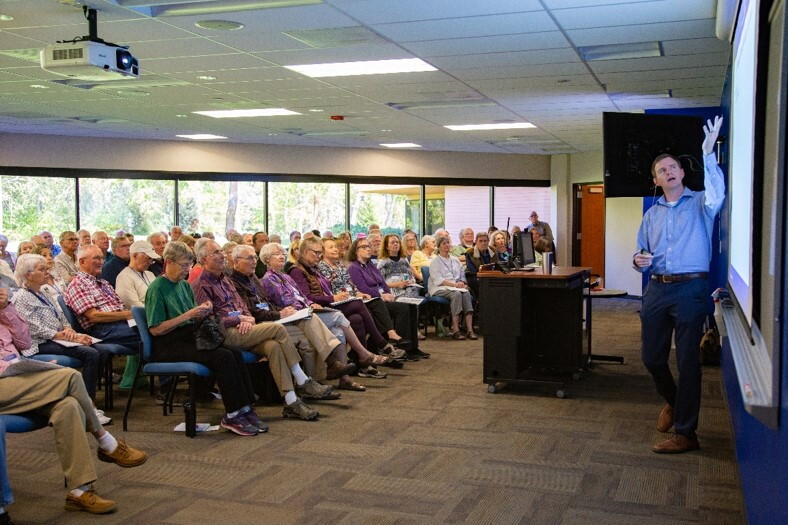
Show notes Osher Institute Gerrymandering Class with Dr. Jeffrey Lyons.( Extended Studies Marketing)
The transatlantic slave trade, Putin's Russia, Ice Age floods in the Columbia River Basin, reproductive rights and gun violence; are just some of the topics from this fall's semester of classes at Boise State's Osher Lifelong Learning Institute.
Thanks in part to lessons learned during the COVID-19 pandemic, Osher is expanding who and how folks can take classes like these. The Director of the Osher Lifelong Learning Institute, Dana Thorp Patterson joined Idaho Matters to tell us more about the program.
Idaho Matters Reporter Roundtable: August 26, 2022
Aug 26, 2022
Show notes
It’s Friday, which means it's time for our Reporter Roundtable when Idaho Matters gets you up-to-date on all the news that made headlines this past week.
Federal judge partially blocks Idaho abortion ban
Aug 25, 2022
Show notesAbortion-rights advocates and abortion-rights opponents demonstrate in front of the U.S. Supreme Court on Dec. 1, as the court hears arguments in a case from Mississippi, where a law would ban abortions after 15 weeks of pregnancy, well before fetal viability.(Andrew Harnik / AP)
Idaho's latest abortion law goes into effect Thursday, with some restrictions.
James Dawson, Boise State Public Radio reporter, joined Idaho Matters to break down the very latest information.
How a new card is helping the Deaf and Hard of Hearing community in Idaho
Aug 25, 2022
Show notes The new Communication Card from the Idaho Council for the Deaf and Hard of Hearing.(Idaho Council For The Deaf And Hard Of Hearing / Idaho Council For The Deaf And Hard Of Hearing In Partnership With The Northwest ADA Center Of Idaho)
Close to a half a million people in Idaho are deaf or hard of hearing and face daily barriers to communication.
Council Executive Director, Steve Snow, along with his interpreter Leah McElwee, joined Idaho Matters to talk more about the new card.
Read the full transcript below.
Gemma Gaudette: Close to a half a million people here in Idaho are deaf or hard of hearing, and they face daily barriers to communication. Something as simple as a traffic stop can be a safety issue for both a driver who is deaf and for a police officer if the two sides cannot quickly communicate with each other. So to help break down that barrier, that barrier, rather. The Idaho Council for the Deaf and Hard of Hearing has created a new communication card that the driver can use to communicate quickly with law enforcement. So here today to talk about this new card is council executive director Steve Snow, who joins us today with his interpreter, Leah McboiseElwee. I want to welcome both of you to the program.
Steve Snow: Thank you for having us here today, Gemma. It's really wonderful to be back on your show.
GG: Well, Steve, it's a pleasure to have you. Can we talk first about that scenario that I mentioned in the intro, which is when someone who is deaf gets pulled over by a police officer for a traffic stop, can you help us understand how difficult that can be for someone who is deaf or hard of hearing?
SS: Yes, I would be happy to. And thank you so much for asking that question. Law enforcement officers in general, just any interaction with the deaf community, it is generally a challenge. So the clear reason for this is barriers in communication. So with the general public, when there is a traffic stop, people already feel that anxiety. They feel just that fear of, oh my goodness, something is wrong. But fortunately, they have that ability to directly communicate and have that conversation so it can reduce the chance of mistakes happening in the midst of that situation. So if a deaf driver is pulled over, they too feel that anxiety. But it's two or three times as bad because they can't predict exactly what will happen during that interaction and how they will communicate with the officer. So when that happens, if it happens at night, if it's dark, they might struggle to see the officer. There are times when police officers will shine flashlights into the window. And so then the deaf individual is unable to see the facial expressions. And so combined with that natural anxiety, the body language of the deaf person can look tense. And so potentially the law enforcement officer could interpret that anxiety as coming from some other cause, potentially drugs or just some other reason. And so just those assumptions can lead to more confusion and can cause safety issues. And this safety issue does not only happen within the state of Idaho. This is a national problem within the deaf community and happens across a variety of situations and locations. It can cause harm and lead to death if there is that misunderstanding, if there are those assumptions, if that deaf person cannot hear the law enforcement officers’ orders and follow those directions that are given.
GG: So, Steve, as you were talking, it hit me that, you know, one thing that hearing people are taught when they learn to drive about being pulled over is leave your hands on the steering wheel where a police officer can see them. You communicate with your hands. So how scary or frustrating then is that situation when you get pulled over and you're trying to somehow communicate? But at the same time, I mean, who knows what would happen if you take your hands off the steering wheel?
SS: Yes. So one of the common problems that happens just across the board with deaf and hard of hearing people is they try to use written communication, a paper and pen to communicate. And of course, during that moment, there's that moment of anxiety, there's that moment of fear as the officer is walking up to the door and they think, I need to communicate, I need to get a paper and pen out. It's a natural response. And usually that paper and pen is in the glove compartment. And so they often will go to reach for something. And all the law enforcement officer sees is they're reaching for something. And there can often be that assumption that it could be a gun, it could be something else they're reaching for. So, yes, that hand movement can cause problems. So when police officers first arrive on the scene, they don't have it in their brain that they're going to meet a deaf person. That's never their first assumption. So when they when they are walking around the car and see that reach, their natural process is is different. But when they once they recognize that the person is deaf, then there is usually a little more flexibility. But in that first moment response, if they see that hand movement. There's going to be confusion. There's going to be issues that arise from that. Afterwards, it might not be an issue, but yes, in that initial instant, it can cause problems.
GG: So, Steve, I want to talk about the communication card. I'm looking at it right now. Before we get into the details of that, though. What then should a deaf person or hard of hearing person do right away when they get pulled over in that situation with a police officer? Because once again, even if you have this card, it might be next to you. Right. So you're going to have to pick it up and hand it to the police officer. And that in just in that brief moment may also cause more anxiety on both sides.
SS: Yes, and that is a good question. Generally, we always try to tell the deaf community in that moment when you are first pulled over, put the card in the visor of your car and you can pull it down quickly since it's above you and then place your hands on the steering wheel or let your hands rest on the steering wheel. And then as the officer approaches, you can use just a gesture to point to the ear, which is generally understood as being deaf, and then point to what you're going to do, point to where you keep that card and wait for the officer to respond to that. And if the officer nods, then you can slowly reach and grab that card and give it to the officer. But in that moment, it is important to have your hands on the steering wheel and wait until the officer approaches. So you want to either have it accessible before the officer is by your window or leave your hands on the steering wheel until you have permission to access that card.
GG: So, Steve, I have to say this communication card is genius. My oldest brother was deaf, deaf from birth. And so many times ran into issues and not, as you mentioned, not just with police officers. It is every interaction you have with a hearing person, frankly, who doesn't know sign language. So we are going to put this communication card up on our website so people can see it. But first, tell us how you came up with this communication card.
SS: This is not our first rendition of this. We have had a different kind of communication card in the past, but it was more limited. There were not icons on the card. Everything was written in written English. And so we put that out for community feedback and realize that that was not as effective. So we made a lot of edits to it and added icons and then asked one police department to for their feedback to for their advice in the process. And then we decided to make those final edits and send it out. Several other states have also produced a similar type of communication card. So we have also looked at what they have developed and kind of picked and chosen what we think will be most effective here in Idaho.
GG: So, Steve, let's go through the card itself, because as you mentioned, it has pictures. So it has icons pictures and it has some text. Can you describe a little bit and what I really appreciate about this is that it has information for the deaf or hard of hearing person to be able to point to. But also it has information to help the police officer as well, or even if someone's in a situation where they need emergency assistance.
SS: So with this card, there are two different sides, the front and the back. So the biggest font is at the top and it clearly shows I am deaf or hard of hearing. So that is in a large font at the top. So that is clearly visible to anyone who's there so they can first see the reason why this is being used. So I am deaf or hard of hearing provides that clarification and then it has simple a simple explanation under that of how to use the communication card and tips for working with the law enforcement officer. So it says, please use eye contact before speaking. So if you're looking in a different direction, it will be harder for the deaf individual to understand, use an interpreter or a variety of other options that will help the law enforcement officer to see what avenues are available. And then at the bottom, it shows different icons for how to best communicate with that person. So there is an icon that represents interpretive services. Some people prefer to communicate through text or written notes. Some individuals do utilize lip reading. And so I do want to make one aside with lip reading, there is a common misconception that all deaf people can lip read and that is simply not true. There are very few deaf individuals who rely on lip reading, so approximately 30% of English words are clear through lip reading, so a very small percentage. So even individuals who are relying on lip reading are having to, based on context, fill in that additional 70%. So you would have to be careful with lip reading.
There is another icon that indicates that an individual utilizes hearing aids or other assistive devices and will be able to communicate that way. And then on the back of the card is where the police officer can point to different icons to indicate why they pulled over the individual so generally and then other requests that the officer can make. So, for example, your license, your registration, your insurance, and then below that is where it shows why the police officer would pull you over. So whether that's speeding, failing to stop at a stop sign, not having your seatbelt buckled, not following traffic stop lights or various other violations so they can point to those most common there to show what has happened and so the driver can understand what was going on. And then at the very bottom, the deaf person can point to what kind of assistance they need if it is an emergency stop. So if they're needing to ask where's the hospital or if they need a tow truck or need to know where they can get gas. So there's different icons that the deaf driver can also use to help reduce that communication issues that arise. And then at the very bottom, it does say emergency contact information. And so we do encourage the deaf community to write the name of another person, really anyone there that they can contact if something arises, they aren't able to communicate very well. There is that phone number there that the police officer can call for that contact information.
GG: And Steve, I would think that this card might come in handy for other things besides a traffic stop, as you mentioned, with having these icons where if there's an emergency like, you know, there's an icon for a hospital, if your car has broken down, I would assume that a driver who is deaf or hard of hearing could use this to communicate, maybe even with a good Samaritan who pulls over and wants to help.
SS: Yes, exactly. There are many different icons that could be added, but we were did have to limit our selection. We couldn't put everything onto the card. We wanted the icons to be large enough. So we did have to prioritize what we felt would happen the most or what's the most common issues to provide the visual accessibility on the card.
GG: So Steve, before we wrap up, how does someone get this card?
SS: You can contact our office and email us at info at CDF dot Idaho dot gov and you can ask for copies. We will pass out multiple copies and we will be happy to mail those to anyone within the state at no charge. And then we have not done this yet, but we plan to disburse some of the cards and put them at various police stations across the state. And our hope is that we will be able to do trainings with those police officers and give them copies of those cards. So. They are exposed to it and they can potentially keep them in their cars or at the station for community members to pick up as needed. We haven't yet dispersed those to the stations, but we hope to do that in the near future.
GG: And what a good idea, because I would hope that police officers would want to maybe carry one of these cards in their vehicles as well. So, Steve, I want to thank you so much for your time today. Really appreciate this conversation. We've been talking with Steve Snow, the head of the Idaho Council for the Deaf and Hard of Hearing, and his interpreter, Leah McElwee, when discussing a new communication card to help deaf drivers and hard of hearing drivers as well as law enforcement communicate during a traffic stop or an emergency situation, we will put a link with more information and a picture of that new card on our website, Boise State Public Radio. Org. Steve, thanks for your time today.
SS: Thank you so much for having us here today.
Rattlesnakes: The sharks of the West
Aug 25, 2022
Show notes( Photo courtesy of Dave Jensen, Owner of Wasatch Snake Removal, LLC)
People have always feared the unknown and that fear transforms some animals into monsters in our minds, like sharks in the ocean, or rattlesnakes in the West.
The Mountain West News Bureau's Madelyn Beck hiked up to the Boise foothills to learn more about these villainized snakes.
Take a trip to the Yuma County Fair!
Aug 25, 2022
Show notes
It's county fair season around our region, with the Western Idaho Fair going on right now in Garden City.
From Kootenai County in Idaho to Los Alamos in New Mexico, people come together at this time of year to celebrate farm life.
Idaho Matters Doctors Roundtable: August 24, 2022
Aug 24, 2022
Show notesTesting capacity for monkeypox is being rapidly expanded.(Pablo Blazquez Dominguez / Getty Images)
Where are we with COVID-19 and what will the future of vaccinations look like?
Dr. David Pate, Former CEO of St. Luke's Health System and a current member of Idaho's Coronavirus Task Force, joined Idaho Matters to answer these questions and give us an update on the number of Monkeypox cases in Idaho.
Idaho StoryCorps: How one man gave up drinking for the sake of his kids
Aug 24, 2022
Show notes Hannah George Sharp and her father Thomas George( StoryCorps)
Thomas George got drunk for the first time to celebrate his graduation from eighth grade. He was just thirteen.
Drinking alcohol quickly became a habit. He and his high school friends went out every weekend and drank.
He told his daughter, Hannah, that his drinking continued through college and affected all parts of his life, including a series of jobs he held and lost. He was still drinking when he met his wife, Hannah’s mother.
“After you and Mom got married, a few years after … is when you got sober. But when did you realize that you needed to get sober and how did you start that process?” asked Hannah.
By then, Thomas said, he would start drinking beer at 8:30 in the morning, as soon as his wife left for work.
“I'd only have one an hour, so I never really got drunk. But I maintained that level I needed to not … be in the shakes or anything. And it went on like that for years, and I didn't think your mom knew anything about it.”
But his wife did know and Thomas only found out later that she was considering taking their two kids, Hannah and James, and leaving her husband.
It was 1994 when Thomas made the decision quit drinking and get help. On November 28, after he called Alcoholics Anonymous, his wife asked Thomas if he had any beer left in the house.
“And I had it hidden under the seat of the minivan. I had it hidden in a toolbox in the garage. I had it hidden in a golf bag in the garage. And I went and started dumping them all down the drain. And as I was pouring the last one down the drain, I just diverted it and put it in my mouth and poured it all down my throat, it was running down my neck. And your mom had this horrified look on her face and she said, what are you doing? And I said, If I'm never going to drink again, I'm going to remember my last beer. And that was the last time I ever had a beer.”
“And how long have you been sober?” asked Hannah.
“Since November 29th, 1994, which is a bit over 27 and a half years. I'll be 28 years in November.”
“My family. My kids, my wife, my marriage,” said Thomas. “I wouldn't have any of that. I wouldn't have any of that if I wasn't able to maintain sobriety. Your mom, as you know, was no nonsense. And no doubt that if I were to start drinking again, she would tell me to leave. She doesn't need any of that nonsense in her life. I would lose my kids. You know, the thought of losing my kids really bothered me.”
Hannah says she wanted to get her father to talk about his path to sobriety for himself and because it might help other people.
“I just want to say thank you for sharing. I know some of that was so hard to talk about. I think it's really, really important to talk about. I think sobriety is a good story for other people to hear. To hear what a sober life could be like if they don't have one.”
Hannah’s voice starts to break.
“The thing, especially now as a parent, that I admire most about you, is that you were willing to do anything to keep your kids. I think there's probably a lot of people in the same situation. So that's why I wanted to talk about it. So, thank you.”
“Thank you, Hannah, for asking me. I'm glad I got to be able to share that with you.”
Thomas paused for a minute.
“You were actually the immediate trigger for my realizing I needed to go to AA,” he told his daughter. “It was one morning I woke up, really hung over. You were probably two, a little over two. James was an infant and your mom left for work. And I was sitting on a couch in the family room, just sick. And you wanted to play, and I asked you to go play by yourself for a little while. I didn't feel good. And you walked away. And the next thing I know, you had gone in the refrigerator and you had gotten a can of beer out, and you walked over and handed it to me.”
With a shaky voice, Thomas continued, “And I was terrified for two reasons. My immediate fear was, oh my God, what if she does this in front of her mother? Her mother is going to wonder why."
“That really set the stage. And it was only days later that I had my final drunk and got sober, started walking that path. So, thank you.”
Thomas says there were other benefits to getting sober. “I got to work on myself. I got to … be a better person and care about other people that I didn't care about when I was drinking, you know? It was always about the party, the good time, even at the end when there were no more good times and I wasn't going out drinking, I wasn't having fun. It was just drinking to not be sick.” Once he quit drinking, we went on to quit smoking and get healthier. “And now I'm going to get to be an old man and a grandfather,” he says with a smile in his voice.
Thomas George and his daughter Hannah George Sharp recorded their conversation at StoryCorps, a national initiative to record and collect stories of everyday people. Excerpts were selected and produced by Boise State Public Radio.
Copyright 2022 Boise State Public Radio
More than just the numbers - how Idaho growth is changing the state
Aug 23, 2022
Show notes
Idaho Matters takes a look at population growth in the Gem State and how those numbers have changed over the last 10 years.
More Idaho kids are anxious and depressed than ever before
Aug 23, 2022
Show notes(Wonderlane / Flickr)
Since the pandemic the number of people struggling with anxiety and depression has increased dramatically across America, resulting in what the white house is calling a mental health crisis.
It's not just adults struggling with mental health issues though, it's kids too.
Here in Idaho the number of children experiencing depression and anxiety has climbed ten percent since 2016. That number comes from the new Kids Count report released just this month.
Christine Tiddens, the Director of Idaho Voices for Children, joined Idaho Matters to talk more about the health needs of children in Idaho.

 Our TOPPODCAST Picks
  Stay Connected