TopPodcast.com
Menu
  • Home
  • Top Charts
  • Top Networks
  • Top Apps
  • Top Independents
  • Top Podfluencers
  • Top Picks
    • Top Business Podcasts
    • Top True Crime Podcasts
    • Top Finance Podcasts
    • Top Comedy Podcasts
    • Top Music Podcasts
    • Top Womens Podcasts
    • Top Kids Podcasts
    • Top Sports Podcasts
    • Top News Podcasts
    • Top Tech Podcasts
    • Top Crypto Podcasts
    • Top Entrepreneurial Podcasts
    • Top Fantasy Sports Podcasts
    • Top Political Podcasts
    • Top Science Podcasts
    • Top Self Help Podcasts
    • Top Sports Betting Podcasts
    • Top Stocks Podcasts
  • Podcast News
  • About Us
  • Podcast Advertising
  • Contact
Not in our directory?
Add Show Here
Podcast Equipment
Center

toppodcastlogoOur TOPPODCAST Picks

  • Comedy
  • Crypto
  • Sports
  • News
  • Politics
  • True Crime
  • Business
  • Finance

Follow Us

toppodcastlogoStay Connected

    View Top 200 Chart
    Back to Rankings Page
    News

    Cyber Security Interviews

    There is “no one way” to start and stay in the field of cyber security. Whether you are involved from the military, law enforcement, consulting, or IT services, it doesn’t matter. I have had countless discussions for years with other professionals online, at conferences, or over drinks, which have changed the way I think about cyber security. That is where this podcast comes in. What if I can capture those moments and frank discussions? I want to share the stories from other cyber security leaders and influencers so everyone can learn from their respective journeys and challenges. Why did they take the path they did? Who were their mentors? How did they tackle some of their biggest career challenges? By hearing how the industry leaders and influencers got to where they are and how they overcame some of the problems they faced, I hope to shed light on the path for other professionals. I will discover what motivates them, explore their journey in cyber security, and discuss where they think the industry is going.

    Advertise

    Copyright: © All Rights Reserved

    • Apple Podcasts
    • Google Play
    • Spotify

    Latest Episodes:
    #007 – What I Am Learning So Far Jan 02, 2017
    Show notes

    This is going to be the second holiday break episode and the first of 2017.

    In this episode, I am taking a quick look back at the first five episodes with my guests to date:

    • Chris Pogue
    • David Cowen
    • Lenny Zeltser
    • Nicholas Percoco
    • Morgan Wright

    Each of these cyber security professionals have had their own, unique journeys to get where they are. In each interview, I learned a lot about them as individuals, but also got their perspectives on a variety of topics that influence the industry as well as some valuable advice.

    Thanks everyone for listening to the first episodes of Cyber Security Interviews. I hope you are all getting some valuable insight to the industry as well as some sage advice.

    Next week we are back with our regular schedule of interviews with top cyber security pros. Have a safe and happy new year everyone, I look forward to speaking to you all soon.

    Remember to sign up here for email notifications of new episodes.


    #006 – 2016: A Look Back Through the Year Dec 26, 2016
    Show notes

    This is going to be one of two special holiday break episodes as we end out the year. We will be returning to our regular interviews with top security experts right after the start of the new year.

    In this episode, I reflect on 2016 and cyber security. It was an interesting year and information security took a spot light more than I could remember for years past (and probably more than I could have imagined a year ago). Even“hackers” even took runner up as Time’s 2016 Person of the Year!

    I will talk about:

    • The cyber-attacks against the Ukrainian Critical Infrastructure, also known as Black Energy
    • The Central Bank of Bangladesh heist
    • The Panama Papers
    • The Internet of Things, Distributed Denial of Service attacks against Dyn DNS
    • Yahoo's breach
    • The email hack of the Democratic National Party

    I wish everyone a safe and happy holiday season this year. Next week I am going to take a quick look back at the first five episodes and some of the lessons I learned from my guests.

    Thanks, I look forward to speaking to you all soon!


    #005 – Morgan Wright: The Rule of Threes Dec 19, 2016
    Show notes

    Morgan Wright is an internationally recognized expert on cybersecurity strategy, cyberterrorism, identity theft and privacy. His landmark testimony before Congress on Healthcare.gov changed how the government collected personally identifiable information. He has made hundreds of appearances on national news, radio, print and web, and has spoken to audiences around the world about cyber security.

    Previously Morgan was a Senior Advisor in the US State Department Antiterrorism Assistance Program and Senior Law Enforcement Advisor for the 2012 Republican National Convention. In addition to 18 years in state and local law enforcement, Morgan has developed solutions in defense, justice and intelligence for the largest technology companies in the world. He has trained over 2,000 law enforcement officers in the investigation of computer crime, including one year training the FBI on internet investigations. He has also taught behavioral analysis interviewing at the National Security Agency.

    A highly seasoned interviewer and moderator, Morgan has over 400 appearances on national news shows. In his interviews, he always tries to inspire, inform and entertain with just the right amount of humor and wit.

    In this interview we discuss cyber security in the 2016 Presidential election, accountability in cyber security and the failure of leadership, investing in people, machine learning, cyber warfare, insider threats, compliance versus security, on the job training, the importance of communication skills, productivity tips and personal development, and much more.

    I hope you enjoy this discussion. Please leave your comments below!

    Where you can find Morgan:

    • LinkedIn
    • Twitter
    • morganwright.us
    • identitysecurity.com
    • morgan.thinkific.com/courses/passwords


    #004 – Nicholas Percoco: Don’t Second Guess Yourself Dec 12, 2016
    Show notes

    Nicholas Percoco has more than 19 years of information security experience and is currently the Chief Information Security Officer at Uptake.

    Prior to Uptake, Nicholas was the Vice President of Global Services at Rapid7. Nick has also been a Director at KPMG and the head of SpiderLabs at Trustwave where he led more than 2000 incident response and forensic investigations globally, ran thousands of ethical hacking & application security tests for clients, and conducted bleeding-edge security research to improve Trustwave's products.

    Before Trustwave, Nick ran the security consulting practices at VeriSign, & Internet Security Systems. In 2004, he drafted an application security framework that became known as the Payment Application Best Practices (PABP). In 2008, this framework was adopted as a global standard called Payment Application Data Security Standard (PA-DSS).

    As a speaker, he has provided unique insight around security breaches, malware, mobile security and InfoSec trends to public (Black Hat, DEFCON, and OWASP) & private audiences (Including DHS, US-CERT, Interpol, United States Secret Service) throughout the world.

    Nick's research has been featured by media including: The Washington Post, eWeek, PC World, CNET, Wired, Network World, Dark Reading, Fox News, USA Today, Forbes, Computerworld, CSO Magazine, CNN, The Times of London, NPR, Gizmodo, Fast Company, Financial Times & The Wall Street Journal.

    Nick is also the creator of THOTCON (a hacking conference held in Chicago each year), & co-founder of The Cavalry movement.

    In this interview we discuss his early start with computers, what is a hacker, developing a methodology for penetration testing, how he developed the SpiderLabs name, analytics and automation, when you should evaluate opportunities, moving past the fear of public speaking, his personal "drink-a-different-beer-a-day" contest, research and public disclosure of vulnerabilities, how to secure Internet connected devices, where he recruits talent, and much more.

    I hope you enjoy this discussion. Please leave your comments below!

    Where you can find Nick:

    • LinkedIn
    • Twitter
    • THOTCON
    • I am the Cavalry


    #003 – Lenny Zeltser: You Can Never Know Everything Dec 05, 2016
    Show notes

    Lenny Zeltser is a seasoned business and tech leader with extensive information security expertise. As a product portfolio owner at a Fortune 500 company, he delivers the financial success and expansion of his orgnization's security services and SaaS products. He has also been a national lead of the security consulting practice at Savvis (acquired by CenturyLink), where he managed the US team of service professionals, aligning their expertise to the firm’s cloud solutions.

    Lenny helps shape global infosec practices by teaching incident response and malware defenses at SANS Institute and by sharing knowledge through writing, public speaking and community projects. He has earned the prestigious GIAC Security Expert professional designation and developed the Linux toolkit REMnux, which is used by malware analysts throughout the world. Lenny is on the Board of Directors of SANS Technology Institute and on the Advisory Board of Minerva Labs.

    Lenny’s approaches to business and technology are built upon his work experience, independent research, as well as a Computer Science degree from the University of Pennsylvania and an MBA degree from MIT Sloan. His expertise is strongest at the intersection of business, technology, and information security, and spans incident response, infosec cloud services and business strategy. To get a sense for Lenny’s thought process and knowledge areas, take a look at his blog.

    In this interview we will discuss why he is passionate about security, stagnating in information security and going back to grad school, public speaking, who has inspired him, his personal challenge asking for advice, early failures in technology, why he developed REMnux to make malware analysis accessible to as many people as possible, cloud security, writing better job descriptions, refining communication skills to technical and non-technical audiences, how to use certifications as a signaling mechanism, building industry relationships, and much more.

    I hope you enjoy this discussion. Please leave your comments below!

    Where you can find Lenny:

    • LinkedIn
    • Twitter
    • Lenny's Blog
    • REMnux


    #002 – David Cowen: Standing On the Shoulders of Giants Nov 23, 2016
    Show notes

    David Cowen has more than sixteen years of experience in the areas of security integration, architecture, assessment, programming, forensic analysis and investigations. He started out as a penetration tester then moved to digital forensics. Currently, he is a partner at G-C Partners, LLC, a full service digital forensics investigation company, and has experience working in a variety of environments ranging from high security military installations to large/small private sector companies.

    David is also one of the most passionate and active contributors within the cyber security and forensic communities. I look at David's contributions and think he doesn't sleep and/or someone in Dallas, TX there is cloning facility that has produced David Cowens versions 2 -5 which are all running around outputting awesome contributions to the community (yes, like the movie Multiplicity).

    Here is just a short list of what David' does to give back to the industry:

    • Regular speaker at conferences such as OSDFCon
    • Ran his blog, Hacking Exposed Computer Forensics, daily which included a weekly forensic challenge
    • Is a Red Team Captain for the National Collegiate Cyber Defense Competition
    • Has his own regular video podcast, Forensic Lunch
    • Author of Computer Forensics: InfoSec Pro Guide
    • Co-author of Hacking Exposed: Computer Forensics
    • Co-author of Anti-Hacker Tool Kit, Third Edition
    • Is a SANS Institute Certified Instructor
    • Developed TriForce ANJP, forensic software for parsing NTFS journals (also working on HFS+ capabilities)

    He is also a two-time Forensic 4cast award winner for both Digital Forensic Article of the Year and Digital Forensic Blog of the year.

    When he is not doing all of this, he is also a family man and BBQ aficionado.

    Nope. Zero chance this is one person.

    In this interview we will discuss how he has accomplished all of this, why he loves being an expert witness, why he moved from pen tester to forensicator, his inspiration to start programming, his favorite type of investigation and the questions to ask, how to hire good talent, what it took to develop TriForce ANJP and how it was a community effort, how no one stands on their own in the industry, and much more.

    I hope you enjoy this discussion. Please leave your comments below!

    Where you can find David:

    • LinkedIn
    • Twitter
    • Hacking Exposed Computer Forensics
    • Forensic Lunch


    #001 – Chris Pogue: Like a Chihuahua On a Pork Chop Nov 23, 2016
    Show notes

    Chris Pogue, Chief Information Security Officer at Nuix, has more than fifteen years’ experience and 2,000 breach investigations under his belt. Over his career, Chris has led multiple professional security services organizations and corporate security initiatives to investigate thousands of security breaches worldwide.

    His extensive experience is drawn from careers as a cyber crimes investigator, ethical hacker, military officer, and law enforcement and military instructor. In 2010, Chris was named a SANS Thought Leader, ran an award-winning security blog (The Digital Standard), and has contributed to multiple security publications. Chris holds a Master's Degree in Information Security and is also an adjunct cyber security professor at Southern Utah University. He also was a contributing author for Data Breach Preparation and Response: Breaches are Certain, Impact is Not.

    Chris is just one of those guys in cyber security I knew I had to have on the show out of the gate. He is an extremely bright guy and very passionate about information security. He is also pleasure to talk to. He coined the methodology and term "Sniper Forensics" a few years back, and it had a huge impact on the way I approach digital forensic investigations.

    In this interview we discuss his military background, his start as a penetration tester, his transition from tech to executive, books that have influenced him, using the scientific method, the merger of cyber crime and physical crime, training cyber security staff, the importance of communication skills, cognitive biases and Parkinson's Law of Triviality, and much more.

    I hope you enjoy this discussion. Please leave your comments below

    Where you can find Chris:

    • LinkedIn
    • Twitter
    • The Digital Standard
    • Nuix Blog


    #000 – Douglas A. Brush: You’re Always a Student – You Never Stop Learning Nov 22, 2016
    Show notes

    Before we tackle the hearts and minds of some of the leaders and influencers in cyber security, I wanted to provide a little background about me and how I got started in cyber security.

    As far back as I can remember, I always wanted to be a hacker.

    In 1981, at an impressionable age five, I plopped down in front of a Texas Instruments TI99/4A computer. It had a whopping 3MHz CPU, 16K of RAM, and 16 colors. My parents got one for the home and I mostly used it to play video games. My favorite game was Hunt the Wumpus.

    At some point, I came across Compute! magazine that had instructional pages of BASIC, spaghetti code programs that you could use to run on your computer. After hours of painstakingly transcribing lines and lines of GOTO commands into the TI99, I would have a small colored box bounce from one side of the screen to the other. Then back again. #Fun.

    [caption id="attachment_1332" align="alignleft" width="173"]“Hi sugar. After you store my 'portable' computer, can you please light my Pall Mall and fetch me a double Alabama Slammer?" Image source: Oldcomputers[/caption]

    The Reagan 1980's roared on and computers gained greater adoption in the business community, particularly in finance and accounting. However, computers for the general public consumption were still in their infancy. Glorified calculators with some generic word processing capabilities. Then movies like Tron and War Games came out. Whoa. They depicted the anti-heros as computer users, but different. They were hacker misfits, but cool in their own way. They could command computers to do powerful things. I wanted to do that.

    My parents continued to bring technology into the home (they were leading communication consultants and authors) including new computers to play with, break, and hopefully, repair. In the summer of 1983 we made the investment in a Compaq Portable Plus. This was also a deciding point because it set me down the IBM/PC market path (sorry Apple). Mind you, this beast of plastic and metal was marketed as "portable" at 28 pounds. Nine-inch monochrome monitor and detachable keyboard? Heck yeah I'll travel with this thing! And we did!

    The real selling point to me on this computer was WordPerfect 3 with the spell checking feature and a printer. No longer was I chained to homework assignments of handwritten drafts! I was able to write a book report on birds, it showed me how horrid my spelling was, and I could print it. Sold. However, my final submission caused a certain amount of controversy with my teacher. She accused my parents of writing this masterpiece. With Kerouac-esque lines like "Cardinals are red," I can see the confusion. She simply couldn’t understand how a kid could use a computer to write a paper. This resulted in my parents meeting with the teacher and principal to explain how I could possibly do such a thing.

    Luckily things started to change and computers were becoming more mainstream. They were more and more likely to be common appliances in the home.


    “I asked for a car, I got a computer. How’s that for being born under a bad sign.”– Ferris Buller

    [caption id="attachment_1333" align="alignleft" width="568"]mud1_screenshotA MUD. By Source, Fair use, Wikipedia.org[/caption]
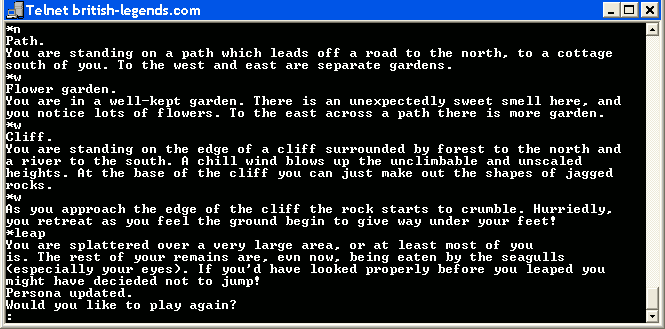
    In the late 1980’s, we started using CompuServe and then Prodigy. A whole other world with computers opened up. Computers, and me, were now connected to people all over. I could chat and play text based online games. Hardly worth PewDiePie commentary, but it was fun to explore these MUD's (Multi-User Dungeons).

    For those old enough to remember, this also created some lessons in POTS and the North American Numbering Plan (NANP). For those not old enough to remember, for these services we had to find "local" numbers to have our computers dial into (yes on landline phones, now get off my lawn). If you didn't use a local number, the Bell carriers would charge you long distant charges per minute on top of the per minute charges of the online service. Whoops, sorry dad.

    In early 1990's while in high school I became the "go to" family member and friend who could fix computers. "Doug, the stupid thing won't turn on." "Windows won't open." "I have no sound." I have edited my fair share of Autoexec.bat files and fixed paths in Config.sys files just to get computers to boot or play noises (Sound Blaster drivers anyone?).

    At some point, we moved away from Prodigy and got on this new thing called the "Internet" with a local ISP. I wasn't limited to messaging users on closed systems or bulletin boards anymore. Now, I could email people with a publicly routable address and post and search Usenet forums. It was pretty cool to suddenly be able interact with people all over the world. I even saved my pennies to make the big jump to a 28.8k modem for some real speed!

    After graduating high school, I was faced with a “do what you love” (computers) or “do what you should” (college) scenario. The options to combine the two scenarios at that particular time was not appealing. The big push for college computer science in the early/mid 1990’s was still focused around mainframe computers and COBOL programming. Um, no thanks. It was not appealing to get pushed towards what I felt was an antiquated architecture when home and small business PC’s were on an exponential rise, the Internet was gaining visibility, and LAN equipment prices were falling.

    Through my parent’s communication consulting company, I gave presentations at business groups in Poughkeepsie, NY (IBM country![1]) about using the Internet and the World-Wide-Web to market and promote your business. After one of these talks, a gentleman came up to me and said, “Kid this is all great, but no one knows what the hell you are talking about. People and businesses need more general help with computers.” Good point. I took my college savings and started a computer consulting company called Computer House Calls. Business quickly took off and I grew a decent client base serving the Hudson Valley in New York. The best part was I was doing what I loved: troubleshooting and exploring technology.

    I also started to get more interested in cyber security as well as hacker culture. I was very intrigued by the interplay between technology, law, activism, privacy, and security. I devoured books like the The Cuckoo's Egg and The Hacker Crackdown. I consumed back issues of 2600 and Phrack and regularly listened to Off the Hook (which as far as I can surmise, is the first “podcast”/radio show dedicated to cyber security). When the movie Sneakers came out, I wanted to be Robert Redford’s character Marty Bishop and run a team that would get paid to hack in to places.

    I closely followed the exploits and (mis)adventures of hackers like Kevin Mitnick and Kevin Poulsen. I was amazed by what they were able to pull off. What was even more shocking was the fearful reaction they garnered from law enforcement and the media. When Mitnick was finally caught, the prosecution made claims that he could start a nuclear war by whistling into a payphone. To me, this demonstrated a huge disconnect with the public’s understanding of how to secure technology work, even while becoming voracious consumers of all things digital.

    During the Internet bubble of the late 1990’s and into the early 2000’s I started and built various IT consulting companies with services around networking, desktops, support, web design, and home automation. I did a ton of malware and virus remediation for clients and was exposed to the various tools that let me see how these nasty pieces of software propagated and infected machines.

    By the time the global financial crisis hit, I decided to focus exclusively on cyber security. It was (and still is) what I loved doing and the marketplace for these services was maturing. I started The Digital Forensic Group, a firm focused on digital forensics, incident response, electronic discovery, and security consulting. I then moved my practice to larger consulting firms to cover end to end security consulting. I have worked investigations involving computer hacking, insider threats, massive corporate espionage, and trade secret theft, as well as assisted clients improve their defenses by having me break into their networks.

    Currently, I run an amazing “A” team of forensicators, penetration testers, security analysts, and data privacy experts. We provide a full range of cyber security and information governance consulting services to clients around the globe. Most importantly, I get to do what I am passionate about and love doing. Every day I get to be a hacker, solve complex problems, and help people achieve a better state of information security. It’s a dream come true.

    However, as I look back on my journey and talk to others, I realize there is no “one way” to start and stay in the field of cyber security. Whether you are involved from the military, law enforcement, consulting, or IT services, it doesn’t matter. There is no one path. Additionally, that type of diversity of professionals only makes the industry stronger. We all need to learn from each other and share our experiences. There is not one person who knows it all.

    I also love the willingness to help each other and the collaboration to solve problems from this diverse set of professionals in cyber security. There truly is a security “community.” Whether it is a technical problem or a career hurdle, there is someone else out there who has overcome that same obstacle. I have had countless discussions for years with other professionals online, at conferences, or over drinks, which have changed the way I think about cyber security. Sometimes, it was just enough to hear that I was not alone when mulling an opinion or thought.

    So, that is where my idea to create this podcast started. What if I can capture those moments and frank discussions? I want to share the stories from other cyber security leaders and influencers so everyone can learn from their respective journeys and challenges. Why did they take the path they did? Who were their mentors? How did they tackle some of their biggest career challenges? Where do they think the industry is going?

    By hearing how the industry leaders and influencers got to where they are and how they overcame some of the problems they faced, I hope to shed light on the path for other professionals. Also, the cyber security professionals I have come to know over the years are some of the funniest, intelligent, and most interesting people I have ever met. It has been very rewarding to get to know them want to share this experience with others.

    So please join me as we meet the leaders and influencers in cyber security. I will discover what motivates them, explore their journey in cyber security, and discuss where they think the industry is going. Cyber Security Interviews will let listeners learn from the experts' stories and hear their opinions on what works (and doesn't) in cyber security.

    Thank you, I look forward to hearing all of your stories.

    - Douglas A. Brush

    [1] I still have a weird vision of Lou Gerstner riding horseback through the Hudson Valley, dressed like the Marlboro man, corralling thousands mid-level mainframe production managers.


    Previous 1 11 12 13

    Related Podcasts

    Inside Strategic Coach: Connecting Entrepreneurs With What Really Matters

    1

    Inside Strategic Coach: Connecting Entrepreneurs With What Really Matters Business
    WSJ Your Money Briefing

    2

    WSJ Your Money Briefing Business
    FORTUNE Unfiltered with Aaron Task

    3

    FORTUNE Unfiltered with Aaron Task Business
    FORTUNE OnStage Presents: The Most Powerful Women

    4

    FORTUNE OnStage Presents: The Most Powerful Women Business
    Slate Money

    5

    Slate Money Business
    In The Dark – The New Yorker

    6

    In The Dark – The New Yorker Business News
    footer-logo

    Contact Us

    Toll Free: 844-670-7747

    Links

    • Home
    • Top Charts
    • Networks
    • Apps
    • Independents Podcasts
    • Podcast Advertising
    • Podcast News
    • Contact Us
    • About Us
    • Analytics & Insights

    Stay Connected

      Privacy, Terms of Use & Our Code of Ethics Protecting Content Creators Copyrights





