TopPodcast.com
Menu
  • Home
  • Top Charts
  • Top Networks
  • Top Apps
  • Top Independents
  • Top Podfluencers
  • Top Picks
    • Top Business Podcasts
    • Top True Crime Podcasts
    • Top Finance Podcasts
    • Top Comedy Podcasts
    • Top Music Podcasts
    • Top Womens Podcasts
    • Top Kids Podcasts
    • Top Sports Podcasts
    • Top News Podcasts
    • Top Tech Podcasts
    • Top Crypto Podcasts
    • Top Entrepreneurial Podcasts
    • Top Fantasy Sports Podcasts
    • Top Political Podcasts
    • Top Science Podcasts
    • Top Self Help Podcasts
    • Top Sports Betting Podcasts
    • Top Stocks Podcasts
  • Podcast News
  • About Us
  • Podcast Advertising
  • Contact
Not in our directory?
Add Show Here
Podcast Equipment
Center

toppodcastlogoOur TOPPODCAST Picks

  • Comedy
  • Crypto
  • Sports
  • News
  • Politics
  • True Crime
  • Business
  • Finance

Follow Us

toppodcastlogoStay Connected

    View Top 200 Chart
    Back to Rankings Page
    News

    Current Affairs

    A podcast of politics and culture, from the editors of Current Affairs magazine.

    Advertise
    • Apple Podcasts
    • Google Play
    • Spotify

    Latest Episodes:
    Santa Claus for Alaska May 31, 2022
    Show notes

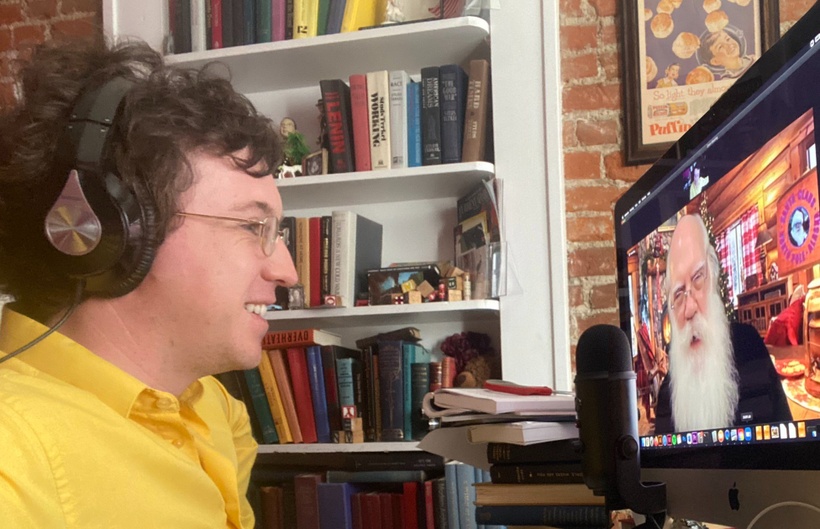
    Santa Claus is the mayor pro-tem of North Pole, Alaska. Yes, he's real, and he's a democratic socialist running for Congress in the special election against Sarah Palin. Current Affairs is honored to be joined by a man falsely thought to be a mere myth. In fact, when parents tell their children there is no Santa, they just don't want kids to know that the real Santa is a leftist who believes love is more important than presents.

    Note from Nathan: Apologies for the absence of new podcast episodes over the last week. I had to defend my PhD dissertation this week and it took all of my energy away! Good news is that's done and I am Dr. Robinson now. Many magnificent new podcasts coming soon so stay tuned!! Thank you so much for all your support we have great stuff planned for the next months.


    How Do We Overcome Capitalism? May 31, 2022
    Show notes

    Tom Wetzel's forthcoming book Overcoming Capitalism: Strategy for the Working Class in the 21st Century (AK Press) is both a primer on the basic left critiques of capitalism and a handbook for creating a new economic system. Wetzel explains in clear, accessible language why exploitation, waste, and environmental destruction are built into the capitalist model and then explores possible alternative economic structures and shows how we might get there. He probes important questions like "What is the role of electoral politics?" "What kinds of unions do we need?" and "What cautions does the history of Marxism-Leninism offer us?"

    In the best libertarian socialist tradition, Wetzel is a critic not only of domination and hierarchy in the contemporary capitalist economy, but of attempts to bring about socialism through authoritarian institutions. He explains the importance of democracy and why it must guide everything we do. Overcoming Capitalism is an important contribution to the literature of the left, the product of over a decade of research and writing, and today Tom Wetzel joins us to explain the basics of his ideas.


    How Corporations Get Away With Criminality—And How to Stop Them May 31, 2022
    Show notes

    Jennifer Taub is a law professor whose book Big Dirty Money: Making White Collar Criminals Pay is about the double standard in American law that harshly punishes street crime while giving a free pass to corporate criminals. Taub tallies up the immense costs of corporate wrongdoing from fraud to wage theft and exposes how CEOs commit acts of destructive criminal wrongdoing with complete impunity.

    But Taub isn't just bemoaning the corruption of the justice system—she also shows how we can change it, and her book is a manifesto for action as well as an indictment. As the San Francisco Chronicle writes, Taub "proposes straightforward fixes and ways everyday people can get involved in taking white-collar criminals to task." Prof. Taub joins Current Affairs editor-in-chief Nathan J. Robinson and online editor Lily Sánchez to talk about how corporate criminals get away with it and why we don't need to resign ourselves to a two-tiered justice system.


    The Life and Crimes of Winston Churchill May 10, 2022
    Show notes

    Tariq Ali is the author of two dozen books and his career as a public intellectual and activist stretches back to the 1960s. His new book Winston Churchill: His Times, His Crimes is an effort to demolish the "Churchill myth" that has been built up since the Thatcher years. Ali demonstrates that Churchill was:

    - Not actually popular among the British public, who threw him out of office immediately at the end of World War II, and voted in the socialist Labour government instead

    - A virulent white supremacist whose core political beliefs were the violent maintenance of the British empire abroad and the suppression of class struggle at home

    - Not actually an opponent of fascism on principle, having highly praised Mussolini. Churchill saw the threat that Hitler posed to Europe but would happily tolerate far-right governments to stop the spread of Bolshevism

    - Responsible for hideous colonial atrocities such as the Bengal famine

    Ali's book is not just a myth-busting biography of Churchill, but a history of imperialism and the British working class movement, and a case study in how falsified myths are used to justify the maintenance of the existing social order. Today, everyone from Boris Johnson to Volodymyr Zelensky invokes the Churchill of legend, but we need to understand the Churchill of historical fact, and face up to the horrors of the British empire and the way that powerful countries rationalize their misdeeds with appealing self-righteous rhetoric and the turning of morally repugnant rulers into saintly icons.

    A review of Ali's Winston Churchill has been published in Current Affairs here. Footage of the British public booing Churchill and chanting "We Want Labour!" can be found here.


    A View of British Government From the Inside w/ former Labour MP Chris Mullin May 10, 2022
    Show notes

    Chris Mullin served from 1987 to 2010 as a Labour MP in the British parliament. During that time, he kept a daily diary of his observations, which has since been published in three acclaimed volumes. The diaries trace the rise and fall of Tony Blair's "New Labour." Mullin himself was associated with the party's left (he edited Tony Benn's book Arguments for Socialism and was the only member of Blair's government to vote against the Iraq war) but found himself trying to tread carefully to use the powers of government effectively. His diaries raise valuable questions about how an ordinary person trying to do good in government can negotiate the thorny ethical dilemmas that come with being close to power.

    Mullin is also the author of the novel A Very British Coup (adapted into a popular miniseries), about what happens when a socialist government takes power in the UK, and is known in Britain for his crusading journalistic effort to free the wrongly accused Birmingham Six, a case from the 70s that is still making headlines to this day.

    In this conversation, we talk about the frustrations of navigating bureaucracy, the catastrophe of Blair's support for the Iraq war, and whether a socialist government would indeed face the kind of existential threats that Mullin has written about in his fiction.

    Edited by Tim Gray.


    Dr. Mark Vonnegut on the Soullessness of Modern Medicine May 10, 2022
    Show notes

    Mark Vonnegut MD has been a pediatrician for over 30 years. He is the author of the books The Eden Express: A Memoir of Insanity, Just Like Someone Without Mental Illness Only More So, and most recently The Heart of Caring: A Life in Pediatrics. His new book is a collection of observations from his life treating children in the American healthcare system. In it, he shows how the for-profit private insurance industry has destroyed doctors' ability to provide effective care for patients, and he explains what he sees as necessary for doctors to treat patients well. His book is both an aggressive indictment of a profit-driven system and a vision for compassionate, empathetic care.

    Dr. Vonnegut shows that to reconstruct our healthcare system, we will need single-payer financing, but we will also need a form of medicine that centers the needs and feelings of patients, and in which medical care is administered free of meddlesome bureaucracy and out of a genuine desire to help people get better. In this conversation, Current Affairs editor in chief Nathan J. Robinson and online editor Lily Sánchez (who herself happens to be a pediatrician) discuss Dr. Vonnegut's hopes for a humane alternative to the contemporary practice of medicine.

    Edited by Tim Gray.


    How the Amazon Labor Union Defeated the Bezos Behemoth May 10, 2022
    Show notes

    Justine Medina is a member of the organizing committee for the Amazon Labor Union and a packer at the JFK8 warehouse in Staten Island. The ALU recently won a historic victory, defeating Amazon's multi-million dollar union-busting campaign to make JFK8 the first unionized Amazon warehouse in the country. It was a victory many thought impossible. But Amazon underestimated the ALU and through persistent organizing work, the union pulled off an astonishing victory that is expected to be a game-changer for Amazon workers around the country. Justine's commentary "How We Did It" can be read in Labor Notes. In this conversation, we discuss how a group of dedicated Amazon workers, organizing independently of any major union, managed to pull off a stunning triumph for the labor movement. We talk about the lessons that others can take from the ALU's example.

    Find out how you can support the Amazon Labor Union here.

    Special thanks to Micheal "Airlift Mike" Ziants of Airlift Productions for narrating the trailer. Trailer edited by Tim Gray.

    Music: "The Descent" by Kevin MacLeod (incompetech.com) Licensed under Creative Commons: by Attribution 3.0

    Justine is the one in the glasses.


    Why Are So Many Pedestrians Getting Killed in America? May 10, 2022
    Show notes

    Angie Schmitt is a transportation writer and planner whose book Right of Way: Race, Class, and the Silent Epidemic of Pedestrian Deaths in America examines the shocking and disturbing growth in pedestrian deaths on the streets of the United States. After declining for 20 years, pedestrian deaths began climbing drastically again around 2010:


    These gruesome tragedies are preventable—in Europe, deaths are declining rather than increasing—and in Angie's book, she discusses all of the factors contributing to the problem. These include:

    • The proliferation of big trucks and SUVs with huge blind spots and killer front ends
    • Gentrification pushing poor people into the suburbs, where not having a car means having to walk to work across busy six-lane roads and take your life in your hands
    • The lack of any serious US national investment in making our roads safe and laws written by the oil industry (for instance, many state constitutions prohibit using gas tax money to build sidewalks)
    • A lack of good public transit
    • A culture of "blaming the pedestrian" that sees accidents as a result of walkers' foolishness rather than bad planning
    • The fact that the victims of these accidents tend to be poor people, old people, and people of color, whose lives are less valued and who navigate worse infrastructure

    Angie's book is filled with important information about an overlooked crisis. It's a serious issue of racial justice and shows the American class divide at its ugliest: rich people in giant trucks mow down poor people of color who have no choice but to dodge traffic. It's a dystopian tragedy, made all the worst by how avoidable it is. Instead of ensuring that everyone could navigate the built environment safely, America has shifted blame onto victims (as we can see in the concept of "jaywalking," which punishes pedestrians for crossing streets even when there are no crosswalks nearby). Angie lays out why we need to care more about this injustice and how we can address it at relatively little expense.

    Nathan accidentally used the wrong microphone so his audio is worse than usual. Apologies.


    Noam Chomsky on How to Avoid World War 3 Apr 22, 2022
    Show notes

    Noam Chomsky is "arguably the most important intellectual alive," the founder of modern linguistics, one of the most cited scholars in history, and the author of over 100 books. He is currently laureate professor at the University of Arizona and professor emeritus in the MIT Department of Linguistics and Philosophy. He recently co-authored the book Consequences of Capitalism: Manufacturing Discontent and Resistance and is soon to release The Withdrawal: Iraq, Libya, Afghanistan, and the Fragility of U.S. Power.

    Prof. Chomsky is one of the foremost experts on U.S. foreign policy, and today we discuss one of the most serious imaginable topics: the threat of world war and the path to reducing the threat of nuclear weapons. We begin by discussing the Hiroshima bombing and the dawn of the nuclear age, before discussing the present escalating tension with Russia and the means by which the U.S. can maintain peace and avoid a catastrophic global conflict. We also discuss the ways that Americans avoid confronting the suffering inflicted by their country on others around the world, the stories that the powerful tell themselves to rationalize atrocities, and the common thread running through Chomsky's work on foreign policy: an insistence that the U.S. confront the truth about its actions and that our moral condemnation of our enemies' crimes be matched with an equally intense scrutiny of our own.

    No topic could be more important than the threat of global warfare, and nobody in the world is more knowledgable about it. It is a great privilege to welcome Prof. Chomsky back to the Current Affairs podcast for this vital conversation.

    • The books on the British empire that Prof. Chomsky cites are Legacy of Violence by Caroline Elkins and Inglorious Empire by Shashi Tharoor.
    • The 1983 Soviet nuclear false alarm incident is discussed here.
    • The Daniel Ellsberg anecdote that Nathan cites at the beginning is from The Doomsday Machine: Confessions of a Nuclear War Planner.
    • The interview Prof. Chomsky cites with veteran diplomat Chas Freeman is here.
    • The interview in which Carter national security advisor Zbignew Brzezinski discusses the Soviet invasion of Afghanistan is here. In it, he says: "We didn’t push the Russians to intervene, but we knowingly increased the probability that they would [...] Regret what? That secret operation was an excellent idea. It had the effect of drawing the Russians into the Afghan trap and you want me to regret it? The day that the Soviets officially crossed the border, I wrote to President Carter, essentially: “We now have the opportunity of giving to the USSR its Vietnam war." Indeed, for almost 10 years, Moscow had to carry on a war that was unsustainable for the regime, a conflict that bought about the demoralization and finally the breakup of the Soviet empire." The war killed an estimated 1 million Afghan civilians.
    • For more on how Biden administration policies are starving Afghanistan, see here and here.
    • The John Stuart Mill essay that Prof. Chomsky refers to is 1859's "A Few Words on Non-Intervention."
    • A helpful list of over 1000 books Prof. Chomsky has cited in his work can be found here.

    The previous Current Affairs interview with Noam Chomsky can be viewed here.


    How Finance Ate The Economy - w/ Grace Blakeley Apr 21, 2022
    Show notes

    Finance expert Grace Blakeley is a staff writer for Tribune magazine. She has served as economics commentator for the New Statesman and as a fellow at the Institute for Public Policy Research's Centre for Economic Justice. She is the author of two books, Stolen: How to Save the World from Financialization and The Corona Crash: How the Pandemic Will Change Capitalism, and editor of the book Futures of Socialism.

    Blakeley's writings argue that the finance sector has taken on an outsized role in the economy, with terrible results for working people. She shows how the profits of financiers have become more important than satisfying human needs, and analyzes the history of capitalism to expose the forces driving the increase in inequalities of wealth and power. In her latest book, she shows how the pandemic has worsened these tendencies. Importantly, Blakeley also provides solutions, showing what it would mean to "democratize the financial sector" and why we should be confident that it's possible.

    In this conversation, Blakeley explains for non-finance experts how the "financialization" of an economy works and why it causes crises.


    Previous 1 35 36 37 38 39 60 Next

    Related Podcasts

    Inside Strategic Coach: Connecting Entrepreneurs With What Really Matters

    1

    Inside Strategic Coach: Connecting Entrepreneurs With What Really Matters Business
    WSJ Your Money Briefing

    2

    WSJ Your Money Briefing Business
    FORTUNE Unfiltered with Aaron Task

    3

    FORTUNE Unfiltered with Aaron Task Business
    FORTUNE OnStage Presents: The Most Powerful Women

    4

    FORTUNE OnStage Presents: The Most Powerful Women Business
    Slate Money

    5

    Slate Money Business
    In The Dark – The New Yorker

    6

    In The Dark – The New Yorker Business News
    footer-logo

    Contact Us

    Toll Free: 844-670-7747

    Links

    • Home
    • Top Charts
    • Networks
    • Apps
    • Independents Podcasts
    • Podcast Advertising
    • Podcast News
    • Contact Us
    • About Us
    • Analytics & Insights

    Stay Connected

      Privacy, Terms of Use & Our Code of Ethics Protecting Content Creators Copyrights