TopPodcast.com
Menu
  • Home
  • Top Charts
  • Top Networks
  • Top Apps
  • Top Independents
  • Top Podfluencers
  • Top Picks
    • Top Business Podcasts
    • Top True Crime Podcasts
    • Top Finance Podcasts
    • Top Comedy Podcasts
    • Top Music Podcasts
    • Top Womens Podcasts
    • Top Kids Podcasts
    • Top Sports Podcasts
    • Top News Podcasts
    • Top Tech Podcasts
    • Top Crypto Podcasts
    • Top Entrepreneurial Podcasts
    • Top Fantasy Sports Podcasts
    • Top Political Podcasts
    • Top Science Podcasts
    • Top Self Help Podcasts
    • Top Sports Betting Podcasts
    • Top Stocks Podcasts
  • Podcast News
  • About Us
  • Podcast Advertising
  • Contact
Not in our directory?
Add Show Here
Podcast Equipment
Center

toppodcastlogoOur TOPPODCAST Picks

  • Comedy
  • Crypto
  • Sports
  • News
  • Politics
  • True Crime
  • Business
  • Finance

Follow Us

toppodcastlogoStay Connected

    View Top 200 Chart
    Back to Rankings Page
    Government & Organizations

    Coaching Through Chaos Podcast

    Conversations with experts to help you conquer the chaos in your life! You’ll hear inspiring and motivating stories about relationships, finance, stress, conflict resolution, healthy living, addiction recovery , health and fitness, money management, success coaching. The show is hosted by Dr. Colleen Mullen, PsyD., LMFT, a therapist and expert in managing life’s chaos!

    Advertise

    Copyright: © All rights reserved

    • Apple Podcasts
    • Google Play
    • Spotify

    Latest Episodes:
    013 - Why Try Resiliency - Christian Moore Sep 01, 2015
    Show notes

    013 - Why Try Resiliency - Christian Moore by colleen mullen psychology motivation self-help life skills social work love relationships resilience san diego coaching therapy


    012 - CleanForks - Shelley Davidescu Aug 25, 2015
    Show notes

    Grow your business and Shrink your booty ! Shelley Davidescu tells us about CleanForks.com - power food coaching for powerful women


    011 - Paws for Purple Hearts - Bonnie Bergin Aug 18, 2015
    Show notes

    011 - Paws for Purple Hearts - Bonnie Bergin by colleen mullen psychology motivation self-help life skills social work love relationships resilience san diego coaching therapy


    010 - Confict Resolution - Stewart Levine Aug 11, 2015
    Show notes

    010 - Confict Resolution - Stewart Levine by colleen mullen psychology motivation self-help life skills social work love relationships resilience san diego coaching therapy


    009 - Human Instruments - Vahakn Matossian Aug 04, 2015
    Show notes

    Musical instruments tailored to the humans using them


    008 - Otherhood with Melanie Notkin Jul 26, 2015
    Show notes

    Celebrating Auntie's Day, this podcast features best selling author Melanie Notkin, who also founded Aunties Day in 2009. Learn about circumstantial infertility, and what exactly is a PANK


    Couples Financial Compatibility - Jeff Motske Jul 21, 2015
    Show notes

    ~ Do discussions about money bring discord into your relationship ? If the answer is yes, you are not alone. In this interview, certified financial planner Jeff Motske provides helpful tips to resolve this problem, as covered in his book - 'The Couples Guide to Financial Compatibility'. The solutions he provides will help you plan for the future, build a solid foundation for your financial house, proactively discuss finances with your partner and deal with boomerangs.

    This year alone we’ve witnessed several companies, including Radio Shack close up its doors for good. Other major chains like Sears, Abercrombie & Fitch, Barnes & Noble, Anna’s Linens and Aerospostale have confirmed that they will be closing many if not all of their stores due to diminished sales and/or bankruptcy. These stories, although they may not affect us personally, can affect the level of stress we carry about our own financial situation. Its societal data points like this that remind us that financial success can be tough to achieve and can be fleeting.

    Today’s episode focuses on how to help couples talk about money. My guest is Jeff Motske. He is the CEO of Trilogy Financial Services; host of the show “Declare Your Financial Independence” on 1110AM KFAX San Francisco, and the author of “The Couples Guide to Financial Compatibility”. Jeff talks with us about building a financial legacy; how to talk you’re your spouse about a family budget and how to talk with your adult kids about financial responsibility when they move back home. He’s also going to tell us all about his “War of the Wallets” quiz that you can take online with your spouse.
    When Trilogy was in its infancy, Jeff started out meeting his client’s needs based on where they were in life and what their financial goals were. He took a small town approach when his competitors were sticking with Wall Street strategies. This approached has grown Trilogy into a nationwide company whose client’s investments surpass $2 billion dollars. Jeff provided us with a lot of insight and some great tips on helping couples talk about their finances and plan for life events.

    We all feel the stress of money at times. Back in my single days, I used to imagine it would be easier to handle money stress when the day came that I would partner up and get married, as I imagine most people think. The problem is, it doesn’t actually get easier. In fact, depending on your situation, either a 2 -income or 1 - income household, it can pose new complications you didn’t have when single (i.e. power struggles over spending, deciding on how to budget, and setting financial limits). In fact, money can be one of the most complicated, or stress-inducing, subjects for couples to talk about. If you search online, you’ll find article after article about how money is the hottest point of contention between couples – I found numbers between 35-57% of couples complaining that money is their number 1 problem. Whether they argue or not, Couples face a lot of stresses in life in life: work, family, kids, who’s going to do the grocery shopping, who’s going to do the dishes. However, when different financial philosophies or struggles enter the picture, it can absolutely get them stuck. Money affects all of us differently. Our parents’ philosophy around money often dictates our own.
    One person may be a spender; the other may be a saver. Sometimes they have similar philosophies both are spenders or savers. Other times, they walk blindly through their life believing their partner is handling the finances. Turning a blind eye to your financial situation and always letting your partner handle it can really get you into trouble. In a partnership, even if one person is the designated “bill payer”, its important to at least be apprised of your current situation on at least a monthly basis. In my private practice, I’ve come across couples who have literally avoided talking about their financial picture for years. Once a couple gets locked in this avoidant pattern, it can be hard to break, but it can be done.
    A lot of what Jeff emphasizes for the couples to keep them healthy financially is similar to the work us marriage therapists do at times with our clients. One of the key components to a happy relationship is effective communication and you need that to do any of the things Jeff talked about. I think the financial date night is a great idea. When couples plan to set aside time to talk about finances (or any other stressful matter), it can relieve the stress of “how do I” or “when do I” bring up my questions or concerns to my partner. Just to make it easier to stay focused, couples can bring notes with them for these discussions. Holding the meeting under the guise of a “date” sets the tone that this is about connection and having the meeting outside of the home reduces the chances of the couple getting emotionally triggered and arguing over a difficult item. I would caution you that couples that have been avoidant of talking about their finances have probably been avoidant about other topics as well. Getting back into talking about these uncomfortable topics can add stress to an already stressful situation. Keep in mind that the financial date night, should be looked at as a time for collaborative problem solving and a time to express concerns effectively. If couples that have been avoidant in the past find that they’re still having trouble addressing the issue or don’t know how to go about talking about it, I’d recommend that they seek out a few sessions with a licensed marriage and family therapist. Most marriage therapists are interested in helping couples effectively communicate and develop the skills to talk with each other safely & authentically without needing the therapist. Deciding to go to couples counseling can be intimidating but it’s really not uncommon for couples to reach out when they are about to embark on trying new behaviors or ways of communicating to ask for help with that.

    Whatever your financial situation is, Jeff Motske's book, "The Couples Guide to Financial Compatibility" can be a healthy starting point for exploring your financial philosophies as a couple and gaining some guidance on ways to discuss the financial planning of some of life's milestones.

    Resources:

    JeffMotske.com You can find Jeff's book "The Couples Guide to Financial Compatibility" as well as his "War of the Wallets" quiz and links to Trilogy Financial Services here

    Real Hope/Free communication tips providing some free helpful tips online for increasing healthy couple communication.

    Harville Hendrix Intentional Dialogue Exercise Harville Hendrix is a master of couple relationship dynamics. He is the founder of IMAGO Therapy. His Intentional Dialogue exercise is a communication strategy designed to help you work through issues or disagreements that may be holding you back from a more intimate and fulfilling relationship with your partner.
    Love Pong Love Pong is an interactive online game designed to help couples improve their communication and express their emotions more effectively.

    Money issues are still really stressing out Americans - / cnn.com

    *****************************************************************

    If you are enjoying the podcast and want to support it without it costing you a dime, there are 3 ways:

    1. Share an episode on your social media
    2. Leave a great review wherever you love to listen to your podcasts
    3. Use my Amazon Storefront Amazon.com/shop/drColleenMullen When you enter Amazon through my storefront. For every purchase you make for 24 hours, I will get a small portion of that sale. You were paying for it anyway, this way a small % of the sale goes to support your favorite podcast. While you're there, you can check out some of my favorite wellness-supporting products and apps! Enjoy!

    If you want to interact with Colleen more personally or stay up-to-date on her other podcasts and happenings, you can follow or friend her on:

    Facebook

    Instagram

    Twitter

    Listen to Shrink@Shrink to learn about love and life through the movies every month.

    Ladies, Look for the upcoming Embrace Your Inner Leader Podcast every month to get empowered and inspired by unique female stories of success!

    You can buy the book: Stop Bitching, Just Lead! The 60-Day Plan for Embracing Your Inner Leader

    If you want to work with Colleen for personal 1:1 coaching to help you conquer the chaos in your life, just reach out through CoachingThroughChaos.com click on the Contact page.

    Thanks for listening!


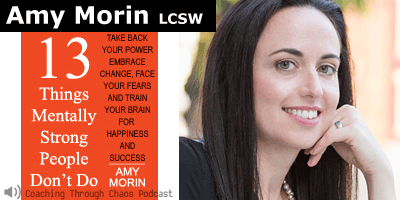
    Train your Brain for Mental Strength with Amy Morin Jul 13, 2015
    Show notes

    Life can throw a lot of hardships in our paths, which it seems only the mentally strong can withstand... Following tragic losses in her life, Amy Morin LCSW wrote a list to remind herself how to keep going. Shared on lifehack.org, the list went viral, then flooded Forbes. Like a beacon in the night, Amy's worldwide best-selling book, 13 Things Mentally Strong People Don’t Do, gives us all simple lessons in resiliency in a world where adversity can leave us feeling isolated..

    Amy Morin LCSW (13 Things) interviewed on the CoachingThroughChaos podcast

    Amy’s life was going along pretty well. But, when she was 22, her mother died suddenly of a brain aneurysm. Her mother was only in her early 50’s. Most people aren’t ready to lost their parents even if they pass away much older, but no one expects their parents to die that young. That’s just not supposed to happen! Amy was healing from that though. She was young in her career as a clinical social worker, was married and starting her life with her husband. But then, on the 3rd anniversary of her mother's death, her 26 year old husband died of a heart attack. What?!? As Amy put the pieces of her life together. She found a way to honor her young husband’s memory. Every year on his birthday, she would get together with his family and participate in life-affirming experiences. Sometimes they were adventurous trips, other times, they were more subdued, but they always made it fun and didn’t wallow in his loss. They found a way to see through the pain of the loss to celebrate life: his and theirs.

    Then, a few years later, Amy found love again and got remarried. She and her new husband were enjoying the early days of this marriage and looking forward to their life together. But then, tragedy struck yet again. This time, her new father-in-law was diagnosed with untreatable cancer. She was then faced with the anticipation of the loss of someone else she was close to – as well as the anticipation of having to help her new husband cope with the loss of his parent. The pain she, of course, knew all too well. This is when Amy decided she was really going to have to pull from all the mental strength she could find.

    Amy initially wrote the original list of “13 Things…” for herself. She speaks of doing it as a reminder to herself of how to successfully cope. She was working as a therapist and was good at helping others find their mental strength, but she discovered that focusing on what to do worked for a while, but she found “not so healthy” habits creeping in to sabotage her. The list helped her understand that she would/could survive these losses. Then, she realized others might benefit from the list and this is when the list took on a life of its’ own. She posted the article on Lifehack.org (you can read it here ). The list went viral within a few hours. The traffic generated from the article shut the page down! It was then re-posted on several other sites, including Forbes.com where it set a record at over 10 million views! To this day, it is still one of their most viral posts.

    It was after all this web attention, that Amy was approached by Harper Collins publishing house and asked to turn the list into a book. So, that’s exactly what she did. The book went on to become a bestseller. I think many people related to her story of strength and perseverance and found her advice practical and actionable.

    Here is the list of “13 Things Mentally Strong People Don’t Do”

    1. They don’t waste time feeling sorry for themselves,
    2. They don’t give away their power,
    3. They don’t shy away from change,
    4. They don’t waste energy on things they can't control,
    5. They don’t worry about pleasing everyone,
    6. They don’t fear taking calculated risks,
    7. They don’t dwell on the past,
    8. They don’t make the same mistakes over and over,
    9. They don’t resent other people’s success,
    10. They don’t give up after the first failure,
    11. They don’t fear time alone,
    12. They don’t feel the world owes them anything, and
    13. They don’t expect immediate results.

    Amy talks of our mental capabilities as a muscle that can be exercised and strengthened. I also subscribe to this thinking. One of my favorite things to work on with my clients is helping them build their mental strengths, or resiliency traits. We are all born with part of our personality predetermined by our genetics. How the other part of our personality developed is thought to be determined by how we are nurtured. As we are growing up, we receive certain messages about how we should or shouldn’t deal with stress, upset, disappointment, as well as love, happiness and all the rest of our emotions. Those messages are internalized and stored as fact, even if they are not in our best interest. For instance, I learned as a child that when I am stressed out I should eat to make myself feel better, which led to a struggle with weight as an adult due to my engagement int his self-soothing behavior. I've had to learn to fight against what fact that although not true, nor in my best interest.

    Amy Morin’s “13 Things Mentally Strong People Don’t Do” takes a refreshing spin on how to overcome struggle and, in her case, multiple losses. Amy’s list resonates with many of us I believe because collectively we have been focusing on what “to do” or what we “should do”. When we don’t “do” what we are “supposed to do to be healthy”, we end up feeling like a failure. However, Amy’s list focuses on “what not to do”. Such a different way of thinking! I say this because when we twist up, say, #11. “They don’t fear time alone” into the “You should do this” type of list, it becomes “They are comfortable being alone”. Somehow not fearing something feels much different than “you should be comfortable” with something. That way of thinking can set many people up for failure. I believe if we re-wrote the list from the “what to do” perspective, it would start to sound like “Mentally strong people just do more then you when you are tired of trying”. Not very empowering.

    Strengthening those emotional muscles to help you become stranger and more resilient takes active work. I’ll leave you with this. The work can be tough, but if your perspective is accepting and forgiving of yourself, reminding yourself of what not to do can feel achievable.

    Resources

    13 Things Mentally Strong People Don’t Do Amazon.com

    Amy Morin's website

    5 Powerful Exercises to Increase your Mental Strength Amy Morin

    7 Ways Mentally Strong People Handle Stress More Effectively Amy Morin

    ***************************************************************************

    If you are enjoying the podcast and want to support it without it costing you a dime, there are 3 ways:

    1. Share an episode on your social media
    2. Leave a great review wherever you love to listen to your podcasts
    3. Use my Amazon Storefront Amazon.com/shop/drColleenMullen When you enter Amazon through my storefront. For every purchase you make for 24 hours, I will get a small portion of that sale. You were paying for it anyway, this way a small % of the sale goes to support your favorite podcast. While you're there, you can check out some of my favorite wellness-supporting products and apps! Enjoy!

    If you want to interact with Colleen more personally or stay up-to-date on her other podcasts and happenings, you can follow or friend her on:

    Facebook

    Instagram

    Twitter

    Listen to Shrink@Shrink to learn about love and life through the movies every month.

    Ladies, Look for the upcoming Embrace Your Inner Leader Podcast every month to get empowered and inspired by unique female stories of success!

    You can buy the book: Stop Bitching, Just Lead! The 60-Day Plan for Embracing Your Inner Leader

    If you want to work with Colleen for personal 1:1 coaching to help you conquer the chaos in your life, just reach out through CoachingThroughChaos.com click on the Contact page.

    Thanks for listening!


    005 Eastern Foundry - Veteran-Owned Technology Incubator 2015 competition Jul 07, 2015
    Show notes

    There are many organizations coming up with new approaches to treating PTSD as we speak. For this episode, I had the opportunity to interview Andrew Chang, one of 4 managing partners of the Eastern Foundry, a veteran-owned technology and innovation incubator. In their own words: “Eastern Foundry is a first-of-its-kind marketplace where technologists, government contractors and agencies convene to exchange information and opportunities, find teaming partners and conduct business.”

    If you start to follow along with the podcast, you may start to guess that I have very strong feelings about our country being ill-prepared for treating the emotional stress and post trauma emotional upheaval many of our troops face through the duties of their service. I think military PTSD will be the mental health field’s biggest problem for the next 20 years or longer. I know I am not the only one that feels this way.

    The Foundry Cup Competition

    Providing all of the resources of a modern technology incubator, Eastern Foundry offers physical workspace, services, trainings and information that are tailored to help large and small businesses achieve government contracting success”. I interviewed Andrew to introduce you to the Foundry Cup competition. This competition is designed to identify solutions to serve our veteran communities. The current competition is their inaugural event, setting off what is going to be a bi-annual forum for not only competition, but also for collaboration among innovators in their fields. The current competition brought together 14 innovation teams to pitch their solutions for Post Traumatic Stress Disorder. The teams present their ideas and technology to a panel of judges much like in the widely- watched Shark Tank television show.

    This initial competition was geared towards innovations in PTSD, but each competition will have it’s own theme. I interviewed Andrew about a week before the winner was announced. I could tell how excited he and his team were at the turnout of innovations and that they were going to get to foster at least one of these new technologies to give them a more solid starting ground. The participants were selected prior to the actual 3- day competition. The participants ranged from a team developing smart phone technology helping veterans bypass the VA waiting lists to access clinicians remotely, to a company who focuses on social media postings for detection of PTSD, to previous Coaching Through Chaos Podcast Guest, the Virtual Reality Medical Center and their work helping treat combat trauma with virtual reality technology.

    The winners were selected based on the following criteria:

    1. Likelihood that the idea will yield positive outcomes,
    2. How innovative the idea is,
    3. State of development (e.g. is it at the idea, prototype/pilot, roll-out, or expansion phase),
    4. Opportunities for collaboration during the program,
    5. Ability to travel to offices in Crystal City, Virginia to attend workshops and events.

    On June 20th the winner and runners’ up were announced.

    And the winner is…

    Qntfy win first Foundry Cup

    The D.C.-based startup Qntfy was awarded the first place cash prize of $10,000.
    They utilize social media data to detect PTSD, The developers were driven to help immediate friends and family suffering from PTSD. The Qntfy team have created an algorithm that analyzes individuals’ social media posting frequency and content to look for indicators of their mental health statuses – data that can help clinicians prioritize care. In addition to the cash prize, Qntfy will also receive office space to develop their tech and utilize the resources of the Eastern Foundry, exposure to possibly funding avenues, education and training. You can find out more about Qntfy here.

    The runner-up was San Antonia-based mobile IT company, Sound-Off. They received $5,000 as their prize. Sound-Off enables veterans to connect with and receive anonymous ongoing care from volunteer counselors and veterans, all from the touch of their smart phones.

    The “People’s Choice” winner was Arlington-based military lifestyle application, Sandboxx, which enables military service members and veterans to connect with family members, friends and military units as well as send snail mail through the app’s Mailboxx feature.

    I had the opportunity to correspond with Glen Coppersmith, Ph.D. He is the founder and CEO of Qntfy (pronounced “quantify”), a small company working to scale clinical impact and empower mental health professionals via technology. For the Foundry Cup, Glen and his team detailed some of their work that provides quantifiable, or measurable, information about mental health from data not traditionally examined by the medical domain – things like social media, movement and workout data. Their algorithms, based on peer-reviewed research, can extract thousands of bits of information, which on their own each weakly correlated with mental health. However, he points out that when taken together, like a braided rope, these weak signals provide a strong picture of a person’s mental health. This data can help clinicians prioritize care. They are going to be able to provide such rich data points for clinicians in order to better attend to their clients' needs. Great Innovation Qntfy!

    The prize from the Foundry Cup was $10,000, but Glen said the biggest benefit came from coming together with other incredible, diverse, and passionate teams similarly motivated to make a dent in the treatment of PTSD. The Eastern Foundry also is providing them with free office-space, next to some of their fellow Foundry Cup Finalists. Glen feels the importance of this collaboration forum can't be overstated. He said the "Eastern Foundry has effectively brought together some people that otherwise wouldn’t have met, and provided material support towards ongoing collaboration, in an area in which they all want to see progress made".

    How to Get Involved in the Foundry Cup Competition

    If you are interested in participating in the next Foundry Cup Competition, please check out their website FoundryCup.com. They will be announcing the next competition very soon, you’ll want to check it out right away to get the details and deadlines. If you go for it- -Good Luck!

    Some information on Veterans and Post Traumatic Stress Disorder

    (These statistics are taken from several websites – all are featured in the resource section of this article).

    1 in 5 veterans of the Iraq and Afghanistan wars are diagnosed with ptsd.
    It is estimated that 30% of Vietnam vets have PTSD (all these years later, this is considered “chronic” in nature.
    More than 40 percent of Iraq and Afghanistan war veterans responding to a recent survey said they did not seek mental health care because of a perceived negative impact on their careers. (Iraq and Afghanistan Veterans of America, Member Survey 2012).
    Health Care for Veterans with PTSD costs s 3.5 times more than for one without ptsd. ((facethefactsusa.org) - 22 service members per day are committing suicide.
    In the general population, it is estimated that 7 or 8 people out of 100 develop ptsd at some point in their life. In contrast, when looking at our current troops serving in Operation enduring Freedom or Operation Iraqui Freedom, it is estimated that they will develop PTSD at a rate of 11-20 out of 100.
    For troops suffering from combat trauma, 2 out of 3 of their marriages are failing. That’s over 200,000 military divorces.
    1/3 of our nation’s homeless are veterans. This needs to change! We have a responsibility to them! They served for us and we, as a nation, need to be prepared to help them.

    Where Does This Leave Us?

    In a country with 21.8 million veterans and 1.3 million active service members we need to understand how they are doing and what they are exposed to. We also need to be mindful of how the anxiety from the anticipation of what they could be exposed to impacts them. I am hoping through continuing to expose the need for services in this arena and highlighting concerning facts about Posttraumatic Stress Disorder, we can get others to take notice and do something to help get our mental health professionals up to speed on, or involved in innovation and research in the arena of treatment modalities for this terrible epidemic that has been plaguing our nation’s veterans for decades. In the meantime, I’ll keep doing the work I do and will continue to highlight resources in this area of need.

    Resources

    • eastern-foundry.com
    • www.veteransandptsd.com/PTSD-statistics.html
    • www.foundrycup.com/
    • www.facethefactsusa.org/facts/the-true-price-of-war-in-human-terms
    • www.ptsd.va.gov/PTSD/public/PTSD-overview/basics/how-common-is-ptsd.asp
    • ptsdusa.org/what-is-ptsd/the-statistics/
    • www.ptsd.va.gov/professional/PTSD-overview/ptsd-overview.asp
    • www.mental-health-today.com/ptsd/dsm.htm

    Disclaimer: The content of this article is intended for informational and educational purposes only. It is not meant to be, nor does it constitute mental health advice. If you are experiencing symptoms or situations contained in this article, please seek out a consult from a licensed mental health provider in your community who specializes in treating Post traumatic Stress Disorder.

    *********************************************************************

    If you are enjoying the podcast and want to support it without it costing you a dime, there are 3 ways:

    1. Share an episode on your social media
    2. Leave a great review wherever you love to listen to your podcasts
    3. Use my Amazon Storefront Amazon.com/shop/drColleenMullen When you enter Amazon through my storefront. For every purchase you make for 24 hours, I will get a small portion of that sale. You were paying for it anyway, this way a small % of the sale goes to support your favorite podcast. While you're there, you can check out some of my favorite wellness-supporting products and apps! Enjoy!

    If you want to interact with Colleen more personally or stay up-to-date on her other podcasts and happenings, you can follow or friend her on:

    Facebook

    Instagram

    Twitter

    Listen to Shrink@Shrink to learn about love and life through the movies every month.

    Ladies, Look for the upcoming Embrace Your Inner Leader Podcast every month to get empowered and inspired by unique female stories of success!

    You can buy the book: Stop Bitching, Just Lead! The 60-Day Plan for Embracing Your Inner Leader

    If you want to work with Colleen for personal 1:1 coaching to help you conquer the chaos in your life, just reach out through CoachingThroughChaos.com click on the Contact page.

    Thanks for listening!


    Codependency for Dummies - Darlene Lancer Jun 28, 2015
    Show notes

    The topic is codependency: what it is and what it is NOT; the difference between normal and codependent behaviors and what a person can do to help themselves.Do you know someone who hasa need to be perfect,low self-esteem,poor boundaries with others,a need to control their environment, andchronic dissatisfaction in relationships ?If those descriptions ring a bell, you probably know someone who may be considered 'codependent'.If you’re into self-help at all, you probably have heard the term codependency- it’s often talked about it in terms of one having a codependent personality. I want to be clear that codependency is NOT a diagnosable condition, although it is talked about in those terms. You may also have been familiar with it, but have been unsure of a clear definition of it. That’s because there is not 1 universal definition of it. There is however, consensus that it is a cluster of behaviors in relationships which can be somewhat easily identified and very often problematic.The history of the term dates back to the 1940s and early 1950s. Primarily it was identified in studying the behavior of an alcoholic within the context of their family experience. The behaviors identified as codependent appeared to be a pattern in these families. The use of the term seemed to explode though a few decades later. In the 1980s with the advent of a focus of family system dynamics, several books came out designed to help people break those dysfunctional behavior patterns. The most famous book that still is referenced today on the subject is Melody Beattie's "Codependent No More". During that time, everyone started studying the families of alcoholics and saw these behaviors but as the clusters of behaviors became more recognizable, so did the fact that so many other people exhibited the same behavior patters who did not come from alcoholic families. The term is now popularly used to generally describe a cluster of behaviors in relationships.Codependency DecodedThis article accompanies Episode 4 of The Coaching Through Chaos Podcast and focuses on behavior in relationships that have come to be identified as “codependent behavior”. We will explore the behavioral patterns that are identified as codependent, suspected causes of these behavioral patterns, some things a person can do to change their codependent behavior and some additional resources so you can learn more about the subject.Darlene Lancer,JD, LMFT of Whatiscodependency.com and darlenelancer.comMy expert guest is Darlene Lancer, Licensed Marriage and Family Therapist in Santa Monica, Ca. She has dedicated her career as a therapist to helping people work through and overcome their struggles with codependent behavior. She has several books published on the subject including “Shame and Codependency” and “Codependency for Dummies”.What is Codependency?Codependency is a term that came into popular psychology culture in the 1980’s, although it’s been around since the 1940s. With the advent of family systems psychology coming into its own in the 1970’s, the studies of family dynamics appears to have been a factor in the movement towards identifying codependent behavioral interactions in the 1980’s. For as much as it is widely used in popular psychological vernacular, it does not have a universal definition, but rather it is used to describe a common set of behavioral patterns. In the 1950’s, codependency was viewed as learned behavior in families of alcoholics or addicts. It was first used to describe the personality traits of people who were typically in relationships with alcoholics – this could be intimate relationships or in families with alcoholics.What researchers and therapists have discovered since then is that, although there is certainly a pattern of behaviors associated with those addict/alcoholic families, they are not all that different than some of the behaviors of families with other sorts of emotional struggles (we will discuss further in what causes codependency). When it was first introduced, the term codependency was used as a shortcut to describe the codependent person’s need for approval from others and the self-sacrificing nature of their own emotional needs. When we (therapists) work with persons who are codependent, the self-sacrificing and approval seeking are common themes.When you read on and see the list of behaviors associated with codependency you will recognize that these behaviors are prevalent in the general population and are not necessarily reserved for those in addict/alcoholic families. The term is now universally accepted as a description of a cluster of behaviors that dictate how a person acts in a a relationship.What Codependency is NOTCodependency, although discussed in terms of “symptoms” and a “condition” for which “treatment” can be provided is NOT actually a diagnosable psychiatric disorder such as anxiety or depression. There were attempts at having it entered in the Diagnostic & Statistical Manual (the diagnostic text of the mental health profession), but it was not accepted as a clinical disorder. The cluster of behaviors is, however, considered to be emotionally stifling and resentment-breeding for both the person who is codependent and the person they love. The good news then, is that since it is not a “personality disorder”, which by definition is an ingrained and unchangeable part of us since it’s part of our personality, if you recognize yourself as orienting yourself in codependent ways, you can make changes to engage in ways which are more fulfilling and satisfying for you.Are you Codependent?This article is not meant for you to find a reason to label yourself or anyone else, but it can be helpful to explore the behaviors that are considered, when clustered together, to represent what we know as a ‘codependent’ person. Most people can relate to some of these behaviors some of the time. If one is to consider themselves as orienting themselves in a codependent way, they should recognize their interactions as a prolonged, pervasive pattern of these behaviors which have left the person feeling unsatisfied and resentful in their relationships.Some of the key characteristics of a codependent person are:Low Self-Esteem: We’ve all heard the term. It’s when someone just doesn’t think too much of themselves. They usually don’t think they deserve as good as everyone else. This trait on its own can lead people to make poor judgment calls in their relationships – typically they pick people who can’t or won’t fully love them. They might engage in relationships with people who are emotionally unavailable (i.e. married or otherwise involved with someone else, addicted to drugs or alcohol, or a workaholic). They have a tendency to stick with an unsatisfying relationship long past recognizing that it is such.Poor Boundaries with others: This can present itself in different ways. Most typically it’s a person who is over-involved in others’ lives. Often, this is an unwelcome over-involvement, as with the case of the spouse of an addict. Because they may not trust their addicted partner (due to the addict behaviors) they have a tendency to “need to know everything”. They will also share with everyone. The “town gossip” has poor boundaries. That person is easier to see because we usually have a visceral reaction when someone tells us something we shouldn’t know about someone else. As a couple’s therapist I hear stories all the time of over-involved in-laws or siblings. It’s the person who has something to say about everyone’s relationship. Poor boundaries also cross-over with people pleasing traits. A person with poor boundaries will also take on everyone else’s problems, volunteer to help when they have their own needs to tend to that go over-looked, and generally have a difficult time saying “no” to others. Their motivation is NOT malicious. It falls in line with the people pleasing motivation – that they are afraid if they say “no” to someone, they won’t be liked or loved anymore. It’s usually easy to teach a person to set healthier boundaries in relationships once this gets identified.People Pleasing: One of the behaviors that breeds the most resentment in a codependent relationship is that the codependent person has a pervasive desire to be liked by everyone. The codependent person will set aside their needs for everyone else’s. They do it under the guise of “being nice” or “being a good person”, but they end up resenting the people they are trying to please when they feel they are not getting the same self-sacrificing behavior in return. The previously-mentioned low self esteem drives them to give much more in a relationship that they ever expect, received or think they deserve. They often give much more of themselves even at the beginning of new relationships. When you see someone taking on their new partner’s problems right at the beginning of the relationship (i.e. lending money, letting them move in right away, getting involved in their family problems, etc.) you are most likely witnessing a codependent person in action.Care taking: The codependent person has a need to care take for others that far exceeds any sense of expected behavior. They are naturally nurturing, but the often “care too much”. This can be exhibited in behavior that appears to be over-doing for others. While everyone likes have a friend or a partner that is nurturing, the level the codependent person takes it to is suggestive of controlling through their care taking. The motivation for this appears to be two-fold: 1. their partner can’t let them down by not attending to their needs and 2. They have control of that environment (keep reading to see more about the need for control).Reactive: The codependent person typically feels their emotions deeply and are often overly sensitive and can perceive themselves as being criticized by others, particularly their partner, which leads to reactions that appear out of sync with the situation.Controlling: As mentioned in the people pleasing section, the codependent person has a need to control their environment and their relationship. This appears to be out of a need for safety- if they control their environment, they convince themselves that they can trust it. We know that is not an accurate perception as when dealing with 2 people in a relationship we can never fully control what the other person thinks, feels, or does. The codependent person convinces themselves into a false sense of security which allows them to move forward in relationships that often have stresses, or “red flags” that go unnoticed or denied.Dependent: The codependent person is not necessarily dependent on their partner for financial or other stability factors, but rather, they are dependent on the relationship usually out of a fear of being alone. They attach strongly to their partners and become helpless to express their own emotional needs out of a fear of abandonment.Engages in Denial: This is usually pretty easy to see as an outsider looking in on a relationship between a codependent and their partner. As the concept of “red flags” was introduced earlier, they are often ignored or otherwise overlooked by a codependent person in order for them to maintain congruence between what they believe their relationship to be and what it actually is. This is a tough factor and this is usually very strong when the codependent has become involved with someone with addiction issues. They can often overlook the substance abuse problem for a long time. It is not unusual for a codependent person to engage in making excuses for their partner’s behavior, for instance, “Oh she wasn’t drunk – he was on migraine medicine from her doctor”.What if you have these traits?In exploring this list, I should note that codependency should be viewed through a contextual and cultural lens.There are definitely cultures I can think of in which the matriarchs over-function and care-take for the family, they get in everyone’s business (poor boundaries), they live to please their family and they are seemingly so dependent on their family it appears they would not be able to survive without them. In some cultures, we call that person “Grandma”. So please remember, this is meant to inform you, rather than diagnose or label anyone.After viewing these behaviors within your contextual environment, if you recognize them in yourself, there are ways to modify your behavior so that you don’t feel driven to meet other people’s needs before your own leading you to feel more fulfilled in your relationships.What causes codependent behavior?In addition to the focus on the codependent behavior being born out of families in which addiction was present, there are theories around the origins of codependent behavior developing in families in which the codependent person was raised by a narcissistic parent. We know that although they may love their children, when sick with the disease of addiction, addicted parents are emotionally unavailable to them. With narcissists the crux of the disorder is they do not notice, or care about, other people’s needs or how their behavior affects others (APA, 2012). Consequently, a narcissistic parent would not be mindful of their child’s emotional needs. Darlene Lancer theorizes that codependency is born out of dysfunction and pain in the family of origin. This certainly can be the emotional make-up of a person raised by either a narcissist or an addict.This lack of emotional engagement by the parents can lead a child to “over-function”, making excuses for the emotional unavailability of the parent (“I’m sure mommy loves me in her own way”) and controlling their environment out of a need for safety.A child being raised by an emotionally unavailable parent does not typically learn appropriate reactions to stress or other uncomfortable emotions. Such children can certainly develop into emotionally reactive adults out of those circumstances. This leads to them over reacting, or conversely under reacting and good at exhibiting the associated denial of problems.There’s been an explosion in recent years in the field of psychology focusing on emotional intelligence. This could be a counter-reaction to realizing that there are so many people that relate to some codependent behavior traits. It is important for our own wellness to be able to understand, feel and express our emotions accurately and effectively. A movement towards more awareness in this area feels appropriate.Codependent behavior doesn’t happen only within the bubble of intimate relationships.Ms. Lancer points out that codependency speaks of how a person orients themselves in the world behaviorally and relationally. She reminds us that we are the same person, but may act differently in different relationships. Therefore if someone is codependent at home, they may exhibit some codependent behaviors in other areas of their life such as work and friendships.She also points out that we often think of codependent people as passive, but that may not always be the case. As already mentioned, one of the “symptoms” is that the person is controlling. Sometimes this is done in passive ways. Other times, they are very demanding of others.The codependent person still may not get their emotional needs met, but they believe they are cared for when their partner does what they command.What can one do to change their behaviors?In order to change behavior, one needs to first recognize that the behavior is problematic to themselves and their relationships. This can be tough to do. Many people seeking help for codependency usually present at a therapist’s office or a self-help group complaining of bad relationship choices.“Why do I keep picking the wrong guy/gal?”It is sometimes only after exploring the behavior the person describes in their relationships that the codependency is discovered. If you have related to what’s been presented in this article and podcast you are already becoming…

    Full show notes at the publisher

    Previous 1 4 5 6 7 Next

    Related Podcasts

    The Joe Rogan Experience

    1

    The Joe Rogan Experience Comedy
    More Perfect

    2

    More Perfect Government
    Casefile True Crime

    3

    Casefile True Crime Games & Hobbies
    Reply All

    4

    Reply All Games & Hobbies
    You Must Remember This

    5

    You Must Remember This Games & Hobbies
    Real Time with Bill Maher

    6

    Real Time with Bill Maher Games & Hobbies
    footer-logo

    Contact Us

    Toll Free: 844-670-7747

    Links

    • Home
    • Top Charts
    • Networks
    • Apps
    • Independents Podcasts
    • Podcast Advertising
    • Podcast News
    • Contact Us
    • About Us
    • Analytics & Insights

    Stay Connected

      Privacy, Terms of Use & Our Code of Ethics Protecting Content Creators Copyrights