This page is dedicated to driving a conversation for choral musicians with the PHILOSOPHY of Choral Music at the heart of every post and podcast episode. Topics will be wide ranging from the technical aspects of our jobs and careers all the way to the artistic interpretations and values that make us who we are as artists. Join me in this conversation in which I hope we can learn from each other.
Episode 74: Is the Choral Ecosystem a Political Monolith? With Reginal Wright
Jul 07, 2021
Show notes
Over the past year, I began to notice a breath of fresh air in the online choral discourse in the form of Reginal Wright. Like many of you, I have used Facebook to network with other choral directors that I don’t know in real life. This has benefits for me as a Podcast host, but can be a challenge on a personal level. Reginal, however, stood out to me because of his frequent posts inviting polite disagreement and creating a platform for multiple views to be expressed and treated with respect. So, I had to speak with a kindred spirit. In the course of this conversation, he and I talk about our approach to political discussions within professional spaces, in our classrooms, as well as the need to put our differences as choral directors aside in order to support each other, advocate for each other and build each other up.
Reginal Wright was born in Henderson, Texas. His life as a musician began in his middle school band as a trombonist. As a 20 year educator, Reginal has earned many awards including Outstanding Teacher, Who’s Who Among America’s Teachers, and a nomination for the UIL Sponsor Excellence Award. Reginal also earned the 2018 Educator of the Year Award for the Mansfield School District.Reginal has performed music in Vienna and Salzburg, Austria as well as Munich, Germany and throughout the United States. As a conductor, he is a sought after clinician in both Gospel and Classical genres. He has enjoyed the opportunity to conduct Honor Choirs for many school districts throughout the United States.
Choralosophy presented by Ludus. Visit Ludus.com/choralosophy for the cutting edge in fine arts ticketing and marketing solutions.
He also serves as a clinician in many Texas All State Choir camps and All State Choirs.Reginal is also an aspiring composer, writing music that caters to school and church choirs.Reginal received both his Bachelor and Masters of Music Education Degrees from Stephen F. Austin State University in Nacogdoches, Texas. He is currently the head choral director at Mansfield High School. His choirs are consistent sweepstakes winners in both concert and sight reading contests.
Choirs under his direction also earn “Outstanding in Class” awards at National Music Festivals. In 2012 the Mansfield High School A Cappella Women’s choir was honored as SWACDA honor choir. In 2018 the Mansfield Varsity Men’s Choir performed at the prestigious Texas Music Educators Association Convention in San Antonio. He is a member of Texas Music Educators Association, Texas Music Adjudicators Association, Texas Choral Directors Association, American Choral Directors Association and served as Vocal Chair for TMEA Region 5 from 2014-2017. Reginal resides in Arlington with his wife Renetta, son Gabrien, daughter Reece and Yorkie Cooper
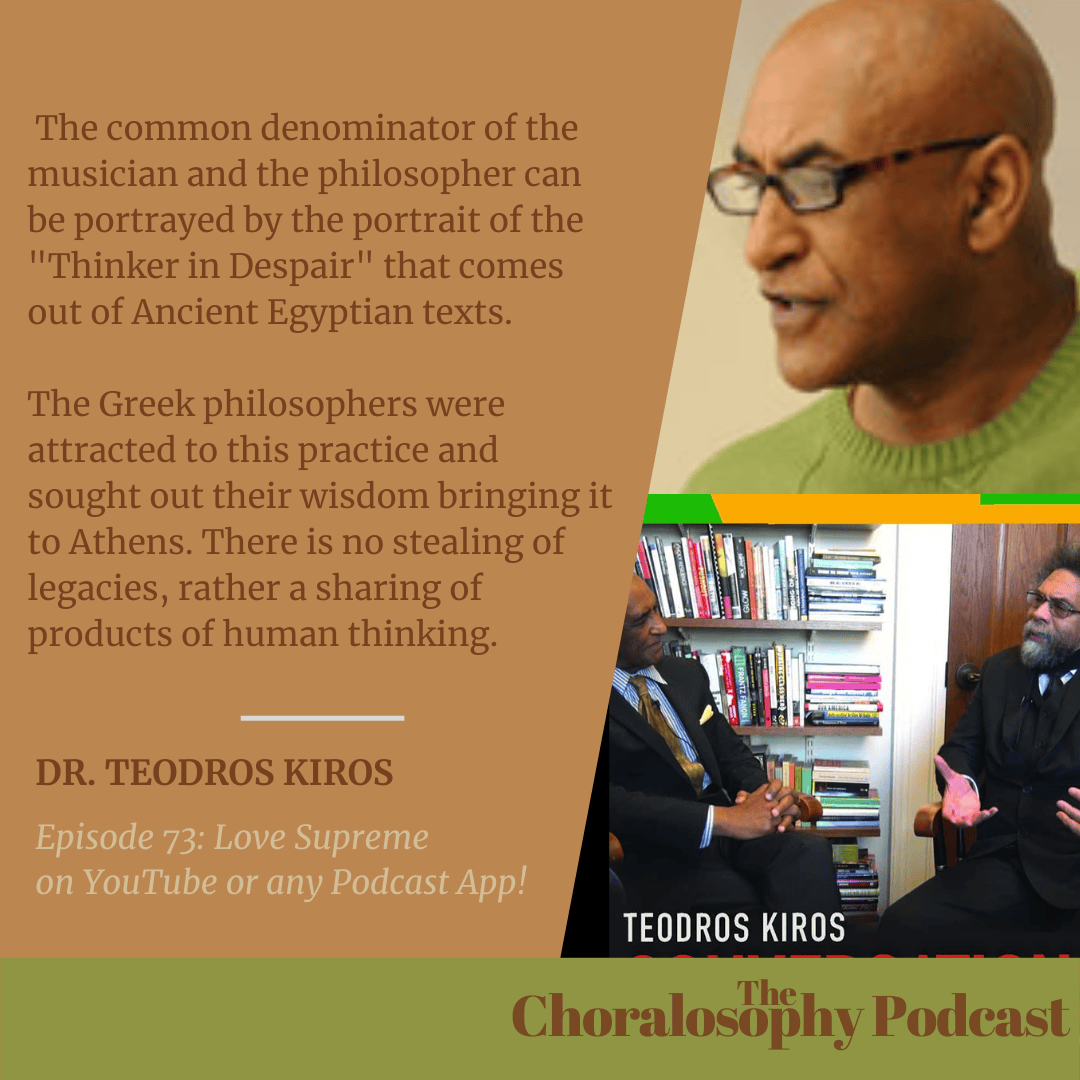
Episode 73: Love Supreme with Professor Teodros Kiros
Jun 30, 2021
Show notes
Executive producer and host of the television program African Ascent, W.E.B Du Bois fellow at Harvard, Professor of Philosophy at Berklee College of Music, Author
“I try to argue that they can become better musicians if they become philosophically trained. They will become sensitive to aesthetics in their lives, to the role that art plays in their lives.”
Dr. Teodros Kiros
I feel like I caught lighting in a bottle with this episode. We are all incredibly fortunate to have the chance to absorb wisdom from Professor Teodros Kiros. Dr. Kiros and I discuss the many connections between philosophical training and musical training. I was spellbound many times throughout this conversation hearing about how inseparable music and philosophy SHOULD be. We discuss the common humanity that is unearthed through the sharing of musical and philosophical ideas throughout history, the most scholarly unpacking of cultural appropriation I have yet encountered, as well as Coltrane’s “Love Supreme” and why, with in that one piece of music, we can find a unifying theme for our life and for our music. Don’t miss it.
Teodros Kiros is considered a leading authority on moral philosophy and a leading voice in African philosophy. He has been a W. E. B. Du Bois Fellow at Harvard University for the past 20 years and has been nominated three times for Berklee’s Distinguished Faculty Award. Kiros is the producer and host of the internationally acclaimed television program African Ascent, which continually gives visibility to Berklee faculty and includes interviews with President Roger H. Brown and Provost Larry Simpson. He is also an essayist for leading websites and has published hundreds of articles in refereed journals and online. He’s also a columnist for leading newspapers.
Receive 10% Discount on your orders at http://www.graphitepublishing.com where you will find the works of Jocelyn Hagen, Eric Barnum, Timothy C. Takach, Paul Rudoi and MANY more.
Career Highlights· Philosopher and novelist· Has had short stories and an excerpt from his forthcoming novel, Cambridge Days, featured on Bridgeportword.com·
Author and/or editor of 17 books including Towards the Construction of Political Action; Moral Philosophy and Development; Self-Construction and the Formation of Human Values: Truth, Language and Desire; Explorations in African Political Thought; Multiculturalism; Zara Yacob: Rationality of the Human Heart; Philosophical Essays; Ethiopian Discourse; Hirut and Hailu and Other Short Stories; and Cambridge Days; and the forthcoming Self-Definition: A Philosophical Inquiry from the Global South and Global North· W. E. B. Du Bois Fellow at Harvard University·
Executive producer and host of the television program African Ascent· Professor of Africana Philosophy at Harvard UniversityAwards· Winner of the 1999 Michael Harrington Book Award—Author for Self-Construction and the Formation of Human Values: Truth, Language, and DesireEducation
Episode 72: Artists! It’s OK to be an Entrepreneur with Brian Witkowski
Jun 23, 2021
Show notes
Singers often have the mentality that if they go to the audition and don’t get the gig, they have failed. Choral directors often feel that if someone doesn’t hire them for the tenure track, or the honor choir gig, then they have sufficiently been told “no.” “I guess this isn’t for me after all.” The happy reality, is that this is a mindset you can chose, or reject. Being an entrepreneur simply means rejecting the “Who’s going to let me?” posture, and adopting the “Who’s going to stop me?” mindset. I sit down with Brian Witkowski of the Lucrative Artist, to discuss this anti-entrepreneur bias inside of Classical music, and how to break out of it. Giving yourself permission and tools to earn from the value you create for others.
I’ve had a love for singing throughout my childhood, and my passion expanded to the stage when I performed my first ever role of Winthrop Paroo in The Music Man. I was fortunate to have a father who always said I could literally do anything I want in life and find success. So I majored in music and pursued a career in singing with experiences spanning the globe in many genres including opera, musical theatre, sacred music and art song. My aspiration to teach led me to earning my Doctor of Musical Arts degree.
Throughout my journey, I’ve faced many recurring physical and mental challenges ranging from having tension down to my toes to limiting beliefs up in my head. Many of those limiting beliefs were about what constitutes a successful “career” in singing and the supposedly “right” way to do it. However, I’ve discovered that for every unavailable or out of reach opportunity, there remains an infinite amount of new opportunities just waiting to be created!
Receive 10% Discount on your orders at http://www.graphitepublishing.com where you will find the works of Jocelyn Hagen, Eric Barnum, Timothy C. Takach, Paul Rudoi and MANY more.
Anyone can be the creator or catalyst for a wealth of possibilities, even you! I created The Lucrative Artist to help artists and artistically-minded individuals have a safe outlet to realize what they most want out of life and position themselves to develop their own new professional opportunities carrying out or supporting their deepest artistic desires. I love helping people overcome limited beliefs, realize their truest niches and acquire the additional vital entrepreneurial skills and knowledge they need to succeed. I truly want everyone to become empowered to have the successful careers and lives they truly desire and deserve!
Find the TOP of the line Resonance Singers mask as well as all of your choir folders, choir supplies as well as choir robes at MyChoirRobes.com. Use Choralosophy at checkout to get a 5% coupon every time you shop!
Car Thoughts: The Conductor is ALWAYS Right?
Jun 18, 2021
Show notes
And other silly traps we fall in to due to the nature of our job and its subsequent ego pitfalls. Tune in for this short reflection on the overbearing conductor stereotype. I think it’s possible that we don’t appreciate what constantly having our job evaluated in front of people does to our Psyche…
Receive 10% Discount on your orders at http://www.graphitepublishing.com where you will find the works of Jocelyn Hagen, Eric Barnum, Timothy C. Takach, Paul Rudoi and MANY more.
Episode 71: It’s All in the Story, with Cecilia McDowall
Jun 16, 2021
Show notesEpisode 71
Another Installment of the Oxford Series on the Choralosophy Podcast
Visit Oxford’s Expansive Choral Catalogue!Episode 71Find the TOP of the line Resonance Singers mask as well as all of your choir folders, choir supplies as well as choir robes at MyChoirRobes.com. Use Choralosophy at checkout to get a 5% coupon every time you shop!
Episode 71
Shop for the wonderful choral works of Ryan Main at http://www.ryanmain.com! Each purchase will receive a 10% discount when you enter choralosophy at checkout. Plus you will OWN the pdf, and make as many copies as you want!
Cecilia McDowall has long been one of my favorite Choral composers. If I were to boil down my reasons for this it would come to her masterful ability to transport both audience and performer through space and time with her writing. In this conversation, I was able to understand a bit more about how her approach and it all became more clear. She immerses herself in a story with each work. Be a fly on the wall as we discuss her writing process, her thoughts on balancing composition, teaching and motherhood throughout her life, interactions between composer and conductor, as well as an exploration of the vulnerability one must face to sing and to compose.
More About Cecilia McDowall
Receive 10% Discount on your orders at http://www.graphitepublishing.com where you will find the works of Jocelyn Hagen, Eric Barnum, Timothy C. Takach, Paul Rudoi and MANY more.
Born in London, 1951, Cecilia McDowall has won many awards, been short-listed eight times for the British Composer Awards and in 2014 won the Choral category of the British Composer Awards for her haunting work, Night Flight, which celebrates the pioneering flight of the American aviatrix, Harriet Quimby, across the English Channel. McDowall’s distinctive style speaks directly to listeners, instrumentalists and singers alike. Her most characteristic works fuse fluent melodic lines with occasional dissonant harmonies and rhythmic exuberance. Her music has been commissioned and performed by leading choirs, including the BBC Singers, The Sixteen, Oxford and Cambridge choirs, Kansas City Chorale, ensembles, and at festivals worldwide.
The best sight singing tool on the market. A must have for any band/choir or orchestra teacher and their students. In class and at home tools to build their literacy at their own pace. Enter “choralosophy” at checkout to get 10% off every time you renew at http://www.sightreadingfactory.com
Recent commissions include When time is broke (Three Shakespeare Songs) for the BBC Singers and Adoro te devote for Westminster Cathedral Choir, London. Three Latin Motets were recorded by the renowned American choir, Phoenix Chorale, conductor, Charles Bruffy; this Chandos recording, Spotless Rose, won a Grammy award and was nominated for Best Classical Album. The National Children’s Choir of Great Britain commissioned a work focusing on ‘children in conflict’, called Everyday Wonders: The Girl from Aleppo. This cantata is based on the real-life escape of Nujeen Mustafa (who is wheelchair-bound) and her sister from war-torn Aleppo; it tells of their harrowing journey across 3,500 miles, through seven countries, eventually arriving in Germany with relief and great gratitude.
Episode 71 on YouTube!
In May, 2019, Wimbledon Choral Society and the Philharmonia Orchestra premiered McDowall’s large-scale choral work, the Da Vinci Requiem, to coincide with the 500th anniversary of Leonardo’s death. The work received its first performance on 7 May in the Royal Festival Hall, London. McDowall’s works are regularly broadcast on BBC Radio and readily available on CD.
The absolute cutting edge in helping students understand resonance. visit http://www.vocevista.com/choralosophy to download VoceVista Video for a free 30 day trial. When you purchase, enter “choralosophy” at checkout to get 10% off!
In 2013 Cecilia McDowall received an Honorary Doctorate from Portsmouth University and in 2017 McDowall was selected for an Honorary Fellow award by the Royal School of Church Music. In 2019 she was awarded an Honorary Doctorate from West London University. In 2021 the Choir of Trinity College, Cambridge, will release a CD of her choral music on the Hyperion label. In 2020 McDowall was presented with the prestigious Ivor Novello Award for ‘outstanding music collection’ for a ‘consistently excellent body of work’. This was a ‘Gift’ from The Ivors Academy (formerly the British Composers’ Academy).Advertisements
Episode 70: Legitimate Love and Suffering in the Music Classroom with Dr. Ryan Board
Jun 09, 2021
Show notes
In this episode, Dr. Ryan Board of Pepperdine University and I discuss the role we see for Choral Music education in filling the void of psychological and emotional development of young people and adults. The epidemic of the loss of resiliency in young people is well documented. Dr. Board walks us through the work of Psychiatrist M. Scott Peck by finding parallels between his prescriptions for building a healthy mind, and what we ALREADY provide in a high quality choral environment. You will not want to miss this conversation designed to center you with a renewed sense of purpose as we move the profession forward.
“Spiritually evolved people, by virtue of their discipline, mastery and love, are people of extraordinary competence, and in their competence they are called on to serve the world, and in their love they answer the call. They are inevitably, therefore, people of great power, although the world may generally behold them as quite ordinary people, since more often than not they will exercise their power in quiet or even hidden ways. Nonetheless, exercise power they do, and in this exercise they suffer greatly…”
M. Scott Peck
Dr. Ryan Boardwww.sightreadingfactory.com is the best literacy tool on the market today. Enter Choralosophy at checkout to get 10% off memberships for you AND your students!Episode 70Receive 10% Discount on your orders at http://www.graphitepublishing.com where you will find the works of Jocelyn Hagen, Eric Barnum, Timothy C. Takach, Paul Rudoi and MANY more.
Ryan Board, Director of Choral Activities at Pepperdine University, continues to garner international attention as a conductor, choral artist, teacher, and clinician. In his role as Director of Choral Activities at Pepperdine, Dr. Board directs the Pepperdine Concert Choir and the Pepperdine Chamber Choir and teaches courses in Conducting, Music History, and Music Education. His research interests focus on rhetoric and affections in the sacred vocal music of the Baroque Era.
Dr. Board maintains an active schedule as a professional singer and conductor. For five years he has directed the renowned KC Collegium Vocale and was previously the director of Armonia Early Music Ensemble. He is currently principle conductor for the Prague Choral Festival in association with Prague Proms, and he has recently collaborated with or prepared choirs for Anton Armstrong, Simon Carrington, Joseph Flummerfelt, Andrew Megill, Andre Thomas, The Royal Concert Philharmonic Orchestra, the Daedalus String Quartet, The Kansas City Friends of Chamber Music, Charles Bruffy and the Kansas City Chorale, Jo Jennings, The Jewell Early Music Festival, and The Kansas City Baroque Consortium. He is also an avid conductor of choral-orchestral literature and has conducted works ranging from J.S. Bach’s St. John Passion to Arnold Schoenberg’s A Survivor from Warsaw.
Episode 69: Higher Standards-Lower Anxiety
Jun 02, 2021
Show notes
Want your singers to make less mistakes while sight reading?
In this episode I outline some approaches, philosophies and even a rubric. But first, one obvious tip, and one counterintuitive one:
Obvious: SRF assignments, quizzes and most importantly daily class work, and test EACH kid individually at the level appropriate for their current aptitude.
Not obvious: don’t reduce grade for mistakes, or count off “points” for mistakes. Instead, make the rubric about independence and problem solving. Let them fix their mistakes. After all, isn’t that how we use literacy in rehearsal?
Might seem less “rigorous,” but this model has helped reduce test taking and sight reading anxiety for us big time, and his lead to MORE accurate, fluent music reading.
When we evaluate literacy progress, often times we do this be thinking of sight singing as a game of guitar hero. This does not translate to real world music making. In this episode I offer a different approach complete with two student demonstrations!
The Rubric is very basic-
2- Student is able to sing the entire exercise correctly and independently with no teacher help or instruction
1-Student is able to sing the entire exercise correctly and independently, but needs teacher help or instruction
0-Student is not able to sing all or part of the exercise correctly and independently
Receive 10% Discount on your orders at http://www.graphitepublishing.com where you will find the works of Jocelyn Hagen, Eric Barnum, Timothy C. Takach, Paul Rudoi and MANY more.
Car Thoughts: Is Social Media Steering or Reflecting Choir Conversations?
May 27, 2021
Show notes
I say it’s steering them. And I think that’s bad news. I believe that Social Media has a tremendous upside and potential for good. But only if it is reflective of the common humanity that we experience when we are in person. My concern is that this has been reversed. That, as we begin to return to in person activities, we will have centered our social media conversations as the “Conversation of Record” in our professional space. For healthy balance to be restored, we will need to get to work to reverse this.
See below a recent post on the Choralosophers FB Page.
Colleagues- we can’t let Facebook steer the ship in our profession. The errors of cognitive processing below are so much easier to avoid in person and/or if you know how to look for them. I’m working on a non-music specific Choralosophy Podcast blog and episode complete with expert guest Dr. Erec Smith on the subsequent changes to our communication habits (which spill into our classrooms as well as broader life…) This post is intended to provide some choir specific context.
Just a few of many Human Psychological processes that social media apps actively manipulate:
1. Availability heuristic- if you see the bad thing constantly on your phone, the brain places it in a category that is the same as “existential danger etc.” The thing may be very real and very bad, but it isn’t as prevalent as the phone makes it seem.
2. Anchoring bias- the first context you see something in, or the first fact you see is disproportionately hard to shake when new info arrives. (This is exploited when you rely on a small group of sources for info)
3. Audience effect- every interaction is perverted by an audience. Because the conversations are not between two people. They are between two people with an audience watching. Which means both participants in the conversation feel a very strong pull to perform. It becomes disproportionately important to us to appear to be a good member of our team. And often, the easiest way to do that is to be seen attacking the “other team.”Social media could be a powerful tool for good, and in many ways it is. But, the bad will outweigh the good if the next generation of kids is not taught how to spot and avoid these traps.
Recent Full Epiosde
A Rhetorical Analysis of Toxic Discourses with Dr. Erec Smith
May 27, 2021
Show notes
For the first time on Choralosophy, I have written a blog to accompany the podcast episode! This post is not specific to music or musicians. But, as with many topics, we are all trying to navigate a rapidly changing social landscape. I think, write and speak quite a bit about how the quality of conversation has been negatively effected by the influence of social media. In the Podcast, I ask Dr. Erec Smith of York College for his expert perspective on some of my observations. Namely, that many “fights” I observe, or that people attempt to pick with me, seem to follow some recurring rhetorical patterns that may be exacerbated by social media, and its manipulation of some of our mental bad habits.
Just a few of many Human Psychological processes that social media apps actively manipulate:
1. Availability heuristic- if you see the bad thing constantly on your phone, the brain places it in a category that is the same as “existential danger etc.” The thing may be very real and very bad, but it isn’t as prevalent as the phone makes it seem. This is where stepping back to look at data is very important. The 10,000 foot view.
2. Anchoring bias- the first context you see something in, or the first fact you see is disproportionately hard to shake when new info arrives. (This is exploited when you rely on a small group of sources for info)
3. Audience effect- every interaction is perverted by an audience. Because the conversations are not between two people. They are between two people with an audience watching. Which means both participants in the conversation feel a very strong pull to perform. It becomes disproportionately important to us to appear to be a good member of our team. And often, the easiest way to do that is to be seen attacking the “other team.”
4. The paradox of morality:-Those who are sincerely want to do the right thing may lie to cover their moral lapses (thus, less moral)-Those who care less about appearing moral may be more honest about their moral failings (thus, more moral) https://journals.sagepub.com/…/10.1177/1088868318811759
Now just my guess: I think most people don’t want to imagine themselves as “susceptible” to such petty manipulation. This is a problem for those “other” people…
Something in the Ether
Probably the most interesting thing about hosting a podcast that “leans in” to sensitive conversations is the type of feedback I get. One “genre” of message I receive quite frequently is listeners, friends and colleagues who PRIVATELY express some type of gratitude or admiration for how I handle arguments online. (I know that sounds like a flex, but it is important for the story.) Namely, that I don’t get rattled, and I don’t get sucked in to the name calling, anger, and accusations. This will also be accompanied by an expression of fear about the common Zeitgeist of how conversations online tend of devolve into suspicion and accusation very quickly. I also hear fear to express one’s true opinions, for fear of losing status in their professional community or friend group.
“What if I don’t get accepted to a post grad program because I am perceived as having the wrong opinions?” “It’s just easier to keep my mouth shut.” etc. I also have found it fascinating that this type of concern and fear has come to me from people with a wide diversity of backgrounds. Conversely, almost every single criticism I get is posted publicly rather than via private attempt to communicate.
Below, I will lay out some of the common rhetorical devices I have seen frequently in the many online conversations I have participated in. Keep in mind, when analyzing something “rhetorically,” we try and focus on the WAY things are being said, and less about the opinions or positions themselves. The sad thing is that this toxic trend is occurring in conversations that are substantially very important. It is for this reason that I feel that we MUST get better at having the conversation.
First, let’s establish what HEALTHY and PRODUCTIVE conversations look like. I believe they must all contain the following:
Mutual respect.
An attempt at equal footing for all participants
A desire to learn from everyone involved, based on the principal that EVERYONE knows something you don’t.
Willingness from ALL participants to engage in some type of Cognitive Restructuring. Or, simply put, “intellectual flexibility and humility.” This is the willingness to be wrong.
When these things are not present, it opens the door for a toxic discussion.
As the Overton Window for what types views can be productively discussed online continues to narrow, I have outlined some common problems that contribute to negative outcomes in contentious comment threads. An extremely common example of this is the following reductionist statement template:
“I am fine with disagreement when it comes to (fill in the blank super benign thing like pizza toppings), but I will not honor the opinion of someone who advocates for (fill in the blank with some extreme, often violent or explicitly discriminatory position that almost no one holds.)”
This is a common rhetorical device that seeks to draw a simple binary over a complex conversation. This way, the person can avoid contending with the THOUSANDS of points of reasonable disagreement between pizza toppings and violence. This narrows the Overton Window by attaching magnetic poles to the extremes of an argument. “You’re either with us or against us.” When you think about it for more than a few seconds, it becomes baffling that a person would frame disagreement in that way. What a charmed life one must have led, to have NO disagreements with anyone other than paint colors or pizza toppings. The most important thing here is learning to recognize this rhetorical device, to avoid getting sucked in by it.
This meme is a popular way to communicate this fallacy. The problem with this statement is that it only works if everyone in the conversation uses the same definitions for all of those words. In the Socratic method, we start be agreeing on definitions FIRST.
In reality, any complex issue has thousands of variables that could be discussed or explored when a group of people is having a discussion. By framing disagreement in this way, we lose the opportunity to explore the variables. What I am seeing, is that many people seem to THINK they are presenting their own thoughts, but in reality are simply filling in pre-made conversation templates like the ones above.
The Anatomy of an Explosive Comment Thread
It is my belief that there are some folks out there that WANT threads to blow up. Some who actually set out to paint people into a corner, so that an argument is inevitable. You know a thread is going to blow up, and that it’s time to get out of dodge when you see the following sequence. It’s like clockwork, I’ve seen it happen 1000 times at this point. This will usually mean that someone who considers themselves to be an activist on whatever topic is being discussed has arrived on the scene. It is often very important for that person to be seen as a white knight or savior. I will call this person “The Hero.” In addition, there are usually a flock of people reading the thread and liking the activist’s/hero’s posts so that they can signal their support, but they rarely contribute to the conversation. This is what I will call the “audience.” This dynamic creates the performative nature of many conversations online.
Step 1. The Hero ENTERS the conversation telling others what they MUST do. This will usually be established in one of the first, if not THE first volley of the conversation. It will be a statement from authority in which a claim of what the result of this conversation will be from the outset.
Step 2. The Hero jump’s right in to mind reading and the assigning of motives. They will start to translate what people are actually saying (explicitly) into what they “are really saying” despite any protests, as well as what you “are really hoping to achieve.” The picture will not be flattering. (Meanwhile, the audience will be liking and loving the Hero’s attempts to paint their interlocutor as the bad guy. In doing so, they are also using the social media algorithms to draw more sympathetic audience members to the thread. Thus, creating the impression that they are in the majority.)
Step 3. Next, the Hero will “Catastrophize” and claim that the results of this conversation (even if it is in a private FB page) could have real and tragic consequences in the real world and provide no evidence for it. (this is usually the justification for step 4. (I have tried turning the conversation at this point to the evidence for the catastrophe that could stem from our continued disagreement on the given topic. I do not recommend this. It won’t go well.)
Step 4. Outline the rules for the conversation early on, including who is allowed to speak and who is not, and most importantly make it clear how unwelcome it would be if the “wrong people” give their opinions. (Sometimes this happens as part of Step 1, but some tend to drag this out a bit and let some people give their opinions before telling them their opinion is not welcome.) This is a part of a ritual almost, during which “teams” become clearly established. You either cheer on all of these rules, or you are on the opposing team.
Step 5. Accusations of bigotry or worse to anyone who bristles at the above steps. This is often accompanied by throwing around the word “tone-policing” or “fragility” when one person expresses discomfort with being called a bigot etc. See below for more thoughts on tone-policing.
Tone-Policing
This is a term used often in activist discourses. It is often used in online arguments when one person does not like being told that they are being “mean or rude” by their interlocutor. In other words, there is usually a claim that saying another person is mean or rude is, in itself, mean or rude.
This seems incongruous with the recent rise in “consent culture” which I see as a good thing. Loosely defined, consent culture is the long overdue idea that I should be sensitive to your personal and physical boundaries. If I have crossed one, I am honor bound to step back. The current trend, at least in these types of arguments, is a move AWAY from consent culture. A person’s boundaries don’t disappear when they log on to the internet. This should concern all of us.
The term “tone-policing,” as I see it, is incongruous with consent culture. In other words, you and no one else, should have the moral authority to draw the boundaries that you are comfortable with online. If you establish them in a conversation, they should be respected. It’s that simple.
But, in order for consent culture to extend to certain online spaces, this concept MUST be reciprocal. “I find your accusations and rhetoric insulting, please stop” should never be met with “you don’t get to decide how I talk to you, stop tone policing me!
We would never accept this with in person conversation, because it is slimy and cowardly. Finding out you have hurt someone, stepping back and apologizing takes strength. If all participants in a conversation, regardless of age, race, gender expression, nationality, religion or any other identity category cannot accept this as a bare minimum for productive conversation to occur, then we are lost. So, my boundary, or line in the sand, is just that. I will talk to you about ANYTHING. As long as I feel like we are starting the conversation as equals. Some will say that this is impossible. “All conversations have power imbalances.” I disagree, but if that is your position, can’t we at least TRY?
Basically, what I am describing is bullying. In online spaces, we should encourage each other to be sensitive to boundaries of treatment the way we instinctually would in real life. (because this is real life.)
Episode 67 Part 2: Growing Access in a Greenhouse with Vince Peterson
May 16, 2021
Show notesSupport the Show
I am very unlikely to to give much credence to a person who is critical of the music education practices of colleagues, if they have nothing better to point to. Criticizing is easy. Building something better is hard. Show me your program and how your ideas have shown results, then I am more likely to listen. I appreciate what Vince is doing here. His criticism is that the Conservatory is not diverse enough. Ok, I hear you. What do you plan to do about it? Tune in to hear Vince’s idea for a NEW model.
Picking right up from where we left off in part one, Vince and I get our hands dirty discussing what we see as one of many important “paths forward” in improving the way music education, and CONSERVATORY education in particular is delivered in terms of philosophy, entry barriers, technology and everything in between. Don’t miss it.
Vince Peterson is a respected choral conductor, composer/arranger, and teacher of music in the United States. His 20-year hybrid career spans the worlds of choral music, theater, sacred music, and music education. He has, however, established himself most prominently in the world of choral music, notably having founded the “shape-shifting” vocal ensemble Choral Chameleon in 2008. Under his leadership, Choral Chameleon has premiered more than 150 works since its nascence and has won critical acclaim in The New York Times, Time Out New York, The New York Concert Review, I Care If You Listen, The Examiner, and other publications. In 2015, the ensemble was awarded the prestigious ASCAP/Chorus America Award for Adventurous Programming. In 2017, the group was named the first vocal ensemble artist-in-residence at NYC’s undisputed new music hub, National Sawdust.
In 2003, Peterson earned the BM in Composition from San Francisco Conservatory of Music under the tutelage of celebrated vocal music composer Conrad Susa. He has also studied composition with David Conte, Elinor Armer, and Philip Lasser. In 2007, he earned a Double MM in Composition and Choral Conducting from Mannes College of Music where he studied under pioneer conductor Mark Shapiro as well as the composer David Loeb. Upon receipt of his Master’s Degree, he was also awarded the singular Music Teacher’s League Award for 2007. As a prolific arranger, Peterson has received seven commissions to date from the multi-Grammy® Award-winning ensemble Chanticleer, whose YouTube videos of his work have garnered over half a million views. Several of his choral arrangements and original compositions have become staples for choirs across the United States. Distinguished performance venues include Chicago Symphony Hall, San Francisco’s War Memorial Opera House, Bartok National Concert Hall in Budapest, New York’s Metropolitan Museum of Art, and Carnegie Hall, among others.
A recognized thought-leader in the music world, The New York Times called Peterson “authoritative beyond his… years,”and The Brooklyn Eagle praised his work as “a stunning symphony of the spiritual and secular,” while hailing him as a solo performer “with depth and vigor” who “provided a universal context which resonated with his audience.”
www.sightreadingfactory.com is the best literacy tool on the market today. Enter Choralosophy at checkout to get 10% off memberships for you AND your students!
In 2018, Vince Peterson was awarded the Louis Botto Award for Innovative Action and Entrepreneurial Zeal by Chorus America, a lifetime distinction he shares with only sixteen of the most influential choral musicians in the United States. In addition to his work with Choral Chameleon, Peterson is overjoyed to serve as Artistic Director of Empire City Men’s Chorus, which he has recently ushered through its 25th Anniversary Season.
Find the TOP of the line Resonance Singers mask as well as all of your choir folders, choir supplies as well as choir robes at MyChoirRobes.com. Use Choralosophy at checkout to get a 5% coupon every time you shop!Receive 10% Discount on your orders at http://www.graphitepublishing.com where you will find the works of Jocelyn Hagen, Eric Barnum, Timothy C. Takach, Paul Rudoi and MANY more.

 Our TOPPODCAST Picks
 Stay Connected