BONE AND SICKLE explores historical topics related to folklore and horror. With acerbic wit and a scholarly penchant for the grotesque, rogue folklorist Al Ridenour delves into a wide but carefully curated range of topics illustrated by stories from historical texts. Narratives are given dramatic readings by “Mrs. Karswell” (Sarah Chavez) backed by richly produced soundscapes blending original music, sound design and effects. The source books, though real enough, are said to be pulled from an imaginary library on Ridenour’s imaginary estate situated somewhere in the neighborhood of Charles Addams and Edward Gorey. Each episode begins with our hosts briefly discussing goings-on in this world before diving into the topic to be explored. Occasional alternate-format episodes are devoted to readings of classic horror stories or curious texts of antiquarian interest. Ridenour is the author of “The Krampus and the Old, Dark Christmas” (2016) and “A Season of Madness: Fools, Monsters, and Marv
Grottos are a peculiar subset of caves, usually small and picturesque, and often associated with wonders both otherworldly and manmade.
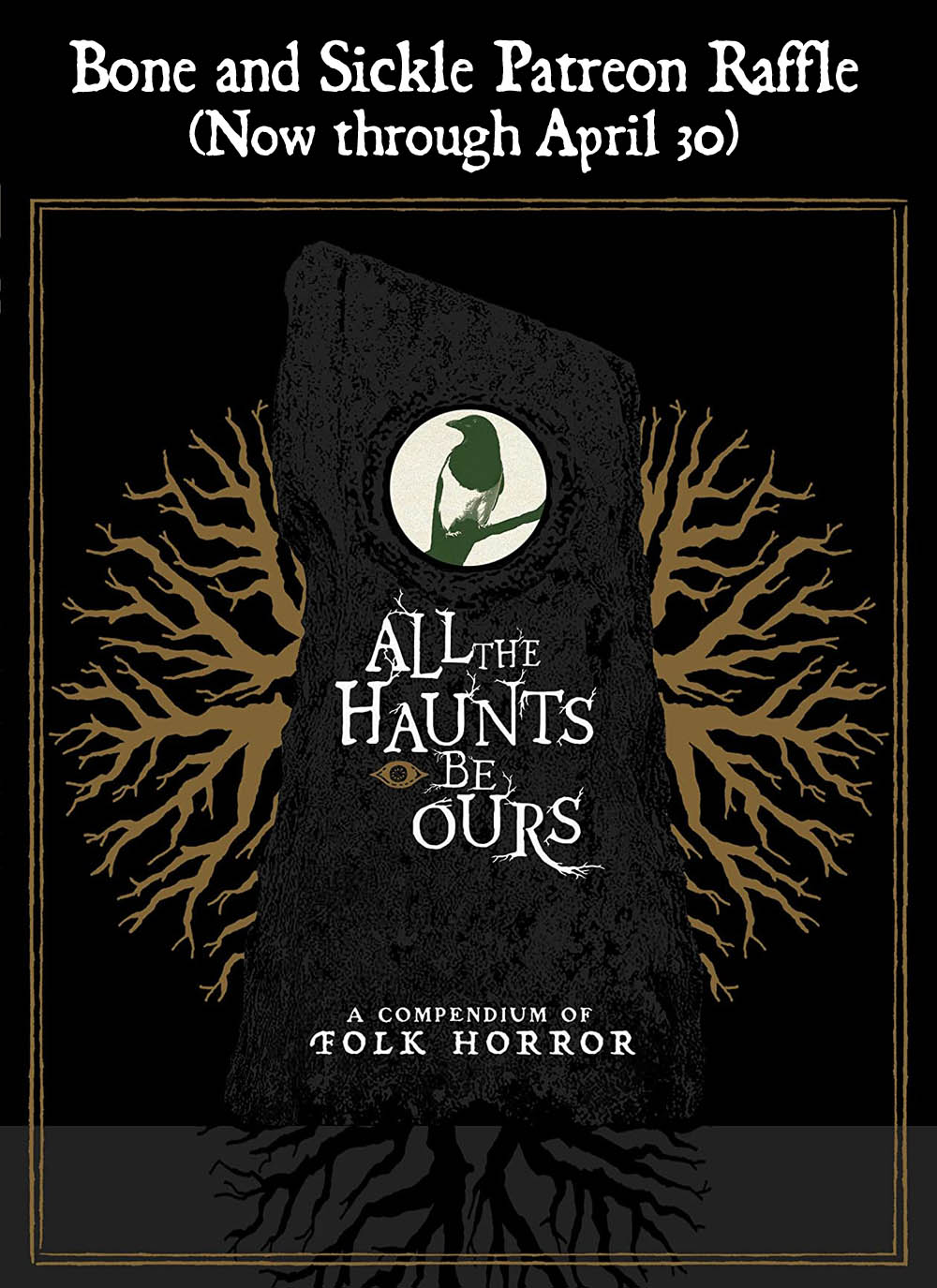
NOTE: Details on our Patreon raffle for the 15-disc set, All The Haunts Be Ours: A Compendium Of Folk Horror, are at the bottom of this post.
We begin with what is likely the best known example of the sacred grotto, the Catholic shrine at Lourdes, France, where in 1858, the Virgin Mary was said to have appeared to a 14-year old Basque girl by the name of Bernadette Soubirous. Particularly of interest to our show is the regional folklore that provided a background for these apparitions, especially the association between a variety of supernatural beings and caves.
While the grotto at Lourdes is a natural structure, the grottos we examine through the rest of the show are artistic constructions, the first of these being the “grottos”formerly created by British children on Grotto Day. The choice of material for constructing these is oyster shells, as the day coincides with the Feast of St. James, patron of oyster harvesters. The connection between St. James and shells is explored via the pilgrimage route leading to his tomb, the Camino de Santiago de Compostela, one for which the symbol of the “pilgrim’s scallop” serve as prominent way-markers.
We then move into the classical world to examine the nymphaeum, a grotto dedicated to the nymphs, specifically the Naiads or water nymphs, a combination of cave and spring as was the case with Lourdes. From this Greek concept grew the Roman notion of the purely secular “pleasure grotto,” such as the famous (and ill-fated) example created by Emperor Tiberius for his villa on the Italian coast at Sperlonga. Mrs. Karswell reads some remarks by the historian Suetonius on this.
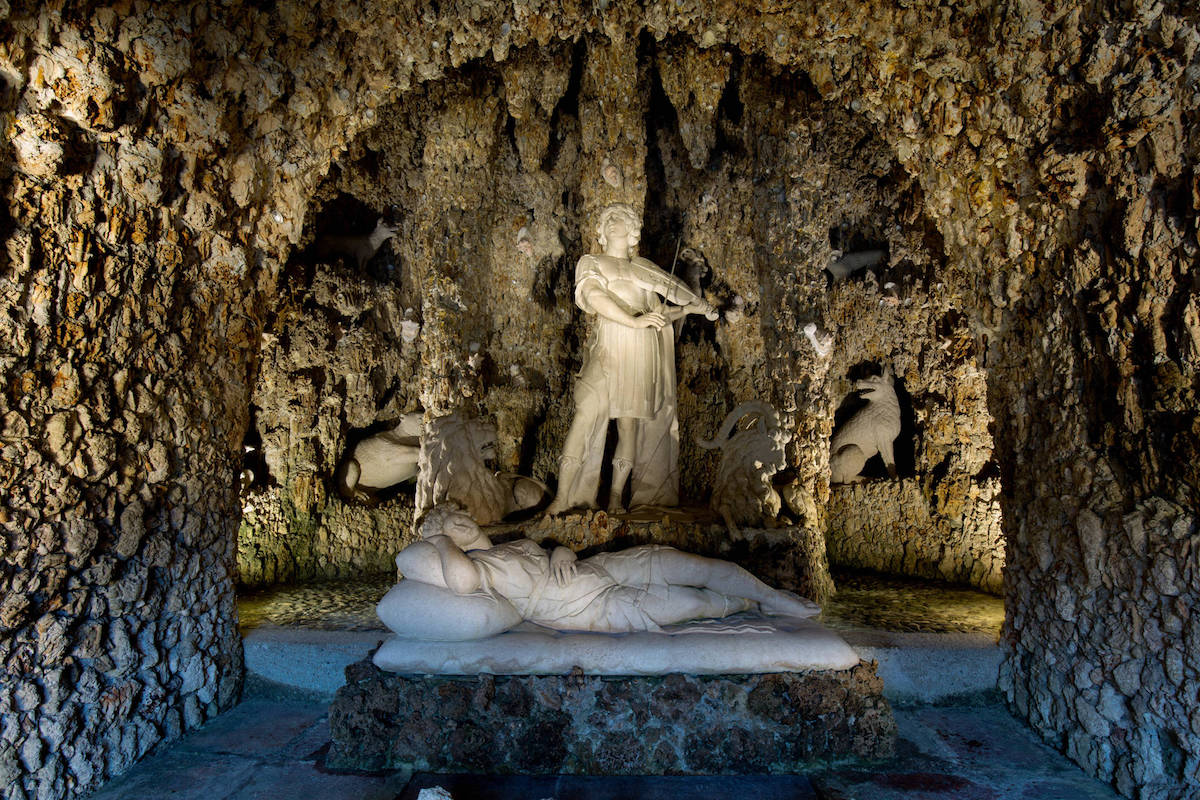
After hearing a bit from the 15th-century architect Leon Battista Alberti on a revived interest in artificial grottos during the Renaissance, we look at the grotto’s evolution into the “water theaters” of the 16th and 17th century, their “trick fountains” and water-driven automata. Here we citing two Italian examples (Villa Aldobrandini in Frascati and Tivoli Gardens in Florence) and one from Austria, Saltzburg’s Hellbrunn Palace.
Orpheus Grotto at Hellbrunn
We then hear a bit about the return during the Romantic era to the earlier classical preference for constructing grottos that simulated natural caves, hearing in this case a quote from the British poet and satirist Alexander Pope enthusing over his grotto completed in 1725. We also hear about England’s most famous grotto in Margate on the southeast coast and the mystery associated with it and about a grotto. Also mentioned is the grotto created fort the gardens of Hawkstone Hall in Shropshire (where other “follies” include a romantic “hermitage” that once employed an actor portraying a bearded hermit).
Our final example, comes from Germany, the “Venus Grotto” constructed for King Ludwig II of Bavaria, the so called “Mad King” responsible for building the palace of Neuschwanstein, Germany’s famous “fairy tale caste. The details of the Venus Grotto should help you better understand Ludwig’s particular strain of “madness.”
We end our episode returning to the story of St. Bernadette and some of the grim details involved in her canonization, namely the exhumation of her body to determine if it might be physically “incorrupt.”
(The song you hear in a couple snippets during the show is, btw, is 1959 single “The Village Of St Bernadette” by Anne Shelton.)
PATREON RAFFLE
We have a special offer running from now until April 30, a chance to win the 15-disc set, All The Haunts Be Ours: A Compendium Of Folk Horror. It’s a splendid collection released in conjunction with the Folk Horror documentary Woodland Dark and Days Bewitched, which is one of the included discs. Not only does it include over 31 hours of folk-horror films on BlueRay, but also 3 CDs including a reading of a classic Arthur Machen story and a 156-page book on the folk-horror genre.
The value of the collection is $279 and a randomly chosen subscriber at the $4 monthly level or above will be announced on May 1.
To enter, you must subscribe on the once-yearly plan, which actually saves 15% on what you would otherwise pay monthly.
You will be automatically entered upon signing up as stipulated.
FEATURE FILMS INCLUDED IN THIS SET:
WOODLANDS DARK AND DAYS BEWITCHED (192 mins/1.85:1/English 2.0/CC) EYES OF FIRE (86 mins/1.85:1/English 1.0/CC) LEPTIRICA (65 mins/1.33:1/Serbian 1.0/English Subtitles) WITCHHAMMER (107 mins/2.35:1/Czech 1.0/English Subtitles) VIY (76 mins/1.33:1/Russian 1.0/English 1.0/English Subtitles) LAKE OF THE DEAD (77 mins/2.40:1/Norwegian 1.0/English Subtitles) TILBURY (57 mins/1.33:1/Icelandic 1.0/English Subtitles) THE DREAMING (90 mins/1.85:1/English 1.0/CC) KADAICHA (88 mins/1.33:1/English 1.0/CC) CELIA (103 mins/1.85:1/ English 1.0/CC) ALISON’S BIRTHDAY (99 mins/1.85:1/ English 1.0/CC) WILCZYCA (103 mins/1.33:1/Polish 1.0/English Subtitles) LOKIS: A MANUSCRIPT OF PROFESSOR WITTEMBACH (100 mins/1.66:1/Polish 1.0/English Subtitles) CLEARCUT (98 mins/2.35:1/English 5.1/English 2.0/CC) IL DEMONIO (100 mins/1.85:1/Italian 1.0/English Subtitles) DARK WATERS (89 mins/1.85:1/Italian 2.0/English Subtitles) A FIELD IN ENGLAND (90 mins/2.35:1/English 5.1/English 2.0/CC) ANCHORESS (108 mins/1.66:1/English 1.0/CC) PENDA’S FEN (90 mins/1.33:1/English 1.0/CC) ROBIN REDBREAST (76 mins/1.33:1/English 1.0/CC)
The Dead Lover’s Heart
Feb 13, 2022
Show notes
Whether freshly removed or strangely preserved after death, the dead lover’s heart occasionally has continued to be embraced as a repository of intensely shared romantic experience. This Valentine’s Day episode explores two different narratives touching on that theme: a historical tale from the 19th-century literary culture of England and a collection of related medieval legends, literature, and song.
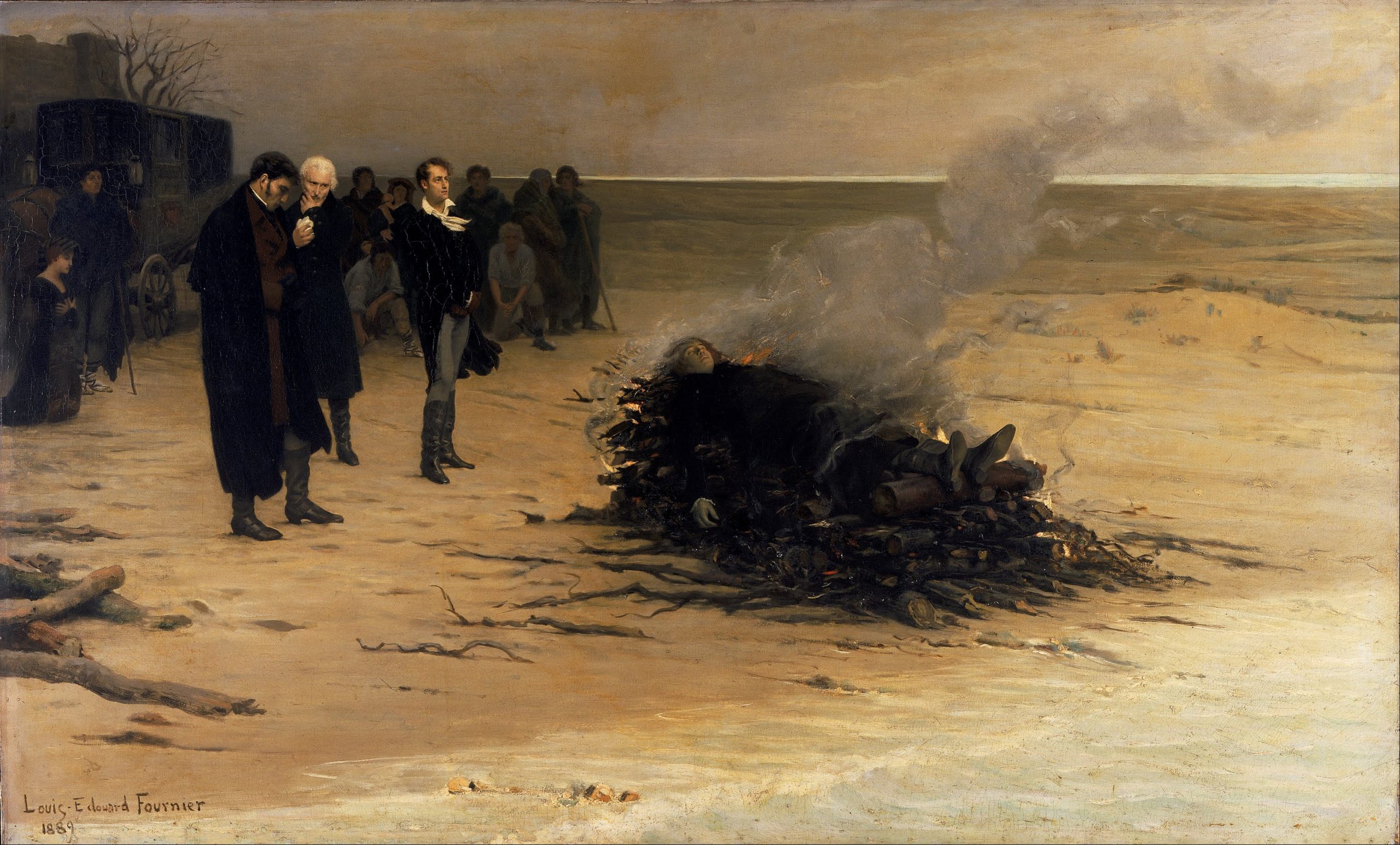
The first half of our episode looks at the strange circumstance surrounding the death, in 1822, of Romantic poet Percy Bysshe Shelley, and the postmortem keepsake inherited by his wife Mary Shelley.
Louis Fournier’s “The Funeral of Shelley,” 1889.
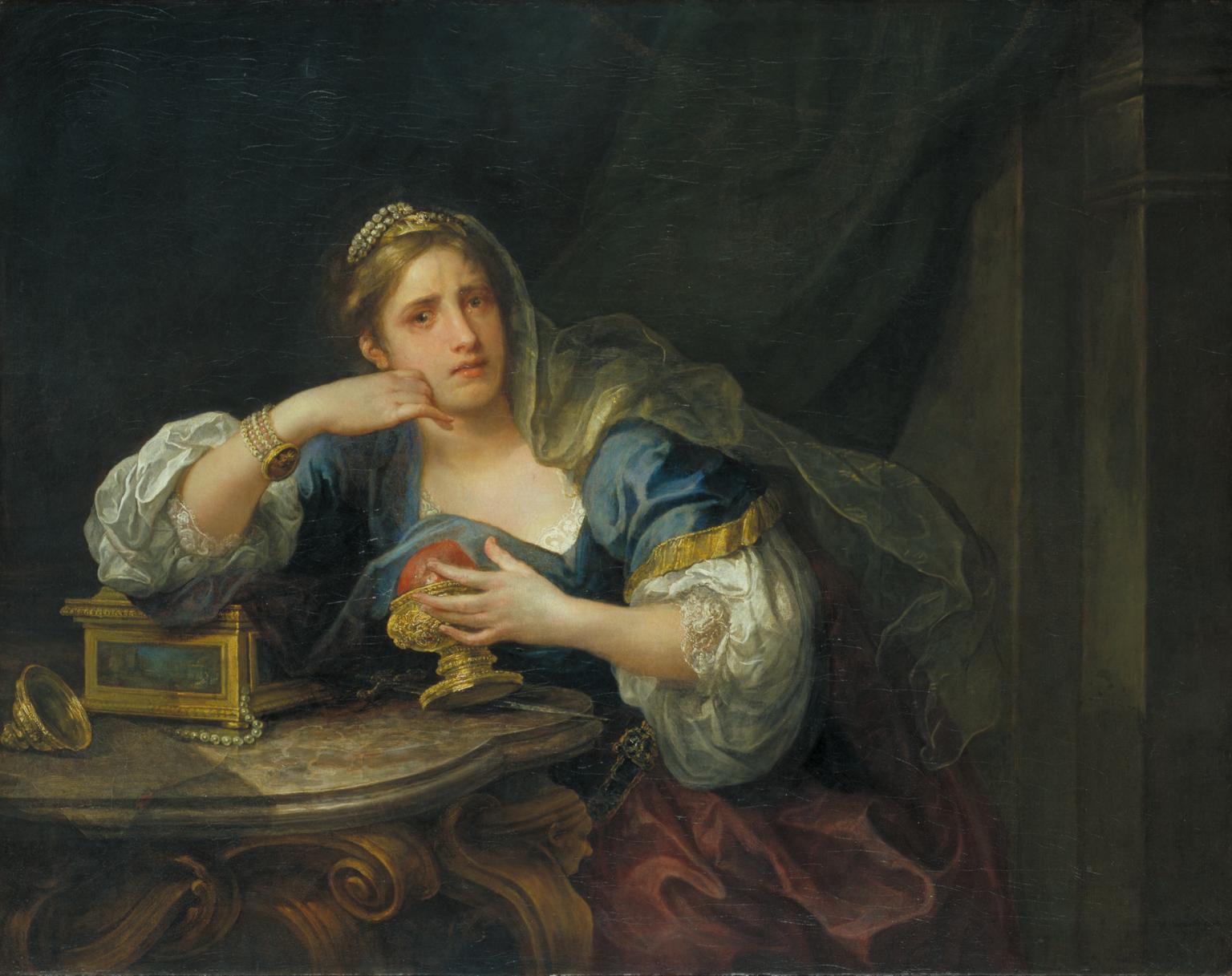
The second half examines two gruesome narratives taken from the 14th century, both from Giovanni Boccaccio’s The Decameron, namely that of the ill-fated lovers Ghismonda & Guiscardo (First Story, Day Four) and of the tragic romantic exploits of Guilhem de Cabestaing (Ninth story, Day Four). Incidentally, our Valentine’s Day show from last year also explores another gruesome tale from The Decameron.
De Cabestaing was an actual historical figure, a Catalan ministrel, whose fictional vida (biography) was often attached to collections of his ballads and served as Boccaccio’s inspiration.
We also look at the Ley of ’Ignaure, a chivalric romance written by the Burgundian French author, Renaud de Beaujeu, probably around the year 1200. This was likely the source of Cabestaing’s vida, Boccaccio’s stories, and the English-Scottish ballad, “Lady Diamond,” from which we also hear a snippet.
“Sigismunda Mourning over the Heart of Guiscardo 1759 William Hogarth
Myth and Magic of the Smith
Jan 24, 2022
Show notes
Folklore of the blacksmith portrays him as a semi-magical figure, a wily opponent of the Devil, a mythic creator in classical and biblical narratives, and an embodiment of occult wisdom within certain secret societies and neopagan groups.
We begin with an audio snippet from the excellent 2017 horror-fantasy Errementari: The Blacksmith and the Devil, a cinematic elaboration of the Basque folktale, “Patxi the Blacksmith” collected back in the 1960s by the Spanish priest and Basque ethnographer Jose Miguel Barandiaran.
This is one of dozens (perhaps hundreds) of variants of “Blacksmith and Devil” tales found from Russia to Appalachia, all of which involve a smith selling his soul to the Devil in exchange for some reward, then somehow tricking the Devil out of his due. Some variations of the story collected by Jacob and Wilhelm Grimm are outlined, and Mrs. Karswell reads passages of an Irish variant from the 1896 volume, The Humor of Ireland, one which also serves as a sort of origin story for a popular seasonal custom.
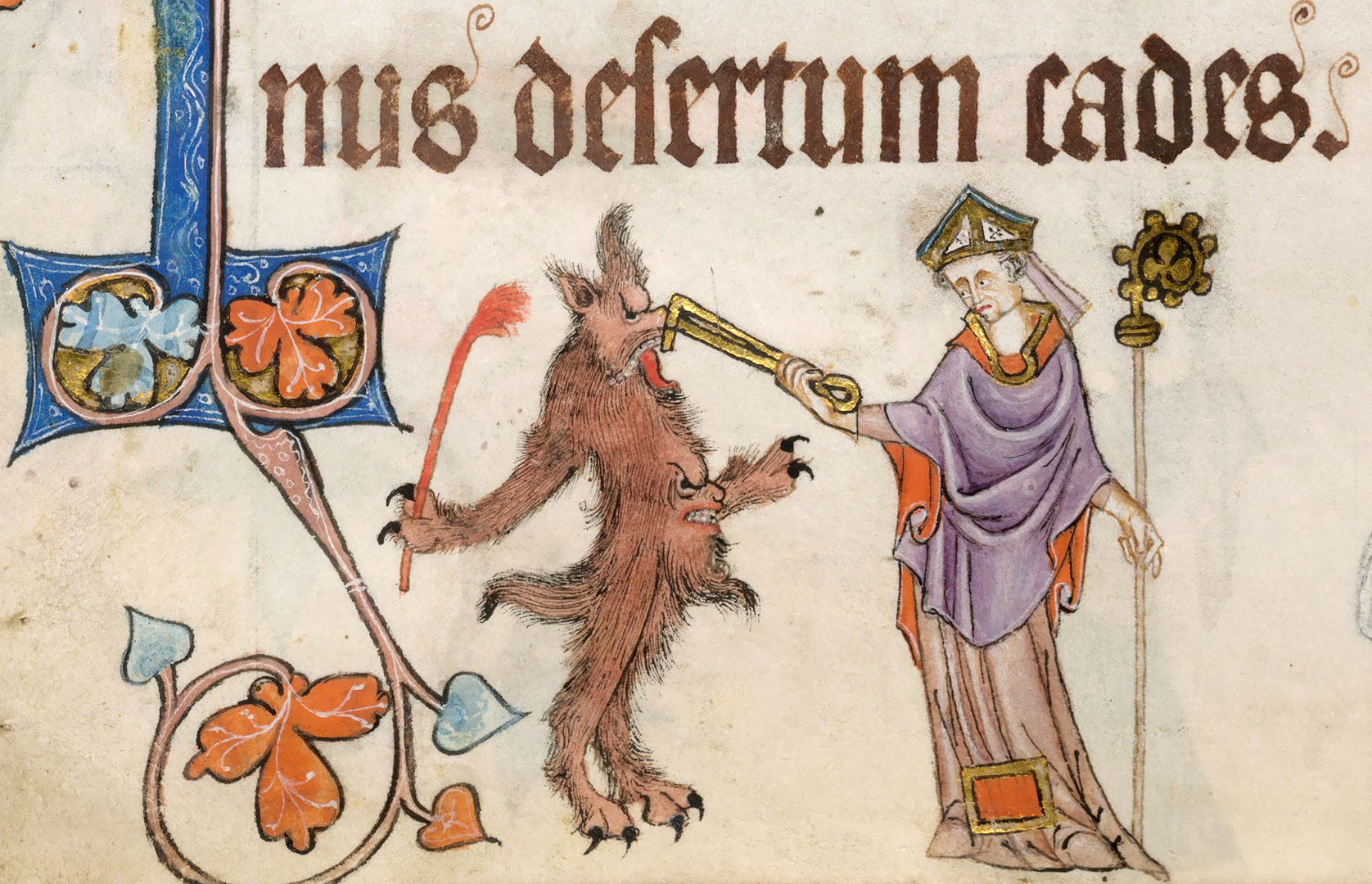
While most of the blacksmiths in these tales tend to be roguish, England offers a devil-combating smith who is actually quite saintly, namely St. Dunstan, the 10-century Abbot of Glastonbury, who also found time to master the harp and the art of blacksmithing. We hear several variations of his encounter with the Devil.
St. Dunstan and the Devil
We then explore folk customs associated with St. Clement, the first-century bishop of Rome whose particular style of martyrdom led to his being embraced as patron of blacksmiths. A variety of celebrations by ironworkers on St. Clement’s Day (November 23) are discussed; we hear a snippet of a song associated with “clementing” (going door to door to collect donations for the “Old Clem Feast,”) and hear a tale told at these feasts explaining how the blacksmith was declared “King of All Trades” by King Alfred. There’s also a bit about a pyrotechnic festivity known as “anvil firing” associated with these celebrations and a snippet of the traditional blacksmith-toasting song, “Twanky Dillo,” sung by the Wild Colonial Boys.
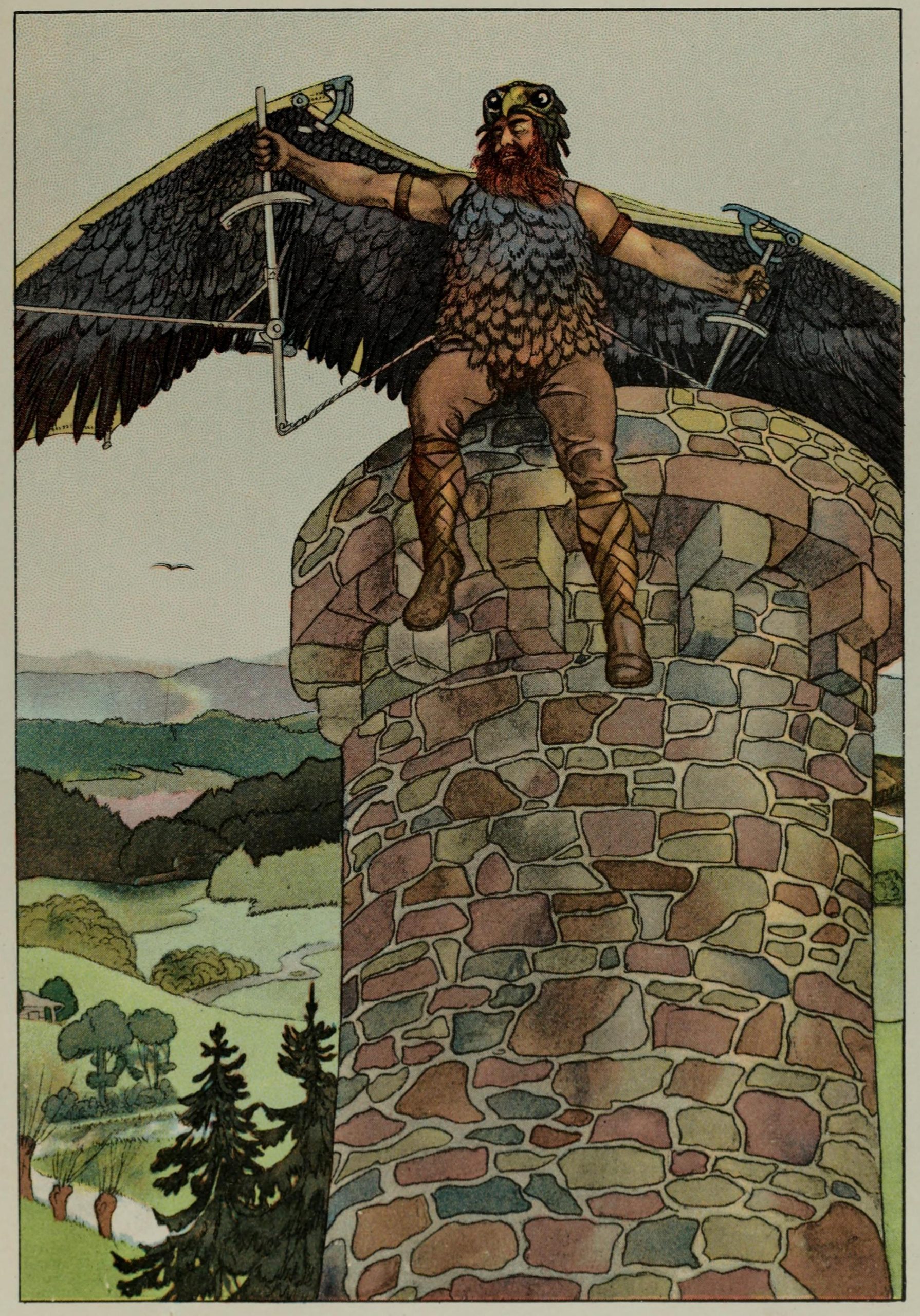
Moving further back into Anglo-Saxon history, we encounter the figure of Wayland the Smith, one who appears briefly as a swordsmith and armorer in Beowulf and other English narratives but whose story is most thoroughly presented in the Lay of Völund part of the Poetic Edda (“Wayland” being an adaptation of the Old Norse name “Völund.”) We hear a brief summary of this tale, including the particularly gruesome revenge taken by the smith upon the king who takes him captive.
We also hear a bit about Wayland’s Smithy in Oxfordshire, a Neolithic long barrow or stone-chamber tomb supposedly occupied by a ghostly blacksmith.
Wayland escapes from “Myths and legends of all nations” (1914)
We then have a look at the smith god of classical mythology, Vulcan (Roman) or Hephaestus (Greek), his physical traits and fantastic creations, which extend beyond simple smithing into the realm of magic and even the creation of the first human female, Pandora.
Another metalworker associated with mankind’s origins is Tubal-Cain, described in the book of Genesis as the first “forger of all instruments of bronze and iron.”
As a descendent of Cain (who commits mankind’s first murder) and a creator of weapons enabling more deaths, Tubal-Cain’s folkloric reputation tends to be rather black. The apocryphal book of Enoch, presents a truly Luciferian blacksmith seemingly based on Tubal-Cain, the fallen angel Azazel, who utterly corrupts mankind before the flood of Noah.
This flood narrative also figures into the mythology of Freemasonry and the role assigned the figure of Tubal-Cain in its rituals. (I give away a few masonic secrets in this segment and can only hope I will not pay for this with my life.)
Also discussed is the Masonic-inspired Society of the Horseman’s Word whose members were said to exercise supernatural control over horses in rural areas of Scotland and England in the 19th century. The order’s mythological founder was understood to be either Cain or Tubal-Cain, depending on the region.
A blacksmith and son of one of these Horsemen was Robert Cochrane, who in 1966, founded The Clan of Tubal Cain, a coven and spiritual path intended to rival the Gardnerian witchcraft largely defining the neopagan world of the 1960s. We end the show with a particularly strange and tragic tale associated with this group.
A Christmas Ghost Story IV
Dec 20, 2021
Show notes
In keeping with the old tradition of whiling away the nights of Christmas telling ghost stories, we bring you a tale published in 1912 by E.F. Benson. Read by Mrs. Karswell, complete with sound FX and music as always.
America and the Old, Dark Christmas
Dec 04, 2021
Show notes
In earlier centuries, Americans partook in many of the same dark Christmas traditions that gave birth to Europe’s Krampus. This episode examines our untamed holiday history.
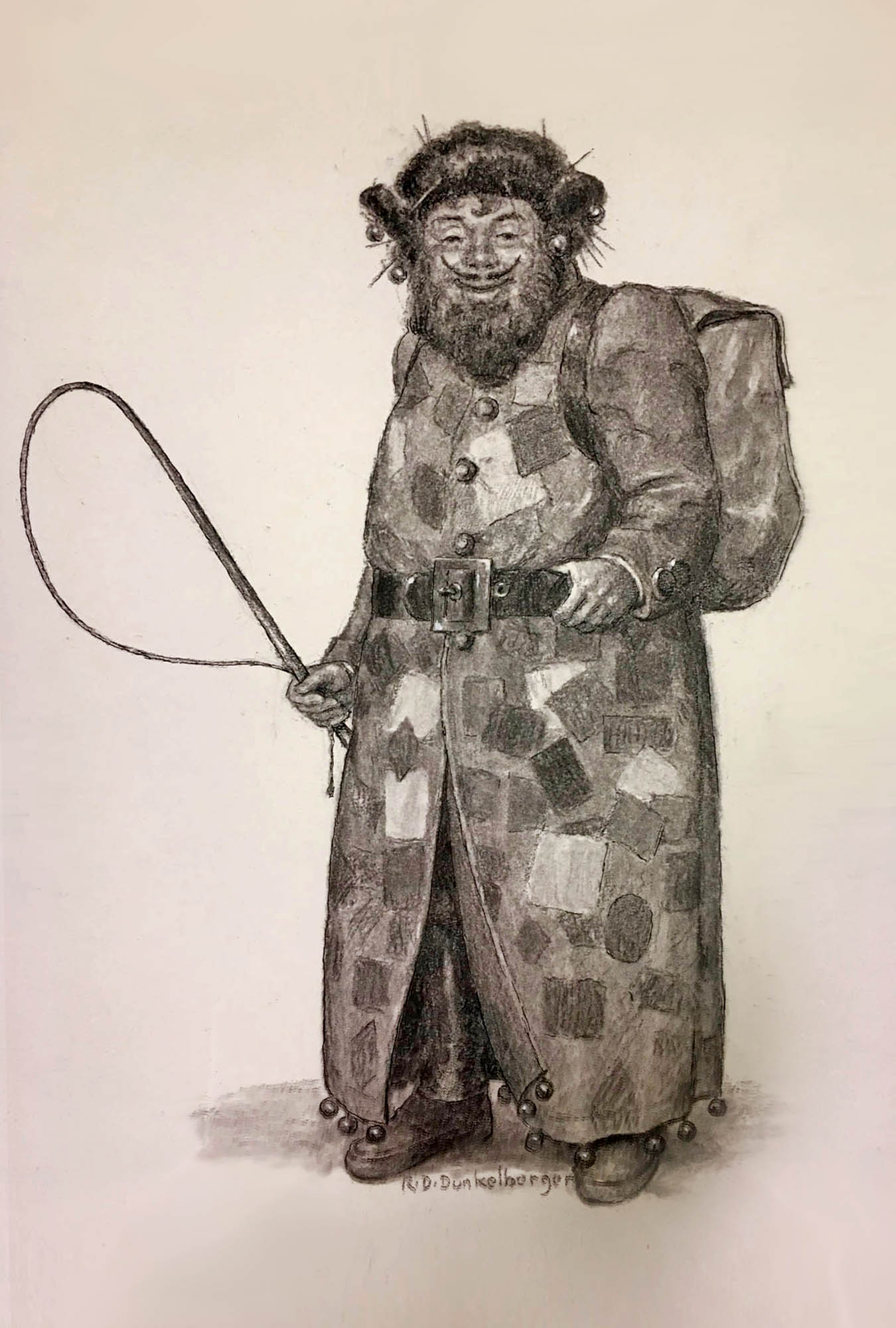
The most obvious example of this is the character of Belsnickel, (sometimes: Pelznickel, Belschnickle, Bells Nickel, etc.), who, like the Krampus, usually appeared on St. Nicholas Day, carrying a whip with which to threaten or strike naughty children. He was found particularly in German-settled areas of eastern Pennsylvania, but also in Appalachian West Virginia, Maryland, North Carolina, and Southern Indiana.
Belsnickel’s costume could vary widely depending upon what was available to the performer, but usually involved a long coat, hat, and almost always false whiskers — all chosen primarily to cover the actor and make him difficult to recognize. For that same reason, his face would also often blackened with soot or covered by any sort of mask available.
Belsnickel illustration by Ralph Dunkelberger (1959) in Berks History Center (PA)
Belsnickel often wore a fur coat or hat, a coat trimmed with fur, or a fur-lined coat turned inside out (to create a weird effect and make the garment less recognizable). The choice of fur probably had less to do with some essential attribute of the character and more to do with the season itself. Nonetheless, the name “Belsnickel,” which is a derivation of the German “Pelznickel,” has often been incorrectly interpreted as “Fur Nicholas.” In fact, the “Pelz” here derives from pelzen, meaning, “to beat.” Pelznickel (and Belsnickel) carried in his pocket or bag, small treats, which he would scatter over the ground. Naughty children trying to grab these would feel his whip.
Like Germany’s Knecht Ruprecht or the Krampus of Alpine Austria and Bavaria, the whip was the Belsnickel’s essential attribute. In fact, in the 1800s, Pelznickel/Belsnickel would probably not have been that different in appearance from the Krampus as the modern image we have of that creature was only standardized as such with advent of Krampus postcards and their imagery dreamed up by city-dwelling artists, along with growth of a competitive community of mask-carvers in the early 20th century.
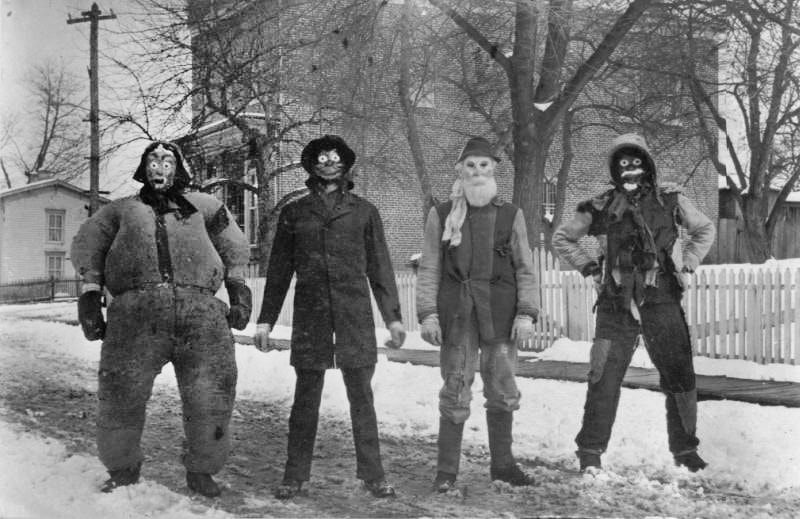
The popularity of the Belsnickel tradition soon saw it spill over from its original December 5-6 celebration to all the days leading up to Christmas and later New Year. As the tradition grew in popularity, Belsnickel was no longer represented as a solitary character but by groups of Belsnickels, whose behavior became increasingly rowdy and unwelcome. Rather than giving gifts or treats, these groups tended to ask for handouts from homes and businesses visited. Mrs. Karswell reads for us a number of American newspaper accounts documenting this trend.
Belsnickel appearing in groups. (photo: Museum of the Shenandoah Valley)
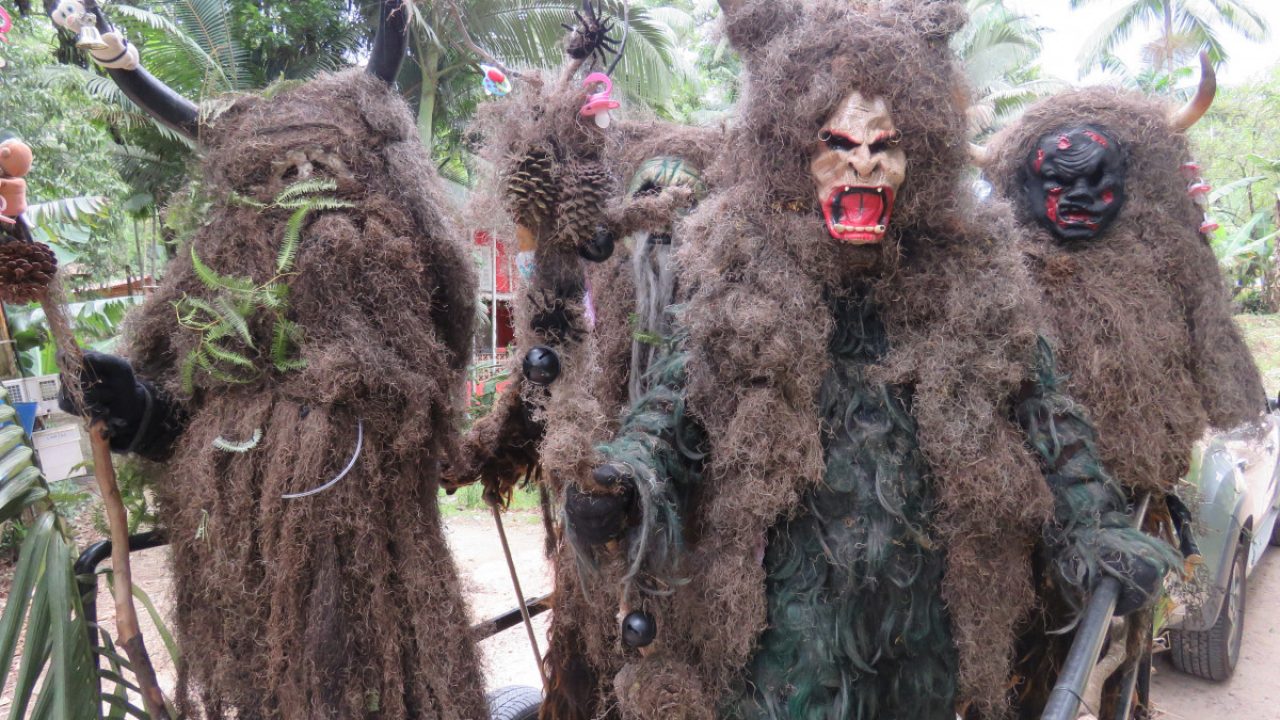
We also take a side-trip to South America, where the figure of Pelznickel arrived with German immigrants in the town of Guabiruba. Brazil. Unlike North America, where the Belsnickel had largely died out by the 1940s, Pelznickel events sponsored by the Sociedade dos Pelznickel continue to thrive – but with an interesting twist. There, the Pelznickel wanders about outfitted in moss and other tropical vegetation, accessorized with Krampus-like mask and horns.
Pelznickel in Guabiruba, Brazil.
The Belsnickel gangs were not the only groups of costumed youth carousing or begging on American streets during the holiday. Some of the earliest reports of this sort of thing come from Boston, where they were known as “Anticks” or “Fantasticals,” a name also used elsewhere. In Philadelphia, they might be called”Belsnickels” or simply “clowns” or “shooters” (thanks to the fact that these groups tended to carry noisemakers, including guns). In New York, these bands of noisemakers, often equipped with actual musical instruments played discordantly, were known as Callithumpians, or Callithumpian bands.
In Philadelphia, the rowdy costumed traditions of immigrants from Great Britain and Scandinavian melded with those of the Germans and were eventually domesticated by civil authorities into a more manageable form, the annual Mummers’ Parade.
In New York, no such solution was found, and Mrs. Karswell reads for us dramatic newspaper account from 1828 describing holiday chaos in that city.
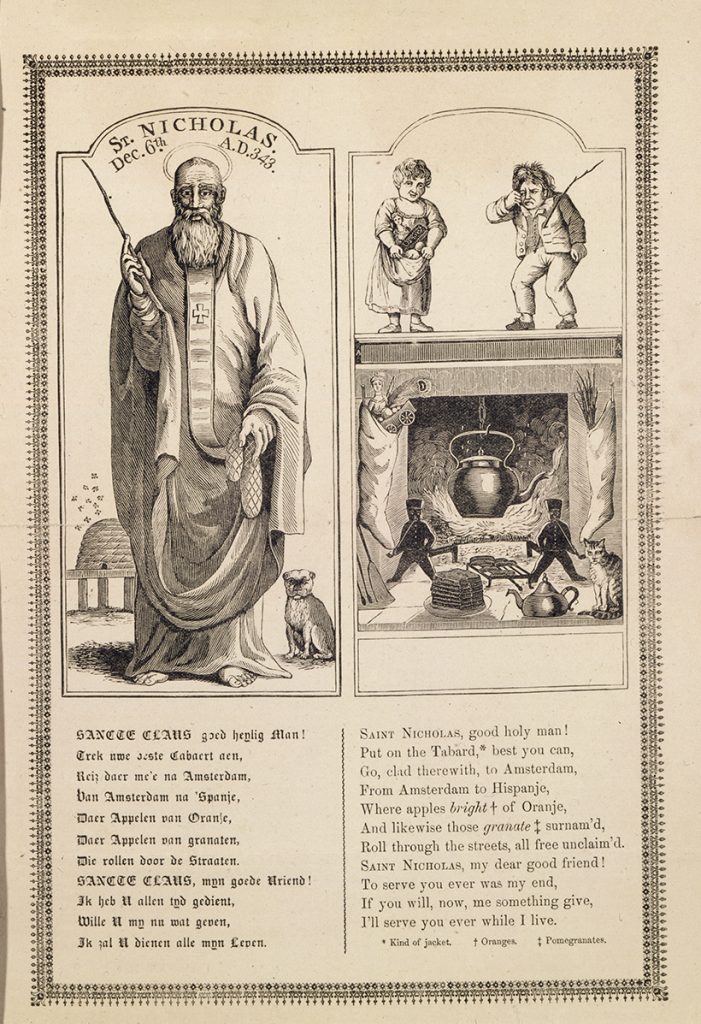
Eventually a remedy to New York’s seasonal turmoil was suggested by John Pintard, founder of the New York Historical Society, whose love for the traditions of “Old Amsterdam” suggested Holland’s patron Saint Nicholas as a distraction from the street carousing. His re-creation of pious domestic rituals involving the saint would eventually displace holiday activity from the street to the home, and refocus festivities from rowdy unmarried men to children rewarded for good behavior. Some peculiar twists and turns along the way are described.
St. Nicholas material Pintard commissioned for the New York Historical Society.
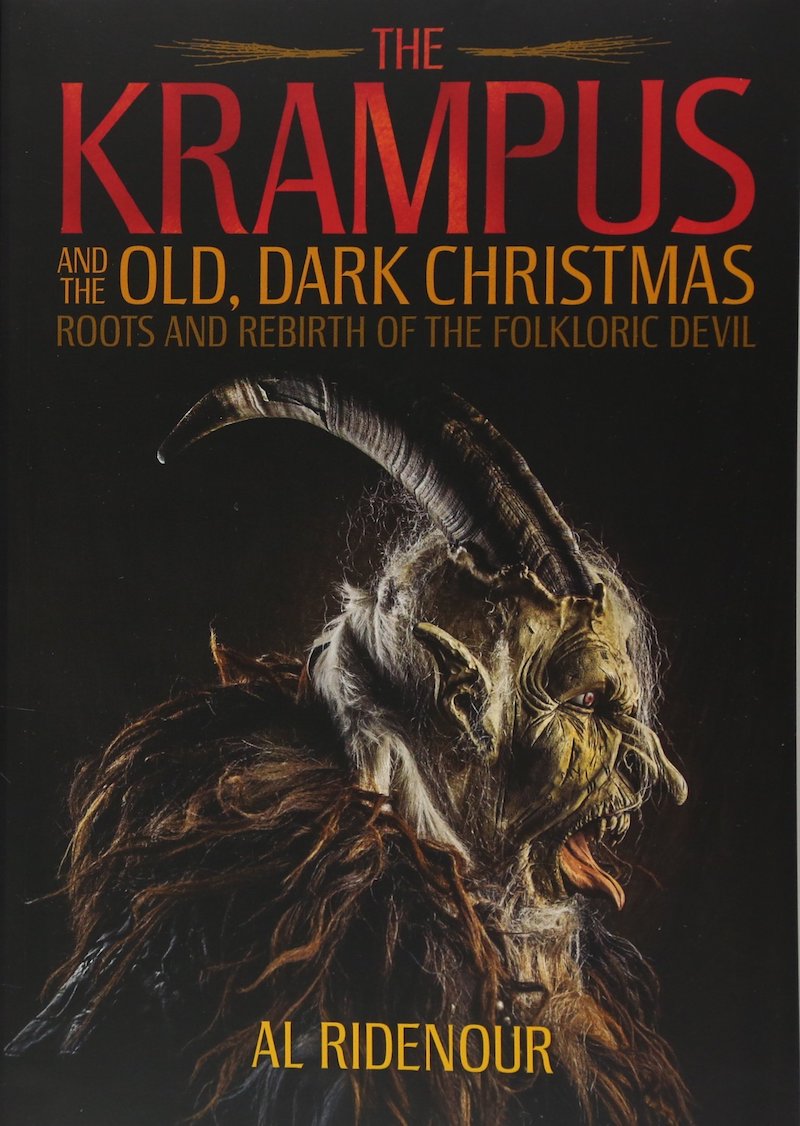
NOTE: This episode consists of material originally written for the book The Krampus and the Old, Dark Christmas, but excised due to page-count. Mr. Ridenour’s book, it should be noted, happens to make an outstanding gift for the holidays.
The book by your host. A most excellent gift!
Transylvanian Vampires
Nov 20, 2021
Show notes
Transylvania’s vampire lore inspired the setting of Bram Stoker’s Dracula, if not the character of the Count, and encompasses not only undead monsters, but living beings akin to witches. (The show is introduced with an audio snippet from Maria Tănase, premiere interpreter of Romanian folk song.)
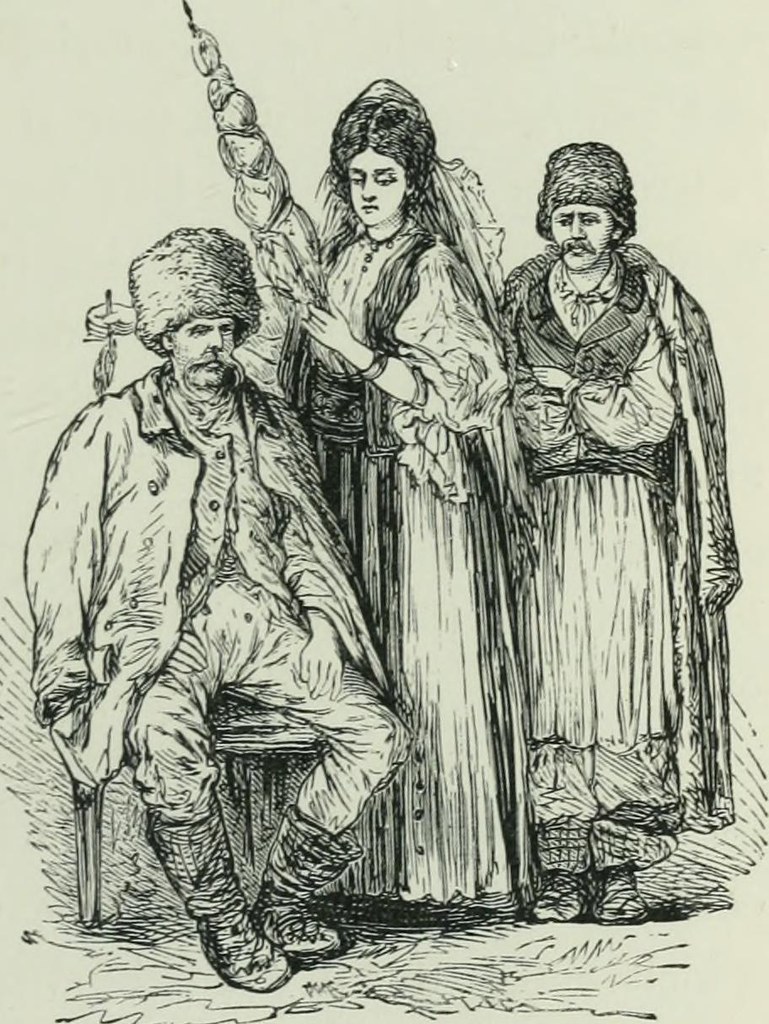
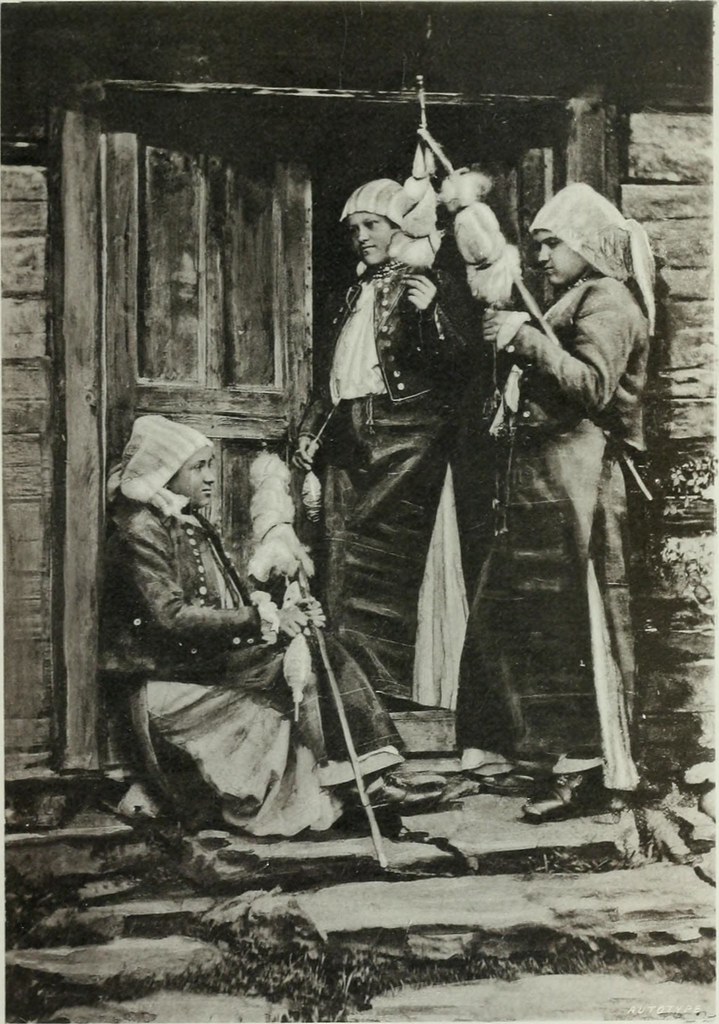
Mrs. Karswell begins the show, reading a passage Stoker wrote for Jonathan’s Harker’s Transylvania travel journal kand its source in an 1855 essay by Emily Gerard, “Transylvania Superstitions.” Originally from Scotland, Gerard developing an interest in the local folklore while living abroad and expand her essay in the 1888 book, The Land Beyond the Forest. She seems to have derived a fair amount of her vampire lore from a German scholar, Wilhelm von Schmidt, who in 1865 article contributed an article on the subject to the Austrian Review.
Illustration from “The Land Beyond the Forest”
While much of Gerard and von Schmidt’s information seems well sourced, the nomenclature used for vampires is incorrect. The word “nosferatu” put forward by the two folklorists and repeated by Stoker in his novel as the common Transylvanian word for “vampire” is not actually a Romanian word — but we sort out the confusion.
In Romanian, there are two words for vampiric beings, which Gerard subsumed under “nosferatu.” They are moroi and strigoi (male forms, plural moroii, strigoii). Strigoi seems to be a more expansive category and is discussed more in the folklore, but both share many traits including behaviors, preventatives, and modes of destruction. Moroii and strigoii tend to blur together along with two other entities, vârcolaci, and pricolici, which might be closer to our concept of the werewolf (something for a later show).
Before diving into the details on these creatures, I provide a note on two sources used for the episode, chose as they seem better grounded than Gerard’s in Romanian language and culture. The first is by Agnes Murgoci, a British zoologist, whose marriage brought her to Romania and into contact with Tudor Pamfile, a well known native-born folklorist, whose tales of vampires Murgoci translates in the source article: “The Vampire in Roumania,” published in the journal Folklore in 1926. The other source is a Romanian language book from 1907: Folk Medicine, by Gr. Grigoriu-Rigo, in which I found a large and unexpected trove of regional vampire lore.
Illustration from “The Land Beyond the Forest”
While living an evil life makes one more likely to become a strigoi or moroi, through no fault of their own, an individual who does not receive proper burial rites, will live on to destroy those who failed to fulfill their funereal duties — namely, his family and relations. We have a look at some of the old burial custom, which includes and audio snippet of bocet, a form of traditional lamentation offered at funerals.
We then dig into the moroi and traits its shares with the strigoi: the tendency to attack family members, similar preventatives and modes of destruction as well as shared methods detection of thevampire in its grave.
The strigoi in some ways is closer to the pop-culture vampire — unlike the moroi, it’s sometime explicitly said to drink blood, and garlic is a primary prophylactic. Alongside its practice of destroying loved ones, we hear of some peculiar incidents in which the strigoi also engages with its family in more neutral or even helpful (if unwanted) ways.
We then have a look at livingstrigoii, that is, strigoii fated to become undead after burial but in life exhibiting supernatural abilities and evil inclinations. In many cases, these beings bear comparisons to witches. Possessing the evil eye and the ability to leave the sleeping body in another form (usually a small animal) are examples of this.
Some methods of preventing a living strigoi from rising from its grave are discussed as well as means of destroying these creatures. Techniques employed against the moroi, while simlar occasionally include additional techniques, such as application of tar or quicklime to the body. Priests’ blessings and spells by benevolent wise women can also be employed (and we hear an audio example of the latter).
The remainder of our show consists of vampire folk tales collected by Tudor Pamfile as provided via Murgoci’s translations. The first pair of stories illustrate the resemblance between living strigoii and witches. These are followed by tales of male strigoii pursuing women vaguely prefiguring the pop-culture vampire Stoker birthed.
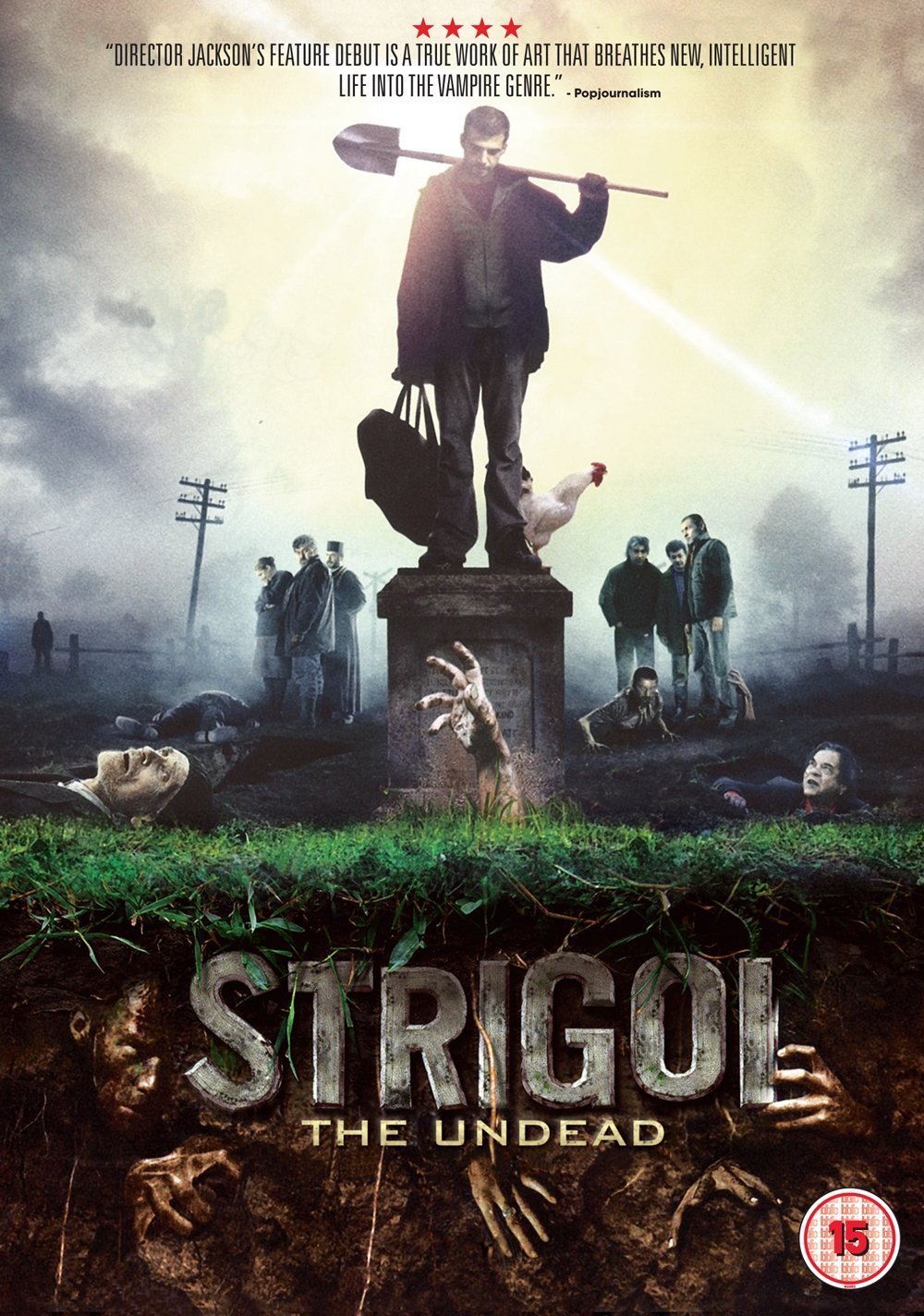
Customs of November 29, the “Night of the Strigoi” in Romania, are then described along with its folkloric significance and relationship to St. Andrew, followed by a clip from the 2009 British comedy, Strigoi.
Though no longer common in Transylvania, in rural regions toward Romania’s Bulgarian border, belief in vampires is still part of life. We hear a bit of a Romanian news segment on a poltergeist-like vampire plaguing the largely Romani village of Sohatu followed by a 2004 case from the village Celaru, which made international news when the body of an alleged vampire was disinterred and its heart burned.
The musical closer to the show is by the horror host Zacherley.
,
Horror Hosts, Part Two
Oct 29, 2021
Show notes
A break from the usual themes for the Halloween season: the second part of our survey of 40 years of Horror hosts, this time the hosts of the 1960s and a couple years of the ’70s.
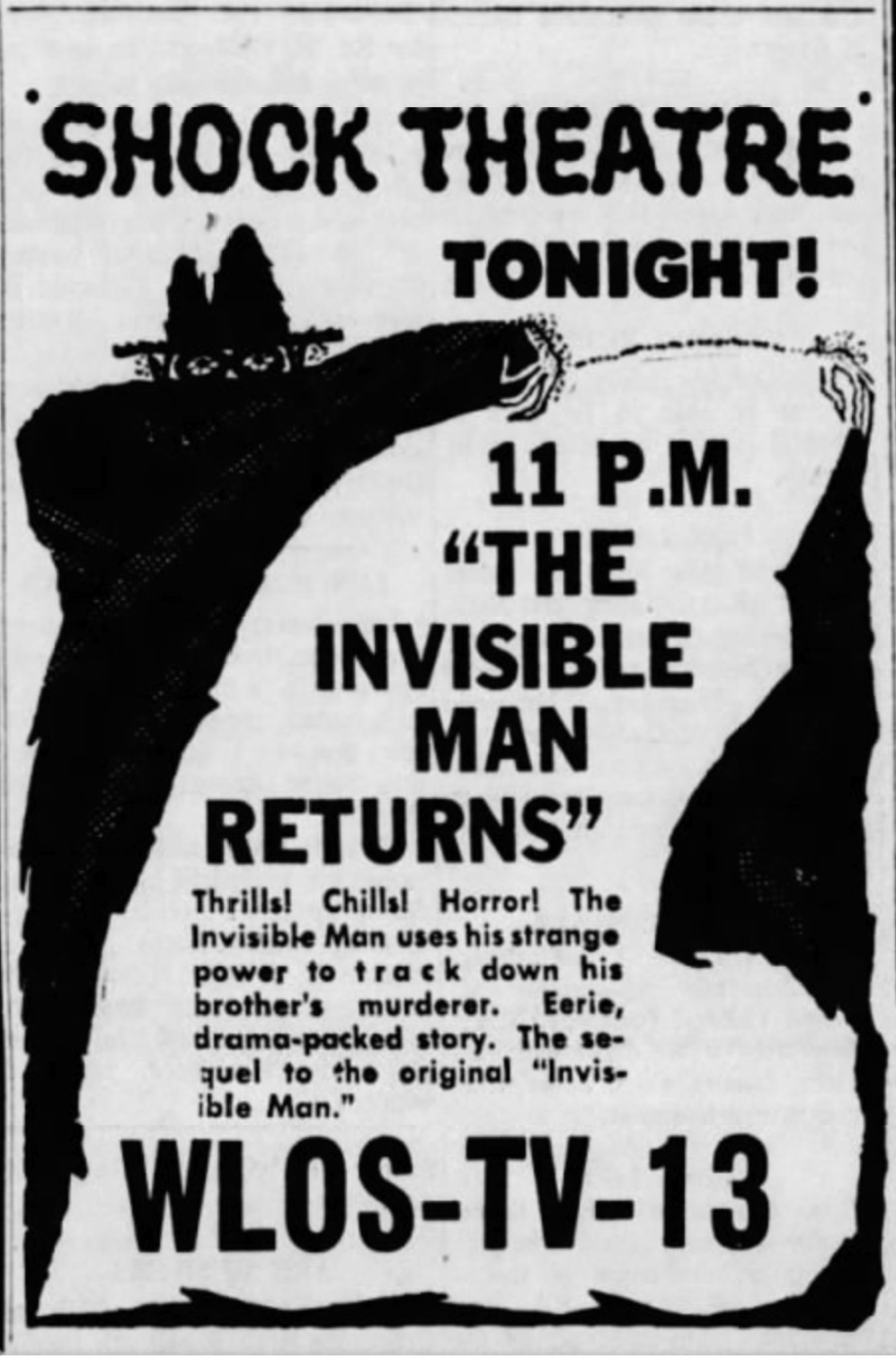
Included in this installment: Morgus the Magnificent, Sammy Terry, Chilly Billy Cardille, Ghoulardi, The Vegas Vampire, The Cool Ghoul, Svengoolie, and Sir Cecil Creape.
Also: Psychic Bee fortune-telling with Mrs. Karswell
Horror Hosts, Part One
Oct 22, 2021
Show notes
Something a little different for the Halloween season: horror hosts and their evolution in the early years. We’ll be doing a second episode (out before Halloween) rounding out our survey to include the horror hosts of the 1960s.
Included in this installment: Vampira, John Zacherle, Gorgon, Marvin the Nearsighted Madman, Tarantula Ghoul, The Old Witch, Raymond, The Mysterious Traveler, The Strange Dr. Weird, and more.
Ghost Trains & Railway Terrors
Oct 14, 2021
Show notes
Ghost trains and real-life railway terrors intermingle in this episode’s exploration of old train-wreck ballads, nervous and funereally obsessed Victorians, urban legends involving train deaths, and more.
Mrs. Karswell begins our show reading an imaginitive description of a phantom train written by George A. Sala for an 1855 edition of the magazine, Household Words, published by Charles Dickens (whose railroad connections we’ll be discussing).
Next we hear a bit of Vernon Dahhart’s 1927 ballad, “The Wreck of the Royal Palm,” describing an accident that had happened near Rockmart, Georgia the previous year. Other folk songs including gruesome railroad deaths are then explored. These include “In the Pines,” “The Wreck of the Old ‘97,” and “Wreck on the C&O,” including snippets from versions recorded by Lead Belly, Vernon Dalhart, and Ernest Stoneman respectively (with a reiteration of a line from “C&O,” by The Kossoy Sisters.) ** FOR MUSIC DETAILS SEE BELOW.
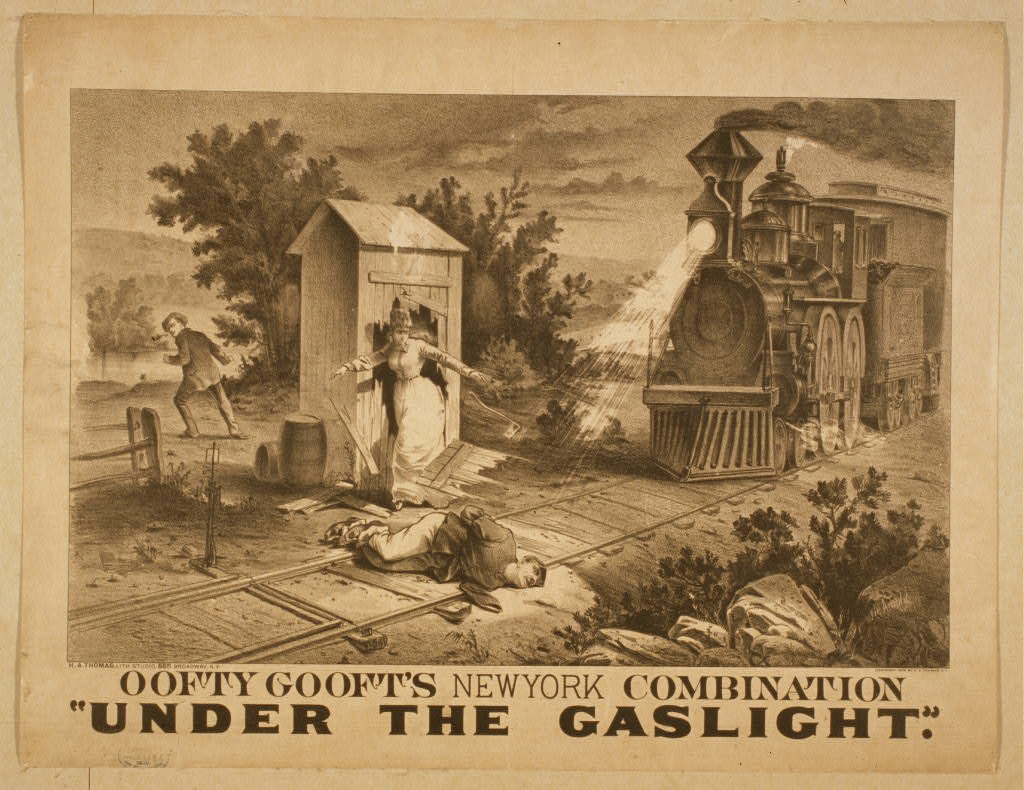
We next hear a bit about an obsession with dangerous trains expressing itself on London’s stages in theater productions of the mid-to-late 1800s. One manifestation was the “sensation dramas” of the day, which presented trains and train wrecks on stage via highly developed stagecraft. Another trend involving characters imperiled on railroad tracks was launched by the 1867 play, Under the Gaslight. The 1923 play Ghost Train is also discussed.
Our attention turns back to Charles Dickens as we hear a vivid passage describing the death of the nemesis of his novel Dombey and Son, published as a serial between 1846 and 1848; it is literature’s first death by train. Mention is also made of his classic ghost story, “The Signalman” from 1865.
Dickens’ ambivalent, and somewhat fearful, attitude toward the railroads seems to be rooted in the railways’ effect on the traditional patterns of life in Britain’s towns and villages, but also has roots in personal experience, namely as a passenger in the 1865 Staplehurst Disaster. A train wreck that not only affected his literary themes, but his personal wellbeing for years to come.
We then switch gears to examine a few localized legends from American involving trains. The first is the Maco Ghost Light encountered near the tiny North Carolina town of Maco Station and said to represent the lantern of an undead (and decapitated) railway worker. We also look at a legend from Texas, that of the San Antonia Ghost Tracks, in which aa alleged accident involving a school bus and train spawned reports of supernatural occurrences.
Another North Carolina legend examined involves an 1891 train accident on Bostian Bridge near the town of Statesville. The ghost stories associated with the site recount appearances of the the doomed train on the anniversary of its accident. The first of these is said to have happened on the 50th anniversary in 1941, but an even more terrifying encounter from 2010, on the 119th anniversary, is also discussed.
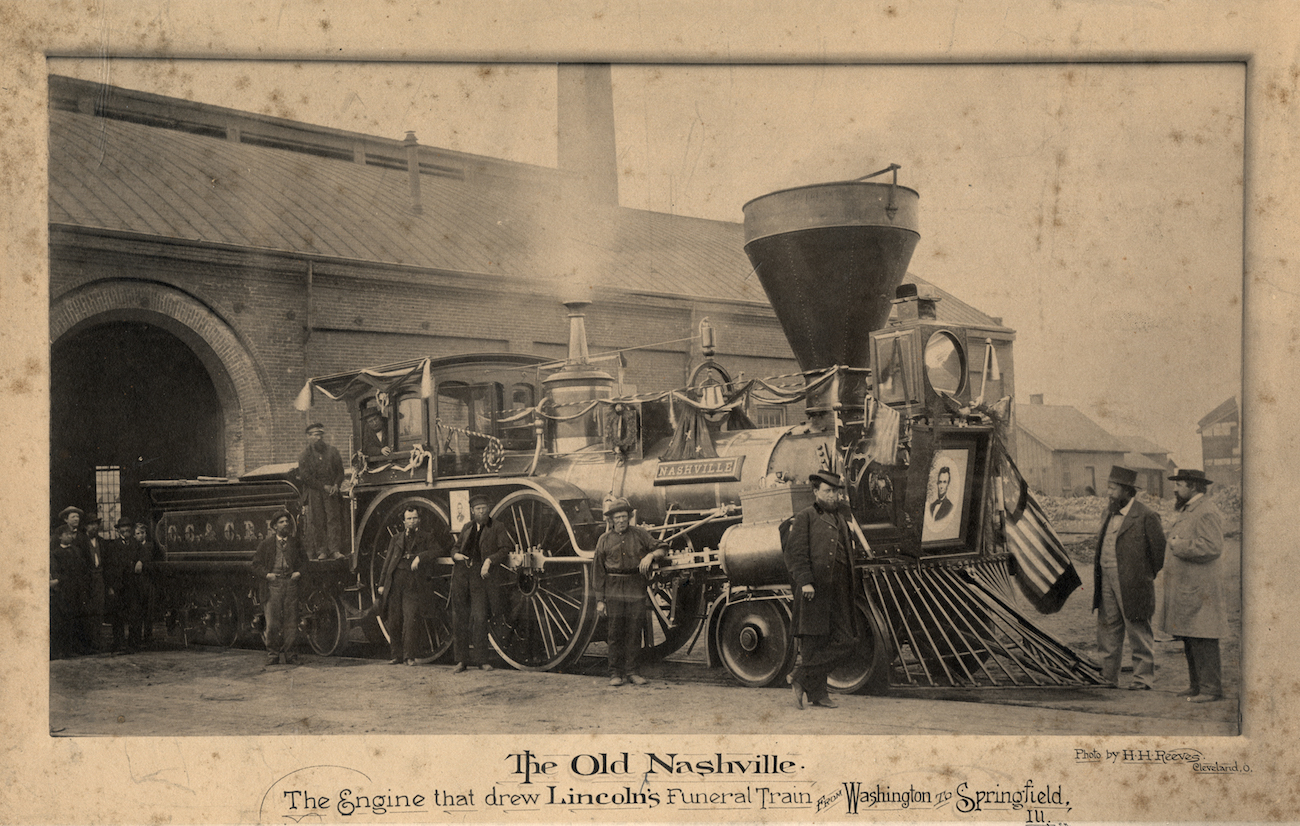
Beginning in 1872, seven years after Abraham Lincoln’s death in 1865, supernatural tales stories began to be told of the train that carried the dead president’s body through 12 cities in which he lay in state. We hear just one of the stories published in The Albany Evening Times.
We then examine the musical phenomenon of songs that portray phantom trains as conveyances to the afterlife, in particular the gospel trope of Death as a Train that may arrive to unexpectedly whisk you off to the Great Beyond, thereby reminding listeners of the need to get right with God. An elaboration of this theme involves the Hell Train, driven by the Devil himself, one which takes those who refuse to make the afore-mentioned spiritual preparations. Included here are songs or song-sermons recorded by The Clinch Mountain Clan, The Carter Family, Rev. J. M. Gates, Rev. H.R. Tomlin, Rev. A.W. Nix, Chuck Berry, and Gin Gillette.
The episode ends with a look at the not terribly successful embalming of Abraham Lincoln prior to his his funeral tour, punctuated by a snippet from “In the Pines” AKA “The Longest Train” by Dead Men’s Hollow.
** NOTE: a streaming library of the numerous songs featured in this episode, along with some additional songs of similar themes, is available to those who join our Patreon as supporters before December 1.
Marvelous and Rare III
Sep 29, 2021
Show notes
Duties in the library unfortunately prevent us from presenting a regular episode at this time, but to fill the gap, we’re offering listeners a taste of the short bonus “Marvelous & Rare” episodes all our $4-and-up Patreon subscribers hear every month (sort of antiquarian version of Ripley’s Believe It Or Not).
If you’d like to hear more in this format, another sample was released to regular listeners in September 2020 and there are around a dozen more available to those who join us on Patreon.
We’ll be back in October with a longer, traditional Bone and Sickle Episode (as well as a Halloween show).

 Our TOPPODCAST Picks
  Stay Connected


 Our attention turns back to Charles Dickens as we hear a vivid passage describing the death of the nemesis of his novel Dombey and Son, published as a serial between 1846 and 1848; it is literature’s first death by train. Mention is also made of his classic ghost story, “The Signalman” from 1865.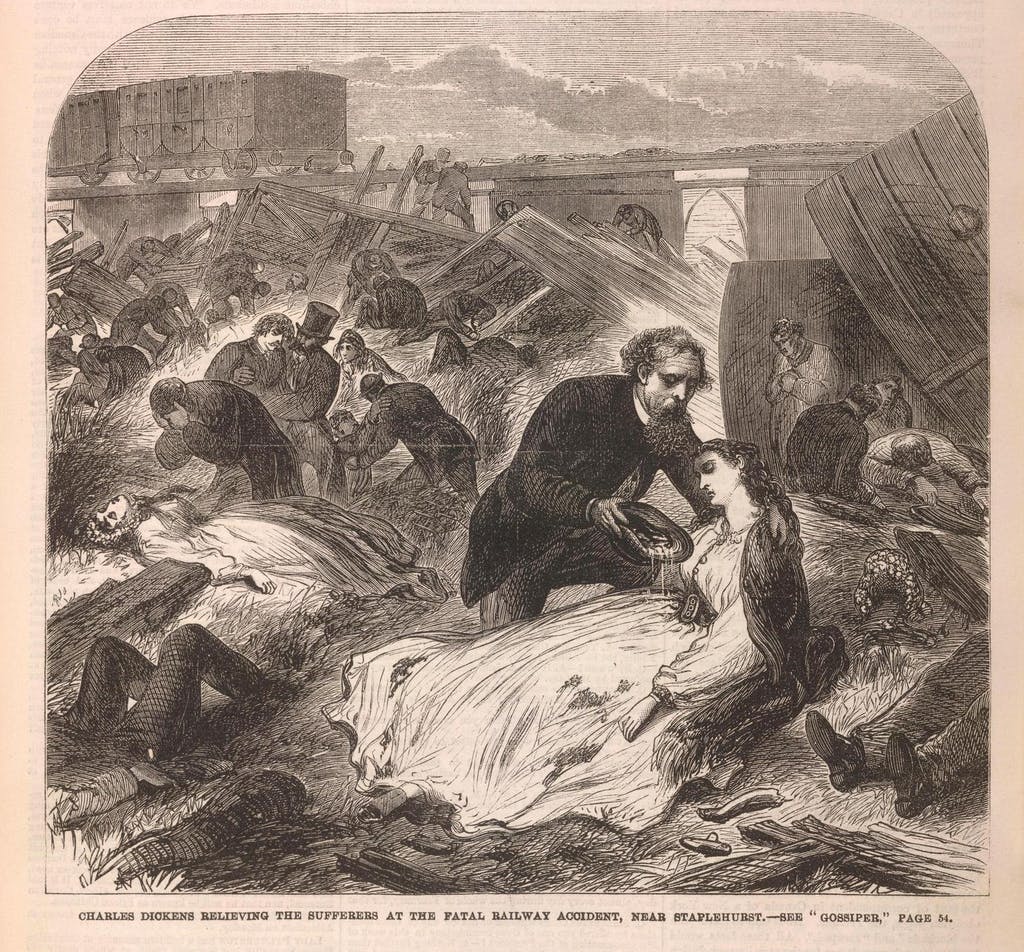
 We then examine the musical phenomenon of songs that portray phantom trains as conveyances to the afterlife, in particular the gospel trope of Death as a Train that may arrive to unexpectedly whisk you off to the Great Beyond, thereby reminding listeners of the need to get right with God. An elaboration of this theme involves the Hell Train, driven by the Devil himself, one which takes those who refuse to make the afore-mentioned spiritual preparations. Included here are songs or song-sermons recorded by The Clinch Mountain Clan, The Carter Family, Rev. J. M. Gates, Rev. H.R. Tomlin, Rev. A.W. Nix, Chuck Berry, and Gin Gillette.