TopPodcast.com
Menu
  • Home
  • Top Charts
  • Top Networks
  • Top Apps
  • Top Independents
  • Top Podfluencers
  • Top Picks
    • Top Business Podcasts
    • Top True Crime Podcasts
    • Top Finance Podcasts
    • Top Comedy Podcasts
    • Top Music Podcasts
    • Top Womens Podcasts
    • Top Kids Podcasts
    • Top Sports Podcasts
    • Top News Podcasts
    • Top Tech Podcasts
    • Top Crypto Podcasts
    • Top Entrepreneurial Podcasts
    • Top Fantasy Sports Podcasts
    • Top Political Podcasts
    • Top Science Podcasts
    • Top Self Help Podcasts
    • Top Sports Betting Podcasts
    • Top Stocks Podcasts
  • Podcast News
  • About Us
  • Podcast Advertising
  • Contact
Not in our directory?
Add Show Here
Podcast Equipment
Center

toppodcastlogoOur TOPPODCAST Picks

  • Comedy
  • Crypto
  • Sports
  • News
  • Politics
  • True Crime
  • Business
  • Finance

Follow Us

toppodcastlogoStay Connected

    View Top 200 Chart
    Back to Rankings Page
    Software How-To

    Arrested DevOps

    Arrested DevOps is the podcast that helps you achieve understanding, develop good practices, and operate your team and organization for maximum DevOps awesomeness.

    Advertise

    Copyright: © Copyright 2013-2021 Arrested DevOps

    • Apple Podcasts
    • Google Play
    • Spotify

    Latest Episodes:
    Disasters! May 29, 2015
    Show notes

    Stephanie Van Dyk @sevandyk is an SRE at Google, and has also worked on healthcare.gov.

    Mark Imbriaco @markimbriaco is co-founder and CEO of OperableInc. He's worked previously at DigitalOcean, GitHub, LivingSocial, Heroku, and 37signals.

    Bridget starts by asking Mark what Operable is all about. Mark explains that Operable is trying to help people who are on the "pointy end" of incidents. They're trying to build tools that help people collaboratively fix problems. "There's a lot of tools these days that do things like wake you up and alert when you when there is a problem," says Mark, "but we think there's a lot of room to help people actually solve problems."

    Stephanie briefly goes through some of the history of healthcare.gov, and how she first learned about it. Her position was unique, she points out. "We worked very hard, and very long hours... We were also in the fortunate position of having a lot of authority, which is important if you're trying to fix a disaster. There's a lot of problems to solve, and you don't want any of your additional problems to be 'Well, who gave you permission to do that?'"

    "That's a really good point -- not all disasters are created equal," Bridget notes, "and maybe we should take a step back and think, what are the ingredients that make something a disaster?"

    Mark: I'm used to catestrophic problems that last for a few hours at most, or in the really bad case, mabe it lasts for two or three or four days, not something that goes on for weeks or months, so that's a different perspective from what I have, so I'm super interested to hear about [healthcare.gov].

    Matt: I think there's the disasters where there's a thing that happens, that's maybe localized to one type of scenario; then there is what happens in an episode of This American Life, where it's just one thing after another and everything unravels. There's a quote from the episode that I like to think about when we think about these bigger disasters that are more than just an outage that may be far reaching:

    "One ingredient of many fiascos is that great, massive, heart-wrenching chaos and failure, are more likely to fail, when great ambition has come into play, when plans are big, expectations are great, and hopes are at their highest."

    "I think you're certainly right," agrees Stephanie. "In order for something to be a disaster, the stakes have to be quite high... An outage that you find, and fix, and write a postmortem, and everyone learns something, and the users all get over their hurt, that's not a disaster. That's just life.

    At times, there are incidents that leave scar tissue in their wake, making people wonder for years to come if they truly want to use certain products, or trust their data to a certain company. Mark reminisces: "The gutwrenching terror is, are we going to get our customers' data back, or is it just gone? As an ops person, there's almost nothing more terrifying than losing data."

    This provides a perfect segue into some of the non-obvious issues that arise with disasters. Stephanie brings up the point that you have to be prepared to regain the trust of your users. "How people think about your service is going to determine the fallout of it, and the impact. It's interesting -- it's not something engineers like to think about very much, because they simply fix the problem. But someone has to be the one to reassure people that it'll be ok."

    Mark agrees: It's really, really hard to be in the middle of responding to a serious problem, and also have to be the person who needs to communicate about that externally. There's so much good will that can be gained from being as transparent and public as you can about what's going on, without pulling punches or hiding, even if things are really bad.

    This is all well and good, but Bridget brings up a good point: "How do you know exactly how and what to communicate to people?"

    Stephanie: There are definitely rings of communication. You have to be able to talk to the other engineers who are working on the problem, and those conversations are going to be very different than how you talk to your customers, even if you're trying to be super open and honest. Your customers don't care about where in the logs you found that tiny error. They care about when it's going to be fixed, and whether you're actually working on it... Also, the person who's in charge of solving the outage should not be the same person who's in charge of communicating about the outage. You should have different roles for that.

    Mark agrees emphatically, and also noted that wording is incredibly important -- not only what you say, but how you say it, and the words that you use. "There are three things I want to get across. The first thing is, I want to apologize to people. It has to be a sincere apology. The other thing I need to do is make sure people feel confident that I understand what happened. I need to display confidence, and a really firm grasp about the problem. The last thing I need to do is tell them what I'll do to try to reduce the likelihood of something like this happening again."

    The conversation turns a corner as Matt asks how you plan for outages and prevent disasters. Stephanie jumps in, and reminds us all:

    "If you don't test your backups, you don't really have backups. Similarly, if you don't test your outage plan, you don't have an outage plan."

    She suggests setting up brainstorming sessions with a handful of people from your team, appointing a "DM" (dubbed "Disaster Master" rather than "Dungeon Master" by Tyler), and running through possible scenarios. Keep an eye out for a Kickstarter in the near future ;)

    There are definitely advantages to documenting incident reports along the way, but how do you balance the speed of talking through a solution out loud, and the value of face-to-face communication to build trust vs. the need to document things for posterity? Mark: How you interact on a day-to-day basis is also how you should communicate during an outage. The last thing you want to do is change your mode of communication when everything is falling apart and you've got high stress.

    Matt posits that sometimes what's a disaster for one company isn't for another, because of their size, their logistical capabilities, etc., but also, sometimes what is being presented as a disaster isn't actually all that bad.

    Stephanie identifies the first benchmark as determining whether or not your users are hurting. "If they're not hurting yet, you might have a disaster coming, but I don't think it qualifies. But if your users are hurting, that's when you really need to jump on board and get focused."

    Mark agrees, and adds that being able to quantify how many users are affected, and in what way they're affected, is hugely important. "That's different than monitoring. Monitoring may tell you that the server's down, but it doesn't tell you how many users that impacts." He reminds us that when you're working at scale, "services are down for somebody literally all of the time. "What is the threshold where it becomes a disaster? When do you need to start talking about it publicly and in status? Those are questions you really need to answer up front."

    Checkouts

    Stephanie

    • catehuston.com, Accidentally in Code
    • USDS

    Mark

    • Pre-Accident Podcast
    • Destiny (the Game)

    Bridget

    • seedsavers.org - Organic heirloom seeds
    • “Common Ground and Coordination in Joint Activity” by David Woods et al

    Trevor

    • Pocket chainsaw
    • Dragonball Z XENOVERSE
    • MSOffice for Android Smartphones (Excel, Powerpoint, Word) Preview

    Matt

    • Does Not Commute - iOS/Android game iOS | Android
    • Recreating highlights of Breaking Bad in GTA5 editor
    • I’m also obsessed with Hearthstone on iOS now (World of Warcraft card game thingy)

    Dr. BOFH, or How I Learned To Stop Worrying and Love the DevOps May 15, 2015
    Show notes

    Chris Read, Kevin Hubbard, and Yvo van Doorn are reformed BOFH's (Basterd Operator's From Hell).

    Chris is back on the podcast again, this time talking about his expereince as a SysAdmin in past lives.

    Kevin is currently the DevOps Engineer for BCycle at Trek Bicycle Corporation, and was a SysAdmin for 15+ years.

    Yvo previously worked at classmates.com and McGraw Hill Corporation as a SysAdmin, and is now at Chef Software.

    Before we get started, you'll need to understand the origin story of BOFH. There were stories posted on Usenet back in the 90's, supposedly authored by a computer operator named Simon whose sole purpose was to terrorize the users of his systems. The phrase "How great would my job be if it weren't for the f***ing users!" resonated with many SysAdmins (and still does!).

    Matt starts the episode off asking what it was like as everyone was starting out in this field.

    Kevin: To me, it was sort of operating in a scarcity model. You had limited resources, and it seemed like anytime there was a new ask for an application, I immediately went to 'How am I going to ask for the capacity to run this?' and I would just get so frustrated. It boiled down to 'How are we going to support this?' That was my standard line when someone would bring up something new, and I wish I had trophies to give those people for all of their good ideas, because we just couldn't get it off the ground with the resources that we had. It wasn't a fun way to operate, but it was the most realistic view.

    Chris: When in high school and university I was the System Administrator for the school systems. It was astounding seeing what damage to the system can be done -- how people trying to do something could affect shared resources, and the after-effects of that. Most of the time it wasn't malicious; it was due to ignorance, but it built up this mental attitude of 'All users are just there to break things. We need to constrain them as much as possible, because when things break, we're the ones that get shouted at.'

    Matt: There was a belief that devs are stupid! All they're going to do is break things, because they don't care about the systems like a SysAdmin does, because they're ours.

    Yvo: Our devs were incentivized not to care because they were paid based on the amount of code they shipped. I've had some nightmare evenings trying to fix all of the problems.

    Bridget then brought the conversation back around to incentives -- are there situations when the incentives are diametrically opposed (or at least not aligend well) between the SysAdmins and the developers?

    Matt brings up the point that developers are incentivized to build features, while SysAdmins are incentivized to bring stability, which at its most basic level is maintained by things not changing.

    The viewpoint of 'developers don't know what they're asking for' is also a problem, Kevin reminds us. SysAdmins will often call the developer and explain why things work the way that they do, but won't take the time to listen to the actual problem.

    In reality, there's a perception of other people touching "our stuff" and things will go wrong, but let's face it: "there are all sorts of things that can go wrong that are often not a specific person's action," says Bridget.

    Given that all of us here are supposedly reformed BOFH's here, let's chat about how things have changed, and what that process was.

    Chris: I finally realized that my interactions with the developers were better if I went to them without the 'clue stick' and simply spoke to them, asking them if they realized the impact of their code. It finally clicked for me when I had to work together with the client-side SysAdmins as well as the developers at Thoughtworks. Our whole purpose was to get code written by two different development teams out into production, and it was only through being an advocate for both teams that I was able to build up a relationship with both teams and understand the value.

    "It seems like DevOps has formalized the relationship between SysAdmins and developers," says Kevin. "It seems like a much more natural, iterative process working with devs." Because we're working side by side, there's much less going back and forth with having to figure out the direction and purpose behind projects, and simply getting to collaborate.

    The "handing down stone tablets" philosophy not only no longer works... it has never worked!

    In Yvo's case, the change started to happen when the project management team was dissolved. Suddenly, a SysAdmin had to be a part of the development meetings, because there was no longer an intermediary passing information from one team to another. It immediately became more collaborative, and there was visibility into what was happening early on rather than being notified after everything was finished.

    We've shifted from a mentality of 'protection' -- teaching our "PFY's" (pimply-faced youths) to protect their systems against the evil developers -- to giving history lessons about how we got to the stage that we're at now where we need to talk to all of the involved parties, and as Chris said, "having everyone focused on the goals, trying to see things from each other's angles rather than antagonistcally." This is how we, as a group, move forward.

    "It takes a deliberate decision to shift," Bridget observes. We have to be dedicated to teaching our PFY's this new, collaborative way so that in the future, fewer people will start out with this BOFH mentality.

    From there, we shift into How can we do better?

    Matt asks, "We used to be this way -- we're better now -- but what are some of the ways that we can still improve?"

    "I want to be able to maintain this new flexibility that comes with DevOps, but I feel like there's some decision-making that needs to be made as far as tools and standards go," says Kevin. It's a matter of balancing the old playbook of limited resources and mixing in the new cohesion and collaboration efforts.

    We've done a great job of bringing in the greater teams of operations and developers, but most companies still have the one or two lone SysAdmins who are struggling on a daily basis to keep their heads above water. Yvo cautions that we need to bring them into the circle as well.

    "If we can make their lives easier, they're going to eventually go to another shop with the perception that being alone and supporting developers is not a bad thing, but right now they really don't like life."

    Bridget's money-back guarantee: "If you're less BOFH-y, I promise you'll be happier, or else we'll pay for your therapy."

    Checkouts

    Chris

    • Liz Keogh - Perverse Incentives

    • GOTO Conference Chicago 2015

      Closing Keynote by Anita Sengupta from NASA JPL was awesome

      James Lewis - "How I finally stopped worrying and learnt to love Conway’s Law"

    • DRW is hiring!

    Kevin

    • Stache - new Trek mountain bike

    Yvo

    • Hop Venom Double IPA - Boneyard</a

    Bridget

    • Organic heirloom seeds
    • Common Ground and Coordination in Joint Activity by David Woods et al

    Matt

    • Effective DevOps by Jennifer Davis and Ryn Daniels
    • asciinema

    DevOps and Marketing Apr 30, 2015
    Show notes

    Shannon Smith is the marketing manager for 10th Magnitude, a consulting firm based in Chicago. She's a self-described "liberal arts nerd" and fell into the tech world through her job at 10th Magnitude. She has a love for well-crafted sentences, song parodies, and general cleverness, which has translated into a love for marketing and the challenges that come with getting an effective message delivered to the "great abyss."

    Jason Hand is a DevOps Evangelist at VictorOps. He's been in the IT space since college, but it wasn't until joining VictorOps that he's ventured into a wider role, working closely with both marketing and product.

    Matt starts off this unique episode by posing an important question: "Why is DevOps something that people in marketing would even care about?"

    Jason jumps in right away: "Obviously, the VictorOps tool is something we feel falls in line with a lot of the DevOps topics, in terms of the things we try to help engineers with. Being able to speak intelligently to the different subjects that fall within DevOps is very important, especially when it comes to marketing. As most of us know, we're very averse to traditional sales and marketing tactics; we can sniff out those types of conversations before they even happen, and we'll pivot and walk away."

    Shannon originally broached the topic during Open Spaces at DevOpsDays Chicago 2014. She was interested in the focus on community, but also intrigued by the jokes about how terrible traditional sales and marketing is. She wanted to know what she could do to combat the negative feelings surrounding these departments, as well as gain insight into what her team could do differently.

    The group starts throwing out common pitfalls:

    • Using #devops on Twitter and thinking that in doing so, your company is part of the conversation
    • Packaging DevOps as a quick fix to deep-rooted problems
    • Trying to follow traditional marketing and sales "rules"

    "Even for those of us who are heavily invested in this DevOps thing," says Jason, "who talk about it on a daily basis, sometimes we don't even understand everything -- all the ins and outs of what is DevOps -- because it's not just a thing. It's a way of getting things done. It's much bigger than just one thing. We are very patient and empathetic to that thought process," he continues, "because we deal with it all the time. That's part of the challenge within marketing, is how to turn that conversation into a succinct way of explaining it."

    Shannon explains that part of the problem with having a succinct explanation for DevOps, as well as how to sell it, is that there are multiple target audiences. "While we do use more traditional marketing for 'decision makers' -- people who are busy and don't have the time to talk about these abstract concepts, we've recognized that there are two or three very separate audiences, and we have to make multiple different messages work."

    The point is, your message is going to be very different depending on whether your audience is practitioner, decision maker, or champion. It could be that your company caters to all three, but then you must have separate messages catered to each of these groups. Otherwise you'll be trying to mandate change from the top-down rather than getting the buy-in from people doing the actual work, or vice versa.

    In a conversation with Matt earlier in the week, Steve Pereira said, "I'm in favor of having marketers speak to what they're actually selling, which is never actually 'DevOps.' DevOps is bathwater in which all of these things are babies."

    Given all of these different audiences, Bridget asks the "elephant in the room" question: "When you're talking about the target markets, how do you build an understanding of DevOps among people who aren't engineers?"

    Jason mentions that at VictorOps, they have an emphasis on moving agiley across the company. Even the marketing team works in sprints, getting things done on a project basis and having team standups. DevOps isn't just for engineers -- it's applicable for everyone across the company.

    But how do we make that happen in a practical sense?

    Companies that are doing this successfully often exhibit certain qualities:

    • Empathy to others, which allows silos to come down
    • Transparency between teams via chat clients and in person
    • Cross-company knowledge of what the top priorities are and what other departments are working on

    This cross-company communication can be difficult at times, but ultimately it's everyone's responsibility to speak up if they see problems with the messaging. Bridget offers a solution: "If you're going to have people external-facing in your organization, going out and evangelizing, they need to also be talking to the people inside the organization, who are developing the product or providing the professional services."

    With Jason's role as DevOps Evangelist, he's often out learning from the best. It's his responsibility to bring the feedback directly back to the company and educate them on what he's hearing from the community, and likewise it's marketing and product's responsibility to be open and willing to hear the feedback.

    Collaboration and accessibility is what drives all of this, as Shannon pointed out. Being able to talk to people face-to-face is one thing, but using chat software to check in with the full company, or somehow checking in frequently with multiple teams is key.

    For our listeners: If you work in a larger organization, we'd love to hear about how you've solved this problem of communication throughout the company. What's resonated, and what hasn't? Tweet your answers to us at @arresteddevops.

    Main takeaways: Jason - Spend some time researching DevOps. Get to the DevOpsDays events that are happening in your area. That's where I've learned the most. I've made some great friends and contacts. Also, these events have helped me have the sense of empathy not only toward the challenges of the marketing and sales teams, but also the conversations that are taking place among all of the business units, no matter what size company. I can now take what I've learned, both online and offline, and take those insights and thoughts back to my team. For the time-being, I'm the one internally who's teaching DevOps best practices. It's really a matter of absorption. You can't sit behind your desk and understand DevOps. You really have to get involved with others.

    Shannon - Truly the biggest thing that I've taken away in the past 9 months is really trying to build up our grassroots messaging and the way that we're reaching out to people. I think the best way to do that is go to these community events -- be involved, listen, share, have natural conversations, and be genuine. Having a presence in the community says a lot more than any little tagline.

    Checkouts

    *Shannon*
    • [Graze](https://www.graze.com/us) & [Naturebox](https://naturebox.com/homev2/) - when you need a 3pm snack
    • [Canva](https://www.canva.com/) - graphic design online tool
    • /// insert picture of Trevor in beret w/a baguette here
    • [Unbreakable Kimmy Schmidt](http://www.imdb.com/title/tt3339966/)

    Jason

    • [Trello](https://trello.com/) - light-weight Kanban boards
    • [Buffer](https://buffer.com/) - tweet scheduler
    • [Mention](https://mention.com/en/) - keep a pulse on what topics people are engaging in
    • [DevOpsDays](https://www.devopsdays.org/) - local DevOps events

    Bridget

    • [DevOps: A Brief History](http://peterjshan.com/posts/2015/04/devops-a-brief-history/)

    Trevor

    • [David Bowie's Exhibition](http://davidbowieis.philharmoniedeparis.fr/en)
    • [Agent Carter](http://www.imdb.com/title/tt3475734/)

    Matt

    • [Mac ID](https://macid.co/)
    • [Octotree Chrome Plugin](https://chrome.google.com/webstore/detail/octotree/bkhaagjahfmjljalopjnoealnfndnagc)
    • [PonyHoof](http://ponyhoof.little.my/)

    What's New At Chef? Apr 17, 2015
    Show notes

    Seth Falcon is the Engineering General Manager for Chef Delivery.

    Julian Dunn is the Product Manager for Chef Analytics.

    Adam Edwards is the Engineering General Manager for the main Chef product.

    Matt, Trevor, and Bridget gather at the Chef Newsroom at ChefConf 2015 to talk about the latest and greatest developments at Chef. They are joined by Seth Falcon, Julian Dunn, and Adam Edwards.

    One of the biggest announcements at ChefConf 2015 was Chef Delivery. Matt asks what is Chef Delivery, and why is it interesting?

    "Chef Delivery is a solution for continuously delivering infrastructure and applications, and it's built on top of Chef," says Seth, who's heading up this new program within Chef. "We're really excited about Chef Delivery. Successful software organizations use patterns to deliver software at high velocity collaboratively and safely. We've been able to distill some of those patterns into a workflow that we think will be easier for folks to adopt and learn."

    Seth continues: "The workflow is one that we've seen work, by working with customers to build these types of pipelines over and over again, and find those successful patterns. The overall workflow begins on a developer's workstation, where they make a change, they do some local testing, and then submit it to the system, where some automated verification tests run. The job of those verification tests is to determine whether it's worth the time of a human to do some code review on that change. Someone can then do some code review to approve the change. At that point, Delivery will build an asset for us that we could release. The workflow for building that asset is simple: do a merge onto the target branch (usually the master), rerun the same verification tests, which usually consists of unit tests, lint testing, and syntax checks, build that asset, and publish it into a repository where it can be fetched later. Then Delivery will provision an acceptance environment, should you need one, and deploy that asset into that acceptance environment, and run some tests to make sure that the deploy was successful. If it was, it waits there for further instruction. The last step is clicking the 'Deliver' button. That sets the system in motion to get the code all the way out. It first goes into a 'Union' stage, where if you had a number of projects that had some interactions, you'd be testing them together at their latest version, and making sure they're good. If those tests succeed, Delivery rolls automatically for the rest of the stages -- into a rehearsal environment, and then into a delivery environment."

    Interested in a more detailed description of the workflow? Seth continues to talk through some of the logistics in the podcast as Bridget and Matt ask questions about particulars. You can also check out this video about Delivery:

    Seth concludes with, "A lot of what we're providing here is an accelerant to teams, to give them that system that will allow them to move quickly and learn how to move quickly in that way."

    We transition into asking Adam Edwards, Engineering GM for the Chef product, what's new in his world.

    "There's a lot of new stuff just coming out over the last few weeks," says Adam. He goes on to detail just a few new features:

    • Policyfiles - solves problems with workflow and provides a way to specify in a specific file which cookbooks you want
    • Test Kitchen on Windows
    • PowerShell DSC Direct Integration
    • Chef Provisioning (neé Chef Metal) update - does more with containers and Azure
    • Chef Nightlies - releasing Chef Server nightly on apt and yum repos

    From here, we move into Chef Analytics, and turn the mic over to Product Manager Julian Dunn. He gives us a quick background on Analytics, explaining that it "gives you a way to visualize, query, and report on the events stream that's coming from your Chef data. Analytics lets you not only visualize that data, but track events in that stream, and then handle them in various ways."

    Matt brings up his favorite part of Analytics, and brings up how it's closely affiliated to security: "You can take those same audit rules that you write in Analytics, and apply them through your pipeline to test them there. What's nice is that it's only one thing to write." It keeps things simple and straightforward, rather than needing to search through a huge amount of rules and regulations to ensure that everything is accounted for.

    Julian agrees: "You can think of security as just another aspect of quality. We understand that you can't get quality if you try to bolt it on to the back of a system. How many of you have worked with applications that didn't have tests originally, and the software is just poor quality? We tend to treat security in this backwards way, where we think if we don't build it into the system, down the road we can just do an audit and we'll magically get compliance and security. If it's not a characteristic that's already there, it's very difficult to achieve those directives."

    In addition, Analytics allows customers to report metrics and characteristics about your infrastructure to business owners. "One of the things we often hear from customers," Julian says, "is how do I measure how successful I am at Chef?" If you're able to use Chef Analytics, it provides you with a direct way to illustrate the ROI of investing in this type of technology.

    This business aspect of Chef Analytics was one of the core announcements regarding the Analytics Product Suite at ChefConf, specifically highlighting the integration with Splunk. Julian explains the rationale behind this integration:

    • Many enterprise customers are already using Splunk
    • Splunk makes it very easy to draw visualizations and make inferences from data

    Matt segues into an overview of ChefConf 2015 and asks everyone for their insights on this year's event.

    Bridget: One thing that stood out for me at ChefConf is that there's a very unified community feeling. At a lot of conferences (that are very wonderful conferences!), there are very specific tracks, or specific groups of people who end up mixing more than with others, and at ChefConf, it definitely seems like there's a very broad community who are all interacting with each other.

    Trevor: I've been rocking the hallway track... and like Bridget said, everyone's been fantastic. I've spoken with so many people here who I thought would never want to give me the time of day outside of our show, where we kind of have them pinned in a corner (laughs). The Open Spaces in particular were fantastic. Brandon Burton brought up a very sensitive topic: mental health, burnout, suicide... and it was such a breathtaking and emotional experience to hear everyone share personal experiences around that.

    Julian: It's really great that even as we've grown as a company and a community, we've retained certain attributes about that community. I think one of those is that there's a little bit of quirkiness, and a little bit of uniqueness, and fun. Backend automation and IT has not necessarily been the most fun arena to work in, and I think this is a breath of fresh air to that sector. I hope we're able to retain those attributes even as we continue to grow.

    Matt: Some of this experience is really hard to explain. You can't explain what the Las Vegas strip looks like at night, even if you've seen it in movies, until you're there. I'm not saying this is like going to Vegas, but just like no one can describe the Matrix to you, you have to experience ChefConf for yourself.

    More information on ChefConf:

    • Watch keynotes and highlight videos
    • Read wrap-up blogpost
    • ChefConf 2016

    Links:

    • ChefConf Unikitten
    • #cheffriends

    DevOps Culture Change with Bill Joy Apr 01, 2015
    Show notes

    How to Change the Culture of an Organization

    “Change management rests with the how” – Bill Joy

    DevOps revolves a lot around what an organization and culture should look like. We talk about it on just about every episode of this podcast. Something we tend to skate around though is the how. How do you change the culture of an organization?

    Matt got to sit down and have an incredible conversation with Bill Joy of the Joy Group about the how of influencing change. We didn’t talk about what changes companies needed to make, we talked about how to get companies to make the changes. Bill shared the often overlooked fact that change influence isn’t restricted to top levels of power in a company.

    If I were to ask you right now, “What would make your company better?” I’m pretty sure your mind goes into overload with all of the things that you would change if you could. The thing that most people fail to realize is that they can make the changes, or at least influence them.

    It doesn’t matter what level of the executive chain you sit at, you have the ability to influence change.

    Any senior leader can mandate any change. If you’re a senior level executive, you can walk into the office and implement new strategies, create a new company wide rule, begin rapid movement events, or whatever you see fit to accomplish your ‘what’.

    But it can’t stop there.

    In mandating a change, you have to be very aware of how it will affect the company itself; the infrastructure, the culture, anticipate any resistance, who are the key stakeholders are, etc. If you don’t allow for these, your change could be very well unsuccessful and you lose a great deal of credibility as a leader.

    Non Executives Can Influence Change Too

    You might remember back when we had John Allspaw on our Etsy episode. (Give it a listen, if you missed it.) When asked “How do you implement developments in an organization when I’m not on the top; I’m coming from the bottom of the chain.” Allspaw answered: “I don’t know. I’ve always been in charge.”

    What a great position to be in. However, not everyone is a high executive with the capability to mandate change. This doesn’t mean that you can’t influence change.

    The question arises then: How do you influence change in your organization from the bottom?

    Ask yourself: Who are my key influencers?

    Change­ management is the influence of authority. That said, as you talk to the person you have deemed to be your authority, you have to remember the power of empathy.

    Patrick Debois once said “We should stop calling it DevOps and call it common sense.”

    Here’s the problem with that, not everyone is going to see it your way. Common sense is a relative term. If during any of your influencing meetings you find yourself thinking “This is crystal clear to me, why aren’t they seeing it?” that’s more about you than it is about them.

    When you make the decision to mandate, or in this case, influence change, it is your responsibility to present your ideas so that people can see them clearly. If they aren’t seeing them clearly, there is a good chance that you aren’t communicating them effectively and didn’t take into consideration who your audience is.

    Identify Your Audience: It’s all in the personality

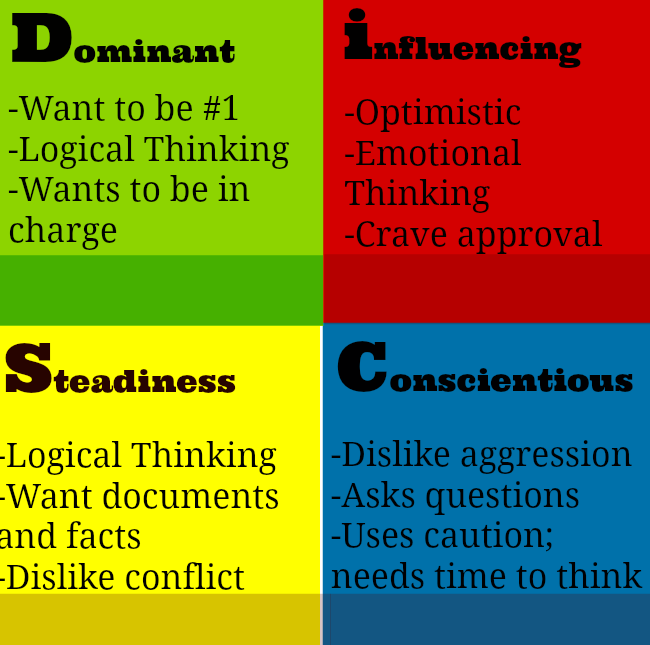
    One of the most popular personality tests around is the MBIT (Myers Briggs) which identifies the strengths and weaknesses of a person’s general personality. There are a bunch of alternatives to the test, but one that works really well with change management is the DiSC Profile, which you can take for free here. The test measures your strengths in four areas: Dominance; Influencing; Steadiness; and Compliance. All of which have different traits associated with them.

    DISC Profile

    Before you attempt to influence another person, you need to have a firm grasp on who you are. For example, if you’re heavily dominant, your natural approach isn’t going to be effective on someone who is compliant. You have to adjust your approach and presentation to your audience.

    Once you understand yourself, know your triggers. As a dominant go-getter, someone who takes a while to process things or lacks energy may really test your nerves in a social situation. Realize this upfront, prepare for it.

    Read; Assess; Adapt & Tweak

    Make it a point to put some time into reading your key influencer. Take special note of the tone in their emails, the speed of their decision making, their general demeanor, etc. These are going to give you clear indications of what personality traits they have, and which you need to play on in order to effectively communicate with them.

    From here, you learn to adapt. Adapting is essentially wrapping the package up. Maybe you thought at first that you would have to have a presentation based on making things less structured to allow for more success. But, you realized you’re in a room with the key influencer who is very compliant; he/she likes configuration and organization. You then have to be ready tweak your strategy to make the presentation more effective and geared towards them..

    Taking On The Role of Consultant

    Regardless of whether you're a hired expert brought on to assess the state of a company or if you're attempting to influence change internally, you're going to be taking on the role of the consultant. As the consultant, it's important that you remain committed to your views and intentions regardless of the initial feedback that you may get particularly if you're trying internally influence change. The key is to look at your key influencer as your client instead of your boss for the purpose of this project.

    If your client (who happens to be your boss) shoots down your ideas and offers a counter plan, you have to be ready to channel some boldness and stand firm in your beliefs. Instead of arguing back and forth or worse, completely backing down because of his/her position above you in the company, you could say something like "I see what you're saying, but if we do it your way, this is what is going to happen", and then lay out how their plan is flawed.

    It's Not The Size Of The Company That Matters, It's the Agility

    When considering the speed and likelihood of a company to change, size shouldn't be the deciding factor. It's seems logical that a larger company would be more difficult to change than a smaller one, but often times it's the smaller company that shows more resistance. Don't let size lead you to any assumptions. Instead, there are 5 key areas that you should take a look at:
    • Risk Tolerance: Regardless of the size, does the company encourage risk? Do they punish risk-takers?
    • Speed of decision making: Is the company bound by politics? Hierarchy? Take notice to how the new hire process happens.
    • Levels of authority: Watch the style of how many people need to weigh in on a decision? When you go to your key influencer, is he/she going to refer the proposed changes to a higher level? Will that level then refer is even higher?
    • Empowerment: There is usually a tendency to refer empowerment higher. empowerment to the next level up. Can you start changing the direction of empowerment down in an organization? What you want to do as a consultant is be able to go in and say something like "Can't this be solved by level 2 instead of going to level 6?"
    • Voice of the customer: Does the organization's customer base see the company as helpful? Are they happy with the customer service? How do they give products? How do they handle product returns? Are they satisfied in general? What's often found is that organizations are more flexible with their external relations than their internal relations.

    Compliance VS Commitment

    Whether you’re doing the influencer or the implementer of change, you’re going to come across two types of people who “sign on” to your changes.

    The Compliant One: The compliant person will sign the documents, put their time in, “do their TPS Reports”, as Matt said in the podcast, punch the clock day in and day out. They’ll do it because they need a job, or are too lazy to leave. Whatever the reason, they’ll make the changes, but won’t really care much about it.

    The Commitment One: The commitment person will simply, “Believe in the TPS Reports”. They’re dedicated to the idea of change and are committed to the success of the company.

    As you have more commitment, the success of your company will be exponential.

    As Bill said; “Find satisfaction in the pursuit of commitment.”

    The best change influencers are those who don’t see people as something they ‘have to deal with’. They’re authentically interested in them, and enjoy the pursuit of the how of change more than the change itself.

    Checkouts

    Bill

    • The Martian by David Weir
    • The Bone Clocks by David Mitchell
    • Managing Transitions by William Bridges

    Matt

    • HabitRPG

    starting a new devops job Mar 14, 2015
    Show notes

    Tonight's episode featured a special guest host, Julian Dunn of Chef.

    Our panel: Ryn Daniels - @rynchantress - a web operations engineer from Etsy. Jake Champlin - @grubernaut - an operations engineer from Minted. (Younger than Trevor!)

    Matt asks Ryn what it was like going to a place like Etsy - the gold standard! - what they expected, and what it was like when they got there. Ryn says that years of reading codeascraft and seeing etsy engineers speak at conferences meant that they were excited to start but also felt a little impostory. "Everyone knows that devops is the internet and the internet is cats - I show up my first day and my desk is covered in cat pictures."

    Jake talks about how devopsdaysPGH was his first tech conference, where he got connected to the community and met his future boss Alex Nobert. Julian asks how Jake got connected to Minted, and Jake talks about Bridget introducing him to Alex and how Minted seemed to have a great culture. Trevor asks what stands out about Minted's culture, and Jake mentions that it's woman-owned and has a strong focus on the product, and how everyone's motivated to make a quality product and it's reflected in your infrastructure.

    Bridget suggests this might be the inverse of Conway's Law, while Matt asserts that most "inverse Conway's Law" discussions just end up proving it. Jake mentions how the community of Minted votes on some products, and the engineering team tries to bring that same excellence throughout.

    Bridget asks Ryn how Etsy's engineering practices influence or are informed by the culture of the company. Ryn mentions Etsy's B-Corporation status, which means they are focused on social good, transparency, giving back to the environment - and that's reflected in a lot of what they do, from codeascraft to blog posts to involving sellers in the community.

    Both guests give a short version of what their company does; Ryn says that aside from the monitoring and sending everyone to Velocity, Etsy is the largest marketplace for handmade and vintage goods. When Jake explains Minted, it's revealed that as "lazy podcasters", we didn't realize that Minted was as artist-focused as it is, providing artists a platform and community - Bridget thought it was primarily for paper goods, while Matt thought it had something to do with money.

    Bridget asks Ryn about their decision-making process to decide that Etsy was right for them. They said that even though Etsy folks they met at Velocity didn't know them, they were welcoming and never condescended to them. (Also, pink-haired thought leadership.) They also admired how Ian Malpass was mentioning at devopsdaysMSP how he wanted to put together a class for effective male allies inside Etsy.

    Similarly, when Jake went to devopsdaysPGH, the way people were open and welcoming is what made him know he was in the right place. (A restaurant-related digression led to a shout-out to Jon Cowie's knife-spork.)

    Matt mentions having the feels and being excited about getting a chance to work with Julian Dunn! and how when starting a new job, when you feel intimidated, people in a good culture are going to reach out to you and make you feel welcome. Julian asks our guests what the experience of starting at one of these devops gigs was like.

    Ryn talks about how starting at Etsy is less-stressful than smaller jobs in the past (since payroll isn't an open question) and then mentioned the engineering rotations that allow new people to "bootcamp" with other teams, to increase understanding across the site. They also mentioned the "first push" program, where everyone (even non-engineers) learns to deploy a change to the site.

    Jake's working remote, and his onboarding process was like being thrown into the deep end of the pool. He felt impostor syndrome at that point. Bridget agrees that it can be an intimidating feeling, and asks Jake how he deals with that. He says that he's working with really smart people and is happy to learn new things every day.

    Trevor asks about cultural cues. Ryn says that they have a chat-heavy culture, and because there are so many remotes, even the in-person team will communicate as if they are remote, so you get to know what's going on with the team and what their favorite cat gifs are. Trevor mentions introducing hipchat to a client and how it caught on quickly. Jake mentions that although only ops and qa are remote, everyone at Minted uses hipchat. Matt believes it's frustrating when there are people in an org aren't on chat, and Jake agrees that having the whole org there (HR/payroll, etc) makes communicating easy, even as a remote employee.

    Ryn: "I do get to sit ten feet away from John Allspaw, so I've got that going for me." Matt: "If you're playing the Arrested DevOps drinking game, that's a drink."

    Julian asks what are some of the downsides of a chat-heavy culture. Bridget mentions that at DramaFever, people have sometimes found chat to be distracting, if people are wanting your attention all day, and Ryn points out that at Etsy, it's considered okay if someone needs to be heads-down working on something, either turning off notifications or signing out of chat. Trevor mentions that working with a global team can mean unintended awakenings from 3am @-mentions, while Ryn and Jake are both in cultures that encourage not having chat on their phones. Bridget says that at DramaFever, the solution is spaces in someone's name so as to not alert them during off hours.

    Jake talks about how being in an oncall rotation instead of being oncall 24/7/365 is great, and after a week of oncall, at Minted they get the next Friday off (and their co-workers will kick them out of chat if they join). Bridget asks Ryn about their blog post on work-life balance, and Ryn says they wrote that about disconnecting, and Etsy also has a culture of asking people to take care of themselves (where they threatened to take away their VPN access because they were working while sick).

    Julian, who reveals he is stranded in Chicago and that's why he is on the show, turns the conversation back to finding good roles and asking what role a recruiter plays. Ryn says that an Etsy person being oncall and troubleshooting during a Sysdrink meetup in New York attracted a number of applicants. That, codeascraft, speaking at conferences - showing what an org does, instead of just saying "we're hiring" - works better.

    Bridget asks them what makes a job a place they know is right for them. Jake says the culture, and working on interesting things with smart people. Ryn agrees, and says that their first week at Etsy they got to start contributing right away. Bridget points out that new people have a power that people who have been there longer can never get back - the power of not knowing how things are "supposed" to be (and the ability to write documentation to better serve a "don't know the answer" POV). Ryn says that breaking Nagios Herald their first week (and then they also got to experience Etsy's culture around blamelessness.) Jake is in a more greenfield situation, and so he was able to start contributing immediately out of necessity.

    Bridget asks for the panel's best advice for people who are interested in a "devops" job, want to find such a job, etc. Apparently the answer is having Bridget introduce you to people and/or convince you that you're totally good enough to work somewhere. [Note from Bridget: this may not scale.] Both Jake and Ryn point out that connecting with the community on Twitter is a really valuable place to start making connections. Matt points out that liking your co-workers isn't so much "nepotism" - you don't have to party with them - but you spend a lot of time with your co-workers, so you're going to want them to be people you don't hate. Matt says, "It's not know the 'right' people, it's just 'know people'." Jake points out that at PGH, Mark Imbriaco and Ben Rockwood spoke to him as if he was a friend, even though they are prominent in the community. Ryn encourages everyone to use Twitter.

    Checkouts

    Ryn

    • git troubleshooting
    • tmate - terminal sharing

    Jake

    • Running Linux on a Mac
    • Helena Nelson-Smith on Mental Overload

    Julian

    • http://usersknow.blogspot.com/2015/02/your-job-is-not-to-write-code.html
    • http://www.isaacchansky.me/days-since-last-new-js-framework/

    Trevor

    • Laphroaig PX Cask Triple Matured Scotch
    • The Book of Mormon
    • How we upgrade a live data center - http://blog.serverfault.com/2015/03/05/how-we-upgrade-a-live-data-center/

    Bridget

    • Fat Bike Birkie - http://www.birkie.com/bike/events/fat-bike-birkie/
    • Bike camping in Napa
    • 30 Days of Biking: http://30daysofbiking.com

    Matt

    • The Goat Farm - Enterprise DevOps podcast by Michael Ducy and Ross Clanton.
    • DevOps Checklist - from our buddy Steve Peirerra

    Docker! Docker! Docker! Feb 27, 2015
    Show notes

    James Turnbull describes Docker as “a solution that is built by people to be usable by people, as opposed to some of the previous containerized solutions which were built by engineers to be usable by a very small subset of other engineers”.

    When you might want to fly less… “when you start to recognize the airport lounge staff and the flight attendants on the New York-San Francisco route and they start to recognize you.”

    James wrote The Docker Book to allow people of varying skill levels to quickly understand how to use Docker and what the practical applications could be for them. It’s intended to be a practical how-to guide.

    At Kickstarter, developers have a dockerized replica of production on their laptops.

    Matt asks if Docker can be only used in completely new deployments designed for Docker from the ground up. James points out that if you have existing infrastructure tools, it’s simple to create Dockerfiles from them.

    The night before 1.0 launched at the first Docker conference in mid-2014, James removed all references to “don’t use this in production” from docker.com.

    James mentions that Fig (soon to be renamed to Compose) helps with modeling multi-tier architectures locally.

    James says, “People kinda forget the past and go, “oh my god Docker’s a pain in the ass to use”, and I’m like “compared to what, exactly? Compared to your previous build, or compared to you shipping around 10 ISO files and running Vagrant and 20 VMs on your local machine?”

    He continues, “It wasn’t that long ago that the dark ages were real. I’m not suggesting that Docker’s a panacea, but it’s certainly a step in the right direction.”

    James points out that something like Elasticsearch does well in Docker, since “it’s a bit of a fiddly thing to build, with the right version of the JVM, right version of Elasticsearch, prepping all the data, etc”.

    James highlights continuous integration as a “sensational combination” with Docker.

    On the controversy, James points out there will always be hype and people claiming “this is a revolutionary technology that will cure world hunger”. He says, “I’m fond of saying that Docker is a powerful tool to help you in your development life cycle [...] not every workload in your data center is well-suited to Docker.” James doesn’t make technical architecture decisions based on the writing of tech journalists or blog posts, but rather by testing and evaluating the relative merits of a given solution.

    In the case of Graphite, James would run carbon-relay and carbon-cache inside Docker containers, but he’d point them at a physical machine with SSDs to actually write the whisper files.

    Matt read a blog post and reactions on reddit and wanted to see what James thought of the concerns around security and operability. James points out that empathy for developers is something sysadmins need to cultivate, because you don’t manage infrastructure for infrastructure’s sake.

    James points out that the main reason developers ship code that doesn’t work in production is that they have no fucking idea what production looks like because there’s this grumpy asshole that manages production and they’re terrified to go ask them a question. Bridget says that as such a former grumpy asshole, she’s much happier when the devs aren’t afraid to talk to her.

    James mentions that Docker containers are not virtual machines and should not be used to separate security concerns, and you should secure the host the containers are running on.

    Matt: “I’m not suggesting that this [security concerns] is why DOCKER BAD…” Bridget: “Race conditions with devicemapper is why DOCKER BAD.”

    James: “[PCI/DSS] is a low bar. If you followed simply the regulations for the compliance stuff that related to PCI/DSS, you would be running a massively insecure system.”

    James points out that “owning” the standard gives one access to the marketing around an ecosystem. He also thinks that even if Rocket is a better technical solution, Docker has more traction.

    Bridget: “So when I feel ranty about Docker and devicemapper, I should submit some pull requests.” James: “You should talk to Michael Crosby... Michael Crosby is currently in San Francisco somewhere going you motherfucker.”

    James sees Amazon and Microsoft’s embracing of Docker as a great driver of revenue towards these cloud providers, if it gets developer code to production faster. They aren’t following hype; there are transparently obvious business reasons to do it.

    In terms of skating to where the puck is going to be, James suggests looking at orchestration, software-defined networking, software-defined data centers - people building that sort of thing with Docker components. Docker Compose, Docker Swarm, people moving up the stack to manage different levels of abstraction.

    James: “I challenge you to find a LAMP stack site where 80-90% of the configuration files aren’t identical - our secret knowledge of what to tweak isn’t as valuable as we think it is.”

    Check outs

    James

    • Jason Dixon’s Monitoring with Graphite book
    • The Art of Monitoring - James's upcoming book

    Bridget

    • Spent a week with my Philly & NY co-workers, went to the 3rd annual DramaFever Awards show, sang more off-key karaoke.
    • Docker to Ducy Chrome plugin

    Matt

    • Was in PDX for the first time last week for Agile Open Northwest. Led an improv open space. Got a tattoo. Met the founder of Voodoo donuts winding a clock. Such hipster. Very Portland.
    • kitty gem
    • Better Call Saul - new AMC show

    DevOps in a Microsoft World with Jessica DeVita and Jeffrey Snover Feb 13, 2015
    Show notes

    The GUI as Strength and Weakness

    Jeffrey Snover, a Distinguished Engineer and lead architect for Windows Server and System Center at Microsoft, found DevOps through John Willis's podcast and Gene Kim's book and "fell in love with it." Jeffrey says a lot of it was familiar, since Jeffrey wrote the Monad Manifesto behind PowerShell in 2002, and that it echoes the quality revolution of the 1980s at Storage Technology. Jessica DeVita, a technical evangelist at Microsoft, runs IT camps where Jessica talks to traditional enterprise IT people about configuration management and version control. Jessica says the IT pros at those camps are frustrated after being promised solutions that haven't worked, can't tell "the wheat from the chaff" among tools, and often work in environments that aren't supportive of the person at the console.

    Jeffrey says Microsoft's strength in GUI tools is also its weakness, because "it's very hard to share a bunch of mouse clicks." Deployment guides run to huge books of screenshots that say click here, and the PowerShell equivalent is a page and a half. Some people love the change, and others hoped they were done learning. Jeffrey's advice: "If you don't want to learn anything new, get into the lumber business," since in IT "you're riding the tiger."

    The Body Follows the Head

    Asked about Microsoft's turn toward open source, Jeffrey says "organizations are like gymnastics: the body follows the head." A new CEO brought a fresh approach of meeting customers where they are, and for people who'd been trying to do this for years, it had not been a friendly environment before and now is. Jeffrey's way of explaining it to skeptics is Azure, where Microsoft makes more money from 10 Linux instances than from 2 Windows ones, and its services are REST APIs usable from anything. Microsoft, Jeffrey says, is "becoming a no-adjective software company." Jessica, who joined a couple of months after the new CEO, says the open source community has cultural lessons to teach the enterprise.

    Jeffrey says this is the beginning of a long journey, with things already open like OMI and Desired State Configuration, and that the only reticence Jeffrey has seen is "here's all the things on my plate." Jeffrey adds that Microsoft is "incapable of sustained error": it screws up constantly, but people call each other out without firing anyone, which works like an immune system. Matty ties it to the blamelessness episode, number 28.

    Why Not Group Policy or SCCM?

    Matty says every way Microsoft has told Matty to configure Windows servers has been tried. Jeffrey agrees that Group Policy and SCCM exist and are good for enterprise client management but not for the data center. Jeffrey also recalls a Passport server admin who set a policy with no way to tell which servers got it. Desired State Configuration is focused on a DevOps way of configuring servers, and says the architecture won't be compromised to serve clients. An executive once told Jeffrey to solve server configuration management, which Jeffrey called impossible, since every group thought of itself as its own CTO. Jeffrey's guide is the DevOps line that "scale times complexity exceeds our skill set," so it has to be "simple, simple, simple."

    Jeffrey wanted a platform that could configure everything in the data center, including Linux, routers and storage, and that others could build on. Why not Chef or Puppet? The core difference, Jeffrey says, is that Unix is document-oriented and Windows is API-oriented: bringing awk, grep and sed to Windows, which Jeffrey once tried, didn't help, since they don't work against the registry, WMI or Active Directory. The exception is IIS, which is why Matty says the IIS cookbook is so good. Matty adds that ConfigMgr is "a big database," which you can't version and can't treat as code, and that a common language between devs and ops lets people pick up 80% of Chef or DSC quickly.

    Getting People Off Click-Next

    Jessica says the challenge is Windows admins who've lived in the GUI and never developed command line skills, a generalization. Jessica likes that Server 2012 R2 shows the PowerShell before the Finish button, so you can copy it and learn, and says more of that is needed. Trevor asks about places still on 2003 and 2008, and Jessica says "you should just already love PowerShell," calling it a different podcast. Matty's line is that it's called PowerShell, not PowerScript. It's not a scripting language but how you interact with a system, so start by telling someone to "crack open a PowerShell prompt and type this in."

    Jeffrey points to Don Jones's PowerShell in a Month of Lunches and a Microsoft Virtual Academy course, and tells managers to promote and reward the people who are moving you toward repeatable, automatable IT: "If you're going to retire in the next 3 years, like, forget it, you know, just click next and learn, you know, practice Bridge." Matty says there are still jobs for AS/400 admins, but it would drive Matty crazy. Jessica says automation buys time, "the real currency," and captures what a brilliant sysadmin figured out so nobody has to keep rediscovering it, "a way to really version control your culture," which Jeffrey answers with "I like that."

    Undifferentiated IT and Healthy Fear

    Jeffrey doubts the click-next jobs will last, since if you're offering undifferentiated IT, the cloud will offer it cheaper, more securely and with better data protection. But if you understand the mission and provide differentiated IT, "you're printing money for your company," and they won't take a generic cheeseburger from the cloud. Jessica says the fear should be of more interesting things: automation is what people should learn, and companies will hire you to automate their infrastructure.

    Jeffrey goes further: "fear, uncertainty, and doubt, these are your friends." Jeffrey tells of a karate student whose hands kept dropping until the instructor decked the student once. Jeffrey is a college dropout who comes in every day with imposter complex, and responds by working hard and performing. Jessica dropped out too, and Trevor says dropping out seemed to mean never succeeding in technology. Matty: "Is there ever anyone on this show that has a degree?"

    The Best Tool, or the Safe Bet

    Matty asks how to help people who avoid non-Microsoft tools, like Lync versus HipChat for ChatOps or SCOM versus Nagios, on the "nobody got fired for buying IBM" theory. Jessica says chat culture matters more than the tool, and uses Yammer. Jeffrey says some parts of Microsoft got DevOps in focus earlier than others, that as more teams run their own services they demand better tools, and that with about $10 billion a year in R&D, "we can move fast." Jeffrey teases what's coming.

    Jeffrey also argues that the best tool has to be around next year. Jeffrey worked at Digital Equipment, Apollo, Greystone, Royce Data Systems and Storage Technology, and "zero of those guys are around." Jessica says weighing whether a tool would last was always part of the job as a consultant, checking who the founder is and where it's hosted. Matty's answer is to pilot: make a small experiment with people who are on fire about the goal, the way Agile was introduced, and Matty cites the GE story from ChefConf. Jeffrey offers a dissent about letting teams choose freely, because a developer's Erlang, or an inherited product at Digital written in 18 languages including Ada ("Brad took the night course in Ada"), is a mess when that person leaves. Jessica says a language is a different level of impact than a chat tool.

    The WinRM Question

    Matty asks on behalf of Brian Barry of the Food Fight Show why you can't copy a file to a server over WinRM. Jeffrey says someone is prototyping it, and that the performance can be terrible compared with SMB, and tells Matty to come talk at Build and Ignite. Matty says it will do as a minimum viable product.

    Discussion Outline

    What are some of the challenges traditional Microsoft IT Pro’s deal with moving to a more automated DevOps pattern?

    • Jessica:
      • Hard to tell which tools are really going to make their lives easier.
      • Are the cultures of the companies benefiting the human side of the IT Pro?
    • Jeffrey:
      • Because Microsoft has great GUI tools, they become the biggest strength and weakness of the DevOps/IT-Pro
      • The process of using a GUI is much harder to replicate in documentation. Because most of the community uses powershell commands, Microsoft IT-Pros really need to get on board.
      • IT-Pros are never done with learning. If you don’t want to learn anything new, get into the lumber business.

    Microsoft has been making more open source integration moves, and changing philosophies to accept the Open Source community. “What up with that?”

    • Jeffrey: “The body follows the head”
    • It helps when you have a leader with a fresh approach who focuses on customer service and helping users within the community
    • Jessica: It is really exciting to get behind a leader that is welcoming to the communities.
    • It is refreshing to see Microsoft becoming a software company, not a “Windows software company”
    • Microsoft wants you to be successful. Tools such as RESTful APIs are becoming available across all OSs.

    What is the acceptance level of the OpenSource movement within Microsoft?

    • Jessica: Whatever you’re running, we can host it for you

    Traditional Configuration Management in Microsoft has been difficult. What are the plans?

    • Steve Morowski (http://stevenmurawski.com/) has good info for those interested in DevOpsing with Windows.
    • Current Microsoft tools are really good for enterprise, client management. Not so good for data center management.
    • We need something different, that is simple, and usable.
    • The problem is, everyone wants to do configuration their way. They want to be the CTO of their servers.
    • Jeffrey describes the creation, and idea conception of a Microsoft Configuration Management platform that takes into account the deep differences between Linux, Unix, Windows. Describing different tools currently available, their faults, and how they might be able to connect them for modern, DevOps oriented, Configuration Management.
    • The ability of chef and puppet, etc. are beneficial because of the ability of devs to pick it up, version it, and insert small parts of just what they need into the configuration.
    • Jessica: We are getting to the point where Microsoft DevOps engineers are adapting the powershell. Until the powershell is adopted by IT-pros, modern DevOps tools will be a difficult push.
    • You should already love powershell.

    How can people get more comfortable with powershell?

    • Matt: It is not a scripting language. It is the way you interact with a system. Don’t write scripts in bash, write commands in bash that emulate the scripts.
    • Jeffrey: Don Jones: Powershell in a Month of Lunches (http://morelunches.com/2011/04/01/learn-windows-powershell-in-a-month-of-lunches-1st-ed/) Step by step people get it, or they don’t. Managers really need to promote and reward the people giving you the IT that you want.
    • Poweshell makes your environment repeatable, automatable, stable, etc. It is the future of the IT pro, and people must adopt it.

    Are we automating ourselves out of jobs?

    • Jeff: The cloud is a great, cheap place to offer undifferentiated IT, however, if you can provide differentiated IT you are practically printing money vs. the cloud.
    • Jessica: We do need a healthy fear. Not of automation though. Be scared of more interesting things. You need to learn automation.

    How do we work with Microsoft when its just not the best for DevOps-ing?

    • As more people us Microsoft, the more Microsoft changes. Jeff discusses the many ways in which Microsoft is using flexible R&D to make a push for DevOps tooling, as well as some tools coming down the pipeline.
    • Jessica: When choosing a tool, the longevity of the tool and the community around it is critical.

    Why can’t I copy a file to a server using WinRM?

    • Jeff: Come talk to me at ‘Build and Ignite’.

    Checkouts

    Jessica

    • The SoCal Linux Expo - Scale13 - a DevOps day Feb 20th - she has a discount code
    • The Field Guide to Understanding Human Error (Dekker)
    • Lean Enterprise book (Jez Humble)

    Jeffrey

    • Hardcore History podcast - I’m in love with this podcast. Dan Carlin is an awesome storyteller.
    • Brain Science Podcast - (Cool podcast about the brain. I was just telling someone about this today)
    • http://www.microsoftvirtualacademy.com/training-courses/getting-started-with-powershell-3-0-jump-start This is the start of a 2 day training session on using PowerShell. It is one of the most widely viewed jumpstarts ever.
    • http://www.leeholmes.com/blog/2011/04/01/powershell-and-html5/ One of my all time favorite PowerShell scripts.

    Trevor

    • FCC Ruling on broadband
    • Windows 10 on Raspberry Pi 2

    Matt

    • Kitchen-windows is almost a thing! If you want to play with it, check out the Windows cookbook at http://github.com/opscode-cookbooks/windows
    • BitTorrent Sync - http://www.getsync.com/
    • Yes, Please by Amy Poehler

    Hiring in a Post-DevOps World Jan 23, 2015
    Show notes

    A Job Description Nobody Agrees On

    The episode was prompted by Josh Hertz, a self-described professional rabble-rouser and the sysadmin for a podcast, ranting to Matty about job postings that want ninjas and rock stars. The panel is Mike Fiedler, Director of Technical Operations at Datadog, and Jill Jubinski, who manages technical recruiting at DigitalOcean. Mike says the biggest hiring problem is that the job description is "entirely too wide and hazy," because everyone uses words nobody agrees on: we want 20 years of Docker experience and every DevOps tool, and someone who's capable of everything and amazing at anything. Post for DevOps when you want a build engineer, and you get contention. Jill says the word means support at some companies, engineers at others, and developers at others, so you have to understand what the job actually needs "and not just have all those crazy buzzwords."

    Matty repeats the observation that nobody in Chicago hires sysadmins anymore, only DevOps engineers whose descriptions read as sysadmin jobs. Matty once spent 25 minutes in a cab explaining to a contract recruiter why the posting was bad, and says the name doesn't matter, just describe it: "no, we use Jenkins."

    The Sysadmin Badge

    Mike says at some point in the last decade the title system administrator "became a dirty, dirty badge." You can't study for it, Mike adds, and the sysadmins of the corporate mail and web servers "hated everybody because running a mail server is usually not very much fun." When companies needed operational mindsets, they reached for a new term. "Not only can we be a DevOps, we can be a DevOps ninja."

    Josh says the start was as a sysadmin, moving to systems engineer when designing systems to scale began, and that DevOps suggests you're doing continuous integration and configuration management. Matty says system engineer wasn't just a nicer word for sysadmin, but that sysadmin became a "server janitor" title.

    Ninjas, Rock Stars, and Heroes

    Matty cites a Reddit user on r/devops: "ninja and rock star are code words for you will be one person doing the job of an 8-person team." Mike says a rock star is one person in the spotlight supported by a band, so what Mike wants is "a tenor in a choir." Josh suggests a session musician, and Matty says you don't want "a DevOps Axl Rose." Jill says the words conjure hiring that one difficult person on your team, and that what teams need is a team player.

    Jill and Mike discuss hiring someone a step above the team. Jill likes it if they share knowledge and raise everyone, and Mike's point is that it's how you frame it to the team: if you're telling everyone else they're now second string, that's a terrible message. Matty says a 10th Magnitude ad Matty came across was rewritten to say they're not hiring ninjas, rock stars or unicorns, just really good developers, winking at the cliché.

    Matty adds that rock stars signal hero culture, and points to Jennifer Davis's talk "From Hero to Zero." Mike says there's a time for it: a three-to-eight-person startup's first ops hire may need the hero who'll work 120 hours a week. At a company with a 30-person operations team, though, the hero is "quickly going to be not as popular amongst their peers."

    Recruiter Fail

    Jill reaches out to 15 to 20 engineers in a given week, each with an email special to them, and says mass emails come from agency recruiters, where "it's all about numbers." Josh asks if targeting works and Jill says absolutely: people are more receptive, and the aim is to build a network so that when your friend is looking, "you'll think of a non-shitty recruiter."

    Matty's LinkedIn says Matty loves the job and has zero interest in any opportunity, and a recruiter who had clearly read the profile replied that people write that to lay low for their employer. Mike says recruiters who do a cursory Google and then send a Ruby on Rails front-end job to someone who isn't one are basically sending spam, and that nine times out of ten those emails get ignored. Jill says engineers on the team forward funny recruiter emails, and that Jill sometimes cold-emails coworkers a Drupal job for a laugh. Matty stays in touch with the polite recruiters who ask for five minutes of help, even if they've never placed Matty.

    What Candidates Get Wrong

    Jill says resumes full of buzzwords and things you touched but didn't dig into get figured out, and Mike says to be honest: three lines of Perl doesn't make it a skill, and if the interviewer asks about something esoteric and you flounder, the phone screen is "going to take a nosedive." Trevor adds that if you say you don't know something in the first interview, don't act like an expert an hour later, "because the interviewers do talk to each other." Josh interviewed someone who listed expert on the OSI model and named three of the seven layers, and Matty's response is that in baseball that would be a good batting average.

    For interviews, Matty tests whether you understand things, not whether you remember every tar flag. Trevor learned that whiteboarding isn't about the right answer but how you get anywhere, and Mike's question is one with no right answer where Mike keeps throwing monkey wrenches to see how you handle adversity. Jill says smart organizations hire for critical thinking and problem solving, since tools like Chef and Go change in three months. Josh says DevOps is knowing what you don't know. Jill's pro tip: "If you don't know something, admit you don't know it. Don't make it up."

    Culture Fit and the Resume

    Matty asks how to convey a DevOps mindset in a resume. Josh says listing "problem solver" and "self-starter" doesn't help, and Mike says it comes out in interviews, where the interviewer poses the right questions and the whole team talks to the candidate. Trevor points out that a bad resume never gets you in the door, and Matty's answer is to skip the adjectives and show what you did, such as any experience working across silos.

    Jill wants to see open source contribution, and Matty says you can at least do something small like whitespace fixes. Mike says junior DevOps people rarely have the experience, so Mike would read an objective statement as why you want ops and not development. Mike suggests tailoring several versions of your resume to the company, and Jill's related pet peeve is a candidate whose materials say they want to work at Google when Jill works somewhere else. Josh admits Josh's own summary reads "a DevOps rock star, 10x pirate ninja," which is "100% snark."

    Check-Outs

    Jill

    • Beer: http://www.beeradvocate.com/beer/profile/45/680/
    • Newest obsession: Rowing class: http://www.cityrow.com/ (there are probably many others outside of NYC)

    Josh

    • I’m officially the SysAdmin for Caustic Soda, which is a podcast about horrible things. It’s like Mythbuster for all that is gross and horrible. Now that I think about it, I can’t recommend it.
    • Influxdb is an open-source, distributed, time series database with no external dependencies. Currently in Alpha (v0.8.8) it's going through a major refactor, the "production ready" version v0.9.0 is due out this month. The ease of installation and setup is what sold me on it. I think it has a lot of potential, so we'll see how v0.9.0 looks when it's released.
    • The Bruery: Briefly mentioned. Small batch, high quality beers out of Placentia, Ca. Their barrel aged and sour beers are outstanding. I recommend Loakal Red as the gateway beer for those that like IPAs.

    Mike

    • http://www.opsschool.org
    • Tubes: A Journey to the Center of the Internet, Andrew Blum
    • The No Asshole Rule: Building a Civilized Workplace and Surviving One That Isn't

    Matt

    • Elevate - brain training app
    • Doing the fitbit thing again. We can be buddies. http://mattstratton.com/fitbit

    Trevor

    • The Decemberists: What a Beautiful World, What a Terrible World. They're back!
    • Microsoft reviews pull requests for C# from github
    • Walking around your neighborhood. Discovered a new spice shop and comic shop by wandering North.

    Incidents and Accidents: Examining Failure Without Blame Jan 16, 2015
    Show notes

    Dave is at Next Big Sound, which does analytics for creative industries, and he’s seen a few orgs handle failure well, and a lot of organizations handle it poorly. He got interested in blameless postmortems and human factors in discussions with John Allspaw of Etsy, and Allspaw influenced him to read the work of David Wood and Sidney Dekker on human factors. He is writing a book for O’Reilly called Being Blameless.

    MCR works at Etsy now, but has spent a lot of time consulting at various firms where he’s seen failure handled with blame. He points out what Rt. Lieutenant Colonel Scott Snook said in Friendly Fire, a book about when two US helicopters were accidentally shot down, that failure is part of complex systems.

    MCR: “I work at Etsy, and that’s what we do - we examine failure as a learning opportunity.”

    Dave is running his next workshop on Awesome Postmortems in NYC on February 12th, in which

    Dave: “Sidney Dekker’s Field Guide to Understanding Human Error is probably the most important book for people like us, meaning people that are in the IT world - it’s very accessible and gives lots of examples from fields outside of IT, but they’ve very relevant to what we do.”

    MCR: “Failure is gonna happen. It’s not a matter of if something is going to fail, it’s a matter of when it is going to fail.”

    MCR mentions the different categories of failures - those that “fail closed”, that are easy to detect, like disk filling up, and “fail open” - the surprises. He mentions some of the techniques Etsy uses - an IRC warroom, Vidyo video chatting, to resolve an immediate issue. After the immediate issue is solved, the learning begins.

    MCR: “We celebrate failure as much as we celebrate success here. [...] The three-armed sweater is given to the person who most spectacularly impacted the website in the year.”

    On the topic of why to do a blameless postmortem, MCR points out that it’s for learning, and there are both technical and human factors. Dave points out that blaming a person short-circuits the learning. Claiming that a person is the cause of the outage feels like a good story, but it’s not true.

    Dave discusses root cause and mentions Allspaw’s excellent blog and a specific post about there being no such thing as a root cause, and Dave disagrees. He believes that outages are caused by change, and the systems with which we work are fundamentally changeable. “The impermanence of systems is the reason that they both function and malfunction.” Mike counters by saying, “Is there really a root cause for something that failed? If a hard drive dies, it’s the same hard drive. It hasn’t changed.” They both agree that it’s a philosophical rabbit hole.

    MCR notes that as Etsy grows, they’ve found that user-impacting, service-degrading issues are when they do postmortems, and even if not user-impacting, if they can learn from a failure it’s worth doing one. Dave says, “The more we learn about the complex systems within which we work, the better we’re able to operate them.”

    Within a week or two, according to Dave, is common practice of a time in which do the postmortem. MCR mentions that it’s important to write down the timeline almost immediately, definitely within a day or two, but doing it while someone’s amygdala is still triggered (and they are upset) is too soon. Dave points out that the facilitator of a postmortem sets the tone, including reminding people of hindsight bias, and at Next Big Sound they use a specific framework document which Dave will share. He also mentions defusing stress with empathy and humor.

    On the topic of evaluating anything you do, MCR mentions that Etsy created Morgue because any department across Etsy can apply these techniques to learn. Dave points out they do retrospectives as well as prospective review at Next Big Sound. MCR says Etsy does both an architectural review and an operability review ahead of time. Dave mentions that answers in prospective reviews can be biased in a positive way, whereas in a “premortem” we imagine things going badly, and try to determine what could lead to that: in essence, harnessing hindsight bias to work for us.

    Bridget forgets what decade it is and claims to have seen a presentation at devopsdays 2003. That would have been a nifty trick, since the first one was in 2009. :)

    Check Outs

    Dave:
    • Field Guide to Understanding Human Error, Sidney Dekker - new edition just came out Dec 28th, 2014!
    Mike:
    • http://www.bsr.org/en/our-network/member-list
    • http://solutions.3m.com/wps/portal/3M/en_US/NA-DataCenters/DataCenters/Solutions/EfficiencySustainability/ImmersionCooling/
    • Etsy's postmortem tool Morgue
    Bridget:
    • Did a lot of reading last week! Beside the aforementioned Dekker book, I read Web Operations (edited by John Allspaw and Jesse Robbins), Jon Cowie’s Customizing Chef, and the first three chapters of Jason Dixon’s Graphite book. All good stuff.
    • The Boundary Waters Canoe Area is great in the winter too: I like Gunflint Lodge: http://www.gunflint.com/
    Trevor:
    • I was on vacation and delightfully disconnected. It’s been pretty awesome. Got a new Kindle and have been reading Game of Thrones before Matt accidentally (though at this point it’s my fault) spoils something.
    • Set up kegbot at our new office, will be doing it’s grand opening later today :) Metrics about office beer / root beer consumption to come!
    Matt:
    • Been on vacation, which is great. Doing the Dadops thing although I was sick for most of it, which was not delightful. However, I did see Big Hero 6, and Trevor was right about that.
    • Book I’ve been listening to on audiobook is The Challenger Sale by Matthew Dixon and Brent Adamson http://www.amazon.com/The-Challenger-Sale-Customer-Conversation/dp/1591844355

    Previous 1 16 17 18 19 20 21 Next

    Related Podcasts

    Know How… (Video)

    1

    Know How… (Video) Education
    JavaScript Jabber

    2

    JavaScript Jabber Education
    Programming Throwdown

    3

    Programming Throwdown Software How-To
    Software Engineering Radio – the podcast for professional software developers

    4

    Software Engineering Radio – the podcast for professional software developers Software How-To
    The Changelog: Software Development, Open Source

    5

    The Changelog: Software Development, Open Source How To
    Coding Blocks

    6

    Coding Blocks Software How-To
    footer-logo

    Contact Us

    Toll Free: 844-670-7747

    Links

    • Home
    • Top Charts
    • Networks
    • Apps
    • Independents Podcasts
    • Podcast Advertising
    • Podcast News
    • Contact Us
    • About Us
    • Analytics & Insights

    Stay Connected

      Privacy, Terms of Use & Our Code of Ethics Protecting Content Creators Copyrights