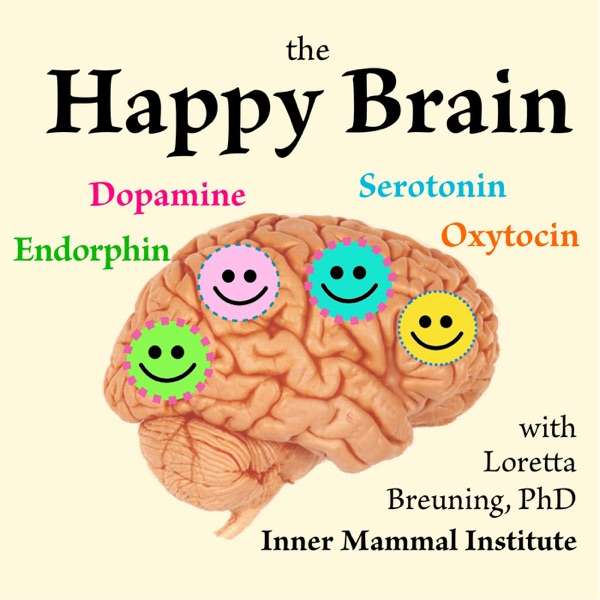
The Happy Brain

Do you wonder what stimulates your happy brain chemicals- dopamine, serotonin, oxytocin, endorphin? Answer your questions with these lively conversations between Loretta Breuning and real readers of her book, Habits of a Happy Brain: Retrain your brain to boost your serotonin, dopamine, oxytocin and endorphin levels. Still have more questions? Read the book and be a guest on the show yourself! Contact Dr. Breuning and learn more about her work at the Inner Mammal Institute at: InnerMammalInstitute.org.

The brain chemicals that make us feel good are inherited from earlier mammals. They evolved to do a job, not to make you feel good all the time. When you know the job of each chemical in the state of nature, your ups and downs make sense. More important, you can re-wire yourself to enjoy more of them in sustainable ways.

But it’s hard. Our brain is designed to release happy chemicals to reward steps that promote survival. But our brain defines survival in a quirky way: it cares about the survival of your genes and it relies on neural pathways built in youth. To make things even harder, our brain habituates to the rewards it has so you always have to do more to get more happy chemicals.

We are not born with survival skills like our animal ancestors. Each newborn human wires itself from its own early experience. Happy chemicals are like paving on your neural pathways, wiring you to repeat behaviors that made you feel good before. This is why our urgent motivations don’t make sense to our verbal brain. It’s not easy being mammal!

When you know how your brain works, you can find healthier ways to enjoy happy chemicals and relieve unhappy chemicals. You can build new neural pathways by feeding your brain new experiences. But you have to design the new experiences carefully and repeat them a lot.

The Inner Mammal Institute has free resources to help you make peace with your inner mammal: videos, blogs, infographics, and podcasts. Dr. Breuning’s books illuminate the big picture and help you plot your course. You can find new ways to feel good, wherever you are right now.

Music from Sonatina Soleil by W.M. Sharp. Hear more of it at InnerMammalInstitute.org/musicbywmsharp

Respiratory Care Podcast

RESPIRATORY CARE podcasts have moved. Please find our content on Libsyn.

Creation Update 2.0

A unique apologetic perspective on scientific discoveries

Deep Convection

A Podcast About Climate, Science, and Life. https://deep-convection.org/

Forestcast

Explore the largest forest research organization in the world alongside scientists studying, questioning, and solving some of today’s most compelling forest issues. Through stories, interviews, and special series, learn what’s happening in your forests, and where those forest ecosystems might be headed.

Season 4: Afire
A 360-degree introduction to fire from a scientific standpoint. The story of how fire research shapes our landscapes and our lives.

Season 3: Women of Research
Highlighting women’s perspectives in research over the past 50 years, scientists share stories of mentors and mentorship, motherhood, rural and urban stewardship, passions for science, leadership, and beyond.

Season 2: Backcross
As non-native insects and diseases threaten ash, elm, and chestnut trees, chemicals and biological controls only offer temporary protection. Dive into the double-stranded story of tree species restoration and resistance breeding alongside the scientists working towards a long-term solution, a long-term resistance.

Season 1: Balance & Barrier
More than 450 non-native insects have invaded our forests and urban trees since European settlement. Come explore stories of the Asian longhorned beetle, emerald ash borer, spongy moth, and hemlock woolly adelgid, as well as the scientists studying and combating these pests.

EXTRA: A Window of Resurgence for Red Spruce:
In the 1970s, red spruce was the forest equivalent of a canary in the coal mine, signaling that acid rain was damaging forests and that some species—especially red spruce—ere particularly sensitive to this human induced damage. In the course of studying the lingering effects of acid rain, scientists came up with a surprising result—decades later, the canary is feeling much better.

EXTRA: The Two-Sided Story of Periodical Cicadas:
Two scientists—one who’s tracked the aboveground movements of cicadas, and another who’s unearthed the belowground impact of these insects—take you inside the many mysteries and forgotten elements of these evolutionary enigmas.

EXTRA: Flying the Nuthatch Home:
Once spanning nearly 6 million acres in Missouri’s Ozarks, the shortleaf pine and oak woodland ecosystem has dwindled to 100,000 acres today. Along with the loss of this habitat, a bird—the brown-headed nuthatch—disappeared as well. However, after decades of woodland restoration, the brown-headed nuthatch has returned to Missouri—by plane.

Discover more at fs.usda.gov/research/products/multimedia/forestcast

What started as a podcast produced by the Northern Research Station focusing on the Northeast and Midwest has now expanded to cover a wide range of forest topics from across USDA Forest Service Research and Development.

Forestcast is an official USDA Forest Service podcast.

Questions or ideas for the show? Connect with Jon at jonathan.yales@usda.gov

New Books in Language and Translation

This podcast is a channel on the New Books Network. The New Books Network is an academic audio library dedicated to public education. In each episode you will hear scholars discuss their recently published research with another expert in their field.

Discover our 150+ channels and browse our 28,000+ episodes on our website: ⁠newbooksnetwork.com⁠

Subscribe to our free weekly Substack newsletter to get informative, engaging content straight to your inbox: ⁠https://newbooksnetwork.substack.com/⁠

Follow us on Instagram and Bluesky to learn about more our latest interviews: @newbooksnetwork
Support our show by becoming a premium member! https://newbooksnetwork.supportingcast.fm/language

The Genomics Life

Behind the scenes stories of the people, their innovations, and exciting work in the field of genomics

The ASCO Post Podcast

News and views from the world of clinical oncology and hematology.

Naked Oceans, from the Naked Scientists

From seagrass to sunfish, dugongs to diatoms, Naked Oceans uncovers the hidden secrets of the sea. Join us in conversation with top marine experts as we explore the latest ocean science and conservation and answer your aquatic questions.

NephTalk

We’re in patient care – and we want to talk about it with you! That’s the simple foundation of our new podcast-leading discussion forum, NephTalk. And it’s just for Nephrologists.

NephTalk will deliver relevant and intriguing podcast interviews and reports that highlight patient stories, industry advancements and Nephrologist best practices.