Episode #196 – What Wealth Is
Oct 14, 2026
Show notes
Most people misjudge Bitcoin because they have never been given a working definition of wealth. David Deutsch's is the set of transformations you could perform without generating new knowledge, and it explains why a million dollars on a deserted island buys almost nothing, why no fortune in 1924 could buy a cure that didn't exist yet, and why holding a fixed share of a ledger gets more valuable as other people solve problems.
Episode Summary
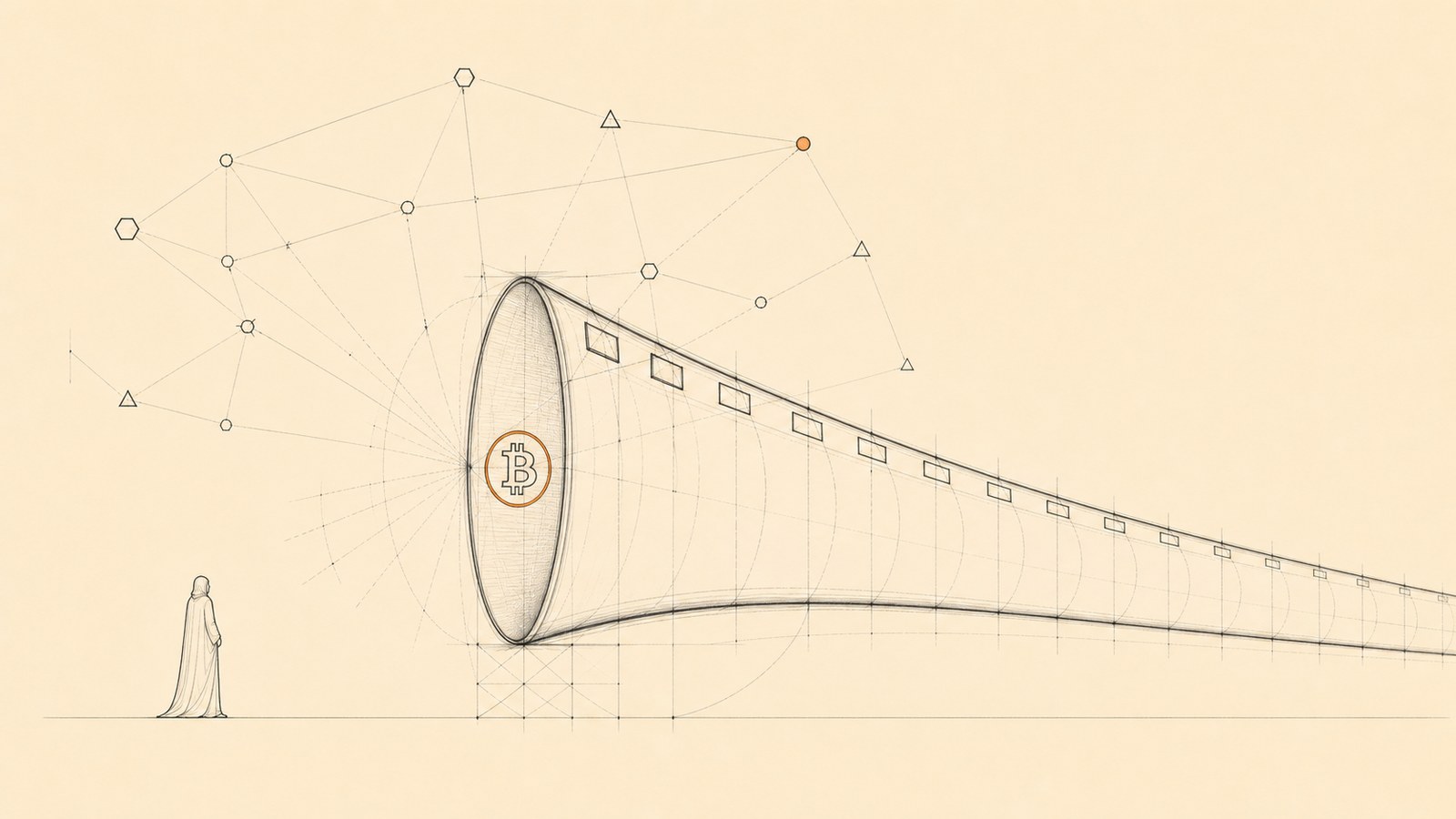
David Deutsch defines the wealth of an entity, in his 2012 paper Constructor Theory, as the set of transformations it could perform without generating new knowledge. That sentence is the best definition of wealth this show has come across, and the episode argues that its absence is what holds most people back from understanding what Bitcoin will do to the extended order, Hayek's name for the collective of people who generate and share knowledge they could never hold individually. Without a definition, money looks like a score to be accumulated. With one, money becomes a tool, and a tool can be judged by what it lets its holder do.
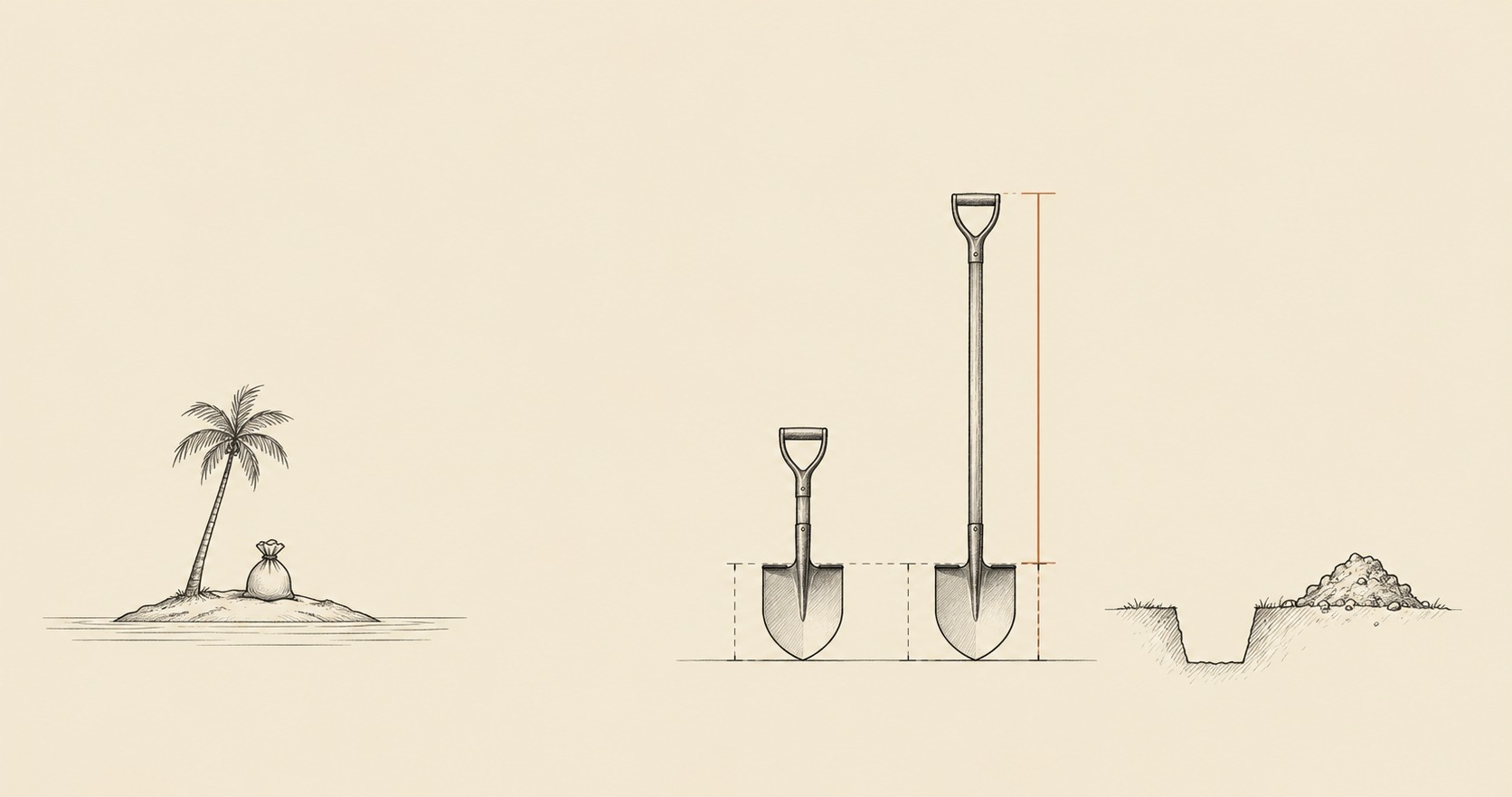
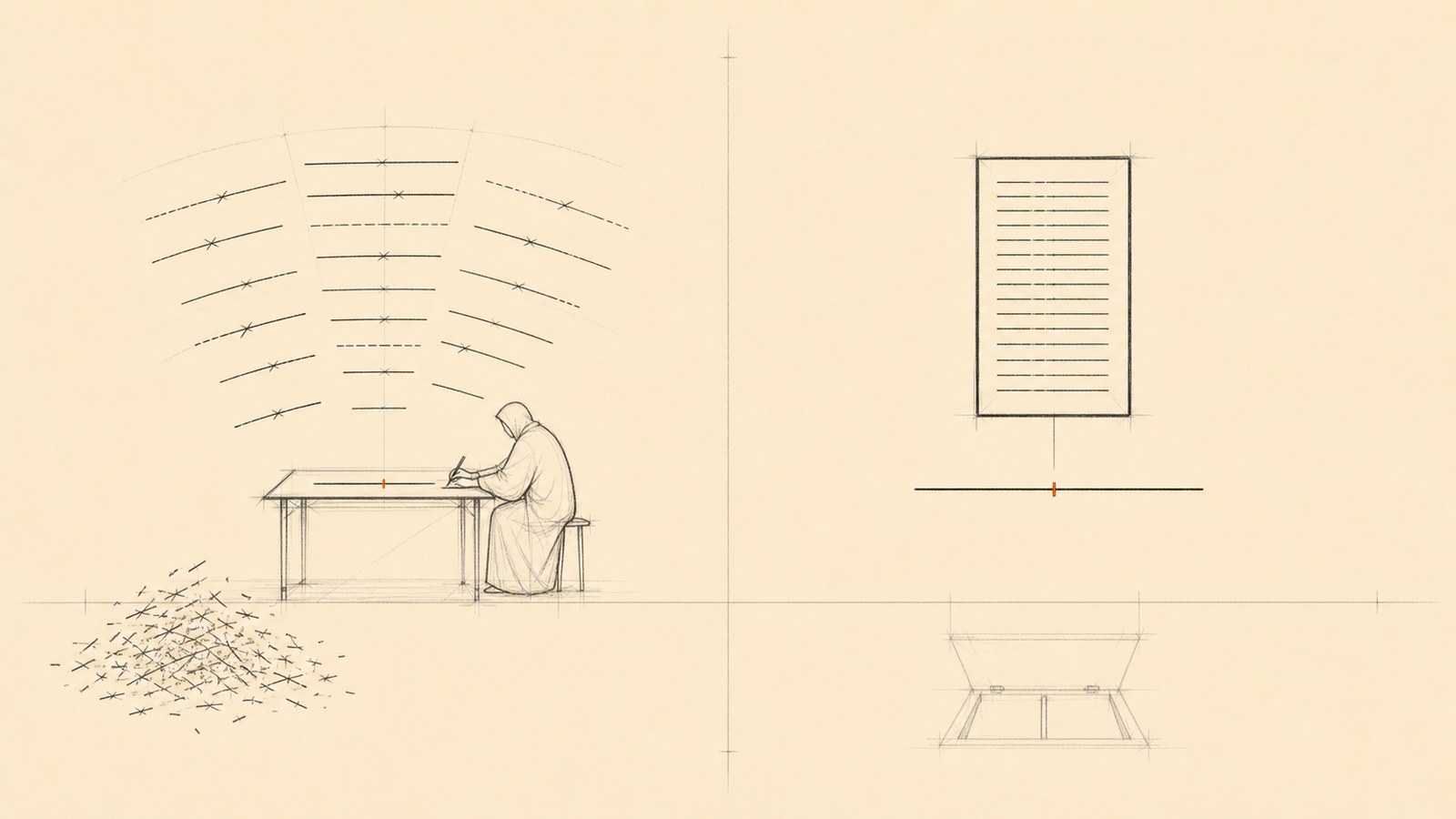
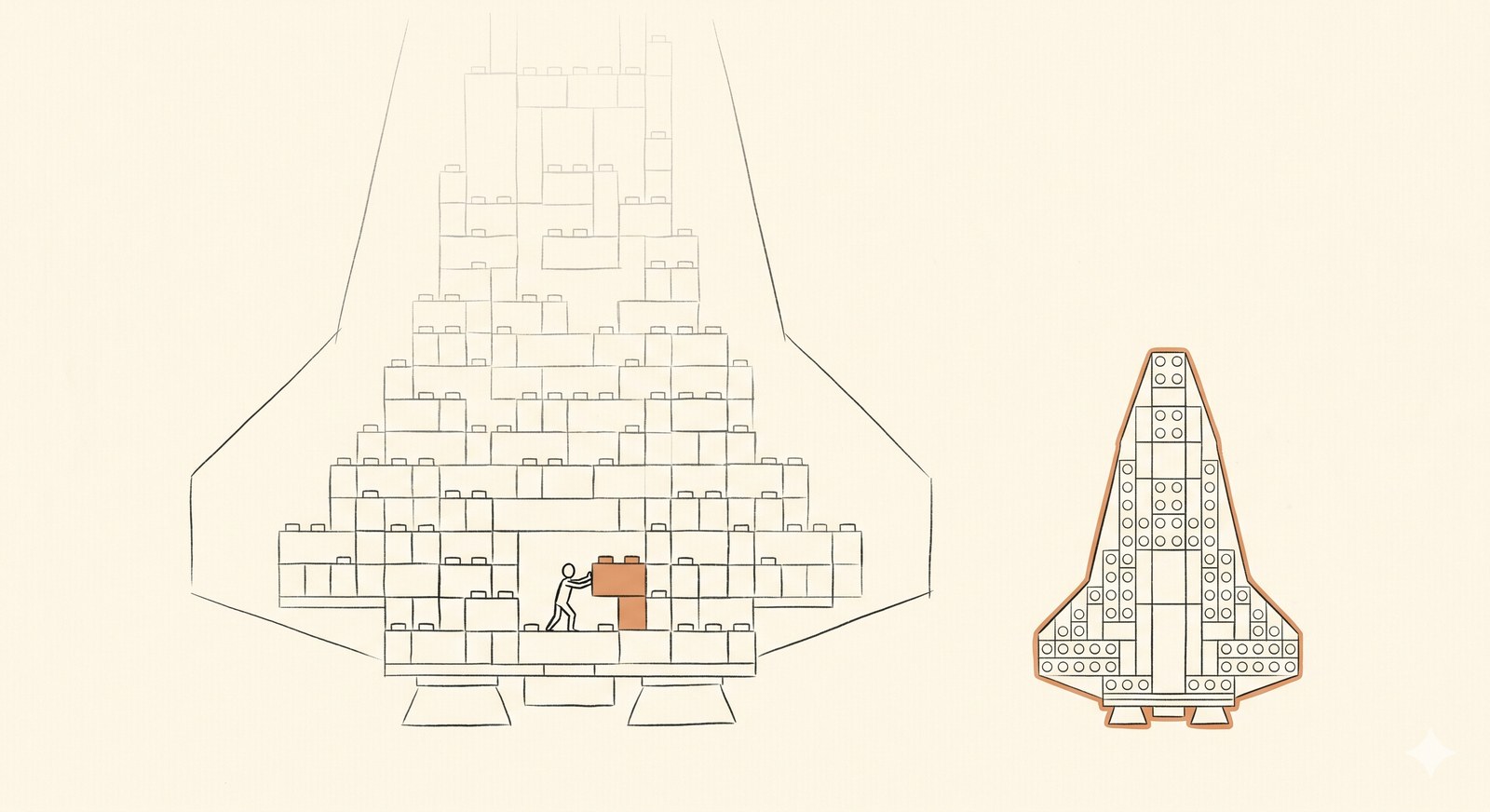
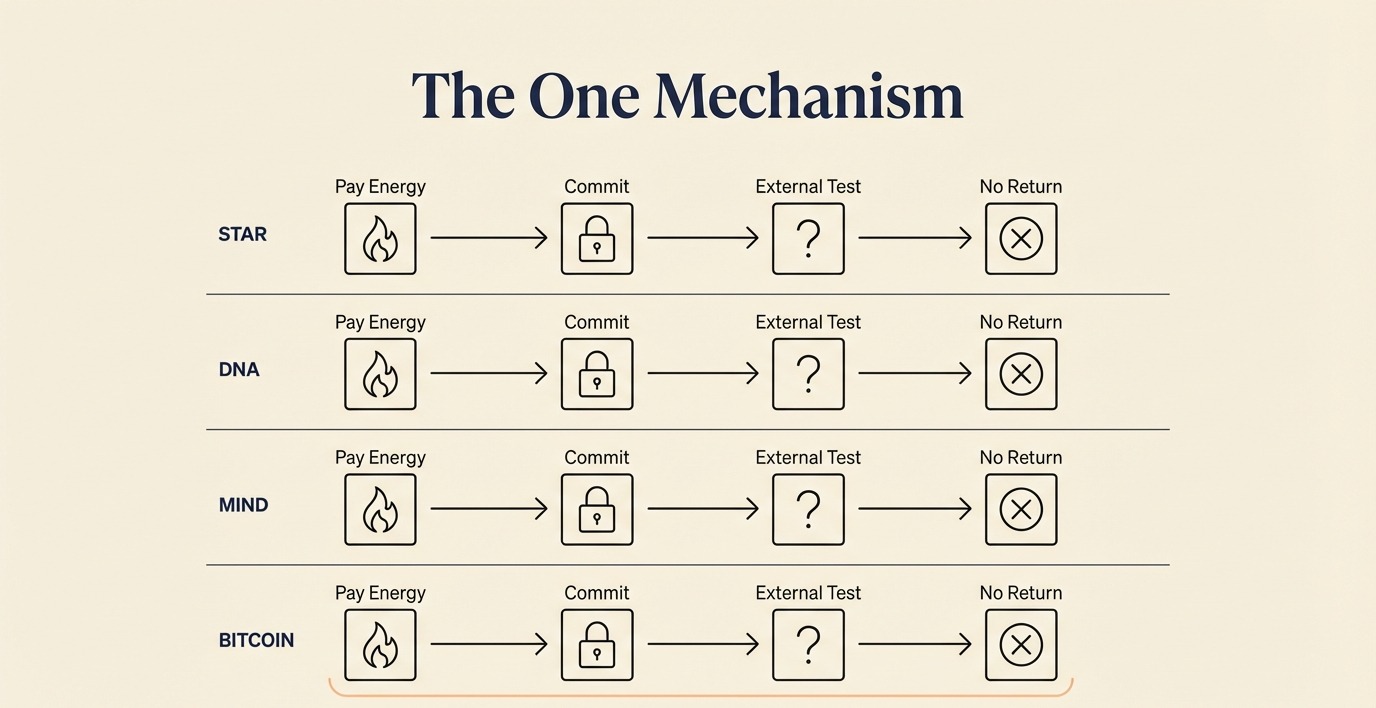
Consider a person stranded on a deserted island with a million dollars. They may know how to bake bread or dig a well, but with no oven, no shovel and no novel arrangements of matter to hand, they can transform almost nothing, and so they are not wealthy. Hand someone a shovel without the knowledge of what digging is for and the result is the same, since an arrangement of matter nobody knows how to employ opens no new phase space. Knowledge also changes how tools are judged. Two shovels with the same blade, one with a six-inch handle and one with a six-foot handle, look equally good to someone who has never dug a hole. The digger knows the long handle spends less energy for the same hole, and finishing in three blocks of time instead of six leaves three blocks, and the energy that would have gone into them, free for other transformations. Time works much like Bitcoin's blocks: standing in one spot to dig commits that moment and removes every future that would have followed from standing a step to the left, just as confirming a transaction removes the branches it would have opened had it stayed in the mempool.
The qualifier at the end of Deutsch's sentence carries the argument. Generating new knowledge is creativity, a separate quantity, and wealth is a set of transformations, which is why it resists being reduced to a single number. Calvin Coolidge Jr., the sixteen-year-old son of a sitting American president, died of blood poisoning from an infected blister on 7 July 1924. His family had about as much money and access as anyone alive, and there was nothing to buy, because Alexander Fleming's report of penicillin's antibacterial action was still years away. Once someone had built the road to that phase space, money could pay for the trip; before then, no amount of it could. Wealth describes the possibilities that already exist, and new knowledge is what enlarges them.
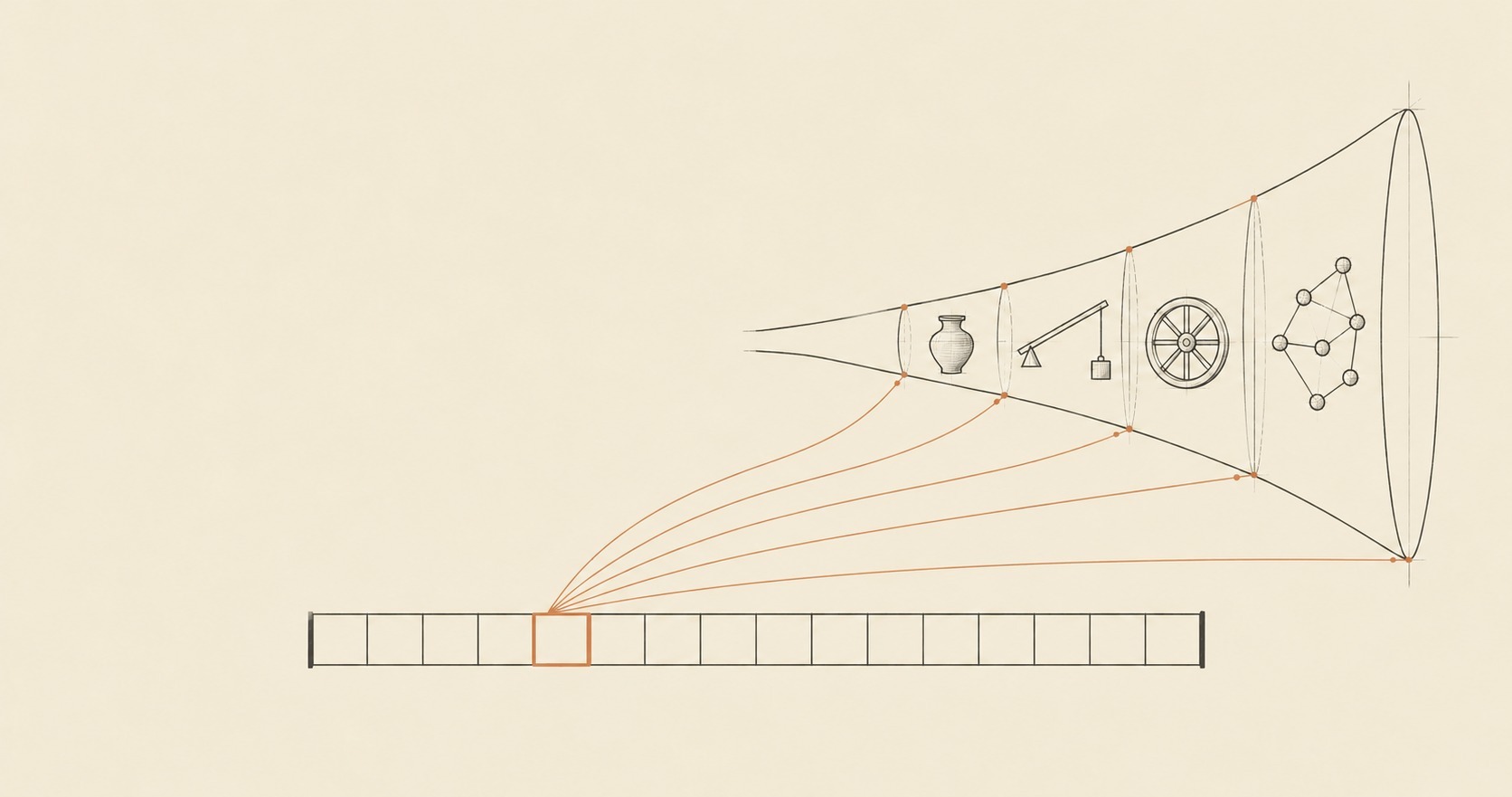
Explanatory knowledge is what gives people an advantage over replicative knowledge, the slower kind evolution produces. Evolution has to build fifty birds with fifty slightly different wings and let the losers die. A mind can conjecture why one design should outperform the rest, criticise the guess, and build only the survivor, running the whole competition in imagination at almost no energy cost. The episode returns to the image of the potter's jug: creativity takes the available information, arranges it into a new order and constrains it so it can't drift anywhere else, which makes a new region of possibilities reachable. Knowledge that does this persists only if it can travel from one physical medium to another while staying hard to vary, and most of what anyone uses each day was inherited this way from people they will never meet.
Wealth needs the tool and the knowledge of what it's for
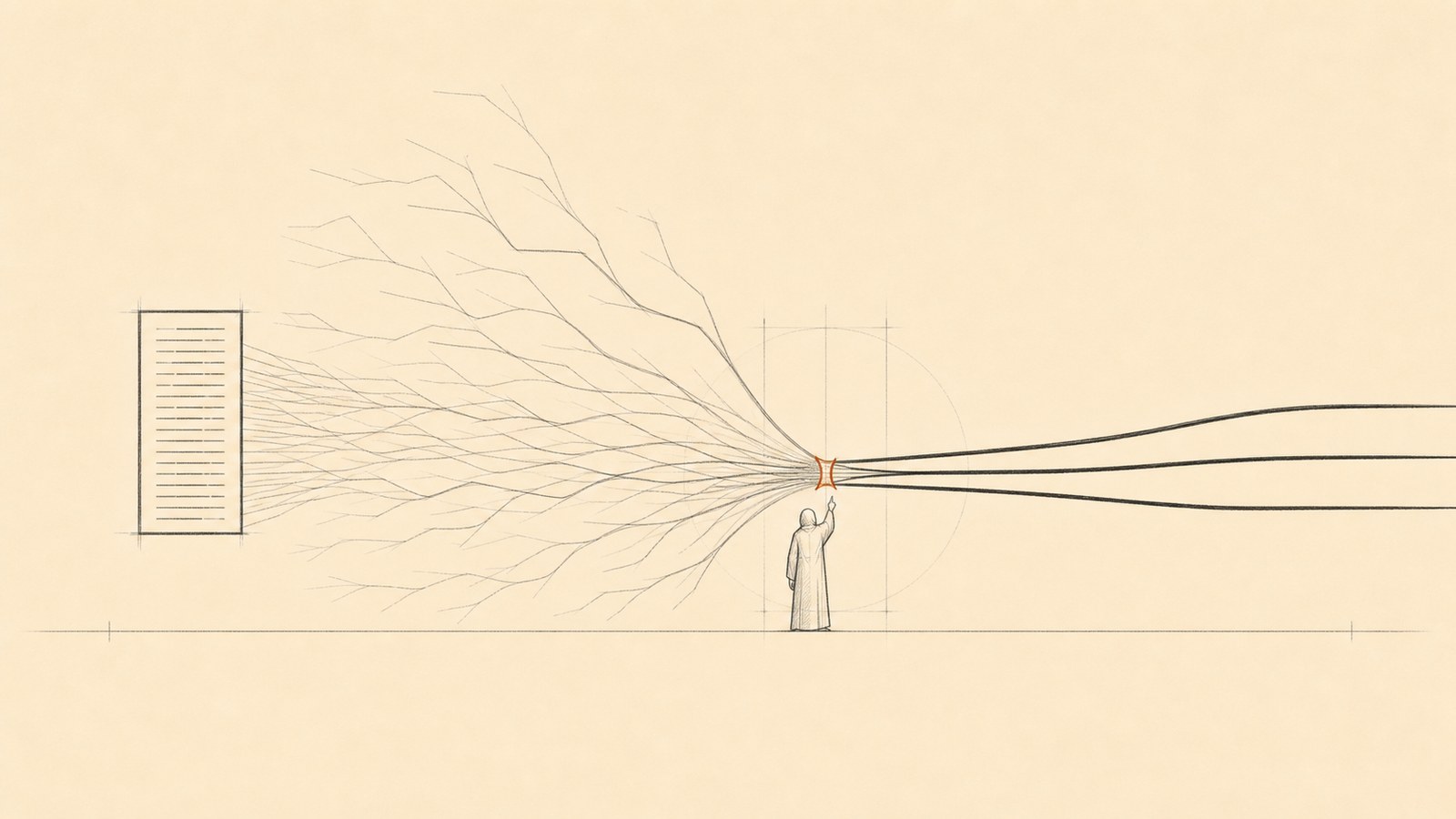
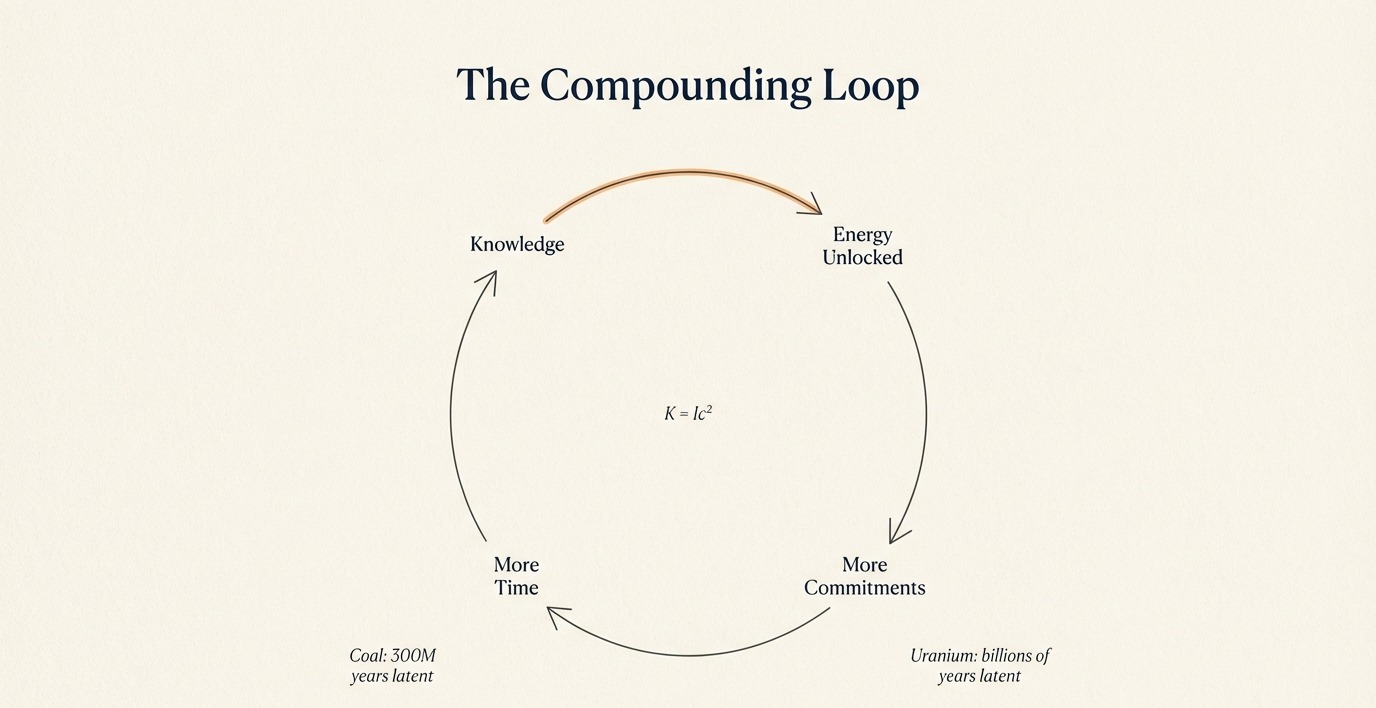
That inheritance also explains how holders of Bitcoin get wealthier. In the extended order a person earns money by solving other people's problems: if a task would cost someone three blocks of time and a certain amount of energy and you can do it in one, they will willingly hand over a slice of what you saved them. The highest-paid solutions are the ones that keep working without their author, carried in a book, a podcast or a stranger's conference talk. Somewhere, every day, people are producing those solutions, and the set of transformations the extended order can reliably perform keeps growing. The show's older name for that growing pie is TASOE, the total accessible supply of energy. Bitcoin's supply doesn't grow with it. The percentage of the ledger a holder owns stays fixed while the capabilities that percentage commands expand. Deutsch has said nothing about Bitcoin, and this application of his definition is the show's own extension.
The episode also records an error. The early thesis held that Bitcoin had perfected money and coordination, and that people would recognise it. Bitcoin turned out to be the perfect tool for the people who already wanted one. Most people are underwater, unable to think ten days out, let alone ten years. Professionals who manage other people's money face a different trap: beating a colleague by two points on a product nobody questions earns a bonus, while holding a volatile new asset through one bad year gets them fired, and the extra thirty percent they forgo belongs to someone else anyway. Michael Saylor's refinery analogy points to the practical answer: give people the product they want and do the conversion for them. Debasement will keep pushing a few individuals toward the exits, and adoption will come from them long before it comes from the masses.
Maximising wealth therefore means maximising knowledge generation, and the recipe is old: property rights to encourage conjecture and free speech to permit criticism. Both are rare in practice because institutions lock in and stop accepting criticism, and every point of friction between knowledge generation and the extended order leaves everyone worse off. Knowledge also has to outlive the people who discover it. A life works much like a model's context window: understanding builds up through conjecture and criticism, and whatever isn't constrained into a durable, hard-to-vary form disappears when the window closes, so that someone else has to rediscover it at full cost. Every conversation with a large language model starts over unless it is pointed at a second brain that holds context between sessions, the situation of the film 50 First Dates. Rediscovery is waste, and a civilisation that keeps forgetting is less likely to persist against one that remembers.
The share stays fixed while what it commands keeps growing
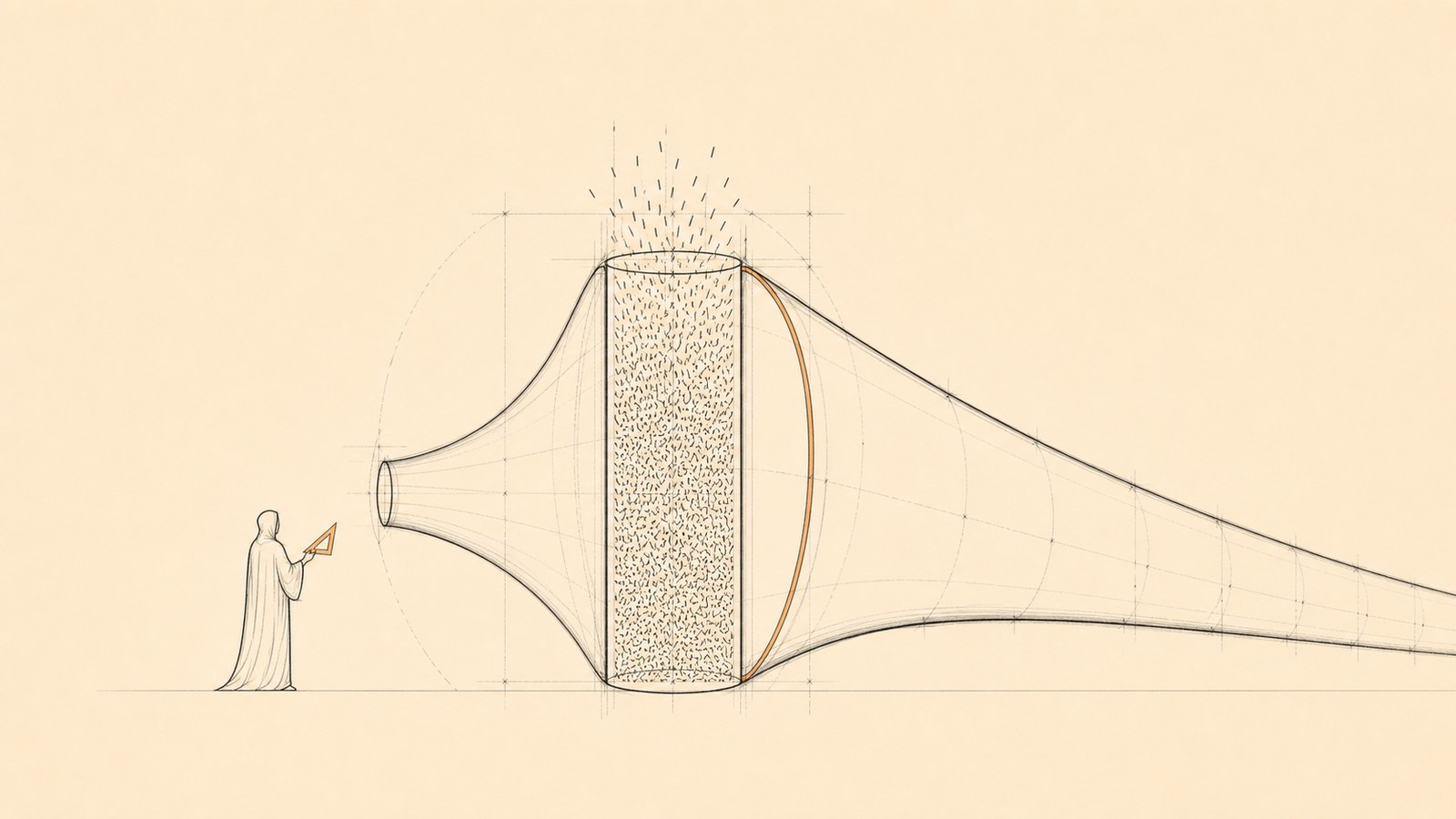
Seen at the largest scale, most of the order in the universe so far came from structural knowledge, the formation of stars and the interactions of matter under physical law, and then from replicative knowledge, in which every branch has to survive before anything can be learned from it. Explanatory knowledge makes the same leaps with far less energy and fewer blocks of time, and its rate of order generation will keep accelerating. The people who open closed phase space for others will be paid willingly for the new transformations they make possible, and the money they will want is the one hardest to vary. That leaves the episode optimistic and pessimistic at once: confident that Bitcoin will keep operating as it has since inception, and doubtful that most people will recognise what it is in time. The short run will stay volatile, the long run is clear, and the opportunity is still open to anyone willing to do the work.
Timestamps
00:00 - What most people are missing: a definition of wealth
01:10 - Explanatory knowledge and the fifty wings evolution has to build
02:36 - The jug, the clay and reach
02:59 - A million dollars on a deserted island
03:47 - A shovel you don't know how to use
04:07 - Persistence: maintaining a unique arrangement
05:06 - Back to explaining Bitcoin: money as a tool
05:40 - Short handle, long handle
06:28 - Energy and blocks of time saved
07:04 - Time as blocks, and the futures a commitment removes
08:29 - Inherited knowledge and states that travel
09:04 - Easy to replicate, hard to vary
09:57 - Is more money the answer?
10:10 - Without generating new knowledge: wealth as a set
10:37 - Calvin Coolidge Jr. and the cure money couldn't buy
11:29 - Why holding Bitcoin generates wealth
12:01 - Getting paid for solving other people's problems
12:25 - Knowledge that keeps solving problems without you
13:50 - The perfect tool, for the few who want one
14:18 - People who can't think ten days out
14:46 - Career risk and other people's money
16:10 - Debasement and the forced-adoption thesis
16:58 - Moving fifty thousand dollars: fiat friction versus Bitcoin
17:43 - A few individuals looking for the exits
18:55 - TASOE: a fixed ledger over a growing set
20:01 - Property rights, free speech and lock-in
21:07 - AI and the context window
23:21 - 50 First Dates and the second brain
24:35 - Optimism and pessimism
26:36 - Structural, replicative and explanatory knowledge
28:17 - Who will hold the most Bitcoin
29:11 - Volatile in the short run, clear in the long run
Timestamps are approximate.
Topics Discussed
Wealth: what individuals and the extended order should be optimising for, and why most people misjudge Bitcoin without a definition of it
David Deutsch's definition of wealth as the set of transformations one could perform without generating new knowledge
The deserted island: why money without tools or knowledge transforms nothing
Tools judged by purpose: the short-handled and long-handled shovel
Time measured in blocks, and the futures a commitment removes
Wealth as a set of possibilities, and creativity as the act that enlarges it
Calvin Coolidge Jr. and the transformation no fortune could buy in 1924
Explanatory knowledge versus replicative knowledge: conjecture and criticism instead of fifty wings
Knowledge as states that travel, easy to replicate and hard to vary
Earning money by solving other people's problems, and solutions that work without their author
TASOE, the total accessible supply of energy, as the growing pie a fixed-supply ledger lays claim to
The early Bitcoin thesis and why most people don't want the perfect tool
Career risk for people managing other people's money
Property rights, free speech and institutional lock-in
The context window: knowledge that disappears unless it is constrained into durable form
Episode #140 - The One Problem is the show's first use of Deutsch's framing of wealth as a repertoire of transformations.
Notable Pull Quotes
““Wealth isn’t a number, it’s a set.”*”
““No amount of money could have bought it the week before.”*”
““Money is just a tool inside of that system to get access to other people’s knowledge.”*”
““Knowledge, especially explanatory knowledge, is states that travel.”*”
““It was the perfect tool for me. It’s not the perfect tool for the masses.”*”
Episode #195 – The Gap
Aug 05, 2026
Show notes
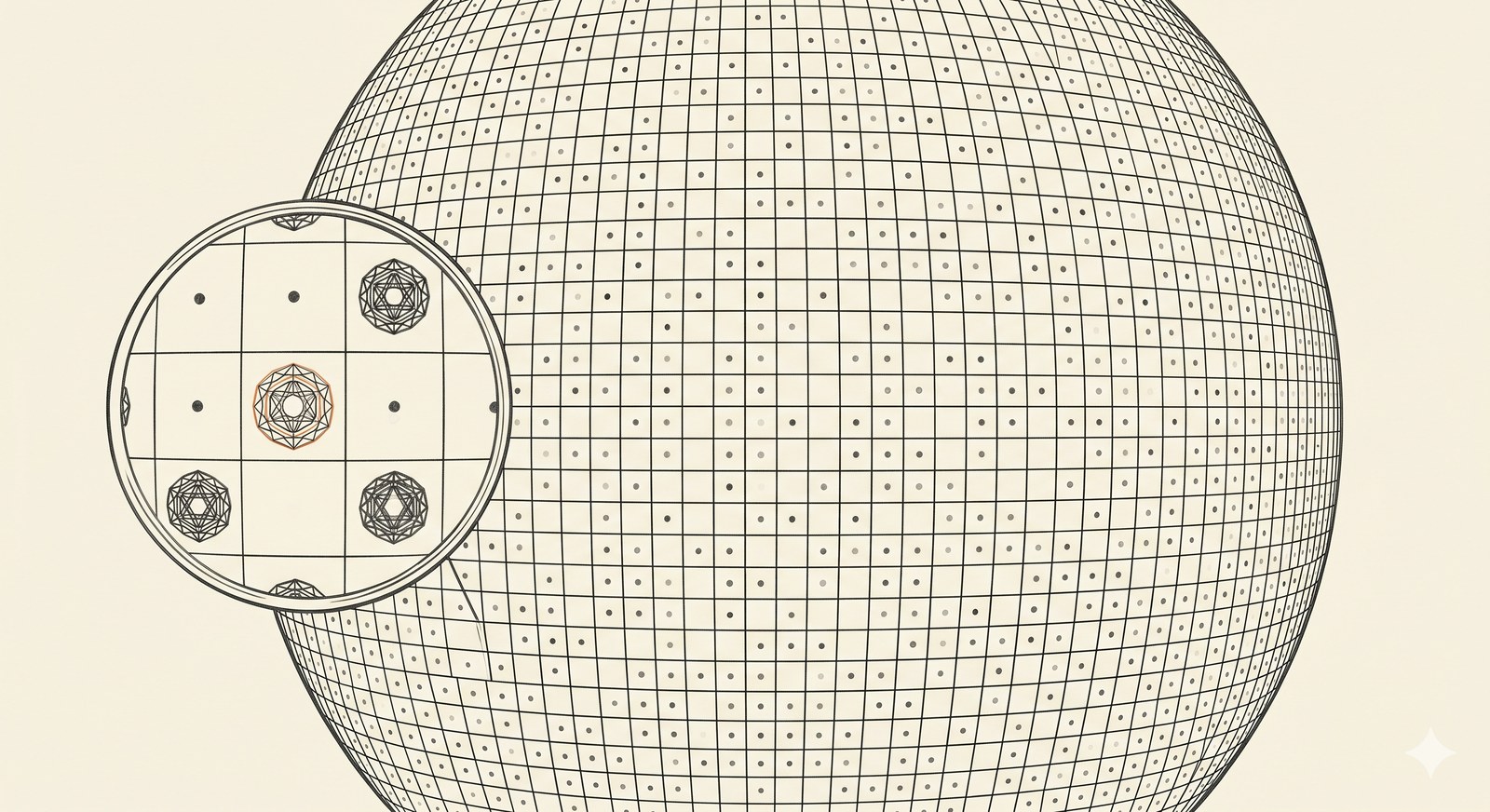
Bitcoin is a machine for remembering, and it works because of one deliberate hole in its memory. The Coldcard entropy failure filled that hole with facts the world had already written down somewhere, which turned a private key into an explainable object and cost people hundreds of millions of dollars without a single server being breached. Entropy is the size of the gap in the record, and the episode works out why nothing else in the system can do its job. Episode Summary Bitcoin is a machine for remembering. Every block, every transaction, every satoshi that has ever moved is written down in public, the writing is permanent, and it is checkable by anybody with a laptop and a small amount of compute. Fifty years from now a payment made in 2011 from some random bedroom in Helsinki will still be auditable, which is the whole of the invention, with one deliberate exception. There is a single fact recorded nowhere: not in any block, not on any node, not in any of the government databases tracking the network. That fact is the private key, and it has to be that way, because a system that remembered absolutely everything would also give everything away. Anything fully written down is something somebody can work out. Bitcoin therefore needs exactly one hole in its memory, and that tiny hole is the only thing standing between a person’s coins and every other person on the planet. Entropy, throughout this episode, means the size of that hole and nothing more elaborate. What happened at Coldcard was not a breach in any conventional sense. No servers were compromised, no houses were entered, nobody was manipulated into handing over their words, and nobody was attacked with a wrench. The people who lost money had by any normal standard done almost everything right: they bought a well-supported hardware wallet, generated a seed on it, wrote the words down, and put them somewhere safe, some of them doing exactly that correctly for five years. The failure sat underneath all of it. The firmware defined the flag for the hardware random number generator as zero, meaning off, and the library that needed to know whether the hardware generator was available asked whether the setting existed rather than whether it was switched on. Zero exists. The check passed, on every device and every time, for five years, and seed generation fell back quietly to a deterministic software algorithm, a thing that produces numbers which look random and are in fact worked out completely in advance. That fallback was seeded from three values, and what those three have in common carries the entire episode: each of them is already written down somewhere in the world. The chip’s serial number is stamped on the chip. The boot counter is a number the device itself is storing. The time is the single most publicly recorded fact in the universe, with every satellite, every phone, every exchange, and every one of us agreeing about it continuously and for free. A search space intended to run to at least 128 bits collapsed to roughly 40 bits on the older Mark 3 devices and something closer to 72 on the Mark 4 and later. Forty bits is not difficult. Seventy-two is expensive, and expensive is relative when hundreds of millions of dollars sit on the other side of the calculation. The seeds had come to remember their own birth: made on chip number such-and-such, at this time, after this many boots. A key that carries memory is a broken key, and in the entire history of this technology that has always been the failure. Nothing about the seed’s appearance changed, which is why the problem sat undisturbed for five years. It was the same twelve or twenty-four words, the same length in bits, the same gibberish on inspection, and it restored perfectly. Handed the word list, nobody could tell by looking whether it came off dice rolls or off broken firmware, and there is no test that can be run on the words themselves. What changed is that the arrangement became explainable, and explainability is the only property that ever mattered. Bitcoin needs two opposite objects welded into the same system, running side by side without ever touching. The time chain is a total history with zero secrets, public and permanent, each block connected to the one before it and verifiable by anyone. The key is the exact reverse, a total secret with zero history, a number drawn one time, witnessed by nothing, connected to nothing, leaving no trace anywhere except wherever its holder puts it. One object is unguessable and the other is undeniable, and the moment anyone confuses which is which, both properties begin to go. In framework language the word structure ends up doing double duty here, and separating the two uses is what makes the rest legible. Structure inside the key has to be zero, because any pattern in those bits is a road, and a road to a place will eventually be driven down. Structure holding the key has to be enormous: the steel plate, the second copy in another jurisdiction, the plan for what happens when the holder dies. The noise is the cargo and the memory is the ship carrying it. The word key is meanwhile covering three different objects, which the framework scores differently. First is the draw, the act of generation, energy committed to an irreversible process, a hundred dice rolls, one event, unrepeatable. Second is the value, the number that came out, contributing information and nothing else, its constraint quality obliged to stay at rock bottom forever, since constraint quality in this sense is structure and structure is a story. Third is the custody, the arrangement that keeps the number alive as it travels through time and across substrates, contributing all the testing, all the redundancy, and all the reach. Neither one is knowledge on its own. A key with no custody is noise, and noise evaporates the moment the paper is lost, or the house floods, or the children cannot find the word list. A custody scheme with no key is an empty box with no arrangement inside it to hold. The key becomes knowledge only through custody, and nothing else in Bitcoin works that way. Structure inside the key at zero, structure around it enormous The same 32 bytes sitting in the same drawer score two completely different numbers depending on the chair they are read from. To the holder, the value has enormous reach, unlocking everything they own, its constraint quality whatever the custody has earned for itself. From an attacker’s chair the identical object has no usable structure and unlocks nothing at all. The gap between those two scores is the security, and every custody decision widens it or narrows it. A brain wallet narrows it by handing the attacker structure. Losing the only backup narrows it by dropping the holder’s side to zero, which is why a great many of Bitcoin’s losses are self-inflicted. The attacker, though, is never scoring the key, for the simple reason that the attacker does not have it. What gets scored is a hypothesis about how the key came to be, and the hypothesis is a sentence: keys from this tool are drawn from such and such a space. Where a key comes off clean dice, the only true sentence available is that it came out that way. No mechanism, no bias, nothing connecting that key to anybody else’s key or to any fact about its owner. The attacker’s best hypothesis is that the value is uniform across two to the 256th, which is completely correct, survives every test anyone can throw at it, and does nothing whatsoever, shrinking the search space by not one bit. Its reach is zero, and the reason is worth stating carefully: the true explanation of that key has no consequences, and where there is nothing to understand, being clever buys nothing. Run the same questions at the sentence the Coldcard attackers assembled and every score comes back high. Their claim was that the library checks whether the flag exists rather than whether it is on, so the real generator falls back to a predictable one, seeding from chip ID, boot count, and clock. On breadth, that claim was tested by things with nothing to do with each other: somebody reading the source, somebody reproducing it across four hardware models, somebody deriving addresses from the predicted seeds, and then those addresses going out to face the hardest verifier in the system, the thousands of independent nodes run by people who have never met. A node cannot be bribed and cannot be flattered; it either verifies or it does not. On depth, the explanation held across five years of firmware and every seed generated in that entire window, never once failing to predict. On reach, that one sentence reached every seed the firmware ever produced, retroactively and permanently, without the attacker needing a single name or country or any fact about any of the people involved. Hard to vary, deeply tested, enormous in reach: real knowledge, information with causal power, pointed the wrong way. The framework does not care what anyone does with it, and reach is reach. The attackers simply did better epistemology than everybody else, and did it to take hundreds of millions of dollars from people who had done almost everything right. The compute was cheap. The knowledge was the expensive part, brutally expensive to find and nearly free to apply, which is the shape the P versus NP episode described, and applying it does not tire or ration itself. What it produces looks less like a burglary than a harvest. Then the coins were swept into a handful of addresses, and what that did to the attackers’ own position is the strangest part. Before the sweep they held an explanation with open reach across an unbounded population of victims. After it they held a pile of coins of one very specific size. The reach collapsed into inventory, and the explanation cannot pay out twice, because every affected seed that held money now holds none. That inventory has the exact opposite problem to a key: maximally structured, maximally remembered, welded into the most thoroughly verified ledger human beings have ever built, and likely the most watched addresses in Bitcoin for years to come. Anyone can go and look at them this afternoon. They exploited the absence of memory and now hold objects made of pure memory, winning on one axis and losing instantly on the other, in the same system and within the same hour. Anybody trying to hide would have peeled the coins apart across a hundred hops, so consolidating them in the open says concealment was never part of the plan. Perhaps the address is meant to stand as a monument, a permanent published proof that the explanation was real and complete, because a ledger that records a theft is also certifying it, and there is no more durable way to attest to exactly how far an idea reached. The draw is the foundation, poured once and sealed How entropy protects anything is a mechanism almost nobody states. Nobody can delete coins, since the ledger only ever gets added to and no one can go back and erase an entry. The only threat is an unauthorised next entry, somebody producing a valid signature that moves the coins elsewhere. Protection here means exclusivity over who gets to write the next line, which is a different object from the wall around the money that fiat custody provides. Bitcoin has no gatekeepers and no guards, and the network will accept a valid signature from anybody on earth, which is the entire design, so exclusivity has to be manufactured out of thin air, and exactly one material does that job: a fact that exists nowhere else. It is not hidden, not encrypted, not stored somewhere clever. It is absent. Memory cannot be protected using more memory, and more memory is precisely what those seeds were made out of. There is a second property here that gets very little attention. Every other component of Bitcoin security degrades with time and use. Addresses grow more linkable every year, chain analysis improves every year, identity leaks a little more with every exchange touched, firmware accumulates bugs, and discipline slips as people get busy and older and distracted and move house, and the steel plate ends up in a box in the garage. Entropy alone does not degrade, because there is nothing for it to degrade toward. A properly drawn number leaks no partial information, ever. Watch the chain for a hundred years, run every analysis anyone invents between now and then, and learn exactly zero bits. It is the one fixed point in a system where everything else is eroding, which is why it is the root rather than another layer. Which is what the dice are for. A hundred rolls is a one-time commitment carrying no memory, an arrangement that exists because energy was committed once and that nobody else has ever seen, and it cannot be made twice: roll again and a completely different key comes out, and the dice cannot be run backwards. That is the pawl at the scale of one person. From there the arrangement has to travel, and its holder is the channel, from dice to brain, brain to paper, paper to steel, steel to the signing device, every one of those a substrate change that has to preserve the exact shape, since one wrong word or one wrong bit kills it. Perfect fidelity carrying zero meaning. The ritual that follows is well known: put the words in a device, send a small amount of Bitcoin to it, wipe the device completely, restore from the backup, and spend the coins. If they spend, the arrangement survived, and the verdict is delivered by thousands of independent nodes confirming that the restored key controls those coins while not one of them learns anything about the key itself. Being tested normally costs exposure, and to be examined a thing has to be seen; here the harshest class of verification that has ever existed runs indefinitely, for free, and never gains a single bit about what it is checking. Every spend is another cycle survived. That ritual, however, would not have saved a single Coldcard victim. Each of them could have run it perfectly, because a 40-bit seed restores perfectly, and their custody was probably as good as it gets. The test confirms that copy A matches copy B; it will catch a misspelled word or two words in the wrong order, and it can say nothing at all about where the seed came from. Every step of it is downstream of the draw, and the draw is the one act in the whole process that nobody ever tests: not the holder, not the network, not anybody, ever. A house can have its wiring and plumbing and roof inspected any day, as often and as long as anyone likes. The foundation gets poured once and sealed, and all that ever mattered was the quality of the concrete on the day. Since depth can never reach the draw, everything falls to breadth, and breadth means genuinely independent sources that do not share a failure mode. One vendor is a breadth of one, however good the vendor and however many years of reputation stand behind it, and everybody who got drained had one source of entropy and one firmware. Dice remain the best available answer for the reason that the universe has never seen that number and there is no story attached to it. Nor does artificial intelligence change this: an explanation-finding machine pointed at an object engineered to have no explanation does nothing forever, no matter how good it gets, while the same machine pointed at a wallet generator with a clock in it will eat everything. Those compromised seeds were compromised in 2021, at the moment of their creation, and for five years they looked completely fine, sitting in the open and appearing to survive every attacker on earth while surviving nothing at all, waiting for somebody to notice. Generating a private key is putting a hole in the record that no one can ever fill in. Timestamps 00:00 – The Coldcard exploit as an occasion to run the framework 00:52 – Bitcoin as a machine for remembering 02:02 – The one fact the system deliberately does not know 02:36 – Entropy as the size of the hole in the record 03:18 –…
Episode #194 – States that Travel
Jul 29, 2026
Show notes
Being early and being wrong are the same position, and the original Bitcoin thesis, the one that expected people to figure it out quickly, was 90 percent wrong. Out of that error comes a working definition of value, and underneath it a definition of knowledge: arrangements that keep their shape as they travel between physical substrates and across time. The compensation for a world too busy to notice is the closing line: nobody knows yet, and that means you’re safe.
Episode Summary
The original thesis, the one Michael Saylor still narrates in interviews, held that people would figure Bitcoin out quickly, that everyone would see their future selves better off and scoop it up, and that the only rational response was to spend every waking moment accumulating before the crowd arrived. The crowd never arrived on schedule. Being that early is the same thing as being wrong, and the honest accounting puts the error at 90 percent. What the error left behind is its own compensation: having been slightly wrong for years means having been slightly right for years, a position from which Bitcoin has kept increasing wealth through every drawdown, five of them now, each absorbed with the same practiced indifference. The fluctuations stopped mattering once the knowledge did its work.
That indifference recently produced a discovery, posted to Nostr a couple of months back: a loophole, shorting MSTR, that behaves like a machine into which other people volunteer their fiat dollars and out of which comes Bitcoin. A good business with a stated horizon, because in a Bitcoin-denominated world with no fiat left to arbitrage, value has to be produced rather than intercepted. That admission sets the real subject, the one the last several episodes have been circling: a working theory of knowledge, and with it a working theory of what value actually is.
Start with wealth, a definition worth testing on people who have never thought about money at all: wealth is the total sum of transformations one can bring about in the world. The pursuit behind it is persistence, more future transformations at one’s own disposal, and the engine of persistence is knowledge, information with causal power. Knowledge comes in three kinds. Structural knowledge is the order the laws of physics assemble on their own, planets and stars, matter drawn together by gravity. Reflective knowledge is life, DNA its classic case. Explanatory knowledge is what human beings generate, and it is on its way to overtaking structure as the dominant constraining force in the physical universe. Fiat fails this whole test because it ships with an edit button, and wherever an edit button exists and individuals control it, they press it, since pressing it is the path of least resistance. When falsifying a record is cheap, preserving it becomes impossible.
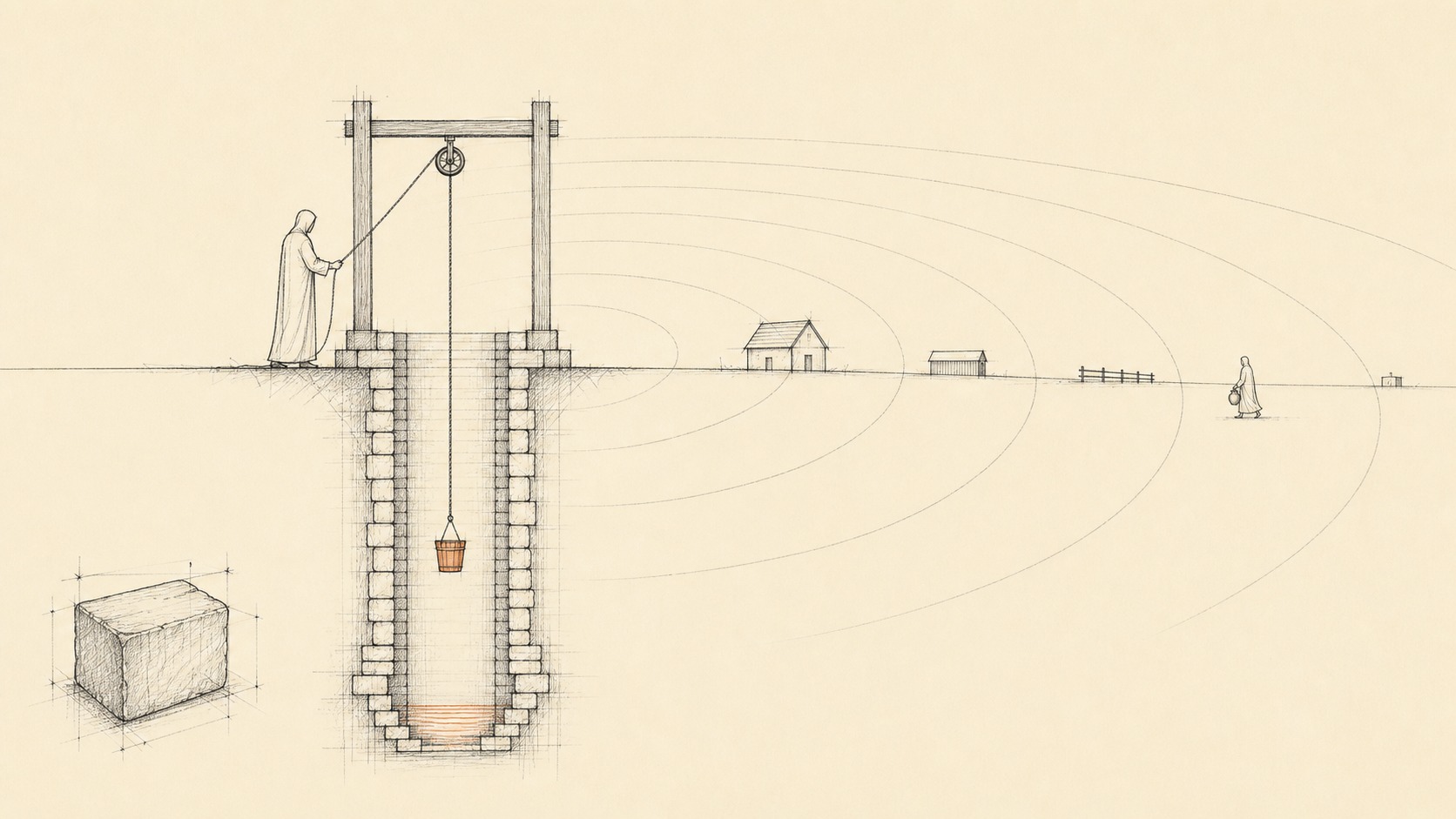
Value, then, is constraining matter so that other knowledge generators have more possibilities open to them, more accessible phase space. The jug from earlier episodes returns: the potter takes clay the customer could never have constrained alone, because the skill stacks on a pyramid of prior figuring-out, and hands over the finished constraint. The well makes the same point at town scale. A settler in a dry western town finds the water, digs the hole, lines it with stone so it cannot collapse or foul, and sells access to a future that now contains water. The catch is that constrained matter cannot be copied; the next town needs its own well, dug at full energy cost. Software escaped that limit, constraining matter once and copying the arrangement everywhere, which explains most of the wealth it created, but it had to defend its scarcity with walls of logic. Bitcoin’s one solved problem was replacing walls of logic with walls of work: scarcity defended by physics rather than by rules.
The well: constrain the matter once, then sell the phase space it opens
Hence the shape of the service. Most people will never take the explanation on board, and offering it stopped being worth the effort years ago; testing these arguments on strangers ended because nobody cared, and people will come when they feel the pain. What they want is a solution: their life is hard, they don’t know why, and somebody is willing to stand between them and the machinery grinding them down. Taking their fiat, converting it, and refusing to flinch at down 50 percent is constraining matter and opening phase space for people who could not have opened it themselves. Perhaps one in a hundred watches the well-digger long enough to notice the trick is stone plus energy, and goes off to dig their own; the rest keep paying a dollar for the bucket, and stay glad of the deal. Even the resulting pile is defensible: holding without spending is deferral, the charitable act of generating accessible phase space for the extended order and declining to ask any of it back.
Knowledge, in the definition that gives this episode its title, is arrangements that travel, and travel means what it says. An arrangement of neurons produces a signal; the signal drives vocal cords; shaped air crosses the room to a microphone; the microphone hands a pattern to a recorder, which commits it to ones and zeros, compresses it, ships it to a server, and eventually reconstitutes it in a listener’s ear. One arrangement, seven substrates, shape preserved at every hop. Whether it persists in depth, across time and state transitions, depends on whether it is useful, whether the people who take it on board find their wealth increased and build on top of it. How far it spreads in breadth over the information manifold is its reach. Storage has become nearly free and lossless, so depth is cheap now; reach is the contested dimension, and the question for any arrangement is whether more people holding it would open more accessible phase space in the universe. For this one, at least locally, the answer is yes.
The larger project behind all of this is K = Ic², and the discovery underneath it is that computation is physical. There is no ethereal realm where ideas live; every idea is instantiated in some substrate, which means every idea is bound by the laws of physics, which means ideas are affected by gravity. Gravity has been the universe’s chief constrainer of matter since the beginning. One thing escapes it: explanatory knowledge, which is mobile, and jumps to substrates that gravity holds less tightly. It follows that the thing worth maximizing, for an individual and for the extended order alike, is knowledge generation, and the recipe has been known since the Enlightenment: conjecture and criticism, as many bites at the apple as possible, the loop of intelligence fired as many times as it will fire. A large language model generates information at enormous speed, but nothing inside it clicks over into an irreversible future state; the person choosing remains the pawl. The same test picks where to live. A place open to knowledge generators has no central planner arranging information, nothing locked in place that cannot be changed, and looks, from any distance, like freedom maximization.
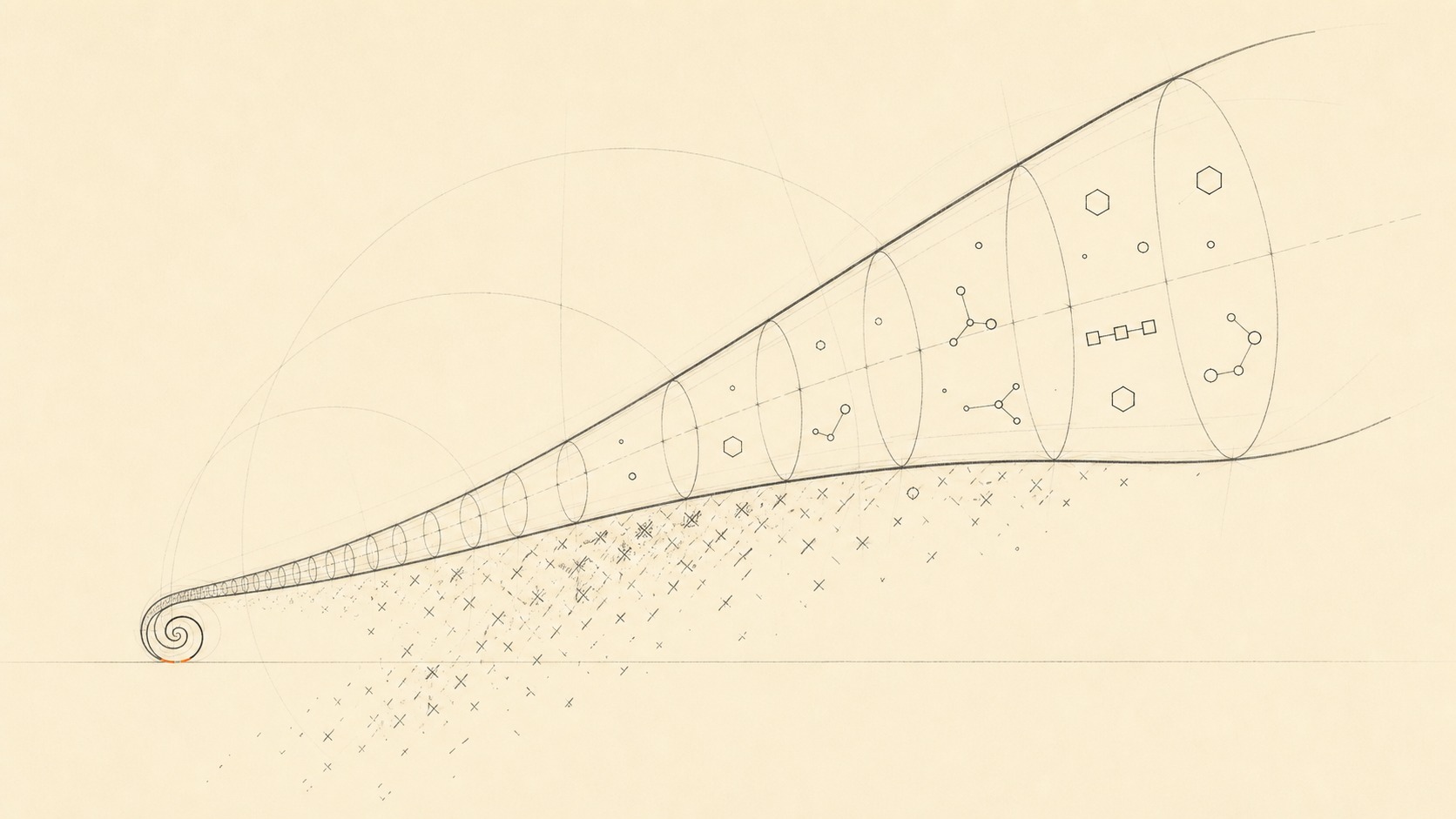
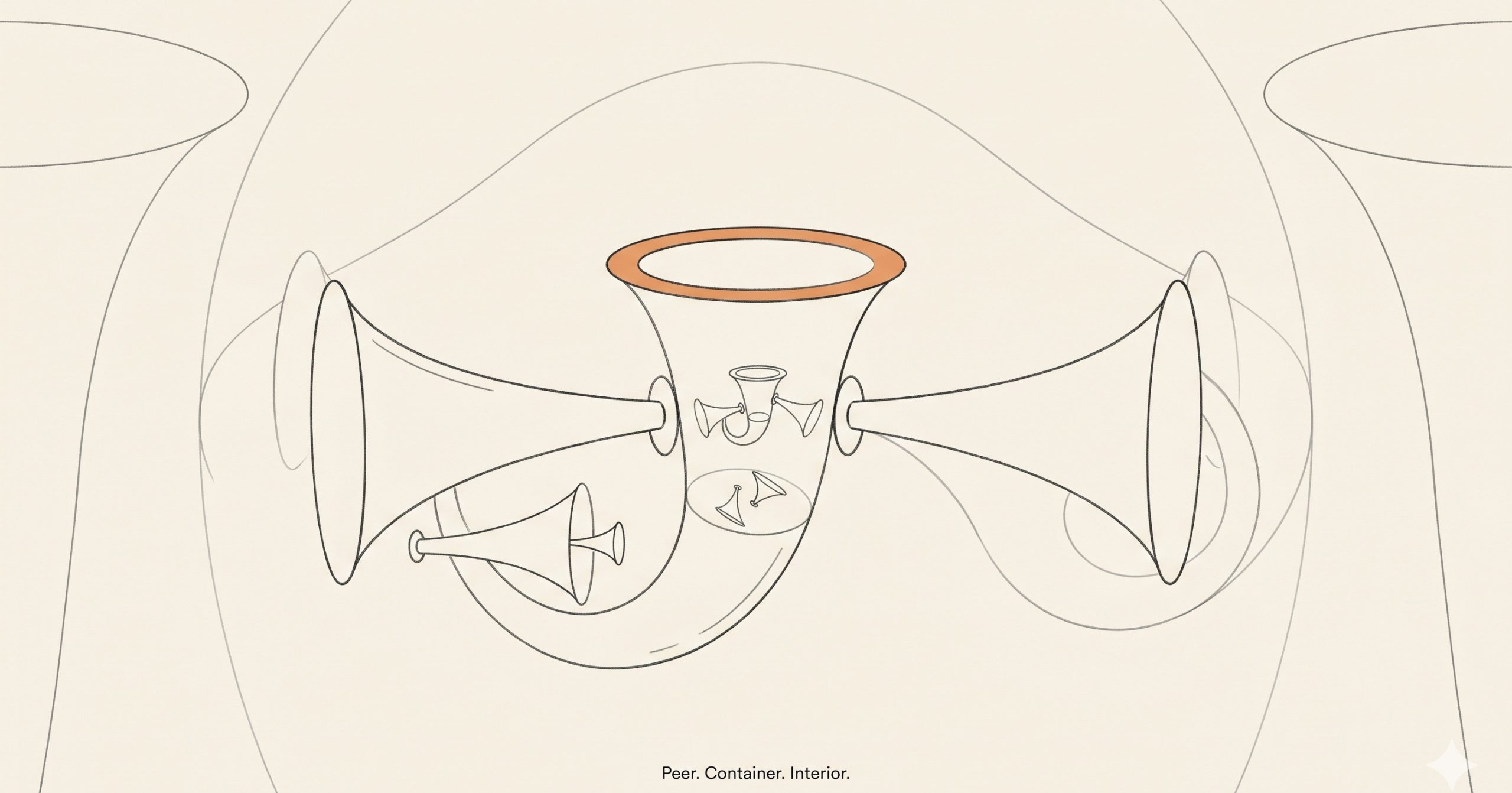
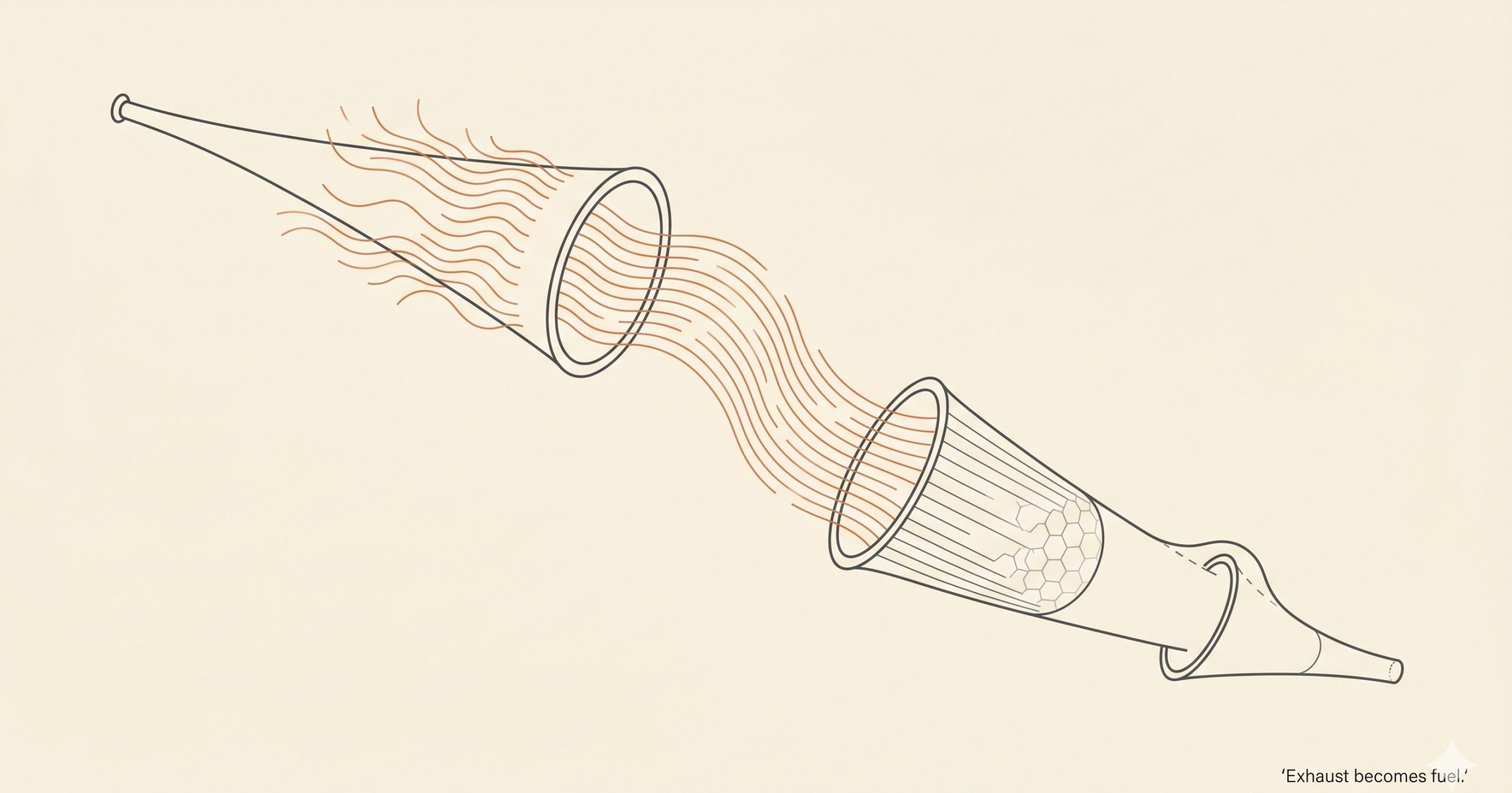
Order generation leaves exhaust behind it, so the horn never pinches off
None of this forecasts imminent recognition. Sentiment inside Bitcoin has rarely been worse, miners are bidding against AI datacentres for energy, and the public conversation has moved on to abundance, as though money were about to be retired altogether. But the abundant future already arrived: show your life to someone from the 1800s and ask whether money is gone, then notice that it matters more than ever, and that abundance means more arrangements to choose between, which makes the chooser more important rather than less. Adoption stays slow because most people are consumed by nearer problems, and the CLARITY Act and MSTR matter mainly as plumbing that lets trapped capital reach Bitcoin at last. Nor does the process run out of road: entropy is the exhaust of order generation, so the universe never reaches maximum constraint and the horn never pinches off. Which leaves the listener with the good part. Nobody knows yet. You’re safe.
Timestamps
00:00 – Opening: the original thesis and the 90 percent error
00:50 – So wrong so early, which is the same as being wrong
01:12 – The loophole: a machine that turns volunteered fiat into Bitcoin
01:56 – In a Bitcoin-denominated world, value has to be produced
02:16 – The larger problem: a working theory of knowledge
03:23 – Structural, reflective, and explanatory knowledge
04:37 – Wrong about the number of state transitions
05:56 – Value as constraining matter; the jug and the pawl
07:36 – The cost of falsifiability versus the cost of preservation
07:52 – The most valuable service available: being the constraint
09:54 – The well: dig once, line it with stone, sell the phase space
11:31 – Walls of logic replaced by walls of work
13:53 – Holding as deferring: the charitable act
14:53 – Bitcoin as a model of the universe viewed from outside
17:40 – A definition of wealth to test on strangers
18:20 – The worst sentiment in memory, and why it doesn’t matter
18:49 – The abundant future is already here
20:01 – You are the pawl in the loop with the LLM
20:48 – Knowledge as arrangements that travel
21:14 – One arrangement crossing seven substrates
22:47 – Depth, breadth, and reach over the information manifold
24:50 – K = Ic² and the discovery that computation is physical
25:30 – Ideas are affected by gravity; one thing escapes
26:37 – Maximizing knowledge generation: conjecture and criticism
28:13 – Where to live: freedom maximization
30:03 – Entropy as the exhaust of order generation
30:43 – The CLARITY Act, MSTR, and trapped capital
32:41 – Nobody knows. You’re safe.
Timestamps are approximate.
Topics Discussed
The 90 percent error: overestimating how fast people would figure Bitcoin out, and why early and wrong are the same position
A machine for turning volunteered fiat into Bitcoin, and its honest limit in a Bitcoin-denominated world
Wealth defined as the total sum of transformations one can bring about in the world
Structural, reflective, and explanatory knowledge, and which one is taking over as the universe’s dominant constraint
Value as constraining matter to open accessible phase space for others
The well and the jug: why constrained matter resists copying, and why software’s copyability produced so much wealth
Walls of logic versus walls of work, the one problem Bitcoin solved
The charitable act: holding as deferral rather than hoarding
Knowledge as arrangements that travel: substrates, depth, and reach
Computation is physical, so ideas are affected by gravity, and explanatory knowledge is the one thing that escapes
Conjecture, criticism, and why an LLM without a pawl generates information rather than knowledge
Freedom maximization as the filter for where to live
Entropy as the exhaust of order generation, and why the horn never pinches off
The CLARITY Act, MSTR, and capital that couldn’t reach Bitcoin before
“I was so wrong so early, which is the same thing as being wrong.”
“Wealth is the total sum of transformations that one can bring about in the world.”
“You are the pawl. You’re the click that doesn’t go backwards.”
“The one thing that can escape gravity is explanatory knowledge.”
“Nobody knows. You’re safe.”
Episode #193 – The Locus of Intelligence
May 21, 2026
Show notes
The intelligent party in a conversation with a frontier model is not the model. Both the people building these systems and the people warning against them assume otherwise, and that shared assumption is the same error the nineteenth century made about gold once the telegraph arrived: mistaking the part of the work a new technology does for the whole of it. Intelligence turns out to be a property of a loop rather than of a system, and the loop only produces knowledge when something inside it pays the constraint.
Episode Summary
Almost everyone who argues about artificial intelligence agrees on one thing without noticing they agree on it: that the intelligent party in a conversation with a frontier model is the model. The people building these systems believe it. The people demanding that the building stop believe it too. When two camps that agree on nothing else converge on a premise, the premise is the part worth examining, and this one is wrong. Intelligence is not a property the system in your chat window has on its own. It’s a property of a loop, and the loop has to contain something that pays a particular price.
The mistake has a precedent, and it’s a monetary one. Lyn Alden has made the point about gold and the telegraph: before the 1840s, information about gold travelled at roughly the speed of gold itself, because both moved on ships. A ledger entry in London claiming that a thousand ounces had landed in Boston could not honestly be written until a ship reached Boston and someone confirmed the metal was sitting there. Communication ran at settlement pace. The telegraph cut the two apart. Information about gold could now cross an ocean in minutes while the gold itself stayed at ship speed, which meant ledgers could assert things that had not been verified, and nobody downstream could tell the verified claims from the unverified ones. What followed was fractional reserve expansion, paper layered on paper, and a hundred and seventy years later, 1971.
The same mistake is now being made about knowledge. A frontier model does part of the work of producing knowledge, the part where a plausible sentence about something gets written down. People have started to act as though it does all of the work, including the part where the sentence is true, or where there is good reason to think it is. Those are different jobs. The telegraph did the communication half of settlement and got mistaken for the whole of it; the model does the generation half of knowledge and gets mistaken for the whole of it. What differs this time is the clock. Gold’s version of the error took a hundred and seventy years to pay out. This one has maybe twenty-four to thirty-six months before the consequences start to bite.
Look at what the model does at the smallest unit, a single sentence. Ask it about the causes of the French Revolution and it runs one mechanical operation: predicting which word is likely to follow the last one, given everything in its training data. It has no model of the French Revolution, only a model of what sentences about the French Revolution tend to look like. Most of the time that does not bite, because the sentences come out clean. A clean sentence carries a signature, though. Every sentence in the training corpus was written by a person who, to arrive at it, threw away a pile of alternatives that were wrong or off-topic or not quite what they meant, and the survivor carries the mark of that throwing-away. The model reproduces the mark and skips the work. It’s Maxwell’s demon run backwards: a process that looks like it is doing what only constraint-paying labour can do, while the constraint itself goes unpaid, and it holds up only because somebody already paid that constraint once, in the training data.
Step back from the single sentence and the same severance shows up at the scale of an entire knowledge system. For nearly all of history, the technology for producing a written claim was about the same as the technology for reading and criticising it, and both ran at human speed. A serious claim had already been criticised inside the writer’s own head before it reached the page, because when one brain does both jobs they happen at the same pace. Peer review, editorial standards, replication conventions: that machinery worked because generation and verification sat on one clock. Large language models break the clock. Generation is now at machine speed while criticism is still at human speed, and the gap is already visible to anyone not looking for it. Stack Overflow has decayed as a place to get a real answer. Google results are close behind. The journals are fighting a flood of machine-written submissions, and courts have caught filings that cite cases which never existed.
Any argument about whether AI is intelligent stalls because the people having it have not agreed on what intelligence is. Start one level down, with knowledge. Knowledge is not the same thing as information, a point Popper made and Deutsch developed at length. A random string of bits and a genome of the same length carry the same amount of Shannon information, and only one of them builds an organism. The difference is constraint: the genome is information that is about something, the proteins it codes for and the regulatory cascades it sets off, and that aboutness is what separates knowledge from noise. In the framework this show has been building, K equals I times c squared, and the c-squared term measures how hard the information has been pressed down onto one specific account of the world. Intelligence, then, is the capacity to produce knowledge. If knowledge needs both information and constraint, a system that can generate only one of the two cannot produce knowledge by itself. It can hand someone a precursor and leave them to finish it.
By that definition the model in your chat window is not intelligent, and the word not is meant exactly. It carries no verdict on the engineering, which is genuinely extraordinary, or on whether the tool is useful, which it plainly is. What it denies is the claim that the system you are chatting with is where the intelligence sits. AlphaFold is intelligent in this precise sense, because the loop it runs inside pays the constraint: a predicted protein structure gets checked against a real one, the wrong predictions get caught by the next round of crystallographic data, and reality foots the bill. A coding agent paired with a compiler is intelligent for the same reason, since code that fails to compile gets thrown back before the loop can continue. The intelligence is located in the pair, not in the agent on its own. Which is why AGI in the usual sense, a single system that counts as intelligent with no verifier anywhere in the loop, is impossible for the same reason Maxwell’s demon is, which is to say impossible as a matter of physics rather than engineering.
Constraint gets paid into a loop in four ways, and the public conversation runs them together. One: the model generates a knowledge-shaped sentence, a human reads it, nobody pays the constraint, and the sentence gets used as though it were knowledge. That is the anti-demon regime, and nearly all the hype points at it. A second way is compression, where the model faithfully summarises a paper whose author already paid the constraint; useful, but old knowledge moved onto a faster substrate, not new intelligence. The third way puts a verifier inside the loop: the compiler that rejects code, the crystallography that fails a wrong protein structure, the gravity and friction a robot meets when it reaches for a cup. The fourth is the one worth dwelling on. The model runs wide exploration at machine speed while the human pays the constraint at the choke point, judging what holds and what does not. This is the Socratic foil, named for the pairing of questioner and explorer behind a fair amount of the Western canon, and it is genuinely new. One skilled operator with a working framework, paired with a model, can produce knowledge at a rate no solo thinker in history could reach, Newton and Einstein included.
That last claim sounds inflated until you count the bottlenecks. Any solo thinker in history ran four jobs in series at human speed: acquiring the existing material, thinking through its implications, drafting the result into words, and criticising the draft. A model collapses the first three to machine speed for a skilled operator. The fourth resists collapse, because criticism is where the constraint gets paid, and it has to be paid by something in the loop that actually knows whether the candidate sentence is true. For now that something is a person. So the test for any piece of AI output reduces to one question: where in this loop did someone pay the constraint? Name the verifier and you are probably holding knowledge; fail to name one and you are holding information shaped like knowledge. The doomers fear that an unverified intelligence will outwit us and the accelerationists hope that an unverified intelligence will save us, and both have made the same mistake, because unverified intelligence is not a thing that exists. Put the question to your own work instead, and the worry stops being whether AI replaces you. It becomes whether you are paying the constraint well, which is a skill, and a learnable one, and worth more now than it was five years ago.
Timestamps
[00:00] The premise both the builders and the doomers share [00:53] The claim: both camps are wrong [01:09] The telegraph, gold, and ledgers that outran the ships [02:44] Knowledge production as the thing now being mismeasured [03:38] What produces knowledge is not the AI, and not the unaided human [04:53] What a model does at the unit of one sentence [06:28] Paying the constraint: the winnowing is the work [07:01] The anti-demon, Maxwell’s demon run backwards [08:41] The telegraph mistake repeated on a faster clock [11:33] When criticism ran at the same pace as writing [12:23] Production at machine speed, criticism at human speed [13:18] The cylinder is already visible: Stack Overflow, Google, the journals [14:03] Defining intelligence from what knowledge actually is [15:35] Intelligence as the capacity to produce knowledge [16:21] Why ChatGPT is not intelligent [16:46] AlphaFold and the compiler: loops that pay the constraint [18:57] AGI without a verifier is impossible, the way the demon is [19:08] The four ways constraint gets paid [21:45] The Socratic foil [23:38] The four bottlenecks every solo thinker ran in series [24:36] Collapsing three of the four to machine speed [26:04] The bottleneck moves to the operator’s criticism [28:11] Name the verifier, or don’t treat it as knowledge [30:02] Turning the question on your own work
Timestamps are estimates.
Topics Discussed
The premise shared by AI’s builders and its critics, and why a premise two opposed camps both hold is the thing to examine
The telegraph and gold: how the 1840s severed the speed of information from the speed of settlement, and what that did to the monetary horn
Why the AI mistake is the telegraph mistake on a faster clock, with a twenty-four to thirty-six month payout instead of a hundred and seventy years
What a frontier model actually does at the unit of a single sentence: next-word prediction with no model of the subject
Paying the constraint, and the winnowing that gives a written sentence its signature
The anti-demon: a process shaped like Maxwell’s demon run backwards, carrying the shape of knowledge with the constraint left unpaid
Knowledge versus information, the genome as the worked example, and the c-squared term in K = Ic²
Intelligence defined as the capacity to produce knowledge, and why that definition makes the chat-window model not intelligent
AlphaFold, coding agents, and robotics as loops where a verifier pays the constraint
The four regimes in which constraint does or does not get paid into a loop
The Socratic foil: one skilled operator paired with a model, and the four solo-thinker bottlenecks it collapses
The single diagnostic question for any AI output, and why the doomers and the accelerationists are downstream of the same error
“It’s a process that appears to do something only constraint-paying labor can do.”
“ChatGPT is not intelligent. The word ‘not’ is doing the work here.”
“It’s impossible in the same way that a Maxwell demon is impossible.”
“There is no horn that can exist without a horn ecology. Something has to press against it.”
“The production side is now free and the verification side is the bottleneck.”
Episode #192 – The Universe Demands Horns
May 15, 2026
Show notes
A persistent knowledge structure can only take one shape. Information is physical, verification is asymmetric, and those two facts force a Gabriel’s horn topology on anything that wants to keep growing. The interesting move is to run the same test against artificial intelligence, since most of what the frontier labs are shipping is shaped like a cylinder dressed as a horn.
Episode Summary
The universe has a preference. Not in the sense that it has feelings or desires; in the sense that two physical facts force a single shape on anything that wants to persist. Information is physical, which means every bit you maintain against thermal noise carries a fuel bill. And verification is asymmetric: finding a valid answer is hard, checking one is cheap. That is P versus NP at the level of every substrate where knowledge gets generated, from quartz crystals to peer-reviewed mathematics. Put the two facts together and the question of what shape a durable structure can take becomes a geometry problem. Three answers are available, and only one of them works.
A cylinder grows its interior forever. The specification keeps expanding, new rules and edge cases bolted on without anything ever removed, until nobody can verify whether anything is actually compliant. Any modern country’s tax code is a cylinder. The verification cost runs away, the structure pays for it in heat, and the heat is what kills it. A cone is the opposite failure mode. Volume and surface area both fix at the start; no new evidence can land. Religious texts carved in stone are cones. So was the Soviet five-year plan, which is why the moment reality moved past it the system had no way to integrate the change. That leaves the horn, which is Gabriel’s: finite interior, unbounded boundary. Verification stays cheap because the rule book is small, and the boundary keeps growing forever because every new tick gets checked against the same lean specification. Coral reefs are horns. The biological rules that govern coral growth do not really change, and yet the reef accretes for thousands of years. Sediment layers are horns. The physics of compression is fixed, and the geological record keeps deepening. Crystals, stars, genomes, theorems, Bitcoin. Bitcoin is the first one humans have built on purpose.
The relevant equation, developed across the prior episodes, is K = Ic². Knowledge equals information times constraint quality squared. Information is the raw arrangement, the bits, the output, and it is cheap. Constraint is what you pay when content has been pressed against reality and survived. Information is easy; constraint is expensive; and the two get confused all of the time. That confusion is the Shannon trap. Claude Shannon’s 1948 information theory left meaning out on purpose, and the field has been forgetting that ever since. Now consider what a frontier lab is selling. Two things at once: a system that is smarter than every human alive, and a system that is going to produce real knowledge. For the pitch to hold, both have to be true. They contradict. A model smarter than every living human has no peer at its own scale, and constraint quality comes from peers. Anthropic, OpenAI, Google: their ultimate-knowledge-generator pitch is a cylinder dressed as a horn. When c is zero, K is zero no matter how much information the system produces.
The failure mode is the shape of Maxwell’s demon. Maxwell sketched a hypothetical creature that sorted molecules without paying any thermodynamic cost, and for a century the demon looked like it might be allowed. Rolf Landauer at IBM in 1961 proved it isn’t. Erasing a bit has an unavoidable energy floor, and the demon has to pay somewhere. A system that looks like it is sorting molecules for free is doing one of two things. Either it is paying the cost off-screen, or it is not actually sorting. Current large language models are the anti-demon: they appear to generate order at no cost, and the constraint is being paid by the humans annotating the outputs, the engineers shaping the prompts, the editors cleaning the final text before it ships. The labs at the source are running the Shannon trap at planetary scale, and the constraint they harvest from users is what makes the early outputs look like knowledge.
The dilution mechanism has a precise monetary analogue. Richard Cantillon, writing in the eighteenth century, observed that new money does not enter an economy evenly. It enters at specific points and ripples outward, benefiting the first holders before prices have adjusted and crushing the late ones who hold the same units once those units buy less. AI text is now running the Cantillon effect across the information substrate. The frontier labs are the central bank. Engineers and operators with direct API access are the early receivers; AI text functions as a productivity multiplier near the source because human attention is still paying the constraint. Out at the periphery the filter thins to nothing. Auto-generated articles flood the search results, bots reply to bots, customer service systems answer AI-formatted complaints with AI-formatted answers, and most of the substrate ends up as AI text being read by AI systems producing more AI text. John Boyd, the U.S. Air Force colonel who developed the OODA loop, named the slow step as orient: the moment a pilot interprets what he sees against his existing model of the world. AI text propagates faster than humans can finish orienting. The medium degrades from the gap between generation rate and verification rate, regardless of whether any individual output is wrong. Lyn Alden has made the same observation about gold and the telegraph in the nineteenth century: once you can send claims faster than the settlement layer can clear them, the settlement layer breaks.
Not every AI deployment is dying this way. There is a clean line through the technology between systems coupled to fast verifiers and systems coupled to slow social verifiers, and the first kind is producing real knowledge. Coding agents are coupled to a compiler. Code either compiles and runs or it does not, and the verifier runs at machine speed. AlphaFold is coupled to the protein-folding ground truth and to the experimental crystal-structure database. A predicted structure matches the wet-lab result or it does not. Robotics is coupled to physical reality. The grasp succeeds, the robot moves, the battery recharges, or none of those things happen. Drug discovery is coupled to the cell or the patient. A candidate compound binds the target at the predicted affinity or it does not make it past phase one. Where physical reality is verifying, AI generates real constraint. Where the only verifier is human attention or social consensus, AI generates slop. The economy is already sorting on exactly this line without naming what it is sorting on, which is why Anthropic’s revenue from coding products is growing faster than its revenue from the chat window. The substrate provides cheap, fast, structural verification; the model iterates inside the loop until the verifier passes; and the training signal is execution, not human preference.
The cleaner sorting suggests a diagnostic. Four questions describe whether any system is actually generating knowledge or only emitting information. What is its verification surface? Does it have independent verifiers? Do verifications stack up over time? And is finding the answer harder than checking it? Bitcoin scores four out of four. The verification surface is every node on Earth running the rules continuously since 2009. The verifiers are independent across software clients, jurisdictions, incentive structures, hardware. Verifications have stacked one block at a time, ten minutes apart, for sixteen years. The asymmetry between mining and checking is something like a hundred billion to one. AlphaFold also scores four out of four for the same kind of reasons, applied to protein structure. The regular ChatGPT window scores zero out of four: the verifier is the user, who is usually not an expert; two queries on the same model are not two independent verifications; the model does not remember anything between conversations; and finding and checking cost the same, which is nothing. Friedrich Hayek named the underlying point in 1945. The extended order works because verification is cheap and the things being claimed are expensive, and distributed local verifiers paying constraint on their own decisions beat any central planner because no central planner can match the aggregate work. AI is reversing that asymmetry. Claim-making is becoming free; verification still requires real contact with reality. Roman Yampolskiy, on Peter McCormack’s show, has called for halting the global AI industry to avoid the catastrophe of an unaligned system. The horn framework points to a smaller and more durable move. Refuse to treat low-constraint output as knowledge. Build the verification substrate that tells the two apart. That substrate has a shape, and the shape is the one Bitcoin already runs at planetary scale.
Timestamps
[00:00] Cold open. The afterburner is on [04:09] The universe has a preference for horns [06:11] The biggest dilution event in the history of order generation [06:38] Frontier labs running the Shannon trap at planetary scale [08:19] The architecture that money needed is the architecture information needs [09:11] Two physical facts that force the shape [10:16] Three possible shapes for a persistent structure [11:29] The cylinder: tax code and the regulations that only ever grow [12:37] The cone: stone tablets and the Soviet five-year plan [13:55] The horn: coral reef, sediment, crystal, star, genome [16:25] Bitcoin as the first horn built on purpose [17:00] Where Yampolskiy’s case breaks: intelligence is not information output [18:16] K = Ic² recap: information is cheap, constraint is expensive [20:32] Anthropic, OpenAI, Google: cylinders dressed as horns [22:12] The anti-demon and Landauer’s 1961 floor [23:03] The Cantillon effect for information [26:50] John Boyd and the orient step of the OODA loop [28:46] The clean line: substrates with fast verifiers [29:43] Why Anthropic’s coding revenue is the tell [31:19] The Horn Test in four questions [32:08] Bitcoin scores four out of four [33:25] Information is going to get cheaper than free [34:24] Refuse low-constraint output as knowledge; the shape is Bitcoin’s
Timestamps are estimates.
Topics Discussed
The two physical facts that force a Gabriel’s horn topology on any persistent knowledge structure
Why the cylinder fails: unbounded interior growth and runaway verification cost, with the tax code as the worked example
Why the cone fails: a frozen interior that cannot integrate new evidence, with religious texts and the Soviet five-year plan as worked examples
The horn as the only shape that ratchets, with coral reefs, sediment, and crystals as physical instances and Bitcoin as the engineered one
K = Ic² applied to large language models: when constraint quality is zero, the output is information without knowledge
The anti-demon: a system that appears to generate order at no cost while the constraint is paid off-screen
The Shannon trap at planetary scale, run by the frontier labs
The Cantillon effect for information, with the labs as the central bank and the periphery as the late receivers
John Boyd’s OODA loop and why AI text propagates faster than human verification can close
The Horn Test: four questions that score any candidate knowledge-generating system
Why coding agents, AlphaFold, drug discovery, and robotics generate real knowledge while the ChatGPT window does not
Hayek’s extended order, the asymmetry between cheap verification and expensive claims, and what reverses when AI flips the asymmetry
“The architecture that money needed is the architecture that information needs now.”
“We are living through the biggest dilution event in the history of information, in the history of order generation.”
“They are running the Shannon trap at basically planetary scale.”
“Bitcoin is the first one that humans built on purpose.”
“The shape is the same shape that Bitcoin has.”
Episode #191 – Why The Search Has To Be Expensive
May 11, 2026
Show notes
P versus NP is the question of whether finding a solution is genuinely harder than checking one. Almost every working mathematician believes finding is harder, and the entirety of modern digital security assumes they’re right. The same asymmetry runs through Einstein deriving E equals MC squared and through a Bitcoin miner burning gigawatts to find one valid nonce.
Episode Summary
P versus NP asks whether two families of problems are secretly the same. The first family includes a thousand-piece jigsaw, the verification of a Bitcoin block, and the check on Einstein’s E equals MC squared. Finding the solution is expensive. Checking it is cheap. The second family includes sorting a list of names or multiplying large numbers, where finding and checking take comparable effort. Computer scientists call the hard-to-find family NP and the easy-to-find family P. The unsettled question is whether NP secretly collapses into P once you’re clever enough. Every working cryptographer hopes it doesn’t. Nobody has proved either side in fifty-five years.
If P turned out to equal NP, digital civilization would come apart in days. Public-key cryptography would collapse, which means HTTPS, banking signatures, password managers, and end-to-end messaging all become trivially breakable. Bitcoin mining would stop being a search problem and a single laptop could rewrite the chain in real time. The mathematical floor under everything we trust online assumes the asymmetry holds. So far, it has.
The interesting move is to notice the same asymmetry running through human cognition. Einstein in the patent office, working on the inconsistency between Maxwell’s equations and Newtonian mechanics, was running an NP search. His skull was a container with finite contents and an unbounded interaction surface: twenty-six years of life, the formal training in physics, every patent he had read on clock synchronization. The candidate space of mathematical relationships was effectively infinite. What made his search tractable was the quality of constraints already inside it. He knew the answer had to be a Lorentz invariant and to reduce to Newtonian mechanics at low velocities. It also had to conserve energy and produce testable predictions. Those constraints turned an astronomical search space into a tractable one. A random person without them would have searched forever.
The moment Einstein finds the equation, the pawl catches in his brain. He pays the energy of the search in months of metabolic effort, and the pattern that encodes E equals MC squared lays down irreversibly. That’s one tick of internal time generated in one head. Then the horn branches. He writes the paper, copying the pattern from neurons to ink at the cost of some compression. Planck reads it, verifies the math in hours rather than years, and approves it for publication. The journal copies the horn again, distributing it to thousands of subscribers. Each verification is another tick of the pawl catching in another brain. The original search was expensive. Every subsequent verification was cheap. Constraint climbed from one to hundreds to millions. The same fractal structure runs through Darwin’s five-year voyage and his decades of correspondence, through every act of knowledge generation in human history, and inside the firing pattern of every neuron.
Bitcoin is the cleanest engineered case of this engine humans have ever built. A miner draws megawatts off the grid and burns them across hundreds of thousands of specialised chips, each guessing numbers for ten minutes on average and generating an enormous count of guesses before one of them lands on a hash with the right run of leading zeros. The winning guess broadcasts. Every full node verifies it in milliseconds. A laptop in someone’s closet checks what an industrial city block of electricity produced. The substrate is silicon rather than neurons, but the principle is identical: search cost large, verification cost small, asymmetry the engine. Einstein took years and got one equation. Bitcoin takes ten minutes and gets one block.
Gabriel’s horn draws the cost asymmetry as geometry. The interior is the verifier, finite and easy to fill with paint. The boundary is the search space, unbounded. Discovery traverses the surface. Verification measures the volume. That topology is what knowledge has to take inside any container where finding stays harder than checking. Evangelista Torricelli, sketching the horn in 1641, was drawing the underlying shape of digital security three centuries before anyone built one.
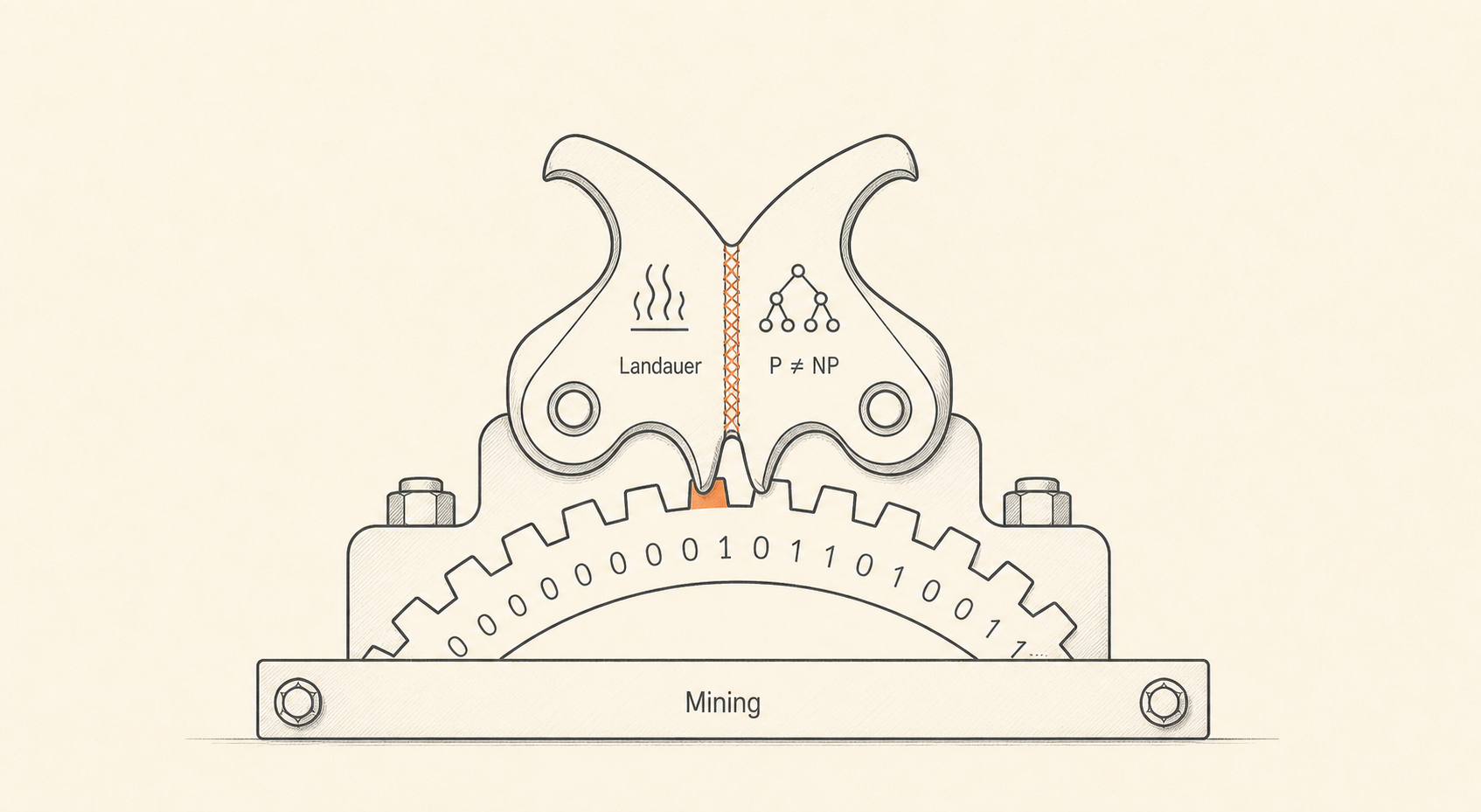
Bitcoin’s contribution is that it builds the horn on purpose, using two distinct pawls welded together. The first pawl is thermodynamic: Landauer’s 1961 result that erasing a bit of information has an unavoidable energy cost. The second is computational: the conjecture that P does not equal NP. One is settled physics. The other is a fifty-five-year-old open problem. Mining bolts them into a single mechanism. The energy dissipated is forced by Landauer. The hash difficulty is forced by the cryptographic conjecture. To produce a block, a miner has to pay the thermodynamic cost of computing hashes, and the computation itself has to traverse the surface of the horn because no shortcut exists.
The simplest way to feel why this matters is to picture cyberspace as a giant pile of wet clay. Bits can take any shape. Any pattern can be made to look like any other. Anyone with admin rights can rewrite the deed to your house and copy it a million times, and no force in the system makes one of the copies the real one. Bitcoin is a kiln inside that clay pile. Mining is the firing. Energy commits upfront. The transformation is irreversible. The verdict comes from an external reference the miner can’t control, which is the network of nodes. The kiln only stays hot because finding the right hash is hard, and the hardness is the conjecture that P does not equal NP. If that conjecture fell, the kiln would cool. The clay would stop baking. Cyberspace would slip back to being a place where disputes can’t be settled, only deferred until someone drags them back into physical reality, where commitments stick.
Time itself only exists where the asymmetry holds. From outside any container, with oracle access to every configuration, P trivially equals NP. There is no search and no flow. From inside, configurations have to be searched for at real cost. The accumulation of those costs across the container’s history is what we have always called time. A universe that began small enough to have no internal search space had no time either. As the container expanded and constraints emerged, the asymmetry opened, and the engine started. Bitcoin runs the same engine in silicon, publicly and observably, every ten minutes since 2009. The connection between the universe’s clock and Bitcoin’s clock is mechanism, all the way down.
Timestamps
[00:00] Have you ever heard of P versus NP
[01:20] Why finding is harder than checking, and what that has to do with time
[04:22] The thousand-piece jigsaw, the Bitcoin block, the same asymmetry
[05:50] NP defined: hard to find, cheap to check
[06:38] The unsettled question, is NP secretly P
[07:27] What collapses if P equals NP
[09:07] Einstein in the patent office as an NP search
[12:48] C squared as search-pruning power
[14:21] The horn branches: brain to paper to community
[16:34] Planck verifies in hours what Einstein took years to find
[19:23] Why P does not equal NP has to hold at every level of the recursion
[20:30] Bitcoin as the engineered instance running publicly
[23:08] Gabriel’s horn as the geometric form of the cost asymmetry
[23:48] Torricelli, 1641, drew the topology of digital security
[26:27] The two pawls: Landauer and the P versus NP conjecture
[29:02] Mining as the welding of physical and mathematical asymmetry
[30:13] Why time itself requires the asymmetry to hold
[31:33] The clay, the kiln, and what cyberspace was before Bitcoin
[33:51] The horn versus the cloud
[36:07] Why irreversibility in cyberspace matters: dispute settlement
[39:23] The horn as the universe’s attractor
[40:42] Next episode: evolution as selection for horn geometry
Timestamps are approximate.
Topics Discussed
P versus NP defined: the asymmetry between finding and checking
The fifty-five-year-old conjecture that P does not equal NP
What breaks if the conjecture fails: HTTPS, banking signatures, password managers, Bitcoin
Einstein in the patent office as an NP search through neural configuration space
C squared as search-pruning power, not only verification quality
How knowledge copies from brain to paper to community at the cost of some compression
The cost asymmetry running fractally from neurons to scientific institutions
Bitcoin as the cleanest engineered case of an NP-asymmetric container
Gabriel’s horn as the geometric form of the cost asymmetry
The two pawls: Landauer’s thermodynamic floor and the P versus NP conjecture
Why cyberspace was clay before Bitcoin and a kiln after
Why time itself requires the asymmetry to hold inside the container
Lowery’s softwar thesis read through the framework: power projection plus time generation
Links & References
Stephen Cook, “The Complexity of Theorem-Proving Procedures,” Proceedings of the Third Annual ACM Symposium on Theory of Computing, 1971
Leonid Levin, “Universal Search Problems,” Problems of Information Transmission, 1973
Rolf Landauer, “Irreversibility and Heat Generation in the Computing Process,” IBM Journal of Research and Development, 1961
Albert Einstein, “Zur Elektrodynamik bewegter Körper,” Annalen der Physik, 1905
Charles Darwin, On the Origin of Species (1859)
Evangelista Torricelli, De solido hyperbolico acuto (1641)
Jason Lowery, Softwar: A Novel Theory on Power Projection and the National Strategic Significance of Bitcoin (US Naval Postgraduate School thesis, 2023)
Satoshi Nakamoto, “Bitcoin: A Peer-to-Peer Electronic Cash System” — bitcoin.org/bitcoin.pdf
“The horn, it’s not a metaphor for NP. The horn is the geometric picture of the cost asymmetry that NP names in mathematics.”
“Bitcoin is a kiln inside of cyberspace.”
“P does not equal NP is what keeps the kiln hot inside the container.”
“Mining isn’t just computation. It’s not just an energy expenditure. It’s the welding together of two distinct asymmetries. One physical, one mathematical, into a single security mechanism.”
“The unification isn’t a metaphor. The unification is the mechanism. And the mechanism is the cost asymmetry of NP.”
Episode #190 – Time
May 08, 2026
Show notes
Somewhere in the world a person has either lost their private keys or has chosen to take them to the grave, and a fixed quantity of Bitcoin will never move again. The surface answer is that the holder gave up purchasing power. This episode argues that what they actually gave up, in a strict physical sense, was time, and that the chronometric identity developed across the last several episodes lets us say that without metaphor.
Episode Summary
In 1687, Isaac Newton built a mechanics in which time is a single universal clock running everywhere at the same rate, and for two centuries that picture explained almost everything anyone could measure. In 1905 and 1915, Albert Einstein replaced it with a picture in which clocks tick at different rates depending on how they move and how deep they sit in a gravitational field, and the GPS satellites overhead correct for both effects every day. Both pictures are about clock time, the thing a clock accumulates. The episode steps a layer beneath that and asks what the clock is actually counting. A pendulum damped by friction, a quartz crystal oscillating in a circuit, a caesium atom flipping between two hyperfine states: each of them counts irreversible state changes, and a good clock is one whose changes are stable enough and regular enough to resist noise.
The chronometric identity is the claim that those state changes are what time is. Time is the ordered accumulation of irreversible state transitions inside a constraint structure. Some transitions are trivial. Some are durable, knowledge bearing, and survive challenge by opening reachable futures that were previously closed off. Knowledge time is that subset, the rate at which the accessible phase space of the system actually grows. Phase space is the collection of configurations a system could in principle occupy. The atoms in a human body could be arranged in an astronomical number of ways, and almost none of those arrangements are a living person. The accessible region is the much smaller set of configurations the body can reach from its present state without destroying itself, and a skilled surgeon expands that region while a careless one contracts it.
Newton did not create gravity. He created access to a region of phase space that gravity had always permitted, and after the Principia an artillery officer could compute a trajectory and a navigator could fix a longitude that no one in 1686 could have computed at all. Maxwell did the same for electromagnetic communication. Satoshi Nakamoto did the same for monetary settlement under adversarial consensus. Each discovery opened a set of transformations that had previously existed only as unrealised possibility. The chronometric identity says the opening is not something that happens in time. The opening is what time is, seen from inside the constraint structure doing the opening.
Once that frame is in place, neither Newton nor Einstein gets contradicted; they get explained. Newton’s universal clock was an outstanding approximation for a regime in which all the relevant clocks sat near each other on a single planet, moved slowly relative to light, and shared almost the same gravitational potential. Einstein showed why that approximation eventually fails: the total rate at which transitions can accumulate along any path through space and time is bounded by the speed of light, so a clock that spends some of that bound on rapid spatial motion has less of it left for internal ticking, and a clock deeper in a gravitational potential sits in a region where the geometry permits less accumulation per unit of an outside observer’s clock. Time dilation is the redistribution of how transitions accumulate. The reading also predicts something the standard view does not. Better clocks cost more energy, because a high-quality tick is an irreversible state change whose timing is strongly constrained against noise, and stronger constraint costs more free energy to produce and to maintain. If time were just an abstract coordinate, an accurate clock would not have to cost any more than an inaccurate one.
The same lens dissolves the past hypothesis, the puzzle that has shaped a century of work in physics. The standard account needs the universe to have started in an extraordinarily improbable, extraordinarily ordered state for the second law of thermodynamics to have an arrow at all, and most of the field treats that initial condition as a brute fact one accepts rather than explains. The chronometric identity makes it a derivation. If time is the rate at which accessible phase space expands through knowledge generation, then the beginning of time has to be the maximally constrained state. Everything locked in. Nothing opened up yet. There is no other state from which knowledge generation can begin, because begin and maximally constrained are the same thing read from opposite sides. The slope of entropy increase is the rate at which durable constraints are created and previously inaccessible regions of phase space become reachable, and it is paid for in heat, which is exactly what the second law has always been measuring.
The cosmic timeline, read this way, is a succession of better receipt-preservation media. The early universe ran the engine for hundreds of thousands of years before recombination cooled it enough for electrons to bind to nuclei, photons to decouple, and the cosmic microwave background to escape as the first surviving public document. Stars built carbon, oxygen, and the heavier elements out of hydrogen and helium and paid in radiation. Biology converted structural knowledge into replicative knowledge by encoding environments into genomes. Minds converted replicative knowledge into explanatory knowledge, which is portable in a way a gene cannot be, so Newton’s laws work on Mars without a population of Newtonian organisms ever evolving there. Civilisation accelerated the same engine again. Writing made memory more durable than any single brain; printing made it cheap; computers made symbolic manipulation fast; the internet made transmission global; and Bitcoin made a public monetary state transition expensive to produce, cheap to verify, and almost impossible to rewrite without paying the cost again. Each layer is a better receipt for the time the universe has already generated.
Bitcoin is the first complete bounded engineered knowledge-generating system whose beginning, rules, state transitions, and accumulated history can be observed from the outside. We cannot stand outside the universe and watch its accessible phase space grow from the Big Bang. We can stand outside Bitcoin and watch a structurally identical system do the same work. Block height is not a coordinate. It is an accumulated count of irreversible public commitments, and the chain in 2026 is not merely longer than the chain in 2009. It carries more proof of work, more adversarial survival, more legal history, more custody practice, more failures absorbed, and more knowledge about what the system can withstand, most of which sits in the ecology around the code rather than inside the code itself. The protocol’s interior stays finite. The boundary of verification and use keeps expanding. That is what makes Bitcoin a Rosetta Stone for the chronometric identity and not just a metaphor for it.
Holding a non-debasing instrument is the inverse of a black hole. A black hole has a boundary that grows while its reach into the outside economy of tasks collapses. A held Bitcoin claim is held open while the surrounding economy grows around it: the holder defers consumption, the productive economy uses the resources the holder declined to pull, new knowledge opens new accessible phase space, and the preserved claim now reaches into a larger future than the one the holder declined to consume. A claim permanently retired by lost or buried keys is the limiting case. Every remaining holder owns a slightly larger share of the fixed supply, and the system’s future claim space has been thinned on the inside and strengthened on the outside. It is not charity in the ordinary moral sense, because charity normally requires intention. It is closer to involuntary monetary philanthropy, a gift produced by the rules of the system rather than by the psychology of the giver, peculiar because nobody receives a transfer and everybody receives a marginal increase in future claim density that remains as long as the keys remain inaccessible. A civilisation that protects its measuring stick rewards deferral, lets producers build against a stable denominator, and compounds. A civilisation that lets it rot punishes deferral, rewards consumption, and ages without compounding. Time is generated, not given, and the choice of monetary instrument is a choice about how much of it the species has.
Timestamps
[00:00] Cold open. The refinery and the time to think [02:54] Lost Bitcoin: someone takes the keys to the grave [10:23] What was actually given? Not just purchasing power [12:30] Two senses of time: clock time, and what clocks count [14:02] The chronometric identity stated [14:57] Knowledge time and accessible phase space [16:45] Newton, Maxwell, Satoshi: opening regions of phase space [18:15] Newton’s absolute time as approximation [19:00] Einstein and the redistribution of transition accumulation [20:21] Better clocks cost more energy [22:18] The past hypothesis dissolved [26:35] Stars, biology, minds, civilisation as engines [27:57] Recombination and the CMB as the first surviving receipt [31:07] Each layer is a better receipt-preservation medium [31:53] Bitcoin as the second spaceship we can watch from outside [33:14] Block height as transition count, not coordinate [34:08] The clay jug returns: Bitcoin as monetary jug [35:28] Holding non-debasing money as monetary inverse of a black hole [37:35] The morality of saving depends on instrument structure [42:01] Lost Bitcoin as involuntary monetary philanthropy [44:41] Civilisational stakes: aging without compounding [48:21] The species’ choice and the deepest project of the universe [49:50] Close: Bitcoin remembers the absence
Timestamps are estimates.
Topics Discussed
Newton’s universal clock and Einstein’s relativistic clock as two readings of clock time
The transition stream beneath every clock and the meaning of a “good” tick
Time defined as the ordered accumulation of irreversible state transitions inside a constraint structure
Accessible phase space and the surgeon analogy
Newton, Maxwell, and Satoshi as openers of previously inaccessible regions of phase space
Time dilation reread as redistribution of transition accumulation under the speed-of-light bound
The energy cost of accuracy as a prediction of the chronometric reading
The past hypothesis dissolved by maximal constraint at t = 0
The cosmic timeline as a succession of receipt-preservation media
Structural, replicative, and explanatory knowledge as three engines of time generation
Bitcoin as a bounded observable system whose beginning, rules, and history can be watched from outside
Block height as accumulated irreversible state transition count, not coordinate
The clay jug returns: Bitcoin’s rules as walls around monetary phase space
Holding non-debasing money as the monetary inverse of a black hole
Lost Bitcoin as involuntary monetary philanthropy and the saver as participant in the extended order’s time engine
Episode #186 – The Anti-Demon: the first statement of K = Ic² and the structural reason a non-debasing instrument can preserve a claim against the demon’s reach.
Notable Pull Quotes
“Time is the ordered accumulation of irreversible state transitions inside a constraint structure.”
“The opening is what time is, seen from inside the constraint structure doing the opening.”
“Bitcoin is the first complete bounded engineered knowledge generating system whose beginning, rules, state transitions, and accumulated history can be observed from the outside.”
“Time is generated. It’s not given.”
“Bitcoin remembers the absence.”
Episode #189 – Gabriel’s Horn: The Shape of Everything
Apr 23, 2026
Show notes
Episode #189 | Published April 23, 2026
In 1641, Evangelista Torricelli rotated the curve y = 1/x around the horizontal axis and obtained a shape whose interior volume converges to π while its surface area diverges to infinity. Mathematicians of the day called it an abomination. Three centuries later, Jacob Bekenstein proved that the entropy of a black hole scales with its event horizon, not its volume. This episode argues that Gabriel’s Horn is the universal blueprint for every structure that creates, stores, or processes knowledge, and that no horn stands alone.
Episode Summary
Torricelli used the proto-calculus of indivisibles available in 1641 to measure his trumpet and got two numbers that should not have coexisted. The interior volume came out to π exactly, a finite quantity that would fit inside a single gallon of paint. The surface area came out to infinity. The physical resolution is that paint has molecular thickness and the horn eventually tapers below that scale, but the geometric truth holds: the universe tolerates objects with a finite interior measure paired with an unbounded boundary measure. That asymmetry is the thread the episode follows.
The shape sat in textbooks as a curiosity until it collided with astrophysics in the 1970s. Bekenstein proposed in 1973 that black-hole entropy scales not with three-dimensional volume but with the two-dimensional area of the event horizon. Stephen Hawking pushed back on the grounds that a black hole cannot radiate heat, and in the course of attempting to disprove the claim he derived the blackbody emission now called Hawking radiation. The Gabriel’s Horn asymmetry, finite interior and unbounded boundary, turned out to describe the most compressed object in the universe. The result became the foundation of the holographic principle in string theory.
Once the pattern is named, it shows up everywhere. A Bitcoin block has a strictly finite interior of roughly 1.5 megabytes of transactions, a header, and a hash pointer, and an unbounded verification surface of every node reading it, every miner committing hashpower, every future block depending on it. Newton’s three laws have an interior a student can memorise in an afternoon and a boundary that is three centuries of apples, artillery, bridges, and satellites. The human mind has a finite interior of neurons and DNA and an unbounded boundary of a lifetime pressing against the world. K = Ic² reads interior as information, the raw Shannon clay, and boundary as constraint, the shape that turns clay into jug. The squaring is not cosmetic. Boundary interactions are networked and combinatorial, and the term mirrors Metcalfe’s law.
Peer. Container. Interior.
A horn cannot exist in empty space. Every horn stands simultaneously in three directions: peer horns at the same scale (other humans, other blocks at similar chain depth), container horns that enclose it (family, city, planet), and interior horns that compose it (cells, molecules, the trillions of bacterial horns of the microbiome). The universe is a fractal of horns, horns made of horns sitting inside larger horns next to peer horns, horns all the way down and all the way up.
The stability question answers itself once the exhaust principle from Episode 188 is ported into the ecology. Every horn doing interior work vents heat at the Landauer minimum. In an isolated-system picture the exhaust leaks into a void. In a densely packed ecology there is no void. The exhaust from one horn presses into the boundary of the next, which metabolises it as fuel. The sun vents photons; trees build cellulose from those photons; animals eat the trees’ chemical exhaust and vent heat and CO&sub2; back; the food chain is a localised horn ecology. Bitcoin runs it explicitly: block N+1 embeds the cryptographic hash of block N as its foundation, so the waste of the past becomes the unforgeable constraint of the future. Heat death was a theorem about isolated systems, and the universe is not one. The universe is a structure building itself out of the fire.
Exhaust becomes fuel.
C is breadth times depth: verifiers pressing on the boundary, multiplied by survived stress cycles. Both factors count surrounding horns. C is not intrinsic. Isolate a horn from its ecology and C collapses to zero; knowledge content collapses with it, regardless of how elegant the interior is. A masterpiece sealed in a safe and sunk to the ocean floor contains high Shannon information and zero knowledge. Newton did not compose the Principia alone in a dark room; he was embedded in the Royal Society, in combative correspondence with Hooke and Leibniz, building on the collected exhaust of his contemporaries. Satoshi wrote the interior in January 2009. The global network wrote the constraint in the seventeen years that followed.
No horn expands forever. When the ratio of boundary to interior diverges past the stability of the tail, the horn pinches. The parent survives, tail truncated. The pinched fragment becomes a child horn, inheriting a compressed fraction of the parent’s constraint and starting its life with a fresh boundary and negligible C. Newtonian mechanics absorbed the precession of Mercury and the ultraviolet catastrophe until its interior could no longer explain the boundary strain, and general relativity pinched off as the child. Scientific revolutions are horn pinches. So are speciations, empires, and paradigms.
The universe itself, on this reading, has to be a horn, and Bitcoin is the second spaceship small enough to walk around and observe from outside. Block zero and the Big Bang share a signature: Shannon entropy zero, internal energy zero, no representation for a block minus one. Constraint and energy were co-created in a single event. Two distinct paths lead to maximum constraint. Brute-force compression, which a black hole exemplifies, yields a sterile child universe whose fundamental constants lack the reach to support complexity. Explanatory compression, which a civilisation of knowledge creators produces by understanding its substrate deeply enough to compress that understanding into a unified theory, yields a child whose constants already permit chemistry and life, because knowledge creators built them. In constructor-theoretic terms, understanding a system completely and writing the next Genesis block are the same physical process. From inside the current universe it looks like discovery. From outside it looks like creation. The framework predicted its own Genesis: it was formalised in a single evening through dense human-LLM exchange, and the theorem, the concept note, and this episode pinched off as three new horns within hours.
Timestamps
[00:00] Cold open. Horns all the way down, and the impossible bucket of paint
[02:42] Torricelli, 1641, and the first horn
[04:58] Bekenstein, Hawking, and the holographic principle
[06:58] Gabriel’s Horn as universal blueprint
[07:57] The Bitcoin block as a horn
[09:08] Newton’s laws and the human mind as horns
[10:26] K = Ic², the clay and the jug
[11:31] Why constraint squared: Metcalfe’s law at the boundary
[13:40] Horn ecology: peer, container, interior
[16:37] Exhaust becomes fuel
[19:45] The Bitcoin chain as a linear horn ecology
[20:31] Heat death inverted, the universe compressing
[21:49] C as breadth times depth
[24:29] Newton in the Royal Society, Satoshi and the network
[27:01] C max and the pinch
[29:18] Scientific revolutions as horn pinches
[31:48] Bitcoin as the second spaceship
[33:41] Two paths to maximum constraint
[35:32] The framework predicts its own Genesis
[37:22] The beginning of infinity
[40:00] Close
Timestamps are estimates.
Topics Discussed
Torricelli’s 1641 derivation of Gabriel’s Horn: volume converges to π, surface area diverges to infinity
Bekenstein’s 1973 proof that black-hole entropy scales with event-horizon area, not volume
Hawking’s failed disproof and the derivation of Hawking radiation
The holographic principle as the asymmetry’s cosmic consequence
Bitcoin blocks, Newton’s laws, and the human mind read as horns
K = Ic² with interior as information and boundary as constraint
The Metcalfe-law rationale for squaring the constraint term
The three-direction census: peer horns, container horns, interior horns
The Exhaust Principle applied to the ecology
The food chain and the Bitcoin chain as worked horn ecologies
Heat death as an artefact of the isolated-system assumption
Constraint quality as ecological census, not intrinsic property
Scientific revolutions, including Newtonian-to-Einsteinian, as horn pinches
Bitcoin’s Genesis block and the Big Bang as structurally identical events
Brute-force versus explanatory paths to maximum constraint
Constructor theory and the claim that understanding a system is the same physical act as writing its Genesis block
Episode #188 – The Exhaust Principle – the direct precursor. Entropy as the receipt for every act of building, and the resolution of the Bekenstein-Hawking puzzle.
Episode #186 – The Anti-Demon – the first statement of K = Ic² and Bitcoin as the structural inverse of Maxwell’s demon.
Notable Pull Quotes
“The universe is a fractal of horns. Horns made of horns sitting inside larger horns next to peer horns. Horns all the way down, all the way up.”
“Satoshi wrote the interior. The global network wrote the constraint.”
“The universe isn’t some fire that’s slowly burning through its own structure until only ashes remain. The universe is a structure building itself out of the fire. It is actively compressing.”
“From inside the current universe it looks like discovery. From outside it looks like creation.”
“The exhaust from one horn becomes the fuel for another horn.”
Episode #188 – The Exhaust Principle
Apr 22, 2026
Show notes
In 1973, Jacob Bekenstein, then John Wheeler’s graduate student at Princeton, demonstrated that a black hole’s entropy is proportional to its surface area, a formula that Stephen Hawking and Brandon Carter would later confirm despite setting out to disprove it. The result has been treated as a paradox for fifty years. This episode argues that the paradox dissolves when the second law is read correctly, and the framework that emerges is the Exhaust Principle: entropy is the receipt for every act of building since Genesis, and the black hole is the biggest engine physics permits.
Episode Summary
John Wheeler, in a filmed interview discussing his work on A Journey into Gravity and Spacetime, once told a story about a conversation with his graduate student Jacob Bekenstein. Wheeler had been thinking about the second law of thermodynamics. He remarked that if he placed a hot tea cup next to a cold tea cup, the two would come to a common temperature, and the universe’s entropy would have gone up because of him. The second law made him complicit. He proposed a solution to his student: if he dropped both cups into a black hole, he could conceal the evidence of the crime. The entropy would leave the universe. The second law would have been outrun. Bekenstein returned some months later with the correction that now carries his name. The entropy had not been outrun. It had been moved. A black hole’s surface area, Bekenstein showed in 1973, encodes an entropy proportional to its area. Stephen Hawking and Brandon Carter, reading the paper and finding it implausible, set out to disprove it. The work they produced instead confirmed Bekenstein’s result, fixed the missing numerical constant, and led Hawking to the radiation that now carries his name.
The result has sat in physics textbooks for fifty years as a puzzle. A black hole is the most compressed object in the universe. A stellar-mass black hole carries approximately 10^77 bits of entropy, more than every star in the observable universe combined. If entropy is disorder, then the most compressed thing in the universe has the most disorder, which makes no physical sense. The standard response has been to note that entropy counts microstates rather than disorder, which is mathematically correct and physically unsatisfying. The artist who illustrated Wheeler’s book covered the black hole’s surface with small boxes, and a friend flipped coins to decide which boxes were black and which were white, so that the resulting picture showed the black hole’s entropy as a surface of random dots. That image has served as the textbook visualisation of Bekenstein-Hawking entropy for half a century.
This episode proposes that the paradox dissolves the moment the second law is read correctly. The second law describes the heat produced when the universe builds. Every act of constraint creation pays energy as heat at the Landauer exchange rate. A star fusing hydrogen into helium pays energy against strong-force repulsion and produces heat as the receipt. Living cells maintain chemistry against diffusion at metabolic cost, and body heat is what that cost looks like from outside. A Bitcoin miner securing a block burns megawatts of electricity that leave the facility as radiated heat. Each act of building produces exhaust, and the exhaust is what the second law measures. Call this the Exhaust Principle. Entropy is the receipt for every act of building since Genesis.
Read in this frame, the black hole stops being a paradox and becomes the prediction. A black hole reaches the absolute maximum constraint physics permits by crushing every degree of freedom in the infalling matter to its limit. Maximum constraint creation produces maximum exhaust. The Bekenstein-Hawking entropy is what one would expect from the universe’s largest engine running at full load. Hawking radiation is the same engine’s exhaust pipe, radiating constraint away at the Landauer minimum one bit at a time. Wheeler’s artist, drawing random dots to depict disorder, was drawing the receipt for the universe’s largest act of building. Every dot on that surface is a fully specified bit, maximally constrained. What looks random from outside the engine is fully determined inside it.
The principle forces a distinction between two paths to maximum constraint. A black hole reaches it by brute compression. The constraint is real, and every degree of freedom is specified, but the reach is zero. It does not explain anything. It is the cosmic equivalent of a random-key-press sequence that happens to produce exactly 285 bytes. A knowledge creator reaches maximum constraint through understanding. The constraint is also real, but the reach is unbounded. Newton’s mechanics reached from falling apples to planetary orbits and later to spaceflight. Einstein’s equations hold from Mercury’s perihelion through the gravitational waves LIGO detected in 2015. Bitcoin’s ledger has reached from a pseudonymous whitepaper into trillions of dollars of value across every continent. Both paths produce maximum exhaust. Only one produces a Genesis block whose initial conditions support further complexity. Brute-force Genesis probably produces sterile daughter universes, with constants that do not permit atoms or chemistry. Explanatory Genesis produces a universe whose constants permit complexity because complexity is what generated those constants in the first place.
The structural identity between Bitcoin’s Genesis block and the Big Bang stops being a metaphor under this reading. Both have Shannon entropy of zero at the Genesis moment: one possible output, a fully specified initial state. Both have zero net internal energy at the start: Bitcoin’s Genesis coinbase is unspendable, and the Big Bang’s mass-energy nets to zero if gravitational potential balances the positive mass-energy, as Edward Tryon proposed in 1973 and Alan Guth developed in 1997. Neither has a “before.” The system has no representation for block minus one or for pre-Big-Bang time. In both cases, the rule-set becoming operative is simultaneously the creation of the energy-constraint pair that the rule-set accounts for. The constraint creates the value. The Genesis block does not need funding because it funds itself by existing.
The instrument that made the entire line of reasoning thinkable is Bitcoin block time. Until 2009, there was no instance of a bounded totality whose internal activity kept growing under fixed rules that could be observed from outside. The universe is a bounded totality with unbounded internal activity, but its inhabitants cannot step outside it to watch. A physicist working inside the universe is a small LEGO piece inside a large spaceship, able to push the piece next to it and see what moves, able to map connections one at a time, never able to see the whole ship. Every experiment is a push. The reach of the push is the reach of the explanation. Bitcoin is a second spaceship, small enough to walk around and observe from every angle, and the second spaceship is what taught us how to look at the first. The Exhaust Principle, the two paths to Genesis, the Bekenstein-Hawking resolution: each of these conjectures was unreachable from inside-only observation. Bitcoin is the Rosetta stone.
Bitcoin’s constraints came from Satoshi, a knowledge creator who understood the inherited constraints of monetary history, cryptography, and computer science deeply enough to compress that understanding into a rule-set and deploy it. The universe’s constraints came from the same structural process one level up, from knowledge creators in a prior cycle who understood their substrate deeply enough to compress the understanding into the initial conditions of our universe. The question “what came before the Big Bang” is syntactically valid and has no referent, in the same way “what is at block minus one” has no referent within Bitcoin. The recursion does not require a mystical first cause. It requires only the observation, which Satoshi’s existence confirms, that knowledge creators inside a bounded totality can compress their understanding into the Genesis event of a new one.
Here the argument takes its deepest turn. Understanding a system completely is the same act as fully specifying that system, and a complete specification of a self-consistent system IS that system. It is the principle of a perfect emulator: a complete specification of a computer’s transistors and circuits runs as that computer, not as an emulation of it. The understanding is already physical. Satoshi’s understanding of the financial system was a physical arrangement of neurons in his brain, maintained at metabolic cost. Mining block zero was the copying of that constraint from one physical substrate to another. By the framework’s logic, the next universe’s Genesis block is already under construction, in the brains of physicists, in the paper records of their results, and in the computers running AI systems that are accelerating the reading. The process is continuous. The Genesis event is the threshold at which the accumulating physical arrangement of understanding becomes complete enough to run as a self-consistent system. We are not living in the remembering. We are living in the building.
Timestamps
[00:00] Jack’s response and the tunnel metaphor
[01:00] The LEGO spaceship: physics is pushing pieces from inside
[02:49] If the spaceship is being built and the heat is exhaust
[03:16] Recap of Episode 187 and the correction
[04:11] The universe is not relaxing. It is compressing.
[05:31] The Exhaust Principle stated
[07:14] The second law as the receipt for building
[07:26] Why both axes rise: constraint and entropy coupled
[09:05] Wheeler’s tea cups and Bekenstein’s 1973 correction
[10:10] Hawking and Carter try to disprove, prove Bekenstein right
[10:41] The artist, the coin flips, and the surface of random dots
[11:20] The resolution: biggest engine, biggest exhaust pipe
[12:28] Hawking radiation as the exhaust pipe
[12:55] The four engines running in Wheeler’s story
[13:46] Two paths to maximum constraint
[16:00] Big Bang as Genesis block
[17:16] Energy and constraint co-created from zero
[19:01] Bitcoin block time as the unlock
[20:24] Bitcoin as the Rosetta stone
[21:00] Where constraints come from
[23:14] Reading the code all the way down IS writing the next block
[23:37] Shannon measured the clay, we measure the jug
[26:21] The perfect emulator
[28:12] The Genesis block is already physical
[30:00] Close: we are living in the building
Timestamps are approximate.
Topics Discussed
The correction to the Episode 187 framing: the universe is compressing, not relaxing
The Exhaust Principle: entropy is the receipt for every act of building since Genesis
Why both axes rise at once: constraint and entropy are engine and exhaust, not opposites
John Wheeler’s tea cups thought experiment and Bekenstein’s 1973 correction
The Bekenstein-Hawking area law and the discovery of Hawking radiation
The Exhaust Principle’s resolution of the black hole entropy puzzle: biggest engine, biggest exhaust pipe
Two paths to maximum constraint: brute force versus explanatory understanding
“The universe is not relaxing. The universe is compressing.”
“Entropy isn’t the trend. It is the receipt that you get for building.”
“The second law isn’t the universe running down. It’s the exhaust from the universe building up.”
“The artist drew the receipt when they thought they were drawing the disorder.”
“Wheeler and Bekenstein were measuring the exhaust pipe. They thought they were measuring disorder. Same numbers. Wrong object.”
“Reading the code all the way down is writing the next block. Understanding and creation are the same act.”
“The Genesis block was always in Satoshi’s head. Mining block zero just gave it its own chain to run on.”
“We are not living in the remembering. We are living in the building.”
Episode #187 – The Shannon Trap
Apr 20, 2026
Show notes
In 1948, Claude Shannon published A Mathematical Theory of Communication and solved, in a single paper, the problem of how to transmit a signal reliably through a noisy channel. He did it by deliberately excluding meaning from his formal definition of information,a move that was correct for the engineering problem at hand and costly once the rest of the twentieth century adopted his measure as the definition of information itself. This episode is about the inversion that followed, and the proposed repair: K = Ic².
Episode Summary
The way a wrong early guess corrupts a game of charades illustrates a cognitive pattern that applies far beyond party games. When one player shouts a confident early guess, Jaws,the entire team anchors to it, and every subsequent gesture the mimer produces gets filtered through that frame. Course correction becomes impossible, not because the evidence stops arriving, but because the evidence is being read through the wrong category. In 1948, Claude Shannon shouted the equivalent of Jaws in the domain of information theory, and the field that followed him has spent seventy-five years interpreting everything through his frame.
Shannon was working at Bell Labs on a concrete engineering problem: how to transmit a signal through a noisy communication channel without the message being garbled at the receiver. He was explicit about the move he made to solve it. The semantic content of the message, he wrote, was irrelevant to the engineering task, because the pipe carrying a phone call does not care whether the callers are arguing philosophy or hitting the keypad with their foreheads. The signal must only fit inside the pipe. What Shannon formalised under the name information was really a measure of possibility space,a count of how many different messages the source could have sent. His entropy rises as the message becomes less predictable and falls as it becomes more determined. For the telephone network, this was exactly the right measurement, and it was enough to build the digital century on.
The error did not lie in Shannon’s math. It lay in what happened next. The field he created adopted his measure as the definition of information itself, and then philosophy and cosmology picked up that definition and ran with it. The map became the territory. Consider a sandcastle on a beach and, next to it, a flat stretch of sand. The two contain the same atoms and, if one lists the three-dimensional coordinates of every grain, take the same number of bits to describe. Shannon’s measure returns the same answer for both. But one is a functional structure that holds form against wind and tide, and the other is what the beach becomes when nothing is holding it. The difference between them is not in the data. It is in the constraint.
In 1961, Rolf Landauer, working at IBM, demonstrated that erasing one bit of information carries an unavoidable thermodynamic cost,roughly 3 × 10⁻²¹ joules at room temperature, a quantity so small that the result was treated as a theoretical curiosity for half a century, until Antoine Bérut and colleagues confirmed it experimentally in Nature in 2012. The implication is straightforward. A bit is not a floating conceptual unit that sits above the hardware. It is a magnetic domain on a disk, a transistor in a memory cell, a specific physical arrangement held in place against the universe’s preference for the generic. Erase the bit, and the system slides back toward that preference while the energy that was holding the arrangement dissipates as heat. A bit, in other words, is a unit of constraint. And maintaining any constraint costs energy.
Read in this frame, the second law of thermodynamics changes register without changing content. Entropy increases in a closed system is the textbook formulation, usually interpreted as things fall apart. Translated into the constraint language: constraint dissipates unless something actively maintains it. A sandcastle pays rent to the wind and the tide. A magnetic domain pays rent to thermal noise. Cease paying, and the arrangement relaxes to the generic. Heat death, under this reading, is not a universe running out of energy but a universe running out of constraint. Shannon’s measure, seen against this backdrop, is the inverse of what the later field took it to be. It reads maximum information when the instrument is pointed at pure noise.
The compounding loop: knowledge unlocks energy, which funds more commitments, which make more time.
The repair is a modified equation: K = Ic². Knowledge equals information multiplied by constraint quality squared. Shannon’s I survives. The c² is the coefficient he deliberately excluded because his phone line did not require it. With that restoration, a new question opens. What does constraint creation look like as a physical process? The answer proposed in this episode is that one four-step mechanism runs at every scale at which the physical world produces durable structure. First, energy is committed up front, before the outcome is known. Second, the transformation is made irreversible, in the sense that reversing it would cost more energy than it released. Third, the verdict is delivered by an external reference the actor does not control. Fourth, there is no path back. Wet clay entering a kiln. Two hydrogen nuclei approaching fusion at the core of a star. A mutation carried for a full generation before selection touches it. A researcher committing a year of career and a laboratory budget to a hypothesis the physical world will evaluate. A miner expending megawatts on a hash contest whose verdict is delivered by nodes he does not control. One mechanism, running in five materials.
One mechanism in four materials: pay, commit, test, no path back.
Under this frame, time is not a backdrop against which events occur. Time is the accumulation of irreversible commitments. An old star, in this sense, is a star that has closed a great many doors behind it. Three and a half billion years of biological time is a sequence of mutations that could not be withdrawn. A calendar year spent committing to difficult projects that reality then tested contains more time, under this framework, than a year in which nothing changed, even though the calendar disagrees. Einstein’s equations tell us how many such commitments are possible along any given path through spacetime, and they do so with the kind of experimental confirmation one finds nowhere else in physics. They do not tell us what a tick is made of. A tick, this episode proposes, is an irreversible commitment. And not every tick carries equal knowledge.
Consider a large language model under the two frames. In the Shannon frame, the model looks maximally informative: trillions of parameters, an enormous possibility space, any combination of words it is asked to produce. In the constraint frame, the same model has no self-maintained constraint of its own. It is predicting the next token from the statistical distribution of language it was trained on, and the explanatory constraint in that distribution was built by the humans who wrote the original text. The model is a compression of human constraint, not a generator of new constraint. It is the sandcastle and the beach, rendered again at trillion-parameter resolution. Bitcoin, by the same logic, is the minimal example of a new constraint generator for the economic domain: energy committed up front, blocks whose production cannot be undone, verdicts delivered by nodes no miner controls, and a record that thickens with every ten-minute interval into something more expensive to revise than to accept.
The account of creativity that falls out of the argument is tighter than the one ordinarily offered. A potter shaping a clay jug creates an interior, a bounded region of possibility,where before there was only the undifferentiated lump. The Impressionists, barred from the academic studios of late nineteenth-century Paris, chose to paint outside and inherited two constraints the studios had neutralised: changing light, and weather they could not control. From those they derived techniques, broken colour and visible brushwork, above all,that could not have been discovered indoors. Cézanne came next, then cubism a generation later, each new constraint revealing an interior of the manifold that did not previously exist. Evolution also opens phase space through random variation, yet the wing does not carry an account of why it works. The periodic table does, and the account reaches into quantum mechanics and nuclear physics,domains Mendeleev could not have imagined in 1869. Creativity, in the stricter definition, is the imposition of a novel explanatory constraint that opens inaccessible configurations and whose explanation has reach beyond its origin. Reach is the line separating a useful local pattern from genuine knowledge.
Timestamps
00:00:00 – Charades and the wrong early guess
00:03:55 – Shannon at Bell Labs and the problem he was actually solving
00:05:37 – Why he deliberately excluded meaning from the math
00:07:20 – Map and territory: when the engineering tool became the ontology
00:07:33 – The sandcastle and the flat beach
00:10:14 – Landauer and the physical cost of erasing a bit
00:12:49 – Rewriting the second law in the language of constraint
00:14:09 – A meter that reads maximum information at maximum noise
00:15:14 – K = IC² as the proposed repair
00:16:30 – The four-step mechanism: pay, commit, test, no path back
00:18:04 – Stars, DNA, minds, markets, and Bitcoin as one mechanism in five materials
00:23:05 – Time as accumulated irreversible commitment
00:25:52 – Einstein’s equations describe the ticks but not what a tick is made of
00:28:47 – Coal and uranium: knowledge opens access to phase space the past couldn’t reach
00:29:45 – AI as compression of human constraint, not a generator of new constraint
00:31:45 – Bitcoin as the correct body for machine-generated economic claims
00:33:00 – Creativity as a novel explanatory constraint
00:37:20 – Evolution versus minds: reach as the line
Timestamps are approximate.
Topics Discussed
Claude Shannon’s 1948 information theory and what it was actually built to solve
Why Shannon deliberately excluded meaning from the formal measure of information
The sandcastle on the beach: two objects with identical bit-counts carrying different amounts of something Shannon can’t see
Landauer’s Principle and the thermodynamic cost of erasing one bit
A bit as a unit of constraint rather than as an abstract unit of information
Entropy as the absence of constraint rather than as disorder
K = IC² as the proposed repair to the Shannon inversion
The four-step mechanism of irreversible commitment across clay, stars, DNA, minds, markets, and Bitcoin
Time as a count of tested commitments, not a backdrop
Why an LLM is a compression of human constraint rather than a generator of new constraint
Bitcoin as the first body through which machine-generated claims can act on physical reality
Creativity as the imposition of a novel explanatory constraint with reach beyond its origin
Links & References
Claude Shannon, “A Mathematical Theory of Communication” (Bell System Technical Journal, 1948)
Rolf Landauer, “Irreversibility and Heat Generation in the Computing Process” (IBM Journal of Research and Development, 1961)
Bérut et al., “Experimental verification of Landauer’s principle linking information and thermodynamics” (Nature 483, 2012)

 Our TOPPODCAST Picks
  Stay Connected